EP1117801B1 - Polyketide synthase enzymes and recombinant dna constructs therefor, for the production of compounds related to fk-506 and fk-520 - Google Patents
Polyketide synthase enzymes and recombinant dna constructs therefor, for the production of compounds related to fk-506 and fk-520 Download PDFInfo
- Publication number
- EP1117801B1 EP1117801B1 EP99970125A EP99970125A EP1117801B1 EP 1117801 B1 EP1117801 B1 EP 1117801B1 EP 99970125 A EP99970125 A EP 99970125A EP 99970125 A EP99970125 A EP 99970125A EP 1117801 B1 EP1117801 B1 EP 1117801B1
- Authority
- EP
- European Patent Office
- Prior art keywords
- pks
- module
- recombinant
- compounds
- domain
- Prior art date
- Legal status (The legal status is an assumption and is not a legal conclusion. Google has not performed a legal analysis and makes no representation as to the accuracy of the status listed.)
- Expired - Lifetime
Links
- 229960001967 tacrolimus Drugs 0.000 title claims abstract description 190
- QJJXYPPXXYFBGM-LFZNUXCKSA-N Tacrolimus Chemical compound C1C[C@@H](O)[C@H](OC)C[C@@H]1\C=C(/C)[C@@H]1[C@H](C)[C@@H](O)CC(=O)[C@H](CC=C)/C=C(C)/C[C@H](C)C[C@H](OC)[C@H]([C@H](C[C@H]2C)OC)O[C@@]2(O)C(=O)C(=O)N2CCCC[C@H]2C(=O)O1 QJJXYPPXXYFBGM-LFZNUXCKSA-N 0.000 title abstract description 162
- QJJXYPPXXYFBGM-SHYZHZOCSA-N tacrolimus Natural products CO[C@H]1C[C@H](CC[C@@H]1O)C=C(C)[C@H]2OC(=O)[C@H]3CCCCN3C(=O)C(=O)[C@@]4(O)O[C@@H]([C@H](C[C@H]4C)OC)[C@@H](C[C@H](C)CC(=C[C@@H](CC=C)C(=O)C[C@H](O)[C@H]2C)C)OC QJJXYPPXXYFBGM-SHYZHZOCSA-N 0.000 title abstract description 156
- 108010030975 Polyketide Synthases Proteins 0.000 title description 484
- 150000001875 compounds Chemical class 0.000 title description 198
- 108020004511 Recombinant DNA Proteins 0.000 title description 27
- 238000004519 manufacturing process Methods 0.000 title description 23
- 229930001119 polyketide Natural products 0.000 claims abstract description 114
- 150000003881 polyketide derivatives Chemical class 0.000 claims description 63
- 229910052739 hydrogen Inorganic materials 0.000 claims description 36
- 239000001257 hydrogen Substances 0.000 claims description 36
- 230000001506 immunosuppresive effect Effects 0.000 claims description 23
- 125000002496 methyl group Chemical group [H]C([H])([H])* 0.000 claims description 19
- 125000001495 ethyl group Chemical group [H]C([H])([H])C([H])([H])* 0.000 claims description 16
- 125000002887 hydroxy group Chemical group [H]O* 0.000 claims description 13
- 125000004435 hydrogen atom Chemical group [H]* 0.000 claims description 9
- 125000000956 methoxy group Chemical group [H]C([H])([H])O* 0.000 claims description 8
- GRVDJDISBSALJP-UHFFFAOYSA-N methyloxidanyl Chemical group [O]C GRVDJDISBSALJP-UHFFFAOYSA-N 0.000 claims description 8
- 210000005036 nerve Anatomy 0.000 claims description 8
- 230000012010 growth Effects 0.000 claims description 6
- 239000008194 pharmaceutical composition Substances 0.000 claims description 6
- 125000003903 2-propenyl group Chemical group [H]C([*])([H])C([H])=C([H])[H] 0.000 claims description 4
- 206010062016 Immunosuppression Diseases 0.000 claims description 4
- 230000008929 regeneration Effects 0.000 claims description 3
- 238000011069 regeneration method Methods 0.000 claims description 3
- 238000002560 therapeutic procedure Methods 0.000 claims description 3
- ZDQSOHOQTUFQEM-NURRSENYSA-N ascomycin Chemical compound C/C([C@H]1OC(=O)[C@@H]2CCCCN2C(=O)C(=O)[C@]2(O)O[C@@H]([C@H](C[C@H]2C)OC)[C@@H](OC)C[C@@H](C)C/C(C)=C/[C@H](C(C[C@H](O)[C@H]1C)=O)CC)=C\[C@@H]1CC[C@@H](O)[C@H](OC)C1 ZDQSOHOQTUFQEM-NURRSENYSA-N 0.000 abstract description 337
- -1 Polyketide compounds Chemical class 0.000 abstract description 64
- 239000004606 Fillers/Extenders Substances 0.000 description 154
- 108700016155 Acyl transferases Proteins 0.000 description 153
- 102000057234 Acyl transferases Human genes 0.000 description 153
- 108090000623 proteins and genes Proteins 0.000 description 135
- 108091026890 Coding region Proteins 0.000 description 119
- 210000004027 cell Anatomy 0.000 description 104
- 108020004414 DNA Proteins 0.000 description 78
- 102000004867 Hydro-Lyases Human genes 0.000 description 77
- 108090001042 Hydro-Lyases Proteins 0.000 description 77
- 101001110310 Lentilactobacillus kefiri NADP-dependent (R)-specific alcohol dehydrogenase Proteins 0.000 description 72
- 101710146995 Acyl carrier protein Proteins 0.000 description 55
- QFJCIRLUMZQUOT-HPLJOQBZSA-N sirolimus Chemical compound C1C[C@@H](O)[C@H](OC)C[C@@H]1C[C@@H](C)[C@H]1OC(=O)[C@@H]2CCCCN2C(=O)C(=O)[C@](O)(O2)[C@H](C)CC[C@H]2C[C@H](OC)/C(C)=C/C=C/C=C/[C@@H](C)C[C@@H](C)C(=O)[C@H](OC)[C@H](O)/C(C)=C/[C@@H](C)C(=O)C1 QFJCIRLUMZQUOT-HPLJOQBZSA-N 0.000 description 52
- ZAHRKKWIAAJSAO-UHFFFAOYSA-N rapamycin Natural products COCC(O)C(=C/C(C)C(=O)CC(OC(=O)C1CCCCN1C(=O)C(=O)C2(O)OC(CC(OC)C(=CC=CC=CC(C)CC(C)C(=O)C)C)CCC2C)C(C)CC3CCC(O)C(C3)OC)C ZAHRKKWIAAJSAO-UHFFFAOYSA-N 0.000 description 51
- 229960002930 sirolimus Drugs 0.000 description 51
- 101001014220 Monascus pilosus Dehydrogenase mokE Proteins 0.000 description 50
- 101000573542 Penicillium citrinum Compactin nonaketide synthase, enoyl reductase component Proteins 0.000 description 50
- 238000000034 method Methods 0.000 description 50
- 230000015572 biosynthetic process Effects 0.000 description 49
- 230000000295 complement effect Effects 0.000 description 47
- 125000000830 polyketide group Chemical group 0.000 description 46
- 239000013598 vector Substances 0.000 description 45
- 102000018679 Tacrolimus Binding Proteins Human genes 0.000 description 42
- 108010027179 Tacrolimus Binding Proteins Proteins 0.000 description 40
- 230000027455 binding Effects 0.000 description 36
- VUGZQVCBBBEZQE-VRQRJWBYSA-N Ethylmalonyl-CoA Chemical compound O[C@@H]1[C@H](OP(O)(O)=O)[C@@H](COP(O)(=O)OP(O)(=O)OCC(C)(C)C(O)C(=O)NCCC(=O)NCCSC(=O)C(C(O)=O)CC)O[C@H]1N1C2=NC=NC(N)=C2N=C1 VUGZQVCBBBEZQE-VRQRJWBYSA-N 0.000 description 35
- 230000000694 effects Effects 0.000 description 34
- 238000011068 loading method Methods 0.000 description 34
- MZFOKIKEPGUZEN-FBMOWMAESA-N methylmalonyl-CoA Chemical group O[C@@H]1[C@H](OP(O)(O)=O)[C@@H](COP(O)(=O)OP(O)(=O)OCC(C)(C)[C@@H](O)C(=O)NCCC(=O)NCCSC(=O)C(C(O)=O)C)O[C@H]1N1C2=NC=NC(N)=C2N=C1 MZFOKIKEPGUZEN-FBMOWMAESA-N 0.000 description 31
- 102000004190 Enzymes Human genes 0.000 description 29
- 108090000790 Enzymes Proteins 0.000 description 29
- 229940088598 enzyme Drugs 0.000 description 29
- 108091008053 gene clusters Proteins 0.000 description 25
- LOZMZPIMDDLWRS-KOQRGSBKSA-N 3-[2-[3-[[(2r)-4-[[[(2r,3s,4r,5r)-5-(6-aminopurin-9-yl)-4-hydroxy-3-phosphonooxyoxolan-2-yl]methoxy-hydroxyphosphoryl]oxy-hydroxyphosphoryl]oxy-2-hydroxy-3,3-dimethylbutanoyl]amino]propanoylamino]ethylsulfanyl]-2-hydroxy-3-oxopropanoic acid Chemical compound O[C@@H]1[C@H](OP(O)(O)=O)[C@@H](COP(O)(=O)OP(O)(=O)OCC(C)(C)[C@@H](O)C(=O)NCCC(=O)NCCSC(=O)C(O)C(O)=O)O[C@H]1N1C2=NC=NC(N)=C2N=C1 LOZMZPIMDDLWRS-KOQRGSBKSA-N 0.000 description 24
- 108090000765 processed proteins & peptides Proteins 0.000 description 24
- 238000003786 synthesis reaction Methods 0.000 description 24
- 102000004196 processed proteins & peptides Human genes 0.000 description 23
- 239000003814 drug Substances 0.000 description 22
- ULGZDMOVFRHVEP-RWJQBGPGSA-N Erythromycin Chemical compound O([C@@H]1[C@@H](C)C(=O)O[C@@H]([C@@]([C@H](O)[C@@H](C)C(=O)[C@H](C)C[C@@](C)(O)[C@H](O[C@H]2[C@@H]([C@H](C[C@@H](C)O2)N(C)C)O)[C@H]1C)(C)O)CC)[C@H]1C[C@@](C)(OC)[C@@H](O)[C@H](C)O1 ULGZDMOVFRHVEP-RWJQBGPGSA-N 0.000 description 21
- 229920001184 polypeptide Polymers 0.000 description 21
- LTYOQGRJFJAKNA-KKIMTKSISA-N Malonyl CoA Natural products S(C(=O)CC(=O)O)CCNC(=O)CCNC(=O)[C@@H](O)C(CO[P@](=O)(O[P@](=O)(OC[C@H]1[C@@H](OP(=O)(O)O)[C@@H](O)[C@@H](n2c3ncnc(N)c3nc2)O1)O)O)(C)C LTYOQGRJFJAKNA-KKIMTKSISA-N 0.000 description 20
- 241000187747 Streptomyces Species 0.000 description 20
- 239000013604 expression vector Substances 0.000 description 20
- LTYOQGRJFJAKNA-DVVLENMVSA-N malonyl-CoA Chemical compound O[C@@H]1[C@H](OP(O)(O)=O)[C@@H](COP(O)(=O)OP(O)(=O)OCC(C)(C)[C@@H](O)C(=O)NCCC(=O)NCCSC(=O)CC(O)=O)O[C@H]1N1C2=NC=NC(N)=C2N=C1 LTYOQGRJFJAKNA-DVVLENMVSA-N 0.000 description 20
- 108010025020 Nerve Growth Factor Proteins 0.000 description 18
- 102000004169 proteins and genes Human genes 0.000 description 18
- 229940079593 drug Drugs 0.000 description 17
- 125000005647 linker group Chemical group 0.000 description 17
- 125000000346 malonyl group Chemical group C(CC(=O)*)(=O)* 0.000 description 17
- 239000000203 mixture Substances 0.000 description 17
- 102000007072 Nerve Growth Factors Human genes 0.000 description 16
- 108700026244 Open Reading Frames Proteins 0.000 description 16
- 235000018102 proteins Nutrition 0.000 description 16
- XEKOWRVHYACXOJ-UHFFFAOYSA-N Ethyl acetate Chemical compound CCOC(C)=O XEKOWRVHYACXOJ-UHFFFAOYSA-N 0.000 description 15
- 239000012634 fragment Substances 0.000 description 15
- 108020004707 nucleic acids Proteins 0.000 description 15
- 102000039446 nucleic acids Human genes 0.000 description 15
- 238000003752 polymerase chain reaction Methods 0.000 description 15
- 150000001413 amino acids Chemical class 0.000 description 14
- 238000013459 approach Methods 0.000 description 14
- 230000001851 biosynthetic effect Effects 0.000 description 14
- 239000000047 product Substances 0.000 description 14
- 238000010276 construction Methods 0.000 description 13
- 239000003018 immunosuppressive agent Substances 0.000 description 13
- 239000003120 macrolide antibiotic agent Substances 0.000 description 13
- 0 C[C@](C[C@]1*)[C@@](C(C(N(CCCC2)C2C(O[C@@]([C@](C)[C@](CC([C@](*)C=C(C)C[C@](C)C2)=O)O)C(C)=C[C@](CC[C@]3*)C[C@]3OC)=O)=O)=O)(O)O[C@@]1[C@]2OC Chemical compound C[C@](C[C@]1*)[C@@](C(C(N(CCCC2)C2C(O[C@@]([C@](C)[C@](CC([C@](*)C=C(C)C[C@](C)C2)=O)O)C(C)=C[C@](CC[C@]3*)C[C@]3OC)=O)=O)=O)(O)O[C@@]1[C@]2OC 0.000 description 12
- 108060004795 Methyltransferase Proteins 0.000 description 12
- 239000012636 effector Substances 0.000 description 12
- 229960003444 immunosuppressant agent Drugs 0.000 description 12
- 230000004060 metabolic process Effects 0.000 description 12
- 150000007523 nucleic acids Chemical class 0.000 description 12
- NSFFHOGKXHRQEW-UHFFFAOYSA-N Thiostrepton B Natural products N1C(=O)C(C)NC(=O)C(=C)NC(=O)C(C)NC(=O)C(C(C)CC)NC(C(C2=N3)O)C=CC2=C(C(C)O)C=C3C(=O)OC(C)C(C=2SC=C(N=2)C2N=3)NC(=O)C(N=4)=CSC=4C(C(C)(O)C(C)O)NC(=O)C(N=4)CSC=4C(=CC)NC(=O)C(C(C)O)NC(=O)C(N=4)=CSC=4C21CCC=3C1=NC(C(=O)NC(=C)C(=O)NC(=C)C(N)=O)=CS1 NSFFHOGKXHRQEW-UHFFFAOYSA-N 0.000 description 11
- 239000003153 chemical reaction reagent Substances 0.000 description 11
- 229960003276 erythromycin Drugs 0.000 description 11
- 230000001861 immunosuppressant effect Effects 0.000 description 11
- 239000002207 metabolite Substances 0.000 description 11
- 239000000126 substance Substances 0.000 description 11
- 229930188070 thiostrepton Natural products 0.000 description 11
- NSFFHOGKXHRQEW-AIHSUZKVSA-N thiostrepton Chemical compound C([C@]12C=3SC=C(N=3)C(=O)N[C@H](C(=O)NC(/C=3SC[C@@H](N=3)C(=O)N[C@H](C=3SC=C(N=3)C(=O)N[C@H](C=3SC=C(N=3)[C@H]1N=1)[C@@H](C)OC(=O)C3=CC(=C4C=C[C@H]([C@@H](C4=N3)O)N[C@H](C(N[C@@H](C)C(=O)NC(=C)C(=O)N[C@@H](C)C(=O)N2)=O)[C@@H](C)CC)[C@H](C)O)[C@](C)(O)[C@@H](C)O)=C\C)[C@@H](C)O)CC=1C1=NC(C(=O)NC(=C)C(=O)NC(=C)C(N)=O)=CS1 NSFFHOGKXHRQEW-AIHSUZKVSA-N 0.000 description 11
- 229940063214 thiostrepton Drugs 0.000 description 11
- NSFFHOGKXHRQEW-OFMUQYBVSA-N thiostrepton A Natural products CC[C@H](C)[C@@H]1N[C@@H]2C=Cc3c(cc(nc3[C@H]2O)C(=O)O[C@H](C)[C@@H]4NC(=O)c5csc(n5)[C@@H](NC(=O)[C@H]6CSC(=N6)C(=CC)NC(=O)[C@@H](NC(=O)c7csc(n7)[C@]8(CCC(=N[C@@H]8c9csc4n9)c%10nc(cs%10)C(=O)NC(=C)C(=O)NC(=C)C(=O)N)NC(=O)[C@H](C)NC(=O)C(=C)NC(=O)[C@H](C)NC1=O)[C@@H](C)O)[C@](C)(O)[C@@H](C)O)[C@H](C)O NSFFHOGKXHRQEW-OFMUQYBVSA-N 0.000 description 11
- 102000016397 Methyltransferase Human genes 0.000 description 10
- 102000005488 Thioesterase Human genes 0.000 description 10
- 238000012217 deletion Methods 0.000 description 10
- 230000037430 deletion Effects 0.000 description 10
- 230000006870 function Effects 0.000 description 10
- 230000014509 gene expression Effects 0.000 description 10
- 239000000765 neuroimmunophilin Substances 0.000 description 10
- 230000000508 neurotrophic effect Effects 0.000 description 10
- 239000013612 plasmid Substances 0.000 description 10
- 108020002982 thioesterase Proteins 0.000 description 10
- UFHFLCQGNIYNRP-UHFFFAOYSA-N Hydrogen Chemical class [H][H] UFHFLCQGNIYNRP-UHFFFAOYSA-N 0.000 description 9
- 108090000364 Ligases Proteins 0.000 description 9
- 102000003960 Ligases Human genes 0.000 description 9
- 108010019477 S-adenosyl-L-methionine-dependent N-methyltransferase Proteins 0.000 description 9
- 238000006243 chemical reaction Methods 0.000 description 9
- 238000003780 insertion Methods 0.000 description 9
- 230000037431 insertion Effects 0.000 description 9
- 239000003446 ligand Substances 0.000 description 9
- 230000004048 modification Effects 0.000 description 9
- 238000012986 modification Methods 0.000 description 9
- 108010000785 non-ribosomal peptide synthase Proteins 0.000 description 9
- 101001074427 Bacillus subtilis (strain 168) Polyketide synthase PksJ Proteins 0.000 description 8
- 101001074418 Bacillus subtilis (strain 168) Polyketide synthase PksL Proteins 0.000 description 8
- 102000004631 Calcineurin Human genes 0.000 description 8
- 108010042955 Calcineurin Proteins 0.000 description 8
- 101000803786 Emericella nidulans (strain FGSC A4 / ATCC 38163 / CBS 112.46 / NRRL 194 / M139) Conidial yellow pigment biosynthesis polyketide synthase Proteins 0.000 description 8
- 101000701349 Emericella nidulans (strain FGSC A4 / ATCC 38163 / CBS 112.46 / NRRL 194 / M139) Putative sterigmatocystin biosynthesis polyketide synthase Proteins 0.000 description 8
- 101100066733 Emericella nidulans (strain FGSC A4 / ATCC 38163 / CBS 112.46 / NRRL 194 / M139) fkbB gene Proteins 0.000 description 8
- 108091028043 Nucleic acid sequence Proteins 0.000 description 8
- 102100029437 Serine/threonine-protein kinase A-Raf Human genes 0.000 description 8
- 101000730455 Serratia sp. (strain ATCC 39006) Beta-ketoacyl synthase PigJ Proteins 0.000 description 8
- 101000691656 Streptomyces venezuelae Narbonolide/10-deoxymethynolide synthase PikA1, modules 1 and 2 Proteins 0.000 description 8
- 101000691655 Streptomyces venezuelae Narbonolide/10-deoxymethynolide synthase PikA2, modules 3 and 4 Proteins 0.000 description 8
- 101000691658 Streptomyces venezuelae Narbonolide/10-deoxymethynolide synthase PikA3, module 5 Proteins 0.000 description 8
- 101001125873 Streptomyces venezuelae Narbonolide/10-deoxymethynolide synthase PikA4, module 6 Proteins 0.000 description 8
- 238000007385 chemical modification Methods 0.000 description 8
- 235000019867 fractionated palm kernal oil Nutrition 0.000 description 8
- 238000010353 genetic engineering Methods 0.000 description 8
- 230000008901 benefit Effects 0.000 description 7
- 238000000855 fermentation Methods 0.000 description 7
- 230000004151 fermentation Effects 0.000 description 7
- 230000008520 organization Effects 0.000 description 7
- 230000008569 process Effects 0.000 description 7
- 239000000758 substrate Substances 0.000 description 7
- 231100000419 toxicity Toxicity 0.000 description 7
- 230000001988 toxicity Effects 0.000 description 7
- 102000004328 Cytochrome P-450 CYP3A Human genes 0.000 description 6
- 108010081668 Cytochrome P-450 CYP3A Proteins 0.000 description 6
- CSNNHWWHGAXBCP-UHFFFAOYSA-L Magnesium sulfate Chemical compound [Mg+2].[O-][S+2]([O-])([O-])[O-] CSNNHWWHGAXBCP-UHFFFAOYSA-L 0.000 description 6
- OKKJLVBELUTLKV-UHFFFAOYSA-N Methanol Chemical compound OC OKKJLVBELUTLKV-UHFFFAOYSA-N 0.000 description 6
- 101100502843 Streptomyces anulatus fkbP gene Proteins 0.000 description 6
- 241000187398 Streptomyces lividans Species 0.000 description 6
- 230000009471 action Effects 0.000 description 6
- 238000004458 analytical method Methods 0.000 description 6
- 229910052799 carbon Inorganic materials 0.000 description 6
- 208000037265 diseases, disorders, signs and symptoms Diseases 0.000 description 6
- 150000002431 hydrogen Chemical group 0.000 description 6
- 210000001853 liver microsome Anatomy 0.000 description 6
- VLKZOEOYAKHREP-UHFFFAOYSA-N n-Hexane Chemical compound CCCCCC VLKZOEOYAKHREP-UHFFFAOYSA-N 0.000 description 6
- 238000003259 recombinant expression Methods 0.000 description 6
- 239000005660 Abamectin Substances 0.000 description 5
- OKTJSMMVPCPJKN-UHFFFAOYSA-N Carbon Chemical group [C] OKTJSMMVPCPJKN-UHFFFAOYSA-N 0.000 description 5
- LFQSCWFLJHTTHZ-UHFFFAOYSA-N Ethanol Chemical compound CCO LFQSCWFLJHTTHZ-UHFFFAOYSA-N 0.000 description 5
- HXEACLLIILLPRG-YFKPBYRVSA-N L-pipecolic acid Chemical compound [O-]C(=O)[C@@H]1CCCC[NH2+]1 HXEACLLIILLPRG-YFKPBYRVSA-N 0.000 description 5
- 101150053185 P450 gene Proteins 0.000 description 5
- 241000187432 Streptomyces coelicolor Species 0.000 description 5
- 241000187391 Streptomyces hygroscopicus Species 0.000 description 5
- 101100066722 Streptomyces hygroscopicus fkbO gene Proteins 0.000 description 5
- RRZXIRBKKLTSOM-XPNPUAGNSA-N avermectin B1a Chemical compound C1=C[C@H](C)[C@@H]([C@@H](C)CC)O[C@]11O[C@H](C\C=C(C)\[C@@H](O[C@@H]2O[C@@H](C)[C@H](O[C@@H]3O[C@@H](C)[C@H](O)[C@@H](OC)C3)[C@@H](OC)C2)[C@@H](C)\C=C\C=C/2[C@]3([C@H](C(=O)O4)C=C(C)[C@@H](O)[C@H]3OC\2)O)C[C@H]4C1 RRZXIRBKKLTSOM-XPNPUAGNSA-N 0.000 description 5
- 201000010099 disease Diseases 0.000 description 5
- 238000005516 engineering process Methods 0.000 description 5
- 238000010348 incorporation Methods 0.000 description 5
- HXEACLLIILLPRG-RXMQYKEDSA-N l-pipecolic acid Natural products OC(=O)[C@H]1CCCCN1 HXEACLLIILLPRG-RXMQYKEDSA-N 0.000 description 5
- 239000002243 precursor Substances 0.000 description 5
- 108091008146 restriction endonucleases Proteins 0.000 description 5
- 239000000523 sample Substances 0.000 description 5
- 239000007858 starting material Substances 0.000 description 5
- 150000007970 thio esters Chemical class 0.000 description 5
- HQZOLNNEQAKEHT-UHFFFAOYSA-N (3R,4S,5R,6S,7S,9R,11R,12S,13R,14R)-14-ethyl-4,6,12-trihydroxy-3,5,7,9,11,13-hexamethyloxacyclotetradecane-2,10-dione Natural products CCC1OC(=O)C(C)C(O)C(C)C(O)C(C)CC(C)C(=O)C(C)C(O)C1C HQZOLNNEQAKEHT-UHFFFAOYSA-N 0.000 description 4
- VYAKOZMPHMJZBU-BJWYLULISA-N 3-[2-[3-[[(2r)-4-[[[(2r,3s,4r,5r)-5-(6-aminopurin-9-yl)-4-hydroxy-3-phosphonooxyoxolan-2-yl]methoxy-hydroxyphosphoryl]oxy-hydroxyphosphoryl]oxy-2-hydroxy-3,3-dimethylbutanoyl]amino]propanoylamino]ethylsulfanyl]-2-methoxy-3-oxopropanoic acid Chemical compound O[C@@H]1[C@H](OP(O)(O)=O)[C@@H](COP(O)(=O)OP(O)(=O)OCC(C)(C)[C@@H](O)C(=O)NCCC(=O)NCCSC(=O)C(C(O)=O)OC)O[C@H]1N1C2=NC=NC(N)=C2N=C1 VYAKOZMPHMJZBU-BJWYLULISA-N 0.000 description 4
- 229920001817 Agar Polymers 0.000 description 4
- 241001465754 Metazoa Species 0.000 description 4
- 241000700159 Rattus Species 0.000 description 4
- 229930189077 Rifamycin Natural products 0.000 description 4
- VYPSYNLAJGMNEJ-UHFFFAOYSA-N Silicium dioxide Chemical compound O=[Si]=O VYPSYNLAJGMNEJ-UHFFFAOYSA-N 0.000 description 4
- 241000905500 Streptomyces hygroscopicus subsp. ascomyceticus Species 0.000 description 4
- 239000004182 Tylosin Substances 0.000 description 4
- 229930194936 Tylosin Natural products 0.000 description 4
- 239000012190 activator Substances 0.000 description 4
- 239000004480 active ingredient Substances 0.000 description 4
- 239000008272 agar Substances 0.000 description 4
- 235000001014 amino acid Nutrition 0.000 description 4
- 230000037396 body weight Effects 0.000 description 4
- 108020001778 catalytic domains Proteins 0.000 description 4
- 238000012512 characterization method Methods 0.000 description 4
- 238000010367 cloning Methods 0.000 description 4
- VYFYYTLLBUKUHU-UHFFFAOYSA-N dopamine Chemical compound NCCC1=CC=C(O)C(O)=C1 VYFYYTLLBUKUHU-UHFFFAOYSA-N 0.000 description 4
- 230000002255 enzymatic effect Effects 0.000 description 4
- 101150065241 fkbO gene Proteins 0.000 description 4
- 101150002876 fkbP gene Proteins 0.000 description 4
- 238000009472 formulation Methods 0.000 description 4
- 230000006801 homologous recombination Effects 0.000 description 4
- 238000002744 homologous recombination Methods 0.000 description 4
- 230000002779 inactivation Effects 0.000 description 4
- 230000003993 interaction Effects 0.000 description 4
- 150000007931 macrolactones Chemical group 0.000 description 4
- 230000003647 oxidation Effects 0.000 description 4
- 238000007254 oxidation reaction Methods 0.000 description 4
- 230000003389 potentiating effect Effects 0.000 description 4
- 230000002829 reductive effect Effects 0.000 description 4
- 229960003292 rifamycin Drugs 0.000 description 4
- HJYYPODYNSCCOU-ODRIEIDWSA-N rifamycin SV Chemical compound OC1=C(C(O)=C2C)C3=C(O)C=C1NC(=O)\C(C)=C/C=C/[C@H](C)[C@H](O)[C@@H](C)[C@@H](O)[C@@H](C)[C@H](OC(C)=O)[C@H](C)[C@@H](OC)\C=C\O[C@@]1(C)OC2=C3C1=O HJYYPODYNSCCOU-ODRIEIDWSA-N 0.000 description 4
- 238000007363 ring formation reaction Methods 0.000 description 4
- 150000003384 small molecules Chemical class 0.000 description 4
- 238000006467 substitution reaction Methods 0.000 description 4
- WBPYTXDJUQJLPQ-VMXQISHHSA-N tylosin Chemical compound O([C@@H]1[C@@H](C)O[C@H]([C@@H]([C@H]1N(C)C)O)O[C@@H]1[C@@H](C)[C@H](O)CC(=O)O[C@@H]([C@H](/C=C(\C)/C=C/C(=O)[C@H](C)C[C@@H]1CC=O)CO[C@H]1[C@@H]([C@H](OC)[C@H](O)[C@@H](C)O1)OC)CC)[C@H]1C[C@@](C)(O)[C@@H](O)[C@H](C)O1 WBPYTXDJUQJLPQ-VMXQISHHSA-N 0.000 description 4
- 229960004059 tylosin Drugs 0.000 description 4
- 235000019375 tylosin Nutrition 0.000 description 4
- OISVCGZHLKNMSJ-UHFFFAOYSA-N 2,6-dimethylpyridine Chemical compound CC1=CC=CC(C)=N1 OISVCGZHLKNMSJ-UHFFFAOYSA-N 0.000 description 3
- WEVYAHXRMPXWCK-UHFFFAOYSA-N Acetonitrile Chemical compound CC#N WEVYAHXRMPXWCK-UHFFFAOYSA-N 0.000 description 3
- 102100027667 Carboxy-terminal domain RNA polymerase II polypeptide A small phosphatase 2 Human genes 0.000 description 3
- 101710134389 Carboxy-terminal domain RNA polymerase II polypeptide A small phosphatase 2 Proteins 0.000 description 3
- YMWUJEATGCHHMB-UHFFFAOYSA-N Dichloromethane Chemical compound ClCCl YMWUJEATGCHHMB-UHFFFAOYSA-N 0.000 description 3
- IAZDPXIOMUYVGZ-UHFFFAOYSA-N Dimethylsulphoxide Chemical compound CS(C)=O IAZDPXIOMUYVGZ-UHFFFAOYSA-N 0.000 description 3
- 241000282414 Homo sapiens Species 0.000 description 3
- 102000000521 Immunophilins Human genes 0.000 description 3
- 108010016648 Immunophilins Proteins 0.000 description 3
- 208000018737 Parkinson disease Diseases 0.000 description 3
- UZQBOFAUUTZOQE-UHFFFAOYSA-N Pikromycin Natural products CC1CC(C)C(=O)C=CC(O)(C)C(CC)OC(=O)C(C)C(=O)C(C)C1OC1C(O)C(N(C)C)CC(C)O1 UZQBOFAUUTZOQE-UHFFFAOYSA-N 0.000 description 3
- 101100066721 Streptomyces tacrolimicus fkbM gene Proteins 0.000 description 3
- 230000003115 biocidal effect Effects 0.000 description 3
- 210000004369 blood Anatomy 0.000 description 3
- 239000008280 blood Substances 0.000 description 3
- 230000036765 blood level Effects 0.000 description 3
- 239000012267 brine Substances 0.000 description 3
- 210000003169 central nervous system Anatomy 0.000 description 3
- 125000004122 cyclic group Chemical group 0.000 description 3
- 238000010520 demethylation reaction Methods 0.000 description 3
- 230000004927 fusion Effects 0.000 description 3
- BRZYSWJRSDMWLG-CAXSIQPQSA-N geneticin Chemical compound O1C[C@@](O)(C)[C@H](NC)[C@@H](O)[C@H]1O[C@@H]1[C@@H](O)[C@H](O[C@@H]2[C@@H]([C@@H](O)[C@H](O)[C@@H](C(C)O)O2)N)[C@@H](N)C[C@H]1N BRZYSWJRSDMWLG-CAXSIQPQSA-N 0.000 description 3
- 230000033444 hydroxylation Effects 0.000 description 3
- 238000005805 hydroxylation reaction Methods 0.000 description 3
- 230000001976 improved effect Effects 0.000 description 3
- 238000001727 in vivo Methods 0.000 description 3
- 239000000543 intermediate Substances 0.000 description 3
- 238000002955 isolation Methods 0.000 description 3
- 125000000468 ketone group Chemical group 0.000 description 3
- 210000004185 liver Anatomy 0.000 description 3
- 229940041033 macrolides Drugs 0.000 description 3
- 229910052943 magnesium sulfate Inorganic materials 0.000 description 3
- 235000019341 magnesium sulphate Nutrition 0.000 description 3
- 230000001404 mediated effect Effects 0.000 description 3
- 230000011987 methylation Effects 0.000 description 3
- 238000007069 methylation reaction Methods 0.000 description 3
- HUKYPYXOBINMND-UHFFFAOYSA-N methymycin Natural products CC1CC(C)C(=O)C=CC(O)(C)C(CC)OC(=O)C(C)C1OC1C(O)C(N(C)C)CC(C)O1 HUKYPYXOBINMND-UHFFFAOYSA-N 0.000 description 3
- 230000035772 mutation Effects 0.000 description 3
- OXFYAOOMMKGGAI-JLTOUBQASA-N narbomycin Chemical compound C[C@H]1C[C@@H](C)C(=O)\C=C\[C@@H](C)[C@@H](CC)OC(=O)[C@H](C)C(=O)[C@H](C)[C@H]1O[C@H]1[C@H](O)[C@@H](N(C)C)C[C@@H](C)O1 OXFYAOOMMKGGAI-JLTOUBQASA-N 0.000 description 3
- OXFYAOOMMKGGAI-UHFFFAOYSA-N narbomycin Natural products CC1CC(C)C(=O)C=CC(C)C(CC)OC(=O)C(C)C(=O)C(C)C1OC1C(O)C(N(C)C)CC(C)O1 OXFYAOOMMKGGAI-UHFFFAOYSA-N 0.000 description 3
- 230000014511 neuron projection development Effects 0.000 description 3
- 230000037361 pathway Effects 0.000 description 3
- UZQBOFAUUTZOQE-VSLWXVDYSA-N pikromycin Chemical compound C[C@H]1C[C@@H](C)C(=O)\C=C\[C@@](O)(C)[C@@H](CC)OC(=O)[C@H](C)C(=O)[C@H](C)[C@H]1O[C@H]1[C@H](O)[C@@H](N(C)C)C[C@@H](C)O1 UZQBOFAUUTZOQE-VSLWXVDYSA-N 0.000 description 3
- 230000003362 replicative effect Effects 0.000 description 3
- JPJALAQPGMAKDF-UHFFFAOYSA-N selenium dioxide Chemical compound O=[Se]=O JPJALAQPGMAKDF-UHFFFAOYSA-N 0.000 description 3
- 238000012163 sequencing technique Methods 0.000 description 3
- HPALAKNZSZLMCH-UHFFFAOYSA-M sodium;chloride;hydrate Chemical compound O.[Na+].[Cl-] HPALAKNZSZLMCH-UHFFFAOYSA-M 0.000 description 3
- 239000007787 solid Substances 0.000 description 3
- 239000000243 solution Substances 0.000 description 3
- YKSVGLFNJPQDJE-YDMQLZBCSA-N (19E,21E,23E,25E,27E,29E,31E)-33-[(2R,3S,4R,5S,6R)-4-amino-3,5-dihydroxy-6-methyloxan-2-yl]oxy-17-[7-(4-aminophenyl)-5-hydroxy-4-methyl-7-oxoheptan-2-yl]-1,3,5,7,37-pentahydroxy-18-methyl-9,13,15-trioxo-16,39-dioxabicyclo[33.3.1]nonatriaconta-19,21,23,25,27,29,31-heptaene-36-carboxylic acid Chemical compound CC(CC(C)C1OC(=O)CC(=O)CCCC(=O)CC(O)CC(O)CC(O)CC2(O)CC(O)C(C(CC(O[C@@H]3O[C@H](C)[C@@H](O)[C@@H](N)[C@@H]3O)\C=C\C=C\C=C\C=C\C=C\C=C\C=C\C1C)O2)C(O)=O)C(O)CC(=O)C1=CC=C(N)C=C1 YKSVGLFNJPQDJE-YDMQLZBCSA-N 0.000 description 2
- NXLNNXIXOYSCMB-UHFFFAOYSA-N (4-nitrophenyl) carbonochloridate Chemical compound [O-][N+](=O)C1=CC=C(OC(Cl)=O)C=C1 NXLNNXIXOYSCMB-UHFFFAOYSA-N 0.000 description 2
- PLRACCBDVIHHLZ-UHFFFAOYSA-N 1-methyl-4-phenyl-1,2,3,6-tetrahydropyridine Chemical compound C1N(C)CCC(C=2C=CC=CC=2)=C1 PLRACCBDVIHHLZ-UHFFFAOYSA-N 0.000 description 2
- KJUGUADJHNHALS-UHFFFAOYSA-N 1H-tetrazole Chemical compound C=1N=NNN=1 KJUGUADJHNHALS-UHFFFAOYSA-N 0.000 description 2
- 241000186361 Actinobacteria <class> Species 0.000 description 2
- 101710095468 Cyclase Proteins 0.000 description 2
- 241000588724 Escherichia coli Species 0.000 description 2
- 101710116650 FAD-dependent monooxygenase Proteins 0.000 description 2
- 108091011114 FK506 binding proteins Proteins 0.000 description 2
- 230000005526 G1 to G0 transition Effects 0.000 description 2
- 108010074633 Mixed Function Oxygenases Proteins 0.000 description 2
- 101001135571 Mus musculus Tyrosine-protein phosphatase non-receptor type 2 Proteins 0.000 description 2
- REPPNUPKOJKPSP-ZZNWINOMSA-N Niddamycin Chemical compound CO[C@H]1[C@H](O)CC(=O)O[C@H](C)C\C=C\C=C\C(=O)[C@H](C)C[C@H](CC=O)[C@@H]1O[C@H]1[C@H](O)[C@@H](N(C)C)[C@H](O[C@@H]2O[C@@H](C)[C@H](OC(=O)C(C)C)[C@](C)(O)C2)[C@@H](C)O1 REPPNUPKOJKPSP-ZZNWINOMSA-N 0.000 description 2
- PXUIVECFRJIQIG-UHFFFAOYSA-N Niddamycin Natural products COC1C(CC(CC(C)C(=O)C=CC=C/CC(C)OC(=O)CC1OC(=O)C)C=O)OC2OC(C)C(OC3CC(C)(O)C(OC(=O)CC(C)C)C(C)O3)C(C2O)N(C)C PXUIVECFRJIQIG-UHFFFAOYSA-N 0.000 description 2
- 101710128228 O-methyltransferase Proteins 0.000 description 2
- 239000004104 Oleandomycin Substances 0.000 description 2
- RZPAKFUAFGMUPI-UHFFFAOYSA-N Oleandomycin Natural products O1C(C)C(O)C(OC)CC1OC1C(C)C(=O)OC(C)C(C)C(O)C(C)C(=O)C2(OC2)CC(C)C(OC2C(C(CC(C)O2)N(C)C)O)C1C RZPAKFUAFGMUPI-UHFFFAOYSA-N 0.000 description 2
- 102000004316 Oxidoreductases Human genes 0.000 description 2
- 108090000854 Oxidoreductases Proteins 0.000 description 2
- 101150049281 PRM1 gene Proteins 0.000 description 2
- 108010002747 Pfu DNA polymerase Proteins 0.000 description 2
- 229920000331 Polyhydroxybutyrate Polymers 0.000 description 2
- JUJWROOIHBZHMG-UHFFFAOYSA-N Pyridine Chemical compound C1=CC=NC=C1 JUJWROOIHBZHMG-UHFFFAOYSA-N 0.000 description 2
- MEFKEPWMEQBLKI-AIRLBKTGSA-N S-adenosyl-L-methioninate Chemical compound O[C@@H]1[C@H](O)[C@@H](C[S+](CC[C@H](N)C([O-])=O)C)O[C@H]1N1C2=NC=NC(N)=C2N=C1 MEFKEPWMEQBLKI-AIRLBKTGSA-N 0.000 description 2
- 229920002472 Starch Polymers 0.000 description 2
- 241000186988 Streptomyces antibioticus Species 0.000 description 2
- 241001468227 Streptomyces avermitilis Species 0.000 description 2
- 241000828254 Streptomyces lividans TK24 Species 0.000 description 2
- 241000187180 Streptomyces sp. Species 0.000 description 2
- 241000531819 Streptomyces venezuelae Species 0.000 description 2
- 101710137500 T7 RNA polymerase Proteins 0.000 description 2
- XSQUKJJJFZCRTK-UHFFFAOYSA-N Urea Chemical compound NC(N)=O XSQUKJJJFZCRTK-UHFFFAOYSA-N 0.000 description 2
- 125000002777 acetyl group Chemical group [H]C([H])([H])C(*)=O 0.000 description 2
- 239000002253 acid Substances 0.000 description 2
- 125000002252 acyl group Chemical group 0.000 description 2
- 108010011384 acyl-CoA dehydrogenase (NADP+) Proteins 0.000 description 2
- 229960001570 ademetionine Drugs 0.000 description 2
- 239000011543 agarose gel Substances 0.000 description 2
- 230000009286 beneficial effect Effects 0.000 description 2
- 230000004071 biological effect Effects 0.000 description 2
- 230000006696 biosynthetic metabolic pathway Effects 0.000 description 2
- 210000004556 brain Anatomy 0.000 description 2
- 235000010633 broth Nutrition 0.000 description 2
- 125000004063 butyryl group Chemical group O=C([*])C([H])([H])C([H])([H])C([H])([H])[H] 0.000 description 2
- 239000011203 carbon fibre reinforced carbon Substances 0.000 description 2
- BVKZGUZCCUSVTD-UHFFFAOYSA-N carbonic acid Chemical class OC(O)=O BVKZGUZCCUSVTD-UHFFFAOYSA-N 0.000 description 2
- 239000000969 carrier Substances 0.000 description 2
- 239000012876 carrier material Substances 0.000 description 2
- 230000003197 catalytic effect Effects 0.000 description 2
- 230000001413 cellular effect Effects 0.000 description 2
- 239000003795 chemical substances by application Substances 0.000 description 2
- 239000013611 chromosomal DNA Substances 0.000 description 2
- 230000002759 chromosomal effect Effects 0.000 description 2
- 238000004891 communication Methods 0.000 description 2
- 238000009833 condensation Methods 0.000 description 2
- 230000005494 condensation Effects 0.000 description 2
- 230000006378 damage Effects 0.000 description 2
- 230000007423 decrease Effects 0.000 description 2
- 230000003413 degradative effect Effects 0.000 description 2
- 230000017858 demethylation Effects 0.000 description 2
- 238000013461 design Methods 0.000 description 2
- UREBDLICKHMUKA-CXSFZGCWSA-N dexamethasone Chemical compound C1CC2=CC(=O)C=C[C@]2(C)[C@]2(F)[C@@H]1[C@@H]1C[C@@H](C)[C@@](C(=O)CO)(O)[C@@]1(C)C[C@@H]2O UREBDLICKHMUKA-CXSFZGCWSA-N 0.000 description 2
- 229960003957 dexamethasone Drugs 0.000 description 2
- 238000006073 displacement reaction Methods 0.000 description 2
- 238000009826 distribution Methods 0.000 description 2
- 229960003638 dopamine Drugs 0.000 description 2
- 239000002552 dosage form Substances 0.000 description 2
- 239000003937 drug carrier Substances 0.000 description 2
- 230000036267 drug metabolism Effects 0.000 description 2
- 229930013356 epothilone Natural products 0.000 description 2
- 150000003883 epothilone derivatives Chemical class 0.000 description 2
- 150000002148 esters Chemical class 0.000 description 2
- 239000000284 extract Substances 0.000 description 2
- 238000003818 flash chromatography Methods 0.000 description 2
- 125000000524 functional group Chemical group 0.000 description 2
- 239000000499 gel Substances 0.000 description 2
- 230000013595 glycosylation Effects 0.000 description 2
- 238000006206 glycosylation reaction Methods 0.000 description 2
- 230000036541 health Effects 0.000 description 2
- 238000000338 in vitro Methods 0.000 description 2
- 230000000415 inactivating effect Effects 0.000 description 2
- 238000011534 incubation Methods 0.000 description 2
- 238000002347 injection Methods 0.000 description 2
- 239000007924 injection Substances 0.000 description 2
- 230000002452 interceptive effect Effects 0.000 description 2
- 239000007788 liquid Substances 0.000 description 2
- 239000003550 marker Substances 0.000 description 2
- 101150054612 merA gene Proteins 0.000 description 2
- 230000002503 metabolic effect Effects 0.000 description 2
- 238000000302 molecular modelling Methods 0.000 description 2
- 201000006417 multiple sclerosis Diseases 0.000 description 2
- YNFMRVVYUVPIAN-AQUURSMBSA-N nemadectin Chemical compound C1[C@H](O)[C@H](C)[C@@H](C(/C)=C/C(C)C)O[C@]11O[C@H](C\C=C(C)\C[C@@H](C)\C=C\C=C/2[C@]3([C@H](C(=O)O4)C=C(C)[C@@H](O)[C@H]3OC\2)O)C[C@H]4C1 YNFMRVVYUVPIAN-AQUURSMBSA-N 0.000 description 2
- 229950009729 nemadectin Drugs 0.000 description 2
- YNFMRVVYUVPIAN-UHFFFAOYSA-N nemadectin alpha Natural products C1C(O)C(C)C(C(C)=CC(C)C)OC11OC(CC=C(C)CC(C)C=CC=C2C3(C(C(=O)O4)C=C(C)C(O)C3OC2)O)CC4C1 YNFMRVVYUVPIAN-UHFFFAOYSA-N 0.000 description 2
- 210000002569 neuron Anatomy 0.000 description 2
- 231100000252 nontoxic Toxicity 0.000 description 2
- 230000003000 nontoxic effect Effects 0.000 description 2
- 239000002773 nucleotide Substances 0.000 description 2
- 125000003729 nucleotide group Chemical group 0.000 description 2
- RZPAKFUAFGMUPI-KGIGTXTPSA-N oleandomycin Chemical compound O1[C@@H](C)[C@H](O)[C@@H](OC)C[C@@H]1O[C@@H]1[C@@H](C)C(=O)O[C@H](C)[C@H](C)[C@H](O)[C@@H](C)C(=O)[C@]2(OC2)C[C@H](C)[C@H](O[C@H]2[C@@H]([C@H](C[C@@H](C)O2)N(C)C)O)[C@H]1C RZPAKFUAFGMUPI-KGIGTXTPSA-N 0.000 description 2
- 229960002351 oleandomycin Drugs 0.000 description 2
- 235000019367 oleandomycin Nutrition 0.000 description 2
- 239000006186 oral dosage form Substances 0.000 description 2
- 210000000056 organ Anatomy 0.000 description 2
- 239000012074 organic phase Substances 0.000 description 2
- 230000036961 partial effect Effects 0.000 description 2
- 210000000578 peripheral nerve Anatomy 0.000 description 2
- 230000000144 pharmacologic effect Effects 0.000 description 2
- HXEACLLIILLPRG-UHFFFAOYSA-N pipecolic acid Chemical compound OC(=O)C1CCCCN1 HXEACLLIILLPRG-UHFFFAOYSA-N 0.000 description 2
- 239000005015 poly(hydroxybutyrate) Substances 0.000 description 2
- 238000002360 preparation method Methods 0.000 description 2
- 230000002265 prevention Effects 0.000 description 2
- 238000012545 processing Methods 0.000 description 2
- 229940072288 prograf Drugs 0.000 description 2
- 125000001501 propionyl group Chemical group O=C([*])C([H])([H])C([H])([H])[H] 0.000 description 2
- 230000009467 reduction Effects 0.000 description 2
- 230000010076 replication Effects 0.000 description 2
- 230000000717 retained effect Effects 0.000 description 2
- 230000001953 sensory effect Effects 0.000 description 2
- QZAYGJVTTNCVMB-UHFFFAOYSA-N serotonin Chemical compound C1=C(O)C=C2C(CCN)=CNC2=C1 QZAYGJVTTNCVMB-UHFFFAOYSA-N 0.000 description 2
- 230000019491 signal transduction Effects 0.000 description 2
- 239000000741 silica gel Substances 0.000 description 2
- 229910002027 silica gel Inorganic materials 0.000 description 2
- 239000008107 starch Substances 0.000 description 2
- 235000019698 starch Nutrition 0.000 description 2
- 230000004936 stimulating effect Effects 0.000 description 2
- UCSJYZPVAKXKNQ-HZYVHMACSA-N streptomycin Chemical compound CN[C@H]1[C@H](O)[C@@H](O)[C@H](CO)O[C@H]1O[C@@H]1[C@](C=O)(O)[C@H](C)O[C@H]1O[C@@H]1[C@@H](NC(N)=N)[C@H](O)[C@@H](NC(N)=N)[C@H](O)[C@H]1O UCSJYZPVAKXKNQ-HZYVHMACSA-N 0.000 description 2
- 239000000725 suspension Substances 0.000 description 2
- 150000003536 tetrazoles Chemical group 0.000 description 2
- 229940124597 therapeutic agent Drugs 0.000 description 2
- 238000013518 transcription Methods 0.000 description 2
- 230000035897 transcription Effects 0.000 description 2
- 238000012546 transfer Methods 0.000 description 2
- 238000002054 transplantation Methods 0.000 description 2
- WJKHJLXJJJATHN-UHFFFAOYSA-N triflic anhydride Chemical compound FC(F)(F)S(=O)(=O)OS(=O)(=O)C(F)(F)F WJKHJLXJJJATHN-UHFFFAOYSA-N 0.000 description 2
- XLYOFNOQVPJJNP-UHFFFAOYSA-N water Substances O XLYOFNOQVPJJNP-UHFFFAOYSA-N 0.000 description 2
- XMAYWYJOQHXEEK-OZXSUGGESA-N (2R,4S)-ketoconazole Chemical compound C1CN(C(=O)C)CCN1C(C=C1)=CC=C1OC[C@@H]1O[C@@](CN2C=NC=C2)(C=2C(=CC(Cl)=CC=2)Cl)OC1 XMAYWYJOQHXEEK-OZXSUGGESA-N 0.000 description 1
- QHHKKMYHDBRONY-WZZMXTMRSA-N (R)-3-hydroxybutanoyl-CoA Chemical compound O[C@@H]1[C@H](OP(O)(O)=O)[C@@H](COP(O)(=O)OP(O)(=O)OCC(C)(C)[C@@H](O)C(=O)NCCC(=O)NCCSC(=O)C[C@H](O)C)O[C@H]1N1C2=NC=NC(N)=C2N=C1 QHHKKMYHDBRONY-WZZMXTMRSA-N 0.000 description 1
- 108091032973 (ribonucleotides)n+m Proteins 0.000 description 1
- JAUCNDQCSDPSHG-UHFFFAOYSA-N 2,3-dihydroxycyclohexene-1-carboxylic acid Chemical compound OC1CCCC(C(O)=O)=C1O JAUCNDQCSDPSHG-UHFFFAOYSA-N 0.000 description 1
- ACTOXUHEUCPTEW-BWHGAVFKSA-N 2-[(4r,5s,6s,7r,9r,10r,11e,13e,16r)-6-[(2s,3r,4r,5s,6r)-5-[(2s,4r,5s,6s)-4,5-dihydroxy-4,6-dimethyloxan-2-yl]oxy-4-(dimethylamino)-3-hydroxy-6-methyloxan-2-yl]oxy-10-[(2s,5s,6r)-5-(dimethylamino)-6-methyloxan-2-yl]oxy-4-hydroxy-5-methoxy-9,16-dimethyl-2-o Chemical compound O([C@H]1/C=C/C=C/C[C@@H](C)OC(=O)C[C@@H](O)[C@@H]([C@H]([C@@H](CC=O)C[C@H]1C)O[C@H]1[C@@H]([C@H]([C@H](O[C@@H]2O[C@@H](C)[C@H](O)[C@](C)(O)C2)[C@@H](C)O1)N(C)C)O)OC)[C@@H]1CC[C@H](N(C)C)[C@@H](C)O1 ACTOXUHEUCPTEW-BWHGAVFKSA-N 0.000 description 1
- XWKFPIODWVPXLX-UHFFFAOYSA-N 2-methyl-5-methylpyridine Natural products CC1=CC=C(C)N=C1 XWKFPIODWVPXLX-UHFFFAOYSA-N 0.000 description 1
- IDCLTMRSSAXUNY-UHFFFAOYSA-N 5-hydroxylansoprazole Chemical compound CC1=C(OCC(F)(F)F)C=CN=C1CS(=O)C1=NC2=CC(O)=CC=C2N1 IDCLTMRSSAXUNY-UHFFFAOYSA-N 0.000 description 1
- HBAQYPYDRFILMT-UHFFFAOYSA-N 8-[3-(1-cyclopropylpyrazol-4-yl)-1H-pyrazolo[4,3-d]pyrimidin-5-yl]-3-methyl-3,8-diazabicyclo[3.2.1]octan-2-one Chemical class C1(CC1)N1N=CC(=C1)C1=NNC2=C1N=C(N=C2)N1C2C(N(CC1CC2)C)=O HBAQYPYDRFILMT-UHFFFAOYSA-N 0.000 description 1
- 244000215068 Acacia senegal Species 0.000 description 1
- 235000006491 Acacia senegal Nutrition 0.000 description 1
- 102100036426 Acid phosphatase type 7 Human genes 0.000 description 1
- 241000187712 Actinoplanes sp. Species 0.000 description 1
- VTIKDEXOEJDMJP-UHFFFAOYSA-N Actinorhodine Natural products CC1OC(CC(=O)O)CC2=C1C(=O)c3c(O)c(cc(O)c3C2=O)c4cc(O)c5C(=O)C6=C(C(C)OC(CC(=O)O)C6)C(=O)c5c4O VTIKDEXOEJDMJP-UHFFFAOYSA-N 0.000 description 1
- 108700037654 Acyl carrier protein (ACP) Proteins 0.000 description 1
- 102000048456 Acyl carrier protein (ACP) Human genes 0.000 description 1
- 102100022734 Acyl carrier protein, mitochondrial Human genes 0.000 description 1
- 102100027211 Albumin Human genes 0.000 description 1
- 108010088751 Albumins Proteins 0.000 description 1
- 206010001767 Alopecia universalis Diseases 0.000 description 1
- GUBGYTABKSRVRQ-XLOQQCSPSA-N Alpha-Lactose Chemical compound O[C@@H]1[C@@H](O)[C@@H](O)[C@@H](CO)O[C@H]1O[C@@H]1[C@@H](CO)O[C@H](O)[C@H](O)[C@H]1O GUBGYTABKSRVRQ-XLOQQCSPSA-N 0.000 description 1
- 208000024827 Alzheimer disease Diseases 0.000 description 1
- 108010063905 Ampligase Proteins 0.000 description 1
- 241001468213 Amycolatopsis mediterranei Species 0.000 description 1
- 206010003827 Autoimmune hepatitis Diseases 0.000 description 1
- 241000894006 Bacteria Species 0.000 description 1
- 208000008439 Biliary Liver Cirrhosis Diseases 0.000 description 1
- 208000033222 Biliary cirrhosis primary Diseases 0.000 description 1
- SGRRVVCKDIUXRT-RSROFNSOSA-N C[C@H](CCC(C)[C@@H](C)CC(C)C(C(C(N(CCCC1)C1C(O[C@@H]([C@H](C)[C@H](C1)O)/C(/C)=C/[C@H](CCC2O)CC2O)=O)=O)=O)(O)O)C/C(/C)=C/[C@@H](CC=C)C1=O Chemical compound C[C@H](CCC(C)[C@@H](C)CC(C)C(C(C(N(CCCC1)C1C(O[C@@H]([C@H](C)[C@H](C1)O)/C(/C)=C/[C@H](CCC2O)CC2O)=O)=O)=O)(O)O)C/C(/C)=C/[C@@H](CC=C)C1=O SGRRVVCKDIUXRT-RSROFNSOSA-N 0.000 description 1
- GESBCZXZDZVPGL-QLRHNRTQSA-N C[C@H](CCC[C@H](C)CC1=CC2C(C)(C[C@@H]([C@@H](C)[C@@H](/C(/C)=C/[C@H](CCC3)CC3O)OC(C(CCCC3)N3C(C3O)=O)=O)N=O)OCCC2OC1)C[C@@H](C)C3(O)O Chemical compound C[C@H](CCC[C@H](C)CC1=CC2C(C)(C[C@@H]([C@@H](C)[C@@H](/C(/C)=C/[C@H](CCC3)CC3O)OC(C(CCCC3)N3C(C3O)=O)=O)N=O)OCCC2OC1)C[C@@H](C)C3(O)O GESBCZXZDZVPGL-QLRHNRTQSA-N 0.000 description 1
- OKTJSMMVPCPJKN-IGMARMGPSA-N Carbon-12 Chemical compound [12C] OKTJSMMVPCPJKN-IGMARMGPSA-N 0.000 description 1
- BVKZGUZCCUSVTD-UHFFFAOYSA-L Carbonate Chemical compound [O-]C([O-])=O BVKZGUZCCUSVTD-UHFFFAOYSA-L 0.000 description 1
- 108010089254 Cholesterol oxidase Proteins 0.000 description 1
- 238000003512 Claisen condensation reaction Methods 0.000 description 1
- 108020004705 Codon Proteins 0.000 description 1
- 229930105110 Cyclosporin A Natural products 0.000 description 1
- PMATZTZNYRCHOR-CGLBZJNRSA-N Cyclosporin A Chemical compound CC[C@@H]1NC(=O)[C@H]([C@H](O)[C@H](C)C\C=C\C)N(C)C(=O)[C@H](C(C)C)N(C)C(=O)[C@H](CC(C)C)N(C)C(=O)[C@H](CC(C)C)N(C)C(=O)[C@@H](C)NC(=O)[C@H](C)NC(=O)[C@H](CC(C)C)N(C)C(=O)[C@H](C(C)C)NC(=O)[C@H](CC(C)C)N(C)C(=O)CN(C)C1=O PMATZTZNYRCHOR-CGLBZJNRSA-N 0.000 description 1
- 108010036949 Cyclosporine Proteins 0.000 description 1
- 102000002004 Cytochrome P-450 Enzyme System Human genes 0.000 description 1
- 108010015742 Cytochrome P-450 Enzyme System Proteins 0.000 description 1
- FBPFZTCFMRRESA-KVTDHHQDSA-N D-Mannitol Chemical compound OC[C@@H](O)[C@@H](O)[C@H](O)[C@H](O)CO FBPFZTCFMRRESA-KVTDHHQDSA-N 0.000 description 1
- 230000006820 DNA synthesis Effects 0.000 description 1
- 206010013710 Drug interaction Diseases 0.000 description 1
- 108010067770 Endopeptidase K Proteins 0.000 description 1
- YQYJSBFKSSDGFO-UHFFFAOYSA-N Epihygromycin Natural products OC1C(O)C(C(=O)C)OC1OC(C(=C1)O)=CC=C1C=C(C)C(=O)NC1C(O)C(O)C2OCOC2C1O YQYJSBFKSSDGFO-UHFFFAOYSA-N 0.000 description 1
- 229930006677 Erythromycin A Natural products 0.000 description 1
- 241000233866 Fungi Species 0.000 description 1
- 108010010803 Gelatin Proteins 0.000 description 1
- 229930182566 Gentamicin Natural products 0.000 description 1
- CEAZRRDELHUEMR-URQXQFDESA-N Gentamicin Chemical compound O1[C@H](C(C)NC)CC[C@@H](N)[C@H]1O[C@H]1[C@H](O)[C@@H](O[C@@H]2[C@@H]([C@@H](NC)[C@@](C)(O)CO2)O)[C@H](N)C[C@@H]1N CEAZRRDELHUEMR-URQXQFDESA-N 0.000 description 1
- WQZGKKKJIJFFOK-GASJEMHNSA-N Glucose Natural products OC[C@H]1OC(O)[C@H](O)[C@@H](O)[C@@H]1O WQZGKKKJIJFFOK-GASJEMHNSA-N 0.000 description 1
- 102000003886 Glycoproteins Human genes 0.000 description 1
- 108090000288 Glycoproteins Proteins 0.000 description 1
- 102000051366 Glycosyltransferases Human genes 0.000 description 1
- 108700023372 Glycosyltransferases Proteins 0.000 description 1
- 208000009329 Graft vs Host Disease Diseases 0.000 description 1
- 229920000084 Gum arabic Polymers 0.000 description 1
- 241000282412 Homo Species 0.000 description 1
- 101000928881 Homo sapiens Acid phosphatase type 7 Proteins 0.000 description 1
- 101000678845 Homo sapiens Acyl carrier protein, mitochondrial Proteins 0.000 description 1
- 101000611240 Homo sapiens Low molecular weight phosphotyrosine protein phosphatase Proteins 0.000 description 1
- 101000620894 Homo sapiens Lysophosphatidic acid phosphatase type 6 Proteins 0.000 description 1
- 101001001294 Homo sapiens Lysosomal acid phosphatase Proteins 0.000 description 1
- 101001001272 Homo sapiens Prostatic acid phosphatase Proteins 0.000 description 1
- 101000620880 Homo sapiens Tartrate-resistant acid phosphatase type 5 Proteins 0.000 description 1
- 101001122914 Homo sapiens Testicular acid phosphatase Proteins 0.000 description 1
- 208000022559 Inflammatory bowel disease Diseases 0.000 description 1
- 108010044467 Isoenzymes Proteins 0.000 description 1
- 108010076876 Keratins Proteins 0.000 description 1
- 102000011782 Keratins Human genes 0.000 description 1
- 239000005909 Kieselgur Substances 0.000 description 1
- ZDXPYRJPNDTMRX-VKHMYHEASA-N L-glutamine Chemical compound OC(=O)[C@@H](N)CCC(N)=O ZDXPYRJPNDTMRX-VKHMYHEASA-N 0.000 description 1
- GUBGYTABKSRVRQ-QKKXKWKRSA-N Lactose Natural products OC[C@H]1O[C@@H](O[C@H]2[C@H](O)[C@@H](O)C(O)O[C@@H]2CO)[C@H](O)[C@@H](O)[C@H]1O GUBGYTABKSRVRQ-QKKXKWKRSA-N 0.000 description 1
- OJMMVQQUTAEWLP-UHFFFAOYSA-N Lincomycin Natural products CN1CC(CCC)CC1C(=O)NC(C(C)O)C1C(O)C(O)C(O)C(SC)O1 OJMMVQQUTAEWLP-UHFFFAOYSA-N 0.000 description 1
- 108091036060 Linker DNA Proteins 0.000 description 1
- 102100022916 Lysophosphatidic acid phosphatase type 6 Human genes 0.000 description 1
- 102100035699 Lysosomal acid phosphatase Human genes 0.000 description 1
- 229930195725 Mannitol Natural products 0.000 description 1
- 102000008109 Mixed Function Oxygenases Human genes 0.000 description 1
- PCZOHLXUXFIOCF-UHFFFAOYSA-N Monacolin X Natural products C12C(OC(=O)C(C)CC)CC(C)C=C2C=CC(C)C1CCC1CC(O)CC(=O)O1 PCZOHLXUXFIOCF-UHFFFAOYSA-N 0.000 description 1
- 102000016943 Muramidase Human genes 0.000 description 1
- 108010014251 Muramidase Proteins 0.000 description 1
- 101100523604 Mus musculus Rassf5 gene Proteins 0.000 description 1
- HSHXDCVZWHOWCS-UHFFFAOYSA-N N'-hexadecylthiophene-2-carbohydrazide Chemical compound CCCCCCCCCCCCCCCCNNC(=O)c1cccs1 HSHXDCVZWHOWCS-UHFFFAOYSA-N 0.000 description 1
- 108010062010 N-Acetylmuramoyl-L-alanine Amidase Proteins 0.000 description 1
- 229930193140 Neomycin Natural products 0.000 description 1
- 206010029155 Nephropathy toxic Diseases 0.000 description 1
- 206010056677 Nerve degeneration Diseases 0.000 description 1
- 206010029350 Neurotoxicity Diseases 0.000 description 1
- 101710138657 Neurotoxin Proteins 0.000 description 1
- 108091005461 Nucleic proteins Proteins 0.000 description 1
- 241000283973 Oryctolagus cuniculus Species 0.000 description 1
- 101100271175 Oryza sativa subsp. japonica AT10 gene Proteins 0.000 description 1
- 101100342486 Oryza sativa subsp. japonica KSL10 gene Proteins 0.000 description 1
- 238000012408 PCR amplification Methods 0.000 description 1
- 102100027913 Peptidyl-prolyl cis-trans isomerase FKBP1A Human genes 0.000 description 1
- 244000089486 Phragmites australis subsp australis Species 0.000 description 1
- 208000012654 Primary biliary cholangitis Diseases 0.000 description 1
- 241000288906 Primates Species 0.000 description 1
- 102100035703 Prostatic acid phosphatase Human genes 0.000 description 1
- 108700040121 Protein Methyltransferases Proteins 0.000 description 1
- 102000055027 Protein Methyltransferases Human genes 0.000 description 1
- 201000004681 Psoriasis Diseases 0.000 description 1
- 102000007056 Recombinant Fusion Proteins Human genes 0.000 description 1
- 108010008281 Recombinant Fusion Proteins Proteins 0.000 description 1
- 241000187559 Saccharopolyspora erythraea Species 0.000 description 1
- 101100445522 Saccharopolyspora erythraea (strain ATCC 11635 / DSM 40517 / JCM 4748 / NBRC 13426 / NCIMB 8594 / NRRL 2338) ermE gene Proteins 0.000 description 1
- 101001056912 Saccharopolyspora erythraea 6-deoxyerythronolide-B synthase EryA1, modules 1 and 2 Proteins 0.000 description 1
- 101001056915 Saccharopolyspora erythraea 6-deoxyerythronolide-B synthase EryA2, modules 3 and 4 Proteins 0.000 description 1
- 101001056914 Saccharopolyspora erythraea 6-deoxyerythronolide-B synthase EryA3, modules 5 and 6 Proteins 0.000 description 1
- 101100214703 Salmonella sp aacC4 gene Proteins 0.000 description 1
- 206010039710 Scleroderma Diseases 0.000 description 1
- 229910018162 SeO2 Inorganic materials 0.000 description 1
- UIIMBOGNXHQVGW-UHFFFAOYSA-M Sodium bicarbonate Chemical class [Na+].OC([O-])=O UIIMBOGNXHQVGW-UHFFFAOYSA-M 0.000 description 1
- 241001532577 Sorangium Species 0.000 description 1
- 241000862997 Sorangium cellulosum Species 0.000 description 1
- 239000004187 Spiramycin Substances 0.000 description 1
- 241001509463 Streptomyces caelestis Species 0.000 description 1
- 101000979697 Streptomyces carzinostaticus 2-hydroxy-5-methyl-1-naphthoate 7-hydroxylase Proteins 0.000 description 1
- 101100356279 Streptomyces coelicolor (strain ATCC BAA-471 / A3(2) / M145) redD gene Proteins 0.000 description 1
- 241000187438 Streptomyces fradiae Species 0.000 description 1
- 101100224332 Streptomyces peucetius dnrI gene Proteins 0.000 description 1
- 241001647839 Streptomyces tsukubensis Species 0.000 description 1
- 101001125870 Streptomyces venezuelae Thioesterase PikA5 Proteins 0.000 description 1
- 208000006011 Stroke Diseases 0.000 description 1
- 102000013530 TOR Serine-Threonine Kinases Human genes 0.000 description 1
- 108010065917 TOR Serine-Threonine Kinases Proteins 0.000 description 1
- 108010006877 Tacrolimus Binding Protein 1A Proteins 0.000 description 1
- 102100022919 Tartrate-resistant acid phosphatase type 5 Human genes 0.000 description 1
- 102100028526 Testicular acid phosphatase Human genes 0.000 description 1
- 239000004098 Tetracycline Substances 0.000 description 1
- 206010044221 Toxic encephalopathy Diseases 0.000 description 1
- 206010046851 Uveitis Diseases 0.000 description 1
- 108010015940 Viomycin Proteins 0.000 description 1
- OZKXLOZHHUHGNV-UHFFFAOYSA-N Viomycin Natural products NCCCC(N)CC(=O)NC1CNC(=O)C(=CNC(=O)N)NC(=O)C(CO)NC(=O)C(CO)NC(=O)C(NC1=O)C2CC(O)NC(=N)N2 OZKXLOZHHUHGNV-UHFFFAOYSA-N 0.000 description 1
- PVNFMCBFDPTNQI-UIBOPQHZSA-N [(1S,2R,5S,6S,16E,18E,20R,21S)-11-chloro-21-hydroxy-12,20-dimethoxy-2,5,9,16-tetramethyl-8,23-dioxo-4,24-dioxa-9,22-diazatetracyclo[19.3.1.110,14.03,5]hexacosa-10,12,14(26),16,18-pentaen-6-yl] acetate [(1S,2R,5S,6S,16E,18E,20R,21S)-11-chloro-21-hydroxy-12,20-dimethoxy-2,5,9,16-tetramethyl-8,23-dioxo-4,24-dioxa-9,22-diazatetracyclo[19.3.1.110,14.03,5]hexacosa-10,12,14(26),16,18-pentaen-6-yl] 3-methylbutanoate [(1S,2R,5S,6S,16E,18E,20R,21S)-11-chloro-21-hydroxy-12,20-dimethoxy-2,5,9,16-tetramethyl-8,23-dioxo-4,24-dioxa-9,22-diazatetracyclo[19.3.1.110,14.03,5]hexacosa-10,12,14(26),16,18-pentaen-6-yl] 2-methylpropanoate [(1S,2R,5S,6S,16E,18E,20R,21S)-11-chloro-21-hydroxy-12,20-dimethoxy-2,5,9,16-tetramethyl-8,23-dioxo-4,24-dioxa-9,22-diazatetracyclo[19.3.1.110,14.03,5]hexacosa-10,12,14(26),16,18-pentaen-6-yl] propanoate Chemical compound CO[C@@H]1\C=C\C=C(C)\Cc2cc(OC)c(Cl)c(c2)N(C)C(=O)C[C@H](OC(C)=O)[C@]2(C)OC2[C@H](C)[C@@H]2C[C@@]1(O)NC(=O)O2.CCC(=O)O[C@H]1CC(=O)N(C)c2cc(C\C(C)=C\C=C\[C@@H](OC)[C@@]3(O)C[C@H](OC(=O)N3)[C@@H](C)C3O[C@@]13C)cc(OC)c2Cl.CO[C@@H]1\C=C\C=C(C)\Cc2cc(OC)c(Cl)c(c2)N(C)C(=O)C[C@H](OC(=O)C(C)C)[C@]2(C)OC2[C@H](C)[C@@H]2C[C@@]1(O)NC(=O)O2.CO[C@@H]1\C=C\C=C(C)\Cc2cc(OC)c(Cl)c(c2)N(C)C(=O)C[C@H](OC(=O)CC(C)C)[C@]2(C)OC2[C@H](C)[C@@H]2C[C@@]1(O)NC(=O)O2 PVNFMCBFDPTNQI-UIBOPQHZSA-N 0.000 description 1
- AKZWRTCWNXHHFR-PDIZUQLASA-N [(3S)-oxolan-3-yl] N-[(2S,3S)-4-[(5S)-5-benzyl-3-[(2R)-2-carbamoyloxy-2,3-dihydro-1H-inden-1-yl]-4-oxo-3H-pyrrol-5-yl]-3-hydroxy-1-phenylbutan-2-yl]carbamate Chemical compound NC(=O)O[C@@H]1Cc2ccccc2C1C1C=N[C@](C[C@H](O)[C@H](Cc2ccccc2)NC(=O)O[C@H]2CCOC2)(Cc2ccccc2)C1=O AKZWRTCWNXHHFR-PDIZUQLASA-N 0.000 description 1
- NOXMCJDDSWCSIE-DAGMQNCNSA-N [[(2R,3S,4R,5R)-5-(2-amino-4-oxo-3H-pyrrolo[2,3-d]pyrimidin-7-yl)-3,4-dihydroxyoxolan-2-yl]methoxy-hydroxyphosphoryl] phosphono hydrogen phosphate Chemical compound C1=2NC(N)=NC(=O)C=2C=CN1[C@@H]1O[C@H](COP(O)(=O)OP(O)(=O)OP(O)(O)=O)[C@@H](O)[C@H]1O NOXMCJDDSWCSIE-DAGMQNCNSA-N 0.000 description 1
- WLLIXJBWWFGEHT-UHFFFAOYSA-N [tert-butyl(dimethyl)silyl] trifluoromethanesulfonate Chemical compound CC(C)(C)[Si](C)(C)OS(=O)(=O)C(F)(F)F WLLIXJBWWFGEHT-UHFFFAOYSA-N 0.000 description 1
- 101150067314 aadA gene Proteins 0.000 description 1
- 230000001594 aberrant effect Effects 0.000 description 1
- 238000010521 absorption reaction Methods 0.000 description 1
- SGRPGPPHKBFMHF-FDSSHOOTSA-N ac1mi0ng Chemical compound C1C[C@@H](O)[C@H](OC)C[C@@H]1CC(C)C1OC(=O)C2C=CC=CN2C(=O)C(=O)C(O)(O2)C(C)CCC2CC(OC)C(C)CC(N2C(N(C=3C=CC=CC=3)C(=O)N32)=O)C=CC3C(C)CC(C)C(=O)C(OC)C(O)C(C)CC(C)C(=O)C1 SGRPGPPHKBFMHF-FDSSHOOTSA-N 0.000 description 1
- 235000010489 acacia gum Nutrition 0.000 description 1
- OJFDKHTZOUZBOS-CITAKDKDSA-N acetoacetyl-CoA Chemical compound O[C@@H]1[C@H](OP(O)(O)=O)[C@@H](COP(O)(=O)OP(O)(=O)OCC(C)(C)[C@@H](O)C(=O)NCCC(=O)NCCSC(=O)CC(=O)C)O[C@H]1N1C2=NC=NC(N)=C2N=C1 OJFDKHTZOUZBOS-CITAKDKDSA-N 0.000 description 1
- VTIKDEXOEJDMJP-WYUUTHIRSA-N actinorhodin Chemical compound C([C@@H](CC(O)=O)O[C@@H]1C)C(C(C2=C(O)C=3)=O)=C1C(=O)C2=C(O)C=3C(C(=C1C2=O)O)=CC(O)=C1C(=O)C1=C2[C@@H](C)O[C@H](CC(O)=O)C1 VTIKDEXOEJDMJP-WYUUTHIRSA-N 0.000 description 1
- 239000013543 active substance Substances 0.000 description 1
- 125000002015 acyclic group Chemical group 0.000 description 1
- 230000006154 adenylylation Effects 0.000 description 1
- 239000002671 adjuvant Substances 0.000 description 1
- 230000002411 adverse Effects 0.000 description 1
- 125000000746 allylic group Chemical group 0.000 description 1
- 208000032775 alopecia universalis congenita Diseases 0.000 description 1
- 150000001412 amines Chemical group 0.000 description 1
- 125000003277 amino group Chemical group 0.000 description 1
- 230000000507 anthelmentic effect Effects 0.000 description 1
- 239000003242 anti bacterial agent Substances 0.000 description 1
- 230000003466 anti-cipated effect Effects 0.000 description 1
- 229940088710 antibiotic agent Drugs 0.000 description 1
- 229950006334 apramycin Drugs 0.000 description 1
- XZNUGFQTQHRASN-XQENGBIVSA-N apramycin Chemical compound O([C@H]1O[C@@H]2[C@H](O)[C@@H]([C@H](O[C@H]2C[C@H]1N)O[C@@H]1[C@@H]([C@@H](O)[C@H](N)[C@@H](CO)O1)O)NC)[C@@H]1[C@@H](N)C[C@@H](N)[C@H](O)[C@H]1O XZNUGFQTQHRASN-XQENGBIVSA-N 0.000 description 1
- ZDQSOHOQTUFQEM-XCXYXIJFSA-N ascomycin Natural products CC[C@H]1C=C(C)C[C@@H](C)C[C@@H](OC)[C@H]2O[C@@](O)([C@@H](C)C[C@H]2OC)C(=O)C(=O)N3CCCC[C@@H]3C(=O)O[C@H]([C@H](C)[C@@H](O)CC1=O)C(=C[C@@H]4CC[C@@H](O)[C@H](C4)OC)C ZDQSOHOQTUFQEM-XCXYXIJFSA-N 0.000 description 1
- 230000003542 behavioural effect Effects 0.000 description 1
- WQZGKKKJIJFFOK-VFUOTHLCSA-N beta-D-glucose Chemical compound OC[C@H]1O[C@@H](O)[C@H](O)[C@@H](O)[C@@H]1O WQZGKKKJIJFFOK-VFUOTHLCSA-N 0.000 description 1
- 230000002457 bidirectional effect Effects 0.000 description 1
- 238000004166 bioassay Methods 0.000 description 1
- 230000036983 biotransformation Effects 0.000 description 1
- 230000002051 biphasic effect Effects 0.000 description 1
- 238000009835 boiling Methods 0.000 description 1
- 210000001185 bone marrow Anatomy 0.000 description 1
- 210000004958 brain cell Anatomy 0.000 description 1
- 208000029028 brain injury Diseases 0.000 description 1
- 239000000872 buffer Substances 0.000 description 1
- 229960004348 candicidin Drugs 0.000 description 1
- 238000005251 capillar electrophoresis Methods 0.000 description 1
- 239000002775 capsule Substances 0.000 description 1
- 239000004202 carbamide Substances 0.000 description 1
- 125000000837 carbohydrate group Chemical group 0.000 description 1
- 150000001721 carbon Chemical group 0.000 description 1
- 125000003178 carboxy group Chemical group [H]OC(*)=O 0.000 description 1
- 230000015556 catabolic process Effects 0.000 description 1
- 238000001516 cell proliferation assay Methods 0.000 description 1
- 210000000349 chromosome Anatomy 0.000 description 1
- 229960001265 ciclosporin Drugs 0.000 description 1
- 239000013599 cloning vector Substances 0.000 description 1
- 238000011260 co-administration Methods 0.000 description 1
- 230000004186 co-expression Effects 0.000 description 1
- 239000008119 colloidal silica Substances 0.000 description 1
- 239000003086 colorant Substances 0.000 description 1
- 238000000205 computational method Methods 0.000 description 1
- 239000013078 crystal Substances 0.000 description 1
- 210000004748 cultured cell Anatomy 0.000 description 1
- 238000012258 culturing Methods 0.000 description 1
- XUJNEKJLAYXESH-UHFFFAOYSA-N cysteine Natural products SCC(N)C(O)=O XUJNEKJLAYXESH-UHFFFAOYSA-N 0.000 description 1
- 235000018417 cysteine Nutrition 0.000 description 1
- 125000000151 cysteine group Chemical group N[C@@H](CS)C(=O)* 0.000 description 1
- 210000000805 cytoplasm Anatomy 0.000 description 1
- 230000001086 cytosolic effect Effects 0.000 description 1
- SUYVUBYJARFZHO-RRKCRQDMSA-N dATP Chemical compound C1=NC=2C(N)=NC=NC=2N1[C@H]1C[C@H](O)[C@@H](COP(O)(=O)OP(O)(=O)OP(O)(O)=O)O1 SUYVUBYJARFZHO-RRKCRQDMSA-N 0.000 description 1
- SUYVUBYJARFZHO-UHFFFAOYSA-N dATP Natural products C1=NC=2C(N)=NC=NC=2N1C1CC(O)C(COP(O)(=O)OP(O)(=O)OP(O)(O)=O)O1 SUYVUBYJARFZHO-UHFFFAOYSA-N 0.000 description 1
- RGWHQCVHVJXOKC-SHYZEUOFSA-J dCTP(4-) Chemical compound O=C1N=C(N)C=CN1[C@@H]1O[C@H](COP([O-])(=O)OP([O-])(=O)OP([O-])([O-])=O)[C@@H](O)C1 RGWHQCVHVJXOKC-SHYZEUOFSA-J 0.000 description 1
- HAAZLUGHYHWQIW-KVQBGUIXSA-N dGTP Chemical compound C1=NC=2C(=O)NC(N)=NC=2N1[C@H]1C[C@H](O)[C@@H](COP(O)(=O)OP(O)(=O)OP(O)(O)=O)O1 HAAZLUGHYHWQIW-KVQBGUIXSA-N 0.000 description 1
- NHVNXKFIZYSCEB-XLPZGREQSA-N dTTP Chemical compound O=C1NC(=O)C(C)=CN1[C@@H]1O[C@H](COP(O)(=O)OP(O)(=O)OP(O)(O)=O)[C@@H](O)C1 NHVNXKFIZYSCEB-XLPZGREQSA-N 0.000 description 1
- 238000006114 decarboxylation reaction Methods 0.000 description 1
- 230000003247 decreasing effect Effects 0.000 description 1
- 238000006731 degradation reaction Methods 0.000 description 1
- 230000001419 dependent effect Effects 0.000 description 1
- 230000036576 dermal application Effects 0.000 description 1
- 210000004207 dermis Anatomy 0.000 description 1
- 230000001066 destructive effect Effects 0.000 description 1
- 238000011161 development Methods 0.000 description 1
- 230000018109 developmental process Effects 0.000 description 1
- 238000010586 diagram Methods 0.000 description 1
- 230000037213 diet Effects 0.000 description 1
- 235000005911 diet Nutrition 0.000 description 1
- 235000014113 dietary fatty acids Nutrition 0.000 description 1
- 230000029087 digestion Effects 0.000 description 1
- 238000010790 dilution Methods 0.000 description 1
- 239000012895 dilution Substances 0.000 description 1
- GXGAKHNRMVGRPK-UHFFFAOYSA-N dimagnesium;dioxido-bis[[oxido(oxo)silyl]oxy]silane Chemical compound [Mg+2].[Mg+2].[O-][Si](=O)O[Si]([O-])([O-])O[Si]([O-])=O GXGAKHNRMVGRPK-UHFFFAOYSA-N 0.000 description 1
- 208000035475 disorder Diseases 0.000 description 1
- 239000000890 drug combination Substances 0.000 description 1
- 238000001962 electrophoresis Methods 0.000 description 1
- 230000008030 elimination Effects 0.000 description 1
- 238000003379 elimination reaction Methods 0.000 description 1
- 239000000839 emulsion Substances 0.000 description 1
- 101150021694 ermE gene Proteins 0.000 description 1
- 210000003743 erythrocyte Anatomy 0.000 description 1
- 230000029142 excretion Effects 0.000 description 1
- 230000001815 facial effect Effects 0.000 description 1
- 210000000256 facial nerve Anatomy 0.000 description 1
- 239000000194 fatty acid Substances 0.000 description 1
- 229930195729 fatty acid Natural products 0.000 description 1
- 150000004665 fatty acids Chemical class 0.000 description 1
- 239000000706 filtrate Substances 0.000 description 1
- 101150052667 fkbM gene Proteins 0.000 description 1
- 210000001035 gastrointestinal tract Anatomy 0.000 description 1
- 239000008273 gelatin Substances 0.000 description 1
- 229920000159 gelatin Polymers 0.000 description 1
- 235000019322 gelatine Nutrition 0.000 description 1
- 235000011852 gelatine desserts Nutrition 0.000 description 1
- 238000007429 general method Methods 0.000 description 1
- 230000004077 genetic alteration Effects 0.000 description 1
- 231100000118 genetic alteration Toxicity 0.000 description 1
- 230000002068 genetic effect Effects 0.000 description 1
- 229960002518 gentamicin Drugs 0.000 description 1
- 239000008103 glucose Substances 0.000 description 1
- ZDXPYRJPNDTMRX-UHFFFAOYSA-N glutamine Natural products OC(=O)C(N)CCC(N)=O ZDXPYRJPNDTMRX-UHFFFAOYSA-N 0.000 description 1
- 108700014210 glycosyltransferase activity proteins Proteins 0.000 description 1
- OQAHHWOPVDDWHD-INIZCTEOSA-N gpi-1046 Chemical compound CCC(C)(C)C(=O)C(=O)N1CCC[C@H]1C(=O)OCCCC1=CC=CN=C1 OQAHHWOPVDDWHD-INIZCTEOSA-N 0.000 description 1
- 208000024908 graft versus host disease Diseases 0.000 description 1
- 230000005283 ground state Effects 0.000 description 1
- 210000002216 heart Anatomy 0.000 description 1
- 208000027700 hepatic dysfunction Diseases 0.000 description 1
- 150000002430 hydrocarbons Chemical group 0.000 description 1
- 230000000640 hydroxylating effect Effects 0.000 description 1
- 239000001866 hydroxypropyl methyl cellulose Substances 0.000 description 1
- 235000010979 hydroxypropyl methyl cellulose Nutrition 0.000 description 1
- 229920003088 hydroxypropyl methyl cellulose Polymers 0.000 description 1
- 201000001421 hyperglycemia Diseases 0.000 description 1
- 230000014726 immortalization of host cell Effects 0.000 description 1
- 229940125721 immunosuppressive agent Drugs 0.000 description 1
- 230000006872 improvement Effects 0.000 description 1
- 230000001939 inductive effect Effects 0.000 description 1
- 238000001802 infusion Methods 0.000 description 1
- 230000010354 integration Effects 0.000 description 1
- 238000007917 intracranial administration Methods 0.000 description 1
- 238000007918 intramuscular administration Methods 0.000 description 1
- 238000001990 intravenous administration Methods 0.000 description 1
- 229960000318 kanamycin Drugs 0.000 description 1
- 229930027917 kanamycin Natural products 0.000 description 1
- SBUJHOSQTJFQJX-NOAMYHISSA-N kanamycin Chemical compound O[C@@H]1[C@@H](O)[C@H](O)[C@@H](CN)O[C@@H]1O[C@H]1[C@H](O)[C@@H](O[C@@H]2[C@@H]([C@@H](N)[C@H](O)[C@@H](CO)O2)O)[C@H](N)C[C@@H]1N SBUJHOSQTJFQJX-NOAMYHISSA-N 0.000 description 1
- 229930182823 kanamycin A Natural products 0.000 description 1
- 229960004125 ketoconazole Drugs 0.000 description 1
- 150000002576 ketones Chemical class 0.000 description 1
- 210000003734 kidney Anatomy 0.000 description 1
- 150000002596 lactones Chemical class 0.000 description 1
- 239000008101 lactose Substances 0.000 description 1
- 150000002611 lead compounds Chemical class 0.000 description 1
- 229960005287 lincomycin Drugs 0.000 description 1
- OJMMVQQUTAEWLP-KIDUDLJLSA-N lincomycin Chemical compound CN1C[C@H](CCC)C[C@H]1C(=O)N[C@H]([C@@H](C)O)[C@@H]1[C@H](O)[C@H](O)[C@@H](O)[C@@H](SC)O1 OJMMVQQUTAEWLP-KIDUDLJLSA-N 0.000 description 1
- 238000004895 liquid chromatography mass spectrometry Methods 0.000 description 1
- 230000006742 locomotor activity Effects 0.000 description 1
- PCZOHLXUXFIOCF-BXMDZJJMSA-N lovastatin Chemical compound C([C@H]1[C@@H](C)C=CC2=C[C@H](C)C[C@@H]([C@H]12)OC(=O)[C@@H](C)CC)C[C@@H]1C[C@@H](O)CC(=O)O1 PCZOHLXUXFIOCF-BXMDZJJMSA-N 0.000 description 1
- 229960004844 lovastatin Drugs 0.000 description 1
- QLJODMDSTUBWDW-UHFFFAOYSA-N lovastatin hydroxy acid Natural products C1=CC(C)C(CCC(O)CC(O)CC(O)=O)C2C(OC(=O)C(C)CC)CC(C)C=C21 QLJODMDSTUBWDW-UHFFFAOYSA-N 0.000 description 1
- 210000004072 lung Anatomy 0.000 description 1
- 108010088495 lysine cyclodeaminase Proteins 0.000 description 1
- 229960000274 lysozyme Drugs 0.000 description 1
- 239000004325 lysozyme Substances 0.000 description 1
- 235000010335 lysozyme Nutrition 0.000 description 1
- 239000000391 magnesium silicate Substances 0.000 description 1
- 229940099273 magnesium trisilicate Drugs 0.000 description 1
- 229910000386 magnesium trisilicate Inorganic materials 0.000 description 1
- 235000019793 magnesium trisilicate Nutrition 0.000 description 1
- 238000012423 maintenance Methods 0.000 description 1
- 239000000594 mannitol Substances 0.000 description 1
- 235000010355 mannitol Nutrition 0.000 description 1
- 239000000463 material Substances 0.000 description 1
- 230000007246 mechanism Effects 0.000 description 1
- 101150046364 melC1 gene Proteins 0.000 description 1
- 230000001035 methylating effect Effects 0.000 description 1
- 125000000325 methylidene group Chemical group [H]C([H])=* 0.000 description 1
- 244000005700 microbiome Species 0.000 description 1
- 238000002156 mixing Methods 0.000 description 1
- 238000007479 molecular analysis Methods 0.000 description 1
- 229960004927 neomycin Drugs 0.000 description 1
- 230000007694 nephrotoxicity Effects 0.000 description 1
- 231100000417 nephrotoxicity Toxicity 0.000 description 1
- 230000001537 neural effect Effects 0.000 description 1
- 230000000926 neurological effect Effects 0.000 description 1
- 230000003961 neuronal insult Effects 0.000 description 1
- 230000005015 neuronal process Effects 0.000 description 1
- 230000003018 neuroregenerative effect Effects 0.000 description 1
- 230000007135 neurotoxicity Effects 0.000 description 1
- 231100000228 neurotoxicity Toxicity 0.000 description 1
- 239000002581 neurotoxin Substances 0.000 description 1
- 231100000618 neurotoxin Toxicity 0.000 description 1
- 230000007935 neutral effect Effects 0.000 description 1
- 230000009871 nonspecific binding Effects 0.000 description 1
- 238000010534 nucleophilic substitution reaction Methods 0.000 description 1
- 235000015097 nutrients Nutrition 0.000 description 1
- PFDLUBNRHMFBGI-HRVFELILSA-N oleandolide Chemical compound O=C1[C@H](C)[C@@H](O)[C@@H](C)[C@@H](C)OC(=O)[C@H](C)[C@@H](O)[C@H](C)[C@@H](O)[C@@H](C)C[C@]11OC1 PFDLUBNRHMFBGI-HRVFELILSA-N 0.000 description 1
- 238000005457 optimization Methods 0.000 description 1
- 230000001590 oxidative effect Effects 0.000 description 1
- 210000000496 pancreas Anatomy 0.000 description 1
- 239000006072 paste Substances 0.000 description 1
- 239000008188 pellet Substances 0.000 description 1
- 239000002304 perfume Substances 0.000 description 1
- 208000027232 peripheral nervous system disease Diseases 0.000 description 1
- 210000002856 peripheral neuron Anatomy 0.000 description 1
- 208000033808 peripheral neuropathy Diseases 0.000 description 1
- 239000000546 pharmaceutical excipient Substances 0.000 description 1
- 239000000825 pharmaceutical preparation Substances 0.000 description 1
- ZHFMVVUVCALAMY-UHFFFAOYSA-N pipecolate Natural products OC1CNC(C(O)=O)C(O)C1O ZHFMVVUVCALAMY-UHFFFAOYSA-N 0.000 description 1
- 230000036470 plasma concentration Effects 0.000 description 1
- 238000007747 plating Methods 0.000 description 1
- 229920001470 polyketone Polymers 0.000 description 1
- 229920001592 potato starch Polymers 0.000 description 1
- 125000002924 primary amino group Chemical group [H]N([H])* 0.000 description 1
- 230000002035 prolonged effect Effects 0.000 description 1
- 230000001737 promoting effect Effects 0.000 description 1
- 230000000644 propagated effect Effects 0.000 description 1
- 125000006239 protecting group Chemical group 0.000 description 1
- 230000004952 protein activity Effects 0.000 description 1
- 210000001938 protoplast Anatomy 0.000 description 1
- 101150020232 ptpA gene Proteins 0.000 description 1
- 238000000746 purification Methods 0.000 description 1
- UMJSCPRVCHMLSP-UHFFFAOYSA-N pyridine Natural products COC1=CC=CN=C1 UMJSCPRVCHMLSP-UHFFFAOYSA-N 0.000 description 1
- 101150077825 rapB gene Proteins 0.000 description 1
- 101150021072 rapC gene Proteins 0.000 description 1
- 239000011541 reaction mixture Substances 0.000 description 1
- 238000010188 recombinant method Methods 0.000 description 1
- 230000006798 recombination Effects 0.000 description 1
- 238000005215 recombination Methods 0.000 description 1
- 230000001105 regulatory effect Effects 0.000 description 1
- 230000008439 repair process Effects 0.000 description 1
- 238000011160 research Methods 0.000 description 1
- ATEBXHFBFRCZMA-VXTBVIBXSA-N rifabutin Chemical compound O([C@](C1=O)(C)O/C=C/[C@@H]([C@H]([C@@H](OC(C)=O)[C@H](C)[C@H](O)[C@H](C)[C@@H](O)[C@@H](C)\C=C\C=C(C)/C(=O)NC(=C2N3)C(=O)C=4C(O)=C5C)C)OC)C5=C1C=4C2=NC13CCN(CC(C)C)CC1 ATEBXHFBFRCZMA-VXTBVIBXSA-N 0.000 description 1
- 229960000885 rifabutin Drugs 0.000 description 1
- 229920006395 saturated elastomer Polymers 0.000 description 1
- 210000003497 sciatic nerve Anatomy 0.000 description 1
- 229930000044 secondary metabolite Natural products 0.000 description 1
- 210000001044 sensory neuron Anatomy 0.000 description 1
- 238000002864 sequence alignment Methods 0.000 description 1
- 229940076279 serotonin Drugs 0.000 description 1
- JXOHGGNKMLTUBP-HSUXUTPPSA-N shikimic acid Chemical compound O[C@@H]1CC(C(O)=O)=C[C@@H](O)[C@H]1O JXOHGGNKMLTUBP-HSUXUTPPSA-N 0.000 description 1
- JXOHGGNKMLTUBP-JKUQZMGJSA-N shikimic acid Natural products O[C@@H]1CC(C(O)=O)=C[C@H](O)[C@@H]1O JXOHGGNKMLTUBP-JKUQZMGJSA-N 0.000 description 1
- 210000000813 small intestine Anatomy 0.000 description 1
- 239000002904 solvent Substances 0.000 description 1
- WPMGNXPRKGXGBO-OFQQMTDKSA-N soraphen A Chemical compound C1([C@H]2OC(=O)[C@@H](C)[C@@]3(O)O[C@@H]([C@H](/C=C/[C@@H](OC)[C@@H](OC)CCCC2)C)[C@@H](C)[C@H](O)[C@H]3OC)=CC=CC=C1 WPMGNXPRKGXGBO-OFQQMTDKSA-N 0.000 description 1
- WPMGNXPRKGXGBO-UHFFFAOYSA-N soraphen A1alpha Natural products COC1C(O)C(C)C(C(C=CC(OC)C(OC)CCCC2)C)OC1(O)C(C)C(=O)OC2C1=CC=CC=C1 WPMGNXPRKGXGBO-UHFFFAOYSA-N 0.000 description 1
- 229960000268 spectinomycin Drugs 0.000 description 1
- UNFWWIHTNXNPBV-WXKVUWSESA-N spectinomycin Chemical compound O([C@@H]1[C@@H](NC)[C@@H](O)[C@H]([C@@H]([C@H]1O1)O)NC)[C@]2(O)[C@H]1O[C@H](C)CC2=O UNFWWIHTNXNPBV-WXKVUWSESA-N 0.000 description 1
- 210000000278 spinal cord Anatomy 0.000 description 1
- 229960001294 spiramycin Drugs 0.000 description 1
- 235000019372 spiramycin Nutrition 0.000 description 1
- 229930191512 spiramycin Natural products 0.000 description 1
- 210000004988 splenocyte Anatomy 0.000 description 1
- 239000007921 spray Substances 0.000 description 1
- 239000003381 stabilizer Substances 0.000 description 1
- 230000000087 stabilizing effect Effects 0.000 description 1
- 238000010561 standard procedure Methods 0.000 description 1
- 229960005322 streptomycin Drugs 0.000 description 1
- 238000010254 subcutaneous injection Methods 0.000 description 1
- 239000007929 subcutaneous injection Substances 0.000 description 1
- 125000001424 substituent group Chemical group 0.000 description 1
- 239000000829 suppository Substances 0.000 description 1
- 239000004094 surface-active agent Substances 0.000 description 1
- 229940042055 systemic antimycotics triazole derivative Drugs 0.000 description 1
- 239000003826 tablet Substances 0.000 description 1
- 239000000454 talc Substances 0.000 description 1
- 229910052623 talc Inorganic materials 0.000 description 1
- CIHOLLKRGTVIJN-UHFFFAOYSA-N tert‐butyl hydroperoxide Chemical compound CC(C)(C)OO CIHOLLKRGTVIJN-UHFFFAOYSA-N 0.000 description 1
- 238000012360 testing method Methods 0.000 description 1
- 229960002180 tetracycline Drugs 0.000 description 1
- 229930101283 tetracycline Natural products 0.000 description 1
- 235000019364 tetracycline Nutrition 0.000 description 1
- 150000003522 tetracyclines Chemical class 0.000 description 1
- 230000001225 therapeutic effect Effects 0.000 description 1
- 231100001274 therapeutic index Toxicity 0.000 description 1
- 230000008719 thickening Effects 0.000 description 1
- 239000002562 thickening agent Substances 0.000 description 1
- 101150004004 tipA gene Proteins 0.000 description 1
- 238000011200 topical administration Methods 0.000 description 1
- 231100000331 toxic Toxicity 0.000 description 1
- 230000002588 toxic effect Effects 0.000 description 1
- 108091006106 transcriptional activators Proteins 0.000 description 1
- 238000005809 transesterification reaction Methods 0.000 description 1
- 230000001131 transforming effect Effects 0.000 description 1
- 238000013519 translation Methods 0.000 description 1
- 230000000472 traumatic effect Effects 0.000 description 1
- ITMCEJHCFYSIIV-UHFFFAOYSA-M triflate Chemical compound [O-]S(=O)(=O)C(F)(F)F ITMCEJHCFYSIIV-UHFFFAOYSA-M 0.000 description 1
- 241001446247 uncultured actinomycete Species 0.000 description 1
- 210000002700 urine Anatomy 0.000 description 1
- 230000009105 vegetative growth Effects 0.000 description 1
- 239000003981 vehicle Substances 0.000 description 1
- GXFAIFRPOKBQRV-GHXCTMGLSA-N viomycin Chemical compound N1C(=O)\C(=C\NC(N)=O)NC(=O)[C@H](CO)NC(=O)[C@H](CO)NC(=O)[C@@H](NC(=O)C[C@@H](N)CCCN)CNC(=O)[C@@H]1[C@@H]1NC(=N)N[C@@H](O)C1 GXFAIFRPOKBQRV-GHXCTMGLSA-N 0.000 description 1
- 229950001272 viomycin Drugs 0.000 description 1
- 239000011800 void material Substances 0.000 description 1
- 230000003442 weekly effect Effects 0.000 description 1
- 210000005253 yeast cell Anatomy 0.000 description 1
Images



Classifications
-
- C—CHEMISTRY; METALLURGY
- C12—BIOCHEMISTRY; BEER; SPIRITS; WINE; VINEGAR; MICROBIOLOGY; ENZYMOLOGY; MUTATION OR GENETIC ENGINEERING
- C12N—MICROORGANISMS OR ENZYMES; COMPOSITIONS THEREOF; PROPAGATING, PRESERVING, OR MAINTAINING MICROORGANISMS; MUTATION OR GENETIC ENGINEERING; CULTURE MEDIA
- C12N15/00—Mutation or genetic engineering; DNA or RNA concerning genetic engineering, vectors, e.g. plasmids, or their isolation, preparation or purification; Use of hosts therefor
- C12N15/09—Recombinant DNA-technology
- C12N15/11—DNA or RNA fragments; Modified forms thereof; Non-coding nucleic acids having a biological activity
- C12N15/62—DNA sequences coding for fusion proteins
-
- C—CHEMISTRY; METALLURGY
- C07—ORGANIC CHEMISTRY
- C07D—HETEROCYCLIC COMPOUNDS
- C07D498/00—Heterocyclic compounds containing in the condensed system at least one hetero ring having nitrogen and oxygen atoms as the only ring hetero atoms
- C07D498/12—Heterocyclic compounds containing in the condensed system at least one hetero ring having nitrogen and oxygen atoms as the only ring hetero atoms in which the condensed system contains three hetero rings
- C07D498/18—Bridged systems
-
- A—HUMAN NECESSITIES
- A61—MEDICAL OR VETERINARY SCIENCE; HYGIENE
- A61P—SPECIFIC THERAPEUTIC ACTIVITY OF CHEMICAL COMPOUNDS OR MEDICINAL PREPARATIONS
- A61P25/00—Drugs for disorders of the nervous system
-
- A—HUMAN NECESSITIES
- A61—MEDICAL OR VETERINARY SCIENCE; HYGIENE
- A61P—SPECIFIC THERAPEUTIC ACTIVITY OF CHEMICAL COMPOUNDS OR MEDICINAL PREPARATIONS
- A61P37/00—Drugs for immunological or allergic disorders
- A61P37/02—Immunomodulators
- A61P37/06—Immunosuppressants, e.g. drugs for graft rejection
-
- C—CHEMISTRY; METALLURGY
- C12—BIOCHEMISTRY; BEER; SPIRITS; WINE; VINEGAR; MICROBIOLOGY; ENZYMOLOGY; MUTATION OR GENETIC ENGINEERING
- C12N—MICROORGANISMS OR ENZYMES; COMPOSITIONS THEREOF; PROPAGATING, PRESERVING, OR MAINTAINING MICROORGANISMS; MUTATION OR GENETIC ENGINEERING; CULTURE MEDIA
- C12N15/00—Mutation or genetic engineering; DNA or RNA concerning genetic engineering, vectors, e.g. plasmids, or their isolation, preparation or purification; Use of hosts therefor
- C12N15/09—Recombinant DNA-technology
- C12N15/11—DNA or RNA fragments; Modified forms thereof; Non-coding nucleic acids having a biological activity
- C12N15/52—Genes encoding for enzymes or proenzymes
-
- C—CHEMISTRY; METALLURGY
- C12—BIOCHEMISTRY; BEER; SPIRITS; WINE; VINEGAR; MICROBIOLOGY; ENZYMOLOGY; MUTATION OR GENETIC ENGINEERING
- C12N—MICROORGANISMS OR ENZYMES; COMPOSITIONS THEREOF; PROPAGATING, PRESERVING, OR MAINTAINING MICROORGANISMS; MUTATION OR GENETIC ENGINEERING; CULTURE MEDIA
- C12N9/00—Enzymes; Proenzymes; Compositions thereof; Processes for preparing, activating, inhibiting, separating or purifying enzymes
- C12N9/10—Transferases (2.)
- C12N9/1025—Acyltransferases (2.3)
- C12N9/1029—Acyltransferases (2.3) transferring groups other than amino-acyl groups (2.3.1)
-
- C—CHEMISTRY; METALLURGY
- C12—BIOCHEMISTRY; BEER; SPIRITS; WINE; VINEGAR; MICROBIOLOGY; ENZYMOLOGY; MUTATION OR GENETIC ENGINEERING
- C12N—MICROORGANISMS OR ENZYMES; COMPOSITIONS THEREOF; PROPAGATING, PRESERVING, OR MAINTAINING MICROORGANISMS; MUTATION OR GENETIC ENGINEERING; CULTURE MEDIA
- C12N9/00—Enzymes; Proenzymes; Compositions thereof; Processes for preparing, activating, inhibiting, separating or purifying enzymes
- C12N9/10—Transferases (2.)
- C12N9/12—Transferases (2.) transferring phosphorus containing groups, e.g. kinases (2.7)
- C12N9/1205—Phosphotransferases with an alcohol group as acceptor (2.7.1), e.g. protein kinases
-
- C—CHEMISTRY; METALLURGY
- C12—BIOCHEMISTRY; BEER; SPIRITS; WINE; VINEGAR; MICROBIOLOGY; ENZYMOLOGY; MUTATION OR GENETIC ENGINEERING
- C12P—FERMENTATION OR ENZYME-USING PROCESSES TO SYNTHESISE A DESIRED CHEMICAL COMPOUND OR COMPOSITION OR TO SEPARATE OPTICAL ISOMERS FROM A RACEMIC MIXTURE
- C12P17/00—Preparation of heterocyclic carbon compounds with only O, N, S, Se or Te as ring hetero atoms
- C12P17/18—Preparation of heterocyclic carbon compounds with only O, N, S, Se or Te as ring hetero atoms containing at least two hetero rings condensed among themselves or condensed with a common carbocyclic ring system, e.g. rifamycin
- C12P17/188—Heterocyclic compound containing in the condensed system at least one hetero ring having nitrogen atoms and oxygen atoms as the only ring heteroatoms
-
- C—CHEMISTRY; METALLURGY
- C12—BIOCHEMISTRY; BEER; SPIRITS; WINE; VINEGAR; MICROBIOLOGY; ENZYMOLOGY; MUTATION OR GENETIC ENGINEERING
- C12P—FERMENTATION OR ENZYME-USING PROCESSES TO SYNTHESISE A DESIRED CHEMICAL COMPOUND OR COMPOSITION OR TO SEPARATE OPTICAL ISOMERS FROM A RACEMIC MIXTURE
- C12P19/00—Preparation of compounds containing saccharide radicals
- C12P19/26—Preparation of nitrogen-containing carbohydrates
- C12P19/28—N-glycosides
- C12P19/30—Nucleotides
- C12P19/32—Nucleotides having a condensed ring system containing a six-membered ring having two N-atoms in the same ring, e.g. purine nucleotides, nicotineamide-adenine dinucleotide
-
- C—CHEMISTRY; METALLURGY
- C07—ORGANIC CHEMISTRY
- C07K—PEPTIDES
- C07K2319/00—Fusion polypeptide
Definitions
- the present invention relates to polyketides and the polyketide synthase (PKS) enzymes that produce them.
- PKS polyketide synthase
- the invention also relates generally to genes encoding PKS enzymes and to recombinant host cells containing such genes and in which expression of such genes leads to the production of polyketides.
- the present invention also relates to compounds useful as medicaments having immunosuppressive and/or neurotrophic activity.
- the invention relates to the fields of chemistry, molecular biology, and agricultural, medical, and veterinary technology.
- Polyketides are a class of compounds synthesized from 2-carbon units through a series of condensations and subsequent modifications. Polyketides occur in many types of organisms, including fungi and mycelial bacteria, in particular, the actinomycetes. Polyketides are biologically active molecules with a wide variety of structures, and the class encompasses numerous compounds with diverse activities. Tetracycline, erythromycin, epothilone, FK-506, FK-520, narbomycin, picromycin, rapamycin, spinocyn, and tylosin are examples of polyketides. Given the difficulty in producing polyketide compounds by traditional chemical methodology, and the typically low production of polyketides in wild-type cells, there has been considerable interest in finding improved or alternate means to produce polyketide compounds.
- Polyketides are synthesized in nature by PKS enzymes. These enzymes, which are complexes of multiple large proteins, are similar to the synthases that catalyze condensation of 2-carbon units in the biosynthesis of fatty acids. PKSs catalyze the biosynthesis of polyketides through repeated, decarboxylative Claisen condensations between acylthioester building blocks.
- the building blocks used to form complex polyketides are typically acylthioesters, such as acetyl, butyryl, propionyl, malonyl, hydroxymalonyl, methylmalonyl, and ethylmalonyl CoA.
- Other building blocks include amino acid like acylthioesters.
- PKS enzymes that incorporate such building blocks include an activity that functions as an amino acid ligase (an AMP ligase) or as a non-ribosomal peptide synthetase (NRPS).
- an AMP ligase an amino acid ligase
- NRPS non-ribosomal peptide synthetase
- Two major types of PKS enzymes are known; these differ in their composition and mode of synthesis of the polyketide synthesized. These two major types of PKS enzymes are commonly referred to as Type I or "modular” and Type II "iterative" PKS enzymes.
- a set of separate catalytic active sites exists for each cycle of carbon chain elongation and modification in the polyketide synthesis pathway.
- the typical modular PKS is composed of several large polypeptides, which can be segregated from amino to carboxy termini into a loading module, multiple extender modules, and a releasing (or thioesterase) domain.
- the PKS enzyme known as 6-deoxyerythronolide B synthase (DEBS) is a Type I PKS. In DEBS, there is a loading module, six extender modules, and a thioesterase (TE) domain.
- the loading module, six extender modules, and TE of DEBS are present on three separate proteins (designated DEBS-1, DEBS-2, and DEBS-3, with two extender modules per protein).
- Each of the DEBS polypeptides is encoded by a separate open reading frame (ORF) or gene; these genes are known as eryAI, eryAII, and eryAIII. See Caffrey et al., 1992, FEBS Letters 304: 205, and U.S. Patent No. 5,824,513, each of which is incorporated herein by reference.
- the loading module is responsible for binding the first building block used to synthesize the polyketide and transferring it to the first extender module.
- the loading module of DEBS consists of an acyltransferase (AT) domain and an acyl carrier protein (ACP) domain.
- ACP acyl carrier protein
- Another type of loading module utilizes an inactivated ketosynthase (KS) domain and AT and ACP domains.
- This inactivated KS is in some instances called KS Q where the superscript letter is the abbreviation for the amino acid, glutamine, that is present instead of the active site cysteine required for ketosynthase activity.
- the loading module incorporates an unusual starter unit and is composed of a CoA ligase like activity domain.
- the loading module recognizes a particular acyl-CoA (usually acetyl or propionyl but sometimes butyryl or other acyl-CoA) and transfers it as a thiol ester to the ACP of the loading module.
- each of the extender modules recognizes a particular extender-CoA (malonyl or alpha-substituted malonyl, i.e., methylmalonyl, ethylmalonyl, and 2-hydroxymalonyl) and transfers it to the ACP of that extender module to form a thioester.
- Each extender module is responsible for accepting a compound from a prior module, binding a building block, attaching the building block to the compound from the prior module, optionally performing one or more additional functions, and transferring the resulting compound to the next module.
- Each extender module of a modular PKS contains a KS, AT, ACP, and zero, one, two, or three domains that modify the beta-carbon of the growing polyketide chain.
- a typical (non-loading) minimal Type I PKS extender module is.exemplified by extender module three of DEBS, which contains a KS domain, an AT domain, and an ACP domain. These three domains are sufficient to activate a 2-carbon extender unit and attach it to the growing polyketide molecule.
- the next extender module is responsible for attaching the next building block and transferring the growing compound to the next extender module until synthesis is complete.
- the acyl group of the loading module is transferred to form a thiol ester (trans-esterification) at the KS of the first extender module; at this stage, extender module one possesses an acyl-KS and a malonyl (or substituted malonyl) ACP.
- the acyl group derived from the loading module is then covalently attached to the alpha-carbon of the malonyl group to form a carbon-carbon bond, driven by concomitant decarboxylation, and generating a new acyl-ACP that has a backbone two carbons longer than the loading building block (elongation or extension).
- the polyketide chain growing by two carbons each extender module, is sequentially passed as covalently bound thiol esters from extender module to extender module, in an assembly line-like process.
- the carbon chain produced by this process alone would possess a ketone at every other carbon atom, producing a polyketone, from which the name polyketide arises.
- additional enzymatic activities modify the beta keto group of each two carbon unit just after it has been added to the growing polyketide chain but before it is transferred to the next module.
- modules may contain a ketoreductase (KR) domain that reduces the keto group to an alcohol.
- Modules may also contain a KR domain plus a dehydratase (DH) domain that dehydrates the alcohol to a double bond.
- Modules may also contain a KR domain, a DH domain, and an enoylreductase (ER) domain that converts the double bond product to a saturated single bond using the beta carbon as a methylene function.
- An extender module can also contain other enzymatic activities, such as, for example, a methylase or dimethylase activity.
- the polyketide After traversing the final extender module, the polyketide encounters a releasing domain that cleaves the polyketide from the PKS and typically cyclizes the polyketide.
- final synthesis of 6-dEB is regulated by a TE domain located at the end of extender module six.
- the TE domain catalyzes cyclization of the macrolide ring by formation of an ester linkage.
- the TE activity is replaced by a RapP (for rapamycin) or RapP like activity that makes a linkage incorporating a pipecolate acid residue.
- RapP The enzymatic activity that catalyzes this incorporation for the rapamycin enzyme is known as RapP, encoded by the rapP gene.
- the polyketide can be modified further by tailoring enzymes; these enzymes add carbohydrate groups or methyl groups, or make other modifications, i.e., oxidation or reduction, on the polyketide core molecule.
- 6-dEB is hydroxylated at C-6 and C-12 and glycosylated at C-3 and C-5 in the synthesis of erythromycin A.
- Type I PKS polypeptides the order of catalytic domains is conserved.
- the order of domains in that module from N-to-C-terminus is always KS, AT, DH, ER, KR, and ACP.
- Some or all of the beta-keto processing domains may be missing in particular modules, but the order of the domains present in a module remains the same.
- the order of domains within modules is believed to be important for proper folding of the PKS polypetides into an active complex. Importantly, there is considerable flexibility in PKS enzymes, which allows for the genetic engineering of novel catalytic complexes.
- the engineering of these enzymes is achieved by modifying, adding, or deleting domains, or replacing them with those taken from other Type I PKS enzymes. It is also achieved by deleting, replacing, or adding entire modules with those taken from other sources.
- a genetically engineered PKS complex should of course have the ability to catalyze the synthesis of the product predicted from the genetic alterations made.
- polyketides can be prepared in a variety of different host cells provided one has access to nucleic acid compounds that encode PKS proteins and polyketide modification enzymes.
- the present invention helps meet the need for such nucleic acid compounds by providing recombinant vectors that encode the FK-520 PKS enzyme and various FK-520 modification enzymes.
- the FK-506 and FK-520 polyketides have many useful activities, there remains a need for compounds with similar useful activities but with better pharmacokinetic profile and metabolism and fewer side-effects.
- the present invention helps meet the need for such compounds as well.
- the invention relates to compounds related in structure to FK-520 or FK-506 that are useful in the treatment of a medical condition.
- These compounds include compounds in which the C-13 methoxy group is replaced by a moiety selected from the group consisting of hydrogen, methyl, and ethyl moieties. Such compounds are less susceptible to the main in vivo pathway of degradation for FK-520 and FK-506 and related compounds and thus exhibit an improved pharmacokinetic profile.
- the compounds of the invention also include compounds in which the C-15 methoxy group is replaced by a moiety selected from the group consisting of hydrogen, methyl, and ethyl moieties.
- the compounds of the invention also include the above compounds further modified by chemical methodology to produce derivatives such as, but not limited to, the C-18 hydroxyl derivatives, which have potent neurotrophin but not immunosuppresion activities.
- the invention provides polyketides having the structure: wherein, R 1 is hydrogen, methyl, ethyl, or allyl; R 2 is hydrogen or hydroxyl, provided that when R 2 is hydrogen, there is a double bond between C-20 and C-19; R 3 is hydrogen or hydroxyl; R 4 is methoxyl, hydrogen, methyl, or ethyl; and R 5 is methoxyl, hydrogen, methyl, or ethyl; wherein at least one of R 4 and R 5 is not methoxy. This does not include FK-506, FK-520,18-hydroxy-FK-520, and 18-hydroxy-FK-506.
- the invention provides these compounds in purified form and in pharmaceutical compositions.
- the invention provides a compound of the invention for use in therapy.
- the compounds of the invention may be administered to achieve immunosuppression or to stimulate nerve growth and regeneration.
- Recombinant DNA vectors may encode all or part of the FK-520 PKS enzyme.
- Illustrative vectors include cosmid pKOS034-120, pKOS034-124, pKOS065-C31, pKOS065-C3, pKOS065-M27, and pKOS065-M21.
- Nucleic acid compounds may encode the various domains of the FK-520 PKS, i.e., the KS, AT, ACP, KR, DH, and ER domains.
- Isolated nucleic acids may encode all or part of one or more modules of the FK-520 PKS, each module comprising a ketosynthase activity, an acyl transferase activity, and an acyl carrier protein activity.
- An isolated nucleic acid may encode one or more open reading frames of FK-520 PKS genes, said open reading frames comprising coding sequences for a CoA ligase activity, an NRPS activity, or two or more extender modules.
- Recombinant expression vectors may contain these nucleic acids.
- Isolated nucleic acids may encode all or a part of a PKS that contains at least one module in which at least one of the domains in the module is a domain from a non-FK-520 PKS and at least one domain is from the FK-520 PKS.
- the non-FK-520 PKS domain or module originates from the rapamycin PKS, the FK-506 PKS, DEBS, or another PKS.
- Recombinant expression vectors may contain these nucleic acids.
- a polyketide may be prepared by a method comprising transforming a host cell with a recombinant DNA vector that encodes at least one module of a PKS, said module comprising at least one FK-520 PKS domain, and culturing said host cell under conditions such that said PKS is produced and catalyzes synthesis of said polyketide.
- the method may be practiced with a Streptomyces host cell.
- the polyketide produced may be FK-520.
- the polyketide produced may be a polyketide related in structure to FK-520.
- the polyketide produced may be a polyketide related in structure to FK-506 or rapamycin.
- a set of genes in recombinant form may be sufficient for the synthesis of ethylmalonyl CoA in a heterologous host cell.
- These genes and the methods described herein enable one to create recombinant host cells with the ability to produce polyketides or other compounds that require ethylmalonyl CoA for biosynthesis.
- Recombinant nucleic acids may encode AT domains specific for ethylmalonyl CoA.
- the compounds described herein can be used to produce polyketides requiring ethylmalonyl CoA in host cells that otherwise are unable to produce such polyketides.
- a set of genes in recombinant form may be sufficient for the synthesis of 2-hydroxymalonyl CoA and 2-methoxymalonyl CoA in a heterologous host cell.
- These genes and the methods described herein enable one to create recombinant host cells with the ability to produce polyketides or other compounds that require 2-hydroxymalonyl CoA for biosynthesis.
- Recombinant nucleic acids may encode AT domains specific for 2-hydroxymalonyl CoA and 2-methoxymalonyl CoA.
- the compounds described herein can be used to produce polyketides requiring 2-hydroxymalonyl CoA or 2-methoxymalonyl CoA in host cells that are otherwise unable to produce such polyketides.
- FK-520 also known as ascomycin or L-683,590 (see Holt et al., 1993, JACS 115 :9925), and FK-506, also known as tacrolimus.
- Tacrolimus is a macrolide immunosuppressant used to prevent or treat rejection of transplanted heart, kidney, liver, lung, pancreas, and small bowel allografts.
- the drug is also useful for the prevention and treatment of graft-versus-host disease in patients receiving bone marrow transplants, and for the treatment of severe, refractory uveitis.
- tacrolimus for other conditions, including alopecia universalis, autoimmune chronic active hepatitis, inflammatory bowel disease, multiple sclerosis, primary biliary cirrhosis, and scleroderma.
- Methods and reagents for making novel polyketides related in structure to FK-520 and FK-506, and structurally related polyketides such as rapamycin are described herein.
- FK-506 and rapamycin polyketides are potent immunosuppressants, with chemical structures shown below.
- FK-520 differs from FK-506 in that it lacks the allyl group at C-21 of FK-506, having instead an ethyl group at that position, and has similar activity to FK-506, albeit reduced immunosuppressive activity.
- FKBPs FK-506 binding proteins
- FKBP-12 protein "immunophilins”
- Immunophilins are a class of cytosolic proteins that form complexes with molecules such as FK-506, FK-520, and rapamycin that in turn serve as ligands for other cellular targets involved in signal transduction. Binding of FK-506, FK-520, and rapamycin to FKBP occurs through the structurally similar segments of the polyketide molecules, known as the "FKBP-binding domain" (as generally but not precisely indicated by the stippled regions in the structures above).
- the FK-506-FKBP complex then binds calcineurin, while the rapamycin-FKBP complex binds to a protein known as RAFT-1. Binding of the FKBP-polyketide complex to these second proteins occurs through the dissimilar regions of the drugs known as the "effector" domains.
- the three component FKBP-polyketide-effector complex is required for signal transduction and subsequent immunosuppressive activity of FK-506, FK-520, and rapamycin.
- Modifications in the effector domains of FK-506, FK-520, and rapamycin that destroy binding to the effector proteins (calcineurin or RAFT) lead to loss of immunosuppressive activity, even though FKBP binding is unaffected.
- Such analogs antagonize the immunosuppressive effects of the parent polyketides, because they compete for FKBP.
- Such non-immunosuppressive analogs also show reduced toxicity (see Dumont et al., 1992, Journal of Experimental Medicine 176, 751-760), indicating that much of the toxicity of these drugs is not linked to FKBP binding.
- FK-520, FK-506, and rapamycin have neurotrophic activity.
- immunophilins are referred to as "neuroimmunophilins".
- the neuroimmunophilin FKBP is markedly enriched in the central nervous system and in peripheral nerves. Molecules that bind to the neuroimmunophilin FKBP, such as FK-506 and FK-520, have the remarkable effect of stimulating nerve growth.
- the small-molecule neurotrophins such as FK-506, FK-520, and rapamycin have different, and often advantageous, properties.
- protein neurotrophins are difficult to deliver to their intended site of action and may require intra-cranial injection, the small-molecule neurotrophins display excellent bioavailability; they are active when administered subcutaneously and orally.
- protein neurotrophins show quite specific effects, the small-molecule neurotrophins show rather broad effects.
- protein neurotrophins often show effects on normal sensory nerves, the small-molecule neurotrophins do not induce aberrant sprouting of normal neuronal processes and seem to affect damaged nerves specifically.
- Neuroimmunophilin ligands have potential therapeutic utility in a variety of disorders involving nerve degeneration (e.g. multiple sclerosis, Parkinson's disease, Alzheimer's disease, stroke, traumatic spinal cord and brain injury, peripheral neuropathies).
- Naturally occurring FK-520 and FK-506 analogs include the antascomycins, which are FK-506-like macrolides that lack the functional groups of FK-506 that bind to calcineurin (see Fehr et al., 1996, The Journal of Antibiotics 49: 230-233). These molecules bind FKBP as effectively as does FK-506; they antagonize the effects of both FK-506 and rapamycin, yet lack immunosuppressive activity.
- analogs can be produced by chemically modifying FK-506, FK-520, or rapamycin.
- One approach to obtaining neuroimmunophilin ligands is to destroy the effector binding region of FK-506, FK-520, or rapamycin by chemical modification. While the chemical modifications permitted on the parent compounds are quite limited, some useful chemically modified analogs exist.
- rapamycin One of the few positions of rapamycin that is readily amenable to chemical modification is the allylic 16-methoxy group; this reactive group is readily exchanged by acid-catalyzed nucleophilic substitution.
- Replacement of the 16-methoxy group of rapamycin with a variety of bulky groups has produced analogs showing selective loss of immunosuppressive activity while retaining FKBP-binding (see Luengo et al., 1995, Chemistry & Biology 2 : 471-481).
- FKBP binding domains There are also synthetic analogs of FKBP binding domains. These compounds reflect an approach to obtaining neuroimmunophilin ligands based on "rationally designed" molecules that retain the FKBP-binding region in an appropriate conformation for binding to FKBP, but do not possess the effector binding regions.
- the ends of the FKBP binding domain were tethered by hydrocarbon chains (see Holt et al., 1993, Journal of the American Chemical Society 115: 9925-9938); the best analog, 2, below, binds to FKBP about as well as FK-506.
- MPTP is a neurotoxin, which, when administered to animals, selectively damages nigral-striatal dopamine neurons in the brain, mimicking the damage caused by Parkinson's disease.
- the FKBP ligand restored the ability of animals to feed themselves and gave improvements in measures of locomotor activity, neurological outcome, and fine motor control. There were also corresponding increases in regrowth of damaged nerve terminals.
- the advantages of this approach are that the conformation of the analogs can be accurately modeled and predicted by computational methods, and the analogs closely resemble parent molecules that have proven pharmacological properties.
- a disadvantage is that the difficult chemistry limits the numbers and types of compounds that can be prepared.
- the second approach involves the trial and error construction of acyclic analogs of the FKBP binding domain by conventional medicinal chemistry.
- the advantages to this approach are that the chemistry is suitable for production of the numerous compounds needed for such interactive chemistry-bioassay approaches.
- the disadvantages are that the molecular types of compounds that have emerged have no known history of appropriate pharmacological properties, have rather labile ester functional groups, and are too conformationally mobile to allow accurate prediction of conformational properties.
- PKS genes may produce a wide variety of polyketides that cannot otherwise be readily synthesized by chemical methodology alone.
- polyketides may have either or both of the desired immunosuppressive and neurotrophic activities, some of which are produced only by fermentation and others of which are produced by fermentation and chemical modification.
- compounds optimally bind to FKBP but do not bind to the effector proteins.
- the methods and reagents described herein can be used to prepare numerous constrained cyclic analogs of FK-520 in which the FKBP binding domain is fixed in a conformation optimal for binding to FKBP.
- Such compounds will show neuroimmunophilin binding (neurotrophic) but not immunosuppressive effects.
- This also allows direct manipulation of FK-520 and related chemical structures via genetic engineering of the enzymes involved in the biosynthesis of FK-520 (as well as related compounds, such as FK-506 and rapamycin); similar chemical modifications are simply not possible because of the complexity of the structures.
- This can also be used to introduce "chemical handles" into normally inert positions that permit subsequent chemical modifications.
- a second, more extensive approach facilitated by the present invention is to utilize molecular modeling to predict optimal structures ab initio that bind to FKBP but not effector molecules.
- molecular modeling can be used to predict polyketides that should optimally bind to FKBP but not calcineurin.
- Various macrolide structures can be generated by linking the ends of the FKBP-binding domain with "all possible" polyketide chains of variable length and substitution patterns that can be prepared by genetic manipulation of the FK-520 or FK-506 PKS gene cluster in accordance with the methods described herein.
- the ground state conformations of the virtual library can be determined, and compounds that possess binding domains most likely to bind well to FKBP can be prepared and tested.
- polyketide compounds and the recombinant genes for the PKS enzymes that produce the compounds that have significant advantages over FK-506 and FK-520 and their analogs.
- the metabolism and pharmacokinetics of tacrolimus has been exstensively studied, and FK-520 is believed to be similar in these respects.
- Absorption of tacrolimus is rapid, variable, and incomplete from the gastrointestinal tract (Harrison's Principles of Internal Medicine, 14th edition, 1998, McGraw Hill, 14, 20, 21, 64-67).
- the mean bioavailability of the oral dosage form is 27%, (range 5 to 65%).
- the volume of distribution (VolD) based on plasma is 5 to 65 L per kg of body weight (L/kg), and is much higher than the VoID based on whole blood concentrations, the difference reflecting the binding of tacrolimus to red blood cells.
- Whole blood concentrations may be 12 to 67 times the plasma concentrations.
- Protein binding is high (75 to 99%), primarily to albumin and alphal-acid glycoprotein.
- the half-life for distribution is 0.9 hour; elimination is biphasic and variable: terminal-11.3 hr (range, 3.5 to 40.5 hours).
- the time to peak concentration is 0.5 to 4 hours after oral administration.
- Tacrolimus is metabolized primarily by cytochrome P450 3A enzymes in the liver and small intestine. The drug is extensively metabolized with less than 1% excreted unchanged in urine. Because hepatic dysfunction decreases clearance of tacrolimus, doses have to be reduced substantially in primary graft non-function, especially in children. In addition, drugs that induce the cytochrome P450 3A enzymes reduce tacrolimus levels, while drugs that inhibit these P450s increase tacrolimus levels. Tacrolimus bioavailability doubles with co-administration of ketoconazole, a drug that inhibits P450 3A.
- FIG. 6 Structures of the eight isolated metabolites formed by liver microsomes are shown in Figure 6.
- Four metabolites of FK-506 involve demethylation of the oxygens on carbons 13, 15, and 31, and hydroxylation of carbon 12.
- the 13-demethylated (hydroxy) compounds undergo cyclizations of the 13-hydroxy at C-10 to give MI, MVI and MVII, and the 12-hydroxy metabolite at C-10 to give I.
- Another four metabolites formed by oxidation of the four metabolites mentioned above were isolated by liver microsomes from dexamethasone treated rats. Three of these are metabolites doubly demethylated at the methoxy groups on carbons 15 and 31 (M-V), 13 and 31 (M-VI), and 13 and 15 (M-VII).
- M-VIII The fourth, M-VIII, was the metabolite produced after demethylation of the 31-methoxy group, followed by formation of a fused ring system by further oxidation.
- M-II has immunosuppressive activity comparable to that of FK-506, whereas the other metabolites exhibit weak or negligible activities.
- the major metabolite of human, dog, and rat liver microsomes is the 13-demethylated and cyclized FK-506 (M-I).
- the major metabolism of FK-506 proceeds via 13-demethylation followed by cyclization to the inactive M-I, this representing about 90% of the metabolic products after a 10 minute incubation with liver microsomes.
- Analogs of tacrolimus that do not possess a C-13 methoxy group would not be susceptible to the first and most important biotransformation in the destructive metabolism of tacrolimus (i.e. cyclization of 13-hydroxy to C-10).
- a 13-desmethoxy analog of FK-506 should have a longer half-life in the body than does FK-506.
- the C-13 methoxy group is believed not to be required for binding to FKBP or calcineurin.
- the C-13 methoxy is not present on the identical position of rapamycin, which binds to FKBP with equipotent affinity as tacrolimus. Also, analysis of the 3-dimensional structure of the FKBP-tacrolimus-calcineurin complex shows that the C-13 methoxy has no interaction with FKBP and only a minor interaction with calcineurin.
- the present invention provides C-13-desmethoxy analogs of FK-506 and FK-520, as well as the recombinant genes that encode the PKS enzymes that catalyze their synthesis and host cells that produce the compounds.
- Dexamethasone because they decrease FK-506 blood levels and reduce efficacy. Because the major site of CYP 3A action on FK-506 is removed in the analogs provided by the present invention, those analogs are not as susceptible to drug interactions as the naturally occurring compounds.
- Hyperglycemia, nephrotoxicity, and neurotoxicity are the most significant adverse effects resulting from the use of FK-506 and are believed to be similar for FK-520. Because these effects appear to occur primarily by the same mechanism as the immunosuppressive action (i.e. FKBP-calcineurin interaction), the intrinsic toxicity of the desmethoxy analogs may be similar to FK-506. However, toxicity of FK-506 is dose related and correlates with high blood levels of the drug (Prograf package insert, Fujisawa ⁇ US, Rev 4/97, Rec 6/97). Because the levels of the compounds provided by the present invention should be more controllable, the incidence of toxicity should be significantly decreased with the 13-desmethoxy analogs. Some reports show that certain FK-506 metabolites are more toxic than FK-506 itself, and this provides an additional reason to expect that a CYP 3A resistant analog can have lower toxicity and a higher therapeutic index.
- the present invention provides novel compounds related in structure to FK-506 and FK-520 but with improved properties. These compounds may be made by fermentation of recombinant host cells.
- the recombinant host cells, the recombinant vectors in those host cells, and the recombinant proteins encoded by those vectors are described herein.
- Other valuable materials useful in the construction of these recombinant vectors have many other important applications as well.
- the FK-520 PKS genes are described herein, as well as certain genes involved in the biosynthesis of FK-520 in recombinant form.
- FK-520 is produced at relatively low levels in the naturally occurring cells, Streptomyces hygroscopicus var. ascomyceticus, in which it was first identified.
- Another benefit provided by the recombinant FK-520 PKS and related genes is the ability to produce FK-520 in greater quantities in the recombinant host cells described herein.
- Methods for making novel FK-520 analogs are also described herein, in addition to the desmethoxy analogs described above, and derivatives in recombinant host cells of any origin.
- the biosynthesis of FK-520 involves the action of several enzymes.
- the FK-520 PKS enzyme which is composed of the fkbA, JkbB, fkbC, and fkbP gene products, synthesizes the core structure of the molecule.
- There is also a methylation at C-31 that is mediated by an O-methyltransferase that is the fkbM gene product.
- methyltransferase believed to be encoded by the fkbG gene; this methyltransferase may act on the hydroxymalonyl CoA substrates prior to binding of the substrate to the AT domains of the PKS during polvketide synthesis.
- the genes encoding these enzymes in recombinant form are described herein.
- the genes encoding the enzymes involved in ethylmalonyl CoA and 2-hydroxymalonyl CoA biosynthesis in recombinant form are also described herein.
- Streptomyces hygroscopicus var. ascomyceticus recombinant host cells lacking one or more of these genes are useful in the production of useful compounds.
- the cells are useful in production in a variety of ways.
- certain cells make a useful FK-520-related compound merely as a result of inactivation of one or more of the FK-520 biosynthesis genes.
- the C-31 O-methyltransferase gene in Streptomyces hygroscopicus var. ascomyceticus, one creates a host cell that makes a desmethyl (at C-31) derivative of FK-520.
- other cells are unable to make FK-520 or FK-520 related compounds due to an inactivation of one or more of the PKS genes.
- These cells are useful in the production of other polyketides produced by PKS enzymes that are encoded on recombinant expression vectors and introduced into the host cell.
- the FK-520 biosynthetic genes were isolated by the following procedure. Genomic DNA was isolated from Streptomyces hygroscopicus var. ascomyceticus (ATCC 14891) using the lysozyme/proteinase K protocol described in Genetic Manipulation of Streptomyces - A Laboratory Manual (Hopwood et al., 1986). The average size of the DNA was estimated to be between 80-120 kb by electrophoresis on 0.3% agarose gels. A library was constructed in the SuperCosTM vector according to the manufacturer's instructions and with the reagents provided in the commercially available kit (Stratagene).
- genomic DNA was partially digested with 4 units of Sau 3A I for 20 min. in a reaction volume of 1 mL, and the fragments were dephosphorylated and ligated to SuperCos vector arms.
- the ligated DNA was packaged and used to infect log-stage XL1-BlueMR cells. A library of about 10,000 independent cosmid clones was obtained.
- a probe for the fkbO gene was isolated from ATCC 14891 using PCR with degenerate primers. With this probe, a cosmid designated pKOS034-124 was isolated from the library. With probes made from the ends of cosmid pKOS034-124, an additional cosmid designated pKOS034-120 was isolated. These cosmids (pKOS034-124 and pKOS034-120) were shown to contain DNA inserts that overlap with one another.
- cosmids containing sequence on the left and right sides of the sequenced region described above a new cosmid library of ATCC 14891 DNA was prepared essentially as described above. This new library was screened with a new fkbM probe isolated using DNA from ATCC 14891. A probe representing the fkbP gene at the end of cosmid pKOS034-124 was also used. Several additional cosmids to the right of the previously sequenced region were identified. Cosmids pKOS065-C31 and pKOS065-C3 were identified and then mapped with restriction enzymes. Initial sequences from these cosmids were consistent with the expected organization of the cluster in this region.
- cosmids pKOS065-M27 and pKOS065-M21 Two additional cosmids, pKOS065-M27 and pKOS065-M21, that contained the desired sequences in a contiguous segment of chromosomal DNA.
- Cosmids pKOS034-124, pKOS034-120, pKOS065-M27, and pKOS065-M21 have been deposited with the American Type Culture Collection, Manassas, VA, USA. The complete nucleotide sequence of the coding sequences of the genes that encode the proteins of the FK-520 PKS are shown below but can also be determined from the cosmids deposited with the ATCC using standard methodology.
- the FK-520 PKS gene cluster is composed of four open reading frames designated fkbB, JkbC, fkbA, and fkbP.
- the fkbB open reading frame encodes the loading module and the first four extender modules of the PKS.
- the fkbC open reading frame encodes extender modules five and six of the PKS.
- the fkbA open reading frame encodes extender modules seven, eight, nine, and ten of the PKS.
- the fkbP open reading frame encodes the NRPS of the PKS.
- Each of these genes can be isolated from the cosmids described above.
- Nucleotides Gene or Domain complement (412 - 1836) fkbW complement (2020 - 3579) JkbV complement (3969 - 4496) fkbR2 complement (4595 - 5488) fkbR1 5601 - 6818 JkbE 6808 - 8052 fkbF 8156 - 8824 fkbG complement (9122 - 9883) fkbH complement (9894 - 10994) fkbI complement (10987 - 11247) f kbJ complement (11244 - 12092) fkbK complement (12113 - 13150) fkbL complement (13212 - 23988) fkbC complement (23992 - 46573) fkbB 46754 - 47788 fkbO 47785
- DNA compounds differing in their nucleotide sequences can be used to encode a given amino acid sequence.
- the native DNA sequence encoding the FK-520 PKS of Streptomyces hygroscopicus is shown herein merely to illustrate a preferred embodiment and DNA compounds of any sequence that encode the amino acid sequences of the polypeptides and proteins may be used.
- a polypeptide can typically tolerate one or more amino acid substitutions, deletions, and insertions in its amino acid sequence without loss or significant loss of a desired activity.
- Such polypeptides may have alternate amino acid sequences, and the amino acid sequences shown merely illustrate preferred embodiments.
- the recombinant nucleic acids, proteins, and peptides described herein are many and diverse. To facilitate an understanding of the invention and the diverse compounds and methods provided thereby, the following general description of the FK-520 PKS genes and modules of the PKS proteins encoded thereby is provided. This general description is followed by a more detailed description of the various domains and modules of the FK-520 PKS contained in and encoded by the compounds of the-invention.
- reference to a heterologous PKS refers to any PKS other than the FK-520 PKS.
- reference to a PKS includes reference to a portion of a PKS.
- reference to a domain, module, or PKS includes reference to the nucleic acids encoding the same and vice-versa, because the methods and reagents of the invention provide or enable one to prepare proteins and the nucleic acids that encode them.
- the FK-520 PKS is composed of three proteins encoded by three genes designated fkbA, fkbB, and fkbC.
- the fkbA ORF encodes extender modules 7 - 10 of the PKS.
- the fkbB ORF encodes the loading module (the CoA ligase) and extender modules 1 - 4 of the PKS.
- the fkbC ORF encodes extender modules 5 - 6 of the PKS.
- the fkbP ORF encodes the NRPS that attaches the pipecolic acid and cyclizes the FK-520 polyketide.
- the loading module of the FK-520 PKS includes a CoA ligase, an ER domain, and an ACP domain.
- the starter building block or unit for FK-520 is believed to be a dihydroxycyclohexene carboxylic acid, which is derived from shikimate.
- the recombinant DNA compounds that encode the loading module of the FK-520 PKS and the corresponding polypeptides encoded thereby are useful for a variety of methods and in a variety of compounds.
- a DNA compound comprising a sequence that encodes the FK-520 loading module may be inserted into a DNA compound that comprises the coding sequence for a heterologous PKS.
- the resulting construct in which the coding sequence for the loading module of the heterologous PKS is replaced by the coding sequence for the FK-520 loading module, provides a novel PKS coding sequence.
- heterologous PKS coding sequences include the rapamycin, FK-506, rifamycin, and avermectin PKS coding sequences.
- a DNA compound comprising a sequence that encodes the FK-520 loading module may be inserted into a DNA compound that comprises the coding sequence for the FK-520 PKS or a recombinant FK-520 PKS that produces an FK-520 derivative.
- a portion of the loading module coding sequence may be utilized in conjunction with a heterologous coding sequence.
- a heterologous coding sequence for example, one may either replace the CoA ligase with a different CoA ligase, delete the ER, or replace the ER with a different ER.
- the ACP can be replaced by another ACP.
- the corresponding domains in another loading or extender module can be replaced by one or more domains of the FK-520 PKS.
- the resulting heterologous loading module coding sequence can be utilized in conjunction with a coding sequence for a PKS that synthesizes FK-520, an FK-520 derivative, or another polyketide.
- the first extender module of the FK-520 PKS includes a KS domain, an AT domain specific for methylmalonyl CoA, a DH domain, a KR domain, and an ACP domain.
- the recombinant DNA compounds that encode the first extender module of the FK-520 PKS and the corresponding polypeptides encoded thereby are useful for a variety of applications.
- a DNA compound comprising a sequence that encodes the FK-520 first extender module may be inserted into a DNA compound that comprises the coding sequence for a heterologous PKS.
- the resulting construct in which the coding sequence for a module of the heterologous PKS is either replaced by that for the first extender module of the FK-520 PKS or the latter is merely added to coding sequences for modules of the heterologous PKS, provides a novel PKS coding sequence.
- a DNA compound comprising a sequence that encodes the first extender module of the FK-520 PKS may be inserted into a DNA compound that comprises the remainder of the coding sequence for the FK-520 PKS or a recombinant FK-520 PKS that produces an FK-520 derivative.
- All or only a portion of the first extender module coding sequence may be utilized in conjunction with other PKS coding sequences to create a hybrid module. For example, one may either replace the methylmalonyl CoA specific AT with a malonyl CoA, ethylmalonyl CoA, or 2-hydroxymalonyl CoA specific AT; delete either the DH or KR or both; replace the DH or KR or both with another DH or KR; and/or insert an ER. In replacing or inserting KR, DH, and ER domains, it is often beneficial to replace the existing KR, DH, and ER domains with the complete set of domains desired from another module.
- the heterologous KS, AT, DH, KR, ER, or ACP coding sequence can originate from a coding sequence for another module of the FK-520 PKS, from a gene for a PKS that produces a polyketide other than FK-520, or from chemical synthesis.
- the resulting heterologous first extender module coding sequence can be utilized in conjunction with a coding sequence for a PKS that synthesizes FK-520, an FK-520 derivative, or another polyketide.
- the corresponding domains in a module of a heterologous PKS can be replaced by one or more domains of the first extender module of the FK-520 PKS.
- Recombinant PKSs and recombinant DNA compounds and vectors that encode such PKSs in which the KS domain of the first extender module has been inactivated are especially useful when placed in translational reading frame with the remaining modules and domains of an FK-520 or FK-520 derivative PKS.
- the utility of these constructs is that host cells expressing, or cell free extracts containing, the PKS encoded thereby can be fed or supplied with N-acylcysteamine thioesters of novel precursor molecules to prepare FK-520 derivatives. See U.S. patent application Serial No. 60/117,384, filed 27 Jan. 1999, and PCT patent publication Nos. US97/02358 and US99/03986.
- the second extender module of the FK-520 PKS includes a KS, an AT specific for methylmalonyl CoA, a KR, an inactive DH, and an ACP.
- the recombinant DNA compounds that encode the second extender module of the FK-520 PKS and the corresponding polypeptides encoded thereby are useful for a variety of applications.
- a DNA compound comprising a sequence that encodes the FK-520 second extender module may be inserted into a DNA compound that comprises the coding sequence for a heterologous PKS.
- the resulting construct in which the coding sequence for a module of the heterologous PKS is either replaced by that for the second extender module of the FK-520 PKS or the latter is merely added to coding sequences for the modules of the heterologous PKS, provides a novel PKS coding sequence.
- a DNA compound comprising a sequence that encodes the second extender module of the FK-520 PKS may be inserted into a DNA compound that comprises the coding sequence for the remainder of the FK-520 PKS or a recombinant FK-520 PKS that produces an FK-520 derivative.
- All or a portion of the second extender module coding sequence may be utilized in conjunction with other PKS coding sequences to create a hybrid module. For example, one may either replace the methylmalonyl CoA specific AT with a malonyl CoA, ethylmalonyl CoA, or 2-hydroxymalonyl CoA specific AT; delete the KR and/or the inactive DH; replace the KR with another KR; and/or insert an active DH or an active DH and an ER.
- the KS and/or ACP can be replaced with another KS and/or ACP. In each of these replacements or insertions, the heterologous KS. AT, DH.
- KR, ER, or ACP coding sequence can originate from a coding sequence for another module of the FK-520 PKS, from a coding sequence for a PKS that produces a polyketide other than FK-520. or from chemical synthesis.
- the resulting heterologous second extender module coding sequence can be utilized in conjunction with a coding sequence from a PKS that synthesizes FK-520, an FK-520 derivative, or another polyketide.
- the corresponding domains in a module of a heterologous PKS can be replaced by one or more domains of the second extender module of the FK-520 PKS.
- the third extender module of the FK-520 PKS includes a KS, an AT specific for malonyl CoA, a KR, an inactive DH, and an ACP.
- the recombinant DNA compounds that encode the third extender module of the FK-520 PKS and the corresponding polypeptides encoded thereby are useful for a variety of applications.
- a DNA compound comprising a sequence that encodes the FK-520 third extender module may be inserted into a DNA compound that comprises the coding sequence for a heterologous PKS.
- the resulting construct in which the coding sequence for a module of the heterologous PKS is either replaced by that for the third extender module of the FK-520 PKS or the latter is merely added to coding sequences for the modules of the heterologous PKS, provides a novel PKS coding sequence.
- a DNA compound comprising a sequence that encodes the third extender module of the FK-520 PKS may be inserted into a DNA compound that comprises the coding sequence for the remainder of the FK-520 PKS or a recombinant FK-520 PKS that produces an FK-520 derivative.
- All or a portion of the third extender module coding sequence may be utilized in conjunction with other PKS coding sequences to create a hybrid module. For example, one may either replace the malonyl CoA specific AT with a methylmalonyl CoA, ethylmalonyl CoA, or 2-hydroxymalonyl CoA specific AT; delete the KR and/or the inactive DH; replace the KR with another KR; and/or insert an active DH or an active DH and an ER.
- the KS and/or ACP can be replaced with another KS and/or ACP.
- the heterologous KS, AT, DH, KR, ER, or ACP coding sequence can originate from a coding sequence for another module of the FK-520 PKS, from a coding sequence for a PKS that produces a polyketide other than FK-520, or from chemical synthesis.
- the resulting heterologous third extender module coding sequence can be utilized in conjunction with a coding sequence from a PKS that synthesizes FK-520, an FK-520 derivative, or another polyketide.
- the corresponding domains in a module of a heterologous PKS can be replaced by one or more domains of the third extender module of the FK-520 PKS.
- the fourth extender module of the FK-520 PKS includes a KS, an AT that binds ethylmalonyl CoA, an inactive DH, and an ACP.
- the recombinant DNA compounds that encode the fourth extender module of the FK-520 PKS and the corresponding polypeptides encoded thereby are useful for a variety of applications.
- a DNA compound comprising a sequence that encodes the FK-520 fourth extender module may be inserted into a DNA compound that comprises the coding sequence for a heterologous PKS.
- the resulting construct in which the coding sequence for a module of the heterologous PKS is either replaced by that for the fourth extender module of the FK-520 PKS or the latter is merely added to coding sequences for the modules of the heterologous PKS, provides a novel PKS coding sequence.
- a DNA compound comprising a sequence that encodes the fourth extender module of the FK-520 PKS may be inserted into a DNA compound that comprises the remainder of the coding sequence for the FK-520 PKS or a recombinant FK-520 PKS that produces an FK-520 derivative.
- a portion of the fourth extender module coding sequence may be utilized in conjunction with other PKS coding sequences to create a hybrid module. For example, one may either replace the ethylmalonyl CoA specific AT with a malonyl CoA, methylmalonyl CoA, or 2-hydroxymalonyl CoA specific AT; and/or delete the inactive DH, insert a KR. a KR and an active DH, or a KR, an active DH, and an ER. In addition, the KS and/or ACP can be replaced with another KS and/or ACP.
- the heterologous KS, AT, DH, KR, ER, or ACP coding sequence can originate from a coding sequence for another module of the FK-520 PKS, a PKS for a polyketide other than FK-520, or from chemical synthesis.
- the resulting heterologous fourth extender module coding sequence can be utilized in conjunction with a coding sequence for a PKS that synthesizes FK-520, an FK-520 derivative, or another polyketide.
- the corresponding domains in a module of a heterologous PKS can be replaced by one or more domains of the fourth extender module of the FK-520 PKS.
- recombinant genes, vectors, and host cells that result from the conversion of the FK-506 PKS to an FK-520 PKS and vice-versa.
- a recombinant set of FK-506 PKS genes may be provided in which the coding sequences for the fourth extender module or at least those for the AT domain in the fourth extender module have been replaced by those for the AT domain of the fourth extender module of the FK-520 PKS.
- This recombinant PKS can be used to produce FK-520 in recombinant host cells.
- a recombinant set of FK-520 PKS genes may be provided in which the coding sequences for the fourth extender module or at least those for the AT domain in the fourth extender module have been replaced by those for the AT domain of the fourth extender module of the FK-506 PKS.
- This recombinant PKS can be used to produce FK-506 in recombinant host cells.
- hybrid PKS enzymes include those in which the AT domain of module 4 has been replaced with a malonyl specific AT domain to provide a PKS that produces 21-desethyl-FK520 or with a methylmalonyl specific AT domain to provide a PKS that produces 21-desethyl-21-methyl-FK520.
- Another hybrid PKS is prepared by replacing the AT and inactive KR domain of FK-520 extender module 4 with a methylmalonyl specific AT and an active KR domain, such as, for example, from module 2 of the DEBS or oleandolide PKS enzymes, to produce 21-desethyl-21-methyl-22-desoxo-22-hydroxy-FK520.
- the compounds produced by these hybrid PKS enzymes are neurotrophins.
- the fifth extender module of the FK-520 PKS includes a KS, an AT that binds methylmalonyl CoA, a DH, a KR, and an ACP.
- the recombinant DNA compounds that encode the fifth extender module of the FK-520 PKS and the corresponding polypeptides encoded thereby are useful for a variety of applications.
- a DNA compound comprising a sequence that encodes the FK-520 fifth extender module may be inserted into a DNA compound that comprises the coding sequence for a heterologous PKS.
- the resulting construct in which the coding sequence for a module of the heterologous PKS is either replaced by that for the fifth extender module of the FK-520 PKS or the latter is merely added to coding sequences for the modules of the heterologous PKS, provides a novel PKS.
- a DNA compound comprising a sequence that encodes the fifth extender module of the FK-520 PKS may be inserted into a DNA compound that comprises the coding sequence for the FK-520 PKS or a recombinant FK-520 PKS that produces an FK-520 derivative.
- a portion of the fifth extender module coding sequence may be utilized in conjunction with other PKS coding sequences to create a hybrid module. For example, one may either replace the methylmalonyl CoA specific AT with a malonyl CoA, ethylmalonyl CoA, or 2-hydroxymalonyl CoA specific AT; delete any one or both of the DH and KR; replace any one or both of the DH and KR with either a KR and/or DH; and/or insert an ER.
- the KS and/or ACP can be replaced with another KS and/or ACP.
- the heterologous KS, AT, DH, KR, ER, or ACP coding sequence can originate from a coding sequence for another module of the FK-520 PKS, from a coding sequence for a PKS that produces a polyketide other than FK-520, or from chemical synthesis.
- the resulting heterologous fifth extender module coding sequence can be utilized in conjunction with a coding sequence for a PKS that synthesizes FK-520, an FK-520 derivative, or another polyketide.
- the corresponding domains in a module of a heterologous PKS can be replaced by one or more domains of the fifth extender module of the FK-520 PKS.
- a set of recombinant FK-520 PKS genes in which the coding sequences for the DH domain of the fifth extender module have been deleted or mutated to render the DH non-functional.
- the KR and DH coding sequences are replaced with those encoding only a KR domain from another PKS gene.
- the resulting PKS genes code for the expression of an FK-520 PKS that produces an FK-520 analog that lacks the C-19 to C-20 double bond of FK-520 and has a C-20 hydroxyl group.
- Such analogs are preferred neurotrophins, because they have little or no immunosuppressant activity.
- This recombinant fifth extender module coding sequence can be combined with other coding sequences to make additional compounds.
- a recombinant FK-520 PKS that contains both this fifth extender module and the recombinant fourth extender module described above that comprises the coding sequence for the fourth extender module AT domain of the FK-506 PKS.
- recombinant host cells derived from FK-506 producing host cells that have been mutated to prevent production of FK-506 but that express this recombinant PKS and so synthesize the corresponding (lacking the C-19 to C-20 double bond of FK-506 and having a C-20 hydroxyl group) FK-506 derivative.
- a recombinant FK-506 PKS in which the DH domain of module 5 has been deleted or otherwise rendered inactive and thus produces this novel polyketide.
- the sixth extender module of the FK-520 PKS includes a KS, an AT specific for methylmalonyl CoA, a KR, a DH, an ER, and an ACP.
- the recombinant DNA compounds that encode the sixth extender module of the FK-520 PKS and the corresponding polypeptides encoded thereby are useful for a variety of applications.
- a DNA compound comprising a sequence that encodes the FK-520 sixth extender module may be inserted into a DNA compound that comprises the coding sequence for a heterologous PKS.
- the resulting construct in which the coding sequence for a module of the heterologous PKS is either replaced by that for the sixth extender module of the FK-520 PKS or the latter is merely added to coding sequences for the modules of the heterologous PKS, provides a novel PKS coding sequence.
- a DNA compound comprising a sequence that encodes the sixth extender module of the FK-520 PKS may be inserted into a DNA compound that comprises the coding sequence for the remainder of the FK-520 PKS or a recombinant FK-520 PKS that produces an FK-520 derivative.
- a portion of the sixth extender module coding sequence may be utilized in conjunction with other PKS coding sequences to create a hybrid module. For example, one may replace the methylmalonyl CoA specif AT with a malonyl CoA, ethylmalonyl CoA, or 2-hydroxymalonyl CoA specific AT; delete any one, two, or all three of the KR, DH, and ER; and/or replace any one, two, or all three of the KR, DH, and ER with another KR, DH, and ER.
- the KS and/or ACP can be replaced with another KS and/or ACP.
- the heterologous KS, AT, DH, KR, ER, or ACP coding sequence can originate from a coding sequence for another module of the FK-520 PKS, from a coding sequence for a PKS that produces a polyketide other than FK-520, or from chemical synthesis.
- the resulting heterologous sixth extender module coding sequence can be utilized in conjunction with a coding sequence for a PKS that synthesizes FK-520, an FK-520 derivative, or another polyketide.
- the corresponding domains in a module of a heterologous PKS can be replaced by one or more domains of the sixth extender module of the FK-520 PKS.
- a set of recombinant FK-520 PKS genes in which the coding sequences for the DH and ER domains of the sixth extender module have been deleted or mutated to render them non-functional.
- the KR, ER, and DH coding sequences are replaced with those encoding only a KR domain from another PKS gene.
- This can also be accomplished by simply replacing the coding sequences for extender module six with those for an extender module having a methylmalonyl specific AT and only a KR domain from a heterologous PKS gene, such as, for example, the coding sequences for extender module two encoded by the eryAI gene.
- the resulting PKS genes code for the expression of an FK-520 PKS that produces an FK-520 analog that has a C-18 hydroxyl group. Such analogs are preferred neurotrophins, because they have little or no immunosuppressant activity.
- This recombinant sixth extender module coding sequence can be combined with other coding sequences to make additional compounds.
- described herein is a recombinant FK-520 PKS that contains both this sixth extender module and the recombinant fourth extender module described above that comprises the coding sequence for the fourth extender module AT domain of the FK-506 PKS.
- recombinant host cells derived from FK-506 producing host cells that have been mutated to prevent production of FK-506 but that express this recombinant PKS and so synthesize the corresponding (having a C-18 hydroxyl group) FK-506 derivative.
- recombinant FK-506 PKS in which the DH and ER domains of module 6 have been deleted or otherwise rendered inactive and thus produces this novel polyketide.
- the seventh extender module of the FK-520 PKS includes a KS, an AT specific for 2-hydroxymalonyl CoA, a KR, a DH, an ER, and an ACP.
- the recombinant DNA compounds that encode the seventh extender module of the FK-520 PKS and the corresponding polypeptides encoded thereby are useful for a variety of applications.
- a DNA compound comprising a sequence that encodes the FK-520 seventh extender module may be inserted into a DNA compound that comprises the coding sequence for a heterologous PKS.
- the resulting construct in which the coding sequence for a module of the heterologous PKS is either replaced by that for the seventh extender module of the FK-520 PKS or the latter is merely added to coding sequences for the modules of the heterologous PKS, provides a novel PKS coding sequence.
- a DNA compound comprising a sequence that encodes the seventh extender module of the FK-520 PKS may be inserted into a DNA compound that comprises the coding sequence for the remainder of the FK-520 PKS or a recombinant FK-520 PKS that produces an FK-520 derivative.
- a portion or all of the seventh extender module coding sequence may be utilized in conjunction with other PKS coding sequences to create a hybrid module. For example, one may either replace the 2-hydroxymalonyl CoA specific AT with a methylmalonyl CoA, ethylmalonyl CoA, or malonyl CoA specific AT; delete the KR, the DH, and/or the ER; and/or replace the KR, DH, and/or ER. In addition, the KS and/or ACP can be replaced with another KS and/or ACP.
- the heterologous KS, AT, DH, KR, ER, or ACP coding sequence can originate from a coding sequence for another module of the FK-520 PKS, from a coding sequence for a PKS that produces a polyketide other than FK-520, or from chemical synthesis.
- the resulting heterologous seventh extender module coding sequence can be utilized in conjunction with a coding sequence for a PKS that synthesizes FK-520, an FK-520 derivative, or another polyketide.
- the corresponding domains in a module of a heterologous PKS can be replaced by one or more domains of the seventh extender module of the FK-520 PKS.
- a set of recombinant FK-520 PKS genes in which the coding sequences for the AT domain of the seventh extender module has been replaced with those encoding an AT domain for malonyl, methylmalonyl, or ethylmalonyl CoA from another PKS gene.
- the resulting PKS genes code for the expression of an FK-520 PKS that produces an FK-520 analog that lacks the C-15 methoxy group, having instead a hydrogen, methyl, or ethyl group at that position, respectively.
- Such analogs are preferred, because they are more slowly metabolized than FK-520.
- This recombinant seventh extender module coding sequence can be combined with other coding sequences to make additional compounds.
- a recombinant FK-520 PKS that contains both this seventh extender module and the recombinant fourth extender module described above that comprises the coding sequence for the fourth extender module AT domain of the FK-506 PKS.
- recombinant host cells derived from FK-506 producing host cells that have been mutated to prevent production of FK-506 but that express this recombinant PKS and so synthesize the corresponding (C-15-desmethoxy) FK-506 derivative.
- a recombinant FK-506 PKS in which the AT domain of module 7 has been replaced and thus produces this novel polyketide.
- hybrid PKS in which the AT and KR domains of module 7 of the FK-520 PKS are replaced by a methylmalonyl specific AT domain and an inactive KR domain, such as, for example, the AT and KR domains of extender module 6 of the rapamycin PKS.
- the resulting hybrid PKS produces 15-desmethoxy-15-methyl-16-oxo-FK-520, a neurotrophin compound.
- the eighth extender module of the FK-520 PKS includes a KS, an AT specific for 2-hydroxymalonyl CoA, a KR, and an ACP.
- the recombinant DNA compounds that encode the eighth extender module of the FK-520 PKS and the corresponding polypeptides encoded thereby are useful for a variety of applications.
- a DNA compound comprising a sequence that encodes the FK-520 eighth extender module may be inserted into a DNA compound that comprises the coding sequence for a heterologous PKS.
- the resulting construct in which the coding sequence for a module of the heterologous PKS is either replaced by that for the eighth extender module of the FK-520 PKS or the latter is merely added to coding sequences for the modules of the heterologous PKS, provides a novel PKS coding sequence.
- a DNA compound comprising a sequence that encodes the eighth extender module of the FK-520 PKS may be inserted into a DNA compound that comprises the coding sequence for the remainder of the FK-520 PKS or a recombinant FK-520 PKS that produces an FK-520 derivative.
- a portion of the eighth extender module coding sequence may be utilized in conjunction with other PKS coding sequences to create a hybrid module. For example, one may either replace the 2-hydroxymalonyl CoA specific AT with a methylmalonyl CoA, ethylmalonyl CoA, or malonyl CoA specific AT; delete or replace the KR; and/or insert a DH or a DH and an ER.
- the KS and/or ACP can be replaced with another KS and/or ACP.
- the heterologous KS, AT, DH, KR, ER, or ACP coding sequence can originate from a coding sequence for another module of the FK-520 PKS, from a coding sequence for a PKS that produces a polyketide other than FK-520, or from chemical synthesis.
- the resulting heterologous eighth extender module coding sequence can be utilized in conjunction with a PKS that synthesizes FK-520, an FK-520 derivative, or another polyketide.
- the corresponding domains in a module of a heterologous PKS can be replaced by one or more domains of the eighth extender module of the FK-520 PKS.
- a set of recombinant FK-520 PKS genes in which the coding sequences for the AT domain of the eighth extender module has been replaced with those encoding an AT domain for malonyl, methylmalonyl, or ethylmalonyl CoA from another PKS gene.
- the resulting PKS genes code for the expression of an FK-520 PKS that produces an FK-520 analog that lacks the C-13 methoxy group, having instead a hydrogen, methyl, or ethyl group at that position, respectively.
- Such analogs are preferred, because they are more slowly metabolized than FK-520.
- This recombinant eighth extender module coding sequence can be combined with other coding sequences to make additional compounds of the invention.
- a recombinant FK-520 PKS that contains both this eighth extender module and the recombinant fourth extender module described above that comprises the coding sequence for the fourth extender module AT domain of the FK-506 PKS.
- recombinant host cells derived from FK-506 producing host cells that have been mutated to prevent production of FK-506 but that express this recombinant PKS and so synthesize the corresponding (C-13-desmethoxy) FK-506 derivative.
- a recombinant FK-506 PKS in which the AT domain of module 8 has been replaced and thus produces this hovel polyketide.
- the ninth extender module of the FK-520 PKS includes a KS, an AT specific for methylmalonyl CoA, a KR, a DH, an ER, and an ACP.
- the recombinant DNA compounds that encode the ninth extender module of the FK-520 PKS and the corresponding polypeptides encoded thereby are useful for a variety of applications.
- a DNA compound comprising a sequence that encodes the FK-520 ninth extender module may be inserted into a DNA compound that comprises the coding sequence for a heterologous PKS.
- the resulting construct in which the coding sequence for a module of the heterologous PKS is either replaced by that for the ninth extender module of the FK-520 PKS or the latter is merely added to coding sequences for the modules of the heterologous PKS, provides a novel PKS coding sequence.
- a DNA compound comprising a sequence that encodes the ninth extender module of the FK-520 PKS may be inserted into a DNA compound that comprises the coding sequence for the remainder of the FK-520 PKS or a recombinant FK-520 PKS that produces an FK-520 derivative.
- a portion of the ninth extender module coding sequence may be utilized in conjunction with other PKS coding sequences to create a hybrid module. For example, one may either replace the methylmalonyl CoA specific AT with a malonyl CoA, ethylmalonyl CoA, or 2-hydroxymalonyl CoA specific AT; delete any one, two, or all three of the KR, DH, and ER; and/or replace any one, two, or all three of the KR, DH, and ER with another KR, DH, and/or ER.
- the KS and/or ACP can be replaced with another KS and/or ACP.
- the heterologous KS, AT, DH, KR, ER, or ACP coding sequence can originate from a coding sequence for another module of the FK-520 PKS, from a coding sequence for a PKS that produces a polyketide other than FK-520. or from chemical synthesis.
- the resulting heterologous ninth extender module coding sequence can be utilized in conjunction with a PKS that synthesizes FK-520, an FK-520 derivative, or another polyketide.
- the corresponding domains in a module of a heterologous PKS can be replaced by one or more domains of the ninth extender module of the FK-520 PKS.
- the tenth extender module of the FK-520 PKS includes a KS, an AT specific for malonyl CoA, and an ACP.
- the recombinant DNA compounds that encode the tenth extender module of the FK-520 PKS and the corresponding polypeptides encoded thereby are useful for a variety of applications.
- a DNA compound comprising a sequence that encodes the FK-520 tenth extender module may be inserted into a DNA compound that comprises the coding sequence for a heterologous PKS.
- the resulting construct in which the coding sequence for a module of the heterologous PKS is either replaced by that for the tenth extender module of the FK-520 PKS or the latter is merely added to coding sequences for the modules of the heterologous PKS, provides a novel PKS coding sequence.
- a DNA compound comprising a sequence that encodes the tenth extender module of the FK-520 PKS may be inserted into a DNA compound that comprises the coding sequence for the remainder of the FK-520 PKS or a recombinant FK-520 PKS that produces an FK-520 derivative.
- a portion or all of the tenth extender module coding sequence may be utilized in conjunction with other PKS coding sequences to create a hybrid module. For example, one may either replace the malonyl CoA specific AT with a methylmalonyl CoA, ethylmalonyl CoA, or 2-hydroxymalonyl CoA specific AT; and/or insert a KR, a KR and DH, or a KR, DH, and an ER. In addition, the KS and/or ACP can be replaced with another KS and/or ACP.
- the heterologous KS, AT, DH, KR, ER, or ACP coding sequence can originate from a coding sequence for another module of the FK-520 PKS, from a coding sequence for a PKS that produces a polyketide other than FK-520, or from chemical synthesis.
- the resulting heterologous tenth extender module coding sequence can be utilized in conjunction with a coding sequence for a PKS that synthesizes FK-520, an FK-520 derivative, or another polyketide.
- the corresponding domains in a module of a heterologous PKS can be replaced by one or more domains of the tenth extender module of the FK-520 PKS.
- the FK-520 polyketide precursor produced by the action of the tenth extender module of the PKS is then attached to pipecolic acid and cyclized to form FK-520.
- the enzyme FkbP is the NRPS like enzyme that catalyzes these reactions.
- FkbP also includes a thioesterase activity that cleaves the nascent FK-520 polyketide from the NRPS. Described herein are recombinant DNA compounds that encode the fkbP gene and so provides recombinant methods for expressing the fkbP gene product in recombinant host cells.
- the recombinant fkbP genes described herein include those in which the coding sequence for the adenylation domain has been mutated or replaced with coding sequences from other NRPS like enzymes so that the resulting recombinant FkbP incorporates a moiety other than pipecolic acid.
- recombinant DNA compounds that express the enzymes that catalyze at least some of the biosynthesis of pipecolic acid (see Nielsen et al., 1991, Biochem. 30: 5789-96).
- the fkbL gene encodes a homolog of RapL, a lysine cyclodeaminase responsible in part for producing the pipecolate unit added to the end of the polyketide chain.
- the fkbB and fkbL recombinant genes can be used in heterologous hosts to produce compounds such as FK-520 or, in conjunction with other PKS or NRPS genes, to produce known or novel polyketides and non-ribosmal peptides.
- FIG. 2 shows the various sites on the FK-520 polyketide core structure at which these enzymes act.
- the heterologous host cell is Streptomyces coelicolor CH999 or Streptomyces lividans K4-114, as described in U.S. Patent No.
- recombinant DNA compounds and vectors that are useful in generating, by homologous recombination, recombinant host cells that produce FK-520 precursor compounds.
- a native host cell that produces FK-520 is transformed with a vector (such as an SCP2* derived vector for Streptomyces host cells) that encodes one or more disrupted genes (i.e., a hydroxylase, a methyltransferase, or both) or merely flanking regions from those genes.
- a vector such as an SCP2* derived vector for Streptomyces host cells
- disrupted genes i.e., a hydroxylase, a methyltransferase, or both
- the native, functional gene is deleted or replaced by the non-functional recombinant gene, and the resulting host cell thus produces an FK-520 precursor.
- Such host cells can also be complemented by introduction of a modified form of the deleted or mutated non-functional gene to produce a novel compound.
- a hybrid PKS is a recombinant PKS that comprises all or part of one or more modules and thioesterase/cyclase domain of a first PKS and all or part of one or more modules, loading module, and thioesterase/cyclase domain of a second PKS.
- the first PKS is all or part of the FK-520 PKS
- the second PKS is only a portion or all of a non-FK-520 PKS.
- One example of the preferred embodiment is an FK-520 PKS in which the AT domain of module 8, which specifies a hydroxymalonyl CoA and from which the C-13 methoxy group of FK-520 is derived, is replaced by an AT domain that specifies a malonyl, methylmalonyl, or ethylmalonyl CoA.
- Examples of such replacement AT domains include the AT domains from modules 3, 12, and 13 of the rapaymycin PKS and from modules 1 and 2 of the erythromycin PKS. Such replacements, conducted at the level of the gene for the PKS, are illustrated in the examples below.
- hybrid PKS includes an FK-520 PKS in which the natural loading module has been replaced with a loading module of another PKS.
- FK-520 PKS is an FK-520 PKS in which the AT domain of module three is replaced with an AT domain that binds methylmalonyl CoA.
- the first PKS is most but not all of a non-FK-520 PKS
- the second PKS is only a portion or all of the FK-520 PKS.
- An illustrative example of such a hybrid PKS includes an erythromycin PKS in which an AT specific for methylmalonyl CoA is replaced with an AT from the FK-520 PKS specfic for malonyl CoA.
- hybrid modules are incorporated into a PKS to provide a hybrid PKS.
- a hybrid PKS can result not only:
- hybrid PKS enzymes produced by coexpression of FK-520 and rapamycin PKS genes.
- hybrid PKS enzymes are produced in recombinant Streptomyces host cells that produce FK-520 or FK-506 but have been mutated to inactivate the gene whose function is to be replaced by the rapamycin PKS gene introduced to produce the hybrid PKS.
- Particular examples include (i) replacement of the fkbC gene with the rapB gene; and (ii) replacement of the fkbA gene with the rapC gene.
- the latter hybrid PKS produces 13,15-didesmethoxy-FK-520, if the host cell is an FK-520 producing host cell, and 13,15-didesmethoxy-FK-506, if the host cell is an FK-506 producing host cell.
- the compounds produced by these hybrid PKS enzymes are immunosuppressants and neurotrophins but can be readily modified to act only as neurotrophins, as described in Example 6, below.
- hybrid PKS enzymes are prepared by replacing the fkbA gene of an FK-520 or FK-506 producing host cell with a hybrid fkbA gene in which:
- hybrid PKSs certain general methods may be helpful. For example, it is often beneficial to retain the framework of the module to be altered to make the hybrid PKS. Thus, if one desires to add DH and ER functionalities to a module, it is often preferred to replace the KR domain of the original module with a KR, DH, and ER domain-containing segment from another module, instead of merely inserting DH and ER domains.
- the hybrid PKS-encoding DNA compounds can be and often are hybrids of more than two PKS genes. Moreover, there are often two or more modules in the hybrid PKS in which all or part of the module is derived from a second (or third) PKS.
- one may provide a hybrid FK-520 PKS that contains the naturally occurring loading module and FkbP as well as modules one, two, four, six, seven, and eight, nine, and ten of the FK-520 PKS and further contains hybrid or heterologous modules three and five.
- Hybrid or heterologous module three contains an AT domain that is specific of methylmalonyl CoA and can be derived for example, from the erythromycin or rapamycin PKS genes.
- Hybrid or heterologous module five contains an AT domain that is specific for malonyl CoA and can be derived for example, from the picromycin or rapamycin PKS genes.
- deletions can encompass one or more modules and/or can be limited to a partial deletion within one or more modules.
- a deletion encompasses an entire module, the resulting FK-520 derivative is at least two carbons shorter than the gene from which it was derived.
- the deletion typically encompasses a KR. DH. or ER domain, or both DH and ER domains, or both KR and DH domains, or all three KR, DH, and ER domains.
- the recombinant DNA compounds may be expression vectors.
- expression vector refers to any nucleic acid that can be introduced into a host cell or cell-free transcription and translation medium.
- An expression vector can be maintained stably or transiently in a cell, whether as part of the chromosomal or other DNA in the cell or in any cellular compartment, such as a replicating vector in the cytoplasm.
- An expression vector also comprises a gene that serves to produce RNA that is translated into a polypeptide in the cell or cell extract.
- expression vectors typically contain additional functional elements, such as resistance-conferring genes to act as selectable markers.
- an expression vector can vary widely, depending on the intended use of the vector. In particular, the components depend on the host cell(s) in which the vector will be used or is intended to function.
- Vector components for expression and maintenance of vectors in E. coli are widely known and commercially available, as are vector components for other commonly used organisms, such as yeast cells and Streptomyces cells.
- the expression vectors may be used to construct recombinant Streptomyces host cells that express a recombinant PKS of the invention.
- Preferred Streptomyces host cell/vector combinations include S. coelicolor CH999 and S . lividans K4-114 host cells, which do not produce actinorhodin, and expression vectors derived from the pRM1 and pRM5 vectors, as described in U.S. Patent No. 5,830,750 and U.S. patent application Serial Nos. 08/828,898, filed 31 Mar. 1997, and 09/181,833, filed 28 Oct. 1998.
- the origin of replication can be, for example and without limitation, a low copy number vector, such as SCP2* (see Hopwood et al., Generic Manipulation of Streptomyces: A Laboratory manual (The John Innes Foundation, Norwich, U.K., 1985); Lydiate et al., 1985, Gene 35 : 223-235; and Kieser and Melton. 1988, Gene 65 : 83-91), SLP1.2 (Thompson et al., 1982, Gene 20: 51-62), and SG5(ts) (Muth et al., 1989, Mol. Gen. Genet.
- SCP2* see Hopwood et al., Generic Manipulation of Streptomyces: A Laboratory manual (The John Innes Foundation, Norwich, U.K., 1985); Lydiate et al., 1985, Gene 35 : 223-235; and Kieser and Melton. 1988, Gene 65 : 83-91
- SLP1.2 Thimpson et al.,
- coli origin of replication such as from pUC, p1P, p1I, and pBR.
- the phages phiC31 and KC515 can be employed (see Hopwood et al., supra).
- the expression vector will comprise one or more marker genes by which host cells containing the vector can be identified and/or selected.
- Useful antibiotic resistance conferring genes for use in Streptomyces host cells include the ermE (confers resistance to erythromycin and other macrolides and lincomycin), tsr (confers resistance to thiostrepton), aadA (confers resistance to spectinomycin and streptomycin), aacC4 (confers resistance to apramycin, kanamycin, gentamicin, geneticin (G418), and neomycin), hyg (confers resistance to hygromycin), and vph (confers resistance to viomycin) resistance conferring genes.
- the recombinant PKS gene on the vector will be under the control of a promoter, typically with an attendant ribosome binding site sequence.
- the endogenous promoters of the FK-520 PKS and related biosynthetic genes may be provided in recombinant form, and these promoters are preferred for use in the native hosts and in heterologous hosts in which the promoters function.
- a preferred promoter is the fkbO gene promoter, comprised in a sequence of about 270 bp between the start of the open reading frames of the fkbO and fkbB genes.
- a recombinant expression vector may comprise the promoter of the fkbO gene of an FK-520 producing organism positioned to transcribe a gene other than fkbO.
- the transcribed gene may be an FK-520 PKS gene.
- the transcribed gene may be a gene that encodes a protein comprised in a hybrid PKS.
- Heterologous promoters can also be employed and are preferred for use in host cells in which the endogenous FK-520 PKS gene promoters do not function or function poorly.
- a preferred heterologous promoter is the actI promoter and its attendant activator gene actII-ORF4, which is provided in the pRM1 and pRM5 expression vectors, supra. This promoter is activated in the stationary phase of growth when secondary metabolites are normally synthesized.
- Other useful Streptomyces promoters include without limitation those from the ermE gene and the melC1 gene, which act constitutively, and the tipA gene and the merA gene, which can be induced at any growth stage.
- the T7 RNA polymerase system has been transferred to Streptomyces and can be employed in vectors and host cells.
- the coding sequence for the T7 RNA polymerase is inserted into a neutral site of the chromosome or in a vector under the control of the inducible merA promoter, and the gene of interest is placed under the control of the T7 promoter.
- one or more activator genes can also be employed to enhance the activity of a promoter.
- Activator genes in addition to the actII-ORF4 gene discussed above include dnrI, redD, and ptpA genes (see U.S. patent application Serial No. 09/181,833, supra) to activate promoters under their control.
- DNA compounds that encode the ethylmalonyl CoA and 2-hydroxymalonyl CoA utilized in the synthesis of FK-520 may be provided.
- recombinant host cells may express the genes required for the biosynthesis of ethylmalonyl CoA and 2-hydroxymalonyl CoA.
- Figures 3 and 4 show the location of these genes on cosmids and the biosynthetic pathway that produces ethylmalonyl CoA.
- the fkbH, fkbI, fkbJ, and fkbK genes are sufficient to confer this ability on Streptomcyces host cells.
- the fkbG gene is also employed. While the complete coding sequence for fkbH is provided on the cosmids, the sequence for this gene provided herein may be missing a T residue based on a comparison made with a similar gene cloned from the ansamitocin gene cluster by Dr. H. Floss. Where the sequence herein shows one T, there may be two, resulting in an extension of the fkbH reading frame to encode the amino acid sequence:
- ethylmalonyl CoA biosynthesis one requires only a crotonyl CoA reductase, which can be supplied by the host cell but can also be supplied by recombinant expression of the fkbS gene.
- a crotonyl CoA reductase which can be supplied by the host cell but can also be supplied by recombinant expression of the fkbS gene.
- the fkbE and fkbU genes as well. While such production can be achieved using only the recombinant genes above, one can also achieve such production by placing into the recombinant host cell a large segment of the DNA provided by the cosmids.
- the recombinant DNA expression vectors that encode these genes can be used to construct recombinant host cells that can make these important polyketide building blocks from cells that otherwise are unable to produce them.
- Streptomyces coelicolor and Streptomyces lividans do not synthesisze ethylmalonyl CoA or 2-hydroxymalonyl CoA.
- Methods and vectors for constructing recombinant Streptomyces coelicolor and Streptomyces lividans that are able to synthesize either or both ethylmalonyl CoA and 2-hydroxymalonyl CoA may be provided.
- These host cells are thus able to make polyketides, those requiring these substrates, that cannot otherwise be made in such cells.
- the resulting host cells produce ethylmalonyl CoA and so are preferred host cells for the production of polyketides produced by PKS enzymes that comprise one or more AT domains specific for ethylmalonyl CoA.
- Illustrative PKS enzymes of this type include the FK-520 PKS and a recombinant PKS in which one or more AT domains is specific for ethylmalonyl CoA.
- deletion or inactivation of the fkbG gene can prevent formation of the methoxyl groups at C-13 and C-15 of FK-520 (or, in the corresponding FK-506 producing cell, FK-506), leading to the production of 13,15-didesmethoxy-13,15-dihydroxy-FK-520 (or, in the corresponding FK-506 producing cell, 13,15-didesmethoxy-13,15-dihydroxy-FK-506).
- the AT domains of modules 7 and 8 may bind malonyl CoA and methylmalonyl CoA. Such incorporation results in the production of a mixture of polyketides in which the methoxy groups at C-13 and C-15 of FK-520 (or FK-506) are replaced by either hydrogen or methyl.
- the deletion or inactivation of one or more biosynthetic genes required for ethylmalonyl and/or 2-hydroxymalonyl production prevents the formation of polyketides requiring ethylmalonyl and/or 2-hydroxymalonyl for biosynthesis, and the resulting host cells are thus preferred for production of polyketides that do not require the same.
- the host cells can be grown and fermented under conditions known in the art for other purposes to produce the compounds of the invention. See, e.g., U.S. Patent Nos. 5,194,378; 5,116,756; and 5,494,820, for suitable fermentation processes.
- the compounds can be isolated from the fermentation broths of these cultured cells and purified by standard procedures.
- Preferred compounds of the invention include the following compounds: 13-desmethoxy-FK-506; 13-desmethoxy-FK-520; 13,15-didesmethoxy-FK-506; 13,15-didesmethoxy-FK-520; 13-desmethoxy-18-hydroxy-FK-506; 13-desmethoxy-18-hydroxy-FK-520; 13,15-didesmethoxy-18-hydroxy-FK-506; and 13,15-didesmethoxy-18-hydroxy-FK-520.
- These compounds can be further modified as described for tacrolimus and FK-520 in U.S. Patent Nos. 5,225,403; 5,189,042; 5,164,495; 5,068,323; 4,980,466; and 4,920,218.
- FIG 8 Part A illustrative C-32-substituted compounds are shown in two columns under the heading R. The substituted compounds are preferred for topical administration and are applied to the dermis for treatment of conditions such as psoriasis.
- Figure 8 Part B illustrative reaction schemes for making the compounds shown in Figure 8, Part A, are provided.
- the C-32 substitution is a tetrazole moiety, illustrative of the groups shown in the left column under R in Figure 8, Part A.
- the C-32 substitution is a disubstituted amino group, where R 3 and R 4 can be any group similar to the illustrative groups shown attached to the amine in the right column under R in Figure 8, Part A.
- Figure 8 shows the C-32-substituted compounds in which the C-15-methoxy is present
- the invention includes these C-32-substituted compounds in which C-15 is ethyl, methyl, or hydrogen.
- C-21 is shown as substituted with ethyl or allyl
- the compounds of the invention includes the C-32-substituted compounds in which C-21 is substituted with hydrogen or methyl.
- Figure 8, Part B provides illustrative reaction schemes.
- a selective reaction of the starting compound (see Figure 8, Part B, for an illustrative starting compound) with trifluoromethanesulfonic anhydride in the presence of a base yields the C-32 O-triflate derivative, as shown in the upper scheme of Figure 8, Part B.
- Displacement of the triflate with 1H-tetrazole or triazole derivatives provides the C-32 tetrazole or teiazole derivative.
- reacting the starting compound with p-nitrophenylchloroformate yields the correspoinding carbonate, which, upon displacement with an amino compound, provides the corresponding carbamate derivative.
- the compounds can be readily formulated to provide the pharmaceutical compositions of the invention.
- the pharmaceutical compositions of the invention can be used in the form of a pharmaceutical preparation, for example, in solid, semisolid, or liquid form.
- This preparation contains one or more of the compounds of the invention as an active ingredient in admixture with an organic or inorganic carrier or excipient suitable for external, enteral, or parenteral application.
- the active ingredient may be compounded, for example, with the usual non-toxic, pharmaceutically acceptable carriers for tablets, pellets, capsules, suppositories, solutions, emulsions, suspensions, and any other form suitable for use.
- Suitable formulation processes and compositions for the compounds of the present invention are described with respect to tacrolimus in U.S. Patent Nos.
- the carriers which can be used include water, glucose, lactose, gum acacia, gelatin, mannitol, starch paste, magnesium trisilicate, talc, com starch, keratin, colloidal silica, potato starch, urea, and other carriers suitable for use in manufacturing preparations, in solid, semi-solid, or liquified form.
- auxiliary stabilizing, thickening, and coloring agents and perfumes may be used.
- the compounds of the invention may be utilized with hydroxypropyl methylcellulose essentially as described in U.S. Patent No. 4,916,138, incorporated herein by reference, or with a surfactant essentially as described in EPO patent publication No. 428,169.
- Oral dosage forms may be prepared essentially as described by Hondo et al., 1987, Transplantation Proceedings XIX, Supp. 6: 17-22.
- Dosage forms for external application may be prepared essentially as described in EPO patent publication No. 423,714.
- the active compound is included in the pharmaceutical composition in an amount sufficient to produce the desired effect upon the disease process or condition.
- a compound of the invention may be administered orally, topically, parenterally, by inhalation spray, or rectally in dosage unit formulations containing conventional non-toxic pharmaceutically acceptable carriers, adjuvant, and vehicles.
- parenteral includes subcutaneous injections, and intravenous, intramuscular, and intrasternal injection or infusion techniques.
- Dosage levels of the compounds of the present invention are of the order from about 0.01 mg to about 50 mg per kilogram of body weight per day, preferably from about 0.1 mg to about 10 mg per kilogram of body weight per day.
- the dosage levels are useful in the treatment of the above-indicated conditions (from about 0.7 mg to about 3.5 mg per patient per day, assuming a 70 kg patient).
- the compounds of the present invention may be administered on an intermittent basis, i.e., at semi-weekly, weekly, semi-monthly, or monthly intervals.
- the amount of active ingredient that may be combined with the carrier materials to produce a single dosage form will vary depending upon the host treated and the particular mode of administration.
- a formulation intended for oral administration to humans may contain from 0.5 mg to 5 g of active agent compounded with an appropriate and convenient amount of carrier material, which may vary from about 5 percent to about 95 percent of the total composition.
- Dosage unit forms will generally contain from about 0.5 mg to about 500 mg of active ingredient.
- the compounds of the invention can be formulated within the range of, for example, 0.00001 % to 60% by weight, preferably from 0.001% to 10% by weight, and most preferably from about 0.005% to 0.8% by weight.
- the compounds and compositions of the invention are useful in treating disease conditions using doses and administration schedules as described for tacrolimus in U.S. Patent Nos. 5,542,436; 5,365,948; 5,348,966; and 5,196,437.
- the compounds of the invention can be used as single therapeutic agents or in combination with other therapeutic agents.
- Drugs that can be usefully combined with compounds of the invention include one or more immunosuppressant agents such as rapamycin, cyclosporin A, FK-506, or one or more neurotrophic agents.
- the specific dosage level for any particular patient will depend on a variety of factors. These factors include the activity of the specific compound employed; the age, body weight, general health, sex, and diet of the subject; the time and route of administration and the rate of excretion of the drug; whether a drug combination is employed in the treatment; and the severity of the particular disease or condition for which therapy is sought.
- the C-13 methoxyl group is introduced into FK-520 via an AT domain in extender module 8 of the PKS that is specific for hydroxymalonyl and by methylation of the hydroxyl group by an S-adenosyl methionine (SAM) dependent methyltransferase.
- SAM S-adenosyl methionine
- Metabolism of FK-506 and FK-520 primarily involves oxidation at the C-13 position into an inactive derivative that is further degraded by host P450 and other enzymes.
- the present invention provides compounds related in structure to FK-506 and FK-520 that do not contain the C-13 methoxy group and exhibit greater stability and a longer half-life in vivo. These compounds are useful medicaments due to their immunosuppressive and neurotrophic activities, and the invention provides the compounds in purified form and as pharmaceutical compositions.
- the present invention also provides the novel PKS enzymes that produce these novel compounds as well as the expression vectors and host cells that produce the novel PKS enzymes.
- the novel PKS enzymes include, among others, those that contain an AT domain specific for either malonyl CoA or methylmalonyl CoA in module 8 of the FK-506 and FK-520 PKS.
- This example describes the construction of recombinant DNA compounds that encode the novel FK-520 PKS enzymes and the transformation of host cells with those recombinant DNA compounds to produce the novel PKS enzymes and the polyketides produced thereby.
- a 4.6 kb Sph I fragment from the FK-520 gene cluster was cloned into plasmid pLitmus 38 (a cloning vector available from New England Biolabs).
- the 4.6 kb Sph I fragment which encodes the ACP domain of module 7 followed by module 8 through the KR domain, was isolated from an agarose gel after digesting the cosmid pKOS65-C31 with Sph I.
- the clone having the insert oriented so the single Sac I site was nearest to the Spe I end of the polylinker was identified and designated as plasmid pKOS60-21-67.
- linker was ligated between the Spe I and Sac I sites to introduce a Bgl II site at the 5' end of the cassette, to eliminate interfering polylinker sites, and to reduce the total insert size to 4.5 kb (the limit of the phage KC515).
- the ligation reactions contained 5 picomolar unphosphorylated linker DNA and 0.1 picomolar vector DNA, i.e., a 50-fold molar excess of linker to vector.
- the linker had the following sequence: 5'-CTAGTGGGCAGATCTGGCAGCT-3' 3'-ACCCGTCTAGACCG-5'
- the resulting plasmid was designated pKOS60-27-1.
- a linker of the following sequence was ligated between the unique Sph I and Afl II sites of plasmid pKOS60-27-1 to introduce an Nsi I site at the 3' end of the module 8 cassette.
- the linker employed was: 5'-GGGATGCATGGC-3' 3'-GTACCCCTACGTACCGAATT-5'
- the resulting plasmid was designated pKOS60-29-55.
- Plasmid pKOS60-29-55 was used as a template for the PCR and sequence 5' to the AT domain was amplified with the primers SpeBgl-fwd and either Avr-rev or Nhe-rev:
- the PCR included, in a 50 ⁇ l reaction, 5 ⁇ l of 10x Pfu polymerase buffer (Stratagene), 5 ⁇ l 10x z-dNTP mixture (2 mM dATP, 2 mM dCTP, 2 mM dTTP, 1 mM dGTP, 1 mM 7-deaza-GTP), 5 ⁇ l DMSO, 2 ⁇ l of each primer (10 ⁇ M), 1 ⁇ l of template DNA (0.1 ⁇ g/ ⁇ l), and 1 ⁇ l of cloned Pfu polymerase (Stratagene).
- the PCR conditions were 95°C for 2 min., 25 cycles at 95°C for 30 sec., 60°C for 30 sec., and 72°C for 4 min., followed by 4 min. at 72°C and a hold at 0°C.
- the amplified DNA products and the Litmus vectors were cut with the appropriate restriction enzymes ( Bgl II and Avr II or Spe I and Nhe I), and cloned into either pLitmus 28 or pLitmus38 (New England Biolabs), respectively, to generate the constructs designated pKOS60-37-4 and pKOS60-37-2, respectively.
- Plasmid pKOS60-29-55 was again used as a template for PCR to amplify sequence 3' to the AT domain using the primers BsrXho-fwd and NsiAfl-rev:
- PCR conditions were as described above.
- the PCR fragment was cut with Bsr GI and Afl II, gel isolated, and ligated into pKOS60-37-4 cut with Asp 718 and Afl II and inserted into pKOS60-37-2 cut with Bsr GI and Afl II, to give the plasmids pKOS60-39-1 and pKOS60-39-13, respectively.
- These two plasmids can be digested with Avr II and Xho I or Nhe I and Xho I, respectively, to insert heterologous AT domains specific for malonyl, methylmalonyl, ethylmalonyl, or other extender units.
- each primer was expected to prime any of the AT domains.
- PCR products representing ATs specific for malonyl or methylmalonyl extenders were identified by sequencing individual cloned PCR products. Sequencing also confirmed that the chosen clones contained no cloning artifacts. Examples of hybrid modules with the rapamycin AT12 and AT13 domains are shown in a separate figure.
- the Avr II -Xho I restriction fragment that encodes module 8 of the FK-520 PKS with the endogenous AT domain replaced by the AT domain of module 12 of the rapamycin PKS has the DNA sequence and encodes the amino acid sequence shown below.
- the AT of rap module 12 is specific for incorporation of malonyl units.
- the Avr II -Xho I restriction fragment that encodes module 8 of the FK-520 PKS with the endogenous AT domain replaced by the AT domain of module 13 (specific for methylmalonyl CoA) of the rapamycin PKS has the DNA sequence and encodes the amino acid sequence shown below.
- the Nhe II -Xho I restriction fragment that encodes module 8 of the FK-520 PKS with the endogenous AT domain replaced by the AT domain of module 12 (specific for malonyl CoA) of the rapamycin PKS has the DNA sequence and encodes the amino acid sequence shown below.
- the Nhe II -Aho I restriction fragment that encodes module 8 of the FK-520 PKS with the endogenous AT domain replaced by the AT domain of module 13 (specific for methylmalonyl CoA) of the rapamycin PKS has the DNA sequence and encodes the amino acid sequence shown below.
- Phage KC515 DNA was prepared using the procedure described in Genetic Manipulation of Streptomyces, A Laboratory Manual, edited by D. Hopwood et al. A phage suspension prepared from 10 plates (100 mm) of confluent plaques of KC515 on S . lividans TK24 generally gave about 3 ⁇ g of phage DNA. The DNA was ligated to circularize at the cos site, subsequently digested with restriction enzymes Bam HI and Pst I, and dephosphorylated with SAP.
- Each module 8 cassette described above was excised with restriction enzymes Bgl II and Nsi I and ligated into the compatible Bam HI and Pst I sites of KC515 phage DNA prepared as described above.
- the ligation mixture containing KC515 and various cassettes was transfected into protoplasts of Streptomyces lividans TK24 using the procedure described in Genetic Manipulation of Streptomyces, A Laboratory Manual edited by D. Hopwood et al. and overlaid with TK24 spores. After 16-24 hr, the plaques were restreaked on plates overlaid with TK24 spores. Single plaques were picked and resuspended in 200 ⁇ L of nutrient broth.
- Phage DNA was prepared by the boiling method (Hopwood et al., supra ). The PCR with primers spanning the left and right boundaries of the recombinant phage was used to verify the correct phage had been isolated. In most cases, at least 80% of the plaques contained the expected insert.
- a spot test is used, as described in Lomovskaya et al. (1997), in which a plate with spots of phage is overlaid with mixture of spores of TK24 and phiC31 TK24 lysogen. After overnight incubation, the plate is overlaid with antibiotic in soft agar. A working stock is made of all phage containing desired constructs.
- Streptomyces hygroscopicus ATCC 14891 (see US Patent No. 3,244,592, issued 5 Apr 1966, incorporated herein by reference) mycelia were infected with the recombinant phage by mixing the spores and phage (1 x 10 8 of each), and incubating on R2YE agar (Genetic Manipulation of Streptomyces, A Laboratory Manual, edited by D. Hopwood et al. ) at 30°C for 10 days. Recombinant clones were selected and plated on minimal medium containing thiostrepton (50 ⁇ g/ml) to select for the thiostrepton resistance-conferring gene.
- Primary thiostrepton resistant clones were isolated and purified through a second round of single colony isolation, as necessary. To obtain thiostrepton-sensitive revertants that underwent a second recombination event to evict the phage genome, primary recombinants were propagated in liquid media for two to three days in the absence of thiostrepton and then spread on agar medium without thiostrepton to obtain spores. Spores were plated to obtain about 50 colonies per plate, and thiostrepton sensitive colonies were identified by replica plating onto thiostrepton containing agar medium.
- the PCR was used to determine which of the thiostrepton sensitive colonies reverted to the wild type (reversal of the initial integration event), and which contain the desired AT swap at module 8 in the ATCC 14891-derived cells.
- the PCR primers used amplified either the KS/AT junction or the AT/DH junction of the wild-type and the desired recombinant strains. Fermentation of the recombinant strains, followed by isolation of the metabolites and analysis by LCMS, and NMR is used to characterize the novel polyketide compounds.
- the present invention also provides the 13-desmethoxy derivatives of FK-506 and the novel PKS enzymes that produce them.
- a variety of Streptomyces strains that produce FK-506 are known in the art, including S. tsukubaensis No. 9993 (FERM BP-927), described in U.S. Patent No. 5,624,852, incorporated herein by reference; S . hygroscopicus subsp. yakushimaensis No. 7238, described in U.S. patent No. 4,894,366, incorporated herein by reference; S. sp. MA6858 (ATCC 55098), described in U.S. Patent Nos. 5,116,756, incorporated herein by reference; and S. sp.
- the complete sequence of the FK-506 gene cluster from Streptomyces sp. MA6548 is known, and the sequences of the corresponding gene clusters from other FK-506-producing organisms is highly homologous thereto.
- the novel FK-506 recombinant gene clusters of the present invention differ from the naturally occurring gene clusters in that the AT domain of module 8 of the naturally occurring PKSs is replaced by an AT domain specific for malonyl CoA or methylmalonyl CoA. These AT domain replacements are made at the DNA level, following the methodology described in Example 1.
- the naturally occurring module 8 sequence for the MA6548 strain is shown below, followed by the illustrative hybrid module 8 sequences for the MA6548 strains.
- the Avr II -Xho I hybrid FK-506 PKS module 8 containing the AT domain of module 12 of rapamycin is shown below.
- the Avr II -Xho I hybrid FK-506 PKS module 8 containing the AT domain of module 13 of rapamycin is shown below.
- Nhe I -Xho I hybrid FK-506 PKS module 8 containing the AT domain of module 12 of rapamycin is shown below.
- the Nhe I- Xho I hybrid FK-506 PKS module 8 containing the AT domain of module 13 of rapamycin is shown below.
- the present invention provides a variety of recombinant PKS genes in addition to those described in Examples 1 and 2 for producing 13-desmethoxy FK-506 and FK-520 compounds.
- This Example provides the construction protocols for recombinant FK-520 and FK-506 (from Streptomyces sp. MA6858 (ATCC 55098), described in U.S. Patent Nos. 5,116,756, incorporated herein by reference) PKS genes in which the module 8 AT coding sequences have been replaced by either the rapAT3 (the AT domain from module 3 of the rapamycin PKS), rap AT12, ery AT1 (the AT domain from module 1 of the erythromycin (DEBS) PKS), or ery AT2 coding sequences.
- Each of these constructs provides a PKS that produces the 13-desmethoxy-13-methyl derivative, except for the rapAT12 replacement, which provides the 13-desmethoxy derivative, i.e., it has a hydrogen where the other derivatives have methyl.
- Figure 7 shows the process used to generate the AT replacement constructs.
- a fragment of ⁇ 4.5 kb containing module 8 coding sequences from the FK-520 cluster of ATCC 14891 was cloned using the convenient restriction sites Sac I and Sph I (Step A in Figure 7).
- Sac I and Sph I The choice of restriction sites used to clone a 4.0 - 4.5 kb fragment comprising module 8 coding sequences from other FK-520 or FK-506 clusters can be different depending on the DNA sequence, but the overall scheme is identical.
- the unique Sac I and Sph I restriction sites at the ends of the FK-520 module 8 fragment were then changed to unique Bgl II and Nsi I sites by ligation to synthetic linkers (described in the preceding Examples, see Step B of Figure 7).
- the following table shows the location and sequences surrounding the engineered site of each of the heterologous AT domains employed.
- the FK-506 hybrid construct was used as a control for the FK-520 recombinant cells produced, and a similar FK-520 hybrid construct was used as a control for the FK-506 recombinant cells.
- sequences shown below provide the location of the AT/DH boundary chosen in the FK-520 module 8 coding sequences.
- the region where an Xho I site was engineered is indicated by lower case and underlining.
- sequences shown below provide the location of the AT/DH boundary chosen in the FK-506 module 8 coding sequences.
- the region where an Xho I site was engineered is indicated by lower case and underlining.
- the methods and reagents of the present invention also provide novel FK-506 and FK-520 derivatives in which the methoxy group at C-15 is replaced by a hydrogen or methyl. These derivatives are produced in recombinant host cells of the invention that express recombinant PKS enzymes the produce the derivatives. These recombinant PKS enzymes are prepared in accordance with the methodology of Examples 1 and 2, with the exception that AT domain of module 7, instead of module 8, is replaced. Moreover, the present invention provides recombinant PKS enzymes in which the AT domains of both modules 7 and 8 have been changed. The table below summarizes the various compounds provided by the present invention.
- Compound C-13 C-15 Derivative Provided FK-506 hydrogen hydrogen 13, 15-didesmethoxy-FK-506 FK-506 hydrogen methoxy 13-desmethoxy-FK-506 FK-506 hydrogen methyl 13,15-didesmethoxy-15-methyl-FK-506 FK-506 methoxy hydrogen 15-desmethoxy-FK-506 FK-506 methoxy methoxy Original Compound -- FK-506 FK-506 methoxy methyl 15-desmethoxy-15-methyl-FK-506 FK-506 methyl hydrogen 13,15-didesmethoxy-13-methyl-FK-506 FK-506 methyl methoxy 13-desmethoxy-13-methyl-FK-506 FK-506 methyl methyl 13,15-didesmethoxy-13,15-dimethyl-FK-506 FK-520 hydrogen hydrogen 13, 15-didesmethoxy FK-520 FK-520 hydrogen methoxy 13-desmethoxy FK-520 FK-520 hydrogen methyl 13,15-dides
- the present invention also provides novel FK-506 and FK-520 derivative compounds in which the methoxy groups at either or both the C-13 and C-15 positions are instead ethyl groups.
- These compounds are produced by novel PKS enzymes of the invention in which the AT domains of modules 8 and/or 7 are converted to ethylmalonyl specific AT domains by modification of the PKS gene that encodes the module.
- Ethylmalonyl specific AT domain coding sequences can be obtained from, for example, the FK-520 PKS genes, the niddamycin PKS genes, and the tylosin PKS genes.
- novel PKS genes of the invention include not only those in which either or both of the AT domains of modules 7 and 8 have been converted to ethylmalonyl specific AT domains but also those in which one of the modules is converted to an ethylmalonyl specific AT domain and the other is converted to a malonyl specific or a methylmalonyl specific AT domain.
- the compounds described in Examples 1-4, inclusive have immunosuppressant activity and can be employed as immunosuppressants in a manner and in formulations similar to those employed for FK-506.
- the compounds of the invention are generally effective for the prevention of organ rejection in patients receiving organ transplants and in particular can be used for immunosuppression following orthotopic liver transplantation. These compounds also have pharmacokinetic properties and metabolism that are more advantageous for certain applications relative to those of FK-506 or FK-520.
- These compounds are also neurotrophic; however, for use as neurotrophins, it is desirable to modify the compounds to diminish or abolish their immunosuppressant activity. This can be readily accomplished by hydroxylating the compounds at the C-18 position using established chemical methodology or novel FK-520 PKS genes provided by the present invention.
- the present invention provides a method for stimulating nerve growth that comprises administering a therapeutically effective dose of 18-hydroxy-FK-520.
- the compound administered is a C-18,20-dihydroxy-FK-520 derivative.
- the compound administered is a C-13-desmethoxy and/or C-15-desmethoxy 18-hydroxy-FK-520 derivative.
- the compound administered is a C-13-desmethoxy and/or C-15-desmethoxy 18,20-dihydroxy-FK-520 derivative.
- the compounds are the corresponding analogs of FK-506.
- the 18-hydroxy compounds of the invention can be prepared chemically, as described in U.S. Patent No. 5,189,042, incorporated herein by reference, or by fermentation of a recombinant host cell provided by the present invention that expresses a recombinant PKS in which the module 5 DH domain has been deleted or rendered non-functional.
- the chemical methodology is as follows. A compound of the invention (-200 mg) is dissolved in 3 mL of dry methylene chloride and added to 45 ⁇ L of 2,6-lutidine, and the mixture stirred at room temperature. After 10 minutes, tert-butyldimethylsilyl trifluoromethanesulfonate (64 ⁇ L) is added by syringe. After 15 minutes, the reaction mixture is diluted with ethyl acetate, washed with saturated bicarbonate, washed with brine, and the organic phase dried over magnesium sulfate.
- the solution is concentrated and purified by flash chromatography on silica gel (ethyl acetate: hexane (1:2) plus 1% methanol) to give the protected 18-hydroxy compound.
- This compound is dissolved in acetonitrile and treated with aqueous HF to remove the protecting groups. After dilution with ethyl acetate, the mixture is washed with saturated bicarbonate and brine, dried over magnesium sulfate, filtered, and evaporated to yield the18-hydroxy compound.
- the present invention provides the C-18-hydroxyl derivatives of the compounds described in Examples 1 - 4.
Landscapes
- Health & Medical Sciences (AREA)
- Chemical & Material Sciences (AREA)
- Life Sciences & Earth Sciences (AREA)
- Organic Chemistry (AREA)
- Engineering & Computer Science (AREA)
- Genetics & Genomics (AREA)
- Wood Science & Technology (AREA)
- Zoology (AREA)
- Bioinformatics & Cheminformatics (AREA)
- Biotechnology (AREA)
- Molecular Biology (AREA)
- Biomedical Technology (AREA)
- General Engineering & Computer Science (AREA)
- General Health & Medical Sciences (AREA)
- Biochemistry (AREA)
- Microbiology (AREA)
- Medicinal Chemistry (AREA)
- General Chemical & Material Sciences (AREA)
- Chemical Kinetics & Catalysis (AREA)
- Physics & Mathematics (AREA)
- Plant Pathology (AREA)
- Biophysics (AREA)
- Immunology (AREA)
- Nuclear Medicine, Radiotherapy & Molecular Imaging (AREA)
- Animal Behavior & Ethology (AREA)
- Pharmacology & Pharmacy (AREA)
- Veterinary Medicine (AREA)
- Public Health (AREA)
- Transplantation (AREA)
- Neurology (AREA)
- Neurosurgery (AREA)
- Pharmaceuticals Containing Other Organic And Inorganic Compounds (AREA)
- Preparation Of Compounds By Using Micro-Organisms (AREA)
- Micro-Organisms Or Cultivation Processes Thereof (AREA)
- Enzymes And Modification Thereof (AREA)
- Medicines That Contain Protein Lipid Enzymes And Other Medicines (AREA)
- Nitrogen And Oxygen Or Sulfur-Condensed Heterocyclic Ring Systems (AREA)
- Immobilizing And Processing Of Enzymes And Microorganisms (AREA)
Abstract
Description
- The present invention relates to polyketides and the polyketide synthase (PKS) enzymes that produce them. The invention also relates generally to genes encoding PKS enzymes and to recombinant host cells containing such genes and in which expression of such genes leads to the production of polyketides. The present invention also relates to compounds useful as medicaments having immunosuppressive and/or neurotrophic activity. Thus, the invention relates to the fields of chemistry, molecular biology, and agricultural, medical, and veterinary technology.
- Polyketides are a class of compounds synthesized from 2-carbon units through a series of condensations and subsequent modifications. Polyketides occur in many types of organisms, including fungi and mycelial bacteria, in particular, the actinomycetes. Polyketides are biologically active molecules with a wide variety of structures, and the class encompasses numerous compounds with diverse activities. Tetracycline, erythromycin, epothilone, FK-506, FK-520, narbomycin, picromycin, rapamycin, spinocyn, and tylosin are examples of polyketides. Given the difficulty in producing polyketide compounds by traditional chemical methodology, and the typically low production of polyketides in wild-type cells, there has been considerable interest in finding improved or alternate means to produce polyketide compounds.
- This interest has resulted in the cloning, analysis, and manipulation by recombinant DNA technology of genes that encode PKS enzymes. The resulting technology allows one to manipulate a known PKS gene cluster either to produce the polyketide synthesized by that PKS at higher levels than occur in nature or in hosts that otherwise do not produce the polyketide. The technology also allows one to produce molecules that are structurally related to, but distinct from, the polyketides produced from known PKS gene clusters. See, e.g., PCT publication Nos. WO 93/13663; 95/08548; 96/40968; 97/02358; 98/27203; and 98/49315; United States Patent Nos. 4,874,748; 5,063,155; 5,098,837; 5,149,639; 5,672,491; 5,712,146; 5,830,750; and 5,843,718; and Fu et al., 1994, Biochemistry 33: 9321-9326; McDaniel et al., 1993, Science 262: 1546-1550; and Rohr, 1995, Angew. Chem. Int. Ed. Engl. 34(8): 881-888, each of which is incorporated herein by reference.
- Polyketides are synthesized in nature by PKS enzymes. These enzymes, which are complexes of multiple large proteins, are similar to the synthases that catalyze condensation of 2-carbon units in the biosynthesis of fatty acids. PKSs catalyze the biosynthesis of polyketides through repeated, decarboxylative Claisen condensations between acylthioester building blocks. The building blocks used to form complex polyketides are typically acylthioesters, such as acetyl, butyryl, propionyl, malonyl, hydroxymalonyl, methylmalonyl, and ethylmalonyl CoA. Other building blocks include amino acid like acylthioesters. PKS enzymes that incorporate such building blocks include an activity that functions as an amino acid ligase (an AMP ligase) or as a non-ribosomal peptide synthetase (NRPS). Two major types of PKS enzymes are known; these differ in their composition and mode of synthesis of the polyketide synthesized. These two major types of PKS enzymes are commonly referred to as Type I or "modular" and Type II "iterative" PKS enzymes.
- In the Type I or modular PKS enzyme group, a set of separate catalytic active sites (each active site is termed a "domain", and a set thereof is termed a "module") exists for each cycle of carbon chain elongation and modification in the polyketide synthesis pathway. The typical modular PKS is composed of several large polypeptides, which can be segregated from amino to carboxy termini into a loading module, multiple extender modules, and a releasing (or thioesterase) domain. The PKS enzyme known as 6-deoxyerythronolide B synthase (DEBS) is a Type I PKS. In DEBS, there is a loading module, six extender modules, and a thioesterase (TE) domain. The loading module, six extender modules, and TE of DEBS are present on three separate proteins (designated DEBS-1, DEBS-2, and DEBS-3, with two extender modules per protein). Each of the DEBS polypeptides is encoded by a separate open reading frame (ORF) or gene; these genes are known as eryAI, eryAII, and eryAIII. See Caffrey et al., 1992, FEBS Letters 304: 205, and U.S. Patent No. 5,824,513, each of which is incorporated herein by reference.
- Generally, the loading module is responsible for binding the first building block used to synthesize the polyketide and transferring it to the first extender module. The loading module of DEBS consists of an acyltransferase (AT) domain and an acyl carrier protein (ACP) domain. Another type of loading module utilizes an inactivated ketosynthase (KS) domain and AT and ACP domains. This inactivated KS is in some instances called KSQ where the superscript letter is the abbreviation for the amino acid, glutamine, that is present instead of the active site cysteine required for ketosynthase activity. In other PKS enzymes, including the FK-506 PKS, the loading module incorporates an unusual starter unit and is composed of a CoA ligase like activity domain. In any event, the loading module recognizes a particular acyl-CoA (usually acetyl or propionyl but sometimes butyryl or other acyl-CoA) and transfers it as a thiol ester to the ACP of the loading module.
- The AT on each of the extender modules recognizes a particular extender-CoA (malonyl or alpha-substituted malonyl, i.e., methylmalonyl, ethylmalonyl, and 2-hydroxymalonyl) and transfers it to the ACP of that extender module to form a thioester. Each extender module is responsible for accepting a compound from a prior module, binding a building block, attaching the building block to the compound from the prior module, optionally performing one or more additional functions, and transferring the resulting compound to the next module.
- Each extender module of a modular PKS contains a KS, AT, ACP, and zero, one, two, or three domains that modify the beta-carbon of the growing polyketide chain. A typical (non-loading) minimal Type I PKS extender module is.exemplified by extender module three of DEBS, which contains a KS domain, an AT domain, and an ACP domain. These three domains are sufficient to activate a 2-carbon extender unit and attach it to the growing polyketide molecule. The next extender module, in turn, is responsible for attaching the next building block and transferring the growing compound to the next extender module until synthesis is complete.
- Once the PKS is primed with acyl- and malonyl-ACPs, the acyl group of the loading module is transferred to form a thiol ester (trans-esterification) at the KS of the first extender module; at this stage, extender module one possesses an acyl-KS and a malonyl (or substituted malonyl) ACP. The acyl group derived from the loading module is then covalently attached to the alpha-carbon of the malonyl group to form a carbon-carbon bond, driven by concomitant decarboxylation, and generating a new acyl-ACP that has a backbone two carbons longer than the loading building block (elongation or extension).
- The polyketide chain, growing by two carbons each extender module, is sequentially passed as covalently bound thiol esters from extender module to extender module, in an assembly line-like process. The carbon chain produced by this process alone would possess a ketone at every other carbon atom, producing a polyketone, from which the name polyketide arises. Most commonly, however, additional enzymatic activities modify the beta keto group of each two carbon unit just after it has been added to the growing polyketide chain but before it is transferred to the next module.
- Thus, in addition to the minimal module containing KS, AT, and ACP domains necessary to form the carbon-carbon bond, and as noted above, other domains that modify the beta-carbonyl moiety can be present. Thus, modules may contain a ketoreductase (KR) domain that reduces the keto group to an alcohol. Modules may also contain a KR domain plus a dehydratase (DH) domain that dehydrates the alcohol to a double bond. Modules may also contain a KR domain, a DH domain, and an enoylreductase (ER) domain that converts the double bond product to a saturated single bond using the beta carbon as a methylene function. An extender module can also contain other enzymatic activities, such as, for example, a methylase or dimethylase activity.
- After traversing the final extender module, the polyketide encounters a releasing domain that cleaves the polyketide from the PKS and typically cyclizes the polyketide. For example, final synthesis of 6-dEB is regulated by a TE domain located at the end of extender module six. In the synthesis of 6-dEB, the TE domain catalyzes cyclization of the macrolide ring by formation of an ester linkage. In FK-506, FK-520, rapamycin, and similar polyketides, the TE activity is replaced by a RapP (for rapamycin) or RapP like activity that makes a linkage incorporating a pipecolate acid residue. The enzymatic activity that catalyzes this incorporation for the rapamycin enzyme is known as RapP, encoded by the rapP gene. The polyketide can be modified further by tailoring enzymes; these enzymes add carbohydrate groups or methyl groups, or make other modifications, i.e., oxidation or reduction, on the polyketide core molecule. For example, 6-dEB is hydroxylated at C-6 and C-12 and glycosylated at C-3 and C-5 in the synthesis of erythromycin A.
- In Type I PKS polypeptides, the order of catalytic domains is conserved. When all beta-keto processing domains are present in a module, the order of domains in that module from N-to-C-terminus is always KS, AT, DH, ER, KR, and ACP. Some or all of the beta-keto processing domains may be missing in particular modules, but the order of the domains present in a module remains the same. The order of domains within modules is believed to be important for proper folding of the PKS polypetides into an active complex. Importantly, there is considerable flexibility in PKS enzymes, which allows for the genetic engineering of novel catalytic complexes. The engineering of these enzymes is achieved by modifying, adding, or deleting domains, or replacing them with those taken from other Type I PKS enzymes. It is also achieved by deleting, replacing, or adding entire modules with those taken from other sources. A genetically engineered PKS complex should of course have the ability to catalyze the synthesis of the product predicted from the genetic alterations made.
- Alignments of the many available amino acid sequences for Type I PKS enzymes has approximately defined the boundaries of the various catalytic domains. Sequence alignments also have revealed linker regions between the catalytic domains and at the N-and C-termini of individual polypeptides. The sequences of these linker regions are less well conserved than are those for the catalytic domains, which is in part how linker regions are identified. Linker regions can be important for proper association between domains and between the individual polypeptides that comprise the PKS complex. One can thus view the linkers and domains together as creating a scaffold on which the domains and modules are positioned in the correct orientation to be active. This organization and positioning, if retained, permits PKS domains of different or identical substrate specificities to be substituted (usually at the DNA level) between PKS enzymes by various available methodologies. In selecting the boundaries of, for example, an AT replacement, one can thus make the replacement so as to retain the linkers of the recipient PKS or to replace them with the linkers of the donor PKS AT domain, or, preferably, make both constructs to ensure that the correct linker regions between the KS and AT domains have been included in at least one of the engineered enzymes. Thus, there is considerable flexibility in the design of new PKS enzymes with the result that known polyketides can be produced more effectively, and novel polyketides useful as pharmaceuticals or for other purposes can be made.
- Chen et al. (J. Antibiot 45: 118-123 and 577-580) report the desmethylation of FK506 and FR900520 by Actinoplanes sp. ATCC 53771 and Actinomycete sp. ATCC 53828 respectively. Shafiee et al. (J. Antibiot 46: 1397-1405) used 31-O-desmethylimmunomycin O: methyltransferase (DIMT) to synthesize three analogs of FR 900520.
- By appropriate application of recombinant DNA technology, a wide variety of polyketides can be prepared in a variety of different host cells provided one has access to nucleic acid compounds that encode PKS proteins and polyketide modification enzymes. The present invention helps meet the need for such nucleic acid compounds by providing recombinant vectors that encode the FK-520 PKS enzyme and various FK-520 modification enzymes. Moreover, while the FK-506 and FK-520 polyketides have many useful activities, there remains a need for compounds with similar useful activities but with better pharmacokinetic profile and metabolism and fewer side-effects. The present invention helps meet the need for such compounds as well.
- The invention relates to compounds related in structure to FK-520 or FK-506 that are useful in the treatment of a medical condition. These compounds include compounds in which the C-13 methoxy group is replaced by a moiety selected from the group consisting of hydrogen, methyl, and ethyl moieties. Such compounds are less susceptible to the main in vivo pathway of degradation for FK-520 and FK-506 and related compounds and thus exhibit an improved pharmacokinetic profile. The compounds of the invention also include compounds in which the C-15 methoxy group is replaced by a moiety selected from the group consisting of hydrogen, methyl, and ethyl moieties. The compounds of the invention also include the above compounds further modified by chemical methodology to produce derivatives such as, but not limited to, the C-18 hydroxyl derivatives, which have potent neurotrophin but not immunosuppresion activities.
- Thus, the invention provides polyketides having the structure:

- In another embodiment, the invention provides a compound of the invention for use in therapy. The compounds of the invention may be administered to achieve immunosuppression or to stimulate nerve growth and regeneration.
- Recombinant DNA vectors may encode all or part of the FK-520 PKS enzyme. Illustrative vectors include cosmid pKOS034-120, pKOS034-124, pKOS065-C31, pKOS065-C3, pKOS065-M27, and pKOS065-M21. Nucleic acid compounds may encode the various domains of the FK-520 PKS, i.e., the KS, AT, ACP, KR, DH, and ER domains. These compounds can be readily used, alone or in combination with nucleic acids encoding other FK-520 or non-FK-520 PKS domains, as intermediates in the construction of recombinant vectors that encode all or part of PKS enzymes that make novel polyketides.
- Isolated nucleic acids may encode all or part of one or more modules of the FK-520 PKS, each module comprising a ketosynthase activity, an acyl transferase activity, and an acyl carrier protein activity. An isolated nucleic acid may encode one or more open reading frames of FK-520 PKS genes, said open reading frames comprising coding sequences for a CoA ligase activity, an NRPS activity, or two or more extender modules. Recombinant expression vectors may contain these nucleic acids.
- Isolated nucleic acids may encode all or a part of a PKS that contains at least one module in which at least one of the domains in the module is a domain from a non-FK-520 PKS and at least one domain is from the FK-520 PKS. The non-FK-520 PKS domain or module originates from the rapamycin PKS, the FK-506 PKS, DEBS, or another PKS. Recombinant expression vectors may contain these nucleic acids.
- A polyketide may be prepared by a method comprising transforming a host cell with a recombinant DNA vector that encodes at least one module of a PKS, said module comprising at least one FK-520 PKS domain, and culturing said host cell under conditions such that said PKS is produced and catalyzes synthesis of said polyketide. The method may be practiced with a Streptomyces host cell. The polyketide produced may be FK-520. The polyketide produced may be a polyketide related in structure to FK-520. The polyketide produced may be a polyketide related in structure to FK-506 or rapamycin.
- A set of genes in recombinant form may be sufficient for the synthesis of ethylmalonyl CoA in a heterologous host cell. These genes and the methods described herein enable one to create recombinant host cells with the ability to produce polyketides or other compounds that require ethylmalonyl CoA for biosynthesis. Recombinant nucleic acids may encode AT domains specific for ethylmalonyl CoA. Thus, the compounds described herein can be used to produce polyketides requiring ethylmalonyl CoA in host cells that otherwise are unable to produce such polyketides.
- A set of genes in recombinant form may be sufficient for the synthesis of 2-hydroxymalonyl CoA and 2-methoxymalonyl CoA in a heterologous host cell. These genes and the methods described herein enable one to create recombinant host cells with the ability to produce polyketides or other compounds that require 2-hydroxymalonyl CoA for biosynthesis. Recombinant nucleic acids may encode AT domains specific for 2-hydroxymalonyl CoA and 2-methoxymalonyl CoA. Thus, the compounds described herein can be used to produce polyketides requiring 2-hydroxymalonyl CoA or 2-methoxymalonyl CoA in host cells that are otherwise unable to produce such polyketides.
- These and other embodiments and aspects of the invention will be more fully understood after consideration of the attached Drawings and their brief description below, together with the detailed description, examples, and claims that follow.
-
- Figure 1 shows a diagram of the FK-520 biosynthetic gene cluster. The top line provides a scale in kilobase pairs (kb). The second line shows a restriction map with selected restriction enzyme recognition sequences indicated. K is KpnI; X is XhoI, S is SacI; P is PstI; and E is EcoRI. The third line indicates the position of FK-520 PKS and related genes. Genes are abbreviated with a one letter designation, i.e., C is fkbC. Immediately under the third line are numbered segments showing where the loading module (L) and ten different extender modules (numbered 1-10) are encoded on the various genes shown. At the bottom of the Figure, the DNA inserts of various cosmids of the invention (i.e., 34-124 is cosmid pKOS034-124) are shown in alignment with the FK-520 biosynthetic gene cluster.
- Figure 2 shows the loading module (load), the ten extender modules, and the peptide synthetase domain of the FK-520 PKS, together with, on the top line, the genes that encode the various domains and modules. Also shown are the various intermediates in FK-520 biosynthesis, as well as the structure of FK-520, with
carbons modules - Figure 3 shows a close-up view of the left end of the FK-520 gene cluster, which contains at least ten additional genes. The ethyl side chain on
carbon 21 of FK-520 (Figure 2) is derived from an ethylmalonyl CoA extender unit that is incorporated by an ethylmalonyl specific AT domain inextender module 4 of the PKS. At least four of the genes in this region code for enzymes involved in ethylmalonyl biosynthesis. The polyhydroxybutyrate depolymerase is involved in maintaining hydroxybutyryl-CoA pools during FK-520 production. Polyhydroxybutyrate accumulates during vegetative growth and disappears during stationary phase in other Streptomyces (Ranade and Vining, 1993, Can. J. Microbiol. 39:377). Open reading frames with unknown function are indicated with a question mark. - Figure 4 shows a biosynthetic pathway for the biosynthesis of ethylmalonyl CoA from acetoacetyl CoA consistent with the function assigned to four of the genes in the FK-520 gene cluster shown in Figure 3.
- Figure 5 shows a close-up view of the right-end of the FK-520 PKS gene cluster (and of the sequences on cosmid pKOS065-C31). The genes shown include fkbD, fkbM (a methyl transferase that methylates the hydroxyl group on C-31 of FK-520),fkbN (a homolog of a gene described as a regulator of cholesterol oxidase and that is believed to be a transcriptional activator), JkbQ (a type II thioesterase, which can increase polyketide production levels), and fkbS (a crotonyl-CoA reductase involved in the biosynthesis of ethylmalonyl CoA).
- Figure 6 shows the proposed degradative pathway for tacrolimus (FK-506) metabolism.
- Figure 7 shows a schematic process for the construction of recombinant PKS genes of the invention that encode PKS enzymes that produce 13-desmethoxy FK-506 and FK-520 polyketides of the invention, as described in Example 4, below.
- Figure 8. in Parts A and B, shows certain compounds of the invention preferred for dermal application in Part A and a synthetic route for making those compounds in Part B.
- Given the valuable pharmaceutical properties of polyketides, there is a need for methods and reagents for producing large quantities of polyketides, as well as for producing related compounds not found in nature. Such methods and reagent are described herein, with particular application to methods and reagents for producing the polyketides known as FK-520, also known as ascomycin or L-683,590 (see Holt et al., 1993, JACS 115:9925), and FK-506, also known as tacrolimus. Tacrolimus is a macrolide immunosuppressant used to prevent or treat rejection of transplanted heart, kidney, liver, lung, pancreas, and small bowel allografts. The drug is also useful for the prevention and treatment of graft-versus-host disease in patients receiving bone marrow transplants, and for the treatment of severe, refractory uveitis. There have been additional reports of the unapproved use of tacrolimus for other conditions, including alopecia universalis, autoimmune chronic active hepatitis, inflammatory bowel disease, multiple sclerosis, primary biliary cirrhosis, and scleroderma. Methods and reagents for making novel polyketides related in structure to FK-520 and FK-506, and structurally related polyketides such as rapamycin are described herein.
- The FK-506 and rapamycin polyketides are potent immunosuppressants, with chemical structures shown below.

- These compounds act through initial formation of an intermediate complex with protein "immunophilins" known as FKBPs (FK-506 binding proteins), including FKBP-12. Immunophilins are a class of cytosolic proteins that form complexes with molecules such as FK-506, FK-520, and rapamycin that in turn serve as ligands for other cellular targets involved in signal transduction. Binding of FK-506, FK-520, and rapamycin to FKBP occurs through the structurally similar segments of the polyketide molecules, known as the "FKBP-binding domain" (as generally but not precisely indicated by the stippled regions in the structures above). The FK-506-FKBP complex then binds calcineurin, while the rapamycin-FKBP complex binds to a protein known as RAFT-1. Binding of the FKBP-polyketide complex to these second proteins occurs through the dissimilar regions of the drugs known as the "effector" domains.

- The three component FKBP-polyketide-effector complex is required for signal transduction and subsequent immunosuppressive activity of FK-506, FK-520, and rapamycin. Modifications in the effector domains of FK-506, FK-520, and rapamycin that destroy binding to the effector proteins (calcineurin or RAFT) lead to loss of immunosuppressive activity, even though FKBP binding is unaffected. Further, such analogs antagonize the immunosuppressive effects of the parent polyketides, because they compete for FKBP. Such non-immunosuppressive analogs also show reduced toxicity (see Dumont et al., 1992, Journal of Experimental Medicine 176, 751-760), indicating that much of the toxicity of these drugs is not linked to FKBP binding.
- In addition to immunosuppressive activity, FK-520, FK-506, and rapamycin have neurotrophic activity. In the central nervous system and in peripheral nerves, immunophilins are referred to as "neuroimmunophilins". The neuroimmunophilin FKBP is markedly enriched in the central nervous system and in peripheral nerves. Molecules that bind to the neuroimmunophilin FKBP, such as FK-506 and FK-520, have the remarkable effect of stimulating nerve growth. In vitro, they act as neurotrophins, i.e., they promote neurite outgrowth in NGF-treated
PC 12 cells and in sensory neuronal cultures, and in intact animals, they promote regrowth of damaged facial and sciatic nerves, and repair lesioned serotonin and dopamine neurons in the brain. See Gold et al., Jun. 1999, J. Pharm. Exp. Ther. 289(3): 1202-1210; Lyons et al., 1994, Proc. National Academy of Science 91: 3191-3195; Gold et al., 1995, Journal of Neuroscience 15: 7509-7516; and Steiner et al., 1997, Proc. National Academy of Science 94: 2019-2024. Further, the restored central and peripheral neurons appear to be functional. - Compared to protein neurotrophic molecules (BNDF, NGF, etc.), the small-molecule neurotrophins such as FK-506, FK-520, and rapamycin have different, and often advantageous, properties. First, whereas protein neurotrophins are difficult to deliver to their intended site of action and may require intra-cranial injection, the small-molecule neurotrophins display excellent bioavailability; they are active when administered subcutaneously and orally. Second, whereas protein neurotrophins show quite specific effects, the small-molecule neurotrophins show rather broad effects. Finally, whereas protein neurotrophins often show effects on normal sensory nerves, the small-molecule neurotrophins do not induce aberrant sprouting of normal neuronal processes and seem to affect damaged nerves specifically. Neuroimmunophilin ligands have potential therapeutic utility in a variety of disorders involving nerve degeneration (e.g. multiple sclerosis, Parkinson's disease, Alzheimer's disease, stroke, traumatic spinal cord and brain injury, peripheral neuropathies).
- Recent studies have shown that the immunosuppressive and neurite outgrowth activity of FK-506, FK-520, and rapamycin can be separated; the neuroregenerative activity in the absence of immunosuppressive activity is retained by agents which bind to FKBP but not to the effector proteins calcineurin or RAFT. See Steiner et al., 1997, Nature Medicine 3: 421-428.

- Available structure-activity data show that the important features for neurotrophic activity of rapamycin, FK-520, and FK-506 lie within the common, contiguous segments of the macrolide ring that bind to FKBP. This portion of the molecule is termed the "FKBP binding domain" (see VanDuyne et al., 1993, Journal of Molecular Biology 229: 105-124.). Nevertheless, the effector domains of the parent macrolides contribute to conformational rigidity of the binding domain and thus indirectly contribute to FKBP binding.

- Naturally occurring FK-520 and FK-506 analogs include the antascomycins, which are FK-506-like macrolides that lack the functional groups of FK-506 that bind to calcineurin (see Fehr et al., 1996, The Journal of Antibiotics 49: 230-233). These molecules bind FKBP as effectively as does FK-506; they antagonize the effects of both FK-506 and rapamycin, yet lack immunosuppressive activity.

- Other analogs can be produced by chemically modifying FK-506, FK-520, or rapamycin. One approach to obtaining neuroimmunophilin ligands is to destroy the effector binding region of FK-506, FK-520, or rapamycin by chemical modification. While the chemical modifications permitted on the parent compounds are quite limited, some useful chemically modified analogs exist. The FK-520 analog L-685,818 (ED50 = 0.7 nM for FKBP binding; see Dumont et al., 1992), and the rapamycin analog WAY-124,466 (IC50 = 12.5 nM; see Ocain et al., 1993, Biochemistry Biophysical Research Communications 192: 1340-134693) are about as effective as FK-506, FK-520, and rapamycin at promoting neurite outgrowth in sensory neurons (see Steiner et al., 1997).

- One of the few positions of rapamycin that is readily amenable to chemical modification is the allylic 16-methoxy group; this reactive group is readily exchanged by acid-catalyzed nucleophilic substitution. Replacement of the 16-methoxy group of rapamycin with a variety of bulky groups has produced analogs showing selective loss of immunosuppressive activity while retaining FKBP-binding (see Luengo et al., 1995, Chemistry & Biology 2: 471-481). One of the best compounds, 1, below, shows complete loss of activity in the splenocyte proliferation assay with only a 10-fold reduction in binding to FKBP.

- There are also synthetic analogs of FKBP binding domains. These compounds reflect an approach to obtaining neuroimmunophilin ligands based on "rationally designed" molecules that retain the FKBP-binding region in an appropriate conformation for binding to FKBP, but do not possess the effector binding regions. In one example, the ends of the FKBP binding domain were tethered by hydrocarbon chains (see Holt et al., 1993, Journal of the American Chemical Society 115: 9925-9938); the best analog, 2, below, binds to FKBP about as well as FK-506. In a similar approach, the ends of the FKBP binding domain were tethered by a tripeptide to give
analog 3, below, which binds to FKBP about 20-fold poorer than FK-506. These compounds are anticipated to have neuroimmunophilin binding activity.
- In a primate MPTP model of Parkinson's disease, administration of FKBP ligand GPI-1046 caused brain cells to regenerate and behavioral measures to improve. MPTP is a neurotoxin, which, when administered to animals, selectively damages nigral-striatal dopamine neurons in the brain, mimicking the damage caused by Parkinson's disease. Whereas, before treatment, animals were unable to use affected limbs, the FKBP ligand restored the ability of animals to feed themselves and gave improvements in measures of locomotor activity, neurological outcome, and fine motor control. There were also corresponding increases in regrowth of damaged nerve terminals. These results demonstrate the utility of FKBP ligands for treatment of diseases of the CNS.
- From the above description, two general approaches towards the design of non-immunosuppressant, neuroimmunophilin ligands can be seen. The first involves the construction of constrained cyclic analogs of FK-506 in which the FKBP binding domain is fixed in a conformation optimal for binding to FKBP. The advantages of this approach are that the conformation of the analogs can be accurately modeled and predicted by computational methods, and the analogs closely resemble parent molecules that have proven pharmacological properties. A disadvantage is that the difficult chemistry limits the numbers and types of compounds that can be prepared. The second approach involves the trial and error construction of acyclic analogs of the FKBP binding domain by conventional medicinal chemistry. The advantages to this approach are that the chemistry is suitable for production of the numerous compounds needed for such interactive chemistry-bioassay approaches. The disadvantages are that the molecular types of compounds that have emerged have no known history of appropriate pharmacological properties, have rather labile ester functional groups, and are too conformationally mobile to allow accurate prediction of conformational properties.
- Useful methods and reagents are described herein related to the first approach, but with significant advantages. Recombinant PKS genes may produce a wide variety of polyketides that cannot otherwise be readily synthesized by chemical methodology alone. Moreover, polyketides may have either or both of the desired immunosuppressive and neurotrophic activities, some of which are produced only by fermentation and others of which are produced by fermentation and chemical modification. Thus, in one aspect, compounds optimally bind to FKBP but do not bind to the effector proteins. The methods and reagents described herein can be used to prepare numerous constrained cyclic analogs of FK-520 in which the FKBP binding domain is fixed in a conformation optimal for binding to FKBP. Such compounds will show neuroimmunophilin binding (neurotrophic) but not immunosuppressive effects. This also allows direct manipulation of FK-520 and related chemical structures via genetic engineering of the enzymes involved in the biosynthesis of FK-520 (as well as related compounds, such as FK-506 and rapamycin); similar chemical modifications are simply not possible because of the complexity of the structures. This can also be used to introduce "chemical handles" into normally inert positions that permit subsequent chemical modifications.
- Several general approaches to achieve the development of novel neuroimmunophilin ligands are facilitated by the methods and reagents described herein . One approach is to make "point mutations" of the functional groups of the parent FK-520 structure that bind to the effector molecules to eliminate their binding potential. These types of structural modifications are difficult to perform by chemical modification, but can be readily accomplished with the methods and reagents described herein.
- A second, more extensive approach facilitated by the present invention is to utilize molecular modeling to predict optimal structures ab initio that bind to FKBP but not effector molecules. Using the available X-ray crystal structure of FK-520 (or FK-506) bound to FKBP, molecular modeling can be used to predict polyketides that should optimally bind to FKBP but not calcineurin. Various macrolide structures can be generated by linking the ends of the FKBP-binding domain with "all possible" polyketide chains of variable length and substitution patterns that can be prepared by genetic manipulation of the FK-520 or FK-506 PKS gene cluster in accordance with the methods described herein. The ground state conformations of the virtual library can be determined, and compounds that possess binding domains most likely to bind well to FKBP can be prepared and tested.
- Once a compound is identified in accordance with the above approaches, a focused library of analogs can be generated around the lead candidate, to "fine tune" the compound for optimal properties. Finally, the genetic engineering methods described herein can be directed towards producing "chemical handles" that enable medicinal chemists to modify positions of the molecule previously inert to chemical modification. This opens the path to previously prohibited chemical optimization of lead compounds by time-proven approaches.
- Moreover, described herein are polyketide compounds and the recombinant genes for the PKS enzymes that produce the compounds that have significant advantages over FK-506 and FK-520 and their analogs. The metabolism and pharmacokinetics of tacrolimus has been exstensively studied, and FK-520 is believed to be similar in these respects. Absorption of tacrolimus is rapid, variable, and incomplete from the gastrointestinal tract (Harrison's Principles of Internal Medicine, 14th edition, 1998, McGraw Hill, 14, 20, 21, 64-67). The mean bioavailability of the oral dosage form is 27%, (
range 5 to 65%). The volume of distribution (VolD) based on plasma is 5 to 65 L per kg of body weight (L/kg), and is much higher than the VoID based on whole blood concentrations, the difference reflecting the binding of tacrolimus to red blood cells. Whole blood concentrations may be 12 to 67 times the plasma concentrations. Protein binding is high (75 to 99%), primarily to albumin and alphal-acid glycoprotein. The half-life for distribution is 0.9 hour; elimination is biphasic and variable: terminal-11.3 hr (range, 3.5 to 40.5 hours). The time to peak concentration is 0.5 to 4 hours after oral administration. - Tacrolimus is metabolized primarily by cytochrome P450 3A enzymes in the liver and small intestine. The drug is extensively metabolized with less than 1% excreted unchanged in urine. Because hepatic dysfunction decreases clearance of tacrolimus, doses have to be reduced substantially in primary graft non-function, especially in children. In addition, drugs that induce the cytochrome P450 3A enzymes reduce tacrolimus levels, while drugs that inhibit these P450s increase tacrolimus levels. Tacrolimus bioavailability doubles with co-administration of ketoconazole, a drug that inhibits P450 3A. See, Vincent et al., 1992, In vitro metabolism of FK-506 in rat, rabbit, and human liver microsomes: Identification of a major metabolite and of cytochrome P450 3A as the major enzymes responsible for its metabolism, Arch. Biochem. Biophys. 294: 454-460; Iwasaki et al., 1993, Isolation, identification, and biological activities of oxidative metabolites of FK-506, a potent immunosuppressive macrolide lactone, Drug Metabolism & Disposition 21: 971-977; Shiraga et al., 1994, Metabolism of FK-506, a potent immunosuppressive agent, by cytochrome P450 3A enzymes in rat, dog, and human liver microsomes, Biochem. Pharmacol. 47: 727-735; and Iwasaki et al., 1995, Further metabolism of FK-506 (Tacrolimus); Identification and biological activities of the metabolites oxidized at multiple sites of FK-506, Drug Metabolism & Disposition 23: 28-34. The cytochrome P450 3A subfamily of isozymes has been implicated as important in this degradative process.
- Structures of the eight isolated metabolites formed by liver microsomes are shown in Figure 6. Four metabolites of FK-506 involve demethylation of the oxygens on
carbons carbon 12. The 13-demethylated (hydroxy) compounds undergo cyclizations of the 13-hydroxy at C-10 to give MI, MVI and MVII, and the 12-hydroxy metabolite at C-10 to give I. Another four metabolites formed by oxidation of the four metabolites mentioned above were isolated by liver microsomes from dexamethasone treated rats. Three of these are metabolites doubly demethylated at the methoxy groups on carbons 15 and 31 (M-V), 13 and 31 (M-VI), and 13 and 15 (M-VII). The fourth, M-VIII, was the metabolite produced after demethylation of the 31-methoxy group, followed by formation of a fused ring system by further oxidation. Among the eight metabolites, M-II has immunosuppressive activity comparable to that of FK-506, whereas the other metabolites exhibit weak or negligible activities. Importantly, the major metabolite of human, dog, and rat liver microsomes is the 13-demethylated and cyclized FK-506 (M-I). - Thus, the major metabolism of FK-506 proceeds via 13-demethylation followed by cyclization to the inactive M-I, this representing about 90% of the metabolic products after a 10 minute incubation with liver microsomes. Analogs of tacrolimus that do not possess a C-13 methoxy group would not be susceptible to the first and most important biotransformation in the destructive metabolism of tacrolimus (i.e. cyclization of 13-hydroxy to C-10). Thus, a 13-desmethoxy analog of FK-506 should have a longer half-life in the body than does FK-506. The C-13 methoxy group is believed not to be required for binding to FKBP or calcineurin. The C-13 methoxy is not present on the identical position of rapamycin, which binds to FKBP with equipotent affinity as tacrolimus. Also, analysis of the 3-dimensional structure of the FKBP-tacrolimus-calcineurin complex shows that the C-13 methoxy has no interaction with FKBP and only a minor interaction with calcineurin. The present invention provides C-13-desmethoxy analogs of FK-506 and FK-520, as well as the recombinant genes that encode the PKS enzymes that catalyze their synthesis and host cells that produce the compounds.
- These compounds exhibit, relative to their naturally occurring counterparts, prolonged immunosuppressive action in vivo, thereby allowing a lower dosage and/or reduced frequency of administration. Dosing is more predictable, because the variability in FK-506 dosage is largely due to variation of metabolism rate. FK-506 levels in blood can vary widely depending on interactions with drugs that induce or inhibit cytochrome P450 3A (summarized in USP Drug Information for the Health Care Professional). Of particular importance are the numerous drugs that inhibit or compete for CYP 3A, because they increase FK-506 blood levels and lead to toxicity (Prograf package insert, Fujisawa□US,
Rev 4/97,Rec 6/97). Also important are the drugs that induce P450 3A (e.g. Dexamethasone), because they decrease FK-506 blood levels and reduce efficacy. Because the major site of CYP 3A action on FK-506 is removed in the analogs provided by the present invention, those analogs are not as susceptible to drug interactions as the naturally occurring compounds. - Hyperglycemia, nephrotoxicity, and neurotoxicity are the most significant adverse effects resulting from the use of FK-506 and are believed to be similar for FK-520. Because these effects appear to occur primarily by the same mechanism as the immunosuppressive action (i.e. FKBP-calcineurin interaction), the intrinsic toxicity of the desmethoxy analogs may be similar to FK-506. However, toxicity of FK-506 is dose related and correlates with high blood levels of the drug (Prograf package insert, Fujisawa□US,
Rev 4/97,Rec 6/97). Because the levels of the compounds provided by the present invention should be more controllable, the incidence of toxicity should be significantly decreased with the 13-desmethoxy analogs. Some reports show that certain FK-506 metabolites are more toxic than FK-506 itself, and this provides an additional reason to expect that a CYP 3A resistant analog can have lower toxicity and a higher therapeutic index. - Thus, the present invention provides novel compounds related in structure to FK-506 and FK-520 but with improved properties. These compounds may be made by fermentation of recombinant host cells. The recombinant host cells, the recombinant vectors in those host cells, and the recombinant proteins encoded by those vectors are described herein. Other valuable materials useful in the construction of these recombinant vectors have many other important applications as well. In particular, the FK-520 PKS genes are described herein, as well as certain genes involved in the biosynthesis of FK-520 in recombinant form.
- FK-520 is produced at relatively low levels in the naturally occurring cells, Streptomyces hygroscopicus var. ascomyceticus, in which it was first identified. Thus, another benefit provided by the recombinant FK-520 PKS and related genes is the ability to produce FK-520 in greater quantities in the recombinant host cells described herein. Methods for making novel FK-520 analogs are also described herein, in addition to the desmethoxy analogs described above, and derivatives in recombinant host cells of any origin.
- The biosynthesis of FK-520 involves the action of several enzymes. The FK-520 PKS enzyme, which is composed of the fkbA, JkbB, fkbC, and fkbP gene products, synthesizes the core structure of the molecule. There is also a hydroxylation at C-9 mediated by the P450 hydroxylase that is the fkbD gene product and that is oxidized by the fkbO gene product to result in the formation of a keto group at C-9. There is also a methylation at C-31 that is mediated by an O-methyltransferase that is the fkbM gene product. There are also methylations at the C-13 and C-15 positions by a methyltransferase believed to be encoded by the fkbG gene; this methyltransferase may act on the hydroxymalonyl CoA substrates prior to binding of the substrate to the AT domains of the PKS during polvketide synthesis. The genes encoding these enzymes in recombinant form are described herein. The genes encoding the enzymes involved in ethylmalonyl CoA and 2-hydroxymalonyl CoA biosynthesis in recombinant form are also described herein. Moreover, Streptomyces hygroscopicus var. ascomyceticus recombinant host cells lacking one or more of these genes are useful in the production of useful compounds.
- The cells are useful in production in a variety of ways. First, certain cells make a useful FK-520-related compound merely as a result of inactivation of one or more of the FK-520 biosynthesis genes. Thus, by inactivating the C-31 O-methyltransferase gene in Streptomyces hygroscopicus var. ascomyceticus, one creates a host cell that makes a desmethyl (at C-31) derivative of FK-520. Second, other cells are unable to make FK-520 or FK-520 related compounds due to an inactivation of one or more of the PKS genes. These cells are useful in the production of other polyketides produced by PKS enzymes that are encoded on recombinant expression vectors and introduced into the host cell.
- Moreover, if only one PKS gene is inactivated, the ability to produce FK-520 or an FK-520 derivative compound is restored by introduction of a recombinant expression vector that contains the functional gene in a modified or unmodified form. The introduced gene produces a gene product that, together with the other endogenous and functional gene products, produces the desired compound. This methodology enables one to produce FK-520 derivative compounds without requiring that all of the genes for the PKS enzyme be present on one or more expression vectors. Additional applications and benefits of such cells and methodology will be readily apparent to those of skill in the art after consideration of how the recombinant genes were isolated and employed in the construction of the compounds of the invention.
- The FK-520 biosynthetic genes were isolated by the following procedure. Genomic DNA was isolated from Streptomyces hygroscopicus var. ascomyceticus (ATCC 14891) using the lysozyme/proteinase K protocol described in Genetic Manipulation of Streptomyces - A Laboratory Manual (Hopwood et al., 1986). The average size of the DNA was estimated to be between 80-120 kb by electrophoresis on 0.3% agarose gels. A library was constructed in the SuperCos™ vector according to the manufacturer's instructions and with the reagents provided in the commercially available kit (Stratagene). Briefly, 100 µg of genomic DNA was partially digested with 4 units of Sau3A I for 20 min. in a reaction volume of 1 mL, and the fragments were dephosphorylated and ligated to SuperCos vector arms. The ligated DNA was packaged and used to infect log-stage XL1-BlueMR cells. A library of about 10,000 independent cosmid clones was obtained.
- Based on recently published sequence from the FK-506 cluster (Motamedi and Shafiee, 1998, Eur. J. Biochem. 256: 528), a probe for the fkbO gene was isolated from ATCC 14891 using PCR with degenerate primers. With this probe, a cosmid designated pKOS034-124 was isolated from the library. With probes made from the ends of cosmid pKOS034-124, an additional cosmid designated pKOS034-120 was isolated. These cosmids (pKOS034-124 and pKOS034-120) were shown to contain DNA inserts that overlap with one another. Initial sequence data from these two cosmids generated sequences similar to sequences from the FK-506 and rapamycin clusters, indicating that the inserts were from the FK-520 PKS gene cluster. Two EcoRI fragments were subcloned from cosmids pKOS034-124 and pKOS034-120. These subclones were used to prepare shotgun libraries by partial digestion with Sau3AI, gel purification of fragments between 1.5 kb and 3 kb in size, and ligation into the pLitmus28 vector (New England Biolabs). These libraries were sequenced using dye terminators on a Beckmann CEQ2000 capillary electrophoresis sequencer, according to the manufacturer's protocols.
- To obtain cosmids containing sequence on the left and right sides of the sequenced region described above, a new cosmid library of ATCC 14891 DNA was prepared essentially as described above. This new library was screened with a new fkbM probe isolated using DNA from ATCC 14891. A probe representing the fkbP gene at the end of cosmid pKOS034-124 was also used. Several additional cosmids to the right of the previously sequenced region were identified. Cosmids pKOS065-C31 and pKOS065-C3 were identified and then mapped with restriction enzymes. Initial sequences from these cosmids were consistent with the expected organization of the cluster in this region. More extensive sequencing showed that both cosmids contained in addition to the desired sequences, other sequences not contiguous to the desired sequences on the host cell chromosomal DNA. Probing of additional cosmid libraries identified two additional cosmids, pKOS065-M27 and pKOS065-M21, that contained the desired sequences in a contiguous segment of chromosomal DNA. Cosmids pKOS034-124, pKOS034-120, pKOS065-M27, and pKOS065-M21 have been deposited with the American Type Culture Collection, Manassas, VA, USA. The complete nucleotide sequence of the coding sequences of the genes that encode the proteins of the FK-520 PKS are shown below but can also be determined from the cosmids deposited with the ATCC using standard methodology.
- Referring to Figures 1 and 3, the FK-520 PKS gene cluster is composed of four open reading frames designated fkbB, JkbC, fkbA, and fkbP. The fkbB open reading frame encodes the loading module and the first four extender modules of the PKS. The fkbC open reading frame encodes extender modules five and six of the PKS. The fkbA open reading frame encodes extender modules seven, eight, nine, and ten of the PKS. The fkbP open reading frame encodes the NRPS of the PKS. Each of these genes can be isolated from the cosmids described above. The DNA sequences of these genes are provided below preceded by the following table identifying the start and stop codons of the open reading frames of each gene and the modules and domains contained therein.
Nucleotides Gene or Domain complement (412 - 1836) fkbW complement (2020 - 3579) JkbV complement (3969 - 4496) fkbR2 complement (4595 - 5488) fkbR1 5601 - 6818 JkbE 6808 - 8052 fkbF 8156 - 8824 fkbG complement (9122 - 9883) fkbH complement (9894 - 10994) fkbI complement (10987 - 11247) fkbJ complement (11244 - 12092) fkbK complement (12113 - 13150) fkbL complement (13212 - 23988) fkbC complement (23992 - 46573) fkbB 46754 - 47788 fkbO 47785 - 52272 fkbP 52275 - 71465 fkbA 71462 - 72628 fkbD 72625 - 73407 fkbM complement (73460 - 76202) fkbN complement (76336 - 77080) fkbQ complement (77076 - 77535) fkbS complement (44974 - 46573) CoA ligase of loading domain complement (43777 - 44629) ER of loading domain complement (43144 - 43660) ACP of loading domain complement (41842 - 43093) KS of extender module 1 (KS1) complement(40609 - 41842) AT1 complement (39442 - 40609) DH1 complement (38677 - 39307) KR1 complement (38371 - 38581) ACP1 complement (37145 - 38296) KS2 complement (35749 - 37144) AT2 complement (34606 - 35749) DH2 (inactive) complement (33823 - 34480) KR2 complement (33505 - 33715) ACP2 complement (32185 - 33439) KS3 complement (31018 - 32185) AT3 complement (29869 - 31018) DH3 (inactive) complement (29092 - 29740) KR3 complement (28750 - 28960) ACP3 complement (27430 - 28684) KS4 complement (26146 - 27430) AT4 complement (24997 - 26146) DH4 (inactive) complement (24163 - 24373) ACP4 complement (22653 - 23892) KS5 complement (21420 - 22653) AT5 complement (20241 - 21420) DH5 complement (19464 - 20097) KR5 complement (19116 - 19326) ACP5 complement (17820 - 19053) KS6 complement (16587 - 17820) AT6 complement (15438 - 16587) DH6 complement (14517 - 15294) ER6 complement (13761 - 14394) KR6 complement (13452 - 13662) ACP6 52362 - 53576 KS7 53577 - 54716 AT7 54717-55871 DH7 56019 - 56819 ER7 56943 - 57575 KR7 57710 - 57920 ACP7 57990 - 59243 KS8 59244 - 60398 AT8 60399 - 61412 DH8 (inactive) 61548 - 62180 KR8 62328 - 62537 ACP8 62598 - 63854 KS9 63855 - 65084 AT9 65085 - 66254 DH9 66399 - 67175 ER9 67299 - 67931 KR9 68094 - 68303 ACP9 68397 - 69653 KS10 69654 - 70985 AT10 71064 - 71273 ACP10 


- Those of skill in the art will recognize that, due to the degenerate nature of the genetic code, a variety of DNA compounds differing in their nucleotide sequences can be used to encode a given amino acid sequence. The native DNA sequence encoding the FK-520 PKS of Streptomyces hygroscopicus is shown herein merely to illustrate a preferred embodiment and DNA compounds of any sequence that encode the amino acid sequences of the polypeptides and proteins may be used. In similar fashion, a polypeptide can typically tolerate one or more amino acid substitutions, deletions, and insertions in its amino acid sequence without loss or significant loss of a desired activity. Such polypeptides may have alternate amino acid sequences, and the amino acid sequences shown merely illustrate preferred embodiments.
- The recombinant nucleic acids, proteins, and peptides described herein are many and diverse. To facilitate an understanding of the invention and the diverse compounds and methods provided thereby, the following general description of the FK-520 PKS genes and modules of the PKS proteins encoded thereby is provided. This general description is followed by a more detailed description of the various domains and modules of the FK-520 PKS contained in and encoded by the compounds of the-invention. In this description, reference to a heterologous PKS refers to any PKS other than the FK-520 PKS. Unless otherwise indicated, reference to a PKS includes reference to a portion of a PKS. Moreover, reference to a domain, module, or PKS includes reference to the nucleic acids encoding the same and vice-versa, because the methods and reagents of the invention provide or enable one to prepare proteins and the nucleic acids that encode them.
- The FK-520 PKS is composed of three proteins encoded by three genes designated fkbA, fkbB, and fkbC. The fkbA ORF encodes extender modules 7 - 10 of the PKS. The fkbB ORF encodes the loading module (the CoA ligase) and extender modules 1 - 4 of the PKS. The fkbC ORF encodes extender modules 5 - 6 of the PKS. The fkbP ORF encodes the NRPS that attaches the pipecolic acid and cyclizes the FK-520 polyketide.
- The loading module of the FK-520 PKS includes a CoA ligase, an ER domain, and an ACP domain. The starter building block or unit for FK-520 is believed to be a dihydroxycyclohexene carboxylic acid, which is derived from shikimate. The recombinant DNA compounds that encode the loading module of the FK-520 PKS and the corresponding polypeptides encoded thereby are useful for a variety of methods and in a variety of compounds. A DNA compound comprising a sequence that encodes the FK-520 loading module may be inserted into a DNA compound that comprises the coding sequence for a heterologous PKS. The resulting construct, in which the coding sequence for the loading module of the heterologous PKS is replaced by the coding sequence for the FK-520 loading module, provides a novel PKS coding sequence. Examples of heterologous PKS coding sequences include the rapamycin, FK-506, rifamycin, and avermectin PKS coding sequences. A DNA compound comprising a sequence that encodes the FK-520 loading module may be inserted into a DNA compound that comprises the coding sequence for the FK-520 PKS or a recombinant FK-520 PKS that produces an FK-520 derivative.
- A portion of the loading module coding sequence may be utilized in conjunction with a heterologous coding sequence. In this embodiment, for example, one may either replace the CoA ligase with a different CoA ligase, delete the ER, or replace the ER with a different ER. In addition, or alternatively, the ACP can be replaced by another ACP. In similar fashion, the corresponding domains in another loading or extender module can be replaced by one or more domains of the FK-520 PKS. The resulting heterologous loading module coding sequence can be utilized in conjunction with a coding sequence for a PKS that synthesizes FK-520, an FK-520 derivative, or another polyketide.
- The first extender module of the FK-520 PKS includes a KS domain, an AT domain specific for methylmalonyl CoA, a DH domain, a KR domain, and an ACP domain. The recombinant DNA compounds that encode the first extender module of the FK-520 PKS and the corresponding polypeptides encoded thereby are useful for a variety of applications. a DNA compound comprising a sequence that encodes the FK-520 first extender module may be inserted into a DNA compound that comprises the coding sequence for a heterologous PKS. The resulting construct, in which the coding sequence for a module of the heterologous PKS is either replaced by that for the first extender module of the FK-520 PKS or the latter is merely added to coding sequences for modules of the heterologous PKS, provides a novel PKS coding sequence. Alternatively, a DNA compound comprising a sequence that encodes the first extender module of the FK-520 PKS may be inserted into a DNA compound that comprises the remainder of the coding sequence for the FK-520 PKS or a recombinant FK-520 PKS that produces an FK-520 derivative.
- All or only a portion of the first extender module coding sequence may be utilized in conjunction with other PKS coding sequences to create a hybrid module. For example, one may either replace the methylmalonyl CoA specific AT with a malonyl CoA, ethylmalonyl CoA, or 2-hydroxymalonyl CoA specific AT; delete either the DH or KR or both; replace the DH or KR or both with another DH or KR; and/or insert an ER. In replacing or inserting KR, DH, and ER domains, it is often beneficial to replace the existing KR, DH, and ER domains with the complete set of domains desired from another module. Thus, if one desires to insert an ER domain, one may simply replace the existing KR and DH domains with a KR, DH, and ER set of domains from a module containing such domains. In addition, the KS and/or ACP can be replaced with another KS and/or ACP. In each of these replacements or insertions, the heterologous KS, AT, DH, KR, ER, or ACP coding sequence can originate from a coding sequence for another module of the FK-520 PKS, from a gene for a PKS that produces a polyketide other than FK-520, or from chemical synthesis. The resulting heterologous first extender module coding sequence can be utilized in conjunction with a coding sequence for a PKS that synthesizes FK-520, an FK-520 derivative, or another polyketide. In similar fashion, the corresponding domains in a module of a heterologous PKS can be replaced by one or more domains of the first extender module of the FK-520 PKS.
- Recombinant PKSs and recombinant DNA compounds and vectors that encode such PKSs in which the KS domain of the first extender module has been inactivated. Such constructs are especially useful when placed in translational reading frame with the remaining modules and domains of an FK-520 or FK-520 derivative PKS. The utility of these constructs is that host cells expressing, or cell free extracts containing, the PKS encoded thereby can be fed or supplied with N-acylcysteamine thioesters of novel precursor molecules to prepare FK-520 derivatives. See U.S. patent application Serial No. 60/117,384, filed 27 Jan. 1999, and PCT patent publication Nos. US97/02358 and US99/03986.
- The second extender module of the FK-520 PKS includes a KS, an AT specific for methylmalonyl CoA, a KR, an inactive DH, and an ACP. The recombinant DNA compounds that encode the second extender module of the FK-520 PKS and the corresponding polypeptides encoded thereby are useful for a variety of applications. A DNA compound comprising a sequence that encodes the FK-520 second extender module may be inserted into a DNA compound that comprises the coding sequence for a heterologous PKS. The resulting construct, in which the coding sequence for a module of the heterologous PKS is either replaced by that for the second extender module of the FK-520 PKS or the latter is merely added to coding sequences for the modules of the heterologous PKS, provides a novel PKS coding sequence. A DNA compound comprising a sequence that encodes the second extender module of the FK-520 PKS may be inserted into a DNA compound that comprises the coding sequence for the remainder of the FK-520 PKS or a recombinant FK-520 PKS that produces an FK-520 derivative.
- All or a portion of the second extender module coding sequence may be utilized in conjunction with other PKS coding sequences to create a hybrid module. For example, one may either replace the methylmalonyl CoA specific AT with a malonyl CoA, ethylmalonyl CoA, or 2-hydroxymalonyl CoA specific AT; delete the KR and/or the inactive DH; replace the KR with another KR; and/or insert an active DH or an active DH and an ER. In addition the KS and/or ACP can be replaced with another KS and/or ACP. In each of these replacements or insertions, the heterologous KS. AT, DH. KR, ER, or ACP coding sequence can originate from a coding sequence for another module of the FK-520 PKS, from a coding sequence for a PKS that produces a polyketide other than FK-520. or from chemical synthesis. The resulting heterologous second extender module coding sequence can be utilized in conjunction with a coding sequence from a PKS that synthesizes FK-520, an FK-520 derivative, or another polyketide. In similar fashion, the corresponding domains in a module of a heterologous PKS can be replaced by one or more domains of the second extender module of the FK-520 PKS.
- The third extender module of the FK-520 PKS includes a KS, an AT specific for malonyl CoA, a KR, an inactive DH, and an ACP. The recombinant DNA compounds that encode the third extender module of the FK-520 PKS and the corresponding polypeptides encoded thereby are useful for a variety of applications. A DNA compound comprising a sequence that encodes the FK-520 third extender module may be inserted into a DNA compound that comprises the coding sequence for a heterologous PKS. The resulting construct, in which the coding sequence for a module of the heterologous PKS is either replaced by that for the third extender module of the FK-520 PKS or the latter is merely added to coding sequences for the modules of the heterologous PKS, provides a novel PKS coding sequence. A DNA compound comprising a sequence that encodes the third extender module of the FK-520 PKS may be inserted into a DNA compound that comprises the coding sequence for the remainder of the FK-520 PKS or a recombinant FK-520 PKS that produces an FK-520 derivative.
- All or a portion of the third extender module coding sequence may be utilized in conjunction with other PKS coding sequences to create a hybrid module. For example, one may either replace the malonyl CoA specific AT with a methylmalonyl CoA, ethylmalonyl CoA, or 2-hydroxymalonyl CoA specific AT; delete the KR and/or the inactive DH; replace the KR with another KR; and/or insert an active DH or an active DH and an ER. In addition, the KS and/or ACP can be replaced with another KS and/or ACP. In each of these replacements or insertions, the heterologous KS, AT, DH, KR, ER, or ACP coding sequence can originate from a coding sequence for another module of the FK-520 PKS, from a coding sequence for a PKS that produces a polyketide other than FK-520, or from chemical synthesis. The resulting heterologous third extender module coding sequence can be utilized in conjunction with a coding sequence from a PKS that synthesizes FK-520, an FK-520 derivative, or another polyketide. In similar fashion, the corresponding domains in a module of a heterologous PKS can be replaced by one or more domains of the third extender module of the FK-520 PKS.
- The fourth extender module of the FK-520 PKS includes a KS, an AT that binds ethylmalonyl CoA, an inactive DH, and an ACP. The recombinant DNA compounds that encode the fourth extender module of the FK-520 PKS and the corresponding polypeptides encoded thereby are useful for a variety of applications. A DNA compound comprising a sequence that encodes the FK-520 fourth extender module may be inserted into a DNA compound that comprises the coding sequence for a heterologous PKS. The resulting construct, in which the coding sequence for a module of the heterologous PKS is either replaced by that for the fourth extender module of the FK-520 PKS or the latter is merely added to coding sequences for the modules of the heterologous PKS, provides a novel PKS coding sequence. A DNA compound comprising a sequence that encodes the fourth extender module of the FK-520 PKS may be inserted into a DNA compound that comprises the remainder of the coding sequence for the FK-520 PKS or a recombinant FK-520 PKS that produces an FK-520 derivative.
- A portion of the fourth extender module coding sequence may be utilized in conjunction with other PKS coding sequences to create a hybrid module. For example, one may either replace the ethylmalonyl CoA specific AT with a malonyl CoA, methylmalonyl CoA, or 2-hydroxymalonyl CoA specific AT; and/or delete the inactive DH, insert a KR. a KR and an active DH, or a KR, an active DH, and an ER. In addition, the KS and/or ACP can be replaced with another KS and/or ACP. In each of these replacements or insertions, the heterologous KS, AT, DH, KR, ER, or ACP coding sequence can originate from a coding sequence for another module of the FK-520 PKS, a PKS for a polyketide other than FK-520, or from chemical synthesis. The resulting heterologous fourth extender module coding sequence can be utilized in conjunction with a coding sequence for a PKS that synthesizes FK-520, an FK-520 derivative, or another polyketide. In similar fashion, the corresponding domains in a module of a heterologous PKS can be replaced by one or more domains of the fourth extender module of the FK-520 PKS.
- As illustrative examples, described herein are recombinant genes, vectors, and host cells that result from the conversion of the FK-506 PKS to an FK-520 PKS and vice-versa. A recombinant set of FK-506 PKS genes may be provided in which the coding sequences for the fourth extender module or at least those for the AT domain in the fourth extender module have been replaced by those for the AT domain of the fourth extender module of the FK-520 PKS. This recombinant PKS can be used to produce FK-520 in recombinant host cells. A recombinant set of FK-520 PKS genes may be provided in which the coding sequences for the fourth extender module or at least those for the AT domain in the fourth extender module have been replaced by those for the AT domain of the fourth extender module of the FK-506 PKS. This recombinant PKS can be used to produce FK-506 in recombinant host cells.
- Other examples of hybrid PKS enzymes include those in which the AT domain of
module 4 has been replaced with a malonyl specific AT domain to provide a PKS that produces 21-desethyl-FK520 or with a methylmalonyl specific AT domain to provide a PKS that produces 21-desethyl-21-methyl-FK520. Another hybrid PKS is prepared by replacing the AT and inactive KR domain of FK-520extender module 4 with a methylmalonyl specific AT and an active KR domain, such as, for example, frommodule 2 of the DEBS or oleandolide PKS enzymes, to produce 21-desethyl-21-methyl-22-desoxo-22-hydroxy-FK520. The compounds produced by these hybrid PKS enzymes are neurotrophins. - The fifth extender module of the FK-520 PKS includes a KS, an AT that binds methylmalonyl CoA, a DH, a KR, and an ACP. The recombinant DNA compounds that encode the fifth extender module of the FK-520 PKS and the corresponding polypeptides encoded thereby are useful for a variety of applications. A DNA compound comprising a sequence that encodes the FK-520 fifth extender module may be inserted into a DNA compound that comprises the coding sequence for a heterologous PKS. The resulting construct, in which the coding sequence for a module of the heterologous PKS is either replaced by that for the fifth extender module of the FK-520 PKS or the latter is merely added to coding sequences for the modules of the heterologous PKS, provides a novel PKS. A DNA compound comprising a sequence that encodes the fifth extender module of the FK-520 PKS may be inserted into a DNA compound that comprises the coding sequence for the FK-520 PKS or a recombinant FK-520 PKS that produces an FK-520 derivative.
- A portion of the fifth extender module coding sequence may be utilized in conjunction with other PKS coding sequences to create a hybrid module. For example, one may either replace the methylmalonyl CoA specific AT with a malonyl CoA, ethylmalonyl CoA, or 2-hydroxymalonyl CoA specific AT; delete any one or both of the DH and KR; replace any one or both of the DH and KR with either a KR and/or DH; and/or insert an ER. In addition, the KS and/or ACP can be replaced with another KS and/or ACP. In each of these replacements or insertions, the heterologous KS, AT, DH, KR, ER, or ACP coding sequence can originate from a coding sequence for another module of the FK-520 PKS, from a coding sequence for a PKS that produces a polyketide other than FK-520, or from chemical synthesis. The resulting heterologous fifth extender module coding sequence can be utilized in conjunction with a coding sequence for a PKS that synthesizes FK-520, an FK-520 derivative, or another polyketide. In similar fashion, the corresponding domains in a module of a heterologous PKS can be replaced by one or more domains of the fifth extender module of the FK-520 PKS.
- In an illustrative embodiment, described herein is a set of recombinant FK-520 PKS genes in which the coding sequences for the DH domain of the fifth extender module have been deleted or mutated to render the DH non-functional. In one such mutated gene, the KR and DH coding sequences are replaced with those encoding only a KR domain from another PKS gene. The resulting PKS genes code for the expression of an FK-520 PKS that produces an FK-520 analog that lacks the C-19 to C-20 double bond of FK-520 and has a C-20 hydroxyl group. Such analogs are preferred neurotrophins, because they have little or no immunosuppressant activity. This recombinant fifth extender module coding sequence can be combined with other coding sequences to make additional compounds. In an illustrative embodiment, described herein is a recombinant FK-520 PKS that contains both this fifth extender module and the recombinant fourth extender module described above that comprises the coding sequence for the fourth extender module AT domain of the FK-506 PKS. Also described are recombinant host cells derived from FK-506 producing host cells that have been mutated to prevent production of FK-506 but that express this recombinant PKS and so synthesize the corresponding (lacking the C-19 to C-20 double bond of FK-506 and having a C-20 hydroxyl group) FK-506 derivative. Also described is a recombinant FK-506 PKS in which the DH domain of
module 5 has been deleted or otherwise rendered inactive and thus produces this novel polyketide. - The sixth extender module of the FK-520 PKS includes a KS, an AT specific for methylmalonyl CoA, a KR, a DH, an ER, and an ACP. The recombinant DNA compounds that encode the sixth extender module of the FK-520 PKS and the corresponding polypeptides encoded thereby are useful for a variety of applications. A DNA compound comprising a sequence that encodes the FK-520 sixth extender module may be inserted into a DNA compound that comprises the coding sequence for a heterologous PKS. The resulting construct, in which the coding sequence for a module of the heterologous PKS is either replaced by that for the sixth extender module of the FK-520 PKS or the latter is merely added to coding sequences for the modules of the heterologous PKS, provides a novel PKS coding sequence. A DNA compound comprising a sequence that encodes the sixth extender module of the FK-520 PKS may be inserted into a DNA compound that comprises the coding sequence for the remainder of the FK-520 PKS or a recombinant FK-520 PKS that produces an FK-520 derivative.
- A portion of the sixth extender module coding sequence may be utilized in conjunction with other PKS coding sequences to create a hybrid module. For example, one may replace the methylmalonyl CoA specif AT with a malonyl CoA, ethylmalonyl CoA, or 2-hydroxymalonyl CoA specific AT; delete any one, two, or all three of the KR, DH, and ER; and/or replace any one, two, or all three of the KR, DH, and ER with another KR, DH, and ER. In addition, the KS and/or ACP can be replaced with another KS and/or ACP. In each of these replacements, the heterologous KS, AT, DH, KR, ER, or ACP coding sequence can originate from a coding sequence for another module of the FK-520 PKS, from a coding sequence for a PKS that produces a polyketide other than FK-520, or from chemical synthesis. The resulting heterologous sixth extender module coding sequence can be utilized in conjunction with a coding sequence for a PKS that synthesizes FK-520, an FK-520 derivative, or another polyketide. In similar fashion, the corresponding domains in a module of a heterologous PKS can be replaced by one or more domains of the sixth extender module of the FK-520 PKS.
- In an illustrative embodiment, described herein is a set of recombinant FK-520 PKS genes in which the coding sequences for the DH and ER domains of the sixth extender module have been deleted or mutated to render them non-functional. In one such mutated gene, the KR, ER, and DH coding sequences are replaced with those encoding only a KR domain from another PKS gene. This can also be accomplished by simply replacing the coding sequences for extender module six with those for an extender module having a methylmalonyl specific AT and only a KR domain from a heterologous PKS gene, such as, for example, the coding sequences for extender module two encoded by the eryAI gene. The resulting PKS genes code for the expression of an FK-520 PKS that produces an FK-520 analog that has a C-18 hydroxyl group. Such analogs are preferred neurotrophins, because they have little or no immunosuppressant activity. This recombinant sixth extender module coding sequence can be combined with other coding sequences to make additional compounds. In an illustrative embodiment, described herein is a recombinant FK-520 PKS that contains both this sixth extender module and the recombinant fourth extender module described above that comprises the coding sequence for the fourth extender module AT domain of the FK-506 PKS. Also described are recombinant host cells derived from FK-506 producing host cells that have been mutated to prevent production of FK-506 but that express this recombinant PKS and so synthesize the corresponding (having a C-18 hydroxyl group) FK-506 derivative. Also described is a recombinant FK-506 PKS in which the DH and ER domains of
module 6 have been deleted or otherwise rendered inactive and thus produces this novel polyketide. - The seventh extender module of the FK-520 PKS includes a KS, an AT specific for 2-hydroxymalonyl CoA, a KR, a DH, an ER, and an ACP. The recombinant DNA compounds that encode the seventh extender module of the FK-520 PKS and the corresponding polypeptides encoded thereby are useful for a variety of applications. A DNA compound comprising a sequence that encodes the FK-520 seventh extender module may be inserted into a DNA compound that comprises the coding sequence for a heterologous PKS. The resulting construct, in which the coding sequence for a module of the heterologous PKS is either replaced by that for the seventh extender module of the FK-520 PKS or the latter is merely added to coding sequences for the modules of the heterologous PKS, provides a novel PKS coding sequence. A DNA compound comprising a sequence that encodes the seventh extender module of the FK-520 PKS may be inserted into a DNA compound that comprises the coding sequence for the remainder of the FK-520 PKS or a recombinant FK-520 PKS that produces an FK-520 derivative.
- A portion or all of the seventh extender module coding sequence may be utilized in conjunction with other PKS coding sequences to create a hybrid module. For example, one may either replace the 2-hydroxymalonyl CoA specific AT with a methylmalonyl CoA, ethylmalonyl CoA, or malonyl CoA specific AT; delete the KR, the DH, and/or the ER; and/or replace the KR, DH, and/or ER. In addition, the KS and/or ACP can be replaced with another KS and/or ACP. In each of these replacements or insertions, the heterologous KS, AT, DH, KR, ER, or ACP coding sequence can originate from a coding sequence for another module of the FK-520 PKS, from a coding sequence for a PKS that produces a polyketide other than FK-520, or from chemical synthesis. The resulting heterologous seventh extender module coding sequence can be utilized in conjunction with a coding sequence for a PKS that synthesizes FK-520, an FK-520 derivative, or another polyketide. In similar fashion, the corresponding domains in a module of a heterologous PKS can be replaced by one or more domains of the seventh extender module of the FK-520 PKS.
- In an illustrative embodiment, described herein is a set of recombinant FK-520 PKS genes in which the coding sequences for the AT domain of the seventh extender module has been replaced with those encoding an AT domain for malonyl, methylmalonyl, or ethylmalonyl CoA from another PKS gene. The resulting PKS genes code for the expression of an FK-520 PKS that produces an FK-520 analog that lacks the C-15 methoxy group, having instead a hydrogen, methyl, or ethyl group at that position, respectively. Such analogs are preferred, because they are more slowly metabolized than FK-520. This recombinant seventh extender module coding sequence can be combined with other coding sequences to make additional compounds. In an illustrative embodiment, described herein is a recombinant FK-520 PKS that contains both this seventh extender module and the recombinant fourth extender module described above that comprises the coding sequence for the fourth extender module AT domain of the FK-506 PKS. Also described are recombinant host cells derived from FK-506 producing host cells that have been mutated to prevent production of FK-506 but that express this recombinant PKS and so synthesize the corresponding (C-15-desmethoxy) FK-506 derivative. Also described is a recombinant FK-506 PKS in which the AT domain of
module 7 has been replaced and thus produces this novel polyketide. - In another illustrative embodiment, described herein is a hybrid PKS in which the AT and KR domains of
module 7 of the FK-520 PKS are replaced by a methylmalonyl specific AT domain and an inactive KR domain, such as, for example, the AT and KR domains ofextender module 6 of the rapamycin PKS. The resulting hybrid PKS produces 15-desmethoxy-15-methyl-16-oxo-FK-520, a neurotrophin compound. - The eighth extender module of the FK-520 PKS includes a KS, an AT specific for 2-hydroxymalonyl CoA, a KR, and an ACP. The recombinant DNA compounds that encode the eighth extender module of the FK-520 PKS and the corresponding polypeptides encoded thereby are useful for a variety of applications. A DNA compound comprising a sequence that encodes the FK-520 eighth extender module may be inserted into a DNA compound that comprises the coding sequence for a heterologous PKS. The resulting construct, in which the coding sequence for a module of the heterologous PKS is either replaced by that for the eighth extender module of the FK-520 PKS or the latter is merely added to coding sequences for the modules of the heterologous PKS, provides a novel PKS coding sequence. A DNA compound comprising a sequence that encodes the eighth extender module of the FK-520 PKS may be inserted into a DNA compound that comprises the coding sequence for the remainder of the FK-520 PKS or a recombinant FK-520 PKS that produces an FK-520 derivative.
- A portion of the eighth extender module coding sequence may be utilized in conjunction with other PKS coding sequences to create a hybrid module. For example, one may either replace the 2-hydroxymalonyl CoA specific AT with a methylmalonyl CoA, ethylmalonyl CoA, or malonyl CoA specific AT; delete or replace the KR; and/or insert a DH or a DH and an ER. In addition, the KS and/or ACP can be replaced with another KS and/or ACP. In each of these replacements, the heterologous KS, AT, DH, KR, ER, or ACP coding sequence can originate from a coding sequence for another module of the FK-520 PKS, from a coding sequence for a PKS that produces a polyketide other than FK-520, or from chemical synthesis. The resulting heterologous eighth extender module coding sequence can be utilized in conjunction with a PKS that synthesizes FK-520, an FK-520 derivative, or another polyketide. In similar fashion, the corresponding domains in a module of a heterologous PKS can be replaced by one or more domains of the eighth extender module of the FK-520 PKS.
- In an illustrative embodiment, described herein is a set of recombinant FK-520 PKS genes in which the coding sequences for the AT domain of the eighth extender module has been replaced with those encoding an AT domain for malonyl, methylmalonyl, or ethylmalonyl CoA from another PKS gene. The resulting PKS genes code for the expression of an FK-520 PKS that produces an FK-520 analog that lacks the C-13 methoxy group, having instead a hydrogen, methyl, or ethyl group at that position, respectively. Such analogs are preferred, because they are more slowly metabolized than FK-520. This recombinant eighth extender module coding sequence can be combined with other coding sequences to make additional compounds of the invention. In an illustrative embodiment, described herein is a recombinant FK-520 PKS that contains both this eighth extender module and the recombinant fourth extender module described above that comprises the coding sequence for the fourth extender module AT domain of the FK-506 PKS. Also described are recombinant host cells derived from FK-506 producing host cells that have been mutated to prevent production of FK-506 but that express this recombinant PKS and so synthesize the corresponding (C-13-desmethoxy) FK-506 derivative. Also described is a recombinant FK-506 PKS in which the AT domain of module 8 has been replaced and thus produces this hovel polyketide.
- The ninth extender module of the FK-520 PKS includes a KS, an AT specific for methylmalonyl CoA, a KR, a DH, an ER, and an ACP. The recombinant DNA compounds that encode the ninth extender module of the FK-520 PKS and the corresponding polypeptides encoded thereby are useful for a variety of applications. A DNA compound comprising a sequence that encodes the FK-520 ninth extender module may be inserted into a DNA compound that comprises the coding sequence for a heterologous PKS. The resulting construct, in which the coding sequence for a module of the heterologous PKS is either replaced by that for the ninth extender module of the FK-520 PKS or the latter is merely added to coding sequences for the modules of the heterologous PKS, provides a novel PKS coding sequence. A DNA compound comprising a sequence that encodes the ninth extender module of the FK-520 PKS may be inserted into a DNA compound that comprises the coding sequence for the remainder of the FK-520 PKS or a recombinant FK-520 PKS that produces an FK-520 derivative.
- A portion of the ninth extender module coding sequence may be utilized in conjunction with other PKS coding sequences to create a hybrid module. For example, one may either replace the methylmalonyl CoA specific AT with a malonyl CoA, ethylmalonyl CoA, or 2-hydroxymalonyl CoA specific AT; delete any one, two, or all three of the KR, DH, and ER; and/or replace any one, two, or all three of the KR, DH, and ER with another KR, DH, and/or ER. In addition, the KS and/or ACP can be replaced with another KS and/or ACP. In each of these replacements, the heterologous KS, AT, DH, KR, ER, or ACP coding sequence can originate from a coding sequence for another module of the FK-520 PKS, from a coding sequence for a PKS that produces a polyketide other than FK-520. or from chemical synthesis. The resulting heterologous ninth extender module coding sequence can be utilized in conjunction with a PKS that synthesizes FK-520, an FK-520 derivative, or another polyketide. In similar fashion, the corresponding domains in a module of a heterologous PKS can be replaced by one or more domains of the ninth extender module of the FK-520 PKS.
- The tenth extender module of the FK-520 PKS includes a KS, an AT specific for malonyl CoA, and an ACP. The recombinant DNA compounds that encode the tenth extender module of the FK-520 PKS and the corresponding polypeptides encoded thereby are useful for a variety of applications. A DNA compound comprising a sequence that encodes the FK-520 tenth extender module may be inserted into a DNA compound that comprises the coding sequence for a heterologous PKS. The resulting construct, in which the coding sequence for a module of the heterologous PKS is either replaced by that for the tenth extender module of the FK-520 PKS or the latter is merely added to coding sequences for the modules of the heterologous PKS, provides a novel PKS coding sequence. A DNA compound comprising a sequence that encodes the tenth extender module of the FK-520 PKS may be inserted into a DNA compound that comprises the coding sequence for the remainder of the FK-520 PKS or a recombinant FK-520 PKS that produces an FK-520 derivative.
- A portion or all of the tenth extender module coding sequence may be utilized in conjunction with other PKS coding sequences to create a hybrid module. For example, one may either replace the malonyl CoA specific AT with a methylmalonyl CoA, ethylmalonyl CoA, or 2-hydroxymalonyl CoA specific AT; and/or insert a KR, a KR and DH, or a KR, DH, and an ER. In addition, the KS and/or ACP can be replaced with another KS and/or ACP. In each of these replacements or insertions, the heterologous KS, AT, DH, KR, ER, or ACP coding sequence can originate from a coding sequence for another module of the FK-520 PKS, from a coding sequence for a PKS that produces a polyketide other than FK-520, or from chemical synthesis. The resulting heterologous tenth extender module coding sequence can be utilized in conjunction with a coding sequence for a PKS that synthesizes FK-520, an FK-520 derivative, or another polyketide. In similar fashion, the corresponding domains in a module of a heterologous PKS can be replaced by one or more domains of the tenth extender module of the FK-520 PKS.
- The FK-520 polyketide precursor produced by the action of the tenth extender module of the PKS is then attached to pipecolic acid and cyclized to form FK-520. The enzyme FkbP is the NRPS like enzyme that catalyzes these reactions. FkbP also includes a thioesterase activity that cleaves the nascent FK-520 polyketide from the NRPS. Described herein are recombinant DNA compounds that encode the fkbP gene and so provides recombinant methods for expressing the fkbP gene product in recombinant host cells. The recombinant fkbP genes described herein include those in which the coding sequence for the adenylation domain has been mutated or replaced with coding sequences from other NRPS like enzymes so that the resulting recombinant FkbP incorporates a moiety other than pipecolic acid. For the construction of host cells that do not naturally produce pipecolic acid, one may use recombinant DNA compounds that express the enzymes that catalyze at least some of the biosynthesis of pipecolic acid (see Nielsen et al., 1991, Biochem. 30: 5789-96). The fkbL gene encodes a homolog of RapL, a lysine cyclodeaminase responsible in part for producing the pipecolate unit added to the end of the polyketide chain. The fkbB and fkbL recombinant genes can be used in heterologous hosts to produce compounds such as FK-520 or, in conjunction with other PKS or NRPS genes, to produce known or novel polyketides and non-ribosmal peptides.
- Also described herein are recombinant DNA compounds that encode the P450 oxidase and methyltransferase genes involved in the biosynthesis of FK-520. Figure 2 shows the various sites on the FK-520 polyketide core structure at which these enzymes act. By providing these genes in recombinant form, one may provide recombinant host cells that can produce FK-520. This is accomplished by introducing the recombinant PKS, P450 oxidase, and methyltransferase genes into a heterologous host cell. Preferably, the heterologous host cell is Streptomyces coelicolor CH999 or Streptomyces lividans K4-114, as described in U.S. Patent No. 5,830,750 and U.S. patent application Serial Nos. 08/828,898, filed 31 Mar. 1997, and 09/181,833, filed 28 Oct. 1998. In addition, by providing recombinant host cells that express only a subset of these genes, one may provides methods for making FK-520 precursor compounds not readily obtainable by other means.
- In a related aspect, described herein are recombinant DNA compounds and vectors that are useful in generating, by homologous recombination, recombinant host cells that produce FK-520 precursor compounds. In this aspect, a native host cell that produces FK-520 is transformed with a vector (such as an SCP2* derived vector for Streptomyces host cells) that encodes one or more disrupted genes (i.e., a hydroxylase, a methyltransferase, or both) or merely flanking regions from those genes. When the vector integrates by homologous recombination, the native, functional gene is deleted or replaced by the non-functional recombinant gene, and the resulting host cell thus produces an FK-520 precursor. Such host cells can also be complemented by introduction of a modified form of the deleted or mutated non-functional gene to produce a novel compound.
- In one important embodiment, described herein are a hybrid PKS and the corresponding recombinant DNA compounds that encode those hybrid PKS enzymes. For purposes of the present invention a hybrid PKS is a recombinant PKS that comprises all or part of one or more modules and thioesterase/cyclase domain of a first PKS and all or part of one or more modules, loading module, and thioesterase/cyclase domain of a second PKS. Preferably the first PKS is all or part of the FK-520 PKS, and the second PKS is only a portion or all of a non-FK-520 PKS.
- One example of the preferred embodiment is an FK-520 PKS in which the AT domain of module 8, which specifies a hydroxymalonyl CoA and from which the C-13 methoxy group of FK-520 is derived, is replaced by an AT domain that specifies a malonyl, methylmalonyl, or ethylmalonyl CoA. Examples of such replacement AT domains include the AT domains from
modules modules - In another preferred embodiment, the first PKS is most but not all of a non-FK-520 PKS, and the second PKS is only a portion or all of the FK-520 PKS. An illustrative example of such a hybrid PKS includes an erythromycin PKS in which an AT specific for methylmalonyl CoA is replaced with an AT from the FK-520 PKS specfic for malonyl CoA.
- Those of skill in the art will recognize that all or part of either the first or second PKS in a hybrid PKS need not be isolated from a naturally occurring source. For example, only a small portion of an AT domain determines its specificity. See U.S. provisional patent application Serial No. 60/091,526. The state of the art in DNA synthesis allows the artisan to construct de novo DNA compounds of size sufficient to construct a useful portion of a PKS module or domain. For purposes of the present invention, such synthetic DNA compounds are deemed to be a portion of a PKS.
- Thus, the hybrid modules are incorporated into a PKS to provide a hybrid PKS. A hybrid PKS can result not only:
- (i) from fusions of heterologous domain (where heterologous means the domains in that module are from at least two different naturally occurring modules) coding sequences to produce a hybrid module coding sequence contained in a PKS gene whose product is incorporated into a PKS, but also:
- (ii) from fusions of heterologous module (where heterologous module means two modules are adjacent to one another that are not adjacent to one another in naturally occurring PKS enzymes) coding sequences to produce a hybrid coding sequence contained in a PKS gene whose product is incorporated into a PKS,
- (iii) from expression of one or more FK-520 PKS genes with one or more non-FK-520 PKS genes, including both naturally occurring and recombinant non-FK-520 PKS genes, and
- (iv) from combinations of the foregoing. Various hybrid PKSs illustrating these various alternatives are described herein.
- Examples of the production of a hybrid PKS by co-expression of PKS genes from the FK-520 PKS and another non-FK-520 PKS include hybrid PKS enzymes produced by coexpression of FK-520 and rapamycin PKS genes. Preferably, such hybrid PKS enzymes are produced in recombinant Streptomyces host cells that produce FK-520 or FK-506 but have been mutated to inactivate the gene whose function is to be replaced by the rapamycin PKS gene introduced to produce the hybrid PKS. Particular examples include (i) replacement of the fkbC gene with the rapB gene; and (ii) replacement of the fkbA gene with the rapC gene. The latter hybrid PKS produces 13,15-didesmethoxy-FK-520, if the host cell is an FK-520 producing host cell, and 13,15-didesmethoxy-FK-506, if the host cell is an FK-506 producing host cell. The compounds produced by these hybrid PKS enzymes are immunosuppressants and neurotrophins but can be readily modified to act only as neurotrophins, as described in Example 6, below.
- Other illustrative hybrid PKS enzymes are prepared by replacing the fkbA gene of an FK-520 or FK-506 producing host cell with a hybrid fkbA gene in which:
- (a) the extender module 8 through 10, inclusive, coding sequences have been replaced by the coding sequnces for
extender modules 12 to 14, inclusive, of the rapamycin PKS; and - (b) the module 8 coding sequences have been replaced by the module 8 coding sequence of the rifamycin PKS. When expressed with the other, naturally occurring FK-520 or FK-506 PKS genes and the genes of the modification enzymes, the resulting hybrid PKS enzymes produce, respectively, (a) 13-desmethoxy-FK-520 or 13-desmethoxy-FK-506; and (b) 13-desmethoxy-13-methyl-FK-520 or 13-desmethoxy-13-methyl-FK-506. In a preferred embodiment, these recombinant PKS genes are introduced into the producing host cell by a vector such as pHU204, which is a plamsid pRM5 derivative that has the well-characterized SCP2* replicon, the colE1 replicon, the tsr and bla resistance genes, and a cos site. This vector can be used to introduce the recombinant fkbA replacement gene in an FK-520 or FK-506 producing host cell (or a host cell derived therefrom in which the endogenous fkbA gene has either been rendered inactive by mutation, deletion or homologous recombination with the gene that replaces it) to produce the desired hybrid PKS.
- In constructing hybrid PKSs, certain general methods may be helpful. For example, it is often beneficial to retain the framework of the module to be altered to make the hybrid PKS. Thus, if one desires to add DH and ER functionalities to a module, it is often preferred to replace the KR domain of the original module with a KR, DH, and ER domain-containing segment from another module, instead of merely inserting DH and ER domains. One can alter the stereochemical specificity of a module by replacement of the KS domain with a KS domain from a module that specifies a different stereochemistry. See Lau et al., 1999, "Dissecting the role of acyltransferase domains of modular polyketide synthases in the choice and stereochemical fate of extender units," Biochemistry 38(5):1643-1651. Stereochemistry can also be changed by changing the KR domain. Also, one can alter the specificity of an AT domain by changing only a small segment of the domain. See Lau et al., supra. One can also take advantage of known linker regions in PKS proteins to link modules from two different PKSs to create a hybrid PKS. See Gokhale et al., 16 Apr. 1999, "Dissecting and Exploiting Intermodular Communication in Polyketide Synthases," Science 284: 482-485.
- The following Table lists references describing illustrative PKS genes and corresponding enzymes that can be utilized in the construction of the recombinant PKSs and the corresponding DNA compounds that encode them . Also presented are various references describing tailoring enzymes and corresponding genes that can be employed in accordance with the methods described herein.
- U.S. Pat. No. 5,252,474 to Merck. -.
- MacNeil et al., 1993, Industrial Microorganisms: Basic and Applied Molecular Genetics, Baltz. Hegeman, & Skatrud, eds. (ASM), pp. 245-256, A Comparison of the Genes Encoding the Polyketide Synthases for Avermectin, Erythromycin, and Nemadectin.
- MacNeil et al., 1992, Gene 115:119-125, Complex Organization of the Streptomyces avermitilis genes encoding the avermectin polyketide synthase.
- Ikeda et al., Aug. 1999, Organization of the biosynthetic gene cluster for the polyketide anthelmintic macrolide avermectin in Streptomyces avermitilis, Proc. Natl. Acad. Sci. USA 96: 9509-9514.
- Hu et al., 1994, Mol. Microbiol. 14: 163-172.
- U.S. Pat. App. Serial No. 60/130,560, filed 22 April 1999.
- PCT Pub. No. 93/13663 to Abbott.
- US Pat. No. 5,824,513 to Abbott.
- Donadio et al., 1991, Science 252:675-9.
- Cortes et al., 8 Nov. 1990, Nature 348:176-8, An unusually large multifunctional polypeptide in the erythromycin producing polyketide synthase of Saccharopolyspora erythraea.
- PCT Pat. App. Pub. No. 97/23630 to Abbott.
- Motamedi et al., 1998, The biosynthetic gene cluster for the macrolactone ring of the immunosuppressant FK-506, Eur. J. biochem. 256: 528-534.
- Motamedi et al., 1997, Structural organization of a multifunctional polyketide synthase involved in the biosynthesis of the macrolide immunosuppressant FK-506, Eur. J. Biochem. 244: 74-80.
- US 5,264,355, issued 23 Nov. 1993, Methylating enzyme from Streptomyces MA6858. 31-O-desmethyl-FK-506 methyltransferase.
- Motamedi et al., 1996, Characterization of methyltransferase and hydroxylase genes involved in the biosynthesis of the immunosuppressants FK-506 and FK-520, J. Bacteriol. 178: 5243-5248.
- U.S. patent application Serial No. 09/154,083, filed 16 Sep. 1998.
- U.S. Pat. No. 5,744,350 to Merck.
- U.S. patent application Serial No. 60/107,093, filed 5 Nov. 1998, and Serial No. 60/120,254, filed 16 Feb. 1999.
- MacNeil et al., 1993, supra.
- Kakavas et al., 1997, Identification and characterization of the niddamycin polyketide synthase genes from Streptomyces caelestis, J. Bacteriol. 179: 7515-7522.
- Swan et al., 1994, Characterisation of a Streptomyces antibioticus gene encoding a type I polyketide synthase which has an unusual coding sequence, Mol. Gen. Genet. 242: 358-362.
- U.S. patent application Serial No. 60/120,254, filed 16 Feb. 1999.
- Olano et al., 1998, Analysis of a Streptomyces antibioticus chromosomal region involved in oleandomycin biosynthesis, which encodes two glycosyltransferases responsible for glycosylation of the macrolactone ring, Mol. Gen. Genet. 259(3): 299-308.
- PCT patent application US99/15047, filed 2 Jul. 1999.
- Xue et al., 1998, Hydroxylation of macrolactones YC-17 and narbomycin is mediated by the pikC-encoded cytochrome P450 in Streptomyces venezuelae, Chemistry & Biology 5(11): 661-667.
- Xue et al., Oct. 1998, A gene cluster for macrolide antibiotic biosynthesis in Streptomyces venezuelae: Architecture of metabolic diversity, Proc. Natl. Acad. Sci. USA 95: 12111 12116.
- EP Pat. App. Pub. No. 791,656 to Lilly.
- Schwecke et al., Aug. 1995, The biosynthetic gene cluster for the polyketide rapamycin, Proc. Natl. Acad. Sci. USA 92:7839-7843.
- Aparicio et al., 1996, Organization of the biosynthetic gene cluster for rapamycin in Streptomyces hygroscopicus: analysis of the enzymatic domains in the modular polyketide synthase, Gene 169: 9-16.
- August et al., 13 Feb. 1998, Biosynthesis of the ansamycin antibiotic rifamycin: deductions from the molecular analysis of the rif biosynthetic gene cluster of Amycolatopsis mediterranei S669, Chemistry & Biology, 5(2): 69-79.
- U.S. patent application Serial No. 09/144,085, filed 31 Aug. 1998.
- U.S. Pat. No. 5,716,849 to Novartis.
- Schupp et al., 1995, J. Bacteriology 177: 3673-3679. A Sorangium cellulosum (Myxobacterium) Gene Cluster for the Biosynthesis of the Macrolide Antibiotic Soraphen A: Cloning, Characterization, and Homology to Polyketide Synthase Genes from Actinomycetes.
- U.S. Pat. No. 5,098,837 to Lilly.
- U.S. Pat. No. 5,514,544 to Lilly.
- EP Pub. No. 791,655 to Lilly.
- U.S. Pat. No. 5,876,991 to Lilly.
- Kuhstoss et al., 1996, Gene 183:231-6., Production of a novel polyketide through the construction of a hybrid polyketide synthase.
- Merson-Davies and Cundliffe, 1994, Mol. Microbiol. 13: 349-355. Analysis of five tylosin biosynthetic genes from the tylBA region of the Streptomyces fradiae genome.
- As the above Table illustrates, there are a wide variety of polyketide synthase genes that serve as readily available sources of DNA and sequence information for use in constructing the hybrid PKS-encoding DNA compounds. Methods for constructing hybrid PKS-encoding DNA compounds are described without reference to the FK-520 PKS in PCT patent publication No. 98/51695; U.S. Patent Nos. 5,672,491 and 5,712,146 and U.S. patent application Serial Nos. 09/073,538, filed 6 May 1998, and 09/141,908, filed 28 Aug 1998.
- The hybrid PKS-encoding DNA compounds can be and often are hybrids of more than two PKS genes. Moreover, there are often two or more modules in the hybrid PKS in which all or part of the module is derived from a second (or third) PKS. Thus, as one illustrative example, one may provide a hybrid FK-520 PKS that contains the naturally occurring loading module and FkbP as well as modules one, two, four, six, seven, and eight, nine, and ten of the FK-520 PKS and further contains hybrid or heterologous modules three and five. Hybrid or heterologous module three contains an AT domain that is specific of methylmalonyl CoA and can be derived for example, from the erythromycin or rapamycin PKS genes. Hybrid or heterologous module five contains an AT domain that is specific for malonyl CoA and can be derived for example, from the picromycin or rapamycin PKS genes.
- While an important embodiment described herein relates to hybrid PKS enzymes and corresponding genes, one may also provide recombinant FK-520 PKS genes in which there is no second PKS gene sequence present but which differ from the FK-520 PKS gene by one or more deletions. The deletions can encompass one or more modules and/or can be limited to a partial deletion within one or more modules. When a deletion encompasses an entire module, the resulting FK-520 derivative is at least two carbons shorter than the gene from which it was derived. When a deletion is within a module, the deletion typically encompasses a KR. DH. or ER domain, or both DH and ER domains, or both KR and DH domains, or all three KR, DH, and ER domains.
- To construct a hybrid PKS or FK-520 derivative PKS gene, one can employ a technique, described in PCT Pub. No. 98/27203 and U.S. patent application Serial No. 08/989,332, filed 11 Dec. 1997, in which the large PKS gene is divided into two or more, typically three, segments, and each segment is placed on a separate expression vector. In this manner, each of the segments of the gene can be altered, and various altered segments can be combined in a single host cell to provide a recombinant PKS gene. This technique makes more efficient the construction of large libraries of recombinant PKS genes, vectors for expressing those genes, and host cells comprising those vectors.
- Thus, the recombinant DNA compounds may be expression vectors. As used herein, the term expression vector refers to any nucleic acid that can be introduced into a host cell or cell-free transcription and translation medium. An expression vector can be maintained stably or transiently in a cell, whether as part of the chromosomal or other DNA in the cell or in any cellular compartment, such as a replicating vector in the cytoplasm. An expression vector also comprises a gene that serves to produce RNA that is translated into a polypeptide in the cell or cell extract. Furthermore, expression vectors typically contain additional functional elements, such as resistance-conferring genes to act as selectable markers.
- The various components of an expression vector can vary widely, depending on the intended use of the vector. In particular, the components depend on the host cell(s) in which the vector will be used or is intended to function. Vector components for expression and maintenance of vectors in E. coli are widely known and commercially available, as are vector components for other commonly used organisms, such as yeast cells and Streptomyces cells.
- The expression vectors may be used to construct recombinant Streptomyces host cells that express a recombinant PKS of the invention. Preferred Streptomyces host cell/vector combinations include S. coelicolor CH999 and S. lividans K4-114 host cells, which do not produce actinorhodin, and expression vectors derived from the pRM1 and pRM5 vectors, as described in U.S. Patent No. 5,830,750 and U.S. patent application Serial Nos. 08/828,898, filed 31 Mar. 1997, and 09/181,833, filed 28 Oct. 1998.
- Described herein are a wide variety of expression vectors for use in Streptomyces. For replicating vectors, the origin of replication can be, for example and without limitation, a low copy number vector, such as SCP2* (see Hopwood et al., Generic Manipulation of Streptomyces: A Laboratory manual (The John Innes Foundation, Norwich, U.K., 1985); Lydiate et al., 1985, Gene 35: 223-235; and Kieser and Melton. 1988, Gene 65: 83-91), SLP1.2 (Thompson et al., 1982, Gene 20: 51-62), and SG5(ts) (Muth et al., 1989, Mol. Gen. Genet. 219: 341-348, and Bierman et al., 1992, Gene 116: 43-49), or a high copy number vector, such as pIJ101 and pJV 1 (see Katz et al., 1983, J. Gen. Microbiol. 129: 2703-2714; Vara el al., 1989, J. Bacteriol. 171: 5782-5781; and Servin-Gonzalez, 1993, Plasmid 30: 131-140). Generally, however, high copy number vectors are not preferred for expression of genes contained on large segments of DNA. For non-replicating and integrating vectors, it is useful to include at least an E. coli origin of replication, such as from pUC, p1P, p1I, and pBR. For phage based vectors, the phages phiC31 and KC515 can be employed (see Hopwood et al., supra).
- Typically, the expression vector will comprise one or more marker genes by which host cells containing the vector can be identified and/or selected. Useful antibiotic resistance conferring genes for use in Streptomyces host cells include the ermE (confers resistance to erythromycin and other macrolides and lincomycin), tsr (confers resistance to thiostrepton), aadA (confers resistance to spectinomycin and streptomycin), aacC4 (confers resistance to apramycin, kanamycin, gentamicin, geneticin (G418), and neomycin), hyg (confers resistance to hygromycin), and vph (confers resistance to viomycin) resistance conferring genes.
- The recombinant PKS gene on the vector will be under the control of a promoter, typically with an attendant ribosome binding site sequence. The endogenous promoters of the FK-520 PKS and related biosynthetic genes may be provided in recombinant form, and these promoters are preferred for use in the native hosts and in heterologous hosts in which the promoters function. A preferred promoter is the fkbO gene promoter, comprised in a sequence of about 270 bp between the start of the open reading frames of the fkbO and fkbB genes. The fkbO promoter is believed to be bidirectional in that it promotes transcription of the genes fkbO, fkbP, and fkbA in one direction and fkbB, fkbC, and fkbL in the other. Thus, in one aspect, a recombinant expression vector may comprise the promoter of the fkbO gene of an FK-520 producing organism positioned to transcribe a gene other than fkbO. The transcribed gene may be an FK-520 PKS gene. The transcribed gene may be a gene that encodes a protein comprised in a hybrid PKS.
- Heterologous promoters can also be employed and are preferred for use in host cells in which the endogenous FK-520 PKS gene promoters do not function or function poorly. A preferred heterologous promoter is the actI promoter and its attendant activator gene actII-ORF4, which is provided in the pRM1 and pRM5 expression vectors, supra. This promoter is activated in the stationary phase of growth when secondary metabolites are normally synthesized. Other useful Streptomyces promoters include without limitation those from the ermE gene and the melC1 gene, which act constitutively, and the tipA gene and the merA gene, which can be induced at any growth stage. In addition, the T7 RNA polymerase system has been transferred to Streptomyces and can be employed in vectors and host cells. In this system, the coding sequence for the T7 RNA polymerase is inserted into a neutral site of the chromosome or in a vector under the control of the inducible merA promoter, and the gene of interest is placed under the control of the T7 promoter. As noted above, one or more activator genes can also be employed to enhance the activity of a promoter. Activator genes in addition to the actII-ORF4 gene discussed above include dnrI, redD, and ptpA genes (see U.S. patent application Serial No. 09/181,833, supra) to activate promoters under their control.
- In addition to providing recombinant DNA compounds that encode the FK-520 PKS, DNA compounds that encode the ethylmalonyl CoA and 2-hydroxymalonyl CoA utilized in the synthesis of FK-520 may be provided. Thus, recombinant host cells may express the genes required for the biosynthesis of ethylmalonyl CoA and 2-hydroxymalonyl CoA. Figures 3 and 4 show the location of these genes on cosmids and the biosynthetic pathway that produces ethylmalonyl CoA.
- For 2-hydroxymalonyl CoA biosynthesis, the fkbH, fkbI, fkbJ, and fkbK genes are sufficient to confer this ability on Streptomcyces host cells. For conversion of 2-hydroxymalonyl to 2-methoxymalonyl, the fkbG gene is also employed. While the complete coding sequence for fkbH is provided on the cosmids, the sequence for this gene provided herein may be missing a T residue based on a comparison made with a similar gene cloned from the ansamitocin gene cluster by Dr. H. Floss. Where the sequence herein shows one T, there may be two, resulting in an extension of the fkbH reading frame to encode the amino acid sequence:

- For ethylmalonyl CoA biosynthesis, one requires only a crotonyl CoA reductase, which can be supplied by the host cell but can also be supplied by recombinant expression of the fkbS gene. To increase yield of ethylmalonyl CoA, one can also express the fkbE and fkbU genes as well. While such production can be achieved using only the recombinant genes above, one can also achieve such production by placing into the recombinant host cell a large segment of the DNA provided by the cosmids. Thus, for 2-hydroxymalonyl and 2-methoxymalonyl CoA biosynthesis, one can simply provide the cells with the segment of DNA located on the left side of the FK-520 PKS genes shown in Figure 1. For ethylmalonyl CoA biosynthesis, one can simply provide the cells with the segment of DNA located on the right side of the FK-520 PKS genes shown in Figure 1 or, alternatively, both the right and left segments of DNA.
- The recombinant DNA expression vectors that encode these genes can be used to construct recombinant host cells that can make these important polyketide building blocks from cells that otherwise are unable to produce them. For example, Streptomyces coelicolor and Streptomyces lividans do not synthesisze ethylmalonyl CoA or 2-hydroxymalonyl CoA. Methods and vectors for constructing recombinant Streptomyces coelicolor and Streptomyces lividans that are able to synthesize either or both ethylmalonyl CoA and 2-hydroxymalonyl CoA may be provided. These host cells are thus able to make polyketides, those requiring these substrates, that cannot otherwise be made in such cells.
- One may provide recombinant Streptomyces host cells, such as S. coelicolor and S. lividans, that have been transformed with a recombinant vector that codes for the expression of the ethylmalonyl CoA biosynthetic genes. The resulting host cells produce ethylmalonyl CoA and so are preferred host cells for the production of polyketides produced by PKS enzymes that comprise one or more AT domains specific for ethylmalonyl CoA. Illustrative PKS enzymes of this type include the FK-520 PKS and a recombinant PKS in which one or more AT domains is specific for ethylmalonyl CoA.
- In a related embodiment, one may provide Streptomyces host cells in which one or more of the ethylmalonyl or 2-hydroxymalonyl biosynthetic genes have been deleted by homologous recombination or rendered inactive by mutation. For example, deletion or inactivation of the fkbG gene can prevent formation of the methoxyl groups at C-13 and C-15 of FK-520 (or, in the corresponding FK-506 producing cell, FK-506), leading to the production of 13,15-didesmethoxy-13,15-dihydroxy-FK-520 (or, in the corresponding FK-506 producing cell, 13,15-didesmethoxy-13,15-dihydroxy-FK-506). If the fkbG gene product acts on 2-hydroxymalonyl and the resulting 2-methoxymalonyl substrate is required for incorporation by the PKS, the AT domains of
modules 7 and 8 may bind malonyl CoA and methylmalonyl CoA. Such incorporation results in the production of a mixture of polyketides in which the methoxy groups at C-13 and C-15 of FK-520 (or FK-506) are replaced by either hydrogen or methyl. - This possibility of non-specific binding results from the construction of a hybrid PKS in which the AT domain of module 8 of the FK-520 PKS replaced the AT domain of
module 6 of DEBS. The resulting PKS produced, in Streptomyces lividans, 6-dEB and 2-desmethyl-6-dEB, indicating that the AT domain of module 8 of the FK-520 PKS could bind malonyl CoA and methylmalonyl CoA substrates. Thus, one could possibly also prepare the 13,15-didesmethoxy-FK-520 and corresponding FK-506 compounds by deleting or otherwise inactivating one or more or all of the genes required for 2-hydroxymalonyl CoA biosynthesis, i.e., the fkbH, fkbI, fkbJ, and fkbK genes. In any event, the deletion or inactivation of one or more biosynthetic genes required for ethylmalonyl and/or 2-hydroxymalonyl production prevents the formation of polyketides requiring ethylmalonyl and/or 2-hydroxymalonyl for biosynthesis, and the resulting host cells are thus preferred for production of polyketides that do not require the same. - The host cells can be grown and fermented under conditions known in the art for other purposes to produce the compounds of the invention. See, e.g., U.S. Patent Nos. 5,194,378; 5,116,756; and 5,494,820, for suitable fermentation processes. The compounds can be isolated from the fermentation broths of these cultured cells and purified by standard procedures. Preferred compounds of the invention include the following compounds: 13-desmethoxy-FK-506; 13-desmethoxy-FK-520; 13,15-didesmethoxy-FK-506; 13,15-didesmethoxy-FK-520; 13-desmethoxy-18-hydroxy-FK-506; 13-desmethoxy-18-hydroxy-FK-520; 13,15-didesmethoxy-18-hydroxy-FK-506; and 13,15-didesmethoxy-18-hydroxy-FK-520. These compounds can be further modified as described for tacrolimus and FK-520 in U.S. Patent Nos. 5,225,403; 5,189,042; 5,164,495; 5,068,323; 4,980,466; and 4,920,218.
- Other compounds are shown in Figure 8, Parts A and B. In Figure 8, Part A, illustrative C-32-substituted compounds are shown in two columns under the heading R. The substituted compounds are preferred for topical administration and are applied to the dermis for treatment of conditions such as psoriasis. In Figure 8, Part B, illustrative reaction schemes for making the compounds shown in Figure 8, Part A, are provided. In the upper scheme in Figure 8. Part B, the C-32 substitution is a tetrazole moiety, illustrative of the groups shown in the left column under R in Figure 8, Part A. In the lower scheme in Figure 8, Part B, the C-32 substitution is a disubstituted amino group, where R3 and R4 can be any group similar to the illustrative groups shown attached to the amine in the right column under R in Figure 8, Part A. While Figure 8 shows the C-32-substituted compounds in which the C-15-methoxy is present, the invention includes these C-32-substituted compounds in which C-15 is ethyl, methyl, or hydrogen. Also, while C-21 is shown as substituted with ethyl or allyl, the compounds of the invention includes the C-32-substituted compounds in which C-21 is substituted with hydrogen or methyl.
- To make these C-32-substituted compounds, Figure 8, Part B, provides illustrative reaction schemes. Thus, a selective reaction of the starting compound (see Figure 8, Part B, for an illustrative starting compound) with trifluoromethanesulfonic anhydride in the presence of a base yields the C-32 O-triflate derivative, as shown in the upper scheme of Figure 8, Part B. Displacement of the triflate with 1H-tetrazole or triazole derivatives provides the C-32 tetrazole or teiazole derivative. As shown in the lower scheme of Figure 8, Part B, reacting the starting compound with p-nitrophenylchloroformate yields the correspoinding carbonate, which, upon displacement with an amino compound, provides the corresponding carbamate derivative.
- The compounds can be readily formulated to provide the pharmaceutical compositions of the invention. The pharmaceutical compositions of the invention can be used in the form of a pharmaceutical preparation, for example, in solid, semisolid, or liquid form. This preparation contains one or more of the compounds of the invention as an active ingredient in admixture with an organic or inorganic carrier or excipient suitable for external, enteral, or parenteral application. The active ingredient may be compounded, for example, with the usual non-toxic, pharmaceutically acceptable carriers for tablets, pellets, capsules, suppositories, solutions, emulsions, suspensions, and any other form suitable for use. Suitable formulation processes and compositions for the compounds of the present invention are described with respect to tacrolimus in U.S. Patent Nos. 5,93,9,427; 5,922,729; 5,385,907; 5,338,684; and 5,260,301. Many of the compounds of the invention contain one or more chiral centers, and all of;the stereoisomers are included within the scope of the invention, as pure compounds as well as mixtures of stereoisomers. Thus the compounds of the invention may be supplied as a mixture of stereoisomers in any proportion.
- The carriers which can be used include water, glucose, lactose, gum acacia, gelatin, mannitol, starch paste, magnesium trisilicate, talc, com starch, keratin, colloidal silica, potato starch, urea, and other carriers suitable for use in manufacturing preparations, in solid, semi-solid, or liquified form. In addition, auxiliary stabilizing, thickening, and coloring agents and perfumes may be used. For example, the compounds of the invention may be utilized with hydroxypropyl methylcellulose essentially as described in U.S. Patent No. 4,916,138, incorporated herein by reference, or with a surfactant essentially as described in EPO patent publication No. 428,169.
- Oral dosage forms may be prepared essentially as described by Hondo et al., 1987, Transplantation Proceedings XIX, Supp. 6: 17-22. Dosage forms for external application, may be prepared essentially as described in EPO patent publication No. 423,714. The active compound is included in the pharmaceutical composition in an amount sufficient to produce the desired effect upon the disease process or condition.
- For the treatment of conditions and diseases relating to immunosuppression or neuronal damage, a compound of the invention may be administered orally, topically, parenterally, by inhalation spray, or rectally in dosage unit formulations containing conventional non-toxic pharmaceutically acceptable carriers, adjuvant, and vehicles. The term parenteral, as used herein, includes subcutaneous injections, and intravenous, intramuscular, and intrasternal injection or infusion techniques.
- Dosage levels of the compounds of the present invention are of the order from about 0.01 mg to about 50 mg per kilogram of body weight per day, preferably from about 0.1 mg to about 10 mg per kilogram of body weight per day. The dosage levels are useful in the treatment of the above-indicated conditions (from about 0.7 mg to about 3.5 mg per patient per day, assuming a 70 kg patient). In addition, the compounds of the present invention may be administered on an intermittent basis, i.e., at semi-weekly, weekly, semi-monthly, or monthly intervals.
- The amount of active ingredient that may be combined with the carrier materials to produce a single dosage form will vary depending upon the host treated and the particular mode of administration. For example, a formulation intended for oral administration to humans may contain from 0.5 mg to 5 g of active agent compounded with an appropriate and convenient amount of carrier material, which may vary from about 5 percent to about 95 percent of the total composition. Dosage unit forms will generally contain from about 0.5 mg to about 500 mg of active ingredient. For external administration, the compounds of the invention can be formulated within the range of, for example, 0.00001 % to 60% by weight, preferably from 0.001% to 10% by weight, and most preferably from about 0.005% to 0.8% by weight. The compounds and compositions of the invention are useful in treating disease conditions using doses and administration schedules as described for tacrolimus in U.S. Patent Nos. 5,542,436; 5,365,948; 5,348,966; and 5,196,437. The compounds of the invention can be used as single therapeutic agents or in combination with other therapeutic agents. Drugs that can be usefully combined with compounds of the invention include one or more immunosuppressant agents such as rapamycin, cyclosporin A, FK-506, or one or more neurotrophic agents.
- It will be understood, however, that the specific dosage level for any particular patient will depend on a variety of factors. These factors include the activity of the specific compound employed; the age, body weight, general health, sex, and diet of the subject; the time and route of administration and the rate of excretion of the drug; whether a drug combination is employed in the treatment; and the severity of the particular disease or condition for which therapy is sought.
- A detailed description of the invention having been provided above, the following examples are given for the purpose of illustrating the present invention.
- The C-13 methoxyl group is introduced into FK-520 via an AT domain in extender module 8 of the PKS that is specific for hydroxymalonyl and by methylation of the hydroxyl group by an S-adenosyl methionine (SAM) dependent methyltransferase. Metabolism of FK-506 and FK-520 primarily involves oxidation at the C-13 position into an inactive derivative that is further degraded by host P450 and other enzymes. The present invention provides compounds related in structure to FK-506 and FK-520 that do not contain the C-13 methoxy group and exhibit greater stability and a longer half-life in vivo. These compounds are useful medicaments due to their immunosuppressive and neurotrophic activities, and the invention provides the compounds in purified form and as pharmaceutical compositions.
- The present invention also provides the novel PKS enzymes that produce these novel compounds as well as the expression vectors and host cells that produce the novel PKS enzymes. The novel PKS enzymes include, among others, those that contain an AT domain specific for either malonyl CoA or methylmalonyl CoA in module 8 of the FK-506 and FK-520 PKS. This example describes the construction of recombinant DNA compounds that encode the novel FK-520 PKS enzymes and the transformation of host cells with those recombinant DNA compounds to produce the novel PKS enzymes and the polyketides produced thereby.
- To construct an expression cassette for performing module 8 AT domain replacements in the FK-520 PKS, a 4.6 kb SphI fragment from the FK-520 gene cluster was cloned into plasmid pLitmus 38 (a cloning vector available from New England Biolabs). The 4.6 kb SphI fragment, which encodes the ACP domain of
module 7 followed by module 8 through the KR domain, was isolated from an agarose gel after digesting the cosmid pKOS65-C31 with Sph I. The clone having the insert oriented so the single SacI site was nearest to the SpeI end of the polylinker was identified and designated as plasmid pKOS60-21-67. To generate appropriate cloning sites, two linkers were ligated sequentially as follows. First, a linker was ligated between the SpeI and SacI sites to introduce a BglII site at the 5' end of the cassette, to eliminate interfering polylinker sites, and to reduce the total insert size to 4.5 kb (the limit of the phage KC515). The ligation reactions contained 5 picomolar unphosphorylated linker DNA and 0.1 picomolar vector DNA, i.e., a 50-fold molar excess of linker to vector. The linker had the following sequence:
5'-CTAGTGGGCAGATCTGGCAGCT-3'
3'-ACCCGTCTAGACCG-5'
The resulting plasmid was designated pKOS60-27-1. - Next, a linker of the following sequence was ligated between the unique SphI and AflII sites of plasmid pKOS60-27-1 to introduce an NsiI site at the 3' end of the module 8 cassette. The linker employed was:
5'-GGGATGCATGGC-3'
3'-GTACCCCTACGTACCGAATT-5'
The resulting plasmid was designated pKOS60-29-55. - To allow in-frame insertions of alternative AT domains, sites were engineered at the 5' end (Avr II or Nhe I) and 3' end (Xho I) of the AT domain using the polymerase chain reaction (PCR) as follows. Plasmid pKOS60-29-55 was used as a template for the PCR and sequence 5' to the AT domain was amplified with the primers SpeBgl-fwd and either Avr-rev or Nhe-rev:
- SpeBgl-fwd 5'-CGACTCACTAGTGGGCAGATCTGG-3'
- Avr-rev 5'-CACGCCTAGGCCGGTCGGTCTCGGGCCAC-3'
- Nhe-rev 5'-GCGGCTAGCTGCTCGCCCATCGCGGGATGC-3'
- The PCR included, in a 50 µl reaction, 5 µl of 10x Pfu polymerase buffer (Stratagene), 5 µl 10x z-dNTP mixture (2 mM dATP, 2 mM dCTP, 2 mM dTTP, 1 mM dGTP, 1 mM 7-deaza-GTP), 5 µl DMSO, 2 µl of each primer (10 µM), 1 µl of template DNA (0.1 µg/µl), and 1 µl of cloned Pfu polymerase (Stratagene). The PCR conditions were 95°C for 2 min., 25 cycles at 95°C for 30 sec., 60°C for 30 sec., and 72°C for 4 min., followed by 4 min. at 72°C and a hold at 0°C. The amplified DNA products and the Litmus vectors were cut with the appropriate restriction enzymes (BglII and AvrII or SpeI and NheI), and cloned into either pLitmus 28 or pLitmus38 (New England Biolabs), respectively, to generate the constructs designated pKOS60-37-4 and pKOS60-37-2, respectively.
- Plasmid pKOS60-29-55 was again used as a template for PCR to amplify sequence 3' to the AT domain using the primers BsrXho-fwd and NsiAfl-rev:
- BsrXho-fwd 5'-GATGTACAGCTCGAGTCGGCACGCCCGGCCGCATC-3'
- NsiAfl-rev 5'-CGACTCACTTAAGCCATGCATCC-3'
- PCR conditions were as described above. The PCR fragment was cut with BsrGI and AflII, gel isolated, and ligated into pKOS60-37-4 cut with Asp718 and AflII and inserted into pKOS60-37-2 cut with BsrGI and AflII, to give the plasmids pKOS60-39-1 and pKOS60-39-13, respectively. These two plasmids can be digested with AvrII and XhoI or NheI and XhoI, respectively, to insert heterologous AT domains specific for malonyl, methylmalonyl, ethylmalonyl, or other extender units.
- Malonyl and methylmalonyl-specific AT domains were cloned from the rapamycin cluster using PCR amplification with a pair of primers that introduce an AvrII or NheI site at the 5' end and an XhoI site at the 3' end. The PCR conditions were as given above and the primer sequences were as follows:
- RATN1 5'-ATCCTAGGCGGGCRGGYGTGTCGTCCTTCGG-3'
(3' end of Rap KS sequence and universal for malonyl and methylmalonyl CoA), - RATMN2 5'-ATGCTAGCCGCCGCGTTCCCCGTCTTCGCGCG-3'
(Rap AT shorter version 5'- sequence and specific for malonyl CoA), - RATMMN2 5'-ATGCTAGCGGATTCGTCGGTGGTGTTCGCCGA-3'
(Rap AT shorter version 5'- sequence and specific for methylmalonyl CoA), and - RATC 5'-ATCTCGAGCCAGTASCGCTGGTGYTGGAAGG-3'
(Rap DH 5'- sequence and universal for malonyl and methylmalonyl CoA).
- Because of the high sequence similarity in each module of the rapamycin cluster, each primer was expected to prime any of the AT domains. PCR products representing ATs specific for malonyl or methylmalonyl extenders were identified by sequencing individual cloned PCR products. Sequencing also confirmed that the chosen clones contained no cloning artifacts. Examples of hybrid modules with the rapamycin AT12 and AT13 domains are shown in a separate figure.
- The AvrII-XhoI restriction fragment that encodes module 8 of the FK-520 PKS with the endogenous AT domain replaced by the AT domain of
module 12 of the rapamycin PKS has the DNA sequence and encodes the amino acid sequence shown below. The AT ofrap module 12 is specific for incorporation of malonyl units.


- The AvrII-XhoI restriction fragment that encodes module 8 of the FK-520 PKS with the endogenous AT domain replaced by the AT domain of module 13 (specific for methylmalonyl CoA) of the rapamycin PKS has the DNA sequence and encodes the amino acid sequence shown below.


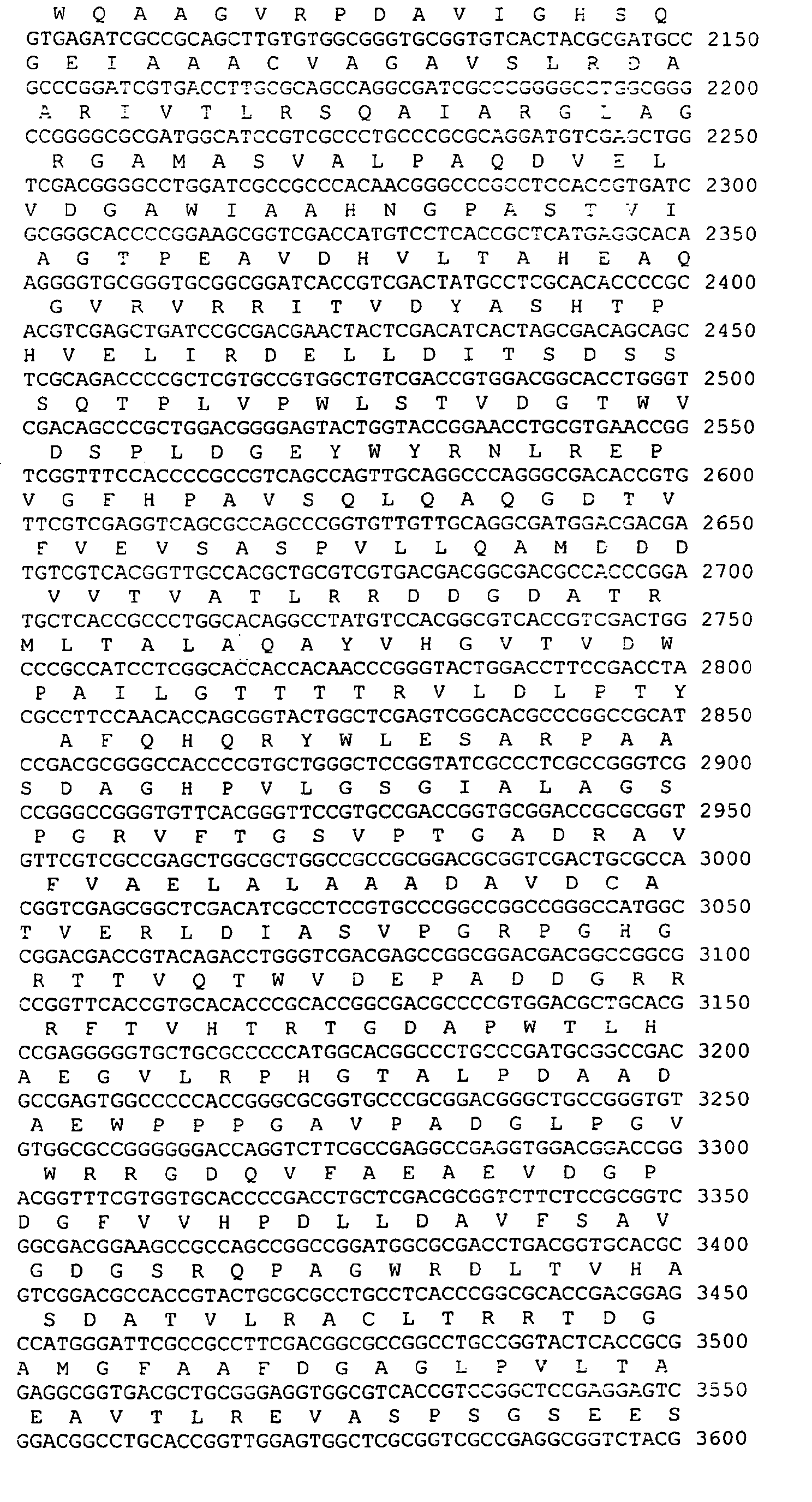

- The NheII-XhoI restriction fragment that encodes module 8 of the FK-520 PKS with the endogenous AT domain replaced by the AT domain of module 12 (specific for malonyl CoA) of the rapamycin PKS has the DNA sequence and encodes the amino acid sequence shown below.


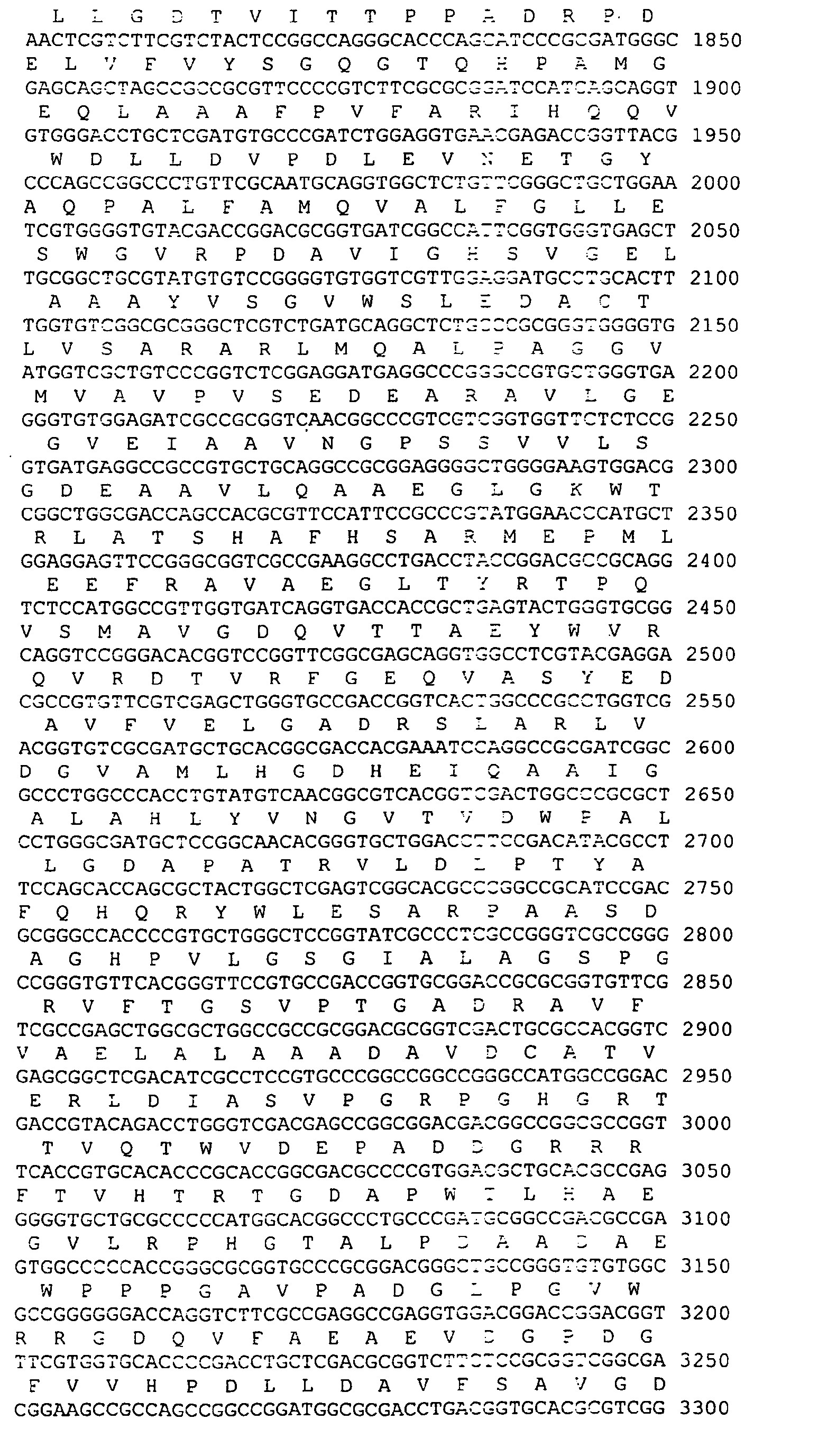

- The NheII-AhoI restriction fragment that encodes module 8 of the FK-520 PKS with the endogenous AT domain replaced by the AT domain of module 13 (specific for methylmalonyl CoA) of the rapamycin PKS has the DNA sequence and encodes the amino acid sequence shown below.


- Phage KC515 DNA was prepared using the procedure described in Genetic Manipulation of Streptomyces, A Laboratory Manual, edited by D. Hopwood et al. A phage suspension prepared from 10 plates (100 mm) of confluent plaques of KC515 on S. lividans TK24 generally gave about 3 µg of phage DNA. The DNA was ligated to circularize at the cos site, subsequently digested with restriction enzymes BamHI and PstI, and dephosphorylated with SAP.
- Each module 8 cassette described above was excised with restriction enzymes BglII and NsiI and ligated into the compatible BamHI and PstI sites of KC515 phage DNA prepared as described above. The ligation mixture containing KC515 and various cassettes was transfected into protoplasts of Streptomyces lividans TK24 using the procedure described in Genetic Manipulation of Streptomyces, A Laboratory Manual edited by D. Hopwood et al. and overlaid with TK24 spores. After 16-24 hr, the plaques were restreaked on plates overlaid with TK24 spores. Single plaques were picked and resuspended in 200 µL of nutrient broth. Phage DNA was prepared by the boiling method (Hopwood et al., supra). The PCR with primers spanning the left and right boundaries of the recombinant phage was used to verify the correct phage had been isolated. In most cases, at least 80% of the plaques contained the expected insert. To confirm the presence of the resistance marker (thiostrepton), a spot test is used, as described in Lomovskaya et al. (1997), in which a plate with spots of phage is overlaid with mixture of spores of TK24 and phiC31 TK24 lysogen. After overnight incubation, the plate is overlaid with antibiotic in soft agar. A working stock is made of all phage containing desired constructs.
- Streptomyces hygroscopicus ATCC 14891 (see US Patent No. 3,244,592, issued 5 Apr 1966, incorporated herein by reference) mycelia were infected with the recombinant phage by mixing the spores and phage (1 x 10⁸ of each), and incubating on R2YE agar (Genetic Manipulation of Streptomyces, A Laboratory Manual, edited by D. Hopwood et al.) at 30°C for 10 days. Recombinant clones were selected and plated on minimal medium containing thiostrepton (50 µg/ml) to select for the thiostrepton resistance-conferring gene. Primary thiostrepton resistant clones were isolated and purified through a second round of single colony isolation, as necessary. To obtain thiostrepton-sensitive revertants that underwent a second recombination event to evict the phage genome, primary recombinants were propagated in liquid media for two to three days in the absence of thiostrepton and then spread on agar medium without thiostrepton to obtain spores. Spores were plated to obtain about 50 colonies per plate, and thiostrepton sensitive colonies were identified by replica plating onto thiostrepton containing agar medium. The PCR was used to determine which of the thiostrepton sensitive colonies reverted to the wild type (reversal of the initial integration event), and which contain the desired AT swap at module 8 in the ATCC 14891-derived cells. The PCR primers used amplified either the KS/AT junction or the AT/DH junction of the wild-type and the desired recombinant strains. Fermentation of the recombinant strains, followed by isolation of the metabolites and analysis by LCMS, and NMR is used to characterize the novel polyketide compounds.
- The present invention also provides the 13-desmethoxy derivatives of FK-506 and the novel PKS enzymes that produce them. A variety of Streptomyces strains that produce FK-506 are known in the art, including S. tsukubaensis No. 9993 (FERM BP-927), described in U.S. Patent No. 5,624,852, incorporated herein by reference; S. hygroscopicus subsp. yakushimaensis No. 7238, described in U.S. patent No. 4,894,366, incorporated herein by reference; S. sp. MA6858 (ATCC 55098), described in U.S. Patent Nos. 5,116,756, incorporated herein by reference; and S. sp. MA 6548, described in Motamedi et al., 1998, "The biosynthetic gene cluster for the macrolactone ring of the immunosuppressant FK-506," Eur. J. Biochem. 256: 528-534, and Motamedi et al., 1997, "Structural organization of a multifunctional polyketide synthase involved in the biosynthesis of the macrolide immunosuppressant FK-506," Eur. J. Biochem. 244: 74-80, each of which is incorporated herein by reference.
- The complete sequence of the FK-506 gene cluster from Streptomyces sp. MA6548 is known, and the sequences of the corresponding gene clusters from other FK-506-producing organisms is highly homologous thereto. The novel FK-506 recombinant gene clusters of the present invention differ from the naturally occurring gene clusters in that the AT domain of module 8 of the naturally occurring PKSs is replaced by an AT domain specific for malonyl CoA or methylmalonyl CoA. These AT domain replacements are made at the DNA level, following the methodology described in Example 1.
- The naturally occurring module 8 sequence for the MA6548 strain is shown below, followed by the illustrative hybrid module 8 sequences for the MA6548 strains.

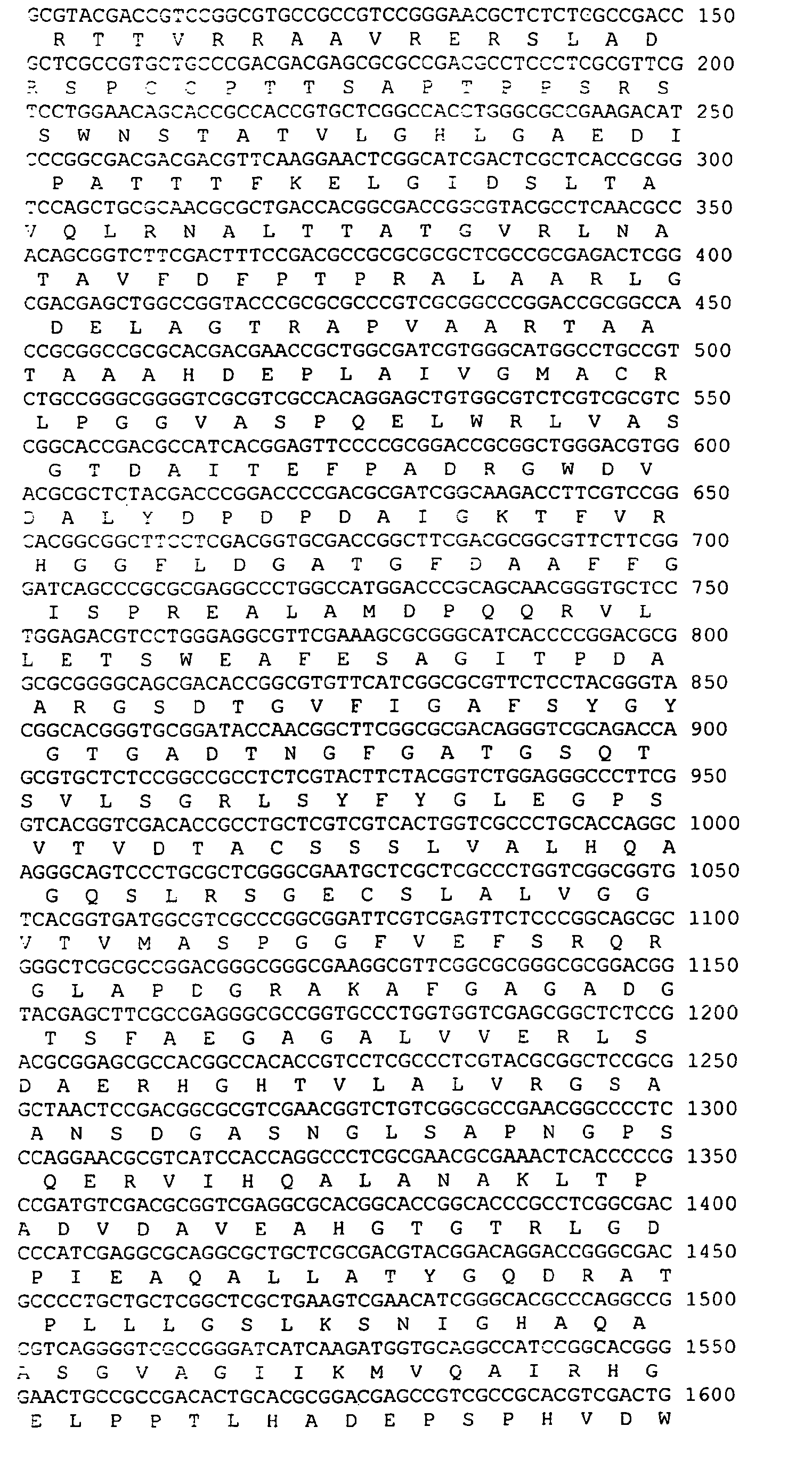


- The AvrII-XhoI hybrid FK-506 PKS module 8 containing the AT domain of
module 12 of rapamycin is shown below.


- The AvrII-XhoI hybrid FK-506 PKS module 8 containing the AT domain of
module 13 of rapamycin is shown below.


- The NheI-XhoI hybrid FK-506 PKS module 8 containing the AT domain of
module 12 of rapamycin is shown below.


- The NheI-XhoI hybrid FK-506 PKS module 8 containing the AT domain of
module 13 of rapamycin is shown below.


- The present invention provides a variety of recombinant PKS genes in addition to those described in Examples 1 and 2 for producing 13-desmethoxy FK-506 and FK-520 compounds. This Example provides the construction protocols for recombinant FK-520 and FK-506 (from Streptomyces sp. MA6858 (ATCC 55098), described in U.S. Patent Nos. 5,116,756, incorporated herein by reference) PKS genes in which the module 8 AT coding sequences have been replaced by either the rapAT3 (the AT domain from
module 3 of the rapamycin PKS), rapAT12, eryAT1 (the AT domain frommodule 1 of the erythromycin (DEBS) PKS), or eryAT2 coding sequences. Each of these constructs provides a PKS that produces the 13-desmethoxy-13-methyl derivative, except for the rapAT12 replacement, which provides the 13-desmethoxy derivative, i.e., it has a hydrogen where the other derivatives have methyl. - Figure 7 shows the process used to generate the AT replacement constructs. First, a fragment of~4.5 kb containing module 8 coding sequences from the FK-520 cluster of ATCC 14891 was cloned using the convenient restriction sites SacI and SphI (Step A in Figure 7). The choice of restriction sites used to clone a 4.0 - 4.5 kb fragment comprising module 8 coding sequences from other FK-520 or FK-506 clusters can be different depending on the DNA sequence, but the overall scheme is identical. The unique SacI and SphI restriction sites at the ends of the FK-520 module 8 fragment were then changed to unique Bgl II and NsiI sites by ligation to synthetic linkers (described in the preceding Examples, see Step B of Figure 7). Fragments containing sequences 5' and 3' of the AT8 sequences were then amplified using primers, described above, that introduced either an AvrII site or an NheI site at two different KS/AT boundaries and an XhoI site at the AT/DH boundary (Step C of Figure 7). Heterologous AT domains from the rapamycin and erythromycin gene clusters were amplified using primers, as described above, that introduced the same sites as just described (Step D of Figure 7). The fragments were ligated to give hybrid modules with in-frame fusions at the KS/AT and AT/DH boundaries (Step E of Figure 7). Finally, these hybrid modules were ligated into the BamHI and PstI sites of the KC515 vector. The resulting recombinant phage were used to transform the FK-506 and FK-520 producer strains to yield the desired recombinant cells, as described in the preceding Examples.
- The following table shows the location and sequences surrounding the engineered site of each of the heterologous AT domains employed. The FK-506 hybrid construct was used as a control for the FK-520 recombinant cells produced, and a similar FK-520 hybrid construct was used as a control for the FK-506 recombinant cells.
Heterologous AT Enzyme Location of Engineered Site FK-506 AT8 AvrII 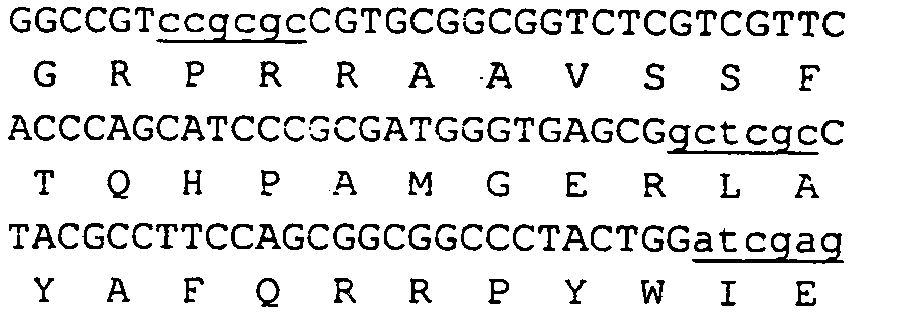
(hydroxymalonyl) NheI XhoI rapamycin AT3 AvrII 
(methylmalonyl) NheI XhoI rapamycin AT 12 AvrII 
(malonyl) NheI XhoI DEBS AT1 AvrII 
(methylmalonyl) NheI XhoI DEBS AT2 AvrII 
(methylmalonyl) NheI XhoI - The sequences shown below provide the location of the KS/AT boundaries chosen in the FK-520 module 8 coding sequences. Regions where AvrII and NheI sites were engineered are indicated by lower case and underlining.
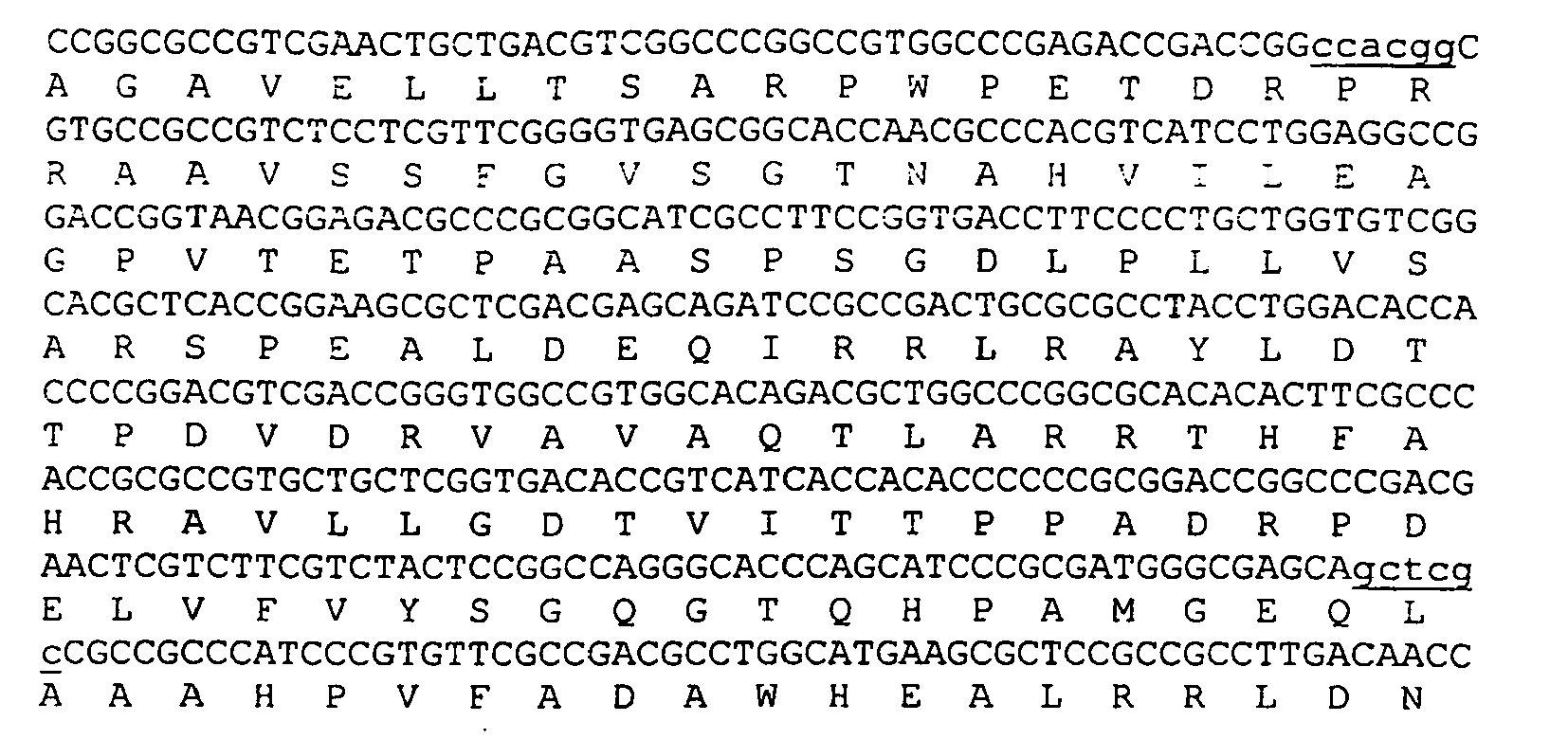
- The sequences shown below provide the location of the AT/DH boundary chosen in the FK-520 module 8 coding sequences. The region where an XhoI site was engineered is indicated by lower case and underlining.

- The sequences shown below provide the location of the KS/AT boundaries chosen in the FK-506 module 8 coding sequences. Regions where AvrII and NheI sites were engineered are indicated by lower case and underlining.

- The sequences shown below provide the location of the AT/DH boundary chosen in the FK-506 module 8 coding sequences. The region where an XhoI site was engineered is indicated by lower case and underlining.

- The methods and reagents of the present invention also provide novel FK-506 and FK-520 derivatives in which the methoxy group at C-15 is replaced by a hydrogen or methyl. These derivatives are produced in recombinant host cells of the invention that express recombinant PKS enzymes the produce the derivatives. These recombinant PKS enzymes are prepared in accordance with the methodology of Examples 1 and 2, with the exception that AT domain of
module 7, instead of module 8, is replaced. Moreover, the present invention provides recombinant PKS enzymes in which the AT domains of bothmodules 7 and 8 have been changed. The table below summarizes the various compounds provided by the present invention.Compound C-13 C-15 Derivative Provided FK-506 hydrogen hydrogen 13, 15-didesmethoxy-FK-506 FK-506 hydrogen methoxy 13-desmethoxy-FK-506 FK-506 hydrogen methyl 13,15-didesmethoxy-15-methyl-FK-506 FK-506 methoxy hydrogen 15-desmethoxy-FK-506 FK-506 methoxy methoxy Original Compound -- FK-506 FK-506 methoxy methyl 15-desmethoxy-15-methyl-FK-506 FK-506 methyl hydrogen 13,15-didesmethoxy-13-methyl-FK-506 FK-506 methyl methoxy 13-desmethoxy-13-methyl-FK-506 FK-506 methyl methyl 13,15-didesmethoxy-13,15-dimethyl-FK-506 FK-520 hydrogen hydrogen 13, 15-didesmethoxy FK-520 FK-520 hydrogen methoxy 13-desmethoxy FK-520 FK-520 hydrogen methyl 13,15-didesmethoxy-15-methyl-FK-520 FK-520 methoxy hydrogen 15-desmethoxy-FK-520 FK-520 methoxy methoxy Original Compound -- FK-520 FK-520 methoxy methyl 15-desmethoxy-15-methyl-FK-520 FK-520 methyl hydrogen 13,15-didesmethoxy-13-methyl-FK-520 FK-520 methyl methoxy 13-desmethoxy-13-methyl-FK-520 FK-520 methyl methyl 13,15-didesmethoxy-13,15-dimethyl-FK-520 - The present invention also provides novel FK-506 and FK-520 derivative compounds in which the methoxy groups at either or both the C-13 and C-15 positions are instead ethyl groups. These compounds are produced by novel PKS enzymes of the invention in which the AT domains of modules 8 and/or 7 are converted to ethylmalonyl specific AT domains by modification of the PKS gene that encodes the module. Ethylmalonyl specific AT domain coding sequences can be obtained from, for example, the FK-520 PKS genes, the niddamycin PKS genes, and the tylosin PKS genes. The novel PKS genes of the invention include not only those in which either or both of the AT domains of
modules 7 and 8 have been converted to ethylmalonyl specific AT domains but also those in which one of the modules is converted to an ethylmalonyl specific AT domain and the other is converted to a malonyl specific or a methylmalonyl specific AT domain. - The compounds described in Examples 1-4, inclusive have immunosuppressant activity and can be employed as immunosuppressants in a manner and in formulations similar to those employed for FK-506. The compounds of the invention are generally effective for the prevention of organ rejection in patients receiving organ transplants and in particular can be used for immunosuppression following orthotopic liver transplantation. These compounds also have pharmacokinetic properties and metabolism that are more advantageous for certain applications relative to those of FK-506 or FK-520. These compounds are also neurotrophic; however, for use as neurotrophins, it is desirable to modify the compounds to diminish or abolish their immunosuppressant activity. This can be readily accomplished by hydroxylating the compounds at the C-18 position using established chemical methodology or novel FK-520 PKS genes provided by the present invention.
- Thus, in one aspect, the present invention provides a method for stimulating nerve growth that comprises administering a therapeutically effective dose of 18-hydroxy-FK-520. In another embodiment, the compound administered is a C-18,20-dihydroxy-FK-520 derivative. In another embodiment, the compound administered is a C-13-desmethoxy and/or C-15-desmethoxy 18-hydroxy-FK-520 derivative. In another embodiment, the compound administered is a C-13-desmethoxy and/or C-15-
desmethoxy 18,20-dihydroxy-FK-520 derivative. In other embodiments, the compounds are the corresponding analogs of FK-506. The 18-hydroxy compounds of the invention can be prepared chemically, as described in U.S. Patent No. 5,189,042, incorporated herein by reference, or by fermentation of a recombinant host cell provided by the present invention that expresses a recombinant PKS in which themodule 5 DH domain has been deleted or rendered non-functional. - The chemical methodology is as follows. A compound of the invention (-200 mg) is dissolved in 3 mL of dry methylene chloride and added to 45 µL of 2,6-lutidine, and the mixture stirred at room temperature. After 10 minutes, tert-butyldimethylsilyl trifluoromethanesulfonate (64 µL) is added by syringe. After 15 minutes, the reaction mixture is diluted with ethyl acetate, washed with saturated bicarbonate, washed with brine, and the organic phase dried over magnesium sulfate. Removal of solvent in vacuo and flash chromatography on silica gel (ethyl acetate: hexane (1:2) plus 1% methanol) gives the protected compound, which is dissolved in 95% ethanol (2.2 mL) and to which is added 53 µL of pyridine, followed by selenium dioxide (58 mg). The flask is fitted with a water condenser and heated to 70°C on a mantle. After 20 hours, the mixture is cooled to room temperature, filtered through diatomaceous earth, and the filtrate poured into a saturated sodium bicarbonate solution. This is extracted with ethyl acetate, and the organic phase is washed with brine and dried over magnesium sulfate. The solution is concentrated and purified by flash chromatography on silica gel (ethyl acetate: hexane (1:2) plus 1% methanol) to give the protected 18-hydroxy compound. This compound is dissolved in acetonitrile and treated with aqueous HF to remove the protecting groups. After dilution with ethyl acetate, the mixture is washed with saturated bicarbonate and brine, dried over magnesium sulfate, filtered, and evaporated to yield the18-hydroxy compound. Thus, the present invention provides the C-18-hydroxyl derivatives of the compounds described in Examples 1 - 4.
- Those of skill in the art will recognize that other suitable chemical procedures can be used to prepare the novel 18-hydroxy compounds of the invention. See, e.g., Kawai et al., Jan. 1993, Structure-activity profiles of macrolactam immunosuppressant FK-506 analogues, FEBS Letters 316(2): 107-113, incorporated herein by reference. These methods can be used to prepare both the C18-[S]-OH and C18-[R]-OH enantiomers, with the R enantiomer showing a somewhat lower IC50, which may be preferred in some applications. See Kawai et al., supra. Another preferred protocol is described in Umbreit and Sharpless, 1977, JACS 99(16): 1526-28, although it may be preferable to use 30 equivalents each of SeO2 and t-BuOOH rather than the 0.02 and 3-4 equivalents, respectively, described in that reference.
Claims (10)
- A polyketide having the structure

- The polyketide of claim 1 that is 13-desmethoxy-FK-506.
- The polyketide of claim 1 that is 13-desmothoxy-18-hydroxy-FK-520.
- The polyketide of claim 1 that is 13-desmethoxy-13-methyl-FK-506, 15-desmethoxy-FK-506, 15-desmethoxy-15-methyl-FK-506, 13,15-didesmethoxy-FK-506, 13,15-didesmethoxy-13-methyl-FK-506, 13,15-didesmethoxy-15-methyl-FK-506 or 13,15-didesmethoxy-13,15-dimethyl-FK-506.
- The polyketide of claim 1 that is 13-desmethoxy-FK-520, 13-desmethoxy-13-methyl-FK-520, 15-desmethoxy-FK-520, 15-desmethoxy-15-methyl-FK-520, 13,15-didesmethoxy-FK-520, 13,15-didesmethoxy-13-methyl-FK-520, 13,15-didesmethoxy-15-methyl-FK-520 or 13,15-didesmethoxy-13,15-dimethyl-FK-520.
- The polyketide of claim 1 that is 13-desmethoxyl-18-hydroxyl-FK-506, 13-desmethoxyl-13-methyl-18-hydroxyl-FK-506, 15-desmethoxy-18-hydroxyl-FK-506, 15-desmethoxy-15-methyl-18-hydroxyl-FK-506, 13,15-didesmethoxy-18-hydroxyl-FK-506, 13,15-didesmethoxy-13-methyl-18-hydroxyl-FK-506, 13,15-didesmethoxy-15-methyl-18-hydroxyl-FK-506 or 13-15-didesmethoxy-13,15-dimethyl-18-hydroxyl-FK-506.
- The polyketide of claim 1 that is 13-desmethoxy-13-methyl-18-hydroxyl-FK-520, 15-desmethoxy-18-hydroxyl-FK-520, 15-desmethoxy-15-methyl-18-hydroxyl-FK-520, 13,15-didesmethoxy-18-hydroxyl-FK-520, 13,15-didesmethoxy-13-methyl-18-hydroxyl-FK-520, 13,15-didesmethoxy-15-methyl-18-hydroxyl-FK-520 or 13,15-didesmethoxy-13,15-dimethyl-18-hydroxyl-FK-520.
- A pharmaceutical composition comprising the polyketide of any one of the preceding claims.
- The polyketide of any one of claims 1 to 7, for use in therapy.
- The polyketide of any one of claims 1 to 7 for use in immunosuppression or to stimulate nerve growth and regeneration.
Applications Claiming Priority (7)
| Application Number | Priority Date | Filing Date | Title |
|---|---|---|---|
| US10274898P | 1998-10-02 | 1998-10-02 | |
| US102748P | 1998-10-02 | ||
| US12381099P | 1999-03-11 | 1999-03-11 | |
| US123810P | 1999-03-11 | ||
| US13965099P | 1999-06-17 | 1999-06-17 | |
| US139650P | 1999-06-17 | ||
| PCT/US1999/022886 WO2000020601A2 (en) | 1998-10-02 | 1999-10-01 | Polyketide synthase enzymes and recombinant dna constructs therefor |
Publications (2)
| Publication Number | Publication Date |
|---|---|
| EP1117801A2 EP1117801A2 (en) | 2001-07-25 |
| EP1117801B1 true EP1117801B1 (en) | 2006-11-29 |
Family
ID=27379409
Family Applications (1)
| Application Number | Title | Priority Date | Filing Date |
|---|---|---|---|
| EP99970125A Expired - Lifetime EP1117801B1 (en) | 1998-10-02 | 1999-10-01 | Polyketide synthase enzymes and recombinant dna constructs therefor, for the production of compounds related to fk-506 and fk-520 |
Country Status (13)
| Country | Link |
|---|---|
| US (5) | US6503737B1 (en) |
| EP (1) | EP1117801B1 (en) |
| JP (1) | JP2002526114A (en) |
| KR (1) | KR20010085877A (en) |
| CN (1) | CN1329668A (en) |
| AT (1) | ATE346938T1 (en) |
| AU (2) | AU773517B2 (en) |
| CA (1) | CA2343880C (en) |
| DE (1) | DE69934242T2 (en) |
| IL (1) | IL142165A0 (en) |
| MX (1) | MXPA01003376A (en) |
| NZ (1) | NZ510819A (en) |
| WO (1) | WO2000020601A2 (en) |
Families Citing this family (64)
| Publication number | Priority date | Publication date | Assignee | Title |
|---|---|---|---|---|
| US6204388B1 (en) | 1996-12-03 | 2001-03-20 | Sloan-Kettering Institute For Cancer Research | Synthesis of epothilones, intermediates thereto and analogues thereof |
| US6242469B1 (en) | 1996-12-03 | 2001-06-05 | Sloan-Kettering Institute For Cancer Research | Synthesis of epothilones, intermediates thereto, analogues and uses thereof |
| NZ510819A (en) * | 1998-10-02 | 2004-03-26 | Kosan Biosciences Inc | Polyketide synthase enzymes and recombinant DNA constructs therefor |
| US6569867B2 (en) | 1999-10-01 | 2003-05-27 | Kosan Biosciences, Inc. | Polyketide derivatives |
| WO2001027306A2 (en) * | 1999-10-13 | 2001-04-19 | The Board Of Trustees Of The Leland Stanford Junior University | Biosynthesis of polyketide synthase substrates |
| US6939691B1 (en) | 1999-10-13 | 2005-09-06 | Board Of Trustees Of The Leland Stanford Junior University | E. coli and Streptomyces host cells that contain MatBC genes or E. coli host cells that contain pcc genes useful for enhanced polyketide production |
| AU1231701A (en) * | 1999-10-25 | 2001-05-08 | Kosan Biosciences, Inc. | Production of polyketides |
| MXPA02004153A (en) | 1999-10-27 | 2002-10-17 | Kosan Biosciences Inc | Heterologous production of polyketides. |
| ATE356880T1 (en) | 1999-10-29 | 2007-04-15 | Kosan Biosciences Inc | RAPAMYCIN ANALOGUE |
| US6562795B2 (en) | 2000-02-18 | 2003-05-13 | Kosan Biosciences, Inc. | Motilide compounds |
| CA2407259A1 (en) * | 2000-05-17 | 2001-11-22 | Chaitan Khosla | Polyketide derivatives |
| US20030050692A1 (en) * | 2000-12-22 | 2003-03-13 | Avantec Vascular Corporation | Delivery of therapeutic capable agents |
| JP2005506044A (en) * | 2001-02-28 | 2005-03-03 | ザ、ボード、オブ、トラスティーズ、オブ、ザ、リーランド、スタンフォード、ジュニア、ユニバーシティ | Biosynthesis of polyketide synthase substrates |
| FR2825717B1 (en) * | 2001-06-08 | 2005-02-18 | Rhodia Chimie Sa | STEREOSELECTIVE PREPARATION OF CYCLIC AMINO ACIDS |
| US7452692B2 (en) * | 2002-02-13 | 2008-11-18 | Teva Gyógyszergyár Zártkörüen Müködö Részvénytársaság | Method for extracting a macrolide from biomatter |
| JP4261365B2 (en) * | 2002-02-13 | 2009-04-30 | テバ ジョジセルジャール ザ−トケルエン ムケド レ−スベニュタ−ルシャシャ−グ | Method for extracting macrolides from biological materials |
| JP4765032B2 (en) | 2002-02-19 | 2011-09-07 | ダウ・アグロサイエンス・エル・エル・シー | Polyketide synthase producing a novel spinosyn |
| US7195907B2 (en) | 2002-03-29 | 2007-03-27 | Wyeth | Non-ribosomal peptide synthetases and associated biosynthetic genes |
| WO2003082909A1 (en) | 2002-03-29 | 2003-10-09 | Wyeth | Non-ribosomal peptide synthetases and associated biosynthetic genes |
| ES2296063T3 (en) * | 2002-07-16 | 2008-04-16 | Biotica Technology Limited | PRODUCTION OF POLYCHETHYDES AND OTHER NATURAL PRODUCTS. |
| AU2007237187B2 (en) * | 2002-07-16 | 2010-08-05 | Biotica Technology Limited | Production of polyketides |
| US6921769B2 (en) | 2002-08-23 | 2005-07-26 | Sloan-Kettering Institute For Cancer Research | Synthesis of epothilones, intermediates thereto and analogues thereof |
| US7649006B2 (en) | 2002-08-23 | 2010-01-19 | Sloan-Kettering Institute For Cancer Research | Synthesis of epothilones, intermediates thereto and analogues thereof |
| WO2004018478A2 (en) * | 2002-08-23 | 2004-03-04 | Sloan-Kettering Institute For Cancer Research | Synthesis of epothilones, intermediates thereto, analogues and uses thereof |
| US7799904B2 (en) * | 2003-06-13 | 2010-09-21 | University Of Kentucky Research Foundation | Gilvocarcin gene cluster, recombinant production and use thereof |
| KR20060110865A (en) * | 2003-11-27 | 2006-10-25 | 에자이 가부시키가이샤 | DNA involved in the hydroxylation of macrolide compounds |
| FR2869044B1 (en) * | 2004-04-16 | 2006-07-14 | Korea Advanced Inst Sci & Tech | GENES FOR THE SYNTHESIS OF POLYKETIDES FR-008 |
| US7229814B2 (en) * | 2004-05-05 | 2007-06-12 | Regents Of The University Of Minnesota | Nucleic acids and polypeptides involved in the production of cryptophycin |
| CA2564581C (en) * | 2004-05-06 | 2015-12-15 | Acco Brands, Inc. | Apparatus and method for determining an optimal ergonomic setup |
| US7507752B2 (en) * | 2004-06-03 | 2009-03-24 | Wyeth | Biosynthetic gene cluster for the production of a complex polyketide |
| JP4599357B2 (en) * | 2004-07-20 | 2010-12-15 | エーザイ・アール・アンド・ディー・マネジメント株式会社 | DNA encoding a polypeptide involved in the biosynthesis of pladienolide |
| WO2006069386A1 (en) * | 2004-12-22 | 2006-06-29 | Teva Gyógyszergyár Zártköruen Muködo Részvénytársaság | Method of purifying tacrolimus |
| CA2588480A1 (en) * | 2005-01-05 | 2006-08-10 | Teva Gyogyszergyar Zartkoruen Mukodo Reszvenytarsasag | Amorphous tacrolimus and preparation thereof |
| TW200716744A (en) * | 2005-05-26 | 2007-05-01 | Eisai R&D Man Co Ltd | Genetically modified microorganism and process for production of macrolide compound using the microorganism |
| US20080000834A1 (en) * | 2006-03-15 | 2008-01-03 | Ladislav Cvak | Process for purifying Tacrolimus |
| US7566558B2 (en) | 2006-07-28 | 2009-07-28 | Regents Of The University Of Michigan | Nucleic acids and polypeptides involved in the production of cryptophycin |
| US8759031B2 (en) * | 2007-04-12 | 2014-06-24 | Wisconsin Alumni Research Foundation | Type I polyketide synthase extender units |
| EP2272963A1 (en) | 2009-07-09 | 2011-01-12 | LEK Pharmaceuticals d.d. | Process for Preparation of Tacrolimus |
| KR101189475B1 (en) * | 2009-12-03 | 2012-10-15 | (주) 제노텍 | Genes and proteins for biosynthesis of tricyclocompounds |
| US9428845B1 (en) | 2010-12-28 | 2016-08-30 | Warp Drive Bio, Inc. | Identifying new therapeutic agents |
| AU2012211052A1 (en) | 2011-01-28 | 2013-09-05 | Amyris, Inc. | Gel-encapsulated microcolony screening |
| BR112013027954A2 (en) | 2011-05-13 | 2017-01-17 | Amyris Inc | methods and compositions for detecting microbial production of water immiscible compounds |
| MX356894B (en) | 2011-09-19 | 2018-06-19 | Dow Global Technologies Llc | Layered structures and articles prepared therefrom. |
| WO2014025941A1 (en) | 2012-08-07 | 2014-02-13 | Jiang Hanxiao | Methods for stabilizing production of acetyl-coenzyme a derived compounds |
| US9121859B2 (en) * | 2012-12-04 | 2015-09-01 | Siemens Healthcare Diagnostics Inc. | Compounds and methods for determination of FKBP-binding immunosuppressant drugs |
| CN105189772B (en) | 2013-03-15 | 2019-09-13 | 阿迈瑞斯公司 | Use of phosphoketolase and phosphotransacetylase to produce acetyl-CoA derivative compounds |
| AU2013397496B2 (en) | 2013-08-07 | 2020-03-12 | Amyris, Inc. | Methods for stabilizing production of acetyl-coenzyme a derived compounds |
| EP4289950A3 (en) | 2015-01-09 | 2024-01-24 | Revolution Medicines, Inc. | Macrocyclic compounds that participate in cooperative binding and medical uses thereof |
| WO2016210350A1 (en) | 2015-06-25 | 2016-12-29 | Amyris, Inc. | Maltose dependent degrons, maltose-responsive promoters, stabilization constructs, and their use in production of non-catabolic compounds |
| EP3355930A4 (en) | 2015-10-01 | 2019-03-06 | Warp Drive Bio, Inc. | METHODS AND REAGENTS FOR THE ANALYSIS OF PROTEIN-PROTEIN INTERFACES |
| KR102359972B1 (en) | 2016-04-12 | 2022-02-10 | 징코 바이오웍스, 인크. | Compositions and methods for the preparation of compounds |
| AU2017350898A1 (en) * | 2016-10-28 | 2019-06-13 | Ginkgo Bioworks, Inc. | Compositions and methods for the production of compounds |
| WO2018081592A2 (en) | 2016-10-28 | 2018-05-03 | Warp Drive Bio, Inc. | Compositions and methods for the production of compounds |
| KR102109168B1 (en) * | 2018-12-11 | 2020-05-12 | 인트론바이오테크놀로지 | A novel compound and a pharmaceutical composition for treating fungal infections |
| CN109943545B (en) * | 2019-03-29 | 2021-08-03 | 浙江大学 | A kind of method of acyltransferase domain-directed transformation synthetic compound |
| US11827837B2 (en) * | 2019-04-02 | 2023-11-28 | King Fahd University Of Petroleum And Minerals | Water-based drilling, completion, and workover fluid composition with reduced barite sagging |
| CN114786777A (en) | 2019-11-04 | 2022-07-22 | 锐新医药公司 | RAS inhibitors |
| PE20221277A1 (en) | 2019-11-04 | 2022-09-05 | Revolution Medicines Inc | RAS INHIBITORS |
| CN114867735A (en) | 2019-11-04 | 2022-08-05 | 锐新医药公司 | RAS inhibitors |
| EP3822348A1 (en) * | 2019-11-12 | 2021-05-19 | Johann Wolfgang Goethe-Universität Frankfurt am Main | Adapter system of artificial non-ribosomal peptide synthetases and polyketide synthases |
| AU2021345111B2 (en) | 2020-09-15 | 2025-11-27 | Revolution Medicines, Inc. | Indole derivatives as Ras inhibitors in the treatment of cancer |
| CR20230558A (en) | 2021-05-05 | 2024-01-24 | Revolution Medicines Inc | RAS INHIBITORS FOR CANCER TREATMENT |
| AR127308A1 (en) | 2021-10-08 | 2024-01-10 | Revolution Medicines Inc | RAS INHIBITORS |
| CN118620933A (en) * | 2024-06-14 | 2024-09-10 | 华东理工大学 | A genetic engineering modification method for Streptomyces hygroscopicus subspecies |
Family Cites Families (21)
| Publication number | Priority date | Publication date | Assignee | Title |
|---|---|---|---|---|
| US4894366A (en) * | 1984-12-03 | 1990-01-16 | Fujisawa Pharmaceutical Company, Ltd. | Tricyclo compounds, a process for their production and a pharmaceutical composition containing the same |
| US4874748A (en) | 1986-03-24 | 1989-10-17 | Abbott Laboratories | Cloning vectors for streptomyces and use thereof in macrolide antibiotic production |
| US5149639A (en) | 1986-03-24 | 1992-09-22 | Abbott Laboratories | Biologically pure cultures of streptomyces and use thereof in macrolide antibiotic production |
| JP2799208B2 (en) * | 1987-12-09 | 1998-09-17 | フアイソンズ・ピーエルシー | Macrocyclic compound |
| US5063155A (en) | 1988-03-28 | 1991-11-05 | Eli Lilly And Company | Method for producing 2"'-o-demethyltylosin |
| US5098837A (en) | 1988-06-07 | 1992-03-24 | Eli Lilly And Company | Macrolide biosynthetic genes for use in streptomyces and other organisms |
| EP0356399A3 (en) * | 1988-08-26 | 1991-03-20 | Sandoz Ag | Substituted 4-azatricyclo (22.3.1.04.9) octacos-18-ene derivatives, their preparation and pharmaceutical compositions containing them |
| CA2044846A1 (en) | 1990-06-25 | 1991-12-26 | Thomas R. Beattie | Antagonists of immunosuppressive macrolides |
| WO1993013663A1 (en) | 1992-01-17 | 1993-07-22 | Abbott Laboratories | Method of directing biosynthesis of specific polyketides |
| US5824513A (en) | 1991-01-17 | 1998-10-20 | Abbott Laboratories | Recombinant DNA method for producing erythromycin analogs |
| US5189042A (en) | 1991-08-22 | 1993-02-23 | Merck & Co. Inc. | Fluoromacrolides having immunosuppressive activity |
| US5672491A (en) | 1993-09-20 | 1997-09-30 | The Leland Stanford Junior University | Recombinant production of novel polyketides |
| ES2164713T3 (en) | 1993-09-20 | 2002-03-01 | Univ Leland Stanford Junior | RECOMBINANT PRODUCTION OF NEW POLYCHETIDES. |
| US5712146A (en) | 1993-09-20 | 1998-01-27 | The Leland Stanford Junior University | Recombinant combinatorial genetic library for the production of novel polyketides |
| JP3633629B2 (en) | 1995-07-06 | 2005-03-30 | ザ レランド スタンフォード ジュニア ユニバーシティ | Cell-free synthesis of polyketides |
| US6033883A (en) | 1996-12-18 | 2000-03-07 | Kosan Biosciences, Inc. | Production of polyketides in bacteria and yeast |
| IL132590A0 (en) | 1997-04-30 | 2001-03-19 | Kosan Biosciences Inc | Combinatorial polyketide libraries produced using a modular pks gene cluster as scaffold |
| US5968921A (en) | 1997-10-24 | 1999-10-19 | Orgegon Health Sciences University | Compositions and methods for promoting nerve regeneration |
| FR2780774B1 (en) * | 1998-07-03 | 2001-03-09 | Alkan Sa | PASSIVE SELF-PROTECTION DEVICE FOR MOBILE MACHINE SUCH AS A HELICOPTER |
| US6150513A (en) | 1998-09-16 | 2000-11-21 | Kosan Biosciences, Inc. | Polyketide synthase enzymes and recombinant DNA constructs therefor |
| NZ510819A (en) * | 1998-10-02 | 2004-03-26 | Kosan Biosciences Inc | Polyketide synthase enzymes and recombinant DNA constructs therefor |
-
1999
- 1999-10-01 NZ NZ510819A patent/NZ510819A/en unknown
- 1999-10-01 US US09/410,551 patent/US6503737B1/en not_active Expired - Lifetime
- 1999-10-01 CA CA002343880A patent/CA2343880C/en not_active Expired - Fee Related
- 1999-10-01 EP EP99970125A patent/EP1117801B1/en not_active Expired - Lifetime
- 1999-10-01 CN CN99813957A patent/CN1329668A/en active Pending
- 1999-10-01 JP JP2000574696A patent/JP2002526114A/en active Pending
- 1999-10-01 MX MXPA01003376A patent/MXPA01003376A/en not_active IP Right Cessation
- 1999-10-01 DE DE69934242T patent/DE69934242T2/en not_active Expired - Fee Related
- 1999-10-01 WO PCT/US1999/022886 patent/WO2000020601A2/en not_active Ceased
- 1999-10-01 AU AU14415/00A patent/AU773517B2/en not_active Ceased
- 1999-10-01 IL IL14216599A patent/IL142165A0/en unknown
- 1999-10-01 AT AT99970125T patent/ATE346938T1/en not_active IP Right Cessation
- 1999-10-01 KR KR1020017004222A patent/KR20010085877A/en not_active Ceased
-
2001
- 2001-04-03 US US09/825,621 patent/US6660862B2/en not_active Ceased
- 2001-08-27 US US09/940,316 patent/US6759536B2/en not_active Expired - Lifetime
-
2004
- 2004-05-25 AU AU2004202308A patent/AU2004202308A1/en not_active Abandoned
- 2004-07-06 US US10/885,305 patent/US7714118B2/en not_active Expired - Lifetime
-
2005
- 2005-12-09 US US11/299,244 patent/USRE39762E1/en not_active Expired - Lifetime
Also Published As
| Publication number | Publication date |
|---|---|
| US20020010328A1 (en) | 2002-01-24 |
| IL142165A0 (en) | 2002-03-10 |
| USRE39762E1 (en) | 2007-08-07 |
| WO2000020601A9 (en) | 2000-08-31 |
| JP2002526114A (en) | 2002-08-20 |
| DE69934242T2 (en) | 2007-09-20 |
| US6660862B2 (en) | 2003-12-09 |
| DE69934242D1 (en) | 2007-01-11 |
| CA2343880C (en) | 2008-08-26 |
| US6759536B2 (en) | 2004-07-06 |
| EP1117801A2 (en) | 2001-07-25 |
| WO2000020601A2 (en) | 2000-04-13 |
| US7714118B2 (en) | 2010-05-11 |
| AU773517B2 (en) | 2004-05-27 |
| AU1441500A (en) | 2000-04-26 |
| US20030175901A1 (en) | 2003-09-18 |
| AU2004202308A1 (en) | 2004-06-24 |
| US20090186378A1 (en) | 2009-07-23 |
| CA2343880A1 (en) | 2000-04-13 |
| WO2000020601A3 (en) | 2000-10-26 |
| CN1329668A (en) | 2002-01-02 |
| KR20010085877A (en) | 2001-09-07 |
| ATE346938T1 (en) | 2006-12-15 |
| US6503737B1 (en) | 2003-01-07 |
| MXPA01003376A (en) | 2002-11-07 |
| NZ510819A (en) | 2004-03-26 |
Similar Documents
| Publication | Publication Date | Title |
|---|---|---|
| CA2343880C (en) | Polyketide synthase enzymes and recombinant dna constructs therefor | |
| US6670168B1 (en) | Recombinant Streptomyces hygroscopicus host cells that produce 17-desmethylrapamycin | |
| JP4662635B2 (en) | Recombinant methods and materials for producing epothilone and epothilone derivatives | |
| EP0910633B1 (en) | Hybrid polyketide synthase I gene | |
| US7067286B2 (en) | Cystobacterineae host cells containing heterologous PKS genes for the synthesis of polykedtides | |
| AU2001295195B2 (en) | Myxococcus host cells for the production of epothilones | |
| CA2347412A1 (en) | Recombinant oleandolide polyketide synthase | |
| JP2002519014A (en) | Polyketides and their synthesis | |
| JP2002516090A (en) | Recombinant narvonolide polyketide synthase | |
| US20020004229A1 (en) | Overproduction hosts for biosynthesis of polyketides | |
| WO2012089349A2 (en) | Novel polyketide compounds and methods of making same | |
| US7851190B2 (en) | Biosynthetic gene cluster for leptomycins | |
| US7807418B2 (en) | Method for producing hybrid polyketide synthases | |
| JP2009213479A (en) | Polyketide and synthesis thereof |
Legal Events
| Date | Code | Title | Description |
|---|---|---|---|
| PUAI | Public reference made under article 153(3) epc to a published international application that has entered the european phase |
Free format text: ORIGINAL CODE: 0009012 |
|
| 17P | Request for examination filed |
Effective date: 20010417 |
|
| AK | Designated contracting states |
Kind code of ref document: A2 Designated state(s): AT BE CH CY DE DK ES FI FR GB GR IE IT LI LU MC NL PT SE |
|
| AX | Request for extension of the european patent |
Free format text: AL;LT;LV;MK;RO;SI |
|
| 17Q | First examination report despatched |
Effective date: 20040408 |
|
| GRAP | Despatch of communication of intention to grant a patent |
Free format text: ORIGINAL CODE: EPIDOSNIGR1 |
|
| RIC1 | Information provided on ipc code assigned before grant |
Ipc: C07D 211/00 20060101ALI20060320BHEP Ipc: C07D 273/00 20060101ALI20060320BHEP Ipc: C07D 311/00 20060101ALI20060320BHEP Ipc: C07D 498/18 20060101ALI20060320BHEP Ipc: C12P 19/32 20060101ALI20060320BHEP Ipc: C12P 17/18 20060101ALI20060320BHEP Ipc: C12N 9/10 20060101ALI20060320BHEP Ipc: C12N 15/62 20060101ALI20060320BHEP Ipc: C12N 15/54 20060101ALI20060320BHEP Ipc: C12N 15/52 20060101AFI20060320BHEP |
|
| RTI1 | Title (correction) |
Free format text: POLYKETIDE SYNTHASE ENZYMES AND RECOMBINANT DNA CONSTRUCTS THEREFOR, FOR THE PRODUCTION OF COMPOUNDS RELATED TO FK-506 AND FK-520 |
|
| GRAS | Grant fee paid |
Free format text: ORIGINAL CODE: EPIDOSNIGR3 |
|
| GRAA | (expected) grant |
Free format text: ORIGINAL CODE: 0009210 |
|
| AK | Designated contracting states |
Kind code of ref document: B1 Designated state(s): AT BE CH CY DE DK ES FI FR GB GR IE IT LI LU MC NL PT SE |
|
| PG25 | Lapsed in a contracting state [announced via postgrant information from national office to epo] |
Ref country code: NL Free format text: LAPSE BECAUSE OF FAILURE TO SUBMIT A TRANSLATION OF THE DESCRIPTION OR TO PAY THE FEE WITHIN THE PRESCRIBED TIME-LIMIT Effective date: 20061129 Ref country code: LI Free format text: LAPSE BECAUSE OF FAILURE TO SUBMIT A TRANSLATION OF THE DESCRIPTION OR TO PAY THE FEE WITHIN THE PRESCRIBED TIME-LIMIT Effective date: 20061129 Ref country code: IT Free format text: LAPSE BECAUSE OF FAILURE TO SUBMIT A TRANSLATION OF THE DESCRIPTION OR TO PAY THE FEE WITHIN THE PRE;WARNING: LAPSES OF ITALIAN PATENTS WITH EFFECTIVE DATE BEFORE 2007 MAY HAVE OCCURRED AT ANY TIME BEFORE 2007. THE CORRECT EFFECTIVE DATE MAY BE DIFFERENT FROM THE ONE RECORDED.SCRIBED TIME-LIMIT Effective date: 20061129 Ref country code: FI Free format text: LAPSE BECAUSE OF FAILURE TO SUBMIT A TRANSLATION OF THE DESCRIPTION OR TO PAY THE FEE WITHIN THE PRESCRIBED TIME-LIMIT Effective date: 20061129 Ref country code: CH Free format text: LAPSE BECAUSE OF FAILURE TO SUBMIT A TRANSLATION OF THE DESCRIPTION OR TO PAY THE FEE WITHIN THE PRESCRIBED TIME-LIMIT Effective date: 20061129 Ref country code: BE Free format text: LAPSE BECAUSE OF FAILURE TO SUBMIT A TRANSLATION OF THE DESCRIPTION OR TO PAY THE FEE WITHIN THE PRESCRIBED TIME-LIMIT Effective date: 20061129 Ref country code: AT Free format text: LAPSE BECAUSE OF FAILURE TO SUBMIT A TRANSLATION OF THE DESCRIPTION OR TO PAY THE FEE WITHIN THE PRESCRIBED TIME-LIMIT Effective date: 20061129 |
|
| REG | Reference to a national code |
Ref country code: GB Ref legal event code: FG4D |
|
| REG | Reference to a national code |
Ref country code: IE Ref legal event code: FG4D Ref country code: CH Ref legal event code: EP |
|
| REG | Reference to a national code |
Ref country code: IE Ref legal event code: FG4D |
|
| REF | Corresponds to: |
Ref document number: 69934242 Country of ref document: DE Date of ref document: 20070111 Kind code of ref document: P |
|
| PG25 | Lapsed in a contracting state [announced via postgrant information from national office to epo] |
Ref country code: SE Free format text: LAPSE BECAUSE OF FAILURE TO SUBMIT A TRANSLATION OF THE DESCRIPTION OR TO PAY THE FEE WITHIN THE PRESCRIBED TIME-LIMIT Effective date: 20070228 Ref country code: DK Free format text: LAPSE BECAUSE OF FAILURE TO SUBMIT A TRANSLATION OF THE DESCRIPTION OR TO PAY THE FEE WITHIN THE PRESCRIBED TIME-LIMIT Effective date: 20070228 |
|
| PG25 | Lapsed in a contracting state [announced via postgrant information from national office to epo] |
Ref country code: ES Free format text: LAPSE BECAUSE OF FAILURE TO SUBMIT A TRANSLATION OF THE DESCRIPTION OR TO PAY THE FEE WITHIN THE PRESCRIBED TIME-LIMIT Effective date: 20070312 |
|
| PG25 | Lapsed in a contracting state [announced via postgrant information from national office to epo] |
Ref country code: PT Free format text: LAPSE BECAUSE OF FAILURE TO SUBMIT A TRANSLATION OF THE DESCRIPTION OR TO PAY THE FEE WITHIN THE PRESCRIBED TIME-LIMIT Effective date: 20070430 |
|
| ET | Fr: translation filed | ||
| NLV1 | Nl: lapsed or annulled due to failure to fulfill the requirements of art. 29p and 29m of the patents act | ||
| REG | Reference to a national code |
Ref country code: CH Ref legal event code: PL |
|
| PLBE | No opposition filed within time limit |
Free format text: ORIGINAL CODE: 0009261 |
|
| STAA | Information on the status of an ep patent application or granted ep patent |
Free format text: STATUS: NO OPPOSITION FILED WITHIN TIME LIMIT |
|
| 26N | No opposition filed |
Effective date: 20070830 |
|
| PG25 | Lapsed in a contracting state [announced via postgrant information from national office to epo] |
Ref country code: GR Free format text: LAPSE BECAUSE OF FAILURE TO SUBMIT A TRANSLATION OF THE DESCRIPTION OR TO PAY THE FEE WITHIN THE PRESCRIBED TIME-LIMIT Effective date: 20070301 |
|
| PG25 | Lapsed in a contracting state [announced via postgrant information from national office to epo] |
Ref country code: MC Free format text: LAPSE BECAUSE OF NON-PAYMENT OF DUE FEES Effective date: 20071031 |
|
| PG25 | Lapsed in a contracting state [announced via postgrant information from national office to epo] |
Ref country code: IE Free format text: LAPSE BECAUSE OF NON-PAYMENT OF DUE FEES Effective date: 20071001 |
|
| PGFP | Annual fee paid to national office [announced via postgrant information from national office to epo] |
Ref country code: FR Payment date: 20080707 Year of fee payment: 10 |
|
| PGFP | Annual fee paid to national office [announced via postgrant information from national office to epo] |
Ref country code: GB Payment date: 20080808 Year of fee payment: 10 |
|
| PGFP | Annual fee paid to national office [announced via postgrant information from national office to epo] |
Ref country code: DE Payment date: 20080731 Year of fee payment: 10 |
|
| PG25 | Lapsed in a contracting state [announced via postgrant information from national office to epo] |
Ref country code: LU Free format text: LAPSE BECAUSE OF NON-PAYMENT OF DUE FEES Effective date: 20071001 Ref country code: CY Free format text: LAPSE BECAUSE OF FAILURE TO SUBMIT A TRANSLATION OF THE DESCRIPTION OR TO PAY THE FEE WITHIN THE PRESCRIBED TIME-LIMIT Effective date: 20061129 |
|
| REG | Reference to a national code |
Ref country code: FR Ref legal event code: ST Effective date: 20100630 |
|
| PG25 | Lapsed in a contracting state [announced via postgrant information from national office to epo] |
Ref country code: FR Free format text: LAPSE BECAUSE OF NON-PAYMENT OF DUE FEES Effective date: 20091102 Ref country code: DE Free format text: LAPSE BECAUSE OF NON-PAYMENT OF DUE FEES Effective date: 20100501 |
|
| PG25 | Lapsed in a contracting state [announced via postgrant information from national office to epo] |
Ref country code: GB Free format text: LAPSE BECAUSE OF NON-PAYMENT OF DUE FEES Effective date: 20091001 |