This invention relates to silver halide color photographic materials.
More particularly, it relates to color photographic materials which contain yellow
dye-forming couplers in combination with certain non-imaging compounds which
enhance the efficiency of generation of the image dye and also give rise to images
which have unexpectedly high stability towards fading by light.
In a silver halide photographic element, a color image is formed
when the element is exposed to light and then subjected to color development with
a primary aromatic amine developer. Color development results in imagewise
reduction of silver halide and production of oxidized developer. Oxidized
developer reacts with one or more incorporated dye-forming couplers to form an
imagewise distribution of dye.
In any polychromatic chromogenic photographic material it is
desirable that the dyes so formed should have certain properties. For instance the
dyes should be bright in color with very little secondary absorption so that good
color reproducibility is obtained. For yellow dyes in particular, color purity is
enhanced by ensuring that the absorption maximum of the dye is well separated
from that of the magenta dye, and hence yellow dyes that absorb at shorter
wavelengths are advantageous. Acetanilide-based yellow dye-forming couplers
have been found to provide desirable dye hues. The dyes that are formed by any
color coupler during processing have a tendency to fade over time as a result of
exposure to light, heat, humidity and oxygen. Since the three image dyes may not
fade at the same rate, an apparent change in image color may result. It is thus
paramount that the formed photographic dye images should be resistant towards
fading by heat, humidity and light.
When the dye images are formed in silver halide photographic
materials from the combination of oxidized developer and an incorporated
coupler, certain restrictions are placed on the properties of the coupler. For
instance, the coupler should produce a dye which has the aforementioned desirable
properties and the efficiency of the dye-forming reaction must be high.
Additionally, the coupler must be easily dispersible, must itself be resistant
towards the deleterious effects of light, heat and humidity, and must have a low
propensity to form fog.
Acetanilide-based yellow dye-forming couplers of the general
structures described in this invention are well known in the art of photography. It
is also well known in the art of coupler chemistry that the incorporation of specific
functionalities into the molecule can enhance features such as coupling reactivity
or high image dye light stability. Another well-proven route to improve image
dye light stability is to incorporate certain stabilizing addenda into the coupler
dispersion. Such stabilizing addenda can be used alone or in combination.
Compounds which have been disclosed as stabilizers for yellow image dyes
include substituted phenolic and blocked phenolic compounds, including
heterocyclic phosphorous compounds (US 4,749,645), phenolic thiane derivatives
((EP 0 310 551) and substituted bisphenols (UK 1,267,287), among which mono-blocked
derivatives have been shown to be especially advantageous (US
4,782,011). The use of substituted bisphenols and blocked bisphenols as light
stabilizers for yellow image dyes has additionally been described in detail in, e.g.,
DE 4,307,439, DE 4,320,828, EP 0 508 398, EP 0 538 862, US 5,294,530, US
5,426,021, US 5,441,855, US 5,441,861, US 5,466,569, US 5,891,613, and WO
91/008,515. Further advantages are claimed for the combination of such
bisphenol stabilizers with certain spirocyclic compounds in US 5,567,578. US
5,284,742 describes the combination of certain yellow couplers with alkylated
quinone type stabilizers and phenolic stabilizers for improved color reproduction
and light stability. US 5,091,294 describes the combination of certain yellow
couplers with thiane stabilizers for improved color reproduction and light stability.
EP 0 310 552 describes the use of thiane derivatives combined with yellow dye-forming
couplers and phenolic antioxidants for improved light stability. US
5,935,773 describes the combination yellow couplers with cyclo-dextrans and
phenolic stabilizers for improved color reproduction and light stability. However,
there remains a continuing need to seek coupler formulations with improved
performance because, quite often, one or more of the other desirable properties of
the photographically formed dye (such as its hue or its efficiency of formation)
can be affected adversely by these artifices.
US Patents 5,017,465 and 5,082,766 and German Published Patent
Application DTOS 4,307,194 describe the use of certain stabilizers with
pyrazoloazole magenta dye forming couplers to improve their dye stability. One
class of stabilizers which is disclosed includes compounds of the following
structure:
wherein A represents a group of non-metal atoms necessary to complete a 5-membered
to 8-membered nitrogen-containing ring and R
0 represents an aryl
group or a heterocyclic group. Preferred compounds of such formula as described
in USP 5,017,465 include compounds wherein A represents the atoms necessary
to complete a thiomorpholine 1,1-dioxide group and where R
0 represents an
alkoxy substituted phenyl group. Such compounds are believed to stabilize by
acting as singlet oxygen quenchers. US 5,236,819 and US 5,561,037 disclose that
the light stability of the image dyes from such cyclic azole magenta couplers can
be further improved by the use of a combination of stabilizers which include
thiomorpholine dioxide compounds, US 5,561,037 disclosing the use of
substituted sulfonamido phenyl compounds in such combinations. The utility of
thiomorpholine dioxide stabilizers in relation to 2-equivalent pyrazolone magenta
couplers is also disclosed in US 5,491,054 and US 5,484,696.
An objective of this invention is to provide photographic elements
which exhibit exceptional yellow dye light stability, and which retain desirable
properties derived from the use of acetanilide-based yellow dye-forming couplers.
A further objective of the invention is to provide increased activity for
photographic elements comprising acetanilide-based yellow dye-forming couplers.
In accordance with one embodiment of the invention, a
photographic element is disclosed comprising a silver halide emulsion layer
having associated therewith an acetanilide-based yellow dye forming coupler and
a stabilizer compound of the formula S-I:
wherein
In accordance with preferred embodiments, R
0 represents a
substituted phenyl group of the following formula:
wherein m is 1, 2, 3, 4 or 5;
n is 0, 1, 2, 3, or 4, provided that the sum of m and n is less than or equal
to 5; and
R1 is H or a substituent group and R2 is a substituent group, provided that
substituent groups represented by R1 and R2 or two R1 or two R2 groups may be
joined to form a ring.
In accordance with most preferred embodiments, R
0 represents a
para-substituted phenyl group of the formula:
where n is 0 or 1.
We have found that the objectives of the invention can be achieved
with acetanilide-based couplers through the use of substituted amine compounds
of formula S-I as stabilizing addenda, particularly when used in combination with
known substituted phenolic stabilizers. Unexpected and substantial improvements
in the light stability of the image dyes can be obtained, and, furthermore, the
presence of the amine compound improves the efficiency of the dye formation
reaction. Accordingly, photographic elements of the present invention upon
exposure and photographic processing exhibit good activity and yield yellow dye
images that have low fading when exposed to light.
As used herein, unless otherwise indicated the alkyl and aryl
groups, and the alkyl and aryl portions of groups, can be unsubstituted or
substituted with non-interfering substituents. Typical alkyl groups have 1 to 32
carbon atoms and typical aryl groups have 6 to 32 carbon atoms. Depending upon
the position of the group, preferred alkyl groups can have 1 to 20 carbon atom, 1
to 12 carbon atoms or 1 to 4 carbon atoms and preferred aryl groups can have 6 to
20 or 6 to 10 carbon atoms. Other groups identified below which contain a
replaceable hydrogen atom can be substituted or not, depending on the particular
structure and properties desired.
R
0 represents an aryl or heterocyclic group. Representative
groups include phenyl, 1-naphthyl, 2-furyl and 2-thienyl, and pyridyl. In a
preferred embodiment, R
0 represents a substituted phenyl group represented
by the formula:
wherein m is 1, 2, 3, 4 or 5; n is 0, 1, 2, 3, or 4, provided that the sum of m and n
is less than or equal to 5; and R
1 is H or a substituent group and R
2 is a substituent
group, provided that substituent groups represented by R
1 and R
2 or two R
1 or two
R
2 groups may be joined to form a ring.
R1 preferably represents an alkyl group, a cycloalkyl group, an
alkenyl group, an aryl group, a heterocyclic group, an acyl group, a bridged
hydrocarbon group, an alkyl sulfonyl group or an aryl sulfonyl group. For R1,
the alkyl group may include, e.g., a straight-chain or branched-chain alkyl
group having 1 to 24 carbon atoms; the cycloalkyl group, e.g., a cycloalkyl
group having 5 to 24 carbon atoms; the alkenyl group, e.g., an alkenyl group
having 3 to 24 carbon atoms; the aryl group, e.g., a phenyl group and
naphthyl group; the heterocyclic group, e.g., a pyridyl group, an imidazolyl
group and a thiazolyl group; the acyl group, e.g., an acetyl group and a
benzoyl group; the bridged hydrocarbon group, e.g., a bicyclo[2.2.1]heptyl
group, etc., respectively. R2 may represent, e.g., a halogen atom or the groups
such as alkyl, aryl, alkoxy, aryloxy, alkylthio, arylthio, acyl, alkoxycarbonyl,
carbamoyl (e.g., alkylcarbamoyl, arylcarbamoyl), ureido (e.g., alkylureido,
arylureido), sulfamoyl (e.g., alkylsulfamoyl, arylsulfamoyl), amino,
alkylsulfonyl, arylsulfonyl, nitro, cyano and carboxy.
The -OR
1 substituent in the above formula is preferably
located para to the amino substituent, and the -R
2 substituent (when present) is
preferably located in either or both of the positions ortho to the -OR
1
substituent. In accordance with particularly preferred embodiments R
0 is
represented by the formula:
wherein n represents 0 or 1.
L represents an alkylene linking group and p represents 0 or 1.
When present, L is preferably selected from alkylene groups having the formula
-(C(R)(R))
q-, where q equals from 1 to 6, more preferably from 1 to 4, and most
preferably 2, and each R may be independently H or an alkyl group, or two alkyl
groups may be joined to form a hydrocarbon ring. Examples of such ring
containing linking groups include the following:
Most preferably, L when present represents an unsubstituted ethylene linking
group.
Ra is H or a substituent group, and Rb is a substituent group,
provided that substituent groups represented by Ra and Rb may be joined to form a
ring. Examples of Ra and Rb substituent groups include those set forth for R1
above. Preferably, Ra and Rb represent alkyl groups. In a particularly preferred
embodiment of the invention, p is 1 and L, Ra and Rb combine together to
complete a thiomorpholine dioxide group. In this embodiment, R1 is preferably an
unsubstituted or substituted alkyl group and n is preferably 0. When Ra represents
H, p preferably is 0 and Rb preferably is an alkyl group of from 1 to 16 carbon
atoms, and R1 is preferably an unsubstituted or substituted alkyl group.
Specific stabilizer compounds of formula S-I which may be used
within the scope of the present invention include the following structures:
Compounds of formula S-I are known in the art (primarily for use
as magenta dye stabilizers as discussed above), and may be formed, e.g., as
disclosed in the above referenced US Patents 5,017,465, 5,082,766, 5,236,819,
5,484,696, 5,491,054, and 5,561,037.
The dye forming coupler compounds employed in the elements of
the present invention are known compounds and can be prepared by techniques
known to those skilled in the art. Individual yellow couplers may be used singly or
in combinations. Couplers that form yellow dyes upon reaction with oxidized
color developing agent and which are useful in elements of the invention are
described in such representative patents and publications as: .U.S. Patents
2,875,057; 2,407,210; 3,265,506; 2,298,443; 3,048,194; 3,447,928 and
"Farbkuppler - Eine Literature Ubersicht," published in Agfa Mitteilungen, Band
III, pp. 112-126 (1961). Such couplers are typically open chain ketomethylene
compounds. Also preferred are yellow couplers such as described in, for example,
European Patent Application Nos. 482,552; 510,535; 524,540; 543,367; and U.S.
Patent 5,238,803.
Typical preferred acetanilide-based yellow couplers are represented
by the following formulas:
wherein R
1, R
2, Q
1 and Q
2 each represent a substituent; X is hydrogen or a
coupling-off group; Y represents an aryl group or a heterocyclic group; Q
3
represents an organic residue required to form a nitrogen-containing heterocyclic
group together with the illustrated nitrogen atom; and Q
4 represents nonmetallic
atoms necessary to form a 3- to 5-membered hydrocarbon ring or a 3- to 5-membered
heterocyclic ring which contains at least one hetero atom selected from
N, O, S, and P in the ring. Preferred couplers are of YELLOW-1 and YELLOW-4
wherein Q
1 and Q
2 each represent an alkyl group, an aryl group, or a heterocyclic
group, and R
2 represents an aryl or alkyl group, including cycloalkyl and bridged
cycloalkyl groups, and more preferably a tertiary alkyl group. Particularly
preferred yellow couplers for use in elements of the invention are represented by
YELLOW-4, wherein R
2 represents a tertiary alkyl group and Y represents an aryl
group (particularly a phenyl group substituted with one or more groups selected
from halogen, alkoxy, aryloxy, alkoxycarbonyl, alkyl- or aryl- amido, alkyl- or
aryl- sulfonamido, alkyl- or aryl- carbamoyl, alkyl- or aryl- sulfamoyl, or alkyl- or
aryl- sulfonyl, any of which may be further substituted) and X represents an
aryloxy or N-heterocyclic coupling-off group. The elements of the invention are
particularly useful in combination with yellow couplers of the above formulas
wherein X represents a nitrogen-containing heterocyclic coupling-off group.
Representative yellow couplers which may be used in the elements
of the invention include the following:
Typically, the couplers and the stabilizers with which they are
associated are dispersed in the same layer of the photographic element in a
permanent high boiling organic compound known in the art as a coupler solvent,
either alone or with auxiliary low boiling or water miscible solvents which are
removed after dispersion formation. Permanent high boiling solvents have a
boiling point sufficiently high, generally above 150°C at atmospheric pressure,
such that they are not evaporated under normal dispersion making and
photographic layer coating procedures. Alternatively, the couplers and stabilizers
may be dispersed without permanent high boiling solvents using only auxiliary
solvent or precipitation techniques as is known in the art. The compounds may be
co-dispersed, or may be dispersed separately and then combined. Representative
coupler solvents include phthalic acid alkyl esters such as diundecyl phthalate,
dibutyl phthalate, bis-2-ethylhexyl phthalate, and dioctyl phthalate; phosphoric
acid esters such as tricresyl phosphate, diphenyl phosphate, tris-2-ethylhexyl
phosphate, and tris-3,5,5-trimethylhexyl phosphate; citric acid esters such as
tributyl acetylcitrate, tributylcitrate and trihexylcitrate; 2-(2-butoxyethoxy)ethyl
acetate; 1,4-cyclohexyldimethylene bis(2-ethylhexanoate); benzoic acid esters
such as octyl benzoate; aliphatic amides such as N,N-diethyl lauramide, N,N-diethyldodecanamide,
N,N-dibutyldodecanamide; mono and polyvalent alcohols
such as oleyl alcohol and glycerin monooleate; and alkyl phenols such as p-dodecyl
phenol and 2,4-di-t-butyl or 2,4-di-t-pentyl phenol. Commonly used
coupler solvents are the phthalate esters, which can be used alone or in
combination with one another or with other coupler solvents. Selection of the
particular coupler solvent has been found to have an influence on the activity of
the coupler as well as the hue and stability of the dye formed on coupling.
Typically the amount of compound S-I range from 0.05 to 2.0
moles stabilizer per mole of coupler, preferably from 0.1 to 1.0 moles stabilizer
per mole of coupler. The yellow coupler is typically coated in the element at a
coverage of from 0.25 mmol/m2 to 2.0 mmol/m2, and preferably at a coverage of
from 0.40 to 1.2 mmol/m2. When a coupler solvent is employed, it typically is
present in an amount of 0.1 to 5.0 mg/mg coupler, and preferably in an amount of
0.25 to 2.0 mg/mg coupler.
To further enhance the stability of the yellow dyes formed in
photographic elements in accordance with the invention, additional conventional
stabilizing compounds may also be included. In accordance with a particularly
preferred embodiment, the use of stabilizers of the formula S-I in combination
with conventional substituted phenolic yellow dye stabilizers, and in particular
substituted bisphenol based stabilizers, have been found to unexpectedly provide
beneficial combinations of yellow coupler activity and formed dye light stability.
Substituted bisphenol light stabilizer compounds which may be
used in accordance with preferred embodiments of the invention generally
comprise bisphenol derivatives having two linked phenol rings wherein at least
one of the phenol rings is substituted as described in the references cited above.
Preferably, at least one of the phenolic hydroxy groups is also substituted with a
blocking group. Such preferred blocked bisphenolic compounds are preferably of
the following formula S-II:

wherein A represents an alkyl (e.g., methyl, ethyl, propyl or butyl), cycloalkyl
(e.g., cyclohexyl), alkenyl, aryl (e.g., phenyl), acyl (e.g., acetyl or benzoyl),
alkylsulfonyl or arylsulfonyl group, X represents a single bond or a bivalent
linking group (e.g., an alkylidene group such as methylene, butylidene, or 3,3,5-trimethylhexylidene,
or a heteroatom such as oxygen, sulfur, selenium, or
tellurium, or a sulfonyl or phosphinyl group), and each R independently represents
one or more alkyl, alkenyl, cycloalkyl, or aryl group, such as described for A
above, or in combination with the benzene ring to which it is attached represents
the atoms necessary to complete a fused ring system. Each A, X and R group may
be further substituted or unsubstituted. Specific examples of such blocked
bisphenolic compounds, along with synthesis techniques, are disclosed, e.g., in
U.S. Pat. Nos. 4,782,011 and 5,426,021. Additional substituted phenolic
stabilizers which may be advantageously used in combination with the invention
include those described in US Patent Nos. 5,091,294, 5,284,742, 5,935,773 and
EP 0 310 551 and EP 0 310 552. When used in combination with stabilizers of
the formula S-I, the substituted phenolic stabilizers may be used at similar
concentrations. Preferably, the molar ratio of stabilizer compound of formula S-I
to substituted phenolic light stabilizer compound is from 1:12 to 25:1.
It is further contemplated to use the yellow coupler and stabilizer
combinations of the invention in combination with polymeric stabilizers. Polymer
containing dispersions of photographic couplers have been employed in
photographic materials, as described, e.g., in U.S. Pat. Nos. 4,857,449; 5,001,045;
5,047,314; 5,055,386; 5,200,304; 5,242,788; 5,294,527, 5,558,980, 5,594,047, and
5,981,159. In a preferred embodiment, the yellow dye forming layer of
photographic elements of the invention may include a copolymer (preferably
50:50 by weight) of t-butylacrylamide and n-butylacrylate.
Throughout this application a reference to any type of chemical
"group" includes both the unsubstituted and substituted forms of the group
described. Generally, unless otherwise specifically stated, substituent groups
usable on molecules herein include any groups, whether substituted or
unsubstituted, which do not destroy properties necessary for the photographic
utility. It will also be understood throughout this application that reference to a
compound of a particular general formula includes those compounds of other
more specific formula which specific formula falls within the general formula
definition. Examples of substituents on any of the mentioned groups can include
known substituents, such as: halogen, for example, chloro, fluoro, bromo, iodo;
alkoxy, particularly those with 1 to 6 carbon atoms (for example, methoxy,
ethoxy); substituted or unsubstituted alkyl, particularly lower alkyl (for example,
methyl, trifluoromethyl); alkenyl or thioalkyl (for example, methylthio or
ethylthio), particularly either of those with 1 to 6 carbon atoms; substituted and
unsubstituted aryl, particularly those having from 6 to 20 carbon atoms (for
example, phenyl); and substituted or unsubstituted heteroaryl, particularly those
having a 5 or 6-membered ring containing 1 to 3 heteroatoms selected from N, O,
or S (for example, pyridyl, thienyl, furyl, pyrrolyl). Alkyl substituents may
specifically include "lower alkyl", that is having from 1 to 6 carbon atoms, for
example, methyl, ethyl, propyl, butyl, pentyl, hexyl. Further, with regard to any
alkyl group, alkylene group or alkenyl group, it will be understood that these can
be branched or unbranched and include ring structures.
The photographic elements of this invention can be chromogenic
black and white elements utilizing combinations of dye-forming couplers, single
color elements or multicolor elements. In addition to a yellow dye image forming
hydrophilic colloid layer, the photographic elements in accordance with preferred
embodiments of the invention further comprise at least one cyan image forming
hydrophilic colloid layer and at least one magenta image forming layer. More
particularly, multicolor photographic elements in accordance with preferred
embodiments of the invention preferably comprise a support bearing light
sensitive image dye forming layers sensitized to the blue (approx. 380-500 nm),
green (approx. 500-600 nm), and red (approx. 600-760 nm) regions of the
electromagnetic spectrum. In accordance with a preferred embodiment of the
invention, the element comprises cyan, magenta and yellow dye forming silver
halide emulsion hydrophilic colloid layer units sensitized to the red, green and
blue regions of the spectrum. Each unit can comprise a single emulsion layer or
multiple emulsion layers sensitive to a given region of the spectrum. The layers of
the element, including the layers of the image forming units, can be arranged in
various orders as known in the art. It is within the scope of this invention,
however, for the light sensitive material to alternatively or additionally be
sensitive to one or more regions of the electromagnetic spectrum outside the
visible, such as the infrared region of the spectrum. In most color photographic
systems, color-forming couplers are incorporated in the light-sensitive
photographic emulsion layers so that during development, they are available in the
emulsion layer to react with the color developing agent that is oxidized by silver
halide image development. Non-diffusing couplers are incorporated in
photographic emulsion layers. When the dye image formed is to be used in situ,
couplers are selected which form non-diffusing dyes. Color photographic systems
can also be used to produce black-and-white images from non-diffusing couplers
as described, e.g., by Edwards et al. in International Publication No. WO
93/012465.
Image dye forming couplers may be included in elements of the
invention such as couplers that form cyan dyes upon reaction with oxidized color
developing agents which are described in such representative patents and
publications as: U.S. Patents 2,367,531; 2,423,730; 2,474,293; 2,772,162;
2,895,826; 3,002,836; 3,034,892; 3,041,236; 4,883,746 and "Farbkuppler - Eine
Literature Ubersicht," published in Agfa Mitteilungen, Band III, pp. 156-175
(1961). Preferably such couplers are phenols and naphthols that form cyan dyes
on reaction with oxidized color developing agent. Also preferable are the cyan
couplers described in, for instance, European Patent Application Nos. 544,322;
556,700; 556,777; 565,096; 570,006; and 574,948.
Typical cyan couplers are represented by the following formulas:
wherein R
1 and R
5 each represent a hydrogen or a substituent; R
2 represents a
substituent; R
3 and R
4 each represent an electron attractive group having a
Hammett's substituent constant s
para of 0.2 or more and the sum of the s
para values
of R
3 and R
4 is 0.65 or more; R
6 represents an electron attractive group having a
Hammett's substituent constant s
para of 0.35 or more; X represents a hydrogen or a
coupling-off group; Z
1 represents nonmetallic atoms necessary for forming a
nitrogen-containing, six-membered, heterocyclic ring which has at least one
dissociative group. A dissociative group has an acidic proton, e.g. -N-, -CH(R)-,
etc., that preferably has a pKa value of from 3 to 12 in water. The values for
Hammett's substituent constants can be found or measured as is described in the
literature (see,
e.g., C. Hansch and A.J. Leo,
J. Med. Chem.,
16, 1207 (1973);
J.
Med. Chem.,
20, 304 (1977); and J.A. Dean,
Lange's Handbook of Chemistry, 12th
Ed. (1979) (McGraw-Hill)).
More preferable are cyan couplers of the following formulas:
wherein R
7 represents a substituent (preferably a carbamoyl, ureido, or
carbonamido group); R
8 represents a substituent (preferably individually selected
from halogen, alkyl, and carbonamido groups); R
9 represents a ballast substituent;
R
10 represents a hydrogen or a substituent (preferably a carbonamido or
sulfonamido group); X represents a hydrogen or a coupling-off group; and m is
from 1-3. Couplers of the structure CYAN-7 are most preferable for use in
elements of the invention.
Couplers that form magenta dyes upon reaction with oxidized color
developing agent which can be incorporated in elements of the invention are
described in such representative patents and publications as: U.S. Patents
2,600,788; 2,369,489; 2,343,703; 2,311,082; 2,908,573; 3,062,653; 3,152,896;
3,519,429 and "Farbkuppler - Eine Literature Ubersicht," published in Agfa
Mitteilungen, Band III, pp. 126-156 (1961). Preferably such couplers are
pyrazolones, pyrazolotriazoles, or pyrazolobenzimidazoles that form magenta dyes
upon reaction with oxidized color developing agents. Especially preferred
couplers are 1H-pyrazolo [5,1-c]-1,2,4-triazole and 1H-pyrazolo [1,5-b]-1,2,4-triazole.
Examples of 1H-pyrazolo [5,1-c]-1,2,4-triazole couplers are described in
U.K. Patent Nos. 1,247,493; 1,252,418; 1,398,979; U.S. Patents 4,443,536;
4,514,490; 4,540,654; 4,590,153; 4,665,015; 4,822,730; 4,945,034; 5,017,465;
and 5,023,170. Examples of 1H-pyrazolo [1,5-b]-1,2,4-triazoles can be found in
European Patent Applications 176,804; 177,765; U.S Patents 4,659,652;
5,066,575; and 5,250,400.
Typical pyrazoloazole and pyrazolone couplers are represented by
the following formulas:
wherein R
a and R
b independently represent H or a substituent; R
c is a substituent
(preferably an aryl group); Rd is a substituent (preferably an anilino, carbonamido,
ureido, carbamoyl, alkoxy, aryloxycarbonyl, alkoxycarbonyl, or
N-heterocyclic
group); X is hydrogen or a coupling-off group; and Z
a, Z
b, and Z
c are
independently a substituted methine group, =N―, =C―, or―NH―, provided
that one of either the Z
a―Z
b bond or the Z
b―Z
c bond is a double bond and the
other is a single bond, and when the Z
b―Z
c bond is a carbon-carbon double bond,
it may form part of an aromatic ring, and at least one of Z
a, Z
b, and Z
c represents
a methine group connected to the group R
b.
To obtain a satisfactory color and tonal balance as photographic
images fade on exposure to light, it is important to achieve a balanced rate of
density loss from yellow, magenta and cyan dyes. It is particularly desirable to
produce a balanced rate of yellow and magenta dye loss in order to maintain a
pleasing reproduction of skin tones. In accordance with preferred embodiments of
the invention, a balanced rate of fade can be achieved using a yellow dye-forming
layer comprising a stabilizer combination in accordance with preferred
embodiments of this invention in combination with a magenta dye-forming
coupler layer comprising highly-stable pyrazolotriazole coupler.
The yellow, cyan and magenta dye forming couplers that may be
used in the elements of the invention can be defined as being 4-equivalent or 2-equivalent
depending on the number of atoms of Ag+ required to form one
molecule of dye. A 4-equivalent coupler can generally be converted into a 2-equivalent
coupler by replacing a hydrogen at the coupling site with a different
coupling-off group. Coupling-off groups are well known in the art. Such groups
can modify the reactivity of the coupler. Such groups can advantageously affect
the layer in which the coupler is coated, or other layers in the photographic
recording material, by performing, after release from the coupler, functions such
as dye formation, dye hue adjustment, development acceleration or inhibition,
bleach acceleration or inhibition, electron transfer facilitation, color correction and
the like. Representative classes of such coupling-off groups include, for example,
chloro, alkoxy, aryloxy, hetero-oxy, sulfonyloxy, acyloxy, acyl, heterocyclyl,
sulfonamido, mercaptotetrazole, benzothiazole, alkylthio (such as
mercaptopropionic acid), arylthio, phosphonyloxy and arylazo. These coupling-off
groups are described in the art, for example, in U.S. Patents 2,455,169;
3,227,551; 3,432,521; 3,476,563; 3,617,291; 3,880,661; 4,052,212 and 4,134,766;
and in U.K. Patents and published Application Nos. 1,466,728; 1,531,927;
1,533,039; 2,006,755A and 2,017,704A.
To control the migration of various components coated in a
photographic layer, including couplers, it may be desirable to include a high
molecular weight hydrophobe or "ballast" group in the component molecule.
Representative ballast groups include substituted or unsubstituted alkyl or aryl
groups containing 8 to 40 carbon atoms. Representative substituents on such
groups include alkyl, aryl, alkoxy, aryloxy, alkylthio, hydroxy, halogen,
alkoxycarbonyl, aryloxycarbonyl, carboxy, acyl, acyloxy, amino, anilino,
carbonamido (also known as acylamino), carbamoyl, alkylsulfonyl, arylsulfonyl,
sulfonamido, and sulfamoyl groups wherein the substituents typically contain 1 to
40 carbon atoms. Such substituents can also be further substituted. Alternatively,
the molecule can be made immobile by attachment to polymeric backbone.
Photographic elements of this invention can have the structures and
components shown on Research Disclosure, February 1995, Item 37038, pages
79-114. Research Disclosure is published by Kenneth Mason Publications, Ltd.,
Dudley Annex, 12a North Street, Emsworth, Hampshire P010 7DQ, ENGLAND.
Specific elements can be those shown on pages 96-98 of this Research Disclosure
item as Color Paper Elements 1 and 2, in which is employed in the yellow dye
forming layers the stabilizer combinations of the present invention instead of the
stabilizers shown there. A typical multicolor photographic element of this
invention comprises a support bearing a cyan dye image-forming unit comprised
of at least one red-sensitive silver halide emulsion layer having associated
therewith at least one cyan dye-forming coupler, a magenta dye image-forming
unit comprising at least one green-sensitive silver halide emulsion layer having
associated therewith at least one magenta dye-forming coupler, and a yellow dye
image-forming unit comprising at least one blue-sensitive silver halide emulsion
layer having associated therewith at least one yellow dye-forming coupler. The
element can contain additional layers, such as filter layers, interlayers, overcoat
layers, and subbing layers. All of these can be coated on a support which can be
transparent or reflective (for example, a paper support). Photographic elements of
the present invention may also usefully include a magnetic recording material as
described in Research Disclosure, Item 34390, November 1992, or a transparent
magnetic recording layer such as a layer containing magnetic particles on the
underside of a transparent support as in US 4,279,945 and US 4,302,523. The
element typically will have a total thickness (excluding the support) of from 5 to
30 micrometers. While the order of the color sensitive layers can be varied, they
will normally be red-sensitive, green-sensitive and blue-sensitive, in that order on
a transparent support, (that is, blue sensitive furthest from the support) and the
reverse order on a reflective support being typical.
This invention also contemplates the use of photographic elements
of the present invention in what are often referred to as single use cameras (or
"film with lens" units). These cameras are sold with film preloaded in them and
the entire camera is returned to a processor with the exposed film remaining inside
the camera. Such cameras may have glass or plastic lenses through which the
photographic element is exposed.
In the following discussion of suitable materials for use in elements
of this invention, reference will be made to Research Disclosure, September 1994,
Number 365, Item 36544, which will be identified hereafter by the term "Research
Disclosure I." The Sections hereafter referred to are Sections of the Research
Disclosure I.
The silver halide emulsions employed in the elements of this
invention can be either negative-working, such as surface-sensitive emulsions or
unfogged internal latent image forming emulsions, or direct positive emulsions of
the unfogged, internal latent image forming type which are positive-working when
development is conducted with uniform light exposure or in the presence of a
nucleating agent. Suitable emulsions and their preparation as well as methods of
chemical and spectral sensitization are described in Sections I through V. Color
materials and development modifiers are described in Sections V through XX.
Vehicles which can be used in the elements of the present invention are described
in Section II, and various additives such as brighteners, antifoggants, stabilizers,
light absorbing and scattering materials, hardeners, coating aids, plasticizers,
lubricants and matting agents are described, for example, in Sections VI through X
and XI through XIV. Manufacturing methods are described in all of the sections,
other layers and supports in Sections XI and XIV, processing methods and agents
in Sections XIX and XX, and exposure alternatives in Section XVI.
With negative-working silver halide a negative image can be
formed. Optionally a positive (or reversal) image can be formed although a
negative image is typically first formed.
The photographic elements of the present invention may also use
colored couplers (e.g. to adjust levels of interlayer correction) and masking
couplers such as those described in EP 213 490; Japanese Published Application
58-172,647; U.S. Patent 2,983,608; German Application DE 2,706,117; U.K.
Patent 1,530,272; Japanese Application A-113935; U.S. Patent 4,070,191 and
German Application DE 2,643,965. The masking couplers may be shifted or
blocked.
The photographic elements may also contain materials that
accelerate or otherwise modify the processing steps of bleaching or fixing to
improve the quality of the image. Bleach accelerators described in EP 193 389;
EP 301 477; U.S. 4,163,669; U.S. 4,865,956; and U.S. 4,923,784 are particularly
useful. Also contemplated is the use of nucleating agents, development
accelerators or their precursors (UK Patent 2,097,140; U.K. Patent 2,131,188);
electron transfer agents (U.S. 4,859,578; U.S. 4,912,025); antifogging and anti
color-mixing agents such as derivatives of hydroquinones, aminophenols, amines,
gallic acid; catechol; ascorbic acid; hydrazides; sulfonamidophenols; and non
color-forming couplers.
The elements may also contain filter dye layers comprising
colloidal silver sol or yellow and/or magenta filter dyes and/or antihalation dyes
(particularly in an undercoat beneath all light sensitive layers or in the side of the
support opposite that on which all light sensitive layers are located) either as oil-in-water
dispersions, latex dispersions or as solid particle dispersions.
Additionally, they may be used with "smearing" couplers (e.g. as described in
U.S. 4,366,237; EP 096 570; U.S. 4,420,556; and U.S. 4,543,323.) Also, the
couplers may be blocked or coated in protected form as described, for example, in
Japanese Application 61/258,249 or U.S. 5,019,492.
The photographic elements may further contain other image-modifying
compounds such as developer inhibitor releasing compounds (DIR's).
The elements of the present invention may be employed to obtain
reflection color prints as described in Research Disclosure, November 1979, Item
18716, available from Kenneth Mason Publications, Ltd, Dudley Annex, 12a
North Street, Emsworth, Hampshire P0101 7DQ, England. The emulsions and
materials to form elements of the present invention, may be coated on pH adjusted
support as described in U.S. 4,917,994; with epoxy solvents (EP 0 164 961); with
additional stabilizers (as described, for example, in U.S. 4,346,165; U.S.
4,540,653 and U.S. 4,906,559); with ballasted chelating agents such as those in
U.S. 4,994,359 to reduce sensitivity to polyvalent cations such as calcium; and
with stain reducing compounds such as described in U.S. 5,068,171 and U.S.
5,096,805. Other compounds useful in the elements of the invention are disclosed
in Japanese Published Patent Applications 83/09,959; 83/62,586; 90/072,629,
90/072,630; 90/072,632; 90/072,633; 90/072,634; 90/077,822; 90/078,229;
90/078,230; 90/079,336; 90/079,338; 90/079,690; 90/079,691; 90/080,487;
90/080,489; 90/080,490; 90/080,491; 90/080,492; 90/080,494; 90/085,928;
90/086,669; 90/086,670; 90/087,361; 90/087,362; 90/087,363; 90/087,364;
90/088,096; 90/088,097; 90/093,662; 90/093,663; 90/093,664; 90/093,665;
90/093,666; 90/093,668; 90/094,055; 90/094,056; 90/101,937; 90/103,409;
90/151,577.
The silver halide grains to be used in the invention may be prepared
according to methods known in the art, such as those described in Research
Disclosure I and James, The Theory of the Photographic Process. These include
methods such as ammoniacal emulsion making, neutral or acidic emulsion
making, and others known in the art. These methods generally involve mixing a
water soluble silver salt with a water soluble halide salt in the presence of a
protective colloid, and controlling the temperature, pAg, and pH values at suitable
values during formation of the silver halide by precipitation.
The silver halide to be used in the invention may be
advantageously subjected to chemical sensitization with noble metal (for example,
gold) sensitizers, middle chalcogen (for example, sulfur) sensitizers, and reduction
sensitizers. Compounds and techniques useful for chemical sensitization of silver
halide are known in the art and described in Research Disclosure I and the
references cited therein.
The photographic elements of the present invention, as is typical,
provide the silver halide in the form of an emulsion. Photographic emulsions
generally include a vehicle for coating the emulsion as a layer of a photographic
element. Useful vehicles include both naturally occurring substances such as
proteins, protein derivatives, cellulose derivatives (e.g., cellulose esters), gelatin
(e.g., alkali-treated gelatin such as cattle bone or hide gelatin, or acid treated
gelatin such as pigskin gelatin), gelatin derivatives (e.g., acetylated gelatin,
phthalated gelatin), and others as described in Research Disclosure I. Also useful
as vehicles or vehicle extenders are hydrophilic water-permeable colloids. These
include synthetic polymeric peptizers, carriers, and/or binders such as poly(vinyl
alcohol), poly(vinyl lactams), acrylamide polymers, polyvinyl acetals, polymers of
alkyl and sulfoalkyl acrylates and methacrylates, hydrolyzed polyvinyl acetates,
polyamides, polyvinyl pyridine, and methacrylamide copolymers, as described in
Research Disclosure I. The vehicle can be present in the emulsion in any amount
useful in photographic emulsions. The emulsion can also include any of the
addenda known to be useful in photographic emulsions. These include chemical
sensitizers, such as active gelatin, sulfur, selenium, tellurium, gold, platinum,
palladium, iridium, osmium, rhenium, phosphorous, or combinations thereof.
Chemical sensitization is generally carried out at pAg levels of from 5 to 10, pH
levels of from 5 to 8, and temperatures of from 30 to 80°C, as illustrated in
Research Disclosure, June 1975, item 13452 and U.S. Patent No. 3,772,031.
The silver halide may be sensitized by sensitizing dyes by any
method known in the art, such as described in Research Disclosure I. The dye
may be added to an emulsion of the silver halide grains and a hydrophilic colloid
at any time prior to (e.g., during or after chemical sensitization) or simultaneous
with the coating of the emulsion on a photographic element. The dye/silver halide
emulsion may be mixed with a dispersion of color image-forming coupler
immediately before coating or in advance of coating (for example, 2 hours).
Photographic elements of the present invention are preferably
imagewise exposed using any of the known techniques, including those described in
Research Disclosure I, section XVI. This typically involves exposure to light in the
visible region of the spectrum, and typically such exposure is of a live image
through a lens, although exposure can also be exposure to a stored image (such as a
computer stored image) by means of light emitting devices (such as light emitting
diodes, CRT).
Photographic elements of the invention can be processed in any of
a number of well-known photographic processes utilizing any of a number of
well-known processing compositions, described, for example, in Research
Disclosure I, or in T.H. James, editor, The Theory of the Photographic Process,
4th Edition, Macmillan, New York, 1977. In the case of processing a negative-working
element, the element is treated with a color developer (that is one which
will form the colored image dyes with the color couplers), and then with a
oxidizer and a solvent to remove silver and silver halide. In the case of processing
a reversal color element, the element is first treated with a black and white
developer (that is, a developer which does not form colored dyes with the coupler
compounds) followed by a treatment to fog unexposed silver halide (usually
chemical or light fogging), followed by treatment with a color developer.
Preferred color developing agents are p-phenylenediamines. Especially preferred
are: 4-amino-N,N-diethylaniline hydrochloride, 4-amino-3-methyl-N,N-diethylaniline
hydrochloride, 4-amino-3-methyl-N-ethyl-N-(β-(methanesulfonamido)
ethylaniline sesquisulfate hydrate, 4-amino-3-methyl-N-ethyl-N-(β-hydroxyethyl)aniline
sulfate, 4-amino-3-β-(methanesulfonamido)ethyl-N,N-diethylaniline
hydrochloride and 4-amino-N-ethyl-N-(2-methoxyethyl)-m-toluidine
di-p-toluene sulfonic acid.
Development is followed by bleach-fixing, to remove silver or
silver halide, washing and drying. Bleaching and fixing can be performed with
any of the materials known to be used for that purpose. Bleach baths generally
comprise an aqueous solution of an oxidizing agent such as water soluble salts and
complexes of iron (III)(e.g., potassium ferricyanide, ferric chloride, ammonium or
potassium salts of ferric ethylenediaminetetraacetic acid), water-soluble
persulfates (e.g., potassium, sodium, or ammonium persulfate), water-soluble
dichromates (e.g., potassium, sodium, and lithium dichromate), and the like.
Fixing baths generally comprise an aqueous solution of compounds that form
soluble salts with silver ions, such as sodium thiosulfate, ammonium thiosulfate,
potassium thiocyanate, sodium thiocyanate, thiourea, and the like.
The photographic elements comprising stabilizers in accordance
with this invention may be processed in amplification processes that use
developer/amplifier solutions described in U.S. Patent 5,324,624, for example.
When processed in this way, the low volume, thin tank processing system and
apparatus described in U.S. Patent 5,436,118 preferably is employed.
The following examples further illustrate this invention. In such
examples, acetanilide-based yellow couplers of the above structures YC-1 though
YC-4 are employed. Also, in addition to various compounds of formula S-I
above, yellow stabilizers YSt-1 through YSt-7 are employed:
Dispersion 1 was prepared by dissolving coupler YC1 (5.63g,
8.38mmol) in a mixture of di-n-butyl phthalate (1.86g) and ethyl acetate (2.0g).
The hot oil phase solution was mixed with aqueous gelatin (40g, 10.9%) which
also contained 0.25% of di-isopropyl-naphthalene-sulfonic acid (sodium salt).
The gelatin was held at 40°C prior to mixing and the mixture was dispersed
immediately, using ultrasonic agitation (Dawe Instruments "SONIPROBE"), for 2
min.
Further dispersions 2 - 10 were similarly prepared except that the
stabilizers S-I-1 and S-I-2 in accordance with the invention and prior art yellow
stabilizers YSt-1, YSt-2 and YSt-3 were mixed with the coupler in the oil phase
solution, according to the schedule below. The amounts of the other components
in the oil phase were unaltered.
| Dispersion Schedule |
| Dispersion: | S-I-1 | S-I-2 | YSt-1 | YSt-2 | YSt-3 |
| 2 | 1.86g | - | - | - | - |
| 3 | - | 1.86g | - | - | - |
| 4 | - | - | 1.86g | - | - |
| 5 | - | - | - | 1.86g | - |
| 6 | - | - | - | - | 1.86g |
| 7 | 0.93g | - | 0.93g | - | - |
| 8 | - | 0.93g | 0.93g | - | - |
| 9 | - | - | 0.93g | 0.93g | - |
| 10 | - | - | 0.93g | - | 0.93g |
Each of these coupler dispersions was diluted with further aqueous
gelatin and mixed with a blue-sensitive cubic silver chloride photographic
emulsion (average edge length: 0.76µm) for coating on a resin-coated paper
support, pre-coated with an unhardened gel pad. The mixing of the already
molten components was carried out immediately prior to coating. A protective gel
layer, which contained an appropriate quantity of bis-(vinylsulfonylmethyl) ether
hardener, was coated over the photosensitive layer. The full coating structure is
shown below (individual stabilizer coverages in the photosensitive layer are
defined by the dispersion identity).
Sample strips of the coatings were exposed through a step tablet
(density range 0 - 3, 0.15 inc.) and developed in standard Kodak RA4™
processing solutions before washing and drying.
| Coating Structure |
| GEL SUPERCOAT |
| Gel | 1.615 g.m-2 |
| Hardener | 0.093 g.m-2 |
| PHOTOSENSITIVE LAYER |
| Coupler | 0.504 g.m-2 |
| (Stabilizers | 0.166 g.m-2) |
| DBP | 0.166 g.m-2 |
| Ag | 0.280 g.m-2 |
| Gel | 1.615 g.m-2 |
| GEL PAD |
| Gel | 3.0 g.m-2 |
| Resin Coated Paper |
Sensitometric curves were generated for each processed strip. The
thermal stability of the image dyes was monitored in an accelerated dark keeping
test at 75°C, 50%RH, while image dye light stability was assessed using standard
simulated daylight fading equipment incorporating a Xenon arc source, delivering
an exposure intensity of 50Klux at the sample plane. For the latter tests, sample
strips were mounted in the fader under a uv-absorbing filter, comprising Tinuvin-328™
(Ciba), dispersed in gelatin and coated on a transparent polyester sheet at a
coverage of 1.0 g.m
-2. At the end of these tests, the sensitometric curves were reread
and compared with the initial curves. Status "A" blue density changes from
specified initial values were recorded. Selected results are reproduced in TABLE
1. In the table, coupling reactivity is represented by the figures in column 2,
headed "0.4 Shoulder Density", which is used as a convenient monitor of upper
scale contrast. It is obtained by recording the density achieved at an exposure 0.4
log(exposure) units greater than that required to produce a density of 0.8. Higher
figures correspond to greater reactivity. Light stability is recorded in column 3,
expressed as the measured density change from an initial density value of 1.0.
| Processed Coatings of Coupler YC1 4wk. 50klux Light Fade (+ uv Filter) |
| Stabilizer(s) | 0.4 Shoulder Density | Fade [ΔD(1.0)] |
| None (Dispn.1) | 1.945 | -0.54 |
| S-I-1 (Dispn.2) | 2.013 | -0.32 |
| S-I-2 (Dispn.3) | 1.982 | -0.49 |
| YSt-1 (Dispn.4) | 1.854 | -0.17 |
| YSt-2 (Dispn.5) | 1.883 | -0.19 |
| YSt-3 (Dispn.6) | 1.917 | -0.38 |
| YSt-1 + S-I-1 (Dispn.7) | 1.927 | -0.13 |
| YSt-1 + S-I-2 (Dispn.8) | 1.938 | -0.17 |
| YSt-1 + YSt-2 (Dispn.9) | 1.850 | -0.17 |
| YSt-1 + YSt-3 (Dispn.10) | 1.819 | -0.13 |
The density figures in column 2 of Table 1 provide a direct
indication of the efficiency of image dye generation in each coating, and show that
the reference stabilizers YSt-1, YSt-2 and YSt-3 all inhibit dye formation, relative
to the coating of coupler alone (dispersion 1). Stabilizer YSt-1 is particularly
poor. However, both the stabilizers of this invention, S-I-1 and S-I-2, enhance dye
formation. Moreover, stabilizers YSt-2 and YSt-3, when combined with stabilizer
YSt-1, further reduce coupling activity, but combining stabilizer YSt-1 with either
stabilizer of this invention (S-I-1 or S-I-2) gives a better response than obtained
from YSt-1 alone, very nearly matching the activity of the unstabilized coating.
The results from the dye fade experiment show that all the
stabilizing addenda improve the stability of the image dye from coupler YC1.
When used alone, the reference stabilizers YSt-1 and YSt-2 are the most effective
examples; the stabilizers S-I-1 and, especially, S-I-2 of this invention, display
lower stabilizing activity, as does the comparison stabilizer YSt-3.
However, despite their relatively poor intrinsic stabilizing
effectiveness, the two stabilizers of this invention, S-I-1 and S-I-2, perform
remarkably well when used in combination with the reference stabilizer YSt-1. S-I-1
combines synergistically with YSt-1, providing greater stability than either stabilizer
used alone, and is comparable in this respect with the comparison stabilizer YSt-3,
which is known to provide a synergistic combination with stabilizers like YSt-1.
Although S-I-2 does not exhibit the same synergism, neither does it degrade the
effectiveness of YSt-1, which is a surprisingly good result for such an intrinsically
poor stabilizer.
Example 2
A dispersion (designated 11) of coupler YC3 was prepared in a similar
fashion to that described in Example 1, except that a high pressure mechanical
homogeniser (Microfluidizer M110F) was used instead of the ultrasonic technique
described therein. The oil phase consisted of a blend of the coupler with the stabilizer
YSt-1 (0.28x w/w cf coupler) dissolved in a mixture of dibutyl phthalate (0.33x w/w,
cf coupler) and 2,(2-butoxyethoxy)ethyl acetate (0.33x w/w cf coupler), and the
aqueous phase comprised a 10.6% gel solution containing di-isopropyl-naphthalene-sulfonic
acid (sodium salt) (1%) and the polymeric surfactant Pluronic-L44™ (BASF)
(1.8%). Component weights were chosen such that, after appropriate dilution, the
finished dispersion contained 6% (w/w) of coupler and gelatin.
An additional six dispersions (12 - 17) were prepared in the same
manner, except that stabilizer YSt-1 was replaced with various alternative
stabilizers (or a combination thereof) as specified in the schedule below. The total
weight of stabilizer remained constant in all these dispersions.
| Dispersion: | Stabilizer |
| 11 | YSt-1 |
| 12 | YSt-4 |
| 13 | S-I-1 |
| 14 | S-I-2 |
| 15 | S-I-1 + YSt-4 (1:1) |
| 16 | S-I-1 + YSt-1 (1:1) |
| 17 | S-I-2 + YSt-1 (1:1) |
The dispersions were mixed with a blue-sensitive iodo-chloride
emulsion and coated in the format described in Example 1, except that an
additional layer, containing the uv absorbing compounds Tinuvin-326™ and
Tinuvin-328™ (Ciba), was included between the light sensitive layer and the
supercoat. The uv-absorbers were incorporated as a co-dispersion prepared by the
techniques described for coupler YC3 (above). To make the oil phase for this
dispersion, the uv absorbers (in the required proportions) were dissolved in a
mixture of dibutyl phthalate (0.166x w/w
cf total uv absorber) and 1,4-cyclohexanedimethylene-bis-2-ethyl
hexanoate (0.21x w/w
cf total uv absorber).
Component coverages were also varied in relation to Example 1, as indicated in
the format below.
| GEL SUPERCOAT |
| Gel | 1.077 g.m-2 |
| Hardener | 0.149 g.m-2 |
| UV SUPERCOAT |
| Gel | 1.40 g.m-2 |
| Tinuvin-326™ | 0.11 g.m-2 |
| Tinuvin-328™ | 0.64 g.m-2 |
| PHOTOSENSITIVE LAYER |
| Gel | 1.66 g.m-2 |
| Coupler | 0.73 g.m-2 |
| (Stabilizers | 0.20 g.m-2) |
| Ag | 0.27 g.m-2 |
| GEL PAD |
| Gel | 3.23 g.m-2 |
| Resin Coated Paper |
Sample strips were exposed, processed and evaluated as described
in Example 1, except that the external uv-absorbing filter was not used in the light
fade experiments. The results from the tests are shown in Table 2.
| Processed Coatings of Coupler YC3 4wk. 50klux Light Fade (No Filter) |
| Dispersion Identity (Stabilizer Content) | 0.4 Shoulder Density | Fade [ΔD(1.0)] |
| Dispn.11 (YSt-1 ) | 1.70 | -0.41 |
| Dispn.12 (YSt-4) | 1.76 | -0.36 |
| Dispn.13 (S-I-1) | 1.85 | -0.36 |
| Dispn.14 (S-I-2) | 1.87 | -0.44 |
| Dispn.15 (S-I-1 + YSt-4) | 1.84 | -0.30 |
| Dispn.16 (S-I-1 + YSt-1) | 1.86 | -0.27 |
| Dispn.17 (S-I-2 + YSt-1) | 1.84 | -0.39 |
As revealed by the shoulder density figures in column 2 of Table 2,
all the dispersions containing the inventive stabilizers S-I-1 and S-I-2, alone or in
combination, provided enhanced coupling reactivity in comparison with the
reference phenolic stabilizers YSt-1 and YSt-4. As was seen in Example 1, the
reactivity advantage shown by S-I-1 and S-I-2 over the reference stabilizers YSt-1
and YSt-4 when the stabilizers are used independently is again retained in the
blended stabilizer dispersions.
Stabilizers YSt-1 and YSt-4 are well-known in the art to provide
useful improvements in yellow image dye light stability, and the fade data
recorded in Table 2 demonstrate that, when used as a direct replacement for them,
the inventive stabilizer S-I-1 compares favorably in performance with these
previously-known materials (see dispersions 11, 12 and 13). However, even
greater stability is obtained from dispersions 15 and 16, in which stabilizer S-I-1 is
blended in equal proportion with one or other of the bis-phenolic stabilizers YSt-1
or YSt-4. Stabilizer S-I-2 of this invention is less effective than the other
stabilizers shown in Table 2, but nevertheless also provides a small improvement
in stability when used in combination with YSt-1 (dispersion 17).
It is clear that the combinations of the inventive stabilizers with the
reference phenolic stabilizers provide better stability than can be obtained from
either of the stabilizers used independently. Thus, the image dye light stability
results recorded in Table 2 further demonstrate the benefits of dispersion
formulations described in this invention, exemplified by the inventive stabilizers
S-I-1 and S-I-2, either used alone or, more especially, in combination with a bisphenol.
Example 3.
A series of dispersions was prepared containing coupler YC2
blended with various stabilizers in a variety of coupler solvents. The specific
stabilizer and solvent combinations are set out in the schedule below.
| Dispersion Schedule |
| Dispersion | Coupler | S-I- 1 (g) | S-I-2 (g) | YSt-1 (g) | YSt-4 (g) | YSt-6 (g) | YSt-7 (g) | Solvent (g) | Oil Temp |
| 21 | YC2 | | | | | | | Solv-1 | 110°C |
| 22 | YC2 | | | 6.1 | | | | Solv-1 | 110°C |
| 23 | YC2 | | | | 6.1 | | | Solv-1 | 110°C |
| 24 | YC2 | | | | | 6.1 | | Solv-1 | 125°C |
| 25 | YC2 | | | | | | 6.1 | Solv-1 | 150°C |
| 26 | YC2 | 6.1 | | | | | | Solv-1 | 110°C |
| 27 | YC2 | | 6.1 | | | | | Solv-1 | 110°C |
| 28 | YC2 | 3.0 | | 3.0 | | | | Solv-1 | 110°C |
| 29 | YC2 | | 3.0 | 3.0 | | | | Solv-1 | 110°C |
| 30 | YC2 | 3.0 | | | | 3.0 | | Solv-1 | 125°C |
| 31 | YC2 | 3.0 | | | | | 3.0 | Solv-1 | 125°C |
| 32 | YC2 | | 3.0 | | | | 3.0 | Solv-1 | 110°C |
| 33 | YC2 | 1.5 | 1.5 | 3.0 | | | | Solv-1 | 110°C |
| 34 | YC2 | | | 12.1 | | | | Solv-1 | 110°C |
| 35 | YC2 | 12.1 | | | | | | Solv-1 | 110°C |
| 36 | YC2 | 6.1 | | 6.1 | | | | Solv-1 | 110°C |
| 37 | YC2 | | | 6.1 | | | | Solv-2 | 110°C |
| 38 | YC2 | 6.1 | | | | | | Solv-2 | 110°C |
| 39 | YC2 | 3.0 | | 3.0 | | | | Solv-2 | 110°C |
| 40 | YC2 | | | 6.1 | | | | Solv-4 | 110°C |
| 41 | YC2 | 6.1 | | | | | | Solv-4 | 110°C |
| 42 | YC2 | 3.0 | | 3.0 | | | | Solv-4 | 110°C |
| 43 | YC2 | | | 6.1 | | | | Solv-5 | 110°C |
| 44 | YC2 | 6.1 | | | | | | Solv-5 | 110°C |
| 45 | YC2 | 3.0 | | 3.0 | | | | Solv-5 | 110°C |
| 46 | YC2 | | | 6.1 | | | | Solv-6 | 110°C |
| 47 | YC2 | 6.1 | | | | | | Solv-6 | 110°C |
| 48 | YC2 | 3.0 | | 3.0 | | | | Solv-6 | 110°C |
Dispersion 21 was prepared by dissolving coupler YC2 (24.3g) in
tributyl citrate (Solv-1, 12.1g) at 110°C. The hot oil phase solution was mixed
with an 11.7% aqueous gelatin solution containing 0.94% di-isopropyl-naphthalene-sulfonic
acid (sodium salt) at 80°C (213.6g). After mixing initially
with a Brinkmann rotor-stator premixer at 8000 rev/min, the blend was passed
twice through a Microfluidics Microfluidizer at 55.16 kPa (8000 psi) and 75°C.
Dispersion 22 was prepared in the same way except that stabilizer
YSt-1 (6.1g) was added to the oil solution and an equivalent quantity of water was
removed from the gel solution to maintain the total dispersion weight at 250g.
Dispersions 23 - 48 were similarly prepared using the appropriate stabilizers
(singly or in combination) and solvents, as set out in the schedule. The amounts
of the coupler and solvent in the oil phase were kept constant and, where
necessary, the amount of water in the gel phase was adjusted to maintain a total
dispersion weight of 250g. When stabilizers YSt-6 and YSt-7 were present it was
sometimes necessary to increase the temperature of the hot oil to effect solution.
The temperatures used are recorded in the schedule.
Portions of all these coupler dispersions were individually diluted
with further aqueous gelatin and mixed with a blue-sensitive cubic silver iodo-chloride
photographic emulsion for coating in the manner described in Example 2.
The same basic coating structure was used, but with changes in the component
coverages, as indicated in the structure below. Individual stabilizer coverages in
the photosensitive layer are defined by the formulation of the coated dispersion.
| Coating Structure |
| GEL SUPERCOAT |
| Gelatin | 1.077 g.m-2 |
| Hardener | 0.149 g.m-2 |
| Alkanol XC | 1.7 mg.m-2 |
| FT-248 | 0.5 mg.m-2 |
| UV LAYER |
| Gelatin | 1.399 g.m-2 |
| Tinuvin-328® | 0.510 g.m-2 |
| Tinuvin-326® | 0.090 g.m-2 |
| PHOTOSENSITIVE LAYER |
| Gelatin | 1.402 g.m-2 |
| Coupler YC2 | 0.414 g.m-2 |
| (Stabilizers | see Table 3a) |
| Ag | 0.215 g.m-2 |
| GEL PAD |
| Gelatin | 3.230 g.m-2 |
| Resin Coated Paper |
Additionally, dispersions 24, 26, and 30 were also coated in a
modification of the above format in which a 44nm t-butylacrylamide
butylacrylate copolymer latex was included in the photosensitive layer in an
amount suitable to produce a polymer coverage of 0.215 g.m-2.
Sample strips were exposed, processed and evaluated as described
in Example 2, except that light fade was continued for only 2 weeks and
measurements were recorded from an initial density of 2.0 as well as 1.0. The
results from the tests are shown in Tables 3a and 3b. Table 3a is confined to data
pertaining to the coatings without the co-polymer latex, while Table 3b includes
the data from the coatings with the latex.
The data in Table 3a show that the coating of dispersion 21,
containing no stabilizer, exhibits poor light stability. Light stability is improved
by the addition of the stabilizers YSt-1, YSt-4, YSt-6, or YSt-7 as shown in
dispersions 22 - 25, but these reduce reactivity, as measured by the shoulder
density. Dispersions 26 and 27, containing, respectively, the inventive stabilizers
S-I-1 and S-I-2, also show improved light stability, although less than obtained
from the comparative stabilizers YSt-1, YSt-4, YSt-5, or YSt-6, but reactivity is
clearly better than shown by the latter stabilizers. The combinations of S-I-1 or S-I-2
with stabilizers YSt-1, YSt-6, or YSt-7 surprisingly give nearly the light
stability obtainable with just using YSt-1, YSt-6, or YSt-7, but preserves the
reactivity of the dispersion with no stabilizers. Stabilizer S-I-1 combined with
stabilizer YSt-1 shows better light stability than obtained with either stabilizer
alone, whereas the combinations of the comparison stabilizers YSt-6 or YSt-7
with S-I-1 give slightly lower stability than if YSt-6 or YSt-7 were used alone.
Comparing dispersions 34, 35, and 36 with dispersions 22, 26, and
28 shows that doubling the amount of the stabilizers improves light stability when
using S-I-1 or YSt-1 on their own, but the combination is still preferable for
maximum light stability and reactivity.
Dispersions 37 - 48 compare the use of the preferred inventive
combination of stabilizers S-I-1 and YSt-1 with the use of both stabilizers alone,
with various alternative coupler solvents to tributyl citrate (Solv-1). The
combination in any solvent still enables high reactivity with high light stability.
The light stability is best maximized by the use of Solv-1.
| Processed Coatings of Dispersion 18 through 45 |
| Disp | Coupler | S-I-1 | S-I-2 | YSt-1 | YSt-4 | YSt-6 | YSt-7 | Solvent | 0.4 Shoulder Density | Fade[ΔD(1.0)] | Fade [ΔD(2.0)] |
| 21 | YC2 | - | - | - | - | - | - | Solv-1 | 1.914 | -0.49 | -0.99 | Comp. |
| 22 | YC2 | - | - | 0.104 | - | - | - | Solv-1 | 1.874 | -0.16 | -0.28 | Comp. |
| 23 | YC2 | - | - | - | 0.104 | - | - | Solv-1 | 1.849 | -0.18 | -0.35 | Comp. |
| 24 | YC2 | - | - | - | - | 0.104 | - | Solv-1 | 1.879 | -0.14 | -0.34 | Comp. |
| 25 | YC2 | - | - | - | - | - | 0.104 | Solv-1 | 1.885 | -0.22 | -0.46 | Comp. |
| 26 | YC2 | 0.104 | - | - | - | - | - | Solv-1 | 1.928 | -0.35 | -0.73 | Inv. |
| 27 | YC2 | - | 0.104 | - | - | - | - | Solv-1 | 1.913 | -0.46 | -0.84 | Inv. |
| 28 | YC2 | 0.052 | - | 0.052 | - | - | - | Solv-1 | 1.900 | -0.14 | -0.34 | Inv. |
| 29 | YC2 | - | 0.052 | 0.052 | - | - | - | Solv-1 | 1.903 | -0.25 | -0.43 | Inv. |
| 30 | YC2 | 0.052 | - | - | - | 0.052 | - | Solv-1 | 1.906 | -0.20 | -0.44 | Inv. |
| 31 | YC2 | 0.052 | - | - | - | - | 0.052 | Solv-1 | 1.919 | -0.25 | -0.54 | Inv. |
| 32 | YC2 | - | 0.052 | - | - | - | 0.052 | Solv-1 | 1.896 | -0.28 | -0.54 | Inv. |
| 33 | YC2 | 0.026 | 0.026 | 0.052 | - | - | - | Solv-1 | 1.905 | * | -0.31 | Inv. |
| 34 | YC2 | - | - | 0.207 | - | - | - | Solv-1 | 1.831 | -0.12 | -0.20 | Comp. |
| 35 | YC2 | 0.207 | - | - | - | - | - | Solv-1 | 1.930 | -0.29 | -0.58 | Inv. |
| 36 | YC2 | 0.104 | - | 0.104 | - | - | - | Solv-1 | 1.912 | -0.09 | -0.17 | Inv. |
| 37 | YC2 | - | - | 0.104 | - | - | - | Solv-2 | 1.873 | -0.26 | -0.40 | Comp. |
| 38 | YC2 | 0.104 | - | - | - | - | - | Solv-2 | 1.929 | -0.58 | -1.11 | Inv. |
| 39 | YC2 | 0.052 | - | 0.052 | - | - | - | Solv-2 | 1.899 | -0.31 | -0.48 | Inv. |
| 40 | YC2 | - | - | 0.104 | - | - | - | Solv-4 | 1.822 | -0.37 | -0.58 | Comp. |
| 41 | YC2 | 0.104 | - | - | - | - | - | Solv-4 | 1.893 | -0.73 | -1.38 | Inv. |
| 42 | YC2 | 0.052 | - | 0.052 | - | - | - | Solv-4 | 1.877 | -0.49 | -0.79 | Inv. |
| 43 | YC2 | - | - | 0.104 | - | - | - | Solv-5 | 1.848 | -0.22 | -0.39 | Comp. |
| 44 | YC2 | 0.104 | - | - | - | - | - | Solv-5 | 1.893 | -0.49 | -0.96 | Inv. |
| 45 | YC2 | 0.052 | - | 0.052 | - | - | - | Solv-5 | 1.869 | -0.22 | -0.44 | Inv. |
| 46 | YC2 | - | - | 0.104 | - | - | - | Solv-6 | 1.844 | -0.16 | -0.32 | Comp. |
| 47 | YC2 | 0.104 | - | - | - | - | - | Solv-6 | 1.888 | -0.41 | -0.82 | Inv. |
| 48 | YC2 | 0.052 | - | 0.052 | - | - | - | Solv-6 | 1.862 | -0.20 | -0.45 | Inv. |
| Processed Coatings with and without latex |
| Disp | Coupler | S-I-1 | YSt-6 | Solvent | Latex | 0.4 Shoulder Density | Fade [ΔD(1.0)] | Fade [ΔD(2.0)] |
| 24 | YC2 | - | 0.104 | Solv-1 | - | 1.879 | -0.14 | -0.34 | Comp. |
| 26 | YC2 | 0.104 | - | Solv-1 | - | 1.928 | -0.35 | -0.73 | Inv. |
| 30 | YC2 | 0.052 | 0.052 | Solv-1 | - | 1.906 | -0.20 | -0.44 | Inv. |
| 24 | YC2 | - | 0.104 | Solv-1 | 0.215 | 1.867 | -0.10 | -0.24 | Comp. |
| 26 | YC2 | 0.104 | - | Solv-1 | 0.215 | 1.958 | -0.17 | -0.40 | Inv. |
| 30 | YC2 | 0.052 | 0.052 | Solv-1 | 0.215 | 1.914 | -0.12 | -0.27 | Inv. |
Referring to Table 3b, combining dispersions of the invention with
a latex known to give improved light stability shows further advantage for light
stability, without negatively affecting the reactivity.
Example 4
Dispersion 50 was prepared by dissolving coupler YC4 (17.0g) and
stabilizer YSt-1 (8.5g) in tributyl citrate (Solv-1, 8.5g) at 110°C and adding the
hot oil phase solution to a gelatin solution comprising gelatin (17.5g) melted at
60°C with a 1.13% aqueous solution of di-isopropyl-naphthalene-sulfonic acid
(sodium salt) (123.5g). After mixing using a Brinkmann rotor-stator premixer at
8000 rev/min, the blend was passed twice through a Microfluidics Microfluidizer
at 55.16 kPa (8000 psi) and 75°C.
Dispersions 51 and 52 were prepared in the same manner as
Dispersion 50, except that stabilizer YSt-1 was completely or partially replaced
with stabilizer S-I-1, as indicated in the schedule below.
| Dispersion | Coupler | S-I-1 | YSt-1 | Solvent | Oil Temp |
| 50 | YC4 | | 8.4 | Solv-1 | 110°C |
| 51 | YC4 | 8.4 | | Solv-1 | 110°C |
| 52 | YC4 | 4.2 | 4.2 | Solv-1 | 110°C |
Coatings of dispersions 50, 51 and 52 were prepared and evaluated
as described in Example 3. Results are reported in Table 4.
| Disp | Coupler | S-I-1 | YSt-1 | Solvent | 0.4 Shoulder Density | Fade [ΔD(1.0)] | Fade [ΔD(2.0)] |
| 50 | YC4 | 0.000 | 0.207 | S-1 | 1.977 | -0.72 | -1.129 | Comp. |
| 51 | YC4 | 0.207 | 0.000 | S-1 | 2.081 | -0.72 | -1.417 | Inv. |
| 52 | YC4 | 0.104 | 0.104 | S-1 | 2.054 | -0.68 | -1.229 | Inv. |
The dye formed from coupler YC4 is substantially less stable to
light than dyes from YC2. Examination of data from higher densities shows that
the preferred combination of the invention still enables high reactivity with more
light stability than would be expected if the light fade properties of the stabilizers
blended linearly.
Example 5.
Four dispersions containing coupler YC2 blended with different
stabilizer combinations (see below) were produced following the technique
described in Example 3, using tributyl citrate (Solv-1) as the oil phase solvent.
The relative proportions of coupler, stabilizer and solvent in the oil phase in these
dispersions are shown in the table below. The weights of coupler and gelatin were
chosen such that the concentrations of each in the finished dispersions were,
respectively, 9.02% and 10.0%.
| Dispersion | YC2 | YSt-1/YSt-5 | S-I-1 | YSt-4 | Solv-1 |
| 61 | 1.0 | - | - | 0.292x | 0.526x |
| 62 | 1.0 | - | 0.292x | - | 0.526x |
| 63 | 1.0 | - | 0.292x | 0.292x | 0.526x |
| 64 | 1.0 | 0.292x | - | 0.292x | 0.526x |
A second series of five similar dispersions was also produced in the
same manner, but in this case trihexyl citrate (Solv-7) was used as the coupler
solvent. The stabilizer blends used in these dispersions are indicated below.
| Dispersion | YC2 | YSt-1/YSt-5 | S-I-1 | YSt-4 | Solv-7 |
| 65 | 1.0 | - | - | 0.146x | 0.526x |
| 66 | 1.0 | - | - | 0.292x | 0.526x |
| 67 | 1.0 | - | 0.146x | 0.146x | 0.526x |
| 68 | 1.0 | 0.292x | - | 0.292x | 0.526x |
Each of these dispersions was combined with a blue-sensitive
chloro-iodide emulsion and coated as the first layer of a three-color photographic
recording material on a resin-coated paper support. The subsequent layers were
identical for all the coatings and consisted, in order, of a layer containing a
scavenger for oxidized developer, a green imaging layer, a second scavenger layer,
a red imaging layer, a uv absorbing layer and a protective gelatin super-coat.
Details of the structure of the multilayer coating, including component coverages
in each layer, are shown below.
In the coating structure, the green imaging layer consisted of a
dispersion of coupler MC1 mixed with a green-sensitive iodo-chloride emulsion
while a similar red-sensitized emulsion was mixed with a dispersion of coupler
CC1 to form the red imaging layer.
The structures of the couplers MC1 and CC1 are shown below.

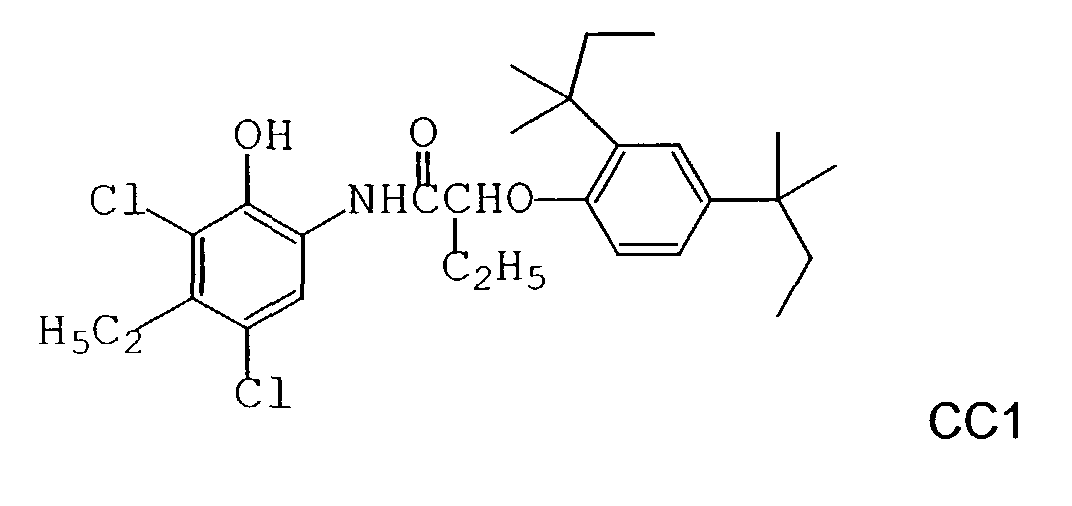
| Coating structure |
| Layer 7 (Supercoat) |
| Ludox AM® (DuPont) | 0.16 g.m-2 |
| Gel | 0.645 g.m-2 |
| Layer 6 (Interlayer C) |
| Tinuvin-328® | 0.130 g.m-2 |
| Tinuvin 326® | 0.023 g.m-2 |
| DMBHQ | 0.042 g.m-2 |
| Gel | 0.538 g.m-2 |
| Layer 5 (Red-sensitive Layer) |
| Ag | 0.19 g.m-2 |
| Coupler CC1 | 0.35 g.m-2 |
| Gel | 1.61 g.m-2 |
| Layer 4 (Interlayer B) |
| Tinuvin-328® | 0.172 g.m-2 |
| Tinuvin 326® | 0.030 g.m-2 |
| DMBHQ | 0.055 g.m-2 |
| Gel | 0.71 g.m-2 |
| Layer 3 (Green-sensitive Layer) |
| Ag | 0.078 g.m-2 |
| Coupler MC1 | 0.244 g.m-2 |
| Gel | 1.42 g.m-2 |
| Layer 2 (Interlayer A) |
| DMBHQ | 0.066 g.m-2 |
| Gel | 0.75 g.m-2 |
| Layer 1 (Blue-sensitive Layer) |
| Ag | 0.227 g.m-2 |
| Coupler YC2 | 0.414 g.m-2 |
| HQ-K | 0.0095 g.m-2 |
| PHR | 0.0024 g.m-2 |
| Latex copolymer | 0.413 g.m-2 |
| Gel | 1.31 g.m-2 |
| Hardener | 0.155 g.m-2 |
| Support |
| PHR = 2,5-dihydroxy-5-methyl-3-(1-piperidenyl)-2-cyclopenten-1-one |
| HQ-K = 2,5-dihydroxy-4-(1-methylheptadecyl)-benzenesulfonic acid (K salt) |
| Latex copolymer = 50/50 t-butylacrylamide / t-butylacrylate latex copolymer |
| DMBHQ = 2,5-di-(1,1,3,3-tetramethylbutyl)hydroquinone |
| Hardener = bis(vinylsulfonyl)methane |
The two uv absorbers, Tinuvin-326® and Tinuvin-328® were
incorporated via the same co-dispersion outlined in Example 2, and the scavenger
DMBHQ was also similarly incorporated in Interlayer A as a dispersion, prepared
using the same techniques. For this dispersion, the scavenger was dissolved in
dibutyl phthalate (3x, w/w cf scavenger).
The dispersions of MC1 and CC1 were prepared in the manner
described for coupler YC2. The oil-phase compositions of these dispersions are
shown below (the proportion of each component is quoted as a fraction of the
coupler weight):
| Magenta |
| Coupler MC1 | 1.0x |
| Stabilizer S-I-1 | 0.275x |
| Stabilizer S-I-2 | 1.88x |
| di-undecyl phthalate | 0.346x |
| Oleyl alcohol | 0.671x |
| Cyan |
| Coupler CC1 | 1.0x |
| tri-o-cresyl phosphate | 1.70x |
| Tinuvin-328® (Ciba-Geigy) | 1.03x |
| 2,(2-butoxyethoxy)ethyl acetate | 0.219x |
Sample strips of the coatings were exposed to blue light (Wratten
98 filter) through a step tablet (density range 0 - 3, 0.15 increments) and
developed in standard Kodak RA4 processing solutions before washing and
drying. Sensitometry and light stability of the resultant yellow image were
measured as described in Example 2, except that fading was continued for 5
weeks. The results are shown in Table 5.
| Processed Coatings Containing Coupler YC2 |
| Dispersion Identity | Stabilizer Content (fraction cf coupler) | Coupler Solvent | 0.4 Shoulder Density | Fade [ΔD(1.0)] |
| 61 | YSt-4 (0.292x) | Solv-1 | 1.95 | -0.44 |
| 62 | S-I-1 (0.292x) | Solv-1 | 2.01 | -0.36 |
| 63 | S-I-1 (0.292x) + YSt-4 (0.292x) | Solv-1 | 1.99 | -0.25 |
| 64 | YSM/YSt-5 (0.292x) + YSt-4 (0.292x) | Solv-1 | 1.95 | -0.40 |
| 65 | YSt-4 (0.146x) | Solv-7 | 1.99 | -0.71 |
| 66 | YSt-4 (0.292x) | Solv-7 | 1.97 | -0.61 |
| 67 | S-I-1 (0.146x) + YSt-4 (0.146x) | Solv-7 | 2.00 | -0.50 |
| 68 | S-I-1 (0.292x) + YSt-4 (0.292x) | Solv-7 | 2.00 | -0.36 |
| 69 | YSM/YSt-5 (0.292x) + YSt-4 (0.292x) | Solv-7 | 1.96 | -0.47 |
Considering the first four entries in Table 5 (corresponding to
coatings of dispersions with tributyl citrate coupler solvent) comparison between
dispersions 61 and 62 shows that stabilizer S-I-1 of this invention is superior to
the reference stabilizer YSt-4 in terms of both coupling reactivity and light
stability. The good reactivity performance is maintained in the mixture of S-I-1
and YSt-4 (dispersion 63), and furthermore this mixture provides excellent light
stability. In both respects, this coating is better than that of dispersion 64, which
contains the same total stabilizer concentration, but made up of a mixture of the
three phenolic stabilizers YSt-1, YSt-4 and YSt-5. These data thus provide further
support for the advantages claimed for the stabilizers of this invention, now
expressed in the context of a multilayer coating.
Additional evidence to illustrate the advantages of the invention is
also available from consideration of the remaining entries in Table 5, consisting of
coatings of dispersions made with trihexyl citrate as coupler solvent. Comparison
between dispersions 65 and 66 shows that doubling the concentration of stabilizer
YSt-4 produces a small improvement in stability of the yellow image, but also
reduces coupling reactivity. However, dispersion 67, which incorporates a
mixture of stabilizers S-I-1 and YSt-4 to the same total stabilizer concentration as
dispersion 66, gives an even larger improvement in stability, and equally
importantly, overcomes the activity penalty seen in dispersion 66. As might be
expected, even better light stability is obtained by increasing the total stabilizer
concentration (compare dispersions 68 and 67), but it is notable that there is in this
case no loss in coupling reactivity. Dispersion 69, which contains the same total
stabilizer concentration as dispersion 68, but made up of a mixture of the three
phenolic stabilizers YSt-1, YSt-4 and YSt-5, provides neither the same level of
stability nor the improved activity shown by the dispersion 68 coating. The
benefits of stabilizer combinations containing stabilizer S-I-1 are thus confirmed.
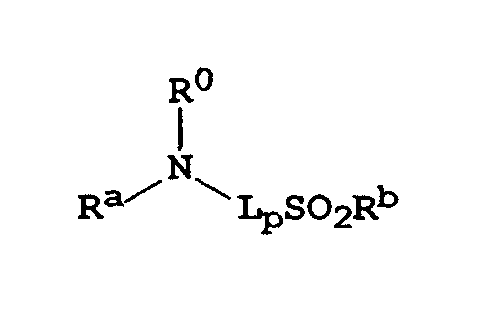

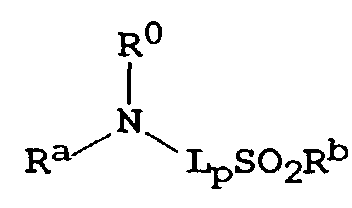
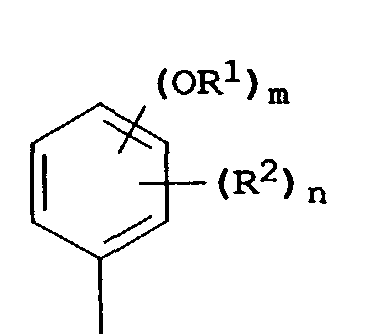
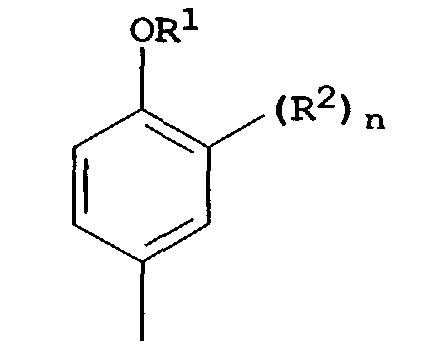


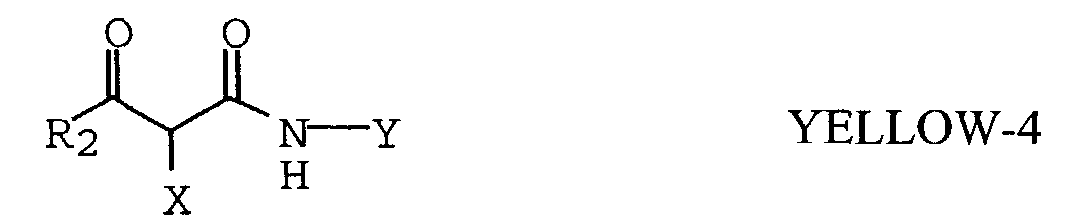
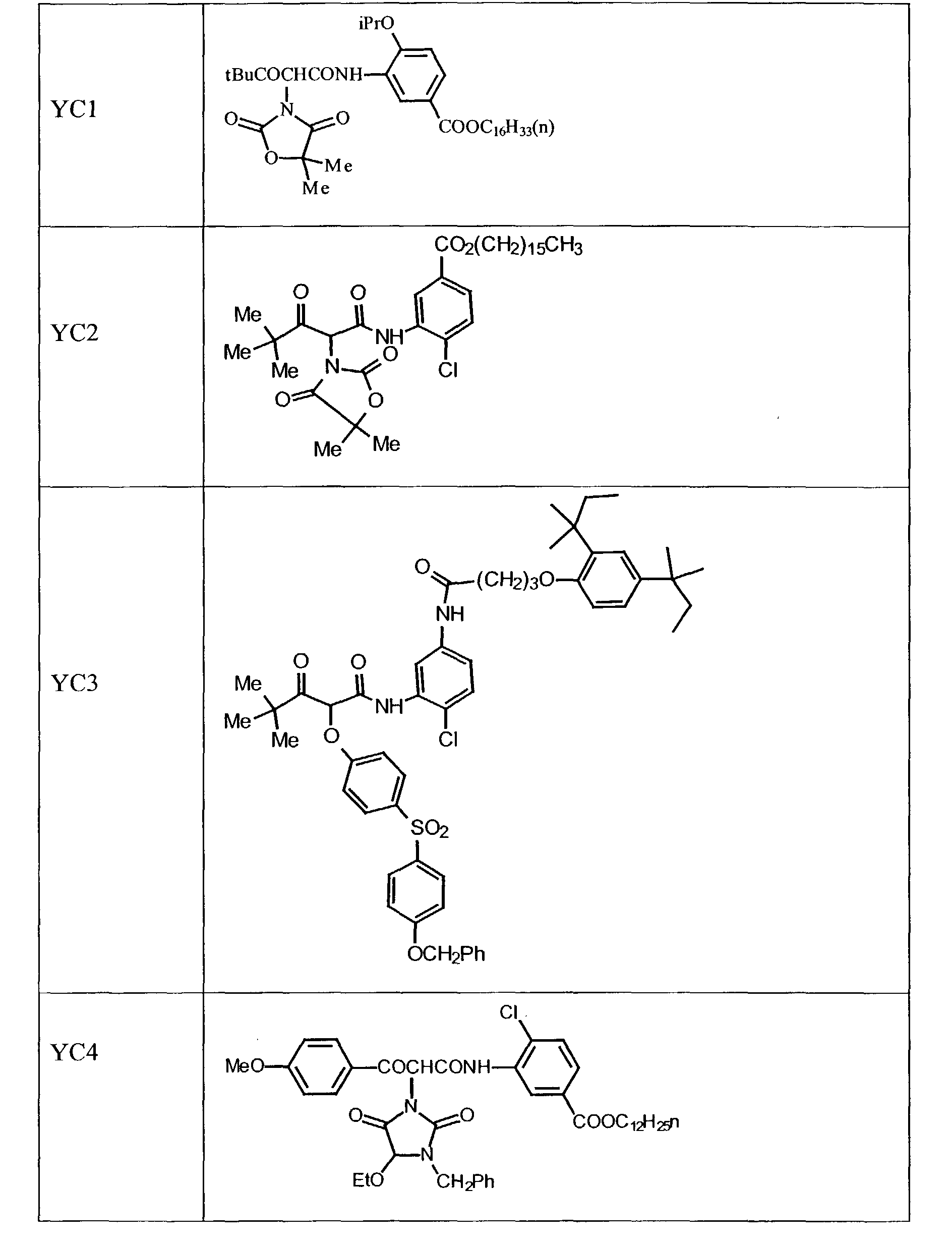


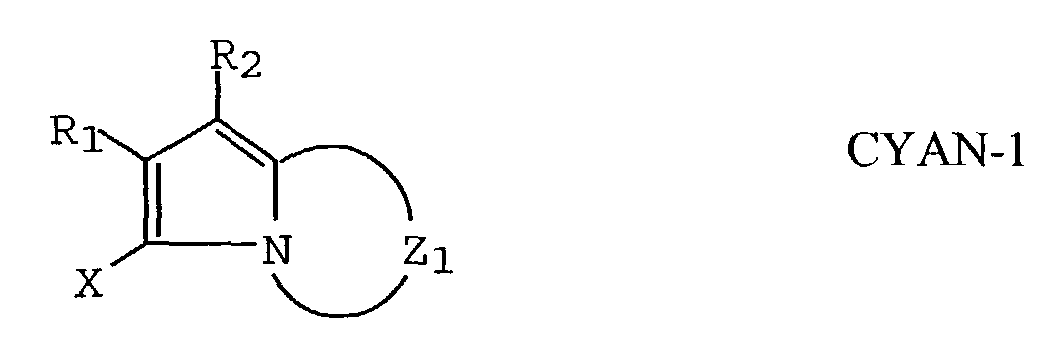


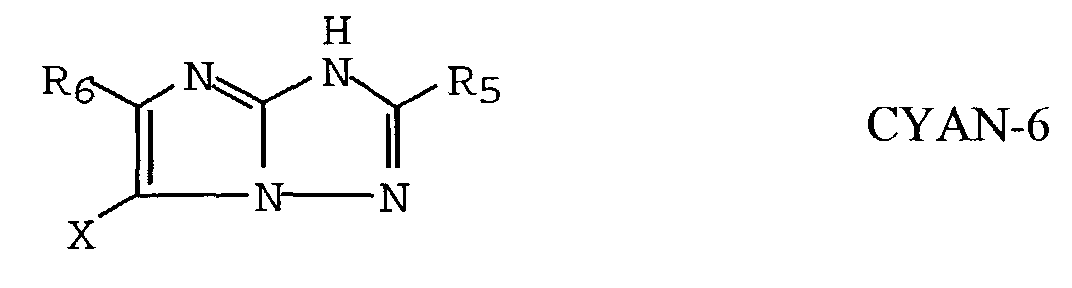
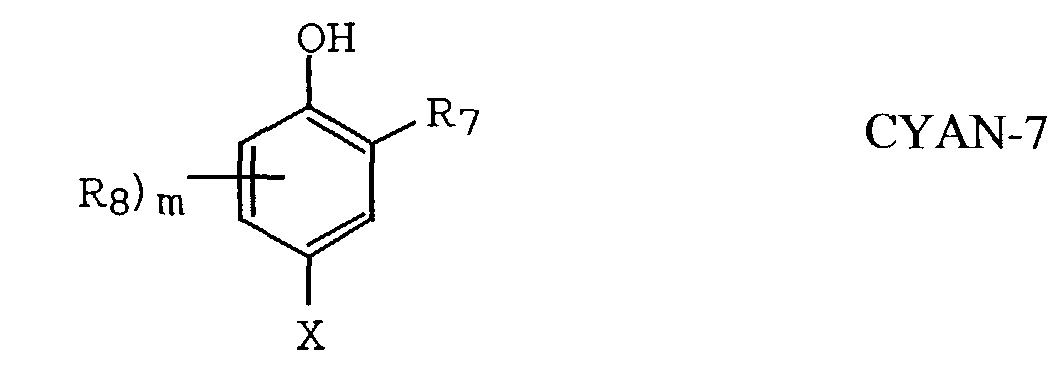
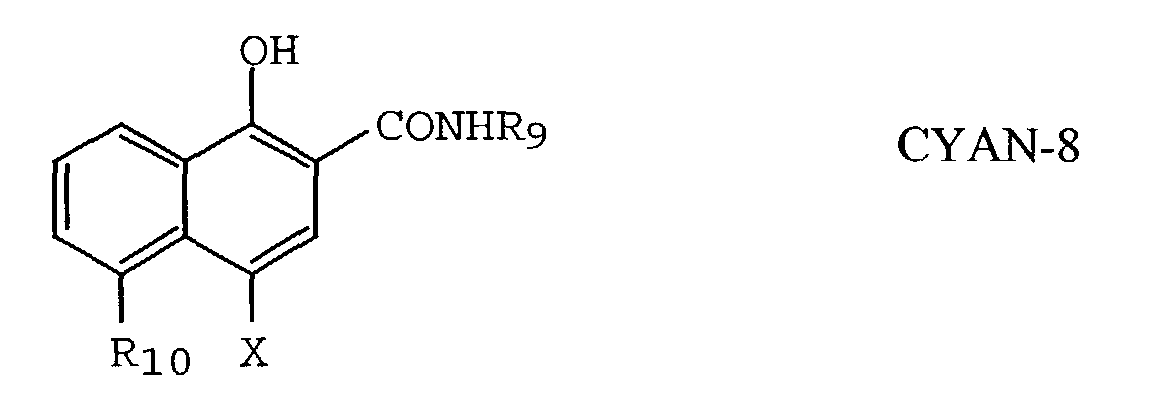


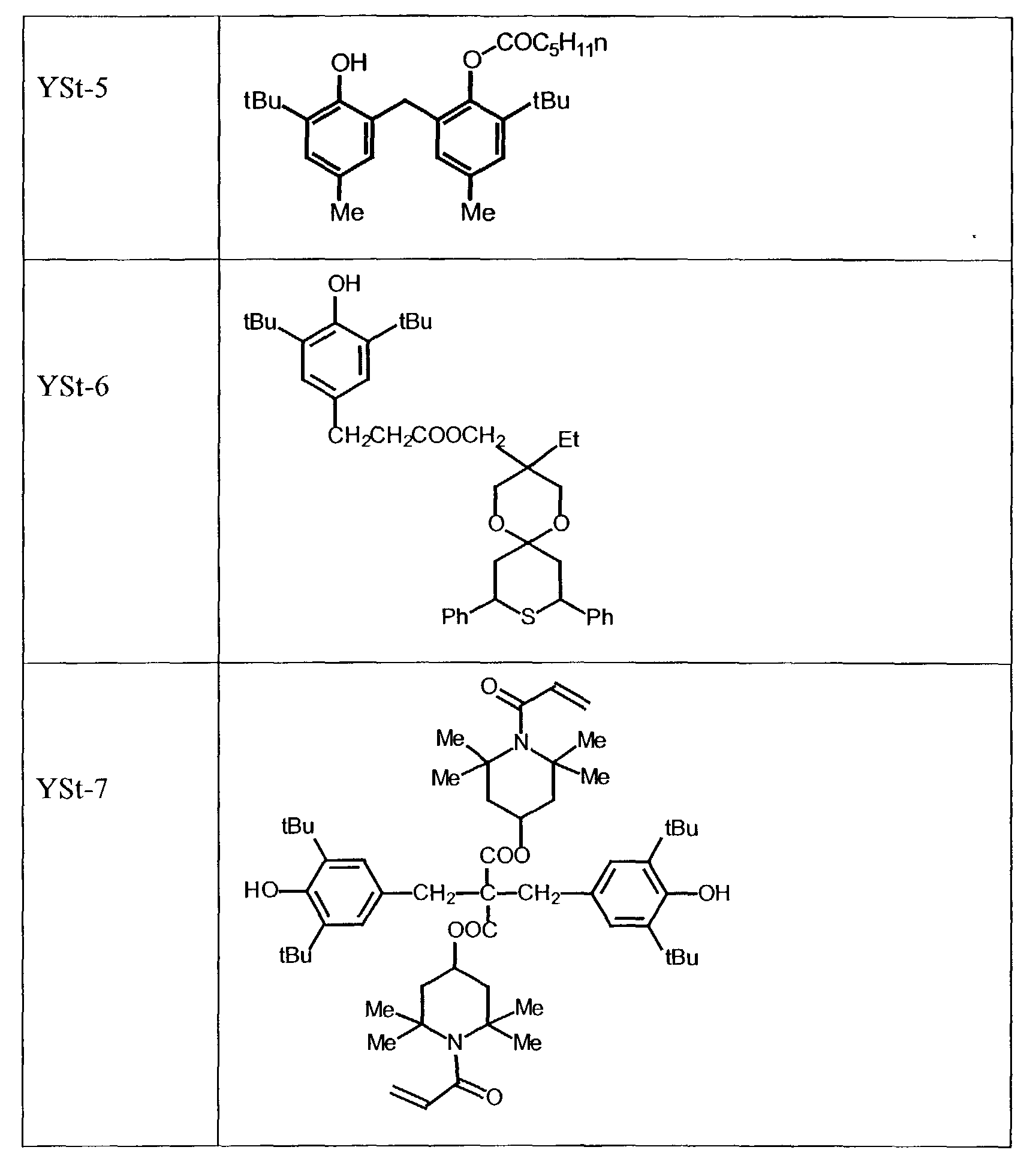
 R0 represents an unsubstituted or substituted aryl or heterocyclic group;Ra is H or a substituent group;L represents an alkylene linking group and p represents 0 or 1; andRb is a substituent group, provided that substituent groups represented by Ra and Rb may be joined to form a ring.
 m is 1, 2, 3, 4 or 5;n is 0, 1, 2, 3, or 4, provided that the sum of m and n is less than or equal to 5; andR1 is H or a substituent group and R2 is a substituent group, provided that substituent groups represented by R1 and R2 or two R1 or two R2 groups may be joined to form a ring.


 or
or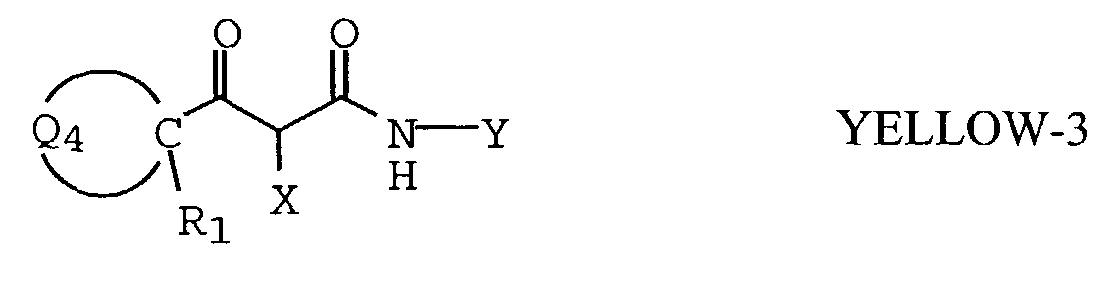 wherein R1, R2, Q1 and Q2 each represent a substituent; X is hydrogen or a coupling-off group; Y represents an aryl group or a heterocyclic group; Q3 represents an organic residue required to form a nitrogen-containing heterocyclic group together with the illustrated nitrogen atom; and Q4 represents nonmetallic atoms necessary to form a 3- to 5-membered hydrocarbon ring or a 3- to 5-membered heterocyclic ring which contains at least one hetero atom selected from N, O, S, and P in the ring.