EP1116803A2 - Method of pickling aluminium can bodies - Google Patents
Method of pickling aluminium can bodies Download PDFInfo
- Publication number
- EP1116803A2 EP1116803A2 EP01400048A EP01400048A EP1116803A2 EP 1116803 A2 EP1116803 A2 EP 1116803A2 EP 01400048 A EP01400048 A EP 01400048A EP 01400048 A EP01400048 A EP 01400048A EP 1116803 A2 EP1116803 A2 EP 1116803A2
- Authority
- EP
- European Patent Office
- Prior art keywords
- agent
- pickling
- tank
- aluminum
- nonionic surfactant
- Prior art date
- Legal status (The legal status is an assumption and is not a legal conclusion. Google has not performed a legal analysis and makes no representation as to the accuracy of the status listed.)
- Withdrawn
Links
Images

Classifications
-
- C—CHEMISTRY; METALLURGY
- C23—COATING METALLIC MATERIAL; COATING MATERIAL WITH METALLIC MATERIAL; CHEMICAL SURFACE TREATMENT; DIFFUSION TREATMENT OF METALLIC MATERIAL; COATING BY VACUUM EVAPORATION, BY SPUTTERING, BY ION IMPLANTATION OR BY CHEMICAL VAPOUR DEPOSITION, IN GENERAL; INHIBITING CORROSION OF METALLIC MATERIAL OR INCRUSTATION IN GENERAL
- C23G—CLEANING OR DE-GREASING OF METALLIC MATERIAL BY CHEMICAL METHODS OTHER THAN ELECTROLYSIS
- C23G1/00—Cleaning or pickling metallic material with solutions or molten salts
- C23G1/02—Cleaning or pickling metallic material with solutions or molten salts with acid solutions
- C23G1/12—Light metals
- C23G1/125—Light metals aluminium
-
- C—CHEMISTRY; METALLURGY
- C23—COATING METALLIC MATERIAL; COATING MATERIAL WITH METALLIC MATERIAL; CHEMICAL SURFACE TREATMENT; DIFFUSION TREATMENT OF METALLIC MATERIAL; COATING BY VACUUM EVAPORATION, BY SPUTTERING, BY ION IMPLANTATION OR BY CHEMICAL VAPOUR DEPOSITION, IN GENERAL; INHIBITING CORROSION OF METALLIC MATERIAL OR INCRUSTATION IN GENERAL
- C23G—CLEANING OR DE-GREASING OF METALLIC MATERIAL BY CHEMICAL METHODS OTHER THAN ELECTROLYSIS
- C23G3/00—Apparatus for cleaning or pickling metallic material
Definitions
- the present invention relates to a method of cleaning aluminum can bodies for beverage or other uses and more particularly to a pickling method suited for pretreatment preceding a chemical conversion or other treatment of aluminum can bodies.
- Aluminum cans for beverage use which are made of aluminum or an aluminum alloy are generally manufactured by a drawing process called drawing and ironing (DI).
- DI drawing and ironing
- the aluminum cans just produced by this process carry fine aluminum particles (smuts) shaven off the material on drawing as well as the lubricating oil. Therefore, in order that chemical conversion treatment or coating may be effected to such aluminum cans, the cans must be cleaned of such smut and lubricating oil in advance.
- a hydrofluoric acid type pickling agent or a fluorine-free pickling agent which etches the metal surface in an appropriate degree and thereby cleans the cans.
- surfactants with HLB values smaller than 14 are generally used.
- the problem which arises when the maintenance of wholesomeness of the pickling agent is sought by the above overflowing system is that a part of the surfactant having an affinity for lubricating oil is removed together with the oil floating on the liquid surface from the system. If, to overcome this disadvantage, the spray pipeline is utilized to draw out the washing agent from the tank at a relatively low level, the oil floating at the liquid level cannot be removed but is entrained into spray mists and ejected against the aluminum can bodies. The resulting residue of lubricating oil on the can surface interferes with the formation of a chemical conversion film and tends to cause black discoloration of the can bottom in the stage of sterilizing the filled cans.
- the object of the present invention is to provide a method for pickling an aluminum can body which makes full use of the surfactant component of a pickling agent and provides for steady cleaning with good reproducibility.
- An exemplary mode of said withdrawal of the pickling agent from the system below the surface of the body of agent may comprise drawing out the pickling agent from the tank through a spray piping, discarding a portion of the drawn agent out of the system and ejecting the remainder in a mist form against an aluminum can body to clean them and recycling the used agent to the tank.
- a tank 1 contains a prepared pickling agent 2.
- the pickling agent 2 is drawn out of the tank 1 by a pump 3 and fed to risers 5 via a spray pipeline 4 branching into a line extending horizontally over the cans and a line extending horizontally below the cans.
- the risers 5 are disposed at right angles with the spray pipeline 4 and provided with a plurality of can-cleaning spray nozzles 6.
- the position where pickling agent 2 is drawn off from tank 1 is not particularly restricted as far as it is below the agent level. There can be mentioned near the agent level, side bottom of the tank and bottom of the tank, preferably side bottom of the tank and bottom of the tank.
- aluminum can bodies 7 are arranged with their open sides down on a conveyer belt 8 made of acid-resistant material and, as such, traverse over the tank 1.
- the smut and lubricating oil adherent to the can bodies 7 are flushed off by the jets of pickling agent 2 delivered from the nozzles 6 in the upper and lower rows.
- the pickling agent is warmed to 35 to 85 °C, more preferably 50 to 80 °C, in advance, and ejected over a time of preferably 30 to 300 seconds, more preferably 45 to 120 seconds.
- the system is so designed that the used agent is recycled to the tank 1.
- the pickling agent 2 withdrawn through the spray pipeline 4 may be discharged from the system through a drain branch pipe 9.
- a drain port other than said drain pipe 9 may be provided in the lower side wall or bottom of the tank 1 to withdraw the agent through the port as needed.
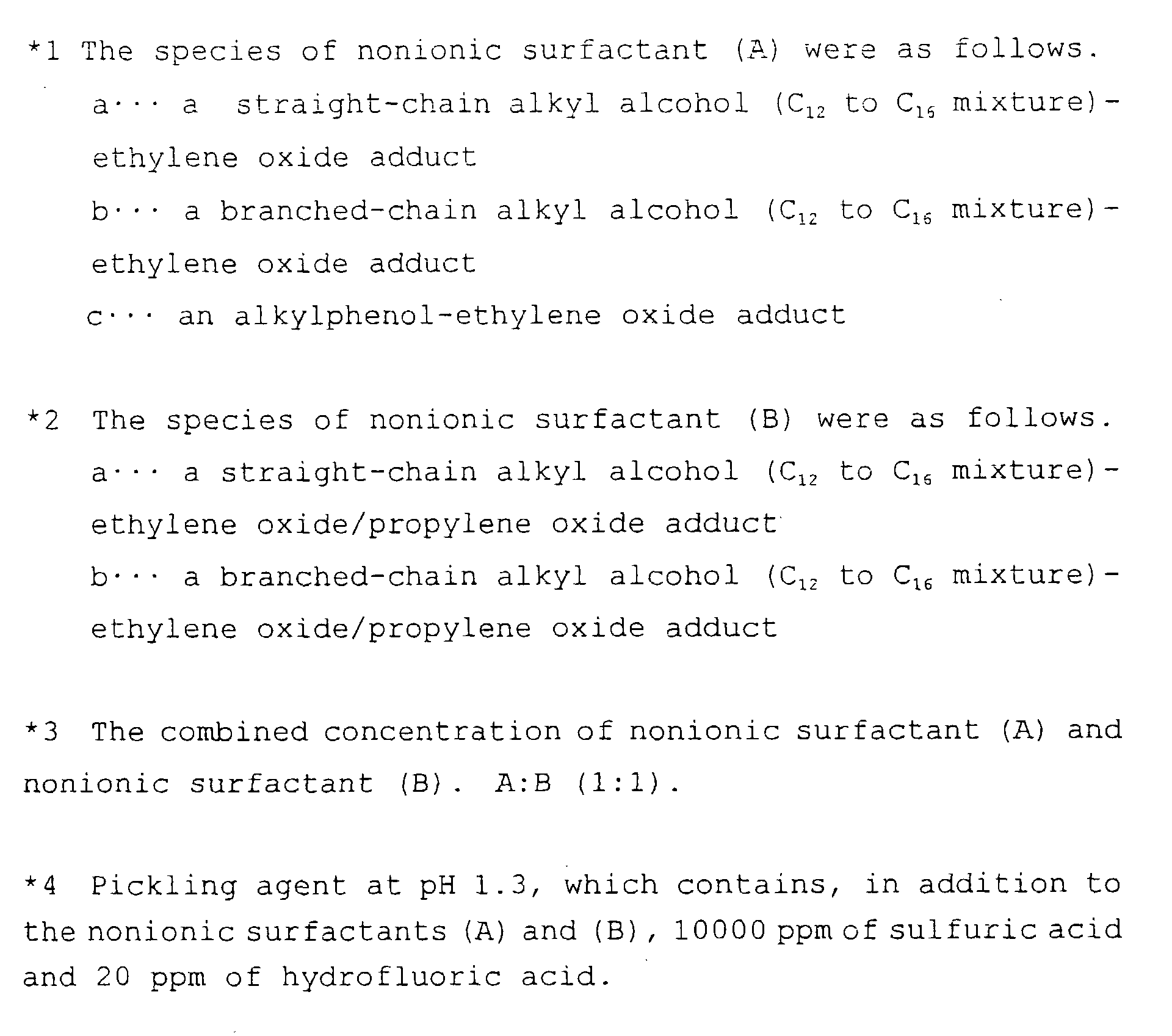
- the pickling agent 2 for use in the present invention contains a polyethylene glycol type detergent nonionic surfactant (A) having an HLB value of 14 to 18 and a low-foaming nonionic surfactant (B) having an HLB value of 2 to 12.
- concentration of the detergent nonionic surfactant (A) in the agent is 100 to 5000 ppm, preferably 1000 to 3000 ppm, and the HLB value of (A) is 14 to 18, preferably 15 to 17.
- an alkyl alcohol ethylene oxide adduct is most preferred but an alkylphenol ethylene oxide adduct and an abietic acid derivative, for instance, can also be employed.
- the concentration amount of the detergent nonionic surfactant (A) is lower than 100 ppm, the degreasing power of the agent is insufficient so that the formation of a chemical conversion film is rendered difficult and a black discoloration of the can bottom is induced in the heat-sterilization of filled cans.
- Use of (A) in excess of 5000 ppm will not be rewarded with any further improvement in degreasing power but rather will induce copious foaming in the tank.
- the HLB value of the low-foaming nonionic surfactant (B) is 2 to 12, preferably 5 to 9.
- the low-foaming nonionic surfactant (B) is added for defoaming purposes and, as such, various known surfactants can be employed.
- various known surfactants can be employed.
- the ratio of (A) to (B) is 10:90 to 90:10, preferably 30:70 to 60:40.
- the lipophilicity of the nonionic surfactant as a whole is so high that the lubricating oil mixing in the pickling agent on the cleaning of cans is coupled to the surfactant and floats on the surface of the body of agent in the tank. This oil cannot be effectively removed from a level below the liquid surface, with the result that the cleaning power is decreased.
- the ratio of (A) exceeds 90, the foaming of the pickling agent in the tank becomes too vigorous to be easily controlled.
- the pickling agent for use in the present invention contains said detergent nonionic surfactant (A) having a comparatively high hydrophilicity of HLB 14 to 18.
- This surfactant has a high capacity to emulsify the lubricating oil contaminating the pickling agent on the cleaning cans and, therefore, unlike the conventional washing agent with an HLB value of less than 14, it does not couple with the lubricating oil and cause it to float on the surface of the body of agent but gives a generally uniform dispersion in the tank. Therefore, the pickling agent pumped up to the nozzles contains the detergent nonionic surfactant (A) retaining a sufficient degreasing power.
- the pickling agent contains not only said nonionic surfactants but also an inorganic acid such as nitric acid, sulfuric acid, phosphoric acid or the like. With such an inorganic acid, the pickling agent is adjusted to, for example, an acidity of not over pH 2, preferably pH 0.6 to 2.
- an etching agent such as oxidation-form metal ions such as ferric ion (Fe 3+ ), ceric ion (Ce 4+ ), cobaltic ion (Co 3+ ), stannic ion (Sn 4+ ), etc. and oxidation-form metal oxoanions such as metavanadate ion (VO 3- ).
- the preferred amount of the etching agent in the pickling agent is 0.02 to 0.4 mass %.
- oxidizing agent such as hydrogen peroxide (H 2 O 2 ), a persulfate salt (e.g. NaS 2 O 3 2- ), ozone (O 3 ), a cerium compound [e.g. cerium ammonium sulfate (NH 4 ) 4 Ce(SO 4 ) 4 ] or a nitrite salt (e.g. NaNO 2 , KNO 2 , etc.).
- a polyhydric alcohol having at least 2 hydroxyl groups directly attached to adjacent carbon atoms of the backbone chain can be added.
- dihydric alcohols such as 1,2-ethanediol (ethylene glycol), 1,2-propanediol (propylene glycol), 1,2-pentanediol, 1,2-butanediol, etc., trihydric alcohols such as 1,2,3-propanetriol (glycerol), 1,2,4-butanetriol, etc., and tetrahydric alcohols such as 1,2,3,4-butanetetraol, etc. can be mentioned.
- the preferred level of said polyhydric alcohol in the pickling agent is 0.01 to 0.5 mass %.
- the conventional overflow system was sometimes inadequate in degreasing power because a substantial amount of the surfactant is removed together with the oil to reduce the surfactant concentration of the pickling agent.
- the pickling agent is withdrawn from a level below the surface of the body of agent so that the surfactant concentration of the pickling agent can be held high and the decrease in degreasing power of the agent can be prevented.
- a pickling agent comprises (A) a polyethylene glycol type detergent nonionic surfactant having an HLB value of 14 to 18, said pickling agent has affinity for the lubricating oil contaminating the agent on the cleaning cans and that for water in the tank. Further, said agent comprises (B) a low-foaming nonionic surfactant having an HLB value of 2 to 12 at a specific ratio to the surfactant (A) , said pickling agent does not show an excessive form.
- the pickling agent delivered from the nozzles contains the surfactants having sufficient degreasing power.
- Example 1 Except that the kind of pickling agent, treating temperature or the species or HLB value of nonionic surfactants (A) and (B) were varied as shown in Table 1, the procedure of Example 1 was otherwise repeated to treat can bodies and examine the bottoms of the treated cans. The results are shown in Table 1.
- Example 1 Except that a fluorine-free pickling agent containing 1500 ppm of a nonionic surfactant having an HLB value of 13, namely a straight-chain alkyl alcohol (C 12 to C 16 mixture)-ethylene oxide adduct, was used in lieu of the pickling agent used in Example 1, the procedure of Example 1 was otherwise repeated to treat can bodies. With regard to the tank composition after treatment, the concentration of the nonionic surfactant and that of the oil fraction had decreased to 1500 ppm and 500 ppm, respectively. Moreover, a brown oil (grease) was found afloat on the agent surface of the cleaning solution in the tank. Evaluation of the can bodies after chemical conversion treatment as in Example 1 revealed punctate blackening of the outer surface of the can bottom.
- a fluorine-free pickling agent containing 1500 ppm of a nonionic surfactant having an HLB value of 13, namely a straight-chain alkyl alcohol (C 12 to C 16 mixture)-ethylene oxide adduct was used in lieu of the pick
Landscapes
- Chemical & Material Sciences (AREA)
- Metallurgy (AREA)
- General Chemical & Material Sciences (AREA)
- Engineering & Computer Science (AREA)
- Materials Engineering (AREA)
- Mechanical Engineering (AREA)
- Chemical Kinetics & Catalysis (AREA)
- Organic Chemistry (AREA)
- Cleaning And De-Greasing Of Metallic Materials By Chemical Methods (AREA)
- Detergent Compositions (AREA)
- Cleaning In General (AREA)
- Cleaning By Liquid Or Steam (AREA)
- Containers Having Bodies Formed In One Piece (AREA)
Abstract
Description

Claims (5)
- A method of pickling an aluminum can bodycomprising ejecting a pickling agent from a tank against an aluminum can body caused to traverse said tank overhead to clean them and recycling the used agent to said tank,wherein said pickling agent is an acidic aqueous solution containing (A) a polyethylene glycol type detergent nonionic surfactant having an HLB value of 14 to 18 and (B) a low-foaming nonionic surfactant having an HLB value of 2 to 12,the concentration of (A) is 100 to 5000 ppm and the ratio of (A) to (B) is 10:90 to 90:10, andthe pickling agent in the tank is withdrawn out of the system from below the agent level.
- The method of pickling an aluminum can body according to Claim 1
wherein said detergent nonionic surfactant (A) is an alkyl alcohol-ethylene oxide adduct. - The method of pickling an aluminum can body according to Claim 1 or 2
wherein said low-foaming nonionic surfactant (B) is an alkyl alcohol-ethylene oxide adduct and/or -propylene oxide adduct. - The method of pickling an aluminum can body according to any of Claims 1 to 3
comprising withdrawing the pickling agent in the tank via a spray pipeline, removing a portion of the withdrawn pickling agent out of the system, ejecting the balance against an aluminum can body to clean them, and recycling the waste agent to the tank. - An aluminum can body obtainable by pickling it using the method according to any of Claims 1 to 4.
Applications Claiming Priority (4)
| Application Number | Priority Date | Filing Date | Title |
|---|---|---|---|
| JP2000003623 | 2000-01-12 | ||
| JP2000003623 | 2000-01-12 | ||
| JP2001000149 | 2001-01-04 | ||
| JP2001000149A JP2001262383A (en) | 2000-01-12 | 2001-01-04 | Acid cleaning method for aluminum can body |
Publications (2)
| Publication Number | Publication Date |
|---|---|
| EP1116803A2 true EP1116803A2 (en) | 2001-07-18 |
| EP1116803A3 EP1116803A3 (en) | 2003-05-02 |
Family
ID=26583385
Family Applications (1)
| Application Number | Title | Priority Date | Filing Date |
|---|---|---|---|
| EP01400048A Withdrawn EP1116803A3 (en) | 2000-01-12 | 2001-01-10 | Method of pickling aluminium can bodies |
Country Status (2)
| Country | Link |
|---|---|
| EP (1) | EP1116803A3 (en) |
| JP (1) | JP2001262383A (en) |
Cited By (8)
| Publication number | Priority date | Publication date | Assignee | Title |
|---|---|---|---|---|
| EP1775354A1 (en) * | 2005-10-17 | 2007-04-18 | Mack GmbH | Process for cleaning metal surfaces |
| CN106964623A (en) * | 2017-05-20 | 2017-07-21 | 泉州市南方食品机械有限公司 | A kind of hot high pressure air-flow cleaning machine of glass container |
| CN108687012A (en) * | 2017-07-24 | 2018-10-23 | 扬州新弘源电气有限公司 | A kind of transformer processing derusting device |
| CN110344068A (en) * | 2019-07-30 | 2019-10-18 | 安徽鑫翊新材料有限公司 | A kind of aluminium section acid wash passivation device |
| CN111910190A (en) * | 2019-05-08 | 2020-11-10 | 奥野制药工业株式会社 | Descaling agent for aluminum material |
| CN113818197A (en) * | 2020-06-18 | 2021-12-21 | 云米互联科技(广东)有限公司 | Detergent quantitative feeding method and system, storage medium and washing device |
| CN115254726A (en) * | 2022-06-22 | 2022-11-01 | 浙江陶特容器科技股份有限公司 | Cavity surface treatment system and method for ultra-high-purity chemical container |
| CN119406826A (en) * | 2025-01-06 | 2025-02-11 | 泰兴市润虹塑业有限公司 | A feeding mechanism and method for processing plastic bottle caps |
Families Citing this family (4)
| Publication number | Priority date | Publication date | Assignee | Title |
|---|---|---|---|---|
| JP5380497B2 (en) * | 2011-04-01 | 2014-01-08 | 花王株式会社 | Cleaning composition for hard surface |
| JP2017088989A (en) * | 2015-11-17 | 2017-05-25 | 住友電工焼結合金株式会社 | Cleaning method of iron-based component |
| CN111014162A (en) * | 2019-12-17 | 2020-04-17 | 徐州振丰超声电子有限公司 | Permanent magnet cleaning, pickling and activating integrated machine before electroplating |
| JP7685667B1 (en) * | 2024-12-23 | 2025-05-29 | 日本ペイント・サーフケミカルズ株式会社 | Acid cleaning solution for aluminum-based metal materials |
Family Cites Families (14)
| Publication number | Priority date | Publication date | Assignee | Title |
|---|---|---|---|---|
| USRE27662E (en) * | 1972-08-14 | 1973-06-12 | Compositions and methods for treating metal surfaces | |
| US4124407A (en) * | 1975-08-25 | 1978-11-07 | Amchem Products, Inc. | Method for cleaning aluminum at low temperatures |
| ZA823946B (en) * | 1981-06-24 | 1983-04-27 | Amchem Prod | Non-fluoride acid compositions for cleaning aluminum surfaces |
| AU591231B2 (en) * | 1986-02-18 | 1989-11-30 | Parker Chemical Company | Aluminum cleaning process |
| JPH0316279Y2 (en) * | 1986-07-31 | 1991-04-08 | ||
| JP2778863B2 (en) * | 1991-11-06 | 1998-07-23 | 日本ペイント株式会社 | Degreasing cleaning method |
| JPH0688265A (en) * | 1992-09-08 | 1994-03-29 | Yoshihide Shibano | Ultrasonic washing device |
| US5259960A (en) * | 1992-06-26 | 1993-11-09 | Man-Gill Chemical Company | Regeneration and recycling of contaminated solutions from aluminum and tin washer processes |
| JPH0741972A (en) * | 1993-07-26 | 1995-02-10 | Nippon Paint Co Ltd | Aqueous cleaning solution of aluminum-based metal |
| JP3248783B2 (en) * | 1993-06-21 | 2002-01-21 | 日本パーカライジング株式会社 | Alkaline liquid detergent composition for metals |
| US5393447A (en) * | 1993-07-09 | 1995-02-28 | Henkel Corporation | Composition and process for desmutting and deoxidizing without smutting |
| JP3465998B2 (en) * | 1995-05-30 | 2003-11-10 | 日本パーカライジング株式会社 | Acidic cleaning composition for aluminum-based metal material and cleaning method |
| JPH09314141A (en) * | 1996-05-23 | 1997-12-09 | Akira Yasuda | Oil separator in pretreatment degreasing process in plating |
| JP4303365B2 (en) * | 1998-07-30 | 2009-07-29 | 日本ペイント株式会社 | Cleaning aqueous solution of aluminum metal and cleaning method thereof |
-
2001
- 2001-01-04 JP JP2001000149A patent/JP2001262383A/en active Pending
- 2001-01-10 EP EP01400048A patent/EP1116803A3/en not_active Withdrawn
Cited By (8)
| Publication number | Priority date | Publication date | Assignee | Title |
|---|---|---|---|---|
| EP1775354A1 (en) * | 2005-10-17 | 2007-04-18 | Mack GmbH | Process for cleaning metal surfaces |
| CN106964623A (en) * | 2017-05-20 | 2017-07-21 | 泉州市南方食品机械有限公司 | A kind of hot high pressure air-flow cleaning machine of glass container |
| CN108687012A (en) * | 2017-07-24 | 2018-10-23 | 扬州新弘源电气有限公司 | A kind of transformer processing derusting device |
| CN111910190A (en) * | 2019-05-08 | 2020-11-10 | 奥野制药工业株式会社 | Descaling agent for aluminum material |
| CN110344068A (en) * | 2019-07-30 | 2019-10-18 | 安徽鑫翊新材料有限公司 | A kind of aluminium section acid wash passivation device |
| CN113818197A (en) * | 2020-06-18 | 2021-12-21 | 云米互联科技(广东)有限公司 | Detergent quantitative feeding method and system, storage medium and washing device |
| CN115254726A (en) * | 2022-06-22 | 2022-11-01 | 浙江陶特容器科技股份有限公司 | Cavity surface treatment system and method for ultra-high-purity chemical container |
| CN119406826A (en) * | 2025-01-06 | 2025-02-11 | 泰兴市润虹塑业有限公司 | A feeding mechanism and method for processing plastic bottle caps |
Also Published As
| Publication number | Publication date |
|---|---|
| JP2001262383A (en) | 2001-09-26 |
| EP1116803A3 (en) | 2003-05-02 |
Similar Documents
| Publication | Publication Date | Title |
|---|---|---|
| JP2587916B2 (en) | How to clean aluminum containers | |
| US10260153B2 (en) | Methods and compositions for acid treatment of a metal surface | |
| RU2108172C1 (en) | Method of treating parts with liquid | |
| US4370173A (en) | Composition and method for acid cleaning of aluminum surfaces | |
| US10486202B2 (en) | Cleaning device | |
| EP2010696B1 (en) | Process for the demulsifying cleaning of metallic surfaces | |
| KR100231390B1 (en) | Acid-cleaning aqueous solution of aluminum-based metal and its cleaning method | |
| US5909742A (en) | Metal cleaning method | |
| JP2001262383A (en) | Acid cleaning method for aluminum can body | |
| USRE27662E (en) | Compositions and methods for treating metal surfaces | |
| JP3465998B2 (en) | Acidic cleaning composition for aluminum-based metal material and cleaning method | |
| EP0976852B1 (en) | Aqueous cleaning solution and method for cleaning aluminium-based metals | |
| EP0662529B1 (en) | Degreasing cleaner and method for cleaning oil-deposited material | |
| DE69305329T2 (en) | COMPOSITION AND METHOD FOR CLEANING TIN PLATED PARTS | |
| GB2187206A (en) | Aluminium cleaning process | |
| CA1180644A (en) | Compositions and methods for the acid cleaning of aluminum surfaces | |
| JPH1046393A (en) | Pre-electrodeposition treatment method for car bodies | |
| USH2089H1 (en) | Compositions useful for degreasing metal surfaces | |
| CN114934277B (en) | Recyclable pop can cleaning agent and preparation method thereof | |
| US5932024A (en) | Decoating titanium and other metallized glass surfaces | |
| Kopecki | Cleaning Stainless Steel | |
| CA1117892A (en) | Procedure for removing plating rests from a plated wire | |
| CA1170144A (en) | Low temperature cleaner for metal surfaces | |
| Spring et al. | Recommended Practices for Cleaning Prior to Electroplating | |
| Callahan | 2 Optimizing and Maintaining the Process |
Legal Events
| Date | Code | Title | Description |
|---|---|---|---|
| PUAI | Public reference made under article 153(3) epc to a published international application that has entered the european phase |
Free format text: ORIGINAL CODE: 0009012 |
|
| AK | Designated contracting states |
Kind code of ref document: A2 Designated state(s): AT BE CH CY DE DK ES FI FR GB GR IE IT LI LU MC NL PT SE TR |
|
| AX | Request for extension of the european patent |
Free format text: AL;LT;LV;MK;RO;SI |
|
| PUAL | Search report despatched |
Free format text: ORIGINAL CODE: 0009013 |
|
| AK | Designated contracting states |
Designated state(s): AT BE CH CY DE DK ES FI FR GB GR IE IT LI LU MC NL PT SE TR |
|
| AX | Request for extension of the european patent |
Extension state: AL LT LV MK RO SI |
|
| RIC1 | Information provided on ipc code assigned before grant |
Ipc: 7C 23G 3/00 B Ipc: 7C 23G 1/36 B Ipc: 7C 23G 1/12 A |
|
| AKX | Designation fees paid | ||
| REG | Reference to a national code |
Ref country code: DE Ref legal event code: 8566 |
|
| STAA | Information on the status of an ep patent application or granted ep patent |
Free format text: STATUS: THE APPLICATION IS DEEMED TO BE WITHDRAWN |
|
| 18D | Application deemed to be withdrawn |
Effective date: 20031103 |