EP1115089A2 - Method of run-length encoding - Google Patents
Method of run-length encoding Download PDFInfo
- Publication number
- EP1115089A2 EP1115089A2 EP00311031A EP00311031A EP1115089A2 EP 1115089 A2 EP1115089 A2 EP 1115089A2 EP 00311031 A EP00311031 A EP 00311031A EP 00311031 A EP00311031 A EP 00311031A EP 1115089 A2 EP1115089 A2 EP 1115089A2
- Authority
- EP
- European Patent Office
- Prior art keywords
- bit
- bits
- repeat factor
- sequence
- equal
- Prior art date
- Legal status (The legal status is an assumption and is not a legal conclusion. Google has not performed a legal analysis and makes no representation as to the accuracy of the status listed.)
- Withdrawn
Links
Images


Classifications
-
- H—ELECTRICITY
- H03—ELECTRONIC CIRCUITRY
- H03M—CODING; DECODING; CODE CONVERSION IN GENERAL
- H03M7/00—Conversion of a code where information is represented by a given sequence or number of digits to a code where the same, similar or subset of information is represented by a different sequence or number of digits
- H03M7/30—Compression; Expansion; Suppression of unnecessary data, e.g. redundancy reduction
-
- G—PHYSICS
- G06—COMPUTING OR CALCULATING; COUNTING
- G06T—IMAGE DATA PROCESSING OR GENERATION, IN GENERAL
- G06T9/00—Image coding
- G06T9/005—Statistical coding, e.g. Huffman, run length coding
Definitions
- the present invention relates to run-length encoding, particularly for data compression.
- Run-length encoding algorithms are frequently the method of choice for data compression when data predominantly consists of sequences of equal-valued bits, such as visual images, because of the high compression ratios they can attain.
- an alphabet of symbols is defined, where such a symbol can consist of one or more bits. Then the data compression is achieved by representing the data as pairs each consisting of a symbol and its repeat factor, i.e., its number of successive occurrences.
- an alphabet need not be defined because successive repeat factors, commonly also referred to as, run-lengths, can designate the length of sequences of alternating bit values: one repeat factor is the number of 0-valued bits and the next repeat factor is the number of 1-values bits. If one bit value predominantly occurs with a repeat factor of one, then only the repeat factor of the opposite bit value which occurs with varying repeat factors may be written. This implies that between any two such repeat factors, there is a single bit of the opposite bit value.
- a problem that limits the efficiency of run-length encoding algorithms is that the repeat factors themselves occupy a certain number of bits, and it can be difficult or impossible to determine the optimal number of bits to represent these repeat factors, especially without knowing the actual data to compress. To aggravate the problem, even if the distribution of repeat factors for the entire data set or bit stream were known before the encoding process is to begin, the best choice of the number of bits to encode the repeat factor need not be constant throughout any one data set or bit stream. In these cases, a sub-optimal data compression ratio most likely results from any fixed choice of the number of bits to encode the repeat factor. Using too many bits to represent the repeat factors is wasteful and contrary to the objective of data compression. Using not enough bits to represent the repeat factors would force the algorithm to introduce zero-length sequences of the opposite bit-value, or other measures for the same purpose, and to then encode the remainder of the sequence that was too long to represent, in the same fashion.
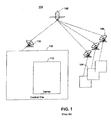
- FIG. 1 illustrates such a conventional satellite system 100 which may use data compression algorithms.
- the system includes a central site 102, at which is a transponder 110 and a server 112.
- the central site 102 communicates with remote clients 104 via a satellite 108.
- Receivers 106 at the client sites facilitate this communication.
- the multicast application server 112 To ensure the correct delivery of data over the satellite 108 to remote clients 104, the multicast application server 112 must be able to determine if the data was received correctly by all addressed clients, and the server 112 must resend the incorrectly received data.
- the clients 104 must respond to the server 112, indicating which of the data need to be resent, either because they were missed altogether, or because they contain more transmission errors than can be reconstructed.
- the response from each client can be different from that of any other client, and the amount of back traffic from all clients 104 to the server 112 will scale approximately linearly with the number of receivers.
- This client response data traffic, or back traffic is a serious burden not only for the central site server 112, but also for the server's local network which may not have sufficient bandwidth and/or responsiveness to handle this client response traffic without impacting other duties of that network.
- client response traffic may be the single most serious limiting factor to increasing the number of clients.
- client response implosion the flooding of a multicast sender/server 112 by the responses from its clients 104, called client response implosion, is a common and significant impediment to the runtime performance and to the scalability in the number of receivers and of multicast and broadcast applications.
- client response implosion is aggravated when transmission errors increase due to adverse weather conditions, obscuring of the line of transmission, or sun spot activity.
- the efficiency of the run-length encoding algorithm used in data compression by the network is therefore a critical factor.
- the present invention provides an improved method for encoding a plurality of bit sequences.
- the present invention includes reading a bit sequence; determining a minimum number of bits for a repeat factor for the bit sequence, where the minimum number of bits is variable; and encoding the bit sequence using the repeat factor.
- the method provides an improved run-length encoding algorithm by using a strategy where the number of bits used to represent the repeat factor (RF) varies for each individual sequence of equal-valued bits. Rather than conventionally representing the RF by any predetermined and fixed number of bits, the RF of the present invention is represented by the minimum number of bits to binary-encode that repeat factor as an unsigned integer.
- variable width RF run-length encoding algorithm provides the key advantage of providing the variable width RF run-length encoding algorithm.
- the RF for each individual bit sequence is represented using only the minimum number of bits necessary, regardless of any previous or following RF. Consequently, a compression ratio can be obtained, which is higher than that obtained with the conventional algorithms, over a wide range of sequence length distributions in the data to compress.
- the variable width RF is data driven in that the data to compress is what controls how many bits are used to represent the RF. Therefore, it is unnecessary to know the bit value sequence distribution in advance, which makes the method in accordance with the present invention well suited for real-time application.
- the number of bits needed to represent the RF of a sequence of equal-valued bits is written to the output bit stream (OBS) before the actual RF, using a small parametrized number of bits, called the repeat factor encoding width (RFEW).
- the first item of information constituting a bit sequence compressed with the method in accordance with the present invention is the RFEW.
- the actual RF is then represented using repeat factor width (RFW) bits.
- RFW repeat factor width
- RFW repeat factor width
- the RFW can range from 1 to 16 bits.
- the RFW can never be smaller than 1 bit, since even a RF of zero needs one bit to be represented.
- a RF can attain values ranging from zero to 2 16 -1, or 65,635.
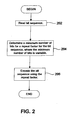
- Figure 2 is a flow chart illustrating a preferred embodiment of a method for providing an improved run-length encoding algorithm for data compression in accordance with the present invention.
- a bit sequence to encode is read, via step 202.
- a minimum number of bits for a RF for the bit sequence is determined, where the minimum number of bits is variable, via step 204.
- the bit sequence is encoded using the RF, via step 206.
- RFEW bits are the ten bits that encode the RF of one thousand.
- bit sequence of one thousand consecutive equal bits is encoded into a fourteen bit long output sequence, "10011111101000", where the first bits, "1001" is the RFEW.
- the resulting compression ratio is 1000/14, or 71.4.
- this example illustrates a RFEW of four bits, any number of bits may be used.
- Figure 3 is a flow chart illustrating in more detail the preferred embodiment of the method for providing an improved run-length encoding algorithm for data compression in accordance with the present invention.
- Figure 4 is a flow chart illustrating in more detail the initializing step 302.
- the first bit from the input bit stream (IBS) is read, and the global variable "previous_bit” is set equal to the first bit, via step 402. If previous_bit is determined to not be equal to zero, via step 404, then a zero length encoded sequence is written, via step 406.
- the global variable "cleanup” is set equal to "TRUE", via step 408, and the global variable for the RF, "repeat_factor", is set equal to one, via step 410.
- variable "cleanup" indicates whether or not an encoded sequence is to be flushed to the OBS. If previous_bit is determined to be equal to zero, via step 404, then the initializing step skips step 406 and proceeds to step 408 and 410. However, whether the convention requires the first bit of the OBS to be zero, as is used above, or one, is arbitrary. The predominant bit value of the IBS should be used.
- Figure 5 is a flow chart illustrating in more detail the writing the zero length sequence (step 406, Fig. 4) in accordance with the present invention.
- the repeat_factor is set equal to zero, via step 502.
- the encoded sequence is written, via step 504.
- step 302 it is determined if the IBS is empty, via step 304. If so, then if cleanup equals TRUE, then the encoded sequence is flushed to the OBS, via step 306. If not, then the next bit of the IBS is read and the global variable "current_bit" is set equal to the next bit, via step 308. Then, it is determined if current_bit equals previous_bit, via step 310. If not, then the end of a sequence of equal bits has been reached and current_bit is the first bit of the next bit sequence. Previous bit is then set equal to current_bit to track the bit value of the next bit sequence, via step 312. The encoded sequence is then written, via step 314. The RF is reset equal to one, via step 316, and cleanup is set to FALSE, via step 318, since the old sequence has already been flushed to the OBS. The process then loops back to step 304.
- repeat_factor is incremented by one, via step 320, in order to count the number of sequential equal bits. If the incremented repeat_factor has exceeded a preset maximum value, via step 322, then repeat_factor is set equal to the maximum value, via step 324. (This maximum value is 2 ⁇ (2 ⁇ RFEW)-1), where the symbol 1 indicates "to the power of”.) Then, the encoded sequence is written, via step 326, and a zero length sequence of the opposite bit value is inserted after the encoded sequence, via step 328. The repeat_factor is then reset equal to one, via step 320, and cleanup is set to TRUE, via step 332. The process then loops back to step 304.
- Figure 6 is a flow chart illustrating in more detail the writing of the encoded sequence (steps 326 and 314, Fig. 3; step 504, Fig. 5) in accordance with the present invention.
- the RFEW for the value of repeat_factor is determined, via step 602.
- the value of the RFEW is written to the OBS, via step 604.
- the value of repeat_factor is written to the OBS, via step 606.
- Figure 7 is a flow chart illustrating in more detail the determining of the RFEW (step 602, Fig. 6) in accordance with the present invention. First, it is determined if repeat_factor is less than or equal to one, via step 702. If it is, then a one is returned for the RFEW, via step 704. If not, then a RFEW equal to one plus the largest integer not greater than the binary logarithm of repeat_factor is returned, via step 706.
- variable width RF run-length encoding algorithm in accordance with the present invention is that the RF for each individual bit sequence is represented using only the minimum number of bits necessary, regardless of any previous or following RF. Consequently, a compression ratio can be obtained, which is higher than that obtained with the conventional algorithms, over a wide range of sequence length distributions in the data to compress. Additionally, the variable width RF is data driven in that the data to compress is what controls how many bits are used to represent the RF. Therefore, it is unnecessary to know the bit value sequence distribution in advance, which makes the method in accordance with the present invention well suited for real-time application.
- the sequence of 1000 consecutive "0"'s require one RF with a width of 10 bits; the sequence of 20 consecutive “1” 's require one RF with a width of 5 bits; and the sequence of 300 consecutive "0"'s require one RF with a width of 9 bits.
- a RFEW with 4 bits is needed for each RF, resulting in 14 bits to encode the 1000 "0"'s, 9 bits to encode the 20 "1” ' s, and 13 bits to encode the 300 "0"'s.
- the run-length compression algorithm in accordance with the present invention which uses a variable RF width, a total of 36 bits is required to encode the bit sequences.
- the decompression of the algorithm in accordance with the present invention does not require a sophisticated algorithm. Since sustained data traffic from memory to the processor (not shown) of the server 112 can be a major performance bottleneck of that server when processing client back traffic, data compression in accordance with the present invention can improve the overall speed at which the server 112 can process the client responses. This is because less response data per client has to be piped into the processor as compared to using conventional compression methods. This, in turn, improves the overall throughput of the server 112 which now has some of its resources freed.
- the implementation of the algorithm in accordance with the present invention requires very little resources in terms of central processing unit (CPU) cycles, and almost none in terms of memory beyond what is needed to contain the executable code implementing it.
- the data to be compressed have to be read/processed only once, i.e., they can be piped through an implementation of the present invention.
- a method for providing an improved run-length encoding algorithm for data compression has been disclosed.
- the method in accordance with the present invention provides an improved run-length encoding algorithm by using a strategy where the number of bits used to represent the repeat factor (RF) varies for each individual sequence of equal-valued bits.
- the RF of the present invention is represented by the minimum number of bits to binary-encode that repeat factor as an unsigned integer.
- the key advantage of providing the variable width RF run-length encoding algorithm in accordance with the present invention is that the RF for each individual bit sequence is represented using only the minimum number of bits necessary, regardless of any previous or following RF.
- variable width RF is data driven in that the data to compress is what controls how many bits are used to represent the RF. Therefore, it is unnecessary to know the bit value sequence distribution in advance, which makes the method in accordance with the present invention well suited for real-time application.
Landscapes
- Engineering & Computer Science (AREA)
- Theoretical Computer Science (AREA)
- Multimedia (AREA)
- Physics & Mathematics (AREA)
- General Physics & Mathematics (AREA)
- Compression, Expansion, Code Conversion, And Decoders (AREA)
Abstract
Description
| Uncompressed bit sequence | Bits after compression with Conventional method with RF fixed width of 4 bits | Bits after compression with method in accordance with present invention with variable width RF | |
| 1000 x "0" | 532 | 14 | |
| 20 x "1" | 12 | 9 | |
| 300 x "0" | 156 | 13 | |
| TOTAL | 1320 | 700 | 36 |
Claims (11)
- A method for encoding a plurality of bit sequences each including a number of repeated bit patterns, comprising:(a) reading a bit sequence;(b) determining the minimum number of bits necessary to represent a repeat factor for said repeated patterns of the bit sequence, wherein the minimum number of bits is variable; and(c) encoding the bit sequence by using the repeat factor to represent the number of repeated bit patterns.
- The method of claim 1, wherein the reading step (a) comprises:
reading a plurality of consecutive equal-valued bits of an input bit stream, said bit patterns being individual bits - The method of claim 2, wherein the reading step further comprises:reading a first bit of the input bit stream;setting a previous bit equal to the first bit;reading a next bit of the input bit stream;setting a current bit equal to the next bit;determining if the previous bit equals the current bit;setting the previous bit equal to the current bit if the previous bit equals the current bit, and returning to step of reaching a next bit; andstopping the reading if the previous bit does not equal the current bit.
- The method of any preceding claim, wherein the determining step (b) comprises:counting a plurality of consecutive equal-valued bits of an input bit stream, wherein the consecutive equal-valued bits comprise the bit sequence, wherein the result of the counting is the repeat factor; anddetermining a repeat factor encoding width for the repeat factor, wherein the repeat factor encoding width is the minimum number of bits for the repeat factor.
- The method of claim 4, wherein the counting step comprises:
setting the repeat factor equal to a predetermined maximum number if the repeat factor is greater than the predetermined maximum number. - The method of claim 4, wherein the determination of the repeat factor encoding width comprises:setting the repeat factor encoding width equal to one, if the repeat factor is not greater than one; andsetting the repeat factor encoding width equal to one plus a largest integer not greater than a binary logarithm of the repeat factor, if the repeat factor is greater than one.
- The method of any preceding claim, wherein the encoding step (c) comprises:writing a repeat factor encoding width for the repeat factor to an output bit stream; andwriting the repeat factor to the output bit stream.
- The method of any preceding claim, wherein prior to the reading step (a), said method further comprises:
initializing the repeat factor equal to one. - The method of any preceding claim, further comprising:
inserting a zero length sequence for a bit value opposite to a value of the bit sequence. - The method of claim 9, wherein the inserting step comprises:setting the repeat factor equal to zero; andencoding the zero length sequence with the repeat factor equal to zero.
- A computer program comprising instructions which, when executed on a computer, carry out a method as claimed in any one of the preceding claims.
Applications Claiming Priority (2)
| Application Number | Priority Date | Filing Date | Title |
|---|---|---|---|
| US09/477,289 US6331826B1 (en) | 2000-01-04 | 2000-01-04 | Method for providing an improved run-length encoding algorithm for data compression |
| US477289 | 2000-01-04 |
Publications (2)
| Publication Number | Publication Date |
|---|---|
| EP1115089A2 true EP1115089A2 (en) | 2001-07-11 |
| EP1115089A3 EP1115089A3 (en) | 2004-03-03 |
Family
ID=23895300
Family Applications (1)
| Application Number | Title | Priority Date | Filing Date |
|---|---|---|---|
| EP00311031A Withdrawn EP1115089A3 (en) | 2000-01-04 | 2000-12-11 | Method of run-length encoding |
Country Status (5)
| Country | Link |
|---|---|
| US (1) | US6331826B1 (en) |
| EP (1) | EP1115089A3 (en) |
| JP (1) | JP3409319B2 (en) |
| KR (1) | KR100390731B1 (en) |
| CN (1) | CN1145265C (en) |
Cited By (2)
| Publication number | Priority date | Publication date | Assignee | Title |
|---|---|---|---|---|
| GB2425864A (en) * | 2005-05-03 | 2006-11-08 | Hewlett Packard Development Co | System and method for compressing system tracking data |
| US7483585B2 (en) * | 2004-12-01 | 2009-01-27 | Ati Technologies Ulc | Image compression using variable bit size run length encoding |
Families Citing this family (23)
| Publication number | Priority date | Publication date | Assignee | Title |
|---|---|---|---|---|
| AU2628301A (en) * | 2000-01-06 | 2001-07-16 | Zen Optical Technology Llc | Pen-based handwritten character recognition and storage system |
| US7164369B2 (en) * | 2001-06-19 | 2007-01-16 | Sharp Laboratories Of America, Inc. | System for improving storage efficiency of digital files |
| US10534606B2 (en) * | 2011-12-08 | 2020-01-14 | Oracle International Corporation | Run-length encoding decompression |
| US9459866B2 (en) * | 2011-12-30 | 2016-10-04 | Intel Corporation | Vector frequency compress instruction |
| US10241792B2 (en) | 2011-12-30 | 2019-03-26 | Intel Corporation | Vector frequency expand instruction |
| US11113054B2 (en) | 2013-09-10 | 2021-09-07 | Oracle International Corporation | Efficient hardware instructions for single instruction multiple data processors: fast fixed-length value compression |
| US9378232B2 (en) | 2013-09-21 | 2016-06-28 | Oracle International Corporation | Framework for numa affinitized parallel query on in-memory objects within the RDBMS |
| CN103888997B (en) * | 2014-01-27 | 2018-02-02 | 广采网络科技(上海)有限公司 | A kind of data compression and storage method for sensor network |
| US10025823B2 (en) | 2015-05-29 | 2018-07-17 | Oracle International Corporation | Techniques for evaluating query predicates during in-memory table scans |
| US10067954B2 (en) | 2015-07-22 | 2018-09-04 | Oracle International Corporation | Use of dynamic dictionary encoding with an associated hash table to support many-to-many joins and aggregations |
| US10402425B2 (en) | 2016-03-18 | 2019-09-03 | Oracle International Corporation | Tuple encoding aware direct memory access engine for scratchpad enabled multi-core processors |
| US10061832B2 (en) | 2016-11-28 | 2018-08-28 | Oracle International Corporation | Database tuple-encoding-aware data partitioning in a direct memory access engine |
| US10061714B2 (en) | 2016-03-18 | 2018-08-28 | Oracle International Corporation | Tuple encoding aware direct memory access engine for scratchpad enabled multicore processors |
| US10599488B2 (en) | 2016-06-29 | 2020-03-24 | Oracle International Corporation | Multi-purpose events for notification and sequence control in multi-core processor systems |
| US10380058B2 (en) | 2016-09-06 | 2019-08-13 | Oracle International Corporation | Processor core to coprocessor interface with FIFO semantics |
| US10783102B2 (en) | 2016-10-11 | 2020-09-22 | Oracle International Corporation | Dynamically configurable high performance database-aware hash engine |
| US10176114B2 (en) | 2016-11-28 | 2019-01-08 | Oracle International Corporation | Row identification number generation in database direct memory access engine |
| US10459859B2 (en) | 2016-11-28 | 2019-10-29 | Oracle International Corporation | Multicast copy ring for database direct memory access filtering engine |
| US10725947B2 (en) | 2016-11-29 | 2020-07-28 | Oracle International Corporation | Bit vector gather row count calculation and handling in direct memory access engine |
| WO2022067790A1 (en) * | 2020-09-30 | 2022-04-07 | Oppo广东移动通信有限公司 | Point cloud layering method, decoder, encoder, and storage medium |
| CN112615627A (en) * | 2020-11-13 | 2021-04-06 | 北京信工博特智能科技有限公司 | Dynamic compression method and dynamic compression system based on improved run length coding |
| US20240388309A1 (en) * | 2022-10-26 | 2024-11-21 | Radu Mircea Secareanu | Binary Data Compression / Decompression Method |
| CN117056292B (en) * | 2023-08-16 | 2026-03-20 | 中国工商银行股份有限公司 | Document processing methods, apparatus, non-volatile storage media, and computer equipment |
Family Cites Families (5)
| Publication number | Priority date | Publication date | Assignee | Title |
|---|---|---|---|---|
| US4799242A (en) * | 1987-08-24 | 1989-01-17 | International Business Machines Corporation | Multi-mode dynamic code assignment for data compression |
| US5717394A (en) * | 1993-02-10 | 1998-02-10 | Ricoh Company Ltd. | Method and apparatus for encoding and decoding data |
| FR2747795B1 (en) * | 1996-04-19 | 1998-08-14 | Soc Et Rech Et Const Electroni | METHOD FOR COMPRESSION OF SEISMIC ACQUISITION DATA |
| US5751231A (en) * | 1996-06-26 | 1998-05-12 | Intel Corporation | Method and apparatus for run-length encoding using special long-run codes |
| US6166664A (en) * | 1998-08-26 | 2000-12-26 | Intel Corporation | Efficient data structure for entropy encoding used in a DWT-based high performance image compression |
-
2000
- 2000-01-04 US US09/477,289 patent/US6331826B1/en not_active Expired - Lifetime
- 2000-12-11 EP EP00311031A patent/EP1115089A3/en not_active Withdrawn
- 2000-12-20 KR KR10-2000-0078967A patent/KR100390731B1/en not_active Expired - Fee Related
- 2000-12-26 JP JP2000394029A patent/JP3409319B2/en not_active Expired - Fee Related
- 2000-12-29 CN CNB001294970A patent/CN1145265C/en not_active Expired - Lifetime
Cited By (4)
| Publication number | Priority date | Publication date | Assignee | Title |
|---|---|---|---|---|
| US7483585B2 (en) * | 2004-12-01 | 2009-01-27 | Ati Technologies Ulc | Image compression using variable bit size run length encoding |
| GB2425864A (en) * | 2005-05-03 | 2006-11-08 | Hewlett Packard Development Co | System and method for compressing system tracking data |
| GB2425864B (en) * | 2005-05-03 | 2009-08-05 | Hewlett Packard Development Co | Systems and methods for organizing and storing data |
| US7895012B2 (en) | 2005-05-03 | 2011-02-22 | Hewlett-Packard Development Company, L.P. | Systems and methods for organizing and storing data |
Also Published As
| Publication number | Publication date |
|---|---|
| KR100390731B1 (en) | 2003-07-10 |
| EP1115089A3 (en) | 2004-03-03 |
| JP3409319B2 (en) | 2003-05-26 |
| KR20010070313A (en) | 2001-07-25 |
| JP2001217723A (en) | 2001-08-10 |
| US6331826B1 (en) | 2001-12-18 |
| CN1303176A (en) | 2001-07-11 |
| CN1145265C (en) | 2004-04-07 |
Similar Documents
| Publication | Publication Date | Title |
|---|---|---|
| EP1115089A2 (en) | Method of run-length encoding | |
| US5003307A (en) | Data compression apparatus with shift register search means | |
| US5764807A (en) | Data compression using set partitioning in hierarchical trees | |
| US6606037B2 (en) | Qualitative modeling and compression of request sequences in ARQ protocols | |
| US6373986B1 (en) | Compression of data transmission by use of prime exponents | |
| US7483580B2 (en) | System and program product for error recovery while decoding cached compressed data | |
| US20080170613A1 (en) | Breakpoint determining for hybrid variable length coding and encoding the determined breakpoint | |
| US6043765A (en) | Method and apparatus for performing a parallel speculative Huffman decoding using both partial and full decoders | |
| CN109787722B (en) | Data transmission method and device and server | |
| JP2000505274A (en) | System and method for nested split coding of sparse datasets | |
| US20020027954A1 (en) | Method and device for gathering block statistics during inverse quantization and iscan | |
| US7605721B2 (en) | Adaptive entropy coding compression output formats | |
| US8473428B2 (en) | Generation and use of specific probability tables for arithmetic coding in data compression systems | |
| US6731807B1 (en) | Method of compressing and/or decompressing a data set using significance mapping | |
| JP3123792B2 (en) | Encoding device and decoding device using arithmetic code | |
| EP0659023A2 (en) | Method and apparatus for compression-coding image data | |
| US20060018556A1 (en) | Method, apparatus and system for data block rearrangement for LZ data compression | |
| US5708431A (en) | Method for compression coding of potentially unbounded integers | |
| Jackson et al. | Parallel pipelined fractal image compression using quadtree recomposition | |
| CN109639393B (en) | Sliding window network coding method based on quadratic permutation polynomial | |
| EP3972133A1 (en) | Selection of pivot positions for linear network codes | |
| US20020027558A1 (en) | Data transfer apparatus and method | |
| JP3009434B2 (en) | Data compression device | |
| CN114022577B (en) | A grayscale image compression method based on Hilbert scanning | |
| Jackson et al. | Fractal image compression using a circulating pipeline computation model |
Legal Events
| Date | Code | Title | Description |
|---|---|---|---|
| PUAI | Public reference made under article 153(3) epc to a published international application that has entered the european phase |
Free format text: ORIGINAL CODE: 0009012 |
|
| AK | Designated contracting states |
Kind code of ref document: A2 Designated state(s): AT BE CH CY DE DK ES FI FR GB GR IE IT LI LU MC NL PT SE TR |
|
| AX | Request for extension of the european patent |
Free format text: AL;LT;LV;MK;RO;SI |
|
| PUAL | Search report despatched |
Free format text: ORIGINAL CODE: 0009013 |
|
| AK | Designated contracting states |
Kind code of ref document: A3 Designated state(s): AT BE CH CY DE DK ES FI FR GB GR IE IT LI LU MC NL PT SE TR |
|
| AX | Request for extension of the european patent |
Extension state: AL LT LV MK RO SI |
|
| 17P | Request for examination filed |
Effective date: 20040522 |
|
| AKX | Designation fees paid |
Designated state(s): AT BE CH CY DE DK ES FI FR GB GR IE IT LI LU MC NL PT SE TR |
|
| 17Q | First examination report despatched |
Effective date: 20050518 |
|
| STAA | Information on the status of an ep patent application or granted ep patent |
Free format text: STATUS: THE APPLICATION IS DEEMED TO BE WITHDRAWN |
|
| 18D | Application deemed to be withdrawn |
Effective date: 20071204 |