EP1114827A1 - Novel nucleic acid base pair - Google Patents
Novel nucleic acid base pair Download PDFInfo
- Publication number
- EP1114827A1 EP1114827A1 EP00946311A EP00946311A EP1114827A1 EP 1114827 A1 EP1114827 A1 EP 1114827A1 EP 00946311 A EP00946311 A EP 00946311A EP 00946311 A EP00946311 A EP 00946311A EP 1114827 A1 EP1114827 A1 EP 1114827A1
- Authority
- EP
- European Patent Office
- Prior art keywords
- nucleic acid
- group
- base
- base pair
- natural
- Prior art date
- Legal status (The legal status is an assumption and is not a legal conclusion. Google has not performed a legal analysis and makes no representation as to the accuracy of the status listed.)
- Granted
Links
Images






Classifications
-
- C—CHEMISTRY; METALLURGY
- C07—ORGANIC CHEMISTRY
- C07H—SUGARS; DERIVATIVES THEREOF; NUCLEOSIDES; NUCLEOTIDES; NUCLEIC ACIDS
- C07H11/00—Compounds containing saccharide radicals esterified by inorganic acids; Metal salts thereof
- C07H11/04—Phosphates; Phosphites; Polyphosphates
-
- C—CHEMISTRY; METALLURGY
- C07—ORGANIC CHEMISTRY
- C07H—SUGARS; DERIVATIVES THEREOF; NUCLEOSIDES; NUCLEOTIDES; NUCLEIC ACIDS
- C07H19/00—Compounds containing a hetero ring sharing one ring hetero atom with a saccharide radical; Nucleosides; Mononucleotides; Anhydro-derivatives thereof
- C07H19/02—Compounds containing a hetero ring sharing one ring hetero atom with a saccharide radical; Nucleosides; Mononucleotides; Anhydro-derivatives thereof sharing nitrogen
- C07H19/04—Heterocyclic radicals containing only nitrogen atoms as ring hetero atom
- C07H19/16—Purine radicals
- C07H19/20—Purine radicals with the saccharide radical esterified by phosphoric or polyphosphoric acids
- C07H19/207—Purine radicals with the saccharide radical esterified by phosphoric or polyphosphoric acids the phosphoric or polyphosphoric acids being esterified by a further hydroxylic compound, e.g. flavine adenine dinucleotide or nicotinamide-adenine dinucleotide
-
- C—CHEMISTRY; METALLURGY
- C07—ORGANIC CHEMISTRY
- C07H—SUGARS; DERIVATIVES THEREOF; NUCLEOSIDES; NUCLEOTIDES; NUCLEIC ACIDS
- C07H21/00—Compounds containing two or more mononucleotide units having separate phosphate or polyphosphate groups linked by saccharide radicals of nucleoside groups, e.g. nucleic acids
-
- C—CHEMISTRY; METALLURGY
- C12—BIOCHEMISTRY; BEER; SPIRITS; WINE; VINEGAR; MICROBIOLOGY; ENZYMOLOGY; MUTATION OR GENETIC ENGINEERING
- C12N—MICROORGANISMS OR ENZYMES; COMPOSITIONS THEREOF; PROPAGATING, PRESERVING, OR MAINTAINING MICROORGANISMS; MUTATION OR GENETIC ENGINEERING; CULTURE MEDIA
- C12N15/00—Mutation or genetic engineering; DNA or RNA concerning genetic engineering, vectors, e.g. plasmids, or their isolation, preparation or purification; Use of hosts therefor
- C12N15/09—Recombinant DNA-technology
- C12N15/11—DNA or RNA fragments; Modified forms thereof; Non-coding nucleic acids having a biological activity
-
- C—CHEMISTRY; METALLURGY
- C12—BIOCHEMISTRY; BEER; SPIRITS; WINE; VINEGAR; MICROBIOLOGY; ENZYMOLOGY; MUTATION OR GENETIC ENGINEERING
- C12P—FERMENTATION OR ENZYME-USING PROCESSES TO SYNTHESISE A DESIRED CHEMICAL COMPOUND OR COMPOSITION OR TO SEPARATE OPTICAL ISOMERS FROM A RACEMIC MIXTURE
- C12P21/00—Preparation of peptides or proteins
- C12P21/02—Preparation of peptides or proteins having a known sequence of two or more amino acids, e.g. glutathione
Definitions
- the present invention relates to formation of selective novel artificial nucleic acid base pair by utilizing steric hindrance.
- the present invention further relates to replication and transcription of nucleic acid using the novel artificial nucleic acid base pair of the present invention, and a system for protein synthesis or functional nucleic acid. More particularly, the present invention pertains the novel artificial nucleic acid having properties to form selective base pair by applying steric hindrance, preferably to form selective base pair by applying steric hindrance, electrostatic repulsive force or stacking action, a process for production thereof, codon containing the same, nucleic acid molecule containing the same, a process for production of novel protein using the above nucleic acid molecules or non-natural gene.
- nucleic acids comprising of four bases consisting of adenine (A), guanine (G), cytosine (C) and thymine (T) as a gene.
- Nucleic acid molecules having various functions were found by in vitro selection method [A. D. Ellington, et al. Nature 346, 818-822 (1990); C. Tuerk, et al. Science 249, 505-510 (1990)]. If the novel base pair X-Y hereinabove can be recognized by polymerases such as DNA polymerase, RNA polymerase and reverse transcriptase, the present in vitro selection method using 4 bases can be performed by using 6 bases, then possibility to create nucleic acid molecules having novel function, which could not be practically realized by using 4 bases, can be expected.
- polymerases such as DNA polymerase, RNA polymerase and reverse transcriptase
- creation of novel base pair has expected for treatment of hereditary diseases caused by gene abnormality, in which one or more base in the gene is replaced by different base.
- nucleic acid base pair could be inhibited by applying steric hindrance of nucleic acid base, and formation of selective base pair between newly designed nucleic acid bases could be made. Further, we have found that such the newly designed nucleic acids could be recognized by various natural polymerases.
- 2-amino-6-(N,N-dimethylamino) purine (hereinafter designates as X), in which two bulky methyl groups are introduced in amino group at position-6 of 2,6-diaminopurine, is designed.
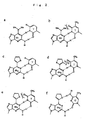
- X does not form base pair with thymine, but bases such as pyridine-2-one (hereinafter designates as Y), an analog of thymine, in which oxo group at position-6 is replaced by hydrogen atom, can form base pair with X (refer to Fig. 1).
- DNA oligomer containing 2-amino-6-(N,N-dimethylamino)-9-(2'-deoxy- ⁇ -D-ribofuranosyl) purine hereinafter designates as dX
- dX 2-amino-6-(N,N-dimethylamino)-9-(2'-deoxy- ⁇ -D-ribofuranosyl) purine
- dYTP 3-(2'-deoxy-5'-triphosphoro- ⁇ -D-ribofuranosyl) pyridine-2-one
- This compound could hinder base pairing with natural base such as thymine (or uridine) (refer to Fig. 2 b) and cytosine in some extent due to steric bulkiness of dimethylamino group in the base (dx in Fig. 2 a).
- this steric hindrance could affect to the neighboring bases, and simultaneously could give inferior effect on stacking between bases, and resulted low rate of incorporation of dYTP by Klenow fragment as well as insufficient suppression for incorporation of thymidine triphosphate (dTTP) to dx.
- the present invention provides ideas for selective formation of novel artificial nucleic acid base pair as a result of recognition of base pairing by polymerase such as DNA polymerase by utilizing steric hindrance between base pairs, preferably be generating steric hindrance between only base pair plane without giving deterioration for stacking between bases and more preferably by selecting bases utilizing electrostatic repulsion against natural bases.
- polymerase such as DNA polymerase
- the present invention relates to a method for constructing selective base pair comprising introducing a group having ability to form steric hindrance, preferably a group having ability to form steric hindrance and electrostatic repulsion, and stacking action in nucleic acid base. More particularly, the present invention relates to a method for constructing selective base pair wherein the said group having ability to form steric hindrance is a group to hinder formation of base pair with base part of natural nucleic acid, to hinder formation of base pair with base part of natural nucleic acid by an action of said steric hindrance and electrostatic repulsion, and to form stable structure with neighboring bases by the stacking action, and the said base pair can be recognized by polymerase.
- the present invention relates to a method for designing nucleic acid to construct selective base pair comprising utilizing steric hindrance in the nucleic acid base part, preferably utilizing steric hindrance and electrostatic repulsion, and stacking action in the nucleic acid base part. More particularly, the present invention relates to a method for designing nucleic acid to construct selective base pair comprising utilizing steric hindrance, preferably hindering to construct base pair with the natural nucleic acid base part by utilizing steric hindrance and electrostatic repulsion and stabilizing with the neighboring bases by the stacking action, and the said base pair can be recognized by polymerase.
- the present invention relates to a nucleic acid, which can construct selective base pair, prepared by introducing a group having ability to form steric hindrance, preferably a group having ability to form steric hindrance and electrostatic repulsion, and stacking action in nucleic acid base. More particularly, the present invention relates to a nucleic acid for constructing selective base pair wherein the said group having ability to form steric hindrance, preferably having ability to form steric hindrance and electrostatic repulsion is to hinder formation of base pair with base part of natural nucleic acid, and more preferably to stabilize with the neighboring bases by the stacking action, and the said base pair can be recognized by polymerase.
- the present invention discloses novel artificial nucleic acid which have similar behavior with nucleic acids containing natural bases and a method for designing such the nucleic acid.
- the nucleic acid of the present invention can be applied in the similar manner as the natural nucleic acid.
- the present invention relates to various applications using the nucleic acid of the present invention or nucleic acid designed by the method of the present invention.
- the present invention relates to a codon comprising one or more nucleic acid designed by the nucleic acid of the present invention or nucleic acid designed by the method of the present invention.
- the said codon can encode amino acids in the similar manner as the natural nucleic acid.
- the said amino acids can be non-natural amino acids.
- the present invention relates to a nucleic acid molecule containing the nucleic acid of the present invention, the nucleic acid designed by the method of the present invention or the nucleic acid of the natural origin.
- the said nucleic acid molecule can encode proteins in the similar manner as the natural nucleic acid. Further the said nucleic acid molecule can maintain whole or part of genetic informations of the natural gene.
- Nucleic acid having complementary strand can be prepared by an action of various polymerases on such the nucleic acid molecule.
- the present invention also relates to such the process for production of complementary strands.
- nucleic acid of the present invention or the nucleic acid designed by the method of the present invention can be introduced or substituted to a part of natural gene. Consequently, the present invention relates to a process for production of non-natural gene comprising introducing or substituting one or more nucleic acid of the present invention or the nucleic acid designed by the method of the present invention into the natural gene. The introduction or substitution can be performed with the codon unit of the present invention as described hereinbefore.
- the present invention relates to a process for production of protein having amino acid sequence based on codons of the non-natural gene or the nucleic acid of the present invention.
- Protein to which non-natural amino acid is introduced or substituted in the part of natural protein can be produced in case that codon containing the nucleic acid of the present invention or the nucleic acid designed by the method of the present invention encodes non-natural amino acid.
- the present invention provides a process for production of novel protein comprising substituting or introducing other natural or non-natural amino acid, preferably non-natural amino acid in a part of natural protein by the method of the present invention. According to this method, functions of amino acids in the protein coded by natural gene can be screened. The present invention also relates to a method for screening function of each amino acid of protein encoded by natural gene.
- the present invention also relates to a microorganism transformed by non-natural gene containing the nucleic acid of the present invention or nucleic acid designed by the method of the present invention (hereinafter simply designates as the nucleic acid of the present invention).
- novel base pair of the present invention does not constitute base pairing with the natural bases, it is useful for treatment of hereditary diseases caused by gene in which one or more base is replaced by other base.
- the present invention provides pharmaceutical composition comprising novel base pair or a base in the said base pair.
- An object of the present invention is to provide artificial nucleic acid which does not form base pair with a base of the natural nucleic acid and can be recognized by polymerase.
- the conventional artificial nucleic acid has produced by attempting to change at the position of hydrogen bond, as a result, base pairing with a base of the natural nucleic acid could not be hindered substantially as well as showing insufficient base pair selectivity.
- We have solved such the problem by introducing a group forming the steric hindrance, preferably by introducing a group forming steric hindrance and electrostatic repulsion and having stacking action.
- the present invention provides novel artificial nucleic acid which can form selective base pairing with artificial nucleic acids themselves.
- a group which forms steric hindrance in the base part of the nucleic acid of the present invention can be a group only hinder hydrogen bonding with deteriorated base, and is not limited if it does not deteriorate for the properties as a base of nucleic acid.
- the size thereof may be not to hinder formation of base pairs of other bases in the nucleic acid sequence.
- group which forms steric hindrance are, for example, lower alkyl group such as ethyl, isopropyl, isobutyl or t-butyl group, preferably branched lower alkyl group, lower alkoxy group consisting of methyl or these lower alkyl groups, di-lower alkylamino group substituted by methyl or these lower alkyl groups and silyl group substituted by methyl or these lower alkyl groups.
- groups having actions for steric hindrance, electrostatic repulsion and stacking action on base part of the nucleic acid are group having steric hindrance which hinders hydrogen bonding having deteriorated action between bases, having electrostatic repulsive force and having ⁇ electron for stacking action. These groups are not limited if they have deteriorating actions as a nucleic acid base. More preferably, a group having size not to hinder base pairing for other nucleic acid is preferable. Further, groups without having polar site for hydrogen bond and activated hydrogen atom are preferable, however if these polar site or activated hydrogen is located at distal position where hydrogen bonding may be impossible, it may not necessary to consider.
- Examples of groups having steric hindrance, electrostatic repulsion and stacking action in the base pair of the present invention are preferably aromatic heterocyclic group having planar structure.
- aromatic heterocyclic group has sufficient size for steric hindrance on the planar direction of molecule, and can generate electrostatic repulsion by different atoms, and also is expected to show stacking action by ⁇ electron of aromatic heterocyclic group.
- aromatic heterocyclic group examples are, concretely, five membered or six membered aromatic heterocyclic group having one or two sulfur atom, oxygen atom or nitrogen atom.
- aromatic heterocyclic groups can be condensed-ring, polycyclic or monocyclic group. Among them, monocyclic group is preferable due to steric size.
- aromatic heterocyclic groups can have any substituents, but a group without having large substituent is preferable due to possibility to cause stereospecific limitation or generation of deteriorative hydrogen bonding. Examples of substituents are hydroxyl, amino, carbonyl, lower alkyl of carbon 1 -5, lower alkoxy, lower alkylamino or nitro.
- Nucleic acid of the present invention is artificial nucleic acid which can be recognized by polymerase.
- polymerase can be any polymerase, preferably DNA polymerase and RNA polymerase. Recent studies on structural analysis of polymerase indicates that interaction of polymerase and nucleic acid is essentially identical with each other. Formation of base pair of the present invention relates to essential nature of polymerase, consequently, the base pair formation of the present invention can be utilized not only for DNA polymerase and RNA polymerase but also for all polymerase including reverse transcriptase.
- configuration of nucleic acid can be calculated by analysis of molecular configuration or precise determination of distance between atoms. Consequently, by applying these results, chemical structure, which causes steric hindrance in one side and provides one or more hydrogen bonds, preferably two hydrogen bonds in other side, can be designed. Consequently, the present invention includes a method for designing artificial nucleic acid based on steric hindrance of the nucleic acid, preferably steric hindrance in the base part of nucleic acid, preferably in addition thereto, electrostatic repulsion and stacking action.
- designing base pair of the present invention designing based on Watson-Crick type base pair is conventional, but Hoogsteen base pairing may also be applicable.
- Nucleic acid of the present invention can be a nucleic acid designed by steric hindrance of nucleic acid, preferably designed by steric hindrance in the base part of the nucleic acid, and is preferable to form selective base pairing with each of artificial nucleic acid.
- base pairing of artificial nucleic acid can be recognized by polymerase and more preferably the complementary strand can be constructed similar to the natural nucleic acid by and action of polymerase.
- Nucleic acid of the present invention can be synthesized by conventional chemical synthesis but is not limited to that method. Chemical synthesis is exemplified in Fig. 3, Fig. 4 and Fig. 5.
- Method for incorporating nucleic acid of the present invention into the nucleic acid sequence can be performed by applying conventional method for incorporation of natural nucleic acid or by applying similar method thereof.
- a method using DNA synthesizer, method for using polymerase and point mutation technology can be mentioned. Labeling can also be possible made as same as in the natural nucleic acid.
- the present invention also includes nucleic acid which can be used for gene fragment or probe, and include nucleic acid molecule containing the nucleic acid of the present invention.
- the nucleic acid molecule of the present invention contains one or more nucleic acid of the present invention, and can be a single strand or double strands.
- Non-natural gene of the present invention includes natural gene in which whole of part of it is replaced by nucleic acid of the present invention, natural gene to which one or more nucleic acid of the present invention is added, or combination thereof. Such the non-natural gene of the present invention can be modified by the same or similar method used for the conventional modification of natural gene.
- nucleic acid molecule or non-natural gene of the present invention can be used for transformation of microorganisms by the same way as in the conventional natural gene by inserting suitable vector or phage and inserted into microorganisms to produce transformant containing the artificial nucleic acid of the present invention.
- new codon containing nucleic acid of the present invention can be designed.
- the present novel artificial nucleic acid base is set as X and Y, combination thereof such as XXY, XYX, YXX, a combination by themselves, and AXA, TYT, CGX, ATX, which are combination of base of natural nucleic acid and artificial base of the present invention.
- Such codons can be designed.
- New codons can code natural amino acid, or non-natural amino acid. Further, functions such as transcription, transfer can be coded. Accordingly, the present invention not only provide novel artificial nucleic acid, but also providing possibility of designing completely new genetic code by designing new codon containing nucleic acid of the present invention.
- New protein synthesis system can be designed by which large number of amino acid can be utilized.
- Usable amino acid can be amino acid utilized on protein synthesis on liposome. Consequently, the present invention provides novel protein synthetic system using codon of the present invention.
- proteins containing desired non-natural amino acid can be produced by substituting or inserting the nucleic acid having codon of desired position into the nucleic acid of the present invention. And such the conversion of amino acid resulted to make screening functions of amino acid in the protein.
- Fig. 1 shows novel artificial nucleic acid base pair (X-Y) by utilizing steric hindrance of the present invention.
- R in Fig. 1 indicates 2-deoxy- ⁇ -D-ribofuranosyl.
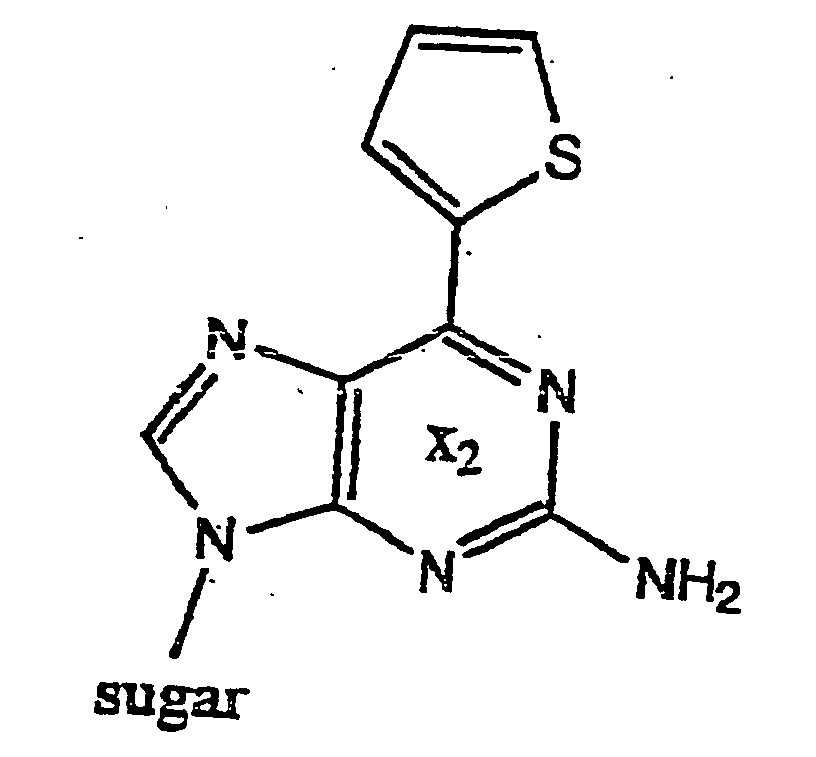
- Fig. 2 shows novel artificial nucleic acid base pair (X2-Y) by utilizing base pairing caused by steric hindrance (Fig. 2 a and b) and steric hindrance, electrostatic repulsion and stacking action.
- Fig. 3 shows synthetic scheme for amidite reagent for dX of nucleic acid having base X of the present invention.
- Fig. 4 shows synthetic scheme of dYTP of nucleic acid having base Y of the present invention.
- Fig. 5 shows synthetic scheme of amidite reagent of dx2 of nucleic acid having base X2 of the present invention.
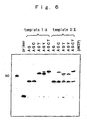
- Fig. 6 shows 20% polyacrylamide 7M urea gel electrophoresis of primer extension reaction by Klenow fragment using 5'-terminal 32 P labeled primer 1 (0.5 ⁇ M) and template 1, 3 (1 ⁇ M) and various dNTP (150 ⁇ M). Reaction was performed at 17°C for 30 minutes.
- B is a graph of the result.
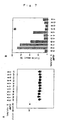
- Fig. 7 shows 20% polyacrylamide 7M urea gel electrophoresis of single nucleotide insertion reaction by Klenow fragment using 5'-terminal 32 P labeled primer 2 (1 ⁇ M) and template 1, 2, 3 (2 ⁇ M) and various dNTP (150 ⁇ M). Reaction was performed at 17°C for 30 minutes. A is electrophoretic pattern with 29% polyacrylamide 7M urea electrophoresis and B is a graph of the result.
- Fig. 8 shows inhibitory experiment by dYTP on primer extension reaction by Klenow fragment using primer 2, template 1, 2, 3 and [ ⁇ - 32 P]TTP or [ ⁇ - 32 P]dCTP.
- Fig. 9 shows primer extension reaction by Klenow fragment using 5'-terminal 32 P labeled primer 3(0.33 ⁇ M) and template 4, 5, 6, 7, 8, and 9 (1 ⁇ M) and various dNTP (150 ⁇ M). Reaction was performed at 17°C for 60 minutes.
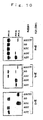
- Fig. 10 Electrophoresis of RNA generated by transcription of T7 RNA polymerase using various rNTPs and template 1-3 and [ ⁇ - 32 P]ATP.
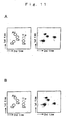
- Fig. 11 Transcription was performed similar to the case in Fig. 10 with rNTP and generated RNA was purified by electrophoresis and digested by RNase T2. Resulted product was analyzed by 2-dimension TLC.
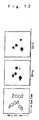
- Fig. 12 Incorporation of various base against X2 of the present invention. Drawing is replaced by photograph.
- Fig. 13 Template containing X2 and rNTP were used. Generated RNA was purified by electrophoresis, then digestd with RNase T2 and analyzed by 2-dimention TLC.
- X could not form base pairing with thymine an analogous base in which oxo group at position-6 of thymine is replaced by hydrogen
- pyridine-2-one hereinafter the base of which is designated as Y
- Fig. 1 Lower part of Fig. 1 illustrates binding not to form base pairing these bases X and Y with other bases.
- primer extension method of DNA and transcriptional reaction synthesizing RNA from DNA were applied.
- the primer extension method includes annealing template DNA oligomer with a primer oligomer, and adding DNA polymerase and 2'-deoxynucleotide-5'-triphosphate (dNTP) to extend complementary sequence of the template at 3'-terminal of the primer.
- dNTP 2'-deoxynucleotide-5'-triphosphate
- Klenow fragment which is deleted 5'-exonuclease from DNA polymerase I, one of DNA polymerase originated from E. coli, and T7 RNA polymerase, RNA polymerase originated from T7 phage, were herein used. Both enzymes are commonly used at present.
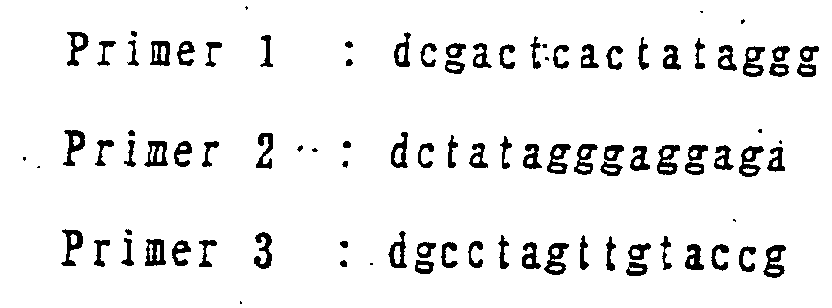
- amidite reagent of dX was synthesized. Also template DNA containing dX having base sequences hereinbelow (Template 3, 5, 6, 7, 8 and 9) and template DNA (Template 1, 2 and 4) and their primer (Primer 1, 2 and 3) for use of control experiments were synthesized.
- Template DNA containing dX (Template 3, 5, 6, 7, 8 and 9):
- 5'-terminal of the primer was labeled with 32 P using T4 polynucleotide kinase and [ ⁇ - 32 P] ATP.
- Primer labeled with 32 P 0.5 ⁇ M
- template 1 and 3 (1 ⁇ M)
- various dNTP 150 ⁇ M
- Klenow fragment 0.2 unit/ ⁇ l
- Fig. 6 left five, i.e. AG, AGC, AGT, AGY and AGCT, indicates cases using template 1, and right five indicates cases using template 3. Results indicate that a base y was incorporated into complementary strands of A, G and X. To the complementary strand X was incorporated also C and T in addition to Y (refer to Fig. 6).
- dYTP did not inhibit incorporation of [ ⁇ - 32 P] TTP into the complementary strand of A and the incorporation of [ ⁇ - 32 P] CTP into the complementary strand of G. (Refer to Fig. 8 B for template 1 and C for template 2). Consequently, incorporation of dYTP into A and G was suppressed by coexisting TTP and dCTP.
- RNA polymerase using DNA containing X as template was examined.
- template 1-3 promoter region on this strand was duplicated, and the transcription reaction was examined using T7 RNA polymerase by adding [ ⁇ - 32 P] ATP.
- Result is shown in Fig. 10.
- Results are shown in Fig. 11.
- spots encircled are indicated as spots observed by UV.
- Theoretical values and experimental values in each case are shown in Table 1 as follows.
- the base X designed as such does not form base pairing with thymine, but the base such as analogous pyridine-2-one (base X) in which oxo at position-6 of thymine is replaced by hydrogen is able to form base pair with X (refer to Fig. 2 a and b). Consequently, formation of selective nucleic base pair of X-Y has detected.
- Fig. 5 Outline of preparation of amidite reagent for dx for synthesis of template DNA is illustrated in Fig. 5. In detail, refer to example 2. This amidite reagent could show similar coupling rate as same as of the commercially available amidite reagent.
- results indicate that rate of incorporation of dYTP on dx is 21% (lane 3), and that on dx2 is increased up to 40% (lane 8). As compared with the incorporation rate of 57% in the case of dTTP on natural type dA under the same condition, some improvement of incorporation was observed by using dx2. Although comparing with the case of dx, incorporation of dCTP is increased by using dx2 (22%) (lane 11), it is not so improved value as compared with the incorporation of dYTP (40%).
- incorporation rate of dCTP on dx2 was increased by using dx2 in place of dx. This might be due to interaction of 4-amino group of cytosine and sulfur atom in thiophene in dx2 (refer to Fig. 2 f).
- sulfur atom in thiophene of dx2 is directed to a plane of base pair, electrostatic repulsion against 4-keto group of thymine (T) will be expected.
- electrostatic repulsive force (refer to Fig. 2 e) can be used in addition to steric hindrance as a factor for hinder formation of base pairing. Accordingly, in thiophene in dx2, sulfur atom side might be directed to the plane of base pair.
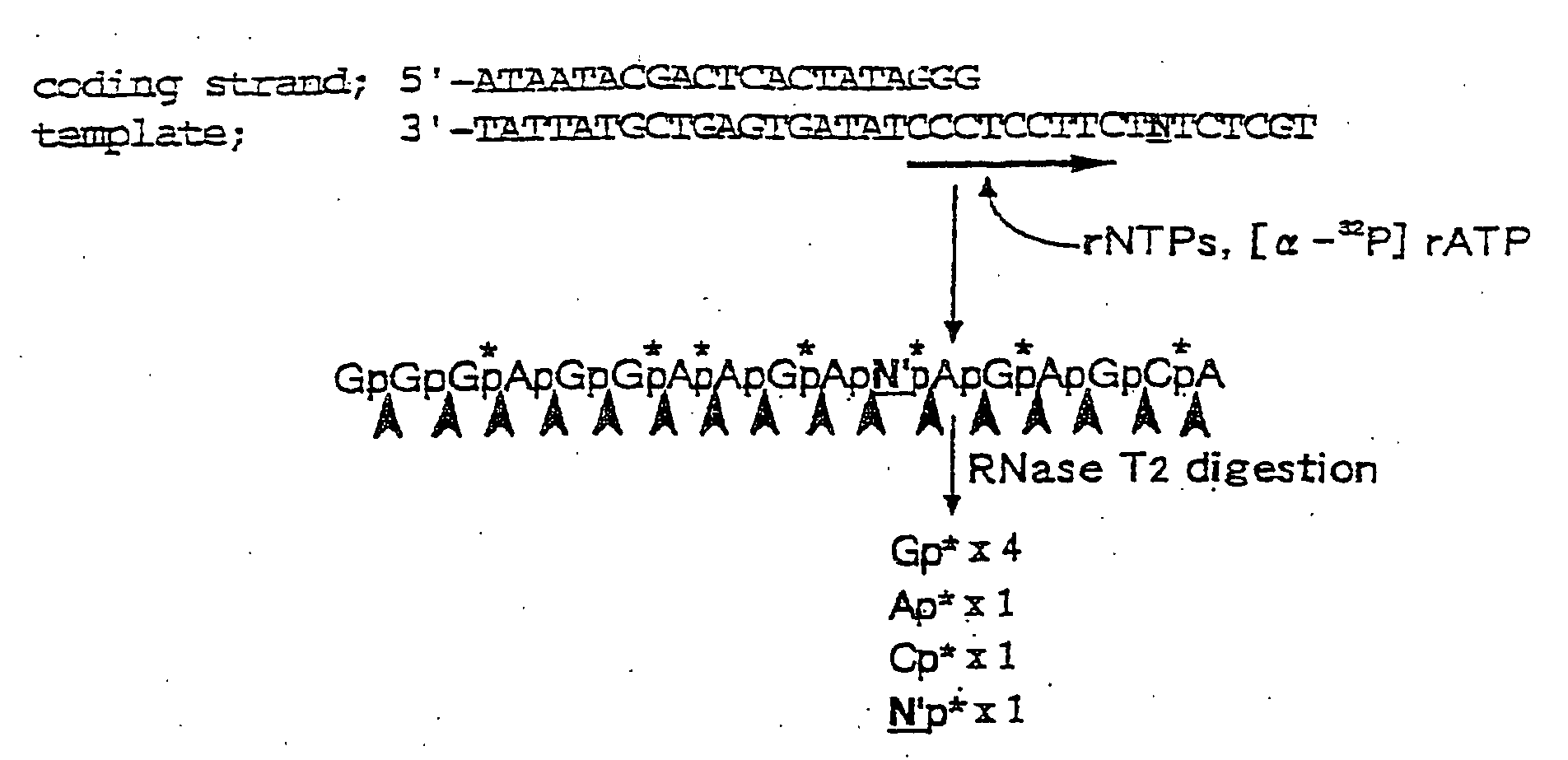
- n is a base corresponding to a base N, asterisk of the right shoulder means labeling, is digested by RNase T2, then ratio of each nucleotide was calculated by 2-diemntion TLC (cellulose resin).
- the present invention provides selective formation of base pair which has never achieved in the heretofore reported artificial base pair. Further, the present invention demonstrates that such the selective formation of base pair can be achieved by steric hindrance of base pair, preferably by applying steric hindrance and electrostatic repulsion as well as stacking action. Bases used in the above experiments are shown as illustration only of the present invention. This fact proves correctness of the idea of the present invention for achieving selective formation of artificial nucleic acid base pair. Consequently, the present invention is never limited within the bases concrete illustrated hereinbefore, and all base pairs generated according to the idea of the present invention are within the scope of the present invention.
- the present invention provides concept for formation of novel artificial base pair which can be applied and achieved in the systems on functional expression of natural gene.
- Such the artificial nucleic acid base pair of the present invention can be applied not only on the protein synthesis system or functional nucleic acid but also on the solution of functions and elucidation of natural gene systems.
- the compound (15) (0.059 mmol, 13.4 mg) obtained in the above (D) was dehydrated azeotropically three times with anhydrous toluene, dissolved in trimethyl phosphate (0.2 ml), added phosphorus oxychloride (0.065 mmol, 7.1 ⁇ l) under ice-cooling and stirred for 7 hours under ice-cooling. After confirming completion of the reaction by TLC, well mixed solution of 0.5 M bistributylammonium pyrophosphate-DMF solution and tributylamine (70.2 ⁇ 1) was immediately added and stirred well under ice-cooling for 30 minutes.
- Primer 1-4 (ca. 1 nmol), 10x polynucleotide kinase buffer (TAKARA) 2 ⁇ l, [ ⁇ - 32 P]-dATP (ca. 1.1 TBq/mmol) 2 ⁇ l, and polynucleotide kinase (10 unit/ ⁇ l, TAKARA) 2 ⁇ l were added into a tube 0.5 ml. The mixture, total 20 ⁇ 1, was incubated at 37°C for 40 minutes. The reaction was terminated by adding 10 M urea BPB dye 10 ⁇ l, treated at 75°C for 5 minutes, then electrophoresed using 20% polyacrylamide 7M urea gel electrophoresis (10 cm ⁇ 10cm).
- TAKARA polynucleotide kinase buffer
- Main band detected by UV (254 nm) was cut out, transferred to 1.5 ml tube, adding 450 ⁇ l of sterilized water ant stirred at 37°C for 12 hours. Supernatant obtained by light centrifugation was transferred to the different tube, added glycogen 1 ⁇ l, 3M sodium acetate 40 ⁇ l and ethanol 1 ml were added. The mixture was shaken well, thereafter allowed to stand at -30°C for 1 hour. Then it was centrifuged at -5°C, under 13,000 rpm for 1 hours. The thus obtained precipitate was rinsed with 70% ethanol and dried by using centrifugal evaporator for 30 minutes. Sterilized water 40 ⁇ l was added and kept at 75°C for 5 minutes, thereafter quantitated at UV 260 nm.
- 5'- 32 P labeled primer, template and 10 x Klenow fragment buffer (TAKARA) 1 ⁇ l were added to the 0.5 ml tube, adjusted total volume to 7 ⁇ l, and annealed at 95°C for 3 minutes, at 40°C for 3 minutes and at 4°C for 7 minutes.
- dNTP 1 ⁇ l, Klenow fragment (1 unit/ml, For Sequencing, TAKARA) 2 ⁇ l were added, adjusted to total volume to 10 ⁇ l and incubated for the fixed time at 17°C. The reaction was terminated by adding 10 M urea BPB dye 5 ⁇ l, heated at 75°C for 5 minutes, and electrophoresed with 20% polyacrylamide gel with 7M urea gel electrophoresis.
- Primer, template and 10x Klenow fragment buffer (TAKARA) 1 ⁇ l were added to 0.5 ml tube, and total volume was adjusted to 7 ⁇ l, and annealed at 95°C for 3 minutes, at 40°C for 3 minutes and at 4°C for 7 minutes.
- [ ⁇ - 32 P] TTP or [ ⁇ - 32 P] dCTP and dYTP were added to final concentration for each level, and Klenow fragment (1 unit/ml, For Sequencing, TAKARA) 2 ⁇ l was added, adjusted to total volume to 10 ⁇ l and incubated for the fixed time at 17°C.
- the reaction was terminated by adding 10 M urea BPB dye 5 ⁇ l, kept at 75°C for 5 minutes, and electrophoresed with 20% polyacrylamide gel with 7M urea gel electrophoresis.
- the result was analyzed using imaging plates (Phosphoroimager analysis). Result is shown in Fig. 8.
- a solution containing [5'- 32 P] labeled primer DNA (20-mer, 4 mM), template DNA (35-mer, 4 mM) and 2x Klenow fragment buffer (TAKARA) were annealed at 95°C for 3 minutes, 40°C for 3 minutes and 4°C for 7 minutes.
- a solution of equimolar amount of 40 mM dNTP and Klenow fragment (exo + ) (2 unit/ml, For Sequencing, TAKARA) were added thereto and incubated at 37°C for 3 minutes.
- Equimolar amount of 10 M urea BPB dye solution was added and kept at 75°C for 5 minutes and electrophoresed with 20% polyacrylamide - 7M urea gel. Products were analyzed by using Phosphoroimager plate. Result is shown in Fig. 12.
- a solution containing template DNA 1mM, in which promoter region has duplicated strands, T7 RNA polymerase 2.5 units, 2mM rNTP, and [ ⁇ - 32 P] rATP 0.1mCi/ml [40 mM Tris-HCl (pH 8.0), 8 mM MgCl 2 , 2 mM spermidine, 5 mM DTT, 0.01% Triton X-100, 10 mM rGMP] were prepared and incubated for 3 hours. 10 M urea dye was added and kept at 75°C for 3 minutes to terminate the reaction. The product RNA (16-mer) in this solution was purified by using electrophoresis with 20% polyacrylamide gel.
- RNA was digested by 0.75 units RNase T2. Ratio of each nucleotide was determined by 2-dimenstion TLC (cellulose resin). In Fig. 13, result of development of TLC is shown. Ratio of each nucleotide is shown in Table 2 hereinbefore.
- Primer and template were synthesized conventionally by using DNA/RNA synthesizer Type 392, The Perkin-Elmer, Applied Biosystems Div., and cyanoethylamidide reagents of dA, dC, dG and dT, which were distributed by The Perkin-Elmer, and dx2 of cyanoethylamidite reagent prepared according to the method in example 1.
- the present invention indicates that selective base pair formation, which could never achieved by the heretofore reported artificial base pair, can be realized by utilizing steric hindrance and electrostatic repulsion as well as stacking action.
- artificial nucleic acid base pair of the present invention can be applied on replication and transcription of nucleic acid, and protein synthetic system or functional nucleic acid.
- in vitro selection method used by the natural base of 4 types can be performed by 6 types of bases. Creation of nucleic acid molecules having new function which can not be realized by 4 natural bases.
- novel base pair of the present invention may be utilized for treatment of hereditary diseases caused by replacement of one or more bases to the other bases.
Landscapes
- Chemical & Material Sciences (AREA)
- Life Sciences & Earth Sciences (AREA)
- Organic Chemistry (AREA)
- Health & Medical Sciences (AREA)
- Engineering & Computer Science (AREA)
- Genetics & Genomics (AREA)
- Molecular Biology (AREA)
- Biotechnology (AREA)
- Biochemistry (AREA)
- General Health & Medical Sciences (AREA)
- Zoology (AREA)
- Wood Science & Technology (AREA)
- Biomedical Technology (AREA)
- Bioinformatics & Cheminformatics (AREA)
- General Engineering & Computer Science (AREA)
- Microbiology (AREA)
- Proteomics, Peptides & Aminoacids (AREA)
- Chemical Kinetics & Catalysis (AREA)
- General Chemical & Material Sciences (AREA)
- Physics & Mathematics (AREA)
- Biophysics (AREA)
- Plant Pathology (AREA)
- Measuring Or Testing Involving Enzymes Or Micro-Organisms (AREA)
- Saccharide Compounds (AREA)
- Investigating Or Analysing Biological Materials (AREA)
- Micro-Organisms Or Cultivation Processes Thereof (AREA)
Abstract
Description
As a result of designing t-RNA corresponding to new codon of the present invention. New protein synthesis system can be designed by which large number of amino acid can be utilized.
Usable amino acid can be amino acid utilized on protein synthesis on liposome. Consequently, the present invention provides novel protein synthetic system using codon of the present invention.








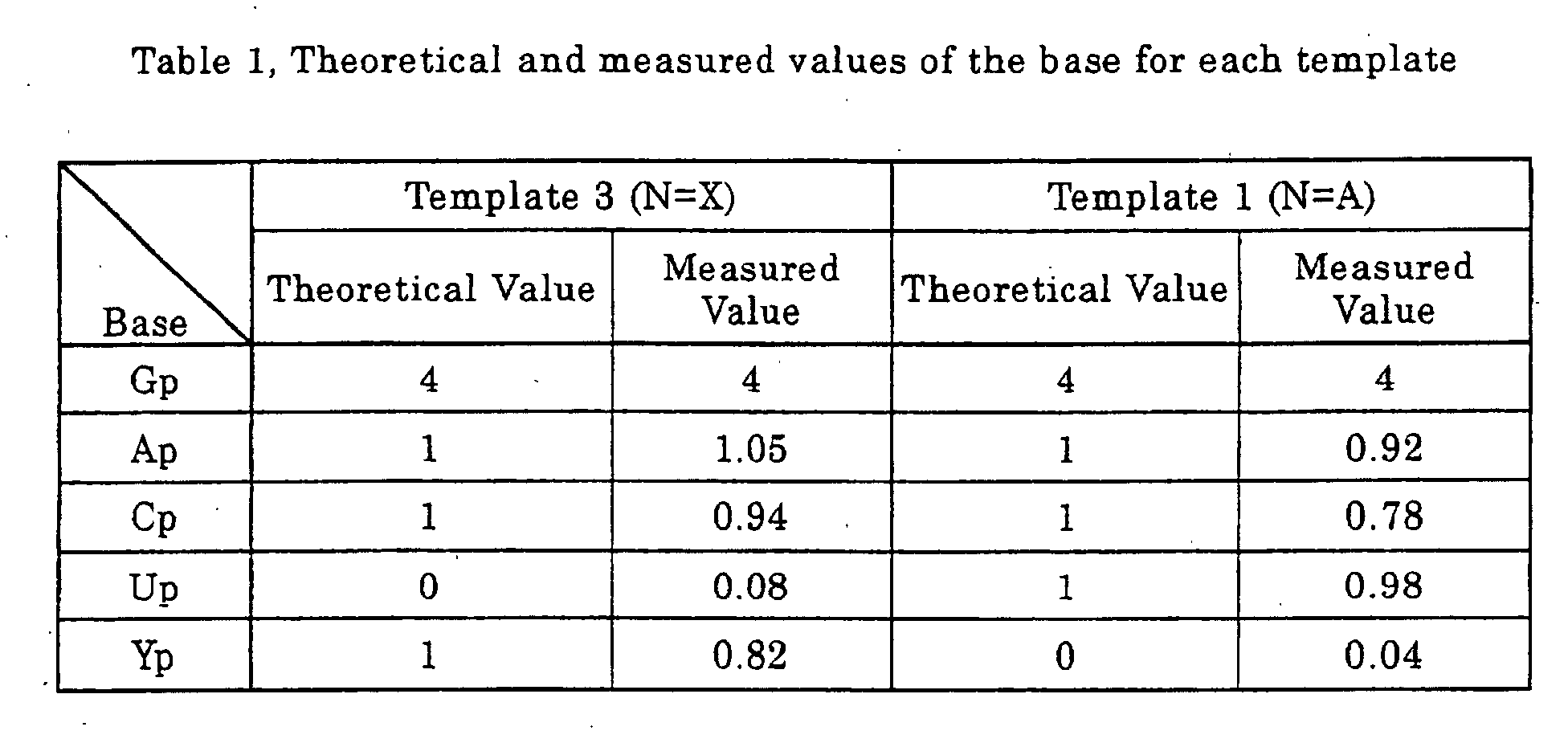


| Template | rGp* | rAp* | rCp* | rUp* | rYp* |
| N = x2 | 3.982(4) | 1.052(1) | 0.950(1) | 0.047(0) | 0.969(1) |
| N = A | 3.939(4) | 1.035(1) | 0.995(1) | 1.032(1) | not detected(0) |
1H-NMR (500.13 MHz, CDCl3) δ : 8.22 (s, 1H, H8), 7.89 (d, 2H, Bz-m, J = 5.0 Hz), 7.80 (s, 1H, NHBz), 7.55 (dd, 1H, Bz-p, J = 7.5 Hz), 7.48 (t, 2H, Bz-o, J = 7.5 Hz), 5.91 (s, 1H, H1'), 4.84 (dd, 1H, H3', J = 5.5 Hz), 4.50 (d, 1H, H2', J = 5.5 Hz), 4.07-4.20 (m, 2H, H4', H5'), 4.06 (d, 1H, H5", J = 13.0 Hz), 3.48 (br, 6H, N-CH3), 0.95-1.08 (m, 28H, iPr).
1H-NMR (500.13 MHz, CDCl3) δ : 8.24 (s, 1H, H8), 7.90 (d, 2H, Bz-m, J = 5.0 Hz), 7.83 (s, 1H, NHBz), 7.54 (t, 1H, Bz-p, J = 7.5 Hz), 7.48 (t, 2H, H Bz-o, J = 7.5 Hz), 6.29 (dd, 1H, H1', J = 7.5 Hz), 4.80-4.83 (m, 1H, H3'), 3.97-4.07 (m, 2H, H5', H5"), 3.86-3.88 (m, 1H, H4'), 3.50 (br, 6H, N-CH3), 2.68-2.71 (m, 1H, H2'), 2.59-2.63 (m, 1H, H2"), 1.03-1.09 (m, 28H, iPr).
1H-NMR (270.16 MHz, CDCl3) δ : 8.20 (s,1H, H8), 7.79 (s, 1H, NHBz), 7.77 (d, 2H, Bz-m, J = 1.4 Hz), 7.76 (d, 1H, Bz-p, J = 3.5 Hz), 7.14-7.51 (m, 11H, H Bz-o, DMTrI, 6.72 (dd, 4H, DMTr), 6.45 (t, 1H, H1', J = 6.5 Hz), 4.78 (m, 1H, H3'), 4.14 (m, 1H, H4'), 3.74 (s, 6H, OCH3), 3.50 (br, 6H, N-CH3), 3.39-3.47 (m, 1H,-H5'), 3.30-3.33 (m, 1H, H5"), 2.80-2.85 (m, 2H, H2', H2").
31P-NMR (109.36 MHz, CDCl3) δ: 149.25.
1H-NMR (270 MHz, CDCl3) δ :
8.19 (s, 1H), 8.14 (bs, 1H), 6.42 (dd, J = 7.4, 6.4 Hz, 1H), 5.44 (m, 1H), 4.41 (m, 2H), 4.34 (m, 1H), 3.00 (m, 1H), 2.80 (m, 1H), 2.58 (m, 3H), 1.17 (m, 18H).
1H-NMR (270 MHz, CDCl3) δ :
8.63 (dd, J = 3.8, 1.2Hz, 1H), 8.17 (s, 1H), 8.10 (bs, 1H), 7.64 (m, 1H), 7.25 (m, 1H), 6.47 (dd, J = 7.9, 1.8 Hz, 1H), 5.44 (m, 1H), 4.43 (m, 2H), 4.37 (m, 1H), 3.18 (m, 1H), 3.00 (m, 1H), 2.61 (m, 3H), 1.24 (m, 18H).
1H-NMR (270 MHz, DMSO-d6) δ :
10.45 (bs, 1H), 8.69 (s, 1H), 8.60 (d, J = 3.5 Hz, 1H), 7.90 (d, J = 4.6 Hz, 1H), 7.32 (dd, J = 4.6, 3.5 Hz, 1H), 6.39 (t, J = 6.6 Hz, 1H), 5.34 (d, J = 3.8 Hz, 1H), 4.91 (t, J = 5.3 Hz, 1H), 4.44 (m, 1H), 3.55 (m, 2H), 2.96 (m, 1H), 2.74 (m, 1H), 2.33 (m, 1H), 1.11 (m, 6H).
1H-NMR (270 MHz, CDCl3) δ :
8.64 (dd, J = 3.6, 0.9 Hz, 1H), 8.14 (s, 1H), 7.92 (bs, 1H), 7.61 (dd, J = 4.3, 0.9 Hz, 1H), 7.39 (m,2H), 7.24 (m, 8H), 6.77 (m, 4H), 6.47 (t, J = 6.2 Hz, 1H), 4.79 (m, 1H), 4.13 (m, 1H), 3.76 (s, 3H), 3.75 (s, 3H), 3.44 (dd, J = 10.23, 5.8 Hz, 1H), 3.38 (dd, J = 10.23, 4.4 Hz, 1H), 2.91 (m, 1H), 2.60 (m, 1H), 2.30 (m, 1H), 1.27 (m, 6H).
1H-NMR (270 MHz, CDCl3) δ : 8.64 (m, 1H), 8.16 (m, 1H), 7.86 (m, 1H), 7.61 (m, 1H), 7.26 (m, 2H), 7.24 (m, 8H), 6.78 (m, 4H), 6.45 (m, 1H9, 4.75 (m, 1H), 4.23 (m, 1H), 3.75 (m, 6H), 3.70 (m, 4H), 3.36 (m, 2H), 2.75 (m, 2H), 2.62 (m, 1H), 2.48 (m, 1H), 1.95 (m, 1H), 1.18 (m, 18H).
31P-NMR (270 MHz, CDCl3): 149.51, 148.43 ppm.
1H-NMR (270.06 MHz, CDCl3) δ : 13.07 (br, 1H, NH), 7.78 (d, 1H, H4, J = 6.8 Hz), 7.37 (d, 1H, H6, J = 4.6 Hz), 6.29 (t, 1H, H5, J = 6.6 Hz), 5.07 (s, 1H, H1'), 4.01-4.30 (m, 5H, H2', H3', H4', H5', H5"), 0.83-1.10 (m, 28H, iPr).
1H-NMR (270.06 MHz, CDCl3) δ : 13.40 (br, 1H, NH), 8.44 (s, 1H, imidazolide), 7.84 (d, 1H, H4, J = 6.8 Hz), 7.73 (s, 1H, imidazolide), 7.33 (d,1H, H6, J = 6.5 Hz), 7.07 (s, 1H, imidazolide), 6.34 (t, 1H, H5, J = 6.8 Hz), 6.23 (d, 1H, H2', J = 5.1 Hz), 5.25 (s, 1H, H1'), 4.46-4.52 (m, 1H, H3'), 4.25-4.29 (m, 1H, H5'), 4.03-4.09 (m, 2H, H4', H5"), 0.87-1.09 (m, 28H, iPr).
The compound (13) (0.749 mmol, 434 mg) obtained in the above (B) was dehydrated azeotropically three times with anhydrous toluene, added ammonium sulfate (8.4 mg), dissolved in hexamethyldisilazane (12.6 ml) and refluxed for 1 hour. The reaction mixture was concentrated in vacuo, dehydrated azeotropically three times with anhydrous toluene, added azobisisobutyronitrile (83.5 mg) and dissolved in anhydrous toluene (16.8 ml). Tributyltin hydride (0.821 ml) was added to the reaction mixture and refluxed for 1 hour. After confirming completion of the reaction by TLC, the reaction mixture was concentrated in vacuo. The residue was purified by using silica-gel column chromatography (dichloromethane - methanol) to obtain the product (14 ) 0.268 g (0.591 mmol) (79%).
1H-NMR (270.06 MHz, CDCl3) δ : 13.07 (br, 1H, NH), 7.72 (d, 1H, H4, J = 7.0 Hz), 7.31 (d, 1H, H6, J = 6.5 Hz), 6.29 (t, 1H, H5, J = 6.6 Hz), 5.20-5.25 (m, 1H, H1'), 4.37-4.40 (m, 1H, H3'), 3.97-4.12 (m, 2H, H5', H5"), 3.80-3.84 (m, 1H, H4'), 2.26-2.36 (m, 1H, H2'), 1.77-1.86 (m, 1H, H2"), 0.90-1.09 (m, 28H, iPr).
1H-NMR (270.06 MHz, CDCl3) δ : 7.77 (d, 1H, H4, J = 3.8 Hz), 7.36 (d, 1H, H6, J = 3.5 Hz), 6.41 (t, 1H, H5, J = 3.6 Hz), 5.01-5.17 (m, 1H, H1'), 4.29-4.31 (m, 1H, H3'), 3.93-3.95 (m, 1H, H4'), 3.62-3.70 (m, 2H, H5', H5"), 2.31-2.35 (m, 1H, H2'), 1.89-1.95 (m, 1H, H2").
MS(ESI-): (M-H-) 449.9.
1H-NMR (270.06 MHz, CDCl3) δ : 7.83 (d, 1H, H4, J = 4.9 Hz), 7.35 (d, 1H, H6, J = 4.9 Hz), 6.51 (t, 1H, H5, J = 4.9 Hz), 5.17 (t, 1H, H1', J = 5.0 Hz), 4.56 (br, 1H, H3'), 4.06 (br, 1H, H4'), 3.99 (br, 2H, H5', H5"), 2.19-2.33 (m, 1H, H2'), 1.81-1.98 (m, 1H, H2").
31P-NMR (109.36 MHz, D2O) δ : -10.3 (m, 2P, P1, P3), -22.7 (m, 1P, P2). UV (10 mM phosphate buffer pH 7.0): λ max = 298 nm (ε = 7.6 x 10³), 226 nm (ε = 7.0 x 10³), λ min = 247 nm; 211 nm.

Claims (40)
- A method for constructing selective base pair comprising introducing a group having ability to form steric hindrance between bases in nucleic acid base.
- The method according to claim 1 wherein the group having ability to form steric hindrance is a group to hinder formation of base pair with base part of natural nucleic acid.
- The method according to claim 1 or claim 2 wherein the group having ability to form steric hindrance is dialkylamino group.
- A method for constructing selective base pair comprising introducing a group having ability to form steric hindrance and electrostatic repulsion, and stacking action between bases in nucleic acid base.
- The method according to claim 4 wherein the group having ability to form steric hindrance and electrostatic repulsion, and stacking action is a group to hinder formation of base pair with base part of natural nucleic acid.
- The method according to claim 4 or claim 5 wherein the group having ability to form steric hindrance and electrostatic repulsion, and stacking action is aromatic heterocyclic group.
- The method according to claim 6 wherein aromatic heterocyclic group is five membered or six membered aromatic heterocyclic group having 1 or 2 sulfur atoms, oxygen atoms or nitrogen atoms as a heteroatom.
- The method according to claim 6 or claim 7 wherein aromatic heterocyclic group is thiophene.
- The method according to any of claims 1 - 8 comprising introducing a group to be able to for additional hydrogen bonds.
- The group to be able to for additional hydrogen bond is an electron pair of amino group, hydroxyl group, keto group or nitrogen group.
- The method according to any of claims 1 - 10 wherein the base pair is a base pair which can be recognized by polymerase.
- The method according to claim 11 wherein the polymerase is DNA polymerase or RNA polymerase.
- A method for designing nucleic acid to construct selective base pair comprising utilizing steric hindrance in the nucleic acid base part.
- A method for designing nucleic acid to construct selective base pair comprising hindering to construct base pair with the natural nucleic acid base part by utilizing the steric hindrance.
- A method for designing nucleic acid to construct selective base pair comprising utilizing steric hindrance and electrostatic repulsion, and stacking action in the nucleic acid base part.
- A method for designing nucleic acid to construct selective base pair comprising hindering to construct base pair with the natural nucleic acid base part by utilizing steric hindrance and electrostatic repulsion and stabilizing to impart stacking action.
- The method for designing nucleic acid according to any of claims 13 - 16 wherein the nucleic acid base pair is a base pair which can be recognized by polymerase.
- A nucleic acid comprising being designed by the method according to any of claims 13 - 17.
- The nucleic acid according to claim 18 wherein the nucleic acid has base comprising purine derivatives having a group at position-6 which can generate steric hindrance.
- The nucleic acid according to claim 19 wherein the nucleic acid base is 2-amino-6-N,N-dimethylamino-purine.
- The nucleic acid according to claim 19 wherein the nucleic acid base is 2-amino-6-thienyl-purine or derivatives thereof.
- The nucleic acid according to claim 18 wherein the nucleic acid has base containing pyridine having hydroxyl group or keto group at position-2.
- The nucleic acid according to claim 22 wherein the nucleic acid base is pyridine-2-one or tautomer thereof.
- The nucleic acid according to any of claims 18 - 23 wherein the nucleic acid is a nucleic acid constructing base pair with its complementary nucleic acid.
- A process for production of the nucleic acid comprising the nucleic acid according to any of claims 18 - 23.
- The process according to claim 25 wherein the nucleic acid is another nucleic acid to construct base pair.
- A codon comprising one or more nucleic acid according to any of claims 18 -24.
- The codon according to claim 27 wherein the codon encodes amino acids.
- The codon according to claim 28 wherein amino acids are non-natural amino acids.
- A nucleic acid molecule comprising containing the nucleic acid according to any of claims 18 - 24 and natural nucleic acid.
- The nucleic acid molecule according to claim 30 wherein the nucleic acid molecule encodes proteins.
- The nucleic acid molecule according to claim 30 or claim 31 wherein the nucleic acid molecule has whole or part of genetic information of the natural gene.
- A process for production of nucleic acid having complementary strand thereof comprising reacting the polymerase with the nucleic acid according to any of claims 30 -32.
- The method according to claim 33 wherein the polymerase is DNA polymerase or RNA polymerase.
- A process for production of non-natural nucleic acid comprising inserting or substituting one or more nucleic acid according to any of claims 1824 in the natural nucleic acid.
- The process for production of non-natural nucleic acid according to claim 35 wherein a position, to which the nucleic acid according to any of claims 18 - 24 is inserted or substituted, has a codon unit and the other part has base sequence encoding natural amino acid sequence.
- A process for production of protein having amino acid sequence based on codons of the nucleic acid according to any of claims 30 -32 or the non-natural nucleic acid obtained by the method according to claim 35 or claim 36.
- The process for production of protein according to claim 37 comprising being inserted or substituted by the non-natural amino acid in the part or whole of amino acid sequence of natural protein.
- A microorganism which is transformed by non-natural gene which can be produced by the process according to claim 35 or claim 36.
- A method for screening functions of amino acids coded by natural gene comprising using the non-natural gene which can be produced by the method according to claim 35 or claim 35.
Priority Applications (2)
| Application Number | Priority Date | Filing Date | Title |
|---|---|---|---|
| EP10003749.8A EP2221311B1 (en) | 1999-07-15 | 2000-07-14 | Novel nucleic acid base pair |
| EP10003750A EP2223931A1 (en) | 1999-07-15 | 2000-07-14 | Novel nucleic acid base pair |
Applications Claiming Priority (5)
| Application Number | Priority Date | Filing Date | Title |
|---|---|---|---|
| JP20145099 | 1999-07-15 | ||
| JP20145099 | 1999-07-15 | ||
| JP2000133519 | 2000-05-02 | ||
| JP2000133519 | 2000-05-02 | ||
| PCT/JP2000/004720 WO2001005801A1 (en) | 1999-07-15 | 2000-07-14 | Novel nucleic acid base pair |
Related Child Applications (4)
| Application Number | Title | Priority Date | Filing Date |
|---|---|---|---|
| EP10003420.6 Division-Into | 2010-03-30 | ||
| EP10003417.2 Division-Into | 2010-03-30 | ||
| EP10003749.8 Division-Into | 2010-04-07 | ||
| EP10003750.6 Division-Into | 2010-04-07 |
Publications (3)
| Publication Number | Publication Date |
|---|---|
| EP1114827A1 true EP1114827A1 (en) | 2001-07-11 |
| EP1114827A4 EP1114827A4 (en) | 2005-11-23 |
| EP1114827B1 EP1114827B1 (en) | 2010-11-17 |
Family
ID=26512797
Family Applications (3)
| Application Number | Title | Priority Date | Filing Date |
|---|---|---|---|
| EP00946311A Expired - Lifetime EP1114827B1 (en) | 1999-07-15 | 2000-07-14 | Novel nucleic acid base pair |
| EP10003749.8A Expired - Lifetime EP2221311B1 (en) | 1999-07-15 | 2000-07-14 | Novel nucleic acid base pair |
| EP10003750A Withdrawn EP2223931A1 (en) | 1999-07-15 | 2000-07-14 | Novel nucleic acid base pair |
Family Applications After (2)
| Application Number | Title | Priority Date | Filing Date |
|---|---|---|---|
| EP10003749.8A Expired - Lifetime EP2221311B1 (en) | 1999-07-15 | 2000-07-14 | Novel nucleic acid base pair |
| EP10003750A Withdrawn EP2223931A1 (en) | 1999-07-15 | 2000-07-14 | Novel nucleic acid base pair |
Country Status (5)
| Country | Link |
|---|---|
| US (3) | US7101992B1 (en) |
| EP (3) | EP1114827B1 (en) |
| JP (1) | JP3893057B2 (en) |
| DE (1) | DE60045238D1 (en) |
| WO (1) | WO2001005801A1 (en) |
Cited By (4)
| Publication number | Priority date | Publication date | Assignee | Title |
|---|---|---|---|---|
| EP2221311A1 (en) * | 1999-07-15 | 2010-08-25 | Japan Science and Technology Agency | Novel nucleic acid base pair |
| US8212014B2 (en) | 2005-08-04 | 2012-07-03 | Riken | Artificial base pairs and uses thereof |
| EP2476689A1 (en) * | 2007-05-10 | 2012-07-18 | Agilent Technologies, Inc. | Thiocarbon-protecting groups for RNA synthesis |
| EP2487181A4 (en) * | 2009-10-06 | 2013-08-28 | Riken | PAIR OF ARTIFICIAL BASES CAPABLE OF FORMING A PAIR OF SPECIFIC BASES |
Families Citing this family (22)
| Publication number | Priority date | Publication date | Assignee | Title |
|---|---|---|---|---|
| AU2006323745B2 (en) | 2005-12-09 | 2012-11-22 | Riken | Method for replicating nucleic acids and novel unnatural base pairs |
| WO2009028345A1 (en) * | 2007-08-31 | 2009-03-05 | Fujitsu Limited | Dimer amidite for synthesis of nucleic acid, nucleic acid synthesis method |
| US8715984B2 (en) | 2008-02-07 | 2014-05-06 | Riken | Modified tRNA containing unnatural base and use thereof |
| EP2275538B1 (en) | 2008-03-31 | 2016-10-05 | TagCyx Biotechnologies | Novel dna capable of being amplified by pcr with high selectivity and high efficiency |
| RS59991B1 (en) | 2013-08-08 | 2020-04-30 | Scripps Research Inst | A method for the site-specific enzymatic labelling of nucleic acids in vitro by incorporation of unnatural nucleotides |
| TWI638047B (en) | 2014-04-09 | 2018-10-11 | 史基普研究協會 | Import of unnatural or modified nucleoside triphosphates into cells via nucleic acid triphosphate transporters |
| WO2017106767A1 (en) | 2015-12-18 | 2017-06-22 | The Scripps Research Institute | Production of unnatural nucleotides using a crispr/cas9 system |
| GB201603296D0 (en) | 2016-02-25 | 2016-04-13 | Ucl Business Plc | Chemotactic,drug-containing polymersomes |
| GB201604553D0 (en) | 2016-03-17 | 2016-05-04 | Ucl Business Plc | Fumarate polymersomes |
| EP4163293A1 (en) | 2016-06-24 | 2023-04-12 | The Scripps Research Institute | Novel nucleoside triphosphate transporter and uses thereof |
| MA49716A (en) | 2017-07-11 | 2021-04-07 | Scripps Research Inst | INCORPORATION OF NON-NATURAL NUCLEOTIDES AND PROCEDURES FOR USE IN VIVO |
| SG11202000167SA (en) | 2017-07-11 | 2020-02-27 | Synthorx Inc | Incorporation of unnatural nucleotides and methods thereof |
| KR20250145137A (en) | 2017-08-03 | 2025-10-13 | 신톡스, 인크. | Cytokine conjugates for the treatment of autoimmune diseases |
| IL275694B2 (en) | 2017-12-29 | 2025-08-01 | Scripps Research Inst | Unnatural nucleotide compounds and methods of using them |
| WO2019165453A1 (en) | 2018-02-26 | 2019-08-29 | Synthorx, Inc. | Il-15 conjugates and uses thereof |
| GB201806095D0 (en) | 2018-04-13 | 2018-05-30 | Ucl Business Plc | Metabolisable pH sensitive polymersomes |
| BR112021005401A2 (en) | 2018-11-08 | 2021-06-29 | Synthorx, Inc. | interleukin 10 conjugates and uses thereof |
| WO2020144467A1 (en) | 2019-01-07 | 2020-07-16 | Ucl Business Ltd | Polymersomes functionalised with multiple ligands |
| US20200246467A1 (en) | 2019-02-06 | 2020-08-06 | Synthorx, Inc. | Il-2 conjugates and methods of use thereof |
| BR112021025130A2 (en) | 2019-06-14 | 2022-03-15 | Scripps Research Inst | Reagents and methods for replication, transcription and translation in semisynthetic organisms |
| PH12022500004A1 (en) | 2019-08-23 | 2023-04-03 | Synthorx Inc | Il-15 conjugates and uses thereof |
| MX2022002740A (en) | 2019-09-10 | 2022-03-25 | Synthorx Inc | IL-2 CONJUGATES AND METHODS OF USE TO TREAT AUTOIMMUNE DISEASES. |
Family Cites Families (5)
| Publication number | Priority date | Publication date | Assignee | Title |
|---|---|---|---|---|
| EP0333832B1 (en) * | 1987-09-22 | 1992-06-03 | Temple University | Artificial dna base pair analogues |
| US5134066A (en) * | 1989-08-29 | 1992-07-28 | Monsanto Company | Improved probes using nucleosides containing 3-dezauracil analogs |
| AU4412096A (en) * | 1994-12-13 | 1996-07-03 | Ribozyme Pharmaceuticals, Inc. | Method and reagent for treatment of arthritic conditions, induction of graft tolerance and reversal of immune responses |
| IT1276225B1 (en) | 1995-10-17 | 1997-10-27 | Sigma Tau Ind Farmaceuti | PHARMACEUTICAL COMPOSITIONS CONTAINING L-CARNITINE AND ALKANOYL L-CARNITINE IN ASSOCIATION WITH RESVERATROL OR ITS DERIVATIVES USEFUL FOR |
| DE60045238D1 (en) * | 1999-07-15 | 2010-12-30 | Japan Science & Tech Agency | NUCLEIC BASE PAIR |
-
2000
- 2000-07-14 DE DE60045238T patent/DE60045238D1/en not_active Expired - Lifetime
- 2000-07-14 EP EP00946311A patent/EP1114827B1/en not_active Expired - Lifetime
- 2000-07-14 US US09/787,196 patent/US7101992B1/en not_active Expired - Fee Related
- 2000-07-14 EP EP10003749.8A patent/EP2221311B1/en not_active Expired - Lifetime
- 2000-07-14 WO PCT/JP2000/004720 patent/WO2001005801A1/en not_active Ceased
- 2000-07-14 EP EP10003750A patent/EP2223931A1/en not_active Withdrawn
- 2000-07-14 JP JP2001511459A patent/JP3893057B2/en not_active Expired - Fee Related
-
2005
- 2005-03-10 US US11/078,607 patent/US7667031B2/en not_active Expired - Fee Related
-
2009
- 2009-07-07 US US12/459,794 patent/US20090286247A1/en not_active Abandoned
Cited By (6)
| Publication number | Priority date | Publication date | Assignee | Title |
|---|---|---|---|---|
| EP2221311A1 (en) * | 1999-07-15 | 2010-08-25 | Japan Science and Technology Agency | Novel nucleic acid base pair |
| EP2223931A1 (en) * | 1999-07-15 | 2010-09-01 | Japan Science and Technology Agency | Novel nucleic acid base pair |
| US8212014B2 (en) | 2005-08-04 | 2012-07-03 | Riken | Artificial base pairs and uses thereof |
| EP2476689A1 (en) * | 2007-05-10 | 2012-07-18 | Agilent Technologies, Inc. | Thiocarbon-protecting groups for RNA synthesis |
| EP2487181A4 (en) * | 2009-10-06 | 2013-08-28 | Riken | PAIR OF ARTIFICIAL BASES CAPABLE OF FORMING A PAIR OF SPECIFIC BASES |
| US8895712B2 (en) | 2009-10-06 | 2014-11-25 | Riken | Artificial base pair capable of forming specific base pair |
Also Published As
| Publication number | Publication date |
|---|---|
| EP2221311A1 (en) | 2010-08-25 |
| DE60045238D1 (en) | 2010-12-30 |
| EP1114827A4 (en) | 2005-11-23 |
| US7101992B1 (en) | 2006-09-05 |
| WO2001005801A1 (en) | 2001-01-25 |
| JP3893057B2 (en) | 2007-03-14 |
| EP2223931A1 (en) | 2010-09-01 |
| US20050191689A1 (en) | 2005-09-01 |
| EP1114827B1 (en) | 2010-11-17 |
| US20090286247A1 (en) | 2009-11-19 |
| EP2221311B1 (en) | 2013-08-21 |
| US7667031B2 (en) | 2010-02-23 |
Similar Documents
| Publication | Publication Date | Title |
|---|---|---|
| US20090286247A1 (en) | Novel nucleic acid base pair | |
| CA2121144C (en) | Oligonucleotides having chiral phosphorus linkages | |
| JPWO2001005801A1 (en) | Novel nucleic acid base pairs | |
| JP4731324B2 (en) | N-O bond cross-linked novel artificial nucleic acid | |
| US6617106B1 (en) | Methods for preparing oligonucleotides containing non-standard nucleotides | |
| US6043060A (en) | Nucleotide analogues | |
| US5212295A (en) | Monomers for preparation of oligonucleotides having chiral phosphorus linkages | |
| US5770713A (en) | Phosphorothioate triester oligonucleotides and method of preparation | |
| US5695979A (en) | Inhibition of reverse transcriptase by phosphorodithioates | |
| US5210264A (en) | S-(2,4-dichlorobenzyl)-β-cyanoethyl phosphorothioate diester | |
| MXPA96004355A (en) | Oligonucleotides and used modified intermediaries in nucleic acids therapeuti | |
| IL185568A (en) | Bi- and tri-cyclic nucleoside, nucleotide and oligonucleotide analogues | |
| EP0135587A4 (en) | Defined sequence single strand oligonucleotides incorporating reporter groups, process for the chemical synthesis thereof, and nucleosides useful in such synthesis. | |
| CN116003496A (en) | Modified mRNA5' -cap analogues | |
| JPH10195098A (en) | New nucleotide analogue | |
| Yao-Zhong et al. | Synthesis and duplex stability of oligodeoxynucleotides containing 6-mercaptopurine | |
| EP0540742A1 (en) | Oligodeoxyribonucleotides | |
| US6600028B1 (en) | Tricyclic base analogues | |
| US5864031A (en) | Process for preparing 5-dithio-modified oligonucleotides | |
| Seela et al. | Phosphoramidites of base-modified 2′-deoxyinosine isosteres and solid-phase synthesis of d (GCI* CGC) oligomers containing an ambiguous base | |
| WO1990012022A1 (en) | Polynucleotide phosphorodithioates as therapeutic agents for retroviral infections | |
| Hartel et al. | Substitution of Adenine by Purine‐2, 6‐diamine Improves the Nonenzymatic Oligomerization of Ribonucleotides on Templates Containing Thymidine | |
| JPH08208686A (en) | Oligoribonucleotides having an amide backbone | |
| US6153742A (en) | General process for the preparation of cyclic oligonucleotides | |
| AU2002325599B2 (en) | Oligonucleotide analogues |
Legal Events
| Date | Code | Title | Description |
|---|---|---|---|
| PUAI | Public reference made under article 153(3) epc to a published international application that has entered the european phase |
Free format text: ORIGINAL CODE: 0009012 |
|
| 17P | Request for examination filed |
Effective date: 20010409 |
|
| AK | Designated contracting states |
Kind code of ref document: A1 Designated state(s): AT BE CH CY DE DK ES FI FR GB GR IE IT LI LU MC NL PT SE |
|
| RAP1 | Party data changed (applicant data changed or rights of an application transferred) |
Owner name: JAPAN SCIENCE AND TECHNOLOGY AGENCY |
|
| RBV | Designated contracting states (corrected) |
Designated state(s): CH DE FR GB LI |
|
| RIC1 | Information provided on ipc code assigned before grant |
Ipc: 7C 12N 15/00 B Ipc: 7C 12N 15/11 B Ipc: 7G 01N 33/50 B Ipc: 7C 12N 5/10 B Ipc: 7C 07H 21/02 A Ipc: 7C 07H 21/00 B Ipc: 7C 07H 21/04 B Ipc: 7C 12N 1/21 B Ipc: 7G 01N 33/15 B |
|
| A4 | Supplementary search report drawn up and despatched |
Effective date: 20051010 |
|
| GRAP | Despatch of communication of intention to grant a patent |
Free format text: ORIGINAL CODE: EPIDOSNIGR1 |
|
| RIN1 | Information on inventor provided before grant (corrected) |
Inventor name: FUJIHARA, TSUYOSHI Inventor name: ISHIKAWA, MASAHIDE Inventor name: HIRAO, ICHIRO Inventor name: YOKOYAMA, SHIGEYUKI |
|
| GRAS | Grant fee paid |
Free format text: ORIGINAL CODE: EPIDOSNIGR3 |
|
| GRAA | (expected) grant |
Free format text: ORIGINAL CODE: 0009210 |
|
| AK | Designated contracting states |
Kind code of ref document: B1 Designated state(s): CH DE FR GB LI |
|
| REG | Reference to a national code |
Ref country code: GB Ref legal event code: FG4D |
|
| REG | Reference to a national code |
Ref country code: CH Ref legal event code: EP |
|
| REF | Corresponds to: |
Ref document number: 60045238 Country of ref document: DE Date of ref document: 20101230 Kind code of ref document: P |
|
| REG | Reference to a national code |
Ref country code: CH Ref legal event code: NV Representative=s name: PATENTANWAELTE SCHAAD, BALASS, MENZL & PARTNER AG |
|
| PLBE | No opposition filed within time limit |
Free format text: ORIGINAL CODE: 0009261 |
|
| STAA | Information on the status of an ep patent application or granted ep patent |
Free format text: STATUS: NO OPPOSITION FILED WITHIN TIME LIMIT |
|
| 26N | No opposition filed |
Effective date: 20110818 |
|
| PGFP | Annual fee paid to national office [announced via postgrant information from national office to epo] |
Ref country code: CH Payment date: 20110725 Year of fee payment: 12 |
|
| REG | Reference to a national code |
Ref country code: DE Ref legal event code: R097 Ref document number: 60045238 Country of ref document: DE Effective date: 20110818 |
|
| REG | Reference to a national code |
Ref country code: FR Ref legal event code: TP Owner name: TAGCYX BIOTECHNOLOGIES, JP Effective date: 20130807 |
|
| REG | Reference to a national code |
Ref country code: GB Ref legal event code: 732E Free format text: REGISTERED BETWEEN 20130815 AND 20130821 |
|
| REG | Reference to a national code |
Ref country code: GB Ref legal event code: 732E Free format text: REGISTERED BETWEEN 20130822 AND 20130828 |
|
| REG | Reference to a national code |
Ref country code: DE Ref legal event code: R082 Ref document number: 60045238 Country of ref document: DE Representative=s name: RECHTS- UND PATENTANWAELTE LORENZ SEIDLER GOSS, DE Effective date: 20130912 Ref country code: DE Ref legal event code: R081 Ref document number: 60045238 Country of ref document: DE Owner name: TAGCYX BIOTECHNOLOGIES (KABUSHIKI KAISHA), JP Free format text: FORMER OWNER: JAPAN SCIENCE AND TECHNOLOGY AGENCY, KAWAGUCHI-SHI, JP Effective date: 20130912 Ref country code: DE Ref legal event code: R081 Ref document number: 60045238 Country of ref document: DE Owner name: TAGCYX BIOTECHNOLOGIES (KABUSHIKI KAISHA), YOK, JP Free format text: FORMER OWNER: JAPAN SCIENCE AND TECHNOLOGY AGENCY, KAWAGUCHI-SHI, SAITAMA, JP Effective date: 20130912 Ref country code: DE Ref legal event code: R082 Ref document number: 60045238 Country of ref document: DE Representative=s name: LORENZ SEIDLER GOSSEL RECHTSANWAELTE PATENTANW, DE Effective date: 20130912 |
|
| REG | Reference to a national code |
Ref country code: CH Ref legal event code: PL |
|
| PG25 | Lapsed in a contracting state [announced via postgrant information from national office to epo] |
Ref country code: CH Free format text: LAPSE BECAUSE OF NON-PAYMENT OF DUE FEES Effective date: 20130731 Ref country code: LI Free format text: LAPSE BECAUSE OF NON-PAYMENT OF DUE FEES Effective date: 20130731 |
|
| REG | Reference to a national code |
Ref country code: FR Ref legal event code: PLFP Year of fee payment: 16 |
|
| PGFP | Annual fee paid to national office [announced via postgrant information from national office to epo] |
Ref country code: GB Payment date: 20150708 Year of fee payment: 16 Ref country code: DE Payment date: 20150707 Year of fee payment: 16 |
|
| PGFP | Annual fee paid to national office [announced via postgrant information from national office to epo] |
Ref country code: FR Payment date: 20150629 Year of fee payment: 16 |
|
| REG | Reference to a national code |
Ref country code: DE Ref legal event code: R119 Ref document number: 60045238 Country of ref document: DE |
|
| GBPC | Gb: european patent ceased through non-payment of renewal fee |
Effective date: 20160714 |
|
| PG25 | Lapsed in a contracting state [announced via postgrant information from national office to epo] |
Ref country code: FR Free format text: LAPSE BECAUSE OF NON-PAYMENT OF DUE FEES Effective date: 20160801 Ref country code: DE Free format text: LAPSE BECAUSE OF NON-PAYMENT OF DUE FEES Effective date: 20170201 |
|
| REG | Reference to a national code |
Ref country code: FR Ref legal event code: ST Effective date: 20170331 |
|
| PG25 | Lapsed in a contracting state [announced via postgrant information from national office to epo] |
Ref country code: GB Free format text: LAPSE BECAUSE OF NON-PAYMENT OF DUE FEES Effective date: 20160714 |