EP1113686A2 - Dynamic channel assignment for intelligent antennas - Google Patents
Dynamic channel assignment for intelligent antennas Download PDFInfo
- Publication number
- EP1113686A2 EP1113686A2 EP00310741A EP00310741A EP1113686A2 EP 1113686 A2 EP1113686 A2 EP 1113686A2 EP 00310741 A EP00310741 A EP 00310741A EP 00310741 A EP00310741 A EP 00310741A EP 1113686 A2 EP1113686 A2 EP 1113686A2
- Authority
- EP
- European Patent Office
- Prior art keywords
- short
- beams
- communication channels
- interference levels
- measured
- Prior art date
- Legal status (The legal status is an assumption and is not a legal conclusion. Google has not performed a legal analysis and makes no representation as to the accuracy of the status listed.)
- Withdrawn
Links
- 238000004891 communication Methods 0.000 claims abstract description 120
- 238000000034 method Methods 0.000 claims abstract description 72
- 230000007774 longterm Effects 0.000 claims abstract description 37
- 238000005259 measurement Methods 0.000 description 28
- 238000012935 Averaging Methods 0.000 description 11
- 230000001174 ascending effect Effects 0.000 description 7
- 239000011159 matrix material Substances 0.000 description 7
- 238000005204 segregation Methods 0.000 description 3
- 238000001228 spectrum Methods 0.000 description 3
- 230000000903 blocking effect Effects 0.000 description 2
- 238000006243 chemical reaction Methods 0.000 description 2
- 238000005457 optimization Methods 0.000 description 2
- 238000005070 sampling Methods 0.000 description 2
- 230000002411 adverse Effects 0.000 description 1
- 230000005540 biological transmission Effects 0.000 description 1
- 238000005562 fading Methods 0.000 description 1
- 230000000977 initiatory effect Effects 0.000 description 1
- 239000000203 mixture Substances 0.000 description 1
- 238000005303 weighing Methods 0.000 description 1
Images


Classifications
-
- H—ELECTRICITY
- H01—ELECTRIC ELEMENTS
- H01Q—ANTENNAS, i.e. RADIO AERIALS
- H01Q3/00—Arrangements for changing or varying the orientation or the shape of the directional pattern of the waves radiated from an antenna or antenna system
- H01Q3/26—Arrangements for changing or varying the orientation or the shape of the directional pattern of the waves radiated from an antenna or antenna system varying the relative phase or relative amplitude of energisation between two or more active radiating elements; varying the distribution of energy across a radiating aperture
- H01Q3/30—Arrangements for changing or varying the orientation or the shape of the directional pattern of the waves radiated from an antenna or antenna system varying the relative phase or relative amplitude of energisation between two or more active radiating elements; varying the distribution of energy across a radiating aperture varying the relative phase between the radiating elements of an array
- H01Q3/34—Arrangements for changing or varying the orientation or the shape of the directional pattern of the waves radiated from an antenna or antenna system varying the relative phase or relative amplitude of energisation between two or more active radiating elements; varying the distribution of energy across a radiating aperture varying the relative phase between the radiating elements of an array by electrical means
- H01Q3/36—Arrangements for changing or varying the orientation or the shape of the directional pattern of the waves radiated from an antenna or antenna system varying the relative phase or relative amplitude of energisation between two or more active radiating elements; varying the distribution of energy across a radiating aperture varying the relative phase between the radiating elements of an array by electrical means with variable phase-shifters
- H01Q3/38—Arrangements for changing or varying the orientation or the shape of the directional pattern of the waves radiated from an antenna or antenna system varying the relative phase or relative amplitude of energisation between two or more active radiating elements; varying the distribution of energy across a radiating aperture varying the relative phase between the radiating elements of an array by electrical means with variable phase-shifters the phase-shifters being digital
-
- H—ELECTRICITY
- H04—ELECTRIC COMMUNICATION TECHNIQUE
- H04B—TRANSMISSION
- H04B7/00—Radio transmission systems, i.e. using radiation field
- H04B7/02—Diversity systems; Multi-antenna system, i.e. transmission or reception using multiple antennas
- H04B7/04—Diversity systems; Multi-antenna system, i.e. transmission or reception using multiple antennas using two or more spaced independent antennas
- H04B7/08—Diversity systems; Multi-antenna system, i.e. transmission or reception using multiple antennas using two or more spaced independent antennas at the receiving station
- H04B7/0868—Hybrid systems, i.e. switching and combining
- H04B7/088—Hybrid systems, i.e. switching and combining using beam selection
-
- H—ELECTRICITY
- H04—ELECTRIC COMMUNICATION TECHNIQUE
- H04B—TRANSMISSION
- H04B7/00—Radio transmission systems, i.e. using radiation field
- H04B7/02—Diversity systems; Multi-antenna system, i.e. transmission or reception using multiple antennas
- H04B7/04—Diversity systems; Multi-antenna system, i.e. transmission or reception using multiple antennas using two or more spaced independent antennas
- H04B7/08—Diversity systems; Multi-antenna system, i.e. transmission or reception using multiple antennas using two or more spaced independent antennas at the receiving station
- H04B7/0837—Diversity systems; Multi-antenna system, i.e. transmission or reception using multiple antennas using two or more spaced independent antennas at the receiving station using pre-detection combining
- H04B7/0842—Weighted combining
- H04B7/086—Weighted combining using weights depending on external parameters, e.g. direction of arrival [DOA], predetermined weights or beamforming
-
- H—ELECTRICITY
- H04—ELECTRIC COMMUNICATION TECHNIQUE
- H04W—WIRELESS COMMUNICATION NETWORKS
- H04W16/00—Network planning, e.g. coverage or traffic planning tools; Network deployment, e.g. resource partitioning or cells structures
- H04W16/02—Resource partitioning among network components, e.g. reuse partitioning
- H04W16/10—Dynamic resource partitioning
-
- H—ELECTRICITY
- H04—ELECTRIC COMMUNICATION TECHNIQUE
- H04W—WIRELESS COMMUNICATION NETWORKS
- H04W16/00—Network planning, e.g. coverage or traffic planning tools; Network deployment, e.g. resource partitioning or cells structures
- H04W16/24—Cell structures
- H04W16/28—Cell structures using beam steering
-
- H—ELECTRICITY
- H04—ELECTRIC COMMUNICATION TECHNIQUE
- H04W—WIRELESS COMMUNICATION NETWORKS
- H04W24/00—Supervisory, monitoring or testing arrangements
- H04W24/10—Scheduling measurement reports ; Arrangements for measurement reports
-
- H—ELECTRICITY
- H04—ELECTRIC COMMUNICATION TECHNIQUE
- H04W—WIRELESS COMMUNICATION NETWORKS
- H04W72/00—Local resource management
- H04W72/50—Allocation or scheduling criteria for wireless resources
- H04W72/54—Allocation or scheduling criteria for wireless resources based on quality criteria
- H04W72/541—Allocation or scheduling criteria for wireless resources based on quality criteria using the level of interference
Definitions
- the present invention relates generally to wireless communication systems and, in particular, to channel assignment schemes.
- Carrier signal to interference (C/I) ratio is a primary factor in determining call quality and capacity. Specifically, the higher the C/I ratio, the better the call quality and the higher the capacity. By contrast, the lower the C/I ratio, the poorer the call quality while potentially adversely affecting capacity.
- DCA dynamic channel assignment
- FMBIA fixed multi-beam intelligent antenna
- the first scheme i.e., DCA
- DCA is a flexible channel allocation technique for dynamically assigning communication channels to mobile-stations based on interference level measurements.
- communication channels having low or lower associated interference level measurements are assigned to mobile-stations before communication channels having high or higher associated interference level measurements. This scheme improves the chances that communication channel assigned to mobile-stations will have a high or acceptable C/I ratio.
- a DCA technique in accordance with the prior art utilizes long term interference level measurements and short term or near real-time interference level measurements to dynamically assign communication channels.
- the DCA technique includes a channel segregation procedure and a dynamic channel assignment procedure, wherein the dynamic channel assignment procedure is based on the results of the channel segregation procedure.
- the channel segregation procedure involves measuring interference levels for each communication channel not currently active (i.e., idle communication channels) in a given cell or sector.
- the interference levels are measured using two different processes referred to herein as a long term process and a short term process.
- the long term process is used to create a "long list", which is then used by the short term process to create a "short list.”
- the long term process involves measuring interference levels for all idle communication channels over a long term (i.e., every few minutes to few hours). These interference level measurements (also referred to herein as “long term interference level measurements”) are used to create the long list, which is a list of the idle communication channels ranked in ascending order from lowest to highest average long term interference level measurements.
- the top portion of the long list includes the idle communication channels with the lowest average long term interference level measurements, and is referred to herein as "candidate channels" for channel assignment.
- the short term process involves measuring interference levels for the candidate channels over a short term or near real-time (i.e., every few seconds to few minutes). These interference level measurements (also referred to herein as "short term interference level measurements”) are used to create the short list, which is a list of the candidate channels ranked in ascending order from lowest to highest average short term interference level measurements. Since the short list is updated more frequently than the long list, the interference level measurements of the candidate channels in the short list are more up-to-date than the interference level measurements in the long list resulting in perhaps a different order for the candidate channels (compared to the long list). Accordingly, the short list is used by the dynamic channel assignment procedure to assign candidate channels to mobile-stations.
- the dynamic channel assignment procedure involves using short term C est /I short ratios to determine whether a candidate channel is acceptable for assignment, where C est is an estimate of a carrier signal strength based on the mobile-station's uplink signal transmitted during call setup and I short is the measured average short term interference level.
- C est is an estimate of a carrier signal strength based on the mobile-station's uplink signal transmitted during call setup
- I short is the measured average short term interference level.
- Several algorithms may be used to assign candidate channels to a mobile-station. For example, the candidate channel at the top of the short list (i.e., candidate channel with the smallest average interference level) may be the first channel assigned to a mobile-station if it has an acceptable C est /I short ratio, or any candidate channel with an acceptable C est /I short ratio may be assigned to the mobile-station. Therefore, DCA improves the chances that idle communication channels assigned to mobile-stations will have a high or acceptable C/I ratio.
- FIG. 5 depicts a geographical area or cell 10 associated with base station 14 for providing wireless communication services to mobile-stations within cell 10, wherein base station 14 has incorporated a FMBIA system in accordance with the prior art.
- Cell 10 is divided into a plurality of 120° sectors 12- j , wherein each sector is further divided into four 30° sub-sectors.
- FIG. 6 depicts a schematic of a generic fixed multi-beam intelligent antenna system 20 for a time division multiple access (TDMA) based wireless communication system in accordance with the prior art, wherein communication channels are defined by a frequency channel and a time slot.
- FMBIA system 20 comprises an antenna array 22, low noise amplifiers 24, RF switch matrix 26, radios 28 and intelligent antenna controller (IAC) 29 (implementable in a digital signal processor).
- Antenna array 22 produces twelve 30° beams for providing wireless communication coverage to the sub-sectors of cell 10. The 30° beams are channeled to radios 28 via low noise amplifiers 24 and RF switch matrix 26.
- Radios 28 are assigned to process (e.g., modulate and demodulate) signals on active communication channels, and are equipped with beam scan receivers for sequentially sampling and measuring received signal strengths (RSS) of the twelve beams for each time slot in each frequency channel.
- RSS received signal strengths
- Each RSS is mapped to a RSS indicator (RSSI) value using a RSS-RSSI conversion or look-up table, wherein higher RSSI indicates higher signal levels for active communication channels.
- the RSSI are provided to IAC 29, which uses the RSSI to select an optimal beam or beams (i.e., beam with highest RSSI moving average) for each active communication channel.
- IAC 29 Upon selecting the optimal beam or beams, IAC 29 directs RF switch matrix 26 to channel the optimal beam or beams to the appropriate radios 28 assigned to process signals for the corresponding active communication channels.
- FMBIA systems improve the C/I ratio on active communication channels at mobile-stations by directing optimal beams to the mobile-station.
- the C/I ratio in FMBIA systems can be further improved through the use of dynamic channel assignment techniques adapted for FMBIA systems. Accordingly, there exists a need for a dynamic channel assignment scheme adapted for FMBIA systems.
- the present invention is a method for improving call quality and capacity by integrating a dynamic channel allocation technique into intelligent antenna systems.
- Channels are dynamically assigned to a mobile-station by measuring interference levels on each beam in a set of beams for a plurality of communication channels, and assigning to the mobile-station a communication channel from the plurality of communication channels based on the measured interference levels on each beam in the set of beams.
- the present invention measures long term interference levels on each beam in a set of beams for a plurality of communication channels, measures short term interference levels on each beam in the set of beams for a portion of the plurality of communication channels, and assigns to a mobile-station a communication channel from the portion of the plurality of communication channels based on the measured short term interference levels on each beam in the set of beams.
- the present invention is a method for improving call quality and capacity by integrating a dynamic channel allocation technique into intelligent antenna systems.
- Channels are dynamically assigned to a mobile-station by measuring interference levels on each beam in a set of beams for a plurality of communication channels, and assigning to the mobile-station a communication channel from the plurality of communication channels based on the measured interference levels on each beam in the set of beams.
- the present invention is described herein with respect to a wireless communication system based on time division multiple access (TDMA) techniques, wherein a communication channel is defined by a frequency channel and a time slot.
- TDMA time division multiple access
- FDMA frequency division multiple access
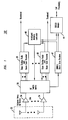
- FIG. 1 depicts a schematic of a fixed multi-beam intelligent antenna (FMBIA) system 30 incorporated with a beam based dynamic channel assignment (BBDCA) scheme in accordance with the present invention.
- FMBIA system 30 comprises antenna array 32, low noise amplifiers 34, RF switch matrix 36, radios 38, intelligent antenna controller (IAC) 40, BBDCA beam scan receiver 42 and BBDCA module 44.
- Antenna array 32 produces M beams for providing wireless communication coverage to a cell, wherein the M beams are grouped into beam sets S .
- Each beam set S includes N S beams, where 1 ⁇ N S ⁇ M.
- a beam may be in one or more sets S , and a set S may include beams that provide coverage to a same sector or to different sectors.
- a set S of beams provides coverage to an entire sector.
- an 120° sector may use four 30° beams for providing wireless communication coverage to mobile-stations within the sector.
- Such four 30° beams collectively comprises the beam set S for a sector.
- the manner in which beams are grouped into sets S depends, in one embodiment, on factors such as application, mobility of the mobile-station, coverage requirements, capacity requirements and/or optimization considerations.
- the M beams are directed from antenna array 32 to radios 38 and BBDCA beam scan receiver 42 via low noise amplifiers 34 and RF switch matrix 36.
- Radios 38 are equipped with beam scan receivers for sequentially sampling and measuring received signal strengths (RSS) of the M beams for all or some active and/or idle communication channels.
- RSS received signal strengths
- Each RSS is mapped to a RSS indicator (RSSI) value using a RSS-RSSI conversion or look-up table, wherein higher RSSI indicates lower interference on active communication channels but higher interference on idle communication channels.
- RSSI received signal strengths
- the RSSI for each communication channel on each beam are provided to IAC 40, which uses the RSSI to select an optimal beam or beams (i.e., highest RSSI moving average) for each active communication channel.
- IAC 40 subsequently uses RF switch matrix 36 to channel the optimal beam or beams to the appropriate radios 38 assigned to process signals transmitted over the corresponding active communication channels.
- BBDCA beam scan receiver 42 sequentially samples and measures RSS for communication channels on beams switched to BBDCA beam scan receiver 42 by IAC 40 via RF switch 36.
- the particular communication channels directed to BBDCA beam scan receiver 42 by IAC 40 are determined by BBDCA module 44.
- BBDCA module 44 directs IAC 40 to have RF switch matrix 36 route all or some idle communication channels to BBDCA beam scan receiver 42.
- the measured RSS are converted to RSSI by BBDCA beam scan receiver 42 and provided as input to BBDCA module 44 wherein, as mentioned earlier, higher RSSI indicates greater interference on idle communication channels. Note that for TDMA, RSS (or RSSI) measurements may be performed on either a frame or time slot basis.
- BBDCA module 44 receives RSSI input from IAC 40 and/or BBDCA beam scan receiver 42, and uses such input to create a plurality of lists. Specifically, BBDCA module 42 uses a long term process to generate a long list, and a short term process to generate a primary short list and a plurality of secondary short lists based on the long list.
- the long list is a list of idle communication channels ranked in ascending order from lowest to highest long term RSSI moving average, wherein a long term RSSI is a RSSI that is measured over a long time interval, such as a few minutes or hours.
- the idle communication channels included in the long list may comprise the entire spectrum associated with the wireless communication systems or a limited portion of the spectrum as, for example, determined by a service provider or system operator.
- a long list is generated and maintained for each beam set S .
- the long list may be a list indicating long term RSSI or RSS values, wherein the RSSI or RSS values may or may not be moving averages.
- the long list may or may not include the interference level measurements, and the idle communication channels are not ranked according to RSSI or RSS values or may be ranked according to some other parameter.
- FIG. 2 is a flowchart 400 illustrating a long term process in accordance with the present invention.
- the long term process begins in step 410.
- the RSS is measured for an idle communication channel on each beam in set S.
- BBDCA module 44 directs IAC 40 to have BBDCA beam scan receiver 42 measure the RSS for the idle communication channel. Since there are N S number of beams in set S , there will be N S number of RSS measurements made by BBDCA beam scan receiver 42 for the idle communication channel.
- the highest RSS measurement for the idle communication channel over all N S beams in beam set S is used to update a long term RSSI moving average for the current idle communication channel.
- RSS-CH(beam 1) For example, suppose communication channel CH is the current idle communication channel, set S comprises four beams, and the RSS measurements for communication channel CH on all four beams in set S are RSS-CH(beam 1), RSS-CH(beam 2), RSS-CH(beam 3) and RSS-CH(beam 4). If RSS-CH(beam 2) is the highest of the four RSS measurements, then RSS-CH(beam 2) is converted to an RSSI value and used to update the long term RSSI moving average for communication channel CH. If the long term RSSI moving average for communication channel CH corresponds to the average of three previous highest RSS measurements, the oldest previous highest RSS measurement is replaced by the current highest RSS measurement, i.e., RSSI-CH(beam 2), to obtain an updated long term RSSI moving average for current communication channel CH.
- the long term process determines if the long list has to be updated and/or re-ordered. In one embodiment, it is determined that the long list has to be updated and/or re-ordered if the updated long term RSSI moving average is different from the previous long term RSSI moving average for the current idle communication channel. If the long list does not have to be updated, the long term process returns to step 420 and measures the RSS for another or next idle communication channel.
- the long term process proceeds to step 450 and updates and/or re-orders the long list based on the updated long term RSSI moving average for the current idle communication channel. Specifically, the long list is updated or re-ordered by ranking the idle communication channels in ascending order from lowest to highest long term RSSI moving average. Upon completion of the updating and/or re-ordering, the long term process selects another or next idle communication in long list and proceeds to step 420 where the RSSI is measured for the other or next idle communication channel on each beam in set S .
- the top portion of the long list includes the idle communication channels with the highest long term RSSI moving average, and is referred to herein as "candidate channels" for channel assignment.
- the number of candidate channels is a system parameter that may be set, for example, by the service provider or system operator.
- the candidate channels are used by the short term process to create the primary and secondary short lists. See FIG. 3, which depicts the relationship among a long list 50, a primary short list 52 and a plurality of secondary short lists 54, wherein the top (shaded) portion 56 of the long list represents the candidate channels.
- the primary and secondary short lists are lists of the candidate channels ranked in ascending order from lowest to highest short term RSSI moving average, wherein a short term RSSI corresponds to a RSS measured over a short time interval, e.g., a few seconds to a few minutes. Generally, the short term RSSI corresponds to a RSS measured over a shorter time interval than a long term RSSI.
- the primary and secondary short list differ in that the latter is associated with individual beams, whereas the former is associated with beam sets S .
- each secondary short list includes the candidate channels ranked in ascending order from lowest to highest short term RSSI moving average as measured for the beam to which the secondary short list is associated.
- the primary short list includes the candidate channels ranked in ascending order from lowest to highest short term RSSI moving average based on the highest RSS measured over all N S beams in set S .
- the primary and secondary short lists may be lists indicating short term RSSI or RSS values, wherein the RSSI or RSS values may or may not be moving averages.
- the primary and secondary short lists may or may not include the interference level measurements, and the idle communication channels are not ranked according to RSSI or RSS values or may be ranked according to some other parameter
- FIG. 4 is a flowchart 600 illustrating a short term process in accordance with the present invention.
- the short term process begins in step 610.
- the short term process measures the RSS for a candidate channel on each beam in set S .
- the measured RSS is used to update short term RSSI moving averages on both the primary short list and the secondary short lists, in step 630.
- a short term RSSI moving average for the candidate channel is updated for the associated secondary short list.
- the highest short term RSSI moving average for the current candidate channel over all N S beams in beam set S is used to update a short term RSSI moving average for the same candidate channel in the primary short list.
- the highest, the highest short term RSSI value (not moving average) for the current candidate channel over all N S beams in beam set S is used to update the short term RSSI moving average for the candidate channel in the primary short list.
- step 640 the short term process updates and/or re-orders the primary and secondary lists based on the updated short term RSSI moving averages for the current candidate channel.
- the short term process selects another or next candidate and proceeds to step 620 where the RSS is measured for the other or next candidate channel on each beam in set S .
- the long and short term processes are different in several respects. Specifically, the long term and short term processes have different associated measurement rates at which RSS are measured, averaging time windows and averaging weights, wherein averaging time window is a duration over which sample average is maintained and averaging weight is a weighing factor associated with each sample.
- the measurement rate, averaging time window and averaging weight for the long term process are set such that the long list reflect slowly varying (long term) system characteristics, such as terrain features, system deployment, system growth and fixed spectrum.
- the measurement rate, averaging time window and averaging weight for the short term process are set such that the short list reflect rapidly varying (short term) system characteristics such as traffic, radio link, interference and shadow fading.
- the measurement rate for communication channels in the short list is faster than that for communication channels in the long list, and the averaging time window for the short list is much shorter than that for the long list.
- the averaging time window or weights are optimized for each list based on performance factors, such as blocking rate and dropping rate. For example, if blocking or dropping rate increases, then the averaging process is shortened.
- Channel assignment can be made from the primary short list, secondary short list or both short lists depending on factors such as call quality and handoffs. For example, if higher carrier to interference quality is most important, the secondary short list is used to assign channels to mobile-stations because the secondary short list would indicate the best idle communication channel in the associated sub-sector. If reducing the number of handoffs is most important, the primary short list is used to assign channels because the primary short list would indicate the best idle communication channel across all sub-sectors belonging to the associated set. If carrier to interference and handoffs are to be considered, channels can be assigned through an interpolation of the primary and secondary short lists. For example, the measured RSS (or RSSI) in the short lists can be combined, such as added, averaged, multiplied, etc., to produce an interpolated RSS (or RSSI) value, which can be used to generate an interpolated short list.
- the measured RSS (or RSSI) in the short lists can be combined, such as added, averaged, multiplied, etc., to produce an interpolated RSS
- Communication channels are assigned upon call initiation.
- the mobile-station transmits over a control channel either a page response or a mobile origination message.
- the beam that covers the mobile-station i.e., coverage beam
- Information regarding which beam covers the mobile-station is sent to BBDCA module 44, which uses such information to select the best candidate channels (e.g., candidate channels with highest short term RSSI moving average or acceptable C/I ratio) from the primary short list corresponding to the beam set S which includes the coverage beam and/or from the secondary short list corresponding to the coverage beam.
- the manner in beams are grouped into sets S depending on the application, mobility of the mobile-stations, coverage requirements, capacity requirements and/or optimization considerations.
- the mobility is so low that the typical mobile-station remains with the coverage area of a beam for the entire duration of a call.
- the typical mobile-station stays within the coverage of a limited number of beams (less than the total number of beams in a sector) during a life of a call.
- the number of sets in a sector and beams per set is optimized for the specific coverage needs of the application.
- a long list and a primary short list are maintained for each set S , wherein the primary short list for each set is derived from a small set of secondary short lists
- the typical mobile-station crosses many or all beams in a sector during the duration of a call.
- the sets S may comprise of every beam in the sector.
- a long list and a primary short list are maintained for each set S or sector. Note that in practical deployment scenarios, mixtures of the three aforementioned applications would be typical for a wireless communication system.
- secondary long lists may be generated for every beam and used to create a primary long list in a manner similar to which the primary short list is created from the secondary short lists. Therefore, the spirit and scope of the present invention should not be limited to the description of the embodiments contained herein.
Landscapes
- Engineering & Computer Science (AREA)
- Computer Networks & Wireless Communication (AREA)
- Signal Processing (AREA)
- Mobile Radio Communication Systems (AREA)
- Radio Transmission System (AREA)
Abstract
Description
Claims (21)
- A method of channel assignment for a wireless communications system incorporating a fixed multi-beam intelligent antenna system comprising the steps of:measuring interference levels on each beam in a set of beams for a plurality of communication channels; andassigning to a mobile-station a communication channel from the plurality of communication channels based on the measured interference levels on each beam in the set of beams.
- The method of claim 1, wherein highest measured interference levels for each of the plurality of communication channels across each beam in the set of beams is used to assign the communication channel.
- The method of claim 1, wherein the plurality of communication channels are idle communication channels in the coverage area associated with the set of beams.
- The method of claim 1, wherein the step of measuring interference levels is repeated over short terms.
- The method of claim 4, wherein the step of assigning the communication channel comprises the additional step of:
generating a plurality of secondary short lists for each beam using the measured short term interference levels associated with each beam. - The method of claim 5, wherein each of the plurality of secondary short lists include communication channels ranked according to the measured short term interference levels.
- The method of claim 5, wherein the communication channel is assigned using a secondary short list corresponding to a coverage beam.
- The method of claim 4, wherein the step of assigning the communication channel comprises the additional step of:
generating a primary short list for the set of beams using the measured short term interference levels, wherein the primary short list is based upon highest or average measured short term interference levels for each of the plurality of communication channels across each beam in the set of beams. - The method of claim 8, wherein the primary short list includes communication channels ranked according to the highest measured short term interference levels for each of the plurality of communication channels across each beam in the set of beams.
- The method of claim 10, wherein the communication channel is assigned using the primary short list.
- The method of claim 8, wherein the step of assigning the communication channel comprises the additional step of:
generating a plurality of secondary short lists for each beam using the measured short term interference levels. - The method of claim 11, wherein the communication channel is assigned using the primary short list and a secondary short list corresponding to a coverage beam.
- A method of channel assignment for a wireless communications system incorporating a fixed multi-beam intelligent antenna system comprising the steps of:measuring interference levels on each beam in a set of beams for a plurality of communication channels over long terms;measuring interference levels on each beam in the set of beams for a portion-of the plurality of communication channels over short termsassigning to a mobile-station a communication channel from the portion of the plurality of communication channels based on the measured short term interference levels on each beam in the set of beams.
- The method of claim 13, wherein highest or average measured short term interference levels for each of the plurality of communication channels across each beam in the set of beams is used to assign the communication channel.
- The method of claim 13, wherein the portion of the plurality of communication channels include communication channels with lower measured long term interference levels relative to long term interference levels measured for other communication channels belonging to the plurality of communication channels.
- The method of claim of claim 13, wherein the step of assigning the communication channel comprises the additional step of:
generating a plurality of secondary short lists for each beam using the measured short term interference levels. - The method of claim 16, wherein the communication channel is assigned using a secondary short list corresponding to a coverage beam.
- The method of claim 13, wherein the step of assigning the communication channel comprises the additional step of:
generating a primary short list for the set of beams using the measured short term interference levels, wherein the primary short list is based upon highest measured short term interference levels for each of the plurality of communication channels across each beam in the set of beams. - The method of claim 18, wherein the communication channel is assigned using the primary short list.
- The method of claim 18, wherein the step of assigning the communication channel comprises the additional step of:
generating a plurality of secondary short lists for each beam using the measured short term interference levels. - The method of claim 20, wherein the communication channel is assigned using the primary short and a secondary short list corresponding to a coverage beam.
Applications Claiming Priority (2)
| Application Number | Priority Date | Filing Date | Title |
|---|---|---|---|
| US473513 | 1990-02-01 | ||
| US09/473,513 US6640104B1 (en) | 1999-12-28 | 1999-12-28 | Dynamic channel assignment for intelligent antennas |
Publications (2)
| Publication Number | Publication Date |
|---|---|
| EP1113686A2 true EP1113686A2 (en) | 2001-07-04 |
| EP1113686A3 EP1113686A3 (en) | 2002-01-30 |
Family
ID=23879845
Family Applications (1)
| Application Number | Title | Priority Date | Filing Date |
|---|---|---|---|
| EP00310741A Withdrawn EP1113686A3 (en) | 1999-12-28 | 2000-12-04 | Dynamic channel assignment for intelligent antennas |
Country Status (8)
| Country | Link |
|---|---|
| US (1) | US6640104B1 (en) |
| EP (1) | EP1113686A3 (en) |
| JP (1) | JP2001245338A (en) |
| KR (1) | KR20010062759A (en) |
| CN (1) | CN1304221A (en) |
| AU (1) | AU7247200A (en) |
| BR (1) | BR0005928A (en) |
| CA (1) | CA2327071A1 (en) |
Cited By (5)
| Publication number | Priority date | Publication date | Assignee | Title |
|---|---|---|---|---|
| WO2004034615A1 (en) | 2002-10-11 | 2004-04-22 | Navini Networks, Inc | Method and system for interference assessment and reduction in a wireless communication system |
| GB2406755A (en) * | 2003-10-04 | 2005-04-06 | Motorola Inc | Communication system, communication unit and method of sharing a communication resource |
| DE102004028703A1 (en) * | 2004-06-14 | 2005-12-29 | Siemens Ag | Method for allocating transmission capacities in a signal transmission, base station and mobile terminal |
| WO2007124460A1 (en) * | 2006-04-20 | 2007-11-01 | Qualcomm Incorporated | Orthogonal resource reuse with sdma beams |
| EP3462633A1 (en) * | 2017-09-28 | 2019-04-03 | Panasonic Intellectual Property Corporation of America | Resource allocation for the beam failure recovery procedure |
Families Citing this family (21)
| Publication number | Priority date | Publication date | Assignee | Title |
|---|---|---|---|---|
| US7133380B1 (en) * | 2000-01-11 | 2006-11-07 | At&T Corp. | System and method for selecting a transmission channel in a wireless communication system that includes an adaptive array |
| US6973059B1 (en) * | 2000-09-11 | 2005-12-06 | Lucent Technologies Inc. | Method for frequency hopping in a TDMA wireless communication system |
| US6760882B1 (en) * | 2000-09-19 | 2004-07-06 | Intel Corporation | Mode selection for data transmission in wireless communication channels based on statistical parameters |
| US6802035B2 (en) * | 2000-09-19 | 2004-10-05 | Intel Corporation | System and method of dynamically optimizing a transmission mode of wirelessly transmitted information |
| US7062001B2 (en) * | 2001-08-31 | 2006-06-13 | Her Majesty The Queen In Right Of Canada, As Represented By The Minister Of National Defence Of Her Majesty's Canadian Government | Adaptive multi-channel, multi-function |
| US7146170B2 (en) * | 2002-12-10 | 2006-12-05 | Andrew Corp. | Wireless network management system |
| US6876776B2 (en) * | 2003-02-14 | 2005-04-05 | Ikonicys, Inc. | System and method for auto-focusing an image |
| KR20040098752A (en) * | 2003-05-15 | 2004-11-26 | 엘지전자 주식회사 | Method for allocating channelization code in mobile communication system |
| JP4241440B2 (en) * | 2004-03-03 | 2009-03-18 | 株式会社日立製作所 | Packet scheduling method and wireless communication apparatus |
| CN100369516C (en) * | 2005-01-21 | 2008-02-13 | 中兴通讯股份有限公司 | A Capacity Test Method for Fixed Beam Smart Antenna Base Station System |
| US7395084B2 (en) * | 2005-01-24 | 2008-07-01 | Sikorsky Aircraft Corporation | Dynamic antenna allocation system |
| CN1316836C (en) * | 2005-05-11 | 2007-05-16 | 西安海天天线科技股份有限公司 | Mobile communication substation based on beam switching type intelligent antenna and beam switching method |
| JP4951274B2 (en) * | 2005-08-19 | 2012-06-13 | 韓國電子通信研究院 | CHANNEL INFORMATION GENERATION APPARATUS AND METHOD, AND APPLICABLE TRANSMISSION APPARATUS AND METHOD THEREOF |
| KR101239796B1 (en) * | 2005-12-14 | 2013-03-06 | 삼성전자주식회사 | Apparatus and method for space division multiple access communication |
| US7360656B2 (en) * | 2005-12-16 | 2008-04-22 | Rohm And Haas Company | Method to improve the cleaner froth flotation process |
| CN101026406B (en) * | 2006-02-17 | 2011-05-25 | 深圳迈瑞生物医疗电子股份有限公司 | Input channel switching method of space diversity receiving device |
| KR101273466B1 (en) * | 2007-01-08 | 2013-06-14 | 삼성전자주식회사 | Aparatus for generating precoding codebook for mimo system and method for the same |
| WO2014100927A1 (en) * | 2012-12-24 | 2014-07-03 | 华为技术有限公司 | Channel allocation method, device, base station, and system |
| KR102049772B1 (en) * | 2013-01-15 | 2019-11-28 | 삼성전자 주식회사 | Method and apparatus for measureing signal in beamforming system |
| KR20150115015A (en) * | 2013-02-07 | 2015-10-13 | 인터디지탈 패튼 홀딩스, 인크 | Interference measurements and management in directional mesh networks |
| CN114578144B (en) * | 2022-05-06 | 2022-07-19 | 成都瑞迪威科技有限公司 | Efficient alignment-free antenna channel distribution detection method |
Family Cites Families (7)
| Publication number | Priority date | Publication date | Assignee | Title |
|---|---|---|---|---|
| JP2661533B2 (en) * | 1993-12-27 | 1997-10-08 | 日本電気株式会社 | Channel allocation method for mobile communication system |
| US5590399A (en) * | 1995-02-23 | 1996-12-31 | Nextel Communications | Up-link channel assignment scheme for cellular mobile communications systems employing multi-beam antennas with beam selection |
| US5745841A (en) * | 1996-05-20 | 1998-04-28 | Metawave Communications Corporation | System and method for cellular beam spectrum management |
| WO1998042150A2 (en) | 1997-03-14 | 1998-09-24 | At & T Corp. | Downlink smart antennas for is-54/is-136 tdma systems |
| US6052605A (en) * | 1997-03-31 | 2000-04-18 | Radio Frequency Systems, Inc. | Continuous interference assessment and avoidance in a land mobile radio system |
| US6104930A (en) * | 1997-05-02 | 2000-08-15 | Nortel Networks Corporation | Floating transceiver assignment for cellular radio |
| US6154655A (en) | 1998-03-05 | 2000-11-28 | Lucent Technologies Inc. | Flexible channel allocation for a cellular system based on a hybrid measurement-based dynamic channel assignment and a reuse-distance criterion algorithm |
-
1999
- 1999-12-28 US US09/473,513 patent/US6640104B1/en not_active Expired - Lifetime
-
2000
- 2000-11-29 CA CA002327071A patent/CA2327071A1/en not_active Abandoned
- 2000-12-04 EP EP00310741A patent/EP1113686A3/en not_active Withdrawn
- 2000-12-19 BR BR0005928-5A patent/BR0005928A/en not_active Application Discontinuation
- 2000-12-21 AU AU72472/00A patent/AU7247200A/en not_active Abandoned
- 2000-12-27 CN CN00136498A patent/CN1304221A/en active Pending
- 2000-12-27 KR KR1020000082671A patent/KR20010062759A/en not_active Ceased
- 2000-12-27 JP JP2000396400A patent/JP2001245338A/en active Pending
Cited By (15)
| Publication number | Priority date | Publication date | Assignee | Title |
|---|---|---|---|---|
| EP1550250B1 (en) * | 2002-10-11 | 2012-04-18 | Cisco Technology, Inc. | Method and system for interference assessment and reduction in a wireless communication system |
| WO2004034615A1 (en) | 2002-10-11 | 2004-04-22 | Navini Networks, Inc | Method and system for interference assessment and reduction in a wireless communication system |
| CN1703854B (en) * | 2002-10-11 | 2012-05-30 | 思科技术公司 | Method and system for interference assessment and reduction in wireless communication system |
| GB2406755A (en) * | 2003-10-04 | 2005-04-06 | Motorola Inc | Communication system, communication unit and method of sharing a communication resource |
| GB2406755B (en) * | 2003-10-04 | 2008-07-02 | Motorola Inc | Communication system, communication unit and method of sharing a communication resource |
| DE102004028703A1 (en) * | 2004-06-14 | 2005-12-29 | Siemens Ag | Method for allocating transmission capacities in a signal transmission, base station and mobile terminal |
| WO2007124460A1 (en) * | 2006-04-20 | 2007-11-01 | Qualcomm Incorporated | Orthogonal resource reuse with sdma beams |
| KR101105012B1 (en) * | 2006-04-20 | 2012-01-16 | 콸콤 인코포레이티드 | Orthogonal resource reuse with sdma beams |
| US8036669B2 (en) | 2006-04-20 | 2011-10-11 | Qualcomm Incorporated | Orthogonal resource reuse with SDMA beams |
| EP2334112A1 (en) * | 2006-04-20 | 2011-06-15 | Qualcomm Incorporated | Orthogonal resource reuse with SDMA beams |
| US8320339B2 (en) | 2006-04-20 | 2012-11-27 | Qualcomm Incorporated | Orthogonal resource reuse with SDMA beams |
| EP3462633A1 (en) * | 2017-09-28 | 2019-04-03 | Panasonic Intellectual Property Corporation of America | Resource allocation for the beam failure recovery procedure |
| WO2019063420A1 (en) * | 2017-09-28 | 2019-04-04 | Panasonic Intellectual Property Corporation Of America | Resource allocation for beam failure recovery procedure |
| US11349547B2 (en) | 2017-09-28 | 2022-05-31 | Panasonic Intellectual Property Corporation Of America | Resource allocation for beam failure recovery procedure |
| US12107655B2 (en) | 2017-09-28 | 2024-10-01 | Panasonic Intellectual Property Corporation Of America | Resource allocation for beam failure recovery procedure |
Also Published As
| Publication number | Publication date |
|---|---|
| JP2001245338A (en) | 2001-09-07 |
| CN1304221A (en) | 2001-07-18 |
| US6640104B1 (en) | 2003-10-28 |
| EP1113686A3 (en) | 2002-01-30 |
| KR20010062759A (en) | 2001-07-07 |
| CA2327071A1 (en) | 2001-06-28 |
| AU7247200A (en) | 2001-07-05 |
| BR0005928A (en) | 2001-07-24 |
Similar Documents
| Publication | Publication Date | Title |
|---|---|---|
| US6640104B1 (en) | Dynamic channel assignment for intelligent antennas | |
| US6119011A (en) | Cost-function-based dynamic channel assignment for a cellular system | |
| US6108321A (en) | Interference based dynamic channel assignment | |
| US6154655A (en) | Flexible channel allocation for a cellular system based on a hybrid measurement-based dynamic channel assignment and a reuse-distance criterion algorithm | |
| EP0779755B1 (en) | Base station selection scheme for CDMA cellular system using perch channel and received interference | |
| KR960000147B1 (en) | Cellular telephone | |
| AU746136B2 (en) | Estimating downlink interference in a cellular communications system | |
| US7805144B2 (en) | Channel assignment based on spatial strategies in a wireless network using adaptive antenna arrays | |
| JP4242061B2 (en) | Method and apparatus for optimizing antenna tilt | |
| CN1248430C (en) | Downlink signal processing in CDMA systems utilizing arrays of antennas | |
| US6728228B1 (en) | Method and system for measuring and reporting received signal strength | |
| US6526279B1 (en) | Communication system with a mobile terminal supporting mobile assisted signal strength measurements for a plurality of networks and methods for operating the same | |
| US20020169005A1 (en) | Base station apparatus and radio communication method | |
| EP2824976B1 (en) | Uplink signal sending and receiving method and device in a wireless communication system | |
| US6535733B1 (en) | Measurement radio system for producing operating information for traffic radios | |
| US6381462B1 (en) | Method and communications system with dynamically adaptable subscriber units | |
| WO2000057658A1 (en) | Channel allocation using enhanced pathloss estimates | |
| US6134442A (en) | Controlling operations in a cellular system using neighbor association-based cost values | |
| US20060099984A1 (en) | Method and apparatus for determing a transmit power | |
| JPH1174831A (en) | Wireless communication method, wireless communication system, base station and mobile terminal | |
| EP1131963B1 (en) | Method and communications system with dynamically adaptable subscriber units | |
| JP3338418B2 (en) | Wireless base station |
Legal Events
| Date | Code | Title | Description |
|---|---|---|---|
| PUAI | Public reference made under article 153(3) epc to a published international application that has entered the european phase |
Free format text: ORIGINAL CODE: 0009012 |
|
| AK | Designated contracting states |
Kind code of ref document: A2 Designated state(s): AT BE CH CY DE DK ES FI FR GB GR IE IT LI LU MC NL PT SE TR Kind code of ref document: A2 Designated state(s): DE FI FR GB SE |
|
| AX | Request for extension of the european patent |
Free format text: AL;LT;LV;MK;RO;SI |
|
| PUAL | Search report despatched |
Free format text: ORIGINAL CODE: 0009013 |
|
| AK | Designated contracting states |
Kind code of ref document: A3 Designated state(s): AT BE CH CY DE DK ES FI FR GB GR IE IT LI LU MC NL PT SE TR |
|
| AX | Request for extension of the european patent |
Free format text: AL;LT;LV;MK;RO;SI |
|
| 17P | Request for examination filed |
Effective date: 20020720 |
|
| AKX | Designation fees paid |
Free format text: DE FI FR GB SE |
|
| STAA | Information on the status of an ep patent application or granted ep patent |
Free format text: STATUS: THE APPLICATION HAS BEEN WITHDRAWN |
|
| 18W | Application withdrawn |
Effective date: 20030611 |
|
| RIN1 | Information on inventor provided before grant (corrected) |
Inventor name: BORST, SIMON C. Inventor name: LUBACHEVSKY, DMITRIEVICH BORIS Inventor name: WHITING, PHILIP ALFRED Inventor name: CHENG, TERRY SI-FONG Inventor name: GRANDHI, SUDHEERA |