EP1113615A2 - Transmission diversity detection circuit and detection method - Google Patents
Transmission diversity detection circuit and detection method Download PDFInfo
- Publication number
- EP1113615A2 EP1113615A2 EP00128288A EP00128288A EP1113615A2 EP 1113615 A2 EP1113615 A2 EP 1113615A2 EP 00128288 A EP00128288 A EP 00128288A EP 00128288 A EP00128288 A EP 00128288A EP 1113615 A2 EP1113615 A2 EP 1113615A2
- Authority
- EP
- European Patent Office
- Prior art keywords
- symbol
- complex conjugate
- transmission diversity
- sch
- respect
- Prior art date
- Legal status (The legal status is an assumption and is not a legal conclusion. Google has not performed a legal analysis and makes no representation as to the accuracy of the status listed.)
- Granted
Links
Images



Classifications
-
- H—ELECTRICITY
- H04—ELECTRIC COMMUNICATION TECHNIQUE
- H04L—TRANSMISSION OF DIGITAL INFORMATION, e.g. TELEGRAPHIC COMMUNICATION
- H04L1/00—Arrangements for detecting or preventing errors in the information received
- H04L1/02—Arrangements for detecting or preventing errors in the information received by diversity reception
- H04L1/06—Arrangements for detecting or preventing errors in the information received by diversity reception using space diversity
- H04L1/0618—Space-time coding
-
- H—ELECTRICITY
- H04—ELECTRIC COMMUNICATION TECHNIQUE
- H04L—TRANSMISSION OF DIGITAL INFORMATION, e.g. TELEGRAPHIC COMMUNICATION
- H04L1/00—Arrangements for detecting or preventing errors in the information received
- H04L1/0001—Systems modifying transmission characteristics according to link quality, e.g. power backoff
- H04L1/0023—Systems modifying transmission characteristics according to link quality, e.g. power backoff characterised by the signalling
- H04L1/0025—Transmission of mode-switching indication
Definitions
- the present invention relates generally to a transmission diversity detection circuit, a detection method thereof and a storage medium storing a transmission diversity detection program. More particularly, the invention relates to a transmission diversity detection circuit, a detection method thereof and a storage medium storing a transmission diversity detection program, applicable for spread spectrum communication performing transmission diversity, and especially applicable for the case where presence or absence of transmission diversity is notified by modulation of a SCH (Synchronization channel).
- SCH Synchrononization channel
- a transmission diversity since a plurality of paths between the base station and a mobile station are established, communication can be performed even when receiving condition in one path is not good, if receiving condition of another path is good.
- a transmission diversity system applicable for spread spectrum communication has been disclosed in 3GPP (3rd Generation Partnership Project) specification TS25.211 V3.0.0 (TSGR1#7(99)g0). This transmission diversity system will be discussed with reference to Figs. 7 to 13.
- Fig. 7 there is shown a transmission pattern of a primary CPICH (common pilot channel) symbol in the transmission diversity.
- CPICH common pilot channel
- one frame is consisted of fifteen time slots (hereinafter,merely called as "slot") #0 to #14. Accordingly, since one frame is consisted of odd number of slots, "-A" and “A” are transmitted from the antenna 2 at the boundary of the frame FB (frame boundary). At portions other than the boundary FB, "A”, “A” and “-A”, “-A” are transmitted alternately from the antenna 2 as set forth above.
- the primary CPICH symbol is not transmitted on the side of the antenna 2, and only primary CPICH symbol on the side of the antenna 1 is transmitted.
- a transmission pattern of the SCH represents both of a primary SCH and a secondary SCH.
- Respective SCHs are those, in which the symbol 1 + j is spread with a primary synchronization code and a secondary synchronization code. These SCHs are further modulated with "a".
- Fig. 8 there is shown the slots #0 to #14 forming one frame. It is assumed that a period T slot of the slot is 2560 chips. On the other hand, a period T frame is 15 x T slot . Then, in one slot, after transmission of 256 chips of the primary SCH and the secondary SCH, data portion indicated by a primary CCPCH (Common Control Physical Channel) is transmitted.
- a primary CCPCH Common Control Physical Channel
- Cp in the primary SCH is a primary synchronization code.
- a takes a value of "1” or "-1" according to the following condition. Namely, concerning the data portion indicated by primary CCPCH in Fig. 8, when transmission diversity is performed in a method called as space time block coding based transmit antenna diversity (STTD), "a” is “1” and when STTD transmission diversity is not performed, “a” becomes "-1".
- STTD space time block coding based transmit antenna diversity
- FIG. 9 is a block diagram showing a construction of a primary portion of the base station for performing STTD transmission diversity.
- the base station is constructed with a STTD encoder 41 for inputting a quadrature phase shift keying (QPSK) symbol, a multiplexer (MUX) 42 being input an encoded output of the encoder 41, a pilot signal and a diversity pilot signal, a multipliers 43a and 43b for spreading an output of the multiplexer 42 with a scramble code C, and antennas 1 and 2 provided corresponding to the multipliers 43a and43b.
- QPSK quadrature phase shift keying
- MUX multiplexer
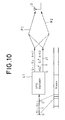
- the STTD encoder 41 converts input symbol as shown in Fig. 10.
- Fig. 10 among input signal to the STTD encoder 41, in a front portion of the data portion N data , symbols S 1 and S 2 are present. Namely, during a period from a time 0 to a time T, symbol S 1 is present, and during a period from the time T to a time 2T, the symbol S 2 is present.
- the STTD encoder 41 outputs symbols S 1 and S 2 as they are, to the side of the antenna 1 (Ant1).
- a complex conjugate -S 2 * of the symbol S 2 and a complex conjugate S 1 * of the symbol S 1 are output alternately.
- the symbol S 1 is transmitted from the antenna 1.
- the complex conjugate -S 2 * of the symbol S 2 is transmitted from the antenna 2.
- the symbol S 2 is transmitted from the antenna 1, and at the same time, the complex conjugate S 1 * of the symbol S 1 is transmitted from the antenna 2.
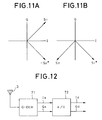
- the symbol S 1 and the complex conjugate -S 2 * are transmitted during the period from the time 0 to the time T as shown in Fig. 11A.
- the symbol S 2 and the complex conjugate S 1 * are transmitted during the period from the time T to the time 2T as shown in Fig. 11B.
- the complex conjugate of the symbol is output from the antenna 2.
- the signal arriving from the antenna 1 during the period from the time 0 to the time T and the signal arriving from the antenna 2 during the period from the time 0 to the time T are situated in a relationship to weaken with each other
- the signal arriving from the antenna 1 during the period from the time T to the time 2T and the signal arriving from the antenna 2 during the period from the time T to the time 2T are inherently situated in a relationship to strengthen with each other.
- paths P1 to Pj (j is a natural number) are present as propagation paths.
- Signals received by the antenna 3 becomes a sum of symbols transmitted from the antennas 1 and 2 at the same timing and varied amplitudes and phases through a plurality of paths. Even if the signals received by the antenna is weaken due to variation of the amplitude and the phase caused by the paths during a certain period, i.e. either the period from 0 to T or the period from T to 2T, the arriving signals from a plurality of paths are strengthened with each other in another period, to increase probability of correct reception.
- Fig. 12 shows a typical construction of the major part on a reception side in relation to the base station.
- the reception side is constructed with a reception antenna 3, a demodulator (Q-DEM) 71 corresponding to the foregoing encoder and an A/D converter 27 which converts an analog signal Ia and Qa into digital signals Id and Qd.
- Q-DEM demodulator
- A/D converter 27 which converts an analog signal Ia and Qa into digital signals Id and Qd.
- Fig. 13 shows a transmission diversity pattern of the SCH.
- the transmission diversity system is those called as TSTD (time switched transmit diversity for SCH) and is different from the foregoing STTD transmission diversity.
- TSTD time switched transmit diversity for SCH
- the SCH is performed only from the antenna 1. Accordingly, irrespective presence or absence of the TSTD transmission diversity, the SCH is never transmitted from a plurality of antennas, simultaneously.
- phase of the symbol through the propagation paths becomes indeterminative. Therefore, on the basis of phase difference with a known symbol to be a reference of the phase, the direction of modulation "a" of the SCH is predicted.
- phase rotation is caused between the symbols to require simultaneously perform prediction and correction of phase rotation to make process quite complicate.
- the present invention has been worked out in view of the drawbacks in the prior art set forth above. It is therefore an object of the present invention to provide a transmission diversity detection circuit, a transmission diversity detection method and a storage medium storing a transmission diversity detection program, which can detect presence or absence of a STTD transmission diversity by simply arithmetic operation.
- a transmission diversity detection circuit for notifying presence or absence of a transmission diversity of spread spectrum communication by modulation of SCH, comprises:
- the arithmetic means may comprise:
- the predetermined slot may be even numbered slots in one frame, the first and second symbols are (0)th and first symbols of the slot.
- the arithmetic means may perform arithmetic operation upon performing communication.
- the arithmetic means may perform arithmetic operation upon registration of position for communication.
- transmission diversity detection method for notifying presence or absence of a transmission diversity of spread spectrum communication by modulation of SCH, comprising:
- the calculating step may comprise steps of:
- the judging step makes judgment whether transmission diversity is performed or not depending upon positive or negative of sign of the sum.
- the predetermined slot may be even numbered slots in one frame, the first and second symbols are (0)th and first symbols of the slot.
- a storage medium storing a program implementing a transmission diversity detection method for notifying presence or absence of a transmission diversity of spread spectrum communication by modulation of SCH, the program comprises:
- the calculating step may derive the complex conjugate C 2n,0 * of the primary CPICH symbol C 2n,0 , a complex conjugate S 2n.0 * of SCH symbol S 2n,0 , a complex conjugate C 2n,1 * of the primary CPICH symbol C 2n,1 and a complex conjugate S 2n,1 * of the SCH symbol S 2n,1 ;
- the judging step makes judgment whether transmission diversity is performed or not depending upon positive or negative of sign of the sum.
- the predetermined slot may be even numbered slots in one frame, the first and second symbols are (0)th and first symbols of the slot.
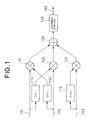
- Fig. 1 is a block diagram showing a construction of the preferred embodiment of a STTD transmission diversity detection circuit according to the present invention.
- Fig. 1 there is shown a construction on a receiver side of the shown system.
- the receiver of the shown system is constructed with complex conjugate calculating portion (Conj.) 111, 112 and 113 for calculating respective complex conjugates for respective complex signals input to complex input portions 101, 102 and 103, complex multipliers 121, 122 and 123 for performing multiplication, a complex adder 130 adding results of multiplication (products) of the multipliers, and judgment portion140 for making judgment whether transmission diversity is present or not depending upon sign of the result of addition.
- Conj. complex conjugate calculating portion
- 111, 112 and 113 for calculating respective complex conjugates for respective complex signals input to complex input portions 101, 102 and 103
- complex multipliers 121, 122 and 123 for performing multiplication
- a complex adder 130 adding results of multiplication (products) of the multipliers
- judgment portion140
- (0)th primary CPICH symbol (to be expressed by C 2n,0 ) in even number slot
- (0)th SCH symbol (to be expressed by S 2n,0 ) in even number slot at the same position
- the first primary CPICH symbol (to be expressed as C 2n,1 ) in even number slot are input, respectively.
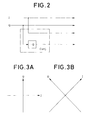
- the complex conjugate calculating portions 111,112 and 113 calculate complex conjugates of input complex signals and output the resultant complex conjugates. From the complex conjugate calculating portion 111, a complex conjugate C 2n,0 * of the complex signal C 2n,0 is output. From the complex conjugate calculating portion 112, a complex conjugate S 2n,0 * of the complex signal S 2n,0 is output. From the complex conjugate calculating portion 113, a complex conjugate C 2n,1 * of the complex signal C 2n,1 is output. It should be noted that the complex conjugate calculating portions 111, 112 and 113 take I signal and Q signal as inputs, derive the complex conjugates with inverting the Q signal and output resultant complex conjugates, as shown in Fig. 2.
- the complex multipliers 121, 122 and 123 perform complex multiplication of two input complexes and output products. From the complex multiplier 121, C 2n,0 ⁇ S 2n,0 * is output. From the complex multiplier 122, C 2n,0 * ⁇ S 2n,0 is output. From the complexmultiplier 123, C 2n,1 ⁇ C 2n,1 * is output.
- the complex adder 130 calculates a sum of input three complex number C 2n,0 ⁇ S 2n,0 * + C 2n,0 * ⁇ S 2n,0 + C 2n,1 ⁇ C 2n,1 * and outputs the sum.
- the judgment portion 140 makes judgment whether transmission diversity is present or not on the basis of the result output from the complex adder 130 .
- the result of judgment is output from a judgment result output portion 150.
- (0)th primary CPICH symbol in (2n)th even number slot is expressed by C 2n,0
- (0)th SCH symbol in (2n)th even number slot at the same position is expressed by S 2n,0
- the subsequent first primary CPICH symbol at the same slot is expressed as C 2n,1 .
- Respective symbols are transmitted with spread by a spread code in the base station.
- despreading with correct spreading code and correct timing is performed for the reception signal, and restoration of the symbol is already completed at the reception side.
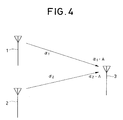
- the character coefficient of the transmission path from the first antenna 1 of the base station to the antenna on the reception side is ⁇ 1 and the characteristic coefficient of the transmission path from the second antenna 2 of the base station to the antenna of the terminal on the reception side is ⁇ 2 .
- characteristics coefficient ⁇ 1 is to be considered.
- These characteristic coefficients ⁇ 1 and ⁇ 2 are complex including the phase and amplitude.
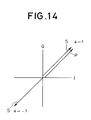
- Figs. 3A and 3B meaning of the characteristic chart will be discussed with reference to Figs. 3A and 3B.
- the transmission side even when transmission is performed in a relationship of the orthogonal coordinate axes as shown in Fig. 3A, it can be received in the relationship of the orthogonal axes as shown in Fig. 3B due to error between reference oscillation frequency between the transmission side and the reception side, or due to rotation of the phase caused by characteristics of the propagation path.
- One expressing the relationship shown in Figs. 3A and 3B is the characteristic coefficient.
- the characteristic coefficient from the transmission antenna 1 to the reception antenna 3 is ⁇ 1
- the transmitted symbol A is received as ⁇ 1 ⁇ A.
- the characteristic coefficient from the transmission antenna 2 to the reception antenna is ⁇ 2
- the transmitted symbol A is received as ⁇ 2 ⁇ A.
- the arithmetic operations are performed.
- the complex conjugate C 2n,0 * of C 2n,0 the complex conjugate S 2n,0 * of S 2n,0 and the complex conjugate C 2n,1 * of C 2n,1 are calculated by the complex conjugate calculating portions 111, 112 and 113 shown in Fig. 1.
- calculation by the following equations (7) to (9) are performed by the complex multipliers 121, 122 and 123 to output the result of calculation.
- the result of calculationbecomes only scalar amount.
- the result of calculation becomes positive value (sign is plus) when STTD transmission diversity is performed, and becomes negative value ( sign is minus) when STTD transmission diversity is not performed. From the foregoing, with the shown system, by the sign of the result of calculation, it becomes possible to detect whether STTD transmission diversity is performed or not. It should be noted that by performing the detection process for a plurality of even numbered slots and averaging the result of detection, diversity detection with higher certainty can be performed.
- the transmission diversity detection method shown in Fig. 5 can be realized. Namely, as shown in Fig. 5, at first, the complex conjugate C 2n,0 * of C 2n,0 , the complex conjugate S 2n,0 * of S 2n,0 and the complex conjugate C 2n,1 * of C 2n,1 are derived(step S101). Next, multiplication C 2n,0 ⁇ S 2n,0 * , multiplication C 2n,0 * ⁇ S 2n,0 and multiplication C 2n,1 ⁇ C 2n,1 * are performed respectively (stepS102 ) . Then, addition of the results of multiplication (products) is performed (step S103). Finally, concerning the result of addition, judgment is made whether the sign of the resultant value is positive or negative (step S104). By performing the foregoing method, it can be detected whether transmission diversity is performed or not.
- a process shown in Fig. 6 is performed. Namely, referring to Fig. 6, comparing the sign D and zero (0), when the sign D is smaller than or equal to zero, judgment can be made that the transmission diversity is not performed to perform normal reception process. On the other hand, when the sign D is greater than zero, judgment can be made that transmission diversity is performed to perform reception process adapting to transmission diversity. As set forth above, reference is made to the result of calculation to check sign of the result of calculation, then whether the transmission diversity is performed or not can be easily detected.
- arithmetic operation for the detection process set forth above may be performed upon reception by the receiver, namely upon communication, or upon position registration for communication.
- a storage medium storing a program for realizing the process shown in Figs. 5 and 6 is prepared to control the computer using the stored program to perform transmission diversity detection process.
- a storage medium a semiconductor memory, a magnetic disk drive and other various storage medium may be used.
- the present invention can detect presence or absence of STTD transmission diversity by simple arithmetic operation.
- presence or absence of STTD transmission diversity can be detected within a short period, namely within a period of two symbols at the shortest.
- presence or absence of STTD transmission diversity can be detected without requiring particular prediction and correction process.
Landscapes
- Engineering & Computer Science (AREA)
- Computer Networks & Wireless Communication (AREA)
- Signal Processing (AREA)
- Quality & Reliability (AREA)
- Radio Transmission System (AREA)
- Mobile Radio Communication Systems (AREA)
Abstract
Description
Claims (11)
- A transmission diversity detection circuit for notifying presence or absence of a transmission diversity of spread spectrum communication by modulation of SCH (Synchronization channel), comprising:arithmetic means for calculating a calculated value of C2n,0 x S2n,0 * + C2n,0 * x S2n,0 + C2n,1 * x C2n,1,in first and second symbols in a predetermined number of series of slots with respect to a reception signal, taking a primary CPICH (common pilot channel) symbol with respect to said first symbol as C2n,0, a SCH symbol with respect to said first symbol as S2n,0, a primary CPICH symbol with respect to said second symbol as C2n,1 and a SCH symbol with respect to said second symbol as S2n,1;taking a complex conjugate of said primary CPICH symbol C2n,0 as C2n,0 *, a complex conjugate of SCH symbol S2n,0 as S2n.0 *, a complex conjugate of said primary CPICH symbol C2n,1 as C2n,1 * and a complex conjugate of said SCH symbol S2n,1 as S2n,1 *; andjudgment means for making judgment whether transmission diversity is present or not depending upon positive or negative of said calculated value.
- A transmission diversity detection circuit as set forth in claim 1, wherein said arithmetic means comprises:circuits for deriving said complex conjugate C2n,0 * of said primary CPICH symbol C2n,0, a complex conjugate S2n,0 * of SCH symbol S2n,0, a complex conjugate C2n,1 * of said primary CPICH symbol C2n,1 and a complex conjugate S2n,1 * of said SCH symbol S2n,1;multipliers calculating C2n,0 x S2n,0 *, C2n,0 * x S2n,0 and C2n,1 * x C2n,1; andan adder calculating a sum of C2n,0 x S2n,0 * + C2n,0 * x S2n,0 + C2n,1 * x C2n,1,said judgment means makes judgment whether transmission diversity is performed or not depending upon positive or negative of sign of said sum.
- A transmission diversity detection circuit as set forth in claim 1, wherein said predetermined slot is even numbered slots in one frame, said first and second symbols are (0)th and first symbols of said slot.
- A transmission diversity detection circuit as set forth in claim 1, wherein said arithmetic means performs arithmetic operation upon performing communication.
- A transmission diversity detection circuit as set forth in claim 1, wherein said arithmetic means performs arithmetic operation upon registration of position for communication.
- A transmission diversity detection method for notifying presence or absence of a transmission diversity of spread spectrum communication by modulation of SCH (Synchronization channel), comprising:calculating step for calculating a calculated value of C2n,0 x S2n,0 * + C2n,0 * x S2n,0 + C2n,1 * x C2n,1, in first and second symbols in a predetermined number of series of slots with respect to a reception signal, taking a primary CPICH (Common pilot channel) symbol with respect to said first symbol as C2n,0, a SCH symbol with respect to said first symbol as S2n,0, a primary CPICH symbol with respect to said second symbol as C2n,1 and a SCH symbol with respect to said second symbol as S2n,1, and taking a complex conjugate of said primary CPICH symbol C2n,0 as C2n,0 *, a complex conjugate of SCH symbol S2n,0 as S2n.0 *, a complex conjugate of said primary CPICH symbol C2n,1 as C2n,1 * and a complex conjugate of said SCH symbol S2n,1 as S2n,1 *; andjudging step for making judgment whether transmission diversity is present or not depending upon positive or negative of said calculated value.
- A transmission diversity detection method as set forth in claim 6, wherein said calculating step comprises steps of:deriving said complex conjugate C2n,0 * of said primary CPICH symbol C2n,0, a complex conjugate S2n.0 * of SCH symbol S2n,0, a complex conjugate C2n,1 * of said primary CPICH symbol C2n,1 and a complex conjugate S2n,1 * of said SCH symbol S2n,1;calculating C2n,0 x S2n,0 *, C2n,0 * x S2n,0 and C2n,1 * x C2n,1; andcalculating a sum of C2n,0 x S2n,0 * + C2n,0 * x S2n,0 + C2n,1 * x C2n,1,said judging step makes judgment whether transmission diversity is performed or not depending upon positive or negative of sign of said sum.
- A transmission diversity detection method as set forth in claim 6, wherein said predetermined slot is even numbered slots in one frame, said first and second symbols are (0)th and first symbols of said slot.
- A storage medium storing a program implementing a transmission diversity detection method for notifying presence or absence of a transmission diversity of spread spectrum communication by modulation of SCH (Synchronization channel), said program comprising:calculating step for calculating a calculated value of C2n,0 x S2n,0 * + C2n,0 * x S2n,0 + C2n,1 * x C2n,1, in first and second symbols in a predetermined number of series of slots with respect to a reception signal, taking a primary CPICH (Common pilot channel) symbol with respect to said first symbol as C2n,0, a SCH symbol with respect to said first symbol as S2n,0, a primary CPICH symbol with respect to said second symbol as C2n,1 and a SCH symbol with respect to said second symbol as S2n,1, and taking a complex conjugate of said primary CPICH symbol C2n,0 as C2n,0 *, a complex conjugate of SCH symbol S2n,0 as S2n,0 *, a complex conjugate of said primary CPICH symbol C2n,1 as C2n,1 * and a complex conjugate of said SCH symbol S2n,1 as S2n,1 *; andjudging step for making judgment whether transmission diversity is present or not depending upon positive or negative of said calculated value.
- A storage medium as set forth in claim 9, wherein said calculating step comprises steps of:deriving said complex conjugate C2n,0 * of said primary CPICH symbol C2n,0, a complex conjugate S2n,0 * of SCH symbol S2n,0, a complex conjugate C2n,1 * of said primary CPICH symbol C2n,1 and a complex conjugate S2n,1 * of said SCH symbol S2n,1;calculating C2n,0 x S2n,0 *, C2n,0 * x S2n,0 and C2n,1 * x C2n,1; andcalculating a sum of C2n,0 x S2n,0 * + C2n,0 * x S2n,0 + C2n,1 * x C2n,1,said judging step makes judgment whether transmission diversity is performed or not depending upon positive or negative of sign of said sum.
- A storage medium as set forth in claim 9, wherein said predetermined slot is even numbered slots in one frame, said first and second symbols are (0)th and first symbols of said slot.
Applications Claiming Priority (2)
| Application Number | Priority Date | Filing Date | Title |
|---|---|---|---|
| JP36859999 | 1999-12-27 | ||
| JP36859999 | 1999-12-27 |
Publications (3)
| Publication Number | Publication Date |
|---|---|
| EP1113615A2 true EP1113615A2 (en) | 2001-07-04 |
| EP1113615A3 EP1113615A3 (en) | 2005-07-20 |
| EP1113615B1 EP1113615B1 (en) | 2007-07-11 |
Family
ID=18492250
Family Applications (1)
| Application Number | Title | Priority Date | Filing Date |
|---|---|---|---|
| EP00128288A Expired - Lifetime EP1113615B1 (en) | 1999-12-27 | 2000-12-22 | Transmission diversity detection circuit and detection method |
Country Status (5)
| Country | Link |
|---|---|
| US (1) | US6859484B2 (en) |
| EP (1) | EP1113615B1 (en) |
| CN (1) | CN100380854C (en) |
| AU (1) | AU770433B2 (en) |
| DE (1) | DE60035479T2 (en) |
Cited By (1)
| Publication number | Priority date | Publication date | Assignee | Title |
|---|---|---|---|---|
| DE10250861B4 (en) * | 2002-10-31 | 2007-01-04 | Infineon Technologies Ag | Methods and apparatus for detecting the TX diversity mode for mobile radio receivers |
Families Citing this family (8)
| Publication number | Priority date | Publication date | Assignee | Title |
|---|---|---|---|---|
| FI20010874A7 (en) * | 2001-04-26 | 2002-10-27 | Nokia Corp | Data transmission method and equipment |
| KR100401954B1 (en) * | 2001-11-01 | 2003-10-17 | 한국전자통신연구원 | Apparatus for determining whether space-time transmit diversity is used in base station and method thereof |
| DE10347985B4 (en) * | 2003-10-15 | 2005-11-10 | Infineon Technologies Ag | Method and apparatus for detecting transmit antenna diversity in the receiver and for scrambling code identification |
| TWI280003B (en) * | 2005-04-14 | 2007-04-21 | Ind Tech Res Inst | System and method for transmission diversity status detection |
| US7684508B1 (en) * | 2005-05-27 | 2010-03-23 | Mediatek Incorporation | Transmission diversity detecting apparatus capable of generating quality indicator and related method thereof |
| KR101276797B1 (en) * | 2005-08-24 | 2013-06-20 | 한국전자통신연구원 | Base station tranmitter for mobile telecommunication system, method for that system |
| WO2007138666A1 (en) * | 2006-05-29 | 2007-12-06 | Panasonic Corporation | Radio base station apparatus |
| US8565775B2 (en) * | 2008-06-25 | 2013-10-22 | Qualcomm Incorporated | Methods and apparatus for common channel cancellation in wireless communications |
Family Cites Families (7)
| Publication number | Priority date | Publication date | Assignee | Title |
|---|---|---|---|---|
| US5812935A (en) * | 1993-04-17 | 1998-09-22 | Hughes Electronics | Cellular system employing base station transmit diversity according to transmission quality level |
| US5623485A (en) * | 1995-02-21 | 1997-04-22 | Lucent Technologies Inc. | Dual mode code division multiple access communication system and method |
| JP3337613B2 (en) * | 1996-03-05 | 2002-10-21 | シャープ株式会社 | Spread spectrum communication system |
| JP3763949B2 (en) * | 1997-09-25 | 2006-04-05 | 若間金物株式会社 | Slide hinge |
| US5940454A (en) * | 1997-12-17 | 1999-08-17 | Nortel Networks Corporation | Blind switch diversity control apparatus |
| KR19990088235A (en) * | 1998-05-13 | 1999-12-27 | 윤종용 | Apparatus for time switched transmission dirversity in mobile communication system and method thereof |
| US6862434B2 (en) * | 2002-07-26 | 2005-03-01 | Qualcomm Inc. | Transmission diversity systems |
-
2000
- 2000-12-21 US US09/740,975 patent/US6859484B2/en not_active Expired - Fee Related
- 2000-12-22 AU AU72518/00A patent/AU770433B2/en not_active Ceased
- 2000-12-22 DE DE60035479T patent/DE60035479T2/en not_active Expired - Lifetime
- 2000-12-22 EP EP00128288A patent/EP1113615B1/en not_active Expired - Lifetime
- 2000-12-27 CN CNB001376241A patent/CN100380854C/en not_active Expired - Fee Related
Cited By (3)
| Publication number | Priority date | Publication date | Assignee | Title |
|---|---|---|---|---|
| DE10250861B4 (en) * | 2002-10-31 | 2007-01-04 | Infineon Technologies Ag | Methods and apparatus for detecting the TX diversity mode for mobile radio receivers |
| US7542726B2 (en) | 2002-10-31 | 2009-06-02 | Infineon Technologies Ag | Methods and apparatuses for detecting the TX diversity mode for mobile radio receivers |
| CN1708937B (en) * | 2002-10-31 | 2012-10-03 | 英特尔移动通信有限责任公司 | Methods and apparatuses for detecting the TX diversity mode for mobile radio receivers |
Also Published As
| Publication number | Publication date |
|---|---|
| EP1113615A3 (en) | 2005-07-20 |
| AU770433B2 (en) | 2004-02-19 |
| CN1304233A (en) | 2001-07-18 |
| DE60035479T2 (en) | 2008-04-17 |
| CN100380854C (en) | 2008-04-09 |
| EP1113615B1 (en) | 2007-07-11 |
| US20010006531A1 (en) | 2001-07-05 |
| AU7251800A (en) | 2001-06-28 |
| US6859484B2 (en) | 2005-02-22 |
| DE60035479D1 (en) | 2007-08-23 |
Similar Documents
| Publication | Publication Date | Title |
|---|---|---|
| US6853839B2 (en) | Method of antenna-weight estimation and mobile communication terminal | |
| US6725028B2 (en) | Receiving station with interference signal suppression | |
| EP0993130B1 (en) | Space time block coded transmit antenna diversity for WCDMA | |
| US6466558B1 (en) | Selection mechanism for signal combining methods | |
| US6424642B1 (en) | Estimation of doppler frequency through autocorrelation of pilot symbols | |
| EP1322045A1 (en) | Radio reception apparatus and radio reception method | |
| EP0898400A2 (en) | Communication method, transmission and reception apparatuses, and cellular radio communication system | |
| US6546026B1 (en) | Multi-diversity synchronization technique for improving synchronization performance in wireless applications over fading channels | |
| US6426978B1 (en) | Digital communication systems and methods for differential and/or amplitude encoding and decoding secondary symbols | |
| US20080095217A1 (en) | Correlation detection method, correlation detection apparatus, transmission diversity detection method and transmission diversity detection circuit | |
| US6859484B2 (en) | Transmission diversity detection circuit and detection method | |
| US7095727B2 (en) | System and method for determining use of STTD encoding of base system | |
| US5946345A (en) | Apparatus and a method for telecommunication system | |
| US7116999B2 (en) | Mobile communications receiving apparatus and method | |
| EP1614232B1 (en) | Method and apparatus for facilitating signal discrimination in a wireless network by applying known frequency offsets | |
| US7676008B2 (en) | Method and apparatus for frequency tracking in a space time transmit diversity receiver | |
| JP6903241B2 (en) | Receivers, wireless communication systems, wireless communication methods, control circuits and programs | |
| US8355459B2 (en) | Method for transmitting and estimating symbols coded with a coding matrix, and corresponding receiver and transmitter | |
| JP3551922B2 (en) | Transmission diversity detection circuit, detection method, recording medium | |
| JP4079964B2 (en) | Radio receiving apparatus and antenna verification method | |
| CA2269740C (en) | Diversity receiver | |
| US6690714B1 (en) | Method and apparatus for achieving demodulation in radio communications system using M-sequence orthogonal modulation | |
| US8259654B2 (en) | Wireless base station apparatus, frequency deviation detecting method, and mobile communication system | |
| US7136424B2 (en) | Method or communications system using a robust diversity combination | |
| US20060215738A1 (en) | Data detection in communication system |
Legal Events
| Date | Code | Title | Description |
|---|---|---|---|
| PUAI | Public reference made under article 153(3) epc to a published international application that has entered the european phase |
Free format text: ORIGINAL CODE: 0009012 |
|
| AK | Designated contracting states |
Kind code of ref document: A2 Designated state(s): AT BE CH CY DE DK ES FI FR GB GR IE IT LI LU MC NL PT SE TR |
|
| AX | Request for extension of the european patent |
Free format text: AL;LT;LV;MK;RO;SI |
|
| PUAL | Search report despatched |
Free format text: ORIGINAL CODE: 0009013 |
|
| AK | Designated contracting states |
Kind code of ref document: A3 Designated state(s): AT BE CH CY DE DK ES FI FR GB GR IE IT LI LU MC NL PT SE TR |
|
| AX | Request for extension of the european patent |
Extension state: AL LT LV MK RO SI |
|
| 17P | Request for examination filed |
Effective date: 20050608 |
|
| AKX | Designation fees paid |
Designated state(s): DE FR GB IT |
|
| GRAP | Despatch of communication of intention to grant a patent |
Free format text: ORIGINAL CODE: EPIDOSNIGR1 |
|
| GRAS | Grant fee paid |
Free format text: ORIGINAL CODE: EPIDOSNIGR3 |
|
| GRAA | (expected) grant |
Free format text: ORIGINAL CODE: 0009210 |
|
| AK | Designated contracting states |
Kind code of ref document: B1 Designated state(s): DE FR GB IT |
|
| REG | Reference to a national code |
Ref country code: GB Ref legal event code: FG4D |
|
| REF | Corresponds to: |
Ref document number: 60035479 Country of ref document: DE Date of ref document: 20070823 Kind code of ref document: P |
|
| ET | Fr: translation filed | ||
| PLBE | No opposition filed within time limit |
Free format text: ORIGINAL CODE: 0009261 |
|
| STAA | Information on the status of an ep patent application or granted ep patent |
Free format text: STATUS: NO OPPOSITION FILED WITHIN TIME LIMIT |
|
| 26N | No opposition filed |
Effective date: 20080414 |
|
| REG | Reference to a national code |
Ref country code: GB Ref legal event code: 732E Free format text: REGISTERED BETWEEN 20141023 AND 20141029 |
|
| REG | Reference to a national code |
Ref country code: FR Ref legal event code: TP Owner name: LENOVO INNOVATIONS LIMITED (HONG KONG), HK Effective date: 20141119 |
|
| PGFP | Annual fee paid to national office [announced via postgrant information from national office to epo] |
Ref country code: DE Payment date: 20141216 Year of fee payment: 15 Ref country code: GB Payment date: 20141217 Year of fee payment: 15 |
|
| PGFP | Annual fee paid to national office [announced via postgrant information from national office to epo] |
Ref country code: FR Payment date: 20141208 Year of fee payment: 15 |
|
| PGFP | Annual fee paid to national office [announced via postgrant information from national office to epo] |
Ref country code: IT Payment date: 20141203 Year of fee payment: 15 |
|
| REG | Reference to a national code |
Ref country code: DE Ref legal event code: R119 Ref document number: 60035479 Country of ref document: DE |
|
| GBPC | Gb: european patent ceased through non-payment of renewal fee |
Effective date: 20151222 |
|
| REG | Reference to a national code |
Ref country code: FR Ref legal event code: ST Effective date: 20160831 |
|
| PG25 | Lapsed in a contracting state [announced via postgrant information from national office to epo] |
Ref country code: DE Free format text: LAPSE BECAUSE OF NON-PAYMENT OF DUE FEES Effective date: 20160701 Ref country code: GB Free format text: LAPSE BECAUSE OF NON-PAYMENT OF DUE FEES Effective date: 20151222 |
|
| PG25 | Lapsed in a contracting state [announced via postgrant information from national office to epo] |
Ref country code: FR Free format text: LAPSE BECAUSE OF NON-PAYMENT OF DUE FEES Effective date: 20151231 |
|
| PG25 | Lapsed in a contracting state [announced via postgrant information from national office to epo] |
Ref country code: IT Free format text: LAPSE BECAUSE OF NON-PAYMENT OF DUE FEES Effective date: 20151222 |