EP1113608A2 - Methods and apparatus for accessing synchronized broadcast data - Google Patents
Methods and apparatus for accessing synchronized broadcast data Download PDFInfo
- Publication number
- EP1113608A2 EP1113608A2 EP00310996A EP00310996A EP1113608A2 EP 1113608 A2 EP1113608 A2 EP 1113608A2 EP 00310996 A EP00310996 A EP 00310996A EP 00310996 A EP00310996 A EP 00310996A EP 1113608 A2 EP1113608 A2 EP 1113608A2
- Authority
- EP
- European Patent Office
- Prior art keywords
- data
- access
- interface
- synchronized
- recited
- Prior art date
- Legal status (The legal status is an assumption and is not a legal conclusion. Google has not performed a legal analysis and makes no representation as to the accuracy of the status listed.)
- Withdrawn
Links
- 230000001360 synchronised effect Effects 0.000 title claims abstract description 136
- 238000000034 method Methods 0.000 title claims abstract description 34
- 238000004590 computer program Methods 0.000 claims 6
- 238000012545 processing Methods 0.000 description 14
- 230000008901 benefit Effects 0.000 description 8
- 230000008569 process Effects 0.000 description 8
- 230000005540 biological transmission Effects 0.000 description 7
- 238000013500 data storage Methods 0.000 description 7
- 239000000872 buffer Substances 0.000 description 6
- 230000002452 interceptive effect Effects 0.000 description 6
- 230000009471 action Effects 0.000 description 3
- 230000007246 mechanism Effects 0.000 description 3
- 239000012536 storage buffer Substances 0.000 description 3
- 238000013459 approach Methods 0.000 description 2
- 238000012986 modification Methods 0.000 description 2
- 230000004048 modification Effects 0.000 description 2
- 239000002699 waste material Substances 0.000 description 2
- 238000004891 communication Methods 0.000 description 1
- 238000010276 construction Methods 0.000 description 1
Images


Classifications
-
- H—ELECTRICITY
- H04—ELECTRIC COMMUNICATION TECHNIQUE
- H04H—BROADCAST COMMUNICATION
- H04H40/00—Arrangements specially adapted for receiving broadcast information
- H04H40/09—Arrangements for receiving desired information automatically according to timetables
-
- H—ELECTRICITY
- H04—ELECTRIC COMMUNICATION TECHNIQUE
- H04N—PICTORIAL COMMUNICATION, e.g. TELEVISION
- H04N21/00—Selective content distribution, e.g. interactive television or video on demand [VOD]
- H04N21/40—Client devices specifically adapted for the reception of or interaction with content, e.g. set-top-box [STB]; Operations thereof
- H04N21/43—Processing of content or additional data, e.g. demultiplexing additional data from a digital video stream; Elementary client operations, e.g. monitoring of home network or synchronising decoder's clock; Client middleware
- H04N21/443—OS processes, e.g. booting an STB, implementing a Java virtual machine in an STB or power management in an STB
- H04N21/4431—OS processes, e.g. booting an STB, implementing a Java virtual machine in an STB or power management in an STB characterized by the use of Application Program Interface [API] libraries
-
- H—ELECTRICITY
- H04—ELECTRIC COMMUNICATION TECHNIQUE
- H04N—PICTORIAL COMMUNICATION, e.g. TELEVISION
- H04N21/00—Selective content distribution, e.g. interactive television or video on demand [VOD]
- H04N21/80—Generation or processing of content or additional data by content creator independently of the distribution process; Content per se
- H04N21/85—Assembly of content; Generation of multimedia applications
- H04N21/854—Content authoring
- H04N21/8547—Content authoring involving timestamps for synchronizing content
-
- Y—GENERAL TAGGING OF NEW TECHNOLOGICAL DEVELOPMENTS; GENERAL TAGGING OF CROSS-SECTIONAL TECHNOLOGIES SPANNING OVER SEVERAL SECTIONS OF THE IPC; TECHNICAL SUBJECTS COVERED BY FORMER USPC CROSS-REFERENCE ART COLLECTIONS [XRACs] AND DIGESTS
- Y10—TECHNICAL SUBJECTS COVERED BY FORMER USPC
- Y10S—TECHNICAL SUBJECTS COVERED BY FORMER USPC CROSS-REFERENCE ART COLLECTIONS [XRACs] AND DIGESTS
- Y10S707/00—Data processing: database and file management or data structures
- Y10S707/99931—Database or file accessing
- Y10S707/99938—Concurrency, e.g. lock management in shared database
Definitions
- the present invention generally relates to broadcast systems. More particularly, the present invention provides methods and apparatus for accessing synchronized data transmitted by a broadcaster in a broadcast system.
- a broadcaster transmits information in the form of audio, video, data, etc. over a medium such as air, cable, phone line (DSL, for example) that, in turn, can be received by any number of receivers.
- a medium such as air, cable, phone line (DSL, for example)
- DSL phone line
- transmitted radio waves can be received with a radio receiver tuned to a particular transmission channel.
- typical broadcast communication is generally a one way medium since the receiver does not have control over the content nor the time of the broadcast transmission.
- data can be transmitted in the form of data packets.
- One such data packet form is defined by the Encapsulated IP datagrams protocol, or by Streaming data in MPEG-2 Packetized Elementary Stream (PES).
- PES Packetized Elementary Stream
- the transmitted data packets also have associated with them timing information indicating when a particular data packet is to be processed.
- a Presentation Time Stamp can be included in a data packet having a value indicating the time at which a unit of data is to be processed (presented).
- PTS values can be defined relative to a System Time Clock (STC), for example, as defined by ISO/IEC 13818-1.
- STC System Time Clock
- Data packets could have both internal and external timing requirements.
- external timing requirements typically imply that data from one stream must be synchronized with another stream of data.
- Transmitted broadcast data containing any type of timing information indicating when data should be processed is referred to herein as "synchronized data”.
- synchronized data Any type of timing information included in a data packet is referred to herein as a "time stamp”.
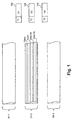
- Fig. 1 illustrates synchronized data packets 102-106 transmitted by a broadcaster (not shown).
- Each of the data packets 102-106 has an associated data segment D1 through D3 respectively, as well as an associated time stamp T1 through T3,respectively.
- data packet 102 has the time stamp T1 indicating when to process the corresponding data segment D1.
- the synchronized data packets 102-106 are received by the digital T.V. receiver at a point of service through what is referred to as a broadcast channel.
- a broadcast channel 2 is subdivided into Video subchannel (V), an Audio subchannel (A), and two Data subchannels (Da and Db).
- a synchronized data packet with video, audio, data information, or any combination thereof, can be transmitted by the broadcaster through the appropriate sub-channel(s) and can be received by a receiver, such as a digital T.V. or analog T.V. with a proper decoder set-top box tuned to the particular broadcast channel.
- a receiver such as a digital T.V. or analog T.V. with a proper decoder set-top box tuned to the particular broadcast channel.
- the receiver is a digital T.V.
- circuitry within the digital T.V. processes the data portion of a data packet as well as the audio and video information (if present) transmitted in the respective subchannels based upon the corresponding time stamp.
- processing the data packet 102 having video information (D1) requires the T.V. receiver to process the video data in such a way that the corresponding video image is displayed on a monitor coupled to the T.V. receiver during a time interval based upon the associated time stamp (T1).
- T1 time stamp
- a T.V. receiver tuned to a particular channel must also access the associated synchronized data packet D1 and process the data included in the packet D1 all within the time constraints dictated by the time stamp T1.
- data is transmitted in a synchronized data packet on a data subchannel such as Da and Db.
- a data subchannel such as Da and Db.
- interactive T.V. during what is referred to as synchronized processing, one must be able to process the data included in a data packet according to the time constraint indicated by the time stamp.
- data can be processed by an interactive application program that is running on the digital T.V. and presented with audio and video in a synchronized manner.
- FIG. 2 illustrates a conventional T.V. receiver 200.
- a tuner 204 included in the T.V. receiver 200 is tuned to a desired broadcast channel and receives the broadcast information transmitted on that channel.
- a demultiplexer 204 is used to divide the broadcast information into subchannels video (V), audio (A), data (D)a, and data (D)b.
- synchronized data packets are received by the receiver 200 via a data subchannel, such as subchannel Da.
- data packets are received as a single stream of data.
- data packets 102-104 are stored in a buffer 208.
- the receiver 200 checks the buffer 208 to determine whether data is available for processing.
- the receiver 200 starts accessing data from the buffer 208 and sequentially accesses data packets 102, 104, and 106 in the order that they are received.
- the receiver 200 accesses synchronized data D1 of data packet 102 and processes it during a time interval defined by the time stamp T1.
- data is transmitted at a higher rate than the receiver 200 can process it, in which case it is possible that the receiver 200 falls behind in processing.
- the receiver 200 while the receiver 200 is processing synchronized data packet 104, it is possible the time stamp T3 for processing and presentation of synchronized data packet 106 expires. Thus, the receiver 200 would be unable to process and present data in a timely manner since the data associated with the data packet 106 is lost.
- buffer 208 has to be constantly checked to determine whether data is available for processing. This is an inefficient approach that wastes processing time.
- Another problem is that there is no mechanism to notify the receiver of loss of data, for example, as a result of buffer overwrite, due to a high transmission rate.
- Yet another problem is that when a receiver falls behind in processing synchronized data, there is no mechanism to allow the receiver to resynchronize with the broadcast transmission.
- the invention relates to methods and apparatus for accessing data that is transmitted by a broadcaster.
- a receiver capable of accessing selected portions of synchronized data that is transmitted by a broadcaster in a broadcasting system
- the receiver includes a synchronized data accessing system capable of providing access to synchronized data transmitted by the broadcaster, the synchronized data accessing system providing an interface that can be used by a data requester to access synchronized data, wherein the data requester can initiate a request to access synchronized data using the interface and data can be made available and accessed by the data requester through the interface.
- a method of accessing synchronized data transmitted by a broadcaster in a broadcast system includes acquiring a listener interface, the listener interface providing an interface for a data requester to request access to synchronized data.
- the method further includes acquiring a point of access interface, the point of access interface allowing the listener to access synchronized data.
- the listener interface is linked to the point of access interface, as well as accessing synchronized data through the listener interface via the point of access interface.
- the invention can be implemented in numerous ways, including as a computer system, an apparatus, and a method. Several embodiments of the invention are discussed below.
- Fig. 1 illustrates conventional synchronized data packets transmitted by a T.V. broadcaster.
- Fig. 2 illustrates a conventional digital T.V. receiver.
- Fig. 3 illustrates a receiver suitable for reception of synchronized data, in accordance with an embodiment of the present invention.
- Fig. 4 illustrates a receiver suitable for reception of synchronized data, in accordance with an embodiment of the present invention.
- Fig. 5 illustrates a method of accessing synchronized data in a broadcast system, in accordance with a particular embodiment of the present invention.
- the invention relates to methods, apparatus, and data structures suitable for accessing synchronized data in a broadcast system.
- a receiver capable of receiving synchronized data transmitted by a broadcaster is disclosed.
- Fig. 3 illustrates a receiver 300 suitable for accessing synchronized data transmitted by a broadcaster, in accordance with an embodiment of the present invention.
- the receiver 300 can be any device suitable for reception of broadcast data, e.g., a digital T.V., set-top box, analog T.V. coupled to a set-top box, as well as a computer (a lap top computer, etc.)
- the receiver can be a digital T.V. or a set-top box running an interactive program where the receiver is implemented as a virtual machine supporting an open interface, e.g., Java, Java T.V., etc.
- the receiver 300 includes a synchronized data accessing system 302 suitable for providing efficient access to synchronized data transmitted by a broadcaster.
- the synchronized data accessing system 302 includes a synchronized data accessor 304 and a synchronized data provider 306.
- the synchronized data accessor 304 can receive a request 308 for accessing synchronized data transmitted on a particular broadcast service, e.g., a channel or subchannel.
- the request 308 can be initiated by an application program that requires access to synchronized data transmitted on a particular channel.
- the synchronized data accessor 304 can, in turn, request the synchronized data from the synchronized data provider 306.
- the synchronized data provider 306 can store it in a data storage buffer 310.
- the synchronized data provider 306 notifies the synchronized data accessor 304 that data is available for access. In this way, synchronized data accessor 304 does not have to check for the arrival of data, thereby freeing the synchronized data accessor 304 to receive and initiate additional requests for access to synchronized data.
- the synchronized data accessor 304 when a data arrival notification is received, notifies the original data requester(that can be, for example, an application program) that data is available for access. In this manner, a notification can be provided when data is ready for access so that an application program does not waste processing time determining whether data has arrived. Thus, an application program can efficiently access data and devote more time to other tasks.
- synchronized data provider 306 provides information including the time stamp and length of synchronized data that is available to be accessed. By providing information about the synchronized data that has been received, more flexibility in data access can be achieved. In addition, the information about synchronized data can be used to make more efficient data accessing decisions.
- the synchronized data provider 306 can send an error notification to the data accessor 304.
- This error notification can be sent to a data requester (an application program, for example) so that the error can be handled accordingly.
- synchronized data accessor 304 can also send a request to resynchronize data access.
- the synchronized data provider 306 can be asked to send notification of the last synchronized data packet received.
- this enables a data requester to resynchronize with the broadcast transmission.
- synchronized data provider 306 is depicted to include a data storage buffer 310, it should be noted that data storage buffer 310 can reside outside of the synchronized data provider 306 without departing from the scope and spirit of the invention. It should also be noted that besides a data storage device, other suitable mechanisms to store and pass data to synchronized data accessor 304 may be implemented.
- Fig 4 illustrates a receiver 400 suitable for reception and processing of synchronized data, in accordance with another embodiment of the present invention.
- the receiver 400 includes the synchronized data accessor 304 and the synchronized data provider 306.
- an application program 402 is running on the receiver 400.
- the application program 402 can be an interactive application program or applet.
- the application program 402 requires access to synchronized data that is transmitted by a broadcaster on a particular channel and received via a data subchannel (Da or Db). Synchronized data can then be provided to the application program 402 for synchronized processing of data for applications, such as interactive T.V. or other such arrangements.
- Da or Db data subchannel
- the synchronized data accessor 304 is implemented as an application programming interface (API).
- the API provides a listener interface that can be used to efficiently access synchronized data.
- the application program 402 can use the API to initiate one or more listeners, such as listeners 404 and 408.
- a listener, such as listener 404, can be used to provide access to synchronized data transmitted on a particular broadcast channel via a data subchannel, e.g., Da.
- Points of access 410-420 can be provided by synchronized data provider 306.
- synchronized data provider 306 is implemented as a part of system software and is capable of providing a point of access for a listener.
- a point of access such as the point of access 410
- synchronized data When synchronized data is received, it can be provided to the synchronized data provider 306.
- synchronized data provider 306 can store synchronized data packets and make them available for access upon request. For example, synchronized data requested by listener 404 is maintained in data storage 422, and synchronized data requested by listener 408 is maintained in data storage 424, and so forth.
- synchronized data provider 306 upon arrival of data, sends a notification to the appropriate listener.
- a notification is sent to listener 404.
- the notification can include information such as the time stamp T1 and length of synchronized data D1.
- the synchronized data accessor 304 can, in turn, notify the application program 402 that synchronized data has been received and is available for access through the data provider.
- the application program 402 can take appropriate action based on the information that is provided by the synchronized data accessor 304. For example, the application program 402 can initiate a data access through the synchronized data accessor 304 by identifying a desired point of access. The application program 402 can choose to ignore a data arrival notification for a listener but initiate a data access request for data notified through another listener.
- the application program 402 can choose to access a portion of available data by providing an offset and the length of data to be accessed. In this manner, application program 402 has the flexibility to access data in segments and/or choose to ignore a portion of data available in a synchronized data packet.
- an error notification can be sent to the application program 402 so that appropriate error handling actions can be taken. For example, if synchronized data packet 102 is no longer available for access, perhaps due to a buffer overfill, an error notification can be sent to the application program 402.
- the application program can resynchronize with the broadcast transmission by sending a request to be notified of the last data available for access on a particular listener. For example, if application program 402 falls behind in processing synchronized data, it can send a request to receive notification of the last synchronized data packet received.
- the synchronized data provider 306 can allow access to the last synchronized data packet 106 received and continue sending notifications when the next synchronized data packet is available for access. In this way, the application program 402 can resynchronize with the broadcast transmission.
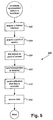
- Fig. 5 shows a flowchart detailing a method 500 of accessing synchronized data transmitted in a broadcast system in accordance with an embodiment of the present invention.
- a listener interface is acquired.
- the listener interface is implemented as an interface in an object programming language such as C++, Java, etc.
- the listener interface is implemented as a Java public abstract interface as an interface for providing notification of pending synchronized data that is available for access.
- this point of access is an access interface defined in an object programming language such as C++, Java, etc.
- this access interface is a Java public abstract interface that can be provided as an access object to a listener.
- the acquired listener interface is linked to the point of access, as noted at 506.
- this linking operation is implemented as a Java method that registers the listener interface with the point of access interface to provide the listener with notification indicating the availability of data for access from the point of access.
- synchronized data is received and is available for access from the point of access interface.
- a notification is sent to the appropriate listener to indicate availability of data, as noted in operation 510.
- the notification is sent to notify the listener that data can be transferred from the point of access.
- this notification is implemented as a Java method for reception of a Java event that provides information such as the time stamp and length of a synchronized data packet that is available for access.
- Synchronized data is accessed through the point of access at 512.
- Synchronized data can be provided via the point of access and made available for access through the listener interface.
- data access can be achieved as a read operation of an object programming language, for example, a Java read method.
- Method 500 can be used by an application program or applet running on an operating system.
- An application program or applet can interface with a Virtual Machine running a Real-Time Operating System.
- the application program or applet uses a Java T.V. Application Programming Interface (API) to access synchronized data transmitted by a broadcaster.
- the JAVA TV API is an extension of the JAVA platform developed by Sun Microsystems of Mountain View, CA.
- the invention has numerous advantages.
- One advantage is that data arrival notification can be provided to allow efficient access of synchronized data.
- Another advantage is that error notifications can be sent to allow appropriate error handling actions to be taken.
- Yet another advantage is that synchronized data can be accessed based on information, such as time stamp and length of synchronized data.
- Still another advantage is that cost effective and efficient solutions can be implemented to access synchronized data.
Landscapes
- Engineering & Computer Science (AREA)
- Signal Processing (AREA)
- Multimedia (AREA)
- Library & Information Science (AREA)
- Software Systems (AREA)
- Computer Security & Cryptography (AREA)
- Two-Way Televisions, Distribution Of Moving Picture Or The Like (AREA)
- Circuits Of Receivers In General (AREA)
- Synchronisation In Digital Transmission Systems (AREA)
Abstract
Description
Claims (22)
- A receiver suitable for accessing selected portions of synchronized data that is transmitted by a broadcaster in a broadcasting system, the receiver comprising:
a synchronized data accessing system capable of providing access to synchronized data transmitted by the broadcaster, the synchronized data accessing system providing an interface that can be used by a data requester to access synchronized data, wherein the data requester can initiate a request to access synchronized data using the interface and data can be made available and accessed by the data requester through the interface. - A receiver as recited in claim 1, wherein the interface is a programming language interface (API).
- A receiver as recited in claim 2, wherein the API includes a listener API and point of access API.
- A receiver as recited in claim 1, wherein the synchronized data accessing system provides a notification associated with the transmitted synchronized data.
- A receiver as recited in claim 4, wherein the notification includes other information that can be used by a data requester to access data.
- A receiver as recited in claim 5, wherein the notification includes a timestamp.
- A receiver as recited in claim 5, wherein the notification includes a length of data indicator that indicates the length of data.
- A receiver as recited in claim 5, wherein the notification includes a timestamp and a length of data indicator that indicates the length of data.
- A receiver as recited in claim 1, wherein the synchronized data accessing system provides error handling information.
- A receiver as recited in claim 1, wherein the synchronized data accessing system provides information that can be used by a data requester to access data in segments.
- A receiver as recited in claim 1, wherein the synchronized data accessing system further includes a data accessor and a data provider.
- A receiver as recited in claim 1, wherein the data accessor can send a request to resynchronize data.
- A receiver as recited in claim 1, wherein the data provider sends an error notification to the data accessor.
- A method of accessing synchronized data transmitted by a broadcaster in a broadcast system, the method comprising:acquiring a listener interface, the listener interface providing an interface for a data requester to request access to synchronized data;acquiring a point of access interface, the point of access interface allowing the listener to access synchronized data;linking the listener interface to the point of access interface; andaccessing synchronized data through the listener interface via the point of access interface.
- A method as recited in claim 9, wherein the method further comprises sending a notification to a data requester to indicate that data is ready for access.
- A method as recited in claim 9, wherein the method further comprises sending a notification to a data requester to indicate that data is ready for access.
- A method as recited in claim 16, wherein the notification includes a time stamp and a length of data indictor that indicates the length of data.
- A method as recited in claim 9, wherein the method further comprises sending an error notification to the data requester.
- A computer programmable media including computer program code for accessing synchronized data transmitted by a broadcaster in a broadcast system, the computer programmable media comprising:computer program code for acquiring a listener interface, the listener interface providing an interface for a data requester to request access to synchronized data;computer program code for acquiring a point of access interface, the point of access interface allowing the listener to access synchronized data;computer program code for linking the listener interface to the point of access interface; andcomputer program code for accessing synchronized data through the listener interface via the point of access interface.
- A computer programmable media as recited in claim 19, further comprising:
computer program code for sending a notification to a data requester to indicate that data is ready for access. - A computer programmable media as recited in claim 20, wherein the notification includes a time stamp and a length of data indictor that indicates the length of data.
- A computer programmable media as recited in claim 19, further comprising:
Applications Claiming Priority (4)
| Application Number | Priority Date | Filing Date | Title |
|---|---|---|---|
| US17269499P | 1999-12-10 | 1999-12-10 | |
| US172694P | 1999-12-10 | ||
| US09/724,732 US7062779B1 (en) | 1999-12-10 | 2000-11-28 | Methods and apparatus for accessing synchronized broadcast data |
| US724732P | 2000-11-28 |
Publications (2)
| Publication Number | Publication Date |
|---|---|
| EP1113608A2 true EP1113608A2 (en) | 2001-07-04 |
| EP1113608A3 EP1113608A3 (en) | 2006-06-28 |
Family
ID=26868359
Family Applications (1)
| Application Number | Title | Priority Date | Filing Date |
|---|---|---|---|
| EP00310996A Withdrawn EP1113608A3 (en) | 1999-12-10 | 2000-12-08 | Methods and apparatus for accessing synchronized broadcast data |
Country Status (3)
| Country | Link |
|---|---|
| US (1) | US7062779B1 (en) |
| EP (1) | EP1113608A3 (en) |
| JP (1) | JP4812934B2 (en) |
Families Citing this family (6)
| Publication number | Priority date | Publication date | Assignee | Title |
|---|---|---|---|---|
| EP1231782A1 (en) * | 2001-02-13 | 2002-08-14 | Sony International (Europe) GmbH | Tuning device for a data distribution network |
| JP4108035B2 (en) | 2003-12-26 | 2008-06-25 | 三菱重工業株式会社 | Control device for multi-cylinder internal combustion engine and signal device capable of providing information to the device |
| US8855981B2 (en) * | 2004-12-13 | 2014-10-07 | The Mathworks, Inc. | Tools for system-level design environments |
| US8812269B1 (en) | 2004-12-13 | 2014-08-19 | The Mathworks, Inc. | Dynamic range assessment in block diagram systems |
| US7853198B2 (en) * | 2006-10-18 | 2010-12-14 | Microsoft Corporation | Delivering individualized content over a broadcast network |
| US11706465B2 (en) * | 2019-01-15 | 2023-07-18 | Sony Group Corporation | ATSC 3.0 advertising notification using event streams |
Family Cites Families (20)
| Publication number | Priority date | Publication date | Assignee | Title |
|---|---|---|---|---|
| US5430836A (en) * | 1991-03-01 | 1995-07-04 | Ast Research, Inc. | Application control module for common user access interface |
| US5768539A (en) * | 1994-05-27 | 1998-06-16 | Bell Atlantic Network Services, Inc. | Downloading applications software through a broadcast channel |
| US5991520A (en) * | 1996-02-02 | 1999-11-23 | Sony Corporation | Application programming interface for managing and automating data transfer operations between applications over a bus structure |
| US6631435B1 (en) * | 1996-02-02 | 2003-10-07 | Sony Corporation | Application programming interface for data transfer and bus management over a bus structure |
| US5778181A (en) * | 1996-03-08 | 1998-07-07 | Actv, Inc. | Enhanced video programming system and method for incorporating and displaying retrieved integrated internet information segments |
| US5946487A (en) * | 1996-06-10 | 1999-08-31 | Lsi Logic Corporation | Object-oriented multi-media architecture |
| FR2752350B1 (en) * | 1996-08-09 | 2001-06-08 | Thomson Multimedia Sa | METHOD FOR EXTRACTING DATA IN A CYCLIC TRANSMISSION SYSTEM AND IMPLEMENTING DEVICE |
| JP3887856B2 (en) * | 1996-12-13 | 2007-02-28 | 株式会社日立製作所 | Terminal device |
| US5909579A (en) * | 1997-04-23 | 1999-06-01 | Sun Microsystems, Inc. | Method and apparatus for encoding and decoding delta encoded information to locate live pointers in program data stacks |
| US6317885B1 (en) * | 1997-06-26 | 2001-11-13 | Microsoft Corporation | Interactive entertainment and information system using television set-top box |
| US6134602A (en) * | 1997-09-24 | 2000-10-17 | Microsoft Corporation | Application programming interface enabling application programs to group code and data to control allocation of physical memory in a virtual memory system |
| US6415373B1 (en) * | 1997-12-24 | 2002-07-02 | Avid Technology, Inc. | Computer system and process for transferring multiple high bandwidth streams of data between multiple storage units and multiple applications in a scalable and reliable manner |
| US6038625A (en) * | 1998-01-06 | 2000-03-14 | Sony Corporation Of Japan | Method and system for providing a device identification mechanism within a consumer audio/video network |
| US6459427B1 (en) * | 1998-04-01 | 2002-10-01 | Liberate Technologies | Apparatus and method for web-casting over digital broadcast TV network |
| US6563515B1 (en) * | 1998-05-19 | 2003-05-13 | United Video Properties, Inc. | Program guide system with video window browsing |
| US6437809B1 (en) * | 1998-06-05 | 2002-08-20 | Xsides Corporation | Secondary user interface |
| US6400407B1 (en) * | 1998-06-17 | 2002-06-04 | Webtv Networks, Inc. | Communicating logical addresses of resources in a data service channel of a video signal |
| US6282713B1 (en) * | 1998-12-21 | 2001-08-28 | Sony Corporation | Method and apparatus for providing on-demand electronic advertising |
| US6326982B1 (en) * | 1999-06-24 | 2001-12-04 | Enreach Technology, Inc. | Method and apparatus for automatically accessing web pages based on television programming information |
| US6904599B1 (en) * | 1999-11-29 | 2005-06-07 | Microsoft Corporation | Storage management system having abstracted volume providers |
-
2000
- 2000-11-28 US US09/724,732 patent/US7062779B1/en not_active Expired - Lifetime
- 2000-12-08 JP JP2000374851A patent/JP4812934B2/en not_active Expired - Lifetime
- 2000-12-08 EP EP00310996A patent/EP1113608A3/en not_active Withdrawn
Also Published As
| Publication number | Publication date |
|---|---|
| JP4812934B2 (en) | 2011-11-09 |
| EP1113608A3 (en) | 2006-06-28 |
| US7062779B1 (en) | 2006-06-13 |
| JP2001230980A (en) | 2001-08-24 |
Similar Documents
| Publication | Publication Date | Title |
|---|---|---|
| US6976268B2 (en) | Methods and apparatus for efficiently accessing periodically broadcast data | |
| US7342941B2 (en) | Data structure, method and apparatus providing efficient retrieval of data from a segmented information stream | |
| JP4035209B2 (en) | Receiver for cyclic packet data transmission system | |
| US20070253509A1 (en) | Data transfer device | |
| US8429697B2 (en) | Modifying the behavior of a multimedia transport system in response to detected capabilities of a client system | |
| JPH11500289A (en) | Method for transmitting and receiving a compressed television signal | |
| EP1197090A2 (en) | Methods and apparatus for selecting multicast ip data transmitted in broadcast streams | |
| US8448184B2 (en) | Method and apparatus for signaling transmission code set in data broadcasting | |
| US7716709B2 (en) | Method of increasing capabilities of streaming content including video on demand | |
| US7062779B1 (en) | Methods and apparatus for accessing synchronized broadcast data | |
| CN1225853C (en) | Transmission of content description information and connection information in digital broadcast networks | |
| US6516376B1 (en) | Command and control architecture for a video decoder and a host | |
| US20060053460A1 (en) | Transmission communications management | |
| EP0854649A2 (en) | Television broadcasting system and receiver | |
| KR100461540B1 (en) | Apparatus and Method for Buffering Sychronized Non_streaming Data | |
| Metzler et al. | Linux dvb api version 3 | |
| JP2005020358A (en) | Digital broadcast viewing system, control program for this digital broadcast viewing system, receiving adapter using this control program, and recording medium recording this control program |
Legal Events
| Date | Code | Title | Description |
|---|---|---|---|
| PUAI | Public reference made under article 153(3) epc to a published international application that has entered the european phase |
Free format text: ORIGINAL CODE: 0009012 |
|
| AK | Designated contracting states |
Kind code of ref document: A2 Designated state(s): AT BE CH CY DE DK ES FI FR GB GR IE IT LI LU MC NL PT SE TR |
|
| AX | Request for extension of the european patent |
Free format text: AL;LT;LV;MK;RO;SI |
|
| PUAL | Search report despatched |
Free format text: ORIGINAL CODE: 0009013 |
|
| AK | Designated contracting states |
Kind code of ref document: A3 Designated state(s): AT BE CH CY DE DK ES FI FR GB GR IE IT LI LU MC NL PT SE TR |
|
| AX | Request for extension of the european patent |
Extension state: AL LT LV MK RO SI |
|
| AKX | Designation fees paid |
Designated state(s): DE FR GB |
|
| 17P | Request for examination filed |
Effective date: 20061228 |
|
| 17Q | First examination report despatched |
Effective date: 20070524 |
|
| STAA | Information on the status of an ep patent application or granted ep patent |
Free format text: STATUS: THE APPLICATION IS DEEMED TO BE WITHDRAWN |
|
| 18D | Application deemed to be withdrawn |
Effective date: 20080701 |