EP1113105B1 - Human sweat malodor counteractant composition and process for using same - Google Patents
Human sweat malodor counteractant composition and process for using same Download PDFInfo
- Publication number
- EP1113105B1 EP1113105B1 EP00311441A EP00311441A EP1113105B1 EP 1113105 B1 EP1113105 B1 EP 1113105B1 EP 00311441 A EP00311441 A EP 00311441A EP 00311441 A EP00311441 A EP 00311441A EP 1113105 B1 EP1113105 B1 EP 1113105B1
- Authority
- EP
- European Patent Office
- Prior art keywords
- weight percent
- weight
- malodor
- hexahydro
- propionate
- Prior art date
- Legal status (The legal status is an assumption and is not a legal conclusion. Google has not performed a legal analysis and makes no representation as to the accuracy of the status listed.)
- Expired - Lifetime
Links
- 239000000203 mixture Substances 0.000 title claims abstract description 53
- 210000004243 sweat Anatomy 0.000 title claims abstract description 20
- 238000000034 method Methods 0.000 title claims abstract description 18
- 230000008569 process Effects 0.000 title claims abstract description 12
- AKGGYBADQZYZPD-UHFFFAOYSA-N benzylacetone Chemical compound CC(=O)CCC1=CC=CC=C1 AKGGYBADQZYZPD-UHFFFAOYSA-N 0.000 claims abstract description 26
- 239000002304 perfume Substances 0.000 claims abstract description 18
- HLCSDJLATUNSSI-UHFFFAOYSA-N 3,7-dimethylocta-2,6-dienenitrile Chemical compound CC(C)=CCCC(C)=CC#N HLCSDJLATUNSSI-UHFFFAOYSA-N 0.000 claims abstract description 14
- LYCAIKOWRPUZTN-UHFFFAOYSA-N ethylene glycol Natural products OCCO LYCAIKOWRPUZTN-UHFFFAOYSA-N 0.000 claims abstract description 14
- TVIDDXQYHWJXFK-UHFFFAOYSA-N dodecanedioic acid Chemical compound OC(=O)CCCCCCCCCCC(O)=O TVIDDXQYHWJXFK-UHFFFAOYSA-N 0.000 claims abstract description 12
- -1 ethylene glycol cyclic ester Chemical class 0.000 claims abstract description 12
- JRJBVWJSTHECJK-LUAWRHEFSA-N (z)-3-methyl-4-(2,6,6-trimethylcyclohex-2-en-1-yl)but-3-en-2-one Chemical compound CC(=O)C(\C)=C/C1C(C)=CCCC1(C)C JRJBVWJSTHECJK-LUAWRHEFSA-N 0.000 claims abstract description 11
- LUZDYPLAQQGJEA-UHFFFAOYSA-N 2-Methoxynaphthalene Chemical compound C1=CC=CC2=CC(OC)=CC=C21 LUZDYPLAQQGJEA-UHFFFAOYSA-N 0.000 claims abstract description 11
- XSAYZAUNJMRRIR-UHFFFAOYSA-N 2-acetylnaphthalene Chemical compound C1=CC=CC2=CC(C(=O)C)=CC=C21 XSAYZAUNJMRRIR-UHFFFAOYSA-N 0.000 claims abstract description 9
- DDQDBZUGVZGFKB-UHFFFAOYSA-N hexahydro-4,7-methanoinden-6-yl propionate Chemical compound C1CCC2C(C3)CC(OC(=O)CC)C3=C21 DDQDBZUGVZGFKB-UHFFFAOYSA-N 0.000 claims abstract description 8
- YLQBMQCUIZJEEH-UHFFFAOYSA-N Furan Chemical compound C=1C=COC=1 YLQBMQCUIZJEEH-UHFFFAOYSA-N 0.000 claims abstract 6
- XBDQKXXYIPTUBI-UHFFFAOYSA-M Propionate Chemical compound CCC([O-])=O XBDQKXXYIPTUBI-UHFFFAOYSA-M 0.000 claims abstract 2
- 239000003205 fragrance Substances 0.000 claims description 40
- YPZUZOLGGMJZJO-UHFFFAOYSA-N Ambronide Chemical compound C1CC2C(C)(C)CCCC2(C)C2C1(C)OCC2 YPZUZOLGGMJZJO-UHFFFAOYSA-N 0.000 claims description 12
- 239000004744 fabric Substances 0.000 claims description 11
- 239000001699 mentha arvensis leaf oil Substances 0.000 claims description 9
- QDGSOAGBNRCDSW-UHFFFAOYSA-N hexahydro-4,7-methanoinden-5-yl propionate Chemical compound C1CCC2C(C3)C(OC(=O)CC)CC3=C21 QDGSOAGBNRCDSW-UHFFFAOYSA-N 0.000 claims description 8
- 238000009472 formulation Methods 0.000 claims description 6
- 230000003472 neutralizing effect Effects 0.000 claims description 6
- ZKVZSBSZTMPBQR-UHFFFAOYSA-N cycloheptadec-9-en-1-one Chemical compound O=C1CCCCCCCC=CCCCCCCC1 ZKVZSBSZTMPBQR-UHFFFAOYSA-N 0.000 claims description 5
- ABRIMXGLNHCLIP-UHFFFAOYSA-N cyclohexadec-5-en-1-one Chemical compound O=C1CCCCCCCCCCC=CCCC1 ABRIMXGLNHCLIP-UHFFFAOYSA-N 0.000 claims description 3
- CSCPPACGZOOCGX-UHFFFAOYSA-N Acetone Chemical compound CC(C)=O CSCPPACGZOOCGX-UHFFFAOYSA-N 0.000 claims 1
- HLCSDJLATUNSSI-JXMROGBWSA-N (2e)-3,7-dimethylocta-2,6-dienenitrile Chemical compound CC(C)=CCC\C(C)=C\C#N HLCSDJLATUNSSI-JXMROGBWSA-N 0.000 abstract description 5
- 239000004480 active ingredient Substances 0.000 abstract 1
- 239000000654 additive Substances 0.000 abstract 1
- 230000000996 additive effect Effects 0.000 abstract 1
- 239000002781 deodorant agent Substances 0.000 description 12
- 230000000873 masking effect Effects 0.000 description 12
- 230000009467 reduction Effects 0.000 description 12
- 235000019645 odor Nutrition 0.000 description 10
- 238000012360 testing method Methods 0.000 description 10
- 239000000047 product Substances 0.000 description 9
- 238000006386 neutralization reaction Methods 0.000 description 8
- 239000000126 substance Substances 0.000 description 8
- ULDHMXUKGWMISQ-UHFFFAOYSA-N carvone Chemical compound CC(=C)C1CC=C(C)C(=O)C1 ULDHMXUKGWMISQ-UHFFFAOYSA-N 0.000 description 6
- 239000003599 detergent Substances 0.000 description 6
- 239000000796 flavoring agent Substances 0.000 description 6
- 235000019634 flavors Nutrition 0.000 description 6
- 239000000463 material Substances 0.000 description 6
- OSWPMRLSEDHDFF-UHFFFAOYSA-N methyl salicylate Chemical compound COC(=O)C1=CC=CC=C1O OSWPMRLSEDHDFF-UHFFFAOYSA-N 0.000 description 6
- SIKJAQJRHWYJAI-UHFFFAOYSA-N Indole Chemical compound C1=CC=C2NC=CC2=C1 SIKJAQJRHWYJAI-UHFFFAOYSA-N 0.000 description 4
- NFLGAXVYCFJBMK-UHFFFAOYSA-N Menthone Chemical compound CC(C)C1CCC(C)CC1=O NFLGAXVYCFJBMK-UHFFFAOYSA-N 0.000 description 4
- 238000011156 evaluation Methods 0.000 description 4
- 239000004615 ingredient Substances 0.000 description 4
- 239000013598 vector Substances 0.000 description 4
- NOOLISFMXDJSKH-UTLUCORTSA-N (+)-Neomenthol Chemical compound CC(C)[C@@H]1CC[C@@H](C)C[C@@H]1O NOOLISFMXDJSKH-UTLUCORTSA-N 0.000 description 3
- NFLGAXVYCFJBMK-RKDXNWHRSA-N (+)-isomenthone Natural products CC(C)[C@H]1CC[C@@H](C)CC1=O NFLGAXVYCFJBMK-RKDXNWHRSA-N 0.000 description 3
- NZGWDASTMWDZIW-MRVPVSSYSA-N (+)-pulegone Chemical compound C[C@@H]1CCC(=C(C)C)C(=O)C1 NZGWDASTMWDZIW-MRVPVSSYSA-N 0.000 description 3
- DSSYKIVIOFKYAU-XCBNKYQSSA-N (R)-camphor Chemical compound C1C[C@@]2(C)C(=O)C[C@@H]1C2(C)C DSSYKIVIOFKYAU-XCBNKYQSSA-N 0.000 description 3
- 239000005973 Carvone Substances 0.000 description 3
- 241000723346 Cinnamomum camphora Species 0.000 description 3
- NOOLISFMXDJSKH-UHFFFAOYSA-N DL-menthol Natural products CC(C)C1CCC(C)CC1O NOOLISFMXDJSKH-UHFFFAOYSA-N 0.000 description 3
- 241000402754 Erythranthe moschata Species 0.000 description 3
- WEEGYLXZBRQIMU-UHFFFAOYSA-N Eucalyptol Chemical compound C1CC2CCC1(C)OC2(C)C WEEGYLXZBRQIMU-UHFFFAOYSA-N 0.000 description 3
- 241001465754 Metazoa Species 0.000 description 3
- NZGWDASTMWDZIW-UHFFFAOYSA-N Pulegone Natural products CC1CCC(=C(C)C)C(=O)C1 NZGWDASTMWDZIW-UHFFFAOYSA-N 0.000 description 3
- USMNOWBWPHYOEA-UHFFFAOYSA-N alpha-thujone Natural products CC1C(=O)CC2(C(C)C)C1C2 USMNOWBWPHYOEA-UHFFFAOYSA-N 0.000 description 3
- 230000008901 benefit Effects 0.000 description 3
- 229930008380 camphor Natural products 0.000 description 3
- 229960000846 camphor Drugs 0.000 description 3
- 239000003795 chemical substances by application Substances 0.000 description 3
- RFFOTVCVTJUTAD-UHFFFAOYSA-N cineole Natural products C1CC2(C)CCC1(C(C)C)O2 RFFOTVCVTJUTAD-UHFFFAOYSA-N 0.000 description 3
- 229960005233 cineole Drugs 0.000 description 3
- 150000001875 compounds Chemical class 0.000 description 3
- 230000029142 excretion Effects 0.000 description 3
- 229940041616 menthol Drugs 0.000 description 3
- 229930007503 menthone Natural products 0.000 description 3
- 229960001047 methyl salicylate Drugs 0.000 description 3
- 239000013642 negative control Substances 0.000 description 3
- 229930007459 p-menth-8-en-3-one Natural products 0.000 description 3
- 239000013641 positive control Substances 0.000 description 3
- AZQWKYJCGOJGHM-UHFFFAOYSA-N 1,4-benzoquinone Chemical compound O=C1C=CC(=O)C=C1 AZQWKYJCGOJGHM-UHFFFAOYSA-N 0.000 description 2
- RWSOTUBLDIXVET-UHFFFAOYSA-N Dihydrogen sulfide Chemical class S RWSOTUBLDIXVET-UHFFFAOYSA-N 0.000 description 2
- KGEKLUUHTZCSIP-HOSYDEDBSA-N [(1s,4s,6r)-1,7,7-trimethyl-6-bicyclo[2.2.1]heptanyl] acetate Chemical compound C1C[C@]2(C)[C@H](OC(=O)C)C[C@H]1C2(C)C KGEKLUUHTZCSIP-HOSYDEDBSA-N 0.000 description 2
- 150000001299 aldehydes Chemical class 0.000 description 2
- CRPUJAZIXJMDBK-UHFFFAOYSA-N camphene Chemical compound C1CC2C(=C)C(C)(C)C1C2 CRPUJAZIXJMDBK-UHFFFAOYSA-N 0.000 description 2
- 239000012153 distilled water Substances 0.000 description 2
- 230000000694 effects Effects 0.000 description 2
- 238000005516 engineering process Methods 0.000 description 2
- RRAFCDWBNXTKKO-UHFFFAOYSA-N eugenol Chemical compound COC1=CC(CC=C)=CC=C1O RRAFCDWBNXTKKO-UHFFFAOYSA-N 0.000 description 2
- IFYYFLINQYPWGJ-UHFFFAOYSA-N gamma-decalactone Chemical compound CCCCCCC1CCC(=O)O1 IFYYFLINQYPWGJ-UHFFFAOYSA-N 0.000 description 2
- 230000006872 improvement Effects 0.000 description 2
- 230000005923 long-lasting effect Effects 0.000 description 2
- GVOWHGSUZUUUDR-UHFFFAOYSA-N methyl N-methylanthranilate Chemical compound CNC1=CC=CC=C1C(=O)OC GVOWHGSUZUUUDR-UHFFFAOYSA-N 0.000 description 2
- VAMXMNNIEUEQDV-UHFFFAOYSA-N methyl anthranilate Chemical compound COC(=O)C1=CC=CC=C1N VAMXMNNIEUEQDV-UHFFFAOYSA-N 0.000 description 2
- 125000002496 methyl group Chemical group [H]C([H])([H])* 0.000 description 2
- RUVINXPYWBROJD-ONEGZZNKSA-N trans-anethole Chemical compound COC1=CC=C(\C=C\C)C=C1 RUVINXPYWBROJD-ONEGZZNKSA-N 0.000 description 2
- XLYOFNOQVPJJNP-UHFFFAOYSA-N water Chemical compound O XLYOFNOQVPJJNP-UHFFFAOYSA-N 0.000 description 2
- DTGKSKDOIYIVQL-WEDXCCLWSA-N (+)-borneol Chemical compound C1C[C@@]2(C)[C@@H](O)C[C@@H]1C2(C)C DTGKSKDOIYIVQL-WEDXCCLWSA-N 0.000 description 1
- REPVLJRCJUVQFA-UHFFFAOYSA-N (-)-isopinocampheol Natural products C1C(O)C(C)C2C(C)(C)C1C2 REPVLJRCJUVQFA-UHFFFAOYSA-N 0.000 description 1
- 150000004057 1,4-benzoquinones Chemical class 0.000 description 1
- KJCVRFUGPWSIIH-UHFFFAOYSA-N 1-naphthol Chemical compound C1=CC=C2C(O)=CC=CC2=C1 KJCVRFUGPWSIIH-UHFFFAOYSA-N 0.000 description 1
- MVOSYKNQRRHGKX-UHFFFAOYSA-N 11-Undecanolactone Chemical compound O=C1CCCCCCCCCCO1 MVOSYKNQRRHGKX-UHFFFAOYSA-N 0.000 description 1
- DNRJTBAOUJJKDY-UHFFFAOYSA-N 2-Acetyl-3,5,5,6,8,8-hexamethyl-5,6,7,8- tetrahydronaphthalene Chemical group CC(=O)C1=C(C)C=C2C(C)(C)C(C)CC(C)(C)C2=C1 DNRJTBAOUJJKDY-UHFFFAOYSA-N 0.000 description 1
- VMUXSMXIQBNMGZ-UHFFFAOYSA-N 3,4-dihydrocoumarin Chemical compound C1=CC=C2OC(=O)CCC2=C1 VMUXSMXIQBNMGZ-UHFFFAOYSA-N 0.000 description 1
- GOLORTLGFDVFDW-UHFFFAOYSA-N 3-(1h-benzimidazol-2-yl)-7-(diethylamino)chromen-2-one Chemical compound C1=CC=C2NC(C3=CC4=CC=C(C=C4OC3=O)N(CC)CC)=NC2=C1 GOLORTLGFDVFDW-UHFFFAOYSA-N 0.000 description 1
- JRJBVWJSTHECJK-PKNBQFBNSA-N 3-Methyl-4-(2,6,6-trimethyl-2-cyclohexen-1-yl)-3-buten-2-one Chemical compound CC(=O)C(\C)=C\C1C(C)=CCCC1(C)C JRJBVWJSTHECJK-PKNBQFBNSA-N 0.000 description 1
- HIQIXEFWDLTDED-UHFFFAOYSA-N 4-hydroxy-1-piperidin-4-ylpyrrolidin-2-one Chemical compound O=C1CC(O)CN1C1CCNCC1 HIQIXEFWDLTDED-UHFFFAOYSA-N 0.000 description 1
- NPBVQXIMTZKSBA-UHFFFAOYSA-N Chavibetol Natural products COC1=CC=C(CC=C)C=C1O NPBVQXIMTZKSBA-UHFFFAOYSA-N 0.000 description 1
- WTEVQBCEXWBHNA-UHFFFAOYSA-N Citral Natural products CC(C)=CCCC(C)=CC=O WTEVQBCEXWBHNA-UHFFFAOYSA-N 0.000 description 1
- 241000207199 Citrus Species 0.000 description 1
- 229920000742 Cotton Polymers 0.000 description 1
- RTZKZFJDLAIYFH-UHFFFAOYSA-N Diethyl ether Chemical class CCOCC RTZKZFJDLAIYFH-UHFFFAOYSA-N 0.000 description 1
- 239000005770 Eugenol Substances 0.000 description 1
- BJIOGJUNALELMI-ONEGZZNKSA-N Isoeugenol Natural products COC1=CC(\C=C\C)=CC=C1O BJIOGJUNALELMI-ONEGZZNKSA-N 0.000 description 1
- 235000006679 Mentha X verticillata Nutrition 0.000 description 1
- 235000002899 Mentha suaveolens Nutrition 0.000 description 1
- 235000001636 Mentha x rotundifolia Nutrition 0.000 description 1
- LSDPWZHWYPCBBB-UHFFFAOYSA-N Methanethiol Chemical compound SC LSDPWZHWYPCBBB-UHFFFAOYSA-N 0.000 description 1
- PXRCIOIWVGAZEP-UHFFFAOYSA-N Primaeres Camphenhydrat Natural products C1CC2C(O)(C)C(C)(C)C1C2 PXRCIOIWVGAZEP-UHFFFAOYSA-N 0.000 description 1
- UVMRYBDEERADNV-UHFFFAOYSA-N Pseudoeugenol Natural products COC1=CC(C(C)=C)=CC=C1O UVMRYBDEERADNV-UHFFFAOYSA-N 0.000 description 1
- VYPSYNLAJGMNEJ-UHFFFAOYSA-N Silicium dioxide Chemical compound O=[Si]=O VYPSYNLAJGMNEJ-UHFFFAOYSA-N 0.000 description 1
- 239000002253 acid Substances 0.000 description 1
- 150000001298 alcohols Chemical class 0.000 description 1
- 125000001931 aliphatic group Chemical group 0.000 description 1
- 125000003545 alkoxy group Chemical group 0.000 description 1
- 125000000217 alkyl group Chemical group 0.000 description 1
- XCPQUQHBVVXMRQ-UHFFFAOYSA-N alpha-Fenchene Natural products C1CC2C(=C)CC1C2(C)C XCPQUQHBVVXMRQ-UHFFFAOYSA-N 0.000 description 1
- 229940062909 amyl salicylate Drugs 0.000 description 1
- 229940011037 anethole Drugs 0.000 description 1
- 150000008365 aromatic ketones Chemical class 0.000 description 1
- 230000015572 biosynthetic process Effects 0.000 description 1
- CKDOCTFBFTVPSN-UHFFFAOYSA-N borneol Natural products C1CC2(C)C(C)CC1C2(C)C CKDOCTFBFTVPSN-UHFFFAOYSA-N 0.000 description 1
- 229940116229 borneol Drugs 0.000 description 1
- 229940115397 bornyl acetate Drugs 0.000 description 1
- 229930006739 camphene Natural products 0.000 description 1
- ZYPYEBYNXWUCEA-UHFFFAOYSA-N camphenilone Natural products C1CC2C(=O)C(C)(C)C1C2 ZYPYEBYNXWUCEA-UHFFFAOYSA-N 0.000 description 1
- 125000004432 carbon atom Chemical group C* 0.000 description 1
- HHTWOMMSBMNRKP-UHFFFAOYSA-N carvacrol Natural products CC(=C)C1=CC=C(C)C(O)=C1 HHTWOMMSBMNRKP-UHFFFAOYSA-N 0.000 description 1
- RECUKUPTGUEGMW-UHFFFAOYSA-N carvacrol Chemical compound CC(C)C1=CC=C(C)C(O)=C1 RECUKUPTGUEGMW-UHFFFAOYSA-N 0.000 description 1
- 235000007746 carvacrol Nutrition 0.000 description 1
- 230000008859 change Effects 0.000 description 1
- 239000007795 chemical reaction product Substances 0.000 description 1
- BJIOGJUNALELMI-ARJAWSKDSA-N cis-isoeugenol Chemical compound COC1=CC(\C=C/C)=CC=C1O BJIOGJUNALELMI-ARJAWSKDSA-N 0.000 description 1
- 229940043350 citral Drugs 0.000 description 1
- 235000020971 citrus fruits Nutrition 0.000 description 1
- 239000002537 cosmetic Substances 0.000 description 1
- 230000001877 deodorizing effect Effects 0.000 description 1
- 230000001419 dependent effect Effects 0.000 description 1
- 238000011161 development Methods 0.000 description 1
- DMSHWWDRAYHEBS-UHFFFAOYSA-N dihydrocoumarin Natural products C1CC(=O)OC2=C1C=C(OC)C(OC)=C2 DMSHWWDRAYHEBS-UHFFFAOYSA-N 0.000 description 1
- USIUVYZYUHIAEV-UHFFFAOYSA-N diphenyl ether Chemical compound C=1C=CC=CC=1OC1=CC=CC=C1 USIUVYZYUHIAEV-UHFFFAOYSA-N 0.000 description 1
- DTGKSKDOIYIVQL-UHFFFAOYSA-N dl-isoborneol Natural products C1CC2(C)C(O)CC1C2(C)C DTGKSKDOIYIVQL-UHFFFAOYSA-N 0.000 description 1
- 230000009977 dual effect Effects 0.000 description 1
- 150000002148 esters Chemical class 0.000 description 1
- NYNCZOLNVTXTTP-UHFFFAOYSA-N ethyl 2-(1,3-dioxoisoindol-2-yl)acetate Chemical compound C1=CC=C2C(=O)N(CC(=O)OCC)C(=O)C2=C1 NYNCZOLNVTXTTP-UHFFFAOYSA-N 0.000 description 1
- YVPJCJLMRRTDMQ-UHFFFAOYSA-N ethyl diazoacetate Chemical compound CCOC(=O)C=[N+]=[N-] YVPJCJLMRRTDMQ-UHFFFAOYSA-N 0.000 description 1
- 229960002217 eugenol Drugs 0.000 description 1
- 238000002474 experimental method Methods 0.000 description 1
- 239000002979 fabric softener Substances 0.000 description 1
- 239000005350 fused silica glass Substances 0.000 description 1
- ONKNPOPIGWHAQC-UHFFFAOYSA-N galaxolide Chemical compound C1OCC(C)C2=C1C=C1C(C)(C)C(C)C(C)(C)C1=C2 ONKNPOPIGWHAQC-UHFFFAOYSA-N 0.000 description 1
- IFYYFLINQYPWGJ-VIFPVBQESA-N gamma-Decalactone Natural products CCCCCC[C@H]1CCC(=O)O1 IFYYFLINQYPWGJ-VIFPVBQESA-N 0.000 description 1
- WTEVQBCEXWBHNA-JXMROGBWSA-N geranial Chemical compound CC(C)=CCC\C(C)=C\C=O WTEVQBCEXWBHNA-JXMROGBWSA-N 0.000 description 1
- 125000001475 halogen functional group Chemical group 0.000 description 1
- PZOUSPYUWWUPPK-UHFFFAOYSA-N indole Natural products CC1=CC=CC2=C1C=CN2 PZOUSPYUWWUPPK-UHFFFAOYSA-N 0.000 description 1
- RKJUIXBNRJVNHR-UHFFFAOYSA-N indolenine Natural products C1=CC=C2CC=NC2=C1 RKJUIXBNRJVNHR-UHFFFAOYSA-N 0.000 description 1
- 230000005764 inhibitory process Effects 0.000 description 1
- 229930002839 ionone Natural products 0.000 description 1
- 150000002499 ionone derivatives Chemical class 0.000 description 1
- WYXXLXHHWYNKJF-UHFFFAOYSA-N isocarvacrol Natural products CC(C)C1=CC=C(O)C(C)=C1 WYXXLXHHWYNKJF-UHFFFAOYSA-N 0.000 description 1
- 150000002576 ketones Chemical class 0.000 description 1
- 239000007788 liquid Substances 0.000 description 1
- 229940102398 methyl anthranilate Drugs 0.000 description 1
- 238000002156 mixing Methods 0.000 description 1
- 150000002825 nitriles Chemical class 0.000 description 1
- OJEQSSJFSNLMLB-UHFFFAOYSA-N p-Tolyl phenylacetate Chemical compound C1=CC(C)=CC=C1OC(=O)CC1=CC=CC=C1 OJEQSSJFSNLMLB-UHFFFAOYSA-N 0.000 description 1
- RUVINXPYWBROJD-UHFFFAOYSA-N para-methoxyphenyl Natural products COC1=CC=C(C=CC)C=C1 RUVINXPYWBROJD-UHFFFAOYSA-N 0.000 description 1
- 230000008447 perception Effects 0.000 description 1
- ISWSIDIOOBJBQZ-UHFFFAOYSA-N phenol group Chemical group C1(=CC=CC=C1)O ISWSIDIOOBJBQZ-UHFFFAOYSA-N 0.000 description 1
- 125000003367 polycyclic group Chemical group 0.000 description 1
- 229920000728 polyester Polymers 0.000 description 1
- 229920001223 polyethylene glycol Polymers 0.000 description 1
- 229920000642 polymer Polymers 0.000 description 1
- 239000000843 powder Substances 0.000 description 1
- 235000021067 refined food Nutrition 0.000 description 1
- 239000000344 soap Substances 0.000 description 1
- 238000001228 spectrum Methods 0.000 description 1
- 229910001220 stainless steel Inorganic materials 0.000 description 1
- 239000010935 stainless steel Substances 0.000 description 1
- BJIOGJUNALELMI-UHFFFAOYSA-N trans-isoeugenol Natural products COC1=CC(C=CC)=CC=C1O BJIOGJUNALELMI-UHFFFAOYSA-N 0.000 description 1
- 125000002023 trifluoromethyl group Chemical group FC(F)(F)* 0.000 description 1
- 239000000341 volatile oil Substances 0.000 description 1
- 238000005406 washing Methods 0.000 description 1
Images


Classifications
-
- C—CHEMISTRY; METALLURGY
- C07—ORGANIC CHEMISTRY
- C07D—HETEROCYCLIC COMPOUNDS
- C07D307/00—Heterocyclic compounds containing five-membered rings having one oxygen atom as the only ring hetero atom
- C07D307/77—Heterocyclic compounds containing five-membered rings having one oxygen atom as the only ring hetero atom ortho- or peri-condensed with carbocyclic rings or ring systems
- C07D307/78—Benzo [b] furans; Hydrogenated benzo [b] furans
- C07D307/79—Benzo [b] furans; Hydrogenated benzo [b] furans with only hydrogen atoms, hydrocarbon or substituted hydrocarbon radicals, directly attached to carbon atoms of the hetero ring
-
- C—CHEMISTRY; METALLURGY
- C07—ORGANIC CHEMISTRY
- C07D—HETEROCYCLIC COMPOUNDS
- C07D321/00—Heterocyclic compounds containing rings having two oxygen atoms as the only ring hetero atoms, not provided for by groups C07D317/00 - C07D319/00
-
- C—CHEMISTRY; METALLURGY
- C11—ANIMAL OR VEGETABLE OILS, FATS, FATTY SUBSTANCES OR WAXES; FATTY ACIDS THEREFROM; DETERGENTS; CANDLES
- C11D—DETERGENT COMPOSITIONS; USE OF SINGLE SUBSTANCES AS DETERGENTS; SOAP OR SOAP-MAKING; RESIN SOAPS; RECOVERY OF GLYCEROL
- C11D3/00—Other compounding ingredients of detergent compositions covered in group C11D1/00
- C11D3/50—Perfumes
-
- D—TEXTILES; PAPER
- D06—TREATMENT OF TEXTILES OR THE LIKE; LAUNDERING; FLEXIBLE MATERIALS NOT OTHERWISE PROVIDED FOR
- D06M—TREATMENT, NOT PROVIDED FOR ELSEWHERE IN CLASS D06, OF FIBRES, THREADS, YARNS, FABRICS, FEATHERS OR FIBROUS GOODS MADE FROM SUCH MATERIALS
- D06M13/00—Treating fibres, threads, yarns, fabrics or fibrous goods made from such materials, with non-macromolecular organic compounds; Such treatment combined with mechanical treatment
- D06M13/005—Compositions containing perfumes; Compositions containing deodorants
Definitions
- Our invention covers technology for the creation and quantitative performance testing of substances useful as fragrance ingredients and combinations of such substances that have human sweat malodor neutralizing capacity.
- Pola Chem Industries, Japan Published Application No. JP 7133490 discloses a long-lasting deodorant with malodor masking effect comprising a perfume composition containing, for example, carvone, pulegone, menthol, menthone, cineole, camphor and methyl salicylate and is abstracted in DERWENT CHEMICAL PATENTS INDEX ALERTING ABSTRACTS BULLETIN, COUNTRY ORDER, Week 9530, issued August 25, 1995 as follows: POKK D22 95-227308/30 JP 7133490-A Long-lasting deodorant with malodour masking effect - comprises perfume compsn. contg. e.g.
- Toppan Printing Company Limited discloses a deodorant containing benzoquinone derivatives in ultra small amounts for deodorizing malodors such as mercaptans and is abstracted in DERWENT CHEMICAL PATENTS INDEX ALERTING ABSTRACTS BULLETIN, COUNTRY ORDER, Week 9530, issued August 25, 1995 as follows: TOPP D22 95-227448/30 JP7136239-A Deodorant conrg. benzoquinone deriv. - in ultra small.amt. for deodorising e.g.
- Deodorant contains benzoquinone deriv(s), of formula (1).
- R1, R2 and R3 H, 1-4C lower alkyl, 1-3C lower alkoxy, halo or trifluoromethyl, provided at least one is not H.
- Kaiser, et al, U.S. Letters Patent No. 5,919,440 issued on July 6, 1999 discloses personal care compositions comprising (a) from about 0.1% up to about 99.85% by weight of a malodor-producing liquid carrier and/or polymer and (b) an odor-masking base comprising 15-75% of an ionone perfume and 5-65% of a musk perfume.
- US-A-4 663 068 discloses bleach-stable deodorant perfumes in detergent powders.
- WO-A-94/24999 discloses a perfumed composition for use in the inhibition of development of human body malodour.
- US-A-4 156 690 discloses a method for preparing unsaturated nitriles.
- Our invention is directed to a highly substantive human sweat malodor counteractant composition and process of using same.
- the malodor maskant composition of our invention contains:
- Malodor neutralization is evaluated by placing a specified amount of malodor into an uncapped, 1 ounce wide-mouth jar. This jar is placed into an 8 ounce wide-mouth jar containing a specified amount of test material or finished fragrance. The quantities of malodor and fragrance are dependent on the specific malodor model used. The 8 ounce jar is capped and allowed to equilibrate. The panelists then rate the headspace for (1) total intensity, (2) malodor intensity and (3) overall like/dislike (hedonics). They are provided with an identified sample of malodor as a reference. Each group of samples presented to the panel contains an unidentified positive control (a fragrance material with no malodor), two unidentified negative controls (malodor with no fragrance) and up to twelve test samples (each fragrance is presented in duplicate or triplicate).
- evaluations are carried out by panelists who have been extensively screened for their olfactory acuity and trained in the method of evaluation (Magnitude Estimation). Panelist performance is constantly monitored and reviewed.
- the positive control is normally rated as providing approximately a 95% malodor reduction; the negative control is less than 10%.
- fragrance composition which we have developed as exemplified below and as set forth, supra, is based upon a fragrance composition's ability to blend with a specific malodor in such a fashion as to be quantified and documented. In addition to having the appropriate aesthetic appeal, these fragrances must also meet the following technical criteria:
- the following table sets forth percents (%) human sweat malodor coverage (calculated according to the above-mentioned protocol) and substantivity for several of the human sweat malodor formulation ingredients of our invention: Substance % Human Sweat Malodor Coverage Substantivity (Time [Hours]) CYCLAPROPTM 91% reduction 24 hours Benzyl acetone 96% reduction 24 hours CITRALVA® 98% reduction 24 hours ⁇ -Naphthyl methyl ether 92% reduction 24 hours ⁇ -Methyl ionone 93% reduction 24 hours Methyl ⁇ -naphthalene ketone 96% reduction 24 hours
- DEODIFF® 2000A and DEODIFF® 2000B formulations (trademarks of International Flavors & Fragrances Inc.):
- dodecahydro-3a,6,6,9a-tetramethylnaphtho(2,1-b)furan (20% in isopropyl myristate); 50% CITRALVA®; 10% corn mint oil having the GLC spectra of Figures 1 and 2; and 35% ethylene glycol cyclic ester of n-dodecanedioic acid.
- Example A The original fragrance of Example A was developed to be aesthetically appropriate for sweat malodor coverage. Although hedonically acceptable, the fragrance is less than adequate for sweat malodor neutralization.
- DEODIFF® A and DEODIFF® B have unexpected, unobvious and advantageous effects in the field of human sweat malodor coverage.
Landscapes
- Chemical & Material Sciences (AREA)
- Organic Chemistry (AREA)
- Engineering & Computer Science (AREA)
- Textile Engineering (AREA)
- Life Sciences & Earth Sciences (AREA)
- Chemical Kinetics & Catalysis (AREA)
- Oil, Petroleum & Natural Gas (AREA)
- Wood Science & Technology (AREA)
- Fats And Perfumes (AREA)
- Organic Low-Molecular-Weight Compounds And Preparation Thereof (AREA)
- Cosmetics (AREA)
Abstract
Description
- Our invention covers technology for the creation and quantitative performance testing of substances useful as fragrance ingredients and combinations of such substances that have human sweat malodor neutralizing capacity.
- The prior art contains a number of attempts at malodor coverage. The malodor coverage achieved by our invention is unobvious, unexpected and advantageous over the prior art which is set forth below.
- Thus, Barr, et al, I, U.S. Patent No. 5,354,737 issued on October 11, 1994 discloses a fragrance composition said to have enhanced efficacy for masking malodor for extended periods of time, the fragrance composition containing fragrance materials that provide a topnote and/or a middle note and/or a bottom note and also containing more than 28% and up to 95% by weight of the total weight of the composition of acetyl hexamethyl tetralin. Barr, et al, I states that the fragrance composition can be incorporated in deodorant compositions to be applied to a person's skin, e.g., in axillary regions, to combat body malodor including malodor arising in axillary regions. A similar disclosure is set forth in U.S. Letters Patent No. 5,380,707 issued on January 10, 1995 (Barr, et al, II).
- Pola Chem Industries, Japan Published Application No. JP 7133490 discloses a long-lasting deodorant with malodor masking effect comprising a perfume composition containing, for example, carvone, pulegone, menthol, menthone, cineole, camphor and methyl salicylate and is abstracted in DERWENT CHEMICAL PATENTS INDEX ALERTING ABSTRACTS BULLETIN, COUNTRY ORDER, Week 9530, issued August 25, 1995 as follows:
POKK D22 95-227308/30 JP 7133490-A
Long-lasting deodorant with malodour masking effect - comprises perfume compsn. contg. e.g. carvone, pulegone, menthol, menthone, cineole, camphor and methyl salicylate
POLA CHEM IND INC 93.11.10 93JP-305850
E19 P34 (D23) (95.05.23) C11B 9/00, A61K 7/46, A61L 9/01 Deodorant contains 10-90 (pref. 30-60) wt.% of a perfume compsn. consisting of at least one of carvone of formula (I), pulegone of formula (II), menthone of formula (III), menthol of formula (IV), borneol of formula (V), camphor of formula (VI), cineole of formula (VII), methyl salicylate: of formula (VIII), chymol of formula (IX), carvacrol of formula (X), bornyl acetate of formula (XI), anethole of formula (XII) and camphene of formula (XIII).
ADVANTAGE - The deodorant has good malodour masking effect for a long periods. Also, the compsn. has sensorial deodorising effect. (7pp Dwg.No.0/0) C95-125013


- Pola Chem Industries Inc., Japanese Published Application No. JP 103964, covering selection of masking perfume based on theorization of masking by representing odorant for masking and similar odorant in making perfume separately as vectors and selective perfume(s) as indexes is abstracted as follows:
POKK D21 95-188003/25JP 7103964-A Selection of masking perfume, based on theorisation of masking - by representing odorant for masking and similar odorant in making perfume separately as vectors and selective perfume(s) as indexes
POLA CHEM IND INC 93.10.04 93JP-248350
S03 (D13) (95.04.21) G01N 33/00, A61K 7/46
New selection comprises representing an odorant to be masked and an odorant similar to the odorant to be masked in a masking perfume separately as vectors and selecting a suitable perfume(s) with the similarity and the ratio of the magnitude of the two vectors as indexes.
ADVANTAGE - The method permits easy selection of appropriate masking perfumes to facilitate prepn. of cosmetic materials and processed foods. (10pp Dwg.No.0/0) C95-087215 - Toppan Printing Company Limited, Japanese Published Application No. JP 7136239, discloses a deodorant containing benzoquinone derivatives in ultra small amounts for deodorizing malodors such as mercaptans and is abstracted in DERWENT CHEMICAL PATENTS INDEX ALERTING ABSTRACTS BULLETIN, COUNTRY ORDER, Week 9530, issued August 25, 1995 as follows:
TOPP D22 95-227448/30JP7136239-A Deodorant conrg. benzoquinone deriv. - in ultra small.amt. for deodorising e.g. mercaptan, for utilisation in various forms
TOPPAN PRINTING CO LTD 93.09.24 93JP-237685
E14 P34 (95.05.30) A61L9/01
93.12.14 93JP-313113
Addnl.Data : DAINIPPON JOCHUGIKU KK (DAAE) Deodorant contains benzoquinone deriv(s), of formula (1). R1, R2 and R3 = H, 1-4C lower alkyl, 1-3C lower alkoxy, halo or trifluoromethyl, provided at least one is not H.
ADVANTAGE - The deodorants exert high detergency against various bad-smelling odorants, including mercaptans, in a very small amt. and allows use in various forms. (4pp Dwg.No.0/0) C95-104573
- Joulain, et al, U.S. Letters Patent No. 4,840,792 issued on June 20, 1989, entitled "AGENT NEUTRALIZING BAD SMELLS FROM EXCRETIONS AND EXCREMENTS OF ANIMALS", discloses and claims "a method for neutralizing disagreeable odors from animal excretions and excrement, comprising the steps of applying to a surface having a significant odor from animal excretions or excrement an agent including a compound selected from the group consisting of C10 to C12 aliphatic alcohols, C10 to C13 aldehydes, C13 to C18 aliphatic ketones, aromatic ketones having a musk odor and up to 18 carbon atoms, C8 to C15 aliphatic esters, methyl anthranilate, methyl N-methylanthranilate, p-cresyl phenylacetate, amyl salicylate, coumarin, dihydrocoumarin, gammadecalactone, dodecalactone, undecalactone, eugenol, isoeugenol, diphenyl oxide, the methyl and ethyl ethers of naphthol, GALAXOLIDE®, indole and its reaction products with hydroxycitronella, tridecene-2-nitrile, and 2-(2'-methyl-pent-2'enyl)-5-methyl pyridine, in an amount effective to neutralize disagreeable odors from said excretions or excrement, said agent having a vapor tension of less than or equal to 4 Pa at 25°C."
- Kaiser, et al, U.S. Letters Patent No. 5,919,440 issued on July 6, 1999 discloses personal care compositions comprising (a) from about 0.1% up to about 99.85% by weight of a malodor-producing liquid carrier and/or polymer and (b) an odor-masking base comprising 15-75% of an ionone perfume and 5-65% of a musk perfume.
- Schreck, et al, U.S. Letters Patent No. 5,683,979 issued on November 4, 1997 discloses a process for counteracting various malodors using as a maskant composition 20-60% of a musk perfumant, 1-20% of a mint substance, e.g., corn mint oil, and 30-70% of a citrus perfumant, e.g., citral.
- Hooper, et al, U.S. Letters Patent No. 4,304,679 issued on December 8, 1981 discloses a deodorant detergent product comprising a non-soap detergent active compound and a deodorant composition which may contain three or four members of the following classes of compounds:
- (i) phenolic substances;
- (ii) essential oils;
- (iii) aldehydes and ketones;
- (iv) polycyclic compounds;
- (v) esters; and
- (vi) alcohols.
- US-A-4 663 068 discloses bleach-stable deodorant perfumes in detergent powders.
- WO-A-94/24999 discloses a perfumed composition for use in the inhibition of development of human body malodour.
- US-A-4 156 690 discloses a method for preparing unsaturated nitriles.
- Nothing in the prior art, however, discloses the unobvious, unexpected and advantageous human sweat malodor coverage results that we have achieved as a result of the use of the formation defined according to the claims appended hereto.
-
- Figure 1 is a GLC profile for the corn mint oil used in a preferred embodiment of our invention (conditions: 15 meter CARBOWAX® 20M column programmed from 70-220°C at 4°C per minute).
- Figure 2 is another GLC profile of the corn mint oil used in a preferred embodiment of our invention (conditions: 50 meter OV-1, dual fused silica system programmed from 70-220°C at 4°C per minute).
- Our invention is directed to a highly substantive human sweat malodor counteractant composition and process of using same.
- The malodor maskant composition of our invention contains:
- (a) from 0 weight percent up to 10 weight percent of β-naphthyl methyl ether;
- (b) from 0 weight percent up to 6 weight percent of methyl β-naphthyl ketone;
- (c) from 0 weight percent up to 40 weight percent of benzyl acetone;
- (d) from 0 weight percent up to 35 weight percent of a 50:50 weight : weight mixture of hexahydro-4,7-methanoinden-5-yl propionate and hexahydro-4,7-methanoinden-6-yl propionate (hereinafter also termed: CYCLAPROP™ (trademark of International Flavors & Fragrances Inc., New York, New York));
- (e) from 0 weight percent up to 20 weight percent of γ-methyl ionone [4-(2,6,6-trimethyl-2-cyclohexen-1-yl)-3-methyl-3-buten-2-one];
- (f) from 10 weight percent up to 100% by weight of 3,7-dimethyl-2,6-octadien-1-nitrile (hereinafter termed CITRALVA®, registered trademark of International Flavors & Fragrances Inc.);
- (g) from 0 up to 50 weight percent of dodecahydro-3a,6,6,9a-tetramethylnaphtho(2, 1-b)furan having the structure:

- (h) from 0 up to 50 weight percent of the ethylene glycol cyclic ester of n-docecanedioic acid having the structure:

- (i) from 0 up to 10% by weight of 1-cyclohexadecen-6-one having the structure:


- (j) from 0 up to 35% by weight of corn mint oil defined according to the GLC profiles of one of Figures 1 or 2.
- The preferred subcombinations of our invention are as claimed in claims 9-15.
- The process of our invention for neutralizing human sweat malodor emanating from a fabric article comprises the steps as claimed in claims 1-7.
- Malodor neutralization is evaluated by placing a specified amount of malodor into an uncapped, 1 ounce wide-mouth jar. This jar is placed into an 8 ounce wide-mouth jar containing a specified amount of test material or finished fragrance. The quantities of malodor and fragrance are dependent on the specific malodor model used. The 8 ounce jar is capped and allowed to equilibrate. The panelists then rate the headspace for (1) total intensity, (2) malodor intensity and (3) overall like/dislike (hedonics). They are provided with an identified sample of malodor as a reference. Each group of samples presented to the panel contains an unidentified positive control (a fragrance material with no malodor), two unidentified negative controls (malodor with no fragrance) and up to twelve test samples (each fragrance is presented in duplicate or triplicate).
- It is to be noted that evaluations are carried out by panelists who have been extensively screened for their olfactory acuity and trained in the method of evaluation (Magnitude Estimation). Panelist performance is constantly monitored and reviewed.
- All samples are coded with random 5-digit numbers. Panelists are instructed to select samples from the test set and evaluate them in a random order.
- The results of these experiments are expressed in terms of malodor reduction (neutralization), change in overall intensity and improvement in hedonics.
- The percent malodor reduction is calculated as:


wherein wherein RMOL represents malodor reduction; iMO is malodor intensity; and iT represents total intensity. - The positive control is normally rated as providing approximately a 95% malodor reduction; the negative control is less than 10%.
- One of the important attributes of the formulations of our invention is that their efficacy should not be achieved by "overpowering" the malodor but by "blending" with it. In order to substantiate this attribute, the total intensity of the "fragrance + malodor" sample cannot be statistically more intense than the "malodor" sample alone. Also, there must be a statistically significant improvement in the perceived pleasantness (hedonics).
- The technology which we have developed as exemplified below and as set forth, supra, is based upon a fragrance composition's ability to blend with a specific malodor in such a fashion as to be quantified and documented. In addition to having the appropriate aesthetic appeal, these fragrances must also meet the following technical criteria:
- 1. significant reduction in perceived malodor when compared to appropriate control fragrances;
- 2. no significant increase in overall intensity when the fragrance is combined with malodor; and
- 3. significant increase in the level of perceived pleasantness.
- The following table sets forth percents (%) human sweat malodor coverage (calculated according to the above-mentioned protocol) and substantivity for several of the human sweat malodor formulation ingredients of our invention:
Substance % Human Sweat Malodor Coverage Substantivity (Time [Hours]) CYCLAPROP™ 91% reduction 24 hours Benzyl acetone 96% reduction 24 hours CITRALVA® 98% reduction 24 hours β-Naphthyl methyl ether 92% reduction 24 hours γ-Methyl ionone 93% reduction 24 hours Methyl β-naphthalene ketone 96% reduction 24 hours - The following examples are intended to indicate how the invention is to be practiced, but the invention is not to be limited thereto and is only to be limited to the claims as set forth, infra.
-


- The following two malodor maskant formulations are prepared and called, respectively, DEODIFF® 2000A and DEODIFF® 2000B formulations (trademarks of International Flavors & Fragrances Inc.):
-
10% β-naphthyl methyl ether; 5% β-naphthyl methyl ketone; 30% benzyl acetone; 10% γ-methyl ionone; 20% CYCLAPROP™ (trademark of International Flavors & Fragrances Inc.); and 25% CITRALVA® (registered trademark of International Flavors & Fragrances Inc.). -
1% dodecahydro-3a,6,6,9a-tetramethylnaphtho(2,1-b)furan (20% in isopropyl myristate); 50% CITRALVA®; 10% corn mint oil having the GLC spectra of Figures 1 and 2; and 35% ethylene glycol cyclic ester of n-dodecanedioic acid. - The following protocols are used for cloth substantivity, for malodor and for human sweat malodor neutralization:
-
- 1. Sufficient 3" x 4.5" polyester:cotton fabric test swatches for the complete test are prewashed in an automatic washing machine using approximately 1/2 cup of unperfumed detergent and subsequently dried in an automatic dryer;
- 2. Use levels (concentration of fragrance in product base) and dosage levels (amount of fragrance product in wash load) are established appropriately for the fragrance ingredients, finished fragrances or product category to be tested;
- 3. All samples are processed using a Launder-O-Meter® Model LEF (trademark of Atlas Electric Devices Company, Chicago, Illinois). A 1,200 ml container is charged with 40 grams of prewashed fabric, 750 ml of distilled water and an appropriate amount of a fragranced laundry care product The samples are agitated with stainless steel balls on the rotor under the standard Launder-O-Meter® protocol for a period of 10 minutes for fabric softener products or 30 minutes for detergent products. The samples are then hand-squeezed to approximately 200% of their original dry weight;
- 4. In the case of detergent products, the treated fabric samples are rinsed in 750 ml of distilled water and agitated for 10 minutes. The test samples are again hand-squeezed to approximately 200% of their original dry weight Samples are then hung to dry in a controlled air flow room for a period of 24 hours;
- 5. The dry samples are then divided into four 10-gram aliquots and placed in 6 oz. wide-mouth jars for a double-blind presentation to the trained panel of magnitude estimation judges; and
- 6. The odor intensities are quantitatively measured and compared to the appropriate controls and embedded targets in order to rate and rank the level of substantivity.
- The following protocol has been developed to determine the level of odor neutralization:
- 1. A predetermined quantity of the malodor model is measured with a micropipette into an uncapped 1 oz. wide-mouth jar. This jar is subsequently placed into an 8 oz. wide-mouth jar containing a predetermined quantity of the test material. The 8 oz. jar is capped and allowed to equilibrate prior to evaluation;
- 2. Odor evaluations are completed by judges who have been trained in the use of Magnitude Estimation. They are presented with a fully randomized array of samples, including duplicates of each test product, blanks, positive and negative controls, internal standards and/or relevant commercial targets. Each judge is also presented with an identified sample of the malodor in order to reinforce the malodor discrimination task;
- 3. Each of the judges rate the headspace for (a) total odor intensity, (b) malodor intensity and (c) the overall like/dislike (hedonics) of the sample; and
- 4. In order to meet our efficacy criteria for malodor neutralization, a fragrance or test material must reduce the perception of the unpleasant note and significantly increase the overall pleasantness of the odor without significantly increasing the overall odor intensity.
- Using the aforementioned protocols, the following sweat malodor neutralization (jar method) and cloth substantivity are obtained for each of DEODIFF® 2000B and DEODIFF® 2000A and Fragrance A:
Substance Tested Sweat Malodor Neutralization (Jar Method) Cloth Substantivity DEODIFF® 2000B 83 + DEODIFF® 2000A 82 + Fragrance A 74 + A "+" in the aforementioned table indicates substantivity of 24 hours. - The original fragrance of Example A was developed to be aesthetically appropriate for sweat malodor coverage. Although hedonically acceptable, the fragrance is less than adequate for sweat malodor neutralization.
- DEODIFF® A and DEODIFF® B have unexpected, unobvious and advantageous effects in the field of human sweat malodor coverage.
Claims (15)
- A process for neutralizing human sweat malodor emanating from a fabric article comprising the steps of:(i) admixing a malodor maskant composition consisting essentially of:(a) from 0 weight percent up to 10 weight percent of β-naphthyl methyl ether;(b) from 0 weight percent up to 6 weight percent of methyl β-naphthyl ketone;(c) from 0 weight percent up to 40 weight percent of benzyl acetone;(d) from 0 weight percent up to 35 weight percent of a 50:50 weight:weight mixture of hexahydro-4,7-methanoinden-5-yl propionate and hexahydro-4,7-methanoinden-6-yl propionate;(e) from 0 weight percent up to 20 weight percent of γ-methyl ionone;(f) from 10 weight percent up to 100% by weight of 3,7-dimethyl-2,6-octadien-1-nitrile;(g) from 0 up to 50 weight percent of dodecahydro-3a,6,6,9a-tetramethymaphtho(2, 1-b)furan having the structure:
 (h) from 0 up to 50 weight percent of the ethylene glycol cyclic ester of n-dodecanedioic acid having the structure:
 (i) from 0 up to 10% by weight of 1-cyclohexadecen-6-one and/or 1-cycloheptadecen 10-one having the structure:
 (j) from 0 up to 35% by weight of corn mint oil defined according to the GLC profiles of one of Figures 1 or 2,with a compatible perfume formulation to form a fragranced malodor maskant composition; and(ii) applying the resulting composition to a fabric article which evolves into the environment surrounding said fabric article a human sweat malodor, in a sweat malodor-reducing quantity, concentration and at a sweat malodor-reducing mass rate whereby the sweat malodor thereof is substantially totally masked.
 - The process of Claim 1 wherein the malodor maskant composition contains:(a) from 5 up to 10 weight percent of β-naphthyl methyl ether;(b) from 3 up to 6 weight percent of β-naphthyl methyl ketone;(c) from 20 up to 40 weight percent of benzyl acetone;(d) from 5 up to 20 weight percent of γ-methylionone;(e) from 15 up to 35 weight percent of a 50:50 mixture of hexahydro-4,7-methanoinden-5-yl propionate and hexahydro-4,7-methanoinden-6-yl propionate; and(f) from 10 up to 40 weight percent of 3,7-dimethyl-2,6-octadien-1-nitrile.
- The process of Claim 1, wherein the malodor maskant contains:(a) from 5 up to 10 weight percent of β-naphthyl methyl ether;(b) from 3 up to 6 weight percent of methyl β-naphthyl ketone;(c) from 20 up to 40 weight percent of benzyl acetone;(d) from 0 weight percent up to 35 weight percent of a 50:50 mixture of hexahydro-4,7-methanoinden-5-yl propionate and hexahydro-4,7methanoinden-6-yl propionate;(e) from 0 weight percent up to 20 weight percent of γ-methyl ionone;(f) at least 10% by weight of 3,7-dimethyl-2,6-octadien-1-nitrile; and(g) from 0 up to 50 weight percent of dodecahydro-3a,6,6,9a-tetramethylnaphtho(2,1-b)furan having the structure:

- The process of Claim 3 wherein the malodor maskant composition contains:(a) from 5 up to 10 weight percent of β-naphthyl methyl ether;(b) from 3 up to 6 weight percent of β-naphthyl methyl ketone;(c) from 20 up to 40 weight percent of benzyl acetone;(d) from 5 up to 20 weight percent of γ-methyl ionone;(e) from 15 up to 35 weight percent of a 50:50 mixture of hexahydro-4,7-methanoinden-5-yl propionate and hexahydro-4,7methanoinden-6-yl propionate;(f) from 10 up to 40 weight percent of 3,7-&methyl-2,6-octadien-1-nitrile; and(g) from 10 up to 40 weight percent of dodecahydro-3 a,6,6,9a-tetramethylnaphtho(2, 1-b)furan.
- The process of Claim 1 wherein the malodor maskant composition contains from 10 up to 50 % by weight of dodecahydro-3a;6,6,9a-tetramethylnaphtho(2,1-b)furan; from 20 up to 40% by weight of benzyl acetone; and greater than at least 10% by weight of 3,7-dimethyl-2,6-octadien-1-nitrile.
- The process of Claim 1 wherein the malodor maskant composition contains from 10 up to 50% by weight of dodecahydro-3a,6,6,9a-tetramethylnaphtho(2,1-b)furan and from 10 up to 90% by weight of 3,7-dimethyl-2,6-octadien-1-nitrile.
- The process of Claim 1 wherein the malodor maskant composition contains:(a) from 0.5 up to 5% by weight of dodecahydro-3a,6,6,9a-tetramethylnaphtho(2,1-b)furan;(b) from 20 up to 60% by weight of 3,7-dimethyl-2,6-octadien-1-nitrile;(c) from 5 up to 30% by weight of corn mint oil defined according to the GLC profiles of one of Figures 1 or 2;(d) from 1% up to 10% by weight of 1-cycloheptadecen-10-one having the structure:
 (e) from 20 up to 40% by weight of the ethylene glycol cyclic ester of n-dodecanedioic acid having the structure:
- A malodor maskant composition comprising:(a) from 0 weight percent up to 10 weight percent of β-naphthyl methyl ether;(b) from 0 weight percent up to 6 weight percent of methyl β-naphthyl ketone;(c) from 0 weight percent up to 40 weight percent of benzyl acetone;(d) from 0 weight percent up to 35 weight percent of a 50:50 weight:weight mixture of hexahydro-4,7-methanoinden-5-yl propionate and hexahydro-4,7-methanoinden-6-yl propionate;(e) from 0 weight percent up to 20 weight percent of γ-methyl ionone;(f) from 10 weight percent up to 100% by weight of 3,7-dimethyl-2,6-octadien 1-nitrile;(g) from 0 up to 50 weight percent of dodecahydro-3a,6,6,9a-tetramethylnaphtho(2,1-b)furan having the structure:
 (h) from 0 up to 50 weight percent of the ethylene glycol cyclic ester of n-dodecanedioic acid having the structure:
 (i) from 0 up to 10% by weight of 1-cyclohexadecen-6-one and/or 1-cycloheptadecen-10-one having the structure:
 (j) from 0 up to 35% by weight of corn mint oil defined according to the GLC profiles of one of Figures 1 or 2.
 - A malodor maskant composition according to Claim 8 wherein the composition contains from 10 up to 50% by weight of dodecahydro-3a,6,6,9a-tetramethylnaphtho(2,1-b)furan; from 20 up to 40 weight percent of benzyl acetone; and at least 10% by weight of 3,7-dimethyl-2,6-octadien-1-nitrile.
- A malodor maskant composition according to Claim 8 wherein the composition contains from 10 up to 50% by weight of dodecahydro-3a,6,6,9a-tetramethylnaphtho(2,1-b)furan and from 10 up to 90% by weight of 3,7-dimethyl-2,6-octadien-1-nitrile.
- A malodor maskant composition according to Claim 8 wherein the composition contains:(a) from 5 up to 10 weight percent of β-naphthyl methyl ether;(b) from 3 up to 6 weight percent of β-naphrnyl methyl ketone;(c) from 20 up to 40 weight percent of benzyl acetone;(d) from 5 up to 20 weight percent of γ-methyl ionone;(e) from 15 up to 35 weight percent of a mixture of hexahydro-4,7-methanoinden-5-yl propionate and hexahydro-4,7-mcthanoinden-6-yl propionate (in a weight ratio of 50:50); and(f) from 10 up to 40 weight percent of 3,7-dimethyl-2,6-octadien-1-nitrile;
- A malodor maskant composition according to Claim 8 wherein the composition contains:(a) from 5 up to 10 weight percent of β-naphthyl methyl ether;(b) from 3 up to 6 weight percent of β-naphthyl methyl ketone;(c) from 20 up to 40 weight percent of benzyl acetone;(d) from 5 up to 20 weight percent of γ-methyl ionone;(e) from 15 up to 35 weight percent of a mixture of hexahydro-4,7-methanoinden-5-yl propionate and hexahydro-4,7-methanoinden-6-yl propionate;(f) from 10 up to 40 weight percent of 3,7-dimethyl-2,6-octadien-1-nitrile; and(g) from 10 up to 40 weight percent of dodecahydro-3a,6,6,9a-tetramethylnaphtho(2, 1-b)furan.
- A malodor maskant composition according to Claim 8 wherein the composition contains(a) from 0.5 up to 5% by weight of dodecahydro-3a,6,6,9a-tetramethylnaphtho(2,1-b)furan;(b) from 20 up to 60% by weight of 3,7-dimethyl-2,6-octadien-1-nitrile;(c) from 5 up to 30% by weight of corn mint oil defined according to the GLC profiles of one of Figures 1 or 2;(d) from 1% up to 10% by weight of 1-cycloheptadecen-10-one having the structure:
 (e) from 20 up to 40% by weight of the ethylene glycol cyclic ester of n-dodecanedioic acid having the structure: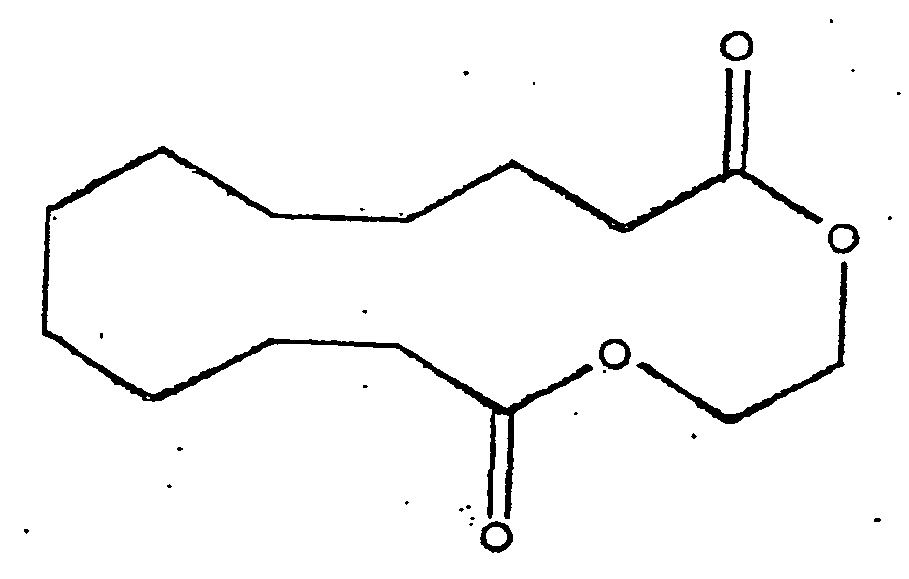
- A malodor maskant composition according to Claims 8 to 13 further comprising a fragrance composition.
- A malodor maskart composition according to Claims 8 to 13 further comprising a compatible perfume formulation.
Applications Claiming Priority (4)
| Application Number | Priority Date | Filing Date | Title |
|---|---|---|---|
| US17299799P | 1999-12-21 | 1999-12-21 | |
| US172997P | 1999-12-21 | ||
| US602269 | 2000-06-23 | ||
| US09/602,269 US6379658B1 (en) | 1999-12-21 | 2000-06-23 | Human sweat malodor counteractant composition and process for using same |
Publications (3)
| Publication Number | Publication Date |
|---|---|
| EP1113105A2 EP1113105A2 (en) | 2001-07-04 |
| EP1113105A3 EP1113105A3 (en) | 2003-02-05 |
| EP1113105B1 true EP1113105B1 (en) | 2006-04-05 |
Family
ID=26868680
Family Applications (1)
| Application Number | Title | Priority Date | Filing Date |
|---|---|---|---|
| EP00311441A Expired - Lifetime EP1113105B1 (en) | 1999-12-21 | 2000-12-20 | Human sweat malodor counteractant composition and process for using same |
Country Status (4)
| Country | Link |
|---|---|
| US (1) | US6379658B1 (en) |
| EP (1) | EP1113105B1 (en) |
| AT (1) | ATE322570T1 (en) |
| DE (1) | DE60027121T2 (en) |
Families Citing this family (26)
| Publication number | Priority date | Publication date | Assignee | Title |
|---|---|---|---|---|
| US7763238B2 (en) * | 2002-01-16 | 2010-07-27 | Monell Chemical Senses Center | Olfactory adaptation and cross-adapting agents to reduce the perception of body odors |
| WO2004009750A1 (en) * | 2002-07-18 | 2004-01-29 | Quest International Services B.V. | Improvements in or relating to perfume compositions |
| US20050227907A1 (en) * | 2004-04-13 | 2005-10-13 | Kaiping Lee | Stable fragrance microcapsule suspension and process for using same |
| US20050226900A1 (en) * | 2004-04-13 | 2005-10-13 | Winton Brooks Clint D | Skin and hair treatment composition and process for using same resulting in controllably-releasable fragrance and/or malodour counteractant evolution |
| US7594594B2 (en) * | 2004-11-17 | 2009-09-29 | International Flavors & Fragrances Inc. | Multi-compartment storage and delivery containers and delivery system for microencapsulated fragrances |
| US20070207174A1 (en) * | 2005-05-06 | 2007-09-06 | Pluyter Johan G L | Encapsulated fragrance materials and methods for making same |
| US20070138673A1 (en) | 2005-12-15 | 2007-06-21 | Kaiping Lee | Process for Preparing a High Stability Microcapsule Product and Method for Using Same |
| US7833960B2 (en) | 2006-12-15 | 2010-11-16 | International Flavors & Fragrances Inc. | Encapsulated active material containing nanoscaled material |
| KR101530398B1 (en) * | 2007-09-20 | 2015-06-19 | 카오카부시키가이샤 | β-glucuronidase inhibitor |
| DE102008043586A1 (en) | 2007-11-12 | 2009-05-14 | Symrise Gmbh & Co. Kg | Perfume Accords to combat the perception of body odor |
| EP2133102B1 (en) | 2008-03-19 | 2014-12-03 | Symrise AG | Odor reducers |
| JP2011528361A (en) * | 2008-07-15 | 2011-11-17 | ビーエーエスエフ、カタリスツ、エルエルシー | Methods, systems and equipment for administration of chlorine dioxide |
| EP2313062A2 (en) * | 2008-07-15 | 2011-04-27 | BASF Corporation | Tooth polishing compositions and methods of tooth polishing without mechanical abrasion |
| WO2010009064A2 (en) * | 2008-07-15 | 2010-01-21 | Basf Corporation | Non-cytotoxic chlorine dioxide fluids |
| JP5297768B2 (en) * | 2008-11-10 | 2013-09-25 | 花王株式会社 | Sweat odor generation inhibitor composition |
| US8311625B2 (en) * | 2009-02-04 | 2012-11-13 | Basf Corporation | Chlorine dioxide treatment for biological tissue |
| WO2011094657A2 (en) | 2010-01-31 | 2011-08-04 | Basf Corporation | Additives for chlorine dioxide-containing compositions |
| US9061965B2 (en) | 2011-10-20 | 2015-06-23 | International Flavors & Fragrances Inc. | Low volatile reactive malodor counteractives and methods of use thereof |
| US20120294821A1 (en) | 2011-05-20 | 2012-11-22 | International Flavors & Fragrances Inc. | Low Volatile Reactive Malodor Counteractives and Methods of Use Thereof |
| US9126890B2 (en) | 2011-10-20 | 2015-09-08 | International Flavors & Fragrances Inc. | Low volatile reactive malodor counteractives and methods of use thereof |
| EP2662434B2 (en) * | 2012-05-10 | 2023-08-16 | Symrise AG | Use of specific compounds for enhancing odours |
| US9770608B2 (en) | 2013-11-11 | 2017-09-26 | International Flavors & Fragrances Inc. | Multi-capsule compositions |
| US10226544B2 (en) | 2015-06-05 | 2019-03-12 | International Flavors & Fragrances Inc. | Malodor counteracting compositions |
| ES2969518T3 (en) | 2017-02-13 | 2024-05-21 | Unilever Ip Holdings B V | Garment washing system |
| CN112135898B (en) * | 2018-06-27 | 2022-12-09 | 联合利华知识产权控股有限公司 | Evaluation method of laundry |
| CN118103022A (en) | 2021-10-20 | 2024-05-28 | 国际香料和香精公司 | Novel 2,2'-(octylimino)bis[ethanol] compositions and uses thereof |
Family Cites Families (15)
| Publication number | Priority date | Publication date | Assignee | Title |
|---|---|---|---|---|
| GB1534132A (en) * | 1975-12-11 | 1978-11-29 | Polak Frutal Works | Alpha beta-disubstituted conjugated nitriles for perfume use |
| FI780440A7 (en) * | 1978-01-12 | 1979-07-13 | Unilever Nv | DETERGENT COMPOSITION |
| US4515705A (en) * | 1983-11-14 | 1985-05-07 | The Procter & Gamble Company | Compositions containing odor purified proteolytic enzymes and perfumes |
| GB8334159D0 (en) * | 1983-12-22 | 1984-02-01 | Unilever Plc | Perfume |
| FR2599257B1 (en) * | 1986-05-29 | 1989-12-29 | Robertet Sa | AGENT FOR NEUTRALIZING UNDESIRABLE ODORS FROM EXCRETIONS AND EXCREMENTS FROM ANIMALS. |
| GB8914055D0 (en) | 1989-06-19 | 1989-08-09 | Unilever Plc | Low-odour deodorant perfume compositions |
| GB9308953D0 (en) * | 1993-04-30 | 1993-06-16 | Unilever Plc | Perfume composition |
| US5441727A (en) * | 1989-06-21 | 1995-08-15 | The Procter & Gamble Company | Diketone deodorant composition and method of deodorization |
| WO1993004158A1 (en) * | 1991-08-21 | 1993-03-04 | The Procter & Gamble Company | Detergent compositions containing lipase and terpene |
| US5354737A (en) | 1993-08-13 | 1994-10-11 | The Mennen Company | Fragrance composition containing substantial amounts of acetyl hexamethyl tetralin, and deodorant composition containing the fragrance composition |
| US5380707A (en) | 1993-08-13 | 1995-01-10 | The Mennen Company | Enhanced efficacy, long-lasting fragrance composition, and deodorant composition, for masking malodor, containing the fragrance composition |
| EP0780132B1 (en) | 1995-12-21 | 2002-07-24 | INTERNATIONAL FLAVORS & FRAGRANCES INC. | Malodor counteractant composition and process for using same |
| US5683979A (en) * | 1996-05-09 | 1997-11-04 | International Flavors & Fragrances Inc. | Malodor counteractant composition and process for using same |
| US5652206A (en) * | 1996-02-26 | 1997-07-29 | The Procter & Gamble Company | Fabric softener compositions with improved environmental impact |
| US5919440A (en) * | 1997-05-05 | 1999-07-06 | Procter & Gamble Company | Personal care compositions containing an odor masking base |
-
2000
- 2000-06-23 US US09/602,269 patent/US6379658B1/en not_active Expired - Lifetime
- 2000-12-20 AT AT00311441T patent/ATE322570T1/en not_active IP Right Cessation
- 2000-12-20 DE DE60027121T patent/DE60027121T2/en not_active Expired - Lifetime
- 2000-12-20 EP EP00311441A patent/EP1113105B1/en not_active Expired - Lifetime
Also Published As
| Publication number | Publication date |
|---|---|
| US6379658B1 (en) | 2002-04-30 |
| EP1113105A2 (en) | 2001-07-04 |
| ATE322570T1 (en) | 2006-04-15 |
| DE60027121D1 (en) | 2006-05-18 |
| DE60027121T2 (en) | 2006-08-31 |
| EP1113105A3 (en) | 2003-02-05 |
Similar Documents
| Publication | Publication Date | Title |
|---|---|---|
| US6379658B1 (en) | Human sweat malodor counteractant composition and process for using same | |
| CA1102243A (en) | Germicidal deodorant detergent composition | |
| JP2746735B2 (en) | Aromatic compositions and their use in detergent products | |
| EP2059265B1 (en) | Malodor counteracting compositions and method for their use | |
| US4304679A (en) | Detergent product containing deodorant compositions | |
| EP1172118B1 (en) | Salicylaldehyde-containing composition having antimicrobial and fragrancing properties and process for using same | |
| US4289641A (en) | Detergent product | |
| CN100356901C (en) | Body odor composition and fragrance composition for suppressing body odor | |
| JP2014196301A (en) | Odor-reducing composition | |
| US20030089885A1 (en) | Use of low molecular weight acetal, alcohol, acylated alcohol and ester compounds to block or reduce odor of carboxylic acids | |
| ES2426440T3 (en) | Perfume compositions | |
| JP2004238620A (en) | Chemical agent for cleaning and for auxiliary which shows high deodorizing performance for laundering clothing | |
| EP0255525B1 (en) | Method fo neutralizing malodor derived from axilla | |
| JP2002519368A (en) | Methods to reduce or prevent malodor | |
| US5683979A (en) | Malodor counteractant composition and process for using same | |
| CN104672089B (en) | 3-(Cyclohex-1-en-1-yl) propionate and its use in perfume compositions | |
| WO2002066083A1 (en) | Macrocyclic musks for malodour prevention and counteraction | |
| US20130149269A1 (en) | Novel malodor counteractant | |
| CN106397376A (en) | Novel organoleptic compounds | |
| US20040037799A1 (en) | Malodor suppression by fragrance composition | |
| US8415391B2 (en) | 3.2.1-bicyclo-octene and -octane compounds | |
| US8399522B2 (en) | 3.2.1-bicyclo-octane compounds | |
| CN106397204A (en) | Novel organoleptic compounds |
Legal Events
| Date | Code | Title | Description |
|---|---|---|---|
| PUAI | Public reference made under article 153(3) epc to a published international application that has entered the european phase |
Free format text: ORIGINAL CODE: 0009012 |
|
| AK | Designated contracting states |
Kind code of ref document: A2 Designated state(s): AT BE CH CY DE DK ES FI FR GB GR IE IT LI LU MC NL PT SE TR |
|
| AX | Request for extension of the european patent |
Free format text: AL;LT;LV;MK;RO;SI |
|
| PUAL | Search report despatched |
Free format text: ORIGINAL CODE: 0009013 |
|
| AK | Designated contracting states |
Designated state(s): AT BE CH CY DE DK ES FI FR GB GR IE IT LI LU MC NL PT SE TR |
|
| AX | Request for extension of the european patent |
Extension state: AL LT LV MK RO SI |
|
| 17P | Request for examination filed |
Effective date: 20030714 |
|
| AKX | Designation fees paid |
Designated state(s): AT BE CH CY DE DK ES FI FR GB GR IE IT LI LU MC NL PT SE TR |
|
| 17Q | First examination report despatched |
Effective date: 20040823 |
|
| GRAP | Despatch of communication of intention to grant a patent |
Free format text: ORIGINAL CODE: EPIDOSNIGR1 |
|
| GRAS | Grant fee paid |
Free format text: ORIGINAL CODE: EPIDOSNIGR3 |
|
| GRAA | (expected) grant |
Free format text: ORIGINAL CODE: 0009210 |
|
| AK | Designated contracting states |
Kind code of ref document: B1 Designated state(s): AT BE CH CY DE DK ES FI FR GB GR IE IT LI LU MC NL PT SE TR |
|
| PG25 | Lapsed in a contracting state [announced via postgrant information from national office to epo] |
Ref country code: FI Free format text: LAPSE BECAUSE OF FAILURE TO SUBMIT A TRANSLATION OF THE DESCRIPTION OR TO PAY THE FEE WITHIN THE PRESCRIBED TIME-LIMIT Effective date: 20060405 Ref country code: CH Free format text: LAPSE BECAUSE OF FAILURE TO SUBMIT A TRANSLATION OF THE DESCRIPTION OR TO PAY THE FEE WITHIN THE PRESCRIBED TIME-LIMIT Effective date: 20060405 Ref country code: BE Free format text: LAPSE BECAUSE OF FAILURE TO SUBMIT A TRANSLATION OF THE DESCRIPTION OR TO PAY THE FEE WITHIN THE PRESCRIBED TIME-LIMIT Effective date: 20060405 Ref country code: LI Free format text: LAPSE BECAUSE OF FAILURE TO SUBMIT A TRANSLATION OF THE DESCRIPTION OR TO PAY THE FEE WITHIN THE PRESCRIBED TIME-LIMIT Effective date: 20060405 Ref country code: AT Free format text: LAPSE BECAUSE OF FAILURE TO SUBMIT A TRANSLATION OF THE DESCRIPTION OR TO PAY THE FEE WITHIN THE PRESCRIBED TIME-LIMIT Effective date: 20060405 Ref country code: NL Free format text: LAPSE BECAUSE OF FAILURE TO SUBMIT A TRANSLATION OF THE DESCRIPTION OR TO PAY THE FEE WITHIN THE PRESCRIBED TIME-LIMIT Effective date: 20060405 |
|
| REG | Reference to a national code |
Ref country code: GB Ref legal event code: FG4D |
|
| REG | Reference to a national code |
Ref country code: CH Ref legal event code: EP |
|
| REG | Reference to a national code |
Ref country code: IE Ref legal event code: FG4D |
|
| REF | Corresponds to: |
Ref document number: 60027121 Country of ref document: DE Date of ref document: 20060518 Kind code of ref document: P |
|
| PG25 | Lapsed in a contracting state [announced via postgrant information from national office to epo] |
Ref country code: SE Free format text: LAPSE BECAUSE OF FAILURE TO SUBMIT A TRANSLATION OF THE DESCRIPTION OR TO PAY THE FEE WITHIN THE PRESCRIBED TIME-LIMIT Effective date: 20060705 Ref country code: DK Free format text: LAPSE BECAUSE OF FAILURE TO SUBMIT A TRANSLATION OF THE DESCRIPTION OR TO PAY THE FEE WITHIN THE PRESCRIBED TIME-LIMIT Effective date: 20060705 |
|
| PG25 | Lapsed in a contracting state [announced via postgrant information from national office to epo] |
Ref country code: ES Free format text: LAPSE BECAUSE OF FAILURE TO SUBMIT A TRANSLATION OF THE DESCRIPTION OR TO PAY THE FEE WITHIN THE PRESCRIBED TIME-LIMIT Effective date: 20060716 |
|
| PG25 | Lapsed in a contracting state [announced via postgrant information from national office to epo] |
Ref country code: PT Free format text: LAPSE BECAUSE OF FAILURE TO SUBMIT A TRANSLATION OF THE DESCRIPTION OR TO PAY THE FEE WITHIN THE PRESCRIBED TIME-LIMIT Effective date: 20060905 |
|
| ET | Fr: translation filed | ||
| NLV1 | Nl: lapsed or annulled due to failure to fulfill the requirements of art. 29p and 29m of the patents act | ||
| REG | Reference to a national code |
Ref country code: CH Ref legal event code: PL |
|
| PG25 | Lapsed in a contracting state [announced via postgrant information from national office to epo] |
Ref country code: IE Free format text: LAPSE BECAUSE OF NON-PAYMENT OF DUE FEES Effective date: 20061220 |
|
| PG25 | Lapsed in a contracting state [announced via postgrant information from national office to epo] |
Ref country code: MC Free format text: LAPSE BECAUSE OF NON-PAYMENT OF DUE FEES Effective date: 20061231 |
|
| PLBE | No opposition filed within time limit |
Free format text: ORIGINAL CODE: 0009261 |
|
| STAA | Information on the status of an ep patent application or granted ep patent |
Free format text: STATUS: NO OPPOSITION FILED WITHIN TIME LIMIT |
|
| 26N | No opposition filed |
Effective date: 20070108 |
|
| PG25 | Lapsed in a contracting state [announced via postgrant information from national office to epo] |
Ref country code: GR Free format text: LAPSE BECAUSE OF FAILURE TO SUBMIT A TRANSLATION OF THE DESCRIPTION OR TO PAY THE FEE WITHIN THE PRESCRIBED TIME-LIMIT Effective date: 20060706 |
|
| PG25 | Lapsed in a contracting state [announced via postgrant information from national office to epo] |
Ref country code: LU Free format text: LAPSE BECAUSE OF NON-PAYMENT OF DUE FEES Effective date: 20061220 Ref country code: TR Free format text: LAPSE BECAUSE OF FAILURE TO SUBMIT A TRANSLATION OF THE DESCRIPTION OR TO PAY THE FEE WITHIN THE PRESCRIBED TIME-LIMIT Effective date: 20060405 |
|
| PG25 | Lapsed in a contracting state [announced via postgrant information from national office to epo] |
Ref country code: CY Free format text: LAPSE BECAUSE OF FAILURE TO SUBMIT A TRANSLATION OF THE DESCRIPTION OR TO PAY THE FEE WITHIN THE PRESCRIBED TIME-LIMIT Effective date: 20060405 |
|
| REG | Reference to a national code |
Ref country code: FR Ref legal event code: PLFP Year of fee payment: 16 |
|
| PGFP | Annual fee paid to national office [announced via postgrant information from national office to epo] |
Ref country code: IT Payment date: 20151210 Year of fee payment: 16 |
|
| REG | Reference to a national code |
Ref country code: FR Ref legal event code: PLFP Year of fee payment: 17 |
|
| PG25 | Lapsed in a contracting state [announced via postgrant information from national office to epo] |
Ref country code: IT Free format text: LAPSE BECAUSE OF NON-PAYMENT OF DUE FEES Effective date: 20161220 |
|
| REG | Reference to a national code |
Ref country code: FR Ref legal event code: PLFP Year of fee payment: 18 |
|
| PGFP | Annual fee paid to national office [announced via postgrant information from national office to epo] |
Ref country code: FR Payment date: 20171227 Year of fee payment: 18 |
|
| PGFP | Annual fee paid to national office [announced via postgrant information from national office to epo] |
Ref country code: GB Payment date: 20171227 Year of fee payment: 18 |
|
| PGFP | Annual fee paid to national office [announced via postgrant information from national office to epo] |
Ref country code: DE Payment date: 20171229 Year of fee payment: 18 |
|
| REG | Reference to a national code |
Ref country code: DE Ref legal event code: R119 Ref document number: 60027121 Country of ref document: DE |
|
| GBPC | Gb: european patent ceased through non-payment of renewal fee |
Effective date: 20181220 |
|
| PG25 | Lapsed in a contracting state [announced via postgrant information from national office to epo] |
Ref country code: FR Free format text: LAPSE BECAUSE OF NON-PAYMENT OF DUE FEES Effective date: 20181231 Ref country code: DE Free format text: LAPSE BECAUSE OF NON-PAYMENT OF DUE FEES Effective date: 20190702 |
|
| PG25 | Lapsed in a contracting state [announced via postgrant information from national office to epo] |
Ref country code: GB Free format text: LAPSE BECAUSE OF NON-PAYMENT OF DUE FEES Effective date: 20181220 |