EP1111944B1 - Unified messaging protocol - Google Patents
Unified messaging protocol Download PDFInfo
- Publication number
- EP1111944B1 EP1111944B1 EP00310484A EP00310484A EP1111944B1 EP 1111944 B1 EP1111944 B1 EP 1111944B1 EP 00310484 A EP00310484 A EP 00310484A EP 00310484 A EP00310484 A EP 00310484A EP 1111944 B1 EP1111944 B1 EP 1111944B1
- Authority
- EP
- European Patent Office
- Prior art keywords
- message
- user
- list
- messages
- content
- Prior art date
- Legal status (The legal status is an assumption and is not a legal conclusion. Google has not performed a legal analysis and makes no representation as to the accuracy of the status listed.)
- Expired - Lifetime
Links
- 230000015654 memory Effects 0.000 claims abstract description 27
- 238000000034 method Methods 0.000 claims description 16
- 230000008878 coupling Effects 0.000 claims 1
- 238000010168 coupling process Methods 0.000 claims 1
- 238000005859 coupling reaction Methods 0.000 claims 1
- 230000000737 periodic effect Effects 0.000 abstract description 10
- 238000004891 communication Methods 0.000 description 18
- 230000006870 function Effects 0.000 description 11
- 230000005540 biological transmission Effects 0.000 description 4
- 230000001413 cellular effect Effects 0.000 description 4
- 238000010586 diagram Methods 0.000 description 4
- IRLPACMLTUPBCL-KQYNXXCUSA-N 5'-adenylyl sulfate Chemical compound C1=NC=2C(N)=NC=NC=2N1[C@@H]1O[C@H](COP(O)(=O)OS(O)(=O)=O)[C@@H](O)[C@H]1O IRLPACMLTUPBCL-KQYNXXCUSA-N 0.000 description 2
- 238000010348 incorporation Methods 0.000 description 2
- 238000012546 transfer Methods 0.000 description 2
- 241000251323 Matthiola oxyceras Species 0.000 description 1
- 238000010276 construction Methods 0.000 description 1
- 230000009977 dual effect Effects 0.000 description 1
- 230000000694 effects Effects 0.000 description 1
- 239000003999 initiator Substances 0.000 description 1
- 238000003825 pressing Methods 0.000 description 1
- 238000012545 processing Methods 0.000 description 1
- 230000004044 response Effects 0.000 description 1
- 230000011664 signaling Effects 0.000 description 1
Images


Classifications
-
- H—ELECTRICITY
- H04—ELECTRIC COMMUNICATION TECHNIQUE
- H04W—WIRELESS COMMUNICATION NETWORKS
- H04W4/00—Services specially adapted for wireless communication networks; Facilities therefor
- H04W4/12—Messaging; Mailboxes; Announcements
-
- H—ELECTRICITY
- H04—ELECTRIC COMMUNICATION TECHNIQUE
- H04W—WIRELESS COMMUNICATION NETWORKS
- H04W4/00—Services specially adapted for wireless communication networks; Facilities therefor
- H04W4/12—Messaging; Mailboxes; Announcements
- H04W4/14—Short messaging services, e.g. short message services [SMS] or unstructured supplementary service data [USSD]
-
- H—ELECTRICITY
- H04—ELECTRIC COMMUNICATION TECHNIQUE
- H04W—WIRELESS COMMUNICATION NETWORKS
- H04W4/00—Services specially adapted for wireless communication networks; Facilities therefor
- H04W4/06—Selective distribution of broadcast services, e.g. multimedia broadcast multicast service [MBMS]; Services to user groups; One-way selective calling services
-
- H—ELECTRICITY
- H04—ELECTRIC COMMUNICATION TECHNIQUE
- H04W—WIRELESS COMMUNICATION NETWORKS
- H04W4/00—Services specially adapted for wireless communication networks; Facilities therefor
- H04W4/06—Selective distribution of broadcast services, e.g. multimedia broadcast multicast service [MBMS]; Services to user groups; One-way selective calling services
- H04W4/08—User group management
-
- H—ELECTRICITY
- H04—ELECTRIC COMMUNICATION TECHNIQUE
- H04W—WIRELESS COMMUNICATION NETWORKS
- H04W8/00—Network data management
- H04W8/18—Processing of user or subscriber data, e.g. subscribed services, user preferences or user profiles; Transfer of user or subscriber data
-
- H—ELECTRICITY
- H04—ELECTRIC COMMUNICATION TECHNIQUE
- H04W—WIRELESS COMMUNICATION NETWORKS
- H04W88/00—Devices specially adapted for wireless communication networks, e.g. terminals, base stations or access point devices
- H04W88/18—Service support devices; Network management devices
- H04W88/184—Messaging devices, e.g. message centre
Definitions
- This invention relates to a method of sending messages, and to a wireless station.
- SMS Short Message Service
- Receipt notification is part of the service, where the receiving station returns an acknowledgement, indicating that the message has been delivered.
- Text messages can originate from various sources, in various ways, including by dialing a toll free number to reach an operator who keys in the message and sends it, by using a software package to send a message directly from a user terminal.
- An SMS communication is not "real time", that is, messages are exchanged independently of each other, and as such, SMS communication does not require the establishment of a simultaneously contiguous end-to-end traffic path.
- a typical SMS system includes user terminals as the initiators or final destinations for messages, a Short Message Service Center (SMSC), which serves as a relay for messages among terminals through the network, and the network itself serving as the communications medium for the messages.
- Final destinations for messages are not limited to user terminals, and could include e-mail addresses and fax machines.
- a terminal configured for SMS provides the user with methods to compose, edit, send, receive, read, and delete messages.
- the connection of an optional keyboard or optional display to the terminal may facilitate the generation and editing of messages by the user.
- the message will typically contain the message contents, an identification of the final destination, and an identification of the desired SMSC.
- the message is sent through the communications network and is received and stored by the SMSC.
- the SMSC determines if the intended destination of the message is available to the network, and if so, the message is then sent to that destination.
- an SMS capable terminal is registered to a network, it is capable of exchanging SMS messages, even when the terminal is engaged in a voice or data call. If the intended destination is not available, or does not acknowledge delivery, the SMSC may then initiate any number of message handling routines including re-transmitting the message at periodic intervals or even discarding the message.
- SMS Another type of SMS is known as broadcast SMS (or also as S-BCCH), which is a point to multipoint message transmission (i.e. from a network operator to a plurality of wireless stations).
- broadcast SMS messages include road traffic reports, winning lottery numbers, and stock market quotations.
- the operator For operator assisted messages, the operator must be notified of each recipient, while for locally generated messages, each recipient must be keyed in individually, as no provisions have been made for providing predefined distribution lists for messages.
- a user may wish to send an updated quotation to a recipient on a periodic basis, for example, every hour.
- the user Under current practice, the user must obtain the information, compose the message, and then send the message, and this procedure must be repeated every hour.
- WO-A-98/10608 discloses a mobile station which stores groups of directory numbers in a memory.
- WO-A-98/34422 discloses a web-based calendar application, in which reminders are sent to a user using SMS.
- GB-A-2327571 discloses the storing of a group on a network, with a user being able to send an SMS to all members of a group through the sending of onemessage.
- a user is provided with a unified messaging protocol that enhances the currently available messaging capabilities of SMS.
- the user is provided with the capability to compose SMS messages and with the capability to compose at least one distribution list for those messages.
- the user is also provided with the capability to send messages to recipients on at least one distribution list on a user determined, periodic basis.
- the user is further provided with the capability to send messages containing content obtained from external sources which may reside on various diverse networks including TCP/IP, X.25, FDDI, ATM, etc.
- the user is further provided with the capability to send those messages periodically to recipients on at least one distribution list, where the content of the messages is automatically updated prior to sending the periodic message.
- the recipients on the distribution lists may also be on diverse networks including those mentioned above.
- a user terminal 10 in this embodiment shown as a user terminal 10, that is suitable for practicing this invention.
- the user terminal 10 may be, but is not limited to, a radio telephone, a cellular telephone or a personal communicator. It should be understood that the user terminal 10 can be a vehicle mounted, handheld, or stationary device.
- the user terminal 10 includes an antenna 12 for transmitting signals to and for receiving signals from a base site or base station 30.
- the base station 30 can be a part of a cellular network comprising a Base Station/Mobile Switching Center/Interworking function (BMI) 32 that includes a mobile switching center (MSC) 34 and a Short Message Service Center (SMSC) 36.
- BMI Base Station/Mobile Switching Center/Interworking function
- MSC mobile switching center
- SMSC Short Message Service Center
- the user terminal 10 includes a modulator (MOD) 14A, a transmitter 14, a receiver 16, a demodulator (DEMOD) 16A, and a controller 18 that provides signals to and receives signals from the transmitter 14 and receiver 16, respectively.
- These signals include signaling information in accordance with the air interface standard of the applicable cellular system, and also user speech and/or user generated data.
- the particular type of air interface standard is not important to the operation of this invention, as the teachings of this invention apply generally to communications systems, including time division/multiple access (TDMA) systems and code division/multiple access (CDMA) systems.
- the user terminal may be capable of operating with any number of other standards such as GSM.
- Some AMPS, narrow band AMPS (NAMPS), as well as TACS wireless stations may also benefit from the teaching of this invention, as should dual or higher mode stations (e.g. digital/analog or TDMA/CDMA/analog stations).
- the controller 18 also includes the circuitry required for implementing the audio (speech path) and logic functions of the wireless station.
- the controller 18 may be comprised of a digital signal processor device, a microprocessor device, and various analog to digital converters, digital to analog converters, and other support circuits. The control and signal processing functions of the wireless station are allocated between these devices according to their respective capabilities.
- a user interface includes a conventional earphone or speaker 17, a conventional microphone 19, a display 20, and a user input device, typically a keypad 22, all of which are coupled to the controller 18.
- the keypad 22 includes the conventional numeric (0-9) and related keys (#,*) 22a, and other keys 22b used for operating the user terminal 10. These other keys 22b may include, by example, a SEND key, various menu scrolling and soft keys, and a PWR key.
- the user terminal 10 also includes various memories, shown collectively as the memory 24, wherein are stored a plurality of constants and variables that are used by the controller 18 during the operation of the wireless station.
- the memory 24 stores the values of wireless system parameters and the number assignment module (NAM).
- NAM number assignment module
- An operating program for controlling the operation of controller 18 is also stored in the memory 24 (typically in a ROM device).
- the operating program in the memory 24 includes routines to present messages and message-related functions to the user on the display 20, typically as various menu items.
- the memory 24 may also store data including point-to-point and Broadcast SMS messages 24A that are received from the SMSC 36 prior to the display of the messages to the user, as well as SMS messages composed by the user prior to transmission to the SMSC 36.
- FIG. 3 shows a preferred embodiment in accordance with the teachings disclosed herein.
- a user composes SMS messages and utilizes a user terminal 10 to convey those messages to the SMSC 36 via base station 30.
- the SMSC 36 communicates with a message server 40 through a communications link 50.
- the message server 40 preferably provides several functions. First, it receives user originated SMS messages specifying the composition of distribution lists for that particular user. Second, it gathers and stores information from various content providers, 60A, 60B, ... 60 n . over link 51. Third, the server receives SMS messages from the user terminal 10 that cause it to assemble messages composed of information received from the content providers and to transmit messages to the addressees 70A... 70 n , on the distribution lists, again over the link 51.
- Link 51 may be any communications link capable of supporting communication between the message server 40 and the content providers 60, and between the message server 40 and the addressees 70.
- Link 51 may include the PSTN, the internet, a wireless network, a wired network, and may further include other types of networks including X.25, TCP/IP, ATM, etc. The various aspects of this are now described in further detail.
- the memory 24 further includes a memory 24B (Fig. 2) containing a short message program (SM program) which includes routines for implementing the method and apparatus disclosed herein, preferably by providing menus to the user.
- the menus allow a user to compose distribution lists for SMS messages, to cause messages to be sent to the distribution lists on a user determined, periodic basis, and to cause messages to be sent periodically where the contents of the messages are automatically updated each time the messages are sent.
- SMS program short message program
- a user selects the SM program in memory 24B (Fig. 2) by pressing the appropriate key(s) on the keypad 22.
- the SM program presents a menu of SM program options. These preferably include composing distribution lists for SMS messages, and sending messages to a specified distribution list or lists. The user then selects the menu option for composing distribution lists and is then further presented with a prompt to input data to define a name or identifier for the list. The user is then prompted to enter the addresses of the recipients that constitute the list.
- the SM program formats the message and sends it to the message server 40. The message is sent directly to addresses on the list which are SMS type addresses.
- the distribution list is composed of a number of different address types, including telephone numbers, fax numbers, e-mail addresses, etc. It should be understood that the type of address is not limited to the examples given, but may be any type of address accessible by the message server 40 including addresses on the various networks described above.
- the user terminal 10 may include a subscriber identification module (SIM) 27 which may include a SIM controller 28 and a SIM memory 29.
- SIM subscriber identification module
- the SM program, the SMS messages received, the user defined distribution lists and their contents, and information about the content providers may be stored in the SIM memory 29.
- a user In order to send messages to a previously created distribution list, a user again enters the SM program and selects an option for sending messages. The user is prompted for the type of message to be sent.
- the message type may include user composed text messages or messages containing information from at least one of the content providers 60A, ... 60 n , accessed by the message server 40.
- the message type USER TEXT may include a message composed by the user for distribution to a particular distribution list. The user is then prompted for the text string to be sent.
- the message type STOCK may include the current price of a particular stock, obtained from a content provider 60 n .
- the user may then be prompted for further parameters to be included in the message, for example, NOK, to indicate that the current price of Nokia be included in the message.
- NOK the current price of Nokia be included in the message.
- the user is then prompted for an identification of a distribution list.
- the SM program formats the message and sends it to the message server 40.
- Triggering conditions may include a certain time of day, a certain elapsed time, or a certain price being achieved for a particular commodity in the financial markets.
- Other triggering events may include a content provider receiving a news item about a particular weather condition, or a news item from a particular location. For example, a user may request that a text message be sent every morning at 7:00 am. As a further example, a user may request that information from a content provider 60A, ... 60 n be updated every hour, between 9:00 am and 4:00 pm, and sent to a distribution list.
- a triggering condition is not limited to the aforementioned examples, and that a triggering condition may include any event that the user terminal or the message server may be capable of recognizing.
- messages may be sent to the user for approval, before being sent to the distribution list.
- a user may request that information from a content provider 60A, ... 60 n be updated every 2 hours and sent to a distribution list.
- the user may request a further option where the message is first sent to the user for approval.
- the user may decide to forgo sending the message for that particular period because, for example, the information may not have changed.
- the message content is updated again and sent to the user for approval. This may continue until a specified time period has elapsed or the user changes the option.
- Information about the content providers 60A, ... 60 n is preferably available to users from the message server 40.
- a user may request that the message server 40 send to the user a list of the content providers 60A, ... 60 n , a list of the information available from the various content providers 60A, ... 60 n , or that it send a description of any parameters that may be required for certain types of content as mentioned above for the users reference.
- this information is stored in memory 24A and then utilized by the SM program for incorporation into the prompts displayed by the SM program. For example, when prompted to specify which information to send to a distribution list, the user may pick the information and any parameters for that information from a displayed list, rather than by typing it in through the keypad 22.
- Another available option is an ability for the user to request previously created distribution lists.
- a user is able to request that the message server 40 send to the user a list composed of the identifiers of previously created distribution lists, or the contents of a previously created list.
- the list of identifiers, or the contents of a previously created list is stored in memory 24A and then utilized by the SM program for incorporation into the prompts displayed by the SM program, where for example, when prompted for a distribution list, a user selects one from the display, rather than entering one through the keypad 22.
- the information may also be used to edit the contents of distribution lists under control of the SM program.
- the memory 24 in addition to the SM program and SMS messages may include storage for the user defined distribution lists and their contents, and information about the content providers and that information may be stored in the memory 24 instead of sending it to be stored in the message server 40.
- the user when operating the SM program, the user preferably has the ability to type in a text string without proceeding through all the prompts. For example, after invoking the SM program, at the appropriate prompt, the user may type FRIENDS: tom@tom.com; 123-123-4567. which the message server 40 recognizes as directing the creation of a distribution list called FRIENDS, containing an e-mail address tom@tom.com; and a telephone number, 123-123-4567.
- the user may again invoke the SM program, and at the appropriate prompt, the user may type STOCK: NOK: FRIENDS, which the message server 40 recognizes as directing that the current stock price of Nokia be sent to the distribution list FRIENDS.
- the user terminal 10 is capable of composing and storing the distribution lists locally, composing SMS messages and sending those messages directly to identifiers on a distribution list that have an SMS address.
- the user terminal 10 further has the capability to distinguish between SMS and non-SMS addresses and then routes messages to non-SMS addresses to the message server 40 for distribution.
- the user terminal 10 may be capable of obtaining content from the content providers 60 n directly and incorporating the content into messages composed in the user terminal 10.
- the user terminal 10 may also be capable of recognizing a triggering condition, obtaining updated content from the content providers 60 n upon the occurrence of the triggering condition, and sending messages with the updated content to predetermined recipients.
- the user terminal 10 may further be capable of sending messages with the updated content to identifiers on a distribution list.
- the menus and prompts contained in the SM program, or the SM program itself can be stored on the message server 40.
- the menus and prompts or the program can be downloaded to the user terminal 10, allowing new users access to the services and functions provided by the message server 40, and also allowing for upgrades to be downloaded automatically.
- the teaching of this invention applies to any user terminal that is capable of receiving messages from a system, that includes or is coupled to a device for conveying messages and a menu of functions to a user, and that furthermore includes or is coupled to a user input device, such as a keypad or a keyboard, with which a user can generate messages and also interact with the menu to select various functions.
- a computer such as a PC, can be coupled to the user terminal 10 for composing and/or viewing SMS messages, as well as interacting with the SMS program.
- the SMSC 36 may be conventional in construction and operation, and communicates with the message server 40 through a communications link 50.
- the SMSC 36 and the message server 40 communicate using a Transmission Control Protocol/Internet Protocol (TCP/IP).
- TCP/IP Transmission Control Protocol/Internet Protocol
- the communications link 50 supports TCP/IP
- the SMSC 36 utilizes TCP/IP communication hardware and software.
- a single message server 40 may service a single SMSC 36, or may service a number of SMSCs 36 b ... 36 n , depending on the capacity of the message server 40.
- the message server 40 may be incorporated into the SMSC 36.
- the message server 40 is also responsive to incoming messages requesting information about the content providers 60A, ... 60 n (Block A).
- An incoming message may request that the message server 40 send to the user a list of the content providers 60A, ... 60 n (Block B), a list of the information available from the various content providers 60A, ... 60 n (Block C), or send a description of any parameters that may be required for certain types of content (Block D) as mentioned above, for the users reference.
- the message server 40 is also responsive to incoming messages requesting information about distribution lists, also shown in Figure 6 (Block E).
- An incoming message may request that the message server 40 send to the user a list of all user created distribution lists (Block F), or the contents of a distribution list (Block G), for the users reference.
- Content providers 60A, ... 60 n may comprise a variety of conventional information sources, and the message server 40 may access them using an assortment of communications mediums.
- the message server 40 may periodically poll a set of commercial content providers on the internet and download specific information.
- the message server 40 may dial up a news service every hour and download any new news content using the PSTN. It may also receive periodic radio transmissions indicating the correct time.
- the message server 40 may access content providers 60A, ... 60 n .periodically, or may only access a content provider in response to a request from a user. For example, a user may wish to send a message about the progress of a particular airline flight. If this information is not already being downloaded as part of the message server's normal activity, the message server 40 may initiate a specific communications session with a flight information provider and download the information as a result of the single request by the user.
- FIG. 5 shows a block diagram of the message server 40.
- the message server 40 comprises a processor 100, a time keeping facility 110, a processor program memory 120, and a message memory 130.
- the processor communicates with the SMSC 36 (Fig. 3) through link 50, and may also be in communication with the content providers 60 (Fig. 3) and the addressees 70 (Fig. 3) through link 51.
- the processor program memory 120 contains a control program for the processor 100 and includes software routines and algorithms for controlling the overall operation of the message server 40.
- the message memory 130 contains the SM program menus, and the stored content from the content providers 60.
- the time keeping facility 110 enables the processor 100 to send messages at the periodic interval specified by the originating user, as well as periodically update message content (e.g. stock prices).
- the messages directed to the message server 40 are not limited to those stated above, and may encompass other messages related to composing and sending SMS messages to user defined distribution lists. It should also be noted that the messages directed to the message server 40 are not limited to the SMS message protocol.
- the user terminal 10, the SM program and the message server 40 support message protocols other than SMS.
- the user terminal 10 and the SM program may support all of the SM program functions mentioned above but may enable composition of messages in other formats to be sent to users on distribution lists that are capable of receiving those other formats.
Landscapes
- Engineering & Computer Science (AREA)
- Computer Networks & Wireless Communication (AREA)
- Signal Processing (AREA)
- Mobile Radio Communication Systems (AREA)
- Telephonic Communication Services (AREA)
- Information Transfer Between Computers (AREA)
- Debugging And Monitoring (AREA)
- Data Exchanges In Wide-Area Networks (AREA)
- Communication Control (AREA)
Abstract
Description
- This invention relates to a method of sending messages, and to a wireless station.
- The Short Message Service (SMS) is a point to point, or point to multi-point service that enables users to exchange messages over a communications network. Receipt notification is part of the service, where the receiving station returns an acknowledgement, indicating that the message has been delivered. Text messages can originate from various sources, in various ways, including by dialing a toll free number to reach an operator who keys in the message and sends it, by using a software package to send a message directly from a user terminal. An SMS communication is not "real time", that is, messages are exchanged independently of each other, and as such, SMS communication does not require the establishment of a simultaneously contiguous end-to-end traffic path. A typical SMS system includes user terminals as the initiators or final destinations for messages, a Short Message Service Center (SMSC), which serves as a relay for messages among terminals through the network, and the network itself serving as the communications medium for the messages. Final destinations for messages are not limited to user terminals, and could include e-mail addresses and fax machines. The Short Message Transfer Protocol (SMTP), including various lower layer protocols, manages the transfer of messages among terminals.
- A terminal configured for SMS provides the user with methods to compose, edit, send, receive, read, and delete messages. The connection of an optional keyboard or optional display to the terminal may facilitate the generation and editing of messages by the user. The message will typically contain the message contents, an identification of the final destination, and an identification of the desired SMSC. The message is sent through the communications network and is received and stored by the SMSC. The SMSC determines if the intended destination of the message is available to the network, and if so, the message is then sent to that destination. Whenever an SMS capable terminal is registered to a network, it is capable of exchanging SMS messages, even when the terminal is engaged in a voice or data call. If the intended destination is not available, or does not acknowledge delivery, the SMSC may then initiate any number of message handling routines including re-transmitting the message at periodic intervals or even discarding the message.
- Reference may be had, by example, to TIA Interim Standard IS-136.1, Rev. A, Feb. 2, 1996, Section 7, for a description of one embodiment of various SMS message formats and protocols.
- Another type of SMS is known as broadcast SMS (or also as S-BCCH), which is a point to multipoint message transmission (i.e. from a network operator to a plurality of wireless stations). Examples of broadcast SMS messages include road traffic reports, winning lottery numbers, and stock market quotations. Reference can be had, by example, to a publication entitled "S-BCCH for IS-136", TR45.3.6/95.06.13/8, Digital Cellular Systems, Jun.12-15, 1995 (Ericsson), for a description of one type of S-BCCH.
- A problem arises when a user desires to send a broadcast message to a specific set of recipients. For operator assisted messages, the operator must be notified of each recipient, while for locally generated messages, each recipient must be keyed in individually, as no provisions have been made for providing predefined distribution lists for messages.
- Another problem arises when a user desires to send a message periodically. A user must recompose the message, or retrieve a saved copy of the message, and then resend it at the desired time, as no provisions have been made for a user determined periodic broadcast of a message to a distribution list defined by that user.
- A further problem arises when a user desires to send a periodic message with updated content. Using stock market quotations as an example, a user may wish to send an updated quotation to a recipient on a periodic basis, for example, every hour. Under current practice, the user must obtain the information, compose the message, and then send the message, and this procedure must be repeated every hour.
- The forgoing and other problems are overcome by methods and apparatus in accordance with embodiments disclosed herein.
- WO-A-98/10608 discloses a mobile station which stores groups of directory numbers in a memory.
- WO-A-98/34422 discloses a web-based calendar application, in which reminders are sent to a user using SMS.
- GB-A-2327571 discloses the storing of a group on a network, with a user being able to send an SMS to all members of a group through the sending of onemessage.
- According to a first aspect of the invention there is provided a method as claimed in
claim 1. According to a second aspect of the invention there is provided a wireless station as claimed in claim 9. - According to preferred aspects of the invention, a user is provided with a unified messaging protocol that enhances the currently available messaging capabilities of SMS. The user is provided with the capability to compose SMS messages and with the capability to compose at least one distribution list for those messages. The user is also provided with the capability to send messages to recipients on at least one distribution list on a user determined, periodic basis. The user is further provided with the capability to send messages containing content obtained from external sources which may reside on various diverse networks including TCP/IP, X.25, FDDI, ATM, etc. The user is further provided with the capability to send those messages periodically to recipients on at least one distribution list, where the content of the messages is automatically updated prior to sending the periodic message. The recipients on the distribution lists may also be on diverse networks including those mentioned above. The above set forth and other features of the invention are made more apparent in the ensuing description of embodiments thereof, given by way of example, when read in conjunction with the attached Drawings, wherein:
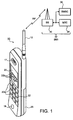
- Figure 1 is an elevational view of a wireless station and further illustrates a wireless communication system and a service provider to which the wireless station is bi-directionally coupled through wireless RF links;
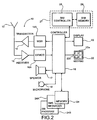
- Figure 2 is a block diagram of a wireless station that is suitable for practicing this invention;
- Figure 3 is a block diagram of a wireless communications system utilizing the functions and embodiments disclosed herein;
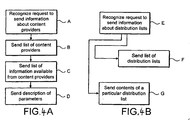
- Figures 4A and 4B show flowcharts of the operation of the message server upon receipt of information requests about content providers and distribution lists, respectively; and
- Figure 5 is a block diagram of a portion of the wireless communication system, specifically
a
message server 40, that utilizes the functions and embodiments disclosed herein. -
- Reference is made to Figs. 1 and 2 for illustrating a
user terminal 10, in this embodiment shown as auser terminal 10, that is suitable for practicing this invention. Theuser terminal 10 may be, but is not limited to, a radio telephone, a cellular telephone or a personal communicator. It should be understood that theuser terminal 10 can be a vehicle mounted, handheld, or stationary device. - The
user terminal 10 includes anantenna 12 for transmitting signals to and for receiving signals from a base site orbase station 30. Thebase station 30 can be a part of a cellular network comprising a Base Station/Mobile Switching Center/Interworking function (BMI) 32 that includes a mobile switching center (MSC) 34 and a Short Message Service Center (SMSC) 36. The MSC 34 provides a connection to landline trunks when theuser terminal 10 is involved in a call. - The
user terminal 10 includes a modulator (MOD) 14A, atransmitter 14, areceiver 16, a demodulator (DEMOD) 16A, and acontroller 18 that provides signals to and receives signals from thetransmitter 14 andreceiver 16, respectively. These signals include signaling information in accordance with the air interface standard of the applicable cellular system, and also user speech and/or user generated data. The particular type of air interface standard is not important to the operation of this invention, as the teachings of this invention apply generally to communications systems, including time division/multiple access (TDMA) systems and code division/multiple access (CDMA) systems. By example, the user terminal may be capable of operating with any number of other standards such as GSM. Some AMPS, narrow band AMPS (NAMPS), as well as TACS wireless stations may also benefit from the teaching of this invention, as should dual or higher mode stations (e.g. digital/analog or TDMA/CDMA/analog stations). - It is understood that the
controller 18 also includes the circuitry required for implementing the audio (speech path) and logic functions of the wireless station. By example, thecontroller 18 may be comprised of a digital signal processor device, a microprocessor device, and various analog to digital converters, digital to analog converters, and other support circuits. The control and signal processing functions of the wireless station are allocated between these devices according to their respective capabilities. - A user interface includes a conventional earphone or
speaker 17, aconventional microphone 19, adisplay 20, and a user input device, typically akeypad 22, all of which are coupled to thecontroller 18. Thekeypad 22 includes the conventional numeric (0-9) and related keys (#,*) 22a, andother keys 22b used for operating theuser terminal 10. Theseother keys 22b may include, by example, a SEND key, various menu scrolling and soft keys, and a PWR key. - The
user terminal 10 also includes various memories, shown collectively as thememory 24, wherein are stored a plurality of constants and variables that are used by thecontroller 18 during the operation of the wireless station. For example, thememory 24 stores the values of wireless system parameters and the number assignment module (NAM). An operating program for controlling the operation ofcontroller 18 is also stored in the memory 24 (typically in a ROM device). The operating program in thememory 24 includes routines to present messages and message-related functions to the user on thedisplay 20, typically as various menu items. Thememory 24 may also store data including point-to-point andBroadcast SMS messages 24A that are received from theSMSC 36 prior to the display of the messages to the user, as well as SMS messages composed by the user prior to transmission to theSMSC 36. - Figure 3 shows a preferred embodiment in accordance with the teachings disclosed herein. A user composes SMS messages and utilizes a
user terminal 10 to convey those messages to theSMSC 36 viabase station 30. TheSMSC 36 communicates with amessage server 40 through acommunications link 50. Themessage server 40 preferably provides several functions. First, it receives user originated SMS messages specifying the composition of distribution lists for that particular user. Second, it gathers and stores information from various content providers, 60A, 60B, ... 60n. overlink 51. Third, the server receives SMS messages from theuser terminal 10 that cause it to assemble messages composed of information received from the content providers and to transmit messages to theaddressees 70A... 70n, on the distribution lists, again over thelink 51.Link 51 may be any communications link capable of supporting communication between themessage server 40 and thecontent providers 60, and between themessage server 40 and the addressees 70.Link 51 may include the PSTN, the internet, a wireless network, a wired network, and may further include other types of networks including X.25, TCP/IP, ATM, etc. The various aspects of this are now described in further detail. - In the
user terminal 10, thememory 24 further includes amemory 24B (Fig. 2) containing a short message program (SM program) which includes routines for implementing the method and apparatus disclosed herein, preferably by providing menus to the user. The menus allow a user to compose distribution lists for SMS messages, to cause messages to be sent to the distribution lists on a user determined, periodic basis, and to cause messages to be sent periodically where the contents of the messages are automatically updated each time the messages are sent. - In order to create a distribution list, a user selects the SM program in
memory 24B (Fig. 2) by pressing the appropriate key(s) on thekeypad 22. The SM program presents a menu of SM program options. These preferably include composing distribution lists for SMS messages, and sending messages to a specified distribution list or lists. The user then selects the menu option for composing distribution lists and is then further presented with a prompt to input data to define a name or identifier for the list. The user is then prompted to enter the addresses of the recipients that constitute the list. Upon completion, the SM program formats the message and sends it to themessage server 40. The message is sent directly to addresses on the list which are SMS type addresses. The distribution list is composed of a number of different address types, including telephone numbers, fax numbers, e-mail addresses, etc. It should be understood that the type of address is not limited to the examples given, but may be any type of address accessible by themessage server 40 including addresses on the various networks described above. - In a further embodiment, the
user terminal 10 may include a subscriber identification module (SIM) 27 which may include aSIM controller 28 and aSIM memory 29. In this case, the SM program, the SMS messages received, the user defined distribution lists and their contents, and information about the content providers may be stored in theSIM memory 29. - In order to send messages to a previously created distribution list, a user again enters the SM program and selects an option for sending messages. The user is prompted for the type of message to be sent. The message type may include user composed text messages or messages containing information from at least one of the content providers 60A, ... 60n, accessed by the
message server 40. By example, the message type USER TEXT may include a message composed by the user for distribution to a particular distribution list. The user is then prompted for the text string to be sent. As a further example, the message type STOCK may include the current price of a particular stock, obtained from acontent provider 60n. The user may then be prompted for further parameters to be included in the message, for example, NOK, to indicate that the current price of Nokia be included in the message. In both cases, after the message contents are specified, the user is then prompted for an identification of a distribution list. Upon completion, the SM program formats the message and sends it to themessage server 40. - Other options related to sending messages preferably include having a message sent upon a triggering condition. Triggering conditions may include a certain time of day, a certain elapsed time, or a certain price being achieved for a particular commodity in the financial markets. Other triggering events may include a content provider receiving a news item about a particular weather condition, or a news item from a particular location. For example, a user may request that a text message be sent every morning at 7:00 am. As a further example, a user may request that information from a content provider 60A, ... 60n be updated every hour, between 9:00 am and 4:00 pm, and sent to a distribution list. It is important to note that a triggering condition is not limited to the aforementioned examples, and that a triggering condition may include any event that the user terminal or the message server may be capable of recognizing.
- In further embodiment messages may be sent to the user for approval, before being sent to the distribution list. For example, a user may request that information from a content provider 60A, ... 60n be updated every 2 hours and sent to a distribution list. The user may request a further option where the message is first sent to the user for approval. Upon viewing the content, the user may decide to forgo sending the message for that particular period because, for example, the information may not have changed. At the next period, the message content is updated again and sent to the user for approval. This may continue until a specified time period has elapsed or the user changes the option.
- Information about the content providers 60A, ... 60n is preferably available to users from the
message server 40. A user may request that themessage server 40 send to the user a list of the content providers 60A, ... 60n, a list of the information available from the various content providers 60A, ... 60n, or that it send a description of any parameters that may be required for certain types of content as mentioned above for the users reference. - In a further embodiment, this information is stored in
memory 24A and then utilized by the SM program for incorporation into the prompts displayed by the SM program. For example, when prompted to specify which information to send to a distribution list, the user may pick the information and any parameters for that information from a displayed list, rather than by typing it in through thekeypad 22. - Another available option is an ability for the user to request previously created distribution lists. Preferably, a user is able to request that the
message server 40 send to the user a list composed of the identifiers of previously created distribution lists, or the contents of a previously created list. - In a further embodiment, the list of identifiers, or the contents of a previously created list is stored in
memory 24A and then utilized by the SM program for incorporation into the prompts displayed by the SM program, where for example, when prompted for a distribution list, a user selects one from the display, rather than entering one through thekeypad 22. The information may also be used to edit the contents of distribution lists under control of the SM program. - In a further embodiment, the
memory 24 in addition to the SM program and SMS messages may include storage for the user defined distribution lists and their contents, and information about the content providers and that information may be stored in thememory 24 instead of sending it to be stored in themessage server 40. - Further, when operating the SM program, the user preferably has the ability to type in a text string without proceeding through all the prompts. For example, after invoking the SM program, at the appropriate prompt, the user may type FRIENDS: tom@tom.com; 123-123-4567. which the
message server 40 recognizes as directing the creation of a distribution list called FRIENDS, containing an e-mail address tom@tom.com; and a telephone number, 123-123-4567. After sending the message that creates the distribution lists FRIENDS, the user may again invoke the SM program, and at the appropriate prompt, the user may type STOCK: NOK: FRIENDS, which themessage server 40 recognizes as directing that the current stock price of Nokia be sent to the distribution list FRIENDS. - The
user terminal 10 is capable of composing and storing the distribution lists locally, composing SMS messages and sending those messages directly to identifiers on a distribution list that have an SMS address. Theuser terminal 10 further has the capability to distinguish between SMS and non-SMS addresses and then routes messages to non-SMS addresses to themessage server 40 for distribution. - In a further embodiment, the
user terminal 10 may be capable of obtaining content from thecontent providers 60n directly and incorporating the content into messages composed in theuser terminal 10. Theuser terminal 10 may also be capable of recognizing a triggering condition, obtaining updated content from thecontent providers 60n upon the occurrence of the triggering condition, and sending messages with the updated content to predetermined recipients. Theuser terminal 10 may further be capable of sending messages with the updated content to identifiers on a distribution list. - In a further embodiment, the menus and prompts contained in the SM program, or the SM program itself, can be stored on the
message server 40. At an appropriate time, the menus and prompts or the program can be downloaded to theuser terminal 10, allowing new users access to the services and functions provided by themessage server 40, and also allowing for upgrades to be downloaded automatically. - In general, the teaching of this invention applies to any user terminal that is capable of receiving messages from a system, that includes or is coupled to a device for conveying messages and a menu of functions to a user, and that furthermore includes or is coupled to a user input device, such as a keypad or a keyboard, with which a user can generate messages and also interact with the menu to select various functions. A computer, such as a PC, can be coupled to the
user terminal 10 for composing and/or viewing SMS messages, as well as interacting with the SMS program. TheSMSC 36 may be conventional in construction and operation, and communicates with themessage server 40 through acommunications link 50. In a preferred embodiment, theSMSC 36 and themessage server 40 communicate using a Transmission Control Protocol/Internet Protocol (TCP/IP). In this case, the communications link 50 supports TCP/IP, and theSMSC 36 utilizes TCP/IP communication hardware and software. Asingle message server 40 may service asingle SMSC 36, or may service a number ofSMSCs 36b ... 36n, depending on the capacity of themessage server 40. - In an alternate embodiment, the
message server 40 may be incorporated into theSMSC 36. - As shown in Figure 4, the
message server 40 is also responsive to incoming messages requesting information about the content providers 60A, ... 60n (Block A). An incoming message may request that themessage server 40 send to the user a list of the content providers 60A, ... 60n (Block B), a list of the information available from the various content providers 60A, ... 60n (Block C), or send a description of any parameters that may be required for certain types of content (Block D) as mentioned above, for the users reference. - The
message server 40 is also responsive to incoming messages requesting information about distribution lists, also shown in Figure 6 (Block E). An incoming message may request that themessage server 40 send to the user a list of all user created distribution lists (Block F), or the contents of a distribution list (Block G), for the users reference. - Content providers 60A, ... 60n may comprise a variety of conventional information sources, and the
message server 40 may access them using an assortment of communications mediums. For example, themessage server 40 may periodically poll a set of commercial content providers on the internet and download specific information. Themessage server 40 may dial up a news service every hour and download any new news content using the PSTN. It may also receive periodic radio transmissions indicating the correct time. Themessage server 40 may access content providers 60A, ... 60n.periodically, or may only access a content provider in response to a request from a user. For example, a user may wish to send a message about the progress of a particular airline flight. If this information is not already being downloaded as part of the message server's normal activity, themessage server 40 may initiate a specific communications session with a flight information provider and download the information as a result of the single request by the user. - Figure 5 shows a block diagram of the
message server 40. Themessage server 40 comprises aprocessor 100, atime keeping facility 110, aprocessor program memory 120, and amessage memory 130. The processor communicates with the SMSC 36 (Fig. 3) throughlink 50, and may also be in communication with the content providers 60 (Fig. 3) and the addressees 70 (Fig. 3) throughlink 51. Theprocessor program memory 120 contains a control program for theprocessor 100 and includes software routines and algorithms for controlling the overall operation of themessage server 40. Themessage memory 130 contains the SM program menus, and the stored content from thecontent providers 60. Thetime keeping facility 110 enables theprocessor 100 to send messages at the periodic interval specified by the originating user, as well as periodically update message content (e.g. stock prices). - It should be noted that the messages directed to the
message server 40 are not limited to those stated above, and may encompass other messages related to composing and sending SMS messages to user defined distribution lists. It should also be noted that the messages directed to themessage server 40 are not limited to the SMS message protocol. In a further embodiment, theuser terminal 10, the SM program and themessage server 40 support message protocols other than SMS. Theuser terminal 10 and the SM program may support all of the SM program functions mentioned above but may enable composition of messages in other formats to be sent to users on distribution lists that are capable of receiving those other formats. Thus, while the invention has been particularly shown and described with respect to preferred embodiments thereof, it will be understood by those skilled in the art that changes in form and details may be made therein without departing from the scope of the claims.
Claims (10)
- A method of sending messages through a telecommunications system comprising a wireless network (32) and at least one wireless station (10), said method comprising the steps of:characterised in that the list includes at least one identifier having another address type and in that the method comprises:composing at least one user defined distribution list for messages, the list including at least one identifier having a short message service address type;storing said at least one user defined distribution list in a memory (24) of said wireless station;composing a short message service message; andsending said message directly to identifiers on.the distribution list that have a short message service address type;distinguishing between identifiers on the list having short message service address types and identifiers on the list having other address types; andconveying said message to identifiers on the distribution list that have other address types to a wireless network message server (40) for distribution.
- The method of claim 1, wherein said step of sending further comprises sending said message to said identifiers upon the occurrence of a triggering condition.
- The method of claim 1 or 2, wherein said step of composing a message further comprisesobtaining message content from an external source;composing said message from said external message content; andupdating said content from said external source upon an occurrence of a trigger condition.
- The method of claim 1 or claim 2, wherein said step of composing a message further comprises:obtaining message content from an external source;composing said message from said external message content;updating said content from said external source upon an occurrence of a trigger condition;and said sending and conveying steps comprise, upon direction from said user, sending said message to said identifiers defined in said at least one user defined distribution list or discarding said message.
- A method as claimed in claim 1 or claim 2, wherein said step of composing a message further comprises:defining a content for a message and a supplier of said content; andupdating said content from said content supplier upon an occurrence of a triggering condition.
- The method of claim 5, wherein said sending step further comprises:upon an occurrence of a triggering condition, sending said message to a user; and,upon direction from said user, sending said message to said at least one predetermined identifier or discarding said message.
- The method of any preceding claim further comprising, before the step of composing at least one user defined distribution list, the step of downloading a program that enables creation of user defined distribution lists to a user terminal from a network memory.
- A user terminal for sending messages through a telecommunications system comprising a memory that stores a program operable to perform a method according to any preceding claim.
- A wireless station (10) for use in a wireless telecommunications system that includes a service provider site, said wireless station comprising:a memory (24; 29) for storing a short message program for creating at least one user defined distribution list for storage in the or another memory (24; 29) of the wireless station the list including at least one identifier having a short message service address type;a wireless transceiver (14, 16) for coupling said wireless station to a message server through said service provider site; andmeans for sending short message service messages directly to identifiers on the distribution list which have a short message service address type;
the wireless station being characterised in;that the list includes at least one identifier having another address types;comprising means for distinguishing between identifiers on the list having short message service address types and identifiers on the list having other address types; andcomprising means for conveying messages to identifiers on the distribution list that have other address types to the message server for distribution. - A wireless station as claimed in claim 9, in which the user defined distribution list is stored on a SIM memory (29).
Priority Applications (1)
| Application Number | Priority Date | Filing Date | Title |
|---|---|---|---|
| EP04101874A EP1453329A1 (en) | 1999-12-21 | 2000-11-27 | Method of sending messages and wireless station |
Applications Claiming Priority (2)
| Application Number | Priority Date | Filing Date | Title |
|---|---|---|---|
| US469022 | 1999-12-21 | ||
| US09/469,022 US6625460B1 (en) | 1999-12-21 | 1999-12-21 | Unified messaging protocol using SMS |
Related Child Applications (1)
| Application Number | Title | Priority Date | Filing Date |
|---|---|---|---|
| EP04101874A Division EP1453329A1 (en) | 1999-12-21 | 2000-11-27 | Method of sending messages and wireless station |
Publications (3)
| Publication Number | Publication Date |
|---|---|
| EP1111944A2 EP1111944A2 (en) | 2001-06-27 |
| EP1111944A3 EP1111944A3 (en) | 2001-11-14 |
| EP1111944B1 true EP1111944B1 (en) | 2004-10-27 |
Family
ID=23862120
Family Applications (2)
| Application Number | Title | Priority Date | Filing Date |
|---|---|---|---|
| EP00310484A Expired - Lifetime EP1111944B1 (en) | 1999-12-21 | 2000-11-27 | Unified messaging protocol |
| EP04101874A Ceased EP1453329A1 (en) | 1999-12-21 | 2000-11-27 | Method of sending messages and wireless station |
Family Applications After (1)
| Application Number | Title | Priority Date | Filing Date |
|---|---|---|---|
| EP04101874A Ceased EP1453329A1 (en) | 1999-12-21 | 2000-11-27 | Method of sending messages and wireless station |
Country Status (4)
| Country | Link |
|---|---|
| US (1) | US6625460B1 (en) |
| EP (2) | EP1111944B1 (en) |
| AT (1) | ATE281044T1 (en) |
| DE (1) | DE60015283T2 (en) |
Families Citing this family (77)
| Publication number | Priority date | Publication date | Assignee | Title |
|---|---|---|---|---|
| US7218921B2 (en) * | 2000-05-12 | 2007-05-15 | Chikka Pte Ltd | Method and system for inviting and creating accounts for prospective users of an instant messaging system |
| JP3504584B2 (en) * | 2000-06-12 | 2004-03-08 | 洪次郎 大元 | Mobile phone system with simultaneous transmission function |
| KR100500537B1 (en) * | 2000-11-15 | 2005-07-12 | 엘지전자 주식회사 | Method for sending a short message a lot of recipient's mobile station |
| US20020065881A1 (en) * | 2000-11-29 | 2002-05-30 | Tapio Mansikkaniemi | Wireless family bulletin board |
| US7024209B1 (en) * | 2000-12-20 | 2006-04-04 | Cisco Technology, Inc. | Unified messaging system configured for management of short message service-type messages |
| JP2002197031A (en) * | 2000-12-26 | 2002-07-12 | Nec Corp | Personal digital assistants with character mail transmission function |
| KR100365860B1 (en) * | 2001-02-08 | 2002-12-26 | 삼성전자 주식회사 | Method for transmitting message in mobile terminal |
| US20020137530A1 (en) * | 2001-03-08 | 2002-09-26 | Katyayini Karve | Cellular telephone with SMS message forwarding |
| US20020187794A1 (en) * | 2001-05-04 | 2002-12-12 | Comverse Network Systems, Ltd. | SMS automatic reply and automatic handling |
| US20020197995A1 (en) * | 2001-06-25 | 2002-12-26 | Starkovich Alex D. | Method and apparatus for conditioning wireless transmission of messages |
| KR100442941B1 (en) * | 2001-07-06 | 2004-08-04 | 엘지전자 주식회사 | Broadcast message transmission circuit and transmitting Method thereof |
| US20030017857A1 (en) * | 2001-07-20 | 2003-01-23 | Kitson Frederick Lee | Wireless device local access system |
| US20030030681A1 (en) * | 2001-08-13 | 2003-02-13 | Vigil Jeff S. | Enhanced text entry system for wireless devices |
| ES2190742A1 (en) * | 2001-10-17 | 2003-08-01 | Telefonica Moviles S A | Distribution and management system for mobile telephony short messages and communication protocol for implementing said system |
| US7151764B1 (en) | 2001-11-01 | 2006-12-19 | Nokia Corporation | Service notification on a low bluetooth layer |
| US6769002B2 (en) * | 2001-11-08 | 2004-07-27 | Jordan E. Ayan | System and methods for multilevel electronic mail communication programs |
| US7340214B1 (en) | 2002-02-13 | 2008-03-04 | Nokia Corporation | Short-range wireless system and method for multimedia tags |
| US7392039B2 (en) * | 2002-03-13 | 2008-06-24 | Novatel Wireless, Inc. | Complete message delivery to multi-mode communication device |
| US7102640B1 (en) | 2002-03-21 | 2006-09-05 | Nokia Corporation | Service/device indication with graphical interface |
| US20050289216A1 (en) * | 2002-03-28 | 2005-12-29 | Andreas Myka | Providing personalized services for mobile users |
| US20050215236A1 (en) * | 2002-03-28 | 2005-09-29 | Andreas Myka | Providing information for mobile users |
| KR20030093038A (en) * | 2002-06-01 | 2003-12-06 | 삼성전자주식회사 | Recipient's situation mode service method and mobile communication terminal therefor |
| US7103313B2 (en) * | 2002-06-05 | 2006-09-05 | Nokia Corporation | Automatic determination of access point content and services for short-range wireless terminals |
| ES2213456B1 (en) * | 2002-06-13 | 2005-07-16 | Universidad De Alcala | ELECTRONIC SYSTEM FOR THE TRANSFER OF INFORMATION OPTIMALLY BY MOBILE PHONE. |
| KR100453160B1 (en) * | 2002-06-25 | 2004-10-15 | 삼성전자주식회사 | Method for transmitting multi short message service in mobile telephone |
| US20050208927A1 (en) * | 2002-06-28 | 2005-09-22 | Marcel Wong | Automated sending of preconfigured messages |
| US7707317B2 (en) * | 2002-07-01 | 2010-04-27 | Prolifiq Software Inc. | Adaptive electronic messaging |
| US7966374B2 (en) * | 2002-07-01 | 2011-06-21 | Profiliq Software Inc. | Adaptive media messaging, such as for rich media messages incorporating digital content |
| US7634556B2 (en) * | 2002-07-01 | 2009-12-15 | Prolifiq Software Inc. | Electronic message management |
| US20040043788A1 (en) * | 2002-08-28 | 2004-03-04 | Guarav Mittal | Management of parameters in a removable user identity module |
| FR2845856A1 (en) * | 2002-10-10 | 2004-04-16 | Mikael Zajac | Text message reply system includes mobile terminal with SIM card and program providing automatic reply to received messages |
| US20040181517A1 (en) * | 2003-03-13 | 2004-09-16 | Younghee Jung | System and method for social interaction |
| DE10324636A1 (en) | 2003-05-28 | 2004-12-30 | Vodafone Holding Gmbh | Method for forwarding data when a mobile terminal is not available |
| WO2005015423A1 (en) * | 2003-07-11 | 2005-02-17 | Vazu, Inc. | Method and system for transferring contact information to an sms-enabled wireless device |
| DE10342065A1 (en) * | 2003-09-08 | 2005-04-07 | Siemens Ag | Method for providing a service by means of a communication network |
| US7613467B2 (en) * | 2003-10-31 | 2009-11-03 | The Boeing Company | Geo-cast systems and methods |
| US20050136837A1 (en) * | 2003-12-22 | 2005-06-23 | Nurminen Jukka K. | Method and system for detecting and using context in wireless networks |
| ES2278278T3 (en) * | 2004-04-16 | 2007-08-01 | Research In Motion Limited | METHOD AND APPARATUS FOR THE CREATION OF ADDRESSES OF DYNAMIC GROUPS. |
| US7912457B2 (en) * | 2004-04-21 | 2011-03-22 | Qualcomm Incorporated | Methods and apparatus for creation and transport of multimedia content flows |
| US7239881B2 (en) * | 2004-06-30 | 2007-07-03 | Cingular Wireless Ii Llc | Customized signature messaging service |
| US8544043B2 (en) * | 2004-07-21 | 2013-09-24 | Qualcomm Incorporated | Methods and apparatus for providing content information to content servers |
| US20060075075A1 (en) * | 2004-10-01 | 2006-04-06 | Malinen Jouni I | Method and system to contextually initiate synchronization services on mobile terminals in an enterprise environment |
| AR052424A1 (en) * | 2004-12-09 | 2007-03-21 | Qualcomm Inc | METHOD AND APPARATUS FOR THE CREATION AND TRANSPORT OF FLOWS OF MULTIMEDIA CONTENTS TO A DISTRIBUTION NETWORK |
| US8880612B1 (en) * | 2004-12-16 | 2014-11-04 | Sprint Spectrum L.P. | Mobile device proxy for instant messaging |
| US20060190321A1 (en) * | 2004-12-27 | 2006-08-24 | Martins Nicho Eurico P | Method and computing system for games, lottery and/or advertising campaign events using SMS or multimedia messages |
| US7609669B2 (en) * | 2005-02-14 | 2009-10-27 | Vocollect, Inc. | Voice directed system and method configured for assured messaging to multiple recipients |
| US7941165B2 (en) * | 2005-03-02 | 2011-05-10 | Cisco Technology, Inc. | System and method for providing a proxy in a short message service (SMS) environment |
| US7221953B2 (en) * | 2005-03-29 | 2007-05-22 | Sbc Knowledge Ventures, Lp | Triggering email/PIM events based on SMS headers and content |
| US7496379B2 (en) * | 2005-04-22 | 2009-02-24 | Kyocera Wireless Corp. | System and method for providing SMS contact information to a wireless mobile device |
| US20070099683A1 (en) * | 2005-10-29 | 2007-05-03 | Similarity, Inc., A Delaware Corporation | Interactive pictures |
| US8639605B2 (en) | 2006-04-21 | 2014-01-28 | Thomson Reuters Global Resources | Systems and methods for the identification and messaging of trading parties |
| US10290055B2 (en) * | 2006-04-21 | 2019-05-14 | Refinitiv Us Organization Llc | Encoded short message service text messaging systems and methods |
| US20080305832A1 (en) * | 2007-06-07 | 2008-12-11 | Microsoft Corporation | Sharing profile mode |
| US10203873B2 (en) | 2007-09-19 | 2019-02-12 | Apple Inc. | Systems and methods for adaptively presenting a keyboard on a touch-sensitive display |
| US10126942B2 (en) * | 2007-09-19 | 2018-11-13 | Apple Inc. | Systems and methods for detecting a press on a touch-sensitive surface |
| US9454270B2 (en) | 2008-09-19 | 2016-09-27 | Apple Inc. | Systems and methods for detecting a press on a touch-sensitive surface |
| US9489086B1 (en) | 2013-04-29 | 2016-11-08 | Apple Inc. | Finger hover detection for improved typing |
| US9110590B2 (en) | 2007-09-19 | 2015-08-18 | Typesoft Technologies, Inc. | Dynamically located onscreen keyboard |
| US20090112997A1 (en) * | 2007-10-25 | 2009-04-30 | Cisco Technology, Inc. | Utilizing Presence Data Associated with Web Item |
| US20090112996A1 (en) * | 2007-10-25 | 2009-04-30 | Cisco Technology, Inc. | Determining Presence Status of End User Associated with Multiple Access Terminals |
| WO2010027432A1 (en) * | 2008-08-27 | 2010-03-11 | Telecommunication Systems, Inc. | Flexible capacity short message service center (smsc) |
| WO2010053453A1 (en) * | 2008-11-06 | 2010-05-14 | Voxp Pte Ltd | Mobile phone message archiving system |
| US9473323B2 (en) * | 2009-05-13 | 2016-10-18 | Centurylink Intellectual Property Llc | Global text gateway for text messages |
| US9183543B2 (en) * | 2010-02-19 | 2015-11-10 | Prolifiq Software Inc. | Tracking digital content objects |
| CA2825416A1 (en) | 2010-12-23 | 2012-09-27 | Telecommunication Systems, Inc. | Alphanumeric address mapping for non-homogeneous short message networks |
| WO2012098469A2 (en) | 2011-01-20 | 2012-07-26 | Cleankeys Inc. | Systems and methods for monitoring surface sanitation |
| WO2012112226A1 (en) | 2011-02-14 | 2012-08-23 | Telecommunication Systems, Inc. | Prepaid short message services revenue capture |
| US8477693B1 (en) | 2011-04-14 | 2013-07-02 | Sprint Communications Company L.P. | Out-of sector message stream delivery |
| WO2012145040A1 (en) * | 2011-04-19 | 2012-10-26 | Telecommunication Systems, Inc. | Short message service center (smsc) message distributor |
| WO2013062482A1 (en) * | 2011-10-28 | 2013-05-02 | Pan Changhe | Scheduled smartphone video messages |
| US9104260B2 (en) | 2012-04-10 | 2015-08-11 | Typesoft Technologies, Inc. | Systems and methods for detecting a press on a touch-sensitive surface |
| US9749321B2 (en) | 2013-01-22 | 2017-08-29 | Prolifiq Software Inc. | System for multi-point publication syndication |
| US10289302B1 (en) | 2013-09-09 | 2019-05-14 | Apple Inc. | Virtual keyboard animation |
| IT201600094057A1 (en) * | 2016-09-20 | 2018-03-20 | Chilybrains S R L S | SYSTEM AND METHOD FOR THE SENDING OF MASSIVE TEXT MESSAGES SMS. |
| CN108287959B (en) * | 2018-01-15 | 2021-05-04 | 北京航空航天大学 | Artificial intelligence programmer writes digital aircraft source code execution method |
| CN111125596A (en) * | 2019-12-11 | 2020-05-08 | 海南港澳资讯产业股份有限公司 | Short message forming method based on financial information |
| CN112153581A (en) * | 2020-09-23 | 2020-12-29 | 石家庄瑞特维通讯网络有限公司 | Intelligent auditing short message service management platform |
Citations (1)
| Publication number | Priority date | Publication date | Assignee | Title |
|---|---|---|---|---|
| WO1998010608A2 (en) * | 1996-09-05 | 1998-03-12 | Orange Personal Communications Services Ltd. | Mobile originated group short message service and apparatus therefor |
Family Cites Families (30)
| Publication number | Priority date | Publication date | Assignee | Title |
|---|---|---|---|---|
| US5546444A (en) | 1994-03-11 | 1996-08-13 | Bellsouth Corporation | Methods and apparatus for communicating data via a cellular network control channel |
| US5353331A (en) | 1992-03-05 | 1994-10-04 | Bell Atlantic Network Services, Inc. | Personal communications service using wireline/wireless integration |
| US5511111A (en) | 1993-11-01 | 1996-04-23 | Engineering And Business Systems, Inc. | Caller name and identification communication system with caller screening option |
| US5742905A (en) | 1994-09-19 | 1998-04-21 | Bell Communications Research, Inc. | Personal communications internetworking |
| GB2301987B (en) * | 1995-06-05 | 2000-01-12 | Nokia Mobile Phones Ltd | Radio telephone text transmission system |
| US5604921A (en) | 1995-07-07 | 1997-02-18 | Nokia Mobile Phones Ltd. | Radiotelephone user interface for broadcast short message service |
| US5884159A (en) | 1995-11-27 | 1999-03-16 | Motorola, Inc. | Method of spawning a communication service |
| WO1997020423A1 (en) | 1995-11-29 | 1997-06-05 | Bell Communications Research, Inc. | A system and method for automatically screening and directing incoming calls |
| AUPN955096A0 (en) * | 1996-04-29 | 1996-05-23 | Telefonaktiebolaget Lm Ericsson (Publ) | Telecommunications information dissemination system |
| US5974300A (en) * | 1996-07-30 | 1999-10-26 | Lucent Technologies Inc. | Two-way wireless cellular messaging system |
| US6014429A (en) * | 1996-08-12 | 2000-01-11 | Lucent Technologies, Inc. | Two-way wireless messaging system with transaction server |
| US6201974B1 (en) | 1996-09-06 | 2001-03-13 | Nokia Mobile Phones Limited | Mobile station and network having hierarchical index for cell broadcast service |
| US5878351A (en) | 1996-11-07 | 1999-03-02 | Nokia Mobile Phones Limited | Methods and apparatus for providing delayed transmission of SMS delivery acknowledgement, manual acknowledgement and SMS messages |
| US6134433A (en) | 1996-12-09 | 2000-10-17 | Telefonaktiebolaget L M Ericsson (Publ) | System and method of forwarding data calls in a radio telecommunications network |
| FR2757340B1 (en) * | 1996-12-12 | 1999-01-08 | Alsthom Cge Alcatel | SYSTEM FOR BROADCASTING MESSAGES FROM A MOBILE RADIO COMMUNICATION TERMINAL |
| US5966663A (en) | 1997-01-14 | 1999-10-12 | Ericsson Messaging Systems Inc. | Data communications protocol for facilitating communications between a message entry device and a messaging center |
| US6125281A (en) | 1997-01-31 | 2000-09-26 | Nokia Mobile Phones Limited | Real-time SMS application messaging using an SMSC-linked server |
| US6023620A (en) * | 1997-02-26 | 2000-02-08 | Telefonaktiebolaget Lm Ecrisson | Method for downloading control software to a cellular telephone |
| US6016107A (en) * | 1997-03-07 | 2000-01-18 | Motorola, Inc. | Reliably updating an information service message |
| US5983073A (en) | 1997-04-04 | 1999-11-09 | Ditzik; Richard J. | Modular notebook and PDA computer systems for personal computing and wireless communications |
| GB2327571B (en) | 1997-07-18 | 2002-01-09 | Orange Personal Comm Serv Ltd | Mobile communications |
| FI105872B (en) * | 1997-08-28 | 2000-10-13 | Nokia Mobile Phones Ltd | Procedures and systems for conveying messages |
| US6161007A (en) | 1997-09-29 | 2000-12-12 | Nortel Networks Limited | Method and apparatus for processing multiple types of incoming communication |
| WO1999033293A1 (en) * | 1997-12-23 | 1999-07-01 | Global Mobility Systems, Inc. | System and method for controlling personal information and information delivery to and from a telecommunications device |
| US6263212B1 (en) | 1998-02-17 | 2001-07-17 | Alcatel Usa Sourcing, L.P. | Short message service center |
| US6044275A (en) * | 1998-03-23 | 2000-03-28 | Ericsson Inc. | System and method for time defined delivery of short message service messages |
| US6119014A (en) * | 1998-04-01 | 2000-09-12 | Ericsson Inc. | System and method for displaying short messages depending upon location, priority, and user-defined indicators |
| US6040781A (en) * | 1998-05-26 | 2000-03-21 | Motorola | Event reminder for a communication device |
| US6289223B1 (en) * | 1998-07-22 | 2001-09-11 | Ericsson Inc | System and method for selective multipoint transmission of short message service messages |
| US6175741B1 (en) * | 1998-12-30 | 2001-01-16 | Ericsson Inc. | System and method for enhancing business card services within a cellular network |
-
1999
- 1999-12-21 US US09/469,022 patent/US6625460B1/en not_active Expired - Lifetime
-
2000
- 2000-11-27 DE DE60015283T patent/DE60015283T2/en not_active Expired - Lifetime
- 2000-11-27 EP EP00310484A patent/EP1111944B1/en not_active Expired - Lifetime
- 2000-11-27 AT AT00310484T patent/ATE281044T1/en not_active IP Right Cessation
- 2000-11-27 EP EP04101874A patent/EP1453329A1/en not_active Ceased
Patent Citations (1)
| Publication number | Priority date | Publication date | Assignee | Title |
|---|---|---|---|---|
| WO1998010608A2 (en) * | 1996-09-05 | 1998-03-12 | Orange Personal Communications Services Ltd. | Mobile originated group short message service and apparatus therefor |
Also Published As
| Publication number | Publication date |
|---|---|
| DE60015283T2 (en) | 2005-10-27 |
| HK1036545A1 (en) | 2002-01-04 |
| US6625460B1 (en) | 2003-09-23 |
| ATE281044T1 (en) | 2004-11-15 |
| DE60015283D1 (en) | 2004-12-02 |
| EP1111944A2 (en) | 2001-06-27 |
| EP1453329A1 (en) | 2004-09-01 |
| EP1111944A3 (en) | 2001-11-14 |
Similar Documents
| Publication | Publication Date | Title |
|---|---|---|
| US6625460B1 (en) | Unified messaging protocol using SMS | |
| US11991600B2 (en) | Methods for bearer selection performed by a sending mobile device | |
| US7548756B2 (en) | Method and system for mobile instant messaging using multiple interfaces | |
| JP3996210B2 (en) | Mobile incoming short message billing | |
| GB2327571A (en) | Sending short messages to groups of users | |
| US7254411B2 (en) | Wireless data communication method | |
| EP1917723A1 (en) | Method of servicing short message service message receiving confirmation, mobile communication terminal and service system for the performing the same | |
| EP1648185B1 (en) | Method for sending batch download messages | |
| KR20040098065A (en) | A method for transmitting data, particularly having multimedia contents, in a mobile radio communication network | |
| HK1036545B (en) | Unified messaging protocol | |
| HK1066136A (en) | Method of sending messages and wireless station | |
| EP1353528A1 (en) | A method for exchanging text messages of limited size, a short message server, a terminal and a program module therefore | |
| Gidlow | Data services on PCN | |
| JP3576901B2 (en) | How to send a message | |
| KR20050067665A (en) | Method for dealing with plural mms | |
| KR20070107258A (en) | Message Handling Method in Mobile Communication Network |
Legal Events
| Date | Code | Title | Description |
|---|---|---|---|
| PUAI | Public reference made under article 153(3) epc to a published international application that has entered the european phase |
Free format text: ORIGINAL CODE: 0009012 |
|
| AK | Designated contracting states |
Kind code of ref document: A2 Designated state(s): AT BE CH CY DE DK ES FI FR GB GR IE IT LI LU MC NL PT SE TR |
|
| AX | Request for extension of the european patent |
Free format text: AL;LT;LV;MK;RO;SI |
|
| PUAL | Search report despatched |
Free format text: ORIGINAL CODE: 0009013 |
|
| AK | Designated contracting states |
Kind code of ref document: A3 Designated state(s): AT BE CH CY DE DK ES FI FR GB GR IE IT LI LU MC NL PT SE TR |
|
| AX | Request for extension of the european patent |
Free format text: AL;LT;LV;MK;RO;SI |
|
| RAP1 | Party data changed (applicant data changed or rights of an application transferred) |
Owner name: NOKIA CORPORATION |
|
| 17P | Request for examination filed |
Effective date: 20020427 |
|
| AKX | Designation fees paid |
Free format text: AT BE CH CY DE DK ES FI FR GB GR IE IT LI LU MC NL PT SE TR |
|
| 17Q | First examination report despatched |
Effective date: 20020701 |
|
| GRAP | Despatch of communication of intention to grant a patent |
Free format text: ORIGINAL CODE: EPIDOSNIGR1 |
|
| GRAS | Grant fee paid |
Free format text: ORIGINAL CODE: EPIDOSNIGR3 |
|
| GRAA | (expected) grant |
Free format text: ORIGINAL CODE: 0009210 |
|
| AK | Designated contracting states |
Kind code of ref document: B1 Designated state(s): AT BE CH CY DE DK ES FI FR GB GR IE IT LI LU MC NL PT SE TR |
|
| PG25 | Lapsed in a contracting state [announced via postgrant information from national office to epo] |
Ref country code: IT Free format text: LAPSE BECAUSE OF FAILURE TO SUBMIT A TRANSLATION OF THE DESCRIPTION OR TO PAY THE FEE WITHIN THE PRESCRIBED TIME-LIMIT;WARNING: LAPSES OF ITALIAN PATENTS WITH EFFECTIVE DATE BEFORE 2007 MAY HAVE OCCURRED AT ANY TIME BEFORE 2007. THE CORRECT EFFECTIVE DATE MAY BE DIFFERENT FROM THE ONE RECORDED. Effective date: 20041027 Ref country code: LI Free format text: LAPSE BECAUSE OF FAILURE TO SUBMIT A TRANSLATION OF THE DESCRIPTION OR TO PAY THE FEE WITHIN THE PRESCRIBED TIME-LIMIT Effective date: 20041027 Ref country code: BE Free format text: LAPSE BECAUSE OF FAILURE TO SUBMIT A TRANSLATION OF THE DESCRIPTION OR TO PAY THE FEE WITHIN THE PRESCRIBED TIME-LIMIT Effective date: 20041027 Ref country code: AT Free format text: LAPSE BECAUSE OF FAILURE TO SUBMIT A TRANSLATION OF THE DESCRIPTION OR TO PAY THE FEE WITHIN THE PRESCRIBED TIME-LIMIT Effective date: 20041027 Ref country code: TR Free format text: LAPSE BECAUSE OF FAILURE TO SUBMIT A TRANSLATION OF THE DESCRIPTION OR TO PAY THE FEE WITHIN THE PRESCRIBED TIME-LIMIT Effective date: 20041027 Ref country code: CH Free format text: LAPSE BECAUSE OF FAILURE TO SUBMIT A TRANSLATION OF THE DESCRIPTION OR TO PAY THE FEE WITHIN THE PRESCRIBED TIME-LIMIT Effective date: 20041027 Ref country code: CY Free format text: LAPSE BECAUSE OF FAILURE TO SUBMIT A TRANSLATION OF THE DESCRIPTION OR TO PAY THE FEE WITHIN THE PRESCRIBED TIME-LIMIT Effective date: 20041027 Ref country code: NL Free format text: LAPSE BECAUSE OF FAILURE TO SUBMIT A TRANSLATION OF THE DESCRIPTION OR TO PAY THE FEE WITHIN THE PRESCRIBED TIME-LIMIT Effective date: 20041027 |
|
| REG | Reference to a national code |
Ref country code: GB Ref legal event code: FG4D |
|
| REG | Reference to a national code |
Ref country code: CH Ref legal event code: EP |
|
| PG25 | Lapsed in a contracting state [announced via postgrant information from national office to epo] |
Ref country code: LU Free format text: LAPSE BECAUSE OF NON-PAYMENT OF DUE FEES Effective date: 20041127 |
|
| PG25 | Lapsed in a contracting state [announced via postgrant information from national office to epo] |
Ref country code: IE Free format text: LAPSE BECAUSE OF NON-PAYMENT OF DUE FEES Effective date: 20041129 |
|
| PG25 | Lapsed in a contracting state [announced via postgrant information from national office to epo] |
Ref country code: MC Free format text: LAPSE BECAUSE OF NON-PAYMENT OF DUE FEES Effective date: 20041130 |
|
| REG | Reference to a national code |
Ref country code: IE Ref legal event code: FG4D |
|
| REF | Corresponds to: |
Ref document number: 60015283 Country of ref document: DE Date of ref document: 20041202 Kind code of ref document: P |
|
| PG25 | Lapsed in a contracting state [announced via postgrant information from national office to epo] |
Ref country code: DK Free format text: LAPSE BECAUSE OF FAILURE TO SUBMIT A TRANSLATION OF THE DESCRIPTION OR TO PAY THE FEE WITHIN THE PRESCRIBED TIME-LIMIT Effective date: 20050127 Ref country code: GR Free format text: LAPSE BECAUSE OF FAILURE TO SUBMIT A TRANSLATION OF THE DESCRIPTION OR TO PAY THE FEE WITHIN THE PRESCRIBED TIME-LIMIT Effective date: 20050127 |
|
| PG25 | Lapsed in a contracting state [announced via postgrant information from national office to epo] |
Ref country code: ES Free format text: LAPSE BECAUSE OF FAILURE TO SUBMIT A TRANSLATION OF THE DESCRIPTION OR TO PAY THE FEE WITHIN THE PRESCRIBED TIME-LIMIT Effective date: 20050207 |
|
| REG | Reference to a national code |
Ref country code: SE Ref legal event code: TRGR |
|
| REG | Reference to a national code |
Ref country code: HK Ref legal event code: GR Ref document number: 1036545 Country of ref document: HK |
|
| REG | Reference to a national code |
Ref country code: CH Ref legal event code: PL |
|
| NLV1 | Nl: lapsed or annulled due to failure to fulfill the requirements of art. 29p and 29m of the patents act | ||
| ET | Fr: translation filed | ||
| PLBE | No opposition filed within time limit |
Free format text: ORIGINAL CODE: 0009261 |
|
| STAA | Information on the status of an ep patent application or granted ep patent |
Free format text: STATUS: NO OPPOSITION FILED WITHIN TIME LIMIT |
|
| 26N | No opposition filed |
Effective date: 20050728 |
|
| REG | Reference to a national code |
Ref country code: IE Ref legal event code: MM4A |
|
| PG25 | Lapsed in a contracting state [announced via postgrant information from national office to epo] |
Ref country code: PT Free format text: LAPSE BECAUSE OF NON-PAYMENT OF DUE FEES Effective date: 20050327 |
|
| PGFP | Annual fee paid to national office [announced via postgrant information from national office to epo] |
Ref country code: FI Payment date: 20091112 Year of fee payment: 10 Ref country code: SE Payment date: 20091106 Year of fee payment: 10 |
|
| REG | Reference to a national code |
Ref country code: SE Ref legal event code: EUG |
|
| PG25 | Lapsed in a contracting state [announced via postgrant information from national office to epo] |
Ref country code: FI Free format text: LAPSE BECAUSE OF NON-PAYMENT OF DUE FEES Effective date: 20101127 |
|
| PG25 | Lapsed in a contracting state [announced via postgrant information from national office to epo] |
Ref country code: SE Free format text: LAPSE BECAUSE OF NON-PAYMENT OF DUE FEES Effective date: 20101128 |
|
| REG | Reference to a national code |
Ref country code: GB Ref legal event code: 732E Free format text: REGISTERED BETWEEN 20150910 AND 20150916 |
|
| REG | Reference to a national code |
Ref country code: FR Ref legal event code: PLFP Year of fee payment: 16 |
|
| REG | Reference to a national code |
Ref country code: DE Ref legal event code: R082 Ref document number: 60015283 Country of ref document: DE Representative=s name: BECKER, KURIG, STRAUS, DE Ref country code: DE Ref legal event code: R081 Ref document number: 60015283 Country of ref document: DE Owner name: NOKIA TECHNOLOGIES OY, FI Free format text: FORMER OWNER: NOKIA CORP., 02610 ESPOO, FI |
|
| REG | Reference to a national code |
Ref country code: FR Ref legal event code: PLFP Year of fee payment: 17 |
|
| REG | Reference to a national code |
Ref country code: FR Ref legal event code: TP Owner name: NOKIA TECHNOLOGIES OY, FI Effective date: 20170109 |
|
| REG | Reference to a national code |
Ref country code: FR Ref legal event code: PLFP Year of fee payment: 18 |
|
| REG | Reference to a national code |
Ref country code: FR Ref legal event code: PLFP Year of fee payment: 19 |
|
| PGFP | Annual fee paid to national office [announced via postgrant information from national office to epo] |
Ref country code: DE Payment date: 20181113 Year of fee payment: 19 |
|
| PGFP | Annual fee paid to national office [announced via postgrant information from national office to epo] |
Ref country code: GB Payment date: 20181121 Year of fee payment: 19 Ref country code: FR Payment date: 20181011 Year of fee payment: 19 |
|
| REG | Reference to a national code |
Ref country code: DE Ref legal event code: R119 Ref document number: 60015283 Country of ref document: DE |
|
| GBPC | Gb: european patent ceased through non-payment of renewal fee |
Effective date: 20191127 |
|
| PG25 | Lapsed in a contracting state [announced via postgrant information from national office to epo] |
Ref country code: DE Free format text: LAPSE BECAUSE OF NON-PAYMENT OF DUE FEES Effective date: 20200603 Ref country code: GB Free format text: LAPSE BECAUSE OF NON-PAYMENT OF DUE FEES Effective date: 20191127 Ref country code: FR Free format text: LAPSE BECAUSE OF NON-PAYMENT OF DUE FEES Effective date: 20191130 |