EP1111608A2 - Coding apparatus and method, decoding apparatus and method, and program storage medium - Google Patents
Coding apparatus and method, decoding apparatus and method, and program storage medium Download PDFInfo
- Publication number
- EP1111608A2 EP1111608A2 EP00127701A EP00127701A EP1111608A2 EP 1111608 A2 EP1111608 A2 EP 1111608A2 EP 00127701 A EP00127701 A EP 00127701A EP 00127701 A EP00127701 A EP 00127701A EP 1111608 A2 EP1111608 A2 EP 1111608A2
- Authority
- EP
- European Patent Office
- Prior art keywords
- coding
- audio data
- data
- coded
- coded data
- Prior art date
- Legal status (The legal status is an assumption and is not a legal conclusion. Google has not performed a legal analysis and makes no representation as to the accuracy of the status listed.)
- Ceased
Links
Images






Classifications
-
- G—PHYSICS
- G10—MUSICAL INSTRUMENTS; ACOUSTICS
- G10L—SPEECH ANALYSIS TECHNIQUES OR SPEECH SYNTHESIS; SPEECH RECOGNITION; SPEECH OR VOICE PROCESSING TECHNIQUES; SPEECH OR AUDIO CODING OR DECODING
- G10L19/00—Speech or audio signals analysis-synthesis techniques for redundancy reduction, e.g. in vocoders; Coding or decoding of speech or audio signals, using source filter models or psychoacoustic analysis
- G10L19/02—Speech or audio signals analysis-synthesis techniques for redundancy reduction, e.g. in vocoders; Coding or decoding of speech or audio signals, using source filter models or psychoacoustic analysis using spectral analysis, e.g. transform vocoders or subband vocoders
- G10L19/0212—Speech or audio signals analysis-synthesis techniques for redundancy reduction, e.g. in vocoders; Coding or decoding of speech or audio signals, using source filter models or psychoacoustic analysis using spectral analysis, e.g. transform vocoders or subband vocoders using orthogonal transformation
-
- H—ELECTRICITY
- H01—ELECTRIC ELEMENTS
- H01R—ELECTRICALLY-CONDUCTIVE CONNECTIONS; STRUCTURAL ASSOCIATIONS OF A PLURALITY OF MUTUALLY-INSULATED ELECTRICAL CONNECTING ELEMENTS; COUPLING DEVICES; CURRENT COLLECTORS
- H01R31/00—Coupling parts supported only by co-operation with counterpart
- H01R31/06—Intermediate parts for linking two coupling parts, e.g. adapter
-
- G—PHYSICS
- G10—MUSICAL INSTRUMENTS; ACOUSTICS
- G10L—SPEECH ANALYSIS TECHNIQUES OR SPEECH SYNTHESIS; SPEECH RECOGNITION; SPEECH OR VOICE PROCESSING TECHNIQUES; SPEECH OR AUDIO CODING OR DECODING
- G10L19/00—Speech or audio signals analysis-synthesis techniques for redundancy reduction, e.g. in vocoders; Coding or decoding of speech or audio signals, using source filter models or psychoacoustic analysis
-
- G—PHYSICS
- G11—INFORMATION STORAGE
- G11B—INFORMATION STORAGE BASED ON RELATIVE MOVEMENT BETWEEN RECORD CARRIER AND TRANSDUCER
- G11B20/00—Signal processing not specific to the method of recording or reproducing; Circuits therefor
- G11B20/10—Digital recording or reproducing
- G11B20/10527—Audio or video recording; Data buffering arrangements
-
- H—ELECTRICITY
- H03—ELECTRONIC CIRCUITRY
- H03M—CODING; DECODING; CODE CONVERSION IN GENERAL
- H03M7/00—Conversion of a code where information is represented by a given sequence or number of digits to a code where the same, similar or subset of information is represented by a different sequence or number of digits
- H03M7/30—Compression; Expansion; Suppression of unnecessary data, e.g. redundancy reduction
-
- G—PHYSICS
- G11—INFORMATION STORAGE
- G11B—INFORMATION STORAGE BASED ON RELATIVE MOVEMENT BETWEEN RECORD CARRIER AND TRANSDUCER
- G11B20/00—Signal processing not specific to the method of recording or reproducing; Circuits therefor
- G11B20/00007—Time or data compression or expansion
- G11B2020/00014—Time or data compression or expansion the compressed signal being an audio signal
- G11B2020/00043—Adaptive transform acoustic coding [ATRAC]
-
- G—PHYSICS
- G11—INFORMATION STORAGE
- G11B—INFORMATION STORAGE BASED ON RELATIVE MOVEMENT BETWEEN RECORD CARRIER AND TRANSDUCER
- G11B20/00—Signal processing not specific to the method of recording or reproducing; Circuits therefor
- G11B20/10—Digital recording or reproducing
- G11B20/10527—Audio or video recording; Data buffering arrangements
- G11B2020/10537—Audio or video recording
- G11B2020/10546—Audio or video recording specifically adapted for audio data
Definitions
- the present invention relates to coding apparatuses and methods, decoding apparatuses and methods, and program storage media therefor. More particularly, the present invention relates to a coding apparatus and method for coding audio data, a decoding apparatus and method for decoding coded data, and a program storage medium therefor.
- a conventional audio coding process using ATRAC Adaptive Transform Acoustic Coding
- ATRAC Adaptive Transform Acoustic Coding
- the sequential audio data is divided into blocks for each audio data (that is, for each musical piece), as shown in part (B) of Fig. 1.
- Each audio data as shown in part (C) of Fig. 1, is divided into orthogonal transform blocks composed of, for example, 1024 samples.
- the coding process is performed based on the orthogonal transform block.
- a sound unit hereinafter referred to as an "SU"
- SU sound unit
- coded stream coded data
- a header in which synchronization data, etc., is stored is added to the start of the coded stream.
- step S11 the personal computer computes the number of necessary SUs on the basis of the number of samples (the number of samples of the original data which is not coded) of the current audio data.
- step S12 the personal computer performs a coding process for each orthogonal transform block.
- step S13 the personal computer determines whether or not the data is the last orthogonal transform block. When it is determined that the data is not the last orthogonal transform block, the process returns to step S12, and the coding process is repeated.
- step S13 When it is determined in step S13 that the data is the last orthogonal transform block, the process proceeds to step S14, whereby the personal computer determines whether or not the track end position is contained in the middle of the orthogonal transform block.
- step S14 When it is determined in step S14 that the track end position is contained in the middle of the orthogonal transform block, the personal computer sets "0" in portions of the orthogonal transform block after the track end position, and the process proceeds to step S16.
- step S15 When it is determined in step S14 that the track end position is not contained in the middle of the orthogonal transform block, the process of step S15 is not necessary. Therefore, step S15 is skipped, and the process proceeds to step S16.
- step S16 the personal computer codes the last orthogonal transform block.
- step S17 the personal computer performs a termination process, such as closing a file in which coded data is stored.
- step S18 the personal computer determines whether or not there is next audio data. When it is determined that there is next audio data, the process returns to step S11, and coding of the next audio data is performed.
- step S18 When it is determined in step S18 that there is no next audio data, the processing is terminated.
- An object of the present invention is to make it possible to obtain coded data which does not strike viewers and listeners as being incongruous, or to make it possible to decode coded data without striking viewers and listeners as being incongruous.
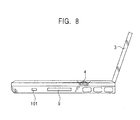
- Figs. 5 to 8 are diagrams showing the exterior of an embodiment of a notebook personal computer according to the present invention.
- This personal computer 1 basically comprises a main unit 2, and a display section 3 which is openable/closable with respect to this main unit 2.
- Fig. 5 is a perspective view of the exterior, showing a state in which the display section 3 is open with respect to the main unit 2.
- Fig. 6 is a plan view of the main unit 2.
- Fig. 7 is an enlarged view of a jog dial 4 (to be described later) which is provided in the main unit 2.
- Fig. 8 is a side view of the jog dial 4 which is provided in the main unit 2.
- the main unit 2 has a keyboard 5 at the upper surface thereof, which is operated to input various characters, symbols, etc., a touch pad 6 as a pointing device which is operated so as to move a pointer (mouse cursor) displayed on an LCD (Liquid Crystal Display) 7, and a power-supply switch 8. Furthermore, the jog dial 4, an IEEE (Institute of Electrical and Electronics Engineers) 1394 port 101, etc., are provided on the side of the main unit 2. It is also possible to provide a pointing stick-type device in place of the touch pad 6.
- the LCD 7 for displaying an image is provided on the front of the display section 3.
- lamps composed of a power-supply lamp PL, a battery lamp BL, a message lamp ML (not shown) which is provided as necessary, and other LEDs are provided.
- a microphone 104 is provided in the upper central portion of the display section 3.
- the power-supply lamp PL, the battery lamp BL, the message lamp ML, etc., may be alternatively provided in the lower portion of the display section 3.
- the jog dial 4 is mounted, for example, between a key A and a key B located on the right side in Fig. 6 of the keyboard 5 on the main unit 2 in such a manner that the top surface of the jog dial 4 is nearly flush with the key A and the key B.
- the jog dial 4 is used to perform a predetermined process (for example, a screen scrolling process) in such a manner as to correspond to a rotation operation indicated by an arrow "a" in Fig. 7 and to perform a predetermined process (for example, a process for determining the selection of an icon) in such a manner as to correspond to a movement operation indicated by an arrow "b" in Fig. 7.
- a predetermined process for example, a screen scrolling process
- a predetermined process for example, a process for determining the selection of an icon
- the jog dial 4 may be located on the left side of the main unit 2, may be located on the left side or the right side of the display section 3, in which the LCD 7 is provided, or may be located in the vertical direction (that is, the jog dial 4 may be rotated in the direction of either the Y key or the B key) between the G key and the H key of the keyboard 5.
- the jog dial 4 may be located in the central portion of the front of the main unit 2 so that the jog dial 4 can be operated with the thumb while operating the touch pad 6 with the index finger; the jog dial 4 may be located in the horizontal direction along the upper edge or the lower edge of the touch pad 6; and jog dial 4 may be located in the vertical direction between the right button and the left button of the touch pad 6. Furthermore, the jog dial 4 may be located at a predetermined angle in such a direction as to facilitate operation with each of the fingers without being limited to the vertical direction and the horizontal direction. In addition, the jog dial 4 may also be located at the side of the mouse, which is a pointing device, so as to be operable with the thumb. As a jog dial, a rotation-type electronic part with a push switch, disclosed in Japanese Unexamined Patent Application Publication No. 8-203387, which was filed by the applicant who is also a coapplicant of the present invention, may be used.
- the IEEE 1394 port 101 has a construction in compliance with the standards defined in IEEE 1394, and cables which comply with the standards defined in IEEE 1394 are connected thereto.
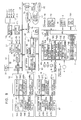
- a CPU (Central Processing Unit) 51 comprises, for example, a Pentium (trademark) processor manufactured by Intel Corporation, etc., and is connected to a host bus 52.
- a bridge 53 (commonly called a "north bridge") is further connected to the host bus 52.
- the bridge 53 has an AGP (Accelerated Graphics Port) 50 and is connected to a PCI (Peripheral Component Interconnect/Interface) bus 56.
- the bridge 53 comprises, for example, 400BX, which is an AGP host bridge controller manufactured by Intel Corporation.
- the bridge 53 controls a CPU 51, a RAM (Random Access Memory) 54 (commonly called a "main memory”), etc.
- the bridge 53 controls a video controller 57 via the AGP 50.
- This bridge 53 and a bridge (commonly called a "south bridge” (PCI-ISA Bridge)) 58 constitute what is commonly called a chip set.
- the bridge 53 is further connected to a cache memory 55.
- the cache memory 55 is formed of a memory, such as an SRAM (Static RAM), which can perform writing and reading operations at higher speed than can RAM 54, and caches (temporarily stores) a program or data used by the CPU 51.
- SRAM Static RAM
- the CPU 51 has contained therein a primary cache memory (a memory which can operate at higher speed than can the cache memory 55 and which is controlled by the CPU 51 itself).
- a primary cache memory a memory which can operate at higher speed than can the cache memory 55 and which is controlled by the CPU 51 itself.
- the RAM 54 comprises, for example, a DRAM (Dynamic RAM) and stores a program to be executed by the CPU 51 or data required for the operation of the CPU 51.
- the RAM 54 stores an electronic mail program 54A, an autopilot program 54B, a jog-dial status monitoring program 54C, a jog-dial driver 54D, an operating system (OS) 54E, a coding program 54F, a decoding program 54G, and other application programs 54H1 to 54Hn, which are loaded from a HDD 67 at the time boot-up is completed.
- DRAM Dynamic RAM
- the electronic mail program 54A is a program for exchanging communication text (commonly called "e-mail") through a communication line, such as a telephone line 76, via a modem 75.
- the electronic mail program 54A has an incoming mail obtaining function. This incoming mail obtaining function queries a mail server 78 provided by an Internet service provider 77 to determine whether or not mail for the user has been received within a mail box 79 thereof and performs a process for obtaining any received mail for the user.
- the autopilot program 54B is a program for sequentially starting plural processes (or programs) which are set in advance, etc., in a preset sequence, and for processing them.
- the jog-dial status monitoring program 54C receives a notification as to whether or not compatibility with the jog dial 4 is provided from each of the above-described application programs. When compatibility with the jog dial 4 is provided, the jog-dial status monitoring program 54C causes the LCD 7 to display operations which can be performed by operating the jog dial 4.
- the jog-dial status monitoring program 54C detects an event (an operation, such as the jog dial 4 being rotated in a direction indicated by arrow "a” in Fig. 7 or being depressed in a direction indicated by arrow "b” in Fig. 7) of the jog dial 4, and performs a process corresponding to the detected event.
- the jog-dial status monitoring program 54C has a list for receiving a notification from an application program.
- the jog-dial driver 54D performs various functions in such a manner as to correspond to an operation of the jog dial 4.
- the OS (Operating System) 54E is a program for controlling the basic operations of a computer, typified by, for example, Windows 95 (trademark) or Windows 98 (trademark), or Mac OS (trademark) from the Apple Computer Corporation.
- the coding program 54F codes predetermined audio data in order to create coded data, and causes the LCD 7 to display a window for inputting an instruction of a coding process.
- the coding program 54F reads audio data from a CD (Compact Disc), which is an optical disk 122, loaded into a drive 113, performs coding thereon by a method, such as ATRAC, and records the coded data to the HDD 67.
- CD Compact Disc
- the decoding program 54G decodes the coded data recorded in the HDD 67 in order to play back audio through a speaker 65, and causes the LCD 7 to display a window for inputting an instruction of a decoding process.
- the video controller 57 is connected to the bridge 53 via the AGP 50.
- the video controller 57 receives data (image data, text data, etc.) supplied from the CPU 51 via the AGP 50 and the bridge 53, creates image data corresponding to the received data, or stores the received data as it is in a built-in video memory 161 (to be described later with reference to Fig. 6).
- the video controller 57 causes the LCD 7 of the display section 3 to display an image corresponding to the image data stored in the video memory 161.
- a sound controller 64 is connected to the PCI bus 56.
- the sound controller 64 receives a signal corresponding to audio from the microphone 66, creates data corresponding to the audio, and outputs it to the RAM 54.
- the sound controller 64 drives the speaker 65 so as to output audio.
- the modem 75 is connected to the PCI bus 56.
- the modem 75 is used to transmit predetermined data to a communication network 80 such as the Internet, or a mail server 78, via a public telephone line 76 and an Internet service provider 77, and is used to receive predetermined data from the communication network 80 or the mail server 78.
- a PC-card slot interface 111 which is connected to the PCI bus 56, supplies data supplied from an interface card 112 loaded into a slot 9 to the CPU 51 or the RAM 54, and outputs data supplied from the CPU 51 to the interface card 112.
- the drive 113 is connected to the PCI bus 56 via the PC-card slot interface 111 and the interface card 112.
- the drive 113 reads data recorded in a magnetic disk 121, an optical disk 122, a magneto-optical disk 123, or a semiconductor memory 124, which is loaded, supplies the read data to the RAM 54 via the PC-card slot interface 111, the interface card 112, and the PCI bus 56.
- the bridge 58 (commonly called a "south bridge”) is also connected to the PCI bus 56.
- the bridge 58 comprises, for example, PIIX4E, manufactured by Intel Corporation, and has contained therein an IDE (Integrated Drive Electronics) controller/configuration register 59, a timer circuit 60, an IDE interface 61, a USB interface 68, etc.
- the bridge 58 controls various types of I/O (Input/Output), such as control of devices which are connected to an IDE bus 62 or devices which are connected via an ISA/EIO (Industry Standard Architecture/Extended Input Output) bus 63 or an I/O interface 69.
- I/O Input/Output
- the IDE controller/configuration register 59 comprises two IDE controllers, commonly called a primary IDE controller and a secondary IDE controller, configuration registers, etc. (not shown).
- the HDD 67 is connected to the primary IDE controller via the IDE bus 62. Furthermore, in another IDE bus, when what is commonly called an IDE device, such as a CD-ROM drive or a HDD (not shown), is loaded, the IDE device is electrically connected to the secondary IDE controller.
- an IDE device such as a CD-ROM drive or a HDD (not shown)
- the IDE device is electrically connected to the secondary IDE controller.
- the HDD 67 has recorded therein an electronic mail program 67A, an autopilot program 67B, a jog-dial status monitoring program 67C, a jog-dial driver 67D, an OS 67E, and a coding program 67F, a decoding program 67G, and other plural application programs 67H1 to 67Hn as application programs.
- the electronic mail program 67A, the autopilot program 67B, the jog-dial status monitoring program 67C, the jog-dial driver 67D, the OS 67E, the coding program 67F, the decoding program 67G, and the application programs 67H1 to 67Hn, which are recorded in the HDD 67, are supplied in sequence to the RAM 54 so as to be loaded in the boot-up process.
- the USB (Universal Serial Bus) interface 68 outputs (for example, checks out) audio data to a connected portable device (not shown) via a USB port 107.
- the timer circuit 60 supplies data indicating the current time to the CPU 51 via the PCI bus 56 in such a manner as to correspond to a request of the coding program 67F.
- the I/O interface 69 is further connected to the ISA/EIO bus 63.
- This I/O interface 69 comprises an embedded controller in which a ROM 70, a RAM 71, and a CPU 72 are interconnected.
- the ROM 70 has prestored therein an IEEE 1394 I/F program 70A, an LED monitoring program 70B, a touch-pad input monitoring program 70C, a key input monitoring program 70D, a wake-up program 70E, a jog-dial status monitoring program 70F, etc.
- the IEEE 1394 interface program 70A transmits and receives data (data stored in packets) which conforms to the standards defined in IEEE 1394 via the IEEE 1394 port 101.
- the LED monitoring program 70B performs switch-on control of lamps composed of a power-supply lamp PL, a battery lamp BL, a message lamp ML where necessary, and other LEDs.
- the touch-pad input monitoring program 70C is a program for monitoring input from the touch pad 6, corresponding to an operation by the user.
- the key input monitoring program 70D is a program for monitoring input from the keyboard 5 or another key switch.
- the wake-up program 70E is a program for checking if a preset time has been reached on the basis of data showing the current time, supplied from the timer circuit 60 of the bridge 58, and for managing the power supply of each chip which is a constituent of the personal computer 1 so that a predetermined process (or a program), etc., is started when the set time has reached.
- the jog-dial status monitoring program 70F is a program for continuously monitoring whether or not the rotary encoder of the jog dial 4 has been rotated and whether or not the jog dial 4 has been pressed.
- BIOS 70G Basic Input/Output System 70G is further written into the ROM 70.
- the BIOS 70G controls exchange (input/output) of data between the OS or an application program, and peripheral devices (the touch pad 6, the keyboard 5, the HDD 67, etc.).
- the RAM 71 has separate registers for LED control, touch pad input status, key input status, and a set time, an I/O register for monitoring jog dial status, an IEEE 1394 I/F register, etc., as registers 71A to 71F.
- the LED control register when the jog dial 4 is depressed and the electronic mail program 54A is started, a predetermined value is stored, and the switch-on of the message lamp ML is controlled in such a manner as to correspond to the stored value.
- a predetermined operation key flag is stored when the jog dial 4 is depressed.
- the set time register a predetermined time is set in such a manner as to correspond to an operation of the keyboard 5, etc., by the user.
- the jog dial 4, the touch pad 6, the keyboard 5, the IEEE 1394 port 101, etc. are connected to the I/O interface 69.
- the I/O interface 69 outputs to the ISA/EIO bus 63 a signal corresponding to the operation of each of the jog dial 4, the touch pad 6, and the keyboard 5.
- the I/O interface 69 controls transmission and reception of data to and from a connected device via the IEEE 1394 port 101.
- lamps composed of the power-supply lamp PL, the battery lamp BL, the message lamp ML, a lamp for a power-supply control circuit 73, and other LEDs are connected to the I/O interface 69.
- the power-supply control circuit 73 is connected to a built-in battery 74 or an AC power-supply.
- the power-supply control circuit 73 supplies necessary power to each block, and performs control for charging the built-in battery 74 or a second battery of a peripheral device.
- the I/O interface 69 monitors the power-supply switch 8 which is operated when the power supply is switched on or off.
- the I/O interface 69 executes the IEEE 1394 interface program 70A to the jog-dial status monitoring program 70F by using the power provided therein. That is, the IEEE 1394 interface program 70A to the jog-dial status monitoring program 70F are operating at all times.
- the personal computer 1 starts a process of predetermined software or a script file, which is set in advance.
- the jog dial 4 has a programmable power key (PPK) function, a dedicated key need not be provided.
- PPK programmable power key
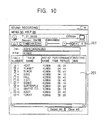
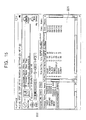
- Fig. 10 is a diagram showing a window which is displayed on the LCD 7 by the coding program 54F.
- a field 201 for displaying the name of an audio data file (i.e., the title of the musical piece) recorded on a CD, which is the optical disk 122, loaded into the drive 113, a button 202 for starting a coding process, etc. are placed.
- check boxes are placed for setting whether or not the coding of audio data should be performed in such a manner as to correspond to the name of the audio data.
- a check is set in the check boxes on the field 201, respectively.
- the audio data is coded by the coding program 54F.
- the coding program 54F then records the coded data corresponding to the respective audio data in the HDD 67.
- a set of sequential musical pieces (musical pieces whose track numbers are in sequence), shown in Fig. 10, like the audio data named "HEAT", the audio data named "PLANET”, and the audio data named “BLACK”, is called a group.
- the audio data named "SONIC” and the audio data named "BUTTERFLY” belong to one group.
- the audio data named "ADDY” and the audio data named "FUNKY” belong to one group.
- the coding program 54F determines whether or not the position of the back end of the orthogonal transform block located at the end of the audio data matches the track end position. When it is determined that the position of the back end of the orthogonal transform block located at the end of each audio data does not match the track end position, samples to be stored in the orthogonal transform block located at the end of the audio data are placed at the start of the first orthogonal transform block of the next audio data (the next musical piece).
- the coding program 54F causes orthogonal transform blocks to correspond to the entirety of the audio data corresponding to the first track, the audio data corresponding to the second track, and the audio data corresponding to the third track, as shown in part (B) of Fig. 11.
- the coding program 54F stores the samples of the audio data of the next musical piece in such a manner as to follow the orthogonal transform block.
- the coding program 54F stores data, which is "0", in the orthogonal transform block, following the samples of the audio data of the orthogonal transform block.
- the coding program 54F applies an MDCT (Modified Discrete Cosine Transform) on the orthogonal transform block in which the samples of the audio data of the next musical piece are stored following the samples of the audio data of the previous musical piece and on the orthogonal transform block located before the orthogonal transform block in order to create an SU 2-1, which is coded data, as shown in part (E) of Fig. 12.
- This SU 2-1 becomes an SU which is located at the start of the coded data of the next musical piece.
- an SU is created as a result of an MDCT being applied to two orthogonal transform blocks containing 1024 samples (that is, to 2048 samples), and contains 1024 spectra.
- the next SU is created as a result of an MDCT being applied to two of the orthogonal transform block used for the creation of the previous SU and the next orthogonal transform block.
- the respective SUs are created by a transform based on the orthogonal transform block used for the creation of the previous SU and the next orthogonal transform block, that is, an overlap transform.
- the coding program 54F performs an MDCT, following the samples of the audio data of the previous musical piece, on the orthogonal transform block in which the samples of the audio data of the next musical piece are stored and on the orthogonal transform block located next to the orthogonal transform block, thereby creating an SU 2-2.
- This SU 2-2 becomes an SU which is located second from the start of the coded data of the next musical piece.
- the coding program 54F may store data for specifying coded data which is coded following previous or next data, in the coded data (for example, the header) when sequential audio data is coded.
- Fig. 15 is a diagram showing a window such that the decoding program 54G causes the LCD 7 to display.
- a field 221 for displaying the name (i.e., the title of the musical piece) of coded data to be decoded a button 222 for starting a decoding process, etc., are placed.
- the decoding program 54G decodes in sequence the coded data corresponding to "HEAT” and the coded data corresponding to "PLANET", recorded in the HDD 67, and causes the speaker 65 to output audio corresponding to the decoded audio signal.
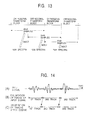
- the decoding program 54G determines whether or not coded data is sequential, as shown in part (A) of Fig. 16.
- the decoding program 54G deletes the header from the next coded data (the coded data corresponding to the track 2 in the figure), as shown in part (B) of Fig. 16 so as to concatenate the previous coded data and the next coded data which are sequential in the same group.
- the decoding program 54G may determine whether or not the coded data to be decoded is the coded data obtained by coding sequential audio data on the basis of the data stored in the header, etc.
- the decoding program 54G decodes the SUs of the concatenated coded data continuously as shown in part (C) of Fig. 16 so as to create a decoded orthogonal transform block.
- the decoding program 54G performs addition in such a manner that predetermined portions of the decoded orthogonal transform block overlap so as to create the original orthogonal transform block (including the original samples), as shown in part (D) of Fig. 16.
- the decoding program 54G applies an IMDCT (Inverse Modified Discrete Cosine Transform) on an SU containing 1024 spectra, thereby creating 2048 samples.
- the decoding program 54G applies an IMDCT on the next SU, thereby creating 2048 samples.
- the decoding program 54G adds 1024 samples in the back portion within the 2048 samples created previously and 1024 samples in the forward portion within the 2048 samples created afterward, thereby creating playback audio data (corresponding to the orthogonal transform block before being coded) of 1024 samples.
- the decoding program 54G decode sequential coded data smoothly, without creating a no-audio interval, for playback, as shown in part (E) of Fig. 16.
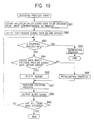
- step S51 the coding program 54F obtains specification of audio data to be coded from an input corresponding to a window displayed on the LCD 7.
- step S52 the coding program 54F defines the sequential audio data within the audio data specified in step S51 as one group.
- step S53 the coding program 54F determines whether or not a stopping request has been input as a result of the keyboard 5 or the touch pad 6 being operated. When it is determined that a stopping request has been input, the process proceeds to step S54, whereby a termination process, such as closing a predetermined file, is performed, and the processing is terminated.
- a termination process such as closing a predetermined file
- step S53 When it is determined in step S53 that a stopping request has not been input, the process proceeds to step S55, whereby the coding program 54F determines whether or not the coded data is the audio data at the start of the current group or whether or not the number of SUs which have been coded has reached the number of SUs to be processed.
- step S56 the process proceeds to step S56, whereby it is determined whether or not all the specified audio data has been coded.
- step S56 When it is determined in step S56 that all the specified audio data has been coded, since the coding process has been terminated, the process proceeds to step S57, whereby a termination process, such as closing a predetermined file, is performed, and the processing is terminated.
- a termination process such as closing a predetermined file
- step S56 When it is determined in step S56 that all the specified audio data has not been coded, the process proceeds to step S58, whereby the coding program 54F determines whether or not audio data to be coded next is at the start of the group. When it is determined that the audio data to be coded next is at the start of the group, the process proceeds to step S59, whereby an initialization process, such as adding a header, is performed, and the process proceeds to step S61.
- step S58 When it is determined in step S58 that the audio data to be coded next is not at the start of the group, the process proceeds to step S60, whereby the coding program 54F performs a process of dividing a bit stream (setting tracks of the coded data), and the process proceeds to step S61.
- step S61 the coding program 54F determines whether or not the next audio data is the audio data at the end of the current group. When it is determined that the next audio data is not the audio data at the end of the current group, since the audio data following the next audio data is in the current group, the process proceeds to step S62, whereby the number of remainder samples of the previous audio data is added to compute the number of SUs to be processed.
- step S63 the coding program 54F stores (for example, stores in the RAM 54 or records in the HDD 67) the remainder samples generated in the computation of the SUs to be processed for this time, and the process proceeds to step S66.
- step S61 When it is determined in step S61 that the next audio data is the audio data at the end of the current group, the process proceeds to step S64, whereby the coding program 54F sets a predetermined number of "0" after the track end position of the next audio data.
- step S65 the coding program 54F computes the number of SUs to be processed by adding the number of remainder samples, and the process proceeds to step S66.
- step S66 the coding program 54F performs a coding process for one SU.
- step S67 the coding program 54F adds 1 to the number of SUs which have been coded, the process returns to step S53, and the coding process is repeated.
- step S55 When it is determined in step S55 that the coded data is not the audio data at the start of the current group and the number of SUs which have been coded has not reached the number of SUs to be processed, since processing is in the middle of the coding process, the process proceeds to step S66, and the coding process is repeated.
- the coding program 54F performs a coding process continuously without setting "0" in the sequential audio data which belongs to a group.
- step S81 the decoding program 54G obtains specification of coded data to be decoded from an input corresponding to the window displayed on the LCD 7.
- step S82 the decoding program 54G defines the sequential coded data within the coded data specified in step S81 as one group.
- step S83 the decoding program 54G determines whether or not a stopping request has been input as a result of the keyboard 5 or the touch pad 6 being operated. When it is determined that a stopping request has been input, the process proceeds to step S90, whereby a termination process, such as closing a predetermined file, is performed, and the processing is terminated.
- a termination process such as closing a predetermined file
- step S83 When it is determined in step S83 that a stopping request has not been input, the process proceeds to step S84, whereby the decoding program 54G determines whether or not the coded data to be decoded is coded data which follows the previous coded data within the group. When it is determined that the coded data to be decoded is coded data which follows the previous coded data within the group, the process proceeds to step S85, whereby the header of the coded data which follows the previous coded data within the group is deleted, and the process proceeds to step S87.
- the decoding program 54G concatenates the coded data which follows the previous coded data within the group and the previous coded data.
- step S84 When it is determined in step S84 that the coded data to be decoded is not coded data which follows the previous coded data within the group, since it is single coded data (coded data which does not belong to a group) or it is the coded data at the start of the group, the process proceeds to step S86, whereby the decoding program 54G performs an initialization process, and the process proceeds to step S87.
- step S87 the decoding program 54G performs a process of decoding the coded data.
- step S88 the decoding program 54G outputs an audio signal corresponding to the audio data obtained by decoding the coded data through the speaker 65.
- step S89 the decoding program 54G determines whether or not all the specified coded data has been decoded. When it is determined that all the specified coded data has not been decoded, the process returns to step S83, and a process of decoding the next coded data is repeated.
- step S89 When it is determined in step S89 that all the specified coded data has been decoded, the processing is terminated.
- the decoding program 54G it is possible for the decoding program 54G to decode sequential coded data which belongs to a group without creating a no-audio interval so that audio is played back smoothly.
- the coding method is not limited to ATRAC, and any method may be used as long as it is a method which performs coding with a predetermined number of samples being treated as one unit.
- the above-described series of processing can be performed by hardware and can also be performed by software.
- programs which form the software are installed from a program recording medium into a computer incorporated into dedicated hardware or, for example, a general-purpose personal computer capable of executing various types of functions by installing various programs.
- This program recording medium is constructed by not only package media formed of the magnetic disk 121 (including a floppy disk), the optical disk 122 (including a CD-ROM (Compact Disc-Read Only Memory), and a DVD (Digital Versatile Disc)), the magneto-optical disk 123 (including an MD (Mini-Disc)), or the semiconductor memory 124, in which programs which are installed into a computer so as to be executable by the computer are stored, but also is constructed by the ROM, a hard disk contained in the HDD 67, etc., in which programs are stored temporarily or permanently. Storing programs in a program storage medium is performed by using a cable or wireless communication medium, such as a local area network, the Internet 80, or a digital satellite broadcast via an interface such as a router or the modem 75, as necessary.
- a cable or wireless communication medium such as a local area network, the Internet 80, or a digital satellite broadcast via an interface such as a router or the modem 75, as necessary.
- steps which describe a program stored in a program recording medium contain not only processing performed in a time-series manner along the described sequence, but also processing performed in parallel or individually although the processing is not necessarily performed in a time-series manner.
- system represents the overall apparatus composed of plural devices.
- the respective audio data is grouped into one audio data, the grouped audio data is coded in sequence with a predetermined number of samples being treated as units, and delimitations corresponding to the delimitations of plural audio data are set in the coded data at coding units of the coded data.
- the relationship between first coded data and second coded data is determined, the first coded data and the second coded data are concatenated as one coded data in such a manner as to correspond to the determination result, and the one concatenated coded data is decoded with a predetermined number of codes being treated as units.
Landscapes
- Engineering & Computer Science (AREA)
- Multimedia (AREA)
- Signal Processing (AREA)
- Physics & Mathematics (AREA)
- Health & Medical Sciences (AREA)
- Human Computer Interaction (AREA)
- Audiology, Speech & Language Pathology (AREA)
- Acoustics & Sound (AREA)
- Computational Linguistics (AREA)
- Theoretical Computer Science (AREA)
- Spectroscopy & Molecular Physics (AREA)
- Compression, Expansion, Code Conversion, And Decoders (AREA)
- Signal Processing For Digital Recording And Reproducing (AREA)
Abstract
Description
Claims (6)
- A coding apparatus for performing coding with a predetermined number of samples being treated as units, said coding apparatus comprising:coding means for grouping, when plural audio data are to be coded, the respective audio data into one audio data and for sequentially coding the grouped audio data with said predetermined number of samples being treated as units; andsetting means for setting delimitations corresponding to the delimitations of said plural audio data, in said coded data at coding units of the coded data which is coded by said coding means.
- A coding method for performing coding with a predetermined number of samples being treated as units, said coding method comprising:a coding step of grouping, when plural audio data are to be coded, the respective audio data into one audio data and for sequentially coding the grouped audio data with said predetermined number of samples being treated as units; anda setting step of setting delimitations corresponding to the delimitations of said plural audio data, in said coded data at coding units of the coded data which is coded in said coding step.
- A program storage medium having stored therein a computer-readable program for a coding process for performing coding with a predetermined number of samples being treated as units, said program comprising:a coding step of grouping, when plural audio data are to be coded, the respective audio data into one audio data and for sequentially coding the grouped audio data with said predetermined number of samples being treated as units; anda setting step of setting delimitations corresponding to the delimitations of said plural audio data, in said coded data at coding units of the coded data which is coded in said coding step.
- A decoding apparatus for performing decoding with a predetermined number of codes being treated as units, said decoding apparatus comprising:determination means for determining the relationship between first coded data and second coded data;concatenating means for concatenating said first coded data and said second coded data as one coded data in such a manner as to correspond to the determination result of said determination means; anddecoding means for decoding said one coded data which is concatenated by said concatenating means with a predetermined number of codes being treated as units.
- A decoding method for performing decoding with a predetermined number of codes being treated as units, said decoding method comprising:a determination step for determining the relationship between first coded data and second coded data;a concatenating step of concatenating said first coded data and said second coded data as one coded data in such a manner as to correspond to the determination result in said determination step; anda decoding step of decoding said one coded data which is concatenated in said concatenating step with a predetermined number of codes being treated as units.
- A program storage medium having stored therein a computer-readable program for a decoding process for performing decoding with a predetermined number of codes being treated as units, said program comprising:a determination step for determining the relationship between first coded data and second coded data;a concatenating step of concatenating said first coded data and said second coded data as one coded data in such a manner as to correspond to the determination result in said determination step; anda decoding step of decoding said one coded data which is concatenated in said concatenating step with a predetermined number of codes being treated as units.
Applications Claiming Priority (2)
| Application Number | Priority Date | Filing Date | Title |
|---|---|---|---|
| JP36032099A JP4595150B2 (en) | 1999-12-20 | 1999-12-20 | Encoding apparatus and method, decoding apparatus and method, and program storage medium |
| JP36032099 | 1999-12-20 |
Publications (2)
| Publication Number | Publication Date |
|---|---|
| EP1111608A2 true EP1111608A2 (en) | 2001-06-27 |
| EP1111608A3 EP1111608A3 (en) | 2003-10-08 |
Family
ID=18468898
Family Applications (1)
| Application Number | Title | Priority Date | Filing Date |
|---|---|---|---|
| EP00127701A Ceased EP1111608A3 (en) | 1999-12-20 | 2000-12-18 | Coding apparatus and method, decoding apparatus and method, and program storage medium |
Country Status (5)
| Country | Link |
|---|---|
| US (6) | US6965805B2 (en) |
| EP (1) | EP1111608A3 (en) |
| JP (1) | JP4595150B2 (en) |
| KR (3) | KR100720177B1 (en) |
| TW (1) | TW486888B (en) |
Cited By (1)
| Publication number | Priority date | Publication date | Assignee | Title |
|---|---|---|---|---|
| EP1732078A4 (en) * | 2004-03-29 | 2009-03-18 | Pioneer Corp | DIGITAL LINK DEVICE |
Families Citing this family (6)
| Publication number | Priority date | Publication date | Assignee | Title |
|---|---|---|---|---|
| JP4595150B2 (en) | 1999-12-20 | 2010-12-08 | ソニー株式会社 | Encoding apparatus and method, decoding apparatus and method, and program storage medium |
| JP2002259035A (en) * | 2001-02-28 | 2002-09-13 | Sony Corp | Graphical user interface and method of operating information processing apparatus, information processing apparatus, recording medium, and program |
| US8798172B2 (en) * | 2006-05-16 | 2014-08-05 | Samsung Electronics Co., Ltd. | Method and apparatus to conceal error in decoded audio signal |
| JP5428083B2 (en) * | 2011-10-13 | 2014-02-26 | カシオ計算機株式会社 | Switch device |
| US9111524B2 (en) | 2011-12-20 | 2015-08-18 | Dolby International Ab | Seamless playback of successive multimedia files |
| US9489952B2 (en) * | 2013-09-11 | 2016-11-08 | Bally Gaming, Inc. | Wagering game having seamless looping of compressed audio |
Family Cites Families (23)
| Publication number | Priority date | Publication date | Assignee | Title |
|---|---|---|---|---|
| JPS5835707A (en) * | 1981-08-25 | 1983-03-02 | Sony Corp | Digital audio disc player |
| JPH04232666A (en) | 1990-12-28 | 1992-08-20 | Casio Comput Co Ltd | Digital recorder |
| JPH04370565A (en) | 1991-06-19 | 1992-12-22 | Mitsubishi Electric Corp | Recording and reproducing system |
| EP0571123B1 (en) * | 1992-05-22 | 1998-03-04 | Sony Corporation | Disc reproduction display |
| EP0606145B1 (en) | 1993-01-06 | 2000-03-29 | Sony Corporation | Recording apparatus and recording method for a recording medium |
| JP3517907B2 (en) * | 1993-10-08 | 2004-04-12 | ソニー株式会社 | Disk recording device |
| JPH08287612A (en) * | 1995-04-14 | 1996-11-01 | Sony Corp | Variable speed playback method for audio data |
| JP2924739B2 (en) * | 1995-10-30 | 1999-07-26 | 日本電気株式会社 | Video data decoding method |
| JP3363712B2 (en) * | 1996-08-06 | 2003-01-08 | 株式会社リコー | Optical disk drive |
| US6256348B1 (en) * | 1996-08-30 | 2001-07-03 | Texas Instruments Incorporated | Reduced memory MPEG video decoder circuits and methods |
| JP3622365B2 (en) * | 1996-09-26 | 2005-02-23 | ヤマハ株式会社 | Voice encoding transmission system |
| JPH11203790A (en) * | 1998-01-06 | 1999-07-30 | Pioneer Electron Corp | Recording medium information reader |
| GB9813831D0 (en) * | 1998-06-27 | 1998-08-26 | Philips Electronics Nv | Frame-accurate editing of encoded A/V sequences |
| DE19839121A1 (en) * | 1998-08-27 | 2000-03-02 | Rohde & Schwarz | Continuous and interruption free reading and processing system for data in data acquisition system with pair of dynamic data buffers |
| US6912251B1 (en) * | 1998-09-25 | 2005-06-28 | Sarnoff Corporation | Frame-accurate seamless splicing of information streams |
| JP4359949B2 (en) * | 1998-10-22 | 2009-11-11 | ソニー株式会社 | Signal encoding apparatus and method, and signal decoding apparatus and method |
| JP2000175285A (en) * | 1998-12-03 | 2000-06-23 | Hirofumi Kimura | Method and device for configuring earphone and speaker with integrated transmission reception signal |
| US6597961B1 (en) * | 1999-04-27 | 2003-07-22 | Realnetworks, Inc. | System and method for concealing errors in an audio transmission |
| US6996097B1 (en) * | 1999-05-21 | 2006-02-07 | Microsoft Corporation | Receiver-driven layered error correction multicast over heterogeneous packet networks |
| US6446037B1 (en) * | 1999-08-09 | 2002-09-03 | Dolby Laboratories Licensing Corporation | Scalable coding method for high quality audio |
| US6931370B1 (en) * | 1999-11-02 | 2005-08-16 | Digital Theater Systems, Inc. | System and method for providing interactive audio in a multi-channel audio environment |
| JP4595150B2 (en) | 1999-12-20 | 2010-12-08 | ソニー株式会社 | Encoding apparatus and method, decoding apparatus and method, and program storage medium |
| US6832198B1 (en) * | 2000-06-29 | 2004-12-14 | International Business Machines Corporation | Split and joint compressed audio with minimum mismatching and distortion |
-
1999
- 1999-12-20 JP JP36032099A patent/JP4595150B2/en not_active Expired - Lifetime
-
2000
- 2000-12-11 US US09/734,390 patent/US6965805B2/en not_active Expired - Lifetime
- 2000-12-12 TW TW089126407A patent/TW486888B/en not_active IP Right Cessation
- 2000-12-14 KR KR1020000076305A patent/KR100720177B1/en not_active Expired - Fee Related
- 2000-12-18 EP EP00127701A patent/EP1111608A3/en not_active Ceased
-
2005
- 2005-03-17 US US11/081,632 patent/US7162316B2/en not_active Expired - Lifetime
- 2005-03-17 US US11/081,655 patent/US7043314B2/en not_active Expired - Lifetime
-
2006
- 2006-03-27 US US11/389,242 patent/US7702406B2/en not_active Expired - Fee Related
-
2007
- 2007-01-12 KR KR1020070003799A patent/KR100808955B1/en not_active Expired - Fee Related
- 2007-05-04 KR KR1020070043500A patent/KR100823548B1/en not_active Expired - Fee Related
-
2010
- 2010-03-01 US US12/715,107 patent/US9008810B2/en not_active Expired - Fee Related
-
2015
- 2015-02-25 US US14/631,589 patent/US9972333B2/en not_active Expired - Fee Related
Cited By (1)
| Publication number | Priority date | Publication date | Assignee | Title |
|---|---|---|---|---|
| EP1732078A4 (en) * | 2004-03-29 | 2009-03-18 | Pioneer Corp | DIGITAL LINK DEVICE |
Also Published As
| Publication number | Publication date |
|---|---|
| US20050159961A1 (en) | 2005-07-21 |
| KR20010062410A (en) | 2001-07-07 |
| KR20070026703A (en) | 2007-03-08 |
| US20100161342A1 (en) | 2010-06-24 |
| KR100823548B1 (en) | 2008-04-22 |
| KR100808955B1 (en) | 2008-03-07 |
| US7702406B2 (en) | 2010-04-20 |
| JP4595150B2 (en) | 2010-12-08 |
| US20060184262A1 (en) | 2006-08-17 |
| EP1111608A3 (en) | 2003-10-08 |
| KR100720177B1 (en) | 2007-05-18 |
| US6965805B2 (en) | 2005-11-15 |
| US20050165605A1 (en) | 2005-07-28 |
| US9008810B2 (en) | 2015-04-14 |
| JP2001175293A (en) | 2001-06-29 |
| TW486888B (en) | 2002-05-11 |
| US9972333B2 (en) | 2018-05-15 |
| US7043314B2 (en) | 2006-05-09 |
| US20010014862A1 (en) | 2001-08-16 |
| US20150194162A1 (en) | 2015-07-09 |
| KR20070061499A (en) | 2007-06-13 |
| US7162316B2 (en) | 2007-01-09 |
Similar Documents
| Publication | Publication Date | Title |
|---|---|---|
| US9972333B2 (en) | Coding apparatus and method, decoding apparatus and method, and program storage medium | |
| US7281214B2 (en) | Automatically updating user programmable input sensors to perform user specified functions | |
| CN100385371C (en) | Playback device and playback control method | |
| US7752460B2 (en) | General-purpose computer and copyright management method for use therein | |
| KR20020020272A (en) | Information processing apparatus and method, and program storage medium | |
| CN1849579A (en) | voice information system | |
| JP2011145694A (en) | Talking e-book | |
| US7516329B2 (en) | Information processing apparatus | |
| CN2594861Y (en) | video playback device | |
| US7418609B2 (en) | Method for instant on multimedia playing | |
| Gowan | Easy as MP3 | |
| US20070091736A1 (en) | System and method for storing and managing digital content | |
| Karlins | FrontPage 2002 Virtual Classroom |
Legal Events
| Date | Code | Title | Description |
|---|---|---|---|
| PUAI | Public reference made under article 153(3) epc to a published international application that has entered the european phase |
Free format text: ORIGINAL CODE: 0009012 |
|
| AK | Designated contracting states |
Kind code of ref document: A2 Designated state(s): AT BE CH CY DE DK ES FI FR GB GR IE IT LI LU MC NL PT SE TR |
|
| AX | Request for extension of the european patent |
Free format text: AL;LT;LV;MK;RO;SI |
|
| PUAL | Search report despatched |
Free format text: ORIGINAL CODE: 0009013 |
|
| AK | Designated contracting states |
Kind code of ref document: A3 Designated state(s): AT BE CH CY DE DK ES FI FR GB GR IE IT LI LU MC NL PT SE TR |
|
| AX | Request for extension of the european patent |
Extension state: AL LT LV MK RO SI |
|
| RIC1 | Information provided on ipc code assigned before grant |
Ipc: 7G 11B 27/034 B Ipc: 7G 11B 20/10 A |
|
| 17P | Request for examination filed |
Effective date: 20040115 |
|
| AKX | Designation fees paid |
Designated state(s): DE FR GB |
|
| 17Q | First examination report despatched |
Effective date: 20050523 |
|
| STAA | Information on the status of an ep patent application or granted ep patent |
Free format text: STATUS: THE APPLICATION HAS BEEN REFUSED |
|
| 18R | Application refused |
Effective date: 20141202 |