EP1111533A2 - Logistic regression trees for drug analysis - Google Patents

Logistic regression trees for drug analysis Download PDF

Info

Publication number
EP1111533A2
EP1111533A2 EP00310926A EP00310926A EP1111533A2 EP 1111533 A2 EP1111533 A2 EP 1111533A2 EP 00310926 A EP00310926 A EP 00310926A EP 00310926 A EP00310926 A EP 00310926A EP 1111533 A2 EP1111533 A2 EP 1111533A2
Authority
EP
European Patent Office
Prior art keywords
compounds
logistic regression
candidate
data base
acceptable
Prior art date
Legal status (The legal status is an assumption and is not a legal conclusion. Google has not performed a legal analysis and makes no representation as to the accuracy of the status listed.)
Withdrawn
Application number
EP00310926A
Other languages
German (de)
French (fr)
Other versions
EP1111533A3 (en
Inventor
David Martin Potter
Current Assignee (The listed assignees may be inaccurate. Google has not performed a legal analysis and makes no representation or warranty as to the accuracy of the list.)
Pfizer Products Inc
Original Assignee
Pfizer Products Inc
Priority date (The priority date is an assumption and is not a legal conclusion. Google has not performed a legal analysis and makes no representation as to the accuracy of the date listed.)
Filing date
Publication date
Application filed by Pfizer Products Inc filed Critical Pfizer Products Inc
Publication of EP1111533A2 publication Critical patent/EP1111533A2/en
Publication of EP1111533A3 publication Critical patent/EP1111533A3/en
Withdrawn legal-status Critical Current

Links

Images

Classifications

    • G—PHYSICS
    • G16—INFORMATION AND COMMUNICATION TECHNOLOGY [ICT] SPECIALLY ADAPTED FOR SPECIFIC APPLICATION FIELDS
    • G16C—COMPUTATIONAL CHEMISTRY; CHEMOINFORMATICS; COMPUTATIONAL MATERIALS SCIENCE
    • G16C20/00—Chemoinformatics, i.e. ICT specially adapted for the handling of physicochemical or structural data of chemical particles, elements, compounds or mixtures
    • G16C20/30—Prediction of properties of chemical compounds, compositions or mixtures
    • G—PHYSICS
    • G16—INFORMATION AND COMMUNICATION TECHNOLOGY [ICT] SPECIALLY ADAPTED FOR SPECIFIC APPLICATION FIELDS
    • G16C—COMPUTATIONAL CHEMISTRY; CHEMOINFORMATICS; COMPUTATIONAL MATERIALS SCIENCE
    • G16C20/00—Chemoinformatics, i.e. ICT specially adapted for the handling of physicochemical or structural data of chemical particles, elements, compounds or mixtures
    • G16C20/40—Searching chemical structures or physicochemical data
    • G—PHYSICS
    • G16—INFORMATION AND COMMUNICATION TECHNOLOGY [ICT] SPECIALLY ADAPTED FOR SPECIFIC APPLICATION FIELDS
    • G16C—COMPUTATIONAL CHEMISTRY; CHEMOINFORMATICS; COMPUTATIONAL MATERIALS SCIENCE
    • G16C20/00—Chemoinformatics, i.e. ICT specially adapted for the handling of physicochemical or structural data of chemical particles, elements, compounds or mixtures
    • G16C20/70—Machine learning, data mining or chemometrics

Definitions

  • This invention relates to logical decisions methods and systems, for aid in assessing or predicting the viability of selected compounds for drug possibilities (i.e., having favorable pharmacokinetic characteristics such as good oral absorption).
  • the invention also relates to such methods and systems for assessing the worth of additional research and testing, without experimentation or testing, but only based on compound structures, and particularly relates to methods using pre-determined or pre-set parameters indicative of general trends and utilities of classes of compounds.
  • the "Rule of 5" components which indicate that poor absorption/permeation are more likely, are: a) more than 5 H-bond donors (sum of OH's, NH's), b) the molecular weight is over 500, c) the ClogP is over 5 (or MlogP is over 4.15), and d) more than 10 H-bond acceptors (sum of N's, O's).
  • H-bond donors sum of OH's, NH's
  • MlogP is over 4.15
  • 10 H-bond acceptors sum of N's, O's
  • the compounds of the data base serve as a measure, based on the inquiry analysis, for predicting further utility in other compounds with similar defined characteristics, such as of structure, components and molecular weight.
  • the present invention comprises an overall system and method for filtering out compounds with potentially poor pharmacokinetic properties such as poor oral absorption, without experimental testing.
  • This filtering is achieved by comparison of the features of the subject compound with both features determined to be significantly associated with a good pharmacokinetic profile and with features associated with a bad pharmacokinetic profile, the latter being determined using a database of both already determined acceptable and non-acceptable compounds in order to build a model that distinguishes the two.
  • a system preferably computerized because of the number of compounds and variables which may be involved
  • the method is implemented with a data base of known and characterized compounds according to the following steps:
  • the method comprises the steps wherein:
  • the viability of the method of the present invention was tested by using a database of physico-chemical properties for 40,000 structurally defined literature compounds, many of which were used as actual drugs.
  • a logistic regression tree analysis was used to identify a set of compounds that have a high probability of progression to advanced clinical drug trials in spite of having a physico-chemical property profile that would suggest poor oral absorption in accordance with prior art determination parameters such as higher molecular weight being more indicative of poorer absorption.
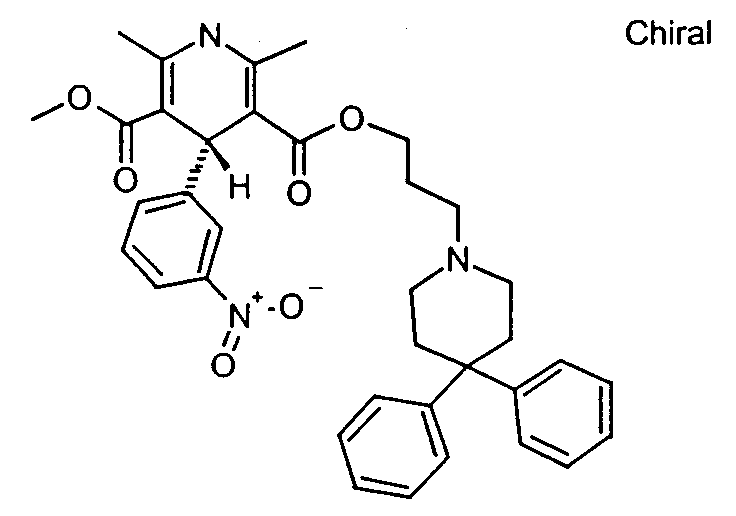
  • a particular example of the compounds was dexniguldipine, with a structure:
  • the data base contained compounds (both acceptable and non-acceptable) with one or more structurally overlapping features in common with the above compound and the other compounds being analyzed for viability of the present method.
  • the regression tree analysis is effected by the following steps:
  • Figure 2 shows compounds with a molecular weight of less than 228, for which the effect of MlogP is to decrease the chances of the compound progressing to Phase II (or higher viability as a drug candidate).
  • This decline is hypothesized to be the result of smaller compounds permeating membranes through a sieving mechanism where increased lipophilicity (i.e., MlogP) which may serve only to increase toxicities.
  • MlogP lipophilicity
  • This factor is only evident from an analysis that separates the compounds based on molecular weight (note that the Rule of 5 gives an upper molecular weight for non-viability but not a lower weight). No further separation of the compounds in Figure 2 yields an appreciable improvement in model fit, and hence this group of compounds is not further subdivided.
  • the logistic regression tree algorithm is then applied to the compounds with weights above 228 to provide the graph of Figure 3, with a traditional parabolic relationship of MlogP to absorption.
  • the compounds are then split again according to a molecular weight of 497 (about the upper molecular weight limit for viability according to the Rule of 5), to provide the graphs of Figures 4 (molecular weight below 497) and Figure 5 (molecular weight above 497).
  • blocking efflux pumps can be desirable or undesirable, drug candidates (and failures) may be experimentally profiled such as by using a competitive assay as standards to set up filters for different benefit/risk scenarios.

Landscapes

  • Chemical & Material Sciences (AREA)
  • Crystallography & Structural Chemistry (AREA)
  • Life Sciences & Earth Sciences (AREA)
  • Engineering & Computer Science (AREA)
  • Bioinformatics & Cheminformatics (AREA)
  • Bioinformatics & Computational Biology (AREA)
  • Computing Systems (AREA)
  • Theoretical Computer Science (AREA)
  • Investigating Or Analysing Biological Materials (AREA)
  • Information Retrieval, Db Structures And Fs Structures Therefor (AREA)

Abstract

An overall system and method for filtering out compounds with potentially poor pharmacokinetic properties, such as unfavorable metabolism or low solubility. The filtering is effected without experimental testing but from consideration as drug candidates or validation or rejection of compounds as drug candidates. This filtering is achieved by comparison of the subject compounds with statistically significant features in a database of already determined acceptable and non-acceptable compounds, by means of a logistic regression tree analysis. A logistic regression tree model and inquiry system is adapted to determined statistically common characteristics (referred to as candidate predictor variables) to structurally compare candidate compounds with the requisite characteristics such as ADME of acceptable compounds.

Description

This invention relates to logical decisions methods and systems, for aid in assessing or predicting the viability of selected compounds for drug possibilities (i.e., having favorable pharmacokinetic characteristics such as good oral absorption). The invention also relates to such methods and systems for assessing the worth of additional research and testing, without experimentation or testing, but only based on compound structures, and particularly relates to methods using pre-determined or pre-set parameters indicative of general trends and utilities of classes of compounds.
Background of the Invention
In a drug discovery setting there is an interest in determining, or at least predicting, various basic pharmacokinetic properties (e.g., ADME-absorption, distribution, metabolism, and excretion) from the molecular structure of a subject compound alone. This determination or, more properly, an educated prediction, serves to focus efforts on compounds which have a more viable possibility of development to actual drugs. To this end a determination system has been developed, as set forth in detail in Experimental and computational approaches to estimate solubility and permeability in drug discovery and development setting, by Christopher A. Lipinski et al. (Advanced Drug Delivery Reviews 23, pp 3-25 (1997)) known colloquially as the "Rule of 5", which provides a rough guide, related to the number "5", for filtering out compounds with potentially poor pharmacokinetic properties (including the ADME properties), such as poor oral absorption, without the necessity for conducting actual tests and experiments. This approach can improve the design of virtual libraries of compounds for screens against a particular biological target. More precisely, libraries comprising compounds likely to have good ADME properties should reduce the chance that a lead compound will run into pharmacokinetic difficulties during later studies. The non-experimental filtering is of particular importance as pharmaceutical companies move toward large-scale screening research procedures.
The "Rule of 5" components, which indicate that poor absorption/permeation are more likely, are: a) more than 5 H-bond donors (sum of OH's, NH's), b) the molecular weight is over 500, c) the ClogP is over 5 (or MlogP is over 4.15), and d) more than 10 H-bond acceptors (sum of N's, O's). When at least two of such criteria are satisfied then there is a question about the viability of the compound for further study as a drug candidate. "ClogP" and "MlogP" are common measurements of lipophilicity, an important factor in drug evaluation. These are however rigid factors and other characteristics may be of overriding importance and there have been instances of useful drugs which do not meet the Rule of 5 criteria.
Summary of the Invention
It is an object of the present invention to provide a system and method which provides a basis for more accurately determining (or providing educated estimates) validity of candidate compounds as being useful drugs, based on structure alone, without actual experimentation or testing.
It is a further object of the present invention to provide a system and method which utilizes logistic regression tree analysis, with inquiry parameters based on data culled from a sufficient, and normally extensive, data base of previously determined viable compounds for candidate drug research (with an indicated history of actual use as a drug), as well as compounds which were determined as not being viable. The compounds of the data base serve as a measure, based on the inquiry analysis, for predicting further utility in other compounds with similar defined characteristics, such as of structure, components and molecular weight.
Generally the present invention comprises an overall system and method for filtering out compounds with potentially poor pharmacokinetic properties such as poor oral absorption, without experimental testing. This filtering is achieved by comparison of the features of the subject compound with both features determined to be significantly associated with a good pharmacokinetic profile and with features associated with a bad pharmacokinetic profile, the latter being determined using a database of both already determined acceptable and non-acceptable compounds in order to build a model that distinguishes the two.
In accordance with the system and method of the present invention, a system (preferably computerized because of the number of compounds and variables which may be involved) is used and the method is implemented with a data base of known and characterized compounds according to the following steps:
  • a) setting up a data base of compounds which have been previously experimentally determined to have good pharmacokinetic properties and compounds which have been previously experimentally determined to have bad pharmacokinetic properties; to provide a statistical basis for various common structural characteristics, components and determined properties; wherein each compound entry for the data base contains at least the structural configurations for the entry compound and whether the compound was actually used in clinical trials;
  • b) adapting a logistic regression tree model and inquiry system to determined statistically common characteristics of the compounds in said data base, as candidate predictor variables, to structurally compare candidate compounds with characteristics of acceptable and not acceptable compounds in said data base;
  • c) applying the logistic regression tree model to compounds in said data base to provide a fit of the candidate compounds with candidate predictor variables;
  • d) using the logistic regression tree model to recursively search the candidate compounds with the predictor variables, to yield the best overall fit of the candidate compounds with the predictor variable; and
  • e) using this best overall fit in final determinations for viability of candidate compounds as candidates for testing as drugs.
  • More specifically, the method comprises the steps wherein:
  • a) the computerized data base is initially set up in memory or accessible data storage of compounds which have been previously determined to have the requisite ADME characteristics (whether or not a compound has made it to Phase II clinical trials is acceptable as being used as a proxy for "good pharmacokinetic/ADME profile" with it again being noted that the database also contains compounds that do not have a good PK/ADME profile), to provide a statistical basis for various common structural characteristics and determined properties. The extent of the data base, sufficient to provide a statistically significant result, is dependent on the properties being used as parameters. Accordingly, a data base of several hundred compounds may be sufficient for one analysis (e.g., such as where the common characteristics are confined to a small number of compounds) while another data base may require thousands of representative compounds to provide compatible and significant comparisons with similar compounds. An ad hoc determination is thus required for each application with respect to minimization of data base comparisons without compromising the validity of any analysis. The data base should only comprise compounds having structural and/or other characteristics in common with the compound under investigation or a determinable nexus such as lack or presence of attributes in compounds having bad pharmacokinetic characteristics. Each compound entry for the data base should contain at least the structural configurations (or an enumeration of components on an atomic or molecular level) for the entry compounds, for proper identification of compounds, and cross checks for computing the physical-chemical variables (e.g., molecular weight). Preferably there are also other compound identification means such as CAS registration numbers, and approved name, for additional cross checking and verification of analysis; calculated physical-chemical properties thought to be related to pharmacokinetic profile (e.g., molecular weight, measures of lipophilicity, hydrogen bonding features); optionally, therapy use and mechanism (if known); and whether a compound was actually used as a drug or whether the compound progressed to Phase II clinical trials as reflected by presence of ISAN or UNN name.
  • b) A logistic regression tree model and inquiry system is adapted to determined statistically common characteristics (referred to as candidate predictor variables) to structurally compare candidate compounds with the requisite ADME characteristics of acceptable and non-acceptable compounds. This differs from prior art determinations, such as the Rule of 5, which are based on rigidly preset parameters generally, but not specifically, derived from prior compound experience. Logistic regression trees are applicable in a setting with a binary outcome such as determination of compounds for drug viability (either yes or no) and a set of candidate explanatory variables (either continuous or categorical). Logistic regression trees are useful in identifying interactions among the explanatory variables (i.e., where the effect of an explanatory variable depends on the value of another explanatory variable), and nonlinear relationships (i.e., where the effect of an explanatory variable on the binary response is not strictly increasing or decreasing). In addition, a logistic regression tree model can be used to predict the probability of the binary response based on values of the explanatory variables. Specifically, in accordance with the present invention, a tree-based statistical method is utilized which imbeds logistic regression models within a recursive partitioning framework. More precisely, logistic regression is a traditional statistical approach to modeling the probability of a binary response as a function of one or more explanatory variables. Tree-based methods, also known as recursive partitioning methods, model a binary response by repeatedly splitting the data into subgroups, based on values of the predictors, such that the resulting subgroups are homogeneous with respect to the binary response. Combining the two approaches, logistic regression trees repeatedly split the data into subgroups, based on values of the predictors, such that the logistic regression models in the subgroups provide a good fit to the data.
  • c) Applying the logistic regression tree model to candidate compounds to provide a fit of the compounds with idealized regressor or predictor variables of the compounds of the data base. Given a binary outcome (accept or reject) and a set of candidate predictor variables (culled from the data base), this logistic regression tree approach recursively searches for the predictors, their split points, and logistic regression models that together yield the best overall fit.
  • d) Using this best overall fit in final determinations of compound (or series of compounds) viability as a drug or drug candidate.
  • The above and other objects, features and advantages of the present invention will become more evident from the following discussion and drawings in which:
    SHORT DESCRIPTION OF THE DRAWINGS
  • Figures 1-5 represent a progressive graphing of likelihood of compounds becoming candidates for viable drugs against MlogP, based on successive logistic regressive tree analysis and based on molecular weight predictor factors; and
  • Figure 6 is an overall area graph of molecular versus MlogP showing degree of drug viability probability.
  • Detailed Description of the Invention
    The viability of the method of the present invention was tested by using a database of physico-chemical properties for 40,000 structurally defined literature compounds, many of which were used as actual drugs. In a comparison study, a logistic regression tree analysis was used to identify a set of compounds that have a high probability of progression to advanced clinical drug trials in spite of having a physico-chemical property profile that would suggest poor oral absorption in accordance with prior art determination parameters such as higher molecular weight being more indicative of poorer absorption. A particular example of the compounds was dexniguldipine, with a structure:
    Figure 00050001
    The data base contained compounds (both acceptable and non-acceptable) with one or more structurally overlapping features in common with the above compound and the other compounds being analyzed for viability of the present method.
    A closer look at the compounds exhibited the disparity between viability according to evaluation based on the method of the present invention and evaluation based on analysis with methods of the prior art. It revealed that these compounds may act as inhibitors of the P-glycoprotein transporter, which acts as an efflux pump to reduce intestinal absorption of foreign molecules. With the compounds being able to reduce efflux pump effect, the time the compound (as a foreign molecule) is effectively at a site (without being expulsed) with increased absorption is extended. Thus, a chemically less effective compound per se (as determined such as by Rule of 5 criteria) is determined to be more effective as a result of enhanced take-up based on an efflux pump effect.
    In accordance with the method of the present invention the regression tree analysis is effected by the following steps:
  • 1. Start with all compounds to be analyzed for viability;
  • 2. Choose a single regressor variable (e.g., MlogP) for selective basic analysis;
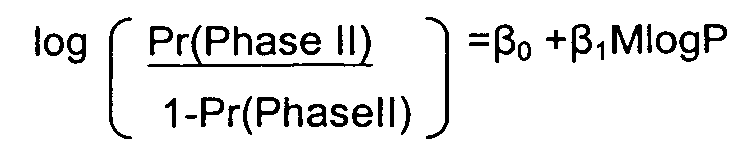
  • 3. Fit the logistic regression model to a data base of known compounds (both viable and not viable) according to the formula;
    Figure 00050002
       wherein "Pr(Phase II)" denotes the probability "p" of viability for a given compound; βo represents the intercept of the model and β1 represents the effect on log(p/(1-p)) of a one unit increase in MlogP. The logistic regression model is estimated using maximum likelihood estimation, via a Newton-Raphson algorithm.
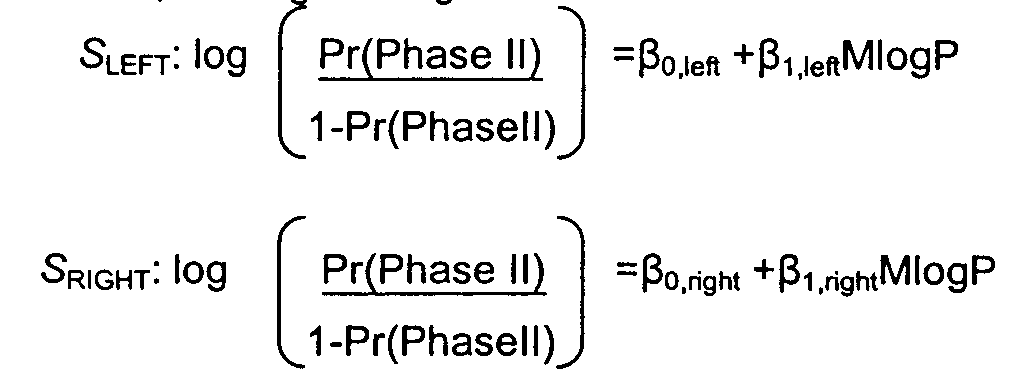
  • 4. For each predictor variable X, and for every split point c on X, separate compounds into 2 sets, SLEFT & SRIGHT respectively:
  • S LEFT: all compounds for which X < c
  • S RIGHT: all compounds for which X ≥c.
  • 5. In each set, fit a logistic regression model:
    Figure 00060001
  • 6. Choose the variable X* and split point c* that yield the best fit as measured by the deviance (a goodness-of-fit measure).
  • 7. Split the compounds into 2 sets based on X* and c*.
  • 8. Recursively repeat steps 3-7 for S LEFT and S RIGHT.
  • 9. Select tree size by cross-validation (CV) or use of external test set.
  • 10. Repeat entire process for other regressors.
  • 11. Choose tree with minimum CV or test set deviance for selection of the most viable candidate compounds.
  • DETAILED DESCRIPTION OF THE DRAWINGS AND THE PREFERRED EMBODIMENTS
    The relationship between successful progression to viable drug candidacy and the Rule of 5 variables was tested with the use of logistic regression trees, as described, utilizing a 40,000 compound database.
    The logistic regression tree suggests that the effect of MlogP on successful progression to drug viability candidacy (Phase II) depends on the molecular weight of a compound, and this is shown as the 1st split from Figure 1 (all the compounds in the data base showing a general increase of Phase II success with increasing MlogP up to about MlogP=4) to Figures 2 and 3, with a cutoff of 228 as the molecular weight.
    In the Figures 1-5, in each node of the tree the probability of a compound progressing to Phase II clinical trials was plotted versus the compound's MlogP value. Because the Phase II outcome is binary (1=yes, 0=no), in addition to the logistic regression fit, a smoothed estimate of the binary response probability (i.e., a weighted average of the 1's and 0's for a narrow range of MlogP values) was also plotted (as shown in dotted line) to provide an overall estimate of the relationship without reference to any particular model.
    The compounds in Figure 2 show a decline in viability whereas the compounds in Figure 3 show a trend similar to all compounds as shown in Figure 1, with a decline when MlogP is above about 4. This decline is consistent with the Rule of 5.
    Figure 2 shows compounds with a molecular weight of less than 228, for which the effect of MlogP is to decrease the chances of the compound progressing to Phase II (or higher viability as a drug candidate). This decline is hypothesized to be the result of smaller compounds permeating membranes through a sieving mechanism where increased lipophilicity (i.e., MlogP) which may serve only to increase toxicities. This factor is only evident from an analysis that separates the compounds based on molecular weight (note that the Rule of 5 gives an upper molecular weight for non-viability but not a lower weight). No further separation of the compounds in Figure 2 yields an appreciable improvement in model fit, and hence this group of compounds is not further subdivided.
    The logistic regression tree algorithm is then applied to the compounds with weights above 228 to provide the graph of Figure 3, with a traditional parabolic relationship of MlogP to absorption. The compounds are then split again according to a molecular weight of 497 (about the upper molecular weight limit for viability according to the Rule of 5), to provide the graphs of Figures 4 (molecular weight below 497) and Figure 5 (molecular weight above 497).
    As shown in Figure 4, for compounds < ~500 g (but above 228 g), the probability of Phase II drops as MlogP values exceed the Rule of 5 cutoff. However, for compounds > ~500 g, increasing MlogP above the Rule of 5 cutoff does not decrease the chance of progression to Phase II, a totally unexpected result. Compounds which do not fit within the Rule of 5 parameters but which are indicated being viable according the logistic regression tree analysis of the present invention, and which made it to Phase II viability, include many compounds which block efflux pumps (e.g., P-glycoprotein pump). Compounds in this category include dihydropyridines; verapamil analogs; macrolides; HIV protease inhibitors; and Prodrugs. These compounds are shown in Figure 6, in the upper right hand section with MlogP above 4 and molecular weights above 500.
    Since blocking efflux pumps can be desirable or undesirable, drug candidates (and failures) may be experimentally profiled such as by using a competitive assay as standards to set up filters for different benefit/risk scenarios.

    Claims (2)

    1. A method for filtering out candidate compounds with potentially good or poor physiological properties with respect to further testing as candidates for drugs, without experimental testing, said method comprising the steps of:
      a) setting up a data base of compounds which have been previously experimentally determined to have good pharmacokinetic properties and compounds which have been previously experimentally determined to have poor pharmacokinetic properties; to provide a statistical basis for various common structural characteristics and determined properties; wherein each compound entry for the data base contains at least the structural configurations for the entry compound and whether the compound was actually used in clinical trials;
      b) adapting a logistic regression tree model and inquiry system to determined statistically common characteristics of the compounds in said data base, as candidate predictor variables, to structurally compare candidate compounds with characteristics of acceptable and not acceptable compounds in said data base;
      c) applying the logistic regression tree model to compounds in said data base to provide a fit of the candidate compounds with candidate predictor variables;
      d) using the logistic regression tree model to recursively search the candidate compounds with the predictor variables, to yield the best overall fit of the candidate compounds with the predictor variable; and
      e) using this best overall fit in final determinations for viability of candidate compounds as candidates for testing as drugs.
    2. The method of claim 1 wherein adapting, applying and using the logistic regression tree model of steps b-d is effected by the following steps:
      a) choosing a single regressor variable for selective basic analysis as a logistic regression model;
      b) fitting the logistic regression model to the data base of known acceptable and non-acceptable compounds according to the formula;
      Figure 00080001
         wherein "Pr(Phase II)" denotes the probability "p" of viability for a given compound; βo represents the intercept of the model and β1 represents the effect on log(p/(1-p) of a one unit increase in MlogP;
      c) for each predictor variable X, and for every split point c on X, separating compounds into two sets, S LEFT & S RIGHT respectively:
      S LEFT: all compounds for which X ≤ c
      S RIGHT: all compounds for which X ≥ c;
      d) in each set, fitting a logistic regression model:
      Figure 00090001
      e) choosing the variable X* and split point c* that yield the best fit as measured by the deviance, as a goodness-of-fit measure;
      f) splitting the compounds into two sets based on X* and c*;
      g) recursively repeating steps 2-6 for SLEFT and SRIGHT;
      h) selecting tree size by any of cross-validation (CV) and of an external test set;
      i) repeating the entire process for other regressors; and
      j) choosing a tree with minimum CV or test set deviance for selection of the most viable candidate compounds.
    EP00310926A 1999-12-15 2000-12-08 Logistic regression trees for drug analysis Withdrawn EP1111533A3 (en)

    Applications Claiming Priority (2)

    Application Number Priority Date Filing Date Title
    US17091799P 1999-12-15 1999-12-15
    US170917P 1999-12-15

    Publications (2)

    Publication Number Publication Date
    EP1111533A2 true EP1111533A2 (en) 2001-06-27
    EP1111533A3 EP1111533A3 (en) 2006-06-07

    Family

    ID=22621802

    Family Applications (1)

    Application Number Title Priority Date Filing Date
    EP00310926A Withdrawn EP1111533A3 (en) 1999-12-15 2000-12-08 Logistic regression trees for drug analysis

    Country Status (3)

    Country Link
    EP (1) EP1111533A3 (en)
    JP (1) JP3477167B2 (en)
    CA (1) CA2328567A1 (en)

    Cited By (5)

    * Cited by examiner, † Cited by third party
    Publication number Priority date Publication date Assignee Title
    WO2002010742A3 (en) * 2000-07-28 2003-08-14 Lion Bioscience Ag System and method for predicting adme/tox characteristics of a compound
    WO2002010741A3 (en) * 2000-07-28 2003-09-04 Lion Bioscience Ag Regional intestinal permeability model
    WO2003042898A3 (en) * 2001-11-13 2004-04-22 Arqule Inc Compound prioritization for drug discovery
    WO2016192191A1 (en) * 2015-05-29 2016-12-08 华中农业大学 Screening method for multi-target drug and/or pharmaceutical composition
    CN111833971A (en) * 2019-04-23 2020-10-27 上海云贵信息科技有限公司 Pharmaceutical compound pharmacokinetic parameter prediction method based on logistic regression

    Families Citing this family (1)

    * Cited by examiner, † Cited by third party
    Publication number Priority date Publication date Assignee Title
    CN107247764A (en) * 2017-06-02 2017-10-13 北京星河聘快线科技有限公司 A kind of determination method and system of information matches degree

    Family Cites Families (1)

    * Cited by examiner, † Cited by third party
    Publication number Priority date Publication date Assignee Title
    FR2773240B1 (en) * 1997-12-30 2002-11-29 Synt Em PROCESS FOR PREDICTING, IDENTIFYING AND DESCRIBING MOLECULES LIKELY TO PRESENT RESEARCH BEHAVIOR, ESPECIALLY IN THE FIELD OF PHARMACY AND MOLECULES OBTAINED BY THIS PROCESS

    Cited By (5)

    * Cited by examiner, † Cited by third party
    Publication number Priority date Publication date Assignee Title
    WO2002010742A3 (en) * 2000-07-28 2003-08-14 Lion Bioscience Ag System and method for predicting adme/tox characteristics of a compound
    WO2002010741A3 (en) * 2000-07-28 2003-09-04 Lion Bioscience Ag Regional intestinal permeability model
    WO2003042898A3 (en) * 2001-11-13 2004-04-22 Arqule Inc Compound prioritization for drug discovery
    WO2016192191A1 (en) * 2015-05-29 2016-12-08 华中农业大学 Screening method for multi-target drug and/or pharmaceutical composition
    CN111833971A (en) * 2019-04-23 2020-10-27 上海云贵信息科技有限公司 Pharmaceutical compound pharmacokinetic parameter prediction method based on logistic regression

    Also Published As

    Publication number Publication date
    JP3477167B2 (en) 2003-12-10
    JP2001221792A (en) 2001-08-17
    CA2328567A1 (en) 2001-06-15
    EP1111533A3 (en) 2006-06-07

    Similar Documents

    Publication Publication Date Title
    Käll et al. Posterior error probabilities and false discovery rates: two sides of the same coin
    Webb-Robertson et al. Review, evaluation, and discussion of the challenges of missing value imputation for mass spectrometry-based label-free global proteomics
    Tabb et al. MyriMatch: highly accurate tandem mass spectral peptide identification by multivariate hypergeometric analysis
    McGurk et al. The use of missing values in proteomic data-independent acquisition mass spectrometry to enable disease activity discrimination
    CN109791124B (en) Mass spectrometry data analysis device and analysis method
    US9211314B2 (en) Treatment selection for lung cancer patients using mass spectrum of blood-based sample
    KR102563901B1 (en) Prediction method for property of pharmaceutical active ingredient
    JP2019528426A5 (en)
    US12525324B2 (en) Active learning using coverage score
    Helman et al. Extending the Generalised Read-Across approach (GenRA): A systematic analysis of the impact of physicochemical property information on read-across performance
    US20070156343A1 (en) Stochastic method to determine, in silico, the drug like character of molecules
    CN115058511A (en) Venous thromboembolism recurrence risk assessment model based on polygenic mutation characteristics, construction method and application thereof
    US10294518B2 (en) Methods and systems for ultra-sensitive detection of genomic alterations
    CA2328567A1 (en) Logistic regression trees for drug analysis
    US20250273335A1 (en) Artificial intelligence for identifying one or more predictive biomarkers
    CN116313158A (en) Monitoring method, device and system for patient safety ESB service data
    CN119069026B (en) A detection method and system based on new pollutant pretreatment data
    Rahman et al. Quantifying uncertainty of a deep learning model for atrial fibrillation detection from ECG signals
    WO2024020427A2 (en) Methods for the detection and treatment of ovarian cancer
    US7113870B2 (en) Prediction of molecular polar surface area and bioabsorption
    Chagoyen et al. Assessment of protein set coherence using functional annotations
    CN120998301B (en) Cell aging detection method and system based on multiple groups of chemical metabolites
    Ghosh et al. Statistical approach to metabonomic analysis of rat urine following surgical trauma
    CN121456496A (en) Construction method and device of active cliff data set, electronic equipment and storage medium
    Tan et al. Data Processing in Metabolomics Capillary Electrophoresis–Mass Spectrometry

    Legal Events

    Date Code Title Description
    PUAI Public reference made under article 153(3) epc to a published international application that has entered the european phase

    Free format text: ORIGINAL CODE: 0009012

    17P Request for examination filed

    Effective date: 20001218

    AK Designated contracting states

    Kind code of ref document: A2

    Designated state(s): AT BE CH CY DE DK ES FI FR GB GR IE IT LI LU MC NL PT SE TR

    AX Request for extension of the european patent

    Free format text: AL;LT;LV;MK;RO;SI

    PUAL Search report despatched

    Free format text: ORIGINAL CODE: 0009013

    AK Designated contracting states

    Kind code of ref document: A3

    Designated state(s): AT BE CH CY DE DK ES FI FR GB GR IE IT LI LU MC NL PT SE TR

    AX Request for extension of the european patent

    Extension state: AL LT LV MK RO SI

    STAA Information on the status of an ep patent application or granted ep patent

    Free format text: STATUS: THE APPLICATION IS DEEMED TO BE WITHDRAWN

    18D Application deemed to be withdrawn

    Effective date: 20060703