EP1111448A1 - Color photographic element containing a fragmentable electron donor in combination with a one equivalent coupler - Google Patents
Color photographic element containing a fragmentable electron donor in combination with a one equivalent coupler Download PDFInfo
- Publication number
- EP1111448A1 EP1111448A1 EP00204390A EP00204390A EP1111448A1 EP 1111448 A1 EP1111448 A1 EP 1111448A1 EP 00204390 A EP00204390 A EP 00204390A EP 00204390 A EP00204390 A EP 00204390A EP 1111448 A1 EP1111448 A1 EP 1111448A1
- Authority
- EP
- European Patent Office
- Prior art keywords
- dye
- group
- image
- photographic element
- coupler
- Prior art date
- Legal status (The legal status is an assumption and is not a legal conclusion. Google has not performed a legal analysis and makes no representation as to the accuracy of the status listed.)
- Withdrawn
Links
- 239000000839 emulsion Substances 0.000 claims abstract description 146
- 239000000975 dye Substances 0.000 claims abstract description 139
- 229910052709 silver Inorganic materials 0.000 claims abstract description 87
- 239000004332 silver Substances 0.000 claims abstract description 87
- -1 silver halide Chemical class 0.000 claims abstract description 72
- 150000001875 compounds Chemical class 0.000 claims abstract description 35
- 230000003647 oxidation Effects 0.000 claims abstract description 22
- 238000007254 oxidation reaction Methods 0.000 claims abstract description 22
- 239000001043 yellow dye Substances 0.000 claims abstract description 7
- 239000012634 fragment Substances 0.000 claims abstract description 6
- AJDUTMFFZHIJEM-UHFFFAOYSA-N n-(9,10-dioxoanthracen-1-yl)-4-[4-[[4-[4-[(9,10-dioxoanthracen-1-yl)carbamoyl]phenyl]phenyl]diazenyl]phenyl]benzamide Chemical compound O=C1C2=CC=CC=C2C(=O)C2=C1C=CC=C2NC(=O)C(C=C1)=CC=C1C(C=C1)=CC=C1N=NC(C=C1)=CC=C1C(C=C1)=CC=C1C(=O)NC1=CC=CC2=C1C(=O)C1=CC=CC=C1C2=O AJDUTMFFZHIJEM-UHFFFAOYSA-N 0.000 claims abstract description 6
- 238000010504 bond cleavage reaction Methods 0.000 claims abstract description 4
- 125000000217 alkyl group Chemical group 0.000 claims description 43
- 125000003118 aryl group Chemical group 0.000 claims description 37
- 125000001424 substituent group Chemical group 0.000 claims description 30
- 125000005647 linker group Chemical group 0.000 claims description 25
- 229910052739 hydrogen Inorganic materials 0.000 claims description 18
- 239000001257 hydrogen Substances 0.000 claims description 18
- 125000000623 heterocyclic group Chemical group 0.000 claims description 15
- 125000000547 substituted alkyl group Chemical group 0.000 claims description 15
- 229910052717 sulfur Inorganic materials 0.000 claims description 15
- 125000004429 atom Chemical group 0.000 claims description 12
- 125000004432 carbon atom Chemical group C* 0.000 claims description 12
- 125000003178 carboxy group Chemical group [H]OC(*)=O 0.000 claims description 9
- 125000004435 hydrogen atom Chemical group [H]* 0.000 claims description 9
- 125000003545 alkoxy group Chemical group 0.000 claims description 8
- 229910052757 nitrogen Inorganic materials 0.000 claims description 8
- 229910052711 selenium Inorganic materials 0.000 claims description 8
- 229910052736 halogen Inorganic materials 0.000 claims description 7
- 150000002367 halogens Chemical class 0.000 claims description 7
- 125000005842 heteroatom Chemical group 0.000 claims description 7
- 125000004433 nitrogen atom Chemical group N* 0.000 claims description 7
- 229910052760 oxygen Inorganic materials 0.000 claims description 7
- 239000002243 precursor Substances 0.000 claims description 7
- 230000000274 adsorptive effect Effects 0.000 claims description 6
- 229910052799 carbon Inorganic materials 0.000 claims description 6
- 229910052714 tellurium Inorganic materials 0.000 claims description 5
- 125000003107 substituted aryl group Chemical group 0.000 claims description 4
- 125000005420 sulfonamido group Chemical group S(=O)(=O)(N*)* 0.000 claims description 4
- 229910003844 NSO2 Inorganic materials 0.000 claims description 3
- 125000004397 aminosulfonyl group Chemical group NS(=O)(=O)* 0.000 claims description 3
- 125000004430 oxygen atom Chemical group O* 0.000 claims description 3
- 229910052698 phosphorus Inorganic materials 0.000 claims description 3
- 125000004434 sulfur atom Chemical group 0.000 claims description 3
- 150000001408 amides Chemical class 0.000 claims description 2
- 125000004104 aryloxy group Chemical group 0.000 claims description 2
- 125000004093 cyano group Chemical group *C#N 0.000 claims description 2
- 125000000753 cycloalkyl group Chemical group 0.000 claims description 2
- 229910052732 germanium Inorganic materials 0.000 claims description 2
- 125000001434 methanylylidene group Chemical group [H]C#[*] 0.000 claims description 2
- HDCXQTPVTAIPNZ-UHFFFAOYSA-N n-({[4-(aminosulfonyl)phenyl]amino}carbonyl)-4-methylbenzenesulfonamide Chemical compound C1=CC(C)=CC=C1S(=O)(=O)NC(=O)NC1=CC=C(S(N)(=O)=O)C=C1 HDCXQTPVTAIPNZ-UHFFFAOYSA-N 0.000 claims description 2
- 125000004437 phosphorous atom Chemical group 0.000 claims description 2
- 229910052710 silicon Inorganic materials 0.000 claims description 2
- 229940124530 sulfonamide Drugs 0.000 claims description 2
- 150000003456 sulfonamides Chemical class 0.000 claims description 2
- 229910052718 tin Inorganic materials 0.000 claims description 2
- 239000010410 layer Substances 0.000 description 100
- 108010010803 Gelatin Proteins 0.000 description 41
- 239000008273 gelatin Substances 0.000 description 41
- 229920000159 gelatin Polymers 0.000 description 41
- 235000019322 gelatine Nutrition 0.000 description 41
- 235000011852 gelatine desserts Nutrition 0.000 description 41
- BQCADISMDOOEFD-UHFFFAOYSA-N Silver Chemical compound [Ag] BQCADISMDOOEFD-UHFFFAOYSA-N 0.000 description 38
- 229910052740 iodine Inorganic materials 0.000 description 23
- 238000000034 method Methods 0.000 description 23
- 239000000203 mixture Substances 0.000 description 21
- 125000001997 phenyl group Chemical group [H]C1=C([H])C([H])=C(*)C([H])=C1[H] 0.000 description 21
- SQGYOTSLMSWVJD-UHFFFAOYSA-N silver(1+) nitrate Chemical compound [Ag+].[O-]N(=O)=O SQGYOTSLMSWVJD-UHFFFAOYSA-N 0.000 description 21
- 239000003795 chemical substances by application Substances 0.000 description 20
- 238000011160 research Methods 0.000 description 20
- 239000002019 doping agent Substances 0.000 description 17
- 238000006243 chemical reaction Methods 0.000 description 15
- 239000000463 material Substances 0.000 description 14
- UFHFLCQGNIYNRP-UHFFFAOYSA-N Hydrogen Chemical compound [H][H] UFHFLCQGNIYNRP-UHFFFAOYSA-N 0.000 description 13
- 238000005859 coupling reaction Methods 0.000 description 13
- XMBWDFGMSWQBCA-UHFFFAOYSA-N hydrogen iodide Chemical compound I XMBWDFGMSWQBCA-UHFFFAOYSA-N 0.000 description 13
- 230000000873 masking effect Effects 0.000 description 13
- 230000004044 response Effects 0.000 description 13
- ZUNKMNLKJXRCDM-UHFFFAOYSA-N silver bromoiodide Chemical compound [Ag].IBr ZUNKMNLKJXRCDM-UHFFFAOYSA-N 0.000 description 13
- 230000008878 coupling Effects 0.000 description 12
- 238000010168 coupling process Methods 0.000 description 12
- 230000008569 process Effects 0.000 description 12
- JHJLBTNAGRQEKS-UHFFFAOYSA-M sodium bromide Chemical compound [Na+].[Br-] JHJLBTNAGRQEKS-UHFFFAOYSA-M 0.000 description 12
- 239000000126 substance Substances 0.000 description 11
- IOJUPLGTWVMSFF-UHFFFAOYSA-N benzothiazole Chemical compound C1=CC=C2SC=NC2=C1 IOJUPLGTWVMSFF-UHFFFAOYSA-N 0.000 description 10
- 239000000243 solution Substances 0.000 description 10
- 206010070834 Sensitisation Diseases 0.000 description 9
- 239000002585 base Substances 0.000 description 9
- 238000011161 development Methods 0.000 description 9
- 230000006872 improvement Effects 0.000 description 9
- 238000012545 processing Methods 0.000 description 9
- 150000003254 radicals Chemical class 0.000 description 9
- 230000008313 sensitization Effects 0.000 description 9
- 230000001235 sensitizing effect Effects 0.000 description 9
- QGKMIGUHVLGJBR-UHFFFAOYSA-M (4z)-1-(3-methylbutyl)-4-[[1-(3-methylbutyl)quinolin-1-ium-4-yl]methylidene]quinoline;iodide Chemical compound [I-].C12=CC=CC=C2N(CCC(C)C)C=CC1=CC1=CC=[N+](CCC(C)C)C2=CC=CC=C12 QGKMIGUHVLGJBR-UHFFFAOYSA-M 0.000 description 8
- 238000010521 absorption reaction Methods 0.000 description 8
- 230000008859 change Effects 0.000 description 8
- 238000009792 diffusion process Methods 0.000 description 8
- CBEQRNSPHCCXSH-UHFFFAOYSA-N iodine monobromide Chemical compound IBr CBEQRNSPHCCXSH-UHFFFAOYSA-N 0.000 description 8
- 230000035945 sensitivity Effects 0.000 description 8
- XLYOFNOQVPJJNP-UHFFFAOYSA-N water Substances O XLYOFNOQVPJJNP-UHFFFAOYSA-N 0.000 description 8
- 239000011248 coating agent Substances 0.000 description 7
- 238000000576 coating method Methods 0.000 description 7
- 230000006870 function Effects 0.000 description 7
- 125000002496 methyl group Chemical group [H]C([H])([H])* 0.000 description 7
- JUJWROOIHBZHMG-UHFFFAOYSA-N Pyridine Chemical compound C1=CC=NC=C1 JUJWROOIHBZHMG-UHFFFAOYSA-N 0.000 description 6
- 230000002411 adverse Effects 0.000 description 6
- 239000006185 dispersion Substances 0.000 description 6
- 125000006575 electron-withdrawing group Chemical group 0.000 description 6
- 125000001495 ethyl group Chemical group [H]C([H])([H])C([H])([H])* 0.000 description 6
- 238000001556 precipitation Methods 0.000 description 6
- 239000011669 selenium Substances 0.000 description 6
- ADZWSOLPGZMUMY-UHFFFAOYSA-M silver bromide Chemical compound [Ag]Br ADZWSOLPGZMUMY-UHFFFAOYSA-M 0.000 description 6
- FPVGTPBMTFTMRT-NSKUCRDLSA-L fast yellow Chemical compound [Na+].[Na+].C1=C(S([O-])(=O)=O)C(N)=CC=C1\N=N\C1=CC=C(S([O-])(=O)=O)C=C1 FPVGTPBMTFTMRT-NSKUCRDLSA-L 0.000 description 5
- 235000019233 fast yellow AB Nutrition 0.000 description 5
- 239000010931 gold Substances 0.000 description 5
- 150000004820 halides Chemical class 0.000 description 5
- 239000011229 interlayer Substances 0.000 description 5
- 230000031700 light absorption Effects 0.000 description 5
- DZVCFNFOPIZQKX-LTHRDKTGSA-M merocyanine Chemical compound [Na+].O=C1N(CCCC)C(=O)N(CCCC)C(=O)C1=C\C=C\C=C/1N(CCCS([O-])(=O)=O)C2=CC=CC=C2O\1 DZVCFNFOPIZQKX-LTHRDKTGSA-M 0.000 description 5
- 239000003607 modifier Substances 0.000 description 5
- 230000007935 neutral effect Effects 0.000 description 5
- 238000001228 spectrum Methods 0.000 description 5
- 125000000999 tert-butyl group Chemical group [H]C([H])([H])C(*)(C([H])([H])[H])C([H])([H])[H] 0.000 description 5
- SIKJAQJRHWYJAI-UHFFFAOYSA-N Indole Chemical compound C1=CC=C2NC=CC2=C1 SIKJAQJRHWYJAI-UHFFFAOYSA-N 0.000 description 4
- 229910021612 Silver iodide Inorganic materials 0.000 description 4
- 150000002431 hydrogen Chemical class 0.000 description 4
- 238000003384 imaging method Methods 0.000 description 4
- 238000004519 manufacturing process Methods 0.000 description 4
- 125000004108 n-butyl group Chemical group [H]C([H])([H])C([H])([H])C([H])([H])C([H])([H])* 0.000 description 4
- 239000000047 product Substances 0.000 description 4
- 125000001436 propyl group Chemical group [H]C([*])([H])C([H])([H])C([H])([H])[H] 0.000 description 4
- 239000011734 sodium Substances 0.000 description 4
- VGTPCRGMBIAPIM-UHFFFAOYSA-M sodium thiocyanate Chemical compound [Na+].[S-]C#N VGTPCRGMBIAPIM-UHFFFAOYSA-M 0.000 description 4
- 239000002904 solvent Substances 0.000 description 4
- 239000003381 stabilizer Substances 0.000 description 4
- 241001479434 Agfa Species 0.000 description 3
- LFQSCWFLJHTTHZ-UHFFFAOYSA-N Ethanol Chemical compound CCO LFQSCWFLJHTTHZ-UHFFFAOYSA-N 0.000 description 3
- OKKJLVBELUTLKV-UHFFFAOYSA-N Methanol Chemical compound OC OKKJLVBELUTLKV-UHFFFAOYSA-N 0.000 description 3
- 125000004453 alkoxycarbonyl group Chemical group 0.000 description 3
- 125000001204 arachidyl group Chemical group [H]C([*])([H])C([H])([H])C([H])([H])C([H])([H])C([H])([H])C([H])([H])C([H])([H])C([H])([H])C([H])([H])C([H])([H])C([H])([H])C([H])([H])C([H])([H])C([H])([H])C([H])([H])C([H])([H])C([H])([H])C([H])([H])C([H])([H])C([H])([H])[H] 0.000 description 3
- 125000001309 chloro group Chemical group Cl* 0.000 description 3
- 239000000084 colloidal system Substances 0.000 description 3
- 238000010276 construction Methods 0.000 description 3
- XLYOFNOQVPJJNP-ZSJDYOACSA-N heavy water Substances [2H]O[2H] XLYOFNOQVPJJNP-ZSJDYOACSA-N 0.000 description 3
- 150000005204 hydroxybenzenes Chemical class 0.000 description 3
- 229910052741 iridium Inorganic materials 0.000 description 3
- GKOZUEZYRPOHIO-UHFFFAOYSA-N iridium atom Chemical compound [Ir] GKOZUEZYRPOHIO-UHFFFAOYSA-N 0.000 description 3
- 125000001624 naphthyl group Chemical group 0.000 description 3
- 239000007800 oxidant agent Substances 0.000 description 3
- 125000005561 phenanthryl group Chemical group 0.000 description 3
- ISWSIDIOOBJBQZ-UHFFFAOYSA-N phenol group Chemical group C1(=CC=CC=C1)O ISWSIDIOOBJBQZ-UHFFFAOYSA-N 0.000 description 3
- 230000001681 protective effect Effects 0.000 description 3
- JEXVQSWXXUJEMA-UHFFFAOYSA-N pyrazol-3-one Chemical class O=C1C=CN=N1 JEXVQSWXXUJEMA-UHFFFAOYSA-N 0.000 description 3
- MCSKRVKAXABJLX-UHFFFAOYSA-N pyrazolo[3,4-d]triazole Chemical class N1=NN=C2N=NC=C21 MCSKRVKAXABJLX-UHFFFAOYSA-N 0.000 description 3
- UMJSCPRVCHMLSP-UHFFFAOYSA-N pyridine Natural products COC1=CC=CN=C1 UMJSCPRVCHMLSP-UHFFFAOYSA-N 0.000 description 3
- 230000027756 respiratory electron transport chain Effects 0.000 description 3
- AKHNMLFCWUSKQB-UHFFFAOYSA-L sodium thiosulfate Chemical compound [Na+].[Na+].[O-]S([O-])(=O)=S AKHNMLFCWUSKQB-UHFFFAOYSA-L 0.000 description 3
- 230000003381 solubilizing effect Effects 0.000 description 3
- 230000003595 spectral effect Effects 0.000 description 3
- 238000012546 transfer Methods 0.000 description 3
- CBCKQZAAMUWICA-UHFFFAOYSA-N 1,4-phenylenediamine Chemical compound NC1=CC=C(N)C=C1 CBCKQZAAMUWICA-UHFFFAOYSA-N 0.000 description 2
- HYZJCKYKOHLVJF-UHFFFAOYSA-N 1H-benzimidazole Chemical compound C1=CC=C2NC=NC2=C1 HYZJCKYKOHLVJF-UHFFFAOYSA-N 0.000 description 2
- JAAIPIWKKXCNOC-UHFFFAOYSA-N 1h-tetrazol-1-ium-5-thiolate Chemical class SC1=NN=NN1 JAAIPIWKKXCNOC-UHFFFAOYSA-N 0.000 description 2
- CIWBSHSKHKDKBQ-JLAZNSOCSA-N Ascorbic acid Chemical compound OC[C@H](O)[C@H]1OC(=O)C(O)=C1O CIWBSHSKHKDKBQ-JLAZNSOCSA-N 0.000 description 2
- 229920002284 Cellulose triacetate Polymers 0.000 description 2
- ZAMOUSCENKQFHK-UHFFFAOYSA-N Chlorine atom Chemical compound [Cl] ZAMOUSCENKQFHK-UHFFFAOYSA-N 0.000 description 2
- VOPWNXZWBYDODV-UHFFFAOYSA-N Chlorodifluoromethane Chemical compound FC(F)Cl VOPWNXZWBYDODV-UHFFFAOYSA-N 0.000 description 2
- CKRZKMFTZCFYGB-UHFFFAOYSA-N N-phenylhydroxylamine Chemical class ONC1=CC=CC=C1 CKRZKMFTZCFYGB-UHFFFAOYSA-N 0.000 description 2
- KDLHZDBZIXYQEI-UHFFFAOYSA-N Palladium Chemical compound [Pd] KDLHZDBZIXYQEI-UHFFFAOYSA-N 0.000 description 2
- NINIDFKCEFEMDL-UHFFFAOYSA-N Sulfur Chemical compound [S] NINIDFKCEFEMDL-UHFFFAOYSA-N 0.000 description 2
- 239000004904 UV filter Substances 0.000 description 2
- NNLVGZFZQQXQNW-ADJNRHBOSA-N [(2r,3r,4s,5r,6s)-4,5-diacetyloxy-3-[(2s,3r,4s,5r,6r)-3,4,5-triacetyloxy-6-(acetyloxymethyl)oxan-2-yl]oxy-6-[(2r,3r,4s,5r,6s)-4,5,6-triacetyloxy-2-(acetyloxymethyl)oxan-3-yl]oxyoxan-2-yl]methyl acetate Chemical compound O([C@@H]1O[C@@H]([C@H]([C@H](OC(C)=O)[C@H]1OC(C)=O)O[C@H]1[C@@H]([C@@H](OC(C)=O)[C@H](OC(C)=O)[C@@H](COC(C)=O)O1)OC(C)=O)COC(=O)C)[C@@H]1[C@@H](COC(C)=O)O[C@@H](OC(C)=O)[C@H](OC(C)=O)[C@H]1OC(C)=O NNLVGZFZQQXQNW-ADJNRHBOSA-N 0.000 description 2
- 239000002253 acid Substances 0.000 description 2
- 125000002252 acyl group Chemical group 0.000 description 2
- 125000004390 alkyl sulfonyl group Chemical group 0.000 description 2
- 150000001412 amines Chemical class 0.000 description 2
- 125000003277 amino group Chemical group 0.000 description 2
- 229940051880 analgesics and antipyretics pyrazolones Drugs 0.000 description 2
- 125000005428 anthryl group Chemical group [H]C1=C([H])C([H])=C2C([H])=C3C(*)=C([H])C([H])=C([H])C3=C([H])C2=C1[H] 0.000 description 2
- 230000015572 biosynthetic process Effects 0.000 description 2
- 239000007844 bleaching agent Substances 0.000 description 2
- 229920001400 block copolymer Polymers 0.000 description 2
- 125000001246 bromo group Chemical group Br* 0.000 description 2
- 125000004181 carboxyalkyl group Chemical group 0.000 description 2
- YCIMNLLNPGFGHC-UHFFFAOYSA-N catechol Chemical compound OC1=CC=CC=C1O YCIMNLLNPGFGHC-UHFFFAOYSA-N 0.000 description 2
- 229920002678 cellulose Polymers 0.000 description 2
- 239000003638 chemical reducing agent Substances 0.000 description 2
- 239000000460 chlorine Substances 0.000 description 2
- 229910052801 chlorine Inorganic materials 0.000 description 2
- 238000012937 correction Methods 0.000 description 2
- 239000013078 crystal Substances 0.000 description 2
- 238000006073 displacement reaction Methods 0.000 description 2
- 239000012153 distilled water Substances 0.000 description 2
- 230000000694 effects Effects 0.000 description 2
- 238000010893 electron trap Methods 0.000 description 2
- 238000003379 elimination reaction Methods 0.000 description 2
- 108010069898 fibrinogen fragment X Proteins 0.000 description 2
- 125000001153 fluoro group Chemical group F* 0.000 description 2
- 238000013467 fragmentation Methods 0.000 description 2
- 238000006062 fragmentation reaction Methods 0.000 description 2
- LNTHITQWFMADLM-UHFFFAOYSA-N gallic acid Chemical compound OC(=O)C1=CC(O)=C(O)C(O)=C1 LNTHITQWFMADLM-UHFFFAOYSA-N 0.000 description 2
- PCHJSUWPFVWCPO-UHFFFAOYSA-N gold Chemical compound [Au] PCHJSUWPFVWCPO-UHFFFAOYSA-N 0.000 description 2
- 229910052737 gold Inorganic materials 0.000 description 2
- 125000005843 halogen group Chemical group 0.000 description 2
- 125000002887 hydroxy group Chemical group [H]O* 0.000 description 2
- PZOUSPYUWWUPPK-UHFFFAOYSA-N indole Natural products CC1=CC=CC2=C1C=CN2 PZOUSPYUWWUPPK-UHFFFAOYSA-N 0.000 description 2
- RKJUIXBNRJVNHR-UHFFFAOYSA-N indolenine Natural products C1=CC=C2CC=NC2=C1 RKJUIXBNRJVNHR-UHFFFAOYSA-N 0.000 description 2
- 239000000314 lubricant Substances 0.000 description 2
- 230000007246 mechanism Effects 0.000 description 2
- VNWKTOKETHGBQD-UHFFFAOYSA-N methane Chemical compound C VNWKTOKETHGBQD-UHFFFAOYSA-N 0.000 description 2
- 125000000956 methoxy group Chemical group [H]C([H])([H])O* 0.000 description 2
- 238000002156 mixing Methods 0.000 description 2
- 229960003742 phenol Drugs 0.000 description 2
- BASFCYQUMIYNBI-UHFFFAOYSA-N platinum Chemical compound [Pt] BASFCYQUMIYNBI-UHFFFAOYSA-N 0.000 description 2
- 239000004848 polyfunctional curative Substances 0.000 description 2
- 238000002360 preparation method Methods 0.000 description 2
- 108090000623 proteins and genes Proteins 0.000 description 2
- 102000004169 proteins and genes Human genes 0.000 description 2
- 230000002829 reductive effect Effects 0.000 description 2
- 235000002639 sodium chloride Nutrition 0.000 description 2
- 125000005504 styryl group Chemical group 0.000 description 2
- 239000011593 sulfur Substances 0.000 description 2
- 239000004094 surface-active agent Substances 0.000 description 2
- 238000012360 testing method Methods 0.000 description 2
- WFKWXMTUELFFGS-UHFFFAOYSA-N tungsten Chemical compound [W] WFKWXMTUELFFGS-UHFFFAOYSA-N 0.000 description 2
- 229910052721 tungsten Inorganic materials 0.000 description 2
- 239000010937 tungsten Substances 0.000 description 2
- 229910052720 vanadium Inorganic materials 0.000 description 2
- 229920002554 vinyl polymer Polymers 0.000 description 2
- 238000001429 visible spectrum Methods 0.000 description 2
- GVEYRUKUJCHJSR-UHFFFAOYSA-N (4-azaniumyl-3-methylphenyl)-ethyl-(2-hydroxyethyl)azanium;sulfate Chemical compound OS(O)(=O)=O.OCCN(CC)C1=CC=C(N)C(C)=C1 GVEYRUKUJCHJSR-UHFFFAOYSA-N 0.000 description 1
- ILKZXYARHQNMEF-UHFFFAOYSA-N (4-azaniumyl-3-methylphenyl)-ethyl-(2-methoxyethyl)azanium;4-methylbenzenesulfonate Chemical compound CC1=CC=C(S(O)(=O)=O)C=C1.CC1=CC=C(S(O)(=O)=O)C=C1.COCCN(CC)C1=CC=C(N)C(C)=C1 ILKZXYARHQNMEF-UHFFFAOYSA-N 0.000 description 1
- KJCVRFUGPWSIIH-UHFFFAOYSA-N 1-naphthol Chemical group C1=CC=C2C(O)=CC=CC2=C1 KJCVRFUGPWSIIH-UHFFFAOYSA-N 0.000 description 1
- VIBPNYGNMMRDQG-UHFFFAOYSA-N 2-[dimethylcarbamothioyl(methyl)amino]acetic acid Chemical compound CN(C)C(=S)N(C)CC(O)=O VIBPNYGNMMRDQG-UHFFFAOYSA-N 0.000 description 1
- CDAWCLOXVUBKRW-UHFFFAOYSA-N 2-aminophenol Chemical class NC1=CC=CC=C1O CDAWCLOXVUBKRW-UHFFFAOYSA-N 0.000 description 1
- JKFYKCYQEWQPTM-UHFFFAOYSA-N 2-azaniumyl-2-(4-fluorophenyl)acetate Chemical compound OC(=O)C(N)C1=CC=C(F)C=C1 JKFYKCYQEWQPTM-UHFFFAOYSA-N 0.000 description 1
- XRZDIHADHZSFBB-UHFFFAOYSA-N 3-oxo-n,3-diphenylpropanamide Chemical class C=1C=CC=CC=1NC(=O)CC(=O)C1=CC=CC=C1 XRZDIHADHZSFBB-UHFFFAOYSA-N 0.000 description 1
- XTBFKMDOQMQYPP-UHFFFAOYSA-N 4-n,4-n-diethylbenzene-1,4-diamine;hydron;chloride Chemical compound Cl.CCN(CC)C1=CC=C(N)C=C1 XTBFKMDOQMQYPP-UHFFFAOYSA-N 0.000 description 1
- INVVMIXYILXINW-UHFFFAOYSA-N 5-methyl-1h-[1,2,4]triazolo[1,5-a]pyrimidin-7-one Chemical compound CC1=CC(=O)N2NC=NC2=N1 INVVMIXYILXINW-UHFFFAOYSA-N 0.000 description 1
- 241000283690 Bos taurus Species 0.000 description 1
- CPELXLSAUQHCOX-UHFFFAOYSA-M Bromide Chemical compound [Br-] CPELXLSAUQHCOX-UHFFFAOYSA-M 0.000 description 1
- WKBOTKDWSSQWDR-UHFFFAOYSA-N Bromine atom Chemical compound [Br] WKBOTKDWSSQWDR-UHFFFAOYSA-N 0.000 description 1
- WSNMPAVSZJSIMT-UHFFFAOYSA-N COc1c(C)c2COC(=O)c2c(O)c1CC(O)C1(C)CCC(=O)O1 Chemical compound COc1c(C)c2COC(=O)c2c(O)c1CC(O)C1(C)CCC(=O)O1 WSNMPAVSZJSIMT-UHFFFAOYSA-N 0.000 description 1
- 239000004606 Fillers/Extenders Substances 0.000 description 1
- 241000631636 Ishige Species 0.000 description 1
- 125000000520 N-substituted aminocarbonyl group Chemical group [*]NC(=O)* 0.000 description 1
- 241000336896 Numata Species 0.000 description 1
- 206010034960 Photophobia Diseases 0.000 description 1
- 229920002009 Pluronic® 31R1 Polymers 0.000 description 1
- 239000004952 Polyamide Substances 0.000 description 1
- WCUXLLCKKVVCTQ-UHFFFAOYSA-M Potassium chloride Chemical compound [Cl-].[K+] WCUXLLCKKVVCTQ-UHFFFAOYSA-M 0.000 description 1
- 235000002492 Rungia klossii Nutrition 0.000 description 1
- 244000117054 Rungia klossii Species 0.000 description 1
- 229910006069 SO3H Inorganic materials 0.000 description 1
- BUGBHKTXTAQXES-UHFFFAOYSA-N Selenium Chemical compound [Se] BUGBHKTXTAQXES-UHFFFAOYSA-N 0.000 description 1
- 229910021607 Silver chloride Inorganic materials 0.000 description 1
- FOIXSVOLVBLSDH-UHFFFAOYSA-N Silver ion Chemical compound [Ag+] FOIXSVOLVBLSDH-UHFFFAOYSA-N 0.000 description 1
- FAPWRFPIFSIZLT-UHFFFAOYSA-M Sodium chloride Chemical compound [Na+].[Cl-] FAPWRFPIFSIZLT-UHFFFAOYSA-M 0.000 description 1
- QAOWNCQODCNURD-UHFFFAOYSA-L Sulfate Chemical compound [O-]S([O-])(=O)=O QAOWNCQODCNURD-UHFFFAOYSA-L 0.000 description 1
- FZWLAAWBMGSTSO-UHFFFAOYSA-N Thiazole Chemical compound C1=CSC=N1 FZWLAAWBMGSTSO-UHFFFAOYSA-N 0.000 description 1
- MPLZNPZPPXERDA-UHFFFAOYSA-N [4-(diethylamino)-2-methylphenyl]azanium;chloride Chemical compound [Cl-].CC[NH+](CC)C1=CC=C(N)C(C)=C1 MPLZNPZPPXERDA-UHFFFAOYSA-N 0.000 description 1
- SJOOOZPMQAWAOP-UHFFFAOYSA-N [Ag].BrCl Chemical compound [Ag].BrCl SJOOOZPMQAWAOP-UHFFFAOYSA-N 0.000 description 1
- XCFIVNQHHFZRNR-UHFFFAOYSA-N [Ag].Cl[IH]Br Chemical compound [Ag].Cl[IH]Br XCFIVNQHHFZRNR-UHFFFAOYSA-N 0.000 description 1
- 150000001241 acetals Chemical class 0.000 description 1
- 230000002378 acidificating effect Effects 0.000 description 1
- 230000004913 activation Effects 0.000 description 1
- 239000000654 additive Substances 0.000 description 1
- 239000003513 alkali Substances 0.000 description 1
- 229910001413 alkali metal ion Inorganic materials 0.000 description 1
- 125000005115 alkyl carbamoyl group Chemical group 0.000 description 1
- 125000005011 alkyl ether group Chemical group 0.000 description 1
- 125000005037 alkyl phenyl group Chemical group 0.000 description 1
- 125000005422 alkyl sulfonamido group Chemical group 0.000 description 1
- 125000005012 alkyl thioether group Chemical group 0.000 description 1
- 125000002947 alkylene group Chemical group 0.000 description 1
- 239000007864 aqueous solution Substances 0.000 description 1
- 125000005161 aryl oxy carbonyl group Chemical group 0.000 description 1
- 125000000732 arylene group Chemical group 0.000 description 1
- 230000001174 ascending effect Effects 0.000 description 1
- 229960005070 ascorbic acid Drugs 0.000 description 1
- 235000010323 ascorbic acid Nutrition 0.000 description 1
- 239000011668 ascorbic acid Substances 0.000 description 1
- 238000011511 automated evaluation Methods 0.000 description 1
- 239000000987 azo dye Substances 0.000 description 1
- 230000009286 beneficial effect Effects 0.000 description 1
- 230000008901 benefit Effects 0.000 description 1
- 125000005605 benzo group Chemical group 0.000 description 1
- 239000011230 binding agent Substances 0.000 description 1
- 238000004061 bleaching Methods 0.000 description 1
- 210000000988 bone and bone Anatomy 0.000 description 1
- GDTBXPJZTBHREO-UHFFFAOYSA-N bromine Substances BrBr GDTBXPJZTBHREO-UHFFFAOYSA-N 0.000 description 1
- 229910052794 bromium Inorganic materials 0.000 description 1
- 125000003917 carbamoyl group Chemical group [H]N([H])C(*)=O 0.000 description 1
- 150000001721 carbon Chemical class 0.000 description 1
- 125000002915 carbonyl group Chemical group [*:2]C([*:1])=O 0.000 description 1
- 125000004112 carboxyamino group Chemical group [H]OC(=O)N([H])[*] 0.000 description 1
- 150000007942 carboxylates Chemical class 0.000 description 1
- 239000000969 carrier Substances 0.000 description 1
- 239000003093 cationic surfactant Substances 0.000 description 1
- 239000001913 cellulose Substances 0.000 description 1
- 239000007795 chemical reaction product Substances 0.000 description 1
- 238000003776 cleavage reaction Methods 0.000 description 1
- 229920001577 copolymer Polymers 0.000 description 1
- 125000000113 cyclohexyl group Chemical group [H]C1([H])C([H])([H])C([H])([H])C([H])(*)C([H])([H])C1([H])[H] 0.000 description 1
- 125000001511 cyclopentyl group Chemical group [H]C1([H])C([H])([H])C([H])([H])C([H])(*)C1([H])[H] 0.000 description 1
- 230000003247 decreasing effect Effects 0.000 description 1
- 230000007812 deficiency Effects 0.000 description 1
- 230000002950 deficient Effects 0.000 description 1
- 230000005595 deprotonation Effects 0.000 description 1
- 238000010537 deprotonation reaction Methods 0.000 description 1
- ZOMNIUBKTOKEHS-UHFFFAOYSA-L dimercury dichloride Chemical class Cl[Hg][Hg]Cl ZOMNIUBKTOKEHS-UHFFFAOYSA-L 0.000 description 1
- LTYMSROWYAPPGB-UHFFFAOYSA-N diphenyl sulfide Chemical group C=1C=CC=CC=1SC1=CC=CC=C1 LTYMSROWYAPPGB-UHFFFAOYSA-N 0.000 description 1
- 238000010494 dissociation reaction Methods 0.000 description 1
- 230000005593 dissociations Effects 0.000 description 1
- 238000009826 distribution Methods 0.000 description 1
- 238000001035 drying Methods 0.000 description 1
- 239000012992 electron transfer agent Substances 0.000 description 1
- 125000001301 ethoxy group Chemical group [H]C([H])([H])C([H])([H])O* 0.000 description 1
- 125000000816 ethylene group Chemical group [H]C([H])([*:1])C([H])([H])[*:2] 0.000 description 1
- 238000011156 evaluation Methods 0.000 description 1
- 229940074391 gallic acid Drugs 0.000 description 1
- 235000004515 gallic acid Nutrition 0.000 description 1
- 125000001072 heteroaryl group Chemical group 0.000 description 1
- 229940042795 hydrazides for tuberculosis treatment Drugs 0.000 description 1
- BHEPBYXIRTUNPN-UHFFFAOYSA-N hydridophosphorus(.) (triplet) Chemical compound [PH] BHEPBYXIRTUNPN-UHFFFAOYSA-N 0.000 description 1
- 125000000687 hydroquinonyl group Chemical class C1(O)=C(C=C(O)C=C1)* 0.000 description 1
- DOUHZFSGSXMPIE-UHFFFAOYSA-N hydroxidooxidosulfur(.) Chemical compound [O]SO DOUHZFSGSXMPIE-UHFFFAOYSA-N 0.000 description 1
- 125000002768 hydroxyalkyl group Chemical group 0.000 description 1
- 125000004464 hydroxyphenyl group Chemical group 0.000 description 1
- 238000010348 incorporation Methods 0.000 description 1
- 239000003112 inhibitor Substances 0.000 description 1
- 230000003993 interaction Effects 0.000 description 1
- 125000002346 iodo group Chemical group I* 0.000 description 1
- 239000004816 latex Substances 0.000 description 1
- 229920000126 latex Polymers 0.000 description 1
- 239000003446 ligand Substances 0.000 description 1
- 208000013469 light sensitivity Diseases 0.000 description 1
- 239000006249 magnetic particle Substances 0.000 description 1
- 239000006224 matting agent Substances 0.000 description 1
- 150000002734 metacrylic acid derivatives Chemical class 0.000 description 1
- 125000001160 methoxycarbonyl group Chemical group [H]C([H])([H])OC(*)=O 0.000 description 1
- SNVLJLYUUXKWOJ-UHFFFAOYSA-N methylidenecarbene Chemical group C=[C] SNVLJLYUUXKWOJ-UHFFFAOYSA-N 0.000 description 1
- 125000002816 methylsulfanyl group Chemical group [H]C([H])([H])S[*] 0.000 description 1
- FECCTLUIZPFIRN-UHFFFAOYSA-N n-[2-[2-amino-5-(diethylamino)phenyl]ethyl]methanesulfonamide;hydrochloride Chemical compound Cl.CCN(CC)C1=CC=C(N)C(CCNS(C)(=O)=O)=C1 FECCTLUIZPFIRN-UHFFFAOYSA-N 0.000 description 1
- 150000004780 naphthols Chemical class 0.000 description 1
- 125000000449 nitro group Chemical group [O-][N+](*)=O 0.000 description 1
- 150000002829 nitrogen Chemical class 0.000 description 1
- 239000002667 nucleating agent Substances 0.000 description 1
- 230000000269 nucleophilic effect Effects 0.000 description 1
- 150000007530 organic bases Chemical class 0.000 description 1
- 125000000962 organic group Chemical group 0.000 description 1
- 239000013110 organic ligand Substances 0.000 description 1
- 229910052762 osmium Inorganic materials 0.000 description 1
- SYQBFIAQOQZEGI-UHFFFAOYSA-N osmium atom Chemical compound [Os] SYQBFIAQOQZEGI-UHFFFAOYSA-N 0.000 description 1
- 150000004989 p-phenylenediamines Chemical class 0.000 description 1
- 229910052763 palladium Inorganic materials 0.000 description 1
- 239000002245 particle Substances 0.000 description 1
- 125000001147 pentyl group Chemical group C(CCCC)* 0.000 description 1
- 150000002978 peroxides Chemical class 0.000 description 1
- 150000002989 phenols Chemical class 0.000 description 1
- 150000003003 phosphines Chemical class 0.000 description 1
- 229920003023 plastic Polymers 0.000 description 1
- 239000004033 plastic Substances 0.000 description 1
- 239000004014 plasticizer Substances 0.000 description 1
- 229910052697 platinum Inorganic materials 0.000 description 1
- 229920001983 poloxamer Polymers 0.000 description 1
- 229920002401 polyacrylamide Polymers 0.000 description 1
- 229920002647 polyamide Polymers 0.000 description 1
- 229920000642 polymer Polymers 0.000 description 1
- 229920002689 polyvinyl acetate Polymers 0.000 description 1
- 229920002451 polyvinyl alcohol Polymers 0.000 description 1
- 229920002717 polyvinylpyridine Polymers 0.000 description 1
- 235000020004 porter Nutrition 0.000 description 1
- KYEKHFSRAXRJBR-UHFFFAOYSA-M potassium;selenocyanate Chemical compound [K+].[Se-]C#N KYEKHFSRAXRJBR-UHFFFAOYSA-M 0.000 description 1
- 238000003672 processing method Methods 0.000 description 1
- 229910052702 rhenium Inorganic materials 0.000 description 1
- WUAPFZMCVAUBPE-UHFFFAOYSA-N rhenium atom Chemical compound [Re] WUAPFZMCVAUBPE-UHFFFAOYSA-N 0.000 description 1
- CHGSZSOJDJQCGO-UHFFFAOYSA-N ruthenium(2+);hexacyanide Chemical compound [Ru+2].N#[C-].N#[C-].N#[C-].N#[C-].N#[C-].N#[C-] CHGSZSOJDJQCGO-UHFFFAOYSA-N 0.000 description 1
- 239000012266 salt solution Substances 0.000 description 1
- 230000007017 scission Effects 0.000 description 1
- CRDYSYOERSZTHZ-UHFFFAOYSA-N selenocyanic acid Chemical compound [SeH]C#N CRDYSYOERSZTHZ-UHFFFAOYSA-N 0.000 description 1
- 238000000926 separation method Methods 0.000 description 1
- 239000003352 sequestering agent Substances 0.000 description 1
- 229940045105 silver iodide Drugs 0.000 description 1
- HKZLPVFGJNLROG-UHFFFAOYSA-M silver monochloride Chemical compound [Cl-].[Ag+] HKZLPVFGJNLROG-UHFFFAOYSA-M 0.000 description 1
- 239000002002 slurry Substances 0.000 description 1
- 239000011780 sodium chloride Substances 0.000 description 1
- 159000000000 sodium salts Chemical class 0.000 description 1
- GGCZERPQGJTIQP-UHFFFAOYSA-N sodium;9,10-dioxoanthracene-2-sulfonic acid Chemical compound [Na+].C1=CC=C2C(=O)C3=CC(S(=O)(=O)O)=CC=C3C(=O)C2=C1 GGCZERPQGJTIQP-UHFFFAOYSA-N 0.000 description 1
- 239000007787 solid Substances 0.000 description 1
- 238000001179 sorption measurement Methods 0.000 description 1
- 230000006641 stabilisation Effects 0.000 description 1
- 238000011105 stabilization Methods 0.000 description 1
- 238000003860 storage Methods 0.000 description 1
- 125000004964 sulfoalkyl group Chemical group 0.000 description 1
- 125000000565 sulfonamide group Chemical group 0.000 description 1
- 125000001174 sulfone group Chemical group 0.000 description 1
- 125000000472 sulfonyl group Chemical group *S(*)(=O)=O 0.000 description 1
- 150000003463 sulfur Chemical class 0.000 description 1
- PORWMNRCUJJQNO-UHFFFAOYSA-N tellurium atom Chemical compound [Te] PORWMNRCUJJQNO-UHFFFAOYSA-N 0.000 description 1
- VLLMWSRANPNYQX-UHFFFAOYSA-N thiadiazole Chemical compound C1=CSN=N1.C1=CSN=N1 VLLMWSRANPNYQX-UHFFFAOYSA-N 0.000 description 1
- 150000003568 thioethers Chemical class 0.000 description 1
- GWIKYPMLNBTJHR-UHFFFAOYSA-M thiosulfonate group Chemical group S(=S)(=O)[O-] GWIKYPMLNBTJHR-UHFFFAOYSA-M 0.000 description 1
- 229910052723 transition metal Inorganic materials 0.000 description 1
- 229910001428 transition metal ion Inorganic materials 0.000 description 1
- 150000003624 transition metals Chemical class 0.000 description 1
- 238000005406 washing Methods 0.000 description 1
Classifications
-
- G—PHYSICS
- G03—PHOTOGRAPHY; CINEMATOGRAPHY; ANALOGOUS TECHNIQUES USING WAVES OTHER THAN OPTICAL WAVES; ELECTROGRAPHY; HOLOGRAPHY
- G03C—PHOTOSENSITIVE MATERIALS FOR PHOTOGRAPHIC PURPOSES; PHOTOGRAPHIC PROCESSES, e.g. CINE, X-RAY, COLOUR, STEREO-PHOTOGRAPHIC PROCESSES; AUXILIARY PROCESSES IN PHOTOGRAPHY
- G03C1/00—Photosensitive materials
- G03C1/005—Silver halide emulsions; Preparation thereof; Physical treatment thereof; Incorporation of additives therein
- G03C1/0051—Tabular grain emulsions
-
- G—PHYSICS
- G03—PHOTOGRAPHY; CINEMATOGRAPHY; ANALOGOUS TECHNIQUES USING WAVES OTHER THAN OPTICAL WAVES; ELECTROGRAPHY; HOLOGRAPHY
- G03C—PHOTOSENSITIVE MATERIALS FOR PHOTOGRAPHIC PURPOSES; PHOTOGRAPHIC PROCESSES, e.g. CINE, X-RAY, COLOUR, STEREO-PHOTOGRAPHIC PROCESSES; AUXILIARY PROCESSES IN PHOTOGRAPHY
- G03C1/00—Photosensitive materials
- G03C1/005—Silver halide emulsions; Preparation thereof; Physical treatment thereof; Incorporation of additives therein
- G03C1/04—Silver halide emulsions; Preparation thereof; Physical treatment thereof; Incorporation of additives therein with macromolecular additives; with layer-forming substances
-
- G—PHYSICS
- G03—PHOTOGRAPHY; CINEMATOGRAPHY; ANALOGOUS TECHNIQUES USING WAVES OTHER THAN OPTICAL WAVES; ELECTROGRAPHY; HOLOGRAPHY
- G03C—PHOTOSENSITIVE MATERIALS FOR PHOTOGRAPHIC PURPOSES; PHOTOGRAPHIC PROCESSES, e.g. CINE, X-RAY, COLOUR, STEREO-PHOTOGRAPHIC PROCESSES; AUXILIARY PROCESSES IN PHOTOGRAPHY
- G03C1/00—Photosensitive materials
- G03C1/005—Silver halide emulsions; Preparation thereof; Physical treatment thereof; Incorporation of additives therein
- G03C1/06—Silver halide emulsions; Preparation thereof; Physical treatment thereof; Incorporation of additives therein with non-macromolecular additives
- G03C1/08—Sensitivity-increasing substances
- G03C1/10—Organic substances
-
- G—PHYSICS
- G03—PHOTOGRAPHY; CINEMATOGRAPHY; ANALOGOUS TECHNIQUES USING WAVES OTHER THAN OPTICAL WAVES; ELECTROGRAPHY; HOLOGRAPHY
- G03C—PHOTOSENSITIVE MATERIALS FOR PHOTOGRAPHIC PURPOSES; PHOTOGRAPHIC PROCESSES, e.g. CINE, X-RAY, COLOUR, STEREO-PHOTOGRAPHIC PROCESSES; AUXILIARY PROCESSES IN PHOTOGRAPHY
- G03C1/00—Photosensitive materials
- G03C1/005—Silver halide emulsions; Preparation thereof; Physical treatment thereof; Incorporation of additives therein
- G03C1/06—Silver halide emulsions; Preparation thereof; Physical treatment thereof; Incorporation of additives therein with non-macromolecular additives
- G03C1/08—Sensitivity-increasing substances
- G03C1/10—Organic substances
- G03C1/12—Methine and polymethine dyes
-
- G—PHYSICS
- G03—PHOTOGRAPHY; CINEMATOGRAPHY; ANALOGOUS TECHNIQUES USING WAVES OTHER THAN OPTICAL WAVES; ELECTROGRAPHY; HOLOGRAPHY
- G03C—PHOTOSENSITIVE MATERIALS FOR PHOTOGRAPHIC PURPOSES; PHOTOGRAPHIC PROCESSES, e.g. CINE, X-RAY, COLOUR, STEREO-PHOTOGRAPHIC PROCESSES; AUXILIARY PROCESSES IN PHOTOGRAPHY
- G03C7/00—Multicolour photographic processes or agents therefor; Regeneration of such processing agents; Photosensitive materials for multicolour processes
- G03C7/30—Colour processes using colour-coupling substances; Materials therefor; Preparing or processing such materials
- G03C7/3022—Materials with specific emulsion characteristics, e.g. thickness of the layers, silver content, shape of AgX grains
-
- G—PHYSICS
- G03—PHOTOGRAPHY; CINEMATOGRAPHY; ANALOGOUS TECHNIQUES USING WAVES OTHER THAN OPTICAL WAVES; ELECTROGRAPHY; HOLOGRAPHY
- G03C—PHOTOSENSITIVE MATERIALS FOR PHOTOGRAPHIC PURPOSES; PHOTOGRAPHIC PROCESSES, e.g. CINE, X-RAY, COLOUR, STEREO-PHOTOGRAPHIC PROCESSES; AUXILIARY PROCESSES IN PHOTOGRAPHY
- G03C7/00—Multicolour photographic processes or agents therefor; Regeneration of such processing agents; Photosensitive materials for multicolour processes
- G03C7/30—Colour processes using colour-coupling substances; Materials therefor; Preparing or processing such materials
- G03C7/305—Substances liberating photographically active agents, e.g. development-inhibiting releasing couplers
- G03C7/30541—Substances liberating photographically active agents, e.g. development-inhibiting releasing couplers characterised by the released group
- G03C7/30547—Dyes
-
- G—PHYSICS
- G03—PHOTOGRAPHY; CINEMATOGRAPHY; ANALOGOUS TECHNIQUES USING WAVES OTHER THAN OPTICAL WAVES; ELECTROGRAPHY; HOLOGRAPHY
- G03C—PHOTOSENSITIVE MATERIALS FOR PHOTOGRAPHIC PURPOSES; PHOTOGRAPHIC PROCESSES, e.g. CINE, X-RAY, COLOUR, STEREO-PHOTOGRAPHIC PROCESSES; AUXILIARY PROCESSES IN PHOTOGRAPHY
- G03C2200/00—Details
- G03C2200/24—Fragmentable electron donating sensitiser
-
- G—PHYSICS
- G03—PHOTOGRAPHY; CINEMATOGRAPHY; ANALOGOUS TECHNIQUES USING WAVES OTHER THAN OPTICAL WAVES; ELECTROGRAPHY; HOLOGRAPHY
- G03C—PHOTOSENSITIVE MATERIALS FOR PHOTOGRAPHIC PURPOSES; PHOTOGRAPHIC PROCESSES, e.g. CINE, X-RAY, COLOUR, STEREO-PHOTOGRAPHIC PROCESSES; AUXILIARY PROCESSES IN PHOTOGRAPHY
- G03C7/00—Multicolour photographic processes or agents therefor; Regeneration of such processing agents; Photosensitive materials for multicolour processes
- G03C7/30—Colour processes using colour-coupling substances; Materials therefor; Preparing or processing such materials
- G03C7/305—Substances liberating photographically active agents, e.g. development-inhibiting releasing couplers
- G03C7/30511—Substances liberating photographically active agents, e.g. development-inhibiting releasing couplers characterised by the releasing group
-
- G—PHYSICS
- G03—PHOTOGRAPHY; CINEMATOGRAPHY; ANALOGOUS TECHNIQUES USING WAVES OTHER THAN OPTICAL WAVES; ELECTROGRAPHY; HOLOGRAPHY
- G03C—PHOTOSENSITIVE MATERIALS FOR PHOTOGRAPHIC PURPOSES; PHOTOGRAPHIC PROCESSES, e.g. CINE, X-RAY, COLOUR, STEREO-PHOTOGRAPHIC PROCESSES; AUXILIARY PROCESSES IN PHOTOGRAPHY
- G03C7/00—Multicolour photographic processes or agents therefor; Regeneration of such processing agents; Photosensitive materials for multicolour processes
- G03C7/30—Colour processes using colour-coupling substances; Materials therefor; Preparing or processing such materials
- G03C7/392—Additives
-
- Y—GENERAL TAGGING OF NEW TECHNOLOGICAL DEVELOPMENTS; GENERAL TAGGING OF CROSS-SECTIONAL TECHNOLOGIES SPANNING OVER SEVERAL SECTIONS OF THE IPC; TECHNICAL SUBJECTS COVERED BY FORMER USPC CROSS-REFERENCE ART COLLECTIONS [XRACs] AND DIGESTS
- Y10—TECHNICAL SUBJECTS COVERED BY FORMER USPC
- Y10S—TECHNICAL SUBJECTS COVERED BY FORMER USPC CROSS-REFERENCE ART COLLECTIONS [XRACs] AND DIGESTS
- Y10S430/00—Radiation imagery chemistry: process, composition, or product thereof
- Y10S430/156—Precursor compound
Definitions
- This invention relates to a color photographic element having improved photographic response.
- a tabular grain emulsion is one in which at least 50 percent of total grain projected area is accounted for by tabular grains.
- tabular grain is employed to indicate grains that have two parallel major faces substantially larger than any remaining face and that exhibit an aspect ratio of at least 2.
- Aspect ratio is the ratio of tabular grain equivalent circular diameter (ECD) divided by thickness (t).
- the average aspect ratio of a tabular grain emulsion is the ratio of average grain ECD divided by average grain thickness.
- a 3D emulsion is one in which at least 50 percent of total grain projected area is accounted for by 3D grains.
- 3D grain refers to non-tabular morphologies, for example cubes, octahedra, rods and spherical grains, and to tabular grains having an aspect ratio of less than 2.
- the halides are named in order of ascending concentrations.
- one equivalent couplers refers to imaging couplers where a pre-formed dye in a shifted state is linked to the coupling position of the coupler.
- the dye image comprises the coupler derived azomethine dye and the released dye which have essentially the same hue.
- high speed films allow use of a fixed aperture having a higher f-number, thus increasing the available depth of field, an important feature in a fixed focus camera.
- higher film speed allows pictures to be taken with a less energetic flash, enabling more economical manufacture of the single use unit.
- the problem of maximizing response of the emulsion grain to light is particularly important for the blue sensitive emulsions of high speed materials, since standard scene illuminants are at least somewhat deficient in blue light.
- 3D AgBrI emulsions with light absorption enhanced by high iodide content are generally employed in the fast yellow emulsion layer of the highest speed color photographic films.
- these large fast yellow 3D emulsions also compromise the acutance of underlying layers.
- high speed motion imaging products are usually tungsten balanced and thus require particularly high blue sensitivity to compensate for blue light deficiency.
- the granularity accompanying these high speed blue sensitive emulsions is a concern for blue screen special effects applications that have a need for reduced blue granularity.
- One aspect of this invention comprises a multicolor photographic element comprising a support bearing a cyan dye image-forming unit comprising at least one red-sensitive silver halide emulsion layer having associated therewith at least one cyan dye-forming coupler, a magenta dye image-forming unit comprising at least one green-sensitive silver halide emulsion layer having associated therewith at least one magenta dye-forming coupler, a yellow dye image-forming unit comprising at least one blue-sensitive silver halide emulsion layer having associated therewith at least one yellow dye-forming coupler, wherein at least one of said layers comprises tabular grains and contains a one-equivalent image-dye forming coupler and a fragmentable electron donating compound of the formula: X-Y' or a compound which contains a moiety of the formula -X-Y'; wherein X is an electron donor moiety, Y' is a leaving proton H or a leaving group Y, with the proviso that if Y' is a proton
- Tabular grains as fast yellow emulsions in accordance with this invention offer advantages for acutance of underlying layers that is not achieved by the conventional use of 3D emulsions in the fast yellow layer. Further, high speed motion imaging products in accordance with this invention overcome the disadvantage of low blue speed associated with tungsten light sources and provide blue screen special effects applications with reduced blue granularity. In addition, the use of one-equivalent couplers in accordance with this invention enables developability and read out of speed for large, fast tabular grains.
- the photographic element of this invention comprises tabular grain silver halide emulsions.
- Tabular grains are those with two parallel major faces each clearly larger than any remaining grain face and tabular grain emulsions are those in which the tabular grains account for at least 50 percent, preferably >70 percent and optimally >90 percent of total grain projected area.
- the tabular grains can account for substantially all (>97 percent) of total grain projected area.
- the emulsions typically exhibit high tabularity (T), where T (i.e., ECD/t 2 ) > 25 and ECD and t are both measured in micrometers ( ⁇ m).
- the tabular grains can be of any thickness compatible with achieving an aim average aspect ratio and/or average tabularity of the tabular grain emulsion.
- the tabular grains satisfying projected area requirements are those having thicknesses of ⁇ 0.3 ⁇ m.
- the tabular grains preferably have an average equivalent circular diameter of at least 2 ⁇ m, more preferably at least 3 ⁇ m, and- most preferably at least 4 ⁇ m.
- Tabular grains formed of silver halide(s) that form a face centered cubic (rock salt type) crystal lattice structure can have either ⁇ 100 ⁇ or ⁇ 111 ⁇ major faces.
- Emulsions containing ⁇ 111 ⁇ major face tabular grains, including those with controlled grain dispersities, halide distributions, twin plane spacing, edge structures and grain dislocations as well as adsorbed ⁇ 111 ⁇ grain face stabilizers, are illustrated in those references cited in Research Disclosure I , Section I.B.(3) (page 503).
- the silver halide used in the photographic element of the present invention may be silver iodobromide, silver bromide, silver chloride, silver chlorobromide, silver chloroiodobromide, and the like.
- the silver halide grains to be used in the invention may be prepared according to methods known in the art, such as those described in Research Disclosure I and James, The Theory of the Photographic Process . These include methods such as ammoniacal emulsion making, neutral or acidic emulsion making, and others known in the art. These methods generally involve mixing a water soluble silver salt with a water soluble halide salt in the presence of a protective colloid, and controlling the temperature, pAg, pH values, etc, at suitable values during formation of the silver halide by precipitation.
- one or more dopants can be introduced to modify grain properties.
- any of the various conventional dopants disclosed in Research Disclosure , Item 36544, Section I. Emulsion grains and their preparation, sub-section G. Grain modifying conditions and adjustments, paragraphs (3), (4) and (5), can be present in the emulsions of the invention.
- a dopant capable of increasing imaging speed by forming a shallow electron trap (hereinafter also referred to as a SET) as discussed in Research Discolosure Item 36736 published November 1994.
- the SET dopants are effective at any location within the grains. Generally better results are obtained when the SET dopant is incorporated in the exterior 50 percent of the grain, based on silver. An optimum grain region for SET incorporation is that formed by silver ranging from 50 to 85 percent of total silver forming the grains.
- the SET can be introduced all at once or run into the reaction vessel over a period of time while grain precipitation is continuing. Generally SET forming dopants are contemplated to be incorporated in concentrations of at least 1 X 10 -7 mole per silver mole up to their solubility limit, typically up to about 5 X 10 -4 mole per silver mole.
- SET dopants are known to be effective to reduce reciprocity failure.
- the use of iridium hexacoordination complexes or Ir +4 complexes as SET dopants is advantageous.
- Iridium dopants that are ineffective to provide shallow electron traps can also be incorporated into the grains of the silver halide grain emulsions to reduce reciprocity failure.
- the Ir can be present at any location within the grain structure.
- a preferred location within the grain structure for Ir dopants to produce reciprocity improvement is in the region of the grains formed after the first 60 percent and before the final 1 percent (most preferably before the final 3 percent) of total silver forming the grains has been precipitated.
- the dopant can be introduced all at once or run into the reaction vessel over a period of time while grain precipitation is continuing.
- reciprocity improving non-SET Ir dopants are contemplated to be incorporated at their lowest effective concentrations.
- concentration ranges for the various SET and non-SET Ir dopants have been set out above, it is recognized that specific optimum concentration ranges within these general ranges can be identified for specific applications by routine testing. It is specifically contemplated to employ the SETand non-SET Ir dopants singly or in combination. For example, grains containing a combination of an SET dopant and a non-SET Ir dopant are specifically contemplated.
- Photographic emulsions generally include a vehicle for coating the emulsion as a layer of a photographic element.
- Useful vehicles include both naturally occurring substances such as proteins, protein derivatives, cellulose derivatives (e.g., cellulose esters), gelatin (e.g., alkali-treated gelatin such as cattle bone or hide gelatin, or acid treated gelatin such as pigskin gelatin), deionized gelatin, gelatin derivatives (e.g., acetylated gelatin, phthalated gelatin, and the like), and others as described in Research Disclosure I .
- Also useful as vehicles or vehicle extenders are hydrophilic water-permeable colloids.
- the vehicle can be present in the emulsion in any amount useful in photographic emulsions.
- the emulsion can also include any of the addenda known to be useful in photographic emulsions.
- the silver halide to be used in the invention may be advantageously subjected to chemical sensitization.
- Compounds and techniques useful for chemical sensitization of silver halide are known in the art and described in Research Disclosure I and the references cited therein.
- Compounds useful as chemical sensitizers include, for example, active gelatin, sulfur, selenium, tellurium, gold, platinum, palladium, iridium, osmium, rhenium, phosphorous, or combinations thereof.
- Chemical sensitization is generally carried out at pAg levels of from 5 to 10, pH levels of from 4 to 8, and temperatures of from 30 to 80°C, as described in Research Disclosure I, Section IV (pages 510-511) and the references cited therein.
- the silver halide emulsion contains a fragmentable electron donating (FED) compound which enhances the sensitivity of the emulsion.
- the fragmentable electron donating compound is of the formula X-Y' or a compound which contains a moiety of the formula -X-Y'; wherein X is an electron donor moiety, Y' is a leaving proton H or a leaving group Y, with the proviso that if Y' is a proton, a base, ⁇ - , is covalently linked directly or indirectly to X, and wherein:
- V oxidation potentials
- E 1 is preferably no higher than about 1.4 V and preferably less than about 1.0 V.
- the oxidation potential is preferably greater than 0, more preferably greater than about 0.3 V.
- E 1 is preferably in the range of about 0 to about 1.4 V, and more preferably from about 0.3 V to about 1.0 V.
- the oxidation potential, E 2 , of the radical X • is equal to or more negative than -0.7V, preferably more negative than about -0.9 V.
- E 2 is preferably in the range of from about -0.7 to about -2 V, more preferably from about -0.8 to about -2 V and most preferably from about-0.9 to about -1.6 V.
- the structural features of X-Y are defined by the characteristics of the two parts, namely the fragment X and the fragment Y.
- the structural features of the fragment X determine the oxidation potential of the X-Y molecule and that of the radical X • , whereas both the X and Y fragments affect the fragmentation rate of the oxidized molecule X-Y •+ .
- Preferred X groups are of the general formula: or The symbol "R" (that is R without a subscript) is used in all structural formulae in this patent application to represent a hydrogen atom or an unsubstituted or substituted alkyl group.
- Ar aryl group (e.g., phenyl, naphthyl, phenanthryl, anthryl); or heterocyclic group (e.g., pyridine, indole, benzimidazole, thiazole, benzothiazole, thiadiazole, etc.);
- Ar aryl group (e.g., phenyl, naphthyl, phenanthryl); or heterocyclic group (e.g., pyridine, benzothiazole, etc.);
- ring represents a substituted or unsubstituted 5-, 6- or 7-membered unsaturated ring, preferably a heterocyclic ring.
- Preferred Y' groups are:
- Y' is -H, -COO- or -Si(R') 3 or-X'.
- Particularly preferred Y' groups are -H, -COO- or -Si(R') 3 .
- a base ⁇ -
- the base is preferably the conjugate base of an acid of pKa between about 1 and about 8, preferably about 2 to about 7. Collections of pKa values are available (see, for example: Dissociation Constants of Organic Bases in Aqueous Solution, D. D. Perrin (Butterworths, London, 1965); CRC Handbook of Chemistry and Physics, 77th ed, D. R. Lide (CRC Press, Boca Raton, Fl, 1996)). Examples of useful bases are included in Table I.
- the base, ⁇ - is a carboxylate, sulfate or amine oxide.
- the fragmentable electron donating compound contains a light absorbing group, Z, which is attached directly or indirectly to X, a silver halide absorptive group, A, directly or indirectly attached to X, or a chromophore forming group, Q, which is attached to X.
- Such fragmentable electron donating compounds are preferably of the following formulae: Z-(L-X-Y') k A-(L-X-Y') k (A-L) k -X-Y' Q-X-Y' A-(X-Y') k (A) k -X-Y' Z-(X-Y') k or (Z) k -X-Y'
- Preferred Z groups are derived from the following dyes:
- the linking group L may be attached to the dye at one (or more) of the heteroatoms, at one (or more) of the aromatic or heterocyclic rings, or at one (or more) of the atoms of the polymethine chain, at one (or more) of the heteroatoms, at one (or more) of the aromatic or heterocyclic rings, or at one (or more) of the atoms of the polymethine chain.
- the attachment of the L group is not specifically indicated in the generic structures.
- the silver halide adsorptive group A is preferably a silver-ion ligand moiety or a cationic surfactant moiety.
- A is selected from the group consisting of: i) sulfur acids and their Se and Te analogs, ii) nitrogen acids, iii) thioethers and their Se and Te analogs, iv) phosphines, v) thionamides, selenamides, and telluramides, and vi) carbon acids.
- Illustrative A groups include: ⁇ CH 2 CH 2 -SH and
- the point of attachment of the linking group L to the silver halide adsorptive group A will vary depending on the structure of the adsorptive group, and may be at one (or more) of the heteroatoms, at one (or more) of the aromatic or heterocyclic rings.
- the linkage group represented by L which connects by a covalent bond the light absorbing group Z or the silver halide adsorbing group A to the fragmentable electron donating group XY is preferably an organic linking group containing a least one C, N, S, or O atom. It is also desired that the linking group not be completely aromatic or unsaturated, so that a pi-conjugation system cannot exist between the Z and XY or the A and XY moieties.
- the length of the linkage group can be limited to a single atom or can be much longer, for instance up to 30 atoms in length.
- a preferred length is from about 2 to 20 atoms, and most preferred is 3 to 10 atoms.
- Q represents the atoms necessary to form a chromophore comprising an amidinium-ion, a carboxyl-ion or dipolar-amidic chromophoric system when conjugated with X-Y'.
- the chromophoric system is of the type generally found in cyanine, complex cyanine, hemicyanine, merocyanine, and complex merocyanine dyes as described in F. M. Hamer, The Cyanine Dyes and Related Compounds (Interscience Publishers, New York, 1964).
- Q groups include:
- Illustrative fragmentable electron donating compounds include:
- the fragmentable electron donors of the present invention can be included in a silver halide emulsion by direct dispersion in the emulsion, or they may be dissolved in a solvent such as water, methanol or ethanol for example, or in a mixture of such solvents, and the resulting solution can be added to the emulsion.
- the compounds of the present invention may also be added from solutions containing a base and/or surfactants, or may be incorporated into aqueous slurries or gelatin dispersions and then added to the emulsion.
- the fragmentable electron donor may be used as the sole sensitizer in the emulsion. However, in preferred embodiments of the invention a sensitizing dye is also added to the emulsion.
- the compounds can be added before, during or after the addition of the sensitizing dye.
- the amount of electron donor which is employed in this invention may range from as little as 1 x 10 -8 mole per mole of silver in the emulsion to as much as about 0.1 mole per mole of silver, preferably from about 5 x 10 -7 to about 0.05 mole per mole of silver.
- the oxidation potential E 1 for the XY moiety of the electron donating sensitizer is a relatively low potential, it is more active, and relatively less agent need be employed.
- the oxidation potential for the XY moiety of the electron donating sensitizer is relatively high, a larger amount thereof, per mole of silver, is employed.
- the fragmentable electron donating sensitizer is more closely associated with the silver halide grain and relatively less agent need be employed.
- fragmentable one-electron donors relatively larger amounts per mole of silver are also employed.
- the electron donor can also be incorporated into the emulsion after exposure by way of a pre-developer bath or by way of the developer bath itself.
- Fragmentable electron donating compounds are described more fully in U.S. Patents Nos. 5,747,235; 5,747,236; 6,010,841; 5,994,051; 6,054,260; and EP 0 893 732.
- the dye image forming layer unit which contains the fragmentable electron donating compound also contains one or more one-equivalent image dye-forming couplers.
- the term "coupler” is employed in its art recognized sense of denoting a compound that reacts with a quinonediimine derived from an oxidized p -phenylenediamine color developing agent during photographic element development to perform a photographically useful function.
- a one equivalent image dye-forming coupler can be viewed as a two or four equivalent image dye-forming coupler modified to contain a leaving group that (a) provides the activation for coupling of leaving groups found in two equivalent image dye-forming couplers and (b) contains a dye chromophore capable of contributing to dye image density.
- one equivalent image dye-forming couplers can be viewed as being made up of conventional coupling moieties (COUP) of the type found in image dye-forming couplers generally and leaving moieties (LG) that are specifically selected to impart one equivalent coupling.
- COUP coupling moieties
- LG moieties
- image dye-forming couplers are summarized in Research Disclosure, Item 38957, X.
- Dye image formers and modifiers B.
- Image-dye-forming couplers contain coupling moieties COUP of the type found in the one equivalent image dye-forming couplers contemplated for use in the image dye forming layer units of the photographic elements of this invention. Although many varied forms of COUP moieties are known, most COUP moieties have been synthesized to facilitate formation of image dyes having their main absorption in the red, green, or blue region of the visible spectrum.
- couplers which form cyan dyes upon reaction with oxidized color developing agents are described in such representative patents and publications as: U.S. Patents 2,772,162; 2,895,826; 3,002,836; 3,034,892; 2,474,293; 2,423,730; 2,367,531; 3,041,236; 4,333,999; and "Farbkuppler: Eine Literaturubersicht,” published in Agfa Mitannonen, Band III, pp. 156-175 (1961).
- the unsatisfied bond indicates the coupling position to which the leaving moiety LG is attached.
- cyan dye-forming couplers are phenols and naphthols which form cyan dyes on reaction with oxidized color developing agent at the coupling position, i.e. the carbon atom in the 4-position of the phenol or naphthol.
- Preferred COUP moieties of the type found in cyan dye-forming couplers are: and wherein R 20 and R 21 can represent a ballast group or a substituted or unsubstituted alkyl or aryl group, and R 22 represents one or more halogen (e.g. chloro, fluoro), alkyl having from 1 to 4 carbon atoms or alkoxy having from 1 to 4 carbon atoms.
- Couplers which form magenta dyes upon reaction with oxidized color developing agent are described in such representative patents and publications as: U.S. Patents 2,600,788; 2,369,489; 2,343,703; 2,311,082; 3,824,250; 3,615,502; 4,076,533; 3,152,896; 3,519,429; 3, 062,653; 2,908,573; 4,540,654; and "Farbkuppler: Eine Literaturubersicht,” published in Agfa Mitanderen, Band III, pp. 126-156 (1961).
- magenta dye-forming couplers are pyrazolones and pyrazolotriazoles which form magenta dyes upon reaction with oxidized color developing agents at the coupling position--i.e., the carbon atom in the 4-position for pyrazolones and the 7-position for pyrazolotriazoles.
- Preferred COUP moieties of the type found in magenta dye-forming couplers are: and wherein R 20 and R 21 are as defined above.
- R 21 for pyrazolone structures is typically phenyl or substituted phenyl, such as, for example, 2,4,6-trihalophenyl, and for the pyrazolotriazole structures R 21 is typically alkyl or aryl.
- Couplers which form yellow dyes upon reaction with oxidized color developing agent are described in such representative patents and publications as: U.S. Patents 2,875,057; 2,407,210; 3,265,506; 2,298,443; 3,048,194; 3, 447,928; and "Farbkuppler: Eine Literaturubersicht,” published in Agfa Mitannonen, Band III, pp. 112-126 (1961).
- yellow dye-forming couplers are acylacetamides, such as benzoylacetanilides and pivalylacetanilides. These couplers react with oxidized developer at the coupling position--i.e., the active methylene carbon atom.
- Preferred COUP moieties of the type found in yellow dye-forming couplers are: and wherein R 20 and R 21 are as defined above and can also be hydrogen, alkoxy, alkoxycarbonyl, alkanesulfonyl, arenesulfonyl, aryloxycarbonyl, carbonamido, carbamoyl, sulfonamido, or sulfamoyl, and R 22 is hydrogen or one or more halogen, lower alkyl (e.g. methyl, ethyl), lower alkoxy (e.g., methoxy, ethoxy), or a ballast (e.g. alkoxy of 16 to 20 carbon atoms) group.
- R 20 and R 21 are as defined above and can also be hydrogen, alkoxy, alkoxycarbonyl, alkanesulfonyl, arenesulfonyl, aryloxycarbonyl, carbonamido, carbamoyl, sulfonamido,
- COUP moieties of the type found in yellow dye-forming couplers are of the formula: or wherein:
- COUP moieties of the type found in yellow dye-forming couplers are of the formula: or wherein Y and Z are as defined above.
- the leaving group LG differs from the leaving groups of two equivalent image dye-forming couplers in that LG itself contains a dye chromophore. If the dye chromophore of LG exhibits the same hue before and after separation from COUP, it does not contribute to forming a dye image, but simply increases dye density uniformly in all image areas.
- conventional LG constructions are chosen to produce a bathochromic shift of light absorption in released LG as compared to COUP attached LG.
- LG can be constructed to contain an ultraviolet absorbing dye chromophore when attached to COUP, and release from COUP can result in shifting absorption bathochromically into the blue region of the spectrum, thereby changing the perceived hue of the LG incorporated dye from essentially colorless to yellow.
- the LG hue can shift from essentially colorless (UV absorbing) to green or even red.
- initial (COUP attached) LG absorption may, depending upon the construction chosen, extend into the visible region of the spectrum. This initially visible absorption is lost when LG is released.
- the loss of light absorption in a selected region of the visible spectrum as a result of a coupling reaction is a property also exhibited by conventional masking couplers, commonly used in color negative films for color correction.
- LG can take the form of any conventional one equivalent coupler leaving group.
- One equivalent couplers having leaving groups suitable for use in the image forming layer units of the photographic elements of the invention are described in Lau U.S. Patent 4,248,962 and Mooberry et al U.S. Patents 4,840,884, 5,447,819 and 5,457,004.
- the one equivalent image dye-forming couplers of Mooberry et al are preferred, since they do not require mordanting on release to retain their desired hue.
- the Mooberry et al one equivalent image dye-forming couplers can contain release dyes that are charge neutral.
- Preferred one equivalent image dye-forming couplers include the following components: COUP-L' n -B'-N(R 23 )-DYE
- COUP is the coupler moiety described above, and the structure to the right of COUP forms L'G.
- DYE is an image dye or image dye precursor and can include an auxochrome associated with the dye, where an auxochrome is a group that increases dye absorption intensity.
- L' n -B' is a linking group that is at least divalent. n is zero or 1.
- the COUP bond and the B'-N(R 23 ) bond are both cleaved under conditions permitting coupling off to occur. Cleaving the B'-N(R 23 ) bond bathochromically shifts the hue of the DYE.
- N(R 23 ) either forms a part of the auxochrome or chromophore of DYE.
- Illustrative groups in which - N(R 23 )- forms a part of an auxochrome are as follows:
- the nitrogen atom in -NR 23 - is optionally located in an auxochrome, that is a group that intensifies the color of the dye, or it is optionally an integral part of the dye chromophore.
- the particular linking group L' n -B' can be varied to help control such parameters as rate and time of release of the -NR 23 - DYE group.
- the particular linking group L' n -B' employed, including the nature of the substituents on L' n -B', can additionally control the rate and distance of diffusion of the unit formed by the group L' n -B', the -NR 23 - group and the DYE after this unit is released from the coupler moiety but before the -NR 23 - DYE is released.
- the linking group L' n -B' preferably causes a spectral shift in absorption of DYE as a function of attachment to -NR 23 -.
- the linking group L' n -B' preferably stabilizes the DYE to oxidation, particularly wherein the -NR 23 - is part of the chromophore.
- the coupler moiety COUP can be any moiety which will react with oxidized color developing agent to cleave the bond between the linking group and the coupler moiety. It includes coupler moieties employed in conventional color-forming couplers which yield colorless products on reaction with oxidized color developing agents as well as coupler moieties which yield colored products on reaction with oxidized color developing agents. Both types of coupler moieties are well known to those skilled in the art.
- the coupler moiety can be unballasted or ballasted with an oil-soluble or fat-tail group. It can be monomeric, or it can form part of a dimeric, oligomeric or polymeric coupler, in which case more than one - L' n -B' -NR 23 - DYE unit can be contained in the coupler.
- the reaction product of the coupler moiety and oxidized color developing agent can be: (1) colored and nondiffusible, in which case it will remain in the location where it is formed; (2) colored and diffusible, in which case it may be removed during processing from the location where it is formed or allowed to migrate to a different location; or (3) colorless.
- the - L' n -B' -NR 23 - DYE unit is joined to the coupler moiety at any of the positions from which groups released from couplers by reaction with oxidized color developing agent can be attached.
- the - L' n -B' -NR 23 - DYE unit is attached at the coupling position of the coupler moiety so that upon reaction of the coupler with oxidized color developing agent the - L' n -B' -NR 23 - DYE will be displaced.
- the linking group L' n -B' can be any organic group which will serve to connect COUP to the -NR 23 - group and which, after cleavage from COUP will cleave from the -NR 23 - group, for example by an elimination reaction of the type described in, for example, U.S. Pat. No. 4,409,323.
- the elimination reaction involves electron transfer down a conjugated chain.
- the term "electron transfer down a conjugated chain" is understood to refer to transfer of an electron along a chain of atoms in which alternate single bonds and double bonds occur.
- a conjugated chain is understood to have the same meaning as commonly used in organic chemistry. Electron transfer down a conjugated chain is as described in, for example, U.S. Pat. No. 4,409,323.
- the group L' n -B' can contain moieties and substituents which will permit control of one or more of the following rates: (i) the rate of reaction of COUP with oxidized color developing agent, (ii) the rate of diffusion of - L' n -B' -NR 23 - DYE and (iii) the rate of release of DYE.
- the linking group L' n -B' can contain additional substituents or precursors thereof which may remain attached to the linking group or be released.
- Illustrative linking groups include: wherein X 1 through X 6 and R 23 through R 41 are substituents that do not adversely affect the described COUP- L' n -B' -NR 23 - DYE.
- R 23 through R 41 are individually hydrogen, unsubstituted or substituted alkyl, such as alkyl containing 1 to 30 carbon atoms, for example, methyl, ethyl, propyl, n-butyl, t-butyl, pentyl and eicosyl; or cycloalkyl, such as cyclopentyl, cyclohexyl and 4-methoxycyclohexyl; or aryl, such as unsubstituted or substituted phenyl.
- X 1 through X 6 can be hydrogen or a substituent that does not adversely affect the described COUP- L' n -B' -NR 23 - DYE, such as electron withdrawing or donating groups, for example, alkyl, such as methyl, ethyl, propyl, n-butyl, t-butyl and eicosyl, halogen, such as chlorine and bromine, nitro, carbamyl, acylamido, sulfonamido, sulfamyl, sulfo, carboxyl, cyano, and alkoxy, such as methoxy and ethoxy, acyl, sulfonyl, hydroxy, alkoxycarbonyl, and aryloxy.
- alkyl such as methyl, ethyl, propyl, n-butyl, t-butyl and eicosyl
- halogen such as chlorine and bromine
- nitro carbamyl
- the linking group L' n -B' can be, for example, a linking group within U.S. Pat. No. 4,409,323 or a nucleophilic displacement type linking group as described in, for example, U.S. Pat. No. 4,248,962, or a linking group which is a combination of these two types.
- a particularly useful linking group is: wherein A is O, S, or sulfonamido (N-SO 2 R 44 ); B is as previously defined; R 42 and R 43 are individually hydrogen, or substituted or unsubstituted alkyl, such as methyl, ethyl, propyl, n-butyl or t-butyl, or aryl, such as unsubstituted or substituted phenyl; X 7 is a substituent as described for X 1 , that does not adversely affect the coupler; and n is 0, 1, 2, 3 or 4.
- R 44 is a substituent, typically alkyl or aryl.
- R 42 and R 43 are hydrogen.
- R 42 and R 43 are hydrogen.
- Preferred L' n -B' linking groups include: wherein X 7a is hydrogen, chlorine, methylsulfonamido (NHSO 2 CH 3 ), -COOCH 3 , -NHCOCH 3 , -CONHCH 3 , -COHNCH 2 COOH, -COOH or CON(CH 3 ) 2 .
- a particularly useful linking group is represented by the formula:
- the linking group and DYE optionally contain substituents that can modify the rate of reaction, diffusion, or displacement, such as halogen, including fluoro, chloro, bromo, or iodo, nitro, alkyl of 1 to 20 carbon atoms, acyl, carboxy, carboxyalkyl, alkoxycarbonyl, alkoxycarbonamido, alkylcarbamyl, sulfoalkyl, alkylsulfonamido, and alkylsulfonyl, solubilizing groups, ballast groups and the like. For example, solubilizing groups will increase the rate of diffusion and ballast groups will decrease the rate of diffusion.
- halogen including fluoro, chloro, bromo, or iodo
- nitro alkyl of 1 to 20 carbon atoms
- acyl carboxy, carboxyalkyl, alkoxycarbonyl, alkoxycarbonamido, alkylcarbamyl, sulfoalkyl
- R 23 substituent on -NR 23 - can be any substituent that does not adversely affect the coupler (A).
- R 23 can be, for example, hydrogen or alkyl, such as alkyl containing 1 to 30 carbon atoms, including methyl, ethyl, propyl, n-butyl, t-butyl or eicosyl, or aryl, such as phenyl.
- R 23 becomes an integral part of the chromophore.
- R 23 groups are alkyl, such as alkyl containing 1 to 18 carbon atoms when R 23 is part of the dye auxochrome.
- R 23 when part of the chromophore is, for example, unsubstituted or substituted aryl, such as phenyl.
- the DYE as described includes any releasable, electrically neutral dye that enables dye hue stabilization without mordanting the dye formed.
- the release mechanism can be initiated by oxidized reducing agent.
- the particular DYE and the nature of the substituents on the DYE can control whether or not the dye diffuses and the rate and distance of diffusion of the DYE formed.
- the DYE can contain a ballast group known in the photographic art that hinders or prevents diffusion.
- the DYE can contain a water solubilizing group, such as carboxy or sulfonamide groups, to help diffusion of the DYE. Such groups are known to those skilled in the art.
- DYE moieties are:
- DYE also includes dye precursors wherein the described substituted nitrogen atom is an integral part of the chromophore, also described herein as leuco dye moieties.
- dye precursors include, for example: wherein R 52 and R 53 are aryl, such as substituted phenyl. wherein R 54 is an aryl group, such as substituted phenyl; and EWG is an electron withdrawing group. wherein Ar are individually substituted aryl groups, particularly substituted phenyl groups.
- L' n -B' preferably comprises a timing group that enables delay of oxidation of the leuco dye by silver halide in a photographic silver halide element.
- L' n -B' be a group when DYE is a leuco dye moiety as described.
- Examples of cyan, magenta, yellow and leuco dyes are as follows: wherein R 55 is a substituent that does not adversely affect the dye, such as alkyl; R 56 is a substituent, such as an electron releasing group; and R 57 is a substituent, such as a strong electron withdrawing group.
- R 58 is a substituent that does not adversely affect the dye, such as alkyl; R 59 is a substituent, such as an electron releasing group; and R 60 is a substituent, such as a strong electron withdrawing group.
- R 61 is alkyl; R 62 is alkoxy; and R 63 is alkyl; and wherein R 64 is alkyl; R 65 is alkoxy; and R 66 is alkyl or aryl.
- R 67 and R 68 are individually hydrogen or alkyl; R 69 is an electron releasing group; and R 70 is a strong electron withdrawing group.
- R 71 and R 73 are individually hydrogen or a substituent;
- R 72 is a hydroxyl, NHR 76 or NHSO2 R 76 wherein R 76 is a substituent;
- R 74 and R 75 are individually hydrogen or a substituent.
- the image forming layer unit can, if desired, contain one or more other conventional couplers.
- the image forming layer unit can, if desired, contain one or more other conventional couplers.
- image dye-forming couplers are used in combination, it is preferred that at least 20 percent on a mole basis of image dye-forming coupler present be provided by one or more one equivalent image dye-forming couplers.
- couplers that can be present in the photographic element of the invention include, for example:
- Couplers which combine with oxidized developer to produce cyan colored dyes are shown, for example, in Weissberger et al U.S. Patent 2,474,293, Vittum et al U.S. Patent 3,002,836, Stecker U.S. Patent 3,041,236, Ono et al U.S. Patent 4,746,602, Kilminster U.S. Patent 4,753,871, Aoki et al U.S. Patent 4,770,988, Kilminster et al U.S. Patent 4,775,616, Hamada et al U.S. Patent 4,818,667, Masukawa et al U.S. Patent 4,818,672, Monbaliu et al U.S.
- Patent 4,822,729 Monbaliu et al U.S. Patent 4,839,267, Masukawa et al U.S. Patent 4,840,883, Hoke et al U.S. Patent 4,849,328, Miura et al U.S. Patent 4,865,961, Tachibana et al U.S. Patent 4,873,183, Shimada et al U.S. Patent 4,883,746, Tani et al U.S. Patent 4,900,656, Ono et al U.S. Patent 4,904,575, Tachibana et al U.S. Patent 4,916,051, Nakayama et al U.S. Patent 4,921,783, Merkel et al U.S.
- Patent 5,202,224 Shimada et al U.S. Patent 5,206,130, Ikesu et al U.S. Patent 5,208,141, Tsukahara et al U.S. Patent 5,210,011, Sato et al U.S. Patent 5,215,871, Kita et al U.S. Patent 5,223,386, Sato et al U.S. Patent 5,227,287, Suzuki et al U.S. Patent 5,256,526, Kobayashi et al U.S. Patetn 5,258,270, Shimada et al U.S. Patent 5,272,051, Ikesu et al U.S. Patent 5,306,610, Yamakawa U.S.
- Patent 5,441,863, Tashiro et al EPO 0 246 616 Lau EPO 0 250 201, Kilminster et al EPO 0 271 323, Sakanoue et al EPO 0 295 632, Mihayashi et al EPO 0 307 927, Ono et al EPO 0 333 185, Shinba et al EPO 0 378 898, Giusto EPO 0 389 817, Sato et al EPO 0 487 111, Suzuki et al EPO 0 488 248, Ikesu et al EPO 0 539 034, Suzuki et al EPO 0 545 300, Yamakawa et al EPO 0 556 700, Shimada et al EPO 0 556 777, Kawai EPO 0 556 858, Yoshioka EPO 0 569 979, Ikesu et al EPO 0 608 133, Merkel et
- Magenta coupler types are shown, for example, in Porter et al U.S. Patents 2,311,082 and 2,369,489, Tuite U.S. Patent 3,152,896, Arai et al U.S. Patent 3,935,015, Renner U.S. Patent 4,745,052, Ogawa et al U.S. Patent 4,762,775, Kida et al U.S. Patent 4,791,052, Wolff et al U.S. Patent 4,812,576, Wolff et al U.S. Patent 4,835,094, Abe et al U.S. Patent 4,840,877, Wolff U.S. Patent 4,845,022, Krishnamurthy et al U.S.
- Patent 4,942,116 Normandin et al U.S. Patent 4,942,117, Normandin et al U.S. Patent 4,942,118, Normandin et al U.S. Patent 4,959,480, Shimazaki et al U.S. Patent 4,968,594, Ishige et al U.S. Patent 4,988,614, Bowne et al U.S. Patent 4,992,361, Renner et al U.S. Patent 5,002,864, Burns et al U.S. Patent 5,021,325, Sato et al U.S. Patent 5,066,575, Morigaki et al U.S. Patent 5,068,171, Ohya et al U.S.
- Patent 5,071,739 Chen et al U.S. Patent 5,100,772, Harder et al U.S. Patent 5,110,942, Kimura et al U.S. Patent 5,116,990, Yokoyama et al U.S. Patent 5,118,812, Kunitz et al U.S. Patent 5,134,059, Mizukawa et al U.S. Patent 5,155,016, Romanet et al U.S. Patent 5,183,728, Tang et al U.S. Patent 5,234,805, Sato et al U.S. Patent 5,235,058, Krishnamurthy et al U.S. Patent 5,250,400, Ikenoue et al U.S.
- Patent 5,254,446 Krishnamurthy et al U.S. Patent 5,262,292, Matsuoka et al U.S. Patent 5,300,407, Romanet et al U.S. Patent 5,302,496, Daifuku et al U.S. Patent 5,336,593, Singer et al U.S. Patent 5,350,667, Tang U.S. Patent 5,395,968, Helling et al U.S. Patent 5,354,826, Tang et al U.S. Patent 5,358,829, Ishidai et al U.S. Patent 5,368,998, Krishnamurthy et al U.S. Patent 5,378,587, Mizukawa et al U.S.
- Patent 5,409,808 Signer et al U.S. Patent 5,411,841, Wolff U.S. Patent 5,418,123, Tang U.S. Patent 5,424,179, Numata et al EPO 0 257 854, Bowne et al EPO 0 284 240, Webb et al EPO 0 341 204, Miura et al EPO 347,235, Yukio et al EPO 365,252, Yamazaki et al EPO 0 422 595, Kei EPO 0 428 899, Tadahisa et al EPO 0 428 902, Hieechi et al EPO 0 459 331, Sakanoue et al EPO 0 467 327, Kida et al, EPO 0 476 949, Kei et al, EPO 0 487 081, Wolfe EPO 0 489 333, Coraluppi et al EPO 0 512 304
- Compounds useful for forming yellow colored dyes upon coupling with oxidized color developer include, for example, Weissberger U.S. Patent 2,298,443, Okumura et al U.S. Patent 4,022,620, Buckland et al U.S. Patent 4,758,501, Ogawa et al U.S. Patent 4,791,050, Buckland et al U.S. Patent 4,824,771, Sato et al U.S. Patent 4,824,773, Renner et al U.S. Patent 4,855,222, Tsoi U.S. Patent 4,978,605, Tsuruta et al U.S. Patent 4,992,360, Tomotake et al U.S.
- Patent 4,994,361 Leyshon et al U.S. Patent 5,021,333, Masukawa U.S. Patent 5,053,325, Kubota et al U.S. Patent 5,066,574, Ichijima et al U.S. Patent 5,066,576, Tomotake et al U.S. Patent 5,100,773, Lau et al U.S. Patent 5,118,599, Kunitz U.S. Patent 5,143,823, Kobayashi et al U.S. Patent 5,187,055, Crawley U.S. Patent 5,190,848, Motoki et al U.S. Patent 5,213,958, Tomotake et al U.S. Patent 5,215,877, Tsoi U.S.
- the tabular grain silver halide emulsion containing a one-equivalent coupler and a fragmentable electron donating compound in accordance with this invention may be spectrally sensitized by the use of a spectral sensitizing dye, as is well known to one of skill in the art.
- a spectral sensitizing dye as is well known to one of skill in the art.
- Preferred sensitizing dyes that can be used are cyanine, merocyanine, styryl, hemicyanine, or complex cyanine dyes.
- Illustrative dyes that can be used include those dyes disclosed in U.S. Patents Nos. 5,747,235 and 5,747,236.
- the sensitization of the silver halide with the sensitizing dyes may be carried out by any method known in the art, such as described in Research Disclosure I .
- the dye may be added to an emulsion of the silver halide grains and a hydrophilic colloid at any time prior to (e.g., during or after chemical sensitization) or simultaneous with the coating of the emulsion on a photographic element.
- the dyes may, for example, be added as a solution in water or an alcohol.
- the dye/silver halide emulsion may be mixed with a dispersion of color image-forming coupler immediately before coating or in advance of coating (for example, 2 hours).
- the emulsion layer of the photographic element of the invention can comprise any one or more of the light sensitive layers of the photographic element.
- the photographic elements made in accordance with the present invention are multicolor elements. Multicolor elements contain dye image-forming units sensitive to each of the three primary regions of the spectrum. Each unit can be comprised of a single emulsion layer or of multiple emulsion layers sensitive to a given region of the spectrum.
- the layers of the element, including the layers of the image-forming units, can be arranged in various orders as known in the art.
- a typical multicolor photographic element comprises a support bearing a cyan dye image-forming unit comprised of at least one red-sensitive silver halide emulsion layer having associated therewith at least one cyan dye-forming coupler, a magenta dye image-forming unit comprising at least one green-sensitive silver halide emulsion layer having associated therewith at least one magenta dye-forming coupler, and a yellow dye image-forming unit comprising at least one blue-sensitive silver halide emulsion layer having associated therewith at least one yellow dye-forming coupler.
- the element can contain additional layers, such as filter layers, interlayers, overcoat layers, subbing layers, and the like. All of these can be coated on a support which is preferably transparent.
- Photographic elements of the present invention may also usefully include a magnetic recording material as described in Research Disclosure, Item 34390, November 1992, or a transparent magnetic recording layer such as a layer containing magnetic particles on the underside of a transparent support as in US 4,279,945 and US 4,302,523.
- the element typically will have a total thickness (excluding the support) of from 5 to 30 microns. While the order of the color sensitive layers can be varied, they will normally be red-sensitive, green-sensitive and blue-sensitive, in that order on a transparent support, (that is, blue sensitive furthest from the support) .
- the present invention also contemplates the use of photographic elements of the present invention in what are often referred to as single use cameras (or "film with lens” units).
- Single use cameras are well known and typically comprise (1) a plastic inner camera shell including a taking lens, a film metering mechanism, and a simple shutter and (2) a paper-cardboard outer sealed pack which contains the inner camera shell and has respective openings for the taking lens and for a shutter release button, a frame counter window, and a film advance thumbwheel on the camera shell.
- the camera may also have a flash unit to provide light when the picture is taken.
- the inner camera shell has front and rear viewfinder windows located at opposite ends of a see-through viewfinder tunnel, and the outer sealed pack has front and rear openings for the respective viewfinder windows.
- the inner camera shell is loaded with a film cartridge, and substantially the entire length of the unexposed filmstrip is factory prewound from the cartridge into a supply chamber of the camera shell.
- the thumbwheel is manually rotated to rewind the exposed frame into the cartridge.
- the rewinding movement of the filmstrip the equivalent of one frame rotates a metering sprocket to decrement a frame counter to its next lower numbered setting.
- the single-use camera is sent to a photofinisher who first removes the inner camera shell from the outer sealed pack and then removes the filmstrip from the camera shell.
- the filmstrip is processed, and the camera shell and the opened pack are thrown away or, preferably, recycled..
- the silver halide emulsions employed in the photographic elements of the present invention may be negative-working, such as surface-sensitive emulsions or unfogged internal latent image forming emulsions, or positive working emulsions of the internal latent image forming type (that are fogged during processing).
- negative-working such as surface-sensitive emulsions or unfogged internal latent image forming emulsions, or positive working emulsions of the internal latent image forming type (that are fogged during processing).
- Suitable emulsions and their preparation as well as methods of chemical and spectral sensitization are described in Sections I through V.
- Color materials and development modifiers are described in Sections V through XX.
- Vehicles which can be used in the photographic elements are described in Section II, and various additives such as brighteners, antifoggants, stabilizers, light absorbing and scattering materials, hardeners, coating aids, plasticizers, lubricants and matting agents are described, for example, in Sections VI through XIII. Manufacturing methods are described in all of the sections, layer arrangements particularly in Section XI, exposure alternatives in Section XVI, and processing methods and agents in Sections XIX and XX.
- a negative image can be formed.
- a positive (or reversal) image can be formed although a negative image is typically first formed.
- the photographic elements of the present invention may also use colored couplers (e.g. to adjust levels of interlayer correction) and masking couplers such as those described in EP 213 490; Japanese Published Application 58-172,647; U.S. Patent 2,983,608; German Application DE 2,706,117C; U.K. Patent 1,530,272; Japanese Application A-113935; U.S. Patent 4,070,191 and German Application DE 2,643,965.
- the masking couplers may be shifted or blocked.
- the photographic elements may also contain materials that accelerate or otherwise modify the processing steps of bleaching or fixing to improve the quality of the image.
- Bleach accelerators described in EP 193 389; EP 301 477; U.S. 4,163,669; U.S. 4,865,956; and U.S. 4,923,784 are particularly useful.
- nucleating agents, development accelerators or their precursors UK Patent 2,097,140; U.K. Patent 2,131,188
- development inhibitors and their precursors U.S. Patent No. 5,460,932; U.S. Patent No. 5,478,711
- electron transfer agents U.S. 4,859,578; U.S.
- antifogging and anti color-mixing agents such as derivatives of hydroquinones, aminophenols, amines, gallic acid; catechol; ascorbic acid; hydrazides; sulfonamidophenols; and non color-forming couplers.
- the elements may also contain filter dye layers comprising colloidal silver sol or yellow and/or magenta filter dyes and/or antihalation dyes (particularly in an undercoat beneath all light sensitive layers or in the side of the support opposite that on which all light sensitive layers are located) either as oil-in-water dispersions, latex dispersions or as solid particle dispersions. Additionally, they may be used with "smearing" couplers (e.g. as described in U.S. 4,366,237; EP 096 570; U.S. 4,420,556; and U.S. 4,543,323.) Also, the couplers may be blocked or coated in protected form as described, for example, in Japanese Application 61/258,249 or U.S. 5,019,492.
- the photographic elements may further contain other image-modifying compounds such as "Development Inhibitor-Releasing” compounds (DIR's).
- DIR's Development Inhibitor-Releasing compounds
- DIR compounds are also disclosed in "Developer-Inhibitor-Releasing (DIR) Couplers for Color Photography," C.R. Barr, J.R. Thirtle and P.W. Vittum in Photographic Science and Engineering, Vol. 13, p. 174 (1969).
- Typical antifoggants are discussed in Section VI of Research Disclosure I, for example tetraazaindenes, mercaptotetrazoles, polyhydroxybenzenes, hydroxyaminobenzenes, combinations of a thiosulfonate and a sulfinate, and the like.
- hydroxybenzene compounds polyhydroxybenzene and hydroxyaminobenzene compounds
- hydroxybenzene compounds are preferred as they are effective for lowering fog without decreasing the emulsion sensitvity.
- hydroxybenzene compounds are:
- V and V' each independently represent -H, -OH, a halogen atom, -OM (M is alkali metal ion), an alkyl group, a phenyl group, an amino group, a carbonyl group, a sulfone group, a sulfonated phenyl group, a sulfonated alkyl group, a sulfonated amino group, a carboxyphenyl group, a carboxyalkyl group, a carboxyamino group, a hydroxyphenyl group, a hydroxyalkyl group, an alkylether group, an alkylphenyl group, an alkylthioether group, or a phenylthioether group.
- M is alkali metal ion
- Hydroxybenzene compounds may be added to the emulsion layers or any other layers constituting the photographic material of the present invention.
- the preferred amount added is from 1 x 10 -3 to 1 x 10 -1 mol, and more preferred is 1 x 10 -3 to 2 x 10 -2 mol, per mol of silver halide.
- Photographic elements of the present invention are preferably imagewise exposed using any of the known techniques, including those described in Research Disclosure I , section XVI. This typically involves exposure to light in the visible region of the spectrum, and typically such exposure is of a live image through a lens, although exposure can also be exposure to a stored image (such as a computer stored image) by means of light emitting devices (such as light emitting diodes, CRT and the like).
- a stored image such as a computer stored image
- Photographic elements comprising the composition of the invention can be processed in any of a number of well-known photographic processes utilizing any of a number of well-known processing compositions, described, for example, in Research Disclosure I , or in T.H. James, editor, The Theory of the Photographic Process , 4th Edition, Macmillan, New York, 1977.
- a negative working element the element is treated with a color developer (that is one which will form the colored image dyes with the color couplers), and then with a oxidizer and a solvent to remove silver and silver halide.
- the element is first treated with a black and white developer (that is, a developer which does not form colored dyes with the coupler compounds) followed by a treatment to fog silver halide (usually chemical fogging or light fogging), followed by treatment with a color developer.
- a black and white developer that is, a developer which does not form colored dyes with the coupler compounds
- a treatment to fog silver halide usually chemical fogging or light fogging
- a color developer usually chemical fogging or light fogging
- Dye images can be formed or amplified by processes which employ in combination with a dye-image-generating reducing agent an inert transition metal-ion complex oxidizing agent, as illustrated by Bissonette U.S. Patents 3,748,138, 3,826,652, 3,862,842 and 3,989,526 and Travis U.S. Patent 3,765,891, and/or a peroxide oxidizing agent as illustrated by Matejec U.S. Patent 3,674,490, Research Disclosure, Vol. 116, December, 1973, Item 11660, and Bissonette Research Disclosure, Vol. 148, August, 1976, Items 14836, 14846 and 14847.
- the photographic elements can be particularly adapted to form dye images by such processes as illustrated by Dunn et al U.S.
- Patent 3,822,129, Bissonette U.S. Patents 3,834,907 and 3,902,905 Bissonette et al U.S. Patent 3,847,619, Mowrey U.S. Patent 3,904,413, Hirai et al U.S. Patent 4,880,725, Iwano U.S. Patent 4,954,425, Marsden et al U.S. Patent 4,983,504, Evans et al U.S. Patent 5,246,822, Twist U.S. Patent No.
- Emulsion Examples are Emulsion Examples:
- the emulsion was optimally chemically and spectrally sensitized by adding KCl, NaSCN, 9.96 x 10 -5 mole/mole Ag of the blue sensitizing dye BSD-1 , Na 2 S 2 O 3 ⁇ 5H 2 O, Na 3 Au(S 2 O 3 ) 2 ⁇ 2H 2 O, and a benzothiazolium finish modifier.
- the emulsion was then subjected to a heat cycle to 65°C.
- An AgBrI tabular silver halide emulsion (Emulsion E-2) was prepared containing 2% total iodide distributed such that the central portion of the emulsion grains contained no iodide and the perimeter area contained substantially higher iodide as described by Chang et. al., U.S. Patent No. 5,314,793.
- the emulsion grains had an average thickness of 0.13 ⁇ m and average circular diameter of 4.5 ⁇ m.
- the emulsion was precipitated using deionized gelatin and contained 0.53 molar parts per million of KSeCN per silver mole introduced at 80% of the precipitation.
- the emulsion was optimally chemically and spectrally sensitized by adding NaSCN, 7.26x 10 -4 mole/mole Ag of the blue sensitizing dye BSD-1, a mercaptotetrazole antifogging agent, Na 3 Au(S 2 O 3 ) 2 ⁇ 2H 2 O, Na 2 S 2 O 3 ⁇ 5H 2 O and a benzothiazolium finish modifier.
- the emulsion was then subjected to a heat cycle to 60°C.
- the antifoggant-stabilizer, tetraazaindene at a concentration of 1.02 x 10 -2 mole/mole silver, was added to the emulsion melt after the chemical sensitization procedure.
- the antifoggant HB3 was added at a concentration of 1.29x10 -2 mole/mole silver followed by 0.3 mg of FED-2/mole.Ag.
- a 180 L reactor charged with 72.3 kg of distilled water and containing 5.45 kg of NaBr, 0.50 kg of KI and 1.66 kg of gelatin, was adjusted to 80° C.
- a 2.35 M AgNO3 solution was then run in at a linearly accelerated rate of 375 to 625 g/min over 13.5 minutes.
- a 2.35 M AgNO3 and a 1.96 M NaBr/1.47 M KI mixed salt solution were added at linearly accelerated rates of 625 to 1125 g/min and 251 to 451 g/min, respectively, for 26.5 minutes.
- 2.35 M AgNO3 was added at a constant 1125 g/min while a 3.91 M NaBr solution was simultaneously double jetted at an accelerated rate of 250 to 998 g/min over a 48 minute period.
- the resulting emulsion grains had a mean equivalent circular diameter of 2.0 um, and silver bromide accounts for 91% of the total silver.
- the emulsion was optimally chemically and spectrally sensitized by adding KCl, NaSCN, Na 2 S 2 O 3 ⁇ 5H 2 O, Na 3 Au(S 2 O 3 ) 2 ⁇ 2H 2 O, and a benzothiazolium finish modifier.
- the emulsion was then subjected to a heat cycle to 63°C after which the blue sensitizing dye BSD-1, at a concentration of 1.01 x 10 -4 mole/mole silver, was added.
- An AgBrI tabular silver halide emulsion (Emulsion E-4) was prepared containing 7.8 % silver iodide.
- the emulsion grains had an average equivalent circular diameter of 3.3 ⁇ m and an average thickness of 0.26 ⁇ m.
- the first 15% of the silver added contained no iodide and was precipitated in the manner of Tsaur et al., U.S. Patent Nos. 5,147,771-3, except the block copolymer Pluronic L43 was substituted for the block copolymer Pluronic 31R1.
- the next 45% of the added silver contained a silver bromoiodide phase, 10% iodide, precipitated from AgI seeds in oxidized gelatin and grown at a pBr of 1.52.
- the emulsion was optimally chemically and spectrally sensitized at 40 °C by adding sodium thiocyanate, 5.01 x 10 -4 mole/mole of silver, benzothiazolium, 3-(3-((methylsulfonyl)amino)-3-oxopropyl)-, tetrafluoroborate(1-), 5.65 x 10 -5 mole/mole of silver, a blue sensitizing dye BSD-1, 4.25 x 10 -4 moles/mole of silver, a sulfur sensitizer carboxymethyl-trimethylthiourea, 2.27 x 10 -6 mole/mole of silver, and a gold sensitizer bis(1,3,5-trimethyl-1,2,4-triazolium-3-thiolate) gold(I) tetrafluoroborate, 7.89 x 10 -7 mole/mole of silver.
- the emulsion was subsequently subjected to a heat cycle to 62.5 °C.
- the sodium salt of tetraazaindene at a concentration of 1.02 x 10 -2 mole/mole of silver, was added to the emulsion melt after the chemical sensitization procedure.
- the antifoggant HB3 was added at a concentration of 1.29x10 -2 mole/mole silver followed by 0.1 mg of FED-2/mole Ag.
- Multilayer Film Structure utilized for this example is shown below, with structures of components immediately following. Component laydowns are provided in units of gm/sq m. (Bislvinylsulfonyl)methane hardener at1.55% of total gelatin weight. Antifoggants (including 4-hydroxy-6-methyl- 1,3,3a,7-tetraazaindene), surfactants, coating aids, coupler solvents, emulsion addenda, sequestrants, lubricants, matte and tinting dyes were added to the appropriate layers as is common in the art.
- ML-A-2 is like ML-A-1 with the following change:
- Emulsion E-2 was used instead of E-1.
- ML-A-3 is like ML-A-2 with the following change:
- FED-2 was added to Emulsion E-2 as specified in the description of Emulsion E-2 .
- ML-A-4 is like ML-A-3 with the following change:
- Layer 3 (Fast Yellow layer): YC-1 was replaced with YC-3 at 0.140.
- Delta % RMS Blue Granularity Granularit y of the blue layer in a neutral exposure was determined by the RMS method (see The Theory of the Photographic Process, 4 th Edition, T.H. James, pp 625-628) using a 48 micron aperture at a density of 0.4 to 1.0 log exposure units from the speed point at 0.15 density units above the fog level. (See tables for specific values.) RMS values are a measure of the standard deviation of density at various densities. Lower RMS granularity values indicate improved photographic performance. Delta % RMS Blue granularity of neutral exposures were compared relative to the check (ML-A-1). Negative delta % RMS Blue Granularity values indicate a desirable improvement in photographic performance. A 6% change in RMS Granularity offers a noticeable improvement in graininess as described by D. Zwick and D. Brothers, ( J. Soc. Mot. Pict. Telev. Eng., v86, p427-430, 1977).
- the exposed samples were developed and bleached in the KODAK FLEXICOLOR (C-41) process
- the exposed and processed samples were evaluated to determine the MTF Percent Response as a function of spatial frequency in the film plane .
- Tables 1 and 2 (below) includes the MTF Percent Response characteristics of the cyan dye images formed by the red light sensitive layers of the described photographic multicolor elements. Higher MTF % Response indicates improved film acutance.
- Multilayer ML-A Results Variation Layer 3 Fast Yellow Emulsion Blue Speed Delta %B RMS Granularity MTF % Response Red Sensitive Layer Cycles/mm 5.0 10 20 60 ML-A-1 E-1 (1.4 ⁇ m, 14 mole% I, 3D grains) 100 0 100.2 95.1 70.5 15.1 ML-A-2 E-2 (4.5x0,138 ⁇ m, 2 mole % I, T-grains) 91 - 17.8 100.4 97.5 80.3 24.3 ML-A-3 E-2 (4.5x0.138 ⁇ m, 2 mole % I, T-grains) + FED-2 103 - 19.0 100.1 97.2 80.8 24.9 ML-A-4 E-2 (4.5x0.138 ⁇ m, 2 mole % I, T-grains) +FED-2 +YC-3 110 -23.9 100.0 98.1 80.1 24.3
- ML-B-1 Like ML-A except;
- ML-B-2 is like ML-B-1 with the following change:
- Emulsion E-4 was used instead of E-3.
- ML-B-3 is like ML-B-2 with the following change:
- FED-2 was added to Emulsion E-4 as specified in the description of Emulsion E-4 .
- ML-B-4 is like ML-B-2 with the following change:
- Layer 3 (Fast Yellow layer): YC-1 and YC-2 were replaced with YC-3 at 0.140.
- ML-B-5 is like ML-B-3 with the following change:
- Layer 3 (Fast Yellow layer): YC-1 and YC-2 were replaced with YC-3 at 0.140.
- Multilayer ML-B Results Variation Layer 3 Fast Yellow Emulsion Blue Speed Delta %B RMS Granularity MTF % Response Red Sensitive Layer Cycles/mm 5 10 20 60 ML-B-1 E-3 (2.1 ⁇ m, 9 mole% I, 3D grains) 100 0 89.5 74.7 58.6 19.2 ML-B-2 E-4 (3.3x0.26 ⁇ m, 7 mole % I, T-grains) 80 -36.9 90.4 78.3 61.1 19.0 ML-B-3 E-4 (3.3x0.26 ⁇ m, 7 mole % I, T-grains) +FED-2 86 - 32.4 89.6 79.1 61.1 19.0 ML-B-4 E-4 (3.3x0.26 ⁇ m, 7 mole % I, T-grains) + YC-3 93 - 53.6 89.4 77.5
Landscapes
- Physics & Mathematics (AREA)
- Chemical & Material Sciences (AREA)
- General Physics & Mathematics (AREA)
- Chemical Kinetics & Catalysis (AREA)
- Engineering & Computer Science (AREA)
- Materials Engineering (AREA)
- Spectroscopy & Molecular Physics (AREA)
- Silver Salt Photography Or Processing Solution Therefor (AREA)
- Plural Heterocyclic Compounds (AREA)
Abstract
This invention provides a multicolor photographic element
comprising a support bearing a cyan dye image-forming unit comprising at least
one red-sensitive silver halide emulsion layer having associated therewith at least
one cyan dye-forming coupler, a magenta dye image-forming unit comprising at
least one green-sensitive silver halide emulsion layer having associated therewith
at least one magenta dye-forming coupler, a yellow dye image-forming unit
comprising at least one blue-sensitive silver halide emulsion layer having
associated therewith at least one yellow dye-forming coupler, wherein at least one
of said emulsion layers comprises large tabular grains having an average
equivalent circular diameter of greater than 3 µm and contains a one equivalent
image dye-forming coupler and a fragmentable electron donating compound of
the formula: X-Y' or a compound which contains a moiety of the formula -X-Y';
wherein
X is an electron donor moiety, Y' is a leaving proton H or a leaving group Y, with the proviso that if Y' is a proton, a base, β-, is covalently linked directly or indirectly to X, and wherein:
X is an electron donor moiety, Y' is a leaving proton H or a leaving group Y, with the proviso that if Y' is a proton, a base, β-, is covalently linked directly or indirectly to X, and wherein:
Description
- This invention relates to a color photographic element having improved photographic response.
- A tabular grain emulsion is one in which at least 50 percent of total grain projected area is accounted for by tabular grains.
- As employed herein the term "tabular grain" is employed to indicate grains that have two parallel major faces substantially larger than any remaining face and that exhibit an aspect ratio of at least 2.
- Aspect ratio is the ratio of tabular grain equivalent circular diameter (ECD) divided by thickness (t). The average aspect ratio of a tabular grain emulsion is the ratio of average grain ECD divided by average grain thickness.
- A 3D emulsion is one in which at least 50 percent of total grain projected area is accounted for by 3D grains. As used herein, the term "3D grain" refers to non-tabular morphologies, for example cubes, octahedra, rods and spherical grains, and to tabular grains having an aspect ratio of less than 2.
- In referring to grains and emulsions containing two or more halides, the halides are named in order of ascending concentrations.
- As used herein, the term "one equivalent couplers" refers to imaging couplers where a pre-formed dye in a shifted state is linked to the coupling position of the coupler. The dye image comprises the coupler derived azomethine dye and the released dye which have essentially the same hue.
- It is a long-standing objective of color photographic origination materials to maximize the overall response to light while maintaining the lowest possible granularity. Increased photographic sensitivity to light (commonly referred to as photographic speed) allows for improved images captured under low light conditions or improved details in the shadowed regions of the image. In general, the overall light sensitivity provided by the light sensitive silver halide emulsions in such systems is determined by the grain size of the emulsions. Larger emulsions capture more light. In color photographic elements, upon development, the captured light is ultimately converted into dye deposits which constitute the reproduced image. However, the granularity expressed by these dye deposits is directly proportional to the grain size of the silver halide emulsion. Thus, larger silver halide emulsion grains have higher sensitivity to light but also lead to higher granularity in the reproduced image. It has been a long-standing problem to provide materials which maximize the response to light of a silver halide emulsion for any given grain size.
- It is of particular interest to find solutions to this problem for large emulsions with the potential for providing high speed ( preferably ISO 400 or greater) color photographic materials. Such high speed materials have a number of potential applications. They are particularly valuable for use in cameras with zoom lenses and in single use cameras (also called "film with lens" units). Zoom lenses generally have smaller apertures (higher f-numbers) than comparable fixed focus lenses. Thus, zoom lenses, while giving increased flexibility in composition of a pictorial scene, deliver less light to the camera film plane. Use of high speed films allows the flexibility of zoom lenses while still preserving picture taking opportunities at low light levels. In single use cameras, lens focus is fixed. Here, high speed films allow use of a fixed aperture having a higher f-number, thus increasing the available depth of field, an important feature in a fixed focus camera. For single use cameras with flash, higher film speed allows pictures to be taken with a less energetic flash, enabling more economical manufacture of the single use unit.
- The problem of maximizing response of the emulsion grain to light is particularly important for the blue sensitive emulsions of high speed materials, since standard scene illuminants are at least somewhat deficient in blue light. As a result, 3D AgBrI emulsions with light absorption enhanced by high iodide content are generally employed in the fast yellow emulsion layer of the highest speed color photographic films. Unfortunately, these large fast yellow 3D emulsions also compromise the acutance of underlying layers. Further, high speed motion imaging products are usually tungsten balanced and thus require particularly high blue sensitivity to compensate for blue light deficiency. However, the granularity accompanying these high speed blue sensitive emulsions is a concern for blue screen special effects applications that have a need for reduced blue granularity.
- We have discovered that adding a fragmentable electron donor to an emulsion comprising large tabular grains and utilizing a one equivalent coupler in the layer containing these grains enables these emulsions to achieve speed/granularity adequate for high speed photography.
- One aspect of this invention comprises a multicolor photographic element comprising a support bearing a cyan dye image-forming unit comprising at least one red-sensitive silver halide emulsion layer having associated therewith at least one cyan dye-forming coupler, a magenta dye image-forming unit comprising at least one green-sensitive silver halide emulsion layer having associated therewith at least one magenta dye-forming coupler, a yellow dye image-forming unit comprising at least one blue-sensitive silver halide emulsion layer having associated therewith at least one yellow dye-forming coupler, wherein at least one of said layers comprises tabular grains and contains a one-equivalent image-dye forming coupler and a fragmentable electron donating compound of the formula: X-Y' or a compound which contains a moiety of the formula -X-Y';
wherein
X is an electron donor moiety, Y' is a leaving proton H or a leaving group Y, with the proviso that if Y' is a proton, a base, β-, is covalently linked directly or indirectly to X, and wherein: - 1) X-Y' has an oxidation potential between 0 and about 1.4 V; and
- 2) the oxidized form of X-Y' undergoes a bond cleavage reaction to give the radical X• and the leaving fragment Y'; and, optionally,
- 3) the radical X• has an oxidation potential ≤-0.7V (that is, equal to or more negative than about -0.7V).
-
- Tabular grains as fast yellow emulsions in accordance with this invention offer advantages for acutance of underlying layers that is not achieved by the conventional use of 3D emulsions in the fast yellow layer. Further, high speed motion imaging products in accordance with this invention overcome the disadvantage of low blue speed associated with tungsten light sources and provide blue screen special effects applications with reduced blue granularity. In addition, the use of one-equivalent couplers in accordance with this invention enables developability and read out of speed for large, fast tabular grains.
- The photographic element of this invention comprises tabular grain silver halide emulsions. Tabular grains are those with two parallel major faces each clearly larger than any remaining grain face and tabular grain emulsions are those in which the tabular grains account for at least 50 percent, preferably >70 percent and optimally >90 percent of total grain projected area. The tabular grains can account for substantially all (>97 percent) of total grain projected area. The tabular grain emulsions can be high aspect ratio tabular grain emulsions--i.e., ECD/t >8, where ECD is the diameter of a circle having an area equal to grain projected area and t is tabular grain thickness; intermediate aspect ratio tabular grain emulsions--i.e., ECD/t = 5 to 8; or low aspect ratio tabular grain emulsions--i.e., ECD/t = 2 to 5. The emulsions typically exhibit high tabularity (T), where T (i.e., ECD/t2) > 25 and ECD and t are both measured in micrometers (µm). The tabular grains can be of any thickness compatible with achieving an aim average aspect ratio and/or average tabularity of the tabular grain emulsion. Preferably the tabular grains satisfying projected area requirements are those having thicknesses of <0.3 µm. The tabular grains preferably have an average equivalent circular diameter of at least 2 µm, more preferably at least 3 µm, and- most preferably at least 4µm.
- Tabular grains formed of silver halide(s) that form a face centered cubic (rock salt type) crystal lattice structure can have either {100} or {111} major faces. Emulsions containing {111} major face tabular grains, including those with controlled grain dispersities, halide distributions, twin plane spacing, edge structures and grain dislocations as well as adsorbed {111} grain face stabilizers, are illustrated in those references cited in Research Disclosure I, Section I.B.(3) (page 503).
- The silver halide used in the photographic element of the present invention may be silver iodobromide, silver bromide, silver chloride, silver chlorobromide, silver chloroiodobromide, and the like.
- The silver halide grains to be used in the invention may be prepared according to methods known in the art, such as those described in Research Disclosure I and James, The Theory of the Photographic Process. These include methods such as ammoniacal emulsion making, neutral or acidic emulsion making, and others known in the art. These methods generally involve mixing a water soluble silver salt with a water soluble halide salt in the presence of a protective colloid, and controlling the temperature, pAg, pH values, etc, at suitable values during formation of the silver halide by precipitation.
- In the course of grain precipitation one or more dopants (grain occlusions other than silver and halide) can be introduced to modify grain properties. For example, any of the various conventional dopants disclosed in Research Disclosure, Item 36544, Section I. Emulsion grains and their preparation, sub-section G. Grain modifying conditions and adjustments, paragraphs (3), (4) and (5), can be present in the emulsions of the invention. In addition it is specifically contemplated to dope the grains with transition metal hexacoordination complexes containing one or more organic ligands, as taught by Olm et al U.S. Patent 5,360,712.
- It is specifically contemplated to incorporate in the face centered cubic crystal lattice of the grains a dopant capable of increasing imaging speed by forming a shallow electron trap (hereinafter also referred to as a SET) as discussed in Research Discolosure Item 36736 published November 1994.
- The SET dopants are effective at any location within the grains. Generally better results are obtained when the SET dopant is incorporated in the exterior 50 percent of the grain, based on silver. An optimum grain region for SET incorporation is that formed by silver ranging from 50 to 85 percent of total silver forming the grains. The SET can be introduced all at once or run into the reaction vessel over a period of time while grain precipitation is continuing. Generally SET forming dopants are contemplated to be incorporated in concentrations of at least 1 X 10⁻⁷ mole per silver mole up to their solubility limit, typically up to about 5 X 10⁻⁴ mole per silver mole.
- SET dopants are known to be effective to reduce reciprocity failure. In particular the use of iridium hexacoordination complexes or Ir+4 complexes as SET dopants is advantageous.
- Iridium dopants that are ineffective to provide shallow electron traps (non-SET dopants) can also be incorporated into the grains of the silver halide grain emulsions to reduce reciprocity failure. To be effective for reciprocity improvement the Ir can be present at any location within the grain structure. A preferred location within the grain structure for Ir dopants to produce reciprocity improvement is in the region of the grains formed after the first 60 percent and before the final 1 percent (most preferably before the final 3 percent) of total silver forming the grains has been precipitated. The dopant can be introduced all at once or run into the reaction vessel over a period of time while grain precipitation is continuing. Generally reciprocity improving non-SET Ir dopants are contemplated to be incorporated at their lowest effective concentrations.
- Although generally preferred concentration ranges for the various SET and non-SET Ir dopants have been set out above, it is recognized that specific optimum concentration ranges within these general ranges can be identified for specific applications by routine testing. It is specifically contemplated to employ the SETand non-SET Ir dopants singly or in combination. For example, grains containing a combination of an SET dopant and a non-SET Ir dopant are specifically contemplated.
- The photographic elements of the present invention, as is typical, provide the silver halide in the form of an emulsion. Photographic emulsions generally include a vehicle for coating the emulsion as a layer of a photographic element. Useful vehicles include both naturally occurring substances such as proteins, protein derivatives, cellulose derivatives (e.g., cellulose esters), gelatin (e.g., alkali-treated gelatin such as cattle bone or hide gelatin, or acid treated gelatin such as pigskin gelatin), deionized gelatin, gelatin derivatives (e.g., acetylated gelatin, phthalated gelatin, and the like), and others as described in Research Disclosure I. Also useful as vehicles or vehicle extenders are hydrophilic water-permeable colloids. These include synthetic polymeric peptizers, carriers, and/or binders such as poly(vinyl alcohol), poly(vinyl lactams), acrylamide polymers, polyvinyl acetals, polymers of alkyl and sulfoalkyl acrylates and methacrylates, hydrolyzed polyvinyl acetates, polyamides, polyvinyl pyridine, methacrylamide copolymers, and the like, as described in Research Disclosure I. The vehicle can be present in the emulsion in any amount useful in photographic emulsions. The emulsion can also include any of the addenda known to be useful in photographic emulsions.
- The silver halide to be used in the invention may be advantageously subjected to chemical sensitization. Compounds and techniques useful for chemical sensitization of silver halide are known in the art and described in Research Disclosure I and the references cited therein. Compounds useful as chemical sensitizers, include, for example, active gelatin, sulfur, selenium, tellurium, gold, platinum, palladium, iridium, osmium, rhenium, phosphorous, or combinations thereof. Chemical sensitization is generally carried out at pAg levels of from 5 to 10, pH levels of from 4 to 8, and temperatures of from 30 to 80°C, as described in Research Disclosure I, Section IV (pages 510-511) and the references cited therein.
- In accordance with this invention the silver halide emulsion contains a fragmentable electron donating (FED) compound which enhances the sensitivity of the emulsion. The fragmentable electron donating compound is of the formula X-Y' or a compound which contains a moiety of the formula -X-Y'; wherein
X is an electron donor moiety, Y' is a leaving proton H or a leaving group Y, with the proviso that if Y' is a proton, a base, β-, is covalently linked directly or indirectly to X, and wherein: - 1) X-Y' has an oxidation potential between 0 and about 1.4 V; and
- 2) the oxidized form of X-Y' undergoes a bond cleavage reaction to give the radical X• and the leaving fragment Y'; and, optionally,
- 3) the radical X• has an oxidation potential ≤-0.7V (that is, equal to or more negative than about -0.7V).
-
- Compounds wherein X-Y' meets criteria (1) and (2) but not (3) are capable of donating one electron and are referred to herein as fragmentable one-electron donating compounds. Compounds which meet all three criteria are capable of donating two electrons and are referred to herein as fragmentable two-electron donating compounds.
- In this patent application, oxidation potentials are reported as "V" which represents "volts versus a saturated calomel reference electrode".
- In embodiments of the invention in which Y' is Y, the following represents the reactions that are believed to take place when X-Y undergoes oxidation and fragmentation to produce a radical X•, which in a preferred embodiment undergoes further oxidation.where E1 is the oxidation potential of X-Y and E2 is the oxidation potential of the radical X•.

- E1 is preferably no higher than about 1.4 V and preferably less than about 1.0 V. The oxidation potential is preferably greater than 0, more preferably greater than about 0.3 V. E1 is preferably in the range of about 0 to about 1.4 V, and more preferably from about 0.3 V to about 1.0 V.
- In certain embodiments of the invention the oxidation potential, E2, of the radical X• is equal to or more negative than -0.7V, preferably more negative than about -0.9 V. E2 is preferably in the range of from about -0.7 to about -2 V, more preferably from about -0.8 to about -2 V and most preferably from about-0.9 to about -1.6 V.
- The structural features of X-Y are defined by the characteristics of the two parts, namely the fragment X and the fragment Y. The structural features of the fragment X determine the oxidation potential of the X-Y molecule and that of the radical X•, whereas both the X and Y fragments affect the fragmentation rate of the oxidized molecule X-Y•+.
- In embodiments of the invention in which Y' is H, the following represents the reactions believed to take place when the compound X-H undergoes oxidation and deprotonation to the base, β-, to produce a radical X•, which in a preferred embodiment undergoes further oxidation.

- Preferred X groups are of the general formula:

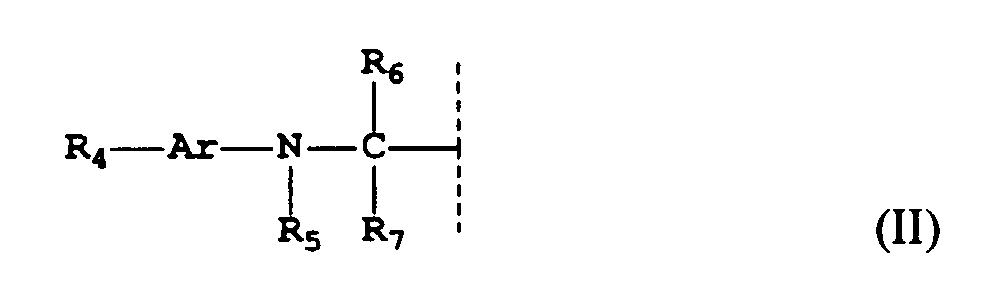 or
or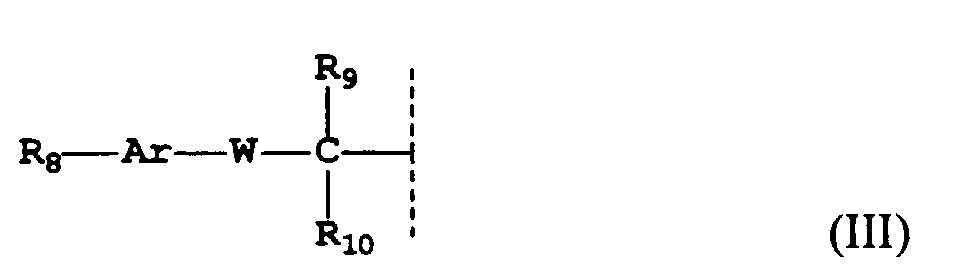 The symbol "R" (that is R without a subscript) is used in all structural formulae in this patent application to represent a hydrogen atom or an unsubstituted or substituted alkyl group.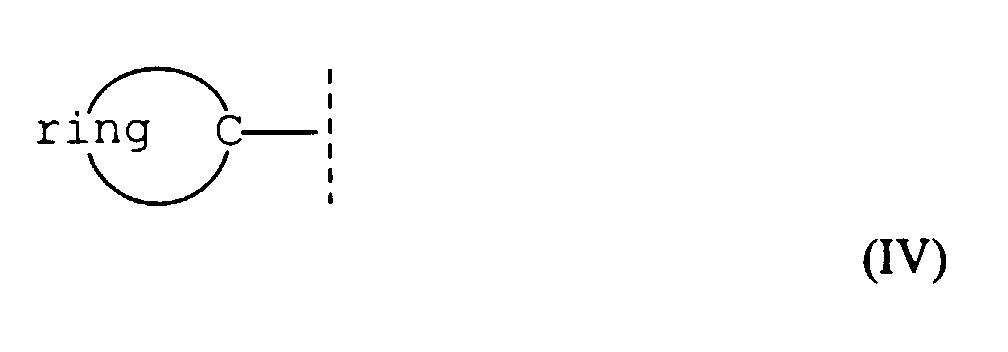
-
- m = 0, 1;
- Z= O,S, Se, Te;
-
- Ar = aryl group (e.g., phenyl, naphthyl, phenanthryl, anthryl); or heterocyclic group (e.g., pyridine, indole, benzimidazole, thiazole, benzothiazole, thiadiazole, etc.);
- R1 = R, carboxyl, amide, sulfonamide, halogen, NR2, (OH)n, (OR')n, or (SR)n;
- R' = alkyl or substituted alkyl;
- n= 1-3;
- R2 = R, Ar';
- R3 = R, Ar';
- R2 and R3 together can form 5- to 8-membered ring;
- R2 and Ar = can be linked to form 5- to 8-membered ring;
- R3 and Ar = can be linked to form 5- to 8-membered ring;
- Ar' = aryl group such as phenyl, substituted phenyl, or heterocyclic group (e.g., pyridine, benzothiazole, etc.)
- R = a hydrogen atom or an unsubstituted or substituted alkyl group.
-
- Ar = aryl group (e.g., phenyl, naphthyl, phenanthryl); or heterocyclic group (e.g., pyridine, benzothiazole, etc.);
- R4 = a substituent having a Hammett sigma value of-1 to +1, preferably -0.7 to +0.7, e.g., R, OR, SR, halogen, CHO, C(O)R, COOR, CONR2, SO3R, SO2NR2, SO2R, SOR, C(S)R, etc;
- R5 = R, Ar'
- R6 and R7 = R, Ar'
- R5 and Ar = can be linked to form 5- to 8-membered ring;
- R6 and Ar = can be linked to form 5- to 8-membered ring (in which case, R6 can be a hetero atom);
- R5 and R6 can be linked to form 5- to 8-membered ring;
- R6 and R7 can be linked to form 5- to 8-membered ring;
- Ar' = aryl group such as phenyl, substituted phenyl, heterocyclic group;
- R = hydrogen atom or an unsubstituted or substituted alkyl group. A discussion on Hammett sigma values can be found in C. Hansch and R. W. Taft Chem. Rev. Vol 91, (1991) p 165.
-
-
- W = O, S, Se;
- Ar = aryl group (e.g., phenyl, naphthyl, phenanthryl, anthryl); or heterocyclic group (e.g., indole, benzimidazole, etc.)
- R8 = R, carboxyl, NR2, (OR)n, or (SR)n (n = 1-3);
- R9 and R10 = R, Ar';
- R9 and Ar = can be linked to form 5- to 8-membered ring;
- Ar' = aryl group such as phenyl substituted phenyl or heterocyclic group;
- R = a hydrogen atom or an unsubstituted or substituted alkyl group.
-
- "ring" represents a substituted or unsubstituted 5-, 6- or 7-membered unsaturated ring, preferably a heterocyclic ring.
- The following are illustrative examples of the group X of the general structure I:
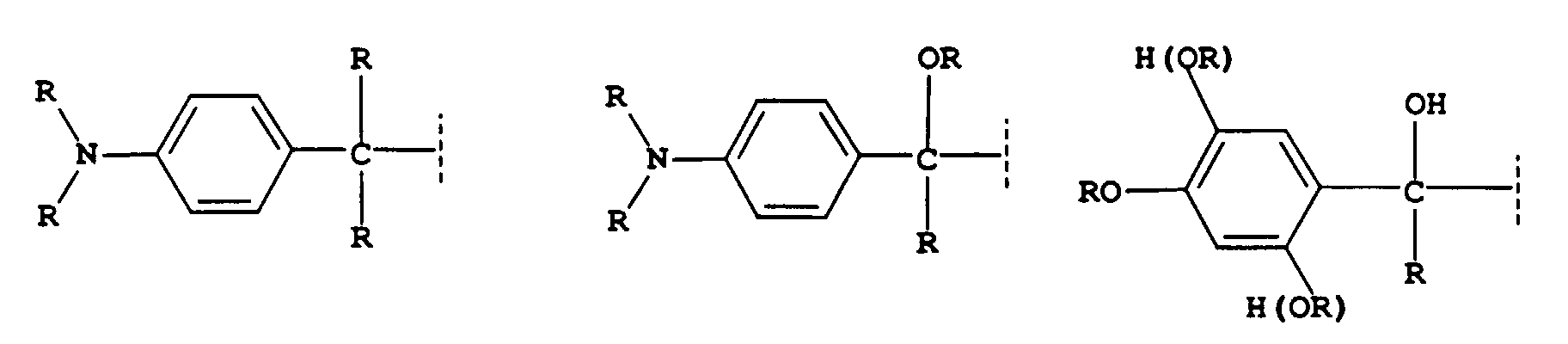

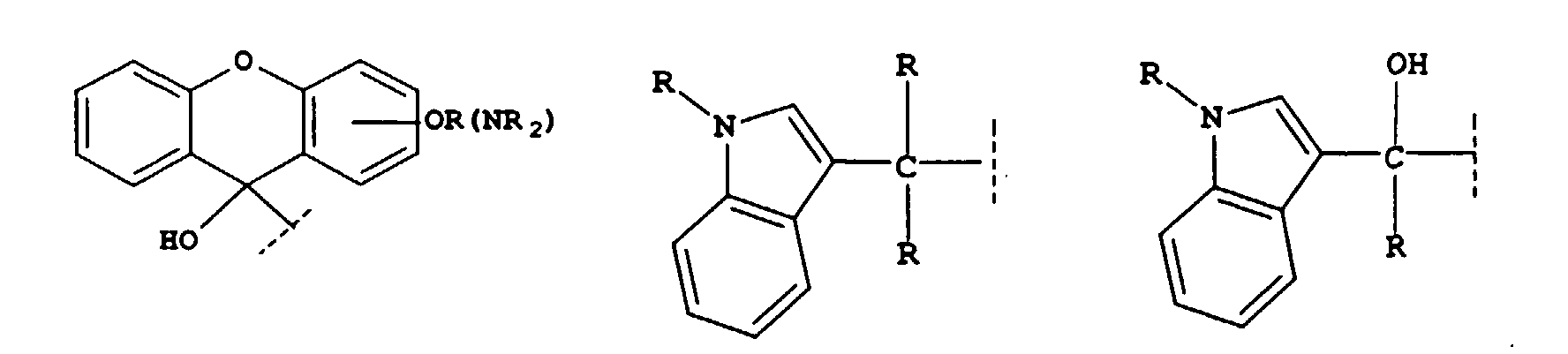
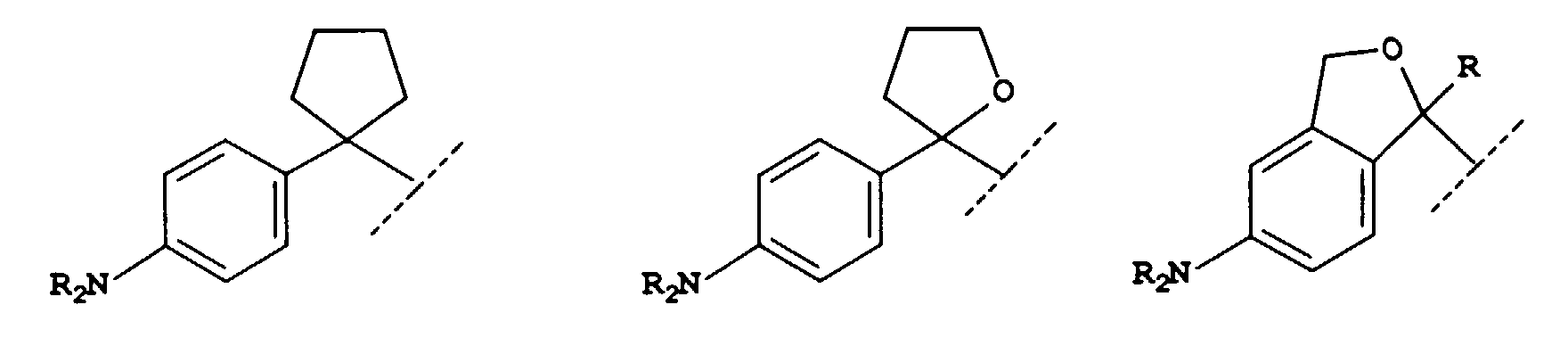
- In the structures of this patent application a designation such as-OR(NR2) indicates that either -OR or -NR2 can be present.
- The following are illustrative examples of the group X of general structure II:


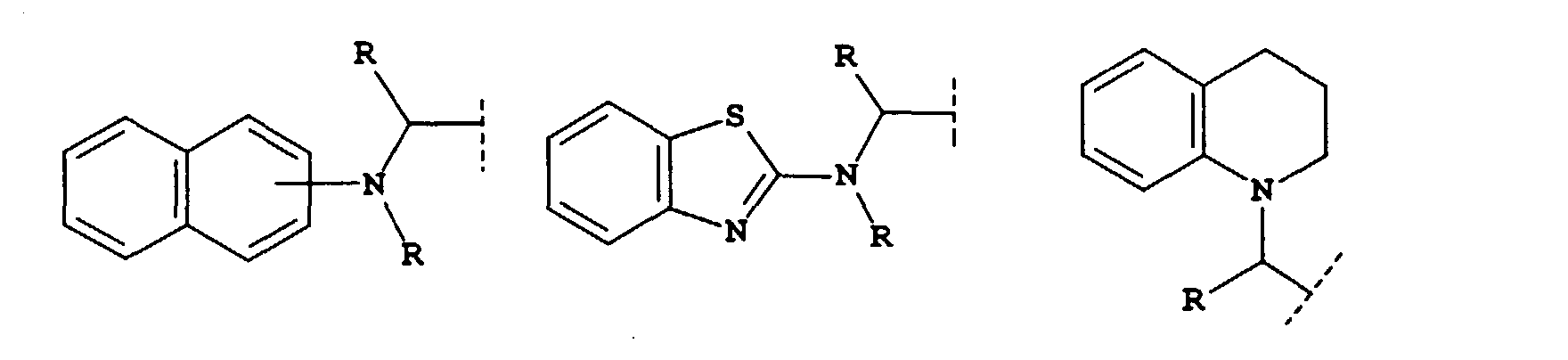 Z1 = a covalent bond, S, O, Se, NR, CR2, CR=CR, or CH2CH2.
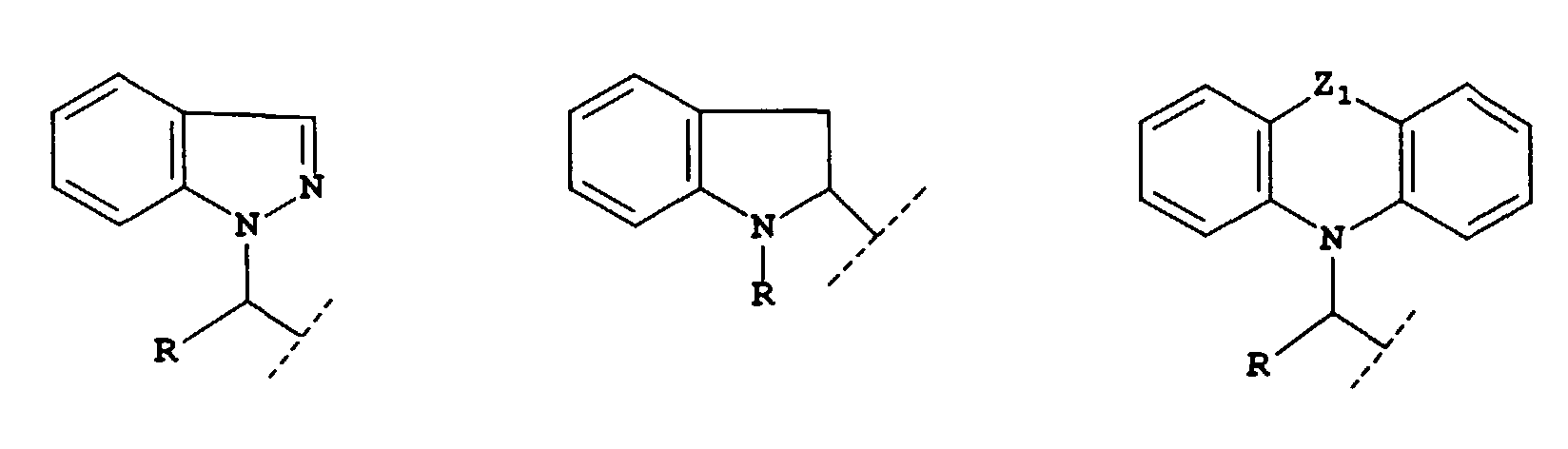 Z2 = S, O, Se, NR, CR2, CR=CR, R13, = alkyl, substituted alkyl or aryl, and
R14 = H, alkyl substituted alkyl or aryl. - The following are illustrative examples of the group X of the general structure III:
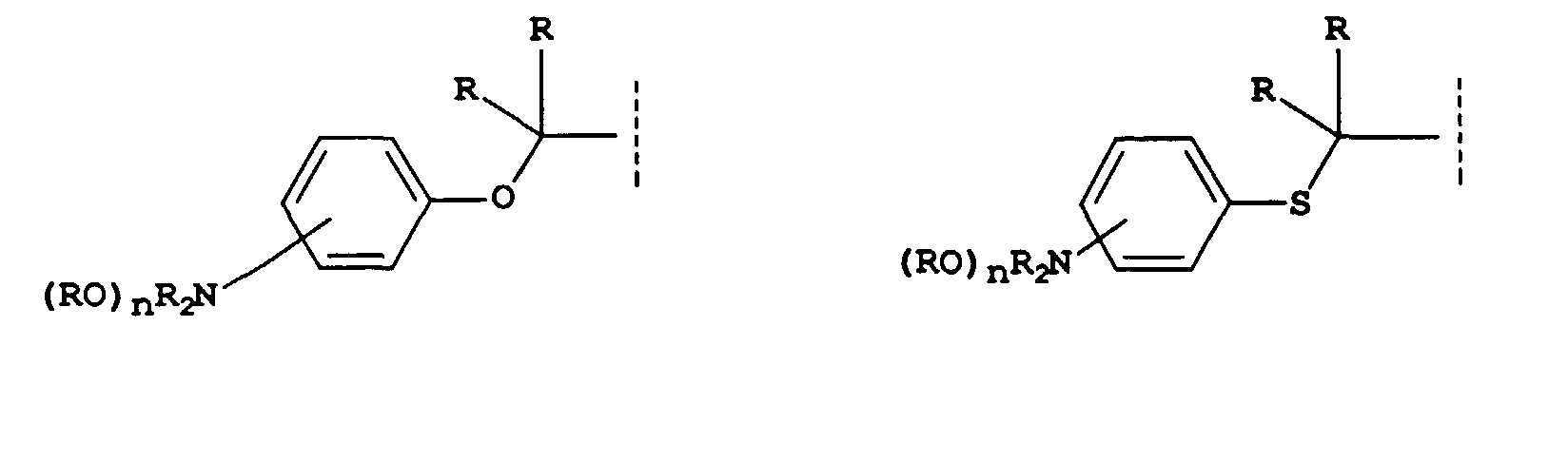 n = 1-3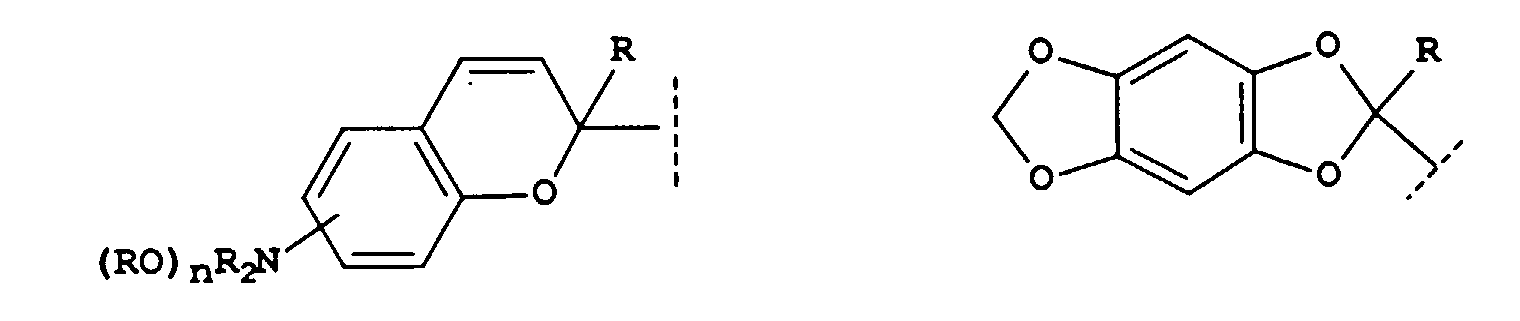
- The following are illustrative examples of the group X of the general structure IV:Z3 = O, S, Se, NR

R15 = R, OR, NR2
R16 = alkyl, substituted alkyl - Preferred Y' groups are:
- (1) X', where X' is an X group as defined in structures I-IV and may be the same as or different from the X group to which it is attached
- (2)

- (3)
where M = Si, Sn or Ge; and R' = alkyl or substituted alkyl
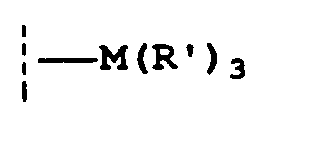
- (4)
where Ar" = aryl or substituted aryl

- (5)
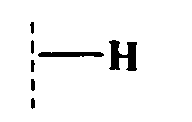
-
- In preferred embodiments of this invention Y' is -H, -COO- or -Si(R')3 or-X'. Particularly preferred Y' groups are -H, -COO- or -Si(R')3.
- In embodiments of the invention in which Y'is a proton, a base, β-, is covalently linked directly or indirectly to X. The base is preferably the conjugate base of an acid of pKa between about 1 and about 8, preferably about 2 to about 7. Collections of pKa values are available (see, for example: Dissociation Constants of Organic Bases in Aqueous Solution, D. D. Perrin (Butterworths, London, 1965); CRC Handbook of Chemistry and Physics, 77th ed, D. R. Lide (CRC Press, Boca Raton, Fl, 1996)). Examples of useful bases are included in Table I.

- Preferably the base, β- is a carboxylate, sulfate or amine oxide.
- In some embodiments of the invention, the fragmentable electron donating compound contains a light absorbing group, Z, which is attached directly or indirectly to X, a silver halide absorptive group, A, directly or indirectly attached to X, or a chromophore forming group, Q, which is attached to X. Such fragmentable electron donating compounds are preferably of the following formulae:
- Z is a light absorbing group;
- k is 1 or 2;
- A is a silver halide adsorptive group that preferably contains at least one atom of
N, S, P, Se, or Te that promotes adsorption to silver halide;
- L represents a linking group containing at least one C, N, S, P or O atom; and
Q represents the atoms necessary to form a chromophore comprising an amidinium-ion, a carboxyl-ion or dipolar-amidic chromophoric system when conjugated with X-Y'. - Z is a light absorbing group including, for example, cyanine dyes, complex cyanine dyes, merocyanine dyes, complex merocyanine dyes, homopolar cyanine dyes, styryl dyes, oxonol dyes, hemioxonol dyes, and hemicyanine dyes.
-
- Preferred Z groups are derived from the following dyes:

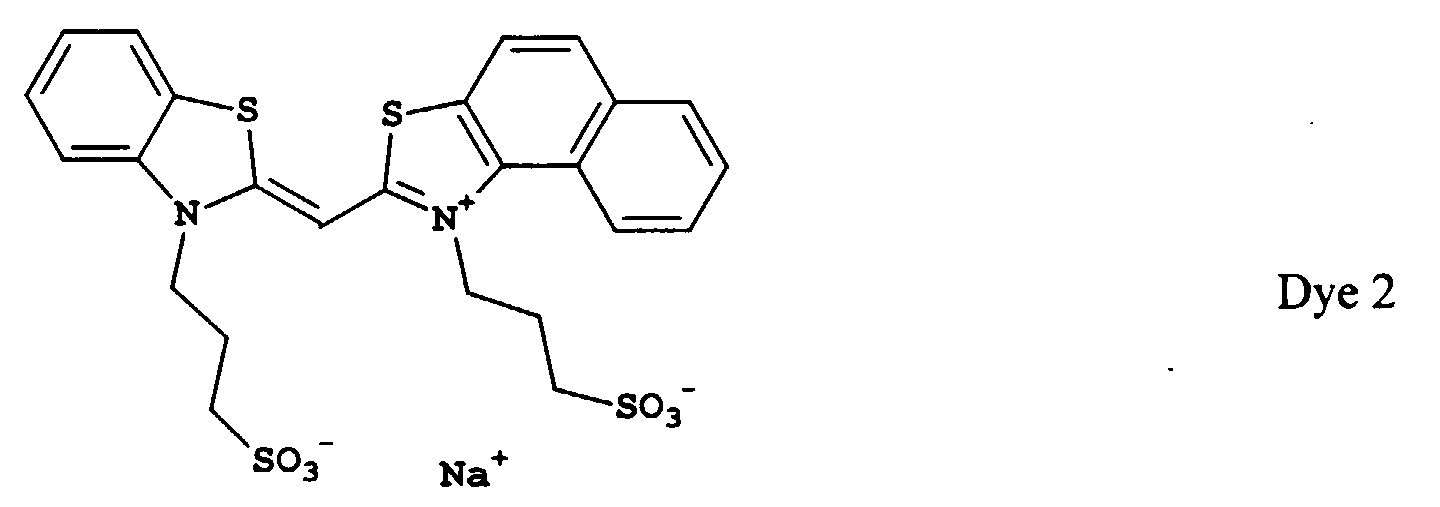


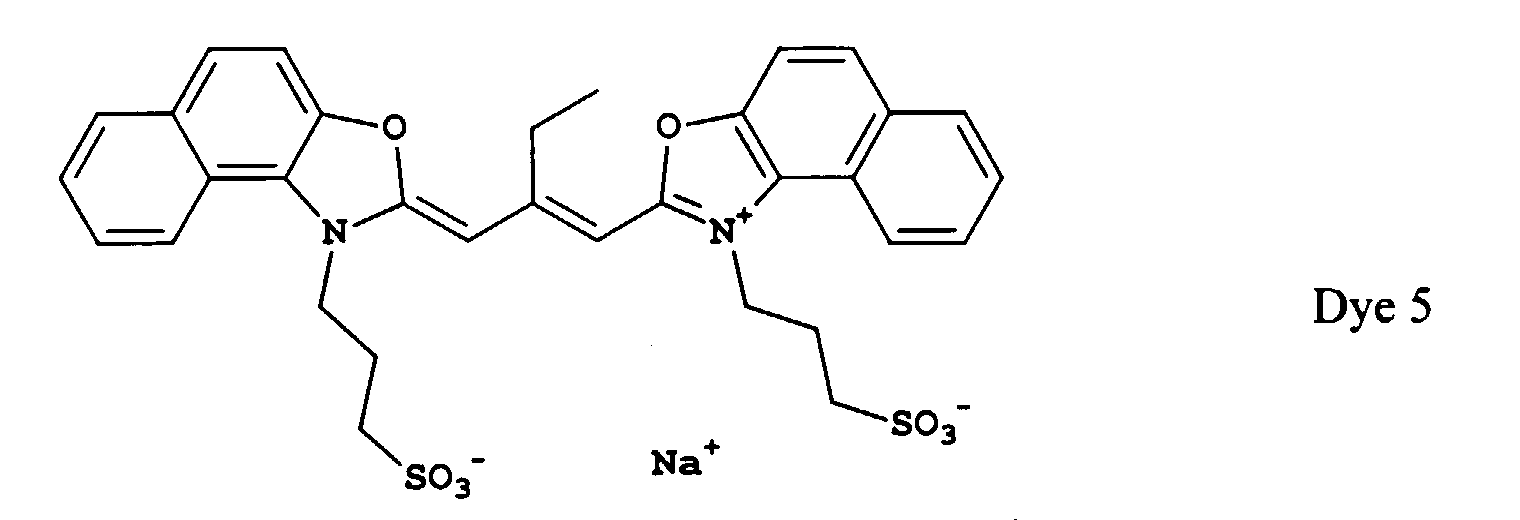
 and
and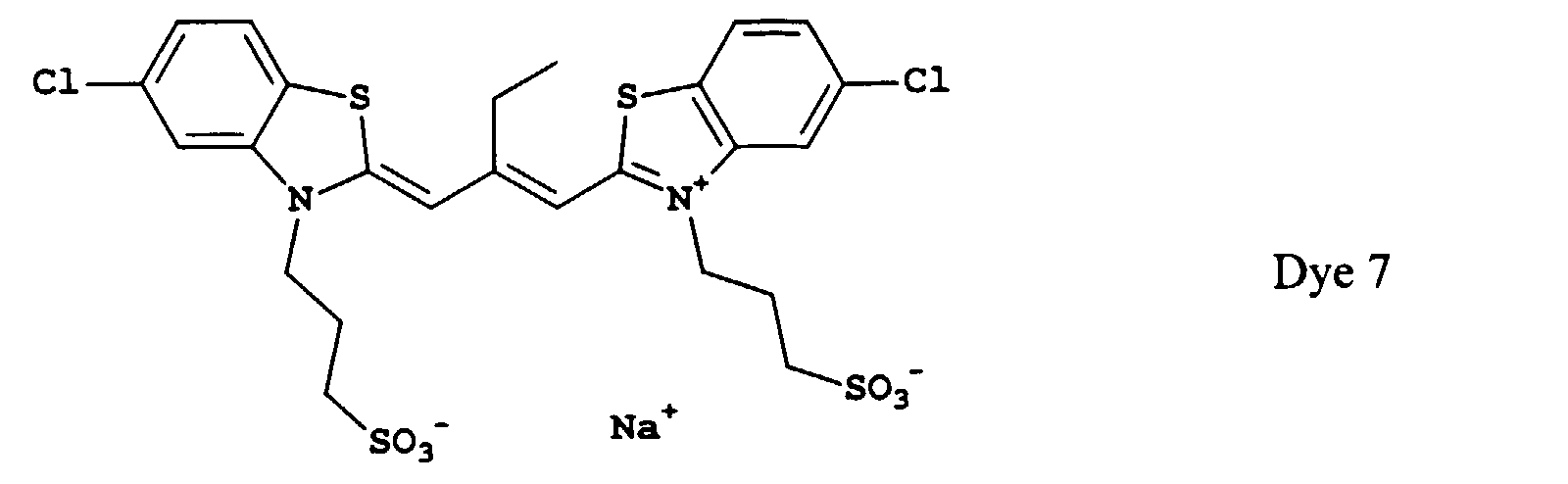

- The linking group L may be attached to the dye at one (or more) of the heteroatoms, at one (or more) of the aromatic or heterocyclic rings, or at one (or more) of the atoms of the polymethine chain, at one (or more) of the heteroatoms, at one (or more) of the aromatic or heterocyclic rings, or at one (or more) of the atoms of the polymethine chain. For simplicity, and because of the multiple possible attachment sites, the attachment of the L group is not specifically indicated in the generic structures.
- The silver halide adsorptive group A is preferably a silver-ion ligand moiety or a cationic surfactant moiety. In preferred embodiments, A is selected from the group consisting of: i) sulfur acids and their Se and Te analogs, ii) nitrogen acids, iii) thioethers and their Se and Te analogs, iv) phosphines, v) thionamides, selenamides, and telluramides, and vi) carbon acids.
- Illustrative A groups include:


- The point of attachment of the linking group L to the silver halide adsorptive group A will vary depending on the structure of the adsorptive group, and may be at one (or more) of the heteroatoms, at one (or more) of the aromatic or heterocyclic rings.
- The linkage group represented by L which connects by a covalent bond the light absorbing group Z or the silver halide adsorbing group A to the fragmentable electron donating group XY is preferably an organic linking group containing a least one C, N, S, or O atom. It is also desired that the linking group not be completely aromatic or unsaturated, so that a pi-conjugation system cannot exist between the Z and XY or the A and XY moieties. Preferred examples of the linkage group include, an alkylene group, an arylene group, -O-, -S-, -C=O, -SO2-, -NH-, -P=O, and -N=. Each of these linking components can be optionally substituted and can be used alone or in combination. Examples of preferred combinations of these groups are:

 where c = 1-3 0, and d = 1-10
- The length of the linkage group can be limited to a single atom or can be much longer, for instance up to 30 atoms in length. A preferred length is from about 2 to 20 atoms, and most preferred is 3 to 10 atoms. Some preferred examples of L can be represented by the general formulae indicated below:

 e and f = 1-30, with the proviso that e + f ≤ 31
- Q represents the atoms necessary to form a chromophore comprising an amidinium-ion, a carboxyl-ion or dipolar-amidic chromophoric system when conjugated with X-Y'. Preferably the chromophoric system is of the type generally found in cyanine, complex cyanine, hemicyanine, merocyanine, and complex merocyanine dyes as described in F. M. Hamer, The Cyanine Dyes and Related Compounds (Interscience Publishers, New York, 1964).
- Illustrative Q groups include:


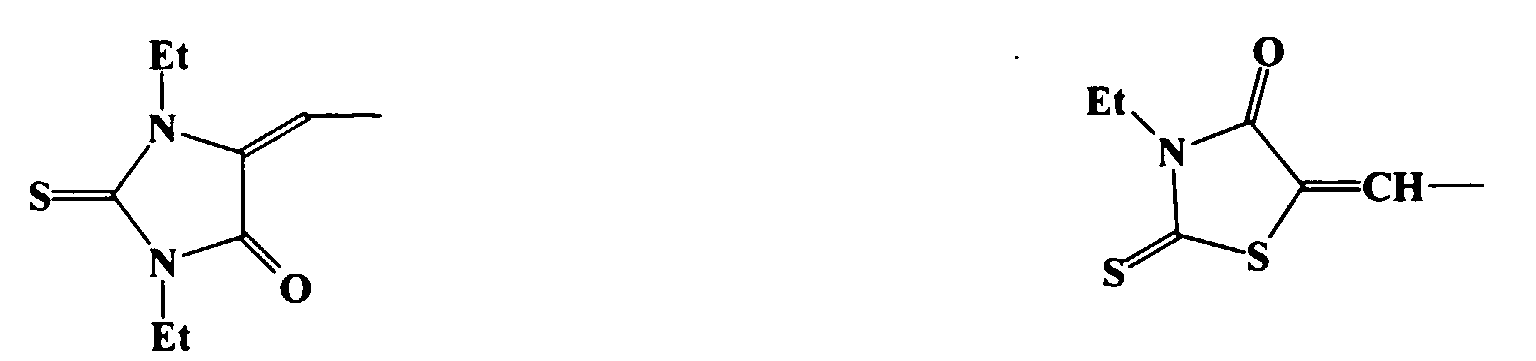
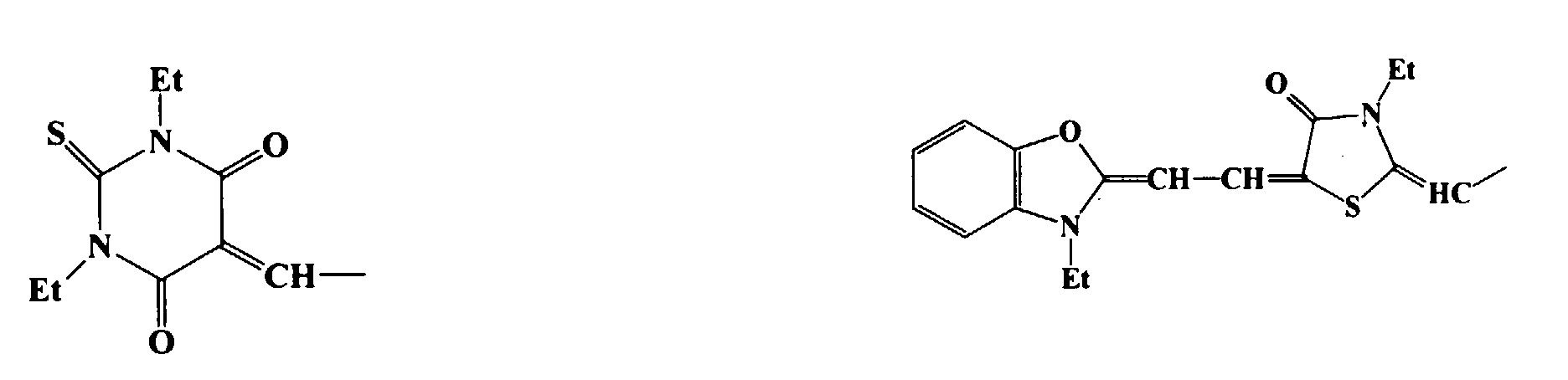
- Particularly preferred are Q groups of the formula:wherein:

- X2 is O, S, N, or C(R19)2, where R19 is substituted or unsubstituted alkyl.
- each R17 is independently a hydrogen atom, a halogen atom, a substituted or unsubstituted alkyl group, or substituted or unsubstituted aryl group;
- a is an integer of 1-4;
and - R18 is substituted or unsubstituted alkyl, or substituted or unsubstituted aryl.
-
- Illustrative fragmentable electron donating compounds include:
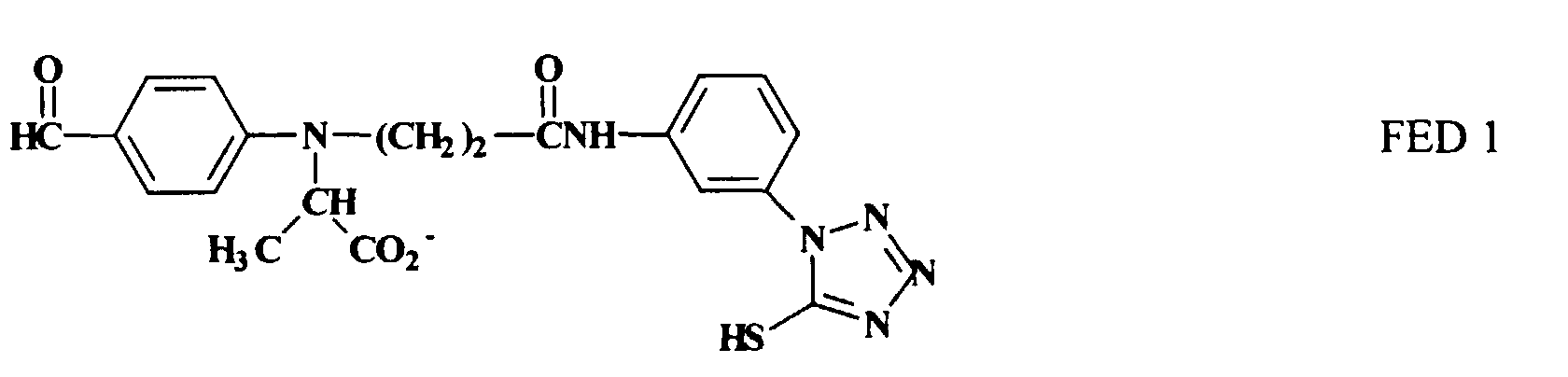
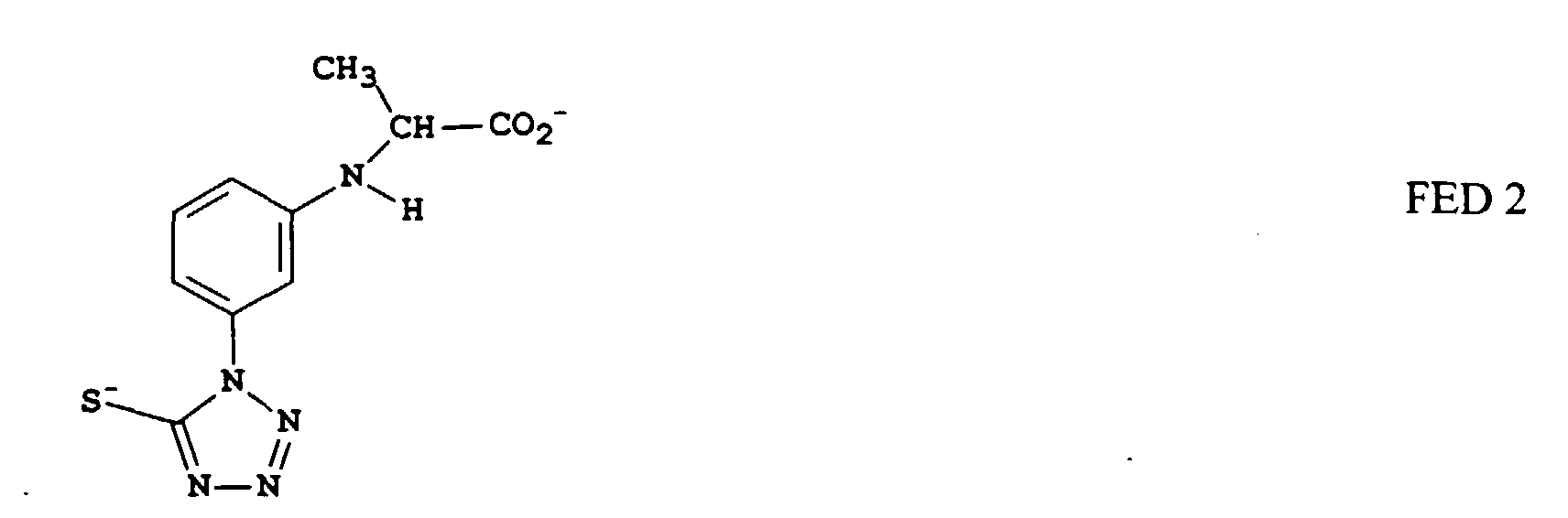


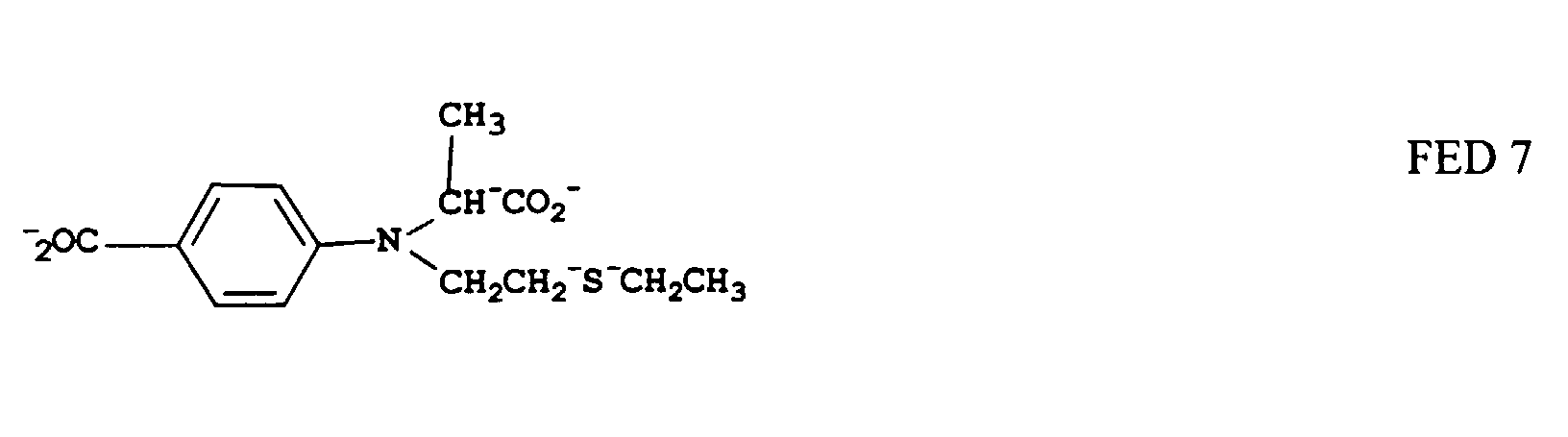
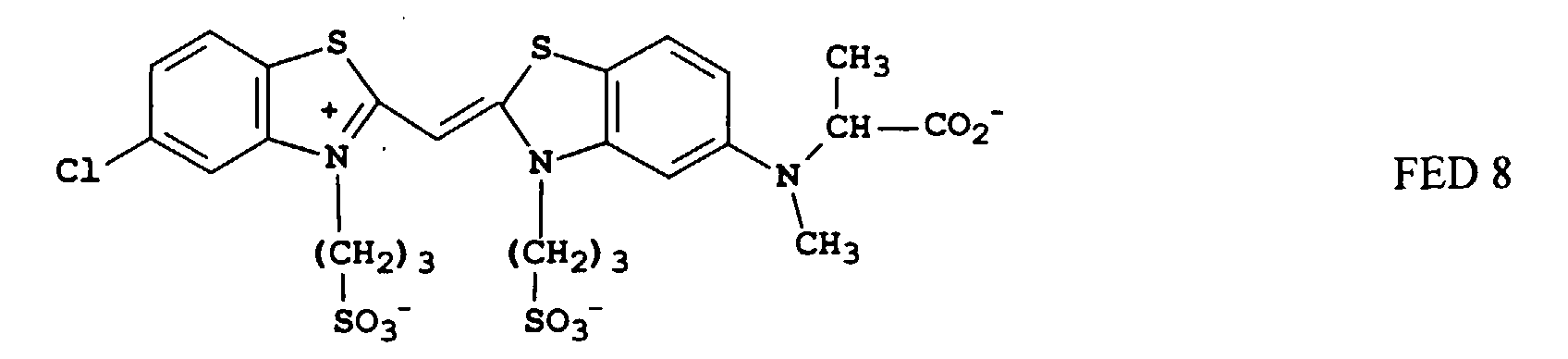

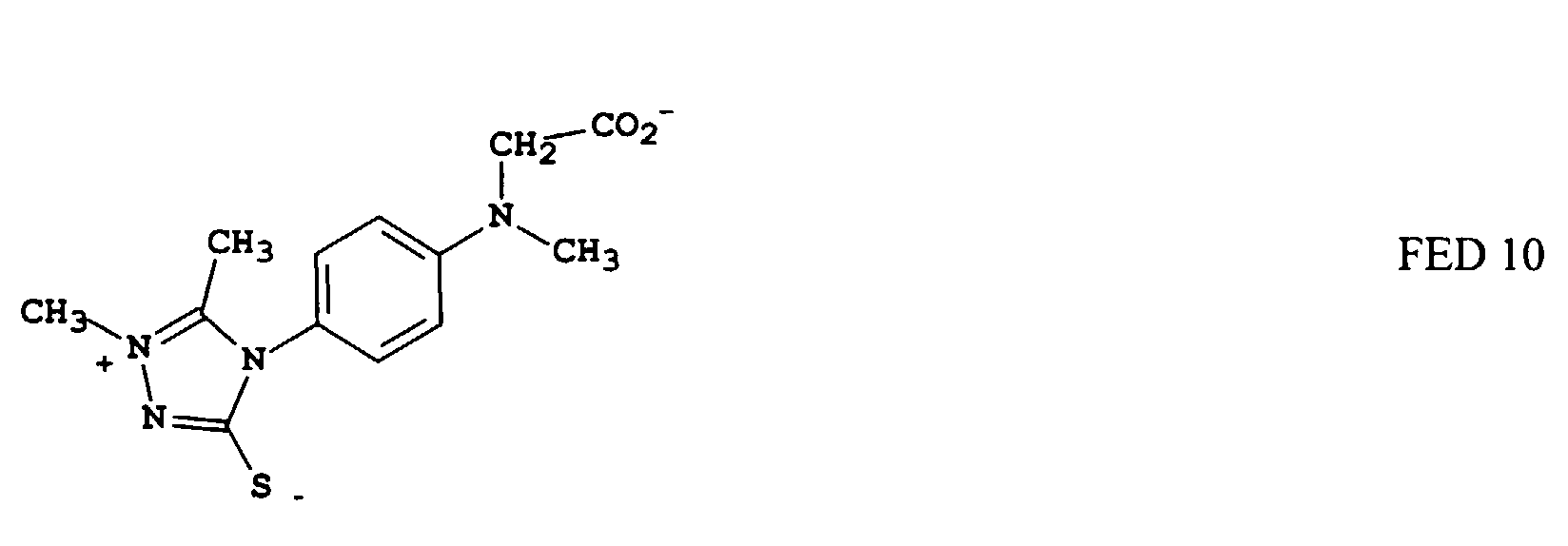


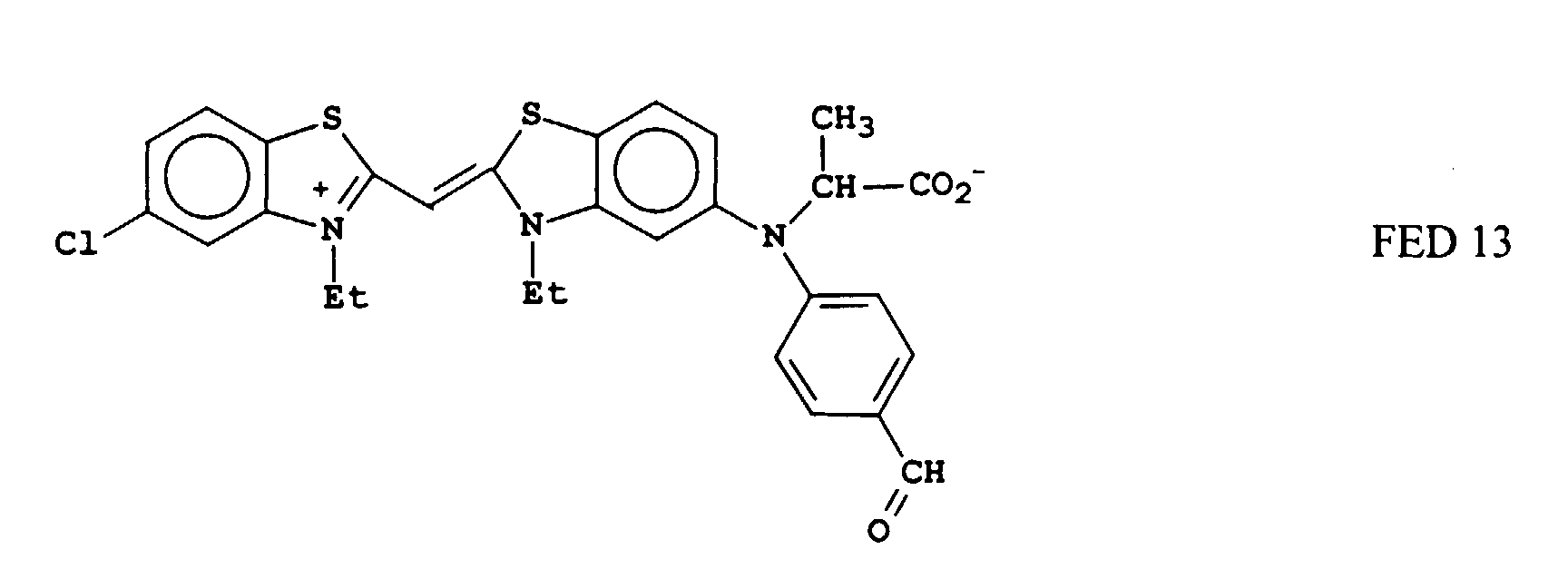
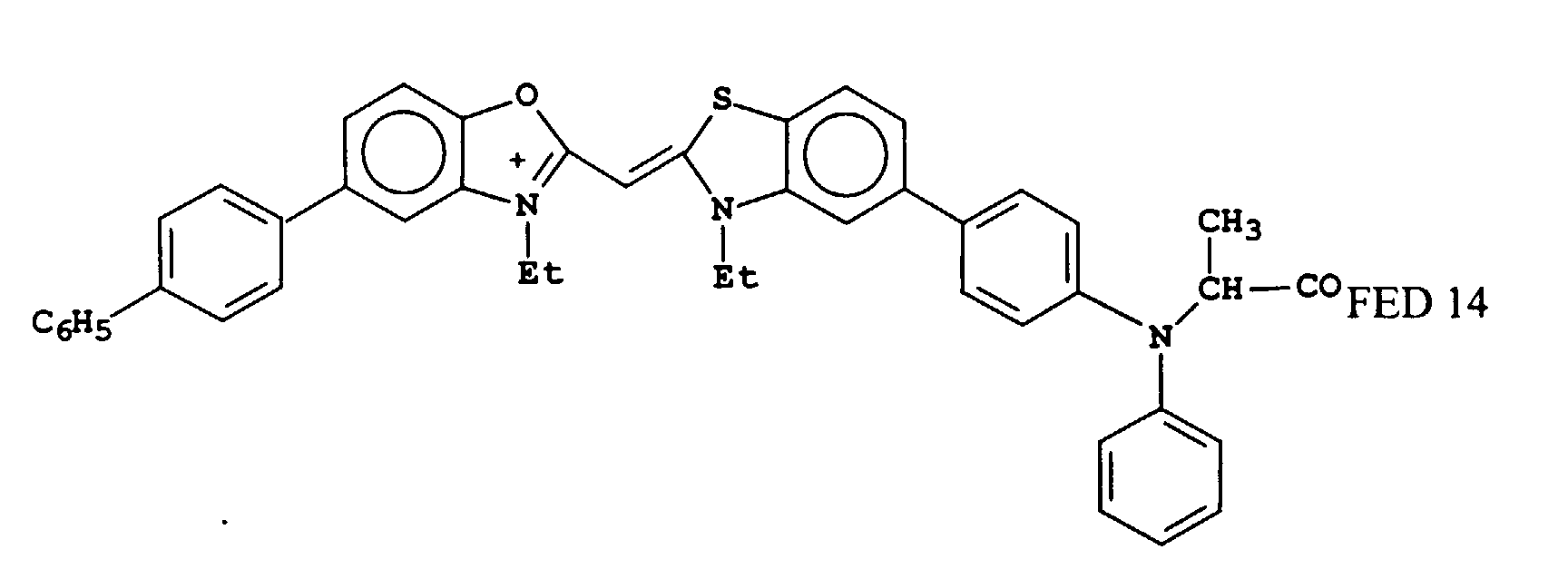
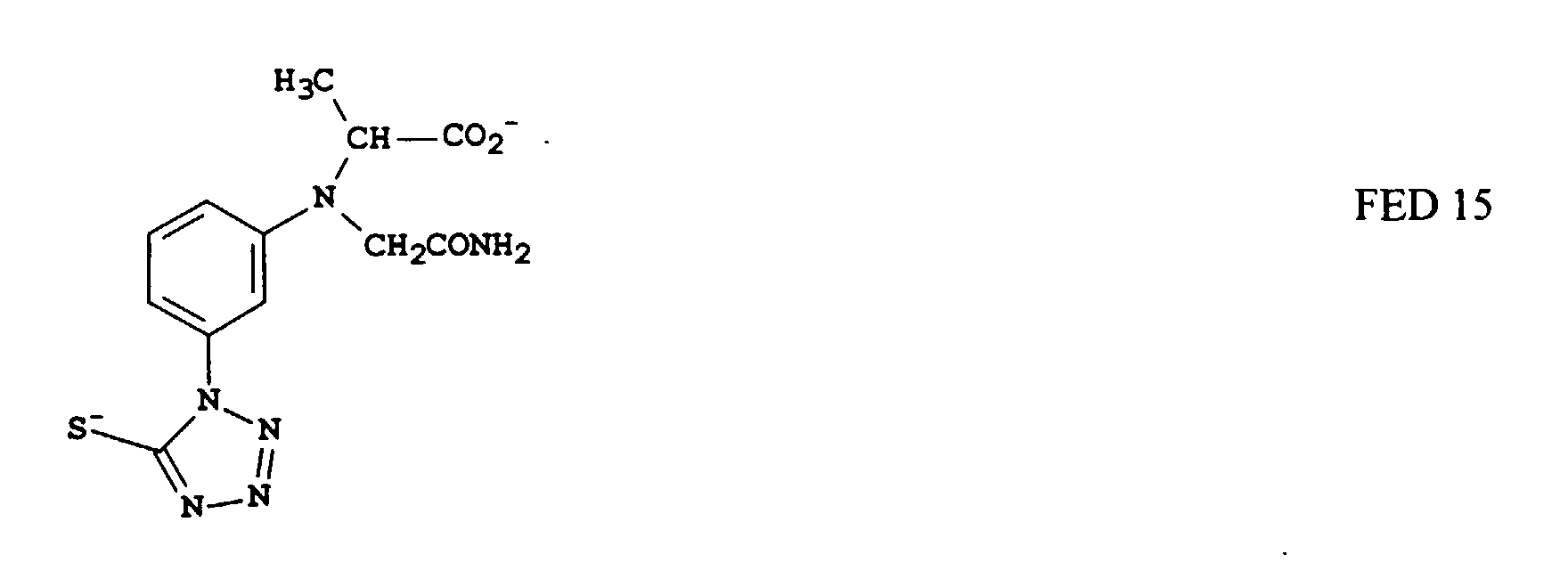
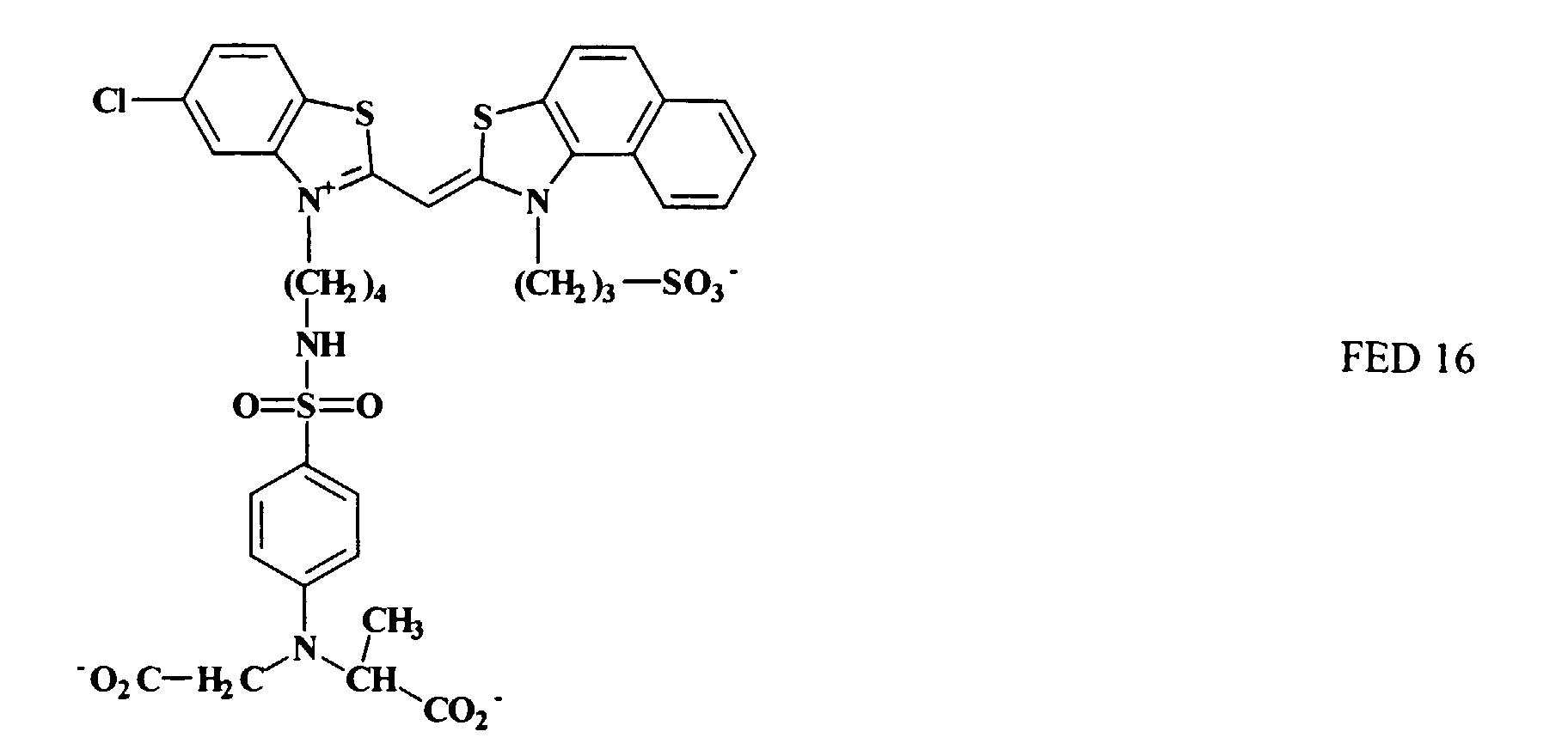
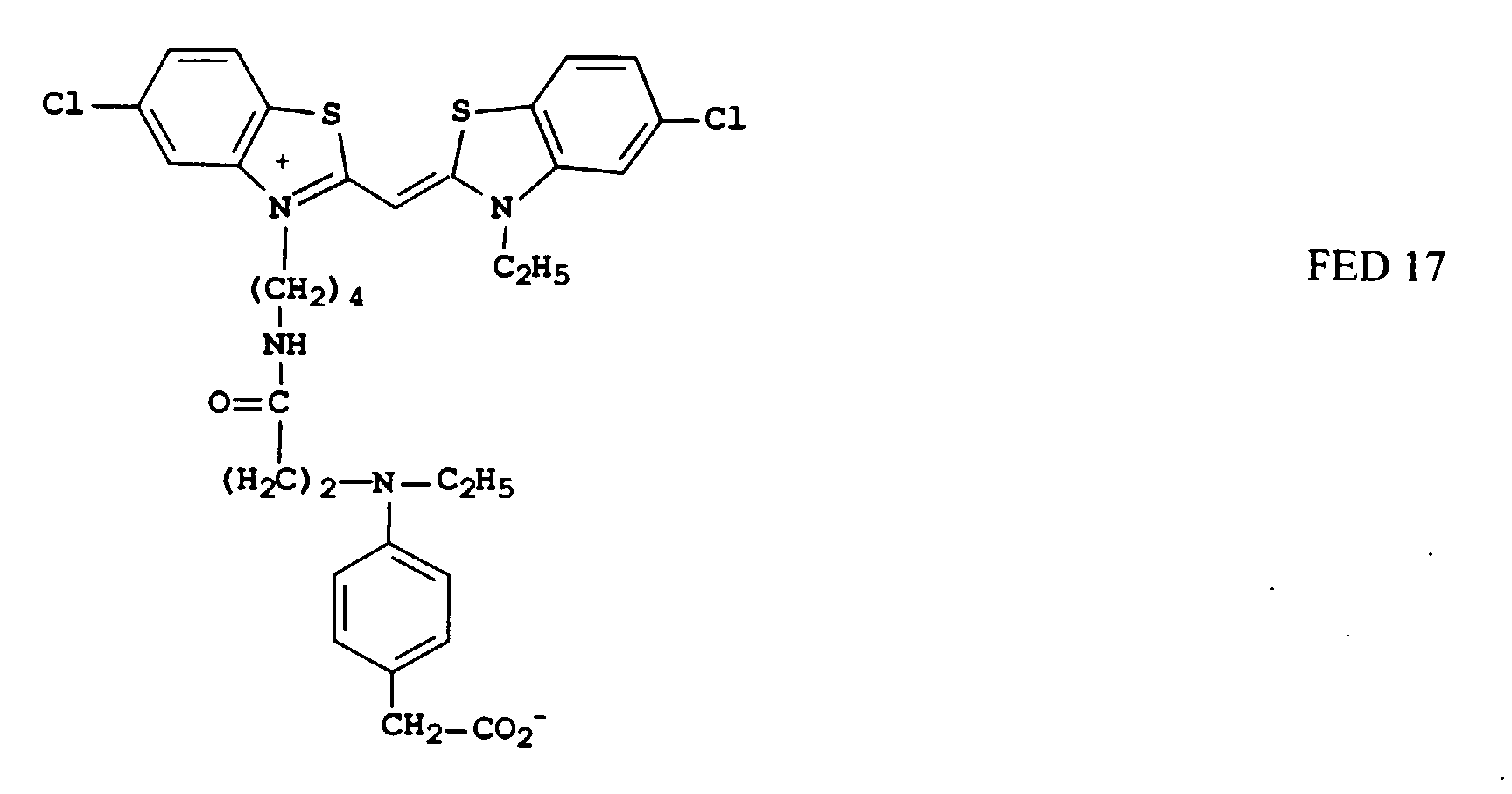
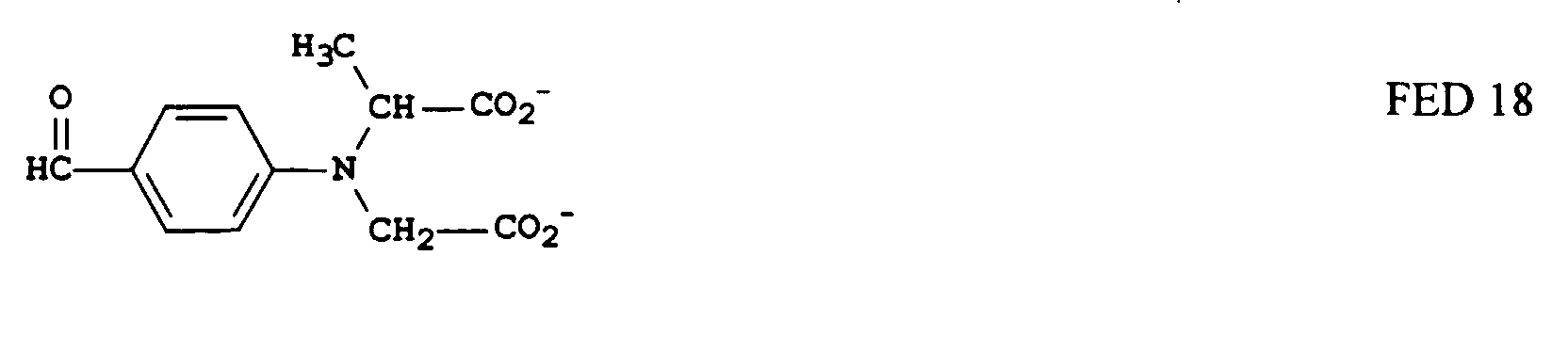
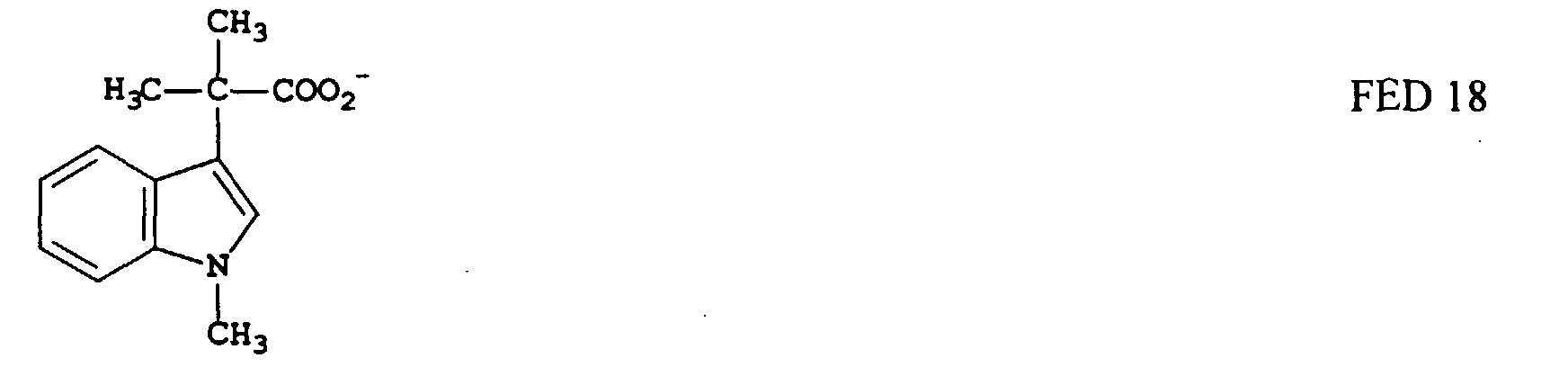
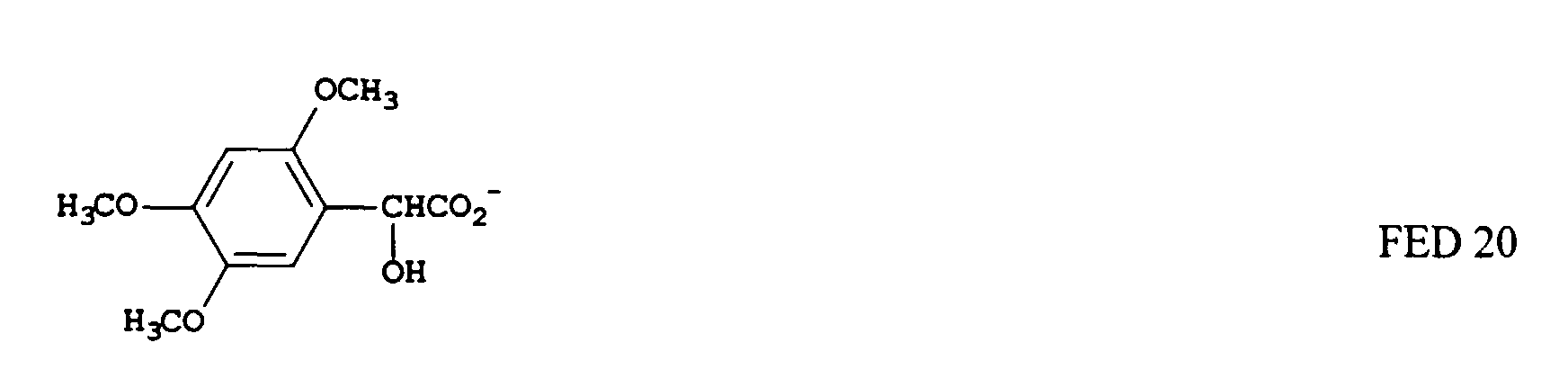
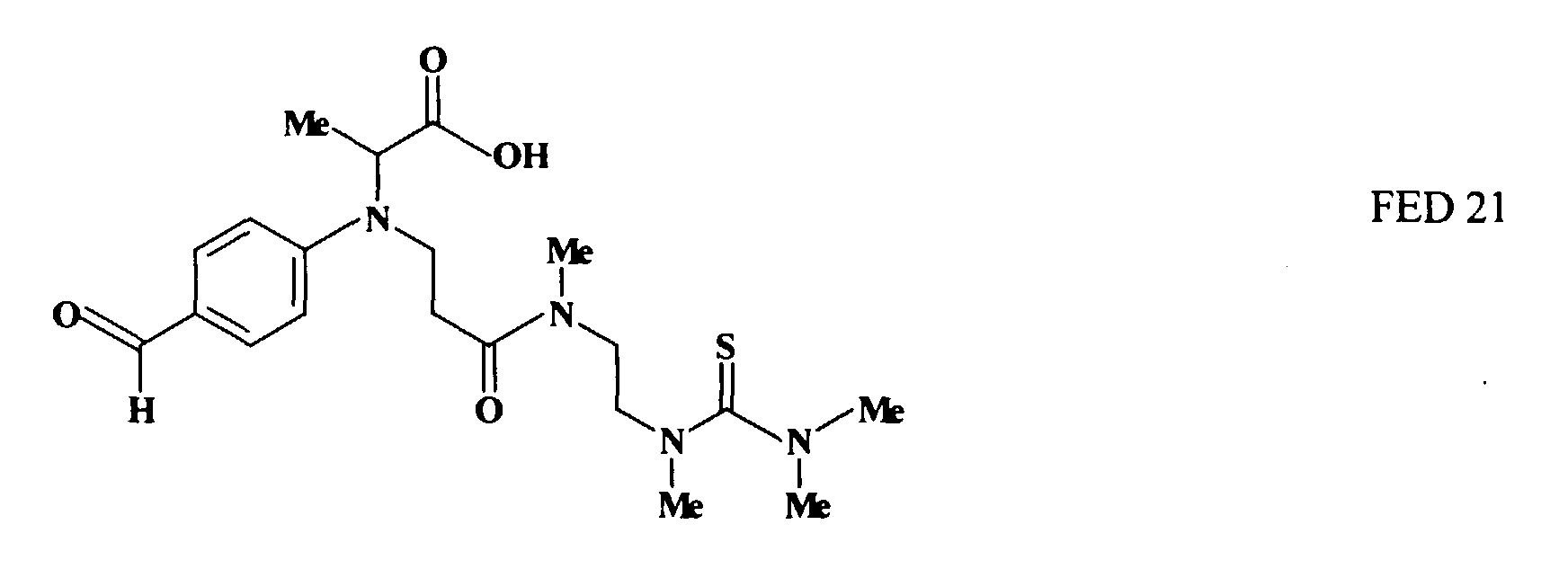
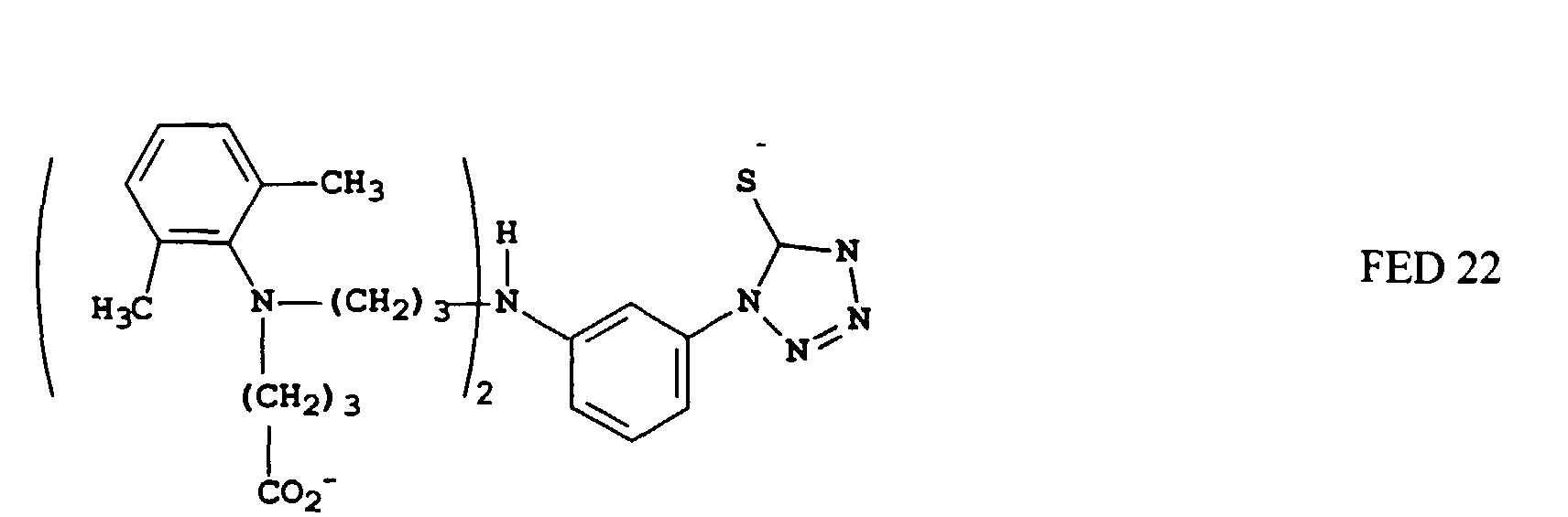
- The fragmentable electron donors of the present invention can be included in a silver halide emulsion by direct dispersion in the emulsion, or they may be dissolved in a solvent such as water, methanol or ethanol for example, or in a mixture of such solvents, and the resulting solution can be added to the emulsion. The compounds of the present invention may also be added from solutions containing a base and/or surfactants, or may be incorporated into aqueous slurries or gelatin dispersions and then added to the emulsion. The fragmentable electron donor may be used as the sole sensitizer in the emulsion. However, in preferred embodiments of the invention a sensitizing dye is also added to the emulsion. The compounds can be added before, during or after the addition of the sensitizing dye. The amount of electron donor which is employed in this invention may range from as little as 1 x 10⁻⁸ mole per mole of silver in the emulsion to as much as about 0.1 mole per mole of silver, preferably from about 5 x 10⁻⁷ to about 0.05 mole per mole of silver. Where the oxidation potential E1 for the XY moiety of the electron donating sensitizer is a relatively low potential, it is more active, and relatively less agent need be employed. Conversely, where the oxidation potential for the XY moiety of the electron donating sensitizer is relatively high, a larger amount thereof, per mole of silver, is employed. In addition, for XY moieties that have silver halide adsorptive groups A or light absorptive groups Z or chromophoric groups Q directly or indirectly attached to X, the fragmentable electron donating sensitizer is more closely associated with the silver halide grain and relatively less agent need be employed. For fragmentable one-electron donors relatively larger amounts per mole of silver are also employed. Although it is preferred that the fragmentable electron donor be added to the silver halide emulsion prior to manufacture of the coating, in certain instances, the electron donor can also be incorporated into the emulsion after exposure by way of a pre-developer bath or by way of the developer bath itself.
- Fragmentable electron donating compounds are described more fully in U.S. Patents Nos. 5,747,235; 5,747,236; 6,010,841; 5,994,051; 6,054,260; and EP 0 893 732.
- The dye image forming layer unit which contains the fragmentable electron donating compound also contains one or more one-equivalent image dye-forming couplers. As herein employed, the term "coupler" is employed in its art recognized sense of denoting a compound that reacts with a quinonediimine derived from an oxidized p-phenylenediamine color developing agent during photographic element development to perform a photographically useful function. A one equivalent image dye-forming coupler can be viewed as a two or four equivalent image dye-forming coupler modified to contain a leaving group that (a) provides the activation for coupling of leaving groups found in two equivalent image dye-forming couplers and (b) contains a dye chromophore capable of contributing to dye image density. In other words, one equivalent image dye-forming couplers can be viewed as being made up of conventional coupling moieties (COUP) of the type found in image dye-forming couplers generally and leaving moieties (LG) that are specifically selected to impart one equivalent coupling.
- The image dye-forming couplers are summarized in Research Disclosure, Item 38957, X. Dye image formers and modifiers, B. Image-dye-forming couplers contain coupling moieties COUP of the type found in the one equivalent image dye-forming couplers contemplated for use in the image dye forming layer units of the photographic elements of this invention. Although many varied forms of COUP moieties are known, most COUP moieties have been synthesized to facilitate formation of image dyes having their main absorption in the red, green, or blue region of the visible spectrum.
- For example, couplers which form cyan dyes upon reaction with oxidized color developing agents are described in such representative patents and publications as: U.S. Patents 2,772,162; 2,895,826; 3,002,836; 3,034,892; 2,474,293; 2,423,730; 2,367,531; 3,041,236; 4,333,999; and "Farbkuppler: Eine Literaturubersicht," published in Agfa Mitteilungen, Band III, pp. 156-175 (1961). In the coupler moiety COUP structures shown below, the unsatisfied bond indicates the coupling position to which the leaving moiety LG is attached.
- Preferably such cyan dye-forming couplers are phenols and naphthols which form cyan dyes on reaction with oxidized color developing agent at the coupling position, i.e. the carbon atom in the 4-position of the phenol or naphthol. Preferred COUP moieties of the type found in cyan dye-forming couplers are:

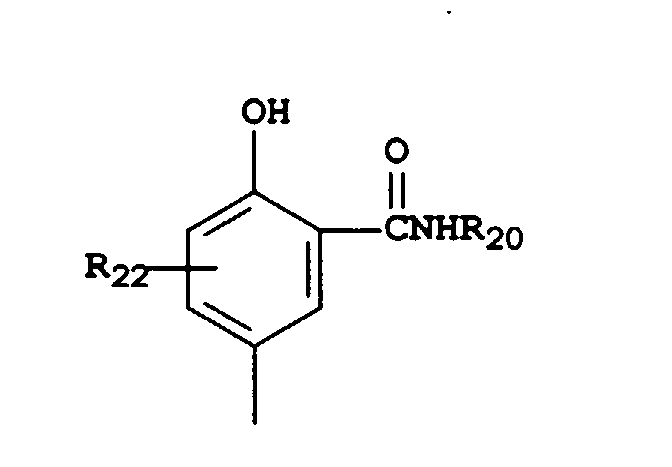
 and
and wherein R20 and R21 can represent a ballast group or a substituted or unsubstituted alkyl or aryl group, and R22 represents one or more halogen (e.g. chloro, fluoro), alkyl having from 1 to 4 carbon atoms or alkoxy having from 1 to 4 carbon atoms.
- Couplers which form magenta dyes upon reaction with oxidized color developing agent are described in such representative patents and publications as: U.S. Patents 2,600,788; 2,369,489; 2,343,703; 2,311,082; 3,824,250; 3,615,502; 4,076,533; 3,152,896; 3,519,429; 3, 062,653; 2,908,573; 4,540,654; and "Farbkuppler: Eine Literaturubersicht," published in Agfa Mitteilungen, Band III, pp. 126-156 (1961).
- Preferably such magenta dye-forming couplers are pyrazolones and pyrazolotriazoles which form magenta dyes upon reaction with oxidized color developing agents at the coupling position--i.e., the carbon atom in the 4-position for pyrazolones and the 7-position for pyrazolotriazoles. Preferred COUP moieties of the type found in magenta dye-forming couplers are:

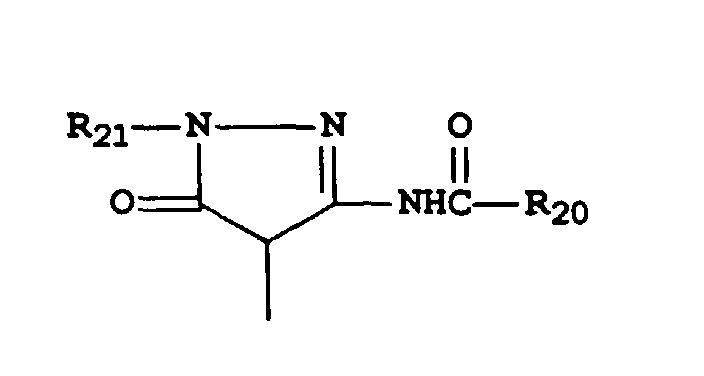
 and
and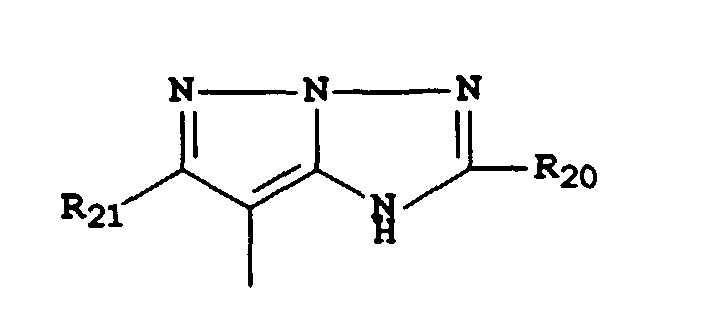 wherein R20 and R21 are as defined above. R21 for pyrazolone structures is typically phenyl or substituted phenyl, such as, for example, 2,4,6-trihalophenyl, and for the pyrazolotriazole structures R21 is typically alkyl or aryl.
- Couplers which form yellow dyes upon reaction with oxidized color developing agent are described in such representative patents and publications as: U.S. Patents 2,875,057; 2,407,210; 3,265,506; 2,298,443; 3,048,194; 3, 447,928; and "Farbkuppler: Eine Literaturubersicht," published in Agfa Mitteilungen, Band III, pp. 112-126 (1961).
- Preferably such yellow dye-forming couplers are acylacetamides, such as benzoylacetanilides and pivalylacetanilides. These couplers react with oxidized developer at the coupling position--i.e., the active methylene carbon atom. Preferred COUP moieties of the type found in yellow dye-forming couplers are:and
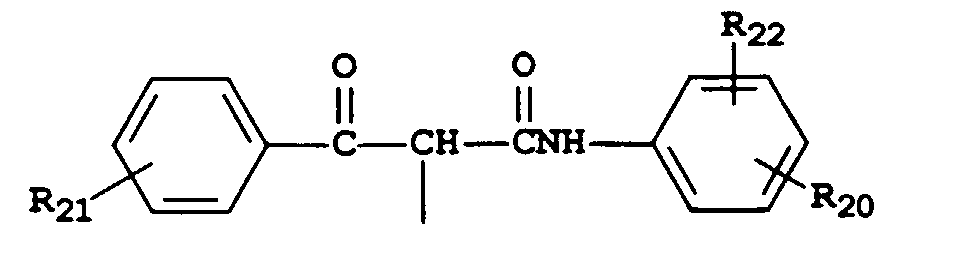 wherein R20 and R21 are as defined above and can also be hydrogen, alkoxy, alkoxycarbonyl, alkanesulfonyl, arenesulfonyl, aryloxycarbonyl, carbonamido, carbamoyl, sulfonamido, or sulfamoyl, and R22 is hydrogen or one or more halogen, lower alkyl (e.g. methyl, ethyl), lower alkoxy (e.g., methoxy, ethoxy), or a ballast (e.g. alkoxy of 16 to 20 carbon atoms) group.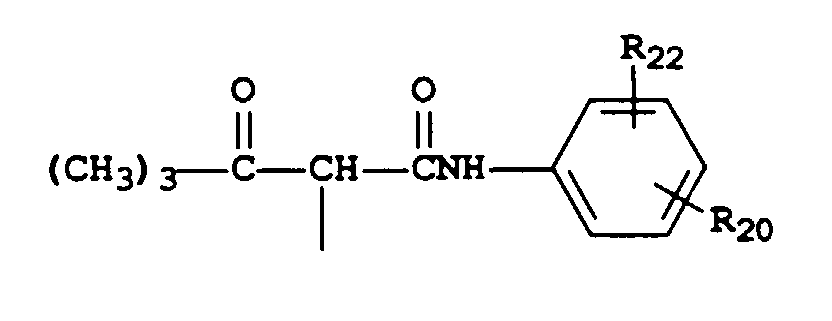
- Other preferred COUP moieties of the type found in yellow dye-forming couplers are of the formula:or
 wherein: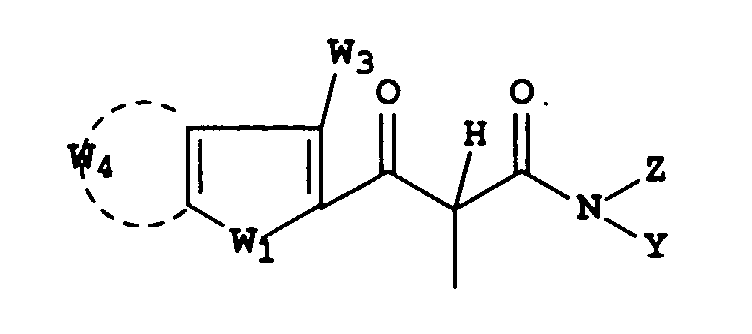
- W1 is a heteroatom or heterogroup, preferably -NR-, -O-, -S-, -SO2-;
- W2 is H, or a substituent group, such as an alkyl or aryl group;
- W3 isH, or a substituent group, such as an alkyl or aryl group;
- W4 represents the atoms necessary to form a fused ring with the ring containing W1, preferably a benzo group;
- Y and Z are independently H or a substituent group, preferably Y is H and Z is a substituted phenyl group.
-
- Other preferred COUP moieties of the type found in yellow dye-forming couplers are of the formula:or
 wherein Y and Z are as defined above.
- The leaving group LG differs from the leaving groups of two equivalent image dye-forming couplers in that LG itself contains a dye chromophore. If the dye chromophore of LG exhibits the same hue before and after separation from COUP, it does not contribute to forming a dye image, but simply increases dye density uniformly in all image areas. To obtain a desired image dye light absorption when LG is released from COUP while avoiding unwanted light absorption by the dye chromophore in LG when LG remains attached to COUP, conventional LG constructions are chosen to produce a bathochromic shift of light absorption in released LG as compared to COUP attached LG. For example, assuming that a yellow (blue light absorbing) dye image is sought, LG can be constructed to contain an ultraviolet absorbing dye chromophore when attached to COUP, and release from COUP can result in shifting absorption bathochromically into the blue region of the spectrum, thereby changing the perceived hue of the LG incorporated dye from essentially colorless to yellow. With LG constructions permitting longer wavelength bathochromic shifts, the LG hue can shift from essentially colorless (UV absorbing) to green or even red. For green and red absorbing dyes in released LG, it is recognized that initial (COUP attached) LG absorption may, depending upon the construction chosen, extend into the visible region of the spectrum. This initially visible absorption is lost when LG is released. The loss of light absorption in a selected region of the visible spectrum as a result of a coupling reaction is a property also exhibited by conventional masking couplers, commonly used in color negative films for color correction. Thus, it is possible to choose the initial absorption of LG as attached to COUP so that the absorption shift on release performs the function of a masking coupler.
- LG can take the form of any conventional one equivalent coupler leaving group. One equivalent couplers having leaving groups suitable for use in the image forming layer units of the photographic elements of the invention are described in Lau U.S. Patent 4,248,962 and Mooberry et al U.S. Patents 4,840,884, 5,447,819 and 5,457,004. The one equivalent image dye-forming couplers of Mooberry et al are preferred, since they do not require mordanting on release to retain their desired hue. Viewed another way, the Mooberry et al one equivalent image dye-forming couplers can contain release dyes that are charge neutral.
- Preferred one equivalent image dye-forming couplers include the following components:
- COUP is the coupler moiety described above, and the structure to the right of COUP forms L'G.
- DYE is an image dye or image dye precursor and can include an auxochrome associated with the dye, where an auxochrome is a group that increases dye absorption intensity.
- L'n-B' is a linking group that is at least divalent. n is zero or 1. The COUP bond and the B'-N(R23) bond are both cleaved under conditions permitting coupling off to occur. Cleaving the B'-N(R23) bond bathochromically shifts the hue of the DYE.
- B' can be chosen from among -OC(O)-, -OC(S)-, -SC(O)-, -SC(S)- or -OC(=NSO2R24)-, where R24 is a substituted or unsubstituted alkyl or aryl group. B' in the form of -OC(=NSO2R24)- and -OC(O)-, particularly the latter, is preferred to maintain the lowest possible densities in unexposed areas.
- N(R23) either forms a part of the auxochrome or chromophore of DYE. Illustrative groups in which - N(R23)- forms a part of an auxochrome are as follows:
- The nitrogen atom in -NR23- is optionally located in an auxochrome, that is a group that intensifies the color of the dye, or it is optionally an integral part of the dye chromophore.
- Illustrative groups wherein -NR23- is part of auxochrome are as follows:
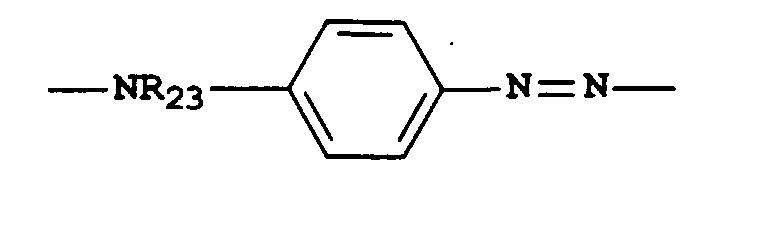
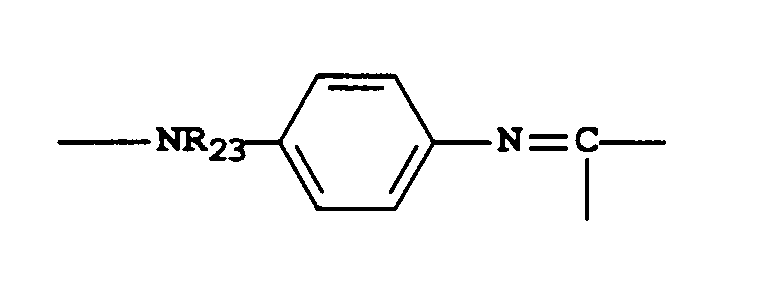
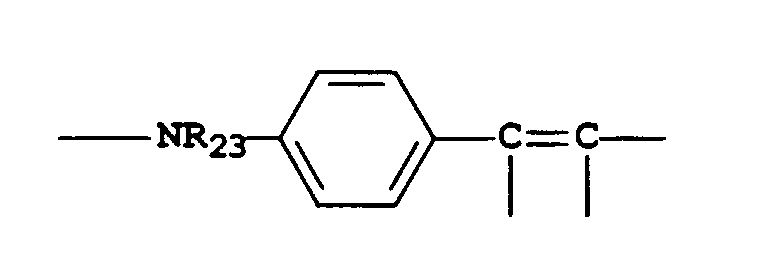
- Illustrative groups in which - N(R23)- forms a part of a dye chromophore are as follows:

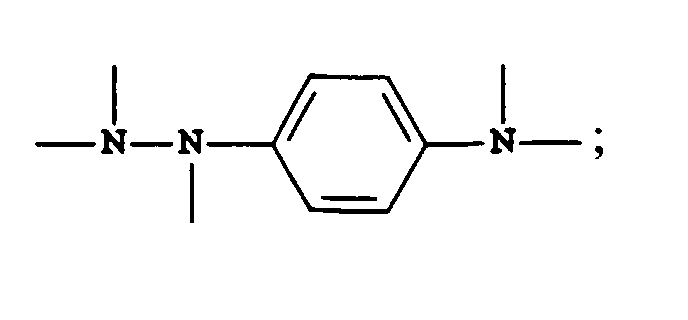


- The particular linking group L'n-B' can be varied to help control such parameters as rate and time of release of the -NR23- DYE group. The particular linking group L'n-B' employed, including the nature of the substituents on L'n-B', can additionally control the rate and distance of diffusion of the unit formed by the group L'n-B', the -NR23- group and the DYE after this unit is released from the coupler moiety but before the -NR23- DYE is released. The linking group L'n-B' preferably causes a spectral shift in absorption of DYE as a function of attachment to -NR23-. Also, the linking group L'n-B' preferably stabilizes the DYE to oxidation, particularly wherein the -NR23- is part of the chromophore.
- The coupler moiety COUP can be any moiety which will react with oxidized color developing agent to cleave the bond between the linking group and the coupler moiety. It includes coupler moieties employed in conventional color-forming couplers which yield colorless products on reaction with oxidized color developing agents as well as coupler moieties which yield colored products on reaction with oxidized color developing agents. Both types of coupler moieties are well known to those skilled in the art.
- The coupler moiety can be unballasted or ballasted with an oil-soluble or fat-tail group. It can be monomeric, or it can form part of a dimeric, oligomeric or polymeric coupler, in which case more than one - L'n-B' -NR23- DYE unit can be contained in the coupler.
- It will be appreciated that, depending upon the particular coupler moiety, the particular color developing agent and the type of processing, the reaction product of the coupler moiety and oxidized color developing agent can be: (1) colored and nondiffusible, in which case it will remain in the location where it is formed; (2) colored and diffusible, in which case it may be removed during processing from the location where it is formed or allowed to migrate to a different location; or (3) colorless.
- The - L'n-B' -NR23- DYE unit is joined to the coupler moiety at any of the positions from which groups released from couplers by reaction with oxidized color developing agent can be attached. The - L'n-B' -NR23- DYE unit is attached at the coupling position of the coupler moiety so that upon reaction of the coupler with oxidized color developing agent the - L'n-B' -NR23- DYE will be displaced.
- The linking group L'n-B' can be any organic group which will serve to connect COUP to the -NR23- group and which, after cleavage from COUP will cleave from the -NR23- group, for example by an elimination reaction of the type described in, for example, U.S. Pat. No. 4,409,323. The elimination reaction involves electron transfer down a conjugated chain. As used herein the term "electron transfer down a conjugated chain " is understood to refer to transfer of an electron along a chain of atoms in which alternate single bonds and double bonds occur. A conjugated chain is understood to have the same meaning as commonly used in organic chemistry. Electron transfer down a conjugated chain is as described in, for example, U.S. Pat. No. 4,409,323.
- The group L'n-B' can contain moieties and substituents which will permit control of one or more of the following rates: (i) the rate of reaction of COUP with oxidized color developing agent, (ii) the rate of diffusion of - L'n-B' -NR23- DYE and (iii) the rate of release of DYE. The linking group L'n-B' can contain additional substituents or precursors thereof which may remain attached to the linking group or be released.
- Illustrative linking groups include:


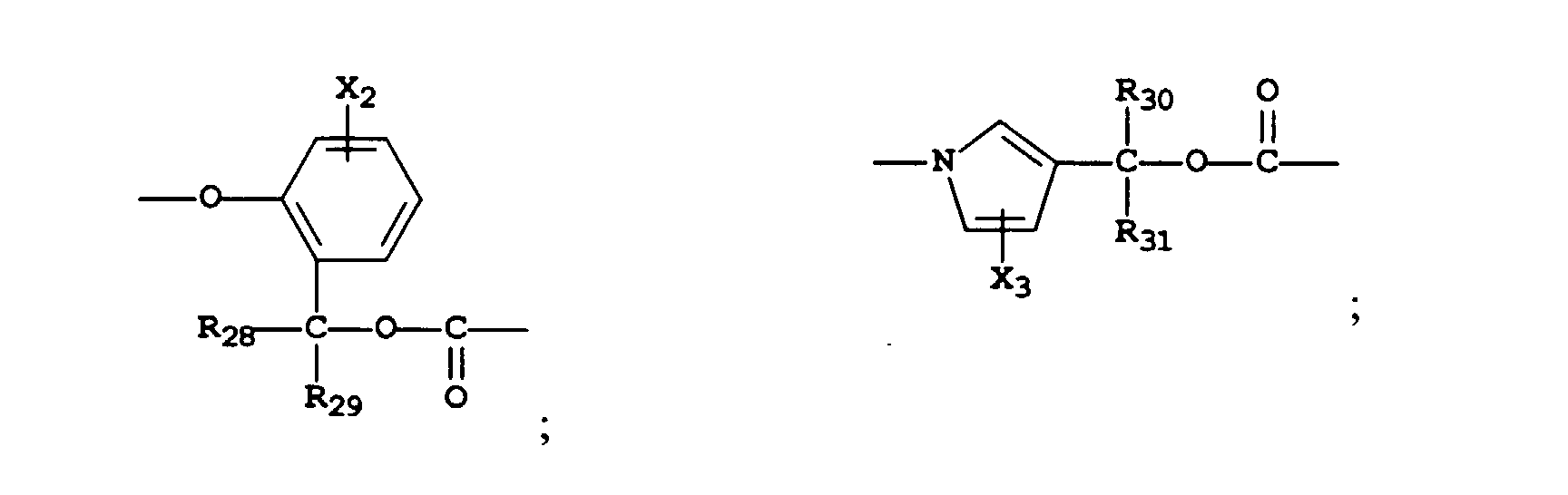
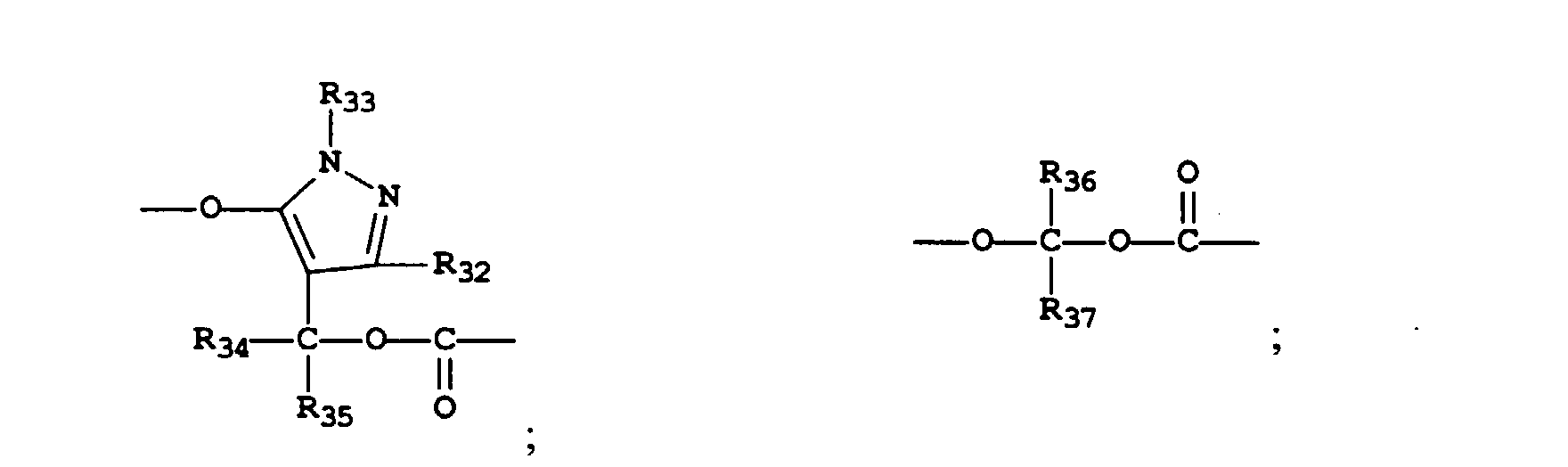
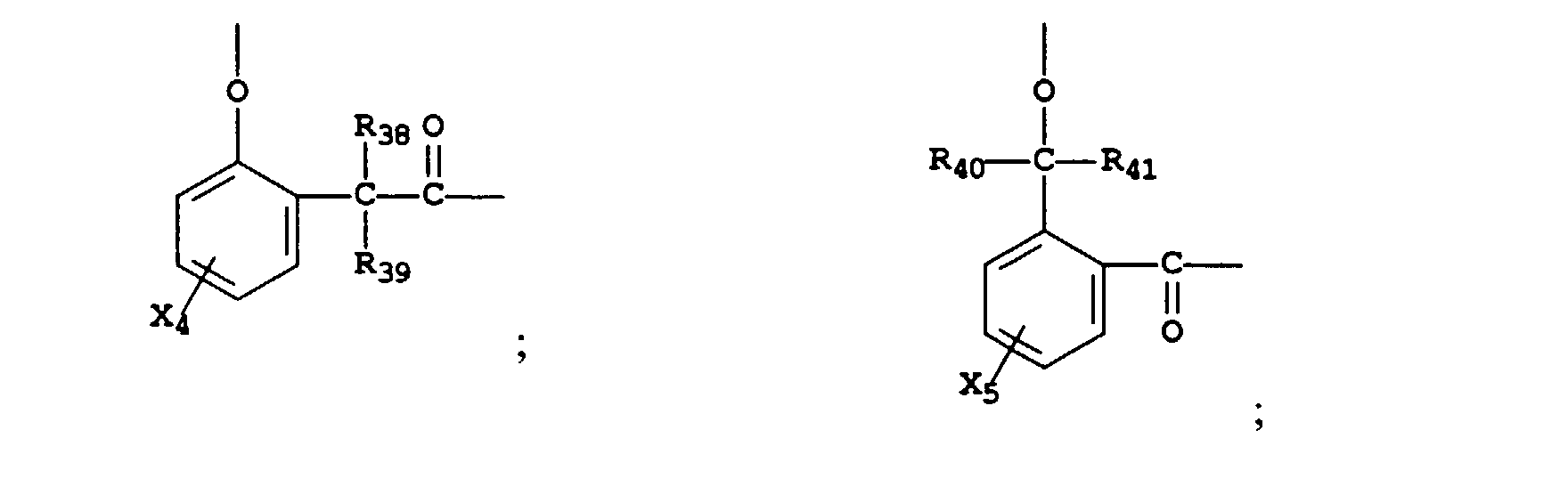 wherein X1 through X6 and R23 through R41 are substituents that do not adversely affect the described COUP- L'n-B' -NR23- DYE. For example, R23 through R41 are individually hydrogen, unsubstituted or substituted alkyl, such as alkyl containing 1 to 30 carbon atoms, for example, methyl, ethyl, propyl, n-butyl, t-butyl, pentyl and eicosyl; or cycloalkyl, such as cyclopentyl, cyclohexyl and 4-methoxycyclohexyl; or aryl, such as unsubstituted or substituted phenyl. X1 through X6 can be hydrogen or a substituent that does not adversely affect the described COUP- L'n-B' -NR23- DYE, such as electron withdrawing or donating groups, for example, alkyl, such as methyl, ethyl, propyl, n-butyl, t-butyl and eicosyl, halogen, such as chlorine and bromine, nitro, carbamyl, acylamido, sulfonamido, sulfamyl, sulfo, carboxyl, cyano, and alkoxy, such as methoxy and ethoxy, acyl, sulfonyl, hydroxy, alkoxycarbonyl, and aryloxy. The linking group L'n-B' can be, for example, a linking group within U.S. Pat. No. 4,409,323 or a nucleophilic displacement type linking group as described in, for example, U.S. Pat. No. 4,248,962, or a linking group which is a combination of these two types.
- A particularly useful linking group is:wherein A is O, S, or sulfonamido (N-SO2 R44);

B is as previously defined;
R42 and R43 are individually hydrogen, or substituted or unsubstituted alkyl, such as methyl, ethyl, propyl, n-butyl or t-butyl, or aryl, such as unsubstituted or substituted phenyl; X7 is a substituent as described for X1, that does not adversely affect the coupler; and n is 0, 1, 2, 3 or 4. R44 is a substituent, typically alkyl or aryl. Typically R42 and R43 are hydrogen.
Typically R42 and R43 are hydrogen. - Preferred L'n-B' linking groups include:wherein X7a is hydrogen, chlorine, methylsulfonamido (NHSO2 CH3), -COOCH3, -NHCOCH3, -CONHCH3, -COHNCH2 COOH, -COOH or CON(CH3)2.

- A particularly useful linking group is represented by the formula:

- The linking group and DYE optionally contain substituents that can modify the rate of reaction, diffusion, or displacement, such as halogen, including fluoro, chloro, bromo, or iodo, nitro, alkyl of 1 to 20 carbon atoms, acyl, carboxy, carboxyalkyl, alkoxycarbonyl, alkoxycarbonamido, alkylcarbamyl, sulfoalkyl, alkylsulfonamido, and alkylsulfonyl, solubilizing groups, ballast groups and the like. For example, solubilizing groups will increase the rate of diffusion and ballast groups will decrease the rate of diffusion.
- The R23 substituent on -NR23- can be any substituent that does not adversely affect the coupler (A). When the -NR23- is part of an auxochrome, R23 can be, for example, hydrogen or alkyl, such as alkyl containing 1 to 30 carbon atoms, including methyl, ethyl, propyl, n-butyl, t-butyl or eicosyl, or aryl, such as phenyl. When the nitrogen atom attached to L'n-B' is part of a chromophore, R23 becomes an integral part of the chromophore.
- Preferred R23 groups are alkyl, such as alkyl containing 1 to 18 carbon atoms when R23 is part of the dye auxochrome. R23 when part of the chromophore is, for example, unsubstituted or substituted aryl, such as phenyl.
- The DYE as described includes any releasable, electrically neutral dye that enables dye hue stabilization without mordanting the dye formed. The release mechanism can be initiated by oxidized reducing agent.
- The particular DYE and the nature of the substituents on the DYE can control whether or not the dye diffuses and the rate and distance of diffusion of the DYE formed. For example, the DYE can contain a ballast group known in the photographic art that hinders or prevents diffusion. The DYE can contain a water solubilizing group, such as carboxy or sulfonamide groups, to help diffusion of the DYE. Such groups are known to those skilled in the art.
- Particularly useful classes of DYE moieties are:
- I. Azo dye moieties including the -NR23- group represented by the
structure:
wherein R45, R46 and R47 are individually hydrogen or a substituent, such as alkyl. The aromatic rings containing R46 and R47 may also be heteroaromatic rings containing one or more ring N atoms.

- II. Azamethine dye moieties including the -NR23- group
represented by the structure:
wherein R48 is hydrogen or a substituent, such as alkyl; R49 is hydrogen or a substituent, such as alkyl; and EWG is an electron withdrawing group.

- III. Methine dye moieties including the -NR23- group represented
by the structure:
wherein R50 is hydrogen or a substituent, such as alkyl; R51 is hydrogen or a substituent such as alkyl; and EWG is an electron withdrawing group.
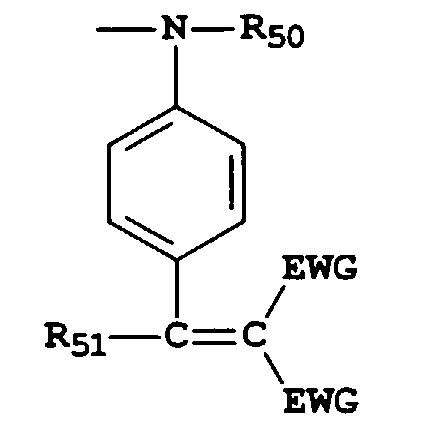
-
- The term DYE also includes dye precursors wherein the described substituted nitrogen atom is an integral part of the chromophore, also described herein as leuco dye moieties. Such dye precursors include, for example:wherein R52 and R53 are aryl, such as substituted phenyl.
 wherein R54 is an aryl group, such as substituted phenyl; and EWG is an electron withdrawing group.
 wherein Ar are individually substituted aryl groups, particularly substituted phenyl groups. When the DYE moiety is a leuco dye, L'n-B' preferably comprises a timing group that enables delay of oxidation of the leuco dye by silver halide in a photographic silver halide element. For example, it is preferred that L'n-B' be a
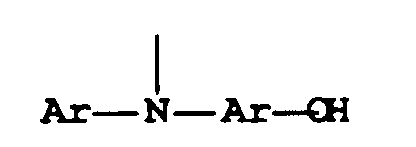 group when DYE is a leuco dye moiety as described.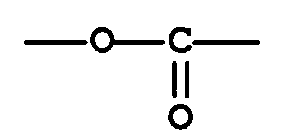
- Examples of cyan, magenta, yellow and leuco dyes are as follows:wherein R55 is a substituent that does not adversely affect the dye, such as alkyl; R56 is a substituent, such as an electron releasing group; and R57 is a substituent, such as a strong electron withdrawing group.
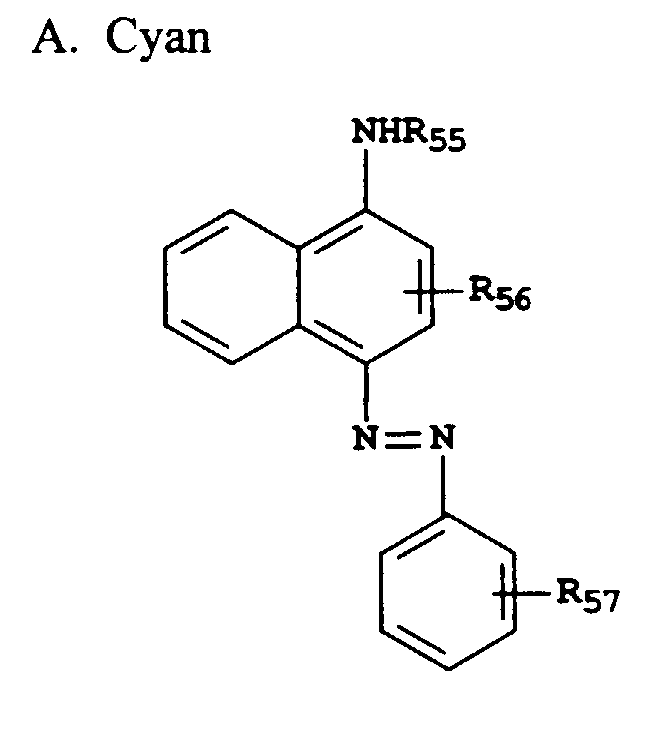 wherein R58 is a substituent that does not adversely affect the dye, such as alkyl; R59 is a substituent, such as an electron releasing group; and R60 is a substituent, such as a strong electron withdrawing group.
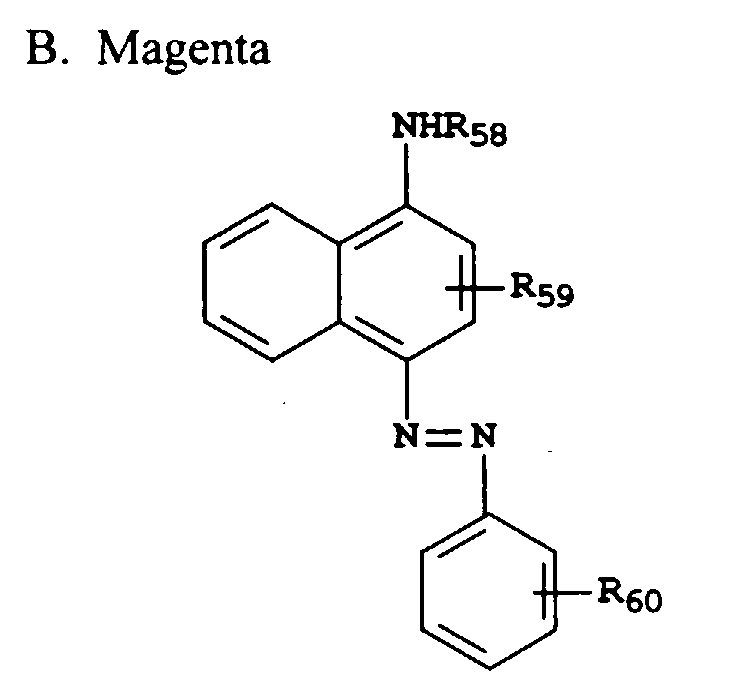 wherein R61 is alkyl; R62 is alkoxy; and R63 is alkyl; and
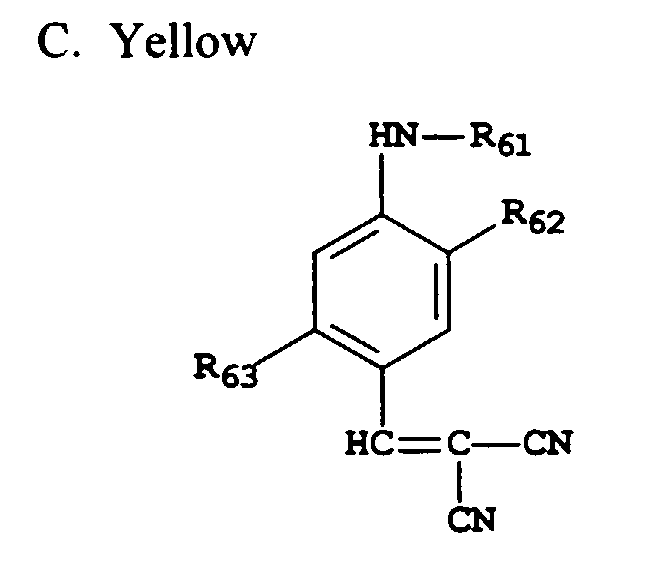 wherein R64 is alkyl; R65 is alkoxy; and R66 is alkyl or aryl.
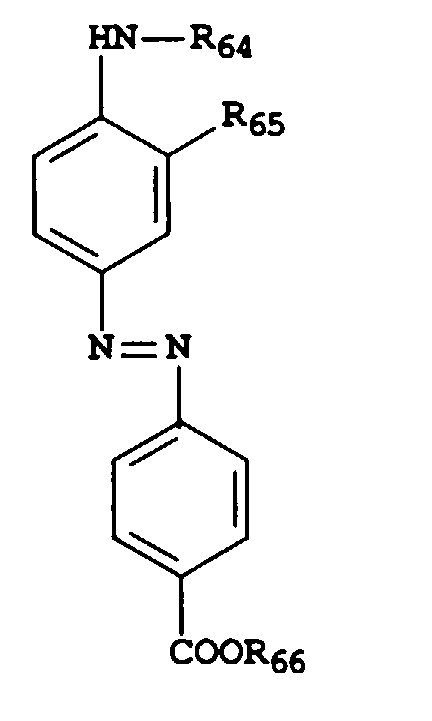 wherein R67 and R68 are individually hydrogen or alkyl; R69 is an electron releasing group; and R70 is a strong electron withdrawing group.
 wherein R71 and R73 are individually hydrogen or a substituent; R72 is a hydroxyl, NHR76 or NHSO2 R76 wherein R76 is a substituent; R74 and R75 are individually hydrogen or a substituent.
- The following are specific illustrations of one equivalent image dye-forming couplers contemplated for use in the practice of this invention:
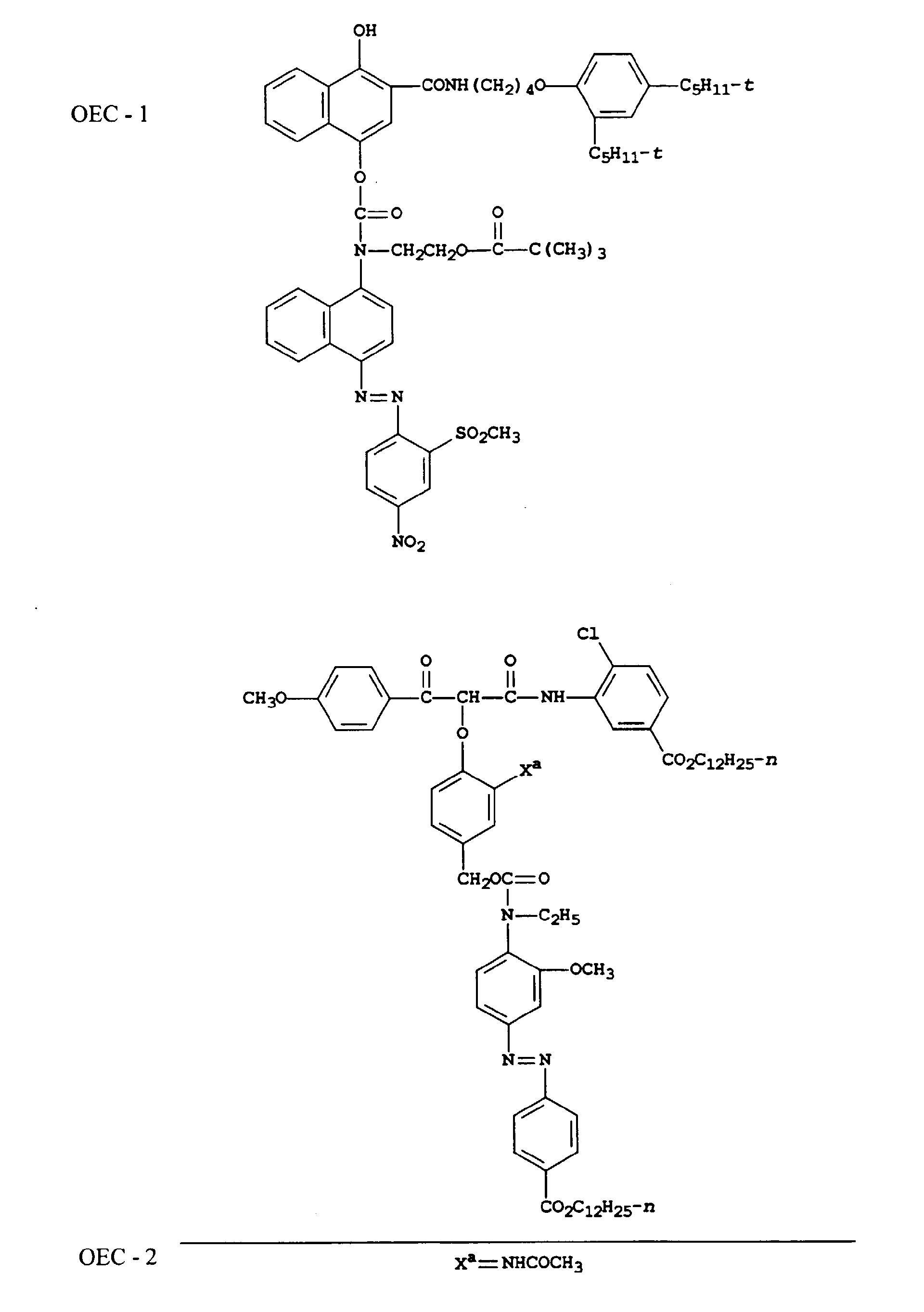
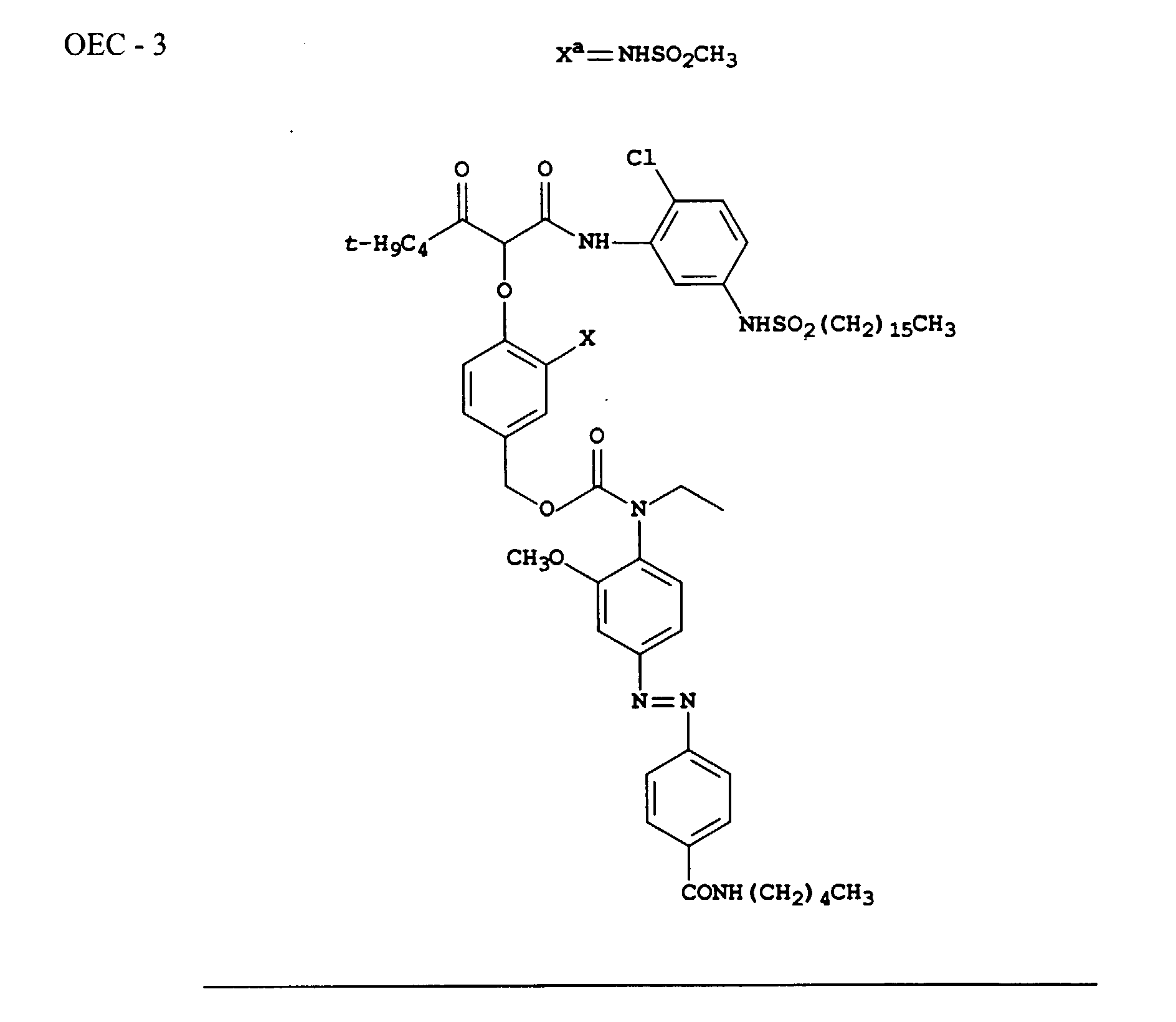


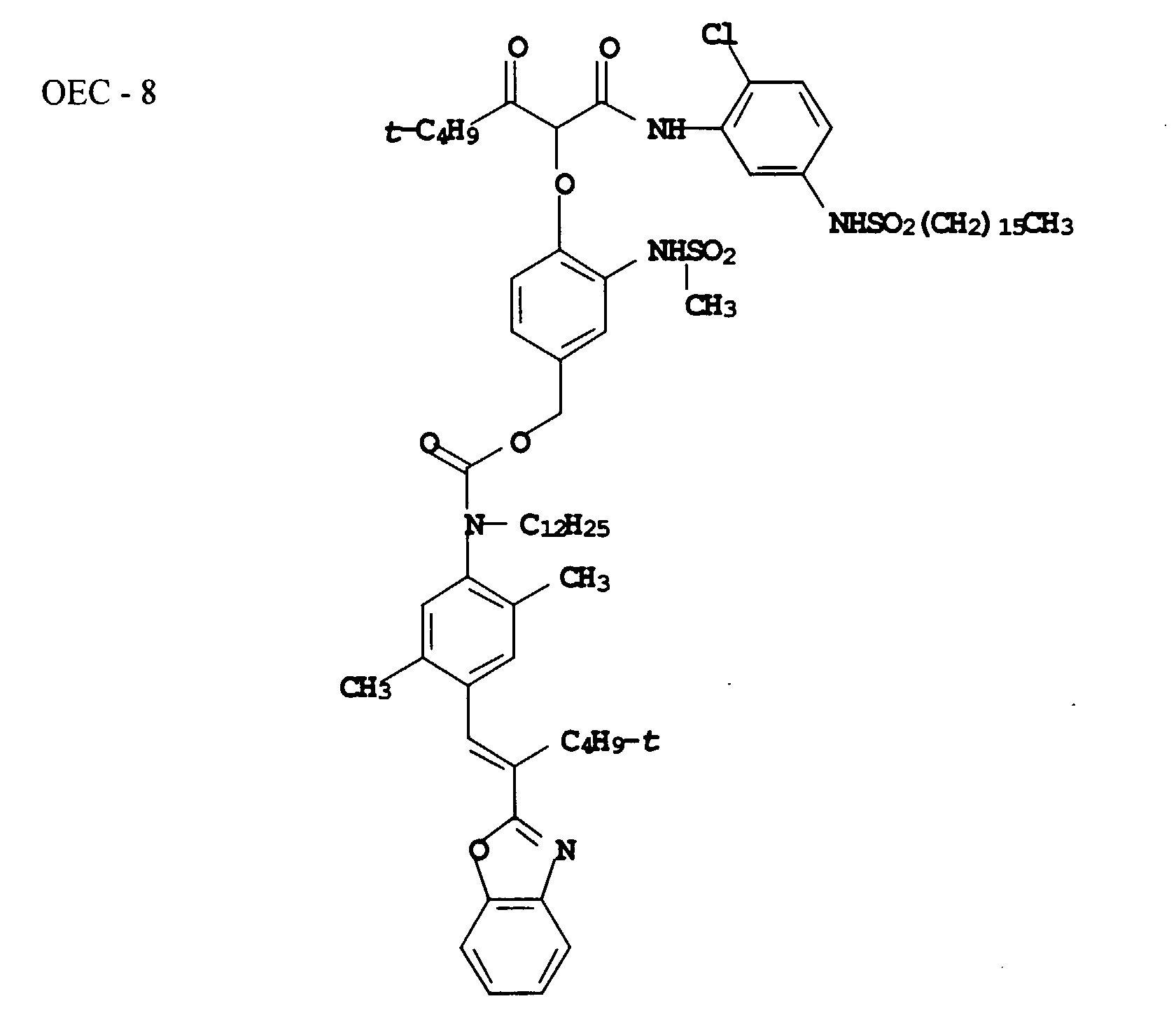


- In addition to one equivalent image dye-forming coupler the image forming layer unit can, if desired, contain one or more other conventional couplers. For example, it is contemplated to employ one or more four equivalent or, particularly, two equivalent image dye-forming couplers in combination with an image dye-forming one equivalent coupler. When image dye-forming couplers are used in combination, it is preferred that at least 20 percent on a mole basis of image dye-forming coupler present be provided by one or more one equivalent image dye-forming couplers.
- Other couplers that can be present in the photographic element of the invention include, for example:
- Couplers which combine with oxidized developer to produce cyan colored dyes are shown, for example, in Weissberger et al U.S. Patent 2,474,293, Vittum et al U.S. Patent 3,002,836, Stecker U.S. Patent 3,041,236, Ono et al U.S. Patent 4,746,602, Kilminster U.S. Patent 4,753,871, Aoki et al U.S. Patent 4,770,988, Kilminster et al U.S. Patent 4,775,616, Hamada et al U.S. Patent 4,818,667, Masukawa et al U.S. Patent 4,818,672, Monbaliu et al U.S. Patent 4,822,729, Monbaliu et al U.S. Patent 4,839,267, Masukawa et al U.S. Patent 4,840,883, Hoke et al U.S. Patent 4,849,328, Miura et al U.S. Patent 4,865,961, Tachibana et al U.S. Patent 4,873,183, Shimada et al U.S. Patent 4,883,746, Tani et al U.S. Patent 4,900,656, Ono et al U.S. Patent 4,904,575, Tachibana et al U.S. Patent 4,916,051, Nakayama et al U.S. Patent 4,921,783, Merkel et al U.S. Patent 4,923,791, Tachibaba et al U.S. Patent 4,950,585, Aoki et al U.S. Patent 4,971,898, Lau U.S. Patent 4,990,436, Masukawa et al U.S. Patent 4,996,139, Merkel U.S. Patent 5,008,180, Wolff U.S. Patent 5,015,565, Tachibana et al U.S. Patent 5,011,765, Kida et al U.S. Patent 5,011,766, Masukawa et al U.S. Patent 5,017,467, Hoke U.S. Patent 5,045,442, Uchida et al U.S. Patent 5,051,347, Kaneko U.S. Patent 5,061,613, Kita et al U.S. Patent 5,071,737, Langen et al U.S. Patent 5,075,207, Fukunada et al U.S. Patent 5,091,297, Tsukahara et al U.S. Patent 5,094,938, Shimada et al U.S. Patent 5,104,783, Fujita et al U.S. Patent 5,178,993, Naito et al U.S. Patent 5,813,729, Ikesu et al U.S. Patent 5,187,057, Tsukahara et al U.S. Patent 5,192,651, Schumann et al U.S. Patent 5,200,305, Yamakawa et al U.S. Patent 5,202,224, Shimada et al U.S. Patent 5,206,130, Ikesu et al U.S. Patent 5,208,141, Tsukahara et al U.S. Patent 5,210,011, Sato et al U.S. Patent 5,215,871, Kita et al U.S. Patent 5,223,386, Sato et al U.S. Patent 5,227,287, Suzuki et al U.S. Patent 5,256,526, Kobayashi et al U.S. Patetn 5,258,270, Shimada et al U.S. Patent 5,272,051, Ikesu et al U.S. Patent 5,306,610, Yamakawa U.S. Patent 5,326,682,Shimada et al U.S. Patent 5,366,856, Naruse et al U.S. Patent 5,378,596, Takizawa et al U.S. Patent 5,380,638, Lau et al U.S. Patent 5,382,502, Matsuoka et al U.S. Patent 5,384,236, Takada et al U.S. Patent 5,397,691, Kaneko et al U.S. Patent 5,415,990, Asami U.S. Patent 5,434,034, Tang et al U.S. Patent 5,441,863, Tashiro et al EPO 0 246 616, Lau EPO 0 250 201, Kilminster et al EPO 0 271 323, Sakanoue et al EPO 0 295 632, Mihayashi et al EPO 0 307 927, Ono et al EPO 0 333 185, Shinba et al EPO 0 378 898, Giusto EPO 0 389 817, Sato et al EPO 0 487 111, Suzuki et al EPO 0 488 248, Ikesu et al EPO 0 539 034, Suzuki et al EPO 0 545 300, Yamakawa et al EPO 0 556 700, Shimada et al EPO 0 556 777, Kawai EPO 0 556 858, Yoshioka EPO 0 569 979, Ikesu et al EPO 0 608 133, Merkel et al EPO 0 636 936, Merkel et al EO 0 651 286, Sugita et al EPO 0 690 344, Renner et al German OLS 4,026,903, Langen et al German OLS 3,624,777 and Wolff et al German OLS 3,823,049;
- Magenta coupler types are shown, for example, in Porter et al U.S. Patents 2,311,082 and 2,369,489, Tuite U.S. Patent 3,152,896, Arai et al U.S. Patent 3,935,015, Renner U.S. Patent 4,745,052, Ogawa et al U.S. Patent 4,762,775, Kida et al U.S. Patent 4,791,052, Wolff et al U.S. Patent 4,812,576, Wolff et al U.S. Patent 4,835,094, Abe et al U.S. Patent 4,840,877, Wolff U.S. Patent 4,845,022, Krishnamurthy et al U.S. Patent 4,853,319, Renner U.S. Patent 4,868,099, Helling et al U.S. Patent 4,865,960, Normandin U.S. Patent 4,871,652, Buckland U.S. Patent 4,876,182, Bowne et al U.S. Patent 4,892,805, Crawley et al U.S. Patent 4,900,657, Furutachi U.S. Patent 4,910,124, Ikesu et al U.S. Patent 4,914,013, Yokoyama et al U.S. Patent 4,921,968, Furutachi et al U.S. Patent 4,929,540, Kim et al U.S. Patent 4,933,465, Renner U.S. Patent 4,942,116, Normandin et al U.S. Patent 4,942,117, Normandin et al U.S. Patent 4,942,118, Normandin et al U.S. Patent 4,959,480, Shimazaki et al U.S. Patent 4,968,594, Ishige et al U.S. Patent 4,988,614, Bowne et al U.S. Patent 4,992,361, Renner et al U.S. Patent 5,002,864, Burns et al U.S. Patent 5,021,325, Sato et al U.S. Patent 5,066,575, Morigaki et al U.S. Patent 5,068,171, Ohya et al U.S. Patent 5,071,739, Chen et al U.S. Patent 5,100,772, Harder et al U.S. Patent 5,110,942, Kimura et al U.S. Patent 5,116,990, Yokoyama et al U.S. Patent 5,118,812, Kunitz et al U.S. Patent 5,134,059, Mizukawa et al U.S. Patent 5,155,016, Romanet et al U.S. Patent 5,183,728, Tang et al U.S. Patent 5,234,805, Sato et al U.S. Patent 5,235,058, Krishnamurthy et al U.S. Patent 5,250,400, Ikenoue et al U.S. Patent 5,254,446, Krishnamurthy et al U.S. Patent 5,262,292, Matsuoka et al U.S. Patent 5,300,407, Romanet et al U.S. Patent 5,302,496, Daifuku et al U.S. Patent 5,336,593, Singer et al U.S. Patent 5,350,667, Tang U.S. Patent 5,395,968, Helling et al U.S. Patent 5,354,826, Tang et al U.S. Patent 5,358,829, Ishidai et al U.S. Patent 5,368,998, Krishnamurthy et al U.S. Patent 5,378,587, Mizukawa et al U.S. Patent 5,409,808, Signer et al U.S. Patent 5,411,841, Wolff U.S. Patent 5,418,123, Tang U.S. Patent 5,424,179, Numata et al EPO 0 257 854, Bowne et al EPO 0 284 240, Webb et al EPO 0 341 204, Miura et al EPO 347,235, Yukio et al EPO 365,252, Yamazaki et al EPO 0 422 595, Kei EPO 0 428 899, Tadahisa et al EPO 0 428 902, Hieechi et al EPO 0 459 331, Sakanoue et al EPO 0 467 327, Kida et al, EPO 0 476 949, Kei et al, EPO 0 487 081, Wolfe EPO 0 489 333, Coraluppi et al EPO 0 512 304, Hirabayashi et al EPO 0 515 128, Harabayashi et al EPO 0 534 703, Sato et al EPO 0 554 778, Tang et al EPO 0 558 145, Mizukawa et al EPO 0 571 959, Schofield et al EPO 0 583 832, Schofield et al EPO 0 583 834, Hirabayashi et al EPO 0 584 793, Tang et al EPO 0 602 748, Tang et al EPO 0 602 749, Lau et al EPO 0 605 918, Allway EPO 0 622 672, Allway EPO 0 622 673, Kita et al EPO 0 629 912, Kapp et al EPO 0 646 841,Kita et al EPO 0 656 561, Ishidai et al EPO 0 660 177, Tanaka et al EPO 0 686 872, Thomas et al WO 90/10253, Williamson et al WO 92/09010, Leyshon et al, WO 92/10788, Crawley et al WO 92/12464, Williamson WO 93/01523, Merkel et al WO 93/02392, Krishnamurthy et al WO 93/02393, Williamson WO 93/07534, UK Patent Application 2,244,053, Japanese Patent Application 03192-350, Renner German OLS 3,624,103, Wolff et al German OLS 3,912,265, and Werner et al German OLS 40 08 067; and
- Compounds useful for forming yellow colored dyes upon coupling with oxidized color developer include, for example, Weissberger U.S. Patent 2,298,443, Okumura et al U.S. Patent 4,022,620, Buckland et al U.S. Patent 4,758,501, Ogawa et al U.S. Patent 4,791,050, Buckland et al U.S. Patent 4,824,771, Sato et al U.S. Patent 4,824,773, Renner et al U.S. Patent 4,855,222, Tsoi U.S. Patent 4,978,605, Tsuruta et al U.S. Patent 4,992,360, Tomotake et al U.S. Patent 4,994,361, Leyshon et al U.S. Patent 5,021,333, Masukawa U.S. Patent 5,053,325, Kubota et al U.S. Patent 5,066,574, Ichijima et al U.S. Patent 5,066,576, Tomotake et al U.S. Patent 5,100,773, Lau et al U.S. Patent 5,118,599, Kunitz U.S. Patent 5,143,823, Kobayashi et al U.S. Patent 5,187,055, Crawley U.S. Patent 5,190,848, Motoki et al U.S. Patent 5,213,958, Tomotake et al U.S. Patent 5,215,877, Tsoi U.S. Patent 5,215,878, Hayashi U.S. Patent 5,217,857, Takada et al U.S. Patent 5,219,716, Ichijima et al U.S. Patent 5,238,803,Kobayashi et al U.S. Patent 5,283,166, Kobayashi et al U.S. Patent 5,294,531,Mihayashi et al U.S. Patent 5,306,609, Fukuzawa et al U.S. Patent 5,328,818, Yamamoto et al U.S. Patent 5,336,591, Saito et al U.S. Patent 5,338,654, Tang et al U.S. Patent 5,358,835, Tang et al. U.S. Patent 5,358,838, Tang et al U.S. Patent 5,360,713, Morigaki et al U.S. Patent 5,362,617, Tosaka et al U.S. Patent 5,382,506, Ling et al U.S. Patent 5,389,504, Tomotake et al U.S. Patent 5,399,474, Shibata U.S. Patent 5,405,737, Goddard et al U.S. Patent 5,411,848, Tang et al U.S. Patent 5,427,898, Himmelmann et al EPO 0 327 976, Clark et al EPO 0 296 793, Okusa et al EPO 0 365 282, Tsoi EPO 0 379 309, Kida et al EPO 0 415 375, Mader et al EPO 0 437 818, Kobayashi et al EPO 0 447 969, Chino et al EPO 0 542 463, Saito et al EPO 0 568 037, Tomotake et al EPO 0 568 196, Okumura et al EPO 0 568 777 and Yamada et al EPO 0 570 006, Kawai EPO 0 573 761, Carmack et al EPO 0 608 956, Carmack et al EPO 0 608 957, Mooberry et al EPO 0 628 865.
- The tabular grain silver halide emulsion containing a one-equivalent coupler and a fragmentable electron donating compound in accordance with this invention may be spectrally sensitized by the use of a spectral sensitizing dye, as is well known to one of skill in the art. Preferred sensitizing dyes that can be used are cyanine, merocyanine, styryl, hemicyanine, or complex cyanine dyes. Illustrative dyes that can be used include those dyes disclosed in U.S. Patents Nos. 5,747,235 and 5,747,236.
- The sensitization of the silver halide with the sensitizing dyes may be carried out by any method known in the art, such as described in Research Disclosure I. The dye may be added to an emulsion of the silver halide grains and a hydrophilic colloid at any time prior to (e.g., during or after chemical sensitization) or simultaneous with the coating of the emulsion on a photographic element. The dyes may, for example, be added as a solution in water or an alcohol. The dye/silver halide emulsion may be mixed with a dispersion of color image-forming coupler immediately before coating or in advance of coating (for example, 2 hours).
- The emulsion layer of the photographic element of the invention can comprise any one or more of the light sensitive layers of the photographic element. The photographic elements made in accordance with the present invention are multicolor elements. Multicolor elements contain dye image-forming units sensitive to each of the three primary regions of the spectrum. Each unit can be comprised of a single emulsion layer or of multiple emulsion layers sensitive to a given region of the spectrum. The layers of the element, including the layers of the image-forming units, can be arranged in various orders as known in the art.
- A typical multicolor photographic element comprises a support bearing a cyan dye image-forming unit comprised of at least one red-sensitive silver halide emulsion layer having associated therewith at least one cyan dye-forming coupler, a magenta dye image-forming unit comprising at least one green-sensitive silver halide emulsion layer having associated therewith at least one magenta dye-forming coupler, and a yellow dye image-forming unit comprising at least one blue-sensitive silver halide emulsion layer having associated therewith at least one yellow dye-forming coupler. The element can contain additional layers, such as filter layers, interlayers, overcoat layers, subbing layers, and the like. All of these can be coated on a support which is preferably transparent.
- Photographic elements of the present invention may also usefully include a magnetic recording material as described in Research Disclosure, Item 34390, November 1992, or a transparent magnetic recording layer such as a layer containing magnetic particles on the underside of a transparent support as in US 4,279,945 and US 4,302,523. The element typically will have a total thickness (excluding the support) of from 5 to 30 microns. While the order of the color sensitive layers can be varied, they will normally be red-sensitive, green-sensitive and blue-sensitive, in that order on a transparent support, (that is, blue sensitive furthest from the support) .
- The present invention also contemplates the use of photographic elements of the present invention in what are often referred to as single use cameras (or "film with lens" units). Single use cameras are well known and typically comprise (1) a plastic inner camera shell including a taking lens, a film metering mechanism, and a simple shutter and (2) a paper-cardboard outer sealed pack which contains the inner camera shell and has respective openings for the taking lens and for a shutter release button, a frame counter window, and a film advance thumbwheel on the camera shell. The camera may also have a flash unit to provide light when the picture is taken. The inner camera shell has front and rear viewfinder windows located at opposite ends of a see-through viewfinder tunnel, and the outer sealed pack has front and rear openings for the respective viewfinder windows. At the manufacturer, the inner camera shell is loaded with a film cartridge, and substantially the entire length of the unexposed filmstrip is factory prewound from the cartridge into a supply chamber of the camera shell. After the customer takes a picture, the thumbwheel is manually rotated to rewind the exposed frame into the cartridge. The rewinding movement of the filmstrip the equivalent of one frame rotates a metering sprocket to decrement a frame counter to its next lower numbered setting. When substantially the entire length of the filmstrip is exposed and rewound into the cartridge, the single-use camera is sent to a photofinisher who first removes the inner camera shell from the outer sealed pack and then removes the filmstrip from the camera shell. The filmstrip is processed, and the camera shell and the opened pack are thrown away or, preferably, recycled..
- In the following discussion of suitable materials for use in elements of this invention, reference will be made to Research Disclosure, September 1996, Number 389, Item 38957, which will be identified hereafter by the term "Research Disclosure I." The Sections hereafter referred to are Sections of the Research Disclosure I unless otherwise indicated. All Research Disclosures referenced are published by Kenneth Mason Publications, Ltd., Dudley Annex, 12a North Street, Emsworth, Hampshire P010 7DQ, ENGLAND.
- The silver halide emulsions employed in the photographic elements of the present invention may be negative-working, such as surface-sensitive emulsions or unfogged internal latent image forming emulsions, or positive working emulsions of the internal latent image forming type (that are fogged during processing). Suitable emulsions and their preparation as well as methods of chemical and spectral sensitization are described in Sections I through V. Color materials and development modifiers are described in Sections V through XX. Vehicles which can be used in the photographic elements are described in Section II, and various additives such as brighteners, antifoggants, stabilizers, light absorbing and scattering materials, hardeners, coating aids, plasticizers, lubricants and matting agents are described, for example, in Sections VI through XIII. Manufacturing methods are described in all of the sections, layer arrangements particularly in Section XI, exposure alternatives in Section XVI, and processing methods and agents in Sections XIX and XX.
- With negative working silver halide a negative image can be formed. Optionally a positive (or reversal) image can be formed although a negative image is typically first formed.
- The photographic elements of the present invention may also use colored couplers (e.g. to adjust levels of interlayer correction) and masking couplers such as those described in EP 213 490; Japanese Published Application 58-172,647; U.S. Patent 2,983,608; German Application DE 2,706,117C; U.K. Patent 1,530,272; Japanese Application A-113935; U.S. Patent 4,070,191 and German Application DE 2,643,965. The masking couplers may be shifted or blocked.
- The photographic elements may also contain materials that accelerate or otherwise modify the processing steps of bleaching or fixing to improve the quality of the image. Bleach accelerators described in EP 193 389; EP 301 477; U.S. 4,163,669; U.S. 4,865,956; and U.S. 4,923,784 are particularly useful. Also contemplated is the use of nucleating agents, development accelerators or their precursors (UK Patent 2,097,140; U.K. Patent 2,131,188); development inhibitors and their precursors (U.S. Patent No. 5,460,932; U.S. Patent No. 5,478,711); electron transfer agents (U.S. 4,859,578; U.S. 4,912,025); antifogging and anti color-mixing agents such as derivatives of hydroquinones, aminophenols, amines, gallic acid; catechol; ascorbic acid; hydrazides; sulfonamidophenols; and non color-forming couplers.
- The elements may also contain filter dye layers comprising colloidal silver sol or yellow and/or magenta filter dyes and/or antihalation dyes (particularly in an undercoat beneath all light sensitive layers or in the side of the support opposite that on which all light sensitive layers are located) either as oil-in-water dispersions, latex dispersions or as solid particle dispersions. Additionally, they may be used with "smearing" couplers (e.g. as described in U.S. 4,366,237; EP 096 570; U.S. 4,420,556; and U.S. 4,543,323.) Also, the couplers may be blocked or coated in protected form as described, for example, in Japanese Application 61/258,249 or U.S. 5,019,492.
- The photographic elements may further contain other image-modifying compounds such as "Development Inhibitor-Releasing" compounds (DIR's). Useful additional DIR's for elements of the present invention, are known in the art and examples are described in U.S. Patent Nos. 3,137,578; 3,148,022; 3,148,062; 3,227,554; 3,384,657; 3,379,529; 3,615,506; 3,617,291; 3,620,746; 3,701,783; 3,733,201; 4,049,455; 4,095,984; 4,126,459; 4,149,886; 4,150,228; 4,211,562; 4,248,962; 4,259,437; 4,362,878; 4,409,323; 4,477,563; 4,782,012; 4,962,018; 4,500,634; 4,579,816; 4,607,004; 4,618,571; 4,678,739; 4,746,600; 4,746,601; 4,791,049; 4,857,447; 4,865,959; 4,880,342; 4,886,736; 4,937,179; 4,946,767; 4,948,716; 4,952,485; 4,956,269; 4,959,299; 4,966,835; 4,985,336 as well as in patent publications GB 1,560,240; GB 2,007,662; GB 2,032,914; GB 2,099,167; DE 2,842,063, DE 2,937,127; DE 3,636,824; DE 3,644,416 as well as the following European Patent Publications: 272,573; 335,319; 336,411; 346,899; 362,870; 365,252; 365,346; 373,382; 376,212; 377,463; 378,236; 384,670; 396,486; 401,612; 401,613.
- DIR compounds are also disclosed in "Developer-Inhibitor-Releasing (DIR) Couplers for Color Photography," C.R. Barr, J.R. Thirtle and P.W. Vittum in Photographic Science and Engineering, Vol. 13, p. 174 (1969).
- Various other compounds may be added to the photographic material of the present invention for the purpose of lowering the fogging of the material during manufacture, storage, or processing. Typical antifoggants are discussed in Section VI of Research Disclosure I, for example tetraazaindenes, mercaptotetrazoles, polyhydroxybenzenes, hydroxyaminobenzenes, combinations of a thiosulfonate and a sulfinate, and the like.
- For this invention, polyhydroxybenzene and hydroxyaminobenzene compounds (hereinafter "hydroxybenzene compounds") are preferred as they are effective for lowering fog without decreasing the emulsion sensitvity. Examples of hydroxybenzene compounds are:
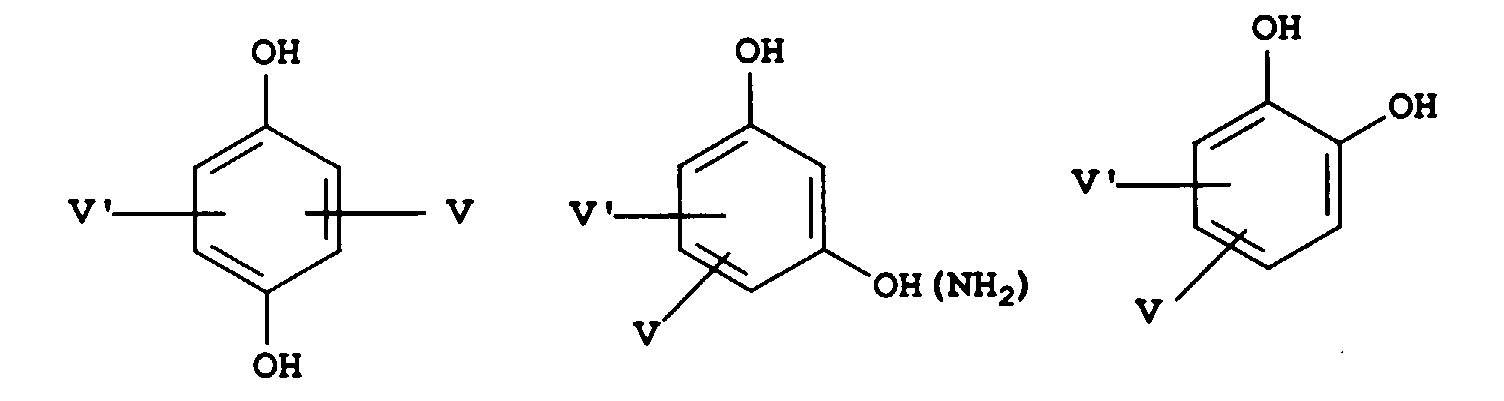
- In these formulae, V and V' each independently represent -H, -OH, a halogen atom, -OM (M is alkali metal ion), an alkyl group, a phenyl group, an amino group, a carbonyl group, a sulfone group, a sulfonated phenyl group, a sulfonated alkyl group, a sulfonated amino group, a carboxyphenyl group, a carboxyalkyl group, a carboxyamino group, a hydroxyphenyl group, a hydroxyalkyl group, an alkylether group, an alkylphenyl group, an alkylthioether group, or a phenylthioether group.
- More preferably, they each independently represent -H, -OH, -Cl,-Br, -COOH, -CH2CH2COOH, -CH3, -CH2CH3, -C(CH3)3, -OCH3, -CHO,-SO3K,-SO3Na, -SO3H, -SCH3, or -phenyl.
- Especially preferred hydroxybenzene compounds follow:

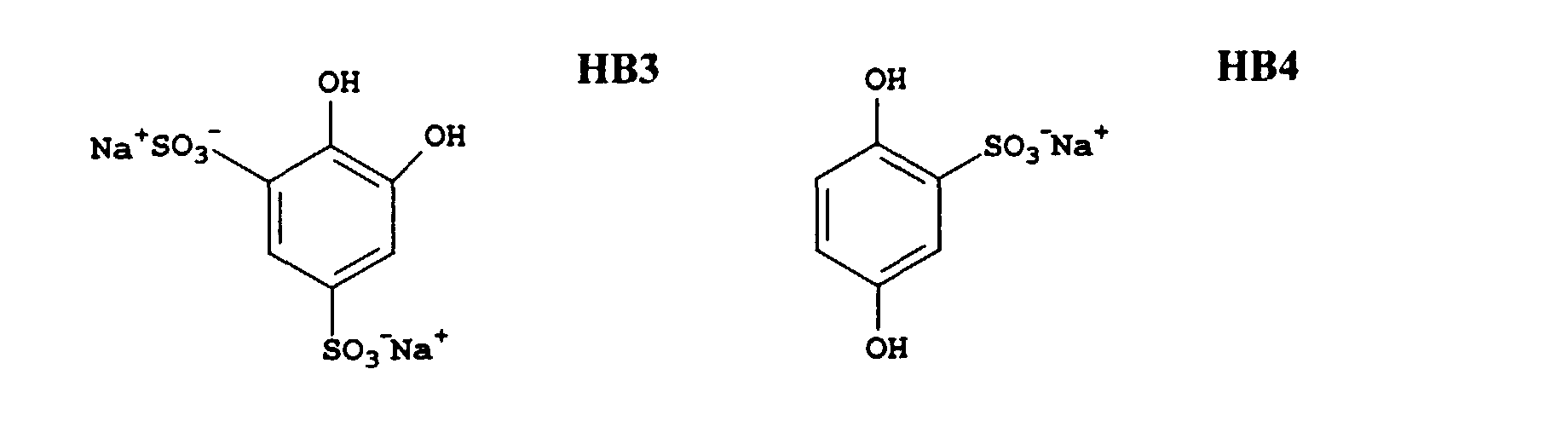

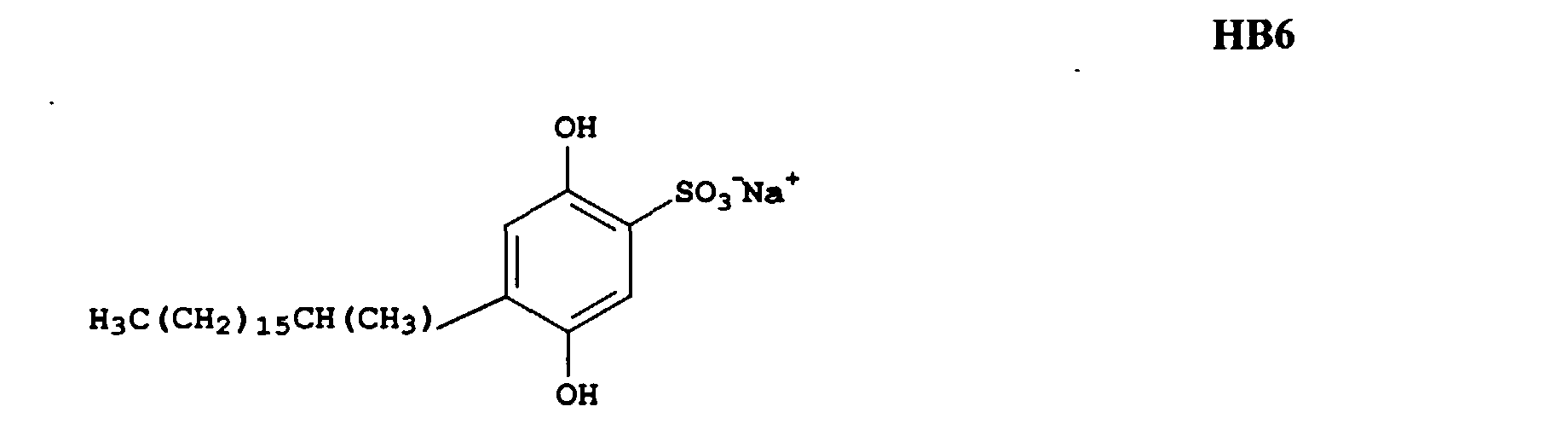
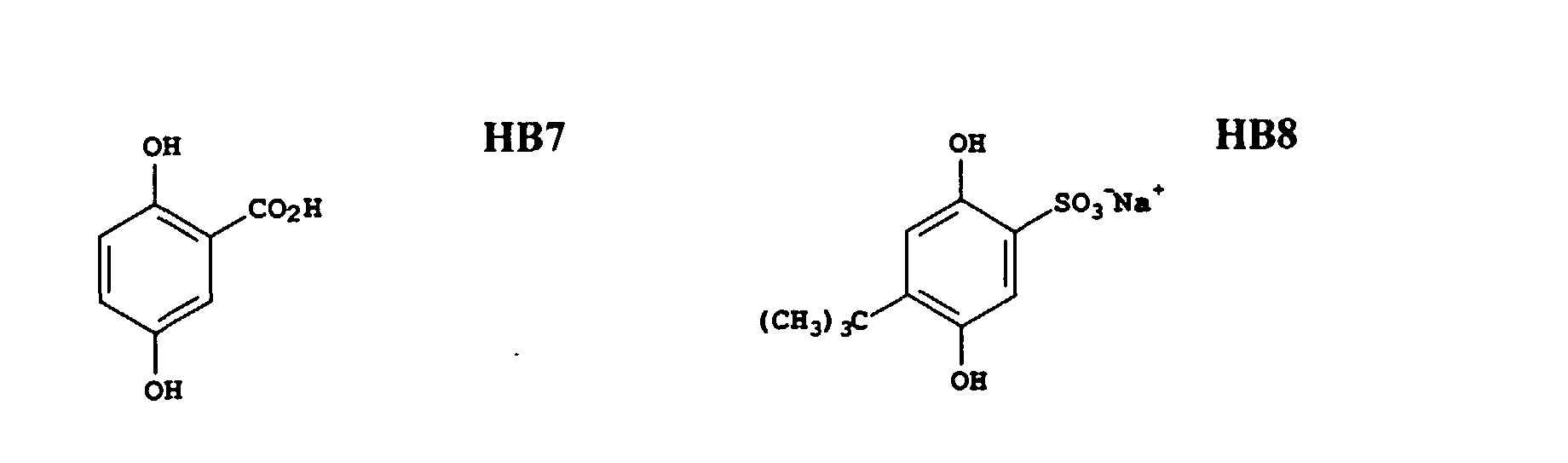
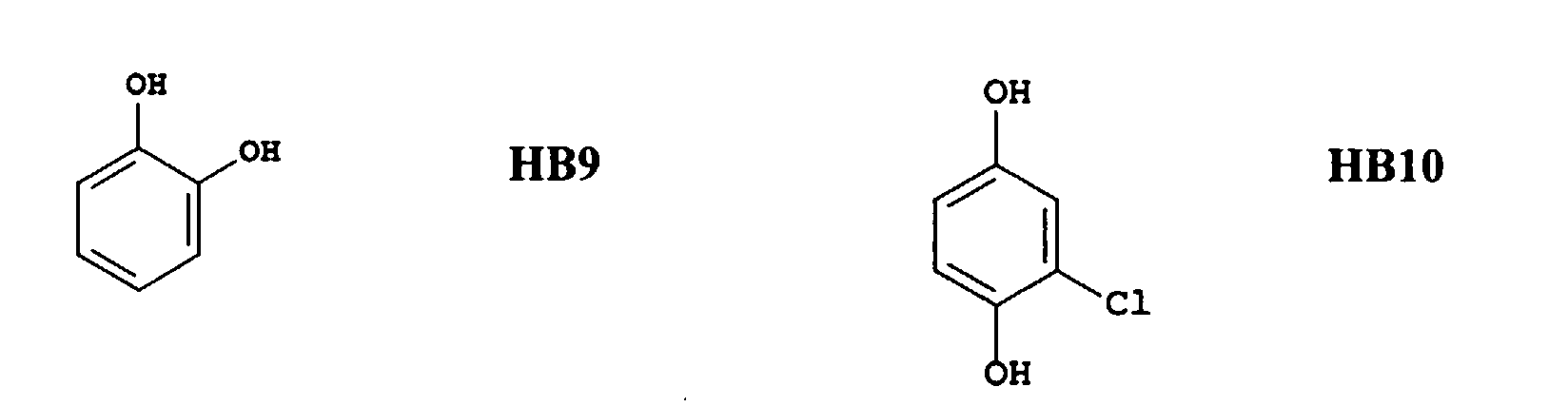

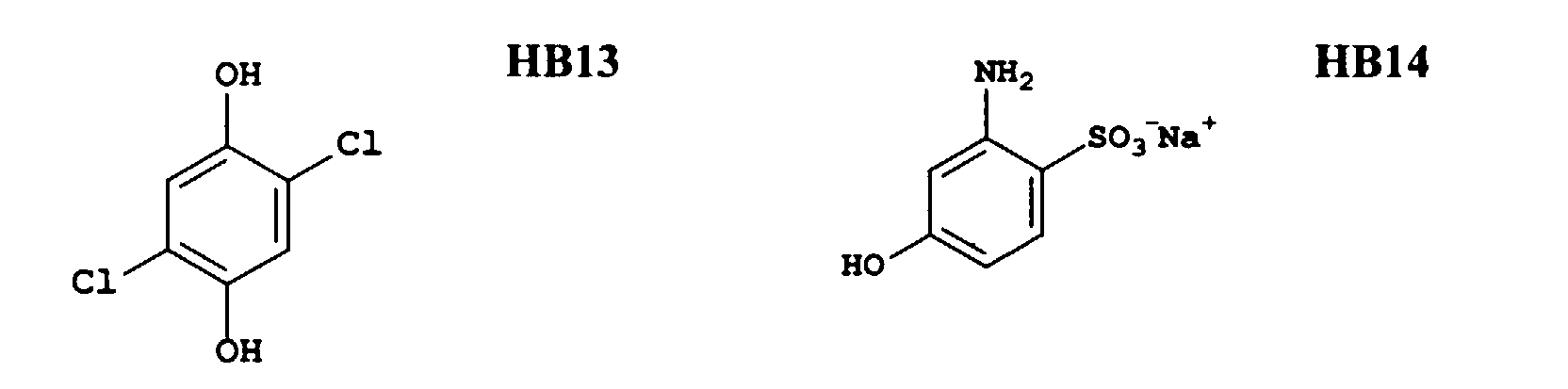
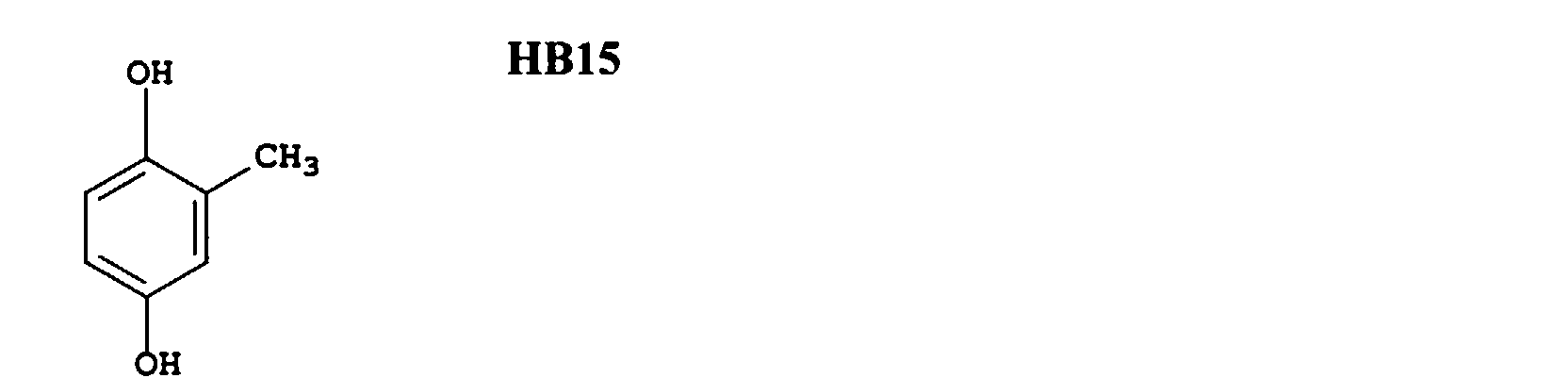
- Hydroxybenzene compounds may be added to the emulsion layers or any other layers constituting the photographic material of the present invention. The preferred amount added is from 1 x 10⁻³ to 1 x 10⁻¹ mol, and more preferred is 1 x 10⁻³ to 2 x 10⁻² mol, per mol of silver halide.
- Photographic elements of the present invention are preferably imagewise exposed using any of the known techniques, including those described in Research Disclosure I, section XVI. This typically involves exposure to light in the visible region of the spectrum, and typically such exposure is of a live image through a lens, although exposure can also be exposure to a stored image (such as a computer stored image) by means of light emitting devices (such as light emitting diodes, CRT and the like).
- Photographic elements comprising the composition of the invention can be processed in any of a number of well-known photographic processes utilizing any of a number of well-known processing compositions, described, for example, in Research Disclosure I, or in T.H. James, editor, The Theory of the Photographic Process, 4th Edition, Macmillan, New York, 1977. In the case of processing a negative working element, the element is treated with a color developer (that is one which will form the colored image dyes with the color couplers), and then with a oxidizer and a solvent to remove silver and silver halide. In the case of processing a reversal color element, the element is first treated with a black and white developer (that is, a developer which does not form colored dyes with the coupler compounds) followed by a treatment to fog silver halide (usually chemical fogging or light fogging), followed by treatment with a color developer. Preferred color developing agents are p-phenylenediamines. Especially preferred are:
- 4-amino N,N-diethylaniline hydrochloride,
- 4-amino-3-methyl-N,N-diethylaniline hydrochloride,
- 4-amino-3-methyl-N-ethyl-N-(β-(methanesulfonamido) ethylaniline sesquisulfate hydrate,
- 4-amino-3-methyl-N-ethyl-N-(β-hydroxyethyl)aniline sulfate,
- 4-amino-3-β-(methanesulfonamido)ethyl-N,N-diethylaniline hydrochloride and
- 4-amino-N-ethyl-N-(2-methoxyethyl)-m-toluidine di-p-toluene sulfonic acid.
-
- Dye images can be formed or amplified by processes which employ in combination with a dye-image-generating reducing agent an inert transition metal-ion complex oxidizing agent, as illustrated by Bissonette U.S. Patents 3,748,138, 3,826,652, 3,862,842 and 3,989,526 and Travis U.S. Patent 3,765,891, and/or a peroxide oxidizing agent as illustrated by Matejec U.S. Patent 3,674,490, Research Disclosure, Vol. 116, December, 1973, Item 11660, and Bissonette Research Disclosure, Vol. 148, August, 1976, Items 14836, 14846 and 14847. The photographic elements can be particularly adapted to form dye images by such processes as illustrated by Dunn et al U.S. Patent 3,822,129, Bissonette U.S. Patents 3,834,907 and 3,902,905, Bissonette et al U.S. Patent 3,847,619, Mowrey U.S. Patent 3,904,413, Hirai et al U.S. Patent 4,880,725, Iwano U.S. Patent 4,954,425, Marsden et al U.S. Patent 4,983,504, Evans et al U.S. Patent 5,246,822, Twist U.S. Patent No. 5,324,624, Fyson EPO 0 487 616, Tannahill et al WO 90/13059, Marsden et al WO 90/13061, Grimsey et al WO 91/16666, Fyson WO 91/17479, Marsden et al WO 92/01972. Tannahill WO 92/05471, Henson WO 92/07299, Twist WO 93/01524 and WO 93/11460 and Wingender et al German OLS 4,211,460.
- Development is followed by bleach-fixing, to remove silver or silver halide, washing and drying.
- A 180 L reactor charged with 52.7 kg of distilled water and containing 131 g of NaBr and 564 g of gelatin was adjusted to 70 C. The contents of the reactor were stirred vigorously throughout the precipitation process. 15.9 moles of AgI Lippmann emulsion were then dumped in and following a 4 minute hold, 1.25 M AgNO3 solution was run in at a linearly accelerated rate of 177 to 285 g/min over 9.4 minutes. Next, 1.25 M AgNO3 and 2.50 M NaBr solutions were added at linearly accelerated rates of 285 to 547 g/min and 116 to 416 g/min, respectively, for 21.8 minutes. Following this segment, 2.50 M AgNO3 and 2.50 M NaBr solutions were double jetted at accelerated rates of 313 to 1414 g/min and 416 g/min to 1272 g/min, respectively, over a 40.9 minute period. After this time, only the AgNO3 flow was continued and at a decelerated rate over the final 21.4 minutes during which the reactor vAg increased to +40 mv. The resulting emulsion grains (Emulsion E-1) had a mean equivalent circular diameter of 1.4 µm, and bromide accounted for 86% of the total emulsion halide.
- The emulsion was optimally chemically and spectrally sensitized by adding KCl, NaSCN, 9.96 x 10⁻⁵ mole/mole Ag of the blue sensitizing dye BSD-1 , Na2S2O3·5H2O, Na3Au(S2O3)2·2H2O, and a benzothiazolium finish modifier. The emulsion was then subjected to a heat cycle to 65°C. The antifoggant-stabilizer, tetraazaindene, at a concentration of 8.71 x 10⁻³ mole/mole silver, was added to the emulsion melt after the chemical sensitization procedure.
- An AgBrI tabular silver halide emulsion (Emulsion E-2) was prepared containing 2% total iodide distributed such that the central portion of the emulsion grains contained no iodide and the perimeter area contained substantially higher iodide as described by Chang et. al., U.S. Patent No. 5,314,793. The emulsion grains had an average thickness of 0.13 µm and average circular diameter of 4.5 µm. The emulsion was precipitated using deionized gelatin and contained 0.53 molar parts per million of KSeCN per silver mole introduced at 80% of the precipitation. The emulsion was optimally chemically and spectrally sensitized by adding NaSCN, 7.26x 10⁻⁴ mole/mole Ag of the blue sensitizing dye BSD-1, a mercaptotetrazole antifogging agent, Na3Au(S2O3)2·2H2O, Na2S2O3·5H2O and a benzothiazolium finish modifier. The emulsion was then subjected to a heat cycle to 60°C. The antifoggant-stabilizer, tetraazaindene, at a concentration of 1.02 x 10⁻² mole/mole silver, was added to the emulsion melt after the chemical sensitization procedure. For variations containing FED-2 as specified in Table 1, the antifoggant HB3 was added at a concentration of 1.29x10⁻² mole/mole silver followed by 0.3 mg of FED-2/mole.Ag.
- A 180 L reactor, charged with 72.3 kg of distilled water and containing 5.45 kg of NaBr, 0.50 kg of KI and 1.66 kg of gelatin, was adjusted to 80° C. A 2.35 M AgNO3 solution was then run in at a linearly accelerated rate of 375 to 625 g/min over 13.5 minutes. Next, a 2.35 M AgNO3 and a 1.96 M NaBr/1.47 M KI mixed salt solution were added at linearly accelerated rates of 625 to 1125 g/min and 251 to 451 g/min, respectively, for 26.5 minutes. Following this segment, 2.35 M AgNO3 was added at a constant 1125 g/min while a 3.91 M NaBr solution was simultaneously double jetted at an accelerated rate of 250 to 998 g/min over a 48 minute period.
- The resulting emulsion grains had a mean equivalent circular diameter of 2.0 um, and silver bromide accounts for 91% of the total silver.
- The emulsion was optimally chemically and spectrally sensitized by adding KCl, NaSCN, Na2S2O3·5H2O, Na3Au(S2O3)2·2H2O, and a benzothiazolium finish modifier. The emulsion was then subjected to a heat cycle to 63°C after which the blue sensitizing dye BSD-1, at a concentration of 1.01 x 10⁻⁴ mole/mole silver, was added.
- An AgBrI tabular silver halide emulsion (Emulsion E-4) was prepared containing 7.8 % silver iodide. The emulsion grains had an average equivalent circular diameter of 3.3 µm and an average thickness of 0.26 µm. The first 15% of the silver added contained no iodide and was precipitated in the manner of Tsaur et al., U.S. Patent Nos. 5,147,771-3, except the block copolymer Pluronic L43 was substituted for the block copolymer Pluronic 31R1. The next 45% of the added silver contained a silver bromoiodide phase, 10% iodide, precipitated from AgI seeds in oxidized gelatin and grown at a pBr of 1.52. From 56-60% of the added silver, 50 mppm ruthenium hexacyanide was added. The next 10% of the added silver was precipitated as AgBr. At 70% of the added silver the pBr was adjusted to 1.13. 0.5 mppm selenocyanic acid and 3% AgI seeds were added. The pBr was adjusted to 2.38 by a single jet addition of silver solution (~17% of the total silver). The remaining 10% of the silver was precipitated as a double jet AgBr phase. The emulsion was optimally chemically and spectrally sensitized at 40 °C by adding sodium thiocyanate, 5.01 x 10⁻⁴ mole/mole of silver, benzothiazolium, 3-(3-((methylsulfonyl)amino)-3-oxopropyl)-, tetrafluoroborate(1-), 5.65 x 10⁻⁵ mole/mole of silver, a blue sensitizing dye BSD-1, 4.25 x 10⁻⁴ moles/mole of silver, a sulfur sensitizer carboxymethyl-trimethylthiourea, 2.27 x 10⁻⁶ mole/mole of silver, and a gold sensitizer bis(1,3,5-trimethyl-1,2,4-triazolium-3-thiolate) gold(I) tetrafluoroborate, 7.89 x 10⁻⁷ mole/mole of silver. The emulsion was subsequently subjected to a heat cycle to 62.5 °C. The sodium salt of tetraazaindene, at a concentration of 1.02 x 10⁻² mole/mole of silver, was added to the emulsion melt after the chemical sensitization procedure. For variations containing FED-2 as specified in Table 2, the antifoggant HB3 was added at a concentration of 1.29x10⁻² mole/mole silver followed by 0.1 mg of FED-2/mole Ag.
- The Multilayer Film Structure utilized for this example is shown below, with structures of components immediately following. Component laydowns are provided in units of gm/sq m. (Bislvinylsulfonyl)methane hardener at1.55% of total gelatin weight. Antifoggants (including 4-hydroxy-6-methyl- 1,3,3a,7-tetraazaindene), surfactants, coating aids, coupler solvents, emulsion addenda, sequestrants, lubricants, matte and tinting dyes were added to the appropriate layers as is common in the art.
- Layer 1 (Protective Overcoat Layer): gelatin at 0.89.
- Layer 2 (UV Filter Layer): silver bromide Lippman emulsion at 0.269, UV-1 and UV-2 both at 0.108 and gelatin at 0.818.
- Layer 3 (Fast Yellow Layer): blue sensitized silver iodobromide 3d emulsion (E-1) coated at 1.34, YC-1 at 0.420, IR-1 at 0.027, B-1 at 0.011 and gelatin at 2.26.
- Layer 4 (Slow Yellow Layer): a blend of three blue sensitized (all with BSD-1) tabular silver iodobromide emulsions (i) 1.3 x 0.13µm, 4.5 mole % I at 0.333, (ii) 0.8x 0.12µm, 1.5 mole % I at 0.269, (iii)) 0.77 x 0.14µm, 1.5 mole % I at 0.215,yellow dye forming coupler YC-1 at 0.732, IR-1 at 0.027 and gelatin at 2.26.
- Layer 5 (Yellow filter layer): YFD-1 at 0.108, OxDS-1 at 0.075 and gelatin at 0.807.
- Layer 6 (Fast Magenta Layer): a green sensitized (with a mixture of GSD- and GSD-2) silver iodobromide tabular emulsions (3.9x0.14µm, 3.7 mole % iodide) at 1.29, magenta dye forming coupler MC-1 at 0.084, IR-2 at 0.003 and gelatin at 1.58.
- Layer 7 (Mid Magenta Layer): a green sensitized (with a mixture of GSD-1 and GSD-2) silver iodobromide tabular emulsions: (i) 2.9x0.12µm, 3.7 mole % iodide at 0.969, magenta dye forming coupler MC-1 at 0.082, Masking Coupler MM-1 at 0.086, IR-2 at 0.011 and gelatin at 1.56.
- Layer 8 (Slow magenta layer): a blend of two green sensitized (both with a mixture of GSD-1 and GSD-2) silver iodobromide tabular emulsions: (i) 0.88x0.12µm, 2.6 mole % iodide at 0.537 and (ii) 1.2x0.12µm, 4.1 mole % iodide at 0.342, magenta dye forming coupler MC-1 at 0.285, Masking Coupler MM-1 at 0.075 and gelatin at 1.18.
- Layer 9 (Interlayer): OxDS-1 at 0.075 and gelatin at 0538.
- Layer 10 (Fast Cyan layer): a red-sensitized sensitized (with a mixture of RSD-1 and RSD-2) iodobromide tabular emulsion (4.0 x0.13µm, 4.0 mole % I) at 0.130, cyan dye-forming coupler CC-2 at 0.205, IR-4 at 0.025, IR-3 at 0.022, OxDS-1 at 0.014 and gelatin at 1.45.
- Layer 11 (Mid Cyan Layer): a red-sensitized sensitized (all with a mixture of
RSD-1 and RSD-2)
iodobromide tabular emulsion (2.2 x0.12µm, 3.0 mole % I) at 1.17, cyan dye-forming coupler CC-2 at 0.181, IR-4 at 0.011, masking coupler CM-1 at 0.032, OxDS-1 at 0.011 and gelatin at 1.61. - Layer 12 (Slow cyan layer): a blend of two red sensitized (all with a mixture of RSD-1 and RSD-2) silver iodobromide emulsions: (i) a large sized iodobromide tabular grain emulsion (1.2 x 0.12µm, 4.1 mole % I) at 0.265, (ii) a smaller iodobromide tabular emulsion (0.74x0.12), 4.1 mole % I) at 0.312, cyan dye-forming coupler CC-1 at 0.227, CC-2 at 0.363, masking coupler CM-1 at 0.032, bleach accelerator releasing coupler B-1 at 0.080 and gelatin at 1.67.
- Layer 13 (Interlayer): OxDS-1 at 0.075 and gelatin at 0538.
- Layer 14 (Antihalation layer): Black Colloidal Silver at 0.151, UV-1 and UV-2
both at 0.075 and gelatin at 1.61.
Support: cellulose triacetate -
- Layer 3 (Fast Yellow layer): Emulsion E-2 was used instead of E-1.
- Layer 3 (Fast Yellow layer): FED-2 was added to Emulsion E-2 as specified in the description of Emulsion E-2.
- Layer 3 (Fast Yellow layer): YC-1 was replaced with YC-3 at 0.140.
- Blue Speed: Samples of each element were given a stepped exposure to a light source with an effective color temperature of 5500°K and processed in the KODAK FLEXICOLOR (C-41) process as described in British Journal of Photography Annual, 1988, pp 196-198. Speed was measured in relative log units as 100*(1-logH) where H is the exposure in lux-sec necessary to produce a density 0.15 above D-min. Relative speed was set equal to 100 for the multilayer element containing the large 3D emulsion in the fast yellow layer (Variation 1).
- Delta % RMS Blue Granularity : Granularity of the blue layer in a neutral exposure was determined by the RMS method (see The Theory of the Photographic Process, 4th Edition, T.H. James, pp 625-628) using a 48 micron aperture at a density of 0.4 to 1.0 log exposure units from the speed point at 0.15 density units above the fog level. (See tables for specific values.) RMS values are a measure of the standard deviation of density at various densities. Lower RMS granularity values indicate improved photographic performance.
Delta % RMS Blue granularity of neutral exposures were compared relative to the check (ML-A-1). Negative delta % RMS Blue Granularity values indicate a desirable improvement in photographic performance. A 6% change in RMS Granularity offers a noticeable improvement in graininess as described by D. Zwick and D. Brothers, ( J. Soc. Mot. Pict. Telev. Eng., v86, p427-430, 1977). - Red Acutance :To evaluate acutance, the film samples were exposed using white light to sinusoidal patterns to determine the Modulation Transfer Function (MTF) Percent Response as a function of spatial frequency in the film plane. Specific details of this exposure-evaluation cycle can be found at R. L. Lamberts and F. C. Eisen, "A System for the Automated Evaluation of Modulation Transfer Functions of Photographic Materials", in the Journal of Applied Photographic Engineering, vol. 6. Pages 1-8, February 1980. A more general description of the determination and meaning of MTF Percent Response curves can be found in the articles cited within this reference. The exposed samples were developed and bleached in the KODAK FLEXICOLOR (C-41) process The exposed and processed samples were evaluated to determine the MTF Percent Response as a function of spatial frequency in the film plane . Tables 1 and 2 (below) includes the MTF Percent Response characteristics of the cyan dye images formed by the red light sensitive layers of the described photographic multicolor elements. Higher MTF % Response indicates improved film acutance.
Multilayer ML-A Results Variation Layer 3 Fast Yellow Emulsion Blue Speed Delta %B RMS Granularity MTF % Response Red Sensitive Layer Cycles/mm 5.0 10 20 60 ML-A-1 E-1 (1.4µm, 14 mole% I, 3D grains) 100 0 100.2 95.1 70.5 15.1 ML-A-2 E-2 (4.5x0,138µm, 2 mole % I, T-grains) 91 - 17.8 100.4 97.5 80.3 24.3 ML-A-3 E-2 (4.5x0.138µm, 2 mole % I, T-grains) +FED-2 103 - 19.0 100.1 97.2 80.8 24.9 ML-A-4 E-2 (4.5x0.138µm, 2 mole % I, T-grains) +FED-2 +YC-3 110 -23.9 100.0 98.1 80.1 24.3 - The results in Table 1 (ML-A) show that, when used as high speed blue emulsions, large tabular AgBrI emulsions are generally inferior to 3D emulsions for photographic sensitivity (speed). However, with the addition of a fragmentable electron donor such as FED-2 and one equivalent couplers such as YC-3, these large tabular grains can be brought up to acceptable sensitivity for high speed applications. The combination of the fragmentable electron donor, one equivalent coupler and the large tabular grains gives emulsions that are superior in overall performance to the large 3D emulsions, offering both outstanding improvements in RMS granularity of the yellow layer and significant improvements in MTF response of underlying layers.
-
- Layer 1 (Protective Overcoat Layer): gelatin at 0.871.
- Layer 2 (UV Filter Layer): silver bromide Lippman emulsion at 0.215, UV-1 at 0.114 and UV-2 at 0.022 and gelatin at 0.860.
- Layer 3 (Fast Yellow Layer): blue sensitized silver iodobromide 3d emulsion (E-3) at 1.72, YC-1 at 0.082, YC-2 at 0.234 and gelatin at 2.0.
- Layer 4 (Slow Yellow Layer): a blend of two blue sensitized (all with BSD-1) tabular silver iodobromide emulsions (i) 2.7 x 0.14µm, 6.0 mole % I at 0.484, (ii) 1.6 x 0.13µm, 4.5 mole % I at 0.322, yellow dye forming coupler YC-1 at 0.484, YC-2 at 0.099, IR-1 at 0.036 and gelatin at 1.58.
- Layer 5 (Yellow filter layer): YFD-1 at 0.151, YD-1 at 0.043, OxDS-3 at 0.108 and gelatin at 0.646.
- Layer 6 (Fast Magenta Layer): a green sensitized (with a mixture of GSD-1 and GSD-2) silver iodobromide tabular emulsions (3.4 x0.11 µm, 4.0 mole % iodide) at 1.03, magenta dye forming coupler MC-1 at 0.088, MC-2 at 0.011, MC-3 at 0.003, masking coupler MM-1 at 0.022 and gelatin at 1.25.
- Layer 7 (Mid Magenta Layer): a green sensitized (with a mixture of GSD-1 and GSD-2) silver iodobromide tabular emulsion 12 x0.14µm, 4.5 mole % iodide at 1.28, magenta dye forming coupler MC-4 at 0.12, MC-2 at 0.074, MC-3 at 0.022, masking coupler MM-1 at 0.048, IR-2 at 0.010 and gelatin at 1.42.
- Layer 8 (Slow magenta layer): a green sensitized (both with a mixture of GSD-1 and GSD-2) silver iodobromide tabular emulsion: 0.7 x 0.14µm, 0.3 mole % iodide at 0.484, magenta dye forming coupler MC-4 at 0.099, MC-2 at 0.069, MC-3 at 0.021, masking coupler MM-1 at 0.086 and gelatin at 0.915.
- Layer 9 (Interlayer): OxDS-3 at 0.108, YD-1 at 0.065 and gelatin at 1.08.
- Layer 10 (Fast Cyan layer): a blend of two red-sensitized sensitized (with a mixture of RSD-1 and RSD-2) emulsions: (i) a large sized iodobromide tabular grain emulsion (3.0 x0.12µm, 4.0 mole % I) at 0.635, (ii) a smaller iodobromide tabular emulsion (1.3 x .0.14µm), 4.5 mole % I) at 0.334, cyan dye-forming coupler CC-1 at 0.060, yellow dye-forming coupler YC-2 at 0.022, masking coupler CM-1 at 0.027, soluble mercaptide releasing coupler B-2 at 0.044 and gelatin at 1.32.
- Layer 11 (Slow cyan layer): a blend of two red sensitized (all with a mixture of RSD-1 and RSD-2) silver emulsions: (i) a large sized iodobromide tabular grain emulsion (1.3 x 0.14µm, 4.5 mole % I) at 0.951, (ii) a smaller iodobromide tabular emulsion (1.2 x .0.11µm), 3.5 mole % I) at 0.675, cyan dye-forming coupler CC-1 at 0.409, yellow dye-forming coupler YC-2 at 0.022, masking coupler CM-1 at 0.011, soluble mercaptide releasing coupler B-2 at 0.0.65, IR-4 at 0.017, IR-5 at 0.026, and gelatin at 2.27. Support: Cellulose triacetate with a RemJet backing on the side opposing the above light sensitive layers.
-
- Samples of each ML-B element were given a stepped exposure to a light source with an effective color temperature of 3200°K and developed in a Kodak ECN-2 Process which includes development using a p-phenylenediamine type compound. A complete description of the Kodak ECN-2 Process is contained in the Kodak H-24 Manual (Manual for Processing Eastman Motion Picture Films; H-24 Manual; Eastman Kodak Company, Rochester, N.Y). Granularity and acutance tests were also carried out as as described for ML-A, except that development was in the Kodak ECN-2 Process.
- Layer 3 (Fast Yellow layer): Emulsion E-4 was used instead of E-3.
- Layer 3 (Fast Yellow layer): FED-2 was added to Emulsion E-4 as specified in the description of Emulsion E-4.
- Layer 3 (Fast Yellow layer): YC-1 and YC-2 were replaced with YC-3 at 0.140.
- Layer 3 (Fast Yellow layer): YC-1 and YC-2 were replaced with YC-3 at 0.140.
Multilayer ML-B Results Variation Layer 3 Fast Yellow Emulsion Blue Speed Delta %B RMS Granularity MTF % Response Red Sensitive Layer Cycles/mm 5 10 20 60 ML-B-1 E-3 (2.1µm, 9 mole% I, 3D grains) 100 0 89.5 74.7 58.6 19.2 ML-B-2 E-4 (3.3x0.26µm, 7 mole % I, T-grains) 80 -36.9 90.4 78.3 61.1 19.0 ML-B-3 E-4 (3.3x0.26µm, 7 mole % I, T-grains) +FED-2 86 - 32.4 89.6 79.1 61.1 19.0 ML-B-4 E-4 (3.3x0.26µm, 7 mole % I, T-grains) + YC-3 93 - 53.6 89.4 77.5 59.7 20.6 ML-B-5 E-4 (3.3x0.26µm, 7 mole % I, T-grains) +FED-2 +YC-3 100 - 59.5 89.1 76.5 60.1 19.2 - The results in Table 2 (ML-B) also show that, when used as high speed blue emulsions, large tabular AgBrI emulsions are generally inferior to 3D emulsions for photographic sensitivity (speed). However, with the addition of a fragmentable electron donor such as FED-2 and one equivalent couplers such as YC-3, these large tabular grains can be brought up to acceptable sensitivity for high speed applications. The 0.07 log E speed gain with the FED-2 in the presence of YC-3 is slightly higher than this speed gain in the absence of the YC-3 (0.06 log E). Likewise, the 0.14 log E speed gain with the YC-3 is slightly higher than this speed gain in the absence of the FED-2 (0.13 log E). In addition, the granularity improvement with the YC-3 is larger in the presence of FED-2 than in its absence. These observations indicate an unexpected beneficial interaction between the fragmentable electron donor and the one equivalent coupler. The combination of the fragmentable electron donor, one equivalent coupler and the large tabular grains gives emulsions that are superior in overall performance to the large 3D emulsions, offering both outstanding improvements in RMS granularity of the yellow layer and respectable improvements in MTF response of underlying layers.

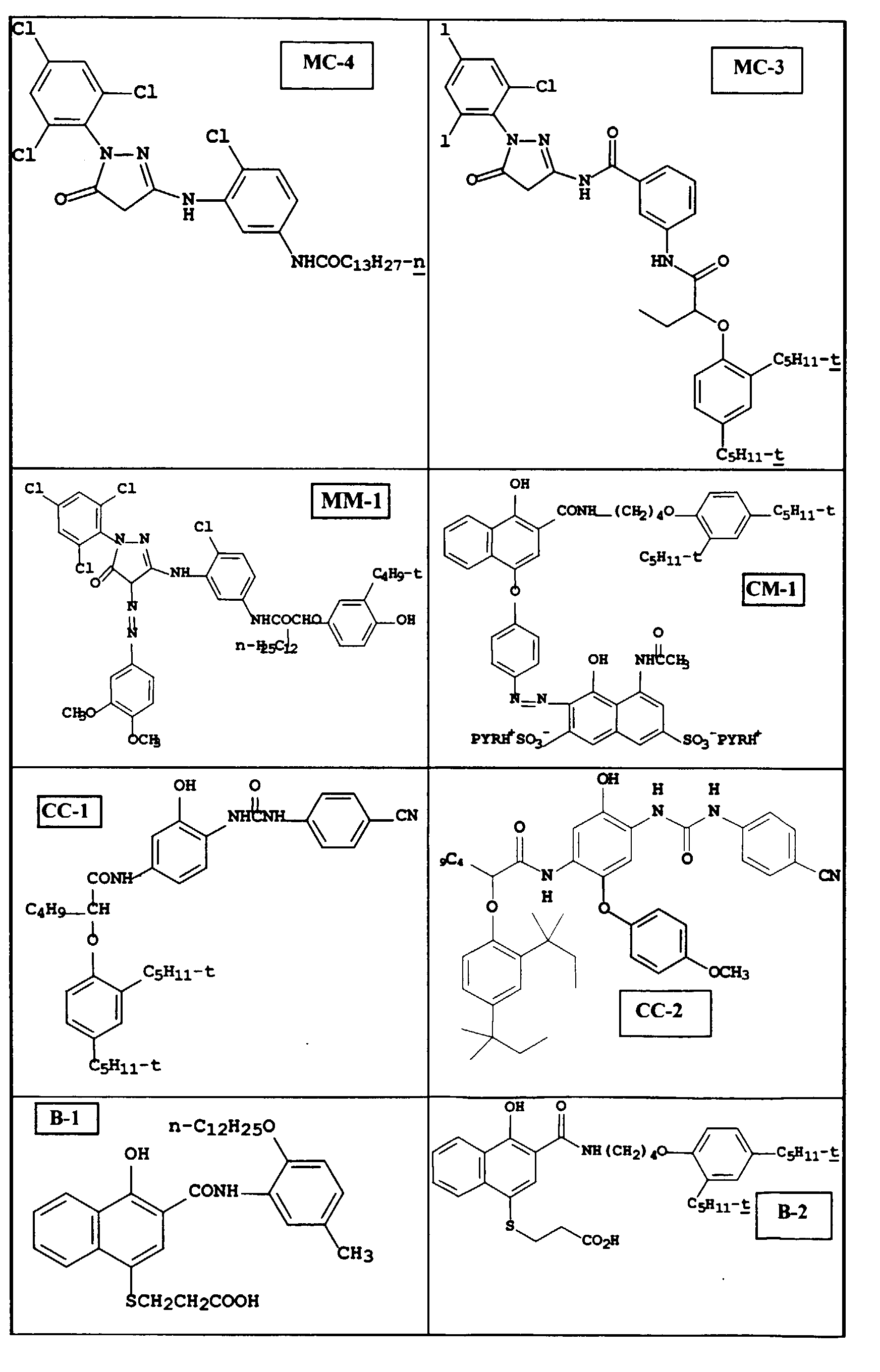
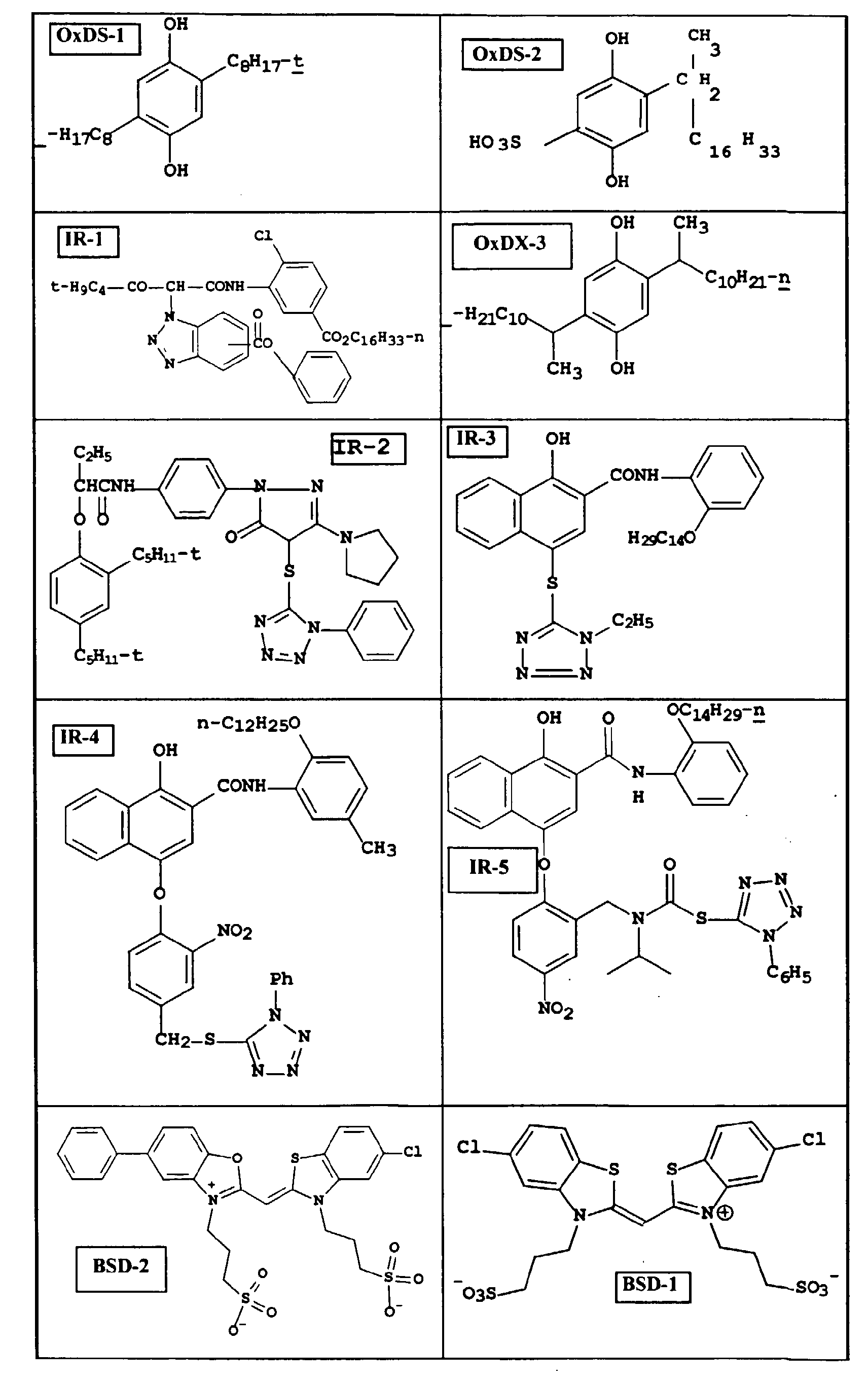

Claims (11)
- A multicolor photographic element comprising a support bearing a cyan dye image-forming unit comprising at least one red-sensitive silver halide emulsion layer having associated therewith at least one cyan dye-forming coupler, a magenta dye image-forming unit comprising at least one green-sensitive silver halide emulsion layer having associated therewith at least one magenta dye-forming coupler, a yellow dye image-forming unit comprising at least one blue-sensitive silver halide emulsion layer having associated therewith at least one yellow dye-forming coupler, wherein at least one of said emulsion layers comprises tabular grains and contains a one equivalent image dye-forming coupler and a fragmentable electron donating compound of the formula: X-Y' or a compound which contains a moiety of the formula -X-Y';
wherein
X is an electron donor moiety, Y' is a leaving proton H or a leaving group Y, with the proviso that if Y' is a proton, a base, β-, is covalently linked directly or indirectly to X, and wherein:1) X-Y' has an oxidation potential between 0 and about 1.4 V; and2) the oxidized form of X-Y' undergoes a bond cleavage reaction to give the radical X• and the leaving fragment Y'; and, optionally,3) the radical X• has an oxidation potential ≤-0.7V. - A photographic element according to claim 1, wherein the tabular grains have an equivalent circular diameter of at least 2 µm.
- A photographic element according to claim 1, wherein the one-equivalent coupler is of the formula:where R24 is a substituted or unsubstituted alkyl or aryl group;COUP is an image dye-forming coupler moiety;DYE is an image dye or image dye precursor;B' is -OC(O)-, -OC(S)-, -SC(O)-, -SC(S)- or -OC(=NSO2R24)-,L' is a linking group;n is zero or 1; andR1 is an alkyl or aromatic group.
- A photographic element according to claim 3, wherein B' is -OC(O)-.
- A photographic element according to claim 3, wherein n is zero or 1.
- A photographic element according to claim 5, wherein n is 1 and L' selected from the following groups:


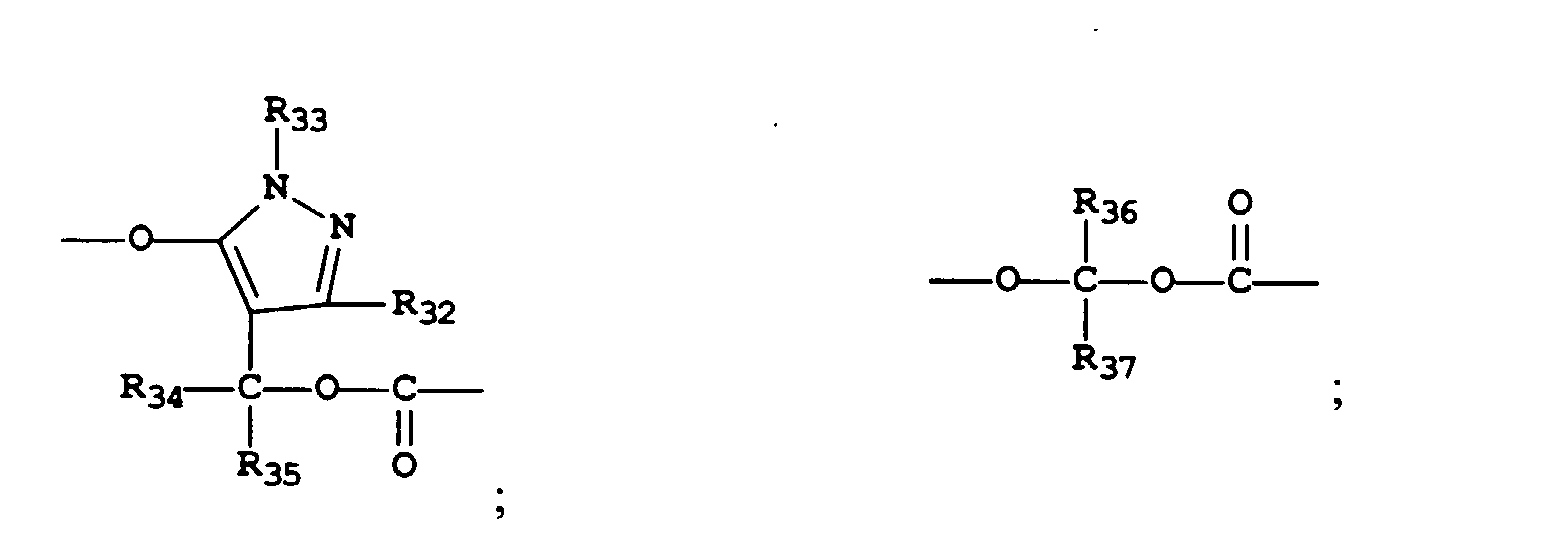 and
and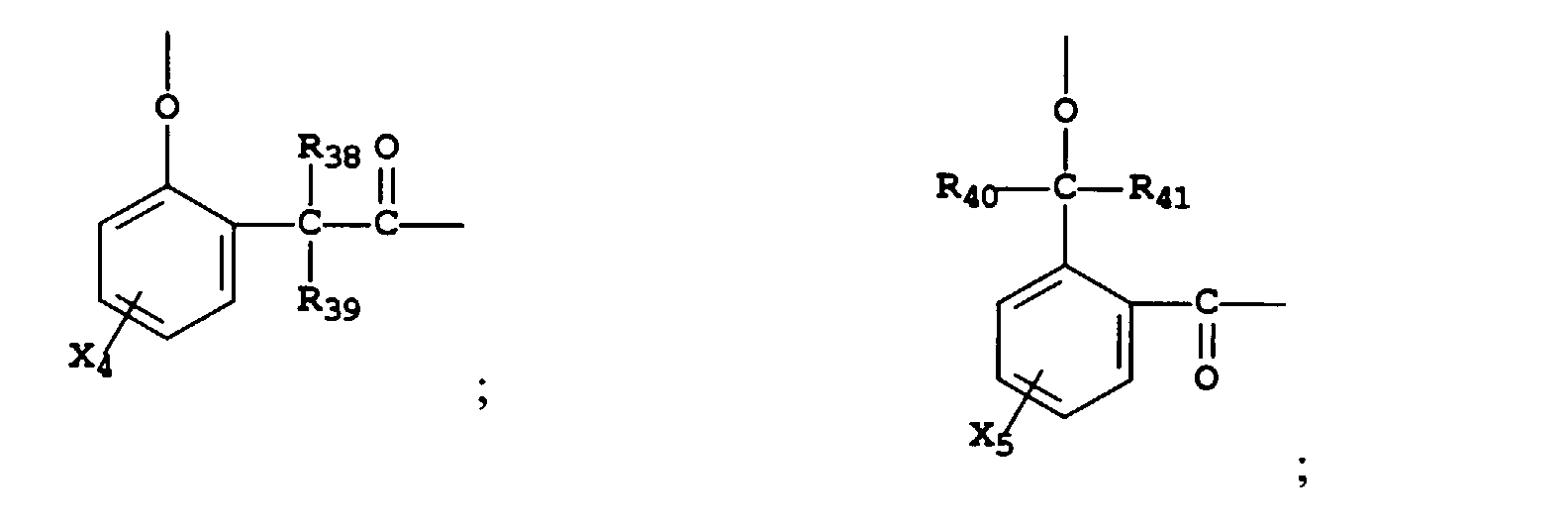 wherein R25 through R41 are individually a hydrogen atom or an unsubstituted or substituted alkyl, cycloalkyl, or aryl group, and X1 through X6 are individually a hydrogen halogen atom or a substituted or unsubstituted alkyl, nitro, carbamyl, acylamido, sulfonamido, sulfamyl, sulfo, carboxyl, cyano, alkoxy, or aryloxy group.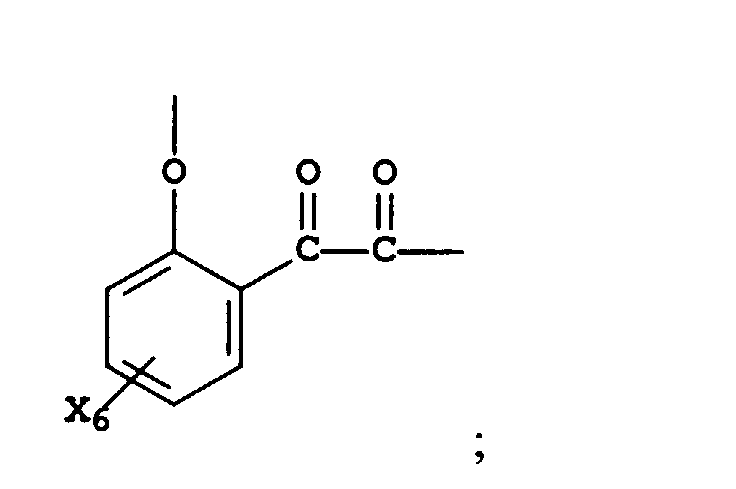
- A photographic element according to claim 3, wherein DYE is an azomethine or methine dye.
- A photographic element according to claim 1, wherein the one equivalent image dye-forming coupler is of the formula:

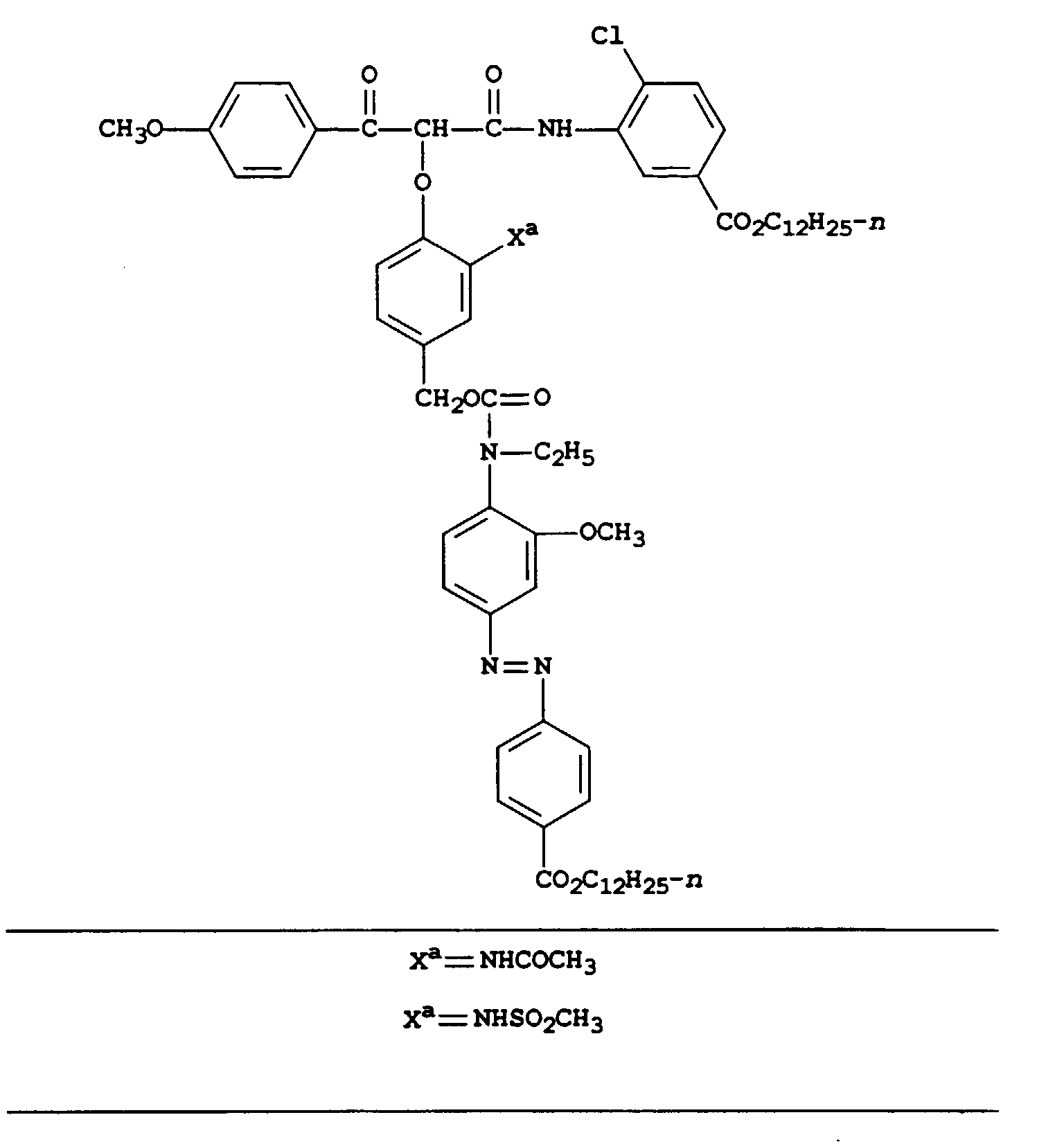




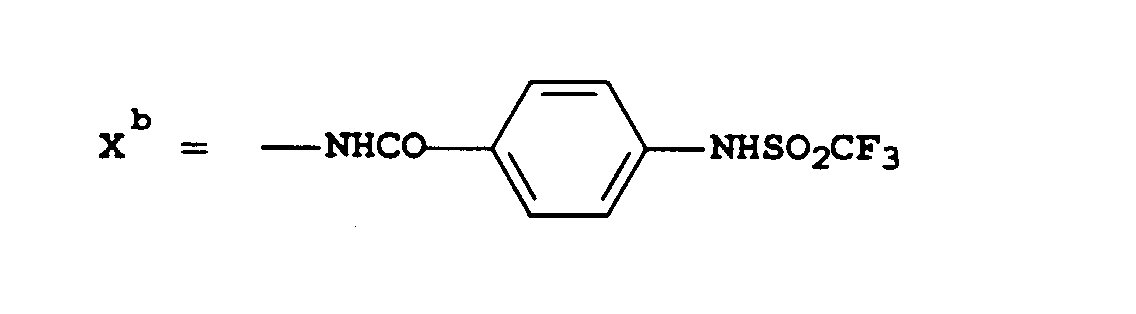


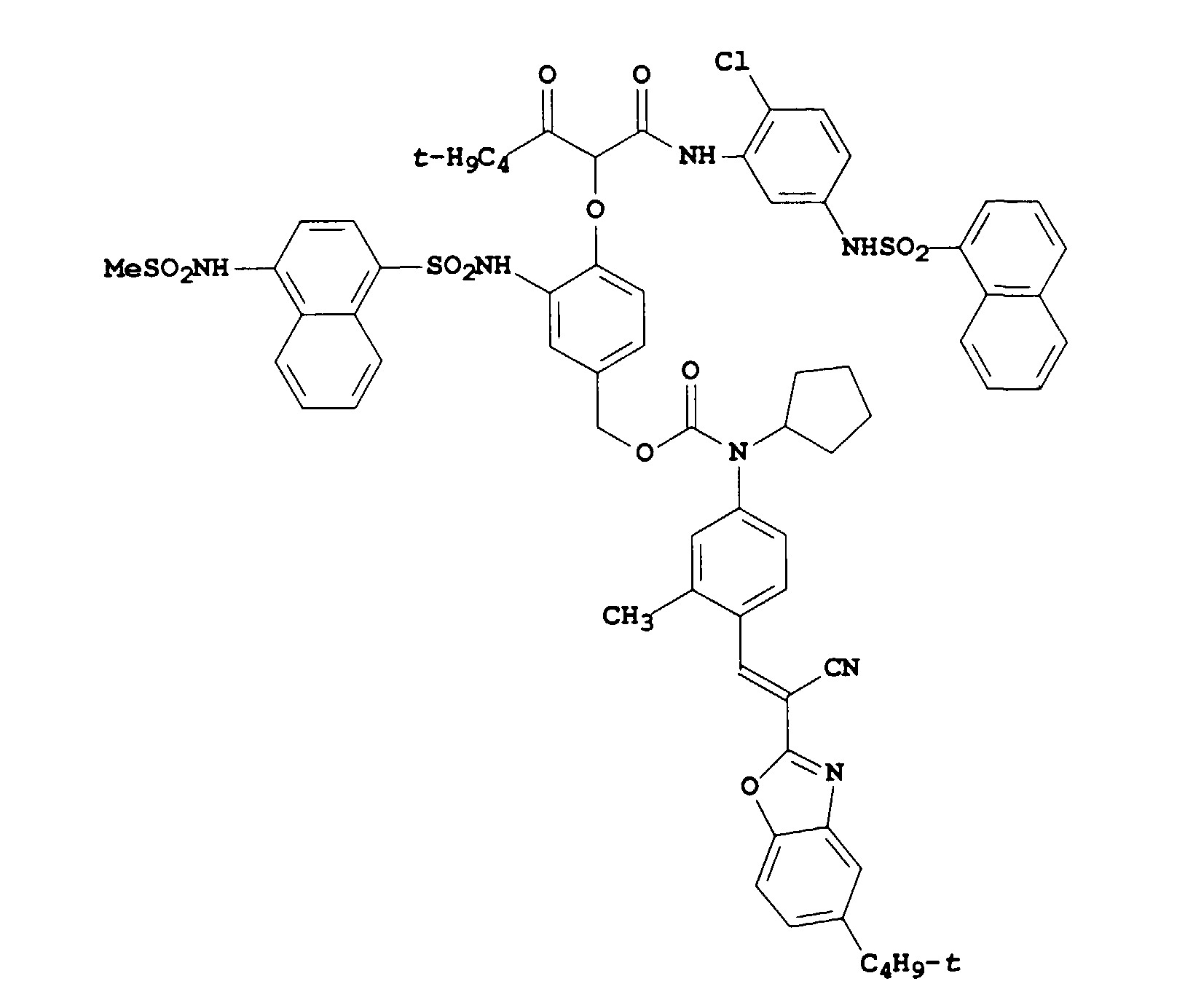 or
or
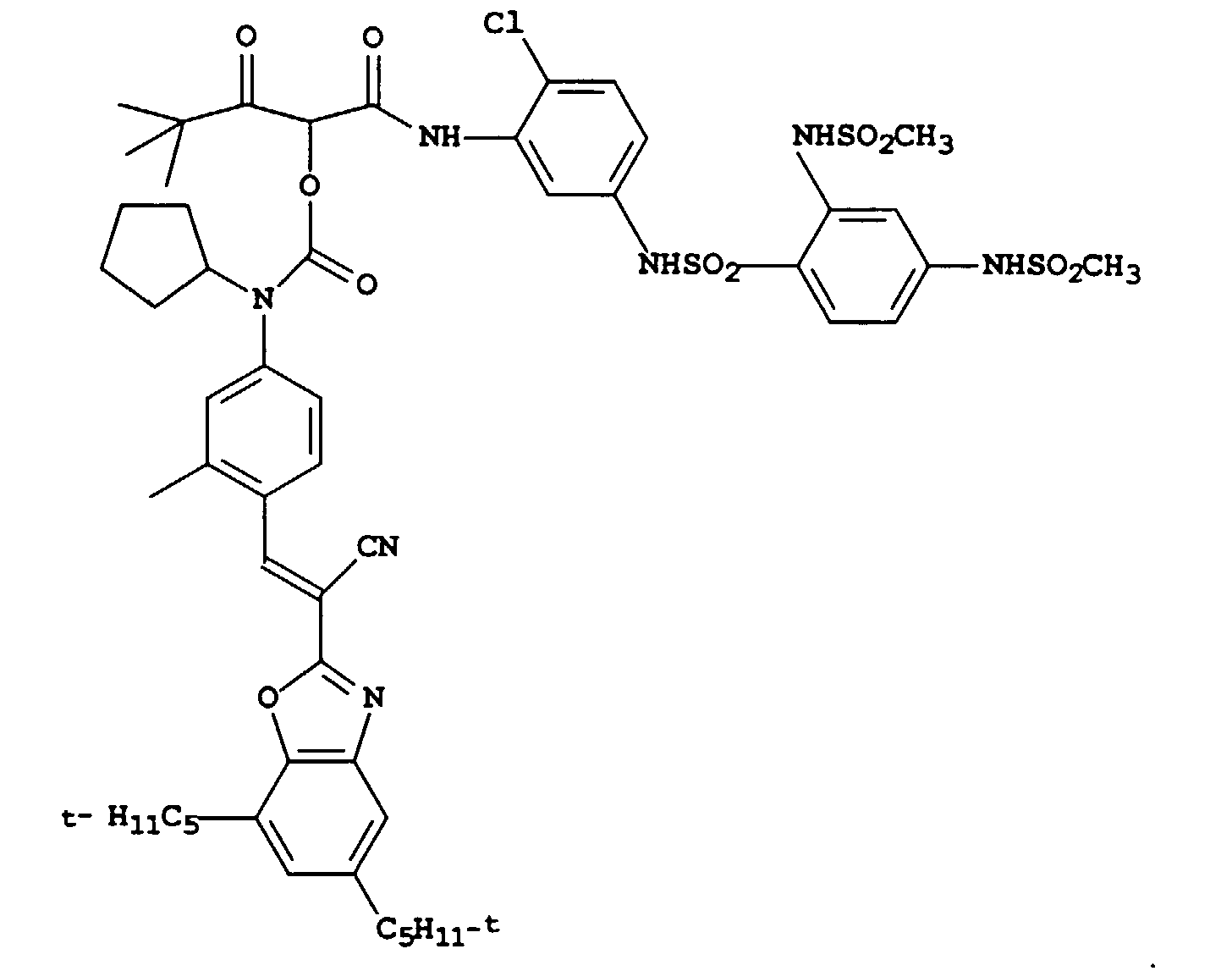
- A photographic element according to claim 1, wherein X is of structure (I), (II), (III) or (IV):
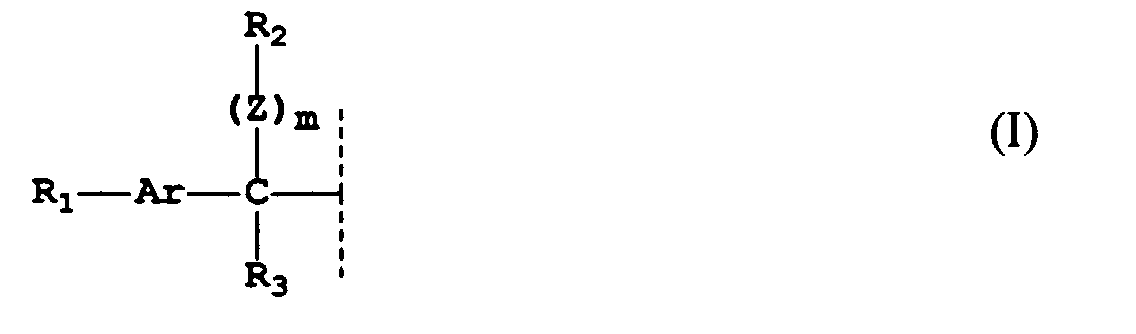 wherein:R1 = R, carboxyl, amide, sulfonamide, halogen, NR2, (OH)n, (OR')n, or (SR)n;R' = alkyl or substituted alkyl;n= 1-3;R2 = R, Ar';R3 = R, Ar';R2 and R3 together can form 5- to 8-wherein:m = 0, 1;Z= O,S,Se,Te;R2 and Ar = can be linked to form 5- to 8-membered ring;R3 and Ar = can be linked to form 5- to 8-membered ring;Ar' = aryl groupor heterocyclic group.andR = a hydrogen atom or an unsubstituted or substituted alkyl group;
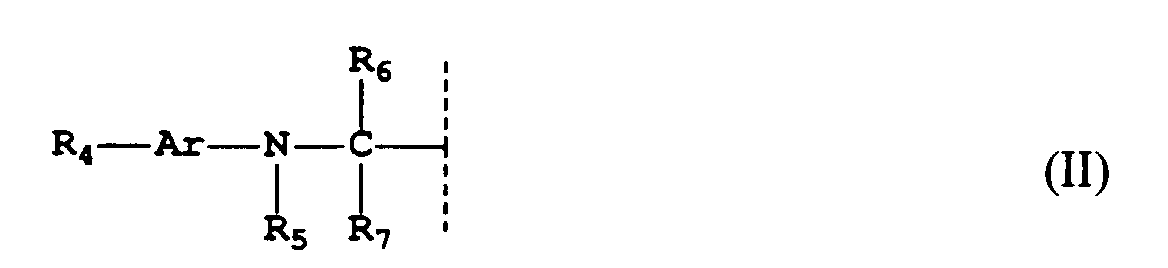 "ring" represents a substituted or unsubstituted 5-, 6- or 7-membered unsaturated ring.Ar = aryl group or heterocyclic groupR4 = a substituent having a Hammett sigma value of-1 to +1,R5 = R or Ar'R6 and R7 = R or Ar'R5 and Ar = can be linked to form 5- to 8-membered ring;R6 and Ar = can be linked to form 5- to 8-membered ring (in which case, R6 can be a hetero atom);R5 and R6 can be linked to form 5- to 8-membered ring;R6 and R7 can be linked to form 5- to 8-membered ring;Ar' = aryl group or heterocyclic group;andR = hydrogen atom or an unsubstituted or substituted alkyl group;wherein:
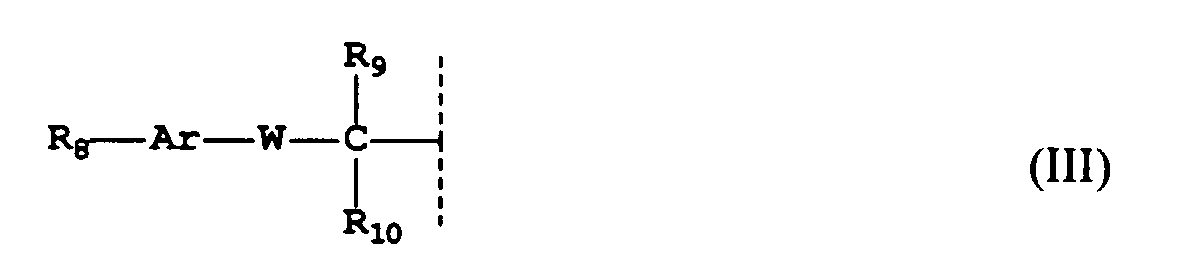 W = O, S, Se;Ar = aryl group or heterocyclic group;R8 = R, carboxyl, NR2, (OR)n, or (SR)n (n = 1-3);R9 and R10 = R, Ar';R9 and Ar = can be linked to form 5- to 8-membered ring;Ar' = aryl group or heterocyclic group;
andR = a hydrogen atom or an unsubstituted or substituted alkyl group;wherein:
- A photographic element according to claim 1, wherein Y' is:(1) X', where X' is an X group as defined in structures I-IV and may be the same as or different from the X group to which it is attached(2)
 (3)where M = Si, Sn or Ge; and R' = alkyl or substituted alkyl
 (4)where Ar" = aryl or substituted aryl
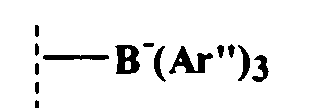 (5)
(5)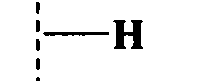
- A photographic element according to claim 1, wherein the fragmentable electron donor compound is selected from compounds of the formulae:Z is a light absorbing group;k is 1 or 2;A is a silver halide adsorptive group;L represents a linking group containing at least one C, N, S, P or O atom; andQ represents the atoms necessary to form a chromophore comprising an amidinium-ion, a carboxyl-ion or dipolar-amidic chromophoric system when conjugated with X-Y'.
Applications Claiming Priority (2)
| Application Number | Priority Date | Filing Date | Title |
|---|---|---|---|
| US468023 | 1990-01-22 | ||
| US09/468,023 US6242170B1 (en) | 1998-12-17 | 1999-12-20 | Color photographic element containing a fragmentable electron donor in combination with a one equivalent coupler for improved photographic response |
Publications (1)
| Publication Number | Publication Date |
|---|---|
| EP1111448A1 true EP1111448A1 (en) | 2001-06-27 |
Family
ID=23858131
Family Applications (1)
| Application Number | Title | Priority Date | Filing Date |
|---|---|---|---|
| EP00204390A Withdrawn EP1111448A1 (en) | 1999-12-20 | 2000-12-08 | Color photographic element containing a fragmentable electron donor in combination with a one equivalent coupler |
Country Status (3)
| Country | Link |
|---|---|
| US (1) | US6242170B1 (en) |
| EP (1) | EP1111448A1 (en) |
| JP (1) | JP2001183782A (en) |
Cited By (3)
| Publication number | Priority date | Publication date | Assignee | Title |
|---|---|---|---|---|
| EP1300726A1 (en) * | 2001-10-03 | 2003-04-09 | Fuji Photo Film Co., Ltd. | Photothermographic material comprising fragmentable electron donor |
| EP1227368A3 (en) * | 2001-01-05 | 2003-05-07 | Eastman Kodak Company | Multicolor photographic element with improved latent image keeping |
| US7211373B2 (en) | 2001-03-23 | 2007-05-01 | Fujifilm Corporation | Photothermographic material |
Families Citing this family (4)
| Publication number | Priority date | Publication date | Assignee | Title |
|---|---|---|---|---|
| US6593073B1 (en) * | 1999-12-20 | 2003-07-15 | Eastman Kodak Company | Core/shell emulsions with enhanced photographic response |
| JP2001323180A (en) * | 2000-05-12 | 2001-11-20 | Fuji Photo Film Co Ltd | Methine compound and silver halide photosensitive material for photography containing the compound |
| JP3568927B2 (en) * | 2001-11-20 | 2004-09-22 | 富士写真フイルム株式会社 | Silver halide color photographic materials |
| US7060424B2 (en) * | 2001-11-22 | 2006-06-13 | Fuji Photo Film Co., Ltd. | Method of increasing speed of silver halide color photosensitive material |
Citations (6)
| Publication number | Priority date | Publication date | Assignee | Title |
|---|---|---|---|---|
| EP0313308A2 (en) * | 1987-10-19 | 1989-04-26 | EASTMAN KODAK COMPANY (a New Jersey corporation) | Photographic element and process comprising a dye releasing group |
| EP0574090A1 (en) * | 1992-06-12 | 1993-12-15 | Eastman Kodak Company | One equivalent couplers and low pKa release dyes |
| EP0786691A1 (en) * | 1996-01-26 | 1997-07-30 | Eastman Kodak Company | Silver halide light sensitive emulsion layer having enhanced photographic sensitivity |
| EP0786692A1 (en) * | 1996-01-26 | 1997-07-30 | Eastman Kodak Company | Silver halide light sensitive emulsion layer having enhanced photographic sensitivity |
| EP0893732A1 (en) * | 1997-07-25 | 1999-01-27 | Eastman Kodak Company | Silver halide light sensitive emulsion layer having enhanced photographic sensitivity |
| EP1011025A1 (en) * | 1998-12-17 | 2000-06-21 | Eastman Kodak Company | Color photographic elements containing one equivalent coupler |
Family Cites Families (13)
| Publication number | Priority date | Publication date | Assignee | Title |
|---|---|---|---|---|
| US4439520A (en) | 1981-11-12 | 1984-03-27 | Eastman Kodak Company | Sensitized high aspect ratio silver halide emulsions and photographic elements |
| US5447819A (en) * | 1994-05-27 | 1995-09-05 | Eastman Kodak Company | Photographic element containing high dye-yield couplers having improved reactivity |
| US5457004A (en) | 1994-05-27 | 1995-10-10 | Eastman Kodak Company | Photographic element containing a high dye-yield coupler with methine dye chromophore |
| US5604085A (en) | 1995-12-19 | 1997-02-18 | Eastman Kodak Company | High bromide ultrathin emulsions improved by peptizer selection |
| US5667955A (en) | 1995-08-10 | 1997-09-16 | Eastman Kodak Company | High bromide ultrathin tabular emulsions improved by peptizer modification |
| US5733718A (en) | 1995-08-10 | 1998-03-31 | Eastman Kodak Company | Photographic emulisions improved by peptizer modification |
| US5620840A (en) | 1995-12-19 | 1997-04-15 | Eastman Kodak Company | High bromide tabular grain emulsions improved by peptizer selection |
| US6010841A (en) | 1996-01-26 | 2000-01-04 | Eastman Kodak Company | Silver halide light sensitive emulsion layer having enhanced photographic sensitivity |
| US5747235A (en) | 1996-01-26 | 1998-05-05 | Eastman Kodak Company | Silver halide light sensitive emulsion layer having enhanced photographic sensitivity |
| US5693459A (en) | 1996-06-24 | 1997-12-02 | Eastman Kodak Company | High bromide (111) tabular grain emulsions precipitated in a novel dispersing medium |
| US5691131A (en) | 1996-11-21 | 1997-11-25 | Eastman Kodak Company | High bromide tabular grain emulsions with dislocations in peripheral regions |
| EP0893731B1 (en) * | 1997-07-25 | 2004-01-28 | Eastman Kodak Company | Silver halide light sensitive emulsion layer having enhanced photographic sensitivity |
| US6132944A (en) * | 1998-12-31 | 2000-10-17 | Eastman Kodak Company | Photographic element containing high dye-yield couplers |
-
1999
- 1999-12-20 US US09/468,023 patent/US6242170B1/en not_active Expired - Fee Related
-
2000
- 2000-12-08 EP EP00204390A patent/EP1111448A1/en not_active Withdrawn
- 2000-12-20 JP JP2000387751A patent/JP2001183782A/en active Pending
Patent Citations (6)
| Publication number | Priority date | Publication date | Assignee | Title |
|---|---|---|---|---|
| EP0313308A2 (en) * | 1987-10-19 | 1989-04-26 | EASTMAN KODAK COMPANY (a New Jersey corporation) | Photographic element and process comprising a dye releasing group |
| EP0574090A1 (en) * | 1992-06-12 | 1993-12-15 | Eastman Kodak Company | One equivalent couplers and low pKa release dyes |
| EP0786691A1 (en) * | 1996-01-26 | 1997-07-30 | Eastman Kodak Company | Silver halide light sensitive emulsion layer having enhanced photographic sensitivity |
| EP0786692A1 (en) * | 1996-01-26 | 1997-07-30 | Eastman Kodak Company | Silver halide light sensitive emulsion layer having enhanced photographic sensitivity |
| EP0893732A1 (en) * | 1997-07-25 | 1999-01-27 | Eastman Kodak Company | Silver halide light sensitive emulsion layer having enhanced photographic sensitivity |
| EP1011025A1 (en) * | 1998-12-17 | 2000-06-21 | Eastman Kodak Company | Color photographic elements containing one equivalent coupler |
Cited By (4)
| Publication number | Priority date | Publication date | Assignee | Title |
|---|---|---|---|---|
| EP1227368A3 (en) * | 2001-01-05 | 2003-05-07 | Eastman Kodak Company | Multicolor photographic element with improved latent image keeping |
| US7211373B2 (en) | 2001-03-23 | 2007-05-01 | Fujifilm Corporation | Photothermographic material |
| EP1300726A1 (en) * | 2001-10-03 | 2003-04-09 | Fuji Photo Film Co., Ltd. | Photothermographic material comprising fragmentable electron donor |
| US6787298B2 (en) | 2001-10-03 | 2004-09-07 | Fuji Photo Film Co., Ltd. | Photothermographic material |
Also Published As
| Publication number | Publication date |
|---|---|
| JP2001183782A (en) | 2001-07-06 |
| US6242170B1 (en) | 2001-06-05 |
Similar Documents
| Publication | Publication Date | Title |
|---|---|---|
| US6242170B1 (en) | Color photographic element containing a fragmentable electron donor in combination with a one equivalent coupler for improved photographic response | |
| US6225036B1 (en) | Color photographic element containing a fragmentable electron donor in combination with a one equivalent coupler and starch peptized tabular emulsion for improved photographic response | |
| US6245497B1 (en) | Performance of high speed emulsions for color film | |
| JPS62136650A (en) | Silver halide color photographic sensitive material and processing method therefor | |
| US4889796A (en) | Silver halide photographic emulsion | |
| US6428947B1 (en) | Multicolor photographic element with improved latent image keeping | |
| US6531272B1 (en) | Color photographic element containing a fragmentable electron donor for improved photographic response | |
| US6416941B1 (en) | Color photographic elements of increased sensitivity | |
| US6518008B1 (en) | Fragmentable electron donor compounds in combination with high bromide tabular grain emulsions | |
| US6514683B2 (en) | Photographic element with improved sensitivity and improved keeping | |
| EP1022609B1 (en) | Fragmentable electron donor compounds with broad blue spectral sensitization | |
| US6660464B1 (en) | Photographic element containing a fragmentable electron donor for improved photographic response | |
| EP1220024A2 (en) | Silver halide photographic element | |
| EP1111450B1 (en) | Core/shell emulsions with enhanced photographic response | |
| US6140036A (en) | Photographic material having improved color reproduction | |
| JPH09203992A (en) | Photographic element containing sensitizing dye | |
| JP2681171B2 (en) | Silver halide photographic material | |
| JPH04368935A (en) | Silver halide color photographic sensitive material | |
| EP1136875A2 (en) | Small 3D emulsions with enhanced photographic response | |
| JPH08297341A (en) | Photographic element | |
| JPS62195650A (en) | Silver halide photographic sensitive material containing novel restrainer | |
| JPH07191439A (en) | Color printing material with variable gradation | |
| JPH0830860B2 (en) | Method for producing silver halide photographic emulsion | |
| JP2000181033A (en) | Photographic element | |
| JPH08201952A (en) | Chemical sensitization method for silver halide photographic emulsion and silver halide photographic sensitive material |
Legal Events
| Date | Code | Title | Description |
|---|---|---|---|
| PUAI | Public reference made under article 153(3) epc to a published international application that has entered the european phase |
Free format text: ORIGINAL CODE: 0009012 |
|
| AK | Designated contracting states |
Kind code of ref document: A1 Designated state(s): DE FR GB |
|
| AX | Request for extension of the european patent |
Free format text: AL;LT;LV;MK;RO;SI |
|
| 17P | Request for examination filed |
Effective date: 20011121 |
|
| AKX | Designation fees paid |
Free format text: DE FR GB |
|
| STAA | Information on the status of an ep patent application or granted ep patent |
Free format text: STATUS: THE APPLICATION HAS BEEN WITHDRAWN |
|
| 18W | Application withdrawn |
Effective date: 20040517 |