EP1111011A2 - Black alcohol soluble dye formulation - Google Patents
Black alcohol soluble dye formulation Download PDFInfo
- Publication number
- EP1111011A2 EP1111011A2 EP00310840A EP00310840A EP1111011A2 EP 1111011 A2 EP1111011 A2 EP 1111011A2 EP 00310840 A EP00310840 A EP 00310840A EP 00310840 A EP00310840 A EP 00310840A EP 1111011 A2 EP1111011 A2 EP 1111011A2
- Authority
- EP
- European Patent Office
- Prior art keywords
- percent
- weight
- composition
- base
- propanol
- Prior art date
- Legal status (The legal status is an assumption and is not a legal conclusion. Google has not performed a legal analysis and makes no representation as to the accuracy of the status listed.)
- Withdrawn
Links
Classifications
-
- C—CHEMISTRY; METALLURGY
- C09—DYES; PAINTS; POLISHES; NATURAL RESINS; ADHESIVES; COMPOSITIONS NOT OTHERWISE PROVIDED FOR; APPLICATIONS OF MATERIALS NOT OTHERWISE PROVIDED FOR
- C09B—ORGANIC DYES OR CLOSELY-RELATED COMPOUNDS FOR PRODUCING DYES, e.g. PIGMENTS; MORDANTS; LAKES
- C09B67/00—Influencing the physical, e.g. the dyeing or printing properties of dyestuffs without chemical reactions, e.g. by treating with solvents grinding or grinding assistants, coating of pigments or dyes; Process features in the making of dyestuff preparations; Dyestuff preparations of a special physical nature, e.g. tablets, films
- C09B67/0033—Blends of pigments; Mixtured crystals; Solid solutions
-
- C—CHEMISTRY; METALLURGY
- C09—DYES; PAINTS; POLISHES; NATURAL RESINS; ADHESIVES; COMPOSITIONS NOT OTHERWISE PROVIDED FOR; APPLICATIONS OF MATERIALS NOT OTHERWISE PROVIDED FOR
- C09B—ORGANIC DYES OR CLOSELY-RELATED COMPOUNDS FOR PRODUCING DYES, e.g. PIGMENTS; MORDANTS; LAKES
- C09B67/00—Influencing the physical, e.g. the dyeing or printing properties of dyestuffs without chemical reactions, e.g. by treating with solvents grinding or grinding assistants, coating of pigments or dyes; Process features in the making of dyestuff preparations; Dyestuff preparations of a special physical nature, e.g. tablets, films
- C09B67/0071—Process features in the making of dyestuff preparations; Dehydrating agents; Dispersing agents; Dustfree compositions
- C09B67/0075—Preparations with cationic dyes
- C09B67/0076—Preparations of cationic or basic dyes in liquid form
-
- C—CHEMISTRY; METALLURGY
- C09—DYES; PAINTS; POLISHES; NATURAL RESINS; ADHESIVES; COMPOSITIONS NOT OTHERWISE PROVIDED FOR; APPLICATIONS OF MATERIALS NOT OTHERWISE PROVIDED FOR
- C09B—ORGANIC DYES OR CLOSELY-RELATED COMPOUNDS FOR PRODUCING DYES, e.g. PIGMENTS; MORDANTS; LAKES
- C09B67/00—Influencing the physical, e.g. the dyeing or printing properties of dyestuffs without chemical reactions, e.g. by treating with solvents grinding or grinding assistants, coating of pigments or dyes; Process features in the making of dyestuff preparations; Dyestuff preparations of a special physical nature, e.g. tablets, films
- C09B67/0071—Process features in the making of dyestuff preparations; Dehydrating agents; Dispersing agents; Dustfree compositions
- C09B67/0083—Solutions of dyes
-
- C—CHEMISTRY; METALLURGY
- C09—DYES; PAINTS; POLISHES; NATURAL RESINS; ADHESIVES; COMPOSITIONS NOT OTHERWISE PROVIDED FOR; APPLICATIONS OF MATERIALS NOT OTHERWISE PROVIDED FOR
- C09D—COATING COMPOSITIONS, e.g. PAINTS, VARNISHES OR LACQUERS; FILLING PASTES; CHEMICAL PAINT OR INK REMOVERS; INKS; CORRECTING FLUIDS; WOODSTAINS; PASTES OR SOLIDS FOR COLOURING OR PRINTING; USE OF MATERIALS THEREFOR
- C09D11/00—Inks
- C09D11/16—Writing inks
-
- Y—GENERAL TAGGING OF NEW TECHNOLOGICAL DEVELOPMENTS; GENERAL TAGGING OF CROSS-SECTIONAL TECHNOLOGIES SPANNING OVER SEVERAL SECTIONS OF THE IPC; TECHNICAL SUBJECTS COVERED BY FORMER USPC CROSS-REFERENCE ART COLLECTIONS [XRACs] AND DIGESTS
- Y10—TECHNICAL SUBJECTS COVERED BY FORMER USPC
- Y10S—TECHNICAL SUBJECTS COVERED BY FORMER USPC CROSS-REFERENCE ART COLLECTIONS [XRACs] AND DIGESTS
- Y10S8/00—Bleaching and dyeing; fluid treatment and chemical modification of textiles and fibers
- Y10S8/938—Solvent dyes
Definitions
- the present invention relates to black alcohol soluble dye formulations of high color intensity, low viscosity, and high tinctorial strength.
- the formulations are particularly useful for writing instruments such as felt tip and roller ball pens.
- Such inks are generally formulated with soluble dye colorants in a compatible aqueous or solvent-based vehicle to form fluid, particle-free, dye solutions.
- Non-aqueous inks have advantages over aqueous-based inks since many solvent dyes have reasonable solubility in volatile organic solvents and, as a result, can be applied as true liquid solutions free of any particles. Another benefit of using solvent dyes in inks is that they tend to be permanent, at least with respect to exposure to water.
- Black ink formulations are often customized to individual manufacturers' requirements to provide a multitude of shade variations from greyish to bluish black to convey company recognition by shade variations of the finished ink. This associates their pens to the end user.
- black dye formulations are typically blends of yellowish-brown dyes combined with black, violet, and/or blue dyes in widely varying ratios to achieve such shade variations.
- the present invention therefore, provides a black, alcohol soluble dye formulation composition comprising:
- the composition consists essentially of those components specified above.
- the propanol solvent is n-propanol.
- the carboxylic acid is 2-ethylhexanoic acid.
- the brown or yellow dye is selected from C.I. Solvent Brown 12 dye or a yellow dye of the formula: as disclosed in U. S. Patent No. 5,142,030, incorporated by reference herein, wherein each R is independently a (C 6 -C 12 )alkyl; preferably each R is a nonyl group (the xylene solution of which is available as AutomateTM Yellow D dye from Morton International or Rohm and Haas Company), or a mixture thereof; most preferably the brown or yellow dye is C.I.
- the ester cosolvent is preferably an acetate, more preferably n-propyl acetate or ethyl acetate. Such cosolvents are most useful when the formulation is intended to be applied to a non-porous substrate.
- the black solvent based formulations of this invention have high tinctorial strength. That is, these formulations have high spectral strength relative to their colorant concentrations. High tinctorial strength is important for certain applications such as ink jet printing.
- the compositions are highly fluid, that is, the viscosity is preferably less than 1200 centipoise (cP) at 25 °C, more preferably less than 1000 cP, and essentially free of particles that can clog the dispensing tips of felt-tip and roller-ball pens as well as ink-jet printer heads. Also, when dried, the ink residue is permanent with respect to exposure to water but is resoluble with respect to its own solvent carriers.
- the inks are further capable of depositing and adhering to the printing substrate, preferably a porous substrate such as, for example, paper, cardstock, and corrugated cardboard, with a minimum of character fogging or bleeding and are fast drying without streaking and blotting on the substrate.
- the formulations of this invention may also be useful as wood stains, petroleum colorants, decorative coatings, and printing inks for the graphic arts industry.
- Nigrosine dyes are a well-known class of black solvent dyes.
- the present invention concerns the use of solvent-soluble nigrosine dyes that are insoluble in water. Although there are water-soluble nigrosine dyes, particularly sulfonated nigrosines, this invention is not directed to their use. Water-soluble nigrosine dyes typically remain water-soluble in use and, therefore, can be washed away.
- Nigrosine dyes are obtained by heating nitro compounds, such as nitrobenzene or nitrophenols, with aniline and/or aniline hydrochloride in the presence of iron or ferric chloride. Different grades or types of nigrosine can readily be prepared by altering the proportions of the reactants and time of heating.
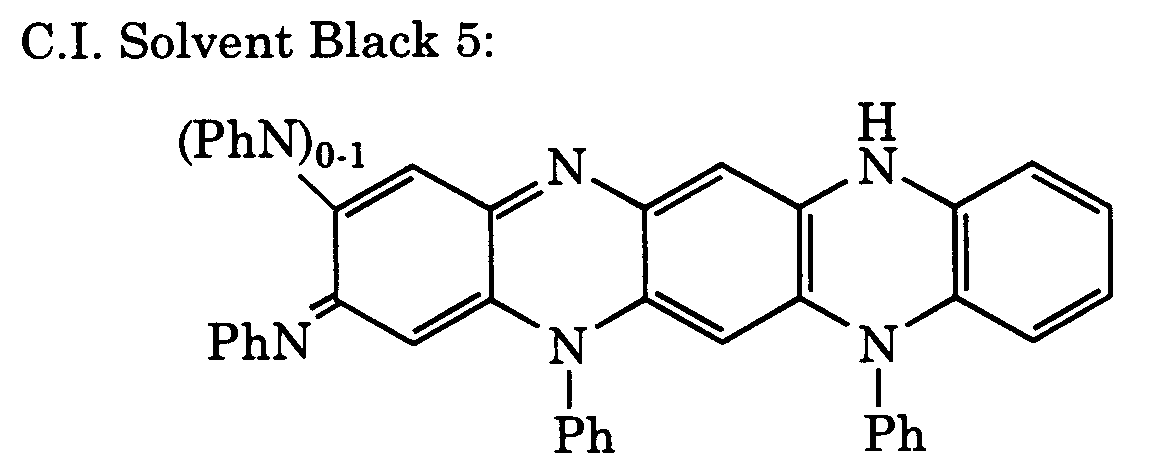
- the nigrosine compositions obtained from such processes are mixtures of compounds which, in their simplest form are of the formula:
- nigrosine dyes examples include Solvent Black 5 and the free base form of Solvent Black 7 ("Nigrosine Base”):
- Nigrosine Base is prepared by reaction of nigrosine dyes with mild alkalis, resulting in rearrangement.
- Crystal Violet Base (C.I. Solvent Violet 9) and Methyl Violet Base (C.I. Solvent Violet 8) are classified as basic dye derivatives of pararosaniline, a triphenylmethane type dye.
- Solvent Brown 12 is a diazo dye mixture prepared by treatment of three parts of toluene-2,4-diamine hydrochloride with two parts of nitrous acid. Crystal Violet Base is preferred.
- AutomateTM Yellow D is a yellow dye prepared by tetrazo coupling of 4,4'-diaminobenzanilide with 2 equivalents of p-nonyl phenol according to the procedure of U. S. Patent No. 5,142,030, incorporated by reference herein.
- Variations in the shade of black obtained with the formulations of this invention can be accomplished by varying the relative amounts of Nigrosine Base, the brown or yellow dye, and the Crystal or Methyl Violet Base.
- compositions of this invention may include other common ink additives such as, for example, pH adjusters, rheology modifiers, antioxidants, thixotropic agents, plasticizers, conductive agents, cap-off additives, and other pigments and/or dyes (to vary the shade of black obtained).
- ink additives such as, for example, pH adjusters, rheology modifiers, antioxidants, thixotropic agents, plasticizers, conductive agents, cap-off additives, and other pigments and/or dyes (to vary the shade of black obtained).
- compositions of this invention are prepared using the following general procedure:
- Samples prepared according to examples 1-6 and 8-9 provided black ink formulations of intense color with a minimum quantity of colorants.
- the sample prepared according to example 7 exhibited a violet-black shading due to the increased ratio of Crystal Violet Base to Solvent Brown 12.
- Samples prepared according to examples 10-12 resulted in red shade black dyes.
- the sample prepared according to example 13 was less violet than other samples but not as blue-black as commercially available UnisolTM Black 1410 (United Color Manufacturing Co.).
Landscapes
- Chemical & Material Sciences (AREA)
- Organic Chemistry (AREA)
- Chemical Kinetics & Catalysis (AREA)
- Life Sciences & Earth Sciences (AREA)
- Engineering & Computer Science (AREA)
- Materials Engineering (AREA)
- Wood Science & Technology (AREA)
- Inks, Pencil-Leads, Or Crayons (AREA)
Abstract
Description



| Ex. # | n-Pr* | Cosolvent | Nigrosine Base | 2-EHA | Solvent Brown 12 | Crystal Violet Base | Visc. |
| 1 | 41 | 32 | 23 | 3 | 1 | 1100 - 1140 | |
| 2 | 41 | 33 | 23 | 2 | 1 | 875 | |
| 3 | 27 | 32 | 35 | 5 | 1 | - | |
| 4 | 25 | 32 | 35 | 5 | 3 | - | |
| 5 | 34 | 5 | 33 | 23 | 4 | 1 | - |
| 6 | 39.5 | 32 | 23 | 4 | 1.5 | - | |
| 7 | 39 | 32.5 | 25 | 2 | 1.5 | 594 | |
| 8 | 40 | 32 | 23 | 4 | 1 | 2350 | |
| 9 | 40 | 32 | 25 | 2 | 1 | 922 | |
| 10 | 35 | 34 | 26 | 4 | 1 | 4340 | |
| 11 | 30 | 35 | 32 | 2 | 1 | 4310 | |
| 12 | 30 | 34 | 32 | 3 | 1 | - | |
| 13 | 30 | 34 | 32 | 3 | 1 | - |
Claims (10)
- A black, alcohol soluble dye composition comprising:a) from 20 to 45 percent, by weight, of a propanol solvent selected from n-propanol, isopropanol, or a mixture thereof;b) from 30 to 35 percent, by weight, of Nigrosine Base;c) from 20 to 40 percent, by weight, of one or more (C7-C20), preferably (C8-C18), more preferably (C8-C10), most preferably (C8) straight or branched chain, saturated or unsaturated carboxylic acids;d) from 1 to 6 percent, by weight, of a brown or yellow dye or combination thereof; ande) from 1 to 3 percent, by weight, of Crystal Violet Base, Methyl Violet Base, or mixture thereof; andf) optionally, 0 to 5 percent, by weight, of an ester cosolvent.
- The composition of claim 1 wherein:a) the propanol solvent is n-propanol;b) the carboxylic acid is 2-ethylhexanoic acid;c) the brown or yellow dye is selected from:1) C.I. Solvent Brown 12 dye; or2) a yellow dye of the formula:wherein each R is independently a (C6-C12)alkyl, or a mixture thereof; and
 d) the Violet Base is Crystal Violet Base.
 - The composition of claim 1 wherein the propanol solvent comprises 30 to 45 percent, by weight, of the composition.
- The composition of claim 1 wherein the Nigrosine Base comprises 32 to 34 percent, by weight, of the composition.
- The composition of claim 1 wherein the carboxylic acid comprises 23 to 26 percent, by weight, of the composition.
- The composition of claim 1 wherein the brown or yellow dye comprises 2 to 3 percent, by weight, of the composition.
- The composition of claim 1 further comprising one or more components selected from the group consisting of pH adjusters, rheology modifiers, antioxidants, thixotropic agents, plasticizers, conductive agents, additional pigments, cap-off additives, and additional dyes.
- The composition of claim 1 comprising:a) from 39 to 41 percent, by weight, of n-propanol;b) from 32 to 33 percent, by weight, of Nigrosine Base;c) from 23 to 26 percent, by weight, of 2-ethylhexanoic acid;d) from 2 to 3 percent, by weight, of C.I Solvent Brown 12 dye; ande) from 1 to 1.5 percent, by weight, of Crystal Violet Base.
- The composition of claim 1 wherein the cosolvent, when used, is selected from the group consisting of n-propyl acetate and ethyl acetate.
- A method for producing the composition of claim 1 comprising the steps of:a) adding the Nigrosine Base in portions to the propanol, which is optionally heated to from 50 to 60 °C, with agitation, until complete wetting out of the Nigrosine Base;b) adding the carboxylic acid;c) adding the brown or yellow dye and the Crystal Violet Base, Methyl Violet Base, or mixture thereof;d) heating the mixture to a temperature of from 80 to 85 °C for approximately one hour;e) cooling the mixture to a temperature of from 50 to 60 °C;f) optionally, adjusting the concentration with additional propanol; andg) optionally filtering the mixture to remove any particulate materials.
Applications Claiming Priority (2)
| Application Number | Priority Date | Filing Date | Title |
|---|---|---|---|
| US17291699P | 1999-12-21 | 1999-12-21 | |
| US172916P | 1999-12-21 |
Publications (2)
| Publication Number | Publication Date |
|---|---|
| EP1111011A2 true EP1111011A2 (en) | 2001-06-27 |
| EP1111011A3 EP1111011A3 (en) | 2003-10-15 |
Family
ID=22629731
Family Applications (1)
| Application Number | Title | Priority Date | Filing Date |
|---|---|---|---|
| EP00310840A Withdrawn EP1111011A3 (en) | 1999-12-21 | 2000-12-07 | Black alcohol soluble dye formulation |
Country Status (8)
| Country | Link |
|---|---|
| US (1) | US6666897B2 (en) |
| EP (1) | EP1111011A3 (en) |
| JP (1) | JP2001200172A (en) |
| CN (1) | CN1358802A (en) |
| AU (1) | AU7209900A (en) |
| BR (1) | BR0005952A (en) |
| MX (1) | MXPA00012414A (en) |
| TW (1) | TW514657B (en) |
Cited By (2)
| Publication number | Priority date | Publication date | Assignee | Title |
|---|---|---|---|---|
| WO2001088043A3 (en) * | 2000-05-16 | 2002-02-28 | Milliken & Co | Washable coloring compositions |
| EP2065459A3 (en) * | 2007-11-05 | 2010-08-25 | Sunbelt Corporation | Liquid dye formulations in non-petroleum based solvent systems |
Families Citing this family (2)
| Publication number | Priority date | Publication date | Assignee | Title |
|---|---|---|---|---|
| CN101845235A (en) * | 2009-12-15 | 2010-09-29 | 西北农林科技大学 | Method for preparing aniline black in dye industry |
| CN108485306A (en) * | 2018-03-29 | 2018-09-04 | 江苏道博化工有限公司 | A kind of synthetic method of aniline black byestuffs |
Family Cites Families (7)
| Publication number | Priority date | Publication date | Assignee | Title |
|---|---|---|---|---|
| US2684908A (en) * | 1950-08-30 | 1954-07-27 | Gen Aniline & Film Corp | Black hectograph printing ink |
| JPS5289928A (en) * | 1976-01-22 | 1977-07-28 | Mita Industrial Co Ltd | Pressure fixing developing agent for electrostatography |
| US4842646A (en) * | 1986-09-23 | 1989-06-27 | Saranda Consolidated Limited Partnership | Substantive dyes, inks and dye baths |
| US5292593A (en) * | 1992-04-06 | 1994-03-08 | Ncr Corporation | Transfer ribbon for use with a thermal printer or with an impact printer |
| JPH0680925A (en) * | 1992-08-31 | 1994-03-22 | Pentel Kk | Oil-base black ink |
| JPH06200343A (en) * | 1993-01-04 | 1994-07-19 | Hitachi Metals Ltd | Member for fluororesin forming machine |
| US5707405A (en) | 1996-04-08 | 1998-01-13 | Morton International, Inc. | Water-reducible nigrosine dye compositions |
-
2000
- 2000-12-07 US US09/731,559 patent/US6666897B2/en not_active Expired - Lifetime
- 2000-12-07 EP EP00310840A patent/EP1111011A3/en not_active Withdrawn
- 2000-12-07 AU AU72099/00A patent/AU7209900A/en not_active Abandoned
- 2000-12-08 TW TW089126225A patent/TW514657B/en not_active IP Right Cessation
- 2000-12-14 MX MXPA00012414A patent/MXPA00012414A/en active IP Right Grant
- 2000-12-20 BR BR0005952-8A patent/BR0005952A/en not_active IP Right Cessation
- 2000-12-20 CN CN00135583A patent/CN1358802A/en active Pending
- 2000-12-21 JP JP2000388274A patent/JP2001200172A/en active Pending
Cited By (4)
| Publication number | Priority date | Publication date | Assignee | Title |
|---|---|---|---|---|
| WO2001088043A3 (en) * | 2000-05-16 | 2002-02-28 | Milliken & Co | Washable coloring compositions |
| EP2065459A3 (en) * | 2007-11-05 | 2010-08-25 | Sunbelt Corporation | Liquid dye formulations in non-petroleum based solvent systems |
| US7842102B2 (en) | 2007-11-05 | 2010-11-30 | Sunbelt Corporation | Liquid dye formulations in non-petroleum based solvent systems |
| US8529639B2 (en) | 2007-11-05 | 2013-09-10 | Sunbelt Corporation | Liquid dye formulations in non-petroleum based solvent systems |
Also Published As
| Publication number | Publication date |
|---|---|
| US6666897B2 (en) | 2003-12-23 |
| MXPA00012414A (en) | 2002-06-04 |
| CN1358802A (en) | 2002-07-17 |
| BR0005952A (en) | 2001-11-27 |
| TW514657B (en) | 2002-12-21 |
| JP2001200172A (en) | 2001-07-24 |
| AU7209900A (en) | 2001-12-13 |
| EP1111011A3 (en) | 2003-10-15 |
| US20020104173A1 (en) | 2002-08-08 |
Similar Documents
| Publication | Publication Date | Title |
|---|---|---|
| US4963189A (en) | Waterfast ink formulations with a novel series of anionic dyes containing two or more carboxyl groups | |
| JP4843805B2 (en) | Ink jet ink and printing method using the same | |
| JP2005015672A (en) | Non-aqueous inkjet ink for polyvinyl chloride resin sheet | |
| CN101198664A (en) | Ink for ink jet for polyvinyl chloride resin sheet | |
| CN112375428A (en) | Pigment ink for printer | |
| JP2007177160A (en) | Oil-based ink for inkjet recording | |
| CN103097471B (en) | Ink composition, inkjet recording method, and colored material | |
| US6666897B2 (en) | Black alcohol soluble dye formulation | |
| CN101772555B (en) | Ink set, ink system and method for printing image | |
| MX2007007440A (en) | Method of highlighting with a reversible highlighting mixture, highlighting kit, and highlighted complex. | |
| JP4744029B2 (en) | Oil-based ink composition and use thereof | |
| EP0659852A1 (en) | Aqueous ink for ink-jet recording | |
| JPH05339513A (en) | Alcohol-soluble dye and ink composition containing the same | |
| JP2002526627A (en) | Composition | |
| JP2012512928A (en) | Magenta dyes and inks for use in ink jet printing | |
| JP2000239548A (en) | Alcohol-soluble azo dye and alcohol-based ink composition | |
| JP4390340B2 (en) | Ink composition for writing instruments | |
| JPH0253470B2 (en) | ||
| JPH09296140A (en) | Stamp ink composition | |
| JPH04331272A (en) | Water-base ink | |
| CN1749335B (en) | Water ink composition for writing tool | |
| JPH04164976A (en) | Water-based ink | |
| JP3248814B2 (en) | Oil-based red ink composition | |
| JPH0797529A (en) | Trisazo dye, method for producing the same, and aqueous ink composition containing the same | |
| JP2000103998A (en) | Water-based ink |
Legal Events
| Date | Code | Title | Description |
|---|---|---|---|
| PUAI | Public reference made under article 153(3) epc to a published international application that has entered the european phase |
Free format text: ORIGINAL CODE: 0009012 |
|
| 17P | Request for examination filed |
Effective date: 20001216 |
|
| AK | Designated contracting states |
Kind code of ref document: A2 Designated state(s): AT BE CH CY DE DK ES FI FR GB GR IE IT LI LU MC NL PT SE TR |
|
| AX | Request for extension of the european patent |
Free format text: AL;LT;LV;MK;RO;SI |
|
| RAP1 | Party data changed (applicant data changed or rights of an application transferred) |
Owner name: SUNBELT CORPORATION |
|
| PUAL | Search report despatched |
Free format text: ORIGINAL CODE: 0009013 |
|
| RIC1 | Information provided on ipc code assigned before grant |
Ipc: 7C 09B 67/22 B Ipc: 7C 09D 11/16 B Ipc: 7C 09B 67/34 B Ipc: 7C 09B 67/44 A |
|
| AK | Designated contracting states |
Kind code of ref document: A3 Designated state(s): AT BE CH CY DE DK ES FI FR GB GR IE IT LI LU MC NL PT SE TR |
|
| AX | Request for extension of the european patent |
Extension state: AL LT LV MK RO SI |
|
| GRAP | Despatch of communication of intention to grant a patent |
Free format text: ORIGINAL CODE: EPIDOSNIGR1 |
|
| AKX | Designation fees paid |
Designated state(s): DE ES FR GB IT |
|
| STAA | Information on the status of an ep patent application or granted ep patent |
Free format text: STATUS: THE APPLICATION IS DEEMED TO BE WITHDRAWN |
|
| 18D | Application deemed to be withdrawn |
Effective date: 20040811 |