EP1110963B1 - Chlorin- and bacteriochlorin-aminophenylDTPA conjugates for MR contrast media and radiopharmaceuticals - Google Patents
Chlorin- and bacteriochlorin-aminophenylDTPA conjugates for MR contrast media and radiopharmaceuticals Download PDFInfo
- Publication number
- EP1110963B1 EP1110963B1 EP00128019A EP00128019A EP1110963B1 EP 1110963 B1 EP1110963 B1 EP 1110963B1 EP 00128019 A EP00128019 A EP 00128019A EP 00128019 A EP00128019 A EP 00128019A EP 1110963 B1 EP1110963 B1 EP 1110963B1
- Authority
- EP
- European Patent Office
- Prior art keywords
- compound
- dtpa
- reacting
- iii
- aminophenyldtpa
- Prior art date
- Legal status (The legal status is an assumption and is not a legal conclusion. Google has not performed a legal analysis and makes no representation as to the accuracy of the status listed.)
- Expired - Lifetime
Links
- 0 CC(*CC1(*)I)C1(N)I=C Chemical compound CC(*CC1(*)I)C1(N)I=C 0.000 description 4
Images






Classifications
-
- A—HUMAN NECESSITIES
- A61—MEDICAL OR VETERINARY SCIENCE; HYGIENE
- A61K—PREPARATIONS FOR MEDICAL, DENTAL OR TOILETRY PURPOSES
- A61K51/00—Preparations containing radioactive substances for use in therapy or testing in vivo
- A61K51/02—Preparations containing radioactive substances for use in therapy or testing in vivo characterised by the carrier, i.e. characterised by the agent or material covalently linked or complexing the radioactive nucleus
- A61K51/04—Organic compounds
- A61K51/0474—Organic compounds complexes or complex-forming compounds, i.e. wherein a radioactive metal (e.g. 111In3+) is complexed or chelated by, e.g. a N2S2, N3S, NS3, N4 chelating group
- A61K51/0478—Organic compounds complexes or complex-forming compounds, i.e. wherein a radioactive metal (e.g. 111In3+) is complexed or chelated by, e.g. a N2S2, N3S, NS3, N4 chelating group complexes from non-cyclic ligands, e.g. EDTA, MAG3
-
- A—HUMAN NECESSITIES
- A61—MEDICAL OR VETERINARY SCIENCE; HYGIENE
- A61K—PREPARATIONS FOR MEDICAL, DENTAL OR TOILETRY PURPOSES
- A61K41/00—Medicinal preparations obtained by treating materials with wave energy or particle radiation ; Therapies using these preparations
- A61K41/0057—Photodynamic therapy with a photosensitizer, i.e. agent able to produce reactive oxygen species upon exposure to light or radiation, e.g. UV or visible light; photocleavage of nucleic acids with an agent
- A61K41/0071—PDT with porphyrins having exactly 20 ring atoms, i.e. based on the non-expanded tetrapyrrolic ring system, e.g. bacteriochlorin, chlorin-e6, or phthalocyanines
-
- A—HUMAN NECESSITIES
- A61—MEDICAL OR VETERINARY SCIENCE; HYGIENE
- A61K—PREPARATIONS FOR MEDICAL, DENTAL OR TOILETRY PURPOSES
- A61K49/00—Preparations for testing in vivo
- A61K49/06—Nuclear magnetic resonance [NMR] contrast preparations; Magnetic resonance imaging [MRI] contrast preparations
- A61K49/08—Nuclear magnetic resonance [NMR] contrast preparations; Magnetic resonance imaging [MRI] contrast preparations characterised by the carrier
- A61K49/085—Nuclear magnetic resonance [NMR] contrast preparations; Magnetic resonance imaging [MRI] contrast preparations characterised by the carrier conjugated systems
-
- A—HUMAN NECESSITIES
- A61—MEDICAL OR VETERINARY SCIENCE; HYGIENE
- A61K—PREPARATIONS FOR MEDICAL, DENTAL OR TOILETRY PURPOSES
- A61K51/00—Preparations containing radioactive substances for use in therapy or testing in vivo
- A61K51/02—Preparations containing radioactive substances for use in therapy or testing in vivo characterised by the carrier, i.e. characterised by the agent or material covalently linked or complexing the radioactive nucleus
- A61K51/04—Organic compounds
- A61K51/0474—Organic compounds complexes or complex-forming compounds, i.e. wherein a radioactive metal (e.g. 111In3+) is complexed or chelated by, e.g. a N2S2, N3S, NS3, N4 chelating group
- A61K51/0485—Porphyrins, texaphyrins wherein the nitrogen atoms forming the central ring system complex the radioactive metal
-
- C—CHEMISTRY; METALLURGY
- C07—ORGANIC CHEMISTRY
- C07D—HETEROCYCLIC COMPOUNDS
- C07D471/00—Heterocyclic compounds containing nitrogen atoms as the only ring hetero atoms in the condensed system, at least one ring being a six-membered ring with one nitrogen atom, not provided for by groups C07D451/00 - C07D463/00
- C07D471/22—Heterocyclic compounds containing nitrogen atoms as the only ring hetero atoms in the condensed system, at least one ring being a six-membered ring with one nitrogen atom, not provided for by groups C07D451/00 - C07D463/00 in which the condensed systems contains four or more hetero rings
-
- C—CHEMISTRY; METALLURGY
- C07—ORGANIC CHEMISTRY
- C07D—HETEROCYCLIC COMPOUNDS
- C07D487/00—Heterocyclic compounds containing nitrogen atoms as the only ring hetero atoms in the condensed system, not provided for by groups C07D451/00 - C07D477/00
- C07D487/22—Heterocyclic compounds containing nitrogen atoms as the only ring hetero atoms in the condensed system, not provided for by groups C07D451/00 - C07D477/00 in which the condensed system contains four or more hetero rings
Definitions
- Cancer is the second most common cause of death in the United States, accounting for 20% of all deaths. Until now, medicine has tried to overwhelm the cancer cell with brute force, slicing it out with surgery, zapping it with radiation, or poisoning it with chemotherapy. All too often, however, a few cells survive the onslaught and germinate, sometimes years later, into tumors that are impervious to treatment. If tumors can be diagnosed at early stages, it will certainly increase the survival rate of the cancer patients. Therefore, efforts are currently underway in our and various other laboratories to develop efficient tumor diagnostic imaging agents.
- MR magnetic resonance imaging
- MR contrast media have been neither disease-specific nor organ-specific. Injected intravenously, most are rapidly excreted by the kidneys by glomerular filtration. Although several liver-specific contrast media have been created, other organs have not been successfully targeted, and no tumor-avid MR contrast agents are available to date.
- a tumor-avid MR contrast medium would have high implications for prognosis, therapy selection, and patient outcomes. The entire issue of cure versus palliation would be impacted.
- Gadolinium is also finding a place in medical research. Over 600 references to Gadolinium appear each year in the basic science literature. While other types of MRI contrast agents, namely an iron-particle-based agent and a manganese (II) chelate have been approved, Gd(III) remains the dominant material. The reasons for this include the direction of MRI development and the nature of Gd chelates.
- the signal intensity in MRI stems largely from the local value of the longitudinal relaxation rate of water protons, 1/ T 1 , and the transverse rate 1/ T 2 . Signal tends to increase with increasing 1/ T 1 and decrease with increasing 1/ T 2 . Pulse sequences that emphasize changes in 1/ T 1 are referred to as 1/ T 1 -weighed, and the opposite is true for T 2 -weighed scans. Contrast agents increase both 1/ T 1 and 1/ T 2 to varying degrees, depending on their nature as well as the applied magnetic field.
- T 1 agents usually have r 2 /r 1 ratios of 1-2, whereas that value for T 2 agents, such as iron oxide particles, is as high as 10 or more. Advances in MRI have strongly favored T 1 agents and thus Gadolinium (III).
- T 1 agents relieve this saturation by restoring a good part of the longitudinal magnetization between pulses.
- a good T 1 agent would not significantly affect the bulk magnetic susceptibility of the tissue compartment in which it is localized, thus minimizing any inhomogeneities which can lead to image artifacts and/or decreased signal intensity.
- Gadolinium (III) chelates The other important and interesting characteristic of Gadolinium (III) chelates is their stability. They remain chelated in the body and are excreted intact. For example, the off-the shelf ligands like DTPA form complexes so stable that while the agent is in vivo , there is no detectable dissociation. Owing to their large size, lanthanides tend to favor high coordination number in aqueous media. Currently, all Gd(III)-based chelates approved for use in MRI are nine-coordinate complexes in which the ligand occupies eight binding sites at the metal center and the ninth coordinate site is occupies by a solvent water molecule.
- Radiopharmaceuticals are drugs containing a radionuclide and are used routinely in nuclear medicine department for the diagnosis or therapy. Radiopharmaceuticals can be divided into two primary classes: Those whose biodistribution is determined exclusively by their chemical and physical properties (like iodine-131) and those whose ultimate distribution is determined by their biological interactions (like a radiolabeled antibody). The latter class includes more target-specific radiopharmaceuticals.
- a target-specific radiopharmaceutical consists of four parts: a targeting molecule, a linker, a chelating ligand and a radionuclide.
- the targeting molecule serves as the vehicle, which carries the radionucleide to the target site in diseased tissue.
- the radionuclide is the radiation source.
- Radionuclides offer many opportunities for designing new radiopharmaceuticals by modifying the coordination environment around the metal with a variety of chelators.
- Most of the radiopharmaceuticals used in conventional nuclear medicine are 99m Tc labeled, because of its short half-life (6 hours) and ideal gamma emission (140 KeV). Millicurie quantities can be delivered without excessive radiation to the patient.
- the monoenergetic 140-KeV photons are readily collimated, producing images of superior spatial resolution.
- 99m TC is readily available in a sterile, pyogen-free, and carrier-free state from 99 MO- 99m TC generators.
- Certain porphyrins and related tetrapyrrolic compounds tend to localize in malignant tumors and other hyperproliferative tissue, such as hyperproliferative blood vessels, at much higher concentrations than in normal tissues, so they are useful as a tool for the treatment of various type of cancers and other hyperproliferative tissue by photodynamic therapy (PDT) (T.J. Dougherty, C.J. Gomer, B.W. Henderson, G. Jori, D. Kessel, M. Kprbelik, J. Moan, Q. Peng, J . Natl . Cancer Inst., 1998, 90, 889).
- PDT photodynamic therapy
- Patent, 1995, 5,459,159 and the hexyl-ether derivative of purpurin-18- N -hexylimide 10 (e.g. R.K. Pandey, W.R. Potter and T.J. Dougherty, U.S. Patent, 1999, 5,952,366) have shown high tumor uptake and minimal skin phototoxicity compared with PHOTOFRIN®.
- HPPH is currently in phase I/II clinical trials for treatment of various types of cancer by photodynamic therapy at the Roswell Park Cancer Institute, Buffalo, NY and the results are promising.
- the invention includes compositions that are chemical combination of porphyrins and chlorins and related tetra-pyrrolic compounds with radioactive elements such as Gadolinium, Indium 111 and radioactive iodine.
- radioactive elements such as Gadolinium, Indium 111 and radioactive iodine.
- the compound When the element can form cations, the compound is usually a chelate with the porphyrin or chlorin structure.
- the compound When the element forms anions, the compound is usually a direct chemical combination of the radioactive element into the porphyrin or chlorin structure.
- porphyrin and chlorin structures that can form compounds with radioactive elements, when modified in accordance with the present invention, are for example described in U.S. Patents 5,756,541; 5,028,621; 4,866,168; 4,649,151; 5,438,071; 5,198,460; 5,002,962; 5,093,349; 5,171,741; 5,173,504; 4,968,715; 5,314,905; 5,459,159; 5,770,730; 5,864,035; 5,190,966; and 5,952,366.
- the invention further includes the method of using the compounds of the invention for diagnostic imaging of hyperproliferative tissue such as tumors and new blood vessel growth as is associated with the wet form of age related macular degeneration.
- porphyrins and chlorins upon injection, carry the radioactive element into cells of hyperproliferative tissue and dramatically enhance the signal produced by tumor tissue in MR imaging.
- porphyrin and chlorin compounds may be chemically altered to other forms by substitutions and modifications; provided that, the base tetrapyrrolic structure that allows selective entry and retention in hyperproliferative tissue cells (e.g. tumors) is retained:
- the chelate is "bifunctional" because, it binds the Gd at one end and binds the target specific vehicle at the other.
- the chelate is a multidentate ligand, which has appropriate ligating groups for coordination to the metal.
- our invention includes:
- a goal has been: (i) to successfully bind Gadolinium to a tumor-avid porphyrin, originally designed for photodynamic therapy (PDT), and to prove that striking tumor uptake at 24 hours enhances the "signal" produced by tumor, thus dramatically increasing its conspicuity on MR imaging and (ii) to prepare related 111 In labeled radiopharmaceuticals as diagnostic agents for nuclear medicine.
- This invention includes the synthesis and application of certain modified ditetratriethylamine penta carboxylic acid (DTPA) conjugates as MR contrast media and radiopharmaceuticals for diagnosis of primary malignancy and metastatic disease.
- DTPA modified ditetratriethylamine penta carboxylic acid
- the tert -butyl groups in conjugate were converted into corresponding carboxylic acid by reacting with trifluoroacetic acid (yield 100%).
- the conjugate was dissolved in pyridine and Gadolinium chloride hexahydrate dissolved in deionized water. The mixture was stirred at room temperature for 2h. After the completion of the reaction (monitored by TLC), pyridine was removed under high vacuum. The residue was washed with water to remove the excess of Gadolinium chloride, dried under vacuum and the title compound was isolated in 92% yield. The structure of the final product was confirmed by mass spectrometry.
- purpurin-imide 7 was converted into the related carboxylic acid analog 11 by conventional procedures. Reaction of 11 with aminophenyl DTPA 5 will produce Gd(III) aminophenyl DTPA conjugate 15, purpurin 18-3-devinyl-3[4'-amidophenyl Gadolinium (III) DTPA]-N-hexylimide.
- the overall lipophilicity of the molecule can be altered by varying the length of the carbon chain of either the alkyl ether substituents and/or N -substituted alkyl chain.
- these compounds provide a unique opportunity to investigate the correlation of tumor uptake and lipophilicity.
- Bacteriochlorins are a class of tetrapyrroles in which the two pyrrole units diagonal to each other are reduced.
- N -hexyl-purpurin imide 7 we have prepared ketobacteriochlorin 20 by following a reaction sequence illustrated in Figure 9.
- purpurinimide 7 containing a vinyl group at position 3 was converted into the 3-devinyl-3-ethyl analog 17 (also be named as meso- N -hexyl-purpurin-18-imide) by reacting with hydrogen using Pd/C as a catalyst. It was then reacted with osmiumtetroxide/pyridine/H 2 S (A.N. Kozyrev. T.J. Dougherty and R.K.
- HPPH a chlorophyll- a derivative
- HPPH represents the vehicle by which the Gd complex is carried into the tumor. Addition of the Gd chelate to HPPH does not hinder its ability to form singlet oxygen producing efficacy, so this contrast medium also has the potential for dual action: enhanced localization on MR imaging (diagnosis), followed by directed light exposure with tumor injury (treatment). Also, because of its excellent tumor selectivity and high fluorescence, the newly synthesized conjugate can be used for IR imaging. Also, Indium or other radionuclides bound to chlorins and bacteriochlorins synthesized and proposed in this invention have potential as imaging agents for nuclear medicine.
Landscapes
- Health & Medical Sciences (AREA)
- Chemical & Material Sciences (AREA)
- Life Sciences & Earth Sciences (AREA)
- Organic Chemistry (AREA)
- Animal Behavior & Ethology (AREA)
- Veterinary Medicine (AREA)
- Public Health (AREA)
- General Health & Medical Sciences (AREA)
- Epidemiology (AREA)
- Pharmacology & Pharmacy (AREA)
- Medicinal Chemistry (AREA)
- Proteomics, Peptides & Aminoacids (AREA)
- Optics & Photonics (AREA)
- Physics & Mathematics (AREA)
- Nuclear Medicine, Radiotherapy & Molecular Imaging (AREA)
- Radiology & Medical Imaging (AREA)
- Biochemistry (AREA)
- Molecular Biology (AREA)
- Medicines Containing Antibodies Or Antigens For Use As Internal Diagnostic Agents (AREA)
- Nitrogen Condensed Heterocyclic Rings (AREA)
- Magnetic Resonance Imaging Apparatus (AREA)
Abstract
Description
- Cancer is the second most common cause of death in the United States, accounting for 20% of all deaths. Until now, medicine has tried to overwhelm the cancer cell with brute force, slicing it out with surgery, zapping it with radiation, or poisoning it with chemotherapy. All too often, however, a few cells survive the onslaught and germinate, sometimes years later, into tumors that are impervious to treatment. If tumors can be diagnosed at early stages, it will certainly increase the survival rate of the cancer patients. Therefore, efforts are currently underway in our and various other laboratories to develop efficient tumor diagnostic imaging agents.
- For many years, in vivo imaging of human anatomy was dependent upon the intravenous administration of radioactive atoms (nuclear medicine) or non-radioactive iodinated contrast media (various x-ray tests and computed tomography). However, over the last decade magnetic resonance imaging (MRI) has assumed a critical role in imaging, and, unlike x-rays or computed tomography, MR uses contrast media that contain paramagnetic ions, particularly Gadolinium [Gd(III)]. Paramagnetic ions are not themselves "seen" by the MR scanner. Rather, they affect the water in body tissue so as to increase the "signal" emitted by tissue when it is placed in a magnetic field.
- By and large, MR contrast media have been neither disease-specific nor organ-specific. Injected intravenously, most are rapidly excreted by the kidneys by glomerular filtration. Although several liver-specific contrast media have been created, other organs have not been successfully targeted, and no tumor-avid MR contrast agents are available to date.
- Because of the importance of detection of unknown primary tumor and metastatic disease in diagnostic oncology imaging, a tumor-avid MR contrast medium would have high implications for prognosis, therapy selection, and patient outcomes. The entire issue of cure versus palliation would be impacted.
- In recent years several reports focused on certain Gd-based macrocycles as potential magnetic resonance imaging (e.g. Z.D. Grossman and S.F. Rosebrough, Clinical Radioimmunoimaging, Grune & Stratton Inc., 1988) and 99mTc or 111In chelated compounds as radiopharmaceuticals (e.g. H.D. Burns, R.F. Gibson, R.F. Dannals and P.K.S. Siegel (Eds.); Nuclear imaging in Drug Discovery, Development and Approval, Birkhauser, 1993, and G.B. Saha, Fundamentals of Nuclear Pharmacy, Springer-Verlag, 1992).
- Since the approval of [Gd(DTPA)(H2O)]2- in 1988, more than 30 metric tons of Gadolinium have been administered to millions of patients worldwide. Approximately 30% of MRI exams include contrast agents, and this percentage is projected to increase as new agents and applications appear. Gadolinium is also finding a place in medical research. Over 600 references to Gadolinium appear each year in the basic science literature. While other types of MRI contrast agents, namely an iron-particle-based agent and a manganese (II) chelate have been approved, Gd(III) remains the dominant material. The reasons for this include the direction of MRI development and the nature of Gd chelates. The signal intensity in MRI stems largely from the local value of the longitudinal relaxation rate of water protons, 1/T1 , and the
transverse rate 1/T2 . Signal tends to increase with increasing 1/T1 and decrease with increasing 1/T2 . Pulse sequences that emphasize changes in 1/T1 are referred to as 1/T1 -weighed, and the opposite is true for T2-weighed scans. Contrast agents increase both 1/T1 and 1/T2 to varying degrees, depending on their nature as well as the applied magnetic field. Agents such as Gadolinium (III) that increases 1/T1 and 1/T2 by roughly similar amounts are best visualized using T1-weighted images, because the percentage change in 1/T1 in tissue is much greater than that in 1/T2 . The longitudinal and transverse relaxivity values r1 and r2 refer to the increase in 1/T1 and 1/T2 , respectively, per milliomole of agent. T1 agents usually have r2/r1 ratios of 1-2, whereas that value for T2 agents, such as iron oxide particles, is as high as 10 or more. Advances in MRI have strongly favored T1 agents and thus Gadolinium (III). Faster scans with higher resolution require more rapid radio frequency pulsing and are thus generally T1 -weighed, since the MR signal in each voxel becomes saturated. T1 agents relieve this saturation by restoring a good part of the longitudinal magnetization between pulses. At the same time a good T1 agent would not significantly affect the bulk magnetic susceptibility of the tissue compartment in which it is localized, thus minimizing any inhomogeneities which can lead to image artifacts and/or decreased signal intensity. - The other important and interesting characteristic of Gadolinium (III) chelates is their stability. They remain chelated in the body and are excreted intact. For example, the off-the shelf ligands like DTPA form complexes so stable that while the agent is in vivo, there is no detectable dissociation. Owing to their large size, lanthanides tend to favor high coordination number in aqueous media. Currently, all Gd(III)-based chelates approved for use in MRI are nine-coordinate complexes in which the ligand occupies eight binding sites at the metal center and the ninth coordinate site is occupies by a solvent water molecule.
- Radiopharmaceuticals are drugs containing a radionuclide and are used routinely in nuclear medicine department for the diagnosis or therapy. Radiopharmaceuticals can be divided into two primary classes: Those whose biodistribution is determined exclusively by their chemical and physical properties (like iodine-131) and those whose ultimate distribution is determined by their biological interactions (like a radiolabeled antibody). The latter class includes more target-specific radiopharmaceuticals. A target-specific radiopharmaceutical consists of four parts: a targeting molecule, a linker, a chelating ligand and a radionuclide. The targeting molecule serves as the vehicle, which carries the radionucleide to the target site in diseased tissue. The radionuclide is the radiation source.
- Metallic radionuclides offer many opportunities for designing new radiopharmaceuticals by modifying the coordination environment around the metal with a variety of chelators. Most of the radiopharmaceuticals used in conventional nuclear medicine are 99mTc labeled, because of its short half-life (6 hours) and ideal gamma emission (140 KeV). Millicurie quantities can be delivered without excessive radiation to the patient. The monoenergetic 140-KeV photons are readily collimated, producing images of superior spatial resolution. Furthermore, 99mTC is readily available in a sterile, pyogen-free, and carrier-free state from 99MO-99mTC generators. Its 6h half-life is sufficiently long to synthesize the labeled radiopharmaceuticals, assay for purity, inject the patient, and image yet short enough to minimize radiation dose. Another radionuclide successfully used is 111In. The success of the pharmaceutical IN-DTPA-Octreotide (OCTREOSCAN), used for diagnosis of somatostatin receptor-positive tumors, has intensified the search for new target-specific radiopharmaceuticals. Compared to 99mTc, the half-life of 111In is much longer (72 hours).
- Certain porphyrins and related tetrapyrrolic compounds tend to localize in malignant tumors and other hyperproliferative tissue, such as hyperproliferative blood vessels, at much higher concentrations than in normal tissues, so they are useful as a tool for the treatment of various type of cancers and other hyperproliferative tissue by photodynamic therapy (PDT) (T.J. Dougherty, C.J. Gomer, B.W. Henderson, G. Jori, D. Kessel, M. Kprbelik, J. Moan, Q. Peng, J. Natl. Cancer Inst., 1998, 90, 889). However, most of the porphyrin-based photosensitizers including PHOTOFRIN® (approved worldwide for the treatment of tumors) clear slowly from normal tissue, so patients must avoid exposure to sunlight for a significant time after treatment. In recent years, a number of chlorophyll analogs have been synthesized and evaluated for their use as photosensitizers for PDT (e.g. R. K. Pandey, D. Herman, Chemistry & Industry, 1998, 739). Among these photosensitizers, the hexyl ether derivative of pyropheophorbide-a 9 (HPPH) (e.g. R.K. Pandey, A.B. Sumlin, S. Constantine, M. Aoudia, W. R. Potter, D.A. Bellnier, B.W. Henderson, M.A. Rodgers, K.M. Smith and T. J. Dougherty, Photochem. Photobiol., 1996, 64, 194; B.W. Henderson, D.A. Bellnier, W.R. Graco, A. Sharma, R.K. Pandey, L.A. Vaughan, W.R. Weishaupt and T. J. Dougherty, Cancer Res., 1997, 57, 4000; and R. K. Pandey, T.J. Dougherty, U.S. Patent, 1993, 5,198,460; U.S. Patent, 1994, 5,314,905 and U.S. Patent, 1995, 5,459,159) and the hexyl-ether derivative of purpurin-18-N-hexylimide 10 (e.g. R.K. Pandey, W.R. Potter and T.J. Dougherty, U.S. Patent, 1999, 5,952,366) have shown high tumor uptake and minimal skin phototoxicity compared with PHOTOFRIN®. HPPH is currently in phase I/II clinical trials for treatment of various types of cancer by photodynamic therapy at the Roswell Park Cancer Institute, Buffalo, NY and the results are promising.
-
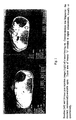
- Figure 1 shows an MR image control using a commercially available contrast agent vs. no use of contrast enhancement agent. The tumor area of the images shows little or no enhancement using the commercially available contrast agent.
- Figure 2 shows the MR image using a Gd-HPPH contrast agent of the invention vs. no contrast agent. The image formed using the contrast agent of the invention shows dramatic image enhancement of the tumor area.
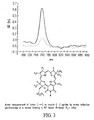
- Figure 3 is a graph of in vivo measurement of tumor vs. muscle uptake by reflection spectroscopy of the compound shown in Figure 3.
- Figure 4 is a schematic diagram showing chemical synthesis of 4-aminophenyl DTPA penta-tert-butyl esters.
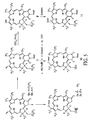
- Figure 5 is a schematic diagram showing chemical synthesis of carboxy 3-(hexyloxy)ethyl pyropheophorbide-a from methylpheophorbide-a.
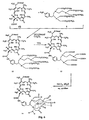
- Figure 6 is a schematic diagram showing chemical synthesis of HPPH-aminophenyl DTPA from carboxy 3-(hexyloxy)ethyl pyropheophorbide-a and 4-aminophenyl DTPA penta-tert-butyl ester followed by reaction with Gadolinium (III) trichloride to form HPPH-Gd(III) aminophenyl DTPA.
- Figure 7 is a schematic diagram showing chemical synthesis of purpurin-18-imide-Gd(III) aminophenyl DTPA (16).
- Figure 8 is a schematic diagram showing preparation of Gd(III) aminophenyl DTPA
complex from
purpurin 7. - Figure 9 is schematic diagram showing preparation of bacteriochlorin based Gd(III) aminophenyl DTPA.
- Figure 13 is a schematic diagram showing preparation of HPPH based In
Aminophenyl DTPA conjugate 28. - Figure 14 is a schematic diagram showing preparation of Aminophenyl DTPA 111In complex and Aminophenyl DTPA Gd(III) complex, e.g. 3-devinyl-3-(1'-alkoxy ethyl)-17-[3'-(4"-amidobenzyl gadolinium(III)DTPA)]ethyl pyropheophorbide-a, from a DTPA dihydro tetrapyrrole compound of the invention.
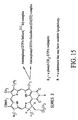
- Figure 15 is a schematic diagram showing Aminophenyl DTPA 111In Complex, and Aminophenyl DTPA Gd(III) complex, e.g. purpurin-18-(30devinyl-3-(4"-amidobenzyl gadoliniumDTPA)]-N-substituted imide, from a DTPA dihydro tetrapyrrole compound of the invention.
- Figure 16 is a schematic diagram showing Aminophenyl DTPA 111In Complex, and Aminophenyl DTPA Gd(III) complex, e.g. purpurin-18-(3-devinyl-3-(l'alkoxy ethyl)-17-[3'-(4"-amidobenzyl gadolinium(III)DTPA)]ethyl pyropheophorbide-a, from a DTPA dihydro tetrapyrrole compound of the invention.
- Figure 17 is a schematic diagram showing Aminophenyl DTPA 111In Complex, and Aminophenyl DTPA Gd(III) complex, e.g. bacteriopurpurin 18-3-(alkyl or alkoxyalkyl)-7-keto-17-[3'-(4"-amidobenzyl gadolinium(III)DTPA)]-N-substituted imide, from a DTPA tetrahydro tetrapyrrole compound of the invention.
-
- The invention includes compositions that are chemical combination of porphyrins and chlorins and related tetra-pyrrolic compounds with radioactive elements such as Gadolinium, Indium111 and radioactive iodine. When the element can form cations, the compound is usually a chelate with the porphyrin or chlorin structure. When the element forms anions, the compound is usually a direct chemical combination of the radioactive element into the porphyrin or chlorin structure.
- Examples of porphyrin and chlorin structures that can form compounds with radioactive elements, when modified in accordance with the present invention, are for example described in U.S. Patents 5,756,541; 5,028,621; 4,866,168; 4,649,151; 5,438,071; 5,198,460; 5,002,962; 5,093,349; 5,171,741; 5,173,504; 4,968,715; 5,314,905; 5,459,159; 5,770,730; 5,864,035; 5,190,966; and 5,952,366.
- The invention further includes the method of using the compounds of the invention for diagnostic imaging of hyperproliferative tissue such as tumors and new blood vessel growth as is associated with the wet form of age related macular degeneration.
- Unexpectedly, porphyrins and chlorins, as above described, upon injection, carry the radioactive element into cells of hyperproliferative tissue and dramatically enhance the signal produced by tumor tissue in MR imaging.
- It is to be understood that porphyrin and chlorin compounds (including bacteriochlorins) may be chemically altered to other forms by substitutions and modifications; provided that, the base tetrapyrrolic structure that allows selective entry and retention in hyperproliferative tissue cells (e.g. tumors) is retained:
- Compounds of the invention have the formulaIn the above formula,
 or
or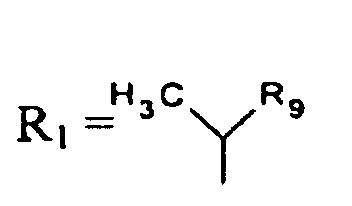 where R9 = H or -OR10, where R10 is lower alkyl of I though 6 carbon atoms; R2 is -CH3, R5 is -CH2CH3 and R3 and R4 together form a covalent bond, or R2 and R3 together are = 0, R4 is -CH2CH3 and R5 is -CH3; R6 is
 or a covalent bond; R7 is = O when R6 is
 and R7 is hydrogen when R6 is a covalent bond; R8 is -(CH2)2CO2CH3 or -(CH2)2CONHphenyleneCH2DTPA; R11 is lower alkyl of 1 through 6 carbon atoms or -(CH2)2CONHphenyleneCH2DTPA; provided that one and only one of R1, R8 or R11 contains a -CONHphenyleneCH2DTPA group; and where the -CONHphenyleneCH2DTPA group has the structural formula
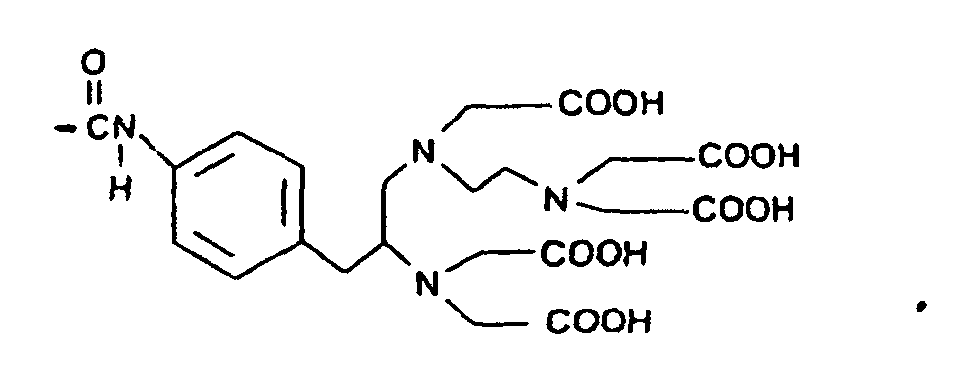
- An objective of the invention was to use these photosensitizers as a vehicle for delivering the desired conjugate (chelated with Gd or radionuclides) to tumor. The chelate is "bifunctional" because, it binds the Gd at one end and binds the target specific vehicle at the other. The chelate is a multidentate ligand, which has appropriate ligating groups for coordination to the metal. In a preferred embodiment, our invention includes:
- Development of chlorin and bacteriochlorin-based Gd(III)aminophenyl DTPA conjugates with variable lipophilicity as tumor diagnostic agent by MRI, and
- Development of chlorin and bacteriochlorin-based 111In aminophenyl DTPA conjugates with variable lipophilicity as tumor diagnostic radiopharmaceuticals.
- A goal has been: (i) to successfully bind Gadolinium to a tumor-avid porphyrin, originally designed for photodynamic therapy (PDT), and to prove that striking tumor uptake at 24 hours enhances the "signal" produced by tumor, thus dramatically increasing its conspicuity on MR imaging and (ii) to prepare related 111In labeled radiopharmaceuticals as diagnostic agents for nuclear medicine.
- This invention includes the synthesis and application of certain modified ditetratriethylamine penta carboxylic acid (DTPA) conjugates as MR contrast media and radiopharmaceuticals for diagnosis of primary malignancy and metastatic disease.
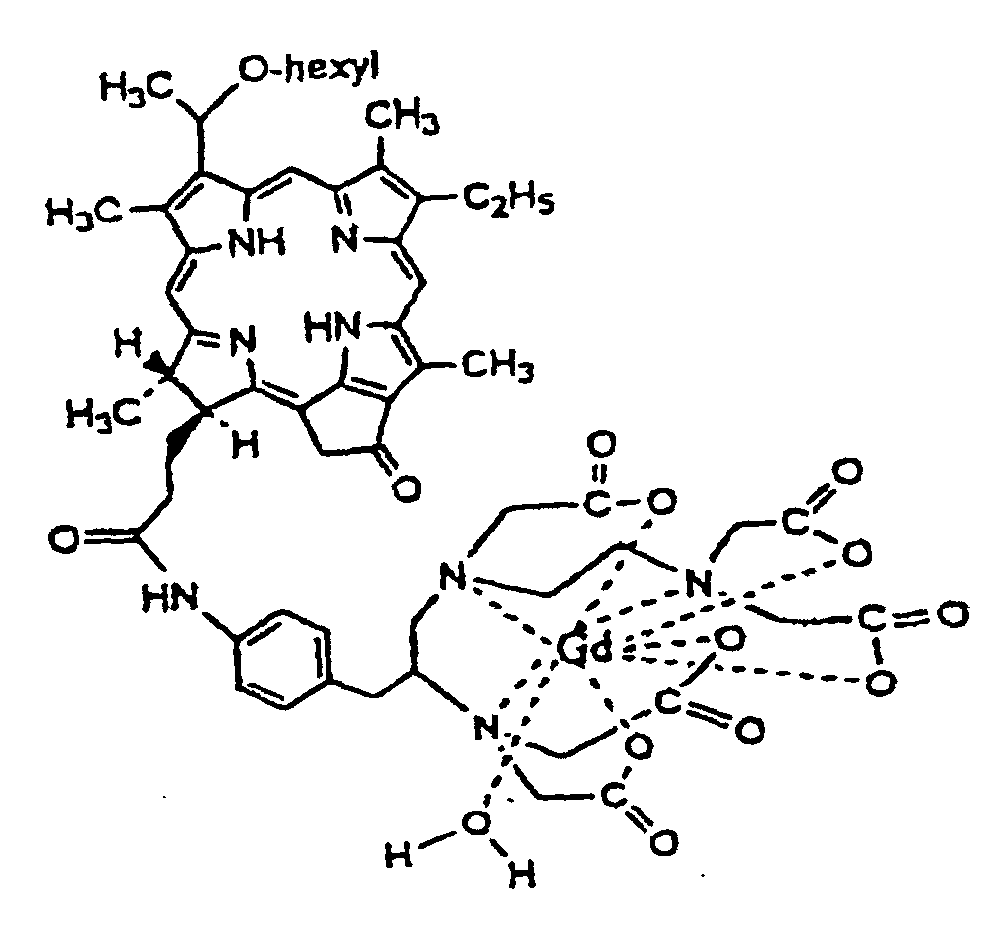
- The following examples describe examples for synthesis and use of magnetic resonance imaging agents. Synthesis of HPPH-Gd(III)aminophenylDTPA 14: For the preparation of the title compound, methylpyropheophorbide-a 6b was obtained from methylpheophorbide-a 6a (which in turn was extracted from Spirulina Algae) by following the literature procedure. It was then converted into methyl 3-(hexyloxy)ethyl analog 9a by following a methodology developed in our laboratory. Hydrolysis of the methyl ester functionality with aqueous LiOH/methanol/THF produced the corresponding
carboxylic acid 9b in quantitative yield. The reaction of 9b with 4-aminophenyl DTPA penta-tert-butyl esters prepared by following the methodology in Figure 4 via the carbodiimide approach (R.K. Pandey, F.-Y. Shiau, A.B. Sumlin, T.J. Dougherty and K.M. Smith, Bioorg. Med. Chem. Lett., 1994, 4, 1263) produced thecorresponding analog 12 in 57% yield (Figures 5 and 6). The structure was confirmed by NMR and mass spectrometry analyses. - Before preparing the Gd(III) complex, the tert-butyl groups in conjugate were converted into corresponding carboxylic acid by reacting with trifluoroacetic acid (yield 100%). For the preparation of Gd(III) complex 14, the conjugate was dissolved in pyridine and Gadolinium chloride hexahydrate dissolved in deionized water. The mixture was stirred at room temperature for 2h. After the completion of the reaction (monitored by TLC), pyridine was removed under high vacuum. The residue was washed with water to remove the excess of Gadolinium chloride, dried under vacuum and the title compound was isolated in 92% yield. The structure of the final product was confirmed by mass spectrometry.
- Synthesis of Purpurin-18-imide-Cd(III)aminophenylDTPA 16: Methylpheophorbide-a 6a was converted into the hexylether derivative of N-hexyl purpurinimide in 70% yield. The methyl ester group was then hydrolyzed to the corresponding
carboxylic acid 10 by following the methodology as discussed for the preparation of 9b. Purpurin-imide 10 was then reacted with aminophenylDTPA penta tert-butyl ester 5 by following a reaction sequence depicted in Figure 8 and the intermediate conjugate was isolated in 45% yield. Further reaction with trifluoroaceticacid and then with GdCl3.6H2O produced the Gd(III) complex 16 in >90% yield. The structures of the conjugates were confirmed by NMR and mass spectrometry. - In our attempt to investigate the effect of the position of the Gd(III) conjugate in the macrocycle, purpurin-
imide 7 was converted into the relatedcarboxylic acid analog 11 by conventional procedures. Reaction of 11 withaminophenyl DTPA 5 will produce Gd(III)aminophenyl DTPA conjugate 15, purpurin 18-3-devinyl-3[4'-amidophenyl Gadolinium (III) DTPA]-N-hexylimide. - In this series of compounds, the overall lipophilicity of the molecule can be altered by varying the length of the carbon chain of either the alkyl ether substituents and/or N-substituted alkyl chain. Thus, these compounds provide a unique opportunity to investigate the correlation of tumor uptake and lipophilicity.
- Bacteriochlorins are a class of tetrapyrroles in which the two pyrrole units diagonal to each other are reduced. Starting from N-hexyl-
purpurin imide 7 we haveprepared ketobacteriochlorin 20 by following a reaction sequence illustrated in Figure 9. In ourapproach purpurinimide 7 containing a vinyl group atposition 3 was converted into the 3-devinyl-3-ethyl analog 17 (also be named as meso-N-hexyl-purpurin-18-imide) by reacting with hydrogen using Pd/C as a catalyst. It was then reacted with osmiumtetroxide/pyridine/H2S (A.N. Kozyrev. T.J. Dougherty and R.K. Pandey, Tetrahedron Lett., 1996, 37, 3781) and the corresponding vic-dihydroxybacteriochlorin 18 was isolated in 75% yield as a mixture of diasteriomers (cis-hydroxy groups up or down relative to trans-reduced ring D). The dihydroxy analog as a diasteriomeric mixture was treated with sulfuric acid under pinacol-pinacolone reaction conditions, (R.K. Pandey, T. Tsuchida, S. Constantine, G. Zheng, C. Medforth, A Kozyrev, A. Mohammad, M.A.J. Rodgers, K.M. Smith and T.J. Dougherty, J. Med. Chem., 1997, 40, 2770) and the ketobacteriochlorin, containing keto- group either at 7- (compound 20) or 8-position (compound 19) respectively were isolated in 70% yield. Among these bacteriochlorins, the 7-keto analog 20 showed high tumor uptake as determined by in vivo reflectance spectroscopy in mice model transplanted with RIF tumor (see Figure 3). The structures ofbacteriochlorins - Our next step was to hydrolyze the methyl ester group in
purpurinimide 20 intocarboxylic acid 21 before converting it into the corresponding 4-aminophenylDTPA conjugate 22 by following the methodology discussed previously for the preparation of related HPPH and purpurin-imide analogs. Syntheses of HPPH based 111In AminophenylDTPA conjugate 28: For the preparation of the title compound, the HPPH-aminophenylDTPA 13 was reacted with 111In(III) chloride, following the methodology reported by Low and coworkers (S. Wang J. Juo, D.A. Lantrip, D.A. Waters, C.J. Mathias, W.A. Green, P.L. Fuchs and P.S. Low, Bioconjugate Chem., 1997, 8, 673) for the preparation of 111In DTPA-Folate and the 111In labeled compound was obtained in 82% yield. - Following the synthesis of GD-labeled HPPH, a series of three rats were injected intravenously and studied immediately after injection, at 1 hour, and at 24 hours, to establish whether the Gd-HPPH remained in the circulation longer than the current standard contrast medium (Magnavist or Gd-DTPA).
- Whereas Magnavist clears rapidly from the mammalian circulation by glomerular filtration, with a circulatory half-time of 16-20 minutes, the newly-synthesized contrast medium Gd-HPPH, was evident in the cerebral circulation at 1 hour. Subsequently, to establish whether the GD-HPPH is tumor-avid, a single rat with a subcutaneously-implanted Ward colon carcinoma was imaged, 24 hours after intravenous GD-HPPH, A second tumor-bearing rat was imaged 24 hours after injection of Magnavist (See Figures 1 and 2). Clearly, the enhanced tumor signal after Gd-HPPH injection indicated that GD-
HPPH 14 has potential as a contrast medium for MR. HPPH (a chlorophyll- a derivative) represents the vehicle by which the Gd complex is carried into the tumor. Addition of the Gd chelate to HPPH does not hinder its ability to form singlet oxygen producing efficacy, so this contrast medium also has the potential for dual action: enhanced localization on MR imaging (diagnosis), followed by directed light exposure with tumor injury (treatment). Also, because of its excellent tumor selectivity and high fluorescence, the newly synthesized conjugate can be used for IR imaging. Also, Indium or other radionuclides bound to chlorins and bacteriochlorins synthesized and proposed in this invention have potential as imaging agents for nuclear medicine.
Claims (16)
- A tetrapyrrole compound characterized in that it has the formulawhere
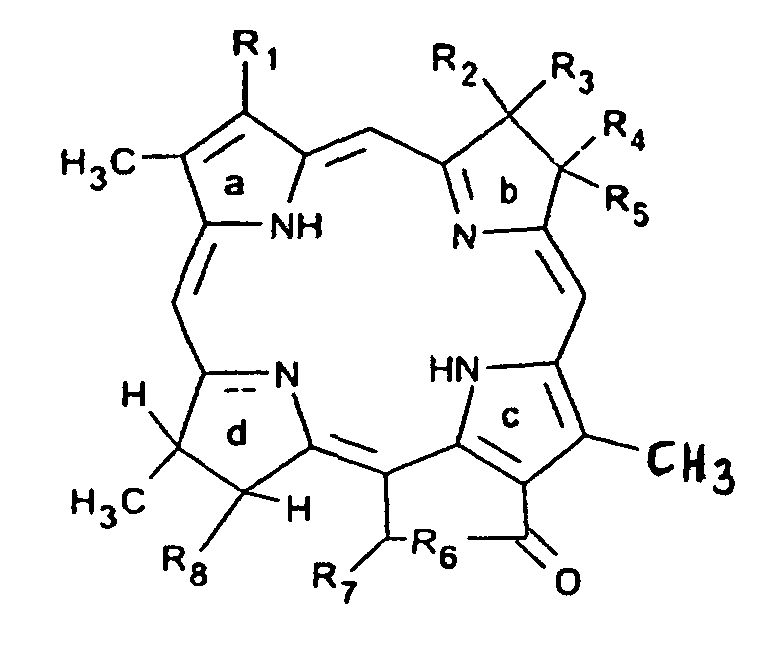 or -CONHphenylene CH2DTPA, where R9 = H or -OR10, where R10 is lower alkyl of 1 through 6 carbon atoms; R2 is -CH3, R5 is -CH2CH3 and R3 and R4 together form a covalent bond, or R2 and R3 together are = O, R4 is - CH2CH3 and R5 is -CH3; R6 is
 or a covalent bond; R7 is = O when R6 is
 and R7 is hydrogen when R6 is a covalent bond; R8 is -(CH2)2CO2CH3 or - (CH2)2CONHphenyleneCH2DTPA; R11 is lower alkyl of 1 through 6 carbon atoms or -(CH2)2CONHphenyleneCH2DTPA; provided that one and only one of R1, R8 or R11 contains a -CONHphenyleneCH2DTPA group; and where the -CONHphenyleneCH2DTPA group has the structural formula

- The compound of Claim 1 characterized in that R8 is -(CH2)2CONHphenyleneCH2DTPA.
- The compound of Claim 2 characterized in that R2 is -CH3, and R5 is -CH2CH3.
- The compound of Claim 1 characterized in that R6 is

- The compound of Claim 4 characterized in that R6 iswhere R11 is hexyl.

- An Indium111 complex of the compound of Claim 1.
- A Gadolinium(III) complex of the compound of Claim 1.
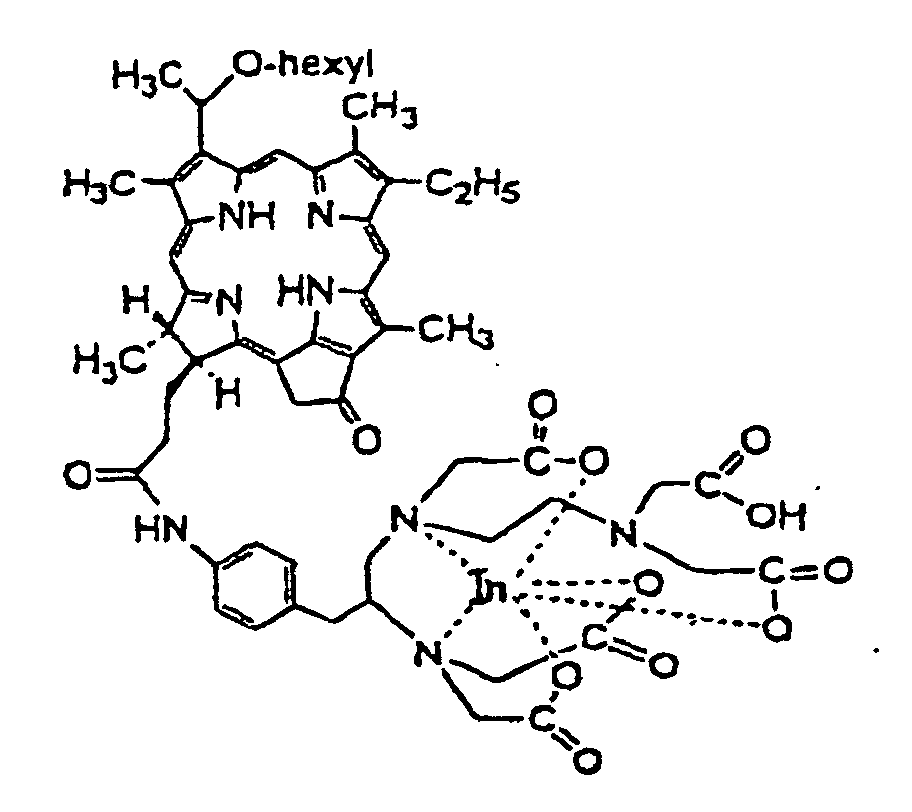
- The compound of Claim 6 characterized in that the compound is a 111In aminophenyl DTPA analog of HPPH having the formulawhere In is 111In.
- The compound of Claim 7 characterized in that the compound is a Gd(III)aminophenylDTPA analog of HPPH having the formulawhere Gd = GdIII.
- The compound of Claim 7 characterized in that the compound is a Gd(III)aminophenylDTPA analog of purpurin 18 imide having the formulawhere Gd is GDIII.

- The compound of Claim 7 characterized in that the compound is a Gd(III)aminophenylDTPA analog of purpurin 18 imide having the formulawhere Gd is GdIII.

- The compound of Claim 8 characterized in that the compound is a Gd(III)aminophenylDTPA analog of bacteriochlorin having the formulawhere Gd is GdIII.

- A method for the preparation of the compound of Claim 9 characterized in that it comprises:hydrolizing methyl 3-(hexyloxy)ethyl pheophorbide a with an aqueous solution of LiOH, methanol and tetrahydrofuran to obtain the corresponding carboxylic acid;reacting the carboxylic acid with 4-aminophenyl DTPA penta-tert-butyl ester to produce the tert-butyl aminophenyl DTPA analog;reacting the DTPA analog with trifluoroacetic acid to convert the tertiary butyl groups to carboxylic acid groups;reacting with a solution of Gadolinium hexahydrate.
- A method for the preparation of the compound of Claim 10 characterized in that it comprises:hydrolizing the methyl ester group of -CH2CH2COOCH3 on the c ring of the hexylether derivative of N-hexyl purpurinimide to the corresponding -CH2CH2COOH carboxylic acid;reacting the resulting carboxy purpurin imide with a solution of aminophenylDTPA penta-tert-butyl ester;reacting the resulting conjugate with trifluoroacetic acid to convert the butyl ester groups to a carboxylic acid; andreacting the resulting carboxylic acid with Gadolinium chloride to obtain the desired compound.
- A method for the preparation of the compound of Claim 12 characterized in that it comprises:hydrogenating 3 vinyl purpurinimide 7 to obtain meso-N-hexyl-purpurin-18-imide;reacting the meso-N-hexyl-purpurin-18-imide with osmiumtetroxide, pyridine and H2S to obtain vic-dihydroxybacteriochlorin;reacting the vic-dihydroxybacteriochlorin with sulfuric acid to obtain a 7-ketobacteriochlorin;hydrolizing a methyl ester group in the 7-ketobacteriochlorin to a carboxy group;reacting the carboxy 7-ketobacteriochlorin with aminophenylDTPA penta-tertiary butyl ester;reacting the resulting product with trifluoroacetic acid to obtain the corresponding carboxylic acid DTPA analog; andreacting the carboxy DTPA analog with Gadolinium chloride to obtain the desired compound.
- A method for the preparation of the compound of claim 8 characterized in that it comprises:reacting HPPH-aminophenylDTPA of the formula :with 111In(III)chloride to obtain the desired compound.

Applications Claiming Priority (5)
| Application Number | Priority Date | Filing Date | Title |
|---|---|---|---|
| US17196199P | 1999-12-23 | 1999-12-23 | |
| US171961P | 1999-12-23 | ||
| US739155 | 2000-12-18 | ||
| US09/739,155 US6534040B2 (en) | 1999-12-23 | 2000-12-18 | Chlorin and bacteriochlorin-based aminophenyl DTPA and N2S2 conjugates for MR contrast media and radiopharmaceuticals |
| 2003-03-28 |
Publications (3)
| Publication Number | Publication Date |
|---|---|
| EP1110963A2 EP1110963A2 (en) | 2001-06-27 |
| EP1110963A3 EP1110963A3 (en) | 2001-12-19 |
| EP1110963B1 true EP1110963B1 (en) | 2004-04-21 |
Family
ID=26867614
Family Applications (1)
| Application Number | Title | Priority Date | Filing Date |
|---|---|---|---|
| EP00128019A Expired - Lifetime EP1110963B1 (en) | 1999-12-23 | 2000-12-20 | Chlorin- and bacteriochlorin-aminophenylDTPA conjugates for MR contrast media and radiopharmaceuticals |
Country Status (8)
| Country | Link |
|---|---|
| US (1) | US6534040B2 (en) |
| EP (1) | EP1110963B1 (en) |
| JP (1) | JP4885354B2 (en) |
| AT (1) | ATE264862T1 (en) |
| AU (1) | AU779361B2 (en) |
| CA (1) | CA2329320C (en) |
| DE (1) | DE60010028T2 (en) |
| DK (1) | DK1110963T3 (en) |
Families Citing this family (26)
| Publication number | Priority date | Publication date | Assignee | Title |
|---|---|---|---|---|
| USRE38994E1 (en) | 1988-07-20 | 2006-02-28 | Health Research, Inc. | Pyropheophorbides conjugates and their use in photodynamic therapy |
| USRE39094E1 (en) | 1988-07-20 | 2006-05-09 | Health Research, Inc. | Pyropheophorbides and their use in photodynamic therapy |
| ATE234114T1 (en) * | 1999-01-15 | 2003-03-15 | Light Sciences Corp | THERAPEUTIC COMPOSITIONS FOR BONE METABOLIC DISORDERS OR BONE METASTASIS CONTAINING A PHOTOSENSITIZER AND A BISPHOSPHONATE |
| US6602274B1 (en) | 1999-01-15 | 2003-08-05 | Light Sciences Corporation | Targeted transcutaneous cancer therapy |
| US6454789B1 (en) | 1999-01-15 | 2002-09-24 | Light Science Corporation | Patient portable device for photodynamic therapy |
| EP1131099A2 (en) | 1999-01-15 | 2001-09-12 | Light Sciences Corporation | Noninvasive vascular therapy |
| US20030114434A1 (en) * | 1999-08-31 | 2003-06-19 | James Chen | Extended duration light activated cancer therapy |
| US7897140B2 (en) * | 1999-12-23 | 2011-03-01 | Health Research, Inc. | Multi DTPA conjugated tetrapyrollic compounds for phototherapeutic contrast agents |
| US7078014B2 (en) * | 1999-12-23 | 2006-07-18 | Health Research, Inc. | Method for using chlorin and bacteriochlorin-based aminophenyl DTPA and N2S2 conjugates for MR contrast media and radiopharmaceuticals |
| US7097826B2 (en) * | 1999-12-23 | 2006-08-29 | Health Research, Inc. | Chlorin and bacteriochlorin-based difunctional aminophenyl DTPA and N2S2 conjugates for MR contrast media and radiopharmaceuticals |
| CA2395567A1 (en) | 2000-01-12 | 2001-07-19 | Light Sciences Corporation | Novel treatment for eye disease |
| US6624187B1 (en) | 2000-06-12 | 2003-09-23 | Health Research, Inc. | Long wave length absorbing bacteriochlorin alkyl ether analogs |
| CA2473924A1 (en) * | 2002-01-23 | 2003-07-31 | Light Sciences Corporation | Systems and methods for photodynamic therapy |
| AU2003248747A1 (en) | 2002-06-27 | 2004-01-19 | Health Research, Inc. | Fluorinated chlorin and bacteriochlorin photosensitizers for photodynamic therapy |
| WO2004005289A2 (en) * | 2002-07-02 | 2004-01-15 | Health Research, Inc. | Efficient synthesis of pyropheophorbide a and its derivatives |
| US20040010218A1 (en) * | 2002-07-11 | 2004-01-15 | Henderson Barbara W. | Photodynamic therapy for the enhancement of vascular permeability to aid in drug delivery to diseased tissues |
| JP4800922B2 (en) * | 2003-01-24 | 2011-10-26 | ザ リサーチ ファウンデイション オブ ステイト ユニバーシティー オブ ニューヨーク | Ceramic-based nanoparticles for encapsulating therapeutic agents for photodynamic therapy and methods of use thereof |
| KR20070086803A (en) * | 2004-12-03 | 2007-08-27 | 유니버시티 오브 유타 리써치 파운데이션 | Mri guided photodynamic therapy for cancer |
| US8236283B2 (en) | 2005-01-06 | 2012-08-07 | Ge Healthcare As | Optical imaging |
| US8198432B2 (en) * | 2005-02-25 | 2012-06-12 | Health Research, Inc. | Porphyrin-based compounds for tumor imaging and photodynamic therapy |
| US20060198783A1 (en) * | 2005-02-25 | 2006-09-07 | Health Research, Inc., Roswell Park Cancer Institute Division | Porphyrin-based compounds for tumor imaging and photodynamic therapy |
| US20090169480A1 (en) * | 2007-12-31 | 2009-07-02 | Industrial Technology Research Institute | Dendritic polymers and magnetic resonance imaging contrast agent employing the same |
| US20120034155A1 (en) * | 2010-08-03 | 2012-02-09 | Searete Llc, A Limited Liability Corporation Of The State Of Delaware | Artificial cells |
| US9095624B2 (en) * | 2011-05-23 | 2015-08-04 | Contango Partners Group, Inc. | Modular transport platform for targeted delivery of therapeutic agents |
| CN104193753A (en) * | 2014-08-26 | 2014-12-10 | 江苏红豆杉药业有限公司 | Method for preparing photosensitizer HPPH from taxus chinensis branch and leaf extracts |
| CN114887055B (en) * | 2022-04-18 | 2023-06-16 | 浙江大学 | Sugar-targeted diagnosis and treatment integrated preparation with MR/NIR imaging and photodynamic therapy functions, and preparation method and application thereof |
Family Cites Families (24)
| Publication number | Priority date | Publication date | Assignee | Title |
|---|---|---|---|---|
| US4649151A (en) | 1982-09-27 | 1987-03-10 | Health Research, Inc. | Drugs comprising porphyrins |
| US5190966A (en) | 1988-07-06 | 1993-03-02 | Health Research, Inc. | Purified hematoporphyrin dimers and trimers useful in photodynamic therapy |
| US4968715A (en) | 1988-07-06 | 1990-11-06 | Health Research, Inc. | Use of purified hematoporphyrin trimers in photodynamic therapy |
| US5002962A (en) | 1988-07-20 | 1991-03-26 | Health Research, Inc. | Photosensitizing agents |
| US5093349A (en) | 1988-07-20 | 1992-03-03 | Health Research Inc. | Photosensitizing agents |
| US5198460A (en) | 1988-07-20 | 1993-03-30 | Health Research Inc. | Pyropheophorbides and their use in photodynamic therapy |
| US5173504A (en) | 1989-04-21 | 1992-12-22 | Health Research, Inc. | Bacteriochlorophyll-a derivatives useful in photodynamic therapy |
| US5171741A (en) | 1989-04-21 | 1992-12-15 | Health Research, Inc. | Bacteriochlorophyll-a derivatives useful in photodynamic therapy |
| DE3922005A1 (en) * | 1989-06-30 | 1991-01-10 | Schering Ag | DERIVATIVED DTPA COMPLEXES, PHARMACEUTICAL AGENTS CONTAINING THESE COMPOUNDS, THEIR USE AND METHOD FOR THE PRODUCTION THEREOF |
| US5330741A (en) | 1992-02-24 | 1994-07-19 | The Regents Of The University Of California | Long-wavelength water soluble chlorin photosensitizers useful for photodynamic therapy and diagnosis of tumors |
| US5257970A (en) | 1992-04-09 | 1993-11-02 | Health Research, Inc. | In situ photodynamic therapy |
| US5244914A (en) | 1992-04-27 | 1993-09-14 | American Cyanamid Company | Stable porfimer sodium compositions and methods for their manufacture |
| JPH0680671A (en) * | 1992-09-03 | 1994-03-22 | Toyo Hatsuka Kogyo Kk | Porphyrin dimer and its use |
| JPH06234661A (en) * | 1993-02-08 | 1994-08-23 | Eiken Chem Co Ltd | Mri imaging agent for arteriosclerotic focus and method for imaging mri |
| WO1995007358A1 (en) | 1993-07-30 | 1995-03-16 | University Of Medicine & Dentistry Of New Jersey | Efficient gene transfer into primary lymphocytes |
| US5498710A (en) | 1994-04-22 | 1996-03-12 | Health Research, Inc. | Alkyl ether analogues of benzoporphyrin derivatives |
| US5591847A (en) | 1994-05-23 | 1997-01-07 | Health Research, Inc. | Long wavelength absorbing photosensitizers related to purpurin-18, bacteriopurpurin-18 and related compounds with imide linkages |
| US5770730A (en) | 1996-03-08 | 1998-06-23 | Health Research, Inc. | Synthesis of carbodimide analogs of chlorins and bacteriochlorins and their use for diagnosis and treatment of cancer |
| US5952366A (en) | 1996-03-08 | 1999-09-14 | Health Research, Inc. | Alkyl ether analogs of chlorins having an N-substituted imide ring |
| US5756541A (en) | 1996-03-11 | 1998-05-26 | Qlt Phototherapeutics Inc | Vision through photodynamic therapy of the eye |
| DE69811931T2 (en) * | 1997-10-27 | 2003-12-18 | Research Corp. Technologies, Inc. | MRI AGENTS FOR THE ADMINISTRATION OF THERAPEUTIC AGENTS |
| AU752812B2 (en) * | 1997-11-17 | 2002-10-03 | Research Corporation Technologies, Inc. | Magnetic resonance imaging agents for the detection of physiological agents |
| JPH11217385A (en) * | 1998-01-30 | 1999-08-10 | Nihon Schering Kk | Fluorine-containing porphyrin complex and contrast medium containing the same |
| US6103751A (en) | 1998-06-22 | 2000-08-15 | Health Research, Inc. | Carotene analogs of porphyrins, chlorins and bacteriochlorins as therapeutic and diagnostic agents |
-
2000
- 2000-12-18 US US09/739,155 patent/US6534040B2/en not_active Expired - Lifetime
- 2000-12-19 AU AU72384/00A patent/AU779361B2/en not_active Ceased
- 2000-12-20 DK DK00128019T patent/DK1110963T3/en active
- 2000-12-20 EP EP00128019A patent/EP1110963B1/en not_active Expired - Lifetime
- 2000-12-20 DE DE60010028T patent/DE60010028T2/en not_active Expired - Lifetime
- 2000-12-20 AT AT00128019T patent/ATE264862T1/en not_active IP Right Cessation
- 2000-12-20 CA CA2329320A patent/CA2329320C/en not_active Expired - Fee Related
- 2000-12-25 JP JP2000404615A patent/JP4885354B2/en not_active Expired - Fee Related
Also Published As
| Publication number | Publication date |
|---|---|
| DE60010028T2 (en) | 2005-04-28 |
| JP2001335578A (en) | 2001-12-04 |
| EP1110963A2 (en) | 2001-06-27 |
| DK1110963T3 (en) | 2004-07-05 |
| AU779361B2 (en) | 2005-01-20 |
| EP1110963A3 (en) | 2001-12-19 |
| CA2329320A1 (en) | 2001-06-23 |
| ATE264862T1 (en) | 2004-05-15 |
| DE60010028D1 (en) | 2004-05-27 |
| CA2329320C (en) | 2010-08-24 |
| AU7238400A (en) | 2001-06-28 |
| JP4885354B2 (en) | 2012-02-29 |
| US20010046983A1 (en) | 2001-11-29 |
| US6534040B2 (en) | 2003-03-18 |
Similar Documents
| Publication | Publication Date | Title |
|---|---|---|
| AU779361B2 (en) | Chlorin and bacteriochlorin-based aminophenyl DTPA and N2S2 conjugates for MR contrast media and radiopharmaceuticals | |
| US6906050B2 (en) | Substituted porphyrin and azaporphyrin derivatives and their use in photodynamic therapy, radioimaging and MRI diagnosis | |
| US8323621B2 (en) | Multi-use multimodal imaging chelates | |
| JF Calvete et al. | Tetrapyrrolic macrocycles: Potentialities in medical imaging technologies | |
| US5849259A (en) | 3-,8-substituted deuteroporphyrin derivatives, pharmaceutical agents containing the latter and process for their production | |
| JP2001335578A5 (en) | Chlorin or bacteriochlorin-based aminophenyl DTPA conjugate for MR contrast agent or radiopharmaceutical | |
| AU2003203569B2 (en) | Chlorin and bacteriochlorin-based difunctional aminophenyl DTPA and N2S2 conjugates for MR contrast media and radiopharmaceuticals | |
| Pan et al. | A brief introduction to porphyrin compounds used in tumor imaging and therapies | |
| US7078014B2 (en) | Method for using chlorin and bacteriochlorin-based aminophenyl DTPA and N2S2 conjugates for MR contrast media and radiopharmaceuticals | |
| AU625529B2 (en) | 10-(2'-hydroxy-3'-alkoxy-1,4,7-triscarboxymethyl-1,4,7,10- tetraazacyclododecanes | |
| IE904318A1 (en) | 10-(2'-hydroxy-3'-alkoxy-1,4,7-triscarboxymethyl-1,4,7,10,¹-tetraazacyclododecanes | |
| US6251367B1 (en) | Paramagnetic 3-,8-substituted deuteroporphyrin derivatives, pharmaceutical agents that contain the latter, process for their production, and their use for MR imaging of necrosis and infarction | |
| CA2572287A1 (en) | Carboranylporphyrins and uses thereof | |
| HK1038558A (en) | Chlorin and bacteriochlorin-based aminophenyl dtpa and n2s2 conjugates for mr contrast media and radiopharmaceuticals | |
| JPH07330773A (en) | Porphyrin derivatives and their uses | |
| DE19825512A1 (en) | 3-, 8-substituted deuteroporphyrin derivatives, pharmaceutical compositions containing them, processes for their preparation and their use in photodynamic therapy and MRI diagnostics | |
| US7897140B2 (en) | Multi DTPA conjugated tetrapyrollic compounds for phototherapeutic contrast agents | |
| Keca | Texaphyrin Architectures for Biomedical Applications | |
| MacDonald | Metalloporphysomes: Engineering New Metalloporphyrin Nanoparticles | |
| Rivas | Dual-modal Imaging Agents for Zinc Ion Sensing | |
| Wu et al. | Carboranylporphyrins and uses thereof | |
| AU2002314857A1 (en) | Substituted porphyrin and azaporphyrin derivatives and their use in photodynamic therapy, radioimaging and MRI diagnosis | |
| MXPA96004956A (en) | Porfocianin and porfirinas extended with |
Legal Events
| Date | Code | Title | Description |
|---|---|---|---|
| PUAI | Public reference made under article 153(3) epc to a published international application that has entered the european phase |
Free format text: ORIGINAL CODE: 0009012 |
|
| AK | Designated contracting states |
Kind code of ref document: A2 Designated state(s): AT BE CH CY DE DK ES FI FR GB GR IE IT LI LU MC NL PT SE TR |
|
| AX | Request for extension of the european patent |
Free format text: AL;LT;LV;MK;RO;SI |
|
| PUAL | Search report despatched |
Free format text: ORIGINAL CODE: 0009013 |
|
| AK | Designated contracting states |
Kind code of ref document: A3 Designated state(s): AT BE CH CY DE DK ES FI FR GB GR IE IT LI LU MC NL PT SE TR |
|
| AX | Request for extension of the european patent |
Free format text: AL;LT;LV;MK;RO;SI |
|
| 17P | Request for examination filed |
Effective date: 20020531 |
|
| AKX | Designation fees paid |
Free format text: AT BE CH CY DE DK ES FI FR GB GR IE IT LI LU MC NL PT SE TR |
|
| 17Q | First examination report despatched |
Effective date: 20021128 |
|
| GRAP | Despatch of communication of intention to grant a patent |
Free format text: ORIGINAL CODE: EPIDOSNIGR1 |
|
| RTI1 | Title (correction) |
Free format text: CHLORIN- AND BACTERIOCHLORIN-AMINOPHENYLDTPA CONJUGATES FOR MR CONTRAST MEDIA AND RADIOPHARMACEUTICALS |
|
| GRAS | Grant fee paid |
Free format text: ORIGINAL CODE: EPIDOSNIGR3 |
|
| GRAA | (expected) grant |
Free format text: ORIGINAL CODE: 0009210 |
|
| AK | Designated contracting states |
Kind code of ref document: B1 Designated state(s): AT BE CH CY DE DK ES FI FR GB GR IE IT LI LU MC NL PT SE TR |
|
| PG25 | Lapsed in a contracting state [announced via postgrant information from national office to epo] |
Ref country code: TR Free format text: LAPSE BECAUSE OF FAILURE TO SUBMIT A TRANSLATION OF THE DESCRIPTION OR TO PAY THE FEE WITHIN THE PRESCRIBED TIME-LIMIT Effective date: 20040421 Ref country code: CY Free format text: LAPSE BECAUSE OF FAILURE TO SUBMIT A TRANSLATION OF THE DESCRIPTION OR TO PAY THE FEE WITHIN THE PRESCRIBED TIME-LIMIT Effective date: 20040421 Ref country code: FI Free format text: LAPSE BECAUSE OF FAILURE TO SUBMIT A TRANSLATION OF THE DESCRIPTION OR TO PAY THE FEE WITHIN THE PRESCRIBED TIME-LIMIT Effective date: 20040421 |
|
| REG | Reference to a national code |
Ref country code: GB Ref legal event code: FG4D |
|
| REG | Reference to a national code |
Ref country code: CH Ref legal event code: EP |
|
| REG | Reference to a national code |
Ref country code: IE Ref legal event code: FG4D |
|
| REF | Corresponds to: |
Ref document number: 60010028 Country of ref document: DE Date of ref document: 20040527 Kind code of ref document: P |
|
| REG | Reference to a national code |
Ref country code: DK Ref legal event code: T3 |
|
| PG25 | Lapsed in a contracting state [announced via postgrant information from national office to epo] |
Ref country code: GR Free format text: LAPSE BECAUSE OF FAILURE TO SUBMIT A TRANSLATION OF THE DESCRIPTION OR TO PAY THE FEE WITHIN THE PRESCRIBED TIME-LIMIT Effective date: 20040721 |
|
| REG | Reference to a national code |
Ref country code: SE Ref legal event code: TRGR |
|
| PG25 | Lapsed in a contracting state [announced via postgrant information from national office to epo] |
Ref country code: ES Free format text: LAPSE BECAUSE OF FAILURE TO SUBMIT A TRANSLATION OF THE DESCRIPTION OR TO PAY THE FEE WITHIN THE PRESCRIBED TIME-LIMIT Effective date: 20040801 |
|
| REG | Reference to a national code |
Ref country code: CH Ref legal event code: NV Representative=s name: ISLER & PEDRAZZINI AG |
|
| PG25 | Lapsed in a contracting state [announced via postgrant information from national office to epo] |
Ref country code: IE Free format text: LAPSE BECAUSE OF NON-PAYMENT OF DUE FEES Effective date: 20041220 Ref country code: LU Free format text: LAPSE BECAUSE OF NON-PAYMENT OF DUE FEES Effective date: 20041220 |
|
| ET | Fr: translation filed | ||
| PG25 | Lapsed in a contracting state [announced via postgrant information from national office to epo] |
Ref country code: MC Free format text: LAPSE BECAUSE OF NON-PAYMENT OF DUE FEES Effective date: 20041231 |
|
| PLBE | No opposition filed within time limit |
Free format text: ORIGINAL CODE: 0009261 |
|
| STAA | Information on the status of an ep patent application or granted ep patent |
Free format text: STATUS: NO OPPOSITION FILED WITHIN TIME LIMIT |
|
| 26N | No opposition filed |
Effective date: 20050124 |
|
| REG | Reference to a national code |
Ref country code: IE Ref legal event code: MM4A |
|
| REG | Reference to a national code |
Ref country code: CH Ref legal event code: PCAR Free format text: ISLER & PEDRAZZINI AG;POSTFACH 1772;8027 ZUERICH (CH) |
|
| PG25 | Lapsed in a contracting state [announced via postgrant information from national office to epo] |
Ref country code: PT Free format text: LAPSE BECAUSE OF NON-PAYMENT OF DUE FEES Effective date: 20040921 |
|
| REG | Reference to a national code |
Ref country code: HK Ref legal event code: WD Ref document number: 1038558 Country of ref document: HK |
|
| PGFP | Annual fee paid to national office [announced via postgrant information from national office to epo] |
Ref country code: SE Payment date: 20091214 Year of fee payment: 10 Ref country code: AT Payment date: 20091217 Year of fee payment: 10 Ref country code: DK Payment date: 20091214 Year of fee payment: 10 Ref country code: CH Payment date: 20091224 Year of fee payment: 10 |
|
| REG | Reference to a national code |
Ref country code: CH Ref legal event code: PL |
|
| REG | Reference to a national code |
Ref country code: DK Ref legal event code: EBP |
|
| PG25 | Lapsed in a contracting state [announced via postgrant information from national office to epo] |
Ref country code: AT Free format text: LAPSE BECAUSE OF NON-PAYMENT OF DUE FEES Effective date: 20101220 |
|
| REG | Reference to a national code |
Ref country code: SE Ref legal event code: EUG |
|
| PG25 | Lapsed in a contracting state [announced via postgrant information from national office to epo] |
Ref country code: SE Free format text: LAPSE BECAUSE OF NON-PAYMENT OF DUE FEES Effective date: 20101221 |
|
| PG25 | Lapsed in a contracting state [announced via postgrant information from national office to epo] |
Ref country code: CH Free format text: LAPSE BECAUSE OF NON-PAYMENT OF DUE FEES Effective date: 20101231 Ref country code: LI Free format text: LAPSE BECAUSE OF NON-PAYMENT OF DUE FEES Effective date: 20101231 |
|
| PGFP | Annual fee paid to national office [announced via postgrant information from national office to epo] |
Ref country code: GB Payment date: 20131219 Year of fee payment: 14 Ref country code: DE Payment date: 20131220 Year of fee payment: 14 |
|
| PGFP | Annual fee paid to national office [announced via postgrant information from national office to epo] |
Ref country code: NL Payment date: 20131219 Year of fee payment: 14 Ref country code: IT Payment date: 20131219 Year of fee payment: 14 |
|
| PGFP | Annual fee paid to national office [announced via postgrant information from national office to epo] |
Ref country code: BE Payment date: 20131219 Year of fee payment: 14 |
|
| PGFP | Annual fee paid to national office [announced via postgrant information from national office to epo] |
Ref country code: FR Payment date: 20131220 Year of fee payment: 14 |
|
| PG25 | Lapsed in a contracting state [announced via postgrant information from national office to epo] |
Ref country code: BE Free format text: LAPSE BECAUSE OF NON-PAYMENT OF DUE FEES Effective date: 20141231 |
|
| REG | Reference to a national code |
Ref country code: DE Ref legal event code: R119 Ref document number: 60010028 Country of ref document: DE |
|
| REG | Reference to a national code |
Ref country code: NL Ref legal event code: V1 Effective date: 20150701 |
|
| REG | Reference to a national code |
Ref country code: NL Ref legal event code: V1 Effective date: 20150701 |
|
| GBPC | Gb: european patent ceased through non-payment of renewal fee |
Effective date: 20141220 |
|
| REG | Reference to a national code |
Ref country code: FR Ref legal event code: ST Effective date: 20150831 |
|
| PG25 | Lapsed in a contracting state [announced via postgrant information from national office to epo] |
Ref country code: NL Free format text: LAPSE BECAUSE OF NON-PAYMENT OF DUE FEES Effective date: 20150701 |
|
| PG25 | Lapsed in a contracting state [announced via postgrant information from national office to epo] |
Ref country code: DE Free format text: LAPSE BECAUSE OF NON-PAYMENT OF DUE FEES Effective date: 20150701 Ref country code: GB Free format text: LAPSE BECAUSE OF NON-PAYMENT OF DUE FEES Effective date: 20141220 |
|
| PG25 | Lapsed in a contracting state [announced via postgrant information from national office to epo] |
Ref country code: FR Free format text: LAPSE BECAUSE OF NON-PAYMENT OF DUE FEES Effective date: 20141231 |
|
| PG25 | Lapsed in a contracting state [announced via postgrant information from national office to epo] |
Ref country code: IT Free format text: LAPSE BECAUSE OF NON-PAYMENT OF DUE FEES Effective date: 20141220 |