EP1109377A1 - Alert signal during telephone conversation - Google Patents
Alert signal during telephone conversation Download PDFInfo
- Publication number
- EP1109377A1 EP1109377A1 EP00310754A EP00310754A EP1109377A1 EP 1109377 A1 EP1109377 A1 EP 1109377A1 EP 00310754 A EP00310754 A EP 00310754A EP 00310754 A EP00310754 A EP 00310754A EP 1109377 A1 EP1109377 A1 EP 1109377A1
- Authority
- EP
- European Patent Office
- Prior art keywords
- telephone
- external event
- electrical signals
- recited
- alert signal
- Prior art date
- Legal status (The legal status is an assumption and is not a legal conclusion. Google has not performed a legal analysis and makes no representation as to the accuracy of the status listed.)
- Withdrawn
Links
- 238000000034 method Methods 0.000 claims abstract description 9
- 230000005540 biological transmission Effects 0.000 claims abstract description 5
- 230000000737 periodic effect Effects 0.000 description 3
- 230000011664 signaling Effects 0.000 description 3
- 238000004891 communication Methods 0.000 description 2
- 230000006870 function Effects 0.000 description 2
- 230000000007 visual effect Effects 0.000 description 2
- 238000010411 cooking Methods 0.000 description 1
- 238000010586 diagram Methods 0.000 description 1
- 238000001035 drying Methods 0.000 description 1
- 230000010354 integration Effects 0.000 description 1
- 230000004044 response Effects 0.000 description 1
- 230000001953 sensory effect Effects 0.000 description 1
- 230000005236 sound signal Effects 0.000 description 1
- 238000005406 washing Methods 0.000 description 1
Images

Classifications
-
- H—ELECTRICITY
- H04—ELECTRIC COMMUNICATION TECHNIQUE
- H04M—TELEPHONIC COMMUNICATION
- H04M1/00—Substation equipment, e.g. for use by subscribers
- H04M1/738—Interface circuits for coupling substations to external telephone lines
-
- H—ELECTRICITY
- H04—ELECTRIC COMMUNICATION TECHNIQUE
- H04M—TELEPHONIC COMMUNICATION
- H04M1/00—Substation equipment, e.g. for use by subscribers
- H04M1/72—Mobile telephones; Cordless telephones, i.e. devices for establishing wireless links to base stations without route selection
- H04M1/724—User interfaces specially adapted for cordless or mobile telephones
- H04M1/72403—User interfaces specially adapted for cordless or mobile telephones with means for local support of applications that increase the functionality
- H04M1/72409—User interfaces specially adapted for cordless or mobile telephones with means for local support of applications that increase the functionality by interfacing with external accessories
- H04M1/72415—User interfaces specially adapted for cordless or mobile telephones with means for local support of applications that increase the functionality by interfacing with external accessories for remote control of appliances
Definitions
- the invention is directed to the field of telephony, and more particularly to the advantageous use of the sounds provided to a telephone speaker.
- the party is fortunate, the memory of the important event occurs in time for the party to take corrective action with no significant or catastrophic consequences. For example, the party may arrive at the bus stop just in time to collect the party's child, or the party may be able to turn off the oven before the dinner is ruined. Sometimes, however, the party's recollection of the event is too late, and the consequences can range from merely inconvenient to severe. There is a need, therefore, for a method and apparatus to alert a party involved in a telephone conversation to the time of day, the occurrence of an important event, or the upcoming occurrence of an important event.
- a telephone includes a microphone adapted to receive audible signals from a user and to convert the audible signals to electrical signals for transmission to a distant party, and a speaker adapted to receive electrical signals associated with input from the distant party and to convert the electrical signals to audible signals.
- the telephone also includes a processor adapted to produce electrical signals associated with an external event, and to integrate these electrical signals with the received electrical signals.
- a method of alerting a party to a telephone conversation of an external event includes the step of providing an indication of the external event to the party from a speaker of the telephone during the telephone conversation.
- the external event can be a time of day, for example, and the indication can be a distinctive chime or an announcement of the time.
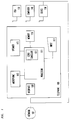
- FIG. 1 shows an exemplary telephone 105 configured to operate according to the invention.
- telephone 105 is a wired telephone coupled to a network 107, such as the public switched telephone network (PSTN), via a telephone line interface 109, although aspects of the invention may be advantageously employed in any kind of telephone coupled to any kind of network.
- PSTN public switched telephone network
- Telephone 105 includes a processor 111, such as an integrated circuit microcontroller or digital signal processor.
- the processor 111 is adapted to control the operations of telephone 105, and in addition to controlling conventional telephone operations, processor 111 is adapted to control operations according to the invention. It is, of course, possible to incorporate the functionality of the invention into a separate processor, but is likely more practical to integrate the functionality into a processor that is already required as part of the design of telephone 105.
- Processor 111 is linked to a microphone 113 and a speaker 115, such as are conventionally configured within a telephone handset or as part of a base unit speaker phone application. Additional elements, such as a codec, which are conventional in a telephone, are not described herein, although one of skill in the art is clearly aware of their usefulness, necessity and desirability in a device configured according to the invention. Instead, to facilitate an understanding of the invention, the description herein is directed to particular elements that function in an unconventional manner to implement an embodiment according to the invention.
- the processor 111 is in the audio path between the interface 109 and the transducers 113 and 115. This is mostly for illustrative purposes, as it is, of course, possible for the processor to be out of the path, such that there is a more direct link between the interface and the transducers, such that the processor acts upon the link according to the invention but is not necessarily part of the link.
- the link can exist in a conventional manner, and the processor can output a signal onto the link for integration into the signal stream provided to speaker 115.
- the signal output by processor 111 may be, for example, a simple tone, a tone pattern, or a chime.
- the processor 111 may be programmed to output a chime on a periodic basis, such as once every ten minutes, to provide a party engaged in a telephone call a sense of the passage of time.
- the processor 111 may be adapted to output an indication of the actual time.
- the processor may have stored therein digital recordings of the components of each ten minute interval, or the processor 111 may include a text-to-speech module programmed to output an announcement of the actual time. This announcement may be on a periodic basis, or may be provided in response to input from the user.
- the announcement may be base on a particular telephone condition, such as a low battery.
- the announcement and/or the frequency of the announcement may vary depending on the basis for the announcement. For example, if the basis for the announcement is merely to inform the user of periodic passage of time, the announcement may occur once every ten minutes. On the other hand, if the announcement is to inform or remind the user of a low battery condition, the announcement may occur every minute.
- the input from the user may be provided to an input unit 117, which may be, for example, a keypad, and which may also be used for keypad input to control conventional telephone functions.
- Input unit 117 may also or alternatively be configured as a wireless transceiver to receive input, such as according to the 802.11 or Bluetooth standards, incorporated herein by reference, or according to other wireless link standards, from one or more input providers.
- Exemplary input providers are illustrated as a personal digital assistant (PDA) 130, a computer 140, or a device 150, such as a household appliance.
- PDA personal digital assistant
- the personal digital assistant 130 and/or the computer 140 may contain a scheduling or calendar program which the user employs to keep track of important events.
- a scheduling program may typically be configured to provide the user with an advance notification of an upcoming appointment.
- the PDA 130 may output an audible signal fifteen minutes before an appointment to remind the user of the appointment.
- the computer 140 may provide a visual alert on a monitor, potentially coupled with an audible alert, to provide the user with advance warning of the appointment.
- telephone 105 is made aware of the appointment by, for example, sensing a signal in input element 117, whereby processor 111 subsequently causes a similar warning signal to be integrated into the audio path to help insure that the user is made aware of the appointment.
- the processor 111 may be configured to provide a real time replica of any received alert signal, such that the PDA 130 and/or computer 140 are merely adapted to output a wireless signal in concert with other signaling targeted to the user.
- the input element 117 is thus adapted to receive such transmissions and notify the processor 111, and the processor 111 is adapted. to cause the appropriate signal to be integrated into the audio path.
- the PDA 130 and/or computer 140 may be adapted to provide information to input element 117 relating to a plurality of events.
- the user may instruct the PDA 130 to upload the PDA's calendar of events to the telephone 105.
- data relating to a plurality of events are transferred via the wireless link to input element 117 and received by processor 111.
- Processor 111 causes these data to be stored in a memory 119.
- memory 119 thus includes a replica of at least some of the scheduling information contained in PDA 130 (or computer 140), and processor 111 and memory 119 thus coordinate to locally generate appropriate alert or warning signals, particularly when telephone 105 is in an off-hook condition.
- Device 150 which is an alternative source for input, may be, for example, a home appliance.
- An exemplary home appliance may be an oven that provides a signal when a cooking cycle is complete.
- Alternative appliances may be a clothes dryer providing a signal indicating that a drying cycle is complete, a washer providing a signal that a washing cycle is complete or that there is a problem with an unbalanced load, or any other form of home appliance that typically provides indicia to a user.
- the signal from the home appliance is recognized by the processor 111 and causes a particular signal to be integrated into the audio path.
- connection may be a wired connection, such as via telephone lines within a home, such that the communication is according to, for example, a home telephone line communication standard, such as the Home Phone Line Network Alliance (HomePNA) standard, incorporated herein by reference.
- HomePNA Home Phone Line Network Alliance
- the devices 130, 140 and 150 may automatically output signals over the home telephone line, regardless of whether telephone 105 is in an off-hook or onhook condition.
- one or more of the devices may include a parallel set detect module coupled to an internal telephone line interface, whereby a processor within the device checks to see if a parallel set (e.g., telephone 105) is off-hook, and if so, then the signals are sent.
- a parallel set e.g., telephone 105
- FIG. 2 provides a simplified operational flowchart of an embodiment according to the invention.
- an alert signal is received by telephone 105.
- a determination is made as to whether telephone 105 is in an off-hook condition. If the answer at step 204 is YES, then an appropriate signal is integrated into the audio path at step 206. If, on the other hand, the answer at step 204 is NO, then either no signal is provided, or an alternative signaling scheme that does not utilize the audio path is employed (step 208).
- the steps 204 and 206 may be proximate in time with the step 202, such that a received alert signal results in a real time inquiry and signaling.
- the alert signal receipt at step 202 may be temporally spaced from step 204 and/or 206.
- the signal received at step 202 may provide information regarding the timing of steps 204 and 206.
Landscapes
- Engineering & Computer Science (AREA)
- Signal Processing (AREA)
- Human Computer Interaction (AREA)
- Computer Networks & Wireless Communication (AREA)
- Telephonic Communication Services (AREA)
- Telephone Function (AREA)
- Telephone Set Structure (AREA)
Abstract
Description
- The invention is directed to the field of telephony, and more particularly to the advantageous use of the sounds provided to a telephone speaker.
- When people talk on the telephone, they sometimes become so involved in a telephone conversation that they lose track of time. It is not uncommon for a party on a telephone conversation to suddenly remember an important event and abruptly declare to the other party something along the lines of "Sorry, I just remembered X, I have to go." At which point the conversation will terminate by the party hanging up the party's telephone. "X" can be anything from picking up one's child at the bus stop, to watching a favorite television show, to turning off the oven before dinner is burned.
- If the party is fortunate, the memory of the important event occurs in time for the party to take corrective action with no significant or catastrophic consequences. For example, the party may arrive at the bus stop just in time to collect the party's child, or the party may be able to turn off the oven before the dinner is ruined. Sometimes, however, the party's recollection of the event is too late, and the consequences can range from merely inconvenient to severe. There is a need, therefore, for a method and apparatus to alert a party involved in a telephone conversation to the time of day, the occurrence of an important event, or the upcoming occurrence of an important event.
- This need is met by providing an audible signal associated with an event as part of the audio path of the telephone. In particular, a telephone according to one embodiment of the invention includes a microphone adapted to receive audible signals from a user and to convert the audible signals to electrical signals for transmission to a distant party, and a speaker adapted to receive electrical signals associated with input from the distant party and to convert the electrical signals to audible signals. According to the invention, the telephone also includes a processor adapted to produce electrical signals associated with an external event, and to integrate these electrical signals with the received electrical signals.
- In an alternative embodiment according to the invention, a method of alerting a party to a telephone conversation of an external event includes the step of providing an indication of the external event to the party from a speaker of the telephone during the telephone conversation. The external event can be a time of day, for example, and the indication can be a distinctive chime or an announcement of the time.
- Objects and advantages of the invention will be apparent to one of skill in the art upon review of the following detailed description in light of the drawing, wherein:
- Figure 1 is a simplified block diagram of an exemplary telephone configured according to the invention; and
- Figure 2 is a simplified operational flowchart describing an exemplary operational configuration of a telephone according to the invention.
-
- Figure 1 shows an
exemplary telephone 105 configured to operate according to the invention. In this embodiment,telephone 105 is a wired telephone coupled to anetwork 107, such as the public switched telephone network (PSTN), via atelephone line interface 109, although aspects of the invention may be advantageously employed in any kind of telephone coupled to any kind of network. -
Telephone 105 includes aprocessor 111, such as an integrated circuit microcontroller or digital signal processor. Theprocessor 111 is adapted to control the operations oftelephone 105, and in addition to controlling conventional telephone operations,processor 111 is adapted to control operations according to the invention. It is, of course, possible to incorporate the functionality of the invention into a separate processor, but is likely more practical to integrate the functionality into a processor that is already required as part of the design oftelephone 105. -
Processor 111 is linked to amicrophone 113 and aspeaker 115, such as are conventionally configured within a telephone handset or as part of a base unit speaker phone application. Additional elements, such as a codec, which are conventional in a telephone, are not described herein, although one of skill in the art is clearly aware of their usefulness, necessity and desirability in a device configured according to the invention. Instead, to facilitate an understanding of the invention, the description herein is directed to particular elements that function in an unconventional manner to implement an embodiment according to the invention. - As illustrated, the
processor 111 is in the audio path between theinterface 109 and thetransducers speaker 115. - The signal output by
processor 111 may be, for example, a simple tone, a tone pattern, or a chime. For example, theprocessor 111 may be programmed to output a chime on a periodic basis, such as once every ten minutes, to provide a party engaged in a telephone call a sense of the passage of time. Alternatively, theprocessor 111 may be adapted to output an indication of the actual time. For example, the processor may have stored therein digital recordings of the components of each ten minute interval, or theprocessor 111 may include a text-to-speech module programmed to output an announcement of the actual time. This announcement may be on a periodic basis, or may be provided in response to input from the user. - Alternatively, the announcement may be base on a particular telephone condition, such as a low battery. Also, the announcement and/or the frequency of the announcement may vary depending on the basis for the announcement. For example, if the basis for the announcement is merely to inform the user of periodic passage of time, the announcement may occur once every ten minutes. On the other hand, if the announcement is to inform or remind the user of a low battery condition, the announcement may occur every minute.
- The input from the user may be provided to an
input unit 117, which may be, for example, a keypad, and which may also be used for keypad input to control conventional telephone functions.Input unit 117 may also or alternatively be configured as a wireless transceiver to receive input, such as according to the 802.11 or Bluetooth standards, incorporated herein by reference, or according to other wireless link standards, from one or more input providers. Exemplary input providers are illustrated as a personal digital assistant (PDA) 130, acomputer 140, or adevice 150, such as a household appliance. - For example, the personal
digital assistant 130 and/or thecomputer 140 may contain a scheduling or calendar program which the user employs to keep track of important events. Such a scheduling program may typically be configured to provide the user with an advance notification of an upcoming appointment. For example, thePDA 130 may output an audible signal fifteen minutes before an appointment to remind the user of the appointment. Similarly, thecomputer 140 may provide a visual alert on a monitor, potentially coupled with an audible alert, to provide the user with advance warning of the appointment. - However, if the user is not proximate to the
PDA 130 and/orcomputer 140, the user may not be aware of the signals being issued thereby. For example, if the user is engaged in a telephone call and is somewhat oblivious to the events going on around the user, or if the telephone call causes the user to be at a location that is not proximate to thePDA 130 and/orcomputer 140, then the user may be unaware of the warning and may thus miss the appointment. According to the invention, however,telephone 105 is made aware of the appointment by, for example, sensing a signal ininput element 117, wherebyprocessor 111 subsequently causes a similar warning signal to be integrated into the audio path to help insure that the user is made aware of the appointment. - The
processor 111 may be configured to provide a real time replica of any received alert signal, such that thePDA 130 and/orcomputer 140 are merely adapted to output a wireless signal in concert with other signaling targeted to the user. Theinput element 117 is thus adapted to receive such transmissions and notify theprocessor 111, and theprocessor 111 is adapted. to cause the appropriate signal to be integrated into the audio path. Alternatively, thePDA 130 and/orcomputer 140 may be adapted to provide information to inputelement 117 relating to a plurality of events. For example, the user may instruct thePDA 130 to upload the PDA's calendar of events to thetelephone 105. As a result, data relating to a plurality of events are transferred via the wireless link to inputelement 117 and received byprocessor 111.Processor 111 causes these data to be stored in amemory 119. In one embodiment,memory 119 thus includes a replica of at least some of the scheduling information contained in PDA 130 (or computer 140), andprocessor 111 andmemory 119 thus coordinate to locally generate appropriate alert or warning signals, particularly whentelephone 105 is in an off-hook condition. -
Device 150, which is an alternative source for input, may be, for example, a home appliance. An exemplary home appliance may be an oven that provides a signal when a cooking cycle is complete. Alternative appliances may be a clothes dryer providing a signal indicating that a drying cycle is complete, a washer providing a signal that a washing cycle is complete or that there is a problem with an unbalanced load, or any other form of home appliance that typically provides indicia to a user. The signal from the home appliance, according to the invention, is recognized by theprocessor 111 and causes a particular signal to be integrated into the audio path. - The above description details a wireless link between the
PDA 130,computer 140,appliance 150 and thetelephone 105. Alternatively, as also depicted in Figure 1, the connection may be a wired connection, such as via telephone lines within a home, such that the communication is according to, for example, a home telephone line communication standard, such as the Home Phone Line Network Alliance (HomePNA) standard, incorporated herein by reference. - The
devices telephone 105 is in an off-hook or onhook condition. Alternatively, one or more of the devices may include a parallel set detect module coupled to an internal telephone line interface, whereby a processor within the device checks to see if a parallel set (e.g., telephone 105) is off-hook, and if so, then the signals are sent. - Figure 2 provides a simplified operational flowchart of an embodiment according to the invention. At step 202 an alert signal is received by
telephone 105. At step 204 a determination is made as to whethertelephone 105 is in an off-hook condition. If the answer atstep 204 is YES, then an appropriate signal is integrated into the audio path atstep 206. If, on the other hand, the answer atstep 204 is NO, then either no signal is provided, or an alternative signaling scheme that does not utilize the audio path is employed (step 208). - As discussed earlier, the
steps step 204 and/or 206. Further, the signal received at step 202 may provide information regarding the timing ofsteps - Based on an understanding of these various embodiments, one of skill in the art is likely to conceive of alternative embodiments that are not specifically enumerated here, but that are clearly within the scope of the invention. For example, the aforementioned embodiments describe the provision of a signal integrated into an audio path of a telephone. It is, of course, possible to couple such an audio signal with an audible signal that is not part of the audio path, as well as a visual or other form of sensory based signal.
Claims (10)
- A telephone, comprising:a microphone adapted to receive audible signals from a user and to convert the audible signals to electrical signals for transmission to a distant party;a speaker adapted to receive electrical signals associated with input from the distant party and to convert the electrical signals to audible signals; anda processor adapted to produce electrical signals associated with an external event, and to integrate these electrical signals with the received electrical signals.
- A telephone as recited in claim 1, wherein the external event is a time of day and wherein the produced electrical signals are adapted to cause one of a chime to be heard from the speaker and the time of day to be heard from the speaker.
- A telephone as recited in claim 1, further comprising a receiver adapted to receive a signal associated with the external event, wherein the receiver is a wireless receiver adapted to receive the signal from one of a personal digital assistant (PDA) and a device associated with the external event.
- A telephone as recited in claim 1, further comprising a memory, wherein the memory is adapted to store information associated with the external event and a plurality of external events, further comprising a receiver adapted to receive a signal associated with the external events.
- A method of alerting a party to a telephone conversation of an external event, comprising the step of:
providing an indication of the external event to the party from a speaker of the telephone during the telephone conversation. - A method as recited in claim 5, wherein the external event is a time of day, wherein the indication is one of a distinctive chime and an announcement of the time.
- A method as recited in claim 5, further comprising the step of receiving an alert signal related to the external event, wherein the alert signal is received from a scheduling device, and wherein the scheduling device is one of a personal digital assistant (PDA), a device associated with the external event, a home appliance, a home telephone network, and a computer.
- A method as recited in claim 7, wherein the alert signal is received and/or the indication is provided at a predetermined point in time relative to the external event.
- A method as recited in claim 7, further comprising the step of storing information associated with the alert signal, the information providing an indication of when to provide the indication, wherein the receiving step comprises receiving information associated with a plurality of external events, and the storing step comprises storing the information associated with the plurality of external events.
- A method as recited in claim 7, wherein the alert signal is received from a home telephone network, further comprising the steps of:the device determining if the telephone is in an off-hook condition; andthe device selectively transmitting the alert signal based on the determination, wherein the selective transmission step is adapted to transmit the alert signal when an off-hook condition is determined.
Priority Applications (1)
| Application Number | Priority Date | Filing Date | Title |
|---|---|---|---|
| EP07075280A EP1802084B1 (en) | 1999-12-10 | 2000-12-04 | Alert signal during telephone conversation |
Applications Claiming Priority (2)
| Application Number | Priority Date | Filing Date | Title |
|---|---|---|---|
| US458651 | 1999-12-10 | ||
| US09/458,651 US6628759B1 (en) | 1999-12-10 | 1999-12-10 | Alert signal during telephone conversation |
Related Child Applications (1)
| Application Number | Title | Priority Date | Filing Date |
|---|---|---|---|
| EP07075280A Division EP1802084B1 (en) | 1999-12-10 | 2000-12-04 | Alert signal during telephone conversation |
Publications (1)
| Publication Number | Publication Date |
|---|---|
| EP1109377A1 true EP1109377A1 (en) | 2001-06-20 |
Family
ID=23821585
Family Applications (2)
| Application Number | Title | Priority Date | Filing Date |
|---|---|---|---|
| EP00310754A Withdrawn EP1109377A1 (en) | 1999-12-10 | 2000-12-04 | Alert signal during telephone conversation |
| EP07075280A Expired - Lifetime EP1802084B1 (en) | 1999-12-10 | 2000-12-04 | Alert signal during telephone conversation |
Family Applications After (1)
| Application Number | Title | Priority Date | Filing Date |
|---|---|---|---|
| EP07075280A Expired - Lifetime EP1802084B1 (en) | 1999-12-10 | 2000-12-04 | Alert signal during telephone conversation |
Country Status (4)
| Country | Link |
|---|---|
| US (1) | US6628759B1 (en) |
| EP (2) | EP1109377A1 (en) |
| JP (1) | JP2001197174A (en) |
| CA (1) | CA2324178C (en) |
Cited By (4)
| Publication number | Priority date | Publication date | Assignee | Title |
|---|---|---|---|---|
| EP1744524A1 (en) * | 2005-07-13 | 2007-01-17 | Research In Motion Limited | Customizability of event notification on telephony-enabled devices |
| EP1768371A3 (en) * | 2005-09-23 | 2009-02-25 | High Tech Computer Corp. | Method for arbitrating audio signal output |
| WO2009126180A1 (en) * | 2008-04-07 | 2009-10-15 | Sony Ericsson Mobile Communications Ab | System and method for audibly representing a remote event |
| US7881283B2 (en) | 2005-07-13 | 2011-02-01 | Research In Motion Limited | Customizability of event notification on telephony-enabled devices |
Families Citing this family (3)
| Publication number | Priority date | Publication date | Assignee | Title |
|---|---|---|---|---|
| TW200713015A (en) * | 2005-09-19 | 2007-04-01 | High Tech Comp Corp | Method for arbitrating audio signal output |
| US20090094283A1 (en) * | 2007-10-03 | 2009-04-09 | Microsoft Corporation | Active use lookup via mobile device |
| KR101478459B1 (en) * | 2013-09-05 | 2014-12-31 | 한국과학기술원 | Language delay treatment system and control method for the same |
Citations (3)
| Publication number | Priority date | Publication date | Assignee | Title |
|---|---|---|---|---|
| EP0675609A2 (en) * | 1994-03-31 | 1995-10-04 | Sony Corporation | Digital radio communication with low quality reception modification |
| US5493611A (en) * | 1994-05-20 | 1996-02-20 | At&T Corp. | User configurable telephone with alarm feature |
| US5794163A (en) * | 1993-07-27 | 1998-08-11 | Spectralink Corporation | Headset for hands-free wireless telephone |
Family Cites Families (13)
| Publication number | Priority date | Publication date | Assignee | Title |
|---|---|---|---|---|
| US4481382A (en) * | 1982-09-29 | 1984-11-06 | Villa Real Antony Euclid C | Programmable telephone system |
| JPS6165555A (en) * | 1984-09-05 | 1986-04-04 | Mitsubishi Electric Corp | Home control system |
| US4737981A (en) * | 1987-03-06 | 1988-04-12 | Grh Electronics, Inc. | Telephone control device |
| US5086385A (en) * | 1989-01-31 | 1992-02-04 | Custom Command Systems | Expandable home automation system |
| US4969180A (en) * | 1989-05-18 | 1990-11-06 | I.I.N.V. Computing Ltd. | Cordless pen telephone handset |
| US5268666A (en) * | 1991-12-23 | 1993-12-07 | At&T Bell Laboratories | Appliance control system providing out-of-context usage |
| FR2695494B1 (en) * | 1992-09-09 | 1994-10-21 | Seb Sa | Modular multifunctional home automation system. |
| US5652789A (en) * | 1994-09-30 | 1997-07-29 | Wildfire Communications, Inc. | Network based knowledgeable assistant |
| US6128012A (en) * | 1996-09-19 | 2000-10-03 | Microsoft Corporation | User interface for a portable data management device with limited size and processing capability |
| US6086377A (en) * | 1997-05-09 | 2000-07-11 | Nortel Networks Corporation | System and method for product and service configuration |
| US6430599B1 (en) * | 1999-06-15 | 2002-08-06 | Sun Microsystems, Inc. | Just-in-time services for small footprint devices |
| US6329937B1 (en) * | 1999-08-11 | 2001-12-11 | Agere Systems Guardian Corp. | Robust data communications using multiple spectral images |
| US6252755B1 (en) * | 1999-08-11 | 2001-06-26 | Advanced Micro Devices, Inc. | Apparatus and method for implementing a home network using customer-premises power lines |
-
1999
- 1999-12-10 US US09/458,651 patent/US6628759B1/en not_active Expired - Fee Related
-
2000
- 2000-10-23 CA CA002324178A patent/CA2324178C/en not_active Expired - Fee Related
- 2000-12-04 EP EP00310754A patent/EP1109377A1/en not_active Withdrawn
- 2000-12-04 EP EP07075280A patent/EP1802084B1/en not_active Expired - Lifetime
- 2000-12-05 JP JP2000370490A patent/JP2001197174A/en active Pending
Patent Citations (3)
| Publication number | Priority date | Publication date | Assignee | Title |
|---|---|---|---|---|
| US5794163A (en) * | 1993-07-27 | 1998-08-11 | Spectralink Corporation | Headset for hands-free wireless telephone |
| EP0675609A2 (en) * | 1994-03-31 | 1995-10-04 | Sony Corporation | Digital radio communication with low quality reception modification |
| US5493611A (en) * | 1994-05-20 | 1996-02-20 | At&T Corp. | User configurable telephone with alarm feature |
Non-Patent Citations (1)
| Title |
|---|
| ERICSSON: "User's Guide - Mobile phone T28", September 1999 (1999-09-01) * |
Cited By (6)
| Publication number | Priority date | Publication date | Assignee | Title |
|---|---|---|---|---|
| EP1744524A1 (en) * | 2005-07-13 | 2007-01-17 | Research In Motion Limited | Customizability of event notification on telephony-enabled devices |
| US7881283B2 (en) | 2005-07-13 | 2011-02-01 | Research In Motion Limited | Customizability of event notification on telephony-enabled devices |
| EP2164235A3 (en) * | 2005-07-13 | 2011-05-18 | Research In Motion Limited | Customizability of event notification on telephony-enabled devices |
| US8542675B2 (en) | 2005-07-13 | 2013-09-24 | Blackberry Limited | Customizability of event notification on telephony-enabled devices |
| EP1768371A3 (en) * | 2005-09-23 | 2009-02-25 | High Tech Computer Corp. | Method for arbitrating audio signal output |
| WO2009126180A1 (en) * | 2008-04-07 | 2009-10-15 | Sony Ericsson Mobile Communications Ab | System and method for audibly representing a remote event |
Also Published As
| Publication number | Publication date |
|---|---|
| US6628759B1 (en) | 2003-09-30 |
| EP1802084B1 (en) | 2011-10-05 |
| CA2324178C (en) | 2004-04-27 |
| JP2001197174A (en) | 2001-07-19 |
| EP1802084A1 (en) | 2007-06-27 |
| CA2324178A1 (en) | 2001-06-10 |
Similar Documents
| Publication | Publication Date | Title |
|---|---|---|
| US6917680B1 (en) | Apparatus for disabling a telephone ringer | |
| US6628759B1 (en) | Alert signal during telephone conversation | |
| US5493611A (en) | User configurable telephone with alarm feature | |
| JPH05505079A (en) | telephone signaling system | |
| US7304563B2 (en) | Alarm clock | |
| JPH04336749A (en) | facsimile machine | |
| KR100390504B1 (en) | Mobile information terminal sleep function control method | |
| JP3814036B2 (en) | Telephone device with ring tone switching function | |
| KR100604600B1 (en) | Alarm method in mobile communication terminal | |
| KR100191342B1 (en) | Method for automatic alarm of subscription clock in telephone | |
| JP2004172811A (en) | Intercom equipment | |
| JP2887509B2 (en) | Incoming call switching device in telephone | |
| JPS63311844A (en) | Telephone set | |
| KR19990032252A (en) | How to tell if you have received messages from an answering machine | |
| JPH10107872A (en) | Telephone equipment | |
| KR940012999A (en) | Remote control automatic transmission / reception processing system and method of telephone | |
| JPH03160894A (en) | Key telephone system | |
| JPH01265691A (en) | Key telephone set | |
| JPH09307618A (en) | Telephone | |
| JPH07101897B2 (en) | Cordless phone | |
| JPS6266746A (en) | Telephone set | |
| JPS63302691A (en) | button phone system | |
| KR19990075216A (en) | How to call reservation signal of communication device | |
| JPH0578053U (en) | Telephone device | |
| JP2005109646A (en) | Key telephone device and key telephone set |
Legal Events
| Date | Code | Title | Description |
|---|---|---|---|
| PUAI | Public reference made under article 153(3) epc to a published international application that has entered the european phase |
Free format text: ORIGINAL CODE: 0009012 |
|
| AK | Designated contracting states |
Kind code of ref document: A1 Designated state(s): DE FR GB |
|
| AX | Request for extension of the european patent |
Free format text: AL;LT;LV;MK;RO;SI |
|
| 17P | Request for examination filed |
Effective date: 20011214 |
|
| AKX | Designation fees paid |
Free format text: DE FR GB |
|
| 17Q | First examination report despatched |
Effective date: 20051018 |
|
| APBK | Appeal reference recorded |
Free format text: ORIGINAL CODE: EPIDOSNREFNE |
|
| APBN | Date of receipt of notice of appeal recorded |
Free format text: ORIGINAL CODE: EPIDOSNNOA2E |
|
| APBR | Date of receipt of statement of grounds of appeal recorded |
Free format text: ORIGINAL CODE: EPIDOSNNOA3E |
|
| RAP3 | Party data changed (applicant data changed or rights of an application transferred) |
Owner name: LUCENT TECHNOLOGIES INC. |
|
| APAF | Appeal reference modified |
Free format text: ORIGINAL CODE: EPIDOSCREFNE |
|
| APBT | Appeal procedure closed |
Free format text: ORIGINAL CODE: EPIDOSNNOA9E |
|
| STAA | Information on the status of an ep patent application or granted ep patent |
Free format text: STATUS: THE APPLICATION HAS BEEN WITHDRAWN |
|
| 18W | Application withdrawn |
Effective date: 20120222 |