EP1109061A1 - Silver halide color photographic light sensitive material - Google Patents
Silver halide color photographic light sensitive material Download PDFInfo
- Publication number
- EP1109061A1 EP1109061A1 EP00311233A EP00311233A EP1109061A1 EP 1109061 A1 EP1109061 A1 EP 1109061A1 EP 00311233 A EP00311233 A EP 00311233A EP 00311233 A EP00311233 A EP 00311233A EP 1109061 A1 EP1109061 A1 EP 1109061A1
- Authority
- EP
- European Patent Office
- Prior art keywords
- silver halide
- group
- formula
- color photographic
- photographic material
- Prior art date
- Legal status (The legal status is an assumption and is not a legal conclusion. Google has not performed a legal analysis and makes no representation as to the accuracy of the status listed.)
- Granted
Links
- -1 Silver halide Chemical class 0.000 title claims abstract description 132
- 229910052709 silver Inorganic materials 0.000 title claims abstract description 79
- 239000004332 silver Substances 0.000 title claims abstract description 79
- 239000000463 material Substances 0.000 title claims abstract description 49
- 239000000839 emulsion Substances 0.000 claims abstract description 69
- 150000001875 compounds Chemical class 0.000 claims description 53
- 239000000975 dye Substances 0.000 claims description 42
- 239000003795 chemical substances by application Substances 0.000 claims description 33
- 125000001424 substituent group Chemical group 0.000 claims description 26
- 125000000217 alkyl group Chemical group 0.000 claims description 20
- 125000000753 cycloalkyl group Chemical group 0.000 claims description 19
- 125000005843 halogen group Chemical group 0.000 claims description 14
- 238000006243 chemical reaction Methods 0.000 claims description 12
- 230000003647 oxidation Effects 0.000 claims description 12
- 238000007254 oxidation reaction Methods 0.000 claims description 12
- 125000003545 alkoxy group Chemical group 0.000 claims description 10
- 125000004435 hydrogen atom Chemical group [H]* 0.000 claims description 9
- 239000003112 inhibitor Substances 0.000 claims description 9
- 125000003118 aryl group Chemical group 0.000 claims description 8
- 125000004104 aryloxy group Chemical group 0.000 claims description 8
- 229910052801 chlorine Inorganic materials 0.000 claims description 7
- 125000000623 heterocyclic group Chemical group 0.000 claims description 7
- 125000004442 acylamino group Chemical group 0.000 claims description 5
- 125000003917 carbamoyl group Chemical group [H]N([H])C(*)=O 0.000 claims description 5
- 125000001309 chloro group Chemical group Cl* 0.000 claims description 5
- 125000000956 methoxy group Chemical group [H]C([H])([H])O* 0.000 claims description 5
- 125000004397 aminosulfonyl group Chemical group NS(=O)(=O)* 0.000 claims description 4
- AJDUTMFFZHIJEM-UHFFFAOYSA-N n-(9,10-dioxoanthracen-1-yl)-4-[4-[[4-[4-[(9,10-dioxoanthracen-1-yl)carbamoyl]phenyl]phenyl]diazenyl]phenyl]benzamide Chemical compound O=C1C2=CC=CC=C2C(=O)C2=C1C=CC=C2NC(=O)C(C=C1)=CC=C1C(C=C1)=CC=C1N=NC(C=C1)=CC=C1C(C=C1)=CC=C1C(=O)NC1=CC=CC2=C1C(=O)C1=CC=CC=C1C2=O AJDUTMFFZHIJEM-UHFFFAOYSA-N 0.000 claims description 4
- 125000005740 oxycarbonyl group Chemical group [*:1]OC([*:2])=O 0.000 claims description 4
- 125000000951 phenoxy group Chemical group [H]C1=C([H])C([H])=C(O*)C([H])=C1[H] 0.000 claims description 4
- 125000000472 sulfonyl group Chemical group *S(*)(=O)=O 0.000 claims description 4
- 239000001043 yellow dye Substances 0.000 claims description 4
- 125000004453 alkoxycarbonyl group Chemical group 0.000 claims description 3
- 150000004820 halides Chemical class 0.000 claims description 2
- 239000010410 layer Substances 0.000 description 52
- 230000001235 sensitizing effect Effects 0.000 description 33
- ZUNKMNLKJXRCDM-UHFFFAOYSA-N silver bromoiodide Chemical compound [Ag].IBr ZUNKMNLKJXRCDM-UHFFFAOYSA-N 0.000 description 24
- XEKOWRVHYACXOJ-UHFFFAOYSA-N Ethyl acetate Chemical compound CCOC(C)=O XEKOWRVHYACXOJ-UHFFFAOYSA-N 0.000 description 21
- 0 *c(cc1)ccc1O*C(Nc(cccc1)c1SC(C(Nc(cc(*)cc1)c1Cl)=NN1c(c(Cl)cc(Cl)c2)c2Cl)C1=O)=O Chemical compound *c(cc1)ccc1O*C(Nc(cccc1)c1SC(C(Nc(cc(*)cc1)c1Cl)=NN1c(c(Cl)cc(Cl)c2)c2Cl)C1=O)=O 0.000 description 20
- 108010010803 Gelatin Proteins 0.000 description 19
- 229920000159 gelatin Polymers 0.000 description 19
- 239000008273 gelatin Substances 0.000 description 19
- 235000019322 gelatine Nutrition 0.000 description 19
- 235000011852 gelatine desserts Nutrition 0.000 description 19
- 238000000034 method Methods 0.000 description 19
- XLYOFNOQVPJJNP-UHFFFAOYSA-N water Substances O XLYOFNOQVPJJNP-UHFFFAOYSA-N 0.000 description 18
- 238000010186 staining Methods 0.000 description 15
- 238000009835 boiling Methods 0.000 description 14
- 238000011161 development Methods 0.000 description 13
- 239000002904 solvent Substances 0.000 description 13
- 238000005406 washing Methods 0.000 description 13
- 230000035945 sensitivity Effects 0.000 description 12
- 125000001997 phenyl group Chemical group [H]C1=C([H])C([H])=C(*)C([H])=C1[H] 0.000 description 9
- 238000012545 processing Methods 0.000 description 8
- WSFSSNUMVMOOMR-UHFFFAOYSA-N Formaldehyde Chemical compound O=C WSFSSNUMVMOOMR-UHFFFAOYSA-N 0.000 description 7
- 230000008569 process Effects 0.000 description 7
- 239000000243 solution Substances 0.000 description 7
- 238000003860 storage Methods 0.000 description 7
- QTBSBXVTEAMEQO-UHFFFAOYSA-N Acetic acid Chemical compound CC(O)=O QTBSBXVTEAMEQO-UHFFFAOYSA-N 0.000 description 6
- WEVYAHXRMPXWCK-UHFFFAOYSA-N Acetonitrile Chemical compound CC#N WEVYAHXRMPXWCK-UHFFFAOYSA-N 0.000 description 6
- OKKJLVBELUTLKV-UHFFFAOYSA-N Methanol Chemical compound OC OKKJLVBELUTLKV-UHFFFAOYSA-N 0.000 description 6
- KWYUFKZDYYNOTN-UHFFFAOYSA-M Potassium hydroxide Chemical compound [OH-].[K+] KWYUFKZDYYNOTN-UHFFFAOYSA-M 0.000 description 6
- BQCADISMDOOEFD-UHFFFAOYSA-N Silver Chemical compound [Ag] BQCADISMDOOEFD-UHFFFAOYSA-N 0.000 description 6
- 238000004061 bleaching Methods 0.000 description 6
- BWHMMNNQKKPAPP-UHFFFAOYSA-L potassium carbonate Chemical compound [K+].[K+].[O-]C([O-])=O BWHMMNNQKKPAPP-UHFFFAOYSA-L 0.000 description 6
- 239000002516 radical scavenger Substances 0.000 description 6
- GEHJYWRUCIMESM-UHFFFAOYSA-L sodium sulfite Chemical compound [Na+].[Na+].[O-]S([O-])=O GEHJYWRUCIMESM-UHFFFAOYSA-L 0.000 description 6
- 206010070834 Sensitisation Diseases 0.000 description 5
- FAPWRFPIFSIZLT-UHFFFAOYSA-M Sodium chloride Chemical class [Na+].[Cl-] FAPWRFPIFSIZLT-UHFFFAOYSA-M 0.000 description 5
- 230000015572 biosynthetic process Effects 0.000 description 5
- 239000007844 bleaching agent Substances 0.000 description 5
- 239000013078 crystal Substances 0.000 description 5
- 238000001556 precipitation Methods 0.000 description 5
- 230000008313 sensitization Effects 0.000 description 5
- 238000003756 stirring Methods 0.000 description 5
- QAOWNCQODCNURD-UHFFFAOYSA-N sulfuric acid Substances OS(O)(=O)=O QAOWNCQODCNURD-UHFFFAOYSA-N 0.000 description 5
- 238000003786 synthesis reaction Methods 0.000 description 5
- ZRHUHDUEXWHZMA-UHFFFAOYSA-N 1,4-dihydropyrazol-5-one Chemical compound O=C1CC=NN1 ZRHUHDUEXWHZMA-UHFFFAOYSA-N 0.000 description 4
- GPUWDUXYXXIUCI-UHFFFAOYSA-N 3-anilino-1,4-dihydropyrazol-5-one Chemical compound N1C(=O)CC(NC=2C=CC=CC=2)=N1 GPUWDUXYXXIUCI-UHFFFAOYSA-N 0.000 description 4
- 239000002250 absorbent Substances 0.000 description 4
- 230000002745 absorbent Effects 0.000 description 4
- 238000010521 absorption reaction Methods 0.000 description 4
- POJWUDADGALRAB-UHFFFAOYSA-N allantoin Chemical compound NC(=O)NC1NC(=O)NC1=O POJWUDADGALRAB-UHFFFAOYSA-N 0.000 description 4
- 239000000203 mixture Substances 0.000 description 4
- 239000000123 paper Substances 0.000 description 4
- ZAMOUSCENKQFHK-UHFFFAOYSA-N Chlorine atom Chemical compound [Cl] ZAMOUSCENKQFHK-UHFFFAOYSA-N 0.000 description 3
- ZMXDDKWLCZADIW-UHFFFAOYSA-N N,N-Dimethylformamide Chemical compound CN(C)C=O ZMXDDKWLCZADIW-UHFFFAOYSA-N 0.000 description 3
- 229960000583 acetic acid Drugs 0.000 description 3
- 125000004432 carbon atom Chemical group C* 0.000 description 3
- UOCJDOLVGGIYIQ-PBFPGSCMSA-N cefatrizine Chemical group S([C@@H]1[C@@H](C(N1C=1C(O)=O)=O)NC(=O)[C@H](N)C=2C=CC(O)=CC=2)CC=1CSC=1C=NNN=1 UOCJDOLVGGIYIQ-PBFPGSCMSA-N 0.000 description 3
- 239000000460 chlorine Substances 0.000 description 3
- 239000000084 colloidal system Substances 0.000 description 3
- 230000000052 comparative effect Effects 0.000 description 3
- 125000001559 cyclopropyl group Chemical group [H]C1([H])C([H])([H])C1([H])* 0.000 description 3
- 230000001747 exhibiting effect Effects 0.000 description 3
- 239000012362 glacial acetic acid Substances 0.000 description 3
- 239000012074 organic phase Substances 0.000 description 3
- 229920000642 polymer Polymers 0.000 description 3
- 229910000027 potassium carbonate Inorganic materials 0.000 description 3
- NLKNQRATVPKPDG-UHFFFAOYSA-M potassium iodide Chemical compound [K+].[I-] NLKNQRATVPKPDG-UHFFFAOYSA-M 0.000 description 3
- 239000011241 protective layer Substances 0.000 description 3
- 239000002994 raw material Substances 0.000 description 3
- 125000002914 sec-butyl group Chemical group [H]C([H])([H])C([H])([H])C([H])(*)C([H])([H])[H] 0.000 description 3
- 235000010265 sodium sulphite Nutrition 0.000 description 3
- 230000006641 stabilisation Effects 0.000 description 3
- 238000011105 stabilization Methods 0.000 description 3
- 239000003381 stabilizer Substances 0.000 description 3
- 229910052717 sulfur Inorganic materials 0.000 description 3
- KJCVRFUGPWSIIH-UHFFFAOYSA-N 1-naphthol Chemical group C1=CC=C2C(O)=CC=CC2=C1 KJCVRFUGPWSIIH-UHFFFAOYSA-N 0.000 description 2
- XRZDIHADHZSFBB-UHFFFAOYSA-N 3-oxo-n,3-diphenylpropanamide Chemical class C=1C=CC=CC=1NC(=O)CC(=O)C1=CC=CC=C1 XRZDIHADHZSFBB-UHFFFAOYSA-N 0.000 description 2
- KCXVZYZYPLLWCC-UHFFFAOYSA-N EDTA Chemical compound OC(=O)CN(CC(O)=O)CCN(CC(O)=O)CC(O)=O KCXVZYZYPLLWCC-UHFFFAOYSA-N 0.000 description 2
- VEXZGXHMUGYJMC-UHFFFAOYSA-N Hydrochloric acid Chemical compound Cl VEXZGXHMUGYJMC-UHFFFAOYSA-N 0.000 description 2
- MHAJPDPJQMAIIY-UHFFFAOYSA-N Hydrogen peroxide Chemical compound OO MHAJPDPJQMAIIY-UHFFFAOYSA-N 0.000 description 2
- 239000004372 Polyvinyl alcohol Substances 0.000 description 2
- 229910021612 Silver iodide Inorganic materials 0.000 description 2
- UIIMBOGNXHQVGW-UHFFFAOYSA-M Sodium bicarbonate Chemical compound [Na+].OC([O-])=O UIIMBOGNXHQVGW-UHFFFAOYSA-M 0.000 description 2
- NINIDFKCEFEMDL-UHFFFAOYSA-N Sulfur Chemical compound [S] NINIDFKCEFEMDL-UHFFFAOYSA-N 0.000 description 2
- PQLVXDKIJBQVDF-UHFFFAOYSA-N acetic acid;hydrate Chemical compound O.CC(O)=O PQLVXDKIJBQVDF-UHFFFAOYSA-N 0.000 description 2
- 125000005115 alkyl carbamoyl group Chemical group 0.000 description 2
- 229960000458 allantoin Drugs 0.000 description 2
- 239000012298 atmosphere Substances 0.000 description 2
- BJQHLKABXJIVAM-UHFFFAOYSA-N bis(2-ethylhexyl) phthalate Chemical compound CCCCC(CC)COC(=O)C1=CC=CC=C1C(=O)OCC(CC)CCCC BJQHLKABXJIVAM-UHFFFAOYSA-N 0.000 description 2
- 125000001951 carbamoylamino group Chemical group C(N)(=O)N* 0.000 description 2
- 229920002678 cellulose Polymers 0.000 description 2
- 239000001913 cellulose Substances 0.000 description 2
- 238000011109 contamination Methods 0.000 description 2
- 230000001808 coupling effect Effects 0.000 description 2
- 125000000113 cyclohexyl group Chemical group [H]C1([H])C([H])([H])C([H])([H])C([H])(*)C([H])([H])C1([H])[H] 0.000 description 2
- 125000001511 cyclopentyl group Chemical group [H]C1([H])C([H])([H])C([H])([H])C([H])(*)C1([H])[H] 0.000 description 2
- 230000009849 deactivation Effects 0.000 description 2
- 239000006185 dispersion Substances 0.000 description 2
- 238000004090 dissolution Methods 0.000 description 2
- 238000001035 drying Methods 0.000 description 2
- 230000006870 function Effects 0.000 description 2
- PCHJSUWPFVWCPO-UHFFFAOYSA-N gold Chemical compound [Au] PCHJSUWPFVWCPO-UHFFFAOYSA-N 0.000 description 2
- 239000010931 gold Substances 0.000 description 2
- 229910052737 gold Inorganic materials 0.000 description 2
- VKYKSIONXSXAKP-UHFFFAOYSA-N hexamethylenetetramine Chemical compound C1N(C2)CN3CN1CN2C3 VKYKSIONXSXAKP-UHFFFAOYSA-N 0.000 description 2
- QWPPOHNGKGFGJK-UHFFFAOYSA-N hypochlorous acid Chemical compound ClO QWPPOHNGKGFGJK-UHFFFAOYSA-N 0.000 description 2
- 125000001449 isopropyl group Chemical group [H]C([H])([H])C([H])(*)C([H])([H])[H] 0.000 description 2
- 230000000873 masking effect Effects 0.000 description 2
- 238000001819 mass spectrum Methods 0.000 description 2
- 239000006224 matting agent Substances 0.000 description 2
- 238000000655 nuclear magnetic resonance spectrum Methods 0.000 description 2
- 229920000139 polyethylene terephthalate Polymers 0.000 description 2
- 239000005020 polyethylene terephthalate Substances 0.000 description 2
- 239000004848 polyfunctional curative Substances 0.000 description 2
- 229920002451 polyvinyl alcohol Polymers 0.000 description 2
- 239000011541 reaction mixture Substances 0.000 description 2
- 230000009467 reduction Effects 0.000 description 2
- 230000002829 reductive effect Effects 0.000 description 2
- 150000003839 salts Chemical class 0.000 description 2
- JHJLBTNAGRQEKS-UHFFFAOYSA-M sodium bromide Chemical compound [Na+].[Br-] JHJLBTNAGRQEKS-UHFFFAOYSA-M 0.000 description 2
- VWDWKYIASSYTQR-UHFFFAOYSA-N sodium nitrate Chemical compound [Na+].[O-][N+]([O-])=O VWDWKYIASSYTQR-UHFFFAOYSA-N 0.000 description 2
- 239000011593 sulfur Substances 0.000 description 2
- DHCDFWKWKRSZHF-UHFFFAOYSA-N sulfurothioic S-acid Chemical compound OS(O)(=O)=S DHCDFWKWKRSZHF-UHFFFAOYSA-N 0.000 description 2
- 125000000999 tert-butyl group Chemical group [H]C([H])([H])C(*)(C([H])([H])[H])C([H])([H])[H] 0.000 description 2
- 150000000178 1,2,4-triazoles Chemical class 0.000 description 1
- YXIWHUQXZSMYRE-UHFFFAOYSA-N 1,3-benzothiazole-2-thiol Chemical class C1=CC=C2SC(S)=NC2=C1 YXIWHUQXZSMYRE-UHFFFAOYSA-N 0.000 description 1
- YHMYGUUIMTVXNW-UHFFFAOYSA-N 1,3-dihydrobenzimidazole-2-thione Chemical class C1=CC=C2NC(S)=NC2=C1 YHMYGUUIMTVXNW-UHFFFAOYSA-N 0.000 description 1
- GGZHVNZHFYCSEV-UHFFFAOYSA-N 1-Phenyl-5-mercaptotetrazole Chemical compound SC1=NN=NN1C1=CC=CC=C1 GGZHVNZHFYCSEV-UHFFFAOYSA-N 0.000 description 1
- JAAIPIWKKXCNOC-UHFFFAOYSA-N 1h-tetrazol-1-ium-5-thiolate Chemical class SC1=NN=NN1 JAAIPIWKKXCNOC-UHFFFAOYSA-N 0.000 description 1
- YQTCQNIPQMJNTI-UHFFFAOYSA-N 2,2-dimethylpropan-1-one Chemical group CC(C)(C)[C]=O YQTCQNIPQMJNTI-UHFFFAOYSA-N 0.000 description 1
- BIEFDNUEROKZRA-UHFFFAOYSA-N 2-(2-phenylethenyl)aniline Chemical class NC1=CC=CC=C1C=CC1=CC=CC=C1 BIEFDNUEROKZRA-UHFFFAOYSA-N 0.000 description 1
- XFHQIFFCAQHVMX-UHFFFAOYSA-B 2-[2-[bis(carboxylatomethyl)amino]ethyl-(carboxylatomethyl)amino]acetate;iron(3+) Chemical compound [Fe+3].[Fe+3].[Fe+3].[Fe+3].[O-]C(=O)CN(CC([O-])=O)CCN(CC([O-])=O)CC([O-])=O.[O-]C(=O)CN(CC([O-])=O)CCN(CC([O-])=O)CC([O-])=O.[O-]C(=O)CN(CC([O-])=O)CCN(CC([O-])=O)CC([O-])=O XFHQIFFCAQHVMX-UHFFFAOYSA-B 0.000 description 1
- DMQQXDPCRUGSQB-UHFFFAOYSA-N 2-[3-[bis(carboxymethyl)amino]propyl-(carboxymethyl)amino]acetic acid Chemical compound OC(=O)CN(CC(O)=O)CCCN(CC(O)=O)CC(O)=O DMQQXDPCRUGSQB-UHFFFAOYSA-N 0.000 description 1
- JKFYKCYQEWQPTM-UHFFFAOYSA-N 2-azaniumyl-2-(4-fluorophenyl)acetate Chemical compound OC(=O)C(N)C1=CC=C(F)C=C1 JKFYKCYQEWQPTM-UHFFFAOYSA-N 0.000 description 1
- FLFWJIBUZQARMD-UHFFFAOYSA-N 2-mercapto-1,3-benzoxazole Chemical class C1=CC=C2OC(S)=NC2=C1 FLFWJIBUZQARMD-UHFFFAOYSA-N 0.000 description 1
- 125000004105 2-pyridyl group Chemical group N1=C([*])C([H])=C([H])C([H])=C1[H] 0.000 description 1
- GDVFHEXRJFFDDB-UHFFFAOYSA-N 4-(5-sulfanylidene-2h-tetrazol-1-yl)benzoic acid Chemical compound C1=CC(C(=O)O)=CC=C1N1C(=S)N=NN1 GDVFHEXRJFFDDB-UHFFFAOYSA-N 0.000 description 1
- NTDQQZYCCIDJRK-UHFFFAOYSA-N 4-octylphenol Chemical compound CCCCCCCCC1=CC=C(O)C=C1 NTDQQZYCCIDJRK-UHFFFAOYSA-N 0.000 description 1
- INVVMIXYILXINW-UHFFFAOYSA-N 5-methyl-1h-[1,2,4]triazolo[1,5-a]pyrimidin-7-one Chemical compound CC1=CC(=O)N2NC=NC2=N1 INVVMIXYILXINW-UHFFFAOYSA-N 0.000 description 1
- 229930024421 Adenine Natural products 0.000 description 1
- GFFGJBXGBJISGV-UHFFFAOYSA-N Adenine Chemical compound NC1=NC=NC2=C1N=CN2 GFFGJBXGBJISGV-UHFFFAOYSA-N 0.000 description 1
- POJWUDADGALRAB-PVQJCKRUSA-N Allantoin Natural products NC(=O)N[C@@H]1NC(=O)NC1=O POJWUDADGALRAB-PVQJCKRUSA-N 0.000 description 1
- WKBOTKDWSSQWDR-UHFFFAOYSA-N Bromine atom Chemical compound [Br] WKBOTKDWSSQWDR-UHFFFAOYSA-N 0.000 description 1
- OKTJSMMVPCPJKN-UHFFFAOYSA-N Carbon Chemical compound [C] OKTJSMMVPCPJKN-UHFFFAOYSA-N 0.000 description 1
- 229920002134 Carboxymethyl cellulose Polymers 0.000 description 1
- 229920002284 Cellulose triacetate Polymers 0.000 description 1
- RPWFJAMTCNSJKK-UHFFFAOYSA-N Dodecyl gallate Chemical compound CCCCCCCCCCCCOC(=O)C1=CC(O)=C(O)C(O)=C1 RPWFJAMTCNSJKK-UHFFFAOYSA-N 0.000 description 1
- IAYPIBMASNFSPL-UHFFFAOYSA-N Ethylene oxide Chemical compound C1CO1 IAYPIBMASNFSPL-UHFFFAOYSA-N 0.000 description 1
- PXGOKWXKJXAPGV-UHFFFAOYSA-N Fluorine Chemical compound FF PXGOKWXKJXAPGV-UHFFFAOYSA-N 0.000 description 1
- 229920000663 Hydroxyethyl cellulose Polymers 0.000 description 1
- 239000004354 Hydroxyethyl cellulose Substances 0.000 description 1
- QPCDCPDFJACHGM-UHFFFAOYSA-N N,N-bis{2-[bis(carboxymethyl)amino]ethyl}glycine Chemical compound OC(=O)CN(CC(O)=O)CCN(CC(=O)O)CCN(CC(O)=O)CC(O)=O QPCDCPDFJACHGM-UHFFFAOYSA-N 0.000 description 1
- 229920002845 Poly(methacrylic acid) Polymers 0.000 description 1
- 239000004793 Polystyrene Substances 0.000 description 1
- 229910021607 Silver chloride Inorganic materials 0.000 description 1
- FOIXSVOLVBLSDH-UHFFFAOYSA-N Silver ion Chemical compound [Ag+] FOIXSVOLVBLSDH-UHFFFAOYSA-N 0.000 description 1
- 229920002125 Sokalan® Polymers 0.000 description 1
- YSMRWXYRXBRSND-UHFFFAOYSA-N TOTP Chemical compound CC1=CC=CC=C1OP(=O)(OC=1C(=CC=CC=1)C)OC1=CC=CC=C1C YSMRWXYRXBRSND-UHFFFAOYSA-N 0.000 description 1
- DTQVDTLACAAQTR-UHFFFAOYSA-N Trifluoroacetic acid Chemical group OC(=O)C(F)(F)F DTQVDTLACAAQTR-UHFFFAOYSA-N 0.000 description 1
- NNLVGZFZQQXQNW-ADJNRHBOSA-N [(2r,3r,4s,5r,6s)-4,5-diacetyloxy-3-[(2s,3r,4s,5r,6r)-3,4,5-triacetyloxy-6-(acetyloxymethyl)oxan-2-yl]oxy-6-[(2r,3r,4s,5r,6s)-4,5,6-triacetyloxy-2-(acetyloxymethyl)oxan-3-yl]oxyoxan-2-yl]methyl acetate Chemical compound O([C@@H]1O[C@@H]([C@H]([C@H](OC(C)=O)[C@H]1OC(C)=O)O[C@H]1[C@@H]([C@@H](OC(C)=O)[C@H](OC(C)=O)[C@@H](COC(C)=O)O1)OC(C)=O)COC(=O)C)[C@@H]1[C@@H](COC(C)=O)O[C@@H](OC(C)=O)[C@H](OC(C)=O)[C@H]1OC(C)=O NNLVGZFZQQXQNW-ADJNRHBOSA-N 0.000 description 1
- SJOOOZPMQAWAOP-UHFFFAOYSA-N [Ag].BrCl Chemical compound [Ag].BrCl SJOOOZPMQAWAOP-UHFFFAOYSA-N 0.000 description 1
- HOLVRJRSWZOAJU-UHFFFAOYSA-N [Ag].ICl Chemical compound [Ag].ICl HOLVRJRSWZOAJU-UHFFFAOYSA-N 0.000 description 1
- 150000001241 acetals Chemical class 0.000 description 1
- 125000000738 acetamido group Chemical group [H]C([H])([H])C(=O)N([H])[*] 0.000 description 1
- 125000002777 acetyl group Chemical group [H]C([H])([H])C(*)=O 0.000 description 1
- 125000003668 acetyloxy group Chemical group [H]C([H])([H])C(=O)O[*] 0.000 description 1
- 239000002253 acid Substances 0.000 description 1
- 230000002378 acidificating effect Effects 0.000 description 1
- 239000000654 additive Substances 0.000 description 1
- 229960000643 adenine Drugs 0.000 description 1
- 125000003342 alkenyl group Chemical group 0.000 description 1
- 125000003282 alkyl amino group Chemical group 0.000 description 1
- 125000003806 alkyl carbonyl amino group Chemical group 0.000 description 1
- 125000004448 alkyl carbonyl group Chemical group 0.000 description 1
- 125000005196 alkyl carbonyloxy group Chemical group 0.000 description 1
- 125000005153 alkyl sulfamoyl group Chemical group 0.000 description 1
- 125000004390 alkyl sulfonyl group Chemical group 0.000 description 1
- 125000004656 alkyl sulfonylamino group Chemical group 0.000 description 1
- 125000004414 alkyl thio group Chemical group 0.000 description 1
- 125000005281 alkyl ureido group Chemical group 0.000 description 1
- 125000003277 amino group Chemical group 0.000 description 1
- SWLVFNYSXGMGBS-UHFFFAOYSA-N ammonium bromide Chemical compound [NH4+].[Br-] SWLVFNYSXGMGBS-UHFFFAOYSA-N 0.000 description 1
- SOIFLUNRINLCBN-UHFFFAOYSA-N ammonium thiocyanate Chemical compound [NH4+].[S-]C#N SOIFLUNRINLCBN-UHFFFAOYSA-N 0.000 description 1
- XYXNTHIYBIDHGM-UHFFFAOYSA-N ammonium thiosulfate Chemical compound [NH4+].[NH4+].[O-]S([O-])(=O)=S XYXNTHIYBIDHGM-UHFFFAOYSA-N 0.000 description 1
- 125000002490 anilino group Chemical group [H]N(*)C1=C([H])C([H])=C([H])C([H])=C1[H] 0.000 description 1
- 230000002421 anti-septic effect Effects 0.000 description 1
- 239000002518 antifoaming agent Substances 0.000 description 1
- 239000002216 antistatic agent Substances 0.000 description 1
- 239000007864 aqueous solution Substances 0.000 description 1
- 125000001769 aryl amino group Chemical group 0.000 description 1
- 125000005116 aryl carbamoyl group Chemical group 0.000 description 1
- 125000004658 aryl carbonyl amino group Chemical group 0.000 description 1
- 125000005129 aryl carbonyl group Chemical group 0.000 description 1
- 125000005161 aryl oxy carbonyl group Chemical group 0.000 description 1
- 125000004657 aryl sulfonyl amino group Chemical group 0.000 description 1
- 125000004391 aryl sulfonyl group Chemical group 0.000 description 1
- 125000005279 aryl sulfonyloxy group Chemical group 0.000 description 1
- 125000005110 aryl thio group Chemical group 0.000 description 1
- KZTASAUPEDXWMQ-UHFFFAOYSA-N azane;iron(3+) Chemical compound N.[Fe+3] KZTASAUPEDXWMQ-UHFFFAOYSA-N 0.000 description 1
- QVQLCTNNEUAWMS-UHFFFAOYSA-N barium oxide Chemical compound [Ba]=O QVQLCTNNEUAWMS-UHFFFAOYSA-N 0.000 description 1
- 229910001864 baryta Inorganic materials 0.000 description 1
- 125000000043 benzamido group Chemical group [H]N([*])C(=O)C1=C([H])C([H])=C([H])C([H])=C1[H] 0.000 description 1
- DMSMPAJRVJJAGA-UHFFFAOYSA-N benzo[d]isothiazol-3-one Chemical compound C1=CC=C2C(=O)NSC2=C1 DMSMPAJRVJJAGA-UHFFFAOYSA-N 0.000 description 1
- 125000003236 benzoyl group Chemical group [H]C1=C([H])C([H])=C(C([H])=C1[H])C(*)=O 0.000 description 1
- 125000001231 benzoyloxy group Chemical group C(C1=CC=CC=C1)(=O)O* 0.000 description 1
- 239000011230 binding agent Substances 0.000 description 1
- 238000005282 brightening Methods 0.000 description 1
- GDTBXPJZTBHREO-UHFFFAOYSA-N bromine Substances BrBr GDTBXPJZTBHREO-UHFFFAOYSA-N 0.000 description 1
- 229910052794 bromium Inorganic materials 0.000 description 1
- 239000000298 carbocyanine Substances 0.000 description 1
- 229910052799 carbon Inorganic materials 0.000 description 1
- 125000002915 carbonyl group Chemical group [*:2]C([*:1])=O 0.000 description 1
- 125000005708 carbonyloxy group Chemical group [*:2]OC([*:1])=O 0.000 description 1
- 239000001768 carboxy methyl cellulose Substances 0.000 description 1
- 235000010948 carboxy methyl cellulose Nutrition 0.000 description 1
- 239000008112 carboxymethyl-cellulose Substances 0.000 description 1
- 235000010980 cellulose Nutrition 0.000 description 1
- 229920002301 cellulose acetate Polymers 0.000 description 1
- 239000011248 coating agent Substances 0.000 description 1
- 238000000576 coating method Methods 0.000 description 1
- 230000003750 conditioning effect Effects 0.000 description 1
- 238000007796 conventional method Methods 0.000 description 1
- 238000001816 cooling Methods 0.000 description 1
- 229920001577 copolymer Polymers 0.000 description 1
- 238000005859 coupling reaction Methods 0.000 description 1
- 125000004093 cyano group Chemical group *C#N 0.000 description 1
- 238000000586 desensitisation Methods 0.000 description 1
- KPUWHANPEXNPJT-UHFFFAOYSA-N disiloxane Chemical class [SiH3]O[SiH3] KPUWHANPEXNPJT-UHFFFAOYSA-N 0.000 description 1
- 235000010386 dodecyl gallate Nutrition 0.000 description 1
- 239000000555 dodecyl gallate Substances 0.000 description 1
- 229940080643 dodecyl gallate Drugs 0.000 description 1
- 230000000694 effects Effects 0.000 description 1
- 125000003754 ethoxycarbonyl group Chemical group C(=O)(OCC)* 0.000 description 1
- SUDHEDJJFGYYPL-UHFFFAOYSA-N ethyl n,n-dimethylcarbamate Chemical compound CCOC(=O)N(C)C SUDHEDJJFGYYPL-UHFFFAOYSA-N 0.000 description 1
- YEDMWSJQDMJDCG-UHFFFAOYSA-N ethyl n-(4-cyanophenyl)carbamate Chemical compound CCOC(=O)NC1=CC=C(C#N)C=C1 YEDMWSJQDMJDCG-UHFFFAOYSA-N 0.000 description 1
- LBKPGNUOUPTQKA-UHFFFAOYSA-N ethyl n-phenylcarbamate Chemical compound CCOC(=O)NC1=CC=CC=C1 LBKPGNUOUPTQKA-UHFFFAOYSA-N 0.000 description 1
- 229940117927 ethylene oxide Drugs 0.000 description 1
- 238000011156 evaluation Methods 0.000 description 1
- 238000011049 filling Methods 0.000 description 1
- 229910052731 fluorine Inorganic materials 0.000 description 1
- 239000011737 fluorine Substances 0.000 description 1
- 239000011521 glass Substances 0.000 description 1
- 229920000578 graft copolymer Polymers 0.000 description 1
- 239000004312 hexamethylene tetramine Substances 0.000 description 1
- 235000010299 hexamethylene tetramine Nutrition 0.000 description 1
- ZJTCHWNYUAHHDJ-UHFFFAOYSA-N hexyl 5-[4-(6-hexoxy-2-methyl-6-oxohexan-2-yl)-2,5-dihydroxyphenyl]-5-methylhexanoate Chemical compound CCCCCCOC(=O)CCCC(C)(C)C1=CC(O)=C(C(C)(C)CCCC(=O)OCCCCCC)C=C1O ZJTCHWNYUAHHDJ-UHFFFAOYSA-N 0.000 description 1
- WJRBRSLFGCUECM-UHFFFAOYSA-N hydantoin Chemical compound O=C1CNC(=O)N1 WJRBRSLFGCUECM-UHFFFAOYSA-N 0.000 description 1
- 229940091173 hydantoin Drugs 0.000 description 1
- 125000002887 hydroxy group Chemical group [H]O* 0.000 description 1
- 235000019447 hydroxyethyl cellulose Nutrition 0.000 description 1
- 229910000378 hydroxylammonium sulfate Inorganic materials 0.000 description 1
- QNXSIUBBGPHDDE-UHFFFAOYSA-N indan-1-one Chemical compound C1=CC=C2C(=O)CCC2=C1 QNXSIUBBGPHDDE-UHFFFAOYSA-N 0.000 description 1
- 230000002401 inhibitory effect Effects 0.000 description 1
- 239000011229 interlayer Substances 0.000 description 1
- PNDPGZBMCMUPRI-UHFFFAOYSA-N iodine Chemical compound II PNDPGZBMCMUPRI-UHFFFAOYSA-N 0.000 description 1
- 238000003475 lamination Methods 0.000 description 1
- 239000004816 latex Substances 0.000 description 1
- 229920000126 latex Polymers 0.000 description 1
- 239000012633 leachable Substances 0.000 description 1
- 229940057995 liquid paraffin Drugs 0.000 description 1
- 239000000314 lubricant Substances 0.000 description 1
- 229910052751 metal Inorganic materials 0.000 description 1
- 239000002184 metal Substances 0.000 description 1
- 150000002739 metals Chemical class 0.000 description 1
- 125000005948 methanesulfonyloxy group Chemical group 0.000 description 1
- 125000001160 methoxycarbonyl group Chemical group [H]C([H])([H])OC(*)=O 0.000 description 1
- 125000004170 methylsulfonyl group Chemical group [H]C([H])([H])S(*)(=O)=O 0.000 description 1
- 239000012046 mixed solvent Substances 0.000 description 1
- SCWKACOBHZIKDI-UHFFFAOYSA-N n-[3-(5-sulfanylidene-2h-tetrazol-1-yl)phenyl]acetamide Chemical compound CC(=O)NC1=CC=CC(N2C(N=NN2)=S)=C1 SCWKACOBHZIKDI-UHFFFAOYSA-N 0.000 description 1
- 150000004780 naphthols Chemical class 0.000 description 1
- 125000001624 naphthyl group Chemical group 0.000 description 1
- 230000007935 neutral effect Effects 0.000 description 1
- 238000006386 neutralization reaction Methods 0.000 description 1
- 125000000449 nitro group Chemical group [O-][N+](*)=O 0.000 description 1
- 229910000510 noble metal Inorganic materials 0.000 description 1
- 125000001117 oleyl group Chemical group [H]C([*])([H])C([H])([H])C([H])([H])C([H])([H])C([H])([H])C([H])([H])C([H])([H])C([H])([H])/C([H])=C([H])\C([H])([H])C([H])([H])C([H])([H])C([H])([H])C([H])([H])C([H])([H])C([H])([H])C([H])([H])[H] 0.000 description 1
- 230000003287 optical effect Effects 0.000 description 1
- 239000003960 organic solvent Substances 0.000 description 1
- QUBQYFYWUJJAAK-UHFFFAOYSA-N oxymethurea Chemical compound OCNC(=O)NCO QUBQYFYWUJJAAK-UHFFFAOYSA-N 0.000 description 1
- 229950005308 oxymethurea Drugs 0.000 description 1
- 230000036961 partial effect Effects 0.000 description 1
- 239000002245 particle Substances 0.000 description 1
- 229960003330 pentetic acid Drugs 0.000 description 1
- 150000002978 peroxides Chemical class 0.000 description 1
- 239000012071 phase Substances 0.000 description 1
- 125000006678 phenoxycarbonyl group Chemical group 0.000 description 1
- 125000003356 phenylsulfanyl group Chemical group [*]SC1=C([H])C([H])=C([H])C([H])=C1[H] 0.000 description 1
- 230000000704 physical effect Effects 0.000 description 1
- QWYZFXLSWMXLDM-UHFFFAOYSA-M pinacyanol iodide Chemical class [I-].C1=CC2=CC=CC=C2N(CC)C1=CC=CC1=CC=C(C=CC=C2)C2=[N+]1CC QWYZFXLSWMXLDM-UHFFFAOYSA-M 0.000 description 1
- 239000000088 plastic resin Substances 0.000 description 1
- 229920000191 poly(N-vinyl pyrrolidone) Polymers 0.000 description 1
- 229920002401 polyacrylamide Polymers 0.000 description 1
- 239000004584 polyacrylic acid Substances 0.000 description 1
- 239000004417 polycarbonate Substances 0.000 description 1
- 229920000515 polycarbonate Polymers 0.000 description 1
- 229920000036 polyvinylpyrrolidone Polymers 0.000 description 1
- 239000001267 polyvinylpyrrolidone Substances 0.000 description 1
- 235000013855 polyvinylpyrrolidone Nutrition 0.000 description 1
- BHZRJJOHZFYXTO-UHFFFAOYSA-L potassium sulfite Chemical compound [K+].[K+].[O-]S([O-])=O BHZRJJOHZFYXTO-UHFFFAOYSA-L 0.000 description 1
- 235000019252 potassium sulphite Nutrition 0.000 description 1
- ZNNZYHKDIALBAK-UHFFFAOYSA-M potassium thiocyanate Chemical compound [K+].[S-]C#N ZNNZYHKDIALBAK-UHFFFAOYSA-M 0.000 description 1
- 229940116357 potassium thiocyanate Drugs 0.000 description 1
- 238000002360 preparation method Methods 0.000 description 1
- 238000003672 processing method Methods 0.000 description 1
- 230000001681 protective effect Effects 0.000 description 1
- 230000009257 reactivity Effects 0.000 description 1
- 238000011160 research Methods 0.000 description 1
- 239000000837 restrainer Substances 0.000 description 1
- 230000000979 retarding effect Effects 0.000 description 1
- ADZWSOLPGZMUMY-UHFFFAOYSA-M silver bromide Chemical compound [Ag]Br ADZWSOLPGZMUMY-UHFFFAOYSA-M 0.000 description 1
- 229940045105 silver iodide Drugs 0.000 description 1
- HKZLPVFGJNLROG-UHFFFAOYSA-M silver monochloride Chemical compound [Cl-].[Ag+] HKZLPVFGJNLROG-UHFFFAOYSA-M 0.000 description 1
- 229910000030 sodium bicarbonate Inorganic materials 0.000 description 1
- 235000017557 sodium bicarbonate Nutrition 0.000 description 1
- 239000011780 sodium chloride Substances 0.000 description 1
- APSBXTVYXVQYAB-UHFFFAOYSA-M sodium docusate Chemical compound [Na+].CCCCC(CC)COC(=O)CC(S([O-])(=O)=O)C(=O)OCC(CC)CCCC APSBXTVYXVQYAB-UHFFFAOYSA-M 0.000 description 1
- 239000004317 sodium nitrate Substances 0.000 description 1
- 235000010344 sodium nitrate Nutrition 0.000 description 1
- AKHNMLFCWUSKQB-UHFFFAOYSA-L sodium thiosulfate Chemical compound [Na+].[Na+].[O-]S([O-])(=O)=S AKHNMLFCWUSKQB-UHFFFAOYSA-L 0.000 description 1
- 235000019345 sodium thiosulphate Nutrition 0.000 description 1
- SYWDUFAVIVYDMX-UHFFFAOYSA-M sodium;4,6-dichloro-1,3,5-triazin-2-olate Chemical compound [Na+].[O-]C1=NC(Cl)=NC(Cl)=N1 SYWDUFAVIVYDMX-UHFFFAOYSA-M 0.000 description 1
- 230000000087 stabilizing effect Effects 0.000 description 1
- 125000005504 styryl group Chemical group 0.000 description 1
- 239000000126 substance Substances 0.000 description 1
- 238000006467 substitution reaction Methods 0.000 description 1
- 125000006296 sulfonyl amino group Chemical group [H]N(*)S(*)(=O)=O 0.000 description 1
- 125000004434 sulfur atom Chemical group 0.000 description 1
- 239000004094 surface-active agent Substances 0.000 description 1
- 229920001059 synthetic polymer Polymers 0.000 description 1
- NYCWWRBJMYYWHT-UHFFFAOYSA-N tetradecyl 3-[4-(3-oxo-3-tetradecoxypropyl)piperazin-1-yl]propanoate Chemical compound CCCCCCCCCCCCCCOC(=O)CCN1CCN(CCC(=O)OCCCCCCCCCCCCCC)CC1 NYCWWRBJMYYWHT-UHFFFAOYSA-N 0.000 description 1
- JJJPTTANZGDADF-UHFFFAOYSA-N thiadiazole-4-thiol Chemical class SC1=CSN=N1 JJJPTTANZGDADF-UHFFFAOYSA-N 0.000 description 1
- ANRHNWWPFJCPAZ-UHFFFAOYSA-M thionine Chemical compound [Cl-].C1=CC(N)=CC2=[S+]C3=CC(N)=CC=C3N=C21 ANRHNWWPFJCPAZ-UHFFFAOYSA-M 0.000 description 1
- 125000004044 trifluoroacetyl group Chemical group FC(C(=O)*)(F)F 0.000 description 1
- 125000005951 trifluoromethanesulfonyloxy group Chemical group 0.000 description 1
- 125000001889 triflyl group Chemical group FC(F)(F)S(*)(=O)=O 0.000 description 1
- ZFVJLNKVUKIPPI-UHFFFAOYSA-N triphenyl(selanylidene)-$l^{5}-phosphane Chemical compound C=1C=CC=CC=1P(C=1C=CC=CC=1)(=[Se])C1=CC=CC=C1 ZFVJLNKVUKIPPI-UHFFFAOYSA-N 0.000 description 1
- JOYRKODLDBILNP-UHFFFAOYSA-N urethane group Chemical group NC(=O)OCC JOYRKODLDBILNP-UHFFFAOYSA-N 0.000 description 1
- 239000004034 viscosity adjusting agent Substances 0.000 description 1
- 239000004711 α-olefin Substances 0.000 description 1
Classifications
-
- C—CHEMISTRY; METALLURGY
- C07—ORGANIC CHEMISTRY
- C07D—HETEROCYCLIC COMPOUNDS
- C07D231/00—Heterocyclic compounds containing 1,2-diazole or hydrogenated 1,2-diazole rings
- C07D231/02—Heterocyclic compounds containing 1,2-diazole or hydrogenated 1,2-diazole rings not condensed with other rings
- C07D231/10—Heterocyclic compounds containing 1,2-diazole or hydrogenated 1,2-diazole rings not condensed with other rings having two or three double bonds between ring members or between ring members and non-ring members
- C07D231/14—Heterocyclic compounds containing 1,2-diazole or hydrogenated 1,2-diazole rings not condensed with other rings having two or three double bonds between ring members or between ring members and non-ring members with hetero atoms or with carbon atoms having three bonds to hetero atoms with at the most one bond to halogen, e.g. ester or nitrile radicals, directly attached to ring carbon atoms
- C07D231/44—Oxygen and nitrogen or sulfur and nitrogen atoms
- C07D231/52—Oxygen atom in position 3 and nitrogen atom in position 5, or vice versa
-
- G—PHYSICS
- G03—PHOTOGRAPHY; CINEMATOGRAPHY; ANALOGOUS TECHNIQUES USING WAVES OTHER THAN OPTICAL WAVES; ELECTROGRAPHY; HOLOGRAPHY
- G03C—PHOTOSENSITIVE MATERIALS FOR PHOTOGRAPHIC PURPOSES; PHOTOGRAPHIC PROCESSES, e.g. CINE, X-RAY, COLOUR, STEREO-PHOTOGRAPHIC PROCESSES; AUXILIARY PROCESSES IN PHOTOGRAPHY
- G03C7/00—Multicolour photographic processes or agents therefor; Regeneration of such processing agents; Photosensitive materials for multicolour processes
- G03C7/30—Colour processes using colour-coupling substances; Materials therefor; Preparing or processing such materials
- G03C7/305—Substances liberating photographically active agents, e.g. development-inhibiting releasing couplers
- G03C7/30541—Substances liberating photographically active agents, e.g. development-inhibiting releasing couplers characterised by the released group
-
- G—PHYSICS
- G03—PHOTOGRAPHY; CINEMATOGRAPHY; ANALOGOUS TECHNIQUES USING WAVES OTHER THAN OPTICAL WAVES; ELECTROGRAPHY; HOLOGRAPHY
- G03C—PHOTOSENSITIVE MATERIALS FOR PHOTOGRAPHIC PURPOSES; PHOTOGRAPHIC PROCESSES, e.g. CINE, X-RAY, COLOUR, STEREO-PHOTOGRAPHIC PROCESSES; AUXILIARY PROCESSES IN PHOTOGRAPHY
- G03C7/00—Multicolour photographic processes or agents therefor; Regeneration of such processing agents; Photosensitive materials for multicolour processes
- G03C7/30—Colour processes using colour-coupling substances; Materials therefor; Preparing or processing such materials
- G03C7/32—Colour coupling substances
- G03C7/3225—Combination of couplers of different kinds, e.g. yellow and magenta couplers in a same layer or in different layers of the photographic material
-
- G—PHYSICS
- G03—PHOTOGRAPHY; CINEMATOGRAPHY; ANALOGOUS TECHNIQUES USING WAVES OTHER THAN OPTICAL WAVES; ELECTROGRAPHY; HOLOGRAPHY
- G03C—PHOTOSENSITIVE MATERIALS FOR PHOTOGRAPHIC PURPOSES; PHOTOGRAPHIC PROCESSES, e.g. CINE, X-RAY, COLOUR, STEREO-PHOTOGRAPHIC PROCESSES; AUXILIARY PROCESSES IN PHOTOGRAPHY
- G03C7/00—Multicolour photographic processes or agents therefor; Regeneration of such processing agents; Photosensitive materials for multicolour processes
- G03C7/30—Colour processes using colour-coupling substances; Materials therefor; Preparing or processing such materials
- G03C7/32—Colour coupling substances
- G03C7/36—Couplers containing compounds with active methylene groups
- G03C7/38—Couplers containing compounds with active methylene groups in rings
- G03C7/384—Couplers containing compounds with active methylene groups in rings in pyrazolone rings
-
- G—PHYSICS
- G03—PHOTOGRAPHY; CINEMATOGRAPHY; ANALOGOUS TECHNIQUES USING WAVES OTHER THAN OPTICAL WAVES; ELECTROGRAPHY; HOLOGRAPHY
- G03C—PHOTOSENSITIVE MATERIALS FOR PHOTOGRAPHIC PURPOSES; PHOTOGRAPHIC PROCESSES, e.g. CINE, X-RAY, COLOUR, STEREO-PHOTOGRAPHIC PROCESSES; AUXILIARY PROCESSES IN PHOTOGRAPHY
- G03C7/00—Multicolour photographic processes or agents therefor; Regeneration of such processing agents; Photosensitive materials for multicolour processes
- G03C7/30—Colour processes using colour-coupling substances; Materials therefor; Preparing or processing such materials
- G03C7/392—Additives
- G03C7/39208—Organic compounds
- G03C7/39236—Organic compounds with a function having at least two elements among nitrogen, sulfur or oxygen
-
- G—PHYSICS
- G03—PHOTOGRAPHY; CINEMATOGRAPHY; ANALOGOUS TECHNIQUES USING WAVES OTHER THAN OPTICAL WAVES; ELECTROGRAPHY; HOLOGRAPHY
- G03C—PHOTOSENSITIVE MATERIALS FOR PHOTOGRAPHIC PURPOSES; PHOTOGRAPHIC PROCESSES, e.g. CINE, X-RAY, COLOUR, STEREO-PHOTOGRAPHIC PROCESSES; AUXILIARY PROCESSES IN PHOTOGRAPHY
- G03C7/00—Multicolour photographic processes or agents therefor; Regeneration of such processing agents; Photosensitive materials for multicolour processes
- G03C7/30—Colour processes using colour-coupling substances; Materials therefor; Preparing or processing such materials
- G03C7/32—Colour coupling substances
- G03C7/333—Coloured coupling substances, e.g. for the correction of the coloured image
- G03C7/3335—Coloured coupling substances, e.g. for the correction of the coloured image containing an azo chromophore
-
- Y—GENERAL TAGGING OF NEW TECHNOLOGICAL DEVELOPMENTS; GENERAL TAGGING OF CROSS-SECTIONAL TECHNOLOGIES SPANNING OVER SEVERAL SECTIONS OF THE IPC; TECHNICAL SUBJECTS COVERED BY FORMER USPC CROSS-REFERENCE ART COLLECTIONS [XRACs] AND DIGESTS
- Y10—TECHNICAL SUBJECTS COVERED BY FORMER USPC
- Y10S—TECHNICAL SUBJECTS COVERED BY FORMER USPC CROSS-REFERENCE ART COLLECTIONS [XRACs] AND DIGESTS
- Y10S430/00—Radiation imagery chemistry: process, composition, or product thereof
- Y10S430/156—Precursor compound
-
- Y—GENERAL TAGGING OF NEW TECHNOLOGICAL DEVELOPMENTS; GENERAL TAGGING OF CROSS-SECTIONAL TECHNOLOGIES SPANNING OVER SEVERAL SECTIONS OF THE IPC; TECHNICAL SUBJECTS COVERED BY FORMER USPC CROSS-REFERENCE ART COLLECTIONS [XRACs] AND DIGESTS
- Y10—TECHNICAL SUBJECTS COVERED BY FORMER USPC
- Y10S—TECHNICAL SUBJECTS COVERED BY FORMER USPC CROSS-REFERENCE ART COLLECTIONS [XRACs] AND DIGESTS
- Y10S430/00—Radiation imagery chemistry: process, composition, or product thereof
- Y10S430/156—Precursor compound
- Y10S430/158—Development inhibitor releaser, DIR
Definitions
- the present invention relates to silver halide color photographic light sensitive materials and in particular to silver halide color photographic materials exhibiting enhanced sensitivity, superior color forming properties and improved storage stability.
- color photographic materials In conventional silver halide color photographic materials (hereinafter, also denoted as color photographic materials or simply as photographic materials), a subtractive color system is employed and color images are formed by the combination of three dyes derived from yellow, magenta and cyan couplers.
- magenta couplers used in conventional color photographic materials are known 5-pyrazolone, pylazolinobenzoimidazole or indanone type couplers, and of these, 5-pyrazolone derivatives are broadly employed.
- Substituents at the 3-position of the 5-pyrazolone ring of the 5-pyrazolone derivatives include, for example, an alkyl group, an aryl group, an alkoxy group described in U.S. Patent Nos. 2,369,489 and 2,600,788, an acylamino group, and a ureido group described in U.S. Patent No. 3,558,319.
- couplers had the disadvantages that coupling activity with an oxidation product of a developing agent was so low that sufficiently high magenta dye image density could be obtained, the magenta dye images obtained through color development resulted in a relatively high secondary absorption in the blue light region and the longer wavelength-side absorption near edge of the main absorption was not sharp.
- commonly known 3-anilino-5-pyrazolone type couplers have disadvantages that solubility in organic solvents is relatively low and when a color photographic material containing this coupler is aged, precipitation of the coupler tends to easily occur in the photographic material.
- color photographic materials containing commonly known 3-anilino-5-pyrazolone couplers exhibited a disadvantage that the magenta dye image density, after being processed, varied after being aged.
- a coupler In commercially available color photographic materials, as is well known, a coupler is not used alone but is used in combination with various functional couplers to improve image quality and color reproducibility. As such functional couplers, so-called DIR couplers and masking couplers (or colored couplers) are generally employed. However, in cases when the 3-anilino-5-pyrazolone coupler is used in combination with a functional coupler, it was shown that the foregoing disadvantages tended to increase.
- the coupler (magenta coupler) represented by formula (I) will be described in detail.
- R 11 represents a secondary or tertiary alkyl group (e.g., i-propyl, sec-butyl, t-butyl, t-amyl, etc.) or a cycloalkyl group (e.g., cyclopropyl, cyclopentyl, cyclohexyl, etc.).
- the group represented by R 11 may be substituted but unsubstituted one is preferred.
- the group represented by formula R 11 preferably has 3 to 12 carbon atoms, and more preferably 3 to 6 carbon atoms. Specifically preferred R 11 is a secondary alkyl group and is0-propyl group is still more preferred.
- R 12 represents an aryloxy group (e.g., phenoxy, naphthyloxy, etc.).
- the aryloxy group may be substituted by substituents and examples of the substituents include the following: an alkyl group (e.g., t-amyl, t-octyl, dodcyl, etc), an cycloalkyl group (e.g., cyclopropyl, cyclhexyl, etc), an aryl (e.g., phenyl, naphthyl, etc), a heterocyclic group (e.g., 2-tetrahydrofuryl, 2-thiophenyl, 4-imidazolyl, indoline-1-yl, 2-pyridyl, etc), a carbonyl group (e.g., alkylcarbonyl such as acetyl, trifluoroacetyl and pivaloyl, and arylcarbonyl such as benzoyl, pent
- a phenoxy group having a substituent on the benzene ring i.e., a substituted phenoxy.
- the substituent is preferably an alkyl group, a cycloalkyl group, an alkoxy group, a halogen atom and an alkoxycarbonyl group.
- the total carbon number of the substituent(s) on the benzene ring is preferably 4 to 20 and more preferably 8 to 12.
- R 13 represents a hydrogen atom, a cycloalkyl group, an aryl group or a heterocyclic group, of which a hydrogen atom is preferred.
- R 14 represents a halogen atom (e.g., chlorine, bromine, iodine, etc.) or a alkoxy group (e.g., methoxy, I-propoxy, etc.), of which R 14 is preferably a chlorine atom or methoxy group.
- R 15 represents a substituent. Any group capable of being substituted on a benzene ring may be included and exemplary examples thereof are the same as cited as the substituents for R 12 .
- R 15 is prefrerably a halogen atom and a chlorine atom is specifically preferred. Specifically, three chlorine atoms being substituted at the 2, 4, 6-position is preferred.
- R 16 also represents a substituent. Any group capable of being substituted on a benzene ring may be included and exemplary examples thereof are the same as cited as the substituents for R 12 .
- R 16 is prefrerably an acylamino group, an oxycarbonyl group, carbamoyl group, sulfonyl group and sulfamoyl group.
- R 17 also represents a substituent. Any group capable of being substituted on a benzene ring may be included and exemplary examples thereof are the same as cited as the substituents for R 12 .
- R 15 is prefrerably a halogen atom.
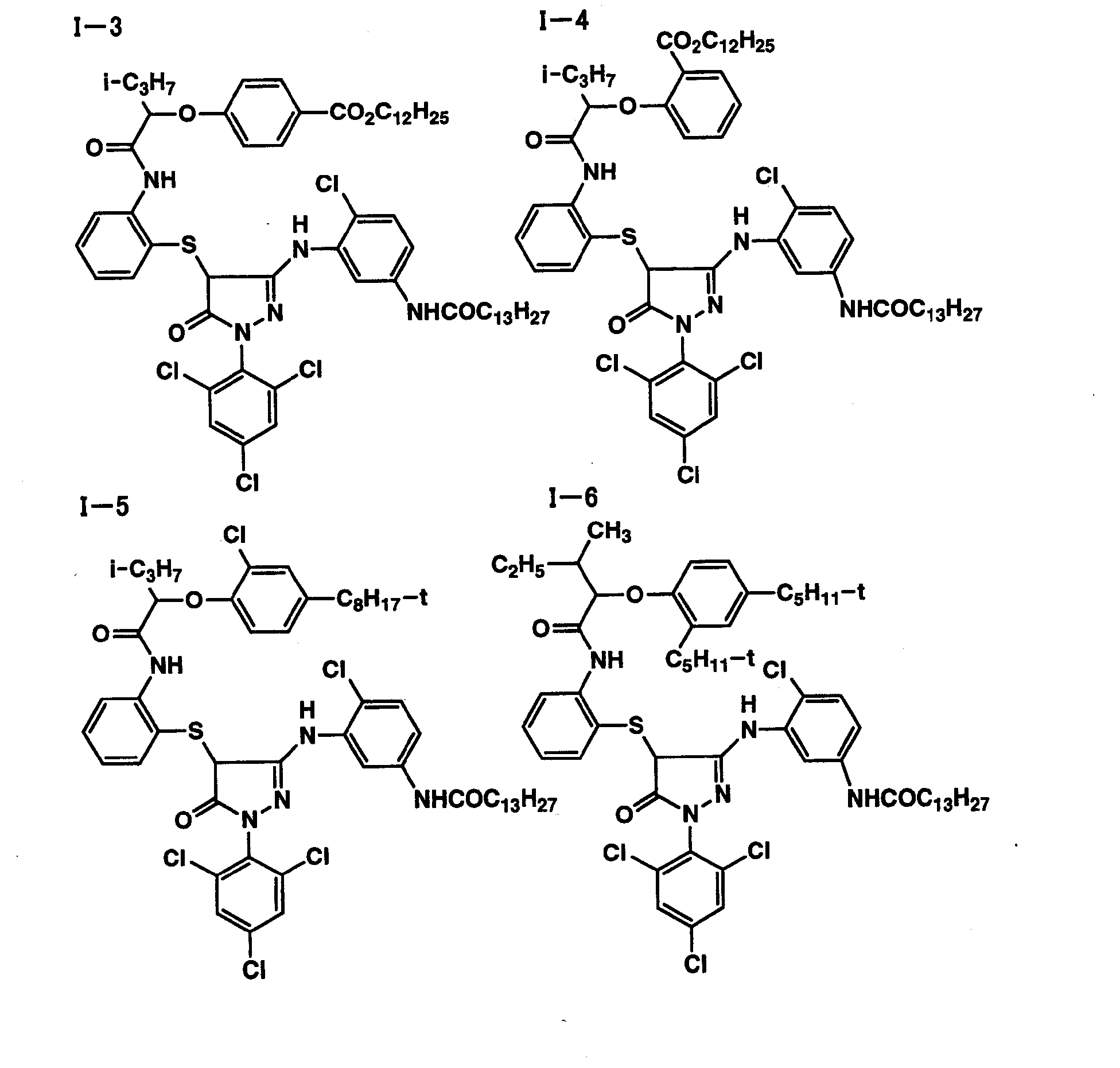
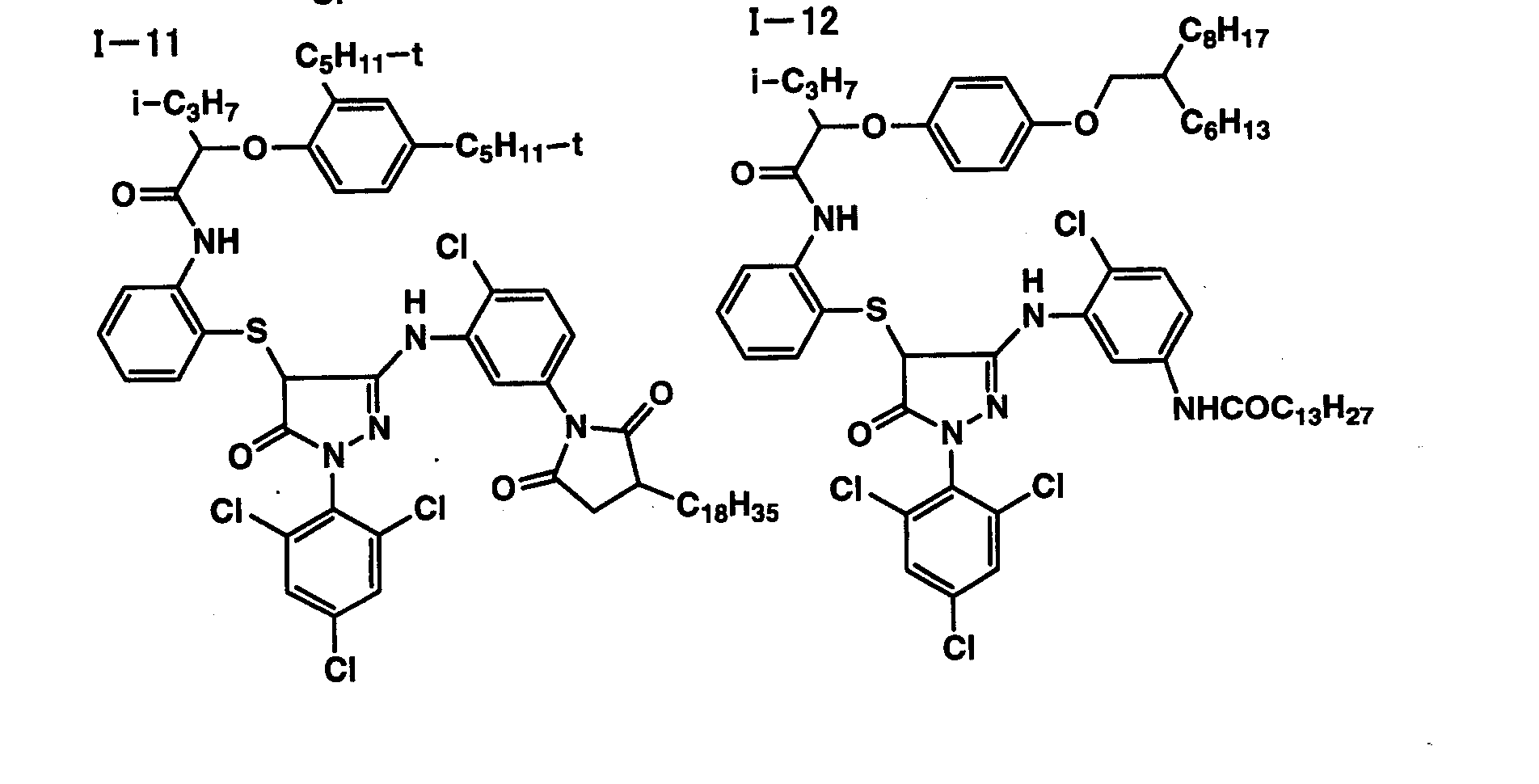
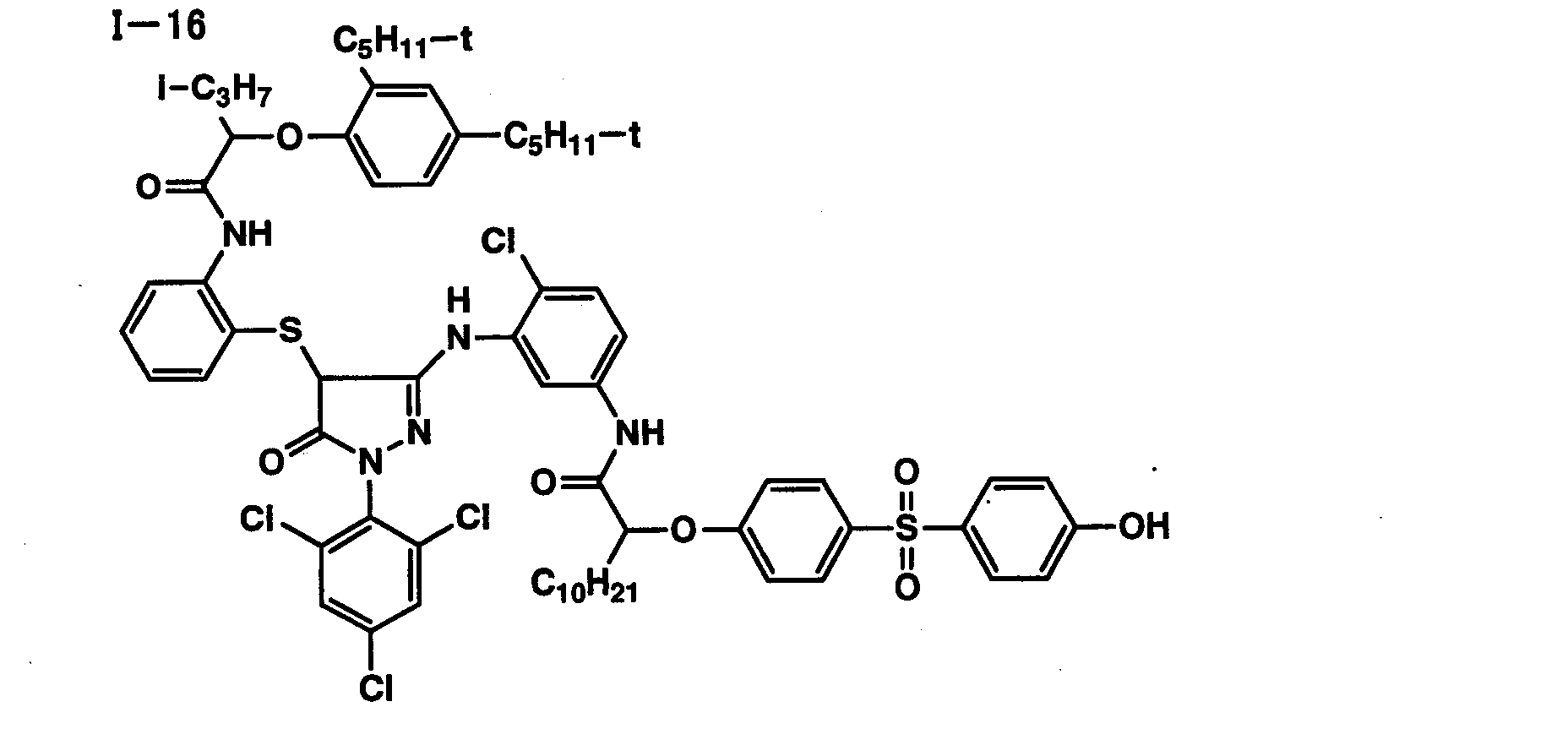
- Coupler represented by formula (I) are shown below but are not limited to these examples.
- R 21 and R 24 independently represent a secondary or tertiary alkyl group or a cycloalkyl group and exemplary examples thereof are the same as cited as R 11 of formula (I).
- R 22 and R 25 each represent an aryloxy group and exemplary examples thereof are the same as cited as R 12 of formula (I).
- R 23 and R 26 each represent a hydrogen atom, an alkyl group, a cycloalkyl group, an aryl group or a heterocyclic group, and exemplary examples thereof are the same as cited as R 13 of formula (I).
- R 27 and R 28 each represent a substituent and exemplary examples thereof are the same as cited as R 17 of formula (I).
- two -NHCO groups may be substituted on any position of each benzene ring and substitution at the ortho-position for the sulfur atom is preferred.
- the compounds represented by formula (III) are a so-called leachable decoloring DIR coupler, as described in JP-A Nos. 58-160954, 63-37350, 4-356042, 5-61160 (hereinafter, the term, JP-A means an unexamined published Japanese Patent Application); and U.S. Patent No. 4,482,629.
- the coupler moiety represented by W may be any coupler moiety having the same property as described above, and is preferably a 1-naphthol substituted at the 2-position by an unsubstituted carbamoyl group or an alkylcarbamoyl group substituted with a water-solubilizing group (e.g., carboxy, sulfo, hydroxy, methoxycarbonyl, ethoxycarbonyl, etc.), in terms of higher reactivity and superior leachability.
- a water-solubilizing group e.g., carboxy, sulfo, hydroxy, methoxycarbonyl, ethoxycarbonyl, etc.
- the group represented by TIME is a so-called timing group and a linkage group used for the purpose of adjustment of the coupling reaction rate of the compound of formula (III) and an oxidation product of a color developing agent, and of the releasing rate of the inhibitor residue represented by DI.
- Representative timing groups are described in U.S. Patent Nos. 4,861,701, 4,248,962, 4,409,323, 4,482,629 and 4,857,447.
- the inhibitor residue represented by DI refers to a compound having a function of retarding the developing rate in the color developing process, that is, a group in which a hydrogen atom is removed from the inhibitor.
- exemplary inhibitors include mercaptotetrazoles, mercaptobenzothiazoles, mercaptobenzoxazoles, mercaptobenzimidazoles, mercpatooxadiazoles, mercaptothiadiazoles, benzoriazoles, and 1,2,3- or 1,2,4-triazoles.
- the DI is preferably a compound inhibiting development at the time of being released from the active position of the coupler upon color development reaction, which is decomposed to a compound substantially having no photographic effect, after being leached into a color developing solution.
- the compound releasing the DI exhibiting such properties is a so-called deactivation type DIR coupler.
- the deactivation type DIR coupler is systematically defined in JP-A 57-151944, and exemplary compounds are described in JP-A Nos. 58-205150, 60-218644, 60-221750, 60-233650, 61-11743, 2-48655, 3-18844, 3-228048, 4-211245, 4-308842; and U.S. Patent No. 4,782,012.
- Y represents a coupler moiety capable of forming a yellow dye upon reaction with an oxidation product of a color developing agent in the color development process.
- Representative yellow dye forming couplers are described in U.S. Patent Nor. 2,875,057, 2,407,210, 3,265,506, 2,298,433, 3,048,194, 3,447,928; and "Farbkuppler mecanic Literturiebersicht” (Affa Mitannonen, Vol. III page 112-126, 1961).
- Preferred Y is acyacetoamides such as pivaloylacetoanilides and benzoylacetoanilides.
- TIME represent a timing group capable of releasing the DI after being released from Y upon reaction with an oxidation product of a color developing agent, and examples thereof are the same as cited as TIME and DI of formula (III).
- the compound represented by formula (V) will be described below.
- the compound represented by formula (V) is a so-called masking coupler or colored coupler, which is yellow-colored.
- R 51 and R 52 represent a secondary or tertiary alkyl group (e.g., i0propyl, sec-butyl, t-butyl, t-amyl, etc.) or a cycloalkyl group (e.g., cyclopropyl, cyclopentyl, cyclohexyl, etc.).
- R 51 and R 52 is preferably a secondary or tertiary alky group having 6 or less carbon atoms or a cycloalkyl group, and i-propyl or sec-butyl are specifically preferred.
- R 53 represents a halogen atom (e.g., chlorine, fluorine, etc.) or an alkoxy group (e.g., methoxy, I-propoxy, etc.). R 53 is preferably a chlorine atom or methoxy group.
- R 54 represents a substituent. The substituent may be any group capable of being substituted on a benzene ring and examples thereof are the same as cited as substituent for R 12 of formula (I).
- R 54 is preferably an acylamino group, an oxycarbonyl group, a carbamoyl group, a sulfonyl group or a sulfamoyl group.
- R 55 also represents a substituent. The substituent may be any group capable of being substituted on a benzene ring and examples thereof are the same as cited as substituent for R 12 of formula (I).
- R 55 is preferably a halogen atom.
- the compounds represented by formula (V) can be synthesized with reference to the method described in JP-A 62-50830. Exemplary examples of the compound of formula (V) are shown below but are by no means limited to these examples.
- the magenta coupler represented by formula (I) is used preferably in an amount of 1x10 -3 to 8x10 -1 , and more preferably 1x10 -2 to 3x10 -1 mol/mol AgX.
- the magenta coupler of formula (I) may be used in combination with other kind of a magenta coupler.
- the compound represented by formula (II) is used preferably in an amount of 0.1 to 10% by weight, and more preferably 0.5 to 5% by weight, based on the magenta coupler of formula (I).
- the DIR coupler represented by formula (III) (I) is used preferably in an amount of 1x10 -5 to 5x10 -1 , and more preferably 1x10 -3 to 1x10 -1 mol/mol AgX.
- the DIR coupler of formula (III) may be used in combination with other kind of a DIR coupler.
- the DIR coupler represented by formula (IV) (I) is used preferably in an amount of 1x10 -5 to 5x10 -1 , and more preferably 1x10 -3 to 2x10 -1 mol/mol AgX.
- the DIR coupler of formula (IV) may be used in combination with other kind of a DIR coupler.
- the colored coupler represented by formula (V) is used preferably in an amount of 5 to 50% by weight, and more preferably 10 to 30% by weight, based on the magenta coupler of formula (I).
- the method for incorporating the compounds of formulas (I) through (V) is not specifically limited and any of methods known in conventional photographic materials are employable, including dispersion as fine oil particles through dissolution in a high boiling solvent, as described in U.S. Patent No. 2,320,027; dispersion through dissolution by introducing a ballast group and a water-solubilizing group, as described in U.S. Patent 2,186,849; integrating into a polymeric compound as its component, as described in U.S. Patent No. 2.397.864; a method of filling in a latex polymer and dispersing through mechanical crushing by the use of a colloid mill or the like.
- the color photographic material according to this invention comprises on a support a green-sensitive silver halide emulsion layer containing the compounds of formulas (I) through (V), as a basic constitution, and a multicolor photographic material is desirable.
- the color photographic material comprises a support provided thereon a green-sensitive silver halide emulsion layer containing the compounds of formulas (I) through (V), which is in combination a blue-sensitive silver halide emulsion layer containing a yellow coupler (such as benzoylacetoanilide compounds and pivaloylacetoanilide compounds) and a red-sensitive silver halide emulsion layer containing a cyan coupler (such as naphthol compounds, 2-ureido-5-acylaminophenol compounds).
- a yellow coupler such as benzoylacetoanilide compounds and pivaloylacetoanilide compounds
- a red-sensitive silver halide emulsion layer containing a cyan coupler such as naphthol compounds,
- a filter layer, a protective layer, an interlayer, a sublayer or a backing layer may be optionally provided.
- the silver halide emulsion layer having sensitivity within each of the wavelength region may be comprised of two or more layers.
- Silver halide emulsions used in this invention include not only silver chloride, silver bromide and silver iodide, but also mixed silver halide such as silver chlorobromide, silver iodobromide, silver iodochloride or silver iodochlorobromide. These silver halide emulsions can be prepared according to the conventional methods, and ammoniacal precipitation, neutral precipitation, acidic precipitaion, a halide conversion method, variable addition and uniform precipitation are applicable. The mean grain size is not specifically limited but is preferably 0.01 to 5 ⁇ m. Two or more silver halide emulsions which have been separately prepared may be blended.
- the silver halide emulsions used in this invention can be chemically sensitized by the commonly known methods, including a gold sensitization with a gold complex, reduction sensitization with a reducing compound, sulfur sensitization using a compound containing a reactive sulfur with a silver ion or active gelatin, and sensitization with noble metal salts of the VIII group of the periodical table.
- the silver halide emulsions can be spectrally sensitized using cyanine dyes such as monomethine cyanines, pentamethine cyanines, merocyanines and carbocyanines, alone or in combination thereof, or in combination with styryl dyes or aminostilbene compounds.
- stablilizer also denoted as RD vol. 176, No. 17643 (1978)can be employed as the foregoing additives.
- Supports used in the color photographic material of this invention are optionally selected according to its purpose.
- the supports include cellulose acetate film, polyethylene terephthalate (PET) film, polystyrene (PS) film, polycarbonate (PC) film, or their lamination materials; paper, baryta paper, ⁇ -olefin polymer-laminated paper, synthetic paper, glass and metals.
- gelatin is advantageously employed as binder or protective colloid; and other hydrophilic colloids including gelatin derivatives, graft polymers of gelatin with other polymers, cellulose derivatives such as hydroxyethyl cellulose, carboxymethyl cellulose and cellulose sulfuric acid ester, and hydrophilic synthetic polymer compounds such as polyvinyl alcohol, partial acetals of polyvinyl alcohol, poly-N-vinylpyrrolidone, polyacrylic acid, polymethacrylic acid, polyacrylamide and their copolymers may be used in combination with gelatin.
- the color photographic materials, after exposure, are subjected to conventional color development.
- the basic process of the negative-positive method comprises color development, bleach and fixing.
- the basic process of the reversal method comprises the first development, followed by exposure to white light or treatment in a foggant-containing bath, and the steps of color development, bleach and fixing. Each of these steps may be independently carried out. Alternatively, two or more steps may be conducted at one time using a processing solution having such functions.
- Example thereof include color processing with a monobath containing a color developing agent, a ferric salt bleaching component and a thiosulfate fixing component (as described in JP-B No. 35-1885); and a monobath bleach-fixing method containing a bleaching component of a ethylenediaminetetraacetate iron (III) complex and a thiosulfate fixing component.
- Photographic processing usable in this invention is not specifically limited and any of photographic processing methods is applicable. Representative examples thereof are as follows:
- the processing may be conducted at a high temperature of 30° C or more, at room temperature or at a low temperature of 20° C or less, but in general, carried out at a temperature of 20 to 70° C.
- the temperature of these steps may be the same or different.
- a triacetyl cellulose film support On a triacetyl cellulose film support were formed the following layers containing composition as shown below to prepare a multi-layered color photographic material Sample 101.
- the addition amount of each compound was represented in term of g/m 2 , provided that the amount of silver halide or colloidal silver was converted to the silver amount and the amount of a sensitizing dye was represented in mol/Ag mol.
- the thus prepared emulsions d and f were added with sensitizing dyes afore-described and ripened, and then chemically sensitized by adding triphenylphosphine selenide, sodium thiosulfate, chloroauric acid and potassium thiocyanate until relationship between sensitivity and fog reached an optimum point.
- Silver iodobromide emulsions a, b, c, g, h, and i were each spectrally and chemically sensitized in a manner similar to silver iodobromide emulsions d and f.
- coating aids SU-1, SU-2 and SU-3 In addition to the above composition were added coating aids SU-1, SU-2 and SU-3; a dispersing aid SU-4; viscosity-adjusting agent V-1; stabilizers ST-1 and ST-2; fog restrainer AF-1 and AF-2 comprising two kinds polyvinyl pyrrolidone of weight-averaged molecular weights of 10,000 and 1.100,000; inhibitors AF-3, AF-4 and AF-5; hardener H-1 and H-2; and antiseptic Ase-1.
- Samples 102 through 123 were prepared in the same manner as Sample 101, except that in the 7th layer (intermediate speed green-sensitive layer), magenta coupler (M-1) was replaced by an equimolar amount of a comparative coupler or an inventive coupler, DIR coupler (DI-2) was replaced by an equimolar amount of a comparative DIR coupler or the DIR coupler of formula (III) or (IV), colored coupler (CM-2) was replaced by an equimolar amount of a comparative colored coupler or the colored coupler of formula (V), or the magenta coupler of formula (II) of 2% by weight was added.
- M-1 magenta coupler
- DIR coupler (DI-2) was replaced by an equimolar amount of a comparative DIR coupler or the DIR coupler of formula (III) or (IV)
- colored coupler (CM-2) was replaced by an equimolar amount of a comparative colored coupler or the colored coupler of formula (
- Sensitivity is represented by a relative value of the reciprocal of exposure giving a density of a minimum density (or fog density) plus 0.7, based on the sensitivity of Sample 101 being 100.
- samples each were processed according to the process described below.
- the thus obtained samples were kept for 3 days under an atmosphere of 50° C and 80% RH and density variation was determined with respect to a magenta density of 1.0 before storage.
- "+” refers to sensitization and "-" refers to desensitization.
- a color developer, bleach, fixer and stabilizer each were prepared according to the following formulas.
- Stabilizer and replenisher thereof Water 900 ml p-Octylphenol/ethyleneoxide (10 mol) adduct 2.0 g Dimethylolurea 0.5 g Hexamethylenetetramine 0.2 g 1,2-benzoisothiazoline-3-one 0.1 g Siloxane (L-77, product by UCC) 0.1 g Ammoniacal water 0.5 ml
Landscapes
- Physics & Mathematics (AREA)
- General Physics & Mathematics (AREA)
- Chemical & Material Sciences (AREA)
- Organic Chemistry (AREA)
- Spectroscopy & Molecular Physics (AREA)
- Silver Salt Photography Or Processing Solution Therefor (AREA)
Abstract
Description
- The present invention relates to silver halide color photographic light sensitive materials and in particular to silver halide color photographic materials exhibiting enhanced sensitivity, superior color forming properties and improved storage stability.
- In conventional silver halide color photographic materials (hereinafter, also denoted as color photographic materials or simply as photographic materials), a subtractive color system is employed and color images are formed by the combination of three dyes derived from yellow, magenta and cyan couplers.
- As magenta couplers used in conventional color photographic materials are known 5-pyrazolone, pylazolinobenzoimidazole or indanone type couplers, and of these, 5-pyrazolone derivatives are broadly employed.
- Substituents at the 3-position of the 5-pyrazolone ring of the 5-pyrazolone derivatives include, for example, an alkyl group, an aryl group, an alkoxy group described in U.S. Patent Nos. 2,369,489 and 2,600,788, an acylamino group, and a ureido group described in U.S. Patent No. 3,558,319. However, such couplers had the disadvantages that coupling activity with an oxidation product of a developing agent was so low that sufficiently high magenta dye image density could be obtained, the magenta dye images obtained through color development resulted in a relatively high secondary absorption in the blue light region and the longer wavelength-side absorption near edge of the main absorption was not sharp.
- Further, 3-anilino-5-pyrazolone couplers described in U.S. Patent Nos. 2,311,081, 3,677,764 and 3,684,514; British patent Nos. 956,261 and 1,173,513, exhibited a relatively high coupling activity, giving a high color density and having advantages such as unwanted absorption in the red light region being relatively low. However, commonly known 3-anilino-5-pyrazolone type couplers have disadvantages that solubility in organic solvents is relatively low and when a color photographic material containing this coupler is aged, precipitation of the coupler tends to easily occur in the photographic material. Furthermore, color photographic materials containing commonly known 3-anilino-5-pyrazolone couplers exhibited a disadvantage that the magenta dye image density, after being processed, varied after being aged.
- In commercially available color photographic materials, as is well known, a coupler is not used alone but is used in combination with various functional couplers to improve image quality and color reproducibility. As such functional couplers, so-called DIR couplers and masking couplers (or colored couplers) are generally employed. However, in cases when the 3-anilino-5-pyrazolone coupler is used in combination with a functional coupler, it was shown that the foregoing disadvantages tended to increase.
- Accordingly, it is an object of the present invention to provide a silver halide color photographic light sensitive material exhibiting enhanced sensitivity, superior color forming property and improved storage stability.
- The above object of the invention can be accomplished by the following constitution:
- (1) A silver halide color photographic light sensitive
material comprising a support having thereon blue-sensitive,
green-sensitive and red-sensitive silver halide emulsion
layers, wherein at least one of the silver halide emulsion
layers contains a coupler represented by the following
formula (I):
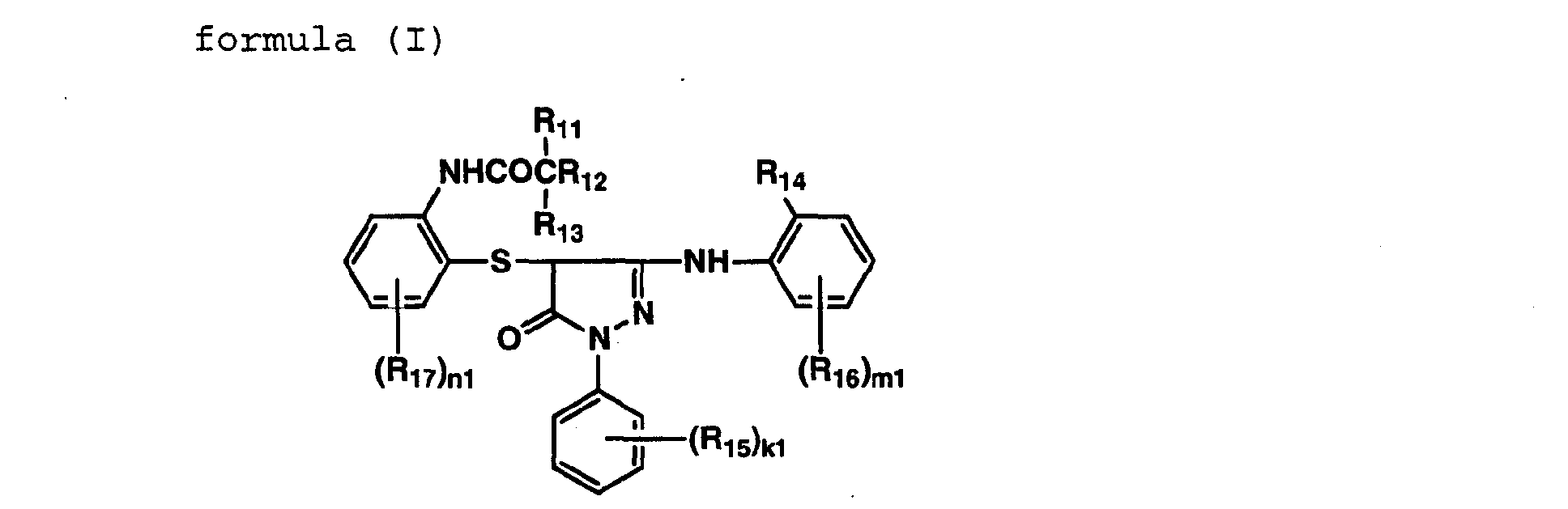
wherein R11 represents a secondary or tertiary alkyl group, or a cycloalkyl group; R12 represents an aryloxy group; R13 represents a hydrogen atom, an alkyl group, a cycloalkyl group, an aryl group or a heterocyclic group; R14 represents a halogen atom or an alkoxy group; R15, R16 and R17 independently represent a substituent; k1 is an integer of 0 to 5; m1 and n1 are each an integer of 0 to 4;
- (2) The silver halide color photographic material described
in (1) above, wherein the silver halide emulsion layer
containing the coupler represented by formula (I) or another
silver halide emulsion layer having the same color-sensitivity
as the silver halide emulsion layer containing
the coupler represented by formula (I) contains a compound
represented by the following formula (II):
wherein R21 and R24 represent a secondary or tertiary alkyl group, or a cycloalkyl group; R22 and R25 represent an aryloxy group; R23 and R26 represent a hydrogen atom, an alkyl group, a cycloalkyl group, an aryl group or a heterocyclic group; R27 and R28 independently represent a substituent; m2 and n2 are each an integer of 0 to 4;

- (3) The silver halide color photographic material described
in (1) or (2) above, wherein the silver halide emulsion layer
containing the coupler represented by formula (I) or another
silver halide emulsion layer having the same color-sensitivity
as the silver halide emulsion layer containing
the coupler represented by formula (I) contains a compound
represented by the following formula (III):
wherein W represents a coupler moiety capable of forming a dye capable of being leached out of the photographic material upon reaction with an oxidation product of a color developing agent; TIME represents a timing group capable of releasing an inhibitor residue DI after being released from W upon reaction with an oxidation product of a color developing agent; and n3 is an integer of 0, 1 and 2;

- (4) The silver halide color photographic material described
in (1) or (2) above, wherein the silver halide emulsion layer
containing the coupler represented by formula (I) or another
silver halide emulsion layer having the same color-sensitivity
as the silver halide emulsion layer containing
the coupler represented by formula (I) contains a compound
represented by the following formula (IV):
wherein Y represents an yellow coupler moiety capable of forming an yellow dye upon reaction with an oxidation product of a color developing agent; TIME represents a timing group capable of releasing an inhibitor residue DI after being released from Y upon reaction with an oxidation product of a color developing agent; and n4 is an integer of 0, 1 and 2;

- (5) The silver halide color photographic material described
in any one of (1) through (4) above, wherein the silver
halide emulsion layer containing the coupler represented by
formula (I) or another silver halide emulsion layer having
the same color-sensitivity as the silver halide emulsion
layer containing the coupler represented by formula (I)
contains a compound represented by the following formula (V):
wherein R51 and R52 independently represent a secondary or tertiary alkyl group or a cycloalkyl group; R53 represents a halogen atom or an alkoxy group; R54 and R55 independently represent a substituent; k5 is an integer of 0 to 5; and m5 is an integer of 0 to 4.

-
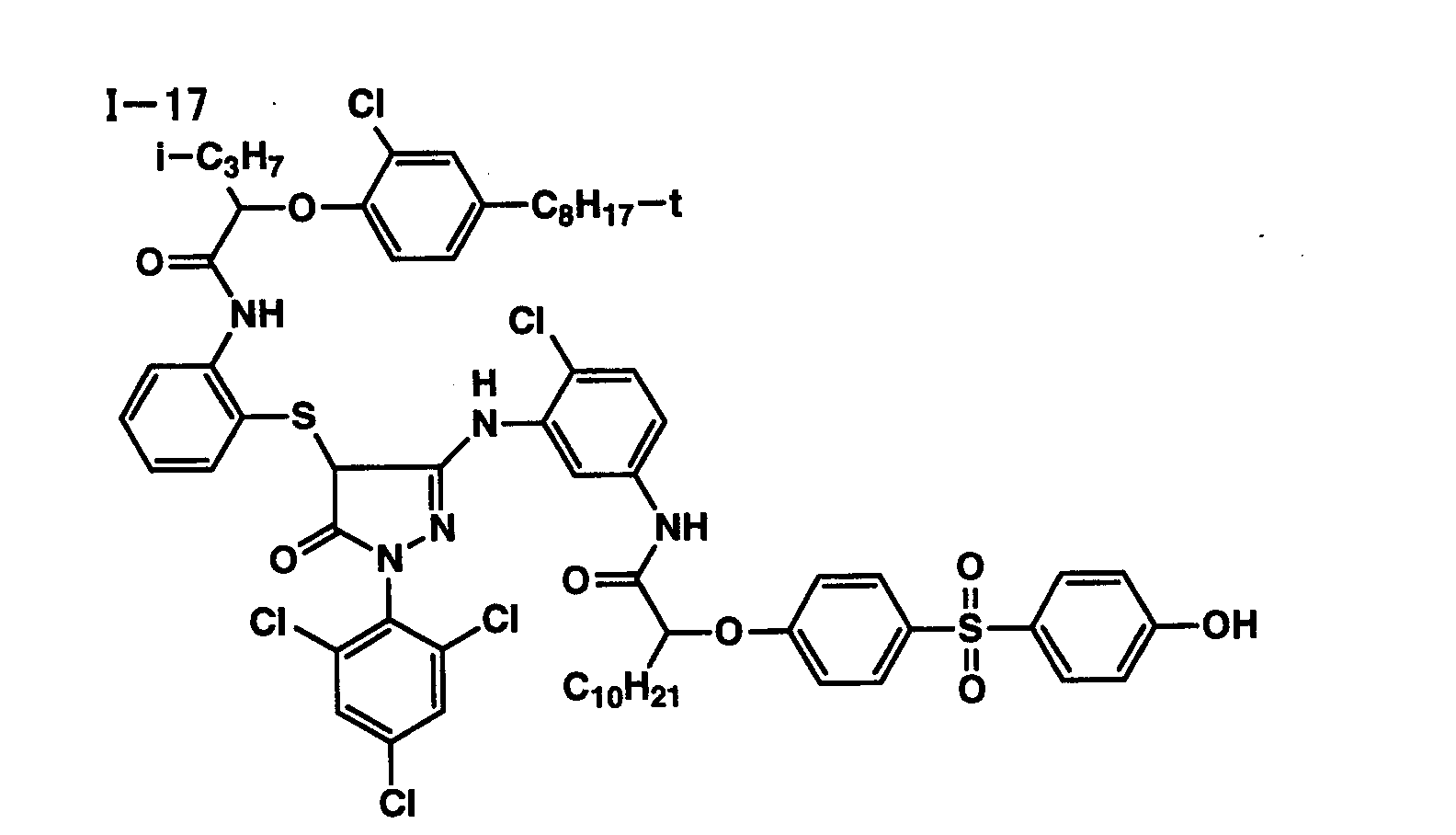
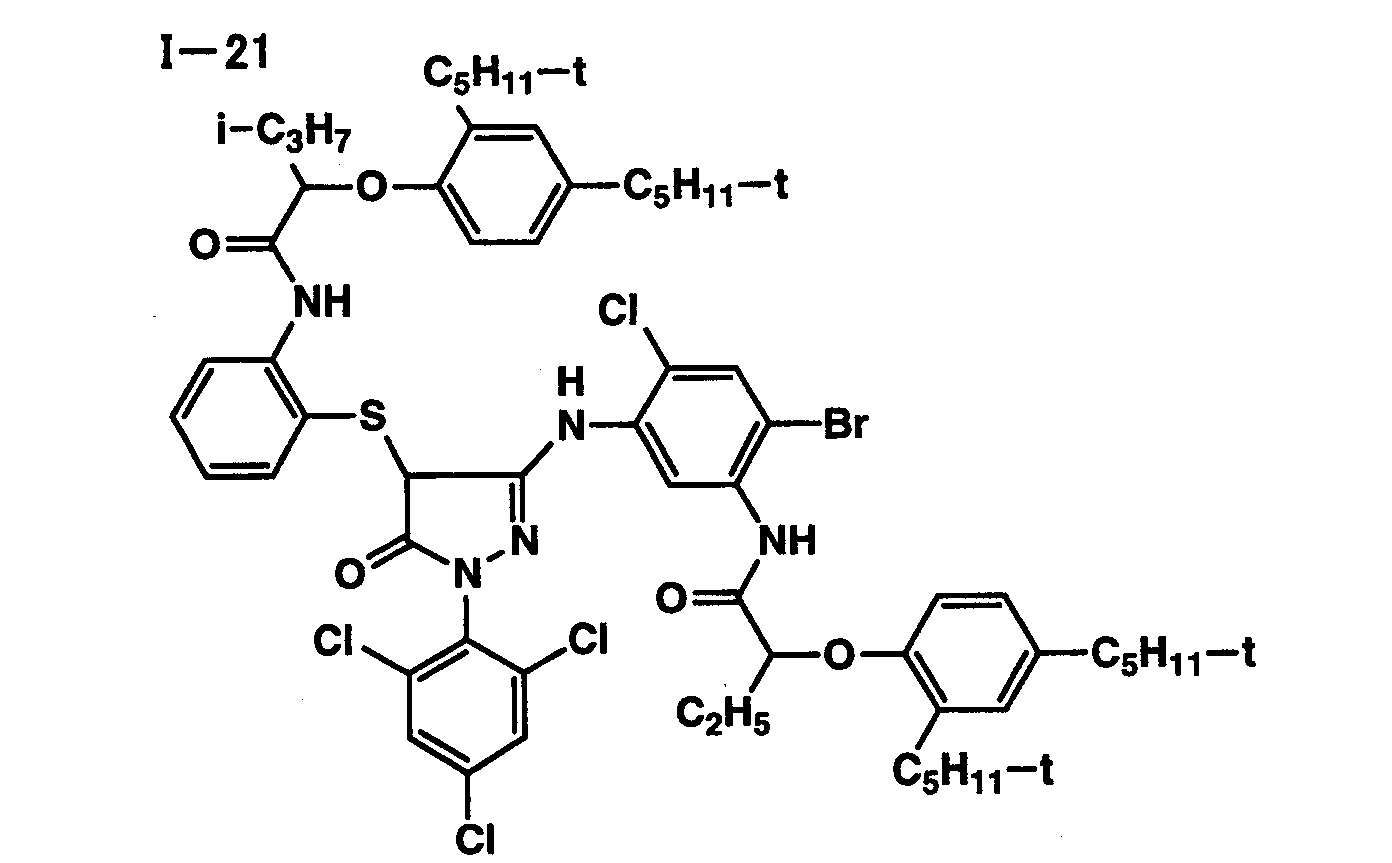
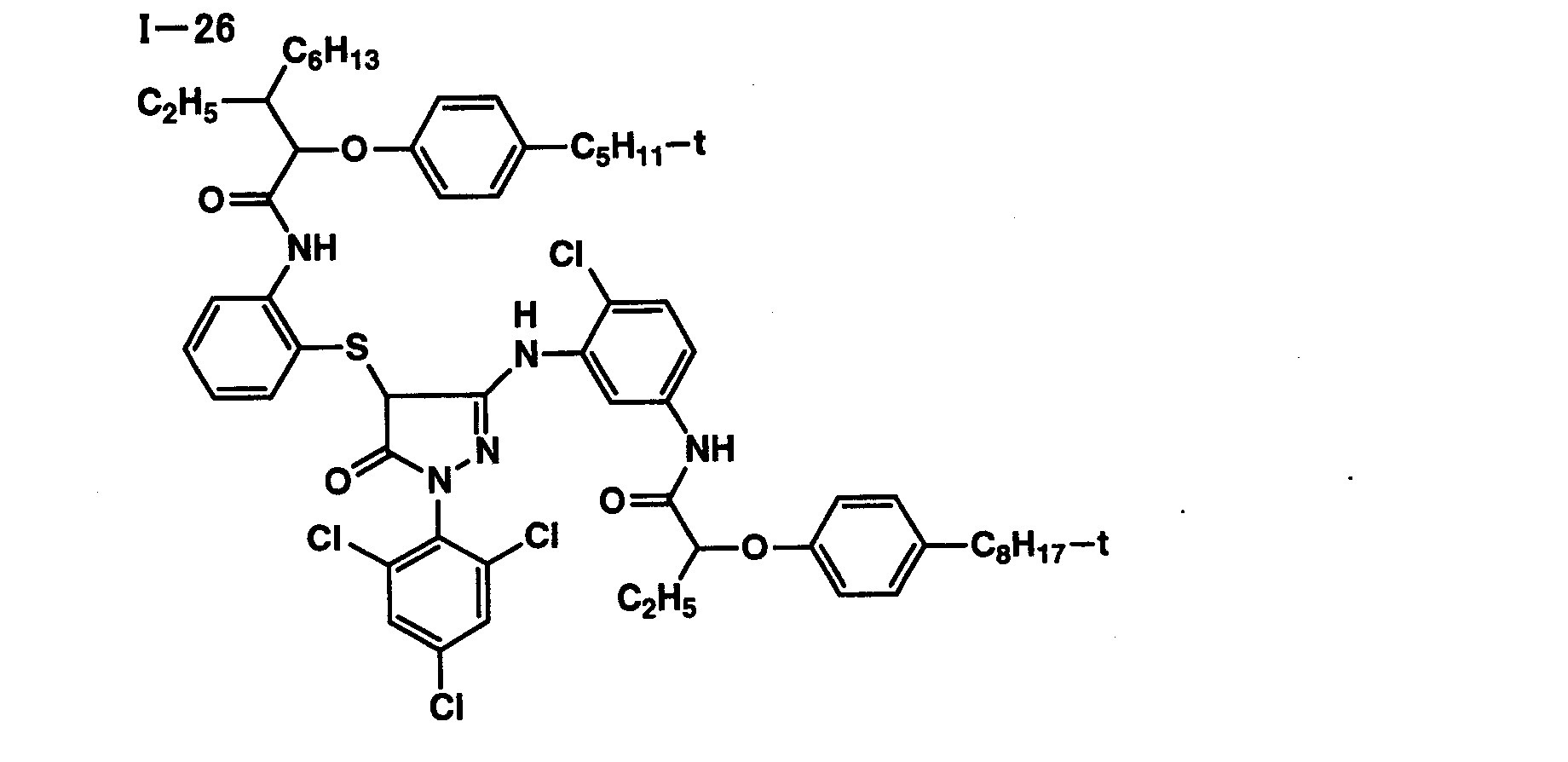
- The coupler (magenta coupler) represented by formula (I) will be described in detail.
- In formula (I), R11 represents a secondary or tertiary alkyl group (e.g., i-propyl, sec-butyl, t-butyl, t-amyl, etc.) or a cycloalkyl group (e.g., cyclopropyl, cyclopentyl, cyclohexyl, etc.). The group represented by R11 may be substituted but unsubstituted one is preferred. The group represented by formula R11 preferably has 3 to 12 carbon atoms, and more preferably 3 to 6 carbon atoms. Specifically preferred R11 is a secondary alkyl group and is0-propyl group is still more preferred. R12 represents an aryloxy group (e.g., phenoxy, naphthyloxy, etc.). The aryloxy group may be substituted by substituents and examples of the substituents include the following:
an alkyl group (e.g., t-amyl, t-octyl, dodcyl, etc), an cycloalkyl group (e.g., cyclopropyl, cyclhexyl, etc), an aryl (e.g., phenyl, naphthyl, etc), a heterocyclic group (e.g., 2-tetrahydrofuryl, 2-thiophenyl, 4-imidazolyl, indoline-1-yl, 2-pyridyl, etc), a carbonyl group (e.g., alkylcarbonyl such as acetyl, trifluoroacetyl and pivaloyl, and arylcarbonyl such as benzoyl, pentafluorobenzoyl and 3,5-di-t-butyl-4-hydroxybenzoyl), an oxycarbonyl group (e.g., alkoxycarbonyl such as methoxycarbonyl, cyclohexyloxycarbonyl and dedecyloxycarbonyl, aryloxycarbonyl such as phenoxycarbonyl, 2,4-di-t-amylphenoxycarbonyland 1-naphthyloxycarbonyl, and heterocyclic-oxycarbonyl such as 2-pyridyloxycarbonyl and 1-phenylpyrazolyl-5-oxycarbonyl), a carbamoyl group (e.g., alkylcarbamoyl such as dimethylcarbamoyl and 4-(2,4-di-t-amylphenoxy)butylcarbonyl, and arylcarbamoyl such as 1-naphthylcarbamoyl), a sulfonyl group (e.g., alkylsulfonyl such as methanesulfonyl and trifluoromethanesulfonyl, and arylsulfonyl such as p-toluenesulfonyl), a sulfamoyl (e.g., alkylsulfamoyl such as dimethylsulfamoyl and 4-(2,4-di-t-amylphenoxy)butylaminosulfonyl, and arylsulfamoyl such as phenylsulfamoyl), a halogen atom, cyano group, nitro group, an alkenyl group (e.g., 2-propylene, oleyl, etc), hydroxy group, an alkoxy group (e.g., methoxy, 2-ethoxyethoxy, etc)an aryloxy group (e.g., phenoxy, 2,4-di-t-amylphenoxy, 4-(4-hydroxyphenylsulfonyl)phenoxy, etc), a heterocyclic-oxy group (e.g., 4-pyridyloxy, 2-hexahydropiranyloxy, etc), a carbonyloxy group (e.g., alkylcarbonyloxy such as acetyloxy, trifluoroacetyloxy and pivaloyloxy, and aryoxy such as benzoyloxy and pentfluorobenzoyloxy)a urethane group (e.g., alkylurethane such as N,N-dimethylurethane and arylurethane such as N-phenylurethane, N-(p-cyanophenyl)urethane), a sulfonyloxy group (e.g., alkylsulfonyoxy such as methanesulfonyloxy, trifluoromethanesulfonyloxy and dodecanesulfonyloxy and arylsulfonyloxy such as benzenesulfonyloxy and p-toluenesulfonyloxy), an amino group (e.g., alkylamino such as dimethylamino, cyclohexylamino and dodecylamino, and arylamino such as anilino and p-t-octylanilino), a sulfonylamino group (e.g., alkylsulfonylamino such as methanesulfonylamino, heptafluoropropanesulfonylamino and hexadecysulfonylamino, and arylsulfonylamino such as p-toluenesulfonylamino and pentafluorobenzenesulfonylamino), a sulfamoylamino group (e.g., alkylsulfamoylamino such as N,N-dimethylsulfamoylamino and arylsulfamoylamino such as N-phenylsulfamoylamino), an acylamino group (e.g., alkylcarbonylamino such as acetylamino and myrystylamino and arylcarbonylamino such as benzoylamino), a ureido group (e.g., alkylureido such as N,N-dimethylureido, and arylureido such as N-phenylureido and N-(p-cyanophenyl)ureido), an alkylthio group (e.g., methylthio, t-octylthio, etc), an arylthio group (e.g., phenylthio, etc), and a heterocycli-thio group (e.g., 1-phenyltetrazole-5-thio, 5-methyl-1,3,4-oxazole-2-thio, etc). - Of the groups represented by R12 is preferred a phenoxy group having a substituent on the benzene ring, i.e., a substituted phenoxy. The substituent is preferably an alkyl group, a cycloalkyl group, an alkoxy group, a halogen atom and an alkoxycarbonyl group. The total carbon number of the substituent(s) on the benzene ring is preferably 4 to 20 and more preferably 8 to 12.
- R13 represents a hydrogen atom, a cycloalkyl group, an aryl group or a heterocyclic group, of which a hydrogen atom is preferred. R14 represents a halogen atom (e.g., chlorine, bromine, iodine, etc.) or a alkoxy group (e.g., methoxy, I-propoxy, etc.), of which R14 is preferably a chlorine atom or methoxy group. R15 represents a substituent. Any group capable of being substituted on a benzene ring may be included and exemplary examples thereof are the same as cited as the substituents for R12. R15 is prefrerably a halogen atom and a chlorine atom is specifically preferred. Specifically, three chlorine atoms being substituted at the 2, 4, 6-position is preferred.
- R16 also represents a substituent. Any group capable of being substituted on a benzene ring may be included and exemplary examples thereof are the same as cited as the substituents for R12. R16 is prefrerably an acylamino group, an oxycarbonyl group, carbamoyl group, sulfonyl group and sulfamoyl group. R17 also represents a substituent. Any group capable of being substituted on a benzene ring may be included and exemplary examples thereof are the same as cited as the substituents for R12. R15 is prefrerably a halogen atom.
- Representative examples of the coupler represented by formula (I) are shown below but are not limited to these examples.










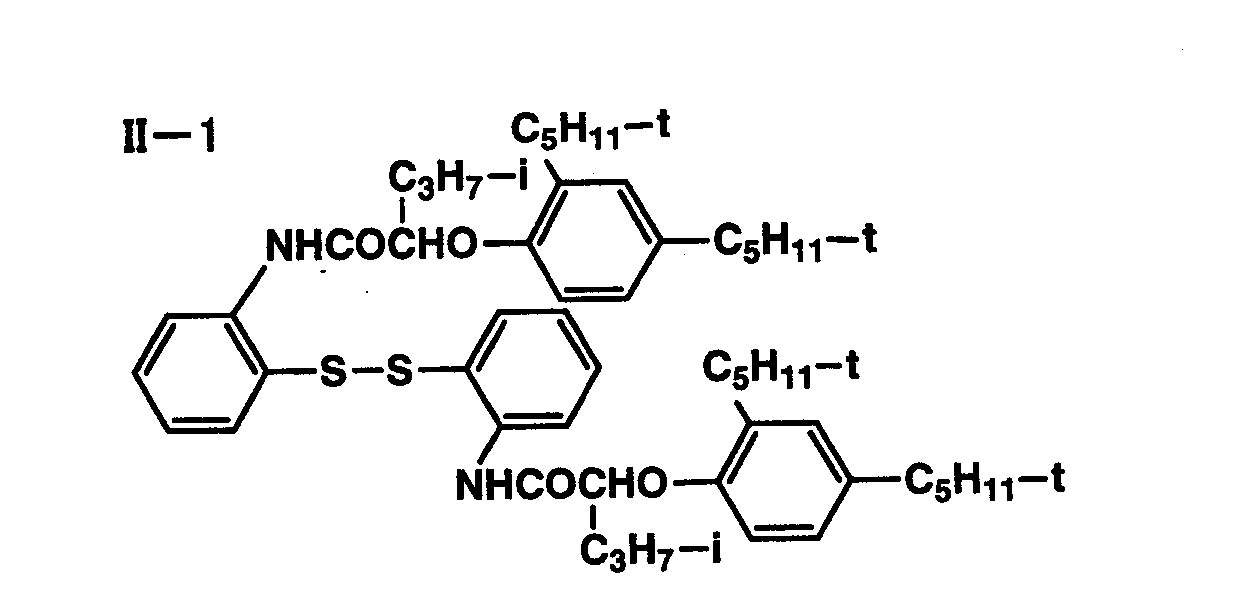
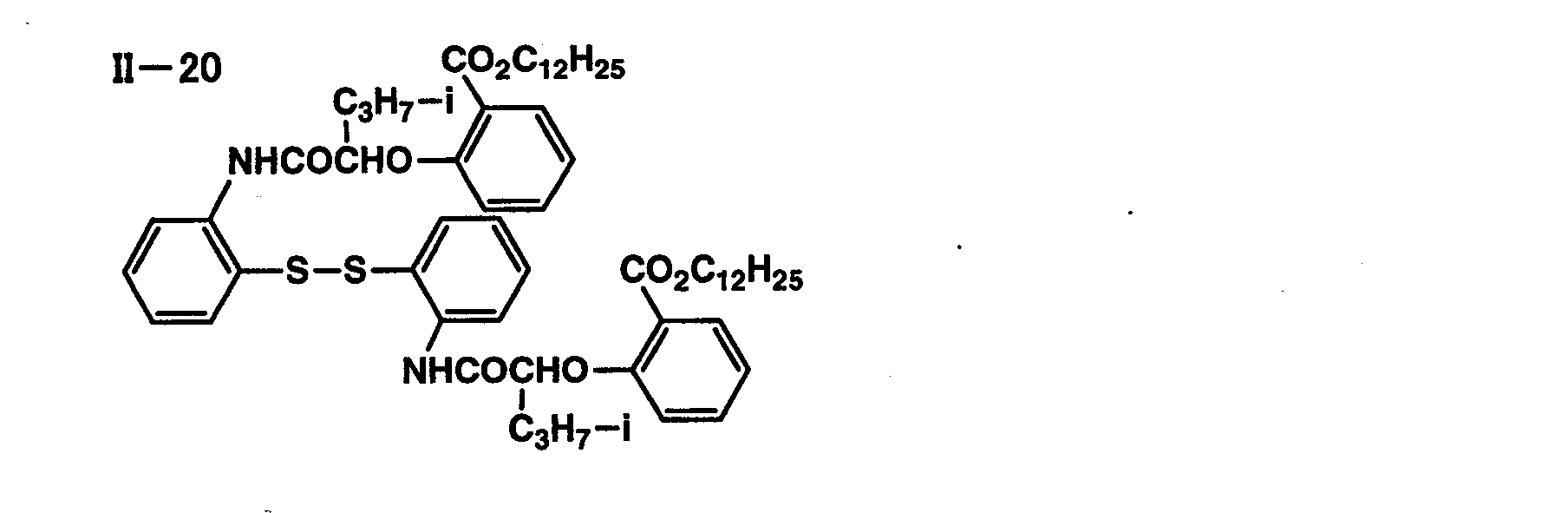
- The compound represented by formula (II) will be described. In formula (II), R21 and R24 independently represent a secondary or tertiary alkyl group or a cycloalkyl group and exemplary examples thereof are the same as cited as R11 of formula (I). R22 and R25 each represent an aryloxy group and exemplary examples thereof are the same as cited as R12 of formula (I). R23 and R26 each represent a hydrogen atom, an alkyl group, a cycloalkyl group, an aryl group or a heterocyclic group, and exemplary examples thereof are the same as cited as R13 of formula (I). R27 and R28 each represent a substituent and exemplary examples thereof are the same as cited as R17 of formula (I). In formula (II), two -NHCO groups may be substituted on any position of each benzene ring and substitution at the ortho-position for the sulfur atom is preferred.
- Representative examples of the compound represented by formula (II) are shown below, but are by no means limited to these examples.
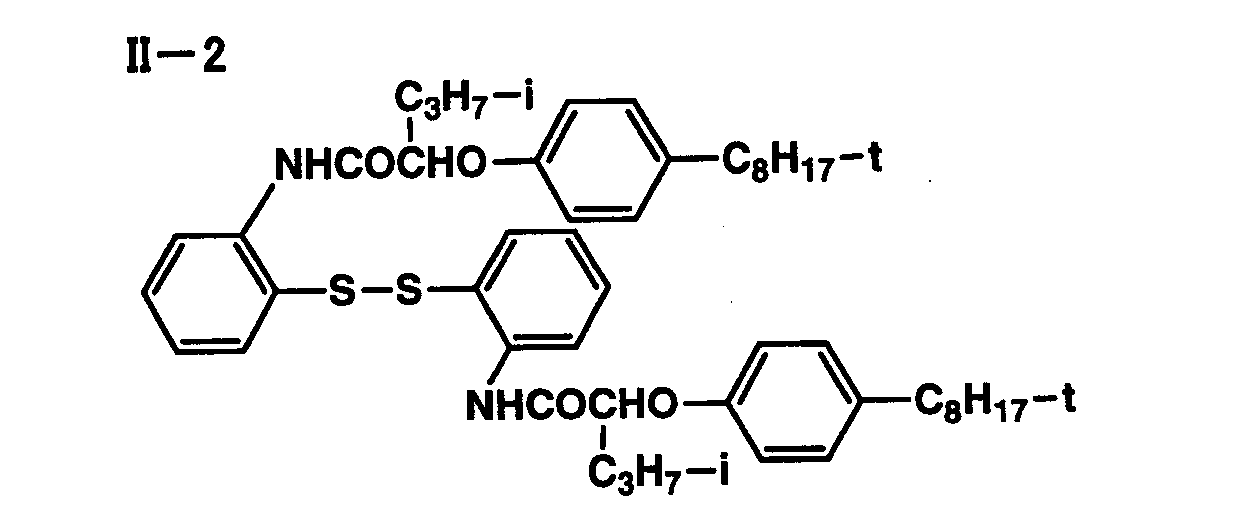
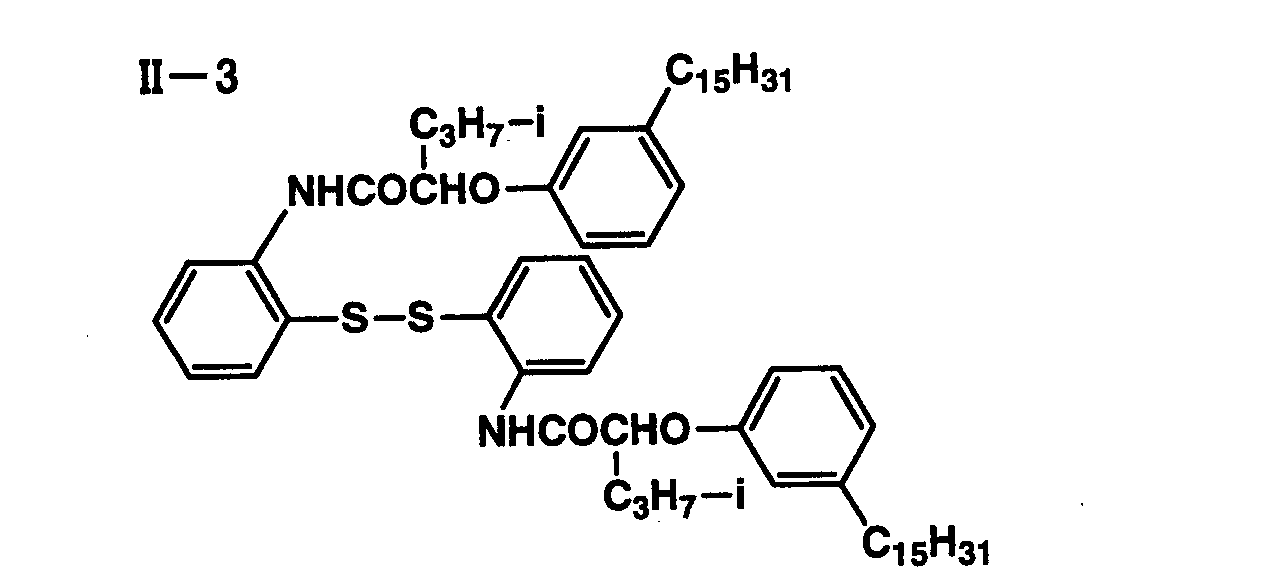
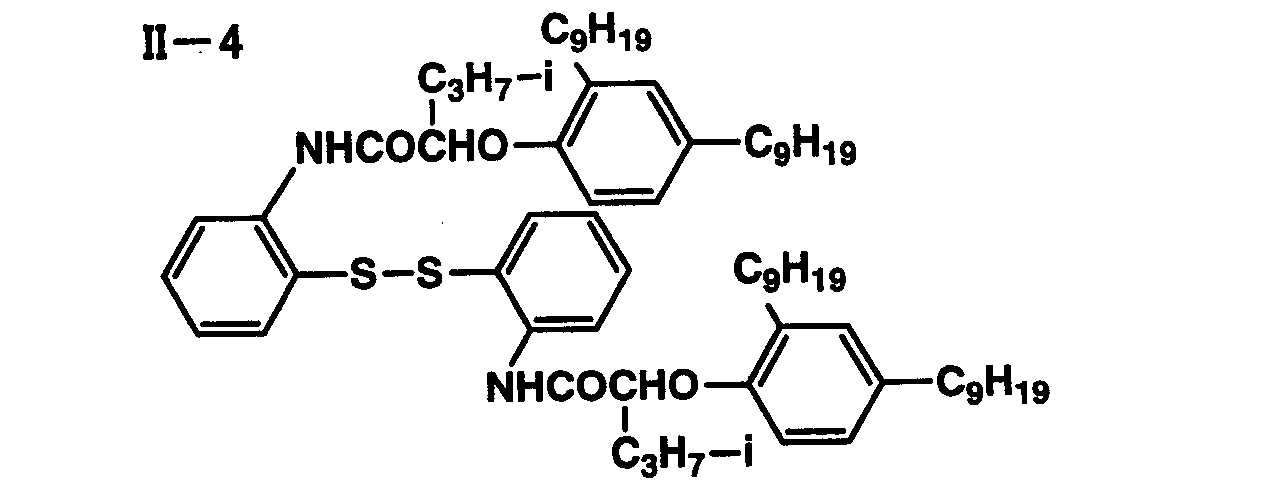


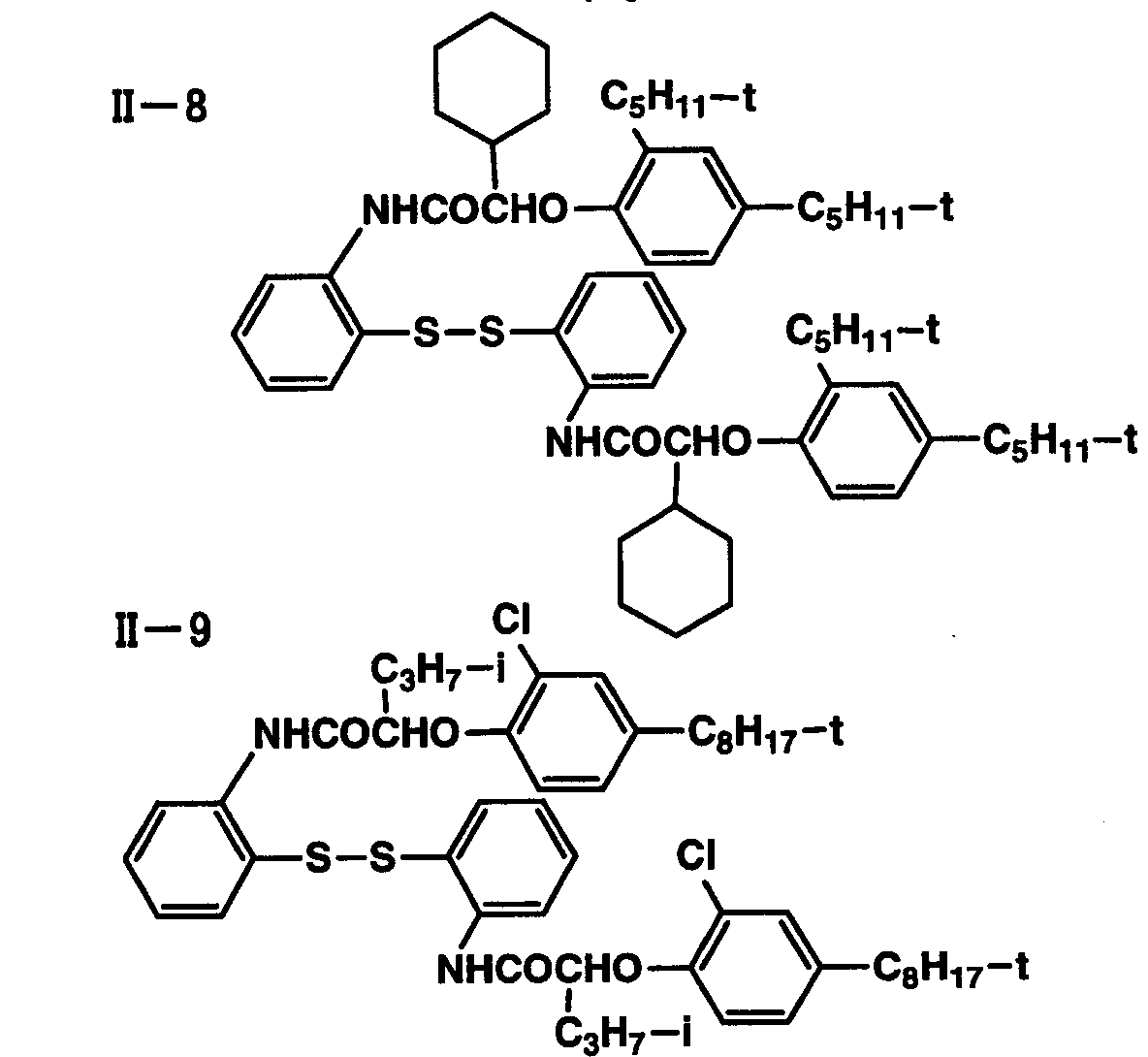
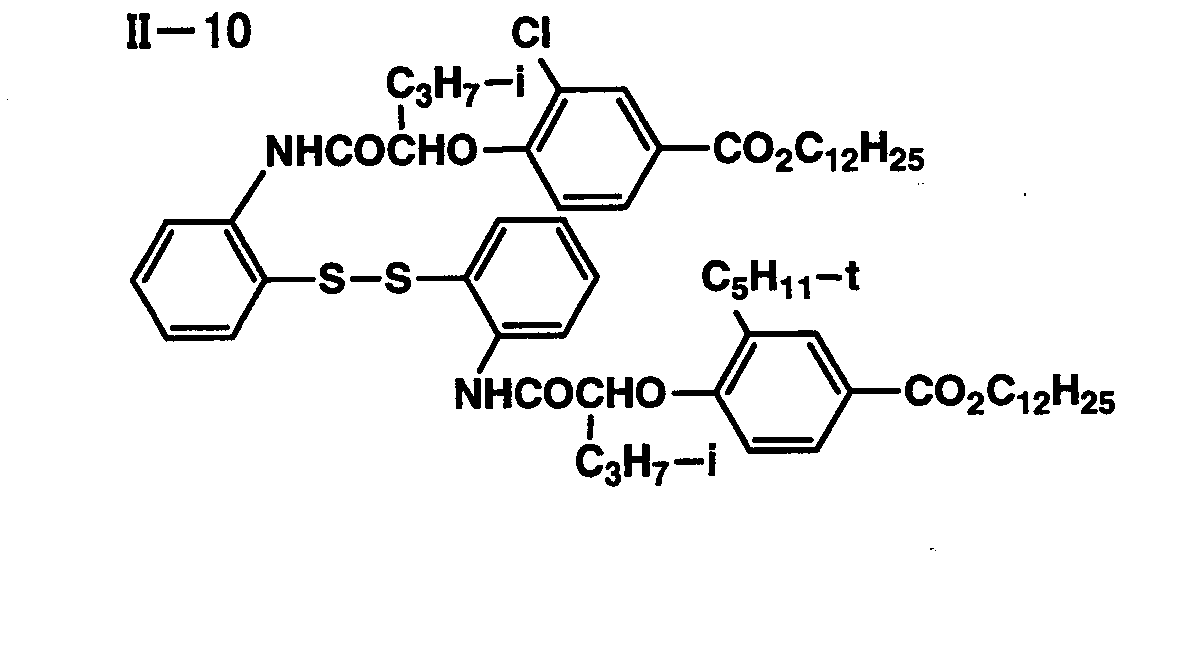

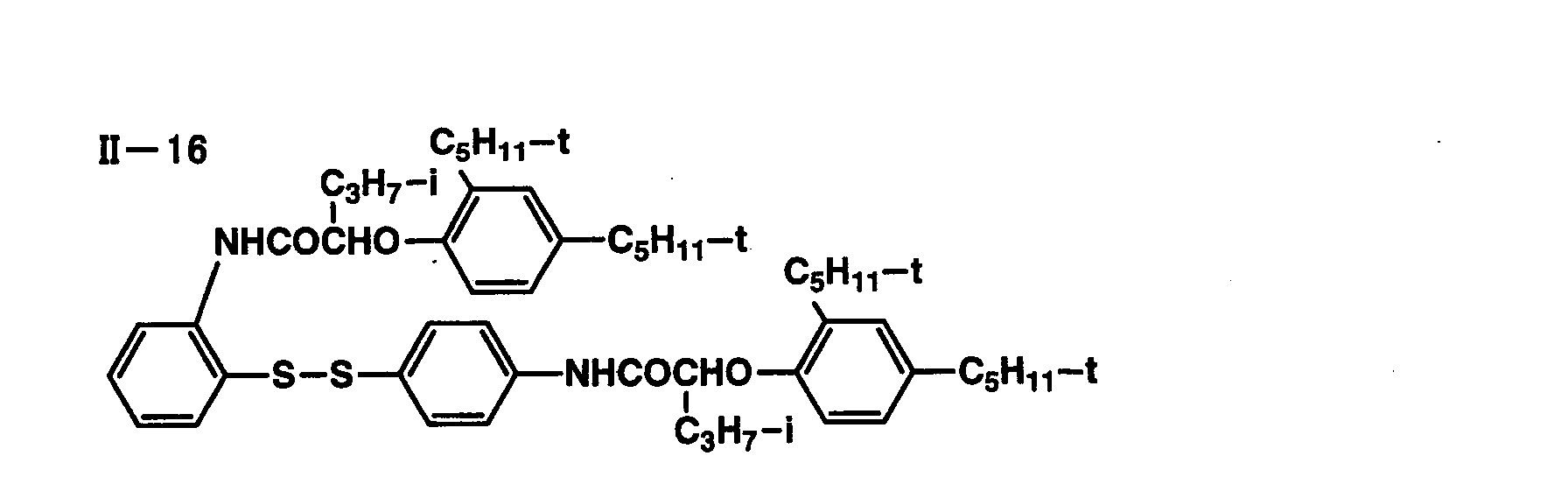
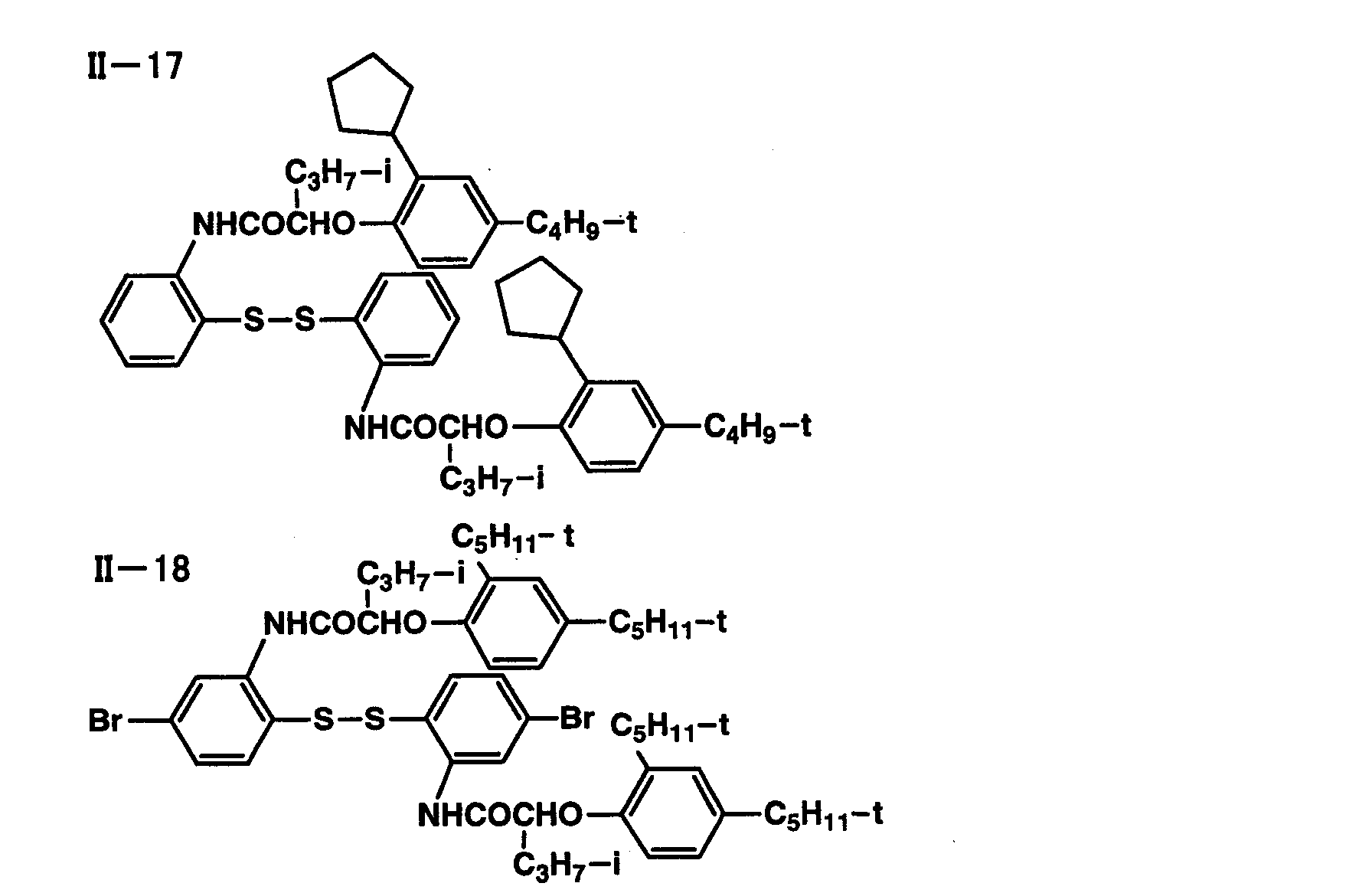
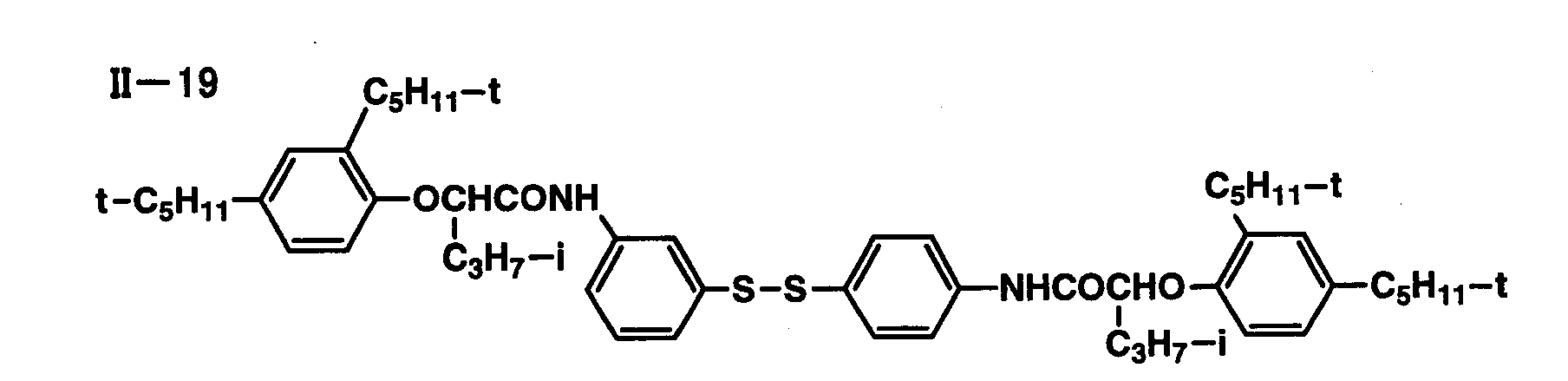
- Next, the compound represented by formula (III) will be described. The compounds represented by formula (III) are a so-called leachable decoloring DIR coupler, as described in JP-A Nos. 58-160954, 63-37350, 4-356042, 5-61160 (hereinafter, the term, JP-A means an unexamined published Japanese Patent Application); and U.S. Patent No. 4,482,629.
- In formula (III), the coupler moiety represented by W may be any coupler moiety having the same property as described above, and is preferably a 1-naphthol substituted at the 2-position by an unsubstituted carbamoyl group or an alkylcarbamoyl group substituted with a water-solubilizing group (e.g., carboxy, sulfo, hydroxy, methoxycarbonyl, ethoxycarbonyl, etc.), in terms of higher reactivity and superior leachability.
- The group represented by TIME is a so-called timing group and a linkage group used for the purpose of adjustment of the coupling reaction rate of the compound of formula (III) and an oxidation product of a color developing agent, and of the releasing rate of the inhibitor residue represented by DI. Representative timing groups are described in U.S. Patent Nos. 4,861,701, 4,248,962, 4,409,323, 4,482,629 and 4,857,447.
- The inhibitor residue represented by DI refers to a compound having a function of retarding the developing rate in the color developing process, that is, a group in which a hydrogen atom is removed from the inhibitor. Exemplary inhibitors include mercaptotetrazoles, mercaptobenzothiazoles, mercaptobenzoxazoles, mercaptobenzimidazoles, mercpatooxadiazoles, mercaptothiadiazoles, benzoriazoles, and 1,2,3- or 1,2,4-triazoles. From the viewpoint of reduction in contamination of processing solutions, the DI is preferably a compound inhibiting development at the time of being released from the active position of the coupler upon color development reaction, which is decomposed to a compound substantially having no photographic effect, after being leached into a color developing solution. The compound releasing the DI exhibiting such properties is a so-called deactivation type DIR coupler. The deactivation type DIR coupler is systematically defined in JP-A 57-151944, and exemplary compounds are described in JP-A Nos. 58-205150, 60-218644, 60-221750, 60-233650, 61-11743, 2-48655, 3-18844, 3-228048, 4-211245, 4-308842; and U.S. Patent No. 4,782,012.
- The compounds represented by formula (III) can be synthesized with reference to the methods described in the above-cited patents.. Exemplary examples of the compound of formula (III) are shown below, but are by no means limited to these examples.


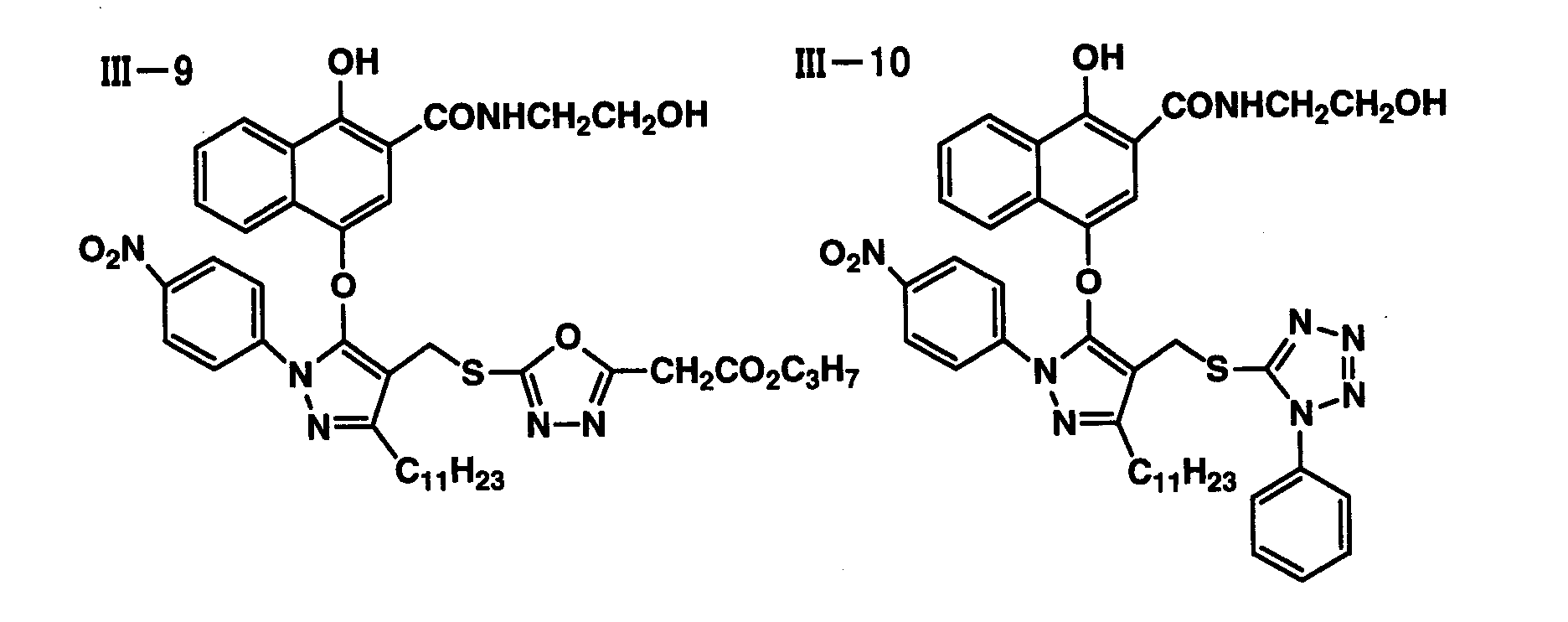

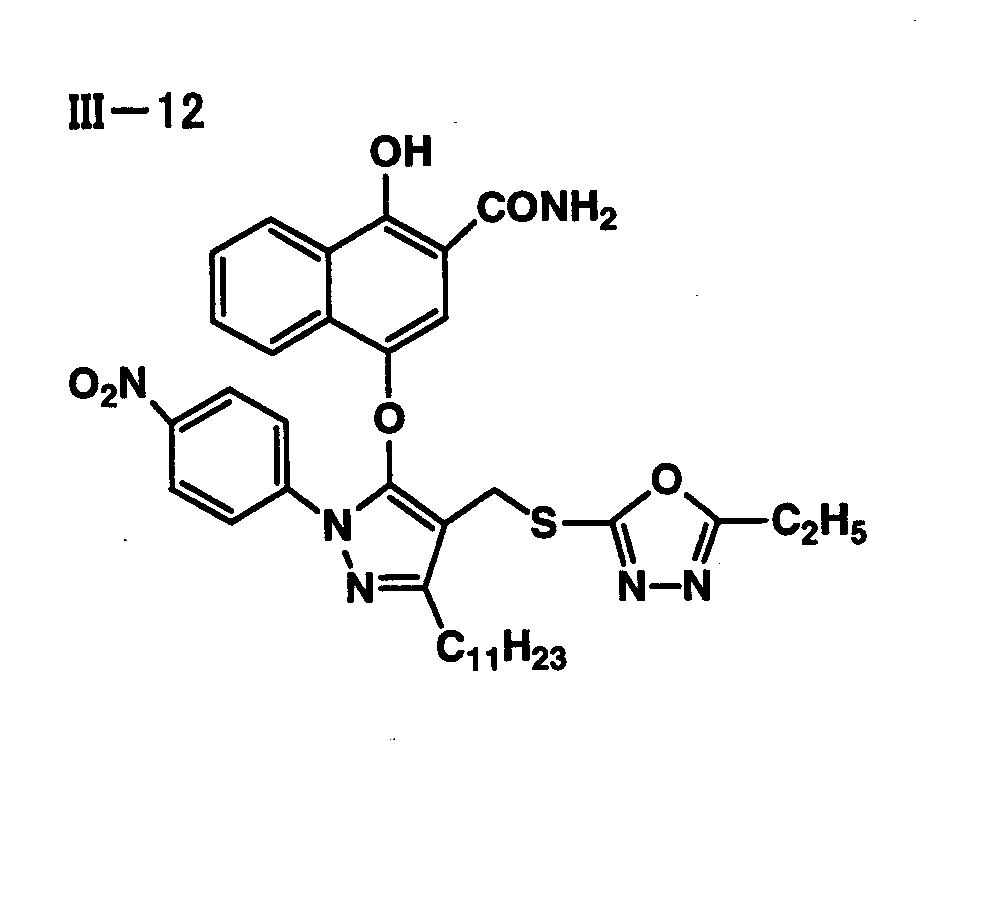


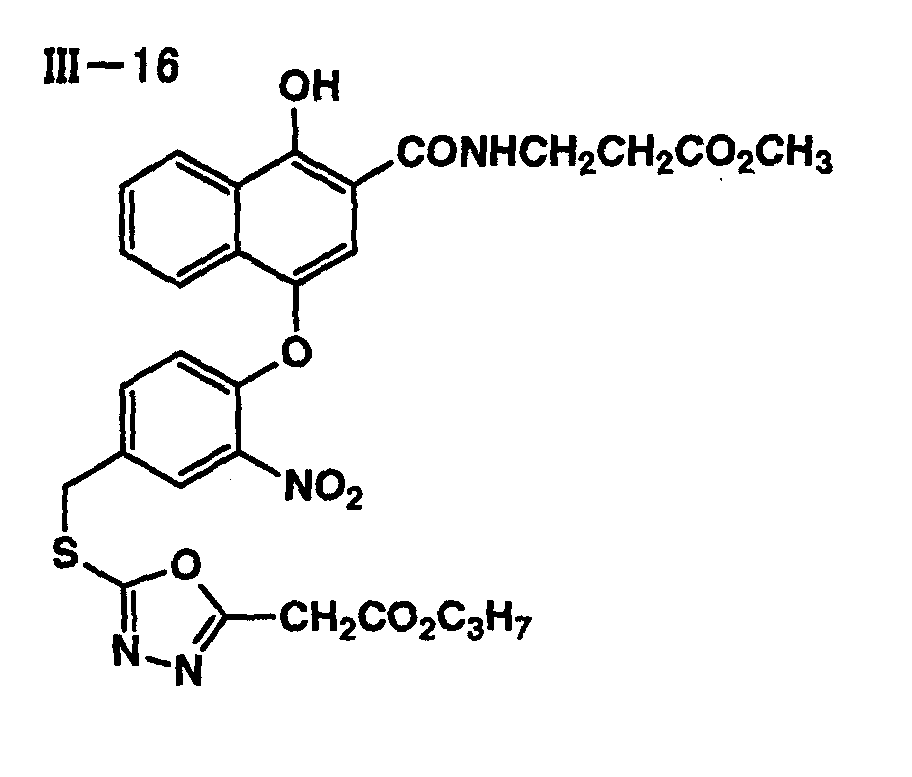
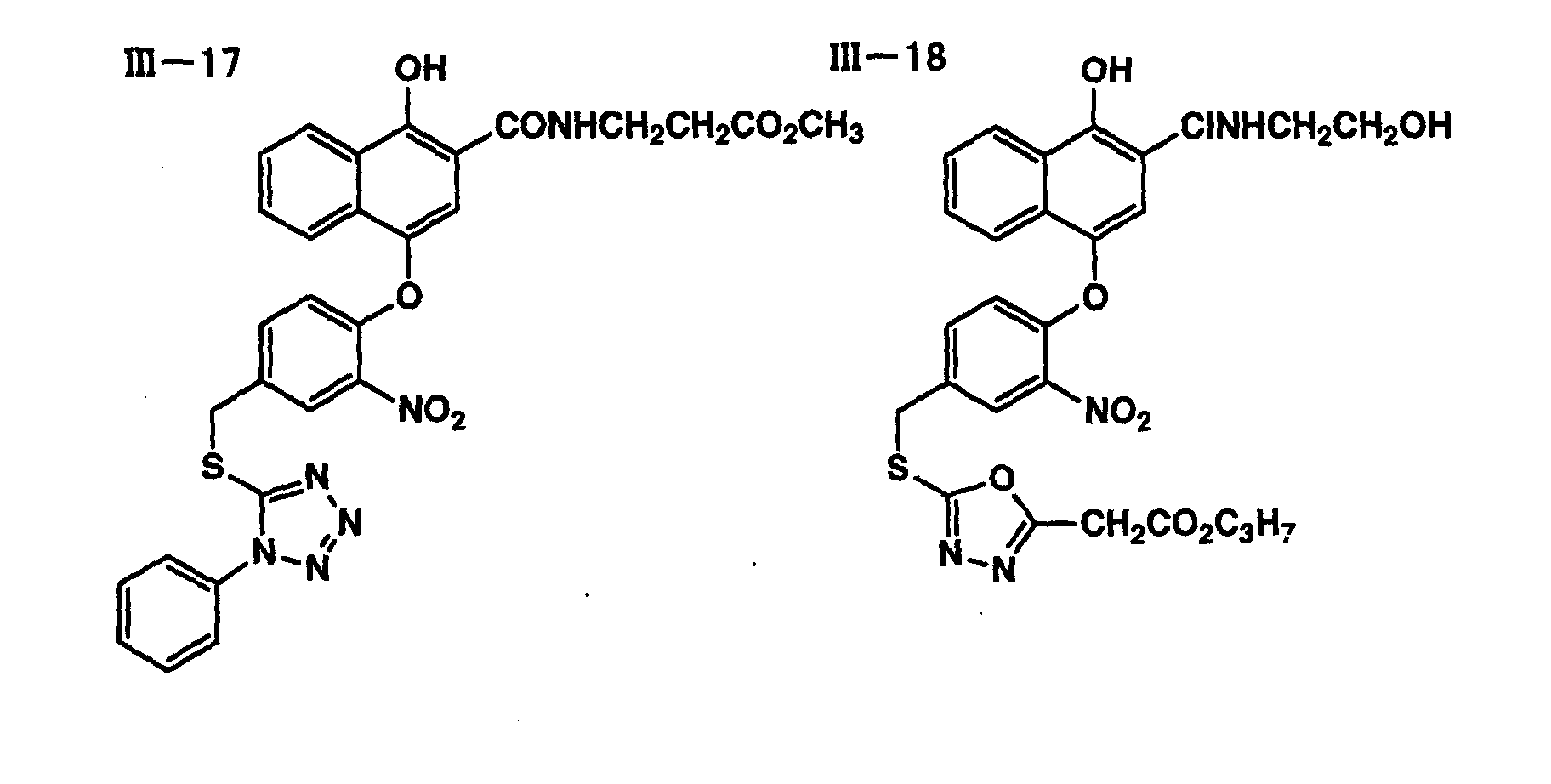


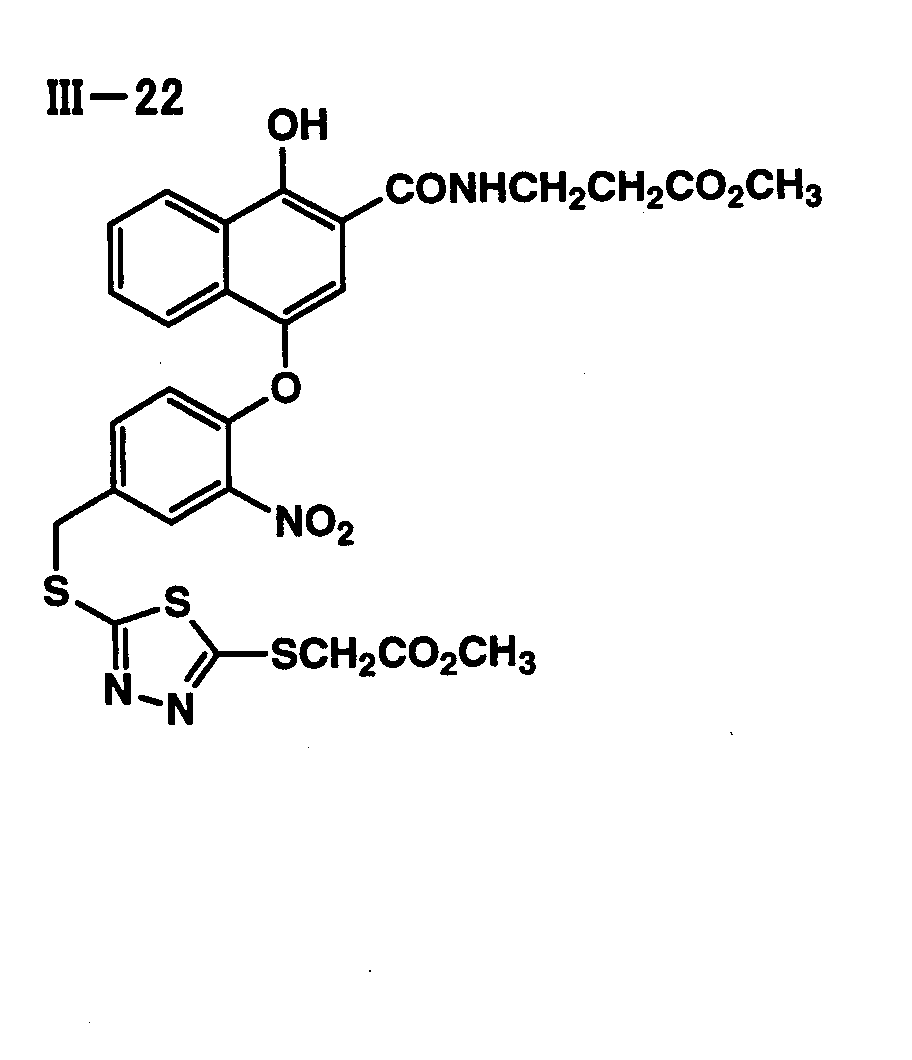

- The compound represented by formula )IV) will be described below. In formula (IV), Y represents a coupler moiety capable of forming a yellow dye upon reaction with an oxidation product of a color developing agent in the color development process. Representative yellow dye forming couplers are described in U.S. Patent Nor. 2,875,057, 2,407,210, 3,265,506, 2,298,433, 3,048,194, 3,447,928; and "Farbkuppler eine Literturiebersicht" (Affa Mitteilungen, Vol. III page 112-126, 1961). Preferred Y is acyacetoamides such as pivaloylacetoanilides and benzoylacetoanilides. TIME represent a timing group capable of releasing the DI after being released from Y upon reaction with an oxidation product of a color developing agent, and examples thereof are the same as cited as TIME and DI of formula (III).
- The compounds represented by formula (IV) can be synthesized with reference to the methods described in the above-cited patents. Exemplary examples of the compound of formula (IV) are shown below, but are by no means limited to these examples.
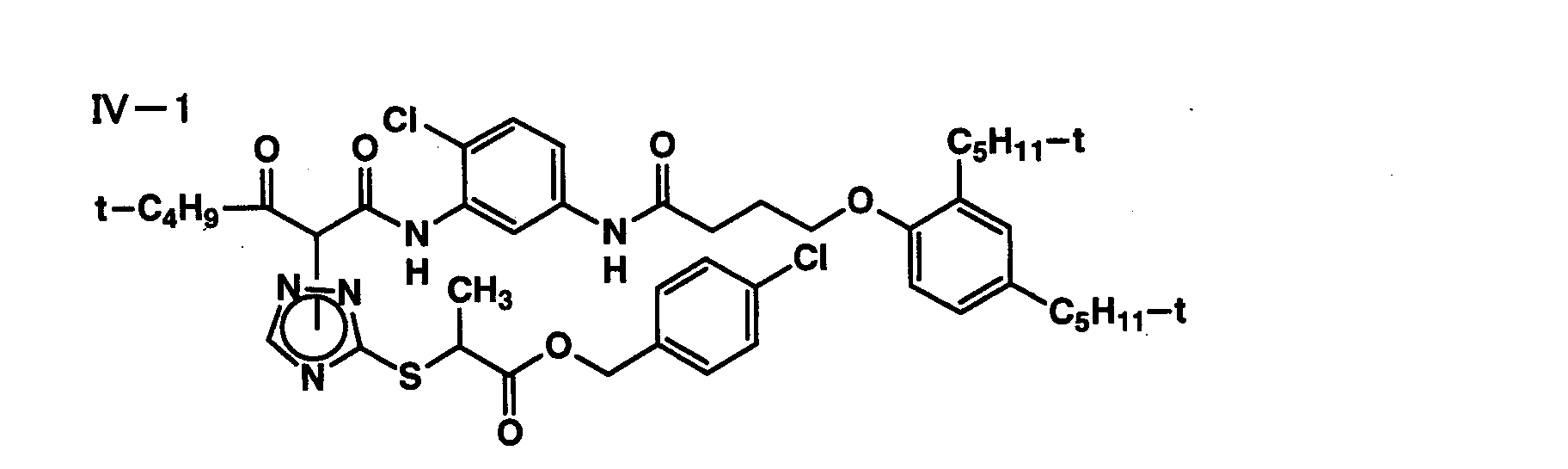


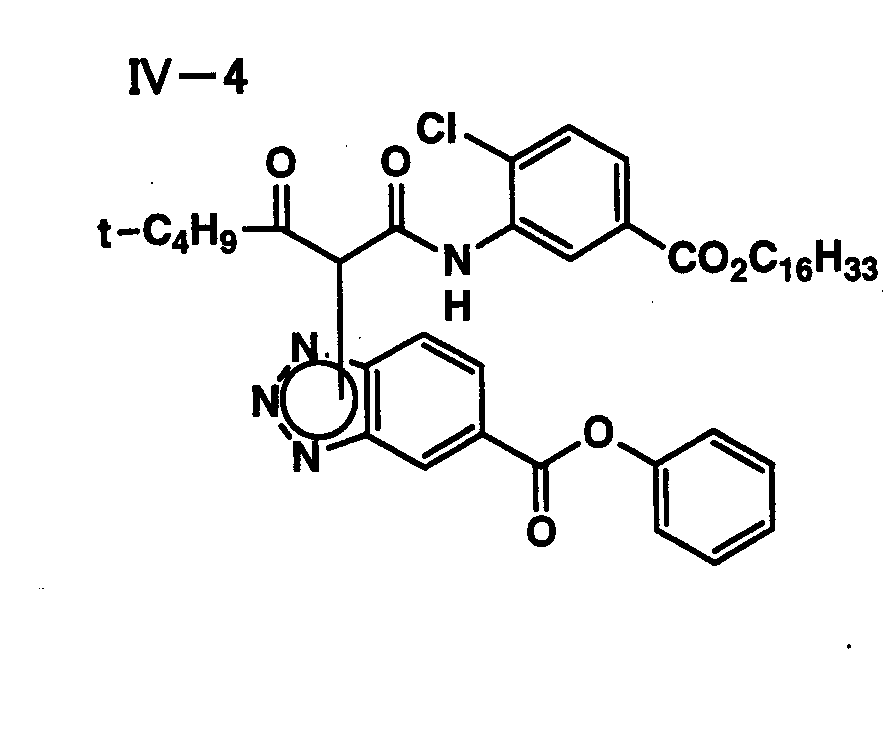


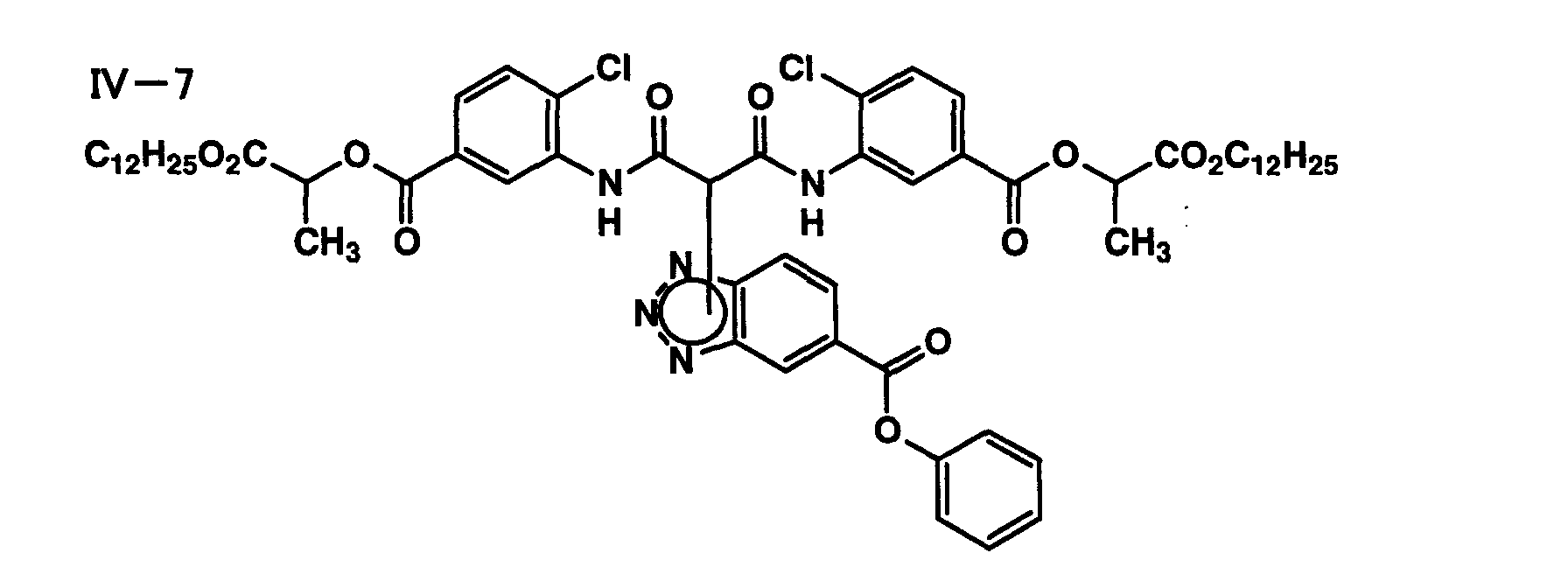
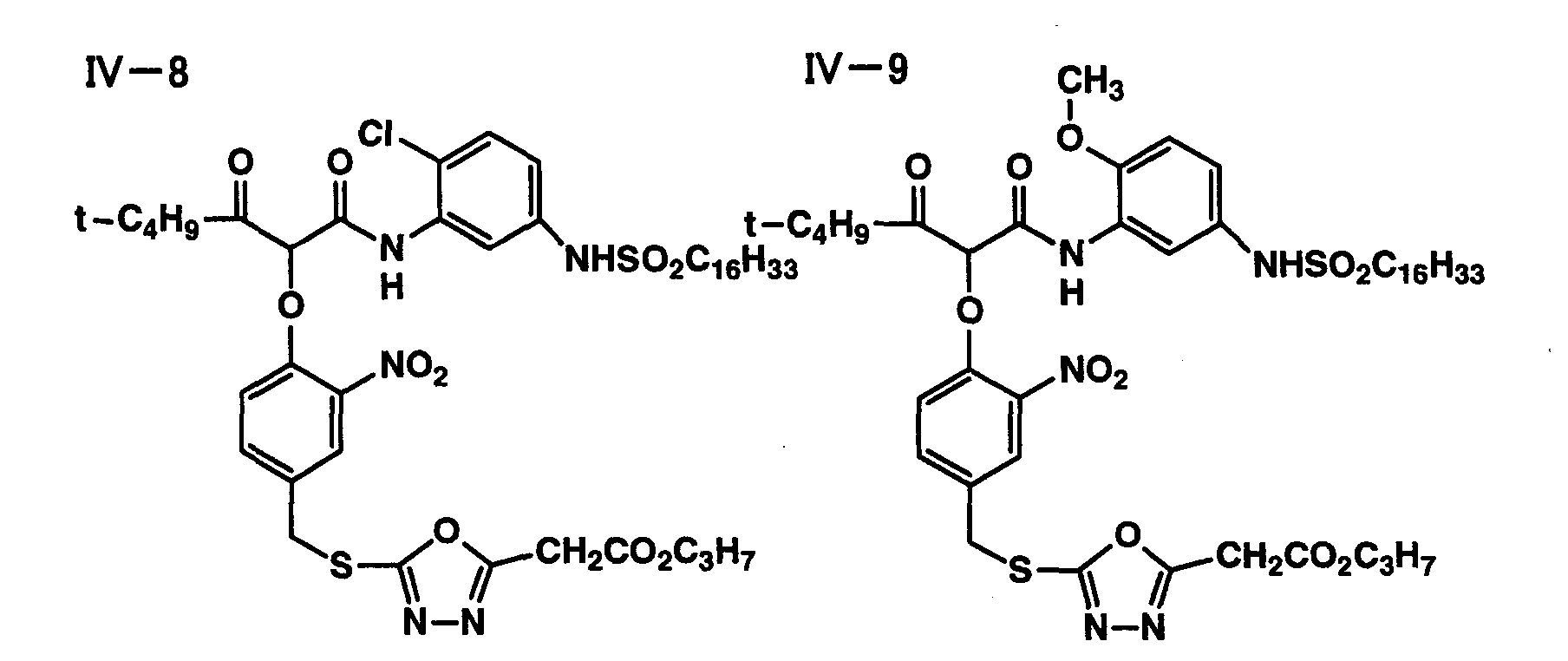
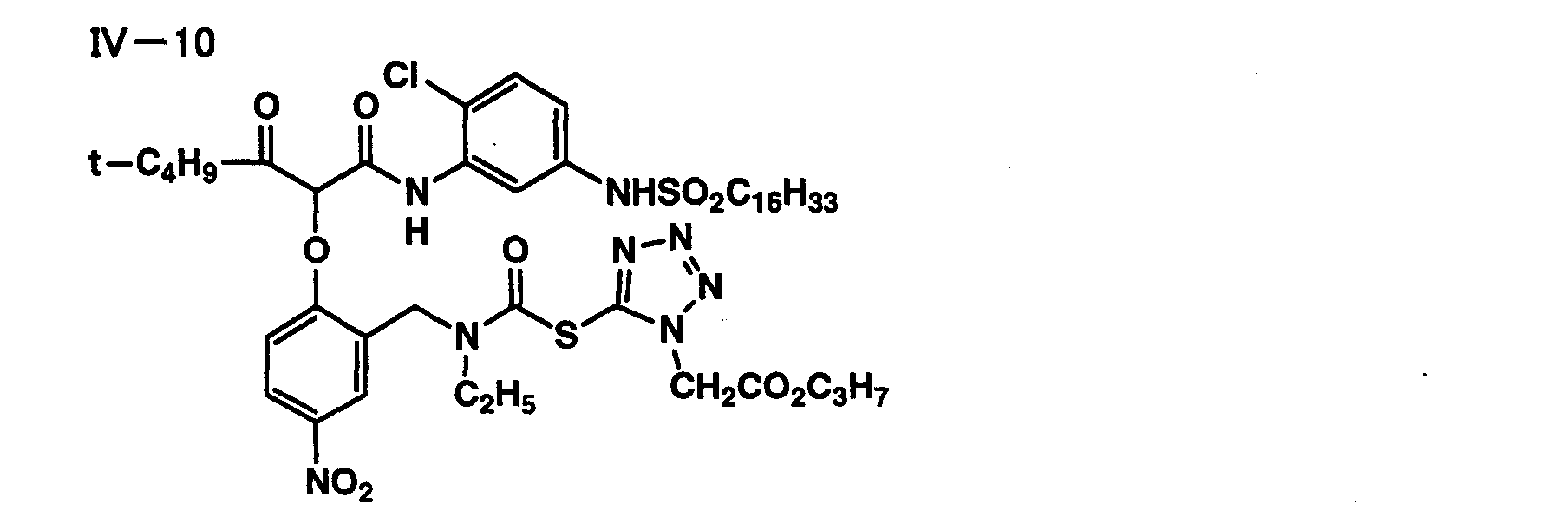

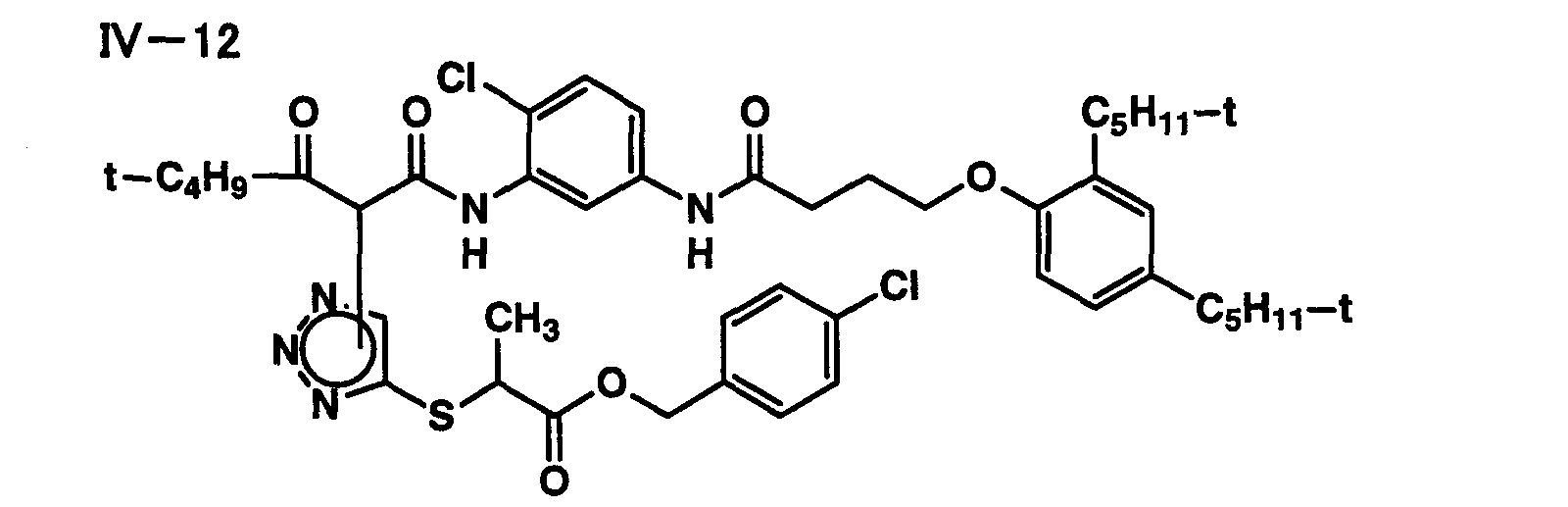
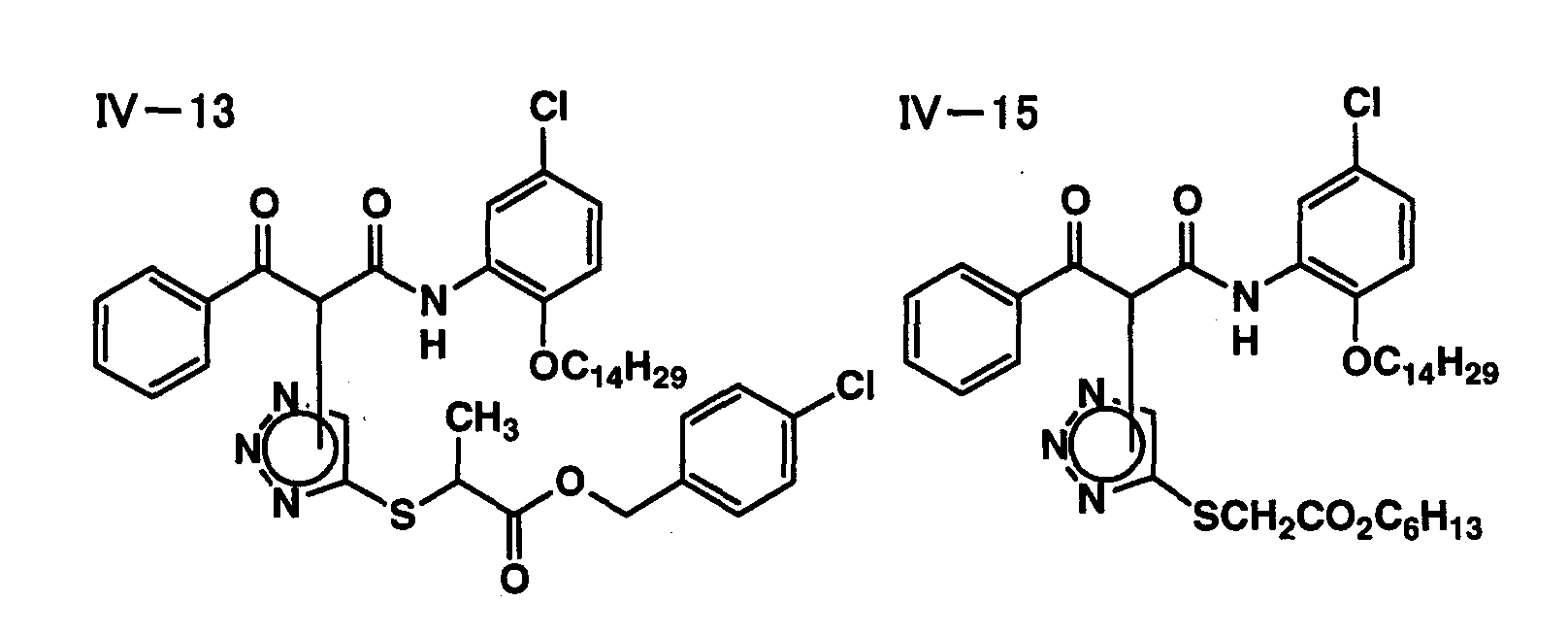
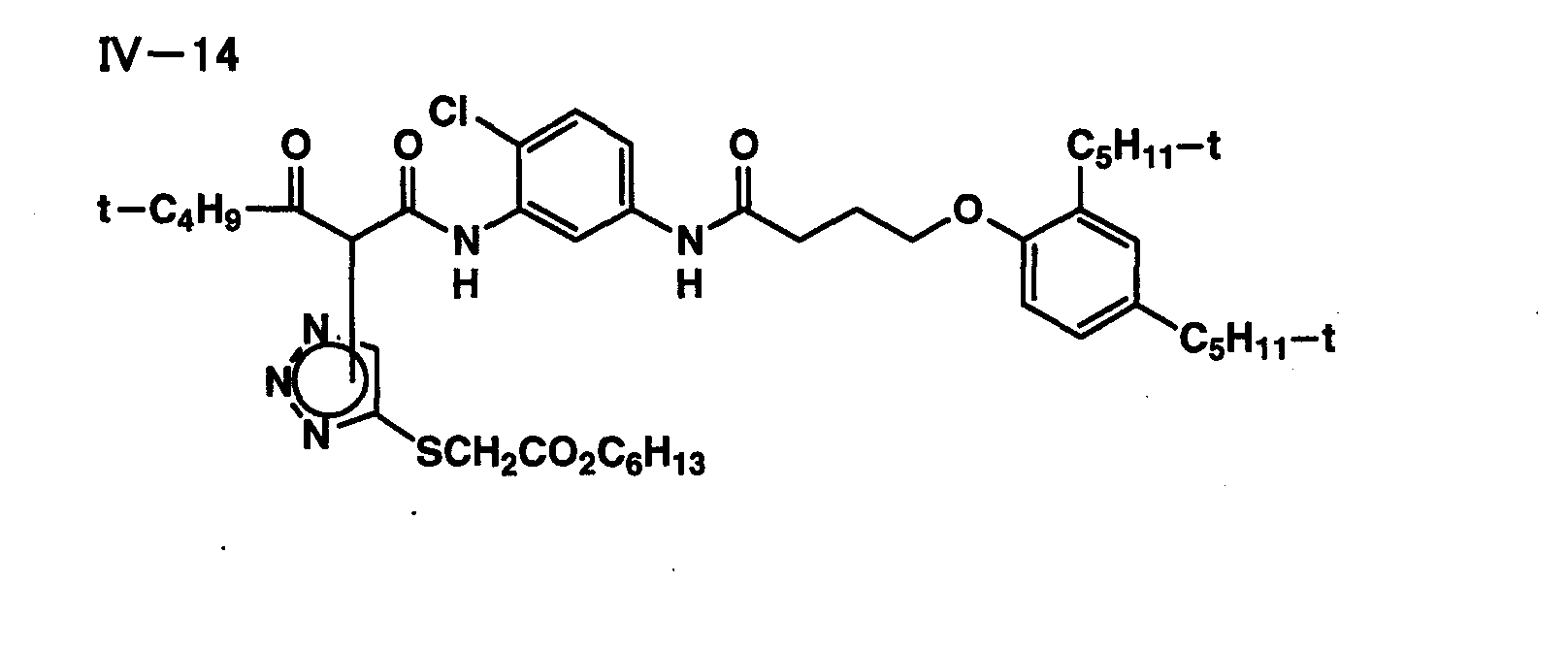


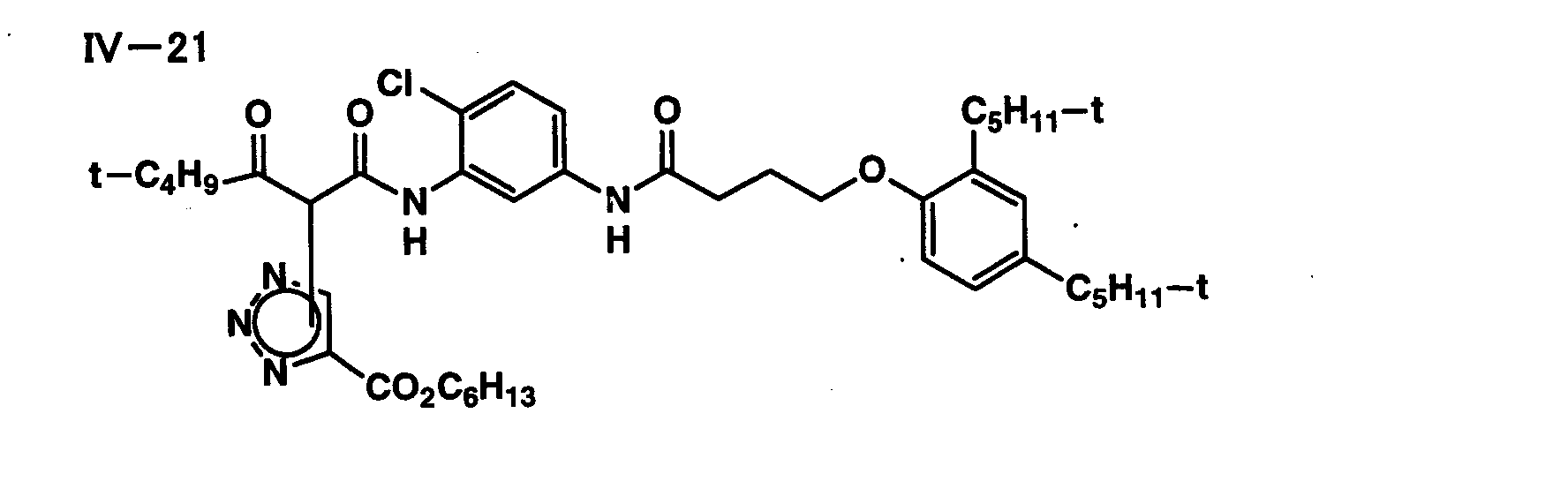
- The compound represented by formula (V) will be described below. The compound represented by formula (V) is a so-called masking coupler or colored coupler, which is yellow-colored.
- In formula (V), R51 and R52 represent a secondary or tertiary alkyl group (e.g., i0propyl, sec-butyl, t-butyl, t-amyl, etc.) or a cycloalkyl group (e.g., cyclopropyl, cyclopentyl, cyclohexyl, etc.). R51 and R52 is preferably a secondary or tertiary alky group having 6 or less carbon atoms or a cycloalkyl group, and i-propyl or sec-butyl are specifically preferred. R53 represents a halogen atom (e.g., chlorine, fluorine, etc.) or an alkoxy group (e.g., methoxy, I-propoxy, etc.). R53 is preferably a chlorine atom or methoxy group. R54 represents a substituent. The substituent may be any group capable of being substituted on a benzene ring and examples thereof are the same as cited as substituent for R12 of formula (I). R54 is preferably an acylamino group, an oxycarbonyl group, a carbamoyl group, a sulfonyl group or a sulfamoyl group. R55 also represents a substituent. The substituent may be any group capable of being substituted on a benzene ring and examples thereof are the same as cited as substituent for R12 of formula (I). R55 is preferably a halogen atom.
- The compounds represented by formula (V) can be synthesized with reference to the method described in JP-A 62-50830. Exemplary examples of the compound of formula (V) are shown below but are by no means limited to these examples.


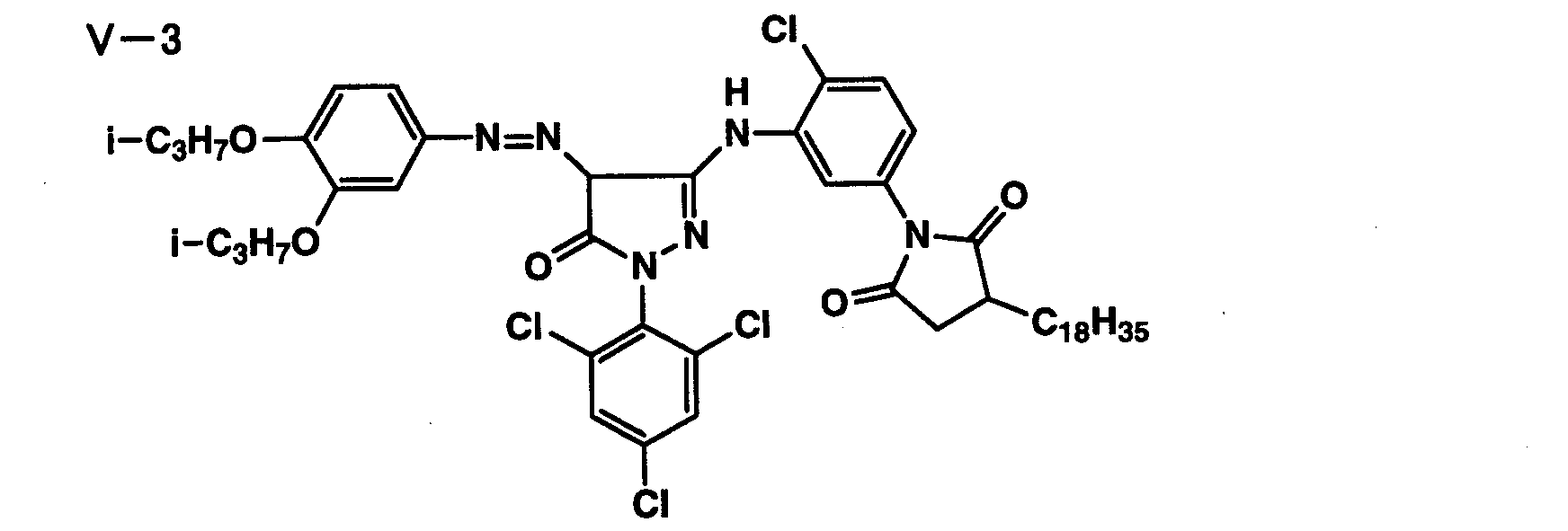


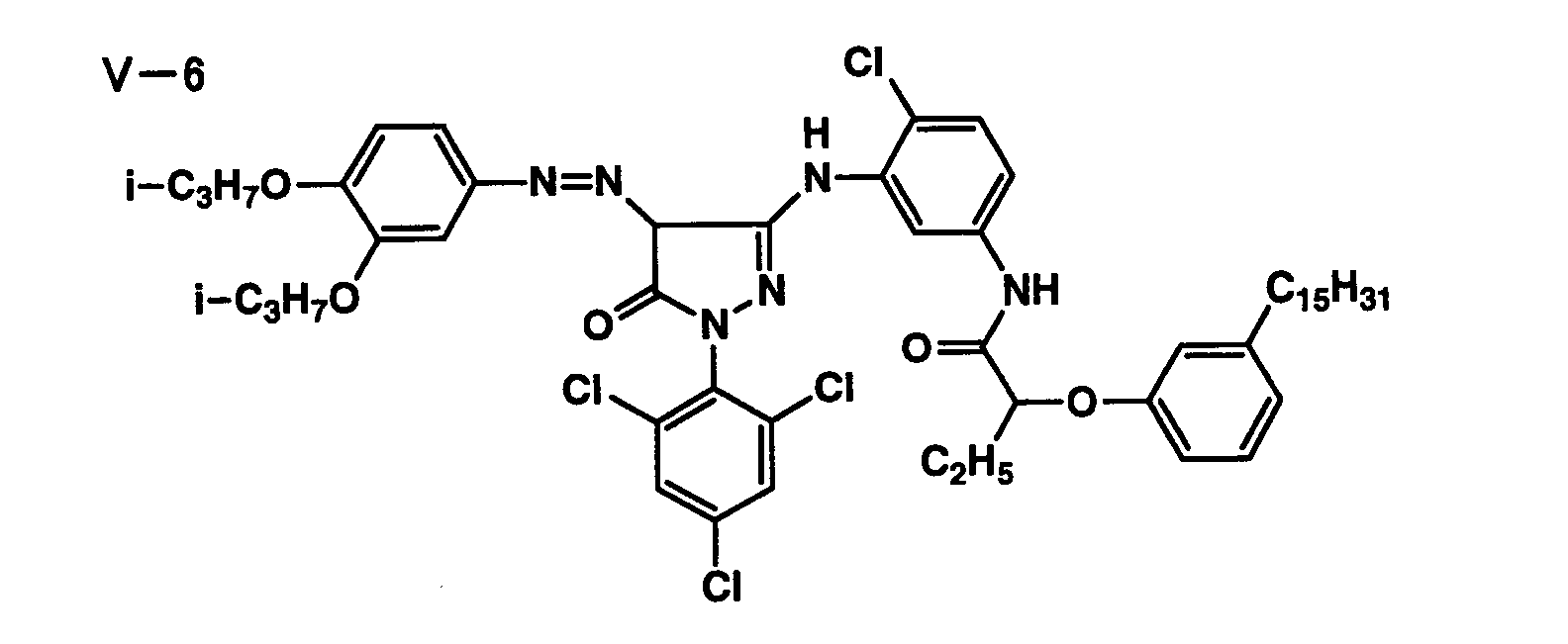

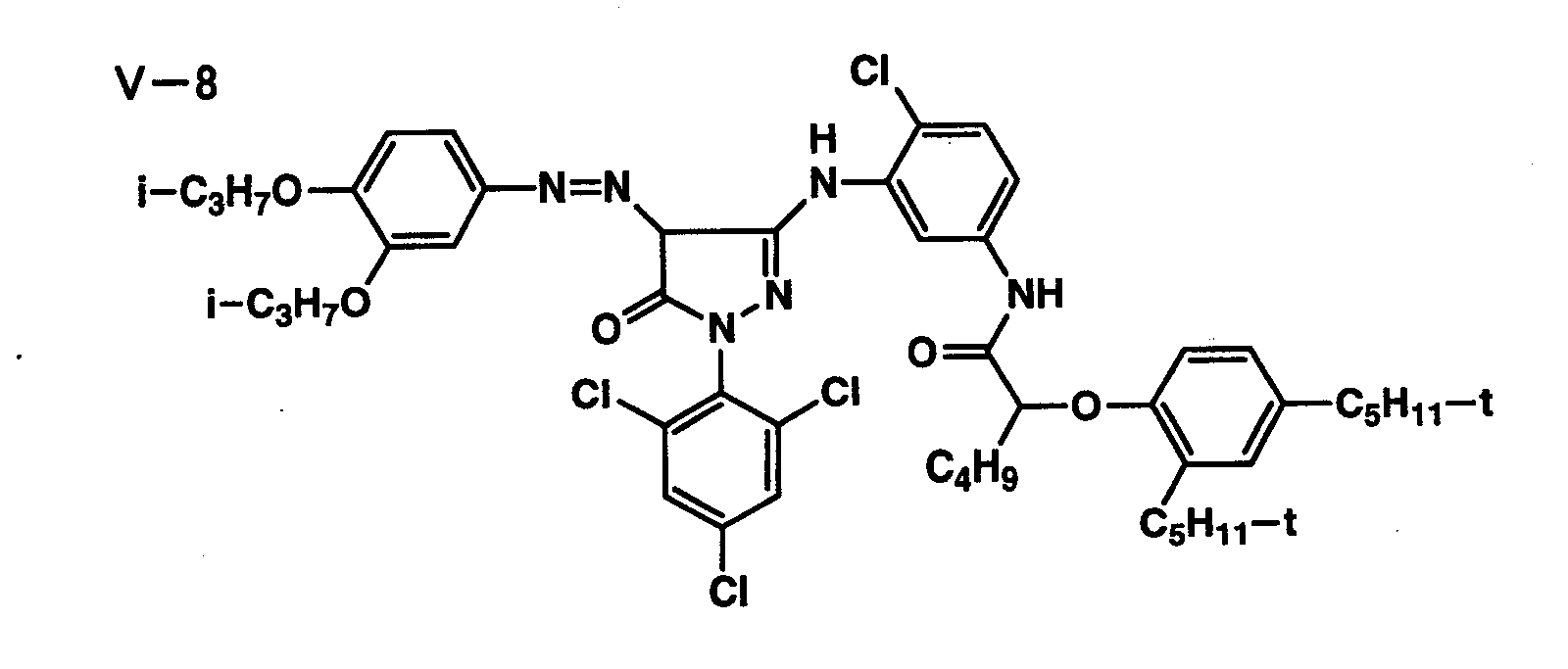
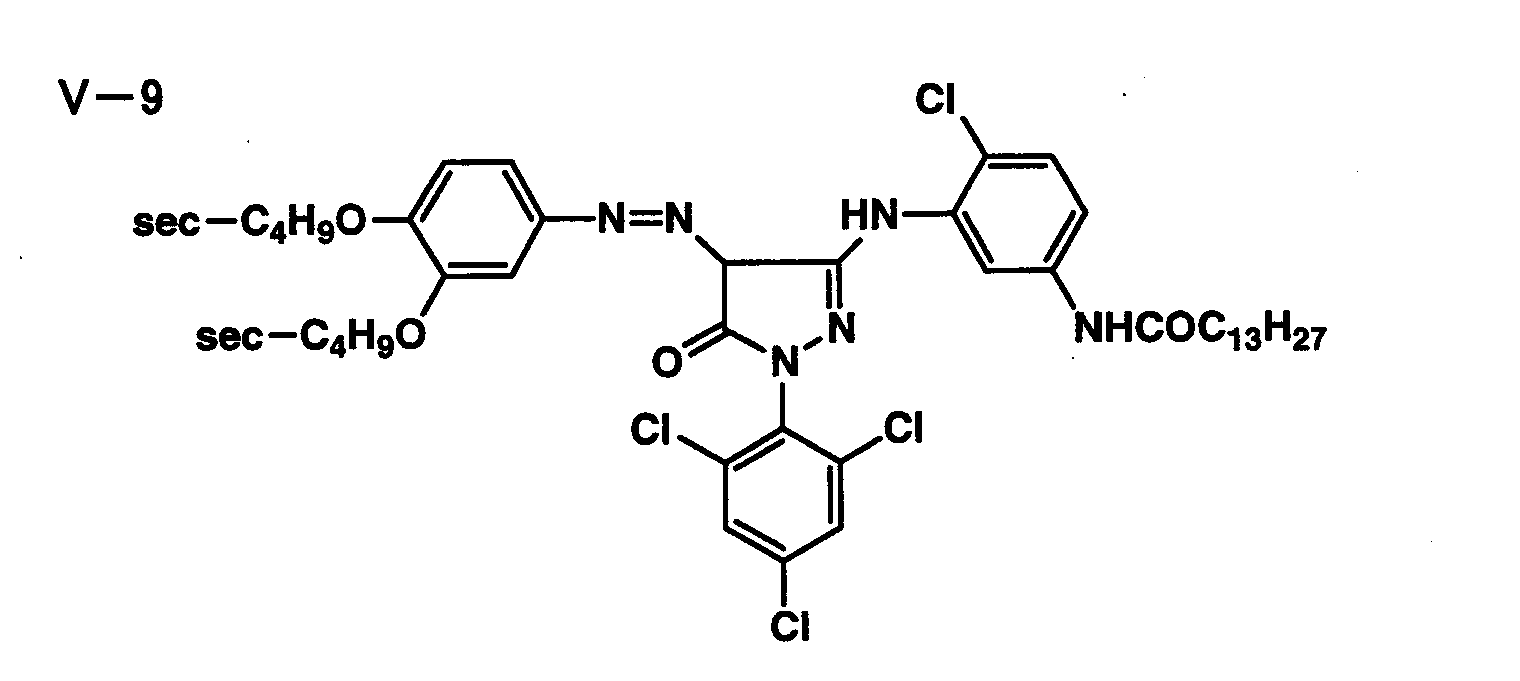
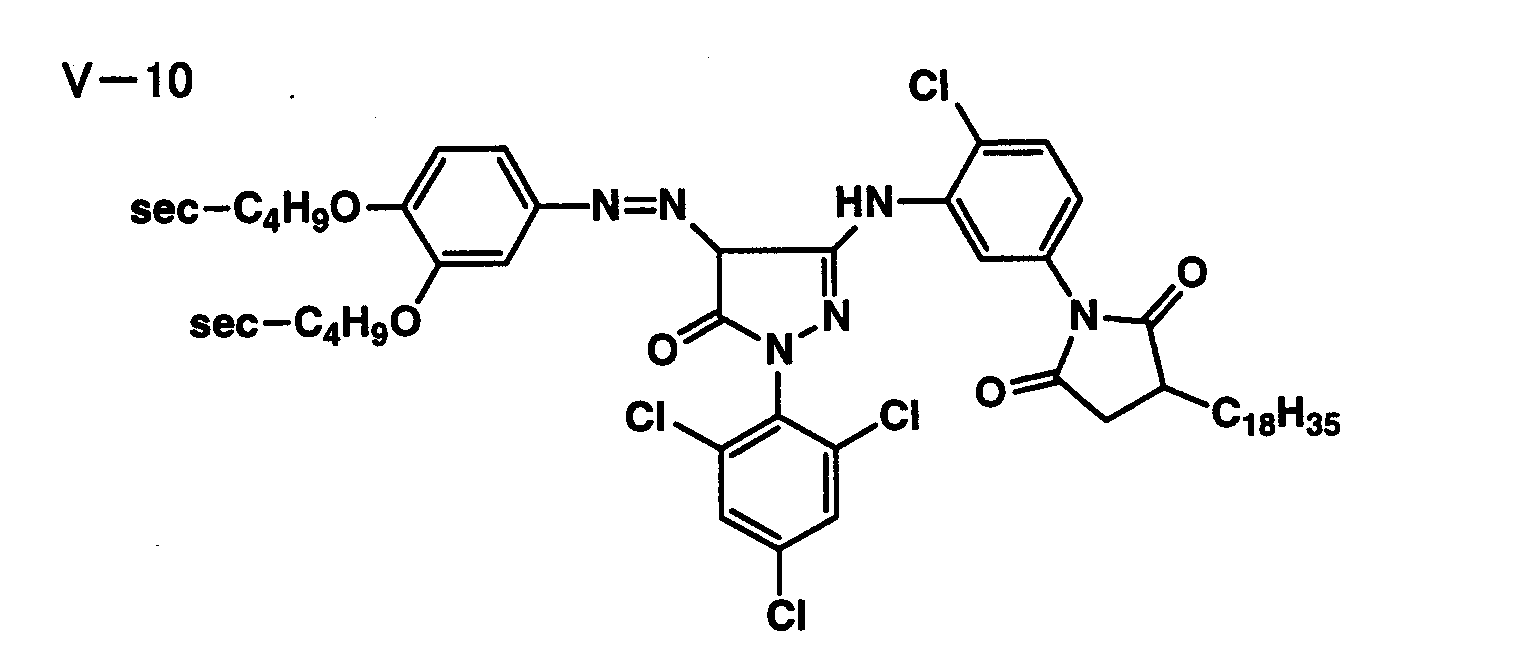
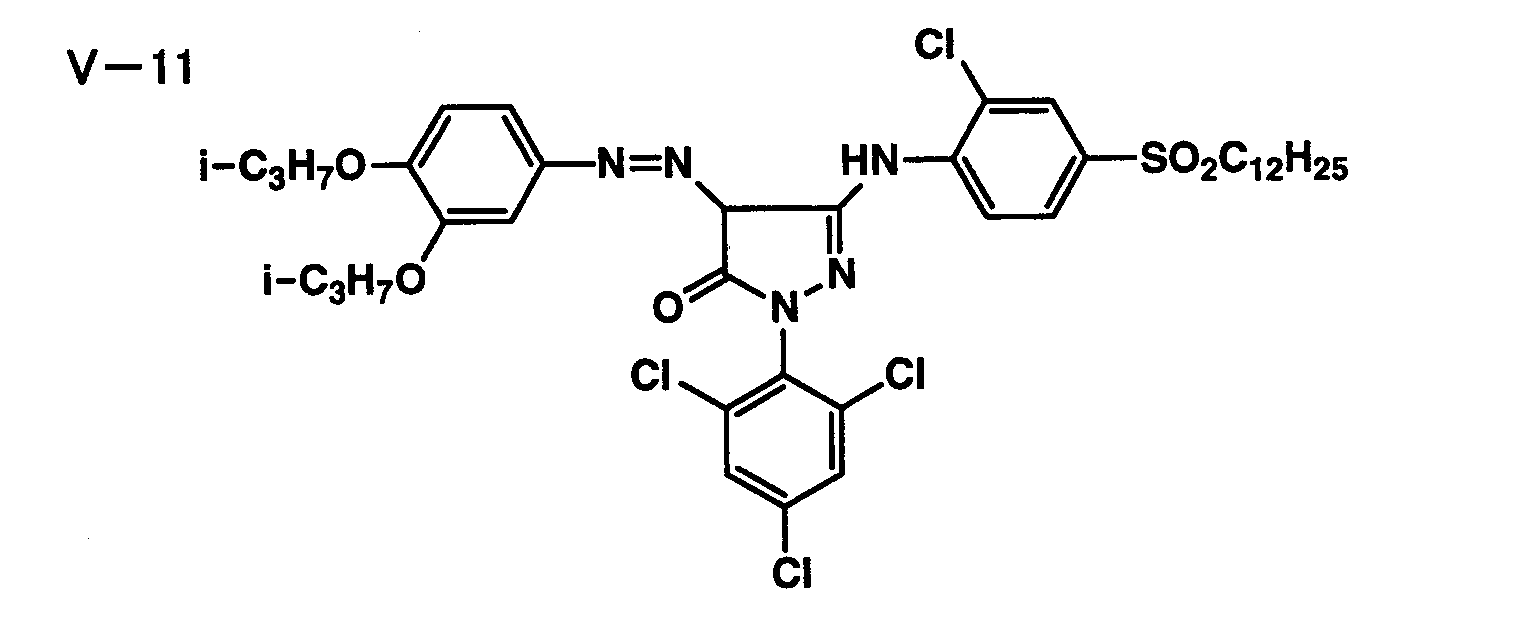
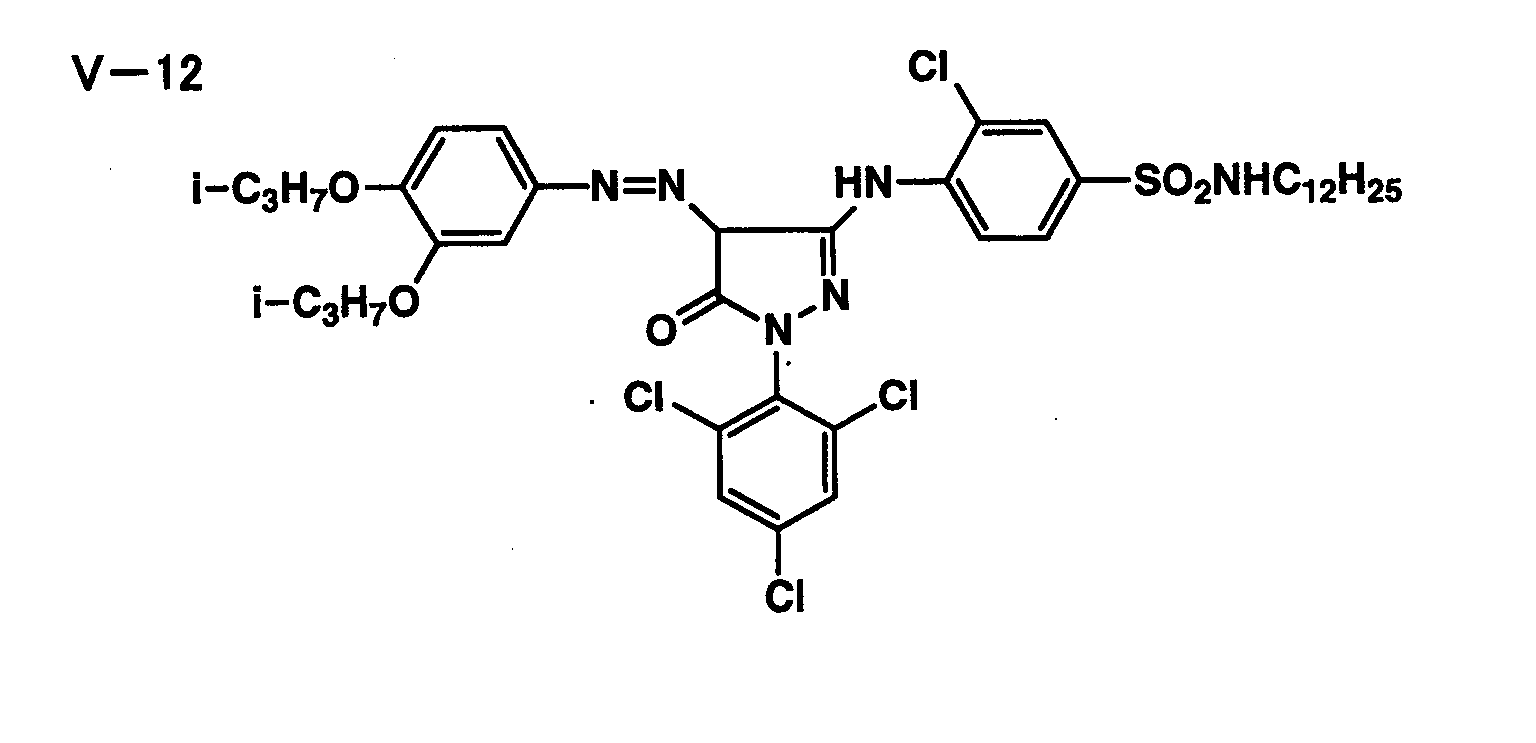
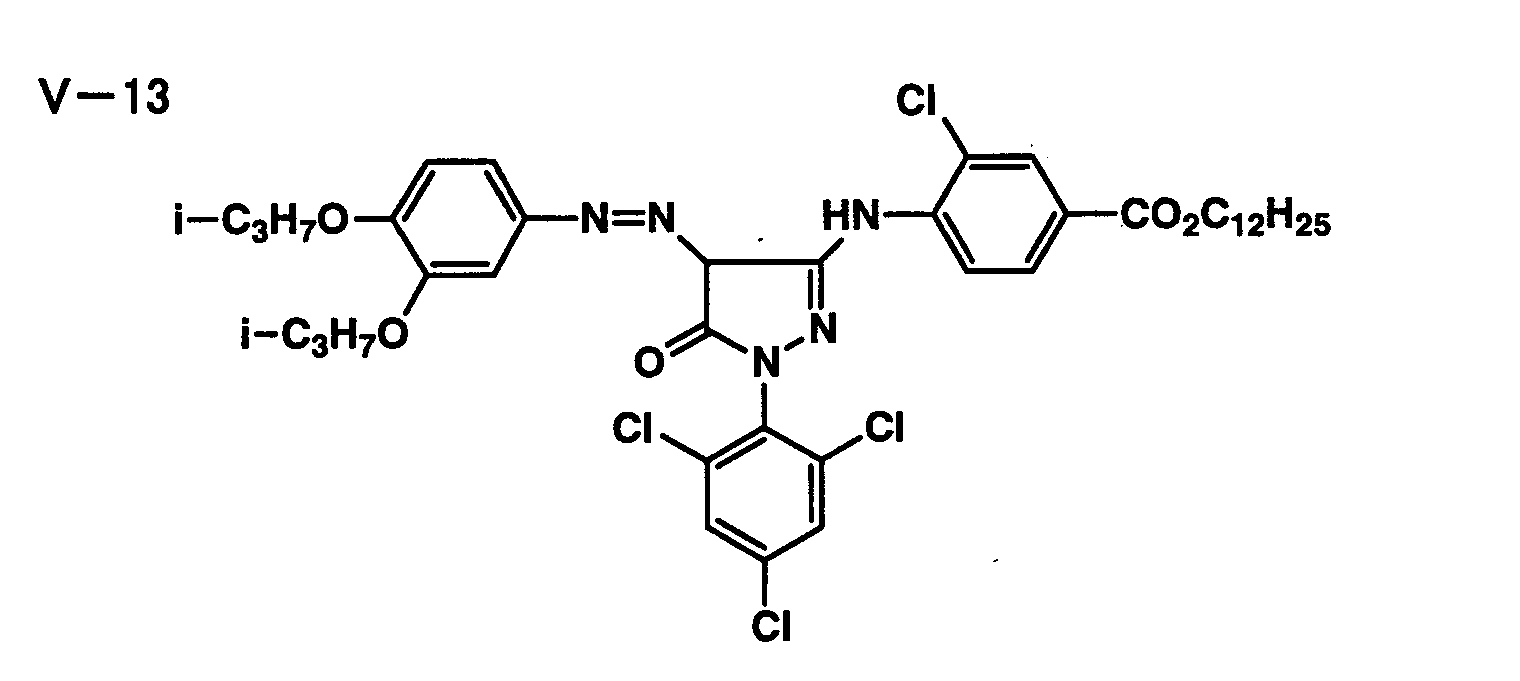
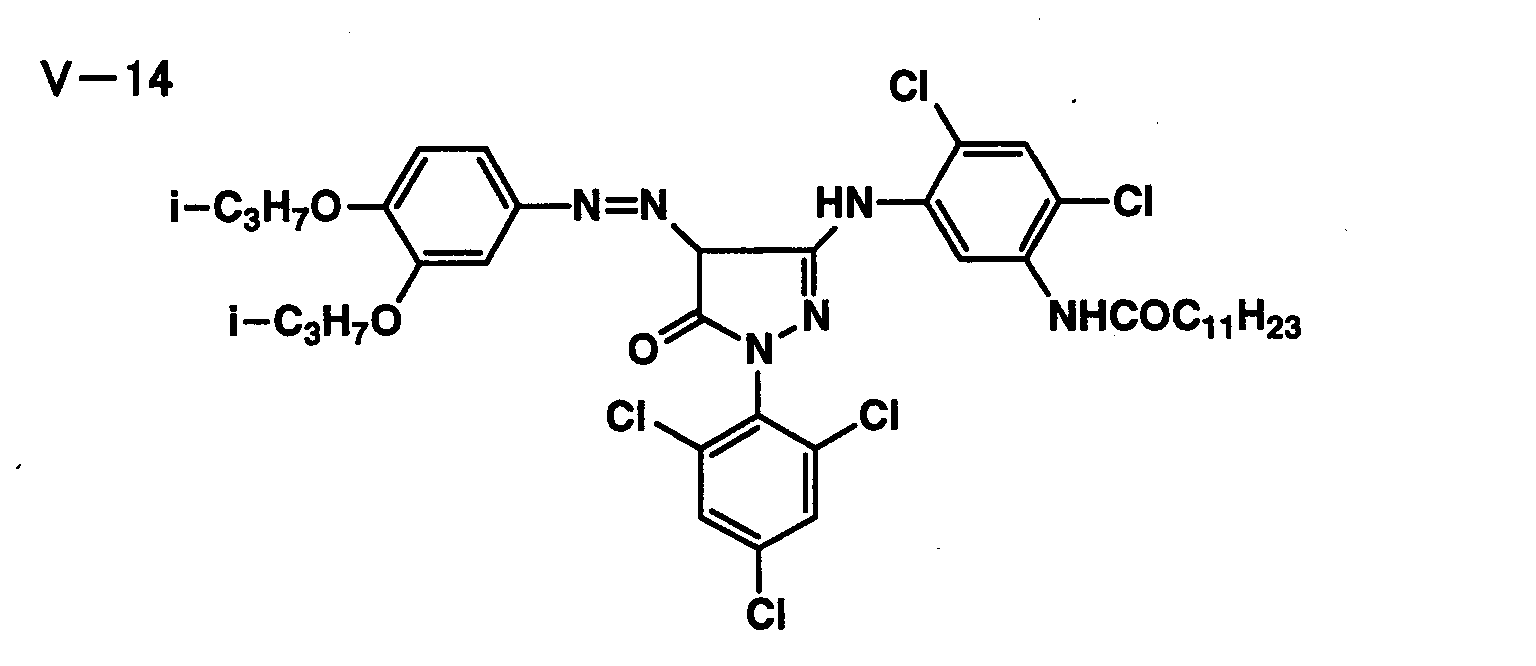


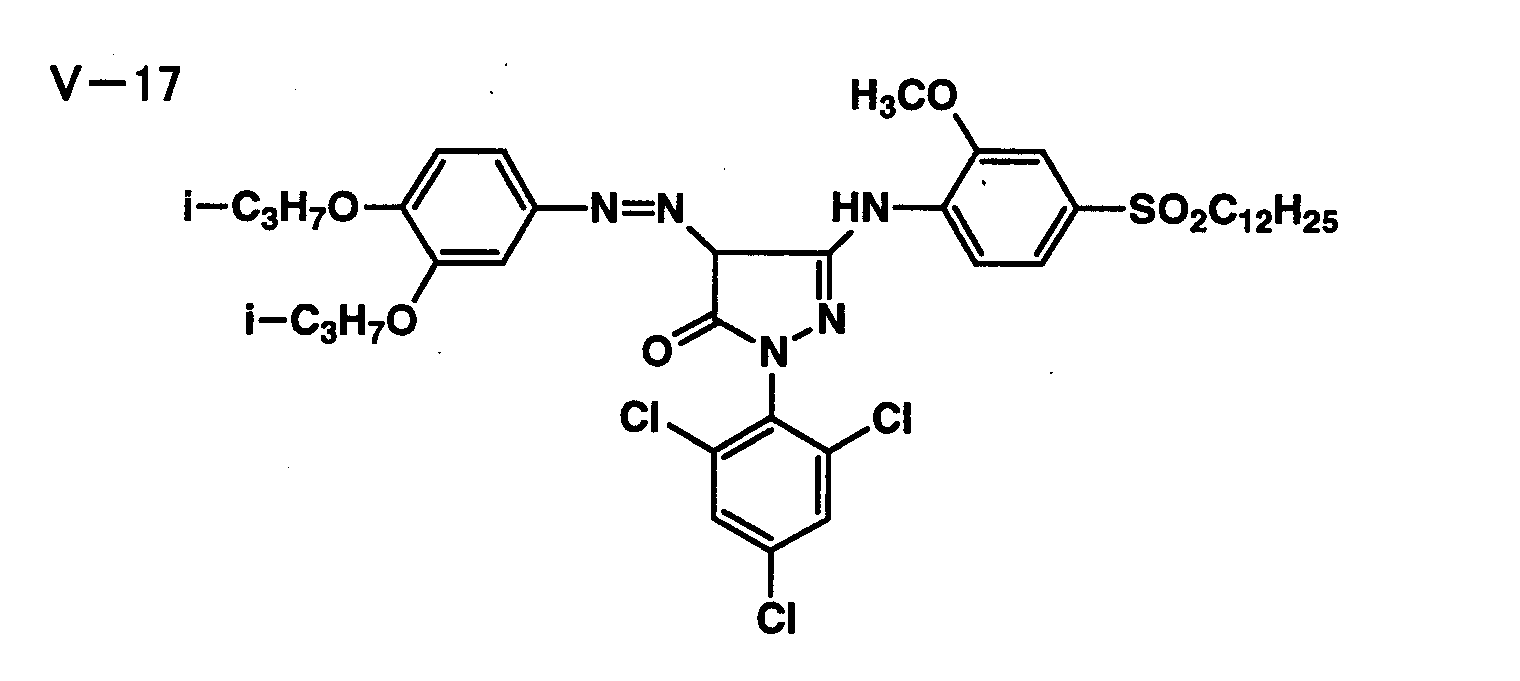
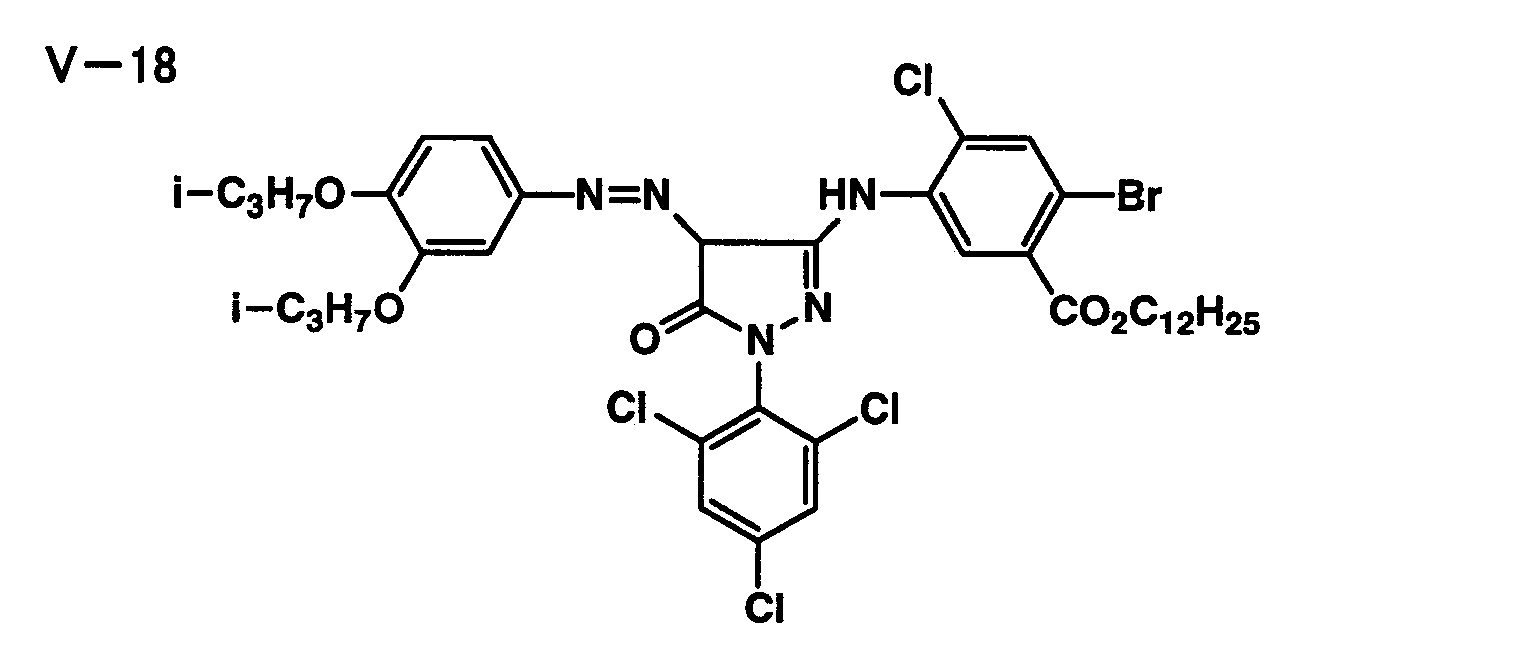
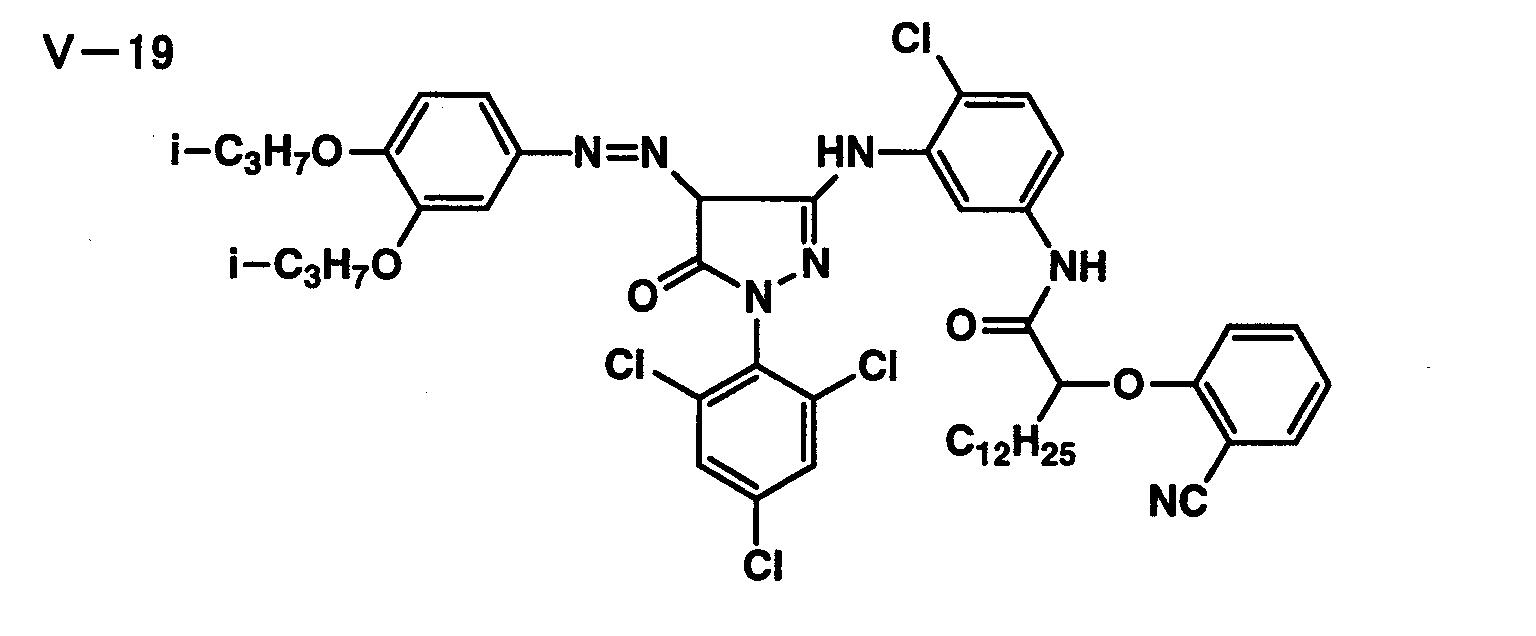
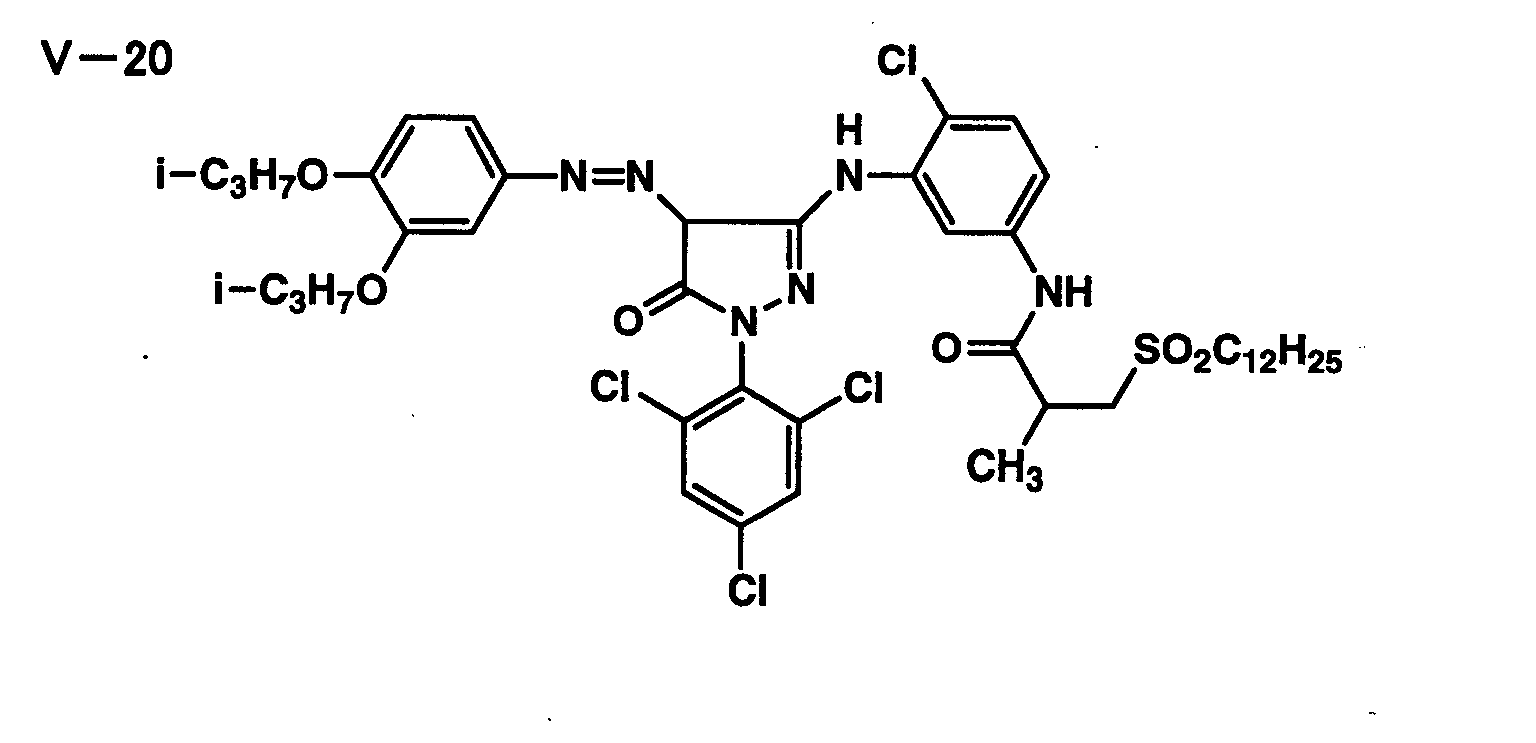


- Next, exemplary synthesis of the compound represented by formulas (I) or (II) is described below.
-

- In 620 ml of ethyl acetate, 122.8 g of raw material (A) was dissolved and then cooled with ice. Subsequently, 53.8 g of 31% hydrogen peroxide was dropwise added thereto at an internal temperature of 15° C or lower (in about 20 min.). After completing the addition, stirring continued further for 1 hr. at a temperature at 20° C or lower. Then, to the reaction mixture was added 194 g of potassium carbonate dissolved in 340 ml water. Subsequently, 450 g of compound (C) dissolved in 450 ml of ethyl acetate was dropwise added at an internal temperature of 20 to 25° C (in about 50 min.). After completing the addition, stirring continued further for 8 hrs. at room temperature. As crystals were precipitated, the reaction mixture was heated to an internal temperature of 65° C with stirring and after dissolving the crystals, a water phase was removed. The remaining organic phase was washed with 390 ml of an aqueous 5% sodium sulfite solution and then twice with 390 ml of hot water. Since precipitation easily occurred, the above washing was carried out, while being maintained at 65° C. After distilling out ethyl acetate under reduced pressure, obtained crude crystals were washed 1,160 ml of methanol, while boiling and suspending. After cooling to room temperature, crystals were filtered and washed with 190 ml of methanol, three times. After drying at 50° C, 386.2 g of exemplified compound II-1 was obtained. The structure was identified by NMR and mass spectrum.
-
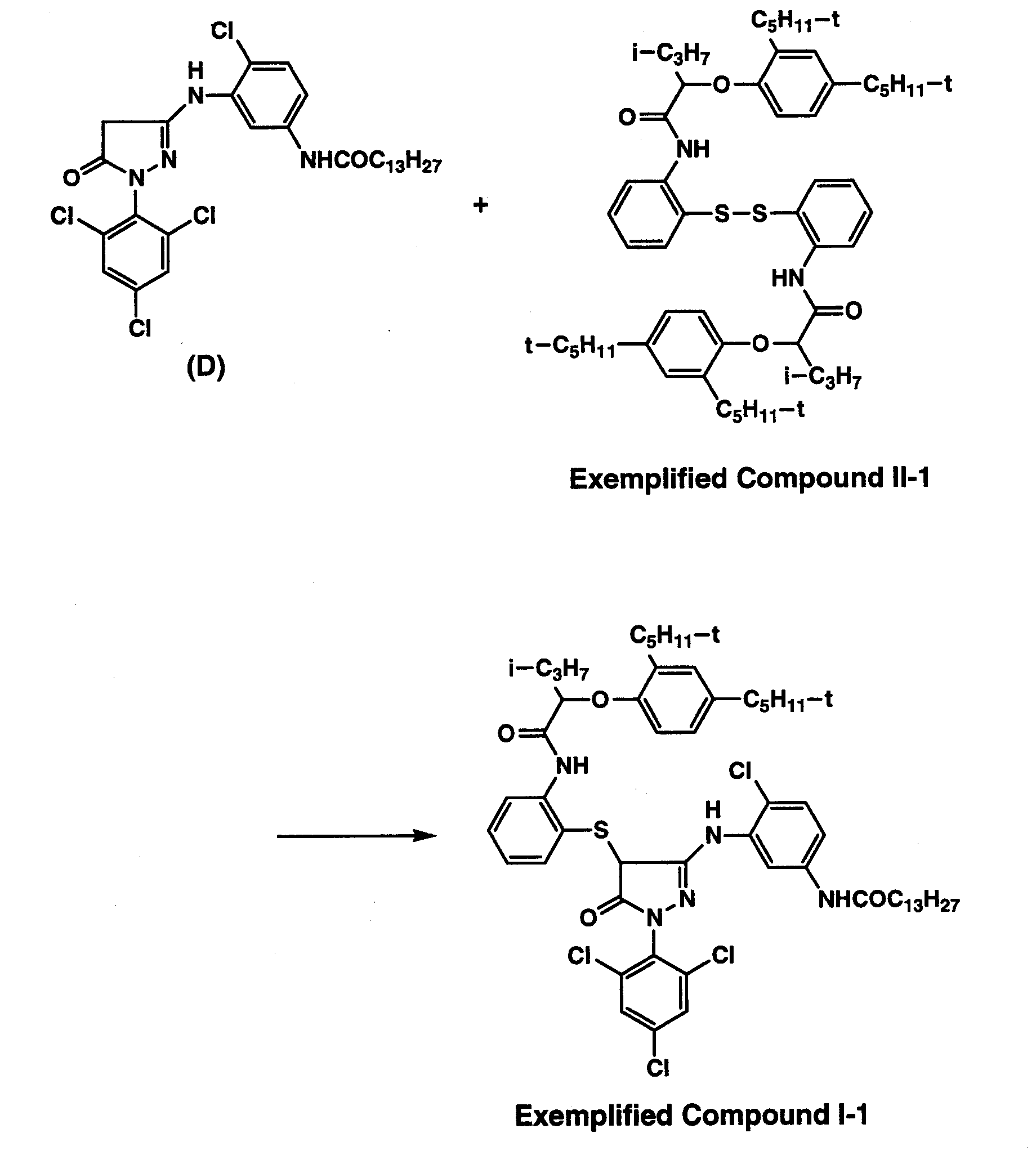
- To 1.3 lit. of ethyl acetate, 130 g of exemplified compound II-1 and 165 g of raw material (D) was added and after dissolved at 50° C, the mixture was allowed to stand until cooled to room temperature. Subsequently, 55.7 g of potassium carbonate dissolved in 220 ml water was added thereto and 400 ml of dimethylformamide was added. After stirring for 1 hr. at room temperature, 20 ml of hypochlorous acid (measure effective chlorine concentration of 3.49%) was dropwise added five times at 30 min. intervals. As raw material (D) still remained, 30 ml of hypochlorous acid was further added thereto. After stirring for one night, an organic phase was washed with 500 ml of hot water. Then, the organic phase was washed successively with the following aqueous solutions having composition described below.
- Washing 1:
- 27 g sodium sulfite/550 ml water
- Washing 2:
- 550 ml saturated sodium chloride solution
- Washing 3:
- 32 ml concentrated hydrochloric acid/ 550 ml saturated sodium chloride solution
- Washing 4:
- 550 ml saturated sodium chloride solution, 3 times.
- After completion of washing, ethyl acetate was distilled out under reduced pressure. Adding 290 ml of ethyl acetate, the obtained crude crystals were dissolved and then recrystalized adding 570 ml of acetonitrile. Further, through recrystalization in a mixed solvent of 820 ml ethyl acetate and 260 ml acetonitrile was obtained 123.6 g of exemplified compound II-1. No contamination of exemplified compound II-1 was observed (less than 0.1%). The structure was identified by NMR and mass spectrum.
- The magenta coupler represented by formula (I) is used preferably in an amount of 1x10⁻³ to 8x10⁻¹, and more preferably 1x10⁻² to 3x10⁻¹ mol/mol AgX. The magenta coupler of formula (I) may be used in combination with other kind of a magenta coupler. The compound represented by formula (II) is used preferably in an amount of 0.1 to 10% by weight, and more preferably 0.5 to 5% by weight, based on the magenta coupler of formula (I). The DIR coupler represented by formula (III) (I) is used preferably in an amount of 1x10⁻⁵ to 5x10⁻¹, and more preferably 1x10⁻³ to 1x10⁻¹ mol/mol AgX. The DIR coupler of formula (III) may be used in combination with other kind of a DIR coupler. The DIR coupler represented by formula (IV) (I) is used preferably in an amount of 1x10⁻⁵ to 5x10⁻¹, and more preferably 1x10⁻³ to 2x10⁻¹ mol/mol AgX. The DIR coupler of formula (IV) may be used in combination with other kind of a DIR coupler. The colored coupler represented by formula (V) is used preferably in an amount of 5 to 50% by weight, and more preferably 10 to 30% by weight, based on the magenta coupler of formula (I).
- The method for incorporating the compounds of formulas (I) through (V) is not specifically limited and any of methods known in conventional photographic materials are employable, including dispersion as fine oil particles through dissolution in a high boiling solvent, as described in U.S. Patent No. 2,320,027; dispersion through dissolution by introducing a ballast group and a water-solubilizing group, as described in U.S. Patent 2,186,849; integrating into a polymeric compound as its component, as described in U.S. Patent No. 2.397.864; a method of filling in a latex polymer and dispersing through mechanical crushing by the use of a colloid mill or the like.
- The color photographic material according to this invention comprises on a support a green-sensitive silver halide emulsion layer containing the compounds of formulas (I) through (V), as a basic constitution, and a multicolor photographic material is desirable. Thus, according to one of preferred embodiments of this invention, the color photographic material comprises a support provided thereon a green-sensitive silver halide emulsion layer containing the compounds of formulas (I) through (V), which is in combination a blue-sensitive silver halide emulsion layer containing a yellow coupler (such as benzoylacetoanilide compounds and pivaloylacetoanilide compounds) and a red-sensitive silver halide emulsion layer containing a cyan coupler (such as naphthol compounds, 2-ureido-5-acylaminophenol compounds). In addition thereto, a filter layer, a protective layer, an interlayer, a sublayer or a backing layer may be optionally provided. Further, the silver halide emulsion layer having sensitivity within each of the wavelength region may be comprised of two or more layers.
- Silver halide emulsions used in this invention include not only silver chloride, silver bromide and silver iodide, but also mixed silver halide such as silver chlorobromide, silver iodobromide, silver iodochloride or silver iodochlorobromide. These silver halide emulsions can be prepared according to the conventional methods, and ammoniacal precipitation, neutral precipitation, acidic precipitaion, a halide conversion method, variable addition and uniform precipitation are applicable. The mean grain size is not specifically limited but is preferably 0.01 to 5 µm. Two or more silver halide emulsions which have been separately prepared may be blended. The silver halide emulsions used in this invention can be chemically sensitized by the commonly known methods, including a gold sensitization with a gold complex, reduction sensitization with a reducing compound, sulfur sensitization using a compound containing a reactive sulfur with a silver ion or active gelatin, and sensitization with noble metal salts of the VIII group of the periodical table. The silver halide emulsions can be spectrally sensitized using cyanine dyes such as monomethine cyanines, pentamethine cyanines, merocyanines and carbocyanines, alone or in combination thereof, or in combination with styryl dyes or aminostilbene compounds.
- Furthermore, a commonly known stablilizer, antifoggant, surfactant, defoaming agent, antistatic agent, hardener, agent for improving physical properties of the layer, brightening agent, anti-staining agent, UV absorbent, and anti-irradiation agent. Compounds described in Research Disclosure (also denoted as RD vol. 176, No. 17643 (1978)can be employed as the foregoing additives.
- Supports used in the color photographic material of this invention are optionally selected according to its purpose. Examples of the supports include cellulose acetate film, polyethylene terephthalate (PET) film, polystyrene (PS) film, polycarbonate (PC) film, or their lamination materials; paper, baryta paper, α-olefin polymer-laminated paper, synthetic paper, glass and metals.
- In the photographic material of this invention, gelatin is advantageously employed as binder or protective colloid; and other hydrophilic colloids including gelatin derivatives, graft polymers of gelatin with other polymers, cellulose derivatives such as hydroxyethyl cellulose, carboxymethyl cellulose and cellulose sulfuric acid ester, and hydrophilic synthetic polymer compounds such as polyvinyl alcohol, partial acetals of polyvinyl alcohol, poly-N-vinylpyrrolidone, polyacrylic acid, polymethacrylic acid, polyacrylamide and their copolymers may be used in combination with gelatin.
- The color photographic materials, after exposure, are subjected to conventional color development. The basic process of the negative-positive method comprises color development, bleach and fixing. The basic process of the reversal method comprises the first development, followed by exposure to white light or treatment in a foggant-containing bath, and the steps of color development, bleach and fixing. Each of these steps may be independently carried out. Alternatively, two or more steps may be conducted at one time using a processing solution having such functions. Example thereof include color processing with a monobath containing a color developing agent, a ferric salt bleaching component and a thiosulfate fixing component (as described in JP-B No. 35-1885); and a monobath bleach-fixing method containing a bleaching component of a ethylenediaminetetraacetate iron (III) complex and a thiosulfate fixing component.
- Photographic processing usable in this invention is not specifically limited and any of photographic processing methods is applicable. Representative examples thereof are as follows:
- (1) color development, followed by bleach-fixing, and optionally, washing and stabilization treatment;
- (2) color development, followed by bleaching and fixing, and further optionally washing and stabilization treatment;
- (3) pre-hardening, followed by neutralization, color development, stop-fixing, washing, bleaching, washing, post-hardening and washing;
- (4) color development, followed by washing, auxiliary color development, stopping, bleaching, fixing, washing and stabilization; and
- (5) a method of processing a low silver coverage, silver halide photographic material using an amplifier such as peroxides or cobalt complex salts.
-
- The processing may be conducted at a high temperature of 30° C or more, at room temperature or at a low temperature of 20° C or less, but in general, carried out at a temperature of 20 to 70° C. The temperature of these steps may be the same or different.
- Embodiment s of this invention will be described based on examples but are limited by no means to these examples.
- On a triacetyl cellulose film support were formed the following layers containing composition as shown below to prepare a multi-layered color photographic material Sample 101. The addition amount of each compound was represented in term of g/m2, provided that the amount of silver halide or colloidal silver was converted to the silver amount and the amount of a sensitizing dye was represented in mol/Ag mol.
1st Layer (Anti-Halation Layer) Black colloidal silver 0.16 UV absorbent (UV-1) 0.30 Colored magenta coupler (CM-1) 0.12 Colored cyan coupler (CC-1) 0.03 High boiling solvent (OIL-1) 0.24 Gelatin 1.33 2nd Layer (Intermediate Layer) Silver iodobromide emulsion j 0.10 Anti-staining agent (AS-1) 0.12 High boiling solvent (OIL-1) 0.15 Gelatin 0.67 3rd Layer (Low-speed Red-Sensitive Layer) Silver iodobromide emulsion c 0.053 Silver iodobromide emulsion d 0.11 Silver iodobromide emulsion e 0.11 Sensitizing dye (SD-1) 2.2 x 10⁻⁵ Sensitizing dye (SD-2) 5.9 x 10⁻⁵ Sensitizing dye (SD-3) 1.2 x 10⁻⁴ Sensitizing dye (SD-4) 1.6 x 10⁻⁴ Sensitizing dye (SD-5) 1.6 x 10⁻⁴ Cyan coupler (C-1) 0.19 Colored cyan coupler (CC-1) 0.003 High boiling solvent (OIL-2) 0.096 Anti-staining agent (AS-2) 0.001 Gelatin 0.44 4th Layer (Medium-speed Red-sensitive Layer) Silver iodobromide emulsion b 0.28 Silver iodobromide emulsion c 0.34 Silver iodobromide emulsion d 0.50 Sensitizing dye (SD-1) 1.8 x 10⁻⁵ Sensitizing dye (SD-4) 2.6 x 10⁻⁴ Sensitizing dye (SD-5) 2.8 x 10⁻⁴ Cyan coupler (C-1) 0.74 Colored cyan coupler (CC-1) 0.081 DIR compound (DI-1) 0.020 DIR compound (DI-4) 0.008 High boiling solvent (OIL-2) 0.42 Anti-staining agent (AS-2) 0.003 Gelatin 1.95 5th Layer (High-speed Red-Sensitive Layer) Silver iodobromide emulsion a 1.45 Silver iodobromide emulsion e 0.076 Sensitizing dye (SD-1) 2.3 x 10⁻⁵ Sensitizing dye (SD-2) 1.1 x 10⁻⁴ Sensitizing dye (SD-3) 1.5 x 10⁻⁵ Sensitizing dye (SD-4) 2.1 x 10⁻⁴ Cyan coupler (C-2) 0.087 Cyan coupler (C-3) 0.12 Colored cyan coupler (CC-1) 0.036 DIR compound (DI-1) 0.021 DIR compound (DI-3) 0.005 Bleach-accelerating agent releasing coupler (BAR-1) 0.022 High boiling solvent (OIL-2) 0.15 Anti-staining agent (AS-2) 0.004 Gelatin 1.40 6th Layer (Intermediate Layer) Dye (F-1) 0.03 Anti-staining agent (AS-1) 0.18 High boiling solvent (OIL-1) 0.22 Gelatin 1.00 7th Layer (Low-speed Green-Sensitive Layer) Silver iodobromide emulsion c. 0.22 Silver iodobromide emulsion e 0.22 Sensitizing dye (SD-6) 4.7 x 10⁻⁵ Sensitizing dye (SD-7) 2.6 x 10⁻⁴ Sensitizing dye (SD-8) 1.9 x 10⁻⁴ Sensitizing dye (SD-9) 1.1 x 10⁻⁴ Sensitizing dye (SD-10) 2.4 x 10⁻⁵ Magenta coupler (M-1) 0.35 Colored magenta coupler (CM-1) 0.044 DIR compound (DI-2) 0.010 High boiling solvent (OIL-1) 0.41 Anti-staining agent (AS-2) 0.001 Anti-staining agent (AS-3) 0.11 Gelatin 1.29 8th Layer (Medium-speed Green-Sensitive Layer) Silver iodobromide emulsion b 0.90 Silver iodobromide emulsion e 0.048 Sensitizing dye (SD-6) 3.8 x 10⁻⁵ Sensitizing dye (SD-7) 2.6 x 10⁻⁵ Sensitizing dye (SD-8) 3.4 x 10⁻⁴ Sensitizing dye (SD-9) 1.6 x 10⁻⁴ Sensitizing dye (SD-10) 4.4 x 10⁻⁵ Magenta coupler (M-1) 0.15 Colored cyan couple (CM-1) 0.062 Colored magenta coupler (CM-2) 0.030 DIR compound (DI-2) 0.032 High boiling solvent (OIL-1) 0.28 Anti-staining agent (AS-2) 0.005 Anti-staining agent (AS-3) 0.045 Gelatin 1.00 9th Layer (High-speed Green-Sensitive Layer) Silver iodobromide emulsion a 1.39 Silver iodobromide emulsion e 0.073 Sensitizing dye (SD-6) 4.1 x 10⁻⁵ Sensitizing dye (SD-7) 2.6 x 10⁻⁵ Sensitizing dye (SD-8) 3.7 x 10⁻⁴ Sensitizing dye (SD-10) 4.9 x 10⁻⁵ Magenta coupler (M-1) 0.071 Magenta coupler (M-2) 0.073 Colored magenta coupler (CM-2) 0.013 DIR compound (DI-2) 0.004 DIR compound (DI-3) 0.003 High boiling solvent (OIL-1) 0.27 Anti-staining agent (AS-2) 0.008 Anti-staining agent (AS-3) 0.043 Gelatin 1.35 10th Layer (Yellow Filter Layer) Yellow colloidal silver 0.053 Anti-staining agent (AS-1) 0.15 High boiling solvent (OIL-1) 0.18 Formalin scavenger (X-1) 0.06 Gelatin 0.83 11th Layer: Low-speed Blue-sensitive Layer Silver iodobromide emulsion g 0.22 Silver iodobromide emulsion h 0.099 Silver iodobromide emulsion i 0.17 Sensitizing dye (SD-11) 2.4 x 10⁻⁴ Sensitizing dye (SD-12) 5.7 x 10⁻⁴ Sensitizing dye (SD-13) 1.3 x 10⁻⁴ Yellow coupler (Y-1) 1.02 Bleach-accelerating agent releasing coupler (BAR-1) 0.022 High boiling solvent (OIL-1) 0.42 Anti-staining agent (AS-2) 0.003 Formaline scavenger (X-1) 0.11 Formaline scavenger (X-2) 0.18 Gelatin 1.95 12th Layer (High-sped Blue-sensitive Layer) Silver iodobromide emulsion f 1.52 Sensitizing dye (SD-11) 8.3 x 10⁻⁵ Sensitizing dye (SD-12) 2.3 x 10⁻⁴ Yellow coupler (Y-1) 0.22 DIR compound (DI-5) 0.11 High boiling solvent (OIL-1) 0.13 Anti-staining agent (AS-2) 0.003 Formaline scavenger (X-1) 0.15 Formaline scavenger (X-2) 0.20 Gelatin 1.20 13th Layer: First Protective Layer Silver iodobromide emulsion k 0.30 UV absorbent (UV-1) 0.11 UV absorbent (UV-2) 0.055 Liquid paraffin 0.28 Formaline scavenger (X-1) 0.079 Gelatin 1.00 14th Layer (Second protective Layer) Matting agent PM-1 0.13 Matting agent PM-2 0.018 Lubricant (WAX-1) 0.021 Gelatin 0.55 - Characteristics of silver iodobromide emulsions described above are shown below, in which the average grain size refers to an edge length of a cube having the same volume as that of the grain.
Emulsion Av. grain size (µm) Av. AgI content (mol%) Diameter/thickness ratio a 0.85 4.2 7.0 b 0.70 4.2 6.0 c 0.50 4.2 5.0 d 0.38 8.0 Octahedral e 0.27 2.0 Tetradecahedral f 1.00 8.0 4.5 g 0.74 3.5 6.2 h 0.44 4.2 6.1 i 0.30 1.9 5.5 j 0.03 2.0 1.0 - The thus prepared emulsions d and f were added with sensitizing dyes afore-described and ripened, and then chemically sensitized by adding triphenylphosphine selenide, sodium thiosulfate, chloroauric acid and potassium thiocyanate until relationship between sensitivity and fog reached an optimum point. Silver iodobromide emulsions a, b, c, g, h, and i were each spectrally and chemically sensitized in a manner similar to silver iodobromide emulsions d and f.
- In addition to the above composition were added coating aids SU-1, SU-2 and SU-3; a dispersing aid SU-4; viscosity-adjusting agent V-1; stabilizers ST-1 and ST-2; fog restrainer AF-1 and AF-2 comprising two kinds polyvinyl pyrrolidone of weight-averaged molecular weights of 10,000 and 1.100,000; inhibitors AF-3, AF-4 and AF-5; hardener H-1 and H-2; and antiseptic Ase-1.
- Chemical formulas of compounds used in the Samples described above are shown below.
- SU-1: C8F17SO2N(C3H7)CH2COOK
- SU-2: C8F17SO2NH(CH2)3N+(CH3)3Br-
- Su-3: Sodium di-(2-ethylhexyl) sulfosuccinate
- SU-4: Tri-i-propylnaphthalenesulfonic acid sodium salt
- ST-1: 4-hydroxy-6-methyl-1,3,3a,7-tetraazaindene
- ST-2: Adenine
- AF-3: 1-Phenyl-5-mercaptotetrazole
- AF-4: 1-(4-Carboxyphenyl)-5-mercaptotetrazole
- AF-5: 1-(3-Acetoamidophenyl)-5-mercaptotetrazole
- H-1: [CH2=CHSO2CH2)3CCH2SO2CH2CH2]2NCH2CH2SO3K
- H-2: 2,4-Dichloro-6-hydroxy-s-triazine sodium salt
- AS-1: 2,5-Bis(1,1-dimethyl-4-hexyloxycarbonylbutyl)hydroquinone
- As-2: Dodecyl gallate
- AS-3: 1,4-Bis(2-tetradecyloxycarbonylethyl)piperazine
- OIL-1: Tricresyl phosphate
- OIL-2: Di(2-ethylhexyl)phthalate
- X-1: Allantoin (5-ureidohydantoin)
- X-2: Hydantoin

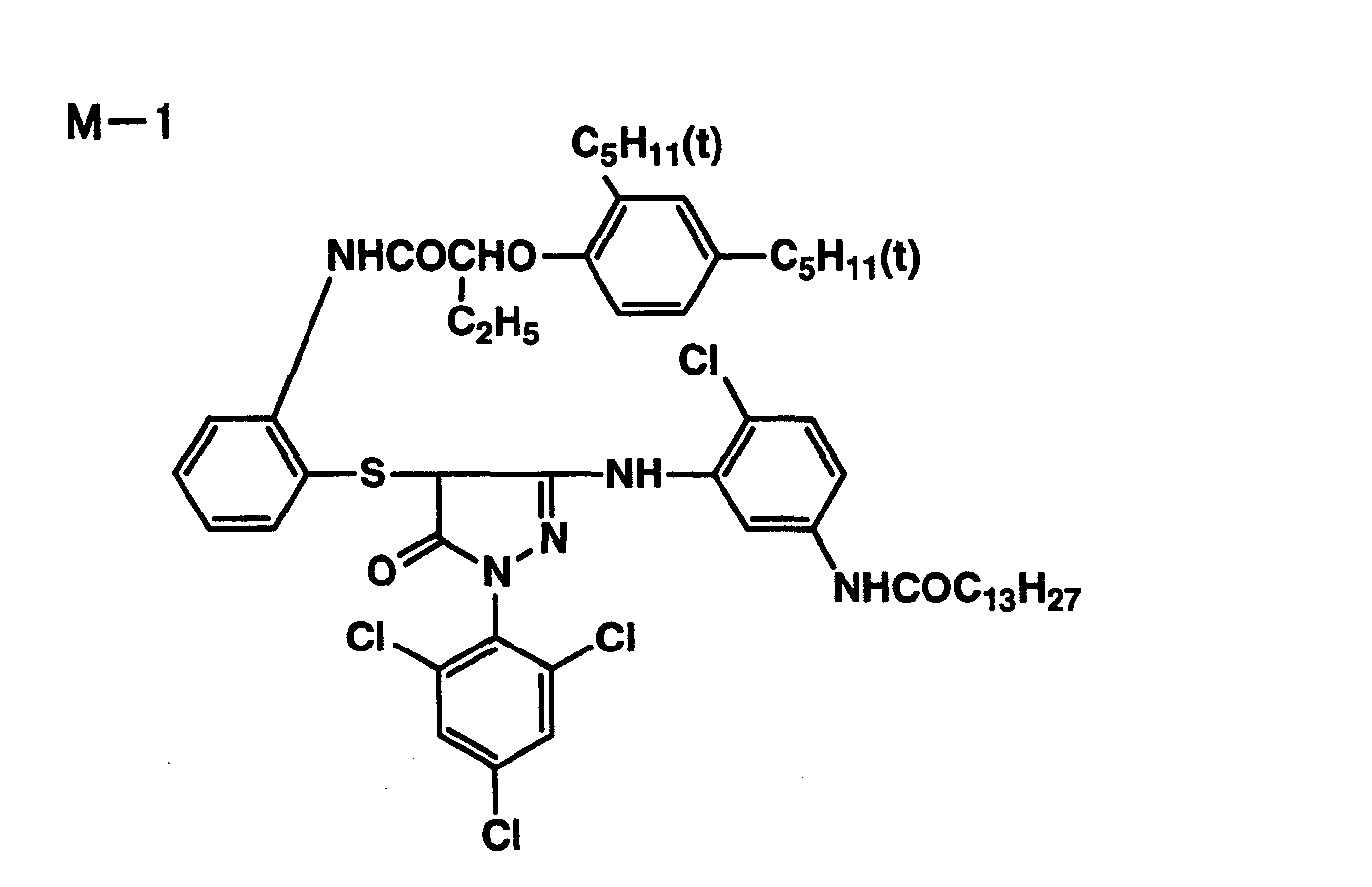

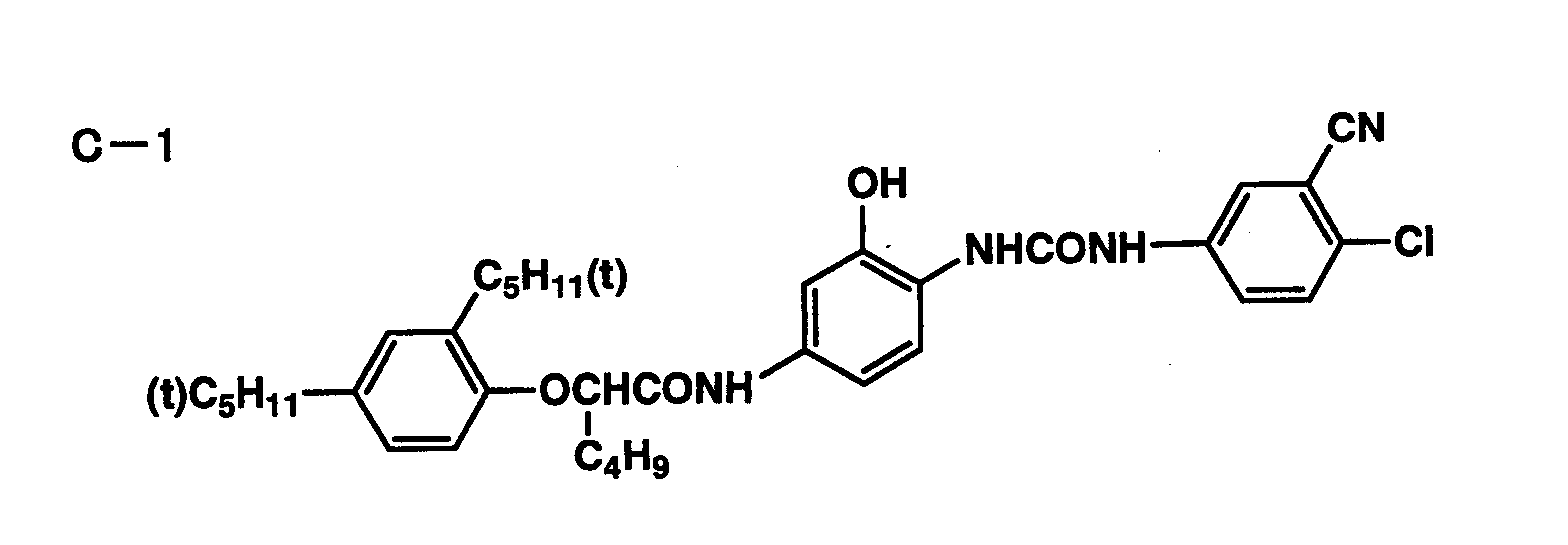

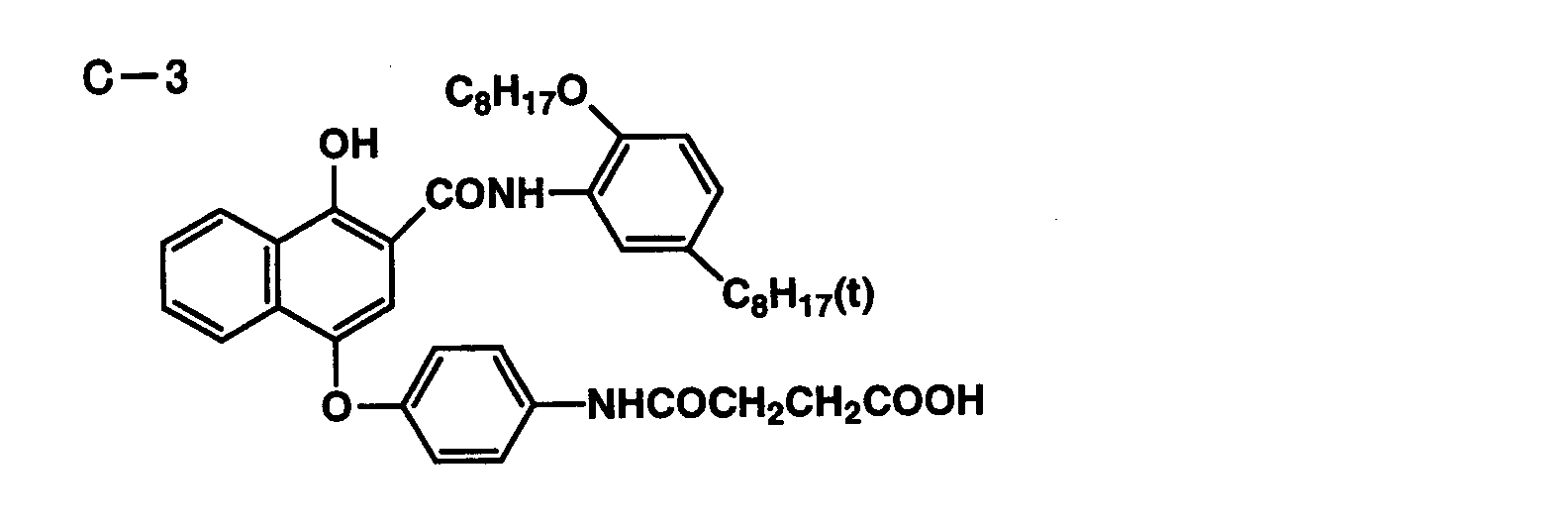


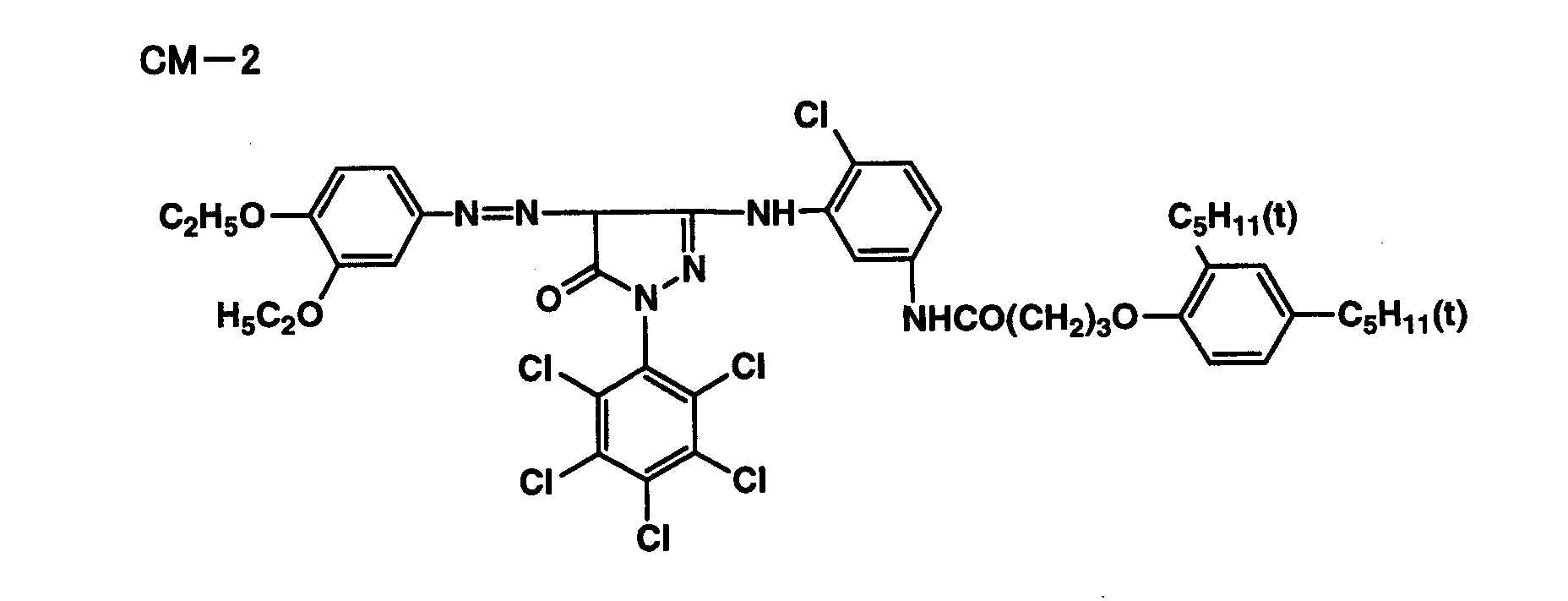
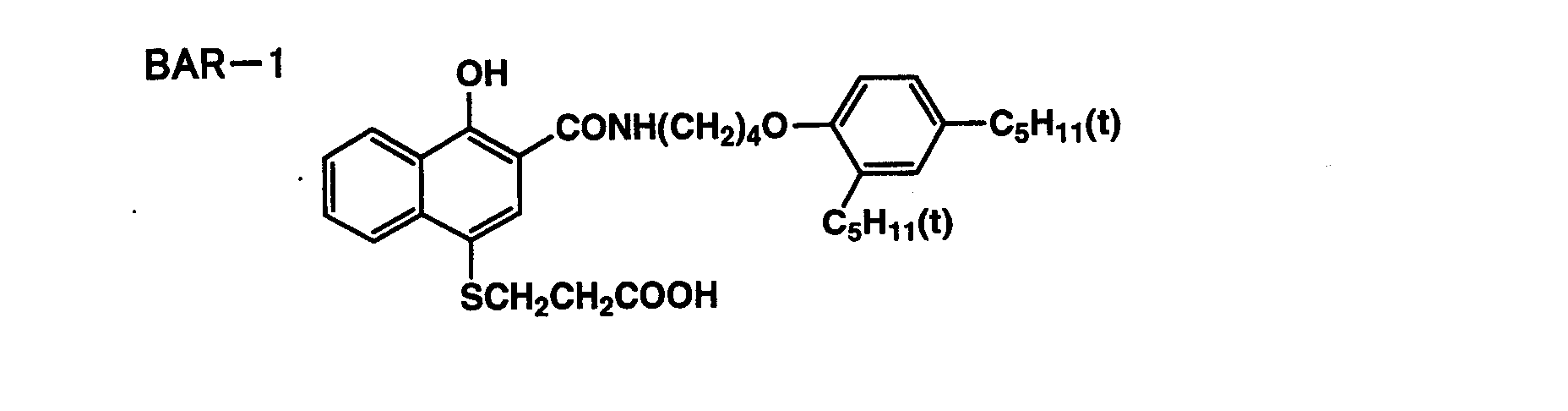
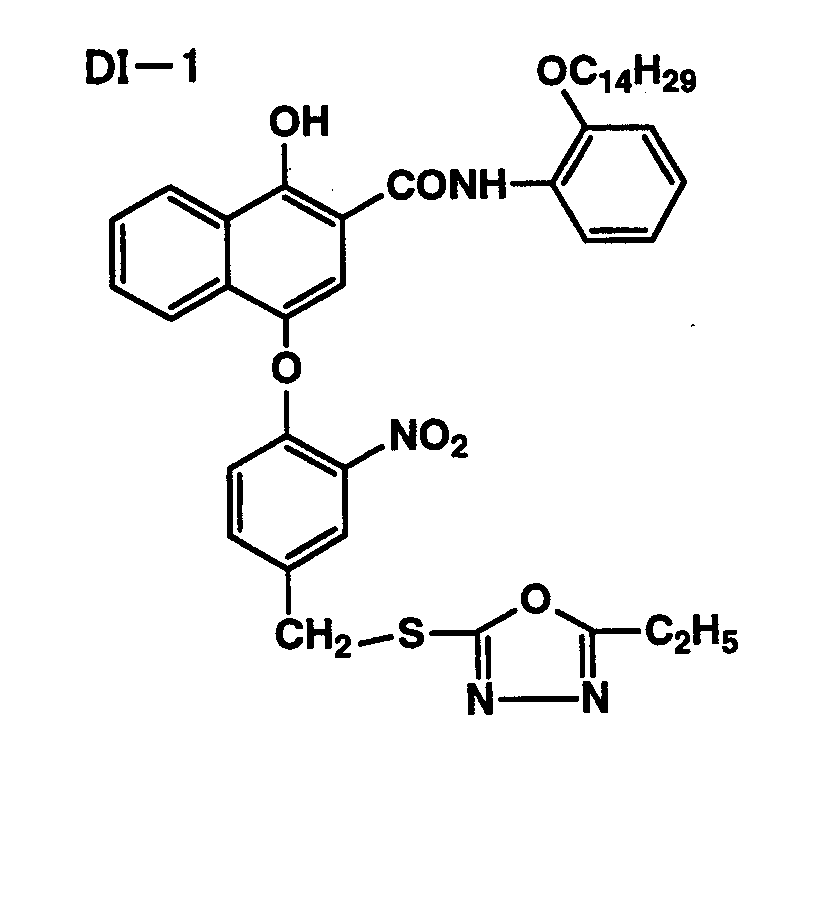


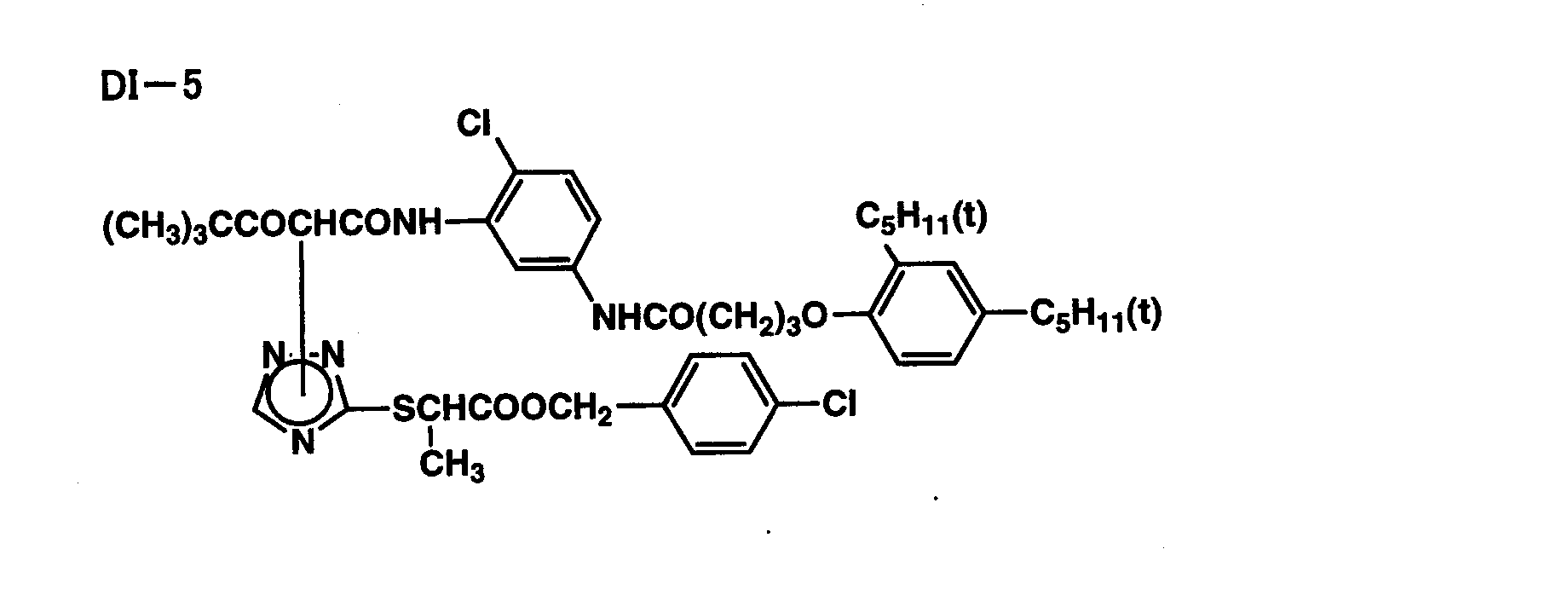

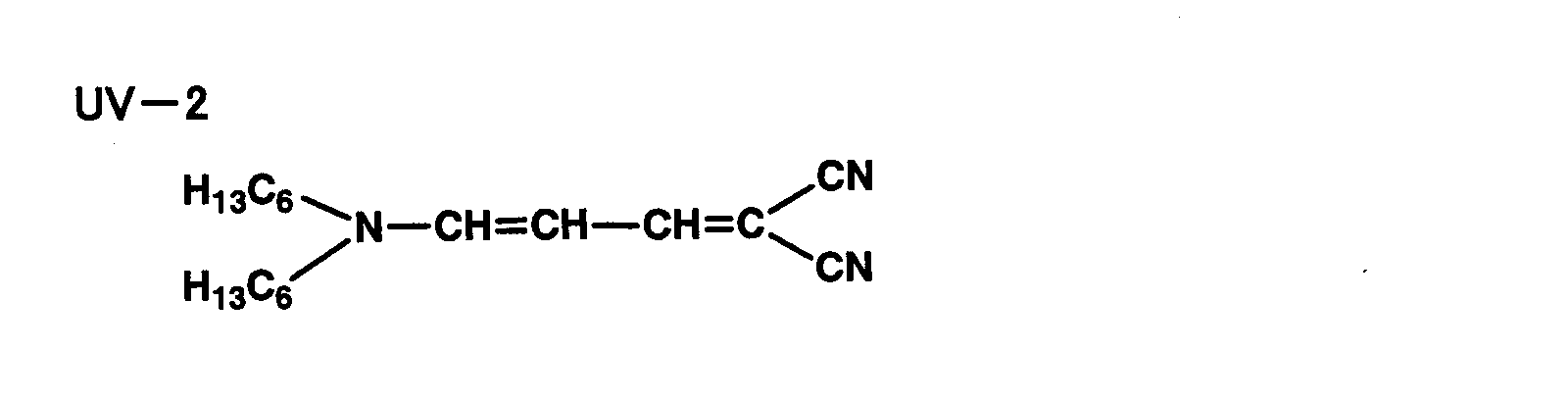


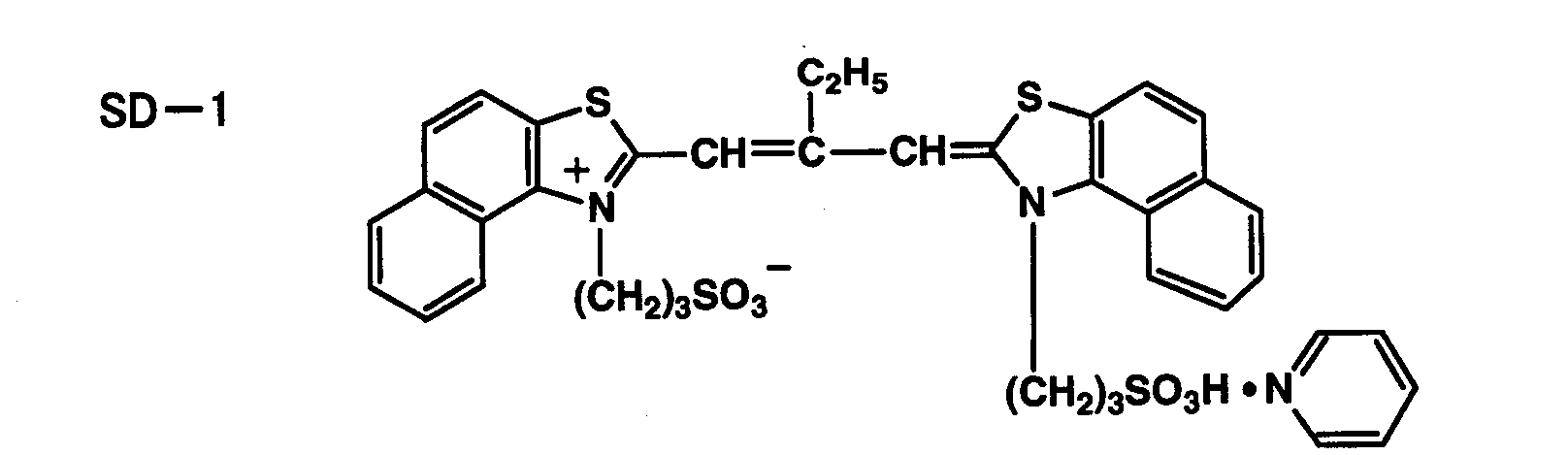


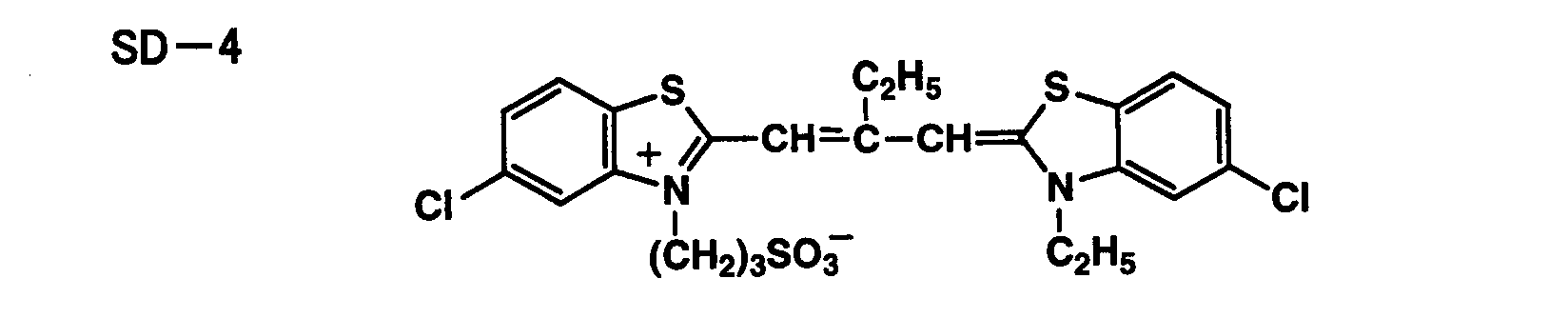
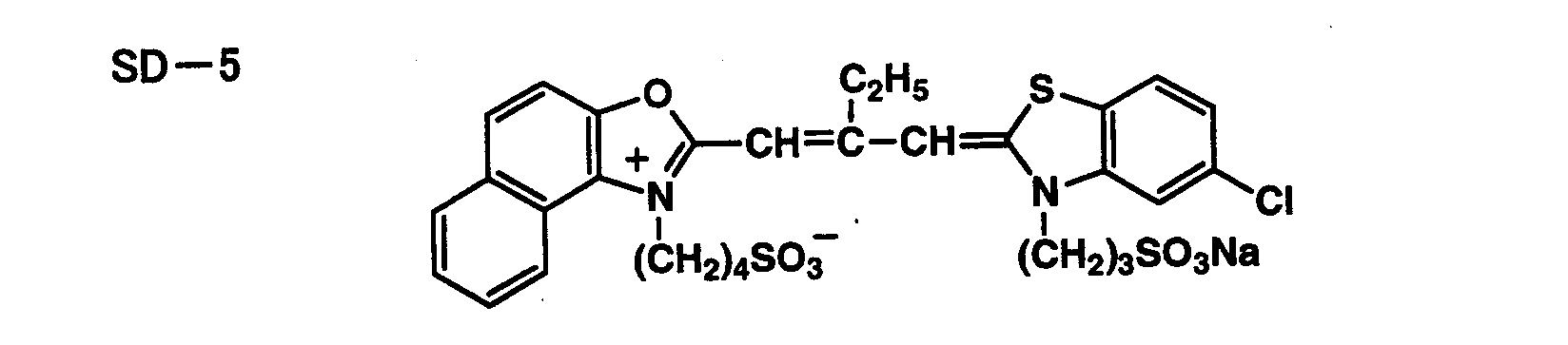
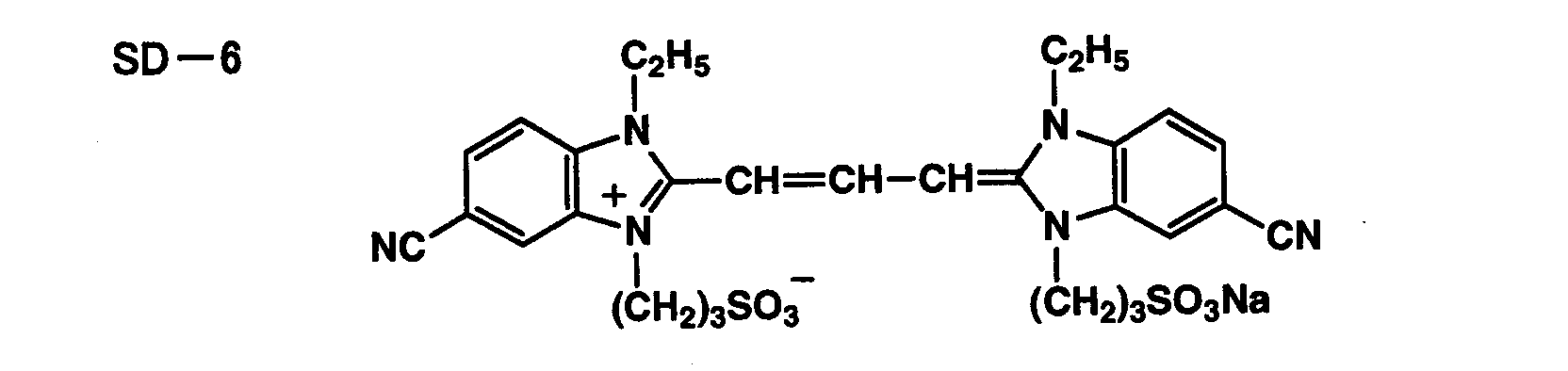
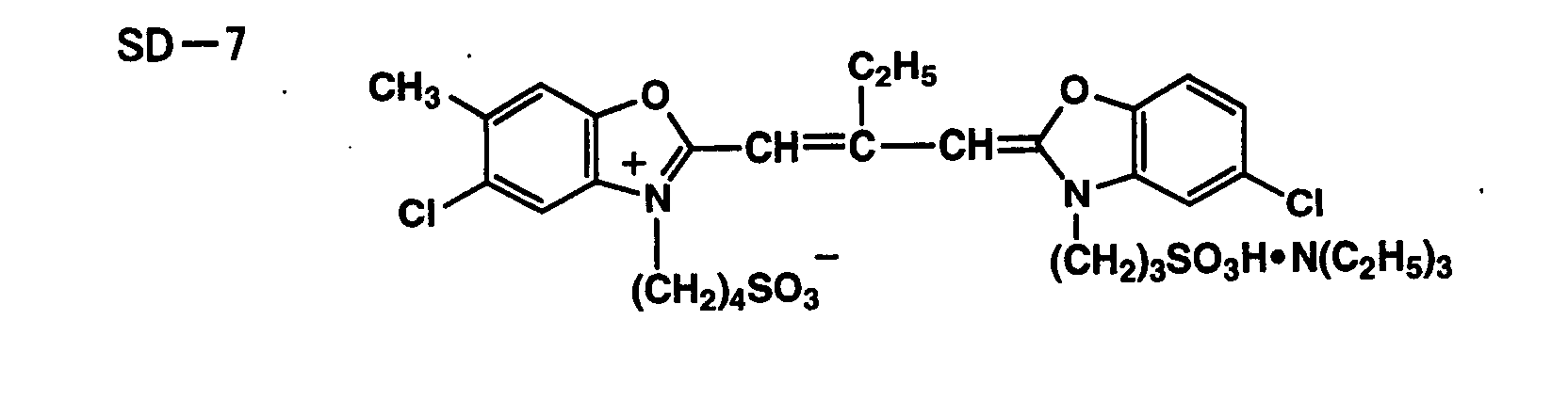
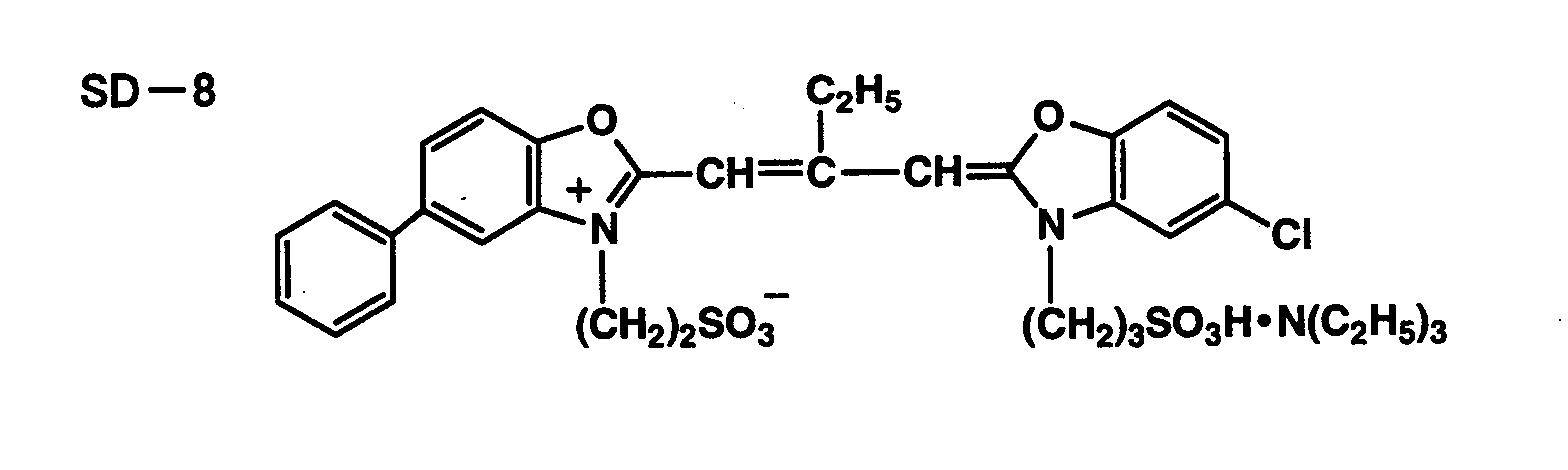
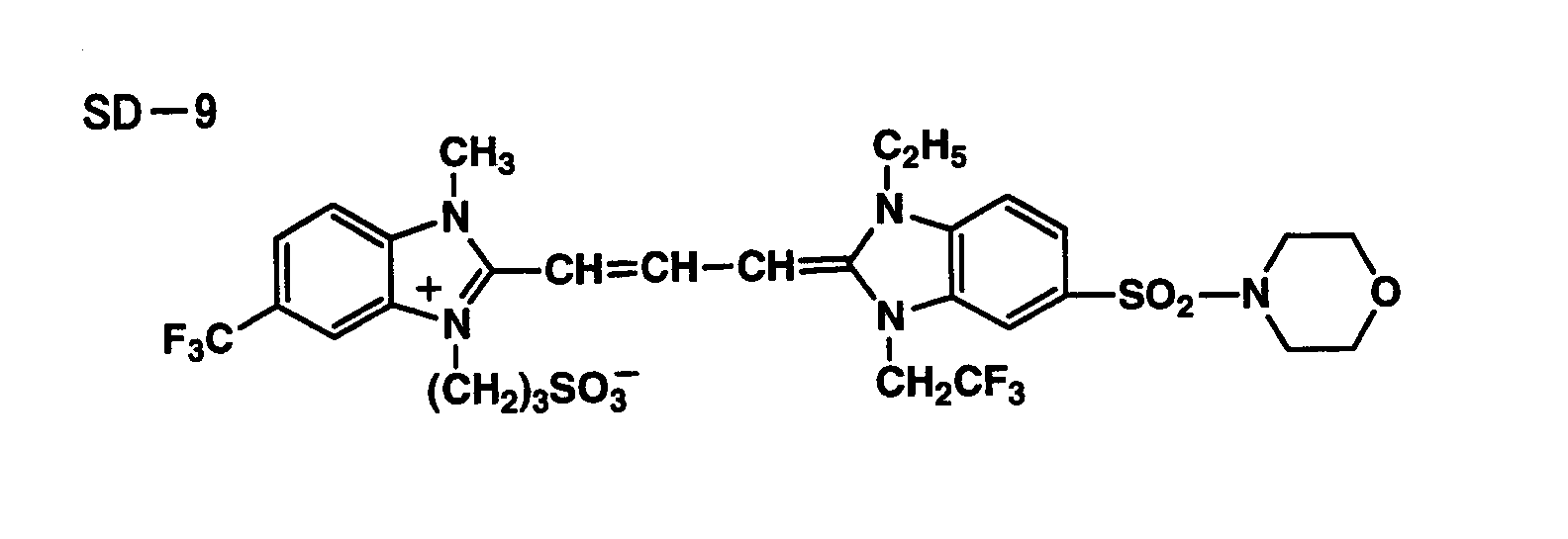
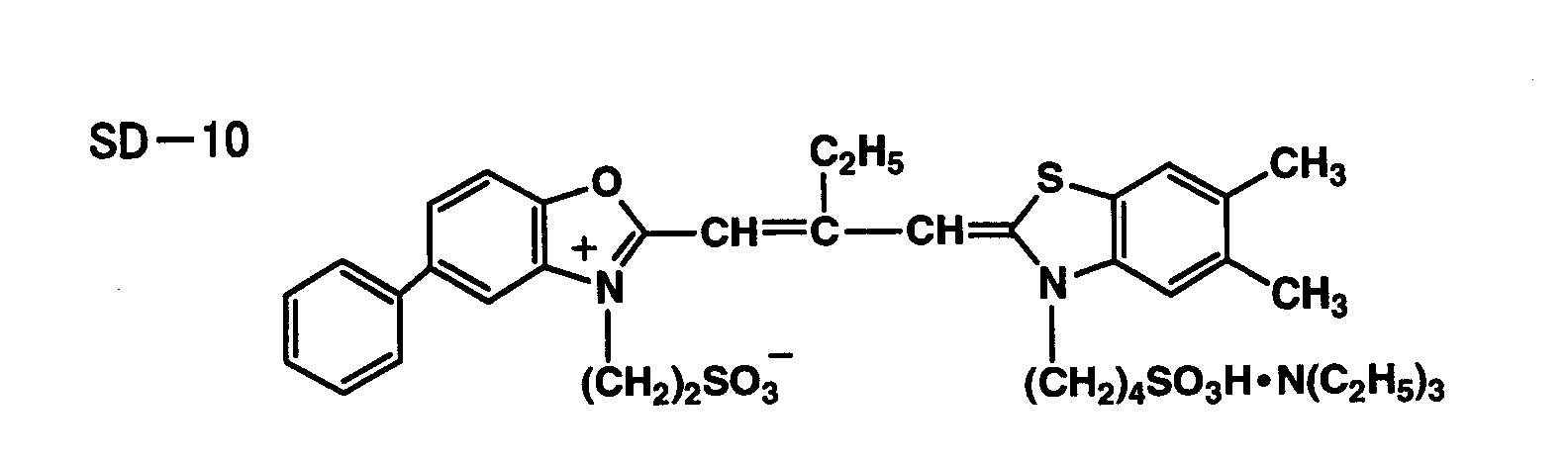
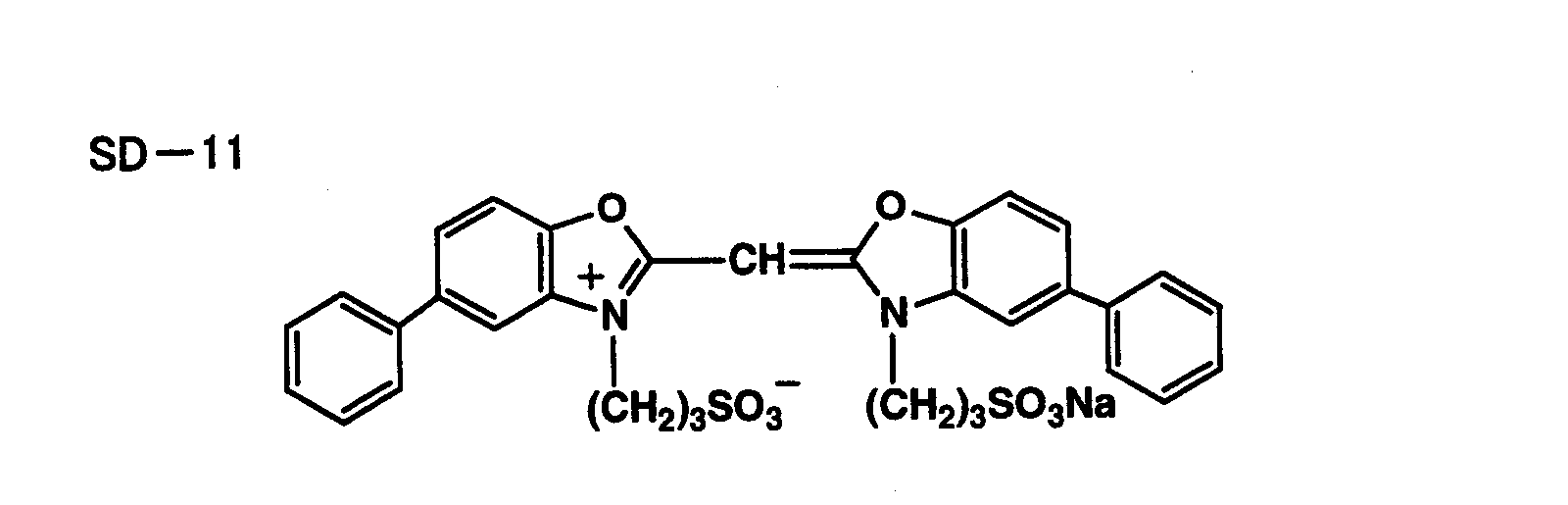
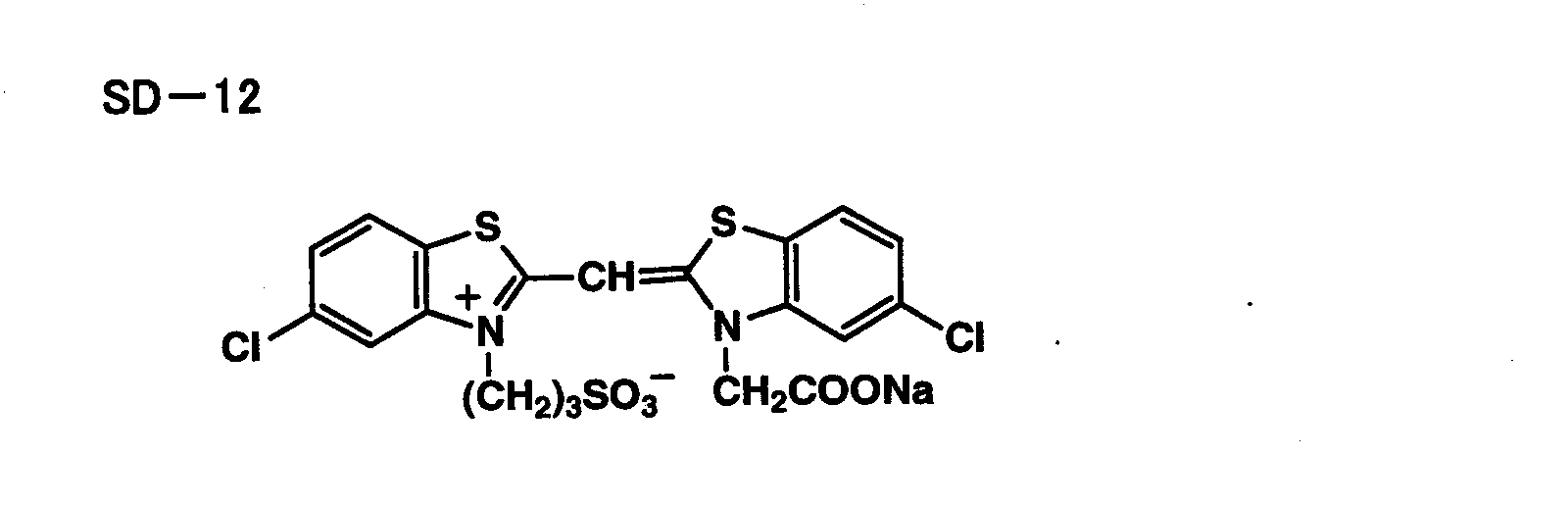


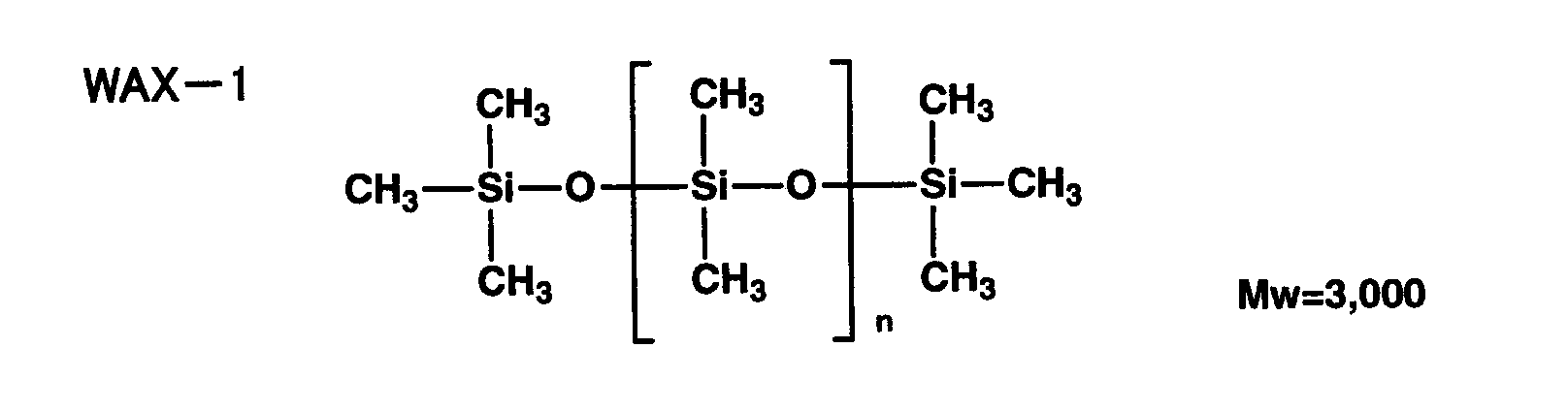

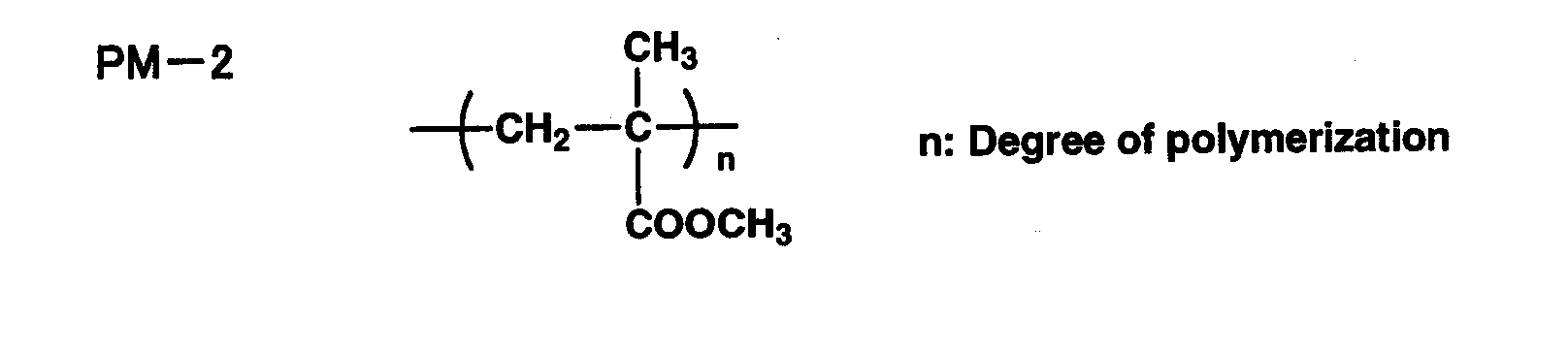
-
- Samples 102 through 123 were prepared in the same manner as Sample 101, except that in the 7th layer (intermediate speed green-sensitive layer), magenta coupler (M-1) was replaced by an equimolar amount of a comparative coupler or an inventive coupler, DIR coupler (DI-2) was replaced by an equimolar amount of a comparative DIR coupler or the DIR coupler of formula (III) or (IV), colored coupler (CM-2) was replaced by an equimolar amount of a comparative colored coupler or the colored coupler of formula (V), or the magenta coupler of formula (II) of 2% by weight was added.
Sample No. Magenta Coupler Compd. of Formula (II) DIR Coupler Colored Coupler 101(comp.) M-1 - DI-2 CM-2 102(comp.) M-A - DI-2 CM-2 103(comp.) M-B - DI-2 CM-2 104(comp.) M-1 - DI-A CM-2 105(comp.) M-1 - DI-B CM-2 106(comp.) M-1 - DI-2 CM-A 107(inv.) I-1 - DI-2 CM-2 108(inv.) I-2 - DI-2 CM-2 109(inv.) 1-25 - DI-2 CM-2 110(inv.) I-1 II-1 DI-2 CM-2 111(inv.) I-2 II-2 DI-2 CM-2 112(inv.) I-25 II-1 DI-2 CM-2 113(inv.) I-1 II-2 III-2 CM-2 114(inv.) I-2 - III-3 CM-2 115(inv.) I-25 II-1 III-6 CM-2 116(inv.) I-1 II-1 IV-1 CM-2 117(inv.) I-2 II-2 IV-2 CM-2 118(inv.) I-25 - IV-3 CM-2 119(inv.) I-1 II-1 III-2 V-1 120(inv.) I-2 II-2 IV-1 V-1 121(inv.) I-25 - IV-1 V-6 122(inv.) I-1 II-1 IV-1 V-1 123(inv.) I-1 - DI-2 V-1 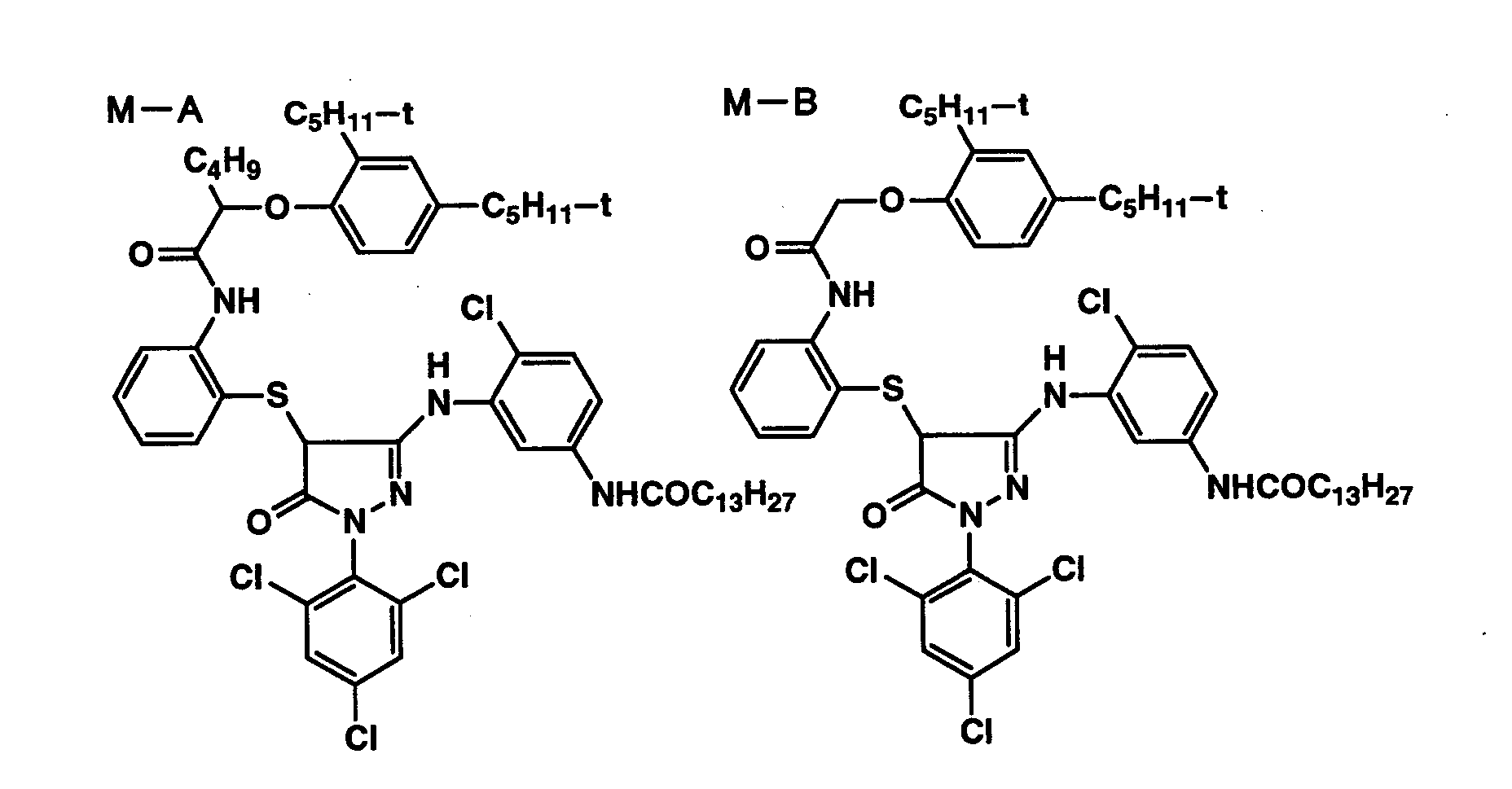


- The thus prepared Samples 101 through 123 were evaluated with respect to photographic characteristics. Sensitivity
- Samples each were exposed to white light through an optical wedge and processed following to the process described below to determine sensitivity. Sensitivity is represented by a relative value of the reciprocal of exposure giving a density of a minimum density (or fog density) plus 0.7, based on the sensitivity of Sample 101 being 100.
- Samples each were cut to a 135-size, put into a patrone, allowed to stand under an atmosphere of 22° C and 55% RH for conditioning and then packed into a plastic resin case months, then processed according to the process described below and evaluated with respect to sensitivity. Results there of are shown by a relative value, based on the sensitivity of Sample 101 before storage being 100.
- After exposed to white light, samples each were processed according to the process described below. The thus obtained samples were kept for 3 days under an atmosphere of 50° C and 80% RH and density variation was determined with respect to a magenta density of 1.0 before storage. In this case, "+" refers to sensitization and "-" refers to desensitization.
- Evaluation results are shown in Table 2.
Processing: Processing step Time Temperature Replenishing rate Color developing 3 min. 15 sec. 38±0.3° C 780 ml Bleaching 45 sec. 38±2.0° C 150 ml Fixing 1 min. 30 sec. 38±2.0° C 830 ml Stabilizing 1 min. 38±5.0° C 830 ml Drying 1 min. 55±5.0° C - - A color developer, bleach, fixer and stabilizer each were prepared according to the following formulas.
- Color developer and replenisher thereof:
Worker Replenisher Water 800 ml 800 ml Potassium carbonate 30 g 35 g Sodium hydrogencarbonate 2.5 g 3.0 g Potassium sulfite 3.0 g 5.0 g Sodium bromide 1.3 g 0.4 g Potassium iodide 1.2 mg - Hydroxylamine sulfate 2.5 g 3.1 g Sodium chloride 0.6 g - 4-Amino-3-methyl-N-(β-hydroxyethyl)-aniline sulfate 4.5 g 6.3 g Diethylenetriaminepentaacetic acid 3.0 g 3.0 g Potassium hydroxide 1.2 g - Water was added to make 1 liter in total, and the pH of the developer and its replenisher were each adjusted to 10.06 and 10.18, respectively with potassium hydroxide and sulfuric acid.
- Bleach and replenisher thereof:
Worker Replenisher Water 700 ml 700 ml Ammonium iron (III) 1,3-diaminopropanetetraacetic acid 125 g 175 g Ethylenediaminetetraacetic acid 2 g 2 g Sodium nitrate 40 g 50 g Ammonium bromide 150 g 200 g Glacial acetic acid 40 g 56 g - Water was added to make 1 liter in total and the pH of the bleach and replenisher thereof were adjusted to 4.4 and 4.0, respectively, with ammoniacal water or glacial acetic acid.
- Fixer and replenisher thereof:
Worker Replenisher Water 800 ml 800 ml Ammonium thiocyanate 120 g 150 g Ammonium thiosulfate 150 g 180 g Sodium sulfite 15 g 20 g Ethylenediaminetetraacetic acid 2 g 2 g - Water was added to make 1 liter in total and the pH of the fixer and replenisher thereof were adjusted to 6.2 and 6.5, respectively, with ammoniacal water or glacial acetic acid.
- Stabilizer and replenisher thereof:
Water 900 ml p-Octylphenol/ethyleneoxide (10 mol) adduct 2.0 g Dimethylolurea 0.5 g Hexamethylenetetramine 0.2 g 1,2-benzoisothiazoline-3-one 0.1 g Siloxane (L-77, product by UCC) 0.1 g Ammoniacal water 0.5 ml - Water was added to make 1 liter in total and the pH thereof was adjusted to 8.5 with ammoniacal water or sulfuric acid (50%).
Sample No. Sensitivity Raw Stock stability Image storage stability 101(comp.) 100 86 +0.06 102(comp.) 98 82 +0.06 103(comp.) 94 80 +0.08 104(comp.) 103 85 +0.07 105(comp.) 104 86 +0.06 106(comp.) 98 86 +0.06 107(inv.) 102 96 +0.03 108(inv.) 103 95 +0.04 109(inv.) 106 100 +0.04 110(inv.) 100 96 +0.03 111(inv.) 102 98 +0.04 112(inv.) 104 101 +0.03 113(inv.) 104 99 +0.02 114(inv.) 106 100 +0.02 115(inv.) 108 104 +0.02 116(inv.) 110 106 +0.02 117(inv.) 110 105 +0.02 118(inv.) 106 101 +0.03 119(inv.) 104 102 +0.02 120(inv.) 109 106 +0.02 121(inv.) 110 107 +0.02 122(inv.) 110 108 +0.01 123(inv.) 102 99 +0.03 - As can be seen from Table 2, Samples Nos. 107 though 123 according to this invention exhibited little variation in sensitivity after raw stock keeping and little variation in image density after storage, as compared to Sample Nos. 101 through 106.
Claims (18)
- A silver halide color photographic light sensitive material comprising a support having thereon a blue-sensitive silver halide emulsion layer, a green-sensitive silver halide emulsion layer and a red-sensitive silver halide emulsion layers, wherein at least one of the silver halide emulsion layers contains a coupler represented by the following formula (I):wherein R11 represents a secondary or tertiary alkyl group, or a cycloalkyl group; R12 represents an aryloxy group; R13 represents a hydrogen atom, an alkyl group, a cycloalkyl group, an aryl group or a heterocyclic group; R14 represents a halogen atom or an alkoxy group; R15, R16 and R17 independently represent a substituent; k1 is an integer of 0 to 5; m1 and n1 are each an integer of 0 to 4.

- The silver halide color photographic material of claim 1, wherein R11 is a secondary alkyl group.
- The silver halide color photographic material of claim 1, wherein R12 is a substituted phenoxy group.
- The silver halide color photographic material of claim 3, wherein R12 is a phenoxy group substituted by at least one substituent selected from the group consisting of an alkyl group, a cycloalkyl group, an alkoxy group, a halogen atom and an alkoxycarbonyl group.
- The silver halide color photographic material of claim 1, wherein R13 is a hydrogen atom.
- The silver halide color photographic material of claim 1, wherein R14 is a chlorine atom or a methoxy group.
- The silver halide color photographic material of claim 1, wherein R15 is a halogen atom.
- The silver halide color photographic material of claim 1, wherein R16 is an acylamino group, an oxycarbonyl group, a carbamoyl group, a sulfonyl group or a sulfamoyl group.
- The silver halide color photographic material of claim 1, wherein R17 is a halogen atom.
- The silver halide color photographic material of claim 1, wherein the compound of formula (I) is contained in an amount of 1x10⁻³ to 8x10⁻¹ mol/mol Ag.
- The silver halide color photographic material of claim 1, wherein the silver halide emulsion layer containing the coupler represented by formula (I) or another silver halide emulsion layer having the same color-sensitivity as the silver halide emulsion layer containing the coupler represented by formula (I) contains a compound represented by the following formula (II):wherein R21 and R24 represent a secondary or tertiary alkyl group, or a cycloalkyl group; R22 and R25 represent an aryloxy group; R23 and R26 represent a hydrogen atom, an alkyl group, a cycloalkyl group, an aryl group or a heterocyclic group; R27 and R28 independently represent a substituent; m2 and n2 are each an integer of 0 to 4.

- The silver halide color photographic material of claim 11, wherein the compound of formula (II) is contained in an amount of 0.1 to 10% by weight, based on the compound of formula (1).
- The silver halide color photographic material of claim 1, wherein the silver halide emulsion layer containing the coupler represented by formula (I) or another silver halide emulsion layer having the same color-sensitivity as the silver halide emulsion layer containing the coupler represented by formula (I) contains a compound represented by the following formula (III):wherein W represents a coupler moiety capable of forming a dye capable of being leached out of the photographic material upon reaction with an oxidation product of a color developing agent; TIME represents a timing group capable of releasing an inhibitor residue DI after being released from W upon reaction with an oxidation product of a color developing agent; and n3 is an integer of 0, 1 and 2.
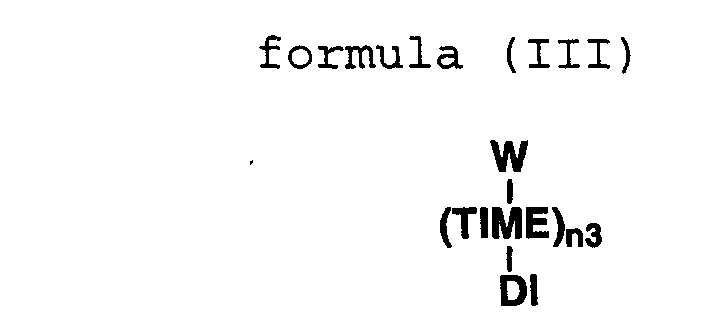
- The silver halide color photographic material of claim 13, wherein the compound of formula (III) is contained in an amount of 1x10⁻³ to 8x10⁻¹ mol/mol Ag.
- The silver halide color photographic material of claim 1, wherein the silver halide emulsion layer containing the coupler represented by formula (I) or another silver halide emulsion layer having the same color-sensitivity as the silver halide emulsion layer containing the coupler represented by formula (I) contains a compound represented by the following formula (IV):wherein Y represents an yellow coupler moiety capable of forming an yellow dye upon reaction with an oxidation product of a color developing agent; TIME represents a timing group capable of releasing an inhibitor residue DI after being released from Y upon reaction with an oxidation product of a color developing agent; and n4 is an integer of 0, 1 and 2.

- The silver halide color photographic material of claim 15, wherein the compound of formula (IV) is contained in an amount of 1x10⁻⁵ to 5x10⁻¹ mol/mol Ag.
- The silver halide color photographic material of claim 1, wherein the silver halide emulsion layer containing the coupler represented by formula (I) or another silver halide emulsion layer having the same color-sensitivity as the silver halide emulsion layer containing the coupler represented by formula (I) contains a compound represented by the following formula (V):wherein R51 and R52 independently represent a secondary or tertiary alkyl group or a cycloalkyl group; R53 represents a halogen atom or an alkoxy group; R54 and R55 independently represent a substituent; k5 is an integer of 0 to 5; and m5 is an integer of 0 to 4.

- The silver halide color photographic halide material of claim 17, wherein the compound of formula (V) is contained in an amount of 5 to 50 mol%, based on the coupler of formula (I).
Applications Claiming Priority (2)
| Application Number | Priority Date | Filing Date | Title |
|---|---|---|---|
| JP35750199 | 1999-12-16 | ||
| JP35750199A JP3835091B2 (en) | 1999-12-16 | 1999-12-16 | Silver halide color photographic light-sensitive material |
Publications (2)
| Publication Number | Publication Date |
|---|---|
| EP1109061A1 true EP1109061A1 (en) | 2001-06-20 |
| EP1109061B1 EP1109061B1 (en) | 2004-06-09 |
Family
ID=18454453
Family Applications (1)
| Application Number | Title | Priority Date | Filing Date |
|---|---|---|---|
| EP00311233A Expired - Lifetime EP1109061B1 (en) | 1999-12-16 | 2000-12-15 | Silver halide color photographic light sensitive material |
Country Status (4)
| Country | Link |
|---|---|
| US (1) | US6403293B2 (en) |
| EP (1) | EP1109061B1 (en) |
| JP (1) | JP3835091B2 (en) |
| DE (1) | DE60011378D1 (en) |
Citations (6)
| Publication number | Priority date | Publication date | Assignee | Title |
|---|---|---|---|---|
| US4868099A (en) * | 1987-09-26 | 1989-09-19 | Agfa-Gevaert Aktiengesellschaft | Color photographic recording material with thiosulphonic acid ester |
| US5262292A (en) * | 1991-04-23 | 1993-11-16 | Eastman Kodak Company | Photographic elements containing pyrazolone couplers and process |
| EP0628868A1 (en) * | 1993-05-24 | 1994-12-14 | Eastman Kodak Company | Photographic elements containing magenta couplers and process for using same |
| EP0686872A1 (en) * | 1994-06-09 | 1995-12-13 | Konica Corporation | Silver halide light-sensitive color photographic material |
| EP0730197A2 (en) * | 1995-02-28 | 1996-09-04 | Konica Corporation | A silver halide color photographic light sensitive material |
| US5866313A (en) * | 1995-11-30 | 1999-02-02 | Fuji Photo Film Co., Ltd. | Silver halide photographic light-sensitive material |
Family Cites Families (5)
| Publication number | Priority date | Publication date | Assignee | Title |
|---|---|---|---|---|
| JPS58162949A (en) * | 1982-03-20 | 1983-09-27 | Konishiroku Photo Ind Co Ltd | Color photographic sensitive silver halide material |
| US4853319A (en) * | 1986-12-22 | 1989-08-01 | Eastman Kodak Company | Photographic silver halide element and process |
| US4782012A (en) * | 1987-07-17 | 1988-11-01 | Eastman Kodak Company | Photographic material containing a novel dir-compound |
| JPH07117737B2 (en) * | 1988-08-12 | 1995-12-18 | 富士写真フイルム株式会社 | Processing method of silver halide color photographic light-sensitive material |
| US5447830A (en) * | 1991-04-23 | 1995-09-05 | Eastman Kodak Company | 3-anilino pyrazolone magenta couplers and process |
-
1999
- 1999-12-16 JP JP35750199A patent/JP3835091B2/en not_active Expired - Fee Related
-
2000
- 2000-12-08 US US09/733,376 patent/US6403293B2/en not_active Expired - Fee Related
- 2000-12-15 EP EP00311233A patent/EP1109061B1/en not_active Expired - Lifetime
- 2000-12-15 DE DE60011378T patent/DE60011378D1/en not_active Expired - Lifetime
Patent Citations (6)
| Publication number | Priority date | Publication date | Assignee | Title |
|---|---|---|---|---|
| US4868099A (en) * | 1987-09-26 | 1989-09-19 | Agfa-Gevaert Aktiengesellschaft | Color photographic recording material with thiosulphonic acid ester |
| US5262292A (en) * | 1991-04-23 | 1993-11-16 | Eastman Kodak Company | Photographic elements containing pyrazolone couplers and process |
| EP0628868A1 (en) * | 1993-05-24 | 1994-12-14 | Eastman Kodak Company | Photographic elements containing magenta couplers and process for using same |
| EP0686872A1 (en) * | 1994-06-09 | 1995-12-13 | Konica Corporation | Silver halide light-sensitive color photographic material |
| EP0730197A2 (en) * | 1995-02-28 | 1996-09-04 | Konica Corporation | A silver halide color photographic light sensitive material |
| US5866313A (en) * | 1995-11-30 | 1999-02-02 | Fuji Photo Film Co., Ltd. | Silver halide photographic light-sensitive material |
Also Published As
| Publication number | Publication date |
|---|---|
| DE60011378D1 (en) | 2004-07-15 |
| EP1109061B1 (en) | 2004-06-09 |
| US20010008749A1 (en) | 2001-07-19 |
| JP2001174960A (en) | 2001-06-29 |
| JP3835091B2 (en) | 2006-10-18 |
| US6403293B2 (en) | 2002-06-11 |
Similar Documents
| Publication | Publication Date | Title |
|---|---|---|
| JPS5814671B2 (en) | Color photographic material | |
| US4009038A (en) | Silver halide color photographic materials | |
| US4187110A (en) | Silver halide photographic light-sensitive material | |
| US4203768A (en) | Silver halide color photographic material and method for formation of color photographic images | |
| US5610003A (en) | Two-equivalent magenta photographic couplers with activity-modifying ballasting groups | |
| EP1109061B1 (en) | Silver halide color photographic light sensitive material | |
| JPS61278854A (en) | Silver halide color photosensitive material | |
| JP2002221775A (en) | Photographic material for silver halide color | |
| US5304463A (en) | Silver halide color photographic material | |
| US6027867A (en) | Silver halide color photographic light sensitive material | |
| JP2001075245A (en) | Silver halide color photographic sensitive material | |
| JPH0422945A (en) | Silver halide color photographic sensitive material | |
| JP3245762B2 (en) | Silver halide color photographic light-sensitive material | |
| JPH0485537A (en) | Silver halide color photographic sensitive material | |
| JPH0588324A (en) | Silver halide color photographic sensitive material | |
| JP2001051382A (en) | Silver halide photographic sensitive material | |
| JPS62217242A (en) | Silver halide photographic sensitive material | |
| JPH05150429A (en) | Silver halide color photographic sensitive material | |
| JP2000275797A (en) | Silver halide photographic sensitive material | |
| JPH06186705A (en) | Silver halide color photographic sensitive material | |
| JPH0450835A (en) | Silver halide photographic sensitive material | |
| JP2000162748A (en) | Photographic coupler and silver halide color photo- graphic sensitive material | |
| JPH04178645A (en) | Silver halide color photographic sensitive material | |
| JPH09304897A (en) | Silver halide photographic sensitive material containing novel cyan coupler | |
| JPH06230529A (en) | Silver halide color photographic sensitive material |
Legal Events
| Date | Code | Title | Description |
|---|---|---|---|
| PUAI | Public reference made under article 153(3) epc to a published international application that has entered the european phase |
Free format text: ORIGINAL CODE: 0009012 |
|
| AK | Designated contracting states |
Kind code of ref document: A1 Designated state(s): DE FR GB NL |
|
| AX | Request for extension of the european patent |
Free format text: AL;LT;LV;MK;RO;SI |
|
| 17P | Request for examination filed |
Effective date: 20011123 |
|
| AKX | Designation fees paid |
Free format text: DE FR GB NL |
|
| GRAP | Despatch of communication of intention to grant a patent |
Free format text: ORIGINAL CODE: EPIDOSNIGR1 |
|
| GRAS | Grant fee paid |
Free format text: ORIGINAL CODE: EPIDOSNIGR3 |
|
| GRAA | (expected) grant |
Free format text: ORIGINAL CODE: 0009210 |
|
| AK | Designated contracting states |
Kind code of ref document: B1 Designated state(s): DE FR GB NL |
|
| PG25 | Lapsed in a contracting state [announced via postgrant information from national office to epo] |
Ref country code: NL Free format text: LAPSE BECAUSE OF FAILURE TO SUBMIT A TRANSLATION OF THE DESCRIPTION OR TO PAY THE FEE WITHIN THE PRESCRIBED TIME-LIMIT Effective date: 20040609 Ref country code: FR Free format text: LAPSE BECAUSE OF FAILURE TO SUBMIT A TRANSLATION OF THE DESCRIPTION OR TO PAY THE FEE WITHIN THE PRESCRIBED TIME-LIMIT Effective date: 20040609 |
|
| REG | Reference to a national code |
Ref country code: GB Ref legal event code: FG4D |
|
| REF | Corresponds to: |
Ref document number: 60011378 Country of ref document: DE Date of ref document: 20040715 Kind code of ref document: P |
|
| PG25 | Lapsed in a contracting state [announced via postgrant information from national office to epo] |
Ref country code: DE Free format text: LAPSE BECAUSE OF FAILURE TO SUBMIT A TRANSLATION OF THE DESCRIPTION OR TO PAY THE FEE WITHIN THE PRESCRIBED TIME-LIMIT Effective date: 20040910 |
|
| NLV1 | Nl: lapsed or annulled due to failure to fulfill the requirements of art. 29p and 29m of the patents act | ||
| PGFP | Annual fee paid to national office [announced via postgrant information from national office to epo] |
Ref country code: GB Payment date: 20041215 Year of fee payment: 5 |
|
| PLBE | No opposition filed within time limit |
Free format text: ORIGINAL CODE: 0009261 |
|
| STAA | Information on the status of an ep patent application or granted ep patent |
Free format text: STATUS: NO OPPOSITION FILED WITHIN TIME LIMIT |
|
| 26N | No opposition filed |
Effective date: 20050310 |
|
| EN | Fr: translation not filed | ||
| PG25 | Lapsed in a contracting state [announced via postgrant information from national office to epo] |
Ref country code: GB Free format text: LAPSE BECAUSE OF NON-PAYMENT OF DUE FEES Effective date: 20051215 |
|
| GBPC | Gb: european patent ceased through non-payment of renewal fee |
Effective date: 20051215 |