EP1108998A1 - Method and apparatus for predicting temperatures of a food product - Google Patents
Method and apparatus for predicting temperatures of a food product Download PDFInfo
- Publication number
- EP1108998A1 EP1108998A1 EP00311166A EP00311166A EP1108998A1 EP 1108998 A1 EP1108998 A1 EP 1108998A1 EP 00311166 A EP00311166 A EP 00311166A EP 00311166 A EP00311166 A EP 00311166A EP 1108998 A1 EP1108998 A1 EP 1108998A1
- Authority
- EP
- European Patent Office
- Prior art keywords
- item
- temperature
- thermal shock
- equalised
- food
- Prior art date
- Legal status (The legal status is an assumption and is not a legal conclusion. Google has not performed a legal analysis and makes no representation as to the accuracy of the status listed.)
- Withdrawn
Links
- 238000000034 method Methods 0.000 title claims abstract description 38
- 235000013305 food Nutrition 0.000 title claims description 80
- 230000035939 shock Effects 0.000 claims abstract description 45
- 238000012545 processing Methods 0.000 claims abstract description 12
- 238000005259 measurement Methods 0.000 claims description 10
- 238000010438 heat treatment Methods 0.000 claims description 8
- 239000007788 liquid Substances 0.000 claims description 5
- 230000003287 optical effect Effects 0.000 claims description 5
- IJGRMHOSHXDMSA-UHFFFAOYSA-N Atomic nitrogen Chemical compound N#N IJGRMHOSHXDMSA-UHFFFAOYSA-N 0.000 claims description 4
- CURLTUGMZLYLDI-UHFFFAOYSA-N Carbon dioxide Chemical compound O=C=O CURLTUGMZLYLDI-UHFFFAOYSA-N 0.000 claims description 4
- 238000012417 linear regression Methods 0.000 claims description 3
- 229910002092 carbon dioxide Inorganic materials 0.000 claims description 2
- 239000001569 carbon dioxide Substances 0.000 claims description 2
- 229910052757 nitrogen Inorganic materials 0.000 claims description 2
- 238000001816 cooling Methods 0.000 description 6
- 239000011159 matrix material Substances 0.000 description 6
- 238000010411 cooking Methods 0.000 description 5
- 238000010586 diagram Methods 0.000 description 4
- 238000009529 body temperature measurement Methods 0.000 description 3
- 238000004364 calculation method Methods 0.000 description 3
- 230000007423 decrease Effects 0.000 description 3
- 238000007710 freezing Methods 0.000 description 3
- 230000008014 freezing Effects 0.000 description 3
- 230000001939 inductive effect Effects 0.000 description 2
- 238000005057 refrigeration Methods 0.000 description 2
- 239000000523 sample Substances 0.000 description 2
- 238000012546 transfer Methods 0.000 description 2
- 239000002699 waste material Substances 0.000 description 2
- 230000001154 acute effect Effects 0.000 description 1
- 238000013459 approach Methods 0.000 description 1
- 238000011437 continuous method Methods 0.000 description 1
- 238000010924 continuous production Methods 0.000 description 1
- 238000012937 correction Methods 0.000 description 1
- 238000011438 discrete method Methods 0.000 description 1
- 230000000694 effects Effects 0.000 description 1
- 238000002474 experimental method Methods 0.000 description 1
- 230000008713 feedback mechanism Effects 0.000 description 1
- 235000013611 frozen food Nutrition 0.000 description 1
- 239000007789 gas Substances 0.000 description 1
- 238000003780 insertion Methods 0.000 description 1
- 230000037431 insertion Effects 0.000 description 1
- 238000004519 manufacturing process Methods 0.000 description 1
- 239000000203 mixture Substances 0.000 description 1
- 239000007787 solid Substances 0.000 description 1
- 238000005507 spraying Methods 0.000 description 1
- 238000012360 testing method Methods 0.000 description 1
- 238000010792 warming Methods 0.000 description 1
Images


Classifications
-
- G—PHYSICS
- G01—MEASURING; TESTING
- G01K—MEASURING TEMPERATURE; MEASURING QUANTITY OF HEAT; THERMALLY-SENSITIVE ELEMENTS NOT OTHERWISE PROVIDED FOR
- G01K7/00—Measuring temperature based on the use of electric or magnetic elements directly sensitive to heat ; Power supply therefor, e.g. using thermoelectric elements
- G01K7/42—Circuits effecting compensation of thermal inertia; Circuits for predicting the stationary value of a temperature
-
- A—HUMAN NECESSITIES
- A23—FOODS OR FOODSTUFFS; TREATMENT THEREOF, NOT COVERED BY OTHER CLASSES
- A23L—FOODS, FOODSTUFFS OR NON-ALCOHOLIC BEVERAGES, NOT OTHERWISE PROVIDED FOR; PREPARATION OR TREATMENT THEREOF
- A23L5/00—Preparation or treatment of foods or foodstuffs, in general; Food or foodstuffs obtained thereby; Materials therefor
- A23L5/10—General methods of cooking foods, e.g. by roasting or frying
-
- F—MECHANICAL ENGINEERING; LIGHTING; HEATING; WEAPONS; BLASTING
- F25—REFRIGERATION OR COOLING; COMBINED HEATING AND REFRIGERATION SYSTEMS; HEAT PUMP SYSTEMS; MANUFACTURE OR STORAGE OF ICE; LIQUEFACTION SOLIDIFICATION OF GASES
- F25D—REFRIGERATORS; COLD ROOMS; ICE-BOXES; COOLING OR FREEZING APPARATUS NOT OTHERWISE PROVIDED FOR
- F25D2500/00—Problems to be solved
- F25D2500/04—Calculation of parameters
-
- F—MECHANICAL ENGINEERING; LIGHTING; HEATING; WEAPONS; BLASTING
- F25—REFRIGERATION OR COOLING; COMBINED HEATING AND REFRIGERATION SYSTEMS; HEAT PUMP SYSTEMS; MANUFACTURE OR STORAGE OF ICE; LIQUEFACTION SOLIDIFICATION OF GASES
- F25D—REFRIGERATORS; COLD ROOMS; ICE-BOXES; COOLING OR FREEZING APPARATUS NOT OTHERWISE PROVIDED FOR
- F25D2700/00—Means for sensing or measuring; Sensors therefor
- F25D2700/16—Sensors measuring the temperature of products
Definitions
- This invention relates to a method and apparatus for determining a prediction of the equalised temperature of a food product prior to its reaching its thermal equilibrium. More specifically, this invention is a method and apparatus for predicting such an equalised temperature based on the response of the food product to thermal shocks.
- the food industry produces a large quantity of standardised food products.
- the industry is relying to a greater extent on electronic control systems which monitor various food manufacturing processes and input variables in order to control the quality of the food product as well as to minimise waste and decrease costs.
- One problem associated with the processing of food items is the determination of an equalised temperature of food item.
- the need for temperature measurement is particularly acute in the area of food cooking and/or frying systems where high heat transfer rates result in a significantly hotter surface surrounding a cooler core.
- the general aim is to reach a certain equalised temperature for the entire food item which takes a certain amount of time to achieve while also minimising the amount of energy required to achieve the equalised temperature.
- cryogenically cooled or frozen foods there is a general need for the food items to reach a certain equalised temperature specified by the needs of the food item while using the least amount of cryogen.
- An intrusive method of temperature determination such as the insertion of a temperature probe in to a food item has severe limitations in measuring the equalised temperature of a food item particularly in a continuous food processing environment.
- the temperature probe must be manually inserted into a food item which cannot then be further processed resulting in waste.
- the amount of effort needed to monitor a significant number of food items invasively would be prohibitively expensive.
- the actual equalised temperature can only be measured after a certain amount of time passes, for example ten to twenty minutes, and therefore, a large number of food items could be incorrectly processed before an error in the equalised temperature is detected.
- Another known method of temperature measurement such as a single infrared sensor, would only be capable of measuring the surface temperature of the product and not the equalised temperature throughout the product.
- the method and apparatus should allow the food processor to predict the equalised temperature of the food items immediately after a thermal shock is applied, i.e. cooking or cooling, rather than after they have actually reached their equalised temperature, so that problems with the cooking process or cooling/freezing cryogenic process can be corrected.
- the invention is therefore concerned with the provision of a method and apparatus for continuous prediction of and estimating the equalised temperature of a food item during processing including doing so in conditions of variable air flow and variable temperatures found in food processing.
- a method for predicting the equalised temperature of an item during processing of the item comprising the steps of applying a thermal shock to the item; measuring the surface temperature of the item over time; calculating a predicted value for the equalised temperature of the item based on the rate of change of the surface temperature of the item over time.
- the method advantageously further comprises the steps of applying at least one additional thermal shock to the item and calculating a predicted value for the equalised temperature of the item based on the difference of the rate of change of the surface temperature of the item over time
- the measurement of the surface temperature preferably comprises at least two measurements of the surface temperature of the item over time. More preferably at least two measurements are taken in a continuous manner; alternatively the measurements may be taken in a discrete manner.
- the step of calculating the predicted value preferably uses at least squares, non-linear regression algorithm.
- the method of the invention can advantageously further comprise the step of using the predicted value for the equalised temperature to control the magnitude and/or duration of the thermal shock applied to the item
- a first thermal shock is applied to the item using heat and the predicted value of the equalised temperature is used to control the temperature of the heat applied to the item
- a first thermal shock is applied to the item using heat and the predicted value of the equalised temperature is used to control the duration that the food item is subject to heating, especially when at least two measurements of surface temperature are taken continuously.
- the invention also provides an apparatus for predicting the equalised temperature of an item comprising a means for providing a thermal shock to the item; one or more sensors for determining the surface temperature of the item over time; a means for calculating a predicted value of the equalised temperature of the item based on the rate of change of the surface temperature of the item.
- the apparatus further comprises a conveyor for moving the items from contact with the means for providing thermal shock to the sensor(s).
- the invention provides apparatus having an infrared sensor for measuring the surface temperature of a food item and means for applying a heat transfer shock of known quantity to the food item for a set length of time.
- a heat transfer shock of known quantity to the food item for a set length of time.
- at least two measurements of the surface temperature of the item are taken at specific times after the initial thermal shock and the equalised temperature of the food item is mathematically predicted from the two measurements.
- the thermal shock and surface temperature measurement process is repeated in order to increase the accuracy of the predicted temperature.
- multiple surface temperature readings are taken after each application of thermal shock with feedback mechanisms to alter the magnitude of the thermal shock.
- a plurality of infrared sensors are mounted over a food processing line so that food items pass under the plurality of sensors and an equalised temperature is predicted for a food item based on the readings from the plurality of sensors.
- the information relating to the predicted equalised temperature of the food product is logged in a computer database for use by the food processing system and for purposes of altering the magnitude of additional thermal shocks to the food items.
- Figure 1 a diagrammatic representation of the an apparatus according to the invention.
- Food items 40 placed on a conveyer 60 travel under a first infrared sensor 30 which provides a measure of the surface temperature of the food item 40.
- a thermal shock is applied to the food items 40 through a means for providing a thermal shock 60 which could be a cryogenic sprayer for spraying liquid or vapour phase cryogen on the food items 40 or an infrared heat source for heating the food items 40.
- a thermal shock 60 which could be a cryogenic sprayer for spraying liquid or vapour phase cryogen on the food items 40 or an infrared heat source for heating the food items 40.
- There are many means for providing a thermal shock to the food items 40 including but not limited to infrared, microwave, inductive, convective or conductive heating and mechanical refrigeration or cryogenic cooling or freezing.
- Cryogenic cooling could be accomplished through the use of cryogens such as liquid nitrogen, carbon dioxide snow or liquefied air including synthetic liquid air (SLA).
- cryogens such as liquid nitrogen, carbon dioxide snow or liquefied air including synthetic liquid air (SLA).
- SLA synthetic liquid air
- the variation of the rate of temperature change can be used to indicate the predicted equalised temperature of the product.
- the controller 20 can use the data regarding the predicted equalised temperature of the food product or items in order to control the means for providing a thermal shock to the food items 40.
- the controller 20 could be a programmable logic controller (PLC) or other programmable computer such as a personal computer.
- PLC programmable logic controller
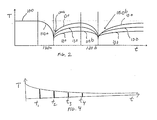
- Reading 100 represents the temperature of a food item prior to application of the thermal shock.
- a thermal shock is applied to the food items which is a cryogenic shock as depicted in Figure 2 such that the temperature of the food item decreases as depicted in portion 110a of the temperature versus time plot of Figure 2.
- a series of temperature readings 130 are taken by infrared sensors 30.
- the readings indicate a warming of the exterior of the food item over time as the heat from the warmer core of the food item is thermally transferred to the exterior of the item.
- An additional thermal shock during time period 120b decreases the temperature of the food item 40 as seen in portion 110b of Figure 2.
- the difference in the rate of change of the temperature readings 130 i.e., the difference between the slopes 150a and 150b is indicative of the core temperature of the product.
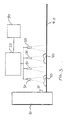
- a preferred embodiment of the invention in which a means for applying a thermal shock is a cooker 10 which heats food items 40.
- the food items 40 are then carried by a conveyor 60 under a plurality of infrared sensors 30 which each provide a peak reading (T1, T2, T3, T4) for each food item.
- a plurality of optical sensors 70 are used to determine when a food item is passing under the infrared sensors 30. Using a set of known factors which are product specific the final equalised temperature is calculated which can be supplied to a memory device 90 for use in the processing of the food items 40.
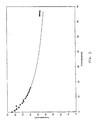
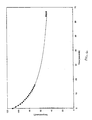
- Figures 5 and 6 depict data from two sets of experiments comparing measured equalised temperatures with calculated equalised temperatures using the above method. The results show that the equalised temperatures can be predicted within plus or minus 5%.
- Figure 7 is a flow diagram of the method of predicting the equalised temperature of a food item.
- an input from an optical sensor 70 indicates when a plurality of food items 40 has exited the means for providing thermal shock 10 and indicates that a plurality of readings T1, T2, T3 and T4 should be input from the infrared sensors 30 in step 220.
- the readings in step 220 are taken when the optical sensor indicated that the elapsed time since a food item has passed under the sensor is greater than the time necessary for the item to pass under all four infrared sensors 30 (T N ) for a given belt speed (BS).
- T N time necessary for the item to pass under all four infrared sensors 30
- BS belt speed
- the readings of the infrared sensors are time tagged and recorded at specific times for a specific food item and after all four readings are taken for a specific food item the calculation of the equalised temperature begins.
- the next step is to calculate the Jacobian (J) using three sets of data, time (matrix x), temperature readings T1, T2, T3 and T4 (matrix y) and a convergence criterion, matrix p.
- the temperature readings T1, T2, T3 and T4 as well as the time at which they were taken are known.
- the set of convergence criteria, p is initially a guess which is continuously recalculated until the change in the convergence criteria is negligible.
- a non-linear regression algorithm based on a Taylor expansion is used where second and higher order terms of the model parameters are neglected on the condition that perturbation in those terms will be small.
- the Jacobian is represented below in equation [2].
- the next step 240 is to calculate the difference ( ⁇ y) between the experimental values for y and those predicted by the model using the following equation [3].
- ⁇ y y - exp( p 0 + p 1 p 2 + x )
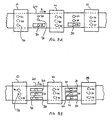
- Figure 8A depicts the top plan view of a system according to the invention in which food items 40 are conveyed on a belt 60 in direction A.
- the food items 40 are subject to thermal shocks using a means for applying thermal shocks 10 which as stated above may be a cryogenic sprayer, mechanical refrigerator, fryer, cooker, inductive heating element, conductive heating or cooling element, convection heater, infrared heater or other heating or cooling means.
- a single infrared sensor 30 is placed so as to measure the temperature of one food item across the width of the belt.
- Figure 8B depicts a top plan view of a similar system wherein a plurality of infrared sensors 30 are used to measure the temperatures of a plurality of food items across the width of the belt so as to insure that the food items across the belt are being processed in a like manner.
- a first means for providing a thermal shock 10 is a cooker, fryer or other heating means which would partially or fully cook a food item.
- a first Infrared sensor 30 placed after the first means for applying the thermal shock 10 enables the system to predict the equilibrium temperature of the food item 40 after cooking. This will then enable the controller 20 to regulate the amount of cryogen or mechanical refrigeration needed to cool and/or freeze the partially or fully cooked food item using the next means for applying thermal shock 10.
- a series of means for applying thermal shocks 10 as heat interspersed by sensors 30 can be used to control the final hot temperature of food items 40 while minimising the amount of thermal energy needed to achieve a desired end result.
- a series of means for applying thermal shocks 10 as cold can be used to control the final temperature of food item 40 while minimising the amount of energy needed to achieve the desired end result.
- the present discussion and embodiments discuss a method of predicting the equalised temperature of a food item the process could be applied to non-food items which are heated or cooled and for which the final temperature of the item is important.
- the food or non-food items may be liquids, solids or mixtures thereof.
Landscapes
- Physics & Mathematics (AREA)
- General Physics & Mathematics (AREA)
- Health & Medical Sciences (AREA)
- Nutrition Science (AREA)
- Life Sciences & Earth Sciences (AREA)
- Chemical & Material Sciences (AREA)
- Engineering & Computer Science (AREA)
- Food Science & Technology (AREA)
- Polymers & Plastics (AREA)
- General Preparation And Processing Of Foods (AREA)
- Radiation Pyrometers (AREA)
- Control Of Temperature (AREA)
Abstract
Description
- This invention relates to a method and apparatus for determining a prediction of the equalised temperature of a food product prior to its reaching its thermal equilibrium. More specifically, this invention is a method and apparatus for predicting such an equalised temperature based on the response of the food product to thermal shocks.
- The food industry produces a large quantity of standardised food products. In order to control the processes used to make standardised food products, the industry is relying to a greater extent on electronic control systems which monitor various food manufacturing processes and input variables in order to control the quality of the food product as well as to minimise waste and decrease costs.
- One problem associated with the processing of food items is the determination of an equalised temperature of food item. The need for temperature measurement is particularly acute in the area of food cooking and/or frying systems where high heat transfer rates result in a significantly hotter surface surrounding a cooler core. The general aim is to reach a certain equalised temperature for the entire food item which takes a certain amount of time to achieve while also minimising the amount of energy required to achieve the equalised temperature. Likewise, for cryogenically cooled or frozen foods, there is a general need for the food items to reach a certain equalised temperature specified by the needs of the food item while using the least amount of cryogen.
- An intrusive method of temperature determination such as the insertion of a temperature probe in to a food item has severe limitations in measuring the equalised temperature of a food item particularly in a continuous food processing environment. The temperature probe must be manually inserted into a food item which cannot then be further processed resulting in waste. In addition, the amount of effort needed to monitor a significant number of food items invasively would be prohibitively expensive. Furthermore, the actual equalised temperature can only be measured after a certain amount of time passes, for example ten to twenty minutes, and therefore, a large number of food items could be incorrectly processed before an error in the equalised temperature is detected.
- Another known method of temperature measurement, such as a single infrared sensor, would only be capable of measuring the surface temperature of the product and not the equalised temperature throughout the product.
- There is therefore a need for a method and apparatus which enables a food processor to predict or estimate the equalised temperature of a food item in a food processing line in a continuous manner without diverting actual food items from the processing line and using intrusive manual temperature testing. Furthermore, the method and apparatus should allow the food processor to predict the equalised temperature of the food items immediately after a thermal shock is applied, i.e. cooking or cooling, rather than after they have actually reached their equalised temperature, so that problems with the cooking process or cooling/freezing cryogenic process can be corrected.
- The invention is therefore concerned with the provision of a method and apparatus for continuous prediction of and estimating the equalised temperature of a food item during processing including doing so in conditions of variable air flow and variable temperatures found in food processing.
- In accordance with the invention, there is provided a method for predicting the equalised temperature of an item during processing of the item comprising the steps of applying a thermal shock to the item; measuring the surface temperature of the item over time; calculating a predicted value for the equalised temperature of the item based on the rate of change of the surface temperature of the item over time.
- The method advantageously further comprises the steps of applying at least one additional thermal shock to the item and calculating a predicted value for the equalised temperature of the item based on the difference of the rate of change of the surface temperature of the item over time
- The measurement of the surface temperature preferably comprises at least two measurements of the surface temperature of the item over time. More preferably at least two measurements are taken in a continuous manner; alternatively the measurements may be taken in a discrete manner.
- The step of calculating the predicted value preferably uses at least squares, non-linear regression algorithm.
- The method of the invention can advantageously further comprise the step of using the predicted value for the equalised temperature to control the magnitude and/or duration of the thermal shock applied to the item
- Preferably, a first thermal shock is applied to the item using heat and the predicted value of the equalised temperature is used to control the temperature of the heat applied to the item
- Alternatively, a first thermal shock is applied to the item using heat and the predicted value of the equalised temperature is used to control the duration that the food item is subject to heating, especially when at least two measurements of surface temperature are taken continuously.
- The invention also provides an apparatus for predicting the equalised temperature of an item comprising a means for providing a thermal shock to the item; one or more sensors for determining the surface temperature of the item over time; a means for calculating a predicted value of the equalised temperature of the item based on the rate of change of the surface temperature of the item.
- Preferably the apparatus further comprises a conveyor for moving the items from contact with the means for providing thermal shock to the sensor(s).
- It preferably further comprises an optical sensor for determining when surface temperature should be determined using the sensor(s).
- In separate and preferred embodiment, the invention provides apparatus having an infrared sensor for measuring the surface temperature of a food item and means for applying a heat transfer shock of known quantity to the food item for a set length of time. Preferably at least two measurements of the surface temperature of the item are taken at specific times after the initial thermal shock and the equalised temperature of the food item is mathematically predicted from the two measurements.
- In a further aspect of the invention, the thermal shock and surface temperature measurement process is repeated in order to increase the accuracy of the predicted temperature.
- In another preferred aspect of the invention, multiple surface temperature readings are taken after each application of thermal shock with feedback mechanisms to alter the magnitude of the thermal shock.
- In a further preferred aspect of the invention, a plurality of infrared sensors are mounted over a food processing line so that food items pass under the plurality of sensors and an equalised temperature is predicted for a food item based on the readings from the plurality of sensors.
- In a still further preferred aspect of the invention, the information relating to the predicted equalised temperature of the food product is logged in a computer database for use by the food processing system and for purposes of altering the magnitude of additional thermal shocks to the food items.
- To illustrate the invention and to show how it may be put in to effect, reference will now be made, by way of exemplification only, to the accompanying drawings, in which:
- Figure 1 is a diagram of an apparatus for carrying out a method of the invention.
- Figure 2 is a graph depicting the temperature curves resulting from the apparatus of Figure 1.
- Figure 3 is a diagram of a second embodiment of the invention.
- Figure 4 is a graph depicting a plurality of temperature readings taken over time.
- Figure 5 is a graph depicting a first set of measured and calculated results.
- Figure 6 is a graph depicting a second set of measured and calculated results.
- Figure 7 is a flow diagram of the prediction method used in the invention.
- Figures 8A and 8B are top plan views of two possible embodiments according to the invention.
-
- With reference to the drawings, Figure 1 a diagrammatic representation of the an apparatus according to the invention.
Food items 40 placed on aconveyer 60 travel under a firstinfrared sensor 30 which provides a measure of the surface temperature of thefood item 40. A thermal shock is applied to thefood items 40 through a means for providing athermal shock 60 which could be a cryogenic sprayer for spraying liquid or vapour phase cryogen on thefood items 40 or an infrared heat source for heating thefood items 40. There are many means for providing a thermal shock to thefood items 40 including but not limited to infrared, microwave, inductive, convective or conductive heating and mechanical refrigeration or cryogenic cooling or freezing. Cryogenic cooling could be accomplished through the use of cryogens such as liquid nitrogen, carbon dioxide snow or liquefied air including synthetic liquid air (SLA). After receiving a thermal shock thefood items 40 are carried byconveyer 60 under a series ofinfrared sensors 30 which each provide a signal to acontroller 20 indicative of the surface temperature of thefood items 40 over a period of time. This sequence of events can be repeated one or more times. - The variation of the rate of temperature change can be used to indicate the predicted equalised temperature of the product. The
controller 20 can use the data regarding the predicted equalised temperature of the food product or items in order to control the means for providing a thermal shock to thefood items 40. Thecontroller 20 could be a programmable logic controller (PLC) or other programmable computer such as a personal computer. - The process described in respect of Figure 1 results in a graph similar to that of Figure 2.
Reading 100 represents the temperature of a food item prior to application of the thermal shock. During time periods 120a a thermal shock is applied to the food items which is a cryogenic shock as depicted in Figure 2 such that the temperature of the food item decreases as depicted in portion 110a of the temperature versus time plot of Figure 2. After application of the thermal shock a series oftemperature readings 130 are taken byinfrared sensors 30. As expected the readings indicate a warming of the exterior of the food item over time as the heat from the warmer core of the food item is thermally transferred to the exterior of the item. An additional thermal shock during time period 120b decreases the temperature of thefood item 40 as seen in portion 110b of Figure 2. The difference in the rate of change of thetemperature readings 130, i.e., the difference between the slopes 150a and 150b is indicative of the core temperature of the product. - In Figures 3 and 4, a preferred embodiment of the invention in which a means for applying a thermal shock is a
cooker 10 which heatsfood items 40. Thefood items 40 are then carried by aconveyor 60 under a plurality ofinfrared sensors 30 which each provide a peak reading (T1, T2, T3, T4) for each food item. A plurality ofoptical sensors 70 are used to determine when a food item is passing under theinfrared sensors 30. Using a set of known factors which are product specific the final equalised temperature is calculated which can be supplied to amemory device 90 for use in the processing of thefood items 40. - To calibrate the series of infrared sensors it is necessary to record a minimum of five sets of temperature readings and the equalised temperature. The data is then supplied to a series of simultaneous equations set forth below in equation [1].
- Figures 5 and 6 depict data from two sets of experiments comparing measured equalised temperatures with calculated equalised temperatures using the above method. The results show that the equalised temperatures can be predicted within plus or minus 5%.
- Figure 7 is a flow diagram of the method of predicting the equalised temperature of a food item. At
steps optical sensor 70 indicates when a plurality offood items 40 has exited the means for providingthermal shock 10 and indicates that a plurality of readings T1, T2, T3 and T4 should be input from theinfrared sensors 30 instep 220. - In a continuous process, the readings in
step 220 are taken when the optical sensor indicated that the elapsed time since a food item has passed under the sensor is greater than the time necessary for the item to pass under all four infrared sensors 30 (TN) for a given belt speed (BS). The peak readings of eachinfrared sensor 30 are then used to calculate the equalised temperature. - In a discrete process the readings of the infrared sensors are time tagged and recorded at specific times for a specific food item and after all four readings are taken for a specific food item the calculation of the equalised temperature begins.
- Independent of the use of the continuous or discrete method of capturing the temperature readings T1, T2, T3, T4 from
infrared sensors 30, the next step is to calculate the Jacobian (J) using three sets of data, time (matrix x), temperature readings T1, T2, T3 and T4 (matrix y) and a convergence criterion, matrix p. The temperature readings T1, T2, T3 and T4 as well as the time at which they were taken are known. The set of convergence criteria, p, is initially a guess which is continuously recalculated until the change in the convergence criteria is negligible. A non-linear regression algorithm based on a Taylor expansion is used where second and higher order terms of the model parameters are neglected on the condition that perturbation in those terms will be small. Thus the Jacobian is represented below in equation [2].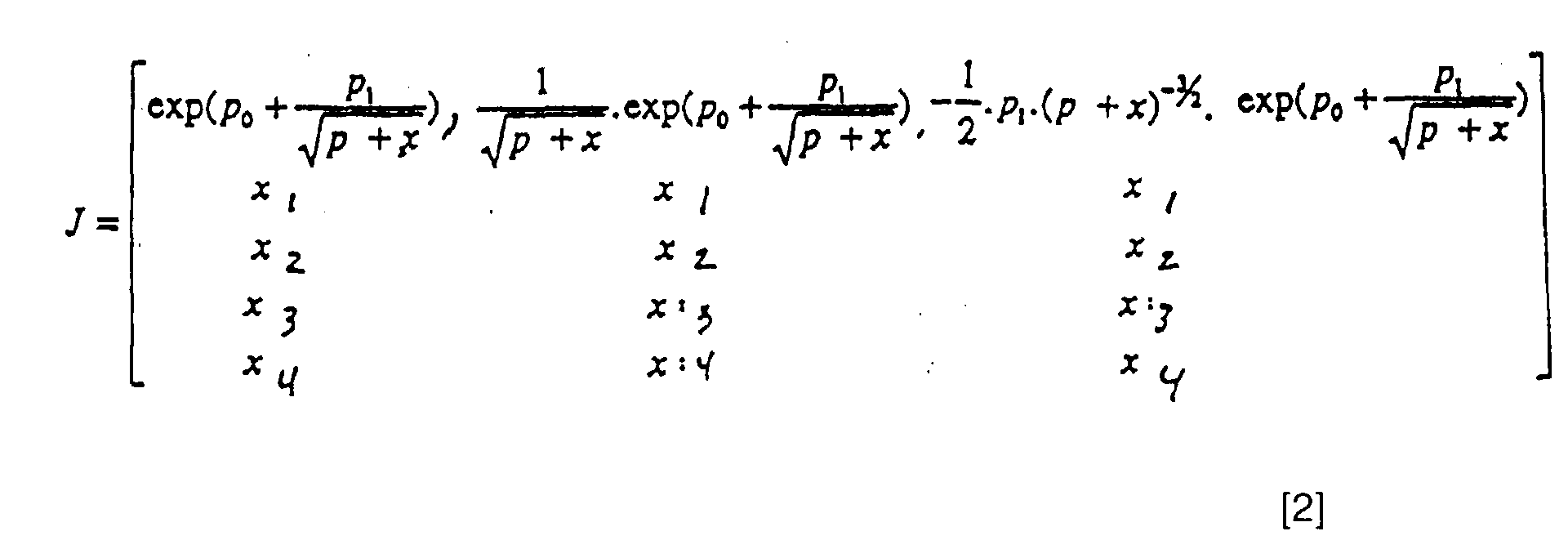
- After calculation of the Jacobian matrix J for a given set of temperatures, times and convergence criteria (the Jacobian matrix J will be different for different model assumptions) the
next step 240 is to calculate the difference (Δy) between the experimental values for y and those predicted by the model using the following equation [3].p - In
step 250, a set of corrections to originally predicted values for convergence criteria, p, is calculated using the following equation [4]. - If Δp is near zero then the equalised temperatures may be calculated. If not, then a new set of convergence criteria is calculated in the p' = p + Δp. The calculation of the Jacobian matrix, J, and Δy is reiterated until Δp approaches zero at which point the equalised temperature y can be calculated using equation [5].
p - Figure 8A depicts the top plan view of a system according to the invention in which
food items 40 are conveyed on abelt 60 in direction A. Thefood items 40 are subject to thermal shocks using a means for applyingthermal shocks 10 which as stated above may be a cryogenic sprayer, mechanical refrigerator, fryer, cooker, inductive heating element, conductive heating or cooling element, convection heater, infrared heater or other heating or cooling means. A singleinfrared sensor 30 is placed so as to measure the temperature of one food item across the width of the belt. Figure 8B depicts a top plan view of a similar system wherein a plurality ofinfrared sensors 30 are used to measure the temperatures of a plurality of food items across the width of the belt so as to insure that the food items across the belt are being processed in a like manner. - In a preferred embodiment of the invention a first means for providing a
thermal shock 10 is a cooker, fryer or other heating means which would partially or fully cook a food item. Afirst Infrared sensor 30 placed after the first means for applying thethermal shock 10 enables the system to predict the equilibrium temperature of thefood item 40 after cooking. This will then enable thecontroller 20 to regulate the amount of cryogen or mechanical refrigeration needed to cool and/or freeze the partially or fully cooked food item using the next means for applyingthermal shock 10. - A series of means for applying
thermal shocks 10 as heat interspersed bysensors 30 can be used to control the final hot temperature offood items 40 while minimising the amount of thermal energy needed to achieve a desired end result. Likewise, a series of means for applyingthermal shocks 10 as cold can be used to control the final temperature offood item 40 while minimising the amount of energy needed to achieve the desired end result. - In such a cooking then freezing process it is possible to overheat the food thereby increasing the frying cost as well as the cost of energy required to freeze the product. For example where a product is overheated by 10 degrees Fahrenheit in a gas fired cooker where the product is being processed at 5000 pounds per hour it is estimated that the cost of the energy unnecessarily expended exceeds UK£8 (US$12) per hour.
- Although the present discussion and embodiments discuss a method of predicting the equalised temperature of a food item the process could be applied to non-food items which are heated or cooled and for which the final temperature of the item is important. The food or non-food items may be liquids, solids or mixtures thereof.
Claims (16)
- A method for predicting the equalised temperature of an item during processing of the item comprising the steps of:applying a thermal shock to the item;measuring the surface temperature of the item over time;calculating a predicted value for the equalised temperature of the item based on the rate of change of the surface temperature of the item over time.
- A method according to Claim 1 further comprising the steps of applying at least one additional thermal shock to the item and calculating a predicted value for the equalised temperature of the item based on the difference of the rate of change of the surface temperature of the item over time.
- A method according to Claim 1 or Claim 2 in which the step of measuring comprises at least two measurements of the surface temperature of the item over time.
- A method according to Claim 3 in which at least two measurements are taken in a continuous manner.
- A method according to Claim 3 in which at least two measurements are taken discretely.
- A method according to any preceding claim in which the step of calculating the predicted value uses a least squares, non-linear regression algorithm.
- A method according to any preceding claim further comprising the step of using the predicted value for the equalised temperature to control the magnitude and/or duration of the thermal shock applied to the item.
- A method according to any preceding claim in which a first thermal shock is applied to the item using heat and the predicted value of the equalised temperature is used to control the temperature of the heat applied to the item.
- A method according to any preceding claim in which a first thermal shock is applied to the item using heat and the predicted value of the equalised temperature is used to control the duration that the food item is subject to heating.
- A method according to any preceding claim in which the means for applying a thermal shock to the item applies cold to the item.
- A method according to Claim 10 in which the means for applying a thermal shock to the item applies a cryogen to the item.
- A method according to Claim 11 in which the cryogen is one or more of liquid nitrogen, carbon dioxide snow or liquefied air.
- A method according to any one of Claims 1 to 9 in which the means for applying a thermal shock to the item applies heat to the item.
- Apparatus for predicting the equalised temperature of an item comprising:a means for providing a thermal shock to the item;one or more sensors for determining the surface temperature of the item over time;a means for calculating a predicted value of the equalised temperature of the item based on the rate of change of the surface temperature of the item.
- Apparatus according to Claim 1 further comprising a conveyor for moving the items from contact with the means for providing thermal shock to the sensor(s).
- Apparatus according to Claim 15 further comprising an optical sensor for determining when surface temperature should be determined using the sensor(s).
Applications Claiming Priority (2)
| Application Number | Priority Date | Filing Date | Title |
|---|---|---|---|
| US464978 | 1999-12-16 | ||
| US09/464,978 US6357911B1 (en) | 1999-12-16 | 1999-12-16 | Method and apparatus for predicting the equalized temperature of a food product |
Publications (1)
| Publication Number | Publication Date |
|---|---|
| EP1108998A1 true EP1108998A1 (en) | 2001-06-20 |
Family
ID=23846050
Family Applications (1)
| Application Number | Title | Priority Date | Filing Date |
|---|---|---|---|
| EP00311166A Withdrawn EP1108998A1 (en) | 1999-12-16 | 2000-12-14 | Method and apparatus for predicting temperatures of a food product |
Country Status (6)
| Country | Link |
|---|---|
| US (1) | US6357911B1 (en) |
| EP (1) | EP1108998A1 (en) |
| AU (1) | AU763204B2 (en) |
| BR (1) | BR0006377A (en) |
| NZ (1) | NZ508678A (en) |
| ZA (1) | ZA200007506B (en) |
Cited By (6)
| Publication number | Priority date | Publication date | Assignee | Title |
|---|---|---|---|---|
| FR2830608A1 (en) * | 2001-10-05 | 2003-04-11 | Air Liquide | Control of quick freezing tunnel used in food industry involves prediction of final temperature of articles passing through it based on thermodynamic and physical characteristics |
| FR2853404A1 (en) * | 2003-04-07 | 2004-10-08 | Air Liquide | Determination of operating parameters of plant with cooling chamber especially for food products, uses comparison of predicted and actual temperatures and correcting when necessary |
| FR2855597A1 (en) * | 2003-05-26 | 2004-12-03 | Air Liquide | METHOD FOR DETERMINING THERMAL PROFILES OF FOOD PRODUCTS LEAVING CRYOGENIC EQUIPMENT AND CORRESPONDING COOLING INSTALLATION |
| EP2998668A1 (en) * | 2014-09-17 | 2016-03-23 | Linde Aktiengesellschaft | Apparatus and method for applying a heat transfer substance |
| EP3170404A1 (en) * | 2015-11-17 | 2017-05-24 | Linde Aktiengesellschaft | Cryogenic freezing method and apparatus |
| CN113280554A (en) * | 2021-04-26 | 2021-08-20 | 珠海格力电器股份有限公司 | Method and device for adjusting indoor temperature of cold storage equipment room and cold storage equipment |
Families Citing this family (6)
| Publication number | Priority date | Publication date | Assignee | Title |
|---|---|---|---|---|
| DE10047269B4 (en) * | 2000-09-23 | 2005-02-24 | Fraunhofer-Gesellschaft zur Förderung der angewandten Forschung e.V. | Method and device for checking the drying results in a bulk material coming from a drying process |
| WO2009123273A1 (en) * | 2008-03-31 | 2009-10-08 | Jfeスチール株式会社 | Steel plate quality assurance system and equipment therefor |
| NL2009043C2 (en) * | 2012-06-21 | 2013-12-24 | Blueprint Holding Bv | Wrapped-product quality control and packing methods, and wrapped-product quality control and packing devices. |
| CA3016416C (en) * | 2016-03-01 | 2023-06-27 | The Hillshire Brands Company | System and method for producing formed meat patties |
| WO2022192288A1 (en) * | 2021-03-09 | 2022-09-15 | Tyson Foods, Inc. | Method and apparatus for non-contact temperature measurement of a food item |
| CN115684628B (en) * | 2022-10-11 | 2023-09-08 | 日升餐厨科技(广东)有限公司 | Indirect temperature measurement method based on thermal shock |
Citations (4)
| Publication number | Priority date | Publication date | Assignee | Title |
|---|---|---|---|---|
| DD253938A1 (en) * | 1986-11-27 | 1988-02-10 | Forsch Rationalisierung Ogs Ma | METHOD AND DEVICE FOR PASTEURIZING FOODS |
| DE4032949A1 (en) * | 1990-10-17 | 1992-04-23 | Miele & Cie | Baking oven with temp. sensor skewer - determining core temp. of item being cooked and cooperating with another sensor for surface temp. |
| EP0492983A2 (en) * | 1990-12-26 | 1992-07-01 | The Boc Group, Inc. | Refrigeration system and method |
| JPH04370068A (en) * | 1991-06-19 | 1992-12-22 | Mitsubishi Heavy Ind Ltd | Method for stepwise cooking in vacuum cooking |
Family Cites Families (8)
| Publication number | Priority date | Publication date | Assignee | Title |
|---|---|---|---|---|
| US4854726A (en) * | 1986-05-29 | 1989-08-08 | Hughes Aircraft Company | Thermal stress screening system |
| WO1988004039A1 (en) * | 1986-11-19 | 1988-06-02 | Terumo Kabushiki Kaisha | Electronic thermometer |
| JPH07111383B2 (en) * | 1989-10-05 | 1995-11-29 | テルモ株式会社 | Equilibrium temperature detection method and electronic thermometer |
| US5259389A (en) * | 1990-10-24 | 1993-11-09 | Terumo Kabushiki Kaisha | Electronic clincal thermometer |
| US5392031A (en) * | 1992-03-17 | 1995-02-21 | Terumo Kabushiki Kaisha | Electronic clinical thermometer |
| JP3056661B2 (en) * | 1994-12-27 | 2000-06-26 | シャープ株式会社 | Heater control device |
| US5738441A (en) * | 1995-07-11 | 1998-04-14 | The United States Of America As Represented By The Administrator Of The National Aeronautics And Space Administration | Electronic clinical predictive thermometer using logarithm for temperature prediction |
| US6076964A (en) * | 1998-11-11 | 2000-06-20 | Chrysler Corporation | Prediction of internal temperature of a battery using a non-linear dynamic model |
-
1999
- 1999-12-16 US US09/464,978 patent/US6357911B1/en not_active Expired - Fee Related
-
2000
- 2000-12-06 AU AU72083/00A patent/AU763204B2/en not_active Ceased
- 2000-12-06 NZ NZ508678A patent/NZ508678A/en unknown
- 2000-12-07 BR BR0006377-0A patent/BR0006377A/en not_active IP Right Cessation
- 2000-12-14 ZA ZA200007506A patent/ZA200007506B/en unknown
- 2000-12-14 EP EP00311166A patent/EP1108998A1/en not_active Withdrawn
Patent Citations (4)
| Publication number | Priority date | Publication date | Assignee | Title |
|---|---|---|---|---|
| DD253938A1 (en) * | 1986-11-27 | 1988-02-10 | Forsch Rationalisierung Ogs Ma | METHOD AND DEVICE FOR PASTEURIZING FOODS |
| DE4032949A1 (en) * | 1990-10-17 | 1992-04-23 | Miele & Cie | Baking oven with temp. sensor skewer - determining core temp. of item being cooked and cooperating with another sensor for surface temp. |
| EP0492983A2 (en) * | 1990-12-26 | 1992-07-01 | The Boc Group, Inc. | Refrigeration system and method |
| JPH04370068A (en) * | 1991-06-19 | 1992-12-22 | Mitsubishi Heavy Ind Ltd | Method for stepwise cooking in vacuum cooking |
Non-Patent Citations (1)
| Title |
|---|
| PATENT ABSTRACTS OF JAPAN vol. 017, no. 243 (C - 1058) 17 May 1993 (1993-05-17) * |
Cited By (12)
| Publication number | Priority date | Publication date | Assignee | Title |
|---|---|---|---|---|
| FR2830608A1 (en) * | 2001-10-05 | 2003-04-11 | Air Liquide | Control of quick freezing tunnel used in food industry involves prediction of final temperature of articles passing through it based on thermodynamic and physical characteristics |
| WO2003031891A1 (en) * | 2001-10-05 | 2003-04-17 | L'air Liquide, Societe Anonyme A Directoire Et Conseil De Surveillance Pour L'etude Et L'exploitation Des Procedes Georges Claude | Method and installation for predicting the temperature of articles passing through a cooling chamber |
| FR2853404A1 (en) * | 2003-04-07 | 2004-10-08 | Air Liquide | Determination of operating parameters of plant with cooling chamber especially for food products, uses comparison of predicted and actual temperatures and correcting when necessary |
| WO2004092667A3 (en) * | 2003-04-07 | 2005-03-31 | Air Liquide | Method for determining the operating parameters of a system comprising a cooling chamber |
| US7330778B2 (en) | 2003-04-07 | 2008-02-12 | L'air Liquide, Societe Anonyme A Directoire Et Conseil De Surveillance Pour L'etude Et L'exploitation Des Procedes Georges Claude | Method for determining the operating parameters of a system comprising a cooling chamber |
| FR2855597A1 (en) * | 2003-05-26 | 2004-12-03 | Air Liquide | METHOD FOR DETERMINING THERMAL PROFILES OF FOOD PRODUCTS LEAVING CRYOGENIC EQUIPMENT AND CORRESPONDING COOLING INSTALLATION |
| WO2004106821A3 (en) * | 2003-05-26 | 2005-02-17 | Air Liquide | Method for determining thermal profiles of food products leaving a cryogenic installation, and corresponding cooling installation |
| EP2998668A1 (en) * | 2014-09-17 | 2016-03-23 | Linde Aktiengesellschaft | Apparatus and method for applying a heat transfer substance |
| EP3194867A4 (en) * | 2014-09-17 | 2018-05-30 | Linde Aktiengesellschaft | Liquid nitrogen control for campylobacter treatment |
| EP3170404A1 (en) * | 2015-11-17 | 2017-05-24 | Linde Aktiengesellschaft | Cryogenic freezing method and apparatus |
| EP3170404B1 (en) | 2015-11-17 | 2019-04-17 | Linde Aktiengesellschaft | Cryogenic freezing method and apparatus |
| CN113280554A (en) * | 2021-04-26 | 2021-08-20 | 珠海格力电器股份有限公司 | Method and device for adjusting indoor temperature of cold storage equipment room and cold storage equipment |
Also Published As
| Publication number | Publication date |
|---|---|
| AU7208300A (en) | 2001-06-21 |
| NZ508678A (en) | 2002-08-28 |
| AU763204B2 (en) | 2003-07-17 |
| BR0006377A (en) | 2001-08-21 |
| US6357911B1 (en) | 2002-03-19 |
| ZA200007506B (en) | 2001-06-18 |
Similar Documents
| Publication | Publication Date | Title |
|---|---|---|
| EP1108998A1 (en) | Method and apparatus for predicting temperatures of a food product | |
| EP3152633B1 (en) | Method of predicting the core temperture of a food item during cooking, cooking device and cooking method | |
| Heldman | Food freezing | |
| CN107846942B (en) | Temperature controlled thawing method and apparatus | |
| Agnelli et al. | Cryomechanical freezing. A model for the heat transfer process | |
| Anderson et al. | Modeling the thawing of frozen foods using air impingement technology | |
| Obuz et al. | Simulation of cooking cylindrical beef roasts | |
| AU2020332295B2 (en) | Temperature control using applied electromagnetic fields | |
| US20060011613A1 (en) | Temperature calibration method for a cooking appliance | |
| US6283379B1 (en) | Method for correlating processor and part temperatures using an air temperature sensor for a conveyorized thermal processor | |
| CN104919891B (en) | For determining the device and method of the core temperature of food | |
| Jaczynski et al. | Temperature prediction during thermal processing of surimi seafood | |
| Zorrilla et al. | Dynamic optimization of double-sided cooking of meat patties | |
| US20040237547A1 (en) | Method and installation for predicting the temperature of articles passing through a cooling chamber | |
| Jacobsen et al. | Noncontact determination of cold-water prawn ice-glaze content using radiometry | |
| Heldman et al. | Thermodynamics of food freezing | |
| Techasena et al. | Surface temperature estimation of solid foods during a surface sterilization | |
| Dincer et al. | Cooling of spherical products: Part II—heat transfer parameters | |
| EP0549295B1 (en) | Calibration of temperature monitoring apparatus | |
| Sabliov et al. | Parametric analysis of cryogenic carbon dioxide cooling of shell eggs | |
| Sargolzaei et al. | Modeling and simulation of hamburger cooking process using finite difference and CFD methods | |
| US20120011862A1 (en) | Automatic compensating freezing and heating recipes | |
| Chung et al. | A simple approximate method for predicting center temperature of chicken wings treated at cryogenic temperature | |
| Ansari et al. | An optimized method for thermal diffusivity measurement of peeled off fruits and vegetables | |
| Davey et al. | A technique for measuring product heat load during beef chilling |
Legal Events
| Date | Code | Title | Description |
|---|---|---|---|
| PUAI | Public reference made under article 153(3) epc to a published international application that has entered the european phase |
Free format text: ORIGINAL CODE: 0009012 |
|
| AK | Designated contracting states |
Kind code of ref document: A1 Designated state(s): AT BE CH CY DE DK ES FI FR GB GR IE IT LI LU MC NL PT SE TR |
|
| AX | Request for extension of the european patent |
Free format text: AL;LT;LV;MK;RO;SI |
|
| 17P | Request for examination filed |
Effective date: 20011122 |
|
| AKX | Designation fees paid |
Free format text: AT BE CH CY DE DK ES FI FR GB GR IE IT LI LU MC NL PT SE TR |
|
| 17Q | First examination report despatched |
Effective date: 20080114 |
|
| STAA | Information on the status of an ep patent application or granted ep patent |
Free format text: STATUS: THE APPLICATION IS DEEMED TO BE WITHDRAWN |
|
| 18D | Application deemed to be withdrawn |
Effective date: 20080527 |