EP1108741A2 - Packaging polyester film - Google Patents
Packaging polyester film Download PDFInfo
- Publication number
- EP1108741A2 EP1108741A2 EP00126971A EP00126971A EP1108741A2 EP 1108741 A2 EP1108741 A2 EP 1108741A2 EP 00126971 A EP00126971 A EP 00126971A EP 00126971 A EP00126971 A EP 00126971A EP 1108741 A2 EP1108741 A2 EP 1108741A2
- Authority
- EP
- European Patent Office
- Prior art keywords
- film
- polyester film
- wrapper
- polyester
- medicine
- Prior art date
- Legal status (The legal status is an assumption and is not a legal conclusion. Google has not performed a legal analysis and makes no representation as to the accuracy of the status listed.)
- Granted
Links
Classifications
-
- B—PERFORMING OPERATIONS; TRANSPORTING
- B65—CONVEYING; PACKING; STORING; HANDLING THIN OR FILAMENTARY MATERIAL
- B65D—CONTAINERS FOR STORAGE OR TRANSPORT OF ARTICLES OR MATERIALS, e.g. BAGS, BARRELS, BOTTLES, BOXES, CANS, CARTONS, CRATES, DRUMS, JARS, TANKS, HOPPERS, FORWARDING CONTAINERS; ACCESSORIES, CLOSURES, OR FITTINGS THEREFOR; PACKAGING ELEMENTS; PACKAGES
- B65D65/00—Wrappers or flexible covers; Packaging materials of special type or form
-
- B—PERFORMING OPERATIONS; TRANSPORTING
- B32—LAYERED PRODUCTS
- B32B—LAYERED PRODUCTS, i.e. PRODUCTS BUILT-UP OF STRATA OF FLAT OR NON-FLAT, e.g. CELLULAR OR HONEYCOMB, FORM
- B32B27/00—Layered products comprising a layer of synthetic resin
- B32B27/36—Layered products comprising a layer of synthetic resin comprising polyesters
-
- B—PERFORMING OPERATIONS; TRANSPORTING
- B32—LAYERED PRODUCTS
- B32B—LAYERED PRODUCTS, i.e. PRODUCTS BUILT-UP OF STRATA OF FLAT OR NON-FLAT, e.g. CELLULAR OR HONEYCOMB, FORM
- B32B27/00—Layered products comprising a layer of synthetic resin
- B32B27/06—Layered products comprising a layer of synthetic resin as the main or only constituent of a layer, which is next to another layer of the same or of a different material
- B32B27/08—Layered products comprising a layer of synthetic resin as the main or only constituent of a layer, which is next to another layer of the same or of a different material of synthetic resin
-
- B—PERFORMING OPERATIONS; TRANSPORTING
- B32—LAYERED PRODUCTS
- B32B—LAYERED PRODUCTS, i.e. PRODUCTS BUILT-UP OF STRATA OF FLAT OR NON-FLAT, e.g. CELLULAR OR HONEYCOMB, FORM
- B32B27/00—Layered products comprising a layer of synthetic resin
- B32B27/18—Layered products comprising a layer of synthetic resin characterised by the use of special additives
-
- C—CHEMISTRY; METALLURGY
- C08—ORGANIC MACROMOLECULAR COMPOUNDS; THEIR PREPARATION OR CHEMICAL WORKING-UP; COMPOSITIONS BASED THEREON
- C08J—WORKING-UP; GENERAL PROCESSES OF COMPOUNDING; AFTER-TREATMENT NOT COVERED BY SUBCLASSES C08B, C08C, C08F, C08G or C08H
- C08J5/00—Manufacture of articles or shaped materials containing macromolecular substances
- C08J5/18—Manufacture of films or sheets
-
- B—PERFORMING OPERATIONS; TRANSPORTING
- B32—LAYERED PRODUCTS
- B32B—LAYERED PRODUCTS, i.e. PRODUCTS BUILT-UP OF STRATA OF FLAT OR NON-FLAT, e.g. CELLULAR OR HONEYCOMB, FORM
- B32B2367/00—Polyesters, e.g. PET, i.e. polyethylene terephthalate
-
- B—PERFORMING OPERATIONS; TRANSPORTING
- B32—LAYERED PRODUCTS
- B32B—LAYERED PRODUCTS, i.e. PRODUCTS BUILT-UP OF STRATA OF FLAT OR NON-FLAT, e.g. CELLULAR OR HONEYCOMB, FORM
- B32B2439/00—Containers; Receptacles
- B32B2439/80—Medical packaging
-
- C—CHEMISTRY; METALLURGY
- C08—ORGANIC MACROMOLECULAR COMPOUNDS; THEIR PREPARATION OR CHEMICAL WORKING-UP; COMPOSITIONS BASED THEREON
- C08J—WORKING-UP; GENERAL PROCESSES OF COMPOUNDING; AFTER-TREATMENT NOT COVERED BY SUBCLASSES C08B, C08C, C08F, C08G or C08H
- C08J2367/00—Characterised by the use of polyesters obtained by reactions forming a carboxylic ester link in the main chain; Derivatives of such polymers
- C08J2367/02—Polyesters derived from dicarboxylic acids and dihydroxy compounds
-
- Y—GENERAL TAGGING OF NEW TECHNOLOGICAL DEVELOPMENTS; GENERAL TAGGING OF CROSS-SECTIONAL TECHNOLOGIES SPANNING OVER SEVERAL SECTIONS OF THE IPC; TECHNICAL SUBJECTS COVERED BY FORMER USPC CROSS-REFERENCE ART COLLECTIONS [XRACs] AND DIGESTS
- Y10—TECHNICAL SUBJECTS COVERED BY FORMER USPC
- Y10T—TECHNICAL SUBJECTS COVERED BY FORMER US CLASSIFICATION
- Y10T428/00—Stock material or miscellaneous articles
- Y10T428/15—Sheet, web, or layer weakened to permit separation through thickness
-
- Y—GENERAL TAGGING OF NEW TECHNOLOGICAL DEVELOPMENTS; GENERAL TAGGING OF CROSS-SECTIONAL TECHNOLOGIES SPANNING OVER SEVERAL SECTIONS OF THE IPC; TECHNICAL SUBJECTS COVERED BY FORMER USPC CROSS-REFERENCE ART COLLECTIONS [XRACs] AND DIGESTS
- Y10—TECHNICAL SUBJECTS COVERED BY FORMER USPC
- Y10T—TECHNICAL SUBJECTS COVERED BY FORMER US CLASSIFICATION
- Y10T428/00—Stock material or miscellaneous articles
- Y10T428/31504—Composite [nonstructural laminate]
- Y10T428/31786—Of polyester [e.g., alkyd, etc.]
Definitions
- the present invention relates to a packaging polyester film. More particularly, it relates to a packaging polyester film which is capable of preventing attachment thereto of the substances wrapped up thereby such as medicines and powdered foods as well as other extraneous matter while increasing visual recognizability of the wrapped-up substance, and also has good printing ink adhesion irrespective of the type of ink.
- Biaxially oriented polyester films represented by polyethylene terephthalate films have been used as base material of a variety of industrial products such as information recording devices, capacitors, packages, printing plates, insulators, photographic films, etc. because of their excellent mechanical and electrical properties, chemical resistance, dimensional stability and other advantageous properties.
- polyester films are used as various types of packaging films by making use of their excellent properties. Amidst the increasing recognition of the importance of environmental problems, the scope of use of the polyester films are expected to widen as they can restrain environmental contamination in disposal of their wastes.
- the packaging polyester films are finding their way into a broader scope of use; they are needed indeed in the various industrial fields including foods, electric and electronic parts, machinery, equipment, building materials and medicines.
- the packaging material is required to have high-level properties in the various aspects of function as the quality of the content can exert a great deal of influence to the human body.
- the wrapping material In the case of wrapping of a medicine or powder food, the wrapping material is required, on one hand, to have an adequate degree of proofness against break to maintain the content quality unchanged, but is also required, on the other hand, to be capable of being easily torn open so that the content may be easily taken of the wrap with bare hands.
- the wrapping material comprising a laminate of a conventional polyester film with other type of film can not be easily torn up with hands because of high film strength, making it unable to easily take out the content from the wrap.
- the packaging film is required to have good printing ink adhesion at its outermost layer.
- the present invention has been attained on the basis of the above finding.
- the object of the present invention is to provide a medicine and powdered food wrapping or packaging film which is proof against attachment of the content or extraneous matter, allows easy recognition of the content when viewed from the outside of the film, has good ink adhesion irrespective of the type of ink, and is easy to rip open.
- a polyester film for medicine wrapper having a surface resistivity of not more than 5 ⁇ 10 12 ⁇ /cm 2 .
- a polyester film for powder food wrapper having a surface resistivity of not more than 5 ⁇ 10 12 ⁇ /cm 2 .
- a medicine wrapper comprising the polyester film as defined in the first aspect.
- a powder food wrapper comprising the polyester film as defined in the second aspect.
- polymers are synonymous with the polymers having ester groups which can be obtained from the polycondensation of dicarboxylic acids and diols or hydroxycarboxylic acids.
- dicarboxylic acids usable for the polycondensation include terephthatic acid, isophthalic acid, adipic acid, azelaic acid, sebacic acid, 2,6-naphthalenedicarboxylic acid, 1,4-cyclohexanedicarboxylic acid and the like.
- diols examples include ethylene glycol, 1,4-butanediol, diethylene glycol, triethylene glycol, neopentyl glycol, 1,4-cyclohexanedimethanol, polyethylene glycol and the like.
- hydroxycarboxylic acids examples include p-hydroxybenzoic acid, 6-hydroxy-2-naphthoic acid and the like.
- Typical examples of such polymers are polyethylene terephthalate and polyethylene-2,6-naphthalate. These polymers may be homopolymers or ternary copolymers.
- the biaxially stretched films are preferably used for the reason of high strength and excellent dimensional stability, but it is also possible to use the non-stretched or at least monoaxially stretched polyester films.
- the film of the present invention needs to have anti-static properties for preventing adhesion of the packaged substance such as medicine and powder food, dust in the ambience and other extraneous matter to the film surface.
- the polyester film of the present invention is specifically treated to have a surface resistivity of not more than 5 ⁇ 10 12 ⁇ /cm 2 , preferably not more than 1 ⁇ 10 12 ⁇ /cm 2 , more preferably not more than 5 ⁇ 10 11 ⁇ /cm 2 . If the surface resistivity of the film is more than 5 ⁇ 10 12 ⁇ /cm 2 , the packaged substance and ambient dust tend to adhere to the film.
- the "powder foods” referred to in the present invention include any of the foods which are of a powdery state, for example dried bonito, fish flour, milk powder, powdered coffee and such. In more concrete terms, they are the powdered foods of such a degree of fineness that when they are passed through a 2.5-mesh screen, the remnants on the screen are not more than 50% by weight of the overall weight of the food.
- Antistatic properties may be provided by incorporating an anti-static agent in the film or by coating the film surface with an anti-static agent.
- anti-static agent Any type of anti-static agent can be used as far as it is capable of reducing surface resistivity of the film.
- anti-static agent used in the present invention examples include sodium alkylsulfonate and sodium alkylbenzenesulfonate, preferably sodium alkylsulfonate.
- the surface resistivity of the outermost layer of the film is not more than 5 ⁇ 10 12 ⁇ /cm 2 .
- the amount of the anti-static agent incorporated in the base polyester film is usually 0.1 to 2% by weight, preferably 0.2 to 1% by weight based on the weight of the polyester film. If the said amount is too small, the effect of the anti-static may be poor and the required surface resistivity in the present invention may not be attained. If the said amount is too large, the haze of the polyester film of the present invention is too large, it may be difficult to recognize the content in the wrapper.
- the base polyester film may be either a single-layer film or a laminate film comprising two or more layers.
- the packaging film When the packaging film is torn open with hands to take out the content such as medicine or powder food, if the tearing resistance is high, the initial force of tearing will be strengthened, which may cause bursting of the package to scatter away the content, or the film may be torn not linearly but irregularly to cause partial scatter of the content. Also, it may be impossible to perform proper operations in opening the package, such as delicate adjustment of the opening area of the package so as to dispense an appropriate amount of the medicine, etc., in the package.
- a solution to these problems is a cut-facilitating work according to which fine perforations are formed densely in the film to facilitate propagation of tearing force from perforation to perforation so that the package may be easily ripped open with hands. This also allows desired adjustment of the shape and area of the opening.
- the cut-facilitating polyester film is especially preferably used as it can be easily torn open with empty hands.
- the film surface has good ink adhesion. Ink adhesion of the film surface tends to lower proportionally to its wetting index. So, it is preferable that the film of the present invention has a surface tension of not less than 49 mN/m, more preferably not less than 51 mN/m, especially preferably not less than 53 mN/m. If the surface tension is too small, the film surface may not have good ink adhesion.
- the wetting index thereof that is, increasing the surface tension
- easy-adhering agent such as polyethylene glycol and polytetramethylene glycol
- the film surface is subject to corona treatment. If the wetting index thereof is too small, the film surface may not have good ink adhesion or the laminate strength may be poor.
- the packaging film can be seen through from the outside for confirmation of the content.
- a see-through package allows correct judgement of the content such as medicine from the outside, making it possible for anyone to easily confirm whether the medicine is the prescribed for him when he takes it. This also makes it possible to prevent erroneous medication or to easily confirm the dosage.
- the haze of the polyester film of the present invention is preferably not more than 10%, more preferably not more than 8%, especially not more than 5%. If the haze is too large, it may be difficult to recognize the content in the wrapper.
- a method for reducing the haze thereof for example, there is a method in which the amount of the particles added is reduced or a method in which the amount of anti-static agent blended is reduced while maintaining the surface resistivity of not more than 5 ⁇ 10 12 ⁇ /cm 2 .
- a medicine or powder food packaging film which is capable of preventing attachment of the content such as medicine and powder food or extraneous matter to the film surface, provides good recognizability of the content, has good ink adhesion irrespective of the ink type, and is easy to rip open.
- the concentric circular electrodes (16008A) comprising a 50 mm ⁇ inner electrode and a 70 mm ⁇ outer electrode, manufactured by Yokokawa Hewlet Packard, Ltd., were set in the specimen under an atmosphere of 23°C and 50% RH, then a voltage of 100 V was applied to the electrodes and the volumetric resistitivy of the specimen was measured by a high resistance meter manufactured by the same company.
- a wetting index reagent (made by NACALAI TESQUE, INC.) was flown over the surface of the sample film and its wettability was determined according to JIS-K6768-1977.
- Film haze was measured by an integrating spherical turbidimeter NDH-20D (mfd. by Nippon Denshoku Kogyo KK) according to JIS-7105.
- a printing ink CCST39 Indigo for cellocolor produced by Toyo Ink Mfd. Co., Ltd. was applied on the film surface to a coating thickness after drying of 1.5 ⁇ m and hot-air dried at 80°C for one minute to obtain a test film for evaluation. Then a cellopane adhesive tape (18 mm wide) (Cellotape mfd. by Nichiban Co., Ltd.) was stuck to the ink applied side of the test film along a length of 7 cm with care so that no air cells wound be allowed to get in between the test film and the adhesive tape, and a predetermined load was given thereto by a 3 kg manual loading roll. A 500 g weight was attached to an end of the adhesive tape, and with the film fixed, the weight was let drop gravitationally through a distance of 45 cm, after which an 180° peel test was started. Ink adhesion was evaluated according to the following 5-point rating system.
- Cigarette ash was dropped onto the surface of each sample film and the film was swung to make a full turn (360°) vertically. The condition of adhesion of ash was observed and evaluated according to the following criterion.
- polyester (A) was blended an anti-static agent sodium alkylsulfonate in an amount of 20% to prepare polyester (B).
- polyester (C) amorphous silica having an average particle size of 2 ⁇ m was added in an amount of 1,000 ppm to prepare polyester (C).
- polyester (D) polyethylene glycol (molecular weight: 6,000 was added in an amount of 10% to prepare polyester (D).
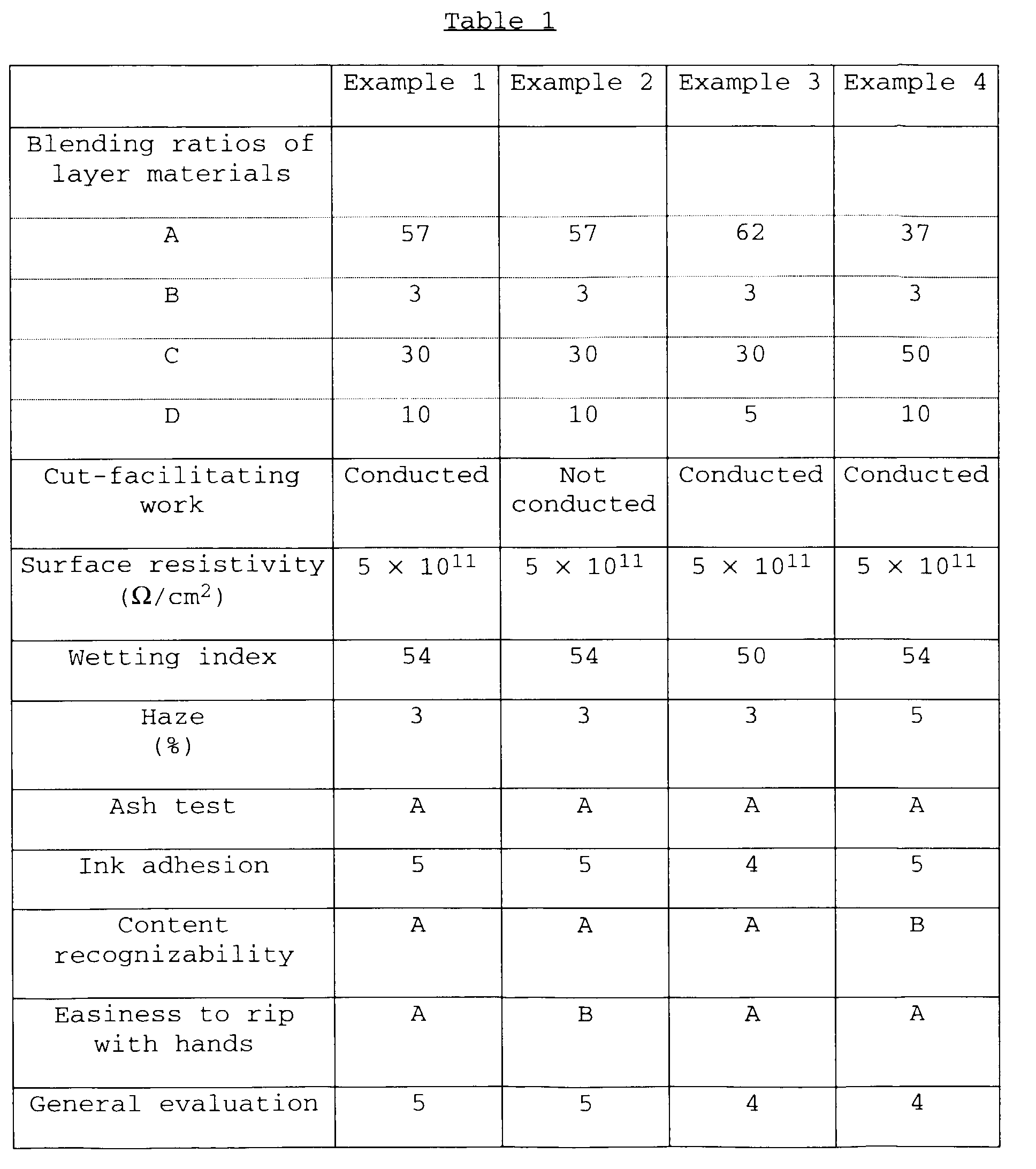
- a 57/3/30/10 (%) mixture of the said polyesters (A), (B), (C) and (D), and polyester (A) were melted respectively at 295°C, and they were coextruded onto a cooled casting drum with the said mixture composing the outermost layer (surface layer) and the said polyester (A) forming the intermediate layer to constitute a 2-material, 3-layer structure, and cooled and solidified to obtain a non-oriented sheet.
- This sheet was stretched 3.6 times in the machine direction at 90°C, then preheated and stretched 4 times in the transverse direction at 90°C by a tenter, and then heat treated at 230°C for 10 seconds to obtain a 19 ⁇ m thick polyester film.
- This polyester film was introduced in between a working roll having a scar forming projection on the circumference of a circle and a back-up roll having a smooth surface, said rolls being arranged to rotate at an equal speed in the opposite directions to each other, whereby the said polyester film was provided with fine perforations over its entire surface.
- This perforated film was then laminated with a polyethylene film to obtain a medicine wrapper with a polyester film as its base.
- This medicine wrapper showed excellent anti-static properties, content recognizability, easiness to rip with hands and ink adhesion.
- Example 1 The same procedure as defined in Example 1 was conducted except that no fine perforations were provided in the polyester film to obtain a medicine wrapper, and its properties were evaluated in the same way as in Example 1.
- Example 2 The same procedure as defined in Example 1 was conducted except that the amount of the surface layer polyester (D) blended was changed to 5% to obtain a medicine wrapper, and its properties were evaluated in the same way as in Example 1.
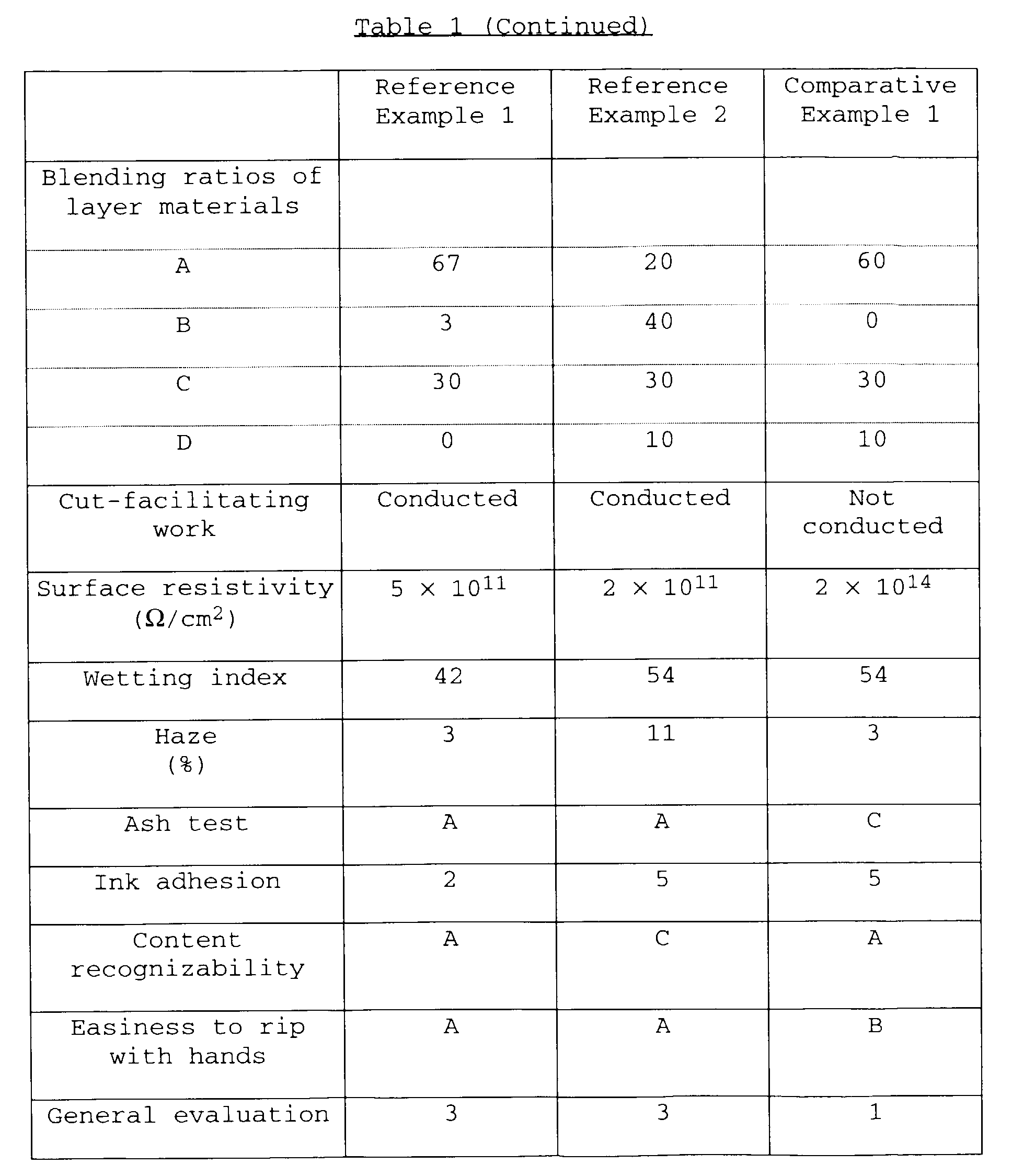
- Example 2 The same procedure as defined in Example 1 was conducted except that the amount of the surface layer polyester (C) blended was changed to 40% to obtain a medicine wrapper, and its properties were evaluated in the same way as in Example 1.
- Example 1 The same procedure as defined in Example 1 was conducted except that polyesters (A), (B) and (C) alone were used as materials of the surface layer to obtain a medicine wrapper, and its properties were evaluated in the same way as in Example 1.
- the obtained wrapper was poor in ink adhesion and incapable of proper printing.
- Example 2 The same procedure as defined in Example 1 was conducted except for a change of the surface layer polyester (B) to obtain a medicine wrapper, and its properties were evaluated in the same way as in Example 1.
- the obtained wrapper had a high level of haze and offered difficulties in recognizing the content.
- Example 1 The same procedure as defined in Example 1 was conducted except that polyesters (A), (C) and (D) were used as surface layer materials, and that no fine perforations were provided in the produced polyester film to obtain a medicine wrapper, and its properties were evaluated in the same way as in Example 1.
- the thus obtained wrapper was poor in anti-static effect and subject to adhesion of the content to its surface. This wrapper was also unsatisfactory in hand ripping quality.
- Example 2 The same procedure as defined in Example 1 was conducted except that the film forming speed was changed to obtain a 12 ⁇ m thick polyester film.
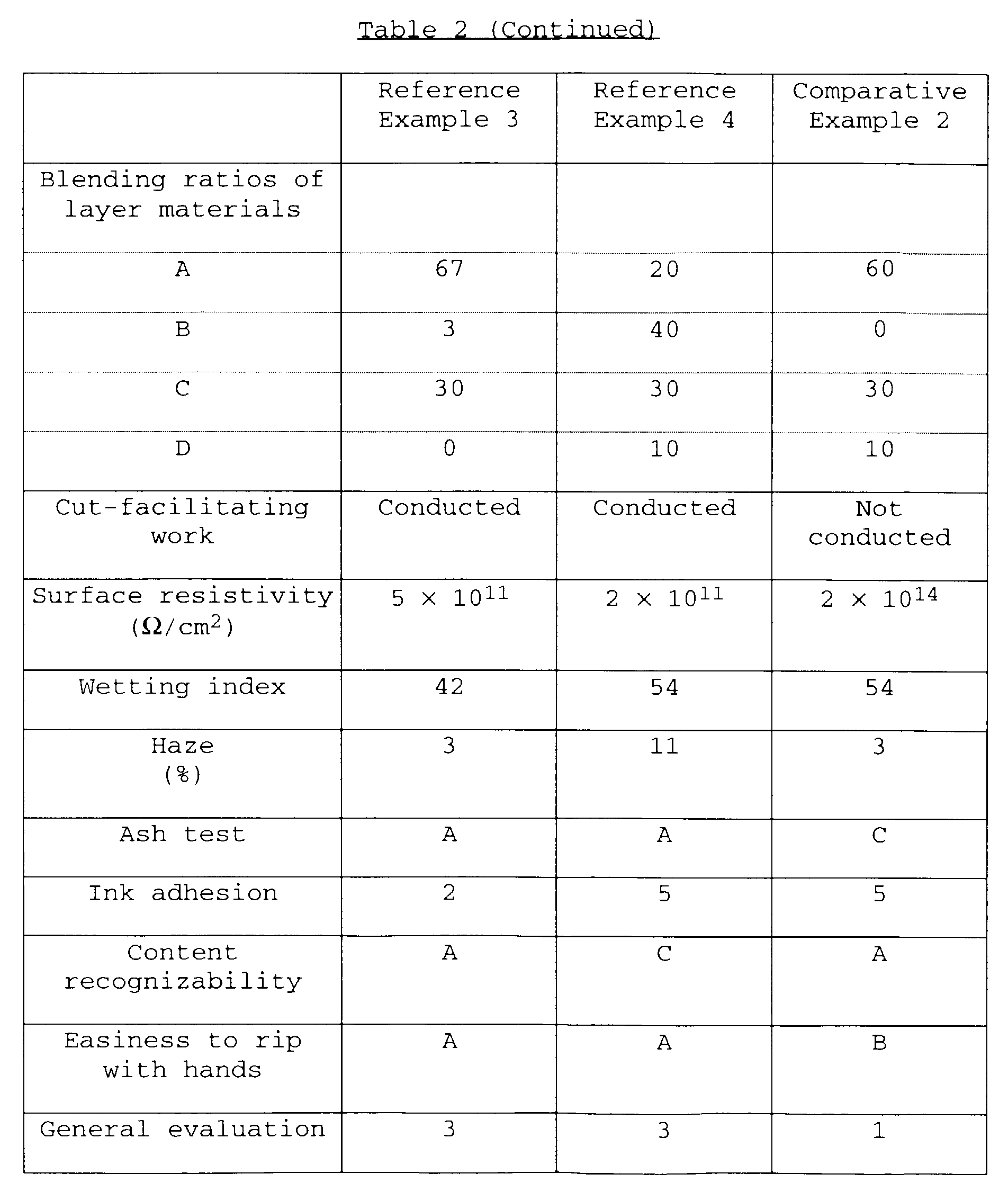
- this perforated film was then laminated with a polyethylene film and OPP film to obtain a powder food wrapper with a polyester film as its base.
- This powder food wrapper showed excellent anti-static properties, content recognizability, easiness to rip with hands and ink adhesion. Therefore, this powder food wrapper showed excellent properties for the powder food wrapper.
- Example 5 The same procedure as defined in Example 5 was conducted except that no fine perforations were provided in the polyester film to obtain a powder food wrapper, and its properties were evaluated in the same way as in Example 5.
- Example 5 The same procedure as defined in Example 5 was conducted except that the amount of the surface layer polyester (D) blended was changed to 5% to obtain a powder food wrapper, and its properties were evaluated in the same way as in Example 5.
- Example 5 The same procedure as defined in Example 5 was conducted except that the amount of the surface layer polyester (C) blended was changed to 40% to obtain a powder food wrapper, and its properties were evaluated in the same way as in Example 5.
- Example 5 The same procedure as defined in Example 5 was conducted except that polyesters (A), (B) and (C) alone were used as materials of the surface layer to obtain a powder food wrapper, and its properties were evaluated in the same way as in Example 5.
- the obtained wrapper was poor in ink adhesion and incapable of proper printing.
- Example 5 The same procedure as defined in Example 5 was conducted except for a change of the surface layer polyester (B) to obtain a powder food wrapper, and its properties were evaluated in the same way as in Example 5.
- the obtained wrapper had a high level of haze and offered difficulties in recognizing the content.
- Example 5 The same procedure as defined in Example 5 was conducted except that polyesters (A), (C) and (D) were used as surface layer materials, and that no fine perforations were provided in the produced polyester film to obtain a powder food wrapper, and its properties were evaluated in the same way as in Example 5.
- the thus obtained wrapper was poor in anti-static effect and subject to adhesion of the content to its surface. This wrapper was also unsatisfactory in hand ripping quality.
Landscapes
- Chemical & Material Sciences (AREA)
- Engineering & Computer Science (AREA)
- Manufacturing & Machinery (AREA)
- Chemical Kinetics & Catalysis (AREA)
- Materials Engineering (AREA)
- Health & Medical Sciences (AREA)
- Medicinal Chemistry (AREA)
- Polymers & Plastics (AREA)
- Organic Chemistry (AREA)
- Mechanical Engineering (AREA)
- Wrappers (AREA)
- Laminated Bodies (AREA)
- Manufacture Of Macromolecular Shaped Articles (AREA)
Abstract
Description

Claims (16)
- A polyester film for medicine wrapper having a surface resistivity of not more than 5 × 10¹² Ω/cm2.
- A polyester film for medicine wrapper according to Claim 1 having a wetting index of not less than 49 mN/m.
- A polyester film for medicine wrapper according to Claim 1 having a haze of not more than 10%.
- A polyester film for medicine wrapper according to Claim 1, wherein said film has been subjected to a cut-facilitating work.
- A packaging polyester film according to Claim 1, wherein said film contains an anti-static agent.
- A packaging polyester film according to Claim 5, wherein said anti-static agent is selected from the group consisting of sodium alkylsulfonate and sodium alkylbenzenesulfonate.
- A packaging polyester film according to Claim 5, wherein the content of said anti-static agent is 0.1 to 2% by weight based on the weight of polyester film.
- A polyester film for powder food wrapper having a surface resistivity of not more than 5 × 10¹² Ω/cm2.
- A polyester film for powder food wrapper according to Claim 8 having a wetting index of not less than 49 mN/m.
- A polyester film for powder food wrapper according to Claim 8 having a haze of not more than 10%.
- A polyester film for powder food wrapper according to Claim 8, wherein said film has been subjected to a cut-facilitating work.
- A packaging polyester film according to Claim 8, wherein said film contains an anti-static agent.
- A packaging polyester film according to Claim 12, wherein said anti-static agent is selected from the group consisting of sodium alkylsulfonate and sodium alkylbenzenesulfonate.
- A packaging polyester film according to Claim 12, wherein the content of said anti-static agent is 0.1 to 2% by weight based on the weight of polyester film.
- A medicine wrapper comprising the polyester film as defined in Claim 1.
- A powder food wrapper comprising the polyester film as defined in Claim 8.
Applications Claiming Priority (6)
| Application Number | Priority Date | Filing Date | Title |
|---|---|---|---|
| JP35408999 | 1999-12-14 | ||
| JP35408999 | 1999-12-14 | ||
| JP2000149261 | 2000-05-22 | ||
| JP2000149261A JP2001233374A (en) | 1999-12-14 | 2000-05-22 | Polyester film for medicine packaging paper |
| JP2000242024A JP2002053167A (en) | 2000-08-10 | 2000-08-10 | Polyester film for powdered food packaging |
| JP2000242024 | 2000-08-10 |
Publications (3)
| Publication Number | Publication Date |
|---|---|
| EP1108741A2 true EP1108741A2 (en) | 2001-06-20 |
| EP1108741A3 EP1108741A3 (en) | 2004-04-21 |
| EP1108741B1 EP1108741B1 (en) | 2011-02-09 |
Family
ID=27341469
Family Applications (1)
| Application Number | Title | Priority Date | Filing Date |
|---|---|---|---|
| EP20000126971 Expired - Lifetime EP1108741B1 (en) | 1999-12-14 | 2000-12-08 | Packaging polyester film |
Country Status (4)
| Country | Link |
|---|---|
| US (1) | US6635356B2 (en) |
| EP (1) | EP1108741B1 (en) |
| KR (1) | KR20010057569A (en) |
| DE (1) | DE60045609D1 (en) |
Cited By (1)
| Publication number | Priority date | Publication date | Assignee | Title |
|---|---|---|---|---|
| WO2010125376A1 (en) * | 2009-04-28 | 2010-11-04 | Gr Advanced Materials Ltd. | Microperforated film |
Families Citing this family (5)
| Publication number | Priority date | Publication date | Assignee | Title |
|---|---|---|---|---|
| JP4179585B2 (en) * | 2002-03-29 | 2008-11-12 | ユニ・チャーム株式会社 | Printed biodegradable plastic film |
| EP1602683A4 (en) * | 2003-03-11 | 2006-04-19 | Mitsubishi Polyester Film Corp | BIAXIALLY ORIENTATED POLYESTER FILM AND DEMOLITION FILM |
| US20100089418A1 (en) * | 2007-02-08 | 2010-04-15 | Bernard Obereiner | Packaged primer and scrub pad |
| US11028299B2 (en) | 2013-11-19 | 2021-06-08 | Mitsubishi Polyester Film, Inc | Anti-powdering and anti-static polymer film for digital printing |
| WO2023184741A1 (en) * | 2022-03-30 | 2023-10-05 | 东莞澳中新材料科技股份有限公司 | Recognizable substrate and recognizable adhesive tape using same, and method for preparing recognizable adhesive tape |
Family Cites Families (11)
| Publication number | Priority date | Publication date | Assignee | Title |
|---|---|---|---|---|
| JPS5812153B2 (en) * | 1974-10-31 | 1983-03-07 | 東レ株式会社 | Redflower polyester film |
| JPS649242A (en) * | 1987-03-16 | 1989-01-12 | Toray Industries | Production of biaxially oriented polyester film |
| JPH02151650A (en) * | 1988-12-02 | 1990-06-11 | Polyplastics Co | Thermoplastic polyester resin composition |
| US5188395A (en) * | 1988-12-21 | 1993-02-23 | Goyo Paper Working Co., Ltd. | Waterproof recording material having ground patterns and its manufacturing method |
| JP2924045B2 (en) * | 1990-01-31 | 1999-07-26 | 東洋紡績株式会社 | Antistatic polyester film and method for producing the same |
| KR930012989A (en) * | 1991-12-27 | 1993-07-21 | 최준식 | Polyester film |
| US5616387A (en) * | 1993-08-31 | 1997-04-01 | Minnesota Mining And Manufacturing Company | Perforated roll of elastic wrap |
| US5602195A (en) * | 1994-07-27 | 1997-02-11 | Skc Limited | Polymeric film and process for the preparation thereof |
| JP3193300B2 (en) * | 1996-07-12 | 2001-07-30 | 帝人株式会社 | Antistatic polyester film |
| DE69704267T2 (en) * | 1996-11-11 | 2001-08-23 | Bando Chemical Industries Ltd., Kobe | MATERIAL THAT ABSORBES AQUEOUS INK AND COMPOSITE FILM THAT CONTAINS A LAYER OF ABSORBENT MATERIAL |
| EP0962486B1 (en) * | 1998-06-05 | 2003-12-17 | Teijin Limited | Antistatic polyester film and process for producing the same |
-
2000
- 2000-12-08 DE DE60045609T patent/DE60045609D1/en not_active Expired - Lifetime
- 2000-12-08 EP EP20000126971 patent/EP1108741B1/en not_active Expired - Lifetime
- 2000-12-12 US US09/735,376 patent/US6635356B2/en not_active Expired - Fee Related
- 2000-12-14 KR KR1020000076353A patent/KR20010057569A/en not_active Ceased
Non-Patent Citations (1)
| Title |
|---|
| None |
Cited By (1)
| Publication number | Priority date | Publication date | Assignee | Title |
|---|---|---|---|---|
| WO2010125376A1 (en) * | 2009-04-28 | 2010-11-04 | Gr Advanced Materials Ltd. | Microperforated film |
Also Published As
| Publication number | Publication date |
|---|---|
| US6635356B2 (en) | 2003-10-21 |
| DE60045609D1 (en) | 2011-03-24 |
| EP1108741B1 (en) | 2011-02-09 |
| US20020168493A1 (en) | 2002-11-14 |
| KR20010057569A (en) | 2001-07-04 |
| EP1108741A3 (en) | 2004-04-21 |
Similar Documents
| Publication | Publication Date | Title |
|---|---|---|
| KR960004763B1 (en) | Polyester resin laminated film | |
| KR101379122B1 (en) | Polyester film | |
| US11325363B2 (en) | Laminate including polyester film having furandicarboxylate unit and heat-sealable resin layer, and packaging bag | |
| KR20050045866A (en) | Process for producing a coextruded, peelable polyester film | |
| US5990248A (en) | Film formed from polyethylene-2,6-naphthalate resin, process for producing said film and package using said film | |
| JP2005145070A (en) | Co-extrusion biaxially stretched polyester film, method for producing the same, packaging material comprising the same, and lid for tray | |
| JP2678179B2 (en) | Composite polyester film with barrier properties | |
| JP2004322642A (en) | Coextrusion transparent biaxially stretched polyester film, method for producing the same, and cover material for tray made of the same | |
| KR20040091573A (en) | Coextruded, Heatsealable and Peelable Polyester Film having Easy Peelability, Process for its Production and its Use | |
| KR20040091575A (en) | Coextruded, Heatsealable and Peelable Polyester Film, Process for its Production and its Use | |
| JP2004322647A (en) | Coextrusion transparent biaxially stretched polyester film, method for producing the same, and cover material for tray made of the same | |
| KR20040091574A (en) | Coextruded, Heatsealable and Peelable Polyester Film having strong peelability, Process for its Production and its Use | |
| US20070148423A1 (en) | Biaxially stretched laminated polyester film and polyester film for covering | |
| JPWO1994029374A1 (en) | Film formed from polyethylene-2,6-naphthalate resin, method for producing said film, and packaging using said film | |
| US20200079064A1 (en) | Heat-sealable polyester film for production of ready-meal trays, process for its production, and use of the film | |
| US20040213968A1 (en) | Coextruded, heatsealable and peelable polyester film, process for its production and its use | |
| US6635356B2 (en) | Packaging polyester film | |
| JP2001510110A (en) | Polyester composite film with gas shielding | |
| JP7243851B2 (en) | Laser-printable film and package using the same | |
| JPH08169962A (en) | Biaxially oriented polyester film | |
| US11136175B2 (en) | Pack made of polyester with a thermoformable lower film and a sealable and peelable upper film, use thereof, and process for its production | |
| JP2002178450A (en) | Lid material for PTP packaging | |
| JP2001233374A (en) | Polyester film for medicine packaging paper | |
| JP4754181B2 (en) | Blister pack packaging lid | |
| JPS6410184B2 (en) |
Legal Events
| Date | Code | Title | Description |
|---|---|---|---|
| PUAI | Public reference made under article 153(3) epc to a published international application that has entered the european phase |
Free format text: ORIGINAL CODE: 0009012 |
|
| AK | Designated contracting states |
Kind code of ref document: A2 Designated state(s): AT BE CH CY DE DK ES FI FR GB GR IE IT LI LU MC NL PT SE TR |
|
| AX | Request for extension of the european patent |
Free format text: AL;LT;LV;MK;RO;SI |
|
| PUAL | Search report despatched |
Free format text: ORIGINAL CODE: 0009013 |
|
| AK | Designated contracting states |
Kind code of ref document: A3 Designated state(s): AT BE CH CY DE DK ES FI FR GB GR IE IT LI LU MC NL PT SE TR |
|
| AX | Request for extension of the european patent |
Extension state: AL LT LV MK RO SI |
|
| 17P | Request for examination filed |
Effective date: 20040419 |
|
| AKX | Designation fees paid |
Designated state(s): DE FR GB IT LU NL |
|
| 17Q | First examination report despatched |
Effective date: 20050318 |
|
| GRAP | Despatch of communication of intention to grant a patent |
Free format text: ORIGINAL CODE: EPIDOSNIGR1 |
|
| GRAS | Grant fee paid |
Free format text: ORIGINAL CODE: EPIDOSNIGR3 |
|
| GRAA | (expected) grant |
Free format text: ORIGINAL CODE: 0009210 |
|
| AK | Designated contracting states |
Kind code of ref document: B1 Designated state(s): DE FR GB IT LU NL |
|
| REG | Reference to a national code |
Ref country code: GB Ref legal event code: FG4D |
|
| REF | Corresponds to: |
Ref document number: 60045609 Country of ref document: DE Date of ref document: 20110324 Kind code of ref document: P |
|
| REG | Reference to a national code |
Ref country code: DE Ref legal event code: R096 Ref document number: 60045609 Country of ref document: DE Effective date: 20110324 |
|
| REG | Reference to a national code |
Ref country code: NL Ref legal event code: VDEP Effective date: 20110209 |
|
| PG25 | Lapsed in a contracting state [announced via postgrant information from national office to epo] |
Ref country code: NL Free format text: LAPSE BECAUSE OF FAILURE TO SUBMIT A TRANSLATION OF THE DESCRIPTION OR TO PAY THE FEE WITHIN THE PRESCRIBED TIME-LIMIT Effective date: 20110209 |
|
| PLBE | No opposition filed within time limit |
Free format text: ORIGINAL CODE: 0009261 |
|
| STAA | Information on the status of an ep patent application or granted ep patent |
Free format text: STATUS: NO OPPOSITION FILED WITHIN TIME LIMIT |
|
| 26N | No opposition filed |
Effective date: 20111110 |
|
| REG | Reference to a national code |
Ref country code: DE Ref legal event code: R097 Ref document number: 60045609 Country of ref document: DE Effective date: 20111110 |
|
| PG25 | Lapsed in a contracting state [announced via postgrant information from national office to epo] |
Ref country code: IT Free format text: LAPSE BECAUSE OF FAILURE TO SUBMIT A TRANSLATION OF THE DESCRIPTION OR TO PAY THE FEE WITHIN THE PRESCRIBED TIME-LIMIT Effective date: 20110209 |
|
| PG25 | Lapsed in a contracting state [announced via postgrant information from national office to epo] |
Ref country code: LU Free format text: LAPSE BECAUSE OF NON-PAYMENT OF DUE FEES Effective date: 20111208 |
|
| PGFP | Annual fee paid to national office [announced via postgrant information from national office to epo] |
Ref country code: GB Payment date: 20131219 Year of fee payment: 14 Ref country code: DE Payment date: 20131220 Year of fee payment: 14 |
|
| PGFP | Annual fee paid to national office [announced via postgrant information from national office to epo] |
Ref country code: FR Payment date: 20131220 Year of fee payment: 14 |
|
| REG | Reference to a national code |
Ref country code: DE Ref legal event code: R119 Ref document number: 60045609 Country of ref document: DE |
|
| GBPC | Gb: european patent ceased through non-payment of renewal fee |
Effective date: 20141208 |
|
| REG | Reference to a national code |
Ref country code: FR Ref legal event code: ST Effective date: 20150831 |
|
| PG25 | Lapsed in a contracting state [announced via postgrant information from national office to epo] |
Ref country code: DE Free format text: LAPSE BECAUSE OF NON-PAYMENT OF DUE FEES Effective date: 20150701 Ref country code: GB Free format text: LAPSE BECAUSE OF NON-PAYMENT OF DUE FEES Effective date: 20141208 |
|
| PG25 | Lapsed in a contracting state [announced via postgrant information from national office to epo] |
Ref country code: FR Free format text: LAPSE BECAUSE OF NON-PAYMENT OF DUE FEES Effective date: 20141231 |