EP1108704A1 - Process for producing alkylated hydroxyl-containing aromatic compounds - Google Patents
Process for producing alkylated hydroxyl-containing aromatic compounds Download PDFInfo
- Publication number
- EP1108704A1 EP1108704A1 EP00310030A EP00310030A EP1108704A1 EP 1108704 A1 EP1108704 A1 EP 1108704A1 EP 00310030 A EP00310030 A EP 00310030A EP 00310030 A EP00310030 A EP 00310030A EP 1108704 A1 EP1108704 A1 EP 1108704A1
- Authority
- EP
- European Patent Office
- Prior art keywords
- process according
- olefin
- olefins
- mixture
- isomerized
- Prior art date
- Legal status (The legal status is an assumption and is not a legal conclusion. Google has not performed a legal analysis and makes no representation as to the accuracy of the status listed.)
- Granted
Links
- 125000002887 hydroxy group Chemical group [H]O* 0.000 title claims abstract description 29
- 150000001491 aromatic compounds Chemical class 0.000 title claims abstract description 25
- 238000000034 method Methods 0.000 title claims description 44
- 230000008569 process Effects 0.000 title claims description 33
- 150000001336 alkenes Chemical class 0.000 claims abstract description 62
- 239000003054 catalyst Substances 0.000 claims abstract description 56
- JRZJOMJEPLMPRA-UHFFFAOYSA-N olefin Natural products CCCCCCCC=C JRZJOMJEPLMPRA-UHFFFAOYSA-N 0.000 claims abstract description 45
- 239000004711 α-olefin Substances 0.000 claims abstract description 38
- 239000000203 mixture Substances 0.000 claims abstract description 36
- 230000002378 acidificating effect Effects 0.000 claims abstract description 30
- 238000006317 isomerization reaction Methods 0.000 claims abstract description 22
- 239000007787 solid Substances 0.000 claims abstract description 12
- LSNNMFCWUKXFEE-UHFFFAOYSA-M Bisulfite Chemical compound OS([O-])=O LSNNMFCWUKXFEE-UHFFFAOYSA-M 0.000 claims abstract description 10
- 125000004432 carbon atom Chemical group C* 0.000 claims abstract description 9
- 239000004927 clay Substances 0.000 claims abstract description 8
- 230000001939 inductive effect Effects 0.000 claims abstract description 6
- 239000003456 ion exchange resin Substances 0.000 claims abstract description 6
- 229920003303 ion-exchange polymer Polymers 0.000 claims abstract description 6
- NWUYHJFMYQTDRP-UHFFFAOYSA-N 1,2-bis(ethenyl)benzene;1-ethenyl-2-ethylbenzene;styrene Chemical compound C=CC1=CC=CC=C1.CCC1=CC=CC=C1C=C.C=CC1=CC=CC=C1C=C NWUYHJFMYQTDRP-UHFFFAOYSA-N 0.000 claims abstract description 5
- 230000002152 alkylating effect Effects 0.000 claims abstract description 5
- 125000000129 anionic group Chemical group 0.000 claims abstract description 4
- 229910001657 ferrierite group Inorganic materials 0.000 claims abstract 4
- ISWSIDIOOBJBQZ-UHFFFAOYSA-N Phenol Chemical compound OC1=CC=CC=C1 ISWSIDIOOBJBQZ-UHFFFAOYSA-N 0.000 claims description 20
- 229910052751 metal Inorganic materials 0.000 claims description 16
- 239000002184 metal Substances 0.000 claims description 16
- 239000002808 molecular sieve Substances 0.000 claims description 12
- URGAHOPLAPQHLN-UHFFFAOYSA-N sodium aluminosilicate Chemical compound [Na+].[Al+3].[O-][Si]([O-])=O.[O-][Si]([O-])=O URGAHOPLAPQHLN-UHFFFAOYSA-N 0.000 claims description 12
- RDOXTESZEPMUJZ-UHFFFAOYSA-N anisole Chemical compound COC1=CC=CC=C1 RDOXTESZEPMUJZ-UHFFFAOYSA-N 0.000 claims description 8
- YCIMNLLNPGFGHC-UHFFFAOYSA-N catechol Chemical compound OC1=CC=CC=C1O YCIMNLLNPGFGHC-UHFFFAOYSA-N 0.000 claims description 8
- GHMLBKRAJCXXBS-UHFFFAOYSA-N resorcinol Chemical compound OC1=CC=CC(O)=C1 GHMLBKRAJCXXBS-UHFFFAOYSA-N 0.000 claims description 8
- 239000011347 resin Substances 0.000 claims description 7
- 229920005989 resin Polymers 0.000 claims description 7
- KDLHZDBZIXYQEI-UHFFFAOYSA-N Palladium Chemical compound [Pd] KDLHZDBZIXYQEI-UHFFFAOYSA-N 0.000 claims description 6
- BASFCYQUMIYNBI-UHFFFAOYSA-N platinum Chemical compound [Pt] BASFCYQUMIYNBI-UHFFFAOYSA-N 0.000 claims description 6
- 150000002739 metals Chemical class 0.000 claims description 5
- QTWJRLJHJPIABL-UHFFFAOYSA-N 2-methylphenol;3-methylphenol;4-methylphenol Chemical compound CC1=CC=C(O)C=C1.CC1=CC=CC(O)=C1.CC1=CC=CC=C1O QTWJRLJHJPIABL-UHFFFAOYSA-N 0.000 claims description 4
- 229930003836 cresol Natural products 0.000 claims description 4
- UZKWTJUDCOPSNM-UHFFFAOYSA-N methoxybenzene Substances CCCCOC=C UZKWTJUDCOPSNM-UHFFFAOYSA-N 0.000 claims description 4
- 239000011148 porous material Substances 0.000 claims description 4
- 229910052763 palladium Inorganic materials 0.000 claims description 3
- 229910052697 platinum Inorganic materials 0.000 claims description 3
- 229910044991 metal oxide Inorganic materials 0.000 claims description 2
- 150000004706 metal oxides Chemical class 0.000 claims description 2
- 239000011949 solid catalyst Substances 0.000 claims description 2
- 239000003377 acid catalyst Substances 0.000 claims 1
- 238000005804 alkylation reaction Methods 0.000 description 12
- 239000000047 product Substances 0.000 description 10
- 230000029936 alkylation Effects 0.000 description 9
- -1 HYDROXYL GROUP Chemical group 0.000 description 8
- 125000003118 aryl group Chemical group 0.000 description 7
- VLKZOEOYAKHREP-UHFFFAOYSA-N n-Hexane Chemical compound CCCCCC VLKZOEOYAKHREP-UHFFFAOYSA-N 0.000 description 6
- 238000002835 absorbance Methods 0.000 description 5
- 239000011521 glass Substances 0.000 description 5
- 238000004566 IR spectroscopy Methods 0.000 description 4
- 239000003921 oil Substances 0.000 description 4
- OKKJLVBELUTLKV-UHFFFAOYSA-N Methanol Chemical compound OC OKKJLVBELUTLKV-UHFFFAOYSA-N 0.000 description 3
- 125000000217 alkyl group Chemical group 0.000 description 3
- 229910052799 carbon Inorganic materials 0.000 description 3
- 150000001875 compounds Chemical class 0.000 description 3
- 239000003599 detergent Substances 0.000 description 3
- 238000004128 high performance liquid chromatography Methods 0.000 description 3
- 238000002347 injection Methods 0.000 description 3
- 239000007924 injection Substances 0.000 description 3
- 238000004808 supercritical fluid chromatography Methods 0.000 description 3
- HIXDQWDOVZUNNA-UHFFFAOYSA-N 2-(3,4-dimethoxyphenyl)-5-hydroxy-7-methoxychromen-4-one Chemical compound C=1C(OC)=CC(O)=C(C(C=2)=O)C=1OC=2C1=CC=C(OC)C(OC)=C1 HIXDQWDOVZUNNA-UHFFFAOYSA-N 0.000 description 2
- IJGRMHOSHXDMSA-UHFFFAOYSA-N Atomic nitrogen Chemical compound N#N IJGRMHOSHXDMSA-UHFFFAOYSA-N 0.000 description 2
- CURLTUGMZLYLDI-UHFFFAOYSA-N Carbon dioxide Chemical compound O=C=O CURLTUGMZLYLDI-UHFFFAOYSA-N 0.000 description 2
- XDTMQSROBMDMFD-UHFFFAOYSA-N Cyclohexane Chemical compound C1CCCCC1 XDTMQSROBMDMFD-UHFFFAOYSA-N 0.000 description 2
- LFQSCWFLJHTTHZ-UHFFFAOYSA-N Ethanol Chemical compound CCO LFQSCWFLJHTTHZ-UHFFFAOYSA-N 0.000 description 2
- CSNNHWWHGAXBCP-UHFFFAOYSA-L Magnesium sulfate Chemical compound [Mg+2].[O-][S+2]([O-])([O-])[O-] CSNNHWWHGAXBCP-UHFFFAOYSA-L 0.000 description 2
- 238000005481 NMR spectroscopy Methods 0.000 description 2
- PXHVJJICTQNCMI-UHFFFAOYSA-N Nickel Chemical compound [Ni] PXHVJJICTQNCMI-UHFFFAOYSA-N 0.000 description 2
- 150000001721 carbon Chemical group 0.000 description 2
- 239000011203 carbon fibre reinforced carbon Substances 0.000 description 2
- 238000006243 chemical reaction Methods 0.000 description 2
- 238000009826 distribution Methods 0.000 description 2
- 125000002573 ethenylidene group Chemical group [*]=C=C([H])[H] 0.000 description 2
- RTZKZFJDLAIYFH-UHFFFAOYSA-N ether Substances CCOCC RTZKZFJDLAIYFH-UHFFFAOYSA-N 0.000 description 2
- 239000000706 filtrate Substances 0.000 description 2
- 239000010687 lubricating oil Substances 0.000 description 2
- 230000008707 rearrangement Effects 0.000 description 2
- 238000003756 stirring Methods 0.000 description 2
- HNSDLXPSAYFUHK-UHFFFAOYSA-N 1,4-bis(2-ethylhexyl) sulfosuccinate Chemical compound CCCCC(CC)COC(=O)CC(S(O)(=O)=O)C(=O)OCC(CC)CCCC HNSDLXPSAYFUHK-UHFFFAOYSA-N 0.000 description 1
- YZUPZGFPHUVJKC-UHFFFAOYSA-N 1-bromo-2-methoxyethane Chemical compound COCCBr YZUPZGFPHUVJKC-UHFFFAOYSA-N 0.000 description 1
- 238000001644 13C nuclear magnetic resonance spectroscopy Methods 0.000 description 1
- OKTJSMMVPCPJKN-UHFFFAOYSA-N Carbon Chemical compound [C] OKTJSMMVPCPJKN-UHFFFAOYSA-N 0.000 description 1
- VYZAMTAEIAYCRO-UHFFFAOYSA-N Chromium Chemical compound [Cr] VYZAMTAEIAYCRO-UHFFFAOYSA-N 0.000 description 1
- 238000005033 Fourier transform infrared spectroscopy Methods 0.000 description 1
- UFHFLCQGNIYNRP-UHFFFAOYSA-N Hydrogen Chemical compound [H][H] UFHFLCQGNIYNRP-UHFFFAOYSA-N 0.000 description 1
- ZOKXTWBITQBERF-UHFFFAOYSA-N Molybdenum Chemical compound [Mo] ZOKXTWBITQBERF-UHFFFAOYSA-N 0.000 description 1
- UCKMPCXJQFINFW-UHFFFAOYSA-N Sulphide Chemical compound [S-2] UCKMPCXJQFINFW-UHFFFAOYSA-N 0.000 description 1
- 239000004809 Teflon Substances 0.000 description 1
- 229920006362 Teflon® Polymers 0.000 description 1
- HCHKCACWOHOZIP-UHFFFAOYSA-N Zinc Chemical compound [Zn] HCHKCACWOHOZIP-UHFFFAOYSA-N 0.000 description 1
- 230000004913 activation Effects 0.000 description 1
- PNEYBMLMFCGWSK-UHFFFAOYSA-N aluminium oxide Inorganic materials [O-2].[O-2].[O-2].[Al+3].[Al+3] PNEYBMLMFCGWSK-UHFFFAOYSA-N 0.000 description 1
- 238000004458 analytical method Methods 0.000 description 1
- 238000009835 boiling Methods 0.000 description 1
- 238000011088 calibration curve Methods 0.000 description 1
- CREMABGTGYGIQB-UHFFFAOYSA-N carbon carbon Chemical compound C.C CREMABGTGYGIQB-UHFFFAOYSA-N 0.000 description 1
- 229910002092 carbon dioxide Inorganic materials 0.000 description 1
- 239000001569 carbon dioxide Substances 0.000 description 1
- 238000001460 carbon-13 nuclear magnetic resonance spectrum Methods 0.000 description 1
- 230000003197 catalytic effect Effects 0.000 description 1
- 229920001429 chelating resin Polymers 0.000 description 1
- 239000003795 chemical substances by application Substances 0.000 description 1
- MJSNUBOCVAKFIJ-LNTINUHCSA-N chromium;(z)-4-oxoniumylidenepent-2-en-2-olate Chemical compound [Cr].C\C(O)=C\C(C)=O.C\C(O)=C\C(C)=O.C\C(O)=C\C(C)=O MJSNUBOCVAKFIJ-LNTINUHCSA-N 0.000 description 1
- 239000010941 cobalt Substances 0.000 description 1
- 229910017052 cobalt Inorganic materials 0.000 description 1
- GUTLYIVDDKVIGB-UHFFFAOYSA-N cobalt atom Chemical compound [Co] GUTLYIVDDKVIGB-UHFFFAOYSA-N 0.000 description 1
- 238000010924 continuous production Methods 0.000 description 1
- 238000002788 crimping Methods 0.000 description 1
- 125000004093 cyano group Chemical group *C#N 0.000 description 1
- 238000004821 distillation Methods 0.000 description 1
- 239000003480 eluent Substances 0.000 description 1
- 238000010828 elution Methods 0.000 description 1
- 238000001704 evaporation Methods 0.000 description 1
- 230000008020 evaporation Effects 0.000 description 1
- 239000012530 fluid Substances 0.000 description 1
- 239000007789 gas Substances 0.000 description 1
- 230000005484 gravity Effects 0.000 description 1
- 239000001257 hydrogen Substances 0.000 description 1
- 229910052739 hydrogen Inorganic materials 0.000 description 1
- 238000005470 impregnation Methods 0.000 description 1
- 238000010348 incorporation Methods 0.000 description 1
- 238000002329 infrared spectrum Methods 0.000 description 1
- 230000010354 integration Effects 0.000 description 1
- 238000005342 ion exchange Methods 0.000 description 1
- 239000007791 liquid phase Substances 0.000 description 1
- 229910052943 magnesium sulfate Inorganic materials 0.000 description 1
- 230000014759 maintenance of location Effects 0.000 description 1
- 230000005012 migration Effects 0.000 description 1
- 238000013508 migration Methods 0.000 description 1
- 229910052750 molybdenum Inorganic materials 0.000 description 1
- 239000011733 molybdenum Substances 0.000 description 1
- 229910052759 nickel Inorganic materials 0.000 description 1
- 229910052757 nitrogen Inorganic materials 0.000 description 1
- 239000012044 organic layer Substances 0.000 description 1
- 150000002989 phenols Chemical class 0.000 description 1
- 238000002360 preparation method Methods 0.000 description 1
- 239000011541 reaction mixture Substances 0.000 description 1
- 230000004044 response Effects 0.000 description 1
- 150000003839 salts Chemical class 0.000 description 1
- 210000002966 serum Anatomy 0.000 description 1
- 239000000243 solution Substances 0.000 description 1
- 230000003595 spectral effect Effects 0.000 description 1
- 238000001228 spectrum Methods 0.000 description 1
- 239000000126 substance Substances 0.000 description 1
- 238000006467 substitution reaction Methods 0.000 description 1
- WFKWXMTUELFFGS-UHFFFAOYSA-N tungsten Chemical compound [W] WFKWXMTUELFFGS-UHFFFAOYSA-N 0.000 description 1
- 239000010937 tungsten Substances 0.000 description 1
- 229910052721 tungsten Inorganic materials 0.000 description 1
- 229910052720 vanadium Inorganic materials 0.000 description 1
- GPPXJZIENCGNKB-UHFFFAOYSA-N vanadium Chemical compound [V]#[V] GPPXJZIENCGNKB-UHFFFAOYSA-N 0.000 description 1
- XLYOFNOQVPJJNP-UHFFFAOYSA-N water Substances O XLYOFNOQVPJJNP-UHFFFAOYSA-N 0.000 description 1
- 229910052725 zinc Inorganic materials 0.000 description 1
- 239000011701 zinc Substances 0.000 description 1
Classifications
-
- C—CHEMISTRY; METALLURGY
- C07—ORGANIC CHEMISTRY
- C07C—ACYCLIC OR CARBOCYCLIC COMPOUNDS
- C07C37/00—Preparation of compounds having hydroxy or O-metal groups bound to a carbon atom of a six-membered aromatic ring
- C07C37/11—Preparation of compounds having hydroxy or O-metal groups bound to a carbon atom of a six-membered aromatic ring by reactions increasing the number of carbon atoms
- C07C37/14—Preparation of compounds having hydroxy or O-metal groups bound to a carbon atom of a six-membered aromatic ring by reactions increasing the number of carbon atoms by addition reactions, i.e. reactions involving at least one carbon-to-carbon unsaturated bond
-
- B—PERFORMING OPERATIONS; TRANSPORTING
- B01—PHYSICAL OR CHEMICAL PROCESSES OR APPARATUS IN GENERAL
- B01J—CHEMICAL OR PHYSICAL PROCESSES, e.g. CATALYSIS OR COLLOID CHEMISTRY; THEIR RELEVANT APPARATUS
- B01J29/00—Catalysts comprising molecular sieves
- B01J29/04—Catalysts comprising molecular sieves having base-exchange properties, e.g. crystalline zeolites
- B01J29/06—Crystalline aluminosilicate zeolites; Isomorphous compounds thereof
- B01J29/65—Crystalline aluminosilicate zeolites; Isomorphous compounds thereof of the ferrierite type, e.g. types ZSM-21, ZSM-35 or ZSM-38, as exemplified by patent documents US4046859, US4016245 and US4046859, respectively
-
- B—PERFORMING OPERATIONS; TRANSPORTING
- B01—PHYSICAL OR CHEMICAL PROCESSES OR APPARATUS IN GENERAL
- B01J—CHEMICAL OR PHYSICAL PROCESSES, e.g. CATALYSIS OR COLLOID CHEMISTRY; THEIR RELEVANT APPARATUS
- B01J29/00—Catalysts comprising molecular sieves
- B01J29/04—Catalysts comprising molecular sieves having base-exchange properties, e.g. crystalline zeolites
- B01J29/06—Crystalline aluminosilicate zeolites; Isomorphous compounds thereof
- B01J29/70—Crystalline aluminosilicate zeolites; Isomorphous compounds thereof of types characterised by their specific structure not provided for in groups B01J29/08 - B01J29/65
- B01J29/7046—MTT-type, e.g. ZSM-23, KZ-1, ISI-4 or EU-13
-
- B—PERFORMING OPERATIONS; TRANSPORTING
- B01—PHYSICAL OR CHEMICAL PROCESSES OR APPARATUS IN GENERAL
- B01J—CHEMICAL OR PHYSICAL PROCESSES, e.g. CATALYSIS OR COLLOID CHEMISTRY; THEIR RELEVANT APPARATUS
- B01J29/00—Catalysts comprising molecular sieves
- B01J29/82—Phosphates
- B01J29/83—Aluminophosphates [APO compounds]
-
- C—CHEMISTRY; METALLURGY
- C07—ORGANIC CHEMISTRY
- C07C—ACYCLIC OR CARBOCYCLIC COMPOUNDS
- C07C5/00—Preparation of hydrocarbons from hydrocarbons containing the same number of carbon atoms
- C07C5/22—Preparation of hydrocarbons from hydrocarbons containing the same number of carbon atoms by isomerisation
- C07C5/2206—Catalytic processes not covered by C07C5/23 - C07C5/31
- C07C5/222—Catalytic processes not covered by C07C5/23 - C07C5/31 with crystalline alumino-silicates, e.g. molecular sieves
-
- C—CHEMISTRY; METALLURGY
- C10—PETROLEUM, GAS OR COKE INDUSTRIES; TECHNICAL GASES CONTAINING CARBON MONOXIDE; FUELS; LUBRICANTS; PEAT
- C10M—LUBRICATING COMPOSITIONS; USE OF CHEMICAL SUBSTANCES EITHER ALONE OR AS LUBRICATING INGREDIENTS IN A LUBRICATING COMPOSITION
- C10M129/00—Lubricating compositions characterised by the additive being an organic non-macromolecular compound containing oxygen
- C10M129/02—Lubricating compositions characterised by the additive being an organic non-macromolecular compound containing oxygen having a carbon chain of less than 30 atoms
- C10M129/04—Hydroxy compounds
- C10M129/10—Hydroxy compounds having hydroxy groups bound to a carbon atom of a six-membered aromatic ring
-
- C—CHEMISTRY; METALLURGY
- C07—ORGANIC CHEMISTRY
- C07C—ACYCLIC OR CARBOCYCLIC COMPOUNDS
- C07C2529/00—Catalysts comprising molecular sieves
- C07C2529/04—Catalysts comprising molecular sieves having base-exchange properties, e.g. crystalline zeolites, pillared clays
- C07C2529/06—Crystalline aluminosilicate zeolites; Isomorphous compounds thereof
- C07C2529/65—Crystalline aluminosilicate zeolites; Isomorphous compounds thereof of the ferrierite type, e.g. types ZSM-21, ZSM-35 or ZSM-38
-
- C—CHEMISTRY; METALLURGY
- C07—ORGANIC CHEMISTRY
- C07C—ACYCLIC OR CARBOCYCLIC COMPOUNDS
- C07C2529/00—Catalysts comprising molecular sieves
- C07C2529/04—Catalysts comprising molecular sieves having base-exchange properties, e.g. crystalline zeolites, pillared clays
- C07C2529/06—Crystalline aluminosilicate zeolites; Isomorphous compounds thereof
- C07C2529/70—Crystalline aluminosilicate zeolites; Isomorphous compounds thereof of types characterised by their specific structure not provided for in groups C07C2529/08 - C07C2529/65
-
- C—CHEMISTRY; METALLURGY
- C10—PETROLEUM, GAS OR COKE INDUSTRIES; TECHNICAL GASES CONTAINING CARBON MONOXIDE; FUELS; LUBRICANTS; PEAT
- C10M—LUBRICATING COMPOSITIONS; USE OF CHEMICAL SUBSTANCES EITHER ALONE OR AS LUBRICATING INGREDIENTS IN A LUBRICATING COMPOSITION
- C10M2207/00—Organic non-macromolecular hydrocarbon compounds containing hydrogen, carbon and oxygen as ingredients in lubricant compositions
- C10M2207/02—Hydroxy compounds
- C10M2207/023—Hydroxy compounds having hydroxy groups bound to carbon atoms of six-membered aromatic rings
- C10M2207/027—Neutral salts thereof
-
- C—CHEMISTRY; METALLURGY
- C10—PETROLEUM, GAS OR COKE INDUSTRIES; TECHNICAL GASES CONTAINING CARBON MONOXIDE; FUELS; LUBRICANTS; PEAT
- C10N—INDEXING SCHEME ASSOCIATED WITH SUBCLASS C10M RELATING TO LUBRICATING COMPOSITIONS
- C10N2030/00—Specified physical or chemical properties which is improved by the additive characterising the lubricating composition, e.g. multifunctional additives
- C10N2030/04—Detergent property or dispersant property
Definitions
- the present invention relates to a process for alkylation of an aromatic compound having at least one hydroxyl group on the aromatic ring, such as phenol, catechol, anisole, cresol, resorcinol or mixtures thereof, to provide an aromatic product having both hydroxyl and alkyl groups on the same aromatic ring in which the content of the para-alkyl isomer is high.
- the alkylated products are useful in making detergents for lubricating oils.
- Also provided in accordance with this invention is a process for producing an alkylated hydroxyl-containing aromatic compound, said process comprising:
- the present invention is based on the discovery that olefin and skeletal isomerization of the normal alpha-olefin prior to alkylation of the hydroxyl-containing aromatic compound results in an alkylated product containing a high content of compounds in which the alkyl and hydroxyl groups are in the para position relative to each other.
- the present invention involves a process for producing alkylated aromatic compounds that have at least one hydroxyl and at least one alkyl group on the same aromatic ring. That process comprises isomerizing a normal alpha-olefin or mixture of normal alpha-olefins (referred to herein collectively as "NAO") having from about 16 to about 30 carbon atoms in the presence of a first solid, acidic catalyst capable of inducing both olefin isomerization and skeletal isomerization to produce a mixture of isomerized olefins, then alkylating an aromatic compound having at least one hydroxyl group on the aromatic ring with the mixture of isomerized olefins in the presence of a second solid, acidic catalyst comprising a sulfonic acid resin catalyst or an acidic clay.
- NAO normal alpha-olefin or mixture of normal alpha-olefins
- the alkylation of phenol with olefins under normal alkylation conditions using a macroporous sulfonic acid resin catalyst or acidic clay, nominally affords an alkylated phenol product in which the para and ortho isomers are dominant.
- the para isomer/ortho isomer ratio content is only about 50/50.
- the alkylated product can be used to prepare detergents for lubricating oil, and the high paraisomer content allows more base to be added to the detergent.
- hydroxyl-containing aromatic compounds that are alkylated in the subject process include phenol, catechol, anisole, cresol, resorcinol and mixtures thereof, with phenol being the preferred compound.
- the normal alpha-olefins that are isomerized prior to the alkylation of the hydroxyl-containing aromatic compounds are normal alpha-olefins or mixtures of normal alpha-olefins that have from about 16 to about 30 carbon atoms per molecule. Preferably, they have about 20 to about 28 carbon atoms per molecule.
- the catalyst used to isomerize the normal alpha-olefin or mixture of normal alpha-olefins can be any catalyst that is capable of inducing both olefin isomerization and skeletal isomerization in the NAO while leaving the NAO otherwise essentially in tact.
- olefin isomerization refers to movement of the carbon-carbon double bond within the molecule
- skeletal isomerization refers to rearrangement of the carbon atoms within the molecule.
- Such catalysts include solid, acidic catalysts comprising at least one metal oxide, and having an average pore size of less than 5.5 Angstroms.
- the solid, acidic catalyst comprises a molecular sieve with a one-dimensional pore system. More preferably, it is selected from the group consisting of molecular sieves SM-3, MAPO-11, SAPO-11, SSZ-32, ZSM-23, MAPO-39, SAPO-39, ZSM-22, and SSZ-20.
- the preferred molecular sieves are SAPO-11 and SSZ-32.
- Other possible solid, acidic catalysts useful for isomerization include molecular sieves ZSM-35, SUZ-4, NU-23, NU-87, and natural or synthetic ferrierites.
- the catalyst can be an admixture with at least one Group VIII metal.
- the Group VIII metal is selected from the group consisting of at least one of platinum and palladium, and optionally other catalytically active metals such as molybdenum, nickel, vanadium, tungsten, cobalt, zinc and mixtures thereof. More preferably, the Group VIII metal is selected from the group consisting of at least one of platinum and palladium.
- the amount of metal ranges from about 0.01 % to about 10% by weight of the catalyst (not counting the weight of the metal), preferably from about 0.2% to about 5% by weight of the catalyst.
- metal or “active metal” as used herein means one or more metals in the elemental state or in some form such as sulfide, oxide or mixtures thereof. Regardless of the state in which the metallic component actually exists, the concentrations are computed as if they existed in the elemental state.
- the catalyst is used in an amount effective to catalyze the isomerization reaction.
- a preferred method of isomerizing the normal alpha-olefin or mixture of normal alpha-olefins involves catalytic isomerization using, for instance, a platinumsupported-on-SAPO-11 molecular sieve catalyst to partially isomerize a feed containing the NAO.
- This and related catalysts are described in U. S. Patent No. 5,082,986, issued January 21, 1992 to Miller, which is hereby incorporated by reference.
- preferred operating conditions include weight hourly space velocities (WHSV) between about 0.5 and about 10 at temperatures between about 100°C and about 250°C. More preferred conditions include WHSV's of between about 0.5 and about 5 at temperatures of about 120°C to about 160°C; most preferred conditions include WHSV's of between about 0.5 and about 3.5 at temperatures of about 120°C to about 140°C. Lower temperatures result in substantial olefin double bond migration, while higher temperatures result in increased skeletal rearrangement.
- the process is preferably conducted in the presence of added hydrogen.
- the isomerized olefins contain branched-chain olefins.
- the branching may occur at a carbon atom that is part of the carbon-carbon double or at a carbon atom that does not form part of the double bond.
- Examples of the branched-chain olefins include, but are not limited to, the following: where R is the remainder of the olefin.
- R is the remainder of the olefin.
- at least 70% of the isomerized olefins are branched, more preferably at least 90%. It has also been found that the more vinylidene and tri-substituted olefin isomers there are in the isomerized olefin mixture, the higher the para/ortho ratio will be in the alkylated product.
- the second acidic catalyst is a solid catalyst comprising a sulfonic acid resin catalyst or an acidic clay.
- the sulfonic acid resin catalyst is an anionic ion exchange resin such as Amberlyst 15 and Amberlyst 36 sulfonic acid ion exchange resins sold by Rohm and Haas Co. Acidic clays such as Filtrol-24 can also be used.
- the catalyst is employed in an amount sufficient to catalyze the alkylation of the hydroxyl-containing aromatic compound. Typically, the amount of catalyst used will be about 1 wt.% to about 20 wt.%, based on the weight of the hydroxyl-containing aromatic compound.
- the alkylation reaction is typically carried out with an hydroxyl-containing aromatic compound or mixture of hydroxyl-containing compounds and a mixture of isomerized olefins in hydroxyl-containing aromatic compound:isomerized olefin molar ratios from 1:15 to 25:1.
- Process temperatures can range from about 90°C to about 150°C. Since the olefins have a high boiling point, the process is preferably carried out in the liquid phase.
- the alkylation process may be carried out in batch or continuous mode. In the batch mode, a typical method is to use a stirred autoclave or glass flask which may be heated to the desired reaction temperature. A continuous process is most efficiently carried out in a fixed bed process. Space rates in a fixed bed process can range from about 0.01 to about 10 or more WHSV.
- the catalyst In a fixed bed process the catalyst is charged to the reactor and activated or dried at a temperature of at least 100°C under vacuum or flowing inert, dry gas. After activation, the catalyst is cooled to ambient temperature and a flow of the hydroxyl-containing aromatic compound is introduced. Optionally, the hydroxyl-containing aromatic compound may be added to the catalyst at the reaction temperature. A flow of the isomerized olefin is then mixed with the hydroxyl-containing aromatic compound and allowed to flow over the catalyst. The reactor effluent containing alkylate product and excess hydroxyl-containing aromatic is collected. Excess hydroxyl-containing aromatic is then removed by distillation, stripping, evaporation under vacuum, or other means known to those skilled in the art .
- C 20-24 Normal Alpha Olefin (composed of 89.1 % alpha-olefin, 0.5 % beta-olefin, 1.4 % internal-olefin, 0.2 %, tri-substituted olefin and 9.5 % vinylidene-olefin by carbon NMR and 11 % branching by IR was pumped up-flow through a fixed bed reactor (83.8 cm high by 22.6 mm ID) containing 216 gms of SAPO-11 catalyst (1/8 " extrudate) sandwiched between 126.5 gms of Alundum (100 mesh) at each end of the reactor operating isothermally at various temperatures and WHSV's.
- a Varian Gemini NMR spectrometer operating at 3000 MHz was used to determine the olefin distribution in the pre-isomerized normal alpha olefins.
- a macro was written to calculate the relative percent of alpha, beta, internal, tri-substituted and vinylidene olefins present from the integration of the 13 C NMR spectra (recorded in CDCI 3 containing a relaxation agent, Chromium (III) acetylacetonate, with a sufficient pulse delay to make the integrals more quantitative).
- the vinylidene olefin content was indicated as the sum of the C 2 and C 4 and higher vinylidene olefins present.
- the vial was removed from the oil bath and wiped with a rag to remove oil from the exterior of the glass vial.
- the glass vial was allowed to cool to approximately 35°C at which time the cap was removed and 15-20 mls of hexane was added.
- the contents of the vial was then gravity filtered to remove the catalyst.
- the filtrate was washed six times with 5ml portions of methanol/water (50/50 by volume).
- the organic layer was dried over anhydrous MgSO 4 , filtered and the hexane allowed to evaporate at room temperature overnight.
- the resulting oil was analyzed by SFC to determine the unreacted olefin content and by IR to determine the ortho/para ratio of the product alkylphenol.
- Table I summarizes the properties of the pre-isomerized C 20-24 normal alpha olefins as well as one non-isomerized C 20-24 normal alpha olefin used to prepare alkylphenols.
- Table II summarizes the para-alkylphenol content and the unreacted olefin content in the alkylphenols prepared from the corresponding olefins in Table I.
- C 20-24 Alpha olefin sample from Table I % Para-alkylphenol content % Olefin Content 1 51 0.5 2 48 0.1 3 45 0.2 4 86 14.0 5 82 2.7
- the following density ramp program was used (isothermal oven at 100°C):
- a Spectra-Physics Isochrom HPLC was used equipped with a RheoDyne Model 71-25 injection valve with a 5 microliter injection loop, a Beckman Ultra Sphere 3 micron Cyano column (7.5 cm long by 4.6 mm ID) and a Spectra-Physics Spectra Chrom 100 UV detector (280 nm wavelength) operating isocratically with a mixture of cyclohexane/ethanol (99.75:0.25) at 40°C.
- the alkylphenol sample (0.1 gm ⁇ 0.02 gm) was dissolved in 5 gm of cyclohexane for analysis.
- Response factors were used to normalize the chromatographic peak areas of the individual components using the following equation: Where, for n components;
- ortho/para absorbance ratio absorbance @ 747 cm -1 absorbance @ 825 cm -1
- the % para-alkylphenol was determined from a calibration curve of ortho/para absorbance ratio versus wt. % ortho content developed using standards.
Landscapes
- Chemical & Material Sciences (AREA)
- Organic Chemistry (AREA)
- Chemical Kinetics & Catalysis (AREA)
- Crystallography & Structural Chemistry (AREA)
- Engineering & Computer Science (AREA)
- Materials Engineering (AREA)
- General Chemical & Material Sciences (AREA)
- Oil, Petroleum & Natural Gas (AREA)
- Organic Low-Molecular-Weight Compounds And Preparation Thereof (AREA)
- Low-Molecular Organic Synthesis Reactions Using Catalysts (AREA)
- Catalysts (AREA)
Abstract
Description
- The present invention relates to a process for alkylation of an aromatic compound having at least one hydroxyl group on the aromatic ring, such as phenol, catechol, anisole, cresol, resorcinol or mixtures thereof, to provide an aromatic product having both hydroxyl and alkyl groups on the same aromatic ring in which the content of the para-alkyl isomer is high. The alkylated products are useful in making detergents for lubricating oils.
- In accordance with the present invention, there is provided a process for producing alkylated, hydroxyl-containing aromatic compounds, said process comprising:
- (a) isomerizing a normal alpha-olefin or mixture of normal alpha-olefins having from about 16 to about 30 carbon atoms in the presence of a first acidic catalyst capable of inducing both olefin isomerization and skeletal isomerization to produce a mixture of isomerized olefins;
- (b) alkylating a hydroxyl-containing aromatic compound with said mixture of isomerized olefins in the presence of a second acidic catalyst comprising a sulfonic acid resin catalyst or an acidic clay.
-
- Also provided in accordance with this invention is a process for producing an alkylated hydroxyl-containing aromatic compound, said process comprising:
- (a) isomerizing a normal alpha-olefin or mixture of normal alpha-olefins having from about 16 to about 30 carbon atoms in the presence of a first acidic catalyst capable of inducing both olefin isomerization and skeletal isomerization to produce a mixture of straight-chain and branched-chain isomerized olefins;
- (b) alkylating an hydroxyl-containing aromatic compound selected from the group consisting of phenol, catechol, anisole, cresol, resorcinol and mixtures thereof with said mixture of isomerized olefins in the presence of a second solid, acidic catalyst comprising a sulfonic acid resin catalyst or an acidic clay.
-
- Among other factors, the present invention is based on the discovery that olefin and skeletal isomerization of the normal alpha-olefin prior to alkylation of the hydroxyl-containing aromatic compound results in an alkylated product containing a high content of compounds in which the alkyl and hydroxyl groups are in the para position relative to each other.
- In its broadest aspect, the present invention involves a process for producing alkylated aromatic compounds that have at least one hydroxyl and at least one alkyl group on the same aromatic ring. That process comprises isomerizing a normal alpha-olefin or mixture of normal alpha-olefins (referred to herein collectively as "NAO") having from about 16 to about 30 carbon atoms in the presence of a first solid, acidic catalyst capable of inducing both olefin isomerization and skeletal isomerization to produce a mixture of isomerized olefins, then alkylating an aromatic compound having at least one hydroxyl group on the aromatic ring with the mixture of isomerized olefins in the presence of a second solid, acidic catalyst comprising a sulfonic acid resin catalyst or an acidic clay.
- The alkylation of phenol with olefins, under normal alkylation conditions using a macroporous sulfonic acid resin catalyst or acidic clay, nominally affords an alkylated phenol product in which the para and ortho isomers are dominant. When one uses a normal alpha-olefin to alkylate the phenol, the para isomer/ortho isomer ratio content is only about 50/50.
- It has now been discovered that by isomerizing an NAO prior to using it to alkylate phenol (or other hydroxyl-containing aromatic compounds), a significant increase in the para isomer is obtained in the alkylated product, e.g., the para isomer/ortho isomer ratio can be increased to about 80/20. The alkylated product can be used to prepare detergents for lubricating oil, and the high paraisomer content allows more base to be added to the detergent.
- The hydroxyl-containing aromatic compounds that are alkylated in the subject process include phenol, catechol, anisole, cresol, resorcinol and mixtures thereof, with phenol being the preferred compound.
- The normal alpha-olefins that are isomerized prior to the alkylation of the hydroxyl-containing aromatic compounds are normal alpha-olefins or mixtures of normal alpha-olefins that have from about 16 to about 30 carbon atoms per molecule. Preferably, they have about 20 to about 28 carbon atoms per molecule.
- The catalyst used to isomerize the normal alpha-olefin or mixture of normal alpha-olefins can be any catalyst that is capable of inducing both olefin isomerization and skeletal isomerization in the NAO while leaving the NAO otherwise essentially in tact. As used herein, the term "olefin isomerization" refers to movement of the carbon-carbon double bond within the molecule, and the term "skeletal isomerization" refers to rearrangement of the carbon atoms within the molecule. Examples of such catalysts include solid, acidic catalysts comprising at least one metal oxide, and having an average pore size of less than 5.5 Angstroms. Preferably, the solid, acidic catalyst comprises a molecular sieve with a one-dimensional pore system. More preferably, it is selected from the group consisting of molecular sieves SM-3, MAPO-11, SAPO-11, SSZ-32, ZSM-23, MAPO-39, SAPO-39, ZSM-22, and SSZ-20. The preferred molecular sieves are SAPO-11 and SSZ-32. Other possible solid, acidic catalysts useful for isomerization include molecular sieves ZSM-35, SUZ-4, NU-23, NU-87, and natural or synthetic ferrierites. These molecular sieves are well known in the art and are discussed in Rosemarie Szostak's Handbook of Molecular Sieves (New York, Van Nostrand Reinhold, 1992), and U. S. Patent No. 5,282,958, issued February 1,1994 to Santilli et al., both of which are hereby incorporated by reference.
- The catalyst can be an admixture with at least one Group VIII metal. Preferably, the Group VIII metal is selected from the group consisting of at least one of platinum and palladium, and optionally other catalytically active metals such as molybdenum, nickel, vanadium, tungsten, cobalt, zinc and mixtures thereof. More preferably, the Group VIII metal is selected from the group consisting of at least one of platinum and palladium. The amount of metal ranges from about 0.01 % to about 10% by weight of the catalyst (not counting the weight of the metal), preferably from about 0.2% to about 5% by weight of the catalyst. The techniques of introducing catalytically active metals to the catalyst are disclosed in the literature, and pre-existing metal incorporation techniques and treatment of the catalyst to form an active catalyst such as ion exchange, impregnation or occlusion during preparation of the catalyst are suitable. Such techniques are disclosed in U.S. Patents No. 3,236,761; 3,226,339; 3,236,762; 3,620,960; 3,373,109; 4,202,996; 4,440,996 and 4,710,485 which are incorporated herein by reference.
- The "metal" or "active metal" as used herein means one or more metals in the elemental state or in some form such as sulfide, oxide or mixtures thereof. Regardless of the state in which the metallic component actually exists, the concentrations are computed as if they existed in the elemental state.
- The catalyst is used in an amount effective to catalyze the isomerization reaction.
- A preferred method of isomerizing the normal alpha-olefin or mixture of normal alpha-olefins involves catalytic isomerization using, for instance, a platinumsupported-on-SAPO-11 molecular sieve catalyst to partially isomerize a feed containing the NAO. This and related catalysts are described in U. S. Patent No. 5,082,986, issued January 21, 1992 to Miller, which is hereby incorporated by reference.
- For platinum-on-SAPO-11 catalysts, partial isomerization is preferred. Therefore, preferred operating conditions include weight hourly space velocities (WHSV) between about 0.5 and about 10 at temperatures between about 100°C and about 250°C. More preferred conditions include WHSV's of between about 0.5 and about 5 at temperatures of about 120°C to about 160°C; most preferred conditions include WHSV's of between about 0.5 and about 3.5 at temperatures of about 120°C to about 140°C. Lower temperatures result in substantial olefin double bond migration, while higher temperatures result in increased skeletal rearrangement. The process is preferably conducted in the presence of added hydrogen.
- The isomerized olefins contain branched-chain olefins. The branching may occur at a carbon atom that is part of the carbon-carbon double or at a carbon atom that does not form part of the double bond. Examples of the branched-chain olefins include, but are not limited to, the following:

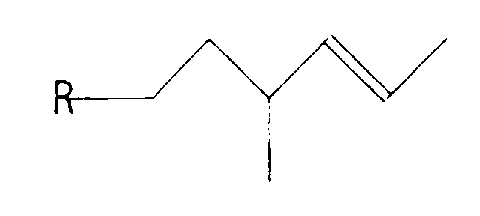

 where R is the remainder of the olefin. Preferably, at least 70% of the isomerized olefins are branched, more preferably at least 90%. It has also been found that the more vinylidene and tri-substituted olefin isomers there are in the isomerized olefin mixture, the higher the para/ortho ratio will be in the alkylated product.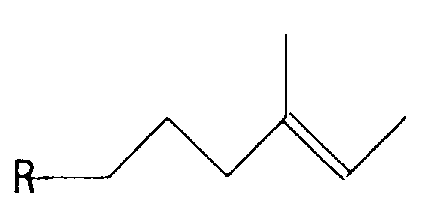
- The second acidic catalyst is a solid catalyst comprising a sulfonic acid resin catalyst or an acidic clay. The sulfonic acid resin catalyst is an anionic ion exchange resin such as Amberlyst 15 and Amberlyst 36 sulfonic acid ion exchange resins sold by Rohm and Haas Co. Acidic clays such as Filtrol-24 can also be used. The catalyst is employed in an amount sufficient to catalyze the alkylation of the hydroxyl-containing aromatic compound. Typically, the amount of catalyst used will be about 1 wt.% to about 20 wt.%, based on the weight of the hydroxyl-containing aromatic compound.
- The alkylation reaction is typically carried out with an hydroxyl-containing aromatic compound or mixture of hydroxyl-containing compounds and a mixture of isomerized olefins in hydroxyl-containing aromatic compound:isomerized olefin molar ratios from 1:15 to 25:1. Process temperatures can range from about 90°C to about 150°C. Since the olefins have a high boiling point, the process is preferably carried out in the liquid phase. The alkylation process may be carried out in batch or continuous mode. In the batch mode, a typical method is to use a stirred autoclave or glass flask which may be heated to the desired reaction temperature. A continuous process is most efficiently carried out in a fixed bed process. Space rates in a fixed bed process can range from about 0.01 to about 10 or more WHSV.
- In a fixed bed process the catalyst is charged to the reactor and activated or dried at a temperature of at least 100°C under vacuum or flowing inert, dry gas. After activation, the catalyst is cooled to ambient temperature and a flow of the hydroxyl-containing aromatic compound is introduced. Optionally, the hydroxyl-containing aromatic compound may be added to the catalyst at the reaction temperature. A flow of the isomerized olefin is then mixed with the hydroxyl-containing aromatic compound and allowed to flow over the catalyst. The reactor effluent containing alkylate product and excess hydroxyl-containing aromatic is collected. Excess hydroxyl-containing aromatic is then removed by distillation, stripping, evaporation under vacuum, or other means known to those skilled in the art .
- The invention will be further illustrated by the following examples, which set forth particularly advantageous embodiments. While the Examples are provided to illustrate the present invention, they are not intended to limit it.
- C20-24 Normal Alpha Olefin (composed of 89.1 % alpha-olefin, 0.5 % beta-olefin, 1.4 % internal-olefin, 0.2 %, tri-substituted olefin and 9.5 % vinylidene-olefin by carbon NMR and 11 % branching by IR was pumped up-flow through a fixed bed reactor (83.8 cm high by 22.6 mm ID) containing 216 gms of SAPO-11 catalyst (1/8 " extrudate) sandwiched between 126.5 gms of Alundum (100 mesh) at each end of the reactor operating isothermally at various temperatures and WHSV's. Samples were collected at the operating temperatures and WHSV's shown in the table below.
Average Reactor Temperature (°C) Average WHSV (hr-1) % Alpha-olefin % Beta-olefin % Internal olefin % Tri -Substituted olefin % Vinylidene olefin 186 5.46 31.7 20.9 68.1 4.6 18.9 201 1.44 7.8 22.3 91.5 11.3 25.5 213 1.28 2.9 25.0 89.1 24.7 37.5 - A Varian Gemini NMR spectrometer operating at 3000 MHz was used to determine the olefin distribution in the pre-isomerized normal alpha olefins. A macro was written to calculate the relative percent of alpha, beta, internal, tri-substituted and vinylidene olefins present from the integration of the 13C NMR spectra (recorded in CDCI3 containing a relaxation agent, Chromium (III) acetylacetonate, with a sufficient pulse delay to make the integrals more quantitative). The vinylidene olefin content was indicated as the sum of the C2 and C4 and higher vinylidene olefins present. The spectral regions used to determine the various olefin species present were as follows:
Olefin Species Description Chemical Shift Assignment (ppm) Integral Code Alpha-olefin C1 113.0-115.4 C C2 137.6 - 140.0 I Beta-olefin C2 Z/E 122.5 - 126.0 E C3 Z/E 130.9 - 132.5 G Internal Olefin RHC=CHR Z/E 129.0 - 130.8 F Tri-substituted olefin =CHR 117.0-119.5 D =CRR 134.0 - 137.5 H Vinylidene olefin =CH2 106.7 - 108.0 A =CRR' Z/E 108.1 - 109.6 B 149.0 - 150.5 J 150.6 - 152.0 K Total - - Sum of A
through K - The percent of each olefinic species present is calculated from the integral of each region (Integral Code) above as follows:
- To a 30 ml glass vial (30 ml volume Wheaton Glass Serum Bottles, 20 mm mouth) fitted with a magnetic stir bar was added 1.0 gm of Amberlyst-36 catalyst (anionic ion exchange resin from Rohm and Haas Co.) followed by 10 gms of a solution of 4.4 gms phenol (46.8 mmol) and 3.6 gms of pre-isomerized C20-24 normal alpha olefin. The glass vial was then sealed with a cap (Wheaton Closed Top Seals with Teflon Faced Rubber Septa) using a crimping tool. The vial was then placed in a magnetically stirred oil bath at 130° ± 3° C. After 24 hours, the vial was removed from the oil bath and wiped with a rag to remove oil from the exterior of the glass vial. The glass vial was allowed to cool to approximately 35°C at which time the cap was removed and 15-20 mls of hexane was added. The contents of the vial was then gravity filtered to remove the catalyst. The filtrate was washed six times with 5ml portions of methanol/water (50/50 by volume). The organic layer was dried over anhydrous MgSO4, filtered and the hexane allowed to evaporate at room temperature overnight. The resulting oil was analyzed by SFC to determine the unreacted olefin content and by IR to determine the ortho/para ratio of the product alkylphenol. Table I summarizes the properties of the pre-isomerized C20-24 normal alpha olefins as well as one non-isomerized C20-24 normal alpha olefin used to prepare alkylphenols.
C20-24 Alpha Olefin Sample % Alpha-olefin % Beta-olefin % Internal olefin % Tri-Substituted olefin % Vinylidene olefin Total % Branching 1 25.4 36.8 68.4 5.9 0.2 23 2 3.1 32.3 90.8 5.8 0.3 28 3 89.1 0.5 1.4 0.2 9.5 4 18.2 27.1 40.3 41.6 0 94 5 7.2 22.0 43.2 47.5 2.1 70 - Table II summarizes the para-alkylphenol content and the unreacted olefin content in the alkylphenols prepared from the corresponding olefins in Table I.
C20-24 Alpha olefin sample from Table I % Para-alkylphenol content % Olefin Content 1 51 0.5 2 48 0.1 3 45 0.2 4 86 14.0 5 82 2.7 - Adding the % tri-substituted olefin content and the % vinylidene content for a variety of pre-isomerized C20-24 alpha olefin samples used to alkylate phenol and plotting this summed value versus the para-alkylphenol content of the corresponding alkylphenol showed a strong linear correlation.
- A Dionex Lee Scientific Model 600 supercritical fluid chromatograph (SFC) equipped with a 10 meter x 195 micron OD/50 micron ID 0.25 micron film SB-Methyl-100 capillary column, an FID detector operating at 325°C and carbon dioxide eluent was used with time-split injection. The following density ramp program was used (isothermal oven at 100°C):
- Initial density = 0.2 g/cc
- Inject sample
- Hold five minutes
- Ramp to 0.3 g/cc at 0.02 g/cc/min
- Ramp to 0.5 g/cc at 0.01 g/cc/min
- Ramp to 0.76 g/cc at 0.02 g/cc/min
- Hold 12 minutes
-
- For the pre-isomerized C20-24 alkylphenols prepared and under the conditions that contribute to the relative retention times (carrier flow, condition of the column and other factors), the C20-24 unreacted olefin eluted between 24 and 33 minutes and the alkylphenol between 33.5 and 45 minutes. The purity of the alkylphenols was calculated as follows:
- To a 3 liter, 3 neck round bottom flask fitted with a condenser and a mechanical stirrer was added of 1128 gms of phenol and 888 gms of a pre-isomerized C20-24 normal alpha-olefin (composed of 18.7 % alpha-olefin, 27.1 % internal olefin, 27.1 % beta-olefin, 41.6 % tri-substituted olefin and 0 % vinylidene olefin) followed by 106.6 gms of catalyst (Amberlyst-36 ion exchange resin available from Rohm and Haas Co.). This mixture was heated to 120°C under an atmosphere of nitrogen at atmospheric pressure with stirring for 60 hours. The reaction mixture was filtered to remove the catalyst. The filtrate was distilled to remove the excess phenol (230°C and 2mm Hg vacuum). The resulting product (880 gms) was analyzed by HPLC and found to have the following composition:
Ortho-alkylphenol = 19.2 %, para-alkylphenol = 74.6 %, phenol = < 0.05 %, di alkylphenol = 1.9 %, ether = 4.3 %. - A Spectra-Physics Isochrom HPLC was used equipped with a RheoDyne Model 71-25 injection valve with a 5 microliter injection loop, a Beckman Ultra Sphere 3 micron Cyano column (7.5 cm long by 4.6 mm ID) and a Spectra-Physics Spectra Chrom 100 UV detector (280 nm wavelength) operating isocratically with a mixture of cyclohexane/ethanol (99.75:0.25) at 40°C.
- The alkylphenol sample (0.1 gm ± 0.02 gm) was dissolved in 5 gm of cyclohexane for analysis. . Response factors were used to normalize the chromatographic peak areas of the individual components using the following equation:Where, for n components;

- Wi = weight of component i
- Ki = gram-extinction coefficient for component
- Ai = area of the peak for component i The order of elution of the components is:
- Ether, 0.45 minutes - 0.65 minutes
- Di-alkylphenol, 0.66 minutes - 1.2 minutes
- Ortho-alkylphenol, 1.21 minutes-1.8minutes
- Para-alkylphenol, 1.81 minutes - 2.6 minutes
- Phenol, 3.4 minutes - 3.7 minutes.
-
- A FTIR was used. A sample of alkylphenol was placed on a salt block and the infrared spectrum recorded between 600 and 4000 cm-1. The absorbance of the peak at 747 cm-1 and 825 cm-1 was measured and the ortho/para absorbance ratio calculated:
- Using the ortho/para absorbance ratio, the % para-alkylphenol was determined from a calibration curve of ortho/para absorbance ratio versus wt. % ortho content developed using standards.
- While the present invention has been described with reference to specific embodiments, this application is intended to cover those various changes and substitutions that may be made by those skilled in the art without departing from the spirit and scope of the appended claims.
Claims (16)
- A process for producing alkylated, hydroxyl-containing aromatic compounds, said process comprising:(a) isomerizing a normal alpha-olefin or mixture of normal alpha-olefins having from about 16 to about 30 carbon atoms in the presence of a first acidic catalyst capable of inducing both olefin isomerization and skeletal isomerization to produce a mixture of isomerized olefins;(b) alkylating a hydroxyl-containing aromatic compound with said mixture of isomerized olefins in the presence of a second acidic catalyst comprising a sulfonic acid resin catalyst or acidic clay.
- A process according to claim 1 wherein the first acidic catalyst is a solid catalyst comprising at least one metal oxide, and having an average pore size of less than 5.5 angstroms, and wherein the isomerized olefin is a mixture of straight-chain and branched-chain olefins.
- A process according to claim 2 wherein the first solid, acidic catalyst comprises a molecular sieve with a one-dimensional pore system.
- A process according to claim 3 wherein the molecular sieve is selected from the group consisting of SM-3, MAPO-11, SAPO-11, SSZ-32, ZSM-23, MAPO-39, SAPO-39, ZSM-22, SSZ-20, ZSM-35, SUZ-4, NU-23, NU-87, natural ferrierite and synthetic ferrierite.
- A process according to claim 4 wherein the molecular sieve is SAPO-11 or SSZ-32.
- A process according to claim 4 wherein the molecular sieve contains a Group VIII metal or mixture of Group VIII metals.
- A process according to claim 5 wherein the molecular sieve contains a Group VIII metal or mixture of Group VIII metals.
- A process according to claim 6 or 7 wherein the Group VIII metal is platinum, palladium or mixtures thereof.
- A process according to claim 1 wherein the isomerized normal alpha-olefins have from about 20 to about 28 carbon atoms.
- A process according to claim 1 wherein at least about 70% of the isomerized olefins are branched-chain olefins.
- A process according to claim 1 wherein at least about 90% of the isomerized olefins are branched-chain olefins.
- A process according to claim 1, wherein the second acid catalyst is a solid acidic catalyst
- A process according to claim 12 wherein the second acidic catalyst comprises a sulfonic acid anionic ion exchange resin.
- A process according to claim 12 wherein the second acidic catalyst comprises an acidic clay.
- A process according to any preceding claim, wherein the hydroxyl-containing aromatic compound is selected from the group consisting of phenol, catechol, anisole, cresol, resorcinol and mixtures thereof.
- A process according to any preceding claim, wherein the mixture of isomerized olefins obtained in step (a) comprises a mixture of straight-chain and branched-chain isomerized olefins.
Applications Claiming Priority (2)
| Application Number | Priority Date | Filing Date | Title |
|---|---|---|---|
| US454785 | 1999-12-03 | ||
| US09/454,785 US6670513B1 (en) | 1999-12-03 | 1999-12-03 | Process for producing alkylated hydroxyl-containing aromatic compounds |
Publications (2)
| Publication Number | Publication Date |
|---|---|
| EP1108704A1 true EP1108704A1 (en) | 2001-06-20 |
| EP1108704B1 EP1108704B1 (en) | 2005-01-26 |
Family
ID=23806073
Family Applications (1)
| Application Number | Title | Priority Date | Filing Date |
|---|---|---|---|
| EP00310030A Expired - Lifetime EP1108704B1 (en) | 1999-12-03 | 2000-11-10 | Process for producing alkylated hydroxyl-containing aromatic compounds |
Country Status (5)
| Country | Link |
|---|---|
| US (1) | US6670513B1 (en) |
| EP (1) | EP1108704B1 (en) |
| CA (1) | CA2325243C (en) |
| DE (1) | DE60017698T2 (en) |
| SG (1) | SG83826A1 (en) |
Cited By (4)
| Publication number | Priority date | Publication date | Assignee | Title |
|---|---|---|---|---|
| EP2682451A1 (en) | 2012-07-06 | 2014-01-08 | Infineum International Limited | Detergent modification |
| EP2501668A4 (en) * | 2009-11-18 | 2015-11-04 | Chevron Oronite Co | ALKYLIC HYDROXYAROMATIC COMPOUND SUBSTANTIALLY FREE OF ENDOCRINE INHIBITORY CHEMICALS |
| CN105705479A (en) * | 2013-10-31 | 2016-06-22 | 雪佛龙奥伦耐有限责任公司 | Process for preparing para-branched alkyl-substituted hydroxyaromatic compounds |
| EP2247700B1 (en) * | 2007-12-28 | 2018-10-03 | Chevron Oronite Company LLC | Low temperature performance lubricating oil detergents |
Families Citing this family (7)
| Publication number | Priority date | Publication date | Assignee | Title |
|---|---|---|---|---|
| US8207380B2 (en) * | 2007-04-27 | 2012-06-26 | Chevron Oronite LLC | Alkylated hydroxyaromatic compound substantially free of endocrine disruptive chemicals and method of making the same |
| US8247621B2 (en) * | 2008-10-14 | 2012-08-21 | Invista North America S.A.R.L. | Process for making 2-secondary-alkyl-4,5-di-(normal-alkyl)phenols |
| ES2601799T3 (en) | 2009-06-12 | 2017-02-16 | Albemarle Europe Sprl. | SAPO molecular sieve catalysts and their preparation and uses |
| US8580717B2 (en) * | 2009-11-24 | 2013-11-12 | Chevron Oronite Company Llc | Process for making an overbased, sulfurized salt of an alkylated hydroxyaromatic compound |
| US9376359B2 (en) * | 2013-10-31 | 2016-06-28 | Chevron Oronite Company Llc | Process for preparing a para-linear alkyl-substituted hydroxyaromatic compound |
| JP7520729B2 (en) * | 2018-06-22 | 2024-07-23 | シェブロン・オロナイト・カンパニー・エルエルシー | Lubricating Oil Composition |
| US20250263514A1 (en) * | 2024-02-16 | 2025-08-21 | Si Group, Inc. | Process for Preparing SVHC-Free Phenolic Resins |
Citations (3)
| Publication number | Priority date | Publication date | Assignee | Title |
|---|---|---|---|---|
| US5082986A (en) * | 1989-02-17 | 1992-01-21 | Chevron Research Company | Process for producing lube oil from olefins by isomerization over a silicoaluminophosphate catalyst |
| US5132478A (en) * | 1989-01-06 | 1992-07-21 | Mobil Oil Corporation | Alkylaromatic lubricant fluids |
| US5282958A (en) * | 1990-07-20 | 1994-02-01 | Chevron Research And Technology Company | Use of modified 5-7 a pore molecular sieves for isomerization of hydrocarbons |
Family Cites Families (23)
| Publication number | Priority date | Publication date | Assignee | Title |
|---|---|---|---|---|
| US2404340A (en) | 1945-07-19 | 1946-07-16 | Universal Oil Prod Co | Production of high antiknock fuel |
| US3422157A (en) * | 1966-04-18 | 1969-01-14 | Union Carbide Corp | Process for continuous alkylation of arylhydroxides using ion exchange resins |
| US3932537A (en) | 1971-09-09 | 1976-01-13 | Reichhold Chemicals, Inc. | Alkylation of phenols |
| US4168390A (en) * | 1973-09-14 | 1979-09-18 | Chemische Werke Huls A.G. | Process for continuous alkylation of phenol using ion exchange resins |
| US4198531A (en) * | 1975-06-14 | 1980-04-15 | Basf Aktiengesellschaft | Manufacture of p-alkylphenols |
| DE2650888C2 (en) * | 1976-11-06 | 1985-03-21 | Basf Ag, 6700 Ludwigshafen | Process for the continuous production of alkylphenols |
| US4632771A (en) * | 1984-08-17 | 1986-12-30 | Chevron Research Company | Normally liquid C14 to C18 monoalkyl catechols |
| US4643838A (en) * | 1985-09-18 | 1987-02-17 | Chevron Research Company | Normally liquid C18 to C24 monoalkyl catechols |
| US5243115A (en) * | 1986-03-31 | 1993-09-07 | Chemical Research & Licensing Company | Alkylation of organic aromatic compounds |
| US4973764A (en) * | 1986-10-24 | 1990-11-27 | Exxon Research And Engineering Company | Alkylphenols and derivatives thereof via phenol alkylation by cracked petroleum distillates |
| US4914246A (en) | 1986-10-24 | 1990-04-03 | Exxon Research & Engineering Company | Alkylphenols and derivatives thereof via phenol alkylation by cracked petroleum distillates |
| EP0396763A4 (en) * | 1988-09-27 | 1991-04-17 | Mitsubishi Kasei Polytec Company | Process for producing internal olefin |
| US5208390A (en) * | 1991-10-25 | 1993-05-04 | Chevron Research And Technology Company | Process for alkylating aromatic polyols with higher carbon number alpha olefin oligomers |
| US5320762A (en) * | 1993-03-12 | 1994-06-14 | Chevron Research And Technology Company | Low viscosity Group II metal overbased sulfurized C12 to C22 alkylphenate compositions |
| US5523510A (en) * | 1993-08-30 | 1996-06-04 | Texaco Inc. | Treated bound ferrierite zeolites for skeletal isomerization of n-olefins to iso-olefins |
| US5510306A (en) * | 1993-12-29 | 1996-04-23 | Shell Oil Company | Process for isomerizing linear olefins to isoolefins |
| US5741759A (en) * | 1994-02-02 | 1998-04-21 | Chevron Chemical Company | Skeletally isomerized linear olefins |
| DE69516608T2 (en) | 1994-02-02 | 2000-12-28 | Chevron Chemical Co. Llc, San Francisco | DRILLING FLUID CONTAINING COMMON LINEAR OLEFINS |
| ES2139197T3 (en) * | 1994-03-31 | 2000-02-01 | Infineum Usa Lp | POLYMERIZATION REACTIONS WITH SUPPORTED LEWIS ACID CATALYSTS. |
| US5561095A (en) * | 1994-03-31 | 1996-10-01 | Exxon Chemical Patents Inc. | Supported lewis acid catalysts for hydrocarbon conversion reactions |
| AU2131095A (en) * | 1994-03-31 | 1995-10-23 | Exxon Chemical Patents Inc. | Supported lewis acid catalysts derived from superacids useful for hydrocarbon conversion reactions |
| CA2204461C (en) * | 1996-05-14 | 2006-07-04 | Thomas V. Harris | Process for producing an alkylated, non-oxygen-containing aromatic hydrocarbon |
| US5986157A (en) * | 1998-02-03 | 1999-11-16 | Catalytic Distillation Technologies | Process for the removal of carbonyl compounds in isomerization feed streams |
-
1999
- 1999-12-03 US US09/454,785 patent/US6670513B1/en not_active Expired - Lifetime
-
2000
- 2000-11-07 CA CA2325243A patent/CA2325243C/en not_active Expired - Fee Related
- 2000-11-10 DE DE60017698T patent/DE60017698T2/en not_active Expired - Lifetime
- 2000-11-10 EP EP00310030A patent/EP1108704B1/en not_active Expired - Lifetime
- 2000-11-13 SG SG200006570A patent/SG83826A1/en unknown
Patent Citations (3)
| Publication number | Priority date | Publication date | Assignee | Title |
|---|---|---|---|---|
| US5132478A (en) * | 1989-01-06 | 1992-07-21 | Mobil Oil Corporation | Alkylaromatic lubricant fluids |
| US5082986A (en) * | 1989-02-17 | 1992-01-21 | Chevron Research Company | Process for producing lube oil from olefins by isomerization over a silicoaluminophosphate catalyst |
| US5282958A (en) * | 1990-07-20 | 1994-02-01 | Chevron Research And Technology Company | Use of modified 5-7 a pore molecular sieves for isomerization of hydrocarbons |
Cited By (5)
| Publication number | Priority date | Publication date | Assignee | Title |
|---|---|---|---|---|
| EP2247700B1 (en) * | 2007-12-28 | 2018-10-03 | Chevron Oronite Company LLC | Low temperature performance lubricating oil detergents |
| EP2501668A4 (en) * | 2009-11-18 | 2015-11-04 | Chevron Oronite Co | ALKYLIC HYDROXYAROMATIC COMPOUND SUBSTANTIALLY FREE OF ENDOCRINE INHIBITORY CHEMICALS |
| EP2682451A1 (en) | 2012-07-06 | 2014-01-08 | Infineum International Limited | Detergent modification |
| CN105705479A (en) * | 2013-10-31 | 2016-06-22 | 雪佛龙奥伦耐有限责任公司 | Process for preparing para-branched alkyl-substituted hydroxyaromatic compounds |
| EP3063115A4 (en) * | 2013-10-31 | 2016-09-21 | Chevron Oronite Co | PROCESS FOR THE PREPARATION OF AN ALKYL-SUBSTITUTED HYDROXYAROMATIC COMPOUND BRANCHED IN PARA POSITION |
Also Published As
| Publication number | Publication date |
|---|---|
| EP1108704B1 (en) | 2005-01-26 |
| CA2325243A1 (en) | 2001-06-03 |
| SG83826A1 (en) | 2001-10-16 |
| DE60017698T2 (en) | 2006-03-30 |
| CA2325243C (en) | 2010-10-19 |
| US6670513B1 (en) | 2003-12-30 |
| DE60017698D1 (en) | 2005-03-03 |
Similar Documents
| Publication | Publication Date | Title |
|---|---|---|
| EP1108704B1 (en) | Process for producing alkylated hydroxyl-containing aromatic compounds | |
| CA2204461C (en) | Process for producing an alkylated, non-oxygen-containing aromatic hydrocarbon | |
| KR20020014834A (en) | Process for Producing Phenyl-Alkanes Compositions Produced Therefrom, and Uses Thereof | |
| DE69015743T2 (en) | METHOD FOR ALKYLATING AROMATES WITH DIMER OF AN ALPHA OLEFIN. | |
| De Almeida et al. | Linear alkylbenzene | |
| US5849974A (en) | Olefin isomerization process | |
| CA1223894A (en) | Alkylation of aromatic molecules using a silica- alumina catalyst derived from zeolite | |
| JPH03119093A (en) | Method for improving thermal stability of synthetic lubricating oil | |
| JP2009538934A (en) | Method for producing alkylated aromatic compound using acidic ionic liquid catalyst | |
| CA2347876C (en) | An alkylbenzene from preisomerised nao usable in lob and hob sulfonate | |
| US3402217A (en) | Process for preparing olefin hydrocarbons for detergent use | |
| US7674945B2 (en) | Process for alkylation of an aromatic hydrocarbon or isoalkane with an olefin over the catalysis of a solid acid | |
| DE68929220T2 (en) | Alkyl aromatic lubricating oils | |
| RU2538974C2 (en) | Method of regulating content of 2-phenyl isomer of linear alkylbenzene and catalyst, applied therein | |
| EP4363395A1 (en) | Metallosilicate catalyst solvents | |
| EP0187594B1 (en) | Zeolite catalysts | |
| Kissin | Primary products in hydrocarbon cracking over solid acidic catalysts under very mild conditions: relation to cracking mechanism | |
| EP1746150B1 (en) | Alkylaryl sulfonate detergent mixture derived from linear olefins | |
| Thorn-Csányi et al. | Kinetic investigations concerning selectivity of different Shcrock-type carbene complexes | |
| US4275249A (en) | Preparation of 2,4-Di-t-alkylphenol | |
| EP0895976B1 (en) | Process for the alkylation of heavy mono-alkylates of single-ring aromatic hydrocarbons | |
| CA2451122C (en) | A process for the isomerization of a vinylidene olefin | |
| Fǎrcaşiu et al. | The liquid-phase reaction of hexane on acid mordenite | |
| ES2268898T3 (en) | METHODS FOR THE PRODUCTION OF SULFURED DIFENYLOXIDES AND COMPOSITIONS MADE FROM THE SAME. | |
| EP2691366B1 (en) | Improved method for the preparation of low overbased alkyltoluene sulfonate |
Legal Events
| Date | Code | Title | Description |
|---|---|---|---|
| PUAI | Public reference made under article 153(3) epc to a published international application that has entered the european phase |
Free format text: ORIGINAL CODE: 0009012 |
|
| AK | Designated contracting states |
Kind code of ref document: A1 Designated state(s): DE FR GB NL |
|
| AX | Request for extension of the european patent |
Free format text: AL;LT;LV;MK;RO;SI |
|
| 17P | Request for examination filed |
Effective date: 20011212 |
|
| AKX | Designation fees paid |
Free format text: DE FR GB NL |
|
| 17Q | First examination report despatched |
Effective date: 20030327 |
|
| GRAP | Despatch of communication of intention to grant a patent |
Free format text: ORIGINAL CODE: EPIDOSNIGR1 |
|
| GRAS | Grant fee paid |
Free format text: ORIGINAL CODE: EPIDOSNIGR3 |
|
| GRAA | (expected) grant |
Free format text: ORIGINAL CODE: 0009210 |
|
| AK | Designated contracting states |
Kind code of ref document: B1 Designated state(s): DE FR GB NL |
|
| REG | Reference to a national code |
Ref country code: GB Ref legal event code: FG4D |
|
| REF | Corresponds to: |
Ref document number: 60017698 Country of ref document: DE Date of ref document: 20050303 Kind code of ref document: P |
|
| PLBE | No opposition filed within time limit |
Free format text: ORIGINAL CODE: 0009261 |
|
| STAA | Information on the status of an ep patent application or granted ep patent |
Free format text: STATUS: NO OPPOSITION FILED WITHIN TIME LIMIT |
|
| ET | Fr: translation filed | ||
| 26N | No opposition filed |
Effective date: 20051027 |
|
| REG | Reference to a national code |
Ref country code: DE Ref legal event code: R082 Ref document number: 60017698 Country of ref document: DE Representative=s name: HASELTINE LAKE LLP, DE |
|
| REG | Reference to a national code |
Ref country code: FR Ref legal event code: PLFP Year of fee payment: 16 |
|
| PGFP | Annual fee paid to national office [announced via postgrant information from national office to epo] |
Ref country code: NL Payment date: 20151106 Year of fee payment: 16 |
|
| REG | Reference to a national code |
Ref country code: FR Ref legal event code: PLFP Year of fee payment: 17 |
|
| REG | Reference to a national code |
Ref country code: NL Ref legal event code: MM Effective date: 20161201 |
|
| PG25 | Lapsed in a contracting state [announced via postgrant information from national office to epo] |
Ref country code: NL Free format text: LAPSE BECAUSE OF NON-PAYMENT OF DUE FEES Effective date: 20161201 |
|
| REG | Reference to a national code |
Ref country code: FR Ref legal event code: PLFP Year of fee payment: 18 |
|
| REG | Reference to a national code |
Ref country code: FR Ref legal event code: PLFP Year of fee payment: 19 |
|
| PGFP | Annual fee paid to national office [announced via postgrant information from national office to epo] |
Ref country code: DE Payment date: 20191029 Year of fee payment: 20 |
|
| PGFP | Annual fee paid to national office [announced via postgrant information from national office to epo] |
Ref country code: FR Payment date: 20191014 Year of fee payment: 20 |
|
| PGFP | Annual fee paid to national office [announced via postgrant information from national office to epo] |
Ref country code: GB Payment date: 20191108 Year of fee payment: 20 |
|
| REG | Reference to a national code |
Ref country code: DE Ref legal event code: R071 Ref document number: 60017698 Country of ref document: DE |
|
| REG | Reference to a national code |
Ref country code: GB Ref legal event code: PE20 Expiry date: 20201109 |
|
| PG25 | Lapsed in a contracting state [announced via postgrant information from national office to epo] |
Ref country code: GB Free format text: LAPSE BECAUSE OF EXPIRATION OF PROTECTION Effective date: 20201109 |