EP1107095A2 - Method for powering dual voltage integrated circuits - Google Patents
Method for powering dual voltage integrated circuits Download PDFInfo
- Publication number
- EP1107095A2 EP1107095A2 EP00310831A EP00310831A EP1107095A2 EP 1107095 A2 EP1107095 A2 EP 1107095A2 EP 00310831 A EP00310831 A EP 00310831A EP 00310831 A EP00310831 A EP 00310831A EP 1107095 A2 EP1107095 A2 EP 1107095A2
- Authority
- EP
- European Patent Office
- Prior art keywords
- voltage
- supply
- regulator
- voltage level
- level
- Prior art date
- Legal status (The legal status is an assumption and is not a legal conclusion. Google has not performed a legal analysis and makes no representation as to the accuracy of the status listed.)
- Granted
Links
Images

Classifications
-
- G—PHYSICS
- G05—CONTROLLING; REGULATING
- G05F—SYSTEMS FOR REGULATING ELECTRIC OR MAGNETIC VARIABLES
- G05F1/00—Automatic systems in which deviations of an electric quantity from one or more predetermined values are detected at the output of the system and fed back to a device within the system to restore the detected quantity to its predetermined value or values, i.e. retroactive systems
- G05F1/10—Regulating voltage or current
- G05F1/46—Regulating voltage or current wherein the variable actually regulated by the final control device is DC
- G05F1/56—Regulating voltage or current wherein the variable actually regulated by the final control device is DC using semiconductor devices in series with the load as final control devices
- G05F1/577—Regulating voltage or current wherein the variable actually regulated by the final control device is DC using semiconductor devices in series with the load as final control devices for plural loads
-
- H—ELECTRICITY
- H02—GENERATION; CONVERSION OR DISTRIBUTION OF ELECTRIC POWER
- H02J—ELECTRIC POWER NETWORKS; CIRCUIT ARRANGEMENTS OR SYSTEMS FOR SUPPLYING OR DISTRIBUTING ELECTRIC POWER; SYSTEMS FOR STORING ELECTRIC ENERGY
- H02J1/00—Circuit arrangements for DC mains or DC distribution networks
Definitions
- This invention relates to integrated circuits having dual supply voltage requirements and, more particularly, to a system and method for accurately controlling the dual supply voltage levels.
- the larger of the two voltage rails will supply the input/output function, and the smaller of the two is used to power the core processor.
- the larger of the two voltage levels is supplied to the input/output functionality of the integrated circuit, and to a voltage regulator which derives the second or lower voltage level for use in powering the core processor.
- the task of the voltage regulator consists of keeping the voltage on the output constant in a defined output range.
- One form of voltage regulator comprises a switch mode power supply.
- a switch mode power supply usually comprises a pulse width modulator (PWM), a power switch, a rectifier and an output filter.
- PWM pulse width modulator
- the pulse width modulator controls the power switch which converts an input voltage into pulsed DC voltage with variable duty cycle which in effect maintains constant voltage on the output of the filter circuit.
- voltage to power the PWM circuit is derived from the regulator's input voltage.
- the PWM circuit requires a finite period to achieve steady state conditions there is an initial period between the time that the voltage is supplied to the regulator input and the time in which the output is fixed at the second voltage level. During this time the voltage difference between the input/output voltage and output core voltage may exceed maximum allowable limits causing damage to the integrated circuit.
- a rail tracking method for providing dual voltages levels to first and second voltage rails on an integrated circuit comprising: providing a first voltage to the first voltage rail; providing the first voltage to a voltage regulator having conversion means to derive a second voltage for the second voltage rail; and providing a supply voltage to the conversion means whereby the supply voltage is provided before the first voltage is provided to the voltage regulator.
- a system for providing rail tracking of dual voltage levels to first and second voltage rails on an integrated circuit comprising: first voltage means to supply a first voltage level to the first voltage rail; a voltage regulator having means to receive the first voltage level; conversion means in the voltage regulator to derive a second voltage level for the second voltage rail from the first voltage level; and a supply voltage means to supply a supply voltage to the conversion means wherein the supply voltage is supplied to the conversion means before the first voltage is supplied to the voltage regulator.
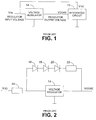
- FIG. 1 illustrates a typical power circuit for a dual voltage integrated circuit.
- Integrated circuit 12 which according to the present invention has a requirement for dual supply voltage levels, namely, a first voltage level for the input/output voltage (Vi/o) and a second voltage level for the core processor (Vcore).
- Vi/o is at a higher voltage level than Vcore.
- An input voltage (Vin) is provided by a power supply (not shown) to Vi/o and to the input of a voltage regulator 14.
- Voltage regulator 14 derives the Vcore voltage level from Vin.
- voltage regulator 14 employs switch mode topology to achieve the voltage conversion.
- the key element of the switch mode topology is a pulse width modulator as discussed previously.
- the voltage regulator output voltage reaches its steady state value, i.e. Vcore, only after initial stabilizing period has passed.
- Vcore steady state value
- the series-connected diodes are selected to provide a voltage drop across the voltage regulator such that the voltage difference between the input and at the core cannot exceed the maximum specified value.
- diodes 16, 18 and 20 limit the difference between Vi/o and Vcore.
- a rail tracking method developed by Newbridge Networks Corporation uses a linear series pass regulator connected between the input Vi/o and the output Vcore of the regulator. This method has proven to be effective when high precision tracking (1.6V maximum difference between Vi/o and Vcore, while the normal operation difference is only 1.3V) is required with high currents (6 to 20A).
- a circuit illustrating this rail tracking method is shown in Figure 3.
- Operational amplifier 30 controls power transistor 38 which, in turn, provides Vcore during the time it takes regulator 14 to startup. During the initial period, operational amplifier 30 is controlled by V reference 32 until the output across voltage divider 34/36 reaches the steady state value. Resistor 40 reduces power dissipation in transistor 38, and diode 42 provides backward tracking during turnoff.
- An additional voltage monitoring network, (not shown) is required to protect resistor 40 and transistor 38 in the case of a failure of the regulator 14.
- Regulator 14 in the prior art and in the embodiment of Figure 3 typically employs a switch mode topology to achieve voltage conversion.
- the key element of this topology is the pulse width modulator (PWM) as previously discussed.
- PWM pulse width modulator
- the regulator will only produce the required output voltage after the PWM is operational.
- the supply voltage for the PWM is derived from the regulator input voltage. Accordingly, there is an inherent delay between the voltage being applied to the regulator input and the PWM being operational. This accounts for the delay between Vi/o and Vcore.
- the preferred embodiment of the present invention is illustrated in the circuit diagram of Figure 4.
- the basis of this invention relies on the PWM power supply being connected prior to the regulator input voltage being applied.
- the regulator output voltage will track, with no delay, the regulator input voltage. This ensures true tracking between regulator input and output voltages which correspond to the true tracking between Vi/o and Vcore.
- voltage regulator 14 includes pulse width modulator 50, which is supplied by supply voltage through input 52.
- supply voltage is provided through input 52 prior to Vi/o being supplied to the regulator.
- the pulse width modulator has reached steady state condition before Vi/o is supplied and hence, the regulator output voltage (Vcore) will precisely track the regulator input voltage.
- the PWM supply voltage is an external voltage not necessarily related to the regulator input voltage.
- the Schottky diode 54 provides backward tracking during turnoff.
- An additional voltage monitoring network (not shown) may be used to protect the integrated circuit in case of failure of the regulator.
- the tracking method provided by the embodiment of Figure 4 offers the following benefits over those previously described.
- this method provides precise rail tracking inasmuch as the pulse width modulator is fully operational before the regulator input voltage is supplied.
- no additional power components are required which results in lower board space, lower cost of the design, and increased reliability.
- the regulator current limit is not bypassed as was the case in the prior art method.
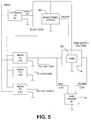
- FIG. 5 shows an example of a practical application of the tracking method of the present invention as implemented in a practical design.
- DC-DC converters Four isolated DC-DC converters are used to provide power to the system. Three of these converters (3.3V and 2X2.5V outputs) are standard modules which operate in the input voltage range 36 to 75V. The fourth one, the 5V output, operates over a wide input range 18 to 75V, and is designed to start faster than the remaining three major converters.
- the main function of the +5V converter is to provide early supply voltage for the monitoring circuit 60 which, via On/Off pins controls the major converters. As shown, the early 5V converter is not part of the On/Off loop.
- the rail tracking in the system is required between the 3.3V and 2.5V rails and between the 3.3V Vi/o and 2.0V Vcore for the dual power IC. Tracking between high current rails (3.3V/60A and 2.5V/20A) has been provided using the linear series pass regulator circuit as illustrated in Figure 3.
- the tracking method according to the preferred embodiment of Figure 4 is used for providing tracking between the 3.3V and 2.0V rail for the dual power IC.
- the 3.3V to 2.0V module is a non-isolated, DC-DC switch mode power supply.
- the pin to supply the supply voltage to the pulse width modulator is isolated in order that voltage from the early 5V supply can be connected directly to the pulse width modulator.
Landscapes
- Engineering & Computer Science (AREA)
- Power Engineering (AREA)
- Physics & Mathematics (AREA)
- Electromagnetism (AREA)
- General Physics & Mathematics (AREA)
- Radar, Positioning & Navigation (AREA)
- Automation & Control Theory (AREA)
- Dc-Dc Converters (AREA)
Abstract
Description
- This invention relates to integrated circuits having dual supply voltage requirements and, more particularly, to a system and method for accurately controlling the dual supply voltage levels.
- Many large scale integrated circuits contain multiple components providing different functionality and require two different supply voltage levels to operate. One such integrated circuit would include, for example, a core processor and input/output functions on the same silicon substrate, but operating from two different voltage levels. During startup, steady state, shut down and under fault conditions, the interaction between these voltages must meet strict requirements to ensure proper operation and to prevent damage to the integrated circuit. The techniques used to ensure proper interaction of these voltage levels all fall under the class of methods known as "Rail Tracking".
- In a dual supply voltage mode scenario, typically, the larger of the two voltage rails will supply the input/output function, and the smaller of the two is used to power the core processor. The larger of the two voltage levels is supplied to the input/output functionality of the integrated circuit, and to a voltage regulator which derives the second or lower voltage level for use in powering the core processor.
- The task of the voltage regulator consists of keeping the voltage on the output constant in a defined output range. One form of voltage regulator comprises a switch mode power supply. A switch mode power supply usually comprises a pulse width modulator (PWM), a power switch, a rectifier and an output filter. The pulse width modulator controls the power switch which converts an input voltage into pulsed DC voltage with variable duty cycle which in effect maintains constant voltage on the output of the filter circuit. In conventional voltage regulators, voltage to power the PWM circuit is derived from the regulator's input voltage.
- Because the PWM circuit requires a finite period to achieve steady state conditions there is an initial period between the time that the voltage is supplied to the regulator input and the time in which the output is fixed at the second voltage level. During this time the voltage difference between the input/output voltage and output core voltage may exceed maximum allowable limits causing damage to the integrated circuit.
- A prior art method dealing with this problem is disclosed in Power Trends application note PT5000/6000 SIP Series (Integrated Switching Regulators DC-DC Converters). In this prior art solution, the voltage regulator is bypassed by a number of series-connected diodes and a small resistor which are connected between the input/output voltage level and the core processor voltage. The series-connected diodes limit the difference between the two voltage levels as will be discussed in greater detail hereinafter.
- There are shortcomings to this prior art method which render it unacceptable in certain circumstances. For example, as the steady state difference between the input/output voltage and the core processor voltage approaches the maximum allowable voltage difference, the tolerance on the diode voltage drop becomes critical. This tolerance is difficult to control inasmuch as the voltage drop across the diode junction is highly current and temperature dependent. Additionally, the tracking voltage difference can be set only with the resolution of each single junction voltage drop which typically equals approximately 0.6 volts or 0.3 volts for Schottky technology. Additionally, the series-connected diodes bypassing the voltage regulator negate any overcurrent protection provided by the voltage regulator. In addition, the diodes themselves can be easily damaged if the regulator fails as all of the current associated with the second voltage level will now flow through the diodes.
- Accordingly, there is a requirement for an improved rail tracking system and method for powering a dual voltage integrated circuit.
- Therefore, in accordance with a first aspect of the present invention there is provided a rail tracking method for providing dual voltages levels to first and second voltage rails on an integrated circuit (IC) comprising: providing a first voltage to the first voltage rail; providing the first voltage to a voltage regulator having conversion means to derive a second voltage for the second voltage rail; and providing a supply voltage to the conversion means whereby the supply voltage is provided before the first voltage is provided to the voltage regulator.
- In accordance with a second aspect of the present invention there is provided a system for providing rail tracking of dual voltage levels to first and second voltage rails on an integrated circuit comprising: first voltage means to supply a first voltage level to the first voltage rail; a voltage regulator having means to receive the first voltage level; conversion means in the voltage regulator to derive a second voltage level for the second voltage rail from the first voltage level; and a supply voltage means to supply a supply voltage to the conversion means wherein the supply voltage is supplied to the conversion means before the first voltage is supplied to the voltage regulator.
- The invention will now be described in greater detail with reference to the attached drawings wherein:
- Figure 1 is a typical power circuit for dual voltage integrated circuits;
- Figure 2 is a diode rail tracking circuit according to the prior art;
- Figure 3 is a linear series pass regulator rail tracking circuit;
- Figure 4 is a circuit diagram of a precise rail tracking methodology according to the present invention; and
- Figure 5 is an example of a block diagram of a practical implementation of the tracking method according to the present invention.
-
- Figure 1 illustrates a typical power circuit for a dual voltage integrated circuit.
Integrated circuit 12, which according to the present invention has a requirement for dual supply voltage levels, namely, a first voltage level for the input/output voltage (Vi/o) and a second voltage level for the core processor (Vcore). As discussed previously Vi/o is at a higher voltage level than Vcore. An input voltage (Vin) is provided by a power supply (not shown) to Vi/o and to the input of avoltage regulator 14.Voltage regulator 14 derives the Vcore voltage level from Vin. Typically,voltage regulator 14 employs switch mode topology to achieve the voltage conversion. The key element of the switch mode topology is a pulse width modulator as discussed previously. The key aspect, however, is that the voltage regulator output voltage reaches its steady state value, i.e. Vcore, only after initial stabilizing period has passed. As noted previously, during this stabilizing period, the voltage difference between the input/output voltage and the output core voltage may exceed maximum allowable limits causing damage to the integrated circuit. - The prior art solution to this problem is illustrated in Figure 2 wherein
voltage regulator 14 is bypassed by series-connecteddiodes resistor 22. Typically,fuse 24, will protect the voltage regulator and downstream components. - According to the prior art method, the series-connected diodes are selected to provide a voltage drop across the voltage regulator such that the voltage difference between the input and at the core cannot exceed the maximum specified value. In Figure 2,
diodes - A rail tracking method developed by Newbridge Networks Corporation uses a linear series pass regulator connected between the input Vi/o and the output Vcore of the regulator. This method has proven to be effective when high precision tracking (1.6V maximum difference between Vi/o and Vcore, while the normal operation difference is only 1.3V) is required with high currents (6 to 20A). A circuit illustrating this rail tracking method is shown in Figure 3.
Operational amplifier 30 controlspower transistor 38 which, in turn, provides Vcore during the time it takesregulator 14 to startup. During the initial period,operational amplifier 30 is controlled byV reference 32 until the output acrossvoltage divider 34/36 reaches the steady state value.Resistor 40 reduces power dissipation intransistor 38, anddiode 42 provides backward tracking during turnoff. An additional voltage monitoring network, (not shown) is required to protectresistor 40 andtransistor 38 in the case of a failure of theregulator 14. - Although the rail tracking method shown in Figure 3 is effective, multiple, real estate consuming, power components are required in addition to the standard regulator.
-
Regulator 14 in the prior art and in the embodiment of Figure 3 typically employs a switch mode topology to achieve voltage conversion. The key element of this topology is the pulse width modulator (PWM) as previously discussed. The regulator will only produce the required output voltage after the PWM is operational. As discussed previously, the supply voltage for the PWM is derived from the regulator input voltage. Accordingly, there is an inherent delay between the voltage being applied to the regulator input and the PWM being operational. This accounts for the delay between Vi/o and Vcore. - The preferred embodiment of the present invention is illustrated in the circuit diagram of Figure 4. The basis of this invention relies on the PWM power supply being connected prior to the regulator input voltage being applied. As a result, the regulator output voltage will track, with no delay, the regulator input voltage. This ensures true tracking between regulator input and output voltages which correspond to the true tracking between Vi/o and Vcore.
- As shown in Figure 4,
voltage regulator 14 includespulse width modulator 50, which is supplied by supply voltage through input 52. In accordance with the basic concept of the invention, supply voltage is provided through input 52 prior to Vi/o being supplied to the regulator. In this way, the pulse width modulator has reached steady state condition before Vi/o is supplied and hence, the regulator output voltage (Vcore) will precisely track the regulator input voltage. As shown in Figure 4, the PWM supply voltage is an external voltage not necessarily related to the regulator input voltage. - The
Schottky diode 54 provides backward tracking during turnoff. An additional voltage monitoring network (not shown) may be used to protect the integrated circuit in case of failure of the regulator. - The tracking method provided by the embodiment of Figure 4 offers the following benefits over those previously described. First, this method provides precise rail tracking inasmuch as the pulse width modulator is fully operational before the regulator input voltage is supplied. Secondly, no additional power components are required which results in lower board space, lower cost of the design, and increased reliability.
- Further, the regulator current limit is not bypassed as was the case in the prior art method.
- The block diagram of Figure 5 shows an example of a practical application of the tracking method of the present invention as implemented in a practical design.
- Four isolated DC-DC converters are used to provide power to the system. Three of these converters (3.3V and 2X2.5V outputs) are standard modules which operate in the
input voltage range 36 to 75V. The fourth one, the 5V output, operates over awide input range 18 to 75V, and is designed to start faster than the remaining three major converters. - The main function of the +5V converter is to provide early supply voltage for the
monitoring circuit 60 which, via On/Off pins controls the major converters. As shown, the early 5V converter is not part of the On/Off loop. The rail tracking in the system is required between the 3.3V and 2.5V rails and between the 3.3V Vi/o and 2.0V Vcore for the dual power IC. Tracking between high current rails (3.3V/60A and 2.5V/20A) has been provided using the linear series pass regulator circuit as illustrated in Figure 3.
The tracking method according to the preferred embodiment of Figure 4 is used for providing tracking between the 3.3V and 2.0V rail for the dual power IC. The 3.3V to 2.0V module is a non-isolated, DC-DC switch mode power supply. According to the preferred embodiment of the invention, the pin to supply the supply voltage to the pulse width modulator is isolated in order that voltage from the early 5V supply can be connected directly to the pulse width modulator. - Although example embodiments of the invention have been disclosed and illustrated, it will be apparent to one skilled in the art that variation to the basic concept can be implemented. Particularly the input/output and core voltage levels and the DC-DC module type may be different. It is to be understood, however, that such variations will fall within the true scope of the invention as defined by the appended claims.
Claims (16)
- A rail tracking method for providing dual voltage levels to first and second voltage rails on an integrated circuit (IC) comprising:providing a first voltage to said first voltage rail;providing said first voltage to a voltage regulator having conversion means to derive a second voltage for said second voltage rail; andproviding a supply voltage to said conversion means whereby said supply voltage is provided before said first voltage is provided to said voltage regulator.
- The method according to claim 1 wherein said conversion means uses a pulse width modulator (PWM) to derive said second voltage from said first voltage.
- A system for providing rail tracking of dual voltage levels to first and second voltage rails on an integrated circuit (IC) comprising:first voltage means to supply a first voltage level to said first voltage rail;a voltage regulator having means to receive said first voltage level; conversion means in said voltage regulator to derive a second voltage level for said second voltage rail from said first voltage level; anda supply voltage means to supply a supply voltage to said conversion means wherein said supply voltage is supplied to said conversion means before said first voltage is supplied to said voltage regulator.
- A system as defined in claim 3 wherein said conversion means includes a pulse width modulator (PWM).
- A system as defined in claim 4 further including a backward tracking diode between said second voltage rail and said first voltage rail.
- A system as defined in claim 5 wherein said first voltage level supplies input/output functions on said IC and said second voltage level powers a core processor on said IC.
- A system as defined in claim 6 wherein said supply voltage is supplied by a DC-DC switch-mode power supply.
- A system for providing rail tracking to an Integrated Circuit (IC) wherein said IC performs multiple functions requiring dual operating voltage levels; said system comprising:a first DC-DC power supply to supply a first voltage level to said IC;a voltage regulator circuit employing a switch mode converter to receive said first voltage level and to derive therefrom a second voltage level for said IC; anda second DC-DC power supply to supply operating voltage to said switch mode converter; whereby said second DC-DC power supply supplies said operating voltage to said switch mode converter such that said converter is operational before said first voltage level to derive said second voltage level is supplied to voltage regulator circuit.
- A system as defined in claim 8 wherein said switch mode converter employs a pulse width modulator to derive said second voltage level.
- A system as defined in claim 8 wherein said voltage regulator circuit has a separate connection for receiving said supply voltage.
- A voltage regulator for controlling dual supply voltage levels comprising:conversion means to receive a first voltage level and to derive therefrom a second voltage level; anda supply voltage input to receive a supply voltage to said conversion means, wherein said supply voltage is received prior to receiving said first voltage level.
- A voltage regulator as defined in claim 11 wherein said conversion means employs a pulse width modulator to derive said second voltage level from said first voltage level.
- A voltage regulator as defined in claim 12 wherein said first voltage level is used to provide an input/output voltage to an integrated circuit and said second voltage level powers a core processor on said integrated circuit.
- In a system for providing rail tracking of dual voltage levels to first and second voltage rails on an integrated circuit, wherein a first voltage level is supplied to said first voltage rail, a voltage regulator for deriving said second voltage level for said second voltage rail, said voltage regulator having conversion means to derive said second voltage level from said first voltage and means to receive supply voltage for said conversion means prior to receiving said first voltage level.
- The voltage regulator as defined in claim 14 wherein said conversion means employs a pulse width modulator.
- The voltage regulator as defined in claim 15 wherein said first voltage level supplies input/output functions on said integrated circuit and said second voltage level powers a core processor.
Applications Claiming Priority (2)
| Application Number | Priority Date | Filing Date | Title |
|---|---|---|---|
| US456392 | 1999-12-08 | ||
| US09/456,392 US6172490B1 (en) | 1999-12-08 | 1999-12-08 | Precise rail tracking method for powering dual voltage integrated circuits |
Publications (3)
| Publication Number | Publication Date |
|---|---|
| EP1107095A2 true EP1107095A2 (en) | 2001-06-13 |
| EP1107095A3 EP1107095A3 (en) | 2008-12-03 |
| EP1107095B1 EP1107095B1 (en) | 2011-04-06 |
Family
ID=23812570
Family Applications (1)
| Application Number | Title | Priority Date | Filing Date |
|---|---|---|---|
| EP00310831A Expired - Lifetime EP1107095B1 (en) | 1999-12-08 | 2000-12-06 | Method for powering dual voltage integrated circuits |
Country Status (3)
| Country | Link |
|---|---|
| US (2) | US6172490B1 (en) |
| EP (1) | EP1107095B1 (en) |
| DE (1) | DE60045811D1 (en) |
Cited By (1)
| Publication number | Priority date | Publication date | Assignee | Title |
|---|---|---|---|---|
| US9559642B2 (en) | 2015-01-02 | 2017-01-31 | Logitech Europe, S.A. | Audio delivery system having an improved efficiency and extended operation time between recharges or battery replacements |
Families Citing this family (12)
| Publication number | Priority date | Publication date | Assignee | Title |
|---|---|---|---|---|
| EP1157046B1 (en) * | 1999-12-28 | 2005-12-07 | Basell Polyolefine GmbH | Process for the preparation of ethylene polymers |
| US20040145358A1 (en) * | 2001-04-19 | 2004-07-29 | Rogers Terrence Edwards | Method and apparatus for minimizing power dissipation in series connected voltage regulators |
| US6948079B2 (en) * | 2001-12-26 | 2005-09-20 | Intel Corporation | Method and apparatus for providing supply voltages for a processor |
| US6661211B1 (en) | 2002-06-25 | 2003-12-09 | Alcatel Canada Inc. | Quick-start DC-DC converter circuit and method |
| US6917123B2 (en) * | 2002-09-25 | 2005-07-12 | Dell Products L.P. | Synchronized power-up for multiple voltage system |
| US7498874B1 (en) | 2006-08-03 | 2009-03-03 | National Semiconductor Corporation | Glitch-free start-up with a tracking pin |
| US7705574B2 (en) * | 2008-06-13 | 2010-04-27 | Hamilton Sundstrand Corporation | Remote power controller with power sharing circuit |
| KR20120100238A (en) * | 2011-03-03 | 2012-09-12 | 삼성전자주식회사 | Semiconductor device, method of operating the same, and semiconductor system having the semiconductor device |
| KR101266834B1 (en) * | 2012-04-24 | 2013-05-27 | 엘에스산전 주식회사 | Digital protection relay |
| US9077514B1 (en) | 2014-01-28 | 2015-07-07 | Altera Corporation | Methods and structures for compensating and tracking process, voltage and temperature variations |
| JP6466761B2 (en) * | 2015-03-31 | 2019-02-06 | ラピスセミコンダクタ株式会社 | Semiconductor device and power supply method |
| CN111079371B (en) * | 2019-12-19 | 2024-03-15 | 武汉新芯集成电路制造有限公司 | Dual power supply standard unit, dual power supply standard unit library and integrated circuit design method |
Family Cites Families (11)
| Publication number | Priority date | Publication date | Assignee | Title |
|---|---|---|---|---|
| JPS6115620Y2 (en) * | 1976-03-02 | 1986-05-15 | ||
| US4472687A (en) * | 1980-12-24 | 1984-09-18 | Tokyo Shibaura Denki Kabushiki Kaisha | Audio power amplifier for supplying electric power to a load by switching of power supply voltage |
| SE467331B (en) * | 1990-10-26 | 1992-06-29 | Andersson & Baevholm Lab | AUDIO POWER AMPLIFIER WITH PULSE WIDE MODULATION AND AN AUDIO POWER STEP |
| US5550729A (en) * | 1994-06-09 | 1996-08-27 | Digital Equipment Corporation | Power sequencing control |
| US5543753A (en) * | 1994-06-22 | 1996-08-06 | Carver Corporation | Audio frequency power amplifiers with actively damped filter |
| US5606289A (en) * | 1994-06-22 | 1997-02-25 | Carver Corporation | Audio frequency power amplifiers with actively damped filter |
| EP0784811B1 (en) * | 1994-10-07 | 2002-01-09 | Elonex I.P. Holdings Limited | An improved variable-voltage cpu voltage regulator |
| US5898340A (en) * | 1996-11-20 | 1999-04-27 | Chatterjee; Manjirnath A. | High power efficiency audio amplifier with digital audio and volume inputs |
| US5864225A (en) * | 1997-06-04 | 1999-01-26 | Fairchild Semiconductor Corporation | Dual adjustable voltage regulators |
| KR100321976B1 (en) * | 1997-12-29 | 2002-05-13 | 윤종용 | Fault tolerant voltage regulator module circuit for intel processors |
| US6011382A (en) * | 1998-10-01 | 2000-01-04 | Toko, Inc. | Circuit and method for directly regulating the output voltage of an electroluminescent lamp driver |
-
1999
- 1999-12-08 US US09/456,392 patent/US6172490B1/en not_active Expired - Lifetime
-
2000
- 2000-12-05 US US09/729,174 patent/US6288523B2/en not_active Expired - Lifetime
- 2000-12-06 EP EP00310831A patent/EP1107095B1/en not_active Expired - Lifetime
- 2000-12-06 DE DE60045811T patent/DE60045811D1/en not_active Expired - Lifetime
Non-Patent Citations (1)
| Title |
|---|
| None |
Cited By (3)
| Publication number | Priority date | Publication date | Assignee | Title |
|---|---|---|---|---|
| US9559642B2 (en) | 2015-01-02 | 2017-01-31 | Logitech Europe, S.A. | Audio delivery system having an improved efficiency and extended operation time between recharges or battery replacements |
| US9722544B2 (en) | 2015-01-02 | 2017-08-01 | Logitech Europe S.A. | Audio system having an improved efficiency and extended operation time |
| US9742357B2 (en) | 2015-01-02 | 2017-08-22 | Logitech Europe S.A. | Audio system having an improved efficiency and extended operation time |
Also Published As
| Publication number | Publication date |
|---|---|
| US20010003417A1 (en) | 2001-06-14 |
| US6172490B1 (en) | 2001-01-09 |
| EP1107095B1 (en) | 2011-04-06 |
| EP1107095A3 (en) | 2008-12-03 |
| DE60045811D1 (en) | 2011-05-19 |
| US6288523B2 (en) | 2001-09-11 |
Similar Documents
| Publication | Publication Date | Title |
|---|---|---|
| US6469478B1 (en) | Multiple output power supply including one regulated converter and at least one semi-regulated converter | |
| US6574124B2 (en) | Plural power converters with individual conditioned error signals shared on a current sharing bus | |
| US6462525B1 (en) | Polyphase PWM converter with high efficiency at light loads | |
| US8576589B2 (en) | Switch state controller with a sense current generated operating voltage | |
| US8432146B2 (en) | Correcting pre-bias during turn-on of switching power regulators | |
| US7738227B2 (en) | Control system and method with constant maximum current for power converter protection | |
| US6346798B1 (en) | Single wire current sharing control technique for the parallel/redundant operation of a plurality of PWM converters | |
| JP4295120B2 (en) | Power supply device having a plurality of switching power supplies connected in parallel | |
| EP2984745B1 (en) | Voltage droop control in a voltage-regulated switched mode power supply | |
| US6172490B1 (en) | Precise rail tracking method for powering dual voltage integrated circuits | |
| US20080164759A1 (en) | Redundant power supply architecture with voltage level range based load switching | |
| US7023187B2 (en) | Integrated circuit for generating a plurality of direct current (DC) output voltages | |
| EP3269029B1 (en) | Using pmos power switch in a combination switching and linear regulator | |
| EP1844533A2 (en) | Compensated droop method for paralleling of power supplies ( c-droop method) | |
| US11329556B1 (en) | Multi-input single output power system and operating method thereof | |
| CN101034850B (en) | DC-DC converter, control circuit thereof, control method thereof, and power supply unit | |
| US6424545B2 (en) | Efficient, dual-source, wide-input range, isolated DC-DC converter with effective current limit | |
| US7915870B2 (en) | Method of forming a current sense circuit and structure therefor | |
| US11159088B2 (en) | Dual path and mode start-up circuit | |
| US7692939B2 (en) | Control circuit | |
| US8093877B2 (en) | Transient voltage compensation apparatus and power supply using the same | |
| KR100793678B1 (en) | DC-DC converter control circuit, DC-DC converter and DC-DC converter control method | |
| US7795755B2 (en) | Simple circuit and method for improving current balance accuracy of a power converter system | |
| US20260121540A1 (en) | Status report of power stage circuit for multiphase voltage regulator | |
| Ofner et al. | Versatile modular WBG stress test system for MHz hard and soft switching operation modes |
Legal Events
| Date | Code | Title | Description |
|---|---|---|---|
| PUAI | Public reference made under article 153(3) epc to a published international application that has entered the european phase |
Free format text: ORIGINAL CODE: 0009012 |
|
| AK | Designated contracting states |
Kind code of ref document: A2 Designated state(s): AT BE CH CY DE DK ES FI FR GB GR IE IT LI LU MC NL PT SE TR |
|
| AX | Request for extension of the european patent |
Free format text: AL;LT;LV;MK;RO;SI |
|
| PUAL | Search report despatched |
Free format text: ORIGINAL CODE: 0009013 |
|
| AK | Designated contracting states |
Kind code of ref document: A3 Designated state(s): AT BE CH CY DE DK ES FI FR GB GR IE IT LI LU MC NL PT SE TR |
|
| AX | Request for extension of the european patent |
Extension state: AL LT LV MK RO SI |
|
| 17P | Request for examination filed |
Effective date: 20090603 |
|
| AKX | Designation fees paid |
Designated state(s): DE ES FR GB IT |
|
| 17Q | First examination report despatched |
Effective date: 20090805 |
|
| GRAP | Despatch of communication of intention to grant a patent |
Free format text: ORIGINAL CODE: EPIDOSNIGR1 |
|
| GRAS | Grant fee paid |
Free format text: ORIGINAL CODE: EPIDOSNIGR3 |
|
| GRAA | (expected) grant |
Free format text: ORIGINAL CODE: 0009210 |
|
| AK | Designated contracting states |
Kind code of ref document: B1 Designated state(s): DE ES FR GB IT |
|
| REG | Reference to a national code |
Ref country code: GB Ref legal event code: FG4D |
|
| REF | Corresponds to: |
Ref document number: 60045811 Country of ref document: DE Date of ref document: 20110519 Kind code of ref document: P |
|
| REG | Reference to a national code |
Ref country code: DE Ref legal event code: R096 Ref document number: 60045811 Country of ref document: DE Effective date: 20110519 |
|
| RAP2 | Party data changed (patent owner data changed or rights of a patent transferred) |
Owner name: ALCATEL LUCENT |
|
| PG25 | Lapsed in a contracting state [announced via postgrant information from national office to epo] |
Ref country code: ES Free format text: LAPSE BECAUSE OF FAILURE TO SUBMIT A TRANSLATION OF THE DESCRIPTION OR TO PAY THE FEE WITHIN THE PRESCRIBED TIME-LIMIT Effective date: 20110717 |
|
| PLBE | No opposition filed within time limit |
Free format text: ORIGINAL CODE: 0009261 |
|
| STAA | Information on the status of an ep patent application or granted ep patent |
Free format text: STATUS: NO OPPOSITION FILED WITHIN TIME LIMIT |
|
| 26N | No opposition filed |
Effective date: 20120110 |
|
| REG | Reference to a national code |
Ref country code: DE Ref legal event code: R097 Ref document number: 60045811 Country of ref document: DE Effective date: 20120110 |
|
| REG | Reference to a national code |
Ref country code: FR Ref legal event code: GC Effective date: 20131018 |
|
| PG25 | Lapsed in a contracting state [announced via postgrant information from national office to epo] |
Ref country code: IT Free format text: LAPSE BECAUSE OF FAILURE TO SUBMIT A TRANSLATION OF THE DESCRIPTION OR TO PAY THE FEE WITHIN THE PRESCRIBED TIME-LIMIT Effective date: 20110406 |
|
| REG | Reference to a national code |
Ref country code: FR Ref legal event code: RG Effective date: 20141016 |
|
| REG | Reference to a national code |
Ref country code: FR Ref legal event code: PLFP Year of fee payment: 16 |
|
| REG | Reference to a national code |
Ref country code: FR Ref legal event code: PLFP Year of fee payment: 17 |
|
| REG | Reference to a national code |
Ref country code: FR Ref legal event code: PLFP Year of fee payment: 18 |
|
| PGFP | Annual fee paid to national office [announced via postgrant information from national office to epo] |
Ref country code: DE Payment date: 20181120 Year of fee payment: 19 |
|
| PGFP | Annual fee paid to national office [announced via postgrant information from national office to epo] |
Ref country code: GB Payment date: 20181205 Year of fee payment: 19 Ref country code: FR Payment date: 20181120 Year of fee payment: 19 |
|
| REG | Reference to a national code |
Ref country code: DE Ref legal event code: R119 Ref document number: 60045811 Country of ref document: DE |
|
| GBPC | Gb: european patent ceased through non-payment of renewal fee |
Effective date: 20191206 |
|
| PG25 | Lapsed in a contracting state [announced via postgrant information from national office to epo] |
Ref country code: GB Free format text: LAPSE BECAUSE OF NON-PAYMENT OF DUE FEES Effective date: 20191206 Ref country code: FR Free format text: LAPSE BECAUSE OF NON-PAYMENT OF DUE FEES Effective date: 20191231 Ref country code: DE Free format text: LAPSE BECAUSE OF NON-PAYMENT OF DUE FEES Effective date: 20200701 |