EP1106690B1 - Polynucleotide encoding autoantigens associated with endometriosis - Google Patents
Polynucleotide encoding autoantigens associated with endometriosis Download PDFInfo
- Publication number
- EP1106690B1 EP1106690B1 EP00310408A EP00310408A EP1106690B1 EP 1106690 B1 EP1106690 B1 EP 1106690B1 EP 00310408 A EP00310408 A EP 00310408A EP 00310408 A EP00310408 A EP 00310408A EP 1106690 B1 EP1106690 B1 EP 1106690B1
- Authority
- EP
- European Patent Office
- Prior art keywords
- repro
- seq
- polypeptide
- sequence
- antibody
- Prior art date
- Legal status (The legal status is an assumption and is not a legal conclusion. Google has not performed a legal analysis and makes no representation as to the accuracy of the status listed.)
- Expired - Lifetime
Links
- 108091033319 polynucleotide Proteins 0.000 title claims abstract description 99
- 102000040430 polynucleotide Human genes 0.000 title claims abstract description 99
- 239000002157 polynucleotide Substances 0.000 title claims abstract description 99
- 201000009273 Endometriosis Diseases 0.000 title claims abstract description 57
- 108090000765 processed proteins & peptides Proteins 0.000 claims abstract description 99
- 102000004196 processed proteins & peptides Human genes 0.000 claims abstract description 95
- 229920001184 polypeptide Polymers 0.000 claims abstract description 91
- 238000000034 method Methods 0.000 claims abstract description 80
- 101001046660 Homo sapiens C-Jun-amino-terminal kinase-interacting protein 1 Proteins 0.000 claims description 144
- 125000003729 nucleotide group Chemical group 0.000 claims description 108
- 239000002773 nucleotide Substances 0.000 claims description 107
- 239000000523 sample Substances 0.000 claims description 82
- 108090000623 proteins and genes Proteins 0.000 claims description 62
- 239000002299 complementary DNA Substances 0.000 claims description 46
- 230000000295 complement effect Effects 0.000 claims description 31
- 238000012360 testing method Methods 0.000 claims description 31
- 125000003275 alpha amino acid group Chemical group 0.000 claims description 30
- 238000009739 binding Methods 0.000 claims description 24
- 230000027455 binding Effects 0.000 claims description 23
- 150000001413 amino acids Chemical class 0.000 claims description 21
- 150000001875 compounds Chemical class 0.000 claims description 21
- 239000000203 mixture Substances 0.000 claims description 17
- 108020004999 messenger RNA Proteins 0.000 claims description 16
- 210000002966 serum Anatomy 0.000 claims description 16
- FWMNVWWHGCHHJJ-SKKKGAJSSA-N 4-amino-1-[(2r)-6-amino-2-[[(2r)-2-[[(2r)-2-[[(2r)-2-amino-3-phenylpropanoyl]amino]-3-phenylpropanoyl]amino]-4-methylpentanoyl]amino]hexanoyl]piperidine-4-carboxylic acid Chemical compound C([C@H](C(=O)N[C@H](CC(C)C)C(=O)N[C@H](CCCCN)C(=O)N1CCC(N)(CC1)C(O)=O)NC(=O)[C@H](N)CC=1C=CC=CC=1)C1=CC=CC=C1 FWMNVWWHGCHHJJ-SKKKGAJSSA-N 0.000 claims description 13
- 238000012216 screening Methods 0.000 claims description 13
- 238000003745 diagnosis Methods 0.000 claims description 12
- 108060003951 Immunoglobulin Proteins 0.000 claims description 11
- 102000018358 immunoglobulin Human genes 0.000 claims description 11
- 229940072221 immunoglobulins Drugs 0.000 claims description 6
- 238000004519 manufacturing process Methods 0.000 claims description 6
- 230000007423 decrease Effects 0.000 claims description 4
- 230000001965 increasing effect Effects 0.000 claims description 4
- 108091093037 Peptide nucleic acid Proteins 0.000 claims description 3
- 239000013068 control sample Substances 0.000 claims description 3
- 230000003247 decreasing effect Effects 0.000 claims description 2
- 241000282414 Homo sapiens Species 0.000 description 44
- 210000004027 cell Anatomy 0.000 description 39
- 239000012491 analyte Substances 0.000 description 35
- 238000009396 hybridization Methods 0.000 description 32
- 102000004169 proteins and genes Human genes 0.000 description 32
- 108020004414 DNA Proteins 0.000 description 26
- 238000003556 assay Methods 0.000 description 23
- 239000012634 fragment Substances 0.000 description 23
- 241000894007 species Species 0.000 description 17
- 238000001514 detection method Methods 0.000 description 16
- 238000003018 immunoassay Methods 0.000 description 16
- -1 phosphorotriesters Chemical class 0.000 description 16
- 108091032973 (ribonucleotides)n+m Proteins 0.000 description 14
- 241001465754 Metazoa Species 0.000 description 14
- 239000012528 membrane Substances 0.000 description 13
- 239000013604 expression vector Substances 0.000 description 12
- 108020004707 nucleic acids Proteins 0.000 description 12
- 239000000427 antigen Substances 0.000 description 11
- 108091007433 antigens Proteins 0.000 description 11
- 102000036639 antigens Human genes 0.000 description 11
- 102000039446 nucleic acids Human genes 0.000 description 11
- 238000004458 analytical method Methods 0.000 description 10
- 239000003446 ligand Substances 0.000 description 10
- 150000007523 nucleic acids Chemical class 0.000 description 10
- 238000003752 polymerase chain reaction Methods 0.000 description 10
- 210000001519 tissue Anatomy 0.000 description 10
- 238000013518 transcription Methods 0.000 description 9
- 230000035897 transcription Effects 0.000 description 9
- 239000013598 vector Substances 0.000 description 9
- 239000000463 material Substances 0.000 description 8
- 239000007787 solid Substances 0.000 description 8
- 239000000126 substance Substances 0.000 description 8
- 238000003786 synthesis reaction Methods 0.000 description 8
- 238000000636 Northern blotting Methods 0.000 description 7
- 108091028043 Nucleic acid sequence Proteins 0.000 description 7
- 108091034117 Oligonucleotide Proteins 0.000 description 7
- 230000003321 amplification Effects 0.000 description 7
- 230000002357 endometrial effect Effects 0.000 description 7
- 210000002216 heart Anatomy 0.000 description 7
- 238000003199 nucleic acid amplification method Methods 0.000 description 7
- 239000000243 solution Substances 0.000 description 7
- 239000000758 substrate Substances 0.000 description 7
- 239000003656 tris buffered saline Substances 0.000 description 7
- 102000053602 DNA Human genes 0.000 description 6
- 238000002965 ELISA Methods 0.000 description 6
- 239000011324 bead Substances 0.000 description 6
- 230000015572 biosynthetic process Effects 0.000 description 6
- 239000003795 chemical substances by application Substances 0.000 description 6
- 208000037265 diseases, disorders, signs and symptoms Diseases 0.000 description 6
- 230000002163 immunogen Effects 0.000 description 6
- 238000004949 mass spectrometry Methods 0.000 description 6
- 239000007790 solid phase Substances 0.000 description 6
- 206010014759 Endometrial neoplasm Diseases 0.000 description 5
- 210000003567 ascitic fluid Anatomy 0.000 description 5
- 210000004369 blood Anatomy 0.000 description 5
- 239000008280 blood Substances 0.000 description 5
- 238000004587 chromatography analysis Methods 0.000 description 5
- 201000010099 disease Diseases 0.000 description 5
- 238000005516 engineering process Methods 0.000 description 5
- 238000011534 incubation Methods 0.000 description 5
- 239000011159 matrix material Substances 0.000 description 5
- 229920000642 polymer Polymers 0.000 description 5
- 230000002285 radioactive effect Effects 0.000 description 5
- 108020003175 receptors Proteins 0.000 description 5
- YBJHBAHKTGYVGT-ZKWXMUAHSA-N (+)-Biotin Chemical compound N1C(=O)N[C@@H]2[C@H](CCCCC(=O)O)SC[C@@H]21 YBJHBAHKTGYVGT-ZKWXMUAHSA-N 0.000 description 4
- 108091026890 Coding region Proteins 0.000 description 4
- 206010014733 Endometrial cancer Diseases 0.000 description 4
- 102000004190 Enzymes Human genes 0.000 description 4
- 108090000790 Enzymes Proteins 0.000 description 4
- 238000007792 addition Methods 0.000 description 4
- 229940049706 benzodiazepine Drugs 0.000 description 4
- 150000001557 benzodiazepines Chemical class 0.000 description 4
- 239000010836 blood and blood product Substances 0.000 description 4
- 229940125691 blood product Drugs 0.000 description 4
- 238000006243 chemical reaction Methods 0.000 description 4
- 238000002405 diagnostic procedure Methods 0.000 description 4
- 201000003914 endometrial carcinoma Diseases 0.000 description 4
- 230000035558 fertility Effects 0.000 description 4
- 230000006870 function Effects 0.000 description 4
- 239000011521 glass Substances 0.000 description 4
- 238000000338 in vitro Methods 0.000 description 4
- 230000036512 infertility Effects 0.000 description 4
- 239000003550 marker Substances 0.000 description 4
- 239000002245 particle Substances 0.000 description 4
- 210000003819 peripheral blood mononuclear cell Anatomy 0.000 description 4
- 239000013612 plasmid Substances 0.000 description 4
- 238000002360 preparation method Methods 0.000 description 4
- 230000010076 replication Effects 0.000 description 4
- 230000009870 specific binding Effects 0.000 description 4
- 210000002700 urine Anatomy 0.000 description 4
- 108091033380 Coding strand Proteins 0.000 description 3
- 108091060211 Expressed sequence tag Proteins 0.000 description 3
- 108010021625 Immunoglobulin Fragments Proteins 0.000 description 3
- 108700005091 Immunoglobulin Genes Proteins 0.000 description 3
- 239000000020 Nitrocellulose Substances 0.000 description 3
- 108020004711 Nucleic Acid Probes Proteins 0.000 description 3
- 108700026244 Open Reading Frames Proteins 0.000 description 3
- 239000004743 Polypropylene Substances 0.000 description 3
- 239000004793 Polystyrene Substances 0.000 description 3
- 108020004511 Recombinant DNA Proteins 0.000 description 3
- 102000007056 Recombinant Fusion Proteins Human genes 0.000 description 3
- 108010008281 Recombinant Fusion Proteins Proteins 0.000 description 3
- 229920002684 Sepharose Polymers 0.000 description 3
- 238000002105 Southern blotting Methods 0.000 description 3
- JLCPHMBAVCMARE-UHFFFAOYSA-N [3-[[3-[[3-[[3-[[3-[[3-[[3-[[3-[[3-[[3-[[3-[[5-(2-amino-6-oxo-1H-purin-9-yl)-3-[[3-[[3-[[3-[[3-[[3-[[5-(2-amino-6-oxo-1H-purin-9-yl)-3-[[5-(2-amino-6-oxo-1H-purin-9-yl)-3-hydroxyoxolan-2-yl]methoxy-hydroxyphosphoryl]oxyoxolan-2-yl]methoxy-hydroxyphosphoryl]oxy-5-(5-methyl-2,4-dioxopyrimidin-1-yl)oxolan-2-yl]methoxy-hydroxyphosphoryl]oxy-5-(6-aminopurin-9-yl)oxolan-2-yl]methoxy-hydroxyphosphoryl]oxy-5-(6-aminopurin-9-yl)oxolan-2-yl]methoxy-hydroxyphosphoryl]oxy-5-(6-aminopurin-9-yl)oxolan-2-yl]methoxy-hydroxyphosphoryl]oxy-5-(6-aminopurin-9-yl)oxolan-2-yl]methoxy-hydroxyphosphoryl]oxyoxolan-2-yl]methoxy-hydroxyphosphoryl]oxy-5-(5-methyl-2,4-dioxopyrimidin-1-yl)oxolan-2-yl]methoxy-hydroxyphosphoryl]oxy-5-(4-amino-2-oxopyrimidin-1-yl)oxolan-2-yl]methoxy-hydroxyphosphoryl]oxy-5-(5-methyl-2,4-dioxopyrimidin-1-yl)oxolan-2-yl]methoxy-hydroxyphosphoryl]oxy-5-(5-methyl-2,4-dioxopyrimidin-1-yl)oxolan-2-yl]methoxy-hydroxyphosphoryl]oxy-5-(6-aminopurin-9-yl)oxolan-2-yl]methoxy-hydroxyphosphoryl]oxy-5-(6-aminopurin-9-yl)oxolan-2-yl]methoxy-hydroxyphosphoryl]oxy-5-(4-amino-2-oxopyrimidin-1-yl)oxolan-2-yl]methoxy-hydroxyphosphoryl]oxy-5-(4-amino-2-oxopyrimidin-1-yl)oxolan-2-yl]methoxy-hydroxyphosphoryl]oxy-5-(4-amino-2-oxopyrimidin-1-yl)oxolan-2-yl]methoxy-hydroxyphosphoryl]oxy-5-(6-aminopurin-9-yl)oxolan-2-yl]methoxy-hydroxyphosphoryl]oxy-5-(4-amino-2-oxopyrimidin-1-yl)oxolan-2-yl]methyl [5-(6-aminopurin-9-yl)-2-(hydroxymethyl)oxolan-3-yl] hydrogen phosphate Polymers Cc1cn(C2CC(OP(O)(=O)OCC3OC(CC3OP(O)(=O)OCC3OC(CC3O)n3cnc4c3nc(N)[nH]c4=O)n3cnc4c3nc(N)[nH]c4=O)C(COP(O)(=O)OC3CC(OC3COP(O)(=O)OC3CC(OC3COP(O)(=O)OC3CC(OC3COP(O)(=O)OC3CC(OC3COP(O)(=O)OC3CC(OC3COP(O)(=O)OC3CC(OC3COP(O)(=O)OC3CC(OC3COP(O)(=O)OC3CC(OC3COP(O)(=O)OC3CC(OC3COP(O)(=O)OC3CC(OC3COP(O)(=O)OC3CC(OC3COP(O)(=O)OC3CC(OC3COP(O)(=O)OC3CC(OC3COP(O)(=O)OC3CC(OC3COP(O)(=O)OC3CC(OC3COP(O)(=O)OC3CC(OC3COP(O)(=O)OC3CC(OC3CO)n3cnc4c(N)ncnc34)n3ccc(N)nc3=O)n3cnc4c(N)ncnc34)n3ccc(N)nc3=O)n3ccc(N)nc3=O)n3ccc(N)nc3=O)n3cnc4c(N)ncnc34)n3cnc4c(N)ncnc34)n3cc(C)c(=O)[nH]c3=O)n3cc(C)c(=O)[nH]c3=O)n3ccc(N)nc3=O)n3cc(C)c(=O)[nH]c3=O)n3cnc4c3nc(N)[nH]c4=O)n3cnc4c(N)ncnc34)n3cnc4c(N)ncnc34)n3cnc4c(N)ncnc34)n3cnc4c(N)ncnc34)O2)c(=O)[nH]c1=O JLCPHMBAVCMARE-UHFFFAOYSA-N 0.000 description 3
- 238000013459 approach Methods 0.000 description 3
- 238000001574 biopsy Methods 0.000 description 3
- 230000000903 blocking effect Effects 0.000 description 3
- 210000003756 cervix mucus Anatomy 0.000 description 3
- 239000013522 chelant Substances 0.000 description 3
- 239000003153 chemical reaction reagent Substances 0.000 description 3
- 230000000694 effects Effects 0.000 description 3
- 210000004696 endometrium Anatomy 0.000 description 3
- 239000012530 fluid Substances 0.000 description 3
- 238000005194 fractionation Methods 0.000 description 3
- 108020001507 fusion proteins Proteins 0.000 description 3
- 102000037865 fusion proteins Human genes 0.000 description 3
- 230000003053 immunization Effects 0.000 description 3
- 239000002596 immunotoxin Substances 0.000 description 3
- 230000002637 immunotoxin Effects 0.000 description 3
- 231100000608 immunotoxin Toxicity 0.000 description 3
- 229940051026 immunotoxin Drugs 0.000 description 3
- 230000000977 initiatory effect Effects 0.000 description 3
- 150000002500 ions Chemical class 0.000 description 3
- 238000002955 isolation Methods 0.000 description 3
- 230000003902 lesion Effects 0.000 description 3
- 238000007834 ligase chain reaction Methods 0.000 description 3
- 210000004962 mammalian cell Anatomy 0.000 description 3
- 230000002175 menstrual effect Effects 0.000 description 3
- 229920001220 nitrocellulos Polymers 0.000 description 3
- 230000036963 noncompetitive effect Effects 0.000 description 3
- 239000002853 nucleic acid probe Substances 0.000 description 3
- 238000002966 oligonucleotide array Methods 0.000 description 3
- 210000001672 ovary Anatomy 0.000 description 3
- 230000001575 pathological effect Effects 0.000 description 3
- 229920002704 polyhistidine Polymers 0.000 description 3
- 229920001155 polypropylene Polymers 0.000 description 3
- 229920002223 polystyrene Polymers 0.000 description 3
- 239000000047 product Substances 0.000 description 3
- 108091008146 restriction endonucleases Proteins 0.000 description 3
- 210000003296 saliva Anatomy 0.000 description 3
- 238000012163 sequencing technique Methods 0.000 description 3
- 210000002027 skeletal muscle Anatomy 0.000 description 3
- 210000001550 testis Anatomy 0.000 description 3
- 238000013519 translation Methods 0.000 description 3
- 239000013603 viral vector Substances 0.000 description 3
- QKNYBSVHEMOAJP-UHFFFAOYSA-N 2-amino-2-(hydroxymethyl)propane-1,3-diol;hydron;chloride Chemical compound Cl.OCC(N)(CO)CO QKNYBSVHEMOAJP-UHFFFAOYSA-N 0.000 description 2
- 229920000936 Agarose Polymers 0.000 description 2
- 208000026310 Breast neoplasm Diseases 0.000 description 2
- 108010078791 Carrier Proteins Proteins 0.000 description 2
- 102000014914 Carrier Proteins Human genes 0.000 description 2
- 241000282693 Cercopithecidae Species 0.000 description 2
- HEDRZPFGACZZDS-UHFFFAOYSA-N Chloroform Chemical compound ClC(Cl)Cl HEDRZPFGACZZDS-UHFFFAOYSA-N 0.000 description 2
- 108020004705 Codon Proteins 0.000 description 2
- 108020004635 Complementary DNA Proteins 0.000 description 2
- 241000588724 Escherichia coli Species 0.000 description 2
- 241000701959 Escherichia virus Lambda Species 0.000 description 2
- WSFSSNUMVMOOMR-UHFFFAOYSA-N Formaldehyde Chemical compound O=C WSFSSNUMVMOOMR-UHFFFAOYSA-N 0.000 description 2
- 108010010803 Gelatin Proteins 0.000 description 2
- 102000008394 Immunoglobulin Fragments Human genes 0.000 description 2
- 102100034343 Integrase Human genes 0.000 description 2
- 102000004388 Interleukin-4 Human genes 0.000 description 2
- 108090000978 Interleukin-4 Proteins 0.000 description 2
- 108091092195 Intron Proteins 0.000 description 2
- CSNNHWWHGAXBCP-UHFFFAOYSA-L Magnesium sulfate Chemical compound [Mg+2].[O-][S+2]([O-])([O-])[O-] CSNNHWWHGAXBCP-UHFFFAOYSA-L 0.000 description 2
- 241000713333 Mouse mammary tumor virus Species 0.000 description 2
- 241000699666 Mus <mouse, genus> Species 0.000 description 2
- 241000283973 Oryctolagus cuniculus Species 0.000 description 2
- 206010033128 Ovarian cancer Diseases 0.000 description 2
- 241000288906 Primates Species 0.000 description 2
- 241000700159 Rattus Species 0.000 description 2
- 108091028664 Ribonucleotide Proteins 0.000 description 2
- FAPWRFPIFSIZLT-UHFFFAOYSA-M Sodium chloride Chemical compound [Na+].[Cl-] FAPWRFPIFSIZLT-UHFFFAOYSA-M 0.000 description 2
- 241000700605 Viruses Species 0.000 description 2
- 230000009471 action Effects 0.000 description 2
- 238000001042 affinity chromatography Methods 0.000 description 2
- 238000000246 agarose gel electrophoresis Methods 0.000 description 2
- 125000000539 amino acid group Chemical group 0.000 description 2
- 230000000692 anti-sense effect Effects 0.000 description 2
- 230000000890 antigenic effect Effects 0.000 description 2
- 230000001363 autoimmune Effects 0.000 description 2
- 238000000376 autoradiography Methods 0.000 description 2
- 239000012472 biological sample Substances 0.000 description 2
- 229960002685 biotin Drugs 0.000 description 2
- 235000020958 biotin Nutrition 0.000 description 2
- 239000011616 biotin Substances 0.000 description 2
- 239000000872 buffer Substances 0.000 description 2
- 210000004899 c-terminal region Anatomy 0.000 description 2
- 238000005119 centrifugation Methods 0.000 description 2
- 238000010367 cloning Methods 0.000 description 2
- 238000012875 competitive assay Methods 0.000 description 2
- 230000002860 competitive effect Effects 0.000 description 2
- 238000010276 construction Methods 0.000 description 2
- POZRVZJJTULAOH-LHZXLZLDSA-N danazol Chemical compound C1[C@]2(C)[C@H]3CC[C@](C)([C@](CC4)(O)C#C)[C@@H]4[C@@H]3CCC2=CC2=C1C=NO2 POZRVZJJTULAOH-LHZXLZLDSA-N 0.000 description 2
- 229960000766 danazol Drugs 0.000 description 2
- 238000011161 development Methods 0.000 description 2
- 230000018109 developmental process Effects 0.000 description 2
- 238000009826 distribution Methods 0.000 description 2
- 239000003814 drug Substances 0.000 description 2
- 238000001976 enzyme digestion Methods 0.000 description 2
- ZMMJGEGLRURXTF-UHFFFAOYSA-N ethidium bromide Chemical compound [Br-].C12=CC(N)=CC=C2C2=CC=C(N)C=C2[N+](CC)=C1C1=CC=CC=C1 ZMMJGEGLRURXTF-UHFFFAOYSA-N 0.000 description 2
- 229960005542 ethidium bromide Drugs 0.000 description 2
- 238000002474 experimental method Methods 0.000 description 2
- 229920000159 gelatin Polymers 0.000 description 2
- 235000019322 gelatine Nutrition 0.000 description 2
- 235000011852 gelatine desserts Nutrition 0.000 description 2
- 238000001415 gene therapy Methods 0.000 description 2
- 230000002068 genetic effect Effects 0.000 description 2
- 210000004408 hybridoma Anatomy 0.000 description 2
- 230000001900 immune effect Effects 0.000 description 2
- 238000002649 immunization Methods 0.000 description 2
- 238000011065 in-situ storage Methods 0.000 description 2
- 208000015181 infectious disease Diseases 0.000 description 2
- 239000002502 liposome Substances 0.000 description 2
- 210000005265 lung cell Anatomy 0.000 description 2
- 239000006166 lysate Substances 0.000 description 2
- 238000000816 matrix-assisted laser desorption--ionisation Methods 0.000 description 2
- 238000012986 modification Methods 0.000 description 2
- 230000004048 modification Effects 0.000 description 2
- 238000010369 molecular cloning Methods 0.000 description 2
- 210000003101 oviduct Anatomy 0.000 description 2
- 238000004806 packaging method and process Methods 0.000 description 2
- 239000000123 paper Substances 0.000 description 2
- 238000002823 phage display Methods 0.000 description 2
- 239000013600 plasmid vector Substances 0.000 description 2
- 239000004033 plastic Substances 0.000 description 2
- 229920003023 plastic Polymers 0.000 description 2
- 102000054765 polymorphisms of proteins Human genes 0.000 description 2
- 239000004800 polyvinyl chloride Substances 0.000 description 2
- 229920000915 polyvinyl chloride Polymers 0.000 description 2
- 125000002924 primary amino group Chemical group [H]N([H])* 0.000 description 2
- 210000001236 prokaryotic cell Anatomy 0.000 description 2
- 238000000159 protein binding assay Methods 0.000 description 2
- 230000001105 regulatory effect Effects 0.000 description 2
- 239000002336 ribonucleotide Substances 0.000 description 2
- 230000035945 sensitivity Effects 0.000 description 2
- 239000007858 starting material Substances 0.000 description 2
- 239000006228 supernatant Substances 0.000 description 2
- 239000003053 toxin Substances 0.000 description 2
- 231100000765 toxin Toxicity 0.000 description 2
- 108700012359 toxins Proteins 0.000 description 2
- 241000701161 unidentified adenovirus Species 0.000 description 2
- 241001515965 unidentified phage Species 0.000 description 2
- 238000011144 upstream manufacturing Methods 0.000 description 2
- 238000005406 washing Methods 0.000 description 2
- 238000001262 western blot Methods 0.000 description 2
- DIGQNXIGRZPYDK-WKSCXVIASA-N (2R)-6-amino-2-[[2-[[(2S)-2-[[2-[[(2R)-2-[[(2S)-2-[[(2R,3S)-2-[[2-[[(2S)-2-[[2-[[(2S)-2-[[(2S)-2-[[(2R)-2-[[(2S,3S)-2-[[(2R)-2-[[(2S)-2-[[(2S)-2-[[(2S)-2-[[2-[[(2S)-2-[[(2R)-2-[[2-[[2-[[2-[(2-amino-1-hydroxyethylidene)amino]-3-carboxy-1-hydroxypropylidene]amino]-1-hydroxy-3-sulfanylpropylidene]amino]-1-hydroxyethylidene]amino]-1-hydroxy-3-sulfanylpropylidene]amino]-1,3-dihydroxypropylidene]amino]-1-hydroxyethylidene]amino]-1-hydroxypropylidene]amino]-1,3-dihydroxypropylidene]amino]-1,3-dihydroxypropylidene]amino]-1-hydroxy-3-sulfanylpropylidene]amino]-1,3-dihydroxybutylidene]amino]-1-hydroxy-3-sulfanylpropylidene]amino]-1-hydroxypropylidene]amino]-1,3-dihydroxypropylidene]amino]-1-hydroxyethylidene]amino]-1,5-dihydroxy-5-iminopentylidene]amino]-1-hydroxy-3-sulfanylpropylidene]amino]-1,3-dihydroxybutylidene]amino]-1-hydroxy-3-sulfanylpropylidene]amino]-1,3-dihydroxypropylidene]amino]-1-hydroxyethylidene]amino]-1-hydroxy-3-sulfanylpropylidene]amino]-1-hydroxyethylidene]amino]hexanoic acid Chemical compound C[C@@H]([C@@H](C(=N[C@@H](CS)C(=N[C@@H](C)C(=N[C@@H](CO)C(=NCC(=N[C@@H](CCC(=N)O)C(=NC(CS)C(=N[C@H]([C@H](C)O)C(=N[C@H](CS)C(=N[C@H](CO)C(=NCC(=N[C@H](CS)C(=NCC(=N[C@H](CCCCN)C(=O)O)O)O)O)O)O)O)O)O)O)O)O)O)O)N=C([C@H](CS)N=C([C@H](CO)N=C([C@H](CO)N=C([C@H](C)N=C(CN=C([C@H](CO)N=C([C@H](CS)N=C(CN=C(C(CS)N=C(C(CC(=O)O)N=C(CN)O)O)O)O)O)O)O)O)O)O)O)O DIGQNXIGRZPYDK-WKSCXVIASA-N 0.000 description 1
- NGYHUCPPLJOZIX-XLPZGREQSA-N 5-methyl-dCTP Chemical compound O=C1N=C(N)C(C)=CN1[C@@H]1O[C@H](COP(O)(=O)OP(O)(=O)OP(O)(O)=O)[C@@H](O)C1 NGYHUCPPLJOZIX-XLPZGREQSA-N 0.000 description 1
- 229920001817 Agar Polymers 0.000 description 1
- 108700028369 Alleles Proteins 0.000 description 1
- 241000710929 Alphavirus Species 0.000 description 1
- 241000193830 Bacillus <bacterium> Species 0.000 description 1
- 241000894006 Bacteria Species 0.000 description 1
- 241000283690 Bos taurus Species 0.000 description 1
- 108091003079 Bovine Serum Albumin Proteins 0.000 description 1
- 206010006187 Breast cancer Diseases 0.000 description 1
- 241000282465 Canis Species 0.000 description 1
- 241000283707 Capra Species 0.000 description 1
- 108091062157 Cis-regulatory element Proteins 0.000 description 1
- 102000004127 Cytokines Human genes 0.000 description 1
- 108090000695 Cytokines Proteins 0.000 description 1
- 108050009160 DNA polymerase 1 Proteins 0.000 description 1
- 230000006820 DNA synthesis Effects 0.000 description 1
- 230000004568 DNA-binding Effects 0.000 description 1
- 108010014303 DNA-directed DNA polymerase Proteins 0.000 description 1
- 102000016928 DNA-directed DNA polymerase Human genes 0.000 description 1
- 241000702421 Dependoparvovirus Species 0.000 description 1
- 229920002307 Dextran Polymers 0.000 description 1
- 108010016626 Dipeptides Proteins 0.000 description 1
- 108010053187 Diphtheria Toxin Proteins 0.000 description 1
- 102000016607 Diphtheria Toxin Human genes 0.000 description 1
- KCXVZYZYPLLWCC-UHFFFAOYSA-N EDTA Chemical compound OC(=O)CN(CC(O)=O)CCN(CC(O)=O)CC(O)=O KCXVZYZYPLLWCC-UHFFFAOYSA-N 0.000 description 1
- 241000206602 Eukaryota Species 0.000 description 1
- 241000282324 Felis Species 0.000 description 1
- 241000287828 Gallus gallus Species 0.000 description 1
- 206010064571 Gene mutation Diseases 0.000 description 1
- HTTJABKRGRZYRN-UHFFFAOYSA-N Heparin Chemical compound OC1C(NC(=O)C)C(O)OC(COS(O)(=O)=O)C1OC1C(OS(O)(=O)=O)C(O)C(OC2C(C(OS(O)(=O)=O)C(OC3C(C(O)C(O)C(O3)C(O)=O)OS(O)(=O)=O)C(CO)O2)NS(O)(=O)=O)C(C(O)=O)O1 HTTJABKRGRZYRN-UHFFFAOYSA-N 0.000 description 1
- 241000282412 Homo Species 0.000 description 1
- 102000006496 Immunoglobulin Heavy Chains Human genes 0.000 description 1
- 108010019476 Immunoglobulin Heavy Chains Proteins 0.000 description 1
- 108010067060 Immunoglobulin Variable Region Proteins 0.000 description 1
- 101710203526 Integrase Proteins 0.000 description 1
- 108091026898 Leader sequence (mRNA) Proteins 0.000 description 1
- 241000124008 Mammalia Species 0.000 description 1
- 229910021380 Manganese Chloride Inorganic materials 0.000 description 1
- GLFNIEUTAYBVOC-UHFFFAOYSA-L Manganese chloride Chemical compound Cl[Mn]Cl GLFNIEUTAYBVOC-UHFFFAOYSA-L 0.000 description 1
- 208000037093 Menstruation Disturbances Diseases 0.000 description 1
- NPPQSCRMBWNHMW-UHFFFAOYSA-N Meprobamate Chemical compound NC(=O)OCC(C)(CCC)COC(N)=O NPPQSCRMBWNHMW-UHFFFAOYSA-N 0.000 description 1
- 102000003792 Metallothionein Human genes 0.000 description 1
- 108090000157 Metallothionein Proteins 0.000 description 1
- 241000699670 Mus sp. Species 0.000 description 1
- 206010028980 Neoplasm Diseases 0.000 description 1
- 101100515452 Neurospora crassa (strain ATCC 24698 / 74-OR23-1A / CBS 708.71 / DSM 1257 / FGSC 987) rca-1 gene Proteins 0.000 description 1
- 101710163270 Nuclease Proteins 0.000 description 1
- 239000004677 Nylon Substances 0.000 description 1
- 108020005187 Oligonucleotide Probes Proteins 0.000 description 1
- 238000012408 PCR amplification Methods 0.000 description 1
- 241000237988 Patellidae Species 0.000 description 1
- 102000035195 Peptidases Human genes 0.000 description 1
- 108091005804 Peptidases Proteins 0.000 description 1
- 108010067902 Peptide Library Proteins 0.000 description 1
- 108010043958 Peptoids Proteins 0.000 description 1
- 241000009328 Perro Species 0.000 description 1
- 108010002747 Pfu DNA polymerase Proteins 0.000 description 1
- 241000276498 Pollachius virens Species 0.000 description 1
- 239000004698 Polyethylene Substances 0.000 description 1
- 101710194807 Protective antigen Proteins 0.000 description 1
- 108700033844 Pseudomonas aeruginosa toxA Proteins 0.000 description 1
- 108010066717 Q beta Replicase Proteins 0.000 description 1
- 108020005067 RNA Splice Sites Proteins 0.000 description 1
- 239000013614 RNA sample Substances 0.000 description 1
- 108010092799 RNA-directed DNA polymerase Proteins 0.000 description 1
- 229920000297 Rayon Polymers 0.000 description 1
- 206010065951 Retrograde menstruation Diseases 0.000 description 1
- 108010039491 Ricin Proteins 0.000 description 1
- 241000283984 Rodentia Species 0.000 description 1
- 240000004808 Saccharomyces cerevisiae Species 0.000 description 1
- 239000012506 Sephacryl® Substances 0.000 description 1
- 229920005654 Sephadex Polymers 0.000 description 1
- 239000012507 Sephadex™ Substances 0.000 description 1
- 238000012300 Sequence Analysis Methods 0.000 description 1
- 108091081024 Start codon Proteins 0.000 description 1
- 108010090804 Streptavidin Proteins 0.000 description 1
- 108091008874 T cell receptors Proteins 0.000 description 1
- 102000016266 T-Cell Antigen Receptors Human genes 0.000 description 1
- RYYWUUFWQRZTIU-UHFFFAOYSA-N Thiophosphoric acid Chemical class OP(O)(S)=O RYYWUUFWQRZTIU-UHFFFAOYSA-N 0.000 description 1
- 241000700618 Vaccinia virus Species 0.000 description 1
- 210000003815 abdominal wall Anatomy 0.000 description 1
- 230000002159 abnormal effect Effects 0.000 description 1
- 239000002671 adjuvant Substances 0.000 description 1
- 239000003463 adsorbent Substances 0.000 description 1
- 238000001261 affinity purification Methods 0.000 description 1
- 239000008272 agar Substances 0.000 description 1
- 230000001270 agonistic effect Effects 0.000 description 1
- 125000005210 alkyl ammonium group Chemical group 0.000 description 1
- 230000003042 antagnostic effect Effects 0.000 description 1
- 239000008346 aqueous phase Substances 0.000 description 1
- 238000003491 array Methods 0.000 description 1
- 238000002820 assay format Methods 0.000 description 1
- 210000003719 b-lymphocyte Anatomy 0.000 description 1
- 108010058966 bacteriophage T7 induced DNA polymerase Proteins 0.000 description 1
- WQZGKKKJIJFFOK-VFUOTHLCSA-N beta-D-glucose Chemical compound OC[C@H]1O[C@@H](O)[C@H](O)[C@@H](O)[C@@H]1O WQZGKKKJIJFFOK-VFUOTHLCSA-N 0.000 description 1
- 230000004071 biological effect Effects 0.000 description 1
- 230000031018 biological processes and functions Effects 0.000 description 1
- 229940098773 bovine serum albumin Drugs 0.000 description 1
- 210000004556 brain Anatomy 0.000 description 1
- 210000000481 breast Anatomy 0.000 description 1
- 201000008275 breast carcinoma Diseases 0.000 description 1
- 238000010804 cDNA synthesis Methods 0.000 description 1
- 201000011510 cancer Diseases 0.000 description 1
- 150000001720 carbohydrates Chemical class 0.000 description 1
- 125000004432 carbon atom Chemical group C* 0.000 description 1
- 239000013592 cell lysate Substances 0.000 description 1
- 230000001413 cellular effect Effects 0.000 description 1
- 229920002678 cellulose Polymers 0.000 description 1
- 239000001913 cellulose Substances 0.000 description 1
- 229920002301 cellulose acetate Polymers 0.000 description 1
- 239000004568 cement Substances 0.000 description 1
- 239000000919 ceramic Substances 0.000 description 1
- 230000008859 change Effects 0.000 description 1
- 238000012512 characterization method Methods 0.000 description 1
- 239000013626 chemical specie Substances 0.000 description 1
- DQLATGHUWYMOKM-UHFFFAOYSA-L cisplatin Chemical compound N[Pt](N)(Cl)Cl DQLATGHUWYMOKM-UHFFFAOYSA-L 0.000 description 1
- 229960004316 cisplatin Drugs 0.000 description 1
- 210000001072 colon Anatomy 0.000 description 1
- 238000002967 competitive immunoassay Methods 0.000 description 1
- 230000021615 conjugation Effects 0.000 description 1
- 239000000356 contaminant Substances 0.000 description 1
- 238000012217 deletion Methods 0.000 description 1
- 230000037430 deletion Effects 0.000 description 1
- 239000003398 denaturant Substances 0.000 description 1
- 238000003936 denaturing gel electrophoresis Methods 0.000 description 1
- 238000000326 densiometry Methods 0.000 description 1
- 239000005547 deoxyribonucleotide Substances 0.000 description 1
- 125000002637 deoxyribonucleotide group Chemical group 0.000 description 1
- 230000001419 dependent effect Effects 0.000 description 1
- 238000003795 desorption Methods 0.000 description 1
- 239000012502 diagnostic product Substances 0.000 description 1
- MCQILDHFZKTBOD-UHFFFAOYSA-N diethoxy-hydroxy-imino-$l^{5}-phosphane Chemical class CCOP(N)(=O)OCC MCQILDHFZKTBOD-UHFFFAOYSA-N 0.000 description 1
- 230000029087 digestion Effects 0.000 description 1
- 238000010790 dilution Methods 0.000 description 1
- 239000012895 dilution Substances 0.000 description 1
- NAGJZTKCGNOGPW-UHFFFAOYSA-N dithiophosphoric acid Chemical class OP(O)(S)=S NAGJZTKCGNOGPW-UHFFFAOYSA-N 0.000 description 1
- 238000010828 elution Methods 0.000 description 1
- 239000002158 endotoxin Substances 0.000 description 1
- 239000003623 enhancer Substances 0.000 description 1
- 230000007613 environmental effect Effects 0.000 description 1
- 238000006911 enzymatic reaction Methods 0.000 description 1
- 210000003527 eukaryotic cell Anatomy 0.000 description 1
- 238000010195 expression analysis Methods 0.000 description 1
- 201000001343 fallopian tube carcinoma Diseases 0.000 description 1
- 238000000684 flow cytometry Methods 0.000 description 1
- 238000001943 fluorescence-activated cell sorting Methods 0.000 description 1
- 239000007850 fluorescent dye Substances 0.000 description 1
- 102000034287 fluorescent proteins Human genes 0.000 description 1
- 108091006047 fluorescent proteins Proteins 0.000 description 1
- 239000000499 gel Substances 0.000 description 1
- 238000001502 gel electrophoresis Methods 0.000 description 1
- 239000008273 gelatin Substances 0.000 description 1
- 238000010448 genetic screening Methods 0.000 description 1
- 230000013595 glycosylation Effects 0.000 description 1
- 238000006206 glycosylation reaction Methods 0.000 description 1
- 230000036541 health Effects 0.000 description 1
- 229960002897 heparin Drugs 0.000 description 1
- 229920000669 heparin Polymers 0.000 description 1
- 229920000140 heteropolymer Polymers 0.000 description 1
- 238000004128 high performance liquid chromatography Methods 0.000 description 1
- 238000013537 high throughput screening Methods 0.000 description 1
- 125000000487 histidyl group Chemical group [H]N([H])C(C(=O)O*)C([H])([H])C1=C([H])N([H])C([H])=N1 0.000 description 1
- 238000002744 homologous recombination Methods 0.000 description 1
- 230000006801 homologous recombination Effects 0.000 description 1
- 150000001469 hydantoins Chemical class 0.000 description 1
- 229910052739 hydrogen Inorganic materials 0.000 description 1
- 239000001257 hydrogen Substances 0.000 description 1
- 230000003100 immobilizing effect Effects 0.000 description 1
- 230000036737 immune function Effects 0.000 description 1
- 230000028993 immune response Effects 0.000 description 1
- 210000000987 immune system Anatomy 0.000 description 1
- 238000003119 immunoblot Methods 0.000 description 1
- 230000000984 immunochemical effect Effects 0.000 description 1
- 238000002513 implantation Methods 0.000 description 1
- 238000001727 in vivo Methods 0.000 description 1
- 238000010348 incorporation Methods 0.000 description 1
- 230000001939 inductive effect Effects 0.000 description 1
- 230000002458 infectious effect Effects 0.000 description 1
- 230000005764 inhibitory process Effects 0.000 description 1
- 229920000592 inorganic polymer Polymers 0.000 description 1
- 238000003780 insertion Methods 0.000 description 1
- 230000037431 insertion Effects 0.000 description 1
- 230000002452 interceptive effect Effects 0.000 description 1
- 238000005304 joining Methods 0.000 description 1
- 210000003734 kidney Anatomy 0.000 description 1
- 238000011005 laboratory method Methods 0.000 description 1
- 238000002357 laparoscopic surgery Methods 0.000 description 1
- 239000004816 latex Substances 0.000 description 1
- 229920000126 latex Polymers 0.000 description 1
- 150000002611 lead compounds Chemical class 0.000 description 1
- 210000000265 leukocyte Anatomy 0.000 description 1
- 229920006008 lipopolysaccharide Polymers 0.000 description 1
- 210000004185 liver Anatomy 0.000 description 1
- 210000004072 lung Anatomy 0.000 description 1
- 210000001165 lymph node Anatomy 0.000 description 1
- 229920002521 macromolecule Polymers 0.000 description 1
- 229910052943 magnesium sulfate Inorganic materials 0.000 description 1
- 239000011565 manganese chloride Substances 0.000 description 1
- 235000002867 manganese chloride Nutrition 0.000 description 1
- 238000013507 mapping Methods 0.000 description 1
- 230000001404 mediated effect Effects 0.000 description 1
- 238000002844 melting Methods 0.000 description 1
- 230000008018 melting Effects 0.000 description 1
- 229910052751 metal Inorganic materials 0.000 description 1
- 239000002184 metal Substances 0.000 description 1
- 229910021645 metal ion Inorganic materials 0.000 description 1
- 229910052752 metalloid Inorganic materials 0.000 description 1
- 150000002738 metalloids Chemical class 0.000 description 1
- 150000002739 metals Chemical class 0.000 description 1
- 125000002496 methyl group Chemical group [H]C([H])([H])* 0.000 description 1
- YACKEPLHDIMKIO-UHFFFAOYSA-N methylphosphonic acid Chemical class CP(O)(O)=O YACKEPLHDIMKIO-UHFFFAOYSA-N 0.000 description 1
- 238000007431 microscopic evaluation Methods 0.000 description 1
- 238000013508 migration Methods 0.000 description 1
- 230000005012 migration Effects 0.000 description 1
- 238000012544 monitoring process Methods 0.000 description 1
- 125000004573 morpholin-4-yl group Chemical group N1(CCOCC1)* 0.000 description 1
- 230000035772 mutation Effects 0.000 description 1
- 230000001338 necrotic effect Effects 0.000 description 1
- 239000013642 negative control Substances 0.000 description 1
- 238000007899 nucleic acid hybridization Methods 0.000 description 1
- 229920001778 nylon Polymers 0.000 description 1
- 239000002751 oligonucleotide probe Substances 0.000 description 1
- 210000000056 organ Anatomy 0.000 description 1
- 229920000620 organic polymer Polymers 0.000 description 1
- 210000000496 pancreas Anatomy 0.000 description 1
- 230000007170 pathology Effects 0.000 description 1
- 239000013610 patient sample Substances 0.000 description 1
- 238000010647 peptide synthesis reaction Methods 0.000 description 1
- 239000000816 peptidomimetic Substances 0.000 description 1
- 210000005259 peripheral blood Anatomy 0.000 description 1
- 239000011886 peripheral blood Substances 0.000 description 1
- 150000004713 phosphodiesters Chemical class 0.000 description 1
- 150000003904 phospholipids Chemical class 0.000 description 1
- 150000008298 phosphoramidates Chemical class 0.000 description 1
- 230000026731 phosphorylation Effects 0.000 description 1
- 238000006366 phosphorylation reaction Methods 0.000 description 1
- 210000002826 placenta Anatomy 0.000 description 1
- 238000007747 plating Methods 0.000 description 1
- 229920002401 polyacrylamide Polymers 0.000 description 1
- 229920001515 polyalkylene glycol Polymers 0.000 description 1
- 229920000573 polyethylene Polymers 0.000 description 1
- 229920000139 polyethylene terephthalate Polymers 0.000 description 1
- 239000005020 polyethylene terephthalate Substances 0.000 description 1
- 238000006116 polymerization reaction Methods 0.000 description 1
- 229920000193 polymethacrylate Polymers 0.000 description 1
- 239000000256 polyoxyethylene sorbitan monolaurate Substances 0.000 description 1
- 229920006324 polyoxymethylene Polymers 0.000 description 1
- 229920001296 polysiloxane Polymers 0.000 description 1
- 239000011148 porous material Substances 0.000 description 1
- 239000013641 positive control Substances 0.000 description 1
- 230000008569 process Effects 0.000 description 1
- 238000012545 processing Methods 0.000 description 1
- 238000004393 prognosis Methods 0.000 description 1
- 210000002307 prostate Anatomy 0.000 description 1
- 201000005825 prostate adenocarcinoma Diseases 0.000 description 1
- 235000019833 protease Nutrition 0.000 description 1
- 150000003235 pyrrolidines Chemical class 0.000 description 1
- 238000003127 radioimmunoassay Methods 0.000 description 1
- 238000002708 random mutagenesis Methods 0.000 description 1
- 239000002964 rayon Substances 0.000 description 1
- 230000009257 reactivity Effects 0.000 description 1
- 238000003753 real-time PCR Methods 0.000 description 1
- 238000007894 restriction fragment length polymorphism technique Methods 0.000 description 1
- 230000000717 retained effect Effects 0.000 description 1
- 238000010839 reverse transcription Methods 0.000 description 1
- 125000002652 ribonucleotide group Chemical group 0.000 description 1
- 229920002477 rna polymer Polymers 0.000 description 1
- 238000003345 scintillation counting Methods 0.000 description 1
- 238000010845 search algorithm Methods 0.000 description 1
- 230000003248 secreting effect Effects 0.000 description 1
- 238000000926 separation method Methods 0.000 description 1
- 150000004760 silicates Chemical class 0.000 description 1
- 238000002741 site-directed mutagenesis Methods 0.000 description 1
- 210000000813 small intestine Anatomy 0.000 description 1
- 150000003384 small molecules Chemical class 0.000 description 1
- 239000011780 sodium chloride Substances 0.000 description 1
- 239000002904 solvent Substances 0.000 description 1
- 238000011895 specific detection Methods 0.000 description 1
- 210000000952 spleen Anatomy 0.000 description 1
- 239000003381 stabilizer Substances 0.000 description 1
- 238000010186 staining Methods 0.000 description 1
- 238000010561 standard procedure Methods 0.000 description 1
- 239000012089 stop solution Substances 0.000 description 1
- 238000006467 substitution reaction Methods 0.000 description 1
- 239000004094 surface-active agent Substances 0.000 description 1
- 230000008685 targeting Effects 0.000 description 1
- 150000003505 terpenes Chemical class 0.000 description 1
- 229940124597 therapeutic agent Drugs 0.000 description 1
- 230000001225 therapeutic effect Effects 0.000 description 1
- 238000002560 therapeutic procedure Methods 0.000 description 1
- 210000001541 thymus gland Anatomy 0.000 description 1
- 231100000331 toxic Toxicity 0.000 description 1
- 230000002588 toxic effect Effects 0.000 description 1
- 230000002103 transcriptional effect Effects 0.000 description 1
- 238000001890 transfection Methods 0.000 description 1
- 238000012546 transfer Methods 0.000 description 1
- 238000010396 two-hybrid screening Methods 0.000 description 1
- 241001430294 unidentified retrovirus Species 0.000 description 1
- 206010046766 uterine cancer Diseases 0.000 description 1
- 208000012991 uterine carcinoma Diseases 0.000 description 1
- 108700026220 vif Genes Proteins 0.000 description 1
- 230000003612 virological effect Effects 0.000 description 1
- 238000011179 visual inspection Methods 0.000 description 1
Images


Classifications
-
- C—CHEMISTRY; METALLURGY
- C07—ORGANIC CHEMISTRY
- C07K—PEPTIDES
- C07K14/00—Peptides having more than 20 amino acids; Gastrins; Somatostatins; Melanotropins; Derivatives thereof
- C07K14/435—Peptides having more than 20 amino acids; Gastrins; Somatostatins; Melanotropins; Derivatives thereof from animals; from humans
- C07K14/46—Peptides having more than 20 amino acids; Gastrins; Somatostatins; Melanotropins; Derivatives thereof from animals; from humans from vertebrates
- C07K14/47—Peptides having more than 20 amino acids; Gastrins; Somatostatins; Melanotropins; Derivatives thereof from animals; from humans from vertebrates from mammals
- C07K14/4701—Peptides having more than 20 amino acids; Gastrins; Somatostatins; Melanotropins; Derivatives thereof from animals; from humans from vertebrates from mammals not used
- C07K14/4713—Autoimmune diseases, e.g. Insulin-dependent diabetes mellitus, multiple sclerosis, rheumathoid arthritis, systemic lupus erythematosus; Autoantigens
-
- A—HUMAN NECESSITIES
- A61—MEDICAL OR VETERINARY SCIENCE; HYGIENE
- A61K—PREPARATIONS FOR MEDICAL, DENTAL OR TOILETRY PURPOSES
- A61K38/00—Medicinal preparations containing peptides
-
- G—PHYSICS
- G01—MEASURING; TESTING
- G01N—INVESTIGATING OR ANALYSING MATERIALS BY DETERMINING THEIR CHEMICAL OR PHYSICAL PROPERTIES
- G01N2800/00—Detection or diagnosis of diseases
- G01N2800/36—Gynecology or obstetrics
- G01N2800/364—Endometriosis, i.e. non-malignant disorder in which functioning endometrial tissue is present outside the uterine cavity
Definitions
- This invention is directed to the field of molecular biology in general, and, more specifically, to a polypeptide associated with endometriosis, an isolated polynucleotide encoding the polypeptide, and methods of using these molecules.
- Endometriosis is a painful disorder that is characterized by the ectopic implantation of functioning endometrial tissue into the abdominal wall and the outer surface of various organs including, most commonly, the lower bowel, ovaries and fallopian tubes.
- endometriosis-specific genes have not been identified and the events relating to the development of endometriosis are poorly understood.
- several reports suggest that retrograde menstruation linked with abnormal immune function may play a role in establishing ectopic endometrium lesions.
- Many attempts to isolate antigens from ectopic endometrium lesions have failed, due to the necrotic nature of the lesions.
- WO 94/28021 describes isolation of an endometrial antigen from female patients with endometri
- Endometriosis also is recognized as having an autoimmune component.
- IgG and IgA auto-antibodies that react with multiple endometrial antigens have been documented in patients with endometriosis.
- attempts to develop IgG or IgA-based assays for the diagnosis of endometriosis has fallen short of fruition.
- Studies have shown that circulating IgG antibodies that bind multiple endometrial proteins can be detected in women with endometriosis to varying degrees.
- This invention provides an isolated cDNA molecule and an alternately spliced variant encoding autoantigens associated with endometriosis.
- the autoantigen is called Repro-EN-1.0.
- the alternately spliced variant is called IB1.
- Subjects diagnosed with endometriosis have been found to have antibodies that specifically bind to Repro-EN-1.0 polypeptide and/or a IB1 polypeptide. These antibodies represent a highly sensitive and specific diagnostic marker for endometriosis.
- Recombinant Repro-EN-1.0 protein and recombinant IB1 protein are useful to detect such antibodies in immunoassays.
- this invention provides a recombinant polynucleotide comprising a nucleotide sequence encoding polypeptide Repro-EN-1.0 of SEQ ID NO:2. or IB1 of SEQ ID NO:4 wherein the polypeptide specifically binds to antibodies from subjects diagnosed with endometriosis.
- the nucleotide sequence is selected from the Repro-EN-1.0 sequence of SEQ ID NO:1 or IB1-sequence of SEQ ID NO: 3.
- the nucleotide sequence is identical to nucleotides 176 to 2755 of SEQ ID NO:1 or nucleotides 176 to 2986 of SEQ ID NO:3.
- the polynucleotide further comprises an expression control sequence operatively linked to the nucleofide sequence.
- this invention provides a polynucleotide primer pair which amplifies a nucleotide sequence encoding polypeptide Repro-EN-1.0 or IB1 wherein the polypeptide specifically binds to antibodies from subjects diagnosed with endometriosis.
- the pair comprises: 1) a 3' primer of at least 7 nucleotides that specifically hybridizes to a 3' end of the nucleotide sequence or downstream from the sequence, and 2) a 5' primer of at least 7 nucleotides that specifically hybridizes to the 3' end of the complement of the nucleotide sequence or downstream from the complement of the sequence.
- this invention provides a recombinant cell comprising a recombinant polynucleotide comprising an expression control sequence operatively linked to a nucleotide sequence encoding polypeptide Repro-EN-1.0 of SEQ ID NO:2 or IB1 of SEQ ID NO:4, wherein the polypeptide specifically binds to antibodies from subjects diagnosed with endometriosis.
- this invention provides a purified, recombinant Repro-EN-1.0 polypeptide whose amino acid sequence is identical to that of SEQ ID NO:2, or an allelic variant of SEQ ID NO:2, or an IB1 polypeptide whose amino acid sequence is identical to that of SEQ ID NO: 4, or an allelic variant of SEQ ID No: 4.
- this invention provides a purified polypeptide comprising Repro-EN-1.0 of SEQ ID NO: 2 or IB1 of SEQ ID NO: 4, wherein the polypeptide specifically binds to antibodies from subjects diagnosed with endometriosis.
- this invention provides a composition consisting essentially of an antibody that specifically binds to Repro-EN-1.0 polypeptide of SEQ ID NO: 2, or IB1 polypeptide of SEQ ID NO: 4.
- this invention provides a method of diagnosing endometriosis in a subject.
- the method comprises the steps of: (a) detecting a test amount of an antibody that specifically binds to Repro-EN-1.0 polypeptidewhose amino acid sequence is identical to SEQ ID NO: 2 or an allelic variant of SEQ ID NO: 2 or IB1 polypeptide whose amino acid sequence is identical to SEQ ID NO: 4 or an allelic variant of SEQ ID NO: 4 in a sample from the subject; and (b) comparing the test amount with a normal range of the antibody in a control sample from a subject who does not suffer from endometriosis.
- a test amount above the normal range provides a positive indication in the diagnosis of endometriosis.
- the sample can be a blood product, e.g., serum, peritoneal fluid, menstrual fluid, vaginal secretion or urine.
- the antibody is an IgE, IgG or IG 4 immunoglobulin.
- the step of detecting comprises capturing the antibody from the sample with immobilized Repro-EN-1.0 or IB1, and detecting captured antibody.
- the step of detecting captured antibody can comprise contacting the captured antibody with a detectable antibody that specifically binds immunoglobulins and detecting binding between the captured antibody and the detectable antibody.
- the step of detecting can comprise capturing the antibody from the sample with an immobilized anti-immunoglobulin antibody and detecting captured antibody.
- the step of detecting captured antibody can comprise contacting the captured antibody with Repro-EN-1.0 or IB1, and detecting binding between the captured antibody and the Repro-EN-1.0 or IB1.
- this invention provides a method for use in following the progress of endometriosis in a subject.
- the method comprises the steps of: (a) detecting first and second amounts of an antibody that specifically bind Repro-EN-1.0 polypeptides whose amino acid sequence is identical to that of SEQ ID NO: 2 or an allelic variant of SEQ ID NO: 2 or IB1 polypeptide whose amino acid sequence is identical to that of SEQ ID NO: 4 or an allelic variant of SEQ ID NO: 4 in samples from the subject at a first and a second time, respectively; and (b) comparing the first and second amounts.
- An increase between the first and second amounts indicates progression of the endometriosis and a decrease between the first an second amounts indicates remission of the endometriosis.
- this invention provides a screening method for determining whether a compound increases or decreases the expression of Repro-EN-1 of SEQ ID NO: 2 or IB1 of SEQ ID NO: 4 in a cell, comprising contacting the cell with the compound and determining whether the-production of Repro-EN1.0 mRNA or polypeptide, or IB1 mRNA or polypeptide, is increased or decreased.
- this invention provides a method of detecting polymorphic forms of Repro-EN-1.0 of SEQ ID NO: 1 or 2 or IB1 of SEQ ID NO: 3 or 4 comprising the steps of: a) determining the identity of a nucleotide or amino acid at a selected position within the sequence of a test Repro-EN-1.0 gene orpolypeptide, or IB1 gene or polypeptide; b) determining the identity of the nucleotide or amino acid at the corresponding position of native Repro-EN-1.0 (gene or polypeptide of SEQ ID NO: 1 or 2 or IB1 gene or polypeptide of SEQ ID NO: 3 or 4) ; and c) comparing the identity from the test gene or polypeptide with the identity of the native gene or polypeptide, whereby a difference in identity indicates that the test gene or polypeptide a polymorphic form of Repro-EN-1.0 or IB1.
- Polynucleotide refers to a polymer composed of nucleotide units.
- Polynucleotides include naturally occurring nucleic acids, such as deoxyribonucleic acid (“DNA”) and ribonucleic acid (“RNA”) as well as nucleic acid analogs.
- Nucleic acid analogs include those which include non-naturally occurring bases, nucleotides that engage in linkages with other nucleotides other than the naturally occurring phosphodiester bond or which include bases attached through linkages other than phosphodiester bonds.
- nucleotide analogs include, for example and without limitation, phosphorothioates, phosphorodithioates, phosphorotriesters, phosphoramidates, boranophosphates, methylphosphonates, chiral-methyl phosphonates, 2-O-methyl ribonucleotides, peptide-nucleic acids (PNAs), and the like.
- PNAs peptide-nucleic acids
- Such polynucleotides can be synthesized, for example, using an automated DNA synthesizer.
- the term “nucleic acid” typically refers to large polynucleotides.
- oligonucleotide typically refers to short polynucleotides, generally no greater than about 50 nucleotides.
- nucleotide sequence is represented by a DNA sequence (i.e., A, T, G, C)
- this also includes an RNA sequence (i.e., A, U, G, C) in which "U" replaces "T.”
- cDNA refers to a DNA that is complementary or identical to an mRNA, in either single stranded or double stranded form.
- the left-hand end of a single-stranded polynucleotide sequence is the 5'-end; the left-hand direction of a double-stranded polynucleotide sequence is referred to as the 5'-direction.
- the direction of 5' to 3' addition of nucleotides to nascent RNA transcripts is referred to as the transcription direction.
- the DNA strand having the same sequence as an mRNA is referred to as the "coding strand”; sequences on the DNA strand having the same sequence as an mRNA transcribed from that DNA and which are located 5' to the 5'-end of the RNA transcript are referred to as "upstream sequences"; sequences on the DNA strand having the same sequence as the RNA and which are 3' to the 3' end of the coding RNA transcript are referred to as "downstream sequences.”
- “Complementary” refers to the topological compatibility or matching together of interacting surfaces of two polynucleotides.
- the two molecules can be described as complementary, and furthermore, the con-tact surface characteristics are complementary to each other.
- a first polynucleotide is complementary to a second polynucleotide if the nucleotide sequence of the first polynucleotide is identical to the nucleotide sequence of the polynucleotide binding partner of the second polynucleotide.
- the polynucleotide whose sequence 5'-TATAC-3' is complementary to a polynucleotide whose sequence is 5'-GTATA-3'.
- a nucleotide sequence is "substantially complementary" to a reference nucleotide sequence if the sequence complementary to the subject nucleotide sequence is substantially identical to the reference nucleotide sequence.
- Encoding refers to the inherent property of specific sequences of nucleotides in a polynucleotide, such as a gene, a cDNA, or an mRNA, to serve as templates for synthesis of other polymers and macromolecules in biological processes having either a defined sequence of nucleotides (i.e., rRNA, tRNA and mRNA) or a defined sequence of amino acids and the biological properties resulting therefrom.
- a gene encodes a protein if transcription and translation of mRNA produced by that gene produces the protein in a cell or other biological system.
- coding strand the nucleotide sequence of which is identical to the mRNA sequence and is usually provided in sequence listings
- non-coding strand used as the template for transcription
- a "nucleotide sequence encoding an amino acid sequence" includes all nucleotide sequences that are degenerate versions of each other and that encode the same amino acid sequence. Nucleotide sequences that encode proteins and RNA may include introns
- Recombinant polynucleotide refers to a polynucleotide having sequences that are not naturally joined together.
- An amplified or assembled recombinant polynucleotide may be included in a suitable vector, and the vector can be used to transform a suitable host cell.
- a host cell that comprises the recombinant polynucleotide is referred to as a "recombinant host cell.”
- the gene is then expressed in the recombinant host cell to produce, e.g., a "recombinant polypeptide.”
- a recombinant polynucleotide may serve a non-coding function (e.g., promoter, origin of replication, ribosome-binding site, etc.) as well.
- “Expression control sequence” refers to a nucleotide sequence in a polynucleotide that regulates the expression (transcription and/or translation) of a nucleotide sequence operatively linked thereto. "Operatively linked” refers to a functional relationship between two parts in which the activity of one part (e.g., the ability to regulate transcription) results in an action on the other part (e.g., transcription of the sequence).
- Expression control sequences can include, for example and without limitation, sequences of promoters (e.g., inducible or constitutive), enhancers, transcription terminators, a start codon (i.e., ATG), splicing signals for introns, and stop codons.
- “Expression vector” refers to a vector comprising a recombinant polynucleotide comprising expression control sequences operatively linked to a nucleotide sequence to be expressed.
- An expression vector comprises sufficient cis-acting elements for expression; other elements for expression can be supplied by the host cell or in vitro expression system.
- Expression vectors include all those known in the art, such as cosmids, plasmids (e.g., naked or contained in liposomes) and viruses that incorporate the recombinant polynucleotide.
- Amplification refers to any means by which a polynucleotide sequence is copied and thus expanded into a larger number of polynucleotide molecules, e.g., by reverse transcription, polymerase chain reaction, and ligase chain reaction.
- Primer refers to a polynucleotide that is capable of specifically hybridizing to a designated polynucleotide template and providing a point of initiation for synthesis of a complementary polynucleotide. Such synthesis occurs when the polynucleotide primer is placed under conditions in which synthesis is induced, i.e., in the presence of nucleotides, a complementary polynucleotide template, and an agent for polymerization such as DNA polymerase.
- a primer is typically single-stranded, but may be double-stranded. Primers are typically deoxyribonucleic acids, but a wide variety of synthetic and naturally occurring primers are useful for many applications.
- a primer is complementary to the template to which it is designed to hybridize to serve as a site for the initiation of synthesis, but need not reflect the exact sequence of the template. In such a case, specific hybridization of the primer to the template depends on the stringency of the hybridization conditions. Primers can,be labeled with, e.g., chromogenic, radioactive, or fluorescent moieties and used as detectable moieties.
- Probe when used in reference to a polynucleotide, refers to a polynucleotide that is capable of specifically hybridizing to a designated sequence of another polynucleotide.
- a probe specifically hybridizes to a target complementary polynucleotide, but need not reflect the exact complementary sequence of the template. In such a case, specific hybridization of the probe to the target depends on the stringency of the hybridization conditions. Probes can'be labeled with, e.g., chromogenic, radioactive, or fluorescent moieties and used as detectable moieties.
- a first sequence is an "antisense sequence" with respect to a second sequence if a polynucleotide whose sequence is the first sequence specifically hybridizes with a polynucleotide whose sequence is the second sequence.
- Hybridizing specifically to or “specific hybridization” or “selectively hybridize to” refers to the binding, duplexing, or hybridizing of a nucleic acid molecule preferentially to a particular nucleotide sequence under stringent conditions when that sequence is present in a complex mixture (e.g., total cellular) DNA or RNA.
- a complex mixture e.g., total cellular DNA or RNA.
- stringent conditions refers to conditions under which a probe will hybridize preferentially to its target subsequence, and to a lesser extent to, or not at all to, other sequences.
- Stringent hybridization and “stringent hybridization wash conditions” in the context of nucleic acid hybridization experiments such as Southern and northern hybridizations are sequence dependent, and are different under different environmental parameters. An extensive guide to the hybridization of nucleic acids is found in Tijssen (1993) Laboratory Techniques in Biochemistry and Molecular Biology--Hybridization with Nucleic Acid Probes part I chapter 2 "Overview of principles of hybridization and the strategy of nucleic acid probe assays", Elsevier, New York.
- highly stringent hybridization and wash conditions are selected to be about 5° C lower than the thermal melting point (Tm) for the specific sequence at a defined ionic strength and pH.
- Tm is the temperature (under defined ionic strength and pH) at which 50% of the target sequence hybridizes to a perfectly matched probe.
- Very stringent conditions are selected to be equal to the Tm for a particular probe.
- An example of stringent hybridization conditions for hybridization of complementary nucleic acids which have more than 100 complementary residues on a filter in a Southern or northern blot is 50% formalin with 1 mg of heparin at 42° C, with the hybridization being carried out overnight.
- An example of highly stringent wash conditions is 0.15 M NaCI at 72° C for about 15 minutes.
- An example of stringent wash conditions is a 0.2X SSC wash at 65° C for 15 minutes (see, Sambrook et al. for a description of SSC buffer). Often, a high stringency wash is preceded by a low stringency wash to remove background probe signal.
- An example medium stringency wash for a duplex of, e.g., more than 100 nucleotides, is 1x SSC at 45° C for 15 minutes.
- An example low stringency wash for a duplex of, e.g., more than 100 nucleotides, is 4-6x SSC at 40° C for 15 minutes.
- a signal to noise ratio of 2x (or higher) than that observed for an unrelated probe in the particular hybridization assay indicates detection of a specific hybridization.
- Polypeptide refers to a polymer composed of amino acid residues, related naturally occurring structural variants, and synthetic non-naturally occurring analogs thereof linked via peptide bonds, related naturally occurring structural variants, and synthetic non-naturally occurring analogs thereof. Synthetic polypeptides can be synthesized, for example, using an automated polypeptide synthesizer.
- the term “protein” typically refers to large polypeptides.
- the term “peptide” typically refers to short polypeptides.
- polypeptide sequences the left-hand end of a polypeptide sequence is the amino-terminus; the right-hand end of a polypeptide sequence is the carboxyl-terminus.
- Allelic variant refers to any of two or more polymorphic forms of a gene occupying the same genetic locus. Allelic variations arise naturally through mutation, and may result in phenotypic polymorphism within populations. Gene mutations can be silent (no change in the encoded polypeptide) or may encode polypeptides having altered amino acid sequences. "Allelic variants” also refer to cDNAs derived from mRNA transcripts of genetic allelic variants, as well as the proteins encoded by them.
- nucleotide or percent “identity,” in the context of two or more polynucleotide or polypeptide sequences, refer to two or more sequences or sub-sequences that are the same or have a specified percentage of nucleotides or amino acid residues that are the same, when compared and aligned for maximum correspondence, as measured using one of the following sequence comparison algorithms or by visual inspection.
- Antibody refers to a polypeptide ligand substantially encoded by an immunoglobulin gene or immunoglobulin genes, or fragments thereof, which specifically binds and recognizes an epitope (e.g., an antigen).
- the recognized immunoglobulin genes include the kappa and lambda light chain constant region genes, the alpha, gamma, delta, epsilon and mu heavy chain constant region genes, and the myriad immunoglobulin variable region genes.
- Antibodies exist, e.g., as intact immunoglobulins or as a number of well characterized fragments produced by digestion with various peptidases. This includes, e.g., Fab' and F(ab)'2 fragments.
- antibody also includes antibody fragments either produced by the modification of whole antibodies or those synthesized de novo using recombinant DNA methodologies. It also includes polyclonal antibodies, monoclonal antibodies, chimeric antibodies and humanized antibodies. "Fc" portion of an antibody refers to that portion of an immunoglobulin heavy chain that comprises one or more heavy chain constant region domains, CH1, CH2 and CH3, but does not include the heavy chain variable region.
- a ligand or a receptor e.g., an antibody "specifically binds to” or “is specifically immunoreactive with” a compound analyte when the ligand or receptor functions in a binding reaction which is determinative of the presence of the analyte in a sample of heterogeneous compounds.
- assay e.g., immunoassay
- a polynucleotide specifically binds under hybridization conditions to an analyte polynucledtide comprising a complementary sequence; an antibody specifically binds under immunoassay conditions to an antigen analyte bearing an epitope against which the antibody was raised; and an adsorbent specifically binds to an analyte under proper elution conditions.
- Immunoassay refers to a method of detecting an analyte in a sample in which specificity for the analyte is conferred by the specific binding between an antibody and a ligand. This includes detecting an antibody analyte through specific binding between the antibody and a ligand. See Harlow and Lane (1988) Antibodies, A Laboratory Manual, Cold Spring Harbor Publications, New York, for a description of immunoassay formats and conditions that can be used to determine specific immunoreactivity.
- substantially pure or “isolated” means an object species is the predominant species present (i.e., on a molar basis, more abundant than any other individual macromolecular species in the composition), and a substantially purified fraction is a composition wherein the object species comprises at least about 50% (on a molar basis) of all macromolecular species present.
- a substantially pure composition means that about 80% to 90% or more of the macromolecular species present in the composition is the purified species of interest.
- the object species is purified to essential homogeneity (contaminant species cannot be detected in the composition by conventional detection methods) if the composition consists essentially of a single macromolecular species.
- Solvent species, small molecules ( ⁇ 500 Daltons), stabilizers (e.g., BSA), and elemental ion species are not considered macromolecular species for purposes of this definition.
- Naturally-occurring refers to the fact that the object can be found in nature.
- a polypeptide or polynucleotide sequence that is present in an organism (including viruses) that can be isolated from a source in nature and which has not been intentionally modified by man in the laboratory is naturally-occurring.
- Detecting refers to determining the presence, absence, or amount of an analyte in a sample, and can include quantifying the amount of the analyte in a sample or per cell in a sample.
- Detectable moiety refers to a composition detectable by spectroscopic, photochemical, biochemical, immunochemical, or chemical means.
- useful labels include 32 P, 35 S, fluorescent dyes, electron-dense reagents, enzymes (e.g., as commonly used in an ELISA), biotin-streptavadin, dioxigenin, haptens and proteins for which antisera or monoclonal antibodies are available, or nucleic acid molecules with a sequence complementary to a target.
- the detectable moiety often generates a measurable signal, such as a radioactive, chromogenic, or fluorescent signal, that can be used to quantitate the amount of bound detectable moiety in a sample.
- the detectable moiety can be incorporated in or attached to a primer or probe either covalently, or through ionic, van der Waals or hydrogen bonds, e.g., incorporation of radioactive nucleotides, or biotinylated nucleotides that are recognized by streptavadin.
- the detectable moiety may be directly or indirectly detectable. Indirect detection can involve the binding of a second directly or indirectly detectable moiety to the detectable moiety.
- the detectable moiety can be the ligand of a binding partner, such as biotin, which is a binding partner for streptavadin, or a nucleotide sequence, which is the binding partner for a complementary sequence, to which it can specifically hybridize.
- the binding partner may itself be directly detectable, for example, an antibody may be itself labeled with a fluorescent molecule.
- the binding partner also may be indirectly detectable, for example, a nucleic acid having a complementary nucleotide sequence can be a part of a branched DNA molecule that is in turn detectable through hybridization with other labeled nucleic acid molecules. (See, e.g., PD. Fahrlander and A. Klausner, Bio / Technology (1988) 6:1165.) Quantitation of the signal is achieved by, e.g., scintillation counting, densitometry, or flow cytometry.
- a "subject" of diagnosis or treatment is a human or non-human mammal.
- Non-human mammals subject to diagnosis or treatment include, for example, primates, ungulates, canines and felines.
- Diagnostic means identifying the presence or nature of a pathologic condition. Diagnostic methods differ in their sensitivity and specificity.
- the "sensitivity” of a diagnostic assay is the percentage of diseased individuals who test positive (percent of true positives).
- the "specificity” of a diagnostic assay is 1 minus the false positive rate, where the false positive rate is defined as the proportion of those without the disease who test positive. While a particular diagnostic method may not provide a definitive diagnosis of a condition, it suffices if the method provides a positive indication that aids in diagnosis.
- Prognostic means predicting the probable development (e.g., severity) of a pathologic condition.
- Test amount refers to an amount of an analyte in a subject sample, which is then compared to a normal amount of the analyte in a sample (e.g., from a healthy individual) such that the relative comparison of the values provides a reference value for diagnosing a designated disease.
- the test amount may be a determination of the amount of the analyte, but it is not necessarily an amount.
- the test amount may also be a relative value, such as a plus or a minus score, and also includes an amount indicating the presence or absence of the analyte in a sample.
- Normal amount refers to an amount or a range of an analyte in a biological sample that indicates health or lack of pathology.
- Diagnostic amount refers to an amount of an analyte in a subject sample that is consistent with a particular diagnosis for a designated disease.
- Prognostic amount refers to an amount or range of an analyte in a subject sample that is consistent with a particular prognosis for a designated disease.
- An “epitope” is portion of a molecule that specifically binds to an antibody or a T cell receptor.
- a peptide epitope generally comprises a sequence of at least 6 amino acids from a polypeptide, although longer and shorter peptides can constitute epitopes.
- Repro-EN-1.0 The autoantigen is called Repro-EN-1.0.
- the presence of antibodies that specifically bind to an epitope of the Repro-EN-1.0 polypeptide is a highly sensitive and specific diagnostic marker for endometriosis.
- Polynucleotides encoding full-length Repro-EN-1.0 are useful in recombinant production of Repro-EN-1.0.
- the Repro-EN-1.0 polypeptide is useful as a positive control in diagnostic assays to detect antibodies that specifically bind to Repro-EN-1.0 from patient serum samples.
- the polypeptide is also useful as an immunogen for eliciting production of antibodies against epitopes of the protein.
- This 3164-base nucleotide sequence contains an open reading frame of 2580 nucleotides encoding Repro-EN-1.0 from nucleotide 176 to nucleotide 2755.
- the deduced amino acid sequence of Repro-EN-1.0 has 860 amino acids.
- Repro-EN-1.0 has a calculated molecular mass of 96.4 kD and a pI of 5.08.
- the Repro-EN-1.0 gene encodes a 3.4 kb mRNA. This mRNA is expressed primarily in skeletal muscle, heart and testis, and to a lesser extent in other tissues. However, it is not detected in lung or peripheral blood mononuclear cells (PBMC).
- PBMC peripheral blood mononuclear cells
- IB1 an alternately spliced variant that was isolated form a human heart cDNA library.
- This variant is called IB1 and is useful in the same ways as the nucleotide sequence (SEQ ID NO:1) and deduced amino acid sequence (SEQ ID NO:2) of Repro-EN-1.0.
- the IB1 sequence was isolated from a heart cDNA library by screening with a nucleic acid probe obtained from the Repro-EN-1.0 sequence.
- the IB1 sequence is different from the Repro-EN-1.0 sequence in that it contains an additional 231 bp exon inserted into the cDNA sequence at position 1555. Therefore the IB1 sequence has similar properties, but is slightly larger.
- IB1 Alternately Spliced Variant from Heart Library:
- amino acid sequence identified several amino acid motifs that will be apparent to those skilled in the art including a myb 1 DNA binding domain, a WD 40 site, an RGD cell-attachment sequence, an N-myristolylation site and several phosphorylation and glycosylation sites. Analysis also shows that the protein is largely hydrophilic. This implies that most of the amino acid sequence is exposed to the immune system and can be recognized as epitopes.
- ESTs expressed sequence tags
- This invention provides recombinant polynucleotides comprising a nucleotide sequence encoding Repro-EN-1.0 and IB1 proteins as described herein.
- the polynucleotides are useful for expressing the mRNA or polypeptides they encode and in the preparation of probes or primers, among other things.
- the recombinant polynucleotide molecule comprises a nucleotide sequence encoding polypeptide Repro-EN-1.0 of SEQ ID NO:2 or IB1 of SEQ ID NO:4.
- the nucleotide sequence can be identical to a sequence from Repro-EN-1.0 cDNA or its complement or IB1 cDNA or its complement, or can include degenerate codons.
- the sequence is identical to the coding sequence of Repro-EN-1.0 of SEQ ID NO:1 or IB1 of SEQ ID NO:3.
- the polynucleotide encodes a fusion protein between Repro-EN-1.0 or IB1 polypeptide or Repro-EN-1.0 or IB1 analog amino acid sequences and a second amino acid sequence.
- the second amino acid sequence can be, for example, a detectable label such as a fluorescent protein, enzyme marker of protein from a two-hybrid system.
- the polynucleotides of the present invention are cloned or amplified by in vitro methods, such as the polymerase chain reaction (PCR), the ligase chain reaction (LCR), the transcription-based amplification system (TAS), the self-sustained sequence replication system (3SR) and the Q ⁇ replicase amplification system (QB).
- PCR polymerase chain reaction
- LCR ligase chain reaction
- TAS transcription-based amplification system
- 3SR self-sustained sequence replication system
- QB Q ⁇ replicase amplification system
- a polynucleotide encoding the protein can be isolated by polymerase chain reaction of cDNA from a human endometrial carcinoma cell line using primers based on the DNA sequence of Repro-EN-1.0 of SEQ ID NO:1.
- One pair of primers useful for amplifying Repro-EN-1.0 DNA, including allelic variants, is:
- PCR methods are described in, for example, U.S. Pat. No. 4,683,195; Mullis et al. (1987) Cold Spring Harbor Symp. Quant. Biol . 51:263; and Erlich, ed., PCR Technology, (Stockton Press, NY, 1989).
- One useful format is real time PCR. See, e.g., Luch et al. (1997) J. Molec. Endocrinol . 18:77-85 and Arold et al., (1997) Proc. Nat'l Acad. Sci., USA 94:2438-43.
- Polynucleotides also can be isolated by screening genomic or cDNA libraries with probes selected from the sequences of SEQ ID NO:1 under stringent hybridization conditions.
- Mutant versions of the proteins can be made by site-specific mutagenesis of other polynucleotides encoding the proteins, or by random mutagenesis caused by increasing the error rate of PCR of the original polynucleotide with 0.1 mM MnCl2 and unbalanced nucleotide concentrations.
- This invention also provides expression vectors, e.g., recombinant polynucleotide molecules comprising expression control sequences operatively linked to a nucleotide sequence encoding the target polypeptide.
- Expression vectors can be adapted for function in prokaryotes or eukaryotes by inclusion of appropriate promoters, replication sequences, markers, etc. for transcription and translation of mRNA.
- the construction of expression vectors and the expression of genes in transfected cells involves the use of molecular cloning techniques also well known in the art. Sambrook et al., Molecular Cloning - A Laboratory Manual , Cold Spring Harbor Laboratory, Cold Spring Harbor, NY, (1989) and Current Protocols in Molecular Biology, F.M.
- Useful promoters for such purposes include a metallothionein promoter, a constitutive adenovirus major late promoter, a dexamethasone-inducible MMTV promoter, a SV40 promoter, a MRP polIII promoter, a constitutive MPSV promoter, a tetracycline-inducible CMV promoter (such as the human immediate-early CMV promoter), and a constitutive CMV promoter.
- Expression vectors useful in this invention depend on their intended use. Such expression vectors must, of course, contain expression and replication signals compatible with the host cell.
- Expression vectors useful for expressing the protein of this invention include viral vectors such as alpha viruses, retroviruses, adenoviruses and adeno-associated viruses, plasmid vectors, cosmids, liposomes and the like. Viral and plasmid vectors are preferred for transfecting mammalian cells.
- the expression vector pcDNA1 Invitrogen, San Diego, CA), in which the expression control sequence comprises the CMV promoter, provides good rates of transfection and expression.
- Adeno-associated viral vectors are useful in the gene therapy methods of this invention.
- the construct can also contain a tag to simplify isolation of the protein.
- a polyhistidine tag of, e.g., six histidine residues, can be incorporated at the amino terminal end of the protein.
- the polyhistidine tag allows convenient isolation of the protein in a single step by nickel-chelate chromatography.
- endogenous genes are transcribed by operatively linking them to expression control sequences supplied endogenously that recombine with genomic DNA.
- one provides the cell with a recombinant polynucleotide containing a targeting sequence, which permits homologous recombination into the genome upstream of the transcriptional start site of target gene; the expression control sequences; an exon of the target gene; and an unpaired splice-donor site which pairs with a splice acceptor in the target gene.
- a targeting sequence which permits homologous recombination into the genome upstream of the transcriptional start site of target gene; the expression control sequences; an exon of the target gene; and an unpaired splice-donor site which pairs with a splice acceptor in the target gene.
- the invention also provides recombinant cells comprising an expression vector for expression of the nucleotide sequences encoding a polypeptide of this invention.
- Host cells can be selected for high levels of expression in order to purify the protein. Mammalian cells are preferred for this purpose, but prokaryotic cells, such as E. coli, also are useful.
- the cell can be, e.g., a recombinant cell in culture or a cell in vivo .
- This invention provides polynucleotide probes and primers that specifically hybridize to a sub-sequence of Repro-EN-1.0 cDNA or its complement or IB1 cDNA or its complement, under stringent hybridization conditions.
- the probes and primers of this invention are polynucleotides of at least 7 nucleotides, at least 10 nucleotides, at least 15 nucleotides, at least 20 nucleotides or at least 25 nucleotides.
- the sequence of the polynucleotide is a contiguous sequence from SEQ ID NO: 1 or its complement. Any suitable region of the Repro-EN-1.0 or IB1 gene may be chosen as a target for polynucleotide hybridization.
- Nucleotide substitutions, deletions, and additions may be incorporated into the polynucleotides as long as the characteristic ability to specifically hybridize to the target sequence or its complement is retained. Nucleotide sequence variation may result from sequence polymorphisms of various alleles, minor sequencing errors, and the like.
- the probes and primers of the invention are useful as probes in hybridization assays, such as Southern and northern blots, for identifying polynucleotides having a nucleotide sequence encoding a Repro-EN-1.0 or IB1 polypeptide, and as primers for amplification procedures.
- the probes and primers of the invention are also useful in detecting the presence, absence or amount of Repro-EN-1.0 or IB1 in tissue biopsies and histological sections where the detection method is carried out in situ, typically after amplification of Repro-EN-1.0 or IB1 sequences using a primer set.
- probes and primers of this invention also are useful for identifying allelic forms of Repro-EN-1.0 and animal cognate genes or IB1 and animal cognate genes.
- Probes and primers can be used to screen human or animal genomic DNA or cDNA libraries under, e.g., stringent conditions. DNA molecules that specifically hybridize to the probe are then further examined to determine whether they are Repro-EN-1.0 allelic variants or animal cognates or IB1 allelic variants or animal cognates.
- the probes also are useful in oligonucleotide arrays. Such arrays are used in hybridization assays to check the identity of bases in a target polynucleotide. In essence, when a target hybridizes perfectly to a probe on the array, the target contains the nucleotide sequence of the probe. When the target hybridizes less well, or does not hybridize at all, then the target and probe differ in sequence by one or more nucleotide. By proper selection of probes, one can check bases on a target molecule. See, e.g., Chee et al., WO 95/11995. The use the Repro-EN-1.0 or IB1 sequence in genomics is described further below.
- the polynucleotide is directly or indirectly detectable through a detectable moiety.
- a detectable moiety bound to either an oligonucleotide primer or a probe is subsequently used to detect hybridization of an oligonucleotide primer to the RNA component. Detection of labeled material bound to a Repro-EN-1.0 or IB1 polynucleotide in a sample provides a means of determining a diagnostic or prognostic value.
- primers and probes can differ in sequence and length, the primary differentiating factor is one of function: primers serve as an initiation point for DNA synthesis of a target polynucleotide, as in RT and PCR reactions, while probes are typically used for hybridization to and detection of a target polynucleotide. Typical lengths of primers or probes can range from 7-50 nucleotides, preferably from 10-40 nucleotides, and most preferably from 15-35 nucleotides. A primer or probe can also be labeled with a detectable moiety for detection of hybridization of the primer or probe to the target polynucleotide.
- polynucleotides used in the invention include both DNA and RNA molecules and naturally occurring modifications thereof, as well as synthetic, non-naturally occurring analogs of the same, and heteropolymers, of deoxyribonucleotides, ribonucleotides, and/or analogs of either.
- the particular composition of a polynucleotide or polynucleotide analog will depend upon the purpose for which the material will be used and the environment in which the material will be placed. Modified or synthetic, non-naturally occurring nucleotides have been designed to serve a variety of purposes and to remain stable in a variety of environments, such as those in which nucleases are present.
- Oligonucleotides preferably are synthesized, e.g., on an Applied BioSystems or other commercially available oligonucleotide synthesizer according to specifications provided by the manufacturer. Oligonucleotides may be prepared using any suitable method, such as the phosphotriester and phosphodiester methods, or automated embodiments thereof. In one such automated embodiment, diethylphosphoramidates are used as starting materials and may be synthesized as described by Beaucage et al., Tetrahedron Letters 22: 1859 (1981), and U.S. Patent No. 4,458,066.
- Polynucleotides e.g., probes, also can be recombinantly produced through the use of plasmids or other vectors.
- this invention provides a probe that specifically hybridizes to the 5' untranslated region of Repro-EN-1.0 or IB1, the coding region of Repro-EN-1.0 or IB1, or a region of Repro-EN-1.0 or IB1 encoding an epitope of the Repro-EN-1.0 or IB1 polypeptide.
- this invention provides a primer pair which amplifies a nucleotide sequence encoding a polypeptide epitope of Repro-EN-1.0 or IB1 recognized by an antibody from an individual diagnosed with endometriosis.
- a primer pair that amplifies a particular nucleotide includes a 5' primer and a 3' primer.
- the 3' primer hybridizes to the 3' end of the nucleotide sequence or downstream from it.
- the 5' primer hybridizes to the 3' end of the complement of the nucleotide sequence or downstream from it.
- the primers can amplify a polynucleotide that comprises the nucleotide sequence.
- One nucleotide sequence encoding a polypeptide epitope of Repro-EN-1.0 has been identified within the about 2.2 kb from 3' end of the coding sequences of Repro-EN-1.0 (SEQ ID NO:1).
- This invention also provides purified, recombinant Repro-EN-1.0 and IB1 polypeptide.
- the invention provides recombinant Repro-EN-1.0 polypeptides which include the polypeptide whose amino acid sequence is presented in SEQ ID NO:2, as well as allelic variants of it.
- Repro-EN-1.0 polypeptide refers to native Repro-EN-1.0, the polypeptide whose amino acid sequence is the amino acid sequence of SEQ ID NO:2, and to allelic variants of it.
- Polynucleotide molecules that encode allelic variants of Repro-EN-1.0 are isolatable from endometrial cancer cell cDNA or genomic DNA and typically hybridize under stringent conditions to the nucleotide sequence encoding Repro-EN-1.0 (SEQ ID NO:1). They can be obtained by amplification using, e.g., PCR primers taken from the sequence of Repro-EN-1.0 described herein.
- Repro-EN-1.0 polypeptides are useful as immunogens to elicit the production of anti-Repro-EN-1.0 antibodies, as affinity capture molecules to isolate such antibodies from a mixture, and as controls in diagnostic methods aimed at detecting Repro-EN-1.0 in a sample.
- the cDNA encoding Repro-EN-1.0 of SEQ ID NO:1 was discovered by screening an expression library of cDNA from an endometrial carcinoma cell line with serum pooled from subjects diagnosed with endometriosis. Therefore, polypeptides comprising an epitope of Repro-EN-1.0 can be identified by screening with such serum.
- the test serum is a serum pooled from several subjects positively diagnosed with endometriosis.
- At least one epitope of Repro-EN-1.0 exists in a fragment of 567 amino acids from the carboxy-terminus of the molecule (amino acids 293-860 of SEQ ID NO:2).
- At least one epitope of IB1 exists in a fragment of 644 amino acids from the carboxy terminus of the molecule (amino acids 293-937 of SEQ ID NO: 4) to detect the presence of antibodies against Repro-EN-1.0 or IB1 in patient serum samples. This test is useful in diagnosis because the presence of such antibodies is a diagnostic marker.
- Repro-EN-1.0 or IB1 are most easily produced recombinantly, as described herein.
- Recombinant Repro-EN-1.0 or IB1 can be purified by affinity purification
- recombinant Repro-EN-1.0 or IB1 comprise a polyhistidine tag.
- the protein is purified on a nickel-chelate affinity matrix.
- Repro-EN-1.0 or IB1 is purified using an affinity matrix carrying anti-Repro-EN-1.0 or IB1 antibodies.
- this invention provides a composition comprising an antibody that specifically binds Repro-EN-1.0 or IB1 polypeptides.
- Antibodies preferably have affinity of at least 10 6 M -1 , 10 7 M -1 , 10 8 M -1 , or 10 9 M -1 .
- This invention contemplates both polyclonal and monoclonal antibody compositions.
- Immunotoxins against Repro-EN-1.0- or IB1-expressing cells are also described herein.
- Immunotoxins are antibodies and the like as described herein coupled to a compound, e.g., a toxin, that is toxic to a target cell.
- Toxins can include, for example, radioactive isotopes, ricin, cisplatin, antisense molecules, Diphtheria toxin, Pseudomonas exotoxin A or Bacillus anthraces protective antigen.
- Immunotoxins bind to cancer cells that express Repro-EN-1.0 or IB1 and kill them. They are useful in the therapeutic methods of this invention.
- the antibodies of the invention have many uses.
- such antibodies are useful for detecting Repro-EN-1.0 or IB1 polypeptides in immunoassays.
- the antibodies also can be used to screen expression libraries for particular expression products such as mammalian Repro-EN-1.0 or IB1. These are useful for detecting or diagnosing various pathological conditions related to the presence of the respective antigens.
- the antibodies in such a procedure are labeled with a moiety allowing easy detection of presence of antigen by antibody binding.
- Antibodies raised against Repro-EN-1.0 or IB1 can also be used to raise anti-idiotypic antibodies.
- a number of immunogens are used to produce antibodies that specifically bind Repro-EN-1.0 or IB1 polypeptides.
- Full-length Repro-EN-1.0 or IB1 is a suitable immunogen.
- the immunogen of interest is a peptide of at least about 3 amino acids, more typically the peptide is 5 amino acids in length, preferably, the fragment is 10 amino acids in length and more preferably the fragment is 15 amino acids in length or greater.
- Thepeptides can be coupled to a carrier protein (e.g., as a fusion protein), or are recombinantly expressed in an immunization vector.
- Antigenic determinants on peptides to which antibodies bind are typically 3 to 10 amino acids in length. Naturally occurring polypeptides are also used either in pure or impure form.
- Recombinant polypeptides are expressed in eukaryotic or prokaryotic cells and purified using standard techniques.
- the polypeptide, or a synthetic version thereof, is then injected into an animal capable of producing antibodies.
- Either monoclonal or polyclonal antibodies can be generated for subsequent use in immunoassays to measure the presence and quantity of the polypeptide.
- an immunogen preferably a purified polypeptide, a polypeptide coupled to an appropriate carrier (e.g., GST, keyhole limpet hemanocyanin, etc.), or a polypeptide incorporated into an immunization vector such as a recombinant vaccinia virus (see, U.S. Patent No. 4,722,848) is mixed with an adjuvant and animals are immunized with the mixture.
- an immunogen preferably a purified polypeptide, a polypeptide coupled to an appropriate carrier (e.g., GST, keyhole limpet hemanocyanin, etc.), or a polypeptide incorporated into an immunization vector such as a recombinant vaccinia virus (see, U.S. Patent No. 4,722,848) is mixed with an adjuvant and animals are immunized with the mixture.
- the animal's immune response to the immunogen preparation is monitored by taking test bleeds and determining the titer of reactivity to the poly
- Antibodies including binding fragments and single chain recombinant versions thereof, against predetermined fragments of Repro-EN-1.0 or IB1 proteins are raised by immunizing animals, e.g., with conjugates of the fragments with carrier proteins as described above.
- Monoclonal antibodies are prepared from cells secreting the desired antibody. These antibodies are screened for binding to normal or modified polypeptides, or screened for agonistic or antagonistic activity, e.g., activity mediated through Repro-EN-1.0 or IB1. In some instances, it is desirable to prepare monoclonal antibodies from various mammalian hosts, such as mice, rodents, primates, humans, etc. Description of techniques for preparing such monoclonal antibodies are found in, e.g., Stites et al.
- recombinant immunoglobulins may be produced. See, Cabilly, U.S. Patent No. 4,816,567; and Queen et al. (1989) Proc. Nat'l Acad. Sci. USA 86: 10029-10033.
- polypeptides and antibodies will be labeled by joining, either covalently or non-covalently, a substance which provides for a detectable signal.
- labels and conjugation techniques are known and are reported extensively in both the scientific and patent literature.
- an antibody used for detecting an analyte can be directly labeled with a detectable moiety, or may be indirectly labeled by, for example, binding to the antibody a secondary antibody that is, itself directly or indirectly labeled.
- the antibodies of this invention are also used for affinity chromatography in isolating Repro-EN-1.0 or IB1 proteins.
- Columns are prepared, e.g., with the antibodies linked to a solid support, e.g., particles, such as agarose, Sephadex, or the like, where a cell lysate is passed through the column, washed, and treated with increasing concentrations of a mild denaturant, whereby purified Repro-EN-1.0 or IB1 polypeptides are released
- Fragments of antibodies against Repro-EN-1.0 or IB1 protein or protein analogs are also described herein. Typically, these fragments exhibit specific binding to the Repro-EN-1.0 protein receptor similar to that of a complete immunoglobulin.
- Antibody fragments include separate heavy chains, light chains Fab, Fab' F(ab') 2 and Fv. Fragments are produced by recombinant DNA techniques, or by enzymic or chemical separation of intact immunoglobulins
- Repro-EN-1.0 or IB1 polypeptides can be identified by any methods known in the art.
- the methods involve detecting the polypeptide with a ligand that specifically recognizes the polypeptide (e.g., an immunoassay).
- the antibodies of the invention are particularly useful for specific detection of Repro-EN-1.0 or IB1 polypeptides.
- a variety of antibody-based detection methods are known in the art. These include, for example, radioimmunoassay, sandwich immunoassays (including ELISA), immunofluorescent assays, western blot, affinity chromatography (affinity ligand bound to a solid phase), and in situ detection with labeled antibodies.
- Another method for detecting Repro-EN-1.0 or IB1 polypeptides involves identifying the polypeptide according to its mass through, for example, gel electrophoresis, mass spectrometry or HPLC.
- Subject samples can be taken from any number of appropriate sources, such as saliva, peritoneal fluid, blood or a blood product (e.g., serum), urine, tissue biopsy (e.g., lymph node tissue), etc.
- the methods for detection of Repro-EN-1.0 or IB1 polypeptides may employ one or more anti-Repro-EN-1.0 or IB1 antibody reagents (i.e., immunoassays).
- immunoassays i.e., immunoassays
- a number of well established immunological binding assay formats suitable for the practice of the invention are known (see, e.g., U.S. Patents 4,366,241; 4,376,110; 4,517,288; and 4,837,168). See, e.g., METHODS IN CELL BIOLOGY VOLUME 37: ANTIBODIES IN CELL BIOLOGY, Asai, ed. Academic Press, Inc.
- immunological binding assays utilize a "capture agent" to specifically bind to and, often, immobilize the analyte to a solid phase.
- the capture agent is a moiety that specifically binds to a Repro-EN-1.0 or IB1 polypeptide or subsequence, such as an anti-Repro-EN-1.0 or anti-IB1 antibody.
- the Repro-EN-1.0 or IB1 polypeptide being assayed is detected directly or indirectly using a detectable label.
- the particular label or detectable group used in the assay is usually not a critical aspect of the invention, so long as it does not significantly interfere with the specific binding of the antibody or antibodies used in the assay.
- the label may be covalently attached to the capture agent (e.g., an anti-Repro-EN-1.0 or or anti-IB1 antibody), or may be attached to a third moiety, such as another antibody, that specifically binds to the Repro-EN-1.0 polypeptide.
- the methods employ competitive and noncompetitive immunoassays for detecting Repro-EN-1.0 or IB1 polypeptides.
- Non-competitive immunoassays are assays in which the amount of captured analyte (in this case Repro-EN-1.0 or IB1) is directly measured.
- One such assay is a two-site, monoclonal-based immunoassay utilizing monoclonal antibodies reactive to two non-interfering epitopes on the Repro-EN-1.0 or IB1 protein. See, e.g., Maddox et al., 1983, J. Exp. Med. 158:1211 for background information.
- the capture agent e.g., an anti-Repro-EN-1.0 or anti-IB1 antibody
- the capture agent is bound directly to a solid substrate where it is immobilized.
- These immobilized antibodies then capture any Repro-EN-1.0 or IB1 protein present in the test sample.
- the Repro-EN-1.0 or IB1 polypeptide thus immobilized can then be labeled, i.e., by binding to a second anti-Repro-EN-1.0 or IB1 antibody bearing a label.
- the second anti-Repro-EN-1.0 or IB1 antibody may lack a label, but be bound by a labeled third antibody specific to antibodies of the species from which the second antibody is derived.
- the second antibody alternatively can be modified with a detectable moiety, such as biotin, to which a third labeled molecule can specifically bind, such as enzyme-labeled streptavidin.
- the amount of Repro-EN-1.0 or IB1 protein present in the sample is measured indirectly by measuring the amount of an added (exogenous) Repro-EN-1.0 or IB1 displaced (or competed away) from a capture agent (e.g., anti-Repro-EN-1.0 or anti-IB1 antibody) by the Repro-EN-1.0 or IB1 protein present in the sample.
- a capture agent e.g., anti-Repro-EN-1.0 or anti-IB1 antibody
- a hapten inhibition assay is another example of a competitive assay.
- Repro-EN-1.0 or IB1 protein is immobilized on a solid substrate.
- a known amount of anti-Repro-EN-1.0 or anti-IB1 antibody is added to the sample, and the sample is then contacted with the immobilized Repro-EN-1.0 or IB1 protein.
- the amount of anti-Repro-EN-1.0 or anti-IB1 antibody bound to the immobilized Repro-EN-1.0 or IB1 protein is inversely proportional to the amount of Repro-EN-1.0 protein present in the sample.
- the amount of immobilized antibody may be detected by detecting either the immobilized fraction of antibody or the fraction of the antibody that remains in solution. In this aspect, detection may be direct, where the antibody is labeled, or indirect where the label is bound to a molecule that specifically binds to the antibody as described above.
- the methods detect and quantify the presence of Repro-EN-1.0 or IB1 polypeptide in the sample by using an immunoblot (Western blot) format.
- Another immunoassay is the so-called "lateral flow chromatography.”
- a sample moves across a substrate by, e.g., capillary action, and encounters a mobile labeled antibody that binds the analyte forming a conjugate.
- the conjugate then moves across the substrate and encounters an immobilized second antibody that binds the analyte.
- immobilized analyte is detected by detecting the labeled antibody.
- the solid surface may be a membrane (e.g., nitrocellulose), a microtiter dish (e.g., PVC, polypropylene, or polystyrene), a test tube (glass or plastic), a dipstick (e.g.
- the desired component may be covalently bound or noncovalently attached through nonspecific bonding.
- organic and inorganic polymers both natural and synthetic may be employed as the material for the solid surface.
- Illustrative polymers include polyethylene, polypropylene, poly(4-methylbutene), polystyrene, polymethacrylate, poly(ethylene terephthalate), rayon, nylon, poly(vinyl butyrate), polyvinyldene difluoride (PVDF), silicones, polyformaldehyde, cellulose, cellulose acetate, nitrocellulose, and the like.
- Other materials which may be employed include paper, glasses, ceramics, metals, metalloids, semiconductive materials, cements or the like.
- substances that form gels such as proteins ( e .
- g ., gelatins lipopolysaccharides, silicates, agarose and polyacrylamides
- Polymers which form several aqueous phases such as dextrans, polyalkylene glycols or surfactants, such as phospholipids, long chain (12-24 carbon atoms) alkyl ammonium salts and the like are also suitable.
- the splid surface is porous, various pore sizes may be employed depending upon the nature of the system.
- Mass spectrometers can measure mass by determining the time required for an ionized analyte to travel down a flight tube and to be detected by an ion detector.
- MALDI matrix-assisted laser desorption/ionization mass spectrometry
- SEAC Surfaces Enhanced for Affinity Capture
- the diagnostic and prognostic assays described herein can be carried out in various combinations and can also be carried out in conjunction with other diagnostic or prognostic tests.
- the presence of a Repro-EN-1.0 or IB1 polypeptide can be used to determine the stage of the disease.
- Tests that may provide additional information include microscopic analysis of biopsy samples, detection of antigens (e.g., cell-surface markers) associated with endometriosis (e.g., using histocytochemistry, FACS, or the like).
- Repro-EN-1.0 or IB1 we have detected circulating antibodies against Repro-EN-1.0 or IB1 in the blood of women diagnosed with endometriosis. This supports the idea that endometriosis has an autoimmune component. Further, Repro-EN-1.0 or IB1 and auto-antibodies against Repro-EN-1.0 or IB1 represent two targets in the diagnosis of endometriosis.
- Repro-EN-1.0 or IB1 that is shed into the peritoneal fluid of women with endometriosis is useful in methods of diagnosing endometriosis. These methods include detecting Repro-EN-1.0 or IB1 in a biological sample of a subject. Suitable samples include, without limitation, saliva, blood or a blood product (e.g., serum), urine, menstrual fluid, vaginal secretion and, in particular, peritoneal fluid. Repro-EN-1.0 or IB1 can be detected by any of the methods described herein. Any detection of Repro-EN-1.0 or IB1 above a normal range is a positive sign in the diagnosis of endometriosis.
- a blood product e.g., serum
- Repro-EN-1.0 or IB1 can be detected by any of the methods described herein. Any detection of Repro-EN-1.0 or IB1 above a normal range is a positive sign in the diagnosis of endometriosis.
- this invention provides methods for diagnosing endometriosis in a subject by detecting in a sample from the subject a diagnostic amount of an antibody that specifically binds to Repro-EN-1.0 or IB1 polypeptide.
- Suitable patient samples include, without limitation, saliva, blood or a blood product (e.g., serum), peritoneal fluid, urine, menstrual fluid, vaginal secretion.
- the antibodies can be detected by any of the methods for detecting proteins described herein. However, sandwich type assays are particularly useful.
- all antibodies are captured onto a solid phase, for example using protein A, and antibodies specific for Repro-EN-1.0 or IB1 are detected using a directly or indirectly labeled Repro-EN-1.0 or IB1 or polypeptide fragment of it having an epitope of Repro-EN-1.0 or IB1.
- Repro-EN-1.0 or IB1 or an antigenic fragment of it can be used as the capture molecule and captured antibodies can be detected.
- the diagnostic method involves specifically detecting IgE or IgG 4 antibodies that specifically recognize Repro-EN-1.0 or IB1.
- Anti-human IgE antibodies and anti-human IgG 4 antibodies can be easily bought or made.
- Compounds that regulate the expression of Repro-EN-1.0 and IB1 are candidates as therapeutic agents. This invention provides methods for determining whether a compound regulates (e.g., activates or inhibits) expression of Repro-EN-1.0 or IB1.
- Methods for determining whether a compound regulates Repro-EN-1.0 or IB1 expression involve administering to a cell or a test animal having an expressible Repro-EN-1.0 or IB1 gene with the compound, and determining whether expression Repro-EN-1.0 or IB1 is altered.
- the methods involve administering the compound to a culture comprising the cell or to a test animal that has cells expressing Repro-EN-1.0 or IB1, measuring the amount of the Repro-EN-1.0 or IB1 polynucleotide or polypeptide in a sample from the culture or the animal, and determining whether the measured amount is different than the amount in a sample from the culture or from the animal under control conditions (e.g., to which no compound has been administered).
- Statistically significant (p ⁇ 0.05) differences between the amount measured from the test sample and from the control sample are recorded and indicate that the compound alters the amount of Repro-EN-1.0 or IB1 produced by the cell.
- the compound to be tested can be selected from a number of sources. For example, combinatorial libraries of molecules are available for screening experiments. Using such libraries, thousands of molecules can be screened for regulatory activity. In one preferred embodiment, high throughput screening methods involve providing a library containing a large number of potential therapeutic compounds (candidate compounds). Such "combinatorial chemical libraries" are then screened in one or more assays, as described herein, to identify those library members (particular chemical species or subclasses) that display a desired characteristic activity. The compounds thus identified can serve as conventional "lead compounds" or can themselves be used as potential or actual therapeutics.
- combinatorial chemical libraries include, but are not limited to, peptide libraries (see, e . g ., U.S. Patent 5,010,175, Furka (1991) Int. J. Pept. Prot. Res., 37: 487-493, Houghton et al . (1991) Nature , 354: 84-88).
- Peptide synthesis is by no means the only approach envisioned and intended for use with the present invention.
- Other chemistries for generating chemical diversity libraries can also be used. Such chemistries include, but are not limited to: peptoids (PCT.Publication No WO 91/19735, 26 Dec.
- nucleic acid libraries nucleic acid libraries
- peptide nucleic acid libraries see, e . g ., U.S. Patent 5,539,083
- antibody libraries see, e . g ., Vaughn et al . (1996) Nature Biotechnology , 14(3): 309-314), and PCT/US96/10287)
- carbohydrate libraries see , e . g ., Liang et al . (1996) Science , 274: 1520-1522, and U.S. Patent 5,593,853
- small organic molecule libraries see, e . g ., benzodiazepines, Baum (1993) C&EN, Jan 18, page 33, isoprenoids U.S.
- Patent 5,569,588, thiazolidinones and metathiazanones U.S. Patent 5,549,974, pyrrolidines
- U.S. Patents 5,525,735 and 5,519,134, morpholino compounds U.S. Patent 5,506,337, benzodiazepines 5,288,514, and the like).
- this invention provides methods useful in detecting polymorphic forms of the Repro-EN-1.0 or IB1 gene.
- the methods involve comparing the identity of a nucleotide or amino acid at a selected position within the sequence of a test Repro-EN-1.0 or IB1 gene with the nucleotide or amino acid at the corresponding position from the sequence of native Repro-EN-1.0 (SEQ ID NO:1) or IB1 (SEQ ID NO:3).
- the comparison can be carried out by any methods known in the art, including direct sequence comparison by nucleotide sequencing, sequence comparison or determination by hybridization or ident fication of RFLPs.
- the method involves nucleotide or amino acid sequencing of the entire test polynucleotide orpolypeptide, or a subsequence from it, and comparing that sequence with the sequence of native Repro-EN-1.0 or IB1.
- the method involves identifying restriction fragments produced upon restriction enzyme digestion of the test polynucleotide and comparing those fragments with fragments produced by restriction enzyme digestion of native Repro-EN-1.0 or IB1 gene. Restriction fragments from the native gene can be identified by analysis of the sequence to identify restriction sites.
- Another embodiment involves the use of oligonucleotide arrays.
- the method involves providing an oligonucleotide array comprising a set of oligonucleotide probes that define sequences selected from the native Repro-EN-1.0 or IB1 sequence, generating hybridization data by performing a hybridization reaction between the target polynucleotide molecules and the probes in the set and detecting hybridization between the target molecules and each of the probes in the set and processing the hybridization data to determine nucleotide positions at which the identity of the target molecule differs from that of native Repro-EN-1.0 or IB1.
- the comparison can be done manually, but is more conveniently done by a programmable, digital computer.
- Poly A+ RNA isolated from RL95-2 was used as a template for first strand cDNA synthesis.
- the poly A+ RNA was analyzed by denaturing gel electrophoresis and ranged in size from 0.2 to 10 Kb (10).
- An oligo dT primer containing an internal, protected Xhol site was annealed in the presence of a nucleotide mixture containing 5-methyl dCTP, and extended with MMTV reverse transcriptase.
- Second strand synthesis of the RL95-2 cDNA/RNA hybrid was completed by the addition of RNase H, DNA polymerase 1, and dNTPs to the first strand synthesis reaction.
- Pfu DNA polymerase was used to blunt-end the double stranded RL95-2 cDNA followed by the ligation of EcoRl adapters.
- the cDNA was kinased and digested with Xhol and EcoRl before size fractionation on Sephacryl S-500 columns, The size fractionated cDNA was recovered and the quantified on ethidium bromide containing plates against a set of serially-diluted DNA standards.
- the cDNA contained in the first two column fractionations was directionally ligated, in the sense orientation, to Xhol / EcoRl -digested uniZAP phage vector arms. Initially, approximately 25 ng (per fraction) of the cDNA was ligated and packaged into bacteriophage particles. Subsequently, the approximately 100 ng remaining cDNA in fractions 1 and 2 was packaged into bacteriophage particles using several reactions of the lambda phage packaging extract (Stratagene).
- the primary human RL95-2 library was titered by infection of the XL1 Blue host strain.
- the ratio of recombinant:nonrecombinant phage was determined by plating infected XL1 Blue in the presence of IPTG and XGal.
- the number of blue (non-recombinant) or white (recombinant) plaques were quantified using a Manostat colony counter.
- Ninety-eight and one-half (98.5) percent of the phage in the human RL95-2 cDNA library were recombinant and the primary phage library base consisted of 2.2 x 10 6 independent clones.
- the human RL95-2 cDNA library was amplified once and re-titered as above. The titer of the amplified library was 3 x 10 9 pfu/ml.
- the average size of the cDNA inserts was determined by PCR amplification. Twenty well-isolated phage plaques were cored and the cDNA inserts were amplified using T7/T3 specific oligonucleotides which hybridize to sites flanking the cDNA insertion site contained within the lambda phage vector. The PCR products were analyzed by agarose gel electrophoresis and visualized by ethidium bromide staining. Ninety--five percent of the cored plaques contained inserts varying in size from 0.5 to 2.5 Kb with an average size of 1.5 Kb.
- the nucleotide sequence of Repro-EN-1.0 was determined by using a modified protocol of the dideoxy chain termination method of Sanger et al. and USB Sequenase 2.0 (Barker, D.F. 1993, Biotechniques ).
- the amino acid sequence was predicted using the Intelligenetic TRANSLATE program and sequence homologies were determined with BLAST data base search algorithms.
- the deduced amino acid sequence (in the expected frame for a fusion protein) was novel.
- the Repro-EN-1.0 expression distribution was determined by Northern blot analysis using poly A+ RNA collected from human spleen, thymus, prostate, testis, ovary, small intestine, colon, and peripheral blood leukocytes (MTN human blot 11; Clontech) and human heart, brain, placenta, lung, liver, skeletal muscle, kidney and pancreas (MTN human blot 1- Clontech) and the manufacturer' suggested protocols (Clontech).
- MTN human blot 11 peripheral blood leukocytes
- MTN human blot 1- Clontech human heart, brain, placenta, lung, liver, skeletal muscle, kidney and pancreas
- the immobilized poly A+ RNA samples were incubated with a random prime labeled probe that represented the Repro-EN-1.0 insert.
- the probe was generated by using and EcoRl / Xhol released fragment of pRepro-EN-1.0 as template for a random prime labeled reaction as described in the manufacturer's manual (Megaprime kit; Amersham).
- the Northern blot membranes were prehybridized with 6 mls of ExpressHyb solution (Clontech) followed by a 1 hour incubation at 68°C with approximately 0.5 ng of radiolabeled probe (approx. 2X10⁵ cpm) in 5 mls of ExpressHyb solution.
- RNA species a 3.4 Kb mRNA, and tissue distribution was determined by autoradiography. Expression was detected primarily in skeletal muscle, heart and testis; and to a lesser extent in other tissues, but was not detected in lung or peripheral blood mononuclear cells (PBMC).
- PBMC peripheral blood mononuclear cells
- Repro-EN-1.0 was up-regulated in breast and uterine carcinomas relative to their normal counterparts, was highly expressed in both normal fallopian tube and fallopian tube carcinoma, and was expressed at low levels in both normal ovary and ovarian carcinoma (Fig. 2).
- Expression of Repro-EN-1.0 in RL95-2 (endometrium carcinoma) cells is lower than in LNCaP (human prostate adenocarcinoma), PC-12 (rat cell line) and BT12 (human breast carcinoma cell line) cells and undetectable in a mouse hybridoma cell line (3E10; negative control) (Fig.3).
- LNCaP human prostate adenocarcinoma
- PC-12 rat cell line
- BT12 human breast carcinoma cell line
- Antibodies to peptides of the clone and/or to recombinant protein were generated in rabbits. This antisera was used to develop a Repro-EN-1.0 ELISA.
- the predicted ORF for Repro-EN-1 was subcloned into an expression vector, and the recombinant protein was expressed and purified by Ni--Chelate chromatography using standard methodologies.
- the purified recombinant Repro-EN-1 protein was used as a target antigen in an ELISA (EndXTM ELISA) designed to detect antigen-specific autoantibodies in patient serum.
- ELISA EndXTM ELISA
Landscapes
- Health & Medical Sciences (AREA)
- Chemical & Material Sciences (AREA)
- Organic Chemistry (AREA)
- Life Sciences & Earth Sciences (AREA)
- Hematology (AREA)
- Medicinal Chemistry (AREA)
- Rehabilitation Therapy (AREA)
- Toxicology (AREA)
- Zoology (AREA)
- Genetics & Genomics (AREA)
- General Health & Medical Sciences (AREA)
- Biochemistry (AREA)
- Immunology (AREA)
- Biophysics (AREA)
- Rheumatology (AREA)
- Molecular Biology (AREA)
- Gastroenterology & Hepatology (AREA)
- Proteomics, Peptides & Aminoacids (AREA)
- Diabetes (AREA)
- Peptides Or Proteins (AREA)
- Pharmaceuticals Containing Other Organic And Inorganic Compounds (AREA)
- Measuring Or Testing Involving Enzymes Or Micro-Organisms (AREA)
- Steroid Compounds (AREA)
- Medicines Containing Antibodies Or Antigens For Use As Internal Diagnostic Agents (AREA)
- Medicines That Contain Protein Lipid Enzymes And Other Medicines (AREA)
Abstract
Description
- This invention is directed to the field of molecular biology in general, and, more specifically, to a polypeptide associated with endometriosis, an isolated polynucleotide encoding the polypeptide, and methods of using these molecules.
- Endometriosis is a painful disorder that is characterized by the ectopic implantation of functioning endometrial tissue into the abdominal wall and the outer surface of various organs including, most commonly, the lower bowel, ovaries and fallopian tubes. P. Vigano et al. (1991) Fertility and Sterility 56:894. Currently, endometriosis-specific genes have not been identified and the events relating to the development of endometriosis are poorly understood. However, several reports suggest that retrograde menstruation linked with abnormal immune function may play a role in establishing ectopic endometrium lesions. T. Ishimaru and H. Masuzaki (1991) Am. J. Obstet. Gynecol. 165:210--214. Many attempts to isolate antigens from ectopic endometrium lesions have failed, due to the necrotic nature of the lesions. WO 94/28021 describes isolation of an endometrial antigen from female patients with endometriosis.
- Endometriosis also is recognized as having an autoimmune component. IgG and IgA auto-antibodies that react with multiple endometrial antigens have been documented in patients with endometriosis. However, attempts to develop IgG or IgA-based assays for the diagnosis of endometriosis has fallen short of fruition. S. Fernandez-Shaw et al., (1996) Hum. Reprod. 11:180-1184. R.A. Wild et al. (1991) Obstetrics and Gynecology 77:927. Studies have shown that circulating IgG antibodies that bind multiple endometrial proteins can be detected in women with endometriosis to varying degrees. Thirty-five percent to 74% of patients have sera reactive with endometrial proteins. O. Odukoya et al. (1996) Acta Obstet. Gynecol. Scand. 75:927-931; J.G. Kim et al. (1995) Am. J. Reprod. Immunol. 34:80-87; O.A. Odukoya et al. (1995) Hum. Reprod. 10:1214-1219. It has also been shown that endometrial antibody titers in patients that respond well to danazol are significantly lower (7/18 (39%) treated patients had elevated titers) than those patients with untreated endometriosis or patients that responded poorly to treatment (17/23 (74%) untreated patients had elevated titers). A. El-Roeiy et al. (1988) Fertility and Sterility 50:864-871; H.J. Chihal et al. (1986) Fertility and Sterility 46:408-411. In addition, it has been recently reported that women with endometriosis have elevated levels of IL-4, a Th2 mediating cytokine, and that treatment with danazol reduces the levels of IL-4 in women that respond well to treatment. C.-C. Hsu et al. (1997) Fertility and Sterility 67:1059-1064.
- This invention provides an isolated cDNA molecule and an alternately spliced variant encoding autoantigens associated with endometriosis. The autoantigen is called Repro-EN-1.0. The alternately spliced variant is called IB1. Subjects diagnosed with endometriosis have been found to have antibodies that specifically bind to Repro-EN-1.0 polypeptide and/or a IB1 polypeptide. These antibodies represent a highly sensitive and specific diagnostic marker for endometriosis. Recombinant Repro-EN-1.0 protein and recombinant IB1 protein are useful to detect such antibodies in immunoassays.
- In one aspect this invention provides a recombinant polynucleotide comprising a nucleotide sequence encoding polypeptide Repro-EN-1.0 of SEQ ID NO:2. or IB1 of SEQ ID NO:4 wherein the polypeptide specifically binds to antibodies from subjects diagnosed with endometriosis. In one embodiment the nucleotide sequence is selected from the Repro-EN-1.0 sequence of SEQ ID NO:1 or IB1-sequence of SEQ ID NO: 3. In another embodiment the nucleotide sequence is identical to nucleotides 176 to 2755 of SEQ ID NO:1 or nucleotides 176 to 2986 of SEQ ID NO:3. In another embodiment the polynucleotide further comprises an expression control sequence operatively linked to the nucleofide sequence.
- In another aspect this invention provides a polynucleotide primer pair which amplifies a nucleotide sequence encoding polypeptide Repro-EN-1.0 or IB1 wherein the polypeptide specifically binds to antibodies from subjects diagnosed with endometriosis. The pair comprises: 1) a 3' primer of at least 7 nucleotides that specifically hybridizes to a 3' end of the nucleotide sequence or downstream from the sequence, and 2) a 5' primer of at least 7 nucleotides that specifically hybridizes to the 3' end of the complement of the nucleotide sequence or downstream from the complement of the sequence.
- In another aspect this invention provides a recombinant cell comprising a recombinant polynucleotide comprising an expression control sequence operatively linked to a nucleotide sequence encoding polypeptide Repro-EN-1.0 of SEQ ID NO:2 or IB1 of SEQ ID NO:4, wherein the polypeptide specifically binds to antibodies from subjects diagnosed with endometriosis.
- In another aspect this invention provides a purified, recombinant Repro-EN-1.0 polypeptide whose amino acid sequence is identical to that of SEQ ID NO:2, or an allelic variant of SEQ ID NO:2, or an IB1 polypeptide whose amino acid sequence is identical to that of SEQ ID NO: 4, or an allelic variant of SEQ ID No: 4.
- In another aspect this invention provides a purified polypeptide comprising Repro-EN-1.0 of SEQ ID NO: 2 or IB1 of SEQ ID NO: 4, wherein the polypeptide specifically binds to antibodies from subjects diagnosed with endometriosis.
- In another aspect this invention provides a composition consisting essentially of an antibody that specifically binds to Repro-EN-1.0 polypeptide of SEQ ID NO: 2, or IB1 polypeptide of SEQ ID NO: 4.
- In another aspect this invention provides a method of diagnosing endometriosis in a subject. The method comprises the steps of: (a) detecting a test amount of an antibody that specifically binds to Repro-EN-1.0 polypeptidewhose amino acid sequence is identical to SEQ ID NO: 2 or an allelic variant of SEQ ID NO: 2 or IB1 polypeptide whose amino acid sequence is identical to SEQ ID NO: 4 or an allelic variant of SEQ ID NO: 4 in a sample from the subject; and (b) comparing the test amount with a normal range of the antibody in a control sample from a subject who does not suffer from endometriosis. A test amount above the normal range provides a positive indication in the diagnosis of endometriosis. The sample can be a blood product, e.g., serum, peritoneal fluid, menstrual fluid, vaginal secretion or urine. In one embodiment the antibody is an IgE, IgG or IG4 immunoglobulin. In another embodiment the step of detecting comprises capturing the antibody from the sample with immobilized Repro-EN-1.0 or IB1, and detecting captured antibody. The step of detecting captured antibody can comprise contacting the captured antibody with a detectable antibody that specifically binds immunoglobulins and detecting binding between the captured antibody and the detectable antibody. In another embodiment the step of detecting can comprise capturing the antibody from the sample with an immobilized anti-immunoglobulin antibody and detecting captured antibody. The step of detecting captured antibody can comprise contacting the captured antibody with Repro-EN-1.0 or IB1, and detecting binding between the captured antibody and the Repro-EN-1.0 or IB1.
- In another aspect this invention provides a method for use in following the progress of endometriosis in a subject. The method comprises the steps of: (a) detecting first and second amounts of an antibody that specifically bind Repro-EN-1.0 polypeptides whose amino acid sequence is identical to that of SEQ ID NO: 2 or an allelic variant of SEQ ID NO: 2 or IB1 polypeptide whose amino acid sequence is identical to that of SEQ ID NO: 4 or an allelic variant of SEQ ID NO: 4 in samples from the subject at a first and a second time, respectively; and (b) comparing the first and second amounts. An increase between the first and second amounts indicates progression of the endometriosis and a decrease between the first an second amounts indicates remission of the endometriosis.
- In another aspect this invention provides a screening method for determining whether a compound increases or decreases the expression of Repro-EN-1 of SEQ ID NO: 2 or IB1 of SEQ ID NO: 4 in a cell, comprising contacting the cell with the compound and determining whether the-production of Repro-EN1.0 mRNA or polypeptide, or IB1 mRNA or polypeptide, is increased or decreased.
- In another aspect this invention provides a method of detecting polymorphic forms of Repro-EN-1.0 of SEQ ID NO: 1 or 2 or IB1 of SEQ ID NO: 3 or 4 comprising the steps of: a) determining the identity of a nucleotide or amino acid at a selected position within the sequence of a test Repro-EN-1.0 gene orpolypeptide, or IB1 gene or polypeptide; b) determining the identity of the nucleotide or amino acid at the corresponding position of native Repro-EN-1.0 (gene or polypeptide of SEQ ID NO: 1 or 2 or IB1 gene or polypeptide of SEQ ID NO: 3 or 4) ; and c) comparing the identity from the test gene or polypeptide with the identity of the native gene or polypeptide, whereby a difference in identity indicates that the test gene or polypeptide a polymorphic form of Repro-EN-1.0 or IB1.
-
- Fig. 1 is a northern blot analysis of Repro-EN-1.0 expression in various tissues.
- Fig. 2 is a northern blot analysis of Repro-EN-1.0 expression comparing various normal v. cancerous tissues.
- Fig. 3 is a northern blot analysis of Repro-EN-1.0 expression in various tissue culture cells.
-
- Unless defined otherwise, all technical and scientific terms used herein have the meaning commonly understood by a person skilled in the art to which this invention belongs. The following references provide one of skill with a general definition of many of the terms used in this invention: Singleton et al., DICTIONARY OF MICROBIOLOGY AND MOLECULAR BIOLOGY (2d ed. 1994); THE CAMBRIDGE DICTIONARY OF SCIENCE AND TECHNOLOGY (Walker ed., 1988); THE GLOSSARY OF GENETICS, 5TH ED., R. Rieger et al. (eds.), Springer Verlag (1991); and Hale & Marham, THE HARPER COLLINS DICTIONARY OF BIOLOGY (1991). As used herein, the following terms have the meanings ascribed to them unless specified otherwise.
- . "Polynucleotide" refers to a polymer composed of nucleotide units. Polynucleotides include naturally occurring nucleic acids, such as deoxyribonucleic acid ("DNA") and ribonucleic acid ("RNA") as well as nucleic acid analogs. Nucleic acid analogs include those which include non-naturally occurring bases, nucleotides that engage in linkages with other nucleotides other than the naturally occurring phosphodiester bond or which include bases attached through linkages other than phosphodiester bonds. Thus, nucleotide analogs include, for example and without limitation, phosphorothioates, phosphorodithioates, phosphorotriesters, phosphoramidates, boranophosphates, methylphosphonates, chiral-methyl phosphonates, 2-O-methyl ribonucleotides, peptide-nucleic acids (PNAs), and the like. Such polynucleotides can be synthesized, for example, using an automated DNA synthesizer. The term "nucleic acid" typically refers to large polynucleotides. The term "oligonucleotide" typically refers to short polynucleotides, generally no greater than about 50 nucleotides. It will be understood that when a nucleotide sequence is represented by a DNA sequence (i.e., A, T, G, C), this also includes an RNA sequence (i.e., A, U, G, C) in which "U" replaces "T."
- "cDNA" refers to a DNA that is complementary or identical to an mRNA, in either single stranded or double stranded form.
- Conventional notation is used herein to describe polynucleotide sequences: the left-hand end of a single-stranded polynucleotide sequence is the 5'-end; the left-hand direction of a double-stranded polynucleotide sequence is referred to as the 5'-direction. The direction of 5' to 3' addition of nucleotides to nascent RNA transcripts is referred to as the transcription direction. The DNA strand having the same sequence as an mRNA is referred to as the "coding strand"; sequences on the DNA strand having the same sequence as an mRNA transcribed from that DNA and which are located 5' to the 5'-end of the RNA transcript are referred to as "upstream sequences"; sequences on the DNA strand having the same sequence as the RNA and which are 3' to the 3' end of the coding RNA transcript are referred to as "downstream sequences."
- "Complementary" refers to the topological compatibility or matching together of interacting surfaces of two polynucleotides. Thus, the two molecules can be described as complementary, and furthermore, the con-tact surface characteristics are complementary to each other. A first polynucleotide is complementary to a second polynucleotide if the nucleotide sequence of the first polynucleotide is identical to the nucleotide sequence of the polynucleotide binding partner of the second polynucleotide. Thus, the polynucleotide whose sequence 5'-TATAC-3' is complementary to a polynucleotide whose sequence is 5'-GTATA-3'.
- A nucleotide sequence is "substantially complementary" to a reference nucleotide sequence if the sequence complementary to the subject nucleotide sequence is substantially identical to the reference nucleotide sequence.
- "Encoding" refers to the inherent property of specific sequences of nucleotides in a polynucleotide, such as a gene, a cDNA, or an mRNA, to serve as templates for synthesis of other polymers and macromolecules in biological processes having either a defined sequence of nucleotides (i.e., rRNA, tRNA and mRNA) or a defined sequence of amino acids and the biological properties resulting therefrom. Thus, a gene encodes a protein if transcription and translation of mRNA produced by that gene produces the protein in a cell or other biological system. Both the coding strand, the nucleotide sequence of which is identical to the mRNA sequence and is usually provided in sequence listings, and non-coding strand, used as the template for transcription, of a gene or cDNA can be referred to as encoding the protein or other product of that gene or cDNA. Unless otherwise specified, a "nucleotide sequence encoding an amino acid sequence" includes all nucleotide sequences that are degenerate versions of each other and that encode the same amino acid sequence. Nucleotide sequences that encode proteins and RNA may include introns
- "Recombinant polynucleotide" refers to a polynucleotide having sequences that are not naturally joined together. An amplified or assembled recombinant polynucleotide may be included in a suitable vector, and the vector can be used to transform a suitable host cell. A host cell that comprises the recombinant polynucleotide is referred to as a "recombinant host cell." The gene is then expressed in the recombinant host cell to produce, e.g., a "recombinant polypeptide." A recombinant polynucleotide may serve a non-coding function (e.g., promoter, origin of replication, ribosome-binding site, etc.) as well.
- "Expression control sequence" refers to a nucleotide sequence in a polynucleotide that regulates the expression (transcription and/or translation) of a nucleotide sequence operatively linked thereto. "Operatively linked" refers to a functional relationship between two parts in which the activity of one part (e.g., the ability to regulate transcription) results in an action on the other part (e.g., transcription of the sequence). Expression control sequences can include, for example and without limitation, sequences of promoters (e.g., inducible or constitutive), enhancers, transcription terminators, a start codon (i.e., ATG), splicing signals for introns, and stop codons.
- "Expression vector" refers to a vector comprising a recombinant polynucleotide comprising expression control sequences operatively linked to a nucleotide sequence to be expressed. An expression vector comprises sufficient cis-acting elements for expression; other elements for expression can be supplied by the host cell or in vitro expression system. Expression vectors include all those known in the art, such as cosmids, plasmids (e.g., naked or contained in liposomes) and viruses that incorporate the recombinant polynucleotide.
- "Amplification" refers to any means by which a polynucleotide sequence is copied and thus expanded into a larger number of polynucleotide molecules, e.g., by reverse transcription, polymerase chain reaction, and ligase chain reaction.
- "Primer" refers to a polynucleotide that is capable of specifically hybridizing to a designated polynucleotide template and providing a point of initiation for synthesis of a complementary polynucleotide. Such synthesis occurs when the polynucleotide primer is placed under conditions in which synthesis is induced, i.e., in the presence of nucleotides, a complementary polynucleotide template, and an agent for polymerization such as DNA polymerase. A primer is typically single-stranded, but may be double-stranded. Primers are typically deoxyribonucleic acids, but a wide variety of synthetic and naturally occurring primers are useful for many applications. A primer is complementary to the template to which it is designed to hybridize to serve as a site for the initiation of synthesis, but need not reflect the exact sequence of the template. In such a case, specific hybridization of the primer to the template depends on the stringency of the hybridization conditions. Primers can,be labeled with, e.g., chromogenic, radioactive, or fluorescent moieties and used as detectable moieties.
- "Probe," when used in reference to a polynucleotide, refers to a polynucleotide that is capable of specifically hybridizing to a designated sequence of another polynucleotide. A probe specifically hybridizes to a target complementary polynucleotide, but need not reflect the exact complementary sequence of the template. In such a case, specific hybridization of the probe to the target depends on the stringency of the hybridization conditions. Probes can'be labeled with, e.g., chromogenic, radioactive, or fluorescent moieties and used as detectable moieties.
- A first sequence is an "antisense sequence" with respect to a second sequence if a polynucleotide whose sequence is the first sequence specifically hybridizes with a polynucleotide whose sequence is the second sequence.
- "Hybridizing specifically to" or "specific hybridization" or "selectively hybridize to", refers to the binding, duplexing, or hybridizing of a nucleic acid molecule preferentially to a particular nucleotide sequence under stringent conditions when that sequence is present in a complex mixture (e.g., total cellular) DNA or RNA.
- The term "stringent conditions" refers to conditions under which a probe will hybridize preferentially to its target subsequence, and to a lesser extent to, or not at all to, other sequences. "Stringent hybridization" and "stringent hybridization wash conditions" in the context of nucleic acid hybridization experiments such as Southern and northern hybridizations are sequence dependent, and are different under different environmental parameters. An extensive guide to the hybridization of nucleic acids is found in Tijssen (1993) Laboratory Techniques in Biochemistry and Molecular Biology--Hybridization with Nucleic Acid Probes part I chapter 2 "Overview of principles of hybridization and the strategy of nucleic acid probe assays", Elsevier, New York. Generally, highly stringent hybridization and wash conditions are selected to be about 5° C lower than the thermal melting point (Tm) for the specific sequence at a defined ionic strength and pH. The Tm is the temperature (under defined ionic strength and pH) at which 50% of the target sequence hybridizes to a perfectly matched probe. Very stringent conditions are selected to be equal to the Tm for a particular probe.
- An example of stringent hybridization conditions for hybridization of complementary nucleic acids which have more than 100 complementary residues on a filter in a Southern or northern blot is 50% formalin with 1 mg of heparin at 42° C, with the hybridization being carried out overnight. An example of highly stringent wash conditions is 0.15 M NaCI at 72° C for about 15 minutes. An example of stringent wash conditions is a 0.2X SSC wash at 65° C for 15 minutes (see, Sambrook et al. for a description of SSC buffer). Often, a high stringency wash is preceded by a low stringency wash to remove background probe signal. An example medium stringency wash for a duplex of, e.g., more than 100 nucleotides, is 1x SSC at 45° C for 15 minutes. An example low stringency wash for a duplex of, e.g., more than 100 nucleotides, is 4-6x SSC at 40° C for 15 minutes. In general, a signal to noise ratio of 2x (or higher) than that observed for an unrelated probe in the particular hybridization assay indicates detection of a specific hybridization.
- "Polypeptide" refers to a polymer composed of amino acid residues, related naturally occurring structural variants, and synthetic non-naturally occurring analogs thereof linked via peptide bonds, related naturally occurring structural variants, and synthetic non-naturally occurring analogs thereof. Synthetic polypeptides can be synthesized, for example, using an automated polypeptide synthesizer. The term "protein" typically refers to large polypeptides. The term "peptide" typically refers to short polypeptides.
- Conventional notation is used herein to portray polypeptide sequences: the left-hand end of a polypeptide sequence is the amino-terminus; the right-hand end of a polypeptide sequence is the carboxyl-terminus.
- "Allelic variant" refers to any of two or more polymorphic forms of a gene occupying the same genetic locus. Allelic variations arise naturally through mutation, and may result in phenotypic polymorphism within populations. Gene mutations can be silent (no change in the encoded polypeptide) or may encode polypeptides having altered amino acid sequences. "Allelic variants" also refer to cDNAs derived from mRNA transcripts of genetic allelic variants, as well as the proteins encoded by them.
- The terms "identical" or percent "identity," in the context of two or more polynucleotide or polypeptide sequences, refer to two or more sequences or sub-sequences that are the same or have a specified percentage of nucleotides or amino acid residues that are the same, when compared and aligned for maximum correspondence, as measured using one of the following sequence comparison algorithms or by visual inspection.
- "Antibody" refers to a polypeptide ligand substantially encoded by an immunoglobulin gene or immunoglobulin genes, or fragments thereof, which specifically binds and recognizes an epitope (e.g., an antigen). The recognized immunoglobulin genes include the kappa and lambda light chain constant region genes, the alpha, gamma, delta, epsilon and mu heavy chain constant region genes, and the myriad immunoglobulin variable region genes. Antibodies exist, e.g., as intact immunoglobulins or as a number of well characterized fragments produced by digestion with various peptidases. This includes, e.g., Fab' and F(ab)'2 fragments. The term "antibody," as used herein, also includes antibody fragments either produced by the modification of whole antibodies or those synthesized de novo using recombinant DNA methodologies. It also includes polyclonal antibodies, monoclonal antibodies, chimeric antibodies and humanized antibodies. "Fc" portion of an antibody refers to that portion of an immunoglobulin heavy chain that comprises one or more heavy chain constant region domains, CH1, CH2 and CH3, but does not include the heavy chain variable region.
- A ligand or a receptor (e.g., an antibody) "specifically binds to" or "is specifically immunoreactive with" a compound analyte when the ligand or receptor functions in a binding reaction which is determinative of the presence of the analyte in a sample of heterogeneous compounds. Thus, under designated assay (e.g., immunoassay) conditions, the ligand or receptor binds preferentially to a particular analyte and does not bind in a significant amount to other compounds present in the sample. For example, a polynucleotide specifically binds under hybridization conditions to an analyte polynucledtide comprising a complementary sequence; an antibody specifically binds under immunoassay conditions to an antigen analyte bearing an epitope against which the antibody was raised; and an adsorbent specifically binds to an analyte under proper elution conditions.
- "Immunoassay" refers to a method of detecting an analyte in a sample in which specificity for the analyte is conferred by the specific binding between an antibody and a ligand. This includes detecting an antibody analyte through specific binding between the antibody and a ligand. See Harlow and Lane (1988) Antibodies, A Laboratory Manual, Cold Spring Harbor Publications, New York, for a description of immunoassay formats and conditions that can be used to determine specific immunoreactivity.
- "Substantially pure" or "isolated" means an object species is the predominant species present (i.e., on a molar basis, more abundant than any other individual macromolecular species in the composition), and a substantially purified fraction is a composition wherein the object species comprises at least about 50% (on a molar basis) of all macromolecular species present. Generally, a substantially pure composition means that about 80% to 90% or more of the macromolecular species present in the composition is the purified species of interest. The object species is purified to essential homogeneity (contaminant species cannot be detected in the composition by conventional detection methods) if the composition consists essentially of a single macromolecular species. Solvent species, small molecules (<500 Daltons), stabilizers (e.g., BSA), and elemental ion species are not considered macromolecular species for purposes of this definition.
- "Naturally-occurring" as applied to an object refers to the fact that the object can be found in nature. For example, a polypeptide or polynucleotide sequence that is present in an organism (including viruses) that can be isolated from a source in nature and which has not been intentionally modified by man in the laboratory is naturally-occurring.
- "Detecting" refers to determining the presence, absence, or amount of an analyte in a sample, and can include quantifying the amount of the analyte in a sample or per cell in a sample.
- "Detectable moiety" or a "label" refers to a composition detectable by spectroscopic, photochemical, biochemical, immunochemical, or chemical means. For example, useful labels include 32P, 35S, fluorescent dyes, electron-dense reagents, enzymes (e.g., as commonly used in an ELISA), biotin-streptavadin, dioxigenin, haptens and proteins for which antisera or monoclonal antibodies are available, or nucleic acid molecules with a sequence complementary to a target. The detectable moiety often generates a measurable signal, such as a radioactive, chromogenic, or fluorescent signal, that can be used to quantitate the amount of bound detectable moiety in a sample. The detectable moiety can be incorporated in or attached to a primer or probe either covalently, or through ionic, van der Waals or hydrogen bonds, e.g., incorporation of radioactive nucleotides, or biotinylated nucleotides that are recognized by streptavadin. The detectable moiety may be directly or indirectly detectable. Indirect detection can involve the binding of a second directly or indirectly detectable moiety to the detectable moiety. For example, the detectable moiety can be the ligand of a binding partner, such as biotin, which is a binding partner for streptavadin, or a nucleotide sequence, which is the binding partner for a complementary sequence, to which it can specifically hybridize. The binding partner may itself be directly detectable, for example, an antibody may be itself labeled with a fluorescent molecule. The binding partner also may be indirectly detectable, for example, a nucleic acid having a complementary nucleotide sequence can be a part of a branched DNA molecule that is in turn detectable through hybridization with other labeled nucleic acid molecules. (See, e.g., PD. Fahrlander and A. Klausner, Bio/Technology (1988) 6:1165.) Quantitation of the signal is achieved by, e.g., scintillation counting, densitometry, or flow cytometry.
- A "subject" of diagnosis or treatment is a human or non-human mammal. Non-human mammals subject to diagnosis or treatment include, for example, primates, ungulates, canines and felines.
- "Diagnostic" means identifying the presence or nature of a pathologic condition. Diagnostic methods differ in their sensitivity and specificity. The "sensitivity" of a diagnostic assay is the percentage of diseased individuals who test positive (percent of true positives). The "specificity" of a diagnostic assay is 1 minus the false positive rate, where the false positive rate is defined as the proportion of those without the disease who test positive. While a particular diagnostic method may not provide a definitive diagnosis of a condition, it suffices if the method provides a positive indication that aids in diagnosis.
- "Prognostic" means predicting the probable development (e.g., severity) of a pathologic condition.
- "Test amount" refers to an amount of an analyte in a subject sample, which is then compared to a normal amount of the analyte in a sample (e.g., from a healthy individual) such that the relative comparison of the values provides a reference value for diagnosing a designated disease. Depending upon the method of detection, the test amount may be a determination of the amount of the analyte, but it is not necessarily an amount. The test amount may also be a relative value, such as a plus or a minus score, and also includes an amount indicating the presence or absence of the analyte in a sample.
- "Normal amount" refers to an amount or a range of an analyte in a biological sample that indicates health or lack of pathology.
- . "Diagnostic amount" refers to an amount of an analyte in a subject sample that is consistent with a particular diagnosis for a designated disease.
- "Prognostic amount" refers to an amount or range of an analyte in a subject sample that is consistent with a particular prognosis for a designated disease.
- "Plurality" means at least two.
- An "epitope" is portion of a molecule that specifically binds to an antibody or a T cell receptor. A peptide epitope generally comprises a sequence of at least 6 amino acids from a polypeptide, although longer and shorter peptides can constitute epitopes.
- We have isolated a cDNA molecule encoding an autoantigen associated with endometriosis. The autoantigen is called Repro-EN-1.0. The presence of antibodies that specifically bind to an epitope of the Repro-EN-1.0 polypeptide is a highly sensitive and specific diagnostic marker for endometriosis.
- Polynucleotides encoding full-length Repro-EN-1.0 are useful in recombinant production of Repro-EN-1.0.
- The Repro-EN-1.0 polypeptide is useful as a positive control in diagnostic assays to detect antibodies that specifically bind to Repro-EN-1.0 from patient serum samples. The polypeptide is also useful as an immunogen for eliciting production of antibodies against epitopes of the protein.
- The nucleotide sequence (SEQ ID NO:1) and deduced amino acid sequence (SEQ ID NO:2) of Repro-EN-1.0 follow:


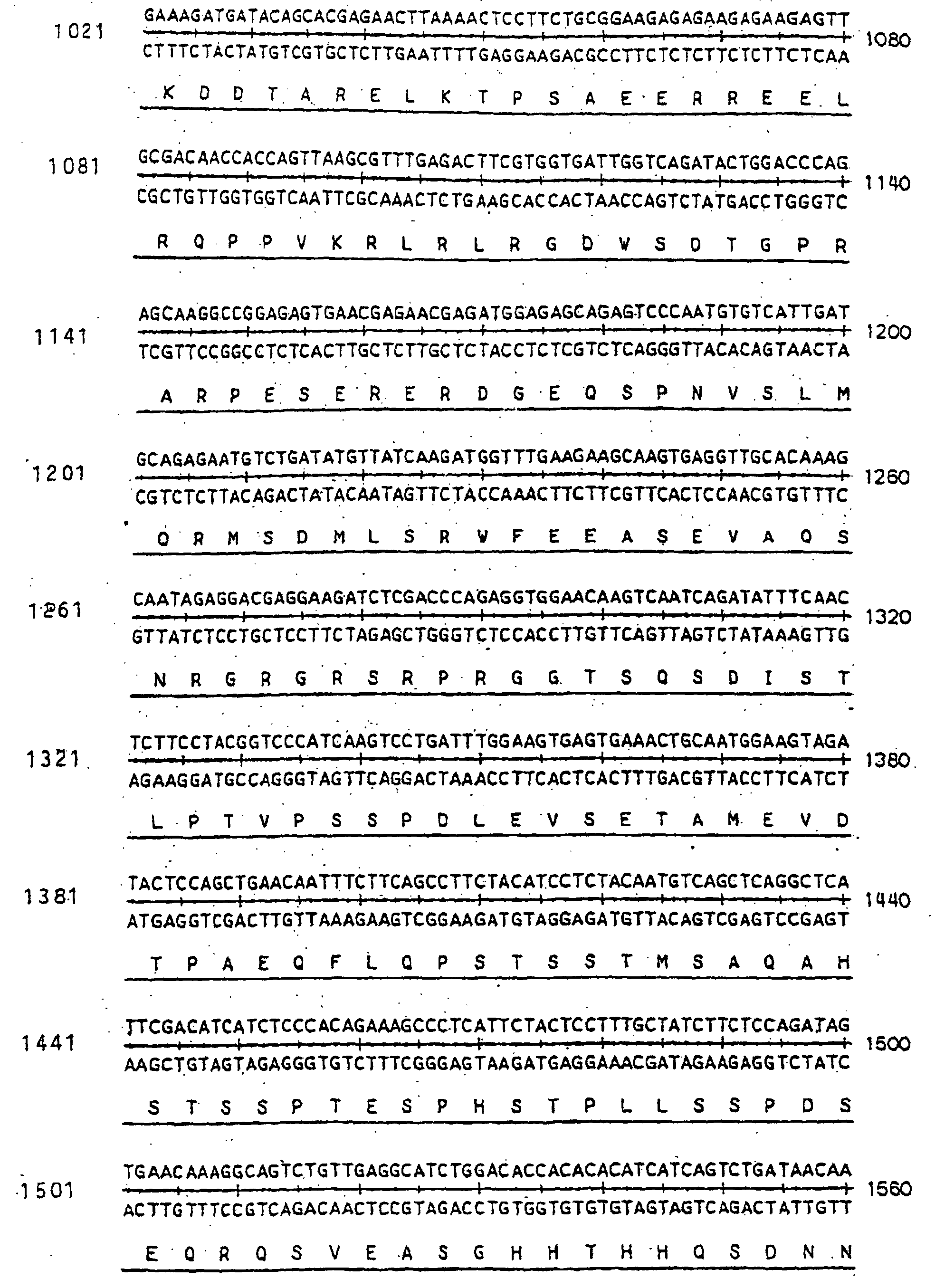


- This 3164-base nucleotide sequence contains an open reading frame of 2580 nucleotides encoding Repro-EN-1.0 from nucleotide 176 to nucleotide 2755. The deduced amino acid sequence of Repro-EN-1.0 has 860 amino acids. Repro-EN-1.0 has a calculated molecular mass of 96.4 kD and a pI of 5.08.
- The Repro-EN-1.0 gene encodes a 3.4 kb mRNA. This mRNA is expressed primarily in skeletal muscle, heart and testis, and to a lesser extent in other tissues.
However, it is not detected in lung or peripheral blood mononuclear cells (PBMC). - Analysis of the deduced amino acid sequence of Repro-EN-1.0 shows no significant sequence identity with any other protein.
- There is an alternately spliced variant that was isolated form a human heart cDNA library. This variant is called IB1 and is useful in the same ways as the nucleotide sequence (SEQ ID NO:1) and deduced amino acid sequence (SEQ ID NO:2) of Repro-EN-1.0. The IB1 sequence was isolated from a heart cDNA library by screening with a nucleic acid probe obtained from the Repro-EN-1.0 sequence. The IB1 sequence is different from the Repro-EN-1.0 sequence in that it contains an additional 231 bp exon inserted into the cDNA sequence at position 1555. Therefore the IB1 sequence has similar properties, but is slightly larger.
- The nucleotide sequence (SEQ ID NO:3) and the deduced amino acid sequence (SEQ ID NO:4) of IB1 follow:
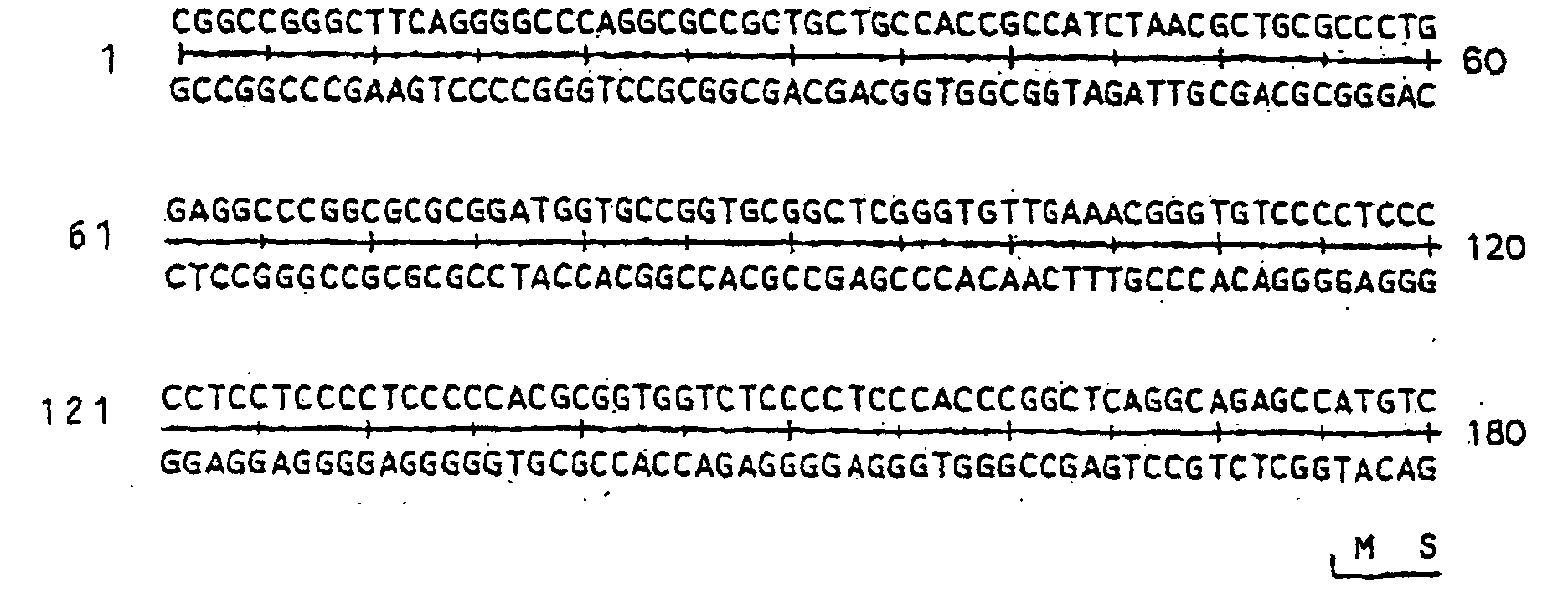
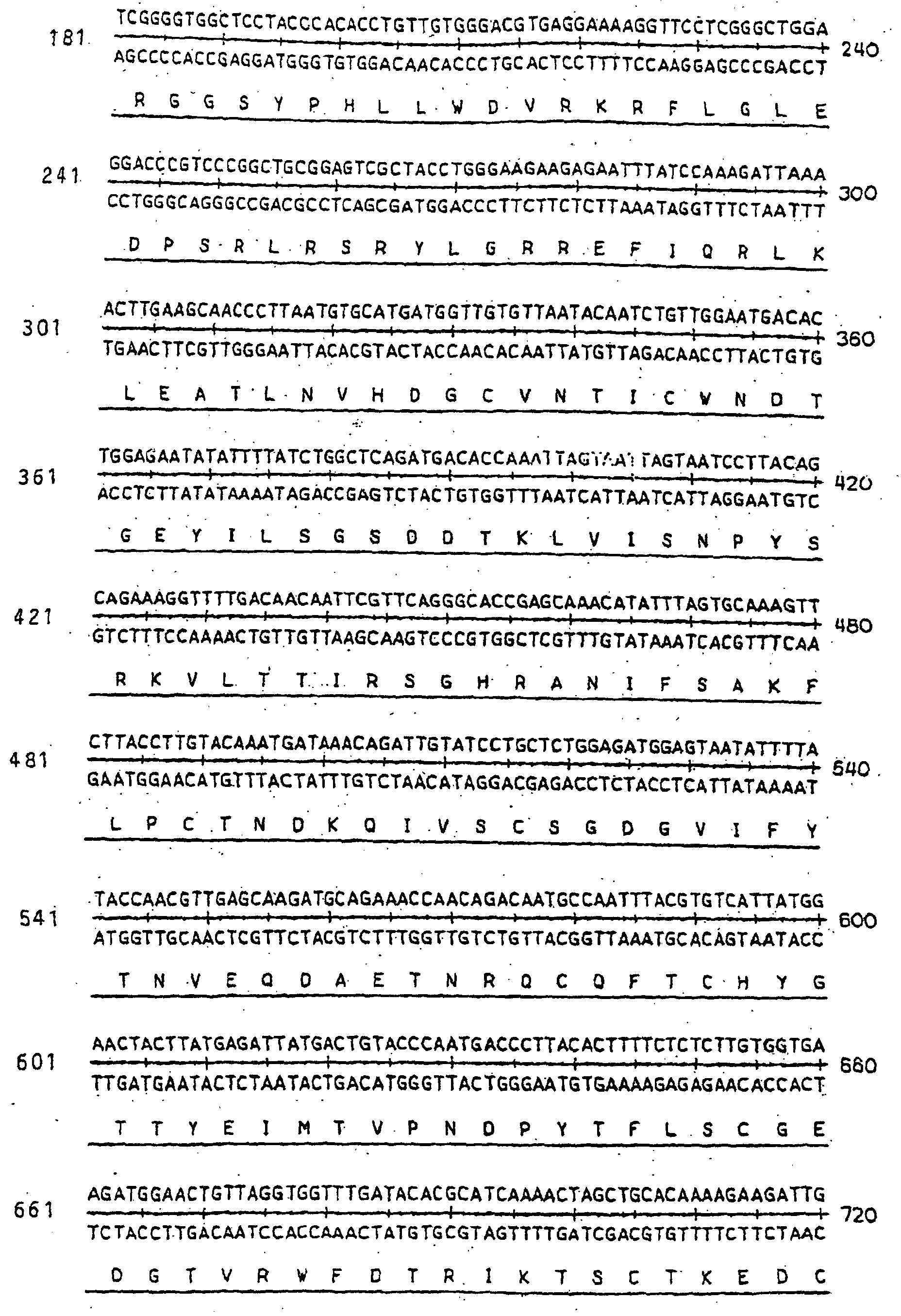

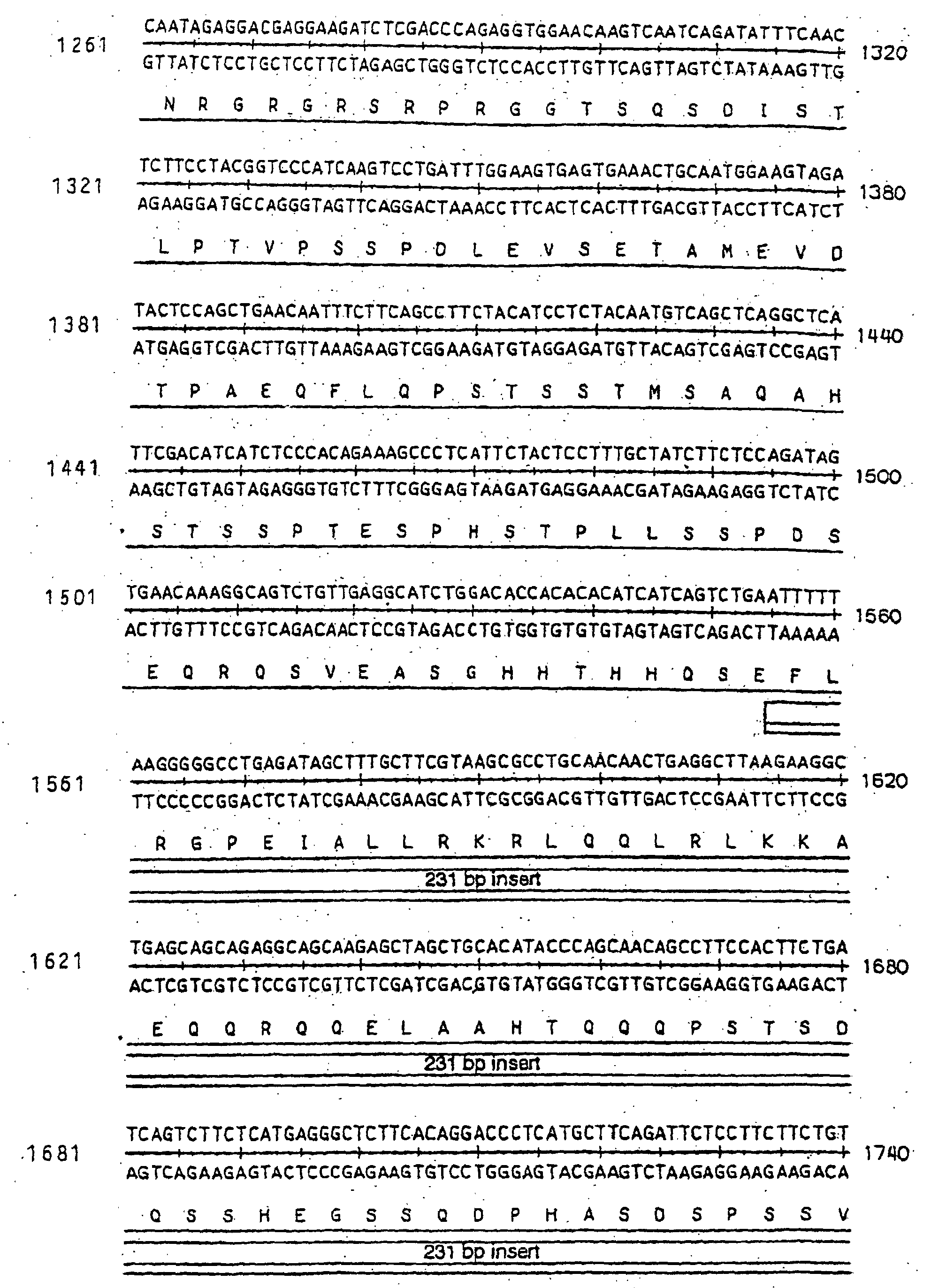
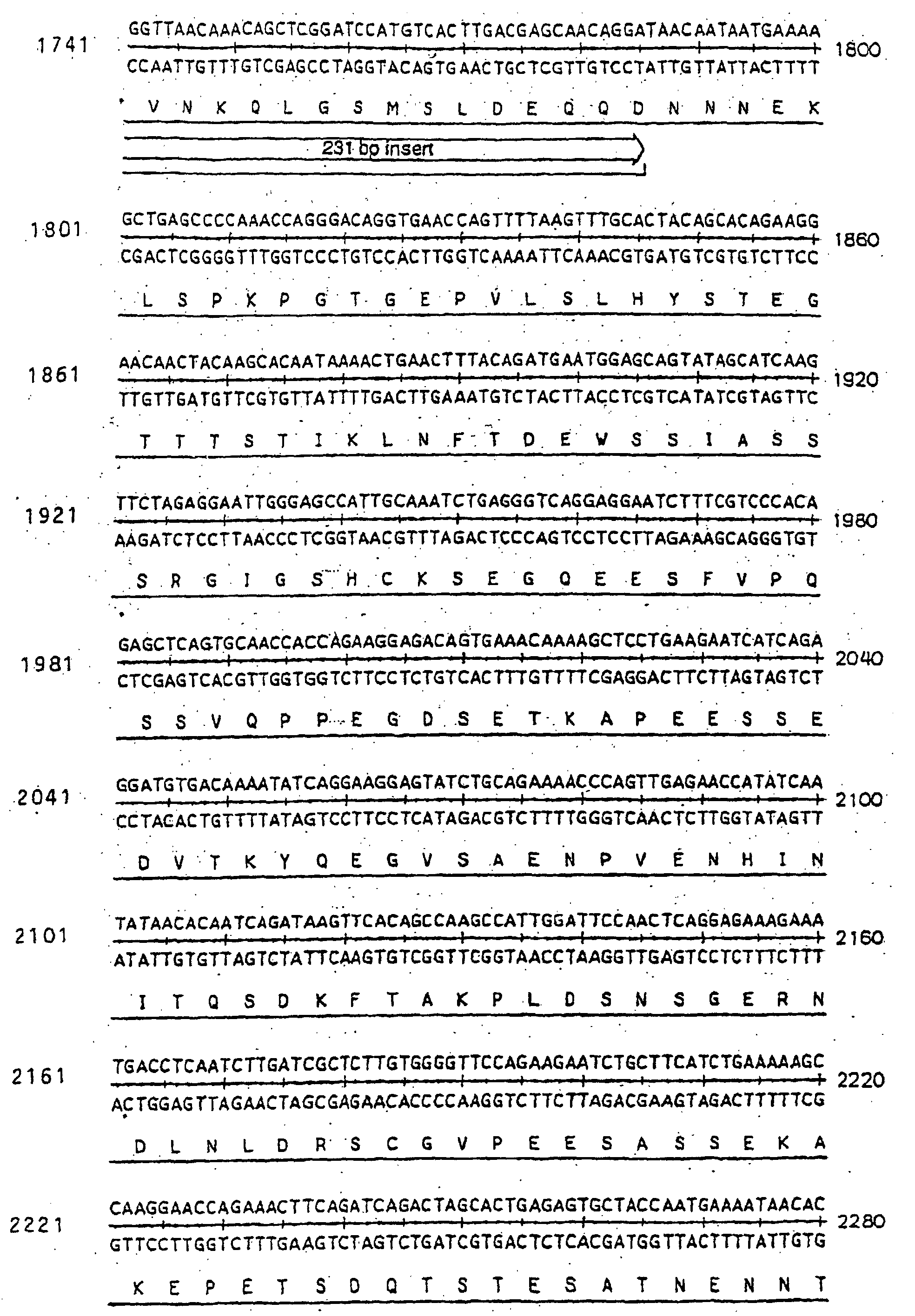
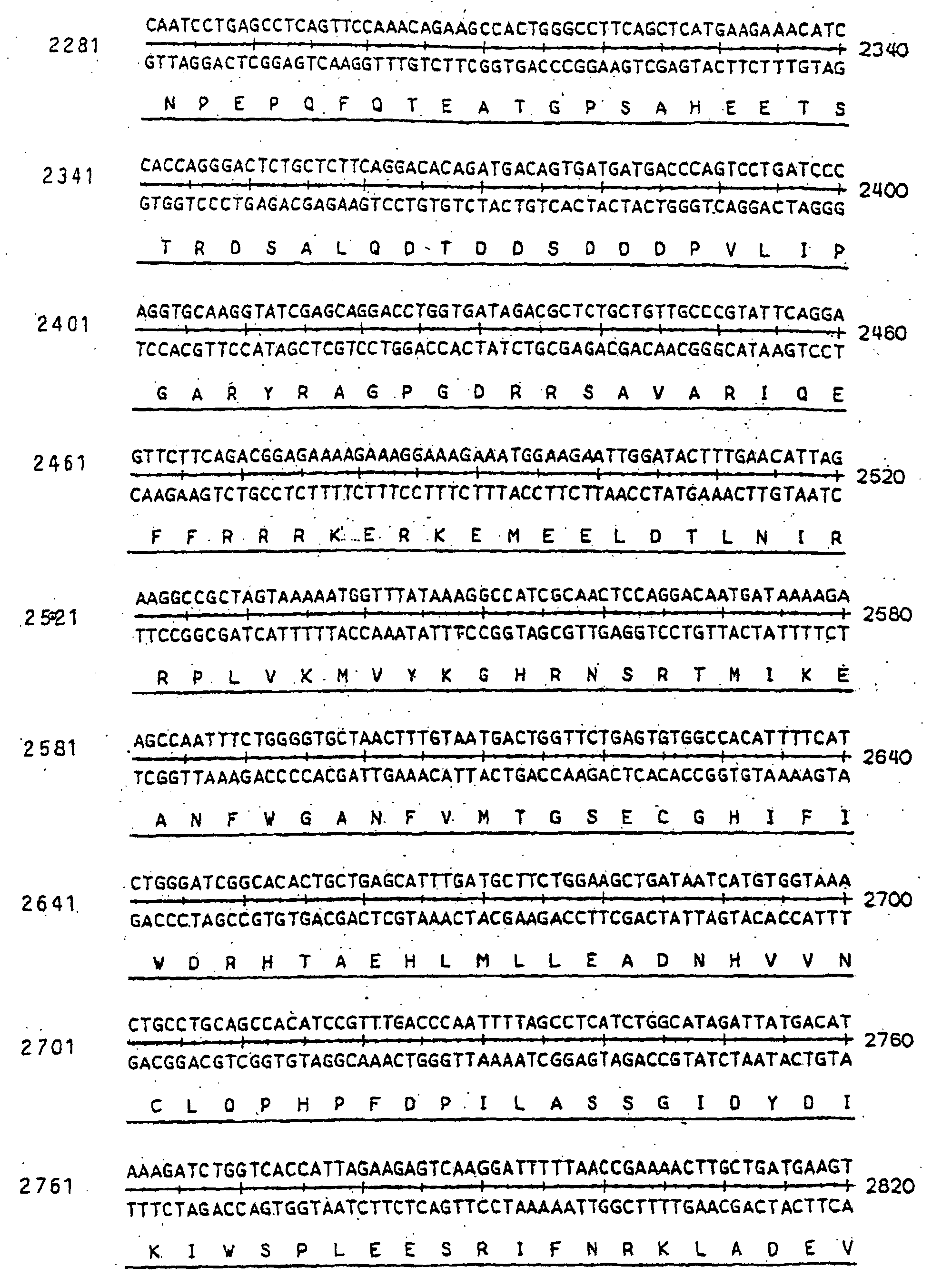

-
- IB1 cDNA is 3,395 base pairs
- IB1 open reading frame is 2,811 nucleotides
- IB1 open reading frame maps to nucleotides 176 to 2986
- Deduced amino acid sequence of IB1 has 937 amino acids
- Calculated moecular mass of IB1 protein is 104,969 Daltons (105kD)
- Calculated pI of IB1 protein is 5.17
-
- Analysis of the amino acid sequence identified several amino acid motifs that will be apparent to those skilled in the art including a myb 1 DNA binding domain, a WD 40 site, an RGD cell-attachment sequence, an N-myristolylation site and several phosphorylation and glycosylation sites. Analysis also shows that the protein is largely hydrophilic. This implies that most of the amino acid sequence is exposed to the immune system and can be recognized as epitopes.
- Analysis of expressed sequence tags (ESTs) from a public database (Genbank) identified many overlapping ESTs that, together, covered most of the Repro-EN-1.0 cDNA sequence.
- This invention provides recombinant polynucleotides comprising a nucleotide sequence encoding Repro-EN-1.0 and IB1 proteins as described herein. The polynucleotides are useful for expressing the mRNA or polypeptides they encode and in the preparation of probes or primers, among other things.
- In one embodiment, the recombinant polynucleotide molecule comprises a nucleotide sequence encoding polypeptide Repro-EN-1.0 of SEQ ID NO:2 or IB1 of SEQ ID NO:4.
- The nucleotide sequence can be identical to a sequence from Repro-EN-1.0 cDNA or its complement or IB1 cDNA or its complement, or can include degenerate codons. In one embodiment of a nucleotide sequence encoding full-length Repro-EN-1.0 or IB1, the sequence is identical to the coding sequence of Repro-EN-1.0 of SEQ ID NO:1 or IB1 of SEQ ID NO:3.
- In another embodiment, the polynucleotide encodes a fusion protein between Repro-EN-1.0 or IB1 polypeptide or Repro-EN-1.0 or IB1 analog amino acid sequences and a second amino acid sequence. The second amino acid sequence can be, for example, a detectable label such as a fluorescent protein, enzyme marker of protein from a two-hybrid system.
- The polynucleotides of the present invention are cloned or amplified by in vitro methods, such as the polymerase chain reaction (PCR), the ligase chain reaction (LCR), the transcription-based amplification system (TAS), the self-sustained sequence replication system (3SR) and the Qβ replicase amplification system (QB). For example, a polynucleotide encoding the protein can be isolated by polymerase chain reaction of cDNA from a human endometrial carcinoma cell line using primers based on the DNA sequence of Repro-EN-1.0 of SEQ ID NO:1. One pair of primers useful for amplifying Repro-EN-1.0 DNA, including allelic variants, is:


- A wide variety of cloning and in vitro amplification methodologies are well-known to persons of skill. PCR methods are described in, for example, U.S. Pat. No. 4,683,195; Mullis et al. (1987) Cold Spring Harbor Symp. Quant. Biol. 51:263; and Erlich, ed., PCR Technology, (Stockton Press, NY, 1989). One useful format is real time PCR. See, e.g., Luch et al. (1997) J. Molec. Endocrinol. 18:77-85 and Arold et al., (1997) Proc. Nat'l Acad. Sci., USA 94:2438-43. Polynucleotides also can be isolated by screening genomic or cDNA libraries with probes selected from the sequences of SEQ ID NO:1 under stringent hybridization conditions.
- Mutant versions of the proteins can be made by site-specific mutagenesis of other polynucleotides encoding the proteins, or by random mutagenesis caused by increasing the error rate of PCR of the original polynucleotide with 0.1 mM MnCl2 and unbalanced nucleotide concentrations.
- This invention also provides expression vectors, e.g., recombinant polynucleotide molecules comprising expression control sequences operatively linked to a nucleotide sequence encoding the target polypeptide. Expression vectors can be adapted for function in prokaryotes or eukaryotes by inclusion of appropriate promoters, replication sequences, markers, etc. for transcription and translation of mRNA. The construction of expression vectors and the expression of genes in transfected cells involves the use of molecular cloning techniques also well known in the art. Sambrook et al., Molecular Cloning - A Laboratory Manual, Cold Spring Harbor Laboratory, Cold Spring Harbor, NY, (1989) and Current Protocols in Molecular Biology, F.M. Ausubel et al., eds., (Current Protocols, a joint venture between Greene Publishing Associates, Inc. and John Wiley & Sons, Inc.) Useful promoters for such purposes include a metallothionein promoter, a constitutive adenovirus major late promoter, a dexamethasone-inducible MMTV promoter, a SV40 promoter, a MRP polIII promoter, a constitutive MPSV promoter, a tetracycline-inducible CMV promoter (such as the human immediate-early CMV promoter), and a constitutive CMV promoter.
- . Methods for transfecting genes into mammalian cells and obtaining their expression for in vitro use or for gene therapy, are well known to the art. See, e.g., Methods in Enzymology, vol. 185, Academic Press, Inc., San Diego, CA (D.V. Goeddel, ed.) (1990) or M. Krieger, Gene Transfer and Expression -- A Laboratory Manual, Stockton Press, New York, NY, (1990).
- Expression vectors useful in this invention depend on their intended use. Such expression vectors must, of course, contain expression and replication signals compatible with the host cell. Expression vectors useful for expressing the protein of this invention include viral vectors such as alpha viruses, retroviruses, adenoviruses and adeno-associated viruses, plasmid vectors, cosmids, liposomes and the like. Viral and plasmid vectors are preferred for transfecting mammalian cells. The expression vector pcDNA1 (Invitrogen, San Diego, CA), in which the expression control sequence comprises the CMV promoter, provides good rates of transfection and expression. Adeno-associated viral vectors are useful in the gene therapy methods of this invention.
- The construct can also contain a tag to simplify isolation of the protein. For example, a polyhistidine tag of, e.g., six histidine residues, can be incorporated at the amino terminal end of the protein. The polyhistidine tag allows convenient isolation of the protein in a single step by nickel-chelate chromatography.
- In another embodiment, endogenous genes are transcribed by operatively linking them to expression control sequences supplied endogenously that recombine with genomic DNA. In one method, one provides the cell with a recombinant polynucleotide containing a targeting sequence, which permits homologous recombination into the genome upstream of the transcriptional start site of target gene; the expression control sequences; an exon of the target gene; and an unpaired splice-donor site which pairs with a splice acceptor in the target gene. Such methods are discussed in Treco et al., WO 94/12650; Treco et al., WO 95/31560 and Treco et al., WO 96/29411.
- . The invention also provides recombinant cells comprising an expression vector for expression of the nucleotide sequences encoding a polypeptide of this invention. Host cells can be selected for high levels of expression in order to purify the protein. Mammalian cells are preferred for this purpose, but prokaryotic cells, such as E. coli, also are useful. The cell can be, e.g., a recombinant cell in culture or a cell in vivo.
- This invention provides polynucleotide probes and primers that specifically hybridize to a sub-sequence of Repro-EN-1.0 cDNA or its complement or IB1 cDNA or its complement, under stringent hybridization conditions. The probes and primers of this invention are polynucleotides of at least 7 nucleotides, at least 10 nucleotides, at least 15 nucleotides, at least 20 nucleotides or at least 25 nucleotides. In one embodiment, the sequence of the polynucleotide is a contiguous sequence from SEQ ID NO: 1 or its complement. Any suitable region of the Repro-EN-1.0 or IB1 gene may be chosen as a target for polynucleotide hybridization. Nucleotide substitutions, deletions, and additions may be incorporated into the polynucleotides as long as the characteristic ability to specifically hybridize to the target sequence or its complement is retained. Nucleotide sequence variation may result from sequence polymorphisms of various alleles, minor sequencing errors, and the like.
- The probes and primers of the invention are useful as probes in hybridization assays, such as Southern and northern blots, for identifying polynucleotides having a nucleotide sequence encoding a Repro-EN-1.0 or IB1 polypeptide, and as primers for amplification procedures. The probes and primers of the invention are also useful in detecting the presence, absence or amount of Repro-EN-1.0 or IB1 in tissue biopsies and histological sections where the detection method is carried out in situ, typically after amplification of Repro-EN-1.0 or IB1 sequences using a primer set.
- The probes and primers of this invention also are useful for identifying allelic forms of Repro-EN-1.0 and animal cognate genes or IB1 and animal cognate genes. Probes and primers can be used to screen human or animal genomic DNA or cDNA libraries under, e.g., stringent conditions. DNA molecules that specifically hybridize to the probe are then further examined to determine whether they are Repro-EN-1.0 allelic variants or animal cognates or IB1 allelic variants or animal cognates.
- The probes also are useful in oligonucleotide arrays. Such arrays are used in hybridization assays to check the identity of bases in a target polynucleotide. In essence, when a target hybridizes perfectly to a probe on the array, the target contains the nucleotide sequence of the probe. When the target hybridizes less well, or does not hybridize at all, then the target and probe differ in sequence by one or more nucleotide. By proper selection of probes, one can check bases on a target molecule. See, e.g., Chee et al., WO 95/11995. The use the Repro-EN-1.0 or IB1 sequence in genomics is described further below.
- In one embodiment, the polynucleotide is directly or indirectly detectable through a detectable moiety. A detectable moiety bound to either an oligonucleotide primer or a probe is subsequently used to detect hybridization of an oligonucleotide primer to the RNA component. Detection of labeled material bound to a Repro-EN-1.0 or IB1 polynucleotide in a sample provides a means of determining a diagnostic or prognostic value.
- Although primers and probes can differ in sequence and length, the primary differentiating factor is one of function: primers serve as an initiation point for DNA synthesis of a target polynucleotide, as in RT and PCR reactions, while probes are typically used for hybridization to and detection of a target polynucleotide. Typical lengths of primers or probes can range from 7-50 nucleotides, preferably from 10-40 nucleotides, and most preferably from 15-35 nucleotides. A primer or probe can also be labeled with a detectable moiety for detection of hybridization of the primer or probe to the target polynucleotide.
- In general, those of skill in the art recognize that the polynucleotides used in the invention include both DNA and RNA molecules and naturally occurring modifications thereof, as well as synthetic, non-naturally occurring analogs of the same, and heteropolymers, of deoxyribonucleotides, ribonucleotides, and/or analogs of either. The particular composition of a polynucleotide or polynucleotide analog will depend upon the purpose for which the material will be used and the environment in which the material will be placed. Modified or synthetic, non-naturally occurring nucleotides have been designed to serve a variety of purposes and to remain stable in a variety of environments, such as those in which nucleases are present.
- Oligonucleotides preferably are synthesized, e.g., on an Applied BioSystems or other commercially available oligonucleotide synthesizer according to specifications provided by the manufacturer. Oligonucleotides may be prepared using any suitable method, such as the phosphotriester and phosphodiester methods, or automated embodiments thereof. In one such automated embodiment, diethylphosphoramidates are used as starting materials and may be synthesized as described by Beaucage et al., Tetrahedron Letters 22: 1859 (1981), and U.S. Patent No. 4,458,066.
- Polynucleotides, e.g., probes, also can be recombinantly produced through the use of plasmids or other vectors.
- In one aspect this invention provides a probe that specifically hybridizes to the 5' untranslated region of Repro-EN-1.0 or IB1, the coding region of Repro-EN-1.0 or IB1, or a region of Repro-EN-1.0 or IB1 encoding an epitope of the Repro-EN-1.0 or IB1 polypeptide.
- In another aspect, this invention provides a primer pair which amplifies a nucleotide sequence encoding a polypeptide epitope of Repro-EN-1.0 or IB1 recognized by an antibody from an individual diagnosed with endometriosis. A primer pair that amplifies a particular nucleotide (given in the 5' to 3' orientation) includes a 5' primer and a 3' primer. The 3' primer hybridizes to the 3' end of the nucleotide sequence or downstream from it. The 5' primer hybridizes to the 3' end of the complement of the nucleotide sequence or downstream from it. In this way, the primers can amplify a polynucleotide that comprises the nucleotide sequence. One nucleotide sequence encoding a polypeptide epitope of Repro-EN-1.0 has been identified within the about 2.2 kb from 3' end of the coding sequences of Repro-EN-1.0 (SEQ ID NO:1).
- This invention also provides purified, recombinant Repro-EN-1.0 and IB1 polypeptide. The invention provides recombinant Repro-EN-1.0 polypeptides which include the polypeptide whose amino acid sequence is presented in SEQ ID NO:2, as well as allelic variants of it.
- Repro-EN-1.0 polypeptide refers to native Repro-EN-1.0, the polypeptide whose amino acid sequence is the amino acid sequence of SEQ ID NO:2, and to allelic variants of it. Polynucleotide molecules that encode allelic variants of Repro-EN-1.0 are isolatable from endometrial cancer cell cDNA or genomic DNA and typically hybridize under stringent conditions to the nucleotide sequence encoding Repro-EN-1.0 (SEQ ID NO:1). They can be obtained by amplification using, e.g., PCR primers taken from the sequence of Repro-EN-1.0 described herein.
- Repro-EN-1.0 polypeptides are useful as immunogens to elicit the production of anti-Repro-EN-1.0 antibodies, as affinity capture molecules to isolate such antibodies from a mixture, and as controls in diagnostic methods aimed at detecting Repro-EN-1.0 in a sample.
- The cDNA encoding Repro-EN-1.0 of SEQ ID NO:1 was discovered by screening an expression library of cDNA from an endometrial carcinoma cell line with serum pooled from subjects diagnosed with endometriosis. Therefore, polypeptides comprising an epitope of Repro-EN-1.0 can be identified by screening with such serum. Preferably, the test serum is a serum pooled from several subjects positively diagnosed with endometriosis. At least one epitope of Repro-EN-1.0 exists in a fragment of 567 amino acids from the carboxy-terminus of the molecule (amino acids 293-860 of SEQ ID NO:2). At least one epitope of IB1 exists in a fragment of 644 amino acids from the carboxy terminus of the molecule (amino acids 293-937 of SEQ ID NO: 4) to detect the presence of antibodies against Repro-EN-1.0 or IB1 in patient serum samples. This test is useful in diagnosis because the presence of such antibodies is a diagnostic marker.
- Repro-EN-1.0 or IB1 are most easily produced recombinantly, as described herein. Recombinant Repro-EN-1.0 or IB1 can be purified by affinity purification In one method, recombinant Repro-EN-1.0 or IB1 comprise a polyhistidine tag. The protein is purified on a nickel-chelate affinity matrix. In another method, Repro-EN-1.0 or IB1 is purified using an affinity matrix carrying anti-Repro-EN-1.0 or IB1 antibodies.
- In one aspect this invention provides a composition comprising an antibody that specifically binds Repro-EN-1.0 or IB1 polypeptides. Antibodies preferably have affinity of at least 106 M-1, 107 M-1, 108 M-1, or 109 M-1. This invention contemplates both polyclonal and monoclonal antibody compositions.
- Immunotoxins against Repro-EN-1.0- or IB1-expressing cells are also described herein. Immunotoxins are antibodies and the like as described herein coupled to a compound, e.g., a toxin, that is toxic to a target cell. Toxins can include, for example, radioactive isotopes, ricin, cisplatin, antisense molecules, Diphtheria toxin, Pseudomonas exotoxin A or Bacillus anthraces protective antigen. Immunotoxins bind to cancer cells that express Repro-EN-1.0 or IB1 and kill them. They are useful in the therapeutic methods of this invention. The antibodies of the invention have many uses. For example, such antibodies are useful for detecting Repro-EN-1.0 or IB1 polypeptides in immunoassays. The antibodies also can be used to screen expression libraries for particular expression products such as mammalian Repro-EN-1.0 or IB1. These are useful for detecting or diagnosing various pathological conditions related to the presence of the respective antigens. Usually the antibodies in such a procedure are labeled with a moiety allowing easy detection of presence of antigen by antibody binding. Antibodies raised against Repro-EN-1.0 or IB1 can also be used to raise anti-idiotypic antibodies.
- A number of immunogens are used to produce antibodies that specifically bind Repro-EN-1.0 or IB1 polypeptides. Full-length Repro-EN-1.0 or IB1 is a suitable immunogen. Typically, the immunogen of interest is a peptide of at least about 3 amino acids, more typically the peptide is 5 amino acids in length, preferably, the fragment is 10 amino acids in length and more preferably the fragment is 15 amino acids in length or greater, Thepeptides can be coupled to a carrier protein (e.g., as a fusion protein), or are recombinantly expressed in an immunization vector. Antigenic determinants on peptides to which antibodies bind are typically 3 to 10 amino acids in length. Naturally occurring polypeptides are also used either in pure or impure form.
- Recombinant polypeptides are expressed in eukaryotic or prokaryotic cells and purified using standard techniques. The polypeptide, or a synthetic version thereof, is then injected into an animal capable of producing antibodies. Either monoclonal or polyclonal antibodies can be generated for subsequent use in immunoassays to measure the presence and quantity of the polypeptide.
- Methods for producing polyclonal antibodies are known to those of skill in the art. In brief, an immunogen, preferably a purified polypeptide, a polypeptide coupled to an appropriate carrier (e.g., GST, keyhole limpet hemanocyanin, etc.), or a polypeptide incorporated into an immunization vector such as a recombinant vaccinia virus (see, U.S. Patent No. 4,722,848) is mixed with an adjuvant and animals are immunized with the mixture. The animal's immune response to the immunogen preparation is monitored by taking test bleeds and determining the titer of reactivity to the polypeptide of interest. When appropriately high titers of antibody to the immunogen are obtained, blood is collected from the animal and antisera are prepared. Further fractionation of the antisera to enrich for antibodies reactive to the polypeptide is performed where desired. See, e.g., Coligan (1991) Current Protocols in Immunology Wiley/Greene, NY; and Harlow and Lane (1989) Antibodies: A Laboratory Manual Cold Spring Harbor Press, NY.
- Antibodies, including binding fragments and single chain recombinant versions thereof, against predetermined fragments of Repro-EN-1.0 or IB1 proteins are raised by immunizing animals, e.g., with conjugates of the fragments with carrier proteins as described above.
- Monoclonal antibodies are prepared from cells secreting the desired antibody. These antibodies are screened for binding to normal or modified polypeptides, or screened for agonistic or antagonistic activity, e.g., activity mediated through Repro-EN-1.0 or IB1. In some instances, it is desirable to prepare monoclonal antibodies from various mammalian hosts, such as mice, rodents, primates, humans, etc. Description of techniques for preparing such monoclonal antibodies are found in, e.g., Stites et al. (eds.) Basic and Clinical Immunology (4th ed.) Lange Medical Publications, Los Altos, CA, and references cited therein; Harlow and Lane, Supra; Goding (1986) Monoclonal Antibodies: Principles and Practice (2d ed.) Academic Press, New York, NY; and Kohler and Milstein (1975) Nature 256: 495-497.
- Other suitable techniques involve selection of libraries of recombinant antibodies in phage or similar vectors. See, Huse et al. (1989) Science 246: 1275-1281; and Ward, et al. (1989) Nature 341: 544-546.
- Also, recombinant immunoglobulins may be produced. See, Cabilly, U.S. Patent No. 4,816,567; and Queen et al. (1989) Proc. Nat'l Acad. Sci. USA 86: 10029-10033.
- Frequently, the polypeptides and antibodies will be labeled by joining, either covalently or non-covalently, a substance which provides for a detectable signal. A wide variety of labels and conjugation techniques are known and are reported extensively in both the scientific and patent literature. Thus, an antibody used for detecting an analyte can be directly labeled with a detectable moiety, or may be indirectly labeled by, for example, binding to the antibody a secondary antibody that is, itself directly or indirectly labeled.
- The antibodies of this invention are also used for affinity chromatography in isolating Repro-EN-1.0 or IB1 proteins. Columns are prepared, e.g., with the antibodies linked to a solid support, e.g., particles, such as agarose, Sephadex, or the like, where a cell lysate is passed through the column, washed, and treated with increasing concentrations of a mild denaturant, whereby purified Repro-EN-1.0 or IB1 polypeptides are released
- An alternative approach is the generation of humanized immunoglobulins by linking the CDR regions of non-human antibodies to human constant regions by recombinant DNA techniques. See Queen et al., United States patent 5,585,089.
- .A further approach for isolating DNA sequences which encode a human monoclonal antibody or a binding fragment thereof is by screening a DNA library from human B cells according to the general protocol outlined by Huse et al., Science 246:1275-1281 (1989) and then cloning and amplifying the sequences which encode the antibody (or binding fragment) of the desired specificity. The protocol described by Huse is rendered more efficient in combination with phage display technology. See, e.g., Dower et al., WO 91/17271 and McCafferty et al., WO 92/01047. Phage display technology can also be used to mutagenize CDR regions of antibodies previously shown to have affinity for Repro-EN-1.0 or IB1 protein receptors or their ligands. Antibodies having improved binding affinity are selected.
- Fragments of antibodies against Repro-EN-1.0 or IB1 protein or protein analogs are also described herein. Typically, these fragments exhibit specific binding to the Repro-EN-1.0 protein receptor similar to that of a complete immunoglobulin. Antibody fragments include separate heavy chains, light chains Fab, Fab' F(ab')2 and Fv. Fragments are produced by recombinant DNA techniques, or by enzymic or chemical separation of intact immunoglobulins
- Repro-EN-1.0 or IB1 polypeptides can be identified by any methods known in the art. In one embodiment, the methods involve detecting the polypeptide with a ligand that specifically recognizes the polypeptide (e.g., an immunoassay). The antibodies of the invention are particularly useful for specific detection of Repro-EN-1.0 or IB1 polypeptides. . A variety of antibody-based detection methods are known in the art. These include, for example, radioimmunoassay, sandwich immunoassays (including ELISA), immunofluorescent assays, western blot, affinity chromatography (affinity ligand bound to a solid phase), and in situ detection with labeled antibodies. Another method for detecting Repro-EN-1.0 or IB1 polypeptides involves identifying the polypeptide according to its mass through, for example, gel electrophoresis, mass spectrometry or HPLC. Subject samples can be taken from any number of appropriate sources, such as saliva, peritoneal fluid, blood or a blood product (e.g., serum), urine, tissue biopsy (e.g., lymph node tissue), etc.
- The methods for detection of Repro-EN-1.0 or IB1 polypeptides may employ one or more anti-Repro-EN-1.0 or IB1 antibody reagents (i.e., immunoassays). A number of well established immunological binding assay formats suitable for the practice of the invention are known (see, e.g., U.S. Patents 4,366,241; 4,376,110; 4,517,288; and 4,837,168). See, e.g., METHODS IN CELL BIOLOGY VOLUME 37: ANTIBODIES IN CELL BIOLOGY, Asai, ed. Academic Press, Inc. New York (1993); BASIC AND CLINICAL IMMUNOLOGY 7th Edition, Stites & Terr, eds. (1991); Harlow and Lane, supra [e.g., Chapter 14], and Ausubel et al., supra, [e.g., Chapter 11]. Typically, immunological binding assays (or immunoassays) utilize a "capture agent" to specifically bind to and, often, immobilize the analyte to a solid phase. In one embodiment embodiment, the capture agent is a moiety that specifically binds to a Repro-EN-1.0 or IB1 polypeptide or subsequence, such as an anti-Repro-EN-1.0 or anti-IB1 antibody.
- Usually the Repro-EN-1.0 or IB1 polypeptide being assayed is detected directly or indirectly using a detectable label. The particular label or detectable group used in the assay is usually not a critical aspect of the invention, so long as it does not significantly interfere with the specific binding of the antibody or antibodies used in the assay. The label may be covalently attached to the capture agent (e.g., an anti-Repro-EN-1.0 or or anti-IB1 antibody), or may be attached to a third moiety, such as another antibody, that specifically binds to the Repro-EN-1.0 polypeptide.
- The methods employ competitive and noncompetitive immunoassays for detecting Repro-EN-1.0 or IB1 polypeptides. Non-competitive immunoassays are assays in which the amount of captured analyte (in this case Repro-EN-1.0 or IB1) is directly measured. One such assay is a two-site, monoclonal-based immunoassay utilizing monoclonal antibodies reactive to two non-interfering epitopes on the Repro-EN-1.0 or IB1 protein. See, e.g., Maddox et al., 1983, J. Exp. Med. 158:1211 for background information. In one preferred "sandwich" assay, the capture agent (e.g., an anti-Repro-EN-1.0 or anti-IB1 antibody) is bound directly to a solid substrate where it is immobilized. These immobilized antibodies then capture any Repro-EN-1.0 or IB1 protein present in the test sample. The Repro-EN-1.0 or IB1 polypeptide thus immobilized can then be labeled, i.e., by binding to a second anti-Repro-EN-1.0 or IB1 antibody bearing a label. Alternatively, the second anti-Repro-EN-1.0 or IB1 antibody may lack a label, but be bound by a labeled third antibody specific to antibodies of the species from which the second antibody is derived. The second antibody alternatively can be modified with a detectable moiety, such as biotin, to which a third labeled molecule can specifically bind, such as enzyme-labeled streptavidin.
- In competitive assays, the amount of Repro-EN-1.0 or IB1 protein present in the sample is measured indirectly by measuring the amount of an added (exogenous) Repro-EN-1.0 or IB1 displaced (or competed away) from a capture agent (e.g., anti-Repro-EN-1.0 or anti-IB1 antibody) by the Repro-EN-1.0 or IB1 protein present in the sample.
- A hapten inhibition assay is another example of a competitive assay. In this assay Repro-EN-1.0 or IB1 protein is immobilized on a solid substrate. A known amount of anti-Repro-EN-1.0 or anti-IB1 antibody is added to the sample, and the sample is then contacted with the immobilized Repro-EN-1.0 or IB1 protein. In this case, the amount of anti-Repro-EN-1.0 or anti-IB1 antibody bound to the immobilized Repro-EN-1.0 or IB1 protein is inversely proportional to the amount of Repro-EN-1.0 protein present in the sample. The amount of immobilized antibody may be detected by detecting either the immobilized fraction of antibody or the fraction of the antibody that remains in solution. In this aspect, detection may be direct, where the antibody is labeled, or indirect where the label is bound to a molecule that specifically binds to the antibody as described above.
- The methods detect and quantify the presence of Repro-EN-1.0 or IB1 polypeptide in the sample by using an immunoblot (Western blot) format. Another immunoassay is the so-called "lateral flow chromatography." In a non-competitive version of lateral flow chromatography, a sample moves across a substrate by, e.g., capillary action, and encounters a mobile labeled antibody that binds the analyte forming a conjugate. The conjugate then moves across the substrate and encounters an immobilized second antibody that binds the analyte. Thus, immobilized analyte is detected by detecting the labeled antibody. In a competitive version of lateral flow chromatography a labeled version of the analyte moves across the carrier and competes with unlabeled analyte for binding with the immobilized antibody. The greater the amount of the analyte in the sample, the less the binding by labeled analyte and, therefore, the weaker the signal. See, e.g., May et aL, U.S. patent 5,622,871 and Rosenstein, U.S. patent 5,591,645.
- As noted supra, depending upon the assay, various components, including the antigen, target antibody, or anti-Repro-EN-1.0 or anti-IB1 antibody, may be bound to a solid surface or support (i.e., a substrate, membrane, or filter paper). Many methods for immobilizing biomolecules to a variety of solid surfaces are known in the art. For instance, the solid surface may be a membrane (e.g., nitrocellulose), a microtiter dish (e.g., PVC, polypropylene, or polystyrene), a test tube (glass or plastic), a dipstick (e.g. glass, PVC, polypropylene, polystyrene, latex, and the like), a microcentrifuge tube, or a glass or plastic bead. The desired component may be covalently bound or noncovalently attached through nonspecific bonding.
- A wide variety of organic and inorganic polymers, both natural and synthetic may be employed as the material for the solid surface. Illustrative polymers include polyethylene, polypropylene, poly(4-methylbutene), polystyrene, polymethacrylate, poly(ethylene terephthalate), rayon, nylon, poly(vinyl butyrate), polyvinyldene difluoride (PVDF), silicones, polyformaldehyde, cellulose, cellulose acetate, nitrocellulose, and the like. Other materials which may be employed, include paper, glasses, ceramics, metals, metalloids, semiconductive materials, cements or the like. In addition, substances that form gels, such as proteins (e.g., gelatins), lipopolysaccharides, silicates, agarose and polyacrylamides can be used. Polymers which form several aqueous phases, such as dextrans, polyalkylene glycols or surfactants, such as phospholipids, long chain (12-24 carbon atoms) alkyl ammonium salts and the like are also suitable. Where the splid surface is porous, various pore sizes may be employed depending upon the nature of the system.
- The mass of a molecule firquently can be used as an identifier of the molecule. Therefore, methods of mass spectrometry can be used to identify a protein analyte. Mass spectrometers can measure mass by determining the time required for an ionized analyte to travel down a flight tube and to be detected by an ion detector.
- One method of mass spectrometry for proteins is matrix-assisted laser desorption/ionization mass spectrometry ("MALDI"). In MALDI the analyte is mixed with an energy absorbing matrix material that absorbs energy of the wavelength of a laser and placed on the surface of a probe. Upon striking the matrix with the laser, the analyte is desorbed from the probe surface, ionized, and detected by the ion detector. See, for example, Hillenkamp et al., United States patent 5,118,937
- . Other methods of mass spectrometry for proteins are described in Hutchens and Yip, United States patent 5,719,060. In one such method referred to as Surfaces Enhanced for Affinity Capture ("SEAC") a solid phase affinity reagent that binds the analyte specifically or non-specifically, such as an antibody or a metal ion, is used to separate the analyte from other materials in a sample. Then the captured analyte is desorbed from the solid phase by, e.g., laser energy, ionized, and detected by the detector.
- The diagnostic and prognostic assays described herein can be carried out in various combinations and can also be carried out in conjunction with other diagnostic or prognostic tests. For example, when the present methods are used to diagnose endometriosis, the presence of a Repro-EN-1.0 or IB1 polypeptide can be used to determine the stage of the disease. Tests that may provide additional information include microscopic analysis of biopsy samples, detection of antigens (e.g., cell-surface markers) associated with endometriosis (e.g., using histocytochemistry, FACS, or the like).
- We have detected circulating antibodies against Repro-EN-1.0 or IB1 in the blood of women diagnosed with endometriosis. This supports the idea that endometriosis has an autoimmune component. Further, Repro-EN-1.0 or IB1 and auto-antibodies against Repro-EN-1.0 or IB1 represent two targets in the diagnosis of endometriosis.
- Repro-EN-1.0 or IB1 that is shed into the peritoneal fluid of women with endometriosis is useful in methods of diagnosing endometriosis. These methods include detecting Repro-EN-1.0 or IB1 in a biological sample of a subject. Suitable samples include, without limitation, saliva, blood or a blood product (e.g., serum), urine, menstrual fluid, vaginal secretion and, in particular, peritoneal fluid. Repro-EN-1.0 or IB1 can be detected by any of the methods described herein. Any detection of Repro-EN-1.0 or IB1 above a normal range is a positive sign in the diagnosis of endometriosis.
- In another aspect, this invention provides methods for diagnosing endometriosis in a subject by detecting in a sample from the subject a diagnostic amount of an antibody that specifically binds to Repro-EN-1.0 or IB1 polypeptide. Suitable patient samples include, without limitation, saliva, blood or a blood product (e.g., serum), peritoneal fluid, urine, menstrual fluid, vaginal secretion. The antibodies can be detected by any of the methods for detecting proteins described herein. However, sandwich type assays are particularly useful. In one version, all antibodies are captured onto a solid phase, for example using protein A, and antibodies specific for Repro-EN-1.0 or IB1 are detected using a directly or indirectly labeled Repro-EN-1.0 or IB1 or polypeptide fragment of it having an epitope of Repro-EN-1.0 or IB1. In another version of the assay, Repro-EN-1.0 or IB1 or an antigenic fragment of it can be used as the capture molecule and captured antibodies can be detected.
- While the detection of antibodies, in general, against Repro-EN-1.0 or IB1 is a positive sign of endometriosis, IgE an IgG4 class antibodies are particularly specific and sensitive for the diagnosis of endometriosis. Therefore, in one embodiment, the diagnostic method involves specifically detecting IgE or IgG4 antibodies that specifically recognize Repro-EN-1.0 or IB1. Anti-human IgE antibodies and anti-human IgG4 antibodies can be easily bought or made.
- Compounds that regulate the expression of Repro-EN-1.0 and IB1 are candidates as therapeutic agents. This invention provides methods for determining whether a compound regulates (e.g., activates or inhibits) expression of Repro-EN-1.0 or IB1.
- Methods for determining whether a compound regulates Repro-EN-1.0 or IB1 expression involve administering to a cell or a test animal having an expressible Repro-EN-1.0 or IB1 gene with the compound, and determining whether expression Repro-EN-1.0 or IB1 is altered. In one embodiment, the methods involve administering the compound to a culture comprising the cell or to a test animal that has cells expressing Repro-EN-1.0 or IB1, measuring the amount of the Repro-EN-1.0 or IB1 polynucleotide or polypeptide in a sample from the culture or the animal, and determining whether the measured amount is different than the amount in a sample from the culture or from the animal under control conditions (e.g., to which no compound has been administered). Statistically significant (p<0.05) differences between the amount measured from the test sample and from the control sample are recorded and indicate that the compound alters the amount of Repro-EN-1.0 or IB1 produced by the cell.
- The compound to be tested can be selected from a number of sources. For example, combinatorial libraries of molecules are available for screening experiments. Using such libraries, thousands of molecules can be screened for regulatory activity. In one preferred embodiment, high throughput screening methods involve providing a library containing a large number of potential therapeutic compounds (candidate compounds). Such "combinatorial chemical libraries" are then screened in one or more assays, as described herein, to identify those library members (particular chemical species or subclasses) that display a desired characteristic activity. The compounds thus identified can serve as conventional "lead compounds" or can themselves be used as potential or actual therapeutics.
- Preparation and screening of combinatorial chemical libraries is well known to those of skill in the art. Such combinatorial chemical libraries include, but are not limited to, peptide libraries (see, e.g., U.S. Patent 5,010,175, Furka (1991) Int. J. Pept. Prot. Res., 37: 487-493, Houghton et al. (1991) Nature, 354: 84-88). Peptide synthesis is by no means the only approach envisioned and intended for use with the present invention. Other chemistries for generating chemical diversity libraries can also be used. Such chemistries include, but are not limited to: peptoids (PCT.Publication No WO 91/19735, 26 Dec. 1991), encoded peptides (PCT Publication WO 93/20242, 14 Oct. 1993), random bio-oligomers (PCT Publication WO 92/00091, 9 Jan. 1992), benzodiazepines (U.S. Pat. No. 5,288,514), diversomers such as hydantoins, benzodiazepines and dipeptides (Hobbs et al., (1993) Proc. Nat. Acad. Sci. USA 90: 6909-6913), vinylogous polypeptides (Hagihara et al. (1992) J. Amer. Chem. Soc. 114: 6568), nonpeptidal peptidomimetics with a Beta-D-Glucose scaffolding (Hirschmann et al., (1992) J. Amer. Chem. Soc. 114: 9217-9218), analogous organic syntheses of small compound libraries (Chen et al. (1994) J. Amer. Chem. Soc. 116: 2661), oligocarbamates (Cho, et al., (1993) Science 261:1303), and/or peptidyl phosphonates (Campbell et al., (1994) J. Org. Chem. 59: 658). See, generally, Gordon et al., (1994) J. Med. Chem. 37:1385, nucleic acid libraries, peptide nucleic acid libraries (see, e.g., U.S. Patent 5,539,083) antibody libraries (see, e.g., Vaughn et al. (1996) Nature Biotechnology, 14(3): 309-314), and PCT/US96/10287), carbohydrate libraries (see, e.g., Liang et al. (1996) Science, 274: 1520-1522, and U.S. Patent 5,593,853), and small organic molecule libraries (see, e.g., benzodiazepines, Baum (1993) C&EN, Jan 18, page 33, isoprenoids U.S. Patent 5,569,588, thiazolidinones and metathiazanones U.S. Patent 5,549,974, pyrrolidines U.S. Patents 5,525,735 and 5,519,134, morpholino compounds U.S. Patent 5,506,337, benzodiazepines 5,288,514, and the like).
- Devices for the preparation of combinatorial libraries are commercially available (see, e.g., 357 MPS, 390 MPS, Advanced Chem Tech, Louisville KY, Symphony, Rainin, Woburn, MA, 433A Applied Biosystems, Foster City, CA, 9050 Plus, Millipore, Bedford, MA).
- The identification of cognate or polymorphic forms of the Repro-EN-1.0 or IB1 gene and the tracking of those polymorphisms in individuals and families is important in genetic screening. Accordingly, this invention provides methods useful in detecting polymorphic forms of the Repro-EN-1.0 or IB1 gene. The methods involve comparing the identity of a nucleotide or amino acid at a selected position within the sequence of a test Repro-EN-1.0 or IB1 gene with the nucleotide or amino acid at the corresponding position from the sequence of native Repro-EN-1.0 (SEQ ID NO:1) or IB1 (SEQ ID NO:3). The comparison can be carried out by any methods known in the art, including direct sequence comparison by nucleotide sequencing, sequence comparison or determination by hybridization or ident fication of RFLPs.
- In one embodiment, the method involves nucleotide or amino acid sequencing of the entire test polynucleotide orpolypeptide, or a subsequence from it, and comparing that sequence with the sequence of native Repro-EN-1.0 or IB1. In another embodiment, the method involves identifying restriction fragments produced upon restriction enzyme digestion of the test polynucleotide and comparing those fragments with fragments produced by restriction enzyme digestion of native Repro-EN-1.0 or IB1 gene. Restriction fragments from the native gene can be identified by analysis of the sequence to identify restriction sites. Another embodiment involves the use of oligonucleotide arrays. (See, e.g., Fodor et al., United States patent 5,445,934.) The method involves providing an oligonucleotide array comprising a set of oligonucleotide probes that define sequences selected from the native Repro-EN-1.0 or IB1 sequence, generating hybridization data by performing a hybridization reaction between the target polynucleotide molecules and the probes in the set and detecting hybridization between the target molecules and each of the probes in the set and processing the hybridization data to determine nucleotide positions at which the identity of the target molecule differs from that of native Repro-EN-1.0 or IB1. The comparison can be done manually, but is more conveniently done by a programmable, digital computer.
- Poly A+ RNA isolated from RL95-2, was used as a template for first strand cDNA synthesis. The poly A+ RNA was analyzed by denaturing gel electrophoresis and ranged in size from 0.2 to 10 Kb (10). An oligo dT primer containing an internal, protected Xhol site was annealed in the presence of a nucleotide mixture containing 5-methyl dCTP, and extended with MMTV reverse transcriptase.
- Second strand synthesis of the RL95-2 cDNA/RNA hybrid was completed by the addition of RNase H, DNA polymerase 1, and dNTPs to the first strand synthesis reaction. Pfu DNA polymerase was used to blunt-end the double stranded RL95-2 cDNA followed by the ligation of EcoRl adapters. The cDNA was kinased and digested with Xhol and EcoRl before size fractionation on Sephacryl S-500 columns, The size fractionated cDNA was recovered and the quantified on ethidium bromide containing plates against a set of serially-diluted DNA standards. The cDNA contained in the first two column fractionations was directionally ligated, in the sense orientation, to Xhol/EcoRl-digested uniZAP phage vector arms. Initially, approximately 25 ng (per fraction) of the cDNA was ligated and packaged into bacteriophage particles. Subsequently, the approximately 100 ng remaining cDNA in fractions 1 and 2 was packaged into bacteriophage particles using several reactions of the lambda phage packaging extract (Stratagene).
- After packaging, the primary human RL95-2 library was titered by infection of the XL1 Blue host strain. The ratio of recombinant:nonrecombinant phage was determined by plating infected XL1 Blue in the presence of IPTG and XGal. The number of blue (non-recombinant) or white (recombinant) plaques were quantified using a Manostat colony counter. Ninety-eight and one-half (98.5) percent of the phage in the human RL95-2 cDNA library were recombinant and the primary phage library base consisted of 2.2 x 10⁶ independent clones. The human RL95-2 cDNA library was amplified once and re-titered as above. The titer of the amplified library was 3 x 10⁹ pfu/ml.
- The average size of the cDNA inserts was determined by PCR amplification. Twenty well-isolated phage plaques were cored and the cDNA inserts were amplified using T7/T3 specific oligonucleotides which hybridize to sites flanking the cDNA insertion site contained within the lambda phage vector. The PCR products were analyzed by agarose gel electrophoresis and visualized by ethidium bromide staining. Ninety--five percent of the cored plaques contained inserts varying in size from 0.5 to 2.5 Kb with an average size of 1.5 Kb.
- To identify endometrial autoantigens that could be used to develop an endometriosis immunoassay, pooled sera from patients (n=17) with laparoscopy confirmed endometriosis was used as a probe to screen the RL95-2 cDNA expression library using the following methods.
- A. Preadsorption of serum. Antibodies that react with expression library host strains were immunoadsorbed from patient serum by using BNN97 and Y1090 E. coli lysate-conjugated sepharose beads (5' → 3') following the manufacturer's protocols. Briefly, 2 ml of host stain lysate-conjugated sepharose beads were washed twice with sterile Tris buffered saline (TBS). The beads were resuspended in 4 mls of serum diluted 1/2 in TBS. Following a 16 hour incubation at 4°C, the sepharose beads were collected by centrifugation at 1,000 x g for 2 min. The supernatant was removed and the beads were washed with 4 mls of sterile TBS. After centrifugation at 1,000 x g for 2 min, the supernatants were collected, pooled and used to screen the RL95-2-specific cDNA expression library.
- B. Screening the RL95-2 cDNA library. Approximately 106 infectious phage particles were incubated with XL-1 blue host cells and plated at density of 50,000 phage per 150 mm dish using standard protocols (Stratagene). After incubating for 5 hours at 42°C, the phage plaques were overlaid with nitrocellulose membranes (Protran; Schleicher & Schuell) that had been soaked in a 10 mM isopropyl-1-thio-b-D-galactopyranoside (IPTG) solution. Following a 4 hour incubation at 37°C, the membranes were removed and washed three times for 15 min in TBS with 0.05% Tween20 (TTBS). The membranes were incubated with blocking solution (1% Bovine serum albumin [fraction V] in TBS) for 1 hour at room temperature prior to a 1 hour incubation with preadsorbed patient serum diluted 1/10 (final dilution of 1/40) in blocking solution. The membranes were washed three time for 15 min with TTBS prior to the addition of alkaline phospbatase-conjugated goat anti-human Ig(G,A,M) (Pierce) diluted 1/25,000 in blocking solution. After a 1 hour incubation at room temperature the membranes were washed three times with TTBS as described above and once with TBS. The membranes were incubated with enzyme substrate (Western Blue; Promega) for approximately 30 min and the enzymatic reaction was terminated by briefly incubating the membranes with stop solution (Tris-HCl pH 2.9; 1 mM EDTA). Several immunoreactive phage plaques were selected and transferred to 500 µl of SM buffer (100 mM NaCl, 8 mM MgSO4, 50 mM Tris-HCl pH 7.5, 0.01% gelatin) containing 20 µl of chloroform. The selected phage were eluted from the agar and plated at a density of approximately 1,000 phage per 100 mm dish and screen as described above. To insure that the selected phage plaque, named Repro-EN-1.0, represented a single clone the screening process was repeated a third time as described above.
- C. Excision of Repro-EN-1.0 phagemid. Plasmid containing the cDNA insert for Repro-EN-1.0 was excised from the phage clone using the manufacturer's protocols (Stratagene). The size of the Repro-EN-1.0 insert was determined by releasing the cDNA fragment from the rescued pBluescript/Repro-EN-1.0 plasmid with the restriction enzymes EcoRl and Xhol. The released insert was size fractionated by agarose-gel electrophoresis and the apparent length of the insert was determined by comparing its migration position with a DNA standard (1 kb ladder; Gibco BRL). The insert migrated at approximately 2.0 Kb.
- D. Identification of the IB1 clone. An alternately spliced variant of Repro-EN-1.0. A commercial human heart cDNA library (Clontech) was screened with a radiolabeled probe mapping within the amino terminus of the Repro-EN-1.0 coding sequence (nt 203 to 897). One of the two clones isolated contained a cDNA insert of 3.4 Kb which possessed an extra 231 base pair insert within the Repro-EN-1.0 coding sequence.
-
- The nucleotide sequence of Repro-EN-1.0 was determined by using a modified protocol of the dideoxy chain termination method of Sanger et al. and USB Sequenase 2.0 (Barker, D.F. 1993, Biotechniques). The amino acid sequence was predicted using the Intelligenetic TRANSLATE program and sequence homologies were determined with BLAST data base search algorithms. The deduced amino acid sequence (in the expected frame for a fusion protein) was novel.
- The Repro-EN-1.0 expression distribution was determined by Northern blot analysis using poly A+ RNA collected from human spleen, thymus, prostate, testis, ovary, small intestine, colon, and peripheral blood leukocytes (MTN human blot 11; Clontech) and human heart, brain, placenta, lung, liver, skeletal muscle, kidney and pancreas (MTN human blot 1- Clontech) and the manufacturer' suggested protocols (Clontech). The immobilized poly A+ RNA samples were incubated with a random prime labeled probe that represented the Repro-EN-1.0 insert. The probe was generated by using and EcoRl/Xhol released fragment of pRepro-EN-1.0 as template for a random prime labeled reaction as described in the manufacturer's manual (Megaprime kit; Amersham). The Northern blot membranes were prehybridized with 6 mls of ExpressHyb solution (Clontech) followed by a 1 hour incubation at 68°C with approximately 0.5 ng of radiolabeled probe (approx. 2X10⁵ cpm) in 5 mls of ExpressHyb solution. Unbound probe was removed by washing the membranes three times with 2 X SSC, 0.05% SDS at room temperature for 10 min for each wash followed by twice with 0.1 X SSC, 0.1% SDS at 50° C for 15 min for each wash. The apparent length of RNA species, a 3.4 Kb mRNA, and tissue distribution was determined by autoradiography.
Expression was detected primarily in skeletal muscle, heart and testis; and to a lesser extent in other tissues, but was not detected in lung or peripheral blood mononuclear cells (PBMC). Expression of Repro-EN-1.0 was up-regulated in breast and uterine carcinomas relative to their normal counterparts, was highly expressed in both normal fallopian tube and fallopian tube carcinoma, and was expressed at low levels in both normal ovary and ovarian carcinoma (Fig. 2). Expression of Repro-EN-1.0 in RL95-2 (endometrium carcinoma) cells is lower than in LNCaP (human prostate adenocarcinoma), PC-12 (rat cell line) and BT12 (human breast carcinoma cell line) cells and undetectable in a mouse hybridoma cell line (3E10; negative control) (Fig.3). In addition, expression in normal endometrium is undetectable. - To determine the level of nucleotide conservation of Repro-EN-1.0 in different species, a Southern blot analysis using EcoRl digested genomic DNA collected from human, monkey, rat, mouse, dog, cow, rabbit, chicken and yeast was performed as described in the manufactures manual (ZooBlot; Clontech). Briefly, the immobilized EcoRl digested genomic DNA samples were prehybridized with 6 mls of ExpressHyb (Clontech) and incubated for 1 hour at 68°C with 1.0 ng (approx. 4X10⁵ cpm in 5 mls) of a random prime labeled probe that represented the Repro-EN-1.0 insert. Unbound probe was removed by washing the membranes once with 2 X SSC, 0.05% SDS at room temperature for 30 min followed by one wash with 0.1 X SSC, 0.1% SDS at 50C for 30 min. Identification of homologues in different species was determine by autoradiography. The sequence is highly conserved between human and non-human primates (Monkey).
- Antibodies to peptides of the clone and/or to recombinant protein were generated in rabbits. This antisera was used to develop a Repro-EN-1.0 ELISA.
- The predicted ORF for Repro-EN-1 was subcloned into an expression vector, and the recombinant protein was expressed and purified by Ni--Chelate chromatography using standard methodologies.
- The purified recombinant Repro-EN-1 protein was used as a target antigen in an ELISA (EndX™ ELISA) designed to detect antigen-specific autoantibodies in patient serum.
-
- <110> Diagnostic Products Corporation
- <120> Polynucleotide Encoding Autoantigens Associates With Endometriosis
- <130> N80980
- <160> 20
- <170> PatentIn Ver. 2.1
- <210> 1
<211> 3189
<212> DNA
<213> Homo sapiens - <220>
<221> CDS
<222> (176)..(2755) - <400> 1
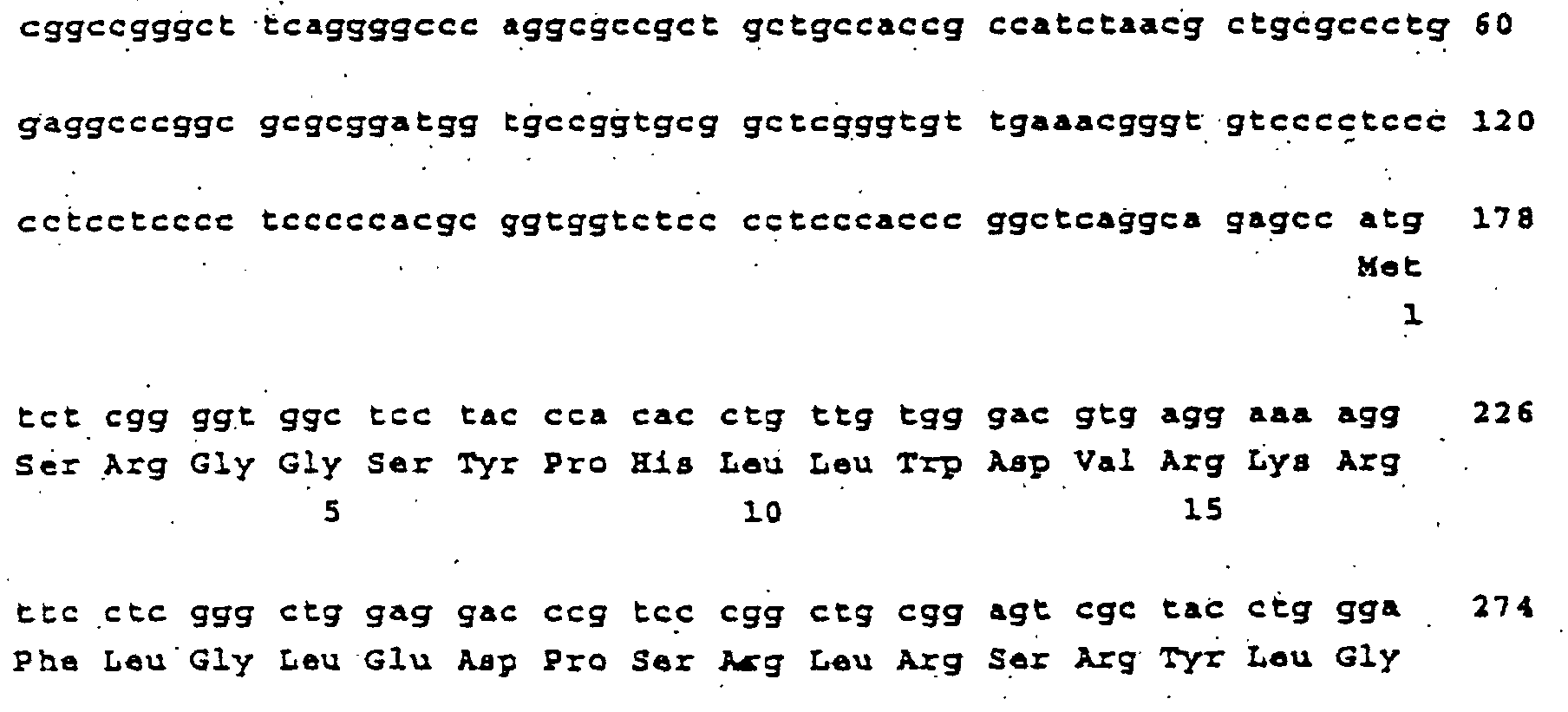
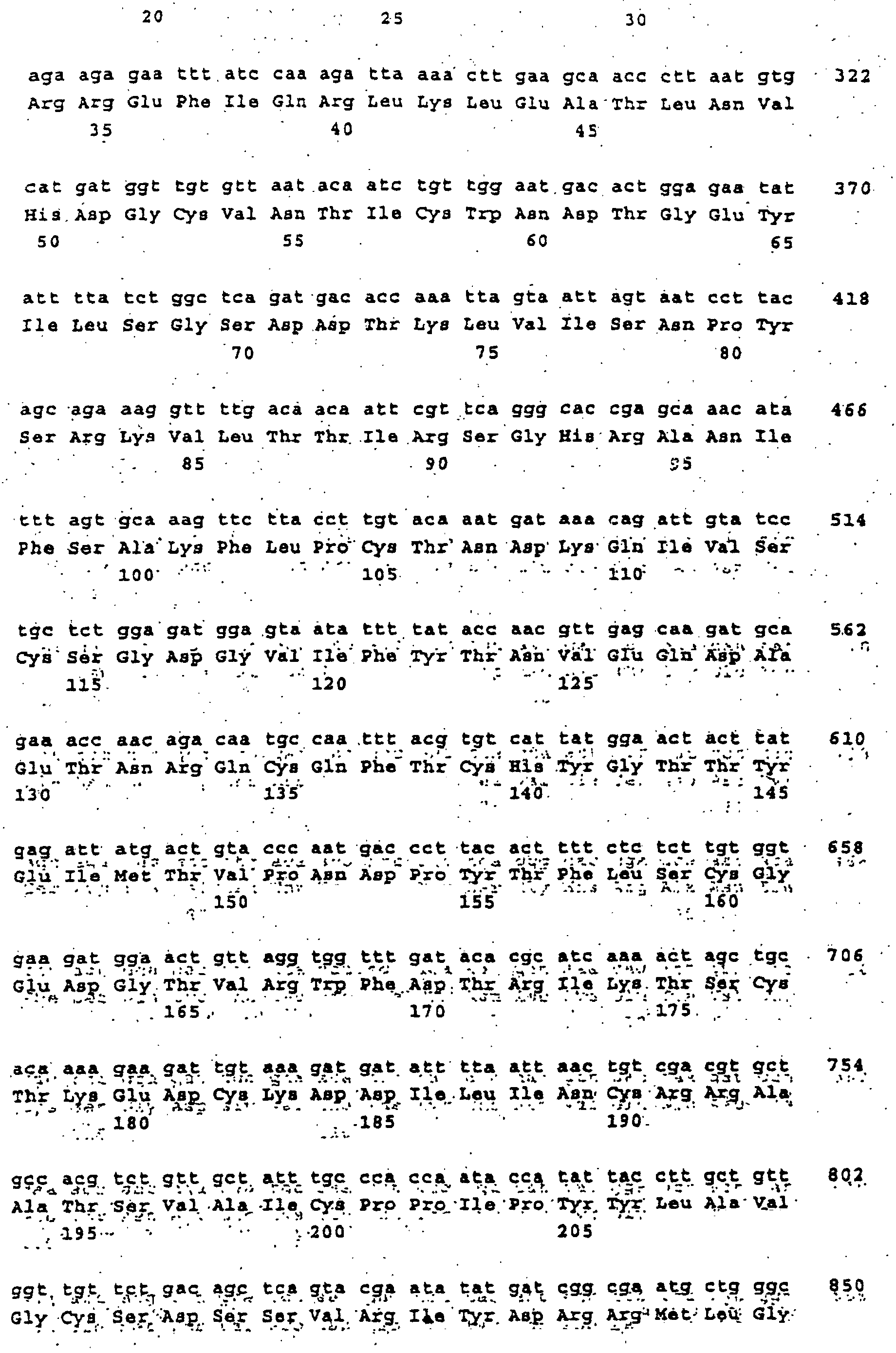


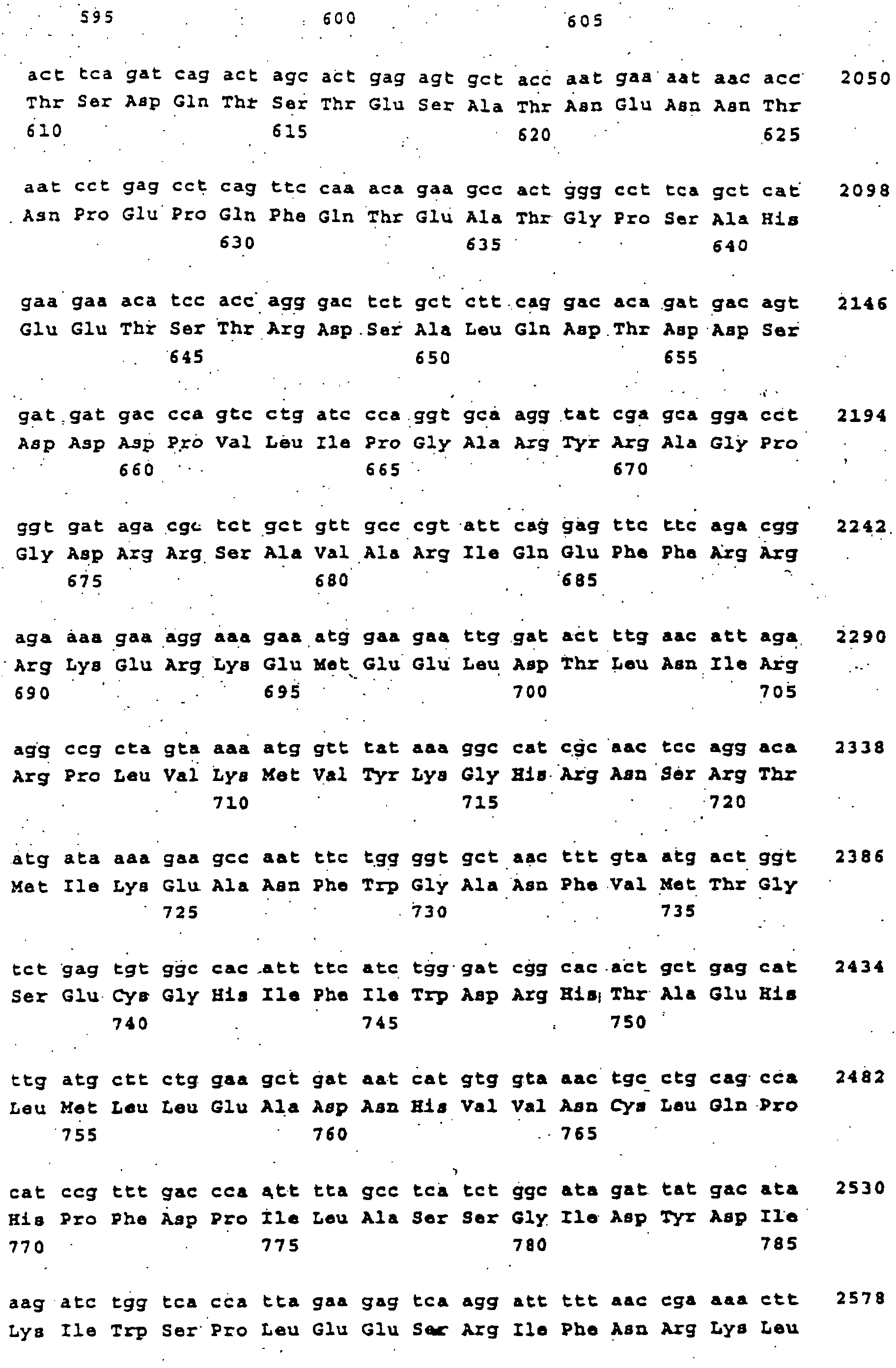


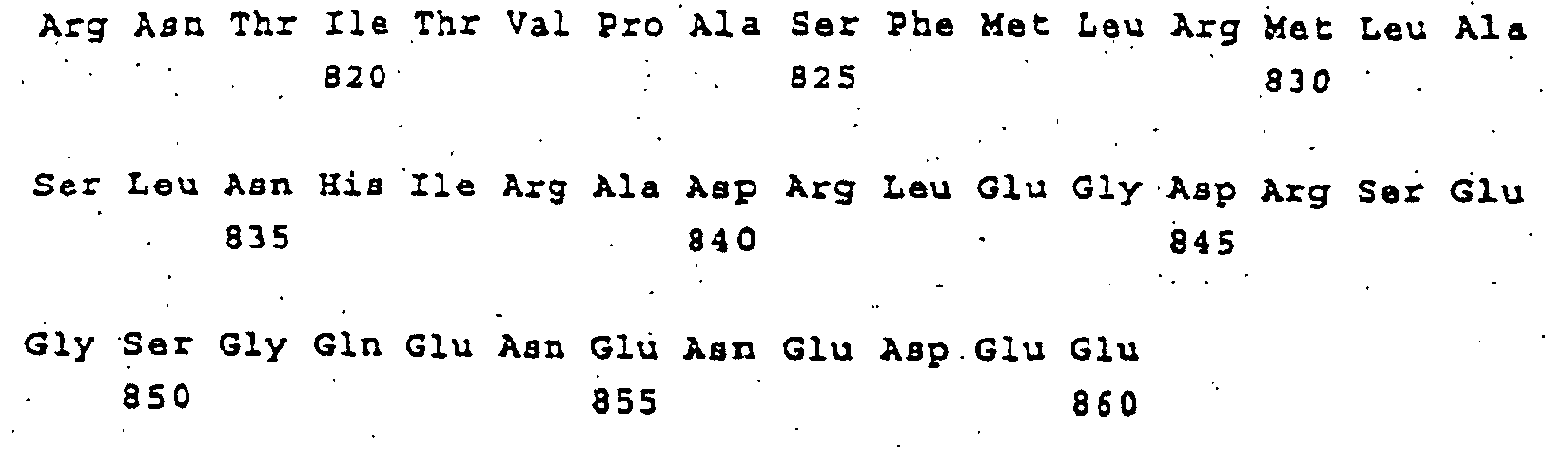
- <210> 3
<211> 3420
<212> DNA
<213> Homo sapiens - <220>
<221> CDS
<222> (176)..(2986) - <400> 3
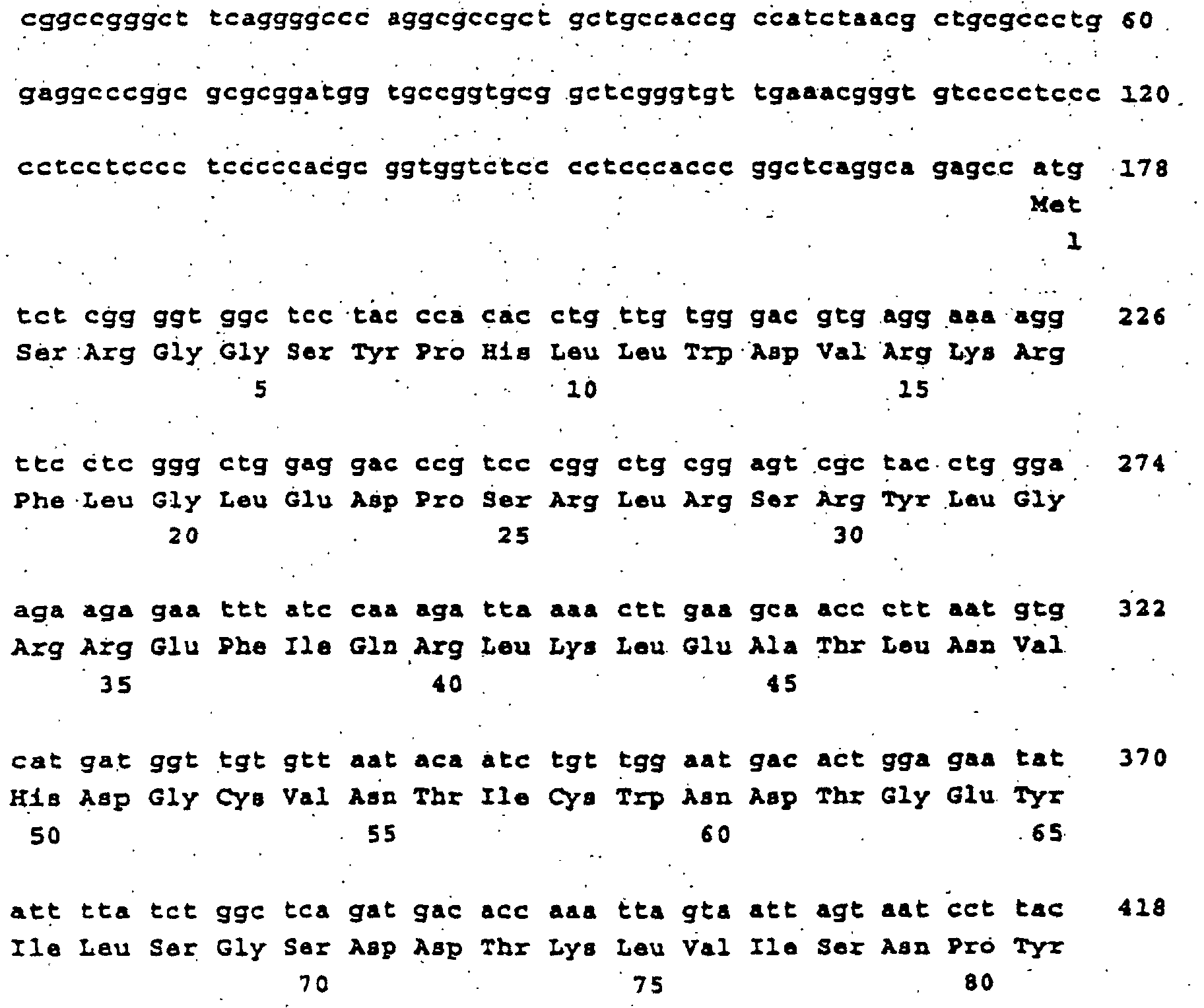
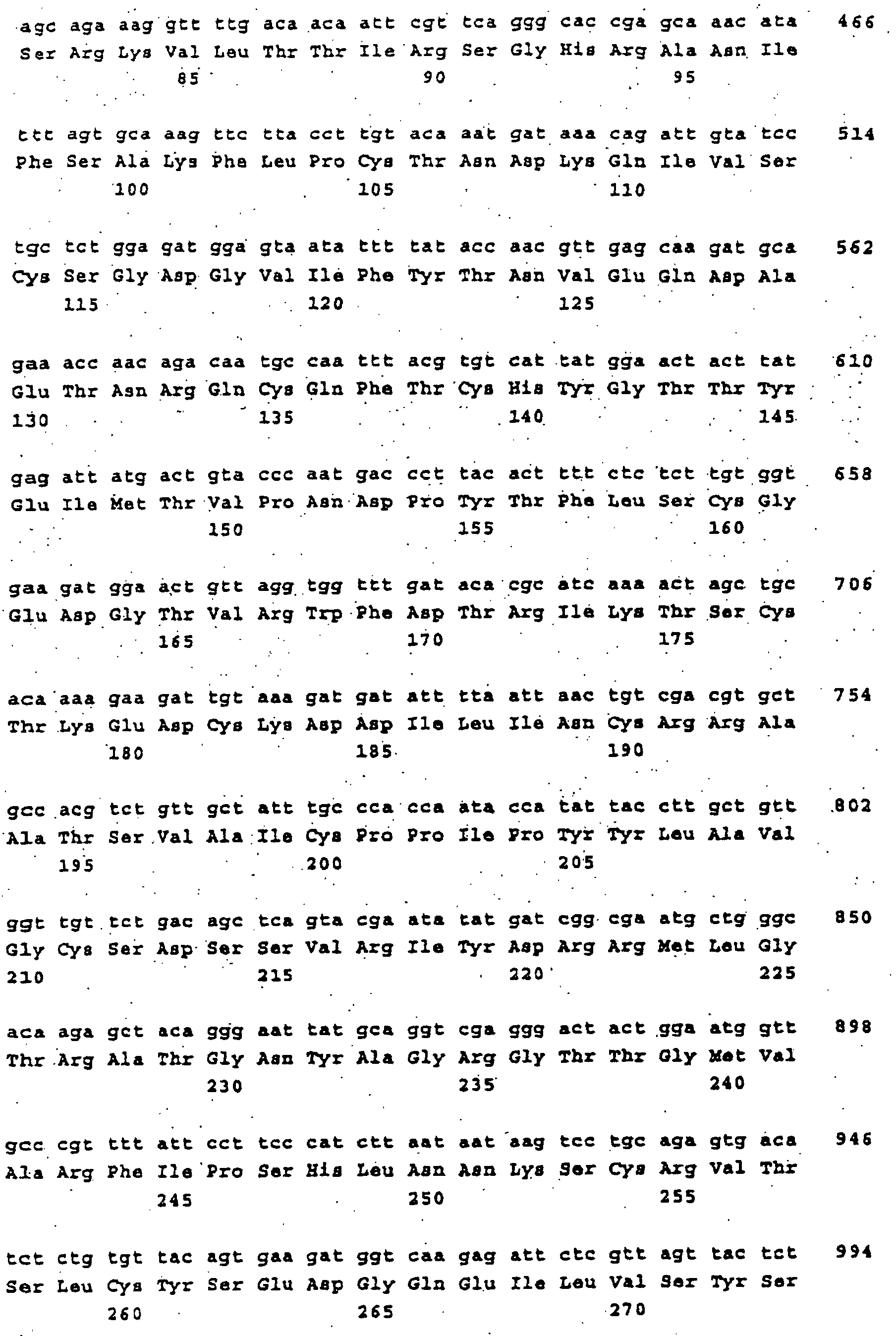
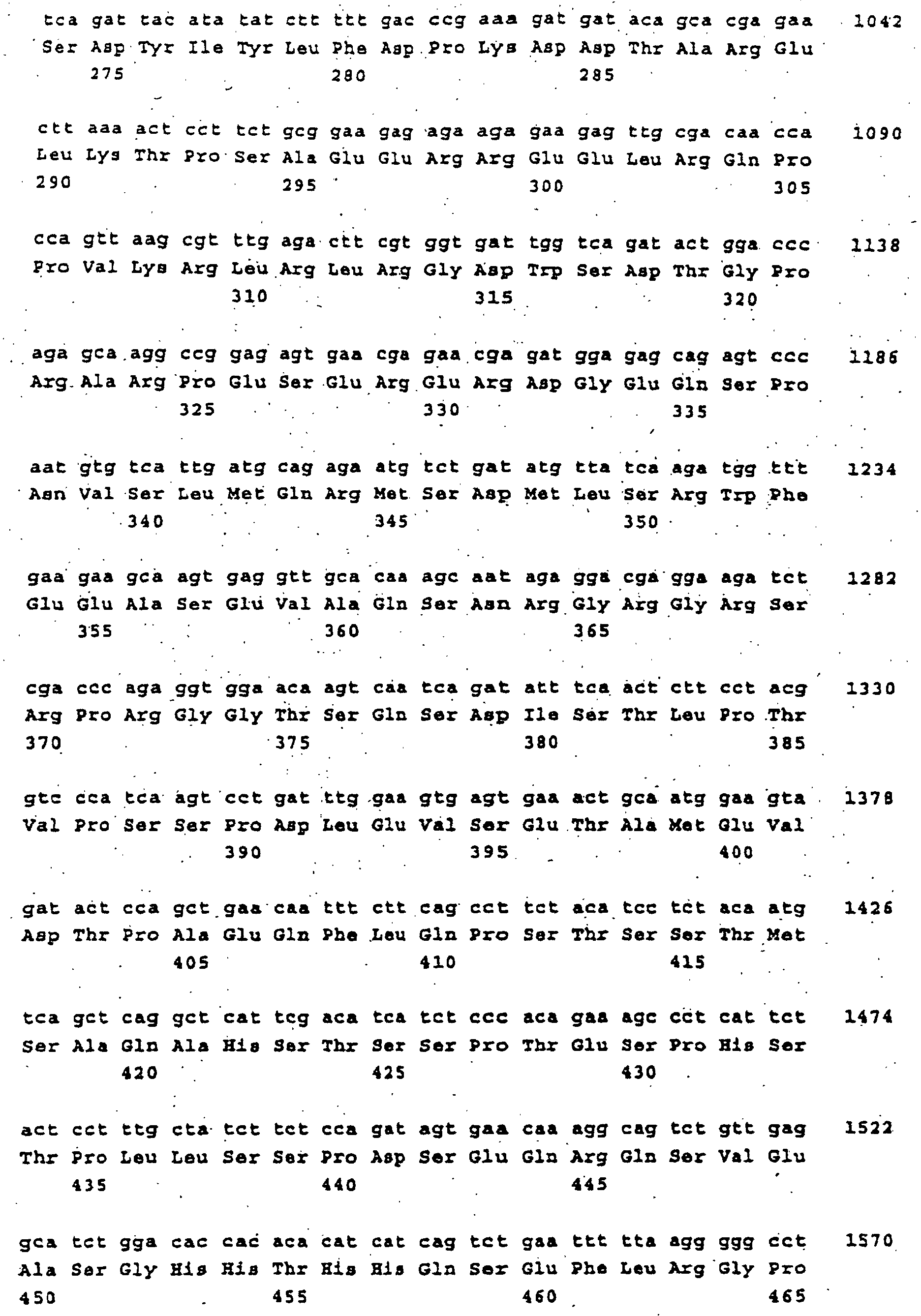


- <210>
<211> 937
<212> PRT
<213> Homo sapiens - <400> 4



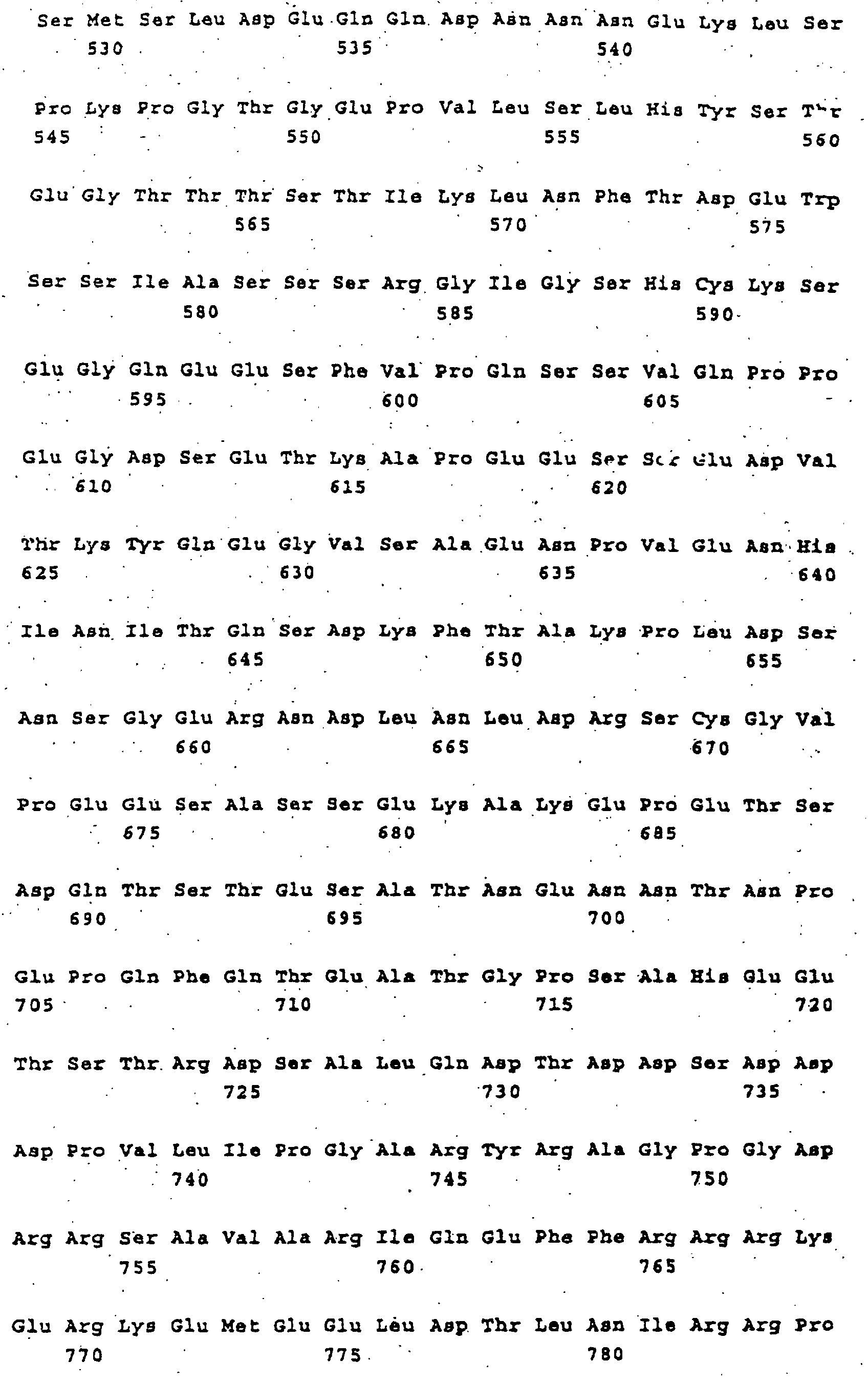

- <210> 5
<211> 21
<212> DNA
<213> Homo sapiens - <400> 5

- <210> 6
<211> 20
<212> DNA
<213> Homo sapiens - <400> 6

- <210> 7
<211> 9
<212> PRT
<213> Homo sapiens - <400> 7

- <210> 8
<211> 8
<212> PRT
<213> Homo sapiens - <400> 8

- <210> 9
<211> 7
<212> PRT
<213> Homo sapiens - <400> 9

- <210> 10
<211> 9
<212> PRT
<213> Homo sapiens - <400> 10

- <210> 11
<211> 35
<212> PRT
<213> Homo sapiens - <400> 11
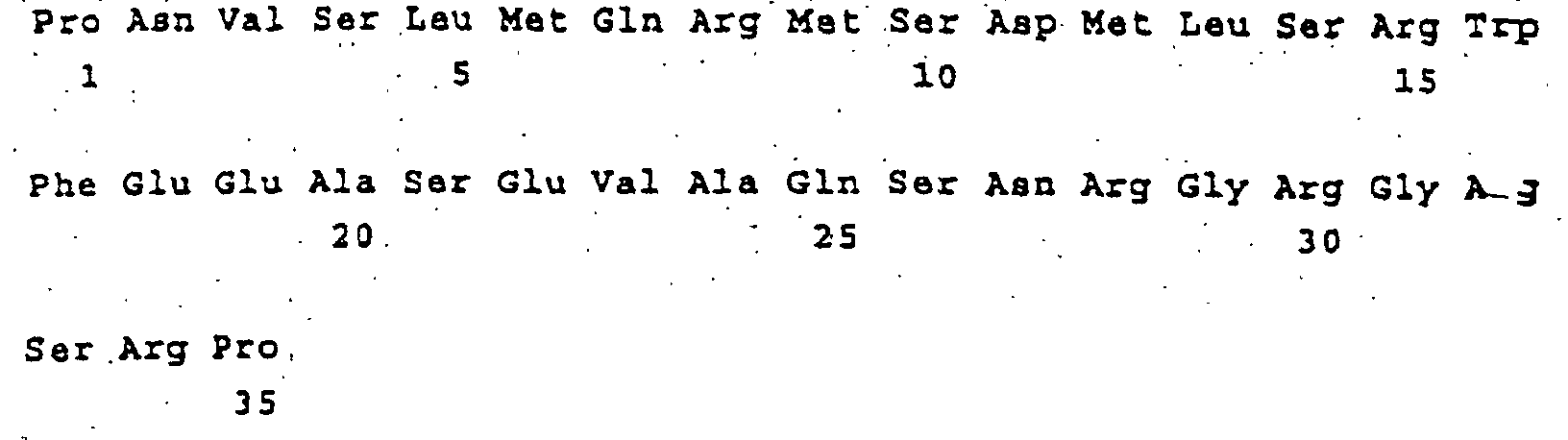
- <210> 12
<211> 25
<212> PRT
<213> Homo sapiens - <400> 12

- <210> 13
<211> 25
<212> PRT
<213> Homo sapiens - <400> 13

- <210> 14
<211> 24
<212> PRT
<213> Homo sapiens - <400> 14

- <210> 15
<211> 25
<212> PRT
<213> Homo sapiens - <400> 15

- <210> 16
<211> 24
<212> PRT
<213> Homo sapiens - <400> 16

- <210> 17
<211> 60
<212> PRT
<213> Homo sapiens - <400> 17

- <210> 18
<211> 37
<212> PRT
<213> Homo sapiens - <400> 18

- <210> 19
<211> 60
<212> PRT
<213> Homo sapiens - <400> 19
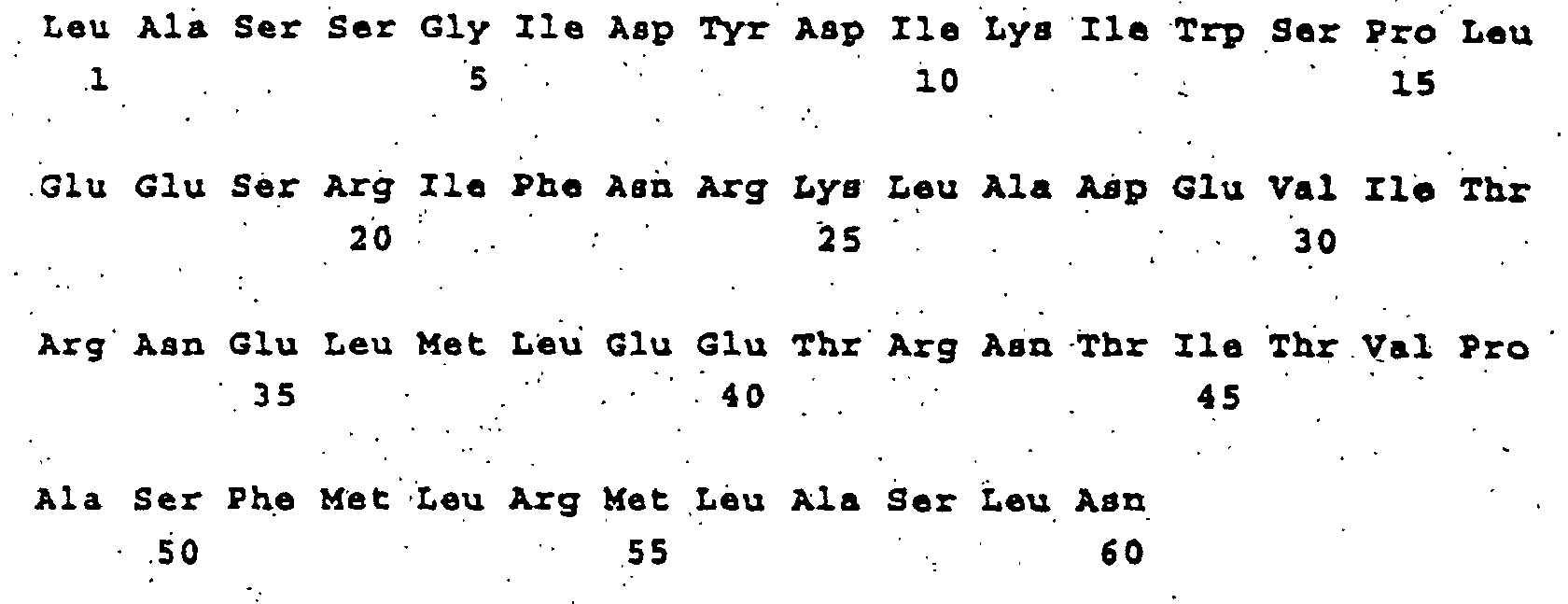
- <210> 20
<211> 11
<212> PRT
<213> Homo sapiens - <400> 20

-
Claims (29)
- A recombinant polynucleotide comprising a nucleotide sequence encoding polypeptide Repro-EN-1.0 of SEQ ID NO: 2, wherein the polypeptide specifically binds to antibodies from subjects diagnosed with endometriosis.
- The polynucleotide of claim 1 wherein the nucleotide sequence is selected from the Repro-EN-1.0 sequence of SEQ ID NO: 1.
- The polynuclectide of claim 1 wherein the nucleotide sequence is a native Repro-EN-1.0 nucleotide sequence.
- The polynucleotide of claim I wherein the nucleotide sequence is identical to nucleotides 176 to 2755 of SEQ ID NO: 1.
- A recombinant polynucleotide composing a nucleotide sequence encoding polypeptide IB1 of SEQ ID NO: 4, wherein the polypeptide specifically binds to antibodies from subjects diagnosed with endometriosis.
- The polynucleotide of claim 5 wherein the nucleotide sequence is selected from the IB1 sequence of SEQ ID NO: 3.
- The polynucleotide of claim 5 wherein the nucleotide sequence is a native IB1 nucleotide sequence.
- The polynucleotide of claim 5 wherein the nucleotide sequence is identical to nucleotides 176 to 2986 of SEQ ID NO: 3.
- The polynucleotide of any one of claims 1 to 8 further comprising an expression control sequence operatively linked to the nucleotide sequence.
- A polynucleotide primer pair which amplifies a nucleotide sequence encoding polypeptide Repro-EN-1.0 of SEQ ID NO:2 or polypeptide IB1 of SEQ ID NO:4, wherein the polypeptide specifically binds to antibodies from subjects diagnosed with endometriosis, the pair comprising:(1) a 3' primer of at least 7 nucleotides that specifically hybridizes to a 3' end of the nucleotide sequence or downstream from the sequence, and(2) a 5' primer of at least 7 nucleotides that specifically hybridizes to the 3' end of the complement of the nucleotide sequence or downstream from the complement of the sequence.
- The polynucleotide primer pair of claim 10 wherein the 3' primer has a sequence complementary to a nucleotide sequence selected from Repro-EN-1.0 cDNA of SEQ ID NO: 1, and the 5' primer has a sequence identical to nucleotide sequence selected from Repro-EN-1.0 cDNA of SEQ ID NO: 1.
- The polynucleotide primer pair of claim 10 wherein the 3' primer has a sequence complementary to a nucleotide sequence selected from IB1 cDNA of SEQ ID NO: 3, and the 5' primer has a sequence identical to nucleotide sequence selected from IB1 cDNA of SEQ ID NO: 3.
- The polynucleotide primer pair of claim 10 wherein the pair of polynucleotides are peptide nucleic acids.
- A recombinant cell comprising a recombinant polynucleotide according to claim 9.
- A purified, recombinant Repro-EN-1.0 polypeptide whose amino acid sequence is identical to that of SEQ ID NO: 2, or an allelic variant of SEQ ID NO: 2.
- A purified, recombinant IB1 polypeptide whose amino acid sequence is identical to that of SEQ ID NO: 4, or an allelic variant of SEQ ID NO: 4.
- A purified polypeptide comprising Repro-EN-1.0 of SEQ ID NO: 2 or IB1 of SEQ ID NO:4, wherein the polypeptide specifically binds to antibodies from subjects diagnosed with endometriosis.
- A composition consisting essentially of an antibody that specifically binds to Repro-EN-1,0 polypeptide of SEQ ID NO: 2 or an antibody that specifically binds to IB1 polypeptide of SEQ ID NO: 4.
- The composition of claim 18 wherein the antibody is monoclonal.
- A method for diagnosing endometriosis in a subject comprising the steps of:whereby a test amount above the normal range provides a positive indication in the diagnosis of endometriosis.(a) detecting a test amount of an antibody that specifically binds to Repro-EN-1.0 polypeptide whose amino acid sequence is identical to that of SEQ ID NO:2 or an allelic variant of SEQ ID NO:2 or a IB1 polypeptide whose amino acid sequence is identical to that of SEQ ID NO:4 or an allelic variant of SEQ ID NO:4 in a sample from the subject; and(b) comparing the test amount with a normal range of the antibody in a control sample from a subject who does not suffer from endometriosis,
- The method of claim 20 wherein the step of detecting comprises capturing the antibody from the sample with an immobilized Repro-EN-1.0 or IB1 and detecting captured antibody.
- The method of claim 20 wherein the step of detecting comprises capturing the antibody from the sample with an immobilized anti-immunoglobulin antibody and detecting captured antibody.
- The method of claim 21 wherein the step of detecting captured antibody comprises contacting the captured antibody with a detectable antibody that specifically binds immunoglobulins and detecting binding between the captured antibody and the detectable antibody.
- The method of claim 22 wherein the step of detecting captured antibody comprises contacting the captured antibody with Repro-EN-1.0 or IB1 and detecting binding between the captured antibody and the Repro-EN-1.0 or IB1.
- The method of any one of claims 20 to 24 wherein the sample comprises blood serum.
- The method of any one of claims 20 to 25 wherein the antibody is an IgG immunoglobulin, an IgE immunoglobulin or an IgG4 immunoglobulin.
- A method for use in following the progress of endometriosis in a subject comprising the steps of:whereby an increase between the first and second amounts indicates progression of the endometriosis and a decrease between the first and second amounts indicates remission of the endometriosis(a) detecting first and second amounts of an antibody that specifically binds Repro-EN-1.0 polypeptide whose amino acid sequence is identical to that of SEQ ID NO:2 or an allelic variant of SEQ ID NO:2 or a IB1 polypeptide whose amino acid sequence is identical to that of SEQ NO:4 or an allelic variant of SEQ ID NO:4 in samples from the subject at a first and a second time, respectively; and(b) comparing the first and second amounts,
- A screening method for determining whether a compound increases or decreases the expression of Repro-EN-1.0 of SEQ ID NO: 2 or IB1 of SEQ ID NO: 4 or an allelic variant thereof in a cell, comprising contacting the cell with the compound and determining whether the production of Repro-EN-1.0 or IB1 mRNA or polypeptide is increased or decreased.
- A method of detecting polymorphic forms of Repro-EN-1.0 of SEQ ID NO:1 or 2 or IB1 of SEQ ID NO:3 or 4 comprising the steps of(a) determining the identity of a nucleotide or amino acid at a selected position within the sequence of a test Repro-EN-1.0 gene or polypeptide or a test IB1 gene or polypeptide;(b) determining the identity of the nucleotide or amino acid at the corresponding position of native Repro-EN-1.0 gene or polypeptide of SEQ ID NO: 1 or 2 or native IB1 gene or polypeptide of SEQ ID NO: 3 or 4 and(c) comparing the identity from the test gene or polypeptide with the identity of the native gene or polypeptide, whereby a difference in identity indicates that the test gene or polypeptide is a polymorphic form of Repro-EN-1.0 or IB1.
Priority Applications (1)
| Application Number | Priority Date | Filing Date | Title |
|---|---|---|---|
| DK00310408T DK1106690T3 (en) | 1999-11-23 | 2000-11-23 | Polynucleotide encoding autoantigens associated with endometriosis |
Applications Claiming Priority (2)
| Application Number | Priority Date | Filing Date | Title |
|---|---|---|---|
| US09/447,399 US6525187B1 (en) | 1998-07-31 | 1999-11-23 | Polynucleotide encoding autoantigens associated with endometriosis |
| US447399 | 1999-11-23 |
Publications (3)
| Publication Number | Publication Date |
|---|---|
| EP1106690A2 EP1106690A2 (en) | 2001-06-13 |
| EP1106690A3 EP1106690A3 (en) | 2001-07-25 |
| EP1106690B1 true EP1106690B1 (en) | 2005-06-01 |
Family
ID=23776233
Family Applications (1)
| Application Number | Title | Priority Date | Filing Date |
|---|---|---|---|
| EP00310408A Expired - Lifetime EP1106690B1 (en) | 1999-11-23 | 2000-11-23 | Polynucleotide encoding autoantigens associated with endometriosis |
Country Status (9)
| Country | Link |
|---|---|
| US (2) | US6525187B1 (en) |
| EP (1) | EP1106690B1 (en) |
| AT (1) | ATE296884T1 (en) |
| AU (1) | AU3746000A (en) |
| DE (1) | DE60020499T2 (en) |
| DK (1) | DK1106690T3 (en) |
| ES (1) | ES2243209T3 (en) |
| PT (1) | PT1106690E (en) |
| WO (1) | WO2001007616A1 (en) |
Families Citing this family (11)
| Publication number | Priority date | Publication date | Assignee | Title |
|---|---|---|---|---|
| US8674932B2 (en) * | 1996-07-05 | 2014-03-18 | Anascape, Ltd. | Image controller |
| US6974683B2 (en) * | 2001-01-17 | 2005-12-13 | Veterans General Hospital | Nucleic acid encoding androgen receptor complex-associated protein |
| US20030082721A1 (en) * | 2001-01-17 | 2003-05-01 | Tai-Jay Chang | Transgenic animals expressing androgen receptor complex-associated protein |
| US20030099976A1 (en) * | 2001-01-17 | 2003-05-29 | Tai-Jay Chang | Androgen receptor complex-associated protein |
| WO2005008251A2 (en) * | 2003-07-11 | 2005-01-27 | Praecis Pharmaceuticals, Inc. | Compositions, kits, and methods for identification, assessment, prevention, and therapy of endometriosis |
| US20050181513A1 (en) * | 2004-02-18 | 2005-08-18 | Viorica Lopez-Avila | Methods and compositions for assessing a sample by MAILDI mass spectrometry |
| US20060008876A1 (en) * | 2004-07-07 | 2006-01-12 | Shami A S E | ME-5, ME-2, and EPP2: human protein antigens reactive with autoantibodies present in the serum of women suffering from endometriosis |
| US8932993B1 (en) | 2007-06-11 | 2015-01-13 | Juneau Biosciences, LLC. | Method of testing for endometriosis and treatment therefor |
| US11287425B2 (en) * | 2009-04-22 | 2022-03-29 | Juneau Biosciences, Llc | Genetic markers associated with endometriosis and use thereof |
| DE102012002929A1 (en) | 2012-02-14 | 2013-08-14 | Jürgen Lewald | Analyzing a peripheral blood sample of a female subject based on concentration of a steroid hormone that indicates endometriosis, comprising e.g. testosterone, progesterone, cortisol, dehydroepiandrosterone and androstenedione |
| US9434991B2 (en) | 2013-03-07 | 2016-09-06 | Juneau Biosciences, LLC. | Method of testing for endometriosis and treatment therefor |
Family Cites Families (2)
| Publication number | Priority date | Publication date | Assignee | Title |
|---|---|---|---|---|
| WO1994028021A1 (en) | 1993-05-28 | 1994-12-08 | Medical University Of South Carolina | Endometrial proteins, antigenic compositions and methods for detecting endometriosis |
| US5880261A (en) | 1997-04-03 | 1999-03-09 | Waeber; Gerard | Transcription factor Islet-Brain 1 (IB1) |
-
1999
- 1999-11-23 US US09/447,399 patent/US6525187B1/en not_active Expired - Lifetime
-
2000
- 2000-03-10 AU AU37460/00A patent/AU3746000A/en not_active Abandoned
- 2000-03-10 WO PCT/US2000/006742 patent/WO2001007616A1/en not_active Ceased
- 2000-11-23 PT PT00310408T patent/PT1106690E/en unknown
- 2000-11-23 DK DK00310408T patent/DK1106690T3/en active
- 2000-11-23 DE DE60020499T patent/DE60020499T2/en not_active Expired - Lifetime
- 2000-11-23 ES ES00310408T patent/ES2243209T3/en not_active Expired - Lifetime
- 2000-11-23 AT AT00310408T patent/ATE296884T1/en active
- 2000-11-23 EP EP00310408A patent/EP1106690B1/en not_active Expired - Lifetime
-
2002
- 2002-06-13 US US10/172,573 patent/US7368533B2/en not_active Expired - Lifetime
Also Published As
| Publication number | Publication date |
|---|---|
| DE60020499T2 (en) | 2006-04-27 |
| WO2001007616A1 (en) | 2001-02-01 |
| EP1106690A2 (en) | 2001-06-13 |
| DK1106690T3 (en) | 2005-09-26 |
| PT1106690E (en) | 2005-10-31 |
| AU3746000A (en) | 2001-02-13 |
| EP1106690A3 (en) | 2001-07-25 |
| US7368533B2 (en) | 2008-05-06 |
| DE60020499D1 (en) | 2005-07-07 |
| US20030083253A1 (en) | 2003-05-01 |
| ES2243209T3 (en) | 2005-12-01 |
| ATE296884T1 (en) | 2005-06-15 |
| US6525187B1 (en) | 2003-02-25 |
Similar Documents
| Publication | Publication Date | Title |
|---|---|---|
| US5750653A (en) | Protein, FAF1, which potentiates Fas-mediated apoptosis and uses thereof | |
| CA2550900A1 (en) | Methods for detecting markers associated with endometrial disease or phase | |
| US20080051338A1 (en) | 98 Human Secreted Proteins | |
| JP2007114212A (en) | Compounds for prostate cancer immunodiagnosis and methods of use thereof | |
| US6110675A (en) | Reagents and methods useful for detecting diseases of the prostate | |
| US6660834B2 (en) | Reagents useful for detecting diseases of the gastrointestinal tract | |
| US20080032316A1 (en) | Tumor associated antigens and methods of using the same | |
| US7368533B2 (en) | Polypeptide autoantigens associated with endometriosis | |
| US20050221305A1 (en) | Antigen panels and methods of using the same | |
| JP2002512513A (en) | Reagents and methods useful for detecting diseases of the gastrointestinal tract | |
| US20090252735A1 (en) | Novel Peptides for Development of Diagnostic and Therapeutic Agents and Methods of Using Same | |
| US6350583B1 (en) | Reagents and methods useful for detecting diseases of the prostate | |
| US7833729B2 (en) | Method for detecting endometriosis in a patient sample | |
| WO2000006732A9 (en) | Polynucleotide encoding an autoantigen associated with endometriosis | |
| US20060019879A1 (en) | Polynucleotide encoding autoantigens associated with endometriosis | |
| US20020098516A1 (en) | Immunodiagnostic determination of usher syndrome type IIA | |
| US7008772B1 (en) | Compounds for immunodiagnosis of prostate cancer and methods for their use | |
| AU782490B2 (en) | Immuno-interactive fragments of the alphaC subunit of inhibin | |
| WO2000004142A1 (en) | Mucins | |
| Tabibzadeh | Diagnostic markers of human female infertility | |
| WO1997041226A9 (en) | Polynucleotides encoding the transcriptional repressor gcf2 of the epidermal growth factor receptor | |
| WO1997041226A2 (en) | Polynucleotides encoding the transcriptional repressor gcf2 of the epidermal growth factor receptor | |
| AU4888799A (en) | Mucins |
Legal Events
| Date | Code | Title | Description |
|---|---|---|---|
| PUAI | Public reference made under article 153(3) epc to a published international application that has entered the european phase |
Free format text: ORIGINAL CODE: 0009012 |
|
| PUAL | Search report despatched |
Free format text: ORIGINAL CODE: 0009013 |
|
| AK | Designated contracting states |
Kind code of ref document: A2 Designated state(s): AT BE CH CY DE DK ES FI FR GB GR IE IT LI LU MC NL PT SE TR |
|
| AX | Request for extension of the european patent |
Free format text: AL;LT;LV;MK;RO;SI |
|
| RIC1 | Information provided on ipc code assigned before grant |
Free format text: 7C 12N 15/12 A, 7C 07K 14/47 B, 7C 12Q 1/68 B, 7C 12N 5/10 B, 7C 07K 16/18 B, 7G 01N 33/53 B, 7G 01N 33/557 B, 7C 07K 19/00 B, 7A 61K 38/17 B |
|
| AK | Designated contracting states |
Kind code of ref document: A3 Designated state(s): AT BE CH CY DE DK ES FI FR GB GR IE IT LI LU MC NL PT SE TR |
|
| AX | Request for extension of the european patent |
Free format text: AL;LT;LV;MK;RO;SI |
|
| 17P | Request for examination filed |
Effective date: 20010914 |
|
| AKX | Designation fees paid |
Free format text: AT BE CH CY DE DK ES FI FR GB GR IE IT LI LU MC NL PT SE TR |
|
| 17Q | First examination report despatched |
Effective date: 20030604 |
|
| GRAP | Despatch of communication of intention to grant a patent |
Free format text: ORIGINAL CODE: EPIDOSNIGR1 |
|
| GRAS | Grant fee paid |
Free format text: ORIGINAL CODE: EPIDOSNIGR3 |
|
| GRAA | (expected) grant |
Free format text: ORIGINAL CODE: 0009210 |
|
| AK | Designated contracting states |
Kind code of ref document: B1 Designated state(s): AT BE CH CY DE DK ES FI FR GB GR IE IT LI LU MC NL PT SE TR |
|
| REG | Reference to a national code |
Ref country code: GB Ref legal event code: FG4D |
|
| REG | Reference to a national code |
Ref country code: CH Ref legal event code: EP |
|
| REG | Reference to a national code |
Ref country code: IE Ref legal event code: FG4D |
|
| REF | Corresponds to: |
Ref document number: 60020499 Country of ref document: DE Date of ref document: 20050707 Kind code of ref document: P |
|
| REG | Reference to a national code |
Ref country code: CH Ref legal event code: NV Representative=s name: R. A. EGLI & CO. PATENTANWAELTE Ref country code: GR Ref legal event code: EP Ref document number: 20050402166 Country of ref document: GR |
|
| REG | Reference to a national code |
Ref country code: SE Ref legal event code: TRGR |
|
| REG | Reference to a national code |
Ref country code: DK Ref legal event code: T3 |
|
| REG | Reference to a national code |
Ref country code: PT Ref legal event code: SC4A Effective date: 20050826 |
|
| REG | Reference to a national code |
Ref country code: ES Ref legal event code: FG2A Ref document number: 2243209 Country of ref document: ES Kind code of ref document: T3 |
|
| ET | Fr: translation filed | ||
| PLBE | No opposition filed within time limit |
Free format text: ORIGINAL CODE: 0009261 |
|
| STAA | Information on the status of an ep patent application or granted ep patent |
Free format text: STATUS: NO OPPOSITION FILED WITHIN TIME LIMIT |
|
| 26N | No opposition filed |
Effective date: 20060302 |
|
| PGFP | Annual fee paid to national office [announced via postgrant information from national office to epo] |
Ref country code: CY Payment date: 20091026 Year of fee payment: 10 |
|
| REG | Reference to a national code |
Ref country code: CH Ref legal event code: PFA Owner name: SIEMENS HEALTHCARE DIAGNOSTICS INC. Free format text: SIEMENS MEDICAL SOLUTIONS DIAGNOSTICS#511 BENEDICT AVENUE#TARRYTOWN, NY 10591 (US) -TRANSFER TO- SIEMENS HEALTHCARE DIAGNOSTICS INC.#511 BENEDICT AVENUE#TARRYTOWN, NY 10591 (US) Ref country code: CH Ref legal event code: PFA Owner name: SIEMENS MEDICAL SOLUTIONS DIAGNOSTICS Free format text: DIAGNOSTIC PRODUCTS CORPORATION#5700 WEST 96TH STREET#LOS ANGELES CALIFORNIA 90045 (US) -TRANSFER TO- SIEMENS MEDICAL SOLUTIONS DIAGNOSTICS#511 BENEDICT AVENUE#TARRYTOWN, NY 10591 (US) |
|
| REG | Reference to a national code |
Ref country code: ES Ref legal event code: PC2A |
|
| REG | Reference to a national code |
Ref country code: FR Ref legal event code: CA Ref country code: FR Ref legal event code: CD |
|
| PG25 | Lapsed in a contracting state [announced via postgrant information from national office to epo] |
Ref country code: CY Free format text: LAPSE BECAUSE OF NON-PAYMENT OF DUE FEES Effective date: 20101123 |
|
| PGFP | Annual fee paid to national office [announced via postgrant information from national office to epo] |
Ref country code: DK Payment date: 20141119 Year of fee payment: 15 Ref country code: LU Payment date: 20141121 Year of fee payment: 15 |
|
| PGFP | Annual fee paid to national office [announced via postgrant information from national office to epo] |
Ref country code: GR Payment date: 20141125 Year of fee payment: 15 Ref country code: GB Payment date: 20141110 Year of fee payment: 15 Ref country code: FR Payment date: 20141112 Year of fee payment: 15 Ref country code: TR Payment date: 20141031 Year of fee payment: 15 Ref country code: MC Payment date: 20141113 Year of fee payment: 15 Ref country code: ES Payment date: 20141217 Year of fee payment: 15 Ref country code: SE Payment date: 20141106 Year of fee payment: 15 Ref country code: IE Payment date: 20141124 Year of fee payment: 15 Ref country code: FI Payment date: 20141112 Year of fee payment: 15 |
|
| PGFP | Annual fee paid to national office [announced via postgrant information from national office to epo] |
Ref country code: AT Payment date: 20141009 Year of fee payment: 15 Ref country code: NL Payment date: 20141103 Year of fee payment: 15 Ref country code: PT Payment date: 20141029 Year of fee payment: 15 |
|
| PGFP | Annual fee paid to national office [announced via postgrant information from national office to epo] |
Ref country code: IT Payment date: 20141126 Year of fee payment: 15 |
|
| PGFP | Annual fee paid to national office [announced via postgrant information from national office to epo] |
Ref country code: BE Payment date: 20141210 Year of fee payment: 15 Ref country code: DE Payment date: 20150119 Year of fee payment: 15 Ref country code: CH Payment date: 20150209 Year of fee payment: 15 |
|
| REG | Reference to a national code |
Ref country code: PT Ref legal event code: MM4A Free format text: LAPSE DUE TO NON-PAYMENT OF FEES Effective date: 20160523 |
|
| REG | Reference to a national code |
Ref country code: DE Ref legal event code: R119 Ref document number: 60020499 Country of ref document: DE |
|
| REG | Reference to a national code |
Ref country code: DK Ref legal event code: EBP Effective date: 20151130 |
|
| PG25 | Lapsed in a contracting state [announced via postgrant information from national office to epo] |
Ref country code: MC Free format text: LAPSE BECAUSE OF NON-PAYMENT OF DUE FEES Effective date: 20151130 Ref country code: LU Free format text: LAPSE BECAUSE OF NON-PAYMENT OF DUE FEES Effective date: 20151123 |
|
| REG | Reference to a national code |
Ref country code: CH Ref legal event code: PL |
|
| REG | Reference to a national code |
Ref country code: AT Ref legal event code: MM01 Ref document number: 296884 Country of ref document: AT Kind code of ref document: T Effective date: 20151123 |
|
| GBPC | Gb: european patent ceased through non-payment of renewal fee |
Effective date: 20151123 |
|
| PG25 | Lapsed in a contracting state [announced via postgrant information from national office to epo] |
Ref country code: LI Free format text: LAPSE BECAUSE OF NON-PAYMENT OF DUE FEES Effective date: 20151130 Ref country code: IT Free format text: LAPSE BECAUSE OF NON-PAYMENT OF DUE FEES Effective date: 20151123 Ref country code: GR Free format text: LAPSE BECAUSE OF NON-PAYMENT OF DUE FEES Effective date: 20160602 Ref country code: CH Free format text: LAPSE BECAUSE OF NON-PAYMENT OF DUE FEES Effective date: 20151130 |
|
| REG | Reference to a national code |
Ref country code: NL Ref legal event code: MM Effective date: 20151201 |
|
| REG | Reference to a national code |
Ref country code: IE Ref legal event code: MM4A |
|
| REG | Reference to a national code |
Ref country code: FR Ref legal event code: ST Effective date: 20160729 |
|
| PG25 | Lapsed in a contracting state [announced via postgrant information from national office to epo] |
Ref country code: SE Free format text: LAPSE BECAUSE OF NON-PAYMENT OF DUE FEES Effective date: 20151124 Ref country code: AT Free format text: LAPSE BECAUSE OF NON-PAYMENT OF DUE FEES Effective date: 20151123 Ref country code: PT Free format text: LAPSE BECAUSE OF NON-PAYMENT OF DUE FEES Effective date: 20160523 |
|
| PG25 | Lapsed in a contracting state [announced via postgrant information from national office to epo] |
Ref country code: NL Free format text: LAPSE BECAUSE OF NON-PAYMENT OF DUE FEES Effective date: 20151201 |
|
| REG | Reference to a national code |
Ref country code: GR Ref legal event code: ML Ref document number: 20050402166 Country of ref document: GR Effective date: 20160602 |
|
| PG25 | Lapsed in a contracting state [announced via postgrant information from national office to epo] |
Ref country code: DE Free format text: LAPSE BECAUSE OF NON-PAYMENT OF DUE FEES Effective date: 20160601 Ref country code: IE Free format text: LAPSE BECAUSE OF NON-PAYMENT OF DUE FEES Effective date: 20151123 Ref country code: DK Free format text: LAPSE BECAUSE OF NON-PAYMENT OF DUE FEES Effective date: 20151130 Ref country code: GB Free format text: LAPSE BECAUSE OF NON-PAYMENT OF DUE FEES Effective date: 20151123 |
|
| PG25 | Lapsed in a contracting state [announced via postgrant information from national office to epo] |
Ref country code: FR Free format text: LAPSE BECAUSE OF NON-PAYMENT OF DUE FEES Effective date: 20151130 |
|
| REG | Reference to a national code |
Ref country code: ES Ref legal event code: FD2A Effective date: 20161230 |
|
| PG25 | Lapsed in a contracting state [announced via postgrant information from national office to epo] |
Ref country code: ES Free format text: LAPSE BECAUSE OF NON-PAYMENT OF DUE FEES Effective date: 20151124 |
|
| PG25 | Lapsed in a contracting state [announced via postgrant information from national office to epo] |
Ref country code: FI Free format text: LAPSE BECAUSE OF NON-PAYMENT OF DUE FEES Effective date: 20151123 |
|
| PG25 | Lapsed in a contracting state [announced via postgrant information from national office to epo] |
Ref country code: BE Free format text: LAPSE BECAUSE OF NON-PAYMENT OF DUE FEES Effective date: 20151130 |
|
| PG25 | Lapsed in a contracting state [announced via postgrant information from national office to epo] |
Ref country code: TR Free format text: LAPSE BECAUSE OF NON-PAYMENT OF DUE FEES Effective date: 20151123 |