EP1106651A1 - Flameproof thermoplastic resin composition - Google Patents
Flameproof thermoplastic resin composition Download PDFInfo
- Publication number
- EP1106651A1 EP1106651A1 EP00111580A EP00111580A EP1106651A1 EP 1106651 A1 EP1106651 A1 EP 1106651A1 EP 00111580 A EP00111580 A EP 00111580A EP 00111580 A EP00111580 A EP 00111580A EP 1106651 A1 EP1106651 A1 EP 1106651A1
- Authority
- EP
- European Patent Office
- Prior art keywords
- weight
- resin
- san
- copolymer resin
- acrylonitrile
- Prior art date
- Legal status (The legal status is an assumption and is not a legal conclusion. Google has not performed a legal analysis and makes no representation as to the accuracy of the status listed.)
- Granted
Links
- 239000011342 resin composition Substances 0.000 title claims abstract description 30
- 229920005992 thermoplastic resin Polymers 0.000 title claims abstract description 16
- 229920006026 co-polymeric resin Polymers 0.000 claims abstract description 94
- 229920005989 resin Polymers 0.000 claims abstract description 82
- 239000011347 resin Substances 0.000 claims abstract description 82
- NLHHRLWOUZZQLW-UHFFFAOYSA-N Acrylonitrile Chemical compound C=CC#N NLHHRLWOUZZQLW-UHFFFAOYSA-N 0.000 claims abstract description 61
- 229920001971 elastomer Polymers 0.000 claims abstract description 56
- 239000005060 rubber Substances 0.000 claims abstract description 56
- -1 aromatic phosphoric acid ester Chemical class 0.000 claims abstract description 42
- 229920000578 graft copolymer Polymers 0.000 claims abstract description 26
- 229920001955 polyphenylene ether Polymers 0.000 claims abstract description 23
- RTZKZFJDLAIYFH-UHFFFAOYSA-N Diethyl ether Chemical compound CCOCC RTZKZFJDLAIYFH-UHFFFAOYSA-N 0.000 claims description 40
- 239000000203 mixture Substances 0.000 claims description 9
- 125000006736 (C6-C20) aryl group Chemical group 0.000 claims description 4
- 239000003795 chemical substances by application Substances 0.000 claims description 4
- UFHFLCQGNIYNRP-UHFFFAOYSA-N Hydrogen Chemical compound [H][H] UFHFLCQGNIYNRP-UHFFFAOYSA-N 0.000 claims description 3
- 229910052739 hydrogen Inorganic materials 0.000 claims description 3
- 239000001257 hydrogen Substances 0.000 claims description 3
- 238000000465 moulding Methods 0.000 claims description 3
- 125000004178 (C1-C4) alkyl group Chemical group 0.000 claims description 2
- 125000000217 alkyl group Chemical group 0.000 claims description 2
- 239000012760 heat stabilizer Substances 0.000 claims description 2
- 239000003112 inhibitor Substances 0.000 claims description 2
- 239000011256 inorganic filler Substances 0.000 claims description 2
- 229910003475 inorganic filler Inorganic materials 0.000 claims description 2
- 239000004611 light stabiliser Substances 0.000 claims description 2
- 230000003647 oxidation Effects 0.000 claims description 2
- 238000007254 oxidation reaction Methods 0.000 claims description 2
- 239000004014 plasticizer Substances 0.000 claims description 2
- 239000000975 dye Substances 0.000 claims 1
- 239000000049 pigment Substances 0.000 claims 1
- SCUZVMOVTVSBLE-UHFFFAOYSA-N prop-2-enenitrile;styrene Chemical class C=CC#N.C=CC1=CC=CC=C1 SCUZVMOVTVSBLE-UHFFFAOYSA-N 0.000 description 95
- 229920000638 styrene acrylonitrile Polymers 0.000 description 80
- PPBRXRYQALVLMV-UHFFFAOYSA-N Styrene Chemical compound C=CC1=CC=CC=C1 PPBRXRYQALVLMV-UHFFFAOYSA-N 0.000 description 32
- 239000000178 monomer Substances 0.000 description 17
- 150000001875 compounds Chemical class 0.000 description 13
- 239000003063 flame retardant Substances 0.000 description 10
- RNFJDJUURJAICM-UHFFFAOYSA-N 2,2,4,4,6,6-hexaphenoxy-1,3,5-triaza-2$l^{5},4$l^{5},6$l^{5}-triphosphacyclohexa-1,3,5-triene Chemical compound N=1P(OC=2C=CC=CC=2)(OC=2C=CC=CC=2)=NP(OC=2C=CC=CC=2)(OC=2C=CC=CC=2)=NP=1(OC=1C=CC=CC=1)OC1=CC=CC=C1 RNFJDJUURJAICM-UHFFFAOYSA-N 0.000 description 9
- 238000000034 method Methods 0.000 description 8
- 229920002554 vinyl polymer Polymers 0.000 description 8
- 229920000122 acrylonitrile butadiene styrene Polymers 0.000 description 7
- 239000000843 powder Substances 0.000 description 7
- 150000003440 styrenes Chemical class 0.000 description 7
- 239000004676 acrylonitrile butadiene styrene Substances 0.000 description 6
- 229910052736 halogen Inorganic materials 0.000 description 6
- 150000002367 halogens Chemical class 0.000 description 6
- 229920000126 latex Polymers 0.000 description 6
- 239000004816 latex Substances 0.000 description 6
- LSDPWZHWYPCBBB-UHFFFAOYSA-N Methanethiol Chemical compound SC LSDPWZHWYPCBBB-UHFFFAOYSA-N 0.000 description 5
- 239000012986 chain transfer agent Substances 0.000 description 5
- 229920001577 copolymer Polymers 0.000 description 5
- 239000008367 deionised water Substances 0.000 description 5
- 229910021641 deionized water Inorganic materials 0.000 description 5
- XLYOFNOQVPJJNP-UHFFFAOYSA-N water Chemical compound O XLYOFNOQVPJJNP-UHFFFAOYSA-N 0.000 description 5
- QAOWNCQODCNURD-UHFFFAOYSA-N Sulfuric acid Chemical compound OS(O)(=O)=O QAOWNCQODCNURD-UHFFFAOYSA-N 0.000 description 4
- XECAHXYUAAWDEL-UHFFFAOYSA-N acrylonitrile butadiene styrene Chemical compound C=CC=C.C=CC#N.C=CC1=CC=CC=C1 XECAHXYUAAWDEL-UHFFFAOYSA-N 0.000 description 4
- 230000000052 comparative effect Effects 0.000 description 4
- 238000002156 mixing Methods 0.000 description 4
- GHMLBKRAJCXXBS-UHFFFAOYSA-N resorcinol Chemical compound OC1=CC=CC(O)=C1 GHMLBKRAJCXXBS-UHFFFAOYSA-N 0.000 description 4
- 239000007787 solid Substances 0.000 description 4
- OZAIFHULBGXAKX-UHFFFAOYSA-N 2-(2-cyanopropan-2-yldiazenyl)-2-methylpropanenitrile Chemical compound N#CC(C)(C)N=NC(C)(C)C#N OZAIFHULBGXAKX-UHFFFAOYSA-N 0.000 description 3
- QIGBRXMKCJKVMJ-UHFFFAOYSA-N Hydroquinone Chemical compound OC1=CC=C(O)C=C1 QIGBRXMKCJKVMJ-UHFFFAOYSA-N 0.000 description 3
- 239000005062 Polybutadiene Substances 0.000 description 3
- 239000000654 additive Substances 0.000 description 3
- 229910052787 antimony Inorganic materials 0.000 description 3
- WATWJIUSRGPENY-UHFFFAOYSA-N antimony atom Chemical compound [Sb] WATWJIUSRGPENY-UHFFFAOYSA-N 0.000 description 3
- 238000012662 bulk polymerization Methods 0.000 description 3
- 239000001506 calcium phosphate Substances 0.000 description 3
- 238000002485 combustion reaction Methods 0.000 description 3
- 150000001993 dienes Chemical class 0.000 description 3
- 150000002825 nitriles Chemical class 0.000 description 3
- 239000008188 pellet Substances 0.000 description 3
- 239000005011 phenolic resin Substances 0.000 description 3
- 229920002285 poly(styrene-co-acrylonitrile) Polymers 0.000 description 3
- 229920002857 polybutadiene Polymers 0.000 description 3
- QORWJWZARLRLPR-UHFFFAOYSA-H tricalcium bis(phosphate) Chemical compound [Ca+2].[Ca+2].[Ca+2].[O-]P([O-])([O-])=O.[O-]P([O-])([O-])=O QORWJWZARLRLPR-UHFFFAOYSA-H 0.000 description 3
- 229940078499 tricalcium phosphate Drugs 0.000 description 3
- 229910000391 tricalcium phosphate Inorganic materials 0.000 description 3
- 235000019731 tricalcium phosphate Nutrition 0.000 description 3
- SMZOUWXMTYCWNB-UHFFFAOYSA-N 2-(2-methoxy-5-methylphenyl)ethanamine Chemical compound COC1=CC=C(C)C=C1CCN SMZOUWXMTYCWNB-UHFFFAOYSA-N 0.000 description 2
- NIXOWILDQLNWCW-UHFFFAOYSA-N 2-Propenoic acid Natural products OC(=O)C=C NIXOWILDQLNWCW-UHFFFAOYSA-N 0.000 description 2
- KXGFMDJXCMQABM-UHFFFAOYSA-N 2-methoxy-6-methylphenol Chemical compound [CH]OC1=CC=CC([CH])=C1O KXGFMDJXCMQABM-UHFFFAOYSA-N 0.000 description 2
- RSWGJHLUYNHPMX-UHFFFAOYSA-N Abietic-Saeure Natural products C12CCC(C(C)C)=CC2=CCC2C1(C)CCCC2(C)C(O)=O RSWGJHLUYNHPMX-UHFFFAOYSA-N 0.000 description 2
- KAKZBPTYRLMSJV-UHFFFAOYSA-N Butadiene Chemical compound C=CC=C KAKZBPTYRLMSJV-UHFFFAOYSA-N 0.000 description 2
- HEDRZPFGACZZDS-UHFFFAOYSA-N Chloroform Chemical compound ClC(Cl)Cl HEDRZPFGACZZDS-UHFFFAOYSA-N 0.000 description 2
- YLQBMQCUIZJEEH-UHFFFAOYSA-N Furan Chemical compound C=1C=COC=1 YLQBMQCUIZJEEH-UHFFFAOYSA-N 0.000 description 2
- WQZGKKKJIJFFOK-GASJEMHNSA-N Glucose Natural products OC[C@H]1OC(O)[C@H](O)[C@@H](O)[C@@H]1O WQZGKKKJIJFFOK-GASJEMHNSA-N 0.000 description 2
- 229910019142 PO4 Inorganic materials 0.000 description 2
- KHPCPRHQVVSZAH-HUOMCSJISA-N Rosin Natural products O(C/C=C/c1ccccc1)[C@H]1[C@H](O)[C@@H](O)[C@@H](O)[C@@H](CO)O1 KHPCPRHQVVSZAH-HUOMCSJISA-N 0.000 description 2
- VYPSYNLAJGMNEJ-UHFFFAOYSA-N Silicium dioxide Chemical compound O=[Si]=O VYPSYNLAJGMNEJ-UHFFFAOYSA-N 0.000 description 2
- 239000002253 acid Substances 0.000 description 2
- XYLMUPLGERFSHI-UHFFFAOYSA-N alpha-Methylstyrene Chemical compound CC(=C)C1=CC=CC=C1 XYLMUPLGERFSHI-UHFFFAOYSA-N 0.000 description 2
- ADCOVFLJGNWWNZ-UHFFFAOYSA-N antimony trioxide Chemical compound O=[Sb]O[Sb]=O ADCOVFLJGNWWNZ-UHFFFAOYSA-N 0.000 description 2
- IISBACLAFKSPIT-UHFFFAOYSA-N bisphenol A Chemical compound C=1C=C(O)C=CC=1C(C)(C)C1=CC=C(O)C=C1 IISBACLAFKSPIT-UHFFFAOYSA-N 0.000 description 2
- 238000006243 chemical reaction Methods 0.000 description 2
- 239000003995 emulsifying agent Substances 0.000 description 2
- 238000007720 emulsion polymerization reaction Methods 0.000 description 2
- 239000008103 glucose Substances 0.000 description 2
- 238000010559 graft polymerization reaction Methods 0.000 description 2
- XBDUTCVQJHJTQZ-UHFFFAOYSA-L iron(2+) sulfate monohydrate Chemical compound O.[Fe+2].[O-]S([O-])(=O)=O XBDUTCVQJHJTQZ-UHFFFAOYSA-L 0.000 description 2
- FPYJFEHAWHCUMM-UHFFFAOYSA-N maleic anhydride Chemical compound O=C1OC(=O)C=C1 FPYJFEHAWHCUMM-UHFFFAOYSA-N 0.000 description 2
- 125000005641 methacryl group Chemical group 0.000 description 2
- 239000002245 particle Substances 0.000 description 2
- 229920001568 phenolic resin Polymers 0.000 description 2
- NBIIXXVUZAFLBC-UHFFFAOYSA-K phosphate Chemical compound [O-]P([O-])([O-])=O NBIIXXVUZAFLBC-UHFFFAOYSA-K 0.000 description 2
- 239000010452 phosphate Substances 0.000 description 2
- 229910052698 phosphorus Inorganic materials 0.000 description 2
- 239000011574 phosphorus Substances 0.000 description 2
- 229920000642 polymer Polymers 0.000 description 2
- 238000006116 polymerization reaction Methods 0.000 description 2
- 230000000379 polymerizing effect Effects 0.000 description 2
- 239000000344 soap Substances 0.000 description 2
- FQENQNTWSFEDLI-UHFFFAOYSA-J sodium diphosphate Chemical compound [Na+].[Na+].[Na+].[Na+].[O-]P([O-])(=O)OP([O-])([O-])=O FQENQNTWSFEDLI-UHFFFAOYSA-J 0.000 description 2
- 229940048086 sodium pyrophosphate Drugs 0.000 description 2
- 239000011145 styrene acrylonitrile resin Substances 0.000 description 2
- 238000010557 suspension polymerization reaction Methods 0.000 description 2
- 235000019818 tetrasodium diphosphate Nutrition 0.000 description 2
- 239000001577 tetrasodium phosphonato phosphate Substances 0.000 description 2
- 239000002341 toxic gas Substances 0.000 description 2
- KHPCPRHQVVSZAH-UHFFFAOYSA-N trans-cinnamyl beta-D-glucopyranoside Natural products OC1C(O)C(O)C(CO)OC1OCC=CC1=CC=CC=C1 KHPCPRHQVVSZAH-UHFFFAOYSA-N 0.000 description 2
- XZZNDPSIHUTMOC-UHFFFAOYSA-N triphenyl phosphate Chemical compound C=1C=CC=CC=1OP(OC=1C=CC=CC=1)(=O)OC1=CC=CC=C1 XZZNDPSIHUTMOC-UHFFFAOYSA-N 0.000 description 2
- HGUFODBRKLSHSI-UHFFFAOYSA-N 2,3,7,8-tetrachloro-dibenzo-p-dioxin Chemical compound O1C2=CC(Cl)=C(Cl)C=C2OC2=C1C=C(Cl)C(Cl)=C2 HGUFODBRKLSHSI-UHFFFAOYSA-N 0.000 description 1
- XKZQKPRCPNGNFR-UHFFFAOYSA-N 2-(3-hydroxyphenyl)phenol Chemical compound OC1=CC=CC(C=2C(=CC=CC=2)O)=C1 XKZQKPRCPNGNFR-UHFFFAOYSA-N 0.000 description 1
- VEORPZCZECFIRK-UHFFFAOYSA-N 3,3',5,5'-tetrabromobisphenol A Chemical class C=1C(Br)=C(O)C(Br)=CC=1C(C)(C)C1=CC(Br)=C(O)C(Br)=C1 VEORPZCZECFIRK-UHFFFAOYSA-N 0.000 description 1
- IYMZEPRSPLASMS-UHFFFAOYSA-N 3-phenylpyrrole-2,5-dione Chemical compound O=C1NC(=O)C(C=2C=CC=CC=2)=C1 IYMZEPRSPLASMS-UHFFFAOYSA-N 0.000 description 1
- VPWNQTHUCYMVMZ-UHFFFAOYSA-N 4,4'-sulfonyldiphenol Chemical compound C1=CC(O)=CC=C1S(=O)(=O)C1=CC=C(O)C=C1 VPWNQTHUCYMVMZ-UHFFFAOYSA-N 0.000 description 1
- JLBJTVDPSNHSKJ-UHFFFAOYSA-N 4-Methylstyrene Chemical compound CC1=CC=C(C=C)C=C1 JLBJTVDPSNHSKJ-UHFFFAOYSA-N 0.000 description 1
- 239000004709 Chlorinated polyethylene Chemical group 0.000 description 1
- ASMQGLCHMVWBQR-UHFFFAOYSA-N Diphenyl phosphate Chemical compound C=1C=CC=CC=1OP(=O)(O)OC1=CC=CC=C1 ASMQGLCHMVWBQR-UHFFFAOYSA-N 0.000 description 1
- 239000004593 Epoxy Chemical class 0.000 description 1
- 239000004609 Impact Modifier Substances 0.000 description 1
- CERQOIWHTDAKMF-UHFFFAOYSA-M Methacrylate Chemical compound CC(=C)C([O-])=O CERQOIWHTDAKMF-UHFFFAOYSA-M 0.000 description 1
- GYCMBHHDWRMZGG-UHFFFAOYSA-N Methylacrylonitrile Chemical compound CC(=C)C#N GYCMBHHDWRMZGG-UHFFFAOYSA-N 0.000 description 1
- OAICVXFJPJFONN-UHFFFAOYSA-N Phosphorus Chemical compound [P] OAICVXFJPJFONN-UHFFFAOYSA-N 0.000 description 1
- YSMRWXYRXBRSND-UHFFFAOYSA-N TOTP Chemical compound CC1=CC=CC=C1OP(=O)(OC=1C(=CC=CC=1)C)OC1=CC=CC=C1C YSMRWXYRXBRSND-UHFFFAOYSA-N 0.000 description 1
- QVGXLLKOCUKJST-UHFFFAOYSA-N atomic oxygen Chemical compound [O] QVGXLLKOCUKJST-UHFFFAOYSA-N 0.000 description 1
- HLSGDMGCWUYRBF-UHFFFAOYSA-N benzene-1,4-diol (2,6-dimethylphenyl) dihydrogen phosphate Chemical compound P(=O)(OC1=C(C=CC=C1C)C)(O)O.C1(O)=CC=C(O)C=C1 HLSGDMGCWUYRBF-UHFFFAOYSA-N 0.000 description 1
- WZZNZLTYLRKPII-UHFFFAOYSA-N bis(2,4-ditert-butylphenyl) (3-hydroxyphenyl) phosphate Chemical compound CC(C)(C)C1=CC(C(C)(C)C)=CC=C1OP(=O)(OC=1C(=CC(=CC=1)C(C)(C)C)C(C)(C)C)OC1=CC=CC(O)=C1 WZZNZLTYLRKPII-UHFFFAOYSA-N 0.000 description 1
- OJUVOJCIHNPHSA-UHFFFAOYSA-N bis(2,6-dimethylphenyl) (3-hydroxyphenyl) phosphate Chemical compound CC1=CC=CC(C)=C1OP(=O)(OC=1C(=CC=CC=1C)C)OC1=CC=CC(O)=C1 OJUVOJCIHNPHSA-UHFFFAOYSA-N 0.000 description 1
- 229940106691 bisphenol a Drugs 0.000 description 1
- GDTBXPJZTBHREO-UHFFFAOYSA-N bromine Substances BrBr GDTBXPJZTBHREO-UHFFFAOYSA-N 0.000 description 1
- 229910052794 bromium Inorganic materials 0.000 description 1
- 125000001246 bromo group Chemical group Br* 0.000 description 1
- 230000015556 catabolic process Effects 0.000 description 1
- 238000005260 corrosion Methods 0.000 description 1
- 230000007797 corrosion Effects 0.000 description 1
- 238000000354 decomposition reaction Methods 0.000 description 1
- 238000006731 degradation reaction Methods 0.000 description 1
- 230000000694 effects Effects 0.000 description 1
- 238000003912 environmental pollution Methods 0.000 description 1
- 238000001125 extrusion Methods 0.000 description 1
- 239000000446 fuel Substances 0.000 description 1
- 239000007789 gas Substances 0.000 description 1
- 239000003365 glass fiber Substances 0.000 description 1
- 229910000039 hydrogen halide Inorganic materials 0.000 description 1
- 239000012433 hydrogen halide Substances 0.000 description 1
- 239000001023 inorganic pigment Substances 0.000 description 1
- 229920003049 isoprene rubber Polymers 0.000 description 1
- 239000011159 matrix material Substances 0.000 description 1
- 238000002844 melting Methods 0.000 description 1
- 230000008018 melting Effects 0.000 description 1
- 239000010445 mica Substances 0.000 description 1
- 229910052618 mica group Inorganic materials 0.000 description 1
- 229910017464 nitrogen compound Inorganic materials 0.000 description 1
- 150000002830 nitrogen compounds Chemical class 0.000 description 1
- 229920003986 novolac Polymers 0.000 description 1
- 239000012860 organic pigment Substances 0.000 description 1
- 229910052760 oxygen Inorganic materials 0.000 description 1
- 239000001301 oxygen Substances 0.000 description 1
- 150000003014 phosphoric acid esters Chemical class 0.000 description 1
- 230000000704 physical effect Effects 0.000 description 1
- 229920001485 poly(butyl acrylate) polymer Polymers 0.000 description 1
- 229920001084 poly(chloroprene) Polymers 0.000 description 1
- 238000002360 preparation method Methods 0.000 description 1
- 229920006395 saturated elastomer Polymers 0.000 description 1
- 239000000377 silicon dioxide Substances 0.000 description 1
- 239000002904 solvent Substances 0.000 description 1
- 239000000454 talc Substances 0.000 description 1
- 229910052623 talc Inorganic materials 0.000 description 1
- 229920001897 terpolymer Polymers 0.000 description 1
- 229920001169 thermoplastic Polymers 0.000 description 1
- 239000004416 thermosoftening plastic Substances 0.000 description 1
- CKXVSWMYIMDMPY-UHFFFAOYSA-N tris(2,4,6-trimethylphenyl) phosphate Chemical compound CC1=CC(C)=CC(C)=C1OP(=O)(OC=1C(=CC(C)=CC=1C)C)OC1=C(C)C=C(C)C=C1C CKXVSWMYIMDMPY-UHFFFAOYSA-N 0.000 description 1
- AZSKHRTUXHLAHS-UHFFFAOYSA-N tris(2,4-di-tert-butylphenyl) phosphate Chemical compound CC(C)(C)C1=CC(C(C)(C)C)=CC=C1OP(=O)(OC=1C(=CC(=CC=1)C(C)(C)C)C(C)(C)C)OC1=CC=C(C(C)(C)C)C=C1C(C)(C)C AZSKHRTUXHLAHS-UHFFFAOYSA-N 0.000 description 1
- KOWVWXQNQNCRRS-UHFFFAOYSA-N tris(2,4-dimethylphenyl) phosphate Chemical compound CC1=CC(C)=CC=C1OP(=O)(OC=1C(=CC(C)=CC=1)C)OC1=CC=C(C)C=C1C KOWVWXQNQNCRRS-UHFFFAOYSA-N 0.000 description 1
- QLORRTLBSJTMSN-UHFFFAOYSA-N tris(2,6-dimethylphenyl) phosphate Chemical compound CC1=CC=CC(C)=C1OP(=O)(OC=1C(=CC=CC=1C)C)OC1=C(C)C=CC=C1C QLORRTLBSJTMSN-UHFFFAOYSA-N 0.000 description 1
- 238000009834 vaporization Methods 0.000 description 1
- 230000008016 vaporization Effects 0.000 description 1
- 125000000391 vinyl group Chemical group [H]C([*])=C([H])[H] 0.000 description 1
- DXZMANYCMVCPIM-UHFFFAOYSA-L zinc;diethylphosphinate Chemical compound [Zn+2].CCP([O-])(=O)CC.CCP([O-])(=O)CC DXZMANYCMVCPIM-UHFFFAOYSA-L 0.000 description 1
Classifications
-
- C—CHEMISTRY; METALLURGY
- C08—ORGANIC MACROMOLECULAR COMPOUNDS; THEIR PREPARATION OR CHEMICAL WORKING-UP; COMPOSITIONS BASED THEREON
- C08L—COMPOSITIONS OF MACROMOLECULAR COMPOUNDS
- C08L25/00—Compositions of, homopolymers or copolymers of compounds having one or more unsaturated aliphatic radicals, each having only one carbon-to-carbon double bond, and at least one being terminated by an aromatic carbocyclic ring; Compositions of derivatives of such polymers
- C08L25/02—Homopolymers or copolymers of hydrocarbons
- C08L25/04—Homopolymers or copolymers of styrene
- C08L25/08—Copolymers of styrene
- C08L25/12—Copolymers of styrene with unsaturated nitriles
-
- C—CHEMISTRY; METALLURGY
- C08—ORGANIC MACROMOLECULAR COMPOUNDS; THEIR PREPARATION OR CHEMICAL WORKING-UP; COMPOSITIONS BASED THEREON
- C08L—COMPOSITIONS OF MACROMOLECULAR COMPOUNDS
- C08L55/00—Compositions of homopolymers or copolymers, obtained by polymerisation reactions only involving carbon-to-carbon unsaturated bonds, not provided for in groups C08L23/00 - C08L53/00
- C08L55/02—ABS [Acrylonitrile-Butadiene-Styrene] polymers
-
- C—CHEMISTRY; METALLURGY
- C08—ORGANIC MACROMOLECULAR COMPOUNDS; THEIR PREPARATION OR CHEMICAL WORKING-UP; COMPOSITIONS BASED THEREON
- C08F—MACROMOLECULAR COMPOUNDS OBTAINED BY REACTIONS ONLY INVOLVING CARBON-TO-CARBON UNSATURATED BONDS
- C08F279/00—Macromolecular compounds obtained by polymerising monomers on to polymers of monomers having two or more carbon-to-carbon double bonds as defined in group C08F36/00
- C08F279/02—Macromolecular compounds obtained by polymerising monomers on to polymers of monomers having two or more carbon-to-carbon double bonds as defined in group C08F36/00 on to polymers of conjugated dienes
-
- C—CHEMISTRY; METALLURGY
- C08—ORGANIC MACROMOLECULAR COMPOUNDS; THEIR PREPARATION OR CHEMICAL WORKING-UP; COMPOSITIONS BASED THEREON
- C08K—Use of inorganic or non-macromolecular organic substances as compounding ingredients
- C08K5/00—Use of organic ingredients
- C08K5/49—Phosphorus-containing compounds
- C08K5/51—Phosphorus bound to oxygen
- C08K5/52—Phosphorus bound to oxygen only
- C08K5/521—Esters of phosphoric acids, e.g. of H3PO4
-
- C—CHEMISTRY; METALLURGY
- C08—ORGANIC MACROMOLECULAR COMPOUNDS; THEIR PREPARATION OR CHEMICAL WORKING-UP; COMPOSITIONS BASED THEREON
- C08L—COMPOSITIONS OF MACROMOLECULAR COMPOUNDS
- C08L51/00—Compositions of graft polymers in which the grafted component is obtained by reactions only involving carbon-to-carbon unsaturated bonds; Compositions of derivatives of such polymers
- C08L51/04—Compositions of graft polymers in which the grafted component is obtained by reactions only involving carbon-to-carbon unsaturated bonds; Compositions of derivatives of such polymers grafted on to rubbers
-
- C—CHEMISTRY; METALLURGY
- C08—ORGANIC MACROMOLECULAR COMPOUNDS; THEIR PREPARATION OR CHEMICAL WORKING-UP; COMPOSITIONS BASED THEREON
- C08L—COMPOSITIONS OF MACROMOLECULAR COMPOUNDS
- C08L71/00—Compositions of polyethers obtained by reactions forming an ether link in the main chain; Compositions of derivatives of such polymers
- C08L71/08—Polyethers derived from hydroxy compounds or from their metallic derivatives
- C08L71/10—Polyethers derived from hydroxy compounds or from their metallic derivatives from phenols
- C08L71/12—Polyphenylene oxides
-
- C—CHEMISTRY; METALLURGY
- C08—ORGANIC MACROMOLECULAR COMPOUNDS; THEIR PREPARATION OR CHEMICAL WORKING-UP; COMPOSITIONS BASED THEREON
- C08L—COMPOSITIONS OF MACROMOLECULAR COMPOUNDS
- C08L71/00—Compositions of polyethers obtained by reactions forming an ether link in the main chain; Compositions of derivatives of such polymers
- C08L71/08—Polyethers derived from hydroxy compounds or from their metallic derivatives
- C08L71/10—Polyethers derived from hydroxy compounds or from their metallic derivatives from phenols
- C08L71/12—Polyphenylene oxides
- C08L71/123—Polyphenylene oxides not modified by chemical after-treatment
-
- C—CHEMISTRY; METALLURGY
- C08—ORGANIC MACROMOLECULAR COMPOUNDS; THEIR PREPARATION OR CHEMICAL WORKING-UP; COMPOSITIONS BASED THEREON
- C08L—COMPOSITIONS OF MACROMOLECULAR COMPOUNDS
- C08L81/00—Compositions of macromolecular compounds obtained by reactions forming in the main chain of the macromolecule a linkage containing sulfur with or without nitrogen, oxygen or carbon only; Compositions of polysulfones; Compositions of derivatives of such polymers
- C08L81/02—Polythioethers; Polythioether-ethers
Definitions
- the present invention relates to a flameproof thermoplastic resin composition. More particularly, the present invention relates to a flameproof thermoplastic resin composition that comprises a styrene-acrylonitrile (SAN) graft copolymer, alternatively a rubber modified SAN copolymer resin, and a polyphenylene ether resin as a base resin, and a phosphoric acid ester compound resin as a flame retardant.
- SAN styrene-acrylonitrile
- a rubber modified styrene-containing resin has a good processability, a high impact strength, and a good appearance. Accordingly, the resin has been widely applied to electric appliances and office supplies. In case that a rubber modified styrene-containing resin is applied to personal computers, facsimiles, and the like, which emit heat, flame-retardant property should be given to the resin due to its combustibility.
- a widely known method for the flame retardancy is that halogen-containing compounds and antimony-containing compounds are added to a rubber modified styrene-containing resin to give flame-retardant property.
- the halogen-containing compounds used in the method above are, for example, polybromodiphenyl ether, tetrabromobisphenol A, epoxy compounds substituted by bromine, chlorinated polyethylene, etc.
- An antimony trioxide and anntimony pentaoxide are commonly used as antimony-containing compounds.
- the methods for improvement of flame-retardant property by applying halogen- and antimony-containing compound have advantages such as easy acquirement of the flame-retardant property and no degradation of the physical properties.
- the disadvantages could be observed that the halogen-containing compound results in the corrosion of the mold itself by the hydrogen halide gases released during the molding process and is fatally harmful due to the toxic gases liberated in case of fire.
- a polybromodiphenyl ether mainly used for a halogen-containing flame retardant, can produce toxic gases such as dioxin or furan during combustion, flame retardant which is not prepared with halogen-containing compound has become main concerns in this field.
- Japanese Patent Laid-open No. 7-48491 discloses a flameproof thermoplastic resin, made of adding a novolac phenolic resin and a phosphoric acid ester in to a thermoplastic copolymer resin composed of a rubber copolymer and an aromatic vinyl monomer. It was found that in order to obtain a good property of flame retardancy, a phenolic resin as a char-forming agent and a phosphoric acid ester compound as a flame retardant should be added in a lot of amount. However, in this case, the heat resistance of the resin composition is dropped suddenly. Therefore, many studies have been done to prepare a flameproof resin composition which does not contain phenol resin but shows a good flame retardancy and heat-resistant.
- U.S. Patent No. 4,360,618 discloses that the impact strength and heat-resistance of a resin composition was improved by mixing SAN resin or ABS resin copolymer with 2 to 8 % by weight of acrylonitrile to improve compatibility of polyphenylene ether and styrene-containing resin with acrylonitrile. And, U.S. Patent No. 4,360,618 discloses that the impact strength and heat-resistance of a resin composition was improved by mixing SAN resin or ABS resin copolymer with 2 to 8 % by weight of acrylonitrile to improve compatibility of polyphenylene ether and styrene-containing resin with acrylonitrile. And, U.S. Patent No.
- 4,578,423 discloses that the mechanical properties of a resin composition with a high content of acrylonitrile were maintained by blending 10 to 90 % by weight of polyphenylene ether with 10 to 90 % by weight of SAN resin or ABS resin copolymer with 8 to 17 % by weight of acrylonitrile (standard deviation of % by weight of acrylonitrile being not less than 3.5 %). But, if the content of acrylonitrile was higher than that of polyphenylene ether, the compatibility of styrene-containing resin and polyphenylene ether deteriorated, so the mechanical property of the resin deteriorated.
- the present inventors have prepared a rubber modified SAN copolymer resin with 15 to 40 % by weight of acrylonitrile of a SAN copolymer resin excluding rubber on applying a SAN graft copolymer as continuous phase resin in order to solve the problem above.
- a resin composition with a high impact strength and a flame retardancy by blending a polyphenylene ether resin with a rubber modified SAN copolymer resin excluding rubber, which comprises 0 to 20 % by weight of SAN copolymer resin with 0 to 9 % by weight of acrylonitrile, 5 to 50 % by weight of SAN copolymer resin with 9 to 20 % by weight of acrylonitrile, and 10 to 90 % by weight of SAN copolymer resin with 20 to50 % by weight of acrylonitrile, and by using an aromatic phosphoric acid ester compound as a flame retardant.
- An object of the present invention is to provide a flameproof thermoplastic resin composition that has a good mechanical property and flame retardancy.
- Another object of the present invention is to provide a flameproof thermoplastic resin composition that does not contain halogen-containing compounds that causes the environmental pollution during the preparation or combustion of the resin.
- a further object of the present invention is to provide a flameproof thermoplastic resin composition with a high compatibility of polyphenylene ether resin and rubber modified SAN copolymer resin by using a rubber modified SAN copolymer resin excluding rubber, which has 15 to 40 % by average weight of acrylonitrile, comprising 0 to 20 % by weight of SAN copolymer resin with 0 to 9 % by weight of acrylonitrile, 5 to 50 % by weight of SAN copolymer resin with 9 to 20 % by weight of acrylonitrile, and 10 to 90 % by weight of SAN copolymer resin with 20 to50 % by weight of acrylonitrile on preparing a blend of rubber modified SAN copolymer resin and polyphenylene ether resin.
- a flameproof thermoplastic resin composition of the present invention comprises (A) 40 to 95 parts by weight of a rubber modified SAN graft copolymer resin composed of (A 1 ) 20 to 100 % by weight of SAN graft copolymer resin with 10 to 60 % by weight of a rubber and 90 to 40 % by weight of SAN copolymer resin, and (A 2 ) 80 to 0 % by weight of SAN copolymer; wherein said rubber modified SAN graft resin has an average weight of 15 to 40 % by weight of acrylonitrile per the SAN resin excluding rubber component; (B) 5 to 60 parts by weight of polyphenylene ether resin; (C) 5 to 30 parts by weight of aromatic phosphoric acid ester per 100 part by weight of a base resin which comprises (A) and (B), with the SAN copolymer resin comprising (i) 0 to 20 % by weight of SAN copolymer resin with 0 to 9 % by weight of acrylonitrile, (ii
- the flameproof thermoplastic resin composition according to the present invention comprises (A) 40 to 95 parts by weight of a rubber modified SAN graft copolymer resin composed of(A 1 )20 to 100 % by weight of SAN graft copolymer resin, and (A 2 ) 80 to 0 % by weight of SAN copolymer; (B) 5 to 60 parts by weight of polyphenylene ether resin; and (C) 5 to 30 parts by weight of aromatic phosphoric acid ester per 100 part by weight of a base resin which comprises (A) and (B).
- the SAN resin excluding rubber comprises (i) 0 to 20 % by weight of SAN copolymer resin with 0 to 9 % by weight of acrylonitrile, (ii) 5 to 50 % by weight of SAN copolymer resin with 9 to 20 % by weight of acrylonitrile, and (iii) 10 to 90 % by weight of SAN copolymer resin with 20 to 50 % by weight of acrylonitrile, and contains 15 to 40 % by average weight of acrylonitrile.
- a rubber modified SAN copolymer resin means a rubber phase copolymer which is dispersed in the form of particles in a matrix comprising aromatic vinyl-containing copolymers.
- the resin is prepared by mixing an aromatic vinyl monomer and a vinyl-containing monomer, which can be polymerized therewith, in the presence of a rubber phase polymer.
- the SAN resin excluding rubber contains 15 to 40 % by average weight of acrylonitrile and comprises three components as follows:
- the SAN copolymer resin comprises (1) 5 to 20 % by weight of SAN copolymer resin with 0 to 9 % by weight of acrylonitrile, (2) 10 to 40 % by weight of SAN copolymer resin with 9 to 20 % by weight of acrylonitrile, and (3) 40 to 80 % by weight of SAN copolymer resin with 20 to 50 % by weight of acrylonitrile.
- Such resin is prepared by a known method such as an emulsion polymerization, a suspension polymerization or a bulk polymerization, and is conventionally produced by extrusion with a styrene-containing graft copolymer resin and a styrene-containing copolymer resin.
- a styrene-containing graft copolymer resin and a styrene-containing copolymer resin are not prepared separately but prepared together in one process, thereby to produce a rubber modified styrene-containing resin.
- the contents of rubber in the final rubber modified styrene-containing resin to the total weight of the base resin are preferably in 5 to 30 parts by weight.
- the SAN graft copolymer resin (A 1 ) can be used alone or in combination with the SAN copolymer resin (A 2 ), it is preferable that they are combined with consideration of their compatibility. In this invention, 20 to 100 % by weight of the SAN graft copolymer resin (A 1 ) is used in combination with 0 to 80 percent by weight of the SAN copolymer resin (A 2 ).
- Examples of a rubber used for a styrene-containing graft copolymer resin are a diene-containing rubber such as a polybutadiene, poly(styrene-butadiene) and a poly(acrylonitrile-butadiene); a saturated rubber in which hydrogen is added to said diene-containing rubber; an isoprene rubber; a chloroprene rubber; a poly (butyl acrylate); and a terpolymer of ethylene-propylene-diene. It is preferable to use a diene-containing rubber, more preferably a butadiene-containing rubber.
- Aromatic vinyl-containing monomers for use preparing the graft copolymer are styrene, ⁇ -methylstyrene, p-methylstyrene, etc. In the above examples, styrene is most preferable. At least one copolymerizable monomer may be introduced and applied to said aromatic vinyl monomers. Preferably, said copolymerizable monomers are acrylonitrile and an unsaturated nitrile-containing compound such as methacrylonitrile, and most preferably the monomer is acrylonitrile.
- the rubber content of the graft copolymer is 10 to 60 % by weight.
- the SAN copolymer grafted the rubber is prepared by polymerizing 60 to 85 % by weight of aromatic vinyl-containing monomer and 15 to 40 % by weight of unsaturated nitrile-containing monomer.
- the monomers such as acrylic acid, methacryl acid, maleic anhydride and N-substituted maleimide can be added in the graft polymerization.
- the amounts of the monomers are in the range of 0 to 40 parts by weight based on the total of said graft copolymer resin.
- the average size of rubber particles is preferred to be in the range of from 0.1 to 4 ⁇ m.
- the SAN copolymer resin may be prepared separately and then blended with SAN graft copolymer resin (A 1 ) as needed.
- the SAN copolymer resin is prepared by polymerizing 60 to 85 % by weight of aromatic vinyl-containing monomer such as styrene and 15 to 40 % by weight of unsaturated nitrile-containing monomer.
- the monomers such as acrylic acid, methacryl acid, maleic anhydride and N-substituted maleimide can be added in the graft polymerization.
- the amounts of the monomers are in the range of 0 to 40 parts by weight based on the total of said SAN copolymer resin.
- the resin is prepared by a known method such as an emulsion polymerization, a suspension polymerization or a bulk polymerization, it is preferred that weight average molecular weight of the resin ranges from 50,000 to 400,000.
- the examples of the copolymerizable monomer to the SAN copolymer resin are methacrylate or phenyl maleimide and so on, and in order to improve a heat resistance, styrene can be alternated with ⁇ -methylstyrene, etc.
- Polyphenylene ether resin is employed as a base resin to improve the flame retardancy, heat resistance and rigidity of the resin composition according to the present invention.
- the polyphenylene ether resin poly(2,6-dimethyl-1,4-phenylene) ether, poly(2,6-diethyl-1,4-phenylene) ether, poly(2,6-dipropyl-1,4-phenylene) ether, poly(2-methyl-6-ethyl-1,4-phenylene) ether, poly(2-methyl-6-propyl-1,4-phenylene) ether, poly(2-ethyl-6-propyl-1,4-phenylene) ether, poly(2,6-diphenyl-1,4-phenylene) ether, copolymer of poly(2,6-dimethyl-1,4-phenylene) ether and poly(2,3,6-trimethyl-1,4-phenylene) ether, and copolymer of poly(2,6-dimethyl-1,4-phenylene
- copolymer of poly(2,6-dimethyl-1,4-phenylene) ether and poly(2,3,6-trimethyl-1,4-phenylene) ether, and poly(2,6-dimethyl-1,4-phenylene) ether are preferably used, more preferably poly(2,6-dimethyl-1,4-phenylene) ether is used.
- the degree of polymerization of polyphenylene ether is not defined specifically, but considering heat-stability or processability of the resin composition, it is preferable that the viscosity of polypheylene ether is in the range of 0.2 to 0.8 measured in chloroform solvent at 25 °C.
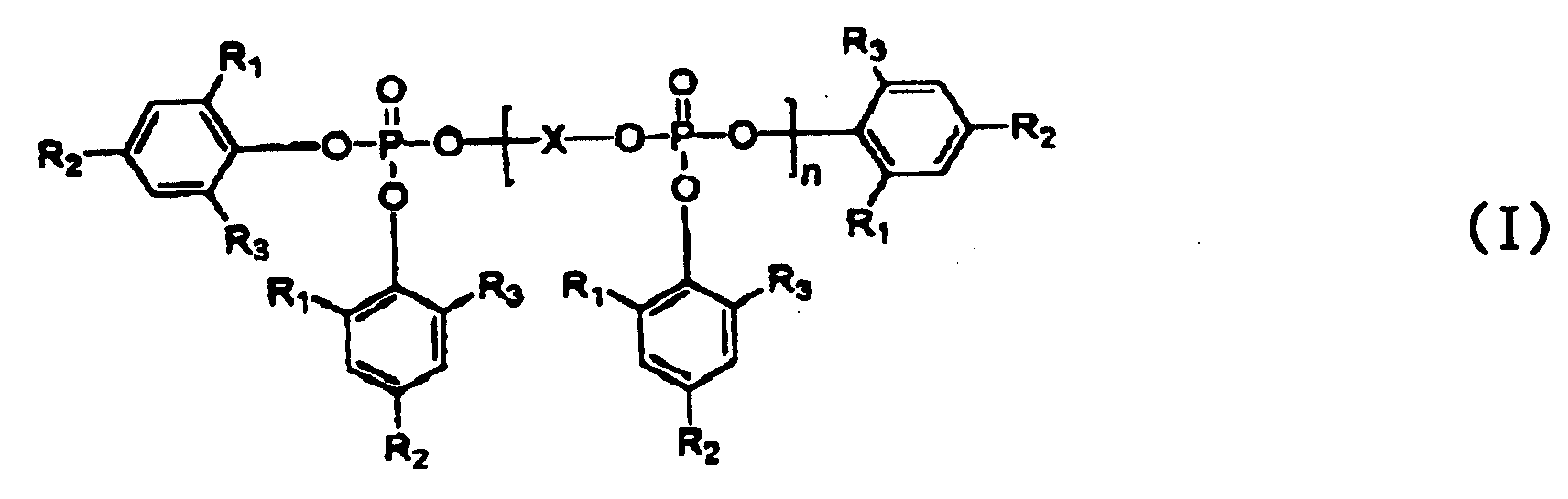
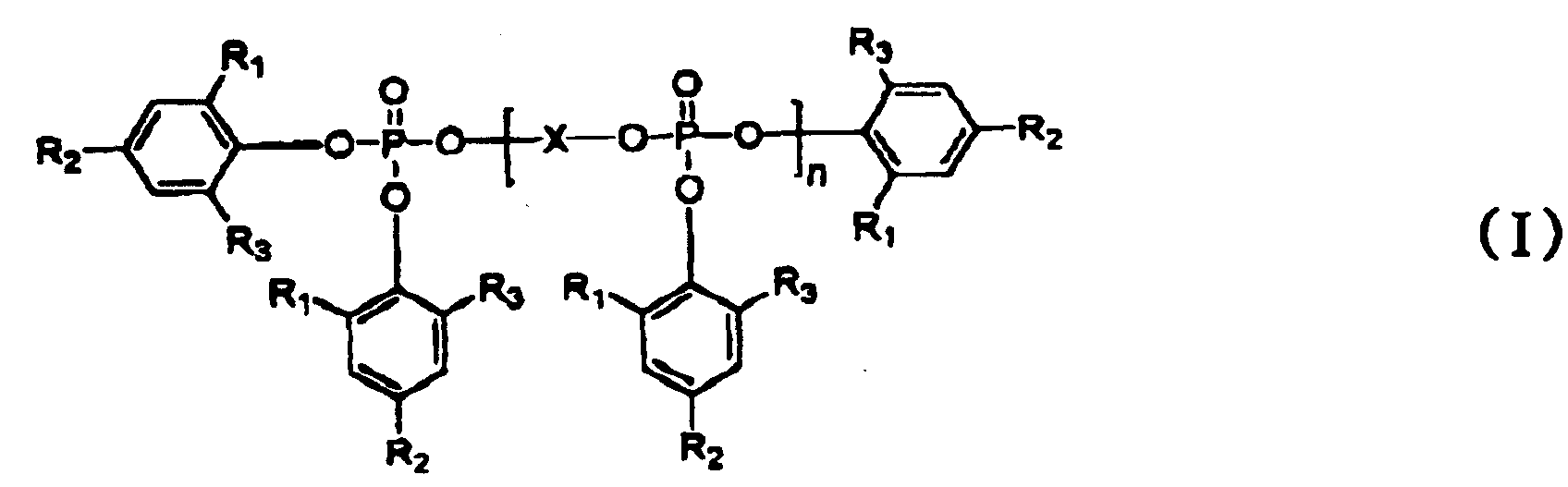
- the aromatic phosphoric acid ester compound used in the present invention is a compound having the following structural formula ( I ): wherein R 1 , R 2 and R 3 independently of one another are hydrogen or C 1 -C 4 alkyl group, X is C 6 -C 20 aryl or alkyl substituted C 6 -C 20 aryl group which is dialcohol derivatives such as resorcinol, diphenol, hydroquinol, bisphenol-A and bisphenol-S, and n is 0 ⁇ 4.
- the compound include triphenyl phosphate, tricresyl phosphate, trixylenyl phosphate, tri(2,6-dimethyl phenyl) phosphate, tri(2,4,6-trimethyl phenyl) phosphate, tri(2,4-ditertiary butyl phenyl) phosphate, tri(2,6-ditertiary butyl phenyl) .
- the compound include resorcinol bis (diphenyl) phosphate, resorcinol bis(2,6-dimethyl phenyl) phosphate, resorcinol bis(2,4-ditertiary butyl phenyl) phosphate, hydroquinone (2,6-dimethyl phenyl) phosphate, hydroquinone(2,4-ditertiary butyl phenyl) phosphate, and the like.
- the phosphoric acid ester compound may be used alone or mixture there of, and is employed in the amount of 5 to 30 parts by weight per 100 parts by weight of the base resin which comprises (A) and (B)
- additives may be contained in the resin composition of the present invention.
- the additives include an anti-dripping agent, an impact modifier, plasticizer, a heat stabilizer, an oxidation inhibitor, a light stabilizer, a compatibilizer and the like.
- An inorganic filler such as talc, silica, mica, glass fiber, organic or inorganic pigment and/or dye can be added too.
- the additives are employed in the amount of 0 to 30 parts by weight on the basis of 100 parts by weight of the base resin.
- butadiene rubber latex powder (on the basis of solid parts), 39 parts by weight of styrene, and 150 parts by weight of deionized water were blended to the blend, 1.0 parts by weight of rosin soap as an emulsifying agent, 0.3 parts by weight of cumenhydroperoxide, 0.2 parts by weight of mercaptan-containing chain transfer agent, 0.4 parts by weight of glucose, 0.01 parts by weight of ferrous sulfate hydrate, and 0.3 parts by weight of sodium pyrophosphate were added.
- the blend was kept at 75 °C for 4 hours, and the reaction was terminated by injecting 11 parts by weight of acrylonitrile to obtain graft ABS latex.
- SAN copolymer resin (g-ABS) in a powder form.
- the SAN copolymer resin excluding rubber, it comprises 8 parts by weight of SAN copolymer resin with 0 to 9 % by weight of acrylonitrile, 37 parts by weight of SAN copolymer resin with 9 to 20 % by weight of acrylonitrile, and 55 parts by weight of SAN copolymer resin with not less than 20 % by weight of acrylonitrile.
- butadiene rubber latex powder (on the basis of solid parts), 39 parts by weight of styrene, 11 parts by weight of acrylonitrile, and 150 parts by weight of deionized water were blended to the blend, 1.0 parts by weight of rosin soap as emulsifying agent, 0.3 parts by weight of cumenhydroperoxide, 0.2 parts by weight of mercaptan-containing chain transfer agent, 0.4 parts by weight of glucose, 0.01 parts by weight of ferrous sulfate hydrate, and 0.3 parts by weight of sodium pyrophosphate were added.
- the blend was kept at 75 °C for 4 hours, and the reaction was terminated by injecting 11 parts by weight of acrylonitrile to obtain graft ABS latex.
- SAN graft copolymer resin (g-ABS) in a powder form.
- SAN copolymer resin excluding rubber it has not more than 3 parts by weight of SAN copolymer resin with not more than 20 % by weight of acrylonitrile.
- styrene 75 parts by weight of styrene, 5 parts by weight of acrylonite, 120 parts by weight of deionized water, 0.2 parts by weight of 1.1'-di((t-butylperoxy)-3,3',5-trimethyl cyclohexane, and 0.1 parts by weight of azobisisobutylonitrile were blended.
- 0.4 parts by weight of tricalciumphosphate and 0.2 parts by weight of mercaptan-containing chain transfer agent were added. The resultant solution was heated to 80 °C for 90 minutes and kept for 150 miutes.
- SAN copolymer resin with 25 % by average weight of AN was prepared.
- the resultant was washed, dehydrated and dried.
- Styrene-acrylonitrile copolymer (SAN) having a weight average molecular weight of 100,000 to 140,000 was obtained.
- the SAN copolymer resin As a result of analysis of the SAN copolymer resin, it comprises 9 parts by weight of SAN copolymer resin with 0 to 9 % by weight of acrylonitrile, 35 parts by weight of SAN copolymer resin with 9 to 20 % by weight of acrylonitrile, and 56 parts by weight of SAN copolymer resin with not less than 20 % by weight of acrylonitrile.
- the SAN copolymer resin As a result of analysis of the SAN copolymer resin, it comprises 9 parts by weight of SAN copolymer resin with 0 to 9 % by weight of acrylonitrile, 35 parts by weight of SAN copolymer resin with 9 to 20 % by weight of acrylonitrile, and 56 parts by weight of SAN copolymer resin with not less than 20 % by weight of acrylonitrile.
- the SAN copolymer resin As a result of analysis of the SAN copolymer resin, it comprises 39 parts by weight of SAN copolymer resin with 0 to 9 % by weight of acrylonitrile, 57 parts by weight of SAN copolymer resin with 9 to 20 % by weight of acrylonitrile, and 4 parts by weight of SAN copolymer resin with not less than 20 % by weight of acrylonitrile.
- Poly(2,6-dimethyl-1,4-phenylene) ether of Japan Asai Kasei Co. was used, its average particulate size was about several ⁇ m, and the product name of powder form was P-402.
- Triphenylphosphate (TPP) with a melting point of 48 °C was used.
- the pellets were dried at 80 °C for 3 hours and extruded in to test specimens in a 6 oz. extruder at molding temperature of 220 ⁇ 280 °C and barrel temperature of 40 ⁇ 80 °C, and the resin pellets were molded in to test specimens.
- the flame retardancy of the test specimens (1/10") was measured according to UL94 VB, and the Izod impact strength of the test specimens was measured according to ASTM D-256 (1/8" notch, kgfcm/cm).
- the resin compositions in Examples 1 ⁇ 3 show good impact strength and flame retardancy.
- the rubber modified SAN copolymer resin (g-ABS) and PPE resin in the blend do not have good compatibility each other.
- the compatibility of g-ABS resin and PPE resin was improved by employing a SAN copolymer resin with 0 to 9 % by weight of AN and a SAN copolymer resin with 9 to 20 % by weight of AN, accordingly the resin had a good impact strength.
- the resin had a good impact strength.
- Comparative Examples showed lower impact strength than Examples.
- the resin has a difficulty to be applied to electric appliances.
Landscapes
- Chemical & Material Sciences (AREA)
- Health & Medical Sciences (AREA)
- Chemical Kinetics & Catalysis (AREA)
- Medicinal Chemistry (AREA)
- Polymers & Plastics (AREA)
- Organic Chemistry (AREA)
- Compositions Of Macromolecular Compounds (AREA)
- Graft Or Block Polymers (AREA)
- Manufacture Of Macromolecular Shaped Articles (AREA)
- Fireproofing Substances (AREA)
Abstract
Description
- The present invention relates to a flameproof thermoplastic resin composition. More particularly, the present invention relates to a flameproof thermoplastic resin composition that comprises a styrene-acrylonitrile (SAN) graft copolymer, alternatively a rubber modified SAN copolymer resin, and a polyphenylene ether resin as a base resin, and a phosphoric acid ester compound resin as a flame retardant.
- A rubber modified styrene-containing resin has a good processability, a high impact strength, and a good appearance. Accordingly, the resin has been widely applied to electric appliances and office supplies. In case that a rubber modified styrene-containing resin is applied to personal computers, facsimiles, and the like, which emit heat, flame-retardant property should be given to the resin due to its combustibility.
- A widely known method for the flame retardancy is that halogen-containing compounds and antimony-containing compounds are added to a rubber modified styrene-containing resin to give flame-retardant property. The halogen-containing compounds used in the method above are, for example, polybromodiphenyl ether, tetrabromobisphenol A, epoxy compounds substituted by bromine, chlorinated polyethylene, etc. An antimony trioxide and anntimony pentaoxide are commonly used as antimony-containing compounds.
- The methods for improvement of flame-retardant property by applying halogen- and antimony-containing compound have advantages such as easy acquirement of the flame-retardant property and no degradation of the physical properties. However, the disadvantages could be observed that the halogen-containing compound results in the corrosion of the mold itself by the hydrogen halide gases released during the molding process and is fatally harmful due to the toxic gases liberated in case of fire. Especially, since a polybromodiphenyl ether, mainly used for a halogen-containing flame retardant, can produce toxic gases such as dioxin or furan during combustion, flame retardant which is not prepared with halogen-containing compound has become main concerns in this field.
- It is commonly known a method to apply phosphorus or nitrogen compounds as halogen-free flame retardant to a resin composition. However, usage of only phosphorus compound deteriorates heat resistance of a rubber modified styrene-containing resin and does not impart sufficient flame retardancy.
- Generally, when a rubber modified styrene-containing resin such as acrylonitrile-butadiene-styrene (ABS) is burned, char is scarcely produced due to decomposition and vaporization in most parts (Journal of Applied Polymer Science, 1998, vol. 68, p1067). Therefore, to impart an effect of flame retardancy, it is necessary to add a char-forming agent to a resin composition, which plays a role to prohibit entrance of oxygen and emission of fuel by forming char on the surface of rubber with three-dimensional carbon chain bonds under combustion.
- Japanese Patent Laid-open No. 7-48491 discloses a flameproof thermoplastic resin, made of adding a novolac phenolic resin and a phosphoric acid ester in to a thermoplastic copolymer resin composed of a rubber copolymer and an aromatic vinyl monomer. It was found that in order to obtain a good property of flame retardancy, a phenolic resin as a char-forming agent and a phosphoric acid ester compound as a flame retardant should be added in a lot of amount. However, in this case, the heat resistance of the resin composition is dropped suddenly. Therefore, many studies have been done to prepare a flameproof resin composition which does not contain phenol resin but shows a good flame retardancy and heat-resistant.
- U.S. Patent No. 4,360,618 discloses that the impact strength and heat-resistance of a resin composition was improved by mixing SAN resin or ABS resin copolymer with 2 to 8 % by weight of acrylonitrile to improve compatibility of polyphenylene ether and styrene-containing resin with acrylonitrile. And, U.S. Patent No. 4,578,423 discloses that the mechanical properties of a resin composition with a high content of acrylonitrile were maintained by blending 10 to 90 % by weight of polyphenylene ether with 10 to 90 % by weight of SAN resin or ABS resin copolymer with 8 to 17 % by weight of acrylonitrile (standard deviation of % by weight of acrylonitrile being not less than 3.5 %). But, if the content of acrylonitrile was higher than that of polyphenylene ether, the compatibility of styrene-containing resin and polyphenylene ether deteriorated, so the mechanical property of the resin deteriorated.
- The present inventors have prepared a rubber modified SAN copolymer resin with 15 to 40 % by weight of acrylonitrile of a SAN copolymer resin excluding rubber on applying a SAN graft copolymer as continuous phase resin in order to solve the problem above. That is, the present inventors have discovered a resin composition with a high impact strength and a flame retardancy by blending a polyphenylene ether resin with a rubber modified SAN copolymer resin excluding rubber, which comprises 0 to 20 % by weight of SAN copolymer resin with 0 to 9 % by weight of acrylonitrile, 5 to 50 % by weight of SAN copolymer resin with 9 to 20 % by weight of acrylonitrile, and 10 to 90 % by weight of SAN copolymer resin with 20 to50 % by weight of acrylonitrile, and by using an aromatic phosphoric acid ester compound as a flame retardant.
- An object of the present invention is to provide a flameproof thermoplastic resin composition that has a good mechanical property and flame retardancy.
- Another object of the present invention is to provide a flameproof thermoplastic resin composition that does not contain halogen-containing compounds that causes the environmental pollution during the preparation or combustion of the resin.
- A further object of the present invention is to provide a flameproof thermoplastic resin composition with a high compatibility of polyphenylene ether resin and rubber modified SAN copolymer resin by using a rubber modified SAN copolymer resin excluding rubber, which has 15 to 40 % by average weight of acrylonitrile, comprising 0 to 20 % by weight of SAN copolymer resin with 0 to 9 % by weight of acrylonitrile, 5 to 50 % by weight of SAN copolymer resin with 9 to 20 % by weight of acrylonitrile, and 10 to 90 % by weight of SAN copolymer resin with 20 to50 % by weight of acrylonitrile on preparing a blend of rubber modified SAN copolymer resin and polyphenylene ether resin.
- Other objects and advantages of this invention will be apparent from the ensuing disclosure and appended claims.
- A flameproof thermoplastic resin composition of the present invention comprises (A) 40 to 95 parts by weight of a rubber modified SAN graft copolymer resin composed of (A1) 20 to 100 % by weight of SAN graft copolymer resin with 10 to 60 % by weight of a rubber and 90 to 40 % by weight of SAN copolymer resin, and (A2) 80 to 0 % by weight of SAN copolymer; wherein said rubber modified SAN graft resin has an average weight of 15 to 40 % by weight of acrylonitrile per the SAN resin excluding rubber component; (B) 5 to 60 parts by weight of polyphenylene ether resin; (C) 5 to 30 parts by weight of aromatic phosphoric acid ester per 100 part by weight of a base resin which comprises (A) and (B), with the SAN copolymer resin comprising (i) 0 to 20 % by weight of SAN copolymer resin with 0 to 9 % by weight of acrylonitrile, (ii) 5 to 50 % by weight of SAN copolymer resin with 9 to 20 % by weight of acrylonitrile, and (iii) 10 to 90 % by weight of SAN copolymer resin with 20 to 50 % by weight of acrylonitrile.
- The flameproof thermoplastic resin composition according to the present invention comprises (A) 40 to 95 parts by weight of a rubber modified SAN graft copolymer resin composed of(A1)20 to 100 % by weight of SAN graft copolymer resin, and (A2) 80 to 0 % by weight of SAN copolymer; (B) 5 to 60 parts by weight of polyphenylene ether resin; and (C) 5 to 30 parts by weight of aromatic phosphoric acid ester per 100 part by weight of a base resin which comprises (A) and (B). In the rubber modified SAN graft copolymer resin (A), the SAN resin excluding rubber comprises (i) 0 to 20 % by weight of SAN copolymer resin with 0 to 9 % by weight of acrylonitrile, (ii) 5 to 50 % by weight of SAN copolymer resin with 9 to 20 % by weight of acrylonitrile, and (iii) 10 to 90 % by weight of SAN copolymer resin with 20 to 50 % by weight of acrylonitrile, and contains 15 to 40 % by average weight of acrylonitrile.
- The detailed descriptions of components of the resin composition according to the present invention are as follows:
- A rubber modified SAN copolymer resin means a rubber phase copolymer which is dispersed in the form of particles in a matrix comprising aromatic vinyl-containing copolymers. The resin is prepared by mixing an aromatic vinyl monomer and a vinyl-containing monomer, which can be polymerized therewith, in the presence of a rubber phase polymer.
- In the rubber-modified SAN copolymer resin, the SAN resin excluding rubber contains 15 to 40 % by average weight of acrylonitrile and comprises three components as follows:
- (1) 0 to 20 % by weight of SAN copolymer resin with 0 to 9 % by weight of acrylonitrile;
- (2) 5 to 50 % by weight of SAN copolymer resin with 9 to 20 % by weight of acrylonitrile; and
- (3) 10 to 90 % by weight of SAN copolymer resin with 20 to 50 % by weight of acrylonitrile.
-
- Preferably, the SAN copolymer resin comprises (1) 5 to 20 % by weight of SAN copolymer resin with 0 to 9 % by weight of acrylonitrile, (2) 10 to 40 % by weight of SAN copolymer resin with 9 to 20 % by weight of acrylonitrile, and (3) 40 to 80 % by weight of SAN copolymer resin with 20 to 50 % by weight of acrylonitrile.
- Such resin is prepared by a known method such as an emulsion polymerization, a suspension polymerization or a bulk polymerization, and is conventionally produced by extrusion with a styrene-containing graft copolymer resin and a styrene-containing copolymer resin. In a bulk polymerization, both a styrene-containing graft copolymer resin and a styrene-containing copolymer resin are not prepared separately but prepared together in one process, thereby to produce a rubber modified styrene-containing resin. In either case, the contents of rubber in the final rubber modified styrene-containing resin to the total weight of the base resin are preferably in 5 to 30 parts by weight.
- Examples of such resins are acrylonitrile-butadiene-styrene (ABS) copolymer resin, acrylonitrile-acryl rubber-styrene (AAS) copolymer resin, acrylonitrile-ethylenepropylene rubber-styrene (AES) copolymer resin, and the like. In preparing the resin, the SAN graft copolymer resin (A1) can be used alone or in combination with the SAN copolymer resin (A2), it is preferable that they are combined with consideration of their compatibility. In this invention, 20 to 100 % by weight of the SAN graft copolymer resin (A1) is used in combination with 0 to 80 percent by weight of the SAN copolymer resin (A2).
- Examples of a rubber used for a styrene-containing graft copolymer resin are a diene-containing rubber such as a polybutadiene, poly(styrene-butadiene) and a poly(acrylonitrile-butadiene); a saturated rubber in which hydrogen is added to said diene-containing rubber; an isoprene rubber; a chloroprene rubber; a poly (butyl acrylate); and a terpolymer of ethylene-propylene-diene. It is preferable to use a diene-containing rubber, more preferably a butadiene-containing rubber.
- Aromatic vinyl-containing monomers for use preparing the graft copolymer are styrene, α -methylstyrene, p-methylstyrene, etc. In the above examples, styrene is most preferable. At least one copolymerizable monomer may be introduced and applied to said aromatic vinyl monomers. Preferably, said copolymerizable monomers are acrylonitrile and an unsaturated nitrile-containing compound such as methacrylonitrile, and most preferably the monomer is acrylonitrile.
- It is preferable that the rubber content of the graft copolymer is 10 to 60 % by weight. The SAN copolymer grafted the rubber is prepared by polymerizing 60 to 85 % by weight of aromatic vinyl-containing monomer and 15 to 40 % by weight of unsaturated nitrile-containing monomer. In addition, in order to give good characteristics of processability and heat resistance, the monomers such as acrylic acid, methacryl acid, maleic anhydride and N-substituted maleimide can be added in the graft polymerization. The amounts of the monomers are in the range of 0 to 40 parts by weight based on the total of said graft copolymer resin.
- To acquire good impact strength and appearance when said SAN graft copolymer is prepared, the average size of rubber particles is preferred to be in the range of from 0.1 to 4 µm.
- In the polymerization process of rubber modified SAN copolymer resin, the SAN copolymer resin may be prepared separately and then blended with SAN graft copolymer resin (A1) as needed. The SAN copolymer resin is prepared by polymerizing 60 to 85 % by weight of aromatic vinyl-containing monomer such as styrene and 15 to 40 % by weight of unsaturated nitrile-containing monomer. In addition, in order to give good characteristics of processability and heat resistance, the monomers such as acrylic acid, methacryl acid, maleic anhydride and N-substituted maleimide can be added in the graft polymerization. The amounts of the monomers are in the range of 0 to 40 parts by weight based on the total of said SAN copolymer resin.
- The resin is prepared by a known method such as an emulsion polymerization, a suspension polymerization or a bulk polymerization, it is preferred that weight average molecular weight of the resin ranges from 50,000 to 400,000. The examples of the copolymerizable monomer to the SAN copolymer resin are methacrylate or phenyl maleimide and so on, and in order to improve a heat resistance, styrene can be alternated with α-methylstyrene, etc.
- Polyphenylene ether resin is employed as a base resin to improve the flame retardancy, heat resistance and rigidity of the resin composition according to the present invention. As examples of the polyphenylene ether resin, poly(2,6-dimethyl-1,4-phenylene) ether, poly(2,6-diethyl-1,4-phenylene) ether, poly(2,6-dipropyl-1,4-phenylene) ether, poly(2-methyl-6-ethyl-1,4-phenylene) ether, poly(2-methyl-6-propyl-1,4-phenylene) ether, poly(2-ethyl-6-propyl-1,4-phenylene) ether, poly(2,6-diphenyl-1,4-phenylene) ether, copolymer of poly(2,6-dimethyl-1,4-phenylene) ether and poly(2,3,6-trimethyl-1,4-phenylene) ether, and copolymer of poly(2,6-dimethyl-1,4-phenylene) ether and poly(2,3,5-triethyl-1,4-phenylene) ether can be used. Preferably, copolymer of poly(2,6-dimethyl-1,4-phenylene) ether and poly(2,3,6-trimethyl-1,4-phenylene) ether, and poly(2,6-dimethyl-1,4-phenylene) ether are preferably used, more preferably poly(2,6-dimethyl-1,4-phenylene) ether is used. The degree of polymerization of polyphenylene ether is not defined specifically, but considering heat-stability or processability of the resin composition, it is preferable that the viscosity of polypheylene ether is in the range of 0.2 to 0.8 measured in chloroform solvent at 25 °C.
- The aromatic phosphoric acid ester compound used in the present invention is a compound having the following structural formula ( I ):wherein R1, R2 and R3 independently of one another are hydrogen or C1-C4 alkyl group, X is C6-C20 aryl or alkyl substituted C6-C20 aryl group which is dialcohol derivatives such as resorcinol, diphenol, hydroquinol, bisphenol-A and bisphenol-S, and n is 0∼4. In the structural formula ( I ), where n is 0, the compound include triphenyl phosphate, tricresyl phosphate, trixylenyl phosphate, tri(2,6-dimethyl phenyl) phosphate, tri(2,4,6-trimethyl phenyl) phosphate, tri(2,4-ditertiary butyl phenyl) phosphate, tri(2,6-ditertiary butyl phenyl) . phosphate, and the like, and where n is 1, the compound include resorcinol bis (diphenyl) phosphate, resorcinol bis(2,6-dimethyl phenyl) phosphate, resorcinol bis(2,4-ditertiary butyl phenyl) phosphate, hydroquinone (2,6-dimethyl phenyl) phosphate, hydroquinone(2,4-ditertiary butyl phenyl) phosphate, and the like. The phosphoric acid ester compound may be used alone or mixture there of, and is employed in the amount of 5 to 30 parts by weight per 100 parts by weight of the base resin which comprises (A) and (B)
- Other additives may be contained in the resin composition of the present invention. The additives include an anti-dripping agent, an impact modifier, plasticizer, a heat stabilizer, an oxidation inhibitor, a light stabilizer, a compatibilizer and the like. An inorganic filler such as talc, silica, mica, glass fiber, organic or inorganic pigment and/or dye can be added too. The additives are employed in the amount of 0 to 30 parts by weight on the basis of 100 parts by weight of the base resin.
- The invention may be better understood by reference to the following examples which are intended for the purpose of illustration and are not to be construed as in any way limiting the scope of the present invention, which is defined in the claims appended here to. In the following examples, all parts and percentage are by weight unless otherwise indicated.
- (A) Rubber modified SAN copolymer resin, (B) polyphenylene ether resin, and (C) phosphoric acid ester compound employed to prepare the resin compositions in Examples and Comparative Examples are as follows:
- 50 parts by weight of butadiene rubber latex powder (on the basis of solid parts), 39 parts by weight of styrene, and 150 parts by weight of deionized water were blended to the blend, 1.0 parts by weight of rosin soap as an emulsifying agent, 0.3 parts by weight of cumenhydroperoxide, 0.2 parts by weight of mercaptan-containing chain transfer agent, 0.4 parts by weight of glucose, 0.01 parts by weight of ferrous sulfate hydrate, and 0.3 parts by weight of sodium pyrophosphate were added. The blend was kept at 75 °C for 4 hours, and the reaction was terminated by injecting 11 parts by weight of acrylonitrile to obtain graft ABS latex. To the ABS latex solid powder, 0.4 parts by weight of sulfuric acid was added, coagulated and dried to obtain SAN graft copolymer resin (g-ABS) in a powder form. As a result of analysis of the SAN copolymer resin excluding rubber, it comprises 8 parts by weight of SAN copolymer resin with 0 to 9 % by weight of acrylonitrile, 37 parts by weight of SAN copolymer resin with 9 to 20 % by weight of acrylonitrile, and 55 parts by weight of SAN copolymer resin with not less than 20 % by weight of acrylonitrile.
- 50 parts by weight of butadiene rubber latex powder (on the basis of solid parts), 39 parts by weight of styrene, 11 parts by weight of acrylonitrile, and 150 parts by weight of deionized water were blended to the blend, 1.0 parts by weight of rosin soap as emulsifying agent, 0.3 parts by weight of cumenhydroperoxide, 0.2 parts by weight of mercaptan-containing chain transfer agent, 0.4 parts by weight of glucose, 0.01 parts by weight of ferrous sulfate hydrate, and 0.3 parts by weight of sodium pyrophosphate were added. The blend was kept at 75 °C for 4 hours, and the reaction was terminated by injecting 11 parts by weight of acrylonitrile to obtain graft ABS latex. To the ABS latex solid powder, 0.4 parts by weight of sulfuric acid was added, coagulated and dried to obtain SAN graft copolymer resin (g-ABS) in a powder form. As a result of analysis of the SAN copolymer resin excluding rubber, it has not more than 3 parts by weight of SAN copolymer resin with not more than 20 % by weight of acrylonitrile.
- 75 parts by weight of styrene, 5 parts by weight of acrylonite, 120 parts by weight of deionized water, 0.2 parts by weight of
1.1'-di((t-butylperoxy)-3,3',5-trimethyl cyclohexane, and 0.1 parts by weight of azobisisobutylonitrile were blended. To the blend, 0.4 parts by weight of tricalciumphosphate and 0.2 parts by weight of mercaptan-containing chain transfer agent were added. The resultant solution was heated to 80 °C for 90 minutes and kept for 150 miutes. 20 parts by weight of acrylonitrile injected to the resultant solution, the resultant solution reheated to 95 °C, kept for 120 minutes, then the SAN copolymer resin with 25 % by average weight of AN was prepared. The resultant was washed, dehydrated and dried. Styrene-acrylonitrile copolymer (SAN) having a weight average molecular weight of 100,000 to 140,000 was obtained. - As a result of analysis of the SAN copolymer resin, it comprises 9 parts by weight of SAN copolymer resin with 0 to 9 % by weight of acrylonitrile, 35 parts by weight of SAN copolymer resin with 9 to 20 % by weight of acrylonitrile, and 56 parts by weight of SAN copolymer resin with not less than 20 % by weight of acrylonitrile.
- 75 parts by weight of styrene, 25 parts by weight of acrylonitrile, 120 parts by weight of deionized water, 0.15 parts by weight of azobisisobutylonitrile, 0.4 parts by weight of tricalciumphosphate, and 0.2 parts by weight of mercaptan-containing chain transfer agent were blended. The resultant solution was heated from room temperature to 80 °C for 90 minutes and kept for 180 minutes, then the SAN copolymer resin with 25 % by average weight of AN was prepared. The resultant was washed, dehydrated and dried. Styrene-acrylonitrile copolymer (SAN) having a weight average molecular weight of 160,000 to 200,000 was obtained. As a result of analysis of the SAN copolymer resin, it comprises 9 parts by weight of SAN copolymer resin with 0 to 9 % by weight of acrylonitrile, 35 parts by weight of SAN copolymer resin with 9 to 20 % by weight of acrylonitrile, and 56 parts by weight of SAN copolymer resin with not less than 20 % by weight of acrylonitrile.
- 87 parts by weight of styrene, 13 parts by weight of acrylonitrile, 120 parts by weight of deionized water, 0.1 parts by weight of azobisisobutylonitrile, 0.2 parts by weight of 1.1 '-di(t-butylperoxy)-3,3',5-trimethyl cyclohexane, 0.4 parts by weight of tricalciumphosphate, and 0.3 parts by weight of mercaptan-containing chain transfer agent were blended. The resultant solution was heated from room temperature to 80 °C for 90 minutes and kept for 240 minutes. The resultant solution reheated to 100 °C, kept for 240 minutes, then the SAN copolymer resin with 13 % by average weight of AN was prepared. The resultant was washed, dehydrated and dried. Styrene-acrylonitrile copolymer (SAN) having a weight average molecular weight of 100,000 to 140,000 was obtained.
- As a result of analysis of the SAN copolymer resin, it comprises 39 parts by weight of SAN copolymer resin with 0 to 9 % by weight of acrylonitrile, 57 parts by weight of SAN copolymer resin with 9 to 20 % by weight of acrylonitrile, and 4 parts by weight of SAN copolymer resin with not less than 20 % by weight of acrylonitrile.
- Poly(2,6-dimethyl-1,4-phenylene) ether of Japan Asai Kasei Co. was used, its average particulate size was about several µm, and the product name of powder form was P-402.
- Triphenylphosphate (TPP) with a melting point of 48 °C was used.
Examples Comparative Examples 1 2 3 1 2 Rubber modified SAN graft copolymer resin(A) SAN graft copolymer resin(A1a) 30 - - - 30 Graft ABS resin(A1b) - 30 30 30 - SAN copolymer resin(A2a) 45 - 45 - - SAN copolymer resin(A2b) - 32 - 45 - SAN copolymer resin(A2c) - 13 - - 45 Polyphenylene ether resin(B) 25 25 25 25 25 Aromatic phosphoric acid ester compound(C) 19 19 19 19 19 Izod impact strength (1/8") 25 23 18 5 9 Flame retardancy (1/10") V-1 V-1 V-1 V-1 V-1
Claims (7)
- A flameproof thermoplastic resin composition comprising:(A) 40 to 95 parts by weight of a rubber modified SAN graft copolymer resin composed of (A1) 20 to 100 % by weight of SAN copolymer resin with 10 to 60 % by weight of a rubber and 90 to 40 % by weight of SAN copolymer resin, and (A2) 80 to 0 % by weight of SAN copolymer, wherein said rubber modified SAN graft resin has an average weight of 15 to 40 % by weight of acrylonitrile per the SAN resin excluding rubber component and wherein said SAN copolymer resin comprises (i) 0 to 20 % by weight of SAN copolymer resin with 0 to 9 % by weight of acrylonitrile, (ii) 5 to 50 % by weight of SAN copolymer resin with 9 to 20 % by weight of acrylonitrile, and (iii) 10 to 90 % by weight of SAN copolymer resin with 20 to 50 % by weight of acrylonitrile;(B) 5 to 60 parts by weight of polyphenylene ether resin; and(C) 5 to 30 parts by weight of aromatic phosphoric acid ester per 100 parts by weight of a base resin comprising (A) and (B).
- The flameproof thermoplastic resin composition as defined in claim 1 wherein said SAN copolymer resin (A) comprises (i) 5 to 20 % by weight of SAN copolymer resin with 0 to 9 % by weight of acrylonitrile, (ii) 10 to 40 % by weight of SAN copolymer resin with 9 to 20 % by weight of acrylonitrile, and (iii) 40 to 80 % by weight of SAN copolymer resin with 20 to 50 % by weight of acrylonitrile.
- The flameproof thermoplastic resin composition as defined in claim 1 or 2 wherein said polyphenylene ether resin (B) is poly(2,6-dimethyl-1,4-phenylene) ether.
- The flameproof thermoplastic resin composition as defined in claim 1, 2 or 3 wherein said aromatic phosphoric acid ester compound (C) representing the following formula ( I ):wherein R1, R2 and R3 independently of one another are hydrogen or C1-C4 alkyl group, X is C6-C20 aryl or alkyl substituted C6-C20 aryl group and n is 0∼4.
- The flameproof thermoplastic resin composition as defined in claim 4 wherein said aromatic phosphoric acid ester compound (C) is a mixture of not less than two kinds of aromatic phosphoric acid ester compound having different n value.
- The flameproof thermoplastic resin composition as defined in any of claims 1 to 5 further comprises an anti-dripping agent, a plasticizer, a heat stabilizer, an oxidation inhibitor, a light stabilizer, a compatibilizer, pigments, dyes and/or an inorganic filler.
- The molding product prepared by the resin composition of defined in any one of claims 1-6.
Applications Claiming Priority (2)
| Application Number | Priority Date | Filing Date | Title |
|---|---|---|---|
| KR9953747 | 1999-11-30 | ||
| KR1019990053747A KR100355411B1 (en) | 1999-11-30 | 1999-11-30 | Flameproof Thermoplastic Resin Composition |
Publications (2)
| Publication Number | Publication Date |
|---|---|
| EP1106651A1 true EP1106651A1 (en) | 2001-06-13 |
| EP1106651B1 EP1106651B1 (en) | 2011-01-05 |
Family
ID=19622618
Family Applications (1)
| Application Number | Title | Priority Date | Filing Date |
|---|---|---|---|
| EP00111580A Expired - Lifetime EP1106651B1 (en) | 1999-11-30 | 2000-05-30 | Flameproof thermoplastic resin composition |
Country Status (4)
| Country | Link |
|---|---|
| EP (1) | EP1106651B1 (en) |
| JP (1) | JP3455715B2 (en) |
| KR (1) | KR100355411B1 (en) |
| DE (1) | DE60045468D1 (en) |
Cited By (2)
| Publication number | Priority date | Publication date | Assignee | Title |
|---|---|---|---|---|
| KR100355411B1 (en) * | 1999-11-30 | 2002-10-11 | 제일모직주식회사 | Flameproof Thermoplastic Resin Composition |
| EP1497365A4 (en) * | 2002-04-16 | 2005-07-06 | Cheil Ind Inc | Thermoplastic flame retardant resin compositions |
Citations (8)
| Publication number | Priority date | Publication date | Assignee | Title |
|---|---|---|---|---|
| EP0007460A1 (en) * | 1978-07-04 | 1980-02-06 | Ciba-Geigy Ag | Flame-retardant polymer compositions |
| US4360618A (en) * | 1981-11-19 | 1982-11-23 | Monsanto Company | Low acrylonitrile content styrene-acrylonitrile polymers blended with polyphenylene oxide |
| US4618633A (en) * | 1984-09-06 | 1986-10-21 | Basf Aktiengesellschaft | Halogen-free self-extinguishing thermoplastic molding material |
| EP0640655A2 (en) * | 1993-08-26 | 1995-03-01 | Bayer Ag | Flame-retardant, stress crack resistant polycarbonate ABS moulding composition |
| EP0682081A1 (en) * | 1994-05-10 | 1995-11-15 | Daicel Chemical Industries, Ltd. | Flame-retardant resin composition |
| EP0700969A1 (en) * | 1994-09-05 | 1996-03-13 | Cheil Industries Inc. | Flameproof thermoplastic resin compositions |
| GB2336158A (en) * | 1998-04-07 | 1999-10-13 | Cheil Ind Inc | Flameproof thermoplastic resin composition |
| GB2341184A (en) * | 1998-09-02 | 2000-03-08 | Cheil Ind Inc | Thermoplastic flameproof polymer blend composition |
Family Cites Families (3)
| Publication number | Priority date | Publication date | Assignee | Title |
|---|---|---|---|---|
| EP0522653A1 (en) * | 1991-07-12 | 1993-01-13 | Dsm N.V. | Flame-retardant polymer composition |
| KR100358231B1 (en) * | 1998-08-18 | 2003-02-19 | 주식회사 엘지화학 | Manufacturing method of heat resistant thermoplastic resin with excellent impact resistance and thermal stability |
| KR100355411B1 (en) * | 1999-11-30 | 2002-10-11 | 제일모직주식회사 | Flameproof Thermoplastic Resin Composition |
-
1999
- 1999-11-30 KR KR1019990053747A patent/KR100355411B1/en not_active Expired - Fee Related
-
2000
- 2000-05-30 DE DE60045468T patent/DE60045468D1/en not_active Expired - Lifetime
- 2000-05-30 JP JP2000164773A patent/JP3455715B2/en not_active Expired - Fee Related
- 2000-05-30 EP EP00111580A patent/EP1106651B1/en not_active Expired - Lifetime
Patent Citations (8)
| Publication number | Priority date | Publication date | Assignee | Title |
|---|---|---|---|---|
| EP0007460A1 (en) * | 1978-07-04 | 1980-02-06 | Ciba-Geigy Ag | Flame-retardant polymer compositions |
| US4360618A (en) * | 1981-11-19 | 1982-11-23 | Monsanto Company | Low acrylonitrile content styrene-acrylonitrile polymers blended with polyphenylene oxide |
| US4618633A (en) * | 1984-09-06 | 1986-10-21 | Basf Aktiengesellschaft | Halogen-free self-extinguishing thermoplastic molding material |
| EP0640655A2 (en) * | 1993-08-26 | 1995-03-01 | Bayer Ag | Flame-retardant, stress crack resistant polycarbonate ABS moulding composition |
| EP0682081A1 (en) * | 1994-05-10 | 1995-11-15 | Daicel Chemical Industries, Ltd. | Flame-retardant resin composition |
| EP0700969A1 (en) * | 1994-09-05 | 1996-03-13 | Cheil Industries Inc. | Flameproof thermoplastic resin compositions |
| GB2336158A (en) * | 1998-04-07 | 1999-10-13 | Cheil Ind Inc | Flameproof thermoplastic resin composition |
| GB2341184A (en) * | 1998-09-02 | 2000-03-08 | Cheil Ind Inc | Thermoplastic flameproof polymer blend composition |
Cited By (2)
| Publication number | Priority date | Publication date | Assignee | Title |
|---|---|---|---|---|
| KR100355411B1 (en) * | 1999-11-30 | 2002-10-11 | 제일모직주식회사 | Flameproof Thermoplastic Resin Composition |
| EP1497365A4 (en) * | 2002-04-16 | 2005-07-06 | Cheil Ind Inc | Thermoplastic flame retardant resin compositions |
Also Published As
| Publication number | Publication date |
|---|---|
| DE60045468D1 (en) | 2011-02-17 |
| KR100355411B1 (en) | 2002-10-11 |
| JP2001172464A (en) | 2001-06-26 |
| EP1106651B1 (en) | 2011-01-05 |
| JP3455715B2 (en) | 2003-10-14 |
| KR20010048880A (en) | 2001-06-15 |
Similar Documents
| Publication | Publication Date | Title |
|---|---|---|
| EP1069157B1 (en) | Flameproof thermoplastic resin composition | |
| US6716900B2 (en) | Flameproof styrene containing graft resin compositions substantially free of phenolic resins and containing styrene/acrylonitrile resin compatabilizer | |
| US6646032B2 (en) | Thermoplastic flameproof resin composition | |
| US6451889B1 (en) | Flameproof thermoplastic resin composition | |
| EP1497365B1 (en) | Thermoplastic flame retardant resin compositions | |
| EP1654321A1 (en) | Flameproof rubber-reinforced styrenic resin composition | |
| US6838497B2 (en) | Flame retardant thermoplastic resin composition containing styrene polymer as compatabilizer and oxaphospholane compound as flame retardant | |
| EP1543070B1 (en) | Flameproof styrenic resin composition | |
| KR20150038968A (en) | Thermoplastic resin composition and article comprising the same | |
| EP1069158B1 (en) | Flameproof thermoplastic resin composition | |
| KR100520790B1 (en) | Thermoplastic Flameproof Resin Composition | |
| US6906123B2 (en) | Flameproof styrene-containing graft resin compositions having a particular nitrile content distribution | |
| US6653374B1 (en) | Method of preparing flameproof thermoplastic resin composition | |
| KR100346395B1 (en) | Thermoplastic Flameproof Resin Composition | |
| KR100359903B1 (en) | Thermoplastic Flameproof Resin Composition | |
| KR100364060B1 (en) | Thermoplastic Flameproof Resin Composition | |
| EP1106651B1 (en) | Flameproof thermoplastic resin composition | |
| KR100391014B1 (en) | Flame retardant thermoplastic resin composition with improved weatherability | |
| KR100348424B1 (en) | Thermoplastic composition with flame retardancy | |
| KR20000018424A (en) | Thermoplastic resin having fire retardancy | |
| KR100576326B1 (en) | Flame Retardant Thermoplastic Composition |
Legal Events
| Date | Code | Title | Description |
|---|---|---|---|
| PUAI | Public reference made under article 153(3) epc to a published international application that has entered the european phase |
Free format text: ORIGINAL CODE: 0009012 |
|
| 17P | Request for examination filed |
Effective date: 20001220 |
|
| AK | Designated contracting states |
Kind code of ref document: A1 Designated state(s): DE GB |
|
| AX | Request for extension of the european patent |
Free format text: AL;LT;LV;MK;RO;SI |
|
| AKX | Designation fees paid |
Free format text: DE GB |
|
| 17Q | First examination report despatched |
Effective date: 20041025 |
|
| GRAP | Despatch of communication of intention to grant a patent |
Free format text: ORIGINAL CODE: EPIDOSNIGR1 |
|
| GRAS | Grant fee paid |
Free format text: ORIGINAL CODE: EPIDOSNIGR3 |
|
| GRAA | (expected) grant |
Free format text: ORIGINAL CODE: 0009210 |
|
| AK | Designated contracting states |
Kind code of ref document: B1 Designated state(s): DE GB |
|
| REG | Reference to a national code |
Ref country code: GB Ref legal event code: FG4D |
|
| REF | Corresponds to: |
Ref document number: 60045468 Country of ref document: DE Date of ref document: 20110217 Kind code of ref document: P |
|
| REG | Reference to a national code |
Ref country code: DE Ref legal event code: R096 Ref document number: 60045468 Country of ref document: DE Effective date: 20110217 |
|
| PLBE | No opposition filed within time limit |
Free format text: ORIGINAL CODE: 0009261 |
|
| STAA | Information on the status of an ep patent application or granted ep patent |
Free format text: STATUS: NO OPPOSITION FILED WITHIN TIME LIMIT |
|
| 26N | No opposition filed |
Effective date: 20111006 |
|
| REG | Reference to a national code |
Ref country code: DE Ref legal event code: R097 Ref document number: 60045468 Country of ref document: DE Effective date: 20111006 |
|
| REG | Reference to a national code |
Ref country code: DE Ref legal event code: R081 Ref document number: 60045468 Country of ref document: DE Owner name: LOTTE ADVANCED MATERIALS CO., LTD., YEOSU-SI, KR Free format text: FORMER OWNER: CHEIL INDUSTRIES INC., KUMI-CITY, KR Ref country code: DE Ref legal event code: R082 Ref document number: 60045468 Country of ref document: DE Representative=s name: BERENDT UND KOLLEGEN, DE |
|
| REG | Reference to a national code |
Ref country code: DE Ref legal event code: R081 Ref document number: 60045468 Country of ref document: DE Owner name: LOTTE ADVANCED MATERIALS CO., LTD., YEOSU-SI, KR Free format text: FORMER OWNER: SAMSUNG SDI CO., LTD., YONGIN-SI, KYONGGI-DO, KR Ref country code: DE Ref legal event code: R082 Ref document number: 60045468 Country of ref document: DE Representative=s name: BERENDT UND KOLLEGEN, DE |
|
| REG | Reference to a national code |
Ref country code: GB Ref legal event code: 732E Free format text: REGISTERED BETWEEN 20170504 AND 20170510 |
|
| PGFP | Annual fee paid to national office [announced via postgrant information from national office to epo] |
Ref country code: DE Payment date: 20180515 Year of fee payment: 19 |
|
| PGFP | Annual fee paid to national office [announced via postgrant information from national office to epo] |
Ref country code: GB Payment date: 20180530 Year of fee payment: 19 |
|
| REG | Reference to a national code |
Ref country code: DE Ref legal event code: R119 Ref document number: 60045468 Country of ref document: DE |
|
| GBPC | Gb: european patent ceased through non-payment of renewal fee |
Effective date: 20190530 |
|
| PG25 | Lapsed in a contracting state [announced via postgrant information from national office to epo] |
Ref country code: DE Free format text: LAPSE BECAUSE OF NON-PAYMENT OF DUE FEES Effective date: 20191203 Ref country code: GB Free format text: LAPSE BECAUSE OF NON-PAYMENT OF DUE FEES Effective date: 20190530 |