EP1106605A1 - Alpha1b-adrenergic receptor antagonists - Google Patents
Alpha1b-adrenergic receptor antagonists Download PDFInfo
- Publication number
- EP1106605A1 EP1106605A1 EP00940789A EP00940789A EP1106605A1 EP 1106605 A1 EP1106605 A1 EP 1106605A1 EP 00940789 A EP00940789 A EP 00940789A EP 00940789 A EP00940789 A EP 00940789A EP 1106605 A1 EP1106605 A1 EP 1106605A1
- Authority
- EP
- European Patent Office
- Prior art keywords
- group
- carbon atoms
- so2nh2
- ome
- aryl
- Prior art date
- Legal status (The legal status is an assumption and is not a legal conclusion. Google has not performed a legal analysis and makes no representation as to the accuracy of the status listed.)
- Withdrawn
Links
- 0 CC(N(*)*)=N*I Chemical compound CC(N(*)*)=N*I 0.000 description 4
- DRTOPLRMDZJIGV-UHFFFAOYSA-N CC(CC1)CCC1=C Chemical compound CC(CC1)CCC1=C DRTOPLRMDZJIGV-UHFFFAOYSA-N 0.000 description 1
- DEXYMWLKAODAJD-UHFFFAOYSA-N CC(CCN(C)C1)=C1C=C Chemical compound CC(CCN(C)C1)=C1C=C DEXYMWLKAODAJD-UHFFFAOYSA-N 0.000 description 1
- ANSUQYZSKINTHZ-RVDMUPIBSA-N CCCC(C)(C)C(C)C(C)(C)NCC/C(/C)=C/C=C Chemical compound CCCC(C)(C)C(C)C(C)(C)NCC/C(/C)=C/C=C ANSUQYZSKINTHZ-RVDMUPIBSA-N 0.000 description 1
- ORTDZGFNIQBSPY-UHFFFAOYSA-N CCC[N](C)(C)C Chemical compound CCC[N](C)(C)C ORTDZGFNIQBSPY-UHFFFAOYSA-N 0.000 description 1
Classifications
-
- C—CHEMISTRY; METALLURGY
- C07—ORGANIC CHEMISTRY
- C07D—HETEROCYCLIC COMPOUNDS
- C07D401/00—Heterocyclic compounds containing two or more hetero rings, having nitrogen atoms as the only ring hetero atoms, at least one ring being a six-membered ring with only one nitrogen atom
- C07D401/02—Heterocyclic compounds containing two or more hetero rings, having nitrogen atoms as the only ring hetero atoms, at least one ring being a six-membered ring with only one nitrogen atom containing two hetero rings
- C07D401/04—Heterocyclic compounds containing two or more hetero rings, having nitrogen atoms as the only ring hetero atoms, at least one ring being a six-membered ring with only one nitrogen atom containing two hetero rings directly linked by a ring-member-to-ring-member bond
-
- A—HUMAN NECESSITIES
- A61—MEDICAL OR VETERINARY SCIENCE; HYGIENE
- A61K—PREPARATIONS FOR MEDICAL, DENTAL OR TOILETRY PURPOSES
- A61K31/00—Medicinal preparations containing organic active ingredients
- A61K31/33—Heterocyclic compounds
- A61K31/395—Heterocyclic compounds having nitrogen as a ring hetero atom, e.g. guanethidine or rifamycins
- A61K31/435—Heterocyclic compounds having nitrogen as a ring hetero atom, e.g. guanethidine or rifamycins having six-membered rings with one nitrogen as the only ring hetero atom
- A61K31/44—Non condensed pyridines; Hydrogenated derivatives thereof
- A61K31/445—Non condensed piperidines, e.g. piperocaine
- A61K31/4523—Non condensed piperidines, e.g. piperocaine containing further heterocyclic ring systems
- A61K31/4545—Non condensed piperidines, e.g. piperocaine containing further heterocyclic ring systems containing a six-membered ring with nitrogen as a ring hetero atom, e.g. pipamperone, anabasine
-
- A—HUMAN NECESSITIES
- A61—MEDICAL OR VETERINARY SCIENCE; HYGIENE
- A61K—PREPARATIONS FOR MEDICAL, DENTAL OR TOILETRY PURPOSES
- A61K31/00—Medicinal preparations containing organic active ingredients
- A61K31/33—Heterocyclic compounds
- A61K31/395—Heterocyclic compounds having nitrogen as a ring hetero atom, e.g. guanethidine or rifamycins
- A61K31/495—Heterocyclic compounds having nitrogen as a ring hetero atom, e.g. guanethidine or rifamycins having six-membered rings with two or more nitrogen atoms as the only ring heteroatoms, e.g. piperazine or tetrazines
- A61K31/496—Non-condensed piperazines containing further heterocyclic rings, e.g. rifampin, thiothixene or sparfloxacin
-
- A—HUMAN NECESSITIES
- A61—MEDICAL OR VETERINARY SCIENCE; HYGIENE
- A61P—SPECIFIC THERAPEUTIC ACTIVITY OF CHEMICAL COMPOUNDS OR MEDICINAL PREPARATIONS
- A61P43/00—Drugs for specific purposes, not provided for in groups A61P1/00-A61P41/00
-
- A—HUMAN NECESSITIES
- A61—MEDICAL OR VETERINARY SCIENCE; HYGIENE
- A61P—SPECIFIC THERAPEUTIC ACTIVITY OF CHEMICAL COMPOUNDS OR MEDICINAL PREPARATIONS
- A61P9/00—Drugs for disorders of the cardiovascular system
-
- A—HUMAN NECESSITIES
- A61—MEDICAL OR VETERINARY SCIENCE; HYGIENE
- A61P—SPECIFIC THERAPEUTIC ACTIVITY OF CHEMICAL COMPOUNDS OR MEDICINAL PREPARATIONS
- A61P9/00—Drugs for disorders of the cardiovascular system
- A61P9/12—Antihypertensives
-
- C—CHEMISTRY; METALLURGY
- C07—ORGANIC CHEMISTRY
- C07D—HETEROCYCLIC COMPOUNDS
- C07D209/00—Heterocyclic compounds containing five-membered rings, condensed with other rings, with one nitrogen atom as the only ring hetero atom
- C07D209/02—Heterocyclic compounds containing five-membered rings, condensed with other rings, with one nitrogen atom as the only ring hetero atom condensed with one carbocyclic ring
- C07D209/04—Indoles; Hydrogenated indoles
- C07D209/10—Indoles; Hydrogenated indoles with substituted hydrocarbon radicals attached to carbon atoms of the hetero ring
- C07D209/14—Radicals substituted by nitrogen atoms, not forming part of a nitro radical
-
- C—CHEMISTRY; METALLURGY
- C07—ORGANIC CHEMISTRY
- C07D—HETEROCYCLIC COMPOUNDS
- C07D211/00—Heterocyclic compounds containing hydrogenated pyridine rings, not condensed with other rings
- C07D211/04—Heterocyclic compounds containing hydrogenated pyridine rings, not condensed with other rings with only hydrogen or carbon atoms directly attached to the ring nitrogen atom
- C07D211/06—Heterocyclic compounds containing hydrogenated pyridine rings, not condensed with other rings with only hydrogen or carbon atoms directly attached to the ring nitrogen atom having no double bonds between ring members or between ring members and non-ring members
- C07D211/08—Heterocyclic compounds containing hydrogenated pyridine rings, not condensed with other rings with only hydrogen or carbon atoms directly attached to the ring nitrogen atom having no double bonds between ring members or between ring members and non-ring members with hydrocarbon or substituted hydrocarbon radicals directly attached to ring carbon atoms
- C07D211/10—Heterocyclic compounds containing hydrogenated pyridine rings, not condensed with other rings with only hydrogen or carbon atoms directly attached to the ring nitrogen atom having no double bonds between ring members or between ring members and non-ring members with hydrocarbon or substituted hydrocarbon radicals directly attached to ring carbon atoms with radicals containing only carbon and hydrogen atoms attached to ring carbon atoms
- C07D211/14—Heterocyclic compounds containing hydrogenated pyridine rings, not condensed with other rings with only hydrogen or carbon atoms directly attached to the ring nitrogen atom having no double bonds between ring members or between ring members and non-ring members with hydrocarbon or substituted hydrocarbon radicals directly attached to ring carbon atoms with radicals containing only carbon and hydrogen atoms attached to ring carbon atoms with hydrocarbon or substituted hydrocarbon radicals attached to the ring nitrogen atom
-
- C—CHEMISTRY; METALLURGY
- C07—ORGANIC CHEMISTRY
- C07D—HETEROCYCLIC COMPOUNDS
- C07D401/00—Heterocyclic compounds containing two or more hetero rings, having nitrogen atoms as the only ring hetero atoms, at least one ring being a six-membered ring with only one nitrogen atom
- C07D401/02—Heterocyclic compounds containing two or more hetero rings, having nitrogen atoms as the only ring hetero atoms, at least one ring being a six-membered ring with only one nitrogen atom containing two hetero rings
- C07D401/06—Heterocyclic compounds containing two or more hetero rings, having nitrogen atoms as the only ring hetero atoms, at least one ring being a six-membered ring with only one nitrogen atom containing two hetero rings linked by a carbon chain containing only aliphatic carbon atoms
-
- C—CHEMISTRY; METALLURGY
- C07—ORGANIC CHEMISTRY
- C07D—HETEROCYCLIC COMPOUNDS
- C07D401/00—Heterocyclic compounds containing two or more hetero rings, having nitrogen atoms as the only ring hetero atoms, at least one ring being a six-membered ring with only one nitrogen atom
- C07D401/14—Heterocyclic compounds containing two or more hetero rings, having nitrogen atoms as the only ring hetero atoms, at least one ring being a six-membered ring with only one nitrogen atom containing three or more hetero rings
-
- C—CHEMISTRY; METALLURGY
- C07—ORGANIC CHEMISTRY
- C07D—HETEROCYCLIC COMPOUNDS
- C07D405/00—Heterocyclic compounds containing both one or more hetero rings having oxygen atoms as the only ring hetero atoms, and one or more rings having nitrogen as the only ring hetero atom
- C07D405/02—Heterocyclic compounds containing both one or more hetero rings having oxygen atoms as the only ring hetero atoms, and one or more rings having nitrogen as the only ring hetero atom containing two hetero rings
- C07D405/04—Heterocyclic compounds containing both one or more hetero rings having oxygen atoms as the only ring hetero atoms, and one or more rings having nitrogen as the only ring hetero atom containing two hetero rings directly linked by a ring-member-to-ring-member bond
-
- C—CHEMISTRY; METALLURGY
- C07—ORGANIC CHEMISTRY
- C07D—HETEROCYCLIC COMPOUNDS
- C07D413/00—Heterocyclic compounds containing two or more hetero rings, at least one ring having nitrogen and oxygen atoms as the only ring hetero atoms
- C07D413/02—Heterocyclic compounds containing two or more hetero rings, at least one ring having nitrogen and oxygen atoms as the only ring hetero atoms containing two hetero rings
- C07D413/04—Heterocyclic compounds containing two or more hetero rings, at least one ring having nitrogen and oxygen atoms as the only ring hetero atoms containing two hetero rings directly linked by a ring-member-to-ring-member bond
Definitions
- the present invention relates to antagonists having affinity for ⁇ 1B adrenoceptor.
- Noradrenaline and adrenaline play important roles as neurotransmitters of the sympathetic nerve system or as vasoactive hormones in the regulation of physiological functions.
- noradrenaline and adrenaline transmit information into the cell by binding with receptors on a cell menbrane.
- the receptors were initially classified as ⁇ receptors and ⁇ receptors by Ahlquist (Am. J. Physiol., 153, 586(1948)), and thereafter, the a receptors were classified as ⁇ 1 receptors and ⁇ 2 receptors, and the ⁇ receptors were classified as ⁇ 1 receptor and ⁇ 2 receptor.
- ⁇ 1 receptors are important receptors which are associated with a variety of physiological activities such as vascular smooth muscle contraction, pupil dilator muscle contraction, cardiac muscle contraction, urethral smooth muscle contraction, renin secretion in the kidney, glycogenolysis in the liver, and lipolysis in fat cells.
- the ⁇ 1 receptors have further been classified as three subtypes, ⁇ 1a, ⁇ 1b, and ⁇ 1d, by means of molecular biological techniques advanced in recent years (Pharmacol. Rev., 47, 267(1995)). Initially, there was some confusion between the molecular-biological classification using clones and the pharmacological classification, but the classification is now unified such that ⁇ 1a, ⁇ 1b , and ⁇ 1d receptors, which are classified based on clone receptors, respectively correspond to ⁇ 1A , ⁇ 1B, and ⁇ 1D receptors, which are pharmacologically classified.
- Each of the ⁇ 1 receptor subtypes is considered to exhibit pharmacological and tissue specificities, and it is very important to provide compounds having selectivity for each of the ⁇ 1 receptor subtypes in order to elucidate physiological activities mediated by individual receptor subtypes and to remedy diseases in which they are involved.
- Prazosin is widely used as a therapeutic agent for hypertension at present and has been already known to have no selectivity for the ⁇ 1 receptor subtypes. Then, a multiplicity of compounds have been synthetically obtained, and 5-methylurapidil and KMD-3213, for example, have been developed as compounds having high selectivity for ⁇ 1A receptor (Exp. Opin. Invest. Drugs, 6, 367(1997); Mol. Pharmacol., 48, 250(1995)). Experiments using these compounds having high selectivity for the ⁇ 1A receptor suggested that the ⁇ 1A receptor is deeply concerned in urethral smooth muscle contraction, and it is now under study to apply ⁇ 1A receptor antagonists as therapeutic agents for dysuria due to prostatic hypertrophy (New Current, 7, 14(1996)).
- Such ⁇ 1B receptor antagonists are expected as therapeutic agents for, for example, hypertension, high ocular tension, congestive heart failure, and arrhythmia (WO97/11698). Consequently, demands are made to create compounds having affinity for the ⁇ 1B receptor and have high selectivity for the receptor, in order to create novel pharmaceutical agents.
- the present invention therefore relates to ⁇ 1 adrenoceptor antagonists, and it is an object of the invention to provide antagonists which are selective for the ⁇ 1 receptor subtypes, and more specifically, to provide antagonists which have selectivity for the ⁇ 1B adrenoceptor. Disclosure of Invention
- the present invention relates to an ⁇ 1B adrenoceptor antagonist which includes a compound represented by the general formula (I) or a pharmacologically acceptable acid addition salt thereof: [wherein Ar is indole, naphthalene, quinoline, benzimidazole, benzofuran, benzothiophene, benzisoxazole, or 2-ketobenzimidazoline, each of which is unsubstituted or substituted with the groups selected from the group consisting of halogen, nitro group, acylamino group having 1 to 9 carbon atoms, amino group, alkylamino group having 1 to 8 carbon atoms, arylamino group having 6 to 15 carbon atoms, dialkylamino group having 2 to 16 carbon atoms, diarylamino group having 12 to 20 carbon atoms, hydroxy, alkyl group having 1 to 8 carbon atoms, aryl group having 6 to 15 carbon atoms, alkoxy group having 1 to 8 carbon atoms,
- the present invention relates to a compound represented by the general formula (III) or a pharmacologically acceptable acid addition salt thereof: [wherein D represents one of the following formulae 1) to 5), each of which is unsubstituted or substituted with the groups selected from the group consisting of halogen, hydroxy, alkyl group having 1 to 8 carbon atoms, aryl group having 6 to 15 carbon atoms, haloalkyl group having 1 to 8 carbon atoms, aminosulfonyl group having 0 to 15 carbon atoms, carboxyl group, alkoxycarbonyl group having 2 to 9 carbon atoms, aminocarbonyl group having 1 to 15 carbon atoms, hydroxyalkyl group having 1 to 8 carbon atoms, alkylcarbonyl group having 2 to 9 carbon atoms, arylcarbonyl group having 7 to 16 carbon atoms, and aralkyl group having 7 to 15 carbon atoms;
- Ar 2 is indole, naphthalene, quino
- ⁇ 1B adrenoceptor antagonists including a compound represented by the general formula (I) or a pharmaceutically acceptable acid addition salt thereof
- preferred compounds are compounds in which n is 0; Ar is indole, naphthalene, quinoline, benzimidazole, benzofuran, or benzothiophene, each of which is unsubstituted or substituted with the groups selected from the group consisting of halogen, nitro group, acylamino group having 1 to 9 carbon atoms, amino group, alkylamino group having 1 to 8 carbon atoms, arylamino group having 6 to 15 carbon atoms, dialkylamino group having 2 to 16 carbon atoms, diarylamino group having 12 to 20 carbon atoms, hydroxy, alkyl group having 1 to 8 carbon atoms, aryl group having 6 to 15 carbon atoms, alkoxy group having 1 to 8 carbon atoms, aryloxy group having 6 to 15 carbon atoms
- n is 0;
- Ar is indole, naphthalene, quinoline, or benzimidazole, each of which is unsubstituted or substituted with the groups selected from the group consisting of halogen, nitro group, acylamino group having 1 to 9 carbon atoms, amino group, alkylamino group having 1 to 8 carbon atoms, arylamino group having 6 to 15 carbon atoms, dialkylamino group having 2 to 16 carbon atoms, diarylamino group having 12 to 20 carbon atoms, hydroxy, alkyl group having 1 to 8 carbon atoms, aryl group having 6 to 15 carbon atoms, alkoxy group having 1 to 8 carbon atoms, aryloxy group having 6 to 15 carbon atoms, haloalkyl group having 1 to 8 carbon atoms, haloalkoxy group having 1 to 8 carbon atoms, cyano group, aminosulfonyl group having 0;
- n is 0;
- Ar is indole or naphthalene, each of which is unsubstituted or substituted with the groups selected from the group consisting of halogen, nitro group, acylamino group having 1 to 9 carbon atoms, amino group, alkylamino group having 1 to 8 carbon atoms, arylamino group having 6 to 15 carbon atoms, dialkylamino group having 2 to 16 carbon atoms, diarylamino group having 12 to 20 carbon atoms, hydroxy, alkyl group having 1 to 8 carbon atoms, aryl group having 6 to 15 carbon atoms, alkoxy group having 1 to 8 carbon atoms, aryloxy group having 6 to 15 carbon atoms, haloalkyl group having 1 to 8 carbon atoms, haloalkoxy group having 1 to 8 carbon atoms, cyano group, aminosulfonyl group having 0 to 15 carbon atoms, carboxyl group,
- halogen includes fluoro, chloro, bromo, and iodo
- acylamino group having 1 to 9 carbon atoms includes -NHCOCH 3 and -NHCOPh
- alkylamino group having 1 to 8 carbon atoms includes methylamino, ethylamino, n-propylamino, isopropylamino, and cyclohexylamino
- arylamino group having 6 to 15 carbon atoms includes phenylamino
- dialkylamino group having 2 to 16 carbon atoms includes dimethylamino, diethylamino, di(npropyl)amino, diisopropylamino, and di(cyclohexyl)amino
- diarylamino group having 12 to 20 carbon atoms includes diphenylamino
- alkyl group having 1 to 8 carbon atoms includes methyl, ethyl, n
- substituents preferred are identical or different one or two fluoro, chloro, bromo, nitro, -NHCOCH 3 , -NHCOPh, amino, methylamino, ethylamino, n-propylamino, isopropylamino, phenylamino, dimethylamino, diethylamino, di (n-propyl) amino, diisopropylamino, hydroxy, methoxy, ethoxy, n-propoxy, isopropoxy, phenoxy, trifluoromethyl, trifluoromethoxy, 2,2,2-trifluoroethoxy, cyano, -SO 2 NH 2 , -SO 2 NHMe, -SO 2 NMe 2 , -SO 2 NHPh, -CONH 2 , -CONHMe, -CONMe 2 , -CONH t Bu, methylthio, ethylthio, and phenylthio.
- preferred alkylene having 1 to 3 carbon atoms which may be substituted with alkyl group having 1 to 8 carbon atoms, halogen, or hydroxyl group, are ethylene, 1-methylethylene, 2-methylethylene, 1-chloroethylene, 1-fluoroethylene, 2-chloroethylene, 2-fluoroethylene, 1-hydroxyethylene, 1,3-trimethylene, 1,3-(2-methyl)trimethylene, 1,3-(3-methyl)trimethylene, 1,3-(2-chloro)trimethylene, 1,3-(2-fluoro)trimethylene, 1,3-(2,2-difluoro)trimethylene, 1,3-(2-hydroxy)trimethylene, and 1,3-(1-hydroxy)trimethylene.
- ethylene, 2-methylethylene, 2-fluoroethylene, 1-hydroxyethylene, 1,3-trimethylene, 1, 3- (2-methyl) trimethylene, 1,3-(3-methyl)trimethylene, and 1,3-(1-hydroxy)trimethylene are more preferred, of which ethylene, 1-hydroxyethylene, and 2-methylethylene are especially preferred.
- Ar is preferably substituted at the 3- or 4-position, and is typically preferably substituted at the 4-position.
- halogen includes fluoro, chloro, and bromo
- alkyl group having 1 to 8 carbon atoms includes methyl, ethyl, n-propyl, isopropyl, n-butyl, isobutyl, sec-butyl, t-butyl, n-pentyl, isopentyl, neopentyl, n-hexyl, and cyclohexyl
- aryl group having 6 to 15 carbon atoms includes phenyl, naphthyl, and biphenyl
- haloalkyl group having 1 to 8 carbon atoms includes trifluoromethyl and 2,2,2-trifluoroethyl
- aminosulfonyl group having 0 to 15 carbon atoms includes -SO 2 NH 2 , -SO 2 NHMe, -SO 2 NMe 2 ,
- substituents preferred are identical or different one or two fluoro, -NHCOCH 3 , -NHCOPh, hydroxy, methyl, isopropyl, t-butyl, phenyl, trifluoromethyl, trifluoromethoxy, -SO 2 NH 2 , -SO 2 NHMe, -SO 2 NMe 2 , -SO 2 NHPh,-SO 2 NPh 2 , -COOH, -COOMe, -CONH 2 , -CONHMe, -CONMe 2 , -CONH t Bu, -CONHPh, and -CONPh 2 .
- alkyl having 1 to 6 carbon atoms includes methyl, ethyl, n-propyl, isopropyl, n-butyl, isobutyl, sec-butyl, tbutyl, n-pentyl, isopentyl, neopentyl, and n-hexyl;
- aryl having 6 to 12 carbon atoms includes phenyl, naphthyl, and biphenyl;
- alkenyl having 2 to 9 carbon atoms includes ethenyl, 2-propenyl, 2-pentenyl, 2-octenyl, 3-butenyl, 3-hexenyl, 4-pentenyl, 4-octenyl, 1,3-butadienyl, 1,3-pentadienyl, 2,4-pentadienyl, 1,3,5-hexatrienyl, 1,3,5-heptatrienyl, 2,4,6-heptatrienyl (these
- methyl, ethyl, n-propyl, isopropyl, phenyl, 2-propenyl, cyclopropyl, cyclohexyl, benzyl, and 2-phenylethyl are preferred.
- methyl, phenyl, 2-propenyl, benzyl, and 2-phenylethyl are more preferred, of which methyl, phenyl, and 2-phenylethyl are especially preferred.
- alkylene having 2 to 8 carbon atoms includes ethylene, 1,3-trimethylene, 1,4-butylene, 1,5-pentamethylene, 1,6-hexamethylene, and 1,7-heptamethylene; phenylene includes 1,4-phenylene, and 1,3-phenylene; cycloalkylene having 3 to 8 carbon atoms includes 1,2-cyclopentylene, 1,3-cyclopentylene, 1,2-cyclohexylene, 1,3-cyclohexylene, 1,4-cyclohexylene, and 1,5-cyclooctylene.
- 1, 3-trimethylene, 1, 4-butylene, 1, 5-pentamethylene, 1,6-hexamethylene, 1,4-phenylene, 1,2-cyclohexylene, 1,3-cyclohexylene, 1,4-cyclohexylene, and 1,5-cyclooctylene are preferred, of which 1,3-trimethylene, 1,4-butylene, 1,5-pentamethylene, and 1,4-cyclohexylene are especially preferred.
- halogen includes fluoro, chloro, bromo, and iodo
- acylamino group having 1 to 9 carbon atoms includes -NHCOCH 3 and -NHCOPh
- alkylamino group having 1 to 8 carbon atoms includes methylamino, ethylamino, npropylamino, isopropylamino, and cyclohexylamino
- arylamino group having 6 to 15 carbon atoms includes phenylamino
- dialkylamino group having 2 to 16 carbon atoms includes dimethylamino, diethylamino, di(n-propyl)amino, diisopropylamino, di(cyclohexyl)amino, piperidino, and pyrrolidino
- alkyl having 1 to 6 carbon atoms includes methyl, ethyl, n-propyl, isopropyl, nbutyl, isobutyl, sec-butyl, t-butyl, n-pentyl, isopentyl, neopentyl, and n-hexyl;
- cycloalkyl having 3 to 8 carbon atoms includes cyclopropyl, cyclobutyl, cyclohexyl, and cycloheptyl;
- aryl having 6 to 15 carbon atoms includes phenyl, naphthyl, and biphenyl;
- aralkyl having 7 to 15 carbon atoms includes benzyl, 2-phenylethyl, 3-phenylpropyl, 2-phenylpropyl, and 4-phenylbutyl;
- alkenyl having 2 to 9 carbon atoms includes e
- methyl, n-propyl, cyclopropyl, benzyl, 2-phenylethyl, 3-phenylpropyl, 2-phenylpropyl, 4-phenylbutyl, and 2-propenyl are preferred.
- methyl, cyclopropyl, benzyl, 2-phenylethyl, 3-phenylpropyl, 2-phenylpropyl, 4-phenylbutyl, and 2-propenyl are more preferred, of which methyl, benzyl, 2-phenylethyl, 3-phenylpropyl, and 2-propenyl are especially preferred.
- R 2 , R 3 , R 4 , R 5 , and R 6 are aryl having 6 to 15 carbon atoms or aralkyl having 7 to 15 carbon atoms, as examples of substituents on the aryl, halogen includes fluoro, chloro, and bromo; acylamino group having 1 to 9 carbon atoms includes -NHCOCH 3 and -NHCOPh; alkylamino group having 1 to 8 carbon atoms includes methylamino, ethylamino, n-propylamino, isopropylamino, and cyclohexylamino; arylamino group having 6 to 15 carbon atoms includes phenylamino; dialkylamino group having 2 to 16 carbon atoms includes dimethylamino, diethylamino, di(n-propyl)amino, diisopropylamino, di(cyclohexyl)amino, piperidino, and pyrrolidin
- methylamine 2-phenylethylamine, piperidine, pyrrolidine, 1,3,4-trihydroisoquinoline, dimethylamine, di(2-phenylethyl)amine, isoindoline, piperazine, morpholine, 2-piperidone, 1-guanidine, and 2-imidazoline.
- 2-phenylethylamine, piperidine, 1,3,4-trihydroisoquinoline, dimethylamine, di(2-phenylethyl)amine, isoindoline, and 2-imidazoline are more preferred, of which 2-phenylethylamine, piperidine, 1,3,4-trihydroisoquinoline, isoindoline, and 2-imidazoline are especially preferred.
- preferred compounds are compounds in which D represents one of the following formulae 1) to 3), each of which is unsubstituted or substituted with the groups selected from the group consisting of halogen, hydroxy, alkyl group having 1 to 8 carbon atoms, aryl group having 6 to 15 carbon atoms, haloalkyl group having 1 to 8 carbon atoms, aminosulfonyl group having 0 to 15 carbon atoms, carboxyl group, alkoxycarbonyl group having 2 to 9 carbon atoms, aminocarbonyl group having 1 to 15 carbon atoms, hydroxyalkyl group having 1 to 8 carbon atoms, alkylcarbonyl group having 2 to 9 carbon atoms, arylcarbonyl group having 7 to 16 carbon atoms, and aralkyl group having 7 to 15 carbon atoms;
- Ar 2 is indole, naphthalene, quinoline, or
- D represents one of the following formulae 1) and 2), each of which is unsubstituted or substituted with the groups selected from the group consisting of halogen, hydroxy, alkyl group having 1 to 8 carbon atoms, aryl group having 6 to 15 carbon atoms, haloalkyl group having 1 to 8 carbon atoms, aminosulfonyl group having 0 to 15 carbon atoms, carboxyl group, alkoxycarbonyl group having 2 to 9 carbon atoms, aminocarbonyl group having 1 to 15 carbon atoms, hydroxyalkyl group having 1 to 8 carbon atoms, alkylcarbonyl group having 2 to 9 carbon atoms, arylcarbonyl group having 7 to 16 carbon atoms, and aralkyl group having 7 to 15 carbon atoms;
- Ar 2 is indole or naphthalene, each of which is unsubstituted or substituted with the groups selected from the group consisting of halogen, nitro group, acylamin
- halogen includes fluoro, chloro, bromo, and iodo
- acylamino group having 1 to 9 carbon atoms includes -NHCOCH 3 and -NHCOPh
- alkylamino group having 1 to 8 carbon atoms includes methylamino, ethylamino, n-propylamino, isopropylamino, and cyclohexylamino
- arylamino group having 6 to 15 carbon atoms includes phenylamino
- dialkylamino group having 2 to 16 carbon atoms includes dimethylamino, diethylamino, di(n-propyl)amino, diisopropylamino, and di(cyclohexyl)amino
- diarylamino group having 12 to 20 carbon atoms includes diphenylamino
- alkyl group having 1 to 8 carbon atoms includes methyl, ethyl, n-propy
- substituents identical or different one or two fluoro, chloro, bromo, nitro, -NHCOCH 3 , -NHCOPh, amino, methylamino, ethylamino, npropylamino, isopropylamino, phenylamino, dimethylamino, diethylamino, di(n-propyl)amino, diisopropylamino, hydroxy, methoxy, ethoxy, n-propoxy, isopropoxy, phenoxy, trifluoromethyl, trifluoromethoxy, 2,2,2-trifluoroethoxy, cyano, -SO 2 NH 2 , -SO 2 NHMe, -SO 2 NMe 2 , -SO 2 NHPh, -CONH 2 , -CONHMe, -CONMe 2 , -CONH t Bu, methylthio, ethylthio, and phenylthio are preferred.
- halogen includes fluoro, chloro, and bromo
- alkyl group having 1 to 8 carbon atoms includes methyl, ethyl, n-propyl, isopropyl, n-butyl, isobutyl, sec-butyl, t-butyl, n-pentyl, isopentyl, neopentyl, n-hexyl, and cyclohexyl
- aryl group having 6 to 15 carbon atoms includes phenyl, naphthyl, and biphenyl
- haloalkyl group having 1 to 8 carbon atoms includes trifluoromethyl and 2,2,2-trifluoroethyl
- aminosulfonyl group having 0 to 15 carbon atoms includes -SO 2 NH 2 , -SO 2 NHMe, -SO 2 NMe 2 , -SO 2 NHPh, and -SO 2 NPh 2 ; alk
- alkylene having 3 to 8 carbon atoms includes 1,3-trimethylene, 1,4-butylene, 1,5-pentamethylene, 1,6-hexamethylene, and 1,7-heptamethylene; phenylene includes 1,4-phenylene and 1,3-phenylene; cycloalkylene having 3 to 8 carbon atoms includes 1,2-cyclopentylene, 1,3-cyclopentylene, 1,2-cyclohexylene, 1, 3-cyclohexylene, 1,4-cyclohexylene, and 1,5-cyclooctylene.
- 1,3-trimethylene, 1,4-butylene, 1,5-pentamethylene, 1,6-hexamethylene, 1,4-phenylene, 1,2-cyclohexylene, 1,3-cyclohexylene, 1,4-cyclohexylene, and 1,5-cyclooctylene are preferred, of which 1,3-trimethylene, 1,4-butylene, 1,5-pentamethylene, and 1,4-cyclohexylene are especially preferred.
- halogen includes fluoro, chloro, bromo, and iodo
- acylamino group having 1 to 9 carbon atoms includes -NHCOCH 3 and -NHCOPh
- alkylamino group having 1 to 8 carbon atoms includes methylamino, ethylamino, npropylamino, isopropylamino, and cyclohexylamino
- arylamino group having 6 to 15 carbon atoms includes phenylamino
- dialkylamino group having 2 to 16 carbon atoms includes dimethylamino, diethylamino, di(n-propyl)amino, diisopropylamino, di(cyclohexyl)amino, piperidino, and pyrrolidino
- alkyl having 1 to 6 carbon atoms includes methyl, n-propyl, isopropyl, n-butyl, isobutyl, sec-butyl, t-butyl, n-pentyl, isopentyl, neopentyl, and n-hexyl;
- cycloalkyl having 3 to 8 carbon atoms includes cyclopropyl, cyclobutyl, cyclohexyl, and cycloheptyl;
- aryl having 6 to 15 carbon atoms includes phenyl, naphthyl, and biphenyl;
- aralkyl having 7 to 15 carbon atoms includes benzyl, 2-phenylethyl, 3-phenylpropyl, 2-phenylpropyl, and 4-phenylbutyl;
- alkenyl having 2 to 9 carbon atoms includes etheny
- methyl, n-propyl, cyclopropyl, benzyl, 2-phenylethyl, 3-phenylpropyl, 2-phenylpropyl, 4-phenylbutyl, and 2-propenyl are preferred.
- methyl, cyclopropyl, benzyl, 2-phenylethyl, 3-phenylpropyl, 2-phenylpropyl, 4-phenylbutyl, and 2-propenyl are more preferred, of which methyl, benzyl, 2-phenylethyl, 3-phenylpropyl, and 2-propenyl are especially preferred.
- R 2 , R 3 , R 4 , R 5 , and R 6 are aryl having 6 to 15 carbon atoms or aralkyl having 7 to 15 carbon atoms, as examples of substituents on the aryl, halogen includes fluoro, chloro, and bromo; acylamino group having 1 to 9 carbon atoms includes -NHCOCH 3 and -NHCOPh; alkylamino group having 1 to 8 carbon atoms includes methylamino, ethylamino, n-propylamino, isopropylamino, and cyclohexylamino; arylamino group having 6 to 15 carbon atoms includes phenylamino; dialkylamino group having 2 to 16 carbon atoms includes dimethylamino, diethylamino, di(n-propyl)amino, diisopropylamino, di(cyclohexyl)amino, piperidino, and pyrrolidin
- methylamine, 2-phenylethylamine, piperidine, pyrrolidine, 1,3,4-trihydroisoquinoline, dimethylamine, di(2-phenylethyl)amine, isoindoline, piperazine, morpholine, 2-piperidone, 1-guanidine, and 2-imidazoline are preferred.
- 2-phenylethylamine, piperidine, 1,3,4-trihydroisoquinoline, dimethylamine, di(2-phenylethyl)amine, isoindoline, and 2-imidazoline are more preferred, of which 2-phenylethylamine, piperidine, 1,3,4-trihydroisoquinoline, isoindoline, and 2-imidazoline are especially preferred.
- Pharmacologically preferable acid addition salts include, but are not limited to, hydrochlorides, sulfates, nitrates, hydrobromides, hydroiodides, phosphates, and other inorganic acid salts; acetates, lactates, citrates, oxalates, glutarates, malates, tartrates, fumarates, mandelates, maleates, benzoates, phthalates, and other organic carboxylates; methanesulfonates, ethanesulfonates, benzenesulfonates, p-toluenesulfonates, camphorsulfonates, and other organic sulfonates.
- hydrochlorides, phosphates, tartrates, and methanesulfonates are especially preferred.
- optical isomers when the compound in question has an asymmetric carbon in the molecule, and there are a variety of diastereomers when the compound has at least two asymmetric carbons.
- the present invention also includes these optical isomers and individual isomers. Additionally, the present invention also includes stereoisomers.
- the compounds are produced by, for example, (1) an N-alkylation using amine (IV) and alkyl halide (V) in the presence of an appropriate base (scheme 1-1), (2) an N-alkylation using haloalkylamide (VI) and amine (VII) in the presence of an appropriate base (scheme 1-2), or (3) a reductive amination using an appropriate aldehyde Ar-B'-CHO (wherein B' is bond, or alkylene having 1 to 3 carbon atoms, which is unsubstituted or substituted with alkyl group having 1 to 8 carbon atoms, halogen, or hydroxy), and a reducing agent such as sodium cyanoborohydride, sodium triacetoxyborohydride and the like or a hydrogenation (scheme 1-3), as shown in scheme 1: (wherein Ar, B, R 1 , A, and Q have the same meanings as defined above; and each of X 1 and X 2 is chloro, bromo, iodo
- the N-alkylation performed in scheme 1-1 according to the present invention can be performed by conventionally known techniques.
- the solvents include an alcoholic solvent such as methanol, ethanol and the like; an etherial solvent such as dioxane, THF and the like; an aprotic solvent such as DMF, DMSO, acetonitrile and the like.
- acetonitrile and DMF are preferably employed, and the use of acetonitrile generally yields satisfactory results.
- the bases include a metal hydroxide such as sodium hydroxide, potassium hydroxide and the like; a metal alkoxide such as sodium alkoxides, potassium alkoxides and the like; a metal hydride such as sodium hydride, potassium hydride and the like; an alkylmetal such as n-butyllithium, methyllithium and the like; a metal carbonate such as sodium hydrogencarbonate, potassium carbonate, sodium carbonate and the like; a tertiary amine such as trialkylamines, diisopropylethylamine and the like.
- a metal hydroxide such as sodium hydroxide, potassium hydroxide and the like
- a metal alkoxide such as sodium alkoxides, potassium alkoxides and the like
- a metal hydride such as sodium hydride, potassium hydride and the like
- an alkylmetal such as n-butyllithium, methyllithium and the like
- a metal carbonate
- sodium hydride, potassium carbonate, sodium carbonate, triethylamine, and diisopropylethylamine are preferably employed, and the use of potassium carbonate generally yields satisfactory results.
- the equivalent of the base used is not specifically limited, but the use of 1 to 50 equivalents, preferably 2 to 20 equivalents, and more preferably 2 to 10 equivalents relative to amine (IV) generally yields satisfactory results.
- the equivalent of alkyl halide or the like (V) used is not specifically limited, but the use of 0.5 to 10 equivalents, preferably 0.8 to 5 equivalents, and more preferably 1 to 3 equivalents relative to amine (IV) generally yields satisfactory results.
- the reaction is generally performed at a reaction temperature in a range of 20°C to 150°C, preferably in a range of 40°C to 120°C, and more preferably in a range of 60°C to 100°C.
- the reaction time generally falls in a range of 30 minutes to 150 hours, preferably in a range of 1 hour to 72 hours, and more preferably in a range of 2 hours to 24 hours.
- the N-alkylation performed in scheme 1-2 according to the present invention can be carried out in the same manner as in scheme 1-1.
- the solvents include an alcoholic solvent such as methanol, ethanol and the like; an etherial solvent such as dioxane, THF and the like; an aprotic solvent such as DMF, DMSO, acetonitrile and the like. Among them, acetonitrile and DMF are preferably employed, and the use of acetonitrile generally yields satisfactory results.
- the bases include a metal hydroxide such as sodium hydroxide, potassium hydroxide and the like; a metal alkoxide such as sodium alkoxides, potassium alkoxides and the like; a metal hydride such as sodium hydride, potassium hydride and the like; an alkylmetal such as n-butyllithium, methyllithium and the like; a metal carbonate such as sodium hydrogencarbonate, potassium carbonate, sodium carbonate and the like; a tertialy amine such as trialkylamines and the like.
- sodium hydride, potassium carbonate, sodium carbonate, triethylamine, and diisopropylethylamine are preferably employed, and the use of potassium carbonate generally yields satisfactory results.
- the equivalent of the base used is not specifically limited, but the use of 1 to 50 equivalents, preferably 2 to 20 equivalents, and more preferably 2 to 10 equivalents relative to haloalkylamide (VI) generally yields satisfactory results.
- the equivalent of amine (VII) used is not specifically limited, but the use of 1 to 50 equivalents, preferably 1 to 30 equivalents, and more preferably 2 to 5 equivalents relative to haloalkylamide (VI) generally yields satisfactory results.
- the reaction is generally performed at a reaction temperature in a range of 20°C to 150°C, preferably in a range of 40°C to 120°C, and more preferably in a range of 60°C to 100°C.
- the reaction time generally falls in a range of 30 minutes to 150 hours, preferably in a range of 1 hour to 72 hours, and more preferably in a range of 2 hours to 24 hours.
- the reductive amination performed in scheme 1-3 according to the invention can be performed by conventionally known techniques.
- the solvents include a halogen solvent such as 1,2-dichloroethane, dichloromethane and the like; an etherial solvent such as THF and the like; an alcoholic solvent such as methanol, ethanol and the like; and acetonitrile and the like.
- 1,2-dichloroethane and THF are preferably employed, and the use of 1,2-dichloroethane generally yields satisfactory results.
- the reducing agents include sodium cyanoborohydride, sodium triacetoxyborohydride, sodium borohydride, borane-pyridine complexes and the like.
- sodium cyanoborohydride and sodium triacetoxyborohydride are preferably employed, and the use of sodium triacetoxyborohydride generally yields satisfactory results.
- the equivalent of the reducing agent used is not specifically limited, but the use of 0.5 to 20 equivalents, preferably 1 to 10 equivalents, and more preferably 1.5 to 3 equivalents relative to aldehyde (VIII) generally yields satisfactory results.
- the equivalent of amine (IX) used is not specifically limited, but the use of 0.5 to 10 equivalents, preferably 0.8 to 5 equivalents, and more preferably 1 to 3 equivalents relative to aldehyde (VIII) generally yields satisfactory results.
- the reaction is generally performed at a reaction temperature in a range of -78°C to 150°C, preferably in a range of -20°C to 100°C, and more preferably in a range of 0°C to 40°C.
- the reaction time generally falls in a range of 30 minutes to 150 hours, preferably in a range of 1 hour to 72 hours, and more preferably in a range of 2 hours to 24 hours.
- Amine derivative (IV) can be prepared by the application of techniques known to those skilled in the art and disclosed in J. Heterocycl. Chem., 19, 377(1982); WO 9218505; Japanese Unexamined Patent Application Publication No. 1-207288; Angew. Chem. Int. Ed. Engl., 34, 1348(1995); J. Org. Chem., 62, 1268(1997); EP 714894 and the like.
- Haloalkylamine derivative (V) can be prepared by the application of techniques known to those skilled in the art and disclosed in W09218505; J. Chem. Soc., Chem. Commun., 960(1983); J. Am. Chem. Soc., 87, 67(1945); Acta. Chim. Hung., 128, 375(1991); Pharmazie, 21(1996) and the like.
- Amide derivative (VI) can be prepared from amine derivative (IV) by the application of amidation disclosed in J. Med. Chem., 34, 593(1991); Farmaco. Ed. Sci., 45(933); and J. Heterocycl. Chem., 33, 427(1996).
- Diamine derivative (IX) can be prepared by the application of techniques known to those skilled in the art and disclosed in J. Med. Chem., 34, 942(1991); Czech. Chem. Commu., 56, 1725(1991); J. Org. Chem., 61, 3635(1996) and the like.
- the compounds represented by the general formula (I) or general formula (III) according to the present invention are antagonists having high affinity and selectivity for the ⁇ 1B adrenoceptor, and can be used for therapy of diseases in which the ⁇ 1B adrenoceptor is concerned, and are particularly useful as therapeutic agents for circulatory diseases.
- the "therapeutic agents for circulatory diseases” used herein include inhibitory agents of vascular intimal thickening, therapeutic agents for ischemic diseases, therapeutic agents for cardiac diseases, and therapeutic agents for hypertension.
- the inhibitory agents of vascular intimal thickening are pharmaceutical agents for use in therapy or prophylaxis of angiostenosis due to hypertrophy of vascular smooth muscle cells, more specifically, of arteriosclerosis and restenosis after percutaneous transluminal coronary angioplasty (PTCA).
- the therapeutic agents for ischemic diseases are pharmaceutical agents for use in therapy or prophylaxis of cardiac or cerebral disorders caused by ischaemia due to, for example, hypervasoconstriction, specifically of angina pectoris, or cerebrovascular spasm after subarachnoid hemorrhage.
- the therapeutic agents for cardiac diseases are pharmaceutical agents for use in therapy or prophylaxis of, for example, arrhythmia, cardiac hypertrophy, and heart failure.
- the therapeutic agents for hypertension are pharmaceutical agents for use in therapy or prophylaxis of increased blood pressure due to increased resistance of peripheral vessels, specially of essential hypertension, renovascular hypertension, renal parenchymal hypertension, endocrine hypertension, vascular hypertension, hypertension in patients with dialysis and patients with renal transplantation, and hypertension due to pheochromocytoma.
- the compounds according to the present invention are especially useful as therapeutic agents for hypertension.
- the compounds according to the invention exhibit antagonism against the ⁇ 1B receptor and can also be used as, for example, antineoplastic agents, ocular tension depressants, and therapeutic agents for prostatism.
- the antineoplastic agents as used herein mean pharmaceutical agents for use in therapy of carcinoma or sarcoma;
- the ocular tension depressants mean pharmaceutical agents for use in therapy or prophylaxis of various diseases in which the ocular tension increases, specifically of primary open angle glaucoma, primary angle-closure glaucoma, secondary glaucoma, congenital glaucoma, and ocular hypertension.
- the therapeutic agents for prostatism mean pharmaceutical agents for use in therapy or prophylaxis of tumescent prostate gland or irritation symptom or occlusion symptom due to such tumentia.
- the compounds according to the present invention are useful to clarify physiological activities mediated by the ⁇ 1B adrenoceptor, and can be used as pharmacological tools to verify whether the ⁇ 1B receptor is concerned in various diseases or not.
- the agent may be a free base or a salt thereof as intact or may further comprise appropriate additives.
- additives include excipients, stabilizers, preservatives, buffers, solubilizing agents, emulsifying agents, diluents, and isotonizing agents.
- any of parenteral (non-oral) administration and oral administration yields sufficient effects.
- Administration formulations include injections, tablets, liquids, capsules, granules, powders and the like, and these formulations can be produced by known formulation techniques.
- a dose can be appropriately selected depending on the symptom, age, weight of the patient and dosage method, and the amount of active ingredient per day per adult is 0.0001 mg to 10 g, and preferably 0.001 mg to 1 g.
- the agent can be administered once or in several installments per day.
- hydrochloric acid/methanol to a solution of the free form in methanol
- the mixture was concentrated and was then recrystallized from methanol/ether to afford the title compound (113 mg, yield: 65%) as white crystals.
- the crude product was purified by column chromatography on a silica gel (silica gel NH-DM 1020 produced by Fuji Silysia Chemical Ltd., eluent; chloroform) and was then recrystallized from ethyl acetate to afford a free form (1.6 g, yield: 40%) of the title compound as white crystals. After adding hydrochloric acid/methanol to a solution of the free form (1.6 g) in methanol, the mixture was concentrated and was then recrystallized from methanol/ether to afford the title compound (1.8 g) as white crystals.
- silica gel silica gel NH-DM 1020 produced by Fuji Silysia Chemical Ltd., eluent; chloroform
- hydrochloric acid/methanol to a solution of the free form (220 mg) in methanol
- the mixture was concentrated and was then recrystallized from ethanol to afford the title compound (120 mg) as pale red crystals.
- the hydrochloride (49 mg) was freeze-dried to afford the
- hydrochloric acid/methanol to a solution of the free form (128 mg) in methanol
- the mixture was concentrated and was then recrystallized from ethanol/ether
- the resulting crude product was purified by column chromatography on a silica gel (silica gel NH-DM 1020 produced by Fuji Silysia Chemical Ltd., eluent; ethyl acetate) and was then recrystallized from ethyl acetate/hexane to afford a free form (212 mg, yield: 99%) of the title compound as white crystals.
- the free form (208 mg) was dissolved in methanol, and hydrochloric acid/methanol was added to the solution, and the resulting mixture was concentrated and was then recrystallized from methanol/ether to afford the title compound (227 mg) as white crystals.
- a free form 107 mg, yield: 56%) of the title compound as white crystals.
- hydrochloric acid/methanol to a solution of the free form (78 mg) in methanol
- the mixture was concentrated and was then recrystallized from methanol/ether to afford the title compound (79 mg) as white crystals.
- hydrochloric acid/methanol to a solution of the free form (80 mg) in methanol
- the mixture was concentrated and was then recrystallized from methanol/ether to afford the title compound (40
- the resulting crude product was purified by column chromatography on a silica gel (silica gel NH-DM 1020 produced by Fuji Silysia Chemical Ltd., eluent; ethyl acetate) to afford a free form (107 mg) of the title compound as a colorless amorphous solid. After adding hydrochloric acid/methanol to a solution of the free form in methanol, the mixture was concentrated and was then recrystallized from methanol/ether to afford the title compound (100 mg, yield: 53%) as white crystals.
- silica gel silica gel NH-DM 1020 produced by Fuji Silysia Chemical Ltd., eluent; ethyl acetate
- the resulting crude product was purified by column chromatography on a silica gel (silica gel NH-DM 1020 produced by Fuji Silysia Chemical Ltd., eluent; chloroform) to afford a free form (63 mg) of the title compound as a colorless oil. After adding hydrochloric acid/methanol to a solution of the free form in methanol, the mixture was concentrated and was then freeze-dried to afford the title compound (63 mg, yield: 57%) as a yellow amorphous solid.
- silica gel silica gel NH-DM 1020 produced by Fuji Silysia Chemical Ltd., eluent; chloroform
- hydrochloric acid/methanol to a solution of the free form (61 mg) in methanol was concentrated and was then freeze-dried to afford the title compound (53 mg) as a white amorphous solid.
- a Sprague-Dawley male rat was exsanguinated under ether anesthesia, and the submaxillary gland was isolated, was weighed and was cut to pieces with scissors.
- the resulting homogenate was allowed to pass through a nylon mesh and was centrifuged at 800 xg for 10 minutes, and the resulting supernatant was centrifuged at 43,000 xg for 15 minutes.
- the resulting precipitate was suspended in Buffer A to a protein concentration of about 10 mg/mL, and the suspension was used as the crude membrane preparation.
- ⁇ 1B adrenoceptor preparation As an ⁇ 1B adrenoceptor preparation, a 100,000 xg precipitation fraction was prepared from a rat liver and this was used as a crude membrane preparation in the experiment.
- the homogenate was centrifuged at 800 xg for 10 minutes, and the resulting supernatant was centrifuged at 100,000 xg for 10 minutes, and the supernatant was then further centrifuged at 100,000 xg for 60 minutes.
- Each of the crude membrane preparations was dispensed and was stored at -80°C and was subjected to the experiment on use.
- the protein concentration was determined by Lowry method using bovine serum albumin as a standard.
- Buffer A 400 ⁇ L containing 0.5 nM [3H] prazosin and 200 ⁇ g crude membrane preparation was used as a standard reaction solution.
- the receptor preparation and [3H] prazosin were incubated at 25°C for 30 minutes, and 2 mL of cold Buffer A was added to terminate the reaction.
- the cell membrane was separated by suction filtration under rapidly reduced pressure with a Whatman GF/C glass filter, and a binding activity (total binding activity, total avidity) was determined from the radioactivity bound to the cell membrane.
- the same experimental procedure was performed in the presence of 10 ⁇ M phentolamine to thereby determine a nonspecific binding activity. A specific binding activity was calculated by subtracting the nonspecific binding activity from the total binding activity.
- a solution of a test drug was prepared by dissolving the test drug to 10 mM in distilled water, ethanol, or DMSO, and serially diluting the solution with distilled water.
- Ki IC50/[1+(radioactive ligand concentration/Kd)]
- the invented compounds have high affinity for ⁇ 1B adrenoceptor. Additionally, these compounds are found to be ⁇ 1B adrenoceptor antagonists as they have no constriction activity on various blood vessels. The invented compounds are useful in elucidation of physiological activities mediated by the ⁇ 1B adrenoceptor and in prophylaxis/therapy of diseases in which the ⁇ 1B adrenoceptor is involved.
- the inhibitory activity of the ⁇ 1B adrenoceptor antagonist according to Example 23 against vasopressor response induced by phenylephrine (an ⁇ 1 adrenoceptor agonist) in rats under anesthesia was studied. Specifically, the compound was intravenously continuously administered to Sprague-Dawley male rats (weight: 320 to 440 g) under pentobarbital (75 mg/kg, i.p.) anesthesia, and vasopressor responses of phenylephrine were determined and the inhibition rate was determined before administration and 15 minutes after administration. The compound was dissolved in physiological saline, and was infused into the femoral vein at a rate of 20 ⁇ l/kg/min.
- the invented compounds are useful in elucidation of physiological activities mediated by the ⁇ 1B adrenoceptor and in prophylaxis/therapy of diseases in which the ⁇ 1B adrenoceptor is involved, and are useful, for example, as therapeutic agents for hypertension.
- the invented compounds are antagonists having high affinity for ⁇ 1B adrenoceptor and are useful as pharmacological tools for elucidation of physiological activities mediated by the ⁇ 1B adrenoceptor, or, as pharmaceutical agents for use in prophylaxis/therapy of diseases (e.g., hypertension) in which the ⁇ 1B adrenoceptor is involved.
- diseases e.g., hypertension
Landscapes
- Chemical & Material Sciences (AREA)
- Organic Chemistry (AREA)
- Health & Medical Sciences (AREA)
- Animal Behavior & Ethology (AREA)
- Veterinary Medicine (AREA)
- Public Health (AREA)
- Medicinal Chemistry (AREA)
- General Health & Medical Sciences (AREA)
- Pharmacology & Pharmacy (AREA)
- Life Sciences & Earth Sciences (AREA)
- Epidemiology (AREA)
- General Chemical & Material Sciences (AREA)
- Nuclear Medicine, Radiotherapy & Molecular Imaging (AREA)
- Engineering & Computer Science (AREA)
- Chemical Kinetics & Catalysis (AREA)
- Bioinformatics & Cheminformatics (AREA)
- Cardiology (AREA)
- Heart & Thoracic Surgery (AREA)
- Pharmaceuticals Containing Other Organic And Inorganic Compounds (AREA)
- Plural Heterocyclic Compounds (AREA)
Abstract
There are provided compounds represented by the general
formula (I):
 [wherein Ar is indole etc., R1 is hydrogen etc., B is bond, or B-N-R1
forms a ring structure and is piperidine etc., n is 0, 1, etc.,
A is trimethylene, butylene, etc., Q is piperidine, isoindoline,
etc.], or pharmacologically acceptable acid addition salts thereof,
and α1B adrenoceptor antagonists composed of these substances. The
invented compounds are antagonists having high affinity for α1B
adrenoceptor and are useful as pharmaceutical agents for use in
prophylaxis/therapy of diseases (e.g., hypertension) in which α1B
adrenoceptor is involved or as pharmacological tools for
elucidation of physiological activities mediated by α1B
adrenoceptor.
[wherein Ar is indole etc., R1 is hydrogen etc., B is bond, or B-N-R1
forms a ring structure and is piperidine etc., n is 0, 1, etc.,
A is trimethylene, butylene, etc., Q is piperidine, isoindoline,
etc.], or pharmacologically acceptable acid addition salts thereof,
and α1B adrenoceptor antagonists composed of these substances. The
invented compounds are antagonists having high affinity for α1B
adrenoceptor and are useful as pharmaceutical agents for use in
prophylaxis/therapy of diseases (e.g., hypertension) in which α1B
adrenoceptor is involved or as pharmacological tools for
elucidation of physiological activities mediated by α1B
adrenoceptor.
Description
The present invention relates to antagonists having affinity
for α1B adrenoceptor.
Noradrenaline and adrenaline play important roles as
neurotransmitters of the sympathetic nerve system or as vasoactive
hormones in the regulation of physiological functions.
These noradrenaline and adrenaline transmit information into
the cell by binding with receptors on a cell menbrane. The
receptors were initially classified as α receptors and β
receptors by Ahlquist (Am. J. Physiol., 153, 586(1948)), and
thereafter, the a receptors were classified as α1 receptors
and α2 receptors, and the β receptors were classified as β1
receptor and β2 receptor.
Of these adrenoceptors, it has been cleared that α1
receptors are important receptors which are associated with
a variety of physiological activities such as vascular
smooth muscle contraction, pupil dilator muscle contraction,
cardiac muscle contraction, urethral smooth muscle
contraction, renin secretion in the kidney, glycogenolysis
in the liver, and lipolysis in fat cells.
The α1 receptors have further been classified as three
subtypes, α1a, α1b, and α1d, by means of molecular
biological techniques advanced in recent years (Pharmacol.
Rev., 47, 267(1995)). Initially, there was some confusion
between the molecular-biological classification using clones
and the pharmacological classification, but the
classification is now unified such that α1a, α1b , and α1d
receptors, which are classified based on clone receptors,
respectively correspond to α1A , α1B, and α1D receptors,
which are pharmacologically classified.
Each of the α1 receptor subtypes is considered to
exhibit pharmacological and tissue specificities, and it is
very important to provide compounds having selectivity for
each of the α1 receptor subtypes in order to elucidate
physiological activities mediated by individual receptor
subtypes and to remedy diseases in which they are involved.
Prazosin is widely used as a therapeutic agent for
hypertension at present and has been already known to have
no selectivity for the α1 receptor subtypes. Then, a
multiplicity of compounds have been synthetically obtained,
and 5-methylurapidil and KMD-3213, for example, have been
developed as compounds having high selectivity for α1A
receptor (Exp. Opin. Invest. Drugs, 6, 367(1997); Mol.
Pharmacol., 48, 250(1995)). Experiments using these
compounds having high selectivity for the α1A receptor
suggested that the α1A receptor is deeply concerned in
urethral smooth muscle contraction, and it is now under
study to apply α1A receptor antagonists as therapeutic
agents for dysuria due to prostatic hypertrophy (New Current,
7, 14(1996)).
In contrast, there are very few reports on compounds
having selectivity for the α1B receptor, and spiperone and
AH 1110A presently reported are not sufficient in their
selectivity and affinity (Trend. Pharmacol. Sci., 15,
167(1994); Soc. Neurosci. Abstr., 20, 526(1994); J.
Computer-Aided Mol. Design, 10, 545(1996)). Therefore,
physiological activities mediated by the α1B receptor have
not yet been completely elucidated. However, recent
experiments using α1B transgenic mice have suggested that
the alB receptor is involved in vascular muscle contraction,
hypercardia, and tumorigenesis (Proc. Natl. Acad. Sci. USA,
87, 2896(1990); Proc. Natl. Acad. Sci. USA, 91, 10109(1994)).
Additionally, experiments using α1B receptor knock out mice
have suggested that the α1B receptor is involved in
vasopressor responses (Proc. Natl. Acad. Sci. USA 94,
11589(1997)). Furthermore, a variety of experiments have
reported that a stimulus to the α1B receptor enhances the
growth of vascular smooth muscle cells (J. Biol. Chem., 270,
30980(1995), and that there is a high possibility that the
α1B receptor is involved in contraction in human coronary
artery and human cerebral artery induced by a stimulus to
the receptors ("Kekkan to Naihi" (Blood Vessel and
Endothelium), 6, 431(1996)), for example. Such α1B receptor
antagonists are expected as therapeutic agents for, for
example, hypertension, high ocular tension, congestive heart
failure, and arrhythmia (WO97/11698). Consequently, demands
are made to create compounds having affinity for the α1B
receptor and have high selectivity for the receptor, in
order to create novel pharmaceutical agents.
The present invention therefore relates to α1
adrenoceptor antagonists, and it is an object of the
invention to provide antagonists which are selective for the
α1 receptor subtypes, and more specifically, to provide
antagonists which have selectivity for the α1B adrenoceptor.
Disclosure of Invention
The present invention relates to an α1B adrenoceptor
antagonist which includes a compound represented by the
general formula (I) or a pharmacologically acceptable acid
addition salt thereof:
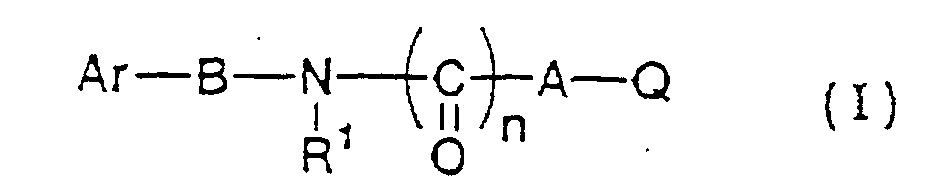 [wherein Ar is indole, naphthalene, quinoline, benzimidazole,
benzofuran, benzothiophene, benzisoxazole, or 2-ketobenzimidazoline,
each of which is unsubstituted or
substituted with the groups selected from the group
consisting of halogen, nitro group, acylamino group having 1
to 9 carbon atoms, amino group, alkylamino group having 1 to
8 carbon atoms, arylamino group having 6 to 15 carbon atoms,
dialkylamino group having 2 to 16 carbon atoms, diarylamino
group having 12 to 20 carbon atoms, hydroxy, alkyl group
having 1 to 8 carbon atoms, aryl group having 6 to 15 carbon
atoms, alkoxy group having 1 to 8 carbon atoms, aryloxy
group having 1 to 15 carbon atoms, haloalkyl group having 1
to 8 carbon atoms, haloalkoxy group having 1 to 8 carbon
atoms, cyano group, aminosulfonyl group having 0 to 15
carbon atoms, carboxyl group, alkoxycarbonyl group having 2
to 9 carbon atoms, aminocarbonyl group having 1 to 15 carbon
atoms, alkylthio group having 1 to 8 carbon atoms, and
arylthio group having 6 to 15 carbon atoms;
[wherein Ar is indole, naphthalene, quinoline, benzimidazole,
benzofuran, benzothiophene, benzisoxazole, or 2-ketobenzimidazoline,
each of which is unsubstituted or
substituted with the groups selected from the group
consisting of halogen, nitro group, acylamino group having 1
to 9 carbon atoms, amino group, alkylamino group having 1 to
8 carbon atoms, arylamino group having 6 to 15 carbon atoms,
dialkylamino group having 2 to 16 carbon atoms, diarylamino
group having 12 to 20 carbon atoms, hydroxy, alkyl group
having 1 to 8 carbon atoms, aryl group having 6 to 15 carbon
atoms, alkoxy group having 1 to 8 carbon atoms, aryloxy
group having 1 to 15 carbon atoms, haloalkyl group having 1
to 8 carbon atoms, haloalkoxy group having 1 to 8 carbon
atoms, cyano group, aminosulfonyl group having 0 to 15
carbon atoms, carboxyl group, alkoxycarbonyl group having 2
to 9 carbon atoms, aminocarbonyl group having 1 to 15 carbon
atoms, alkylthio group having 1 to 8 carbon atoms, and
arylthio group having 6 to 15 carbon atoms;
R1 is hydrogen, alkyl having 1 to 6 carbon atoms, aryl having 6 to 12 carbon atoms, alkenyl having 2 to 9 carbon atoms, or cycloalkyl having 3 to 8 carbon atoms;
B is a bond, or alkylene group having 1 to 3 carbon atoms which is unsubstituted or substituted with the groups selected from the group consisting of alkyl group having 1 to 8 carbon atoms, halogen, and hydroxy;
or B-N-R1 forms a ring structure and is piperidine, piperazine, or 2,3,6-trihydropyridine, each of which is unsubstituted or substituted with the groups selected from the group consisting of halogen, hydroxy, alkyl group having 1 to 8 carbon atoms, aryl group having 6 to 15 carbon atoms, haloalkyl group having 1 to 8 carbon atoms, aminosulfonyl group having 0 to 15 carbon atoms, carboxyl group, alkoxycarbonyl group having 2 to 9 carbon atoms, aminocarbonyl group having 1 to 15 carbon atoms, hydroxyalkyl group having 1 to 8 carbon atoms, alkylcarbonyl group having 2 to 9 carbon atoms, arylcarbonyl group having 7 to 16 carbon atoms, and aralkyl group having 7 to 15 carbon atoms;
n denotes an integer of 0 or 1;
A is alkylene having 2 to 8 carbon atoms, phenylene, or cycloalkylene having 3 to 8 carbon atoms, each of which is unsubstituted or substituted with the groups selected from the group consisting of halogen, nitro group, acylamino group having 1 to 9 carbon atoms, amino group, alkylamino group having 1 to 8 carbon atoms, arylamino group having 6 to 15 carbon atoms, dialkylamino group having 2 to 16 carbon atoms, diarylamino group having 12 to 20 carbon atoms, hydroxy, alkyl group having 1 to 8 carbon atoms, aryl group having 6 to 15 carbon atoms, alkoxy group having 1 to 8 carbon atoms, aryloxy group having 6 to 15 carbon atoms, haloalkyl group having 1 to 8 carbon atoms, haloalkoxy group having 1 to 8 carbon atoms, cyano group, aminosulfonyl group having 0 to 15 carbon atoms, carboxyl group, alkoxycarbonyl group having 2 to 9 carbon atoms, aminocarbonyl group having 1 to 15 carbon atoms, alkylthio group having 1 to 8 carbon atoms, and arylthio group having 6 to 15 carbon atoms; Q is:
R1 is hydrogen, alkyl having 1 to 6 carbon atoms, aryl having 6 to 12 carbon atoms, alkenyl having 2 to 9 carbon atoms, or cycloalkyl having 3 to 8 carbon atoms;
B is a bond, or alkylene group having 1 to 3 carbon atoms which is unsubstituted or substituted with the groups selected from the group consisting of alkyl group having 1 to 8 carbon atoms, halogen, and hydroxy;
or B-N-R1 forms a ring structure and is piperidine, piperazine, or 2,3,6-trihydropyridine, each of which is unsubstituted or substituted with the groups selected from the group consisting of halogen, hydroxy, alkyl group having 1 to 8 carbon atoms, aryl group having 6 to 15 carbon atoms, haloalkyl group having 1 to 8 carbon atoms, aminosulfonyl group having 0 to 15 carbon atoms, carboxyl group, alkoxycarbonyl group having 2 to 9 carbon atoms, aminocarbonyl group having 1 to 15 carbon atoms, hydroxyalkyl group having 1 to 8 carbon atoms, alkylcarbonyl group having 2 to 9 carbon atoms, arylcarbonyl group having 7 to 16 carbon atoms, and aralkyl group having 7 to 15 carbon atoms;
n denotes an integer of 0 or 1;
A is alkylene having 2 to 8 carbon atoms, phenylene, or cycloalkylene having 3 to 8 carbon atoms, each of which is unsubstituted or substituted with the groups selected from the group consisting of halogen, nitro group, acylamino group having 1 to 9 carbon atoms, amino group, alkylamino group having 1 to 8 carbon atoms, arylamino group having 6 to 15 carbon atoms, dialkylamino group having 2 to 16 carbon atoms, diarylamino group having 12 to 20 carbon atoms, hydroxy, alkyl group having 1 to 8 carbon atoms, aryl group having 6 to 15 carbon atoms, alkoxy group having 1 to 8 carbon atoms, aryloxy group having 6 to 15 carbon atoms, haloalkyl group having 1 to 8 carbon atoms, haloalkoxy group having 1 to 8 carbon atoms, cyano group, aminosulfonyl group having 0 to 15 carbon atoms, carboxyl group, alkoxycarbonyl group having 2 to 9 carbon atoms, aminocarbonyl group having 1 to 15 carbon atoms, alkylthio group having 1 to 8 carbon atoms, and arylthio group having 6 to 15 carbon atoms; Q is:
wherein each of R2 and R3 is independently hydrogen, alkyl having 1 to 6 carbon atoms, cycloalkyl having 3 to 8 carbon atoms, alkenyl having 2 to 9 carbon atoms, aryl having 6 to 15 carbon atoms, or aralkyl having 7 to 15 carbon atoms (wherein the aryl moiety of the aryl and aralkyl may be substituted with the groups selected from the group consisting of halogen, nitro group, acylamino group having 1 to 9 carbon atoms, amino group, alkylamino group having 1 to 8 carbon atoms, arylamino group having 6 to 15 carbon atoms, dialkylamino group having 2 to 16 carbon atoms, diarylamino group having 12 to 20 carbon atoms, hydroxy, alkyl group having 1 to 8 carbon atoms, aryl group having 6 to 15 carbon atoms, alkoxy group having 1 to 8 carbon atoms, aryloxy group having 6 to 15 carbon atoms, haloalkyl group having 1 to 8 carbon atoms, haloalkoxy group having 1 to 8 carbon atoms, cyano group, aminosulfonyl group having 0 to 15 carbon atoms, carboxyl group, alkoxycarbonyl group having 2 to 9 carbon atoms, aminocarbonyl group having 1 to 15 carbon atoms, alkylthio group having 1 to 8 carbon atoms, and arylthio group having 6 to 15 carbon atoms), or -NR2R3 together forms piperidine, pyrrolidine, 1,3,4-trihydroisoquinoline, isoindoline, piperazine, morpholine, 2-piperidone, 2-pyrrolidone, indoline, 2,3,4-trihydroquinoline, 2,3,4-trihydroquinoxaline, dihydrobenzoxazine, benzothiane, phthalimide, or guanidine, each of which is unsubstituted or substituted with the groups selected from the group consisting of halogen, nitro group, acylamino group having 1 to 9 carbon atoms, amino group, alkylamino group having 1 to 8 carbon atoms, arylamino group having 6 to 15 carbon atoms, dialkylamino group having 2 to 16 carbon atoms, diarylamino group having 12 to 20 carbon atoms, hydroxy, alkyl group having 1 to 8 carbon atoms, aryl group having 6 to 15 carbon atoms, alkoxy group having 1 to 8 carbon atoms, aryloxy group having 6 to 15 carbon atoms, haloalkyl group having 1 to 8 carbon atoms, haloalkoxy group having 1 to 8 carbon atoms, cyano group, aminosulfonyl group having 0 to 15 carbon atoms, carboxyl group, alkoxycarbonyl group having 2 to 9 carbon atoms, aminocarbonyl group having 1 to 15 carbon atoms, alkylthio group having 1 to 8 carbon atoms, and arylthio group having 6 to 15 carbon atoms; or

In another aspect, the present invention relates to a
compound represented by the general formula (III) or a
pharmacologically acceptable acid addition salt thereof:
 [wherein D represents one of the following formulae 1) to 5),
each of which is unsubstituted or substituted with the
groups selected from the group consisting of halogen,
hydroxy, alkyl group having 1 to 8 carbon atoms, aryl group
having 6 to 15 carbon atoms, haloalkyl group having 1 to 8
carbon atoms, aminosulfonyl group having 0 to 15 carbon
atoms, carboxyl group, alkoxycarbonyl group having 2 to 9
carbon atoms, aminocarbonyl group having 1 to 15 carbon
atoms, hydroxyalkyl group having 1 to 8 carbon atoms,
alkylcarbonyl group having 2 to 9 carbon atoms, arylcarbonyl
group having 7 to 16 carbon atoms, and aralkyl group having
7 to 15 carbon atoms;
[wherein D represents one of the following formulae 1) to 5),
each of which is unsubstituted or substituted with the
groups selected from the group consisting of halogen,
hydroxy, alkyl group having 1 to 8 carbon atoms, aryl group
having 6 to 15 carbon atoms, haloalkyl group having 1 to 8
carbon atoms, aminosulfonyl group having 0 to 15 carbon
atoms, carboxyl group, alkoxycarbonyl group having 2 to 9
carbon atoms, aminocarbonyl group having 1 to 15 carbon
atoms, hydroxyalkyl group having 1 to 8 carbon atoms,
alkylcarbonyl group having 2 to 9 carbon atoms, arylcarbonyl
group having 7 to 16 carbon atoms, and aralkyl group having
7 to 15 carbon atoms;
 Ar2 is indole, naphthalene, quinoline, benzimidazole,
benzofuran, or benzothiophene, each of which is
unsubstituted or substituted with the groups selected from
the group consisting of halogen, nitro group, acylamino
group having 1 to 9 carbon atoms, amino group, alkylamino
group having 1 to 8 carbon atoms, arylamino group having 6
to 15 carbon atoms, dialkylamino group having 2 to 16 carbon
atoms, diarylamino group having 12 to 20 carbon atoms,
hydroxy, alkyl group having 1 to 8 carbon atoms, aryl group
having 6 to 15 carbon atoms, alkoxy group having 1 to 8
carbon atoms, aryloxy group having 6 to 15 carbon atoms,
haloalkyl group having 1 to 8 carbon atoms, haloalkoxy group
having 1 to 8 carbon atoms, cyano group, aminosulfonyl group
having 0 to 15 carbon atoms, carboxyl group, alkoxycarbonyl
group having 2 to 9 carbon atoms, aminocarbonyl group having
1 to 15 carbon atoms, alkylthio group having 1 to 8 carbon
atoms, and arylthio group having 6 to 15 carbon atoms;
Ar2 is indole, naphthalene, quinoline, benzimidazole,
benzofuran, or benzothiophene, each of which is
unsubstituted or substituted with the groups selected from
the group consisting of halogen, nitro group, acylamino
group having 1 to 9 carbon atoms, amino group, alkylamino
group having 1 to 8 carbon atoms, arylamino group having 6
to 15 carbon atoms, dialkylamino group having 2 to 16 carbon
atoms, diarylamino group having 12 to 20 carbon atoms,
hydroxy, alkyl group having 1 to 8 carbon atoms, aryl group
having 6 to 15 carbon atoms, alkoxy group having 1 to 8
carbon atoms, aryloxy group having 6 to 15 carbon atoms,
haloalkyl group having 1 to 8 carbon atoms, haloalkoxy group
having 1 to 8 carbon atoms, cyano group, aminosulfonyl group
having 0 to 15 carbon atoms, carboxyl group, alkoxycarbonyl
group having 2 to 9 carbon atoms, aminocarbonyl group having
1 to 15 carbon atoms, alkylthio group having 1 to 8 carbon
atoms, and arylthio group having 6 to 15 carbon atoms;
A is alkylene having 3 to 8 carbon atoms, phenylene, or cycloalkylene having 3 to 8 carbon atoms, each of which is unsubstituted or substituted with the groups selected from the group consisting of halogen, nitro group, acylamino group having 1 to 9 carbon atoms, amino group, alkylamino group having 1 to 8 carbon atoms, arylamino group having 6 to 15 carbon atoms, dialkylamino group having 2 to 16 carbon atoms, diarylamino group having 12 to 20 carbon atoms, hydroxy, alkyl group having 1 to 8 carbon atoms, aryl group having 6 to 15 carbon atoms, alkoxy group having 1 to 8 carbon atoms, aryloxy group having 6 to 15 carbon atoms, haloalkyl group having 1 to 8 carbon atoms, haloalkoxy group having 1 to 8 carbon atoms, cyano group, aminosulfonyl group having 0 to 15 carbon atoms, carboxyl group, alkoxycarbonyl group having 2 to 9 carbon atoms, aminocarbonyl group having 1 to 15 carbon atoms, alkylthio group having 1 to 8 carbon atoms, and arylthio group having 6 to 15 carbon atoms; Q2 is:
A is alkylene having 3 to 8 carbon atoms, phenylene, or cycloalkylene having 3 to 8 carbon atoms, each of which is unsubstituted or substituted with the groups selected from the group consisting of halogen, nitro group, acylamino group having 1 to 9 carbon atoms, amino group, alkylamino group having 1 to 8 carbon atoms, arylamino group having 6 to 15 carbon atoms, dialkylamino group having 2 to 16 carbon atoms, diarylamino group having 12 to 20 carbon atoms, hydroxy, alkyl group having 1 to 8 carbon atoms, aryl group having 6 to 15 carbon atoms, alkoxy group having 1 to 8 carbon atoms, aryloxy group having 6 to 15 carbon atoms, haloalkyl group having 1 to 8 carbon atoms, haloalkoxy group having 1 to 8 carbon atoms, cyano group, aminosulfonyl group having 0 to 15 carbon atoms, carboxyl group, alkoxycarbonyl group having 2 to 9 carbon atoms, aminocarbonyl group having 1 to 15 carbon atoms, alkylthio group having 1 to 8 carbon atoms, and arylthio group having 6 to 15 carbon atoms; Q2 is:
wherein each of R2 and R3 is independently hydrogen, alkyl having 1 to 6 carbon atoms, cycloalkyl having 3 to 8 carbon atoms, alkenyl having 2 to 9 carbon atoms, aryl having 6 to 15 carbon atoms, or aralkyl having 7 to 15 carbon atoms (wherein the aryl moiety of the aryl and aralkyl may be substituted with the groups selected from the group consisting of halogen, nitro group, acylamino group having 1 to 9 carbon atoms, amino group, alkylamino group having 1 to 8 carbon atoms, arylamino group having 6 to 15 carbon atoms, dialkylamino group having 2 to 16 carbon atoms, diarylamino group having 12 to 20 carbon atoms, hydroxy, alkyl group having 1 to 8 carbon atoms, aryl group having 6 to 15 carbon atoms, alkoxy group having 1 to 8 carbon atoms, aryloxy group having 6 to 15 carbon atoms, haloalkyl group having 1 to 8 carbon atoms, haloalkoxy group having 1 to 8 carbon atoms, cyano group, aminosulfonyl group having 0 to 15 carbon atoms, carboxyl group, alkoxycarbonyl group having 2 to 9 carbon atoms, aminocarbonyl group having 1 to 15 carbon atoms, alkylthio group having 1 to 8 carbon atoms, and arylthio group having 6 to 15 carbon atoms, where R2=R3=H and R2=R3=ethyl are excluded), or -NR2R3 together forms piperidine, pyrrolidine, 1,3,4-trihydroisoquinoline, isoindoline, piperazine, morpholine, 2-piperidone, 2-pyrrolidone, indoline, 2,3,4-trihydroquinoline, 2,3,4-trihydroquinoxaline, dihydrobenzoxazine, or guanidine, each of which is unsubstituted or substituted with the groups selected from the group consisting of halogen, nitro group, acylamino group having 1 to 9 carbon atoms, amino group, alkylamino group having 1 to 8 carbon atoms, arylamino group having 6 to 15 carbon atoms, dialkylamino group having 2 to 16 carbon atoms, diarylamino group having 12 to 20 carbon atoms, hydroxy, alkyl group having 1 to 8 carbon atoms, aryl group having 6 to 15 carbon atoms, alkoxy group having 1 to 8 carbon atoms, aryloxy group having 6 to 15 carbon atoms, haloalkyl group having 1 to 8 carbon atoms, haloalkoxy group having 1 to 8 carbon atoms, cyano group, aminosulfonyl group having 0 to 15 carbon atoms, carboxyl group, alkoxycarbonyl group having 2 to 9 carbon atoms, aminocarbonyl group having 1 to 15 carbon atoms, alkylthio group having 1 to 8 carbon atoms, and arylthio group having 6 to 15 carbon atoms; or
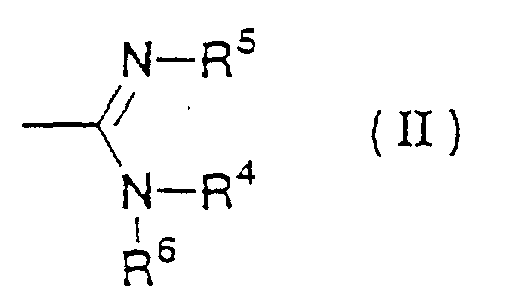
Of α1B adrenoceptor antagonists according to the
present invention including a compound represented by the
general formula (I) or a pharmaceutically acceptable acid
addition salt thereof, preferred compounds are compounds in
which n is 0;
Ar is indole, naphthalene, quinoline, benzimidazole, benzofuran, or benzothiophene, each of which is unsubstituted or substituted with the groups selected from the group consisting of halogen, nitro group, acylamino group having 1 to 9 carbon atoms, amino group, alkylamino group having 1 to 8 carbon atoms, arylamino group having 6 to 15 carbon atoms, dialkylamino group having 2 to 16 carbon atoms, diarylamino group having 12 to 20 carbon atoms, hydroxy, alkyl group having 1 to 8 carbon atoms, aryl group having 6 to 15 carbon atoms, alkoxy group having 1 to 8 carbon atoms, aryloxy group having 6 to 15 carbon atoms, haloalkyl group having 1 to 8 carbon atoms, haloalkoxy group having 1 to 8 carbon atoms, cyano group, aminosulfonyl group having 0 to 15 carbon atoms, carboxyl group, alkoxycarbonyl group having 2 to 9 carbon atoms, aminocarbonyl group having 1 to 15 carbon atoms, alkylthio group having 1 to 8 carbon atoms, and arylthio group having 6 to 15 carbon atoms;
B is alkylene having 2 or 3 carbon atoms, which is unsubstituted or substituted with the groups selected from the group consisting of alkyl group having 1 to 8 carbon atoms, halogen, and hydroxy, or
B-N-R1 forms a ring structure and is piperidine, piperazine, or 2,3,6-trihydropyridine, each of which is unsubstituted or substituted with the groups selected from the group consisting of halogen, hydroxy, alkyl group having 1 to 8 carbon atoms, aryl group having 6 to 15 carbon atoms, haloalkyl group having 1 to 8 carbon atoms, aminosulfonyl group having 0 to 15 carbon atoms, carboxyl group, alkoxycarbonyl group having 2 to 9 carbon atoms, aminocarbonyl group having 1 to 15 carbon atoms, hydroxyalkyl group having 1 to 8 carbon atoms, alkylcarbonyl group having 2 to 9 carbon atoms, arylcarbonyl group having 7 to 16 carbon atoms, and aralkyl group having 7 to 15 carbon atoms;
Q is:
Ar is indole, naphthalene, quinoline, benzimidazole, benzofuran, or benzothiophene, each of which is unsubstituted or substituted with the groups selected from the group consisting of halogen, nitro group, acylamino group having 1 to 9 carbon atoms, amino group, alkylamino group having 1 to 8 carbon atoms, arylamino group having 6 to 15 carbon atoms, dialkylamino group having 2 to 16 carbon atoms, diarylamino group having 12 to 20 carbon atoms, hydroxy, alkyl group having 1 to 8 carbon atoms, aryl group having 6 to 15 carbon atoms, alkoxy group having 1 to 8 carbon atoms, aryloxy group having 6 to 15 carbon atoms, haloalkyl group having 1 to 8 carbon atoms, haloalkoxy group having 1 to 8 carbon atoms, cyano group, aminosulfonyl group having 0 to 15 carbon atoms, carboxyl group, alkoxycarbonyl group having 2 to 9 carbon atoms, aminocarbonyl group having 1 to 15 carbon atoms, alkylthio group having 1 to 8 carbon atoms, and arylthio group having 6 to 15 carbon atoms;
B is alkylene having 2 or 3 carbon atoms, which is unsubstituted or substituted with the groups selected from the group consisting of alkyl group having 1 to 8 carbon atoms, halogen, and hydroxy, or
B-N-R1 forms a ring structure and is piperidine, piperazine, or 2,3,6-trihydropyridine, each of which is unsubstituted or substituted with the groups selected from the group consisting of halogen, hydroxy, alkyl group having 1 to 8 carbon atoms, aryl group having 6 to 15 carbon atoms, haloalkyl group having 1 to 8 carbon atoms, aminosulfonyl group having 0 to 15 carbon atoms, carboxyl group, alkoxycarbonyl group having 2 to 9 carbon atoms, aminocarbonyl group having 1 to 15 carbon atoms, hydroxyalkyl group having 1 to 8 carbon atoms, alkylcarbonyl group having 2 to 9 carbon atoms, arylcarbonyl group having 7 to 16 carbon atoms, and aralkyl group having 7 to 15 carbon atoms;
Q is:

Among them, more preferred compounds are compounds in
which n is 0;
Ar is indole, naphthalene, quinoline, or benzimidazole, each of which is unsubstituted or substituted with the groups selected from the group consisting of halogen, nitro group, acylamino group having 1 to 9 carbon atoms, amino group, alkylamino group having 1 to 8 carbon atoms, arylamino group having 6 to 15 carbon atoms, dialkylamino group having 2 to 16 carbon atoms, diarylamino group having 12 to 20 carbon atoms, hydroxy, alkyl group having 1 to 8 carbon atoms, aryl group having 6 to 15 carbon atoms, alkoxy group having 1 to 8 carbon atoms, aryloxy group having 6 to 15 carbon atoms, haloalkyl group having 1 to 8 carbon atoms, haloalkoxy group having 1 to 8 carbon atoms, cyano group, aminosulfonyl group having 0 to 15 carbon atoms, carboxyl group, alkoxycarbonyl group having 2 to 9 carbon atoms, aminocarbonyl group having 1 to 15 carbon atoms, alkylthio group having 1 to 8 carbon atoms, and arylthio group having 6 to 15 carbon atoms;
B-N-R1 forms a ring structure and is piperidine or piperazine, each of which is unsubstituted or substituted with the groups selected from the group consisting of halogen, hydroxy, alkyl group having 1 to 8 carbon atoms, aryl group having 6 to 15 carbon atoms, haloalkyl group having 1 to 8 carbon atoms, aminosulfonyl group having 0 to 15 carbon atoms, carboxyl group, alkoxycarbonyl group having 2 to 9 carbon atoms, aminocarbonyl group having 1 to 15 carbon atoms, hydroxyalkyl group having 1 to 8 carbon atoms, alkylcarbonyl group having 2 to 9 carbon atoms, arylcarbonyl group having 7 to 16 carbon atoms, and aralkyl group having 7 to 15 carbon atoms;
A is alkylene having 2 to 8 carbon atoms or cycloalkylene having 3 to 8 carbon atoms, each of which is unsubstituted or substituted with the groups selected from the group consisting of halogen, nitro group, acylamino group having 1 to 9 carbon atoms, amino group, alkylamino group having 1 to 8 carbon atoms, arylamino group having 6 to 15 carbon atoms, dialkylamino group having 2 to 16 carbon atoms, diarylamino group having 12 to 20 carbon atoms, hydroxy, alkyl group having 1 to 8 carbon atoms, aryl group having 6 to 15 carbon atoms, alkoxy group having 1 to 8 carbon atoms, aryloxy group having 6 to 15 carbon atoms, haloalkyl group having 1 to 8 carbon atoms, haloalkoxy group having 1 to 8 carbon atoms, cyano group, aminosulfonyl group having 0 to 15 carbon atoms, carboxyl group, alkoxycarbonyl group having 2 to 9 carbon atoms, aminocarbonyl group having 1 to 15 carbon atoms, alkylthio group having 1 to 8 carbon atoms, and arylthio group having 6 to 15 carbon atoms;
Q is:
1) -NR2R3 (wherein each of R2 and R3 is independently hydrogen, alkyl having 1 to 6 carbon atoms, cycloalkyl having 3 to 8 carbon atoms, alkenyl having 2 to 9 carbon atoms, aryl having 6 to 15 carbon atoms, or aralkyl having 7 to 15 carbon atoms (wherein the aryl moiety of the aryl and aralkyl may be substituted with the groups selected from the group consisting of halogen, nitro group, acylamino group having 1 to 9 carbon atoms, amino group, alkylamino group having 1 to 8 carbon atoms, arylamino group having 6 to 15 carbon atoms, dialkylamino group having 2 to 16 carbon atoms, diarylamino group having 12 to 20 carbon atoms, hydroxy, alkyl group having 1 to 8 carbon atoms, aryl group having 6 to 15 carbon atoms, alkoxy group having 1 to 8 carbon atoms, aryloxy group having 6 to 15 carbon atoms, haloalkyl group having 1 to 8 carbon atoms, haloalkoxy group having 1 to 8 carbon atoms, cyano group, aminosulfonyl group having 0 to 15 carbon atoms, carboxyl group, alkoxycarbonyl group having 2 to 9 carbon atoms, aminocarbonyl group having 1 to 15 carbon atoms, alkylthio group having 1 to 8 carbon atoms, and arylthio group having 6 to 15 carbon atoms),or-NR2R3 together forms piperidine, pyrrolidine, 1,3,4-trihydroisoquinoline, isoindoline, piperazine, morpholine, or guanidine, each of which is unsubstituted or substituted with the groups selected from the group consisting of halogen, nitro group, acylamino group having 1 to 9 carbon atoms, amino group, alkylamino group having 1 to 8 carbon atoms, arylamino group having 6 to 15 carbon atoms, dialkylamino group having 2 to 16 carbon atoms, diarylamino group having 12 to 20 carbon atoms, hydroxy, alkyl group having 1 to 8 carbon atoms, aryl group having 6 to 15 carbon atoms, alkoxy group having 1 to 8 carbon atoms, aryloxy group having 6 to 15 carbon atoms, haloalkyl group having 1 to 8 carbon atoms, haloalkoxy group having 1 to 8 carbon atoms, cyano group, aminosulfonyl group having 0 to 15 carbon atoms, carboxyl group, alkoxycarbonyl group having 2 to 9 carbon atoms, aminocarbonyl group having 1 to 15 carbon atoms, alkylthio group having 1 to 8 carbon atoms, and arylthio group having 6 to 15 carbon atoms; or 2) the formula (II): (wherein R4, R5, and R6 have the same meanings as defined
above).
(wherein R4, R5, and R6 have the same meanings as defined
above).
Ar is indole, naphthalene, quinoline, or benzimidazole, each of which is unsubstituted or substituted with the groups selected from the group consisting of halogen, nitro group, acylamino group having 1 to 9 carbon atoms, amino group, alkylamino group having 1 to 8 carbon atoms, arylamino group having 6 to 15 carbon atoms, dialkylamino group having 2 to 16 carbon atoms, diarylamino group having 12 to 20 carbon atoms, hydroxy, alkyl group having 1 to 8 carbon atoms, aryl group having 6 to 15 carbon atoms, alkoxy group having 1 to 8 carbon atoms, aryloxy group having 6 to 15 carbon atoms, haloalkyl group having 1 to 8 carbon atoms, haloalkoxy group having 1 to 8 carbon atoms, cyano group, aminosulfonyl group having 0 to 15 carbon atoms, carboxyl group, alkoxycarbonyl group having 2 to 9 carbon atoms, aminocarbonyl group having 1 to 15 carbon atoms, alkylthio group having 1 to 8 carbon atoms, and arylthio group having 6 to 15 carbon atoms;
B-N-R1 forms a ring structure and is piperidine or piperazine, each of which is unsubstituted or substituted with the groups selected from the group consisting of halogen, hydroxy, alkyl group having 1 to 8 carbon atoms, aryl group having 6 to 15 carbon atoms, haloalkyl group having 1 to 8 carbon atoms, aminosulfonyl group having 0 to 15 carbon atoms, carboxyl group, alkoxycarbonyl group having 2 to 9 carbon atoms, aminocarbonyl group having 1 to 15 carbon atoms, hydroxyalkyl group having 1 to 8 carbon atoms, alkylcarbonyl group having 2 to 9 carbon atoms, arylcarbonyl group having 7 to 16 carbon atoms, and aralkyl group having 7 to 15 carbon atoms;
A is alkylene having 2 to 8 carbon atoms or cycloalkylene having 3 to 8 carbon atoms, each of which is unsubstituted or substituted with the groups selected from the group consisting of halogen, nitro group, acylamino group having 1 to 9 carbon atoms, amino group, alkylamino group having 1 to 8 carbon atoms, arylamino group having 6 to 15 carbon atoms, dialkylamino group having 2 to 16 carbon atoms, diarylamino group having 12 to 20 carbon atoms, hydroxy, alkyl group having 1 to 8 carbon atoms, aryl group having 6 to 15 carbon atoms, alkoxy group having 1 to 8 carbon atoms, aryloxy group having 6 to 15 carbon atoms, haloalkyl group having 1 to 8 carbon atoms, haloalkoxy group having 1 to 8 carbon atoms, cyano group, aminosulfonyl group having 0 to 15 carbon atoms, carboxyl group, alkoxycarbonyl group having 2 to 9 carbon atoms, aminocarbonyl group having 1 to 15 carbon atoms, alkylthio group having 1 to 8 carbon atoms, and arylthio group having 6 to 15 carbon atoms;
Q is:
1) -NR2R3 (wherein each of R2 and R3 is independently hydrogen, alkyl having 1 to 6 carbon atoms, cycloalkyl having 3 to 8 carbon atoms, alkenyl having 2 to 9 carbon atoms, aryl having 6 to 15 carbon atoms, or aralkyl having 7 to 15 carbon atoms (wherein the aryl moiety of the aryl and aralkyl may be substituted with the groups selected from the group consisting of halogen, nitro group, acylamino group having 1 to 9 carbon atoms, amino group, alkylamino group having 1 to 8 carbon atoms, arylamino group having 6 to 15 carbon atoms, dialkylamino group having 2 to 16 carbon atoms, diarylamino group having 12 to 20 carbon atoms, hydroxy, alkyl group having 1 to 8 carbon atoms, aryl group having 6 to 15 carbon atoms, alkoxy group having 1 to 8 carbon atoms, aryloxy group having 6 to 15 carbon atoms, haloalkyl group having 1 to 8 carbon atoms, haloalkoxy group having 1 to 8 carbon atoms, cyano group, aminosulfonyl group having 0 to 15 carbon atoms, carboxyl group, alkoxycarbonyl group having 2 to 9 carbon atoms, aminocarbonyl group having 1 to 15 carbon atoms, alkylthio group having 1 to 8 carbon atoms, and arylthio group having 6 to 15 carbon atoms),or-NR2R3 together forms piperidine, pyrrolidine, 1,3,4-trihydroisoquinoline, isoindoline, piperazine, morpholine, or guanidine, each of which is unsubstituted or substituted with the groups selected from the group consisting of halogen, nitro group, acylamino group having 1 to 9 carbon atoms, amino group, alkylamino group having 1 to 8 carbon atoms, arylamino group having 6 to 15 carbon atoms, dialkylamino group having 2 to 16 carbon atoms, diarylamino group having 12 to 20 carbon atoms, hydroxy, alkyl group having 1 to 8 carbon atoms, aryl group having 6 to 15 carbon atoms, alkoxy group having 1 to 8 carbon atoms, aryloxy group having 6 to 15 carbon atoms, haloalkyl group having 1 to 8 carbon atoms, haloalkoxy group having 1 to 8 carbon atoms, cyano group, aminosulfonyl group having 0 to 15 carbon atoms, carboxyl group, alkoxycarbonyl group having 2 to 9 carbon atoms, aminocarbonyl group having 1 to 15 carbon atoms, alkylthio group having 1 to 8 carbon atoms, and arylthio group having 6 to 15 carbon atoms; or 2) the formula (II):
Of these compounds, especially preferred compounds are
compounds in which n is 0;
Ar is indole or naphthalene, each of which is unsubstituted or substituted with the groups selected from the group consisting of halogen, nitro group, acylamino group having 1 to 9 carbon atoms, amino group, alkylamino group having 1 to 8 carbon atoms, arylamino group having 6 to 15 carbon atoms, dialkylamino group having 2 to 16 carbon atoms, diarylamino group having 12 to 20 carbon atoms, hydroxy, alkyl group having 1 to 8 carbon atoms, aryl group having 6 to 15 carbon atoms, alkoxy group having 1 to 8 carbon atoms, aryloxy group having 6 to 15 carbon atoms, haloalkyl group having 1 to 8 carbon atoms, haloalkoxy group having 1 to 8 carbon atoms, cyano group, aminosulfonyl group having 0 to 15 carbon atoms, carboxyl group, alkoxycarbonyl group having 2 to 9 carbon atoms, aminocarbonyl group having 1 to 15 carbon atoms, alkylthio group having 1 to 8 carbon atoms, and arylthio group having 6 to 15 carbon atoms;
B-N-R1 forms a ring structure and is represented by the following formula 1) or 2), each of which is unsubstituted or substituted with the groups selected from the group consisting of halogen, hydroxy, alkyl group having 1 to 8 carbon atoms, aryl group having 6 to 15 carbon atoms, haloalkyl group having 1 to 8 carbon atoms, aminosulfonyl group having 0 to 15 carbon atoms, carboxyl group, alkoxycarbonyl group having 2 to 9 carbon atoms, aminocarbonyl group having 1 to 15 carbon atoms, hydroxyalkyl group having 1 to 8 carbon atoms, alkylcarbonyl group having 2 to 9 carbon atoms, arylcarbonyl group having 7 to 16 carbon atoms, and aralkyl group having 7 to 15 carbon atoms;
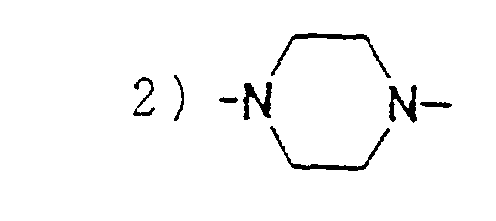 A is alkylene having 3 to 8 carbon atoms, which is
unsubstituted or substituted with the groups selected from
the group consisting of halogen, nitro group, acylamino
group having 1 to 9 carbon atoms, amino group, alkylamino
group having 1 to 8 carbon atoms, arylamino group having 6
to 15 carbon atoms, dialkylamino group having 2 to 16 carbon
atoms, diarylamino group having 12 to 20 carbon atoms,
hydroxy, alkyl group having 1 to 8 carbon atoms, aryl group
having 6 to 15 carbon atoms, alkoxy group having 1 to 8
carbon atoms, aryloxy group having 6 to 15 carbon atoms,
haloalkyl group having 1 to 8 carbon atoms, haloalkoxy group
having 1 to 8 carbon atoms, cyano group, aminosulfonyl group
having 0 to 15 carbon atoms, carboxyl group, alkoxycarbonyl
group having 2 to 9 carbon atoms, aminocarbonyl group having
1 to 15 carbon atoms, alkylthio group having 1 to 8 carbon
atoms, and arylthio group having 6 to 15 carbon atoms;
Q is:
A is alkylene having 3 to 8 carbon atoms, which is
unsubstituted or substituted with the groups selected from
the group consisting of halogen, nitro group, acylamino
group having 1 to 9 carbon atoms, amino group, alkylamino
group having 1 to 8 carbon atoms, arylamino group having 6
to 15 carbon atoms, dialkylamino group having 2 to 16 carbon
atoms, diarylamino group having 12 to 20 carbon atoms,
hydroxy, alkyl group having 1 to 8 carbon atoms, aryl group
having 6 to 15 carbon atoms, alkoxy group having 1 to 8
carbon atoms, aryloxy group having 6 to 15 carbon atoms,
haloalkyl group having 1 to 8 carbon atoms, haloalkoxy group
having 1 to 8 carbon atoms, cyano group, aminosulfonyl group
having 0 to 15 carbon atoms, carboxyl group, alkoxycarbonyl
group having 2 to 9 carbon atoms, aminocarbonyl group having
1 to 15 carbon atoms, alkylthio group having 1 to 8 carbon
atoms, and arylthio group having 6 to 15 carbon atoms;
Q is:
Ar is indole or naphthalene, each of which is unsubstituted or substituted with the groups selected from the group consisting of halogen, nitro group, acylamino group having 1 to 9 carbon atoms, amino group, alkylamino group having 1 to 8 carbon atoms, arylamino group having 6 to 15 carbon atoms, dialkylamino group having 2 to 16 carbon atoms, diarylamino group having 12 to 20 carbon atoms, hydroxy, alkyl group having 1 to 8 carbon atoms, aryl group having 6 to 15 carbon atoms, alkoxy group having 1 to 8 carbon atoms, aryloxy group having 6 to 15 carbon atoms, haloalkyl group having 1 to 8 carbon atoms, haloalkoxy group having 1 to 8 carbon atoms, cyano group, aminosulfonyl group having 0 to 15 carbon atoms, carboxyl group, alkoxycarbonyl group having 2 to 9 carbon atoms, aminocarbonyl group having 1 to 15 carbon atoms, alkylthio group having 1 to 8 carbon atoms, and arylthio group having 6 to 15 carbon atoms;
B-N-R1 forms a ring structure and is represented by the following formula 1) or 2), each of which is unsubstituted or substituted with the groups selected from the group consisting of halogen, hydroxy, alkyl group having 1 to 8 carbon atoms, aryl group having 6 to 15 carbon atoms, haloalkyl group having 1 to 8 carbon atoms, aminosulfonyl group having 0 to 15 carbon atoms, carboxyl group, alkoxycarbonyl group having 2 to 9 carbon atoms, aminocarbonyl group having 1 to 15 carbon atoms, hydroxyalkyl group having 1 to 8 carbon atoms, alkylcarbonyl group having 2 to 9 carbon atoms, arylcarbonyl group having 7 to 16 carbon atoms, and aralkyl group having 7 to 15 carbon atoms;

As examples of substituents on Ar in the compounds
represented by the general formula (I), halogen includes
fluoro, chloro, bromo, and iodo; acylamino group having 1 to
9 carbon atoms includes -NHCOCH3 and -NHCOPh; alkylamino
group having 1 to 8 carbon atoms includes methylamino,
ethylamino, n-propylamino, isopropylamino, and
cyclohexylamino; arylamino group having 6 to 15 carbon atoms
includes phenylamino; dialkylamino group having 2 to 16
carbon atoms includes dimethylamino, diethylamino, di(npropyl)amino,
diisopropylamino, and di(cyclohexyl)amino;
diarylamino group having 12 to 20 carbon atoms includes
diphenylamino; alkyl group having 1 to 8 carbon atoms
includes methyl, ethyl, n-propyl, isopropyl, n-butyl,
isobutyl, sec-butyl, t-butyl, n-pentyl, isopentyl, neopentyl,
n-hexyl, and cyclohexyl; aryl group having 6 to 15 carbon
atoms includes phenyl, naphthyl, and biphenyl; alkoxy group
having 1 to 8 carbon atoms includes methoxy, ethoxy, npropoxy,
isopropoxy, and cyclohexyloxy; aryloxy group having
6 to 15 carbon atoms includes phenoxy; haloalkyl group
having 1 to 8 carbon atoms includes trifluoromethyl and
2,2,2-trifluoroethyl; haloalkoxy group having 1 to 8 carbon
atoms includes trifluoromethoxy and 2,2,2-trifluoroethoxy;
aminosulfonyl group having 0 to 15 carbon atoms includes
-SO2NH2,-SO2NHMe, -SO2NMe2, -SO2NHPh, and -SO2NPh2;
alkoxycarbonyl group having 1 to 9 carbon atoms includes
-COOMe, and -COOEt; aminocarbonyl group having 1 to 15
carbon atoms includes -CONH2, -CONHMe, -CONMe2, -CONHtBu,
-CONHPh, and -CONPh2; alkylthio group having 1 to 8 carbon
atoms includes methylthio, ethylthio, n-propylthio, and
isopropylthio; arylthio group having 6 to 15 carbon atoms
includes phenylthio; and other substituents include nitro,
amino, hydroxy, cyano, and -COOH. Of these substituents,
preferred are identical or different one or two fluoro,
chloro, bromo, nitro, -NHCOCH3, -NHCOPh, amino, methylamino,
ethylamino, n-propylamino, isopropylamino, phenylamino,
dimethylamino, diethylamino, di (n-propyl) amino,
diisopropylamino, hydroxy, methoxy, ethoxy, n-propoxy,
isopropoxy, phenoxy, trifluoromethyl, trifluoromethoxy,
2,2,2-trifluoroethoxy, cyano, -SO2NH2, -SO2NHMe, -SO2NMe2,
-SO2NHPh, -CONH2, -CONHMe, -CONMe2, -CONHtBu, methylthio,
ethylthio, and phenylthio. Among them, more preferred are
identical or different one or two fluoro, chloro, bromo,
nitro, -NHCOCH3, amino, methylamino, isopropylamino,
phenylamino, dimethylamino, diisopropylamino, hydroxy,
methoxy, ethoxy, isopropoxy, trifluoromethyl,
trifluoromethoxy, cyano, -SO2NH2, -SO2NHMe, -SO2NMe2, -SO2NHPh,
-CONH2, -CONMe2, methylthio, and phenylthio, of which
identical or different one or two fluoro, chloro, bromo,
nitro, amino, methylamino, methoxy, ethoxy, trifluoromethyl,
trifluoromethoxy, -SO2NH2, and -CONH2 are especially
preferred.
In B, preferred alkylene having 1 to 3 carbon atoms,
which may be substituted with alkyl group having 1 to 8
carbon atoms, halogen, or hydroxyl group, are ethylene, 1-methylethylene,
2-methylethylene, 1-chloroethylene, 1-fluoroethylene,
2-chloroethylene, 2-fluoroethylene, 1-hydroxyethylene,
1,3-trimethylene, 1,3-(2-methyl)trimethylene,
1,3-(3-methyl)trimethylene, 1,3-(2-chloro)trimethylene,
1,3-(2-fluoro)trimethylene, 1,3-(2,2-difluoro)trimethylene,
1,3-(2-hydroxy)trimethylene, and 1,3-(1-hydroxy)trimethylene.
Among them, ethylene, 2-methylethylene,
2-fluoroethylene, 1-hydroxyethylene, 1,3-trimethylene,
1, 3- (2-methyl) trimethylene, 1,3-(3-methyl)trimethylene,
and 1,3-(1-hydroxy)trimethylene are
more preferred, of which ethylene, 1-hydroxyethylene, and 2-methylethylene
are especially preferred.
When B-N-R1 is piperidine, piperazine, or 2,3,6-trihydropyridine,
Ar is preferably substituted at the 3- or
4-position, and is typically preferably substituted at the
4-position.
As examples of substituents on piperidine, piperazine,
or 2,3,6-trihydropyridine in the above case, halogen
includes fluoro, chloro, and bromo; alkyl group having 1 to
8 carbon atoms includes methyl, ethyl, n-propyl, isopropyl,
n-butyl, isobutyl, sec-butyl, t-butyl, n-pentyl, isopentyl,
neopentyl, n-hexyl, and cyclohexyl; aryl group having 6 to
15 carbon atoms includes phenyl, naphthyl, and biphenyl;
haloalkyl group having 1 to 8 carbon atoms includes
trifluoromethyl and 2,2,2-trifluoroethyl; aminosulfonyl
group having 0 to 15 carbon atoms includes -SO2NH2, -SO2NHMe,
-SO2NMe2, -SO2MHPh, and -SO2NPh2; alkoxycarbonyl group having
2 to 9 carbon atoms includes -COOMe, and -COOEt;
aminocarbonyl group having 1 to 15 carbon atoms includes
-CONH2, -CONHMe, -CONMe2, -CONHtBu, -CONHPh, and -CONPh2;
hydroxyalkyl group having 1 to 8 carbon atoms includes
hydroxymethyl, 1-hydroxyethyl, 2-hydroxyethyl, and 3-hydroxypropyl;
alkylcarbonyl group having 2 to 9 carbon
atoms includes -COMe, and -COEt; arylcarbonyl having 7 to 16
carbon atoms includes -COPh, naphthylcarbonyl, and 2-furanylcarbonyl;
aralkyl having 7 to 15 carbon atoms
includes benzyl, 2-phenylethyl, and 3-phenylpropyl; and
other substituents include hydroxy and -COOH. Among these
substituents, preferred are identical or different one or
two fluoro, -NHCOCH3, -NHCOPh, hydroxy, methyl, isopropyl,
t-butyl, phenyl, trifluoromethyl, trifluoromethoxy, -SO2NH2,
-SO2NHMe, -SO2NMe2, -SO2NHPh,-SO2NPh2, -COOH, -COOMe, -CONH2,
-CONHMe, -CONMe2, -CONHtBu, -CONHPh, and -CONPh2. Among them,
identical or different one or two fluoro, hydroxy, methyl,
isopropyl, phenyl, trifluoromethyl, trifluoromethoxy, -SO2NH2,
-SO2NHMe, -SO2NHPh, -COOH, -COOMe, -CONH2, -CONHMe, -CONHtBu,
and -CONMe2 are more preferred, of which one fluoro, hydroxy,
methyl, phenyl, trifluoromethyl, -SO2NH2, -CONH2, and
-CONHtBu are especially preferred.
In R1, alkyl having 1 to 6 carbon atoms includes methyl,
ethyl, n-propyl, isopropyl, n-butyl, isobutyl, sec-butyl, tbutyl,
n-pentyl, isopentyl, neopentyl, and n-hexyl; aryl
having 6 to 12 carbon atoms includes phenyl, naphthyl, and
biphenyl; alkenyl having 2 to 9 carbon atoms includes
ethenyl, 2-propenyl, 2-pentenyl, 2-octenyl, 3-butenyl, 3-hexenyl,
4-pentenyl, 4-octenyl, 1,3-butadienyl, 1,3-pentadienyl,
2,4-pentadienyl, 1,3,5-hexatrienyl, 1,3,5-heptatrienyl,
2,4,6-heptatrienyl (these also include isomers
(E form and Z form) with respect to double bond); cycloalkyl
having 3 to 8 carbon atoms includes cyclopropyl, cyclobutyl,
cyclohexyl, and cycloheptyl; aralkyl having 7 to 15 carbon
atoms includes benzyl, 2-phenylethyl, 3-phenylpropyl, 2-phenylpropyl,
and 4-phenylbutyl. Of these groups, methyl,
ethyl, n-propyl, isopropyl, phenyl, 2-propenyl, cyclopropyl,
cyclohexyl, benzyl, and 2-phenylethyl are preferred. Among
them, methyl, phenyl, 2-propenyl, benzyl, and 2-phenylethyl
are more preferred, of which methyl, phenyl, and 2-phenylethyl
are especially preferred.
In A, alkylene having 2 to 8 carbon atoms includes
ethylene, 1,3-trimethylene, 1,4-butylene, 1,5-pentamethylene,
1,6-hexamethylene, and 1,7-heptamethylene; phenylene
includes 1,4-phenylene, and 1,3-phenylene; cycloalkylene
having 3 to 8 carbon atoms includes 1,2-cyclopentylene, 1,3-cyclopentylene,
1,2-cyclohexylene, 1,3-cyclohexylene, 1,4-cyclohexylene,
and 1,5-cyclooctylene. Among these groups,
1, 3-trimethylene, 1, 4-butylene, 1, 5-pentamethylene, 1,6-hexamethylene,
1,4-phenylene, 1,2-cyclohexylene, 1,3-cyclohexylene,
1,4-cyclohexylene, and 1,5-cyclooctylene are
preferred, of which 1,3-trimethylene, 1,4-butylene, 1,5-pentamethylene,
and 1,4-cyclohexylene are especially
preferred.
As examples of substituents on the alkylene having 2 to
8 carbon atoms, phenylene, or cycloalkylene having 3 to 8
carbon atoms in A, halogen includes fluoro, chloro, bromo,
and iodo; acylamino group having 1 to 9 carbon atoms
includes -NHCOCH3 and -NHCOPh; alkylamino group having 1 to
8 carbon atoms includes methylamino, ethylamino, npropylamino,
isopropylamino, and cyclohexylamino; arylamino
group having 6 to 15 carbon atoms includes phenylamino;
dialkylamino group having 2 to 16 carbon atoms includes
dimethylamino, diethylamino, di(n-propyl)amino,
diisopropylamino, di(cyclohexyl)amino, piperidino, and
pyrrolidino; diarylamino group having 12 to 20 carbon atoms
includes diphenylamino; alkyl group having 1 to 8 carbon
atoms includes methyl, ethyl, n-propyl, isopropyl, n-butyl,
isobutyl, sec-butyl, t-butyl, n-pentyl, isopentyl, neopentyl,
n-hexyl, and cyclohexyl; aryl group having 6 to 15 carbon
atoms includes phenyl, naphthyl, and biphenyl; alkoxy group
having 1 to 8 carbon atoms includes methoxy, ethoxy, npropoxy,
isopropoxy, and cyclohexyloxy; aryloxy group having
6 to 15 carbon atoms includes phenoxy; haloalkyl group
having 1 to 8 carbon atoms includes trifluoromethyl and
2,2,2-trifluoroethyl; haloalkoxy group having 1 to 8 carbon
atoms includes trifluoromethoxy and 2,2,2-trifluoroethoxy;
aminosulfonyl group having 0 to 15 carbon atoms includes
-SO2NH2, -SO2NHMe, -SO2NMe2, -SO2NHPh, and -SO2NPh2;
alkoxycarbonyl group having 2 to 9 carbon atoms includes
-COOMe, and -COOEt; aminocarbonyl group having 1 to 15
carbon atoms includes -CONH2, -CONHMe, -CONMe2, -CONHtBu,
-CONHPh, and -CONPh2; alkylthio group having 1 to 8 carbon
atoms includes methylthio, ethylthio, n-propylthio, and
isopropylthio; arylthio group having 6 to 15 carbon atoms
includes phenylthio; and other substituents include nitro,
amino, hydroxy, cyano, and -COOH. Among these substituents,
identical or different one or more fluoro, chloro, amino,
methylamino, isopropylamino, phenylamino, dimethylamino, 1-piperidino,
1-pyrrolidino, hydroxy, methyl, isopropyl,
phenyl, methoxy, isopropoxy, phenoxy, trifluoromethyl,
trifluoromethoxy, cyano, -SO2NH2, -SO2NHMe, -SO2NMe2, -SO2NHPh,
-SO2NPh2, -COOH, -COOMe, -CONH2, -CONHMe, -CONMe2, -CONHtBu,-CONHPh,
and -CONPh2 are preferred, of which identical or
different one or more fluoro, amino, methylamino, 1-piperidino,
hydroxy, methyl, isopropyl, methoxy, and
trifluoromethyl are especially preferred.
Of R2, R3, R4, R5, and R6 in Q, alkyl having 1 to 6
carbon atoms includes methyl, ethyl, n-propyl, isopropyl, nbutyl,
isobutyl, sec-butyl, t-butyl, n-pentyl, isopentyl,
neopentyl, and n-hexyl; cycloalkyl having 3 to 8 carbon
atoms includes cyclopropyl, cyclobutyl, cyclohexyl, and
cycloheptyl; aryl having 6 to 15 carbon atoms includes
phenyl, naphthyl, and biphenyl; aralkyl having 7 to 15
carbon atoms includes benzyl, 2-phenylethyl, 3-phenylpropyl,
2-phenylpropyl, and 4-phenylbutyl; alkenyl having 2 to 9
carbon atoms includes ethenyl, 2-propenyl, 2-pentenyl, 2-octenyl,
3-butenyl, 3-hexenyl, 4-pentenyl, 4-octenyl, 1,3-butadienyl,
1,3-pentadienyl, 2,4-pentadienyl, 1,3,5-hexatrienyl,
1,3,5-heptatrienyl, and 2,4,6-heptatrienyl
(these also include isomers (E form and Z form) with respect
to double bond). Of these groups, methyl, n-propyl,
cyclopropyl, benzyl, 2-phenylethyl, 3-phenylpropyl, 2-phenylpropyl,
4-phenylbutyl, and 2-propenyl are preferred.
Among them, methyl, cyclopropyl, benzyl, 2-phenylethyl, 3-phenylpropyl,
2-phenylpropyl, 4-phenylbutyl, and 2-propenyl
are more preferred, of which methyl, benzyl, 2-phenylethyl,
3-phenylpropyl, and 2-propenyl are especially preferred.
When R2, R3, R4, R5, and R6 are aryl having 6 to 15
carbon atoms or aralkyl having 7 to 15 carbon atoms, as
examples of substituents on the aryl, halogen includes
fluoro, chloro, and bromo; acylamino group having 1 to 9
carbon atoms includes -NHCOCH3 and -NHCOPh; alkylamino group
having 1 to 8 carbon atoms includes methylamino, ethylamino,
n-propylamino, isopropylamino, and cyclohexylamino;
arylamino group having 6 to 15 carbon atoms includes
phenylamino; dialkylamino group having 2 to 16 carbon atoms
includes dimethylamino, diethylamino, di(n-propyl)amino,
diisopropylamino, di(cyclohexyl)amino, piperidino, and
pyrrolidino; diarylamino group having 12 to 20 carbon atoms
includes diphenylamino; alkyl group having 1 to 8 carbon
atoms includes methyl, ethyl, n-propyl, isopropyl, n-butyl,
isobutyl, sec-butyl, t-butyl, n-pentyl, isopentyl, neopentyl,
n-hexyl, and cyclohexyl; aryl group having 6 to 15 carbon
atoms includes phenyl, naphthyl, and biphenyl; alkoxy group
having 1 to 8 carbon atoms includes methoxy, ethoxy, npropoxy,
isopropoxy, and cyclohexyloxy; aryloxy group having
6 to 15 carbon atoms includes phenoxy; haloalkyl group
having 1 to 8 carbon atoms includes trifluoromethyl and
2,2,2-trifluoroethyl; haloalkoxy group having 1 to 8 carbon
atoms includes trifluoromethoxy and 2,2,2-trifluoroethoxy;
aminosulfonyl group having 0 to 15 carbon atoms includes
-SO2NH2, -SO2NHMe, -SO2NMe2, -SO2NHPh, and -SO2NPh2;
alkoxycarbonyl group having 2 to 9 carbon atoms includes
-COOMe, and -COOEt; aminocarbonyl group having 1 to 15
carbon atoms includes -CONH2, -CONHMe, -CONMe2, -CONHtBu,
-CONHPh, and -CONPh2; alkylthio group having 1 to 8 carbon
atoms includes methylthio, ethylthio, n-propylthio, and
isopropylthio; arylthio group having 6 to 15 carbon atoms
includes phenylthio; and other substituents include nitro,
amino, hydroxy, cyano, and -COOH. Among these substituents,
identical or different one or more fluoro, chloro, amino,
methylamino, isopropylamino, phenylamino, dimethylamino, 1-piperidino,
1-pyrrolidino, hydroxy, methyl, isopropyl,
phenyl, methoxy, isopropoxy, phenoxy, trifluoromethyl,
trifluoromethoxy, cyano, -SO2NH2, -SO2NHMe, -SO2NMe2, -SO2NHPh,
-SO2NPh2, -COOH, -COOMe, -CONH2, -CONHMe, -CONMe2, -CONHtBu,
-CONHPh, and -CONPh2 are preferred, of which identical or
different one or more fluoro, amino, methylamino, 1-piperidino,
hydroxy, methyl, phenyl, isopropyl, methoxy,
trifluoromethyl, -SO2NH2, and -CONH2 are especially preferred.
As Q, preferred are methylamine, 2-phenylethylamine,
piperidine, pyrrolidine, 1,3,4-trihydroisoquinoline,
dimethylamine, di(2-phenylethyl)amine, isoindoline,
piperazine, morpholine, 2-piperidone, 1-guanidine, and 2-imidazoline.
Among them, 2-phenylethylamine, piperidine,
1,3,4-trihydroisoquinoline, dimethylamine, di(2-phenylethyl)amine,
isoindoline, and 2-imidazoline are more
preferred, of which 2-phenylethylamine, piperidine, 1,3,4-trihydroisoquinoline,
isoindoline, and 2-imidazoline are
especially preferred.
Of compounds represented by the general formula (III)
or pharmacologically acceptable acid addition salts thereof
according to the present invention, preferred compounds are
compounds in which D represents one of the following
formulae 1) to 3), each of which is unsubstituted or
substituted with the groups selected from the group
consisting of halogen, hydroxy, alkyl group having 1 to 8
carbon atoms, aryl group having 6 to 15 carbon atoms,
haloalkyl group having 1 to 8 carbon atoms, aminosulfonyl
group having 0 to 15 carbon atoms, carboxyl group,
alkoxycarbonyl group having 2 to 9 carbon atoms,
aminocarbonyl group having 1 to 15 carbon atoms,
hydroxyalkyl group having 1 to 8 carbon atoms, alkylcarbonyl
group having 2 to 9 carbon atoms, arylcarbonyl group having
7 to 16 carbon atoms, and aralkyl group having 7 to 15
carbon atoms;
 Ar2 is indole, naphthalene, quinoline, or benzimidazole,
each of which is unsubstituted or substituted with the
groups selected from the group consisting of halogen, nitro
group, acylamino group having 1 to 9 carbon atoms, amino
group, alkylamino group having 1 to 8 carbon atoms,
arylamino group having 6 to 15 carbon atoms, dialkylamino
group having 2 to 16 carbon atoms, diarylamino group having
12 to 20 carbon atoms, hydroxy, alkyl group having 1 to 8
carbon atoms, aryl group having 6 to 15 carbon atoms, alkoxy
group having 1 to 8 carbon atoms, aryloxy group having 6 to
15 carbon atoms, haloalkyl group having 1 to 8 carbon atoms,
haloalkoxy group having 1 to 8 carbon atoms, cyano group,
aminosulfonyl group having 0 to 15 carbon atoms, carboxyl
group, alkoxycarbonyl group having 2 to 9 carbon atoms,
aminocarbonyl group having 1 to 15 carbon atoms, alkylthio
group having 1 to 8 carbon atoms, and arylthio group having
6 to 15 carbon atoms;
Ar2 is indole, naphthalene, quinoline, or benzimidazole,
each of which is unsubstituted or substituted with the
groups selected from the group consisting of halogen, nitro
group, acylamino group having 1 to 9 carbon atoms, amino
group, alkylamino group having 1 to 8 carbon atoms,
arylamino group having 6 to 15 carbon atoms, dialkylamino
group having 2 to 16 carbon atoms, diarylamino group having
12 to 20 carbon atoms, hydroxy, alkyl group having 1 to 8
carbon atoms, aryl group having 6 to 15 carbon atoms, alkoxy
group having 1 to 8 carbon atoms, aryloxy group having 6 to
15 carbon atoms, haloalkyl group having 1 to 8 carbon atoms,
haloalkoxy group having 1 to 8 carbon atoms, cyano group,
aminosulfonyl group having 0 to 15 carbon atoms, carboxyl
group, alkoxycarbonyl group having 2 to 9 carbon atoms,
aminocarbonyl group having 1 to 15 carbon atoms, alkylthio
group having 1 to 8 carbon atoms, and arylthio group having
6 to 15 carbon atoms;
A is an alkylene having 3 to 8 carbon atoms or cycloalkylene having 3 to 8 carbon atoms, each of which is unsubstituted or substituted with the groups selected from the group consisting of halogen, nitro group, acylamino group having 1 to 9 carbon atoms, amino group, alkylamino group having 1 to 8 carbon atoms, arylamino group having 6 to 15 carbon atoms, dialkylamino group having 2 to 16 carbon atoms, diarylamino group having 12 to 20 carbon atoms, hydroxy, alkyl group having 1 to 8 carbon atoms, aryl group having 6 to 15 carbon atoms, alkoxy group having 1 to 8 carbon atoms, aryloxy group having 6 to 15 carbon atoms, haloalkyl group having 1 to 8 carbon atoms, haloalkoxy group having 1 to 8 carbon atoms, cyano group, aminosulfonyl group having 0 to 15 carbon atoms, carboxyl group, alkoxycarbonyl group having 2 to 9 carbon atoms, aminocarbonyl group having 1 to 15 carbon atoms, alkylthio group having 1 to 8 carbon atoms, and arylthio group having 6 to 15 carbon atoms; Q2 is:
A is an alkylene having 3 to 8 carbon atoms or cycloalkylene having 3 to 8 carbon atoms, each of which is unsubstituted or substituted with the groups selected from the group consisting of halogen, nitro group, acylamino group having 1 to 9 carbon atoms, amino group, alkylamino group having 1 to 8 carbon atoms, arylamino group having 6 to 15 carbon atoms, dialkylamino group having 2 to 16 carbon atoms, diarylamino group having 12 to 20 carbon atoms, hydroxy, alkyl group having 1 to 8 carbon atoms, aryl group having 6 to 15 carbon atoms, alkoxy group having 1 to 8 carbon atoms, aryloxy group having 6 to 15 carbon atoms, haloalkyl group having 1 to 8 carbon atoms, haloalkoxy group having 1 to 8 carbon atoms, cyano group, aminosulfonyl group having 0 to 15 carbon atoms, carboxyl group, alkoxycarbonyl group having 2 to 9 carbon atoms, aminocarbonyl group having 1 to 15 carbon atoms, alkylthio group having 1 to 8 carbon atoms, and arylthio group having 6 to 15 carbon atoms; Q2 is:
wherein each of R2 and R3 is independently hydrogen, alkyl having 1 to 6 carbon atoms, cycloalkyl having 3 to 8 carbon atoms, alkenyl having 2 to 9 carbon atoms, aryl having 6 to 15 carbon atoms, or aralkyl having 7 to 15 carbon atoms (wherein the aryl moiety of the aryl and aralkyl may be substituted with the groups selected from the group consisting of halogen, nitro group, acylamino group having 1 to 9 carbon atoms, amino group, alkylamino group having 1 to 8 carbon atoms, arylamino group having 6 to 15 carbon atoms, dialkylamino group having 2 to 16 carbon atoms, diarylamino group having 12 to 20 carbon atoms, hydroxy, alkyl group having 1 to 8 carbon atoms, aryl group having 6 to 15 carbon atoms, alkoxy group having 1 to 8 carbon atoms, aryloxy group having 6 to 15 carbon atoms, haloalkyl group having 1 to 8 carbon atoms, haloalkoxy group having 1 to 8 carbon atoms, cyano group, aminosulfonyl group having 0 to 15 carbon atoms, carboxyl group, alkoxycarbonyl group having 2 to 9 carbon atoms, aminocarbonyl group having 1 to 15 carbon atoms, alkylthio group having 1 to 8 carbon atoms, and arylthio group having 6 to 15 carbon atoms, where R2=R3=H and R2=R3=ethyl are excluded), or -NR2R3 together forms piperidine, pyrrolidine, 1,3,4-trihydroisoquinoline, isoindoline, piperazine, morpholine, indoline, 2,3,4-trihydroquinoline, 2,3,4-trihydroquinoxaline, dihydrobenzoxazine, or guanidine, each of which is unsubstituted or substituted with the groups selected from the group consisting of halogen, nitro group, acylamino group having 1 to 9 carbon atoms, amino group, alkylamino group having 1 to 8 carbon atoms, arylamino group having 6 to 15 carbon atoms, dialkylamino group having 2 to 16 carbon atoms, diarylamino group having 12 to 20 carbon atoms, hydroxy, alkyl group having 1 to 8 carbon atoms, aryl group having 6 to 15 carbon atoms, alkoxy group having 1 to 8 carbon atoms, aryloxy group having 6 to 15 carbon atoms, haloalkyl group having 1 to 8 carbon atoms, haloalkoxy group having 1 to 8 carbon atoms, cyano group, aminosulfonyl group having 0 to 15 carbon atoms, carboxyl group, alkoxycarbonyl group having 2 to 9 carbon atoms, aminocarbonyl group having 1 to 15 carbon atoms, alkylthio group having 1 to 8 carbon atoms, and arylthio group having 6 to 15 carbon atoms; or

In more preferred compounds, D represents one of the
following formulae 1) and 2), each of which is unsubstituted
or substituted with the groups selected from the group
consisting of halogen, hydroxy, alkyl group having 1 to 8
carbon atoms, aryl group having 6 to 15 carbon atoms,
haloalkyl group having 1 to 8 carbon atoms, aminosulfonyl
group having 0 to 15 carbon atoms, carboxyl group,
alkoxycarbonyl group having 2 to 9 carbon atoms,
aminocarbonyl group having 1 to 15 carbon atoms,
hydroxyalkyl group having 1 to 8 carbon atoms, alkylcarbonyl
group having 2 to 9 carbon atoms, arylcarbonyl group having
7 to 16 carbon atoms, and aralkyl group having 7 to 15
carbon atoms;
 Ar2 is indole or naphthalene, each of which is unsubstituted
or substituted with the groups selected from the group
consisting of halogen, nitro group, acylamino group having 1
to 9 carbon atoms, amino group, alkylamino group having 1 to
8 carbon atoms, arylamino group having 6 to 15 carbon atoms,
dialkylamino group having 2 to 16 carbon atoms, diarylamino
group having 12 to 20 carbon atoms, hydroxy, alkyl group
having 1 to 8 carbon atoms, aryl group having 6 to 15 carbon
atoms, alkoxy group having 1 to 8 carbon atoms, aryloxy
group having 6 to 15 carbon atoms, haloalkyl group having 1
to 8 carbon atoms, haloalkoxy group having 1 to 8 carbon
atoms, cyano group, aminosulfonyl group having 0 to 15
carbon atoms, carboxyl group, alkoxycarbonyl group having 2
to 9 carbon atoms, aminocarbonyl group having 1 to 15 carbon
atoms, alkylthio group having 1 to 8 carbon atoms, and
arylthio group having 6 to 15 carbon atoms;
Ar2 is indole or naphthalene, each of which is unsubstituted
or substituted with the groups selected from the group
consisting of halogen, nitro group, acylamino group having 1
to 9 carbon atoms, amino group, alkylamino group having 1 to
8 carbon atoms, arylamino group having 6 to 15 carbon atoms,
dialkylamino group having 2 to 16 carbon atoms, diarylamino
group having 12 to 20 carbon atoms, hydroxy, alkyl group
having 1 to 8 carbon atoms, aryl group having 6 to 15 carbon
atoms, alkoxy group having 1 to 8 carbon atoms, aryloxy
group having 6 to 15 carbon atoms, haloalkyl group having 1
to 8 carbon atoms, haloalkoxy group having 1 to 8 carbon
atoms, cyano group, aminosulfonyl group having 0 to 15
carbon atoms, carboxyl group, alkoxycarbonyl group having 2
to 9 carbon atoms, aminocarbonyl group having 1 to 15 carbon
atoms, alkylthio group having 1 to 8 carbon atoms, and
arylthio group having 6 to 15 carbon atoms;
A is alkylene having 3 to 8 carbon atoms, which is unsubstituted or substituted with the groups selected from the group consisting of halogen, nitro group, acylamino group having 1 to 9 carbon atoms, amino group, alkylamino group having 1 to 8 carbon atoms, arylamino group having 6 to 15 carbon atoms, dialkylamino group having 2 to 16 carbon atoms, diarylamino group having 12 to 20 carbon atoms, hydroxy, alkyl group having 1 to 8 carbon atoms, aryl group having 6 to 15 carbon atoms, alkoxy group having 1 to 8 carbon atoms, aryloxy group having 6 to 15 carbon atoms, haloalkyl group having 1 to 8 carbon atoms, haloalkoxy group having 1 to 8 carbon atoms, cyano group, aminosulfonyl group having 0 to 15 carbon atoms, carboxyl group, alkoxycarbonyl group having 2 to 9 carbon atoms, aminocarbonyl group having 1 to 15 carbon atoms, alkylthio group having 1 to 8 carbon atoms, and arylthio group having 6 to 15 carbon atoms; Q2 is:
A is alkylene having 3 to 8 carbon atoms, which is unsubstituted or substituted with the groups selected from the group consisting of halogen, nitro group, acylamino group having 1 to 9 carbon atoms, amino group, alkylamino group having 1 to 8 carbon atoms, arylamino group having 6 to 15 carbon atoms, dialkylamino group having 2 to 16 carbon atoms, diarylamino group having 12 to 20 carbon atoms, hydroxy, alkyl group having 1 to 8 carbon atoms, aryl group having 6 to 15 carbon atoms, alkoxy group having 1 to 8 carbon atoms, aryloxy group having 6 to 15 carbon atoms, haloalkyl group having 1 to 8 carbon atoms, haloalkoxy group having 1 to 8 carbon atoms, cyano group, aminosulfonyl group having 0 to 15 carbon atoms, carboxyl group, alkoxycarbonyl group having 2 to 9 carbon atoms, aminocarbonyl group having 1 to 15 carbon atoms, alkylthio group having 1 to 8 carbon atoms, and arylthio group having 6 to 15 carbon atoms; Q2 is:
wherein each of R2 and R3 is independently hydrogen, alkyl having 1 to 6 carbon atoms,' cycloalkyl having 3 to 8 carbon atoms, alkenyl having 2 to 9 carbon atoms, aryl having 6 to 15 carbon atoms, or aralkyl having 7 to 15 carbon atoms (wherein the aryl moiety of the aryl and aralkyl may be substituted with the groups selected from the group consisting of halogen, nitro group, acylamino group having 1 to 9 carbon atoms, amino group, alkylamino group having 1 to 8 carbon atoms, arylamino group having 6 to 15 carbon atoms, dialkylamino group having 2 to 16 carbon atoms, diarylamino group having 12 to 20 carbon atoms, hydroxy, alkyl group having 1 to 8 carbon atoms, aryl group having 6 to 15 carbon atoms, alkoxy group having 1 to 8 carbon atoms, aryloxy group having 6 to 15 carbon atoms, haloalkyl group having 1 to 8 carbon atoms, haloalkoxy group having 1 to 8 carbon atoms, cyano group, aminosulfonyl group having 0 to 15 carbon atoms, carboxyl group, alkoxycarbonyl group having 2 to 9 carbon atoms, aminocarbonyl group having 1 to 15 carbon atoms, alkylthio group having 1 to 8 carbon atoms, and arylthio group having 6 to 15 carbon atoms, where R2=R3=H and R2=R3=ethyl are excluded), or -NR2R3 together forms piperidine, pyrrolidine, 1,3,4-trihydroisoquinoline, isoindoline, piperazine, morpholine, or guanidine, each of which is unsubstituted or substituted with the groups selected from the group consisting of halogen, nitro group, acylamino group having 1 to 9 carbon atoms, amino group, alkylamino group having 1 to 8 carbon atoms, arylamino group having 6 to 15 carbon atoms, dialkylamino group having 2 to 16 carbon atoms, diarylamino group having 12 to 20 carbon atoms, hydroxy, alkyl group having 1 to 8 carbon atoms, aryl group having 6 to 15 carbon atoms, alkoxy group having to 8 carbon atoms, aryloxy group having 6 to 15 carbon atoms, haloalkyl group having 1 to 8 carbon atoms, haloalkoxy group having 1 to 8 carbon atoms, cyano group, aminosulfonyl group having 0 to 15 carbon atoms, carboxyl group, alkoxycarbonyl group having 2 to 9 carbon atoms, aminocarbonyl group having 1 to 15 carbon atoms, alkylthio group having 1 to 8 carbon atoms, and arylthio group having 6 to 15 carbon atoms; or

As examples of substituents on Ar2 in the compounds
(III), halogen includes fluoro, chloro, bromo, and iodo;
acylamino group having 1 to 9 carbon atoms includes -NHCOCH3
and -NHCOPh; alkylamino group having 1 to 8 carbon atoms
includes methylamino, ethylamino, n-propylamino,
isopropylamino, and cyclohexylamino; arylamino group having
6 to 15 carbon atoms includes phenylamino; dialkylamino
group having 2 to 16 carbon atoms includes dimethylamino,
diethylamino, di(n-propyl)amino, diisopropylamino, and
di(cyclohexyl)amino; diarylamino group having 12 to 20
carbon atoms includes diphenylamino; alkyl group having 1 to
8 carbon atoms includes methyl, ethyl, n-propyl, isopropyl,
n-butyl, isobutyl, sec-butyl, t-butyl, n-pentyl, isopentyl,
neopentyl, n-hexyl, and cyclohexyl; aryl group having 6 to
15 carbon atoms includes phenyl, naphthyl, and biphenyl;
alkoxy group having 1 to 8 carbon atoms includes methoxy,
ethoxy, n-propoxy, isopropoxy, and cyclohexyloxy; aryloxy
group having 6 to 15 carbon atoms includes phenoxy;
haloalkyl group having 1 to 8 carbon atoms includes
trifluoromethyl and 2,2,2-trifluoroethyl; haloalkoxy group
having 1 to 8 carbon atoms includes trifluoromethoxy and
2,2,2-trifluoroethoxy; aminosulfonyl group having 0 to 15
carbon atoms includes -SO2NH2, -SO2NHMe, -SO2NMe2, -SO2NHPh,
and -SO2NPh2; alkoxycarbonyl group having 1 to 9 carbon atoms
includes -COOMe, and -COOEt; aminocarbonyl group having 1 to
15 carbon atoms includes -CONH2, -CONHMe, -CONMe2, -CONHtBu,
-CONHPh, and -CONPh2; alkylthio group having 1 to 8 carbon
atoms includes methylthio, ethylthio, n-propylthio, and
isopropylthio; arylthio group having 6 to 15 carbon atoms
includes phenylthio; and other substituents include nitro,
amino, hydroxy, cyano, and -COOH. Of these substituents,
identical or different one or two fluoro, chloro, bromo,
nitro, -NHCOCH3, -NHCOPh, amino, methylamino, ethylamino, npropylamino,
isopropylamino, phenylamino, dimethylamino,
diethylamino, di(n-propyl)amino, diisopropylamino, hydroxy,
methoxy, ethoxy, n-propoxy, isopropoxy, phenoxy,
trifluoromethyl, trifluoromethoxy, 2,2,2-trifluoroethoxy,
cyano, -SO2NH2, -SO2NHMe, -SO2NMe2, -SO2NHPh, -CONH2, -CONHMe,
-CONMe2, -CONHtBu, methylthio, ethylthio, and phenylthio are
preferred. Among them, identical or different one or two
fluoro, chloro, bromo, nitro, -NHCOCH3, amino, methylamino,
isopropylamino, phenylamino, dimethylamino, diisopropylamino,
hydroxy, methoxy, ethoxy, isopropoxy, trifluoromethyl,
trifluoromethoxy, cyano, -SO2NH2, -SO2NHMe, -SO2NMe2, -SO2NHPh,
-CONH2, -CONMe2, methylthio, and phenylthio are more
preferred, of which identical or different one or two fluoro,
chloro, bromo, nitro, amino, methylamino, 2-phenylethylamino,
methoxy, ethoxy, trifluoromethyl, trifluoromethoxy, -SO2NH2,
and -CONH2 are especially preferred.
As examples of substituents on D, halogen includes
fluoro, chloro, and bromo; alkyl group having 1 to 8 carbon
atoms includes methyl, ethyl, n-propyl, isopropyl, n-butyl,
isobutyl, sec-butyl, t-butyl, n-pentyl, isopentyl, neopentyl,
n-hexyl, and cyclohexyl; aryl group having 6 to 15 carbon
atoms includes phenyl, naphthyl, and biphenyl; haloalkyl
group having 1 to 8 carbon atoms includes trifluoromethyl
and 2,2,2-trifluoroethyl; aminosulfonyl group having 0 to 15
carbon atoms includes -SO2NH2, -SO2NHMe, -SO2NMe2, -SO2NHPh,
and -SO2NPh2; alkoxycarbonyl group having 2 to 9 carbon atoms
includes -COOMe and -COOEt; aminocarbonyl group having 1 to
15 carbon atoms includes -CONH2, -CONHMe, -CONMe2, -CONHtBu,
-CONHPh, and -CONPh2; hydroxyalkyl group having 1 to 8
carbon atoms includes hydroxymethyl, 1-hydroxyethyl, 2-hydroxyethyl,
and 3-hydroxypropyl; alkylcarbonyl group
having 2 to 9 carbon atoms includes -COMe, and -COEt;
arylcarbonyl having 7 to 16 carbon atoms includes -COPh,
naphthylcarbonyl, and 2-furanylcarbonyl; aralkyl having 7 to
15 carbon atoms includes benzyl, 2-phenylethyl, and 3-phenylpropyl;
and other substituents include hydroxy and-COOH.
Among these substituents, identical or different one
or two fluoro, -NHCOCH3, -NHCOPh, hydroxy, methyl, isopropyl,
t-butyl, phenyl, trifluoromethyl, trifluoromethoxy, -SO2NH2,
-SO2NHMe, -SO2NMe2, -SO2NHPh, -SO2NPh2, -COOH, -COOMe, -CONH2,
-CONHMe, -CONMe2, -CONHtBu, -CONHPh, and -CONPh2 are
preferred. Among them, identical or different one or two
fluoro, hydroxy, methyl, isopropyl, phenyl, trifluoromethyl,
-SO2NH2, -SO2NHMe, -SO2NHPh, -COOH, -COOMe, -CONH2, -CONHMe,
-CONHtBu, and -CONMe2 are more preferred, of which one fluoro,
hydroxy, methyl, phenyl, trifluoromethyl, -SO2NH2, -CONH2,
and -CONHtBu are especially preferred.
In A, alkylene having 3 to 8 carbon atoms includes 1,3-trimethylene,
1,4-butylene, 1,5-pentamethylene, 1,6-hexamethylene,
and 1,7-heptamethylene; phenylene includes
1,4-phenylene and 1,3-phenylene; cycloalkylene having 3 to 8
carbon atoms includes 1,2-cyclopentylene, 1,3-cyclopentylene,
1,2-cyclohexylene, 1, 3-cyclohexylene, 1,4-cyclohexylene, and
1,5-cyclooctylene. Among these groups, 1,3-trimethylene,
1,4-butylene, 1,5-pentamethylene, 1,6-hexamethylene, 1,4-phenylene,
1,2-cyclohexylene, 1,3-cyclohexylene, 1,4-cyclohexylene,
and 1,5-cyclooctylene are preferred, of which
1,3-trimethylene, 1,4-butylene, 1,5-pentamethylene, and 1,4-cyclohexylene
are especially preferred.
As examples of substituents on the alkylene having 3 to
8 carbon atoms, phenylene, or cycloalkylene having 3 to 8
carbon atoms in A, halogen includes fluoro, chloro, bromo,
and iodo; acylamino group having 1 to 9 carbon atoms
includes -NHCOCH3 and -NHCOPh; alkylamino group having 1 to
8 carbon atoms includes methylamino, ethylamino, npropylamino,
isopropylamino, and cyclohexylamino; arylamino
group having 6 to 15 carbon atoms includes phenylamino;
dialkylamino group having 2 to 16 carbon atoms includes
dimethylamino, diethylamino, di(n-propyl)amino,
diisopropylamino, di(cyclohexyl)amino, piperidino, and
pyrrolidino; diarylamino group having 12 to 20 carbon atoms
includes diphenylamino; alkyl group having 1 to 8 carbon
atoms includes methyl, ethyl, n-propyl, isopropyl, n-butyl,
isobutyl, sec-butyl, t-butyl, n-pentyl, isopentyl, neopentyl,
n-hexyl, and cyclohexyl; aryl group having 6 to 15 carbon
atoms includes phenyl, naphthyl, and biphenyl; alkoxy group
having 1 to 8 carbon atoms includes methoxy, ethoxy, npropoxy,
isopropoxy, and cyclohexyloxy; aryloxy group having
6 to 15 carbon atoms includes phenoxy; haloalkyl group
having 1 to 8 carbon atoms includes trifluoromethyl and
2,2,2-trifluoroethyl; haloalkoxy group having 1 to 8 carbon
atoms includes trifluoromethoxy and 2,2,2-trifluoroethoxy;
aminosulfonyl group having 0 to 15 carbon atoms includes
-SO2NH2, -SO2NHMe, -SO2NMe2, -SO2NHPh, and -SO2NPh2;
alkoxycarbonyl group having 2 to 9 carbon atoms includes
-COOMe and -COOEt; aminocarbonyl group having 1 to 15 carbon
atoms includes -CONH2, -CONHMe, -CONMe2, -COMHtBu, -CONHPh,
and -CONPh2; alkylthio group having 1 to 8 carbon atoms
includes methylthio, ethylthio, n-propylthio, and
isopropylthio; arylthio group having 6 to 15 carbon atoms
includes phenylthio; and other substituents include nitro,
amino, hydroxy, cyano, and -COOH. Among these substituents,
identical or different one or more fluoro, chloro, amino,
methylamino, isopropylamino, phenylamino, dimethylamino, 1-piperidino,
1-pyrrolidino, hydroxy, methyl, isopropyl,
phenyl, methoxy, isopropoxy, phenoxy, trifluoromethyl,
trifluoromethoxy, cyano, -SO2NH2, -SO2NHMe, -SO2NMe2, -SO2NHPh,
-SO2NPh2, -COOH, -COOMe, -CONH2, -CONHMe, -CONMe2, -CONHtBu,
-CONHPh, and -CONPh2 are preferred, of which identical or
different one or more fluoro, amino, methylamino, 1-piperidino,
hydroxy, methyl, isopropyl, methoxy, and
trifluoromethyl are especially preferred.
Of R2, R3, R4, R5, and R6 in Q2, alkyl having 1 to 6
carbon atoms includes methyl, n-propyl, isopropyl, n-butyl,
isobutyl, sec-butyl, t-butyl, n-pentyl, isopentyl, neopentyl,
and n-hexyl; cycloalkyl having 3 to 8 carbon atoms includes
cyclopropyl, cyclobutyl, cyclohexyl, and cycloheptyl; aryl
having 6 to 15 carbon atoms includes phenyl, naphthyl, and
biphenyl; aralkyl having 7 to 15 carbon atoms includes
benzyl, 2-phenylethyl, 3-phenylpropyl, 2-phenylpropyl, and
4-phenylbutyl; alkenyl having 2 to 9 carbon atoms includes
ethenyl, 2-propenyl, 2-pentenyl, 2-octenyl, 3-butenyl, 3-hexenyl,
4-pentenyl, 4-octenyl, 1,3-butadienyl, 1,3-pentadienyl,
2,4-pentadienyl, 1,3,5-hexatrienyl, 1,3,5-heptatrienyl,
and 2,4,6-heptatrienyl (these also include
isomers (E form and Z form) with respect to double bond).
Of these groups, methyl, n-propyl, cyclopropyl, benzyl, 2-phenylethyl,
3-phenylpropyl, 2-phenylpropyl, 4-phenylbutyl,
and 2-propenyl are preferred. Among them, methyl,
cyclopropyl, benzyl, 2-phenylethyl, 3-phenylpropyl, 2-phenylpropyl,
4-phenylbutyl, and 2-propenyl are more
preferred, of which methyl, benzyl, 2-phenylethyl, 3-phenylpropyl,
and 2-propenyl are especially preferred.
When R2, R3, R4, R5, and R6 are aryl having 6 to 15
carbon atoms or aralkyl having 7 to 15 carbon atoms, as
examples of substituents on the aryl, halogen includes
fluoro, chloro, and bromo; acylamino group having 1 to 9
carbon atoms includes -NHCOCH3 and -NHCOPh; alkylamino group
having 1 to 8 carbon atoms includes methylamino, ethylamino,
n-propylamino, isopropylamino, and cyclohexylamino;
arylamino group having 6 to 15 carbon atoms includes
phenylamino; dialkylamino group having 2 to 16 carbon atoms
includes dimethylamino, diethylamino, di(n-propyl)amino,
diisopropylamino, di(cyclohexyl)amino, piperidino, and
pyrrolidino; diarylamino group having 12 to 20 carbon atoms
includes diphenylamino; alkyl group having 1 to 8 carbon
atoms includes methyl, ethyl, n-propyl, isopropyl, n-butyl,
isobutyl, sec-butyl, t-butyl, n-pentyl, isopentyl, neopentyl,
n-hexyl, and cyclohexyl; aryl group having 6 to 15 carbon
atoms includes phenyl, naphthyl, and biphenyl; alkoxy group
having 1 to 8 carbon atoms includes methoxy, ethoxy, npropoxy,
isopropoxy, and cyclohexyloxy; aryloxy group having
6 to 15 carbon atoms includes phenoxy; haloalkyl group
having 1 to 8 carbon atoms includes trifluoromethyl and
2,2,2-trifluoroethyl; haloalkoxy group having 1 to 8 carbon
atoms includes trifluoromethoxy and 2,2,2-trifluoroethoxy;
aminosulfonyl group having 0 to 15 carbon atoms includes
-SO2NH2, -SO2NHMe, -SO2NMe2, -SO2NHPh, and -SO2NPh2;
alkoxycarbonyl group having 2 to 9 carbon atoms includes
-COOMe and -COOEt; aminocarbonyl group having 1 to 15 carbon
atoms includes -CONH2, -CONHMe, -CONMe2, -CONHtBu, -CONHPh,
and -CONPh2; alkylthio group having 1 to 8 carbon atoms
includes methylthio, ethylthio, n-propylthio, and
isopropylthio; arylthio group having 6 to 15 carbon atoms
includes phenylthio; and other substituents include nitro,
amino, hydroxy, cyano, and -COOH. Among these substituents,
identical or different one or more fluoro, chloro, amino,
methylamino, isopropylamino, phenylamino, dimethylamino, 1-piperidino,
1-pyrrolidino, hydroxy, methyl, isopropyl,
phenyl, methoxy, isopropoxy, phenoxy, trifluoromethyl,
trifluoromethoxy, cyano, -SO2NH2, -SO2NHMe, -SO2NMe2, -SO2NHPh,
-SO2NPh2, -COOH, -COOMe, -CONH2, -CONHMe, -CONMe2, -CONHtBu,
-CONHPh, and -CONPh2 are preferred, of which identical or
different one or more fluoro, amino, methylamino, 1-piperidino,
hydroxy, methyl, phenyl, isopropyl, methoxy,
trifluoromethyl, -SO2NH2, and -CONH2 are especially preferred.
As Q2, methylamine, 2-phenylethylamine, piperidine,
pyrrolidine, 1,3,4-trihydroisoquinoline, dimethylamine,
di(2-phenylethyl)amine, isoindoline, piperazine, morpholine,
2-piperidone, 1-guanidine, and 2-imidazoline are preferred.
Among them, 2-phenylethylamine, piperidine, 1,3,4-trihydroisoquinoline,
dimethylamine, di(2-phenylethyl)amine,
isoindoline, and 2-imidazoline are more preferred, of which
2-phenylethylamine, piperidine, 1,3,4-trihydroisoquinoline,
isoindoline, and 2-imidazoline are especially preferred.
Pharmacologically preferable acid addition salts
include, but are not limited to, hydrochlorides, sulfates,
nitrates, hydrobromides, hydroiodides, phosphates, and other
inorganic acid salts; acetates, lactates, citrates, oxalates,
glutarates, malates, tartrates, fumarates, mandelates,
maleates, benzoates, phthalates, and other organic
carboxylates; methanesulfonates, ethanesulfonates,
benzenesulfonates, p-toluenesulfonates, camphorsulfonates,
and other organic sulfonates. Among them, hydrochlorides,
phosphates, tartrates, and methanesulfonates are especially
preferred.
Specific examples of the compounds represented by the
general formula (I) or general formula (III) according to
the invention are shown in the following tables, which are
not intended to limit the scope of the present invention.
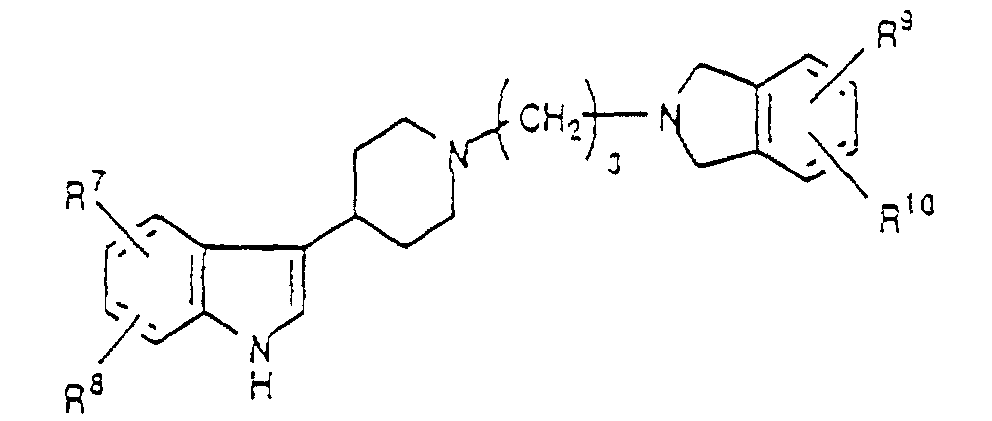

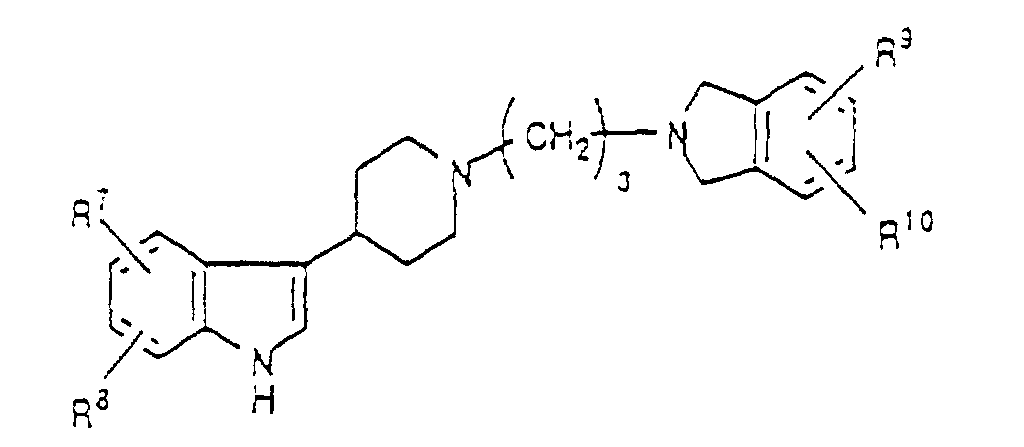


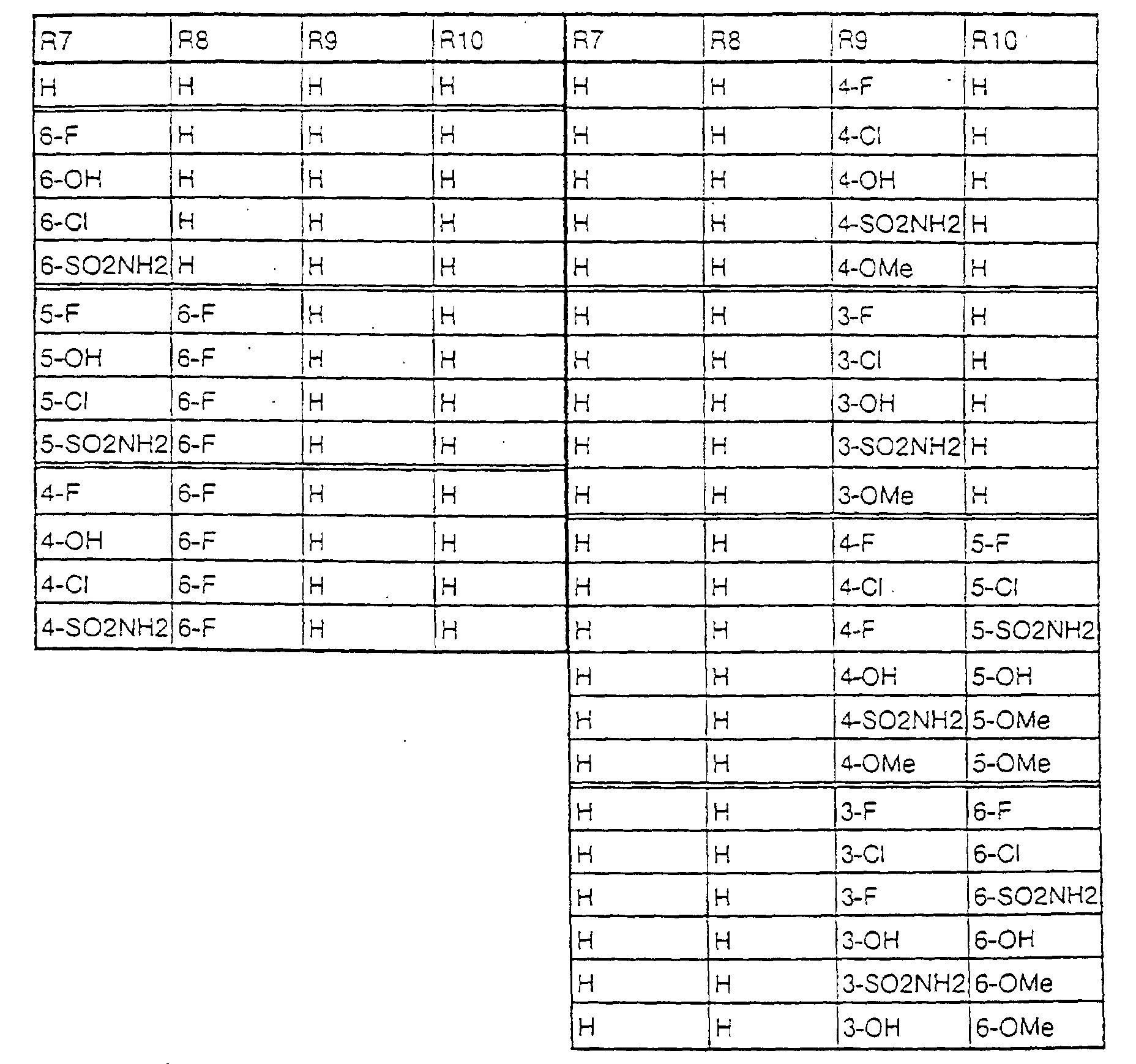

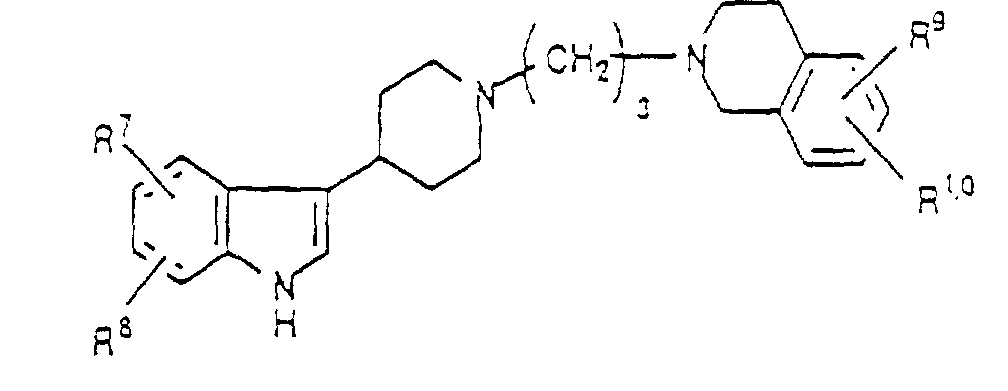
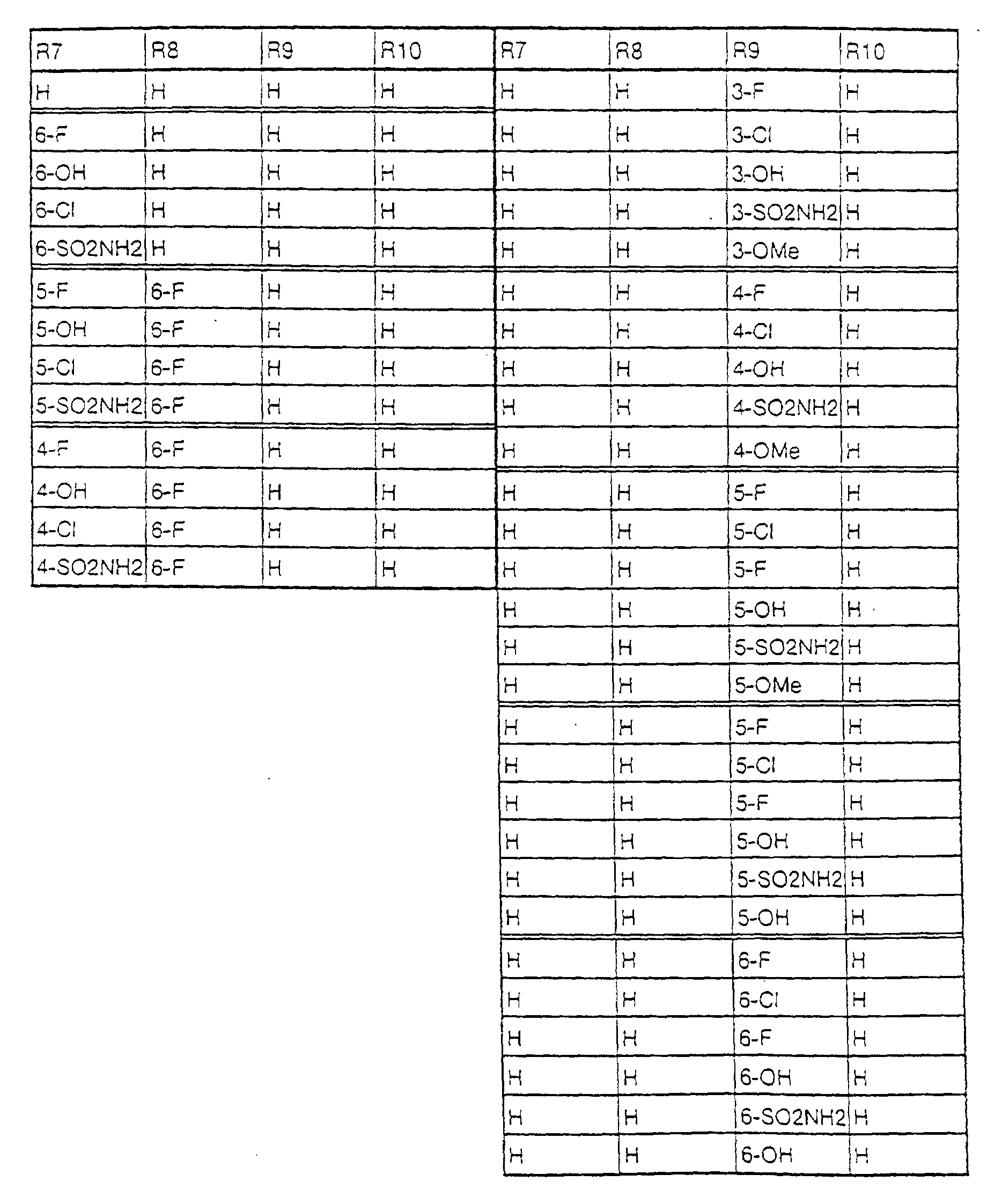
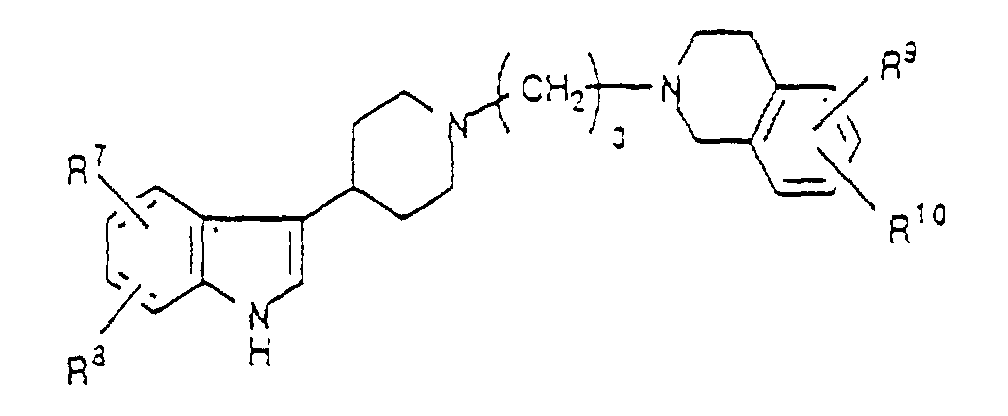
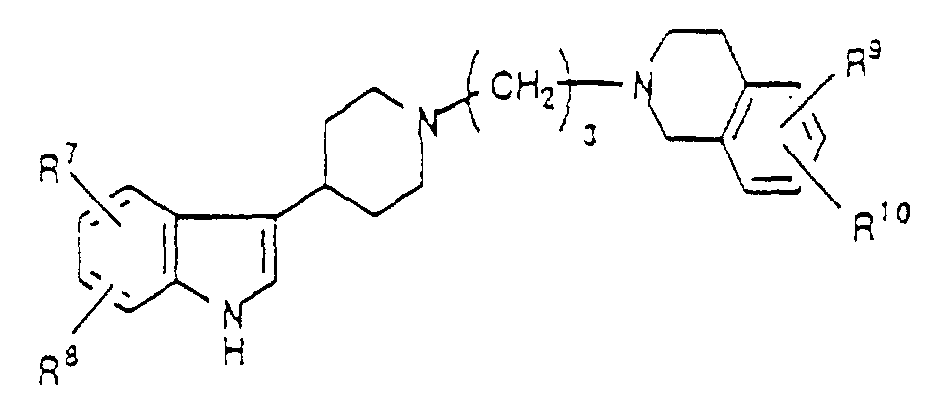

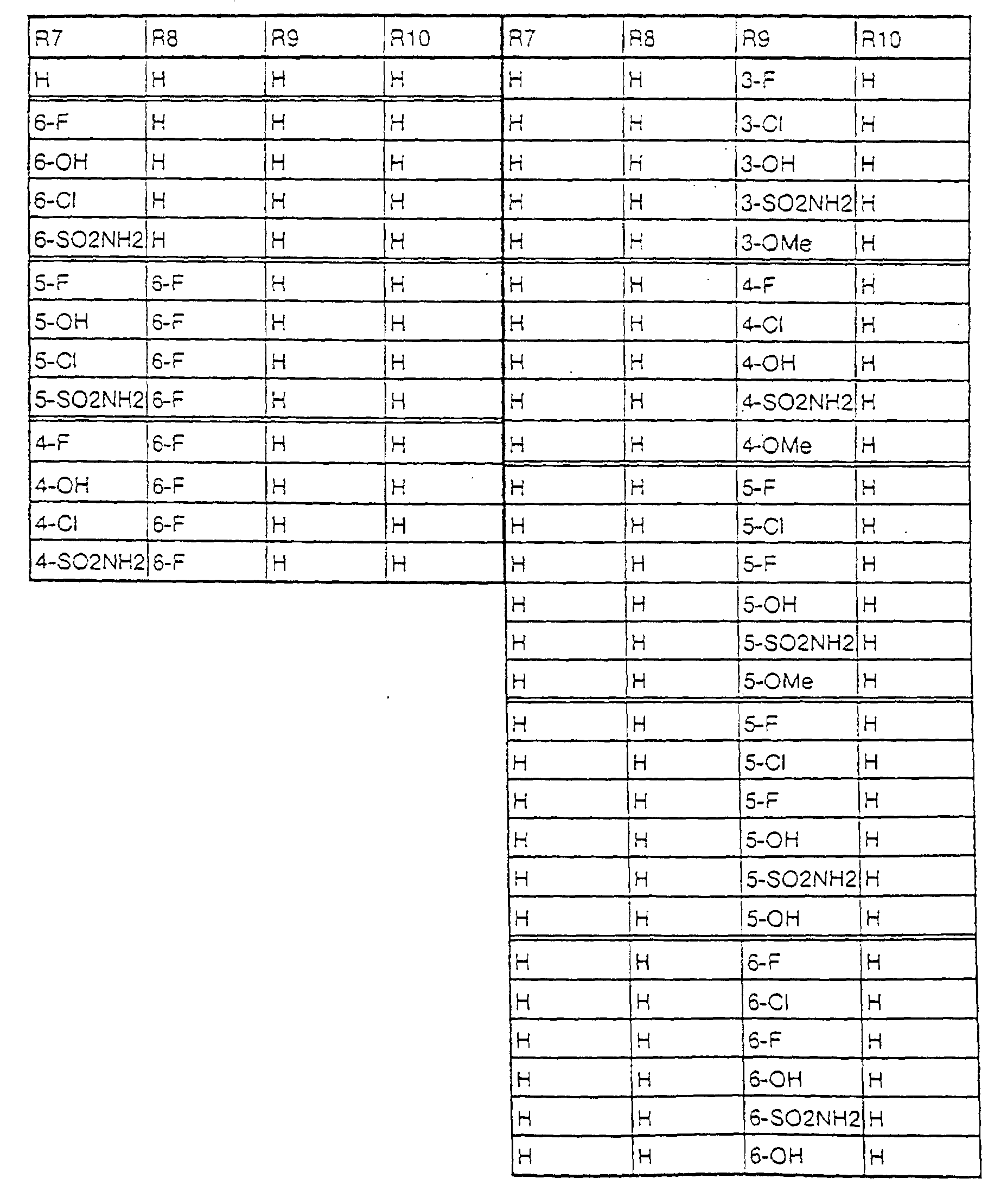


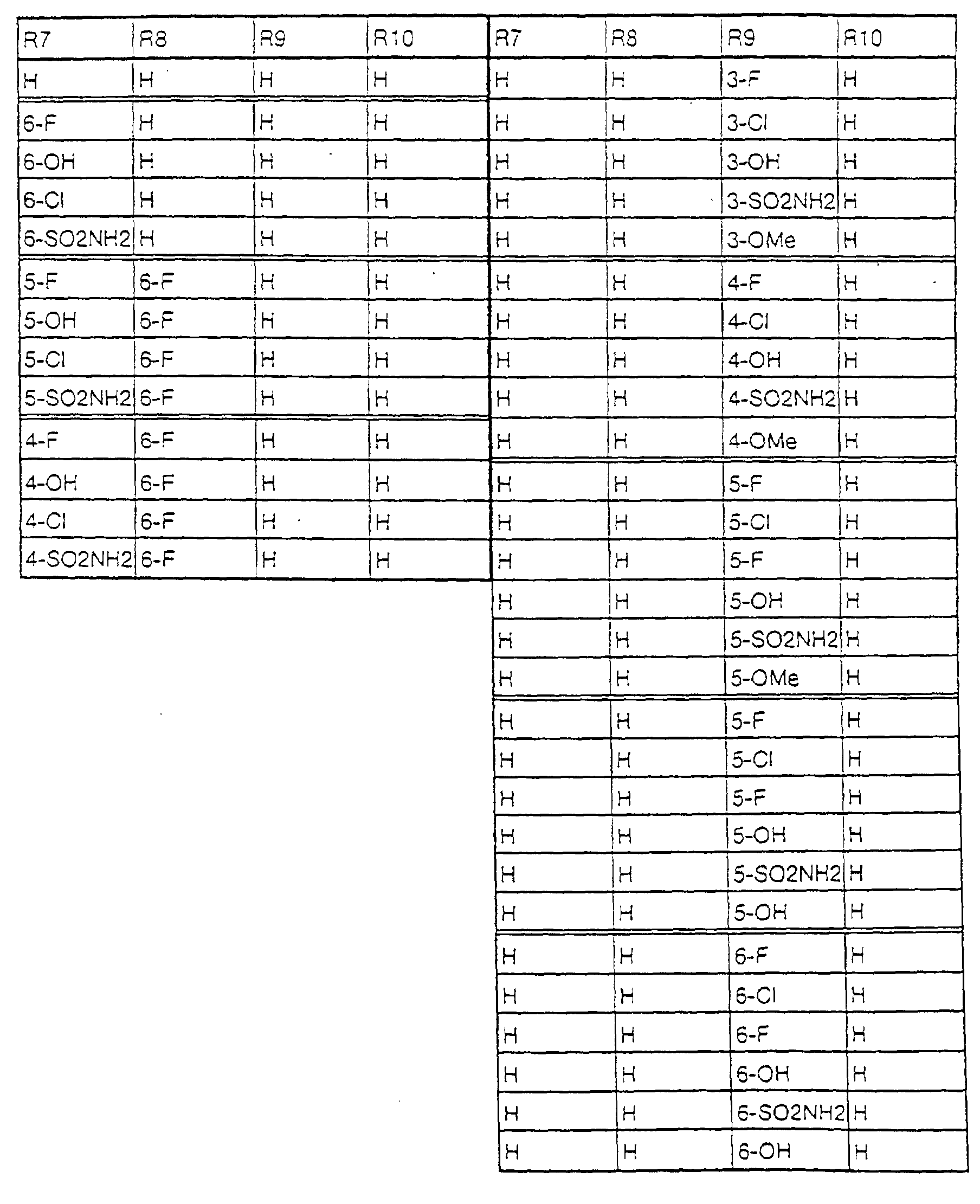
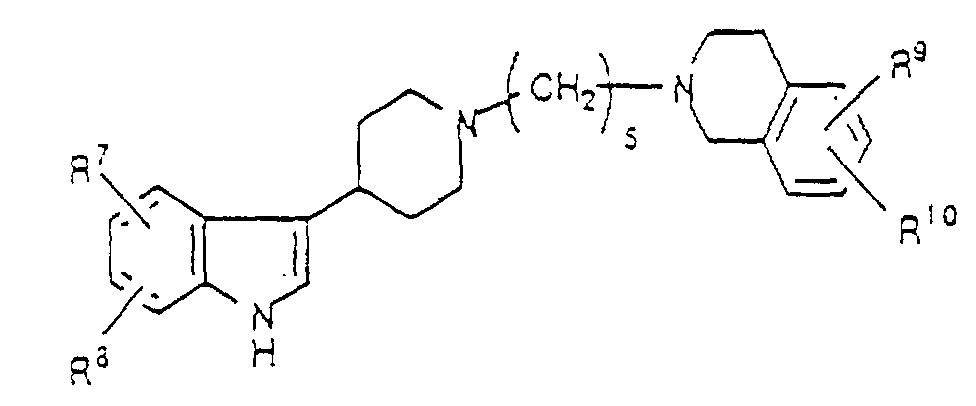
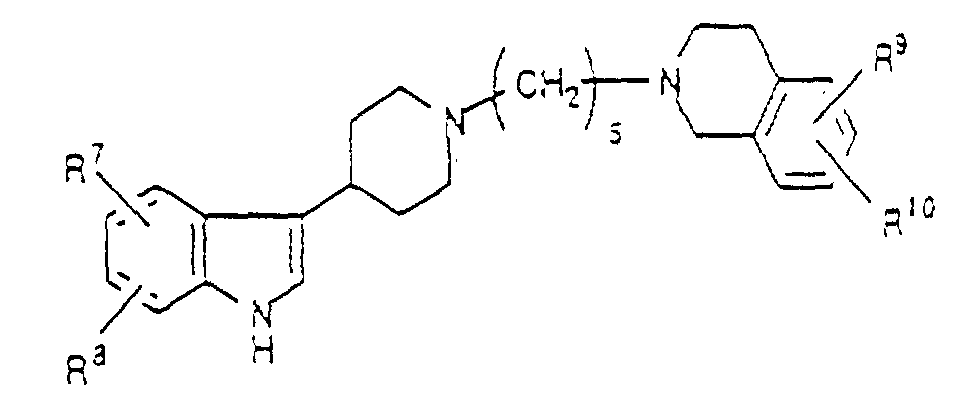


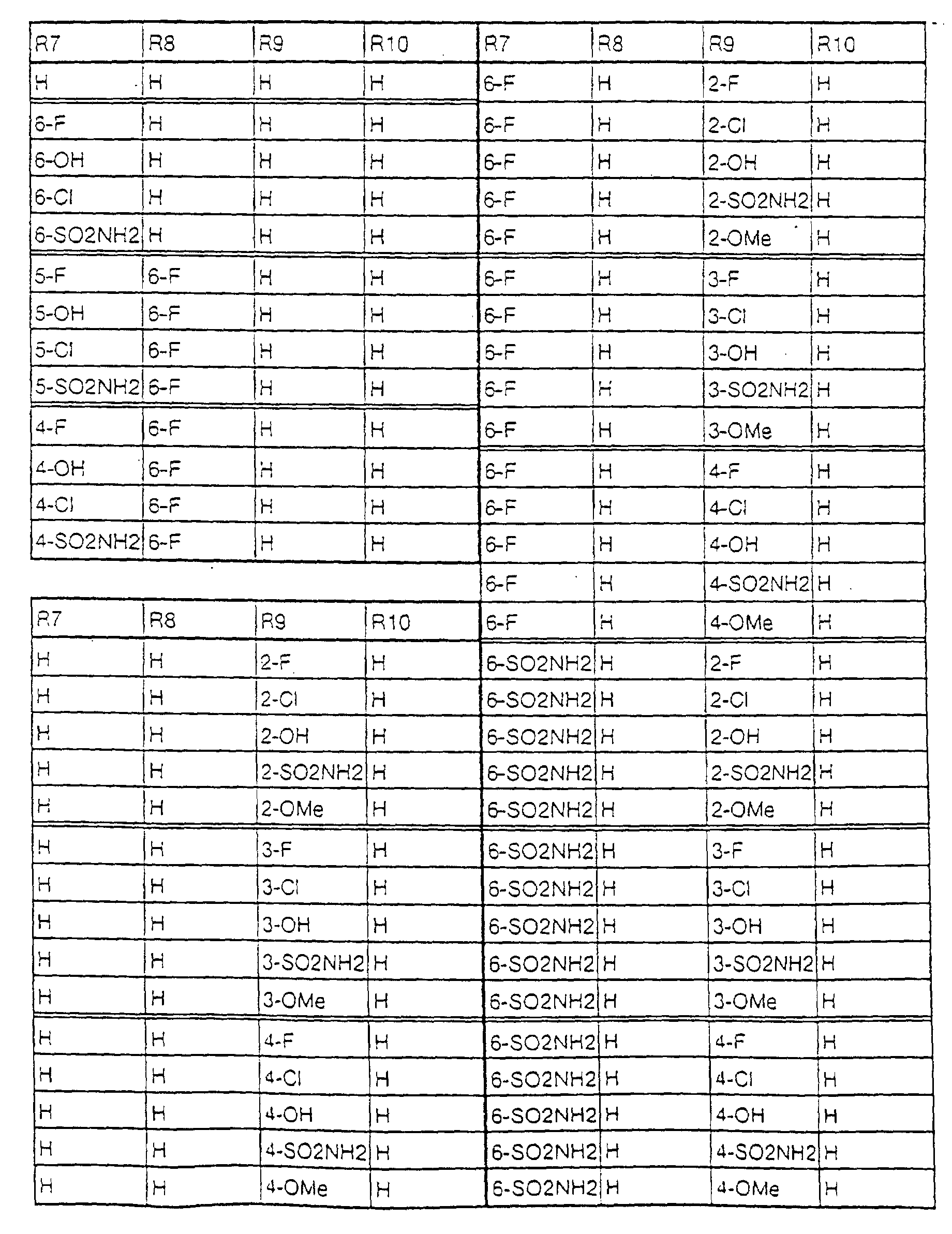


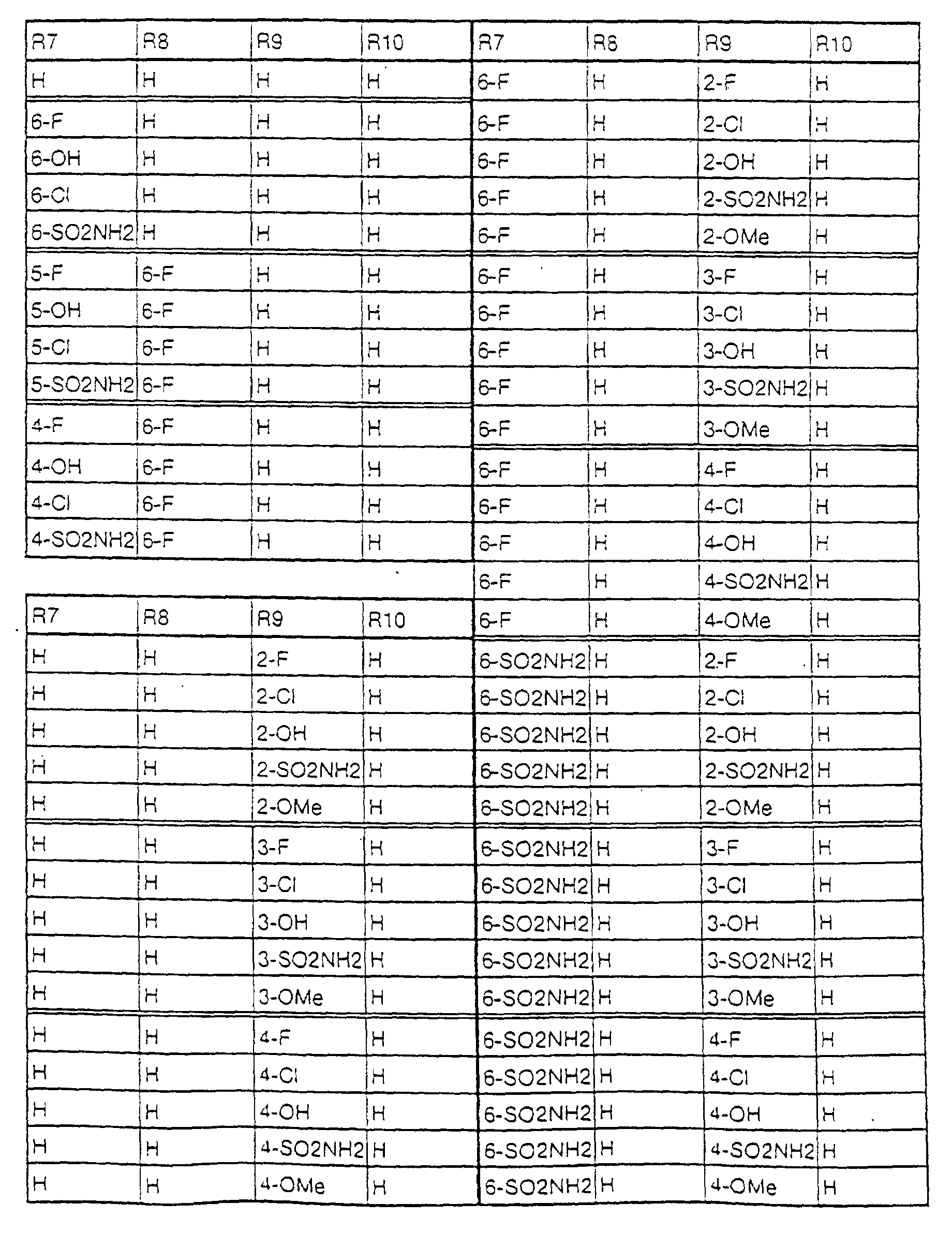


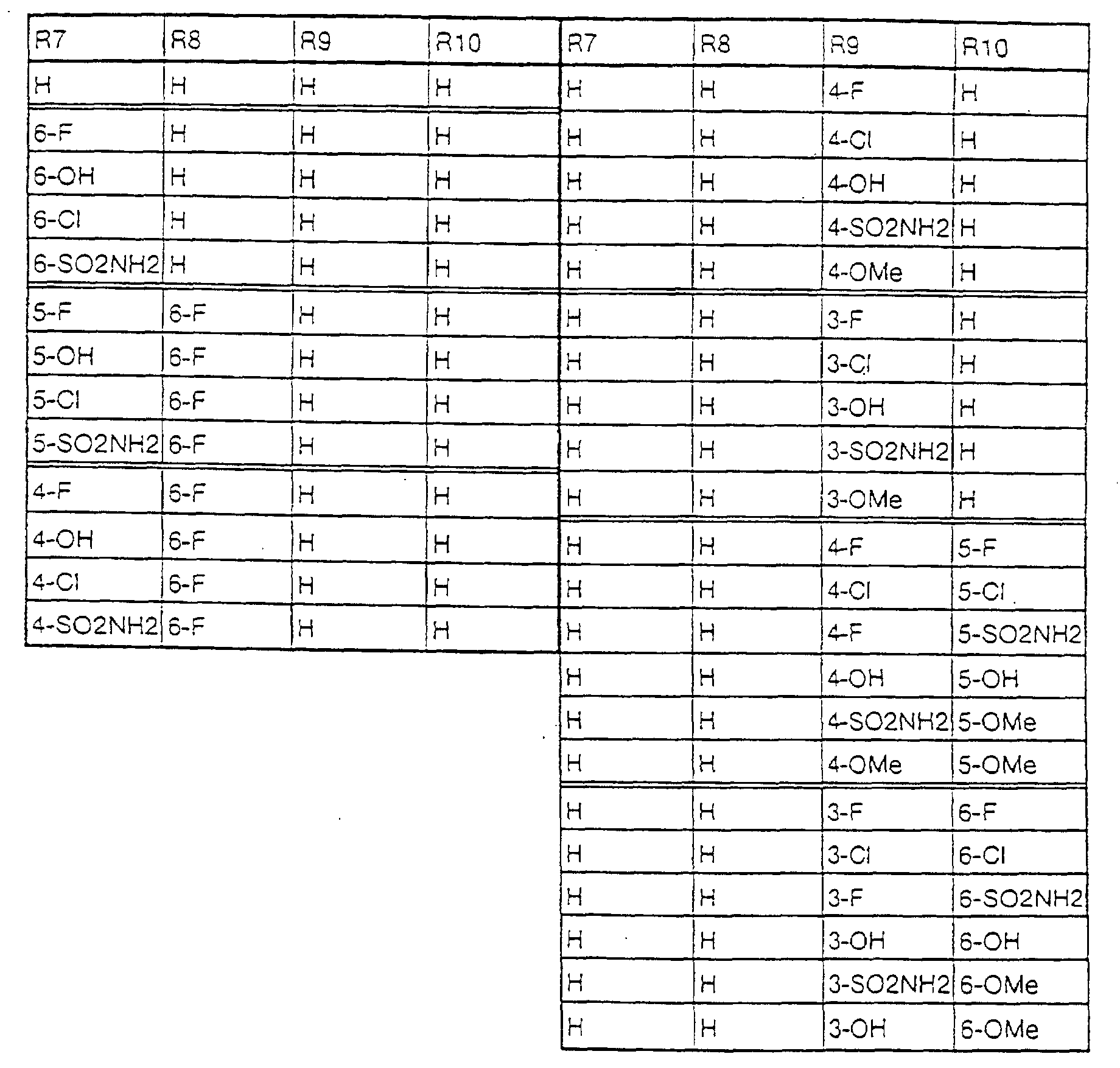
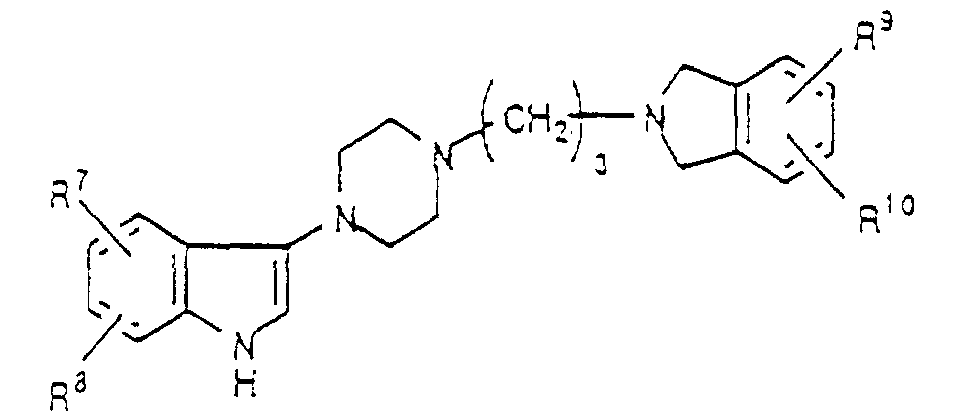
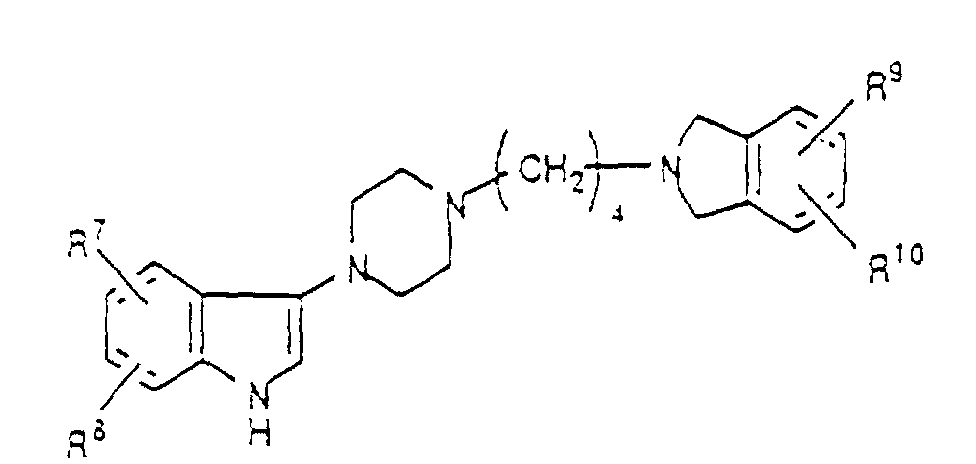
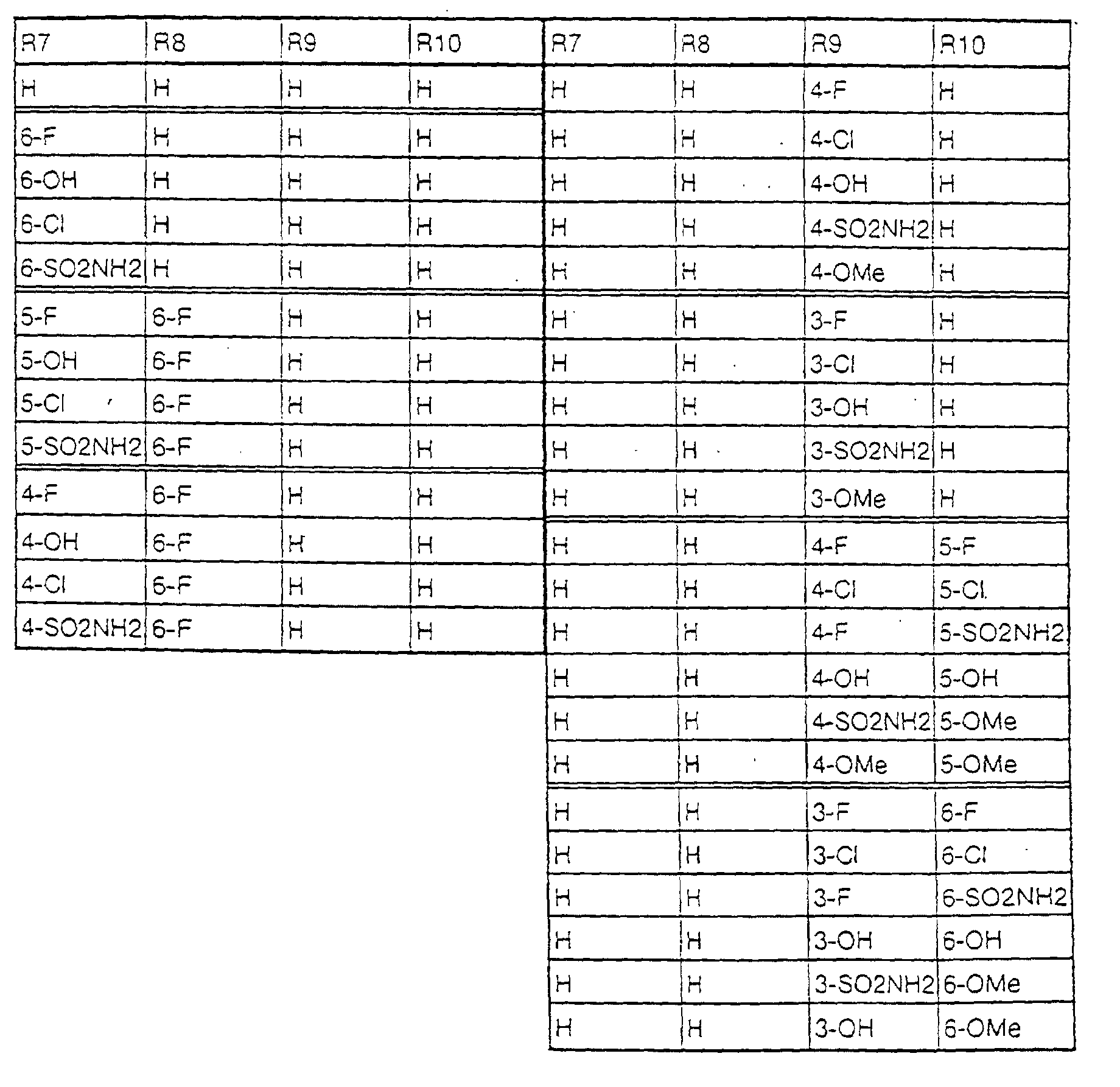

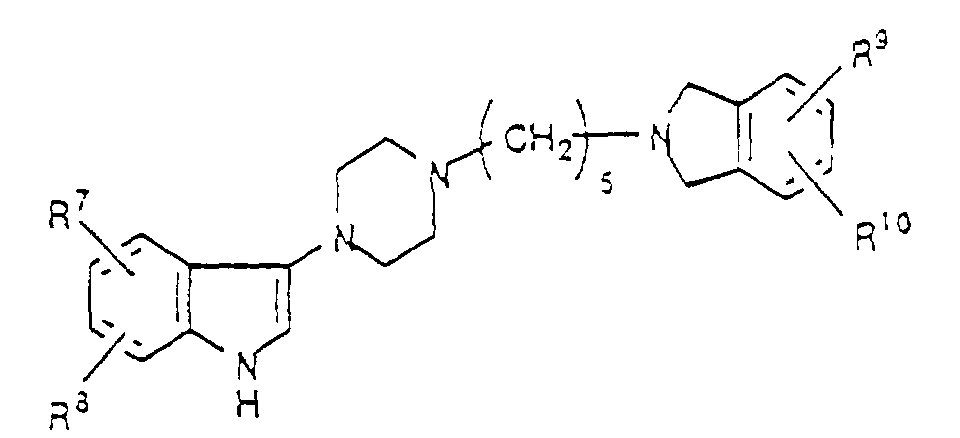
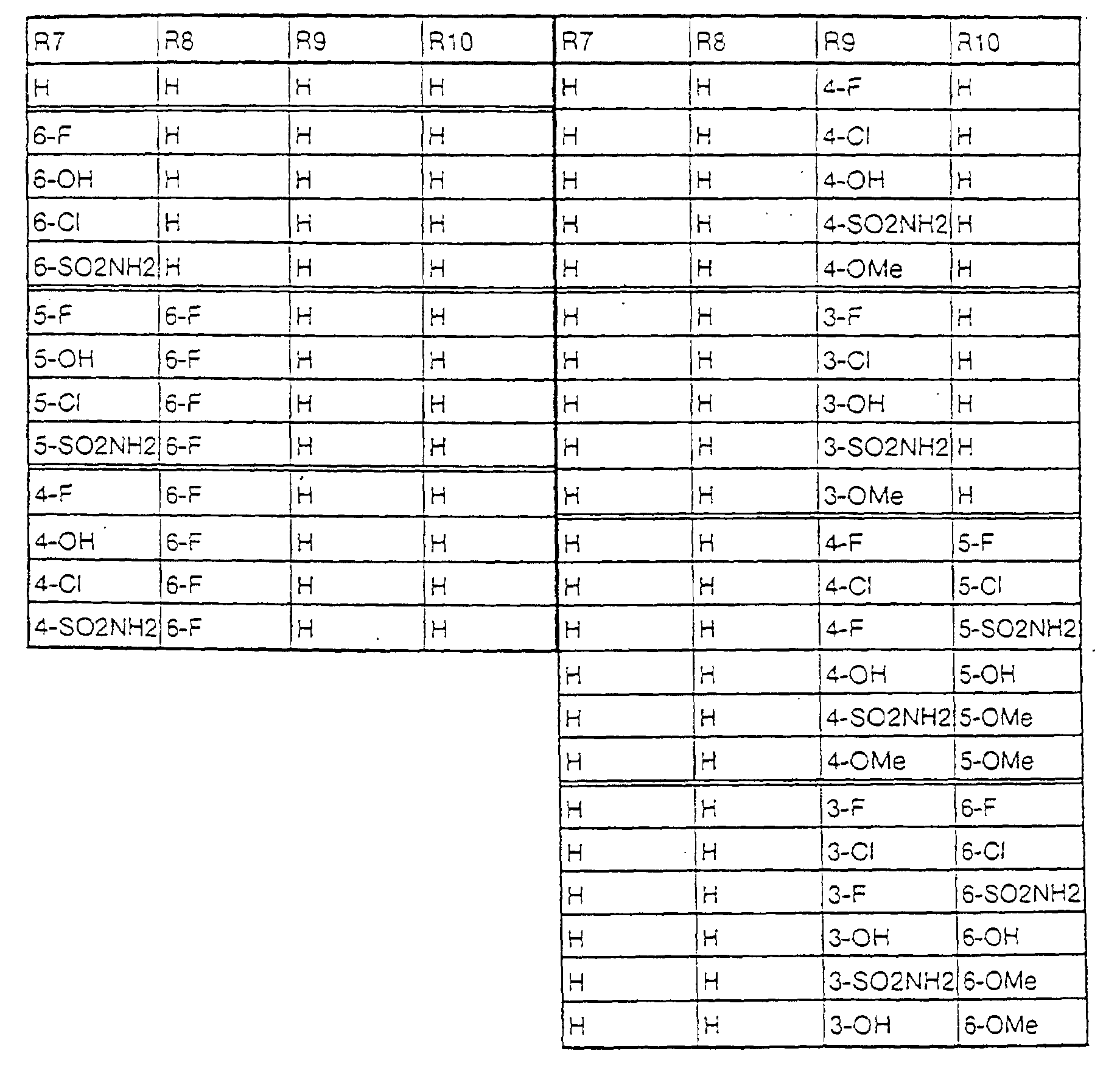
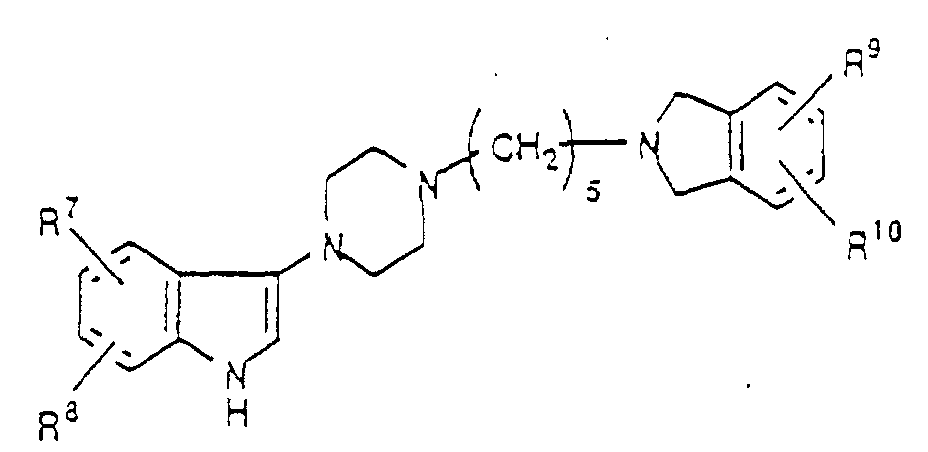


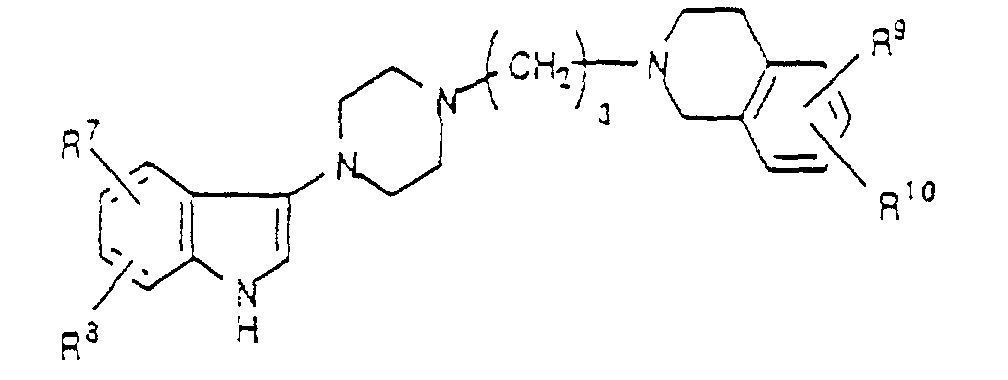


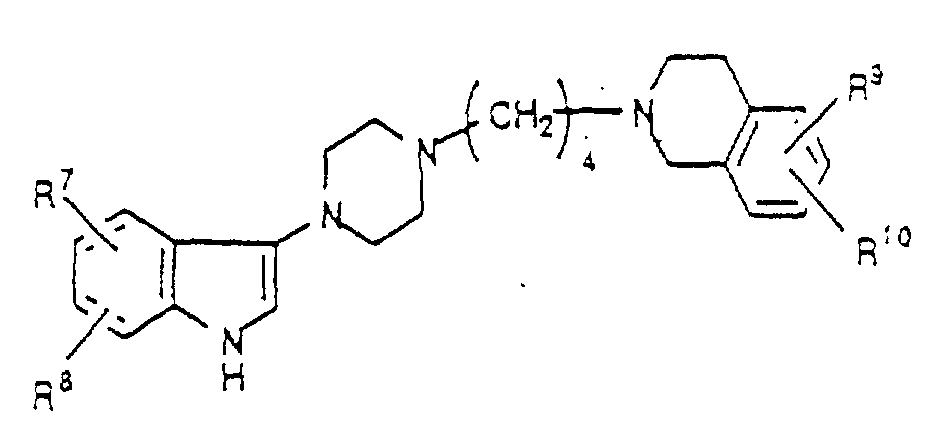

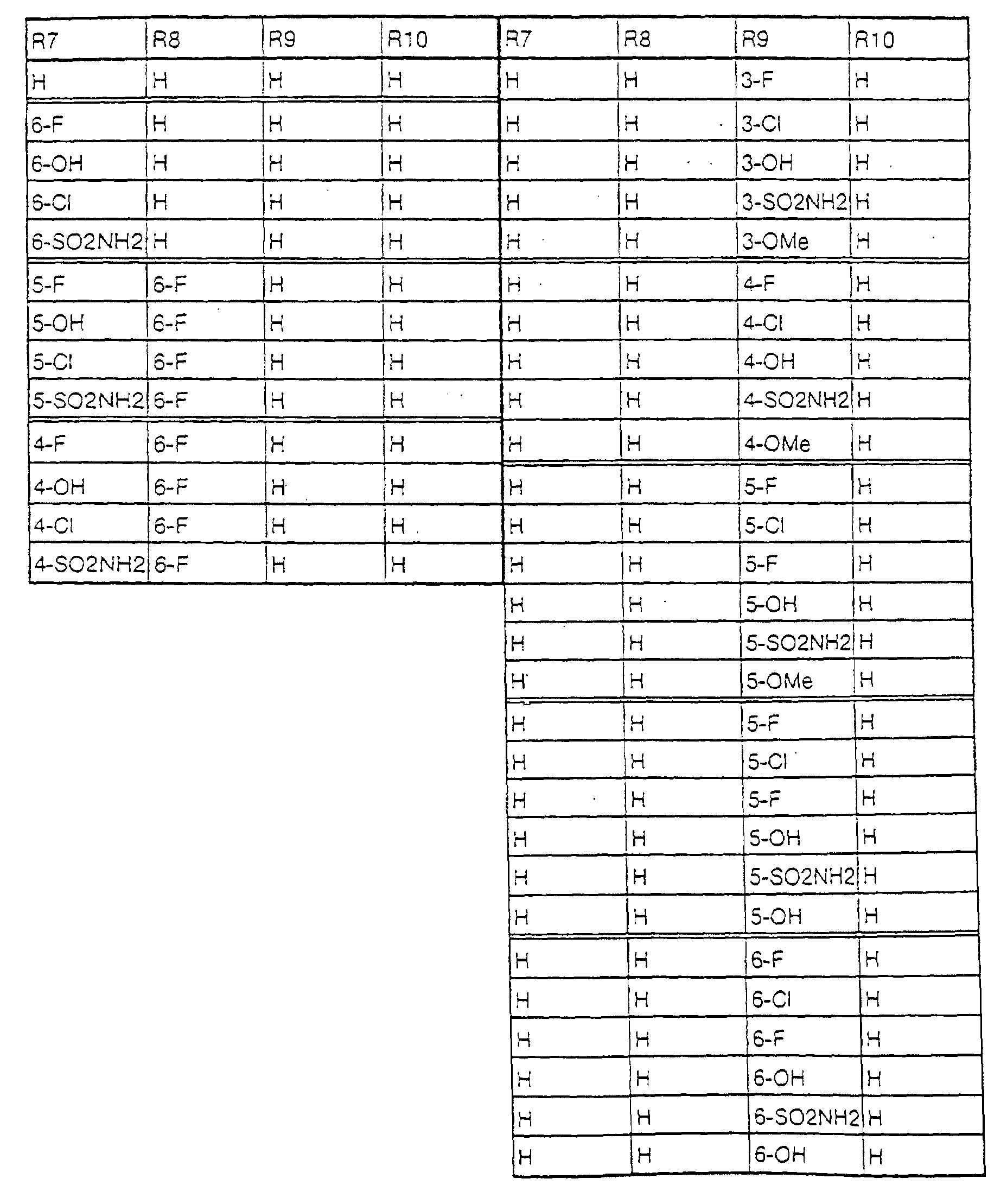
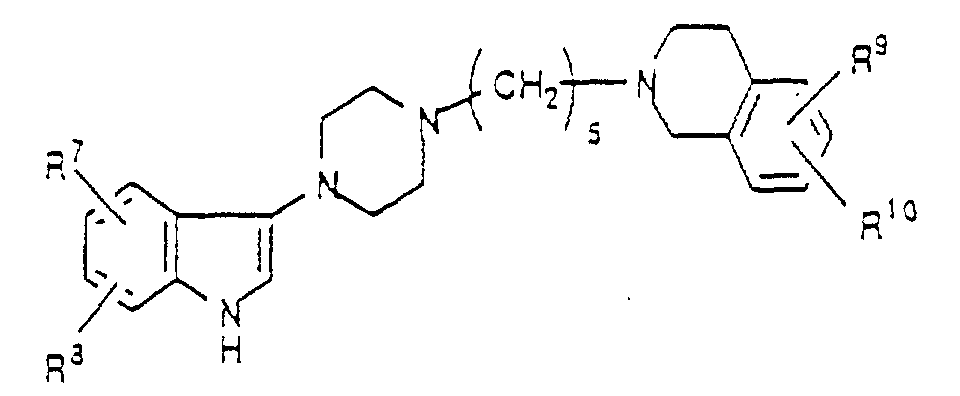

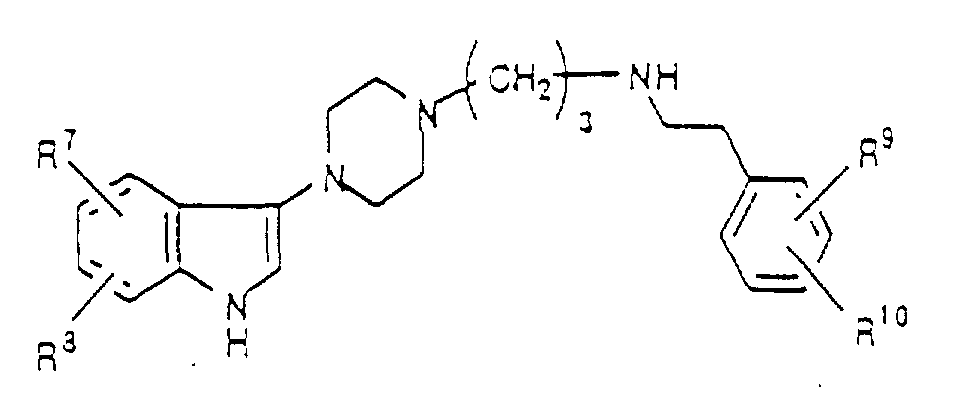


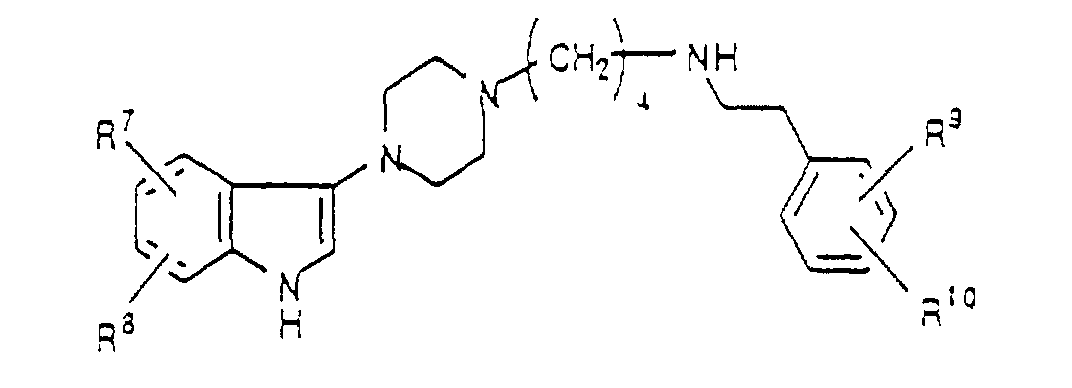


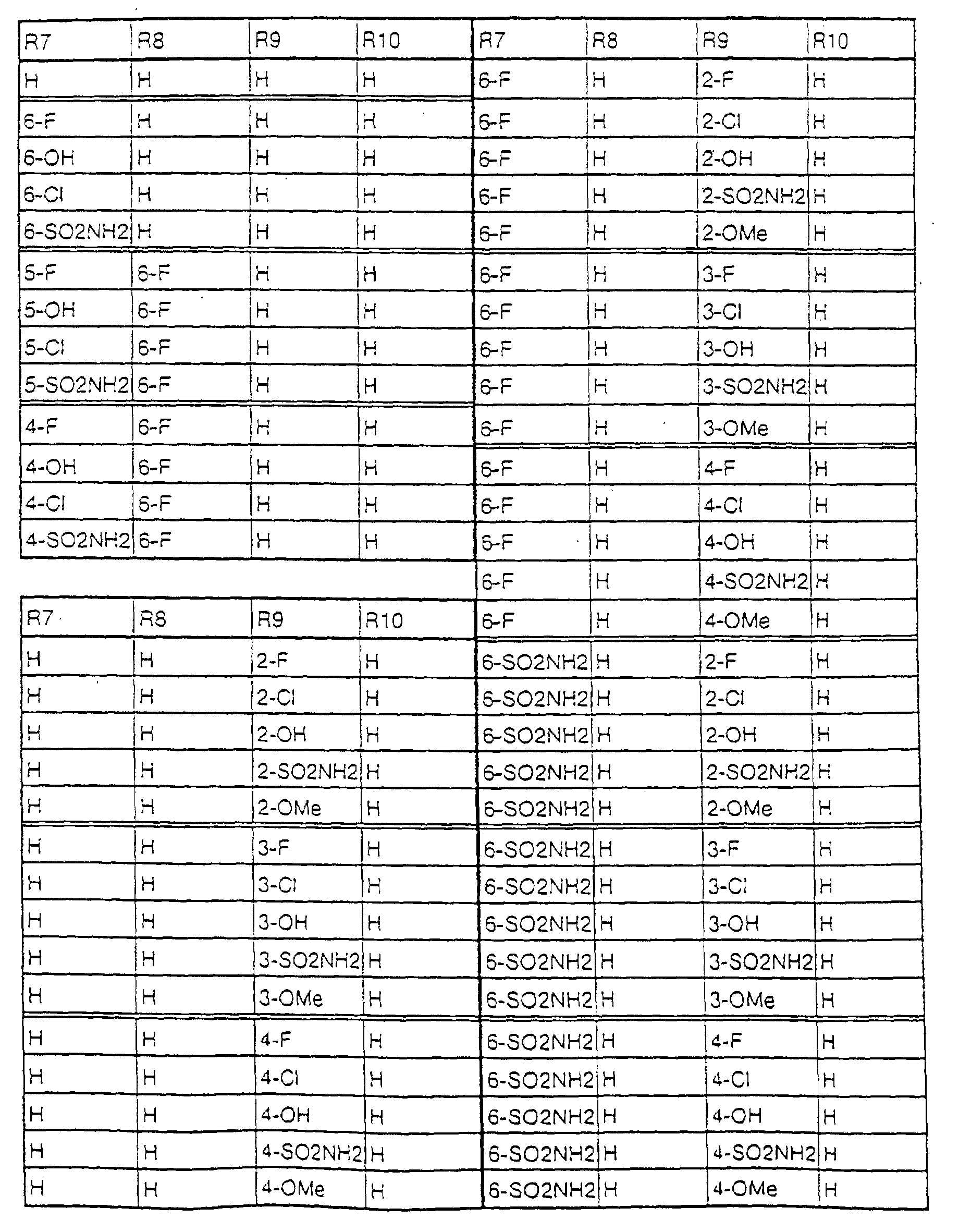


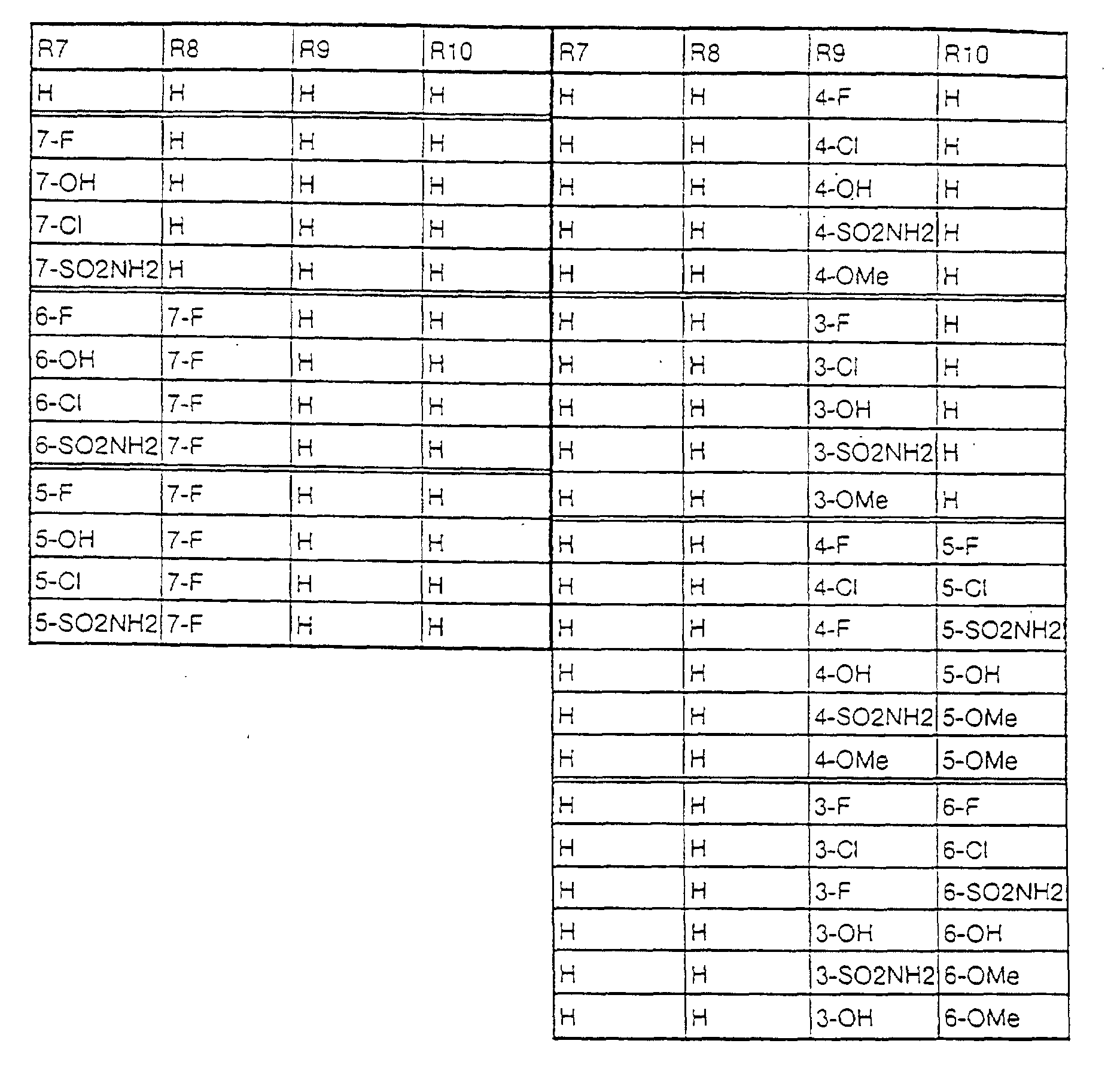


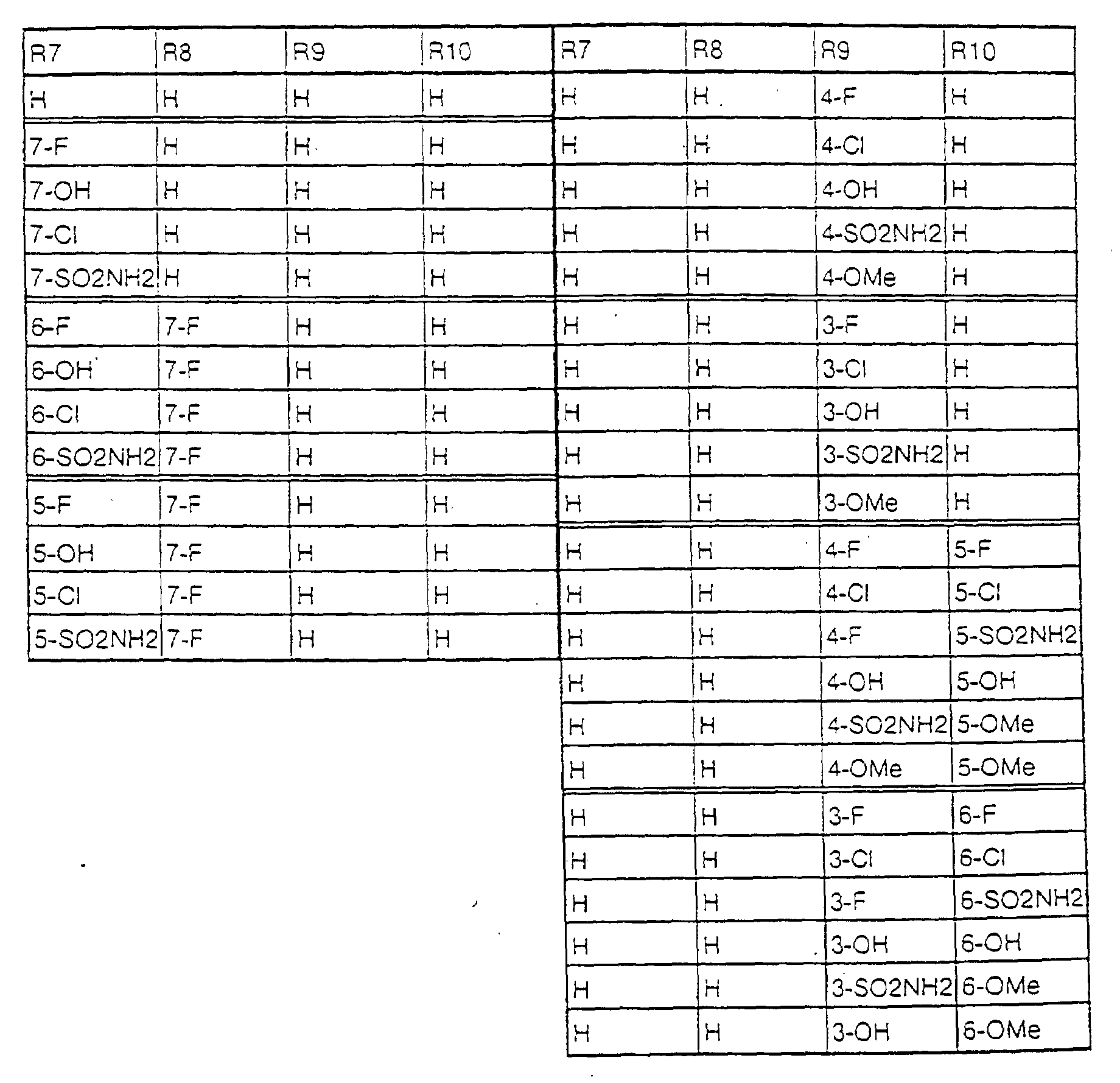
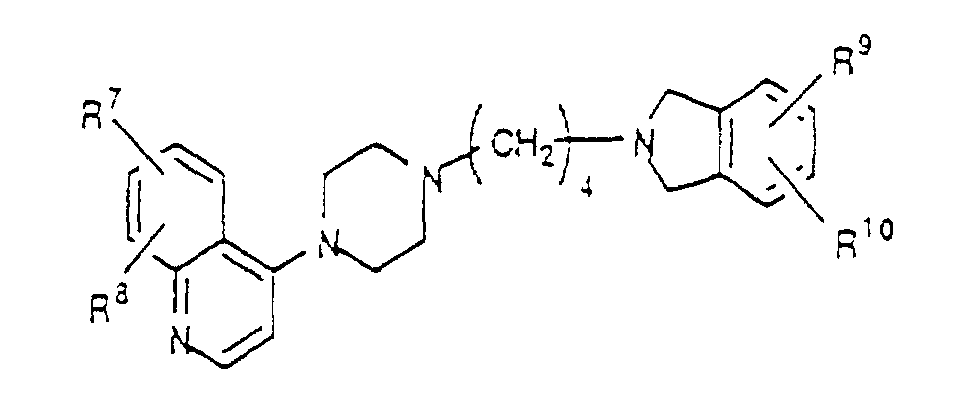


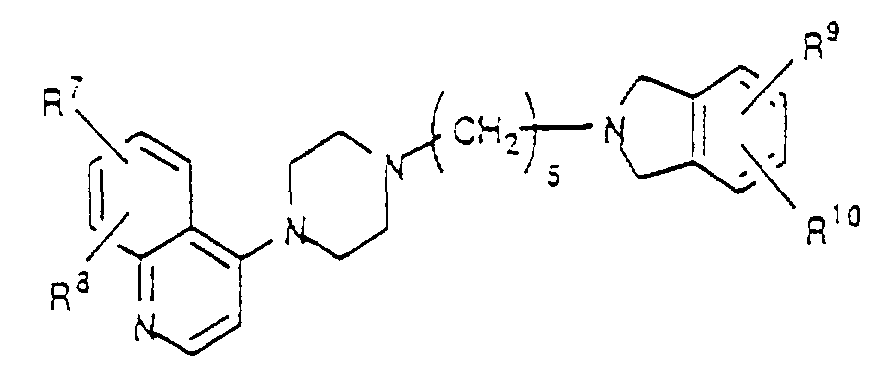
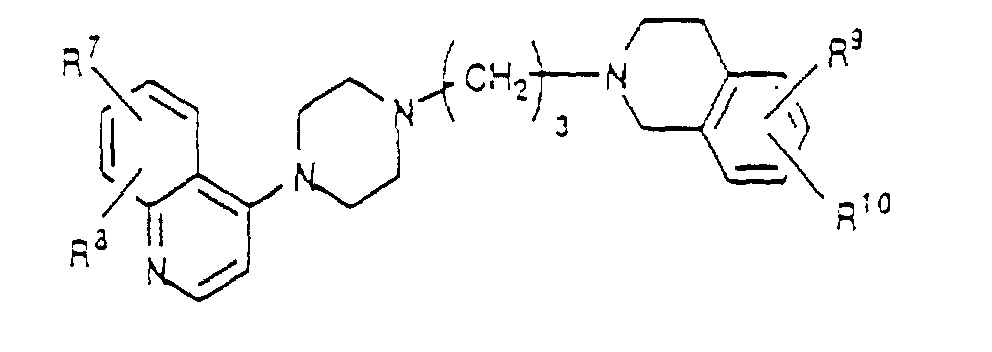


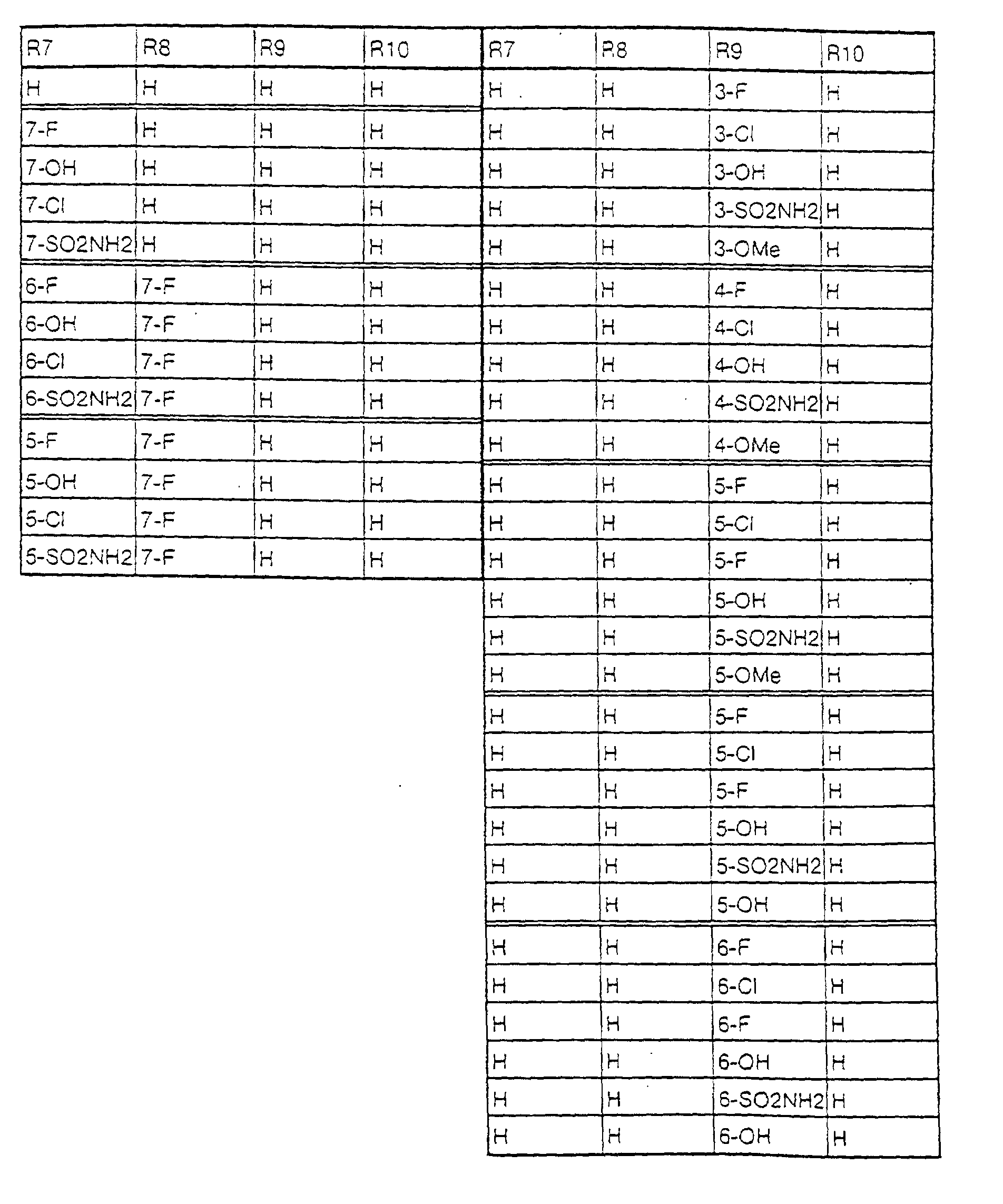

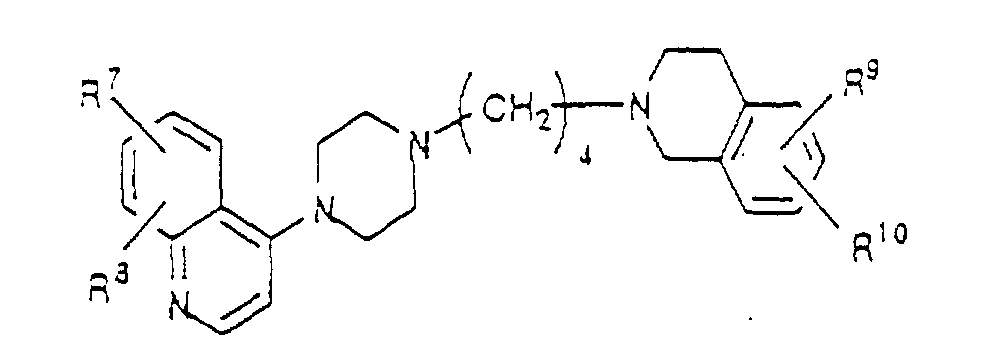


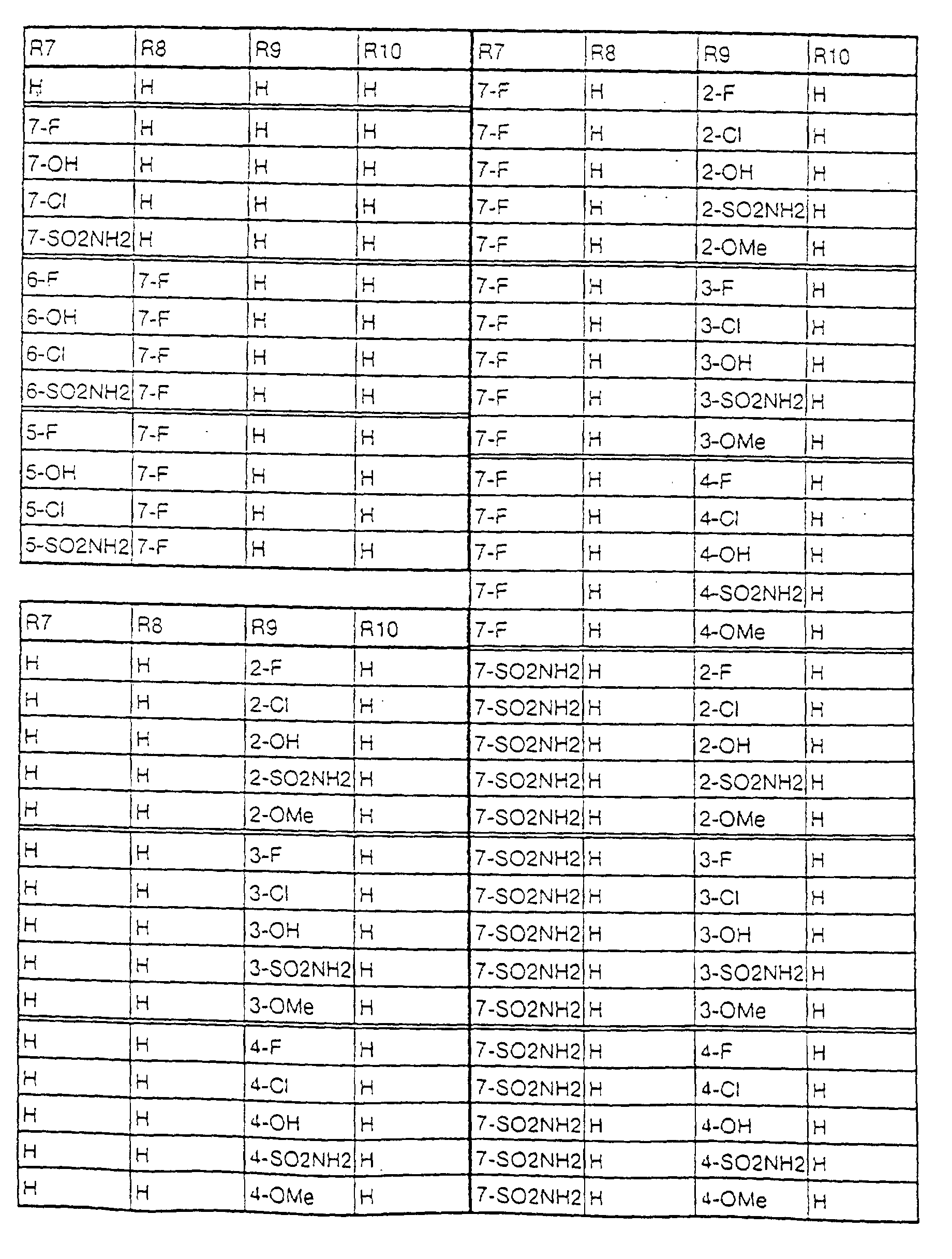
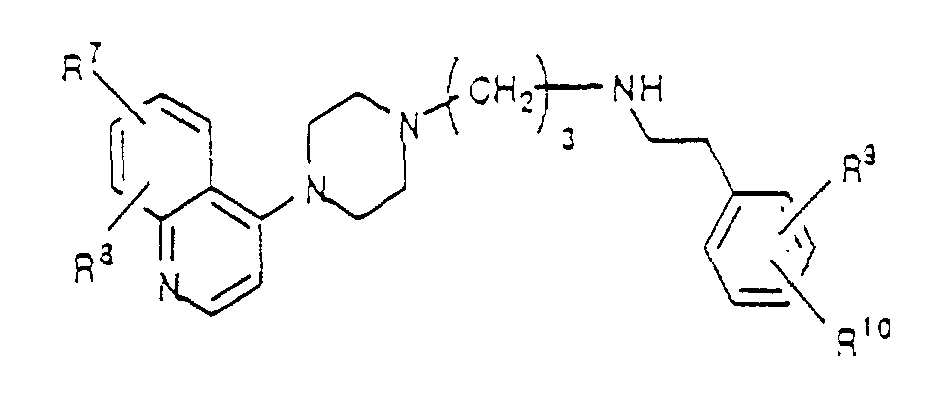
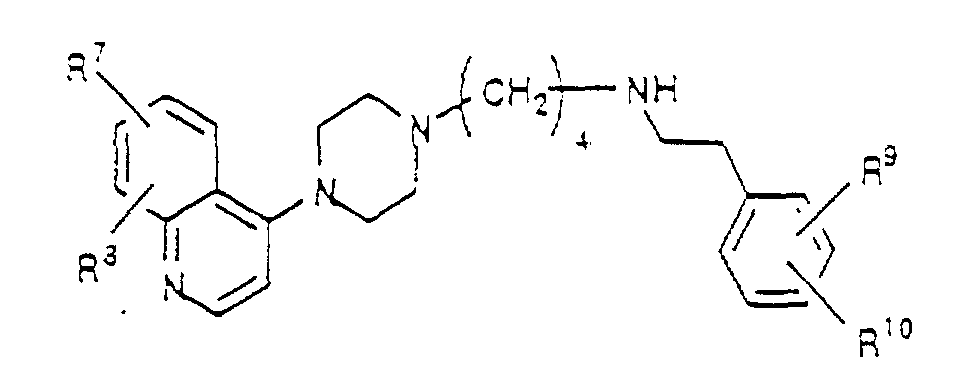


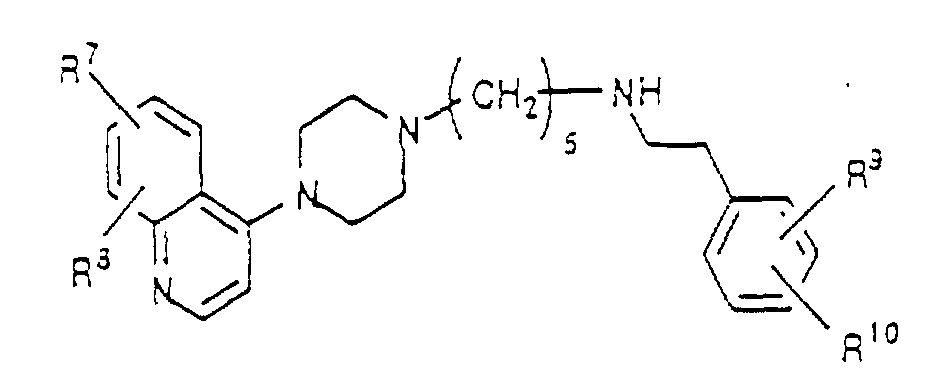
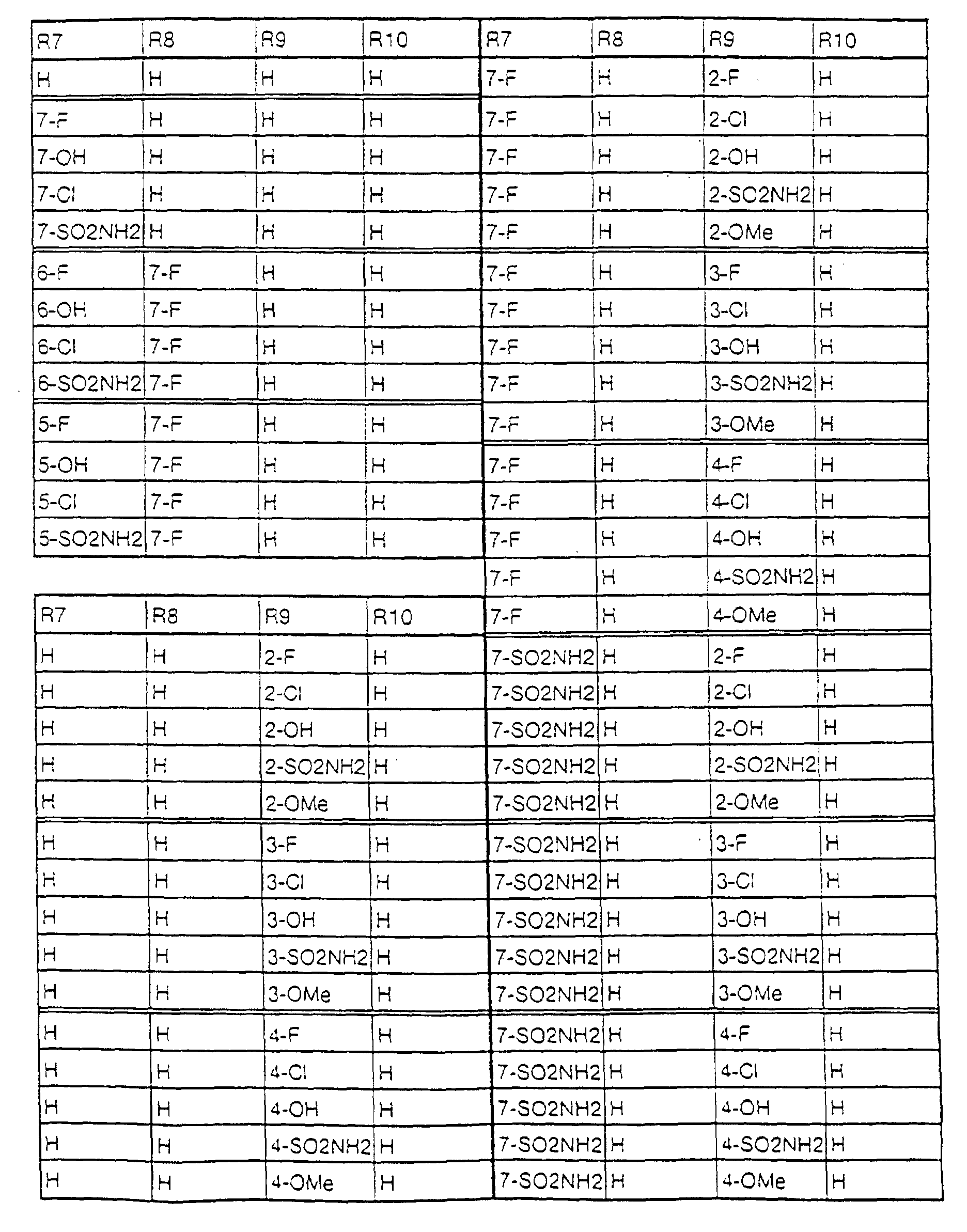


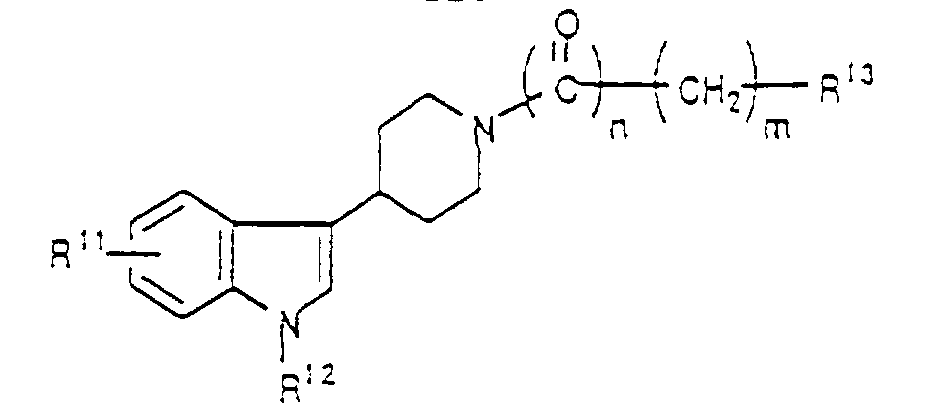
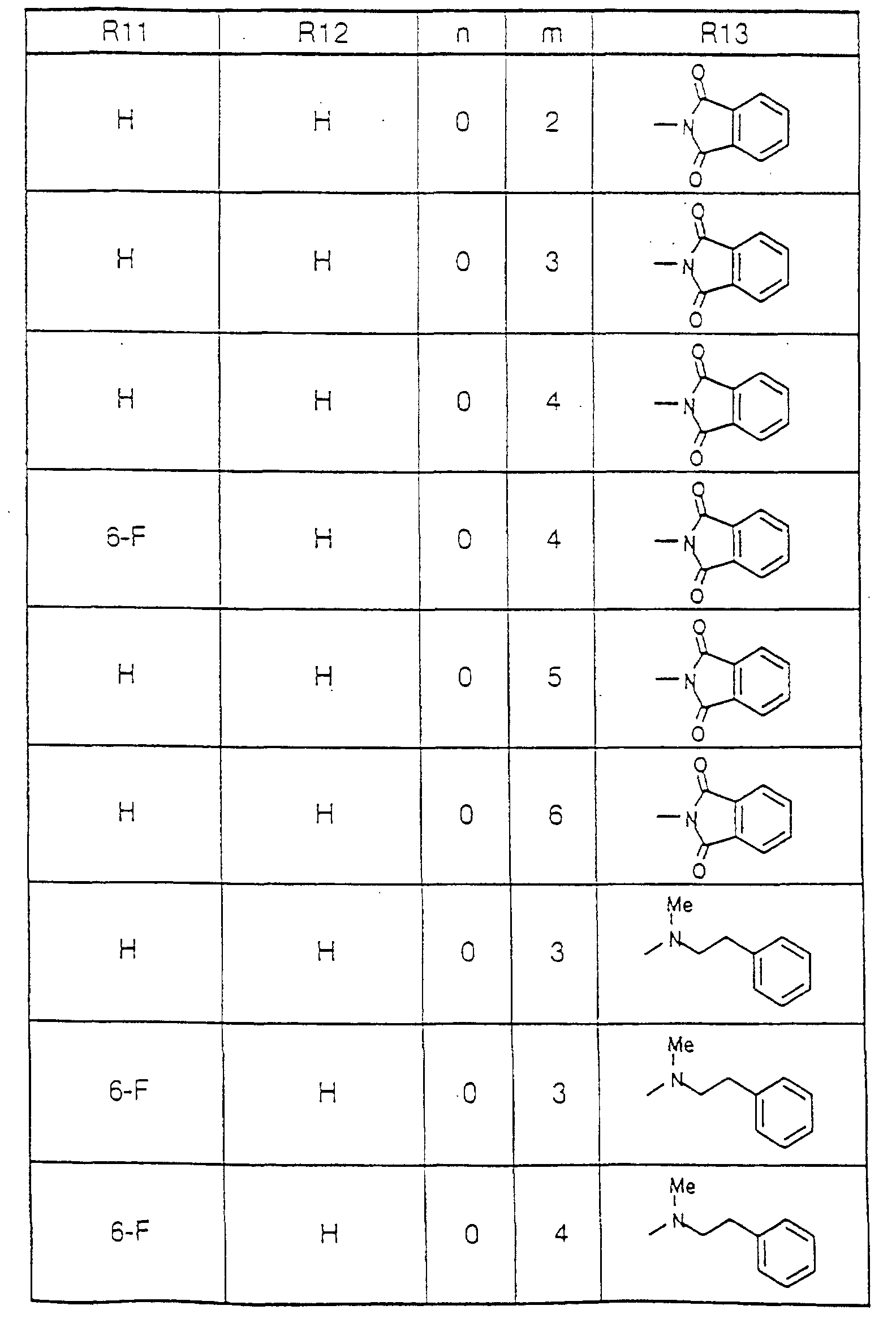
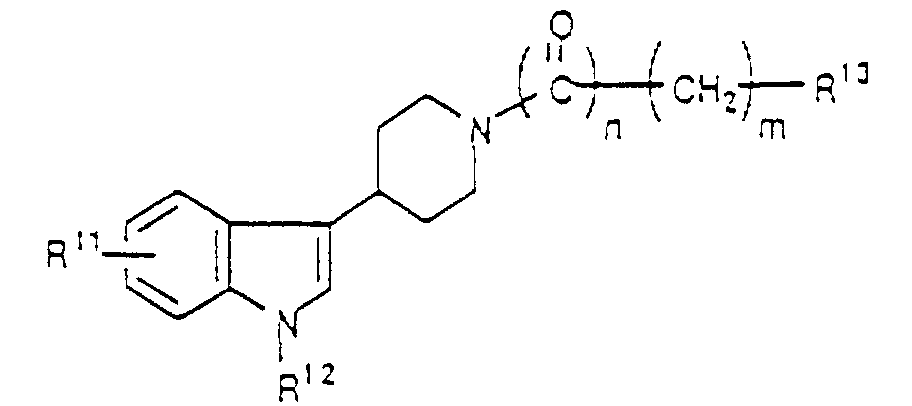

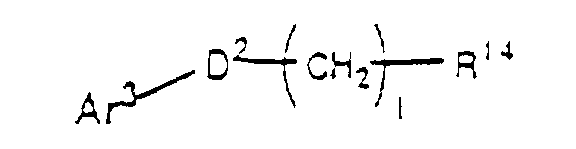


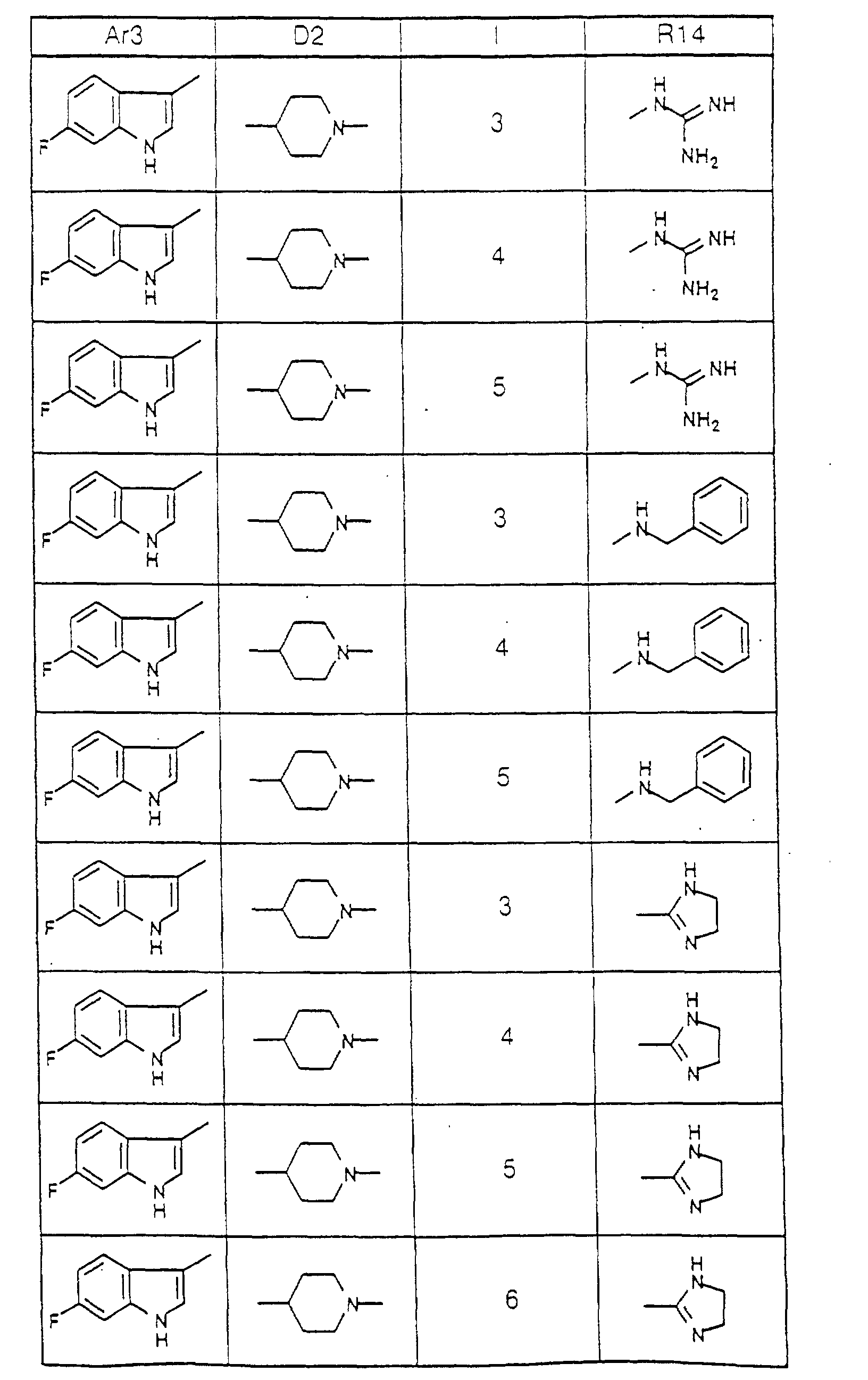
| R7 | R8 | R9 | R10 | R7 | R8 | R9 | R10 |
| 6-F | H | 4-F | H | 6-SO2NH2 | H | 4-F | H |
| 6-F | H | 4-Cl | H | 6-SO2NH2 | H | 4-Cl | H |
| 6-F | H | 4-OH | H | 6-SO2NH2 | H | 4-OH | H |
| 6-F | H | 4-SO2NH2 | H | 6-SO2NH2 | H | 4-SO2NH2 | H |
| 6-F | H | 4-OMe | H | 6-SO2NH2 | H | 4-OMe | H |
| 6-F | H | 3-F | H | 6-SO2NH2 | H | 3-F | H |
| 6-F | H | 3-Gl | H | 6-SO2NH2 | H | 3-Cl | H |
| 6-F | H | 3-OH | H | 6-SO2NH2 | H | 3-OH | H |
| 6-F | H | 3-SO2NH2 | H | 6-SO2NH2 | H | 3-SO2NH2 | H |
| 6-F | H | 3-OMe | H | 6-SO2NH2 | H | 3-OMe | H |
| 6-F | H | 4-F | 5-F | 6-SO2NH2 | H | 4-F | 5-F |
| 6-F | H | 4-Cl | 5-Cl | 6-SO2NH2 | H | 4-Cl | 5-Cl |
| 6-F | H | 4-F | 5-SO2NH2 | 6-SO2NH2 | H | 4-F | 5-SO2NH2 |
| 6-F | H | 4-OH | 5-OH | 6-SO2NH2 | H | 4-OH | 5-OH |
| 6-F | H | 4-SO2NH2 | 5-OMe | 6-SO2NH2 | H | 4-SO2NH2 | 5-OMe |
| 6-F | H | 4-OMe | 5-OMe | 6-SO2NH2 | H | 4-OMe | 5-OMe |
| 6-F | H | 3-F | 6-F | 6-SO2NH2 | H | 3-F | 6-F |
| 6-F | H | 3-Cl | 6-Cl | 6-SO2NH2 | H | 3-Cl | 6-Cl |
| 6-F | H | 3-F | 6-SO2NH2 | 6-SO2NH2 | H | 3-F | 6-SO2NH2 |
| 6-F | H | 3-OH | 6-OH | 6-SO2NH2 | H | 3-OH | 6-OH |
| 6-F | H | 3-SO2NH2 | 6-OMe | 6-SO2NH2 | H | 3-SO2NH2 | 6-OMe |
| 6-F | H | 3-OH | 6-OMe | 6-SO2NH2 | H | 3-OH | 6-OMe |
| R7 | R8 | R9 | R10 | R7 | R8 | R9 | R10 |
| 6-F | H | 4-F | H | 6-SO2NH2 | H | 4-F | H |
| 6-F | H | 4-Cl | H | 6-SO2NH2 | H | 4-Cl | H |
| 6-F | H | 4-OH | H | 6-SO2NH2 | H | 4-OH | H |
| 6-F | H | 4-SO2NH2 | H | 6-SO2NH2 | H | 4-SO2NH2 | H |
| 6-F | H | 4-OMe | H | 6-SO2NH2 | H | 4-OMe | H |
| 6-F | H | 3-F | H | 6-SO2NH2 | H | 3-F | H |
| 6-F | H | 3-Cl | H | 6-SO2NH2 | H | 3-Cl | H |
| 6-F | H | 3-OH | H | 6-SO2NH2 | H | 3-OH | H |
| 6-F | H | 3-SO2NH2 | H | 6-SO2NH2 | H | 3-SO2NH2 | H |
| 6-F | H | 3-OMe | H | 6-SO2NH2 | H | 3-OMe | H |
| 6-F | H | 4-F | 5-F | 6-SO2NH2 | H | 4-F | 5-F |
| 6-F | H | 4-Cl | 5-Cl | 6-SO2NH2 | H | 4-Cl | 5-Cl |
| 6-F | H | 4-F | 5-SO2NH2 | 6-SO2NH2 | H | 4-F | 5-SO2NH2 |
| 6-F | H | 4-OH | 5-OH | 6-SO2NH2 | H | 4-OH | 5-OH |
| 6-F | H | 4-SO2NH2 | 5-OMe | 6-SO2NH2 | H | 4-SO2NH2 | 5-OMe |
| 6-F | H | 4-OMe | 5-OMe | 6-SO2NH2 | H | 4-OMe | 5-OMe |
| 6-F | H | 3-F | 6-F | 6-SO2NH2 | H | 3-F | 6-F |
| 6-F | H | 3-Cl | 6-Cl | 6-SO2NH2 | H | 3-Cl | 6-Cl |
| 6-F | H | 3-F | 6-SO2NH2 | 6-SO2NH2 | H | 3-F | 6-SO2NH2 |
| 6-F | H | 3-OH | 6-OH | 6-SO2NH2 | H | 3-OH | 6-OH |
| 6-F | H | 3-SO2NH2 | 6-OMe | 6-SO2NH2 | H | 3-SO2NH2 | 6-OMe |
| 6-F | H | 3-OH | 6-OMe | 6-SO2NH2 | H | 3-OH | 6-OMe |
| R7 | R8 | R9 | R10 | R7 | R8 | R9 | R10 |
| 6-F | H | 4-F | H | 6-SO2NH2 | H | 4-F | H |
| 6-F | H | 4-Cl | H | 6-SO2NH2 | H | 4-Cl | H |
| 6-F | H | 4-OH | H | 6-SO2NH2 | H | 4-OH | H |
| 6-F | H | 4-SO2NH2 | H | 6-SO2NH2 | H | 4-SO2NH2 | H |
| 6-F | H | 4-OMe | H | 6-SO2NH2 | H | 4-OMe | H |
| 6-F | H | 3-F | H | 6-SO2NH2 | H | 3-F | H |
| 6-F | H | 3-Cl | H | 6-SO2NH2 | H | 3-Cl | H |
| 6-F | H | 3-OH | H | 6-SO2NH2 | H | 3-OH | H |
| 6-F | H | 3-SO2NH2 | H | 6-SO2NH2 | H | 3-SO2NH2 | H |
| 6-F | H | 3-OMe | H | 6-SO2NH2 | H | 3-OMe | H |
| 6-F | H | 4-F | 5-F | 6-SO2NH2 | H | 4-F | 5-F |
| 6-F | H | 4-Cl | 5-Cl | 6-SO2NH2 | H | 4-Cl | 5-Cl |
| 6-F | H | 4-F | 5-SO2NH2 | 6-SO2NH2 | H | 4-F | 5-SO2NH2 |
| 6-F | H | 4-OH | 5-OH | 6-SO2NH2 | H | 4-OH | 5-OH |
| 6-F | H | 4-SO2NH2 | 5-OMe | 6-SO2NH2 | H | 4-SO2NH2 | 5-OMe |
| 6-F | H | 4-OMe | 5-OMe | 6-SO2NH2 | H | 4-OMe | 5-OMe |
| 6-F | H | 3-F | 6-F | 6-SO2NH2 | H | 3-F | 6-F |
| 6-F | H | 3-Cl | 6-Cl | 6-SO2NH2 | H | 3-Cl | 6-Cl |
| 6-F | H | 3-F | 6-SO2NH2 | 6-SO2NH2 | H | 3-F | 6-SO2NH2 |
| 6-F | H | 3-OH | 6-OH | 6-SO2NH2 | H | 3-OH | 6-OH |
| 6-F | H | 3-SO2NH2 | 6-OMe | 6-SO2NH2 | H | 3-SO2NH2 | 6-OMe |
| 6-F | H | 3-OH | 6-OMe | 6-SO2NH2 | H | 3-OH | 6-OMe |
| R7 | R8 | R9 | R10 | R7 | R8 | R9 | R10 |
| 5-F | H | 4-F | 5-F | 6-SO2NH2 | H | 4-F | 5-F |
| 6-F | H | 4-Cl | 5-Cl | 6-SO2NH2 | H | 4-Cl | 5-Cl |
| 6-F | H | 4-OH | 5-OH | 6-SO2NH2 | H | 4-OH | 5-OH |
| 6-F | H | 4-OMe | 5-OMe | 6-SO2NH2 | H | 4-OMe | 5-OMe |
| 6-F | H | 4-OMe | 5-SO2NH2 | 6-SO2NH2 | H | 4-OMe | 5-SO2NH2 |
| 6-F | H | 4-SO2NH2 | 5-OMe | 6-SO2NH2 | H | 4-SO2NH2 | 5-OMe |
| 6-F | H | 3-F | 6-F | 6-SO2NH2 | H | 3-F | 6-F |
| 6-F | H | 3-Cl | 6-Cl | 6-SO2NH2 | H | 3-Cl | 6-Cl |
| 6-F | H | 3-OH | 6-OH | 6-SO2NH2 | H | 3-OH | 6-OH |
| 6-F | H | 3-OMe | 6-OMe | 6-SO2NH2 | H | 3-OMe | 6-OMe |
| 6-F | H | 3-OMe | 6-SO2NH2 | 6-SO2NH2 | H | 3-OMe | 6-SO2NH2 |
| 6-F | H | 3-SO2NH2 | 6-OMe | 6-SO2NH2 | H | 3-SO2NH2 | 6-OMe |
| 6-F | H | 3-F | 4-F | 6-SO2NH2 | H | 3-F | 4-F |
| 6-F | H | 3-F | 5-F | 6-SO2NH2 | H | 3-F | 5-F |
| 6-F | H | 4-F | 6-F | 6-SO2NH2 | H | 4-F | 6-F |
| 6-F | H | 3-Cl | 4-Cl | 6-SO2NH2 | H | 3-Cl | 4-Cl |
| 6-F | H | 3-Cl | 5-Cl | 6-SO2NH2 | H | 3-Cl | 5-Cl |
| 6-F | H | 4-Cl | 6-Cl | 6-SO2NH2 | H | 4-Cl | 6-Cl |
| 6-F | H | 3-OH | 4-OH | 6-SO2NH2 | H | 3-OH | 4-OH |
| 6-F | H | 3-OH | 5-OH | 6-SO2NH2 | H | 3-OH | 5-OH |
| 6-F | H | 4-OH | 6-OH | 6-SO2NH2 | H | 4-OH | 6-OH |
| 6-F | H | 3-OMe | 4-OMe | 6-SO2NH2 | H | 3-OMe | 4-OMe |
| 6-F | H | 3-OMe | 5-OMe | 6-SO2NH2 | H | 3-OMe | 5-OMe |
| 6-F | H | 4-OMe | 6-OMe | 6-SO2NH2 | H | 4-OMe | 6-OMe |
| R7 | R8 | R9 | R10 | R7 | R8 | R9 | R10 |
| 6-F | H | 3-F | H | 6-SO2NH2 | H | 3-F | H |
| 6-F | H | 3-Cl | H | 6-SO2NH2 | H | 3-Cl | H |
| 6-F | H | 3-OH | H | 6-SO2NH2 | H | 3-OH | H |
| 6-F | H | 3-SO2NH2 | H | 6-SO2NH2 | H | 3-SO2NH2 | H |
| 6-F | H | 3-OMe | H | 6-SO2NH2 | H | 3-OMe | H |
| 6-F | H | 4-F | H | 6-SO2NH2 | H | 4-F | H |
| 6-F | H | 4-Cl | H | 6-SO2NH2 | H | 4-Cl | H |
| 6-F | H | 4-OH | H | 6-SO2NH2 | H | 4-OH | H |
| 6-F | H | 4-SO2NH2 | H | 6-SO2NH2 | H | 4-SO2NH2 | H |
| 6-F | H | 4-OMe | H | 6-SO2NH2 | H | 4-OMe | H |
| 6-F | H | 5-F | H | 6-SO2NH2 | H | 5-F | H |
| 6-F | H | 5-Cl | H | 6-SO2NH2 | H | 5-Cl | H |
| 6-F | H | 5-F | H | 6-SO2NH2 | H | 5-F | H |
| 6-F | H | 5-OH | H | 6-SO2NH2 | H | 5-OH | H |
| 6-F | H | 5-SO2NH2 | H | 6-SO2NH2 | H | 5-SO2NH2 | H |
| 6-F | H | 5-OMe | H | 6-SO2NH2 | H | 5-OMe | H |
| 6-F | H | 5-F | H | 6-SO2NH2 | H | 5-F | H |
| 6-F | H | 5-Cl | H | 6-SO2NH2 | H | 5-Cl | H |
| 6-F | H | 5-F | H | 6-SO2NH2 | H | 5-F | H |
| 6-F | H | 5-OH | H | 6-SO2NH2 | H | 5-OH | H |
| 6-F | H | 5-SO2NH2 | H | 6-SO2NH2 | H | 5-SO2NH2 | H |
| 6-F | H | 5-OH | H | 6-SO2NH2 | H | 5-OH | H |
| 6-F | H | 6-F | H | 6-SO2NH2 | H | 6-F | H |
| 6-F | H | 6-Cl | H | 6-SO2NH2 | H | 6-Cl | H |
| 6-F | H | 6-F | H | 6-SO2NH2 | H | 6-F | H |
| 6-F | H | 6-OH | H | 6-SO2NH2 | H | 6-OH | H |
| 6-F | H | 6-SO2NH2 | H | 6-SO2NH2 | H | 6-SO2NH2 | H |
| 6-F | H | 6-OH | H | 6-SO2NH2 | H | 6-OH | H |
| R7 | R8 | R9 | R10 | R7 | R8 | R9 | R10 |
| 6-F | H | 4-F | 5-F | 6-SO2NH2 | H | 4-F | 5-F |
| 6-F | H | 4-Cl | 5-Cl | 6-SO2NH2 | H | 4-Cl | 5-Cl |
| 6-F | H | 4-OH | 5-OH | 6-SO2NH2 | H | 4-OH | 5-OH |
| 6-F | H | 4-OMe | 5-OMe | 6-SO2NH2 | H | 4-OMe | 5-OMe |
| 6-F | H | 4-OMe | 5-SO2NH2 | 6-SO2NH2 | H | 4-OMe | 5-SO2NH2 |
| 6-F | H | 4-SO2NH2 | 5-OMe | 6-SO2NH2 | H | 4-SO2NH2 | 5-OMe |
| 6-F | H | 3-F | 6-F | 6-SO2NH2 | H | 3-F | 6-F |
| 6-F | H | 3-Cl | 6-Cl | 6-SO2NH2 | H | 3-Cl | 6-Cl |
| 6-F | H | 3-OH | 6-OH | 6-SO2NH2 | H | 3-OH | 6-OH |
| 6-F | H | 3-OMe | 6-OMe | 6-SO2NH2 | H | 3-OMe | 6-OMe |
| 6-F | H | 3-OMe | 6-SO2NH2 | 6-SO2NH2 | H | 3-OMe | 6-SO2NH2 |
| 6-F | H | 3-SO2NH2 | 6-OMe | 6-SO2NH2 | H | 3-SO2NH2 | 6-OMe |
| 6-F | H | 3-F | 4-F | 6-SO2NH2 | H | 3-F | 4-F |
| 6-F | H | 3-F | 5-F | 6-SO2NH2 | H | 3-F | 5-F |
| 6-F | H | 4-F | 6-F | 6-SO2NH2 | H | 4-F | 6-F |
| 6-F | H | 3-Cl | 4-Cl | 6-SO2NH2 | H | 3-Cl | 4-Cl |
| 6-F | H | 3-Cl | 5-Cl | 6-SO2NH2 | H | 3-Cl | 5-Cl |
| 6-F | H | 4-Cl | 6-Cl | 6-SO2NH2 | H | 4-Cl | 6-Cl |
| 6-F | H | 3-OH | 4-OH | 6-SO2NH2 | H | 3-OH | 4-OH |
| 6-F | H | 3-OH | 5-OH | 6-SO2NH2 | H | 3-OH | 5-OH |
| 6-F | H | 4-OH | 6-OH | 6-SO2NH2 | H | 4-OH | 6-OH |
| 6-F | H | 3-OMe | 4-OMe | 6-SO2NH2 | H | 3-OMe | 4-OMe |
| 6-F | H | 3-OMe | 5-OMe | 6-SO2NH2 | H | 3-OMe | 5-OMe |
| 6-F | H | 4-OMe | 6-OMe | 6-SO2NH2 | H | 4-OMe | 6-OMe |
| R7 | R8 | R9 | R10 | R7 | R8 | R9 | R10 |
| 6-F | H | 3-F | H | 6-SO2NH2 | H | 3-F | H |
| 6-F | H | 3-Cl | H | 6-SO2NH2 | H | 3-Cl | H |
| 6-F | H | 3-OH | H | 6-SO2NH2 | H | 3-OH | H |
| 6-F | H | 3-SO2NH2 | H | 6-SO2NH2 | H | 3-SO2NH2 | H |
| 6-F | H | 3-OMe | H | 6-SO2NH2 | H | 3-OMe | H |
| 6-F | H | 4-F | H | 6-SO2NH2 | H | 4-F | H |
| 6-F | H | 4-Cl | H | 6-SO2NH2 | H | 4-Cl | H |
| 6-F | H | 4-OH | H | 6-SO2NH2 | H | 4-OH | H |
| 6-F | H | 4-SO2NH2 | H | 6-SO2NH2 | H | 4-SO2NH2 | H |
| 6-F | H | 4-OMe | H | 6-SO2NH2 | H | 4-OMe | H |
| 6-F | H | 5-F | H | 6-SO2NH2 | H | 5-F | H |
| 6-F | H | 5-Cl | H | 6-SO2NH2 | H | 5-Cl | H |
| 6-F | H | 5-F | H | 6-SO2NH2 | H | 5-F | H |
| 6-F | H | 5-OH | H | 6-SO2NH2 | H | 5-OH | H |
| 6-F | H | 5-SO2NH2 | H | 6-SO2NH2 | H | 5-SO2NH2 | H |
| 6-F | H | 5-OMe | H | 6-SO2NH2 | H | 5-OMe | H |
| 6-F | H | 5-F | H | 6-SO2NH2 | H | 5-F | H |
| 6-F | H | 5-Cl | H | 6-SO2NH2 | H | 5-Cl | H |
| 6-F | H | 5-F | H | 6-SO2NH2 | H | 5-F | H |
| 6-F | H | 5-OH | H | 6-SO2NH2 | H | 5-OH | H |
| 6-F | H | 5-SO2NH2 | H | 6-SO2NH2 | H | 5-SO2NH2 | H |
| 6-F | H | 5-OH | H | 6-SO2NH2 | H | 5-OH | H |
| 6-F | H | 6-F | H | 6-SO2NH2 | H | 6-F | H |
| 6-F | H | 6-Cl | H | 6-SO2NH2 | H | 5-Cl | H |
| 6-F | H | 6-F | H | 6-SO2NH2 | H | 6-F | H |
| 6-F | H | 6-OH | H | 6-SO2NH2 | H | 6-OH | H |
| 6-F | H | 6-SO2NH2 | H | 6-SO2NH2 | H | 6-SO2NH2 | H |
| 6-F | H | 6-OH | H | 6-SO2NH2 | H | 6-OH | H |
| R7 | R8 | R9 | R10 | R7 | R8 | R9 | R10 |
| 6-F | H | 4-F | 5-F | 6-SO2NH2 | H | 4-F | 5-F |
| 6-F | H | 4-Cl | 5-Cl | 6-SO2NH2 | H | 4-Cl | 5-Cl |
| 6-F | H | 4-OH | 5-OH | 6-SO2NH2 | H | 4-OH | 5-OH |
| 6-F | H | 4-OMe | 5-OMe | 6-SO2NH2 | H | 4-OMe | 5-OMe |
| 6-F | H | 4-OMe | 5-SO2NH2 | 6-SO2NH2 | H | 4-OMe | 5-SO2NH2 |
| 6-F | H | 4-SO2NH2 | 5-OMe | 6-SO2NH2 | H | 4-SO2NH2 | 5-OMe |
| 6-F | H | 3-F | 6-F | 6-SO2NH2 | H | 3-F | 6-F |
| 6-F | H | 3-Cl | 6-Cl | 6-SO2NH2 | H | 3-Cl | 6-Cl |
| 6-F | H | 3-OH | 6-OH | 6-SO2NH2 | H | 3-OH | 6-OH |
| 6-F | H | 3-OMe | 6-OMe | 6-SO2NH2 | H | 3-OMe | 6-OMe |
| 6-F | H | 3-OMe | 6-SO2NH2 | 6-SO2NH2 | H | 3-OMe | 6-SO2NH2 |
| 6-F | H | 3-SO2NH2 | 6-OMe | 6-SO2NH2 | H | 3-SO2NH2 | 6-OMe |
| 6-F | H | 3-F | 4-F | 6-SO2NH2 | H | 3-F | 4-F |
| 6-F | H | 3-F | 5-F | 6-SO2NH2 | H | 3-F | 5-F |
| 6-F | H | 4-F | 6-F | 6-SO2NH2 | H | 4-F | 6-F |
| 6-F | H | 3-Cl | 4-Cl | 6-SO2NH2 | H | 3-Cl | 4-Cl |
| 6-F | H | 3-Cl | 5-Cl | 6-SO2NH2 | H | 3-Cl | 5-Cl |
| 6-F | H | 4-Cl | 6-Cl | 6-SO2NH2 | H | 4-Cl | 6-Cl |
| 6-F | H | 3-OH | 4-OH | 6-SO2NH2 | H | 3-OH | 4-OH |
| 6-F | H | 3-OH | 5-OH | 6-SO2NH2 | H | 3-OH | 5-OH |
| 6-F | H | 4-OH | 6-OH | 6-SO2NH2 | H | 4-OH | 6-OH |
| 6-F | H | 3-OMe | 4-OMe | 6-SO2NH2 | H | 3-OMe | 4-OMe |
| 6-F | H | 3-OMe | 5-OMe | 6-SO2NH2 | H | 3-OMe | 5-OMe |
| 6-F | H | 4-OMe | 6-OMe | 6-SO2NH2 | H | 4-OMe | 6-OMe |
| R7 | R8 | R9 | R10 | R7 | R8 | R9 | R10 |
| 6-F | H | 3-F | H | 6-SO2NH2 | H | 3-F | H |
| 6-F | H | 3-Cl | H | 6-SO2NH2 | H | 3-Cl | H |
| 6-F | H | 3-OH | H | 6-SO2NH2 | H | 3-OH | H |
| 6-F | H | 3-SO2NH2 | H | 6-SO2NH2 | H | 3-SO2NH2 | H |
| 6-F | H | 3-OMe | H | 6-SO2NH2 | H | 3-OMe | H |
| 6-F | H | 4-F | H | 6-SO2NH2 | H | 4-F | H |
| 6-F | H | 4-Cl | H | 6-SO2NH2 | H | 4-Cl | H |
| 6-F | H | 4-OH | H | 6-SO2NH2 | H | 4-OH | H |
| 6-F | H | 4-SO2NH2 | H | 6-SO2NH2 | H | 4-SO2NH2 | H |
| 6-F | H | 4-OMe | H | 6-SO2NH2 | H | 4-OMe | H |
| 6-F | H | 5-F | H | 6-SO2NH2 | H | 5-F | H |
| 6-F | H | 5-Cl | H | 6-SO2NH2 | H | 5-Cl | H |
| 6-F | H | 5-F | H | 6-SO2NH2 | H | 5-F | H |
| 6-F | H | 5-OH | H | 6-SO2NH2 | H | 5-OH | H |
| 6-F | H | 5-SO2NH2 | H | 6-SO2NH2 | H | 5-SO2NH2 | H |
| 6-F | H | 5-OMe | H | 6-SO2NH2 | H | 5-OMe | H |
| 6-F | H | 5-F | H | 6-SO2NH2 | H | 5-F | H |
| 6-F | H | 5-Cl | H | 6-SO2NH2 | H | 5-Cl | H |
| 6-F | H | 5-F | H | 6-SO2NH2 | H | 5-F | H |
| 6-F | H | 5-OH | H | 6-SO2NH2 | H | 5-OH | H |
| 6-F | H | 5-SO2NH2 | H | 6-SO2NH2 | H | 5-SO2NH2 | H |
| 6-F | H | 5-OH | H | 6-SO2NH2 | H | 5-OH | H |
| 6-F | H | 6-F | H | 6-SO2NH2 | H | 6-F | H |
| 6-F | H | 6-Cl | H | 6-SO2NH2 | H | 6-Cl | H |
| 6-F | H | 6-F | H | 6-SO2NH2 | H | 6-F | H |
| 6-F | H | 6-OH | H | 6-SO2NH2 | H | 6-OH | H |
| 6-F | H | 6-SO2NH2 | H | 6-SO2NH2 | H | 6-SO2NH2 | H |
| 6-F | H | 6-OH | H | 6-SO2NH2 | H | 6-OH | H |
| R7 | R8 | R9 | R10 | R7 | R8 | R9 | R10 |
| 6-F | H | 2-F | 3-F | 6-SO2NH2 | H | 2-F | 3-F |
| 6-F | H | 2-Cl | 3-Cl | 6-SO2NH2 | H | 2-Cl | 3-Cl |
| 6-F | H | 2-OH | 3-OH | 6-SO2NH2 | H | 2-OH | 3-OH |
| 6-F | H | 2-OMe | 3-OMe | 6-SO2NH2 | H | 2-OMe | 3-OMe |
| 6-F | H | 2-F | 4-F | 6-SO2NH2 | H | 2-F | 4-F |
| 6-F | H | 2-Cl | 4-Cl | 6-SO2NH2 | H | 2-Cl | 4-Cl |
| 6-F | H | 2-OH | 4-OH | 6-SO2NH2 | H | 2-OH | 4-OH |
| 6-F | H | 2-OMe | 4-OMe | 6-SO2NH2 | H | 2-OMe | 4-OMe |
| 6-F | H | 2-F | 5-F | 6-SO2NH2 | H | 2-F | 5-F |
| 6-F | H | 2-Cl | 5-Cl | 6-SO2NH2 | H | 2-Cl | 5-Cl |
| 6-F | H | 2-OH | 5-OH | 6-SO2NH2 | H | 2-OH | 5-OH |
| 6-F | H | 2-OMe | 5-OMe | 6-SO2NH2 | H | 2-OMe | 5-OMe |
| 6-F | H | 2-F | 6-F | 6-SO2NH2 | H | 2-F | 6-F |
| 6-F | H | 2-Cl | 6-Cl | 6-SO2NH2 | H | 2-Cl | 6-Cl |
| 6-F | H | 2-OH | 8-OH | 6-SO2NH2 | H | 2-OH | 6-OH |
| 6-F | H | 2-OMe | 6-OMe | 6-SO2NH2 | H | 2-OMe | 6-OMe |
| 6-F | H | 3-F | 4-F | 6-SO2NH2 | H | 3-F | 4-F |
| 6-F | H | 3-Cl | 4-Cl | 6-SO2NH2 | H | 3-Cl | 4-Cl |
| 6-F | H | 3-OH | 4-OH | 6-SO2NH2 | H | 3-OH | 4-OH |
| 6-F | H | 3-OMe | 4-OMe | 6-SO2NH2 | H | 3-OMe | 4-OMe |
| 6-F | H | 3-SO2NH2 | 4-OMe | 6-SO2NH2 | H | 3-SO2NH2 | 4-OMe |
| 6-F | H | 3-OMe | 4-SO2NH2 | 6-SO2NH2 | H | 3-OMe | 4-SO2NH2 |
| R7 | R8 | R9 | R10 | R7 | R8 | R9 | R10 |
| 6-F | H | 2-F | 3-F | 6-SO2NH2 | H | 2-F | 3-F |
| 6-F | H | 2-Cl | 3-Cl | 6-SO2NH2 | H | 2-Cl | 3-Cl |
| 6-F | H | 2-OH | 3-OH | 6-SO2NH2 | H | 2-OH | 3-OH |
| 6-F | H | 2-OMe | 3-OMe | 6-SO2NH2 | H | 2-OMe | 3-OMe |
| 6-F | H | 2-F | 4-F | 6-SO2NH2 | H | 2-F | 4-F |
| 6-F | H | 2-Cl | 4-Cl | 6-SO2NH2 | H | 2-Cl | 4-Cl |
| 6-F | H | 2-OH | 4-OH | 6-SO2NH2 | H | 2-OH | 4-OH |
| 6-F | H | 2-OMe | 4-OMe | 6-SO2NH2 | H | 2-OMe | 4-OMe |
| 6-F | H | 2-F | 5-F | 6-SO2NH2 | H | 2-F | 5-F |
| 6-F | H | 2-Cl | 5-Cl | 6-SO2NH2 | H | 2-Cl | 5-Cl |
| 6-F | H | 2-OH | 5-OH | 6-SO2NH2 | H | 2-OH | 5-OH |
| 6-F | H | 2-OMe | 5-OMe | 6-SO2NH2 | H | 2-OMe | 5-OMe |
| 6-F | H | 2-F | 6-F | 6-SO2NH2 | H | 2-F | 6-F |
| 6-F | H | 2-Cl | 6-Cl | 6-SO2NH2 | H | 2-Cl | 6-Cl |
| 6-F | H | 2-OH | 6-OH | 6-SO2NH2 | H | 2-OH | 6-OH |
| 6-F | H | 2-OMe | 6-OMe | 6-SO2NH2 | H | 2-OMe | 6-OMe |
| 6-F | H | 3-F | 4-F | 6-SO2NH2 | H | 3-F | 4-F |
| 6-F | H | 3-Cl | 4-Cl | 6-SO2NH2 | H | 3-Cl | 4-Cl |
| 6-F | H | 3-OH | 4-OH | 6-SO2NH2 | H | 3-OH | 4-OH |
| 6-F | H | 3-OMe | 4-OMe | 6-SO2NH2 | H | 3-OMe | 4-OMe |
| 6-F | H | 3-SO2NH2 | 4-OMe | 6-SO2NH2 | H | 3-SO2NH2 | 4-OMe |
| 6-F | H | 3-OMe | 4-SO2NH2 | 6-SO2NH2 | H | 3-OMe | 4-SO2NH2 |
| R7 | R8 | R9 | R10 | R7 | R8 | R9 | R10 |
| 6-F | H | 2-F | 3-F | 6-SO2NH2 | H | 2-F | 3-F |
| 6-F | H | 2-Cl | 3-Cl | 6-SO2NH2 | H | 2-Cl | 3-Cl |
| 6-F | H | 2-OH | 3-OH | 6-SO2NH2 | H | 2-OH | 3-OH |
| 6-F | H | 2-OMe | 3-OMe | 6-SO2NH2 | H | 2-OMe | 3-OMe |
| 6-F | H | 2-F | 4-F | 6-SO2NH2 | H | 2-F | 4-F |
| 6-F | H | 2-Cl | 4-Cl | 6-SO2NH2 | H | 2-Cl | 4-Cl |
| 6-F | H | 2-OH | 4-OH | 6-SO2NH2 | H | 2-OH | 4-OH |
| 6-F | H | 2-OMe | 4-OMe | 6-SO2NH2 | H | 2-OMe | 4-OMe |
| 6-F | H | 2-F | 5-F | 6-SO2NH2 | H | 2-F | 5-F |
| 6-F | H | 2-Cl | 5-Cl | 6-SO2NH2 | H | 2-Cl | 5-Cl |
| 6-F | H | 2-OH | 5-OH | 6-SO2NH2 | H | 2-OH | 5-OH |
| 6-F | H | 2-OMe | 5-OMe | 6-SO2NH2 | H | 2-OMe | 5-OMe |
| 6-F | H | 2-F | 6-F | 6-SO2NH2 | H | 2-F | 6-F |
| 6-F | H | 2-Cl | 6-Cl | 6-SO2NH2 | H | 2-Cl | 6-Cl |
| 6-F | H | 2-OH | 6-OH | 6-SO2NH2 | H | 2-OH | 6-OH |
| 6-F | H | 2-OMe | 6-OMe | 6-SO2NH2 | H | 2-OMe | 6-OMe |
| 6-F | H | 3-F | 4-F | 6-SO2NH2 | H | 3-F | 4-F |
| 6-F | H | 3-Cl | 4-Cl | 6-SO2NH2 | H | 3-Cl | 4-Cl |
| 6-F | H | 3-OH | 4-OH | 6-SO2NH2 | H | 3-OH | 4-OH |
| 6-F | H | 3-OMe | 4-OMe | 6-SO2NH2 | H | 3-OMe | 4-OMe |
| 6-F | H | 3-SO2NH2 | 4-OMe | 6-SO2NH2 | H | 3-SO2NH2 | 4-OMe |
| 6-F | H | 3-OMe | 4-SO2NH2 | 6-SO2NH2 | H | 3-OMe | 4-SO2NH2 |
| R7 | R8 | R9 | R10 | R7 | R8 | R9 | R10 |
| 6-F | H | 4-F | H | 6-SO2NH2 | H | 4-F | H |
| 6-F | H | 4-Cl | H | 6-SO2NH2 | H | 4-Cl | H |
| 6-F | H | 4-OH | H | 8-SO2NH2 | H | 4-OH | H |
| 6-F | H | 4-SO2NH2 | H | 6-SO2NH2 | H | 4-SO2NH2 | H |
| 6-F | H | 4-OMe | H | 6-SO2NH2 | H | 4-OMe | H |
| 6-F | H | 3-F | H | 6-SO2NH2 | H | 3-F | H |
| 6-F | H | 3-Cl | H | 6-SO2NH2 | H | 3-Cl | H |
| 6-F | H | 3-OH | H | 6-SO2NH2 | H | 3-OH | H |
| 6-F | H | 3-SO2NH2 | H | 6-SO2NH2 | H | 3-SO2NH2 | H |
| 6-F | H | 3-OMe | H | 6-SO2NH2 | H | 3-OMe | H |
| 6-F | H | 4-F | 5-F | 6-SO2NH2 | H | 4-F | 5-F |
| 6-F | H | 4-Cl | 5-Cl | 6-SO2NH2 | H | 4-Cl | 5-Cl |
| 6-F | H | 4-F | 5-SO2NH2 | 6-SO2NH2 | H | 4-F | 5-SO2NH2 |
| 6-F | H | 4-OH | 5-OH | 6-SO2NH2 | H | 4-OH | 5-OH |
| 6-F | H | 4-SO2NH2 | 5-OMe | 6-SO2NH2 | H | 4-SO2NH2 | 5-OMe |
| 6-F | H | 4-OMe | 5-OMe | 6-SO2NH2 | H | 4-OMe | 5-OMe |
| 6-F | H | 3-F | 6-F | 6-SO2NH2 | H | 3-F | 6-F |
| 6-F | H | 3-Cl | 6-Cl | 6-SO2NH2 | H | 3-Cl | 6-Cl |
| 6-F | H | 3-F | 6-SO2NH2 | 6-SO2NH2 | H | 3-F | 6-SO2NH2 |
| 6-F | H | 3-OH | 6-OH | 6-SO2NH2 | H | 3-OH | 6-OH |
| 6-F | H | 3-SO2NH2 | 6-OMe | 6-SO2NH2 | H | 3-SO2NH2 | 6-OMe |
| 6-F | H | 3-OH | 6-OMe | 6-SO2NH2 | H | 3-OH | 6-OMe |
| R7 | R8 | R9 | R10 | R7 | R8 | R9 | R10 |
| 6-F | H | 4-F | H | 6-SO2NH2 | H | 4-F | H |
| 6-F | H | 4-Cl | H | 6-SO2NH2 | H | 4-Cl | H |
| 6-F | H | 4-OH | H | 6-SO2NH2 | H | 4-OH | H |
| 6-F | H | 4-SO2NH2 | H | 6-SO2NH2 | H | 4-SO2NH2 | H |
| 6-F | H | 4-OMe | H | 6-SO2NH2 | H | 4-OMe | H |
| 6-F | H | 3-F | H | 6-SO2NH2 | H | 3-F | H |
| 6-F | H | 3-Cl | H | 6-SO2NH2 | H | 3-Cl | H |
| 6-F | H | 3-OH | H | 6-SO2NH2 | H | 3-OH | H |
| 6-F | H | 3-SO2NH2 | H | 6-SO2NH2 | H | 3-SO2NH2 | H |
| 6-F | H | 3-OMe | H | 6-SO2NH2 | H | 3-OMe | H |
| 6-F | H | 4-F | 5-F | 6-SO2NH2 | H | 4-F | 5-F |
| 6-F | H | 4-Cl | 5-Cl | 6-SO2NH2 | H | 4-Cl | 5-Cl |
| 6-F | H | 4-F | 5-SO2NH2 | 6-SO2NH2 | H | 4-F | 5-SO2NH2 |
| 6-F | H | 4-OH | 5-OH | 6-SO2NH2 | H | 4-OH | 5-OH |
| 6-F | H | 4-SO2NH2 | 5-OMe | 6-SO2NH2 | H | 4-SO2NH2 | 5-OMe |
| 6-F | H | 4-OMe | 5-OMe | 6-SO2NH2 | H | 4-OMe | 5-OMe |
| 6-F | H | 3-F | 6-F | 6-SO2NH2 | H | 3-F | 6-F |
| 5-F | H | 3-Cl | 6-Cl | 6-SO2NH2 | H | 3-Cl | 6-Cl |
| 6-F | H | 3-F | 6-SO2NH2 | 6-SO2NH2 | H | 3-F | 6-SO2NH2 |
| 6-F | H | 3-OH | 6-OH | 6-SO2NH2 | H | 3-OH | 6-OH |
| 6-F | H | 3-SO2NH2 | 6-OMe | 6-SO2NH2 | H | 3-SO2NH2 | 6-OMe |
| 6-F | H | 3-OH | 5-OMe | 6-SO2NH2 | H | 3-OH | 6-OMe |
| R7 | R8 | R9 | R10 | R7 | R8 | R9 | R10 |
| 6-F | H | 4-F | H | 6-SO2NH2 | H | 4-F | H |
| 6-F | H | 4-Cl | H | 6-SO2NH2 | H | 4-Cl | H |
| 6-F | H | 4-OH | H | 6-SO2NH2 | H | 4-OH | H |
| 6-F | H | 4-SO2NH2 | H | 6-SO2NH2 | H | 4-SO2NH2 | H |
| 6-F | H | 4-OMe | H | 6-SO2NH2 | H | 4-OMe | H |
| 6-F | H | 3-F | H | 6-SO2NH2 | H | 3-F | H |
| 6-F | H | 3-Cl | H | 6-SO2NH2 | H | 3-Cl | H |
| 6-F | H | 3-OH | H | 6-SO2NH2 | H | 3-OH | H |
| 6-F | H | 3-SO2NH2 | H | 6-SO2NH2 | H | 3-SO2NH2 | H |
| 6-F | H | 3-OMe | H | 6-SO2NH2 | H | 3-OMe | H |
| 6-F | H | 4-F | 5-F | 6-SO2NH2 | H | 4-F | 5-F |
| 6-F | H | 4-Cl | 5-Cl | 6-SO2NH2 | H | 4-Cl | 5-Cl |
| 6-F | H | 4-F | 5-SO2NH2 | 6-SO2NH2 | H | 4-F | 5-SO2NH2 |
| 6-F | H | 4-OH | 5-OH | 6-SO2NH2 | H | 4-OH | 5-OH |
| 6-F | H | 4-SO2NH2 | 5-OMe | 6-SO2NH2 | H | 4-SO2NH2 | 5-OMe |
| 6-F | H | 4-OMe | 5-OMe | 6-SO2NH2 | H | 4-OMe | 5-OMe |
| 6-F | H | 3-F | 6-F | 6-SO2NH2 | H | 3-F | 6-F |
| 6-F | H | 3-Cl | 6-Cl | 6-SO2NH2 | H | 3-Cl | 6-Cl |
| 6-F | H | 3-F | 6-SO2NH2 | 6-SO2NH2 | H | 3-F | 6-SO2NH2 |
| 6-F | H | 3-OH | 6-OH | 6-SO2NH2 | H | 3-OH | 6-OH |
| 6-F | H | 3-SO2NH2 | 6-OMe | 6-SO2NH2 | H | 3-SO2NH2 | 6-OMe |
| 6-F | H | 3-OH | 6-OMe | 6-SO2NH2 | H | 3-OH | 6-OMe |
| R7 | R8 | R9 | R10 | R7 | R8 | R9 | R10 |
| 6-F | H | 4-F | 5-F | 6-SO2NH2 | H | 4-F | 5-F |
| 6-F | H | 4-Cl | 5-Cl | 6-SO2NH2 | H | 4-Cl | 5-Cl |
| 6-F | H | 4-OH | 5-OH | 6-SO2NH2 | H | 4-OH | 5-OH |
| 6-F | H | 4-OMe | 5-OMe | 6-SO2NH2 | H | 4-OMe | 5-OMe |
| 6-F | H | 4-OMe | 5-SO2NH2 | 6-SO2NH2 | H | 4-OMe | 5-SO2NH2 |
| 6-F | H | 4-SO2NH2 | 5-OMe | 6-SO2NH2 | H | 4-SO2NH2 | 5-OMe |
| 6-F | H | 3-F | 6-F | 6-SO2NH2 | H | 3-F | 6-F |
| 6-F | H | 3-Cl | 6-Cl | 6-SO2NH2 | H | 3-Cl | 6-Cl |
| 6-F | H | 3-OH | 6-OH | 6-SO2NH2 | H | 3-OH | 6-OH |
| 6-F | H | 3-OMe | 6-OMe | 6-SO2NH2 | H | 3-OMe | 6-OMe |
| 6-F | H | 3-OMe | 6-SO2NH2 | 6-SO2NH2 | H | 3-OMe | 6-SO2NH2 |
| 6-F | H | 3-SO2NH2 | 6-OMe | 6-SO2NH2 | H | 3-SO2NH2 | 6-OMe |
| 6-F | H | 3-F | 4-F | 6-SO2NH2 | H | 3-F | 4-F |
| 6-F | H | 3-F | 5-F | 6-SO2NH2 | H | 3-F | 5-F |
| 6-F | H | 4-F | 6-F | 6-SO2NH2 | H | 4-F | 6-F |
| 6-F | H | 3-Cl | 4-Cl | 6-SO2NH2 | H | 3-Cl | 4-Cl |
| 6-F | H | 3-Cl | 5-Cl | 6-SO2NH2 | H | 3-Cl | 5-Cl |
| 6-F | H | 4-Cl | 6-Cl | 6-SO2NH2 | H | 4-Cl | 6-Cl |
| 6-F | H | 3-OH | 4-OH | 6-SO2NH2 | H | 3-OH | 4-OH |
| 6-F | H | 3-OH | 5-OH | 6-SO2NH2 | H | 3-OH | 5-OH |
| 6-F | H | 4-OH | 6-OH | 6-SO2NH2 | H | 4-OH | 6-OH |
| 6-F | H | 3-OMe | 4-OMe | 6-SO2NH2 | H | 3-OMe | 4-OMe |
| 6-F | H | 3-OMe | 5-OMe | 6-SO2NH2 | H | 3-OMe | 5-OMe |
| 6-F | H | 4-OMe | 6-OMe | 6-SO2NH2 | H | 4-OMe | 6-OMe |
| R7 | R8 | R9 | R10 | R7 | R8 | R9 | R10 |
| 6-F | H | 3-F | H | 6-SO2NH2 | H | 3-F | H |
| 6-F | H | 3-Cl | H | 6-SO2NH2 | H | 3-Cl | H |
| 6-F | H | 3-OH | H | 6-SO2NH2 | H | 3-OH | H |
| 6-F | H | 3-SO2NH2 | H | 6-SO2NH2 | H | 3-SO2NH2 | H |
| 6-F | H | 3-OMe | H | 6-SO2NH2 | H | 3-OMe | H |
| 6-F | H | 4-F | H | 6-SO2NH2 | H | 4-F | H |
| 5-F | H | 4-Cl | H | 6-SO2NH2 | H | 4-Cl | H |
| 6-F | H | 4-OH | H | 6-SO2NH2 | H | 4-OH | H |
| 6-F | H | 4-SO2NH2 | H | 6-SO2NH2 | H | 4-SO2NH2 | H |
| 6-F | H | 4-OMe | H | 6-SO2NH2 | H | 4-OMe | H |
| 6-F | H | 5-F | H | 6-SO2NH2 | H | 5-F | H |
| 6-F | H | 5-Cl | H | 6-SO2NH2 | H | 5-Cl | H |
| 6-F | H | 5-F | H | 6-SO2NH2 | H | 5-F | H |
| 6-F | H | 5-OH | H | 6-SO2NH2 | H | 5-OH | H |
| 6-F | H | 5-SO2NH2 | H | 6-SO2NH2 | H | 5-SO2NH2 | H |
| 6-F | H | 5-OMe | H | 6-SO2NH2 | H | 5-OMe | H |
| 6-F | H | 5-F | H | 6-SO2NH2 | H | 5-F | H |
| 6-F | H | 5-Cl | H | 6-SO2NH2 | H | 5-Cl | H |
| 6-F | H | 5-F | H | 6-SO2NH2 | H | 5-F | H |
| 6-F | H | 5-OH | H | 6-SO2NH2 | H | 5-OH | H |
| 6-F | H | 5-SO2NH2 | H | 6-SO2NH2 | H | 5-SO2NH2 | H |
| 6-F | H | 5-OH | H | 6-SO2NH2 | H | 5-OH | H |
| 6-F | H | 6-F | H | 6-SO2NH2 | H | 6-F | H |
| 6-F | H | 6-Cl | H | 6-SO2NH2 | H | 6-Cl | H |
| 6-F | H | 6-F | H | 6-SO2NH2 | H | 6-F | H |
| 6-F | H | 6-OH | H | 6-SO2NH2 | H | 6-OH | H |
| 6-F | H | 6-SO2NH2 | H | 6-SO2NH2 | H | 6-SO2NH2 | H |
| 6-F | H | 6-OH | H | 6-SO2NH2 | H | 6-OH | H |
| R7 | R8 | R9 | R10 | R7 | R8 | R9 | R10 |
| 6-F | H | 4-F | 5-F | 6-SO2NH2 | H | 4-F | 5-F |
| 6-F | H | 4-Cl | 5-Cl | 6-SO2NH2 | H | 4-Cl | 5-Cl |
| 6-F | H | 4-OH | 5-OH | 6-SO2NH2 | H | 4-OH | 5-OH |
| 6-F | H | 4-OMe | 5-OMe | 6-SO2NH2 | H | 4-OMe | 5-OMe |
| 6-F | H | 4-OMe | 5-SO2NH2 | 6-SO2NH2 | H | 4-OMe | 5-SO2NH2, |
| 6-F | H | 4-SO2NH2 | 5-OMe | 6-SO2NH2 | H | 4-SO2NH2 | 5-OMe |
| 6-F | H | 3-F | 6-F | 6-SO2NH2 | H | 3-F | 6-F |
| 6-F | H | 3-Cl | 6-Cl | 6-SO2NH2 | H | 3-Cl | 6-Cl |
| 6-F | H | 3-OH | 6-OH | 6-SO2NH2 | H | 3-OH | 6-OH |
| 6-F | H | 3-OMe | 6-OMe | 6-SO2NH2 | H | 3-OMe | 6-OMe |
| 6-F | H | 3-OMe | 6-SO2NH2 | 6-SO2NH2 | H | 3-OMe | 6-SO2NH2 |
| 6-F | H | 3-SO2NH2 | 6-OMe | 6-SO2NH2 | H | 3-SO2NH2 | 6-OMe |
| 6-F | H | 3-F | 4-F | 6-SO2NH2 | H | 3-F | 4-F |
| 6-F | H | 3-F | 5-F | 6-SO2NH2 | H | 3-F | 5-F |
| 6-F | H | 4-F | 6-F | 6-SO2NH2 | H | 4-F | 6-F |
| 6-F | H | 3-Cl | 4-Cl | 6-SO2NH2 | H | 3-Cl | 4-Cl |
| 6-F | H | 3-Cl | 5-Cl | 6-SO2NH2 | H | 3-Cl | 5-Cl |
| 6-F | H | 4-Cl | 6-Cl | 6-SO2NH2 | H | 4-Cl | 6-Cl |
| 6-F | H | 3-OH | 4-OH | 6-SO2NH2 | H | 3-OH | 4-OH |
| 6-F | H | 3-OH | 5-OH | 6-SO2NH2 | H | 3-OH | 5-OH |
| 6-F | H | 4-OH | 6-OH | 6-SO2NH2 | H | 4-OH | 6-OH |
| 6-F | H | 3-OMe | 4-OMe | 6-SO2NH2 | H | 3-OMe | 4-OMe |
| 6-F | H | 3-OMe | 5-OMe | 6-SO2NH2 | H | 3-OMe | 5-OMe |
| 6-F | H | 4-OMe | 6-OMe | 6-SO2NH2 | H | 4-OMe | 6-OMe |
| R7 | R8 | R9 | R10 | R7 | R8 | R9 | R10 |
| 6-F | H | 3-F | H | 6-SO2NH2 | H | 3-F | H |
| 6-F | H | 3-Cl | H | 6-SO2NH2 | H | 3-Cl | H |
| 6-F | H | 3-OH | H | 6-SO2NH2 | H | 3-OH | H |
| 6-F | H | 3-SO2NH2 | H | 6-SO2NH2 | H | 3-SO2NH2 | H |
| 6-F | H | 3-OMe | H | 6-SO2NH2 | H | 3-OMe | H |
| 6-F | H | 4-F | H | 6-SO2NH2 | H | 4-F | H |
| 6-F | H | 4-Cl | H | 6-SO2NH2 | H | 4-Cl | H |
| 6-F | H | 4-OH | H | 6-SO2NH2 | H | 4-OH | H |
| 6-F | H | 4-SO2NH2 | H | 6-SO2NH2 | H | 4-SO2NH2 | H |
| 6-F | H | 4-OMe | H | 6-SO2NH2 | H | 4-OMe | H |
| 6-F | H | 5-F | H | 6-SO2NH2 | H | 5-F | H |
| 6-F | H | 5-Cl | H | 6-SO2NH2 | H | 5-Cl | H |
| 6-F | H | 5-F | H | 6-SO2NH2 | H | 5-F | H |
| 6-F | H | 5-OH | H | 6-SO2NH2 | H | 5-OH | H |
| 6-F | H | 5-SO2NH2 | H | 6-SO2NH2 | H | 5-SO2NH2 | H |
| 6-F | H | 5-OMe | H | 6-SO2NH2 | H | 5-OMe | H |
| 6-F | H | 5-F | H | 6-SO2NH2 | H | 5-F | H |
| 6-F | H | 5-Cl | H | 6-SO2NH2 | H | 5-Cl | H |
| 6-F | H | 5-F | H | 6-SO2NH2 | H | 5-F | H |
| 6-F | H | 5-OH | H | 6-SO2NH2 | H | 5-OH | H |
| 6-F | H | 5-SO2NH2 | H | 6-SO2NH2 | H | 5-SO2NH2 | H |
| 6-F | H | 5-OH | H | 6-SO2NH2 | H | 5-OH | H |
| 6-F | H | 6-F | H | 6-SO2NH2 | H | 6-F | H |
| 6-F | H | 6-Cl | H | 6-SO2NH2 | H | 6-Cl | H |
| 6-F | H | 6-F | H | 6-SO2NH2 | H | 6-F | H |
| 6-F | H | 6-OH | H | 6-SO2NH2 | H | 6-OH | H |
| 6-F | H | 6-SO2NH2 | H | 6-SO2NH2 | H | 6-SO2NH2 | H |
| 6-F | H | 6-OH | H | 6-SO2NH2 | H K | 6-OH | H |
| R7 | R8 | R9 | R10 | R7 | R8 | R9 | R10 |
| 6-F | H | 4-F | 5-F | 6-SO2NH2 | H | 4-F | 5-F |
| 6-F | H | 4-Cl | 5-Cl | 6-SO2NH2 | H | 4-Cl | 5-Cl |
| 6-F | H | 4-OH | 5-OH | 6-SO2NH2 | H | 4-OH | 5-OH |
| 6-F | H | 4-OMe | 5-OMe | 6-SO2NH2 | H | 4-OMe | 5-OMe |
| 6-F | H | 4-OMe | 5-SO2NH2 | 6-SO2NH2 | H | 4-OMe | 5-SO2NH2 |
| 6-F | H | 4-SO2NH2 | 5-OMe | 6-SO2NH2 | H | 4-SO2NH2 | 5-OMe |
| 6-F | H | 3-F | 6-F | 6-SO2NH2 | H | 3-F | 6-F |
| 6-F | H | 3-Cl | 6-Cl | 6-SO2NH2 | H | 3-Cl | 6-Cl |
| 6-F | H | 3-OH | 6-OH | 6-SO2NH2 | H | 3-OH | 6-OH |
| 6-F | H | 3-OMe | 6-OMe | 6-SO2NH2 | H | 3-OMe | 6-OMe |
| 6-F | H | 3-OMe | 6-SO2NH2 | 6-SO2NH2 | H | 3-OMe | 6-SO2NH2 |
| 6-F | H | 3-SO2NH2 | 6-OMe | 6-SO2NH2 | H | 3-SO2NH2 | 6-OMe |
| 6-F | H | 3-F | 4-F | 6-SO2NH2 | H | 3-F | 4-F |
| 6-F | H | 3-F | 5-F | 6-SO2NH2 | H | 3-F | 5-F |
| 6-F | H | 4-F | 6-F | 6-SO2NH2 | H | 4-F | 6-F |
| 6-F | H | 3-Cl | 4-Cl | 6-SO2NH2 | H | 3-Cl | 4-Cl |
| 6-F | H | 3-Cl | 5-Cl | 6-SO2NH2 | H | 3-Cl | 5-Cl |
| 6-F | H | 4-Cl | 6-Cl | 6-SO2NH2 | H | 4-Cl | 6-Cl |
| 6-F | H | 3-OH | 4-OH | 6-SO2NH2 | H | 3-OH | 4-OH |
| 6-F | H | 3-OH | 5-OH | 6-SO2NH2 | H | 3-OH | 5-OH |
| 6-F | H | 4-OH | 6-OH | 6-SO2NH2 | H | 4-OH | 6-OH |
| 6-F | H | 3-OMe | 4-OMe | 6-SO2NH2 | H | 3-OMe | 4-OMe |
| 6-F | H | 3-OMe | 5-OMe | 6-SO2NH2 | H | 3-OMe | 5-OMe |
| 6-F | H | 4-OMe | 6-OMe | 6-SO2NH2 | H | 4-OMe | 6-OMe |
| R7 | R8 | R9 | R10 | R7 | R8 | R9 | R10 |
| 6-F | H | 3-F | H | 6-SO2NH2 | H | 3-F | H |
| 6-F | H | 3-Cl | H | 6-SO2NH2 | H | 3-Cl | H |
| 6-F | H | 3-OH | H | 6-SO2NH2 | H | 3-OH | H |
| 6-F | H | 3-SO2NH2 | H | 6-SO2NH2 | H | 3-SO2NH2 | H |
| 6-F | H | 3-OMe | H | 6-SO2NH2 | H | 3-OMe | H |
| 6-F | H | 4-F | H | 6-SO2NH2 | H | 4-F | H |
| 6-F | H | 4-Cl | H | 6-SO2NH2 | H | 4-Cl | H |
| 6-F | H | 4-OH | H | 6-SO2NH2 | H | 4-OH | H |
| 6-F | H | 4-SO2NH2 | H | 6-SO2NH2 | H | 4-SO2NH2 | H |
| 6-F | H | 4-OMe | H | 6-SO2NH2 | H | 4-OMe | H |
| 6-F | H | 5-F | H | 6-SO2NH2 | H | 5-F | H |
| 6-F | H | 5-Cl | H | 6-SO2NH2 | H | 5-Cl | H |
| 6-F | H | 5-F | H | 6-SO2NH2 | H | 5-F | H |
| 6-F | H | 5-OH | H | 6-SO2NH2 | H | 5-OH | H |
| 6-F | H | 5-SO2NH2 | H | 6-SO2NH2 | H | 5-SO2NH2 | H |
| 6-F | H | 5-OMe | H | 6-SO2NH2 | H | 5-OMe | H |
| 6-F | H | 5-F | H | 6-SO2NH2 | H | 5-F | H |
| 6-F | H | 5-Cl | H | 6-SO2NH2 | H | 5-Cl | H |
| 6-F | H | 5-F | H | 6-SO2NH2 | H | 5-F | H |
| 6-F | H | 5-OH | H | 6-SO2NH2 | H | 5-OH | H |
| 6-F | H | 5-SO2NH2 | H | 6-SO2NH2 | H | 5-SO2NH2 | H |
| 6-F | H | 5-OH | H | 6-SO2NH2 | H | 5-OH | H |
| 6-F | H | 6-F | H | 6-SO2NH2 | H | 6-F | H |
| 6-F | H | 6-Cl | H | 6-SO2NH2 | H | 6-Cl | H |
| 6-F | H | 6-F | H | 6-SO2NH2 | H | 6-F | H |
| 6-F | H | 6-OH | H | 6-SO2NH2 | H | 6-OH | H |
| 6-F | H | 6-SO2NH2 | H | 6-SO2NH2 | H | 6-SO2NH2 | H |
| 6-F | H | 6-OH | H | 6-SO2NH2 | H | 6-OH | H |
| R7 | R8 | R9 | R10 | R7 | R8 | R9 | R10 |
| 6-F | H | 2-F | 3-F | 6-SO2NH2 | H | 2-F | 3-F |
| 6-F | H | 2-Cl | 3-Cl | 6-SO2NH2 | H | 2-Cl | 3-Cl |
| 6-F | H | 2-OH | 3-OH | 6-SO2NH2 | H | 2-OH | 3-OH |
| 6-F | H | 2-OMe | 3-OMe | 6-SO2NH2 | H | 2-OMe | 3-OMe |
| 6-F | H | 2-F | 4-F | 6-SO2NH2 | H | 2-F | 4-F |
| 6-F | H | 2-Cl | 4-Cl | 6-SO2NH2 | H | 2-Cl | 4-Cl |
| 6-F | H | 2-OH | 4-OH | 6-SO2NH2 | H | 2-OH | 4-OH |
| 6-F | H | 2-OMe | 4-OMe | 6-SO2NH2 | H | 2-OMe | 4-OMe |
| 6-F | H | 2-F | 5-F | 6-SO2NH2 | H | 2-F | 5-F |
| 6-F | H | 2-Cl | 5-Cl | 6-SO2NH2 | H | 2-Cl | 5-Cl |
| 6-F | H | 2-OH | 5-OH | 6-SO2NH2 | H | 2-OH | 5-OH |
| 6-F | H | 2-OMe | 5-OMe | 6-SO2NH2 | H | 2-OMe | 5-OMe |
| 6-F | H | 2-F | 6-F | 6-SO2NH2 | H | 2-F | 6-F |
| 6-F | H | 2-Cl | 6-Cl | 6-SO2NH2 | H | 2-Cl | 6-Cl |
| 6-F | H | 2-OH | 6-OH | 6-SO2NH2 | H | 2-OH | 6-OH |
| 6-F | H | 2-OMe | 6-OMe | 6-SO2NH2 | H | 2-OMe | 6-OMe |
| 6-F | H | 3-F | 4-F | 6-SO2NH2 | H | 3-F | 4-F |
| 6-F | H | 3-Cl | 4-Cl | 6-SO2NH2 | H | 3-Cl | 4-Cl |
| 6-F | H | 3-OH | 4-OH | 6-SO2NH2 | H | 3-OH | 4-OH |
| 6-F | H | 3-OMe | 4-OMe | 6-SO2NH2 | H | 3-OMe | 4-OMe |
| 6-F | H | 3-SO2NH2 | 4-OMe | 6-SO2NH2 | H | 3-SO2NH2 | 4-OMe |
| 6-F | H | 3-OMe | 4-SO2NH2 | 6-SO2NH2 | H | 3-OMe | 4-SO2NH2 |
| R7 | R8 | R9 | R10 | R7 | R8 | R9 | R10 |
| 6-F | H | 2-F | 3-F | 6-SO2NH2 | H | 2-F | 3-F |
| 6-F | H | 2-Cl | 3-Cl | 6-SO2NH2 | H | 2-Cl | 3-Cl |
| 6-F | H | 2-OH | 3-OH | 6-SO2NH2 | H | 2-OH | 3-OH |
| 6-F | H | 2-OMe | 3-OMe | 6-SO2NH2 | H | 2-OMe | 3-OMe |
| 6-F | H | 2-F | 4-F | 6-SO2NH2 | H | 2-F | 4-F |
| 6-F | H | 2-Cl | 4-Cl | 6-SO2NH2 | H | 2-Cl | 4-Cl |
| 6-F | H | 2-OH | 4-OH | 6-SO2NH2 | H | 2-OH | 4-OH |
| 6-F | H | 2-OMe | 4-OMe | 6-SO2NH2 | H | 2-OMe | 4-OMe |
| 6-F | H | 2-F | 5-F | 6-SO2NH2 | H | 2-F | 5-F |
| 6-F | H | 2-Cl | 5-Cl | 6-SO2NH2 | H | 2-Cl | 5-Cl |
| 6-F | H | 2-OH | 5-OH | 6-SO2NH2 | H | 2-OH | 5-OH |
| 6-F | H | 2-OMe | 5-OMe | 6-SO2NH2 | H | 2-OMe | 5-OMe |
| 6-F | H | 2-F | 6-F | 6-SO2NH2 | H | 2-F | 6-F |
| 6-F | H | 2-Cl | 6-Cl | 6-SO2NH2 | H | 2-Cl | 6-Cl |
| 6-F | H | 2-OH | 6-OH | 6-SO2NH2 | H | 2-OH | 6-OH |
| 6-F | H | 2-OMe | 6-OMe | 6-SO2NH2 | H | 2-OMe | 6-OMe |
| 6-F | H | 3-F | 4-F | 6-SO2NH2 | H | 3-F | 4-F |
| 6-F | H | 3-Cl | 4-Cl | 6-SO2NH2 | H | 3-Cl | 4-Cl |
| 6-F | H | 3-OH | 4-OH | 6-SO2NH2 | H | 3-OH | 4-OH |
| 6-F | H | 3-OMe | 4-OMe | 6-SO2NH2 | H | 3-OMe | 4-OMe |
| 6-F | H | 3-SO2NH2 | 4-OMe | 6-SO2NH2 | H | 3-SO2NH2 | 4-OMe |
| 6-F | H | 3-OMe | 4-SO2NH2 | 6-SO2NH2 | H | 3-OMe | 4-SO2NH2 |
| R7 | R8 | R9 | R10 | R7 | R8 | R9 | R10 |
| 6-F | H | 2-F | 3-F | 6-SO2NH2 | H | 2-F | 3-F |
| 6-F | H | 2-Cl | 3-Cl | 6-SO2NH2 | H | 2-Cl | 3-Cl |
| 6-F | H | 2-OH | 3-OH | 6-SO2NH2 | H | 2-OH | 3-OH |
| 6-F | H | 2-OMe | 3-OMe | 6-SO2NH2 | H | 2-OMe | 3-OMe |
| 6-F | H | 2-F | 4-F | 6-SO2NH2 | H | 2-F | 4-F |
| 6-F | H | 2-Cl | 4-Cl | 6-SO2NH2 | H | 2-Cl | 4-Cl |
| 6-F | H | 2-OH | 4-OH | 6-SO2NH2 | H | 2-OH | 4-OH |
| 6-F | H | 2-OMe | 4-OMe | 6-SO2NH2 | H | 2-OMe | 4-OMe |
| 6-F | H | 2-F | 5-F | 6-SO2NH2 | H | 2-F | 5-F |
| 6-F | H | 2-Cl | 5-Cl | 6-SO2NH2 | H | 2-Cl | 5-Cl |
| 6-F | H | 2-OH | 5-OH | 6-SO2NH2 | H | 2-OH | 5-OH |
| 6-F | H | 2-OMe | 5-OMe | 6-SO2NH2 | H | 2-OMe | 5-OMe |
| 6-F | H | 2-F | 6-F | 6-SO2NH2 | H | 2-F | 6-F |
| 6-F | H | 2-Cl | 6-Cl | 6-SO2NH2 | H | 2-Cl | 6-Cl |
| 6-F | H | 2-OH | 6-OH | 6-SO2NH2 | H | 2-OH | 6-OH |
| 6-F | H | 2-OMe | 6-OMe | 6-SO2NH2 | H | 2-OMe | 6-OMe |
| 6-F | H | 3-F | 4-F | 6-SO2NH2 | H | 3-F | 4-F |
| 6-F | H | 3-Cl | 4-Cl | 6-SO2NH2 | H | 3-Cl | 4-Cl |
| 6-F | H | 3-OH | 4-OH | 6-SO2NH2 | H | 3-OH | 4-OH |
| 6-F | H | 3-OMe | 4-OMe | 6-SO2NH2 | H | 3-OMe | 4-OMe |
| 6-F | H | 3-SO2NH2 | 4-OMe | 6-SO2NH2 | H | 3-SO2NH2 | 4-OMe |
| 6-F | H | 3-OMe | 4-SO2NH2 | 6-SO2NH2 | H | 3-OMe | 4-SO2NH2 |
| R7 | R8 | R9 | R10 | R7 | R8 | R9 | R10 |
| 7-F | H | 4-F | H | 7-SO2NH2 | H | 4-F | H |
| 7-F | H | 4-Cl | H | 7-SO2NH2 | H | 4-Cl | H |
| 7-F | H | 4-OH | H | 7-SO2NH2 | H | 4-OH | H |
| 7-F | H | 4-SO2NH2 | H | 7-SO2NH2 | H | 4-SO2NH2 | H |
| 7-F | H | 4-OMe | H | 7-SO2NH2 | H | 4-OMe | H |
| 7-F | H | 3-F | H | 7-SO2NH2 | H | 3-F | H |
| 7-F | H | 3-Cl | H | 7-SO2NH2 | H | 3-Cl | H |
| 7-F | H | 3-OH | H | 7-SO2NH2 | H | 3-OH | H |
| 7-F | H | 3-SO2NH2 | H | 7-SO2NH2 | H | 3-SO2NH2 | H |
| 7-F | H | 3-OMe | H | 7-SO2NH2 | H | 3-OMe | H |
| 7-F | H | 4-F | 5-F | 7-SO2NH2 | H | 4-F | 5-F |
| 7-F | H | 4-Cl | 5-Cl | 7-SO2NH2 | H | 4-Cl | 5-Cl |
| 7-F | H | 4-F | 5-SO2NH2 | 7-SO2NH2 | H | 4-F | 5-SO2NH2 |
| 7-F | H | 4-OH | 5-OH | 7-SO2NH2 | H | 4-OH | 5-OH |
| 7-F | H | 4-SO2NH2 | 5-OMe | 7-SO2NH2 | H | 4-SO2NH2 | 5-OMe |
| 7-F | H | 4-OMe | 5-OMe | 7-SO2NH2 | H | 4-OMe | 5-OMe |
| 7-F | H | 3-F | 6-F | 7-SO2NH2 | H | 3-F | 6-F |
| 7-F | H | 3-Cl | 6-Cl | 7-SO2NH2 | H | 3-Cl | 6-Cl |
| 7-F | H | 3-F | 6-SO2NH2 | 7-SO2NH2 | H | 3-F | 6-SO2NH2 |
| 7-F | H | 3-OH | 6-OH | 7-SO2NH2 | H | 3-OH | 6-OH |
| 7-F | H | 3-SO2NH2 | 6-OMe | 7-SO2NH2 | H | 3-SO2NH2 | 6-OMe |
| 7-F | H | 3-OH | 6-OMe | 7-SO2NH2 | H | 3-OH | 6-OMe |
| R7 | R8 | R9 | R10 | R7 | R8 | R9 | R10 |
| 7-F | H | 4-F | H | 7-SO2NH2 | H | 4-F | H |
| 7-F | H | 4-Cl | H | 7-SO2NH2 | H | 4-Cl | H |
| 7-F | H | 4-OH | H | 7-SO2NH2 | H | 4-OH | H |
| 7-F | H | 4-SO2NH2 | H | 7-SO2NH2 | H | 4-SO2NH2 | H |
| 7-F | H | 4-OMe | H | 7-SO2NH2 | H | 4-OMe | H |
| 7-F | H | 3-F | H | 7-SO2NH2 | H | 3-F | H |
| 7-F | H | 3-Cl | H | 7-SO2NH2 | H | 3-Cl | H |
| 7-F | H | 3-OH | H | 7-SO2NH2 | H | 3-OH | H |
| 7-F | H | 3-SO2NH2 | H | 7-SO2NH2 | H | 3-SO2NH2 | H |
| 7-F | H | 3-OMe | H | 7-SO2NH2 | H | 3-OMe | H |
| 7-F | H | 4-F | 5-F | 7-SO2NH2 | H | 4-F | 5-F |
| 7-F | H | 4-Cl | 5-Cl | 7-SO2NH2 | H | 4-Cl | 5-Cl |
| 7-F | H | 4-F | 5-SO2NH2 | 7-SO2NH2 | H | 4-F | 5-SO2NH2 |
| 7-F | H | 4-OH | 5-OH | 7-SO2NH2 | H | 4-OH | 5-OH |
| 7-F | H | 4-SO2NH2 | 5-OMe | 7-SO2NH2 | H | 4-SO2NH2 | 5-OMe |
| 7-F | H | 4-OMe | 5-OMe | 7-SO2NH2 | H | 4-OMe | 5-OMe |
| 7-F | H | 3-F | 6-F | 7-SO2NH2 | H | 3-F | 6-F |
| 7-F | H | 3-Cl | 6-Cl | 7-SO2NH2 | H | 3-Cl | 6-Cl |
| 7-F | H | 3-F | 6-SO2NH2 | 7-SO2NH2 | H | 3-F | 6-SO2NH2 |
| 7-F | H | 3-OH | 6-OH | 7-SO2NH2 | H | 3-OH | 6-OH |
| 7-F | H | 3-SO2NH2 | 6-OMe | 7-SO2NH2 | H | 3-SO2NH2 | 6-OMe |
| 7-F | H | 3-OH | 6-OMe | 7-SO2NH2 | H | 3-OH | 6-OMe |
| R7 | R8 | R9 | R10 | R7 | R8 | R9 | R10 |
| 7-F | H | 4-F | H | 7-SO2NH2 | H | 4-F | H |
| 7-F | H | 4-Cl | H | 7-SO2NH2 | H | 4-Cl | H |
| 7-F | H | 4-OH | H | 7-SO2NH2 | H | 4-OH | H |
| 7-F | H | 4-SO2NH2 | H | 7-SO2NH2 | H | 4-SO2NH2 | H |
| 7-F | H | 4-OMe | H | 7-SO2NH2 | H | 4-OMe | H |
| 7-F | H | 3-F | H | 7-SO2NH2 | H | 3-F | H |
| 7-F | H | 3-Cl | H | 7-SO2NH2 | H | 3-Cl | H |
| 7-F | H | 3-OH | H | 7-SO2NH2 | H | 3-OH | H |
| 7-F | H | 3-SO2NH2 | H | 7-SO2NH2 | H | 3-SO2NH2 | H |
| 7-F | H | 3-OMe | H | 7-SO2NH2 | H | 3-OMe | H |
| 7-F | H | 4-F | 5-F | 7-SO2NH2 | H | 4-F | 5-F |
| 7-F | H | 4-Cl | 5-Cl | 7-SO2NH2 | H | 4-Cl | 5-Cl |
| 7-F | H | 4-F | 5-SO2NH2 | 7-SO2NH2 | H | 4-F | 5-SO2NH2 |
| 7-F | H | 4-OH | 5-OH | 7-SO2NH2 | H | 4-OH | 5-OH |
| 7-F | H | 4-SO2NH2 | 5-OMe | 7-SO2NH2 | H | 4-SO2NH2 | 5-OMe |
| 7-F | H | 4-OMe | 5-OMe | 7-SO2NH2 | H | 4-OMe | 5-OMe |
| 7-F | H | 3-F | 6-F | 7-SO2NH2 | H | 3-F | 6-F |
| 7-F | H | 3-Cl | 5-Cl | 7-SO2NH2 | H | 3-Cl | 6-Cl |
| 7-F | H | 3-F | 6-SO2NH2 | 7-SO2NH2 | H | 3-F | 6-SO2NH2 |
| 7-F | H | 3-OH | 6-OH | 7-SO2NH2 | H | 3-OH | 6-OH |
| 7-F | H | 3-SO2NH2 | 6-OMe | 7-SO2NH2 | H | 3-SO2NH2 | 6-OMe |
| 7-F | H | 3-OH | 6-OMe | 7-SO2NH2 | H | 3-OH | 6-OMe |
| R7 | R8 | R9 | R10 | R7 | R8 | R9 | R10 |
| 7-F | H | 4-F | 5-F | 7-SO2NH2 | H | 4-F | 5-F |
| 7-F | H | 4-Cl | 5-Cl | 7-SO2NH2 | H | 4-Cl | 5-Cl |
| 7-F | H | 4-OH | 5-OH | 7-SO2NH2 | H | 4-OH | 5-OH |
| 7-F | H | 4-OMe | 5-OMe | 7-SO2NH2 | H | 4-OMe | 5-OMe |
| 7-F | H | 4-OMe | 5-SO2NH2 | 7-SO2NH2 | H | 4-OMe | 5-SO2NH2 |
| 7-F | H | 4-SO2NH2 | 5-OMe | 7-SO2NH2 | H | 4-SO2NH2 | 5-OMe |
| 7-F | H | 3-F | 6-F | 7-SO2NH2 | H | 3-F | 6-F |
| 7-F | H | 3-Cl | 6-Cl | 7-SO2NH2 | H | 3-Cl | 6-Cl |
| 7-F | H | 3-OH | 6-OH | 7-SO2NH2 | H | 3-OH | 6-OH |
| 7-F | H | 3-OMe | 6-OMe | 7-SO2NH2 | H | 3-OMe | 6-OMe |
| 7-F | H | 3-OMe | 6-SO2NH2 | 7-SO2NH2 | H | 3-OMe | 6-SO2NH2 |
| 7-F | H | 3-SO2NH2 | 6-OMe | 7-SO2NH2 | H | 3-SO2NH2 | 6-OMe |
| 7-F | H | 3-F | 4-F | 7-SO2NH2 | H | 3-F | 4-F |
| 7-F | H | 3-F | 5-F | 7-SO2NH2 | H | 3-F | 5-F |
| 7-F | H | 4-F | 6-F | 7-SO2NH2 | H | 4-F | 6-F |
| 7-F | H | 3-Cl | 4-Cl | 7-SO2NH2 | H | 3-Cl | 4-Cl |
| 7-F | H | 3-Cl | 5-Cl | 7-SO2NH2 | H | 3-Cl | 5-Cl |
| 7-F | H | 4-Cl | 6-Cl | 7-SO2NH2 | H | 4-Cl | 6-Cl |
| 7-F | H | 3-OH | 4-OH | 7-SO2NH2 | H | 3-OH | 4-OH |
| 7-F | H | 3-OH | 5-OH | 7-SO2NH2 | H | 3-OH | 5-OH |
| 7-F | H | 4-OH | 6-OH | 7-SO2NH2 | H | 4-OH | 6-OH |
| 7-F | H | 3-OMe | 4-OMe | 7-SO2NH2 | H | 3-OMe | 4-OMe |
| 7-F | H | 3-OMe | 5-OMe | 7-SO2NH2 | H | 3-OMe | 5-OMe |
| 7-F | H | 4-OMe | 6-OMe | 7-SO2NH2 | H | 4-OMe | 6-OMe |
| R7 | R8 | R9 | R10 | R7 | R8 | R9 | R10 |
| 7-F | H | 3-F | H | 7-SO2NH2 | H | 3-F | H |
| 7-F | H | 3-Cl | H | 7-SO2NH2 | H | 3-Cl | H |
| 7-F | H | 3-OH | H | 7-SO2NH2 | H | 3-OH | H |
| 7-F | H | 3-SO2NH2 | H | 7-SO2NH2 | H | 3-SO2NH2 | H |
| 7-F | H | 3-OMe | H | 7-SO2NH2 | H | 3-OMe | H |
| 7-F | H | 4-F | H | 7-SO2NH2 | H | 4-F | H |
| 7-F | H | 4-Cl | H | 7-SO2NH2 | H | 4-Cl | H |
| 7-F | H | 4-OH | H | 7-SO2NH2 | H | 4-OH | H |
| 7-F | H | 4-SO2NH2 | H | 7-SO2NH2 | H | 4-SO2NH2 | H |
| 7-F | H | 4-OMe | H | 7-SO2NH2 | H | 4-OMe | H |
| 7-F | H | 5-F | H | 7-SO2NH2 | H | 5-F | H |
| 7-F | H | 5-Cl | H | 7-SO2NH2 | H | 5-Cl | H |
| 7-F | H | 5-F | H | 7-SO2NH2 | H | 5-F | H |
| 7-F | H | 5-OH | H | 7-SO2NH2 | H | 5-OH | H |
| 7-F | H | 5-SO2NH2 | H | 7-SO2NH2 | H | 5-SO2NH2 | H |
| 7-F | H | 5-OMe | H | 7-SO2NH2 | H | 5-OMe | H |
| 7-F | H | 5-F | H | 7-SO2NH2 | H | 5-F | H |
| 7-F | H | 5-Cl | H | 7-SO2NH2 | H | 5-Cl | H |
| 7-F | H | 5-F | H | 7-SO2NH2 | H | 5-F | H |
| 7-F | H | 5-OH | H | 7-SO2NH2 | H | 5-OH | H |
| 7-F | H | 5-SO2NH2 | H | 7-SO2NH2 | H | 5-SO2NH2 | H |
| 7-F | H | 5-OH | H | 7-SO2NH2 | H | 5-OH | H |
| 7-F | H | 6-F | H | 7-SO2NH2 | H | 6-F | H |
| 7-F | H | 6-Cl | H | 7-SO2NH2 | H | 6-Cl | H |
| 7-F | H | 6-F | H | 7-SO2NH2 | H | 6-F | H |
| 7-F | H | 6-OH | H | 7-SO2NH2 | H | 6-OH | H |
| 7-F | H | 6-SO2NH2 | H | 7-SO2NH2 | H | 6-SO2NH2 | H |
| 7-F | H | 6-OH | H | 7-SO2NH2 | H | 6-OH | H |
| R7 | R8 | R9 | R10 | R7 | R8 | R9 | R10 |
| 7-F | H | 4-F | 5-F | 7-SO2NH2 | H | 4-F | 5-F |
| 7-F | H | 4-Cl | 5-Cl | 7-SO2NH2 | H | 4-Cl | 5-Cl |
| 7-F | H | 4-OH | 5-OH | 7-SO2NH2 | H | 4-OH | 5-OH |
| 7-F | H | 4-OMe | 5-OMe | 7-SO2NH2 | H | 4-OMe | 5-OMe |
| 7-F | H | 4-OMe | 5-SO2NH2 | 7-SO2NH2 | H | 4-OMe | 5-SO2NH2 |
| 7-F | H | 4-SO2NH2 | 5-OMe | 7-SO2NH2 | H | 4-SO2NH2 | 5-OMe |
| 7-F | H | 3-F | 6-F | 7-SO2NH2 | H | 3-F | 6-F |
| 7-F | H | 3-Cl | 6-Cl | 7-SO2NH2 | H | 3-Cl | 6-Cl |
| 7-F | H | 3-OH | 6-OH | 7-SO2NH2 | H | 3-OH | 6-OH |
| 7-F | H | 3-OMe | 6-OMe | 7-SO2NH2 | H | 3-OMe | 6-OMe |
| 7-F | H | 3-OMe | 6-SO2NH2 | 7-SO2NH2 | H | 3-OMe | 6-SO2NH2 |
| 7-F | H | 3-SO2NH2 | 6-OMe | 7-SO2NH2 | H | 3-SO2NH2 | 6-OMe |
| 7-F | H | 3-F | 4-F | 7-SO2NH2 | H | 3-F | 4-F |
| 7-F | H | 3-F | 5-F | 7-SO2NH2 | H | 3-F | 5-F |
| 7-F | H | 4-F | 6-F | 7-SO2NH2 | H | 4-F | 6-F |
| 7-F | H | 3-Cl | 4-Cl | 7-SO2NH2 | H | 3-Cl | 4-Cl |
| 7-F | H | 3-Cl | 5-Cl | 7-SO2NH2 | H | 3-Cl | 5-Cl |
| 7-F | H | 4-Cl | 6-Cl | 7-SO2NH2 | H | 4-Cl | 6-Cl |
| 7-F | H | 3-OH | 4-OH | 7-SO2NH2 | H | 3-OH | 4-OH |
| 7-F | H | 3-OH | 5-OH | 7-SO2NH2 | H | 3-OH | 5-OH |
| 7-F | H | 4-OH | 6-OH | 7-SO2NH2 | H | 4-OH | 6-OH |
| 7-F | H | 3-OMe | 4-OMe | 7-SO2NH2 | H | 3-OMe | 4-OMe |
| 7-F | H | 3-OMe | 5-OMe | 7-SO2NH2 | H | 3-OMe | 5-OMe |
| 7-F | H | 4-OMe | 6-OMe | 7-SO2NH2 | H | 4-OMe | 6-OMe |
| R7 | R8 | R9 | R10 | R7 | R8 | R9 | R10 |
| 7-F | H | 3-F | H | 7-SO2NH2 | H | 3-F | H |
| 7-F | H | 3-Cl | H | 7-SO2NH2 | H | 3-Cl | H |
| 7-F | H | 3-OH | H | 7-SO2NH2 | H | 3-OH | H |
| 7-F | H | 3-SO2NH2 | H | 7-SO2NH2 | H | 3-SO2NH2 | H |
| 7-F | H | 3-OMe | H | 7-SO2NH2 | H | 3-OMe | H |
| 7-F | H | 4-F | H | 7-SO2NH2 | H | 4-F | H |
| 7-F | H | 4-Cl | H | 7-SO2NH2 | H | 4-Cl | H |
| 7-F | H | 4-OH | H | 7-SO2NH2 | H | 4-OH | H |
| 7-F | H | 4-SO2NH2 | H | 7-SO2NH2 | H | 4-SO2NH2 | H |
| 7-F | H | 4-OMe | H | 7-SO2NH2 | H | 4-OMe | H |
| 7-F | H | 5-F | H | 7-SO2NH2 | H | 5-F | H |
| 7-F | H | 5-Cl | H | 7-SO2NH2 | H | 5-Cl | H |
| 7-F | H | 5-F | H | 7-SO2NH2 | H | 5-F | H |
| 7-F | H | 5-OH | H | 7-SO2NH2 | H | 5-OH | H |
| 7-F | H | 5-SO2NH2 | H | 7-SO2NH2 | H | 5-SO2NH2 | H |
| 7-F | H | 5-OMe | H | 7-SO2NH2 | H | 5-OMe | H |
| 7-F | H | 5-F | H | 7-SO2NH2 | H | 5-F | H |
| 7-F | H | 5-Cl | H | 7-SO2NH2 | H | 5-Cl | H |
| 7-F | H | 5-F | H | 7-SO2NH2 | H | 5-F | H |
| 7-F | H | 5-OH | H | 7-SO2NH2 | H | 5-OH | H |
| 7-F | H | 5-SO2NH2 | H | 7-SO2NH2 | H | 5-SO2NH2 | H |
| 7-F | H | 5-OH | H | 7-SO2NH2 | H | 5-OH | H |
| 7-F | H | 6-F | H | 7-SO2NH2 | H | 6-F | H |
| 7-F | H | 6-Cl | H | 7-SO2NH2 | H | 6-Cl | H |
| 7-F | H | 6-F | H | 7-SO2NH2 | H | 6-F | H |
| 7-F | H | 6-OH | H | 7-SO2NH2 | H | 6-OH | H |
| 7-F | H | 6-SO2NH2 | H | 7-SO2NH2 | H | 6-SO2NH2 | H |
| 7-F | H | 6-OH | H | 7-SO2NH2 | H | 6-OH | H |
| R7 | R8 | R9 | R10 | R7 | R8 | R9 | R10 |
| 7-F | H | 4-F | 5-F | 7-SO2NH2 | H | 4-F | 5-F |
| 7-F | H | 4-Cl | 5-Cl | 7-SO2NH2 | H | 4-Cl | 5-Cl |
| 7-F | H | 4-OH | 5-OH | 7-SO2NH2 | H | 4-OH | 5-OH |
| 7-F | H | 4-OMe | 5-OMe | 7-SO2NH2 | H | 4-OMe | 5-OMe |
| 7-F | H | 4-OMe | 5-SO2NH2 | 7-SO2NH2 | H | 4-OMe | 5-SO2NH2 |
| 7-F | H | 4-SO2NH2 | 5-OMe | 7-SO2NH2 | H | 4-SO2NH2 | 5-OMe |
| 7-F | H | 3-F | 6-F | 7-SO2NH2 | H | 3-F | 6-F |
| 7-F | H | 3-Cl | 6-Cl | 7-SO2NH2 | H | 3-Cl | 6-Cl |
| 7-F | H | 3-OH | 6-OH | 7-SO2NH2 | H | 3-OH | 6-OH |
| 7-F | H | 3-OMe | 6-OMe | 7-SO2NH2 | H | 3-OMe | 6-OMe |
| 7-F | H | 3-OMe | 6-SO2NH2 | 7-SO2NH2 | H | 3-OMe | 6-SO2NH2 |
| 7-F | H | 3-SO2NH2 | 6-OMe | 7-SO2NH2 | H | 3-SO2NH2 | 6-OMe |
| 7-F | H | 3-F | 4-F | 7-SO2NH2 | H | 3-F | 4-F |
| 7-F | H | 3-F | 5-F | 7-SO2NH2 | H | 3-F | 5-F |
| 7-F | H | 4-F | 6-F | 7-SO2NH2 | H | 4-F | 6-F |
| 7-F | H | 3-Cl | 4-Cl | 7-SO2NH2 | H | 3-Cl | 4-Cl |
| 7-F | H | 3-Cl | 5-Cl | 7-SO2NH2 | H | 3-Cl | 5-Cl |
| 7-F | H | 4-Cl | 6-Cl | 7-SO2NH2 | H | 4-Cl | 6-Cl |
| 7-F | H | 3-OH | 4-OH | 7-SO2NH2 | H | 3-OH | 4-OH |
| 7-F | H | 3-OH | 5-OH | 7-SO2NH2 | H | 3-OH | 5-OH |
| 7-F | H | 4-OH | 6-OH | 7-SO2NH2 | H | 4-OH | 6-OH |
| 7-F | H | 3-OMe | 4-OMe | 7-SO2NH2 | H | 3-OMe | 4-OMe |
| 7-F | H | 3-OMe | 5-OMe | 7-SO2NH2 | H | 3-OMe | 5-OMe |
| 7-F | H | 4-OMe | 6-OMe | 7-SO2NH2 | H | 4-OMe | 6-OMe |
| R7 | R8 | R9 | R10 | R7 | R8 | R9 | R10 |
| 7-F | H | 3-F | H | 7-SO2NH2 | H | 3-F | H |
| 7-F | H | 3-Cl | H | 7-SO2NH2 | H | 3-Cl | H |
| 7-F | H | 3-OH | H | 7-SO2NH2 | H | 3-OH | H |
| 7-F | H | 3-SO2NH2 | H | 7-SO2NH2 | H | 3-SO2NH2 | H |
| 7-F | H | 3-OMe | H | 7-SO2NH2 | H | 3-OMe | H |
| 7-F | H | 4-F | H | 7-SO2NH2 | H | 4-F | H |
| 7-F | H | 4-Cl | H | 7-SO2NH2 | H | 4-Cl | H |
| 7-F | H | 4-OH | H | 7-SO2NH2 | H | 4-OH | H |
| 7-F | H | 4-SO2NH2 | H | 7-SO2NH2 | H | 4-SO2NH2 | H |
| 7-F | H | 4-OMe | H | 7-SO2NH2 | H | 4-OMe | H |
| 7-F | H | 5-F | H | 7-SO2NH2 | H | 5-F | H |
| 7-F | H | 5-Cl | H | 7-SO2NH2 | H | 5-Cl | H |
| 7-F | H | 5-F | H | 7-SO2NH2 | H | 5-F | H |
| 7-F | H | 5-OH | H | 7-SO2NH2 | H | 5-OH | H |
| 7-F | H | 5-SO2NH2 | H | 7-SO2NH2 | H | 5-SO2NH2 | H |
| 7-F | H | 5-OMe | H | 7-SO2NH2 | H | 5-OMe | H |
| 7-F | H | 5-F | H | 7-SO2NH2 | H | 5-F | H |
| 7-F | H | 5-Cl | H | 7-SO2NH2 | H | 5-Cl | H |
| 7-F | H | 5-F | H | 7-SO2NH2 | H | 5-F | H |
| 7-F | H | 5-OH | H | 7-SO2NH2 | H | 5-OH | H |
| 7-F | H | 5-SO2NH2 | H | 7-SO2NH2 | H | 5-SO2NH2 | H |
| 7-F | H | 5-OH | H | 7-SO2NH2 | H | 5-OH | H |
| 7-F | H | 6-F | H | 7-SO2NH2 | H | 6-F | H |
| 7-F | H | 6-Cl | H | 7-SO2NH2 | H | 6-Cl | H |
| 7-F | H | 6-F | H | 7-SO2NH2 | H | 6-F | H |
| 7-F | H | 6-OH | H | 7-SO2NH2 | H | 6-OH | H |
| 7-F | H | 6-SO2NH2 | H | 7-SO2NH2 | H | 6-SO2NH2 | H |
| 7-F | H | 6-OH | H | 7-SO2NH2 | H | 6-OH | H |
| R7 | R8 | R9 | R10 | R7 | R8 | R9 | R10 |
| 7-F | H | 2-F | 3-F | 7-SO2NH2 | H | 2-F | 3-F |
| 7-F | H | 2-Cl | 3-Cl | 7-SO2NH2 | H | 2-Cl | 3-Cl |
| 7-F | H | 2-OH | 3-OH | 7-SO2NH2 | H | 2-OH | 3-OH |
| 7-F | H | 2-OMe | 3-OMe | 7-SO2NH2 | H | 2-OMe | 3-OMe |
| 7-F | H | 2-F | 4-F | 7-SO2NH2 | H | 2-F | 4-F |
| 7-F | H | 2-Cl | 4-Cl | 7-SO2NH2 | H | 2-Cl | 4-Cl |
| 7-F | H | 2-OH | 4-OH | 7-SO2NH2 | H | 2-OH | 4-OH |
| 7-F | H | 2-OMe | 4-OMe | 7-SO2NH2 | H | 2-OMe | 4-OMe |
| 7-F | H | 2-F | 5-F | 7-SO2NH2 | H | 2-F | 5-F |
| 7-F | H | 2-Cl | 5-Cl | 7-SO2NH2 | H | 2-Cl | 5-Cl |
| 7-F | H | 2-OH | 5-OH | 7-SO2NH2 | H | 2-OH | 5-OH |
| 7-F | H | 2-OMe | 5-OMe | 7-SO2NH2 | H | 2-OMe | 5-OMe |
| 7-F | H | 2-F | 6-F | 7-SO2NH2 | H | 2-F | 6-F |
| 7-F | H | 2-Cl | 5-Cl | 7-SO2NH2 | H | 2-Cl | 6-Cl |
| 7-F | H | 2-OH | 6-OH | 7-SO2NH2 | H | 2-OH | 6-OH |
| 7-F | H | 2-OMe | 6-OMe | 7-SO2NH2 | H | 2-OMe | 6-OMe |
| 7-F | H | 3-F | 4-F | 7-SO2NH2 | H | 3-F | 4-F |
| 7-F | H | 3-Cl | 4-Cl | 7-SO2NH2 | H | 3-Cl | 4-Cl |
| 7-F | H | 3-OH | 4-OH | 7-SO2NH2 | H | 3-OH | 4-OH |
| 7-F | H | 3-OMe | 4-OMe | 7-SO2NH2 | H | 3-OMe | 4-OMe |
| 7-F | H | 3-SO2NH2 | 4-OMe | 7-SO2NH2 | H | 3-SO2NH2 | 4-OMe |
| 7-F | H | 3-OMe | 4-SO2NH2 | 7-SO2NH2 | H | 3-OMe | 4-SO2NH2 |
| R7 | R8 | R9 | R10 | R7 | R8 | R9 | R10 |
| 7-F | H | 2-F | 3-F | 7-SO2NH2 | H | 2-F | 3-F |
| 7-F | H | 2-Cl | 3-Cl | 7-SO2NH2 | H | 2-Cl | 3-Cl |
| 7-F | H | 2-OH | 3-OH | 7-SO2NH2 | H | 2-OH | 3-OH |
| 7-F | H | 2-OMe | 3-OMe | 7-SO2NH2 | H | 2-OMe | 3-OMe |
| 7-F | H | 2-F | 4-F | 7-SO2NH2 | H | 2-F | 4-F |
| 7-F | H | 2-Cl | 4-Cl | 7-SO2NH2 | H | 2-Cl | 4-Cl |
| 7-F | H | 2-OH | 4-OH | 7-SO2NH2 | H | 2-OH | 4-OH |
| 7-F | H | 2-OMe | 4-OMe | 7-SO2NH2 | H | 2-OMe | 4-OMe |
| 7-F | H | 2-F | 5-F | 7-SO2NH2 | H | 2-F | 5-F |
| 7-F | H | 2-Cl | 5-Cl | 7-SO2NH2 | H | 2-Cl | 5-Cl |
| 7-F | H | 2-OH | 5-OH | 7-SO2NH2 | H | 2-OH | 5-OH |
| 7-F | H | 2-OMe | 5-OMe | 7-SO2NH2 | H | 2-OMe | 5-OMe |
| 7-F | H | 2-F | 6-F | 7-SO2NH2 | H | 2-F | 6-F |
| 7-F | H | 2-Cl | 6-Cl | 7-SO2NH2 | H | 2-Cl | 6-Cl |
| 7-F | H | 2-OH | 6-OH | 7-SO2NH2 | H | 2-OH | 6-OH |
| 7-F | H | 2-OMe | 6-OMe | 7-SO2NH2 | H | 2-OMe | 6-OMe |
| 7-F | H | 3-F | 4-F | 7-SO2NH2 | H | 3-F | 4-F |
| 7-F | H | 3-Cl | 4-Cl | 7-SO2NH2 | H | 3-Cl | 4-Cl |
| 7-F | H | 3-OH | 4-OH | 7-SO2NH2 | H | 3-OH | 4-OH |
| 7-F | H | 3-OMe | 4-OMe | 7-SO2NH2 | H | 3-OMe | 4-OMe |
| 7-F | H | 3-SO2NH2 | 4-OMe | 7-SO2NH2 | H | 3-SO2NH2 | 4-OMe |
| 7-F | H | 3-OMe | 4-SO2NH2 | 7-SO2NH2 | H | 3-OMe | 4-SO2NH2 |
| R7 | R8 | R9 | R10 | R7 | R8 | R9 | R10 |
| 7-F | H | 2-F | 3-F | 7-SO2NH2 | H | 2-F | 3-F |
| 7-F | H | 2-Cl | 3-Cl | 7-SO2NH2 | H | 2-Cl | 3-Cl |
| 7-F | H | 2-OH | 3-OH | 7-SO2NH2 | H | 2-OH | 3-OH |
| 7-F | H | 2-OMe | 3-OMe | 7-SO2NH2 | H | 2-OMe | 3-OMe |
| 7-F | H | 2-F | 4-F | 7-SO2NH2 | H | 2-F | 4-F |
| 7-F | H | 2-Cl | 4-Cl | 7-SO2NH2 | H | 2-Cl | 4-Cl |
| 7-F | H | 2-OH | 4-OH | 7-SO2NH2 | H | 2-OH | 4-OH |
| 7-F | H | 2-OMe | 4-OMe | 7-SO2NH2 | H | 2-OMe | 4-OMe |
| 7-F | H | 2-F | 5-F | 7-SO2NH2 | H | 2-F | 5-F |
| 7-F | H | 2-Cl | 5-Cl | 7-SO2NH2 | H | 2-Cl | 5-Cl |
| 7-F | H | 2-OH | 5-OH | 7-SO2NH2 | H | 2-OH | 5-OH |
| 7-F | H | 2-OMe | 5-OMe | 7-SO2NH2 | H | 2-OMe | 5-OMe |
| 7-F | H | 2-F | 6-F | 7-SO2NH2 | H | 2-F | 6-F |
| 7-F | H | 2-Cl | 6-Cl | 7-SO2NH2 | H | 2-Cl | 6-Cl |
| 7-F | H | 2-OH | 6-OH | 7-SO2NH2 | H | 2-OH | 6-OH |
| 7-F | H | 2-OMe | 6-OMe | 7-SO2NH2 | H | 2-OMe | 6-OMe |
| 7-F | H | 3-F | 4-F | 7-SO2NH2 | H | 3-F | 4-F |
| 7-F | H | 3-Cl | 4-Cl | 7-SO2NH2 | H | 3-Cl | 4-Cl |
| 7-F | H | 3-OH | 4-OH | 7-SO2NH2 | H | 3-OH | 4-OH |
| 7-F | H | 3-OMe | 4-OMe | 7-SO2NH2 | H | 3-OMe | 4-OMe |
| 7-F | H | 3-SO2NH2 | 4-OMe | 7-SO2NH2 | H | 3-SO2NH2 | 4-OMe |
| 7-F | H | 3-OMe | 4-SO2NH2 | 7-SO2NH2 | H | 3-OMe | 4-SO2NH2 |
Of the invented compounds, there are a variety of
optical isomers when the compound in question has an
asymmetric carbon in the molecule, and there are a variety
of diastereomers when the compound has at least two
asymmetric carbons. The present invention also includes
these optical isomers and individual isomers. Additionally,
the present invention also includes stereoisomers.
Some compounds of the compounds of the general formula
(I) according to the invention have already been disclosed
in literature [Arch. Pharm. Pharm. Med. Chem., 329, 3(1996)]
or PCT International Publication No. WO94/24127, and the
production process described therein can be applied as
intact.
Generally, the compounds are produced by, for example,
(1) an N-alkylation using amine (IV) and alkyl halide (V) in
the presence of an appropriate base (scheme 1-1), (2) an N-alkylation
using haloalkylamide (VI) and amine (VII) in the
presence of an appropriate base (scheme 1-2), or (3) a
reductive amination using an appropriate aldehyde Ar-B'-CHO
(wherein B' is bond, or alkylene having 1 to 3 carbon atoms,
which is unsubstituted or substituted with alkyl group
having 1 to 8 carbon atoms, halogen, or hydroxy), and a
reducing agent such as sodium cyanoborohydride, sodium
triacetoxyborohydride and the like or a hydrogenation
(scheme 1-3), as shown in scheme 1:
 (wherein Ar, B, R1, A, and Q have the same meanings as
defined above; and each of X1 and X2 is chloro, bromo, iodo,
methanesulfonyloxy, or p-toluenesulfonyloxy).
(wherein Ar, B, R1, A, and Q have the same meanings as
defined above; and each of X1 and X2 is chloro, bromo, iodo,
methanesulfonyloxy, or p-toluenesulfonyloxy).
The N-alkylation performed in scheme 1-1 according to
the present invention can be performed by conventionally
known techniques. The solvents include an alcoholic solvent
such as methanol, ethanol and the like; an etherial solvent
such as dioxane, THF and the like; an aprotic solvent such
as DMF, DMSO, acetonitrile and the like. Among them,
acetonitrile and DMF are preferably employed, and the use of
acetonitrile generally yields satisfactory results. The
bases include a metal hydroxide such as sodium hydroxide,
potassium hydroxide and the like; a metal alkoxide such as
sodium alkoxides, potassium alkoxides and the like; a metal
hydride such as sodium hydride, potassium hydride and the
like; an alkylmetal such as n-butyllithium, methyllithium
and the like; a metal carbonate such as sodium
hydrogencarbonate, potassium carbonate, sodium carbonate and
the like; a tertiary amine such as trialkylamines,
diisopropylethylamine and the like. Among them, sodium
hydride, potassium carbonate, sodium carbonate,
triethylamine, and diisopropylethylamine are preferably
employed, and the use of potassium carbonate generally
yields satisfactory results. The equivalent of the base
used is not specifically limited, but the use of 1 to 50
equivalents, preferably 2 to 20 equivalents, and more
preferably 2 to 10 equivalents relative to amine (IV)
generally yields satisfactory results. The equivalent of
alkyl halide or the like (V) used is not specifically
limited, but the use of 0.5 to 10 equivalents, preferably
0.8 to 5 equivalents, and more preferably 1 to 3 equivalents
relative to amine (IV) generally yields satisfactory results.
The reaction is generally performed at a reaction
temperature in a range of 20°C to 150°C, preferably in a
range of 40°C to 120°C, and more preferably in a range of
60°C to 100°C. The reaction time generally falls in a range
of 30 minutes to 150 hours, preferably in a range of 1 hour
to 72 hours, and more preferably in a range of 2 hours to 24
hours.
The N-alkylation performed in scheme 1-2 according to
the present invention can be carried out in the same manner
as in scheme 1-1. The solvents include an alcoholic
solvent such as methanol, ethanol and the like; an etherial
solvent such as dioxane, THF and the like; an aprotic
solvent such as DMF, DMSO, acetonitrile and the like. Among
them, acetonitrile and DMF are preferably employed, and the
use of acetonitrile generally yields satisfactory results.
The bases include a metal hydroxide such as sodium hydroxide,
potassium hydroxide and the like; a metal alkoxide such as
sodium alkoxides, potassium alkoxides and the like; a metal
hydride such as sodium hydride, potassium hydride and the
like; an alkylmetal such as n-butyllithium, methyllithium
and the like; a metal carbonate such as sodium
hydrogencarbonate, potassium carbonate, sodium carbonate and
the like; a tertialy amine such as trialkylamines and the
like. Among them, sodium hydride, potassium carbonate,
sodium carbonate, triethylamine, and diisopropylethylamine
are preferably employed, and the use of potassium carbonate
generally yields satisfactory results. The equivalent of
the base used is not specifically limited, but the use of 1
to 50 equivalents, preferably 2 to 20 equivalents, and more
preferably 2 to 10 equivalents relative to haloalkylamide
(VI) generally yields satisfactory results. When 3
equivalents or more of amine (VII) is used, satisfactory
results can be obtained without the addition of a base. The
equivalent of amine (VII) used is not specifically limited,
but the use of 1 to 50 equivalents, preferably 1 to 30
equivalents, and more preferably 2 to 5 equivalents relative
to haloalkylamide (VI) generally yields satisfactory results.
The reaction is generally performed at a reaction
temperature in a range of 20°C to 150°C, preferably in a
range of 40°C to 120°C, and more preferably in a range of
60°C to 100°C. The reaction time generally falls in a range
of 30 minutes to 150 hours, preferably in a range of 1 hour
to 72 hours, and more preferably in a range of 2 hours to 24
hours.
The reductive amination performed in scheme 1-3
according to the invention can be performed by
conventionally known techniques. The solvents include a
halogen solvent such as 1,2-dichloroethane, dichloromethane
and the like; an etherial solvent such as THF and the like;
an alcoholic solvent such as methanol, ethanol and the like;
and acetonitrile and the like. Among them, 1,2-dichloroethane
and THF are preferably employed, and the use
of 1,2-dichloroethane generally yields satisfactory results.
The reducing agents include sodium cyanoborohydride, sodium
triacetoxyborohydride, sodium borohydride, borane-pyridine
complexes and the like. Among them, sodium cyanoborohydride
and sodium triacetoxyborohydride are preferably employed,
and the use of sodium triacetoxyborohydride generally yields
satisfactory results. The equivalent of the reducing agent
used is not specifically limited, but the use of 0.5 to 20
equivalents, preferably 1 to 10 equivalents, and more
preferably 1.5 to 3 equivalents relative to aldehyde (VIII)
generally yields satisfactory results. The equivalent of
amine (IX) used is not specifically limited, but the use of
0.5 to 10 equivalents, preferably 0.8 to 5 equivalents, and
more preferably 1 to 3 equivalents relative to aldehyde
(VIII) generally yields satisfactory results. The reaction
is generally performed at a reaction temperature in a range
of -78°C to 150°C, preferably in a range of -20°C to 100°C,
and more preferably in a range of 0°C to 40°C. The reaction
time generally falls in a range of 30 minutes to 150 hours,
preferably in a range of 1 hour to 72 hours, and more
preferably in a range of 2 hours to 24 hours.
Commercially available compounds as intact can be used
as these compounds (IV) to (IX) for use in the reactions.
Additionally, compounds which are not commercially available
can be prepared by the application of techniques known to
those skilled in the art and described in the following
references and patents.
Amine derivative (IV) can be prepared by the
application of techniques known to those skilled in the art
and disclosed in J. Heterocycl. Chem., 19, 377(1982); WO
9218505; Japanese Unexamined Patent Application Publication
No. 1-207288; Angew. Chem. Int. Ed. Engl., 34, 1348(1995); J.
Org. Chem., 62, 1268(1997); EP 714894 and the like.
Haloalkylamine derivative (V) can be prepared by the
application of techniques known to those skilled in the art
and disclosed in W09218505; J. Chem. Soc., Chem. Commun.,
960(1983); J. Am. Chem. Soc., 87, 67(1945); Acta. Chim.
Hung., 128, 375(1991); Pharmazie, 21(1996) and the like.
Amide derivative (VI) can be prepared from amine
derivative (IV) by the application of amidation disclosed in
J. Med. Chem., 34, 593(1991); Farmaco. Ed. Sci., 45(933);
and J. Heterocycl. Chem., 33, 427(1996).
Diamine derivative (IX) can be prepared by the
application of techniques known to those skilled in the art
and disclosed in J. Med. Chem., 34, 942(1991); Czech. Chem.
Commu., 56, 1725(1991); J. Org. Chem., 61, 3635(1996) and
the like.
As shown in the following examples, the compounds
represented by the general formula (I) or general formula
(III) according to the present invention are antagonists
having high affinity and selectivity for the α1B
adrenoceptor, and can be used for therapy of diseases in
which the α1B adrenoceptor is concerned, and are
particularly useful as therapeutic agents for circulatory
diseases.
The "therapeutic agents for circulatory diseases" used
herein include inhibitory agents of vascular intimal
thickening, therapeutic agents for ischemic diseases,
therapeutic agents for cardiac diseases, and therapeutic
agents for hypertension. The inhibitory agents of vascular
intimal thickening are pharmaceutical agents for use in
therapy or prophylaxis of angiostenosis due to hypertrophy
of vascular smooth muscle cells, more specifically, of
arteriosclerosis and restenosis after percutaneous
transluminal coronary angioplasty (PTCA). The therapeutic
agents for ischemic diseases are pharmaceutical agents for
use in therapy or prophylaxis of cardiac or cerebral
disorders caused by ischaemia due to, for example,
hypervasoconstriction, specifically of angina pectoris, or
cerebrovascular spasm after subarachnoid hemorrhage. The
therapeutic agents for cardiac diseases are pharmaceutical
agents for use in therapy or prophylaxis of, for example,
arrhythmia, cardiac hypertrophy, and heart failure. The
therapeutic agents for hypertension are pharmaceutical
agents for use in therapy or prophylaxis of increased blood
pressure due to increased resistance of peripheral vessels,
specially of essential hypertension, renovascular
hypertension, renal parenchymal hypertension, endocrine
hypertension, vascular hypertension, hypertension in
patients with dialysis and patients with renal
transplantation, and hypertension due to pheochromocytoma.
The compounds according to the present invention are
especially useful as therapeutic agents for hypertension.
Additionally, the compounds according to the invention
exhibit antagonism against the α1B receptor and can also be
used as, for example, antineoplastic agents, ocular tension
depressants, and therapeutic agents for prostatism. The
antineoplastic agents as used herein mean pharmaceutical
agents for use in therapy of carcinoma or sarcoma; the
ocular tension depressants mean pharmaceutical agents for
use in therapy or prophylaxis of various diseases in which
the ocular tension increases, specifically of primary open
angle glaucoma, primary angle-closure glaucoma, secondary
glaucoma, congenital glaucoma, and ocular hypertension. The
therapeutic agents for prostatism mean pharmaceutical agents
for use in therapy or prophylaxis of tumescent prostate
gland or irritation symptom or occlusion symptom due to such
tumentia.
Additionally, the compounds according to the present
invention are useful to clarify physiological activities
mediated by the α1B adrenoceptor, and can be used as
pharmacological tools to verify whether the α1B receptor is
concerned in various diseases or not.
When the invented α1B adrenoceptor antagonist is
clinically used as a pharmaceutical agent, the agent may be
a free base or a salt thereof as intact or may further
comprise appropriate additives. Such additives include
excipients, stabilizers, preservatives, buffers,
solubilizing agents, emulsifying agents, diluents, and
isotonizing agents. As the form of administration, any of
parenteral (non-oral) administration and oral administration
yields sufficient effects. Administration formulations
include injections, tablets, liquids, capsules, granules,
powders and the like, and these formulations can be produced
by known formulation techniques. A dose can be
appropriately selected depending on the symptom, age, weight
of the patient and dosage method, and the amount of active
ingredient per day per adult is 0.0001 mg to 10 g, and
preferably 0.001 mg to 1 g. The agent can be administered
once or in several installments per day.
The present invention will be further illustrated in
the following reference examples and examples.
To a solution of 85% potassium hydroxide (6.3 g, 96
mmol) in methanol (50 mL) was added 6-fluoroindole (3.9 g,
29 mmol) and 1-benzyl-4-piperidone (6.0 g, 32 mmol), and the
resulting mixture was refluxed for 20 hours. The reaction
mixture was cooled to room temperature and the precipitated
solid was filtrated, was washed with methanol:water = 2:1
(100 mL), and was dried at 50°C for 10 hours to afford the
title compound (8.2 g, yield: 93%) as white crystals.
To a solution of 6-fluoro-3-(4-benzyl-2H,3H,5H-4-azinyl)indole
(3.0 g, 10 mmol) in methanol (190 mL) was
added 2.9 M hydrochloric acid/methanol (5.0 mL) and 5%
palladium/carbon (0.60 g), and the mixture was stirred under
hydrogen atmosphere at room temperature overnight. After
filtrating the reaction mixture through Celite, the filtrate
was concentrated. An aqueous sodium hydroxide was then added
to pH of 12, and the mixture was extracted with chloroform.
After drying over anhydrous sodium sulfate, the chloroform
layer was concentrated, and the resulting crude product was
reprecipitated with methanol/ether to afford the title
compound (2.2 g, yield: 99%) as a white crystalline powder.
To a solution of 1-bromonaphthalene (2.7 g, 13 mmol) in
THF (40 mL) was added dropwise a 1.63 M solution of nbutyllithium
(7.3 mL, 12 mmol) in hexane at -78°C over 10
minutes. The reaction mixture was then stirred for 30
minutes and a solution of N-methylpiperidone (1.1 g, 10
mmol) in THF (2 mL) was added dropwise to the reaction
mixture. After stirring the reaction mixture for 2 hours, a
saturated aqueous ammonium chloride(10 mL) was added to the
reaction mixture, and the mixture was extracted with
chloroform. After drying over anhydrous sodium sulfate, the
chloroform layer was concentrated, and the resulting crude
crystals were recrystallized from chloroform/hexane to
afford the title compound (1.5 g, yield: 63%) as white
crystals.
A solution of 4-hydroxy-1-methyl-4-(1-naphthyl)piperidine
(1.1g, 4.6 mmol) and p-toluenesulfonic
acid monohydrate (2.1 g, 11 mmol) in toluene (50 mL) was
subjected to azeotropic dehydration under reflux for 4 hours.
The reaction solution was cooled to room temperature, and a
saturated aqueous sodium hydrogencarbonate(10 mL) was added
thereto, and the resulting mixture was extracted with ethyl
acetate. After drying over anhydrous sodium sulfate, the
ethyl acetate layer was concentrated to afford the title
compound (1.0 g, yield: 97%) as white crystals.
To a solution of 1-methyl-4-naphthyl-2H,3H,5H-azine
(1.0 g, 4.5 mmol) in methanol (50 mL) was added a 2.9 M
hydrochloric acid/methanol (1.9 mL) and 5% palladium/carbon
(0.30 g), and the resulting mixture was stirred under
hydrogen atmosphere at room temperature overnight. After
filtrating the reaction mixture through Celite, the filtrate
was concentrated, and a saturated aqueous sodium
hydrogencarbonate was then added to pH of 10, and the
resulting mixture was extracted with chloroform. After
drying over anhydrous sodium sulfate, the chloroform layer
was concentrated, and the resulting crude product was
purified by column chromatography on a silica gel (silica
gel NH-DM 1020 produced by Fuji Silysia Chemical Ltd.,
eluent; hexane:ethyl acetate = 2:1 → ethyl acetate) to
afford a free form of the title compound (1.0 g) as a pale
yellow viscous oil. After adding hydrochloric acid/methanol,
a solution of the free form (1.0 g) in methanol was
concentrated, and was recrystallized from methanol/ether to
afford the title compound (0.94 g, yield: 80%) as white
crystals.
To a solution of 1-methyl-4-(1-naphthyl)piperidine (0.5
g, 2.2 mmol) in 1,2-dichloroethane (30 mL) was added a
proton sponge (2.1 g, 9.9 mmol) and trichloroethyl
chloroformate (0.93 mL, 6.6 mmol), and the resulting mixture
was stirred at 115°C overnight. After cooling to room
temperature, the reaction mixture was extracted with ethyl
acetate, and the ethyl acetate layer was washed with 1 N
hydrochloric acid and subsequently with a saturated aqueous
sodium chloride. After drying over anhydrous sodium sulfate,
the ethyl acetate layer was concentrated, and the resulting
crude product was purified by column chromatography on a
silica gel (eluent; hexane:ethyl acetate = 6:1) to afford
the title compound (0.85 g, yield: 100%) as a yellow oil.
A solution of 4-(1-naphthyl)-1-(2,2,2-trichloroethoxycarbonyl)piperidine
(0.85 g, 2.2 mmol) and a
powdered zinc (0.80 g, 1.2 mmol) in acetic acid (22 mL) was
stirred at room temperature overnight. After filtrating the
reaction mixture through Celite, the filtrate was
concentrated, and a saturated aqueous sodium
hydrogencarbonate was then added to pH of 10, and the
resulting mixture was extracted with chloroform. After
drying over anhydrous sodium sulfate, the chloroform layer
was concentrated, and the resulting crude product was
purified by column chromatography on a silica gel (silica
gel NH-DM 1020 produced by Fuji Silysia Chemical Ltd.,
eluent; chloroform) to afford a free form of the title
compound (0.4 g) as a pale yellow oil. After adding
hydrochloric acid/methanol, a solution of the free form (0.4
g) in methanol was cooled to afford the title compound (0.36
g, yield: 66%) as white crystals.
To a solution of 3-bromoindole (prepared according to
the method described in Synthesis, 1096(1982)) (196 mg, 1.0
mmol) and tosyl chloride (286 mg, 1.5 mmol) in benzene (4.5
mL) was added tetra-n-butylammonium hydrogensulfate (34 mg,
0.1 mmol) and a 50% aqueous sodium hydroxide (1.0 mL), and
the resulting mixture was refluxed for 1 hour. After the
reaction solution was cooled to room temperature, water was
added to the reaction solution, and the resulting mixture
was extracted with chloroform. After drying over anhydrous
sodium sulfate, the chloroform layer was concentrated, and
the resulting crude product was purified by column
chromatography on a silica gel (eluent; hexane:ethyl acetate
= 6:1) to afford the title compound (335 mg, yield: 96%) as
white crystals.
To a solution of 3-bromo-1-tosylindole (105 mg, 0.3
mmol) and anhydrous piperazine (258 mg, 3.0 mmol) in toluene
(4.5 mL) was added palladium acetate (13.4 mg, 0.055 mmol),
BINAP (40.3 mg, 0.065 mmol), and cesium carbonate (318 mmol,
0.9 mmol), and the resulting mixture was refluxed for 6
hours. The reaction solution was cooled to room temperature
and the precipitated salt was separated by filtration, and
the filtrate was concentrated to afford a crude product.
The crude product was purified by column chromatography on a
silica gel (eluent; ammonia-saturated chloroform) to afford
the title compound (69 mg, yield: 65%) as a colorless
viscous oil.
To a solution of piperidine (0.45 g, 5.3 mmol) and 1-bromo-3-chloropropane
(5.2 g, 33 mmol) in toluene (17.5 mL)
was added tetra-n-butylammonium hydrogensulfate (0.51 g, 1.5
mmol) and a 25% aqueous sodium hydroxide (10 mL), and the
resulting mixture was stirred at 40°C for 3 hours. The
reaction solution was cooled to room temperature, and the
toluene layer was separated and was then washed with a
saturated aqueous sodium chloride and was dried over
anhydrous sodium sulfate. After sodium sulfate was filtered
off, hydrochloric acid/methanol (2 mL) was added to the
filtrate and the mixture was concentrated. The resulting
crude crystals were recrystallized from methanol/ether to
afford the title compound (0.96 g, yield: 91%) as white
crystals.
Using 4-phenylpiperidine hydrochloride (0.67 g, 3.4
mmol) as a material, the reaction and purification were
carried out in the same procedure as Reference Example 1 to
afford the title compound (0.83 g, yield: 88%) as white
crystals.
Using 3-(4-methoxyphenyl)piperidine hydrochloride (120
mg, 0.53 mmol) as a material, the reaction and purification
were carried out in the same procedure as Reference Example
1 to afford the title compound (130 mg, yield: 83%) as
white crystals.
Using 1,2,3,4-tetrahydroisoquinoline (2.0 g, 15 mmol)
as a material, the reaction and purification were carried
out in the same procedure as Reference Example 1 to afford
the title compound (2.9 g, yield: 79%) as white crystals.
Using indoline (1.8 g, 15 mmol) as a material, the
reaction and purification were carried out in the same
procedure as Reference Example 1 to afford the title
compound (1.3 g, yield: 38%) as white crystals.
To a suspension of a powdered 85% potassium hydroxide
(3.7 g, 56 mmol) in DMSO (15 mL) was added dropwise a
solution of δ-valerolactam (1.4 g, 14 mmol) in DMSO (5 mL)
at room temperature, and 1-bromo-4-chlorobutane (4.8 g, 28
mmol) was then added dropwise with water-cooling. After
stirring at room temperature for 2 hours, the reaction
mixture was poured into water (40 mL) and was then extracted
with chloroform. After drying over anhydrous sodium sulfate,
the chloroform layer was concentrated, and the resulting
crude product was purified by column chromatography on a
silica gel (eluent; ethyl acetate) to afford the title
compound (2.1 g, yield: 79%) as a colorless oil.
Using 1-bromo-5-chloropentane (5.2 g, 28 mmol) as a
material, the reaction and purification were carried out in
the same procedure as Reference Example 6 to afford the
title compound (2.8 g, yield: 97%) as a colorless oil.
To a solution of 85% potassium hydroxide (1.9 g, 29
mmol) in methanol (14 mL) was added indole (1.2 g, 10 mmol)
and 1,4-cyclohexanedione monoethylene ketal (1.7 g, 11 mmol),
and the resulting mixture was refluxed for 12 hours. After
cooling the reaction mixture to room temperature, the
precipitated solid was filtrated, was washed with
methanol:water = 2:1 (100 mL), and was then dried at 50°C
for 10 hours to afford the title compound (2.4 g, yield:
92%) as white crystals.
To a solution of 4-(3-indolyl)-3-cyclohexen-1-one
ethylene ketal (1.96 g, 7.7 mmol) in THF (50 mL) was added
5% palladium/carbon (0.39 g), and the mixture was stirred
under hydrogen atmosphere at room temperature overnight.
After filtrating the reaction mixture through Celite, the
filtrate was concentrated to afford a crude product. THF
(40 mL) and 1 N hydrochloric acid (25 mL) were added to the
crude product and the resulting mixture was stirred at room
temperature for 12 hours. Water (10 mL) was added to the
reaction mixture and the mixture was extracted with
chloroform. After drying over anhydrous sodium sulfate, the
chloroform layer was concentrated, and the resulting crude
crystals were recrystallized from chloroform/hexane to
afford the title compound (1.4 g, yield: 83%) as white
crystals.
To a suspended solution of benzylmethylamine (0.61 g,
5.0 mmol) and 1-(3-chloropropyl)piperidine hydrochloride
(1.5 g, 7.5 mmol) in acetonitrile (50 mL) was added
potassium carbonate (1.03 g, 7.5 mmol), and the resulting
mixture was refluxed for 5 hours. After the precipitated
salt was filtered off, the filtrate was concentrated, and
methanol and subsequently hydrochloric acid/methanol were
added to the resulting crude product. After concentrating
the solution, the resulting crude crystal was recrystallized
from methanol/ether to afford the title compound (0.82 g,
yield: 51%) as white crystals.
To a solution of 1-(3-(N-benzyl-N-methylamino)propyl)piperidine
hydrochloride (0.82 g, 2.6
mmol) in methanol (50 mL) was added 5% palladium/carbon
(0.16 g), and the mixture was stirred under hydrogen
atmosphere at room temperature overnight. After filtrating
the reaction mixture through Celite, the filtrate was
concentrated to afford the title compound (0.58 g, yield:
99%) as white crystals.
Using 4-phenylpiperidine hydrochloride (99 mg, 0.50
mmol) and 1-(3-chloropropyl)-4-phenylpiperidine 2
hydrochloride (110 mg, 0.40 mmol) instead of 4-(3-indolyl)piperidine
and 1-(3-chloropropyl)-3-(4-methoxyphenyl)piperidine
3 hydrochloride, respectively, the
reaction and purification were carried out in the same
procedure as Example 2. The resulting crude product was
purified by column chromatography on a silica gel (silica
gel NH-DM 1020 produced by Fuji Silysia Chemical Ltd.,
eluent; hexane:ether = 2:1) to afford a free form (106 mg)
of the title compound as white crystals. After adding
hydrochloric acid/methanol to a solution of the free form in
methanol, the mixture was concentrated and was then
recrystallized from methanol/ether to afford the title
compound (113 mg, yield: 65%) as white crystals.
To a suspended solution of 4-(3-indolyl)piperidine (2.0
g, 10 mmol) and 1-(3-chloropropyl)-4-phenylpiperidine
hydrochloride (3.1 g, 11.2 mmol) in DMF (60 mL) was added
potassium carbonate (5.5 g, 40 mmol), and the mixture was
stirred at 100°C for 4 hours. After the precipitated salt
was filtered off, the filtrate was concentrated, water (50
mL) was added to the filtrate, and the mixture was extracted
with chloroform. After drying over anhydrous sodium sulfate,
the chloroform layer was concentrated to afford a crude
product. The crude product was purified by column
chromatography on a silica gel (silica gel NH-DM 1020
produced by Fuji Silysia Chemical Ltd., eluent; chloroform)
and was then recrystallized from ethyl acetate to afford a
free form (1.6 g, yield: 40%) of the title compound as
white crystals. After adding hydrochloric acid/methanol to
a solution of the free form (1.6 g) in methanol, the mixture
was concentrated and was then recrystallized from
methanol/ether to afford the title compound (1.8 g) as white
crystals.
To a suspended solution of 4-(3-indolyl)piperidine (48
mg, 0.24 mmol) and 1-(3-chloropropyl)-3-(4-methoxyphenyl)piperidine
hydrochloride (61 mg, 0.2 mmol) in
acetonitrile (13 mL) was added potassium carbonate (111 mg,
0.8 mmol), and the resulting mixture was refluxed for 12
hours. After the precipitated salt was filtered off, the
filtrate was concentrated, and the resulting crude product
was purified by column chromatography on a silica gel
(eluent; chloroform:ammonia-saturated chloroform = 10:1 →
3:1 → 1:2) to afford a free form (92 mg) of the title
compound as a colorless viscous oil. After adding
hydrochloric acid/methanol to a solution of the free form in
methanol, the mixture was concentrated and was then freeze-dried
to afford the title compound (81 mg, yield: 80%) as a
white amorphous solid.
Using 1-(3-chloropropyl)piperidine hydrochloride (2.0 g,
10 mmol) instead of 1-(3-chloropropyl)-4-phenylpiperidine
hydrochloride, reaction, extraction and concentration were
carried out in the same procedure as Example 1. The
resulting crude product was purified by column
chromatography on a silica gel (silica gel NH-DM 1020
produced by Fuji Silysia Chemical Ltd., eluent; ethyl
acetate) and was then recrystallized from ethyl acetate to
afford a free form (1.5 g, yield: 59%) of the title
compound as white crystals. After adding hydrochloric
acid/methanol to a solution of the free form (1.3 g) in
methanol, the mixture was concentrated and was then
recrystallized from methanol/ether to afford the title
compound (1.3 g) as white crystals.
To a suspended solution of 4-(3-indolyl)piperidine (1.0
g, 5.0 mmol) and a 96% 3-dimethylaminopropyl chloride
hydrochloride (0.91 g, 5.5 mmol) in acetonitrile (50 mL) was
added potassium carbonate (2.07 g, 15 mmol) and sodium
iodide (0.82 g, 5.5 mmol), and the resulting mixture was
refluxed for 5 hours. After the precipitated salt was
filtered off, the filtrate was concentrated, and water (40
mL) was added to the filtrate and the mixture was extracted
with chloroform. After drying over anhydrous sodium sulfate,
the chloroform layer was concentrated, and the resulting
crude product was purified by column chromatography on a
silica gel (silica gel NH-DM 1020 produced by Fuji Silysia
Chemical Ltd., eluent; ethyl acetate) to afford a free form
(1.2 g) of the title compound as pale red crystals. After
adding hydrochloric acid/methanol to a solution of the free
form in methanol, the mixture was concentrated and was then
recrystallized from methanol/ether to afford the title
compound (1.2 g, yield: 69%) as pale yellow crystals.
Using 2-(3-chloropropyl)-1,2,3,4-tetrahydroisoquinoline
hydrochloride (236 mg, 0.96 mmol) instead of 3-dimethylaminopropyl
chloride hydrochloride, reaction,
extraction and concentration were carried out in the same
procedure as Example 4. The resulting crude product was
purified by column chromatography on a silica gel (silica
gel NH-DM 1020 produced by Fuji Silysia Chemical Ltd.,
eluent; chloroform) and was then recrystallized from ethyl
acetate/hexane to afford a free form (200 mg, yield: 67%)
of the title compound as white crystals. After adding
hydrochloric acid/methanol to a solution of the free form
(154 mg) in methanol, the mixture was concentrated and was
then recrystallized from methanol to afford the title
compound (84 mg) as pale yellow crystals.
Using 1-(3-chloropropyl)indoline hydrochloride (223 mg,
0.96 mmol) instead of 3-dimethylaminopropyl chloride
hydrochloride, reaction, extraction, and concentration were
carried out in the same procedure as Example 4. The
resulting crude product was purified by column
chromatography on a silica gel (silica gel NH-DM 1020
produced by Fuji Silysia Chemical Ltd., eluent; chloroform)
to affod a free form (227 mg) of the title compound as a
pale yellow viscous oil. After adding hydrochloric
acid/methanol to a solution of the free form in methanol,
the mixture was concentrated and was then recrystallized
from methanol/ether to afford the title compound (186 mg,
yield: 54%) as white crystals.
Using N-(3-bromopropyl)phthalimide (590 mg, 2.2 mmol)
instead of 1-(3-chloropropyl)-3-(4-methoxyphenyl)piperidine
hydrochloride, reaction and concentration were carried out
in the same procedure as Example 2. The crude crystals
obtained by concentration was recrystallized from methanol
to afford a free form (490 mg, yield: 79%) of the title
compound as white crystals. After adding hydrochloric
acid/methanol to a solution of the free form (120 mg) in
methanol, the mixture was concentrated and was then
recrystallized from methanol/ether to afford the title
compound (90 mg) as white crystals.
Using N-(4-bromobutyl)phthalimide (846 mg, 3.0 mmol)
instead of 1-(3-chloropropyl)-3-(4-methoxyphenyl)piperidine
hydrochloride, reaction and concentration were carried out
in the same procedure as Example 2. The resulting crude
product was purified by column chromatography on a silica
gel (silica gel NH-DM 1020 produced by Fuji Silysia Chemical
Ltd., eluent; chloroform) and was then recrystallized from
ethyl acetate/hexane to afford a free form (709 mg, yield:
88%) of the title compound as pale yellow crystals. After
adding hydrochloric acid/methanol to a solution of the free
form (80 mg) in methanol, the mixture was concentrated and
was then recrystallized from methanol/ether to afford the
title compound (68 mg) as white crystals.
Using N-(5-bromopentyl)phthalimide (887 mg, 3.0 mmol)
instead of 1-(3-chloropropyl)-3-(4-methoxyphenyl)piperidine
hydrochloride, reaction and concentration were carried out
in the same procedure as Example 2. The resulting crude
product was purified by column chromatography on a silica
gel (silica gel NH-DM 1020 produced by Fuji Silysia Chemical
Ltd., eluent; chloroform) to afford a free form (928 mg) of
the title compound as a pale green viscous oil. After
adding hydrochloric acid/methanol to a solution of the free
form in methanol, the mixture was concentrated and was then
recrystallized from methanol/ether to afford the title
compound (791 mg, yield: 88%) as white crystals.
Using 1-(4-chlorobutyl)-δ-valerolactam (334 mg, 1.8
mmol) instead of 3-dimethylaminopropyl chloride
hydrochloride, reaction, extraction, and concentration were
carried out in the same procedure as Example 4. The
resulting crude product was purified by column
chromatography on a silica gel (silica gel NH-DM 1020
produced by Fuji Silysia Chemical Ltd., eluent; ethyl
acetate) and was then recrystallized from ethyl
acetate/hexane to afford a free form (293 mg, yield: 52%)
of the title compound as white crystals. After adding
hydrochloric acid/methanol to a solution of the free form
(90 mg) in methanol, the mixture was concentrated and was
then recrystallized from methanol/ether to afford the title
compound (89 mg) as white crystals.
Using 1-(5-chloropentyl)-δ-valerolactam (387 mg, 1.9
mmol) instead of 3-dimethylaminopropyl chloride
hydrochloride, reaction, extraction, and concentration were
carried out in the same procedure as Example 4. The
resulting crude product was purified by column
chromatography on a silica gel (silica gel NH-DM 1020
produced by Fuji Silysia Chemical Ltd., eluent; chloroform)
and was then recrystallized from ethyl acetate/hexane to
afford the title compound (125 mg, yield: 21%) as white
crystals.
To a suspended solution of lithium aluminium hydride
(150 mg, 4.0 mmol) in THF (15 mL) was added dropwise a
solution of 1-(4-(4-indol-3-ylpiperidyl)butyl)piperidin-2-one
(290 mg, 0.82 mmol) in THF (10 mL) in an ice bath.
After stirring at room temperature for 4 hours, a saturated
aqueous sodium sulfate and subsequently anhydrous sodium
sulfate were added to the reaction mixture, and the
precipitated white solid was separated by filtration. The
filtrate was concentrated, and the resulting crude crystals
were recrystallized from ethyl acetate to afford a free form
(197 mg, yield: 71%) of the title compound as yellow
crystals. After adding hydrochloric acid/methanol to a
solution of the free form (187 mg) in methanol, the mixture
was concentrated and was then recrystallized from
methanol/ether to afford the title compound (193 mg) as
pale yellow crystals.
Using 1-(5- (4-indol-3-ylpiperidyl)pentyl)piperidin-2-one
(340 mg, 0.93 mmol) instead of 1-(4-(4-indol-3-ylpiperidyl)butyl)piperidin-2-one,
reaction, filtration, and
concentration were carried out in the same procedure as
Example 12. The resulting crude crystals were
recrystallized from ethyl acetate to afford the title
compound (273 mg, yield: 83%) as white crystals.
Using 2-(3-(4-indol-3-ylpiperidyl)propyl)isoindoline-1,3-dione
(2.0 g, 5.2 mmol) instead of 1-(4-(4-indol-3-ylpiperidyl)butyl)piperidin-2-one,
reaction, filtration, and
concentration were carried out in the same procedure as
Example 12. The resulting crude crystals were
recrystallized from ethyl acetate to afford a free form (1.1
g) of the title compound as pale yellow crystals. After
adding hydrochloric acid/methanol to a solution of the free
form in methanol, the mixture was concentrated and was then
recrystallized from methanol/ether to afford the title
compound (0.84 g, yield: 38%) as pale green crystals.
Using 2-(4-(4-indol-3-ylpiperidyl)butyl)isoindoline-1,3-dione
(362 mg, 0.90 mmol) instead of 1-(4-(4-indol-3-ylpiperidyl)butyl)piperidin-2-one,
reaction, filtration, and
concentration were carried out in the same procedure as
Example 12. The resulting crude product was purified by
column chromatography on a silica gel (silica gel NH-DM 1020
produced by Fuji Silysia Chemical Ltd., eluent; chloroform)
and was then recrystallized from ethyl acetate to afford a
free form (112 mg, yield: 33%) of the title compound as
pale yellow crystals. After adding hydrochloric
acid/methanol to a solution of the free form (106 mg) in
methanol, the mixture was concentrated and was then freeze-dried
to afford the title compound (80 mg) as a pale green
amorphous solid.
Using 2-(5-(4-indol-3-ylpiperidyl)pentyl)isoindoline-1,3-dione
(258 mg, 0.62 mmol) instead of 1-(4-(4-indol-3-ylpiperidyl)butyl)piperidin-2-one,
reaction, filtration, and
concentration were carried out in the same procedure as
Example 12. The resulting crude product was purified by
column chromatography on a silica gel (silica gel NH-DM 1020
produced by Fuji Silysia Chemical Ltd., eluent; chloroform)
and was then recrystallized from ethyl acetate to afford the
title compound (103 mg, yield: 43%) as pale yellow crystals.
To a suspended solution of 4-(3-indolyl)piperidine (165
mg, 0.82 mmol) and 1,3-dibromopropane (76 mg, 0.37 mmol) in
DMF (6 mL) was added potassium carbonate (216 mg, 1.6 mmol),
and the resulting mixture was stirred at 80°C for 4 hours.
After the precipitated salt was filtered off, and the
filtrate was then concentrated, water (20 mL) was added to
the filtrate and the mixture was extracted with chloroform.
After drying over anhydrous sodium sulfate, the chloroform
layer was concentrated, and the resulting crude crystals
were recrystallized from ethanol to afford a free form (107
mg, yield: 66%) of the title compound as pale yellow
crystals. After adding hydrochloric acid/methanol to a
solution of the free form (98 mg) in chloroform, the mixture
was concentrated and was then recrystallized from
methanol/ether to afford the title compound (103 mg) as pale
red crystals.
Using 4-(3-(1-methyl)indolyl)piperidine (64 mg, 0.30
mmol) and 1-(3-chloropropyl)-4-phenylpiperidine
hydrochloride (99 mg, 0.36 mmol) instead of 4-(3-indolyl)piperidine
and 1-(3-chloropropyl)-3-(4-methoxyphenyl)piperidine
hydrochloride respectively,
reaction and concentration were carried out in the same
procedure as Example 2. The resulting crude product was
purified by column chromatography on a silica gel (eluent;
chloroform:ammonia-saturated chloroform = 3:1) to afford a
free form (122 mg) of the title compound as a pale yellow
viscous oil. After adding hydrochloric acid/methanol to a
solution of the free form in methanol, the mixture was
concentrated and was then reprecipitated with methanol/ether
to afford the title compound (88 mg, yield: 60%) as a pale
yellow amorphous solid.
Using 4-(3-(2-methyl)indolyl)piperidine (171 mg, 0.80
mmol) and 1-(3-chloropropyl)piperidine hydrochloride (220 mg,
1.1 mmol) instead of 4-(3-indolyl)piperidine and 1-(3-chloropropyl)-3-(4-methoxyphenyl)piperidine
hydrochloride
respectively, reaction and concentration were carried out in
the same procedure as Example 2. The resulting crude
product was purified by column chromatography on a silica
gel (silica gel NH-DM 1020 produced by Fuji Silysia Chemical
Ltd., eluent; hexane:ethyl acetate = 1:1) to afford a free
form (224 mg, yield: 82%) of the title compound as a pale
yellow viscous oil. After adding hydrochloric acid/methanol
to a solution of the free form (220 mg) in methanol, the
mixture was concentrated and was then recrystallized from
ethanol to afford the title compound (120 mg) as pale red
crystals. Furthermore, the hydrochloride (49 mg) was
freeze-dried to afford the title compound (43 mg) as a white
amorphous solid.
Using 4-(3-(6-methoxy)indolyl)piperidine (138 mg, 0.60
mmol) and 1-(3-chloropropyl)piperidine hydrochloride (173 mg,
0.84 mmol) instead of 4-(3-indolyl)piperidine and 1-(3-chloropropyl)-3-(4-methoxyphenyl)piperidine
hydrochloride
respectively, reaction and concentration were carried out in
the same procedure as Example 2. The resulting crude
product was purified by column chromatography on a silica
gel (silica gel NH-DM 1020 produced by Fuji Silysia Chemical
Ltd., eluent; hexane:ethyl acetate = 1:1) and was then
recrystallized from ethyl acetate/hexane to afford a free
form (131 mg, yield: 61%) of the title compound as white
crystals. After adding hydrochloric acid/methanol to a
solution of the free form (128 mg) in methanol, the mixture
was concentrated and was then recrystallized from
ethanol/ether to afford the title compound (137 mg) as white
crystals.
Using 4-(3-(6-fluoro)indolyl)piperidine (218 mg, 1.0
mmol) and 1-(3-chloropropyl)piperidine hydrochloride (277 mg,
1.4 mmol) instead of 4-(3-indolyl)piperidine and 3-dimethylaminopropyl
chloride hydrochloride respectively,
reaction, extraction, and concentration were carried out in
the same procedure as Example 4. The resulting crude
product was purified by preparative TLC (developing solvent;
ammonia-saturated chloroform:methanol = 10:1) and was then
recrystallized from chloroform to afford a free form (67 mg,
yield 20%) of the title compound as white crystals. After
adding hydrochloric acid/methanol to a solution of the free
form (50 mg) in methanol, the mixture was concentrated and
was then recrystallized from methanol/ether to afford the
title compound (37 mg) as white crystals.
Using 4-(3-(5-fluoro)indolyl)piperidine (175 mg, 0.80
mmol) and 1-(3-chloropropyl)piperidine hydrochloride (220 mg,
1.1 mmol) instead of 4-(3-indolyl)piperidine and 1-(3-chloropropyl)-3-(4-methoxyphenyl)piperidine
hydrochloride
respectively, reaction and concentration were carried out in
the same procedure as Example 2. The resulting crude
product was purified by column chromatography on a silica
gel (silica gel NH-DM 1020 produced by Fuji Silysia Chemical
Ltd., eluent; ethyl acetate) and was then recrystallized
from ethyl acetate/hexane to afford a free form (212 mg,
yield: 99%) of the title compound as white crystals. The
free form (208 mg) was dissolved in methanol, and
hydrochloric acid/methanol was added to the solution, and
the resulting mixture was concentrated and was then
recrystallized from methanol/ether to afford the title
compound (227 mg) as white crystals.
Using 4-(3-(6-fluoro)indolyl)piperidine (109 mg, 0.5
mmol) and 2-(3-chloropropyl)isoindoline hydrochloride (139
mg, 0.6 mmol) instead of 4-(3-indolyl)piperidine and 3-dimethylaminopropyl
chloride hydrochloride respectively,
reaction, extraction, and concentration were carried out in
the same procedure as Example 4. The resulting crude
product was purified by column chromatography on a silica
gel (silica gel NH-DM 1020 produced by Fuji Silysia Chemical
Ltd., eluent; chloroform:methanol = 20:1) and was then
recrystallized from chloroform to afford a free form (107 mg,
yield: 56%) of the title compound as white crystals. After
adding hydrochloric acid/methanol to a solution of the free
form (78 mg) in methanol, the mixture was concentrated and
was then recrystallized from methanol/ether to afford the
title compound (79 mg) as white crystals.
Using 4-(3-(6-fluoro)indolyl)piperidine. (175 mg, 0.8
mmol) and 2-(3-chloropropyl)-1,2,3,4-tetrahydroisoquinoline
hydrochloride (236 mg, 0.96 mmol) instead of 4-(3-indolyl)piperidine
and 3-dimethylaminopropyl chloride
hydrochloride respectively, reaction, extraction, and
concentration were carried out in the same procedure as
Example 4. The resulting crude product was purified by
column chromatography on a silica gel (silica gel NH-DM 1020
produced by Fuji Silysia Chemical Ltd., eluent;
chloroform:methanol = 20:1) and was then recrystallized from
ethyl acetate to afford a free form (176 mg) of the title
compound as white crystals. After adding hydrochloric
acid/methanol to a solution of the free form in methanol,
the mixture was concentrated and was then recrystallized
from methanol/ether to afford the title compound (202 mg,
yield: 54%) as white crystals.
Using 4- (3- (5-methoxy)indolyl)-1,2,3,6-tetrahydropyridine
(115 mg, 0.50 mmol) and 1-(3-chloropropyl)piperidine
hydrochloride (139 mg, 0.70 mmol)
instead of 4-(3-indolyl)piperidine and 1-(3-chloropropyl)-3-(4-methoxyphenyl)piperidine
hydrochloride respectively,
reaction and concentration were carried out in the same
procedure as Example 2. The resulting crude product was
purified by column chromatography on a silica gel (silica
gel NH-DM 1020 produced by Fuji Silysia Chemical Ltd.,
eluent; hexane:ethyl acetate = 1:1) and was then
recrystallized from ethyl acetate to afford a free form (108
mg, yield: 61%) of the title compound as pale yellow
crystals. After adding hydrochloric acid/methanol to a
solution of the free form (80 mg) in methanol, the mixture
was concentrated and was then recrystallized from
methanol/ether to afford the title compound (40 mg) as white
crystals.
To a suspended solution of 4-(3-indolyl)piperidine (200
mg, 1.0 mmol) in dichloromethane (15 mL) was added pyridine
(5 mL), and the resulting mixture was cooled to 0°C.
Subsequently, 3-chloropropionyl chloride (0.25 mL, 2.6 mmol)
was then added dropwise to the mixture, and the resulting
mixture was stirred at 0°C for 2 hours. After the reaction
mixture was poured into hydrochloric acid and then extracted
with ethyl acetate, the ethyl acetate layer was washed with
1 N hydrochloric acid and a saturated aqueous sodium
chloride and was dried over anhydrous sodium sulfate. After
sodium sulfate was filtered off, the filtrate was
concentrated to afford a crude product (100 mg). After
identifying the structure of the crude product by 1H NMR and
IR, piperidine (350 mg, 4.0 mmol) was added to a solution of
the crude product in acetonitrile (10 mL), and the mixture
was stirred at 80°C for 3 hours. After concentrating the
reaction mixture, water (10 mL) was added thereto, and the
resulting mixture was extracted with chloroform. After
drying over anhydrous sodium sulfate, the chloroform layer
was concentrated, and the resulting crude product was
purified by column chromatography on a silica gel (silica
gel NH-DM 1020 produced by Fuji Silysia Chemical Ltd.,
eluent; hexane:ethyl acetate = 1:2) to afford a free form
(97 mg, yield: 29%) of the title compound as a colorless
amorphous solid. After adding hydrochloric acid/methanol to
a solution of the free form (67 mg) in methanol, the mixture
was concentrated and was then reprecipitated from
ethanol/ether to afford the title compound (50 mg) as a pale
yellow amorphous solid.
To a solution of 4-(3-indolyl)cyclohexanone (248 mg,
1.2 mmol) and 1-(3-methylaminopropyl)piperidine (200 mg, 1.3
mmol) in 1,2-dichloroethane (10 mL) was added sodium
triacetoxyborohydride (377 mg, 1.8 mmol) and acetic acid (70
mg, 1.2 mmol). After stirring at room temperature for 12
hours, the reaction mixture was diluted with ethyl acetate
and was extracted with water. A saturated aqueous sodium
hydrogencarbonate was added to the water layer to pH of 11,
and the resulting mixture was extracted with chloroform.
After drying over anhydrous sodium sulfate, the chloroform
layer was concentrated, and the resulting crude product was
purified by column chromatography on a silica gel (silica
gel NH-DM 1020 produced by Fuji Silysia Chemical Ltd.,
eluent; ethyl acetate) to afford a free form (341 mg, yield:
80%) of the title compound as a pale red viscous oil. After
adding hydrochloric acid/methanol to a solution of the free
form (335 mg) in methanol, the mixture was concentrated and
was then reprecipitated from methanol/ether to afford the
title compound (219 mg) as a white crystalline powder.
Using a 98% 4-(1-(2-keto)benzimidazolinyl)piperidine
(100 mg, 0.45 mmol) and 1-(3-chloropropyl)piperidine
hydrochloride (120 mg, 0.60 mmol) instead of 4-(3-indolyl)piperidine
and 1-(3-chloropropyl)-3-(4-methoxyphenyl)piperidine
hydrochloride respectively,
reaction and concentration were carried out in the same
procedure as Example 2. The resulting crude product was
purified by column chromatography on a silica gel (silica
gel NH-DM 1020 produced by Fuji Silysia Chemical Ltd.,
eluent; ethyl acetate) to afford a free form (107 mg) of the
title compound as a colorless amorphous solid. After adding
hydrochloric acid/methanol to a solution of the free form in
methanol, the mixture was concentrated and was then
recrystallized from methanol/ether to afford the title
compound (100 mg, yield: 53%) as white crystals.
Using 4-(1-naphthyl)piperidine (149 mg, 0.60 mmol) and
1-(3-chloropropyl)piperidine hydrochloride (166 mg, 0.84
mmol) instead of 4-(3-indolyl)piperidine and 1-(3-chloropropyl)-3-(4-methoxyphenyl)piperidine
hydrochloride
respectively, reaction, extraction, and concentration were
carried out in the same procedure as Example 2. The
resulting crude product was purified by column
chromatography on a silica gel (silica gel NH-DM 1020
produced by Fuji Silysia Chemical Ltd., eluent; hexane:ethyl
acetate = 2:1) to afford a free form (202 mg) of the title
compound as a yellow viscous oil. After adding hydrochloric
acid/methanol to a solution of the free form in methanol,
the mixture was concentrated and was then recrystallized
from methanol/ether to afford the title compound (85 mg,
yield: 35%) as white crystals.
Using 4-(1-naphthyl)piperidine (124 mg, 0.50 mmol) and
2-(3-chloropropyl)isoindoline hydrochloride (139 mg, 0.72
mmol) instead of 4-(3-indolyl)piperidine and 3-dimethylaminopropyl
chloride hydrochloride respectively,
reaction, extraction, and concentration were carried out in
the same procedure as Example 4. The resulting crude
product was purified by column chromatography on a silica
gel (silica gel NH-DM 1020 produced by Fuji Silysia Chemical
Ltd., eluent; chloroform:methanol = 20:1) to afford a free
form (158 mg) of the title compound as a yellow viscous oil.
After adding hydrochloric acid/methanol to a solution of the
free form in methanol, the mixture was concentrated and was
then recrystallized from methanol/ether to afford the title
compound (91 mg, yield: 44%) as white crystals.
Using 4-(2-naphthyl)piperidine (167 mg, 0.67 mmol) and
1-(3-chloropropyl)piperidine hydrochloride (198 mg, 1.0
mmol) instead of 4-(3-indolyl)piperidine and 3-dimethylaminopropyl
chloride hydrochloride respectively,
reaction, extraction, and concentration were carried out in
the same procedure as Example 4. The resulting crude
product was purified by column chromatography on a silica
gel (silica gel NH-DM 1020 produced by Fuji Silysia Chemical
Ltd., eluent; hexane:chloroform = 1:1) to afford a free form
(187 mg) of the title compound as a yellow viscous oil.
After adding hydrochloric acid/methanol to a solution of the
free form in methanol, the mixture was concentrated and was
then recrystallized from ethanol to afford the title
compound (177 mg, yield: 64%) as white crystals.
Using 4-(2-naphthyl)piperidine (149 mg, 0.60 mmol) and
2-(3-chloropropyl)isoindoline hydrochloride (209 mg, 0.90
mmol) instead of 4-(3-indolyl)piperidine and 3-dimethylaminopropyl
chloride hydrochloride respectively,
reaction, extraction, and concentration were carried out in
the same procedure as Example 4. The resulting crude
product was purified by column chromatography on a silica
gel (silica gel NH-DM 1020 produced by Fuji Silysia Chemical
Ltd., eluent; chloroform) to afford a free form (119 mg) of
the title compound as a colorless viscous oil. After adding
hydrochloric acid/methanol to a solution of the free form in
methanol, the mixture was concentrated and was then
recrystallized from ethanol/ethyl acetate to afford the
title compound (110 mg, yield: 41%) as white crystals.
Using 4-(3-benzisoxazolyl)piperidine (191 mg, 0.80
mmol) and 1-(3-chloropropyl)piperidine hydrochloride (222 mg,
1.1 mmol) instead of 4-(3-indolyl)piperidine and 1-(3-chloropropyl)-3-(4-methoxyphenyl)piperidine
hydrochloride
respectively, reaction and concentration were carried out in
the same procedure as Example 2. The resulting crude
product was purified by column chromatography on a silica
gel (silica gel NH-DM 1020 produced by Fuji Silysia Chemical
Ltd., eluent; hexane:ethyl acetate = 3:1) to afford a free
form (236 mg) of the title compound as a pale yellow viscous
oil. After adding hydrochloric acid/methanol to a solution
of the free form in methanol, the mixture was concentrated
and was then recrystallized from methanol/ether to afford
the title compound (277 mg, yield: 86%) as white crystals.
Using 3-(2-methylaminoethyl)indole (123 mg, 0.70 mmol)
and 1-(3-chloropropyl)piperidine hydrochloride (198 mg, 1.0
mmol) instead of 4-(3-indolyl)piperidine and 1-(3-chloropropyl)-3-(4-methoxyphenyl)piperidine
hydrochloride
respectively, reaction and concentration were carried out in
the same procedure as Example 2. The resulting crude
product was purified by column chromatography on a silica
gel (silica gel NH-DM 1020 produced by Fuji Silysia Chemical
Ltd., eluent; hexane:ethyl acetate = 1:1) to afford a free
form (166 mg) of the title compound as a pale yellow
viscous oil. After adding hydrochloric acid/methanol to a
solution of the free form in methanol, the mixture was
concentrated and was then reprecipitated with methanol/ether
to afford the title compound (167 mg, yield: 64%) as a pale
yellow crystalline powder.
Using 3-(3-indolyl)piperidine (104 mg, 0.44 mmol) and
1-(3-chloropropyl)piperidine hydrochloride (122 mg, 0.62
mmol) instead of 4-(3-indolyl)piperidine and 3-dimethylaminopropyl
chloride hydrochloride respectively,
reaction, extraction, and concentration were carried out in
the same procedure as Example 4. The resulting crude
product was purified by column chromatography on a silica
gel (silica gel NH-DM 1020 produced by Fuji Silysia Chemical
Ltd., eluent; chloroform) to afford a free form (125 mg) of
the title compound as a pale yellow viscous oil. After
adding hydrochloric acid/methanol to a solution of the free
form in methanol, the mixture was concentrated and was then
freeze-dried to afford the title compound (129 mg, yield:
74%) as a white amorphous solid.
Using 3-(3-benzofuranyl)piperidine (152 mg, 0.64 mmol)
and 1-(3-chloropropyl)piperidine hydrochloride (178 mg, 0.90
mmol) instead of 4-(3-indolyl)piperidine and 3-dimethylaminopropyl
chloride hydrochloride respectively,
reaction, extraction, and concentration were carried out in
the same procedure as Example 4. The resulting crude
product was purified by column chromatography on a silica
gel (silica gel NH-DM 1020 produced by Fuji Silysia Chemical
Ltd., eluent; chloroform:methanol = 20:1) to afford a free
form (238 mg) of the title compound as a colorless viscous
oil. After adding hydrochloric acid/methanol to a solution
of the free form in methanol, the mixture was concentrated
and was then recrystallized from methanol/ether to afford
the title compound (235 mg, yield: 92%) as white crystals.
Using N-(6-bromohexyl)phthalimide (682 mg, 2.2 mmol)
instead of 1-(3-chloropropyl)-3-(4-methoxyphenyl)piperidine
hydrochloride, reaction and concentration were carried out
in the same procedure as Example 2. The resulting crude
product was purified by column chromatography on a silica
gel (silica gel NH-DM 2035 produced by Fuji Silysia Chemical
Ltd., eluent; chloroform:hexane = 1:1) and was then
recrystallized from ethyl acetate/hexane to afford a free
form (359 mg, yield: 42%) of the title compound as pale
yellow crystals. After adding hydrochloric acid/methanol to
a solution of the free form (186 mg) in methanol, the
mixture was concentrated and was then recrystallized from
methanol/ether to afford the title compound (174 mg) as pale
orange crystals.
Using N-(2-bromoethyl)phthalimide (559 mg, 2.2 mmol)
instead of 1-(3-chloropropyl)-3-(4-methoxyphenyl)piperidine
hydrochloride, reaction and concentration were carried out
in the same procedure as Example 2. The resulting crude
product was purified by column chromatography on a silica
gel (silica gel NH-DM 1020 produced by Fuji Silysia Chemical
Ltd., eluent; chloroform:hexane = 1:4) and was then
recrystallized from ethyl acetate/hexane to afford a free
form (468 mg, yield: 63%) of the title compound as pale
yellow crystals. After adding hydrochloric acid/methanol to
a solution of the free form (172 mg) in methanol, the
mixture was concentrated and was then recrystallized from
methanol/ether to afford the title compound (152 mg) as
colorless crystals.
Using 4-(3-(6-fluoro)indolyl)piperidine (437 mg, 2.0
mmol) and N-(4-bromobutyl)phthalimide (677 mg, 2.4 mmol)
instead of 4-(3-indolyl)piperidine and 3-dimethylaminopropyl
chloride hydrochloride respectively, reaction, extraction,
and concentration were carried out in the same procedure as
Example 4. The resulting crude product was purified by
column chromatography on a silica gel (silica gel NH-DM 1020
produced by Fuji Silysia Chemical Ltd., eluent;
chloroform:methanol = 20:1) to afford a free form (756 mg,
yield: 90%) of the title compound as a yellow viscous oil.
After adding hydrochloric acid/methanol to a solution of the
free form (100 mg) in methanol, the mixture was concentrated
and was then recrystallized from methanol/ether to afford
the title compound (85 mg) as yellow crystals.
Using a free form of 2-(4-(4-(6-fluoroindol-3-yl)piperidyl)butyl)isoindoline-1,3-dione
(135 mg, 0.32 mmol)
instead of 1-(4-(4-indol-3-ylpiperidyl)butyl)piperidin-2-one,
reaction, filtration, and concentration were carried out in
the same procedure as Example 12. The resulting crude
product was purified by column chromatography on a silica
gel (silica gel NH-DM 1020 produced by Fuji Silysia Chemical
Ltd., eluent; chloroform) to afford a free form (81 mg,
yield: 65%) of the title compound as a white solid. After
adding hydrochloric acid/methanol to a solution of the free
form (50 mg) in methanol, the mixture was concentrated and
was then freeze-dried to afford the title compound (54 mg)
as a yellow amorphous solid.
Using 1-(2-1,3,4-trihydroisoquinolyl)-4-chlorobutan-1-one
(285 mg, 1.2 mmol) instead of 3-dimethylaminopropyl
chloride hydrochloride, reaction, extraction, and
concentration were carried out in the same procedure as
Example 4. The resulting crude product was purified by
column chromatography on a silica gel (silica gel NH-DM 1020
produced by Fuji Silysia Chemical Ltd., eluent;
chloroform:hexane = 1:1) to afford an amide (95 mg, yield:
24%) as a colorless oil. After identifying the structure by 1H NMR and IR, the amide was subjected to reduction, filtration, and concentration in the same procedure as Example 12. The resulting crude product was purified by column chromatography on a silica gel (silica gel NH-DM 1020 produced by Fuji Silysia Chemical Ltd., eluent; chloroform) to afford a free form (63 mg) of the title compound as a colorless oil. After adding hydrochloric acid/methanol to a solution of the free form in methanol, the mixture was concentrated and was then freeze-dried to afford the title compound (63 mg, yield: 57%) as a yellow amorphous solid.
24%) as a colorless oil. After identifying the structure by 1H NMR and IR, the amide was subjected to reduction, filtration, and concentration in the same procedure as Example 12. The resulting crude product was purified by column chromatography on a silica gel (silica gel NH-DM 1020 produced by Fuji Silysia Chemical Ltd., eluent; chloroform) to afford a free form (63 mg) of the title compound as a colorless oil. After adding hydrochloric acid/methanol to a solution of the free form in methanol, the mixture was concentrated and was then freeze-dried to afford the title compound (63 mg, yield: 57%) as a yellow amorphous solid.
Using 4-(3-(6-fluoro)indolyl)piperidine hydrochloride
(1.02 g, 4.0 mmol) and 4-bromobutyronitrile (715 mg, 4.8
mmol) instead of 4-(3-indolyl)piperidine and 3-dimethylaminopropyl
chloride hydrochloride respectively,
reaction, extraction, and concentration were carried out in
the same procedure as Example 4. The resulting crude
product was purified by column chromatography on a silica
gel (silica gel NH-DM 1020 produced by Fuji Silysia Chemical
Ltd., eluent; chloroform:methanol = 20:1) to afford the
title compound (1.18 g, yield: 83%) as yellow crystals. The
crystals (1.08 g) were then recrystallized from hexane/ethyl
acetate to afford the title compound (370 mg) as yellow
crystals.
To a solution of 6-fluoro-3-(1-(3-cyanopropyl)-4-piperidyl)indole
(453 mg, 1.6 mmol) in ethanol (30 mL) was
added platinum oxide (110 mg) and a concentrated
hydrochloric acid (0.8 mL), and the resulting mixture was
stirred under hydrogen atmosphere at room temperature
overnight. After filtrating the reaction mixture through
Celite, the filtrate was concentrated, and a saturated
aqueous sodium hydrogencarbonate was added to pH of 10, and
the resulting mixture was extracted with chloroform. After
drying over anhydrous sodium sulfate, the chloroform layer
was concentrated to afford 6-fluoro-3-(1-(4-aminobutyl)-4-piperidyl)indole
(470 mg, yield: 100%) as a pale yellow
solid. To a solution of this amine (68 mg, 0.23 mmol) in
DMF (0.22 mL) was added 1H-pyrazole-1-carboxamidine
hydrochloride (35 mg, 0.23 mmol) and diisobutylethylamine
(31 mg, 0.23 mmol), and the mixture was stirred at room
temperature overnight. After washing with diethyl ether,
the reaction mixture was purified by column chromatography
on a silica gel (silica gel NH-DM 1020 produced by Fuji
Silysia Chemical Ltd., eluent; chloroform:methanol = 4:1) to
afford a free form (61 mg, yield: 77%) of the title
compound as a yellow viscous oil. After adding hydrochloric
acid/methanol to a solution of the free form (61 mg) in
methanol was concentrated and was then freeze-dried to
afford the title compound (53 mg) as a white amorphous solid.
In the same manner as in Example 42, 6-fluoro-3-(1-(4-aminobutyl)-4-piperidyl)indole
(58 mg, 0.20 mmol) was
prepared. Using this amine and benzaldehyde (21 mg, 0.20
mmol) instead of 1-(3-methylaminopropyl)piperidine and 4-(3-indolyl)cyclohexanone
respectively, reaction, extraction,
and concentration were carried out in the same procedure as
Example 27. The resulting crude product was purified by
column chromatography on a silica gel (eluent; ammonia-saturated
chloroform:methanol = 30:1) to afford a free form
(40 mg, yield: 52%) of the title compound as a yellow
viscous oil. After adding hydrochloric acid/methanol to a
solution of the free form (28 mg) in methanol, the mixture
was concentrated and was then freeze-dried to afford the
title compound (32 mg) as a pale brown amorphous substance.
Structural formulae and spectra data of the invented
compounds listed in the above reference examples and
examples are shown in the following tables.
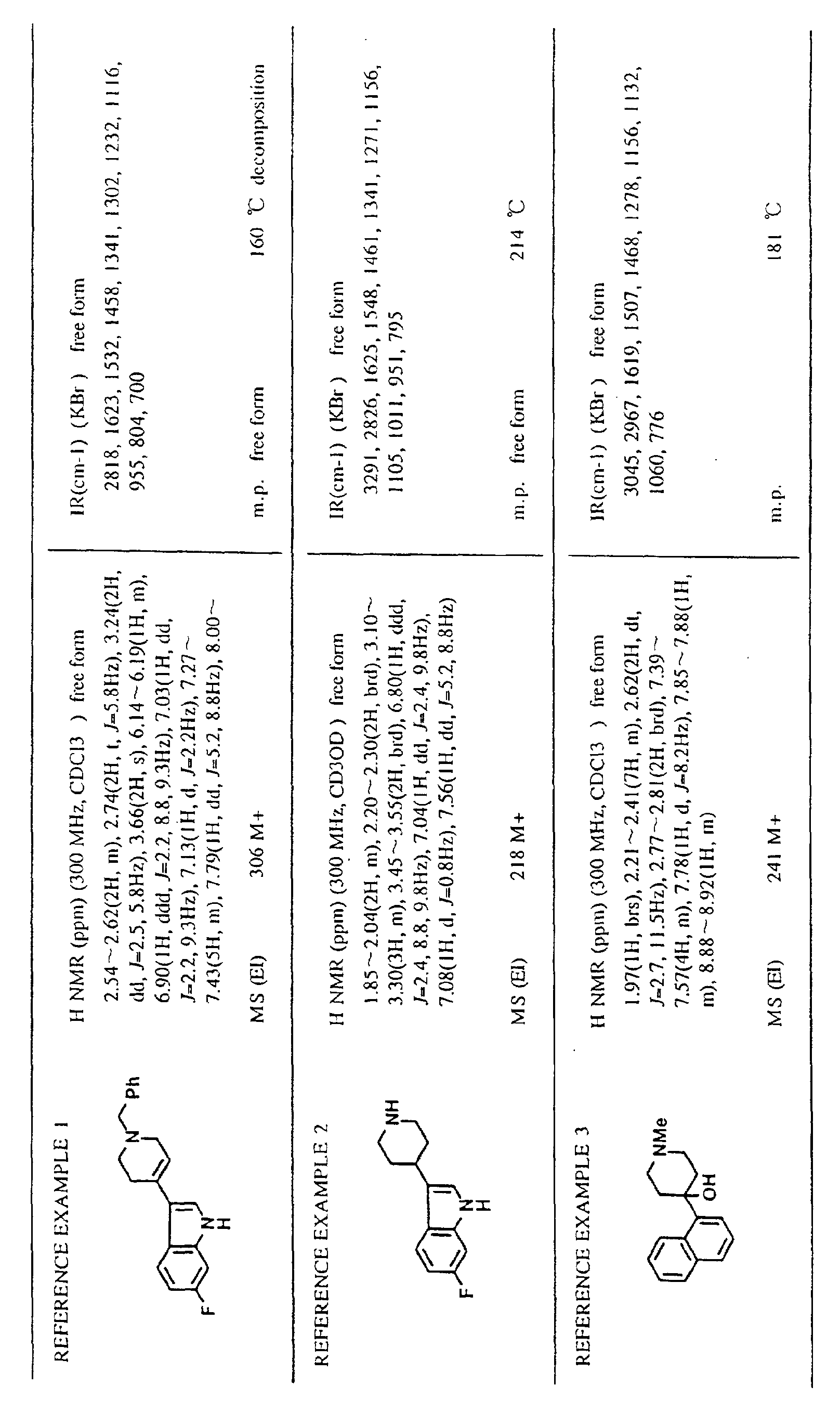


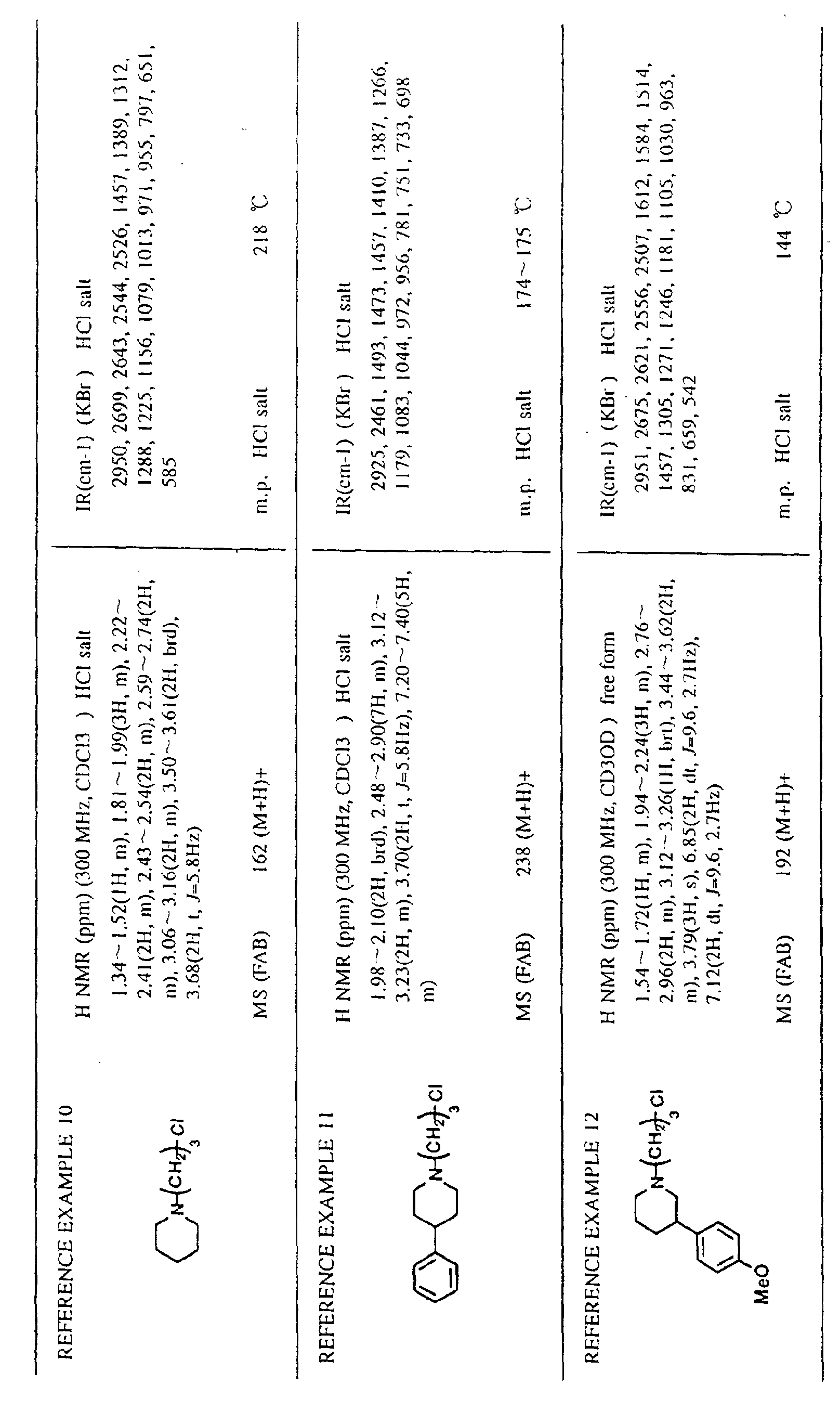


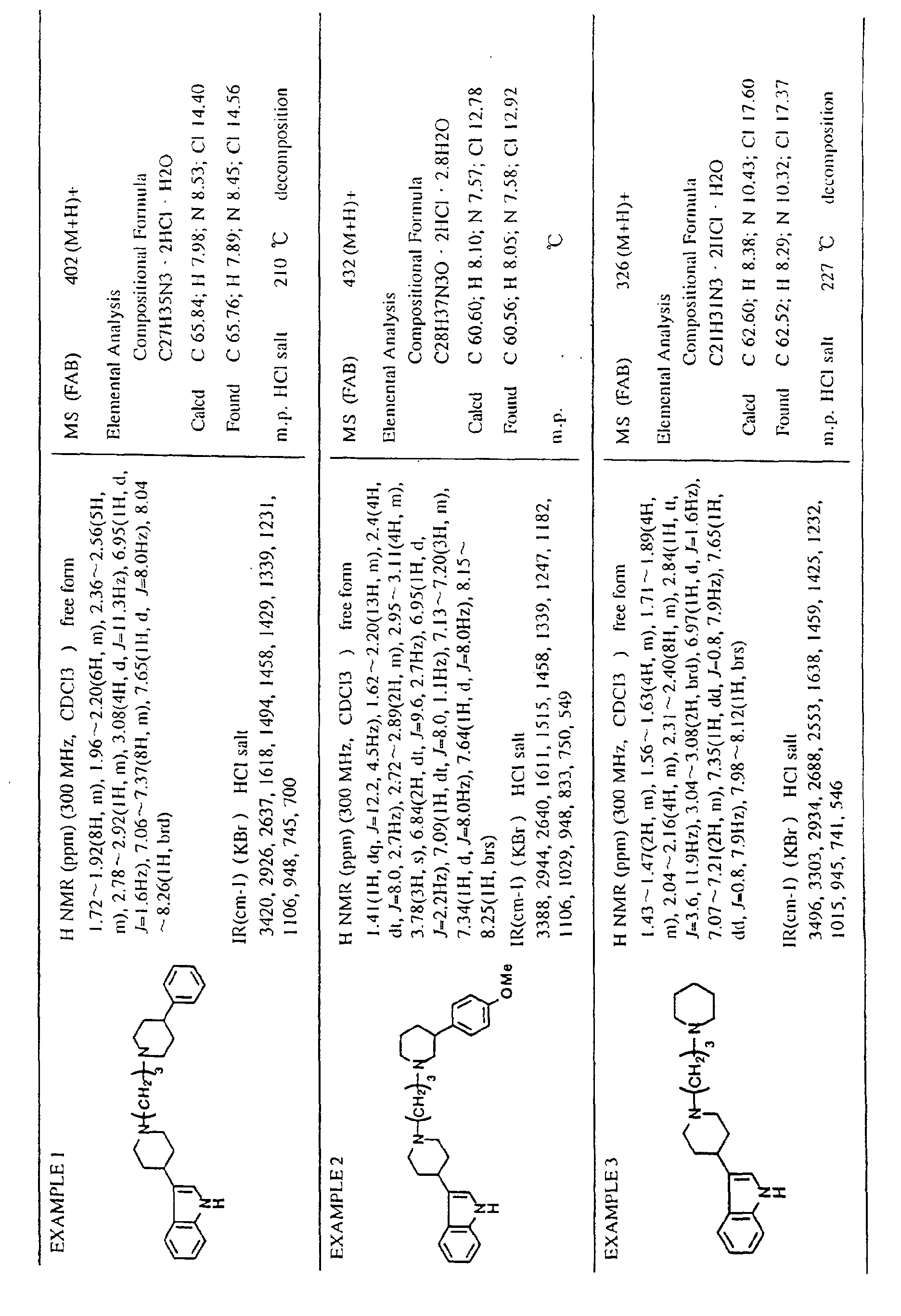
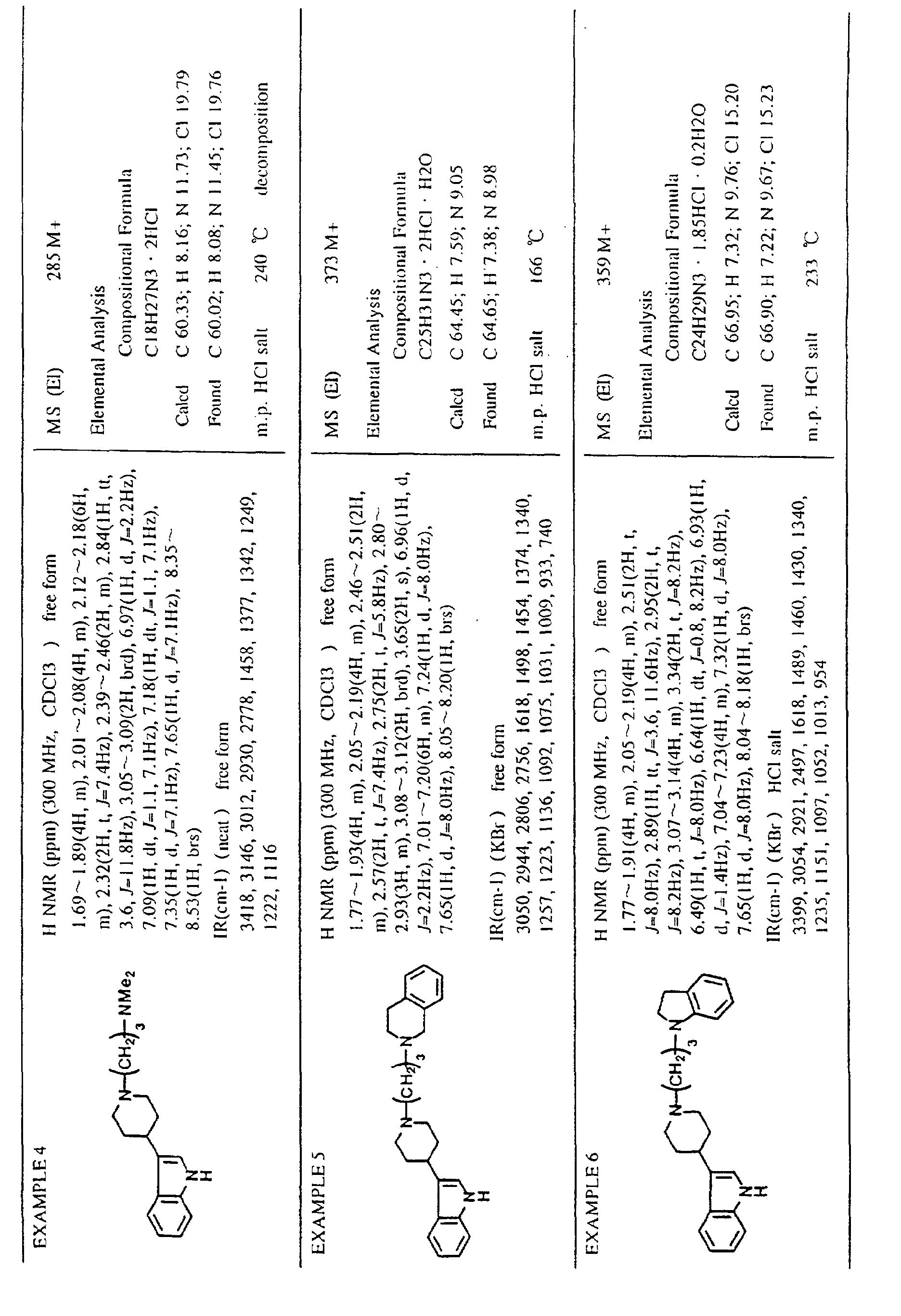
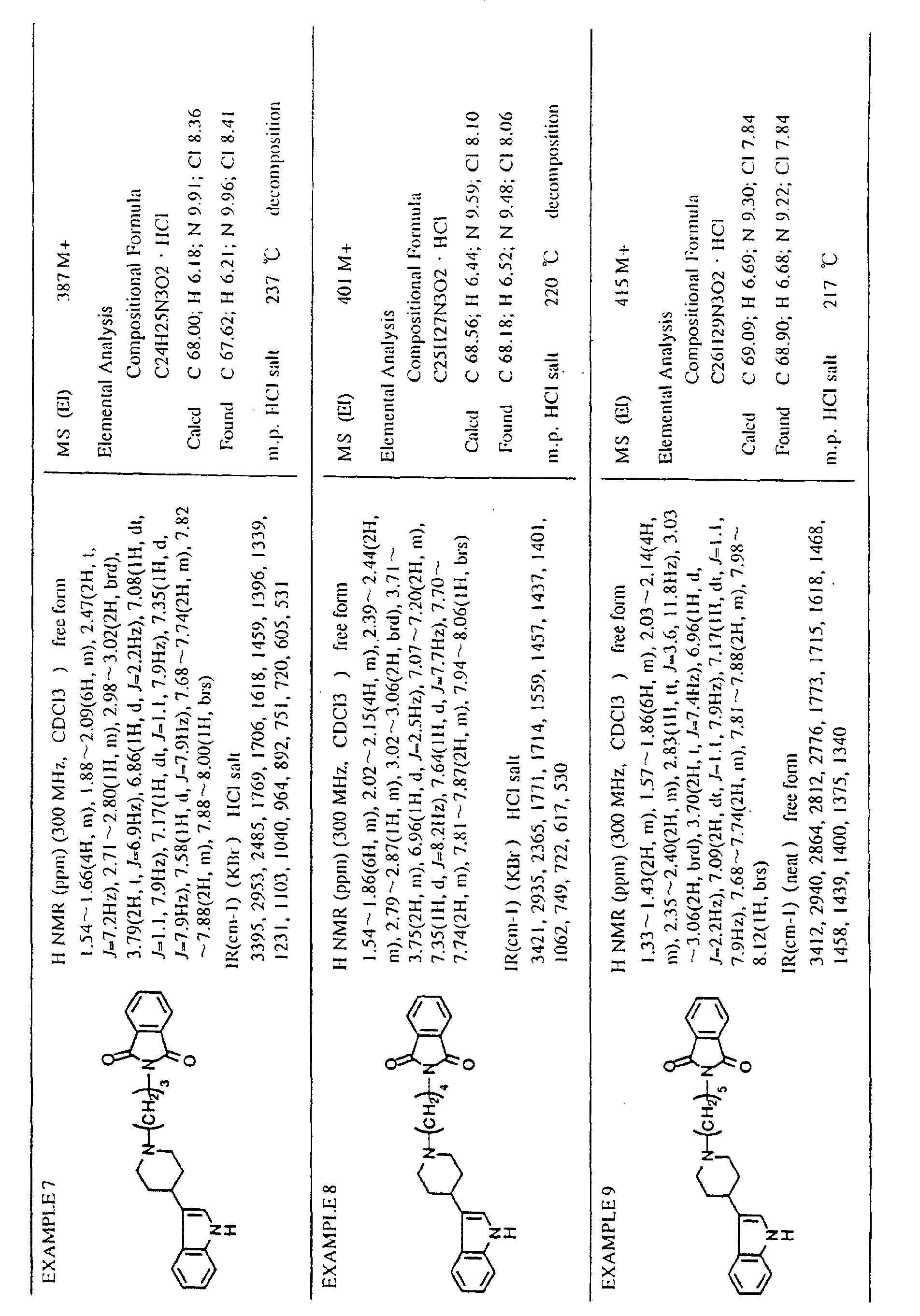
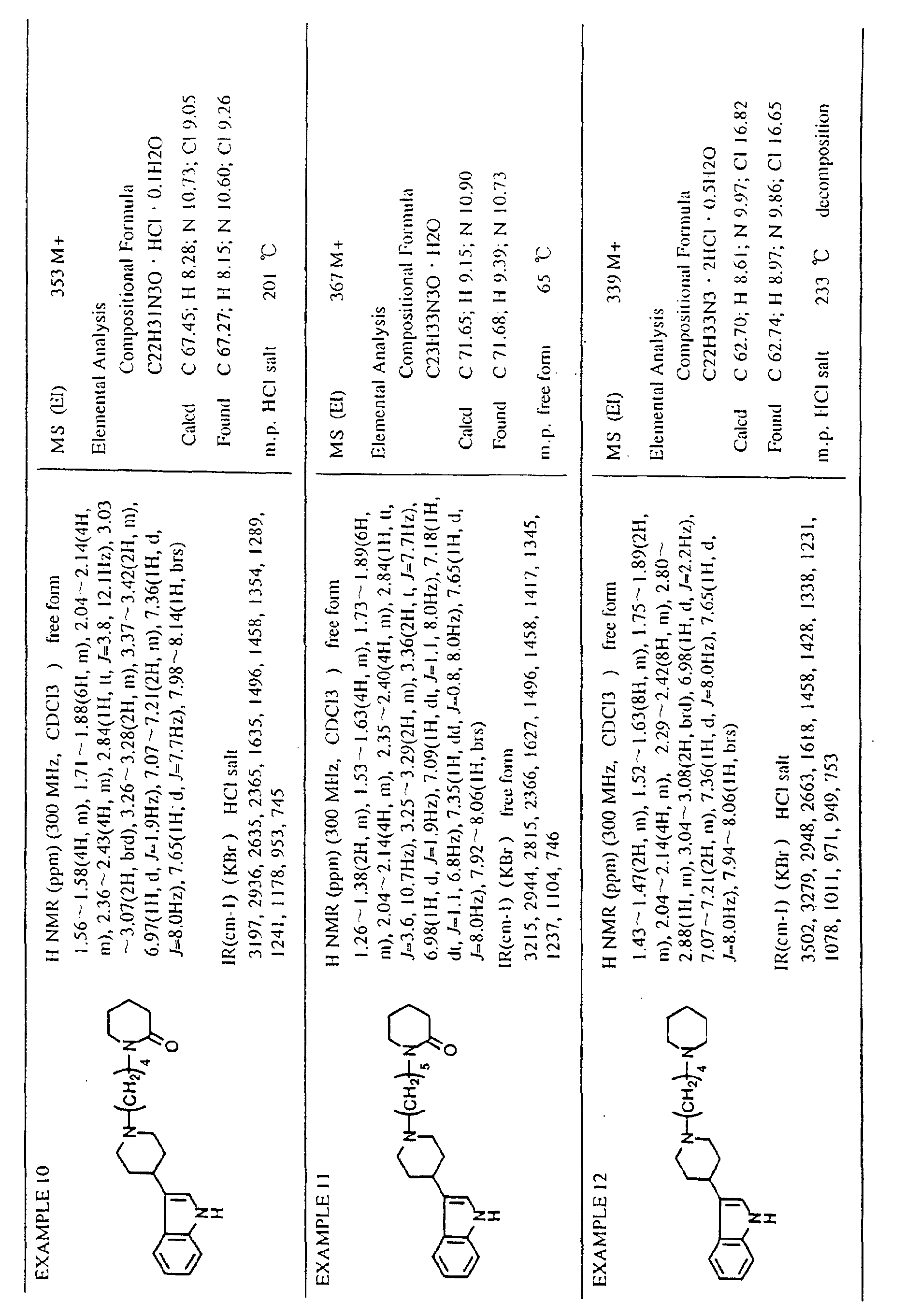
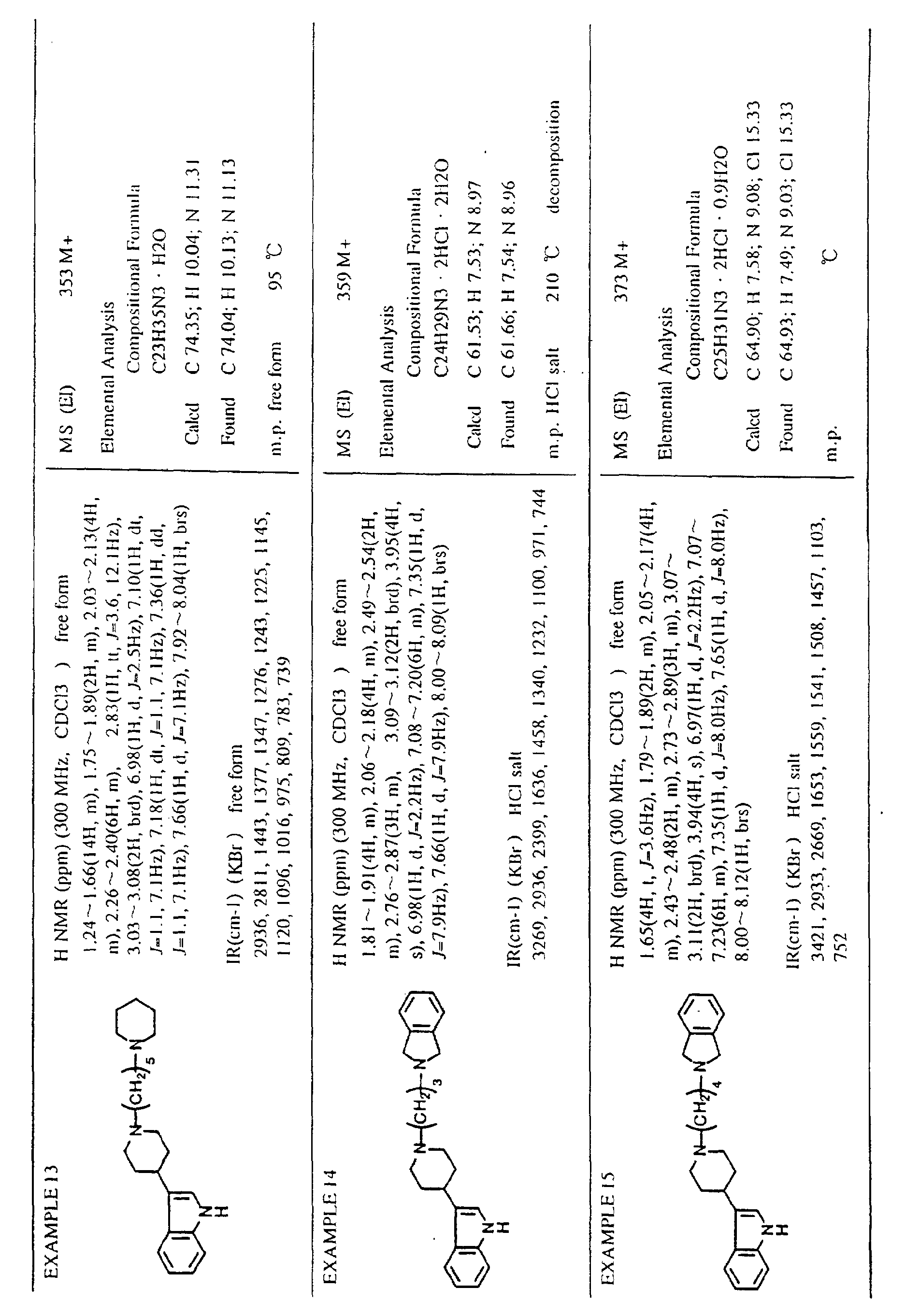


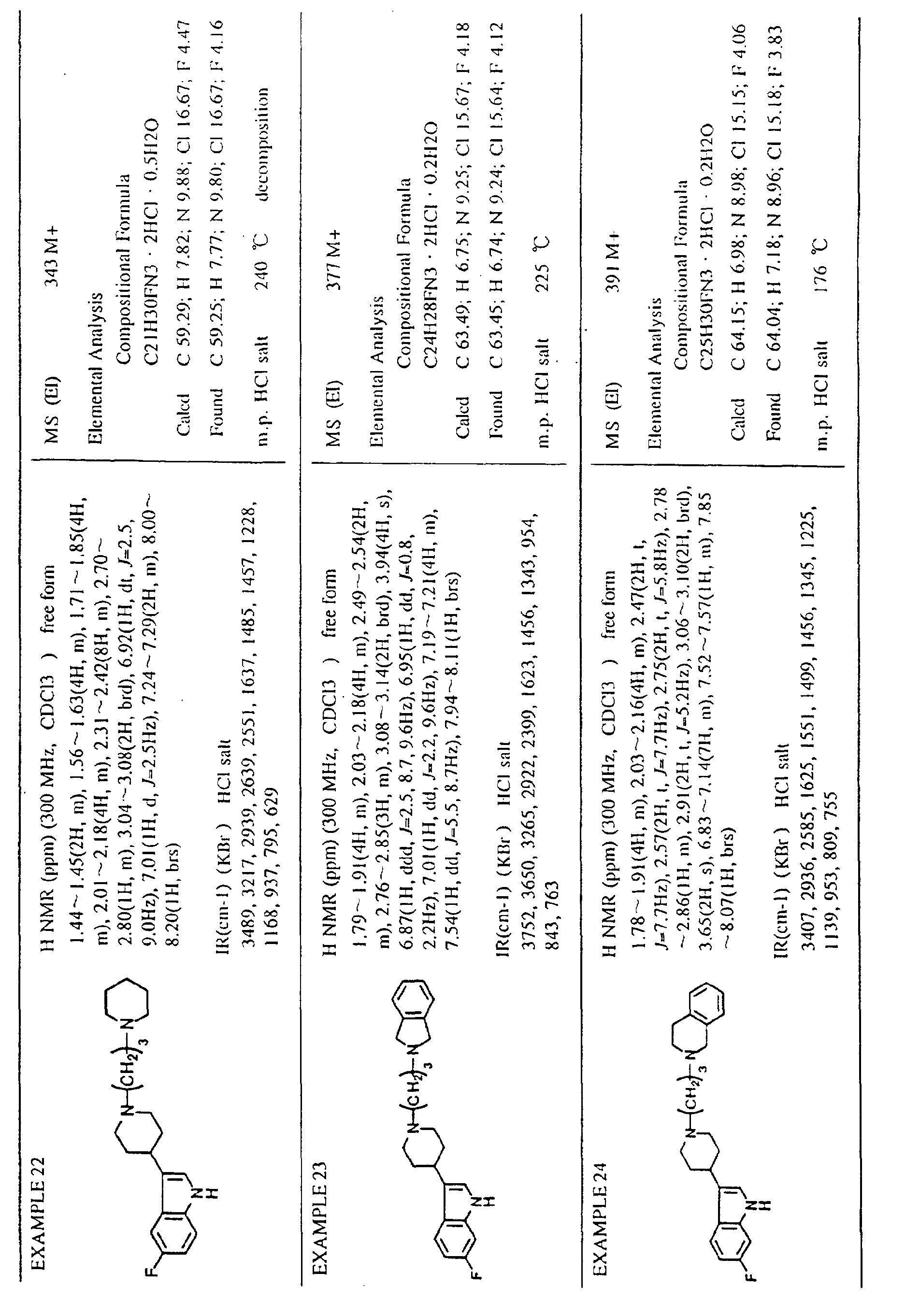
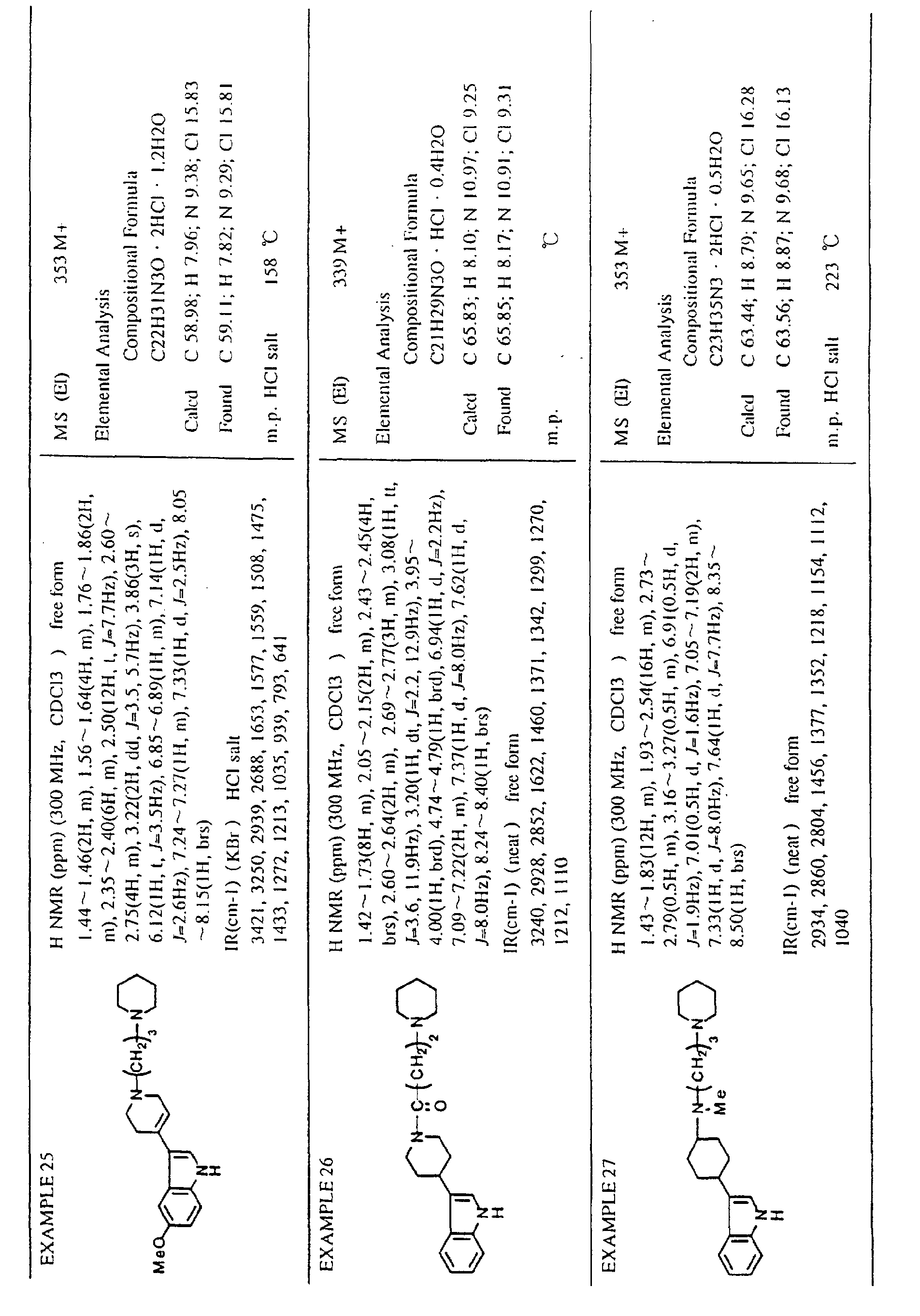
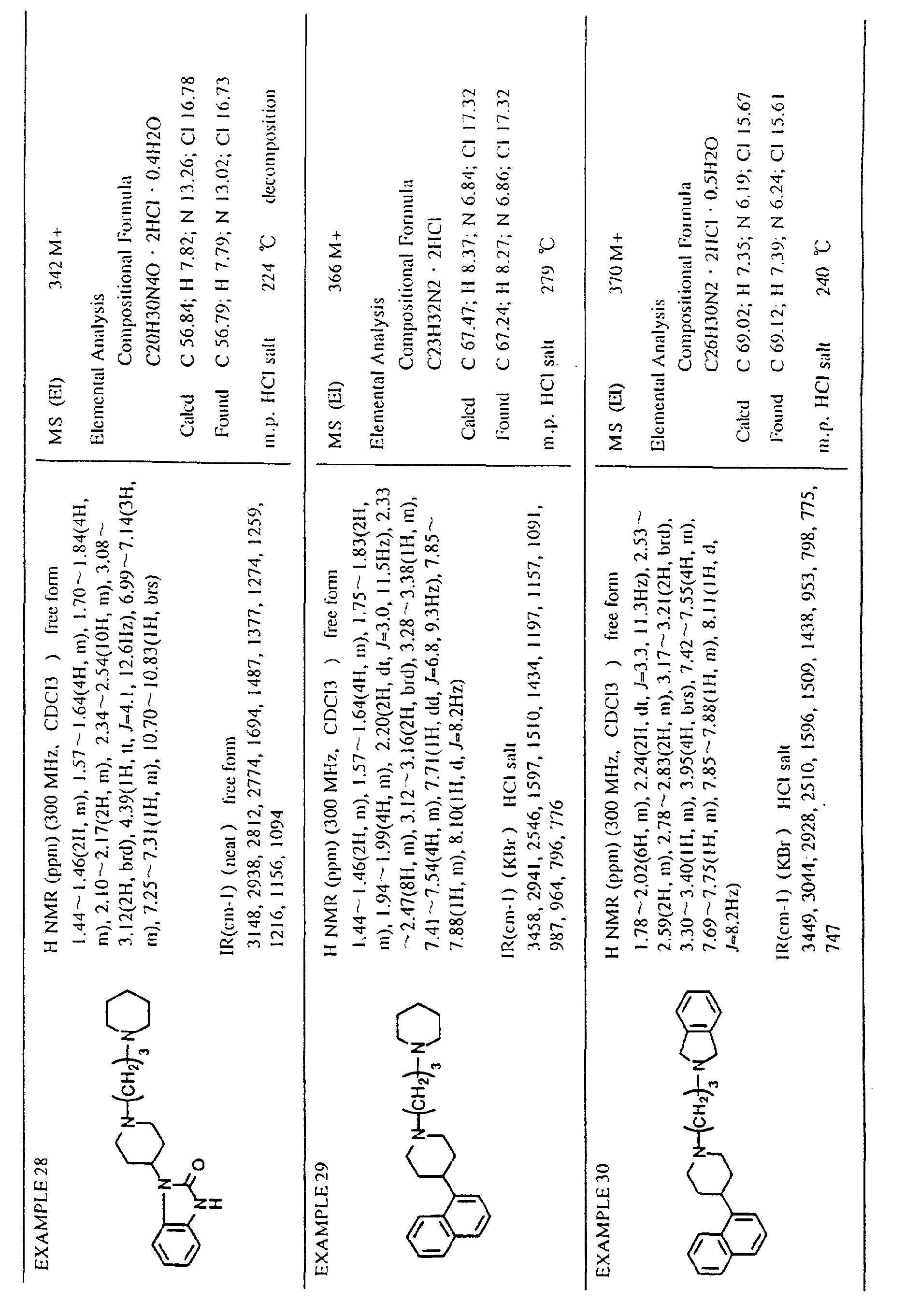
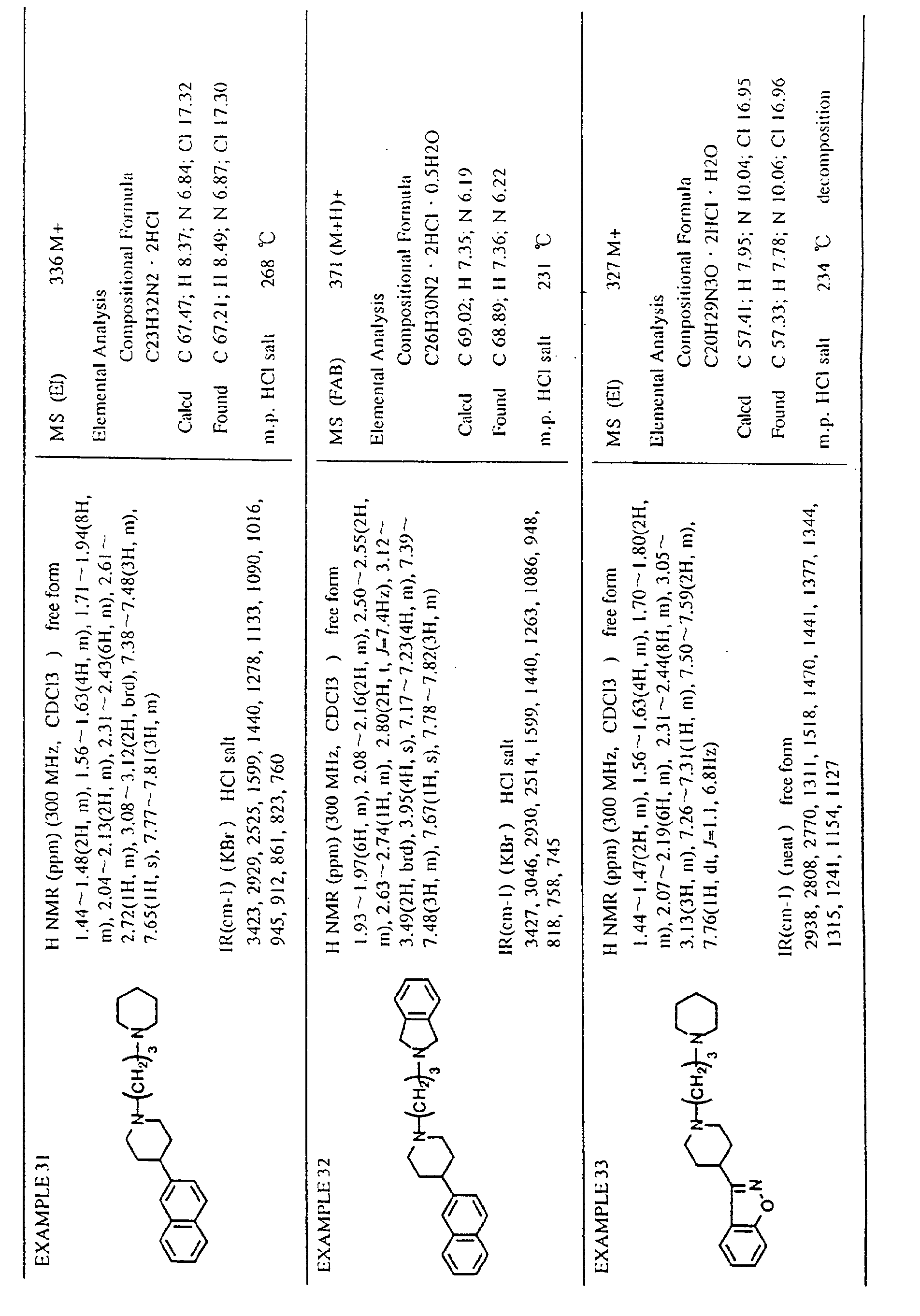
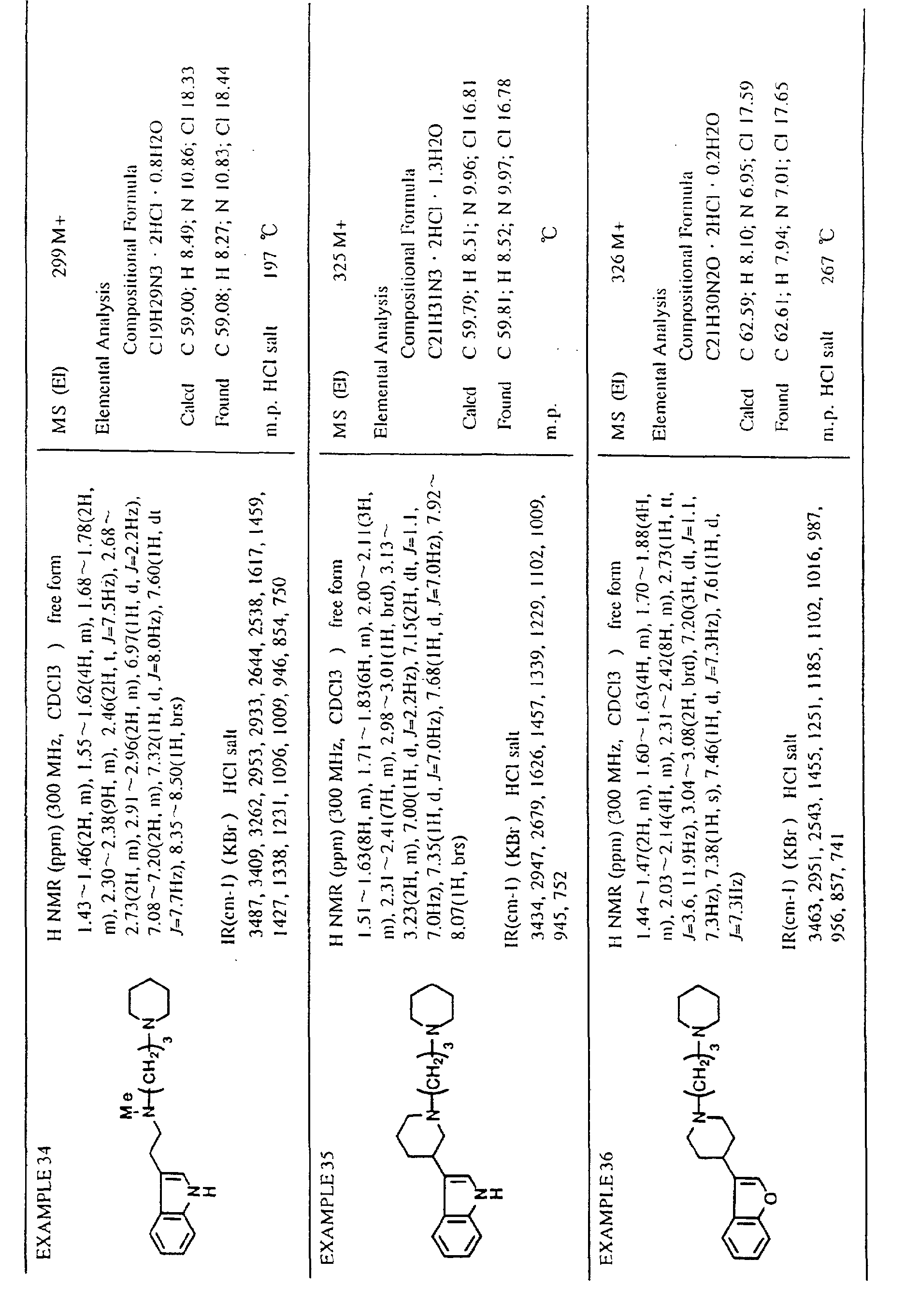
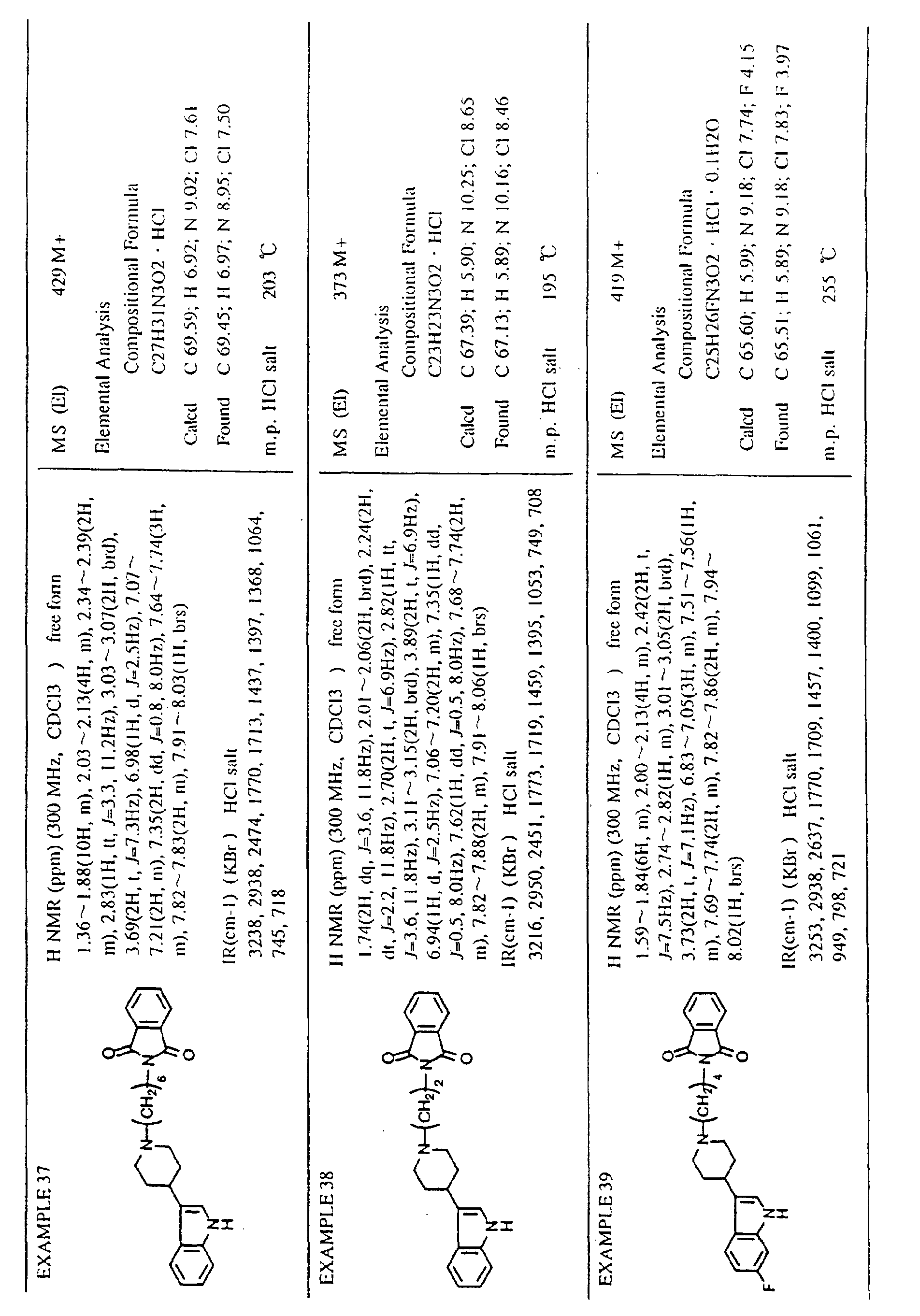

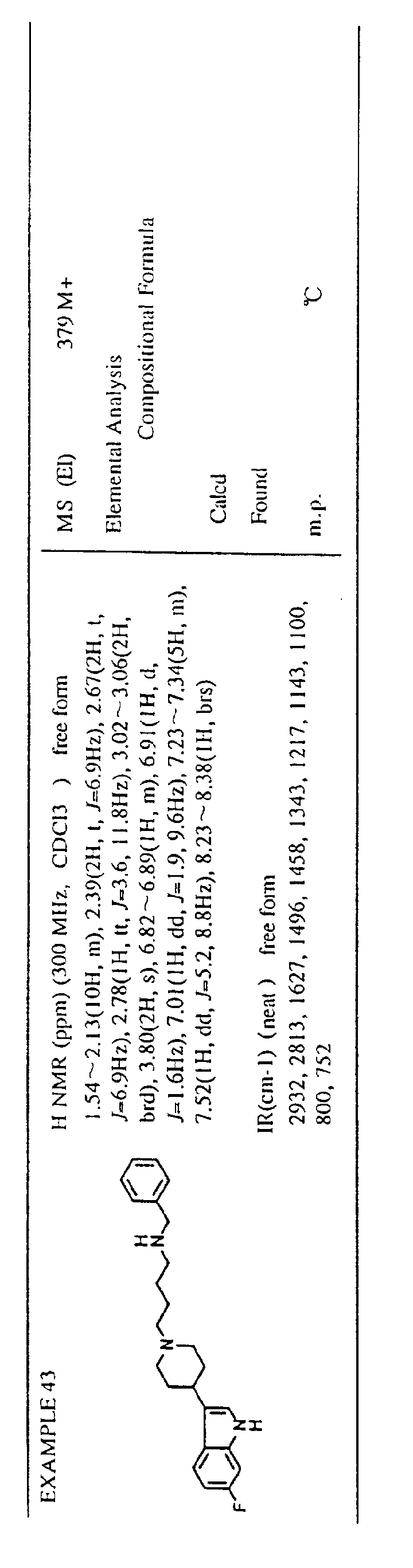
All experiments were performed at temperatures between
0°C and 4°C. As an α1A adrenoceptor preparation, a 43,000 xg
precipitation fraction was prepared from a rat submaxillary
gland, and this was used as a crude membrane preparation in
the experiment.
A Sprague-Dawley male rat was exsanguinated under ether
anesthesia, and the submaxillary gland was isolated, was
weighed and was cut to pieces with scissors. The cut gland
was put into a Potter-Elvehjem type Teflon homogenizer, and
was homogenized with 5 times by volume (5 mL per 1 g of the
wet weight of the submaxillary gland) of a 50 mM Tris-HCl
buffer (pH = 7.4) containing 5 mM EDTA, 0.2 mM DTT, and 0.1
mM PMSF. The resulting homogenate was allowed to pass
through a nylon mesh and was centrifuged at 800 xg for 10
minutes, and the resulting supernatant was centrifuged at
43,000 xg for 15 minutes. The precipitate was suspended in
a 50 mM Tris-HCl buffer (pH = 7.4) (Buffer A) containing 10
mM MgCl2, 0.2 mM DTT, and 0.1 mM PMSF and was then
centrifuged at 43,000 xg for 15 minutes. The resulting
precipitate was suspended in Buffer A to a protein
concentration of about 10 mg/mL, and the suspension was used
as the crude membrane preparation.
As an α1B adrenoceptor preparation, a 100,000 xg
precipitation fraction was prepared from a rat liver and
this was used as a crude membrane preparation in the
experiment.
A Sprague-Dawley male rat was exsanguinated under ether
anesthesia, and the liver was isolated, was weighed and was
cut into pieces with scissors. The cut liver was put into a
Potter-Elvehjem type Teflon homogenizer, and was homogenized
with 9 times by volume (9 mL per 1 g of the wet weight of
the liver) of a 50 mM Tris-HCl buffer (pH = 7.4) containing
0.25 M sucrose, 10 mM MgCl2, 1 mM EDTA, 0.2 mM DTT, and 0.1
mM PMSF. The homogenate was centrifuged at 800 xg for 10
minutes, and the resulting supernatant was centrifuged at
100,000 xg for 10 minutes, and the supernatant was then
further centrifuged at 100,000 xg for 60 minutes. The
precipitate obtained by centrifugation was suspended in a 50
mM Tris-HCl buffer (pH = 7.4) (Buffer A) containing 10 mM
MgCl2, 0.2 mM DTT, and 0.1 mM PMSF to a protein
concentration of about 10 mg/mL, and the suspension was used
as the crude membrane preparation.
Each of the crude membrane preparations was dispensed
and was stored at -80°C and was subjected to the experiment
on use. The protein concentration was determined by Lowry
method using bovine serum albumin as a standard.
Buffer A (400 µL) containing 0.5 nM [3H] prazosin and
200 µg crude membrane preparation was used as a standard
reaction solution. The receptor preparation and [3H]
prazosin were incubated at 25°C for 30 minutes, and 2 mL of
cold Buffer A was added to terminate the reaction. The cell
membrane was separated by suction filtration under rapidly
reduced pressure with a Whatman GF/C glass filter, and a
binding activity (total binding activity, total avidity) was
determined from the radioactivity bound to the cell membrane.
The same experimental procedure was performed in the
presence of 10 µM phentolamine to thereby determine a
nonspecific binding activity. A specific binding activity
was calculated by subtracting the nonspecific binding
activity from the total binding activity.
A solution of a test drug was prepared by dissolving
the test drug to 10 mM in distilled water, ethanol, or DMSO,
and serially diluting the solution with distilled water.
Kd values and Bmax values were determined using
Scatchard plots. Dissociation constant Ki (nM) of each
compound was determined according to the following equation.
Ki = IC50/[1+(radioactive ligand concentration/Kd)]
The results are shown in the following tables.
| Compound Example No. | α1B Ki (nM) |
| 1 | 7.1 |
| 2 | 6.7 |
| 3 | 3.0 |
| 4 | 4.8 |
| 5 | 2.1 |
| 6 | 7.5 |
| 7 | 7.2 |
| 12 | 1.1 |
| 13 - | 1.5 |
| 14 | 3.6 |
| 15 | 1.4 |
| 16 | 1.6 |
| 18 | 60 |
| 19 | 71 |
| 21 | 0.63 |
| 22 | 16 |
| 23 | 0.79 |
| 24 | 0.61 |
| 25 | 61 |
| 26 | 200 |
| 27 | 89 |
| 29 | 69 |
| 31 | 92 |
| 34 | 91 |
| 35 | 110 |
| 36 | 7.7 |
| Reference Example 21 | 860 |
| Compound Example No. | α1A Ki (nM) |
| 1 | 230 |
| 2 | 100 |
| 3 | 120 |
| 4 | 240 |
| 5 | 130 |
| 6 | 51 |
| 7 | 53 |
| 12 | 56 |
| 13 | 57 |
| 14 | 50 |
| 15 | 30 |
| 16 | 82 |
| 18 | 480 |
| 19 | 1900 |
| 21 | 21 |
| 22 | 690 |
| 23 | 18 |
| 24 | 24 |
| 25 | 3200 |
| 26 | 4100 |
| 27 | 2000 |
| 29 | 890 |
| 31 | 2200 |
| 34 | 2200 |
| 35 | 1500 |
| 36 | 60 |
| Reference Example 21 | 870 |
The results show that the invented compounds have high
affinity for α1B adrenoceptor. Additionally, these compounds are
found to be α1B adrenoceptor antagonists as they have no
constriction activity on various blood vessels. The invented
compounds are useful in elucidation of physiological activities
mediated by the α1B adrenoceptor and in prophylaxis/therapy of
diseases in which the α1B adrenoceptor is involved.
Inhibitory activity against vasopressor response induced by
α1 adrenoceptor agonist:
The inhibitory activity of the α1B adrenoceptor antagonist
according to Example 23 against vasopressor response induced by
phenylephrine (an α1 adrenoceptor agonist) in rats under anesthesia
was studied. Specifically, the compound was intravenously
continuously administered to Sprague-Dawley male rats (weight: 320
to 440 g) under pentobarbital (75 mg/kg, i.p.) anesthesia, and
vasopressor responses of phenylephrine were determined and the
inhibition rate was determined before administration and 15 minutes
after administration. The compound was dissolved in physiological
saline, and was infused into the femoral vein at a rate of 20
µl/kg/min. Phenylephrine was dissolved in physiological saline and
was bolus injected at a dose of 0.2 ml/kg (3 µg/kg). The
inhibition rate was calculated according to the following equation.
Inhibition rate (%)
= [1-(pressure increase induced by phenylephrine 15 minutes after
administration of the example compound)/(pressure increase induced
by phenylephrine before administration of the example compound)] x
100
The results are shown in the following table.
Inhibitory activity of the compound against vasopressor
response due to phenylephrine
| Dose of compound (mg/kg/min) | 0.1 | 0.3 | 1 | 3 |
| Number of rats used | 4 | 3 | 3 | 3 |
| Inhibition rate (%) | 24±5 | 47±5 | 72±5 | 86±2 |
The numerical values show mean±standard error.
The results show that the invented compounds inhibit pressure
increase induced by α1 adrenoceptor agonists.
Accordingly, the invented compounds are useful in elucidation
of physiological activities mediated by the α1B adrenoceptor and in
prophylaxis/therapy of diseases in which the α1B adrenoceptor is
involved, and are useful, for example, as therapeutic agents for
hypertension.
The invented compounds are antagonists having high affinity
for α1B adrenoceptor and are useful as pharmacological tools for
elucidation of physiological activities mediated by the α1B
adrenoceptor, or, as pharmaceutical agents for use in
prophylaxis/therapy of diseases (e.g., hypertension) in which the
α1B adrenoceptor is involved.
Claims (13)
- An α1B adrencceotor antagonist comprising a compound represented by the general formula (I) or a pharmacologically acceptable acid addition salt thereof:[wherein Ar is indole, naphthalene, quinoline, benzimidazole, benzofuran, benzothiophene, benzisoxazole, or 2-ketobenzimidazoline, each of which is unsubstituted or substituted with the groups selected from the group consisting of halogen, nitro group, acylamino group having 1 to 9 carbon atoms, amino group, alkylamino group having 1 to 8 carbon atoms, arylamino group having 6 to 15 carbon atoms, dialkylamino group having 2 to 16 carbon atoms, diarylamino group having 12 to 20 carbon atoms, hydroxy, alkyl group having 1 to 8 carbon atoms, aryl group having 6 to 15 carbon atoms, alkoxy group having 1 to 8 carbon atoms, aryloxy group having 1 to 15 carbon atoms, haloalkyl group having 1 to 8 carbon atoms, haloalkoxy group having 1 to 8 carbon atoms, cyano group, aminosulfonyl group having 0 to 15 carbon atoms, carboxyl group, alkoxycarbonyl group having 2 to 9 carbon atoms, aminocarbonyl group having 1 to 15 carbon atoms, alkylthio group having 1 to 8 carbon atoms, and arylthio group having 6 to 15 carbon atoms; R1 is hydrogen, alkyl having 1 to 6 carbon atoms, aryl having 6 to 12 carbon atoms, alkenyl having 2 to 9 carbon atoms, or cycloalkyl having 3 to 8 carbon atoms;

B is bond, or alkylene having 1 to 3 carbon atoms which is unsubstituted or substituted with the groups selected from the group consisting of alkyl group having 1 to 8 carbon atoms, halogen, and hydroxy;
or B-N-R1 forms a ring structure and is piperidine, piperazine, or 2,3,6-trihydropyridine, each of which is unsubstituted or substituted with the groups selected from the group consisting of halogen, hydroxy, alkyl group having 1 to 8 carbon atoms, aryl group having 6 to 15 carbon atoms, haloalkyl group having 1 to 8 carbon atoms, aminosulfonyl group having 0 to 15 carbon atoms, carboxyl group, alkoxycarbonyl group having 2 to 9 carbon atoms, aminocarbonyl group having 1 to 15 carbon atoms, hydroxyalkyl group having 1 to 8 carbon atoms, alkylcarbonyl group having 2 to 9 carbon atoms, arylcarbonyl group having 7 to 16 carbon atoms, and aralkyl group having 7 to 15 carbon atoms;
n denotes an integer of 0 or 1;
A is alkylene having 2 to 8 carbon atoms, phenylene, or cycloalkylene having 3 to 8 carbon atoms, each of which is unsubstituted or substituted with the groups selected from the group consisting of halogen, nitro group, acylamino group having 1 to 9 carbon atoms, amino group, alkylamino group having 1 to 8 carbon atoms, arylamino group having 6 to 15 carbon atoms, dialkylamino group having 2 to 16 carbon atoms, diarylamino group having 12 to 20 carbon atoms, hydroxy, alkyl group having 1 to 8 carbon atoms, aryl group having 6 to 15 carbon atoms, alkoxy group having 1 to 8 carbon atoms, aryloxy group having 6 to 15 carbon atoms, haloalkyl group having 1 to 8 carbon atoms, haloalkoxy group having 1 to 8 carbon atoms, cyano group, aminosulfonyl group having 0 to 15 carbon atoms, carboxyl group, alkoxycarbonyl group having 2 to 9 carbon atoms, aminocarbonyl group having 1 to 15 carbon atoms, alkylthio group having 1 to 8 carbon atoms, and arylthio group having 6 to 15 carbon atoms;
Q is:1) -NR2R3,
wherein each of R2 and R3 is independently hydrogen, alkyl having 1 to 6 carbon atoms, cycloalkyl having 3 to 8 carbon atoms, alkenyl having 2 to 9 carbon atoms, aryl having 6 to 15 carbon atoms, or aralkyl having 7 to 15 carbon atoms (wherein the aryl moiety of the aryl and aralkyl may be substituted with the groups selected from the group consisting of halogen, nitro group, acylamino group having 1 to 9 carbon atoms, amino group, alkylamino group having 1 to 8 carbon atoms, arylamino group having 6 to 15 carbon atoms, dialkylamino group having 2 to 16 carbon atoms, diarylamino group having 12 to 20 carbon atoms, hydroxy, alkyl group having 1 to 8 carbon atoms, aryl group having 6 to 15 carbon atoms, alkoxy group having 1 to 8 carbon atoms, aryloxy group having 6 to 15 carbon atoms, haloalkyl group having 1 to 8 carbon atoms, haloalkoxy group having 1 to 8 carbon atoms, cyano group, aminosulfonyl group having 0 to 15 carbon atoms, carboxyl group, alkoxycarbonyl group having 2 to 9 carbon atoms, aminocarbonyl group having 1 to 15 carbon atoms, alkylthio group having 1 to 8 carbon atoms, and arylthio group having 6 to 15 carbon atoms), or -NR2R3 together forms piperidine, pyrrolidine, 1,3,4-trihydroisoquinoline, isoindoline, piperazine, morpholine, 2-piperidone, 2-pyrrolidone, indoline, 2,3,4-trihydroquinoline, 2,3,4-trihydroquinoxaline, dihydrobenzoxazine, benzothiane, phthalimide, or guanidine, each of which is unsubstituted or substituted with the groups selected from the group consisting of halogen, nitro group, acylamino group having 1 to 9 carbon atoms, amino group, alkylamino group having 1 to 8 carbon atoms, arylamino group having 6 to 15 carbon atoms, dialkylamino group having 2 to 16 carbon atoms, diarylamino group having 12 to 20 carbon atoms, hydroxy, alkyl group having 1 to 8 carbon atoms, aryl group having 6 to 15 carbon atoms, alkoxy group having 1 to 8 carbon atoms, aryloxy group having 6 to 15 carbon atoms, haloalkyl group having 1 to 8 carbon atoms, haloalkoxy group having 1 to 8 carbon atoms, cyano group, aminosulfonyl group having 0 to 15 carbon atoms, carboxyl group, alkoxycarbonyl group having 2 to 9 carbon atoms, aminocarbonyl group having 1 to 15 carbon atoms, alkylthio group having 1 to 8 carbon atoms, and arylthio group having 6 to 15 carbon atoms; or2) the formula (II):(wherein each of R4, R5, R6 is independently hydrogen, alkyl having 1 to 6 carbon atoms, cycloalkyl having 3 to 8 carbon atoms, alkenyl having 2 to 9 carbon atoms, aryl having 6 to 15 carbon atoms, or aralkyl having 7 to 15 carbon atoms (wherein the aryl moiety of the aryl and aralkyl may be substituted with the groups selected from the group consisting of halogen, nitro group, acylamino group having 1 to 9 carbon atoms, amino group, alkylamino group having 1 to 8 carbon atoms, arylamino group having 6 to 15 carbon atoms, dialkylamino group having 2 to 16 carbon atoms, diarylamino group having 12 to 20 carbon atoms, hydroxy, alkyl group having 1 to 8 carbon atoms, aryl group having 6 to 15 carbon atoms, alkoxy group having 1 to 8 carbon atoms, aryloxy group having 6 to 15 carbon atoms, haloalkyl group having 1 to 8 carbon atoms, haloalkoxy group having 1 to 8 carbon atoms, cyano group, aminosulfonyl group having 0 to 15 carbon atoms, carboxyl group, alkoxycarbonyl group having 2 to 9 carbon atoms, aminocarbonyl group having 1 to 15 carbon atoms, alkylthio group having 1 to 8 carbon atoms, and arylthio group having 6 to 15 carbon atoms), or R4 and R5 together form an imidazoline ring)].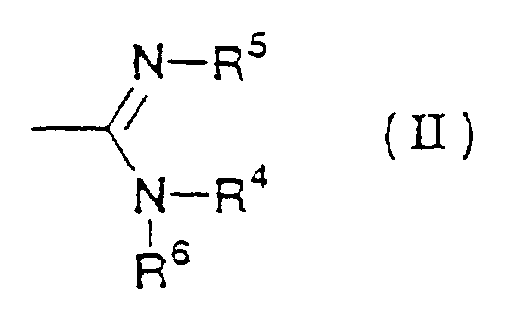
- An α1B adrenoceptor antagonist according to claim 1, wherein, in the general formula (I), n is 0;
Ar is indole, naphthalene, quinoline, benzimidazole, benzofuran, or benzothiophene, each of which is unsubstituted or substituted with the groups selected from the group consisting of halogen, nitro group, acylamino group having 1 to 9 carbon atoms, amino group, alkylamino group having 1 to 8 carbon atoms, arylamino group having 6 to 15 carbon atoms, dialkylamino group having 2 to 16 carbon atoms, diarylamino group having 12 to 20 carbon atoms, hydroxy, alkyl group having 1 to 8 carbon atoms, aryl group having 6 to 15 carbon atoms, alkoxy group having 1 to 8 carbon atoms, aryloxy group having 6 to 15 carbon atoms, haloalkyl group having 1 to 8 carbon atoms, haloalkoxy group having 1 to 8 carbon atoms, cyano group, aminosulfonyl group having 0 to 15 carbon atoms, carboxyl group, alkoxycarbonyl group having 2 to 9 carbon atoms, aminocarbonyl group having 1 to 15 carbon atoms, alkylthio group having 1 to 8 carbon atoms, and arylthio group having 6 to 15 carbon atoms;
B is alkylene having 2 or 3 carbon atoms which is unsubstituted or substituted with the groups selected from the group consisting of alkyl group having 1 to 8 carbon atoms, halogen, and hydroxy, or B-N-R1 forms a ring structure and is piperidine, piperazine, or 2,3,6-trihydropyridine, each of which is unsubstituted or substituted with the groups selected from the group consisting of halogen, hydroxy, alkyl group having 1 to 8 carbon atoms, aryl group having 6 to 15 carbon atoms, haloalkyl group having 1 to 8 carbon atoms, aminosulfonyl group having 0 to 15 carbon atoms, carboxyl group, alkoxycarbonyl group having 2 to 9 carbon atoms, aminocarbonyl group having 1 to 15 carbon atoms, hydroxyalkyl group having 1 to 8 carbon atoms, alkylcarbonyl group having 2 to 9 carbon atoms, arylcarbonyl group having 7 to 16 carbon atoms, and aralkyl group having 7 to 15 carbon atoms;
A has the same meaning as defined in claim 1;
Q is:1) -NR2R3,
wherein each of R2 and R3 is independently hydrogen, alkyl having 1 to 6 carbon atoms, cycloalkyl having 3 to 8 carbon atoms, alkenyl having 2 to 9 carbon atoms, aryl having 6 to 15 carbon atoms, or aralkyl having 7 to 15 carbon atoms (wherein the aryl moiety of the aryl and aralkyl may be substituted with the groups selected from the group consisting of halogen, nitro group, acylamino group having 1 to 9 carbon atoms, amino group, alkylamino group having 1 to 8 carbon atoms, arylamino group having 6 to 15 carbon atoms, dialkylamino group having 2 to 16 carbon atoms, diarylamino group having 12 to 20 carbon atoms, hydroxy, alkyl group having 1 to 8 carbon atoms, aryl group having 6 to 15 carbon atoms, alkoxy group having 1 to 8 carbon atoms, aryloxy group having 6 to 15 carbon atoms, haloalkyl group having 1 to 8 carbon atoms, haloalkoxy group having 1 to 8 carbon atoms, cyano group, aminosulfonyl group having 0 to 15 carbon atoms, carboxyl group, alkoxycarbonyl group having 2 to 9 carbon atoms, aminocarbonyl group having 1 to 15 carbon atoms, alkylthio group having 1 to 8 carbon atoms, and arylthio group having 6 to 15 carbon atoms), or -NR2R3 together forms piperidine, pyrrolidine, 1,3,4-trihydroisoquinoline, isoindoline, piperazine, morpholine, indoline, 2,3,4-trihydroquinoline, 2,3,4-trihydroquinoxaline, dihydrobenzoxazine, or guanidine, each of which is unsubstituted or substituted with the groups selected from the group consisting of halogen, nitro group, acylamino group having 1 to 9-carbon atoms, amino group, alkylamino group having 1 to 8 carbon atoms, arylamino group having 6 to 15 carbon atoms, dialkylamino group having 2 to 16 carbon atoms, diarylamino group having 12 to 20 carbon atoms, hydroxy, alkyl group having 1 to 8 carbon atoms, aryl group having 6 to 15 carbon atoms, alkoxy group having 1 to 8 carbon atoms, aryloxy group having 6 to 15 carbon atoms, haloalkyl group having 1 to 8 carbon atoms, haloalkoxy group having 1 to 8 carbon atoms, cyano group, aminosulfonyl group having 0 to 15 carbon atoms, carboxyl group, alkoxycarbonyl group having 2 to 9 carbon atoms, aminocarbonyl group having 1 to 15 carbon atoms, alkylthio group having 1 to 8 carbon atoms, and arylthio group having 6 to 15 carbon atoms; or2) the formula (II):(wherein R4, R5, and R6 have the same meanings as defined in claim 1).
- An α1B adrenoceptor antagonist according to claim 1 or 2, wherein, in the general formula (I), n is 0;
Ar is indole, naphthalene, quinoline, or benzimidazole, each of which is unsubstituted or substituted with the groups selected from the group consisting of halogen, nitro group, acylamino group having 1 to 9 carbon atoms, amino group, alkylamino group having 1 to 8 carbon atoms, arylamino group having 6 to 15 carbon atoms, dialkylamino group having 2 to 16 carbon atoms, diarylamino group having 12 to 20 carbon atoms, hydroxy, alkyl group having 1 to 8 carbon atoms, aryl group having 6 to 15 carbon atoms, alkoxy group having 1 to 8 carbon atoms, aryloxy group having 6 to 15 carbon atoms, haloalkyl group having 1 to 8 carbon atoms, haloalkoxy group having 1 to 8 carbon atoms, cyano group, aminosulfonyl group having 0 to 15 carbon atoms, carboxyl group, alkoxycarbonyl group having 2 to 9 carbon atoms, aminocarbonyl group having 1 to 15 carbon atoms, alkylthio group having 1 to 8 carbon atoms, and arylthio group having 6 to 15 carbon atoms;
B-N-R1 forms a ring structure and is piperidine or piperazine, each of which is unsubstituted or substituted with the groups selected from the group consisting of halogen, hydroxy, alkyl group having 1 to 8 carbon atoms, aryl group having 6 to 15 carbon atoms, haloalkyl group having 1 to 8 carbon atoms, aminosulfonyl group having 0 to 15 carbon atoms, carboxyl group, alkoxycarbonyl group having 2 to 9 carbon atoms, aminocarbonyl group having 1 to 15 carbon atoms, hydroxyalkyl group having 1 to 8 carbon atoms, alkylcarbonyl group having 2 to 9 carbon atoms, arylcarbonyl group having 7 to 16 carbon atoms, and aralkyl group having 7 to 15 carbon atoms;
A is alkylene having 2 to 8 carbon atoms or cycloalkylene having 3 to B carbon atoms, each of which is unsubstituted or substituted with the groups selected from the group consisting of halogen. nitro group, acylamino group having 1 to 9 carbon atoms, amino group, alkylamino group having 1 to 8 carbon atoms, arylamino group having 6 to 15 carbon atoms, dialkylamino group having 2 to 16 carbon atoms, diarylamino group having 12 to 20 carbon atoms, hydroxy, alkyl group having 1 to 8 carbon atoms, aryl group having 6 to 15 carbon atoms, alkoxy group having 1 to 8 carbon atoms, aryloxy group having 6 to 15 carbon atoms, haloalkyl group having 1 to 8 carbon atoms, haloalkoxy group having 1 to 8 carbon atoms, cyano group, aminosulfonyl group having 0 to 15 carbon atoms, carboxyl group, alkoxycarbonyl group having 2 to 9 carbon atoms, aminocarbonyl group having 1 to 15 carbon atoms, alkylthio group having 1 to 8 carbon atoms, and arylthio group having 6 to 15 carbon atoms;
Q is :1) -NR2R3 (wherein each of R2 and R3 is independently hydrogen, alkyl having 1 to 6 carbon atoms, cycloalkyl having 3 to 8 carbon atoms, alkenyl having 2 to 9 carbon atoms, aryl having 6 to 15 carbon atoms, or aralkyl having 7 to 15 carbon atoms (wherein the aryl moiety of the aryl and aralkyl may be substituted with the groups selected from the group consisting of halogen, nitro group, acylamino group having 1 to 9 carbon atoms, amino group, alkylamino group having 1 to 8 carbon atoms, arylamino group having 6 to 15 carbon atoms, dialkylamino group having 2 to 16 carbon atoms, diarylamino group having 12 to 20 carbon atoms, hydroxy, alkyl group having 1 to 8 carbon atoms, aryl group having 6 to 15 carbon atoms, alkoxy group having 1 to 8 carbon atoms, aryloxy group having 6 to 15 carbon atoms, haloalkyl group having 1 to 8 carbon atoms, haloalkoxy group having 1 to 8 carbon atoms, cyano group, aminosulfonyl group having 0 to 15 carbon atoms, carboxyl group, alkoxycarbonyl group having 2 to 9 carbon atoms, aminocarbonyl group having 1 to 15 carbon atoms, alkylthio group having 1 to 8 carbon atoms, and arylthio group having 6 to 15 carbon atoms),or -NR2R3 together forms piperidine, pyrrolidine, 1,3,4-trihydroisoquinoline, isoindoline, piperazine, morpholine, or guanidine, each of which is unsubstituted or substituted with the groups selected from the group consisting of halogen, nitro group, acylamino group having 1 to 9 carbon atoms, amino group, alkylamino group having 1 to 8 carbon atoms, arylamino group having 6 to 15 carbon atoms, dialkylamino group having 2 to 16 carbon atoms, diarylamino group having 12 to 20 carbon atoms, hydroxy, alkyl group having 1 to 8 carbon atoms, aryl group having 6 to 15 carbon atoms, alkoxy group having 1 to 8 carbon atoms, aryloxy group having 6 to 15 carbon atoms, haloalkyl group having 1 to 8 carbon atoms, haloalkoxy group having 1 to 8 carbon atoms, cyano group, aminosulfonyl group having 0 to 15 carbon atoms, carboxyl group, alkoxycarbonyl group having 2 to 9 carbon atoms, aminocarbonyl group having 1 to 15 carbon atoms, alkylthio group having 1 to 8 carbon atoms, and arylthio group having 6 to 15 carbon atoms; or2) the formula (II):(wherein R4, R5, and R6 have the same meanings as defined in claim 1).
- An α1B adrenoceptor antagonist according to any one of claims 1 to 3, wherein, in the general formula (I), n is 0;
Ar is indole or naphthalene, each of which is unsubstituted or substituted with the groups selected from the group consisting of halogen, nitro group, acylamino group having 1 to 9 carbon atoms, amino group, alkylamino group having 1 to 8 carbon atoms, arylamino group having 6 to 15 carbon atoms, dialkylamino group having 2 to 16 carbon atoms, diarylamino group having 12 to 20 carbon atoms, hydroxy, alkyl group having 1 to 8 carbon atoms, aryl group having 6 to 15 carbon atoms, alkoxy group having 1 to 8 carbon atoms, aryloxy group having 6 to 15 carbon atoms, haloalkyl group having 1 to 8 carbon atoms, haloalkoxy group having 1 to 8 carbon atoms, cyano group, aminosulfonyl group having 0 to 15 carbon atoms, carboxyl group, alkoxycarbonyl group having 2 to 9 carbon atoms, aminocarbonyl group having 1 to 15 carbon atoms, alkylthio group having 1 to 8 carbon atoms, and arylthio group having 6 to 15 carbon atoms;
B-N-R1 forms a ring structure and is represented by the following formula 1) or 2), each of which is unsubstituted or substituted with the groups selected from the group consisting of halogen, hydroxy, alkyl group having 1 to 8 carbon atoms, aryl group having 6 to 15 carbon atoms, haloalkyl group having 1 to 8 carbon atoms, aminosulfonyl group having 0 to 15 carbon atoms, carboxyl group, alkoxycarbonyl group having 2 to 9 carbon atoms, aminocarbonyl group having 1 to 15 carbon atoms, hydroxyalkyl group having 1 to 8 carbon atoms, alkylcarbonyl group having 2 to 9 carbon atoms, arylcarbonyl group having 7 to 16 carbon atoms, and aralkyl group having 7 to 15 carbon atoms;A is alkylene having 3 to 8 carbon atoms, which is unsubstituted or substituted with the groups selected from the group consisting of halogen, nitro group, acylamino group having 1 to 9 carbon atoms, amino group, alkylamino group having 1 to 8 carbon atoms, arylamino group having 6 to 15 carbon atoms, dialkylamino group having 2 to 16 carbon atoms, diarylamino group having 12 to 20 carbon atoms, hydroxy, alkyl group having 1 to 8 carbon atoms, aryl group having 6 to 15 carbon atoms, alkoxy group having 1 to 8 carbon atoms, aryloxy group having 6 to 15 carbon atoms, haloalkyl group having 1 to 8 carbon atoms, haloalkoxy group having 1 to 8 carbon atoms, cyano group, aminosulfonyl group having 0 to 15 carbon atoms, carboxyl group, alkoxycarbonyl group having 2 to 9 carbon atoms, aminocarbonyl group having 1 to 15 carbon atoms, alkylthio group having 1 to 8 carbon atoms, and arylthio group having 6 to 15 carbon atoms;
Q is:1) -NR2R3 (wherein each of R2 and R3 is independently hydrogen, alkyl having 1 to 6 carbon atoms, cycloalkyl having 3 to B carbon atoms, alkenyl having 2 to 9 carbon atoms, aryl having 6 to 15 carbon atoms, or aralkyl having 7 to 15 carbon atoms (wherein the aryl moiety of the aryl and aralkyl may be substituted with the groups selected from the group consisting of halogen, nitro group, acylamino group having 1 to 9 carbon atoms, amino group, alkylamino group having 1 to 8 carbon atoms, arylamino group having 6 to 15 carbon atoms, dialkylamino group having 2 to 16 carbon atoms, diarylamino group having 12 to 20 carbon atoms, hydroxy, alkyl group having 1 to 8 carbon atoms, aryl group having 6 to 15 carbon atoms, alkoxy group having 1 to 8 carbon atoms, aryloxy group having 6 to 15 carbon atoms, haloalkyl group having 1 to 8 carbon atoms, haloalkoxy group having 1 to 8 carbon atoms, cyano group, aminosulfonyl group having 0 to 15 carbon atoms, carboxyl group, alkoxycarbonyl group having 2 to 9 carbon atoms, aminocarbonyl group having 1 to 15 carbon atoms, alkylthio group having 1 to 8 carbon atoms, and arylthio group having 6 to 15 carbon atoms), or-NR2R3 together forms piperidine, pyrrolidine, 1,3,4-trihydroisoquinoline, isoindoline, piperazine, morpholine, or guanidine, each of which is unsubstituted or substituted with the groups selected from the group consisting of halogen, nitro group, acylamino group having 1 to 9 carbon atoms, amino group, alkylamino group having 1 to 8 carbon atoms, arylamino group having 6 to 15 carbon atoms, dialkylamino group having 2 to 16 carbon atoms, diarylamino group having 12 to 20 carbon atoms, hydroxy, alkyl group having 1 to 8 carbon atoms, aryl group having 6 to 15 carbon atoms, alkoxy group having 1 to 8 carbon atoms, aryloxy group having 6 to 15 carbon atoms, haloalkyl group having 1 to 8 carbon atoms, haloalkoxy group having 1 to 8 carbon atoms, cyano group, aminosulfonyl group having 0 to 15 carbon atoms, carboxyl group, alkoxycarbonyl group having 2 to 9 carbon atoms, aminocarbonyl group having 1 to 15 carbon atoms, alkylthio group having 1 to 8 carbon atoms, and arylthio group having 6 to 15 carbon atoms; or2) the formula (II):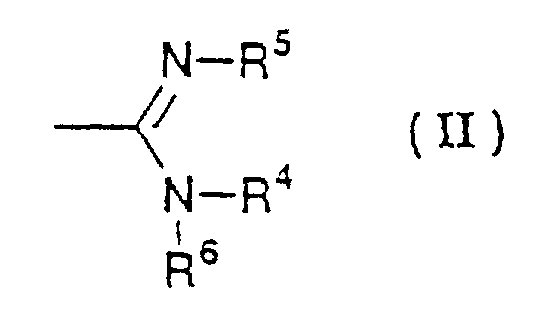 (wherein R4, R5, and R6 have the same meanings as defined in claim 1).
 - A therapeutic agent for circulatory disease comprising a compound represented by the general formula (I) or a pharmacologically acceptable acid addition salt thereof according to claim 1 as an active ingredient.
- A therapeutic agent for hypertension comprising a compound represented by the general formula (I) or a pharmacologically acceptable acid addition salt thereof according to claim 1 as an active ingredient.
- A compound represented by the general formula (III), or a pharmacologically acceptable acid addition salt thereof:[wherein D represents one of the following formulae 1) to 5), each of which is unsubstituted or substituted with the groups selected from the group consisting of halogen, hydroxy, alkyl group having 1 to 8 carbon atoms, aryl group having 6 to 15 carbon atoms, haloalkyl group having 1 to 8 carbon atoms, aminosulfonyl group having 0 to 15 carbon atoms, carboxyl group, alkoxycarbonyl group having 2 to 9 carbon atoms, aminocarbonyl group having 1 to 15 carbon atoms, hydroxyalkyl group having 1 to 8 carbon atoms, alkylcarbonyl group having 2 to 9 carbon atoms, arylcarbonyl group having 7 to 16 carbon atoms, and aralkyl group having 7 to 15 carbon atoms;
 Ar2 is indole, naphthalene, quinoline, benzimidazole, benzofuran, or benzothiophene, each of which is unsubstituted or substituted with the groups selected from the group consisting of halogen, nitro group, acylamino group having 1 to 9 carbon atoms, amino group, alkylamino group having 1 to 8 carbon atoms, arylamino group having 6 to 15 carbon atoms, dialkylamino group having 2 to 16 carbon atoms, diarylamino group having 12 to 20 carbon atoms, hydroxy, alkyl group having 1 to 8 carbon atoms, aryl group having 6 to 15 carbon atoms, alkoxy group having 1 to 8 carbon atoms, aryloxy group having 6 to 15 carbon atoms, haloalkyl group having 1 to 8 carbon atoms, haloalkoxy group having 1 to 8 carbon atoms, cyano group, aminosulfonyl group having 0 to 15 carbon atoms, carboxyl group, alkoxycarbonyl group having 2 to 9 carbon atoms, aminocarbonyl group having 1 to 15 carbon atoms, alkylthio group having 1 to 8 carbon atoms, and arylthio group having 6 to 15 carbon atoms;
A is alkylene having 3 to 8 carbon atoms, phenylene, or cycloalkylene having 3 to 8 carbon atoms, each of which is unsubstituted or substituted with the groups selected from the group consisting of halogen, nitro group, acylamino group having 1 to 9 carbon atoms, amino group, alkylamino group having 1 to 8 carbon atoms, arylamino group having 6 to 15 carbon atoms, dialkylamino group having 2 to 16 carbon atoms, diarylamino group having 12 to 20 carbon atoms, hydroxy, alkyl group having 1 to 8 carbon atoms, aryl group having 6 to 15 carbon atoms, alkoxy group having 1 to 8 carbon atoms, aryloxy group having 6 to 15 carbon atoms, haloalkyl group having 1 to 8 carbon atoms, haloalkoxy group having 1 to 8 carbon atoms, cyano group, aminosulfonyl group having 0 to 15 carbon atoms, carboxyl group, alkoxycarbonyl group having 2 to 9 carbon atoms, aminocarbonyl group having 1 to 15 carbon atoms, alkylthio group having 1 to 8 carbon atoms, and arylthio group having 6 to 15 carbon atoms;
Q2 is:1) -NR2R3,
wherein each of R2 and R3 is independently hydrogen, alkyl having 1 to 6 carbon atoms, cycloalkyl having 3 to 8 carbon atoms, alkenyl having 2 to 9 carbon atoms, aryl having 6 to 15 carbon atoms, or aralkyl having 7 to 15 carbon atoms (wherein the aryl moiety of the aryl and aralkyl may be substituted with the groups selected from the group consisting of halogen, nitro group, acylamino group having 1 to 9 carbon atoms, amino group, alkylamino group having 1 to 8 carbon atoms, arylamino group having 6 to 15 carbon atoms, dialkylamino group having 2 to 16 carbon atoms, diarylamino group having 12 to 20 carbon atoms, hydroxy, alkyl group having 1 to 8 carbon atoms, aryl group having 6 to 15 carbon atoms, alkoxy group having 1 to 8 carbon atoms, aryloxy group having 6 to 15 carbon atoms, haloalkyl group having 1 to 8 carbon atoms, haloalkoxy group having 1 to 8 carbon atoms, cyano group, aminosulfonyl group having 0 to 15 carbon atoms, carboxyl group, alkoxycarbonyl group having 2 to 9 carbon atoms,-aminocarbonyl group having 1 to 15 carbon atoms, alkylthio group having 1 to 8 carbon atoms, and arylthio group having 6 to 15 carbon atoms, where R2=R3=H and R2=R3=ethyl are excluded),
or -NR2R3 together forms piperidine, pyrrolidine, 1,3,4-trihydroisoquinoline, isoindoline, piperazine, morpholine, 2-piperidone, 2-pyrrolidone, indoline, 2,3,4-trihydroquinoline, 2,3,4-trihydroquinoxaline, dihydrobenzoxazine, or guanidine, each of which is unsubstituted or substituted with the groups selected from the group consisting of halogen, nitro group, acylamino group having 1 to 9 carbon atoms, amino group, alkylamino group having 1 to 8 carbon atoms, arylamino group having 6 to 15 carbon atoms, dialkylamino group having 2 to 16 carbon atoms, diarylamino group having 12 to 20 carbon atoms, hydroxy, alkyl group having 1 to 8 carbon atoms, aryl group having 6 to 15 carbon atoms, alkoxy group having 1 to 8 carbon atoms, aryloxy group having 6 to 15 carbon atoms, haloalkyl group having 1 to 8 carbon atoms, haloalkoxy group having 1 to 8 carbon atoms, cyano group, aminosulfonyl group having 0 to 15 carbon atoms, carboxyl group, alkoxycarbonyl group having 2 to 9 carbon atoms, aminocarbonyl group having 1 to 15 carbon atoms, alkylthio group having 1 to 8 carbon atoms, and arylthio group having 6 to 15 carbon atoms; or2) the formula (II):(wherein each of R4, R5, R6 is independently hydrogen, alkyl having 1 to 6 carbon atoms, cycloalkyl having 3 to 8 carbon atoms, alkenyl having 2 to 9 carbon atoms, aryl having 6 to 15 carbon atoms, or aralkyl having 7 to 15 carbon atoms (wherein the aryl moiety of the aryl and aralkyl may be substituted with the groups selected from the group consisting of halogen, nitro group, acylamino group having 1 to 9 carbon atoms, amino group, alkylamino group having 1 to 8 carbon atoms, arylamino group having 6 to 15 carbon atoms, dialkylamino group having 2 to 16 carbon atoms, diarylamino group having 12 to 20 carbon atoms, hydroxy, alkyl group having 1 to 8 carbon atoms, aryl group having 6 to 15 carbon atoms, alkoxy group having 1 to 8 carbon atoms, aryloxy group having 6 to 15 carbon atoms, haloalkyl group having 1 to 8 carbon atoms, haloalkoxy group having 1 to 8 carbon atoms, cyano group, aminosulfonyl group having 0 to 15 carbon atoms, carboxyl group, alkoxycarbonyl group having 2 to 9 carbon atoms, aminocarbonyl group having 1 to 15 carbon atoms, alkylthio group having 1 to 8 carbon atoms, and arylthio group having 6 to 15 carbon atoms), or R4 and R5 together form an imidazoline ring)].
- A compound or a pharmacologically acceptable acid addition salt thereof according to claim 7, wherein, in the general formula (III), D represents one of the following formulae 1) to 3), each of which is unsubstituted or substituted with the groups selected from the group consisting of halogen, hydroxy, alkyl group having 1 to 8 carbon atoms, aryl group having 6 to 15 carbon atoms, haloalkyl group having 1 to 8 carbon atoms, aminosulfonyl group having 0 to 15 carbon atoms, carboxyl group, alkoxycarbonyl group having 2 to 9 carbon atoms, aminocarbonyl group having 1 to 15 carbon atoms, hydroxyalkyl group having 1 to 8 carbon atoms, alkylcarbonyl group having 2 to 9 carbon atoms, arylcarbonyl group having 7 to 16 carbon atoms, and aralkyl group having 7 to 15 carbon atoms;Ar2 is indole, naphthalene, quinoline, or benzimidazole, each of which is unsubstituted or substituted with the groups selected from the group consisting of halogen, nitro group, acylamino group having 1 to 9 carbon atoms, amino group, alkylamino group having 1 to B carbon atoms, arylamino group having 6 to 15 carbon atoms, dialkylamino group having 2 to 16 carbon atoms, diarylamino group having 12 to 20 carbon atoms, hydroxy, alkyl group having 1 to 8 carbon atoms, aryl group having 6 to 15 carbon atoms, alkoxy group having 1 to 8 carbon atoms, aryloxy group having 6 to 15 carbon atoms, haloalkyl group having 1 to 8 carbon atoms, haloalkoxy group having 1 to 8 carbon atoms, cyano group, aminosulfonyl group having 0 to 15 carbon atoms, carboxyl group, alkoxycarbonyl group having 2 to 9 carbon atoms, aminocarbonyl group having 1 to 15 carbon atoms, alkylthio group having 1 to 8 carbon atoms, and arylthio group having 6 to 15 carbon atoms;

A is alkylene having 3 to 8 carbon atoms or cycloalkylene having 3 to 8 carbon atoms, each of which is unsubstituted or substituted with the groups selected from the group consisting of halogen, nitro group, acylamino group having 1 to 9 carbon atoms, amino group, alkylamino group having 1 to 8 carbon atoms, arylamino group having 6 to 15 carbon atoms, dialkylamino group having 2 to 16 carbon atoms, diarylamino group having 12 to 20 carbon atoms, hydroxy, alkyl group having 1 to 8 carbon atoms, aryl group having 6 to 15 carbon atoms, alkoxy group having 1 to 8 carbon atoms, aryloxy group having 6 to 15 carbon atoms, haloalkyl group having 1 to 8 carbon atoms, haloalkoxy group having 1 to 8 carbon atoms, cyano group, aminosulfonyl group having 0 to 15 carbon atoms, carboxyl group, alkoxycarbonyl group having 2 to 9 carbon atoms, aminocarbonyl group having 1 to 15 carbon atoms, alkylthio group having 1 to 8 carbon atoms, and arylthio group having 6 to 15 carbon atoms;
Q2 is:1) -NR2R3,
wherein each of R2 and R3 is independently hydrogen, alkyl having 1 to 6 carbon atoms, cycloalkyl having 3 to 8 carbon atoms, alkenyl having 2 to 9 carbon atoms, aryl having 6 to 15 carbon atoms, or aralkyl having 7 to 15 carbon atoms (wherein the aryl moiety of the aryl and aralkyl may be substituted with the groups selected from the group consisting of halogen, nitro group, acylamino group having 1 to 9 carbon atoms, amino group, alkylamino group having 1 to 8 carbon atoms, arylamino group having 6 to 15 carbon atoms, dialkylamino group having 2 to 16 carbon atoms, diarylamino group having 12 to 20 carbon atoms, hydroxy, alkyl group having 1 to 8 carbon atoms, aryl group having 6 to 15 carbon atoms, alkoxy group having 1 to 8 carbon atoms, aryloxy group having 6 to 15 carbon atoms, haloalkyl group having 1 to 8 carbon atoms, haloalkoxy group having 1 to 8 carbon atoms, cyano group, aminosulfonyl group having 0 to 15 carbon atoms, carboxyl group, alkoxycarbonyl group having 2 to 9 carbon atoms, aminocarbonyl group having 1 to 15 carbon atoms, alkylthio group having 1 to 8 carbon atoms, and arylthio group having 6 to 15 carbon atoms, where R2=R3=H and R2=R3=ethyl are excluded), or -NR2R3 together forms piperidine, pyrrolidine, 1,3,4-trihydroisoquinoline, isoindoline, piperazine, morpholine, indoline, 2,3,4-trihydroquinoline, 2,3,4-trihydroquinoxaline, dihydrobenzoxazine, or guanidine, each of which is unsubstituted or substituted with the groups selected from the group consisting of halogen, nitro group, acylamino group having 1 to 9 carbon atoms, amino group, alkylamino group having 1 to 8 carbon atoms, arylamino group having 6 to 15 carbon atoms, dialkylamino group having 2 to 16 carbon atoms, diarylamino group having 12 to 20 carbon atoms, hydroxyl group, alkyl group having 1 to 8 carbon atoms, aryl group having 6 to 15 carbon atoms, alkoxy group having 1 to 8 carbon atoms, aryloxy group having 6 to 15 carbon atoms, haloalkyl group having 1 to 8 carbon atoms, haloalkoxy group having 1 to 8 carbon atoms, cyano group, aminosulfonyl group having 0 to 15 carbon atoms, carboxyl group, alkoxycarbonyl group having 2 to 9 carbon atoms, aminocarbonyl group having 1 to 15 carbon atoms, alkylthio group having 1 to 8 carbon atoms, and arylthio group having 6 to 15 carbon atoms; or2) the formula (II):(wherein R4, R5, and R6 have the same meanings as defined in claim 7).
- A compound or a pharmacologically acceptable acid addition salt thereof according to one of claims 7 and 8, wherein, in the general formula (III), D represents one of the following formulae 1) and 2), each of which is unsubstituted or substituted with the groups selected from the group consisting of halogen, hydroxy, alkyl group having 1 to 8 carbon atoms, aryl group having 5 to 15 carbon atoms, haloalkyl group having 1 to 8 carbon atoms, aminosulfonyl group having 0 to 15 carbon atoms, carboxyl group, alkoxycarbonyl group having 2 to 9 carbon atoms, aminocarbonyl group having 1 to 15 carbon atoms, hydroxyalkyl group having 1 to 8 carbon atoms, alkylcarbonyl group having 2 to 9 carbon atoms, arylcarbonyl group having 7 to 16 carbon atoms, and aralkyl group having 7 to 15 carbon atoms;
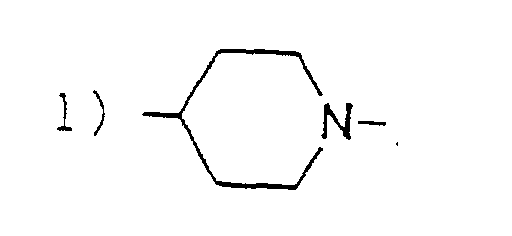 Ar2 is indole or naphthalene, each of which is unsubstituted or substituted with the groups selected from the group consisting of halogen, nitro group, acylamino group having 1 to 9 carbon atoms, amino group, alkylamino group having 1 to 8 carbon atoms, arylamino group having 6 to 15 carbon atoms, dialkylamino group having 2 to 16 carbon atoms, diarylamino group having 12 to 20 carbon atoms, hydroxy, alkyl group having 1 to 8 carbon atoms, aryl group having 6 to 15 carbon atoms, alkoxy group having 1 to 8 carbon atoms, aryloxy group having 6 to 15 carbon atoms, haloalkyl group having 1 to 8 carbon atoms, haloalkoxy group having 1 to 8 carbon atoms, cyano group, aminosulfonyl group having 0 to 15 carbon atoms, carboxyl group, alkoxycarbonyl group having 2 to 9 carbon atoms, aminocarbonyl group having 1 to 15 carbon atoms, alkylthio group having 1 to 8 carbon atoms, and arylthio group having 6 to 15 carbon atoms;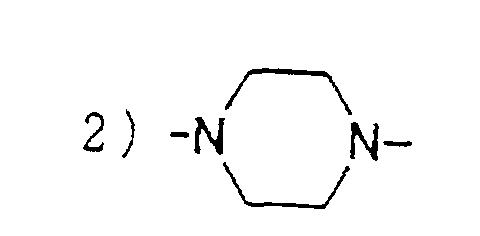
A is alkylene having 3 to 8 carbon atoms, which is unsubstituted or substituted with the groups selected from the group consisting of halogen, nitro group, acylamino group having 1 to 9 carbon atoms, amino group, alkylamino group having 1 to 8 carbon atoms, arylamino group having 6 to 15 carbon atoms, dialkylamino group having 2 to 16 carbon atoms, diarylamino group having 12 to 20 carbon atoms, hydroxy, alkyl group having 1 to 8 carbon atoms, aryl group having 6 to 15 carbon atoms, alkoxy group having 1 to 8 carbon atoms, aryloxy group having 6 to 15 carbon atoms, haloalkyl group having 1 to 8 carbon atoms, haloalkoxy group having 1 to 8 carbon atoms, cyano group, aminosulfonyl group having 0 to 15 carbon atoms, carboxyl group, alkoxycarbonyl group having 2 to 9 carbon atoms, aminocarbonyl group having 1 to 15 carbon atoms, alkylthio group having 1 to 8 carbon atoms, and arylthio group having 6 to 15 carbon atoms;
Q2 is:1) -NR2R3,
wherein each of R2 and R3 is independently hydrogen, alkyl having 1 to 6 carbon atoms, cycloalkyl having 3 to 8 carbon atoms, alkenyl having 2 to 9 carbon atoms, aryl having 6 to 15 carbon atoms, or aralkyl having 7 to 15 carbon atoms (wherein the aryl moiety of the aryl and aralkyl may be substituted with the groups selected from the group consisting of halogen, nitro group, acylamino group having 1 to 9 carbon atoms, amino group, alkylamino group having 1 to 8 carbon atoms, arylamino group having 6 to 15 carbon atoms, dialkylamino group having 2 to 16 carbon atoms, diarylamino group having 12 to 20 carbon atoms, hydroxy, alkyl group having 1 to 8 carbon atoms, aryl group having 6 to 15 carbon atoms, alkoxy group having 1 to 8 carbon atoms, aryloxy group having 6 to 15 carbon atoms, haloalkyl group having 1 to 8 carbon atoms, haloalkoxy group having 1 to 8 carbon atoms, cyano group, aminosulfonyl group having 0 to 15 carbon atoms, carboxyl group, alkoxycarbonyl group having 2 to 9 carbon atoms, aminocarbonyl group having 1 to 15 carbon atoms, alkylthio group having 1 to 8 carbon atoms, and arylthio group having 6 to 15 carbon atoms, where R2=R3=H and R2=R3=ethyl are excluded), or -NR2R3 together forms piperidine, pyrrolidine, 1,3,4-trihydroisoquinoline, isoindoline, piperazine, morpholine, or guanidine, each of which is unsubstituted or substituted with the groups selected from the group consisting of halogen, nitro group, acylamino group having 1 to 9 carbon atoms, amino group, alkylamino group having 1 to 8 carbon atoms, arylamino group having 6 to 15 carbon atoms, dialkylamino group having 2 to 16 carbon atoms, diarylamino group having 12 to 20 carbon atoms, hydroxy, alkyl group having 1 to 8 carbon atoms, aryl group having 6 to 15 carbon atoms, alkoxy group having 1 to 8 carbon atoms, aryloxy group having 6 to 15 carbon atoms, haloalkyl group having 1 to 8 carbon atoms, haloalkoxy group having 1 to 8 carbon atoms, cyano group, aminosulfonyl group having 0 to 15 carbon atoms, carboxyl group, alkoxycarbonyl group having 2 to 9 carbon atoms, aminocarbonyl group having 1 to 15 carbon atoms, alkylthio group having 1 to 8 carbon atoms, and arylthio group having 6 to 15 carbon atoms; or2) the formula (II):(wherein R4, R5, and R6 have the same meanings as defined in claim 7).
- A pharmaceutical agent comprising a compound represented by the general formula (III) or a pharmacologically acceptable acid addition salt thereof according to claim 7.
- An α1B adrenoceptor antagonist comprising a compound represented by the general formula (III) or a pharmacologically acceptable acid addition salt thereof according to claim 7.
- A therapeutic agent for circulatory disease comprising a compound represented by the general formula (III) or a pharmacologically acceptable acid addition salt thereof according to claim 7 as an active ingredient.
- A therapeutic agent for hypertension comprising a compound represented by the general formula (III) or a pharmacologically acceptable acid addition salt thereof according to claim 7 as an active ingredient.
Applications Claiming Priority (3)
| Application Number | Priority Date | Filing Date | Title |
|---|---|---|---|
| JP17817099 | 1999-06-24 | ||
| JP17817099 | 1999-06-24 | ||
| PCT/JP2000/004068 WO2000078716A1 (en) | 1999-06-24 | 2000-06-22 | α1B-ADRENERGIC RECEPTOR ANTAGONISTS |
Publications (2)
| Publication Number | Publication Date |
|---|---|
| EP1106605A1 true EP1106605A1 (en) | 2001-06-13 |
| EP1106605A4 EP1106605A4 (en) | 2005-12-07 |
Family
ID=16043845
Family Applications (1)
| Application Number | Title | Priority Date | Filing Date |
|---|---|---|---|
| EP00940789A Withdrawn EP1106605A4 (en) | 1999-06-24 | 2000-06-22 | Alpha1b-adrenergic receptor antagonists |
Country Status (7)
| Country | Link |
|---|---|
| US (1) | US6642228B1 (en) |
| EP (1) | EP1106605A4 (en) |
| KR (1) | KR20010085555A (en) |
| CN (1) | CN1158258C (en) |
| AU (1) | AU5567000A (en) |
| CA (1) | CA2341542A1 (en) |
| WO (1) | WO2000078716A1 (en) |
Cited By (8)
| Publication number | Priority date | Publication date | Assignee | Title |
|---|---|---|---|---|
| WO2001096328A1 (en) * | 2000-06-14 | 2001-12-20 | H. Lundbeck A/S | Indole derivatives useful for the treatment of cns disorders |
| EP1468996A1 (en) * | 2000-06-14 | 2004-10-20 | H. Lundbeck A/S | Indole derivatives for the treatment of CNS disorders |
| US6844338B2 (en) | 2000-05-18 | 2005-01-18 | Eli Lilly And Company | Piperidyindoles as serotonin receptor ligands |
| WO2007138611A1 (en) * | 2006-05-30 | 2007-12-06 | Suven Life Sciences Limited | 3-(heterocyclyl)-n-(arylsulfonyl)indole derivatives as functional 5-ht6 ligands |
| US7371743B2 (en) | 2004-02-28 | 2008-05-13 | Boehringer Ingelheim International Gmbh | Carboxylic acid amides, the preparation thereof and their use as medicaments |
| EP1945213A4 (en) * | 2005-10-24 | 2009-12-02 | Janssen Pharmaceutica Nv | 3-piperidin-4-yl-indole orl-1 receptor modulators |
| EP2924033A4 (en) * | 2012-11-26 | 2016-06-29 | Liaoning Emmy Biolog Pharmaceutical Co Ltd | USE OF PIPERAZINE-TYPE PENTAGONIC HETEROCYCLES AND PIPERIDINE DERIVATIVES |
| WO2019170543A1 (en) | 2018-03-07 | 2019-09-12 | Bayer Aktiengesellschaft | Identification and use of erk5 inhibitors |
Families Citing this family (30)
| Publication number | Priority date | Publication date | Assignee | Title |
|---|---|---|---|---|
| GB2362381A (en) * | 2000-05-18 | 2001-11-21 | Lilly Co Eli | Pharmaceutically active indolyl-piperidines |
| ATE410165T1 (en) | 2001-04-18 | 2008-10-15 | Euro Celtique Sa | NOCICEPTIN ANALOGUE |
| GB0112834D0 (en) | 2001-05-25 | 2001-07-18 | Smithkline Beecham Plc | Medicaments |
| ES2350977T3 (en) | 2002-11-05 | 2011-01-28 | Glaxo Group Limited | ANTIBACTERIAL AGENTS. |
| TW200507841A (en) * | 2003-03-27 | 2005-03-01 | Glaxo Group Ltd | Antibacterial agents |
| GB0316915D0 (en) | 2003-07-18 | 2003-08-20 | Glaxo Group Ltd | Compounds |
| UA91341C2 (en) | 2004-07-15 | 2010-07-26 | Амр Текнолоджи, Інк. | Aryl-and heteroaryl-substituted tetrahydroisoquinolines and use thereof to block reuptake of norepinephrine, dopamine, and serotonin |
| US20080015225A1 (en) * | 2004-07-16 | 2008-01-17 | Janssen Pharmaceutica N.V. | Dimeric Piperidine Derivatives |
| WO2006117314A2 (en) * | 2005-04-30 | 2006-11-09 | Boehringer Ingelheim International Gmbh | Novel piperidin- substituted indoles and their use as ccr-3 modulators |
| AU2006271781A1 (en) | 2005-07-15 | 2007-01-25 | F. Hoffmann-La Roche Ag | Novel heteroaryl fused cyclic amines |
| BRPI0618523A2 (en) * | 2005-11-11 | 2011-09-06 | Hoffmann La Roche | carbocyclically fused cyclic amine compounds, pharmaceutical compositions and uses thereof |
| US7601752B2 (en) | 2005-11-16 | 2009-10-13 | Hoffmann-La Roche Inc. | Pyrrolidine derivatives |
| EP1984351A1 (en) | 2006-02-17 | 2008-10-29 | Memory Pharmaceuticals Corporation | Compounds having 5-ht6 receptor affinity |
| EP1847537A1 (en) * | 2006-04-21 | 2007-10-24 | F. Hoffmann-La Roche Ag | Dicarboxamide derivatives |
| CA2651942A1 (en) | 2006-05-11 | 2008-07-03 | Janssen Pharmaceutica N.V. | 1,2,3,4-tetrahydro-quinoline derivatives as cetp inhibitors |
| US7749995B2 (en) | 2006-05-11 | 2010-07-06 | Janssen Pharmaceutica Nv | 3,4-dihydro-2h-benzo[1,4]oxazine and thiazine derivatives as CETP inhibitors |
| US20110002855A1 (en) * | 2007-06-25 | 2011-01-06 | Neurogen Corporation | Piperazinyl oxoalkyl tetrahydro-beta-carbolines and related analogues |
| US9156812B2 (en) | 2008-06-04 | 2015-10-13 | Bristol-Myers Squibb Company | Crystalline form of 6-[(4S)-2-methyl-4-(2-naphthyl)-1,2,3,4-tetrahydroisoquinolin-7-yl]pyridazin-3-amine |
| TW201041868A (en) * | 2009-03-20 | 2010-12-01 | Intervet Int Bv | Anthelmintic agents and their use |
| JP5739415B2 (en) | 2009-05-12 | 2015-06-24 | ブリストル−マイヤーズ スクウィブ カンパニー | (S) -7-([1,2,4] triazolo [1,5-a] pyridin-6-yl) -4- (3,4-dichlorophenyl) -1,2,3,4-tetrahydroisoquinoline Crystal forms and uses thereof |
| ES2446971T3 (en) | 2009-05-12 | 2014-03-11 | Albany Molecular Research, Inc. | Tetrahydroisoquinolines substituted with aryl, heteroaryl, and heterocycle and their use |
| CN102595902B (en) * | 2009-05-12 | 2015-04-29 | 阿尔巴尼分子研究公司 | 7-([1,2,4]triazolo[1,5-a]pyridin-6-yl)-4-(3,4-dichlorophenyl)-1,2,3,4-tetrahydro Isoquinolines and their uses |
| WO2011153359A1 (en) | 2010-06-04 | 2011-12-08 | Albany Molecular Research, Inc. | Glycine transporter-1 inhibitors, methods of making them, and uses thereof |
| CA2877526A1 (en) | 2012-06-20 | 2013-12-27 | Novartis Ag | Complement pathway modulators and uses thereof |
| CN106420754B (en) * | 2012-11-26 | 2019-11-05 | 沈阳海王生物技术有限公司 | The purposes of benzo five-membered Azacyclyl bridged piperazine derivatives |
| CN103833730B (en) * | 2012-11-26 | 2017-08-04 | 沈阳海王生物技术有限公司 | Benzo five-membered Azacyclyl piperidine derivative, Its Preparation Method And Use |
| BR122019007990B1 (en) | 2013-11-18 | 2021-05-04 | Forma Therapeutics, Inc | COMPOUND, AND, PHARMACEUTICAL COMPOSITION |
| RU2720237C2 (en) | 2013-11-18 | 2020-04-28 | Форма Терапеутикс, Инк. | Compositions containing benzopiperazine as bromodomain bet inhibitors |
| EP3929194B1 (en) | 2017-06-01 | 2024-04-17 | Bristol-Myers Squibb Company | Substituted nitrogen containing compounds |
| WO2019088095A1 (en) * | 2017-11-02 | 2019-05-09 | 国立大学法人九州大学 | Analgesic and use thereof |
Family Cites Families (17)
| Publication number | Priority date | Publication date | Assignee | Title |
|---|---|---|---|---|
| FR84902E (en) * | 1962-08-30 | 1965-05-07 | Rhone Poulenc Sa | New quinoline derivatives and their preparation |
| NL297170A (en) * | 1963-04-04 | 1900-01-01 | ||
| JPS5849550B2 (en) * | 1974-02-07 | 1983-11-05 | 住友化学工業株式会社 | Synchronous aniline usage information |
| JPS5827793B2 (en) * | 1980-09-18 | 1983-06-11 | 住友化学工業株式会社 | Production method for new aniline derivatives |
| DK733788A (en) * | 1988-01-14 | 1989-07-15 | Fujisawa Pharmaceutical Co | INDOLYL PIPERIDE INGREDIENTS AND PROCEDURES FOR PREPARING THEREOF |
| US5296497A (en) * | 1989-05-16 | 1994-03-22 | Duphar International Research B.V. | 3,4-dehydropiperidine derivatives having psychotropic activity |
| EP0398413A1 (en) | 1989-05-16 | 1990-11-22 | Duphar International Research B.V | "3,4-dehydropiperidine derivatives having psychotropic activity |
| FR2655988B1 (en) | 1989-12-20 | 1994-05-20 | Adir Cie | NOVEL DERIVATIVES OF NAPHT-1-YL PIPERAZINE, PROCESS FOR THEIR PREPARATION AND THE PHARMACEUTICAL COMPOSITIONS CONTAINING THEM. |
| JPH05505612A (en) * | 1991-03-01 | 1993-08-19 | ハー・ルンドベック・アクティーゼルスカブ | Treatment of hypertension and peripheral vascular disease |
| EP1449529B1 (en) * | 1993-12-23 | 2010-01-27 | Eli Lilly And Company | Protein Kinase C Inhibitors |
| DE69618050T2 (en) * | 1995-03-17 | 2002-07-11 | Aventis Pharmaceuticals Inc., Cincinnati | Substituted benzylthienylpiperazines, their use as medicines and processes for their manufacture |
| US5472966A (en) * | 1995-03-29 | 1995-12-05 | Bristol-Myers Squibb Company | Antidepressant heteroarylaminoalkyl derivatives of naphthyl-monazines |
| ZA9711376B (en) * | 1996-12-20 | 1998-07-21 | Lundbeck & Co As H | Indole or dihydroindole derivatives |
| DE19707628A1 (en) * | 1997-02-26 | 1998-08-27 | Merck Patent Gmbh | Oxazolidinones |
| AU1193199A (en) * | 1997-10-22 | 1999-05-10 | Eli Lilly And Company | Arylpiperazines as serotonin reuptake inhibitors and 5-ht1dalpha antagonists |
| TW520367B (en) * | 1998-04-29 | 2003-02-11 | Wyeth Corp | Indolyl derivatives as serotonergic agents |
| US6066637A (en) * | 1998-06-19 | 2000-05-23 | American Home Products Corporation | Indolyl derivatives as serotonergic agents |
-
2000
- 2000-06-22 AU AU55670/00A patent/AU5567000A/en not_active Abandoned
- 2000-06-22 WO PCT/JP2000/004068 patent/WO2000078716A1/en not_active Ceased
- 2000-06-22 EP EP00940789A patent/EP1106605A4/en not_active Withdrawn
- 2000-06-22 CN CNB008017646A patent/CN1158258C/en not_active Expired - Fee Related
- 2000-06-22 US US09/763,684 patent/US6642228B1/en not_active Expired - Fee Related
- 2000-06-22 KR KR1020017002340A patent/KR20010085555A/en not_active Withdrawn
- 2000-06-22 CA CA002341542A patent/CA2341542A1/en not_active Abandoned
Cited By (13)
| Publication number | Priority date | Publication date | Assignee | Title |
|---|---|---|---|---|
| US6844338B2 (en) | 2000-05-18 | 2005-01-18 | Eli Lilly And Company | Piperidyindoles as serotonin receptor ligands |
| WO2001096328A1 (en) * | 2000-06-14 | 2001-12-20 | H. Lundbeck A/S | Indole derivatives useful for the treatment of cns disorders |
| EP1468996A1 (en) * | 2000-06-14 | 2004-10-20 | H. Lundbeck A/S | Indole derivatives for the treatment of CNS disorders |
| US6890916B2 (en) | 2000-06-14 | 2005-05-10 | H. Lundbeck A/S | Indole derivatives useful for the treatment of CNS disorders |
| US7276508B2 (en) | 2000-06-14 | 2007-10-02 | H. Lundbeck A/S | Indole derivatives useful for the treatment of CNS disorders |
| US7371743B2 (en) | 2004-02-28 | 2008-05-13 | Boehringer Ingelheim International Gmbh | Carboxylic acid amides, the preparation thereof and their use as medicaments |
| US7947700B2 (en) | 2004-02-28 | 2011-05-24 | Boehringer Ingelheim International Gmbh | Carboxylic acid amides, the preparation thereof and their use as medicaments |
| US8445525B2 (en) | 2004-02-28 | 2013-05-21 | Boehringer Ingelheim International Gmbh | Carboxylic acid amides, the preparation thereof and their use as medicaments |
| US8791103B2 (en) | 2004-02-28 | 2014-07-29 | Boehringer Ingelheim International Gmbh | Carboxylic acid amides, the preparation thereof and their use as medicaments |
| EP1945213A4 (en) * | 2005-10-24 | 2009-12-02 | Janssen Pharmaceutica Nv | 3-piperidin-4-yl-indole orl-1 receptor modulators |
| WO2007138611A1 (en) * | 2006-05-30 | 2007-12-06 | Suven Life Sciences Limited | 3-(heterocyclyl)-n-(arylsulfonyl)indole derivatives as functional 5-ht6 ligands |
| EP2924033A4 (en) * | 2012-11-26 | 2016-06-29 | Liaoning Emmy Biolog Pharmaceutical Co Ltd | USE OF PIPERAZINE-TYPE PENTAGONIC HETEROCYCLES AND PIPERIDINE DERIVATIVES |
| WO2019170543A1 (en) | 2018-03-07 | 2019-09-12 | Bayer Aktiengesellschaft | Identification and use of erk5 inhibitors |
Also Published As
| Publication number | Publication date |
|---|---|
| CA2341542A1 (en) | 2000-12-28 |
| EP1106605A4 (en) | 2005-12-07 |
| WO2000078716A1 (en) | 2000-12-28 |
| AU5567000A (en) | 2001-01-09 |
| US6642228B1 (en) | 2003-11-04 |
| CN1327444A (en) | 2001-12-19 |
| KR20010085555A (en) | 2001-09-07 |
| CN1158258C (en) | 2004-07-21 |
Similar Documents
| Publication | Publication Date | Title |
|---|---|---|
| US6642228B1 (en) | α1b-adrenergic receptor antagonists | |
| JP2978566B2 (en) | 5-Azabicyclo [3.1.0] hexylalkyl-2-piperidone and -glutarimide as neurokinin receptor antagonists | |
| US5849780A (en) | 1-benzenesulfonyl-1-1,3-dihydroindol-2-one derivatives, their preparation and pharmaceutical compositions in which they are present | |
| AU769465B2 (en) | Heterocyclic compounds and methods to treat cardiac failure and other disorders | |
| US5663431A (en) | 1-benzenesulfonyl-1,3-dihydro-indol-2-one derivatives, their preparation and pharmaceutical compositions in which they are present | |
| US5726322A (en) | 1-benzenesulfonyl-1,3-dihydroindol-2-one derivatives, their preparation and pharmaceutical compositions in which they are present | |
| US20030073699A1 (en) | Compounds and methods to treat cardiac failure and other disorders | |
| CN1323079C (en) | renin inhibitor | |
| SK5462003A3 (en) | Indolylmaleimide derivatives, method for the preparation thereof and pharmaceutical composition comprising same | |
| JPH08253474A (en) | Indolepiperidine derivative | |
| JPH07504429A (en) | Indole derivatives as 5HT↓1c antagonists | |
| EP1322617A1 (en) | Compounds and methods for modulation of estrogen receptors | |
| JP2003510317A (en) | Piperazine derivatives as 5-HT1B antagonists | |
| US20030109545A1 (en) | Novel 1,3-dihydro-2h-indol-2-one, preparation method and pharmaceutical compositions containing same | |
| SK50895A3 (en) | 3-indolylpiperidine derivative, method of its preparation, its use for preparation of pharmaceutical composition and pharmaceutical composition containing them | |
| RU2444515C2 (en) | Indazole acrylic acid amide derivative | |
| RU2165420C2 (en) | 1,2,5-thiadiazole derivatives of indolylalkyl-pyrimidinyl-piperazines and pharmaceutical composition based on these compounds | |
| US6340685B1 (en) | Compounds and methods to treat cardiac failure and other disorders | |
| JP2001114777A (en) | Quinolin-4-yl derivative II | |
| HU180873B (en) | Process for preparing indolyl-alkyl-amine derivatives and pharmaceutical preparations containing such compounds as active substances | |
| HU201543B (en) | Process for production of derivatives of 2-(/piperin-4-il/-methil/)-1,2,3,4-tetrahydro-izoquinoline and medical compositions containing them | |
| CN101014573A (en) | 5-HT7 receptor antagonists | |
| JP2006503056A (en) | Histamine H3 receptor antagonist, its manufacture and therapeutic use | |
| CA2277965A1 (en) | Dihydropyrimidone derivatives as npy antagonists | |
| US5028607A (en) | Bis(aryl)alkene compounds |
Legal Events
| Date | Code | Title | Description |
|---|---|---|---|
| PUAI | Public reference made under article 153(3) epc to a published international application that has entered the european phase |
Free format text: ORIGINAL CODE: 0009012 |
|
| 17P | Request for examination filed |
Effective date: 20010220 |
|
| AK | Designated contracting states |
Kind code of ref document: A1 Designated state(s): AT BE CH CY DE DK ES FI FR GB GR IE IT LI LU MC NL PT SE |
|
| A4 | Supplementary search report drawn up and despatched |
Effective date: 20051021 |
|
| 17Q | First examination report despatched |
Effective date: 20070115 |
|
| STAA | Information on the status of an ep patent application or granted ep patent |
Free format text: STATUS: THE APPLICATION IS DEEMED TO BE WITHDRAWN |
|
| 18D | Application deemed to be withdrawn |
Effective date: 20100103 |