EP1106373A2 - Ink jet recording element - Google Patents
Ink jet recording element Download PDFInfo
- Publication number
- EP1106373A2 EP1106373A2 EP00204059A EP00204059A EP1106373A2 EP 1106373 A2 EP1106373 A2 EP 1106373A2 EP 00204059 A EP00204059 A EP 00204059A EP 00204059 A EP00204059 A EP 00204059A EP 1106373 A2 EP1106373 A2 EP 1106373A2
- Authority
- EP
- European Patent Office
- Prior art keywords
- recording element
- dye
- ink jet
- image
- recording
- Prior art date
- Legal status (The legal status is an assumption and is not a legal conclusion. Google has not performed a legal analysis and makes no representation as to the accuracy of the status listed.)
- Granted
Links
Classifications
-
- B—PERFORMING OPERATIONS; TRANSPORTING
- B41—PRINTING; LINING MACHINES; TYPEWRITERS; STAMPS
- B41M—PRINTING, DUPLICATING, MARKING, OR COPYING PROCESSES; COLOUR PRINTING
- B41M5/00—Duplicating or marking methods; Sheet materials for use therein
- B41M5/50—Recording sheets characterised by the coating used to improve ink, dye or pigment receptivity, e.g. for ink-jet or thermal dye transfer recording
- B41M5/52—Macromolecular coatings
-
- B—PERFORMING OPERATIONS; TRANSPORTING
- B41—PRINTING; LINING MACHINES; TYPEWRITERS; STAMPS
- B41M—PRINTING, DUPLICATING, MARKING, OR COPYING PROCESSES; COLOUR PRINTING
- B41M5/00—Duplicating or marking methods; Sheet materials for use therein
- B41M5/50—Recording sheets characterised by the coating used to improve ink, dye or pigment receptivity, e.g. for ink-jet or thermal dye transfer recording
- B41M5/502—Recording sheets characterised by the coating used to improve ink, dye or pigment receptivity, e.g. for ink-jet or thermal dye transfer recording characterised by structural details, e.g. multilayer materials
- B41M5/508—Supports
-
- B—PERFORMING OPERATIONS; TRANSPORTING
- B41—PRINTING; LINING MACHINES; TYPEWRITERS; STAMPS
- B41M—PRINTING, DUPLICATING, MARKING, OR COPYING PROCESSES; COLOUR PRINTING
- B41M5/00—Duplicating or marking methods; Sheet materials for use therein
- B41M5/50—Recording sheets characterised by the coating used to improve ink, dye or pigment receptivity, e.g. for ink-jet or thermal dye transfer recording
- B41M5/52—Macromolecular coatings
- B41M5/5218—Macromolecular coatings characterised by inorganic additives, e.g. pigments, clays
-
- B—PERFORMING OPERATIONS; TRANSPORTING
- B41—PRINTING; LINING MACHINES; TYPEWRITERS; STAMPS
- B41M—PRINTING, DUPLICATING, MARKING, OR COPYING PROCESSES; COLOUR PRINTING
- B41M5/00—Duplicating or marking methods; Sheet materials for use therein
- B41M5/50—Recording sheets characterised by the coating used to improve ink, dye or pigment receptivity, e.g. for ink-jet or thermal dye transfer recording
- B41M5/52—Macromolecular coatings
- B41M5/5227—Macromolecular coatings characterised by organic non-macromolecular additives, e.g. UV-absorbers, plasticisers, surfactants
-
- B—PERFORMING OPERATIONS; TRANSPORTING
- B41—PRINTING; LINING MACHINES; TYPEWRITERS; STAMPS
- B41M—PRINTING, DUPLICATING, MARKING, OR COPYING PROCESSES; COLOUR PRINTING
- B41M5/00—Duplicating or marking methods; Sheet materials for use therein
- B41M5/50—Recording sheets characterised by the coating used to improve ink, dye or pigment receptivity, e.g. for ink-jet or thermal dye transfer recording
- B41M5/52—Macromolecular coatings
- B41M5/5236—Macromolecular coatings characterised by the use of natural gums, of proteins, e.g. gelatins, or of macromolecular carbohydrates, e.g. cellulose
-
- B—PERFORMING OPERATIONS; TRANSPORTING
- B41—PRINTING; LINING MACHINES; TYPEWRITERS; STAMPS
- B41M—PRINTING, DUPLICATING, MARKING, OR COPYING PROCESSES; COLOUR PRINTING
- B41M5/00—Duplicating or marking methods; Sheet materials for use therein
- B41M5/50—Recording sheets characterised by the coating used to improve ink, dye or pigment receptivity, e.g. for ink-jet or thermal dye transfer recording
- B41M5/52—Macromolecular coatings
- B41M5/5254—Macromolecular coatings characterised by the use of polymers obtained by reactions only involving carbon-to-carbon unsaturated bonds, e.g. vinyl polymers
-
- Y—GENERAL TAGGING OF NEW TECHNOLOGICAL DEVELOPMENTS; GENERAL TAGGING OF CROSS-SECTIONAL TECHNOLOGIES SPANNING OVER SEVERAL SECTIONS OF THE IPC; TECHNICAL SUBJECTS COVERED BY FORMER USPC CROSS-REFERENCE ART COLLECTIONS [XRACs] AND DIGESTS
- Y10—TECHNICAL SUBJECTS COVERED BY FORMER USPC
- Y10T—TECHNICAL SUBJECTS COVERED BY FORMER US CLASSIFICATION
- Y10T428/00—Stock material or miscellaneous articles
- Y10T428/25—Web or sheet containing structurally defined element or component and including a second component containing structurally defined particles
-
- Y—GENERAL TAGGING OF NEW TECHNOLOGICAL DEVELOPMENTS; GENERAL TAGGING OF CROSS-SECTIONAL TECHNOLOGIES SPANNING OVER SEVERAL SECTIONS OF THE IPC; TECHNICAL SUBJECTS COVERED BY FORMER USPC CROSS-REFERENCE ART COLLECTIONS [XRACs] AND DIGESTS
- Y10—TECHNICAL SUBJECTS COVERED BY FORMER USPC
- Y10T—TECHNICAL SUBJECTS COVERED BY FORMER US CLASSIFICATION
- Y10T428/00—Stock material or miscellaneous articles
- Y10T428/25—Web or sheet containing structurally defined element or component and including a second component containing structurally defined particles
- Y10T428/256—Heavy metal or aluminum or compound thereof
-
- Y—GENERAL TAGGING OF NEW TECHNOLOGICAL DEVELOPMENTS; GENERAL TAGGING OF CROSS-SECTIONAL TECHNOLOGIES SPANNING OVER SEVERAL SECTIONS OF THE IPC; TECHNICAL SUBJECTS COVERED BY FORMER USPC CROSS-REFERENCE ART COLLECTIONS [XRACs] AND DIGESTS
- Y10—TECHNICAL SUBJECTS COVERED BY FORMER USPC
- Y10T—TECHNICAL SUBJECTS COVERED BY FORMER US CLASSIFICATION
- Y10T428/00—Stock material or miscellaneous articles
- Y10T428/25—Web or sheet containing structurally defined element or component and including a second component containing structurally defined particles
- Y10T428/256—Heavy metal or aluminum or compound thereof
- Y10T428/257—Iron oxide or aluminum oxide
-
- Y—GENERAL TAGGING OF NEW TECHNOLOGICAL DEVELOPMENTS; GENERAL TAGGING OF CROSS-SECTIONAL TECHNOLOGIES SPANNING OVER SEVERAL SECTIONS OF THE IPC; TECHNICAL SUBJECTS COVERED BY FORMER USPC CROSS-REFERENCE ART COLLECTIONS [XRACs] AND DIGESTS
- Y10—TECHNICAL SUBJECTS COVERED BY FORMER USPC
- Y10T—TECHNICAL SUBJECTS COVERED BY FORMER US CLASSIFICATION
- Y10T428/00—Stock material or miscellaneous articles
- Y10T428/25—Web or sheet containing structurally defined element or component and including a second component containing structurally defined particles
- Y10T428/258—Alkali metal or alkaline earth metal or compound thereof
-
- Y—GENERAL TAGGING OF NEW TECHNOLOGICAL DEVELOPMENTS; GENERAL TAGGING OF CROSS-SECTIONAL TECHNOLOGIES SPANNING OVER SEVERAL SECTIONS OF THE IPC; TECHNICAL SUBJECTS COVERED BY FORMER USPC CROSS-REFERENCE ART COLLECTIONS [XRACs] AND DIGESTS
- Y10—TECHNICAL SUBJECTS COVERED BY FORMER USPC
- Y10T—TECHNICAL SUBJECTS COVERED BY FORMER US CLASSIFICATION
- Y10T428/00—Stock material or miscellaneous articles
- Y10T428/25—Web or sheet containing structurally defined element or component and including a second component containing structurally defined particles
- Y10T428/259—Silicic material
Definitions
- the present invention relates to a substantially transparent, porous ink jet image-recording element.
- ink droplets are ejected from a nozzle at high speed towards a recording element or medium to produce an image on the medium.
- the ink droplets, or recording liquid generally comprise a recording agent, such as a dye or pigment, and a large amount of solvent.
- the solvent, or carrier liquid typically is made up of water and an organic material such as a monohydric alcohol, a polyhydric alcohol or mixtures thereof.
- An ink jet recording element typically comprises a support having on at least one surface thereof an ink-receiving or image-recording layer, and includes those intended for reflection viewing, which have an opaque support, and those intended for viewing by transmitted light, which have a transparent support.
- Medical images such as radiographic images, are typically viewed on a blue transparent support.
- porous receivers have been developed which provide nearly instantaneous drying as long as they have sufficient thickness and pore volume to effectively contain the liquid ink.
- a porous receiver can be manufactured by cast coating, in which a particulate-containing coating is applied to a support and is dried in contact with a polished smooth surface.
- EP 813,978 relates to an ink jet recording element comprising an ink absorption layer containing solid fine particles, a binder and oil drops.
- an ink absorption layer containing solid fine particles, a binder and oil drops.
- an objectionable white appearance results due to scattering of visible light, as described above.
- an ink jet recording element prior to image recording, comprising a substantially transparent support having thereon an image-recording layer comprising a polymeric binder, a colorant, and porous, colorless aggregates of particles having a primary particle size of from 7 to 40 nm in diameter and being aggregated up to 300 nm.
- Another embodiment of the invention relates to an ink jet printing process comprising:
- a fast-drying image can be produced which has a reduced white appearance due to scattering of visible light.
- Particles useful in the invention include alumina, boehmite, clay, calcium carbonate, titanium dioxide, calcined clay, aluminosilicates, silica, barium sulfate, or polymeric beads.
- the particles are metallic oxides, such as alumina. While many types of inorganic and organic particles are manufactured by various methods and commercially available for an ink receiving layer, porosity is necessary in order to obtain very fast ink drying. The pores formed between the particles must be sufficiently large and interconnected so that the printing ink passes quickly through the layer and away from the outer surface to give the impression of fast drying. At the same time, the particles must be arranged in such a way so that the pores formed between them are sufficiently small that they do not scatter visible light.
- the most preferred particle type providing the above requirements are aggregates of small particles.
- the aggregates are typically 150-300 nm in dimension and are comprised of smaller primary particles 7-40 nm in diameter.
- the pores in a dried coating of such aggregates fall within the range necessary to ensure low optical scatter yet sufficient ink vehicle uptake.
- Silica and alumina fumed oxides are well known, and alumina fumed oxides are preferred. Fumed oxides are available in dry form or as dispersions of the aggregates mentioned above.
- the polymeric binder is a hydrophilic polymer.
- hydrophilic materials include, but are not limited to, polyvinyl alcohols and their derivatives, polyvinyl pyrrolidone, sulfonated or phosphated polyesters, cellulose ethers and their derivatives, poly(2-ethyl-2-oxazoline), gelatin, casein, zein, albumin, chitin, chitosan, dextran, pectin, collagen derivatives, collodian, agar-agar, arrowroot, guar, carrageenan, tragacanth, xanthan, rhamsan, sulfonated polystyrenes, acrylamides and their derivatives, poly(alkylene oxides) and the like.
- the hydrophilic polymer is poly(vinyl alcohol), hydroxypropyl cellulose, hydroxypropyl methyl cellulose or a poly(alkylene oxides) and the like.
- the binder material should be chosen so that it is compatible with the aforementioned particles.
- the amount of binder used should be sufficient to impart cohesive strength to the ink jet receiver, but should also be minimized so that the interconnected pore structure formed by the aggregates is not filled in by the binder.
- the volume ratio of binder to particles is from 1:4 to 1:2.
- the void volume must be sufficient to absorb all of the printing ink. For example, if a porous layer has 60 volume % open pores, in order to instantly absorb 32 cc/m 2 of ink, it must have a physical thickness of at least 54 ⁇ m.
- Suitable support materials useful in the invention include polymeric film materials such as tinted or untinted poly(ethylene terephthalate), polyethylene naphthalate, poly-1,4-cyclohexane dimethylene terephthalate, polyvinyl chloride, polyimide, polycarbonate, polystyrene, cellulose acetate, or cellulose acetate propionate.
- the support is poly(ethylene terephthalate).
- film materials may be pretreated with an adhesion promoting layer, an antistatic layer, or a curl control layer as known in the art.
- the support generally has a thickness of from 50 to 500 ⁇ m, preferably from 75 to 300 ⁇ m.
- Antioxidants, antistatic agents, plasticizers, and other known additives may be incorporated into the support, if desired.
- the surface of the support may be subjected to a corona-discharge treatment prior to applying the image-recording layer.
- the colorant in the image-recording layer is a dye chosen to match the color of the tinted transparency
- a clear support may be used with the image-recording layer providing both the desired background color and ink receptive properties.
- Colorants useful in the invention can be classified as either dyes or pigments. If a dye is used, the dye molecules are dispersed or solvated by the liquid or solid medium, so that each individual dye molecule is surrounded by molecules of the liquid or solid medium. Dyes are soluble in aqueous and organic solvents, thus particles are not observable under a microscope. If a pigment is used, discrete particles are dispersed in a liquid or solid medium. Each particle consists of many dye molecules held together by strong intermolecular forces. Pigment-based colorants are not soluble in aqueous and organic solvents, and particles ranging from 0.01 to 1.0 micron are observable under a microscope.
- cationic or anionic dyes may be used.
- Cationic dyes are those dyes which yield colored cations in aqueous solution
- anionic dyes are those dyes which yield colored anions in aqueous solution.
- Cationic dyes usually contain quaternary nitrogen groups as the ionic moiety and encompass all basic dyes.
- Anionic dyes usually contain sulfonic or carboxylic acid groups as the ionic moiety and encompass all acid groups.
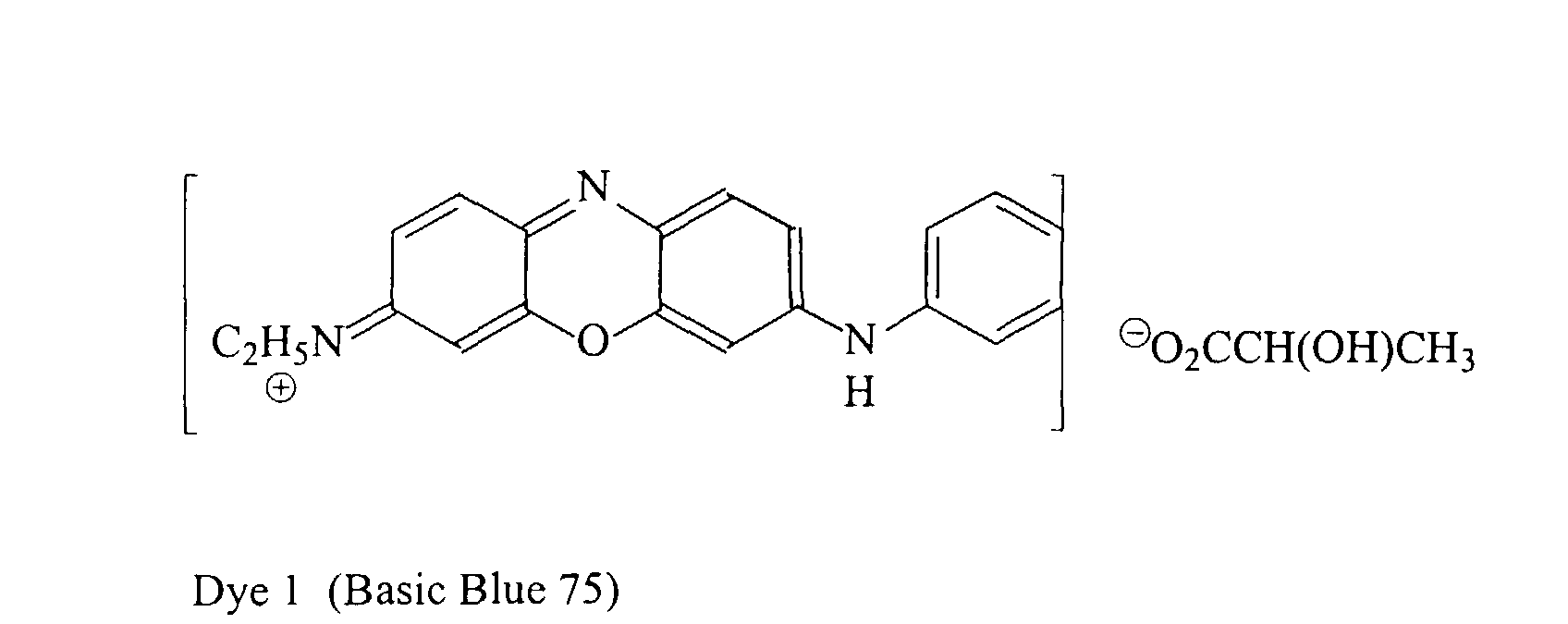
- Types of cationic dyes that may be used include the C. I. Basic dyes, e.g., Basic Yellows 9, 11, 13 and 51 for yellow dyes; Basic Reds 1 and 3 and Basic Violets 7, 10 and 23 for magenta dyes; Basic Blues 3, 9 and 75 for cyan dyes; and Basic Blacks 2 and 8 for black dyes; and the C. I. Mordant dyes, e.g. Mordant Green 13, that are designed to bind acidic sites on substrates such as fibers.
- Basic dyes e.g., Basic Yellows 9, 11, 13 and 51 for yellow dyes
- Basic Reds 1 and 3 and Basic Violets 7, 10 and 23 for magenta dyes
- Basic Blues 3, 9 and 75 for cyan dyes
- Basic Blacks 2 and 8 for black dyes
- C. I. Mordant dyes e.g. Mordant Green 13 that are designed to bind acidic sites on substrates such as fibers.
- Useful cationic dyes include azine compounds, oxazine compounds, thiazine compounds, azo compounds, diphenylmethane compounds, triarylmethane compounds, xanthene compounds, acridine compounds, quinoline compounds, methine or polymethine compounds, thiazole compounds, indamine or indophenol compounds, among others, all of which are well known to those skilled in the art.
- Anionic dyes that may be used in the invention include the C. I. Acid, Direct, Food, Mordant and Reactive dyes such as Acid Blue 9, Direct Blue 199, Acid Red 52, Reactive Red 23, Acid Yellow 23, Direct Yellow 132, Food Black 2 and Reactive Black 31.
- Useful anionic dyes include nitroso compounds, nitro compounds, azo compounds, stilbene compounds, triarylmethane compounds, xanthene compounds, quinoline compounds, thiazole compounds, azine compounds, oxazine compounds, thiazine compounds, aminoketone compounds, anthraquinone compounds, indigoid compounds and phthalocyaninc compounds, among others, all of which are well known to those skilled in the art.
- the colorant may be present in any amount effective for the intended purpose. In general, good results have been obtained when the colorant is present in an amount of from 0.01 g/m 2 to 0.05 g/m 2 .
- the particles forming the porous image-recording layer are primarily anionic, such as fumed silica, anionic dyes preferred. If particles having a high point of zero charge, such as fumed alumina are employed, cationic dyes are preferably used in order to provide melt stability.
- Coating compositions employed in the invention may be applied by any number of well known techniques, including dip-coating, wound-wire rod coating, doctor blade coating, gravure and reverse-roll coating, slide coating, bead coating, extrusion coating, curtain coating and the like.
- Known coating and drying methods are described in further detail in Research Disclosure no. 308119, published Dec. 1989, pages 1007 to 1008.
- Slide coating is preferred, in which the base layers and overcoat may be simultaneously applied. After coating, the layers are generally dried by simple evaporation, which may be accelerated by known techniques such as convection heating.
- the image-recording layer may contain dye mordants as additives to improve water resistance.
- dye mordants as additives to improve water resistance.
- the printing dyes are primarily anionic, quaternary ammonium or phosphonium containing polymers, surfactants, etc may be added.
- other mordanting materials well known in the art may be selected, such as amine containing polymers or simply a polymer or species carrying positive charges.
- crosslinkers which act upon the binder discussed above may be added in small quantities. Such an additive improves the cohesive strength of the layer.
- Crosslinkers such as carbodiimides, polyfunctional aziridines, aldehydes, isocyanates, epoxides, polyvalent metal cations, and the like may all be used.
- UV stabilizers and absorbers may also be added to the image-recording layer as is well known in the art.
- coating aids In order to obtain adequate coatability, additives known to those familiar with such art such as surfactants, defoamers, alcohol and the like may be used.
- a common level for coating aids is 0.01 to 0.30 per cent active coating aid based on the total solution weight.
- These coating aids can be nonionic, anionic, cationic or amphoteric. Specific examples are described in MCCUTCHEON's Volume 1: Emulsifiers and Detergents, 1995, North American Edition.
- the coating composition can be coated either from water or organic solvents, however water is preferred.
- the total solids content should be selected to yield a useful coating thickness in the most economical way, and for particulate coating formulations, solids contents from 10-40% are typical.
- the ink jet inks used to image the recording elements of the present invention are well-known in the art.
- the ink compositions used in ink jet printing typically are liquid compositions comprising a solvent or carrier liquid, dyes or pigments, humectants, organic solvents, detergents, thickeners, preservatives, and the like.
- the solvent or carrier liquid can be solely water or can be water mixed with other water-miscible solvents such as polyhydric alcohols.
- Inks in which organic materials such as polyhydric alcohols are the predominant carrier or solvent liquid may also be used. Particularly useful are mixed solvents of water and polyhydric alcohols.
- the dyes used in such compositions are typically water-soluble direct or acid type dyes.
- Such liquid compositions have been described extensively in the prior art including, for example, US-A-4,381,946; US-A-4,239,543 and US-A-4,781,758.
- Pen plotters operate by writing directly on the surface of a recording medium using a pen consisting of a bundle of capillary tubes in contact with an ink reservoir.
- This element was made by coating a support with a liquid of fumed alumina, CEP10AK97003, (Cabot Corporation) and polyvinyl alcohol, Elvanol ® 52/22, (DuPont Corp) such that the weight ratio of alumina to PVA was 90 to 10 and the total solid content in water was 30% by weight.
- the liquid was coated using a wound wire rod at a wet thickness of 100 ⁇ m and dried at 100°C.
- the support was a clear transparent poly(ethylene terephthalate) having an adhesion promoting layer comprised of a terpolymer of acrylonitrile, vinylidene chloride and acrylic acid.
- This element was prepared the same as Element 1 except that the support was a blue transparent poly(ethylene terephthalate) support which had an adhesion promoting "sub" comprised primarily of gelatin.
- This element used the support of Element 2 without any coating.
- This element was the same as Element 1 except that it contained Dye 1 in an amount of 0.024 g/m 2 and Dye 2 above in an amount of 0.012 g/m 2 .
- This element was the same as Element 2 except that it contained Dye 1 in an amount of 0.024 g/m 2 and Dye 2 above in an amount of 0.012 g/m 2 .
- each neutral dye was added at a level of 0.7% by weight to a water/lactic acid solution (95/5 ratio by weight). Then, 2% of the cationic cyan dye solution and 1% of the cationic magenta dye solution by weight were added to the melt and it was coated as described above.
Landscapes
- Ink Jet Recording Methods And Recording Media Thereof (AREA)
- Ink Jet (AREA)
Abstract
Description

| Element | Coating | L* | a* | b* |
| 1 | Alumina/PVA | 58.6 | -1.5 | -25.9 |
| 2 | Alumina/PVA | 63.3 | -1.3 | -17.8 |
| Control 1 | none | 18.6 | -1.1 | -10.1 |
| Element | L* | a* | b* |
| 3 | 48 | -0.1 | -35.1 |
| 4 | 49.3 | 0.9 | -37.3 |
Claims (10)
- An ink jet recording element, prior to image recording, comprising a substantially transparent support having thereon an image-recording layer comprising a polymeric binder, a colorant, and porous, colorless aggregates of particles having a primary particle size of from 7 to 40 nm in diameter and being aggregated up to 300 nm.
- The recording element of Claim 1 wherein said polymeric binder is a hydrophilic polymer.
- The recording element of Claim 2 wherein said hydrophilic polymer is poly(vinyl alcohol), hydroxypropyl cellulose, hydroxypropyl methyl cellulose, or a poly(alkylene oxide).
- The recording element of Claim 1 wherein said polymeric binder is poly(vinyl alcohol).
- The recording element of Claim 1 wherein said particles are metallic oxides or alumina.
- The recording element of Claim 1 wherein said colorant is a dye.
- The recording element of Claim 6 wherein said dye is a cationic dye or an anionic dye.
- The recording element of Claim 7 wherein said cationic dye is the lactate salt of protonated C.I. Basic Blue 75.
- The recording element of Claim 8 which also contains the following dye:

- An ink jet printing process comprising:a) providing an ink jet recording element according to Claim 1, andb) applying liquid ink droplets thereon in an image-wise manner.
Applications Claiming Priority (2)
| Application Number | Priority Date | Filing Date | Title |
|---|---|---|---|
| US09/453,159 US6391427B1 (en) | 1999-12-02 | 1999-12-02 | Ink jet recording element |
| US453159 | 1999-12-02 |
Publications (3)
| Publication Number | Publication Date |
|---|---|
| EP1106373A2 true EP1106373A2 (en) | 2001-06-13 |
| EP1106373A3 EP1106373A3 (en) | 2001-08-29 |
| EP1106373B1 EP1106373B1 (en) | 2005-01-12 |
Family
ID=23799411
Family Applications (1)
| Application Number | Title | Priority Date | Filing Date |
|---|---|---|---|
| EP00204059A Expired - Lifetime EP1106373B1 (en) | 1999-12-02 | 2000-11-17 | Ink jet recording element |
Country Status (4)
| Country | Link |
|---|---|
| US (1) | US6391427B1 (en) |
| EP (1) | EP1106373B1 (en) |
| JP (1) | JP2001199161A (en) |
| DE (1) | DE60017345T2 (en) |
Cited By (2)
| Publication number | Priority date | Publication date | Assignee | Title |
|---|---|---|---|---|
| WO2006049545A1 (en) * | 2004-11-08 | 2006-05-11 | Akzo Nobel N.V. | Pigment composition in the form of aqueous dispersion |
| WO2010149676A1 (en) | 2009-06-26 | 2010-12-29 | Akzo Nobel Chemicals International B.V. | Coated substrate and method for the preparation thereof |
Families Citing this family (6)
| Publication number | Priority date | Publication date | Assignee | Title |
|---|---|---|---|---|
| US6613418B2 (en) * | 2000-06-06 | 2003-09-02 | Mitsubishi Paper Mills Limited | Ink-jet recording material and use of the same |
| US20030124935A1 (en) * | 2000-07-06 | 2003-07-03 | Nicole Smith | Scrub pad with printed rigid plates and associated methods |
| US20050041084A1 (en) * | 2003-02-03 | 2005-02-24 | Deba Mukherjee | Quick drying, waterfast inkjet recording media |
| US7022406B1 (en) * | 2004-03-24 | 2006-04-04 | Morgan Adhesives Company | Breathable film cover for window panes |
| US8133556B2 (en) * | 2009-08-12 | 2012-03-13 | Brady Worldwide, Inc. | Durable multilayer inkjet recording media topcoat |
| US20110039077A1 (en) * | 2009-08-12 | 2011-02-17 | Klemann Bruce M | Stain-Resistant Overcoat |
Family Cites Families (6)
| Publication number | Priority date | Publication date | Assignee | Title |
|---|---|---|---|---|
| US5928127A (en) * | 1995-04-03 | 1999-07-27 | Asahi Glass Company Ltd. | Alumina sol and recording sheet |
| US6238784B1 (en) | 1996-06-20 | 2001-05-29 | Konica Corporation | Ink-jet recording sheet |
| EP0879709B1 (en) * | 1997-05-22 | 2001-03-14 | Oji Paper Company Limited | Ink jet recording sheet containing silica particles and process for producing the same |
| EP0893270B1 (en) * | 1997-07-23 | 2001-01-31 | Mitsubishi Paper Mills, Ltd. | Ink jet recording sheet |
| US5804531A (en) * | 1997-12-22 | 1998-09-08 | Eastman Kodak Company | Thermal dye transfer system with polyester ionomer receiver |
| US6110601A (en) * | 1998-12-31 | 2000-08-29 | Eastman Kodak Company | Ink jet recording element |
-
1999
- 1999-12-02 US US09/453,159 patent/US6391427B1/en not_active Expired - Fee Related
-
2000
- 2000-11-17 EP EP00204059A patent/EP1106373B1/en not_active Expired - Lifetime
- 2000-11-17 DE DE60017345T patent/DE60017345T2/en not_active Expired - Fee Related
- 2000-12-01 JP JP2000367278A patent/JP2001199161A/en active Pending
Cited By (3)
| Publication number | Priority date | Publication date | Assignee | Title |
|---|---|---|---|---|
| WO2006049545A1 (en) * | 2004-11-08 | 2006-05-11 | Akzo Nobel N.V. | Pigment composition in the form of aqueous dispersion |
| CN101056956B (en) * | 2004-11-08 | 2010-05-26 | 阿克佐诺贝尔公司 | Pigment compositions in the form of aqueous dispersions |
| WO2010149676A1 (en) | 2009-06-26 | 2010-12-29 | Akzo Nobel Chemicals International B.V. | Coated substrate and method for the preparation thereof |
Also Published As
| Publication number | Publication date |
|---|---|
| DE60017345T2 (en) | 2006-03-02 |
| JP2001199161A (en) | 2001-07-24 |
| DE60017345D1 (en) | 2005-02-17 |
| US6391427B1 (en) | 2002-05-21 |
| EP1106373B1 (en) | 2005-01-12 |
| EP1106373A3 (en) | 2001-08-29 |
Similar Documents
| Publication | Publication Date | Title |
|---|---|---|
| US6447111B1 (en) | Ink jet printing method | |
| US6645582B2 (en) | Ink jet recording element | |
| US6689430B2 (en) | Ink jet recording element | |
| US6391427B1 (en) | Ink jet recording element | |
| US20030044583A1 (en) | Ink jet recording element | |
| US6419355B1 (en) | Ink jet printing method | |
| US6447110B1 (en) | Ink jet printing method | |
| US6630212B2 (en) | Ink jet recording element | |
| US6479135B2 (en) | Ink jet recording element | |
| US6040060A (en) | High uniform gloss ink-jet receivers | |
| EP1226970B1 (en) | Ink jet recording element and printing method | |
| US6547386B2 (en) | Ink jet printing method | |
| US6692123B2 (en) | Ink jet printing method | |
| EP1138512B1 (en) | Ink-jet image-receiving element containing encapsulated particles | |
| US6689431B2 (en) | Ink jet recording element | |
| US6565205B2 (en) | Ink jet printing method | |
| EP1288008B1 (en) | Ink jet recording element and printing method | |
| US6632490B2 (en) | Ink jet recording element | |
| US6548151B2 (en) | Ink jet recording element | |
| EP1288010B1 (en) | Ink jet recording element and printing method | |
| EP1288009B1 (en) | Ink jet recording element and printing method | |
| US6815020B2 (en) | Ink jet recording element | |
| US6431701B1 (en) | Ink jet printing method | |
| US6991835B2 (en) | Ink jet recording element | |
| US7138162B2 (en) | Ink jet recording element |
Legal Events
| Date | Code | Title | Description |
|---|---|---|---|
| PUAI | Public reference made under article 153(3) epc to a published international application that has entered the european phase |
Free format text: ORIGINAL CODE: 0009012 |
|
| AK | Designated contracting states |
Kind code of ref document: A2 Designated state(s): AT BE CH CY DE DK ES FI FR GB GR IE IT LI LU MC NL PT SE TR Kind code of ref document: A2 Designated state(s): DE FR GB |
|
| AX | Request for extension of the european patent |
Free format text: AL;LT;LV;MK;RO;SI |
|
| PUAL | Search report despatched |
Free format text: ORIGINAL CODE: 0009013 |
|
| AK | Designated contracting states |
Kind code of ref document: A3 Designated state(s): AT BE CH CY DE DK ES FI FR GB GR IE IT LI LU MC NL PT SE TR |
|
| AX | Request for extension of the european patent |
Free format text: AL;LT;LV;MK;RO;SI |
|
| 17P | Request for examination filed |
Effective date: 20020204 |
|
| AKX | Designation fees paid |
Free format text: DE FR GB |
|
| 17Q | First examination report despatched |
Effective date: 20031002 |
|
| GRAP | Despatch of communication of intention to grant a patent |
Free format text: ORIGINAL CODE: EPIDOSNIGR1 |
|
| GRAS | Grant fee paid |
Free format text: ORIGINAL CODE: EPIDOSNIGR3 |
|
| GRAA | (expected) grant |
Free format text: ORIGINAL CODE: 0009210 |
|
| AK | Designated contracting states |
Kind code of ref document: B1 Designated state(s): DE FR GB |
|
| REG | Reference to a national code |
Ref country code: GB Ref legal event code: FG4D |
|
| REF | Corresponds to: |
Ref document number: 60017345 Country of ref document: DE Date of ref document: 20050217 Kind code of ref document: P |
|
| PLBE | No opposition filed within time limit |
Free format text: ORIGINAL CODE: 0009261 |
|
| STAA | Information on the status of an ep patent application or granted ep patent |
Free format text: STATUS: NO OPPOSITION FILED WITHIN TIME LIMIT |
|
| ET | Fr: translation filed | ||
| 26N | No opposition filed |
Effective date: 20051013 |
|
| PGFP | Annual fee paid to national office [announced via postgrant information from national office to epo] |
Ref country code: GB Payment date: 20061004 Year of fee payment: 7 |
|
| PGFP | Annual fee paid to national office [announced via postgrant information from national office to epo] |
Ref country code: FR Payment date: 20061103 Year of fee payment: 7 |
|
| PGFP | Annual fee paid to national office [announced via postgrant information from national office to epo] |
Ref country code: DE Payment date: 20061130 Year of fee payment: 7 |
|
| GBPC | Gb: european patent ceased through non-payment of renewal fee |
Effective date: 20071117 |
|
| PG25 | Lapsed in a contracting state [announced via postgrant information from national office to epo] |
Ref country code: DE Free format text: LAPSE BECAUSE OF NON-PAYMENT OF DUE FEES Effective date: 20080603 |
|
| REG | Reference to a national code |
Ref country code: FR Ref legal event code: ST Effective date: 20080930 |
|
| PG25 | Lapsed in a contracting state [announced via postgrant information from national office to epo] |
Ref country code: GB Free format text: LAPSE BECAUSE OF NON-PAYMENT OF DUE FEES Effective date: 20071117 |
|
| PG25 | Lapsed in a contracting state [announced via postgrant information from national office to epo] |
Ref country code: FR Free format text: LAPSE BECAUSE OF NON-PAYMENT OF DUE FEES Effective date: 20071130 |