EP1106245A2 - Intermolecularly bound transition metal complexes for oxygen-selective adsorption - Google Patents
Intermolecularly bound transition metal complexes for oxygen-selective adsorption Download PDFInfo
- Publication number
- EP1106245A2 EP1106245A2 EP00127004A EP00127004A EP1106245A2 EP 1106245 A2 EP1106245 A2 EP 1106245A2 EP 00127004 A EP00127004 A EP 00127004A EP 00127004 A EP00127004 A EP 00127004A EP 1106245 A2 EP1106245 A2 EP 1106245A2
- Authority
- EP
- European Patent Office
- Prior art keywords
- tecs
- oxygen
- groups
- donors
- group
- Prior art date
- Legal status (The legal status is an assumption and is not a legal conclusion. Google has not performed a legal analysis and makes no representation as to the accuracy of the status listed.)
- Withdrawn
Links
- 229910052760 oxygen Inorganic materials 0.000 title claims abstract description 184
- 239000001301 oxygen Substances 0.000 title claims abstract description 173
- QVGXLLKOCUKJST-UHFFFAOYSA-N atomic oxygen Chemical compound [O] QVGXLLKOCUKJST-UHFFFAOYSA-N 0.000 title claims abstract description 171
- 238000001179 sorption measurement Methods 0.000 title claims description 33
- 229910052723 transition metal Inorganic materials 0.000 title claims description 28
- 150000003624 transition metals Chemical class 0.000 title claims description 20
- 239000000203 mixture Substances 0.000 claims abstract description 54
- 238000000034 method Methods 0.000 claims abstract description 40
- 230000008569 process Effects 0.000 claims abstract description 20
- 239000013522 chelant Substances 0.000 claims abstract description 13
- 230000007704 transition Effects 0.000 claims abstract description 13
- OKKJLVBELUTLKV-UHFFFAOYSA-N Methanol Chemical group OC OKKJLVBELUTLKV-UHFFFAOYSA-N 0.000 claims description 101
- 229910052757 nitrogen Inorganic materials 0.000 claims description 63
- 239000000463 material Substances 0.000 claims description 54
- 239000007787 solid Substances 0.000 claims description 49
- 239000003463 adsorbent Substances 0.000 claims description 46
- 239000007789 gas Substances 0.000 claims description 26
- 229910021645 metal ion Inorganic materials 0.000 claims description 23
- 125000000524 functional group Chemical group 0.000 claims description 20
- 239000013354 porous framework Substances 0.000 claims description 19
- 229910001428 transition metal ion Inorganic materials 0.000 claims description 19
- XLJKHNWPARRRJB-UHFFFAOYSA-N cobalt(2+) Chemical compound [Co+2] XLJKHNWPARRRJB-UHFFFAOYSA-N 0.000 claims description 13
- 239000001257 hydrogen Substances 0.000 claims description 13
- 229910052739 hydrogen Inorganic materials 0.000 claims description 13
- 125000002015 acyclic group Chemical group 0.000 claims description 11
- 125000002837 carbocyclic group Chemical group 0.000 claims description 11
- 229910052801 chlorine Inorganic materials 0.000 claims description 11
- 229910052731 fluorine Inorganic materials 0.000 claims description 11
- 229910052698 phosphorus Inorganic materials 0.000 claims description 11
- 229910052717 sulfur Inorganic materials 0.000 claims description 11
- 229910052794 bromium Inorganic materials 0.000 claims description 10
- 125000001424 substituent group Chemical group 0.000 claims description 9
- CWYNVVGOOAEACU-UHFFFAOYSA-N Fe2+ Chemical compound [Fe+2] CWYNVVGOOAEACU-UHFFFAOYSA-N 0.000 claims description 8
- 229910052710 silicon Inorganic materials 0.000 claims description 8
- WAEMQWOKJMHJLA-UHFFFAOYSA-N Manganese(2+) Chemical compound [Mn+2] WAEMQWOKJMHJLA-UHFFFAOYSA-N 0.000 claims description 7
- 229910052796 boron Inorganic materials 0.000 claims description 7
- MYMOFIZGZYHOMD-UHFFFAOYSA-N Dioxygen Chemical compound O=O MYMOFIZGZYHOMD-UHFFFAOYSA-N 0.000 claims description 5
- 229910052799 carbon Inorganic materials 0.000 claims description 5
- 125000004093 cyano group Chemical group *C#N 0.000 claims description 5
- 125000000449 nitro group Chemical group [O-][N+](*)=O 0.000 claims description 5
- 125000003277 amino group Chemical group 0.000 claims description 4
- 125000004432 carbon atom Chemical group C* 0.000 claims description 4
- 125000002915 carbonyl group Chemical group [*:2]C([*:1])=O 0.000 claims description 4
- 229910052747 lanthanoid Inorganic materials 0.000 claims description 4
- 150000002602 lanthanoids Chemical class 0.000 claims description 4
- 125000000962 organic group Chemical group 0.000 claims description 4
- 230000000737 periodic effect Effects 0.000 claims description 4
- 125000003118 aryl group Chemical group 0.000 claims description 3
- 150000007942 carboxylates Chemical group 0.000 claims description 3
- 150000001768 cations Chemical class 0.000 claims description 3
- UFHFLCQGNIYNRP-UHFFFAOYSA-N Hydrogen Chemical compound [H][H] UFHFLCQGNIYNRP-UHFFFAOYSA-N 0.000 claims description 2
- 229910015667 MoO4 Inorganic materials 0.000 claims description 2
- 125000003545 alkoxy group Chemical group 0.000 claims description 2
- 125000005210 alkyl ammonium group Chemical group 0.000 claims description 2
- 125000003368 amide group Chemical group 0.000 claims description 2
- 125000000129 anionic group Chemical group 0.000 claims description 2
- 125000002843 carboxylic acid group Chemical group 0.000 claims description 2
- 125000002091 cationic group Chemical group 0.000 claims description 2
- 229910052736 halogen Inorganic materials 0.000 claims description 2
- 150000002367 halogens Chemical class 0.000 claims description 2
- 125000005842 heteroatom Chemical group 0.000 claims description 2
- 125000002883 imidazolyl group Chemical group 0.000 claims description 2
- 125000001841 imino group Chemical group [H]N=* 0.000 claims description 2
- 230000007935 neutral effect Effects 0.000 claims description 2
- 125000004076 pyridyl group Chemical group 0.000 claims description 2
- 125000003837 (C1-C20) alkyl group Chemical group 0.000 claims 1
- ISWSIDIOOBJBQZ-UHFFFAOYSA-N Phenol Chemical group OC1=CC=CC=C1 ISWSIDIOOBJBQZ-UHFFFAOYSA-N 0.000 claims 1
- 239000003446 ligand Substances 0.000 abstract description 55
- 239000008246 gaseous mixture Substances 0.000 abstract description 3
- IJGRMHOSHXDMSA-UHFFFAOYSA-N Atomic nitrogen Chemical compound N#N IJGRMHOSHXDMSA-UHFFFAOYSA-N 0.000 description 108
- 238000011068 loading method Methods 0.000 description 56
- 229910052751 metal Inorganic materials 0.000 description 40
- 239000000523 sample Substances 0.000 description 33
- 239000002184 metal Substances 0.000 description 31
- LFQSCWFLJHTTHZ-UHFFFAOYSA-N Ethanol Chemical compound CCO LFQSCWFLJHTTHZ-UHFFFAOYSA-N 0.000 description 26
- 238000002360 preparation method Methods 0.000 description 26
- HEMHJVSKTPXQMS-UHFFFAOYSA-M Sodium hydroxide Chemical compound [OH-].[Na+] HEMHJVSKTPXQMS-UHFFFAOYSA-M 0.000 description 24
- JUJWROOIHBZHMG-UHFFFAOYSA-N Pyridine Chemical compound C1=CC=NC=C1 JUJWROOIHBZHMG-UHFFFAOYSA-N 0.000 description 20
- 239000000047 product Substances 0.000 description 20
- 238000010438 heat treatment Methods 0.000 description 19
- YXFVVABEGXRONW-UHFFFAOYSA-N Toluene Chemical compound CC1=CC=CC=C1 YXFVVABEGXRONW-UHFFFAOYSA-N 0.000 description 18
- 230000003993 interaction Effects 0.000 description 16
- 239000002904 solvent Substances 0.000 description 16
- ZMANZCXQSJIPKH-UHFFFAOYSA-N Triethylamine Chemical compound CCN(CC)CC ZMANZCXQSJIPKH-UHFFFAOYSA-N 0.000 description 15
- 238000006243 chemical reaction Methods 0.000 description 13
- 239000003153 chemical reaction reagent Substances 0.000 description 13
- 230000002441 reversible effect Effects 0.000 description 13
- 230000015572 biosynthetic process Effects 0.000 description 12
- 239000013078 crystal Substances 0.000 description 12
- 238000003795 desorption Methods 0.000 description 12
- 238000003756 stirring Methods 0.000 description 12
- -1 fluomine Chemical compound 0.000 description 11
- 239000003570 air Substances 0.000 description 10
- 150000002500 ions Chemical class 0.000 description 10
- UMJSCPRVCHMLSP-UHFFFAOYSA-N pyridine Natural products COC1=CC=CN=C1 UMJSCPRVCHMLSP-UHFFFAOYSA-N 0.000 description 10
- 238000001914 filtration Methods 0.000 description 9
- 125000003431 oxalo group Chemical group 0.000 description 9
- 238000006213 oxygenation reaction Methods 0.000 description 9
- 239000011148 porous material Substances 0.000 description 9
- 238000000926 separation method Methods 0.000 description 9
- GCNTZFIIOFTKIY-UHFFFAOYSA-N 4-hydroxypyridine Chemical compound OC1=CC=NC=C1 GCNTZFIIOFTKIY-UHFFFAOYSA-N 0.000 description 8
- WMFOQBRAJBCJND-UHFFFAOYSA-M Lithium hydroxide Chemical compound [Li+].[OH-] WMFOQBRAJBCJND-UHFFFAOYSA-M 0.000 description 8
- 229910002092 carbon dioxide Inorganic materials 0.000 description 8
- 150000001875 compounds Chemical class 0.000 description 7
- 230000002093 peripheral effect Effects 0.000 description 7
- 238000002336 sorption--desorption measurement Methods 0.000 description 7
- 238000013459 approach Methods 0.000 description 6
- 238000006555 catalytic reaction Methods 0.000 description 6
- GUTLYIVDDKVIGB-UHFFFAOYSA-N cobalt atom Chemical compound [Co] GUTLYIVDDKVIGB-UHFFFAOYSA-N 0.000 description 6
- 230000001351 cycling effect Effects 0.000 description 6
- 150000002739 metals Chemical group 0.000 description 6
- 238000012360 testing method Methods 0.000 description 6
- 239000012298 atmosphere Substances 0.000 description 5
- 230000003197 catalytic effect Effects 0.000 description 5
- 230000008859 change Effects 0.000 description 5
- 229910017052 cobalt Inorganic materials 0.000 description 5
- 239000000126 substance Substances 0.000 description 5
- UGFAIRIUMAVXCW-UHFFFAOYSA-N Carbon monoxide Chemical compound [O+]#[C-] UGFAIRIUMAVXCW-UHFFFAOYSA-N 0.000 description 4
- VMQMZMRVKUZKQL-UHFFFAOYSA-N Cu+ Chemical compound [Cu+] VMQMZMRVKUZKQL-UHFFFAOYSA-N 0.000 description 4
- PIICEJLVQHRZGT-UHFFFAOYSA-N Ethylenediamine Chemical compound NCCN PIICEJLVQHRZGT-UHFFFAOYSA-N 0.000 description 4
- 239000002262 Schiff base Substances 0.000 description 4
- 150000004753 Schiff bases Chemical class 0.000 description 4
- 230000004913 activation Effects 0.000 description 4
- UWCPYKQBIPYOLX-UHFFFAOYSA-N benzene-1,3,5-tricarbonyl chloride Chemical compound ClC(=O)C1=CC(C(Cl)=O)=CC(C(Cl)=O)=C1 UWCPYKQBIPYOLX-UHFFFAOYSA-N 0.000 description 4
- 229910002091 carbon monoxide Inorganic materials 0.000 description 4
- 239000010941 cobalt Substances 0.000 description 4
- VZHHNBNSMNNUAD-UHFFFAOYSA-N cobalt 2-[2-[(2-hydroxyphenyl)methylideneamino]ethyliminomethyl]phenol Chemical compound [Co].OC1=CC=CC=C1C=NCCN=CC1=CC=CC=C1O VZHHNBNSMNNUAD-UHFFFAOYSA-N 0.000 description 4
- 238000004132 cross linking Methods 0.000 description 4
- 238000009792 diffusion process Methods 0.000 description 4
- 239000000539 dimer Substances 0.000 description 4
- 238000002474 experimental method Methods 0.000 description 4
- 239000012530 fluid Substances 0.000 description 4
- 239000007788 liquid Substances 0.000 description 4
- 229910001416 lithium ion Inorganic materials 0.000 description 4
- 230000004048 modification Effects 0.000 description 4
- 238000012986 modification Methods 0.000 description 4
- 239000012299 nitrogen atmosphere Substances 0.000 description 4
- 230000037361 pathway Effects 0.000 description 4
- 229920000642 polymer Polymers 0.000 description 4
- 150000004032 porphyrins Chemical class 0.000 description 4
- 238000010791 quenching Methods 0.000 description 4
- 239000007790 solid phase Substances 0.000 description 4
- 238000011282 treatment Methods 0.000 description 4
- NGNBDVOYPDDBFK-UHFFFAOYSA-N 2-[2,4-di(pentan-2-yl)phenoxy]acetyl chloride Chemical group CCCC(C)C1=CC=C(OCC(Cl)=O)C(C(C)CCC)=C1 NGNBDVOYPDDBFK-UHFFFAOYSA-N 0.000 description 3
- CURLTUGMZLYLDI-UHFFFAOYSA-N Carbon dioxide Chemical compound O=C=O CURLTUGMZLYLDI-UHFFFAOYSA-N 0.000 description 3
- YMWUJEATGCHHMB-UHFFFAOYSA-N Dichloromethane Chemical compound ClCCl YMWUJEATGCHHMB-UHFFFAOYSA-N 0.000 description 3
- RTZKZFJDLAIYFH-UHFFFAOYSA-N Diethyl ether Chemical compound CCOCC RTZKZFJDLAIYFH-UHFFFAOYSA-N 0.000 description 3
- 239000002156 adsorbate Substances 0.000 description 3
- 125000004429 atom Chemical group 0.000 description 3
- 239000002585 base Substances 0.000 description 3
- 230000008901 benefit Effects 0.000 description 3
- 230000003247 decreasing effect Effects 0.000 description 3
- RAXXELZNTBOGNW-UHFFFAOYSA-N imidazole Natural products C1=CNC=N1 RAXXELZNTBOGNW-UHFFFAOYSA-N 0.000 description 3
- 229910003002 lithium salt Inorganic materials 0.000 description 3
- 159000000002 lithium salts Chemical class 0.000 description 3
- 239000003921 oil Substances 0.000 description 3
- 230000003647 oxidation Effects 0.000 description 3
- 238000007254 oxidation reaction Methods 0.000 description 3
- 238000012856 packing Methods 0.000 description 3
- 230000036961 partial effect Effects 0.000 description 3
- 239000012071 phase Substances 0.000 description 3
- 239000000843 powder Substances 0.000 description 3
- 239000002244 precipitate Substances 0.000 description 3
- 238000000746 purification Methods 0.000 description 3
- 230000000171 quenching effect Effects 0.000 description 3
- 230000004044 response Effects 0.000 description 3
- 239000002002 slurry Substances 0.000 description 3
- 239000000758 substrate Substances 0.000 description 3
- 239000000725 suspension Substances 0.000 description 3
- ILWRPSCZWQJDMK-UHFFFAOYSA-N triethylazanium;chloride Chemical compound Cl.CCN(CC)CC ILWRPSCZWQJDMK-UHFFFAOYSA-N 0.000 description 3
- 230000004580 weight loss Effects 0.000 description 3
- GEYOCULIXLDCMW-UHFFFAOYSA-N 1,2-phenylenediamine Chemical compound NC1=CC=CC=C1N GEYOCULIXLDCMW-UHFFFAOYSA-N 0.000 description 2
- ITTXGKOHFZJUEX-UHFFFAOYSA-N 3-(ethoxymethylidene)pentane-2,4-dione Chemical compound CCOC=C(C(C)=O)C(C)=O ITTXGKOHFZJUEX-UHFFFAOYSA-N 0.000 description 2
- XKRFYHLGVUSROY-UHFFFAOYSA-N Argon Chemical compound [Ar] XKRFYHLGVUSROY-UHFFFAOYSA-N 0.000 description 2
- OKTJSMMVPCPJKN-UHFFFAOYSA-N Carbon Chemical compound [C] OKTJSMMVPCPJKN-UHFFFAOYSA-N 0.000 description 2
- HEDRZPFGACZZDS-UHFFFAOYSA-N Chloroform Chemical compound ClC(Cl)Cl HEDRZPFGACZZDS-UHFFFAOYSA-N 0.000 description 2
- JPVYNHNXODAKFH-UHFFFAOYSA-N Cu2+ Chemical compound [Cu+2] JPVYNHNXODAKFH-UHFFFAOYSA-N 0.000 description 2
- WHXSMMKQMYFTQS-UHFFFAOYSA-N Lithium Chemical compound [Li] WHXSMMKQMYFTQS-UHFFFAOYSA-N 0.000 description 2
- HBBGRARXTFLTSG-UHFFFAOYSA-N Lithium ion Chemical compound [Li+] HBBGRARXTFLTSG-UHFFFAOYSA-N 0.000 description 2
- VYPSYNLAJGMNEJ-UHFFFAOYSA-N Silicium dioxide Chemical compound O=[Si]=O VYPSYNLAJGMNEJ-UHFFFAOYSA-N 0.000 description 2
- PTFCDOFLOPIGGS-UHFFFAOYSA-N Zinc dication Chemical compound [Zn+2] PTFCDOFLOPIGGS-UHFFFAOYSA-N 0.000 description 2
- 125000000217 alkyl group Chemical group 0.000 description 2
- 239000012080 ambient air Substances 0.000 description 2
- 238000009835 boiling Methods 0.000 description 2
- 239000000969 carrier Substances 0.000 description 2
- 239000003054 catalyst Substances 0.000 description 2
- BFGKITSFLPAWGI-UHFFFAOYSA-N chromium(3+) Chemical compound [Cr+3] BFGKITSFLPAWGI-UHFFFAOYSA-N 0.000 description 2
- 150000001868 cobalt Chemical class 0.000 description 2
- 238000009833 condensation Methods 0.000 description 2
- 230000005494 condensation Effects 0.000 description 2
- 239000007859 condensation product Substances 0.000 description 2
- 239000003431 cross linking reagent Substances 0.000 description 2
- VILAVOFMIJHSJA-UHFFFAOYSA-N dicarbon monoxide Chemical compound [C]=C=O VILAVOFMIJHSJA-UHFFFAOYSA-N 0.000 description 2
- 238000001704 evaporation Methods 0.000 description 2
- 230000008020 evaporation Effects 0.000 description 2
- 239000000706 filtrate Substances 0.000 description 2
- 239000012634 fragment Substances 0.000 description 2
- 125000000623 heterocyclic group Chemical group 0.000 description 2
- 230000002401 inhibitory effect Effects 0.000 description 2
- 229910052744 lithium Inorganic materials 0.000 description 2
- LZWQNOHZMQIFBX-UHFFFAOYSA-N lithium;2-methylpropan-2-olate Chemical compound [Li+].CC(C)(C)[O-] LZWQNOHZMQIFBX-UHFFFAOYSA-N 0.000 description 2
- 125000002496 methyl group Chemical group [H]C([H])([H])* 0.000 description 2
- 238000005580 one pot reaction Methods 0.000 description 2
- 150000002894 organic compounds Chemical class 0.000 description 2
- CTSLXHKWHWQRSH-UHFFFAOYSA-N oxalyl chloride Chemical compound ClC(=O)C(Cl)=O CTSLXHKWHWQRSH-UHFFFAOYSA-N 0.000 description 2
- 125000004430 oxygen atom Chemical group O* 0.000 description 2
- 239000000741 silica gel Substances 0.000 description 2
- 229910002027 silica gel Inorganic materials 0.000 description 2
- 238000003860 storage Methods 0.000 description 2
- 239000006228 supernatant Substances 0.000 description 2
- 230000009466 transformation Effects 0.000 description 2
- 239000010457 zeolite Substances 0.000 description 2
- WSWCOQWTEOXDQX-MQQKCMAXSA-M (E,E)-sorbate Chemical compound C\C=C\C=C\C([O-])=O WSWCOQWTEOXDQX-MQQKCMAXSA-M 0.000 description 1
- VLLHEPHWWIDUSS-ONEGZZNKSA-N (e)-4-methoxybut-3-en-2-one Chemical compound CO\C=C\C(C)=O VLLHEPHWWIDUSS-ONEGZZNKSA-N 0.000 description 1
- OPCJOXGBLDJWRM-UHFFFAOYSA-N 1,2-diamino-2-methylpropane Chemical compound CC(C)(N)CN OPCJOXGBLDJWRM-UHFFFAOYSA-N 0.000 description 1
- XFXPMWWXUTWYJX-UHFFFAOYSA-N Cyanide Chemical compound N#[C-] XFXPMWWXUTWYJX-UHFFFAOYSA-N 0.000 description 1
- VTLYFUHAOXGGBS-UHFFFAOYSA-N Fe3+ Chemical compound [Fe+3] VTLYFUHAOXGGBS-UHFFFAOYSA-N 0.000 description 1
- VEQPNABPJHWNSG-UHFFFAOYSA-N Nickel(2+) Chemical compound [Ni+2] VEQPNABPJHWNSG-UHFFFAOYSA-N 0.000 description 1
- JQRLYSGCPHSLJI-UHFFFAOYSA-N [Fe].N1C(C=C2N=C(C=C3NC(=C4)C=C3)C=C2)=CC=C1C=C1C=CC4=N1 Chemical class [Fe].N1C(C=C2N=C(C=C3NC(=C4)C=C3)C=C2)=CC=C1C=C1C=CC4=N1 JQRLYSGCPHSLJI-UHFFFAOYSA-N 0.000 description 1
- 239000002250 absorbent Substances 0.000 description 1
- 230000002745 absorbent Effects 0.000 description 1
- WETWJCDKMRHUPV-UHFFFAOYSA-N acetyl chloride Chemical compound CC(Cl)=O WETWJCDKMRHUPV-UHFFFAOYSA-N 0.000 description 1
- 239000012346 acetyl chloride Substances 0.000 description 1
- 125000002777 acetyl group Chemical group [H]C([H])([H])C(*)=O 0.000 description 1
- 239000002253 acid Substances 0.000 description 1
- 150000007513 acids Chemical class 0.000 description 1
- 239000011149 active material Substances 0.000 description 1
- 229910052784 alkaline earth metal Inorganic materials 0.000 description 1
- 150000001342 alkaline earth metals Chemical class 0.000 description 1
- 150000001412 amines Chemical class 0.000 description 1
- 150000001449 anionic compounds Chemical class 0.000 description 1
- 229910052786 argon Inorganic materials 0.000 description 1
- 230000001588 bifunctional effect Effects 0.000 description 1
- 230000000903 blocking effect Effects 0.000 description 1
- 239000001569 carbon dioxide Substances 0.000 description 1
- 238000007385 chemical modification Methods 0.000 description 1
- 239000003795 chemical substances by application Substances 0.000 description 1
- ZBYYWKJVSFHYJL-UHFFFAOYSA-L cobalt(2+);diacetate;tetrahydrate Chemical compound O.O.O.O.[Co+2].CC([O-])=O.CC([O-])=O ZBYYWKJVSFHYJL-UHFFFAOYSA-L 0.000 description 1
- 239000011365 complex material Substances 0.000 description 1
- 238000010276 construction Methods 0.000 description 1
- 238000001816 cooling Methods 0.000 description 1
- 239000013256 coordination polymer Substances 0.000 description 1
- 229920001795 coordination polymer Polymers 0.000 description 1
- 238000002447 crystallographic data Methods 0.000 description 1
- 230000002939 deleterious effect Effects 0.000 description 1
- 238000011161 development Methods 0.000 description 1
- 229960004132 diethyl ether Drugs 0.000 description 1
- 230000000694 effects Effects 0.000 description 1
- 230000009881 electrostatic interaction Effects 0.000 description 1
- 239000011521 glass Substances 0.000 description 1
- 230000036541 health Effects 0.000 description 1
- 125000002887 hydroxy group Chemical group [H]O* 0.000 description 1
- 150000002466 imines Chemical class 0.000 description 1
- 230000006872 improvement Effects 0.000 description 1
- 239000012535 impurity Substances 0.000 description 1
- 238000001764 infiltration Methods 0.000 description 1
- 230000008595 infiltration Effects 0.000 description 1
- 229910000765 intermetallic Inorganic materials 0.000 description 1
- 229910052740 iodine Inorganic materials 0.000 description 1
- ZWYCMWUUWAFXIA-UHFFFAOYSA-N iron(2+);5,10,15,20-tetraphenylporphyrin-22,23-diide Chemical compound [Fe+2].C1=CC(C(=C2C=CC([N-]2)=C(C=2C=CC=CC=2)C2=CC=C([N-]2)C(C=2C=CC=CC=2)=C2C=CC3=N2)C=2C=CC=CC=2)=NC1=C3C1=CC=CC=C1 ZWYCMWUUWAFXIA-UHFFFAOYSA-N 0.000 description 1
- 230000002427 irreversible effect Effects 0.000 description 1
- 230000014759 maintenance of location Effects 0.000 description 1
- MMIPFLVOWGHZQD-UHFFFAOYSA-N manganese(3+) Chemical compound [Mn+3] MMIPFLVOWGHZQD-UHFFFAOYSA-N 0.000 description 1
- 238000005259 measurement Methods 0.000 description 1
- 239000012229 microporous material Substances 0.000 description 1
- 239000002480 mineral oil Substances 0.000 description 1
- 235000010446 mineral oil Nutrition 0.000 description 1
- 239000003607 modifier Substances 0.000 description 1
- 239000002808 molecular sieve Substances 0.000 description 1
- 125000004433 nitrogen atom Chemical group N* 0.000 description 1
- 150000002891 organic anions Chemical class 0.000 description 1
- 239000013110 organic ligand Substances 0.000 description 1
- 150000002926 oxygen Chemical class 0.000 description 1
- WXHIJDCHNDBCNY-UHFFFAOYSA-N palladium dihydride Chemical compound [PdH2] WXHIJDCHNDBCNY-UHFFFAOYSA-N 0.000 description 1
- 150000004707 phenolate Chemical class 0.000 description 1
- 238000002459 porosimetry Methods 0.000 description 1
- 238000001556 precipitation Methods 0.000 description 1
- 230000002035 prolonged effect Effects 0.000 description 1
- 230000001737 promoting effect Effects 0.000 description 1
- 230000009257 reactivity Effects 0.000 description 1
- 230000002829 reductive effect Effects 0.000 description 1
- URGAHOPLAPQHLN-UHFFFAOYSA-N sodium aluminosilicate Chemical compound [Na+].[Al+3].[O-][Si]([O-])=O.[O-][Si]([O-])=O URGAHOPLAPQHLN-UHFFFAOYSA-N 0.000 description 1
- 239000011343 solid material Substances 0.000 description 1
- 239000012265 solid product Substances 0.000 description 1
- 239000012453 solvate Substances 0.000 description 1
- 229940075554 sorbate Drugs 0.000 description 1
- 239000002594 sorbent Substances 0.000 description 1
- LXEJRKJRKIFVNY-UHFFFAOYSA-N terephthaloyl chloride Chemical compound ClC(=O)C1=CC=C(C(Cl)=O)C=C1 LXEJRKJRKIFVNY-UHFFFAOYSA-N 0.000 description 1
- 238000000844 transformation Methods 0.000 description 1
- 239000011800 void material Substances 0.000 description 1
Images






Classifications
-
- B—PERFORMING OPERATIONS; TRANSPORTING
- B01—PHYSICAL OR CHEMICAL PROCESSES OR APPARATUS IN GENERAL
- B01J—CHEMICAL OR PHYSICAL PROCESSES, e.g. CATALYSIS OR COLLOID CHEMISTRY; THEIR RELEVANT APPARATUS
- B01J31/00—Catalysts comprising hydrides, coordination complexes or organic compounds
- B01J31/16—Catalysts comprising hydrides, coordination complexes or organic compounds containing coordination complexes
- B01J31/18—Catalysts comprising hydrides, coordination complexes or organic compounds containing coordination complexes containing nitrogen, phosphorus, arsenic or antimony as complexing atoms, e.g. in pyridine ligands, or in resonance therewith, e.g. in isocyanide ligands C=N-R or as complexed central atoms
- B01J31/1805—Catalysts comprising hydrides, coordination complexes or organic compounds containing coordination complexes containing nitrogen, phosphorus, arsenic or antimony as complexing atoms, e.g. in pyridine ligands, or in resonance therewith, e.g. in isocyanide ligands C=N-R or as complexed central atoms the ligands containing nitrogen
- B01J31/181—Cyclic ligands, including e.g. non-condensed polycyclic ligands, comprising at least one complexing nitrogen atom as ring member, e.g. pyridine
-
- B—PERFORMING OPERATIONS; TRANSPORTING
- B01—PHYSICAL OR CHEMICAL PROCESSES OR APPARATUS IN GENERAL
- B01J—CHEMICAL OR PHYSICAL PROCESSES, e.g. CATALYSIS OR COLLOID CHEMISTRY; THEIR RELEVANT APPARATUS
- B01J20/00—Solid sorbent compositions or filter aid compositions; Sorbents for chromatography; Processes for preparing, regenerating or reactivating thereof
- B01J20/02—Solid sorbent compositions or filter aid compositions; Sorbents for chromatography; Processes for preparing, regenerating or reactivating thereof comprising inorganic material
- B01J20/06—Solid sorbent compositions or filter aid compositions; Sorbents for chromatography; Processes for preparing, regenerating or reactivating thereof comprising inorganic material comprising oxides or hydroxides of metals not provided for in group B01J20/04
-
- B—PERFORMING OPERATIONS; TRANSPORTING
- B01—PHYSICAL OR CHEMICAL PROCESSES OR APPARATUS IN GENERAL
- B01D—SEPARATION
- B01D53/00—Separation of gases or vapours; Recovering vapours of volatile solvents from gases; Chemical or biological purification of waste gases, e.g. engine exhaust gases, smoke, fumes, flue gases, aerosols
- B01D53/02—Separation of gases or vapours; Recovering vapours of volatile solvents from gases; Chemical or biological purification of waste gases, e.g. engine exhaust gases, smoke, fumes, flue gases, aerosols by adsorption, e.g. preparative gas chromatography
-
- B—PERFORMING OPERATIONS; TRANSPORTING
- B01—PHYSICAL OR CHEMICAL PROCESSES OR APPARATUS IN GENERAL
- B01J—CHEMICAL OR PHYSICAL PROCESSES, e.g. CATALYSIS OR COLLOID CHEMISTRY; THEIR RELEVANT APPARATUS
- B01J20/00—Solid sorbent compositions or filter aid compositions; Sorbents for chromatography; Processes for preparing, regenerating or reactivating thereof
- B01J20/22—Solid sorbent compositions or filter aid compositions; Sorbents for chromatography; Processes for preparing, regenerating or reactivating thereof comprising organic material
-
- B—PERFORMING OPERATIONS; TRANSPORTING
- B01—PHYSICAL OR CHEMICAL PROCESSES OR APPARATUS IN GENERAL
- B01J—CHEMICAL OR PHYSICAL PROCESSES, e.g. CATALYSIS OR COLLOID CHEMISTRY; THEIR RELEVANT APPARATUS
- B01J20/00—Solid sorbent compositions or filter aid compositions; Sorbents for chromatography; Processes for preparing, regenerating or reactivating thereof
- B01J20/22—Solid sorbent compositions or filter aid compositions; Sorbents for chromatography; Processes for preparing, regenerating or reactivating thereof comprising organic material
- B01J20/26—Synthetic macromolecular compounds
-
- B—PERFORMING OPERATIONS; TRANSPORTING
- B01—PHYSICAL OR CHEMICAL PROCESSES OR APPARATUS IN GENERAL
- B01J—CHEMICAL OR PHYSICAL PROCESSES, e.g. CATALYSIS OR COLLOID CHEMISTRY; THEIR RELEVANT APPARATUS
- B01J31/00—Catalysts comprising hydrides, coordination complexes or organic compounds
- B01J31/16—Catalysts comprising hydrides, coordination complexes or organic compounds containing coordination complexes
- B01J31/1691—Coordination polymers, e.g. metal-organic frameworks [MOF]
-
- C—CHEMISTRY; METALLURGY
- C01—INORGANIC CHEMISTRY
- C01B—NON-METALLIC ELEMENTS; COMPOUNDS THEREOF; METALLOIDS OR COMPOUNDS THEREOF NOT COVERED BY SUBCLASS C01C
- C01B13/00—Oxygen; Ozone; Oxides or hydroxides in general
- C01B13/02—Preparation of oxygen
- C01B13/0229—Purification or separation processes
- C01B13/0248—Physical processing only
- C01B13/0259—Physical processing only by adsorption on solids
- C01B13/0262—Physical processing only by adsorption on solids characterised by the adsorbent
-
- B—PERFORMING OPERATIONS; TRANSPORTING
- B01—PHYSICAL OR CHEMICAL PROCESSES OR APPARATUS IN GENERAL
- B01D—SEPARATION
- B01D2253/00—Adsorbents used in seperation treatment of gases and vapours
- B01D2253/20—Organic adsorbents
- B01D2253/204—Metal organic frameworks (MOF's)
-
- B—PERFORMING OPERATIONS; TRANSPORTING
- B01—PHYSICAL OR CHEMICAL PROCESSES OR APPARATUS IN GENERAL
- B01D—SEPARATION
- B01D2253/00—Adsorbents used in seperation treatment of gases and vapours
- B01D2253/25—Coated, impregnated or composite adsorbents
-
- B—PERFORMING OPERATIONS; TRANSPORTING
- B01—PHYSICAL OR CHEMICAL PROCESSES OR APPARATUS IN GENERAL
- B01D—SEPARATION
- B01D2253/00—Adsorbents used in seperation treatment of gases and vapours
- B01D2253/30—Physical properties of adsorbents
- B01D2253/302—Dimensions
- B01D2253/311—Porosity, e.g. pore volume
-
- B—PERFORMING OPERATIONS; TRANSPORTING
- B01—PHYSICAL OR CHEMICAL PROCESSES OR APPARATUS IN GENERAL
- B01D—SEPARATION
- B01D2257/00—Components to be removed
- B01D2257/10—Single element gases other than halogens
- B01D2257/104—Oxygen
-
- B—PERFORMING OPERATIONS; TRANSPORTING
- B01—PHYSICAL OR CHEMICAL PROCESSES OR APPARATUS IN GENERAL
- B01D—SEPARATION
- B01D53/00—Separation of gases or vapours; Recovering vapours of volatile solvents from gases; Chemical or biological purification of waste gases, e.g. engine exhaust gases, smoke, fumes, flue gases, aerosols
- B01D53/02—Separation of gases or vapours; Recovering vapours of volatile solvents from gases; Chemical or biological purification of waste gases, e.g. engine exhaust gases, smoke, fumes, flue gases, aerosols by adsorption, e.g. preparative gas chromatography
- B01D53/04—Separation of gases or vapours; Recovering vapours of volatile solvents from gases; Chemical or biological purification of waste gases, e.g. engine exhaust gases, smoke, fumes, flue gases, aerosols by adsorption, e.g. preparative gas chromatography with stationary adsorbents
- B01D53/047—Pressure swing adsorption
-
- B—PERFORMING OPERATIONS; TRANSPORTING
- B01—PHYSICAL OR CHEMICAL PROCESSES OR APPARATUS IN GENERAL
- B01J—CHEMICAL OR PHYSICAL PROCESSES, e.g. CATALYSIS OR COLLOID CHEMISTRY; THEIR RELEVANT APPARATUS
- B01J2231/00—Catalytic reactions performed with catalysts classified in B01J31/00
- B01J2231/70—Oxidation reactions, e.g. epoxidation, (di)hydroxylation, dehydrogenation and analogues
-
- B—PERFORMING OPERATIONS; TRANSPORTING
- B01—PHYSICAL OR CHEMICAL PROCESSES OR APPARATUS IN GENERAL
- B01J—CHEMICAL OR PHYSICAL PROCESSES, e.g. CATALYSIS OR COLLOID CHEMISTRY; THEIR RELEVANT APPARATUS
- B01J2531/00—Additional information regarding catalytic systems classified in B01J31/00
- B01J2531/10—Complexes comprising metals of Group I (IA or IB) as the central metal
- B01J2531/11—Lithium
-
- B—PERFORMING OPERATIONS; TRANSPORTING
- B01—PHYSICAL OR CHEMICAL PROCESSES OR APPARATUS IN GENERAL
- B01J—CHEMICAL OR PHYSICAL PROCESSES, e.g. CATALYSIS OR COLLOID CHEMISTRY; THEIR RELEVANT APPARATUS
- B01J2531/00—Additional information regarding catalytic systems classified in B01J31/00
- B01J2531/80—Complexes comprising metals of Group VIII as the central metal
- B01J2531/84—Metals of the iron group
- B01J2531/845—Cobalt
-
- C—CHEMISTRY; METALLURGY
- C01—INORGANIC CHEMISTRY
- C01B—NON-METALLIC ELEMENTS; COMPOUNDS THEREOF; METALLOIDS OR COMPOUNDS THEREOF NOT COVERED BY SUBCLASS C01C
- C01B2210/00—Purification or separation of specific gases
- C01B2210/0043—Impurity removed
- C01B2210/0046—Nitrogen
Definitions
- This invention is directed to adsorbents used for separating gases, such as oxygen or carbon monoxide, from gaseous mixtures. More particularly, the invention is directed to the use of transition element complexes (TECs) as oxygen-selective adsorbents.
- TECs transition element complexes
- the following description relates primarily to the use of TECs for oxygen adsorption, it should be understood that the complexes of this invention may be used for the chemisorption of other gases, as well as for heterogeneous catalyses.
- Nitrogen-selective adsorbents as typified by ion-exchanged zeolites, are nitrogen-selective at equilibrium and have been used in pressure swing adsorption (PSA) processes.
- PSA pressure swing adsorption
- CMS carbon molecular sieves
- Adsorbents that are oxygen-selective at equilibrium are preferred for many applications since cycle times for PSA processes are not constrained as typically required for rate selective adsorbents.
- Cyanocobaltates which exhibit oxygen selectivity for example, have been described in U.S. Patent Nos. 5,126,466; 5,208,335; 5,141,725; 5,239,090; and 5,294,418.
- TECs Transition element complexes
- solid state oxygen-selective adsorbents based on discrete TEC units include Co(salen), fluomine, and iron(II) and cobalt(II) complexes of the so-called “picket-fence porphyrin.” Collman, "Synthetic Models for Oxygen-Binding Hemoproteins,” Acc . Chem. Res., 10, 265 (1977).
- an exogenous base e.g. a molecule or ion, added as a separate component, with a site or sites capable of coordinating to the metal center by electron donation
- pyridine e.g. a molecule or ion, added as a separate component, with a site or sites capable of coordinating to the metal center by electron donation
- the use of an exogenous base is necessary for TECs based on tetradentate ligands in order to provide the five-coordinate deoxy TEC sites required for superoxo binding.
- TECs One class of TECs is referred to as “protected” TECs. These use ligand superstructures referred to as “caps,” “picket-fences,” and “bridges” to sterically inhibit ⁇ -peroxo binding and to provide a permanent void on one face of the TEC that serves as an oxygen interaction site. Examples of such ligand systems include porphyrins, cyclidenes, and Schiff bases. Unfortunately, the number, complexity, and yields of the synthetic steps required to make TECs based on these superstructured ligands result in costs that are prohibitively high for many applications. In addition, the high molecular weights inherent in superstructured TECs restrict the oxygen loadings and storages that are achievable. Finally, oxygen interaction rates are slow for known, non-supported solid forms of protected TECs due to intracrystalline diffusion.
- TECs having pentadentate ligands in dilute solution include examples having substituents that inhibit ⁇ -peroxo dimer formation, and wherein the ligand structure and donors are intramolecular.
- Solid state TECs offer several advantages over those in dilute solution. TECs in solution have problems which have hampered commercial development such as solubility, solvent loss, viscosity, and TEC lifetime. To date, none of the known materials has been found to react reversibly with oxygen in the solid state.
- U.S. Patent No. 5,648,508 to Yaghi and many other publications disclose methods of preparing crystalline or microcrystalline microporous materials using metal and simple ligands that contain cyano, pyridyl, and carbooxylate functional groups.
- this prior art does not teach methods for preparing materials having a metal center that has at least one open coordination position for interaction with substrates.
- the simple functional groups taught in this patent e.g., carboxylates, cannot produce a metal center (e.g., a cobalt center) with appropriate chemical potentials required for chemisorption (reversible oxygenation) and catalytic reactions.
- Another series of materials having oxygen selectivity at equilibrium includes cyanocobaltate materials such as lithium pentacyanocobaltate solvates.
- U.S. Patent No. 5,126,466 to Ramprasad et al. discloses solid state cyanocobaltate oxygen-selective adsorbents.
- the primary ligand is cyanide, which not only poses health issues but also results in a structurally non-versatile product.
- gas separation processes which utilize these materials have been disclosed, ranges of composition are restricted, and an ability to optimize performance by adjusting isotherm shapes is limited.
- Pending EP Patent Application No. 0 853 976 assigned to the owner of the present invention, the disclosure of which is incorporated herein, discloses oxygen- selective adsorbent compositions which utilize intermolecular coordination to generate porosity. That invention involves TECs having up to four intramolecular donor ligands coordinated with a transition element ion, wherein the ligands provide a fifth donor site to intermolecularly bond to a second transition element ion contained in a second discrete TEC. These compositions exhibit high oxygen loadings and oxygen half saturation pressures which are suitable for gas separation.
- the structures contain five donors: four donors for intramolecular coordination to the primary metallic center, and one donor for intermolecular coordination with the metal of a second discrete TEC structure.
- the resultant porosity from this intermolecular coordination offers improved oxygen adsorption characteristics as compared with cyanocobaltate materials of the prior art.
- the present invention comprises a process and composition for selectively adsorbing a component of a gas mixture.
- the process comprises contacting the gas mixture with a solid state selective adsorbent material comprising a porous framework comprising one or more transition element complexes (TECs) which may be the same or different, and which have the formula shown in Figure 1, wherein:
- the TECs incorporated in the adsorbent materials of the invention incorporate a transition metal ion (M) and one or more ligands (comprising the donors D to D 4 and groups G to G 4 covalently bonded thereto), providing at least one open coordination site on the transition metal for interaction of the active center provided thereby with guest molecules, e.g., oxygen, to be adsorbed thereon.
- the transition metal center is the first characterizing feature of the adsorbent materials utilized in accordance with the invention.
- the transition metal ion in each TEC unit is coordinated with at least three primary donors (D to D 4 ) which occupy coordination sites on each transition metal center M.
- the functional groups G to G 4 form ligands with the donors, at least one of G to G 4 forming a 5 or 6 membered chelate ring on the center.
- the primary coordination between the donors and transition metal center is controlled by the properties of the metal ion (its coordination geometry and stepwise equilibrium constants) and the structures and properties of the ligands. Selection of these materials controls the chemical properties, e.g., redox potentials and equilibria, and the configuration of the open coordination site, providing the improved adsorption characteristics of the materials of the invention.
- the third characterizing feature of the transition metal complexes of the invention involves the assembly of the respective TECs into a porous framework by the bonding or separating moiety (R), which either bonds multiple TECs through coordinate bonding with the secondary metal ions (M') [see Figure 3]; covalently bonds the respective TECs to peripheral ligand sites; orients the TEC species by hydrogen bonding; or separates the TECs by non-coordinating ions, to create a stable, porous coordination framework.
- R bonding or separating moiety
- M' secondary metal ions
- porous TEC framework of the materials of the invention facilitates the formation of improved adsorbents, e.g., oxygen-selective adsorbents having high oxygen capacity, fast rates and structural versatility.
- adsorbents e.g., oxygen-selective adsorbents having high oxygen capacity, fast rates and structural versatility.
- Such materials have high contents of gaseous component binding sites and may employ ligands which may be readily modified to optimize performance characteristics such as reaction equilibria and rates.
- the provision of the materials of the invention facilitates the use of relatively simple and inexpensive TEC structures such as Co(salen), Co(malen) and their derivatives, in advantageous chemisorption and/or catalytic processes.
- a preferred embodiment of the invention is that shown in Figures 2 and 3 discussed below, wherein transition metals defining pentacoordinate sites, e.g., Co(II), Fe(II) or Mn(II), and leaving one open coordination position for interaction with an oxygen or other adsorbate molecule, are provided.
- transition metals defining pentacoordinate sites e.g., Co(II), Fe(II) or Mn(II)
- Such TECs are desirably assembled in a porous framework by secondary coordination by means of secondary donors D' and secondary metal ions M', as schematically illustrated in Figure 3 and more fully discussed below.
- TECs incorporating such hexacoordinate primary metal centers, and secondary coordinate bonding between TECs in the adsorbent materials of the invention because this ensures that active metal centers are created that are accessible to potential adsorbates due to inherent porosity.
- the transition element complexes of the present invention are represented schematically in Figure 1. It is contemplated that group R intermolecularly bonds the discrete TEC units together in a spatial arrangement to form a TEC framework. Group R creates the framework of the various TECs by secondary coordination, covalent bonding, hydrogen bonding, or electrostatic interaction through the use of non-coordinating counter-ions. As visualized in Figure 1, the intermolecular connection of the separate TEC units A, B, and C creates pores therebetween. These pores allow gas molecules, such as oxygen or carbon monoxide access to the transition metal ion M to which they are adsorbed.
- the TEC to R ratio may range from 6:1 to 1:8.
- the R group may be coordinated with, bonded to or separate the various TECs at any points in the ligands formed by donors D to D 4 and functional groups G to G 4 , not necessarily at the positions diagrammatically illustrated in Figure 1.
- the intermolecular connection may be between any two or all three of the TECs to provide either two-dimensional or three-dimensional frameworks along the respective orthogonal axes.
- the structure of the preferred TEC unit incorporating pentacoordinated transition metals M having five primary donors D to D 4 thereon (and one coordination site for bonding the desired sorbate) is schematically represented in Figure 2.
- Donors D to D 4 bond to transition metal M to form the primary coordination infrastructure.
- Functional groups G to G 4 bond to these donors. It is these functional groups which form the chelate rings which, in turn, interact with group R to form the intermolecular structure.
- the preferred embodiment of the transition metal complex framework of the present invention is schematically represented in Figure 3.
- the discrete TEC units are intermolecularly bound to each other through secondary coordination. It is understood that some or all of the TECs may be the same or different.
- Group R facilitates the secondary coordination through secondary donors D' attached to a central, secondary coordinating metal M'. These secondary donors interact with the chelate rings of the TEC units, the chelate rings being formed through the intramolecular bonding of the primary donors D to D 4 and the functional groups G to G 4 .
- the primary transition metal sites are the active centers of the transition metal complex materials of the invention. When the transition metal binds to appropriate primary donors, the primary metal has the required properties to perform chemisorption or catalytic reactions.
- suitable metal centers include all the first, second and third row transition metals of the Periodic Table, and the lanthanides, including but not limited to Sc(III), Ti(III), Ti(IV), Ti (VI), V(II), V(III), Cr(II), Cr(III), Mn(II), Mn(III), Fe(II), Fe(III), Co(I), Co(II), Co(III), Ni(I), Ni(II), Cu(I), Cu(II), Zn(II), Y(III), Zr(IV), Nb(IV) Nb(V), Mo(III), Tc(V), Ru(III), Pd(II), Ag(I), Cd(II), Pt(II), Hg(I), Hg(II).
- transition metals useful herein include those intended for catalytic and adsorption applications where more than one primary transition metal ion is involved, for example as a pathway to changing isotherm shapes, promoting different catalytic processes, or for catalysis where multiple substrates are present.
- compositions containing both Co(II) and Cu(I) active sites may be so utilized in the materials of the invention.
- the preferred transition metal sites include Fe(II), Co(II), Cu(I), Mn(II), Ru(II), Ru(III), and Rh(II).
- typical metal centers include Cu(I).
- the pentacoordinate transition metal ions e.g., Co(II), Fe(II) and Mn(II
- transition metal ions e.g., Co(II), Fe(II) and Mn(II
- These transition metals have particularly appropriate chemical properties, e.g., redox potential for chemisorption and/or chemical reactions.
- cobalt (II) as the primary transition metal center for such purposes is particularly preferred.
- the primary donors D to D 4 coordinate with the transition metal center M and are bonded to groups G to G 4 to provide organic ligands coordinated with the transition metal center of each TEC.
- At least one of the ligands, incorporating at least three of the donors D to D 4 is coordinated to the same transition metal center M to form a five or six-membered chelate ring.
- At least three of the D or G groups may be connected to form a tridentate ligand or, as shown in Figure 3, two G groups may be connected to form bidentate ligands.
- the multidentate ligands control the chemical properties and the coordination position for the association of oxygen on the primary metal center, and thus insure an accessible active site thereon.
- the primary donor atoms D to D 4 may be N, O, S, C, P, Cl, F and Br and may be neutral (e.g., the N atom in pyridine) or charged (i.e., the O in RO - ).
- the donors may be incorporated in the functional groups G to G 4 providing the ligands associated with the TECs.
- One or more of the ligands constituted of the primary donors D to D 4 and functional peripheral groups G to G 4 may provide a substituent or substituents which inhibit ⁇ -peroxo dimer formation and insure vacant oxygen interaction sites on the TEC. Some or all of the ligands should also incorporate or be associated with the intermolecular connecting group R for bonding and/or separating the respective TECs to establish the porous framework thereof, and provide pathways and access to the primary metal centers which serve as active sites.
- secondary interaction through group R is used to connect the TECs and create pores around them.
- guest molecules can easily access metal centers in TECs since the molecules are mobile. However, this is not the case in the solid state, and accessibility of the metal centers is a key to performance. Molecules in the solid phase tend to pack closely to increase the van der Waals interaction between molecules. As a result, most TEC solids are dense and guest molecules cannot enter the solid to interact with the metal center.
- the present invention utilizes secondary interactions between TEC species to create porous materials. These secondary interactions create space around the TEC molecules to provide pathways for guest molecules to enter the solid phase and enable them to interact with metal centers.
- the TECs can be bridged by coordinate bonds with secondary metal ions, covalent bonds with organic fragments, hydrogen bonds or combinations thereof.
- space around the TECs can be created by non-coordinating ions or organic molecules
- secondary metal ions M' are used to coordinate with secondary donors D' on the peripheral functional groups G to G 4 associated with the primary donors D to D 4 on the respective TECs.
- the role of the secondary metal ions is to provide pores around the active centers M. Therefore, the choice of the secondary metal is based on the coordination properties of the metal, including its coordination number and the coordination geometry.
- Secondary metals can be any metal ion from the Periodic Table (e.g., transition metal ions). Particular examples are provided by the alkal metals, the alkaline earth metals, the elements in the first, second and third transition series in the Periodic Table, and the lanthanides.
- the secondary donors D' are used with the secondary metals to create porosity.
- D' may represent a single donor or a group of donors and may bond to more than one R group (see Example 1C and Figure 5). Further, D' is bonded to a chelate ring or a ligand forming group G to G 4 .
- the ligands associated with the TEC should provide additional donors for the secondary metal ions. Therefore, the ligands in the TEC molecule should contain at least one secondary donor atom but no more than 10, preferably 3 to 6, which are most suitable for the construction of three-dimensional frameworks.
- the coordination atoms include O, N, S, Cl, F, Br, I, C, and P.
- the coordination environments at the secondary metals can be different from that at the active site since the role of the secondary coordination interaction is to generate porosity, whereas the role of the primary coordination is to control the properties of the active center.
- the active site shuld have an appropriate redox potential for reversible oxygenation. If the redox potential is too high, the interaction between metal and oxygen molecule is too weak and the oxygen loading will be very low under conditions required for low cost processes. However, if the redox potential of the active site is too low, the metal can be readily irreversibly oxidized by oxygen.
- a metal ion M which provides the active site depend on the donor set, electronic structures of ligands, and coordination geometry around the metal ion. Collectively, these factors play important roles in determining the reversibility of oxygenation.
- Ligands such as Schiff bases, porphyrins and associated dianions, and cyclidenes, and a few metal ions such as Co(II), Fe(II), and Mn(II) produce compounds which have well-defined reversible oxygenation ability.
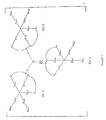
- Co(salen), Co(malen) See Figure 4
- related structures are the most common simple oxygen carriers that combine structural simplicity and low molecular weight. These systems show reversible oxygenation in solution, but as solids they exhibit either very slow oxygenation, very low oxygen loadings, or no loading at all due to efficient molecular packing in solids.
- compositions of this invention facilitate the formation of accessible active sites in solids.
- Many derivatives of Co(malen) and Co(salen) have secondary donors which can be used for the secondary coordination interaction and can be prepared at low cost. Combination of the desired chemical property, the flexibility in modification of the structure and performance, and the low costs make the approaches described herein very attractive for preparation of oxygen-selective adsorbents.
- Co(Me 2 Ac 2 H 2 malen) illustrates this approach.
- the cobalt in the complex is four-coordinate and the four donors are in a square planar arrangement around the metal center.
- the lithum ion serves as the secondary metal ion.
- the lithium ions coordinate to the secondary donors which are the oxygen atoms from the deprotonated hydroxyl group on the axial ligand and two carbonyl groups from two adjacent TEC molecules.
- the coordination of the lithium ion with Co(Me 2 Ac 2 H 2 malen) (4-Py-O - ) molecules creates a porous framework.
- the TECs may be covalently bonded to create porosity in the solid material.
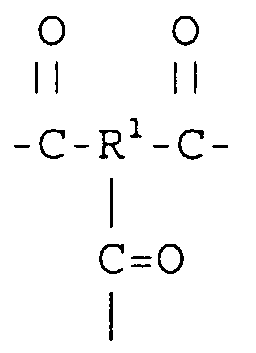
- R may be a bicarbonyl radical a tricarbonyl radical or a tetracarbonyl radical and may be substituted by F, Cl, Br, O, N, P, S, Si or B.
- Organic fragments can be used to cross-link TECs through chemical reactions at the ligand periphery to form the covalent bonds R to provide porous TEC systems.
- the use of polyfunctional reagents can lead to porous structures.
- both the TEC and the organic compound contain only two reactive sites each. This will necessarily result in a linear polymeric species.
- the introduction of a TEC or organic species with more than two sites enables formation of a crosslinked system even if the new species is a minor component. Therefore, examples where the average number of reactive sites on TECs and organic compounds is greater than two will be crosslinked. Both mixtures of species and single components meet this criterion. Indeed, the combination of species containing different numbers of sites enables control of linear and crosslinked regions of the solid and allows control of system porosity.
- both rigid TECs and relatively rigid organic agents are preferred to create permanent porosity.
- the molecular weight of the organic modifier should be minimized to provide high contents of reactive centers per unit mass and per unit volume, preferably over 1.5 mmol/g.
- the covalent modification approach to provide porous TEC frameworks is known in solution for TEC modification at peripheral ligand sites with monofunctional reagents, or with bifunctional reagents used in a way to maximize intramolecular reactions to provide bridges such as in the case of lacunar cyclidenes, bridged porphyrins or Schiff base complexes.
- the goal is deliberate formation of polymeric species that function as adsorbents or catalysts in the solid-state including crosslinked systems.
- An example of a crosslinked TEC system is the product from the reaction of 1,3,5-benzenetricarbonyltrichloride with Co(Me 2 H 2 H 2 malen) in the presence of triethylamine.
- Hydrogen bonding can also be used to organize the TEC species and create porosity.
- Functional groups which are capable of forming hydrogen bonds can be attached to ligands on the TECs. The interactions between those functional groups create channels around the TEC species and cavities around the active metal centers.
- Groups capable of hydrogen bonding include amido groups R 1 CONR 2 -, an amino group R 1 R 2 N-, a carbinol group -R 1 OH, and a carboxylic acid group R 1 CO 2 H, wherein R 1 and R 2 are the same or different and are unsubstituted acyclic or carbocyclic groups or substituted acyclic or carbocyclic groups substituted by F, Cl, Br, O, N, P, S, Si or B.
- Non-coordinating ions R may be used to separate TEC species in the solid to create porosity. If the TECs used to provide active sites are ionic, then counter-ions are needed for charge balance. These counter-ions are distributed between TEC molecules throughout the crystals. When the counter-ions have a relatively large size, they can separate TEC molecules and prevent them from packing efficiently to form dense materials. Therefore, counter-ions R can be used to generate porosity to provide vacant and accessible sites for guest molecules.
- the ions that can be used with anionic TECs include alkylammonium or arylammonium cations having the formula -(R 1 R 2 R 3 R 4 )N + , wherein R 1 , R 2 , R 3 and R 4 are the same or different and are hydrogen and at least one of which is an unsubstituted acyclic or carbocyclic group or an acyclic or carbocyclic group substituted by F, Cl, Br, O, N, P, S, Si or B.
- the adsorbent materials of the invention can be prepared conveniently in a step-by-step fashion.
- the first step is to prepare the individual TECs (the primary coordination spheres) using methods well known to those skilled in the art.
- the next step is to use these materials to prepare the intermolecular connecting group R (the secondary coordination sphere, where a secondary metal ion M' is employed, as in the embodiment of Figure 3).
- TECs the primary coordination sphere
- R the secondary coordination sphere, where a secondary metal ion M' is employed, as in the embodiment of Figure 3
- a solution or slurry of the system that provides the primary coordination sphere is treated with a reagent or reagents to create the secondary coordination sphere with heating if necessary.
- Solid formation occurs either spontaneously or in response to cooling, concentration, or change in solvent composition (e.g. precipitation). Isolated solid can be treated with a solution or vapor containing additional potential donors, if required to provide active sites.
- the materials can be prepared in two steps, the preparation can also be performed using a one-pot reaction if 1) one metal will be used for both the primary (M) and secondary (M') coordination spheres or 2) the metals and the donors on the ligands have such distinguishable coordination properties that each metal will form its own coordination environment to create the desired structure without interference.
- the complex in Example 2B below, Co(Me 2 Ac 2 H 2 maltmen) (4-PyOLi) (EtOH) can be prepared through a one-pot reaction using a cobalt salt, H 2 (Me 2 Ac 2 H 2 maltmen), lithium hydroxide, and 4-hydroxypyridine in ethanol since cobalt and lithium have very different coordination properties and will not compete with each other for the coordination sites.
- ligands on a TEC When organic reagents are used to cross-link TEC molecules to form a porous solid, it is necessary for the ligands on a TEC to have at least two reactive sites.
- the cross-linking reagents react with the reactive sites to form three-dimensional frameworks.
- the TEC in the metal form that is required to provide active sites when chemical reaction occurs.
- the sites that are reactive in the TEC are undesirable in an unreacted state.
- the crosslinking reactions can be performed either with the active metal center present, with a metal center that can be replaced with an active center, or using a chelating ligand suitable for forming a reactive center.
- the direct use of TECs containing the reactive center for the adsorption or catalytic application is preferred.
- the materials prepared in accordance with this invention are primarily intended for use as oxygen-selective adsorbents. Such use would involve passing an oxygen containing gas, such as air, over a bed of such adsorbents and recovering either oxygen or the non-adsorbed components (e.g. nitrogen) as product.
- an oxygen containing gas such as air
- the methods described herein for formation of coordinatively unsaturated metal centers in porous systems are also capable of providing materials suitable for use in other applications, e.g., as adsorbents for carbon monoxide, and catalysts for organic transformations, e.g., oxidations.
- the following examples disclose the methods of preparation and properties of six preferred embodiments of the porous oxygen-selective adsorbents of the invention. All of the examples utilize cobalt as the active metal center M and all multidentate ligands are derivatives of malen (Figure 4).
- the six materials can be classified in two types. The porosity of Type 1 is created by secondary coordination while the porosity in Type 2 is produced by covalent bonds.
- the materials exemplified are:
- the substituents on malonaldhyde are placed in front of "malen”, “maltmen”, or “maldmen”.
- the order of substituents is those at the carbonyl carbon, those at CH 2 group, and those at the carbonyl carbon that reacts with amine to form imine. See Figure 4 for the structures of the four ligands used.
- Co (Me 2 Ac 2 H 2 malen) (4-PyOLi) (MeOH) contains one methanol molecule per cobalt atom.
- the sample was placed in an Erlenmeyer flask and connected to a vacuum pump. The flask was heated to 75°C in an oil bath for 3 hours to obtain Co(Me 2 Ac 2 H 2 malen) (4-PyOLi) .
- a critical aspect to the practical application of oxygen selective adsorbents is the amount of oxygen that can be taken up under fixed conditions of temperature and pressure. This value is expressed in micro moles of oxygen per gram of solid (loading).
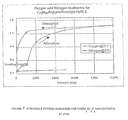
- the oxygen and nitrogen isotherms for the complex prepared as described in Example 1D were determined on a pressure microbalance. Optimal sample performance requires minimal exposure to air. At 27°C, the sample shows an oxygen loading over 2.0 mmol/g under 10 torr of oxygen. The nitrogen loading at 10 torr is too small to measure accurately, but is only 0.012 mmol/g at 1000 torr. The loadings at various pressures corrected for buoyancy effects are listed in Table 1, and the isotherms for oxygen and nitrogen are shown in Figure 6.
- the oxygen and nitrogen isotherms depict the gas loading capacity for a given adsorbent with respect to the partial pressure. They show the following features:
- this sample When exposed to 1 atm O 2 , this sample shows a very fast oxygen adsorption rate (>8 mL/g/s). The results also indicate that the adsorbed oxygen can be completely removed by vacuum or pure nitrogen. However, due to high oxygen affinity, the desorption rate is slow. It takes 120 and 27 minutes to achieve 90% desorption at 27 °C and 47 °C, respectively, The high oxygen affinity, high selectivity, and reversibility make this compound suitable for, but not limited to, removal of trace oxygen in a gaseous stream.
- Example 1D A sample (0.383 g) of the complex prepared as described Example 1D was loaded into a tube in a glove box under an inert atmosphere. The tube was sealed and transferred to an Accelerated Surface Area and Porosimetry System (Model ASAP 2010 from Micrometrics). Carbon dioxide was used as a probe molecule and the adsorption and desorption of the probe molecule was determined at 195°K by a volumetric method on the instrument. The BET surface area was calculated to be 156(2) m 2 /g. The Horvath-Kawazoe method was used to calculate the median pore diameter and maximum pore volume: 5.4 A and 0.080 cm 3 /g.
- H 2 Me 2 Ac 2 H 2 maltmen
- Co(CH 3 CO 2 ) 2 .4H 2 O 0.295 g, 1. 18 mmol
- the compound prepared according to the method described in Example 2B using EtOH solvent contained one ethanol molecule per cobalt.
- a sample of Co(Me 2 Ac 2 H 2 maltmen) (4-PyOLi) (EtOH) was loaded onto a TGA instrument. The sample was heated to 90°C at a heating rate of 0.1°C/min. Based on weight loss, all of the solvent was lost before the temperature reached 70°C. The weight loss was 8.7%, close to the theoretical loss of 8.5% to produce Co (Me 2 Ac 2 H 2 maltmen) (4-PyOLi) .
- Example 2B A sample of Co(Me 2 Ac 2 H 2 maltmen) (4-PyOLi) (EtOH), prepared as described in Example 2B, was loaded on a pressure microbalance with limited exposure to air.
- the oxygen and nitrogen isotherms were determined at 27°C.
- the sample showed an oxygen loading of 1.70 mmol/g at 10,000 torr. In contrast, the nitrogen loading was very low. Under 5,000 torr of nitrogen, the nitrogen loading for the sample was 0.045 mmol/g.
- the loadings at various pressures are listed in Table 2 and the isotherms for oxygen and nitrogen are shown in Figure 7.
- the oxygen and nitrogen isotherms indicate that this sample can selectively adsorb oxygen and that the oxygen loading is high.
- the adsorbed oxygen can be fully desorbed under vacuum.
- Example 2C A sample of the product described in Example 2C, exposed to high pressure oxygen to induce a phase change, was loaded onto a TGA system. The sample was cycled between oxygen and nitrogen with a 20-minute cycle time (10 minutes for oxygen and 10 minutes for nitrogen) at 27°C. Due to prolonged contact with ambient air, the oxygen loading was lower than that obtained on a microbalance. The sample was cycled between oxygen and nitrogen for 6,000 cycles and the performance decreased by 5%. Trace moisture in the gas stream was mainly, if not fully, responsible for the decay in performance. A section of the TGA cycling experiment is shown in Figure 9. This oxygen/nitrogen cycling experiment shows the following significant features:
- the oxygen loading at 1 bar can be increased not only by the treatment with highpressure oxygen at ambient temperature but also by the treatment with 1 bar oxygen at low temperature. Studies also show that the magnitude of the increase in oxygen loading at 1 bar depends on the duration and number of the treatments.
- the increase in the oxygen loading at 1 bar results from a change of oxygen affinity, which shifts the oxygen isotherms towards the lower pressure region.
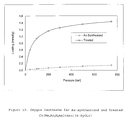
- the oxygen isotherms for two samples are shown Figure 10. The lower curve was obtained from an as-synthesized sample without any pretreatment with oxygen while the upper curve was obtained from a sample which was treated with 1 bar oxygen at low temperature (0 to -50 °C) for 30 times. A desired shape of isotherm between the two extreme curves can be obtained by controlling the treatment conditions.
- the transformation of the sample was irreversible, at least on the time frame of months.
- a lifetime test was performed on one of the intermediate samples.
- the oxygen loading at 1 bar decreased from 1.03 to 0.87 mmol/g after cycling between nitrogen (10 minutes) and oxygen (10 minutes) for 70 days. Assuming that the decay is first order in the content of active material, the half lifetime was projected to be around 300 days.
- Sample prepared in Example 3C contains one molecule of solvent EtOH per cobalt atom.
- the solvent molecule can be removed by heating the sample under nitrogen or vacuum at 90 °C.
- a sample (15.244 mg) was loaded onto a TGA sample pan. The furnace temperature was ramped to 90 °C at a heating rate of 2 °C/min and kept at 90 °C for 2 hour before cooled to 27 °C.
- the weight loss was 8.7%.
- the theoretical value is 9.0% for losing one EtOH molecule.
- the lower experimental value may result from the partial loss of the solvent molecule during the collection and storage of the sample.
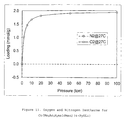
- the oxygen and nitrogen isotherms were determined at 27 °C.
- the sample showed oxygen loadings of 1.021, 1.454, 1.668, 1.810, and 1.939 mmol/g at 2.11, 5.52, 10.11, 20, and 100 torr, respectively.
- the nitrogen loading was very low. Under 1,000 torr, the nitrogen loading for the sample was 0.035 mmol/g.
- the oxygen and nitrogen isotherms are displayed in Figure 11. The isotherms indicate that this sample has high oxygen loading and very high O 2 /N 2 selectivity.
- the oxygen and nitrogen adsorption curves show the following features:
- this sample When exposed to 1 atm O 2 , this sample shows a very fast oxygen adsorption rate (0.52 mmol/g/s or 12.6 mL/g/s).
- the results also indicate that the adsorbed oxygen can be completely removed by vacuum or pure nitrogen.
- the desorption rate is slower than that for Co (Me 2 Ac 2 H 2 maltmen) (4-PyOLi) but much faster than that for Co(Me 2 Ac 2 H 2 malen) (4-PyOLi). It takes 22 minutes to achieve 90% desorption at 27 °C.
- the high oxygen affinity, high selectivity, and reversibility make this compound suitable for, but not limited to, removal of trace oxygen in a gaseous stream.
- Cobalt(II) acetate tetrahydrate (18.7g, 75 mmol) was added to give a solid mass and a brown solution, then a solution of sodium hydroxide (6.06g, 152 mmol) in methanol (100ml) was added over 3 minutes. After standing at room temperature for 2 days, the brown solid was collected by filtration and dried under vacuum, to give Co(Me 2 H 2 H 2 malophen) (19.09g) as a brown solid. This material was used without purification.
- the product was isolated by filtration as a brown powder, then dried under vacuum, yield 0.4119g.
- the BET surface area for this product following activation at 50°C under vacuum was 46 m 2 /g.
- the solid was treated with pyridine.
- the isolated solid (0. 15g) was treated with pyridine (4 drops) using vapor diffusion in a sealed vessel (rather than direct liquid contact) over several days to yield Co (Me 2 H 2 H 2 malophen) /tricarbonyl/py.
- the solution was concentrated to dryness under vacuum, then methanol (40 ml) was added to extract triethylamine hydrochloride and the system was stirred for one hour.
- the product was isolated by filtration as a brown powder then dried under vacuum.
- the BET surface following activation at 200°C under vacuum is 51 m 2 /g.
- the solid was treated with pyridine.
- the isolated solid (0.1750g) was treated with pyridine (7 drops) using vapor diffusion in a sealed vessel (rather than direct liquid contact) over several days to yield Co (Me 2 H 2 H 2 malophen) /tricarbonyl/terephthaloyl/py.
- Isolated solid (0.18g) was treated with pyridine (7 drops) using vapor diffusion in a sealed vessel (rather than direct liquid contact) over several days to yield Co(Me 2 H 2 H 2 malophen)/ tricarbonyl/oxalyl/py.
- Oxygen and Nitrogen Adsorption/Desorption Data for Co (Me 2 H 2 H 2 malophen) /tricarbonyl/oxalyl/py at 0°C Pressure (torr) O 2 Loading (mmol/g) N 2 Loading (mmol/g) 0 0 0 1000 0.158 0 2000 0.048 5000 0.363 10000 0.537 0.18 20000 0.738 0.282 0 0.051 0
- the adsorbents of the present invention may be used in separations or enrichments of fluid mixtures containing oxygen.
- processes based on oxygen- selective adsorbent would allow air separation to produce either nitrogen or oxygen or both.
- the materials of the present invention may be used in the enrichment of air with either nitrogen or oxygen.
- an oxygen-selective adsorbent could be employed for oxygen removal from other fluids (gases and/or liquids) including mixtures with nitrogen and argon, where oxygen is a minor or trace compound by contacting those fluids with the adsorbent.
- Oxygen-selective adsorbents of the invention may also be utilized for catalytic applications, particularly oxygen activation for the partial oxidation or selective oxidation of organic substrates.
- the adsorbents of the invention may also be used to separate CO from mixtures of other fluids including CO.
Landscapes
- Chemical & Material Sciences (AREA)
- Organic Chemistry (AREA)
- Chemical Kinetics & Catalysis (AREA)
- Analytical Chemistry (AREA)
- Inorganic Chemistry (AREA)
- Engineering & Computer Science (AREA)
- Materials Engineering (AREA)
- General Chemical & Material Sciences (AREA)
- Oil, Petroleum & Natural Gas (AREA)
- Solid-Sorbent Or Filter-Aiding Compositions (AREA)
- Gas Separation By Absorption (AREA)
Abstract
Description
the R group bonding and/or separating the respective TECs to and from one another to maintain them in a porous framework and wherein z is 1 to 8, and wherein R may be the same or different when z is greater than 1; and



| Adsorption/Desorption Data for Co(Me2Ac2H2malen) (4-PyOLi) | ||
| Pressure (torr) | O2 Loading (mmol/g) | N2 Loading (mmol/g) |
| 0 | 0 | 0 |
| 1.13 | 1.001 | |
| 5 | 1.878 | |
| 10 | 2.038 | |
| 20 | 2.067 | |
| 100 | 2.108 | |
| 1000 | 0.012 |
| Oxygen and Nitrogen Adsorption/Desorption Data for Co(Me2Ac2H2maltmen) (4-PyOLi) at 27°C | ||
| Pressure (torr) | O2 Loading (mmol/g) | N2 Loading (mmol/g) |
| 0 | 0 | 0 |
| 500 | 0.193 | |
| 1000 | 0.263 | 0.011 |
| 2000 | 1.086 | 0.017 |
| 5000 | 1.526 | 0.045 |
| 10000 | 1.701 | |
| 5000 | 1.62 | |
| 2000 | 1.54 | 0.023 |
| 1000 | 1.455 | 0.017 |
| 100 | 0.883 | |
| 0 | 0.023 | 0.008 |
| Oxygen Adsorption/Desorption Data for Co (Me2Ac2H2malen) (4-PyOLi) at 27°C | |
| Pressure (torr) | 02 Loading (mmol/g) |
| 0 | 0 |
| 40 | 0.171 |
| 100 | 0.339 |
| 200 | 0.483 |
| 300 | 0.557 |
| 500 | 0.640 |
| 750 | 0.705 |
| 500 | 0.638 |
| 300 | 0.557 |
| 200 | 0.481 |
| 100 | 0.334 |
| 40 | 0.158 |
| 0 | -0.006 |
| Oxygen and Nitrogen Adsorption/Desorption Data for Co (Me2H2H2malophen) /tricarbonyl/py at 27°C | ||
| Pressure (torr) | O2 Loading (mmol/g) | N2 Loading (mmol/g) |
| 0 | 0 | 0 |
| 1000 | 0.261 | 0 |
| 2000 | 0.016 | |
| 5000 | 0.686 | |
| 10000 | 1.016 | 0.064 |
| 20000 | 1.255 | 0.102 |
| 0 | 0.804 | 0 |
| Oxygen and Nitrogen Adsorption/Desorption Data for Co (Me2H2H2malophen) /tricarbonyl/terephthaloyl/py at 0°C | ||
| Pressure (torr) | O2 Loading (mmol/g) | N2 Loading (mmol/g) |
| 0 | 0 | 0 |
| 1000 | 0.363 | 0 |
| 5000 | 0.746 | |
| 10000 | 0.981 | 0.011 |
| 20000 | 1.134 | 0 |
| 0 | 0.036 | -0.007 |
| Oxygen and Nitrogen Adsorption/Desorption Data for Co (Me2H2H2malophen) /tricarbonyl/oxalyl/py at 0°C | ||
| Pressure (torr) | O2 Loading (mmol/g) | N2 Loading (mmol/g) |
| 0 | 0 | 0 |
| 1000 | 0.158 | 0 |
| 2000 | 0.048 | |
| 5000 | 0.363 | |
| 10000 | 0.537 | 0.18 |
| 20000 | 0.738 | 0.282 |
| 0 | 0.051 | 0 |
Claims (12)
- A process for selectively adsorbing a component of a gas mixture, which comprises contacting the mixture with a solid state, selective adsorbent material comprising a porous framework of a plurality of transition element complexes (TECs) having the formula shown in Figure 1, wherein:(a) M is a primary transition metal ion;(b) D to D4 are primary donors and m is zero or one, at least three of D to D4 occupying primary donor coordination sites on M but leaving at least one open coordination site on M for the component to react with M;(c) G to G4 are functional groups and n is zero or one, at least one of G to G4 being intramolecularly bonded to at least three adjacent primary donors to form at least one 5 or 6 member chelate ring on the primary transition metal ion and providing at least three donors thereto;(d) M, D to D4 and G to G4 together define one or more transition metal complexes, wherein said complexes are the same or different and wherein k is from 0 to 4;(e) R is an intermolecular connecting group selected from(i) secondary metal ions coordinated with secondary donors bonded to one or more of groups G to G4 on the respective TECs;(ii) multifunctional organic groups forming covalent bonds with one or more of groups G to G4 on the respective TECs;(iii) functional groups forming hydrogen bonds with one or more of groups G to G4 on the respective TECs; or(iv) non-coordinating counter-ions spaced between and separating the respective TECs; the R group bonding and/or spacing the respective TECs to and from one another to maintain them in a porous framework wherein z is from 1 to 8, and wherein R may be the same or different when z is greater than 1; and (f) y is an integer sufficient to provide said porous framework of the plurality of TECs for the selective adsorption of the desired component thereon.
- The process of claim 1 for selectively adsorbing a component of a gas mixture, wherein said transition metal ion M is an element selected from the first, second or third row of transition metals of the Periodic Table and the lanthanides.
- The process of claim 1 for selectively adsorbing a component of a gas mixture, wherein the donors D to D4 are N, O, S, C, P, Cl, F, or Br, and may be neutral or charged.
- The process of claim 1 for selectively adsorbing a component of a gas mixture, wherein G to G4 may be the same or different and are:a) pyridinyl or imidazolyl groups;b) amino groups having the formula -NR1R2R3;c) imino groups having the formula -R1N=CR2R3 or -N=CR1R2;d) carbonyl groups having the formula-R1C(O)R2, -R1CONR2R3 or -R1CO2R2;e) cyano groups having the formula -R1-CN;f) nitro groups having the formula -R1-NO2;g) phenolate groups with up to five substituents selected from halogens or -R1;h) carboxylate groups having the formula-R1CO2-; andi) alkoxy groups having the formula -R1O-; wherein R1, R2 and R3 are the same or different and are substituted or unsubstituted acyclic or carbocyclic groups, or substituted by F, Cl, Br, O, N, P, S, Si or B.
- The process of claim 1 for selectively adsorbing a component of a gas mixture, wherein R is a member of group (i) and has the structurewherein D' is a secondary donor or a group of 2 to 4 secondary donors bonded to at least a G to G4 group or a chelate ring on a coordination site on M and may also bond to an adjacent R group within the pourous framework; and M' is a secondary metal ion coordinated with secondary donors D', x is from 0 to 6 and z is from 1 to 8; said structure bonding the respective TECs to one another to form said porous framework.

- The process of claim 1 for selectively adsorbing a component of a gas mixture, wherein R is a member of group (ii) and has the formula

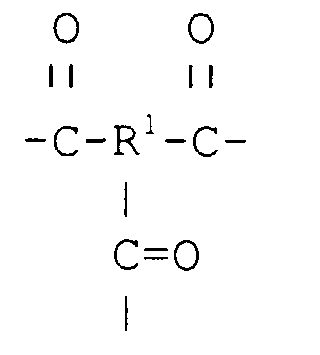 or mixtures thereof, and wherein R1 is a substituted or unsubstituted acyclic or carbocyclic group and is unsubstituted or is substituted by F, Cl, Br, O, N, P, S, Si or B.
- The process of claim 1 for selectively adsorbing a component of a gas
mixture, wherein R is group (iii) and is:wherein R1 and R2 are the same or different and are unsubstituted acyclic or carbocyclic groups, or substituted acyclic or carbocyclic groups substituted by F, Cl, Br, O, N, P, S, Si or B.a) an amide group having the formula R1CONR2-;b) an amino group having the formula R1R2N-;c) a carbinol group having the formula -R1OH; ord) a carboxylic acid group having the formula-R1CO2H, - The process of claim 1 for selectively adsorbing a component of a gas mixture, wherein R is a member of group (iv), selected from:(a) an alkylammonium or arylammonium cation having the formula-(R1R2R3R4)N+, wherein R1R2R3 and R4 are the same or different and are hydrogen and at least one of which is an unsubstituted acyclic or carbocyclic group or an acyclic or carbocyclic group substituted by F, Cl, Br, O, N, P, S, Si or B when the TECs are anionic; or(b) BF4-, BOR"-, PF6-, NO3-, SO4 2-, CO3 2-, MoO4 2-, a polyoxometallate, R"CO2-, R"O-, R"SO3-, wherein R" is a C1-20 alkyl or an aryl or hetero group having from 4 to 20 carbon atoms, when the TECs are cationic.
- A process for selectively adsorbing oxygen from a gas mixture, which comprises contacting the mixture with a solid state, selective adsorbent material comprising a porous framework of a plurality of transition element complexes (TECs) having the formula shown in Figure 3, wherein:(a) M is a primary transition metal ion selected from Co(II), Fe(II) or Mn(II);(b) D to D4 are primary donors occupying primary donor coordination sites on M but leaving one open coordination site on M for an oxygen molecule to react with M;(c) G to G4 are functional groups and n is zero or one, at least one of G to G4 being intramolecularly bonded to at least three adjacent primary donors to form at least one 5 or 6 member chelate ring on the primary transition metal ion and providing at least three donors thereto;(d) M, D to D4 and G to G4 together define one or more transition metal complexes TEC A, TEC B and TEC C, wherein said complexes are the same or different;(e) D' is a secondary donor or a group of secondary donors bonded to a chelate ring on a coordination site on M, and x is zero or one;(f) M' is a secondary metal ion coordinated with secondary donors D',
 the group bonding the respective TECs to one another to maintain them in a porous framework and wherein z is from 1 to 8 and x is from 0 to 6; and
 (g) y is an integer sufficient to provide said porous framework of the plurality of TECs for the selective adsorption of oxygen thereon.
 - A composition for selectively adsorbing a component of a gas mixture,
which comprises a solid state, selective adsorbent material comprising a porous framework of a plurality of transition element complexes (TECs) having the formula shown in Figure 1, wherein:(a) M is a primary transition metal ion;(b) D to D4 are primary donors and m is zero or one, at least three of D to D4 occupying primary donor coordination sites on M but leaving at least one open coordination site on M for the component to react with M;(c) G to G4 are functional groups and n is zero or one, at least one of G to G4 being intramolecularly bonded to at least three adjacent primary donors to form at least one 5 or 6 member chelate ring on the primary transition metal ion and providing at least three donors thereto;(d) M, D to D4 and G to G4 together define one or more transition metal complexes, wherein said complexes are the same or different and k is from 0 to 4;(e) R is an intermolecular connecting group selected fromthe R group bonding and/or spacing the respective TECs to and from one another to maintain them in a porous framework, wherein z is from 1 to 8, and wherein R may be the same or different when z is greater than 1; and(i) secondary metal ions coordinated with secondary donors bonded to one or more of groups G to G4 on the respective TECs;(ii) multifunctional organic groups forming covalent bonds with one or more of groups G to G4 on the respective TECs;(iii) functional groups forming hydrogen bonds with one or more of groups G to G4 on the respective TECs; or(iv) non-coordinating counter-ions spaced between and separating the respective TECs;(f) y is an integer sufficient to provide said porous framework of the plurality of TECs for the selective adsorption of the desired component thereon. - The composition of claim 10 for selectively adsorbing a component of a gas mixture, wherein the TECs are Co (Me2H2H2maltmen) (4-PyOLi) .
- The composition of claim 10 for selectively adsorbing a component of a gas mixture, wherein the TECs are Co(Me2H2H2maldmen) (4-PyOLi).
Applications Claiming Priority (4)
| Application Number | Priority Date | Filing Date | Title |
|---|---|---|---|
| US45806699A | 1999-12-10 | 1999-12-10 | |
| US458066 | 1999-12-10 | ||
| US725845 | 2000-11-30 | ||
| US09/725,845 US6989044B2 (en) | 1999-12-10 | 2000-11-30 | Intermolecularly bound transition element complexes for oxygen-selective adsorption |
Publications (2)
| Publication Number | Publication Date |
|---|---|
| EP1106245A2 true EP1106245A2 (en) | 2001-06-13 |
| EP1106245A3 EP1106245A3 (en) | 2002-09-04 |
Family
ID=27038844
Family Applications (1)
| Application Number | Title | Priority Date | Filing Date |
|---|---|---|---|
| EP00127004A Withdrawn EP1106245A3 (en) | 1999-12-10 | 2000-12-08 | Intermolecularly bound transition metal complexes for oxygen-selective adsorption |
Country Status (4)
| Country | Link |
|---|---|
| EP (1) | EP1106245A3 (en) |
| KR (1) | KR100459778B1 (en) |
| CN (1) | CN1227063C (en) |
| CA (1) | CA2327972C (en) |
Cited By (4)
| Publication number | Priority date | Publication date | Assignee | Title |
|---|---|---|---|---|
| WO2007007113A3 (en) * | 2005-07-14 | 2007-05-24 | Uni I Oslo | Metal-organic framework catalysts and their use in hydrocarbon transformation |
| US9120571B2 (en) | 2012-05-25 | 2015-09-01 | B/E Aerospace, Inc. | Hybrid on-board generation of oxygen for aircraft passengers |
| US9550570B2 (en) | 2012-05-25 | 2017-01-24 | B/E Aerospace, Inc. | On-board generation of oxygen for aircraft passengers |
| US9550575B2 (en) | 2012-05-25 | 2017-01-24 | B/E Aerospace, Inc. | On-board generation of oxygen for aircraft pilots |
Families Citing this family (6)
| Publication number | Priority date | Publication date | Assignee | Title |
|---|---|---|---|---|
| KR100792038B1 (en) * | 2006-09-20 | 2008-01-04 | 한국화학연구원 | Method for preparing porous coordination polymer, porous coordination polymer prepared therefrom and application thereof |
| EP3409343B1 (en) * | 2016-01-27 | 2021-04-28 | Sharp Kabushiki Kaisha | Liquid having oxygen absorbing ability, method for producing same, and complex solution containing same |
| CN106478959B (en) * | 2016-09-23 | 2019-05-28 | 肇庆学院 | One kind being based on the Cd-MOF and preparation method thereof of 4,4 '-dicarboxydiphenyl ethers |
| WO2020162030A1 (en) * | 2019-02-04 | 2020-08-13 | パナソニックIpマネジメント株式会社 | Photoresponsive oxygen storage material |
| CN116023294A (en) * | 2022-12-28 | 2023-04-28 | 威格科技(苏州)股份有限公司 | Preparation method and application of a kind of oxygen-absorbing material ligand |
| CN115869923B (en) * | 2022-12-28 | 2024-03-22 | 威格科技(苏州)股份有限公司 | Oxygen absorbing material, preparation method thereof and prepared adsorption material capable of simultaneously adsorbing oxygen and organic solvent |
Family Cites Families (6)
| Publication number | Priority date | Publication date | Assignee | Title |
|---|---|---|---|---|
| US2450276A (en) * | 1944-07-07 | 1948-09-28 | Little Inc A | Process for production of oxygen |
| US4343715A (en) * | 1980-10-10 | 1982-08-10 | Duke University | Immobilized hemoglobin, and processes for extracting oxygen from fluids using the same |
| US4948506A (en) * | 1986-07-07 | 1990-08-14 | Bend Research, Inc. | Physicochemically functional ultrathin films by interfacial polymerization |
| KR100228825B1 (en) * | 1994-11-14 | 1999-11-01 | 조안 엠. 젤사도로시 엠. 보어 | Oxygen-selective adsorbent |
| ID19498A (en) * | 1997-01-15 | 1998-07-16 | Praxair Technology Inc | SORBEN SELECTIVE OXYGEN |
| US6436171B1 (en) * | 1999-07-22 | 2002-08-20 | The Boc Group, Inc. | Oxygen-selective adsorbents |
-
2000
- 2000-12-08 KR KR10-2000-0074556A patent/KR100459778B1/en not_active Expired - Fee Related
- 2000-12-08 CN CNB001376411A patent/CN1227063C/en not_active Expired - Fee Related
- 2000-12-08 CA CA002327972A patent/CA2327972C/en not_active Expired - Fee Related
- 2000-12-08 EP EP00127004A patent/EP1106245A3/en not_active Withdrawn
Cited By (5)
| Publication number | Priority date | Publication date | Assignee | Title |
|---|---|---|---|---|
| WO2007007113A3 (en) * | 2005-07-14 | 2007-05-24 | Uni I Oslo | Metal-organic framework catalysts and their use in hydrocarbon transformation |
| US9120571B2 (en) | 2012-05-25 | 2015-09-01 | B/E Aerospace, Inc. | Hybrid on-board generation of oxygen for aircraft passengers |
| US9550570B2 (en) | 2012-05-25 | 2017-01-24 | B/E Aerospace, Inc. | On-board generation of oxygen for aircraft passengers |
| US9550575B2 (en) | 2012-05-25 | 2017-01-24 | B/E Aerospace, Inc. | On-board generation of oxygen for aircraft pilots |
| US9580177B2 (en) | 2012-05-25 | 2017-02-28 | B/E Aerospace, Inc. | Hybrid on-board generation of oxygen for aircraft passengers |
Also Published As
| Publication number | Publication date |
|---|---|
| KR100459778B1 (en) | 2004-12-03 |
| CA2327972A1 (en) | 2001-06-10 |
| EP1106245A3 (en) | 2002-09-04 |
| KR20010062262A (en) | 2001-07-07 |
| CN1227063C (en) | 2005-11-16 |
| CA2327972C (en) | 2004-10-26 |
| CN1327877A (en) | 2001-12-26 |
Similar Documents
| Publication | Publication Date | Title |
|---|---|---|
| US6989044B2 (en) | Intermolecularly bound transition element complexes for oxygen-selective adsorption | |
| US11077398B2 (en) | Compositions comprising metal organic frameworks for the uptake of compounds and related methods | |
| JP6150315B2 (en) | EMM-19 *: Novel Zeolite Imidazolate Framework Material, Method for Producing the Same, and Application | |
| CN111094304B (en) | Zirconium terephthalate-based metal-organic frameworks with open metal sites | |
| EP0571952B1 (en) | Reversible oxygen sorbent compositions | |
| KR101002571B1 (en) | Coordination Polymer Crystals with Porous Metal-Organic Skeletal Structures and Methods for Preparing the Same | |
| US8227375B2 (en) | Gas adsorption on metal-organic frameworks | |
| EP2384237A1 (en) | Reversible ethylene oxide capture in porous frameworks | |
| JPH08206496A (en) | Oxygen selective sorbent | |
| Li et al. | Porous Lanthanide Metal–Organic Frameworks for Gas Storage and Separation | |
| CA2327972C (en) | Intermolecularly bound transition element complexes for oxygen-selective adsorption | |
| WO2013029830A1 (en) | Porous materials containing built-in single molecule traps for small molecule capture | |
| Pal et al. | Two 2D microporous MOFs based on bent carboxylates and a linear spacer for selective CO2 adsorption | |
| WO2017062733A1 (en) | Adsorbents with stepped isotherms for gas storage applications | |
| Dang et al. | A pyridyl-decorated MOF-505 analogue exhibiting hierarchical porosity, selective CO2 capture and catalytic capacity | |
| JP2535282B2 (en) | Method of oxygen separation from oxygen-containing fluid streams | |
| US6183709B1 (en) | Process for separation of oxygen from an oxygen containing gas using oxygen selective sorbents | |
| WO2021043492A1 (en) | Gas storage material and gas storage system | |
| WO2021043491A1 (en) | Gas storage material and gas storage system | |
| Bell et al. | Physisorption-induced structural change directing carbon monoxide chemisorption and nitric oxide coordination on hemilabile porous metal organic framework NaNi3 (OH)(SIP) 2 (H2O) 5· H2O (SIP= 5-sulfoisophthalate) | |
| US5239098A (en) | Solid state cyanocobaltate complexes | |
| Mahwasane | Synthesis of mixes ligand metal-organic frameworks for sorption studies | |
| Shi | New Polynuclear Copper-Pyrazolate Complexes: Towards the Synthesis of Photo-and Redox-Active Metal Organic Frameworks | |
| Frank | New Rotaxane Ligands with Donors on Both the Axle and Wheel | |
| Holcroft | Synthesis, characterisation and properties of benzenepolycarboxylate metal-orgnanic frameworks |
Legal Events
| Date | Code | Title | Description |
|---|---|---|---|
| PUAI | Public reference made under article 153(3) epc to a published international application that has entered the european phase |
Free format text: ORIGINAL CODE: 0009012 |
|
| AK | Designated contracting states |
Kind code of ref document: A2 Designated state(s): AT BE CH CY DE DK ES FI FR GB GR IE IT LI LU MC NL PT SE TR |
|
| AX | Request for extension of the european patent |
Free format text: AL;LT;LV;MK;RO;SI |
|
| RIC1 | Information provided on ipc code assigned before grant |
Free format text: 7B 01J 20/22 A, 7B 01D 53/02 B, 7B 01D 53/047 B, 7C 01B 13/02 B, 7B 01J 20/26 B, 7C 07F 13/00 B, 7C 07F 15/02 B, 7C 07F 15/06 B, 7C 08G 61/12 B |
|
| PUAL | Search report despatched |
Free format text: ORIGINAL CODE: 0009013 |
|
| AK | Designated contracting states |
Kind code of ref document: A3 Designated state(s): AT BE CH CY DE DK ES FI FR GB GR IE IT LI LU MC NL PT SE TR |
|
| AX | Request for extension of the european patent |
Free format text: AL;LT;LV;MK;RO;SI |
|
| 17P | Request for examination filed |
Effective date: 20020917 |
|
| AKX | Designation fees paid |
Designated state(s): DE ES FR GB IT |
|
| 17Q | First examination report despatched |
Effective date: 20050609 |
|
| STAA | Information on the status of an ep patent application or granted ep patent |
Free format text: STATUS: THE APPLICATION IS DEEMED TO BE WITHDRAWN |
|
| 18D | Application deemed to be withdrawn |
Effective date: 20051020 |
|
| RIC1 | Information provided on ipc code assigned before grant |
Ipc: B01D 53/047 20060101ALI20140129BHEP Ipc: C07F 15/06 20060101ALI20140129BHEP Ipc: B01D 53/02 20060101ALI20140129BHEP Ipc: B01J 20/22 20060101AFI20140129BHEP Ipc: B01J 20/26 20060101ALI20140129BHEP Ipc: C07F 13/00 20060101ALI20140129BHEP Ipc: C07F 15/02 20060101ALI20140129BHEP Ipc: C01B 13/02 20060101ALI20140129BHEP Ipc: C08G 61/12 20060101ALI20140129BHEP |