EP1105109B1 - Injectable formulations of nanoparticulate naproxen - Google Patents
Injectable formulations of nanoparticulate naproxen Download PDFInfo
- Publication number
- EP1105109B1 EP1105109B1 EP99941065A EP99941065A EP1105109B1 EP 1105109 B1 EP1105109 B1 EP 1105109B1 EP 99941065 A EP99941065 A EP 99941065A EP 99941065 A EP99941065 A EP 99941065A EP 1105109 B1 EP1105109 B1 EP 1105109B1
- Authority
- EP
- European Patent Office
- Prior art keywords
- naproxen
- less
- particle size
- average particle
- composition
- Prior art date
- Legal status (The legal status is an assumption and is not a legal conclusion. Google has not performed a legal analysis and makes no representation as to the accuracy of the status listed.)
- Expired - Lifetime
Links
Classifications
-
- A—HUMAN NECESSITIES
- A61—MEDICAL OR VETERINARY SCIENCE; HYGIENE
- A61K—PREPARATIONS FOR MEDICAL, DENTAL OR TOILETRY PURPOSES
- A61K9/00—Medicinal preparations characterised by special physical form
- A61K9/14—Particulate form, e.g. powders, Processes for size reducing of pure drugs or the resulting products, Pure drug nanoparticles
- A61K9/141—Intimate drug-carrier mixtures characterised by the carrier, e.g. ordered mixtures, adsorbates, solid solutions, eutectica, co-dried, co-solubilised, co-kneaded, co-milled, co-ground products, co-precipitates, co-evaporates, co-extrudates, co-melts; Drug nanoparticles with adsorbed surface modifiers
- A61K9/146—Intimate drug-carrier mixtures characterised by the carrier, e.g. ordered mixtures, adsorbates, solid solutions, eutectica, co-dried, co-solubilised, co-kneaded, co-milled, co-ground products, co-precipitates, co-evaporates, co-extrudates, co-melts; Drug nanoparticles with adsorbed surface modifiers with organic macromolecular compounds
-
- A—HUMAN NECESSITIES
- A61—MEDICAL OR VETERINARY SCIENCE; HYGIENE
- A61K—PREPARATIONS FOR MEDICAL, DENTAL OR TOILETRY PURPOSES
- A61K31/00—Medicinal preparations containing organic active ingredients
- A61K31/185—Acids; Anhydrides, halides or salts thereof, e.g. sulfur acids, imidic, hydrazonic or hydroximic acids
- A61K31/19—Carboxylic acids, e.g. valproic acid
- A61K31/192—Carboxylic acids, e.g. valproic acid having aromatic groups, e.g. sulindac, 2-aryl-propionic acids, ethacrynic acid
-
- A—HUMAN NECESSITIES
- A61—MEDICAL OR VETERINARY SCIENCE; HYGIENE
- A61P—SPECIFIC THERAPEUTIC ACTIVITY OF CHEMICAL COMPOUNDS OR MEDICINAL PREPARATIONS
- A61P19/00—Drugs for skeletal disorders
- A61P19/02—Drugs for skeletal disorders for joint disorders, e.g. arthritis, arthrosis
-
- A—HUMAN NECESSITIES
- A61—MEDICAL OR VETERINARY SCIENCE; HYGIENE
- A61P—SPECIFIC THERAPEUTIC ACTIVITY OF CHEMICAL COMPOUNDS OR MEDICINAL PREPARATIONS
- A61P19/00—Drugs for skeletal disorders
- A61P19/06—Antigout agents, e.g. antihyperuricemic or uricosuric agents
-
- A—HUMAN NECESSITIES
- A61—MEDICAL OR VETERINARY SCIENCE; HYGIENE
- A61P—SPECIFIC THERAPEUTIC ACTIVITY OF CHEMICAL COMPOUNDS OR MEDICINAL PREPARATIONS
- A61P29/00—Non-central analgesic, antipyretic or antiinflammatory agents, e.g. antirheumatic agents; Non-steroidal antiinflammatory drugs [NSAID]
-
- Y—GENERAL TAGGING OF NEW TECHNOLOGICAL DEVELOPMENTS; GENERAL TAGGING OF CROSS-SECTIONAL TECHNOLOGIES SPANNING OVER SEVERAL SECTIONS OF THE IPC; TECHNICAL SUBJECTS COVERED BY FORMER USPC CROSS-REFERENCE ART COLLECTIONS [XRACs] AND DIGESTS
- Y10—TECHNICAL SUBJECTS COVERED BY FORMER USPC
- Y10S—TECHNICAL SUBJECTS COVERED BY FORMER USPC CROSS-REFERENCE ART COLLECTIONS [XRACs] AND DIGESTS
- Y10S977/00—Nanotechnology
- Y10S977/70—Nanostructure
- Y10S977/773—Nanoparticle, i.e. structure having three dimensions of 100 nm or less
-
- Y—GENERAL TAGGING OF NEW TECHNOLOGICAL DEVELOPMENTS; GENERAL TAGGING OF CROSS-SECTIONAL TECHNOLOGIES SPANNING OVER SEVERAL SECTIONS OF THE IPC; TECHNICAL SUBJECTS COVERED BY FORMER USPC CROSS-REFERENCE ART COLLECTIONS [XRACs] AND DIGESTS
- Y10—TECHNICAL SUBJECTS COVERED BY FORMER USPC
- Y10S—TECHNICAL SUBJECTS COVERED BY FORMER USPC CROSS-REFERENCE ART COLLECTIONS [XRACs] AND DIGESTS
- Y10S977/00—Nanotechnology
- Y10S977/70—Nanostructure
- Y10S977/778—Nanostructure within specified host or matrix material, e.g. nanocomposite films
- Y10S977/779—Possessing nanosized particles, powders, flakes, or clusters other than simple atomic impurity doping
-
- Y—GENERAL TAGGING OF NEW TECHNOLOGICAL DEVELOPMENTS; GENERAL TAGGING OF CROSS-SECTIONAL TECHNOLOGIES SPANNING OVER SEVERAL SECTIONS OF THE IPC; TECHNICAL SUBJECTS COVERED BY FORMER USPC CROSS-REFERENCE ART COLLECTIONS [XRACs] AND DIGESTS
- Y10—TECHNICAL SUBJECTS COVERED BY FORMER USPC
- Y10S—TECHNICAL SUBJECTS COVERED BY FORMER USPC CROSS-REFERENCE ART COLLECTIONS [XRACs] AND DIGESTS
- Y10S977/00—Nanotechnology
- Y10S977/902—Specified use of nanostructure
- Y10S977/904—Specified use of nanostructure for medical, immunological, body treatment, or diagnosis
- Y10S977/906—Drug delivery
-
- Y—GENERAL TAGGING OF NEW TECHNOLOGICAL DEVELOPMENTS; GENERAL TAGGING OF CROSS-SECTIONAL TECHNOLOGIES SPANNING OVER SEVERAL SECTIONS OF THE IPC; TECHNICAL SUBJECTS COVERED BY FORMER USPC CROSS-REFERENCE ART COLLECTIONS [XRACs] AND DIGESTS
- Y10—TECHNICAL SUBJECTS COVERED BY FORMER USPC
- Y10S—TECHNICAL SUBJECTS COVERED BY FORMER USPC CROSS-REFERENCE ART COLLECTIONS [XRACs] AND DIGESTS
- Y10S977/00—Nanotechnology
- Y10S977/902—Specified use of nanostructure
- Y10S977/904—Specified use of nanostructure for medical, immunological, body treatment, or diagnosis
- Y10S977/908—Mechanical repair performed/surgical
-
- Y—GENERAL TAGGING OF NEW TECHNOLOGICAL DEVELOPMENTS; GENERAL TAGGING OF CROSS-SECTIONAL TECHNOLOGIES SPANNING OVER SEVERAL SECTIONS OF THE IPC; TECHNICAL SUBJECTS COVERED BY FORMER USPC CROSS-REFERENCE ART COLLECTIONS [XRACs] AND DIGESTS
- Y10—TECHNICAL SUBJECTS COVERED BY FORMER USPC
- Y10T—TECHNICAL SUBJECTS COVERED BY FORMER US CLASSIFICATION
- Y10T428/00—Stock material or miscellaneous articles
- Y10T428/29—Coated or structually defined flake, particle, cell, strand, strand portion, rod, filament, macroscopic fiber or mass thereof
- Y10T428/2982—Particulate matter [e.g., sphere, flake, etc.]
- Y10T428/2984—Microcapsule with fluid core [includes liposome]
- Y10T428/2985—Solid-walled microcapsule from synthetic polymer
Definitions
- the present invention is directed to an injectable formulation of nanoparticulate naproxen that produces minimal or no intramuscular pain or burning sensation upon administration, methods of making such a formulation, and methods of using such a formulation.
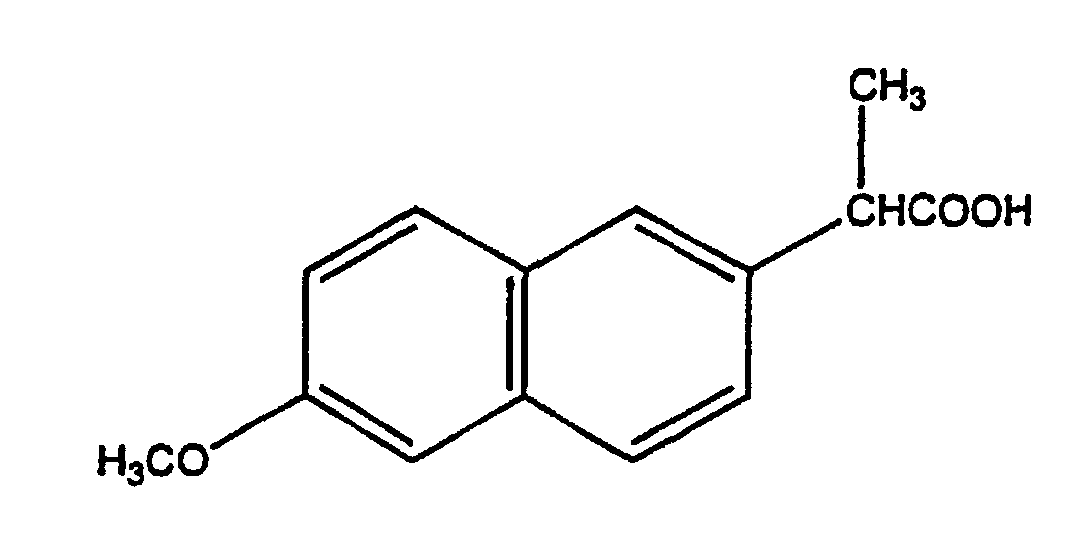
- Naproxen also known as 6-methoxy- ⁇ -methyl-2-napthalene-acetic acid and d -2(6-methoxy-2-naphthyl)propionic acid
- ALEVE® ANAPROX®
- NAPROSYN® ANAPROSYN®
- SYNFLEX® all available from Syntex Chemicals, Inc.
- Naproxen which is highly water insoluble, i.e., less than 10 mg/ml, has the following chemical structure:
- Naproxen is a non-steroidal anti-inflammatory drug (NSAID) often used to relieve the inflammation, swelling, stiffness, and joint pain associated with rheumatoid arthritis, osteoarthritis (the most common form of arthritis), juvenile arthritis, ankylosing spondylitis (spinal arthritis), tendinitis, bursitis, and acute gout. In addition, it is used to treat pain associated with menstrual periods, migraine headaches, and other types of mild to moderate pain.
- NSAID non-steroidal anti-inflammatory drug
- Naproxen acts by suppressing the production of prostaglandins, which are hormone-like substances that act on local tissues to produce pain and inflammation.
- Its pharmaceutical forms of delivery include tablets, capsules, and liquids. Delivery characteristics and forms are disclosed in, for example, U.S. Patent Nos. 3,904,682; 4,009,197; 4,780,320; 4,888,178; 4,919,939; 4,940,588; 4,952,402; 5,200,193; 5,354,556; 5,462,747; and 5,480,650.
- the synthesis of naproxen is described in U.S. Patent Nos. 3,904,682 and 4,009,197.
- U.S. Patent No. 5,510,118 to Bosch et al is directed to a method of making nanoparticulate compositions of a poorly soluble crystalline drug and a surface stabilizer by milling in a microfluidizer.
- Bosch et al do not teach or suggest how to make an injectable formulation of naproxen that does not result in pain upon administration.
- the reference does not teach that povidone polymers are the only polymers known to be suitable for injectable formulations of naproxen, or that such povidone polymers must have a molecular weight of 40,000 daltons or less for a suitable injectable naproxen formulation.
- European Patent Application No. 577,215 discloses particles of a cyrstalline anticancer agent having a surface modifer adsorbed on the surface thereof so that a particle size of less than 1000 nm is maintained. Such particles exhibit reduced toxicity and/or enhanced efficacy.
- Surface modifiers such as PVP, are taught to be useful for adsorbing onto the surface of an anticancer agent; however the use of PVP and naproxen is not suggested by this reference. There is no suggestion of how to make an injectable formulation of naproxen that does not result in pain upon administration.
- Naproxen is a more potent pain reliever than aspirin, especially for menstrual cramps, toothaches, minor arthritis, and injunes accompanied by inflammation, such as tendinitis.
- the naproxen sodium salt is specifically indicated in the treatment of various types of acute and very high intensity pain because it induces a rapid and sustained remission.
- naproxen Because of naproxen's low solubility, it is generally formulated for oral administration. However, oral administration of naproxen frequently results in gastrointestinal irritation. All NSAIDs produce gastrointestinal symptoms to some degree upon oral administration. Such symptoms most commonly are constipation, gastric burns, diarrhea, stomatitis, dyspepsia, nausea, vomiting, upper abdominal pain, and heartburn. Oral administration may also lead to an ulcer or bleeding from the stomach or duodenum.
- Gastrointestinal irritation resulting from oral administration of an NSAID can be significant.
- Numerous literature articles detail the severity of gastric irritation caused by NSAID compositions. For example, one report states that between 10,000 and 20,000 people in Canada each year are hospitalized with major gastro-intestinal bleeding caused by oral ingestion of NSAIDs, with effects resulting in death for at least 1,000 of these patients. See Marketplace , October 24, 1996. Yet another reference states that gastrointestinal complications of NSAID use may be responsible for over 10,000 deaths each year. See American Family Physician , March 1997.
- Injectable formulations of naproxen are preferable over oral administration forms for several reasons.
- injectable formulations of pain medication are also preferable for post-operative health care, where oral administration may not be feasible.
- Injectable formulations of naproxen are particularly preferred, as naproxen is not addictive, in contrast to other injectable formulations of drugs, such as morphine and ketorolac (Toradol®).
- Injectable formulations of naproxen have been used prior to the present invention. See Marsala et al., "Treatment of Acute Pain of Ureteral and Biliary Colic with Naproxen Sodium Administered by the Parenteral Route," Int. J. Clin. Pharmacol. Res ., 6 :495-500 (1986) (IM and IV injections of naproxen); L. Kvarnes, "Naproxen Sodium Versus Pentazocine in Treating Postoperative Pain," Curr. Ther. Res. , Clin. Exp., 46 :259-268 (1989) (IM injections of naproxen).
- injectable naproxen formulations are difficult to formulate due to the low solubility of naproxen.
- current injectable formulations of naproxen are undesirable because they produce intense pain and/or a burning sensation upon administration.
- the present invention is directed to the surprising and unexpected discovery of a new injectable formulation of naproxen that produces minimal or no pain or burning sensation upon administration.
- the injectable formulation comprises nanoparticulate naproxen having a povidone polymer adsorbed on the surface thereof in an amount sufficient to maintain an effective average particle size of less than about 600 nm.
- the effective average particle size of the nanoparticulate naproxen is less than about 450 nm, more preferably less than about 300 nm, even more preferably less than about 250 nm, and most preferably less than about 100 nm.
- Nanoparticulate compositions were first described in U.S. Patent No. 5,145,684 ("the '684 patent").
- the invention provides for injectable compositions comprising high naproxen concentrations in low injection volumes, with rapid drug dissolution upon administration.
- an injectable pharmaceutical composition comprising: (1) naproxen particles having an effective average particle size of less than 600 nm; (2) a povidone polymer adsorbed on the surface of the naproxen particles, wherein the povidone polymer has a molecular weight of 40,000 daltons or less; and (3) a pharmaceutically acceptable carrier.
- a method of preparing injectable nanoparticulate naproxen formulations comprises: (1) dispersing naproxen in a liquid dispersion medium comprising a povidone polymer with a molecular weight of less than about 40,000 daltons; and (2) mechanically reducing the particle size of the naproxen to an effective average particle size of less than about 600 nm.
- the pH of the liquid dispersion medium is maintained within the range of from about 3 to about 8 during the size reduction process.
- Yet another aspect of the present invention provides a method of treating a mammal requiring anti-inflammatory, analgesic, or antipyretic treatment comprising administering to the mammal the above-described injectable nanoparticulate naproxen formulation.
- the present invention is directed to the surprising and unexpected discovery of a new injectable formulation of naproxen that produces minimal or no pain or burning sensation upon administration.
- the injectable composition comprises nanoparticulate naproxen having a povidone polymer with a molecular weight of less than about 40,000 daltons adsorbed on the surface thereof in an amount sufficient to maintain an effective average particle size of less than about 600 nm.
- the effective average particle size of the nanoparticulate naproxen is less than about 450 nm, more preferably less than about 300 nm, even more preferably less than about 250 nm, and most preferably less than about 100 nm.
- Naproxen has a pKa of 4.4. Below its pKa of 4.4, the solubility of naproxen is about 20 micrograms/ml. However, above a pKa of 4.4, the solubility of naproxen is about 3 mg/ml. It is preferred that the nanoparticulate naproxen/povidone polymer pharmaceutical formulation of the invention has a pH of between about 6 to about 7.
- Povidone polymers also known as polyvidon(e), povidonum, PVP, and polyvinylpyrrolidone, are sold under the trade names Kollidon® (BASF Corp.) and Plasdone® (ISP Technologies, Inc.). They are polydisperse macromolecular molecules, with a chemical name of 1-ethenyl-2-pyrrolidinone polymers and 1-vinyl-2-pyrrolidinone polymers. Povidone polymers are produced commercially as a series of products having mean molecular weights ranging from about 10,000 to about 700,000 daltons.
- the povidone polymer must have a molecular weight of less than about 40,000 daltons, as a molecular weight of greater than 40,000 daltons would have difficulty clearing the body.
- Povidone polymers are prepared by, for example, Reppe's process, comprising: (1) obtaining 1,4-butanediol from acetylene and formaldehyde by the Reppe butadiene synthesis; (2) dehydrogenating the 1,4-butanediol over copper at 200° to form ⁇ -butyrolactone; and (3) reacting ⁇ -butyrolactone with ammonia to yield pyrrolidone. Subsequent treatment with acetylene gives the vinyl pyrrolidone monomer. Polymerization is carried out by heating in the presence of H 2 O and NH 3 . See The Merck Index , 10 th Edition, pp. 7581 (Merck & Co., Rahway, NJ, 1983).
- the manufacturing process for povidone polymers produces polymers containing molecules of unequal chain length, and thus different molecular weights.
- the molecular weights of the molecules vary about a mean or average for each particular commercially available grade. Because it is difficult to determine the polymer's molecular weight directly, the most widely used method of classifying various molecular weight grades is by K-values, based on viscosity measurements.
- the K-values of various grades of povidone polymers represent a function of the average molecular weight, and are derived from viscosity measurements and calculated according to Fikentscher's formula.
- the weight-average of the molecular weight, Mw is determined by methods that measure the weights of the individual molecules, such as by light scattering.
- Table 1 provides molecular weight data for several commercially available povidone polymers, all of which are soluble.
- Povidone K-Value Mv (Daltons) Mw (Daltons) Mn (Daltons) Plasdone C-15® 17 ⁇ 1 7,000 10,500 3,000
- exemplary preferred commercially available povidone polymers include, but are not limited to, Plasdone C-15®, Kollidon 12 PF®, Kollidon 17 PF®, and Kollidon 25®.
- the invention provides injectable nanoparticulate naproxen formulations that can comprise high drug concentrations in low injection volumes, with rapid drug dissolution upon administration.
- Preferred compositions comprise, based on % w/w: naproxen 5 - 50% povidone polymer 0.1 - 50% preservatives 0.05 - 0.25% pH adjusting agent pH about 6 to about 7 water for injection q.s.
- Exemplary preservatives include methylparaben (about 0.18% based on % w/w), propylparaben (about 0.02% based on % w/w), phenol (about 0.5% based on % w/w), and benzyl alcohol (up to 2% v/v).
- An exemplary pH adjusting agent is sodium hydroxide
- an exemplary liquid carrier is sterile water for injection.
- Other useful preservatives, pH adjusting agents, and liquid carriers are well-known in the art.
- a method of preparing the injectable nanoparticulate naproxen formulations of the invention comprises: (1) dispersing naproxen in a liquid dispersion medium comprising a povidone polymer with a molecular weight of less than about 40,000 daltons; and (2) mechanically reducing the particle size of the naproxen to an effective average particle size of less than about 600 nm.
- the effective average particle size of the nanoparticulate naproxen is less than about 450 nm, more preferably less than about 300 nm, even more preferably less than about 250 nm, and most preferably less than about 100 nm.
- the pH of the liquid dispersion medium is preferably maintained within the range of from about 5.0 to about 7.5 during the size reduction process.
- the dispersion medium used for the size reduction process is aqueous.
- Effective methods of providing mechanical force for particle size reduction of naproxen include ball milling, media milling, and homogenization, for example, with a Microfluidizer® (Microfluidics Corp.).
- Ball milling is a low energy milling process that uses milling media, drug, stabilizer, and liquid. The materials are placed in a milling vessel that is rotated at optimal speed such that the media cascades and reduces the drug particle size by impaction.
- the media used must have a high density as the energy for the particle reduction is provided by gravity and the mass of the attrition media.
- Media milling is a high energy milling process. Drug, stabilizer, and liquid are placed in a reservoir and recirculated in a chamber containing media and a rotating shaft/impeller. The rotating shaft agitates the media which subjects the drug to impaction and sheer forces, thereby reducing the drug particle size.
- Homogenization is a technique that does not use milling media.
- Drug, stabilizer, and liquid constitute a process stream propelled into a process zone, which in the Microfluidizer® is called the Interaction Chamber.
- the product to be treated is inducted into the pump, and then forced out.
- the priming valve ofthe Microfluidizer® purges air out of the pump. Once the pump is filled with product, the priming valve is closed and the product is forced through the interaction chamber.
- the geometry of the interaction chamber produces powerful forces of sheer, impact, and cavitation which are responsible for particle size reduction. Specifically, inside the interaction chamber, the pressurized product is split into two streams and accelerated to extremely high velocities.
- the formed jets are then directed toward each other and collide in the interaction zone.
- the resulting product has very fine and uniform particle or droplet size.
- the Microfluidizer® also provides a heat exchanger to allow cooling of the product.
- U.S. Patent No. 5,510,118 refers to a process using a Microfluidizer® resulting in sub 400 nm particles.
- the particle size of naproxen is reduced to an effective average particle size of less than about 600 nm.
- the effective average particle size of the nanoparticulate naproxen is less than about 450 nm, more preferably less than about 300 nm, even more preferably less than about 250 nm, and most preferably less than about 100 nm.
- the naproxen particles can be reduced in size in the presence of a povidone polymer, or the povidone polymer can be added to the naproxen dispersion following particle size reduction.
- Naproxen can be added to a liquid medium in which it is essentially insoluble to form a premix.
- concentration of the naproxen in the liquid medium can vary from about 5 to about 60%, and preferably is from about 15 to about 50% (w/v), and more preferably about 20 to about 40%.
- the povidone polymer can be present in the premix or it can be added to the drug dispersion following particle size reduction.
- concentration of the povidone polymer can vary from about 0.1 to about 50%, and preferably is from about 0.5 to about 20%, and more preferably from about 1 to about 10%, by weight.
- the premix can be used directly by subjecting it to mechanical means to reduce the average naproxen particle size in the dispersion to less than about 600 nm. It is preferred that the premix be used directly when a ball mill is used for attrition.
- naproxen and the povidone polymer can be dispersed in the liquid medium using suitable agitation, e.g ., a Cowles type mixer, until a homogeneous dispersion is observed in which there are no large agglomerates visible to the naked eye. It is preferred that the premix be subjected to such a premilling dispersion step when a recirculating media mill is used for attrition.
- the mechanical means applied to reduce the naproxen particle size conveniently can take the form of a dispersion mill.
- Suitable dispersion mills include a ball mill, an attritor mill, a vibratory mill, and media mills such as a sand mill and a bead mill.
- a media mill is preferred due to the relatively shorter milling time required to provide the desired reduction in particle size.
- the apparent viscosity of the premix is preferably from about 100 to about 1000 centipoise, and for ball milling the apparent viscosity of the premix is preferably from about 1 up to about 100 centipoise. Such ranges tend to afford an optimal balance between efficient particle size reduction and media erosion.
- the attrition time can vary widely and depends primarily upon the particular mechanical means and processing conditions selected. For ball mills, processing times of up to five days or longer may be required. Alternatively, processing times of less than 1 day (residence times of one minute up to several hours) are possible with the use of a high shear media mill.
- the naproxen particles must be reduced in size at a temperature which does not significantly degrade naproxen. Processing temperatures of less than about 30 to less than about 40°C are ordinarily preferred. If desired, the processing equipment can be cooled with conventional cooling equipment. Control of the temperature, e.g ., by jacketing or immersion of the milling chamber in ice water, is contemplated. Generally, the method of the invention is conveniently carried out under conditions of ambient temperature and at processing pressures which are safe and effective for the milling process. Ambient processing pressures are typical of ball mills, attritor mills, and vibratory mills.
- the grinding media can comprise particles that are preferably substantially spherical in shape, e.g ., beads, consisting essentially of polymeric resin.
- the grinding media can comprise a core having a coating of a polymeric resin adhered thereon.
- suitable polymeric resins are chemically and physically inert, substantially free of metals, solvent, and monomers, and of sufficient hardness and friability to enable them to avoid being chipped or crushed during grinding.
- Suitable polymeric resins include crosslinked polystyrenes, such as polystyrene crosslinked with divinylbenzene; styrene copolymers; polycarbonates; polyacetals, such as Delrin® (E.I. du Pont de Nemours and Co.); vinyl chloride polymers and copolymers; polyurethanes; polyamides; poly(tetrafluoroethylenes), e.g ., Teflon®(E.I.
- du Pont de Nemours and Co. and other fluoropolymers
- high density polyethylenes polypropylenes
- cellulose ethers and esters such as cellulose acetate
- polyhydroxymethacrylate polyhydroxyethyl acrylate
- silicone-containing polymers such as polysiloxanes and the like.
- the polymer can be biodegradable.
- biodegradable polymers include poly(lactides), poly(glycolide) copolymers of lactides and glycolide, polyanhydrides, poly(hydroxyethyl methacylate), poly(imino carbonates), poly(N-acylhydroxyproline)esters, poly(N-palmitoyl hydroxyproline) esters, ethylene-vinyl acetate copolymers, poly(orthoesters), poly(caprolactones), and poly(phosphazenes).
- contamination from the media itself advantageously can metabolize in vivo into biologically acceptable products that can be eliminated from the body.
- the grinding media preferably ranges in size from about 0.01 to about 3 mm.
- the grinding media is preferably from about 0.02 to about 2 mm, and more preferably from about 0.03 to about 1 mm in size.
- the polymeric resin can have a density from about 0.8 to about 3.0 g/cm 3 .
- the particles are made continuously.
- Such a method comprises continuously introducing naproxen into a milling chamber, contacting the naproxen with grinding media while in the chamber to reduce the naproxen particle size, and continuously removing the nanoparticulate naproxen from the milling chamber.
- the grinding media is separated from the milled nanoparticulate naproxen using conventional separation techniques, in a secondary process such as by simple filtration, sieving through a mesh filter or screen. Other separation techniques such as centrifugation may also be employed.
- particle size is determined on the basis of the weight average particle size as measured by conventional particle size measuring techniques well known to those skilled in the art. Such techniques include, for example, sedimentation field flow fractionation, photon correlation spectroscopy, light scattering, and disk centrifugation.
- an effective average particle size of less than about 600 nm it is meant that at least 90% of the particles, by weight, have a particle size of less than about 600 nm when measured by the above-noted techniques.
- the effective average particle size is less than about 450 nm, and more preferably less than about 400 nm.
- the naproxen particles can also have an effective average particle size of less than about 300 nm, less than about 250 nm, and less than about 100 nm.
- the effective average particle size it is preferred that at least 90%, more preferably at least 95%, and most preferably at least 99% of the particles have a particle size less than the effective average particle size. In particularly preferred embodiments essentially all of the particles have a size less than about 600 nm.
- the povidone polymer hinders the flocculation and/or agglomeration of the naproxen particles by functioning as a mechanical or steric barrier between the particles, minimizing the close, interparticle approach necessary for agglomeration and flocculation.
- Yet another aspect of the present invention provides a method of treating a mammal, including a human, requiring anti-inflammatory, analgesic, or antipyretic treatment comprising administering to the mammal the injectable nanoparticulate naproxen formulation of the invention.
- a mammal including a human, requiring anti-inflammatory, analgesic, or antipyretic treatment
- the pharmaceutical formulation of the invention exhibits unexpectedly rapid drug absorption upon administration, and produces minimal or no pain or irritation upon administration.
- the injectable formulation of the invention can provide a high naproxen concentration in a small volume to be injected.
- a general protocol for administration comprises a bolus injection of naproxen, with one continuous fast injection, rather than a slow infusion of the drug.
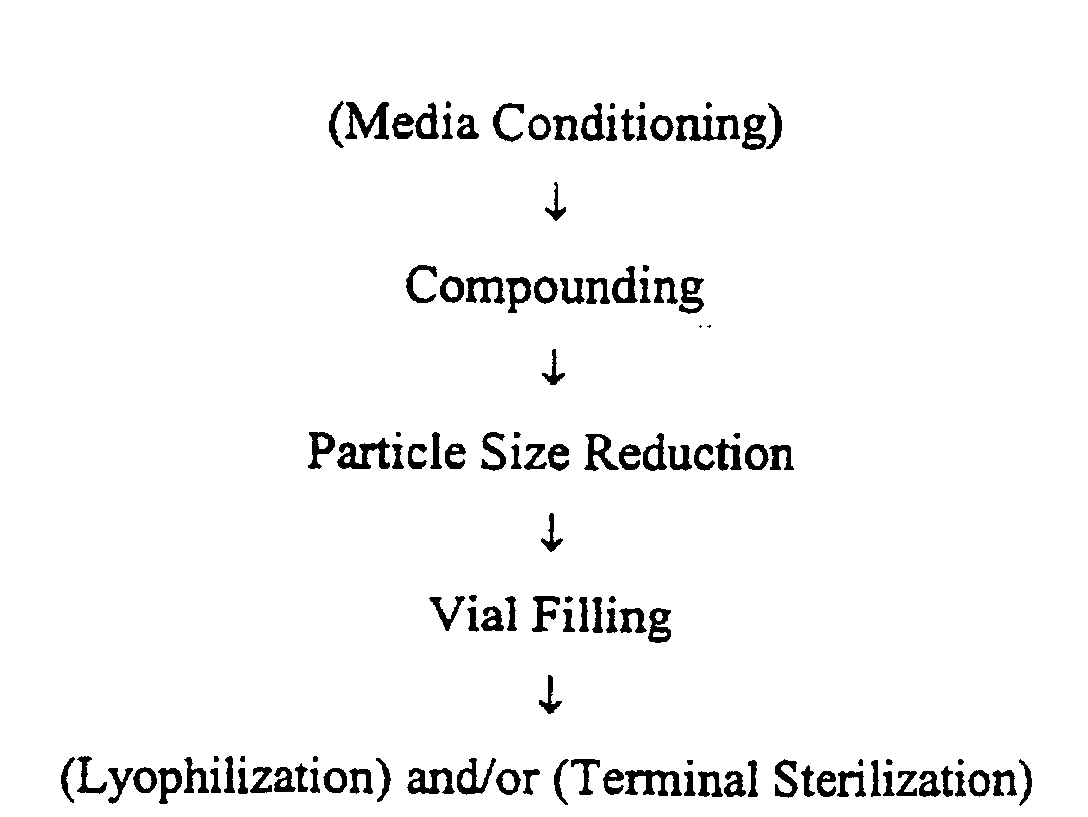
- some of the processing is dependent upon the method of particle size reduction and/or method of sterilization.
- media conditioning is not required for a milling method that does not use media. If terminal sterilization is not feasible due to chemical and/or physical instability, aseptic processing can be used.
- the purpose of this example was to evaluate the use of different types of surface modifiers for the preparation of an injectable nanoparticulate formulation of naproxen.
- the dispersions were formulated at 40% solids to 2.4% surface stabilizer.
- Surface Stabilizer Manufacturer Results Plasdone C15® (polyvinylpyrrolidone) ISP Technologies, Inc. size reduction ⁇ 400 nm Kollidon 17PF® (a polyvinylpyrrolidone polymer) BASF Corp. size reduction ⁇ 400 nm Povidone K30® (a polyvinylpyrrolidone polymer) ISP Technologies, Inc. size reduction ⁇ 400 nm Tyloxapol Nycomed, Inc.
- the purpose of this example was to determine the rates of absorption for intravenously and intramuscularly administered naproxen.
- the plasma concentration of naproxen ( ⁇ g/ml) in rabbits after administration of 15 mg/kg by either the IV or IM routes versus time in hours was determined.
- the method used for quantification of naproxen in rabbit plasma was modified from a procedure by Shimek et al., Journal of Pharm. Sci., 15: 436-439 (1982).
- C max mean peak plasma level concentration
- AUC area-under-curve value
- the purpose of this example was to demonstrate the feasibility of using a Microfluidizer® for aseptically producing an injectable formulation of a naproxen colloidal dispersion.
- a Microfluidizer® Model No. M110EH (Microfluidics Corp.), was successfully used to produce a sterile colloidal dispersion of naproxen suitable for injection.
- the naproxen slurry was heat sterilized prior to microfluidizing.
- the purpose of this example was to determine the potential local irritation of an injectable nanoparticulate naproxen formulation when administered intramuscularly to rats. This information correlates to the irritation or pain experienced upon administration of the formulation.
- Injectable nanoparticulate naproxen having a concentration of 489 mg/ml was used, comprising 489 mg/ml naproxen, 40 mg/ml of ISP PlasdoneTM C15, 1.9 mg/ml methylparaben (preservative), and 0.2 mg/ml propylparaben.
- Dosages of 49 and 134 mg/kg were administered intramuscularly. The intramuscular route was chosen because it is a possible route of administration to human.
- the test and control articles were stored at room temperature and protected from light.
- mice Twenty male Albino rats (Sprague-Dawley Crl:CD®) were used for the study, obtained from Charles River. The animals were laboratory bred and were experimentally naive at the outset of the study. Animals selected for use were as uniform in age and weight as possible. They were approximately 7-8 weeks of age, and their body weights ranged from 210.7 to 247.0 gm. Each animal was identified by a unique number via an ear tag. All animals were acclimated to laboratory conditions for approximately 12 days prior to study initiation, and the animals were housed individually in stainless-steel cages.
- PMI Feeds, Inc.® Certified Rodent Chow was available ad libitum via food hoppers. No contaminants are known to be present in the certified diet that would interfere with the results of the study.
- Tap water was available ad libitum via automatic watering device or water bottle. The water was routinely analyzed for contaminants. No contaminants are known to be present in the water that would interfere with the results of the study.
- test animals were assigned to treatment groups as shown in Table 3 below. Each animal received a single intramuscular injection of the test article and the vehicle in distinct previously shaven sites of contralateral legs: thigh muscle of the right and left hind legs, respectively. Prior to the day of dosing (designated Day I of the study), all animals were fasted overnight. Following dosing, animals were returned to their cages and subsequently provided with hoppers containing food. The animals were evaluated for changes in clinical signs and body weight and the injection sites were examined for any local reaction. Ten animals each were sacrificed at approximately 48 and 96 hours after the IM injection and the injection site areas removed and processed for histopathological examination. Treatment Groups Group Number of Males Treatment Dose (mg/kg) Dose Vol.
Landscapes
- Health & Medical Sciences (AREA)
- General Health & Medical Sciences (AREA)
- Life Sciences & Earth Sciences (AREA)
- Chemical & Material Sciences (AREA)
- Animal Behavior & Ethology (AREA)
- Veterinary Medicine (AREA)
- Medicinal Chemistry (AREA)
- Pharmacology & Pharmacy (AREA)
- Public Health (AREA)
- Engineering & Computer Science (AREA)
- Bioinformatics & Cheminformatics (AREA)
- Epidemiology (AREA)
- Chemical Kinetics & Catalysis (AREA)
- Rheumatology (AREA)
- Nuclear Medicine, Radiotherapy & Molecular Imaging (AREA)
- Organic Chemistry (AREA)
- General Chemical & Material Sciences (AREA)
- Physical Education & Sports Medicine (AREA)
- Pain & Pain Management (AREA)
- Orthopedic Medicine & Surgery (AREA)
- Immunology (AREA)
- Acyclic And Carbocyclic Compounds In Medicinal Compositions (AREA)
- Medicinal Preparation (AREA)
- Pharmaceuticals Containing Other Organic And Inorganic Compounds (AREA)
Abstract
Description
| Povidone | K-Value | Mv (Daltons) | Mw (Daltons) | Mn (Daltons) |
| Plasdone C-15® | 17 ± 1 | 7,000 | 10,500 | 3,000 |
| Plasdone C-30® | 30.5 ± 1.5 | 38,000 | 62,500 | 16,500 |
| Kollidon 12 PF® | 11-14 | 3,900 | 2,000-3,000 | 1,300 |
| Kollidon 17 PF® | 16-18 | 9,300 | 7,000-11,000 | 2,500 |
| Kollidon 25® | 24-32 | 25,700 | 28,000-34,000 | 6,000 |
| naproxen | 5 - 50% |
| povidone polymer | 0.1 - 50% |
| preservatives | 0.05 - 0.25% |
| pH adjusting agent | pH about 6 to about 7 |
| water for injection | q.s. |
| Surface Stabilizer | Manufacturer | Results |
| Plasdone C15® (polyvinylpyrrolidone) | ISP Technologies, Inc. | size reduction < 400 nm |
| Kollidon 17PF® (a polyvinylpyrrolidone polymer) | BASF Corp. | size reduction < 400 nm |
| Povidone K30® (a polyvinylpyrrolidone polymer) | ISP Technologies, Inc. | size reduction < 400 nm |
| Tyloxapol | Nycomed, Inc. | size reduction > 400 nm |
| Pluronic F68® (a high molecular weight polyoxyalkylene ether) | BASF Corp. | size reduction > 400 nm |
| Pluronic F108® (a high molecular weight polyoxyalkylene ether) | BASF Corp. | size reduction > 400 nm |
| Tween 80® (a polyoxyethylene sorbitan fatty acid ester) | ICI Americas | size reduction > 400 nm |
| dioctylsulfosuccinate (CAS No. 577-11-7; aka Docusate Sodium) | Ashland Chem. Co., Columbus, OH | size reduction > 400 nm |
| B20-5000® (a triblock copolymer surface modifier) | Dow Chemical | size reduction > 400 nm |
| B20-5000-sulfonated (a triblock copolymer surface modifier) | Dow Chemical | size reduction > 400 nm |
| lecithin (CAS No. 8002-43-5) | Ashland Chem. Co., Columbus, OH | size reduction > 400 nm |
| Povidone K30® and Pluronic F108® | ISP Technologies, Inc. and BASF Corp. | size reduction > 400 nm |
| Treatment Groups | |||||
| Group | Number of Males | Treatment | Dose (mg/kg) | Dose Vol. (ml/kg) | Day of Sacrifice |
| 1 | 5 | Control | 0 | 0.1 | 3 |
| Nanonaproxen | 49 | 0.1 | |||
| 2 | 5 | Control | 0 | 0.1 | 5 |
| Nanonaproxen | 49 | 0.1 | |||
| 3 | 5 | Control | 0 | 0.275 | 3 |
| Nanonaproxen | 134 | 0.275 | |||
| 4 | 5 | Control | 0 | 0.275 | 5 |
| Nanonaproxen | 134 | 0.275 |
| Clinical Observations | ||
| Test Article | Animal No. | Clinical Observations |
| Nanoparticulate Naproxen; 49 mg/kg For 3 day test period | 311M | Days 1-3: normal |
| 312M | Days 1-3: normal | |
| 313M | Days 1-3: normal | |
| 314M | Days 1-2: normal Day 3: abrasion neck right side; stain red neck right side; scab scapula right | |
| 315M | Days 1-3: normal | |
| Nanoparticulate Naproxen; 49 mg/kg For 5 day test period | 321M | Days 1-5: normal |
| 322M | Days 1-5: normal | |
| 323M | Day 1: normal Day 2: slight bluish color at injection site 2 Days 3-5: normal | |
| 324M | Days 1-4: normal Day 5: dehydrated; scab at injection site on right hind limb | |
| 325M | Days 1-5: normal | |
| Nanoparticulate Naproxen; 134 mg/kg | 331M | Day 1: normal Days 2-3: infrequent stool Day 3: chromorhinorrhea, pallor |
| For 3 day test period | 332M | Day 1: normal Days 2-3: infrequent stool; chromorhinorrhea; pallor; rough coat Day 3: chromodacryorrhea-both; brown-stained scrotum |
| 333M | Day 1: normal Days 2-3: infrequent stool Day 3: chromorhinorrhea; pallor; dehydrated; scab at right injection site | |
| 334M | Day 1: normal Days 2-3: infrequent stool; chromorhinorrhea; wet coat pelvic region Day 3: pallor; scabs at both injection sites left and right hind limbs | |
| 335M | Day 1: normal Days 2-3: infrequent stool Day 3: chromodacryorrhea both; chromorhinorrhea; dehydrated; pallor; diarrhea; dark stool | |
| Nanoparticulate Naproxen; 134 mg/kg For 5 day test period | 341M | Day 1: normal Days 2-4: chromorhinorrhea Days 2-5: infrequent stool; pallor Day 3: brown-stained forefeet Days 3-5: rough coat Day 4: prostrate Day 5: dehydrated; scab at injection sites on right hand limb |
| 342 | Day 1: normal Day 2: chromorhinorrhea Days 2-3: infrequent stool Days 3-5: rough coat; pallor Days 4-5: scab head Day 5: scab at injection sites on left hand limb | |
| 343M | Day 1: normal Days 2-5: infrequent stool Days 3-5: piloerection; rough coat; dehydrated; pallor | |
| 344M | Day 1: normal Day 2: loose stool; chromorhinorrhea Days 2-3: infrequent stool Days 2-4: rough coat Day 5: scabs at injection sites bilaterally | |
| 345M | Day 1: normal Days 2-5: infrequent stool; chromorhinorrhea; pallor Day 3: rough coat; chromodacryorrhea both Days 3-5: brown-stained forefeet Day 5: dehydrated; scabs at injection sites on hind limbs |
| Individual and Group Mean Body Weights (g) | ||||
| Treatment | Animal No. | Day 1 | Day 3 | Day 5 |
| Nanoparticulate Naproxen; 49 mg/kg | 311M | 210.7 | 251.5 | |
| 312M | 219.4 | 256.6 | ||
| 313M | 224.5 | 260.9 | ||
| 314M | 234.7 | 271.8 | ||
| 315M | 237.3 | 273.0 | ||
| mean ±SD | 225.3 ±11.0 | 262.8 ±9.4 | ||
| Nanoparticulate Naproxen; 49 mg/kg | 321M | 218.9 | 233.5 | |
| 322M | 216.8 | 222.4 | ||
| 323M | 223.4 | 229.5 | ||
| 324M | 234.6 | 249.1 | ||
| 325M | 241.9 | 259.3 | ||
| mean ±SD | 227.1 ±10.8 | 238.8 ±15.1 | ||
| Nanoparticulate Naproxen; 134 mg/kg | 331M | 215.2 | 203.2 | |
| 332M | 216.6 | 210.1 | ||
| 333M | 226.7 | 211.0 | ||
| 334M | 228.0 | 216.3 | ||
| 335M | 247.0 | 227.3 | ||
| mean ±SD | 226.7 ±12.7 | 213.6 ±9.0 | ||
| Nanoparticulate Naproxen; 134 mg/kg | 341M | 216.1 | 192.1 | |
| 342M | 213.0 | 184.5 | ||
| 343M | 226.3 | 189.7 | ||
| 344M | 228.3 | 208.5 | ||
| 345M | 241.5 | 209.2 | ||
| mean ±SD | 225.0 ±11.3 | 196.8 ±11.3 |
| Individual and Group Mean Dermal Irritation (Erythema or Eschar) Scores | |||||
| Treatment | Animal No. | Day 2 | Day 3 | Day 4 | Day 5 |
| Control | 311M | 0 | 0 | ||
| 312M | 0 | 0 | |||
| 313M | 0 | 0 | |||
| 314M | 0 | 0 | |||
| 315M | 0 | 0 | |||
| mean ±SD | 0 ±0 | 0 ±0 | |||
| Nanoparticulate Naproxen; 49 mg/kg | 311M | 0 | 0 | ||
| 312M | 0 | 0 | |||
| 313M | 0 | 0 | |||
| 314M | 0 | 0 | |||
| 315M | 0 | 0 | |||
| mean ±SD | 0 ±0 | 0 ±0 | |||
| control | 321M | 0 | 0 | 0 | 0 |
| 322M | 0 | 0 | 0 | 0 | |
| 323M | 0 | 0 | 0 | 0 | |
| 324M | 0 | 0 | 0 | 0 | |
| 325M | 0 | 0 | 0 | 0 | |
| mean ±SD | 0 ±0 | 0 ±0 | 0 ±0 | 0 ±0 | |
| Nanoparticulate Naproxen; 49 mg/kg | 321M | 0 | 0 | 0 | 0 |
| 322M | 0 | 0 | 0 | 0 | |
| 323M | 0 | 0 | 0 | 0 | |
| 324M | 0 | 0 | 0 | 0 | |
| 325M | 0 | 0 | 0 | 0 | |
| mean ±SD | 0 ±0 | 0 ±0 | 0 ±0 | 0 ±0 | |
| Control | 331M | 0 | 0 | ||
| 332M | 0 | 0 | |||
| 333M | 0 | 0 | |||
| 334M | 0 | 0 | |||
| 335M | 0 | 0 | |||
| mean ±SD | 0 ±0 | 0 ±0 | |||
| Nanoparticulate Naproxen; 134 mg/kg | 331M | 0 | 0 | ||
| 332M | 0 | 0 | |||
| 333M | 0 | 0 | |||
| 334M | 0 | 0 | |||
| 335M | 0 | 0 | |||
| mean ±SD | 0 ±0 | 0 ±0 | |||
| control | 341M | 0 | 0 | 0 | 0 |
| 342M | 0 | 0 | 0 | 0 | |
| 343M | 0 | 0 | 0 | 0 | |
| 344M | 0 | 0 | 0 | 0 | |
| 345M | 0 | 0 | 0 | 0 | |
| mean ±SD | 0 ±0 | 0 ±0 | 0 ±0 | 0 ±0 | |
| Nanoparticulate Naproxen; 134 mg/kg | 341M | 0 | 0 | 0 | 0 |
| 342M | 0 | 0 | 0 | 0 | |
| 343M | 0 | 0 | 0 | 0 | |
| 344M | 0 | 0 | 0 | 0 | |
| 345M | 0 | 0 | 0 | 0 | |
| mean ±SD | 0 ±0 | 0 ±0 | 0 ±0 | 0 ±0 |
| Individual and Group Mean Dermal Irritation (Edema) Scores | |||||
| Treatment | Animal No. | Day 2 | Day 3 | Day 4 | Day 5 |
| Control | 311M | 0 | 0 | ||
| 312M | 0 | 0 | |||
| 313M | 0 | 0 | |||
| 314M | 0 | 0 | |||
| 315M | 0 | 0 | |||
| mean ±SD | 0 ±0 | 0 ±0 | |||
| Nanoparticulate Naproxen; 49 mg/kg | 311M | 0 | 0 | ||
| 312M | 0 | 0 | |||
| 313M | 0 | 0 | |||
| 314M | 0 | 0 | |||
| 315M | 0 | 0 | |||
| mean ±SD | 0 ±0 | 0 ±0 | |||
| Control | 321M | 0 | 0 | 0 | 0 |
| 322M | 0 | 0 | 0 | 0 | |
| 323M | 0 | 0 | 0 | 0 | |
| 324M | 0 | 0 | 0 | 0 | |
| 325M | 0 | 0 | 0 | 0 | |
| mean ±SD | 0 ±0 | 0 ±0 | 0 ±0 | 0 ±0 | |
| Nanoparticulate Naproxen; 49 mg/kg | 321M | 0 | 0 | 0 | 0 |
| 322M | 0 | 0 | 0 | 0 | |
| 323M | 0 | 0 | 0 | 0 | |
| 324M | 0 | 0 | 0 | 0 | |
| 325M | 0 | 0 | 0 | 0 | |
| mean ±SD | 0 ±0 | 0 ±0 | 0 ±0 | 0 ±0 | |
| control | 331M | 0 | 0 | ||
| 332M | 0 | 0 | |||
| 333M | 0 | 0 | |||
| 334M | 0 | 0 | |||
| 335M | 0 | 0 | |||
| mean ±SD | 0 ±0 | 0 ±0 | |||
| Nanoparticulate Naproxen; 134 mg/kg | 331M | 0 | 0 | ||
| 332M | 0 | 0 | |||
| 333M | 0 | 0 | |||
| 334M | 0 | 0 | |||
| 335M | 0 | 0 | |||
| mean ±SD | 0 ±0 | 0 ±0 | |||
| control | 341M | 0 | 0 | 0 | 0 |
| 342M | 0 | 0 | 0 | 0 | |
| 343M | 0 | 0 | 0 | 0 | |
| 344M | 0 | 0 | 0 | 0 | |
| 345M | 0 | 0 | 0 | 0 | |
| mean ±SD | 0 ±0 | 0 ±0 | 0 ±0 | 0 ±0 | |
| Nanoparticulate Naproxen; 134 mg/kg | 341M | 0 | 0 | 0 | 0 |
| 342M | 0 | 0 | 0 | 0 | |
| 343M | 0 | 0 | 0 | 0 | |
| 344M | 0 | 0 | 0 | 0 | |
| 345M | 0 | 0 | 0 | 0 | |
| mean ±SD | 0 ±0 | 0 ±0 | 0 ±0 | 0 ±0 |
Claims (17)
- An injectable pharmaceutical composition comprising: (1) naproxen particles having an effective average particle size of less than 600 nm; (2) a povidone polymer adsorbed on the surface of the naproxen particles, wherein the povidone polymer has a molecular weight of 40,000 daltons or less; and (3) a pharmaceutically acceptable carrier.
- The composition of claim 1, wherein the effective average particle size of the naproxen particles is less than 450 nm.
- The composition of claims 1 or 2, wherein the effective average particle size of the naproxen particles is selected from the group consisting of less than 400 nm, less than 300 nm, less than 250 nm, and less than 100 nm.
- The composition of any preceding claim, wherein the povidone polymer is present in an amount of 0.1 to 50% (w/w) based on the total weight of the naproxen and povidone polymer.
- The composition of any preceding claim, wherein the naproxen is present in an amount of 5.0 to 50% (w/w), by weight.
- The composition of claim 1 to 5 for use as an anti-inflammatory, analgesic or antipyretic treatment.
- Use of the composition of claim 1 to 6 for the preparation of an injectable pharmaceutical composition for anti-inflammatory, analgesic or antipyretic treatment.
- A method of preparing an injectable pharmaceutical composition that produces minimal or no pain or irritation upon administration, wherein the composition comprises: (1) naproxen particles having an effective average particle size of less than 600 nm; (2) a povidone polymer adsorbed on the surface of the naproxen particles, wherein the povidone polymer has a molecular weight of 40,000 daltons or less; and (3) a pharmaceutically acceptable carrier, wherein the method comprises:(a) dispersing the naproxen particles in a liquid dispersion medium comprising a povidone polymer; and(b) mechanically reducing the particle size of the naproxen to an effective average particle size of less than 600 nm.
- The method of claim 8, wherein the effective average particle size of the naproxen particles is less than 450 nm.
- The method of claims 8 or 9, wherein the effective average particle size of the naproxen particles is selected from the group consisting of less than 400 nm, less than 300 nm, less than 250 nm, and less than 100 nm.
- A method of preparing an injectable pharmaceutical composition comprising: (1) naproxen particles having an effective average particle size of less than 600 nm; (2) a povidone polymer adsorbed on the surface of the naproxen particles, wherein the povidone polymer has a molecular weight of 40,000 daltons or less; and (3) a pharmaceutically acceptable carrier, wherein the method comprises:(a) dispersing the naproxen particles in a liquid dispersion;(b) mechanically reducing the particle size of the naproxen to an effective average particle size of less than 600 nm; and(c) adding a povidone polymer to the dispersion of naproxen particles.
- The method of claim 11, wherein the effective average particle size of the naproxen particles is less than 450 nm.
- The method of claims 11 or 12, wherein the effective average particle size of the naproxen particles is selected from the group consisting of less than 400 nm, less than 300 nm, less than 250 nm, and less than 100 nm.
- The composition of claims 1 to 5, wherein the pH of the nanoparticulate composition is between 6 to 7.
- The composition of claims 1 to 5 for use as in claims 6, wherein the pH of the nanoparticulate composition is between 6 to 7.
- The use of claim 7, wherein the pH of the nanoparticulate composition is between 6 to 7.
- The method of claims 8 to 13, wherein the pH of the nanoparticulate composition is between 6 to 7.
Applications Claiming Priority (3)
| Application Number | Priority Date | Filing Date | Title |
|---|---|---|---|
| US154422 | 1988-02-05 | ||
| US09/154,422 US6153225A (en) | 1998-08-13 | 1998-08-13 | Injectable formulations of nanoparticulate naproxen |
| PCT/US1999/018270 WO2000009096A1 (en) | 1998-08-13 | 1999-08-12 | Injectable formulations of nanoparticulate naproxen |
Publications (2)
| Publication Number | Publication Date |
|---|---|
| EP1105109A1 EP1105109A1 (en) | 2001-06-13 |
| EP1105109B1 true EP1105109B1 (en) | 2003-04-23 |
Family
ID=22551305
Family Applications (1)
| Application Number | Title | Priority Date | Filing Date |
|---|---|---|---|
| EP99941065A Expired - Lifetime EP1105109B1 (en) | 1998-08-13 | 1999-08-12 | Injectable formulations of nanoparticulate naproxen |
Country Status (8)
| Country | Link |
|---|---|
| US (1) | US6153225A (en) |
| EP (1) | EP1105109B1 (en) |
| JP (1) | JP2002522474A (en) |
| AT (1) | ATE238042T1 (en) |
| AU (1) | AU5478999A (en) |
| CA (1) | CA2340221C (en) |
| DE (1) | DE69907213T2 (en) |
| WO (1) | WO2000009096A1 (en) |
Cited By (12)
| Publication number | Priority date | Publication date | Assignee | Title |
|---|---|---|---|---|
| US6835396B2 (en) | 2001-09-26 | 2004-12-28 | Baxter International Inc. | Preparation of submicron sized nanoparticles via dispersion lyophilization |
| US6869617B2 (en) | 2000-12-22 | 2005-03-22 | Baxter International Inc. | Microprecipitation method for preparing submicron suspensions |
| US6884436B2 (en) | 2000-12-22 | 2005-04-26 | Baxter International Inc. | Method for preparing submicron particle suspensions |
| US6951656B2 (en) | 2000-12-22 | 2005-10-04 | Baxter International Inc. | Microprecipitation method for preparing submicron suspensions |
| US6977085B2 (en) | 2000-12-22 | 2005-12-20 | Baxter International Inc. | Method for preparing submicron suspensions with polymorph control |
| US7112340B2 (en) | 2001-10-19 | 2006-09-26 | Baxter International Inc. | Compositions of and method for preparing stable particles in a frozen aqueous matrix |
| US7193084B2 (en) | 2000-12-22 | 2007-03-20 | Baxter International Inc. | Polymorphic form of itraconazole |
| US8067032B2 (en) | 2000-12-22 | 2011-11-29 | Baxter International Inc. | Method for preparing submicron particles of antineoplastic agents |
| US8263131B2 (en) | 2000-12-22 | 2012-09-11 | Baxter International Inc. | Method for treating infectious organisms normally considered to be resistant to an antimicrobial drug |
| US8426467B2 (en) | 2007-05-22 | 2013-04-23 | Baxter International Inc. | Colored esmolol concentrate |
| US8722091B2 (en) | 2001-09-26 | 2014-05-13 | Baxter International Inc. | Preparation of submicron sized nanoparticles via dispersion lyophilization |
| US8722736B2 (en) | 2007-05-22 | 2014-05-13 | Baxter International Inc. | Multi-dose concentrate esmolol with benzyl alcohol |
Families Citing this family (69)
| Publication number | Priority date | Publication date | Assignee | Title |
|---|---|---|---|---|
| WO1996025918A1 (en) * | 1995-02-24 | 1996-08-29 | Nanosystems L.L.C. | Aerosols containing nanoparticle dispersions |
| US20050004049A1 (en) * | 1997-03-11 | 2005-01-06 | Elan Pharma International Limited | Novel griseofulvin compositions |
| US8236352B2 (en) | 1998-10-01 | 2012-08-07 | Alkermes Pharma Ireland Limited | Glipizide compositions |
| CA2348871C (en) | 1998-11-02 | 2009-04-14 | John G. Devane | Multiparticulate modified release composition |
| US6969529B2 (en) * | 2000-09-21 | 2005-11-29 | Elan Pharma International Ltd. | Nanoparticulate compositions comprising copolymers of vinyl pyrrolidone and vinyl acetate as surface stabilizers |
| US20030224058A1 (en) * | 2002-05-24 | 2003-12-04 | Elan Pharma International, Ltd. | Nanoparticulate fibrate formulations |
| US7198795B2 (en) | 2000-09-21 | 2007-04-03 | Elan Pharma International Ltd. | In vitro methods for evaluating the in vivo effectiveness of dosage forms of microparticulate of nanoparticulate active agent compositions |
| US7998507B2 (en) * | 2000-09-21 | 2011-08-16 | Elan Pharma International Ltd. | Nanoparticulate compositions of mitogen-activated protein (MAP) kinase inhibitors |
| US7276249B2 (en) | 2002-05-24 | 2007-10-02 | Elan Pharma International, Ltd. | Nanoparticulate fibrate formulations |
| US9700866B2 (en) | 2000-12-22 | 2017-07-11 | Baxter International Inc. | Surfactant systems for delivery of organic compounds |
| US6976647B2 (en) * | 2001-06-05 | 2005-12-20 | Elan Pharma International, Limited | System and method for milling materials |
| JP2005504266A (en) * | 2001-06-22 | 2005-02-10 | エラン ファーマ インターナショナル,リミティド | High-throughput screening methods using small-scale mills or microfluidics |
| DK1429731T3 (en) * | 2001-09-19 | 2007-05-14 | Elan Pharma Int Ltd | Nanoparticle formulations containing insulin |
| DE60222160T2 (en) * | 2001-10-12 | 2008-06-12 | Elan Pharma International Ltd., Athlone | COMPOSITIONS COMPRISING PROPERTIES OF IMMEDIATE RELEASE AND CONTROLLED RELEASE |
| DK1471887T3 (en) | 2002-02-04 | 2010-06-07 | Elan Pharma Int Ltd | Nanoparticle compositions having lysozyme as a surface stabilizer |
| EP1487419A2 (en) * | 2002-03-20 | 2004-12-22 | Elan Pharma International Limited | Fast dissolving dosage forms having reduced friability |
| US20100226989A1 (en) * | 2002-04-12 | 2010-09-09 | Elan Pharma International, Limited | Nanoparticulate megestrol formulations |
| US7101576B2 (en) | 2002-04-12 | 2006-09-05 | Elan Pharma International Limited | Nanoparticulate megestrol formulations |
| US20040105889A1 (en) * | 2002-12-03 | 2004-06-03 | Elan Pharma International Limited | Low viscosity liquid dosage forms |
| US9101540B2 (en) * | 2002-04-12 | 2015-08-11 | Alkermes Pharma Ireland Limited | Nanoparticulate megestrol formulations |
| CA2481390C (en) | 2002-04-12 | 2012-11-27 | Elan Pharma International Ltd. | Nanoparticulate megestrol formulations |
| AU2003234452A1 (en) * | 2002-05-06 | 2003-11-11 | Elan Pharma International Ltd. | Nanoparticulate nystatin formulations |
| CA2488498A1 (en) * | 2002-06-10 | 2003-12-18 | Elan Pharma International Limited | Nanoparticulate polycosanol formulations and novel polycosanol combinations |
| EP2283864A1 (en) * | 2002-07-16 | 2011-02-16 | Elan Pharma International Ltd. | Liquid dosage compositions fo stable nanoparticulate active agents |
| US7713551B2 (en) * | 2002-09-11 | 2010-05-11 | Elan Pharma International Ltd. | Gel stabilized nanoparticulate active agent compositions |
| US20040105778A1 (en) * | 2002-10-04 | 2004-06-03 | Elan Pharma International Limited | Gamma irradiation of solid nanoparticulate active agents |
| US20040173696A1 (en) * | 2002-12-17 | 2004-09-09 | Elan Pharma International Ltd. | Milling microgram quantities of nanoparticulate candidate compounds |
| JP4469846B2 (en) * | 2003-01-31 | 2010-06-02 | エラン ファーマ インターナショナル,リミティド | Nanoparticulate topiramate formulation |
| US20040208833A1 (en) * | 2003-02-04 | 2004-10-21 | Elan Pharma International Ltd. | Novel fluticasone formulations |
| US8512727B2 (en) | 2003-03-03 | 2013-08-20 | Alkermes Pharma Ireland Limited | Nanoparticulate meloxicam formulations |
| US20100297252A1 (en) | 2003-03-03 | 2010-11-25 | Elan Pharma International Ltd. | Nanoparticulate meloxicam formulations |
| JP2007501683A (en) * | 2003-05-22 | 2007-02-01 | エラン ファーマ インターナショナル リミテッド | Sterilization of nanoparticle active substance dispersions by gamma irradiation |
| CA2534924A1 (en) * | 2003-08-08 | 2005-02-24 | Elan Pharma International Ltd. | Novel metaxalone compositions |
| CA2544627A1 (en) * | 2003-11-05 | 2005-05-19 | Elan Pharma International Ltd. | Nanoparticulate compositions having a peptide as a surface stabilizer |
| WO2005089716A1 (en) * | 2004-03-24 | 2005-09-29 | Takeda Pharmaceutical Company Limited | Preparation with elevated content |
| AU2005307797B2 (en) * | 2004-11-16 | 2011-06-02 | Alkermes Pharma Ireland Limited | Injectable nanoparticulate olanzapine formulations |
| UA89513C2 (en) * | 2004-12-03 | 2010-02-10 | Элан Фарма Интернешнл Лтд. | Nanoparticulate raloxifene hydrochloride composition |
| CA2590675A1 (en) * | 2004-12-15 | 2006-06-22 | Elan Pharma International Ltd. | Nanoparticulate tacrolimus formulations |
| US20060159767A1 (en) * | 2004-12-22 | 2006-07-20 | Elan Pharma International Limited | Nanoparticulate bicalutamide formulations |
| US20060165806A1 (en) * | 2005-01-06 | 2006-07-27 | Elan Pharma International Limited | Nanoparticulate candesartan formulations |
| EP1853234A2 (en) | 2005-02-15 | 2007-11-14 | Elan Pharma International Limited | Aerosol and injectable formulations of nanoparticulate benzodiazepine |
| MX2007010394A (en) * | 2005-02-24 | 2008-02-19 | Elan Pharma Int Ltd | Nanoparticulate formulations of docetaxel and analogues thereof. |
| WO2006099121A2 (en) * | 2005-03-10 | 2006-09-21 | Elan Pharma International Limited | Formulations of a nanoparticulate finasteride, dutasteride and tamsulosin hydrochloride, and mixtures thereof |
| MX2007011502A (en) * | 2005-03-16 | 2007-12-07 | Elan Pharma Int Ltd | Nanoparticulate leukotriene receptor antagonist/corticosteroid formulations. |
| EP1865928A1 (en) * | 2005-03-17 | 2007-12-19 | Elan Pharma International Limited | Nanoparticulate biphosphonate compositions |
| WO2006102494A2 (en) * | 2005-03-23 | 2006-09-28 | Elan Pharma International Limited | Nanoparticulate corticosteroid and antihistamine formulations |
| BRPI0609071A2 (en) | 2005-04-12 | 2010-11-16 | Elan Pharma Int Ltd | stable nanoparticulate cyclosporine composition, method for preparing a nanoparticulate cyclosporine, use of stable nanoparticulate cyclosporine composition, and controlled release composition |
| BRPI0607537A2 (en) * | 2005-04-12 | 2009-09-15 | Elan Pharma Int Ltd | nanoparticulate quinazoline derivative formulations |
| US20060246141A1 (en) * | 2005-04-12 | 2006-11-02 | Elan Pharma International, Limited | Nanoparticulate lipase inhibitor formulations |
| CA2612994A1 (en) | 2005-06-08 | 2006-12-08 | Elan Pharma International Limited | Nanoparticulate and controlled release compositions comprising cefditoren |
| CA2622758A1 (en) | 2005-09-15 | 2007-03-29 | Elan Pharma International, Limited | Nanoparticulate aripiprazole formulations |
| WO2008106571A2 (en) * | 2007-02-28 | 2008-09-04 | Abbott Laboratories | Sustained release parenteral formulations of buprenorphine |
| US8309129B2 (en) | 2007-05-03 | 2012-11-13 | Bend Research, Inc. | Nanoparticles comprising a drug, ethylcellulose, and a bile salt |
| US8703204B2 (en) | 2007-05-03 | 2014-04-22 | Bend Research, Inc. | Nanoparticles comprising a cholesteryl ester transfer protein inhibitor and anon-ionizable polymer |
| EP2162120B1 (en) | 2007-06-04 | 2016-05-04 | Bend Research, Inc | Nanoparticles comprising a non-ionizable cellulosic polymer and an amphiphilic non-ionizable block copolymer |
| WO2008149230A2 (en) | 2007-06-04 | 2008-12-11 | Pfizer Products Inc. | Nanoparticles comprising drug, a non-ionizable cellulosic polymer and tocopheryl polyethylene glycol succinate |
| EP2240162A4 (en) | 2007-12-06 | 2013-10-09 | Bend Res Inc | NANOPARTICLES COMPRISING A NON-IONIZABLE POLYMER AND AN AMINO-FUNCTIONALIZED METHACRYLATE COPOLYMER |
| EP2231169B1 (en) | 2007-12-06 | 2016-05-04 | Bend Research, Inc. | Pharmaceutical compositions comprising nanoparticles and a resuspending material |
| EP2389159A1 (en) | 2009-01-22 | 2011-11-30 | Noramco, Inc. | Process for preparing particles of opioids and compositions produced thereby |
| FR2945950A1 (en) | 2009-05-27 | 2010-12-03 | Elan Pharma Int Ltd | ANTICANCER NANOPARTICLE COMPOSITIONS AND METHODS FOR PREPARING THE SAME |
| WO2010138539A2 (en) | 2009-05-27 | 2010-12-02 | Elan Pharma International Ltd. | Reduction of flake-like aggregation in nanoparticulate active agent compositions |
| GB201118181D0 (en) | 2011-10-21 | 2011-12-07 | Jagotec Ag | Pharmaceutical compositions |
| CN105007898A (en) * | 2012-12-19 | 2015-10-28 | 卡希夫制药有限责任公司 | Supersaturated stabilized nanoparticles for poorly soluble drugs |
| US10166197B2 (en) | 2015-02-13 | 2019-01-01 | St. John's University | Sugar ester nanoparticle stabilizers |
| US10011629B2 (en) | 2015-05-01 | 2018-07-03 | Cocrystal Pharma, Inc. | Nucleoside analogs for treatment of the flaviviridae family of viruses and cancer |
| CA3087192A1 (en) | 2017-12-27 | 2019-07-04 | Raymond F. Schinazi | Combined modalities for nucleosides and/or nadph oxidase (nox) inhibitors as myeloid-specific antiviral agents |
| MX2021014742A (en) | 2019-06-05 | 2022-02-11 | Univ Emory | PEPTIDOMIMETICS FOR THE TREATMENT OF CORONAVIRUS AND PICORNAVIRUS INFECTIONS. |
| CN113730344B (en) * | 2021-09-13 | 2023-10-20 | 艾迈华创(武汉)科技有限公司 | Naproxen preparation for injection and application thereof |
| DE112023000659T5 (en) | 2022-01-25 | 2024-11-14 | Leiutis Pharmaceuticals Llp | New naproxen sodium preparations for parenteral administration |
Family Cites Families (14)
| Publication number | Priority date | Publication date | Assignee | Title |
|---|---|---|---|---|
| US4009197A (en) * | 1967-01-13 | 1977-02-22 | Syntex Corporation | 2-(6-Substituted-2'-naphthyl) acetic acid derivatives and the salts and esters thereof |
| US3904682A (en) * | 1967-01-13 | 1975-09-09 | Syntex Corp | 2-(6{40 -Methoxy-2{40 -naphthyl)acetic acid |
| DE2914788A1 (en) * | 1979-04-11 | 1980-10-16 | Nattermann A & Cie | PARENTERAL APPLICABLE, STABLE DRUG SOLUTIONS WITH ANTI-INFLAMMATORY EFFECT |
| IE58110B1 (en) * | 1984-10-30 | 1993-07-14 | Elan Corp Plc | Controlled release powder and process for its preparation |
| US4780320A (en) * | 1986-04-29 | 1988-10-25 | Pharmetrix Corp. | Controlled release drug delivery system for the periodontal pocket |
| US4919939A (en) * | 1986-04-29 | 1990-04-24 | Pharmetrix Corporation | Periodontal disease treatment system |
| IT1200178B (en) * | 1986-07-23 | 1989-01-05 | Alfa Farmaceutici Spa | GALENIC FORMULATIONS WITH SCHEDULED SALE CONTAINING DRUGS WITH ANTI-FLOGISTIC ACTIVITY |
| US5200193A (en) * | 1987-04-22 | 1993-04-06 | Mcneilab, Inc. | Pharmaceutical sustained release matrix and process |
| US5580575A (en) * | 1989-12-22 | 1996-12-03 | Imarx Pharmaceutical Corp. | Therapeutic drug delivery systems |
| IT1242642B (en) * | 1990-04-17 | 1994-05-16 | Alfa Wassermann Spa | INJECTABLE FORMULATIONS CONTAINING NAPROXEN SODIUM SALT. |
| US5145684A (en) * | 1991-01-25 | 1992-09-08 | Sterling Drug Inc. | Surface modified drug nanoparticles |
| US5399363A (en) * | 1991-01-25 | 1995-03-21 | Eastman Kodak Company | Surface modified anticancer nanoparticles |
| IT1258143B (en) * | 1992-09-11 | 1996-02-20 | Alfa Wassermann Spa | PROGRAMMED SALE TABS CONTAINING NAPROXEN |
| US5510118A (en) * | 1995-02-14 | 1996-04-23 | Nanosystems Llc | Process for preparing therapeutic compositions containing nanoparticles |
-
1998
- 1998-08-13 US US09/154,422 patent/US6153225A/en not_active Expired - Lifetime
-
1999
- 1999-08-12 DE DE69907213T patent/DE69907213T2/en not_active Expired - Lifetime
- 1999-08-12 AU AU54789/99A patent/AU5478999A/en not_active Abandoned
- 1999-08-12 JP JP2000564599A patent/JP2002522474A/en active Pending
- 1999-08-12 WO PCT/US1999/018270 patent/WO2000009096A1/en not_active Ceased
- 1999-08-12 CA CA002340221A patent/CA2340221C/en not_active Expired - Fee Related
- 1999-08-12 AT AT99941065T patent/ATE238042T1/en not_active IP Right Cessation
- 1999-08-12 EP EP99941065A patent/EP1105109B1/en not_active Expired - Lifetime
Cited By (13)
| Publication number | Priority date | Publication date | Assignee | Title |
|---|---|---|---|---|
| US8263131B2 (en) | 2000-12-22 | 2012-09-11 | Baxter International Inc. | Method for treating infectious organisms normally considered to be resistant to an antimicrobial drug |
| US6869617B2 (en) | 2000-12-22 | 2005-03-22 | Baxter International Inc. | Microprecipitation method for preparing submicron suspensions |
| US6884436B2 (en) | 2000-12-22 | 2005-04-26 | Baxter International Inc. | Method for preparing submicron particle suspensions |
| US6951656B2 (en) | 2000-12-22 | 2005-10-04 | Baxter International Inc. | Microprecipitation method for preparing submicron suspensions |
| US6977085B2 (en) | 2000-12-22 | 2005-12-20 | Baxter International Inc. | Method for preparing submicron suspensions with polymorph control |
| US7037528B2 (en) | 2000-12-22 | 2006-05-02 | Baxter International Inc. | Microprecipitation method for preparing submicron suspensions |
| US7193084B2 (en) | 2000-12-22 | 2007-03-20 | Baxter International Inc. | Polymorphic form of itraconazole |
| US8067032B2 (en) | 2000-12-22 | 2011-11-29 | Baxter International Inc. | Method for preparing submicron particles of antineoplastic agents |
| US6835396B2 (en) | 2001-09-26 | 2004-12-28 | Baxter International Inc. | Preparation of submicron sized nanoparticles via dispersion lyophilization |
| US8722091B2 (en) | 2001-09-26 | 2014-05-13 | Baxter International Inc. | Preparation of submicron sized nanoparticles via dispersion lyophilization |
| US7112340B2 (en) | 2001-10-19 | 2006-09-26 | Baxter International Inc. | Compositions of and method for preparing stable particles in a frozen aqueous matrix |
| US8426467B2 (en) | 2007-05-22 | 2013-04-23 | Baxter International Inc. | Colored esmolol concentrate |
| US8722736B2 (en) | 2007-05-22 | 2014-05-13 | Baxter International Inc. | Multi-dose concentrate esmolol with benzyl alcohol |
Also Published As
| Publication number | Publication date |
|---|---|
| DE69907213T2 (en) | 2004-04-15 |
| CA2340221A1 (en) | 2000-02-24 |
| DE69907213D1 (en) | 2003-05-28 |
| CA2340221C (en) | 2003-10-14 |
| AU5478999A (en) | 2000-03-06 |
| WO2000009096B1 (en) | 2000-03-30 |
| ATE238042T1 (en) | 2003-05-15 |
| WO2000009096A1 (en) | 2000-02-24 |
| JP2002522474A (en) | 2002-07-23 |
| EP1105109A1 (en) | 2001-06-13 |
| US6153225A (en) | 2000-11-28 |
Similar Documents
| Publication | Publication Date | Title |
|---|---|---|
| US6153225A (en) | Injectable formulations of nanoparticulate naproxen | |
| EP1296647B1 (en) | Polymeric micelle compositions | |
| EP2600846B1 (en) | Pharmaceutical dosage form comprising 6'-fluoro-(n-methyl- or n,n-dimethyl-)-4-phenyl-4',9'-dihydro-3'h-spiro[cylohexane-1,1'-pyrano[3,4,b]indol]-4-amine | |
| JP3802345B2 (en) | A novel solid dosage form of nanoparticulate naproxen | |
| KR101216853B1 (en) | Nanoparticulate fibrate formulations | |
| CA2190966C (en) | Method of grinding pharmaceutical substances | |
| AU2001259099B2 (en) | Fibrate-statin combinations with reduced fed-fasted effects | |
| JP6181733B2 (en) | Nanoparticulate isoflavone composition and methods of making and using the same | |
| EP0686034B1 (en) | Bisacodyl dosage form | |
| TW200820991A (en) | Nanoparticulate sorafenib formulations | |
| WO2001089522A1 (en) | Compositions and methods for administration of pharmacologically active compounds | |
| JP2008524239A (en) | Nanoparticulate tacrolimus formulation | |
| JP2008533165A (en) | Injectable composition of nanoparticulate immunosuppressive compounds | |
| RU2574006C2 (en) | Tacrolimus for improved treatment of patients with grafts | |
| SG175314A1 (en) | A novel formulation of diclofenac | |
| MX2008011069A (en) | Nanoparticulate carvedilol formulations. | |
| MX2008016223A (en) | Compositions comprising nanoparticulate naproxen and controlled release hydrocodone. | |
| JP2008507504A (en) | Taste masking preparation comprising a drug with delayed dissolution form and / or a cyclodextrin with enhanced dissolution form | |
| WO2006099121A2 (en) | Formulations of a nanoparticulate finasteride, dutasteride and tamsulosin hydrochloride, and mixtures thereof | |
| RU2582390C2 (en) | MEDICINAL DOSAGE FORM, WHICH CONTAINS 6'-FLUOR-(N-METHYL-OR N,N-DIMETHYL)-4-PHENYL-4',9'-DIHYDRO-3'H-SPIRO[CYCLOHEXANE-1,1'-PYRANO[3,4,b]INDOLE]-4-AMINE | |
| WO2011130834A1 (en) | Non-intravenous dosage form comprising solid formulation of liquid biologically active agent and uses thereof | |
| CA2273272C (en) | Immediate release drug delivery forms | |
| Subashini | Oral Delivery of ascorbic acid stabilized rifampicin nanoparticles for enhanced bioavailability of rifampicin. | |
| WO2005023221A1 (en) | Clarithromycin formulations having improved biovailability | |
| Falk | Controlled drug delivery using polymeric microspheres: Encapsulation and release |
Legal Events
| Date | Code | Title | Description |
|---|---|---|---|
| PUAI | Public reference made under article 153(3) epc to a published international application that has entered the european phase |
Free format text: ORIGINAL CODE: 0009012 |
|
| 17P | Request for examination filed |
Effective date: 20010312 |
|
| AK | Designated contracting states |
Kind code of ref document: A1 Designated state(s): AT BE CH CY DE DK ES FI FR GB GR IE IT LI LU MC NL PT SE |
|
| AX | Request for extension of the european patent |
Free format text: AL;LT;LV;MK;RO;SI |
|
| 17Q | First examination report despatched |
Effective date: 20020429 |
|
| GRAH | Despatch of communication of intention to grant a patent |
Free format text: ORIGINAL CODE: EPIDOS IGRA |
|
| GRAH | Despatch of communication of intention to grant a patent |
Free format text: ORIGINAL CODE: EPIDOS IGRA |
|
| GRAA | (expected) grant |
Free format text: ORIGINAL CODE: 0009210 |
|
| AK | Designated contracting states |
Designated state(s): AT BE CH CY DE DK ES FI FR GB GR IE IT LI LU MC NL PT SE |
|
| PG25 | Lapsed in a contracting state [announced via postgrant information from national office to epo] |
Ref country code: NL Free format text: LAPSE BECAUSE OF FAILURE TO SUBMIT A TRANSLATION OF THE DESCRIPTION OR TO PAY THE FEE WITHIN THE PRESCRIBED TIME-LIMIT Effective date: 20030423 Ref country code: LI Free format text: LAPSE BECAUSE OF FAILURE TO SUBMIT A TRANSLATION OF THE DESCRIPTION OR TO PAY THE FEE WITHIN THE PRESCRIBED TIME-LIMIT Effective date: 20030423 Ref country code: FI Free format text: LAPSE BECAUSE OF FAILURE TO SUBMIT A TRANSLATION OF THE DESCRIPTION OR TO PAY THE FEE WITHIN THE PRESCRIBED TIME-LIMIT Effective date: 20030423 Ref country code: CH Free format text: LAPSE BECAUSE OF FAILURE TO SUBMIT A TRANSLATION OF THE DESCRIPTION OR TO PAY THE FEE WITHIN THE PRESCRIBED TIME-LIMIT Effective date: 20030423 Ref country code: BE Free format text: LAPSE BECAUSE OF FAILURE TO SUBMIT A TRANSLATION OF THE DESCRIPTION OR TO PAY THE FEE WITHIN THE PRESCRIBED TIME-LIMIT Effective date: 20030423 Ref country code: AT Free format text: LAPSE BECAUSE OF FAILURE TO SUBMIT A TRANSLATION OF THE DESCRIPTION OR TO PAY THE FEE WITHIN THE PRESCRIBED TIME-LIMIT Effective date: 20030423 |
|
| REG | Reference to a national code |
Ref country code: GB Ref legal event code: FG4D |
|
| REG | Reference to a national code |
Ref country code: CH Ref legal event code: EP |
|
| REF | Corresponds to: |
Ref document number: 69907213 Country of ref document: DE Date of ref document: 20030528 Kind code of ref document: P |
|
| REG | Reference to a national code |
Ref country code: IE Ref legal event code: FG4D |
|
| PG25 | Lapsed in a contracting state [announced via postgrant information from national office to epo] |
Ref country code: SE Free format text: LAPSE BECAUSE OF FAILURE TO SUBMIT A TRANSLATION OF THE DESCRIPTION OR TO PAY THE FEE WITHIN THE PRESCRIBED TIME-LIMIT Effective date: 20030723 Ref country code: PT Free format text: LAPSE BECAUSE OF FAILURE TO SUBMIT A TRANSLATION OF THE DESCRIPTION OR TO PAY THE FEE WITHIN THE PRESCRIBED TIME-LIMIT Effective date: 20030723 Ref country code: GR Free format text: LAPSE BECAUSE OF FAILURE TO SUBMIT A TRANSLATION OF THE DESCRIPTION OR TO PAY THE FEE WITHIN THE PRESCRIBED TIME-LIMIT Effective date: 20030723 Ref country code: DK Free format text: LAPSE BECAUSE OF FAILURE TO SUBMIT A TRANSLATION OF THE DESCRIPTION OR TO PAY THE FEE WITHIN THE PRESCRIBED TIME-LIMIT Effective date: 20030723 |
|
| PG25 | Lapsed in a contracting state [announced via postgrant information from national office to epo] |
Ref country code: LU Free format text: LAPSE BECAUSE OF NON-PAYMENT OF DUE FEES Effective date: 20030812 Ref country code: IE Free format text: LAPSE BECAUSE OF NON-PAYMENT OF DUE FEES Effective date: 20030812 Ref country code: CY Free format text: LAPSE BECAUSE OF FAILURE TO SUBMIT A TRANSLATION OF THE DESCRIPTION OR TO PAY THE FEE WITHIN THE PRESCRIBED TIME-LIMIT Effective date: 20030812 |
|
| PG25 | Lapsed in a contracting state [announced via postgrant information from national office to epo] |
Ref country code: MC Free format text: LAPSE BECAUSE OF NON-PAYMENT OF DUE FEES Effective date: 20030831 |
|
| NLV1 | Nl: lapsed or annulled due to failure to fulfill the requirements of art. 29p and 29m of the patents act | ||
| ET | Fr: translation filed | ||
| PG25 | Lapsed in a contracting state [announced via postgrant information from national office to epo] |
Ref country code: ES Free format text: LAPSE BECAUSE OF FAILURE TO SUBMIT A TRANSLATION OF THE DESCRIPTION OR TO PAY THE FEE WITHIN THE PRESCRIBED TIME-LIMIT Effective date: 20031030 |
|
| REG | Reference to a national code |
Ref country code: CH Ref legal event code: PL |
|
| PLBE | No opposition filed within time limit |
Free format text: ORIGINAL CODE: 0009261 |
|
| STAA | Information on the status of an ep patent application or granted ep patent |
Free format text: STATUS: NO OPPOSITION FILED WITHIN TIME LIMIT |
|
| 26N | No opposition filed |
Effective date: 20040126 |
|
| REG | Reference to a national code |
Ref country code: IE Ref legal event code: MM4A |
|
| REG | Reference to a national code |
Ref country code: FR Ref legal event code: PLFP Year of fee payment: 17 |
|
| PGFP | Annual fee paid to national office [announced via postgrant information from national office to epo] |
Ref country code: DE Payment date: 20150827 Year of fee payment: 17 Ref country code: GB Payment date: 20150827 Year of fee payment: 17 |
|
| PGFP | Annual fee paid to national office [announced via postgrant information from national office to epo] |
Ref country code: FR Payment date: 20150817 Year of fee payment: 17 |
|
| PGFP | Annual fee paid to national office [announced via postgrant information from national office to epo] |
Ref country code: IT Payment date: 20150825 Year of fee payment: 17 |
|
| REG | Reference to a national code |
Ref country code: DE Ref legal event code: R119 Ref document number: 69907213 Country of ref document: DE |
|
| GBPC | Gb: european patent ceased through non-payment of renewal fee |
Effective date: 20160812 |
|
| REG | Reference to a national code |
Ref country code: FR Ref legal event code: ST Effective date: 20170428 |
|
| PG25 | Lapsed in a contracting state [announced via postgrant information from national office to epo] |
Ref country code: DE Free format text: LAPSE BECAUSE OF FAILURE TO SUBMIT A TRANSLATION OF THE DESCRIPTION OR TO PAY THE FEE WITHIN THE PRESCRIBED TIME-LIMIT Effective date: 20170301 Ref country code: FR Free format text: LAPSE BECAUSE OF NON-PAYMENT OF DUE FEES Effective date: 20160831 Ref country code: GB Free format text: LAPSE BECAUSE OF NON-PAYMENT OF DUE FEES Effective date: 20160812 |
|
| PG25 | Lapsed in a contracting state [announced via postgrant information from national office to epo] |
Ref country code: IT Free format text: LAPSE BECAUSE OF NON-PAYMENT OF DUE FEES Effective date: 20160812 |