EP1104893A1 - Processing method providing cold blue-black image tone for black-and white materials having silver halide tabular gain emulsions - Google Patents
Processing method providing cold blue-black image tone for black-and white materials having silver halide tabular gain emulsions Download PDFInfo
- Publication number
- EP1104893A1 EP1104893A1 EP00203915A EP00203915A EP1104893A1 EP 1104893 A1 EP1104893 A1 EP 1104893A1 EP 00203915 A EP00203915 A EP 00203915A EP 00203915 A EP00203915 A EP 00203915A EP 1104893 A1 EP1104893 A1 EP 1104893A1
- Authority
- EP
- European Patent Office
- Prior art keywords
- silver
- developer
- silver halide
- processing method
- solution
- Prior art date
- Legal status (The legal status is an assumption and is not a legal conclusion. Google has not performed a legal analysis and makes no representation as to the accuracy of the status listed.)
- Granted
Links
- 229910052709 silver Inorganic materials 0.000 title claims abstract description 98
- 239000004332 silver Substances 0.000 title claims abstract description 98
- 239000000463 material Substances 0.000 title claims abstract description 92
- -1 silver halide Chemical class 0.000 title claims abstract description 92
- 238000003672 processing method Methods 0.000 title claims description 20
- 239000000839 emulsion Substances 0.000 title description 54
- 238000012545 processing Methods 0.000 claims abstract description 71
- 238000000034 method Methods 0.000 claims abstract description 48
- 239000003795 chemical substances by application Substances 0.000 claims abstract description 46
- BQCADISMDOOEFD-UHFFFAOYSA-N Silver Chemical compound [Ag] BQCADISMDOOEFD-UHFFFAOYSA-N 0.000 claims abstract description 34
- 229910021612 Silver iodide Inorganic materials 0.000 claims abstract description 19
- JKFYKCYQEWQPTM-UHFFFAOYSA-N 2-azaniumyl-2-(4-fluorophenyl)acetate Chemical compound OC(=O)C(N)C1=CC=C(F)C=C1 JKFYKCYQEWQPTM-UHFFFAOYSA-N 0.000 claims abstract description 15
- 229940045105 silver iodide Drugs 0.000 claims abstract description 15
- 239000003513 alkali Substances 0.000 claims abstract description 12
- XMBWDFGMSWQBCA-UHFFFAOYSA-N hydrogen iodide Chemical compound I XMBWDFGMSWQBCA-UHFFFAOYSA-N 0.000 claims abstract description 11
- 239000011230 binding agent Substances 0.000 claims abstract description 6
- 238000001035 drying Methods 0.000 claims abstract description 6
- CIWBSHSKHKDKBQ-JLAZNSOCSA-N Ascorbic acid Natural products OC[C@H](O)[C@H]1OC(=O)C(O)=C1O CIWBSHSKHKDKBQ-JLAZNSOCSA-N 0.000 claims description 35
- 150000001875 compounds Chemical class 0.000 claims description 30
- 229960005070 ascorbic acid Drugs 0.000 claims description 18
- 239000011668 ascorbic acid Substances 0.000 claims description 16
- CRTGSPPMTACQBL-UHFFFAOYSA-N 2,3-dihydroxycyclopent-2-en-1-one Chemical compound OC1=C(O)C(=O)CC1 CRTGSPPMTACQBL-UHFFFAOYSA-N 0.000 claims description 10
- 150000003839 salts Chemical class 0.000 claims description 7
- CIWBSHSKHKDKBQ-DUZGATOHSA-N D-isoascorbic acid Chemical compound OC[C@@H](O)[C@H]1OC(=O)C(O)=C1O CIWBSHSKHKDKBQ-DUZGATOHSA-N 0.000 claims description 5
- 235000010350 erythorbic acid Nutrition 0.000 claims description 5
- 229940026239 isoascorbic acid Drugs 0.000 claims description 5
- BDHFUVZGWQCTTF-UHFFFAOYSA-N sulfonic acid Chemical compound OS(=O)=O BDHFUVZGWQCTTF-UHFFFAOYSA-N 0.000 claims description 4
- UGUHFDPGDQDVGX-UHFFFAOYSA-N 1,2,3-thiadiazole Chemical group C1=CSN=N1 UGUHFDPGDQDVGX-UHFFFAOYSA-N 0.000 claims description 2
- 150000005208 1,4-dihydroxybenzenes Chemical class 0.000 claims description 2
- KJUGUADJHNHALS-UHFFFAOYSA-N 1H-tetrazole Substances C=1N=NNN=1 KJUGUADJHNHALS-UHFFFAOYSA-N 0.000 claims description 2
- ABLZXFCXXLZCGV-UHFFFAOYSA-N Phosphorous acid Chemical compound OP(O)=O ABLZXFCXXLZCGV-UHFFFAOYSA-N 0.000 claims description 2
- WTKZEGDFNFYCGP-UHFFFAOYSA-N Pyrazole Chemical class C=1C=NNC=1 WTKZEGDFNFYCGP-UHFFFAOYSA-N 0.000 claims description 2
- 125000004429 atom Chemical group 0.000 claims description 2
- 150000001732 carboxylic acid derivatives Chemical class 0.000 claims description 2
- 150000002460 imidazoles Chemical class 0.000 claims description 2
- 150000002473 indoazoles Chemical class 0.000 claims description 2
- 150000003854 isothiazoles Chemical class 0.000 claims description 2
- 150000004866 oxadiazoles Chemical class 0.000 claims description 2
- 150000002916 oxazoles Chemical class 0.000 claims description 2
- 150000003536 tetrazoles Chemical class 0.000 claims description 2
- 150000003557 thiazoles Chemical class 0.000 claims description 2
- 150000003852 triazoles Chemical class 0.000 claims description 2
- 125000005605 benzo group Chemical group 0.000 claims 1
- 238000004090 dissolution Methods 0.000 abstract description 6
- 239000000243 solution Substances 0.000 description 105
- 239000010410 layer Substances 0.000 description 61
- 239000013078 crystal Substances 0.000 description 36
- 239000000203 mixture Substances 0.000 description 27
- 239000000975 dye Substances 0.000 description 19
- 239000007858 starting material Substances 0.000 description 19
- 230000003595 spectral effect Effects 0.000 description 17
- 238000000576 coating method Methods 0.000 description 14
- 239000011248 coating agent Substances 0.000 description 13
- 229910021607 Silver chloride Inorganic materials 0.000 description 12
- 235000010323 ascorbic acid Nutrition 0.000 description 12
- 229920000159 gelatin Polymers 0.000 description 12
- 235000019322 gelatine Nutrition 0.000 description 12
- NLKNQRATVPKPDG-UHFFFAOYSA-M potassium iodide Chemical compound [K+].[I-] NLKNQRATVPKPDG-UHFFFAOYSA-M 0.000 description 12
- 230000005855 radiation Effects 0.000 description 12
- HKZLPVFGJNLROG-UHFFFAOYSA-M silver monochloride Chemical compound [Cl-].[Ag+] HKZLPVFGJNLROG-UHFFFAOYSA-M 0.000 description 12
- 108010010803 Gelatin Proteins 0.000 description 11
- 230000003139 buffering effect Effects 0.000 description 11
- 235000011852 gelatine desserts Nutrition 0.000 description 11
- 230000001965 increasing effect Effects 0.000 description 11
- 230000035945 sensitivity Effects 0.000 description 11
- FAPWRFPIFSIZLT-UHFFFAOYSA-M Sodium chloride Chemical compound [Na+].[Cl-] FAPWRFPIFSIZLT-UHFFFAOYSA-M 0.000 description 10
- 239000008273 gelatin Substances 0.000 description 10
- SQGYOTSLMSWVJD-UHFFFAOYSA-N silver(1+) nitrate Chemical compound [Ag+].[O-]N(=O)=O SQGYOTSLMSWVJD-UHFFFAOYSA-N 0.000 description 10
- MUBZPKHOEPUJKR-UHFFFAOYSA-N Oxalic acid Chemical compound OC(=O)C(O)=O MUBZPKHOEPUJKR-UHFFFAOYSA-N 0.000 description 9
- 238000006243 chemical reaction Methods 0.000 description 9
- 230000005070 ripening Effects 0.000 description 9
- 206010070834 Sensitisation Diseases 0.000 description 8
- 230000000052 comparative effect Effects 0.000 description 8
- 238000011161 development Methods 0.000 description 8
- 230000018109 developmental process Effects 0.000 description 8
- 239000007788 liquid Substances 0.000 description 8
- 238000002360 preparation method Methods 0.000 description 8
- 239000000047 product Substances 0.000 description 8
- 230000001681 protective effect Effects 0.000 description 8
- 230000008313 sensitization Effects 0.000 description 8
- ADZWSOLPGZMUMY-UHFFFAOYSA-M silver bromide Chemical compound [Ag]Br ADZWSOLPGZMUMY-UHFFFAOYSA-M 0.000 description 8
- 230000002180 anti-stress Effects 0.000 description 7
- 230000003647 oxidation Effects 0.000 description 7
- 238000007254 oxidation reaction Methods 0.000 description 7
- 239000000126 substance Substances 0.000 description 7
- WSFSSNUMVMOOMR-UHFFFAOYSA-N Formaldehyde Chemical compound O=C WSFSSNUMVMOOMR-UHFFFAOYSA-N 0.000 description 6
- 239000002612 dispersion medium Substances 0.000 description 6
- 125000004430 oxygen atom Chemical group O* 0.000 description 6
- OYPRJOBELJOOCE-UHFFFAOYSA-N Calcium Chemical compound [Ca] OYPRJOBELJOOCE-UHFFFAOYSA-N 0.000 description 5
- 239000000654 additive Substances 0.000 description 5
- 229910052791 calcium Inorganic materials 0.000 description 5
- 239000011575 calcium Substances 0.000 description 5
- 229910001961 silver nitrate Inorganic materials 0.000 description 5
- 239000011780 sodium chloride Substances 0.000 description 5
- 229930024421 Adenine Natural products 0.000 description 4
- GFFGJBXGBJISGV-UHFFFAOYSA-N Adenine Chemical compound NC1=NC=NC2=C1N=CN2 GFFGJBXGBJISGV-UHFFFAOYSA-N 0.000 description 4
- OAICVXFJPJFONN-UHFFFAOYSA-N Phosphorus Chemical compound [P] OAICVXFJPJFONN-UHFFFAOYSA-N 0.000 description 4
- VYPSYNLAJGMNEJ-UHFFFAOYSA-N Silicium dioxide Chemical compound O=[Si]=O VYPSYNLAJGMNEJ-UHFFFAOYSA-N 0.000 description 4
- LSNNMFCWUKXFEE-UHFFFAOYSA-N Sulfurous acid Chemical class OS(O)=O LSNNMFCWUKXFEE-UHFFFAOYSA-N 0.000 description 4
- 230000000996 additive effect Effects 0.000 description 4
- 229910052782 aluminium Inorganic materials 0.000 description 4
- XAGFODPZIPBFFR-UHFFFAOYSA-N aluminium Chemical compound [Al] XAGFODPZIPBFFR-UHFFFAOYSA-N 0.000 description 4
- 239000002216 antistatic agent Substances 0.000 description 4
- 230000015572 biosynthetic process Effects 0.000 description 4
- 239000000872 buffer Substances 0.000 description 4
- 239000000084 colloidal system Substances 0.000 description 4
- 239000003607 modifier Substances 0.000 description 4
- 239000002245 particle Substances 0.000 description 4
- ZUNKMNLKJXRCDM-UHFFFAOYSA-N silver bromoiodide Chemical compound [Ag].IBr ZUNKMNLKJXRCDM-UHFFFAOYSA-N 0.000 description 4
- BVKZGUZCCUSVTD-UHFFFAOYSA-L Carbonate Chemical compound [O-]C([O-])=O BVKZGUZCCUSVTD-UHFFFAOYSA-L 0.000 description 3
- 239000004793 Polystyrene Substances 0.000 description 3
- HEMHJVSKTPXQMS-UHFFFAOYSA-M Sodium hydroxide Chemical compound [OH-].[Na+] HEMHJVSKTPXQMS-UHFFFAOYSA-M 0.000 description 3
- 239000002253 acid Substances 0.000 description 3
- KRKNYBCHXYNGOX-UHFFFAOYSA-N citric acid Chemical compound OC(=O)CC(O)(C(O)=O)CC(O)=O KRKNYBCHXYNGOX-UHFFFAOYSA-N 0.000 description 3
- 238000009826 distribution Methods 0.000 description 3
- 239000007789 gas Substances 0.000 description 3
- 150000004820 halides Chemical class 0.000 description 3
- 230000002401 inhibitory effect Effects 0.000 description 3
- 150000002894 organic compounds Chemical class 0.000 description 3
- 235000006408 oxalic acid Nutrition 0.000 description 3
- 229920000139 polyethylene terephthalate Polymers 0.000 description 3
- 239000005020 polyethylene terephthalate Substances 0.000 description 3
- 229920002223 polystyrene Polymers 0.000 description 3
- 238000001556 precipitation Methods 0.000 description 3
- 239000002243 precursor Substances 0.000 description 3
- 238000011160 research Methods 0.000 description 3
- 239000011347 resin Substances 0.000 description 3
- 229920005989 resin Polymers 0.000 description 3
- FVAUCKIRQBBSSJ-UHFFFAOYSA-M sodium iodide Chemical compound [Na+].[I-] FVAUCKIRQBBSSJ-UHFFFAOYSA-M 0.000 description 3
- 239000007787 solid Substances 0.000 description 3
- 229910052717 sulfur Inorganic materials 0.000 description 3
- 125000004434 sulfur atom Chemical group 0.000 description 3
- XLYOFNOQVPJJNP-UHFFFAOYSA-N water Substances O XLYOFNOQVPJJNP-UHFFFAOYSA-N 0.000 description 3
- BTBUEUYNUDRHOZ-UHFFFAOYSA-N Borate Chemical compound [O-]B([O-])[O-] BTBUEUYNUDRHOZ-UHFFFAOYSA-N 0.000 description 2
- RGHNJXZEOKUKBD-SQOUGZDYSA-N D-gluconic acid Chemical compound OC[C@@H](O)[C@@H](O)[C@H](O)[C@@H](O)C(O)=O RGHNJXZEOKUKBD-SQOUGZDYSA-N 0.000 description 2
- QZRGKCOWNLSUDK-UHFFFAOYSA-N Iodochlorine Chemical compound ICl QZRGKCOWNLSUDK-UHFFFAOYSA-N 0.000 description 2
- 239000002211 L-ascorbic acid Substances 0.000 description 2
- 235000000069 L-ascorbic acid Nutrition 0.000 description 2
- BAPJBEWLBFYGME-UHFFFAOYSA-N Methyl acrylate Chemical compound COC(=O)C=C BAPJBEWLBFYGME-UHFFFAOYSA-N 0.000 description 2
- KDLHZDBZIXYQEI-UHFFFAOYSA-N Palladium Chemical compound [Pd] KDLHZDBZIXYQEI-UHFFFAOYSA-N 0.000 description 2
- 229920001609 Poly(3,4-ethylenedioxythiophene) Polymers 0.000 description 2
- 239000005864 Sulphur Substances 0.000 description 2
- 235000010724 Wisteria floribunda Nutrition 0.000 description 2
- HOLVRJRSWZOAJU-UHFFFAOYSA-N [Ag].ICl Chemical compound [Ag].ICl HOLVRJRSWZOAJU-UHFFFAOYSA-N 0.000 description 2
- 238000010521 absorption reaction Methods 0.000 description 2
- 229960000643 adenine Drugs 0.000 description 2
- 239000012670 alkaline solution Substances 0.000 description 2
- WNROFYMDJYEPJX-UHFFFAOYSA-K aluminium hydroxide Chemical compound [OH-].[OH-].[OH-].[Al+3] WNROFYMDJYEPJX-UHFFFAOYSA-K 0.000 description 2
- 239000003963 antioxidant agent Substances 0.000 description 2
- 230000003078 antioxidant effect Effects 0.000 description 2
- 235000006708 antioxidants Nutrition 0.000 description 2
- QVGXLLKOCUKJST-UHFFFAOYSA-N atomic oxygen Chemical compound [O] QVGXLLKOCUKJST-UHFFFAOYSA-N 0.000 description 2
- 150000004649 carbonic acid derivatives Chemical class 0.000 description 2
- 238000003763 carbonization Methods 0.000 description 2
- 239000008119 colloidal silica Substances 0.000 description 2
- 238000012505 colouration Methods 0.000 description 2
- 238000001816 cooling Methods 0.000 description 2
- 239000011258 core-shell material Substances 0.000 description 2
- 230000000694 effects Effects 0.000 description 2
- 230000002708 enhancing effect Effects 0.000 description 2
- 238000001704 evaporation Methods 0.000 description 2
- 230000008020 evaporation Effects 0.000 description 2
- 230000002349 favourable effect Effects 0.000 description 2
- 235000011194 food seasoning agent Nutrition 0.000 description 2
- 125000000623 heterocyclic group Chemical group 0.000 description 2
- 239000001257 hydrogen Substances 0.000 description 2
- 229910052739 hydrogen Inorganic materials 0.000 description 2
- 238000003384 imaging method Methods 0.000 description 2
- 230000006872 improvement Effects 0.000 description 2
- 239000004615 ingredient Substances 0.000 description 2
- 239000006224 matting agent Substances 0.000 description 2
- 239000002609 medium Substances 0.000 description 2
- 238000002156 mixing Methods 0.000 description 2
- 238000012986 modification Methods 0.000 description 2
- 230000004048 modification Effects 0.000 description 2
- 230000006911 nucleation Effects 0.000 description 2
- 238000010899 nucleation Methods 0.000 description 2
- 229910052760 oxygen Inorganic materials 0.000 description 2
- 239000001301 oxygen Substances 0.000 description 2
- 230000000149 penetrating effect Effects 0.000 description 2
- 230000000704 physical effect Effects 0.000 description 2
- 239000004848 polyfunctional curative Substances 0.000 description 2
- IOLCXVTUBQKXJR-UHFFFAOYSA-M potassium bromide Chemical compound [K+].[Br-] IOLCXVTUBQKXJR-UHFFFAOYSA-M 0.000 description 2
- BWHMMNNQKKPAPP-UHFFFAOYSA-L potassium carbonate Chemical compound [K+].[K+].[O-]C([O-])=O BWHMMNNQKKPAPP-UHFFFAOYSA-L 0.000 description 2
- 238000004321 preservation Methods 0.000 description 2
- 238000002601 radiography Methods 0.000 description 2
- 230000002829 reductive effect Effects 0.000 description 2
- 230000008929 regeneration Effects 0.000 description 2
- 238000011069 regeneration method Methods 0.000 description 2
- 230000001235 sensitizing effect Effects 0.000 description 2
- 239000010944 silver (metal) Substances 0.000 description 2
- 239000010802 sludge Substances 0.000 description 2
- 239000003381 stabilizer Substances 0.000 description 2
- 238000003756 stirring Methods 0.000 description 2
- 230000008961 swelling Effects 0.000 description 2
- 238000001429 visible spectrum Methods 0.000 description 2
- AIGNCQCMONAWOL-UHFFFAOYSA-N 1,3-benzoselenazole Chemical class C1=CC=C2[se]C=NC2=C1 AIGNCQCMONAWOL-UHFFFAOYSA-N 0.000 description 1
- 150000000183 1,3-benzoxazoles Chemical class 0.000 description 1
- XBDZRROTFKRVES-UHFFFAOYSA-N 2,3-dihydroxy-4,4,5,5-tetramethylcyclopent-2-en-1-one Chemical compound CC1(C)C(O)=C(O)C(=O)C1(C)C XBDZRROTFKRVES-UHFFFAOYSA-N 0.000 description 1
- BIEFDNUEROKZRA-UHFFFAOYSA-N 2-(2-phenylethenyl)aniline Chemical class NC1=CC=CC=C1C=CC1=CC=CC=C1 BIEFDNUEROKZRA-UHFFFAOYSA-N 0.000 description 1
- JAHNSTQSQJOJLO-UHFFFAOYSA-N 2-(3-fluorophenyl)-1h-imidazole Chemical compound FC1=CC=CC(C=2NC=CN=2)=C1 JAHNSTQSQJOJLO-UHFFFAOYSA-N 0.000 description 1
- OEPOKWHJYJXUGD-UHFFFAOYSA-N 2-(3-phenylmethoxyphenyl)-1,3-thiazole-4-carbaldehyde Chemical compound O=CC1=CSC(C=2C=C(OCC=3C=CC=CC=3)C=CC=2)=N1 OEPOKWHJYJXUGD-UHFFFAOYSA-N 0.000 description 1
- XZXYQEHISUMZAT-UHFFFAOYSA-N 2-[(2-hydroxy-5-methylphenyl)methyl]-4-methylphenol Chemical compound CC1=CC=C(O)C(CC=2C(=CC=C(C)C=2)O)=C1 XZXYQEHISUMZAT-UHFFFAOYSA-N 0.000 description 1
- GDVFHEXRJFFDDB-UHFFFAOYSA-N 4-(5-sulfanylidene-2h-tetrazol-1-yl)benzoic acid Chemical compound C1=CC(C(=O)O)=CC=C1N1C(=S)N=NN1 GDVFHEXRJFFDDB-UHFFFAOYSA-N 0.000 description 1
- CPELXLSAUQHCOX-UHFFFAOYSA-M Bromide Chemical compound [Br-] CPELXLSAUQHCOX-UHFFFAOYSA-M 0.000 description 1
- BHPQYMZQTOCNFJ-UHFFFAOYSA-N Calcium cation Chemical compound [Ca+2] BHPQYMZQTOCNFJ-UHFFFAOYSA-N 0.000 description 1
- VEXZGXHMUGYJMC-UHFFFAOYSA-M Chloride anion Chemical compound [Cl-] VEXZGXHMUGYJMC-UHFFFAOYSA-M 0.000 description 1
- RGHNJXZEOKUKBD-UHFFFAOYSA-N D-gluconic acid Natural products OCC(O)C(O)C(O)C(O)C(O)=O RGHNJXZEOKUKBD-UHFFFAOYSA-N 0.000 description 1
- FEWJPZIEWOKRBE-JCYAYHJZSA-N Dextrotartaric acid Chemical compound OC(=O)[C@H](O)[C@@H](O)C(O)=O FEWJPZIEWOKRBE-JCYAYHJZSA-N 0.000 description 1
- 229910052688 Gadolinium Inorganic materials 0.000 description 1
- 239000001828 Gelatine Substances 0.000 description 1
- SXRSQZLOMIGNAQ-UHFFFAOYSA-N Glutaraldehyde Chemical compound O=CCCCC=O SXRSQZLOMIGNAQ-UHFFFAOYSA-N 0.000 description 1
- 150000000996 L-ascorbic acids Chemical class 0.000 description 1
- XUYPXLNMDZIRQH-LURJTMIESA-N N-acetyl-L-methionine Chemical compound CSCC[C@@H](C(O)=O)NC(C)=O XUYPXLNMDZIRQH-LURJTMIESA-N 0.000 description 1
- IWPZUNZVUVXGPW-UHFFFAOYSA-N OS(=O)=S.Cc1ccccc1 Chemical compound OS(=O)=S.Cc1ccccc1 IWPZUNZVUVXGPW-UHFFFAOYSA-N 0.000 description 1
- 229910019142 PO4 Inorganic materials 0.000 description 1
- BUGBHKTXTAQXES-UHFFFAOYSA-N Selenium Chemical compound [Se] BUGBHKTXTAQXES-UHFFFAOYSA-N 0.000 description 1
- 239000004133 Sodium thiosulphate Substances 0.000 description 1
- 229920002472 Starch Polymers 0.000 description 1
- NINIDFKCEFEMDL-UHFFFAOYSA-N Sulfur Chemical compound [S] NINIDFKCEFEMDL-UHFFFAOYSA-N 0.000 description 1
- FEWJPZIEWOKRBE-UHFFFAOYSA-N Tartaric acid Natural products [H+].[H+].[O-]C(=O)C(O)C(O)C([O-])=O FEWJPZIEWOKRBE-UHFFFAOYSA-N 0.000 description 1
- 238000005299 abrasion Methods 0.000 description 1
- QTBSBXVTEAMEQO-UHFFFAOYSA-N acetic acid Substances CC(O)=O QTBSBXVTEAMEQO-UHFFFAOYSA-N 0.000 description 1
- OMCWXFSQPKBREP-UHFFFAOYSA-N acetic acid;hydroiodide Chemical compound I.CC(O)=O OMCWXFSQPKBREP-UHFFFAOYSA-N 0.000 description 1
- 238000005273 aeration Methods 0.000 description 1
- 230000003113 alkalizing effect Effects 0.000 description 1
- 125000003342 alkenyl group Chemical group 0.000 description 1
- 125000000217 alkyl group Chemical group 0.000 description 1
- 125000000304 alkynyl group Chemical group 0.000 description 1
- 229940107816 ammonium iodide Drugs 0.000 description 1
- 239000007864 aqueous solution Substances 0.000 description 1
- 125000003710 aryl alkyl group Chemical group 0.000 description 1
- 125000003118 aryl group Chemical group 0.000 description 1
- 238000000429 assembly Methods 0.000 description 1
- 230000000712 assembly Effects 0.000 description 1
- 229910052788 barium Inorganic materials 0.000 description 1
- DSAJWYNOEDNPEQ-UHFFFAOYSA-N barium atom Chemical compound [Ba] DSAJWYNOEDNPEQ-UHFFFAOYSA-N 0.000 description 1
- 239000002585 base Substances 0.000 description 1
- 150000001556 benzimidazoles Chemical class 0.000 description 1
- IOJUPLGTWVMSFF-UHFFFAOYSA-N benzothiazole Chemical class C1=CC=C2SC=NC2=C1 IOJUPLGTWVMSFF-UHFFFAOYSA-N 0.000 description 1
- 239000012964 benzotriazole Substances 0.000 description 1
- 150000001565 benzotriazoles Chemical class 0.000 description 1
- 239000001045 blue dye Substances 0.000 description 1
- 150000001639 boron compounds Chemical class 0.000 description 1
- 150000001642 boronic acid derivatives Chemical class 0.000 description 1
- 239000006172 buffering agent Substances 0.000 description 1
- 150000001661 cadmium Chemical class 0.000 description 1
- 229910001424 calcium ion Inorganic materials 0.000 description 1
- QXDMQSPYEZFLGF-UHFFFAOYSA-L calcium oxalate Chemical compound [Ca+2].[O-]C(=O)C([O-])=O QXDMQSPYEZFLGF-UHFFFAOYSA-L 0.000 description 1
- 125000004181 carboxyalkyl group Chemical group 0.000 description 1
- 125000002843 carboxylic acid group Chemical group 0.000 description 1
- 125000002091 cationic group Chemical group 0.000 description 1
- 229910052798 chalcogen Inorganic materials 0.000 description 1
- 150000001787 chalcogens Chemical class 0.000 description 1
- 230000008859 change Effects 0.000 description 1
- 235000015165 citric acid Nutrition 0.000 description 1
- 239000008139 complexing agent Substances 0.000 description 1
- 239000007859 condensation product Substances 0.000 description 1
- 238000010276 construction Methods 0.000 description 1
- 238000011109 contamination Methods 0.000 description 1
- 238000007766 curtain coating Methods 0.000 description 1
- 125000000392 cycloalkenyl group Chemical group 0.000 description 1
- 125000000753 cycloalkyl group Chemical group 0.000 description 1
- 230000003247 decreasing effect Effects 0.000 description 1
- 230000001419 dependent effect Effects 0.000 description 1
- 238000001514 detection method Methods 0.000 description 1
- 238000003745 diagnosis Methods 0.000 description 1
- 238000002059 diagnostic imaging Methods 0.000 description 1
- 238000009792 diffusion process Methods 0.000 description 1
- 238000010790 dilution Methods 0.000 description 1
- 239000012895 dilution Substances 0.000 description 1
- IPZJQDSFZGZEOY-UHFFFAOYSA-N dimethylmethylene Chemical compound C[C]C IPZJQDSFZGZEOY-UHFFFAOYSA-N 0.000 description 1
- 239000002019 doping agent Substances 0.000 description 1
- 238000010894 electron beam technology Methods 0.000 description 1
- SLFLFNSLWZNOOG-UHFFFAOYSA-N ethanol;hydroiodide Chemical compound [I-].CC[OH2+] SLFLFNSLWZNOOG-UHFFFAOYSA-N 0.000 description 1
- 238000011156 evaluation Methods 0.000 description 1
- 238000002474 experimental method Methods 0.000 description 1
- 239000010946 fine silver Substances 0.000 description 1
- 230000006870 function Effects 0.000 description 1
- UIWYJDYFSGRHKR-UHFFFAOYSA-N gadolinium atom Chemical compound [Gd] UIWYJDYFSGRHKR-UHFFFAOYSA-N 0.000 description 1
- 239000000174 gluconic acid Substances 0.000 description 1
- 235000012208 gluconic acid Nutrition 0.000 description 1
- 229910052737 gold Inorganic materials 0.000 description 1
- 239000010931 gold Substances 0.000 description 1
- PDMYFWLNGXIKEP-UHFFFAOYSA-K gold(3+);trithiocyanate Chemical compound [Au+3].[S-]C#N.[S-]C#N.[S-]C#N PDMYFWLNGXIKEP-UHFFFAOYSA-K 0.000 description 1
- 239000001307 helium Substances 0.000 description 1
- 229910052734 helium Inorganic materials 0.000 description 1
- SWQJXJOGLNCZEY-UHFFFAOYSA-N helium atom Chemical compound [He] SWQJXJOGLNCZEY-UHFFFAOYSA-N 0.000 description 1
- 238000001093 holography Methods 0.000 description 1
- 239000000017 hydrogel Substances 0.000 description 1
- 125000004435 hydrogen atom Chemical class [H]* 0.000 description 1
- 230000002209 hydrophobic effect Effects 0.000 description 1
- 229920001600 hydrophobic polymer Polymers 0.000 description 1
- 125000002768 hydroxyalkyl group Chemical group 0.000 description 1
- 238000010348 incorporation Methods 0.000 description 1
- 239000011229 interlayer Substances 0.000 description 1
- CBEQRNSPHCCXSH-UHFFFAOYSA-N iodine monobromide Chemical compound IBr CBEQRNSPHCCXSH-UHFFFAOYSA-N 0.000 description 1
- 239000004816 latex Substances 0.000 description 1
- 229920000126 latex Polymers 0.000 description 1
- 239000004973 liquid crystal related substance Substances 0.000 description 1
- 239000000314 lubricant Substances 0.000 description 1
- 238000004519 manufacturing process Methods 0.000 description 1
- 239000011159 matrix material Substances 0.000 description 1
- 229930182817 methionine Natural products 0.000 description 1
- LVHBHZANLOWSRM-UHFFFAOYSA-N methylenebutanedioic acid Natural products OC(=O)CC(=C)C(O)=O LVHBHZANLOWSRM-UHFFFAOYSA-N 0.000 description 1
- 229910052754 neon Inorganic materials 0.000 description 1
- GKAOGPIIYCISHV-UHFFFAOYSA-N neon atom Chemical compound [Ne] GKAOGPIIYCISHV-UHFFFAOYSA-N 0.000 description 1
- 229910052758 niobium Inorganic materials 0.000 description 1
- 239000010955 niobium Substances 0.000 description 1
- GUCVJGMIXFAOAE-UHFFFAOYSA-N niobium atom Chemical compound [Nb] GUCVJGMIXFAOAE-UHFFFAOYSA-N 0.000 description 1
- 229910000510 noble metal Inorganic materials 0.000 description 1
- 238000009659 non-destructive testing Methods 0.000 description 1
- 238000005691 oxidative coupling reaction Methods 0.000 description 1
- 239000006179 pH buffering agent Substances 0.000 description 1
- 229910052763 palladium Inorganic materials 0.000 description 1
- 235000021317 phosphate Nutrition 0.000 description 1
- 239000008363 phosphate buffer Substances 0.000 description 1
- 150000003013 phosphoric acid derivatives Chemical class 0.000 description 1
- 239000004014 plasticizer Substances 0.000 description 1
- 229920003207 poly(ethylene-2,6-naphthalate) Polymers 0.000 description 1
- 229920000515 polycarbonate Polymers 0.000 description 1
- 239000004417 polycarbonate Substances 0.000 description 1
- 229920000728 polyester Polymers 0.000 description 1
- 239000011112 polyethylene naphthalate Substances 0.000 description 1
- 229920000151 polyglycol Polymers 0.000 description 1
- 239000010695 polyglycol Substances 0.000 description 1
- 229920000915 polyvinyl chloride Polymers 0.000 description 1
- 239000004800 polyvinyl chloride Substances 0.000 description 1
- 229910000027 potassium carbonate Inorganic materials 0.000 description 1
- 239000002244 precipitate Substances 0.000 description 1
- 230000002265 prevention Effects 0.000 description 1
- 238000007639 printing Methods 0.000 description 1
- 230000008569 process Effects 0.000 description 1
- MFAFRIKAXPDIQH-UHFFFAOYSA-N propanoic acid;hydroiodide Chemical compound I.CCC(O)=O MFAFRIKAXPDIQH-UHFFFAOYSA-N 0.000 description 1
- 239000011241 protective layer Substances 0.000 description 1
- NDGRWYRVNANFNB-UHFFFAOYSA-N pyrazolidin-3-one Chemical class O=C1CCNN1 NDGRWYRVNANFNB-UHFFFAOYSA-N 0.000 description 1
- 230000009467 reduction Effects 0.000 description 1
- 239000012266 salt solution Substances 0.000 description 1
- 238000006748 scratching Methods 0.000 description 1
- 230000002393 scratching effect Effects 0.000 description 1
- 238000007789 sealing Methods 0.000 description 1
- 229910052711 selenium Inorganic materials 0.000 description 1
- 239000011669 selenium Substances 0.000 description 1
- 239000003352 sequestering agent Substances 0.000 description 1
- 239000000377 silicon dioxide Substances 0.000 description 1
- 239000001632 sodium acetate Substances 0.000 description 1
- 235000017281 sodium acetate Nutrition 0.000 description 1
- 235000009518 sodium iodide Nutrition 0.000 description 1
- 239000004296 sodium metabisulphite Substances 0.000 description 1
- AKHNMLFCWUSKQB-UHFFFAOYSA-L sodium thiosulfate Chemical compound [Na+].[Na+].[O-]S([O-])(=O)=S AKHNMLFCWUSKQB-UHFFFAOYSA-L 0.000 description 1
- 235000019345 sodium thiosulphate Nutrition 0.000 description 1
- GGCZERPQGJTIQP-UHFFFAOYSA-N sodium;9,10-dioxoanthracene-2-sulfonic acid Chemical compound [Na+].C1=CC=C2C(=O)C3=CC(S(=O)(=O)O)=CC=C3C(=O)C2=C1 GGCZERPQGJTIQP-UHFFFAOYSA-N 0.000 description 1
- 239000007962 solid dispersion Substances 0.000 description 1
- 238000005507 spraying Methods 0.000 description 1
- 238000010186 staining Methods 0.000 description 1
- 235000019698 starch Nutrition 0.000 description 1
- 239000008107 starch Substances 0.000 description 1
- 229910052712 strontium Inorganic materials 0.000 description 1
- CIOAGBVUUVVLOB-UHFFFAOYSA-N strontium atom Chemical compound [Sr] CIOAGBVUUVVLOB-UHFFFAOYSA-N 0.000 description 1
- 125000001424 substituent group Chemical group 0.000 description 1
- 239000000758 substrate Substances 0.000 description 1
- 239000004094 surface-active agent Substances 0.000 description 1
- 239000011975 tartaric acid Substances 0.000 description 1
- 235000002906 tartaric acid Nutrition 0.000 description 1
- 229910052714 tellurium Inorganic materials 0.000 description 1
- PORWMNRCUJJQNO-UHFFFAOYSA-N tellurium atom Chemical compound [Te] PORWMNRCUJJQNO-UHFFFAOYSA-N 0.000 description 1
- 238000012360 testing method Methods 0.000 description 1
- UEUXEKPTXMALOB-UHFFFAOYSA-J tetrasodium;2-[2-[bis(carboxylatomethyl)amino]ethyl-(carboxylatomethyl)amino]acetate Chemical compound [Na+].[Na+].[Na+].[Na+].[O-]C(=O)CN(CC([O-])=O)CCN(CC([O-])=O)CC([O-])=O UEUXEKPTXMALOB-UHFFFAOYSA-J 0.000 description 1
- 238000012546 transfer Methods 0.000 description 1
- 238000005406 washing Methods 0.000 description 1
- 239000010457 zeolite Substances 0.000 description 1
Classifications
-
- G—PHYSICS
- G03—PHOTOGRAPHY; CINEMATOGRAPHY; ANALOGOUS TECHNIQUES USING WAVES OTHER THAN OPTICAL WAVES; ELECTROGRAPHY; HOLOGRAPHY
- G03C—PHOTOSENSITIVE MATERIALS FOR PHOTOGRAPHIC PURPOSES; PHOTOGRAPHIC PROCESSES, e.g. CINE, X-RAY, COLOUR, STEREO-PHOTOGRAPHIC PROCESSES; AUXILIARY PROCESSES IN PHOTOGRAPHY
- G03C5/00—Photographic processes or agents therefor; Regeneration of such processing agents
- G03C5/26—Processes using silver-salt-containing photosensitive materials or agents therefor
- G03C5/29—Development processes or agents therefor
- G03C5/305—Additives other than developers
-
- G—PHYSICS
- G03—PHOTOGRAPHY; CINEMATOGRAPHY; ANALOGOUS TECHNIQUES USING WAVES OTHER THAN OPTICAL WAVES; ELECTROGRAPHY; HOLOGRAPHY
- G03C—PHOTOSENSITIVE MATERIALS FOR PHOTOGRAPHIC PURPOSES; PHOTOGRAPHIC PROCESSES, e.g. CINE, X-RAY, COLOUR, STEREO-PHOTOGRAPHIC PROCESSES; AUXILIARY PROCESSES IN PHOTOGRAPHY
- G03C1/00—Photosensitive materials
- G03C1/005—Silver halide emulsions; Preparation thereof; Physical treatment thereof; Incorporation of additives therein
- G03C1/0051—Tabular grain emulsions
-
- G—PHYSICS
- G03—PHOTOGRAPHY; CINEMATOGRAPHY; ANALOGOUS TECHNIQUES USING WAVES OTHER THAN OPTICAL WAVES; ELECTROGRAPHY; HOLOGRAPHY
- G03C—PHOTOSENSITIVE MATERIALS FOR PHOTOGRAPHIC PURPOSES; PHOTOGRAPHIC PROCESSES, e.g. CINE, X-RAY, COLOUR, STEREO-PHOTOGRAPHIC PROCESSES; AUXILIARY PROCESSES IN PHOTOGRAPHY
- G03C1/00—Photosensitive materials
- G03C1/005—Silver halide emulsions; Preparation thereof; Physical treatment thereof; Incorporation of additives therein
- G03C1/035—Silver halide emulsions; Preparation thereof; Physical treatment thereof; Incorporation of additives therein characterised by the crystal form or composition, e.g. mixed grain
- G03C2001/03535—Core-shell grains
-
- G—PHYSICS
- G03—PHOTOGRAPHY; CINEMATOGRAPHY; ANALOGOUS TECHNIQUES USING WAVES OTHER THAN OPTICAL WAVES; ELECTROGRAPHY; HOLOGRAPHY
- G03C—PHOTOSENSITIVE MATERIALS FOR PHOTOGRAPHIC PURPOSES; PHOTOGRAPHIC PROCESSES, e.g. CINE, X-RAY, COLOUR, STEREO-PHOTOGRAPHIC PROCESSES; AUXILIARY PROCESSES IN PHOTOGRAPHY
- G03C1/00—Photosensitive materials
- G03C1/005—Silver halide emulsions; Preparation thereof; Physical treatment thereof; Incorporation of additives therein
- G03C1/035—Silver halide emulsions; Preparation thereof; Physical treatment thereof; Incorporation of additives therein characterised by the crystal form or composition, e.g. mixed grain
- G03C2001/03558—Iodide content
-
- G—PHYSICS
- G03—PHOTOGRAPHY; CINEMATOGRAPHY; ANALOGOUS TECHNIQUES USING WAVES OTHER THAN OPTICAL WAVES; ELECTROGRAPHY; HOLOGRAPHY
- G03C—PHOTOSENSITIVE MATERIALS FOR PHOTOGRAPHIC PURPOSES; PHOTOGRAPHIC PROCESSES, e.g. CINE, X-RAY, COLOUR, STEREO-PHOTOGRAPHIC PROCESSES; AUXILIARY PROCESSES IN PHOTOGRAPHY
- G03C5/00—Photographic processes or agents therefor; Regeneration of such processing agents
- G03C5/26—Processes using silver-salt-containing photosensitive materials or agents therefor
- G03C5/29—Development processes or agents therefor
- G03C5/30—Developers
- G03C2005/3007—Ascorbic acid
-
- G—PHYSICS
- G03—PHOTOGRAPHY; CINEMATOGRAPHY; ANALOGOUS TECHNIQUES USING WAVES OTHER THAN OPTICAL WAVES; ELECTROGRAPHY; HOLOGRAPHY
- G03C—PHOTOSENSITIVE MATERIALS FOR PHOTOGRAPHIC PURPOSES; PHOTOGRAPHIC PROCESSES, e.g. CINE, X-RAY, COLOUR, STEREO-PHOTOGRAPHIC PROCESSES; AUXILIARY PROCESSES IN PHOTOGRAPHY
- G03C2200/00—Details
- G03C2200/01—100 crystal face
-
- G—PHYSICS
- G03—PHOTOGRAPHY; CINEMATOGRAPHY; ANALOGOUS TECHNIQUES USING WAVES OTHER THAN OPTICAL WAVES; ELECTROGRAPHY; HOLOGRAPHY
- G03C—PHOTOSENSITIVE MATERIALS FOR PHOTOGRAPHIC PURPOSES; PHOTOGRAPHIC PROCESSES, e.g. CINE, X-RAY, COLOUR, STEREO-PHOTOGRAPHIC PROCESSES; AUXILIARY PROCESSES IN PHOTOGRAPHY
- G03C2200/00—Details
- G03C2200/03—111 crystal face
-
- G—PHYSICS
- G03—PHOTOGRAPHY; CINEMATOGRAPHY; ANALOGOUS TECHNIQUES USING WAVES OTHER THAN OPTICAL WAVES; ELECTROGRAPHY; HOLOGRAPHY
- G03C—PHOTOSENSITIVE MATERIALS FOR PHOTOGRAPHIC PURPOSES; PHOTOGRAPHIC PROCESSES, e.g. CINE, X-RAY, COLOUR, STEREO-PHOTOGRAPHIC PROCESSES; AUXILIARY PROCESSES IN PHOTOGRAPHY
- G03C2200/00—Details
- G03C2200/34—Hydroquinone
-
- G—PHYSICS
- G03—PHOTOGRAPHY; CINEMATOGRAPHY; ANALOGOUS TECHNIQUES USING WAVES OTHER THAN OPTICAL WAVES; ELECTROGRAPHY; HOLOGRAPHY
- G03C—PHOTOSENSITIVE MATERIALS FOR PHOTOGRAPHIC PURPOSES; PHOTOGRAPHIC PROCESSES, e.g. CINE, X-RAY, COLOUR, STEREO-PHOTOGRAPHIC PROCESSES; AUXILIARY PROCESSES IN PHOTOGRAPHY
- G03C2200/00—Details
- G03C2200/40—Mercapto compound
-
- G—PHYSICS
- G03—PHOTOGRAPHY; CINEMATOGRAPHY; ANALOGOUS TECHNIQUES USING WAVES OTHER THAN OPTICAL WAVES; ELECTROGRAPHY; HOLOGRAPHY
- G03C—PHOTOSENSITIVE MATERIALS FOR PHOTOGRAPHIC PURPOSES; PHOTOGRAPHIC PROCESSES, e.g. CINE, X-RAY, COLOUR, STEREO-PHOTOGRAPHIC PROCESSES; AUXILIARY PROCESSES IN PHOTOGRAPHY
- G03C5/00—Photographic processes or agents therefor; Regeneration of such processing agents
- G03C5/16—X-ray, infrared, or ultraviolet ray processes
- G03C5/17—X-ray, infrared, or ultraviolet ray processes using screens to intensify X-ray images
-
- G—PHYSICS
- G03—PHOTOGRAPHY; CINEMATOGRAPHY; ANALOGOUS TECHNIQUES USING WAVES OTHER THAN OPTICAL WAVES; ELECTROGRAPHY; HOLOGRAPHY
- G03C—PHOTOSENSITIVE MATERIALS FOR PHOTOGRAPHIC PURPOSES; PHOTOGRAPHIC PROCESSES, e.g. CINE, X-RAY, COLOUR, STEREO-PHOTOGRAPHIC PROCESSES; AUXILIARY PROCESSES IN PHOTOGRAPHY
- G03C5/00—Photographic processes or agents therefor; Regeneration of such processing agents
- G03C5/26—Processes using silver-salt-containing photosensitive materials or agents therefor
- G03C5/29—Development processes or agents therefor
- G03C5/30—Developers
Definitions
- the present invention relates to a processing method of exposed light-sensitive black-and-white silver halide materials having silver halide grains in their light-sensitive hydrophilic layers.
- the film materials are coated with relatively high amounts of silver, in order to provide a suitable sensitometry even if a low radiation dose is applied to the patient as is always desirable.
- ⁇ 111 ⁇ tabular silver halide grains permits coating of lower amounts of silver, if compared e.g. with grains having a more globular shape like cubic grains as applied before practical application of said tabular grains, there remains the need to provide an acceptable image tone after development of materials having light-sensitive silver halide layers containing said tabular grains, optionally containing cubic grains.
- radiographic film materials single-side as well as duplitized or double-side coated in its light-sensitive layer(s) with one or more spectrally sensitized silver halide emulsion(s) in order to get a diagnostic image having a desired cold blue-black image tone.
- an exposed black-and-white silver halide photographic film material comprising in one or more hydrophilic light-sensitive layer(s) thereof a binder and silver halide grains being ⁇ 111 ⁇ or ⁇ 100 ⁇ tabular silver bromo(chloro)iodide or silver chloro(bromo)iodide grains having an average aspect ratio of from 1.2 to 50 and having silver iodide in an amount of less than 5 mole %, and more preferably less than 3 mole % based on silver (with at least part of it at their grain surface), said method comprising the steps of developing in a developer, fixing in a fixer, rinsing and drying, characterized in that in said developing step the developer comprises an alkali soluble agent or compound having preventing silver dissolution properties, wherein said alkali soluble compound, as presented in the description hereinafter and in the claims, is a mercapto-azole compound having alkali soluble groups.
- said silver halide grains are ⁇ 111 ⁇ or ⁇ 100 ⁇ tabular silver bromo (chloro)iodide or silver chloro (bromo)iodide grains having an average aspect ratio of from 1.2 to 50. It is understood that the halide, first mentioned in the composition as described, is present therein in the highest amount, expressed in molar amounts, based on silver.
- all of said silver halide grains have a silver iodide content of from 0.1 up to 1 mole % based on silver.
- silver iodide content of from 0.1 up to 1 mole % based on silver.
- the method of processing of a light-sensitive black-and-white silver halide photographic material thus comprises the steps of developing, fixing, rinsing and drying, wherein during said processing said developer comprises, besides one or more developing agent(s), one or more agent(s) preventing oxidation thereof and agent(s) providing pH buffering in running equilibrium conditions during said processing, at least one alkali-soluble agent having preventing silver dissolution properties as set forth hereinbefore, wherein said agent or compound is present in the developer solution in an amount of from 5 x 10 -5 up to 1 x 10 -3 mole per liter of said developer, more preferably from 5 x 10 -5 up to 1 x 10 -3 mole per liter.
- a compound according to the general formula (I) having a molecular weight of e.g. 160 this corresponds with an amount in mg of from 8 up to 160 mg/l of developer solution.
- said mercapto azole compound is a compound selected from the group consisting of tetrazoles, triazoles, benzotriazoles, imidazoles, benzimidazoles, oxazoles, benzoxazoles, thiazoles, benzthiazoles, selenazoles, benzselenazoles, diazoles, indazoles, iso-oxazoles, iso-thiazoles and oxadiazoles .
- said alkali soluble agent having preventing dissolution properties being a mercapto azole compound is represented by formula (II) or a salt thereof, wherein the alkali soluble group is a carboxylic acid group:
- said mercapto azole compound is present in the developer in an amount of from 20 up to 50 mg per 100 ml of developer ready-for-use.
- Other agents or compounds suitable for use in the developer solution in the processing method of the present invention are represented by the formulae (III) to (XXVI) hereinafter
- the developer solution may be any of the solutions which is used in order to develop a photographic material, i.a. a starting solution, a seasoned developer, a developing solution ready-for-use or the concentrated developer compositions thereof.
- the developer solution chemistry in the processor is the replenishment developer solution chemistry, whether or not with a supplementary additive mixed therewith, said supplementary additive being the developer starter solution.
- Said "fresh developer” is defined as the developer present in the developer unit of the processor before any film has passed, or in the alternative, the developer in which a very little amount of film was run, well before a steady state or equilibrium situation is reached (e.g. resulting in a "half-seasoned” developer).
- developer replenisher solution is defined as the unused developer present in the developer container which is, in the method of the present invention, mixed in the developer unit with developer starter solution in order to prepare the "fresh developer” solution defined hereinbefore. It is clear that said “developer replenishing solution” is added further to the developer unit as the film is being processed, acting as a commonly used “replenisher” too.
- the “seasoned developer” is defined as the developer present in the developer unit of the processor after processing enough film in order to reach a steady-state or an equilibrium situation, depending on the amounts of replenisher used. In order to reach said steady-state, the said developer is topped up with the "developer replenisher solution” defined hereinbefore. The said “seasoned developer” is the same as the developer in "running equilibrium conditions”.
- the said developer solution comprises a mixture of a developer starter solution and developer replenisher solution, wherein it is understood that both solutions have been mixed before addition to the developer unit or tank of the automatic processor.
- an additional step is the step of adding of a developer starter solution to the developer replenisher solution which is present in the said developer unit or tank.
- said developer starter solution is preferably added before starting processing, although it is not excluded to add the said developer starter solution during processing, i.e. after the processing has been started, before an equilibrium or seasoned state has been reached.
- the method of the present invention comprises the step of mixing of developer starter solution and fixer replenishing solution in a developer unit or tank of the said processor.
- said developer starter solution is mixed with the developer replenishing solution in the processor before starting processing.
- the developer starter solution is a buffering solution. Said buffering solution alters pH of the developer to the required value: so in a preferred embodiment said developer starter solution alters pH to a value in the range from - 0.3 up to + 0.3 units of the pH of the developer solution after seasoning.
- said developer starter solution is water or an alkaline solution.
- an amount of developer starter solution is proportional to tank volume of the developer solution in the processor.
- an amount of developer starter solution is less than 10 % of volume of replenisher solution with which it is mixed upon starting processing.
- Developer solutions may contain glutardialdehyde as hardening agent but in a preferred embodiment, favourable with respect to ecology, the developer is free thereof.
- the light-sensitive black-and-white silver halide photographic materials processed in the developing composition by the method according to the present invention should be hardened to such an extent that in a developing step free from hardening agents no problems occur as e.g. "sludge formation" in form of troubles due to lack of physical strength properties of the materials.
- a survey of hardening agents available in order to foreharden coated hydrophilic gelatinous layers of the said photographic materials has been given e.g. in Research Disclosure 38957, Chapter II. Vinyl sulfonyl hardeners are nowadays preferred as instant hardeners, which is e.g. not the case with formaldehyde.
- a main developing agent is present in the developer, wherein said agent is selected from the group consisting of hydroquinones and reductones or a combination thereof, wherein said reductones preferably are members selected from the group consisting of 1-ascorbic acid, iso-ascorbic acid, and reductic acid.
- Said 1-ascorbic acid, iso-ascorbic acid and reductic acid are the more preferred forms from the ascorbic acid type developers according to the formula (XXVII) wherein in the formula (XXXIV) each of A, B and D independently represents an oxygen atom or NR' 1 ;
- iso-ascorbic acid and l-ascorbic acid are both preferred.
- the compound(s) according to the formula (XLI) preferably is(are) present in the developer solution in an amount comprised between 1 g and 100 g per litre, although a preferred amount of from 20 up to 50 g per litre is sufficient in many cases.
- Examples of reducing precursor compounds suitable for use in the developer of the present invention have, e.g., been described in WO's 94/3834 and 94/16362.
- ascorbic acid is not merely used in the developer as an antioxidant as e.g. described in WO 93/12463, in JP-A's 4428673 and 55149936, in GB 1,266,533 and in US-A's 3,865,591; 4,756,997 and 4,839,259 and in the literature as, e.g., J. Am. Chem. Soc., 60 (1938), p. 99 and p. 2084; 61 (1939), p. 442; 64 (1942), p. 1561, 65 (1943), p. 1489; 66 (1944), p. 700 and 104 (1982), p. 6273.
- said antioxidant or agent preventing oxidation is selected from the group consisting of a sulfite salt, 1-ascorbic acid, iso-ascorbic acid, reductic acid, salts and derivatives and combinations thereof.
- a combination of high amounts of ascorbic acid type compounds and low amounts of sulfite is therefore highly preferred as the presence of sulfite normally leads to undesirable odours in the processing.
- Low amounts of sulfite as e.g. disclosed in EP-A 0 738 400 are therefore preferred: amounts of less than 0.4 mole per liter of developer are satisfactory in order to prevent oxidation by air oxygen.
- a preferred phenidone compound used in the method of the present invention is 4,4'-hydroxymethyl-methyl-1-phenyl-3-pyrazolidine-1-one, which is present in amounts of from 0.5 g up to 5 g/litre of developer. Especially if iodide ions are present in the developing solution, said preferred phenidone compound is present in lower amounts as has been disclosed in US-A 5,296,342.
- a pH buffering agent is present, wherein said buffering agent is selected from the group consisting of carbonates, phosphates and borates and combinations thereof. More particularly carbonate buffers applied may be those described in EP-A's 0 565 459 and 0 736 802 (together with borate) and in US-A's 5,648,205 and 5,738,979; whereas borate buffers may be those as described in GB-A 2,292,813 and in US-A's 5,702,875; 5,756,271 and 5,853,964 and phosphate buffers as in US-A's 5,585,610; 5,744,279; 5,858,612 and 5,876,907.
- the said processing further comprises the step of replenishing the developer composition in an amount of less than 200 ml/m2 and, moreover, the said replenishing proceeds with a replenisher having the same composition as the developer composition.
- EP-A 0 874 276 it is recommended, as further described in EP-A 0 962 820, in particular for photographic materials having silver halide, coated in an amount, expressed as an equivalent amount of silver nitrate of less than 6 g/m 2 that the said material has a buffering capacity of less than 6 mmole/m 2 , preferably of less than 4 mmole/m 2 and even more preferably less than 2.5 mmole/m 2 , wherein said buffering capacity is defined as the amount of alkali, expressed in mmole/square meter required to bridge across pH differences between the material and the developer.
- said processing proceeds in a total dry-to-dry processing time of less than 100 seconds.
- the method of the present invention is not restricted to the processing of materials coated with such low amounts of silver halide and that also silver halide materials more rich in coated amounts of silver, as e.g. double-side coated materials for non-destructive testing purposes having an amount of silver up to 20 g per sq.m. and per side of the support, said amount of silver being expressed as an equivalent amount of silver nitrate, as disclosed e.g. in EP-A 0 698 817.
- the developer solution is buffered between a value of from 9.0 up to 11.0 by buffering compounds having a concentration of from 0.3 up to 1.0 mole/litre and more preferably from 0.3 up to 0.7 mole/litre.
- Particularly suitable buffering compounds in the developing solution are carbonates as has also been shown in EP-A 0 565 459 wherein the use of ascorbic acid developers with high concentrations of carbonate buffering is illustrated.
- the high carbonate level provides a high degree of pH buffering and also provides aeration protection via reduced oxygen solubility in the developing solution.
- Use of highly buffered ascorbic acid developers has been disclosed e.g. in US-A 5,503,965, wherein the instability of ascorbic acid developers has been tackled not only by the use of highly buffering solutions but in addition by the use of replenisher solutions having a higher pH.
- pH of the developer replenisher In order to compensate during processing for a decrease of pH due to the oxidation of ascorbic acid type developing agents, if present, to oxalic acid it is recommended to provide pH of the developer replenisher to be higher as e.g. in EP-A 0 573 700 and in US-A 5,869,218 and more particularly about 0.5 higher than the developer itself as in US-A 5,503,965; although depending on the composition of the developer pH differences of 0.1 to 0.3 pH units may be sufficient as disclosed in US-A 5,738,979. In the alternative mixtures of two pyrazolidones may compensate for pH drop as has been suggested in EP-A 0 588 408.
- Ascorbic-acid type developers used in the method of the present invention preferably have a pH in the range from 9-11, but lower values as e.g. in US-A's 5,702,875; 5,756,271; 5,853,964 and 5,858,610 are not excluded.
- Alkalizing agents providing the desired pH are e.g. those described in US-A 5,821,041.
- the developing solution has a regeneration rate less than 150 ml/m2 and pH of the developing solution in running equilibrium conditions is between 9.5 and 9.9, with a pH difference between the seasoned developer and the developer replenisher between 0.3 and 0.6.
- the method according to the present invention it is further preferred that, in order to provide constant sensitometric and physical properties of silver halide photographic materials after rapid processing in solutions, replenished with minimum amounts of said solutions and in order to specifically minimize the differences between the freshly prepared fixer solution and the fixer solution after seasoning that upon starting of the processing the said fixer solution comprises a mixture of a fixer starter solution and a fixer replenisher solution and in that said fixer solution is replenished with the said fixer replenishing solution as disclosed in EP-A 0 851 286.
- said method comprises the step of mixing a fixer starter solution and a fixer replenisher solution in a fixer unit or tank of the said processor.
- the film material to be processed is a light-sensitive black-and-white silver halide photographic material which is a single-side or double-side coated material, coated on a subbed support with one or more light-sensitive silver halide emulsion layers.
- said material is a radiographic material as for such material having diagnostic value it is of utmost importance to provide an image having an optimized image quality for the medicamentn, also with respect to more perceptible characteristics as image tone in order to make said medicinaln able to formulate unambiguous conclusions after having viewed said image.
- cubic silver bromo (chloro)-iodide grains having an average crystal diameter of 0.1 up to 1 ⁇ m may be present.
- the said light-sensitive silver halide emulsions present individually or as a mixture of different emulsions are present in one or more adjacent layers at one side or at both sides of the support material and grains or crystals present therein may be cubic grains (whether or not with rounded corners as a consequence e.g. of use of grain growth modifiers, such as e.g.
- Emulsions comprising crystals having a habit selected from the group consisting of a ⁇ 100 ⁇ tabular, a ⁇ 111 ⁇ tabular and a cubic habit and mixtures thereof, suitable for use in the method of the present invention have e.g. been described in BE 93001438, in EP-A's 0 288 949, 0 528 480, 0 555 897, 0 573 373, 0 574 331, 0 592 616, 0 614 111, 0 622 668, 0 581 065, 0 678 772, 0 704 750, 0 709 730, 0 724 193, 0 731 382, 0 736 797, 0 786 694, 0 770 909, 0 809 135, 0 809 139, 0 843 207, 0 851 282, 0 862 083, 0 862 088, 0 866 362, 0 890 873, 0 908 764, 0 911 6
- Emulsions comprising crystals having a habit selected from the group consisting of a ⁇ 100 ⁇ tabular grains rich in silver chloride, suitable for use in the method of the present invention have e.g. been described in EP-A's 0 534 395, 0 653 669, 0 584 815, 0 584 644, 0 617 317, 0 617 321, 0 645 670, 0 672 940, 0 670 515, 0 670 514, 0 767 400, 0 768 567, 0 843 207, 0 911 688, 0 949 536; in US-A's 5,292,632; 5,320,938; 5,356,764; 5,558,982; 5,565,315; 5,641,620; 5,663,041 and in Research Disclosure No.394 (1997), p.83-89.
- Said ⁇ 100 ⁇ tabular grains are preferably accounting for at least 30% and more preferably at least 50% of the total projective area of all grains, having at least 90 mole% of silver chloride, not more than 1 mole% of silver iodide and more preferably 0.1 up to 0.4 mole % at the grain surfaces.
- the said light-sensitive silver halide emulsions present individually or as a mixture of different emulsions are present in one or more adjacent layers at one side or at both sides of the support material and grains or crystals present therein are ⁇ 111 ⁇ or ⁇ 100 ⁇ tabular grains rich in silver bromide (more than 50 mole % of bromide) or rich in silver chloride (more than 50 mole % of chloride).
- Said tabular grains preferably account for at least 50 % of the total projective surface area of all grains, more preferred for at least 70 % and still more preferred for at least 90 %, further have an average crystal diameter (equivalent circular diameter leading to an equal total flat surface as the preferred hexagonal ⁇ 111 ⁇ or rectangular ⁇ 100 ⁇ grain) of from 0.3 to 3.0 ⁇ m, more preferably from 0.5 to 2.5 ⁇ m and still more preferably from 0.5 to 1.5 ⁇ m, for an average thickness of the tabular grain from 0.05 up to 0.30 ⁇ m, more preferably from 0.05 to 0.25 ⁇ m.
- an average crystal diameter equivalent circular diameter leading to an equal total flat surface as the preferred hexagonal ⁇ 111 ⁇ or rectangular ⁇ 100 ⁇ grain
- Average aspect ratios of the ⁇ 111 ⁇ or ⁇ 100 ⁇ tabular grains obtained after calculation from the ratio of diameter to thickness measured for each grain are in the range 2:1 to 100:1, more preferably from 5:1 to 50:1 and still more preferably from 5:1 to 20:1 or even from 8:1 to 20:1.
- Variation coefficients calculated over grain diameters or thicknesses are preferably less than 0.40, more preferably less than 0.30 and even more preferably in the range from 0.10-0.20, thereby being indicative for the degree of homogeneity of the grain distribution in an emulsion.
- a crystal habit modifier being a habit stabilizer
- Preferred crystal habit modifiers which are useful in the preparation of ⁇ 111 ⁇ tabular grains for use in the method of the present invention have e.g.
- Iodide ions can be provided by using aqueous solutions of inorganic salts thereof as e.g. potassium iodide, sodium iodide or ammonium iodide and can be added apart (as solution providing conversion) or in a double-jet step together with a silver salt solution as e.g. silver nitrate. Iodide ions can also be provided by organic compounds releasing iodide ions as has e.g.
- iodide ions provided by organic agents releasing iodide ions are preferred such as mono iodide acetic acid, mono iodide propionic acid, mono iodide ethanol and even hydrogels containing iodide ions, capable to generate iodide ions.
- the calcium content is about 0.4 %, which corresponds with about 100 mmole/kg, measured at the end of the preparation process of inert gelatin.
- Complex-bound calcium ions strongly decrease the electric potential carried by gelatin.
- Substantially "calcium free gelatin” is thus defined as gelatin with a calcium content at a level below 40 ppm which corresponds with the analytical detection limit.
- recommended amounts present in the material used in the method of the present invention preferably have a calcium content of less than 10 mg/sq.m. as in US-A 5,723,267, more preferably of less than 5 mg/sq.m. and still more preferably of less than 3 mg/sq.m..
- Dyes absorbing in the blue wavelength region of the visible spectrum for use as spectral sensitizers for cubic and/or tabular silver halide grains can be used as those described in JP-A 01-196031 and in US-A's 4,494,212; 4,952,491 and 5,376,523.
- spectral sensitization as described in EP-A 0 890 873 can advantageously be applied. The same applies to the other regions of the visible spectrum as the green wavelength region (see e.g.
- spectral sensitizers described in EP-A 0 757 286.
- combinations of differing spectral sensitizers may be used as well as mixtures of emulsions being the same or different, wherein each part may be spectrally sensitized with another spectral sensitizer or with another combination of spectral sensitizers.
- Spectral sensitizers having asymmetrical heterocycles may be useful with respect to improvements in residual colouration after processing.
- Suitable supersensitizers are e.g. heterocyclic mercapto compounds containing at least one electronegative substituent as described e.g. in US-A 3,457,078, nitrogen-containing heterocyclic ring-substituted aminostilbene compounds as described e.g. in US-A 2,933,390 and US-A 3,635,721, aromatic organic acid/formaldehyde condensation products as described e.g.
- the black-and-white photographic material may contain several light-insensitive layers at the side of the support carrying said light-sensitive emulsion layer(s), e.g. a protective antistress layer which can be split up into two layers, one of them being an underlying interlayer or an outermost afterlayer coated or sprayed on top of the "basic" protective antistress layer.
- Said protective antistress layer may comprise e.g. one or more organic compounds inhibiting development, like e.g. organic compound(s) inhibiting development is(are) preferably (a) benzotriazole compound(s) as disclosed in EP-A 0 866 362.
- Protective antistress layers present in the materials used in the method of the present invention preferably contain coating aids and coating physical property modifying addenda mentioned in RD's Nos. 36544 and 38957, published September 1994 and 1996 respectively, Chapter IX.
- Antistatic properties are especially preferred in order to prevent blackening after processing in form of sparks etc. due to abrupt decharging of electrostatic charges during production and/or handling before exposure and/or processing. It is highly preferred to add antistatic agents to the protective antistress layer or to an afterlayer coated thereupon as has been described e.g. in EP-A's 0 534 006, 0 644 454 and 0 644 456 and in US-A's 4,670,374 and 4,670,376.
- Abrasion resistance of these outermost layers may be improved as described in US-A's 4,766,059 and 4,820,615.
- Spraycoating of afterlayers as can be applied has been disclosed e.g. in US-A 5,443,640.
- Non-imagewise blackening may alternatively be due to pressure sensitivity of the silver halide grains. Measures in order to prevent pressure sensitivity may be coating of enhanced amounts of binder as e.g. gelatin. This however is disadvantageous with respect to rapid processing and therefore as an alternative silver halide crystals prepared in silica may offer an alternative as has been disclosed e.g. in EP-A's 0 528 476, 0 649 051 and 0 682 287 .
- one or more subbing layers e.g. filter layers, antistatic agent(s), filter dyes for safety-light purposes etc. may be present.
- intermediate layers eventually containing filter or antihalation dyes that absorb scattering light and thus promote the image sharpness have been described in e.g.
- Backing layers applied to a material having at least one emulsion layer at one side of a light-sensitive silver halide material used in the method of the present invention essentially contain as ingredients hydrophilic colloids, one or more antihalation dye(s), matting agent(s), surfactant(s), antistatic agent(s), lubricant(s) and hardening agent(s), said ingredients being same as discussed hereinbefore.
- Amounts of hydrophilic colloids may be chosen in order to prevent curl of the single side emulsion coated material, such as in US-A 5,155,013.
- non-swelling hydrophobic polymers can be used in the backing layer as has e.g. been described in US-A 5,326,686. Further measures to prevent curling have been disclosed e.g. in JP-A's 02-24645; 02-85847 and 02-87138.
- the support of the black-and-white photographic materials comprising silver halide emulsion having crystals, used in the method of the present invention, more particularly for X-ray imaging, may be a transparent resin, preferably a blue coloured polyester support like polyethylene terephthalate.
- the thickness of such organic resin film is preferably about 175 ⁇ m.
- Other hydrophobic resin supports are well known to those skilled in the art and are made e.g. of polystyrene, polyvinyl chloride, polycarbonate and polyethylene naphthalate.
- the support is further provided with a substrate layer at both sides to have good adhesion properties between the adjacent layers and said support: one or more subbing layers known to those skilled in the art for adhering thereto a hydrophilic colloid layer may be present.
- subbing layers for polyethylene terephthalate supports are described e.g. in US-A's 3,397,988, 3,649,336, 4,123,278 and 4,478,907.
- a preferred layer arrangement wherein a subbing layer composition comprising as a latex copolymer vinylidene chloride, methylacrylate and itaconic acid has been covered with hydrophilic layers being at least one gelatinous dye containing layer comprising one or more dyes, at least one silver halide emulsion layer, at least one protective antistress layer, and optionally an afterlayer can be applied and has been described in EP-A 0 752 617.
- said hydrophilic layers have a swelling ratio of not more than 200 % and in said hydrophilic layers are coated simultaneously by the slide-hopper coating or by the slide-hopper curtain coating technique. Further information on supports suitable for use herein can be found in RD's Nos.
- materials having subbed supports are preferably providing permanent antistatic character thanks to electronic conductivity of polyethylene dioxythiophene (PEDT) as those described in EP-A 0 602 713 and in EP-A 1 031 875.
- PEDT polyethylene dioxythiophene
- black-and-white photographic materials can be used such as, for example, X-ray photographic materials, photographic materials for printing, photographic papers, photographic negative films, microfilms, direct positive photographic materials, super fine grain light-sensitive materials (for a LSI photomask, for a shadow mask, for a liquid crystal mask, for diffusion transfer type materials, for heat-developable photographic materials, for high-density digital recording photographic materials, photographic materials for holography, etc.
- said black-and-white silver halide photographic materials are (single-side or double-side coated) radiographic materials or (single-side coated) laser-imaging materials wherein a laser source directed by digital information is "written" on a hard-copy laser film.
- Suitable lasers may be gas lasers or solid state lasers.
- a suitable gas laser a helium/neon gas laser is well-known (absorption maximum 633 nm).
- a solid state laser an infrared laser diode having a more bathochrome absorption maximum at 820 nm may be used, but nowadays also green-and blue-light laser sources are available, as e.g. a YAG-laser.
- a preferred laser imager we refer to the laser imager MATRIX LR 3300, trade name product marketed by Agfa-Gevaert.
- Suitable single-side coated materials for use in the processing of the present invention have e.g.
- Double-side coated materials have e.g. been described in US-A's 5,397,687 and 5,660,966 and in EP-A's 0 678 772 and 0 754 972.
- Useful multilayer assemblies have e.g. been described in EP-A 0 770 909.
- penetrating radiation which is high energy radiation belonging to the class of X-rays, ⁇ -rays and high energy elementary particle radiation, e.g. ⁇ -rays, electron beam or neutron radiation.
- penetrating radiation For the conversion of penetrating radiation into visible light and/or ultraviolet radiation luminescent substances are used called phosphors.
- Light emitted imagewise by intensifying screens as in medical diagnosis irradiates a contacting photographic silver halide emulsion layer film which after exposure is developed to form therein a silver image in conformity with the X-ray image.
- the X-ray film comprises a transparent film support double-side coated with a silver halide emulsion layer. During the X-ray irradiation said film is arranged in a cassette between two X-ray conversion screens each of them making contact with their corresponding silver halide emulsion layer.
- Phosphors suitable for use in the conventional radiographic system must have a high prompt emission on X-ray irradiation and low after-glow in favour of image-sharpness.
- An improved set of blue-light-emitting screens has e.g. been described in US-A 5,381,015.
- Screen/film combinations may be symmetric or asymmetric: this means that screens differing in speed and/or radiation emitted therefrom are differing and/or that there is a difference in speed and/or contrast and/or spectral sensitivity at both sides of the film support.
- a conventional processing apparatus the sheet material is transported along a generally horizontal feed path, the sheet material passing from one vessel to another usually via a circuitous feed path passing under the surface of each treatment liquid and over dividing walls between the vessels.
- processing machines having a substantially vertical orientation have also been proposed, in which a plurality of vessels are mounted one above the other, each vessel having an opening at the top acting as a sheet material inlet and an opening at the bottom acting as a sheet material outlet or vice versa.
- the term "substantially vertical” is intended to mean that the sheet material moves along a path from the inlet to the outlet which is either exactly vertical, or which has a vertical component greater than any horizontal component.
- the apparatus occupies only a fraction of the floor space which is occupied by a conventional horizontal arrangement.
- the sheet transport path in a vertically oriented apparatus may be substantially straight, in contrast to the circuitous feed path which is usual in a horizontally oriented apparatus.
- the straight path is independent of the stiffness of the sheet material and reduces the risk of scratching compared with a horizontally oriented apparatus.
- it is important to avoid, or at least minimize leakage of treatment liquid from one vessel to another and carry-over as the sheet material passes through the apparatus.
- the treatment liquid in one vessel is not contaminated by contents of the adjacent vessels, that is neither by the treatment liquid of the next higher vessel nor by vapours escaping from the next lower vessel.
- invention is characterized by means for connecting each cell to adjacent cells in the stack in a closed manner and according to a second aspect, the invention is characterised in that the roller is a drive roller.
- the roller is a drive roller.
- a method of processing photographic sheet material by use of an apparatus comprising a plurality of processing cells so arranged to define a sheet material path through the apparatus, at least one of the cells constituting a developing cell containing a developing liquid, characterized in that the developing cell is a closed cell and the developing liquid contains an ascorbic acid developing agent.
- an apparatus comprising a plurality of processing cells so arranged to define a sheet material path through the apparatus, at least one of the cells constituting a developing cell containing a developing liquid, characterized in that the developing cell is a closed cell and the developing liquid contains an ascorbic acid developing agent.
- Material No.1 MAMMORAY MR6 Film (trademarked product from Agfa-Gevaert N.V.) No. 37450058 (having in the light-sensitive emulsion layer a silver bromoiodide emulsion having monodisperse cubic crystals with an average grain diameter of 0.7 ⁇ m and a variation coefficient thereupon of about 0.15).
- Material No.2 CURIX ORTHO Film (trademarked product from Agfa-Gevaert N.V.) No. 39445055 having in the light-sensitive layers at both sides of the film support a silver bromoiodide emulsion (99 mole % of AgBr, 1 mole % of AgI, based on silver) having ⁇ 111 ⁇ tabular crystals with an average volume equivalent diameter of 0.70 ⁇ m and an average grain thickness of 0.23 ⁇ m.
- a silver bromoiodide emulsion 99 mole % of AgBr, 1 mole % of AgI, based on silver
- Material No.3 CURIX ORTHO Film (trademarked product from Agfa-Gevaert N.V.) 39475106 having in the light-sensitive layers at both sides of the film support a silver bromoiodide emulsion (99.9 mole % of AgBr, 0.1 mole % of AgI, based on silver) having ⁇ 111 ⁇ tabular crystals with an average volume equivalent diameter of 0.55 ⁇ m and an average grain thickness of 0.13 ⁇ m.
- a silver bromoiodide emulsion 99.9 mole % of AgBr, 0.1 mole % of AgI, based on silver
- Material No.4 FUJI HRE30 Film (trademarked product from Fuji Photo Film, Japan) 3068601 having in the light-sensitive layers at both sides of the film support having in the light-sensitive layers at both sides of the film support a silver bromoiodide emulsion (99.9 mole % of AgBr, 0.1 mole % of AgI, based on silver) having ⁇ 111 ⁇ tabular crystals with an average volume equivalent diameter of 0.55 ⁇ m and an average grain thickness of 0.15 ⁇ m.
- FUJI HRE30 Film trademarked product from Fuji Photo Film, Japan
- the “inventive processing” (inv.) was run in a processing cycle according to the processing method of the present invention, wherein the "inventive developer” G138i ( ID ) was used, differing from the “comparative” in that compound (II) was added in an amount of 10 ( ID1 ), 25 ( ID2 ) and 50 mg ( ID3 ) per 100 ml of developer.
- the same fixer G334 was used.
- an increased amount of compound (II) added to the developer composition in the processing provides an improved image tone for the correspondingly processed material, if compared with a material coated with a comparative developer having no such additive in its composition. Only if present in the highest amounts as applied in the present example said compound (II) may have an influence on fog (suppressing fog, speed and gradation which become slightly increased for fog and decreased for both speed and gradation respectively, at lower levels of said compound).
- Emulsions A1 and A2 tabular silver chloroiodide emulsions
- Emulsion A1 In order to prepare Emulsion A1 the following solutions were prepared :
- a nucleation step was performed by introducing solution A and solution B1 simultaneously in dispersion medium C, both at a flow rate of 70 ml/min, during 30 seconds at a stirring rate of 500 r.p.m.. After a physical ripening time of 20 min during which the temperature was raised to 70°C, a first growth step was performed.
- Emulsion A1 thus obtained was consisting of an amount by number of more than 90 % of tabular grains having 2 parallel ⁇ 111 ⁇ -faces.
- the crystals were characterized by an average circular diameter of 0.85 ⁇ m and an average volume equivalent diameter dM of 0.64 ⁇ m and an average thickness of 0.14 ⁇ m.
- the silver halide composition was represented as AgCl(99%)I(1%).
- Emulsion A2 was prepared, analoguous as Emulsion A1, except for a few aspects.
- a nucleation step was performed by introducing solution A and solution B1 simultaneously in dispersion medium C, both at a flow rate of 70 ml/min, during 30 seconds at a stirring rate of 500 r.p.m.. After a physical ripening time of 20 min during which the temperature was raised to 70°C, a first growth step was performed.
- solution A maintaining first during 4 min a flow rate of 10.0 ml/min, then increasing the flow rate linearly to an end value of 19.80 ml/min
- an amount of a Lippmann emulsion 100 mole % of AgI, having very fine grains with a diameter of less than 0.050 ⁇ m was added to this dispersion medium in an amount in order to get a total amount of iodide of
- Emulsion A2 thus obtained was consisting of more than 90 % of tabular grains, by number, having 2 parallel ⁇ 111 ⁇ -faces.
- the crystals were characterized by an average aspect ratio of 6.2, an average circular diameter of 0.85 ⁇ m and an average volume equivalent diameter dM of 0.64 ⁇ m.
- the silver halide composition was represented as AgCl(99.3%)I(0.7%).
- the mV-value of the redispersed emulsions A and B were adjusted at +120 mV with sodium chloride and the pH-value at 5.5 with sodium hydroxide.
- anhydro-5,5'-dichloro-3,3'-bis-(n-sulphobutyl)-9-ethyl-oxacarbo-cyanine was added in an amount of 1.25 mmole per mole of silver.
- chemical ripening agents added after the spectral sensitizer, gold thiocyanate and sodium thiosulphate as a source of sulphur were added, whereas toluene thiosulphonic acid was used as predigestion agent.
- the amounts of each chemical ripening were optimized in order to obtain an optimal fog-sensitivity relationship after 2 hours at 57°C.
- each emulsion was stabilized with 1-p-carboxyphenyl-5-mercaptotetrazole and after addition of the normal coating additives the solutions were coated simultaneously together with a protective layer containing 1.3 g gelatine per m 2 per side on both sides of a polyethylene terephthalate film support having a thickness of 175 ⁇ m.
- the resulting photographic materials A1 and A2 were containing per side an amount of silver halide corresponding to 3.5 grams of silver per m 2 and an amount of gelatin corresponding to 2.80 g/m 2 .
- the processing was run in the developer A the composition of which is given hereinafter (the "comparative processing” (comp.) was run in the “comparative developer A” ( CDA ), followed by fixing in fixer A'(see composition given hereinafter) and rinsing at the indicated temperature of 35°C for a total processing time of 45 seconds.
- the “inventive processing” (inv.) was run in a processing cycle according to the processing method of the present invention, wherein the "inventive developer” ( IDA ) was used, differing from the “comparative” in that compound (II) was added in an amount of 50 mg ( IDA ) per 100 ml of developer. The same fixer A' was used.
- the density as a function of the light dose was measured and therefrom were determined the following parameters:
- Said compound (II) also has an influence on fog (suppressing fog and speed when added in the said amount of 50 mg/l as hereinbefore). Improved image tone seems to be more pronounced if silver iodide has been added at the grain surface of the silver chloroiodide grains in form of very fine Lippmann emulsion grains (smaller than 50 nm) having silver iodide in an amount of 100 mole % based on silver.
Landscapes
- Physics & Mathematics (AREA)
- General Physics & Mathematics (AREA)
- Silver Salt Photography Or Processing Solution Therefor (AREA)
Abstract
Description
More particularly if image tone after processing materials having silver bromide cubic grains are compared with materials having silver chloride cubic grains, it becomes clear that cubic grains rich in silver chloride provide a colder bluish-black image tone after processing than do cubic grains rich in silver bromide, showing a warmer reddish-brown image tone as has e.g. been clearly illustrated in Example 1, Table 1 in EP-A 0 794 456 and in the corresponding US-A 5,712,081.
Otherwise disadvantages encountered with the use of tabular grains coated in a radiographic film material are hitherto unambiguously related indeed with the occurrence, after processing of such materials, of diagnostic images having an unacceptable reddish-brown image tone, which, for radiologists, remains undesired and unpleasant in the context of examination of diagnostic images.
Measures taken in order to get a shift in image tone from reddish-brown to the desired bluish-black colour of the developed silver, well-known from the state-of-the-art, are hitherto unsatisfactory. Coating light-sensitive emulsion layers on a blue base as in US-A 5,800,976 makes increase minimum density, a phenomenon which is interpreted by the radiologist as an undesired increase of "fog density". Incorporation in the other layers of the film material of such dyes or dye precursors providing blue colour directly or indirectly (by processing and oxidative coupling reactions) are e.g. known from US-A's 5,716,769 and 5,811,229 and EP-A 0 844 520, and JP-A 10-274 824 respectively and causes the same problems as set forth hereinbefore, moreover showing, in the worst cases, staining of the screens with blue dyes diffusing from the material onto the screen, with residual colour of dyes due to uncomplete removal of said dyes in, nowadays desired, rapid processing steps and problems related with criticality of generation of imagewise developed blue coloured silver and preservation characteristics of the material.
Other complicated solutions laying burden on reproducibility due to a rather complicated layer arrangement have been proposed e.g. in EP-A 0 770 909.


Other agents or compounds suitable for use in the developer solution in the processing method of the present invention are represented by the formulae (III) to (XXVI) hereinafter
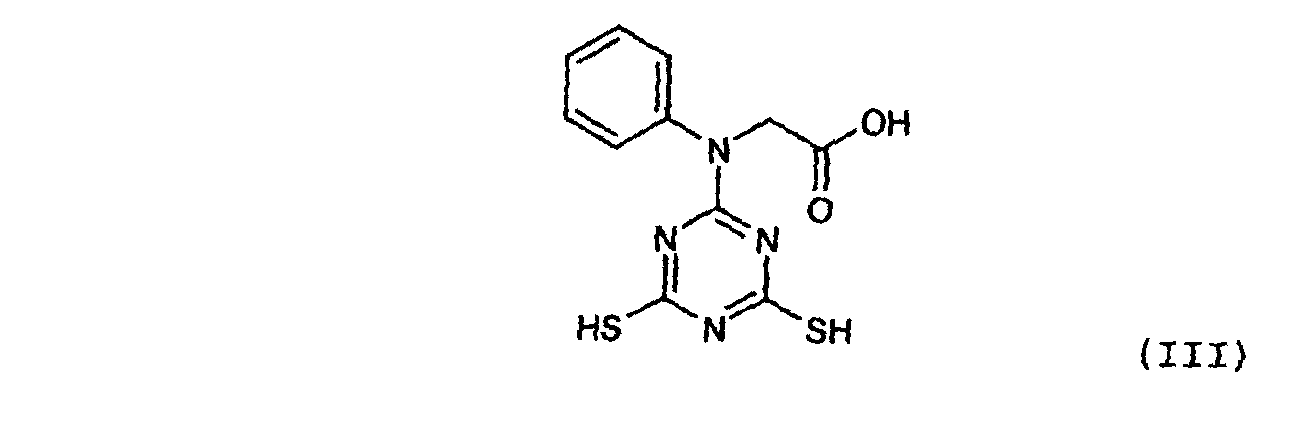

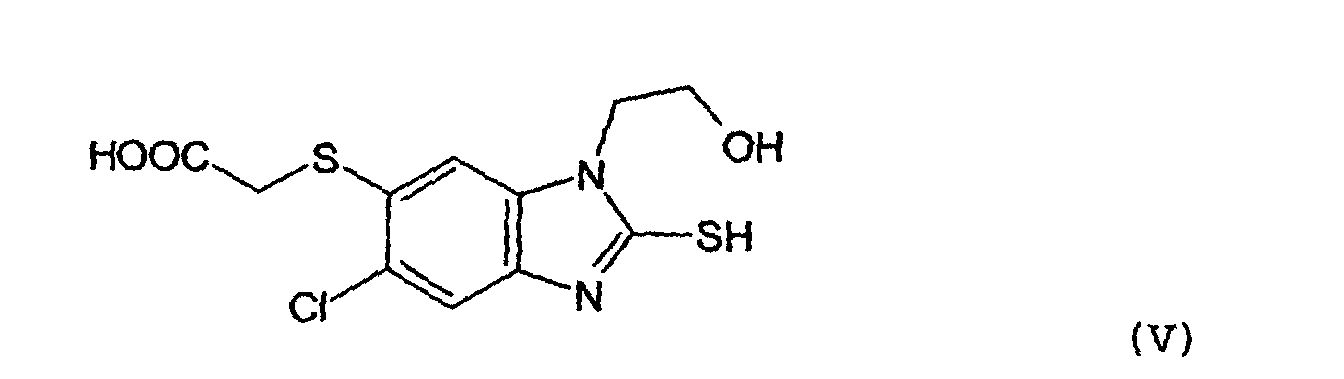


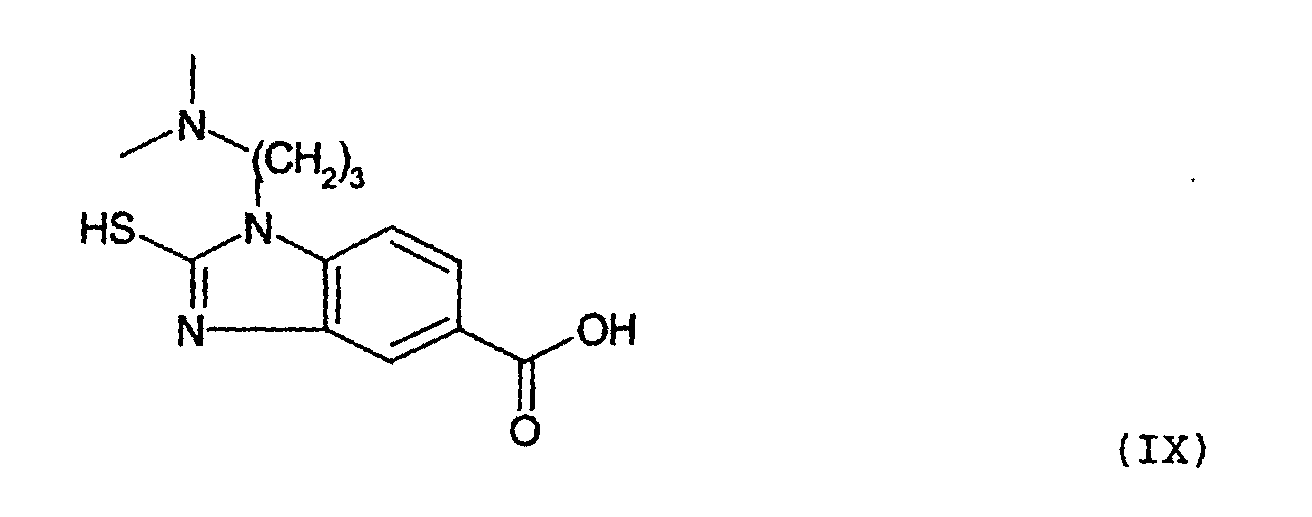

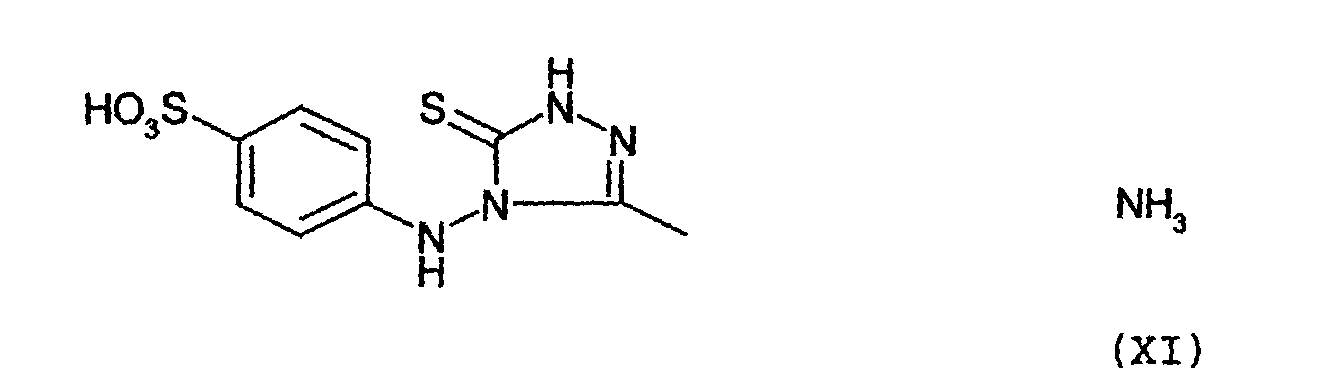


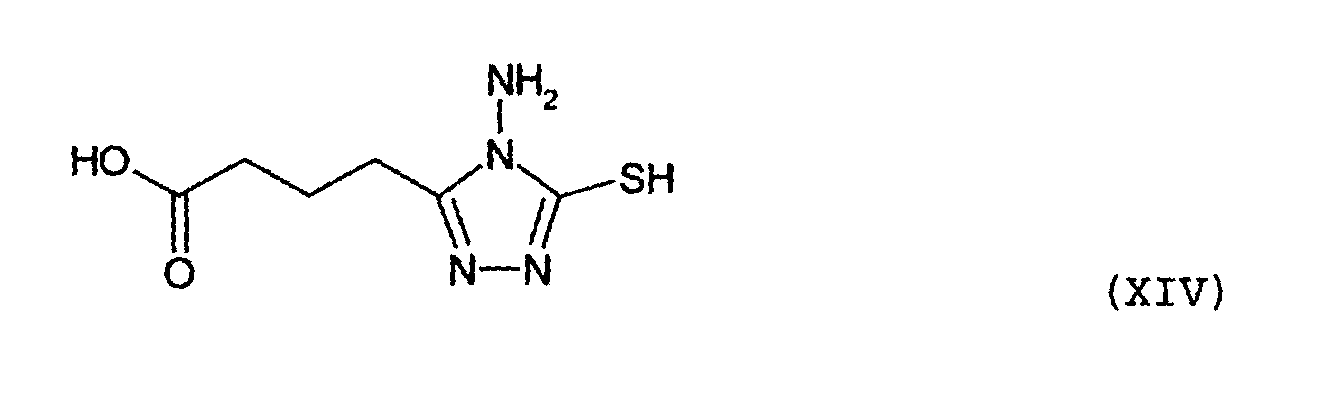


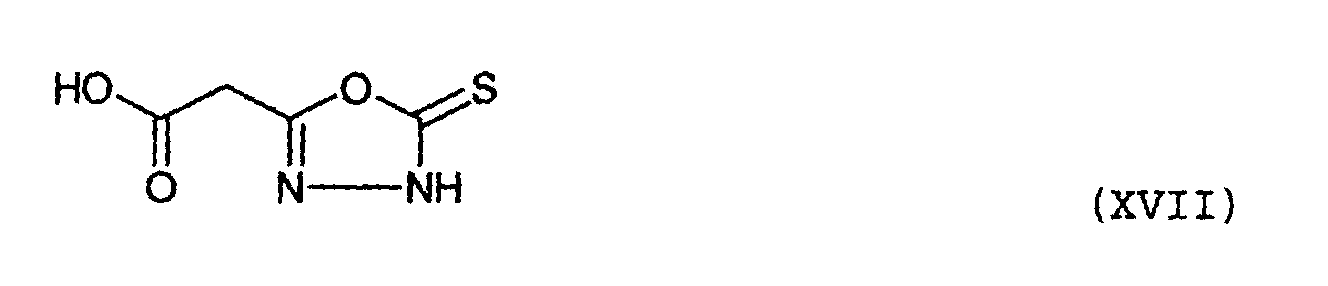
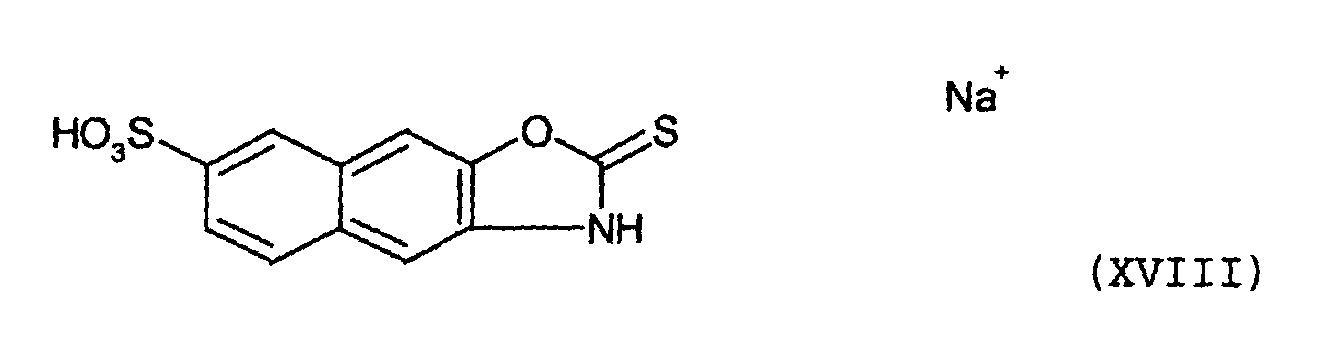
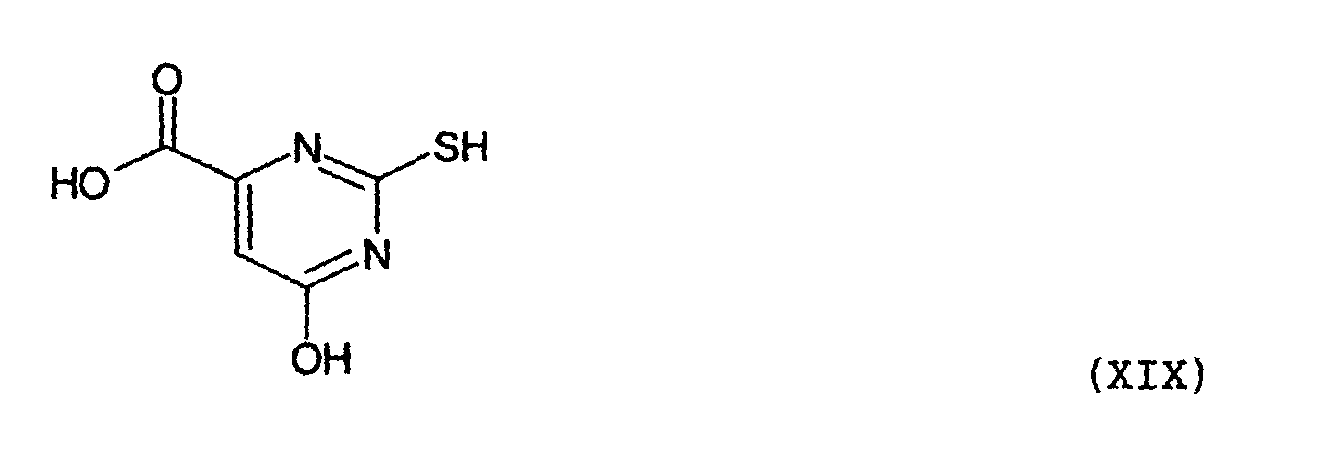


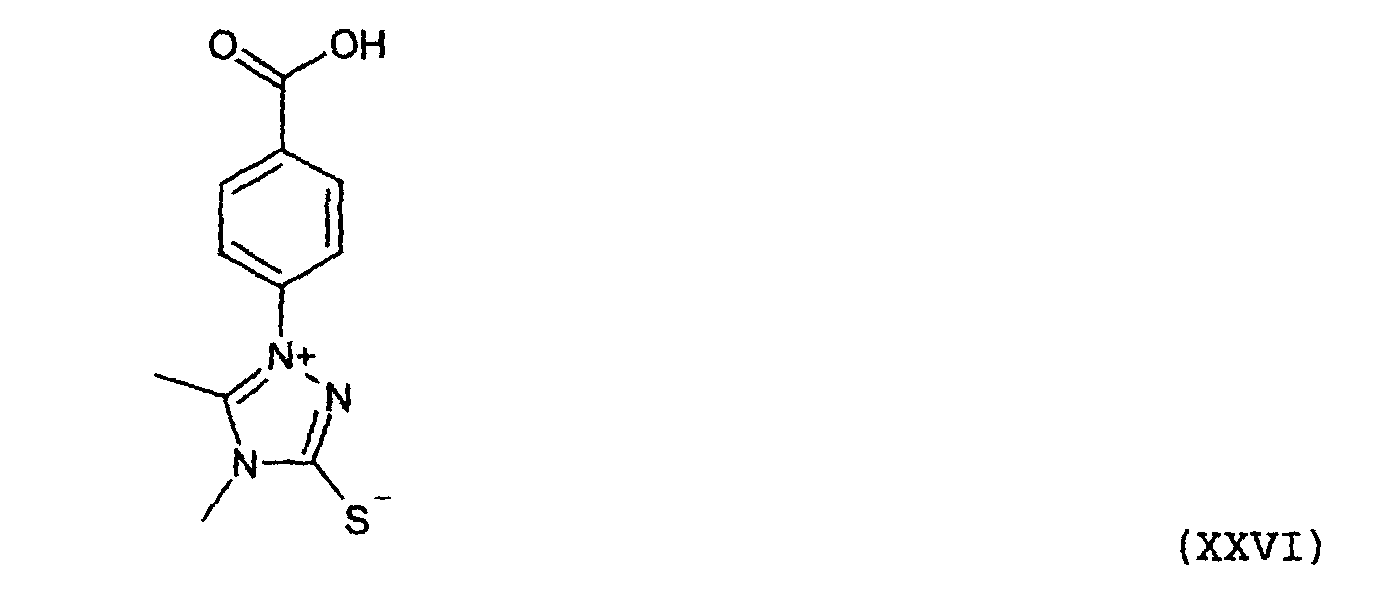


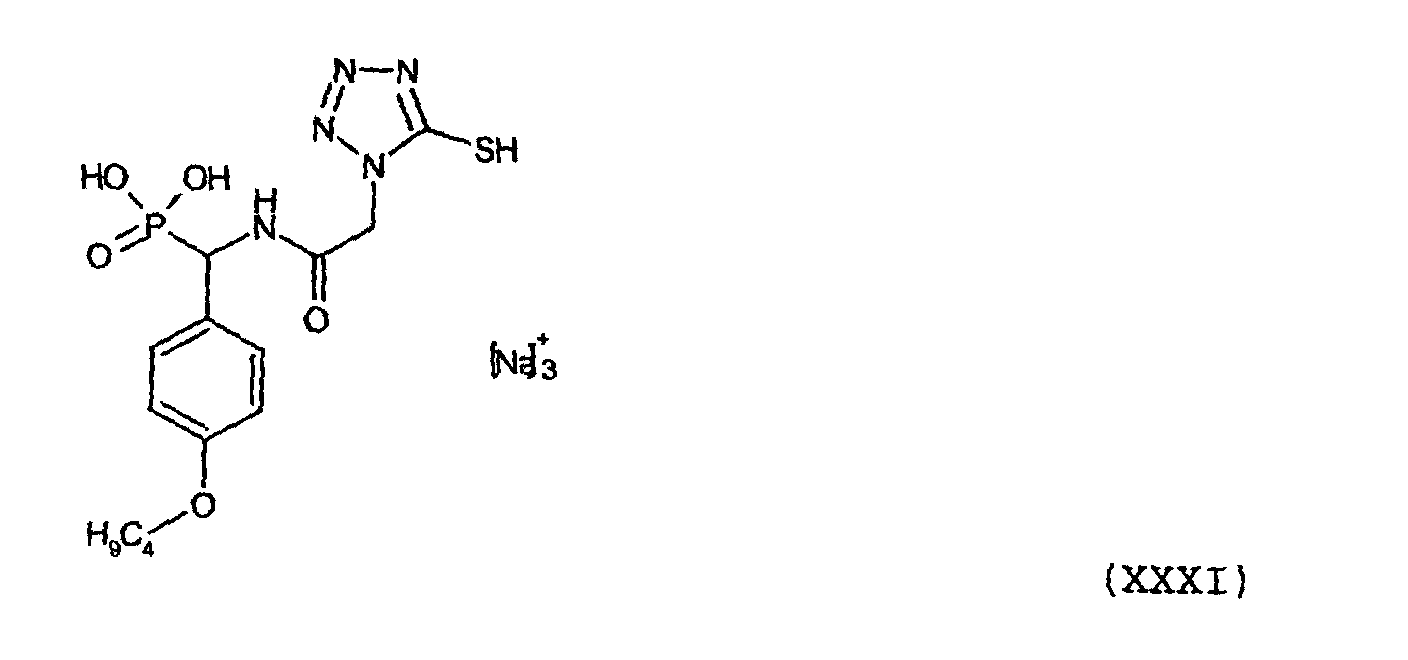


In one embodiment the developer starter solution is a buffering solution. Said buffering solution alters pH of the developer to the required value: so in a preferred embodiment said developer starter solution alters pH to a value in the range from - 0.3 up to + 0.3 units of the pH of the developer solution after seasoning. In another embodiment said developer starter solution is water or an alkaline solution. In still another embodiment an amount of developer starter solution is proportional to tank volume of the developer solution in the processor. In a further embodiment an amount of developer starter solution is less than 10 % of volume of replenisher solution with which it is mixed upon starting processing.
Said 1-ascorbic acid, iso-ascorbic acid and reductic acid are the more preferred forms from the ascorbic acid type developers according to the formula (XXVII)

The compound(s) according to the formula (XLI) preferably is(are) present in the developer solution in an amount comprised between 1 g and 100 g per litre, although a preferred amount of from 20 up to 50 g per litre is sufficient in many cases. Examples of reducing precursor compounds suitable for use in the developer of the present invention have, e.g., been described in WO's 94/3834 and 94/16362.
As is well-known and as has been described in US-A's 5,108,887 and 5,376,523 and in EP-A's 0 622 665 and 0 712 034, zeromethine dyes are very useful in the said wavelength region. In the method according to the present invention spectral sensitization as described in EP-A 0 890 873 can advantageously be applied.
The same applies to the other regions of the visible spectrum as the green wavelength region (see e.g. EP-A 0 678 772) and in the red wavelength range (see e.g. EP-A 0 794 456) and a still broader wavelength range has extensively been covered by spectral sensitizers described in EP-A 0 757 286. As already set forth combinations of differing spectral sensitizers may be used as well as mixtures of emulsions being the same or different, wherein each part may be spectrally sensitized with another spectral sensitizer or with another combination of spectral sensitizers. Spectral sensitizers having asymmetrical heterocycles may be useful with respect to improvements in residual colouration after processing. Other dyes, which do not have any spectral sensitization activity, or certain other compounds, which do not substantially absorb visible radiation, may have a supersensitization effect when they are incorporated together with said spectral sensitizing agents into the emulsion. Suitable supersensitizers are e.g. heterocyclic mercapto compounds containing at least one electronegative substituent as described e.g. in US-A 3,457,078, nitrogen-containing heterocyclic ring-substituted aminostilbene compounds as described e.g. in US-A 2,933,390 and US-A 3,635,721, aromatic organic acid/formaldehyde condensation products as described e.g. in US-A 3,743,510, cadmium salts, and azaindene compounds. Problems in the method of processing according to the present invention related with occurrence of residual dye stain due to the presence of huge amounts of spectral sensitizer (consequence of the large ratio of specific surface of the crystals to the crystal volume as is the case for tabular grains having a high aspect ratio or for very small cubic grains having diameters of less than 0.20 µm) are effectively overcome by application of combinations of J-aggregating and non-J-aggregating dyes as has been described in EP-A 0 953 867.
As a preferred laser imager we refer to the laser imager MATRIX LR 3300, trade name product marketed by Agfa-Gevaert. Suitable single-side coated materials for use in the processing of the present invention have e.g. been described in US-A 5,449,599, and in EP-A's 0 610 608, 0 712 036 and 0 794.456. Double-side coated materials have e.g. been described in US-A's 5,397,687 and 5,660,966 and in EP-A's 0 678 772 and 0 754 972. Useful multilayer assemblies have e.g. been described in EP-A 0 770 909.
An improved set of blue-light-emitting screens has e.g. been described in US-A 5,381,015. Specific intensifying screens emitting ultraviolet-blue radiation have further been disclosed in US-A's 4,225,653; 4,387,141; 4,710,637; 5,112,700; 5,173,611 and 5,432,351; in EP-A's 0 650 089; 0 658 613; in WO93011457 and WO95015514.
Typical blue-UV emitting phosphors are tantalates and hafnates and fluorohalides of barium and strontium. In EP-A 0 820 069, particles a niobium doped, monoclinic M, yttriumtantalate phosphor and particles of an europíum doped bariumfluorohalide phosphor are composing the screen.
Specific intensifying screens emitting green light radiation have been disclosed in GB 1 489 398; in US-A's 4,431,922 and 4,710,637. A typical green emitting phosphor used therein is a gadolinium oxisulphide phosphor.
Screen-film systems wherein blue and/or (ultra)violet radiation emitted by screens is absorbed by suitable films in contact therewith have been described e.g. in EP-A 0 712 034 and in EP-A 0 890 873, and in WO93001521.
Screen-film systems wherein green-light emitting screens are used in contact with green sensitized silver halide films have been described e.g. in EP-A 0 678 772.
Screen/film combinations may be symmetric or asymmetric: this means that screens differing in speed and/or radiation emitted therefrom are differing and/or that there is a difference in speed and/or contrast and/or spectral sensitivity at both sides of the film support.
Although it is possible to use whatever a processing unit adapted to the requirements described hereinbefore to reach the objectives concerning a perfect link between rapid processing and ecology, the objects of this invention concerning processing have e.g. been realised in the processing unit CURIX HT 330, trade name product marketed by Agfa-Gevaert. New developments however become available with respect to processing apparatus. In a conventional processing apparatus the sheet material is transported along a generally horizontal feed path, the sheet material passing from one vessel to another usually via a circuitous feed path passing under the surface of each treatment liquid and over dividing walls between the vessels. However, processing machines having a substantially vertical orientation have also been proposed, in which a plurality of vessels are mounted one above the other, each vessel having an opening at the top acting as a sheet material inlet and an opening at the bottom acting as a sheet material outlet or vice versa. In the present context, the term "substantially vertical" is intended to mean that the sheet material moves along a path from the inlet to the outlet which is either exactly vertical, or which has a vertical component greater than any horizontal component. The use of a vertical orientation for the apparatus leads to a number of advantages. In particular the apparatus occupies only a fraction of the floor space which is occupied by a conventional horizontal arrangement. Furthermore, the sheet transport path in a vertically oriented apparatus may be substantially straight, in contrast to the circuitous feed path which is usual in a horizontally oriented apparatus. The straight path is independent of the stiffness of the sheet material and reduces the risk of scratching compared with a horizontally oriented apparatus. In a vertically oriented apparatus, it is important to avoid, or at least minimize leakage of treatment liquid from one vessel to another and carry-over as the sheet material passes through the apparatus. Furthermore it is desirable that the treatment liquid in one vessel is not contaminated by contents of the adjacent vessels, that is neither by the treatment liquid of the next higher vessel nor by vapours escaping from the next lower vessel. In order to reduce consumption of treatment liquids, it is furthermore desirable to reduce the evaporation, oxidation and carbonization thereof. A solution therefore has been proposed in US-A 5,652,939, wherein it has been disclosed that contamination and evaporation, oxidation and carbonization can both be reduced in a simple manner by a particular construction of the apparatus for the processing of photographic sheet material comprising a plurality of cells mounted one above the other in a stack to define a substantially vertical sheet material path through the apparatus, each cell comprising a housing within which is mounted a rotatable roller biased towards a reaction surface to define a roller nip there-between through which the sheet material path extends and associated sealing means serving to provide a gas- and liquid-tight seal between the roller and reaction surface on the one hand and a wall of the housing on the other. According to a first aspect, invention is characterized by means for connecting each cell to adjacent cells in the stack in a closed manner and according to a second aspect, the invention is characterised in that the roller is a drive roller. Particularly the objectives set forth above may be achieved when the developing cell of the apparatus is a closed cell and the developing liquid contains an ascorbic acid developing agent as has been described in EP-Application No. 96201753, filed June 24, 1996. According to that invention, there is provided a method of processing photographic sheet material by use of an apparatus comprising a plurality of processing cells so arranged to define a sheet material path through the apparatus, at least one of the cells constituting a developing cell containing a developing liquid, characterized in that the developing cell is a closed cell and the developing liquid contains an ascorbic acid developing agent. With respect to further characteristics of the processing apparatus suitable for use in the processing method of the present invention we refer to EP-A 0 819 992, wherein it was an object to provide an apparatus in which operating components can easily be replaced without the need for substantial re-programming of the CPU (central processing unit).
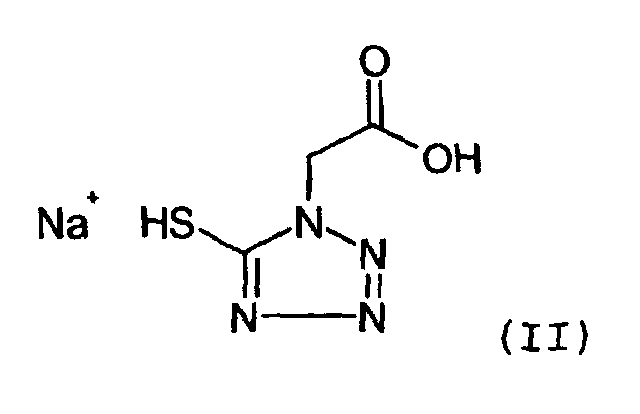
- Fog "F", given as an integer after having multiplied the real fog density as measured with a factor of 1000;
- Speed "S", given as an integer after having multiplied the sensitivity measured at a density of 1.00 above minimum density as measured with a factor of 100; - an decrease of speed with a figure of 30 corresponding with a doubling in speed -;
- Gradation (contrast) "GG", given as an integer after having multiplied with a factor of 100 the real gradation - contrast - figure as measured between a density of 1.0 and 2.0 above minimum density;
- Image tone "IT", evaluated from figures corresponding with Dr,
wherefore data are summarised with respect to the density Dr
measured through a red filter at a density Db=2 behind a blue
filter: the higher this value (figure multiplied by a factor of
100), the better (more desired blue-black instead of undesired red-brown)
is the colour of the developed silver. Differences of 0.02
are considered to be significant as being visually perceptible.
Addition of compound (II) to the developer Matl. No. Dev. F S GG IT 1 CD 227 131 395 208 1 ID1 232 130 375 209 1 ID2 241 132 375 210 1 ID3 228 138 362 211 2 CD 218 164 278 200 2 ID1 223 160 268 201 2 ID2 225 162 281 203 2 ID3 231 162 244 205 3 CD 203 158 305 192 3 ID1 202 158 290 193 3 ID2 204 159 301 194 3 ID3 204 164 270 197 4 CD 226 162 297 194 4 ID1 227 162 313 196 4 ID2 227 166 288 198 4 ID3 224 171 258 203
Only if present in the highest amounts as applied in the present example said compound (II) may have an influence on fog (suppressing fog, speed and gradation which become slightly increased for fog and decreased for both speed and gradation respectively, at lower levels of said compound).
- 5.72 l of a dispersion medium (C) containing 0.47 moles of sodium chloride, 100 g of inert gelatin and 398 mg of adenine; temperature was established at 55°C and pH was maintained at a value of 6.0;
- a 2.94 molar silver nitrate solution (A);
- a solution containing 2.756 moles of sodium chloride, 0.015 moles of potassium iodide and 420 mg of adenin (B1).
Finally, an amount of a potassium iodide solution (1 wt%) was added to this dispersion medium in an amount in order to get a total amount of iodide of 1 mole %. After cooling the emulsion to about 40°C, 24 ml of polystyrene sulphonic acid was added, and the pH value of the said dispersing medium was adjusted to a value of 3.0. The emulsion was flocculated, decanted and washed three times with an amount of 4 1 of demineralized water in order to remove the soluble salts present.
- 5.77 l of a dispersion medium (C) containing 0.47 moles of sodium chloride, 50 g of inert gelatin and 440 mg of adenine; temperature was established at 55°C and pH was maintained at a value of 6.0;
- a 2.94 molar silver nitrate solution (A);
- a solution containing 3.02 moles of sodium chloride, 0.0127 moles of potassium iodide and 420 mg of adenin (B1).
Finally, an amount of a Lippmann emulsion (100 mole % of AgI, having very fine grains with a diameter of less than 0.050 µm) was added to this dispersion medium in an amount in order to get a total amount of iodide of 0.7 mole %. After cooling the emulsion to about 40°C, 24 ml of polystyrene sulphonic acid was added, and the pH value of the said dispersing medium was adjusted to a value of 3.0. The emulsion was flocculated, decanted and washed three times with an amount of 4 l of demineralized water in order to remove the soluble salts present.
Before coating each emulsion was stabilized with 1-p-carboxyphenyl-5-mercaptotetrazole and after addition of the normal coating additives the solutions were coated simultaneously together with a protective layer containing 1.3 g gelatine per m2 per side on both sides of a polyethylene terephthalate film support having a thickness of 175 µm. The resulting photographic materials A1 and A2 were containing per side an amount of silver halide corresponding to 3.5 grams of silver per m2 and an amount of gelatin corresponding to 2.80 g/m2.
| Developer A | |
| 1-phenyl-4-methyl-4'hydroxy-methyl-pyrazolidine-3-one | 2 g/l |
| Sodium EDTA | 2 g/l |
| Potassium bromide | 3.3 g/l |
| Potassium thiocyanate | |
| Potassium sulphite | 1 g/l |
| Potassium carbonate | 33 g/l |
| Polyglycol (M.W.= ca. 400) | 96 g/l |
| Compound (x) | 20 ml/l |
| Ascorbic Acid | |
| pH ready-for-use | 1 g/l |
| 50 g/l | |
| 10.0 |
| Fixer A' | |
| -Ammonium thiosulphate (60 % solution, wherein 1 ml comprises 0.778 g) | 710 ml |
| -Sodium metabisulphite | 80 g |
| - Sodium acetate | 130 g |
| -Acetic acid | 31 ml |
| pH ready-for-use (after dilution 1+3) | 4.90 |
- fog level F (with an accuracy of 0.001 density), value multiplied by a factor of 1000 (accuracy thus being 1);
- the relative speed S at a density of 1 above fog (an increase of the said speed with a factor of 2 gives a speed value that is 0.30 lower as the relation is logarithmic and as less light is needed to get the desired density), value multiplied by a factor of 100 and speed increasing with a factor of 2 when the value of S is lower in an amount of 30,
- Image tone "IT", evaluated from figures corresponding with Dr,
wherefore data are summarised with respect to the density Dr
measured through a red filter at a density Db=2 behind a blue
filter: the higher this value (figure multiplied by a factor of
100), the better (more desired blue-black instead of undesired red-brown)
is the colour of the developed silver. Differences of 0.02
are considered to be significant as being visually perceptible.
Addition of compound (II) to the developer A (=IDA) Matl. Dev. F S IT A1 CDA 302 181 193 A1 IDA 301 182 195 A2 CDA 215 191 192 A2 IDA 230 192 197
Claims (7)
- Processing method of an exposed black-and-white silver halide photographic film material comprising in a hydrophilic light-sensitive layer thereof a binder and silver halide grains being {111} or {100} tabular silver bromo(chloro)iodide or silver chloro(bromo)iodide grains having an average aspect ratio of from 1.2 to 50 and having a silver iodide content of less than 3 mole % based on silver with at least part of it at their grain surface, said method comprising the steps of developing in a developer, fixing in a fixer, rinsing and drying, characterized in that in said developing step the developer comprises an alkali soluble agent, which is represented by the general formula (I),wherein said agent stands for a mercapto azole compound, having at least one alkali soluble group, selected from the group consisting of carboxylic acid, sulphonic acid and phosphonic acid, wherein Z represents an atom capable of closing a 5- or 6-membered ring, differing from a thiadiazole ring, and wherein M is selected from the group consisting of a group providing a thiolate anion under alkaline processing conditions and a charge compensating counterion for the said thiolate anion.
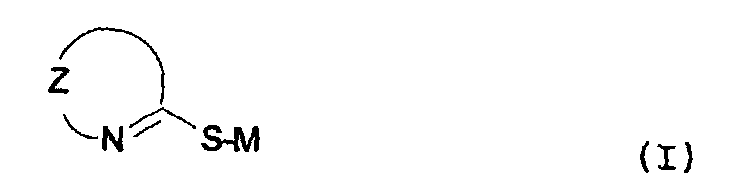
- Processing method according to claim 1, wherein said mercapto azole compound is a compound selected from the group consisting of tetrazoles, (benzo)triazoles, (benz)imidazoles, (benz)oxazoles, (benz)thiazoles, (benz)selenazoles, diazoles, indazoles, iso-oxazoles, iso-thiazoles and oxadiazoles.
- Processing method according to claim 1 or 2, wherein said agent is represented by formula (II) or a salt thereof:

- Processing method according to any of claims 1 to 3, wherein said agent is present in the developer solution in an amount of from 5 x 10⁻⁵ up to 1 x 10⁻³ mole per liter of said developer.
- Processing method according to any of claims 1 to 4, wherein in the developer a main developing agent is present, said agent being selected from the group consisting of hydroquinones and reductones or a combination thereof, and wherein said reductones are members selected from the group consisting of 1-ascorbic acid, iso-ascorbic acid, and reductic acid.
- Processing method according to any of claims 1 to 5, wherein said silver halide grains have a silver iodide content of from 0.1 up to 1 mole % based on silver.
- Processing method according to claim 6, wherein said silver halide grains have silver iodide at their surfaces in an amount of from 0.1 up to 0.4 mole % based on silver.
Priority Applications (1)
| Application Number | Priority Date | Filing Date | Title |
|---|---|---|---|
| EP00203915A EP1104893B1 (en) | 1999-11-26 | 2000-11-07 | Processing method providing cold blue-black image tone for black-and white materials having silver halide tabular gain emulsions |
Applications Claiming Priority (3)
| Application Number | Priority Date | Filing Date | Title |
|---|---|---|---|
| EP99204007 | 1999-11-26 | ||
| EP99204007 | 1999-11-26 | ||
| EP00203915A EP1104893B1 (en) | 1999-11-26 | 2000-11-07 | Processing method providing cold blue-black image tone for black-and white materials having silver halide tabular gain emulsions |
Publications (2)
| Publication Number | Publication Date |
|---|---|
| EP1104893A1 true EP1104893A1 (en) | 2001-06-06 |
| EP1104893B1 EP1104893B1 (en) | 2002-09-04 |
Family
ID=26072843
Family Applications (1)
| Application Number | Title | Priority Date | Filing Date |
|---|---|---|---|
| EP00203915A Expired - Lifetime EP1104893B1 (en) | 1999-11-26 | 2000-11-07 | Processing method providing cold blue-black image tone for black-and white materials having silver halide tabular gain emulsions |
Country Status (1)
| Country | Link |
|---|---|
| EP (1) | EP1104893B1 (en) |
Cited By (2)
| Publication number | Priority date | Publication date | Assignee | Title |
|---|---|---|---|---|
| EP1388755A1 (en) * | 2002-07-30 | 2004-02-11 | Agfa-Gevaert | Silver halide photographic processing solution |
| US6740479B2 (en) | 2002-07-30 | 2004-05-25 | Agfa-Gevaert | Silver halide photographic processing solution |
Citations (4)
| Publication number | Priority date | Publication date | Assignee | Title |
|---|---|---|---|---|
| EP0507284A1 (en) * | 1991-04-02 | 1992-10-07 | Fuji Photo Film Co., Ltd. | Development of silver halide photosensitive material and developer |
| EP0529526A2 (en) * | 1991-08-22 | 1993-03-03 | Fuji Photo Film Co., Ltd. | Developing solution for silver halide photographic material and method for processing silver halide photographic material by using the same |
| EP0789271A1 (en) * | 1996-02-07 | 1997-08-13 | Fuji Photo Film Co., Ltd. | A method for development processing of silver halide photographic materials |
| EP0789272A1 (en) * | 1996-02-07 | 1997-08-13 | Fuji Photo Film Co., Ltd. | Developer for silver halide photographic photosensitive material |
-
2000
- 2000-11-07 EP EP00203915A patent/EP1104893B1/en not_active Expired - Lifetime
Patent Citations (4)
| Publication number | Priority date | Publication date | Assignee | Title |
|---|---|---|---|---|
| EP0507284A1 (en) * | 1991-04-02 | 1992-10-07 | Fuji Photo Film Co., Ltd. | Development of silver halide photosensitive material and developer |
| EP0529526A2 (en) * | 1991-08-22 | 1993-03-03 | Fuji Photo Film Co., Ltd. | Developing solution for silver halide photographic material and method for processing silver halide photographic material by using the same |
| EP0789271A1 (en) * | 1996-02-07 | 1997-08-13 | Fuji Photo Film Co., Ltd. | A method for development processing of silver halide photographic materials |
| EP0789272A1 (en) * | 1996-02-07 | 1997-08-13 | Fuji Photo Film Co., Ltd. | Developer for silver halide photographic photosensitive material |
Cited By (2)
| Publication number | Priority date | Publication date | Assignee | Title |
|---|---|---|---|---|
| EP1388755A1 (en) * | 2002-07-30 | 2004-02-11 | Agfa-Gevaert | Silver halide photographic processing solution |
| US6740479B2 (en) | 2002-07-30 | 2004-05-25 | Agfa-Gevaert | Silver halide photographic processing solution |
Also Published As
| Publication number | Publication date |
|---|---|
| EP1104893B1 (en) | 2002-09-04 |
Similar Documents
| Publication | Publication Date | Title |
|---|---|---|
| US5998083A (en) | System and method for radiological image formation | |
| EP1130463B1 (en) | Rapidly processable and directly viewable radiographic film with visually adative contrast | |
| EP0897131A1 (en) | Radiographic elements for mammographic medical diagnostic imaging | |
| EP1104893B1 (en) | Processing method providing cold blue-black image tone for black-and white materials having silver halide tabular gain emulsions | |
| US6432625B1 (en) | Processing method providing cold blue-black image tone for black-and-white materials having silver halide grain emulsions | |
| US6238853B1 (en) | Processing method of light-sensitive silver halide photographic materials showing less tendency to sludge formation | |
| US6403276B1 (en) | Radiographic UV/blue film material and intensifying screen-film combination | |
| EP0862083B1 (en) | System and method for radiological image formation | |
| US6607876B2 (en) | Radiographic film material and intensifying screen-film combination | |
| JP3109320B2 (en) | Silver halide photographic material | |
| EP1061413A1 (en) | Processing method of light-sensitive silver halide photographic materials showing less tendency to sludge formation. | |
| US6048096A (en) | System and method for radiological image formation | |
| EP0690343B1 (en) | Photographic silver halide developer composition and process for forming photographic silver images | |
| US5912108A (en) | Processing of a light-sensitive silver halide photographic material | |
| JPH10115883A (en) | Radiation-transmissible photographic element containing extremely thin flat grain emulsion | |
| US6066441A (en) | Processing of radiographic materials having emulsion grains rich in silver chloride | |
| US6528227B2 (en) | Film/screen system and image-forming system for use in direct X-ray applications | |
| EP0851282B1 (en) | Processing of a light-sensitive silver halide photographic material | |
| EP0930527A1 (en) | Radiographic intensifying screen-film combination | |
| US5856077A (en) | Single sided mammographic radiographic elements | |
| JPH04204937A (en) | Silver halide photographic sensitive material | |
| US6727055B1 (en) | High bromide cubic grain emulsions | |
| EP1045282B1 (en) | Radiographic UV/Blue-sensitive film material and intensifying screen-film combination | |
| EP1195641B1 (en) | Film/Screen system and image-forming system for use in direct X-ray applications | |
| EP1217428A1 (en) | Radiographic film material and intensifying screen-film combination |
Legal Events
| Date | Code | Title | Description |
|---|---|---|---|
| PUAI | Public reference made under article 153(3) epc to a published international application that has entered the european phase |
Free format text: ORIGINAL CODE: 0009012 |
|
| AK | Designated contracting states |
Kind code of ref document: A1 Designated state(s): DE FR GB |
|
| AX | Request for extension of the european patent |
Free format text: AL;LT;LV;MK;RO;SI |
|
| 17P | Request for examination filed |
Effective date: 20011206 |
|
| RAP1 | Party data changed (applicant data changed or rights of an application transferred) |
Owner name: AGFA-GEVAERT |
|
| AKX | Designation fees paid |
Free format text: DE FR GB |
|
| GRAG | Despatch of communication of intention to grant |
Free format text: ORIGINAL CODE: EPIDOS AGRA |
|
| 17Q | First examination report despatched |
Effective date: 20020311 |
|
| GRAG | Despatch of communication of intention to grant |
Free format text: ORIGINAL CODE: EPIDOS AGRA |
|
| GRAH | Despatch of communication of intention to grant a patent |
Free format text: ORIGINAL CODE: EPIDOS IGRA |
|
| GRAH | Despatch of communication of intention to grant a patent |
Free format text: ORIGINAL CODE: EPIDOS IGRA |
|
| GRAA | (expected) grant |
Free format text: ORIGINAL CODE: 0009210 |
|
| AK | Designated contracting states |
Kind code of ref document: B1 Designated state(s): DE FR GB |
|
| PG25 | Lapsed in a contracting state [announced via postgrant information from national office to epo] |
Ref country code: FR Free format text: LAPSE BECAUSE OF NON-PAYMENT OF DUE FEES Effective date: 20020904 |
|
| REG | Reference to a national code |
Ref country code: GB Ref legal event code: FG4D |
|
| REF | Corresponds to: |
Ref document number: 60000401 Country of ref document: DE Date of ref document: 20021010 |
|
| PG25 | Lapsed in a contracting state [announced via postgrant information from national office to epo] |
Ref country code: DE Free format text: LAPSE BECAUSE OF FAILURE TO SUBMIT A TRANSLATION OF THE DESCRIPTION OR TO PAY THE FEE WITHIN THE PRESCRIBED TIME-LIMIT Effective date: 20021205 |
|
| EN | Fr: translation not filed | ||
| PLBE | No opposition filed within time limit |
Free format text: ORIGINAL CODE: 0009261 |
|
| STAA | Information on the status of an ep patent application or granted ep patent |
Free format text: STATUS: NO OPPOSITION FILED WITHIN TIME LIMIT |
|
| 26N | No opposition filed |
Effective date: 20030605 |
|
| REG | Reference to a national code |
Ref country code: GB Ref legal event code: 732E |
|
| PGFP | Annual fee paid to national office [announced via postgrant information from national office to epo] |
Ref country code: GB Payment date: 20071018 Year of fee payment: 8 |
|
| GBPC | Gb: european patent ceased through non-payment of renewal fee |
Effective date: 20081107 |
|
| PG25 | Lapsed in a contracting state [announced via postgrant information from national office to epo] |
Ref country code: GB Free format text: LAPSE BECAUSE OF NON-PAYMENT OF DUE FEES Effective date: 20081107 |