EP1104755B1 - Process for the preparation of (S)-N-tertbutyl-1,2,3,4- tetrahydroisoquinoline-3-carboxamide - Google Patents
Process for the preparation of (S)-N-tertbutyl-1,2,3,4- tetrahydroisoquinoline-3-carboxamide Download PDFInfo
- Publication number
- EP1104755B1 EP1104755B1 EP00811108A EP00811108A EP1104755B1 EP 1104755 B1 EP1104755 B1 EP 1104755B1 EP 00811108 A EP00811108 A EP 00811108A EP 00811108 A EP00811108 A EP 00811108A EP 1104755 B1 EP1104755 B1 EP 1104755B1
- Authority
- EP
- European Patent Office
- Prior art keywords
- process according
- tetrahydroisoquinoline
- tert
- reaction
- carboxyanhydride
- Prior art date
- Legal status (The legal status is an assumption and is not a legal conclusion. Google has not performed a legal analysis and makes no representation as to the accuracy of the status listed.)
- Expired - Lifetime
Links
- 238000000034 method Methods 0.000 title claims abstract description 36
- DMJXRYSGXCLCFP-LBPRGKRZSA-N (3s)-n-tert-butyl-1,2,3,4-tetrahydroisoquinoline-3-carboxamide Chemical compound C1=CC=C2CN[C@H](C(=O)NC(C)(C)C)CC2=C1 DMJXRYSGXCLCFP-LBPRGKRZSA-N 0.000 title claims abstract description 9
- 238000002360 preparation method Methods 0.000 title description 3
- YXFVVABEGXRONW-UHFFFAOYSA-N Toluene Chemical compound CC1=CC=CC=C1 YXFVVABEGXRONW-UHFFFAOYSA-N 0.000 claims abstract description 32
- YBRBMKDOPFTVDT-UHFFFAOYSA-N tert-butylamine Chemical compound CC(C)(C)N YBRBMKDOPFTVDT-UHFFFAOYSA-N 0.000 claims abstract description 20
- 239000012442 inert solvent Substances 0.000 claims abstract 5
- 238000006243 chemical reaction Methods 0.000 claims description 22
- BWKMGYQJPOAASG-VIFPVBQESA-N (3s)-1,2,3,4-tetrahydroisoquinoline-3-carboxylic acid Chemical compound C1=CC=C2CN[C@H](C(=O)O)CC2=C1 BWKMGYQJPOAASG-VIFPVBQESA-N 0.000 claims description 12
- UCPYLLCMEDAXFR-UHFFFAOYSA-N triphosgene Chemical compound ClC(Cl)(Cl)OC(=O)OC(Cl)(Cl)Cl UCPYLLCMEDAXFR-UHFFFAOYSA-N 0.000 claims description 11
- RYHBNJHYFVUHQT-UHFFFAOYSA-N 1,4-Dioxane Chemical compound C1COCCO1 RYHBNJHYFVUHQT-UHFFFAOYSA-N 0.000 claims description 8
- KFZMGEQAYNKOFK-UHFFFAOYSA-N Isopropanol Chemical compound CC(C)O KFZMGEQAYNKOFK-UHFFFAOYSA-N 0.000 claims description 8
- 239000002904 solvent Substances 0.000 claims description 6
- UPZBXVBPICTBDP-TUAOUCFPSA-N (3s,4as,8as)-n-tert-butyl-1,2,3,4,4a,5,6,7,8,8a-decahydroisoquinoline-3-carboxamide Chemical compound C1CCC[C@@H]2CN[C@H](C(=O)NC(C)(C)C)C[C@@H]21 UPZBXVBPICTBDP-TUAOUCFPSA-N 0.000 claims description 5
- YMWUJEATGCHHMB-UHFFFAOYSA-N Dichloromethane Chemical compound ClCCl YMWUJEATGCHHMB-UHFFFAOYSA-N 0.000 claims description 5
- 239000003443 antiviral agent Substances 0.000 claims description 5
- WYURNTSHIVDZCO-UHFFFAOYSA-N Tetrahydrofuran Chemical compound C1CCOC1 WYURNTSHIVDZCO-UHFFFAOYSA-N 0.000 claims description 4
- 150000001875 compounds Chemical class 0.000 claims description 4
- 238000004519 manufacturing process Methods 0.000 claims description 4
- 238000010992 reflux Methods 0.000 claims description 4
- 150000003839 salts Chemical class 0.000 claims description 4
- ZHNSDZJJTWNYLU-ZDUSSCGKSA-N N-tert-butyl-2-[(3S)-1,2,3,4-tetrahydroisoquinolin-3-yl]acetamide Chemical compound C(C)(C)(C)NC(=O)C[C@H]1NCC2=CC=CC=C2C1 ZHNSDZJJTWNYLU-ZDUSSCGKSA-N 0.000 claims description 3
- 239000003960 organic solvent Substances 0.000 claims description 3
- MHOVAHRLVXNVSD-UHFFFAOYSA-N rhodium atom Chemical compound [Rh] MHOVAHRLVXNVSD-UHFFFAOYSA-N 0.000 claims description 3
- PNEYBMLMFCGWSK-UHFFFAOYSA-N aluminium oxide Inorganic materials [O-2].[O-2].[O-2].[Al+3].[Al+3] PNEYBMLMFCGWSK-UHFFFAOYSA-N 0.000 claims description 2
- 239000010948 rhodium Substances 0.000 claims description 2
- 229910052703 rhodium Inorganic materials 0.000 claims description 2
- 238000009903 catalytic hydrogenation reaction Methods 0.000 claims 2
- FAPWRFPIFSIZLT-UHFFFAOYSA-M Sodium chloride Chemical class [Na+].[Cl-] FAPWRFPIFSIZLT-UHFFFAOYSA-M 0.000 claims 1
- 125000000532 dioxanyl group Chemical group 0.000 claims 1
- 125000003944 tolyl group Chemical group 0.000 claims 1
- 230000015572 biosynthetic process Effects 0.000 abstract description 3
- 238000003786 synthesis reaction Methods 0.000 abstract description 3
- XLYOFNOQVPJJNP-UHFFFAOYSA-N water Substances O XLYOFNOQVPJJNP-UHFFFAOYSA-N 0.000 description 10
- IMNFDUFMRHMDMM-UHFFFAOYSA-N N-Heptane Chemical compound CCCCCCC IMNFDUFMRHMDMM-UHFFFAOYSA-N 0.000 description 6
- 239000000539 dimer Substances 0.000 description 6
- 238000004128 high performance liquid chromatography Methods 0.000 description 4
- XEKOWRVHYACXOJ-UHFFFAOYSA-N Ethyl acetate Chemical compound CCOC(C)=O XEKOWRVHYACXOJ-UHFFFAOYSA-N 0.000 description 3
- YGYAWVDWMABLBF-UHFFFAOYSA-N Phosgene Chemical compound ClC(Cl)=O YGYAWVDWMABLBF-UHFFFAOYSA-N 0.000 description 3
- HEMHJVSKTPXQMS-UHFFFAOYSA-M Sodium hydroxide Chemical compound [OH-].[Na+] HEMHJVSKTPXQMS-UHFFFAOYSA-M 0.000 description 3
- 229960001852 saquinavir Drugs 0.000 description 3
- QWAXKHKRTORLEM-UGJKXSETSA-N saquinavir Chemical compound C([C@@H]([C@H](O)CN1C[C@H]2CCCC[C@H]2C[C@H]1C(=O)NC(C)(C)C)NC(=O)[C@H](CC(N)=O)NC(=O)C=1N=C2C=CC=CC2=CC=1)C1=CC=CC=C1 QWAXKHKRTORLEM-UGJKXSETSA-N 0.000 description 3
- 239000000725 suspension Substances 0.000 description 3
- NENLYAQPNATJSU-UHFFFAOYSA-N 1,2,3,4,4a,5,6,7,8,8a-decahydroisoquinoline Chemical group C1NCCC2CCCCC21 NENLYAQPNATJSU-UHFFFAOYSA-N 0.000 description 2
- QAGYKUNXZHXKMR-UHFFFAOYSA-N CPD000469186 Natural products CC1=C(O)C=CC=C1C(=O)NC(C(O)CN1C(CC2CCCCC2C1)C(=O)NC(C)(C)C)CSC1=CC=CC=C1 QAGYKUNXZHXKMR-UHFFFAOYSA-N 0.000 description 2
- 0 Cc(c(O)ccc1)c1C(N[C@@](CSc1ccccc1)[C@@](CN(C[C@@](CCCC1)[C@]1C1)C1C(*)=O)O)=O Chemical compound Cc(c(O)ccc1)c1C(N[C@@](CSc1ccccc1)[C@@](CN(C[C@@](CCCC1)[C@]1C1)C1C(*)=O)O)=O 0.000 description 2
- CDBYLPFSWZWCQE-UHFFFAOYSA-L Sodium Carbonate Chemical compound [Na+].[Na+].[O-]C([O-])=O CDBYLPFSWZWCQE-UHFFFAOYSA-L 0.000 description 2
- 239000006227 byproduct Substances 0.000 description 2
- 239000003054 catalyst Substances 0.000 description 2
- 238000007796 conventional method Methods 0.000 description 2
- 239000000203 mixture Substances 0.000 description 2
- 229960000884 nelfinavir Drugs 0.000 description 2
- QAGYKUNXZHXKMR-HKWSIXNMSA-N nelfinavir Chemical compound CC1=C(O)C=CC=C1C(=O)N[C@H]([C@H](O)CN1[C@@H](C[C@@H]2CCCC[C@@H]2C1)C(=O)NC(C)(C)C)CSC1=CC=CC=C1 QAGYKUNXZHXKMR-HKWSIXNMSA-N 0.000 description 2
- 239000012074 organic phase Substances 0.000 description 2
- 239000000843 powder Substances 0.000 description 2
- 239000000047 product Substances 0.000 description 2
- 239000002994 raw material Substances 0.000 description 2
- 239000007787 solid Substances 0.000 description 2
- 238000003756 stirring Methods 0.000 description 2
- OKTJSMMVPCPJKN-UHFFFAOYSA-N Carbon Chemical compound [C] OKTJSMMVPCPJKN-UHFFFAOYSA-N 0.000 description 1
- LFQSCWFLJHTTHZ-UHFFFAOYSA-N Ethanol Chemical compound CCO LFQSCWFLJHTTHZ-UHFFFAOYSA-N 0.000 description 1
- JFMNKDRNEZZRBW-UHFFFAOYSA-N NC(C1NCc2ccccc2C1)=O Chemical compound NC(C1NCc2ccccc2C1)=O JFMNKDRNEZZRBW-UHFFFAOYSA-N 0.000 description 1
- MFQCEFDMLXLCGB-UHFFFAOYSA-N O=C(C1N2Cc3ccccc3C1)OC2=O Chemical compound O=C(C1N2Cc3ccccc3C1)OC2=O MFQCEFDMLXLCGB-UHFFFAOYSA-N 0.000 description 1
- 230000002378 acidificating effect Effects 0.000 description 1
- 238000013019 agitation Methods 0.000 description 1
- DCVXWERGVUVVLH-UHFFFAOYSA-N azane;isoquinoline Chemical compound N.C1=NC=CC2=CC=CC=C21 DCVXWERGVUVVLH-UHFFFAOYSA-N 0.000 description 1
- 229910052799 carbon Inorganic materials 0.000 description 1
- 239000007795 chemical reaction product Substances 0.000 description 1
- 239000003153 chemical reaction reagent Substances 0.000 description 1
- 239000007810 chemical reaction solvent Substances 0.000 description 1
- 230000000052 comparative effect Effects 0.000 description 1
- 238000004090 dissolution Methods 0.000 description 1
- 238000002474 experimental method Methods 0.000 description 1
- 238000001914 filtration Methods 0.000 description 1
- 239000012467 final product Substances 0.000 description 1
- 239000007789 gas Substances 0.000 description 1
- 208000015181 infectious disease Diseases 0.000 description 1
- 230000000144 pharmacologic effect Effects 0.000 description 1
- 239000012071 phase Substances 0.000 description 1
- 239000002798 polar solvent Substances 0.000 description 1
- 230000002265 prevention Effects 0.000 description 1
- 238000010791 quenching Methods 0.000 description 1
- 239000011541 reaction mixture Substances 0.000 description 1
- 230000035484 reaction time Effects 0.000 description 1
- 238000010517 secondary reaction Methods 0.000 description 1
- 238000006467 substitution reaction Methods 0.000 description 1
- 231100000331 toxic Toxicity 0.000 description 1
- 230000002588 toxic effect Effects 0.000 description 1
- 239000002341 toxic gas Substances 0.000 description 1
- 238000005406 washing Methods 0.000 description 1
Classifications
-
- C—CHEMISTRY; METALLURGY
- C07—ORGANIC CHEMISTRY
- C07D—HETEROCYCLIC COMPOUNDS
- C07D217/00—Heterocyclic compounds containing isoquinoline or hydrogenated isoquinoline ring systems
- C07D217/12—Heterocyclic compounds containing isoquinoline or hydrogenated isoquinoline ring systems with radicals, substituted by hetero atoms, attached to carbon atoms of the nitrogen-containing ring
-
- C—CHEMISTRY; METALLURGY
- C07—ORGANIC CHEMISTRY
- C07K—PEPTIDES
- C07K5/00—Peptides containing up to four amino acids in a fully defined sequence; Derivatives thereof
- C07K5/04—Peptides containing up to four amino acids in a fully defined sequence; Derivatives thereof containing only normal peptide links
- C07K5/06—Dipeptides
- C07K5/06139—Dipeptides with the first amino acid being heterocyclic
-
- A—HUMAN NECESSITIES
- A61—MEDICAL OR VETERINARY SCIENCE; HYGIENE
- A61P—SPECIFIC THERAPEUTIC ACTIVITY OF CHEMICAL COMPOUNDS OR MEDICINAL PREPARATIONS
- A61P31/00—Antiinfectives, i.e. antibiotics, antiseptics, chemotherapeutics
- A61P31/12—Antivirals
-
- C—CHEMISTRY; METALLURGY
- C07—ORGANIC CHEMISTRY
- C07D—HETEROCYCLIC COMPOUNDS
- C07D217/00—Heterocyclic compounds containing isoquinoline or hydrogenated isoquinoline ring systems
- C07D217/22—Heterocyclic compounds containing isoquinoline or hydrogenated isoquinoline ring systems with hetero atoms or with carbon atoms having three bonds to hetero atoms with at the most one bond to halogen, e.g. ester or nitrile radicals, directly attached to carbon atoms of the nitrogen-containing ring
- C07D217/26—Carbon atoms having three bonds to hetero atoms with at the most one bond to halogen
Definitions
- the present invention relates to a new process for the preparation of (S)-N-tert-butyl-1,2,3,4-tetrahydroisoquinoline-3-carboxamide, whose formula of structure is here below reported, and which is a key intermediate for the preparation of compounds having elevated pharmacological activity, which can be used in particular in the treatment and in the prevention of the infections caused by HIV.
- the (S)-N-tert-butyl-1,2,3,4-tetrahydroisoquinoline-3-carboxamide is not used directly as such but, contrarily, is previously hydrogenated to form the N-tert-butyl-decahydro-(4aS,8aS)-isoquinolin-3(S)-carboxamide, whose formula of structure is here below reported, and which, by suitable substitutions at the isoquinoline nitrogen which will be obvious to any person skilled in the art, is in turn converted into the pharmacologically active derivative.
- Nelfinavir Another anti-viral drug of substantial importance, which also contains the decahydroisoquinoline residue present in Saquinavir, is Nelfinavir, the structural formula of which is likewise given below
- Both Nelfinavir and Saquinavir are normally used in the form of the corresponding watersoluble salts and, in particular, in the form of the mesylated salts.
- EP-A-751128 describes a similar synthesis process in which the conversion of the (3S)-1,2,3,4-tetrahydroisoquinoline-3-carboxylic acid into the corresponding NCA can be effected also with triphosgene.
- triphosgene which, unlike phosgene, is not a toxic gas, permits complete safety of implementation with a consequent saving in operating costs and plant costs; triphosgene is also a solid compound which enables it to be used more accurately and therefore without the typical secondary reactions which may occur with the use of a gaseous reagent in excess.
- WO-A-00/00494 describes an implemented process for the synthesis of the (S)-N-tert-butyl-1,2,3,4-tetrahydroisoquinoline-3-carboxamide characterized in that the (3S)-1,2,3,4-tetrahydroisoquinoline-3-carboxylic acid is reacted with triphosgene in dioxane making it possible to obtain particularly high global yields also on an industrial scale.
- the reaction carried out according to the present invention permits the obtainment of the (S)-N-tert-butyl-1,2,3,4-tetrahydroisoquinoline-3-carboxamide with yields of 15 to 20% higher than those obtainable by operating at a starting temperature higher than -20°C.
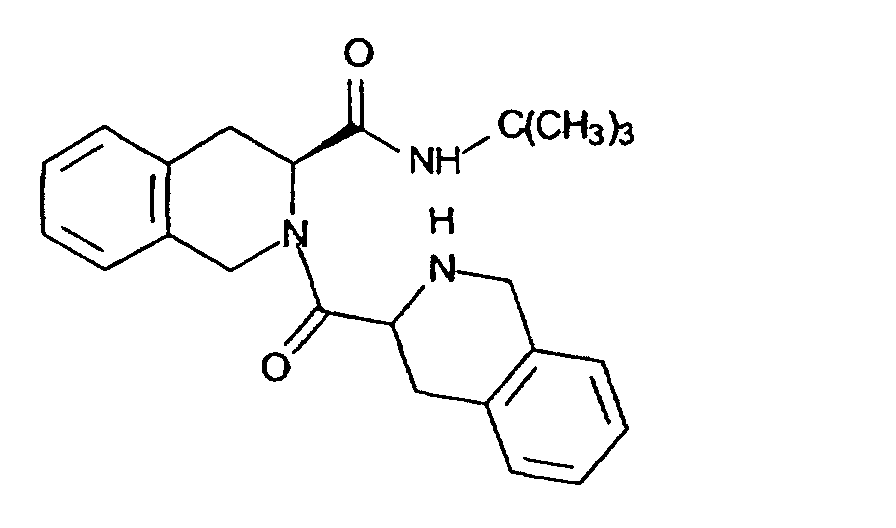
- the reaction between tert-butylamine and the NCA carried out according to the previously described methods produces a dimer by-product, whose formula is here-below reported, which is on the contrary produced in substantially reduced amounts if operating according to the method of the present invention.
- the reaction between NCA and tert-butylamine is carried out in an inert organic solvent, preferably toluene, THF, dioxane, methylene chloride, using from 1 to 10 moles of tert-butylamine, preferably from 3 to 5 moles, for each mole of NCA.
- an inert organic solvent preferably toluene, THF, dioxane, methylene chloride
- the NCA is generally suspended in 5 to 10 liters of solvent for 1 kg of NCA.
- the so-obtained suspension is then normally cooled to a temperature lower than -50°C, preferably at a temperature comprised between -80 and -50°C, even more preferably at -75 to -65°C.
- the tert-butylamine is then added maintaining the temperature below -50°C, preferably below - 55°C; the temperature is then raised until room temperature and maintained as such until reaction completion.
- the method for the manufacture of the NCA is not limiting for the purposes of the present invention and can be carried out according to the several methods reported in literature; the preferred method is however that disclosed in WO-A-00/00494 and wherein the (3S)-1,2,3,4-tetrahydroisoquinoline-3-carboxylic acid is reacted with triphosgene in dioxane at a starting concentration of 0.5 to 1.5 mol/l with 0.3 to 1.2 equivalents of triphosgene at temperatures of between +20 and +85°C.
- the NCA thus obtained is not isolated from the reactor; on the contrary, the solvent of the previous reaction is distilled off and the raw NCA is then directly suspended in the reaction solvent, preferably in toluene; normally 3000 to 5000 liters of solvent, preferably 3500 to 4500, are used for 500 kg of (3S)-1,2,3,4-tetrahydro-isoquinoline-3-carboxylic acid.
- reaction mixture is then cooled to about -70°C and the tert-butylamine is then added dropwise into the solution for a time period of 20 to 40 minutes, maintaining the temperature below -55°C; the temperature is then raised to about - 20°C in 20 to 40 minutes and it is then raised to +15 to +20°C still in 20 to 40 minutes. The temperature is then maintained as such for about 2 hours and water is added afterwards in order to quench the reaction.
- the end product is then isolated in accordance with conventional techniques; preferably it is precipitated from acidic water by addition of a base, generally soda.
- The(S)-N-tert-butyl-1,2,3,4-tetrahydroisoquinoline-3-carboxyamide can then be hydrogenated to N-tert-butyl-decahydro-(4aS,8aS)-isoquinoline-3(S)-carboxamide in accordance with conventional techniques as those described in US 5,256,783, US 5,587,481, EP-A-751128 and WO-A-00/00494, herein incorporated as a reference; the reaction is normally carried out in an organic polar solvent, preferably an alcohol, even more preferably isopropanol, in the presence of a reduction catalyst in heterogeneous phase, preferably rhodium supported on alumina.
- an organic polar solvent preferably an alcohol, even more preferably isopropanol
- a triphosgene solution (83 g, 0,28 mol) in dioxane (200 ml) has been added dropwise in 2 hours to a suspension of (3S)-1,2,3,4-tetrahydroisoquinoline-3-carboxylic acid (100 g, 0,564 mol) in dioxane (300 ml) under reflux.
- the mixture has then been maintained at reflux (100°C) under stirring for 30 minutes until complete dissolution.
- the solution has then been cooled to +75°C to +85°C in 10 minutes and distilled off under vacuum in 2 hours and 30 minutes, maintaining the temperature at +40°C, until a dense but stirrable paste was obtained.
- a solution of triphosgene (400 kg) dissolved in dioxane (1000 I) is added dropwise, with agitation, over a period of 2 hours to a mixture of (3S)-1,2,3,4-tetrahydroisoquinoline-3-carboxylic acid (500 kg) in dioxane (1500 I) heated to reflux. After one hour at that temperature, the whole is cooled to +40°C and distilled to leave a residue. The residue is taken up twice in toluene (300 l) and distilled off to leave a residue which is again taken up in toluene (3500 I).
- the so-obtained suspension is then cooled to -70°C and a solution of tert-butylamine (900 I) is added in about 30 minutes maintaining the temperature below -55°C.
- the temperature is then raised to about -20°C in 30 minutes and is raised to +15 to +20°C in 30 further minutes; it is then maintained as such for 2 other hours.
- the so-obtained (S)-N-tert-butyl-1,2,3,4-tetrahydroisoquinoline-3-carboxyamide is then dissolved in about 1800 liters of isopropanol and subsequently hydrogenated at 45 bar on Rh/Al 2 O 3 (5%, 8 kg) for 3-4 hours at a temperature of +70°C; the catalyst is then filtered and washed with isopropanol.
- the solvent is evaporated and the raw material is taken up with heptane; the solvent is evaporated and the raw material is taken up again with heptane (120 I) and cooled to +0 to +5°C for 1 hour.
- the final product is then obtained after filtration and washing with heptane as a white crystalline powder (map. 113 to 115°C), with a yield of 88%.
Landscapes
- Chemical & Material Sciences (AREA)
- Organic Chemistry (AREA)
- Health & Medical Sciences (AREA)
- Life Sciences & Earth Sciences (AREA)
- General Health & Medical Sciences (AREA)
- Medicinal Chemistry (AREA)
- Biochemistry (AREA)
- Biophysics (AREA)
- Genetics & Genomics (AREA)
- Molecular Biology (AREA)
- Proteomics, Peptides & Aminoacids (AREA)
- Communicable Diseases (AREA)
- Animal Behavior & Ethology (AREA)
- Oncology (AREA)
- Chemical Kinetics & Catalysis (AREA)
- General Chemical & Material Sciences (AREA)
- Nuclear Medicine, Radiotherapy & Molecular Imaging (AREA)
- Pharmacology & Pharmacy (AREA)
- Virology (AREA)
- Public Health (AREA)
- Veterinary Medicine (AREA)
- Pharmaceuticals Containing Other Organic And Inorganic Compounds (AREA)
- Low-Molecular Organic Synthesis Reactions Using Catalysts (AREA)
- Other In-Based Heterocyclic Compounds (AREA)
- Organic Low-Molecular-Weight Compounds And Preparation Thereof (AREA)
- Plural Heterocyclic Compounds (AREA)
Abstract
Description
- The present invention relates to a new process for the preparation of (S)-N-tert-butyl-1,2,3,4-tetrahydroisoquinoline-3-carboxamide, whose formula of structure is here below reported,and which is a key intermediate for the preparation of compounds having elevated pharmacological activity, which can be used in particular in the treatment and in the prevention of the infections caused by HIV.

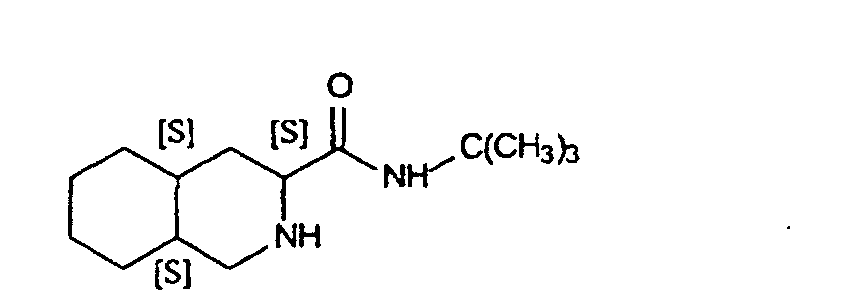
- In the greatest part of said antiviral drugs, the (S)-N-tert-butyl-1,2,3,4-tetrahydroisoquinoline-3-carboxamide is not used directly as such but, contrarily, is previously hydrogenated to form the N-tert-butyl-decahydro-(4aS,8aS)-isoquinolin-3(S)-carboxamide, whose formula of structure is here below reported,and which, by suitable substitutions at the isoquinoline nitrogen which will be obvious to any person skilled in the art, is in turn converted into the pharmacologically active derivative.
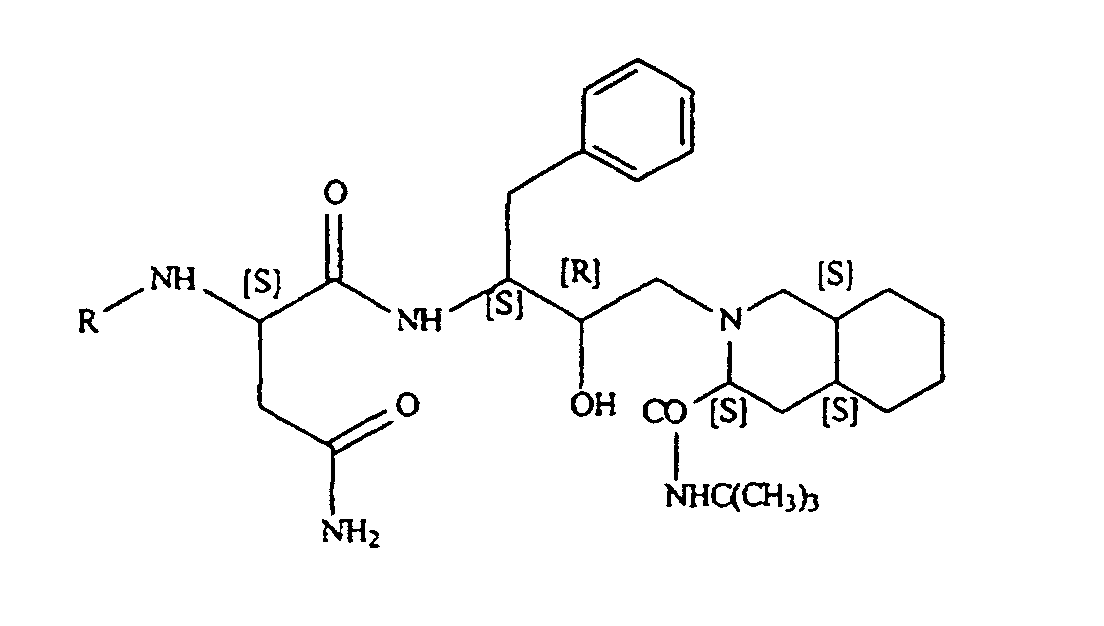
- In US 5,196,438, herein incorporated as a reference, pharmacologically active compounds are disclosed whose formula of structure is here below reportedand in which the decahydroisoquinoline residue derived from the N-tert-butyl-decahydro-(4aS,8aS)-isoquinolin-3(S)-carboxamide is immediately identifiable; among these, the derivative of most interest, and the structural formula of which is given below
 is known by the commercial name Saquinavir.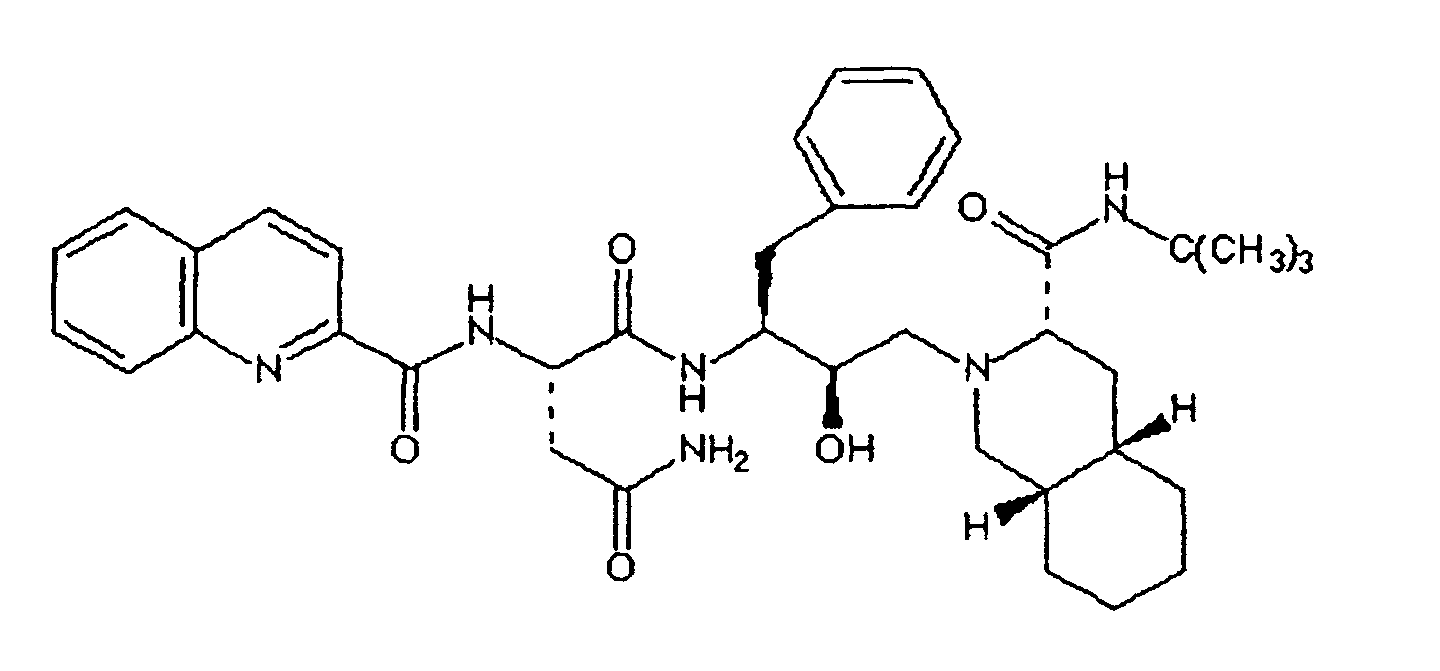
- Another anti-viral drug of substantial importance, which also contains the decahydroisoquinoline residue present in Saquinavir, is Nelfinavir, the structural formula of which is likewise given below

- Both Nelfinavir and Saquinavir are normally used in the form of the corresponding watersoluble salts and, in particular, in the form of the mesylated salts.
- In US 5,587,481 it is described a process for the manufacture of the (S)-N-tert-butyl-1,2,3,4-tetrahydroisoquinoline-3-carboxamide wherein the (3S)-1,2,3,4-tetrahydroisoquino-line-3-carboxylic acidis reacted with phosgene in ethyl acetate to produce the corresponding N-carboxyanhydride (NCA), here-below reported.

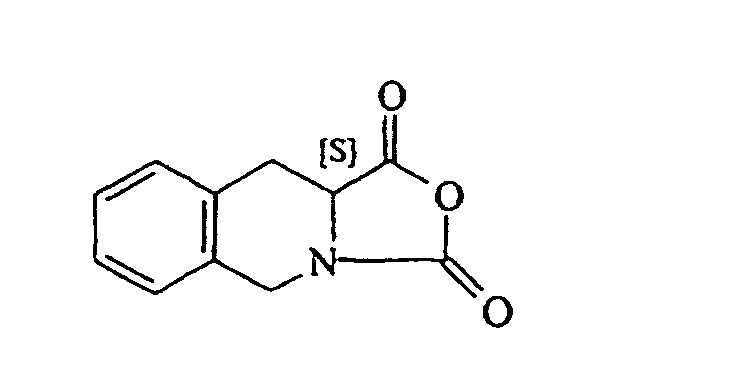
- The NCA is then directly reacted with tert-butylamine and subsequently hydrogenated to give the N-tert-butyl-decahydro-(4aS,8aS)-isoquinolin-3(S)-carboxamide. The process disclosed in US 5,587,481 is however characterized by drawbacks which cannot be neglected as low yields and, in particular, the fact of using phosgene, which is a toxic and highly dangerous gas.
- EP-A-751128 describes a similar synthesis process in which the conversion of the (3S)-1,2,3,4-tetrahydroisoquinoline-3-carboxylic acid into the corresponding NCA can be effected also with triphosgene. The advantages resulting from this process are clear because the use of triphosgene which, unlike phosgene, is not a toxic gas, permits complete safety of implementation with a consequent saving in operating costs and plant costs; triphosgene is also a solid compound which enables it to be used more accurately and therefore without the typical secondary reactions which may occur with the use of a gaseous reagent in excess.
- Finally, WO-A-00/00494 describes an implemented process for the synthesis of the (S)-N-tert-butyl-1,2,3,4-tetrahydroisoquinoline-3-carboxamide characterized in that the (3S)-1,2,3,4-tetrahydroisoquinoline-3-carboxylic acid is reacted with triphosgene in dioxane making it possible to obtain particularly high global yields also on an industrial scale.
- Both US 5,587,481, EP-A-751128 and WO-A-00/00494 present the common feature that the reaction between NCA and tert-butylamine is carried out at a starting temperature higher than -20°C.
- It has now been surprisingly found and it is the object of the present invention, that by carrying out the reaction between tert-butylamine and the NCA at a starting temperature lower than -50°C, the (S)-N-tert-butyl-1,2,3,4-tetrahydroisoquinoline-3-carboxamide is produced with a yield and a purity definitely higher than those obtainable by carrying out the reaction according to the previously described methods.
- In particular, as it will be appreciated by the following examples, the reaction carried out according to the present invention permits the obtainment of the (S)-N-tert-butyl-1,2,3,4-tetrahydroisoquinoline-3-carboxamide with yields of 15 to 20% higher than those obtainable by operating at a starting temperature higher than -20°C. Furthermore, the reaction between tert-butylamine and the NCA carried out according to the previously described methods produces a dimer by-product, whose formula is here-below reported,which is on the contrary produced in substantially reduced amounts if operating according to the method of the present invention.
- The reaction between NCA and tert-butylamine is carried out in an inert organic solvent, preferably toluene, THF, dioxane, methylene chloride, using from 1 to 10 moles of tert-butylamine, preferably from 3 to 5 moles, for each mole of NCA.
- The NCA is generally suspended in 5 to 10 liters of solvent for 1 kg of NCA. The so-obtained suspension is then normally cooled to a temperature lower than -50°C, preferably at a temperature comprised between -80 and -50°C, even more preferably at -75 to -65°C. The tert-butylamine is then added maintaining the temperature below -50°C, preferably below - 55°C; the temperature is then raised until room temperature and maintained as such until reaction completion.
- The method for the manufacture of the NCA is not limiting for the purposes of the present invention and can be carried out according to the several methods reported in literature; the preferred method is however that disclosed in WO-A-00/00494 and wherein the (3S)-1,2,3,4-tetrahydroisoquinoline-3-carboxylic acid is reacted with triphosgene in dioxane at a starting concentration of 0.5 to 1.5 mol/l with 0.3 to 1.2 equivalents of triphosgene at temperatures of between +20 and +85°C.
- In the preferred embodiment of the invention, the NCA thus obtained is not isolated from the reactor; on the contrary, the solvent of the previous reaction is distilled off and the raw NCA is then directly suspended in the reaction solvent, preferably in toluene; normally 3000 to 5000 liters of solvent, preferably 3500 to 4500, are used for 500 kg of (3S)-1,2,3,4-tetrahydro-isoquinoline-3-carboxylic acid. The reaction mixture is then cooled to about -70°C and the tert-butylamine is then added dropwise into the solution for a time period of 20 to 40 minutes, maintaining the temperature below -55°C; the temperature is then raised to about - 20°C in 20 to 40 minutes and it is then raised to +15 to +20°C still in 20 to 40 minutes. The temperature is then maintained as such for about 2 hours and water is added afterwards in order to quench the reaction.
- The end product is then isolated in accordance with conventional techniques; preferably it is precipitated from acidic water by addition of a base, generally soda.
- The(S)-N-tert-butyl-1,2,3,4-tetrahydroisoquinoline-3-carboxyamide can then be hydrogenated to N-tert-butyl-decahydro-(4aS,8aS)-isoquinoline-3(S)-carboxamide in accordance with conventional techniques as those described in US 5,256,783, US 5,587,481, EP-A-751128 and WO-A-00/00494, herein incorporated as a reference; the reaction is normally carried out in an organic polar solvent, preferably an alcohol, even more preferably isopropanol, in the presence of a reduction catalyst in heterogeneous phase, preferably rhodium supported on alumina.
- Those and other aspects of the invention will become clear from the following examples which are to be regarded purely as non-limiting illustrations of the invention.
- In the following table there are reported the results of experiments carried out in toluene on 5 g of isolated NCA (40 ml, K.F. = 0,02%, which means water content calculated with the Karl Fischer method) with 3 equivalents of tert-butylamine. The reactions have been carried out maintaining the temperatures indicated in column B for the whole time indicated in column D; only the temperature of test 8 was maintained at -40°C for the first hour and then raised to room temperature for the 3 following hours. The yields in solution were determined via HPLC.
A B C D E F test temp. (°C) t-BuNH2 addition time (min) total reaction time (hours) average yield (%) dimer (area%) 1 - 7°C 5 3 94,5 2,46 - 2,47 2 - 7°C 60 3 94,5 2,26 - 2,21 3 - 7°C 5 4 89,2 2,29 - 2,42 4 - 7°C 60 4 91,0 2,31 - 2,33 5 - 7°C 5 6 92,7 2,46 - 2,47 6 - 7°C 60 6 94,0 2,45 - 2,46 7 + 13°C 5 3 92,7 2,82 - 3,59 8 -40°C 1 hour 5 4 99,2 0,78 - 0,79 - As it can be appreciated from the data listed in the table, by carrying out the reaction between tert-butylamine and NCA at a starting temperature lower than -20°C, it is possible to obtain substantially higher yields and a presence of dimer by-product considerably lower than by operating at a starting temperature higher than -20°C.
- A triphosgene solution (83 g, 0,28 mol) in dioxane (200 ml) has been added dropwise in 2 hours to a suspension of (3S)-1,2,3,4-tetrahydroisoquinoline-3-carboxylic acid (100 g, 0,564 mol) in dioxane (300 ml) under reflux. The mixture has then been maintained at reflux (100°C) under stirring for 30 minutes until complete dissolution. The solution has then been cooled to +75°C to +85°C in 10 minutes and distilled off under vacuum in 2 hours and 30 minutes, maintaining the temperature at +40°C, until a dense but stirrable paste was obtained. The residue was then taken up twice with 100 ml of toluene and distilled off to give a stirrable paste. This was taken up again with 500 ml of toluene and cooled to -50°C; the t-butylamine (180 ml, 1,709 moles) was then added dropwise in 30 minutes under stirring and in an inert atmosphere.
- The temperature was then let to increase until +15°C in 1 hour, the temperature was maintained as such for 2 hours and 700 ml of water were then added. The organic phase was then extracted with water (800 ml) and HCI 30% at pH=1 and the product was thus precipitated for the aqueous layer by addition of NaOH 30%, filtered, washed with water and dried under vacuum. 112.4 grams of product were obtained.
- The results of this test are here-below listed
titer 99,11 % purity HPLC (A%) 99,32 % dimer (HPLC, A%) 0,36 % enantiomeric purity (A%) 98,9 % K.F. 0,21 % NaCI 0,24 % yield 85,03 % - The reaction of example 2 was repeated by changing the starting temperature and the time of t-butylamine dropwise addition only; the results are reported in the table.
test starting reaction temperature dropwise addition time (minutes) yield (%) dimer (area %) titer (%) purity (%) 2 -40 to -50°C 20 85 0.36 99.1 99.3 2a +10 to +15°C 90 71 3.8 98.6 96 2b -5 to -10°C 120 73 3.1 98.1 96.6 2c -5 to -10°C 120 73 1.3 99.8 98.6 - A solution of triphosgene (400 kg) dissolved in dioxane (1000 I) is added dropwise, with agitation, over a period of 2 hours to a mixture of (3S)-1,2,3,4-tetrahydroisoquinoline-3-carboxylic acid (500 kg) in dioxane (1500 I) heated to reflux. After one hour at that temperature, the whole is cooled to +40°C and distilled to leave a residue. The residue is taken up twice in toluene (300 l) and distilled off to leave a residue which is again taken up in toluene (3500 I).
- The so-obtained suspension is then cooled to -70°C and a solution of tert-butylamine (900 I) is added in about 30 minutes maintaining the temperature below -55°C. The temperature is then raised to about -20°C in 30 minutes and is raised to +15 to +20°C in 30 further minutes; it is then maintained as such for 2 other hours.
- The reaction is then quenched by adding demineralized water (3500 I); the organic phase is then extracted with water (3000 I) and HCI 30% (345 l), diluted with 2400 liters of water, treated with carbon, filtered and made basic with soda 30% until pH 11. The solid thus obtained is then filtered, washed with water and dried to give 524.4 kg of (S)-N-tert-butyl-1,2,3,4-tetrahydroisoquinoline-3-carboxyamide (yield 80%; dimer 1 to 2%) as white crystalline powder; purity > 97% (HPLC), titer > 98%.
- The so-obtained (S)-N-tert-butyl-1,2,3,4-tetrahydroisoquinoline-3-carboxyamide is then dissolved in about 1800 liters of isopropanol and subsequently hydrogenated at 45 bar on Rh/Al2O3 (5%, 8 kg) for 3-4 hours at a temperature of +70°C; the catalyst is then filtered and washed with isopropanol. The solvent is evaporated and the raw material is taken up with heptane; the solvent is evaporated and the raw material is taken up again with heptane (120 I) and cooled to +0 to +5°C for 1 hour.
- The final product is then obtained after filtration and washing with heptane as a white crystalline powder (map. 113 to 115°C), with a yield of 88%.
Claims (20)
- A process for the production of (S)-N-tert-butyl-1,2,3,4-tetrahydroisoquinoline-3-carboxamide comprising the reaction between tert-butylamine and the N-carboxyanhydride of formulain an organic inert solvent, characterized in that said reaction is carried out at a starting temperature lower than -50°C.

- A process according to claim 1 characterized in that said starting temperature is between -80 and -50°C.
- A process according to claim 2 characterized in that said starting temperature is between -75 and -65°C.
- A process according to claim 1 characterized in that said organic inert solvent is selected from toluene, THF, dioxane and CH2Cl2.
- A process according to claim 4 characterized in that said organic inert solvent is toluene.
- A process according to claim 1 characterized in that said N-carboxyanhydride is treated with 1 to 10 tert-butylamine equivalents.
- A process according to claim 6 characterized in that said N-carboxyanhydride is treated with 3 to 5 tert-butylamine equivalents.
- A process according to claim 1 characterized in that said reaction is carried out in 5 to 10 liters of organic inert solvent for 1 kg of N-carboxyanhydride.
- A process according to claim 1 wherein: (a) a solution of said N-carboxyanhydride in toluene is cooled to -75 to -65°C, (b) tert-butylamine is added to the solution dropwise for a time period of 20 to 40 minutes maintaining the temperature below -55°C, (c) the temperature is then raised to about -20°C in 20 to 40 minutes and (d) it is then raised to +15 to +20 °C in 20 to 40 minutes and (e) maintained as such until reaction completion.
- A process according to anyone of the previous claims wherein said N-carboxyanhydride is obtained from the reaction between (3S)-1,2,3,4-tetrahydroisoquinoline-3-carboxylic acid and triphosgene in an inert organic solvent.
- A process according to claim 10 characterized in that said inert organic solvent is dioxane.
- A process according to claim 10 characterized in that said reaction between (3S)-1,2,3,4-tetrahydroisoquinoline-3-carboxylic acid and triphosgene is carried out at a temperature comprised between +20 and +105°C, preferably under reflux.
- A process according to claim 10 characterized in that (3S)-1,2,3,4-tetrahydroisoquinoline-3-carboxylic acid is used at a starting concentration of 0.5-1.5 mol/l.
- A process according to claim 10 characterized in that (3S)-1,2,3,4-tetrahydroisoquinoline-3-carboxylic acid is treated with 0.3 to 1.2 triphosgene equivalents.
- A process according to claim 10 characterized in that said N-carboxyanhydride is suspended in 3000 to 5000 liters of solvent, preferably in 3500 to 4500, for 500 kg (3S)-1,2,3,4-tetrahydroisoquinoline-3-carboxylic acid.
- A process according to anyone of the previous claims wherein the so-obtained (S)-N-tert-butyl-1,2,3,4-tetrahydroisoquinoline-3-carboxyamide is converted into N-tertbutyldecahydro-(4aS,8aS)-isoquinolin-3(S)-carboxamide by catalytic hydrogenation.
- A process according to claim 16 characterized in that said catalytic hydrogenation is carried out in isopropanol in the presence of rhodium supported on alumina.
- A process for the manufacture of anti-viral drugs and of the corresponding saline derivatives characterized by comprising a process according to anyone of the previous claims.
- A process according to claim 18, characterized in that the anti-viral drugs are the following two compounds


- A process according to claim 19, characterized in that the salt derivatives of said antiviral drugs are mesylated salts.
Applications Claiming Priority (2)
| Application Number | Priority Date | Filing Date | Title |
|---|---|---|---|
| ITMI992457 | 1999-11-25 | ||
| IT1999MI002457A IT1313682B1 (en) | 1999-11-25 | 1999-11-25 | PROCEDURE FOR THE PREPARATION OF (S) -N-TERBUTYL-1,2,3,4-TETRAIDROISOCHINOLIN-3-CARBOXYAMIDE. |
Publications (2)
| Publication Number | Publication Date |
|---|---|
| EP1104755A1 EP1104755A1 (en) | 2001-06-06 |
| EP1104755B1 true EP1104755B1 (en) | 2004-10-06 |
Family
ID=11384015
Family Applications (1)
| Application Number | Title | Priority Date | Filing Date |
|---|---|---|---|
| EP00811108A Expired - Lifetime EP1104755B1 (en) | 1999-11-25 | 2000-11-22 | Process for the preparation of (S)-N-tertbutyl-1,2,3,4- tetrahydroisoquinoline-3-carboxamide |
Country Status (9)
| Country | Link |
|---|---|
| US (1) | US6433177B1 (en) |
| EP (1) | EP1104755B1 (en) |
| JP (1) | JP2001163860A (en) |
| KR (1) | KR20010051886A (en) |
| AT (1) | ATE278672T1 (en) |
| DE (1) | DE60014556T2 (en) |
| ES (1) | ES2228442T3 (en) |
| HU (1) | HUP0004717A2 (en) |
| IT (1) | IT1313682B1 (en) |
Families Citing this family (2)
| Publication number | Priority date | Publication date | Assignee | Title |
|---|---|---|---|---|
| CN1300115C (en) * | 2004-03-26 | 2007-02-14 | 厦门大学 | Method for synthesizing 1,2,3,4 ramification of tetrahydro-isoquinoline |
| WO2007075809A2 (en) * | 2005-12-22 | 2007-07-05 | Schering Corporation | Oxazoloisoquinoline derivatives as thrombin receptor antagonists |
Family Cites Families (6)
| Publication number | Priority date | Publication date | Assignee | Title |
|---|---|---|---|---|
| GB8927913D0 (en) * | 1989-12-11 | 1990-02-14 | Hoffmann La Roche | Amino acid derivatives |
| JP3204368B2 (en) * | 1995-06-30 | 2001-09-04 | 味の素株式会社 | Preparation of optically active amides |
| ES2135171T5 (en) * | 1995-06-30 | 2006-03-16 | Ajinomoto Co., Inc. | PROCEDURE TO PRODUCE OPTICALLY ACTIVE AMIDAS. |
| US5587481A (en) * | 1996-02-20 | 1996-12-24 | The Monsanto Company | Preparation of (S)-decahydroisoquinoline-3-carboxylic acid t-butylamide |
| JPH10291979A (en) | 1997-04-21 | 1998-11-04 | Ichikawa Gosei Kagaku Kk | Production of 1,2,3,4-tetrahydroisoquinoline-3-carboxylic acid tertiary butyl amide |
| IT1301825B1 (en) * | 1998-06-26 | 2000-07-07 | Archimica Spa | PROCEDURE FOR THE PREPARATION OF (S) -N-TERBUTYL-1,2,3,4-TETRAIDROISOCHINOLIN-3-CARBOXYAMIDE. |
-
1999
- 1999-11-25 IT IT1999MI002457A patent/IT1313682B1/en active
-
2000
- 2000-01-06 US US09/478,657 patent/US6433177B1/en not_active Expired - Fee Related
- 2000-11-22 EP EP00811108A patent/EP1104755B1/en not_active Expired - Lifetime
- 2000-11-22 ES ES00811108T patent/ES2228442T3/en not_active Expired - Lifetime
- 2000-11-22 DE DE60014556T patent/DE60014556T2/en not_active Expired - Fee Related
- 2000-11-22 AT AT00811108T patent/ATE278672T1/en not_active IP Right Cessation
- 2000-11-23 KR KR1020000069801A patent/KR20010051886A/en not_active Abandoned
- 2000-11-24 HU HU0004717A patent/HUP0004717A2/en unknown
- 2000-11-24 JP JP2000357141A patent/JP2001163860A/en active Pending
Also Published As
| Publication number | Publication date |
|---|---|
| ITMI992457A0 (en) | 1999-11-25 |
| DE60014556T2 (en) | 2005-02-03 |
| ES2228442T3 (en) | 2005-04-16 |
| JP2001163860A (en) | 2001-06-19 |
| DE60014556D1 (en) | 2004-11-11 |
| US6433177B1 (en) | 2002-08-13 |
| KR20010051886A (en) | 2001-06-25 |
| ATE278672T1 (en) | 2004-10-15 |
| HU0004717D0 (en) | 2001-02-28 |
| HUP0004717A2 (en) | 2002-11-28 |
| IT1313682B1 (en) | 2002-09-09 |
| ITMI992457A1 (en) | 2001-05-25 |
| EP1104755A1 (en) | 2001-06-06 |
Similar Documents
| Publication | Publication Date | Title |
|---|---|---|
| AU2008355336B2 (en) | Crystalline form of tenofovir disoproxil and a process for its preparation | |
| WO1993008184A1 (en) | Hiv protease inhibitors | |
| JPH10501796A (en) | N- (3-amino-2-hydroxybutyl) sulfonamide derivatives as HIV protease inhibitors | |
| CA2221375A1 (en) | Process for resolving chiral acids with 1-aminoindan-2-ols | |
| EP0928787B1 (en) | Process for the preparation of 3-amino-pyrrolidine derivatives | |
| EP1104755A1 (en) | Process for the preparation of (S)-N-tertbutyl-1,2,3,4- tetrahydroisoquinoline-3-carboxamide | |
| EP0902781B1 (en) | Preparation of (s)-decahydroisoquinoline-3-carboxylic acid t-butylamide | |
| HK1037190A (en) | Process for the preparation of (s)-n-tertbutyl-1,2,3,4-tetrahydroisoquinoline-3-carboxamide | |
| EP0751128B2 (en) | Process for producing optically active amides | |
| JP5729512B2 (en) | Production intermediate of tetrahydropyran compounds | |
| US6340760B1 (en) | Process for the preparation of (S)-N-tert-butyl-1,2,3,4-tetrahydroisoquinoline-3-carboxyamide | |
| IL41409A (en) | Lysergic acid amides and process for their preparation | |
| EP0991630A1 (en) | Crystalline roxifiban | |
| IE912005A1 (en) | "New process for the industrial preparation of 4-chloro 3-sulphamoyl-N-(2,3-dihydro-2-methyl-1H-indol-1- yl)- benzamide from 2,3-dihydro-2-methyl-1H-indole and hydrox ylamine-O-sulphonic acid" | |
| KR100245205B1 (en) | Process for preparing entaiomerically pure fluorinated epoxychromans | |
| JP2008545006A (en) | Method for synthesizing ACE inhibitor | |
| JP3204368B2 (en) | Preparation of optically active amides | |
| WO2006134612A1 (en) | A process for the preparation of saquinavir using novel intermediate | |
| US20040034056A1 (en) | Method of preparation of (s)-n-tert-butyl-1,2,3,4-tetrahydroisoquinoline-3-carboxamide | |
| CZ319199A3 (en) | HIV protease inhibitors | |
| CA2166372A1 (en) | Pseudopeptides having a trifluoromethyl-substituted 2-azabicyclooctane | |
| JPS6261968A (en) | Production of tetrahydro-4-hydroxyisoquinoline derivative |
Legal Events
| Date | Code | Title | Description |
|---|---|---|---|
| PUAI | Public reference made under article 153(3) epc to a published international application that has entered the european phase |
Free format text: ORIGINAL CODE: 0009012 |
|
| AK | Designated contracting states |
Kind code of ref document: A1 Designated state(s): AT BE CH CY DE DK ES FI FR GB GR IE IT LI LU MC NL PT SE TR |
|
| AX | Request for extension of the european patent |
Free format text: AL;LT;LV;MK;RO;SI |
|
| RAP1 | Party data changed (applicant data changed or rights of an application transferred) |
Owner name: CLARIANT LIFE SCIENCE MOLECULES (ITALIA) S.P.A. |
|
| 17P | Request for examination filed |
Effective date: 20011206 |
|
| AKX | Designation fees paid |
Free format text: AT BE CH CY DE DK ES FI FR GB GR IE IT LI LU MC NL PT SE TR |
|
| 17Q | First examination report despatched |
Effective date: 20030520 |
|
| GRAP | Despatch of communication of intention to grant a patent |
Free format text: ORIGINAL CODE: EPIDOSNIGR1 |
|
| GRAS | Grant fee paid |
Free format text: ORIGINAL CODE: EPIDOSNIGR3 |
|
| GRAA | (expected) grant |
Free format text: ORIGINAL CODE: 0009210 |
|
| AK | Designated contracting states |
Kind code of ref document: B1 Designated state(s): AT BE CH CY DE DK ES FI FR GB GR IE IT LI LU MC NL PT SE TR |
|
| PG25 | Lapsed in a contracting state [announced via postgrant information from national office to epo] |
Ref country code: NL Free format text: LAPSE BECAUSE OF FAILURE TO SUBMIT A TRANSLATION OF THE DESCRIPTION OR TO PAY THE FEE WITHIN THE PRESCRIBED TIME-LIMIT Effective date: 20041006 Ref country code: AT Free format text: LAPSE BECAUSE OF FAILURE TO SUBMIT A TRANSLATION OF THE DESCRIPTION OR TO PAY THE FEE WITHIN THE PRESCRIBED TIME-LIMIT Effective date: 20041006 Ref country code: TR Free format text: LAPSE BECAUSE OF FAILURE TO SUBMIT A TRANSLATION OF THE DESCRIPTION OR TO PAY THE FEE WITHIN THE PRESCRIBED TIME-LIMIT Effective date: 20041006 Ref country code: SE Free format text: LAPSE BECAUSE OF FAILURE TO SUBMIT A TRANSLATION OF THE DESCRIPTION OR TO PAY THE FEE WITHIN THE PRESCRIBED TIME-LIMIT Effective date: 20041006 Ref country code: FI Free format text: LAPSE BECAUSE OF FAILURE TO SUBMIT A TRANSLATION OF THE DESCRIPTION OR TO PAY THE FEE WITHIN THE PRESCRIBED TIME-LIMIT Effective date: 20041006 Ref country code: BE Free format text: LAPSE BECAUSE OF FAILURE TO SUBMIT A TRANSLATION OF THE DESCRIPTION OR TO PAY THE FEE WITHIN THE PRESCRIBED TIME-LIMIT Effective date: 20041006 Ref country code: CY Free format text: LAPSE BECAUSE OF FAILURE TO SUBMIT A TRANSLATION OF THE DESCRIPTION OR TO PAY THE FEE WITHIN THE PRESCRIBED TIME-LIMIT Effective date: 20041006 |
|
| REG | Reference to a national code |
Ref country code: GB Ref legal event code: FG4D |
|
| REG | Reference to a national code |
Ref country code: CH Ref legal event code: NV Representative=s name: CLARIANT INTERNATIONAL LTD. Ref country code: CH Ref legal event code: EP |
|
| REG | Reference to a national code |
Ref country code: IE Ref legal event code: FG4D |
|
| REF | Corresponds to: |
Ref document number: 60014556 Country of ref document: DE Date of ref document: 20041111 Kind code of ref document: P |
|
| PG25 | Lapsed in a contracting state [announced via postgrant information from national office to epo] |
Ref country code: LU Free format text: LAPSE BECAUSE OF NON-PAYMENT OF DUE FEES Effective date: 20041122 |
|
| PG25 | Lapsed in a contracting state [announced via postgrant information from national office to epo] |
Ref country code: MC Free format text: LAPSE BECAUSE OF NON-PAYMENT OF DUE FEES Effective date: 20041130 |
|
| PG25 | Lapsed in a contracting state [announced via postgrant information from national office to epo] |
Ref country code: GR Free format text: LAPSE BECAUSE OF FAILURE TO SUBMIT A TRANSLATION OF THE DESCRIPTION OR TO PAY THE FEE WITHIN THE PRESCRIBED TIME-LIMIT Effective date: 20050106 Ref country code: DK Free format text: LAPSE BECAUSE OF FAILURE TO SUBMIT A TRANSLATION OF THE DESCRIPTION OR TO PAY THE FEE WITHIN THE PRESCRIBED TIME-LIMIT Effective date: 20050106 |
|
| ET | Fr: translation filed | ||
| NLV1 | Nl: lapsed or annulled due to failure to fulfill the requirements of art. 29p and 29m of the patents act | ||
| REG | Reference to a national code |
Ref country code: ES Ref legal event code: FG2A Ref document number: 2228442 Country of ref document: ES Kind code of ref document: T3 |
|
| PLBE | No opposition filed within time limit |
Free format text: ORIGINAL CODE: 0009261 |
|
| STAA | Information on the status of an ep patent application or granted ep patent |
Free format text: STATUS: NO OPPOSITION FILED WITHIN TIME LIMIT |
|
| 26N | No opposition filed |
Effective date: 20050707 |
|
| PG25 | Lapsed in a contracting state [announced via postgrant information from national office to epo] |
Ref country code: PT Free format text: LAPSE BECAUSE OF NON-PAYMENT OF DUE FEES Effective date: 20050306 |
|
| PGFP | Annual fee paid to national office [announced via postgrant information from national office to epo] |
Ref country code: DE Payment date: 20071115 Year of fee payment: 8 Ref country code: ES Payment date: 20071219 Year of fee payment: 8 |
|
| PGFP | Annual fee paid to national office [announced via postgrant information from national office to epo] |
Ref country code: CH Payment date: 20071114 Year of fee payment: 8 |
|
| PGFP | Annual fee paid to national office [announced via postgrant information from national office to epo] |
Ref country code: FR Payment date: 20071108 Year of fee payment: 8 Ref country code: GB Payment date: 20071121 Year of fee payment: 8 |
|
| REG | Reference to a national code |
Ref country code: HK Ref legal event code: WD Ref document number: 1037190 Country of ref document: HK |
|
| PGFP | Annual fee paid to national office [announced via postgrant information from national office to epo] |
Ref country code: IT Payment date: 20080529 Year of fee payment: 8 |
|
| REG | Reference to a national code |
Ref country code: CH Ref legal event code: PL |
|
| GBPC | Gb: european patent ceased through non-payment of renewal fee |
Effective date: 20081122 |
|
| REG | Reference to a national code |
Ref country code: IE Ref legal event code: MM4A |
|
| PG25 | Lapsed in a contracting state [announced via postgrant information from national office to epo] |
Ref country code: IT Free format text: LAPSE BECAUSE OF NON-PAYMENT OF DUE FEES Effective date: 20081122 |
|
| PGFP | Annual fee paid to national office [announced via postgrant information from national office to epo] |
Ref country code: IE Payment date: 20071113 Year of fee payment: 8 |
|
| REG | Reference to a national code |
Ref country code: FR Ref legal event code: ST Effective date: 20090731 |
|
| PG25 | Lapsed in a contracting state [announced via postgrant information from national office to epo] |
Ref country code: DE Free format text: LAPSE BECAUSE OF NON-PAYMENT OF DUE FEES Effective date: 20090603 Ref country code: LI Free format text: LAPSE BECAUSE OF NON-PAYMENT OF DUE FEES Effective date: 20081130 Ref country code: CH Free format text: LAPSE BECAUSE OF NON-PAYMENT OF DUE FEES Effective date: 20081130 Ref country code: IE Free format text: LAPSE BECAUSE OF NON-PAYMENT OF DUE FEES Effective date: 20081124 |
|
| PG25 | Lapsed in a contracting state [announced via postgrant information from national office to epo] |
Ref country code: GB Free format text: LAPSE BECAUSE OF NON-PAYMENT OF DUE FEES Effective date: 20081122 |
|
| REG | Reference to a national code |
Ref country code: ES Ref legal event code: FD2A Effective date: 20081124 |
|
| PG25 | Lapsed in a contracting state [announced via postgrant information from national office to epo] |
Ref country code: ES Free format text: LAPSE BECAUSE OF NON-PAYMENT OF DUE FEES Effective date: 20081124 |
|
| PG25 | Lapsed in a contracting state [announced via postgrant information from national office to epo] |
Ref country code: FR Free format text: LAPSE BECAUSE OF NON-PAYMENT OF DUE FEES Effective date: 20081130 |