EP1104166A2 - Data embedding apparatus, data extracting apparatus, and methods therefor, and recording medium having such methods recorded thereon - Google Patents

Data embedding apparatus, data extracting apparatus, and methods therefor, and recording medium having such methods recorded thereon Download PDF

Info

Publication number
EP1104166A2
EP1104166A2 EP00301721A EP00301721A EP1104166A2 EP 1104166 A2 EP1104166 A2 EP 1104166A2 EP 00301721 A EP00301721 A EP 00301721A EP 00301721 A EP00301721 A EP 00301721A EP 1104166 A2 EP1104166 A2 EP 1104166A2
Authority
EP
European Patent Office
Prior art keywords
data
information storing
storing region
color information
region
Prior art date
Legal status (The legal status is an assumption and is not a legal conclusion. Google has not performed a legal analysis and makes no representation as to the accuracy of the status listed.)
Ceased
Application number
EP00301721A
Other languages
German (de)
French (fr)
Other versions
EP1104166A3 (en
Inventor
Takashi Hitachi Ltd. Intel. Prop. Group Shinoda
Nobuharu Hitachi Ltd. Intel. Prop. Group Miura
Yoh Hitachi Ltd. Intel. Prop. Group Miyamoto
Current Assignee (The listed assignees may be inaccurate. Google has not performed a legal analysis and makes no representation or warranty as to the accuracy of the list.)
Hitachi Ltd
Original Assignee
Hitachi Ltd
Priority date (The priority date is an assumption and is not a legal conclusion. Google has not performed a legal analysis and makes no representation as to the accuracy of the date listed.)
Filing date
Publication date
Application filed by Hitachi Ltd filed Critical Hitachi Ltd
Publication of EP1104166A2 publication Critical patent/EP1104166A2/en
Publication of EP1104166A3 publication Critical patent/EP1104166A3/en
Ceased legal-status Critical Current

Links

Images

Classifications

    • GPHYSICS
    • G06COMPUTING OR CALCULATING; COUNTING
    • G06TIMAGE DATA PROCESSING OR GENERATION, IN GENERAL
    • G06T1/00General purpose image data processing
    • G06T1/0021Image watermarking
    • HELECTRICITY
    • H04ELECTRIC COMMUNICATION TECHNIQUE
    • H04NPICTORIAL COMMUNICATION, e.g. TELEVISION
    • H04N1/00Scanning, transmission or reproduction of documents or the like, e.g. facsimile transmission; Details thereof
    • H04N1/32Circuits or arrangements for control or supervision between transmitter and receiver or between image input and image output device, e.g. between a still-image camera and its memory or between a still-image camera and a printer device
    • H04N1/32101Display, printing, storage or transmission of additional information, e.g. ID code, date and time or title
    • H04N1/32144Display, printing, storage or transmission of additional information, e.g. ID code, date and time or title embedded in the image data, i.e. enclosed or integrated in the image, e.g. watermark, super-imposed logo or stamp
    • H04N1/32149Methods relating to embedding, encoding, decoding, detection or retrieval operations
    • H04N1/32309Methods relating to embedding, encoding, decoding, detection or retrieval operations in colour image data
    • HELECTRICITY
    • H04ELECTRIC COMMUNICATION TECHNIQUE
    • H04NPICTORIAL COMMUNICATION, e.g. TELEVISION
    • H04N1/00Scanning, transmission or reproduction of documents or the like, e.g. facsimile transmission; Details thereof
    • H04N1/32Circuits or arrangements for control or supervision between transmitter and receiver or between image input and image output device, e.g. between a still-image camera and its memory or between a still-image camera and a printer device
    • H04N1/32101Display, printing, storage or transmission of additional information, e.g. ID code, date and time or title
    • H04N1/32144Display, printing, storage or transmission of additional information, e.g. ID code, date and time or title embedded in the image data, i.e. enclosed or integrated in the image, e.g. watermark, super-imposed logo or stamp
    • H04N1/32149Methods relating to embedding, encoding, decoding, detection or retrieval operations
    • H04N1/32347Reversible embedding, i.e. lossless, invertible, erasable, removable or distorsion-free embedding
    • GPHYSICS
    • G06COMPUTING OR CALCULATING; COUNTING
    • G06TIMAGE DATA PROCESSING OR GENERATION, IN GENERAL
    • G06T2201/00General purpose image data processing
    • G06T2201/005Image watermarking
    • G06T2201/0051Embedding of the watermark in the spatial domain
    • GPHYSICS
    • G06COMPUTING OR CALCULATING; COUNTING
    • G06TIMAGE DATA PROCESSING OR GENERATION, IN GENERAL
    • G06T2201/00General purpose image data processing
    • G06T2201/005Image watermarking
    • G06T2201/0061Embedding of the watermark in each block of the image, e.g. segmented watermarking

Definitions

  • a luminance value of pixels, a frequency component of an image, or the like is changed in such a portion in which even if data is changed, the change is not visually perceptible.
  • Information is embedded by representing a bit value "0" or "1” or the like in the form of change in luminance value or frequency component.
  • the first index number of the data 502 within the pixel information storing region corresponding to the bit value "1" of the embedded data 501 is two.
  • 128 is added to two, so that the index number becomes 130 after the change.
  • all index numbers corresponding to the bit value "1" of the embedded data 501 are one by one increased by 128 in a similar manner. In this way, the information is embedded into the image data by changing the index numbers of the data 502 within the pixel information storing region.

Landscapes

  • Engineering & Computer Science (AREA)
  • Multimedia (AREA)
  • Signal Processing (AREA)
  • Physics & Mathematics (AREA)
  • General Physics & Mathematics (AREA)
  • Theoretical Computer Science (AREA)
  • Editing Of Facsimile Originals (AREA)
  • Image Processing (AREA)
  • Color Image Communication Systems (AREA)

Abstract

An intended image data structure (202) is assumed to have a color information storing region (203) and a pixel information storing region (206) as its components. First, consider that the color information storing region within the image data structure is divided into a plurality of subregions (401, 402), and a corresponding bit value (501) is defined for each of the subregions. Next, an index number stored for each of pixels within the pixel information storing region is changed to an index number (502) belonging to a subregion corresponding to a bit value of information to be embedded. In this way, one bit or more of information can be embedded for each pixel. Thus, a large amount of information can be embedded into a small-size image composed of simple shapes and having a small number of colors without degrading the image quality, and the information can be extracted from the image in which it has been embedded.

Description

The present invention relates generally to a data embedding apparatus for embedding arbitrary information into data, an apparatus for extracting embedded data, and methods therefor, and a computer readable recording medium recording the methods, and more particularly to electronic watermark techniques for embedding information into an image.
In an electronic watermark technique applied to image data, a luminance value of pixels, a frequency component of an image, or the like is changed in such a portion in which even if data is changed, the change is not visually perceptible. Information is embedded by representing a bit value "0" or "1" or the like in the form of change in luminance value or frequency component.
Since an image embedded with information must not present any visual change therein, when compared with its original image, the conventional electronic watermark technique has the following two requirements:
  • 1) An image into which a watermark is embedded is a digital content of a relatively large size which is composed of rather complicated shapes (or-patterns) in a large number of colors, as represented by photographs, pictures and so on; and
  • 2) A small amount of information is embedded. Conditions required to the electronic watermark techniques are described, for example, in Kobayashi et al., "Data Hiding Using the Nature of Neighboring Pixels - Statistical Nature of Neighboring Pixels", Transactions of 56th National Meeting of Institute of Information Processing, pp.3-37 to 3-38, 1998.
  • When the conventional electronic watermark technique is applied to an image composed of simple shapes (or patterns) and having a small number of colors, as represented by a logo mark of a company or the like, even a small change in pixel or frequency component of the image will result in a visually perceptible degradation of the image quality. In addition, for embedding a large amount of information into an image of a relatively small size, the luminance value of pixels, frequency components of an image, or the like must be largely changed, thereby causing a significant degradation of image quality.
    It is an object of the present invention to provide a data embedding apparatus, a data extracting apparatus, and methods therefor, and a recording medium having recorded thereon the methods, which are capable of embedding a large amount of information into an image of a relatively small size composed of simple shapes (or patterns) and having a small number of colors without causing any degradation of the image quality even in comparison with the original image.
    In a first aspect, the present invention provides means according to Claim 1.
    It should be noted however that an image data structure intended by the present invention is assumed to have, as its components, a color information storing region for managing all colors used in an image in order of index numbers, and a pixel information storing region for indirectly specifying used colors by assigning the index number to each pixel.
    First, consider that the color information storing region within the image data structure is divided into a plurality of subregions, and a corresponding bit value is defined for each of the subregions. Thus, for a color defined by a certain index number, a corresponding bit value can be identified by identifying a subregion in which the color is stored.
    Next, an index number stored for each of pixels within the pixel information storing region is changed to an index number belonging to a subregion corresponding to a bit value of information to be embedded. In this way, one bit or more of information (depending on a number into which the color information storing region is divided) can be embedded for each pixel.
    Also, information embedded by the foregoing means can be extracted by retrieving index numbers stored in the pixel information storing region, and identifying bit values corresponding to subregions in which the index numbers are contained.
    Further, the present invention can be widely distributed on the market by programming the foregoing information embedding method into computer executable codes, and recording the codes on computer readable recording media such as magnetic disks, optical disks and so on, or through a recording medium which has recorded thereon an image that has been embedded with information by the embedding method.
    BRIEF DESCRIPTION OF THE DRAWINGS
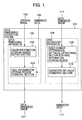
  • Fig. 1 is a block diagram illustrating an embodiment of a system comprising a data embedding apparatus and a data extracting apparatus for embedding and extracting data into and from an image according to the present invention;
  • Figs. 2A, 2B are a diagram and a table showing an example of an image data structure composed of a color information storing region, a pixel information storing region and a region division number storing region;
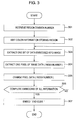
  • Fig. 3 is a flow chart illustrating an embodiment of a method of embedding data into an image according to the present invention;
  • Fig. 4 is a diagram showing an embodiment of editing of the color information storing region within the image data structure;
  • Fig. 5 is a diagram showing an embodiment for changing index numbers in the pixel information storing region within the image data structure;
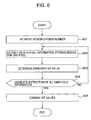
  • Fig. 6 is a flow chart illustrating a method of extracting data from an image according to an embodiment of the present invention; and
  • Fig. 7 is a block diagram illustrating an embodiment in which the present invention is applied to image data recorded on a recording medium.
  • DETAILED DESCRIPTION OF THE EMBODIMENTS
    Embodiments of the present invention will hereinafter be described with reference to the accompanying drawings. It should be understood that the following description merely illustrates exemplary embodiments of the present invention, and is not intended to limit the present invention.
    Fig. 1 illustrates in block diagram an embodiment of a system configuration according to the present invention. A data embedding/extracting system 101 according to the present invention may be implemented on an electronic computing device such as a personal computer, a workstation or the like, and is composed of a data embedding apparatus 102 comprising a data embedding method according to the present invention, and a data extracting apparatus 108.
    The data embedding apparatus 102, which comprises a color information storing region editing section 103 and a pixel information storing region changing section 104, receives an original image 105 as multimedia data and an embedded data 106, and outputs a data embedded image 107.
    The data extracting apparatus 108, which comprises an index number determining (bit value extracting) section 109 for a pixel information storing region, and a combining section 110 for combining extracted bit values, receives a data embedded image 111, and outputs an embedded data 112.
    It should be noted that while this embodiment implements the data embedding apparatus 101 and the data extracting apparatus 102 on the same electronic computing device, the respective apparatus may be implemented on separate electronic computing devices.
    Figs. 2A, 2B show an example of an image data structure which has a color information storing region, a pixel information storing region, and a region division number storing region, which are a prerequisite for implementing the present invention.
    In a display image 201 represented by three vertical pixels and three horizontal pixels (the total number of pixels are nine), an actual data structure 202 is assumed to be composed of a color information storing region 203, a pixel information storing region 206, and a region division number storing region 207.
    It should be noted that the data structure may additionally store header information indicative of a variety of information on image data, and so on, separately from the color information storing region 203, the pixel information storing region 206 and the region division number storing region 207. The data structure 202 is stored in a storing section in which the data structure is stored. The color information storing region 203, the pixel information storing region 206 and the region division number storing region 207 may be stored in separate storing section from one another.
    Assume that the color information storing region 203 within the data structure 202 has the capability of storing 256 colors of color information at maximum. In this event, index numbers 204 are arranged in order from (0) to (255), and color information 205 is individually stored for each index number. Here, the value of each color information is represented by a value of a total of 24 bits (zero to approximately 16,770,000 in decimal representation) composed of eight bits each of R (red), G (green) and B (blue) components. Stated another way, image data having the structure shown in the above example can utilize 256 colors within approximately 16,770,000 colors.
    The pixel information storing region 206 selects a desired color for each pixel, one by one, from the color information storing region 203, and stores its index number (0 - 255). As shown, index numbers corresponding to colors for a total of nine pixels of the display image 201 are specified in order.
    The region division number storing region 207 stores a value which indicates into which subregions the color information storing region 203 is divided during the processing for embedding data into the image according to the present invention. Thus, this region may be eliminated if the division number for the color information storing region 203 is fixed.
    Fig. 3 is a flow chart illustrating a method of embedding data into an image according to the present invention.
    At step 301, the division number for the color information storing region 203 is retrieved from the region division number storing region 207. At step 302, data in the color information storing region 203 is edited to define a bit value corresponded to each subregion. At step 303, one bit of data embedded into image data is extracted. At step 304, one pixel of the image data (index number) is extracted from the pixel information storing region 206 in which the pixel data is stored.
    At step 305, the image data (index number) extracted at step 304 is changed to the corresponding value defined at step 302 based on the bit value extracted at step 303. At step 306, it is determined whether or not all data have been embedded. If not, step 303 through step 305 are repeated.
    When all data have been embedded, an end code is embedded at step 307. The end code refers to a bit sequence used to explicitly indicate the end position of the embedded data.
    Fig. 4 shows a specific embodiment of a procedure for editing the color information storing region 203 within the image data structure 202.
    This embodiment will be described only for a particular case where the color information storing region is divided into two. As shown in Fig. 4, assume that the color information storage region for 256 colors is divided into two subregions 401, 402 each for 128 colors. It should be noted that this division does not involve any actual manipulation, modification, or the like on the image data structure itself.
    In this event, the color information storing region is edited such that in the two subregions 401, 402, the values of colors and the order in which they are stored therein are identical. As shown in Fig. 4, this means that a color stored at an index number i (0 • i • 127) is made identical to a color stored at an index i+128. In this case, data in the subregion 401 for 128 colors may be directly duplicated to the subregion 402. However, this editing processing is not necessary if it is assumed that a color information storing region previously edited as described above has been prepared beforehand.
    Here, bit values are defined in correspondence to the two divided subregions. For example, a bit value corresponding to the subregion 401 is defined to be "0"; and a bit value corresponding to the subregion 402, "1." Fig. 5 shows a specific embodiment of a section for changing the index number for the image information storing region in the image data structure.
    With the foregoing color information storing region editing section 103, information is embedded into image data whose color information storing region is divided into two subregions. As an example, assume that 4-bit information is embedded into image data composed of three horizontal pixels and three vertical pixels (the total number of pixels is nine). Bit values of embedded data 501 is arranged in the order of "1010." Here, after embedding the information "1010," an end code 503 is added to the embedded data 501 for explicitly indicating the end position. In this embodiment, as shown, the end code 503 is defined to be "11" provisionally. It should be noted however that the end code may not be embedded if the number of embedded bits (four in this embodiment) is described in a header or the like of the image data.
    Next, consider an original image into which data may be embedded.
    Data 502 within a pixel information storing region of the original image specify index numbers within the color information storing region for a total of nine pixels, and with the index numbers, a color is indirectly specified for each pixel. In this event, assume that index numbers specified by the data 502 within the pixel information storing region have been all created within the subregion 401 in Fig. 4 (within the index numbers 0 - 127, i.e., the number of maximally available colors is 128).
    Here, the embedded data 501 is compared with the data 502 within the pixel information storing region in order from the beginning. In Fig. 5, portions surrounded by broken lines indicate portions which contain the embedded data 501 having a bit value "1," and an index number of the data 502 within the pixel information storing region corresponding thereto. As previously defined, corresponding to the bit value "1" is the subregion 402 in Fig. 4. Therefore, in the data 502 within the pixel information storing region, index numbers corresponding to the bit value "1" of the embedded data 501 may be increased by 128.
    For example, the first index number of the data 502 within the pixel information storing region corresponding to the bit value "1" of the embedded data 501 is two. In this case, 128 is added to two, so that the index number becomes 130 after the change. Subsequently, all index numbers corresponding to the bit value "1" of the embedded data 501 are one by one increased by 128 in a similar manner. In this way, the information is embedded into the image data by changing the index numbers of the data 502 within the pixel information storing region.
    In this embodiment, it is possible to store 1-bit information per pixel. For example, when the foregoing means is applied to original image data of a relatively small size having 128 horizontal pixels and 128 vertical pixels, which can be created with a number of color not more than 128, the total number of pixels is 16,384, so that a maximum value of embedded data is 16,384 bit (2,048 bytes).
    It has been previously shown that a color stored at an index number i (0•i•127) and a color stored at an index number i+128 are edited to be completely the same color in the color information storing regions divided into two subregions. Thus, even if the index numbers are changed by the aforementioned means, the image will not apparently change.
    Fig. 6 is a flow chart illustrating a method of extracting data embedded in an image.
    First, at step 601, a division number for the color information storing region is retrieved from the region division number storing region. At step 602, data (index number) in the pixel information storing region is extracted for one pixel. At step 603, the extracted data is examined with respect to a bit value embedded therein. Here, when the index number extracted at step 602 is i•127, the embedded bit value is determined to be "0." Conversely, when the index number is i•128, the embedded bit value is determined to be "1."
    At step 604, it is checked whether the end code appears in the extracted data. Step 602 and step 603 are repeated until the end code appears. The appearance of the end code indicates the completed retrieval of all embedded information, so that the retrieved bit values are combined at step 605. With this procedure, data produced by combining a set of finally obtained bit values (except for the end code) in order from the beginning is the embedded data in the image.
    Fig. 7 shows an example in which the present invention is applied to data which is recorded on a recording medium.
    Embedded data 702 is embedded into an original image 701 by a data embedding section 703. By recording this data embedded image on a recording medium 705 formatted by a formatting section 704 unique to this medium, it is possible to create media such as magnetic disks, optical disks and so on, on which the data embedded image is recorded.
    Further, the present invention may be widely distributed on the market by programming the foregoing processing for implementing the embedding method into computer executable codes, and recording the codes on computer readable recording media such as magnetic disks, optical disks and so on.
    Also, while the foregoing embodiments have shown an example in which the color information storing region is edited and divided into two subregions, the color information storing region may be divided into more than two subregions, and a corresponding bit value may be defined for each of the subregions.
    The present invention can embed a large amount of information into an image of a relatively small size composed of simple shapes (or patterns) and having a small number of colors, without causing a degradation in image quality, and extract the information from the image in which the information has been embedded.

    Claims (11)

    1. A data embedding apparatus (102) for embedding data into image data storing means (202) having a color information storing region (203) for managing colors used in an image with index numbers (204), and a pixel information storing region (206) for specifying said index number for each of pixels, said data embedding apparatus comprising:
      means (103) for dividing said color information storing region into a plurality of subregions (401, 402), and for editing color information in said color information storing region such that the respective regions have the same color information;
      means (104) for defining a bit value (501) corresponded to each of said subregions; and
      means (104) for selecting a color existing in said pixel information storing region corresponding to a bit value of said embedded data for each of pixels stored in said region.
    2. A data embedding apparatus (102) for embedding data into image data storing means (202) having a color information storing region (203) for managing colors used in an image with index numbers (204), and a pixel information storing region (206) for specifying said index number for each of pixels, said data embedding apparatus comprising:
      means (103) for dividing said color information storing region into a plurality of subregions (401, 402), and for editing color information in said color information storing region such that the respective regions have the same color information;
      means (104) for defining a bit value (501) corresponded to each of said subregions; and
      means (104) for setting an index number (502) corresponding to a bit value of said embedded data for each of pixels stored in said pixel information storing region.
    3. A data embedding method for embedding data into image data (202) having a color information storing region (203) for managing colors used in an image with index numbers (204), and a pixel information storing region (206) for specifying said index number for each of pixels, said data embedding method comprising the steps of:
      dividing said color information storing region into a plurality of subregions (401, 402), and for editing color information in said color information storing region such that the respective regions have the same color information;
      defining a bit value (501) corresponded to each of said subregions; and
      selecting a color existing in said pixel information storing region corresponding to a bit value of said embedded data for each of pixels stored in said region.
    4. A data embedding method for embedding data into image data (202) having a color information storing region (203) for managing colors used in an image with index numbers (204), and a pixel information storing region (206) for specifying said index number for each of pixels, said data embedding method comprising the steps of:
      dividing said color information storing region into a plurality of subregions (401, 402), and for editing color information in said color information storing region such that the respective regions have the same color information;
      defining a bit value (501) corresponded to each of said subregions; and
      setting an index number (502) corresponding to a bit value of said embedded data for each of pixels stored in said pixel information storing region.
    5. A computer readable recording medium having recorded thereon a program for embedding data into image data storing means (202) having a color information storing region (203) for managing colors used in an image with index numbers (204), and a pixel information storing region (206) for specifying said index number for each of pixels, said program causing an information processing apparatus to execute the steps of:
      editing said color information storing region;
      defining a bit value (501) corresponded to each of subregions; and
      selecting a color existing in said pixel information storing region corresponding to a bit value of said embedded data for each of pixels stored in said pixel information storing region.
    6. A recording medium (705) having recorded thereon an image embedded with data by the data embedding method according to claim 4.
    7. A data extracting apparatus (108) comprising:
      means (109) for finding a region in which a color specified by each pixel exists within a color information storing region (203) to extract data embedded in image data;
      means (109) for extracting a bit value (501) corresponding to the found region; and
      means (110) for combining a set of extracted bit values for associated pixels.
    8. A data extracting apparatus (108) comprising:
      means (109) for determining an index number specified by each pixel to extract data embedded in image data;
      means (109) for extracting a bit value (501) corresponding to the determined index number; and
      means (110) for combining a set of extracted bit values for associated pixels.
    9. A data extracting method comprising the steps of:
      finding a region in which a color specified by each pixel exists within a color information storing region (203) to extract data embedded in image data;
      extracting a bit value (501) corresponding to the found region; and
      combining a set of extracted bit values for associated pixels.
    10. A data extracting method comprising the steps of:
      determining an index number (502) specified by each pixel to extract data embedded in image data;
      extracting a bit value (501) corresponding to the determined index number; and
      combining a set of extracted bit values for associated pixels.
    11. A computer readable recording medium having recorded thereon a program for decoding data embedded in image data by a data embedding method, said program causing an information processing apparatus to execute the steps of:
      finding a region (401, 402) specified by each pixel within an image body region;
      extracting a bit value (501) corresponding to the found region; and
      combining a set of extracted bit values for associated pixels.
    EP00301721A 1999-11-29 2000-03-02 Data embedding apparatus, data extracting apparatus, and methods therefor, and recording medium having such methods recorded thereon Ceased EP1104166A3 (en)

    Applications Claiming Priority (2)

    Application Number Priority Date Filing Date Title
    JP33791699 1999-11-29
    JP33791699A JP3986226B2 (en) 1999-11-29 1999-11-29 Data embedding device, data extraction device, methods thereof, and recording medium recording the method

    Publications (2)

    Publication Number Publication Date
    EP1104166A2 true EP1104166A2 (en) 2001-05-30
    EP1104166A3 EP1104166A3 (en) 2002-05-08

    Family

    ID=18313211

    Family Applications (1)

    Application Number Title Priority Date Filing Date
    EP00301721A Ceased EP1104166A3 (en) 1999-11-29 2000-03-02 Data embedding apparatus, data extracting apparatus, and methods therefor, and recording medium having such methods recorded thereon

    Country Status (3)

    Country Link
    US (1) US6850624B1 (en)
    EP (1) EP1104166A3 (en)
    JP (1) JP3986226B2 (en)

    Cited By (1)

    * Cited by examiner, † Cited by third party
    Publication number Priority date Publication date Assignee Title
    AU2003203958B2 (en) * 2002-05-01 2005-11-24 Canon Kabushiki Kaisha Steganographic Image Encoding

    Families Citing this family (7)

    * Cited by examiner, † Cited by third party
    Publication number Priority date Publication date Assignee Title
    US8229624B2 (en) * 1995-06-07 2012-07-24 American Vehicular Sciences Llc Vehicle diagnostic information generating and transmission systems and methods
    JP3976969B2 (en) * 1999-12-02 2007-09-19 キヤノン株式会社 Image processing apparatus, image processing method, and storage medium
    JP3487284B2 (en) * 2000-11-02 2004-01-13 セイコーエプソン株式会社 Printer system, printer driver, and printer
    US8607287B2 (en) * 2005-12-29 2013-12-10 United Video Properties, Inc. Interactive media guidance system having multiple devices
    EP2011075B1 (en) 2006-04-25 2017-03-29 Thomson Licensing Digital watermarking method
    US8098770B2 (en) * 2008-05-06 2012-01-17 Broadcom Corporation Unbiased signal-to-noise ratio estimation for receiver having channel estimation error
    US10943030B2 (en) * 2008-12-15 2021-03-09 Ibailbonding.Com Securable independent electronic document

    Family Cites Families (8)

    * Cited by examiner, † Cited by third party
    Publication number Priority date Publication date Assignee Title
    US5142272A (en) * 1987-05-21 1992-08-25 Sony Corporation Method and apparatus for processing display color signal
    GB9303198D0 (en) 1993-02-17 1993-03-31 Int Computers Ltd Invisible marking of electronic images
    US5659726A (en) * 1995-02-23 1997-08-19 Sandford, Ii; Maxwell T. Data embedding
    WO1996026494A1 (en) * 1995-02-23 1996-08-29 The Regents Of The University Of California Data embedding
    WO1997049235A1 (en) * 1996-06-20 1997-12-24 Ibm Japan Ltd. Data hiding method and data extracting method
    JPH118753A (en) 1997-06-18 1999-01-12 Nec Corp Electronic watermark insertion device
    US6334187B1 (en) * 1997-07-03 2001-12-25 Matsushita Electric Industrial Co., Ltd. Information embedding method, information extracting method, information embedding apparatus, information extracting apparatus, and recording media
    US5946414A (en) * 1998-08-28 1999-08-31 Xerox Corporation Encoding data in color images using patterned color modulated image regions

    Cited By (1)

    * Cited by examiner, † Cited by third party
    Publication number Priority date Publication date Assignee Title
    AU2003203958B2 (en) * 2002-05-01 2005-11-24 Canon Kabushiki Kaisha Steganographic Image Encoding

    Also Published As

    Publication number Publication date
    EP1104166A3 (en) 2002-05-08
    US6850624B1 (en) 2005-02-01
    JP2001157030A (en) 2001-06-08
    JP3986226B2 (en) 2007-10-03

    Similar Documents

    Publication Publication Date Title
    EP1173850B1 (en) Method and apparatus for performing natural color matching
    US7081900B2 (en) Graphical user interface for color correction
    US6373890B1 (en) Video compression and playback process
    EP0901102B1 (en) Watermark embedding method and system
    EP1566763B1 (en) Watermarking of limited colour images
    US7400349B2 (en) Electronic camera and image processing method
    JP2000106626A (en) Information imbedding method, system and recording medium thereof
    JP3733594B2 (en) Image data printing apparatus, print image data generation apparatus, and image data printing method
    US5519790A (en) Method for reducing noise in digital video information
    US6850624B1 (en) Data embedding apparatus, data extracting apparatus, and method therefor, and recording medium having such methods recorded thereon
    JP2005537731A (en) How to embed fingerprints for multimedia content identification
    US20040151313A1 (en) Digital watermark with variable location
    US5900883A (en) Method for storing and retrieving a digital image across multiple storage media
    US6714257B2 (en) Color key preservation during sample rate conversion
    JP3758362B2 (en) Image processing device
    RU2288544C2 (en) Method for embedding additional information into digital images
    CN110889795A (en) Method for automatically removing image watermark
    US20030103669A1 (en) Method and apparatus for color quantization of images employing a dynamic color map
    KR101865116B1 (en) Apparatus and method for processing hidden data
    US6963655B1 (en) Alteration detection apparatus and method thereof
    CA2492888C (en) Modification of media with common attributes on a digital nonlinear editing system
    JPS62120185A (en) Picture recording method
    US20030028776A1 (en) Data processing apparatus, data processing system, data processing method, memory medium and program therefor
    JPH06203115A (en) Pixel information recording method
    JP2001268340A (en) Digital watermark

    Legal Events

    Date Code Title Description
    PUAI Public reference made under article 153(3) epc to a published international application that has entered the european phase

    Free format text: ORIGINAL CODE: 0009012

    17P Request for examination filed

    Effective date: 20000322

    AK Designated contracting states

    Kind code of ref document: A2

    Designated state(s): AT BE CH CY DE DK ES FI FR GB GR IE IT LI LU MC NL PT SE

    AX Request for extension of the european patent

    Free format text: AL;LT;LV;MK;RO;SI

    PUAL Search report despatched

    Free format text: ORIGINAL CODE: 0009013

    AK Designated contracting states

    Kind code of ref document: A3

    Designated state(s): AT BE CH CY DE DK ES FI FR GB GR IE IT LI LU MC NL PT SE

    AX Request for extension of the european patent

    Free format text: AL;LT;LV;MK;RO;SI

    17Q First examination report despatched

    Effective date: 20020905

    AKX Designation fees paid

    Designated state(s): DE FR GB

    STAA Information on the status of an ep patent application or granted ep patent

    Free format text: STATUS: THE APPLICATION HAS BEEN REFUSED

    18R Application refused

    Effective date: 20060504