EP1103859A1 - Developing composition for alkaline-developable lithographic printing plates with different interlayers - Google Patents
Developing composition for alkaline-developable lithographic printing plates with different interlayers Download PDFInfo
- Publication number
- EP1103859A1 EP1103859A1 EP00125231A EP00125231A EP1103859A1 EP 1103859 A1 EP1103859 A1 EP 1103859A1 EP 00125231 A EP00125231 A EP 00125231A EP 00125231 A EP00125231 A EP 00125231A EP 1103859 A1 EP1103859 A1 EP 1103859A1
- Authority
- EP
- European Patent Office
- Prior art keywords
- composition
- developer
- glycerol
- component
- glycol
- Prior art date
- Legal status (The legal status is an assumption and is not a legal conclusion. Google has not performed a legal analysis and makes no representation as to the accuracy of the status listed.)
- Granted
Links
- 238000007639 printing Methods 0.000 title claims abstract description 67
- 239000000203 mixture Substances 0.000 title claims abstract description 45
- 239000011229 interlayer Substances 0.000 title claims abstract description 24
- PEDCQBHIVMGVHV-UHFFFAOYSA-N Glycerine Chemical compound OCC(O)CO PEDCQBHIVMGVHV-UHFFFAOYSA-N 0.000 claims abstract description 91
- LYCAIKOWRPUZTN-UHFFFAOYSA-N Ethylene glycol Chemical compound OCCO LYCAIKOWRPUZTN-UHFFFAOYSA-N 0.000 claims abstract description 78
- 229910019142 PO4 Inorganic materials 0.000 claims abstract description 39
- 235000021317 phosphate Nutrition 0.000 claims abstract description 39
- WGCNASOHLSPBMP-UHFFFAOYSA-N hydroxyacetaldehyde Natural products OCC=O WGCNASOHLSPBMP-UHFFFAOYSA-N 0.000 claims abstract description 30
- 150000003013 phosphoric acid derivatives Chemical class 0.000 claims abstract description 22
- NBIIXXVUZAFLBC-UHFFFAOYSA-N Phosphoric acid Chemical compound OP(O)(O)=O NBIIXXVUZAFLBC-UHFFFAOYSA-N 0.000 claims abstract description 18
- 229910052910 alkali metal silicate Inorganic materials 0.000 claims abstract description 17
- 229910000147 aluminium phosphate Inorganic materials 0.000 claims abstract description 9
- 235000011187 glycerol Nutrition 0.000 claims description 30
- 239000000758 substrate Substances 0.000 claims description 30
- 230000005855 radiation Effects 0.000 claims description 25
- 229910052782 aluminium Inorganic materials 0.000 claims description 23
- XAGFODPZIPBFFR-UHFFFAOYSA-N aluminium Chemical compound [Al] XAGFODPZIPBFFR-UHFFFAOYSA-N 0.000 claims description 23
- VYPSYNLAJGMNEJ-UHFFFAOYSA-N Silicium dioxide Chemical compound O=[Si]=O VYPSYNLAJGMNEJ-UHFFFAOYSA-N 0.000 claims description 20
- 238000000034 method Methods 0.000 claims description 18
- 239000010452 phosphate Substances 0.000 claims description 17
- NBIIXXVUZAFLBC-UHFFFAOYSA-K phosphate Chemical compound [O-]P([O-])([O-])=O NBIIXXVUZAFLBC-UHFFFAOYSA-K 0.000 claims description 16
- -1 amine hydrochlorides Chemical class 0.000 claims description 15
- 229910052681 coesite Inorganic materials 0.000 claims description 10
- 229910052906 cristobalite Inorganic materials 0.000 claims description 10
- 239000000377 silicon dioxide Substances 0.000 claims description 10
- 229910052682 stishovite Inorganic materials 0.000 claims description 10
- 229910052905 tridymite Inorganic materials 0.000 claims description 10
- BPQQTUXANYXVAA-UHFFFAOYSA-N Orthosilicate Chemical compound [O-][Si]([O-])([O-])[O-] BPQQTUXANYXVAA-UHFFFAOYSA-N 0.000 claims description 8
- 229940042400 direct acting antivirals phosphonic acid derivative Drugs 0.000 claims description 7
- 150000003007 phosphonic acid derivatives Chemical class 0.000 claims description 7
- 238000012545 processing Methods 0.000 claims description 7
- 150000001875 compounds Chemical class 0.000 claims description 6
- 229910052739 hydrogen Inorganic materials 0.000 claims description 6
- 239000001257 hydrogen Substances 0.000 claims description 6
- KRHYYFGTRYWZRS-UHFFFAOYSA-M Fluoride anion Chemical compound [F-] KRHYYFGTRYWZRS-UHFFFAOYSA-M 0.000 claims description 5
- 239000008139 complexing agent Substances 0.000 claims description 5
- 229920000151 polyglycol Polymers 0.000 claims description 5
- 239000010695 polyglycol Substances 0.000 claims description 5
- 239000000306 component Substances 0.000 claims description 4
- 125000004435 hydrogen atom Chemical group [H]* 0.000 claims description 4
- 150000003009 phosphonic acids Chemical class 0.000 claims description 4
- 239000004094 surface-active agent Substances 0.000 claims description 4
- 125000006273 (C1-C3) alkyl group Chemical group 0.000 claims description 3
- DNIAPMSPPWPWGF-GSVOUGTGSA-N (R)-(-)-Propylene glycol Chemical compound C[C@@H](O)CO DNIAPMSPPWPWGF-GSVOUGTGSA-N 0.000 claims description 3
- 229920001353 Dextrin Polymers 0.000 claims description 3
- 239000000654 additive Substances 0.000 claims description 3
- 239000002518 antifoaming agent Substances 0.000 claims description 3
- 239000003139 biocide Substances 0.000 claims description 3
- 125000002887 hydroxy group Chemical group [H]O* 0.000 claims description 3
- DNIAPMSPPWPWGF-UHFFFAOYSA-N monopropylene glycol Natural products CC(O)CO DNIAPMSPPWPWGF-UHFFFAOYSA-N 0.000 claims description 3
- 235000013772 propylene glycol Nutrition 0.000 claims description 3
- DNIAPMSPPWPWGF-VKHMYHEASA-N (+)-propylene glycol Chemical compound C[C@H](O)CO DNIAPMSPPWPWGF-VKHMYHEASA-N 0.000 claims description 2
- YPFDHNVEDLHUCE-UHFFFAOYSA-N 1,3-propanediol Substances OCCCO YPFDHNVEDLHUCE-UHFFFAOYSA-N 0.000 claims description 2
- 229920002134 Carboxymethyl cellulose Polymers 0.000 claims description 2
- 229920000084 Gum arabic Polymers 0.000 claims description 2
- 241000978776 Senegalia senegal Species 0.000 claims description 2
- 239000000205 acacia gum Substances 0.000 claims description 2
- 235000010489 acacia gum Nutrition 0.000 claims description 2
- 150000001413 amino acids Chemical class 0.000 claims description 2
- 125000003277 amino group Chemical group 0.000 claims description 2
- 239000001768 carboxy methyl cellulose Substances 0.000 claims description 2
- 235000010948 carboxy methyl cellulose Nutrition 0.000 claims description 2
- 239000008112 carboxymethyl-cellulose Substances 0.000 claims description 2
- FYGDTMLNYKFZSV-MRCIVHHJSA-N dextrin Chemical compound O[C@@H]1[C@@H](O)[C@H](O)[C@@H](CO)OC1O[C@@H]1[C@@H](CO)OC(O[C@@H]2[C@H](O[C@H](O)[C@H](O)[C@H]2O)CO)[C@H](O)[C@H]1O FYGDTMLNYKFZSV-MRCIVHHJSA-N 0.000 claims description 2
- 150000002894 organic compounds Chemical class 0.000 claims description 2
- 229920000166 polytrimethylene carbonate Polymers 0.000 claims description 2
- WERYXYBDKMZEQL-UHFFFAOYSA-N butane-1,4-diol Chemical compound OCCCCO WERYXYBDKMZEQL-UHFFFAOYSA-N 0.000 claims 2
- 230000000996 additive effect Effects 0.000 claims 1
- XLYOFNOQVPJJNP-UHFFFAOYSA-N water Substances O XLYOFNOQVPJJNP-UHFFFAOYSA-N 0.000 description 30
- 229910001868 water Inorganic materials 0.000 description 29
- 238000012360 testing method Methods 0.000 description 23
- 241001481710 Cerambycidae Species 0.000 description 14
- 239000010410 layer Substances 0.000 description 13
- 238000011161 development Methods 0.000 description 12
- 239000000463 material Substances 0.000 description 12
- 239000000243 solution Substances 0.000 description 12
- 230000000694 effects Effects 0.000 description 11
- 239000001488 sodium phosphate Substances 0.000 description 9
- 238000004448 titration Methods 0.000 description 9
- PLXMOAALOJOTIY-FPTXNFDTSA-N Aesculin Natural products OC[C@@H]1[C@@H](O)[C@H](O)[C@@H](O)[C@H](O)[C@H]1Oc2cc3C=CC(=O)Oc3cc2O PLXMOAALOJOTIY-FPTXNFDTSA-N 0.000 description 8
- 229920003986 novolac Polymers 0.000 description 8
- NTHWMYGWWRZVTN-UHFFFAOYSA-N sodium silicate Chemical compound [Na+].[Na+].[O-][Si]([O-])=O NTHWMYGWWRZVTN-UHFFFAOYSA-N 0.000 description 8
- 229910052783 alkali metal Inorganic materials 0.000 description 7
- 150000001340 alkali metals Chemical class 0.000 description 7
- 230000000052 comparative effect Effects 0.000 description 7
- 238000003756 stirring Methods 0.000 description 7
- WSFSSNUMVMOOMR-UHFFFAOYSA-N Formaldehyde Chemical compound O=C WSFSSNUMVMOOMR-UHFFFAOYSA-N 0.000 description 6
- ISWSIDIOOBJBQZ-UHFFFAOYSA-N Phenol Chemical compound OC1=CC=CC=C1 ISWSIDIOOBJBQZ-UHFFFAOYSA-N 0.000 description 6
- 239000004115 Sodium Silicate Substances 0.000 description 6
- RLSSMJSEOOYNOY-UHFFFAOYSA-N m-cresol Chemical compound CC1=CC=CC(O)=C1 RLSSMJSEOOYNOY-UHFFFAOYSA-N 0.000 description 6
- TWNQGVIAIRXVLR-UHFFFAOYSA-N oxo(oxoalumanyloxy)alumane Chemical compound O=[Al]O[Al]=O TWNQGVIAIRXVLR-UHFFFAOYSA-N 0.000 description 6
- 229920005989 resin Polymers 0.000 description 6
- 239000011347 resin Substances 0.000 description 6
- 150000004760 silicates Chemical class 0.000 description 6
- 239000011734 sodium Substances 0.000 description 6
- 235000019795 sodium metasilicate Nutrition 0.000 description 6
- 229910052911 sodium silicate Inorganic materials 0.000 description 6
- RYFMWSXOAZQYPI-UHFFFAOYSA-K trisodium phosphate Chemical class [Na+].[Na+].[Na+].[O-]P([O-])([O-])=O RYFMWSXOAZQYPI-UHFFFAOYSA-K 0.000 description 6
- 239000003513 alkali Substances 0.000 description 5
- PNEYBMLMFCGWSK-UHFFFAOYSA-N aluminium oxide Inorganic materials [O-2].[O-2].[O-2].[Al+3].[Al+3] PNEYBMLMFCGWSK-UHFFFAOYSA-N 0.000 description 5
- 239000011248 coating agent Substances 0.000 description 5
- 238000000576 coating method Methods 0.000 description 5
- 239000000123 paper Substances 0.000 description 5
- 238000002360 preparation method Methods 0.000 description 5
- AJPJDKMHJJGVTQ-UHFFFAOYSA-M sodium dihydrogen phosphate Chemical compound [Na+].OP(O)([O-])=O AJPJDKMHJJGVTQ-UHFFFAOYSA-M 0.000 description 5
- 229910000406 trisodium phosphate Inorganic materials 0.000 description 5
- 229920002554 vinyl polymer Polymers 0.000 description 5
- 229920002266 Pluriol® Polymers 0.000 description 4
- 239000002253 acid Substances 0.000 description 4
- 239000007864 aqueous solution Substances 0.000 description 4
- 239000011230 binding agent Substances 0.000 description 4
- 230000015572 biosynthetic process Effects 0.000 description 4
- 229910052751 metal Inorganic materials 0.000 description 4
- 239000002184 metal Substances 0.000 description 4
- 229910000403 monosodium phosphate Inorganic materials 0.000 description 4
- 235000019799 monosodium phosphate Nutrition 0.000 description 4
- IWDCLRJOBJJRNH-UHFFFAOYSA-N p-cresol Chemical compound CC1=CC=C(O)C=C1 IWDCLRJOBJJRNH-UHFFFAOYSA-N 0.000 description 4
- 238000001556 precipitation Methods 0.000 description 4
- 235000019801 trisodium phosphate Nutrition 0.000 description 4
- CSCPPACGZOOCGX-UHFFFAOYSA-N Acetone Chemical compound CC(C)=O CSCPPACGZOOCGX-UHFFFAOYSA-N 0.000 description 3
- 229910000272 alkali metal oxide Inorganic materials 0.000 description 3
- 150000001735 carboxylic acids Chemical class 0.000 description 3
- 230000007423 decrease Effects 0.000 description 3
- MTHSVFCYNBDYFN-UHFFFAOYSA-N diethylene glycol Chemical compound OCCOCCO MTHSVFCYNBDYFN-UHFFFAOYSA-N 0.000 description 3
- 150000002334 glycols Chemical class 0.000 description 3
- 229920001568 phenolic resin Polymers 0.000 description 3
- 239000004033 plastic Substances 0.000 description 3
- 229920003023 plastic Polymers 0.000 description 3
- 229920001451 polypropylene glycol Polymers 0.000 description 3
- 235000019353 potassium silicate Nutrition 0.000 description 3
- 150000003839 salts Chemical class 0.000 description 3
- LWIHDJKSTIGBAC-UHFFFAOYSA-K tripotassium phosphate Chemical compound [K+].[K+].[K+].[O-]P([O-])([O-])=O LWIHDJKSTIGBAC-UHFFFAOYSA-K 0.000 description 3
- 125000004178 (C1-C4) alkyl group Chemical group 0.000 description 2
- RXTHAGCVCGSZLO-UHFFFAOYSA-N 2-diazoniophenolate Chemical compound [O-]C1=CC=CC=C1[N+]#N RXTHAGCVCGSZLO-UHFFFAOYSA-N 0.000 description 2
- CURLTUGMZLYLDI-UHFFFAOYSA-N Carbon dioxide Chemical compound O=C=O CURLTUGMZLYLDI-UHFFFAOYSA-N 0.000 description 2
- RTZKZFJDLAIYFH-UHFFFAOYSA-N Diethyl ether Chemical compound CCOCC RTZKZFJDLAIYFH-UHFFFAOYSA-N 0.000 description 2
- IAYPIBMASNFSPL-UHFFFAOYSA-N Ethylene oxide Chemical compound C1CO1 IAYPIBMASNFSPL-UHFFFAOYSA-N 0.000 description 2
- DBVJJBKOTRCVKF-UHFFFAOYSA-N Etidronic acid Chemical compound OP(=O)(O)C(O)(C)P(O)(O)=O DBVJJBKOTRCVKF-UHFFFAOYSA-N 0.000 description 2
- ABLZXFCXXLZCGV-UHFFFAOYSA-N Phosphorous acid Chemical compound OP(O)=O ABLZXFCXXLZCGV-UHFFFAOYSA-N 0.000 description 2
- 239000002202 Polyethylene glycol Substances 0.000 description 2
- 239000004793 Polystyrene Substances 0.000 description 2
- 238000010521 absorption reaction Methods 0.000 description 2
- 150000008044 alkali metal hydroxides Chemical class 0.000 description 2
- 239000002738 chelating agent Substances 0.000 description 2
- 229920001577 copolymer Polymers 0.000 description 2
- 239000000975 dye Substances 0.000 description 2
- 229960004585 etidronic acid Drugs 0.000 description 2
- 239000006260 foam Substances 0.000 description 2
- 239000004615 ingredient Substances 0.000 description 2
- 239000002198 insoluble material Substances 0.000 description 2
- QWVGKYWNOKOFNN-UHFFFAOYSA-N o-cresol Chemical compound CC1=CC=CC=C1O QWVGKYWNOKOFNN-UHFFFAOYSA-N 0.000 description 2
- 239000005011 phenolic resin Substances 0.000 description 2
- 239000002985 plastic film Substances 0.000 description 2
- 229920006255 plastic film Polymers 0.000 description 2
- 239000004014 plasticizer Substances 0.000 description 2
- 229920001223 polyethylene glycol Polymers 0.000 description 2
- 229920000642 polymer Polymers 0.000 description 2
- 229920002223 polystyrene Polymers 0.000 description 2
- 239000002244 precipitate Substances 0.000 description 2
- 230000000717 retained effect Effects 0.000 description 2
- 230000002195 synergetic effect Effects 0.000 description 2
- GPRLSGONYQIRFK-MNYXATJNSA-N triton Chemical compound [3H+] GPRLSGONYQIRFK-MNYXATJNSA-N 0.000 description 2
- 125000000229 (C1-C4)alkoxy group Chemical group 0.000 description 1
- 125000004209 (C1-C8) alkyl group Chemical group 0.000 description 1
- ZRYCRPNCXLQHPN-UHFFFAOYSA-N 3-hydroxy-2-methylbenzaldehyde Chemical compound CC1=C(O)C=CC=C1C=O ZRYCRPNCXLQHPN-UHFFFAOYSA-N 0.000 description 1
- LZDOYVMSNJBLIM-UHFFFAOYSA-N 4-tert-butylphenol;formaldehyde Chemical compound O=C.CC(C)(C)C1=CC=C(O)C=C1 LZDOYVMSNJBLIM-UHFFFAOYSA-N 0.000 description 1
- 229910000838 Al alloy Inorganic materials 0.000 description 1
- MSZOYGJYKNDHMA-UHFFFAOYSA-N C=C.C=C.C=C.C=C.C=C.[Na] Chemical group C=C.C=C.C=C.C=C.C=C.[Na] MSZOYGJYKNDHMA-UHFFFAOYSA-N 0.000 description 1
- OYPRJOBELJOOCE-UHFFFAOYSA-N Calcium Chemical compound [Ca] OYPRJOBELJOOCE-UHFFFAOYSA-N 0.000 description 1
- 229920001747 Cellulose diacetate Polymers 0.000 description 1
- DQEFEBPAPFSJLV-UHFFFAOYSA-N Cellulose propionate Chemical compound CCC(=O)OCC1OC(OC(=O)CC)C(OC(=O)CC)C(OC(=O)CC)C1OC1C(OC(=O)CC)C(OC(=O)CC)C(OC(=O)CC)C(COC(=O)CC)O1 DQEFEBPAPFSJLV-UHFFFAOYSA-N 0.000 description 1
- 229920002284 Cellulose triacetate Polymers 0.000 description 1
- RYGMFSIKBFXOCR-UHFFFAOYSA-N Copper Chemical compound [Cu] RYGMFSIKBFXOCR-UHFFFAOYSA-N 0.000 description 1
- 241001301450 Crocidium multicaule Species 0.000 description 1
- 239000004375 Dextrin Substances 0.000 description 1
- UFHFLCQGNIYNRP-UHFFFAOYSA-N Hydrogen Chemical compound [H][H] UFHFLCQGNIYNRP-UHFFFAOYSA-N 0.000 description 1
- DGAQECJNVWCQMB-PUAWFVPOSA-M Ilexoside XXIX Chemical compound C[C@@H]1CC[C@@]2(CC[C@@]3(C(=CC[C@H]4[C@]3(CC[C@@H]5[C@@]4(CC[C@@H](C5(C)C)OS(=O)(=O)[O-])C)C)[C@@H]2[C@]1(C)O)C)C(=O)O[C@H]6[C@@H]([C@H]([C@@H]([C@H](O6)CO)O)O)O.[Na+] DGAQECJNVWCQMB-PUAWFVPOSA-M 0.000 description 1
- 239000000020 Nitrocellulose Substances 0.000 description 1
- TTZMPOZCBFTTPR-UHFFFAOYSA-N O=P1OCO1 Chemical compound O=P1OCO1 TTZMPOZCBFTTPR-UHFFFAOYSA-N 0.000 description 1
- 229930040373 Paraformaldehyde Natural products 0.000 description 1
- 239000004698 Polyethylene Substances 0.000 description 1
- 239000004743 Polypropylene Substances 0.000 description 1
- BQCADISMDOOEFD-UHFFFAOYSA-N Silver Chemical compound [Ag] BQCADISMDOOEFD-UHFFFAOYSA-N 0.000 description 1
- HCHKCACWOHOZIP-UHFFFAOYSA-N Zinc Chemical compound [Zn] HCHKCACWOHOZIP-UHFFFAOYSA-N 0.000 description 1
- NNLVGZFZQQXQNW-ADJNRHBOSA-N [(2r,3r,4s,5r,6s)-4,5-diacetyloxy-3-[(2s,3r,4s,5r,6r)-3,4,5-triacetyloxy-6-(acetyloxymethyl)oxan-2-yl]oxy-6-[(2r,3r,4s,5r,6s)-4,5,6-triacetyloxy-2-(acetyloxymethyl)oxan-3-yl]oxyoxan-2-yl]methyl acetate Chemical compound O([C@@H]1O[C@@H]([C@H]([C@H](OC(C)=O)[C@H]1OC(C)=O)O[C@H]1[C@@H]([C@@H](OC(C)=O)[C@H](OC(C)=O)[C@@H](COC(C)=O)O1)OC(C)=O)COC(=O)C)[C@@H]1[C@@H](COC(C)=O)O[C@@H](OC(C)=O)[C@H](OC(C)=O)[C@H]1OC(C)=O NNLVGZFZQQXQNW-ADJNRHBOSA-N 0.000 description 1
- FJWGYAHXMCUOOM-QHOUIDNNSA-N [(2s,3r,4s,5r,6r)-2-[(2r,3r,4s,5r,6s)-4,5-dinitrooxy-2-(nitrooxymethyl)-6-[(2r,3r,4s,5r,6s)-4,5,6-trinitrooxy-2-(nitrooxymethyl)oxan-3-yl]oxyoxan-3-yl]oxy-3,5-dinitrooxy-6-(nitrooxymethyl)oxan-4-yl] nitrate Chemical compound O([C@@H]1O[C@@H]([C@H]([C@H](O[N+]([O-])=O)[C@H]1O[N+]([O-])=O)O[C@H]1[C@@H]([C@@H](O[N+]([O-])=O)[C@H](O[N+]([O-])=O)[C@@H](CO[N+]([O-])=O)O1)O[N+]([O-])=O)CO[N+](=O)[O-])[C@@H]1[C@@H](CO[N+]([O-])=O)O[C@@H](O[N+]([O-])=O)[C@H](O[N+]([O-])=O)[C@H]1O[N+]([O-])=O FJWGYAHXMCUOOM-QHOUIDNNSA-N 0.000 description 1
- YDONNITUKPKTIG-UHFFFAOYSA-N [Nitrilotris(methylene)]trisphosphonic acid Chemical compound OP(O)(=O)CN(CP(O)(O)=O)CP(O)(O)=O YDONNITUKPKTIG-UHFFFAOYSA-N 0.000 description 1
- IKHGUXGNUITLKF-XPULMUKRSA-N acetaldehyde Chemical compound [14CH]([14CH3])=O IKHGUXGNUITLKF-XPULMUKRSA-N 0.000 description 1
- DHKHKXVYLBGOIT-UHFFFAOYSA-N acetaldehyde Diethyl Acetal Natural products CCOC(C)OCC DHKHKXVYLBGOIT-UHFFFAOYSA-N 0.000 description 1
- 150000001241 acetals Chemical class 0.000 description 1
- 239000003377 acid catalyst Substances 0.000 description 1
- 150000001299 aldehydes Chemical class 0.000 description 1
- 125000002947 alkylene group Chemical group 0.000 description 1
- 150000001412 amines Chemical class 0.000 description 1
- 125000000129 anionic group Chemical group 0.000 description 1
- 230000000845 anti-microbial effect Effects 0.000 description 1
- 239000003429 antifungal agent Substances 0.000 description 1
- 229940121375 antifungal agent Drugs 0.000 description 1
- 239000004599 antimicrobial Substances 0.000 description 1
- 239000002585 base Substances 0.000 description 1
- HRBFQSUTUDRTSV-UHFFFAOYSA-N benzene-1,2,3-triol;propan-2-one Chemical compound CC(C)=O.OC1=CC=CC(O)=C1O HRBFQSUTUDRTSV-UHFFFAOYSA-N 0.000 description 1
- 230000003115 biocidal effect Effects 0.000 description 1
- 229920001400 block copolymer Polymers 0.000 description 1
- 229910021538 borax Inorganic materials 0.000 description 1
- BMRWNKZVCUKKSR-UHFFFAOYSA-N butane-1,2-diol Chemical compound CCC(O)CO BMRWNKZVCUKKSR-UHFFFAOYSA-N 0.000 description 1
- 239000011575 calcium Substances 0.000 description 1
- 229910052791 calcium Inorganic materials 0.000 description 1
- 239000001569 carbon dioxide Substances 0.000 description 1
- 229910002092 carbon dioxide Inorganic materials 0.000 description 1
- 229920002301 cellulose acetate Polymers 0.000 description 1
- 229920006217 cellulose acetate butyrate Polymers 0.000 description 1
- 229920006218 cellulose propionate Polymers 0.000 description 1
- 238000006243 chemical reaction Methods 0.000 description 1
- 239000003795 chemical substances by application Substances 0.000 description 1
- 238000004140 cleaning Methods 0.000 description 1
- 239000002131 composite material Substances 0.000 description 1
- 239000012141 concentrate Substances 0.000 description 1
- 239000007859 condensation product Substances 0.000 description 1
- 238000006482 condensation reaction Methods 0.000 description 1
- 238000007796 conventional method Methods 0.000 description 1
- 229910052802 copper Inorganic materials 0.000 description 1
- 239000010949 copper Substances 0.000 description 1
- 238000005260 corrosion Methods 0.000 description 1
- 230000007797 corrosion Effects 0.000 description 1
- 229910052593 corundum Inorganic materials 0.000 description 1
- 239000003431 cross linking reagent Substances 0.000 description 1
- 239000008367 deionised water Substances 0.000 description 1
- 229910021641 deionized water Inorganic materials 0.000 description 1
- 235000019425 dextrin Nutrition 0.000 description 1
- 238000007865 diluting Methods 0.000 description 1
- HRMOLDWRTCFZRP-UHFFFAOYSA-L disodium 5-acetamido-3-[(4-acetamidophenyl)diazenyl]-4-hydroxynaphthalene-2,7-disulfonate Chemical compound [Na+].OC1=C(C(=CC2=CC(=CC(=C12)NC(C)=O)S(=O)(=O)[O-])S(=O)(=O)[O-])N=NC1=CC=C(C=C1)NC(C)=O.[Na+] HRMOLDWRTCFZRP-UHFFFAOYSA-L 0.000 description 1
- 239000006185 dispersion Substances 0.000 description 1
- 238000001035 drying Methods 0.000 description 1
- 230000007613 environmental effect Effects 0.000 description 1
- 150000002170 ethers Chemical class 0.000 description 1
- 125000001495 ethyl group Chemical group [H]C([H])([H])C([H])([H])* 0.000 description 1
- 239000004744 fabric Substances 0.000 description 1
- 239000008233 hard water Substances 0.000 description 1
- 238000010438 heat treatment Methods 0.000 description 1
- 239000004312 hexamethylene tetramine Substances 0.000 description 1
- 235000010299 hexamethylene tetramine Nutrition 0.000 description 1
- 150000002431 hydrogen Chemical group 0.000 description 1
- 238000003384 imaging method Methods 0.000 description 1
- 238000007654 immersion Methods 0.000 description 1
- 239000003112 inhibitor Substances 0.000 description 1
- 150000002576 ketones Chemical class 0.000 description 1
- 238000010030 laminating Methods 0.000 description 1
- 239000007788 liquid Substances 0.000 description 1
- 159000000003 magnesium salts Chemical class 0.000 description 1
- 229910001507 metal halide Inorganic materials 0.000 description 1
- 150000005309 metal halides Chemical class 0.000 description 1
- WSFSSNUMVMOOMR-NJFSPNSNSA-N methanone Chemical compound O=[14CH2] WSFSSNUMVMOOMR-NJFSPNSNSA-N 0.000 description 1
- 125000002496 methyl group Chemical group [H]C([H])([H])* 0.000 description 1
- YTCQFLFGFXZUSN-BAQGIRSFSA-N microline Chemical compound OC12OC3(C)COC2(O)C(C(/Cl)=C/C)=CC(=O)C21C3C2 YTCQFLFGFXZUSN-BAQGIRSFSA-N 0.000 description 1
- 229910000402 monopotassium phosphate Inorganic materials 0.000 description 1
- 235000019796 monopotassium phosphate Nutrition 0.000 description 1
- PSZYNBSKGUBXEH-UHFFFAOYSA-N naphthalene-1-sulfonic acid Chemical compound C1=CC=C2C(S(=O)(=O)O)=CC=CC2=C1 PSZYNBSKGUBXEH-UHFFFAOYSA-N 0.000 description 1
- 229920001220 nitrocellulos Polymers 0.000 description 1
- 239000010680 novolac-type phenolic resin Substances 0.000 description 1
- 238000007645 offset printing Methods 0.000 description 1
- 239000003921 oil Substances 0.000 description 1
- 230000003647 oxidation Effects 0.000 description 1
- 238000007254 oxidation reaction Methods 0.000 description 1
- 229920002866 paraformaldehyde Polymers 0.000 description 1
- 229920001983 poloxamer Polymers 0.000 description 1
- 229920001748 polybutylene Polymers 0.000 description 1
- 229920000515 polycarbonate Polymers 0.000 description 1
- 239000004417 polycarbonate Substances 0.000 description 1
- 229920000573 polyethylene Polymers 0.000 description 1
- 229920000139 polyethylene terephthalate Polymers 0.000 description 1
- 239000005020 polyethylene terephthalate Substances 0.000 description 1
- 229920001444 polymaleic acid Polymers 0.000 description 1
- 229920001155 polypropylene Polymers 0.000 description 1
- 229920001296 polysiloxane Polymers 0.000 description 1
- XAEFZNCEHLXOMS-UHFFFAOYSA-M potassium benzoate Chemical compound [K+].[O-]C(=O)C1=CC=CC=C1 XAEFZNCEHLXOMS-UHFFFAOYSA-M 0.000 description 1
- GNSKLFRGEWLPPA-UHFFFAOYSA-M potassium dihydrogen phosphate Chemical compound [K+].OP(O)([O-])=O GNSKLFRGEWLPPA-UHFFFAOYSA-M 0.000 description 1
- 159000000001 potassium salts Chemical class 0.000 description 1
- 229910052913 potassium silicate Inorganic materials 0.000 description 1
- 239000002243 precursor Substances 0.000 description 1
- 230000001681 protective effect Effects 0.000 description 1
- 238000009877 rendering Methods 0.000 description 1
- 230000001846 repelling effect Effects 0.000 description 1
- 229920003987 resole Polymers 0.000 description 1
- 229910052709 silver Inorganic materials 0.000 description 1
- 239000004332 silver Substances 0.000 description 1
- 239000010802 sludge Substances 0.000 description 1
- 229910052708 sodium Inorganic materials 0.000 description 1
- 229910000162 sodium phosphate Inorganic materials 0.000 description 1
- 235000011008 sodium phosphates Nutrition 0.000 description 1
- 159000000000 sodium salts Chemical class 0.000 description 1
- 239000004328 sodium tetraborate Substances 0.000 description 1
- 235000010339 sodium tetraborate Nutrition 0.000 description 1
- 239000003381 stabilizer Substances 0.000 description 1
- 150000005846 sugar alcohols Chemical class 0.000 description 1
- 238000004381 surface treatment Methods 0.000 description 1
- 238000007651 thermal printing Methods 0.000 description 1
- 239000002562 thickening agent Substances 0.000 description 1
- 229910000404 tripotassium phosphate Inorganic materials 0.000 description 1
- 235000019798 tripotassium phosphate Nutrition 0.000 description 1
- 238000005406 washing Methods 0.000 description 1
- 229910001845 yogo sapphire Inorganic materials 0.000 description 1
- 229910052725 zinc Inorganic materials 0.000 description 1
- 239000011701 zinc Substances 0.000 description 1
Classifications
-
- G—PHYSICS
- G03—PHOTOGRAPHY; CINEMATOGRAPHY; ANALOGOUS TECHNIQUES USING WAVES OTHER THAN OPTICAL WAVES; ELECTROGRAPHY; HOLOGRAPHY
- G03F—PHOTOMECHANICAL PRODUCTION OF TEXTURED OR PATTERNED SURFACES, e.g. FOR PRINTING, FOR PROCESSING OF SEMICONDUCTOR DEVICES; MATERIALS THEREFOR; ORIGINALS THEREFOR; APPARATUS SPECIALLY ADAPTED THEREFOR
- G03F7/00—Photomechanical, e.g. photolithographic, production of textured or patterned surfaces, e.g. printing surfaces; Materials therefor, e.g. comprising photoresists; Apparatus specially adapted therefor
- G03F7/26—Processing photosensitive materials; Apparatus therefor
- G03F7/30—Imagewise removal using liquid means
- G03F7/32—Liquid compositions therefor, e.g. developers
- G03F7/322—Aqueous alkaline compositions
-
- C—CHEMISTRY; METALLURGY
- C11—ANIMAL OR VEGETABLE OILS, FATS, FATTY SUBSTANCES OR WAXES; FATTY ACIDS THEREFROM; DETERGENTS; CANDLES
- C11D—DETERGENT COMPOSITIONS; USE OF SINGLE SUBSTANCES AS DETERGENTS; SOAP OR SOAP-MAKING; RESIN SOAPS; RECOVERY OF GLYCEROL
- C11D7/00—Compositions of detergents based essentially on non-surface-active compounds
- C11D7/02—Inorganic compounds
- C11D7/04—Water-soluble compounds
- C11D7/10—Salts
- C11D7/14—Silicates
-
- C—CHEMISTRY; METALLURGY
- C11—ANIMAL OR VEGETABLE OILS, FATS, FATTY SUBSTANCES OR WAXES; FATTY ACIDS THEREFROM; DETERGENTS; CANDLES
- C11D—DETERGENT COMPOSITIONS; USE OF SINGLE SUBSTANCES AS DETERGENTS; SOAP OR SOAP-MAKING; RESIN SOAPS; RECOVERY OF GLYCEROL
- C11D7/00—Compositions of detergents based essentially on non-surface-active compounds
- C11D7/02—Inorganic compounds
- C11D7/04—Water-soluble compounds
- C11D7/10—Salts
- C11D7/16—Phosphates including polyphosphates
-
- C—CHEMISTRY; METALLURGY
- C11—ANIMAL OR VEGETABLE OILS, FATS, FATTY SUBSTANCES OR WAXES; FATTY ACIDS THEREFROM; DETERGENTS; CANDLES
- C11D—DETERGENT COMPOSITIONS; USE OF SINGLE SUBSTANCES AS DETERGENTS; SOAP OR SOAP-MAKING; RESIN SOAPS; RECOVERY OF GLYCEROL
- C11D7/00—Compositions of detergents based essentially on non-surface-active compounds
- C11D7/50—Solvents
- C11D7/5004—Organic solvents
- C11D7/5022—Organic solvents containing oxygen
-
- C—CHEMISTRY; METALLURGY
- C11—ANIMAL OR VEGETABLE OILS, FATS, FATTY SUBSTANCES OR WAXES; FATTY ACIDS THEREFROM; DETERGENTS; CANDLES
- C11D—DETERGENT COMPOSITIONS; USE OF SINGLE SUBSTANCES AS DETERGENTS; SOAP OR SOAP-MAKING; RESIN SOAPS; RECOVERY OF GLYCEROL
- C11D2111/00—Cleaning compositions characterised by the objects to be cleaned; Cleaning compositions characterised by non-standard cleaning or washing processes
- C11D2111/10—Objects to be cleaned
- C11D2111/14—Hard surfaces
- C11D2111/22—Electronic devices, e.g. PCBs or semiconductors
Definitions
- This invention relates to developing systems useful for developing either positive-working or negative-working alkaline-developable lithographic printing plates (including thermal plates) having different interlayers. It also relates to a method for developing imagewise exposed printing plates.
- the art of lithographic printing is based upon the immiscibility of oil and water, in which oily material or ink is preferentially retained by the image areas and the water or fountain solution is preferentially retained by the non-image areas of the printing plate.
- oily material or ink is preferentially retained by the image areas and the water or fountain solution is preferentially retained by the non-image areas of the printing plate.
- the background or non-image areas retain the water and repel the ink while the image areas accept the ink and repel the water.
- the ink on the image areas is then transferred to the surface of a material upon which the image is to be reproduced, such as paper, cloth and plastics. Commonly, the ink is transferred to an intermediate material called the blanket which in turn transfers the ink to the surface of the material upon which the image is to be reproduced.
- Lithographic printing plates can be either negative-working or positive-working, and comprise one or more radiation-sensitive layers on a suitable substrate, such as metal or polymeric support.
- the radiation-sensitive layer generally includes one or more radiation-sensitive components that may be dispersed in a suitable binder. Alternatively, the radiation-sensitive component can also be the binder material. Certain useful printing plates can be used either as positive-working or negative-working.
- a negative-working printing plate generally has a light sensitive layer composed of a radiation-sensitive component such as an unsaturated resin on a suitable substrate. Upon exposure to light, the exposed areas are hardened, leaving non-exposed areas removable during development.
- Certain negative-working printing plates contain novolac resins, a cross-linking agent, and a radiation-sensitive component that produces acid on exposure. By subsequently heating the plate, only the exposed areas are cured and the unexposed areas can be removed by a developer. The exposed, hardened areas are therefore oleophilic and will accept ink while the non-exposed underlying areas of the substrate are hydrophilic.
- An alkaline developable positive-working printing plate generally has a light sensitive layer comprising a novolac resin and a radiation-sensitive component such as an o-diazoquinone or diazonaphthoquinone compound. Upon exposure to light the radiation-sensitive component is converted to the corresponding carboxylic acid.
- the use of an alkaline developer will remove only the exposed areas of the radiation-sensitive layer, leaving the surface of the support. Because the surface of the support is hydrophilic, the uncovered non-image area attracts water and repels the oily ink. The image area remaining after development is oleophilic thereby repelling water and attracting the printing ink.
- aqueous solutions are known for use as developers for both positive-working and negative-working printing plates.
- Yamasue U.S. Pat. No. 4,259,434
- These solutions include alkali metal silicates, in which the ratio of SiO 2 to M is from 0.5 to 0.75 ("M" being the alkali metal) at 1-4% SiO 2 concentration.
- M being the alkali metal
- many of such developers are overly active and attack or remove the unexposed image on the plates. Further, such developers attack the aluminum oxide layer and the aluminum on the back of the printing plate to such an extent that the developer activity decreases considerably and that sludging problems occur in the developing processor. The decrease in the developer activity due to its reaction with the carbon dioxide in air is significant as well.
- the replenishment rate of such developers is critical because the operational range of the developers is very narrow.
- Miller, U.S. Pat. No. 5,851,735 discloses an aqueous alkaline developing composition that is useful in developing either positive-working or negative-working lithographic printing plates.
- the composition has a pH of at least 12 and comprises an alkali metal silicate and at least 6 wt% of a water-soluble or water-dispersible thickener, such as glycerol.
- GB-A-2,276,729 (DE-A-4 411 176) discloses a developer or replenisher for both positive-working and negative-working lithographic printing plates comprising an alkali metal silicate and a water-soluble ethylene oxide adduct, obtained by addition of ethylene oxide to a sugar alcohol having not less than 4 hydroxy groups.
- This developer is stable and shows a high developing efficiency.
- Offset printing plates usually have an interlayer between the commonly used aluminum substrate and the radiation-sensitive coating.
- this interlayer consists of different materials; for example treatment of the substrate with silicate, dextrine, hexafluorosilicic acid, phosphate/fluoride, polyvinyl phosphonic acid or polyvinyl phosphonic acid copolymers is known.
- Methods for improving the hydrophilicity of the substrate (typically aluminum) are described, for example, in Berg Reifen, U.S. Pat. No. 4,153,461 (DE-A-16 21 478); Simon, U.S. Pat. No. 4,689,272 (EP-A-0 154 200); Walls, U.S. Pat. No.
- the developer should be able to develop both positive- and negative-working alkaline developable plates with a high throughput, it should have a small overflow rate, it should not produce any sludge, it should not attack the aluminum or alumina of the printing plate base, it should not attack the coating particularly in case of positive-working plates, and there should be no need for a special regenerator.
- the invention is an aqueous alkaline composition that is useful as a developer for alkaline developable positive-working and negative-working lithographic printing plates, including thermal plates.
- the composition comprises, in addition to water:
- the developer is alkaline (i.e., pH greater than 7), typically having a pH of at least about 11, preferably at least about 12, and more preferably about 12 to about 14.
- the developer may comprise other conventional ingredients, such as phosphonic acid derivatives, polyglycol derivatives, and chelating agents.
- the invention is method of processing an imagewise exposed positive-working or negative-working lithographic printing plate with the developer.
- the printing plates developed by the developer comprise novolac and/or phenolic resins.
- the developer of the invention is an aqueous alkaline composition that comprises, in addition to water:
- the developer comprises an alkali metal silicate component comprising at least one alkali metal silicate.
- Alkali metal meta silicates provide sufficient alkalinity to the developer. However, an additional alkali metal hydroxide must be used with water glass.
- alkali metal meta silicates is especially preferred.
- the most preferred alkali metal meta silicate is sodium meta silicate.
- the amount of alkali metal silicate in the developer is generally at least about 10 grams SiO 2 per 1000 grams of developer, and preferably from about 20 to about 80 grams SiO 2 /1000 grams of developer.
- the second important component of the developer is glycerol (CH 2 OHCHOHCH 2 OH), which is also called glycerin or 1,2,3-propanetriol.
- glycerol CH 2 OHCHOHCH 2 OH
- 1,2,3-propanetriol the second important component of the developer.
- the glycol component comprises one or more glycols of formula I.
- the glycol component comprises a glycol selected from the group consisting of ethylene glycol, 1,2-propanediol, 1,3-propanediol and 1,2-butanediol.
- the amount of glycol component plus glycerol is preferably from about 3 to about 16 wt%, based on the total weight of the developer, more preferably from about 8 to about 14 wt%. Although it is important that glycerol and the glycol component are present in the developer; the weight ratio of glycerol to the glycol component is not important. However, preferably neither glycerol nor the glycol component is present in an amount of less then about 0.5 wt%, based on the total weight of the developer.
- the glycol component comprises about 10 to 90 wt%, typically about 50 to 70 wt%, of the total weight of the glycol component and glycerol.
- Glycerol comprises about 10 to 90 wt%, typically 30 to 50 wt%, of the total weight of the glycol component and glycerol.
- the glycol component comprises 55 to 65 wt% and glycerol comprises 35 to 45 wt% of the total weight of the glycol component and glycerol.
- the developer also comprises a phosphate component, which comprises at least one member selected from phosphoric acid and phosphates.
- phosphate component includes phosphoric acid in addition to primary, secondary and tertiary phosphates.
- the phosphates are alkali metal or alkaline earth phosphates.
- Sodium phosphates are especially preferred.
- mixtures of phosphates such as a mixture of primary sodium phosphate (NaH 2 PO 4 ) and tertiary sodium phosphate (Na 3 PO 4 ), are preferred.
- phosphates are formed from phosphoric acid in an alkaline composition, so it is also possible to use phosphoric acid instead of phosphates when preparing the developer.
- the phosphate component is preferably about 0.2 to about 3 wt% (calculated as P 2 O 5 ), based on the total weight of the developer, more preferably about 0.2 to about 1 wt%.
- the phosphate component influences printing quality in a positive manner; toning can be reduced or eliminated by the presence of phosphates. Although not being bound by any theory or explanation, it is believed that the phosphates can protect the surface of the printing plate against oxide formation during printing.
- the developers comprise phosphonic acid derivatives.
- Phosphonic acid derivatives may function as corrosion inhibitors for aluminum. Together with phosphates and glycerol/glycol, phosphonic acid derivatives have a synergetic protective effect.
- Examples of phosphonic acid derivatives which may be added to the compositions of the invention are those of formula II below, especially hydroxyethanediphosphonic acid or suitable salts thereof, hexamethylenediaminotetra(methylenephosphonic acid) or suitable salts thereof, aminotri(methylenephosphonic acid) or suitable salts thereof; especially preferred is the use of sodium or potassium salts thereof. in which X is C 2 -C 6 alkylene or in which
- phosphonic acid derivatives are used in an amount from about 0.01 to about 5 wt%; especially preferred the amount is from about 0.1 to about 1 wt%.
- polyglycol derivatives especially those of formula III in which R 7 is hydrogen or C 1 -C 8 alkyl, R 8 is hydrogen, methyl or ethyl, R 9 is hydrogen or CH 2 COOH and n is an integer from 10 to 20.
- the polyglycol derivatives are selected from the group consisting of derivatives of polypropylene glycol ether, polyethylene glycol ether and polybutylene glycol ether.
- the amount of the polyglycol component is not limited, but in preferred embodiments it is from about 0.0005 to about 3 wt%; especially preferred the amount is from about 0.001 to about 0.6 wt%.
- a complexing agent be added to the developer, especially if the developer is used in combination with and/or diluted with hard water; by the use of complexing agents the rolls are kept clean.
- Trilon® chelating agent BASF was commonly used in developers. However, it seems to attack the alumina in certain kinds of printing plates. Therefore, especially preferred complexing agents are carboxylic acid polymers like polymaleic acids as available from Polygon Chemie AG for instance under the tradename Sequion MS84.
- the amount of the complexing agent depends on the hardness of the water used for diluting the composition and/or used in the printing process. Preferably it is used in an amount of about 0.05 to about 2 wt% based on the total developer.
- the developer has an alkaline pH (i.e., greater than 7), typically at least about 11, preferably at least about 12, and more preferably about 12 to about 14.
- Alkalinity is provided using a suitable concentration of the alkali metal silicate or a silicate in combination with an alkali metal hydroxide.
- optional components of the developer include surfactants (anionic, nonionic and amphoteric) in a suitable amount (for example up to 5 wt% based on the total composition weight), biocides (antimicrobial or antifungal agent) and antifoaming agents, such as certain silicones.
- surfactants anionic, nonionic and amphoteric
- biocides antifungal agent
- antifoaming agents such as certain silicones.
- neither a surfactant, an anti-foaming agent, nor a biocide is included in the developer.
- the developer can be provided in a form ready for use with the concentrations of the components being as above, but it can also be provided in the form of a concentrate, which is diluted with water by the user prior to use.
- the invention is a method for providing an image by processing an imagewise exposed positive-working or negative-working lithographic printing plate using the developer of the invention.
- the method comprises developing an imagewise exposed alkaline developable positive-working or negative-working lithographic printing plate ding an alkaline developable positive-working or negative-working lithographic printing plate with the developer of the invention.
- a positive-working printing plate is imagewise exposed using a suitable light source, making the exposed regions alkali soluble. The exposed regions are removed by the developer, revealing the underlying hydrophilic substrate.
- Development of a positive-working printing plate according to this invention is generally conducted at a temperature of from about 18° to about 28°C for a period of from about 5 to about 60 seconds.
- the positive-working printing plates processed in the practice of this invention are any of those conventionally used in the art.
- An appropriate positive-working radiation-sensitive layer that includes a photosensitive component such as an o-diazoquinone, including an o-diazonapthoquinone compound as described in Gath, U.S. Pat. No. 4,927,741 and GB-2,082,339, is on the substrate.
- these radiation-sensitive compounds can be used alone, more typically they are dispersed in a suitable binder material (or mixture thereof) that is soluble in the developer.
- binder materials include, but are not limited to, novolac-type phenolic resins, and others readily apparent to one skilled in the art.
- Novolac resins are commercially available and are well known to those skilled in the art. They are typically prepared by the condensation reaction of a phenol, such as phenol, m -cresol, o -cresol, p -cresol, etc, with an aldehyde, such as formaldehyde, paraformaldehyde, acetaldehyde, etc. or ketone, such as acetone, in the presence of an acid catalyst.
- Typical novolac resins include, for example, phenol-formaldehyde resins, cresol-formaldehyde resins, phenol-cresol-formaldehyde resins, p - t -butylphenol-formaldehyde resins, and pyrogallol-acetone resins.
- Particularly useful novolac resins are prepared by reacting m -cresol, mixtures of m -cresol and p -cresol, or phenol with formaldehyde using conventional conditions.
- Further additives can be included in the radiation-sensitive layer composition, including dyes, plasticizers, and components that give print-out properties.
- a negative-working alkaline developable printing plate typically comprising a novolac and/or a phenolic resins
- a suitable light source heated to a certain temperature, thus hardening the exposed regions. Accordingly, the non-exposed regions are washed away by the developer to reveal the hydrophilic substrate underneath.
- negative-working thermal plates that also contain an infrared radiation absorbing compound, rendering the radiation-sensitive layer infrared radiation (or heat) sensitive.
- a laser or other source of infrared radiation can be used to reduce solubility in exposed regions of the plate.
- Direct-to-plate systems use digitized image information, which typically is stored on a computer disk or a computer tape.
- the bits of information in a digitized record correspond to the image elements or pixels of the image.
- This pixel record is used to control an exposure device, such as an infrared laser that produces beam of a modulated infrared radiation.
- the position of the exposure beam may be controlled by a rotating drum, a leadscrew, or a turning mirror (flying spot apparatus).
- the exposure beam is turned on and off in correspondence with the pixels to be printed.
- the exposure beam is focused onto a presensitized, unexposed, lithographic printing plate.
- the exposed plate is submitted to any required processing steps, such as removal of unexposed material, washing, etc. to produce a lithographic printing plate ready for the printing press.
- the direct-to-plate method of plate making is contrasted with the conventional method, which involves use of an exposed and processed film of the image to be printed.
- the film is contact-printed with ultraviolet radiation onto the sensitized, unexposed printing plate.
- the exposed plate is then processed by the required processing procedures.
- the direct-to-plate method of directly imaging a lithographic plate does not require the use of any film and, thus, contributes to savings in film costs and processing.
- Further additives can be included in the radiation-sensitive layer composition, including dyes, plasticizers, Brönsted acid precursors, infrared radiation absorbing compounds, sensitizers, stabilizers, surfactants, and components that give printout properties, as are also well known in the art.
- Development of a negative-working printing plate according to this invention is generally conducted at a temperature of from about 18 to about 28°C for a period of from about 5 to about 60 seconds.
- An advantage of the invention is that after developing of a certain number of plates, a fresh developer solution can be added to the container of the processor that contains the developer, no specific replenisher solution is necessary.
- the radiation-sensitive composition of a printing plate is coated on a dimensionally stable substrate.
- supports include paper, paper on which plastic (e.g. polyethylene, propylene, polystyrene) is laminated, a plate of metal such as aluminum (including aluminum alloys), zinc, copper, etc., plastic films (e.g., cellulose diacetate, cellulose triacetate, cellulose propionate, cellulose acetate, cellulose acetate butyrate, cellulose nitrate, polyethylene terephthalate, polyethylene, polystyrene, polypropylene, polycarbonate, polyvinyl acetal), and a paper or plastic on which the metal as cited above is laminated.
- plastic e.g. polyethylene, propylene, polystyrene
- a plate of metal such as aluminum (including aluminum alloys), zinc, copper, etc.
- plastic films e.g., cellulose diacetate, cellulose triacetate, cellulose propionate, cellulose acetate,
- an aluminum plate is preferred over the others since it has markedly high dimensional stability and especially high adhesiveness to the photosensitive layers using the present photosensitive compositions, and is inexpensive. Also, a composite sheet formed by laminating an aluminum sheet on a plastic film can be used.
- the substrate undergo a surface treatment such as a graining treatment like brush graining and electrolytic graining, an anoidic oxidation treatment, etc.
- a surface treatment such as a graining treatment like brush graining and electrolytic graining, an anoidic oxidation treatment, etc.
- the support may further be coated with a silicate, fluorozirconate, a phosphate, a phosphate/fluoride interlayer or an organic compound selected from among carboxymethyl cellulose, dextrin, gum arabic, amino group-containing phosphonic acids, organic phosphonic acids including polyvinyl phosphoric acid, organic phosphates, amino acids, and hydroxyl group-containing amine hydrochlorides, etc. These compounds may be used as a mixture of two or more thereof.
- the developer can be used to develop imagewise exposed positive-working or negative-working lithographic printing plates, independent of the type of interlayer present on the substrate.
- the developer can also be used to develop thermal printing plates.
- the invention allows the printer to use different kinds of printing plates without having to prepare, store, and use a variety of different developers.
- the developer can also be used as its own replenisher (top-up), thus eliminating the need for specially formulated replenishing solution.
- the advantages of the developer are the usefulness for both positive-working and negative-working alkaline developable plates including thermal plates independently from the interlayer present.
- the developers allow the simultaneous development of different kinds of plates and all common developing processors can be used. Further advantages are the high plate through-put by constant developer activity for a long period of time without performance cutback caused by CO 2 -absorption from the air, no attack of aluminum or alumina nor of the coating, a shorter exposure time with conventional positive-plates, no deposits of SiO 2 , calcium and magnesium salts, no sludging and easy cleaning of the processor. Based on the high developing capacity only a low amount of solution is to be disposed which is an important contribution to environmental protection.
- the seller of unexposed lithographic printing plates also sells a developer solution that is optimized for the use with a certain kind of printing plate but which generally does not yield optimum results when used with other printing plates, for example those of competitors. Consequently, the user of different printing plates from different suppliers has to use and store different developers, typically a different developer for each type of printing plate.
- the developer of the invention As is shown in the examples below, the present developer can effectively be used for developing all alkaline developable printing plates, independently of the kind of interlayer present on the substrate.
- a developer was prepared from the following components under stirring: 73.8 kg water 10.44 kg sodium meta silicate x 5 H 2 O 1.97 kg trisodium phosphate x 12 H 2 O 0.12 kg monosodium phosphate 0.20 kg Sequion 10 Na 0.22 kg Sequion MS 84 0.05 kg Pluriol P600 7.70 kg ethylene glycol 5.50 kg glycerol
- the developer was filtered and stored in a closed container prior to use.
- a developer was prepared from the following components under stirring: 70.8 kg water 13.44 kg sodium meta silicate x 5 H 2 O 1.97 kg trisodium phosphate x 12 H 2 O 0.12 kg monosodium phosphate 0.20 kg Sequion 50K33 0.22 kg Sequion MS 84 0.05 kg Pluriol P600 7.70 kg ethylene glycol 5.50 kg glycerol
- the developer was filtered and stored in a closed container prior to use.
- a developer is prepared from the following components under stirring: 61.91 kg water 23.20 kg potassium meta silicate (45% solution) 1.10 kg tripotassium phosphate 0.12 kg monopotassium phosphate 0.20 kg Sequion 10 Na 0.22 kg Sequion MS 84 0.05 kg Pluriol P600 7.70 kg ethylene glycol 5.50 kg glycerol
- the developer was filtered and stored in a closed container prior to use.
- a developer was prepared from the following components under stirring: 73.8 kg water 10.44 kg sodium meta silicate x 5 H 2 O 1.97 kg trisodium phosphate x 12 H 2 O 0.12 kg monosodium phosphate 0.20 kg Sequion 10 Na 0.22 kg Sequion MS 84 0.05 kg poly(propylene glycol) 425 (Aldrich) 7.70 kg 1,2-Propanediol 5.50 kg glycerol
- the developer was filtered and stored in a closed container prior to use.
- a developer was prepared from the following components under stirring: 73.8 kg water 10.44 kg sodium meta silicate x 5 H 2 O 1.97 kg trisodium phosphate x 12 H 2 O 0.12 kg monosodium phosphate 0.20 kg Sequion 10 Na 0.22 kg Sequion MS 84 0.05 kg AKYPO® LF6 7.70 kg ethylene glycol 5.50 kg glycerol
- the mixture was filtered and stored in a closed container prior to use.
- a developer was prepared from the following components under stirring: 79.3 kg water 15.0 kg sodium meta silicate x 5 H 2 O 2.0 kg Borax 2.5 kg TRITON® H66 (50% aqueous solution of a phosphate ester; Rohm & Haas) 0.2 kg SYNPERONIC® T 304 (liquid block copolymer; I.C.I.) 0.02 kg TRITON® CF-32 (95% aqueous solution of an amine ethoxylate; Rohm & Haas) 0.0036 kg Cibacron Golden Yellow 2R 0.0004 kg Cibacron Red 6B 1.0 kg BRIQUEST® 810625S (25% aqueous solution of sodium pentaethylene hexamine octakis (methylene phosphonate); Albright & Wilson)
- the developer was filtered and stored in a closed container prior to use.
- the positive working printing plates VirageTM (interlayer: polyvinyl phosphonic acid) and CAPRICORN® (interlayer: phosphate/fluoride), which are processed in the following further examples, are commercially available from Kodak Polychrome Graphics LLC. They have been cut to a size of 790 x 850 mm and exposed by a metal halide lamp (MH-Burner, Theimer) with 530 mJ/cm 2 (VirageTM) and 420 mJ/cm 2 (CAPRICORN®) under a silver film half-step wedge (test strips from Fogra) with a density range of 0.15 to 1.95, in which the density increments are 0.15, as a positive copy.
- MH-Burner, Theimer metal halide lamp
- CAPRICORN® silver film half-step wedge
- a commercially available developing processor (Sprinter 72, Kodak Polychrome Graphics LLC), equipped with a developing bath of the immersion type, a section for rinsing with water, a gumming and drying section, was used for developing the above-mentioned imagewise exposed plates.
- the developing processor was filled with 25 L of the respective developer solution (obtained in Examples 1-5 above). If the processor contained more than the given volume of 25 L, the excess was removed via an overflow. This excess can be caught in a container. Separately, a container for the top-up (replenisher) was filled with the developer. A predetermined amount of developer per square meter of exposed plate was added to the developer in the processor via a pump.
- the activity of the developer was examined by titration of the amount of alkali.
- 5mL of the developer was removed from the developing bath, 95 mL of deionized water was added and titration was carried out with 0.5 N HCI (Titrino DMS 716, Metrohm).
- the number of mL used until the first equivalence point was reached is referred to as alkali value.
- the following parameters were kept constant in all tests: temperature of the developing bath (23 ⁇ 1)°C dwell time in the developer 25 sec
- the exposed and developed plates were mounted in a sheet-fed offset press and proofed.
- the press was stopped for about 30 minutes and then restarted (restarting test).
- the same results as at the beginning of the printing test were obtained.
- the non-image areas did not show any toning, which indicates a good protection of the basis material by the developed.
- VirageTM plates that had been exposed with the UGRA wedge in the same manner as described above were developed one after another at a rate of 150 plates per day for 25 days (plus 4 weekend interruptions) in the Sprinter 72 automatic developing processor.
- the quality of the resulting copies was evaluated in terms of the GW and ML values.
- the activity of the developer was monitored at a throughput of 4 m 2 /L by the titration of 0.5 N HCI.
- CAPRICORN® plates that had been exposed with the UGRA wedge in the same manner as described above were developed one after another at a rate of 150 plates per day for 25 days (plus 4 weekend interruptions) in the Sprinter 72 automatic developing processor.
- the quality of the resulting copies was evaluated in terms of the GW and ML values.
- the activity of the developer was monitored at a throughput of 4 m 2 /L by the titration of 0.5 N HCI.
- VirageTM plates, CAPRICORN® plates, and RP plates were developed in the same manner as described above in the developing processor with the developers listed in Comparative Examples 1 to 4. Plates were also developed manually after a soak time of 5 minutes. In each case the copy parameters and the attack on aluminum oxide (front side of the plate) were determined. An aluminum cover with a size of 1 dm 2 was put in the developer for 5 minutes and the aluminum attack was determined gravimetrically. The results are listed in Table 5 for Virage® plates, in Table 6 for CAPRICORN® plates and in Table 7 for RP plates.
- the developer according to the invention is the only one that shows no aluminum oxide attack with all three tested substrates.
Landscapes
- Chemical & Material Sciences (AREA)
- Organic Chemistry (AREA)
- Life Sciences & Earth Sciences (AREA)
- Engineering & Computer Science (AREA)
- Chemical Kinetics & Catalysis (AREA)
- Oil, Petroleum & Natural Gas (AREA)
- Wood Science & Technology (AREA)
- Inorganic Chemistry (AREA)
- General Physics & Mathematics (AREA)
- Physics & Mathematics (AREA)
- Health & Medical Sciences (AREA)
- Emergency Medicine (AREA)
- Photosensitive Polymer And Photoresist Processing (AREA)
Abstract
Description
- This invention relates to developing systems useful for developing either positive-working or negative-working alkaline-developable lithographic printing plates (including thermal plates) having different interlayers. It also relates to a method for developing imagewise exposed printing plates.
- The art of lithographic printing is based upon the immiscibility of oil and water, in which oily material or ink is preferentially retained by the image areas and the water or fountain solution is preferentially retained by the non-image areas of the printing plate. When a suitably prepared surface is moistened with water and ink is applied, the background or non-image areas retain the water and repel the ink while the image areas accept the ink and repel the water. The ink on the image areas is then transferred to the surface of a material upon which the image is to be reproduced, such as paper, cloth and plastics. Commonly, the ink is transferred to an intermediate material called the blanket which in turn transfers the ink to the surface of the material upon which the image is to be reproduced.
- Lithographic printing plates can be either negative-working or positive-working, and comprise one or more radiation-sensitive layers on a suitable substrate, such as metal or polymeric support. The radiation-sensitive layer generally includes one or more radiation-sensitive components that may be dispersed in a suitable binder. Alternatively, the radiation-sensitive component can also be the binder material. Certain useful printing plates can be used either as positive-working or negative-working.
- A negative-working printing plate generally has a light sensitive layer composed of a radiation-sensitive component such as an unsaturated resin on a suitable substrate. Upon exposure to light, the exposed areas are hardened, leaving non-exposed areas removable during development. Certain negative-working printing plates contain novolac resins, a cross-linking agent, and a radiation-sensitive component that produces acid on exposure. By subsequently heating the plate, only the exposed areas are cured and the unexposed areas can be removed by a developer. The exposed, hardened areas are therefore oleophilic and will accept ink while the non-exposed underlying areas of the substrate are hydrophilic.
- An alkaline developable positive-working printing plate generally has a light sensitive layer comprising a novolac resin and a radiation-sensitive component such as an o-diazoquinone or diazonaphthoquinone compound. Upon exposure to light the radiation-sensitive component is converted to the corresponding carboxylic acid. The use of an alkaline developer will remove only the exposed areas of the radiation-sensitive layer, leaving the surface of the support. Because the surface of the support is hydrophilic, the uncovered non-image area attracts water and repels the oily ink. The image area remaining after development is oleophilic thereby repelling water and attracting the printing ink.
- Various aqueous solutions are known for use as developers for both positive-working and negative-working printing plates. For example, Yamasue, U.S. Pat. No. 4,259,434, describes use of a dispersion of a silicate to develop positive-working printing plates. These solutions include alkali metal silicates, in which the ratio of SiO2 to M is from 0.5 to 0.75 ("M" being the alkali metal) at 1-4% SiO2 concentration. However, many of such developers are overly active and attack or remove the unexposed image on the plates. Further, such developers attack the aluminum oxide layer and the aluminum on the back of the printing plate to such an extent that the developer activity decreases considerably and that sludging problems occur in the developing processor. The decrease in the developer activity due to its reaction with the carbon dioxide in air is significant as well. The replenishment rate of such developers is critical because the operational range of the developers is very narrow.
- Seino, U.S. Pat. No. 4,452,880 describes silicate-containing developers in which the SiO2 to alkali metal oxide ratios are much higher, that is between 1.6 and 2.0, and the % SiO2 concentration is from 2 to 9%. These developers have relatively low activity, resulting in slow or incomplete development within the time suitable for practical commercial use. Thus, higher amounts of silicate must be included. Such higher amounts can be disadvantageous due to cost, residue on the plates and the potential for sludging in the processing equipment.
- Miller, U.S. Pat. No. 5,851,735, discloses an aqueous alkaline developing composition that is useful in developing either positive-working or negative-working lithographic printing plates. The composition has a pH of at least 12 and comprises an alkali metal silicate and at least 6 wt% of a water-soluble or water-dispersible thickener, such as glycerol.
- Toyama, GB-A-2,276,729 (DE-A-4 411 176) discloses a developer or replenisher for both positive-working and negative-working lithographic printing plates comprising an alkali metal silicate and a water-soluble ethylene oxide adduct, obtained by addition of ethylene oxide to a sugar alcohol having not less than 4 hydroxy groups. This developer is stable and shows a high developing efficiency.
- Offset printing plates usually have an interlayer between the commonly used aluminum substrate and the radiation-sensitive coating. Depending on the manufacturer, this interlayer consists of different materials; for example treatment of the substrate with silicate, dextrine, hexafluorosilicic acid, phosphate/fluoride, polyvinyl phosphonic acid or polyvinyl phosphonic acid copolymers is known. Methods for improving the hydrophilicity of the substrate (typically aluminum) are described, for example, in Berghäuser, U.S. Pat. No. 4,153,461 (DE-A-16 21 478); Simon, U.S. Pat. No. 4,689,272 (EP-A-0 154 200); Walls, U.S. Pat. No. 3,902,976 (DE-A-25 32 769); and Mohr, U.S. Pat. No. 4,458,005 (DE-A-31 26 627). In practice, not every developer works well with every printing plate, especially with those that have different interlayers. The attack of a developer on the aluminum substrate and/or the aluminum oxide is depends on the composition of the developer. Therefore, printers who use printing plates with different interlayers must store and use a developer for each type of plate.
- Consequently, there is a need for a developer that can be used effectively for developing printing plates with different kinds of interlayers. The developer should be able to develop both positive- and negative-working alkaline developable plates with a high throughput, it should have a small overflow rate, it should not produce any sludge, it should not attack the aluminum or alumina of the printing plate base, it should not attack the coating particularly in case of positive-working plates, and there should be no need for a special regenerator.
- The invention is an aqueous alkaline composition that is useful as a developer for alkaline developable positive-working and negative-working lithographic printing plates, including thermal plates. The composition comprises, in addition to water:
- (a) an alkali metal silicate component comprising at least one alkali metal silicate;
- (b) glycerol;
- (c) a glycol component comprising at least one glycol of formula I
in which R10 and R11 are each independently hydrogen or C1-C3 alkyl, and z is 0, 1, or 2; and

- (d) a phosphate component comprising at least one member selected from the group consisting of phosphoric acid, primary phosphates, secondary phosphates, and tertiary phosphates.
-
- The developer is alkaline (i.e., pH greater than 7), typically having a pH of at least about 11, preferably at least about 12, and more preferably about 12 to about 14. In addition to these essential ingredients, the developer may comprise other conventional ingredients, such as phosphonic acid derivatives, polyglycol derivatives, and chelating agents.
- In another embodiment, the invention is method of processing an imagewise exposed positive-working or negative-working lithographic printing plate with the developer. Usually, the printing plates developed by the developer comprise novolac and/or phenolic resins.
- The developer of the invention is an aqueous alkaline composition that comprises, in addition to water:
- (a) an alkali metal silicate component comprising at least one alkali metal silicate;
- (b) glycerol;
- (c) a glycol component comprising at least one glycol of formula I
in which R10 and R11 are each independently hydrogen or C1-C3 alkyl, and z is 0, 1, or 2; and

- (d) a phosphate component comprising at least one member selected from the group consisting of phosphoric acid, primary phosphates, secondary phosphates, and tertiary phosphates.
-
- The use of only one alkali metal silicate and only one glycol is preferred. However, a mixture of silicates and/or glycols can be used, if desired.
- The developer comprises an alkali metal silicate component comprising at least one alkali metal silicate. The term "alkali metal silicate" as used in this application includes, but is not limited to, water glass, i.e. silicates with a molar ratio of SiO2 to M2O (with M = alkali metal) of 2 or more, as well as alkali metal meta silicates, which have a molar ratio of SiO2 to M2O of at most 1. Alkali metal meta silicates provide sufficient alkalinity to the developer. However, an additional alkali metal hydroxide must be used with water glass. Although both types of silicates can be used in the developer of the invention, alkali metal meta silicates is especially preferred. The most preferred alkali metal meta silicate is sodium meta silicate.
- The amount of alkali metal silicate in the developer is generally at least about 10 grams SiO2 per 1000 grams of developer, and preferably from about 20 to about 80 grams SiO2/1000 grams of developer.
- The second important component of the developer is glycerol (CH2OHCHOHCH2OH), which is also called glycerin or 1,2,3-propanetriol. Surprisingly, the combination of glycerol and one or more glycols provides a synergetic effect, reducing attack on the aluminum substrate by the developer effect independent of the type of interlayer present on the substrate.
- The glycol component comprises one or more glycols of formula I. Preferably, the glycol component comprises a glycol selected from the group consisting of ethylene glycol, 1,2-propanediol, 1,3-propanediol and 1,2-butanediol.
- The amount of glycol component plus glycerol is preferably from about 3 to about 16 wt%, based on the total weight of the developer, more preferably from about 8 to about 14 wt%. Although it is important that glycerol and the glycol component are present in the developer; the weight ratio of glycerol to the glycol component is not important. However, preferably neither glycerol nor the glycol component is present in an amount of less then about 0.5 wt%, based on the total weight of the developer. The glycol component comprises about 10 to 90 wt%, typically about 50 to 70 wt%, of the total weight of the glycol component and glycerol. Glycerol comprises about 10 to 90 wt%, typically 30 to 50 wt%, of the total weight of the glycol component and glycerol. Preferably, the glycol component comprises 55 to 65 wt% and glycerol comprises 35 to 45 wt% of the total weight of the glycol component and glycerol.
- The developer also comprises a phosphate component, which comprises at least one member selected from phosphoric acid and phosphates. The term "phosphate component" includes phosphoric acid in addition to primary, secondary and tertiary phosphates. Preferably the phosphates are alkali metal or alkaline earth phosphates. Sodium phosphates are especially preferred. Although a single phosphate can be used, mixtures of phosphates, such as a mixture of primary sodium phosphate (NaH2PO4) and tertiary sodium phosphate (Na3PO4), are preferred. As is apparent to those skilled in the art, phosphates are formed from phosphoric acid in an alkaline composition, so it is also possible to use phosphoric acid instead of phosphates when preparing the developer.
- The phosphate component is preferably about 0.2 to about 3 wt% (calculated as P2O5), based on the total weight of the developer, more preferably about 0.2 to about 1 wt%.
- The phosphate component influences printing quality in a positive manner; toning can be reduced or eliminated by the presence of phosphates. Although not being bound by any theory or explanation, it is believed that the phosphates can protect the surface of the printing plate against oxide formation during printing.
- It is further preferred that the developers comprise phosphonic acid derivatives. Phosphonic acid derivatives may function as corrosion inhibitors for aluminum. Together with phosphates and glycerol/glycol, phosphonic acid derivatives have a synergetic protective effect. Examples of phosphonic acid derivatives which may be added to the compositions of the invention are those of formula II below, especially hydroxyethanediphosphonic acid or suitable salts thereof, hexamethylenediaminotetra(methylenephosphonic acid) or suitable salts thereof, aminotri(methylenephosphonic acid) or suitable salts thereof; especially preferred is the use of sodium or potassium salts thereof.in which X is C2-C6 alkylene or
 in which
- k = 0 or 1
- m = 1, 2, 3
- p = 1, 2, 3
- r is an integer from 10-20
- R1 and R3 are independently H or C1-C4 alkyl
- R2 and R4 are independently H, OH or C1-C4 alkoxy
- Y is -R6N-(CH2)n-(NR5)q- with q = 0 or 1, n being an integer from 0 to 8 and R5 and R6 being independently H, C1-C4 alkyl or -CH2-P(O)(OH)2.
-
- In a preferred embodiment of the invention, phosphonic acid derivatives are used in an amount from about 0.01 to about 5 wt%; especially preferred the amount is from about 0.1 to about 1 wt%.
- Further useful is the presence of polyglycol derivatives especially those of formula IIIin which R7 is hydrogen or C1-C8 alkyl, R8 is hydrogen, methyl or ethyl, R9 is hydrogen or CH2COOH and n is an integer from 10 to 20.

- They can protect the coating against over-development by absorption. Preferably the polyglycol derivatives are selected from the group consisting of derivatives of polypropylene glycol ether, polyethylene glycol ether and polybutylene glycol ether. The amount of the polyglycol component is not limited, but in preferred embodiments it is from about 0.0005 to about 3 wt%; especially preferred the amount is from about 0.001 to about 0.6 wt%.
- Furthermore, it is preferred that a complexing agent be added to the developer, especially if the developer is used in combination with and/or diluted with hard water; by the use of complexing agents the rolls are kept clean. Trilon® chelating agent (BASF) was commonly used in developers. However, it seems to attack the alumina in certain kinds of printing plates. Therefore, especially preferred complexing agents are carboxylic acid polymers like polymaleic acids as available from Polygon Chemie AG for instance under the tradename Sequion MS84.
- The amount of the complexing agent depends on the hardness of the water used for diluting the composition and/or used in the printing process. Preferably it is used in an amount of about 0.05 to about 2 wt% based on the total developer.
- The developer has an alkaline pH (i.e., greater than 7), typically at least about 11, preferably at least about 12, and more preferably about 12 to about 14. Alkalinity is provided using a suitable concentration of the alkali metal silicate or a silicate in combination with an alkali metal hydroxide.
- Further, optional components of the developer include surfactants (anionic, nonionic and amphoteric) in a suitable amount (for example up to 5 wt% based on the total composition weight), biocides (antimicrobial or antifungal agent) and antifoaming agents, such as certain silicones. However, in preferred embodiments, neither a surfactant, an anti-foaming agent, nor a biocide is included in the developer.
- The developer can be provided in a form ready for use with the concentrations of the components being as above, but it can also be provided in the form of a concentrate, which is diluted with water by the user prior to use.
- In another embodiment, the invention is a method for providing an image by processing an imagewise exposed positive-working or negative-working lithographic printing plate using the developer of the invention. The method comprises developing an imagewise exposed alkaline developable positive-working or negative-working lithographic printing plate ding an alkaline developable positive-working or negative-working lithographic printing plate with the developer of the invention. In one embodiment, a positive-working printing plate is imagewise exposed using a suitable light source, making the exposed regions alkali soluble. The exposed regions are removed by the developer, revealing the underlying hydrophilic substrate.
- Development of a positive-working printing plate according to this invention is generally conducted at a temperature of from about 18° to about 28°C for a period of from about 5 to about 60 seconds.
- The positive-working printing plates processed in the practice of this invention are any of those conventionally used in the art. An appropriate positive-working radiation-sensitive layer that includes a photosensitive component such as an o-diazoquinone, including an o-diazonapthoquinone compound as described in Gath, U.S. Pat. No. 4,927,741 and GB-2,082,339, is on the substrate.
- Although these radiation-sensitive compounds can be used alone, more typically they are dispersed in a suitable binder material (or mixture thereof) that is soluble in the developer. Such binder materials include, but are not limited to, novolac-type phenolic resins, and others readily apparent to one skilled in the art. Novolac resins are commercially available and are well known to those skilled in the art. They are typically prepared by the condensation reaction of a phenol, such as phenol, m-cresol, o-cresol, p-cresol, etc, with an aldehyde, such as formaldehyde, paraformaldehyde, acetaldehyde, etc. or ketone, such as acetone, in the presence of an acid catalyst. The weight average molecular weight is typically about 1,000 to 15,000. Typical novolac resins include, for example, phenol-formaldehyde resins, cresol-formaldehyde resins, phenol-cresol-formaldehyde resins, p-t-butylphenol-formaldehyde resins, and pyrogallol-acetone resins. Particularly useful novolac resins are prepared by reacting m-cresol, mixtures of m-cresol and p-cresol, or phenol with formaldehyde using conventional conditions. Further additives can be included in the radiation-sensitive layer composition, including dyes, plasticizers, and components that give print-out properties.
- In another embodiment of this invention, a negative-working alkaline developable printing plate, typically comprising a novolac and/or a phenolic resins, is imagewise exposed using a suitable light source, heated to a certain temperature, thus hardening the exposed regions. Accordingly, the non-exposed regions are washed away by the developer to reveal the hydrophilic substrate underneath. Especially useful are negative-working thermal plates that also contain an infrared radiation absorbing compound, rendering the radiation-sensitive layer infrared radiation (or heat) sensitive. Thus, a laser or other source of infrared radiation can be used to reduce solubility in exposed regions of the plate.
- Such plates belong to the so-called direct-to-plate type. Direct-to-plate systems use digitized image information, which typically is stored on a computer disk or a computer tape. The bits of information in a digitized record correspond to the image elements or pixels of the image. This pixel record is used to control an exposure device, such as an infrared laser that produces beam of a modulated infrared radiation. The position of the exposure beam, in turn, may be controlled by a rotating drum, a leadscrew, or a turning mirror (flying spot apparatus). The exposure beam is turned on and off in correspondence with the pixels to be printed. The exposure beam is focused onto a presensitized, unexposed, lithographic printing plate. The exposed plate is submitted to any required processing steps, such as removal of unexposed material, washing, etc. to produce a lithographic printing plate ready for the printing press.
- The direct-to-plate method of plate making is contrasted with the conventional method, which involves use of an exposed and processed film of the image to be printed. The film is contact-printed with ultraviolet radiation onto the sensitized, unexposed printing plate. The exposed plate is then processed by the required processing procedures. The direct-to-plate method of directly imaging a lithographic plate does not require the use of any film and, thus, contributes to savings in film costs and processing.
- A variety of materials are known for the direct-to-plate method, as described, for example, in Haley, U.S. Pat. No. 5,340,699; Haley, U.S. Pat. No. 5,466,557; and DeBoer, U.S. Pat. No. 5,491,046. On the substrate is an appropriate negative-working thermal sensitive layer that includes a thermal sensitive component, in addition to a novolac resin, a resole resin, or both. Such materials are well known in the art, as described, for example, in Haley, U.S. Pat. No. 5,372,907. Further additives can be included in the radiation-sensitive layer composition, including dyes, plasticizers, Brönsted acid precursors, infrared radiation absorbing compounds, sensitizers, stabilizers, surfactants, and components that give printout properties, as are also well known in the art.
- Development of a negative-working printing plate according to this invention is generally conducted at a temperature of from about 18 to about 28°C for a period of from about 5 to about 60 seconds.
- An advantage of the invention is that after developing of a certain number of plates, a fresh developer solution can be added to the container of the processor that contains the developer, no specific replenisher solution is necessary.
- The radiation-sensitive composition of a printing plate is coated on a dimensionally stable substrate. Examples supports include paper, paper on which plastic (e.g. polyethylene, propylene, polystyrene) is laminated, a plate of metal such as aluminum (including aluminum alloys), zinc, copper, etc., plastic films (e.g., cellulose diacetate, cellulose triacetate, cellulose propionate, cellulose acetate, cellulose acetate butyrate, cellulose nitrate, polyethylene terephthalate, polyethylene, polystyrene, polypropylene, polycarbonate, polyvinyl acetal), and a paper or plastic on which the metal as cited above is laminated. Of these supports, an aluminum plate is preferred over the others since it has markedly high dimensional stability and especially high adhesiveness to the photosensitive layers using the present photosensitive compositions, and is inexpensive. Also, a composite sheet formed by laminating an aluminum sheet on a plastic film can be used.
- When a metal substrate, especially an aluminum plate, is used, it is desirable that the substrate undergo a surface treatment such as a graining treatment like brush graining and electrolytic graining, an anoidic oxidation treatment, etc. To further enhance the hydrophilic properties of the substrate surface, the support may further be coated with a silicate, fluorozirconate, a phosphate, a phosphate/fluoride interlayer or an organic compound selected from among carboxymethyl cellulose, dextrin, gum arabic, amino group-containing phosphonic acids, organic phosphonic acids including polyvinyl phosphoric acid, organic phosphates, amino acids, and hydroxyl group-containing amine hydrochlorides, etc. These compounds may be used as a mixture of two or more thereof.
- It has been recognized that the developer solutions presently available attack the aluminum and/or alumina to a different degree depending on the kind of the interlayer present on the aluminum substrate.
- The developer can be used to develop imagewise exposed positive-working or negative-working lithographic printing plates, independent of the type of interlayer present on the substrate. In addition, the developer can also be used to develop thermal printing plates. Thus, the invention allows the printer to use different kinds of printing plates without having to prepare, store, and use a variety of different developers.
- The developer can also be used as its own replenisher (top-up), thus eliminating the need for specially formulated replenishing solution. The advantages of the developer are the usefulness for both positive-working and negative-working alkaline developable plates including thermal plates independently from the interlayer present. The developers allow the simultaneous development of different kinds of plates and all common developing processors can be used. Further advantages are the high plate through-put by constant developer activity for a long period of time without performance cutback caused by CO2-absorption from the air, no attack of aluminum or alumina nor of the coating, a shorter exposure time with conventional positive-plates, no deposits of SiO2, calcium and magnesium salts, no sludging and easy cleaning of the processor. Based on the high developing capacity only a low amount of solution is to be disposed which is an important contribution to environmental protection.
- To obtain printing plates that produce optimal printing quality when used in lithographic printing processes it has so far been necessary to use different developer solutions for printing plates with different kinds of interlayers. Therefore, usually the seller of unexposed lithographic printing plates also sells a developer solution that is optimized for the use with a certain kind of printing plate but which generally does not yield optimum results when used with other printing plates, for example those of competitors. Consequently, the user of different printing plates from different suppliers has to use and store different developers, typically a different developer for each type of printing plate. This problem is overcome by the developer of the invention. As is shown in the examples below, the present developer can effectively be used for developing all alkaline developable printing plates, independently of the kind of interlayer present on the substrate.
- The advantageous properties of this invention can be observed by reference to the following examples, which illustrate but do not limit the invention.
-
AKYPO® LF6 Polyethyleneglycol ether derivative (Chemy) Pluriol P600 Polypropyleneglycol ether (BASF) Sequion 10 Na Sodium salt of hydroxyethane diphosphonic acid (Polygon) Sequion 50 K 33 Potassium salt of hexamethylenediamino-tetra(methylenephosphonic acid) (Polygon) Sequion MS 84 Carboxylic acid polymer (Polygon) - A developer was prepared from the following components under stirring:
73.8 kg water 10.44 kg sodium meta silicate x 5 H2O 1.97 kg trisodium phosphate x 12 H2O 0.12 kg monosodium phosphate 0.20 kg Sequion 10 Na 0.22 kg Sequion MS 84 0.05 kg Pluriol P600 7.70 kg ethylene glycol 5.50 kg glycerol - The developer was filtered and stored in a closed container prior to use.
- A developer was prepared from the following components under stirring:
70.8 kg water 13.44 kg sodium meta silicate x 5 H2O 1.97 kg trisodium phosphate x 12 H2O 0.12 kg monosodium phosphate 0.20 kg Sequion 50K33 0.22 kg Sequion MS 84 0.05 kg Pluriol P600 7.70 kg ethylene glycol 5.50 kg glycerol - The developer was filtered and stored in a closed container prior to use.
- A developer is prepared from the following components under stirring:
61.91 kg water 23.20 kg potassium meta silicate (45% solution) 1.10 kg tripotassium phosphate 0.12 kg monopotassium phosphate 0.20 kg Sequion 10 Na 0.22 kg Sequion MS 84 0.05 kg Pluriol P600 7.70 kg ethylene glycol 5.50 kg glycerol - The developer was filtered and stored in a closed container prior to use.
- A developer was prepared from the following components under stirring:
73.8 kg water 10.44 kg sodium meta silicate x 5 H2O 1.97 kg trisodium phosphate x 12 H2O 0.12 kg monosodium phosphate 0.20 kg Sequion 10 Na 0.22 kg Sequion MS 84 0.05 kg poly(propylene glycol) 425 (Aldrich) 7.70 kg 1,2-Propanediol 5.50 kg glycerol - The developer was filtered and stored in a closed container prior to use.
- A developer was prepared from the following components under stirring:
73.8 kg water 10.44 kg sodium meta silicate x 5 H2O 1.97 kg trisodium phosphate x 12 H2O 0.12 kg monosodium phosphate 0.20 kg Sequion 10 Na 0.22 kg Sequion MS 84 0.05 kg AKYPO® LF6 7.70 kg ethylene glycol 5.50 kg glycerol - The mixture was filtered and stored in a closed container prior to use.
- Developers were prepared under stirring from the components shown in Table 1. Each developer was filtered and stored in a closed container prior to use.
- A developer was prepared from the following components under stirring:
79.3 kg water 15.0 kg sodium meta silicate x 5 H2O 2.0 kg Borax 2.5 kg TRITON® H66 (50% aqueous solution of a phosphate ester; Rohm & Haas) 0.2 kg SYNPERONIC® T 304 (liquid block copolymer; I.C.I.) 0.02 kg TRITON® CF-32 (95% aqueous solution of an amine ethoxylate; Rohm & Haas) 0.0036 kg Cibacron Golden Yellow 2R 0.0004 kg Cibacron Red 6B 1.0 kg BRIQUEST® 810625S (25% aqueous solution of sodium pentaethylene hexamine octakis (methylene phosphonate); Albright & Wilson) - The developer was filtered and stored in a closed container prior to use.
- The positive working printing plates Virage™ (interlayer: polyvinyl phosphonic acid) and CAPRICORN® (interlayer: phosphate/fluoride), which are processed in the following further examples, are commercially available from Kodak Polychrome Graphics LLC. They have been cut to a size of 790 x 850 mm and exposed by a metal halide lamp (MH-Burner, Theimer) with 530 mJ/cm2 (Virage™) and 420 mJ/cm2 (CAPRICORN®) under a silver film half-step wedge (test strips from Fogra) with a density range of 0.15 to 1.95, in which the density increments are 0.15, as a positive copy.
- A commercially available developing processor (Sprinter 72, Kodak Polychrome Graphics LLC), equipped with a developing bath of the immersion type, a section for rinsing with water, a gumming and drying section, was used for developing the above-mentioned imagewise exposed plates. The developing processor was filled with 25 L of the respective developer solution (obtained in Examples 1-5 above). If the processor contained more than the given volume of 25 L, the excess was removed via an overflow. This excess can be caught in a container. Separately, a container for the top-up (replenisher) was filled with the developer. A predetermined amount of developer per square meter of exposed plate was added to the developer in the processor via a pump.
- The activity of the developer was examined by titration of the amount of alkali. To determine the alkali content, 5mL of the developer was removed from the developing bath, 95 mL of deionized water was added and titration was carried out with 0.5 N HCI (Titrino DMS 716, Metrohm). The number of mL used until the first equivalence point was reached is referred to as alkali value. The following parameters were kept constant in all tests:
temperature of the developing bath (23±1)°C dwell time in the developer 25 sec - To evaluate the copies obtained after development, the following criteria were examined: steps of the gray wedge that are not covered at all (in the following referred to as GW), microlines that have not yet been attacked (in the following referred to as ML), behavior during the print proof or during restarting of the printing (ink acceptance problems of the image and non-image areas).
- To obtain the latter test results, the exposed and developed plates were mounted in a sheet-fed offset press and proofed. The image areas accepted ink without any problems and the paper copies did not show any background (referred to as toning) in the non-image areas. After about 1000 copies, the press was stopped for about 30 minutes and then restarted (restarting test). The same results as at the beginning of the printing test were obtained. In particular the non-image areas did not show any toning, which indicates a good protection of the basis material by the developed.
- The copying results obtained with the developers of the invention are listed in Table 2 below. As can be seen, the different developers yield nearly identical results in both examined plates as regards gray wedge and microline resolution. The slight differences obtained with developer 1 are due to its slightly elevated alkali value (6.5 mL) compared to those of the other developers (6.2 to 6.3 mL). 2
Parameter Example 1 Example 2 Example 3 Example 4 Example 5 Virage™ GK 3/4 3 3 3 3 ML 12/15 12 12 12 12 print no toning no toning no toning no toning no toning CAPRICORN® GK 3/4 3 3 3 3 ML 12/15 12 12 12 12 print no toning no toning no toning no toning no toning - Virage™ plates that had been exposed with the UGRA wedge in the same manner as described above were developed one after another at a rate of 150 plates per day for 25 days (plus 4 weekend interruptions) in the Sprinter 72 automatic developing processor. The quality of the resulting copies was evaluated in terms of the GW and ML values. The activity of the developer was monitored at a throughput of 4 m2/L by the titration of 0.5 N HCI.
- The results for developer 1 are listed in Table 3 below. As can be seen from the titration data, the activity of the developer can be kept constant during the long testing period by means of top-up (addition of developer) in the amount of 100 mL/ m2 of the developed plate. This also becomes apparent in the almost constant values for the copy parameters after the development of 775 m2 plates in the 25 L developer of the processor. Throughout the course of the test, 54 L of overflow of used developer was collected, which corresponds to a value of 70 mL/m2 (30 mL/ m2 are removed).
- During the test period, the developing process of the Virage™ plates was not affected by the formation of foam nor by the precipitation of insoluble material on the bottom of the processor. After the testing was completed, the processor could easily be cleaned by rinsing with water and no residue remained.
After a throughput of 10, 20 and 31 m2/L Virage™ plates did not show any irregularities in the printing test. Neither ink acceptance nor toning problems occurred.Throughput (m2/L) G/K µ - Lines Top-Up (mL/m2) Titration (mL 0.5 N HCI) 0 3/8 12-15 100 6.5 2 3/8 12-15 100 6.3 4 3/8 12-15 100 6.2 6 3/8 12-15 100 6.0 8 3/8 12-15 100 6.0 10 3/8 12-15 100 5.9 12 3/8 12-15 100 6.0 14 3/8 12-15 100 5.9 16 3/8 12-15 100 6.1 18 3/8 12-15 100 5.9 20 3/8 12-15 100 6.0 22 3/8 12-15 100 5.8 24 3/8 12-15 100 5.9 26 3/8 12-15 100 5.8 28 3/8 12-15 100 6.0 30 3/8 12-15 100 5.9 31 3/8 12-15 100 5.9 - CAPRICORN® plates that had been exposed with the UGRA wedge in the same manner as described above were developed one after another at a rate of 150 plates per day for 25 days (plus 4 weekend interruptions) in the Sprinter 72 automatic developing processor. The quality of the resulting copies was evaluated in terms of the GW and ML values. The activity of the developer was monitored at a throughput of 4 m2/L by the titration of 0.5 N HCI.
- The results for developer 1 are listed in Table 4 below. As can be seen from the titration data, the activity of the developer can be kept constant during the long testing period by means of top-up (addition of developer) in the amount of 100 mL/m2 of the developed plate. This also becomes apparent in the almost constant values for the copy parameters after the development of 775 m2 plates in the 25 L developer of the processor. Throughout the course of the test, 54 L of overflow of used developer was collected, which corresponds to a value of 70 mL/m2. During the test period, neither formation of foam nor precipitation of insoluble material on the bottom of the processor affected the developing process of the CAPRICORN® plates. After the testing was completed, the processor could easily be cleaned by rinsing with water and no residue remained. After a throughput of 10, 20 and 31 m2/L CAPRICORN® plates did not show any irregularities in the printing test. Neither ink acceptance nor toning problems occurred.
Throughput (m2/L) G/K µ - lines Top-Up (mL/m2) Titration (mL 0.5 N HCI) 0 3/8 12-15 100 6.5 2 3/8 12-15 100 6.2 4 3/8 12-15 100 6.2 6 3/8 12-15 100 6.1 8 3/8 12-15 100 6.0 10 3/8 12-15 100 5.9 12 3/8 12-15 100 5.9 14 3/8 12-15 100 6.0 16 3/8 12-15 100 6.0 18 3/8 12-15 100 6.1 20 3/8 12-15 100 6.0 22 3/8 12-15 100 5.9 24 3/8 12-15 100 5.8 26 3/8 12-15 100 6.0 28 3/8 12-15 100 5.8 30 3/8 12-15 100 5.9 31 3/8 12-15 100 6.0 - In order to determine whether the coating components of Virage™ and CAPRICORN® plates contained in a used developer affects the development of the other plate, the following cross tests were carried out:
- (1) In developer 1, in which 20 m2/L Virage™ plates had been developed (cf. Table 3 above), 20 m2 exposed CAPRICORN® plates were subsequently developed. Both the copy values and the printing properties of the thus developed CAPRICORN® plates corresponded to standard values. Furthermore, no precipitation was observed in the developing processor.
- (2) In developer 1, in which 20 m2/L CAPRICORN® plates had been developed (cf. Table 4 above), 20 m2 exposed Virage™ plates were subsequently developed. Both the copy values and the printing properties of the thus developed Virage™ plates corresponded to standard values. Furthermore, no precipitation was observed in the developing processor.
-
- Virage™ plates, CAPRICORN® plates, and RP plates (interlayer: Lomar substrate, i.e. condensation product of formaldehyde and naphthalene sulphonic acid) were developed in the same manner as described above in the developing processor with the developers listed in Comparative Examples 1 to 4. Plates were also developed manually after a soak time of 5 minutes. In each case the copy parameters and the attack on aluminum oxide (front side of the plate) were determined. An aluminum cover with a size of 1 dm2 was put in the developer for 5 minutes and the aluminum attack was determined gravimetrically. The results are listed in Table 5 for Virage® plates, in Table 6 for CAPRICORN® plates and in Table 7 for RP plates.
- It was found that although the copy results after a short soak time of 25 sec are identical for almost all the tested developers, there are clear differences after a soak time of 5 minutes. These differences are due to the Al/Al2O3 attack by the developers and indicate the improvement achieved by the developers of the invention.
- A stability and load test of Comparative Example 10, carried out in the same manner as that of the developers 1 and 2 according to the invention, provided the following results:
- (1) At a plate throughput of up to 4 m2/L, top-up amounts of 180mL/ m2 of developer are necessary in order to keep the titration (activity) of the developer bath somewhat constant.
- (2) Additionally, at a higher plate throughput, the soak time has to be continuously increased so that the standard copy parameters can be achieved.
- (3) At a plate throughput of about 15 m2/L, a precipitate was formed in the processor.
- (4) At a plate throughput of about 20 m2/L, the developer in the processor has to be exchanged since the standard copy parameters are no longer obtained and the formation of precipitate is so strong that the plates are soiled.
-
- A comparison with the results of Table 3 above shows a clear improvement of the plate throughput and a decrease in the overflow amount (150 mL/ m2 in the comparative composition compared to 70 mL/m2 in developer solution 1) due to the use of the developers according to the invention.

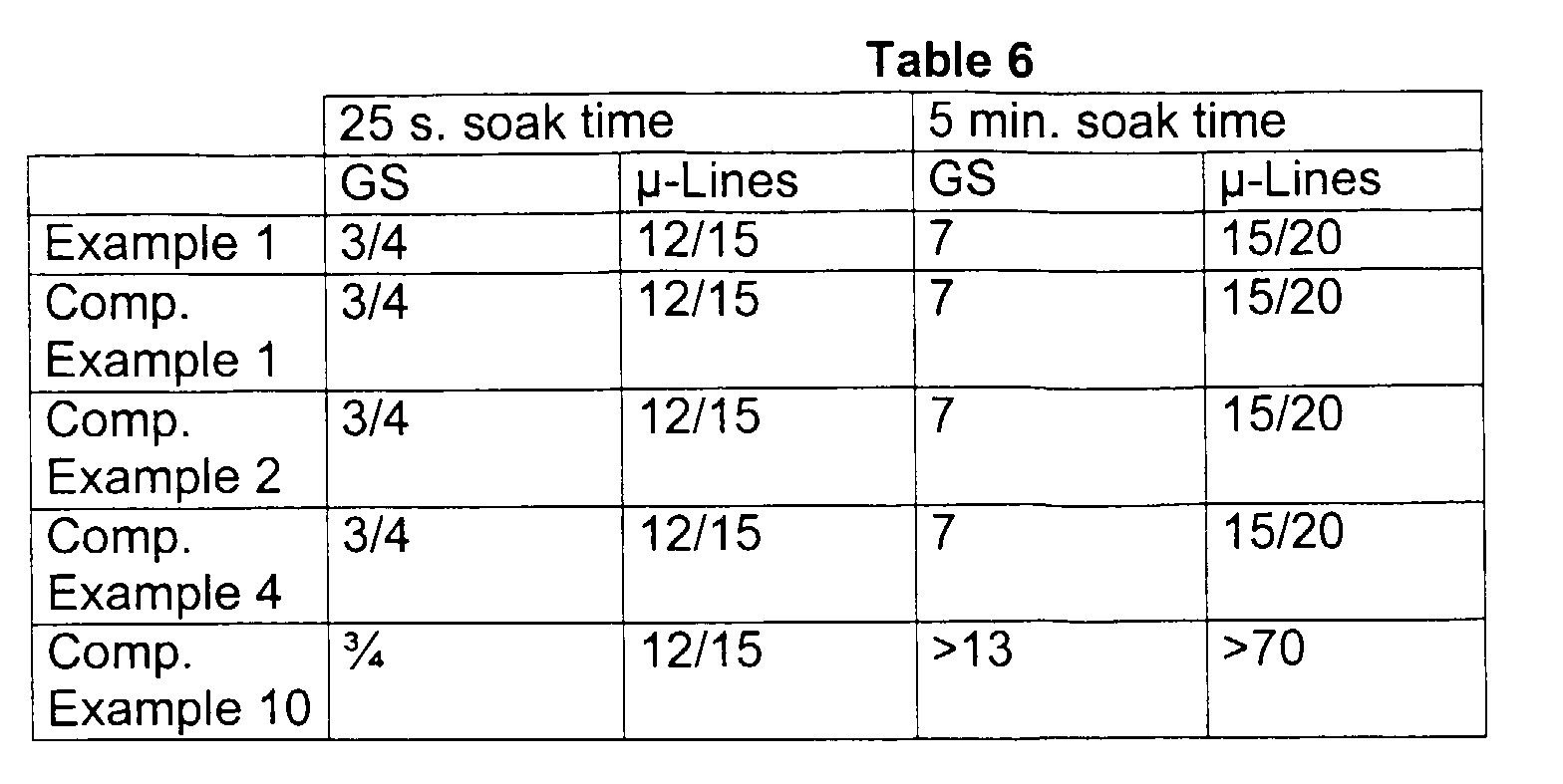

- In this test, the amount of aluminum removed by various developers was gravimetrically measured by comparing the initial weight of an aluminum disc having a certain interlayer but no radiation-sensitive layer with the weight of the disc after it laid in the developer for 5 minutes at 20°C. The results are shown in Table 8.
- As is apparent from Table 8, at both substrates there is no or only a slight attack on the aluminum when using the developer according to the invention while those of the developers of Comparative Examples 1-9 result in a significant attack at both substrates.
- In this test the attack on aluminum oxide was determined for aluminum substrates with three different interlayers. The results are shown in Table 9.
Developer Oxide Attack on PVPA Substrate Oxide Attack on PVPA Copolymer Substrate Oxide Attack on Phosphate/Fluoride Substrate Goldstar Commercial developer according to EP 0 274 044 A1 yes Yes no Silverstar Commercial developer from Kodak Polychrome Graphics yes Yes no Greenstar Commercial developer from Kodak Polychrome Graphics yes Yes no DE 507 Commercial developer from Kodak Polychrome Graphics yes Yes no DE 508 Commercial developer from Kodak Polychrome Graphics yes Yes no DE 506 Commercial developer from Kodak Polychrome Graphics yes Yes no 907 F commercial developer from Kodak Polychrome Graphics yes Yes no Example 1 no No no - As is apparent from Table 9, the developer according to the invention is the only one that shows no aluminum oxide attack with all three tested substrates.
- Having described the invention, we now claim the following and their equivalents.
Claims (15)
- An aqueous alkaline composition comprising:(a) an alkali metal silicate component comprising at least one alkali metal silicate;(b) glycerol;(c) a glycol component comprising at least one glycol of formula Iin which R10 and R11 are each independently hydrogen or C1-C3 alkyl, and z is 0, 1, or 2; and
 (d) a phosphate component comprising at least one member selected from the group consisting of phosphoric acid, primary phosphates, secondary phosphates, and tertiary phosphates.
 - The composition of claim 1 in which the alkali metal silicate component is at least about 10 g SiO2 per 1000 g of the total weight of the composition.
- The composition of claim 1 or claim 2 in which the amount of glycerol plus the amount of glycol component is from about 3 wt% to about 16 wt%, based on the total weight of the composition.
- The composition of any of claims 1 to 3 in which the glycol component comprises about 10 to 90 wt% of the total weight of the glycol component and glycerol, and glycerol comprises about 10 to 90 wt% of the total weight of the glycol component and glycerol.
- The composition of any of claims 1 to 4 in which the amount of the phosphate component is from about 0.2 to about 3 wt%, calculated as P2O5 based on the total weight of the composition.
- The composition of any of claims 1 to 5 in which the glycol component comprises at least one glycol selected from the group consisting of ethylene glycol, 1,2-propanediol, 1,3-propanediol and 1,4-butanediol.
- The composition of any of claims 1 to 6 in which the pH of the composition is about 12 to about 14.
- The composition of any of claims 1 to 7 further comprising at least one component selected from the group consisting of phosphonic acid derivatives, polyglycol derivatives, and complexing agents.
- The composition of any of claims 1 to 8 further comprising at least one additive selected from the group consisting of surfactants, biocides, and antifoaming agents.
- The composition of any of claims 1 to 9 in which:the glycol component comprises about 50 to 70 wt% of the total weight of the glycol component and glycerol and glycerol comprises about 30 to 50 wt% of the total weight of glycol component and glycerol, andthe pH of the composition is about 12 and about 14.
- A method for processing, comprising:
developing an imagewise exposed lithographic printing plate with the aqueous alkaline developing composition of any of claims 1-10. - The method of claim 11 in which the printing plate comprises an aluminum or a treated aluminum substrate.
- The method of claim 12 in which the substrate is coated with a silicate interlayer, a fluorozirconate interlayer, a phosphate interlayer, a phosphate/fluoride interlayer, or an organic compound selected from the group consisting of carboxymethyl cellulose, dextrine, gum arabic, amino group-containing phosphonic acids, organic phosphonic acids, organic phosphates, amino acids and hydroxyl group-containing amine hydrochlorides.
- The method of any of claims 11 to 13 in which the printing plate is a negative-working, heat-sensitive printing plate comprising a negative-working radiation-sensitive composition comprising an infrared radiation absorbing compound.
- The method of any of claims 11 to 14 additionally comprising, after the developing step, the step of adding an additional amount of the aqueous alkaline developing composition to the aqueous alkaline developing composition.
Applications Claiming Priority (2)
| Application Number | Priority Date | Filing Date | Title |
|---|---|---|---|
| US449074 | 1999-11-24 | ||
| US09/449,074 US6255042B1 (en) | 1999-11-24 | 1999-11-24 | Developing system for alkaline-developable lithographic printing plates with different interlayers |
Publications (2)
| Publication Number | Publication Date |
|---|---|
| EP1103859A1 true EP1103859A1 (en) | 2001-05-30 |
| EP1103859B1 EP1103859B1 (en) | 2009-12-23 |
Family
ID=23782773
Family Applications (1)
| Application Number | Title | Priority Date | Filing Date |
|---|---|---|---|
| EP00125231A Expired - Lifetime EP1103859B1 (en) | 1999-11-24 | 2000-11-22 | Developing composition for alkaline-developable lithographic printing plates with different interlayers |
Country Status (3)
| Country | Link |
|---|---|
| US (1) | US6255042B1 (en) |
| EP (1) | EP1103859B1 (en) |
| DE (1) | DE60043570D1 (en) |
Cited By (6)
| Publication number | Priority date | Publication date | Assignee | Title |
|---|---|---|---|---|
| WO2003012550A1 (en) * | 2001-08-01 | 2003-02-13 | Kodak Polychrome Graphics Company Ltd. | Method for developing lithographic printing plate precursors using a coating attack-suppressing agent |
| WO2005023971A1 (en) * | 2003-09-03 | 2005-03-17 | Johnsondiversey, Inc. | Cleaning composition |
| WO2008138942A1 (en) * | 2007-05-15 | 2008-11-20 | Agfa Graphics Nv | A gum solution for developing and gumming a photopolymer printing plate. |
| EP2040124A1 (en) * | 2007-09-24 | 2009-03-25 | Eastman Kodak Company | Method for making lithographic printing plates |
| CN101441422B (en) * | 2007-11-22 | 2011-04-27 | 乐凯集团第二胶片厂 | Thermal positive CTP plate developer |
| EP1457836B2 (en) † | 2003-03-10 | 2016-08-17 | FUJIFILM Corporation | Developing solution for lithographic printing plate precursor and method for preparing lithographic printing plate |
Families Citing this family (15)
| Publication number | Priority date | Publication date | Assignee | Title |
|---|---|---|---|---|
| JP4230130B2 (en) * | 2001-07-04 | 2009-02-25 | 富士フイルム株式会社 | Photosensitive lithographic printing plate developer and lithographic printing plate making method |
| US20060234161A1 (en) * | 2002-10-04 | 2006-10-19 | Eric Verschueren | Method of making a lithographic printing plate precursor |
| US20060000377A1 (en) * | 2002-10-04 | 2006-01-05 | Agfa-Gevaert | Method of marking a lithographic printing plate precursor |
| US20060060096A1 (en) * | 2002-10-15 | 2006-03-23 | Agfa-Gevaert | Polymer for heat-sensitive lithographic printing plate precursor |
| US7455949B2 (en) * | 2002-10-15 | 2008-11-25 | Agfa Graphics, N.V. | Polymer for heat-sensitive lithographic printing plate precursor |
| US7458320B2 (en) * | 2002-10-15 | 2008-12-02 | Agfa Graphics, N.V. | Polymer for heat-sensitive lithographic printing plate precursor |
| GB0226101D0 (en) * | 2002-11-08 | 2002-12-18 | Rhodia Cons Spec Ltd | White rust corrosion inhibitors |
| JP2006517306A (en) * | 2003-02-11 | 2006-07-20 | アグフア−ゲヴエルト | Thermosensitive lithographic printing plate precursor |
| KR101020164B1 (en) | 2003-07-17 | 2011-03-08 | 허니웰 인터내셔날 인코포레이티드 | Planarization films for advanced microelectronic applications, and apparatus and methods for making same |
| US20050076801A1 (en) * | 2003-10-08 | 2005-04-14 | Miller Gary Roger | Developer system |
| US7078162B2 (en) * | 2003-10-08 | 2006-07-18 | Eastman Kodak Company | Developer regenerators |
| EP1834803B1 (en) * | 2006-03-17 | 2011-07-27 | Agfa Graphics N.V. | Method for making a lithographic printing plate |
| US20080299491A1 (en) * | 2007-05-31 | 2008-12-04 | Miller Gary R | Highly alkaline developer composition and methods of use |
| US7883833B2 (en) * | 2007-06-20 | 2011-02-08 | Eastman Kodak Company | Use of highly alkaline developer regenerator composition |
| EP2366545B1 (en) | 2010-03-19 | 2012-12-05 | Agfa Graphics N.V. | A lithographic printing plate precursor |
Citations (8)
| Publication number | Priority date | Publication date | Assignee | Title |
|---|---|---|---|---|
| US4259434A (en) | 1977-10-24 | 1981-03-31 | Fuji Photo Film Co., Ltd. | Method for developing positive acting light-sensitive planographic printing plate |
| US4452880A (en) | 1980-09-20 | 1984-06-05 | Konishiroku Photo Industry Co., Ltd. | Process for developing positive photosensitive lithographic printing plate |
| US4822723A (en) | 1987-11-30 | 1989-04-18 | Hoechst Celanese Corporation | Developer compositions for heavy-duty lithographic printing plates |
| US4828965A (en) | 1988-01-06 | 1989-05-09 | Olin Hunt Specialty Products Inc. | Aqueous developing solution and its use in developing positive-working photoresist composition |
| US4983379A (en) * | 1983-03-01 | 1991-01-08 | Schaeffer Hans A | Dental preparation, article and method for storage and delivery thereof |
| GB2290962A (en) * | 1994-07-04 | 1996-01-17 | Ronald Albert Porter | Fire extinguishing composition |
| WO1998054622A1 (en) | 1997-05-30 | 1998-12-03 | Kodak Polychrome Graphics, L.L.C. | Alkaline developing composition and method of use to process lithographic printing plates |
| US5851735A (en) | 1996-10-11 | 1998-12-22 | Kodak Polychrome Graphics | Alkaline developing composition and method of use to process lithographic printing plates |
Family Cites Families (11)
| Publication number | Priority date | Publication date | Assignee | Title |
|---|---|---|---|---|
| ZA6807938B (en) | 1967-12-04 | |||
| US3907976A (en) | 1974-11-29 | 1975-09-23 | Mallinckrodt Inc | Continuous process for preparing potassium fluotantalate crystals |
| DE3126627A1 (en) | 1981-07-06 | 1983-01-20 | Hoechst Ag, 6000 Frankfurt | POLYVINYLMETHYLPHOSPHINIC ACID, METHOD FOR THE PRODUCTION THEREOF AND THEIR USE |
| DE3406101A1 (en) | 1984-02-21 | 1985-08-22 | Hoechst Ag, 6230 Frankfurt | METHOD FOR THE TWO-STAGE HYDROPHILIZING TREATMENT OF ALUMINUM OXIDE LAYERS WITH AQUEOUS SOLUTIONS AND THE USE THEREOF IN THE PRODUCTION OF OFFSET PRINT PLATE CARRIERS |
| ZA872295B (en) | 1986-03-13 | 1987-09-22 | ||
| JP3086354B2 (en) | 1993-03-30 | 2000-09-11 | 富士写真フイルム株式会社 | Developer and replenisher for photosensitive lithographic printing plates |
| US5372915A (en) | 1993-05-19 | 1994-12-13 | Eastman Kodak Company | Method of making a lithographic printing plate containing a resole resin and a novolac resin in the radiation sensitive layer |
| US5466557A (en) | 1994-08-29 | 1995-11-14 | Eastman Kodak Company | Radiation-sensitive composition containing a resole resin, a novolac resin, a latent bronsted acid, an infrared absorber and terephthalaldehyde and use thereof in lithographic printing plates |
| US5491046A (en) | 1995-02-10 | 1996-02-13 | Eastman Kodak Company | Method of imaging a lithographic printing plate |
| US5897985A (en) | 1996-10-11 | 1999-04-27 | Kodak Polychrome Graphics, Llc | Potassium silicate developing composition and method of use to process lithographic printing plates |
| US5863710A (en) * | 1997-06-05 | 1999-01-26 | Tokyo Ohka Kogyo Co., Ltd. | Developer solution for photolithographic patterning |
-
1999
- 1999-11-24 US US09/449,074 patent/US6255042B1/en not_active Expired - Fee Related
-
2000
- 2000-11-22 DE DE60043570T patent/DE60043570D1/en not_active Expired - Lifetime
- 2000-11-22 EP EP00125231A patent/EP1103859B1/en not_active Expired - Lifetime
Patent Citations (8)
| Publication number | Priority date | Publication date | Assignee | Title |
|---|---|---|---|---|
| US4259434A (en) | 1977-10-24 | 1981-03-31 | Fuji Photo Film Co., Ltd. | Method for developing positive acting light-sensitive planographic printing plate |
| US4452880A (en) | 1980-09-20 | 1984-06-05 | Konishiroku Photo Industry Co., Ltd. | Process for developing positive photosensitive lithographic printing plate |
| US4983379A (en) * | 1983-03-01 | 1991-01-08 | Schaeffer Hans A | Dental preparation, article and method for storage and delivery thereof |
| US4822723A (en) | 1987-11-30 | 1989-04-18 | Hoechst Celanese Corporation | Developer compositions for heavy-duty lithographic printing plates |
| US4828965A (en) | 1988-01-06 | 1989-05-09 | Olin Hunt Specialty Products Inc. | Aqueous developing solution and its use in developing positive-working photoresist composition |
| GB2290962A (en) * | 1994-07-04 | 1996-01-17 | Ronald Albert Porter | Fire extinguishing composition |
| US5851735A (en) | 1996-10-11 | 1998-12-22 | Kodak Polychrome Graphics | Alkaline developing composition and method of use to process lithographic printing plates |
| WO1998054622A1 (en) | 1997-05-30 | 1998-12-03 | Kodak Polychrome Graphics, L.L.C. | Alkaline developing composition and method of use to process lithographic printing plates |
Cited By (11)
| Publication number | Priority date | Publication date | Assignee | Title |
|---|---|---|---|---|
| WO2003012550A1 (en) * | 2001-08-01 | 2003-02-13 | Kodak Polychrome Graphics Company Ltd. | Method for developing lithographic printing plate precursors using a coating attack-suppressing agent |
| US6562555B2 (en) | 2001-08-01 | 2003-05-13 | Kodak Polychrome Graphics Llc | Method for developing lithographic printing plate precursors using a coating attack-suppressing agent |
| EP1457836B2 (en) † | 2003-03-10 | 2016-08-17 | FUJIFILM Corporation | Developing solution for lithographic printing plate precursor and method for preparing lithographic printing plate |
| WO2005023971A1 (en) * | 2003-09-03 | 2005-03-17 | Johnsondiversey, Inc. | Cleaning composition |
| WO2008138942A1 (en) * | 2007-05-15 | 2008-11-20 | Agfa Graphics Nv | A gum solution for developing and gumming a photopolymer printing plate. |
| CN101681127B (en) * | 2007-05-15 | 2012-08-08 | 爱克发印艺公司 | A gum solution for developing and gumming a photopolymer printing plate. |
| EP2040124A1 (en) * | 2007-09-24 | 2009-03-25 | Eastman Kodak Company | Method for making lithographic printing plates |
| WO2009040104A1 (en) * | 2007-09-24 | 2009-04-02 | Eastman Kodak Company | Method for making lithographic printing plates |
| JP2010540981A (en) * | 2007-09-24 | 2010-12-24 | イーストマン コダック カンパニー | Planographic printing plate manufacturing method |
| US8361701B2 (en) | 2007-09-24 | 2013-01-29 | Eastman Kodak Company | Method for making lithographic plates |
| CN101441422B (en) * | 2007-11-22 | 2011-04-27 | 乐凯集团第二胶片厂 | Thermal positive CTP plate developer |
Also Published As
| Publication number | Publication date |
|---|---|
| EP1103859B1 (en) | 2009-12-23 |
| DE60043570D1 (en) | 2010-02-04 |
| US6255042B1 (en) | 2001-07-03 |
Similar Documents
| Publication | Publication Date | Title |
|---|---|---|
| US6255042B1 (en) | Developing system for alkaline-developable lithographic printing plates with different interlayers | |
| US6143479A (en) | Developing system for alkaline-developable lithographic printing plates | |
| EP1399783B1 (en) | Method of processing lithographic printing plate precursors | |
| US7507526B2 (en) | Developer regenerators | |
| US4469776A (en) | Developing solution for light-sensitive printing plates | |
| US5837425A (en) | Method of preparing a lithographic printing plate using a developer containing a development stabilizer | |
| JPH0347198B2 (en) | ||
| EP0411883A1 (en) | Dampening water composition for lithographic plate | |
| EP0836120A1 (en) | Alkaline developing composition and method of use to process lithographic printing plates | |
| EP0602736B1 (en) | Aqueous developer for lithographic printing plates which exhibits reduced sludge formation | |
| EP0602739B1 (en) | Aqueous developer for lithographic printing plates which provides improved oleophilicity | |
| US6541188B2 (en) | Developer for alkaline-developable lithographic printing plates | |
| US4475460A (en) | Process for desensitizing lithographic printing plates | |
| EP0985167A1 (en) | Alkaline developing composition and method of use to process lithographic printing plates | |
| JPH07102753B2 (en) | Planographic printing plate making method and burning pretreatment liquid | |
| EP0397407B1 (en) | Lithographic plate finisher | |
| US5278030A (en) | Developer solution comprising ethyl hexyl sulphate, a surfactant, an alkaline material and having a pH of not less than 12 | |
| US20070196776A1 (en) | Stable High Ph Developer | |
| JP4344563B2 (en) | Method for producing developer for planographic printing plate | |
| JPH0632081A (en) | Plate surface detergent for lithographic plate | |
| JPH08142533A (en) | Plate surface protecting agent for planographic printing plate | |
| JPH11290868A (en) | Ph lowering agent of alkaline industrial waste and ph lowering method using the same | |
| JP2005288843A (en) | Processing method of lithographic printing plate | |
| JP2004151679A (en) | Alkaline developer solution for lithographic printing plate, and method for making lithographic printing plate | |
| JPH0374199B2 (en) |
Legal Events
| Date | Code | Title | Description |
|---|---|---|---|
| PUAI | Public reference made under article 153(3) epc to a published international application that has entered the european phase |
Free format text: ORIGINAL CODE: 0009012 |
|
| AK | Designated contracting states |
Kind code of ref document: A1 Designated state(s): DE FR GB IT Kind code of ref document: A1 Designated state(s): DE FR GB IT NL |
|
| AX | Request for extension of the european patent |
Free format text: AL;LT;LV;MK;RO;SI |
|
| 17P | Request for examination filed |
Effective date: 20010921 |
|
| AKX | Designation fees paid |
Free format text: DE FR GB IT |
|
| RBV | Designated contracting states (corrected) |
Designated state(s): DE FR GB IT NL |
|
| RAP1 | Party data changed (applicant data changed or rights of an application transferred) |
Owner name: KODAK POLYCHROME GRAPHICS COMPANY LTD. |
|
| 17Q | First examination report despatched |
Effective date: 20081013 |
|
| RIC1 | Information provided on ipc code assigned before grant |
Ipc: C11D 7/50 20060101ALI20090508BHEP Ipc: G03F 7/32 20060101AFI20090508BHEP Ipc: C11D 7/16 20060101ALI20090508BHEP Ipc: C11D 7/14 20060101ALI20090508BHEP |
|
| GRAP | Despatch of communication of intention to grant a patent |
Free format text: ORIGINAL CODE: EPIDOSNIGR1 |
|
| GRAS | Grant fee paid |
Free format text: ORIGINAL CODE: EPIDOSNIGR3 |
|
| GRAA | (expected) grant |
Free format text: ORIGINAL CODE: 0009210 |
|
| AK | Designated contracting states |
Kind code of ref document: B1 Designated state(s): DE FR GB IT NL |
|
| REG | Reference to a national code |
Ref country code: GB Ref legal event code: FG4D |
|
| REF | Corresponds to: |
Ref document number: 60043570 Country of ref document: DE Date of ref document: 20100204 Kind code of ref document: P |
|
| REG | Reference to a national code |
Ref country code: NL Ref legal event code: T3 |
|
| PLBE | No opposition filed within time limit |
Free format text: ORIGINAL CODE: 0009261 |
|
| STAA | Information on the status of an ep patent application or granted ep patent |
Free format text: STATUS: NO OPPOSITION FILED WITHIN TIME LIMIT |
|
| 26N | No opposition filed |
Effective date: 20100924 |
|
| PGFP | Annual fee paid to national office [announced via postgrant information from national office to epo] |
Ref country code: IT Payment date: 20101119 Year of fee payment: 11 |
|
| PGFP | Annual fee paid to national office [announced via postgrant information from national office to epo] |
Ref country code: NL Payment date: 20111110 Year of fee payment: 12 Ref country code: FR Payment date: 20111103 Year of fee payment: 12 |
|
| PGFP | Annual fee paid to national office [announced via postgrant information from national office to epo] |
Ref country code: DE Payment date: 20121130 Year of fee payment: 13 |
|
| PGFP | Annual fee paid to national office [announced via postgrant information from national office to epo] |
Ref country code: GB Payment date: 20121025 Year of fee payment: 13 |
|
| REG | Reference to a national code |
Ref country code: NL Ref legal event code: V1 Effective date: 20130601 |
|
| REG | Reference to a national code |
Ref country code: FR Ref legal event code: ST Effective date: 20130731 |
|
| PG25 | Lapsed in a contracting state [announced via postgrant information from national office to epo] |
Ref country code: NL Free format text: LAPSE BECAUSE OF NON-PAYMENT OF DUE FEES Effective date: 20130601 Ref country code: IT Free format text: LAPSE BECAUSE OF NON-PAYMENT OF DUE FEES Effective date: 20121122 |
|
| PG25 | Lapsed in a contracting state [announced via postgrant information from national office to epo] |
Ref country code: FR Free format text: LAPSE BECAUSE OF NON-PAYMENT OF DUE FEES Effective date: 20121130 |
|
| GBPC | Gb: european patent ceased through non-payment of renewal fee |
Effective date: 20131122 |
|
| PG25 | Lapsed in a contracting state [announced via postgrant information from national office to epo] |
Ref country code: DE Free format text: LAPSE BECAUSE OF NON-PAYMENT OF DUE FEES Effective date: 20140603 |
|
| REG | Reference to a national code |
Ref country code: DE Ref legal event code: R119 Ref document number: 60043570 Country of ref document: DE Effective date: 20140603 |
|
| PG25 | Lapsed in a contracting state [announced via postgrant information from national office to epo] |
Ref country code: GB Free format text: LAPSE BECAUSE OF NON-PAYMENT OF DUE FEES Effective date: 20131122 |