EP1103530A1 - Glass fiber - Google Patents
Glass fiber Download PDFInfo
- Publication number
- EP1103530A1 EP1103530A1 EP00125263A EP00125263A EP1103530A1 EP 1103530 A1 EP1103530 A1 EP 1103530A1 EP 00125263 A EP00125263 A EP 00125263A EP 00125263 A EP00125263 A EP 00125263A EP 1103530 A1 EP1103530 A1 EP 1103530A1
- Authority
- EP
- European Patent Office
- Prior art keywords
- glass
- mol
- glass fiber
- light
- wavelength
- Prior art date
- Legal status (The legal status is an assumption and is not a legal conclusion. Google has not performed a legal analysis and makes no representation as to the accuracy of the status listed.)
- Granted
Links
Images

Classifications
-
- C—CHEMISTRY; METALLURGY
- C03—GLASS; MINERAL OR SLAG WOOL
- C03C—CHEMICAL COMPOSITION OF GLASSES, GLAZES OR VITREOUS ENAMELS; SURFACE TREATMENT OF GLASS; SURFACE TREATMENT OF FIBRES OR FILAMENTS MADE FROM GLASS, MINERALS OR SLAGS; JOINING GLASS TO GLASS OR OTHER MATERIALS
- C03C13/00—Fibre or filament compositions
- C03C13/04—Fibre optics, e.g. core and clad fibre compositions
- C03C13/045—Silica-containing oxide glass compositions
- C03C13/046—Multicomponent glass compositions
-
- C—CHEMISTRY; METALLURGY
- C03—GLASS; MINERAL OR SLAG WOOL
- C03C—CHEMICAL COMPOSITION OF GLASSES, GLAZES OR VITREOUS ENAMELS; SURFACE TREATMENT OF GLASS; SURFACE TREATMENT OF FIBRES OR FILAMENTS MADE FROM GLASS, MINERALS OR SLAGS; JOINING GLASS TO GLASS OR OTHER MATERIALS
- C03C13/00—Fibre or filament compositions
- C03C13/04—Fibre optics, e.g. core and clad fibre compositions
- C03C13/048—Silica-free oxide glass compositions
-
- G—PHYSICS
- G02—OPTICS
- G02F—OPTICAL DEVICES OR ARRANGEMENTS FOR THE CONTROL OF LIGHT BY MODIFICATION OF THE OPTICAL PROPERTIES OF THE MEDIA OF THE ELEMENTS INVOLVED THEREIN; NON-LINEAR OPTICS; FREQUENCY-CHANGING OF LIGHT; OPTICAL LOGIC ELEMENTS; OPTICAL ANALOGUE/DIGITAL CONVERTERS
- G02F1/00—Devices or arrangements for the control of the intensity, colour, phase, polarisation or direction of light arriving from an independent light source, e.g. switching, gating or modulating; Non-linear optics
- G02F1/35—Non-linear optics
- G02F1/355—Non-linear optics characterised by the materials used
- G02F1/3555—Glasses
-
- Y—GENERAL TAGGING OF NEW TECHNOLOGICAL DEVELOPMENTS; GENERAL TAGGING OF CROSS-SECTIONAL TECHNOLOGIES SPANNING OVER SEVERAL SECTIONS OF THE IPC; TECHNICAL SUBJECTS COVERED BY FORMER USPC CROSS-REFERENCE ART COLLECTIONS [XRACs] AND DIGESTS
- Y10—TECHNICAL SUBJECTS COVERED BY FORMER USPC
- Y10T—TECHNICAL SUBJECTS COVERED BY FORMER US CLASSIFICATION
- Y10T428/00—Stock material or miscellaneous articles
- Y10T428/29—Coated or structually defined flake, particle, cell, strand, strand portion, rod, filament, macroscopic fiber or mass thereof
- Y10T428/2913—Rod, strand, filament or fiber
- Y10T428/2933—Coated or with bond, impregnation or core
-
- Y—GENERAL TAGGING OF NEW TECHNOLOGICAL DEVELOPMENTS; GENERAL TAGGING OF CROSS-SECTIONAL TECHNOLOGIES SPANNING OVER SEVERAL SECTIONS OF THE IPC; TECHNICAL SUBJECTS COVERED BY FORMER USPC CROSS-REFERENCE ART COLLECTIONS [XRACs] AND DIGESTS
- Y10—TECHNICAL SUBJECTS COVERED BY FORMER USPC
- Y10T—TECHNICAL SUBJECTS COVERED BY FORMER US CLASSIFICATION
- Y10T428/00—Stock material or miscellaneous articles
- Y10T428/29—Coated or structually defined flake, particle, cell, strand, strand portion, rod, filament, macroscopic fiber or mass thereof
- Y10T428/2913—Rod, strand, filament or fiber
- Y10T428/2933—Coated or with bond, impregnation or core
- Y10T428/294—Coated or with bond, impregnation or core including metal or compound thereof [excluding glass, ceramic and asbestos]
- Y10T428/2942—Plural coatings
- Y10T428/2949—Glass, ceramic or metal oxide in coating
-
- Y—GENERAL TAGGING OF NEW TECHNOLOGICAL DEVELOPMENTS; GENERAL TAGGING OF CROSS-SECTIONAL TECHNOLOGIES SPANNING OVER SEVERAL SECTIONS OF THE IPC; TECHNICAL SUBJECTS COVERED BY FORMER USPC CROSS-REFERENCE ART COLLECTIONS [XRACs] AND DIGESTS
- Y10—TECHNICAL SUBJECTS COVERED BY FORMER USPC
- Y10T—TECHNICAL SUBJECTS COVERED BY FORMER US CLASSIFICATION
- Y10T428/00—Stock material or miscellaneous articles
- Y10T428/29—Coated or structually defined flake, particle, cell, strand, strand portion, rod, filament, macroscopic fiber or mass thereof
- Y10T428/2913—Rod, strand, filament or fiber
- Y10T428/2933—Coated or with bond, impregnation or core
- Y10T428/2964—Artificial fiber or filament
Definitions
- the present invention relates to a glass fiber having a third order nonlinear optical effect useful for an ultrafast speed optical switch or a wavelength conversion device.
- optical technology is indispensable which takes the place of conventional electronics processing.
- various developments have been made on optical switches to process optical signals by means of light.
- the third order nonlinear optical effect is utilized whereby the optical properties such as the refractive index and the transmittance of a material can be changed by light.
- WDM wavelength division multiplexing communication system
- the channel is multiplexed by changing the wavelength. Accordingly, in this system, it is desired that the wavelength conversion from a certain wavelength to other wavelength is easy, and for this purpose, four wave mixing is suitable which utilizes the third order nonlinear optical effect.
- the signal light having an angular frequency of ⁇ s will be converted to the light having an angular frequency of ⁇ c . If the third order nonlinear optical effect of the third order nonlinear optical material is large, this angular frequency conversion i.e. the wavelength conversion can effectively be carried out.
- a third order nonlinear optical glass so-called a nonresonant type, accompanying no light absorption, such as quartz glass, is known to show a nonlinear response at a high speed of a few picoseconds or less.
- a third order nonlinear optical glass so-called a resonant type and accompanying light absorption such as semiconductor-dispersed glass or nano metal particle-dispersed glass
- its third order nonlinear optical effect is small. Therefore, in order to use such a nonresonant type third order nonlinear optical glass for an optical switch, it has been necessary to increase the device length or to increase the operation power.
- JP-A-3-21934 discloses that an As-S type glass known as chalcogen glass, has a large nonlinear optical effect, so that a high speed switching operation at the same level as a quartz glass fiber is possible with a length of about 1/1,000 of the quartz glass fiber.
- chalcogen glass has had a problem such that it is necessary to control the atmosphere during the preparation of the glass, the process for preparing the glass tends to be cumbersome for the control of the discharge out of the system of As, Se, S, etc., or the glass transition temperature is low, the thermal stability is poor, and the optical damage threshold is inferior.
- a quartz fiber doped with germanium has been reported.
- the third order nonlinear optical effect is small, and to use it as an optical switch, it is still required to have a length of about 1,000 m.
- the present invention provides a glass fiber comprising core glass and clad glass, wherein the core glass consists essentially of from 25 to 70 mol% of Bi 2 O 3 , from 5 to 74.89 mol% of B 2 O 3 +SiO 2 , from 0.1 to 30 mol% of Al 2 O 3 +Ga 2 O 3 , and from 0 to 10 mol% of CeO 2 .
- Figure 1 is a view illustrating the arrangement of a polarizing rotary optical switch device employing the glass fiber of the present invention.
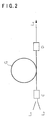
- Figure 2 is a view illustrating the arrangement of a wavelength conversion device employing the glass fiber of the present invention.
- the core glass of the glass fiber of the present invention preferably consists essentially of 39 to 50 mol% of Bi 2 O 3 , from 20 to 55 mol% of B 2 O 3 +SiO 2 , from 5 to 25 mol% of Al 2 O 3 +Ga 2 O 3 , and from 0.01 to 10 mol% of CeO 2 .
- a glass comprising 42.8 mol% of Bi 2 O 3 , 35.6 mol% of SiO 2 , 3.6 mol% of Al 2 O 3 , 17.8 mol% of Ga 2 O 3 and 0.2 mol% of CeO 2 , may be mentioned.
- composition of the core glass of the glass fiber of the present invention will be described in detail wherein mol% will be represented simply by %.
- the third order nonlinear optical effect tends to be too small. It is preferably at least 35%, more preferably at least 39%, particularly preferably at least 40%. If it exceeds 70%, vitrification tends to be difficult, or crystals are likely to precipitate during the preparation of a fiber, whereby the preparation of the fiber tends to be difficult. It is preferably at most 65%, more preferably at most 55%, particularly preferably at most 50%.
- Each of B 2 O 3 and SiO 2 is a network former, and at least one of them must be contained. If the total content of B 2 O 3 and SiO 2 is less than 5%, vitrification tends to be difficult, or preparation of a fiber tends to be difficult. It is preferably at least 20%, more preferably at least 25%, particularly preferably at least 30%. If the total content exceeds 74.89%, the third order nonlinear optical effect tends to be too small. It is preferably at most 65%, more preferably at most 60%, particularly preferably at most 55%, most preferably at most 50%.
- B 2 O 3 When B 2 O 3 is contained, its content is preferably at least 1%, more preferably at least 10%, particularly preferably at least 20%. Further, such content is preferably at most 40%, more preferably at most 35%.
- SiO 2 When SiO 2 is contained, its content is preferably at least 1%, more preferably at least 5%, particularly preferably at least 10%. Further, such content is preferably at most 45%, more preferably at most 40%.
- Each of Al 2 O 3 and Ga 2 O 3 is a component to suppress crystallization during the preparation of a fiber, and at least one of them must be contained. If the total content of Al 2 O 3 and Ga 2 O 3 is less than 0.1%, the above-mentioned effect for suppressing the crystallization tends to be small.
- the total content is preferably at least 1%, more preferably at least 5%. If it exceeds 30%, crystallization is likely to take place during the preparation of the glass. It is preferably at most 28%, more preferably at most 25%.
- Al 2 O 3 When Al 2 O 3 is contained, its content is preferably at least 1%, more preferably at least 3%, particularly preferably at least 5%. Further, such content is preferably at most 20%, more preferably at most 15%.
- Ga 2 O 3 When Ga 2 O 3 is contained, its content is preferably at least 1%, more preferably at least 3%, particularly preferably at least 5%. Further, such content is preferably at most 25%, more preferably at most 20%.
- CeO 2 is not essential, but has an effect to suppress precipitation of Bi 2 O 3 as metal bismuth in the molten glass, and to suppress deterioration of the transparency of the glass, and thus it may be contained up to 10%. If it exceeds 10%, glass formation tends to be difficult, or the third order nonlinear optical effect tends to decrease. It is preferably at most 2%, more preferably at most 1%, particularly preferably at most 0.5%. CeO 2 is a component which tends to color the glass with yellow color or orange color. When it is desired to avoid deterioration of the transmittance due to such coloring, it is preferred for the glass not to contain CeO 2 .
- CeO 2 When CeO 2 is contained, its content is preferably at least 0.01%. If it is less than 0.01%, the effect to suppress deterioration of the transparency of the glass due to precipitation of metal bismuth tends to be small. It is preferably at least 0.1%.
- the core glass of the present invention preferably contains from 40 to 50% of Bi 2 O 3 , from 0 to 35% of B 2 O 3 , from 10 to 40% of SiO 2 , from 0 to 15% of Al 2 O 3 , from 0 to 20% of Ga 2 O 3 and from 0 to 10% of CeO 2 .
- "contains 0% of a component” means that said component is not essential.
- the glass of the present invention consists essentially of the above components, but may further contain other components in a total amount of 10 mol% within a range not to impair the purpose of the present invention.
- Such “other components” may, for example, be Li 2 O, Na 2 O, K 2 O, MgO, CaO, SrO, BaO, ZnO, TiO 2 , WO 3 , SnO 2 and TeO 2 .
- Er absorbs lights in wavelength regions of 980 nm band and 1,550 nm band to lower the transmittance in such wavelength regions, and accordingly, should not better be contained.
- the clad glass of the glass fiber of the present invention preferably consists essentially of from 25 to 70% of Bi 2 O 3 , from 5 to 74.89% of B 2 O 3 +SiO 2 , from 0.1 to 30% of Al 2 O 3 +Ga 2 O 3 and from 0 to 10% of CeO 2 .
- the core glass of the present invention contains from 0.1 to 10% of CeO 2 , it is more preferred that CeO 2 in the above preferred clad glass is from 0.1 to 10%.
- the method for preparing the glass fiber of the present invention is not particularly limited.
- it can be prepared as follows.
- the prescribed starting materials are mixed, put into a gold crucible, a platinum crucible, an alumina crucible, a quartz crucible or an iridium crucible and melted in air at a temperature of from 800 to 1,300°C.
- the obtained melt is cast in a prescribed mold to obtain a preform combined with clad glass. This preform is drawn to obtain a glass fiber. Otherwise, the above melt is formed into a plate, followed by extrusion molding to obtain a preform, and a glass fiber may be prepared by using this preform.
- a nonresonant type third order nonlinear optical effect is utilized. Namely, polarization formed only when light is irradiated, is utilized. Accordingly, the switch operation can be carried out within a time equal to or less than the pulse width of a laser beam to be used, and within such a time, wavelength conversion can be carried out by four wave mixing. Further, as the third order nonlinear optical effect is large, the switch operation or the wavelength conversion can be efficiently carried out with a low power.
- a wavelength conversion device employing the glass fiber of the present invention has a high wavelength conversion efficiency. Typically, it is believed that by the fiber glass of the present invention having a length of not more than 100 m, any desired wavelength conversion can be carried out.
- Glass fibers of Examples 1 to 5 were prepared which comprised core glass and clad glass having compositions shown by mol% in the lines for from Bi 2 O 3 to CeO 2 in Table 1, wherein the clad diameter was 125 ⁇ m, and the diameter (unit: ⁇ m) of the core glass was as shown in Table 1.
- the refractive index at a wavelength of 1.55 ⁇ m is also shown in Table 1.
- L 1 is a control light, which is a laser beam with a wavelength of 1.3 ⁇ m, a pulse width of 120 femtoseconds, a pulse energy of 600 pJ and a polarization direction of 45° against the below-mentioned signal light L in .
- L in is a signal light, which is a laser beam with a wavelength of 1.07 ⁇ m, a pulse width of 120 femtoseconds and a pulse energy of 13 pJ and which has been made to have horizontal polarization by a polarizer.
- the above polarizer and an analyzer A were disposed to be a crossed Nicols disposition (extinction ratio: 24 dB).
- the extinction ratio is a ratio of the light intensity in the open Nicols disposition to the light intensity in the crossed Nicols disposition.
- G represents the glass fiber, and the glass fiber of Example 5 having a length of 25 mm was used.
- L s is a signal light, which is a laser beam with a wavelength of 1.57 ⁇ m, a pulse width of 50 picoseconds, a repetitive frequency of 2.5 GHz, and an average intensity of 0.1 mW.
- L p is a pumping light, which is a laser beam with a wavelength of 1.56 ⁇ m, a pulse width of 60 picoseconds, a repetitive frequency of 2.5 GHz and an average intensity of 10 mW.
- G is a glass fiber, and a glass fiber of any one of Examples 1 to 5 having a length of 100 m is to be used.
- the signal light L s and the pumping light L p are combined by a coupler C and irradiated into the glass fiber G.
- the light emitted from the glass fiber G is separated through a coupler D, whereby a wavelength-shifted light L c having a wavelength of 1.55 ⁇ m is obtained.
- the glass fiber of the present invention has a large nonresonant type third order nonlinear optical effect.
- phase modulation or the like of a light beam utilizing this characteristic, it is possible to carry out an optical switch operation in an extremely short time at a level of not more than the pulse width of the incident light, specifically not longer than 1 picosecond (1,000 femtoseconds).
- lightwave conversion can be carried out with a shorter glass fiber.
- the glass fiber of the present invention is made of a glass material composed solely of oxides, whereby no special atmosphere is required for its preparation, and it can be produced by a conventional glass preparation process.
Landscapes
- Physics & Mathematics (AREA)
- Chemical & Material Sciences (AREA)
- Optics & Photonics (AREA)
- Nonlinear Science (AREA)
- General Chemical & Material Sciences (AREA)
- Chemical Kinetics & Catalysis (AREA)
- Engineering & Computer Science (AREA)
- Geochemistry & Mineralogy (AREA)
- Materials Engineering (AREA)
- Organic Chemistry (AREA)
- Life Sciences & Earth Sciences (AREA)
- General Physics & Mathematics (AREA)
- Glass Compositions (AREA)
- Surface Treatment Of Glass Fibres Or Filaments (AREA)
Abstract
Description
- The present invention relates to a glass fiber having a third order nonlinear optical effect useful for an ultrafast speed optical switch or a wavelength conversion device.
- To realize an advanced information processing society or multimedia, it is necessary to process a large quantity of information at an ultrafast speed, and for this purpose, an optical technology is indispensable which takes the place of conventional electronics processing. To realize such optical processing technology, various developments have been made on optical switches to process optical signals by means of light. To operate such optical switches, the third order nonlinear optical effect is utilized whereby the optical properties such as the refractive index and the transmittance of a material can be changed by light.
- Further, as a system to increase the transmission capacity, a wavelength division multiplexing communication system (WDM) has been proposed. In this system, in order to increase the transmission capacity, the channel is multiplexed by changing the wavelength. Accordingly, in this system, it is desired that the wavelength conversion from a certain wavelength to other wavelength is easy, and for this purpose, four wave mixing is suitable which utilizes the third order nonlinear optical effect.
- The four wave mixing means that when a pumping light having an angular frequency of ωp and a signal light having an angular frequency of ωs enter a third order nonlinear optical material, a light having an angular frequency of ωc (=2ωp-ωs) will be generated. By such four wave mixing, the signal light having an angular frequency of ωs will be converted to the light having an angular frequency of ωc. If the third order nonlinear optical effect of the third order nonlinear optical material is large, this angular frequency conversion i.e. the wavelength conversion can effectively be carried out.
- A third order nonlinear optical glass so-called a nonresonant type, accompanying no light absorption, such as quartz glass, is known to show a nonlinear response at a high speed of a few picoseconds or less. However, as compared with a third order nonlinear optical glass so-called a resonant type and accompanying light absorption, such as semiconductor-dispersed glass or nano metal particle-dispersed glass, its third order nonlinear optical effect is small. Therefore, in order to use such a nonresonant type third order nonlinear optical glass for an optical switch, it has been necessary to increase the device length or to increase the operation power. For example, when quartz glass is formed into a fiber and an optical switch is prepared therefrom, a switch operation (switching) in from 5 to 20 picoseconds is possible, but in order to obtain a practical optical switch, it has been necessary to make the fiber length to be about 1,000 m. Accordingly, also in the field of the nonresonant type third order nonlinear optical glass, strenuous efforts are being made to develop a glass having a large third order nonlinear optical effect.
- On the other hand, JP-A-3-21934 discloses that an As-S type glass known as chalcogen glass, has a large nonlinear optical effect, so that a high speed switching operation at the same level as a quartz glass fiber is possible with a length of about 1/1,000 of the quartz glass fiber. However, chalcogen glass has had a problem such that it is necessary to control the atmosphere during the preparation of the glass, the process for preparing the glass tends to be cumbersome for the control of the discharge out of the system of As, Se, S, etc., or the glass transition temperature is low, the thermal stability is poor, and the optical damage threshold is inferior.
- Further, as a wavelength-conversion fiber, a quartz fiber doped with germanium has been reported. However, the third order nonlinear optical effect is small, and to use it as an optical switch, it is still required to have a length of about 1,000 m.
- It is an object of the present invention to provide a glass fiber which does not contain any one of As, S and Se and which can be prepared by a conventional process for preparing glass and wherein a glass having a large third order nonlinear optical effect is used as the core glass.
- The present invention provides a glass fiber comprising core glass and clad glass, wherein the core glass consists essentially of from 25 to 70 mol% of Bi2O3, from 5 to 74.89 mol% of B2O3+SiO2, from 0.1 to 30 mol% of Al2O3+Ga2O3, and from 0 to 10 mol% of CeO2.
- In the accompanying drawings:
- Figure 1 is a view illustrating the arrangement of a polarizing rotary optical switch device employing the glass fiber of the present invention.
- Figure 2 is a view illustrating the arrangement of a wavelength conversion device employing the glass fiber of the present invention.
- The core glass of the glass fiber of the present invention (hereinafter referred to simply as the core glass of the present invention) preferably consists essentially of 39 to 50 mol% of Bi2O3, from 20 to 55 mol% of B2O3+SiO2, from 5 to 25 mol% of Al2O3+Ga2O3, and from 0.01 to 10 mol% of CeO2. For example, a glass comprising 42.8 mol% of Bi2O3, 35.6 mol% of SiO2, 3.6 mol% of Al2O3, 17.8 mol% of Ga2O3 and 0.2 mol% of CeO2, may be mentioned.
- The composition of the core glass of the glass fiber of the present invention will be described in detail wherein mol% will be represented simply by %.
- If the content of Bi2O3 is less than 25%, the third order nonlinear optical effect tends to be too small. It is preferably at least 35%, more preferably at least 39%, particularly preferably at least 40%. If it exceeds 70%, vitrification tends to be difficult, or crystals are likely to precipitate during the preparation of a fiber, whereby the preparation of the fiber tends to be difficult. It is preferably at most 65%, more preferably at most 55%, particularly preferably at most 50%.
- Each of B2O3 and SiO2 is a network former, and at least one of them must be contained. If the total content of B2O3 and SiO2 is less than 5%, vitrification tends to be difficult, or preparation of a fiber tends to be difficult. It is preferably at least 20%, more preferably at least 25%, particularly preferably at least 30%. If the total content exceeds 74.89%, the third order nonlinear optical effect tends to be too small. It is preferably at most 65%, more preferably at most 60%, particularly preferably at most 55%, most preferably at most 50%.
- When B2O3 is contained, its content is preferably at least 1%, more preferably at least 10%, particularly preferably at least 20%. Further, such content is preferably at most 40%, more preferably at most 35%.
- When SiO2 is contained, its content is preferably at least 1%, more preferably at least 5%, particularly preferably at least 10%. Further, such content is preferably at most 45%, more preferably at most 40%.
- Each of Al2O3 and Ga2O3 is a component to suppress crystallization during the preparation of a fiber, and at least one of them must be contained. If the total content of Al2O3 and Ga2O3 is less than 0.1%, the above-mentioned effect for suppressing the crystallization tends to be small. The total content is preferably at least 1%, more preferably at least 5%. If it exceeds 30%, crystallization is likely to take place during the preparation of the glass. It is preferably at most 28%, more preferably at most 25%.
- When Al2O3 is contained, its content is preferably at least 1%, more preferably at least 3%, particularly preferably at least 5%. Further, such content is preferably at most 20%, more preferably at most 15%.
- When Ga2O3 is contained, its content is preferably at least 1%, more preferably at least 3%, particularly preferably at least 5%. Further, such content is preferably at most 25%, more preferably at most 20%.
- CeO2 is not essential, but has an effect to suppress precipitation of Bi2O3 as metal bismuth in the molten glass, and to suppress deterioration of the transparency of the glass, and thus it may be contained up to 10%. If it exceeds 10%, glass formation tends to be difficult, or the third order nonlinear optical effect tends to decrease. It is preferably at most 2%, more preferably at most 1%, particularly preferably at most 0.5%. CeO2 is a component which tends to color the glass with yellow color or orange color. When it is desired to avoid deterioration of the transmittance due to such coloring, it is preferred for the glass not to contain CeO2.
- When CeO2 is contained, its content is preferably at least 0.01%. If it is less than 0.01%, the effect to suppress deterioration of the transparency of the glass due to precipitation of metal bismuth tends to be small. It is preferably at least 0.1%.
- The core glass of the present invention preferably contains from 40 to 50% of Bi2O3, from 0 to 35% of B2O3, from 10 to 40% of SiO2, from 0 to 15% of Al2O3, from 0 to 20% of Ga2O3 and from 0 to 10% of CeO2. Here, "contains 0% of a component" means that said component is not essential.
- The glass of the present invention consists essentially of the above components, but may further contain other components in a total amount of 10 mol% within a range not to impair the purpose of the present invention. Such "other components" may, for example, be Li2O, Na2O, K2O, MgO, CaO, SrO, BaO, ZnO, TiO2, WO3, SnO2 and TeO2.
- Further, it is preferred that none of As, S and Se is contained. Further, Er absorbs lights in wavelength regions of 980 nm band and 1,550 nm band to lower the transmittance in such wavelength regions, and accordingly, should not better be contained.
- The relation represented by the following formula should better be satisfied between the refractive index n2 of the clad glass and the refractive index n1 of the core glass of the glass fiber of the present invention:
- Further, the clad glass of the glass fiber of the present invention preferably consists essentially of from 25 to 70% of Bi2O3, from 5 to 74.89% of B2O3+SiO2, from 0.1 to 30% of Al2O3+Ga2O3 and from 0 to 10% of CeO2. When the core glass of the present invention contains from 0.1 to 10% of CeO2, it is more preferred that CeO2 in the above preferred clad glass is from 0.1 to 10%.
- The method for preparing the glass fiber of the present invention is not particularly limited. For example, it can be prepared as follows. The prescribed starting materials are mixed, put into a gold crucible, a platinum crucible, an alumina crucible, a quartz crucible or an iridium crucible and melted in air at a temperature of from 800 to 1,300°C. The obtained melt is cast in a prescribed mold to obtain a preform combined with clad glass. This preform is drawn to obtain a glass fiber. Otherwise, the above melt is formed into a plate, followed by extrusion molding to obtain a preform, and a glass fiber may be prepared by using this preform.
- In the present invention, a nonresonant type third order nonlinear optical effect is utilized. Namely, polarization formed only when light is irradiated, is utilized. Accordingly, the switch operation can be carried out within a time equal to or less than the pulse width of a laser beam to be used, and within such a time, wavelength conversion can be carried out by four wave mixing. Further, as the third order nonlinear optical effect is large, the switch operation or the wavelength conversion can be efficiently carried out with a low power.
- With the optical switch device employing the glass fiber of the present invention, it is possible to carry out a switch operation in a time equal to the pulse width of a laser beam to be used for the optical switch. Further, a wavelength conversion device employing the glass fiber of the present invention has a high wavelength conversion efficiency. Typically, it is believed that by the fiber glass of the present invention having a length of not more than 100 m, any desired wavelength conversion can be carried out.
- Now, the present invention will be described in further detail with reference to Examples. However, it should be understood that the present invention is by no means restricted to such specific Examples.
- Glass fibers of Examples 1 to 5 were prepared which comprised core glass and clad glass having compositions shown by mol% in the lines for from Bi2O3 to CeO2 in Table 1, wherein the clad diameter was 125 µm, and the diameter (unit: µm) of the core glass was as shown in Table 1. The refractive index at a wavelength of 1.55 µm is also shown in Table 1.

- The optical switch operation test of the glass fiber of Example 5 was carried out using a polarization rotary optical switch device, the arrangement of which is shown in Figure 1.
- L1 is a control light, which is a laser beam with a wavelength of 1.3 µm, a pulse width of 120 femtoseconds, a pulse energy of 600 pJ and a polarization direction of 45° against the below-mentioned signal light Lin.
- Lin is a signal light, which is a laser beam with a wavelength of 1.07 µm, a pulse width of 120 femtoseconds and a pulse energy of 13 pJ and which has been made to have horizontal polarization by a polarizer.
- The above polarizer and an analyzer A were disposed to be a crossed Nicols disposition (extinction ratio: 24 dB). Here, the extinction ratio is a ratio of the light intensity in the open Nicols disposition to the light intensity in the crossed Nicols disposition.
- G represents the glass fiber, and the glass fiber of Example 5 having a length of 25 mm was used.
- By a half mirror M, L1 and Lin were combined, and the combined light was admitted into the glass fiber G. When there was no control light L1, the signal light Lin did not substantially pass through the analyzer A, whereby the pulse energy of the signal light Lin passed through the analyzer A was as small as 0.05 pJ. On the other hand, when the control light L1 was admitted to the half mirror M, the signal light Lin passed through the analyzer A. The pulse energy of the transmitted light Lout was 0.6 pJ. When evaluated as a S/N ratio, this corresponds to 10 dB, which indicates that such is sufficiently useful as an optical switch device. Further, the control light L1 emitted from the glass fiber G is cut off by a filter F.
- Further, it was attempted to measure the switch operation time by giving a time delay between the control light L1 and the signal light Lin, whereby the signal light Lin passed through the analyzer A only when the pulse of the control light L1 and the pulse of the signal light Lin were timely overlapped. This indicates that the switch operation time is not longer than the pulse width (=120 femtoseconds) of the control light L1.
- Further, it is considered that, for example, an optical switch wherein the control light L1 has a wavelength of 1.5 µm, a pulse width of 150 femtoseconds and a pulse energy of 10 nJ, the signal light Lin has a wavelength of 1.6 µm, a pulse width of 150 femtoseconds and a pulse energy of 100 pJ, and the glass fiber G is a glass fiber (length=1 m) of any one of Examples 1 to 4, also has a sufficient optical switch function.
- Further, it is considered that even if the control light L1 has a wavelength of 1.48 µm, a pulse width of 150 femtoseconds and a pulse energy of 20 pJ, and the signal light Lin has a wavelength of 1.55 µm, a pulse width of 150 femtoseconds and a pulse energy of 1 pJ, if the glass fiber G is a glass fiber (length=1 m) of any one of Examples 1 to 5, such an optical switch device has a sufficient optical switch function.
- Further, an arrangement which is considered to be suitable for a wavelength conversion device employing a glass fiber of any one of Examples 1 to 4 or Example 5, is shown in Figure 2.
- Ls is a signal light, which is a laser beam with a wavelength of 1.57 µm, a pulse width of 50 picoseconds, a repetitive frequency of 2.5 GHz, and an average intensity of 0.1 mW. Lp is a pumping light, which is a laser beam with a wavelength of 1.56 µm, a pulse width of 60 picoseconds, a repetitive frequency of 2.5 GHz and an average intensity of 10 mW. G is a glass fiber, and a glass fiber of any one of Examples 1 to 5 having a length of 100 m is to be used.
- The signal light Ls and the pumping light Lp are combined by a coupler C and irradiated into the glass fiber G. The light emitted from the glass fiber G is separated through a coupler D, whereby a wavelength-shifted light Lc having a wavelength of 1.55 µm is obtained.
- The glass fiber of the present invention has a large nonresonant type third order nonlinear optical effect. By carrying out phase modulation or the like of a light beam utilizing this characteristic, it is possible to carry out an optical switch operation in an extremely short time at a level of not more than the pulse width of the incident light, specifically not longer than 1 picosecond (1,000 femtoseconds).
- Further, by effective wavelength conversion utilizing four wave mixing, lightwave conversion can be carried out with a shorter glass fiber.
- Further, the glass fiber of the present invention is made of a glass material composed solely of oxides, whereby no special atmosphere is required for its preparation, and it can be produced by a conventional glass preparation process.
- The entire disclosure of Japanese Patent Application No. 11-335813 filed on November 26, 1999 including specification, claims, drawings and summary are incorporated herein by reference in its entirety.
Claims (6)
- A glass fiber comprising core glass and clad glass, wherein the core glass consists essentially of from 25 to 70 mol% of Bi2O3, from 5 to 74.89 mol% of B2O3+SiO2, from 0.1 to 30 mol% of Al2O3+Ga2O3, and from 0 to 10 mol% of CeO2.
- The glass fiber according to Claim 1, wherein the core glass contains from 40 to 50 mol% of Bi2O3, from 0 to 35 mol% of B2O3, from 10 to 40 mol% of SiO2, from 0 to 15 mol% of Al2O3 and from 0 to 20 mol% of Ga2O3.
- The glass fiber according to Claim 1 or 2, wherein the core glass contains from 0.001 to 10 mol% of CeO2.
- The glass fiber according to Claim 1, 2 or 3, wherein the core glass does not contain Er.
- The glass fiber according to Claim 1, 2 or 3, which is used for an optical switch.
- The glass fiber according to Claim 1, 2 or 3, which is used for a wavelength conversion device.
Applications Claiming Priority (2)
| Application Number | Priority Date | Filing Date | Title |
|---|---|---|---|
| JP33581399 | 1999-11-26 | ||
| JP33581399 | 1999-11-26 |
Publications (2)
| Publication Number | Publication Date |
|---|---|
| EP1103530A1 true EP1103530A1 (en) | 2001-05-30 |
| EP1103530B1 EP1103530B1 (en) | 2005-01-26 |
Family
ID=18292713
Family Applications (1)
| Application Number | Title | Priority Date | Filing Date |
|---|---|---|---|
| EP00125263A Expired - Lifetime EP1103530B1 (en) | 1999-11-26 | 2000-11-24 | Glass fiber |
Country Status (4)
| Country | Link |
|---|---|
| US (1) | US6656584B1 (en) |
| EP (1) | EP1103530B1 (en) |
| AT (1) | ATE287860T1 (en) |
| DE (1) | DE60017688T2 (en) |
Cited By (1)
| Publication number | Priority date | Publication date | Assignee | Title |
|---|---|---|---|---|
| US7524781B2 (en) | 2003-06-20 | 2009-04-28 | Asahi Glass Company, Limited | Non-lead optical glass and optical fiber |
Families Citing this family (7)
| Publication number | Priority date | Publication date | Assignee | Title |
|---|---|---|---|---|
| WO2002034683A1 (en) * | 2000-10-23 | 2002-05-02 | Asahi Glass Company, Limited | Glass for press molding and lens |
| JPWO2006035722A1 (en) * | 2004-09-29 | 2008-05-15 | 旭硝子株式会社 | Nonlinear fiber, wavelength conversion method, and wavelength converter |
| US10151865B2 (en) * | 2014-05-02 | 2018-12-11 | Futurewei Technologies, Inc. | Compact external grating PBS/PBC coupler |
| US10551640B2 (en) * | 2016-11-21 | 2020-02-04 | Futurewei Technologies, Inc. | Wavelength division multiplexed polarization independent reflective modulators |
| US10222676B2 (en) | 2017-01-27 | 2019-03-05 | Futurewei Technologies, Inc. | Polarization insensitive integrated optical modulator |
| US10330959B2 (en) | 2017-05-22 | 2019-06-25 | Futurewei Technologies, Inc. | Polarization insensitive micro ring modulator |
| US10243684B2 (en) | 2017-05-23 | 2019-03-26 | Futurewei Technologies, Inc. | Wavelength-division multiplexed polarization-insensitive transmissive modulator |
Citations (4)
| Publication number | Priority date | Publication date | Assignee | Title |
|---|---|---|---|---|
| US5148510A (en) * | 1990-11-28 | 1992-09-15 | Corning Incorporated | Optical fiber made of galliobismuthate glasses and optical devices using same |
| JPH11236245A (en) * | 1998-02-23 | 1999-08-31 | Central Glass Co Ltd | Optical waveguide and 1.5-1.6 micron band light amplifier using the same |
| JPH11317561A (en) * | 1998-03-03 | 1999-11-16 | Asahi Glass Co Ltd | Optical amplification glass |
| WO2000023392A1 (en) * | 1998-10-20 | 2000-04-27 | Asahi Glass Company Ltd. | Light-amplifying glass, light-amplifying medium and resin-coated light-amplifying medium |
Family Cites Families (4)
| Publication number | Priority date | Publication date | Assignee | Title |
|---|---|---|---|---|
| US3938974A (en) * | 1973-04-27 | 1976-02-17 | Macedo Pedro B | Method of producing optical wave guide fibers |
| US4861129A (en) * | 1987-04-17 | 1989-08-29 | Hoechst Celanese Corp. | Inorganic-organic composite compositions exhibiting nonlinear optical response |
| US5668066A (en) * | 1995-07-24 | 1997-09-16 | Hoya Corporation | Near infrared absorption filter glass |
| ATE281416T1 (en) * | 2000-08-10 | 2004-11-15 | Asahi Glass Co Ltd | LIGHT-AMPLIFICATION GLASS |
-
2000
- 2000-11-24 US US09/718,395 patent/US6656584B1/en not_active Expired - Fee Related
- 2000-11-24 DE DE60017688T patent/DE60017688T2/en not_active Expired - Lifetime
- 2000-11-24 EP EP00125263A patent/EP1103530B1/en not_active Expired - Lifetime
- 2000-11-24 AT AT00125263T patent/ATE287860T1/en not_active IP Right Cessation
Patent Citations (4)
| Publication number | Priority date | Publication date | Assignee | Title |
|---|---|---|---|---|
| US5148510A (en) * | 1990-11-28 | 1992-09-15 | Corning Incorporated | Optical fiber made of galliobismuthate glasses and optical devices using same |
| JPH11236245A (en) * | 1998-02-23 | 1999-08-31 | Central Glass Co Ltd | Optical waveguide and 1.5-1.6 micron band light amplifier using the same |
| JPH11317561A (en) * | 1998-03-03 | 1999-11-16 | Asahi Glass Co Ltd | Optical amplification glass |
| WO2000023392A1 (en) * | 1998-10-20 | 2000-04-27 | Asahi Glass Company Ltd. | Light-amplifying glass, light-amplifying medium and resin-coated light-amplifying medium |
Non-Patent Citations (6)
| Title |
|---|
| CHEMICAL ABSTRACTS, vol. 95, no. 2, 13 July 1981, Columbus, Ohio, US; abstract no. 11313s, T. N. KESHISHYAN ET AL: "Mechanism of the effect of oxides of aluminum, lanthanum, barium and lead on the elastic properties of bismuth-borate glasses" page 262; XP002162815 * |
| DUMBAUGH W H ET AL: "HEAVY-METAL OXIDE GLASSES", JOURNAL OF THE AMERICAN CERAMIC SOCIETY,US,AMERICAN CERAMIC SOCIETY. COLUMBUS, vol. 75, no. 9, 1 September 1992 (1992-09-01), pages 2315 - 2326, XP000305937, ISSN: 0002-7820 * |
| LAPP J C ET AL: "Recent advances in heavy metal oxide glass research", PROPERTIES AND CHARACTERISTICS OF OPTICAL GLASS II;SAN DIEGO, CA, USA JUL 12-13 1990, vol. 1327, 1990, Proc SPIE Int Soc Opt Eng;Proceedings of SPIE - The International Society for Optical Engineering 1990 Publ by Int Soc for Optical Engineering, Bellingham, WA, USA, pages 162 - 170, XP000991582 * |
| PATENT ABSTRACTS OF JAPAN vol. 1999, no. 13 30 November 1999 (1999-11-30) * |
| PATENT ABSTRACTS OF JAPAN vol. 2000, no. 02 29 February 2000 (2000-02-29) * |
| TR.-MOSK. KHIM.-TEKHNOL. INST. IM. D. I. MENDELEEVA, vol. 108, 1979, pages 29 - 31 * |
Cited By (1)
| Publication number | Priority date | Publication date | Assignee | Title |
|---|---|---|---|---|
| US7524781B2 (en) | 2003-06-20 | 2009-04-28 | Asahi Glass Company, Limited | Non-lead optical glass and optical fiber |
Also Published As
| Publication number | Publication date |
|---|---|
| ATE287860T1 (en) | 2005-02-15 |
| EP1103530B1 (en) | 2005-01-26 |
| US6656584B1 (en) | 2003-12-02 |
| DE60017688T2 (en) | 2005-12-22 |
| DE60017688D1 (en) | 2005-03-03 |
Similar Documents
| Publication | Publication Date | Title |
|---|---|---|
| EP1127858B1 (en) | Light-amplifying glass, light-amplifying medium and resin-coated light-amplifying medium | |
| Sugimoto | Ultrafast optical switches and wavelength division multiplexing (WDM) amplifiers based on bismuth oxide glasses | |
| KR100391106B1 (en) | Transparent Glass-Ceramic | |
| KR100340047B1 (en) | Multi-component oxyhalide glass for optical amplifier and laser | |
| WO2004058656A1 (en) | Glass composition fluorescent in infrared wavelength region | |
| JP2003283028A (en) | Infrared illuminator and optical amplifying medium | |
| EP1103530B1 (en) | Glass fiber | |
| KR100848025B1 (en) | Optical amplifying glass and optical waveguide | |
| JP4686845B2 (en) | Glass fiber | |
| EP1394910B1 (en) | Raman-active optical fiber | |
| US7524781B2 (en) | Non-lead optical glass and optical fiber | |
| Todoroki et al. | Alkali magnesium/zinc silicate glasses with low Rayleigh scattering | |
| JPH11167036A (en) | Optical waveguide circuit and nonlinear optical device | |
| JP2011065130A (en) | Nonlinear optical glass | |
| JP3749276B2 (en) | Infrared transmission glass | |
| KR100381009B1 (en) | Tellurite glass composition for enhancing 980 nm excitation efficiency of erbium ion and fiberization characteristics | |
| JP3948079B2 (en) | Ultrafast optical switch | |
| JP3764525B2 (en) | Ultrafast photo-induced switch | |
| JPH11337988A (en) | Light switch | |
| JP2005352445A (en) | Optical Kerr switch and nonlinear optical fiber | |
| Parker et al. | Some recent developments in glasses for nonlinear optics | |
| JP2003107540A (en) | Signal light modulation method | |
| de Araujo | Nonlinear optical properties of antimony based glasses at telecom wavelengths | |
| Todoroki et al. | Sodium magnesium silicate glasses for ultra low loss fibers | |
| JPH0211535B2 (en) |
Legal Events
| Date | Code | Title | Description |
|---|---|---|---|
| PUAI | Public reference made under article 153(3) epc to a published international application that has entered the european phase |
Free format text: ORIGINAL CODE: 0009012 |
|
| AK | Designated contracting states |
Kind code of ref document: A1 Designated state(s): AT BE CH CY DE DK ES FI FR GB GR IE IT LI LU MC NL PT SE TR |
|
| AX | Request for extension of the european patent |
Free format text: AL;LT;LV;MK;RO;SI |
|
| 17P | Request for examination filed |
Effective date: 20010920 |
|
| AKX | Designation fees paid |
Free format text: AT BE CH CY DE DK ES FI FR GB GR IE IT LI LU MC NL PT SE TR |
|
| 17Q | First examination report despatched |
Effective date: 20021028 |
|
| GRAP | Despatch of communication of intention to grant a patent |
Free format text: ORIGINAL CODE: EPIDOSNIGR1 |
|
| GRAS | Grant fee paid |
Free format text: ORIGINAL CODE: EPIDOSNIGR3 |
|
| GRAA | (expected) grant |
Free format text: ORIGINAL CODE: 0009210 |
|
| AK | Designated contracting states |
Kind code of ref document: B1 Designated state(s): AT BE CH CY DE DK ES FI FR GB GR IE IT LI LU MC NL PT SE TR |
|
| PG25 | Lapsed in a contracting state [announced via postgrant information from national office to epo] |
Ref country code: IT Free format text: LAPSE BECAUSE OF FAILURE TO SUBMIT A TRANSLATION OF THE DESCRIPTION OR TO PAY THE FEE WITHIN THE PRESCRIBED TIME-LIMIT;WARNING: LAPSES OF ITALIAN PATENTS WITH EFFECTIVE DATE BEFORE 2007 MAY HAVE OCCURRED AT ANY TIME BEFORE 2007. THE CORRECT EFFECTIVE DATE MAY BE DIFFERENT FROM THE ONE RECORDED. Effective date: 20050126 Ref country code: AT Free format text: LAPSE BECAUSE OF FAILURE TO SUBMIT A TRANSLATION OF THE DESCRIPTION OR TO PAY THE FEE WITHIN THE PRESCRIBED TIME-LIMIT Effective date: 20050126 Ref country code: NL Free format text: LAPSE BECAUSE OF FAILURE TO SUBMIT A TRANSLATION OF THE DESCRIPTION OR TO PAY THE FEE WITHIN THE PRESCRIBED TIME-LIMIT Effective date: 20050126 Ref country code: FI Free format text: LAPSE BECAUSE OF FAILURE TO SUBMIT A TRANSLATION OF THE DESCRIPTION OR TO PAY THE FEE WITHIN THE PRESCRIBED TIME-LIMIT Effective date: 20050126 Ref country code: BE Free format text: LAPSE BECAUSE OF FAILURE TO SUBMIT A TRANSLATION OF THE DESCRIPTION OR TO PAY THE FEE WITHIN THE PRESCRIBED TIME-LIMIT Effective date: 20050126 Ref country code: LI Free format text: LAPSE BECAUSE OF FAILURE TO SUBMIT A TRANSLATION OF THE DESCRIPTION OR TO PAY THE FEE WITHIN THE PRESCRIBED TIME-LIMIT Effective date: 20050126 Ref country code: TR Free format text: LAPSE BECAUSE OF FAILURE TO SUBMIT A TRANSLATION OF THE DESCRIPTION OR TO PAY THE FEE WITHIN THE PRESCRIBED TIME-LIMIT Effective date: 20050126 Ref country code: CH Free format text: LAPSE BECAUSE OF FAILURE TO SUBMIT A TRANSLATION OF THE DESCRIPTION OR TO PAY THE FEE WITHIN THE PRESCRIBED TIME-LIMIT Effective date: 20050126 |
|
| REG | Reference to a national code |
Ref country code: GB Ref legal event code: FG4D |
|
| REG | Reference to a national code |
Ref country code: CH Ref legal event code: EP |
|
| REG | Reference to a national code |
Ref country code: IE Ref legal event code: FG4D |
|
| REF | Corresponds to: |
Ref document number: 60017688 Country of ref document: DE Date of ref document: 20050303 Kind code of ref document: P |
|
| PG25 | Lapsed in a contracting state [announced via postgrant information from national office to epo] |
Ref country code: DK Free format text: LAPSE BECAUSE OF FAILURE TO SUBMIT A TRANSLATION OF THE DESCRIPTION OR TO PAY THE FEE WITHIN THE PRESCRIBED TIME-LIMIT Effective date: 20050426 Ref country code: GR Free format text: LAPSE BECAUSE OF FAILURE TO SUBMIT A TRANSLATION OF THE DESCRIPTION OR TO PAY THE FEE WITHIN THE PRESCRIBED TIME-LIMIT Effective date: 20050426 Ref country code: SE Free format text: LAPSE BECAUSE OF FAILURE TO SUBMIT A TRANSLATION OF THE DESCRIPTION OR TO PAY THE FEE WITHIN THE PRESCRIBED TIME-LIMIT Effective date: 20050426 |
|
| PG25 | Lapsed in a contracting state [announced via postgrant information from national office to epo] |
Ref country code: ES Free format text: LAPSE BECAUSE OF FAILURE TO SUBMIT A TRANSLATION OF THE DESCRIPTION OR TO PAY THE FEE WITHIN THE PRESCRIBED TIME-LIMIT Effective date: 20050507 |
|
| NLV1 | Nl: lapsed or annulled due to failure to fulfill the requirements of art. 29p and 29m of the patents act | ||
| REG | Reference to a national code |
Ref country code: CH Ref legal event code: PL |
|
| ET | Fr: translation filed | ||
| PG25 | Lapsed in a contracting state [announced via postgrant information from national office to epo] |
Ref country code: CY Free format text: LAPSE BECAUSE OF FAILURE TO SUBMIT A TRANSLATION OF THE DESCRIPTION OR TO PAY THE FEE WITHIN THE PRESCRIBED TIME-LIMIT Effective date: 20051124 Ref country code: IE Free format text: LAPSE BECAUSE OF NON-PAYMENT OF DUE FEES Effective date: 20051124 |
|
| PG25 | Lapsed in a contracting state [announced via postgrant information from national office to epo] |
Ref country code: LU Free format text: LAPSE BECAUSE OF NON-PAYMENT OF DUE FEES Effective date: 20051130 Ref country code: MC Free format text: LAPSE BECAUSE OF NON-PAYMENT OF DUE FEES Effective date: 20051130 |
|
| PLBE | No opposition filed within time limit |
Free format text: ORIGINAL CODE: 0009261 |
|
| STAA | Information on the status of an ep patent application or granted ep patent |
Free format text: STATUS: NO OPPOSITION FILED WITHIN TIME LIMIT |
|
| 26N | No opposition filed |
Effective date: 20051027 |
|
| REG | Reference to a national code |
Ref country code: IE Ref legal event code: MM4A |
|
| PG25 | Lapsed in a contracting state [announced via postgrant information from national office to epo] |
Ref country code: PT Free format text: LAPSE BECAUSE OF NON-PAYMENT OF DUE FEES Effective date: 20050626 |
|
| PGFP | Annual fee paid to national office [announced via postgrant information from national office to epo] |
Ref country code: FR Payment date: 20121130 Year of fee payment: 13 |
|
| PGFP | Annual fee paid to national office [announced via postgrant information from national office to epo] |
Ref country code: GB Payment date: 20121121 Year of fee payment: 13 |
|
| PGFP | Annual fee paid to national office [announced via postgrant information from national office to epo] |
Ref country code: DE Payment date: 20131120 Year of fee payment: 14 |
|
| GBPC | Gb: european patent ceased through non-payment of renewal fee |
Effective date: 20131124 |
|
| REG | Reference to a national code |
Ref country code: FR Ref legal event code: ST Effective date: 20140731 |
|
| PG25 | Lapsed in a contracting state [announced via postgrant information from national office to epo] |
Ref country code: GB Free format text: LAPSE BECAUSE OF NON-PAYMENT OF DUE FEES Effective date: 20131124 Ref country code: FR Free format text: LAPSE BECAUSE OF NON-PAYMENT OF DUE FEES Effective date: 20131202 |
|
| REG | Reference to a national code |
Ref country code: DE Ref legal event code: R119 Ref document number: 60017688 Country of ref document: DE |
|
| PG25 | Lapsed in a contracting state [announced via postgrant information from national office to epo] |
Ref country code: DE Free format text: LAPSE BECAUSE OF NON-PAYMENT OF DUE FEES Effective date: 20150602 |