EP1101734A2 - Purification of argon - Google Patents
Purification of argon Download PDFInfo
- Publication number
- EP1101734A2 EP1101734A2 EP00125137A EP00125137A EP1101734A2 EP 1101734 A2 EP1101734 A2 EP 1101734A2 EP 00125137 A EP00125137 A EP 00125137A EP 00125137 A EP00125137 A EP 00125137A EP 1101734 A2 EP1101734 A2 EP 1101734A2
- Authority
- EP
- European Patent Office
- Prior art keywords
- iron
- milling
- continued
- adsorbent
- oxygen
- Prior art date
- Legal status (The legal status is an assumption and is not a legal conclusion. Google has not performed a legal analysis and makes no representation as to the accuracy of the status listed.)
- Withdrawn
Links
- XKRFYHLGVUSROY-UHFFFAOYSA-N Argon Chemical compound [Ar] XKRFYHLGVUSROY-UHFFFAOYSA-N 0.000 title claims abstract description 76
- 229910052786 argon Inorganic materials 0.000 title claims abstract description 38
- 238000000746 purification Methods 0.000 title description 9
- XEEYBQQBJWHFJM-UHFFFAOYSA-N Iron Chemical compound [Fe] XEEYBQQBJWHFJM-UHFFFAOYSA-N 0.000 claims abstract description 120
- 238000003801 milling Methods 0.000 claims abstract description 42
- 239000003463 adsorbent Substances 0.000 claims abstract description 41
- UQSXHKLRYXJYBZ-UHFFFAOYSA-N Iron oxide Chemical compound [Fe]=O UQSXHKLRYXJYBZ-UHFFFAOYSA-N 0.000 claims abstract description 40
- 238000000034 method Methods 0.000 claims abstract description 33
- 229910052742 iron Inorganic materials 0.000 claims description 45
- YXFVVABEGXRONW-UHFFFAOYSA-N Toluene Chemical compound CC1=CC=CC=C1 YXFVVABEGXRONW-UHFFFAOYSA-N 0.000 claims description 33
- IJGRMHOSHXDMSA-UHFFFAOYSA-N Atomic nitrogen Chemical compound N#N IJGRMHOSHXDMSA-UHFFFAOYSA-N 0.000 claims description 32
- 239000000843 powder Substances 0.000 claims description 22
- 239000001257 hydrogen Substances 0.000 claims description 20
- 229910052739 hydrogen Inorganic materials 0.000 claims description 20
- 229910052757 nitrogen Inorganic materials 0.000 claims description 14
- XLYOFNOQVPJJNP-UHFFFAOYSA-N water Substances O XLYOFNOQVPJJNP-UHFFFAOYSA-N 0.000 claims description 13
- 239000007789 gas Substances 0.000 claims description 12
- 239000011261 inert gas Substances 0.000 claims description 11
- 239000011159 matrix material Substances 0.000 claims description 10
- MCMNRKCIXSYSNV-UHFFFAOYSA-N Zirconium dioxide Chemical compound O=[Zr]=O MCMNRKCIXSYSNV-UHFFFAOYSA-N 0.000 claims description 8
- PNEYBMLMFCGWSK-UHFFFAOYSA-N aluminium oxide Inorganic materials [O-2].[O-2].[O-2].[Al+3].[Al+3] PNEYBMLMFCGWSK-UHFFFAOYSA-N 0.000 claims description 7
- 238000000151 deposition Methods 0.000 claims description 6
- 239000000203 mixture Substances 0.000 claims description 6
- 239000002002 slurry Substances 0.000 claims description 6
- 239000002904 solvent Substances 0.000 claims description 6
- 239000012535 impurity Substances 0.000 claims description 4
- HBMJWWWQQXIZIP-UHFFFAOYSA-N silicon carbide Chemical compound [Si+]#[C-] HBMJWWWQQXIZIP-UHFFFAOYSA-N 0.000 claims description 4
- 229910010271 silicon carbide Inorganic materials 0.000 claims description 4
- UGFAIRIUMAVXCW-UHFFFAOYSA-N Carbon monoxide Chemical compound [O+]#[C-] UGFAIRIUMAVXCW-UHFFFAOYSA-N 0.000 claims description 3
- 229910052581 Si3N4 Inorganic materials 0.000 claims description 3
- 230000003213 activating effect Effects 0.000 claims description 3
- 229910002091 carbon monoxide Inorganic materials 0.000 claims description 3
- HQVNEWCFYHHQES-UHFFFAOYSA-N silicon nitride Chemical compound N12[Si]34N5[Si]62N3[Si]51N64 HQVNEWCFYHHQES-UHFFFAOYSA-N 0.000 claims description 3
- 239000010935 stainless steel Substances 0.000 claims description 3
- 229910001220 stainless steel Inorganic materials 0.000 claims description 3
- UHOVQNZJYSORNB-UHFFFAOYSA-N Benzene Chemical compound C1=CC=CC=C1 UHOVQNZJYSORNB-UHFFFAOYSA-N 0.000 claims 3
- VLKZOEOYAKHREP-UHFFFAOYSA-N n-Hexane Chemical compound CCCCCC VLKZOEOYAKHREP-UHFFFAOYSA-N 0.000 claims 3
- 229930195733 hydrocarbon Natural products 0.000 claims 2
- 150000002430 hydrocarbons Chemical class 0.000 claims 2
- 239000004215 Carbon black (E152) Substances 0.000 claims 1
- XDTMQSROBMDMFD-UHFFFAOYSA-N Cyclohexane Chemical compound C1CCCCC1 XDTMQSROBMDMFD-UHFFFAOYSA-N 0.000 claims 1
- 239000001307 helium Substances 0.000 claims 1
- 229910052734 helium Inorganic materials 0.000 claims 1
- SWQJXJOGLNCZEY-UHFFFAOYSA-N helium atom Chemical compound [He] SWQJXJOGLNCZEY-UHFFFAOYSA-N 0.000 claims 1
- 125000004435 hydrogen atom Chemical class [H]* 0.000 claims 1
- UONOETXJSWQNOL-UHFFFAOYSA-N tungsten carbide Chemical compound [W+]#[C-] UONOETXJSWQNOL-UHFFFAOYSA-N 0.000 claims 1
- 239000001301 oxygen Substances 0.000 abstract description 66
- 229910052760 oxygen Inorganic materials 0.000 abstract description 66
- QVGXLLKOCUKJST-UHFFFAOYSA-N atomic oxygen Chemical compound [O] QVGXLLKOCUKJST-UHFFFAOYSA-N 0.000 abstract description 65
- 230000009467 reduction Effects 0.000 abstract description 8
- 238000005979 thermal decomposition reaction Methods 0.000 abstract description 6
- 159000000014 iron salts Chemical class 0.000 abstract description 4
- NPFOYSMITVOQOS-UHFFFAOYSA-K iron(III) citrate Chemical compound [Fe+3].[O-]C(=O)CC(O)(CC([O-])=O)C([O-])=O NPFOYSMITVOQOS-UHFFFAOYSA-K 0.000 abstract description 3
- UFHFLCQGNIYNRP-UHFFFAOYSA-N Hydrogen Chemical compound [H][H] UFHFLCQGNIYNRP-UHFFFAOYSA-N 0.000 description 17
- 230000004913 activation Effects 0.000 description 17
- 239000002245 particle Substances 0.000 description 17
- 238000011069 regeneration method Methods 0.000 description 17
- VEPSWGHMGZQCIN-UHFFFAOYSA-H ferric oxalate Chemical compound [Fe+3].[Fe+3].[O-]C(=O)C([O-])=O.[O-]C(=O)C([O-])=O.[O-]C(=O)C([O-])=O VEPSWGHMGZQCIN-UHFFFAOYSA-H 0.000 description 16
- 239000000463 material Substances 0.000 description 16
- 230000008929 regeneration Effects 0.000 description 16
- 230000000694 effects Effects 0.000 description 15
- 238000012360 testing method Methods 0.000 description 15
- 238000000227 grinding Methods 0.000 description 11
- 230000008569 process Effects 0.000 description 11
- 238000001179 sorption measurement Methods 0.000 description 11
- 239000011491 glass wool Substances 0.000 description 10
- 229910052751 metal Inorganic materials 0.000 description 10
- 239000002184 metal Substances 0.000 description 10
- OKKJLVBELUTLKV-UHFFFAOYSA-N Methanol Chemical compound OC OKKJLVBELUTLKV-UHFFFAOYSA-N 0.000 description 9
- 238000002360 preparation method Methods 0.000 description 9
- 239000011324 bead Substances 0.000 description 8
- 238000006722 reduction reaction Methods 0.000 description 8
- 150000002739 metals Chemical class 0.000 description 7
- 239000003054 catalyst Substances 0.000 description 6
- 238000011068 loading method Methods 0.000 description 6
- 239000012528 membrane Substances 0.000 description 6
- PXHVJJICTQNCMI-UHFFFAOYSA-N Nickel Chemical compound [Ni] PXHVJJICTQNCMI-UHFFFAOYSA-N 0.000 description 5
- 238000000354 decomposition reaction Methods 0.000 description 5
- 238000004821 distillation Methods 0.000 description 5
- 230000009257 reactivity Effects 0.000 description 5
- 239000012692 Fe precursor Substances 0.000 description 4
- 238000004519 manufacturing process Methods 0.000 description 4
- 239000000047 product Substances 0.000 description 4
- 150000003839 salts Chemical class 0.000 description 4
- 238000000926 separation method Methods 0.000 description 4
- 230000003247 decreasing effect Effects 0.000 description 3
- 230000008021 deposition Effects 0.000 description 3
- 238000005516 engineering process Methods 0.000 description 3
- 238000002474 experimental method Methods 0.000 description 3
- 239000000706 filtrate Substances 0.000 description 3
- 239000007788 liquid Substances 0.000 description 3
- 230000003647 oxidation Effects 0.000 description 3
- 238000007254 oxidation reaction Methods 0.000 description 3
- -1 oxygen ion Chemical class 0.000 description 3
- 239000002243 precursor Substances 0.000 description 3
- 238000006479 redox reaction Methods 0.000 description 3
- 230000002441 reversible effect Effects 0.000 description 3
- LFQSCWFLJHTTHZ-UHFFFAOYSA-N Ethanol Chemical compound CCO LFQSCWFLJHTTHZ-UHFFFAOYSA-N 0.000 description 2
- KDLHZDBZIXYQEI-UHFFFAOYSA-N Palladium Chemical compound [Pd] KDLHZDBZIXYQEI-UHFFFAOYSA-N 0.000 description 2
- VYPSYNLAJGMNEJ-UHFFFAOYSA-N Silicium dioxide Chemical compound O=[Si]=O VYPSYNLAJGMNEJ-UHFFFAOYSA-N 0.000 description 2
- 230000009471 action Effects 0.000 description 2
- 238000013459 approach Methods 0.000 description 2
- 125000004429 atom Chemical group 0.000 description 2
- 238000000889 atomisation Methods 0.000 description 2
- WMWLMWRWZQELOS-UHFFFAOYSA-N bismuth(iii) oxide Chemical compound O=[Bi]O[Bi]=O WMWLMWRWZQELOS-UHFFFAOYSA-N 0.000 description 2
- 238000001354 calcination Methods 0.000 description 2
- 230000003197 catalytic effect Effects 0.000 description 2
- 230000008859 change Effects 0.000 description 2
- 230000006835 compression Effects 0.000 description 2
- 238000007906 compression Methods 0.000 description 2
- 230000006378 damage Effects 0.000 description 2
- QDOXWKRWXJOMAK-UHFFFAOYSA-N dichromium trioxide Chemical compound O=[Cr]O[Cr]=O QDOXWKRWXJOMAK-UHFFFAOYSA-N 0.000 description 2
- 238000005470 impregnation Methods 0.000 description 2
- VNWKTOKETHGBQD-UHFFFAOYSA-N methane Chemical compound C VNWKTOKETHGBQD-UHFFFAOYSA-N 0.000 description 2
- 239000002105 nanoparticle Substances 0.000 description 2
- 229910052759 nickel Inorganic materials 0.000 description 2
- MWUXSHHQAYIFBG-UHFFFAOYSA-N nitrogen oxide Inorganic materials O=[N] MWUXSHHQAYIFBG-UHFFFAOYSA-N 0.000 description 2
- BASFCYQUMIYNBI-UHFFFAOYSA-N platinum Chemical compound [Pt] BASFCYQUMIYNBI-UHFFFAOYSA-N 0.000 description 2
- 238000011084 recovery Methods 0.000 description 2
- 238000003756 stirring Methods 0.000 description 2
- VYZAMTAEIAYCRO-UHFFFAOYSA-N Chromium Chemical compound [Cr] VYZAMTAEIAYCRO-UHFFFAOYSA-N 0.000 description 1
- RYGMFSIKBFXOCR-UHFFFAOYSA-N Copper Chemical compound [Cu] RYGMFSIKBFXOCR-UHFFFAOYSA-N 0.000 description 1
- 239000004793 Polystyrene Substances 0.000 description 1
- 229910000831 Steel Inorganic materials 0.000 description 1
- 229910001069 Ti alloy Inorganic materials 0.000 description 1
- RTAQQCXQSZGOHL-UHFFFAOYSA-N Titanium Chemical compound [Ti] RTAQQCXQSZGOHL-UHFFFAOYSA-N 0.000 description 1
- 238000005411 Van der Waals force Methods 0.000 description 1
- HCHKCACWOHOZIP-UHFFFAOYSA-N Zinc Chemical compound [Zn] HCHKCACWOHOZIP-UHFFFAOYSA-N 0.000 description 1
- 229910001093 Zr alloy Inorganic materials 0.000 description 1
- PWKWDCOTNGQLID-UHFFFAOYSA-N [N].[Ar] Chemical compound [N].[Ar] PWKWDCOTNGQLID-UHFFFAOYSA-N 0.000 description 1
- 239000011149 active material Substances 0.000 description 1
- 229910045601 alloy Inorganic materials 0.000 description 1
- 239000000956 alloy Substances 0.000 description 1
- 229910052782 aluminium Inorganic materials 0.000 description 1
- XAGFODPZIPBFFR-UHFFFAOYSA-N aluminium Chemical compound [Al] XAGFODPZIPBFFR-UHFFFAOYSA-N 0.000 description 1
- 229910000323 aluminium silicate Inorganic materials 0.000 description 1
- 238000004458 analytical method Methods 0.000 description 1
- 238000004873 anchoring Methods 0.000 description 1
- 229910052790 beryllium Inorganic materials 0.000 description 1
- ATBAMAFKBVZNFJ-UHFFFAOYSA-N beryllium atom Chemical compound [Be] ATBAMAFKBVZNFJ-UHFFFAOYSA-N 0.000 description 1
- JCXGWMGPZLAOME-UHFFFAOYSA-N bismuth atom Chemical compound [Bi] JCXGWMGPZLAOME-UHFFFAOYSA-N 0.000 description 1
- 238000009835 boiling Methods 0.000 description 1
- 150000001720 carbohydrates Chemical class 0.000 description 1
- 238000003889 chemical engineering Methods 0.000 description 1
- 238000006243 chemical reaction Methods 0.000 description 1
- 229910052804 chromium Inorganic materials 0.000 description 1
- 239000011651 chromium Substances 0.000 description 1
- 150000001860 citric acid derivatives Chemical class 0.000 description 1
- 229910052802 copper Inorganic materials 0.000 description 1
- 239000010949 copper Substances 0.000 description 1
- 238000005520 cutting process Methods 0.000 description 1
- 230000007547 defect Effects 0.000 description 1
- HNPSIPDUKPIQMN-UHFFFAOYSA-N dioxosilane;oxo(oxoalumanyloxy)alumane Chemical compound O=[Si]=O.O=[Al]O[Al]=O HNPSIPDUKPIQMN-UHFFFAOYSA-N 0.000 description 1
- 239000006185 dispersion Substances 0.000 description 1
- 239000012153 distilled water Substances 0.000 description 1
- 238000009826 distribution Methods 0.000 description 1
- 238000001035 drying Methods 0.000 description 1
- 239000003792 electrolyte Substances 0.000 description 1
- 239000000945 filler Substances 0.000 description 1
- 239000006260 foam Substances 0.000 description 1
- 239000012634 fragment Substances 0.000 description 1
- VZCYOOQTPOCHFL-OWOJBTEDSA-L fumarate(2-) Chemical class [O-]C(=O)\C=C\C([O-])=O VZCYOOQTPOCHFL-OWOJBTEDSA-L 0.000 description 1
- 238000010438 heat treatment Methods 0.000 description 1
- 238000010316 high energy milling Methods 0.000 description 1
- 150000002431 hydrogen Chemical class 0.000 description 1
- 230000007774 longterm Effects 0.000 description 1
- 238000005259 measurement Methods 0.000 description 1
- 229910052987 metal hydride Inorganic materials 0.000 description 1
- 150000004681 metal hydrides Chemical class 0.000 description 1
- 238000004021 metal welding Methods 0.000 description 1
- 238000012986 modification Methods 0.000 description 1
- 230000004048 modification Effects 0.000 description 1
- 239000002808 molecular sieve Substances 0.000 description 1
- 150000003891 oxalate salts Chemical class 0.000 description 1
- 238000006864 oxidative decomposition reaction Methods 0.000 description 1
- RVTZCBVAJQQJTK-UHFFFAOYSA-N oxygen(2-);zirconium(4+) Chemical compound [O-2].[O-2].[Zr+4] RVTZCBVAJQQJTK-UHFFFAOYSA-N 0.000 description 1
- 229910052763 palladium Inorganic materials 0.000 description 1
- 239000011236 particulate material Substances 0.000 description 1
- 230000000149 penetrating effect Effects 0.000 description 1
- 230000000704 physical effect Effects 0.000 description 1
- 229910052697 platinum Inorganic materials 0.000 description 1
- 229920000515 polycarbonate Polymers 0.000 description 1
- 239000004417 polycarbonate Substances 0.000 description 1
- 229920001296 polysiloxane Polymers 0.000 description 1
- 229920002223 polystyrene Polymers 0.000 description 1
- 239000011148 porous material Substances 0.000 description 1
- 238000012545 processing Methods 0.000 description 1
- 238000010926 purge Methods 0.000 description 1
- 229920006395 saturated elastomer Polymers 0.000 description 1
- 239000000377 silicon dioxide Substances 0.000 description 1
- URGAHOPLAPQHLN-UHFFFAOYSA-N sodium aluminosilicate Chemical compound [Na+].[Al+3].[O-][Si]([O-])=O.[O-][Si]([O-])=O URGAHOPLAPQHLN-UHFFFAOYSA-N 0.000 description 1
- 239000007787 solid Substances 0.000 description 1
- 239000010959 steel Substances 0.000 description 1
- 230000007847 structural defect Effects 0.000 description 1
- 150000003892 tartrate salts Chemical class 0.000 description 1
- 239000010936 titanium Substances 0.000 description 1
- 238000012546 transfer Methods 0.000 description 1
- 238000005292 vacuum distillation Methods 0.000 description 1
- 238000001238 wet grinding Methods 0.000 description 1
- 239000010457 zeolite Substances 0.000 description 1
- 229910052725 zinc Inorganic materials 0.000 description 1
- 239000011701 zinc Substances 0.000 description 1
- 229910001928 zirconium oxide Inorganic materials 0.000 description 1
Images


Classifications
-
- C—CHEMISTRY; METALLURGY
- C01—INORGANIC CHEMISTRY
- C01B—NON-METALLIC ELEMENTS; COMPOUNDS THEREOF; METALLOIDS OR COMPOUNDS THEREOF NOT COVERED BY SUBCLASS C01C
- C01B23/00—Noble gases; Compounds thereof
- C01B23/001—Purification or separation processes of noble gases
- C01B23/0036—Physical processing only
- C01B23/0052—Physical processing only by adsorption in solids
- C01B23/0084—Physical processing only by adsorption in solids in getters
-
- B—PERFORMING OPERATIONS; TRANSPORTING
- B01—PHYSICAL OR CHEMICAL PROCESSES OR APPARATUS IN GENERAL
- B01D—SEPARATION
- B01D53/00—Separation of gases or vapours; Recovering vapours of volatile solvents from gases; Chemical or biological purification of waste gases, e.g. engine exhaust gases, smoke, fumes, flue gases, aerosols
- B01D53/02—Separation of gases or vapours; Recovering vapours of volatile solvents from gases; Chemical or biological purification of waste gases, e.g. engine exhaust gases, smoke, fumes, flue gases, aerosols by adsorption, e.g. preparative gas chromatography
-
- B—PERFORMING OPERATIONS; TRANSPORTING
- B01—PHYSICAL OR CHEMICAL PROCESSES OR APPARATUS IN GENERAL
- B01J—CHEMICAL OR PHYSICAL PROCESSES, e.g. CATALYSIS OR COLLOID CHEMISTRY; THEIR RELEVANT APPARATUS
- B01J20/00—Solid sorbent compositions or filter aid compositions; Sorbents for chromatography; Processes for preparing, regenerating or reactivating thereof
- B01J20/02—Solid sorbent compositions or filter aid compositions; Sorbents for chromatography; Processes for preparing, regenerating or reactivating thereof comprising inorganic material
-
- B—PERFORMING OPERATIONS; TRANSPORTING
- B01—PHYSICAL OR CHEMICAL PROCESSES OR APPARATUS IN GENERAL
- B01J—CHEMICAL OR PHYSICAL PROCESSES, e.g. CATALYSIS OR COLLOID CHEMISTRY; THEIR RELEVANT APPARATUS
- B01J20/00—Solid sorbent compositions or filter aid compositions; Sorbents for chromatography; Processes for preparing, regenerating or reactivating thereof
- B01J20/02—Solid sorbent compositions or filter aid compositions; Sorbents for chromatography; Processes for preparing, regenerating or reactivating thereof comprising inorganic material
- B01J20/06—Solid sorbent compositions or filter aid compositions; Sorbents for chromatography; Processes for preparing, regenerating or reactivating thereof comprising inorganic material comprising oxides or hydroxides of metals not provided for in group B01J20/04
-
- B—PERFORMING OPERATIONS; TRANSPORTING
- B01—PHYSICAL OR CHEMICAL PROCESSES OR APPARATUS IN GENERAL
- B01J—CHEMICAL OR PHYSICAL PROCESSES, e.g. CATALYSIS OR COLLOID CHEMISTRY; THEIR RELEVANT APPARATUS
- B01J20/00—Solid sorbent compositions or filter aid compositions; Sorbents for chromatography; Processes for preparing, regenerating or reactivating thereof
- B01J20/30—Processes for preparing, regenerating, or reactivating
- B01J20/3021—Milling, crushing or grinding
-
- B—PERFORMING OPERATIONS; TRANSPORTING
- B01—PHYSICAL OR CHEMICAL PROCESSES OR APPARATUS IN GENERAL
- B01J—CHEMICAL OR PHYSICAL PROCESSES, e.g. CATALYSIS OR COLLOID CHEMISTRY; THEIR RELEVANT APPARATUS
- B01J20/00—Solid sorbent compositions or filter aid compositions; Sorbents for chromatography; Processes for preparing, regenerating or reactivating thereof
- B01J20/30—Processes for preparing, regenerating, or reactivating
- B01J20/32—Impregnating or coating ; Solid sorbent compositions obtained from processes involving impregnating or coating
- B01J20/3202—Impregnating or coating ; Solid sorbent compositions obtained from processes involving impregnating or coating characterised by the carrier, support or substrate used for impregnation or coating
- B01J20/3204—Inorganic carriers, supports or substrates
-
- B—PERFORMING OPERATIONS; TRANSPORTING
- B01—PHYSICAL OR CHEMICAL PROCESSES OR APPARATUS IN GENERAL
- B01J—CHEMICAL OR PHYSICAL PROCESSES, e.g. CATALYSIS OR COLLOID CHEMISTRY; THEIR RELEVANT APPARATUS
- B01J20/00—Solid sorbent compositions or filter aid compositions; Sorbents for chromatography; Processes for preparing, regenerating or reactivating thereof
- B01J20/30—Processes for preparing, regenerating, or reactivating
- B01J20/32—Impregnating or coating ; Solid sorbent compositions obtained from processes involving impregnating or coating
- B01J20/3231—Impregnating or coating ; Solid sorbent compositions obtained from processes involving impregnating or coating characterised by the coating or impregnating layer
- B01J20/3234—Inorganic material layers
- B01J20/3236—Inorganic material layers containing metal, other than zeolites, e.g. oxides, hydroxides, sulphides or salts
-
- C—CHEMISTRY; METALLURGY
- C01—INORGANIC CHEMISTRY
- C01B—NON-METALLIC ELEMENTS; COMPOUNDS THEREOF; METALLOIDS OR COMPOUNDS THEREOF NOT COVERED BY SUBCLASS C01C
- C01B23/00—Noble gases; Compounds thereof
- C01B23/001—Purification or separation processes of noble gases
- C01B23/0015—Chemical processing only
- C01B23/0021—Chemical processing only by oxidation
-
- C—CHEMISTRY; METALLURGY
- C01—INORGANIC CHEMISTRY
- C01B—NON-METALLIC ELEMENTS; COMPOUNDS THEREOF; METALLOIDS OR COMPOUNDS THEREOF NOT COVERED BY SUBCLASS C01C
- C01B2210/00—Purification or separation of specific gases
- C01B2210/0029—Obtaining noble gases
- C01B2210/0034—Argon
-
- C—CHEMISTRY; METALLURGY
- C01—INORGANIC CHEMISTRY
- C01B—NON-METALLIC ELEMENTS; COMPOUNDS THEREOF; METALLOIDS OR COMPOUNDS THEREOF NOT COVERED BY SUBCLASS C01C
- C01B2210/00—Purification or separation of specific gases
- C01B2210/0043—Impurity removed
- C01B2210/0045—Oxygen
Definitions
- This invention relates to methods for preparing highly active iron adsorbent, which can reduce oxygen concentration from argon- or nitrogen down to ppb levels.
- Argon is used in a number of processes requiring non-reactive gas atmosphere. Typical applications involve blanketing or purge gas, as heat transfer medium, filler of light bulbs, for the gas removal of reactive impurities in various metals processing technologies, in welding of metals, as inert atmosphere for steel production, in electronics, in the atomization process of molten gases resulting in fine metallic powder, and the like.
- Argon is separated by low temperature distillation of liquefied air with an argon side stream column to recover crude argon from a low-pressure column side stream.
- Crude argon produced via cryogenic separation contains traces of nitrogen (0.01-1%) and oxygen (0.1-7%).
- the currently practiced separation technology can produce argon with less than 2% oxygen only by reducing recovery to generally unacceptable levels. Because of proximity of boiling points of argon (87.3 K) and oxygen (90.2 K), separation of both gases by distillation is difficult and expensive.
- Oxygen can be separated from argon by chemisorption in which oxygen reacts with certain metals supported on a carrier matrix.
- U.S. Patent No. 3,697,445 and British Patent No. 1,263,132 disclose that nickel on silica matrix can remove oxygen from argon at ambient temperature and can be regenerated by reduction with hydrogen at 200-500°C.
- French Patent No. 8400096 discloses using titanium/zirconium alloy to remove oxygen from inert gases at 400-900°C. The authors claim that the alloy can be re-generated by applying vacuum or using reducing atmosphere.
- U.S. Patent No. 4,144,038 and No. 4,477,265 disclose the removal of oxygen from argon using aluminosilicate zeolites and molecular sieves.
- U.S.S.R. Patent No. 2,995,864 discloses the removal of oxygen impurity from argon by using catalyst, containing oxides of chromium, zinc, aluminum and copper.
- the saturated adsorbent can be regenerated by nitrogen-hydrogen mixtures.
- U.S. Patent No. 4,230,463 discloses a method for the removal of oxygen from argon using polymeric membranes such as polysulfonates, polystyrenes, polycarbonates, polysiloxanes, and the like. Generally speaking, the effectiveness of these membranes is poor and argon penetrates with oxygen through membranes and must be recycled to the crude argon distillation column.
- Japanese Patent Application No. 9 45-123711 discloses a nickel adsorbent for removal of oxygen from an inert gas.
- the catalyst can be regenerated by contacting with hydrogen at 30-200°C.
- a process has been invented for preparing active adsorbent, which is capable of removing oxygen from inert gases down to bpm level.
- the process is based on production of very fine metallic iron powders.
- Two processes of manufacturing this extremely active powder have been invented: 1) attrition milling of metallic iron powder and 2) thermal decomposition of certain salts of iron.
- this invention is directed to a method for purifying inert gases comprising the steps of a) providing an iron adsorbent; b) depositing the iron adsorbent on a carrier matrix; c) placing the carrier matrix in a reactor; d) activating the iron adsorbent; and e) passing a gas stream containing an inert gas over the carrier matrix under conditions effective to remove impurities from the inert gas.
- Milling of materials is of prime interest in modem industry. Grinding is an ancient widespread technological process. Mechanical comminution is restricted to relatively hard, brittle metals, some reactive metals such as beryllium and metal hydrides, ductile metals used to produce metal flakes and chemically embrittled materials such as sensitized stainless steel.
- Impact is the instantaneous striking of one object by another.
- Attrition is the production of wear debris or particles created by rubbing action between two bodies.
- Shear consists of cutting or cleaving of particles and is usually combined with other type of forces. Shear contributes to fracturing by breaking particles into individual pieces with minimum of fines. Compression is the slow application of compressive forces to a particle body.
- Nanocrystalline metals with grain size on the scale of few nanometers, are characterized by high density of grain boundaries. The relatively large volume of atoms located in the grain boundaries result in large differences in physical properties of nanocrystaline materials when compared with corresponding conventional polycrystalline materials with grain sizes in the micron range. Thus a new class of materials is interesting from technological point of view, providing materials with exceptional reactivity.
- an attrition mill was used as a high-energy mill. Milling in an attrition mill is effected by a stirring action of an agitator that has a vertically rotating shaft with horizontal arms. Milling is accomplished by impact and shear forces. The rotating charge of balls and milling product form a vortex at the upper end of the stirring shaft, into which the milling product and balls are drown. The milling product is impacted by balls travelling in various trajectories that collide within dilated charge and powder. Attrition mill can effectively mill metals in inert atmosphere.
- Different materials zirconia, silicon nitride, silicon carbide, stainless steel
- different sizes from about 2.5-5 mm
- grinding media were used. Vessels from about 0.5-15 liters with amounts from about 20 grams to 4 kilograms of milling material were used. Weight ratio of grinding media to grinding material varied from about 2:1 to 10:1, preferably about 5:1. The milling process could be performed in dry state with or without keeping it in inert atmosphere. If wet milling is used as a liquid media, water or carbohydrate - to prevent oxidation (best toluene) - could be applied. Revolutions per minute vary from about 150-4200.
- a very active material good for chemisorption of oxygen was prepared by thermal decomposition of certain salts of iron, in particular citrates, oxalates, fumarates and tartrates. Typically, these salts will decompose to very fine iron powder, iron oxide and gaseous products as water, CO, C02 and like.
- the method of catalyst preparation consists of 2 steps:
- the second step - activation - can be carried out in two ways:
- the purpose of this disclosure is to indicate that iron powder prepared by us in a nanoform size shows an extreme affinity to oxygen and can lower the concentration of oxygen in inert gases to ppb levels.
- Elemental powder of iron (purity 99.5%, particle size of 44 ⁇ m), iron oxide (purity 99.8%, particle size 44 ⁇ m) and iron oxide (purity 99+%, particle size ⁇ 5 gm) were used.
- the high-energy milling was performed in an attrition mill with silicon nitride or zirconium oxide milling media in an argon stream or in air. After different milling times, a small quantity of material was removed and surface area was measured. After several hundred hours of milling, the material was transferred to tubular SS reactor and the adsorbent was activated in a stream of argon or pure hydrogen, or 0.1 to 99.9% H 2 in argon or nitrogen.
- the activation temperature was between about 20 and 500°C, preferably about 400°C, the activation time from about 0.5 to 5 hours, preferably about 2.0 hours.
- Iron citrate was dissolved in water and alumina support was soaked by the solution. The resulting material was dried and the dry material was decomposed in air. The decomposed material was reduced in stream of hydrogen.
- Iron oxalate was mixed with glass wool and poured with alcohol. This mixture was then mixed to achieve good redistribution of iron oxalate powder on the glass wool. The last step consisted of drying to remove alcohol. On 1.0 g of glass wool was deposited about 3.0 g of iron oxalate powder. Finely distributed iron oxalate was loaded onto the reactor and activated-decomposed in reducing atmosphere at elevated temperature.
- This example illustrates the material preparation. Fine iron powder (6-10 ⁇ m, 99.5 % purity) was used in the grinding attrition mill. The milling charge contained iron powder, grinding media and toluene (99.8% purity). The attrition mill was sealed and the internal gas was flushed by a continuous flow of high purity grade argon (5ppm-max. concentration of oxygen).
- This example shows preparation of adsorbent precursor. Fine iron oxide (99.8 % purity) was used in the grinding attrition mill. The milling charge contained iron oxide powder, grinding media and 99.8% toluene. The extent of the milling process was followed by measuring specific surface area as a function of the milling time is presented in Figure 1.
- This example shows preparation of adsorbent precursor. Fine iron oxide ( ⁇ 5 ⁇ m, 99+% purity) was used in the grinding attrition mill. The milling charge contained iron oxide powder, grinding media and distilled water.
- Nanoparticles of iron was deposited on a foamy structure. Silicon carbide foam was used for anchoring of ultra-fine iron powder. The slurry was pumped in an inert atmosphere through the layer of the foamed silicon carbide. After 4 hours of operation, 33 wt% of iron was deposited in the macro-porous structure.
- the impregnation of the catalyst was carried out in a similar way as described in Example 6. However, the calcination step (the oxidative decomposition) was omitted.
- the precursor was directly activated in hydrogen stream.
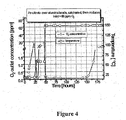
- the exit concentration of oxygen dropped from 85 ppm to less than 0.1 ppm and the reactor operated in this regime at room temperature for 42 hours. After increasing the inlet temperature to 150°C the ⁇ 0.1 ppm exit concentration of oxygen was kept an additional 400 hours.
- the regenerated adsorbent operated at room temperature 49 hours at exit oxygen concentration below 0.1 ppm and additional 200 hours at 150°C as shown in Figure 5.
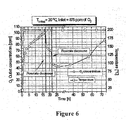
- This example illustrates purification of argon with high concentration of oxygen.
- the purification characteristics of argon with 875 ppm oxygen were investigated.
- the results of the measurements can be extracted from Figure 6.
- the metallic iron powder was able to lower the concentration of oxygen by more than an order of magnitude for 70 hours.
- This example illustrates preparation and properties of an adsorbent prepared by thermal decomposition of iron oxalate.
- 0.25 to 250 g of iron oxalate was deposited with inert beads in tubular reactor. Subsequent reduction was accomplished in 4% of hydrogen in nitrogen at 400°C for 2 hours giving very reactive iron.
- This example illustrates preparation and properties of an adsorbent prepared by elemental iron milling in toluene as described in Example 1.
- 0.1 to 100 g of iron was deposited with inert beads in tubular reactor. Activation was accomplished in 4% of hydrogen in nitrogen at 400°C for 2 hours.
- argon 8.9 ppm of oxygen, linear velocity from 0.1 to 30 cm/s
- the outlet oxygen concentration was measured at 23, 150 and 250°C till breakthrough occurred (>0.2 ppm of oxygen).
- Subsequent regenerations were performed showing decreasing breakthrough adsorption capacity of iron adsorbent (higher breakthrough adsorption capacity for lower inlet concentrations). Corresponding surface area was measured after each experimental run. Results are presented in Table 3.
- This example illustrates preparation and properties of an adsorbent prepared by thermal decomposition of iron oxalate.
- 0.25 to 250 g of Iron oxalate was deposited on glass wool in tubular reactor. Subsequent reduction was accomplished in 4% of hydrogen in nitrogen at 400°C for 2 hours giving very reactive iron.
- argon 8.9 ppm, 27 ppm. and 80 ppm of oxygen, linear velocity from 30 to 100 cm/s
- the outlet oxygen concentration was measured at 250°C till breakthrough occurred (> 0.2 ppm. of oxygen).
- This example illustrates preparation and properties of an adsorbent prepared by elemental iron milling in toluene as described in Example 1.
- 0.1 to 100 g of iron was deposited on glass wool in tubular reactor.
- Activation was accomplished in 4% of hydrogen in nitrogen at 400°C for 2 hours.
- argon 8.9 ppm, 27 ppm and 80 ppm. of oxygen, linear velocity from 30 to 100 cm/s
- the outlet oxygen concentration was measured at 23, 150 and 250°C till breakthrough occurred (> 0.2 ppm of oxygen).
- Subsequent regenerations were performed showing stable breakthrough adsorption capacity of iron adsorbent (higher breakthrough adsorption capacity for lower inlet concentrations). Corresponding surface area was measured after each regeneration. Results are presented in Table 5.
- This example gives the deposition of nanoparticles of iron, prepared by milling described in Example 1, on a porous beads support. Between 100-300 grams of iron in toluene slurry or iron powder was mixed with 100 grams of beads such as alumina or silica using methanol solvent for fine dispersion of the particles. The beads and toluene mixture was allowed to dry. Between 5-50 grams of iron remained deposited on the beads.
- This example illustrates the purification process of ultra-clean nitrogen for O 2 (in ppm) removal using milled iron.
- the reactivity of iron prepared in Example 14 was tested at various inlet feed concentrations of ppm O 2 and temperature (°C) as shown in Table 6.
- the amount of iron used was between 5 and 50 grams.
- the O 2 loading in ml O 2 /grain iron was calculated at 0.2 ppm O 2 breakthrough.
- This example gives the regeneration of iron powder for the values cited in Example 15. Regeneration was done using approximately 2.5% H 2 at 400°C then decreased to 250°C as shown in Table 6. The oxidation-reduction reaction on the ultra fine powder is reversible, for those that could be demonstrated, for example, with runs No. 7 and 8, when the total oxygen load was 729 and 658 ml of oxygen, respectively and oxygen released (calculated from the amount of water removed) was 737 and 618 ml, respectively.
- This example illustrates the purification process of ultra-clean nitrogen for ppm O 2 removal using iron oxide prepared by milling in toluene.
- the reactivity of iron oxide prepared in Example 14 was tested at various inlet feed concentrations of ppm O 2 and temperature (°C) as shown in Table 7.
- the amount of iron oxide used was between 0.5 and 50 grams.
- the O 2 loading in ml O 2 /gram iron was calculated at 0.2 ppm O 2 breakthrough.
- This example illustrates the regeneration of iron oxide for the values derived from Example 17. Regeneration was done using approximately 1.3 and 2.5% H 2 at 250°C and 350°C as shown in Table 7. The oxidation-reduction reaction on the ultra fine powder is reversible, for those that could be demonstrated, for example, with runs No. 13 and 14, when the total oxygen load was 329 and 96 ml of oxygen, respectively and oxygen released (calculated from the amount of water removed) was 266 and 94 ml, respectively.
- This example illustrates the deposition of iron oxalate powder on glass wool.
- About 5 to 30 grams of iron oxalate was mixed with about 1 to 10 grams of glass wool and 0.5 to 1.01 of methanol. This slurry was mixed to achieve good distribution of iron oxalate over the glass wool. After that, methanol was evaporated and iron oxalate was reduced in 1.3% of hydrogen in nitrogen at 300°C.
- This example illustrates the purification process of ultra-clean nitrogen for ppm 02 removal using iron prepared by iron oxalate decomposition-reduction.
- the reactivity of iron oxide prepared in Example 19 was tested at various inlet feed concentrations of ppm O 2 and temperature (°C) as shown in Table 8.
- the amount of iron used was between 0.5 and 50 grams.
- the O 2 loading in ml O 2 /gram iron was calculated at 0.2 ppm O 2 breakthrough.
- This example illustrates the regeneration of iron for the values cited in Example 20. Regeneration was done using approximately 1.3 % H 2 at 300°C as shown in Table 8. The oxidation-reduction reaction on the ultra fine powder is reversible for those that could be demonstrated, for example, with runs No. 8 and 9, when the total oxygen load was 535 and 445 ml of oxygen, respectively and oxygen released (calculated from the amount of water removed) was 580 and 498 ml, respectively.
- 400 2 1.2 138.3 Continued at 150°C 12.4 Continued at 250°C 124.7 Iron milled in toluene, deposited with zirconia beads Activated (decomposed) in 4% of H 2 in N 2 flow, Activity test - passing Ar (8.9 ppm of O 2 ) @ 23°C, 150°C and 250°C Activation Temperature [°C] Activation Time [h] 0 2 uptake [ml/g Fe ] @ 23,150 Total and 250°C 1. 400 2 1.2 51.0 Continued at 150°C 19.4 Continued at 250°C 30.4 2. 400 2 1.1 41.1 Continued at 150°C 16.0 Continued at 250°C 24.0 3.
- 400 2 27.8 Measured at 250°C Iron milled in toluene, deposited on glass wool Activated (decomposed) in 4% of H 2 in N 2 flow, experiments @ 23°C, 150°C and 250°C Activation Temperature [°C] Activation Time [h] O 2 uptake [ml/g Fe ] @ 23,150 Total and 250°C Activity Test - passing Ar (80 ppm of O 2 ) 1.
- 400 2 4.1 50.9 Continued at 150°C 4.1 Continued at 250°C 42.7 2.
- 400 2 4.1 38.7 Continued at 150°C 4.1 Continued at 250°C 30.5 3.
- 400 2 3.0 34.5 Continued at 150°C 3.0 Continued at 250°C 28.5 4.
- 400 2 2.0 28.4 Continued at 150°C 2.0 Continued at 250°C 24.4 5.
- 400 2 35.0 35.0 Measured at 250°C 6.
- 400 2 33.5 33.5 Measured at 250°C Activity test - passing Ar (27 ppm of O 2 ), the same adsorbent 7.
- 400 2 48.6 Measured at 250°C 48.6 Activity test - passing Ar (8.9 ppm of O 2 ), the same adsorbent 8.
- 400 2 61.5 61.5 Measured at 250°C Activity test - passing Ar (80 ppm of O 2 ), the same adsorbent 9.
- 400 2 27.6 27.6 Measured at 250°C 10.
Landscapes
- Chemical & Material Sciences (AREA)
- Organic Chemistry (AREA)
- Analytical Chemistry (AREA)
- Chemical Kinetics & Catalysis (AREA)
- Inorganic Chemistry (AREA)
- General Chemical & Material Sciences (AREA)
- Engineering & Computer Science (AREA)
- Oil, Petroleum & Natural Gas (AREA)
- Solid-Sorbent Or Filter-Aiding Compositions (AREA)
Abstract
Description
| Activated in hydrogen flow, V=100 ml/min Activity test passing Ar (83 ppm O2) @ 23°C, 100°C and 150°C | ||||
| Activation Temperature [°C] | Activation Time [h] | O2 uptake [Ml/gFe] Total | ||
| 1. | 100 | 2 | 0.0 | |
| 2. | 150 | 2 | 0.1 | |
| 3. | 200 | 1 | 0.6 | |
| 4. | 200 | 5 | 1.4 | |
| 5. | 400 | 1 | 5.5 | |
| 6. | 400 | 1 | 6.3 | |
| 7. | 400 | 1 | 7.1 | |
| 8. | 400 | 3 | 10.2 | |
| 9. | 400 | 5 | 10.6 | |
| 10. | 400 | 2 | 10.4 | |
| 11. | 400 | 1 | 13.0 | |
| 12. | 350 | 3 | 8.5 | |
| 13. | 300 | 3 | 8.1 | |
| 14. | 300 | 3 | 8.1 | |
| 15. | 300 | 3 | 7.1 | |
| 16. | 400 | 3 | 8.1 | |
| 17. | 300 | 3 | 7.1 | |
| 18. | 300 | 3 | 6.9 | 60.0 |
| 19. | Continued @ 150°C | 53.1 | ||
| 20. | 300 | 3 | 6.7 | 61.7 |
| 21. | Continued @ 100°C | 55.0 |
| Iron oxalate deposited with zirconia beads Activated (decomposed) in 4% of H2 in N2 flow, experiments @ 23°C, 150°C and 250°C | ||||
| Activation Temperature [°C] | Activation Time [h] | 02 uptake [ml/gFe] @ 23,150 Total and 250°C | ||
| Activity Test - passing Ar (8.2 ppm of O2) | ||||
| 1. | 400 | 2 | 4.4 | 65.0 |
| Continued at 150°C | 14.8 | |||
| Continued at 250°C | 45.8 | |||
| 2. | 400 | 2 | 2.9 | 159.6 |
| Continued at 150°C | 17.8 | |||
| Continued at 250°C | 138.9 | |||
| 3. | 400 | 2 | 0.0 | 75.3 |
| Continued at 150°C | 10.7 | |||
| Continued at 250°C | 64.6 | |||
| 4. | 400 | 2 | 0.7 | 109.6 |
| Continued at 150°C | 10.7 | |||
| Continued at 250°C | 64.6 | |||
| 5. | 400 | 2 | 1.2 | 106.4 |
| Continued at 150°C | 10.7 | |||
| Continued at 250°C | 94.5 | |||
| Activity Test - passing Ar (80 ppm of O2), the | ||||
| 6. | 400 | 2 | 0.0 | 67.4 |
| Continued at 150°C | 4.4 | |||
| Continued at 250°C | 63.0 | |||
| Activity test - passing Ar (27 ppm of O2), the same adsorbent | ||||
| 7. | 400 | 2 | 0.5 | 100.4 |
| Continued at 150°C | 8.4 | |||
| Continued at 250°C | 91.5 | |||
| 8. | 400 | 2 | 0.5 | 92.4 |
| Continued at 150°C | 7.9 | |||
| Continued at 250°C | 84.1 | |||
| 9. | 400 | 2 | 0.5 | 89.0 |
| Continued at 150°C | 6.9 | |||
| Continued at 250°C | 81.6 | |||
| 10. | 400 | 2 | 1.5 | 130.6 |
| Continued at 150°C | 12.9 | |||
| Continued at 250°C | 116.2 | |||
| 11. | 400 | 2 | 0.5 | 101.9 |
| Continued at 150°C | 12.4 | |||
| Continued at 250°C | 89.0 | |||
| 12. | 400 | 2 | 1.5 | 112.1 |
| Continued at 150°C | 10.4 | |||
| Continued at 250°C | 100.2 | |||
| 13. | 400 | 2 | 0.0 | 112.5 |
| Continued at 150°C | 11.1 | |||
| Continued at 250°C | 101.4 | |||
| 14. | 400 | 2 | 0.0 | 122.4 |
| Continued at 150°C | 9.9 | |||
| Continued at 250°C | 112.5 | |||
| 15. | 400 | 2 | 0.0 | 112.8 |
| Continued at 150°C | 6.4 | |||
| Continued at 250°C | 106.4 | |||
| 16. | 400 | 2 | 1.5 | 114.3 |
| Continued at 150°C | 11.4 | |||
| Continued at 250°C | 101.4 | |||
| 17. | 400 | 2 | 1.7 | 132.8 |
| Continued at 150°C | 12.4 | |||
| Continued at 250°C | 118.7 | |||
| Activity test - passing Ar (80 ppm of O2), the same adsorbent | ||||
| 18. | 400 | 2 | 0.7 | 97.4 |
| Continued at 150°C | 7.3 | |||
| Continued at 250°C | 89.4 | |||
| 19. | 400 | 2 | 1.5 | 103.4 |
| Continued at 150°C | 8.1 | |||
| Continued at 250°C | 93.8 | |||
| 20. | 400 | 2 | 2.2 | 103.3 |
| Continued at 150°C | 8.8 | |||
| Continued at 250°C | 92.3 | |||
| 21. | 400 | 2 | 1.5 | 106.3 |
| Continued at 150°C | 8.1 | |||
| Continued at 250°C | 96.7 | |||
| 22. | 400 | 2 | 1.5 | 99.7 |
| Continued at 150°C | 8.8 | |||
| Continued at 250°C | 89.4 | |||
| 23. | 400 | 2 | 0.7 | 97.4 |
| Continued at 150°C | 8.8 | |||
| Continued at 250°C | 87.9 | |||
| 24. | 400 | 2 | 1.5 | 101.9 |
| Continued at 150°C | 8.8 | |||
| Continued at 250°C | 91.6 | |||
| Activity test - passing Ar (27 ppm of O2), the | ||||
| 25. | 400 | 2 | 1.2 | 138.3 |
| Continued at 150°C | 12.4 | |||
| Continued at 250°C | 124.7 |
| Iron milled in toluene, deposited with zirconia beads Activated (decomposed) in 4% of H2 in N2 flow, Activity test - passing Ar (8.9 ppm of O2) @ 23°C, 150°C and 250°C | ||||
| Activation Temperature [°C] | Activation Time [h] | 02 uptake [ml/gFe] @ 23,150 Total and 250°C | ||
| 1. | 400 | 2 | 1.2 | 51.0 |
| Continued at 150°C | 19.4 | |||
| Continued at 250°C | 30.4 | |||
| 2. | 400 | 2 | 1.1 | 41.1 |
| Continued at 150°C | 16.0 | |||
| Continued at 250°C | 24.0 | |||
| 3. | 400 | 2 | 1.0 | 34.6 |
| Continued at 150°C | 13.9 | |||
| Continued at 250°C | 19.7 | |||
| 4. | 400 | 2 | 0.8 | 38.1 |
| Continued at 150°C | 13.6 | |||
| Continued at 250°C | 23.7 |
| Iron oxalate deposited on glass wool Activated (decomposed) in 4% of H2 in N2 flow, experiments @ 250°C | |||
| Activation Temperature [°C] | Activation Time [h] | 02 uptake [ml/gFe] @ 250°C | |
| 1. | 400 | 2 | 152.7 |
| Measured at 250° | |||
| 2. | 400 | 2 | 74.0 |
| Measured at 250°C | |||
| Activity test - passing Ar (8.9 ppm of O2), the | |||
| 3. | 400 | 2 | 80.3 |
| Measured at 250°C | |||
| Activity test - passing Ar (80 ppm of O2), the same adsorbent | |||
| 4. | 400 | 2 | 34.4 |
| Measured at 250°C | |||
| 5. | 400 | 2 | 31.1 |
| Measured at 250° | |||
| 6. | 400 | 2 | 28.9 |
| Measured at 250°C | |||
| 7. | 400 | 2 | 27.8 |
| Measured at 250° | |||
| 8. | 400 | 2 | 26.9 |
| Measured at 250° | |||
| 9. | 400 | 2 | 26.9 |
| Measured at 250° | |||
| 10. | 400 | 2 | 28.6 |
| Measured at 250°C | |||
| 11. | 400 | 2 | 28.6 |
| Measured at 250° | |||
| 12. | 400 | 2 | 18.9 |
| Measured at 250°C | |||
| 13. | 400 | 2 | 25.0 |
| Measured at 250° | |||
| 14. | 400 | 2 | 25.0 |
| Measured at 250° | |||
| 15. | 400 | 2 | 27.8 |
| Measured at 250°C |
| Iron milled in toluene, deposited on glass wool Activated (decomposed) in 4% of H2 in N2 flow, experiments @ 23°C, 150°C and 250°C | ||||
| Activation Temperature [°C] | Activation Time [h] | O2 uptake [ml/gFe] @ 23,150 Total and 250°C | ||
| Activity Test - passing Ar (80 ppm of O2) | ||||
| 1. | 400 | 2 | 4.1 | 50.9 |
| Continued at 150°C | 4.1 | |||
| Continued at 250°C | 42.7 | |||
| 2. | 400 | 2 | 4.1 | 38.7 |
| Continued at 150°C | 4.1 | |||
| Continued at 250°C | 30.5 | |||
| 3. | 400 | 2 | 3.0 | 34.5 |
| Continued at 150°C | 3.0 | |||
| Continued at 250°C | 28.5 | |||
| 4. | 400 | 2 | 2.0 | 28.4 |
| Continued at 150°C | 2.0 | |||
| Continued at 250°C | 24.4 | |||
| 5. | 400 | 2 | 35.0 | 35.0 |
| Measured at 250° | ||||
| 6. | 400 | 2 | 33.5 | 33.5 |
| Measured at 250°C | ||||
| Activity test - passing Ar (27 ppm of O2), the same adsorbent | ||||
| 7. | 400 | 2 | 48.6 | |
| Measured at 250°C | 48.6 | |||
| Activity test - passing Ar (8.9 ppm of O2), the | ||||
| 8. | 400 | 2 | 61.5 | 61.5 |
| Measured at 250°C | ||||
| Activity test - passing Ar (80 ppm of O2), the | ||||
| 9. | 400 | 2 | 27.6 | 27.6 |
| Measured at 250° | ||||
| 10. | 400 | 2 | 33.6 | 33.6 |
| Measured at 250°C |
| Milled Iron Powder (5-50 grams Iron) | |||||
| Run | O2/Fe ratio [mlO2/gFe] (till 0.2 ppm of O2) | Oxygen Loading Conditions | Regeneration Conditions | ||
| C [ppm] | T[°C] | %H2 | T[°C] | ||
| 1. | 7.8 | 2.7 | 150° | 2.5 | 400° |
| 2. | - | 9.5 | 150° | 2.5 | 400° |
| 3. | 3.3 | 9.5 | 150° | 2.5 | 400° |
| 4. | - | 1.5 | 150° | 2.5 | 400° |
| 5. | 15.7 | 9.5 | 250° | 2.5 | 400° |
| 6. | 13.5 | 9.5 | 250° | 2.5 | 400° |
| 7. | 12.7 | 9.5 | 250° | 2.5 | 400° |
| 8. | 10.5 | 9.5 | 250° | 2.5 | 400° |
| 9. | 2.0 | 105.0 | 150° | 2.5 | 250° |
| 10. | 9.7 | 9.5 | 250° | 2.5 | 250° |
| 11. | 2.8 | 2.7 | 60° | 2.5 | 250° |
| 12. | 1.7 | 9.5 | 60° | 2.5 | 250° |
| 13. | 7.6 | 9.5 | 250° | 2.5 | 250° |
| Milled Iron Oxide (5-50 grams Iron) | |||||
| Run | O2/Fe ratio [mlO2/gFe] (till 0.2 ppm of O2) | Oxygen Loading Conditions | Regeneration Conditions | ||
| C[ppm] | T[°C] | %H2 | T[°C] | ||
| 1. | 17.6 | 9.7 | 150° | 2.5 | 350° |
| 2. | 14.9 | 9.7 | 150° | 2.5 | 350° |
| 3. | 56.1 | 9.7 | 250° | 2.5 | 350° |
| 4. | 8.3 | 0.9 | 22° | 2.5 | 350° |
| 5. | 4.2 | 9.7 | 22° | 2.5 | 350° |
| 6. | 48.1 | 0.9 | 150° | 2.5 | 350° |
| 7. | 11.5 | 0.9 | 80° | 2.5 | 350° |
| 8. | 4.7 | 9.7 | 80° | 2.5 | 350° |
| 9. | 13.4 | 9.7 | 150° | 1.3 | 350° |
| 10. | 9.8 | 9.7 | 150° | 2.5 | 250° |
| 11. | 9.4 | 9.7 | 150° | 1.3 | 250° |
| 12. | 9.8 | 9.7 | 150° | 2.5 | 350° |
| 13. | 11.9 | 9.7 | 150° | 1.3 | 350° |
| 14. | 9.8 | 9.7 | 150° | 2.5 | 350° |
| 15. | 46.1 | 9.7 | 250° | 1.3 | 250° |
| 16. | 33.2 | 9.7 | 200° | 1.3 | 300° |
| 17 | 40.4 | 9.7 | 250° |
| Milled Iron Oxalate (5-50 grams Iron) | |||||
| Run | O2/Fe ratio [mlO2/gFe] (till 0.2 ppm of O2) | Oxygen Loading Conditions | Regeneration Conditions | ||
| C[ppm] | T[°C] | %H2 | T[°C] | ||
| 1. | 22.9 | 10.4 | 150° | 1.3 | 300° |
| 2. | 14.6 | 10.4 | 150° | 1.3 | 300° |
| 3. | 11.1 | 10.4 | 150° | 1.3 | 300° |
| 4. | 39.8 | 10.4 | 250° | 1.3 | 300° |
| 5. | 29.3 | 10.4 | 250° | 1.3 | 300° |
| 6. | 24.3 | 10.4 | 250° | 1.3 | 300° |
| 7. | 21.2 | 10.4 | 250° | 1.3 | 300° |
| 8. | 17.9 | 10.4 | 250° | 1.3 | 300° |
| 9. | 17.5 | 10.4 | 250° | 1.3 | 300° |
| 10. | - | 1.2 | 250° | 1.3 | 300° |
| 11. | 7.4 | 1.2 | 60° | 1.3 | 300° |
| 12. | 17.1 | 10.4 | 250° | 1.3 | 300° |
| 13. | 6.3 | 10.1 | 150° | 1.3 | 300° |
| 14. | 13.1 | 10.4 | 250° | 1.3 |
Claims (15)
- A method for purifying inert gases comprising:a) providing an iron adsorbent;b) depositing the iron adsorbent on a carrier matrix;c) placing the carrier matrix in a reactor;d) activating the iron adsorbent; ande) passing a gas stream containing an inert gas over the carrier matrix under conditions effective to remove impurities from the inert gas.
- A method according to claim 1, wherein said step a) comprises:a) providing a metallic iron powder or iron oxide powder;b) providing a milling media;c) placing the metallic iron powder or iron oxide powder and the milling media in a mill; andd) milling the metallic iron powder or iron oxide powder in the mill under conditions effective to produce the iron adsorbent.
- A method according to claim 2 further comprising placing a solvent in the mill with the milling-media and the metallic iron powder or iron oxide powder under conditions effective to produce a slurry of iron in solvent.
- A method according to claim 3, wherein the solvent is selected from the group consisting of hydrocarbons and water.
- A method according to claim 4, wherein the hydrocarbon is selected from the group consisting of toluene, benzene, hexane, cyclohexane, and mixtures thereof.
- A method according to claim 2, wherein the metallic iron powder is about 99.5% pure.
- A method according to claim 2, wherein the mill is an attrition mill or other high-performance mill.
- A method according to claim 2, wherein the milling media is selected from the group consisting of zirconia, alumina, silicon nitride, silicon carbide, tungsten carbide, stainless steel, and mixtures thereof
- A method according to claim 2, wherein the milling media is from about I mm to about 5 mm in diameter.
- A method according to claim 3, wherein the milling media are from about 10% to about 5 0% of the slurry volume.
- A method according to claim 2, wherein the milling is performed in an inert atmosphere.
- A method according to claim 11, wherein the milling is performed in a stream of argon.
- A method according to claim 1, wherein said depositing comprises:a) mixing a slurry comprising the metallic iron powder or iron oxide powder and a solvent with the carrier matrix andb) removing the solvent.
- A method according to claim 1, wherein said - activating comprises:
reducing the iron adsorbent in a reducing atmosphere. - A method according to claim 14, wherein the reducing atmosphere is selected from the group consisting of pure hydrogen, 1-99% H2 in argon, 1-99% H2 in nitrogen, 1-99% H2 in helium, and carbon monoxide.
Applications Claiming Priority (2)
| Application Number | Priority Date | Filing Date | Title |
|---|---|---|---|
| US16667799P | 1999-11-19 | 1999-11-19 | |
| US166677 | 1999-11-19 |
Publications (2)
| Publication Number | Publication Date |
|---|---|
| EP1101734A2 true EP1101734A2 (en) | 2001-05-23 |
| EP1101734A3 EP1101734A3 (en) | 2003-01-15 |
Family
ID=22604268
Family Applications (1)
| Application Number | Title | Priority Date | Filing Date |
|---|---|---|---|
| EP00125137A Withdrawn EP1101734A3 (en) | 1999-11-19 | 2000-11-17 | Purification of argon |
Country Status (1)
| Country | Link |
|---|---|
| EP (1) | EP1101734A3 (en) |
Family Cites Families (5)
| Publication number | Priority date | Publication date | Assignee | Title |
|---|---|---|---|---|
| NL143139B (en) * | 1967-04-14 | 1974-09-16 | Stamicarbon | PROCESS FOR PREPARING A CARRIER CATALYST BY TREATING A CARRIER WITH A SOLUTION OF A SALT OF A CATALYTIC ACTIVE ELEMENT. |
| GB1263131A (en) * | 1968-04-01 | 1972-02-09 | Exxon Research Engineering Co | Process for removal of trace quantities of oxygen from inert gases |
| EP0040935B1 (en) * | 1980-05-23 | 1985-07-24 | Mitsubishi Jukogyo Kabushiki Kaisha | Oxygen adsorbent and process for the separation of oxygen and nitrogen using same |
| FI111245B (en) * | 1998-12-31 | 2003-06-30 | Micro Chemie B V | Process for separating ammonia from a gas mixture and using an adsorbent composition for this separation |
| WO2002040135A1 (en) * | 2000-11-16 | 2002-05-23 | Ub Foundation Services, Inc. A Not-For Profit, Educational Corporation Of The State Of New York | Purification of argon |
-
2000
- 2000-11-17 EP EP00125137A patent/EP1101734A3/en not_active Withdrawn
Also Published As
| Publication number | Publication date |
|---|---|
| EP1101734A3 (en) | 2003-01-15 |
Similar Documents
| Publication | Publication Date | Title |
|---|---|---|
| Rodriguez et al. | Carbon nanofibers: a unique catalyst support medium | |
| Grunwaldt et al. | Comparative study of Au/TiO2 and Au/ZrO2 catalysts for low-temperature CO oxidation | |
| Rodriguez et al. | Deactivation of copper nickel-catalysts due to changes in surface composition | |
| EP1954393B1 (en) | Highly dispersed metal calatysts | |
| Kroll et al. | Methane reforming reaction with carbon dioxide over Ni/SiO2Catalyst: I. Deactivation studies | |
| Zhang et al. | Methane decomposition and carbon deposition over Ni/ZrO2 catalysts: Comparison of amorphous, tetragonal, and monoclinic zirconia phase | |
| Haruta et al. | Gold catalysts prepared by coprecipitation for low-temperature oxidation of hydrogen and of carbon monoxide | |
| EP4223412B1 (en) | Ammonia decomposition catalyst | |
| CA2470945A1 (en) | Regeneration of catalysts for carbon monoxide hydrogenation | |
| Otsuka et al. | Decomposition and regeneration of methane in the absence and the presence of a hydrogen-absorbing alloy CaNi5 | |
| Kharitonov et al. | Mechanism of FeZSM-5 milling and its effect on the catalytic performance in benzene to phenol oxidation | |
| Perupogu et al. | Insight into the role of metal support interface on shape dependent MnO2 support through the synergistic effect between Ag and MnO2 for the total oxidation of propane | |
| EP0147839A2 (en) | A process of the production of a catalyst | |
| Kovnir et al. | PdGa and Pd3Ga7: Highly-selective catalysts for the acetylene partial hydrogenation | |
| Chen et al. | Catalytic properties of nanostructured hydrogen storage nickel particles with cerium shell structure | |
| Wu et al. | TiO2 supported nano-Au catalysts prepared via solvated metal atom impregnation for low–temperature CO oxidation | |
| Alinia et al. | Enhanced Fischer-Tropsch synthesis performance using graphene Nanosheets-Supported Cobalt-Ruthenium Nanocatalysts: Comparative study with γ-Alumina and carbon nanotubes supports | |
| WO2002040135A1 (en) | Purification of argon | |
| Schlögl | Preparation and activation of the technical ammonia synthesis catalyst | |
| US20080096986A1 (en) | Method for synthesizing a catalyst based on anisotropic metallic nanoparticles by a micellar means | |
| EP4552738A1 (en) | Solid material, use and preparation of said solid material | |
| US20250360454A1 (en) | Solid-state gas sorption, storage and separation | |
| Watanabe et al. | Sulfur tolerance of noble metal catalysts for steam methane reforming | |
| Mavrodinova et al. | Effect of the preparation conditions of Ni-supported shock-wave synthesized nanodiamond catalysts: FT-IR and catalytic considerations | |
| Wang et al. | Calorimetric study on oxidation of alumina supported rhodium by dioxygen |
Legal Events
| Date | Code | Title | Description |
|---|---|---|---|
| PUAI | Public reference made under article 153(3) epc to a published international application that has entered the european phase |
Free format text: ORIGINAL CODE: 0009012 |
|
| AK | Designated contracting states |
Kind code of ref document: A2 Designated state(s): AT BE CH CY DE DK ES FI FR GB GR IE IT LI LU MC NL PT SE TR |
|
| AX | Request for extension of the european patent |
Free format text: AL;LT;LV;MK;RO;SI |
|
| RIN1 | Information on inventor provided before grant (corrected) |
Inventor name: MARKOWSKY, MARY LOU Inventor name: HLAVACECK, VLADIMIR Inventor name: PRANDA, PAVOL |
|
| PUAL | Search report despatched |
Free format text: ORIGINAL CODE: 0009013 |
|
| AK | Designated contracting states |
Kind code of ref document: A3 Designated state(s): AT BE CH CY DE DK ES FI FR GB GR IE IT LI LU MC NL PT SE TR |
|
| AX | Request for extension of the european patent |
Free format text: AL;LT;LV;MK;RO;SI |
|
| RIC1 | Information provided on ipc code assigned before grant |
Free format text: 7B 01D 53/02 A, 7C 01B 23/00 B, 7B 01J 20/02 B, 7B 01J 20/06 B, 7F 25J 3/08 B |
|
| AKX | Designation fees paid | ||
| REG | Reference to a national code |
Ref country code: DE Ref legal event code: 8566 |
|
| STAA | Information on the status of an ep patent application or granted ep patent |
Free format text: STATUS: THE APPLICATION IS DEEMED TO BE WITHDRAWN |
|
| 18D | Application deemed to be withdrawn |
Effective date: 20030604 |