EP1100952B1 - Process for preparing optically pure (s)-3,4-dihydroxybutyric acid derivatives - Google Patents
Process for preparing optically pure (s)-3,4-dihydroxybutyric acid derivatives Download PDFInfo
- Publication number
- EP1100952B1 EP1100952B1 EP99935128A EP99935128A EP1100952B1 EP 1100952 B1 EP1100952 B1 EP 1100952B1 EP 99935128 A EP99935128 A EP 99935128A EP 99935128 A EP99935128 A EP 99935128A EP 1100952 B1 EP1100952 B1 EP 1100952B1
- Authority
- EP
- European Patent Office
- Prior art keywords
- acid
- process according
- amylopectin
- oxidation
- oxidant
- Prior art date
- Legal status (The legal status is an assumption and is not a legal conclusion. Google has not performed a legal analysis and makes no representation as to the accuracy of the status listed.)
- Expired - Lifetime
Links
- DZAIOXUZHHTJKN-VKHMYHEASA-N 3S,4-dihydroxy-butyric acid Chemical class OC[C@@H](O)CC(O)=O DZAIOXUZHHTJKN-VKHMYHEASA-N 0.000 title claims abstract description 49
- 238000004519 manufacturing process Methods 0.000 title abstract description 4
- 238000000034 method Methods 0.000 claims abstract description 42
- 229920000945 Amylopectin Polymers 0.000 claims abstract description 36
- 229920001542 oligosaccharide Polymers 0.000 claims abstract description 29
- 150000002482 oligosaccharides Chemical class 0.000 claims abstract description 29
- 238000007254 oxidation reaction Methods 0.000 claims abstract description 20
- 230000003647 oxidation Effects 0.000 claims abstract description 19
- 230000008569 process Effects 0.000 claims abstract description 19
- 102000004190 Enzymes Human genes 0.000 claims abstract description 16
- 108090000790 Enzymes Proteins 0.000 claims abstract description 16
- 230000032050 esterification Effects 0.000 claims abstract description 10
- 238000005886 esterification reaction Methods 0.000 claims abstract description 10
- 125000000217 alkyl group Chemical group 0.000 claims abstract description 4
- 125000004432 carbon atom Chemical group C* 0.000 claims abstract description 4
- 108090000637 alpha-Amylases Proteins 0.000 claims description 35
- HEMHJVSKTPXQMS-UHFFFAOYSA-M Sodium hydroxide Chemical group [OH-].[Na+] HEMHJVSKTPXQMS-UHFFFAOYSA-M 0.000 claims description 30
- 102000004139 alpha-Amylases Human genes 0.000 claims description 18
- 229940024171 alpha-amylase Drugs 0.000 claims description 18
- MHAJPDPJQMAIIY-UHFFFAOYSA-N Hydrogen peroxide Chemical compound OO MHAJPDPJQMAIIY-UHFFFAOYSA-N 0.000 claims description 16
- 239000002253 acid Substances 0.000 claims description 15
- 229940088598 enzyme Drugs 0.000 claims description 15
- 239000002585 base Substances 0.000 claims description 14
- 125000002791 glucosyl group Chemical group C1([C@H](O)[C@@H](O)[C@H](O)[C@H](O1)CO)* 0.000 claims description 14
- 229920001282 polysaccharide Polymers 0.000 claims description 14
- 150000004676 glycans Chemical class 0.000 claims description 13
- 239000005017 polysaccharide Substances 0.000 claims description 13
- -1 alkyl hydroperoxide Chemical compound 0.000 claims description 12
- 238000006911 enzymatic reaction Methods 0.000 claims description 12
- 239000007800 oxidant agent Substances 0.000 claims description 12
- VEXZGXHMUGYJMC-UHFFFAOYSA-N Hydrochloric acid Chemical compound Cl VEXZGXHMUGYJMC-UHFFFAOYSA-N 0.000 claims description 11
- 230000001590 oxidative effect Effects 0.000 claims description 10
- LFQSCWFLJHTTHZ-UHFFFAOYSA-N Ethanol Chemical compound CCO LFQSCWFLJHTTHZ-UHFFFAOYSA-N 0.000 claims description 8
- QAOWNCQODCNURD-UHFFFAOYSA-N Sulfuric acid Chemical compound OS(O)(=O)=O QAOWNCQODCNURD-UHFFFAOYSA-N 0.000 claims description 8
- 239000003377 acid catalyst Substances 0.000 claims description 8
- 230000015556 catabolic process Effects 0.000 claims description 7
- 238000006731 degradation reaction Methods 0.000 claims description 7
- NBIIXXVUZAFLBC-UHFFFAOYSA-N Phosphoric acid Chemical compound OP(O)(O)=O NBIIXXVUZAFLBC-UHFFFAOYSA-N 0.000 claims description 6
- DTQVDTLACAAQTR-UHFFFAOYSA-N Trifluoroacetic acid Chemical compound OC(=O)C(F)(F)F DTQVDTLACAAQTR-UHFFFAOYSA-N 0.000 claims description 6
- GRYLNZFGIOXLOG-UHFFFAOYSA-N Nitric acid Chemical compound O[N+]([O-])=O GRYLNZFGIOXLOG-UHFFFAOYSA-N 0.000 claims description 3
- 150000008044 alkali metal hydroxides Chemical class 0.000 claims description 3
- 229910001860 alkaline earth metal hydroxide Inorganic materials 0.000 claims description 3
- 229910000147 aluminium phosphate Inorganic materials 0.000 claims description 3
- 150000007522 mineralic acids Chemical class 0.000 claims description 3
- 229910017604 nitric acid Inorganic materials 0.000 claims description 3
- 150000007524 organic acids Chemical class 0.000 claims description 3
- 150000004973 alkali metal peroxides Chemical class 0.000 claims description 2
- CIHOLLKRGTVIJN-UHFFFAOYSA-N tert‐butyl hydroperoxide Chemical group CC(C)(C)OO CIHOLLKRGTVIJN-UHFFFAOYSA-N 0.000 claims description 2
- 229910052784 alkaline earth metal Inorganic materials 0.000 claims 1
- 150000001342 alkaline earth metals Chemical class 0.000 claims 1
- 235000000346 sugar Nutrition 0.000 abstract description 14
- 238000009826 distribution Methods 0.000 abstract description 10
- 229930014626 natural product Natural products 0.000 abstract description 4
- 239000000243 solution Substances 0.000 description 38
- FUDDLSHBRSNCBV-UHFFFAOYSA-N (+)-(R)-3-hydroxytetrahydrofuranone Natural products OC1COC(=O)C1 FUDDLSHBRSNCBV-UHFFFAOYSA-N 0.000 description 35
- FUDDLSHBRSNCBV-VKHMYHEASA-N (4s)-4-hydroxyoxolan-2-one Chemical compound O[C@@H]1COC(=O)C1 FUDDLSHBRSNCBV-VKHMYHEASA-N 0.000 description 34
- 238000006243 chemical reaction Methods 0.000 description 34
- AEMRFAOFKBGASW-UHFFFAOYSA-N Glycolic acid Chemical compound OCC(O)=O AEMRFAOFKBGASW-UHFFFAOYSA-N 0.000 description 18
- 229920002472 Starch Polymers 0.000 description 13
- 150000002016 disaccharides Chemical class 0.000 description 13
- 238000002360 preparation method Methods 0.000 description 13
- 239000008107 starch Substances 0.000 description 13
- 235000019698 starch Nutrition 0.000 description 13
- QTBSBXVTEAMEQO-UHFFFAOYSA-N Acetic acid Chemical compound CC(O)=O QTBSBXVTEAMEQO-UHFFFAOYSA-N 0.000 description 12
- OKKJLVBELUTLKV-UHFFFAOYSA-N Methanol Chemical compound OC OKKJLVBELUTLKV-UHFFFAOYSA-N 0.000 description 12
- 239000000463 material Substances 0.000 description 12
- 230000003287 optical effect Effects 0.000 description 12
- 239000000543 intermediate Substances 0.000 description 11
- HEDRZPFGACZZDS-MICDWDOJSA-N Trichloro(2H)methane Chemical compound [2H]C(Cl)(Cl)Cl HEDRZPFGACZZDS-MICDWDOJSA-N 0.000 description 10
- BDAGIHXWWSANSR-UHFFFAOYSA-N methanoic acid Natural products OC=O BDAGIHXWWSANSR-UHFFFAOYSA-N 0.000 description 10
- KCKWOJWPEXHLOQ-BYPYZUCNSA-N methyl (3s)-3,4-dihydroxybutanoate Chemical compound COC(=O)C[C@H](O)CO KCKWOJWPEXHLOQ-BYPYZUCNSA-N 0.000 description 10
- YMWUJEATGCHHMB-UHFFFAOYSA-N Dichloromethane Chemical compound ClCCl YMWUJEATGCHHMB-UHFFFAOYSA-N 0.000 description 9
- MUBZPKHOEPUJKR-UHFFFAOYSA-N Oxalic acid Chemical compound OC(=O)C(O)=O MUBZPKHOEPUJKR-UHFFFAOYSA-N 0.000 description 9
- 239000000047 product Substances 0.000 description 9
- CDBYLPFSWZWCQE-UHFFFAOYSA-L Sodium Carbonate Chemical compound [Na+].[Na+].[O-]C([O-])=O CDBYLPFSWZWCQE-UHFFFAOYSA-L 0.000 description 8
- 239000006227 byproduct Substances 0.000 description 8
- 150000001875 compounds Chemical class 0.000 description 8
- 238000005516 engineering process Methods 0.000 description 8
- XLYOFNOQVPJJNP-UHFFFAOYSA-N water Substances O XLYOFNOQVPJJNP-UHFFFAOYSA-N 0.000 description 8
- 238000005160 1H NMR spectroscopy Methods 0.000 description 7
- 229920000856 Amylose Polymers 0.000 description 7
- 230000015572 biosynthetic process Effects 0.000 description 7
- 238000004817 gas chromatography Methods 0.000 description 7
- OWEGMIWEEQEYGQ-UHFFFAOYSA-N 100676-05-9 Natural products OC1C(O)C(O)C(CO)OC1OCC1C(O)C(O)C(O)C(OC2C(OC(O)C(O)C2O)CO)O1 OWEGMIWEEQEYGQ-UHFFFAOYSA-N 0.000 description 6
- XEKOWRVHYACXOJ-UHFFFAOYSA-N Ethyl acetate Chemical compound CCOC(C)=O XEKOWRVHYACXOJ-UHFFFAOYSA-N 0.000 description 6
- GUBGYTABKSRVRQ-PICCSMPSSA-N Maltose Natural products O[C@@H]1[C@@H](O)[C@H](O)[C@@H](CO)O[C@@H]1O[C@@H]1[C@@H](CO)OC(O)[C@H](O)[C@H]1O GUBGYTABKSRVRQ-PICCSMPSSA-N 0.000 description 6
- 238000004458 analytical method Methods 0.000 description 6
- 150000001720 carbohydrates Chemical class 0.000 description 6
- 235000014633 carbohydrates Nutrition 0.000 description 6
- 238000000746 purification Methods 0.000 description 6
- 239000011541 reaction mixture Substances 0.000 description 6
- OSWFIVFLDKOXQC-UHFFFAOYSA-N 4-(3-methoxyphenyl)aniline Chemical compound COC1=CC=CC(C=2C=CC(N)=CC=2)=C1 OSWFIVFLDKOXQC-UHFFFAOYSA-N 0.000 description 5
- 238000005481 NMR spectroscopy Methods 0.000 description 5
- 230000002255 enzymatic effect Effects 0.000 description 5
- 235000019253 formic acid Nutrition 0.000 description 5
- 239000000203 mixture Substances 0.000 description 5
- AFVFQIVMOAPDHO-UHFFFAOYSA-N Methanesulfonic acid Chemical compound CS(O)(=O)=O AFVFQIVMOAPDHO-UHFFFAOYSA-N 0.000 description 4
- 239000007853 buffer solution Substances 0.000 description 4
- 238000001816 cooling Methods 0.000 description 4
- 150000002148 esters Chemical class 0.000 description 4
- 238000010438 heat treatment Methods 0.000 description 4
- 238000006460 hydrolysis reaction Methods 0.000 description 4
- 230000009257 reactivity Effects 0.000 description 4
- 230000008684 selective degradation Effects 0.000 description 4
- 229910000029 sodium carbonate Inorganic materials 0.000 description 4
- 150000008163 sugars Chemical class 0.000 description 4
- DZAIOXUZHHTJKN-UHFFFAOYSA-N 3,4-dihydroxybutyric acid Chemical compound OCC(O)CC(O)=O DZAIOXUZHHTJKN-UHFFFAOYSA-N 0.000 description 3
- WFDIJRYMOXRFFG-UHFFFAOYSA-N Acetic anhydride Chemical compound CC(=O)OC(C)=O WFDIJRYMOXRFFG-UHFFFAOYSA-N 0.000 description 3
- JPIJQSOTBSSVTP-PWNYCUMCSA-N D-erythronic acid Chemical compound OC[C@@H](O)[C@@H](O)C(O)=O JPIJQSOTBSSVTP-PWNYCUMCSA-N 0.000 description 3
- 229920002245 Dextrose equivalent Polymers 0.000 description 3
- WQZGKKKJIJFFOK-GASJEMHNSA-N Glucose Natural products OC[C@H]1OC(O)[C@H](O)[C@@H](O)[C@@H]1O WQZGKKKJIJFFOK-GASJEMHNSA-N 0.000 description 3
- GUBGYTABKSRVRQ-QKKXKWKRSA-N Lactose Natural products OC[C@H]1O[C@@H](O[C@H]2[C@H](O)[C@@H](O)C(O)O[C@@H]2CO)[C@H](O)[C@@H](O)[C@H]1O GUBGYTABKSRVRQ-QKKXKWKRSA-N 0.000 description 3
- KWYUFKZDYYNOTN-UHFFFAOYSA-M Potassium hydroxide Chemical compound [OH-].[K+] KWYUFKZDYYNOTN-UHFFFAOYSA-M 0.000 description 3
- QOAAHMCFVNHTBI-YFKPBYRVSA-N [(3s)-5-oxooxolan-3-yl] acetate Chemical compound CC(=O)O[C@@H]1COC(=O)C1 QOAAHMCFVNHTBI-YFKPBYRVSA-N 0.000 description 3
- WQZGKKKJIJFFOK-VFUOTHLCSA-N beta-D-glucose Chemical compound OC[C@H]1O[C@@H](O)[C@H](O)[C@@H](O)[C@@H]1O WQZGKKKJIJFFOK-VFUOTHLCSA-N 0.000 description 3
- GUBGYTABKSRVRQ-QUYVBRFLSA-N beta-maltose Chemical compound OC[C@H]1O[C@H](O[C@H]2[C@H](O)[C@@H](O)[C@H](O)O[C@@H]2CO)[C@H](O)[C@@H](O)[C@@H]1O GUBGYTABKSRVRQ-QUYVBRFLSA-N 0.000 description 3
- 239000001913 cellulose Substances 0.000 description 3
- 229920002678 cellulose Polymers 0.000 description 3
- 239000003795 chemical substances by application Substances 0.000 description 3
- 230000000052 comparative effect Effects 0.000 description 3
- 230000000694 effects Effects 0.000 description 3
- 239000008103 glucose Substances 0.000 description 3
- 230000007062 hydrolysis Effects 0.000 description 3
- 239000008101 lactose Substances 0.000 description 3
- 235000006408 oxalic acid Nutrition 0.000 description 3
- 230000009467 reduction Effects 0.000 description 3
- 238000006722 reduction reaction Methods 0.000 description 3
- 230000001131 transforming effect Effects 0.000 description 3
- 241001134780 Bacillus acidopullulyticus Species 0.000 description 2
- 229920002774 Maltodextrin Polymers 0.000 description 2
- 239000005913 Maltodextrin Substances 0.000 description 2
- 102100026367 Pancreatic alpha-amylase Human genes 0.000 description 2
- JUJWROOIHBZHMG-UHFFFAOYSA-N Pyridine Chemical compound C1=CC=NC=C1 JUJWROOIHBZHMG-UHFFFAOYSA-N 0.000 description 2
- 230000002378 acidificating effect Effects 0.000 description 2
- WQZGKKKJIJFFOK-PHYPRBDBSA-N alpha-D-galactose Chemical compound OC[C@H]1O[C@H](O)[C@H](O)[C@@H](O)[C@H]1O WQZGKKKJIJFFOK-PHYPRBDBSA-N 0.000 description 2
- 239000003054 catalyst Substances 0.000 description 2
- 239000003153 chemical reaction reagent Substances 0.000 description 2
- 239000007810 chemical reaction solvent Substances 0.000 description 2
- 230000000593 degrading effect Effects 0.000 description 2
- 239000003814 drug Substances 0.000 description 2
- 238000005227 gel permeation chromatography Methods 0.000 description 2
- SGOVJIDEXZEOTB-NJGYIYPDSA-N isosaccharinic acid Chemical compound OC[C@@H](O)C[C@](O)(CO)C(O)=O SGOVJIDEXZEOTB-NJGYIYPDSA-N 0.000 description 2
- 229940035034 maltodextrin Drugs 0.000 description 2
- 229910052751 metal Inorganic materials 0.000 description 2
- 239000002184 metal Substances 0.000 description 2
- 229940098779 methanesulfonic acid Drugs 0.000 description 2
- 235000005985 organic acids Nutrition 0.000 description 2
- 238000007363 ring formation reaction Methods 0.000 description 2
- 238000000926 separation method Methods 0.000 description 2
- 159000000000 sodium salts Chemical class 0.000 description 2
- GQYKSISLCPUNJT-BDVNFPICSA-N (2r,3r,4r,5r)-2,3,5,6-tetrahydroxy-4-methoxyhexanal Chemical compound OC[C@@H](O)[C@@H](OC)[C@H](O)[C@@H](O)C=O GQYKSISLCPUNJT-BDVNFPICSA-N 0.000 description 1
- YQGDEPYYFWUPGO-GSVOUGTGSA-N (3r)-4-amino-3-hydroxybutanoic acid Chemical compound NC[C@H](O)CC(O)=O YQGDEPYYFWUPGO-GSVOUGTGSA-N 0.000 description 1
- WGNSGQNASYNCBU-VKHMYHEASA-N (3s)-4-bromo-3-hydroxybutanoic acid Chemical compound BrC[C@@H](O)CC(O)=O WGNSGQNASYNCBU-VKHMYHEASA-N 0.000 description 1
- XDPCNPCKDGQBAN-BYPYZUCNSA-N (3s)-oxolan-3-ol Chemical compound O[C@H]1CCOC1 XDPCNPCKDGQBAN-BYPYZUCNSA-N 0.000 description 1
- PHIQHXFUZVPYII-ZCFIWIBFSA-N (R)-carnitine Chemical compound C[N+](C)(C)C[C@H](O)CC([O-])=O PHIQHXFUZVPYII-ZCFIWIBFSA-N 0.000 description 1
- WHBMMWSBFZVSSR-VKHMYHEASA-N (S)-3-hydroxybutyric acid Chemical class C[C@H](O)CC(O)=O WHBMMWSBFZVSSR-VKHMYHEASA-N 0.000 description 1
- RBNPOMFGQQGHHO-UHFFFAOYSA-N -2,3-Dihydroxypropanoic acid Natural products OCC(O)C(O)=O RBNPOMFGQQGHHO-UHFFFAOYSA-N 0.000 description 1
- IHLAQQPQKRMGSS-BYPYZUCNSA-N 2-[(4s)-4-hydroxy-2-oxopyrrolidin-1-yl]acetamide Chemical compound NC(=O)CN1C[C@@H](O)CC1=O IHLAQQPQKRMGSS-BYPYZUCNSA-N 0.000 description 1
- 229940124321 AIDS medicine Drugs 0.000 description 1
- GUBGYTABKSRVRQ-XLOQQCSPSA-N Alpha-Lactose Chemical compound O[C@@H]1[C@@H](O)[C@@H](O)[C@@H](CO)O[C@H]1O[C@@H]1[C@@H](CO)O[C@H](O)[C@H](O)[C@H]1O GUBGYTABKSRVRQ-XLOQQCSPSA-N 0.000 description 1
- XUKUURHRXDUEBC-UHFFFAOYSA-N Atorvastatin Natural products C=1C=CC=CC=1C1=C(C=2C=CC(F)=CC=2)N(CCC(O)CC(O)CC(O)=O)C(C(C)C)=C1C(=O)NC1=CC=CC=C1 XUKUURHRXDUEBC-UHFFFAOYSA-N 0.000 description 1
- XUKUURHRXDUEBC-KAYWLYCHSA-N Atorvastatin Chemical compound C=1C=CC=CC=1C1=C(C=2C=CC(F)=CC=2)N(CC[C@@H](O)C[C@@H](O)CC(O)=O)C(C(C)C)=C1C(=O)NC1=CC=CC=C1 XUKUURHRXDUEBC-KAYWLYCHSA-N 0.000 description 1
- 241000193744 Bacillus amyloliquefaciens Species 0.000 description 1
- 241000194108 Bacillus licheniformis Species 0.000 description 1
- RBNPOMFGQQGHHO-UWTATZPHSA-N D-glyceric acid Chemical compound OC[C@@H](O)C(O)=O RBNPOMFGQQGHHO-UWTATZPHSA-N 0.000 description 1
- 229940122440 HIV protease inhibitor Drugs 0.000 description 1
- 229940121710 HMGCoA reductase inhibitor Drugs 0.000 description 1
- 150000007513 acids Chemical class 0.000 description 1
- 229960001830 amprenavir Drugs 0.000 description 1
- YMARZQAQMVYCKC-OEMFJLHTSA-N amprenavir Chemical compound C([C@@H]([C@H](O)CN(CC(C)C)S(=O)(=O)C=1C=CC(N)=CC=1)NC(=O)O[C@@H]1COCC1)C1=CC=CC=C1 YMARZQAQMVYCKC-OEMFJLHTSA-N 0.000 description 1
- 230000003466 anti-cipated effect Effects 0.000 description 1
- QVGXLLKOCUKJST-UHFFFAOYSA-N atomic oxygen Chemical compound [O] QVGXLLKOCUKJST-UHFFFAOYSA-N 0.000 description 1
- 229960005370 atorvastatin Drugs 0.000 description 1
- 230000008901 benefit Effects 0.000 description 1
- 210000004556 brain Anatomy 0.000 description 1
- 244000309464 bull Species 0.000 description 1
- 238000010531 catalytic reduction reaction Methods 0.000 description 1
- 235000013351 cheese Nutrition 0.000 description 1
- 230000007073 chemical hydrolysis Effects 0.000 description 1
- 238000004587 chromatography analysis Methods 0.000 description 1
- 238000007796 conventional method Methods 0.000 description 1
- 150000001923 cyclic compounds Chemical class 0.000 description 1
- 230000007423 decrease Effects 0.000 description 1
- 230000003247 decreasing effect Effects 0.000 description 1
- 235000015872 dietary supplement Nutrition 0.000 description 1
- 125000005594 diketone group Chemical group 0.000 description 1
- 229940079593 drug Drugs 0.000 description 1
- 230000008030 elimination Effects 0.000 description 1
- 238000003379 elimination reaction Methods 0.000 description 1
- 201000005577 familial hyperlipidemia Diseases 0.000 description 1
- 238000001914 filtration Methods 0.000 description 1
- 235000013373 food additive Nutrition 0.000 description 1
- 239000002778 food additive Substances 0.000 description 1
- 150000002402 hexoses Chemical class 0.000 description 1
- 238000004128 high performance liquid chromatography Methods 0.000 description 1
- 239000004030 hiv protease inhibitor Substances 0.000 description 1
- 150000004677 hydrates Chemical class 0.000 description 1
- 239000001257 hydrogen Substances 0.000 description 1
- 229910052739 hydrogen Inorganic materials 0.000 description 1
- 125000002887 hydroxy group Chemical group [H]O* 0.000 description 1
- 239000002471 hydroxymethylglutaryl coenzyme A reductase inhibitor Substances 0.000 description 1
- 230000006872 improvement Effects 0.000 description 1
- 230000000415 inactivating effect Effects 0.000 description 1
- 230000002779 inactivation Effects 0.000 description 1
- 150000002576 ketones Chemical class 0.000 description 1
- 239000001630 malic acid Substances 0.000 description 1
- 230000007246 mechanism Effects 0.000 description 1
- 230000004060 metabolic process Effects 0.000 description 1
- 150000004972 metal peroxides Chemical class 0.000 description 1
- 125000002496 methyl group Chemical group [H]C([H])([H])* 0.000 description 1
- SYSQUGFVNFXIIT-UHFFFAOYSA-N n-[4-(1,3-benzoxazol-2-yl)phenyl]-4-nitrobenzenesulfonamide Chemical class C1=CC([N+](=O)[O-])=CC=C1S(=O)(=O)NC1=CC=C(C=2OC3=CC=CC=C3N=2)C=C1 SYSQUGFVNFXIIT-UHFFFAOYSA-N 0.000 description 1
- 239000003176 neuroleptic agent Substances 0.000 description 1
- 239000001301 oxygen Substances 0.000 description 1
- 229910052760 oxygen Inorganic materials 0.000 description 1
- 150000002978 peroxides Chemical class 0.000 description 1
- 230000000704 physical effect Effects 0.000 description 1
- 230000003389 potentiating effect Effects 0.000 description 1
- UMJSCPRVCHMLSP-UHFFFAOYSA-N pyridine Natural products COC1=CC=CN=C1 UMJSCPRVCHMLSP-UHFFFAOYSA-N 0.000 description 1
- 230000035484 reaction time Effects 0.000 description 1
- 230000036186 satiety Effects 0.000 description 1
- 235000019627 satiety Nutrition 0.000 description 1
- 238000010898 silica gel chromatography Methods 0.000 description 1
- 239000000126 substance Substances 0.000 description 1
- 125000001424 substituent group Chemical group 0.000 description 1
- 239000000758 substrate Substances 0.000 description 1
- 238000003786 synthesis reaction Methods 0.000 description 1
- 238000003419 tautomerization reaction Methods 0.000 description 1
- 108010075550 termamyl Proteins 0.000 description 1
- 230000009466 transformation Effects 0.000 description 1
- 238000010626 work up procedure Methods 0.000 description 1
Images

Classifications
-
- C—CHEMISTRY; METALLURGY
- C07—ORGANIC CHEMISTRY
- C07D—HETEROCYCLIC COMPOUNDS
- C07D307/00—Heterocyclic compounds containing five-membered rings having one oxygen atom as the only ring hetero atom
- C07D307/02—Heterocyclic compounds containing five-membered rings having one oxygen atom as the only ring hetero atom not condensed with other rings
- C07D307/26—Heterocyclic compounds containing five-membered rings having one oxygen atom as the only ring hetero atom not condensed with other rings having one double bond between ring members or between a ring member and a non-ring member
- C07D307/30—Heterocyclic compounds containing five-membered rings having one oxygen atom as the only ring hetero atom not condensed with other rings having one double bond between ring members or between a ring member and a non-ring member with hetero atoms or with carbon atoms having three bonds to hetero atoms with at the most one bond to halogen, e.g. ester or nitrile radicals, directly attached to ring carbon atoms
- C07D307/32—Oxygen atoms
- C07D307/33—Oxygen atoms in position 2, the oxygen atom being in its keto or unsubstituted enol form
-
- C—CHEMISTRY; METALLURGY
- C12—BIOCHEMISTRY; BEER; SPIRITS; WINE; VINEGAR; MICROBIOLOGY; ENZYMOLOGY; MUTATION OR GENETIC ENGINEERING
- C12P—FERMENTATION OR ENZYME-USING PROCESSES TO SYNTHESISE A DESIRED CHEMICAL COMPOUND OR COMPOSITION OR TO SEPARATE OPTICAL ISOMERS FROM A RACEMIC MIXTURE
- C12P17/00—Preparation of heterocyclic carbon compounds with only O, N, S, Se or Te as ring hetero atoms
- C12P17/02—Oxygen as only ring hetero atoms
- C12P17/04—Oxygen as only ring hetero atoms containing a five-membered hetero ring, e.g. griseofulvin, vitamin C
-
- C—CHEMISTRY; METALLURGY
- C12—BIOCHEMISTRY; BEER; SPIRITS; WINE; VINEGAR; MICROBIOLOGY; ENZYMOLOGY; MUTATION OR GENETIC ENGINEERING
- C12P—FERMENTATION OR ENZYME-USING PROCESSES TO SYNTHESISE A DESIRED CHEMICAL COMPOUND OR COMPOSITION OR TO SEPARATE OPTICAL ISOMERS FROM A RACEMIC MIXTURE
- C12P19/00—Preparation of compounds containing saccharide radicals
- C12P19/14—Preparation of compounds containing saccharide radicals produced by the action of a carbohydrase (EC 3.2.x), e.g. by alpha-amylase, e.g. by cellulase, hemicellulase
-
- C—CHEMISTRY; METALLURGY
- C12—BIOCHEMISTRY; BEER; SPIRITS; WINE; VINEGAR; MICROBIOLOGY; ENZYMOLOGY; MUTATION OR GENETIC ENGINEERING
- C12P—FERMENTATION OR ENZYME-USING PROCESSES TO SYNTHESISE A DESIRED CHEMICAL COMPOUND OR COMPOSITION OR TO SEPARATE OPTICAL ISOMERS FROM A RACEMIC MIXTURE
- C12P19/00—Preparation of compounds containing saccharide radicals
- C12P19/22—Preparation of compounds containing saccharide radicals produced by the action of a beta-amylase, e.g. maltose
-
- C—CHEMISTRY; METALLURGY
- C12—BIOCHEMISTRY; BEER; SPIRITS; WINE; VINEGAR; MICROBIOLOGY; ENZYMOLOGY; MUTATION OR GENETIC ENGINEERING
- C12P—FERMENTATION OR ENZYME-USING PROCESSES TO SYNTHESISE A DESIRED CHEMICAL COMPOUND OR COMPOSITION OR TO SEPARATE OPTICAL ISOMERS FROM A RACEMIC MIXTURE
- C12P7/00—Preparation of oxygen-containing organic compounds
- C12P7/40—Preparation of oxygen-containing organic compounds containing a carboxyl group including Peroxycarboxylic acids
- C12P7/42—Hydroxy-carboxylic acids
-
- H—ELECTRICITY
- H04—ELECTRIC COMMUNICATION TECHNIQUE
- H04M—TELEPHONIC COMMUNICATION
- H04M1/00—Substation equipment, e.g. for use by subscribers
- H04M1/02—Constructional features of telephone sets
- H04M1/04—Supports for telephone transmitters or receivers
-
- H—ELECTRICITY
- H04—ELECTRIC COMMUNICATION TECHNIQUE
- H04M—TELEPHONIC COMMUNICATION
- H04M1/00—Substation equipment, e.g. for use by subscribers
- H04M1/60—Substation equipment, e.g. for use by subscribers including speech amplifiers
- H04M1/6033—Substation equipment, e.g. for use by subscribers including speech amplifiers for providing handsfree use or a loudspeaker mode in telephone sets
- H04M1/6041—Portable telephones adapted for handsfree use
- H04M1/6058—Portable telephones adapted for handsfree use involving the use of a headset accessory device connected to the portable telephone
- H04M1/6066—Portable telephones adapted for handsfree use involving the use of a headset accessory device connected to the portable telephone including a wireless connection
-
- H—ELECTRICITY
- H04—ELECTRIC COMMUNICATION TECHNIQUE
- H04M—TELEPHONIC COMMUNICATION
- H04M19/00—Current supply arrangements for telephone systems
- H04M19/02—Current supply arrangements for telephone systems providing ringing current or supervisory tones, e.g. dialling tone or busy tone
- H04M19/04—Current supply arrangements for telephone systems providing ringing current or supervisory tones, e.g. dialling tone or busy tone the ringing-current being generated at the substations
-
- C—CHEMISTRY; METALLURGY
- C07—ORGANIC CHEMISTRY
- C07B—GENERAL METHODS OF ORGANIC CHEMISTRY; APPARATUS THEREFOR
- C07B2200/00—Indexing scheme relating to specific properties of organic compounds
- C07B2200/07—Optical isomers
Definitions
- the present invention relates to a process for preparing optically pure (S)-3,4-dihydroxybutyric acid derivatives expressed by the following Formula 1 and more particularly, to a process that enables preparing optically pure (S)-3,4-dihydroxybutyric acid derivatives economically in large quantities, by:
- ( S )-3,4-Dihydroxybutyric acid derivatives and ( S )-3-hydroxy- ⁇ -butyrolactone are used as synthetic intermediates for preparing various chiral compounds.
- they act as key intermediates for preparing neuromeidator ( R )-GABOB [ Tetrahedron , 46, 4277(1990)], treatment for hyperlipemia (Atorvastatin; HMG-CoA reductase inhibitor) [ Tetrahedron Lett ., 33, 2279(1992)], (S)-oxiracetam which is improvement agent in brain metabolism [International patent publication WO93/06,826], L-carnitine which is health supplement agent [International patent publication WO99/05,092], (S)-3-hydroxytetrahydrofuran [ J.
- ( S )-3,4-dihydroxybutyric acid is produced with various kinds of mixtures including glycolic acid (D), isosaccharinic acid (B), formic acid, ketone, diketone and glyceric acid. Since the yield of ( S )-3,4-dihydroxybutyric acid is very low, these methods are also considered as not suitable for industrial use.
- the (1,4) and/or (1,6) glucose units are linked complexly like nets.
- the problem is that the step-by-step oxidation proceeding from the reducing end units comprising (1,4) linkage terminates at (1,6) linkage unit. Therefore, no more target product is formed.
- the polysaccharides are degraded by overoxidation of reducing end units to complex acid mixtures containing formic acid, oxalic acid, glycolic acid and erythronic acid [ J. Am. Chem. Soc ., 81, 3136(1959); Starch 41 Nr. 8, S. 303 ⁇ 309(1989); Synthesis , 597 ⁇ 613(1997)].
- the target product and by-products are formed competitively in the step-by-step oxidation due to the compact structure having random (1,4) linkage and (1,6) linkage.
- selective degradation technique of polysaccharide to a suitable sugar distribution range having (1,4) linkage is required.
- the reported technologies include preparing glucose, maltose and ethanol through enzymatic treatment of starch [USP 3,791,865(1974); USP 3,922,200(1975); USP 4,855,232(1989): Japanese patent publication 4-158,795(1992); Methods Carbohydr. Chem ., 10, 231 ⁇ 239(1994); Methods Carbohydr. Chem ., 10, 245 ⁇ 248(1994)], and preparing maltodextrin with adequate dextrose equivalent (DE) [USP 3,986,890(1976); USP 4,447,532(1984); USP 4,612,284(1986); USP 5,506,353(1996)].
- DE dextrose equivalent
- EP-A1-0 513 430 which corresponds to US Patent 5,374,773 discloses in more detail a process for the conversion of a hexose source containing D-hexose as a substituent and another sugar attached to the D-hexose substituent in the 4 position to 3,4-dihydroxybutyric acid and glycolic acid which comprises:
- the inventors of the present invention made intensive efforts to develop a method for preparing optically pure ( S )-3,4-dihydroxybutyric acid derivatives from commercially available amylopectin with ease.
- a process which enables preparing optically pure ( S )-3,4-dihydroxybutyric acid derivatives economically in large quantities is found by preparing oligosaccharide with structural specificity which can minimize formation of by-products from amylopectin by enzymatic reaction.
- oxidation reaction can be performed continuously in the same reactor without additional separation and purification of the above prepared oligosaccharide.
- an object of this invention is to provide a method for preparing optically pure ( S )-3,4-dihydroxybutyric acid derivatives in high yield without additional purification of intermediates.
- the present invention is characterized by comprising the following steps:
- the fundamental inventive concept of the present invention is selective degradation of ⁇ -(1,4) linkage and ⁇ -(1,6) linkage within amylopectin using specific enzymes, i.e., transforming amylopectin to ⁇ -(1,4)-linked oligosaccharide with the optimal sugar distribution for preparing the target compound. And subsequently oxidation and esterification are performed to prepare ( S )-3,4-dihydroxybutyric acid derivatives.
- amylopectin is degraded sequentially with specific enzymes to ⁇ -(1,4) linked oligosaccharide, and optically pure ( S )-3,4-dihydroxybutyric acid derivatives are prepared from the transformed oligosaccharide in high yield.
- Optical purity of the desired product prepared by a sequential method is over 99.9%ee.
- Oligosaccharide used in the present invention is prepared with biological enzymatic treatment of amylopectin, and amylopectin is commercially available with ease. Especially, since amylopectin is highly soluble in water or in buffer solution of pH 4.0 ⁇ 8.0, used as reaction solvent for enzymatic reaction of the present invention, the relative reactivity to enzyme is greatly increased compared with other polysaccharides such as starch and cellulose. Thus, the same is very effective material for preparing of oligosaccharide having suitable sugar distribution for the preparation of ( S )-3,4-dihydroxybutyric acid derivatives.
- pullulanase As an enzyme for selective degradation of ⁇ -(1,6) linkage in amylopectin, it causes the solubility problem of amylopectin and reduced enzyme activity. So, rather than using pullulanase only, ⁇ -amylase was used to improve reactivity in degrading amylopectin to a suitable sugar distribution, and then pullulanase was used. However, in this case, activity of the remaining ⁇ -amylase persists and thus amylopectin is degraded excessively, so that the desired oligosaccharide is not formed. Accordingly, a technology of inactivating the remaining ⁇ -amylase before the pullulanase reaction was introduced.
- the detailed explanation of the preparation process of this invention is as follow. It comprises; 1) a step preparing oligosaccharide with characteristic ⁇ -(1,4) linkage expressed in Formula 2 by selective degradation of amylopectin using biological treatment of specific enzymes, and 2) a step preparing optically pure ( S )-3,4-dihydroxybutyric acid derivatives by esterifying ( S )-3,4-dihydroxybutyric acid salt formed through oxidation.
- the preparation process of this invention is characterized by preparing ( S )-3,4-dihydroxybutyric acid derivatives in the same reactor without additional purification of the intermediates (oligosaccharide and ( S )-3,4-dihydroxybutyric acid).
- the enzymatic reaction of the present invention uses ⁇ -amylase and pullulanase sequentially.
- ⁇ -Amylase degrades ⁇ -(1,4) linkage and pullulanase degrades ⁇ -(1,6) linkage selectively.
- the superiority of the present invention lies in that optically pure ( S )-3,4-dihydroxybutyric acid derivatives are prepared in high yield under a mild reaction condition by using enzymes selectively degrading ⁇ -(1,4) linkage or ⁇ -(1,6) linkage, while the chemical hydrolysis method has no selectivity.
- the enzymatic reaction of the present invention is performed in water or buffer solution of pH 4.0 ⁇ 8.0 at 40 ⁇ 120°C.
- ⁇ -Amylase is used in the range of 0.001 ⁇ 10 wt% of amylopectin, and enzymatic reaction of ⁇ -amylase is performed for 30 min ⁇ 4 hr, and then remaining ⁇ -amylase is inactivated. Inactivation is performed under acidic (pH 2.0 ⁇ 4.5) and high temperature (60 ⁇ 150°C) conditions and maintained for 10 min ⁇ 4 hr.
- pullulanase In the enzymatic reaction of pullulanase, pullulanase is used in the range of 0.001 ⁇ 10 wt% of amylopectin, and most of the oligosaccharides distribute within 3 ⁇ 50 glucose units by 10 ⁇ 40 hr of the pullulanase enzymatic treatment. Reducing end units and molecular weight distribution of the prepared oligosaccharide are analyzed from reducing end units and dextrose equivalent analysis by an optical analyzer, HPLC analysis, and gel permeation chromatography (GPC) analysis.
- GPC gel permeation chromatography
- the oligosaccharide is obtained from the selective enzymatic reaction and has distribution mostly between 3 ⁇ 50 glucose units, and preferably 5 ⁇ 50 glucose units. Since most of the glucose units are linked with ⁇ -(1,4) linkage, ( S )-3,4-dihydroxybutyric acid derivatives can be obtained in high yield through continuous sequential reactions with minimizing the by-products (e.g., acid mixtures of formic acid, oxalic acid, glycolic acid and erythronic acid). Furthermore, the obtained ( S )-3,4-dihydroxybutyric acid derivatives were identified to be optically very pure (>99.9%ee).
- Oxidation of oligosaccharide is performed by adding base and oxidant dropwise for 6 ⁇ 36 hr under the condition of 30 ⁇ 65°C. Hydrogen peroxide, alkali metal peroxides, akaline earth metal peroxides and alkyl hydroperoxides are used for the oxidants, and hydrogen peroxide is the most preferable.
- the oxidant is used in the range of 1 ⁇ 3 equivalents per molar glucose unit of amylopectin.
- the base is selected from the group consisting of alkali metal hydroxide or alkaline earth metal hydroxide, and sodium hydroxide or potassium hydroxide is preferable. The base is used in the range of 2 ⁇ 4 equivalents per molar glucose unit of amylopectin.
- Esterification of the present invention is performed in the presence of acid catalyst using alcohol as both a reaction solvent and reagent in the range of 30 ⁇ 80°C.
- Inorganic acids such as hydrochloric acid, sulfuric acid, phosphoric acid and nitric acid, or organic acids such as fluoroalkylsulfonic acid, aralkylsulfonic acid, hydrate of aralkylsulfonic acid and trifluoroacetic acid are used as acid catalyst.
- Linear or branched alcohol with 1 ⁇ 5 carbon atoms is used for the alcohol.
- Inorganic acids such as hydrochloric acid, sulfuric acid, phosphoric acid and nitric acid, or organic acids such as fluoroalkylsulfonic acid, aralkylsulfonic acid, hydrate of aralkylsulfonic acid and trifluoroacetic acid are used as acid catalyst.
- organic acids such as fluoroalkylsulfonic acid, aralkylsulfonic acid, hydrate of aralkylsulfonic acid and trifluoroacetic acid.
- the present invention is excellent in that the low reactivity of amylopectin to oxidation is overcome by transforming amylopectin to oligosaccharide with the application of specific enzymes. Furthermore, by-product formation is minimized and optically pure ( S )-3,4-dihydroxybutyric acid derivatives can be prepared in high yield with very simple purification process.
- Table 1 shows that for disaccharide the relative mass conversion yield is low as 23.7 wt%. On the other hand, if amylopectin is transformed to oligosaccharide with specific enzyme treatment, the relative mass conversion yield is enhanced to 57.2 wt%, almost two times compared with disaccharide. If amylopectin is not treated with enzymes, the relative mass conversion yield is relatively low as 20.2 wt%.
- ( S )-3-Acetoxy- ⁇ -butyrolactone was synthesized by the following method in order to analyze optical purity of ( S )-3-hydroxy- ⁇ -butyrolactone prepared from the present invention and the conventional preparing method.
- the preparing method of the present invention gives optically pure ( S )-3,4-dihydroxybutyric acid derivatives, which is very useful for industrial uses because the by-product formation is minimized and the purification process is very simple. It comprises alkaline oxidation of ⁇ -(1,4)-linked oligosaccharide from the enzymatic reaction using specific enzymes for the sequential degradation of amylopectin in a specific condition followed by esterifying to afford the target product.
- the present invention has overcome the disadvantage of using expensive metal catalyst for selective asymmetric reduction, and enables easy preparation from inexpensive natural product having optically pure chiral center, thereby the industrial utility as chiral intermediates of various medicine can be maximized. Furthermore, the relative mass conversion yield is almost double compared with disaccharides.
Landscapes
- Organic Chemistry (AREA)
- Chemical & Material Sciences (AREA)
- Engineering & Computer Science (AREA)
- Life Sciences & Earth Sciences (AREA)
- Zoology (AREA)
- Wood Science & Technology (AREA)
- Health & Medical Sciences (AREA)
- Genetics & Genomics (AREA)
- General Chemical & Material Sciences (AREA)
- Chemical Kinetics & Catalysis (AREA)
- Biotechnology (AREA)
- Biochemistry (AREA)
- Bioinformatics & Cheminformatics (AREA)
- General Engineering & Computer Science (AREA)
- General Health & Medical Sciences (AREA)
- Microbiology (AREA)
- Signal Processing (AREA)
- Computer Networks & Wireless Communication (AREA)
- Preparation Of Compounds By Using Micro-Organisms (AREA)
- Furan Compounds (AREA)
- Low-Molecular Organic Synthesis Reactions Using Catalysts (AREA)
- Organic Low-Molecular-Weight Compounds And Preparation Thereof (AREA)
- Polysaccharides And Polysaccharide Derivatives (AREA)
Abstract
Description
- The present invention relates to a process for preparing optically pure (S)-3,4-dihydroxybutyric acid derivatives expressed by the following Formula 1 and more particularly, to a process that enables preparing optically pure (S)-3,4-dihydroxybutyric acid derivatives economically in large quantities, by:
- (a) Preparing α-(1,4)-linked oligosaccharide with adequate sugar distribution by reacting amylopectin which is easily available from natural product with enzyme under a specific condition; and
- (b) Performing oxidation and esterification sequentially under a specific
condition.
 Wherein, R represents linear or branched alkyl group with 1∼5 carbon atoms.
 -
- (S)-3,4-Dihydroxybutyric acid derivatives and (S)-3-hydroxy-γ-butyrolactone are used as synthetic intermediates for preparing various chiral compounds. For example, it is well known that they act as key intermediates for preparing neuromeidator (R)-GABOB [Tetrahedron, 46, 4277(1990)], treatment for hyperlipemia (Atorvastatin; HMG-CoA reductase inhibitor) [Tetrahedron Lett., 33, 2279(1992)], (S)-oxiracetam which is improvement agent in brain metabolism [International patent publication WO93/06,826], L-carnitine which is health supplement agent [International patent publication WO99/05,092], (S)-3-hydroxytetrahydrofuran [J. Am. Chem. Soc., 117, 1181(1995); International patent publication WO94/05,639] which is an essential intermediate of AIDS drug (Agenerase; HIV protease inhibitor), (S)-mono-betalactam [Japanese patent publication 64-13,069(1989)], ester of (S)-3-hydroxy-4-bromobutyric acid [Japanese patent publication 4-149,151(1992); Japanese patent publication 6-172,256(1994)], potentiating intermediate of satiety agent [Bull. Chem. Soc. Jpn., 61, 2025(1988)] and neuroleptic drug [USP 4,138,484] and useful intermediates in synthetic efforts towards natural products [J. Org. Chem., 50, 1144 (1985); Can. J. Chem., 65, 195 (1987), Tetrahedron Lett., 507 (1992)]. Optical purity is the most important factor in preparing these chiral compounds.
- The conventional technologies for preparing (S)-3,4-dihydroxybutyric acid derivatives and (S)-3-hydroxy-γ-butyrolactone, which are useful for preparing the said chiral compounds, are explained in detail hereunder.
- Methods of preparing (S)-3-hydroxybutyric acid derivatives from the enzymatic or catalytic reduction of β-ketoester were known [J. Am. Chem. Soc., 105, 5925∼5926(1983); Teterahedron Lett., 31, 267∼270(1990); European patent publication 452,143A2]. These methods have difficulty in that the prochiral center should be reduced to one-side to generate chiral center and expensive metal catalyst should be used.
- A technology preparing ester of (S)-3,4-dihydroxybutyric acid and (S)-3-hydroxy-y-butyrolactone by selective reduction of (L)-malic acid ester was known [Chem. Lett., 1389∼1392(1984); USP 5,808/107]. This technology has disadvantage in that reduction should be performed selectively to only one of the two ester functional groups.
- Many methods of preparing (S)-3,4-dihydroxybutyric acid derivatives and (S)-3-hydroxy-γ-butyrolactone from carbohydrate have been reported.
- A technology preparing isosaccharinic acid (B) or (S)-3,4-dihydroxybutyric acid (C) is reported [J. Chem. Soc., 1924-1931(1960)] by alkaline degradation of carbohydrate containing glucose substituent in the 4-position, such as 4-O-methyl-(D)-glucose, maltose, amylose and cellulose, elimination of C-4 substituent as leaving group, forming dicarbonyl compound (A; 4-deoxy-2,3-hexodiulose), and reacting the formed dicarbonyl compound with base as shown in Scheme 1. However, the yield of (S)-3,4-dihydroxybutyric acid is low.

- Also, it has been reported that (S)-3,4-dihydroxybutyric acid (C) and glycolic acid (D) were obtained as major products by forming dicarbonyl compound (A) from alkaline degradation of carbohydrate containing glucose substituent in the 4-position, and separating the formed dicarbonyl compound (A) and reacting it with hydrogen peroxide [J. Chem. Soc., 1932-1938(1960)]. This method has a serious problem that the product exists as small amount of isomers due to tautomerization and a mixture of cyclic compounds and hydrates derived from dicarbonyl compound (A). So, the dicarbonyl compound (A) cannot be separated in good yields from the reaction mixture. Another problem is that the prepared (S)-3,4-dihydroxybutyric acid is degraded to formic acid and glycolic acid due to the overoxidation.
- A similar technology for preparing (S)-3,4-dihydroxybutyric acid from carbohydrate either using base only or using oxygen in base was known. It proposed that the dicarbonyl compound (A) was a synthetic intermediate for (S)-3,4-dihydroxybutyric acid as shown in the Scheme 1. But the yield was reported to be as low as about 30% [J. Res. Natl. Bur. Stand., 32, 45(1944); J. Am. Chem. Soc., 2245∼2247(1953); J. Am. Chem. Soc., 1431∼1435(1955); Carbohyd. Res., 11, 17∼25(1969); J. Chromatography, 549, 113∼225(1991)]. In these methods, (S)-3,4-dihydroxybutyric acid is produced with various kinds of mixtures including glycolic acid (D), isosaccharinic acid (B), formic acid, ketone, diketone and glyceric acid. Since the yield of (S)-3,4-dihydroxybutyric acid is very low, these methods are also considered as not suitable for industrial use.
- A method for preparing (S)-3,4-dihydroxybutyric acid from disaccharide (lactose) using base and oxidant has been reported [International patent publication WO98/04543]. In this work, (S)-3,4-dihydroxybutyric acid was cyclized to (S)-3-hydroxy-γ-butyrolactone under the reaction condition and purified by protection of the two hydroxy groups to acetonide ester compound, methyl (S)-3,4-O-isopropylidene-3,4-dihydroxybutanoate, which was recyclized to (S)-3-hydroxy-γ-butyrolactone under acidic media.
- Preparing methods of (S)-3,4-dihydroxybutyric acid including the process of alkaline oxidation of carbohydrate containing glucose substituent in the 4-position have been known [USP 5,292,939, 5,319,110 & 5,374,773(1994)]. In these methods, dicarbonyl compound (A) intermediate is formed at first, oxidized to (S)-3,4-dihydroxybutyric acid (C) and glycolyic acid (D). However, optical purity, the most important physical property of chiral compounds, is not mentioned at all. Also, purification of target compound is very difficult, considering the reaction mechanism. In the case of disaccharides such as maltose or lactose, only one sugar unit in the disaccharide forms (S)-3,4-dihydroxybutyric acid and the other sugar unit functions as leaving group, so that the target product and leaving group coexist as 1:1 mixture. Accordingly, it is very difficult to separate and purify (S)-3,4-dihydroxybutyric acid or (S)-3-hydroxy-γ-butyrolactone from the reaction mixture. The theoretical mass conversion obtainable is 28.3 wt%. In other words, 28.3g of (S)-3-hydroxy-γ-butyrolactone can be obtained from 100g of disaccaride. For polysaccharides, such as maltodextrin, starch and cellulose, mentioned in the above patents, the (1,4) and/or (1,6) glucose units are linked complexly like nets. The problem is that the step-by-step oxidation proceeding from the reducing end units comprising (1,4) linkage terminates at (1,6) linkage unit. Therefore, no more target product is formed. Also, the polysaccharides are degraded by overoxidation of reducing end units to complex acid mixtures containing formic acid, oxalic acid, glycolic acid and erythronic acid [J. Am. Chem. Soc., 81, 3136(1959); Starch 41 Nr. 8, S. 303∼309(1989); Synthesis, 597∼613(1997)].
- There was an attempt to improve the yield of (S)-3,4-dihydroxybutyric acid or (S)-3-hydroxy-γ-butyrolactone for polysaccharide by degradation of higher-molecular sugars to relatively lower-molecular sugars through acid or base hydrolysis. Though the reactivity by this method is increased to a degree, (1,4) linkage and (1,6) linkage are not hydrolyzed selectively to afford random distribution. Accordingly, there is a fundamental problem in preparing (S)-3,4-dihydroxybutyric acid derivatives in high yield [Encyclopedia of Chemical Technology, 3rd ed. 492∼507].
- Regarding the preparation of (S)-3-hydroxy-γ-butyrolactone using (1,4) linked polysaccharide, the step-by-step oxidation proceeds continuously from the reducing end units to non-reducing end units to afford (S)-3,4-dihydroxybutyric acid until the last chain unit (a leaving group) remained. Namely, if (1,4)-linked polysaccharide is used as a source material for preparing (S)-3-hydroxy-γ-butyrolactone, the theoretical mass conversion obtainable is 63 wt%, about two times more compared with the method using disaccharide. In other words, 63g of (S)-3-hydroxy-γ-butyrolactone can be obtained from 100g of (1,4)-linked polysaccharide. Also, since the small amount of leaving group is produced in the reaction mixture compared with disaccharide, the target product is easily purified. Therefore, the use of (1,4)-linked polysaccharide promises the enhanced productivity.
- However, regarding conventional polysaccharides, the target product and by-products (acids such as formic acid, oxalic acid, glycolic acid and erythronic acid) are formed competitively in the step-by-step oxidation due to the compact structure having random (1,4) linkage and (1,6) linkage. Thus, selective degradation technique of polysaccharide to a suitable sugar distribution range having (1,4) linkage is required.
- On the other hand, there have been many reports of transforming higher-molecular sugars to lower-molecular sugars using biological enzymatic treatment process for industrial use.
- The reported technologies include preparing glucose, maltose and ethanol through enzymatic treatment of starch [USP 3,791,865(1974); USP 3,922,200(1975); USP 4,855,232(1989): Japanese patent publication 4-158,795(1992); Methods Carbohydr. Chem., 10, 231∼239(1994); Methods Carbohydr. Chem., 10, 245∼248(1994)], and preparing maltodextrin with adequate dextrose equivalent (DE) [USP 3,986,890(1976); USP 4,447,532(1984); USP 4,612,284(1986); USP 5,506,353(1996)]. In these references, through the degradation or transformation of high molecular polysaccarides, they are converted to adequate materials for medicines, food additives and diagnostic reagents.
- But, the method for preparing α-(1,4) linked oligosaccharides with suitable sugar distribution for the production of (S)-3,4-dihydroxybutyric acid derivatives is not known at present.
- EP-A1-0 513 430 which corresponds to US Patent 5,374,773 discloses in more detail a process for the conversion of a hexose source containing D-hexose as a substituent and another sugar attached to the D-hexose substituent in the 4 position to 3,4-dihydroxybutyric acid and glycolic acid which comprises:
- (a) reacting in a reaction mixture the glucose source with a base selected from the group consisting of an alkali metal hydroxide and an alkaline earth metal hydroxide and a peroxide oxidizing agent until 3,4-dihydroxybutyric acid and glycolic acid are formed; and
- (b) separating the 3,4-dihydroxybutyric acid and glycolic acid from the reaction mixture.
-
- In EP-A1-0 513430 the use of starch as a substrate after the partial hydrolyses thereof is anticipated. The use of the lower molecular weight starch obtained by partial acid hydrolyses can increase the mass conversion theoretically to 66% when units of 10 glucose molecules are created. The advantage of this partial hydrolysis is the decreased reaction time, due to the increased number of reducing ends. The disadvantage of this partial hydrolysis is that the yield decreases slightly (from 74% to 66%) with respect to unmodified amylose.
- The inventors of the present invention made intensive efforts to develop a method for preparing optically pure (S)-3,4-dihydroxybutyric acid derivatives from commercially available amylopectin with ease. As a result, a process which enables preparing optically pure (S)-3,4-dihydroxybutyric acid derivatives economically in large quantities is found by preparing oligosaccharide with structural specificity which can minimize formation of by-products from amylopectin by enzymatic reaction. Furthermore, oxidation reaction can be performed continuously in the same reactor without additional separation and purification of the above prepared oligosaccharide.
- Accordingly, an object of this invention is to provide a method for preparing optically pure (S)-3,4-dihydroxybutyric acid derivatives in high yield without additional purification of intermediates.
-
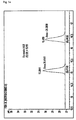
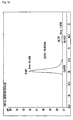
- Fig. 1a represents the optical purity analysis results by gas chromatography (GC) of racemic 3-hydroxy-γ-butyrolactone.
- Fig. 1b represents the optical purity analysis results by gas chromatography (GC) of 3-hydroxy-γ-butyrolactone prepared from disaccharide of the conventional method.
- Fig. 1c represents the optical purity analysis results by gas chromatography (GC) of 3-hydroxy-γ-butyrolactone prepared from oligosaccharide of the present invention.
-
- The present invention is characterized by comprising the following steps:
- (a) Enzymatic reaction using specific enzymes for the sequential degradation of amylopectin to α-(1,4) linked oligosaccharide expressed by the Formula 2, wherein the enzymatic reaction uses α-amylase and pullulanase sequentially such that amylopectin is degraded by α-amylase and the remaining α-amylase is inactivated before the introduction of pullulanase; and
- (b) Oxidation of the oligosaccharide by adding base and oxidant, and
subsequent esterification with alcohol in the presence of an acid
catalyst to afford ester of (S)-3,4-dihydroxybutyric acid derivatives
expressed by the Formula 1.
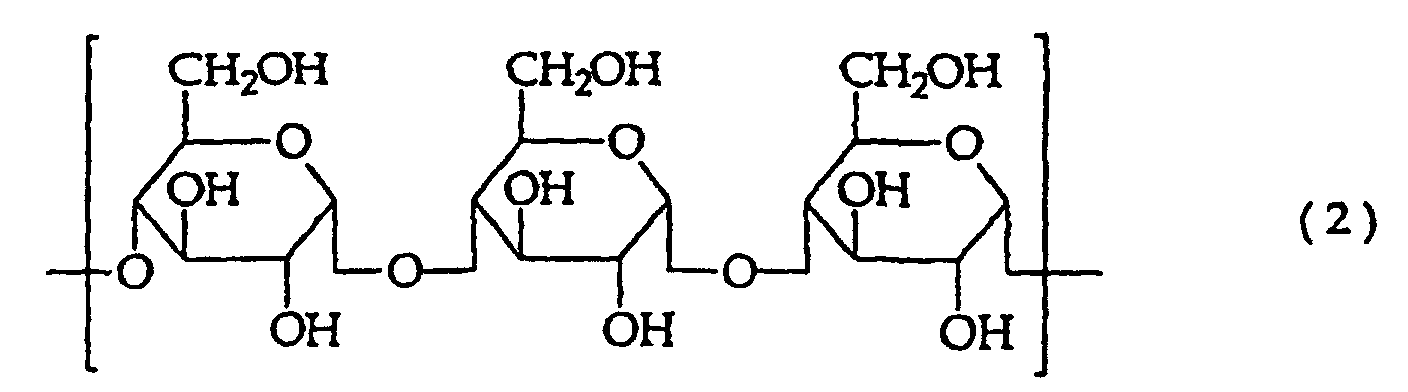
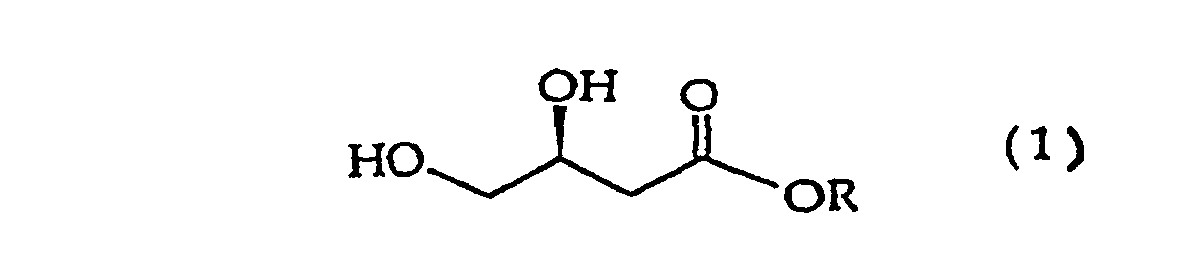
 ,wherein R represents linear or branched alkyl group with 1∼5 carbons.
 -
- The detailed description of the present invention is given hereunder.
- The fundamental inventive concept of the present invention is selective degradation of α-(1,4) linkage and α-(1,6) linkage within amylopectin using specific enzymes, i.e., transforming amylopectin to α-(1,4)-linked oligosaccharide with the optimal sugar distribution for preparing the target compound. And subsequently oxidation and esterification are performed to prepare (S)-3,4-dihydroxybutyric acid derivatives.
- Namely, focusing on the specificity of enzymes, amylopectin is degraded sequentially with specific enzymes to α-(1,4) linked oligosaccharide, and optically pure (S)-3,4-dihydroxybutyric acid derivatives are prepared from the transformed oligosaccharide in high yield. Optical purity of the desired product prepared by a sequential method is over 99.9%ee.
- Oligosaccharide used in the present invention is prepared with biological enzymatic treatment of amylopectin, and amylopectin is commercially available with ease. Especially, since amylopectin is highly soluble in water or in buffer solution of pH 4.0∼8.0, used as reaction solvent for enzymatic reaction of the present invention, the relative reactivity to enzyme is greatly increased compared with other polysaccharides such as starch and cellulose. Thus, the same is very effective material for preparing of oligosaccharide having suitable sugar distribution for the preparation of (S)-3,4-dihydroxybutyric acid derivatives.
- When using pullulanase as an enzyme for selective degradation of α-(1,6) linkage in amylopectin, it causes the solubility problem of amylopectin and reduced enzyme activity. So, rather than using pullulanase only, α-amylase was used to improve reactivity in degrading amylopectin to a suitable sugar distribution, and then pullulanase was used. However, in this case, activity of the remaining α-amylase persists and thus amylopectin is degraded excessively, so that the desired oligosaccharide is not formed. Accordingly, a technology of inactivating the remaining α-amylase before the pullulanase reaction was introduced.
- The detailed explanation of the preparation process of this invention is as follow. It comprises; 1) a step preparing oligosaccharide with characteristic α-(1,4) linkage expressed in Formula 2 by selective degradation of amylopectin using biological treatment of specific enzymes, and 2) a step preparing optically pure (S)-3,4-dihydroxybutyric acid derivatives by esterifying (S)-3,4-dihydroxybutyric acid salt formed through oxidation. Especially, the preparation process of this invention is characterized by preparing (S)-3,4-dihydroxybutyric acid derivatives in the same reactor without additional purification of the intermediates (oligosaccharide and (S)-3,4-dihydroxybutyric acid).
- The enzymatic reaction of the present invention uses α-amylase and pullulanase sequentially. α-Amylase degrades α-(1,4) linkage and pullulanase degrades α-(1,6) linkage selectively.
- The superiority of the present invention lies in that optically pure (S)-3,4-dihydroxybutyric acid derivatives are prepared in high yield under a mild reaction condition by using enzymes selectively degrading α-(1,4) linkage or α-(1,6) linkage, while the chemical hydrolysis method has no selectivity.
- The enzymatic reaction of the present invention is performed in water or buffer solution of pH 4.0∼8.0 at 40∼120°C. α-Amylase is used in the range of 0.001∼10 wt% of amylopectin, and enzymatic reaction of α-amylase is performed for 30 min ∼ 4 hr, and then remaining α-amylase is inactivated. Inactivation is performed under acidic (pH 2.0∼4.5) and high temperature (60∼150°C) conditions and maintained for 10 min ∼ 4 hr. In the enzymatic reaction of pullulanase, pullulanase is used in the range of 0.001∼10 wt% of amylopectin, and most of the oligosaccharides distribute within 3∼50 glucose units by 10∼40 hr of the pullulanase enzymatic treatment. Reducing end units and molecular weight distribution of the prepared oligosaccharide are analyzed from reducing end units and dextrose equivalent analysis by an optical analyzer, HPLC analysis, and gel permeation chromatography (GPC) analysis.
- The oligosaccharide is obtained from the selective enzymatic reaction and has distribution mostly between 3∼50 glucose units, and preferably 5∼50 glucose units. Since most of the glucose units are linked with α-(1,4) linkage, (S)-3,4-dihydroxybutyric acid derivatives can be obtained in high yield through continuous sequential reactions with minimizing the by-products (e.g., acid mixtures of formic acid, oxalic acid, glycolic acid and erythronic acid). Furthermore, the obtained (S)-3,4-dihydroxybutyric acid derivatives were identified to be optically very pure (>99.9%ee).
- Oxidation of oligosaccharide is performed by adding base and oxidant dropwise for 6∼36 hr under the condition of 30∼65°C. Hydrogen peroxide, alkali metal peroxides, akaline earth metal peroxides and alkyl hydroperoxides are used for the oxidants, and hydrogen peroxide is the most preferable. The oxidant is used in the range of 1∼3 equivalents per molar glucose unit of amylopectin. The base is selected from the group consisting of alkali metal hydroxide or alkaline earth metal hydroxide, and sodium hydroxide or potassium hydroxide is preferable. The base is used in the range of 2∼4 equivalents per molar glucose unit of amylopectin.
- Esterification of the present invention is performed in the presence of acid catalyst using alcohol as both a reaction solvent and reagent in the range of 30∼80°C. Inorganic acids such as hydrochloric acid, sulfuric acid, phosphoric acid and nitric acid, or organic acids such as fluoroalkylsulfonic acid, aralkylsulfonic acid, hydrate of aralkylsulfonic acid and trifluoroacetic acid are used as acid catalyst. Linear or branched alcohol with 1∼5 carbon atoms is used for the alcohol.
- In order to compare the preparation yields depending on the source material of oxidation, the prepared (S)-3,4-dihydroxybutyric acid derivatives were cyclized (S)-3-hydroxy-γ-butyrolactone as follows [Refer to Experimental example 1.]. (S)-3,4-dihydroxybutyric acid derivatives were cyclized in the presence of acid catalyst by agitating the same for 2∼5 hr in the range of 30∼80°C to obtain (S)-3-hydroxy-γ-butyrolactone. Inorganic acids such as hydrochloric acid, sulfuric acid, phosphoric acid and nitric acid, or organic acids such as fluoroalkylsulfonic acid, aralkylsulfonic acid, hydrate of aralkylsulfonic acid and trifluoroacetic acid are used as acid catalyst. As a result, if maltose (disaccharide) or lactose (disaccharide) obtained from cheese by-product is used as source material, the theoretical mass conversion yield of (S)-3-hydroxy-γ-butyrolactone is not more than 28.3 wt% of the source material weight used. On the other hand, if amylose (α-(1,4) linked polysaccharide) with more than 50 glucose units is used, the theoretical mass conversion yield of (S)-3-hydroxy-y-butyrolactone is equal to that of amylopectin. But, the double helix structure due to very strong intramolecular hydrogen bond limits the step-by-step oxidation, so the yield becomes very low. However, by using oligosaccharide of the present invention as source material, the yield of (S)-3-hydroxy-γ-butyrolactone is very high as 57.2 wt% of the source material weight used.
- As explained above, the present invention is excellent in that the low reactivity of amylopectin to oxidation is overcome by transforming amylopectin to oligosaccharide with the application of specific enzymes. Furthermore, by-product formation is minimized and optically pure (S)-3,4-dihydroxybutyric acid derivatives can be prepared in high yield with very simple purification process.
- The following examples are intended to be illustrative of the present invention and should not be construed as limiting the scope of this invention defined by the appended claims.
- 10 L of water and 5 kg of dried amylopectin were put into a 50 L reactor. After heating the reactor to 55°C, 12 g of α-amylase (BAN®; EC 3.2.1.1 from Bacillus licheniformis, Novo Nordisk) was added. After heating this reaction solution to 75°C, the same was stirred for 2 hr at the same temperature. 5 mL of 0.1N HCl solution was added to adjust the pH 3.0∼3.5, and then the same was stirred for 1 hr at 90°C to inactivate the remaining α-amylase. After slowly cooling the reaction mixture to 30°C, 3.7L of 4M acetic acid buffer solution (pH 5) and 1.3L of water were added to adjust the pH to 5. The reaction solution was heated to 60°C, and then 62.5g of pullulanase (Promozyme; EC 3.2.1.4 from Bacillus acidopullulyticus, Novo Nordisk) was added and the solution was stirred for 22 hr at the same temperature. 0.54kg of 40% NaOH solution was added to the reaction solution to neutralize acetic acid and the temperature was raised to 60°C. 40% NaOH (8.64 kg) solution and 30% H2O2 (5.25 kg) solution were added dropwise for 24 hr to the reaction solution and the same was stirred for 1 hr at the same temperature. The prepared sodium salt of (S)-3,4-dihydroxybutyric acid was identified using NMR analysis.
1H-NMR (D2O, ppm) δ 2.27 (dd, 1H), 239 (dd, 1H), 3.41 (dd, 1H), 3.51 (dd, 1H), 3.8∼3.9 (m, 1H) - The reaction solution was concentrated, and 10L of methanol was added. Sulfuric acid were added to adjust the pH to 4∼5, and then the same was stirred for 3 hr at 50°C. Sodium carbonate was added to neutralize the solution, and the same was filtered to remove the by-product, and then methanol was concentrated to obtain methyl (S)-3,4-dihydroxybutanoate. The formation of methyl (S)-3,4-dihydroxybutanoate (conversion ratio: 92%) was identified through NMR analysis by comparison with internal standard.
1H-NMR (CDCl3, ppm) δ 2.5 (dd, 2H), 3.5 (dd, 1H), 3.6 (dd, 1H), 3.7 (s, 3H), 4.1 (m, 1H) - 10L of water and 5kg of dried amylopectin were put into a 50L reactor. After heating the reactor to 55°C, 12g of α-amylase (Termamyl®; EC 3.2.1.1 from Bacillus amyloliquefaciens, Novo Nordisk) was added. After heating this reaction solution to 85°C; the same was stirred for 2 hr at the same temperature. 5mL of 0.1N HCl solution was added to adjust the pH 3.0∼3.5, and then the same was stirred for 1 hr at 90°C to inactivate the remaining α-amylase. After slowly cooling the reaction to 30°C, 3.7L of 4M acetic acid buffer solution (pH 5) and 1.3L of water were added to adjust the pH to 5. The reaction solution was heated to 60°C, and then 62.5g of pullulanase (Promozyme; EC 3.2.1.4 from Bacillus acidopullulyticus, Novo Nordisk) was added and the solution was stirred for 22 hr at the same temperature. 0.54kg of 40% NaOH solution was added to the reaction solution to neutralize acetic acid and the temperature was raised to 60°C. 40% NaOH (8.64kg) solution and 30% H2O2 (5.25kg) solution were added dropwise for 24 hr to the reaction solution and the same was stirred for 1 hr at the same temperature. The prepared sodium salt of (S)-3,4-dihydroxybutyric acid was identified using NMR analysis.
1H-NMR (D2O, ppm) δ 2.27 (dd, 1H), 2.39 (dd, 1H), 3.41 (dd, 1H), 3.51 (dd, 1H), 3.8∼3.9 (m, 1H) - The reaction solution was concentrated, and 10L of methanol was added. In this solution, methanesulfonic acid was added to adjust the pH to 4∼5, and then the same was stirred for 3 hr at 50°C. After cooling, sodium carbonate was added to neutralize the solution, and the same was filtered to remove the by-product, and then methanol was concentrated to obtain methyl (S)-3,4-dihydroxybutanoate. Formation of methyl (S)-3,4-dihydroxybutanoate (conversion ratio: 93%) was identified using NMR analysis by comparison with the internal standard.
1H-NMR (CDCl3, ppm) δ 2.5 (dd, 2H), 3.5 (dd, 1H), 3.6 (dd, 1H), 3.7 (s, 3H), 4.1 (m, 1H) - The prepared methyl (S)-3,4-dihydroxybutanoate was cyclized at 65°C under reduced pressure by adding 0.5 wt% of concentrated HCI without any separation being performed. The resultant solution was dissolved with ethyl acetate and the same was neutralized with sodium carbonate. After filtrating and concentrating the same, (S)-3-hydroxy-γ-butyrolactone (2.86kg, 57.2 wt% of the amylopectin weight used) was obtained.
1H-NMR (CDCl3, ppm) δ 2.28 (dd, 1H), 2.74 (dd, 1H), 4.13 (dd, 1H), 4.32 (dd, 1H), 4.4∼4.5 (m, 1H) - As in Example 2, however using 1 wt% of methanesulfonic acid rather than concentrated HCl in the cyclization of the prepared methyl (S)-3,4-dihydroxybutanoate, the same was cyclized at 65°C under reduced pressure. The resultant solution was dissolved with ethyl acetate and the same was neutralized with sodium carbonate. After filtering and concentrating the same, (S)-3-hydroxy-γ-butyrolactone (2.85kg, 57 wt% of the amylopectin weight used) was obtained.
1H-NMR (CDCl3, ppm) δ 2.28 (dd, 1H), 2.74 (dd, 1H), 4.13 (dd, 1H), 4.32 (dd, 1H), 4.4∼4.5 (m, 1H) - As in Example 1, however using t-butylhydroperoxide (4.16 kg) rather than H2O2 for the oxidant, methyl (S)-3,4-dihydroxybutanoate was obtained. The formation of methyl (S)-3,4-dihydroxybutanoate (conversion ratio: 91%) was identified using NMR analysis by comparison with internal standard.
1H-NMR (CDCl3, ppm) δ 2.5 (dd, 2H), 3.5 (dd, 1H), 3.6 (dd, 1H), 3.7 (s, 3H), 4.1 (m, 1H) - 20L of water and 5kg of dried starch were put into a 50L reactor, and the temperature was raised to 70°C. 40% NaOH (8.64kg) solution and 30% H2O2 (5.25kg) solution were added dropwise for 48 hr to the reaction solution and the same was stirred for 1 hr at the same temperature. The same was esterified and cyclized as in Example 2 to obtain (S)-3-hydroxy-γ-butyrolactone (1.1kg, 22.0 wt% of starch weight used).
- 10L of 0.5N HCl solution and 5kg of dried starch were put into a 50L reactor, and the starch was hydrolyzed for 20 min at 100°C. After cooling the solution to 20°C, the same was neutralized with 100mL of 40% NaOH solution and the temperature was raised to 70°C. 40% NaOH (8.64kg) solution and 30% H2O2 (5.25kg) solution were added dropwise for 48 hr to the reaction solution and the same was stirred for 1 hr at the same temperature. The same was esterified and cyclized as in Example 2 to obtain (S)-3-hydroxy-γ-butyrolactone (1.22kg, 24.4 wt% of starch weight used).
- 20L of water and 5kg of dried amylose were put into a 50L reactor, and the temperature was raised to 70°C. 40% NaOH (8.64kg) solution and 30% H2O2 (5.25kg) solution were added dropwise for 48 hr to the reaction solution and the same was stirred for 1 hr at the same temperature. The same was esterified and cyclized as in the Example 2 to obtain (S)-3-hydroxy-γ-butyrolactone (1.35kg, 27.0 wt% of amylose weight used).
- For the reaction solutions containing each of the carbohydrates shown in Table 1, oxidation, esterification and cyclization were performed as in the Example 2 to obtain (S)-3,4-dihydroxybutyric acid derivatives, and subsequently cyclized to obtain (S)-3-hydroxy-γ-butyrolactone. The yields of (S)-3-hydroxy-γ-butyrolactone are shown in Table 1.
Source material (5kg) Product (wt% compared with source material weight) Oligosaccharide of the present invention (Example 2) 2.86kg (57.2 wt%) Polysaccharide Amylopectin 1.01kg (20.2 wt%) Amylose 1.35kg (27.0 wt%) Disaccharide (maltose) 1.19kg (23.7 wt%) - Table 1 shows that for disaccharide the relative mass conversion yield is low as 23.7 wt%. On the other hand, if amylopectin is transformed to oligosaccharide with specific enzyme treatment, the relative mass conversion yield is enhanced to 57.2 wt%, almost two times compared with disaccharide. If amylopectin is not treated with enzymes, the relative mass conversion yield is relatively low as 20.2 wt%.
- (S)-3-Acetoxy-γ-butyrolactone was synthesized by the following method in order to analyze optical purity of (S)-3-hydroxy-γ-butyrolactone prepared from the present invention and the conventional preparing method.
- 102mg (1mmol) of (S)-3-hydroxy-γ-butyrolactone prepared from each method was dissolved in 3mL of methylene chloride, and 0.4mL (5mmol) of pyridine and 0.47mL (5mmol) of acetic anhydride were added to the same. After 3 hr, the reaction was quenched with 1N HCl. (S)-3-Acetoxy-γ-butyrolactone was extracted with the methylene chloride. After work up, the same was purified with silica gel column chromatography. The obtained (S)-3-acetoxy-γ-butyrolactone was dissolved in methylene chloride, and 0.5µℓ was taken with syringe for GC analysis. The result is shown in the following Table 2 and Figs. 1a∼1c.
Source Material Optical Purity Disaccharide (maltose) 94%ee Oligosaccharide of the present invention (Example 2) 99.9%ee - To improve the medicinal efficiency and minimize the side effect, more than 99.5%ee of high optical purity is required for chiral compounds. Table 2 and Figs. 1a∼1c show that the optical purity of (S)-3-hydroxy-γ-butyrolactone prepared from the present invention is very high as 99.9%ee. So, the same is very useful for the intermediates of other chiral compounds. The results are illustrated in Figure 1a, 1b, and 1c, respectively
- The preparing method of the present invention gives optically pure (S)-3,4-dihydroxybutyric acid derivatives, which is very useful for industrial uses because the by-product formation is minimized and the purification process is very simple. It comprises alkaline oxidation of α-(1,4)-linked oligosaccharide from the enzymatic reaction using specific enzymes for the sequential degradation of amylopectin in a specific condition followed by esterifying to afford the target product. The present invention has overcome the disadvantage of using expensive metal catalyst for selective asymmetric reduction, and enables easy preparation from inexpensive natural product having optically pure chiral center, thereby the industrial utility as chiral intermediates of various medicine can be maximized. Furthermore, the relative mass conversion yield is almost double compared with disaccharides.
Claims (13)
- A process for producing optically pure (S)-3,4-dihydroxybutyric acid derivatives expressed by the following Formula 1 from polysaccharide source, which comprises the following steps:, wherein R represents linear or branched alkyl group with 1∼5 carbon atoms.Enzymatic reaction using specific enzymes for the sequentical degradation of amylopectin to α-(1,4) linked oligosaccharide expressed by the Formula 2, wherein the enzymatic reaction uses α-amylase and pullulanase sequentially such that amylopectin is degraded by α-amylase and the remaining α-amylase is inactivated before the introduction of pullulanase; andOxidation of the oligosaccharide by adding base and oxidant, and subsequent esterification with alcohol in the presence of an acid catalyst.

- The process according to claim 1, wherein the said oligosaccharide has 3∼50 glucose units.
- The process according to claim 1, wherein the said oxidation is performed in the temperature range of 30∼65°C.
- The process according to claim 1, wherein the base used in the said oxidation is selected from alkali metal hydroxide and alkaline earth metal hydroxide.
- The process according to claim 4, wherein the said base is sodium hydroxide.
- The process according to claim 1 or claim 4, wherein the said base is used in the range of 2∼4 equivalents per molar glucose unit of amylopectin.
- The process according to claim 1, wherein the oxidant used in the said oxidation is selected from hydrogen peroxide, alkali metal peroxide, alkaline earth metal peroxide and alkyl hydroperoxide.
- The process according to claim 7, wherein the said oxidant is hydrogen peroxide.
- The process according to claim 7, wherein the said oxidant is t-butylhydroperoxide.
- The process according to claim 1 or claim 7, wherein the said oxidant is used in the range of 1∼3 equivalents per molar glucose unit of amylopectin.
- The process according to claim 1, wherein the said esterification is performed in the temperature range of 30∼80°C.
- The process according to claim 1, wherein the acid catalyst used in the said esterification is an inorganic acid selected from hydrochloric acid, sulfuric acid, phosphoric acid and nitric acid.
- The process according to claim 1, wherein the acid catalyst used in the said esterification is an organic acid selected from fluoroalkylsulfonic acid, aralkylsulfonic acid, hydrate of aralkylsulfonic acid and trifluoroacetic acid.
Applications Claiming Priority (3)
| Application Number | Priority Date | Filing Date | Title |
|---|---|---|---|
| KR19980029912 | 1998-07-24 | ||
| KR9829912 | 1998-07-24 | ||
| PCT/KR1999/000396 WO2000005400A1 (en) | 1998-07-24 | 1999-07-23 | Process for preparing optically pure (s)-3,4-dihydroxybutyric acid derivatives |
Publications (2)
| Publication Number | Publication Date |
|---|---|
| EP1100952A1 EP1100952A1 (en) | 2001-05-23 |
| EP1100952B1 true EP1100952B1 (en) | 2002-10-09 |
Family
ID=19545119
Family Applications (5)
| Application Number | Title | Priority Date | Filing Date |
|---|---|---|---|
| EP99935131A Expired - Lifetime EP1100954B1 (en) | 1998-07-24 | 1999-07-23 | Continuous process for preparing optically pure (s)-3,4-dihydroxybutyric acid derivatives |
| EP99935130A Expired - Lifetime EP1100953B1 (en) | 1998-07-24 | 1999-07-23 | CONTINUOUS PROCESS FOR PREPARING OPTICALLY PURE ($i(S))-3-HYDROXY-GAMA-BUTYROLACTONE |
| EP99935127A Expired - Lifetime EP1100951B1 (en) | 1998-07-24 | 1999-07-23 | PROCESS FOR PREPARING OPTICALLY PURE ($i(S))-3-HYDROXY-GAMA-BUTYROLACTONE |
| EP99935129A Withdrawn EP1100948A1 (en) | 1998-07-24 | 1999-07-23 | Process for preparing alpha-(1,4) linked oligosaccharide |
| EP99935128A Expired - Lifetime EP1100952B1 (en) | 1998-07-24 | 1999-07-23 | Process for preparing optically pure (s)-3,4-dihydroxybutyric acid derivatives |
Family Applications Before (4)
| Application Number | Title | Priority Date | Filing Date |
|---|---|---|---|
| EP99935131A Expired - Lifetime EP1100954B1 (en) | 1998-07-24 | 1999-07-23 | Continuous process for preparing optically pure (s)-3,4-dihydroxybutyric acid derivatives |
| EP99935130A Expired - Lifetime EP1100953B1 (en) | 1998-07-24 | 1999-07-23 | CONTINUOUS PROCESS FOR PREPARING OPTICALLY PURE ($i(S))-3-HYDROXY-GAMA-BUTYROLACTONE |
| EP99935127A Expired - Lifetime EP1100951B1 (en) | 1998-07-24 | 1999-07-23 | PROCESS FOR PREPARING OPTICALLY PURE ($i(S))-3-HYDROXY-GAMA-BUTYROLACTONE |
| EP99935129A Withdrawn EP1100948A1 (en) | 1998-07-24 | 1999-07-23 | Process for preparing alpha-(1,4) linked oligosaccharide |
Country Status (10)
| Country | Link |
|---|---|
| US (4) | US6124122A (en) |
| EP (5) | EP1100954B1 (en) |
| JP (5) | JP2002521031A (en) |
| KR (5) | KR20000011940A (en) |
| CN (5) | CN1144878C (en) |
| AU (5) | AU5067999A (en) |
| CA (5) | CA2338755A1 (en) |
| DE (4) | DE69903441T2 (en) |
| ES (4) | ES2183585T3 (en) |
| WO (5) | WO2000005402A1 (en) |
Families Citing this family (14)
| Publication number | Priority date | Publication date | Assignee | Title |
|---|---|---|---|---|
| US6713290B2 (en) * | 1998-07-24 | 2004-03-30 | Samsung Fine Chemicals Co., Ltd. | Process for preparing optically pure (S)-3-hydroxy-γ-butyrolactone |
| KR20000011940A (en) * | 1998-07-24 | 2000-02-25 | 박영구 | Process for preparing α-(1,4) linked oligosaccharide |
| US6239311B1 (en) * | 2000-04-24 | 2001-05-29 | Board Of Trustees Operating Michigan State University | Process for the preparation of 3,4-dihydroxybutanoic acid and salts and lactones derived therefrom |
| KR100645665B1 (en) * | 2000-07-27 | 2006-11-13 | 에스케이 주식회사 | Continuous production method of (S) -beta-hydroxy-gamma-butyrolactone |
| FR2819123B1 (en) * | 2000-12-29 | 2003-04-11 | St Microelectronics Sa | LOW NOISE CHARGING PUMP FOR PHASE LOCKED LOOP |
| JP4824874B2 (en) * | 2001-07-19 | 2011-11-30 | 高砂香料工業株式会社 | Process for producing optically active γ-butyrolactone |
| AU2002329102A1 (en) * | 2002-09-18 | 2004-04-08 | Sk Corporation | CONTINUOUS PROCESS FOR THE PRODUCTION OF OPTICALLY PURE (S)-Beta HYDROXY-Gamma-BUTYROLACTONE |
| US6713639B1 (en) | 2002-10-28 | 2004-03-30 | Council Of Scientific And Industrial Research | Process for preparing enantiomerically pure (S)-3-hydroxy-gamma-butyrolactone |
| JP4545487B2 (en) * | 2004-05-28 | 2010-09-15 | イハラケミカル工業株式会社 | Method for producing anilide compound |
| KR100590857B1 (en) | 2005-02-05 | 2006-06-19 | 엔자이텍 주식회사 | Method for preparing 3-hydroxy-gamma-butyrolactone using cation exchange resin |
| WO2007100227A1 (en) * | 2006-03-02 | 2007-09-07 | Lg Chem, Ltd. | Method for preparing (s)-3-hydroxy-gamma-butyrolactone using hydrolase |
| JP2008162902A (en) * | 2006-12-27 | 2008-07-17 | Central Glass Co Ltd | Method for producing difluoroacetic acid ester |
| CN102325563A (en) | 2008-12-22 | 2012-01-18 | 昆士兰大学 | Patch production |
| CN105669423B (en) * | 2016-01-08 | 2018-06-29 | 江西科技师范大学 | The novel synthesis of two kinds of enantiomters of 4- (4- (benzyloxy) phenyl) -2- hydroxybutyric acids |
Family Cites Families (27)
| Publication number | Priority date | Publication date | Assignee | Title |
|---|---|---|---|---|
| US3791865A (en) * | 1969-05-12 | 1974-02-12 | Staley Mfg Co A E | High maltose syrups |
| US3986890A (en) | 1972-02-21 | 1976-10-19 | Akademie Der Wissenschaften Der Ddr | Method of producing starch hydrolysis products for use as food additives |
| US3922200A (en) | 1974-03-18 | 1975-11-25 | Cpc International Inc | Enzymatic hydrolysis of granular starch |
| US4138484A (en) | 1976-08-16 | 1979-02-06 | Nelson Research & Development Company | Method for treating schizophrenia and method and composition for potentiating neuroleptic drugs |
| AT362526B (en) * | 1977-09-13 | 1981-05-25 | Boehringer Mannheim Gmbh | METHOD AND REAGENT FOR DETERMINING ALPHA AMYLASE |
| US4447532A (en) | 1982-04-29 | 1984-05-08 | H. J. Heinz Company | Process for the manufacture of low D.E. maltodextrins |
| US4612284A (en) | 1984-09-28 | 1986-09-16 | A. E. Staley Manufacturing Company | Process for the enzymatic hydrolysis of non-gelatinized granular starch material directly to glucose |
| US4963479A (en) * | 1986-10-07 | 1990-10-16 | Hoechst Celanese Corporation | Reagent system for an alpha-amylase assay containing aromatic substituted glycoside |
| JPS6413069A (en) * | 1987-07-03 | 1989-01-17 | Shiseido Co Ltd | Optically active mono-beta-lactam ring derivative and production thereof |
| JPH01202294A (en) * | 1988-02-09 | 1989-08-15 | Agency Of Ind Science & Technol | Increased production of glucose |
| US4912272A (en) | 1988-06-23 | 1990-03-27 | Mobil Oil Corporation | Lubricant blends having high viscosity indices |
| WO1990000500A2 (en) * | 1988-07-07 | 1990-01-25 | John Earp | Packaged food recovery apparatus |
| JP2825604B2 (en) | 1990-04-11 | 1998-11-18 | 三井化学株式会社 | Method for producing methylene-bridged polyarylamine |
| JPH04121197A (en) * | 1990-09-11 | 1992-04-22 | Shin Etsu Chem Co Ltd | Method for producing maltooligosaccharide |
| JP2710688B2 (en) * | 1990-10-09 | 1998-02-10 | 鐘淵化学工業株式会社 | Method for producing 4-bromo-3-hydroxybutyrate derivative |
| JP3030073B2 (en) | 1990-10-11 | 2000-04-10 | コベルコ健機株式会社 | Wheel crane |
| JP3072433B2 (en) * | 1990-10-19 | 2000-07-31 | 東和化成工業株式会社 | Method for producing high-purity maltose |
| CA2049536C (en) * | 1991-05-13 | 1999-07-06 | Rawle I. Hollingsworth | Process for the preparation of 3,4-dihydroxybutanoic acid and salts thereof |
| GB9121289D0 (en) | 1991-10-08 | 1991-11-20 | Isf Spa | Composition and use |
| IS2334B (en) | 1992-09-08 | 2008-02-15 | Vertex Pharmaceuticals Inc., (A Massachusetts Corporation) | Aspartyl protease inhibitor of a new class of sulfonamides |
| JP3351563B2 (en) | 1992-12-03 | 2002-11-25 | 鐘淵化学工業株式会社 | Method for producing 3-hydroxybutyric acid derivative |
| US5506353A (en) | 1994-03-21 | 1996-04-09 | Firmenich Sa | Particulate hydrogenated starch hydrolysate based flavoring materials and use of same |
| JP3855033B2 (en) * | 1995-09-08 | 2006-12-06 | 高砂香料工業株式会社 | Process for producing optically active 3-hydroxy-γ-butyrolactone |
| WO1998004543A1 (en) * | 1996-07-29 | 1998-02-05 | Warner-Lambert Company | Improved process for the synthesis of protected esters of (s)-3,4-dihydroxybutyric acid |
| KR100255039B1 (en) * | 1997-07-28 | 2000-05-01 | 박영구 | Process for the preparation of l-carnitine |
| US5808107A (en) | 1997-10-31 | 1998-09-15 | Board Of Trustees Operating Michigan State University | Process for the preparation of hydroxy substituted gamma butyrolactones |
| KR20000011940A (en) * | 1998-07-24 | 2000-02-25 | 박영구 | Process for preparing α-(1,4) linked oligosaccharide |
-
1999
- 1999-07-23 KR KR1019990030064A patent/KR20000011940A/en not_active Ceased
- 1999-07-23 EP EP99935131A patent/EP1100954B1/en not_active Expired - Lifetime
- 1999-07-23 CN CNB998103659A patent/CN1144878C/en not_active Expired - Fee Related
- 1999-07-23 WO PCT/KR1999/000399 patent/WO2000005402A1/en not_active Ceased
- 1999-07-23 AU AU50679/99A patent/AU5067999A/en not_active Abandoned
- 1999-07-23 JP JP2000561344A patent/JP2002521031A/en active Pending
- 1999-07-23 CA CA002338755A patent/CA2338755A1/en not_active Abandoned
- 1999-07-23 ES ES99935128T patent/ES2183585T3/en not_active Expired - Lifetime
- 1999-07-23 WO PCT/KR1999/000397 patent/WO2000005398A1/en not_active Ceased
- 1999-07-23 EP EP99935130A patent/EP1100953B1/en not_active Expired - Lifetime
- 1999-07-23 EP EP99935127A patent/EP1100951B1/en not_active Expired - Lifetime
- 1999-07-23 AU AU50680/99A patent/AU5068099A/en not_active Abandoned
- 1999-07-23 CA CA002338756A patent/CA2338756A1/en not_active Abandoned
- 1999-07-23 US US09/359,678 patent/US6124122A/en not_active Expired - Fee Related
- 1999-07-23 KR KR1019990030062A patent/KR100308524B1/en not_active Expired - Fee Related
- 1999-07-23 WO PCT/KR1999/000395 patent/WO2000005399A1/en not_active Ceased
- 1999-07-23 US US09/359,679 patent/US6221639B1/en not_active Expired - Fee Related
- 1999-07-23 CA CA002338527A patent/CA2338527A1/en not_active Abandoned
- 1999-07-23 JP JP2000561348A patent/JP3614367B2/en not_active Expired - Fee Related
- 1999-07-23 DE DE69903441T patent/DE69903441T2/en not_active Expired - Fee Related
- 1999-07-23 KR KR1019990030063A patent/KR100324476B1/en not_active Expired - Fee Related
- 1999-07-23 ES ES99935130T patent/ES2183586T3/en not_active Expired - Lifetime
- 1999-07-23 JP JP2000561345A patent/JP3512741B2/en not_active Expired - Fee Related
- 1999-07-23 AU AU50677/99A patent/AU5067799A/en not_active Abandoned
- 1999-07-23 KR KR1019990030065A patent/KR100310935B1/en not_active Expired - Fee Related
- 1999-07-23 EP EP99935129A patent/EP1100948A1/en not_active Withdrawn
- 1999-07-23 US US09/359,676 patent/US6288272B1/en not_active Expired - Fee Related
- 1999-07-23 CN CNB998103721A patent/CN1160468C/en not_active Expired - Fee Related
- 1999-07-23 DE DE69903442T patent/DE69903442T2/en not_active Expired - Fee Related
- 1999-07-23 EP EP99935128A patent/EP1100952B1/en not_active Expired - Lifetime
- 1999-07-23 WO PCT/KR1999/000396 patent/WO2000005400A1/en not_active Ceased
- 1999-07-23 AU AU50676/99A patent/AU5067699A/en not_active Abandoned
- 1999-07-23 JP JP2000561347A patent/JP3364482B2/en not_active Expired - Fee Related
- 1999-07-23 AU AU50678/99A patent/AU5067899A/en not_active Abandoned
- 1999-07-23 US US09/359,712 patent/US6251642B1/en not_active Expired - Fee Related
- 1999-07-23 ES ES99935131T patent/ES2183587T3/en not_active Expired - Lifetime
- 1999-07-23 JP JP2000561346A patent/JP3614366B2/en not_active Expired - Fee Related
- 1999-07-23 WO PCT/KR1999/000398 patent/WO2000005401A1/en not_active Ceased
- 1999-07-23 CN CNB998103144A patent/CN1166781C/en not_active Expired - Fee Related
- 1999-07-23 DE DE69903444T patent/DE69903444T2/en not_active Expired - Fee Related
- 1999-07-23 KR KR1019990030066A patent/KR100324475B1/en not_active Expired - Fee Related
- 1999-07-23 CN CNB998103160A patent/CN1166782C/en not_active Expired - Fee Related
- 1999-07-23 ES ES99935127T patent/ES2183584T3/en not_active Expired - Lifetime
- 1999-07-23 CA CA002338752A patent/CA2338752A1/en not_active Abandoned
- 1999-07-23 CA CA002338757A patent/CA2338757A1/en not_active Abandoned
- 1999-07-23 DE DE69903443T patent/DE69903443T2/en not_active Expired - Fee Related
- 1999-07-23 CN CN99810313A patent/CN1316008A/en active Pending
Also Published As
Similar Documents
| Publication | Publication Date | Title |
|---|---|---|
| EP1100951B1 (en) | PROCESS FOR PREPARING OPTICALLY PURE ($i(S))-3-HYDROXY-GAMA-BUTYROLACTONE | |
| US6713290B2 (en) | Process for preparing optically pure (S)-3-hydroxy-γ-butyrolactone |
Legal Events
| Date | Code | Title | Description |
|---|---|---|---|
| PUAI | Public reference made under article 153(3) epc to a published international application that has entered the european phase |
Free format text: ORIGINAL CODE: 0009012 |
|
| 17P | Request for examination filed |
Effective date: 20010223 |
|
| AK | Designated contracting states |
Kind code of ref document: A1 Designated state(s): AT BE CH CY DE DK ES FI FR GB GR IE IT LI LU MC NL PT SE |
|
| AX | Request for extension of the european patent |
Free format text: AL;LT;LV;MK;RO;SI |
|
| 17Q | First examination report despatched |
Effective date: 20010628 |
|
| GRAG | Despatch of communication of intention to grant |
Free format text: ORIGINAL CODE: EPIDOS AGRA |
|
| GRAG | Despatch of communication of intention to grant |
Free format text: ORIGINAL CODE: EPIDOS AGRA |
|
| GRAG | Despatch of communication of intention to grant |
Free format text: ORIGINAL CODE: EPIDOS AGRA |
|
| GRAH | Despatch of communication of intention to grant a patent |
Free format text: ORIGINAL CODE: EPIDOS IGRA |
|
| GRAH | Despatch of communication of intention to grant a patent |
Free format text: ORIGINAL CODE: EPIDOS IGRA |
|
| GRAH | Despatch of communication of intention to grant a patent |
Free format text: ORIGINAL CODE: EPIDOS IGRA |
|
| GRAA | (expected) grant |
Free format text: ORIGINAL CODE: 0009210 |
|
| AK | Designated contracting states |
Kind code of ref document: B1 Designated state(s): CH DE ES FR GB IT LI |
|
| AX | Request for extension of the european patent |
Free format text: AL;LT;LV;MK;RO;SI |
|
| REG | Reference to a national code |
Ref country code: GB Ref legal event code: FG4D |
|
| REG | Reference to a national code |
Ref country code: CH Ref legal event code: EP |
|
| REG | Reference to a national code |
Ref country code: IE Ref legal event code: FG4D |
|
| REF | Corresponds to: |
Ref document number: 69903442 Country of ref document: DE Date of ref document: 20021114 |
|
| REG | Reference to a national code |
Ref country code: CH Ref legal event code: NV Representative=s name: PATENTANWAELTE SCHAAD, BALASS, MENZL & PARTNER AG |
|
| ET | Fr: translation filed | ||
| REG | Reference to a national code |
Ref country code: ES Ref legal event code: FG2A Ref document number: 2183585 Country of ref document: ES Kind code of ref document: T3 |
|
| LTIE | Lt: invalidation of european patent or patent extension |
Effective date: 20021009 |
|
| PLBE | No opposition filed within time limit |
Free format text: ORIGINAL CODE: 0009261 |
|
| STAA | Information on the status of an ep patent application or granted ep patent |
Free format text: STATUS: NO OPPOSITION FILED WITHIN TIME LIMIT |
|
| 26N | No opposition filed |
Effective date: 20030710 |
|
| REG | Reference to a national code |
Ref country code: IE Ref legal event code: MM4A |
|
| PGFP | Annual fee paid to national office [announced via postgrant information from national office to epo] |
Ref country code: DE Payment date: 20040730 Year of fee payment: 6 |
|
| PGFP | Annual fee paid to national office [announced via postgrant information from national office to epo] |
Ref country code: GB Payment date: 20040812 Year of fee payment: 6 |
|
| PGFP | Annual fee paid to national office [announced via postgrant information from national office to epo] |
Ref country code: FR Payment date: 20040819 Year of fee payment: 6 |
|
| PGFP | Annual fee paid to national office [announced via postgrant information from national office to epo] |
Ref country code: CH Payment date: 20040824 Year of fee payment: 6 |
|
| PGFP | Annual fee paid to national office [announced via postgrant information from national office to epo] |
Ref country code: ES Payment date: 20040826 Year of fee payment: 6 |
|
| PG25 | Lapsed in a contracting state [announced via postgrant information from national office to epo] |
Ref country code: IT Free format text: LAPSE BECAUSE OF NON-PAYMENT OF DUE FEES;WARNING: LAPSES OF ITALIAN PATENTS WITH EFFECTIVE DATE BEFORE 2007 MAY HAVE OCCURRED AT ANY TIME BEFORE 2007. THE CORRECT EFFECTIVE DATE MAY BE DIFFERENT FROM THE ONE RECORDED. Effective date: 20050723 Ref country code: GB Free format text: LAPSE BECAUSE OF NON-PAYMENT OF DUE FEES Effective date: 20050723 |
|
| PG25 | Lapsed in a contracting state [announced via postgrant information from national office to epo] |
Ref country code: ES Free format text: LAPSE BECAUSE OF NON-PAYMENT OF DUE FEES Effective date: 20050726 |
|
| PG25 | Lapsed in a contracting state [announced via postgrant information from national office to epo] |
Ref country code: LI Free format text: LAPSE BECAUSE OF NON-PAYMENT OF DUE FEES Effective date: 20050731 Ref country code: CH Free format text: LAPSE BECAUSE OF NON-PAYMENT OF DUE FEES Effective date: 20050731 |
|
| PG25 | Lapsed in a contracting state [announced via postgrant information from national office to epo] |
Ref country code: DE Free format text: LAPSE BECAUSE OF NON-PAYMENT OF DUE FEES Effective date: 20060201 |
|
| REG | Reference to a national code |
Ref country code: CH Ref legal event code: PL |
|
| GBPC | Gb: european patent ceased through non-payment of renewal fee |
Effective date: 20050723 |
|
| PG25 | Lapsed in a contracting state [announced via postgrant information from national office to epo] |
Ref country code: FR Free format text: LAPSE BECAUSE OF NON-PAYMENT OF DUE FEES Effective date: 20060331 |
|
| REG | Reference to a national code |
Ref country code: FR Ref legal event code: ST Effective date: 20060331 |
|
| REG | Reference to a national code |
Ref country code: ES Ref legal event code: FD2A Effective date: 20050726 |