EP1100285A1 - Congestion control of AAL2 connections - Google Patents
Congestion control of AAL2 connections Download PDFInfo
- Publication number
- EP1100285A1 EP1100285A1 EP99402809A EP99402809A EP1100285A1 EP 1100285 A1 EP1100285 A1 EP 1100285A1 EP 99402809 A EP99402809 A EP 99402809A EP 99402809 A EP99402809 A EP 99402809A EP 1100285 A1 EP1100285 A1 EP 1100285A1
- Authority
- EP
- European Patent Office
- Prior art keywords
- packet
- cps
- buffer
- packets
- aal2
- Prior art date
- Legal status (The legal status is an assumption and is not a legal conclusion. Google has not performed a legal analysis and makes no representation as to the accuracy of the status listed.)
- Granted
Links
- 239000000872 buffer Substances 0.000 claims abstract description 135
- 238000000034 method Methods 0.000 claims abstract description 19
- 238000012546 transfer Methods 0.000 claims abstract description 10
- 230000006978 adaptation Effects 0.000 claims abstract description 9
- 238000012545 processing Methods 0.000 claims abstract description 7
- 208000027744 congestion Diseases 0.000 description 49
- 230000007246 mechanism Effects 0.000 description 13
- 238000007726 management method Methods 0.000 description 8
- 230000011218 segmentation Effects 0.000 description 7
- 230000005540 biological transmission Effects 0.000 description 5
- 238000004891 communication Methods 0.000 description 4
- 229920006395 saturated elastomer Polymers 0.000 description 4
- 238000010586 diagram Methods 0.000 description 2
- 230000006870 function Effects 0.000 description 2
- 238000005070 sampling Methods 0.000 description 2
- 230000009471 action Effects 0.000 description 1
- 238000013459 approach Methods 0.000 description 1
- 230000015556 catabolic process Effects 0.000 description 1
- 230000008859 change Effects 0.000 description 1
- 238000012937 correction Methods 0.000 description 1
- 230000006378 damage Effects 0.000 description 1
- 238000001514 detection method Methods 0.000 description 1
- 230000000694 effects Effects 0.000 description 1
- 230000008030 elimination Effects 0.000 description 1
- 238000003379 elimination reaction Methods 0.000 description 1
- 238000009434 installation Methods 0.000 description 1
- 230000008569 process Effects 0.000 description 1
- 230000011664 signaling Effects 0.000 description 1
Images


Classifications
-
- H—ELECTRICITY
- H04—ELECTRIC COMMUNICATION TECHNIQUE
- H04L—TRANSMISSION OF DIGITAL INFORMATION, e.g. TELEGRAPHIC COMMUNICATION
- H04L12/00—Data switching networks
- H04L12/28—Data switching networks characterised by path configuration, e.g. LAN [Local Area Networks] or WAN [Wide Area Networks]
-
- H—ELECTRICITY
- H04—ELECTRIC COMMUNICATION TECHNIQUE
- H04Q—SELECTING
- H04Q11/00—Selecting arrangements for multiplex systems
- H04Q11/04—Selecting arrangements for multiplex systems for time-division multiplexing
- H04Q11/0428—Integrated services digital network, i.e. systems for transmission of different types of digitised signals, e.g. speech, data, telecentral, television signals
- H04Q11/0478—Provisions for broadband connections
-
- H—ELECTRICITY
- H04—ELECTRIC COMMUNICATION TECHNIQUE
- H04L—TRANSMISSION OF DIGITAL INFORMATION, e.g. TELEGRAPHIC COMMUNICATION
- H04L12/00—Data switching networks
- H04L12/54—Store-and-forward switching systems
- H04L12/56—Packet switching systems
- H04L12/5601—Transfer mode dependent, e.g. ATM
- H04L2012/5638—Services, e.g. multimedia, GOS, QOS
- H04L2012/5646—Cell characteristics, e.g. loss, delay, jitter, sequence integrity
- H04L2012/5647—Cell loss
- H04L2012/5648—Packet discarding, e.g. EPD, PTD
-
- H—ELECTRICITY
- H04—ELECTRIC COMMUNICATION TECHNIQUE
- H04L—TRANSMISSION OF DIGITAL INFORMATION, e.g. TELEGRAPHIC COMMUNICATION
- H04L12/00—Data switching networks
- H04L12/54—Store-and-forward switching systems
- H04L12/56—Packet switching systems
- H04L12/5601—Transfer mode dependent, e.g. ATM
- H04L2012/5638—Services, e.g. multimedia, GOS, QOS
- H04L2012/5646—Cell characteristics, e.g. loss, delay, jitter, sequence integrity
- H04L2012/5652—Cell construction, e.g. including header, packetisation, depacketisation, assembly, reassembly
- H04L2012/5653—Cell construction, e.g. including header, packetisation, depacketisation, assembly, reassembly using the ATM adaptation layer [AAL]
- H04L2012/5656—Cell construction, e.g. including header, packetisation, depacketisation, assembly, reassembly using the ATM adaptation layer [AAL] using the AAL2
Definitions
- the present invention relates to the field of data transfer in the form of asynchronous packets in radio or cable communication networks.
- packets are transferred asynchronously, there is a risk of congestion at the network nodes if the instantaneous flowrate of incoming packets exceeds the maximum throughput capacity of the multiplex.
- the invention concerns more specifically - but not exclusively - a protocol for managing such congestions in buffers which multiplex network connections known as AAL2 (ATM (asynchronous transfer mode) adaptation layer 2) connections.
- ATM asynchronous transfer mode
- AAL2 is used amongst others in UTRAN (UMTS (universal mobile telecommunication system) terrestrial radio access network).
- UTRAN is the terrestrial radio access network for UMTS.
- UMTS constitutes the third generation mobile system (3GPP) defined by the standardisation organisation.
- the AAL2 protocol and its implementation in data transmission systems are well established and are now standardised for example in the publication by the International Telecommunication Union Telecommunication Standardization Sector (ITU-T), Recommendation 1366.1 (06/98) entitled "Series I: Segmentation and Reassembly Service Specific Convergence Sublayer for the AAL type 2" and, also from ITU-T, recommendation I.363.2 entitled "B-ISDN ATM Adaptation layer type 2 Specification” whose contents are considered as included in the state of the art.
- ITU-T International Telecommunication Union Telecommunication Standardization Sector
- Recommendation 1366.1 entitled "Series I: Segmentation and Reassembly Service Specific Convergence Sublayer for the AAL type 2”
- ITU-T International Telecommunication Union Telecommunication Standardization Sector
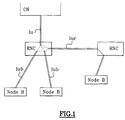
- FIG 1 is a schematic diagram showing an example of part of a communication network linking a core network (CN) to two controllers (RNCs) which are themselves connected to base stations referred to as Node B.
- CN core network
- RNCs controllers
- a Node B is equivalent to a base transceiver station (BTS) in the GSM system.
- BTS base transceiver station
- the Node B and RNC are connected together by an interface known as Iub (interface UMTS bis, equivalent to the Abis interface of the GSM).
- Iub interface UMTS bis, equivalent to the Abis interface of the GSM
- the RNC is connected to the core network CN via an interface Iu (UMTS interface).
- the RNCs are connected together by an interface Iur (UMTS interface between two RNCs). These interfaces are based on ATM. ATM is used as a transport layer for the Iu, Iur and Iub interfaces.
- Interfaces Iur and Iub receive radio frames or multiple radio frames. At radio level, frames have a 10 ms duration.
- the time interval between frame transmissions on the Iub and Ur interfaces is typically 10 ms, 20 ms, 40 ms or 80 ms (respectively equivalent to 1, 2, 4 or 8 radio frames).
- UMTS serves to transport data and voice, and possibly several other types of service, some of which can have a baud rate of up to 2Mbits/s.
- the transport of data shall be illustrated with an example of a message containing voice at a baud rate of 8kbits/s. Accordingly, to send frames every 10 ms, 80 bits or 10 octets will be used. Sending voice frames every 20 ms requires 160 bits, or 20 octets (bytes) . With a data service at 144Kbits/s, frames can be formed in groups of four or eight. Transmission time intervals are generally 40 or 80 ms. For 80 ms frames, 1440 octets per frame will be available on the Iub interface. With 40ms frames, 720 octets will be available per frame on the Iub inteface.
- the ATM system uses cells of 53 octets (bytes): 5 octets for connection identification information and 48 octets forming the payload.
- an ATM adaptation layer is used, namely the AAL2.
- This adaptation layer comprises a number of sub-layers : a service specific segmentation and reassembly sublayer (SSSAR) forming part of SEG-SSCS (optional) which allows data packets exceeding 45 octets to be segmented.
- SSSAR service specific segmentation and reassembly sublayer
- Another sublayer known as the common part sublayer (CPS)
- CPS common part sublayer
- SDUs SSSAR service data units
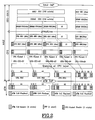
- FIG. 2 is a diagram showing the different AAL2 sublayers and the ATM layer which come into play when a frame is sent on the Iub or Iur interface. Right at the bottom of the figure are shown the ATM cells comprising the 48 octet payload plus a 5 octet header.
- the figure is based on an example of a 150 octet long AAL2 SDU frame which is shown as the topmost layer in the figure.
- the service specific convergence sublayer (SSCS) used is the SEG-SSCS (segmentation and reassembly service specific convergence sublayer). In the example, it is reduced to the service specific segmentation and reassembly (SSSAR) sublayer.
- SSSAR SDU frames thus have the same length as AAL2 SDU frames. This length can change over time and depends on the baud rate, the amount of data to be transported, etc....
- AAL2 layers shall be of interest in the present case: the mandatory common partsublayer (CPS) and the segmentation and reassembly service specific convergence sublayer (SEG-SSCS), which is an optional segmentation and reassembly layer.
- CPS common partsublayer
- SEG-SSCS segmentation and reassembly service specific convergence sublayer
- the SSSAR PDUs are then transferred to the mandatory common part sublayer (CPS), keeping the condition that one SSSAR PDU corresponds to one CPS SDU as regards the format and in particular the number of constitutive octets.
- CPS mandatory common part sublayer
- the CPS layer multiplexes the CPS SDUs it receives on 48 octets that form the ATM cell payload.
- the CPS layer will add a 3 octet header to each CPS SDU it receives for identification of each CPS SDU.
- the UUI field has the value "26" to indicate receipt of an end of SSSAR SDU (150 octets in the example), and the value "27" to indicate that more data follows.
- CPS-PDU start field STF octet which serves to identify the position of the first CPS packet inside the payload of the ATM cell or CPS PDU.
- a CPS PDU corresponds to the payload of an ATM cell.
- CPS PDU The size of CPS PDU is always equal to 48 octets (equal to an ATM cell payload).
- the first CPS PDU octet is always the STF octet.
- the 47 remaining octets are either CPS packet octets or padding.
- the first 47 octets can be inserted into one CPS PDU.
- the last remaining octet shall go into another CPS PDU.
- a straddling is created at the level of the payload.
- the 45 payload octets of CPS SDU number 1 are divided on two CPS PDUs, with 44 octets in the first CPS PDU (thus filling up entirely the payload of that packet) and the remaining octet in the following CPS PDU.
- This octet is located directly after the STF octet of the following CPS PDU.
- the second CPS PDU can dispose of only 43 octets for multiplexing the second CPS SDU. Consequently, the last two octets of that second CPS SDU shall be integrated in the third CPS PDU, just after the STF of the latter.
- the STF octet for the CPS PDU will indicate that the start of the first CPS packet is located immediately after the STF octet.
- the STF octet will indicate that the start of the second packet is located as from the second octet
- the STF octet will indicate that the start of the third CPS packet will be located as from the third octet.
- the fourth CPS PDU comprises the STF octet followed by the three remaining octets of the third CPS SDU, followed by its own 3 octet header and all the 15 octets of the fourth CPS SDU, i.e. a total of 22 octets.
- This fourth CPS PDU thus disposes of 26 free octets in its payload.
- these 26 octets are partially exploited for multiplexing the following AAL2 SDU which, as shown in the top line of figure 2, comprises only 20 octets.
- This AAL2 SDU can e.g. correspond to another connection for sampling voice at 20 ms.
- this 20 octet AAL SDU is converted in the form of a CPS SDU (only one single packet in this case) comprising the above-mentioned 3 octet header plus 20 payload octets, forming a total of 23 octets.
- This CPS packet can be integrally contained in the fourth CPS PDU which disposes of 26 free octets.
- the 3 unused octets of this fourth CPS PDU are filled with padding octets devoid of any information.
- the thus-multiplexed CPS PDUs are then transferred to the ATM layer via the ATM service access point (SAP).
- the ATM layer comprises ATM cells which are each composed of a 5 octet header and a 48 octet payload.
- a CPS PDU can thus be integrally contained in the payload of an ATM cell.
- CPS packets are stored in buffers before being transposed into corresponding ATM cells via the intermediate multiplexing into CPS PDUs. Indeed, the information arrives at the buffers asynchronously and some non-negligible processing time is required to transform the CPS packets into CPS PDUs. It is thus possible to receive at a given moment more information in the form of CPS packets than can be transferred on the interface. This is the reason why the packets must be buffered.
- the incoming load at the level of the buffers to form ATM cells can be very temporarily greater than 1. In other words, there occurs the situation in which more CPS packets arrive than can be multiplexed and outputted in ATM cells. A momentary overload can then occur. If this overload situation lasts for too long, the buffers can overflow, and CPS packets can hence be lost.
- the present invention proposes a method of managing data packets originating from data frames, the packets being presented to buffer means prior to processing, characterised in that when a packet corresponding to the start of a frame is presented to the buffer stage, it is determined whether the filling level of the buffer means exceeds a first predetermined filling threshold corresponding to a state of congestion and, if such is the case, this packet and all packets belonging to that same frame are systematically discarded before the buffer.
- the method according to the invention lends itself particularly well to the above-mentioned AAL2 connections, in which case the frames in question originate from AAL2 connections, and each constitute a respective ATM (asynchronous transfer mode) adaptation layer service data unit (AAL2 SDU), and the packets are common part sublayer (CPS) packets, and the buffer means stores the CPS packets before the latter are multiplexed into asynchronous transfer mode (ATM) cells.
- ATM asynchronous transfer mode adaptation layer service data unit
- ATM common part sublayer
- the state of congestion is attained upon exceeding the first threshold and the state of congestion is left by passing below a second filling threshold of the buffer means, the second threshold being lower than the first threshold. Consequently, the congestion criterion exhibits a hysteresis effect.
- the first threshold is set such that the remaining capacity of the memory upon exceeding that threshold is substantially sufficient to accept all remaining packets of a frame whose first packet has been accepted into the buffer means. In this way, no frame in the course of being loaded into the buffer can be lost.
- the mechanism can also operate so that:
- the data frame would be an entire AAL2 SDU and hence the CPS packets belonging to that AAL2 SDU would be systematically discarded in case of congestion.
- the packet discard mechanism in brought into action to eliminate intelligently all CPS packets of an entire AAL2 SDU, instead of only certain packets from each AAL2-SDU.
- the selective elimination can be advantageously achieved by exploiting the UUI field of the above mentioned CPS packet header, this field indicating the receipt of the last data of an SSSAR SDU frame, whose length is equivalent to that of a corresponding AAL2 SDU.
- a mechanism in accordance with the invention can be implemented to determine the value of the UUI field: if the congestion threshold is reached, the mechanism allows entry of all the remaining packets of an AAL2 SDU already started to be admitted prior to the congestion threshold being reached if the following packets have a UUI field equal to 27.
- the value 26 is detected for that field, it is established that the CPS packet is the last one for the current AAL2 SDU. It is thus also admitted into the buffer. However, the next packet, which will have the value 27 (or 26 if it contains the entire AAL SDU) at the level of its UUI field shall be discarded.
- the packets of the same AAL2 SDU that follow the latter being identified by the value 27 at the level of their UUI field, except for the last one which will have the value 26 for that field.
- the packet destruction step is effected before the buffer becomes completely saturated so that it is still possible to continue to accept CPS packets of a current frame and only to discard CPS packets of the next frame, knowing that a data frame has a limited maximum length, this length being e.g. 65 568 octets long in the case of an AAL2 SDU connection.
- the method advantageously operates so that:
- the present invention also relates to a device for managing data packets originating from data frames, the CPS packets being presented to buffer means prior to processing, characterised in that it comprises:
- the device can moreover be configured to implement all the process steps defined above and in. the method claims.
- the processor can be centred around a processor operating from a program in accordance with a classical computer architecture.
- the processor can be assimilated to the general processing means which manage communications and the buffer which receives the CPS packets.
- Figure 5 shows in column form the storage capacity of a buffer memory 40 which receives CPS packets before they are multiplexed into CPS PDUs for loading into ATM cell payloads.
- the memory's filling level at a given moment is indicated by arrow F. The higher is the arrow F, the more the memory 40 is filled.
- the memory 40 comprises two filling thresholds: an higher threshold 42, close to the absolute limit of the memory, which corresponds to a congestion threshold, and a lower threshold 44 which corresponds to a lower filling level of the memory. Between these thresholds 42, 44 is defined a critical zone 46 which, as will be explained later, defines a hysteresis range.
- a congestion situation is reached when the filling level of the buffer memory 40 reaches or exceeds the higher threshold 42. However, once this threshold is reached or exceeded, the congestion condition remains all the while the filling level of the memory remains in the critical zone 46. In other words, even if the filling level (arrow F) drops somewhat to fall beneath the higher threshold 42 but stays within the critical zone 46, the congestion condition remains. It is then necessary for the filling level to fall below the lower threshold 44 to end the congestion situation.
- the critical zone 46 forms a hysteresis range in accordance with an embodiment of the invention.
- the overflow situation is simply the case where the memory's absolute storage limit is reached. In other words, the buffer memory is physically no longer capable of receiving new packets in an overflow situation.
- the packets discarded will be those originating from a same AAL2 SDU frame.
- a congestion condition is reached according to the above-mentioned criteria, it can still be possible to continue storing CPS packets from an AAL2 SDU frame in the course of reassembly (by virtue of the margin between the higher threshold 42 and the buffer memory's overflow level), but as soon as that frame is loaded, the packets coming from the following AAL2 SDU shall be systematically discarded.
- the algorithm is divided into three phases.
- the first phase determines when a congestion condition occurs
- the second phase selectively discards CPS packets
- the third phase determines whether the next CPS packet is the first of an AAL2 SDU frame.
- This algorithm decides whether or not the buffer 40 is congested.
- the congestion criterion is as described with reference to figure 5 i.e. with the hysteresis condition.
- the algorithm starts by reading the LI field from the header of each incoming CPS packet (step S56).
- the size of the CPS packet (in octets) is LI + 1 + 3, 3 being the size of the header and LI + 1 being the size of the CPS packet payload.
- the procedure starts at step S72 with the arrival of a CPS packet from an AAL2 connection. There then follows an algorithm which determines whether this packet is to be stored in the buffer 40 or discarded.
- step S74 It is first determined whether the packet is the first one of an AAL2 SDU by considering the FP context (step S74). This can be detected by noting that the UUI field of the previous CPS packet was at value 26. It will be assumed that such is the case, for example by considering the first packet of the 150 octet frame shown in figure 2.
- step A82 Next is performed a first CPS packet determination algorithm described below.
- step S78 the algorithm passes from step S78 along branch blO to initiate the incoming packet discard mechanism, starting from the CPS packet being processed.
- the first CPS packet algorithm is executed (algorithm A82) as in the previous case.
- the higher threshold 42 of the buffer memory 40 can be set to leave a sufficient margin before overflow to accept an AAL2 SDU frame of maximum length, i.e. 65 568 octets or more.
- step S90 each CPS packet of that AAL2 SDU frame shall be eliminated (step S90) and the algorithm then proceeds with the first CPS packet algorithm A82 mentioned above. Note that in this case all the CPS SDU packets of a same AAL2 SDU frame are systematically discarded after the packet is discarded, without taking the filling level of the memory into account.
- the number of served octets is less than or equal to the size of the CPS packet (LI + 3 + 1) .
- This algorithm shown in figure 8 decides whether or not the next CPS packet of a given AAL2 to be processed is the first CPS packet of an AAL2 SDU frame.
- the first CPS packet determination algorithm requires a global context for reading the CPS UUI values of the processed CPS packets (CPS-UUI field read in the CPS packet header).
- the algorithm starts by reading the UUI field of a CPS packet being processed (step S92). As explained above, this UUI field has the value 27 if at least one other CPS packet follows to complete the AAL2 SDU frame, and the value 26 if, on the contrary, the CPS packet is the last one of the frame. Note that a packet can be both the first and last packet of a frame, as in the case of packet 5 in figure 2.
- this variant consists essentially in adding a decision algorithm A98 for overflow management and a decision step (S100) at branch b12 between steps S86 and S84/S88. All the other steps and branches are otherwise identical to the ones described in respect of figure 7 and shall not be repeated here for conciseness.
- the algorithm serves to determine whether or not the buffer 40 is in an overflow state.
- Figure 10 shows the flow chart for the decision algorithm A98. It begins by determining whether the current octet counter value CPS_CO plus the size of the CPS packet being processed is less than the buffer capacity, i.e. CPS_CO + LI + 1 + 3 ⁇ BUF CAP (step S102). If such is the case, then the buffer is not in a state of overflow. The algorithm then follows branch b16 to set the parameter OVER_VAL to the value NOK (step 104). Conversely, if it is determined at step 102 that the buffer 40 is saturated, the algorithm follows branch b17 to set the parameter OVER_VAL to OK (step 106).
- the buffer capacity i.e. CPS_CO + LI + 1 + 3 ⁇ BUF CAP
- the second embodiment allows CPS packets of a given AAL2 SDU frame to be eliminated while one or several CPS packets have already been accepted into the buffer memory.
- This approach enables the higher threshold 42 (figure 4) to be set to a higher filling level of the buffer memory, and even at the limit of the buffer's maximum physical capacity.
- step S100 determines whether the buffer 40 is saturated. If it is determined at step S100 that the buffer 40 is not saturated, the algorithm follows branch bl9 to the above described step S88 of accepting the CPS packet and incrementing counter CPS_CO by LI + 4.
Landscapes
- Engineering & Computer Science (AREA)
- Computer Networks & Wireless Communication (AREA)
- Signal Processing (AREA)
- Data Exchanges In Wide-Area Networks (AREA)
- Communication Control (AREA)
- Supply And Distribution Of Alternating Current (AREA)
Abstract
Description
- a 5 bit error correction field HEC;
- an 8 bit CID field which identifies the AAL2 connection number, i.e. the channel user AAAL2 CPS;
- a 6 bit LI field which indicates the payload length minus one of the CPS packet. The maximum length of the CPS packet is 45 octets by default, but this value can be increased to 64 octets by signalling;
- a 5 bit UUI (user-to-user interface) field. For SEG SSCS, a CPS-UUI is used to implement a "More Data" bit. A UUI value equal to "27" indicates that more data are required to complete the reassembly of an SSSAR-SDU. A value equal "26" indicates the reception of the last data of an SSSAR SDU. Any other value, i.e. between 0 and 26 should not be used for reasons of compatibility with other SSCS specifications.
- for each CPS packet, the user-to-user interface (UUI) field is used to determine if the packet is the last CPS packet forming an ATM (asynchronous transfer mode) adaptation layer type 2 (AAL2) service data unit (SDU) and, if such is the case, to determine the following common part sublayer (CPS) packet as a first packet;
- in the case of a first CPS packet of an AAL2 service data unit (SDU) frame, it is detected if the buffer means are in a state of congestion;
- in the case of a congestion, the first CPS packet and all the following CPS packets are discarded up to and including the CPS packet for which it is detected that the UUI field of that CPS packet corresponds to the last CPS packet of the current AAL2 SDU frame.
- for each CPS packet, the user-to-user interface (UUI) field is used to determine if the packet is the last CPS packet forming an AAL2 SDU and, if such is the case, to determine the following CPS packet as a first packet;
- in the case of a first CPS packet of an AAL2 SDU frame, it is detected if the buffer means are in a state of congestion;
- if the buffer means are not in a state of congestion the first CPS packet and all the CPS packets that follow are accepted into said buffer means up to and including the one for which it is detected that the UUI field of that CPS packet corresponds to the last packet of the current AAL2 SDU frame.
- for each CPS packet, the user-to-user interface (UUI) field is used to determine if the packet is the last CPS packet forming an AAL2 SDU and, if such is the case, to determine the following CPS packet as a first packet;
- in the case of a first CPS packet of an AAL2 SDU frame, it is detected if the buffer means are in a state of congestion;
- if the buffer means are not in a state of congestion said first CPS packet is accepted into the buffer means and, for each following CPS packet belonging the same AAL2 SDU frame as the first packet, the packet is accepted only if said buffer means are not in a state of saturation.
- for each incoming CPS packet, the Length Indicator field (LI) of the CPS Packet header is read to determine the length of the arriving CPS Packet;
- the thus determined length of the arriving
CPS packet is used to update a buffer
occupancy counter which is configured to
store at least one amongst :
- i) the instantaneous number of octets used in the buffer for a given AAL2 connection;
- ii) the instantaneous number of octets used in the buffer for a given group of AAL2 connections;
- iii) the instantaneous number of octets used in the buffer by all AAL2 connections stored therein.
- packet analysing means for analysing if a CPS packet presented to said buffer means is a first CPS packet of a frame;
- means for determining whether the filling level of the buffer means exceeds a first predetermined filling threshold corresponding to a state of congestion and,
- means active when the filling level of said buffer means exceeds the first threshold to discard systematically before the buffer this first CPS packet of a frame and all following CPS packets belonging to that same frame.
- figure 1, already described, shows an example of part of a network complying to UMTS standards defined in the 3GPP of a terrestrial access network;
- figure 2, already described, shows an example of the breakdown and multiplexing of AAL2 SDU frames into ATM cells through different AAL2 and ATM layers;
- figure 3, already described, shows the detailed structure of a CPS SDU header;
- figure 4, already described, shows the queuing of CPS packets at the buffer entrance for the case of example 2, waiting to be multiplexed to form CPS PDUs;
- figure 5 shows schematically the filling level of a buffer memory, indicating the different filling thresholds in accordance with an embodiment of the invention;
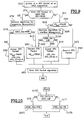
- figure 6 is a flow chart for a decision algorithm for congestion management in accordance with the invention;
- figure 7 is flow chart for the complete intelligent packet discard algorithm in accordance with a first embodiment of the invention;
- figure 8 is a flow chart for a first CPS packet detection algorithm used in the algorithm of figure 7;
- figure 9 is a flow chart for a complete intelligent packet discard algorithm in accordance with a second embodiment of the invention; and
- figure 10 is a flow chart for a decision algorithm for overflow management used in the algorithm of figure 9.
- CONG_VAL: congestion indicator. Its value is OK in case of congestion and NOK in case of no congestion.
- CPS_CO (CPS counter). This is the counter which indicates the buffer's current filling level (for an AAL2 connection, a group of AAL2 connections or the entire buffer 40). In other words it indicates the number of octets present in the buffer for a given AAL2 connection (or for a given group of connections, or the total number of octets used).
- CPS_Low_Threshold =
lower threshold 44. - CPS_High_Threshold =
higher threshold 42
- for each AAL2 connection, a context bit PDAAL2 (packet discard) which indicates whether or not the CPS packet discard mechanism is activated by that connection (respectively "True" and "False"); and
- for each AAL2 connection, a context bit FP (First Packet) which indicates whether or not a processed CPS packet (being processed or following) is the first one (or not) of an AAL2 SDU.
- OVER_VAL, which is an overflow indicator. Its value is OK if the buffer is in an overflow state and NOK if the buffer is not in an overflow state. (It is recalled here that a buffer overflow occurs when the buffer can physically no longer store data.); and
- BUF_CAP, which is the buffer capacity in octets. This parameter is configurable for each or a given buffer.
Claims (18)
- Method of managing data packets originating from data frames, said packets being presented to buffer means (40) prior to processing, characterised in that when a packet corresponding to the start of a frame is presented to the buffer stage, it is determined whether the filling level of the buffer means (40) exceeds a first predetermined filling threshold (42) corresponding to a state of congestion and, if such is the case, this packet and all packets belonging to that same frame are systematically discarded before the buffer means (40).
- Method according to claim 1, characterised in that said frames originate from AAL2 connections, and each constitute a respective asynchronous transfer mode (ATM) adaptation layer type 2 service data unit (AAL2 SDU), and in that said packets are common part sublayer (CPS) packets, and said buffer means (40) stores said CPS packets before the latter are multiplexed into asynchronous transfer mode (ATM) cells.
- Method according to claim 1 or 2, characterised in that if said first filling threshold (42) is exceeded, packets are allowed to enter into said buffer means (40) only if said packets on the one hand follow a first packet admitted into the buffer means prior to said first threshold being exceeded and on the other hand originate from the same frame as said first packet.
- Method according to any one of claims 1 to 3, characterised in that said state of congestion of said buffer means (40) is attained upon exceeding said first threshold (42) and in that said state of congestion is left by passing below a second filling threshold (44) of said buffer means, said second threshold being lower than said first threshold.
- Method according to any one of claims 1 to 4, characterised in that said first threshold (42) is set such that the remaining capacity of the buffer means (40) upon exceeding that threshold is substantially sufficient to accept all remaining packets of a frame whose first packet has been accepted into said buffer means (40).
- Method according to any one of claims 2 to 5, characterised in that :for each CPS packet, the user-to-user interface (UUI) field is used to determine if said packet is the last CPS packet forming an AAL2 SDU and, if such is the case, the following CPS packet is considered as a first CPS packet;in the case of a first CPS packet of an AAL2 SDU frame, it is detected if the buffer means (40) are in a state of congestion;in the case of a congestion, said first packet and all the following CPS packets are discarded up to and including the packet for which it is detected that the UUI field of that packet corresponds to the last packet of the current AAL2 SDU frame.
- Method according to any one of claims 2 to 6, characterised in that :for each CPS packet, the user-to-user interface (UUI) field is used to determine if said packet is the last CPS packet forming an AAL2 SDU and, if such is the case, the following CPS packet is considered as a first packet;in the case of a first CPS packet of an AAL2 SDU frame, it is detected if the buffer means (40) are in a state of congestion;if the buffer means (40) are not in a state of congestion for said first CPS packet, said first CPS packet and all the CPS packets that follow are accepted systematically into said buffer means up to and including the one for which it is detected that the UUI field of that CPS packet corresponds to the last packet of the current AAL2 SDU frame.
- Method according to any one of claims 2 to 6, characterised in that :for each CPS packet, the user-to-user interface (UUI) field is used to determine if said packet is the last CPS packet forming an AAL2 SDU and, if such is the case, the following CPS packet is considered as a first packet;in the case of a first CPS packet of an AAL2 SDU frame, it is detected if the buffer means (40) are in a state of congestion;if the buffer means (40) are not in a state of congestion said first CPS packet is accepted into said buffer means and, for each following CPS packet belonging the same AAL2 SDU frame as said first packet, said packet is accepted only if said buffer means are not in a state of overflow.
- Method according to any one of claims 2 to 8, characterised in that:for each incoming CPS packet, the Length
Indicator field (LI) of the CPS Packet header is read to determine the length of the arriving CPS Packet;the thus determined length of the arriving CPS packet is used to update a buffer occupancy counter which is configured to store at least one amongst :i) the instantaneous number of octets used in the buffer for a given AAL2 connection;ii) the instantaneous number of octets used in the buffer for a given group of AAL2 connections;iii) the instantaneous number of octets used in the buffer by all AAL2 connections stored therein. - Device for managing data packets originating from data frames, said packets being presented to buffer means (40) prior to processing, characterised in that it comprises:packet analysing means for determining whether a packet presented to said buffer means (40) is a first packet of frame;means for determining whether the filling level of the buffer means (40) exceeds a first predetermined filling threshold (42)corresponding to a state of congestion and,means active when the filling level of said buffer means exceeds said first filling threshold to discard systematically before said buffer means said first packet of a frame and all following packets belonging to that same frame before the buffer means (40).
- Device according to claim 10, characterised in that said frames originate from AAL2 connections, and each constitute a respective ATM (asynchronous transfer mode) adaptation layer type 2 service data unit (AAL2 SDU), and in that said packets are common part sublayer (CPS) packets, and said buffer means (40) stores said CPS packets before the latter are multiplexed into asynchronous transfer mode [ATM) cells.
- Device according to claim 10 or 11, characterised in that it comprises means active when said first threshold (42) is exceeded to allow packets to enter into said buffer means (40) only if said packets on the one hand follow a first packet admitted into the buffer means prior to said first threshold being exceeded and on the other hand originate from the same frame as said first packet.
- Device according to any one of claims 10 to 12, characterised in that said state of congestion of said buffer means (40) is attained upon exceeding said first threshold (42) and in that said state of congestion is left by passing below a second filling threshold (44) of said buffer means, said second filling threshold being lower than said first filling threshold.
- Device according to any one of claims 10 to 13, characterised in that said first threshold (42) is set such that the remaining capacity of the buffer means (40) upon exceeding that threshold is substantially sufficient to accept all remaining packets of a frame whose first packet has been accepted into said buffer means (40).
- Device according to any one of claims 11 to 14, characterised in that it further comprises:means active for each CPS packet to determine from the user-to-user interface (UUI) field thereof whether said packet is the last CPS packet forming an AAL2 SDU and, if such is the case, for considering the following CPS packet as a first CPS packet;means active in the case of a first CPS packet of an AAL2 SDU frame to detect if the buffer means (40) are in a state of congestion;means active in the case of a congestion to discard said first CPS packet and all the following CPS packets up to and including the packet for which it is detected that the UUI field of that packet corresponds to the last packet of the current AAL2 SDU frame.
- Device according to any one of claims 11 to 15, characterised in that it further comprises:means active for each CPS packet to determine from the user-to-user interface (UUI) field thereof whether said packet is the last CPS packet forming an AAL2 SDU and, if such is the case, for considering the following CPS packet as a first CPS packet;means active in the case of a first CPS packet of an AAL2 SDU frame to detect if the buffer means (40) are in a state of congestion;means active if the buffer means (40) are not in a state of congestion for said first CPS packet, to accept systematically said first CPS packet and all the CPS packets that follow into said buffer means up to and including the one for which it is detected that the UUI of that CPS packet corresponds to the last CPS packet of the current AAL2 SDU frame.
- Device according to any one of claims 11 to 15, characterised in that it further comprises:means active for each CPS packet to determine from the user-to-user interface (UUI) field thereof whether said packet is the last CPS packet forming an AAL2 SDU and, if such is the case, for considering the following CPS packet as a first packet;means active in the case of a first CPS packet of an AAL2 SDU frame to detect if the buffer means (40) are in a state of congestion;means active if said buffer means (40) are not in a state of congestion for accepting into said buffer said first CPS packet and, for each following CPS packet belonging to a same AAL2 SDU frame, for accepting said packet only if said buffer is not in a state of saturation.
- Device according to any one of claims 11 to 17, characterised in that it further comprises :means active for each incoming CPS packet, to read the Length Indicator field (LI) of the CPS Packet header and to determine the length of the arriving CPS Packet;means for updating on the basis of the thus determined length of the arriving CPS packet a buffer occupancy counter which is configured to store at least one amongst :i) the instantaneous number of octets used in the buffer for a given AAL2 connection;ii) the instantaneous number of octets used in the buffer for a given group of AAL2 connections;iii) the instantaneous number of octets used in the buffer by all AAL2 connections stored therein.
Priority Applications (8)
| Application Number | Priority Date | Filing Date | Title |
|---|---|---|---|
| EP99402809A EP1100285B1 (en) | 1999-11-12 | 1999-11-12 | Congestion control of AAL2 connections |
| DE69913535T DE69913535T2 (en) | 1999-11-12 | 1999-11-12 | Overload control of an AAL2 connection |
| AT99402809T ATE256374T1 (en) | 1999-11-12 | 1999-11-12 | OVERLOAD CONTROL OF AN AAL2 CONNECTION |
| US09/476,134 US6711126B1 (en) | 1999-11-12 | 2000-01-03 | Congestion control of AAL2 connections |
| AU66683/00A AU6668300A (en) | 1999-11-12 | 2000-10-23 | Congestion control of AAL2 connections |
| JP2000326389A JP4618861B2 (en) | 1999-11-12 | 2000-10-26 | Congestion control of AAL2 connection |
| KR1020000066739A KR20010070203A (en) | 1999-11-12 | 2000-11-10 | Congestion control of aal2 connections |
| CNB001339036A CN1199408C (en) | 1999-11-12 | 2000-11-10 | Blocking control of asynchronous transmission mode adaptive layer 2 connection |
Applications Claiming Priority (1)
| Application Number | Priority Date | Filing Date | Title |
|---|---|---|---|
| EP99402809A EP1100285B1 (en) | 1999-11-12 | 1999-11-12 | Congestion control of AAL2 connections |
Publications (2)
| Publication Number | Publication Date |
|---|---|
| EP1100285A1 true EP1100285A1 (en) | 2001-05-16 |
| EP1100285B1 EP1100285B1 (en) | 2003-12-10 |
Family
ID=8242176
Family Applications (1)
| Application Number | Title | Priority Date | Filing Date |
|---|---|---|---|
| EP99402809A Expired - Lifetime EP1100285B1 (en) | 1999-11-12 | 1999-11-12 | Congestion control of AAL2 connections |
Country Status (8)
| Country | Link |
|---|---|
| US (1) | US6711126B1 (en) |
| EP (1) | EP1100285B1 (en) |
| JP (1) | JP4618861B2 (en) |
| KR (1) | KR20010070203A (en) |
| CN (1) | CN1199408C (en) |
| AT (1) | ATE256374T1 (en) |
| AU (1) | AU6668300A (en) |
| DE (1) | DE69913535T2 (en) |
Cited By (5)
| Publication number | Priority date | Publication date | Assignee | Title |
|---|---|---|---|---|
| WO2005025151A1 (en) | 2003-09-11 | 2005-03-17 | Telefonaktiebolaget Lm Ericsson (Publ) | Method for discarding all segments corresponding to the same packet in a buffer |
| EP1471687A4 (en) * | 2002-01-23 | 2005-11-09 | Huawei Tech Co Ltd | A method for realize the atm variable bit rate real-time traffic |
| WO2012115545A1 (en) * | 2011-02-22 | 2012-08-30 | Telefonaktiebolaget L M Ericsson (Publ) | Method and device for congestion situations |
| EP3951581A4 (en) * | 2019-03-27 | 2022-05-18 | Wuxi Hisky Medical Technologies Co., Ltd. | DATA STORAGE APPARATUS AND METHOD AND READABLE STORAGE MEDIA |
| RU2804268C2 (en) * | 2019-03-27 | 2023-09-26 | Уси Хиски Медикал Текнолоджис Ко., Лтд. | Device and method of data storage and machine readable data medium |
Families Citing this family (22)
| Publication number | Priority date | Publication date | Assignee | Title |
|---|---|---|---|---|
| US7116680B1 (en) * | 2000-03-02 | 2006-10-03 | Agere Systems Inc. | Processor architecture and a method of processing |
| US7508758B1 (en) * | 2000-06-09 | 2009-03-24 | Nokia Corporation | Method and system to transmit and/or receive information between network elements |
| EP2288202B1 (en) * | 2000-10-07 | 2015-04-08 | LG Electronics Inc. | Method for transmitting data from RLC layer in radio communication system |
| US7116683B1 (en) * | 2000-11-21 | 2006-10-03 | Telefonaktiebolaget Lm Ericsson (Publ) | Sequencing of user data packets segmented into AAL2 packets transported over internet protocol (IP) |
| KR100364747B1 (en) * | 2000-12-30 | 2002-12-16 | 엘지전자 주식회사 | Apparatus and method for converting AAL2/AAL5 |
| GB2371177B (en) * | 2001-01-16 | 2003-02-19 | Ericsson Telefon Ab L M | Automatic repetition request mechanism in a radio access network |
| US6826188B2 (en) * | 2001-01-16 | 2004-11-30 | Freescale Semiconductor, Inc. | Method and circuit for forming an ATM cell |
| US7327740B2 (en) * | 2001-05-25 | 2008-02-05 | Telefonaktiebolaget Lm Ericsson (Publ) | Facilitating reliable connection admission control for telecommunications system using AAL2 signaling |
| US6928080B2 (en) * | 2001-06-28 | 2005-08-09 | Intel Corporation | Transporting variable length ATM AAL CPS packets over a non-ATM-specific bus |
| FI20011520A7 (en) * | 2001-07-11 | 2003-01-12 | Nokia Corp | Method for managing connection resources |
| US7822423B2 (en) * | 2001-11-19 | 2010-10-26 | Nokia Corporation | Provision of location information |
| FI20031401A0 (en) * | 2003-09-29 | 2003-09-29 | Nokia Corp | Dynamic SVC connections for AAL2 traffic transfer |
| GB0410481D0 (en) * | 2004-05-11 | 2004-06-16 | Nokia Corp | Frame transmission interval |
| KR100678891B1 (en) * | 2004-07-30 | 2007-02-05 | 삼성전자주식회사 | Method and device for elastically adjusting the buffer amount according to the property of contents |
| KR100603570B1 (en) * | 2004-09-22 | 2006-07-24 | 삼성전자주식회사 | Network congestion control device and method |
| US7573840B2 (en) * | 2005-04-30 | 2009-08-11 | Cisco Technology, Inc. | AAL2 profiles for UMTS IuUP |
| JP4805080B2 (en) * | 2006-09-29 | 2011-11-02 | 株式会社エヌ・ティ・ティ・ドコモ | Communication control method, radio base station, and radio control station |
| US8085803B2 (en) * | 2007-01-29 | 2011-12-27 | Intel Corporation | Method and apparatus for improving quality of service for packetized voice |
| US8325608B2 (en) * | 2008-08-07 | 2012-12-04 | Qualcomm Incorporated | Efficient packet handling for timer-based discard in a wireless communication system |
| CN102361473B (en) * | 2011-06-30 | 2016-12-21 | 中兴通讯股份有限公司 | Jamming control method, device and system |
| EP2725825B1 (en) * | 2011-07-26 | 2018-04-11 | Huawei Technologies Co., Ltd. | Wireless local area network cooperated data transmission method, device and system |
| EP4383729B1 (en) * | 2022-12-07 | 2025-11-05 | Axis AB | Video failover recording |
Citations (2)
| Publication number | Priority date | Publication date | Assignee | Title |
|---|---|---|---|---|
| US5822540A (en) * | 1995-07-19 | 1998-10-13 | Fujitsu Network Communications, Inc. | Method and apparatus for discarding frames in a communications device |
| EP0915634A2 (en) * | 1997-11-06 | 1999-05-12 | Lucent Technologies Inc. | Method for call admission in a packet voice system |
Family Cites Families (7)
| Publication number | Priority date | Publication date | Assignee | Title |
|---|---|---|---|---|
| SE515178C2 (en) * | 1992-03-20 | 2001-06-25 | Ericsson Telefon Ab L M | Procedures and devices for prioritizing buffer management in packet networks |
| JP3129588B2 (en) * | 1993-01-18 | 2001-01-31 | 日本電信電話株式会社 | Cell frame transfer method |
| JPH08288965A (en) * | 1995-04-18 | 1996-11-01 | Hitachi Ltd | Switching system |
| JP2929998B2 (en) * | 1996-03-22 | 1999-08-03 | 日本電気株式会社 | Cell buffer control method in ATM transfer |
| JPH1070547A (en) * | 1996-08-28 | 1998-03-10 | Nec Corp | Both input/output buffers type atm switch |
| JPH10190677A (en) * | 1996-12-26 | 1998-07-21 | Mitsubishi Electric Corp | Buffer congestion control method for ATM communication device |
| US6219339B1 (en) * | 1998-02-20 | 2001-04-17 | Lucent Technologies Inc. | Method and apparatus for selectively discarding packets |
-
1999
- 1999-11-12 DE DE69913535T patent/DE69913535T2/en not_active Expired - Lifetime
- 1999-11-12 AT AT99402809T patent/ATE256374T1/en not_active IP Right Cessation
- 1999-11-12 EP EP99402809A patent/EP1100285B1/en not_active Expired - Lifetime
-
2000
- 2000-01-03 US US09/476,134 patent/US6711126B1/en not_active Expired - Lifetime
- 2000-10-23 AU AU66683/00A patent/AU6668300A/en not_active Abandoned
- 2000-10-26 JP JP2000326389A patent/JP4618861B2/en not_active Expired - Fee Related
- 2000-11-10 KR KR1020000066739A patent/KR20010070203A/en not_active Withdrawn
- 2000-11-10 CN CNB001339036A patent/CN1199408C/en not_active Expired - Fee Related
Patent Citations (2)
| Publication number | Priority date | Publication date | Assignee | Title |
|---|---|---|---|---|
| US5822540A (en) * | 1995-07-19 | 1998-10-13 | Fujitsu Network Communications, Inc. | Method and apparatus for discarding frames in a communications device |
| EP0915634A2 (en) * | 1997-11-06 | 1999-05-12 | Lucent Technologies Inc. | Method for call admission in a packet voice system |
Non-Patent Citations (1)
| Title |
|---|
| HONGQING LI ET AL: "PERFORMANCE OF TCP OVER UBR SERVICE IN ATM NETWORKS WITH PER-VC EARLY PACKET DISCARD SCHEMES", PROCEEDINGS OF THE IEEE ANNUAL INTERNATIONAL PHOENIX CONFERENCE ON COMPUTERS AND COMMUNICATIONS,US,NEW YORK, IEEE, vol. CONF. 15, 1996, pages 350 - 357, XP000594803, ISBN: 0-7803-3256-3 * |
Cited By (11)
| Publication number | Priority date | Publication date | Assignee | Title |
|---|---|---|---|---|
| EP1471687A4 (en) * | 2002-01-23 | 2005-11-09 | Huawei Tech Co Ltd | A method for realize the atm variable bit rate real-time traffic |
| WO2005025151A1 (en) | 2003-09-11 | 2005-03-17 | Telefonaktiebolaget Lm Ericsson (Publ) | Method for discarding all segments corresponding to the same packet in a buffer |
| US8130074B2 (en) | 2003-09-11 | 2012-03-06 | Telefonaktiebolaget Lm Ericsson (Publ) | Method for discarding all segments corresponding to same packet in a buffer |
| US8412160B2 (en) | 2003-09-11 | 2013-04-02 | Telefonaktiebolaget Lm Ericsson (Publ) | Method for discarding all segments corresponding to the same packet in a buffer |
| CN1839591B (en) * | 2003-09-11 | 2014-03-05 | 艾利森电话股份有限公司 | Method for discarding all segments corresponding to same packet in buffer |
| WO2012115545A1 (en) * | 2011-02-22 | 2012-08-30 | Telefonaktiebolaget L M Ericsson (Publ) | Method and device for congestion situations |
| US9532265B2 (en) | 2011-02-22 | 2016-12-27 | Telefonaktiebolaget Lm Ericsson (Publ) | Method and device for congestion situations |
| EP3951581A4 (en) * | 2019-03-27 | 2022-05-18 | Wuxi Hisky Medical Technologies Co., Ltd. | DATA STORAGE APPARATUS AND METHOD AND READABLE STORAGE MEDIA |
| AU2020249862B2 (en) * | 2019-03-27 | 2023-06-29 | Wuxi Hisky Medical Technologies Co., Ltd. | Data storage apparatus and method, and readable storage medium |
| RU2804268C2 (en) * | 2019-03-27 | 2023-09-26 | Уси Хиски Медикал Текнолоджис Ко., Лтд. | Device and method of data storage and machine readable data medium |
| US11836098B2 (en) | 2019-03-27 | 2023-12-05 | Wuxi Hisky Medical Technologies Co., Ltd. | Data storage apparatus and method, and readable storage medium |
Also Published As
| Publication number | Publication date |
|---|---|
| JP4618861B2 (en) | 2011-01-26 |
| CN1199408C (en) | 2005-04-27 |
| EP1100285B1 (en) | 2003-12-10 |
| DE69913535T2 (en) | 2004-06-24 |
| US6711126B1 (en) | 2004-03-23 |
| AU6668300A (en) | 2001-05-17 |
| DE69913535D1 (en) | 2004-01-22 |
| CN1305293A (en) | 2001-07-25 |
| ATE256374T1 (en) | 2003-12-15 |
| JP2001168885A (en) | 2001-06-22 |
| KR20010070203A (en) | 2001-07-25 |
Similar Documents
| Publication | Publication Date | Title |
|---|---|---|
| EP1100285B1 (en) | Congestion control of AAL2 connections | |
| US6219339B1 (en) | Method and apparatus for selectively discarding packets | |
| EP0915634B1 (en) | Method and apparatus for call admission in a packet voice system | |
| US5936967A (en) | Multi-channel broadband adaptation processing | |
| KR100222222B1 (en) | A data processing method for efficiently transmitting multimedia packets in a conventional digital packet switched network | |
| US6483854B1 (en) | Method and apparatus for using ATM queues for segmentation and reassembly of data frames | |
| US6259696B1 (en) | ATM switch and congestion control method | |
| JP3542608B2 (en) | Minicell segmentation and reassembly method | |
| EP1095535B1 (en) | Source node for a broadband network with atm cells | |
| EP1115265B1 (en) | Method and a device for determining packet transmission priority between a plurality of data streams | |
| US6967924B1 (en) | Packet switching device and cell transfer control method | |
| CA2355111C (en) | Flow control method in a telecommunications system | |
| US5481544A (en) | Multi-channel broadband adaptation processing | |
| KR100984051B1 (en) | Interworking between cell-based and packet-based networks | |
| US6870854B1 (en) | Packet switching device and cell transfer method | |
| JP3808736B2 (en) | Multiplex transmission apparatus and multiple transmission method | |
| EP0995290A1 (en) | Vc merging for atm switch | |
| JP3129588B2 (en) | Cell frame transfer method | |
| US6636514B1 (en) | Telecommunications system | |
| US20040085956A1 (en) | Processor for packet switching between cell streams with optional virtual channel and channel identification modification | |
| US20020141445A1 (en) | Method and system for handling a loop back connection using a priority unspecified bit rate in ADSL interface | |
| JP2005515710A (en) | Data conversion method and data conversion system | |
| JP2828139B2 (en) | ATM communication device and cell discarding method | |
| SHEU et al. | An adaptive cell checking controller for wireless ATM networks | |
| KR19990058026A (en) | Traffic Control Method Using Cell Priority of Hybrid Protocol Converter |
Legal Events
| Date | Code | Title | Description |
|---|---|---|---|
| PUAI | Public reference made under article 153(3) epc to a published international application that has entered the european phase |
Free format text: ORIGINAL CODE: 0009012 |
|
| 17P | Request for examination filed |
Effective date: 19991124 |
|
| AK | Designated contracting states |
Kind code of ref document: A1 Designated state(s): AT BE CH CY DE DK ES FI FR GB GR IE IT LI LU MC NL PT SE |
|
| AX | Request for extension of the european patent |
Free format text: AL;LT;LV;MK;RO;SI |
|
| AKX | Designation fees paid |
Free format text: AT BE CH CY DE DK ES FI FR GB GR IE IT LI LU MC NL PT SE |
|
| 17Q | First examination report despatched |
Effective date: 20020906 |
|
| GRAH | Despatch of communication of intention to grant a patent |
Free format text: ORIGINAL CODE: EPIDOS IGRA |
|
| GRAS | Grant fee paid |
Free format text: ORIGINAL CODE: EPIDOSNIGR3 |
|
| GRAA | (expected) grant |
Free format text: ORIGINAL CODE: 0009210 |
|
| AK | Designated contracting states |
Kind code of ref document: B1 Designated state(s): AT BE CH CY DE DK ES FI FR GB GR IE IT LI LU MC NL PT SE |
|
| PG25 | Lapsed in a contracting state [announced via postgrant information from national office to epo] |
Ref country code: NL Free format text: LAPSE BECAUSE OF FAILURE TO SUBMIT A TRANSLATION OF THE DESCRIPTION OR TO PAY THE FEE WITHIN THE PRESCRIBED TIME-LIMIT Effective date: 20031210 Ref country code: LI Free format text: LAPSE BECAUSE OF FAILURE TO SUBMIT A TRANSLATION OF THE DESCRIPTION OR TO PAY THE FEE WITHIN THE PRESCRIBED TIME-LIMIT Effective date: 20031210 Ref country code: FI Free format text: LAPSE BECAUSE OF FAILURE TO SUBMIT A TRANSLATION OF THE DESCRIPTION OR TO PAY THE FEE WITHIN THE PRESCRIBED TIME-LIMIT Effective date: 20031210 Ref country code: CY Free format text: LAPSE BECAUSE OF FAILURE TO SUBMIT A TRANSLATION OF THE DESCRIPTION OR TO PAY THE FEE WITHIN THE PRESCRIBED TIME-LIMIT Effective date: 20031210 Ref country code: CH Free format text: LAPSE BECAUSE OF FAILURE TO SUBMIT A TRANSLATION OF THE DESCRIPTION OR TO PAY THE FEE WITHIN THE PRESCRIBED TIME-LIMIT Effective date: 20031210 Ref country code: BE Free format text: LAPSE BECAUSE OF FAILURE TO SUBMIT A TRANSLATION OF THE DESCRIPTION OR TO PAY THE FEE WITHIN THE PRESCRIBED TIME-LIMIT Effective date: 20031210 Ref country code: AT Free format text: LAPSE BECAUSE OF FAILURE TO SUBMIT A TRANSLATION OF THE DESCRIPTION OR TO PAY THE FEE WITHIN THE PRESCRIBED TIME-LIMIT Effective date: 20031210 |
|
| REG | Reference to a national code |
Ref country code: GB Ref legal event code: FG4D |
|
| REG | Reference to a national code |
Ref country code: CH Ref legal event code: EP |
|
| REG | Reference to a national code |
Ref country code: IE Ref legal event code: FG4D |
|
| REF | Corresponds to: |
Ref document number: 69913535 Country of ref document: DE Date of ref document: 20040122 Kind code of ref document: P |
|
| PG25 | Lapsed in a contracting state [announced via postgrant information from national office to epo] |
Ref country code: SE Free format text: LAPSE BECAUSE OF FAILURE TO SUBMIT A TRANSLATION OF THE DESCRIPTION OR TO PAY THE FEE WITHIN THE PRESCRIBED TIME-LIMIT Effective date: 20040310 Ref country code: GR Free format text: LAPSE BECAUSE OF FAILURE TO SUBMIT A TRANSLATION OF THE DESCRIPTION OR TO PAY THE FEE WITHIN THE PRESCRIBED TIME-LIMIT Effective date: 20040310 Ref country code: DK Free format text: LAPSE BECAUSE OF FAILURE TO SUBMIT A TRANSLATION OF THE DESCRIPTION OR TO PAY THE FEE WITHIN THE PRESCRIBED TIME-LIMIT Effective date: 20040310 |
|
| PG25 | Lapsed in a contracting state [announced via postgrant information from national office to epo] |
Ref country code: ES Free format text: LAPSE BECAUSE OF FAILURE TO SUBMIT A TRANSLATION OF THE DESCRIPTION OR TO PAY THE FEE WITHIN THE PRESCRIBED TIME-LIMIT Effective date: 20040321 |
|
| NLV1 | Nl: lapsed or annulled due to failure to fulfill the requirements of art. 29p and 29m of the patents act | ||
| REG | Reference to a national code |
Ref country code: CH Ref legal event code: PL |
|
| ET | Fr: translation filed | ||
| PLBE | No opposition filed within time limit |
Free format text: ORIGINAL CODE: 0009261 |
|
| STAA | Information on the status of an ep patent application or granted ep patent |
Free format text: STATUS: NO OPPOSITION FILED WITHIN TIME LIMIT |
|
| PG25 | Lapsed in a contracting state [announced via postgrant information from national office to epo] |
Ref country code: LU Free format text: LAPSE BECAUSE OF NON-PAYMENT OF DUE FEES Effective date: 20041112 Ref country code: IE Free format text: LAPSE BECAUSE OF NON-PAYMENT OF DUE FEES Effective date: 20041112 |
|
| PG25 | Lapsed in a contracting state [announced via postgrant information from national office to epo] |
Ref country code: MC Free format text: LAPSE BECAUSE OF NON-PAYMENT OF DUE FEES Effective date: 20041130 |
|
| 26N | No opposition filed |
Effective date: 20040913 |
|
| REG | Reference to a national code |
Ref country code: IE Ref legal event code: MM4A |
|
| REG | Reference to a national code |
Ref country code: FR Ref legal event code: CD |
|
| PG25 | Lapsed in a contracting state [announced via postgrant information from national office to epo] |
Ref country code: PT Free format text: LAPSE BECAUSE OF NON-PAYMENT OF DUE FEES Effective date: 20040510 |
|
| REG | Reference to a national code |
Ref country code: GB Ref legal event code: 732E Free format text: REGISTERED BETWEEN 20131114 AND 20131120 |
|
| REG | Reference to a national code |
Ref country code: FR Ref legal event code: GC Effective date: 20140717 |
|
| REG | Reference to a national code |
Ref country code: FR Ref legal event code: RG Effective date: 20141016 |
|
| REG | Reference to a national code |
Ref country code: FR Ref legal event code: PLFP Year of fee payment: 17 |
|
| REG | Reference to a national code |
Ref country code: FR Ref legal event code: PLFP Year of fee payment: 18 |
|
| PGFP | Annual fee paid to national office [announced via postgrant information from national office to epo] |
Ref country code: IT Payment date: 20161123 Year of fee payment: 18 |
|
| REG | Reference to a national code |
Ref country code: FR Ref legal event code: PLFP Year of fee payment: 19 |
|
| PGFP | Annual fee paid to national office [announced via postgrant information from national office to epo] |
Ref country code: DE Payment date: 20171121 Year of fee payment: 19 Ref country code: FR Payment date: 20171121 Year of fee payment: 19 |
|
| PGFP | Annual fee paid to national office [announced via postgrant information from national office to epo] |
Ref country code: GB Payment date: 20171123 Year of fee payment: 19 |
|
| PG25 | Lapsed in a contracting state [announced via postgrant information from national office to epo] |
Ref country code: IT Free format text: LAPSE BECAUSE OF NON-PAYMENT OF DUE FEES Effective date: 20171112 |
|
| REG | Reference to a national code |
Ref country code: DE Ref legal event code: R119 Ref document number: 69913535 Country of ref document: DE |
|
| GBPC | Gb: european patent ceased through non-payment of renewal fee |
Effective date: 20181112 |
|
| PG25 | Lapsed in a contracting state [announced via postgrant information from national office to epo] |
Ref country code: DE Free format text: LAPSE BECAUSE OF NON-PAYMENT OF DUE FEES Effective date: 20190601 Ref country code: FR Free format text: LAPSE BECAUSE OF NON-PAYMENT OF DUE FEES Effective date: 20181130 |
|
| PG25 | Lapsed in a contracting state [announced via postgrant information from national office to epo] |
Ref country code: GB Free format text: LAPSE BECAUSE OF NON-PAYMENT OF DUE FEES Effective date: 20181112 |