EP1100047A2 - Method and apparatus for displaying medical images - Google Patents
Method and apparatus for displaying medical images Download PDFInfo
- Publication number
- EP1100047A2 EP1100047A2 EP00124157A EP00124157A EP1100047A2 EP 1100047 A2 EP1100047 A2 EP 1100047A2 EP 00124157 A EP00124157 A EP 00124157A EP 00124157 A EP00124157 A EP 00124157A EP 1100047 A2 EP1100047 A2 EP 1100047A2
- Authority
- EP
- European Patent Office
- Prior art keywords
- medical image
- medical
- image
- displaying apparatus
- images
- Prior art date
- Legal status (The legal status is an assumption and is not a legal conclusion. Google has not performed a legal analysis and makes no representation as to the accuracy of the status listed.)
- Withdrawn
Links
Images

Classifications
-
- G—PHYSICS
- G06—COMPUTING OR CALCULATING; COUNTING
- G06T—IMAGE DATA PROCESSING OR GENERATION, IN GENERAL
- G06T3/00—Geometric image transformations in the plane of the image
- G06T3/60—Rotation of whole images or parts thereof
Definitions
- the present invention relates to a method and apparatus for displaying medical images, and specifically relates to a medical image displaying method and a medical image displaying apparatus, which are suitable for displaying radiographic images.
- the radiographic images are displayed on a monitor display, such as a CRT, a liquid crystal display, etc., based on such the digital image data, so that the doctor can make diagnosis by viewing images displayed on the monitor display.
- a monitor display such as a CRT, a liquid crystal display, etc.
- the abovementioned system includes such a very serious problem for the medical diagnosis that a diseased part is liable to be overlooked by the doctor at the time of diagnosis made by using the monitor display, compared to the diagnosis made by using the radiographic image film.
- the present inventors have found the following facts.
- Conventionally when the doctor makes diagnosis by using the radiographic image film, it has been easy for the doctor to find out a diseased part photographed in the film, since the doctor has had such know-how that the doctor rotates or moves the film in various directions in order to unconsciously change the special-frequency of the image into the most suitable special-frequency for finding out the diseased part.
- the medical radiographic images displayed on the monitor have neither rotated nor moved, the doctor has been compelled to view them at a fixed special-frequency.
- the method for viewing them includes know-how, which would be unique depending on each of doctors. For instance, a certain doctor would rotate or move the film when viewing the radiographic image, as aforementioned, while an experienced doctor can make diagnosis by analogizing the radiographic image to the cases, which he viewed in the past and memorized in his memory.
- flesh doctors or doctors having a little experience are liable to overlook a diseased part, compared to the experienced doctors, since they have not sufficiently acquired such know-how as mentioned above due to an insufficiency of experienced cases.
- the accuracy of diagnosis with viewing the film considerably depends on the experienced skill of the doctor. Accordingly, when the medical diagnoses are made by employing the radiographic image film, there has been happened such a fact that one diagnosis is more reliable than another diagnosis, depending on the experienced skill of the doctor.
- the present invention is attained in view of the abovementioned problems.
- Another object of the present invention is to provide methods for displaying medical images and medical image displaying apparatus, which make it possible to co-own know-how, conventionally depending on the experiences of each doctor, and therefore, which make it possible for the doctor to make more equalized and more precise diagnoses than ever, namely, which make it possible even for flesh doctors or doctors having a little experience to make precise diagnosis.
- a medical image displaying method characterized in that, in the medical image displaying method for displaying a medical image, a slantwise image, which is obtained by rotating the medical image on either a rotating axis included in an image plane of the medical image or another rotating axis located outside the image plane and being in parallel with the image plane, and then, projecting a rotated medical image onto the image plane of the medical image before rotating, is displayed.
- a medical image displaying apparatus characterized in that the medical image displaying apparatus, for displaying a medical image, comprises an image-processing means for displaying a slantwise image, which is obtained by rotating the medical image on either a rotating axis included in an image plane of the medical image or another rotating axis located outside the image plane and being in parallel with the image plane, and then, projecting a rotated medical image onto the image plane of the medical image before rotating.
- a medical image displaying method characterized in that, when generating and displaying the slantwise image of the medical image, the rotating operations for generating the slantwise image are continuously performed in stepwise or non-stepwise mode to generate a plurality of images having different rotating states, which are displayed by arranging on a screen.
- a medical image displaying apparatus characterized in that the image-processing means continuously performs the rotating operations for generating the slantwise image in stepwise or non-stepwise mode to generate a plurality of images having different rotating states, which are displayed by arranging on a screen.
- a plurality of slantwise images are generated by continuously performing the rotating operations for generating the slantwise image in stepwise or non-stepwise mode, it is possible to display them by arranging on a screen and it becomes possible to display the medical image on the monitor in a manner similar to that of viewing the medical image photographed on the film.
- a plurality of slantwise images having different rotating states are displayed, it is possible to instantaneously compare a slantwise image with a next slantwise image, which is slightly different from the next in its viewing angle, and a sense of viewing film can be obtained.
- a medical image displaying method characterized in that, when generating and displaying the slantwise image of the medical image, the rotating operations for generating the slantwise image are continuously performed in stepwise or non-stepwise mode to generate a plurality of slantwise images having different rotating states, and one of the slantwise images can be switched to either a display mode or a non-display mode with respect to others.
- a medical image displaying apparatus characterized in that the image-processing means continuously performs the rotating operations for generating the slantwise image in stepwise or non-stepwise mode to generate a plurality of images having different rotating states, and one of the slantwise images can be switched to either a display mode or a non-display mode with respect to others.
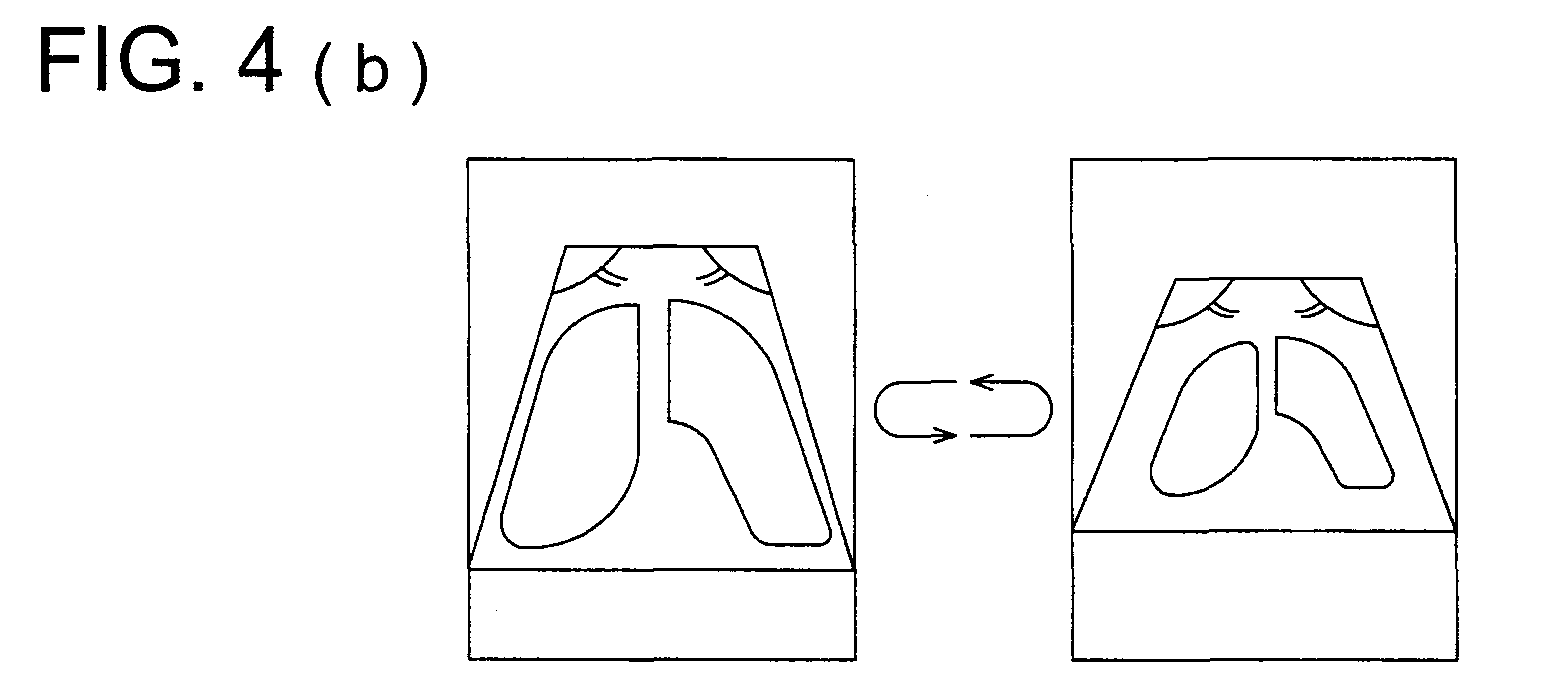
- a plurality of slantwise images are generated by continuously performing the rotating operations for generating the slantwise image in stepwise or non-stepwise mode, and one of the slantwise images is switched to either a display mode or a non-display mode with respect to others, it becomes possible to display the medical image on the monitor in a manner similar to that of viewing the medical image photographed on the film. In this case, the viewer would sense as if a slantwise direction of a film image, viewed from slightly different direction, is changed.
- a medical image displaying method characterized in that, when generating and displaying the slantwise image of the medical image, the rotating operations for generating the slantwise image are continuously performed in stepwise or non-stepwise mode to generate a plurality of slantwise images having different rotating states, and a plurality of slantwise images having different rotating states are displayed at a same position by switching them one by one.
- a medical image displaying apparatus characterized in that the image-processing means continuously performs the rotating operations for generating the slantwise image in stepwise or non-stepwise mode to generate a plurality of images having different rotating states, and displays a plurality of slantwise images having different rotating states at a same position by switching them one by one.
- a medical image displaying method characterized in that, in the medical image displaying method for displaying medical images, a plurality of medical images, which are photographed for a same subject from substantially a same direction, are displayed by aligning them in the horizontal direction.
- a medical image displaying apparatus characterized in that, in the medical image displaying apparatus for displaying medical images, a plurality of medical images, which are photographed for a same subject from substantially a same direction, are displayed by aligning them in the horizontal direction.
- a medical image displaying method characterized in that the medical images, aligned in the horizontal direction, are displayed by switching between a displaying mode and a non-displaying made at a predetermined period, or by switching the luminous intensity of the medical image between high and low levels.
- a medical image displaying apparatus characterized in that, in the medical image displaying apparatus for displaying a medical image, the medical images, aligned in the horizontal direction, are displayed by switching between a displaying mode and a non-displaying mode at a predetermined period, or by switching the luminous intensity of the medical image between high and low levels.
- a medical image displaying method characterized in that a displaying mode for displaying an image, obtained by slantingly viewing a plane including a medical image, is provided.
- a medical image displaying apparatus characterized in that a displaying mode for displaying an image, obtained by slantingly viewing a plane including a medical image, is provided.
- a medical image displaying method characterized in that, in the medical image displaying method for displaying a medical image, the medical image concerned is displayed with the same kind of the past medical images on the same screen.
- a medical image displaying apparatus characterized in that, in the medical image displaying apparatus for displaying a medical image, a image memory means for storing medical images, an image-processing means for reading out the medical image concerned and the same kind of the past medical images from the image memory means to display the medical image with aligning the past medical images on the same screen, and a medical image displaying means for displaying the images processed by the image-processing means, are provided.
- a medical image displaying method characterized in that, in the medical image displaying method for displaying a medical image, the medical image is displayed in such a manner that one of factors, including a minimum and maximum density, a dynamic-range, and an image size, coincides with that of the medical image in the past.
- a medical image displaying apparatus characterized in that, in the medical image displaying apparatus for displaying a medical image, there is provided an image processing means, which applies an image processing for matching one of factors, including a minimum and maximum density, a dynamic-range, and an image size, with that of the medical image in the past.
- an image processing means which applies an image processing for matching one of factors, including a minimum and maximum density, a dynamic-range, and an image size, with that of the medical image in the past.
- a medical image displaying apparatus characterized in that, in the medical image displaying apparatus for displaying a medical image, there is provided an image processing means, which applies an image processing for matching the image size with that of the medical image in the past.
- a medical image displaying method characterized in that, in the medical image displaying method for displaying a medical image, both normal and reverse images of the medical image concerned are displayed at a same position by alternately switching them.
- a medical image displaying apparatus characterized in that, in the medical image displaying apparatus for displaying a medical image, there is provided an image processing means, which performs an image processing for displaying both normal and reverse images of the medical image concerned at a same position by alternately switching them.
- a medical image displaying method characterized in that, in the medical image displaying method for displaying a medical image, the normal and reverse images of the medical image concerned are displayed at upper and lower sides or right and left sides of the medical image concerned.
- a medical image displaying apparatus characterized in that, in the medical image displaying apparatus for displaying a medical image, there is provided an image processing means, which performs an image processing for displaying the normal and reverse images of the medical image concerned at upper and lower sides or right and left sides of the medical image concerned.
- the normal and reverse images of the medical image concerned are displayed at upper and lower sides or right and left sides of the medical image concerned, it becomes possible to eliminate such a case that the doctor overlooks the diseased part due to the deficiency of the monitor screen, and the doctor can easily grasp various kinds of image variations in the medical image concerned, and it becomes possible to display the medical images on the display in a similar manner when viewing a lot of the medical images photographed on the films, which are aligned in front of the doctor.
- the medical image displaying apparatus is an apparatus for displaying medical images based on the medical image digital data, and comprises a medical image digital data processing section (hereinafter, referred to as the image processing section, for simplicity) to process the medical image digital data and a image displaying section to display the medical images based on the medical image digital data processed in the image processing section.
- the apparatus also includes an operating section, such as a keyboard, a various kinds of buttons, levers, etc., to input data for changing the displaying mode or the displaying state of the medical images.
- the medical image digital data is processed to perform a dynamic display mode, including a rotating display, a reversing display, a display of plural images, etc. of medical images, and a static display mode (to be detailed later).
- a dynamic display mode including a rotating display, a reversing display, a display of plural images, etc. of medical images, and a static display mode (to be detailed later).
- it is desirable that adjustments of the density, the dynamic-range and the image-size are also performed in the image processing section.
- a CPU, a LSI, an IC, etc. can be cited as a concrete example of the image processing section, and of cause, each of them is possibly controlled by software.
- a CRT monitor a liquid-crystal display, an organic EL, a plasma display, etc.
- a CRT monitor a liquid-crystal display, an organic EL, a plasma display, etc.
- a CRT monitor a liquid-crystal display, an organic EL, a plasma display, etc.
- the medical image displaying apparatus includes a memory section to store medical image data.
- Digital image-recording media such as a memory, a hard disk, various kinds of RAMs (including DRAM, SRAM, a flash memory, a miniature card, a compact flash, a smart media, PC card, etc.), various kinds of ROMs (including a mask ROM, EPROM, EEPROM, etc.), CD-ROM, CD-RW, CD-R, MT, DAT, FD, MD, MO, DVD, etc., and recording/reproducing apparatus of those media can be cited as concrete examples of the memory section.
- the medical image displaying apparatus does not include the memory section, but a medical diagnosis system (to be detailed later) includes the memory section. Of cause, it is also possible that the medical image displaying apparatus include the memory section, and further, another memory apparatus is included as a diagnosis system.
- the medical image displaying apparatus it is possible to display the medical image both dynamically and statically.
- the description of "to display the medical image dynamically” means that the medical image, displayed on the monitor, is continuously changing during the displaying action.
- the medical image, displayed on the monitor is continuously rotating in either stepwise or non-stepwise.
- the medical image displaying apparatus can display a slantwise image, which is obtained by rotating the medical image on either a rotating axis included in the image plane of the medical image or another rotating axis located outside the image plane and being in parallel with the image plane, and then, projecting a rotated medical image onto the image plane of the medical image before rotating.
- the medical image displaying apparatus displays either the dynamically rotating medical image, namely, the dynamic medical image continuously rotating in either stepwise or non-stepwise, or the static medical image stopped at a certain rotation angle. Further, it is also applicable to rotate the medical image on a rotating axis perpendicular to the image plane of the medical image.
- the medical image displaying apparatus displays a plurality of slantwise images, each of which is rotating in each individual manner, in the same image area.
- the slantwise images, displayed on the screen are aligned in horizontal direction.
- the slantwise images are based on the same medical image digital data, but only the rotating manners of them are different each other.
- each of the slantwise images is displayed either dynamically or statically.
- the medical image displaying apparatus displays a plurality of slantwise images, each of which is rotating in each individual manner, at the same position by switching them one by one.
- the medical image displaying apparatus displays a medical image in such a manner that the medical image is vibrated (reciprocated) in a constant direction at a predetermined period.
- the medical image, displayed on the screen moves based on the actions of the operating section, such as a lever, a mouse, etc., performed by the diagnosis inspector.
- the luminous intensity of the medical image can be varied in the medical image displaying apparatus.
- the medical image is displayed dynamically at the fixed position while the luminous intensity of the medical image is varied in either stepwise or non-stepwise, it is also applicable that a plurality of medical images, the luminous intensities of which are different each other, are displayed statically in the same image area.
- the medical image displaying apparatus can display both normal and reverse images of the medical image. It is applicable that the normal and reverse images of the medical image are displayed within the same image area, or separately displayed at the same position by switching action. In addition, this action of displaying the normal and reverse images of the medical image can be regarded as one mode of the aforementioned image rotating operation.
- the medical image displaying apparatus can display a plurality of medical images with regard to an individual patient.
- the medical images with regard to the individual patient are displayed in the same image area.
- each of the medical images could be displayed either dynamically or statically in the various displaying mode, such as the rotation, the reversion, the variation of the luminous intensity, etc.
- each of the medical images with regard to the individual patient could be separately displayed at the same position by switching action. In this case, it is desirable that the medical images are continuously displayed on the screen by automatically switching them one by one.
- the medical image displaying apparatus displays a plurality of medical images of a specific section of the individual patient, which are different each other in its photographic angle.
- the abovementioned term of "section” indicates a part of the patient's body, such as a foot, a chest, an abdomen, etc.
- the photographic angle may be a slightly changed angle within 45°, or a largely changed angle more than 45°.
- the medical image displaying apparatus displays a plurality of medical images of a specific section of the individual patient, which are different each other in its photographic date. For instance, it is possible to display an image of the chest of the patient, which was photographed from the direct front side one year before and another image of the chest, which is photographed at present. In this case, it is desirable that the differences of the photographic angles between the medical images are within 30°, or more desirably, coincide each other.
- the medical image displaying apparatus displays a plurality of medical images, each of which corresponds to each of different sections of the individual patient.
- the photographic dates of the medical images substantially coincide each other, such as the same day.
- the medical image displaying apparatus can display a plurality of medical images with regard to different patients.
- the medical images with regard to the different patients are displayed in the same image area.
- each of the medical images could be displayed either dynamically or statically in the various displaying mode, such as the rotation, the reversion, the variation of the luminous intensity, etc.
- each of the medical images with regard to the different patients could be separately displayed at the same position by switching action. In this case, it is desirable that the medical images are continuously displayed on the screen by automatically switching them one by one.
- the medical image displaying apparatus displays a dynamic medical image, which is continuously expanding or reducing its image size, in a similar manner as the doctor brings the film close to his eyes or apart from his eyes.
- the doctor can obtain the same effect as that of manually bringing the film close to or apart from his eyes.
- the medical image can be expanded or reduced at a center of a predetermined position (desirably, the diseased part) designated by the doctor.
- At least one of factors, including a minimum and maximum density, a dynamic-range, and an image size, for displaying a plurality of medical images of the individual patient is unified into a common value. It is more desirable that each of all factors, including a minimum and maximum density, a dynamic-range, and an image size, is unified into a common value.
- the medical image displaying apparatus has a displaying mode for assisting the medical diagnosis, which makes it easy to recognize a diseased part of the patient as well as viewing the film, in order that doctors can co-own know-how, which depends on the experience of the doctor, even if medical images are displayed on the monitor.
- the operating mode could be switched to the displaying mode for assisting the medical diagnosis by operating the mode conversion switch, or could be automatically switched by turning on the power switch of the apparatus.
- the medical image displaying apparatus merely has a rotation-displaying mode, a reversiondisplaying mode, plural images displaying mode, etc., instead of the displaying mode for assisting the medical diagnosis.
- the medical image digital data includes at least one of data, such as personal data of the patient, data of the photographic date, data of the photographic section and data of the photographic angle, in addition to the image data.
- the image processing section processes not only the image data, but also at least one of data, such as personal data of the patient, data of the photographic date, data of the photographic section and data of the photographic angle. Namely, the image processing section performs, for instance, retrieving actions based on one of the abovementioned data, or relating action between the image data and one of the abovementioned data.
- another processing apparatus included in the medical diagnosis system performs the abovementioned operations, instead of the medical image displaying apparatus.
- medical image digital data is obtained by digitizing a plane image.
- the medical images are the radiographic images obtained by photographing the patients by means of the radiographic apparatus.
- the medical image displaying apparatus includes an examined-result inputting section for inputting an examined result diagnosed with medical images displayed on the image displaying section by an examiner (for instance, a doctor, a physician, etc.).
- an examiner for instance, a doctor, a physician, etc.
- the image processing section relates the examined result with the medical image digital data, when the examiner inputs the examined result into the examined-result inputting section.
- Keyboards, pushbuttons, voice recognition apparatus, scanners, etc. can be cited as examples of the examined-result inputting section.
- the medical diagnosis system is at least comprised of the medical image displaying apparatus and the radiographic image photographing apparatus, which captures the medical image by irradiating radial-rays to the subject and digitize the radiographic image into the medical image digital data. It is desirable that the radiographic image photographing apparatus generates the image data by directly converting the radial rays, penetrated through the subject, to electronic energy or by converting the radial rays to photo energy and further converting the photo energy to electronic energy.
- the medical diagnosis system is further comprised of a memory apparatus for storing a plurality of the medical image digital data generated by the radiographic image photographing apparatus, and the medical image displaying apparatus displays medical images based on the medical image digital data retrieved from the memory apparatus.
- the medical diagnosis system is further comprised of a processing apparatus for processing the personal data of the patient and the data of diagnosis results, which are related to the medical image digital data.
- a server or other personal computers could be employed as the memory apparatus or the diagnosis apparatus.
- the medical diagnosis system is further comprised of a laser imager for recording the radiographic image onto a paper sheet or a film.
- the radiographic image photographing apparatus could be integrated with the medical image displaying apparatus, or those may be separate apparatus, which are coupled each other in the network. In case of separate apparatus, those are possibly coupled each other in either a wired or a wireless communication mode. Of cause, it is applicable that a plurality of the medical image displaying apparatus and a plurality of the radiographic image photographing apparatus are provided in the medical diagnosis system. Further, the abovementioned system can be also utilized for a medical image management system.
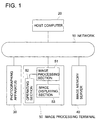
- Fig. 1 shows a structural block-diagram of the medical image management system (the medical diagnosis system) including an example of the medical image displaying apparatus, embodied in the present invention, and peripheral apparatus.
- numeral 10 indicates a network in which various kinds of apparatus (to be detailed later) are coupled each other
- numeral 20 indicates a host-computer, serving as a controlling means, for generating reservation data with regard to the accepted reservations for medical examinations or inspections, managing medical image data photographed, and controlling retrieving and transferring actions for medical image data.
- Numeral 30 indicates a photographing apparatus for capturing the radiographic image of the subject and generating a medical image data by reading the image capturing result.
- Numeral 40 indicates an image memory server for storing the medical image data generated by capturing the radiographic image.
- Numeral 50 indicates an image processing terminal, serving as the medical image displaying apparatus embodied in the present invention, for displaying medical images, which are utilized for an image inspection of the radiographic image.
- image processing terminal 50 is provided with image processing section 51, serving as an image processing means, for applying various kinds of processing to medical images, operating section 52 to which various kinds of commands are inputted when medical images are processed, and image displaying section 53, serving as an image displaying means, for displaying medical images on the CRT display, etc.
- photographing apparatus 30 and image processing terminal 50 are equipped in each of sections (medical sections). Further, it is also possible that image processing terminal 50 is directly coupled to photographing apparatus 30 or a reading apparatus (not shown in the drawings) without coupling through the network.
- Photographing apparatus 30 captures the radiographic image based on the photographing reservation data generated by host-computer 20, and generates the medical image data with respect to the subject. Then, the medical image data is stored in image memory server 40, under the controlling actions of host-computer 20.
- host-computer 20 transfers the concerned medical image data to image-processing terminal 50 from image memory server 40.
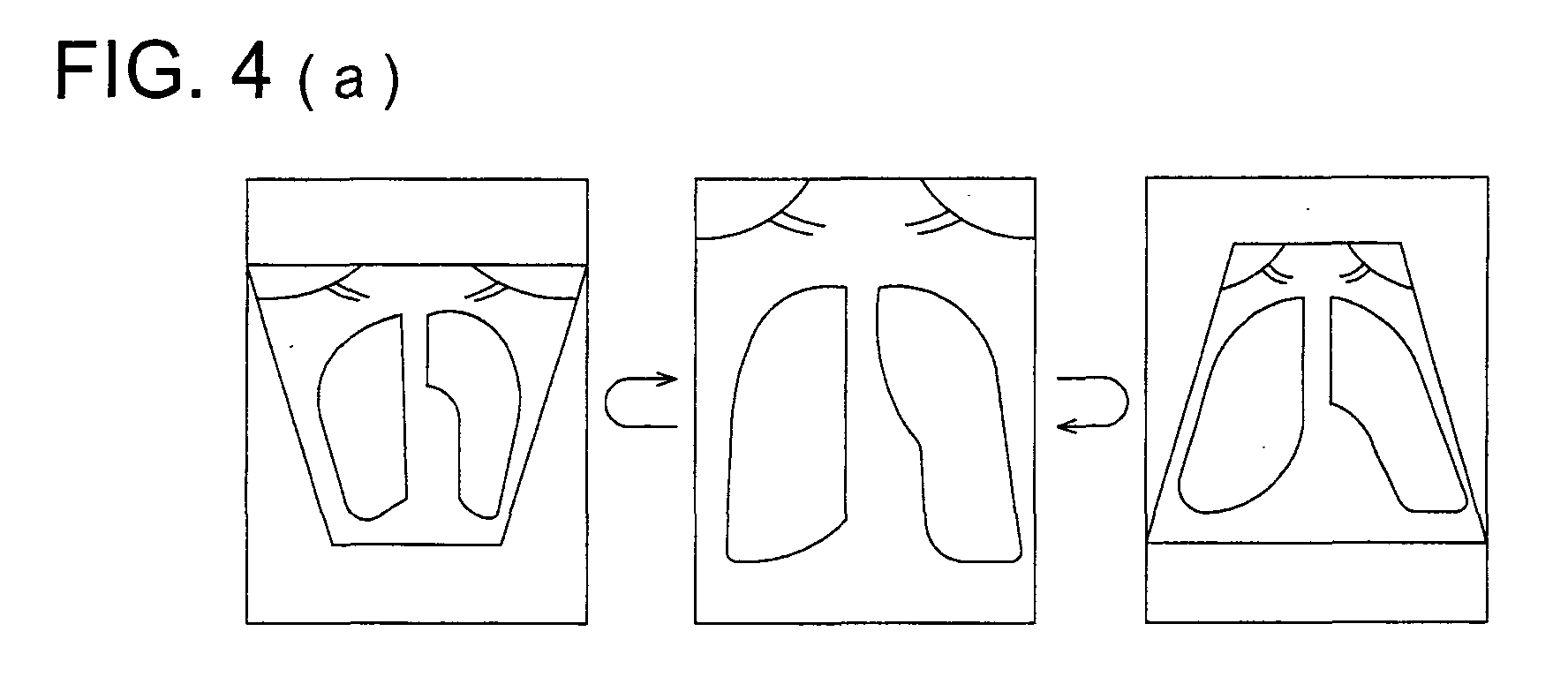
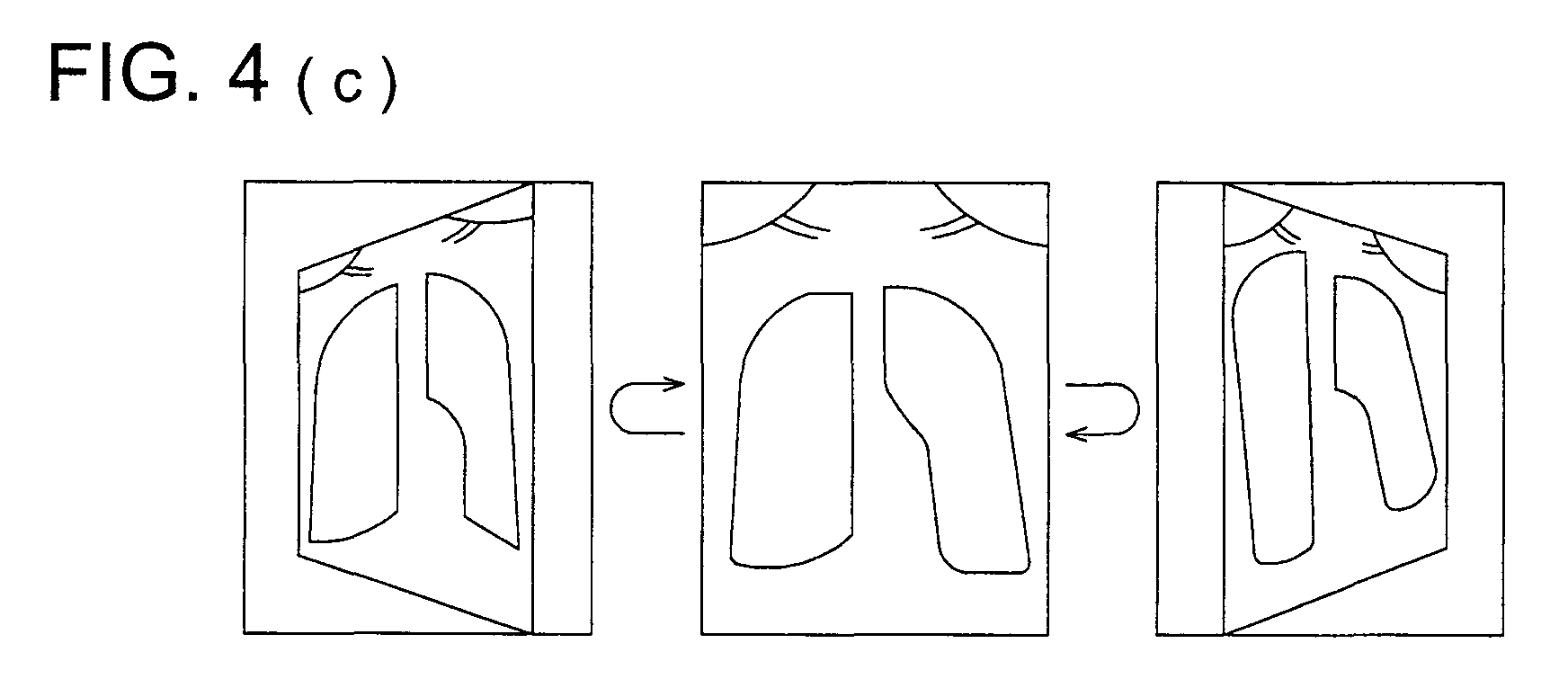
- image-processing section 51 processes the medical image data, so that the medical image is rotated around a rotating axis, which is parallel to the image plane of the medical image and included in the image plane or located outside the image plane, and then, the rotated medical image is projected onto the original image plane to generate a slantwise image to be displayed.
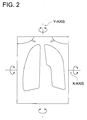
- Fig. 2 shows an explanatory illustration of the image plane, typically indicating X-axis and Y-axis, serving as rotational axes.
- Image-processing section 51 performs such a three-dimensional image processing that the medical image revolves on either X-axis or Y-axis, or on both X-axis and Y-axis.
- the selection of the rotational axes depends on the command sent from operating section 52.
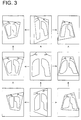
- Fig. 3 shows an explanatory illustration of medical images in various rotating states, indicating the original medical image before processing at the center, the medical images revolving on X-axis at right and left sides of the original medical image, the medical images revolving on Y-axis at upper and lower sides of the original medical image, and the medical images revolving on both X-axis and Y-axis at diagonal sides of the original medical image, respectively.
- the medical image generated by image-processing operations in the image-processing section 51, is displayed on the monitor of the image displaying section 53.
- an exhibiting degree of the perspective sense of view can be controlled by command signals sent from operating section 52.
- the doctor inputs operational commands, with regard to the vibrating direction, the amplitude of the vibration, the period of the vibration, etc., from operating section 52.
- Image-processing section 51 processes the medical image data based on the command signals sent from operating section 52, so as to display the medical image in the vibration mode.
- an afterimage effect of eyesight makes it easier for the doctor to grasp various kinds of image variations (such as a diseased part), and it becomes possible to display the medical image on the monitor in a manner similar to that of viewing the medical image photographed on the film.
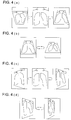
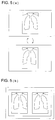
- Fig. 5(a) and Fig. 5(b) show an explanatory illustration of images displayed on the monitor screen, indicating another embodiment of the present invention.
- the CRT display or the liquid-crystal display, equipped in image displaying section 53 does not necessary displays a uniform image over the whole area of its screen.
- displaying properties of the CRT display screen such as brightness, contrast and ⁇ characteristic, may vary from right area to left area in the screen, due to the variation of light-emitting materials employed for the screen.
- image-processing section 51 alternately generates a normal medical image (shown in upper side of Fig.
- the MTF characteristic (Modulation Transfer Function) of the monitor screen in image displaying section 53 is deteriorated at a specific spatial-frequency, it is possible to compensate the MTF characteristic in such a manner that the MTF characteristic of the monitor screen is measured in advance, and the specific spatial-frequency is emphasized based on the measurement result of the MTF characteristic in image-processing section 51.
- the MTF characteristic is protruded at a specific spatial-frequency, it is also possible to attenuate the specific spatial-frequency, as well. Accordingly, since the medical images can be displayed on the monitor screen having substantially uniform properties irrespective of the MTF characteristic, the possibility of overlooking a diseased part, etc. reduces significantly. Therefore, it becomes possible to display the medical image, being similar to that of the film, on the monitor screen.
- image-processing section 51 performs such an image processing that a density characteristic of the film employed in photographing section 30 and a density characteristic of the monitor screen employed in image displaying section 53 are measured in advance, and image-processing section 51 compensates the difference between both density characteristics. According to the abovementioned image processing, it also becomes possible to display the medical image, being similar to that of the film, on the monitor screen.
- a suitable displaying pattern in advance, corresponding to a purpose of diagnosis, a section for diagnosis, etc., as well as the displaying pattern unique for each user, and to instantaneously call out the suitable displaying pattern when using image-processing terminal 50. Accordingly, employing the displaying pattern suitable for the purpose or the section of diagnosis allows the user to perform the image-inspection in the same level as that of the skilled user, even if the user is not skilled in the image-inspection.
- the medical images are aligned in the horizontal direction.
- displaying the medical images in the horizontal direction makes it easier to grasp many images in the eyesight, and it becomes possible to display the medical image on the monitor in a manner similar to that of viewing the medical image photographed on the film.
- this horizontal displaying mode it is applicable that the medical images are statically displayed in the horizontal direction, or dynamically displayed, so as to smoothly moves in the horizontal direction.
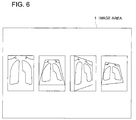
- image-processing section 51 retrieves the medical image concerned as well as images for comparison, which are registered in image memory server 40 in advance, from image memory server 40, and the images for comparison, having a reduced image size, are displayed at the side area of the medical image concerned, as shown in Fig. 7.
- the images for comparison are a plurality of medical images, each of which is photographed during the passage of time from the initial time when the diagnosis was made for its purpose to the last time, namely, the past images of the same kind. Accordingly, displaying the images for comparison on the same image area allows the user to perform the image-inspection in the same level as that of the skilled user, even if the user is not skilled in the image-inspection.
- the medical image is displayed by switching between a displaying mode and a non-displaying mode at a predetermined period, or by switching the luminous intensity of the medical image between high and low levels.
- an afterimage effect of eyesight makes it easier for the doctor to grasp various kinds of image variations, and it becomes possible to display the medical image on the monitor in a similar manner when viewing the medical image photographed on the film.
- the medical image concerned is displayed with the same kind of the past medical images on the same screen.
- the past medical images make it easier for the doctor to grasp various kinds of image variations in the medical image concerned, and it becomes possible to display the medical images on the monitor in a similar manner when viewing a lot of the medical images photographed on the films, which are aligned in front of the doctor.
- the medical image concerned is displayed in such a manner that the density and the dynamic-range of the image coincide with those of the past medical image.
- the doctor can easily grasp various kinds of image variations in the medical image concerned, and it becomes possible to display the medical images on the monitor in a similar manner when viewing a lot of the medical images photographed on the films, which are aligned in front of the doctor.
- the medical image concerned is displayed in such a manner that the size of the image coincide with that of the past medical image.
- the doctor can easily grasp various kinds of image variations in the medical image concerned, and it becomes possible to display the medical images on the monitor in a similar manner when viewing a lot of the medical images photographed on the films, which are aligned in front of the doctor.
- the normal and reverse images of the medical image concerned are alternately displayed at the same position on the monitor screen.
- the normal and reverse images of the medical image concerned are displayed at upper and lower sides or right and left sides of the medical image concerned.
Landscapes
- Physics & Mathematics (AREA)
- General Physics & Mathematics (AREA)
- Engineering & Computer Science (AREA)
- Theoretical Computer Science (AREA)
- Apparatus For Radiation Diagnosis (AREA)
- Measuring And Recording Apparatus For Diagnosis (AREA)
Abstract
Description
comprising: an image-processing section to process the medical image digital data; and an image displaying section to display the medical image based on the medical image digital data processed by the image-processing section.
(30) A medical image displaying method, characterized in that, in the medical image displaying method for displaying a medical image, a slantwise image, which is obtained by rotating the medical image on either a rotating axis included in an image plane of the medical image or another rotating axis located outside the image plane and being in parallel with the image plane, and then, projecting a rotated medical image onto the image plane of the medical image before rotating, is displayed.
(31) A medical image displaying method, characterized in that, when generating and displaying the slantwise image of the medical image, the rotating operations for generating the slantwise image are continuously performed in stepwise or non-stepwise mode to generate a plurality of images having different rotating states, which are displayed by arranging on a screen.
(32) A medical image displaying method, characterized in that, when generating and displaying the slantwise image of the medical image, the rotating operations for generating the slantwise image are continuously performed in stepwise or non-stepwise mode to generate a plurality of slantwise images having different rotating states, and one of the slantwise images can be switched to either a display mode or a non-display mode with respect to others.
(33) A medical image displaying method, characterized in that, when generating and displaying the slantwise image of the medical image, the rotating operations for generating the slantwise image are continuously performed in stepwise or non-stepwise mode to generate a plurality of slantwise images having different rotating states, and a plurality of slantwise images having different rotating states are displayed at a same position by switching them one by one.
(34) A medical image displaying method, characterized in that, in the medical image displaying method for displaying medical images, a plurality of medical images, which are photographed for a same subject from substantially a same direction, are displayed by aligning them in the horizontal direction.
(35) A medical image displaying method, characterized in that the medical images, aligned in the horizontal direction, are displayed by switching between a displaying mode and a non-displaying made at a predetermined period, or by switching the luminous intensity of the medical image between high and low levels.
(36) A medical image displaying method, characterized in that a displaying mode for displaying an image, obtained by slantingly viewing a plane including a medical image, is provided.
(37) A medical image displaying method, characterized in that, in the medical image displaying method for displaying a medical image, the medical image concerned is displayed with the same kind of the past medical images on the same screen.
(38) A medical image displaying method, characterized in that, in the medical image displaying method for displaying a medical image, the medical image is displayed in such a manner that one of factors, including a minimum and maximum density, a dynamic-range, and an image size, coincides with that of the medical image in the past.
(39) A medical image displaying method, characterized in that, in the medical image displaying method for displaying a medical image, the medical image is displayed in such a manner that the image size coincides with that of the medical image in the past.
(40) A medical image displaying method, characterized in that, in the medical image displaying method for displaying a medical image, both normal and reverse images of the medical image concerned are displayed at a same position by alternately switching them.
(41) A medical image displaying method, characterized in that, in the medical image displaying method for displaying a medical image, the normal and reverse images of the medical image concerned are displayed at upper and lower sides or right and left sides of the medical image concerned.
embodied in the present invention, and the total configuration of the medical image management system will be detailed in the following, referring to the structural block-diagram shown in Fig. 1.
serving as the medical image displaying apparatus embodied in the present invention, for displaying medical images, which are utilized for an image inspection of the radiographic image. Incidentally,
Claims (29)
- A medical image displaying apparatus for displaying a medical image based on medical image digital data, comprising:an image-processing section to process said medical image digital data; andan image displaying section to display said medical image based on said medical image digital data processed by said image-processing section.
- The medical image displaying apparatus of claim 1,
wherein said medical image displaying apparatus dynamically displays said medical image. - The medical image displaying apparatus of claim 1,
wherein said medical image displaying apparatus displays a slantwise image, which is obtained by rotating said medical image on either a rotating axis included in an image plane of said medical image or another rotating axis located outside said image plane and being in parallel with said image plane, and then, projecting a rotated medical image onto said image plane of said medical image before rotating. - The medical image displaying apparatus of claim 3,
wherein said medical image displaying apparatus displays a plurality of slantwise images, each of which is rotating in each individual manner, in an image area. - The medical image displaying apparatus of claim 3,
wherein said medical image displaying apparatus displays a plurality of slantwise images, each of which is rotating in each individual manner, at a same position by switching them one by one. - The medical image displaying apparatus of claim 1,
wherein said medical image displaying apparatus displays a plurality of said medical images with regard to a same individual subject. - The medical image displaying apparatus of claim 6,
wherein said medical image displaying apparatus displays a plurality of said medical images with regard to a same individual subject in an image area. - The medical image displaying apparatus of claim 6,
wherein said medical image displaying apparatus displays a plurality of said medical images with regard to said individual subject at a same position by switching them one by one. - The medical image displaying apparatus of claim 6,
wherein said medical image displaying apparatus displays a plurality of said medical images, with regard to a same specific section of said same individual subject, which are different each other in its photographic angle. - The medical image displaying apparatus of claim 6,
wherein said medical image displaying apparatus displays a plurality of said medical images, with regard to a same specific section of said same individual subject, which are different each other in its photographic date or time. - The medical image displaying apparatus of claim 6,
wherein said medical image displaying apparatus displays a plurality of said medical images, each of which corresponds to each of different sections of said same individual subject. - The medical image displaying apparatus of claim 6,
wherein said medical image displaying apparatus displays a plurality of said medical images with regard to said same individual subject in such a manner that at least one of factors for a plurality of said medical images, such as a minimum density, a maximum density, a dynamic-range and an image size, is unified into a common value. - The medical image displaying apparatus of claim 1,
wherein said medical image displaying apparatus displays a plurality of said medical images with regard to different subjects. - The medical image displaying apparatus of claim 13,
wherein said medical image displaying apparatus displays a plurality of said medical images with regard to different subjects in an image area. - The medical image displaying apparatus of claim 13,
wherein said medical image displaying apparatus displays a plurality of said medical images with regard to different subjects at a same position by switching them one by one. - The medical image displaying apparatus of claim 13,
wherein said medical image displaying apparatus displays a plurality of said medical images with regard to different subjects in such a manner that at least one of factors for a plurality of said medical images, such as a minimum density, a maximum density, a dynamic-range and an image size, is unified into a common value. - The medical image displaying apparatus of claim 1,
wherein said medical image displaying apparatus displays said medical image while continuously varying a luminous intensity of said medical image in either stepwise or non-stepwise. - The medical image displaying apparatus of claim 1,
wherein said medical image displaying apparatus displays both normal and reverse images of the medical image. - The medical image displaying apparatus of claim 18,
wherein said medical image displaying apparatus displays both normal and reverse images of said medical image in an image area. - The medical image displaying apparatus of claim 18,
wherein said medical image displaying apparatus displays both normal and reverse images of said medical image at a same position by switching them one by one. - The medical image displaying apparatus of claim 1,
wherein said medical image digital data includes at least one of data, such as personal data of a subject, data of a photographic date, data of a photographic section and data of a photographic angle, in addition to an image data, and said image processing section processes said image data and at least one of data, such as personal data of said subject, data of said photographic date, data of said photographic section and data of said photographic angle. - The medical image displaying apparatus of claim 1,
wherein said medical image digital data is obtained by digitizing a plane image. - The medical image displaying apparatus of claim 1,
wherein said medical image is a radiographic image. - The medical image displaying apparatus of claim 1,
wherein said medical image displaying apparatus includes an examined-result inputting section for inputting an examined result diagnosed with said medical image, displayed on said image displaying section, by an examiner, and said image processing section relates data of said examined result with said medical image digital data. - The medical image displaying apparatus of claim 1,
wherein said medical image displaying apparatus displays said medical image in such a manner that said medical image is vibrated (reciprocated) in a constant direction at a predetermined period. - The medical image displaying apparatus of claim 1, further comprising:
an operating section, wherein said medical image displaying apparatus displays said medical image while moving said medical image based on an operating action for said operating section. - A medical diagnosis system, comprising:a radiographic image photographing apparatus for photographing a medical image by irradiating radial-rays onto a subject to generate medical image digital data; anda medical image displaying apparatus for displaying said medical image based on said medical image digital data, said medical image displaying apparatus comprising,an image-processing section to process said medical image digital data, andan image displaying section to display said medical image based on said medical image digital data processed by said image-processing section.
- The medical diagnosis system of claim 27, further comprising:
a memory section for storing a plurality of said medical image digital data generated by said radiographic image photographing apparatus, wherein said medical image displaying apparatus displays said medical image based on said medical image digital data retrieved from said memory section. - A medical image displaying method for displaying a medical image based on medical image digital data, comprising the steps of:processing said medical image digital data; anddisplaying said medical image based on said medical image digital data processed.
Applications Claiming Priority (2)
| Application Number | Priority Date | Filing Date | Title |
|---|---|---|---|
| JP31789099 | 1999-11-09 | ||
| JP31789099 | 1999-11-09 |
Publications (2)
| Publication Number | Publication Date |
|---|---|
| EP1100047A2 true EP1100047A2 (en) | 2001-05-16 |
| EP1100047A3 EP1100047A3 (en) | 2002-07-24 |
Family
ID=18093205
Family Applications (1)
| Application Number | Title | Priority Date | Filing Date |
|---|---|---|---|
| EP00124157A Withdrawn EP1100047A3 (en) | 1999-11-09 | 2000-11-07 | Method and apparatus for displaying medical images |
Country Status (1)
| Country | Link |
|---|---|
| EP (1) | EP1100047A3 (en) |
Cited By (1)
| Publication number | Priority date | Publication date | Assignee | Title |
|---|---|---|---|---|
| DE102007056431A1 (en) * | 2007-11-23 | 2009-06-04 | Siemens Ag | Apparatus and method for adapting medical images for display on a large display |
Family Cites Families (4)
| Publication number | Priority date | Publication date | Assignee | Title |
|---|---|---|---|---|
| JPH05120451A (en) * | 1991-08-08 | 1993-05-18 | Hitachi Medical Corp | Medical diagnostic imaging equipment |
| US5452416A (en) * | 1992-12-30 | 1995-09-19 | Dominator Radiology, Inc. | Automated system and a method for organizing, presenting, and manipulating medical images |
| US5842473A (en) * | 1993-11-29 | 1998-12-01 | Life Imaging Systems | Three-dimensional imaging system |
| US5986662A (en) * | 1996-10-16 | 1999-11-16 | Vital Images, Inc. | Advanced diagnostic viewer employing automated protocol selection for volume-rendered imaging |
-
2000
- 2000-11-07 EP EP00124157A patent/EP1100047A3/en not_active Withdrawn
Cited By (1)
| Publication number | Priority date | Publication date | Assignee | Title |
|---|---|---|---|---|
| DE102007056431A1 (en) * | 2007-11-23 | 2009-06-04 | Siemens Ag | Apparatus and method for adapting medical images for display on a large display |
Also Published As
| Publication number | Publication date |
|---|---|
| EP1100047A3 (en) | 2002-07-24 |
Similar Documents
| Publication | Publication Date | Title |
|---|---|---|
| US8831324B2 (en) | Surgical method and workflow | |
| US7202838B2 (en) | Viewing device | |
| US20050043970A1 (en) | Electronic imaging dental record management system | |
| US20040254763A1 (en) | Medical system | |
| EP0609500A1 (en) | A digital radiographic image quality control workstation operable in manual or pass-through modes | |
| JP2020529226A (en) | Systems and methods for improving ophthalmic imaging | |
| JP7701280B2 (en) | Apparatus for immediate advice on imaging selections to streamline imaging workflow - Patent Application 20070123633 | |
| US20090021476A1 (en) | Integrated medical display system | |
| US10102638B2 (en) | Device and method for image registration, and a nontransitory recording medium | |
| KR20240142446A (en) | Guided self-capture of diagnostic images | |
| US6614875B2 (en) | Method and apparatus for imaging the head area of a patient | |
| US7219997B2 (en) | Method and apparatus for three dimensionally displaying eyeground and measuring coordinates thereof | |
| JP2002049691A (en) | Medical information management system | |
| US20090279764A1 (en) | Small-scale diagnosis system | |
| CN1831867B (en) | Image displaying apparatus and method thereof | |
| JP4832997B2 (en) | Diagnostic imaging support device | |
| CN1671325A (en) | Medical Image Diagnosis Device | |
| JPH0370547A (en) | Ct photographing apparatus | |
| JP3951592B2 (en) | MEDICAL IMAGE DISPLAY METHOD, MEDICAL IMAGE DISPLAY DEVICE, AND MEDICAL DIAGNOSIS SYSTEM | |
| Young et al. | A new screening tool for diabetic retinopathy: the Canon CR5 45NM retinal camera with Frost Medical Software RIS-Lite digital imaging system | |
| US20050288568A1 (en) | Real-time automatic searching system for medical image and method for the same | |
| JP4768701B2 (en) | Patient face image automatic storage system in X-ray equipment | |
| JP2507439B2 (en) | Image processing device | |
| EP1326534A2 (en) | Method and apparatus for remotely viewing radiological images | |
| JP7532709B2 (en) | Image reading system and portable storage medium for image reading system |
Legal Events
| Date | Code | Title | Description |
|---|---|---|---|
| PUAI | Public reference made under article 153(3) epc to a published international application that has entered the european phase |
Free format text: ORIGINAL CODE: 0009012 |
|
| AK | Designated contracting states |
Kind code of ref document: A2 Designated state(s): AT BE CH CY DE DK ES FI FR GB GR IE IT LI LU MC NL PT SE TR |
|
| AX | Request for extension of the european patent |
Free format text: AL;LT;LV;MK;RO;SI |
|
| PUAL | Search report despatched |
Free format text: ORIGINAL CODE: 0009013 |
|
| AK | Designated contracting states |
Kind code of ref document: A3 Designated state(s): AT BE CH CY DE DK ES FI FR GB GR IE IT LI LU MC NL PT SE TR |
|
| AX | Request for extension of the european patent |
Free format text: AL;LT;LV;MK;RO;SI |
|
| RIC1 | Information provided on ipc code assigned before grant |
Free format text: 7G 06T 3/60 A, 7G 06F 19/00 B |
|
| 17P | Request for examination filed |
Effective date: 20030122 |
|
| AKX | Designation fees paid |
Designated state(s): DE FR GB IT |
|
| 17Q | First examination report despatched |
Effective date: 20030403 |
|
| 17Q | First examination report despatched |
Effective date: 20030403 |
|
| STAA | Information on the status of an ep patent application or granted ep patent |
Free format text: STATUS: THE APPLICATION IS DEEMED TO BE WITHDRAWN |
|
| 18D | Application deemed to be withdrawn |
Effective date: 20120601 |