EP1100005A2 - Version-adaptive serialization and deserialization of program objects - Google Patents
Version-adaptive serialization and deserialization of program objects Download PDFInfo
- Publication number
- EP1100005A2 EP1100005A2 EP00116794A EP00116794A EP1100005A2 EP 1100005 A2 EP1100005 A2 EP 1100005A2 EP 00116794 A EP00116794 A EP 00116794A EP 00116794 A EP00116794 A EP 00116794A EP 1100005 A2 EP1100005 A2 EP 1100005A2
- Authority
- EP
- European Patent Office
- Prior art keywords
- program
- class
- properties
- serialized
- program object
- Prior art date
- Legal status (The legal status is an assumption and is not a legal conclusion. Google has not performed a legal analysis and makes no representation as to the accuracy of the status listed.)
- Withdrawn
Links
Images



Classifications
-
- G—PHYSICS
- G06—COMPUTING OR CALCULATING; COUNTING
- G06F—ELECTRIC DIGITAL DATA PROCESSING
- G06F9/00—Arrangements for program control, e.g. control units
-
- G—PHYSICS
- G06—COMPUTING OR CALCULATING; COUNTING
- G06F—ELECTRIC DIGITAL DATA PROCESSING
- G06F9/00—Arrangements for program control, e.g. control units
- G06F9/06—Arrangements for program control, e.g. control units using stored programs, i.e. using an internal store of processing equipment to receive or retain programs
- G06F9/46—Multiprogramming arrangements
- G06F9/465—Distributed object oriented systems
-
- G—PHYSICS
- G06—COMPUTING OR CALCULATING; COUNTING
- G06F—ELECTRIC DIGITAL DATA PROCESSING
- G06F8/00—Arrangements for software engineering
- G06F8/70—Software maintenance or management
- G06F8/71—Version control; Configuration management
-
- Y—GENERAL TAGGING OF NEW TECHNOLOGICAL DEVELOPMENTS; GENERAL TAGGING OF CROSS-SECTIONAL TECHNOLOGIES SPANNING OVER SEVERAL SECTIONS OF THE IPC; TECHNICAL SUBJECTS COVERED BY FORMER USPC CROSS-REFERENCE ART COLLECTIONS [XRACs] AND DIGESTS
- Y10—TECHNICAL SUBJECTS COVERED BY FORMER USPC
- Y10S—TECHNICAL SUBJECTS COVERED BY FORMER USPC CROSS-REFERENCE ART COLLECTIONS [XRACs] AND DIGESTS
- Y10S707/00—Data processing: database and file management or data structures
- Y10S707/99951—File or database maintenance
- Y10S707/99952—Coherency, e.g. same view to multiple users
- Y10S707/99953—Recoverability
-
- Y—GENERAL TAGGING OF NEW TECHNOLOGICAL DEVELOPMENTS; GENERAL TAGGING OF CROSS-SECTIONAL TECHNOLOGIES SPANNING OVER SEVERAL SECTIONS OF THE IPC; TECHNICAL SUBJECTS COVERED BY FORMER USPC CROSS-REFERENCE ART COLLECTIONS [XRACs] AND DIGESTS
- Y10—TECHNICAL SUBJECTS COVERED BY FORMER USPC
- Y10S—TECHNICAL SUBJECTS COVERED BY FORMER USPC CROSS-REFERENCE ART COLLECTIONS [XRACs] AND DIGESTS
- Y10S707/00—Data processing: database and file management or data structures
- Y10S707/99951—File or database maintenance
- Y10S707/99952—Coherency, e.g. same view to multiple users
- Y10S707/99954—Version management
Definitions
- the present invention pertains generally to computer programs, and pertains more particularly to techniques for handling program objects in object-oriented programming.
- elements of the application may be represented by programming structures known as program objects.
- a program object may represent essentially any real or imaginary, tangible or intangible item.
- an object may be used to represent an employee or an employee's pay for a designated period of employment.
- a program object may be used to represent individual aircraft or a particular runway.
- a program object representing an entire airport could represent the control tower and also include or embed program objects representing all the runways for that airport.
- Program objects normally do not survive beyond the execution lifetime of the program that creates them.
- the information that represents the objects normally resides in some form of volatile storage such as random access memory (RAM) and the ability to access and use this information normally exists only while the program that created the program objects is executing.
- RAM random access memory
- Known techniques allow an executing program to generate information that represents a program object in a form that can be recorded or transmitted, and that permit a program executing at another time or place to read the information and recreate the program object.
- Suitable techniques for program objects in the JavaTM programming language are disclosed in an "Object Serialization Specification" published by Sun Microsystems, Inc. of Palo Alto, California. This specification is available from the Internet under a "jdk-specification directory" identified by the Uniform Resource Locator (URL) http://java.sun.com/products/jdk/1.1/docs/guide/serialization/spec/, which is incorporated herein by reference.
- Object serialization and deserialization can be used to optimize the processing required for one or more applications.
- application processing can be split into segments and the processing required to perform those segments can be provided by two or more computing systems.
- One computer system could perform an initial segment of an application and, at the conclusion of that segment, serialize one or more program objects to capture the state of the processing in a serial information stream.
- a second computer system could continue application processing by recreating the program objects represented by the serial information stream, thereby restoring the state of the processing that existed in the first computer system at the end of the initial segment, and continuing the processing by performing a subsequent segment.
- serialized information could be provided to multiple computer systems for performing the same segment of the process more or less in parallel.
- a change may be forward compatible in the sense that a program using a later version of a class can successfully deserialize an instance of that class from serial information that was generated by a program using an earlier version of the class.
- a change may backward compatible in the sense that a program using an earlier version of a class can successfully deserialize an instance of that class from serial information that was generated by a program using a later version of the class.
- a compatible change is both forward and backward compatible.
- An incompatible change lacks either or both forward and backward compatibility If a required change is incompatible, that change cannot be introduced into any one computer system until all computer systems that participate in a distributed network have been changed to use the same class version.
- a method serializes a program object that is an instantiation of an object class by obtaining a version identification of the program object, and generating serialized information conveying a representation of the program object that is determined as a function of the object class and the version identification.
- a method deserializes serialized information conveying a representation of a program object that is an instantiation of an object class by obtaining from the serialized information the object class and a version identification of the program object, and establishing values from the serialized information for one or more properties of the object, wherein the values for the one or more properties are established as a function of the object class and the version identification.
- a medium readable by a device conveys serialized information representing one or more program objects that are instantiations of an object class that comprises an indication of the number of program objects represented by the serialized information, an indication of the object class name, and for each respective program object represented by the serialized information, a version identification of the respective program object and a respective value for one or more properties of the respective program object.
- a medium readable by a device conveys one or more programs of instructions for execution by the device to perform a method for serializing or for deserializing a program object that is an instantiation of a program class.
- the one or more programs of instructions comprise a definition of the object class that includes a method for obtaining a version identification of a respective program object, and a definition of an object-descriptor class that includes a method for identifying one or more properties of the respective program object that are to be serialized or deserialized.
- Fig. 1 is a block diagram of computer system 10 that may be used to implement various aspects of the present invention.
- CPU 12 provides computing resources.
- Input control 13 represents an interface to input device 14 such as a keyboard or mouse.
- RAM 19 is system random access memory (RAM).
- Storage control 15 represents an interface to storage device 16 that includes a storage medium such as magnetic tape or disk, or an optical medium. The storage medium may be used to record programs of instructions for operating systems, utilities and applications, and may include embodiments of programs that implement various aspects of the present invention.
- Display control 17 provides an interface to display device 18.
- Communication control 21 represents an interface to communication channel 21 that connects to communication facility 20.
- Communication facility 20 may be essentially any facility such as a network, switch, or point-to-point communication path that allows computer system 10 to communicate with other devices.
- bus 11 which may represent more than one physical bus.
- bus 11 may represent more than one physical bus.
- some personal computers incorporate only one bus that conforms to the so called Industry Standard Architecture (ISA) or some variant of ISA.
- ISA Industry Standard Architecture
- Other computers incorporate an additional bus such as a higher bandwidth bus conforming to some bus standard such as the PCI local bus standard.
- a bus architecture is not required to practice the present invention.
- Such software may be conveyed by a variety machine readable media including magnetic tape, magnetic disk, optical disc, and baseband or modulated communication paths throughout the spectrum including from supersonic to ultraviolet frequencies.
- Various aspects can also be implemented in various components of computer system 10 by processing circuitry such as ASICs, general-purpose integrated circuits, microprocessors controlled by programs embodied in various forms of read-only memory (ROM) or RAM, and other techniques.
- Fig. 2 is a block diagram of several computer systems interconnected by communication facility 20 in the form of a network such as the Internet.
- computer systems 8, 9 and 10 act as clients that can interact through the network with one or more servers 5, 6.
- This particular embodiment is shown merely as an example of a way in which computer systems may communicate with one another. No particular feature of this embodiment is important to the present invention.
- a device such as computer system 10 may carry out various aspects of the present invention by writing serial information to, or reading serial information from, a storage medium such as that included in storage device 16 or a communication path such as that provided by communication facility 20.
- This serial information is used to represent one or more program objects, allowing program objects that are created at one particular time and place to be recreated at another time and/or place. This feature allows application processing to be distributed in time and/or place.
- serial information refers to information that may be recorded or conveyed in some serial manner; however, this information may be recorded or conveyed in essentially any form.
- the "serial information” may be composed of informational elements such as bytes, the binary bits of which may be recorded or conveyed in parallel fashion.
- the present invention can be used to distribute the processing required to carry out a particular application by allowing computer system 10 to utilize the resources of other computer systems connected to communication facility 20.
- This may be accomplished by having computer system 10 generate serial information representing one or more program objects and sending that serial information to another computer system such as client 8.
- Server 5 and/or 6 may be used to facilitate the transfer of serial information between computer systems.
- An application executing on client 8 may create counterpart program objects to the one or more program objects that had existed on computer system 10 from the serial information received from communication facility 20, and perform tasks that are appropriate for the resources available to client 8. The performance of these tasks may modify one or more program objects, which can be conveyed by serial information generated by client 8. This serial information can be passed to another computer system for subsequent processing.
- a single computer system may distribute processing in time by generating serial information representing one or more program objects and writing that serial information to storage device 16. Subsequently, an application can create counterpart program objects from the serial information that can be read from storage device 16.
- This mechanism works well enough until changes affecting the class structure or definition of the program objects are introduced into one or more applications. Changes in the class structure may be needed to correct errors or to add desirable new features for these applications. The ability to make such changes to an application that executes in a particular computer system is often hindered by a need to preserve compatibility of program objects between applications that execute in multiple computer systems. Compatibility is required so that these distributed applications can share serial information that represents these program objects.
- the present invention overcomes this difficulty by providing a unique "version" identification for each change in the program-object definition and by providing serialization and deserialization features that can adapt to the particular version of the program object that is to be serialized or deserialized.
- Fig. 3 represents steps in a basic version-adaptive process for generating serial information that represents a program object according to the version of the program object.
- step 110 obtains the version of the program object
- step 120 determines a representation of the program object according to the version
- step 130 generates serial information that conveys this representation.
- This particular process may be implemented in a variety of ways; however, in preferred implementations, program objects to be serialized must be instances of a class that defines various features facilitating the serialization process. Such classes are deemed to be "serializable" classes.
- the class of a program object to be serialized defines a method for obtaining the version of the program object.
- Step 101 instantiates a program object of this class and step 110 invokes the appropriate method to obtain an identification of the program object version.
- Step 121 identifies the properties for this program object version that should be included in the serialized representation of the program object. This may be implemented in a variety of ways including, for example, a method of the program object to be serialized, a method of a program object in another class that is related in some manner to the class of the program object to be serialized, or a database of properties.
- an implementation of a process that determines the properties to serialize may be considered a function of the program object class and version.
- Step 122 ascertains the value of each property to serialize and step 130 generates serial information that conveys the program object class and version, and a representation of each respective property that was identified in steps 121 and 122.
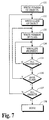
- Fig. 7 illustrates the organization of one process that may be used to generate serial information representing one or more program objects.
- step 131 writes the number of program objects to serialize into a serial stream of information.
- step 132 writes into the serial information stream an identification of the class of the respective program object and step 133 writes an identification of the version of the respective program object.
- step 134 invokes the appropriate process to serialize the respective property.
- Step 134 may implement a recursive process to serialize program object properties that are themselves one or more serializable program objects. This feature is described in more detail below.
- Step 135 determines whether all properties for the respective program object have been serialized and, if not, the process returns to step 134 to serialize the next property.
- step 136 determines whether the class of the respective program object is derived from any base class that should be serialized.
- Fig. 9 illustrates steps in one process that may be used to implement step 136 in applications using program objects that conform to a "JavaBeansTM API specification" such as version 1.01 that is included in the Java Development Kit (JDK) version 1.1 available from Sun Microsystems, Inc. Version 1.01 of this specification includes a specification for serializing a program component known as a "JavaBean” is provided in a document that is available from the Internet at URL http://java.sun.com/products/jdk/1.1/docs/guide/beans/index.html, which is incorporated herein by reference.
- Step 361 invokes a method of the program object to obtain the name of the class of which the program object is an instance.
- Step 362 identifies the class name of an object-descriptor class that is associated with the class of the program object to serialize.
- the class name of the object-descriptor class is derived from the class name of the program object in some manner such as, for example, appending the string "Descriptor" to the class name.
- the object-descriptor class name for the class "Widget" is "WidgetDescriptor".
- Step 363 instantiates an object of the object-descriptor class and step 364 invokes a method of this object that is provided by the Java reflection application programming interface (API) to obtain the name of the base class from which this object-descriptor class is derived.
- API Java reflection application programming interface
- step 133 that writes to the serial information stream an identification of the version pertaining to the base class.
- step 137 determines whether any further program objects remain to be serialized. If so, the process continues with step 132 for the next respective program object. Otherwise, the process concludes with step 138.
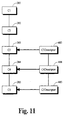
- Fig. 11 The relationship between a hierarchy of derived program object classes and a hierarchy of related object-descriptor classes is illustrated in Fig. 11.
- Program object classes C1 through C5 are represented by boxes 381 through 385, respectively, and object-descriptor classes C3Descriptor, C4Descriptor and C5Descriptor are represented by boxes 483 through 485, respectively.
- Class C5 is derived from class C4, which in turn is derived from class C3.
- class C3 is the highest program object class that is deemed to be XSerializable .
- the designation XSerializable in this particular implementation indicates the instances of a program object class can be serialized because the class implements features that facilitate the serialization of an object.
- Class C5Descriptor is an object-descriptor class that is derived from class C4Descriptor, which in turn is derived from class C3Descriptor.
- Each of these object-descriptor classes implement methods that can be invoked to obtain descriptive information about a respective program object class. This information may be used to serialize program objects for a respective class.
- the methods of an object of the object-descriptor class C4Descriptor may be invoked to obtain a list of the properties for the C4 class that are to be serialized.
- features of the Java reflection mechanism may be used by methods in the object-descriptor class to obtain this information. Because class C3 is the highest program object class that is XSerializable , no counterpart object-descriptor classes are defined for the higher program object classes C2 and C1.
- serial information may be arranged in essentially any format. No particular format is important to the present invention.
- a schematic illustration of the contents of serial information stream 300 generated according to the processes described above is illustrated in Fig. 10.
- segment 301 provides an indication of the number of program objects represented by information in the stream
- segments 302 and 303 provide an indication of the class name and version of the first program object represented in the stream, respectively
- segment 304 conveys serial information representing one or more properties of the first program object.
- segments 305 and 306 represent the version and properties of the base class. If this base class is derived from one or more additional base classes that are serialized, additional pairs of segments are used to convey information for the version and properties of each base class.
- segment 307 provides an indication of the class name for the second program object. Additional segments convey information for this second program object and any subsequent program objects in the same manner as information is conveyed in segments 302 to 306 for the first program object.
- Segments such as segment 304 that convey information representing one or more serialized properties may be divided into units of information as necessary. For example, information in segments representing multiple properties may be divided into a respective unit for each property. For properties that are themselves serializable objects, a unit may be further divided into segments. For example, if segment 304 conveys information representing multiple serializable objects, the information in this segment may be divided according to the format of segments 301 to 307 as illustrated in Fig. 10.
- Fig. 5 represents steps in a basic process for creating a program object for a particular version of a class from serial information that represents a program object for a possibly different version of that class.
- step 210 reads the serial information to obtain the version of the program object represented by the serial information
- step 220 establishes values for properties of the program object according to the version of the class represented in the serial information and according to the version of the class for which a program object is to be created.
- This particular process may be implemented in a variety of ways; however, in preferred implementations, program objects to be serialized must be instances of a class deemed to be serializable because that class defines various features facilitating the serialization process.
- step 201 instantiates a program object of before step 210 reads the serial information to obtain an identification of the program object version that is represented by the serial information.
- an instance of the program object may be created in a subsequent step.
- Step 221 identifies the properties for this program object version that are included in the serial information. This may be implemented in a variety of ways including, for example, a method of the program object to be deserialized, a method of a program object in a class that is related in some manner to the class of the program object to be deserialized, or a database of properties.
- Step 222 obtains the value of one or more properties from the serial information and step 223 establishes these values for the corresponding properties of the newly created instance of the program object.
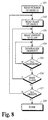
- Fig. 8 illustrates the organization of one process that may be used to read and process serial information representing one or more program objects.
- step 231 reads the serial information to obtain the number of program objects that are represented in the serial information.
- step 232 reads from the serial information an identification of the class of the respective program object and step 233 reads an identification of the version of the respective program object.
- step 234 For each respective property of the respective program object to deserialize, step 234 invokes the appropriate process to deserialize the respective property.
- Step 234 may implement a recursive process to deserialize program object properties that are themselves one or more deserializable program objects. This feature is described in more detail below.
- Step 235 determines whether all properties for the respective program object have been deserialized and, if not, the process returns to step 234 to deserialize the next property.
- step 236 determines whether the class of the respective program object is derived from any base class that should be deserialized.
- Fig. 9 illustrates steps in one process that may be used to implement step 236 in applications using program objects that conform to the Java Object Serialization Specification mentioned above. This particular implementation, which is described above, utilizes a feature of the Java programming language known as reflection.
- step 233 that reads from the serial information an identification of the version pertaining to the base class.
- step 236 determines that no further base classes remain, at which time step 237 determines whether any further program objects remain to be deserialized. If so, the process continues with step 232 for the next respective program object. Otherwise, the process concludes with step 238.
- Implementations of various aspects of the processes discussed above are shown below in several program fragments. These program fragment are expressed in pseudo-code that includes syntactical features of the Java programming language.
- the program fragments provided herein are not intended to be suitable for compilation into a practical embodiment but are provided to show a few considerations for possible implementations. For example, these program fragments do not include checks for error conditions and exceptions that would be required in practical embodiments.
- the present invention may be implemented by essentially any programming language; however, the Java programming language provides features such as the reflection API that facilitate the particular implementation discussed below.
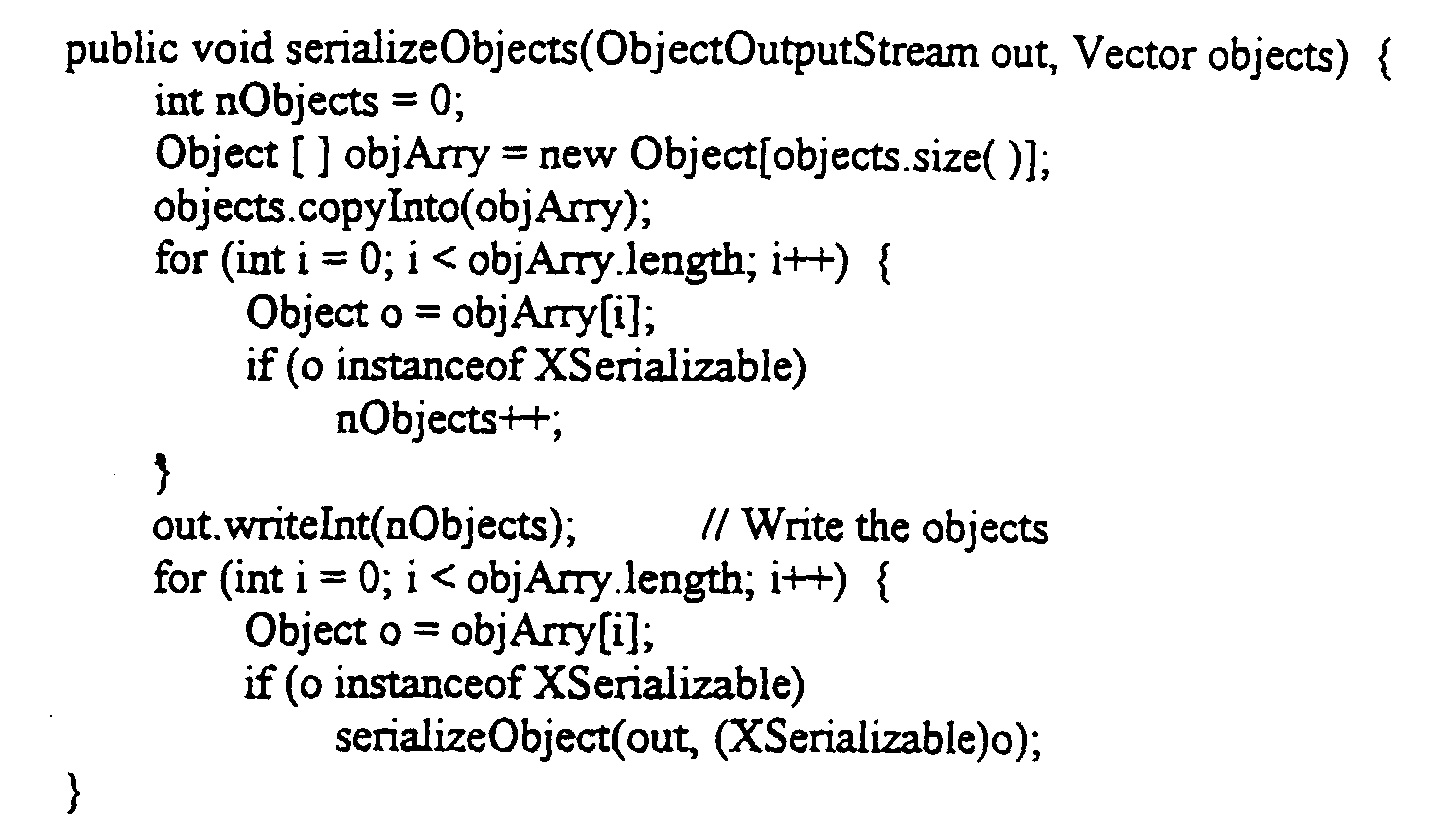
- the following program fragment implements the procedure serializeObjects that may be called to serialize one or more program objects.
- procedure serializeObjects receives an array objects that identifies the one or more program objects to serialize, and receives a reference out that identifies a serial stream into which the serialized representation is to be written.
- the procedure uses the variable nObjects to count the number of objects represented in array objects that can be serialized.
- the designation XSerializable in this particular implementation indicates a program object can be serialized because the program object belongs to a class that implements features that facilitate the serialization of an object.
- the object count nObjects is written into the serial stream out .
- a for-loop in the procedure iteratively calls procedure serializeObject to serialize each program object identified in the object array that is designated as being XSerializable .
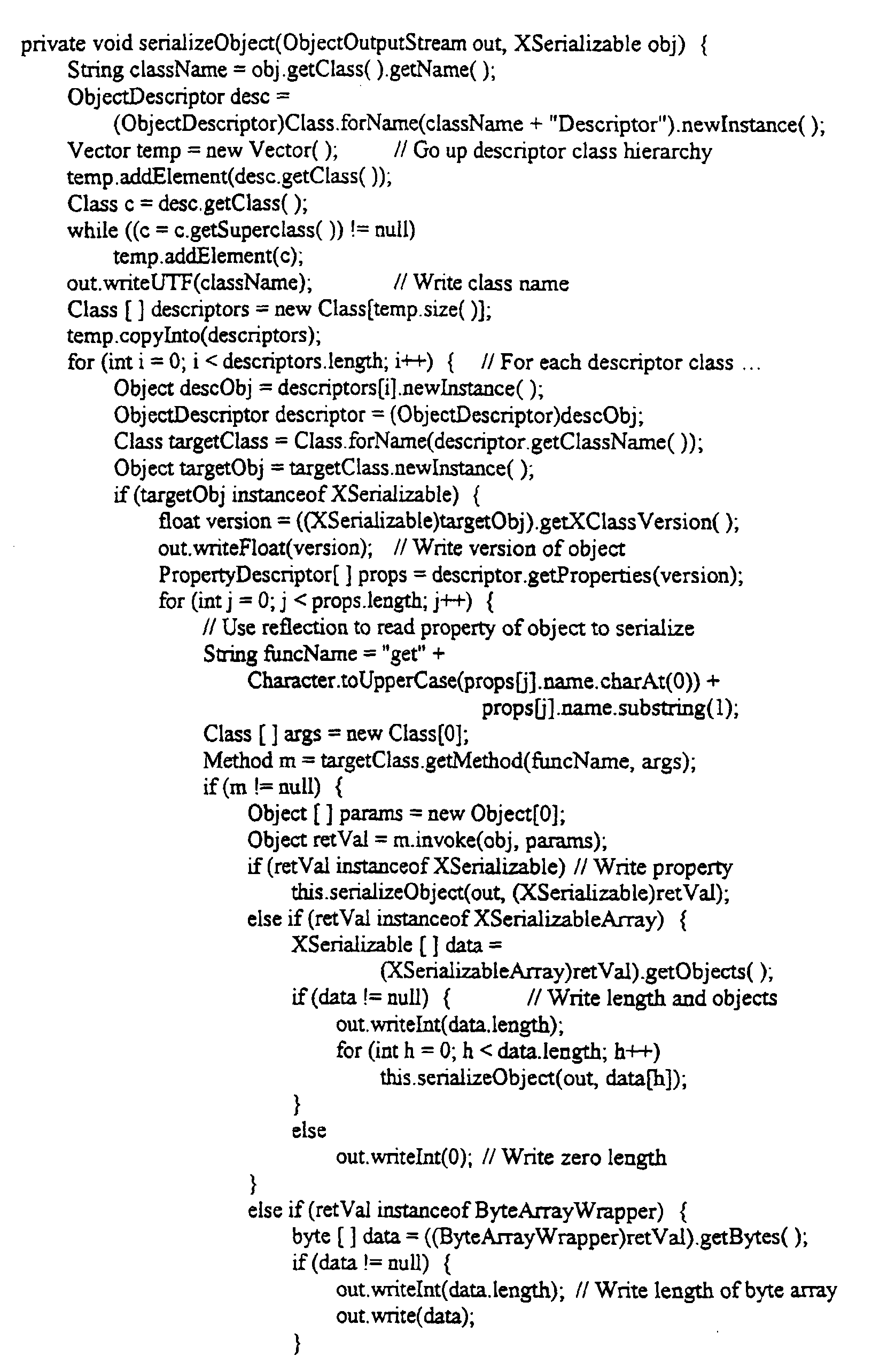
- the following program fragment implements the procedure serializeObject that is called by the serializeObjects procedure to serialize a program object.
- This procedure serializes specific properties of a program object, including properties of any base classes from which the program object's class may be derived.
- a property may be a single entity such as an integer, or it may be an array of entities. If a property itself is a serializable program object or an array of serializable program objects, one or more recursive calls are made to serializeObject to serialize these program objects.
- procedure serializeObject receives a reference obj to a serializable object and a reference out that identifies a serial stream into which the serialized representation is to be written.
- the procedure obtains the name of the class for the object and writes the class name into the serial stream out .
- the procedure also builds an array descriptors of classes. The first element of the array is the class of the object-descriptor pertaining to the program object to be serialized. Subsequent entries in the array, if any, are the base classes from which the class of the object-descriptor is derived.
- the procedure continues with a for-loop that iterates through the descriptors array.
- a respective object-descriptor object for that class is instantiated as descriptor and used to identify the target class of the program object that is described by the respective object-descriptor object.
- the target class of the first object-descriptor object instantiated from the array descriptors is the class of the program object obj to be serialized. If an object of this target class is deemed to be XSerializable , the procedure continues by obtaining an identification of the version for the target class and writing the version identification into the serial stream out .
- the method getProperties of the object-descriptor object is then invoked to obtain an array props in which each element describes a property to be serialized. Because the getProperties method is a function of the target class version and the procedure that implements the method may vary for each respective target class, the process that identifies the properties to serialize may be considered to be a function of both the target class and the version of the target class.
- the procedure continues with a for-loop that iterates through the props array.
- the reflection mechanism of Java is used to obtain the corresponding property itself.
- a recursive call is made to the procedure serializeObject to serialize this object.
- the property is an array of elements that are designated XSerializable , an array data is constructed for the elements, the length of the array is written into the serial stream out , and a recursive call is made to serializeObject for each element in the array.
- the property is a byte array or an integer array, the length of the array and a representation for each element in the array are written into the serial stream out . Otherwise, a representation of the property itself is written into the serial stream out .
- the following program fragment implements the procedure deserializeObjects that may be called to deserialize one or more program objects.
- procedure deserializeObjects receives a reference in that identifies a serial stream from which a serialized representation of one or more program objects is to be deserialized.
- the procedure reads into variable nObjects the number of objects represented in the serial stream.
- a for-loop in the procedure iteratively calls procedure deserializeObject to deserialize each program object that is represented in the serial stream.
- the following program fragment implements the procedure deserializeObject that is called by the deserializeObjects procedure to deserialize a program object.
- This procedure deserializes specific properties of a program object, including properties of any base classes from which the program object's class may be derived.
- a property may be a single entity such as an integer, or it may be an array of entities. If a property itself is a program object or an array of program objects, one or more recursive calls are made to deserializeObject to deserialize these program objects.
- procedure deserializeObject receives a reference in that identifies a serial stream from which a serialized representation of a program object is to be deserialized.
- the procedure reads the name of the class for the object from the serial stream in .
- the procedure also builds an array descriptors of object-descriptor classes.
- the first element of the array is the class of the object-descriptor pertaining to the class that was read from the serial stream.
- Subsequent entries in the array, if any, are the base classes from which the class of the object-descriptor is derived.
- the procedure continues with a for-loop that iterates through the descriptors array.
- a respective version identification is read from the serial stream in
- a respective object-descriptor object for that class is instantiated as objDesc
- a respective target program object to be deserialized is instantiated as theObj .
- the getProperties method of the object-descriptor object objDesc is invoked to obtain an array props in which each element describes a property that is represented in the serial stream and is to be deserialized.
- This method is a function of the respective version identification read from the serial stream in .
- the determination of the properties to be deserialized may be considered to be a function of both target object class and version.
- the procedure continues with a for-loop that iterates through the props array to deserialize each respective property. If the property itself is designated XSerializable , a recursive call is made to the procedure deserializeObject to deserialize this object. If the property is an array of elements that are designated XSerializable , the length of the array is read from serial stream in, an array data is constructed, and a recursive call is made to deserializeObject to deserialize each property into a respective element of array data . If the property is a byte array or an integer array, the length of the array is read from the serial stream in , an array data is constructed, and each property is read from the serial stream and placed into a respective element of array data .
- the representation of the property that is obtained from the serial stream in is placed into an object named propVal . If the type of property is not any of the types mentioned above, the value of the property is read from serial stream out and placed directly into variable propVal . Methods that are appropriate for the program object that is being deserialized are then invoked to establish the program object property based on the representation available in propVal .
- the following program fragment implements the procedure isXSerializable that is used by the program fragments shown above to determine whether a particular class is deemed to be XSerializable .
- procedure isXSerializable receives a class c and determines whether objects that are instantiations of the class are deemed to be XSerializable . If class c itself implements an interface that has a particular name as shown, the class is deemed to be XSerializable . If not, each base class from which class c is derived is tested to determine whether any of the base classes implement this same interface. If any base class does implement this interface, class c is deemed to be XSerializable . Otherwise, class c is not deemed to be XSerializable .
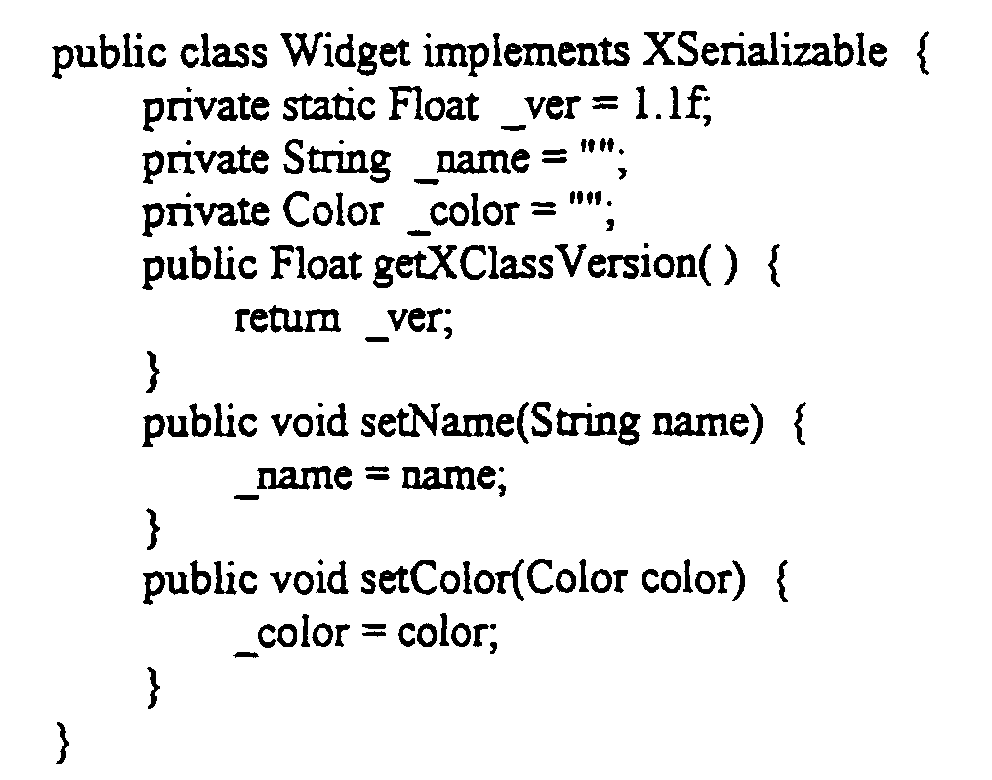
- the following program fragments illustrate how an XSerializable class may be defined according to the implementations described above.
- the first example shows a version 1.0 class definition.
- the next example shows a version 1.1 class definition.
- the properties _name and _color and the methods setName and setColor are arbitrary. The methods are used in examples discussed below.
- An XSerializable class may extend another XSerializable base class. It may also include or imbed a property that refers to an instance of an XSerializable class.
- Arrays of primitive variable types such as "Byte” and “Integer” may be implemented as XSerializable structures in a variety of ways.
- An example of an implementation that is consistent with the implementations discussed above is presented in the following program fragment. This fragment defines two wrappers for Byte and Integer arrays.
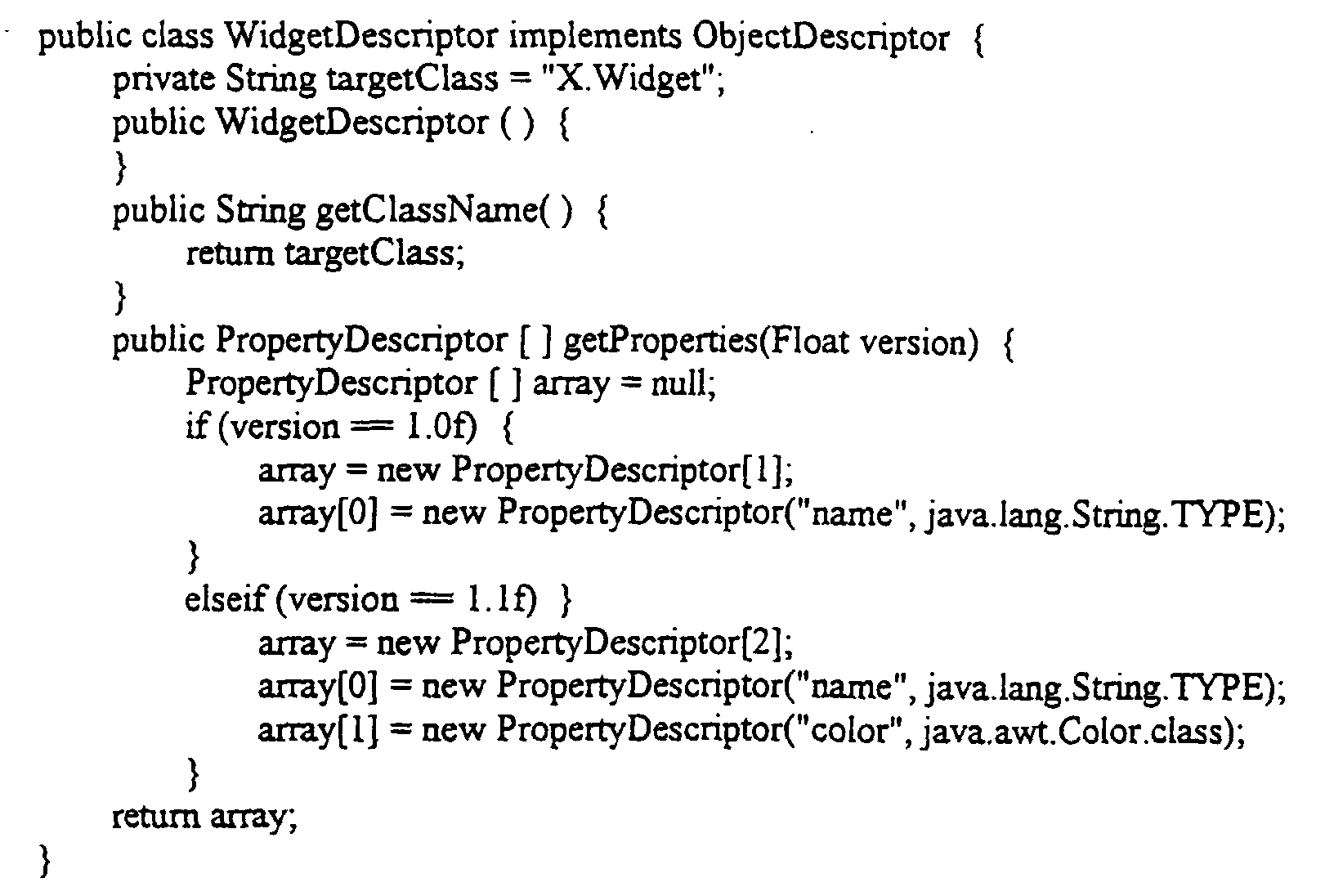
- the following program fragment illustrates how an object-descriptor class may be defined according to the implementations described above.
- the following program fragment illustrates how an object-descriptor class may be defined for the ArrayWrapper class described above.
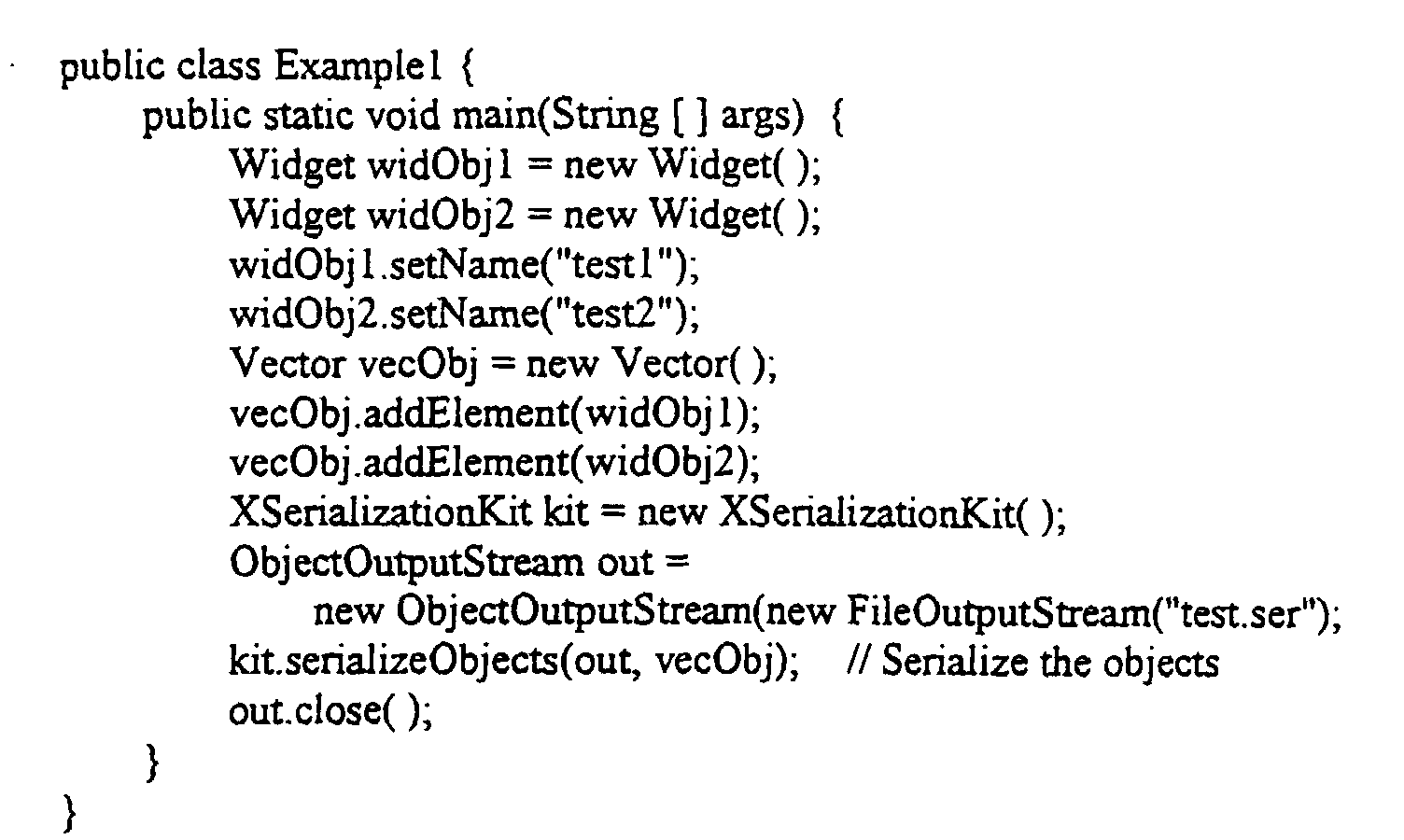
- the following program fragment illustrates how an application program may use the serialization kit described above to serialize one or more program objects.
- two program object instances of version 1.0 of the Widget class is serialized into the test.ser file.
- the following program fragment illustrates how an application program may use the serialization kit described above to deserialize one or more program objects.
- two instances of the Widget class are deserialized from the test.ser file generated by the Example1 application discussed above.
- the Example2 application creates program objects that conform to version 1.1 of the Widget class, as shown by the last line in the program fragment that invokes the setColor method to set the color property of program object widObj1 . As shown above, this property was added to version 1.1 of the Widget class definition.
Landscapes
- Engineering & Computer Science (AREA)
- Theoretical Computer Science (AREA)
- Software Systems (AREA)
- Physics & Mathematics (AREA)
- General Engineering & Computer Science (AREA)
- General Physics & Mathematics (AREA)
- Stored Programmes (AREA)
Abstract
Description





Claims (54)
- A method for serializing a program object that is an instantiation of an object class, wherein the method comprises:obtaining a version identification of the program object; andgenerating serialized information conveying a representation of the program object that is determined as a function of the object class and the version identification.
- A method, according to claim 1 wherein the representation of the object is determined by:identifying one or more properties of the program object to be serialized, wherein the properties are identified according to the object class and the program object version identification;ascertaining a value for each respective property of the program object to be serialized; andgenerating the representation of the object to include representations of a name of the object class, the version identification of the program object, and the value of each respective property to be serialized.
- A method according to claim 2 wherein the one or more properties of the program object to be serialized are identified by invoking a procedure within an object-descriptor interface that describes how instantiations of the object class are to be serialized, wherein the procedure is responsive to the version identification of the program object.
- A method according to claim 3 wherein the object-descriptor interface has a name that is derived from the name of the object class.
- A method according to claim 3 wherein the program object and the object class conform to a JavaBean specification of a Java programming language.
- A method according to claim 2 wherein the one or more properties of the program object to be serialized are identified by invoking a procedure that returns a list of property names that varies according to the object class and the version identification.
- A method according to claim 6 wherein the procedure is a method of an object that is an instance of an object-descriptor class defining serializable characteristics of the program object to be serialized.
- A method according to claim 2 wherein:the version identification is obtained by invoking a method of the program object;the one or more properties of the program object to be serialized are identified by invoking a method of an object-descriptor object that is a function of the object class and the program object version identification; andthe serial information is generated by invoking a method of an output-stream object.
- An apparatus for serializing a program object that is an instantiation of an object class, wherein the apparatus comprises:random access memory; andprocessing circuitry coupled to the random access memory, wherein the processing circuitry obtains a version identification of the program object stored in the random access memory and generates serialized information conveying a representation of the program object that is determined as a function of the object class and the version identification.
- An apparatus according to claim 9 wherein the representation of the object is determined by:identifying one or more properties of the program object to be serialized, wherein the properties are identified according to the object class and the program object version identification;ascertaining a value for each respective property of the program object to be serialized; andgenerating the representation of the object to include representations of a name of the object class, the version identification of the program object, and the value of each respective property to be serialized.
- An apparatus according to claim 10 wherein the one or more properties of the program object to be serialized are identified by invoking a procedure within an object-descriptor interface that describes how instantiations of the object class are to be serialized, wherein the procedure is responsive to the version identification of the program object.
- An apparatus according to claim 11 wherein the object-descriptor interface has a name that is derived from the name of the object class.
- An apparatus according to claim 11 wherein the program object and the object class conform to a JavaBean specification of a Java programming language.
- An apparatus according to claim 10 wherein the one or more properties of the program object to be serialized are identified by invoking a procedure that returns a list of property names that varies according to the object class and the version identification.
- An apparatus according to claim 14 wherein the procedure is a method of an object that is an instance of an object-descriptor class defining serializable characteristics of the program object to be serialized.
- An apparatus according to claim 10 wherein:the version identification is obtained by invoking a method of the program object;the one or more properties of the program object to be serialized are identified by invoking a method of an object-descriptor object that is a function of the object class and the program object version identification; andthe serial information is generated by invoking a method of an output-stream object.
- A medium readable by a device and conveying a program of instructions for execution by the device to perform a method for serializing a program object that is an instantiation of an object class, wherein the method comprises:obtaining a version identification of the program object; andgenerating serialized information conveying a representation of the program object that is determined as a function of the object class and the version identification.
- A medium according to claim 17 wherein the representation of the object is determined by:identifying one or more properties of the program object to be serialized, wherein the properties are identified according to the object class and the program object version identification;ascertaining a value for each respective property of the program object to be serialized; andgenerating the representation of the object to include representations of a name of the object class, the version identification of the program object, and the value of each respective property to be serialized.
- A medium according to claim 18 wherein the one or more properties of the program object to be serialized are identified by invoking a procedure within an object-descriptor interface that describes how instantiations of the object class are to be serialized, wherein the procedure is responsive to the version identification of the program object.
- A medium according to claim 19 wherein the object-descriptor interface has a name that is derived from the name of the object class.
- A medium according to claim 19 wherein the program object and the object class conform to a JavaBean specification of a Java programming language.
- A medium according to claim 18 wherein the one or more properties of the program object to be serialized are identified by invoking a procedure that returns a list of property names that varies according to the object class and the version identification.
- A medium according to claim 22 wherein the procedure is a method of an object that is an instance of an object-descriptor class defining serializable characteristics of the program object to be serialized.
- A medium according to claim 18 wherein:the version identification is obtained by invoking a method of the program object;the one or more properties of the program object to be serialized are identified by invoking a method of an object-descriptor object that is a function of the object class and the program object version identification; andthe serial information is generated by invoking a method of an output-stream object.
- A method for deserializing serialized information conveying a representation of a program object that is an instantiation of an object class, wherein the method comprises:obtaining from the serialized information the object class and a version identification of the program object; andestablishing values from the serialized information for one or more properties of the object, wherein the values for the one or more properties are established as a function of the object class and the version identification.
- A method according to claim 25 wherein the values for the one or more property values are established by:identifying one or more properties of the program object to be deserialized, wherein the properties are identified according to the object class and the program object version identification;obtaining values from the serialized information for one or more respective properties of the program object to be deserialized; andestablishing the values for the one or more properties of the program object in response to the values obtained from the serialized information.
- A method according to claim 26 wherein the one or more properties to be deserialized are identified by invoking a procedure within an object-descriptor interface that describes how instantiations of the object class are to be deserialized, wherein the procedure is responsive to the version identification of the program object.
- A method according to claim 26 wherein the object-descriptor interface has a name that is derived from the name of the object class.
- A method according to claim 27 wherein the program object and the object class conform to a JavaBean specification of a Java programming language.
- A method according to claim 26 wherein the one or more properties of the program object to be deserialized are identified by invoking a procedure that returns a list of property names that varies according to the object class and the version identification.
- A method according to claim 30 wherein the procedure is a method of an object that is an instance of an object-descriptor class defining deserializable characteristics of the program object to be deserialized.
- A method according to claim 26 wherein:the object class and the version identification are obtained by invoking a method of an input-stream object; andthe one or more properties of the program object to be deserialized are identified by invoking a method of an object-descriptor object that is a function of the object class and the program object version identification.
- An apparatus for deserializing serialized information conveying a representation of a program object that is an instantiation of an object class, wherein the apparatus comprises:random access memory; andprocessing circuitry coupled to the random access memory, wherein the processing circuitry obtains from the serialized information the object class and a version identification of the program object, and establishes in the random access memory values from the serialized information for one or more properties of the object, wherein the values for the one or more properties are established as a function of the object class and the version identification.
- An apparatus according to claim 33 wherein the values for the one or more property values are established by:identifying one or more properties of the program object to be deserialized, wherein the properties are identified according to the object class and the program object version identification;obtaining values from the serialized information for one or more respective properties of the program object to be deserialized; andestablishing the values for the one or more properties of the program object in response to the values obtained from the serialized information.
- An apparatus according to claim 34 wherein the one or more properties to be deserialized are identified by invoking a procedure within an object-descriptor interface that describes how instantiations of the object class are to be deserialized, wherein the procedure is responsive to the version identification of the program object.
- An apparatus according to claim 34 wherein the object-descriptor interface has a name that is derived from the name of the object class.
- An apparatus according to claim 35 wherein the program object and the object class conform to a JavaBean specification of a Java programming language.
- An apparatus according to claim 34 wherein the one or more properties of the program object to be deserialized are identified by invoking a procedure that returns a list of property names that varies according to the object class and the version identification.
- An apparatus according to claim 38 wherein the procedure is a method of an object that is an instance of an object-descriptor class defining deserializable characteristics of the program object to be deserialized.
- An apparatus according to claim 34 wherein:the object class and the version identification are obtained by invoking a method of an input-stream object; andthe one or more properties of the program object to be deserialized are identified by invoking a method of an object-descriptor object that is a function of the object class and the program object version identification.
- A medium readable by a device and conveying a program of instructions for execution by the device to perform a method for deserializing serialized information conveying a representation of a program object that is an instantiation of an object class, wherein the method comprises:obtaining from the serialized information the object class and a version identification of the program object; andestablishing values from the serialized information for one or more properties of the object, wherein the values for the one or more properties are established as a function of the object class and the version identification.
- A medium according to claim 41 wherein the values for the one or more property values are established by:identifying one or more properties of the program object to be deserialized, wherein the properties are identified according to the object class and the program object version identification;obtaining values from the serialized information for one or more respective properties of the program object to be deserialized; andestablishing the values for the one or more properties of the program object in response to the values obtained from the serialized information.
- A medium according to claim 42 wherein the one or more properties to be deserialized are identified by invoking a procedure within an object-descriptor interface that describes how instantiations of the object class are to be deserialized, wherein the procedure is responsive to the version identification of the program object.
- A medium according to claim 42 wherein the object-descriptor interface has a name that is derived from the name of the object class.
- A medium according to claim 43 wherein the program object and the object class conform to a JavaBean specification of a Java programming language.
- A medium according to claim 42 wherein the one or more properties of the program object to be deserialized are identified by invoking a procedure that returns a list of property names that varies according to the object class and the version identification.
- A medium according to claim 46 wherein the procedure is a method of an object that is an instance of an object-descriptor class defining deserializable characteristics of the program object to be deserialized.
- A medium according to claim 42 wherein:the object class and the version identification are obtained by invoking a method of an input-stream object; andthe one or more properties of the program object to be deserialized are identified by invoking a method of an object-descriptor object that is a function of the object class and the program object version identification.
- A medium readable by a device and conveying serialized information representing one or more program objects that are instantiations of an object class, wherein the serialized information comprises:an indication of the number of program objects represented by the serialized information;an indication of the object class name; andfor each respective program object represented by the serialized information, a version identification of the respective program object and a respective value for one or more properties of the respective program object.
- A medium according to claim 49 that conveys serialized information representing one or more second program objects that are instantiations of a superclass of the object class, wherein the serialized information comprises for each respective second program object a version identification of the respective second program object and a respective value for one or more properties of the respective second program object.
- A medium readable by a device and conveying one or more programs of instructions for execution by the device to perform a method for serializing or for deserializing a program object that is an instantiation of a program class, wherein the one or more programs of instructions comprise:a definition of the object class that includes a method for obtaining a version identification of a respective program object; anda definition of an object-descriptor class that includes a method for identifying one or more properties of the respective program object that are to be serialized or deserialized.
- A medium according to claim 51 wherein the definition of the object-descriptor class includes a method that returns an indication of names for the one or more properties of the respective program object that are to be serialized or deserialized.
- A medium according to claim 51 wherein the definition of the object-descriptor class includes a method that returns a name for the object class.
- A medium according to claim 51 wherein the one or more programs of instructions comprise a definition of a property-descriptor class that includes a method for obtaining an indication of property types for the one or more properties of the respective program object that are to be serialized or deserialized.
Applications Claiming Priority (2)
| Application Number | Priority Date | Filing Date | Title |
|---|---|---|---|
| US410363 | 1995-03-24 | ||
| US09/410,363 US6477701B1 (en) | 1999-09-30 | 1999-09-30 | Version-adaptive serialization and deserialization of program objects in an object-oriented environment |
Publications (2)
| Publication Number | Publication Date |
|---|---|
| EP1100005A2 true EP1100005A2 (en) | 2001-05-16 |
| EP1100005A3 EP1100005A3 (en) | 2004-06-30 |
Family
ID=23624399
Family Applications (1)
| Application Number | Title | Priority Date | Filing Date |
|---|---|---|---|
| EP00116794A Withdrawn EP1100005A3 (en) | 1999-09-30 | 2000-08-03 | Version-adaptive serialization and deserialization of program objects |
Country Status (5)
| Country | Link |
|---|---|
| US (1) | US6477701B1 (en) |
| EP (1) | EP1100005A3 (en) |
| JP (1) | JP2001125787A (en) |
| KR (1) | KR100639167B1 (en) |
| CN (1) | CN1242326C (en) |
Families Citing this family (40)
| Publication number | Priority date | Publication date | Assignee | Title |
|---|---|---|---|---|
| US7120863B1 (en) * | 1999-11-15 | 2006-10-10 | International Business Machines Corporation | Method, system, and program for interfacing with elements in a document |
| US6629227B1 (en) * | 2000-05-04 | 2003-09-30 | Scientific-Atlanta, Inc. | System and method for a communication terminal to manage memory and maintain a current application version for multiple applications |
| GB2363866B (en) * | 2000-05-31 | 2002-11-06 | Intamission Ltd | Data processing apparatus, method and system |
| US6877162B1 (en) * | 2000-07-31 | 2005-04-05 | Hewlett-Packard Company | Method and system for extendable class-based shared data-types |
| US7191196B2 (en) * | 2001-06-28 | 2007-03-13 | International Business Machines Corporation | Method and system for maintaining forward and backward compatibility in flattened object streams |
| US6983448B2 (en) * | 2001-07-12 | 2006-01-03 | International Business Machines Corporation | Open framework for the definition of metadata |
| FR2836568A1 (en) * | 2002-02-28 | 2003-08-29 | Bull Sa | Data conversion method for smart cards, involves conversion of structured software object from software agent in embedded platform to data set arranged in linear data sequence by serialization agent |
| US7150004B2 (en) * | 2002-08-21 | 2006-12-12 | International Business Machines Corporation | Programmatically serializing complex objects using self-healing techniques |
| CA2419904A1 (en) * | 2003-02-26 | 2004-08-26 | Ibm Canada Limited - Ibm Canada Limitee | Version-insensitive serialization and deserialization of program objects |
| US7404186B2 (en) * | 2003-05-28 | 2008-07-22 | Microsoft Corporation | Signature serialization |
| US7386836B2 (en) * | 2003-06-09 | 2008-06-10 | International Business Machines Corporation | Maintaining multiple valid concurrent serialized object versions |
| US7325226B2 (en) * | 2003-06-19 | 2008-01-29 | Microsoft Corporation | Modular object serialization architecture |
| US7293253B1 (en) * | 2003-09-12 | 2007-11-06 | Nortel Networks Limited | Transparent interface migration using a computer-readable mapping between a first interface and a second interface to auto-generate an interface wrapper |
| US7207002B2 (en) * | 2003-11-13 | 2007-04-17 | International Business Machines Corporation | Serialization and preservation of objects |
| US7698359B2 (en) * | 2004-01-16 | 2010-04-13 | Microsoft Corporation | Remote system administration using command line environment |
| US7770181B2 (en) * | 2004-01-16 | 2010-08-03 | Microsoft Corporation | System and method for transferring computer-readable objects across a remote boundary |
| US7730041B2 (en) * | 2004-08-25 | 2010-06-01 | Microsoft Corporation | Data abstraction based serialization |
| US7464082B2 (en) * | 2004-11-29 | 2008-12-09 | International Business Machines Corporation | Methods for de-serializing data objects on demand |
| US7543002B2 (en) * | 2004-12-02 | 2009-06-02 | Bea Systems, Inc. | Mechanism to load first version classes into a runtime environment running a second version of the class |
| US20060218538A1 (en) * | 2005-03-22 | 2006-09-28 | Van Kesteren Tom A | System, method and computer program product for converting a serialized object between different software versions |
| US7954088B2 (en) * | 2005-03-23 | 2011-05-31 | Microsoft Corporation | Method and apparatus for executing unit tests in application host environment |
| US20070299863A1 (en) * | 2006-04-27 | 2007-12-27 | Qualcomm Incorporated | Portable object serialization |
| US20080046874A1 (en) * | 2006-08-21 | 2008-02-21 | International Business Machines Corporation | Data reporting application programming interfaces in an xml parser generator for xml validation and deserialization |
| KR100866603B1 (en) * | 2007-01-03 | 2008-11-03 | 삼성전자주식회사 | Data processing method and data processing device for deserializing and serializing |
| CN100456238C (en) * | 2007-03-12 | 2009-01-28 | 华为技术有限公司 | Method, device and compilation unit for realizing distributed object persistence |
| US8006253B2 (en) * | 2007-08-30 | 2011-08-23 | Ixia | Version-adaptive serialization and deserialization |
| US8626720B2 (en) * | 2008-02-11 | 2014-01-07 | International Business Machines Corporation | System and method of reconstructing complex custom objects |
| US8055619B2 (en) * | 2008-06-05 | 2011-11-08 | Novell, Inc. | Mechanisms to support object-oriented version control operations |
| US8495659B1 (en) | 2012-05-01 | 2013-07-23 | International Business Machines Corporation | Eliminating redundancy in instance data of different versioned classes in communication between object request brokers using a common class definition |
| US10025702B1 (en) * | 2014-12-10 | 2018-07-17 | Amazon Technologies, Inc. | Browser capable of saving and restoring content item state |
| KR101707649B1 (en) * | 2015-09-24 | 2017-02-20 | (주)에스아이티 | Centralized data transmitting/receiving apparatus and method |
| US10467321B2 (en) | 2017-09-07 | 2019-11-05 | Mastercard International Incorporated | Systems and methods for dynamic C# serialization |
| US10922024B1 (en) * | 2019-06-28 | 2021-02-16 | Amazon Technologies, Inc. | Self-protection against serialization incompatibilities |
| US11477258B2 (en) * | 2020-03-30 | 2022-10-18 | Oracle International Corporation | Serialization of objects using multiple serialization algorithms |
| US11599551B2 (en) * | 2020-03-30 | 2023-03-07 | Oracle International Corporation | Deserialization of stream objects using multiple deserialization algorithms |
| US11288045B1 (en) | 2021-02-09 | 2022-03-29 | Oracle International Corporation | Object creation from structured data using indirect constructor invocation |
| US11256480B1 (en) | 2021-02-09 | 2022-02-22 | Oracle International Corporation | Deserialization of stream objects using constant-foldable method handles |
| JP7253172B2 (en) * | 2021-04-30 | 2023-04-06 | 株式会社ソフトギア | Serialization method, deserialization method, information processing program, information processing apparatus, and communication system |
| CN113191124B (en) * | 2021-05-20 | 2023-03-21 | 上海曼恒数字技术股份有限公司 | Runtime editing method and system based on 3D engine |
| KR102886673B1 (en) * | 2024-11-06 | 2025-11-17 | 주식회사 피앤피시큐어 | Method to synchronize Java application data for server synchronization |
Family Cites Families (13)
| Publication number | Priority date | Publication date | Assignee | Title |
|---|---|---|---|---|
| US5867708A (en) * | 1995-11-20 | 1999-02-02 | International Business Machines Corporation | System, method, and article of manufacture for adding concurrency to a binary class in an object oriented system |
| US6212673B1 (en) * | 1997-03-31 | 2001-04-03 | International Business Machines Corporation | Component-neutral builder interface |
| US6256771B1 (en) * | 1997-10-16 | 2001-07-03 | At&T Corp. | Method and apparatus for providing a dynamic service composition software architecture |
| US6151700A (en) * | 1997-10-20 | 2000-11-21 | International Business Machines Corporation | Object oriented distributed programming system for computer controlled networks with selective capture of program property data identifying a particular program version |
| US6272521B1 (en) * | 1997-12-08 | 2001-08-07 | Object Technology Licensing Corporation | Apparatus and method for allowing object-oriented programs created with different framework versions to communicate |
| US6032152A (en) * | 1997-12-31 | 2000-02-29 | Intel Corporation | Object factory template |
| US6085198A (en) * | 1998-06-05 | 2000-07-04 | Sun Microsystems, Inc. | Integrated three-tier application framework with automated class and table generation |
| US6272677B1 (en) * | 1998-08-28 | 2001-08-07 | International Business Machines Corporation | Method and system for automatic detection and distribution of code version updates |
| US6298353B1 (en) * | 1998-11-19 | 2001-10-02 | International Business Machines Corporation | Checking serialization compatibility between versions of java classes |
| US6298478B1 (en) * | 1998-12-31 | 2001-10-02 | International Business Machines Corporation | Technique for managing enterprise JavaBeans (™) which are the target of multiple concurrent and/or nested transactions |
| US6385769B1 (en) * | 1999-02-03 | 2002-05-07 | International Business Machines Corporation | Text based object oriented program code with a visual program builder and parser support for predetermined and not predetermined formats |
| US6301585B1 (en) * | 1999-03-17 | 2001-10-09 | Sun Microsystems, Inc. | Redundancy elimination in the persistence of object graphs |
| US6031747A (en) * | 1999-08-02 | 2000-02-29 | Lockheed Martin Missiles & Space Company | Interleaved synchronous flyback converter with high efficiency over a wide operating load range |
-
1999
- 1999-09-30 US US09/410,363 patent/US6477701B1/en not_active Expired - Lifetime
-
2000
- 2000-08-03 EP EP00116794A patent/EP1100005A3/en not_active Withdrawn
- 2000-09-08 KR KR1020000053559A patent/KR100639167B1/en not_active Expired - Fee Related
- 2000-09-30 CN CNB001305557A patent/CN1242326C/en not_active Expired - Fee Related
- 2000-10-02 JP JP2000302722A patent/JP2001125787A/en active Pending
Also Published As
| Publication number | Publication date |
|---|---|
| HK1037250A1 (en) | 2002-02-01 |
| CN1290889A (en) | 2001-04-11 |
| EP1100005A3 (en) | 2004-06-30 |
| US6477701B1 (en) | 2002-11-05 |
| KR20010050408A (en) | 2001-06-15 |
| JP2001125787A (en) | 2001-05-11 |
| CN1242326C (en) | 2006-02-15 |
| KR100639167B1 (en) | 2006-10-27 |
Similar Documents
| Publication | Publication Date | Title |
|---|---|---|
| US6477701B1 (en) | Version-adaptive serialization and deserialization of program objects in an object-oriented environment | |
| US6415435B1 (en) | Method and apparatus for determining compatibility of parent classes in an object oriented environment using versioning | |
| US6298353B1 (en) | Checking serialization compatibility between versions of java classes | |
| US7191196B2 (en) | Method and system for maintaining forward and backward compatibility in flattened object streams | |
| US7617222B2 (en) | Transferring data and storing metadata across a network | |
| KR100684680B1 (en) | Scalable distributed enterprise application integration system | |
| US7269792B2 (en) | System and method for generating high-function browser widgets with full addressability | |
| KR100574156B1 (en) | How to access legacy computer applications over the Internet | |
| US6718331B2 (en) | Method and apparatus for locating inter-enterprise resources using text-based strings | |
| US6959307B2 (en) | Process and system for a client object to perform a remote method invocation of a method in a server object | |
| US8141074B2 (en) | Packaging files having automatic conversion across platforms | |
| US7721283B2 (en) | Deploying a variety of containers in a Java 2 enterprise edition-based architecture | |
| US6078743A (en) | Generic IDE interface support for scripting | |
| US6289395B1 (en) | Generic Java-based event processor for scripting Java beans | |
| EP0912014A2 (en) | A method, apparatus and program product for accessing a management information service provided by a server | |
| US20060248467A1 (en) | Framework for declarative expression of data processing | |
| US20070198705A1 (en) | System and method for integrating resources in a network | |
| CN111367818A (en) | System component testing method and device based on dynamic data return | |
| EP0784265B1 (en) | Method and system of dynamically moving objects between heterogeneous execution environments | |
| US20040233237A1 (en) | Development environment for DSP | |
| US6556220B1 (en) | Method and system to display, modify or substitute the contents of self-describing objects | |
| US20030028549A1 (en) | Open framework for the definition of metadata | |
| US20060122958A1 (en) | Matching client interfaces with service interfaces | |
| US6640252B2 (en) | Apparatus and method for physically and logically packaging and distributing items in a distributed environment | |
| JP4049099B2 (en) | Resource adapter enhancements |
Legal Events
| Date | Code | Title | Description |
|---|---|---|---|
| PUAI | Public reference made under article 153(3) epc to a published international application that has entered the european phase |
Free format text: ORIGINAL CODE: 0009012 |
|
| AK | Designated contracting states |
Kind code of ref document: A2 Designated state(s): AT BE CH CY DE DK ES FI FR GB GR IE IT LI LU MC NL PT SE |
|
| AX | Request for extension of the european patent |
Free format text: AL;LT;LV;MK;RO;SI |
|
| PUAL | Search report despatched |
Free format text: ORIGINAL CODE: 0009013 |
|
| RIC1 | Information provided on ipc code assigned before grant |
Ipc: 7G 06F 9/46 B Ipc: 7G 06F 9/44 A |
|
| AK | Designated contracting states |
Kind code of ref document: A3 Designated state(s): AT BE CH CY DE DK ES FI FR GB GR IE IT LI LU MC NL PT SE |
|
| AX | Request for extension of the european patent |
Extension state: AL LT LV MK RO SI |
|
| 17P | Request for examination filed |
Effective date: 20040803 |
|
| 17Q | First examination report despatched |
Effective date: 20041124 |
|
| AKX | Designation fees paid |
Designated state(s): DE FR GB |
|
| STAA | Information on the status of an ep patent application or granted ep patent |
Free format text: STATUS: THE APPLICATION IS DEEMED TO BE WITHDRAWN |
|
| 18D | Application deemed to be withdrawn |
Effective date: 20051028 |