EP1099705B1 - Method for preparing 3-(hydroxyphenylphosphinyl)-propanoic acid - Google Patents
Method for preparing 3-(hydroxyphenylphosphinyl)-propanoic acid Download PDFInfo
- Publication number
- EP1099705B1 EP1099705B1 EP19990122580 EP99122580A EP1099705B1 EP 1099705 B1 EP1099705 B1 EP 1099705B1 EP 19990122580 EP19990122580 EP 19990122580 EP 99122580 A EP99122580 A EP 99122580A EP 1099705 B1 EP1099705 B1 EP 1099705B1
- Authority
- EP
- European Patent Office
- Prior art keywords
- hydroxyphenylphosphinyl
- propanoic acid
- compound
- hydrophosphoryl
- preparing
- Prior art date
- Legal status (The legal status is an assumption and is not a legal conclusion. Google has not performed a legal analysis and makes no representation as to the accuracy of the status listed.)
- Expired - Lifetime
Links
- MORLYCDUFHDZKO-UHFFFAOYSA-N 3-[hydroxy(phenyl)phosphoryl]propanoic acid Chemical compound OC(=O)CCP(O)(=O)C1=CC=CC=C1 MORLYCDUFHDZKO-UHFFFAOYSA-N 0.000 title claims description 22
- 238000000034 method Methods 0.000 title claims description 15
- IMDXZWRLUZPMDH-UHFFFAOYSA-N dichlorophenylphosphine Chemical compound ClP(Cl)C1=CC=CC=C1 IMDXZWRLUZPMDH-UHFFFAOYSA-N 0.000 claims description 14
- HFBMWMNUJJDEQZ-UHFFFAOYSA-N acryloyl chloride Chemical compound ClC(=O)C=C HFBMWMNUJJDEQZ-UHFFFAOYSA-N 0.000 claims description 11
- 150000001875 compounds Chemical class 0.000 claims description 9
- JUODZJFVOZRRQW-UHFFFAOYSA-N 3-[chloro(phenyl)phosphoryl]propanoyl chloride Chemical compound ClC(=O)CCP(Cl)(=O)C1=CC=CC=C1 JUODZJFVOZRRQW-UHFFFAOYSA-N 0.000 claims description 8
- 239000002244 precipitate Substances 0.000 claims description 6
- MLCHBQKMVKNBOV-UHFFFAOYSA-N phenylphosphinic acid Chemical compound OP(=O)C1=CC=CC=C1 MLCHBQKMVKNBOV-UHFFFAOYSA-N 0.000 claims description 5
- XLYOFNOQVPJJNP-UHFFFAOYSA-N water Substances O XLYOFNOQVPJJNP-UHFFFAOYSA-N 0.000 claims description 4
- VEXZGXHMUGYJMC-UHFFFAOYSA-M Chloride anion Chemical compound [Cl-] VEXZGXHMUGYJMC-UHFFFAOYSA-M 0.000 claims description 2
- 238000001816 cooling Methods 0.000 claims description 2
- 230000003301 hydrolyzing effect Effects 0.000 claims description 2
- 239000000203 mixture Substances 0.000 claims description 2
- 238000006243 chemical reaction Methods 0.000 description 14
- SMZOUWXMTYCWNB-UHFFFAOYSA-N 2-(2-methoxy-5-methylphenyl)ethanamine Chemical compound COC1=CC=C(C)C=C1CCN SMZOUWXMTYCWNB-UHFFFAOYSA-N 0.000 description 12
- NIXOWILDQLNWCW-UHFFFAOYSA-N 2-Propenoic acid Natural products OC(=O)C=C NIXOWILDQLNWCW-UHFFFAOYSA-N 0.000 description 12
- 238000004519 manufacturing process Methods 0.000 description 6
- 239000000376 reactant Substances 0.000 description 4
- 239000011541 reaction mixture Substances 0.000 description 4
- 238000003756 stirring Methods 0.000 description 4
- FKLJPTJMIBLJAV-UHFFFAOYSA-N Compound IV Chemical compound O1N=C(C)C=C1CCCCCCCOC1=CC=C(C=2OCCN=2)C=C1 FKLJPTJMIBLJAV-UHFFFAOYSA-N 0.000 description 3
- 230000000052 comparative effect Effects 0.000 description 3
- 230000007062 hydrolysis Effects 0.000 description 3
- 238000006460 hydrolysis reaction Methods 0.000 description 3
- 229920000728 polyester Polymers 0.000 description 3
- 239000000047 product Substances 0.000 description 3
- RNFJDJUURJAICM-UHFFFAOYSA-N 2,2,4,4,6,6-hexaphenoxy-1,3,5-triaza-2$l^{5},4$l^{5},6$l^{5}-triphosphacyclohexa-1,3,5-triene Chemical compound N=1P(OC=2C=CC=CC=2)(OC=2C=CC=CC=2)=NP(OC=2C=CC=CC=2)(OC=2C=CC=CC=2)=NP=1(OC=1C=CC=CC=1)OC1=CC=CC=C1 RNFJDJUURJAICM-UHFFFAOYSA-N 0.000 description 2
- 238000007259 addition reaction Methods 0.000 description 2
- 238000009835 boiling Methods 0.000 description 2
- 239000003086 colorant Substances 0.000 description 2
- 239000000835 fiber Substances 0.000 description 2
- 239000003063 flame retardant Substances 0.000 description 2
- 239000002002 slurry Substances 0.000 description 2
- 241000478345 Afer Species 0.000 description 1
- 150000001252 acrylic acid derivatives Chemical class 0.000 description 1
- 238000009833 condensation Methods 0.000 description 1
- 230000005494 condensation Effects 0.000 description 1
- 230000000694 effects Effects 0.000 description 1
- 230000002349 favourable effect Effects 0.000 description 1
- 239000013067 intermediate product Substances 0.000 description 1
- 239000000463 material Substances 0.000 description 1
- 238000002844 melting Methods 0.000 description 1
- 230000008018 melting Effects 0.000 description 1
- 238000002156 mixing Methods 0.000 description 1
- 238000012986 modification Methods 0.000 description 1
- 230000004048 modification Effects 0.000 description 1
- 239000012299 nitrogen atmosphere Substances 0.000 description 1
- 230000000704 physical effect Effects 0.000 description 1
- 229920001225 polyester resin Polymers 0.000 description 1
- 239000004645 polyester resin Substances 0.000 description 1
- 238000002360 preparation method Methods 0.000 description 1
- 230000009257 reactivity Effects 0.000 description 1
- 239000007858 starting material Substances 0.000 description 1
Classifications
-
- C—CHEMISTRY; METALLURGY
- C07—ORGANIC CHEMISTRY
- C07F—ACYCLIC, CARBOCYCLIC OR HETEROCYCLIC COMPOUNDS CONTAINING ELEMENTS OTHER THAN CARBON, HYDROGEN, HALOGEN, OXYGEN, NITROGEN, SULFUR, SELENIUM OR TELLURIUM
- C07F9/00—Compounds containing elements of Groups 5 or 15 of the Periodic Table
- C07F9/02—Phosphorus compounds
- C07F9/28—Phosphorus compounds with one or more P—C bonds
- C07F9/48—Phosphonous acids [RP(OH)2] including [RHP(=O)(OH)]; Thiophosphonous acids including [RP(SH)2], [RHP(=S)(SH)]; Derivatives thereof
- C07F9/4891—Monohalide derivatives RP (XR') (Hal) (X = O, S, N)
-
- C—CHEMISTRY; METALLURGY
- C07—ORGANIC CHEMISTRY
- C07F—ACYCLIC, CARBOCYCLIC OR HETEROCYCLIC COMPOUNDS CONTAINING ELEMENTS OTHER THAN CARBON, HYDROGEN, HALOGEN, OXYGEN, NITROGEN, SULFUR, SELENIUM OR TELLURIUM
- C07F9/00—Compounds containing elements of Groups 5 or 15 of the Periodic Table
- C07F9/02—Phosphorus compounds
- C07F9/28—Phosphorus compounds with one or more P—C bonds
- C07F9/30—Phosphinic acids [R2P(=O)(OH)]; Thiophosphinic acids ; [R2P(=X1)(X2H) (X1, X2 are each independently O, S or Se)]
- C07F9/301—Acyclic saturated acids which can have further substituents on alkyl
-
- C—CHEMISTRY; METALLURGY
- C07—ORGANIC CHEMISTRY
- C07F—ACYCLIC, CARBOCYCLIC OR HETEROCYCLIC COMPOUNDS CONTAINING ELEMENTS OTHER THAN CARBON, HYDROGEN, HALOGEN, OXYGEN, NITROGEN, SULFUR, SELENIUM OR TELLURIUM
- C07F9/00—Compounds containing elements of Groups 5 or 15 of the Periodic Table
- C07F9/02—Phosphorus compounds
- C07F9/28—Phosphorus compounds with one or more P—C bonds
- C07F9/30—Phosphinic acids [R2P(=O)(OH)]; Thiophosphinic acids ; [R2P(=X1)(X2H) (X1, X2 are each independently O, S or Se)]
- C07F9/34—Halides thereof
Definitions
- the present invention relates to a method for preparing 3-(hydroxyphenylphosphinyl)-propanoic acid.
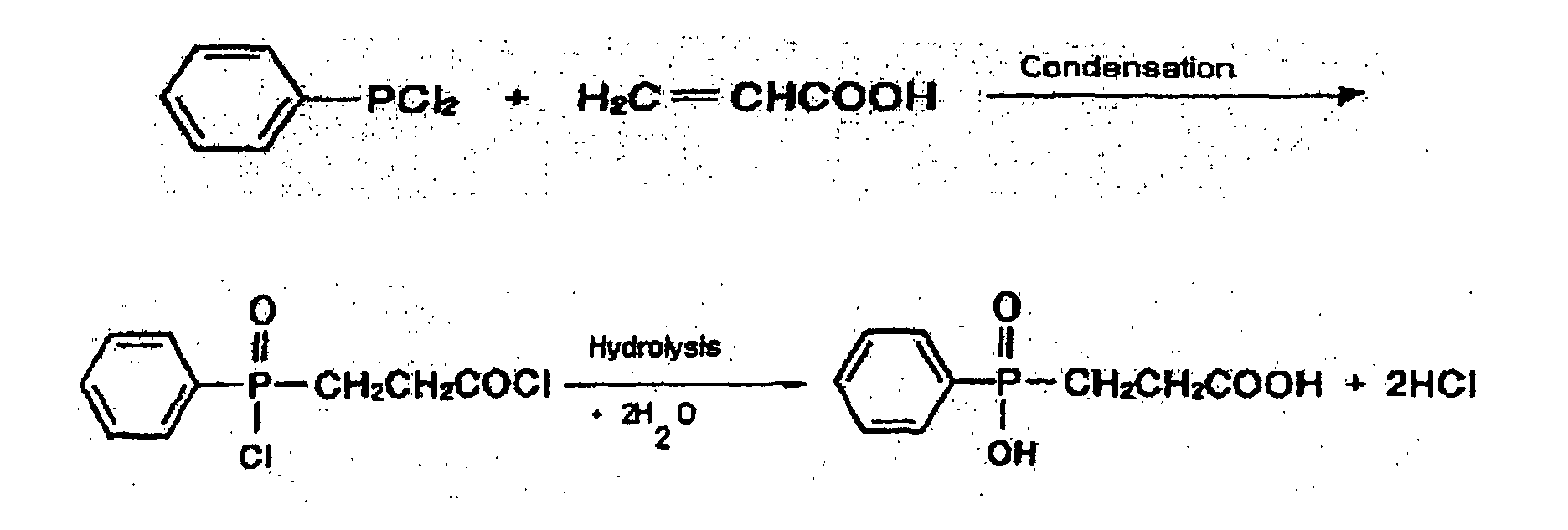
- 3-(hydroxyphenylphosphinyl)-propanoic acid which is commonly used as a flame retardant for polyester resins, is generally prepared by the condensation of phenylphosphonous dichloride and acrylic acid, followed by the hydrolysis of the condensate, 3-(chlorophenylphosphinyl)-propionylchloride, as shown in the following reaction formula I:
- Flame-retardant, 3-(hydroxyphenylphosphinyl)-propanoic acid-containing polyester is generally used for fibers such as curtains, coverlets and night dresses.
- One of the factors which have significant influence on the quality of these fiber products is color.
- the colors of the products are partly determined by the color of the polyester. Accordingly, the color of 3-(hydroxyphenylphosphinyl)-propanoic acid, which is added to provide flame retardation for polyester, is very important in determining the colors of final products.
- 3-(hydroxyphenylphosphinyl)-propanoic acid prepared by the Hazen's method, it is slightly yellowish.
- Kardanov et al reported in the Journal of General Chemistry USSR (vol. 62, no. 1, pp. 182-183) a method for preparing 3-(hydroxyphenylphosphinyl)-propanoic acid, wherein phenylphosphonous dichloride, phenyl phosphinic acid and an excess acryloyl chloride are reacted, and then the excess acryloyl chloride is removed under vacuum before the obtained 3-(chlorophenylphosphinyl)-propionyl chloride is hydrolyzed.
- the present invention was studied to solve the problems of prior arts, and has an object of providing a method for preparing 3-(hydroxyphenylphosphinyl)-propanoic acid of desired color at high yields through a low temperature reaction.
- a method for preparing 3-(hydroxyphenylphosphinyl)-propanoic acid essentially consisting of the steps: reacting phenylphosphonous dichloride with phenylphosphinic acid to give a hydrophosphoryl compound; reacting the hydrophosphoryl compound with acryloyl chloride at a temperature of 0 ⁇ 40 °C to give 3-(chlorophenylphosphinyl)-propionyl chloride, the acyloyl chloride being present at an amount more by 10 ⁇ 15 mole% than the amount of the hydrophosphoryl compound; and hydrolyzing the 3-(chlorophenylphosphinyl)-propionyl chloride in water to the 3-(hydroxyphenylphosphinyl)-propanoic acid and then cooling the aqueous mixture to 10°C and standing at 10°C for 1 hour to obtain the 3-(hydroxyphenylphosphinyl)-propanoic acid as precipitate.
- 3-(hydroxyphenylphosphinyl)-propanoic acid is prepared from phenylphosphonous dichloride. This starting material is reacted with phenyl phosphinic acid to produce a hydrophosohoryl compound which is, in turn, reacted to excess acryloyl chloride to give 3-(chlorophenylphosphinyl)-propionyl chloride. This adduct is hydrolyzed to the object compound.
- This reaction procedure is represented by the following Reaction Formula 2:
- the hydrophosphoryl compound IV resulting from the reaction of phenylphosphonous dichloride II and phenylphosphinic acid III is in a tautomeric state as seen in the Reaction Formula 2 and is of so high reactivity that it can readily react at low temperatures.
- the reaction of the hydrophosphoryl compound IV and acryloyl chloride is conducted at a temperature of 0-40 °C.
- acryloyl chloride has a boiling point of 72-76 °C which is significantly lower than the boiling point (139 °C) of acrylic acid
- the remainder of the acryloyl chloride after the addition reaction can be collected and recycled with ease.
- acryloyl chloride is used at an amount more by 5-30 mole % and more preferably 10-15 mole % than that of the hydrophosphoryl compound IV.
- Example II A procedure was carried out following Example I except that 895 g (5 moles) of phenylphosphonous dichloride were placed in the reactor, heated to 80 °C with stirring, and dropwise added with 386 g (5.35 moles) of acrylic acid while maintaining a reaction temperature at 80-100 °C under 1 atm, after which the reaction mixture was heated up to 130 °C, allowed to stand for 1 hour, and cooled to room temperature, to produce 1,008 g of 3-(hydroxyphenylphosphinyl)-propanoic acid. Yield 94.2 %.
- 3-(hydroxyphenylphosphinyl)-propanoic acid can be prepared at high yields with good color through low temperature reactions, in accordance with the present invention.
- the present invention is economically favorable because the remainder of the acryloyl chloride after the addition reaction can be collected and recycled with ease.
Landscapes
- Chemical & Material Sciences (AREA)
- Organic Chemistry (AREA)
- Health & Medical Sciences (AREA)
- Life Sciences & Earth Sciences (AREA)
- Biochemistry (AREA)
- General Health & Medical Sciences (AREA)
- Molecular Biology (AREA)
Description
- The present invention relates to a method for preparing 3-(hydroxyphenylphosphinyl)-propanoic acid. 3-(hydroxyphenylphosphinyl)-propanoic acid, which is commonly used as a flame retardant for polyester resins, is generally prepared by the condensation of phenylphosphonous dichloride and acrylic acid, followed by the hydrolysis of the condensate, 3-(chlorophenylphosphinyl)-propionylchloride, as shown in the following reaction formula I:
- Pudovik et al. reported the above procedure in the Russian Journal of Organic Chemistry (Vol. 137, pp. 423-427) in 1967. Since then, there have been disclosed a number of improved procedures which could increase the production yield by controlling a reactant mole fraction or reaction temperature. For example, U.S. Pat. No. 4,081,463 (Birum et al.) proposes a method in which acrylic acid was used at an amount more by 25∼45 mol% (more preferably 30∼40 mol%) than that of phenylphosphonous dichloride, insisting that the production yield can be increased by using excess acrylic acid because a portion of phenylphosphonous dichloride remains unreacted when these reactants are present at the same equivalent. However, this method is problematic in that not only is the reactant wasted due to the excess of acrylic acid, but also the production yield is not increased to a satisfactory extent. Another reference directed to the preparation of 3-(hydroxyphenylphosphinyl)-propanoic acid is U.S. Pat. No. 4,769,182, yielded to Hazen. It discloses that the object compound can be produced at high production yields by using acrylic acid at a relatively small amount, but greater by 5∼10 mol% than that of phenylphosphonous dichloride and maintaining the reaction temperature at 115∼150 °C during the reaction of the reactants. In the above-cited patent, Hazen insisted that acrylic acid was not consumed nor converted into an unreactable material, but converted into certain acrylic acid derivatives which were then reacted with remaining phenylphosphonous dichloride at the elevated reaction temperature, which led to an improvement in the production yield. However, despite the enhanced production yield, this method suffers from a weakness in that the effect of excess acrylic acid is abated because acrylic acid used in the reaction is self-condensed or boiled to vaporize owing to the high temperature.
- Flame-retardant, 3-(hydroxyphenylphosphinyl)-propanoic acid-containing polyester is generally used for fibers such as curtains, coverlets and night dresses. One of the factors which have significant influence on the quality of these fiber products is color. The colors of the products are partly determined by the color of the polyester. Accordingly, the color of 3-(hydroxyphenylphosphinyl)-propanoic acid, which is added to provide flame retardation for polyester, is very important in determining the colors of final products.
- As for 3-(hydroxyphenylphosphinyl)-propanoic acid prepared by the Hazen's method, it is slightly yellowish. Kardanov et al reported in the Journal of General Chemistry USSR (vol. 62, no. 1, pp. 182-183) a method for preparing 3-(hydroxyphenylphosphinyl)-propanoic acid, wherein phenylphosphonous dichloride, phenyl phosphinic acid and an excess acryloyl chloride are reacted, and then the excess acryloyl chloride is removed under vacuum before the obtained 3-(chlorophenylphosphinyl)-propionyl chloride is hydrolyzed.
- With this background in mind, the present invention was studied to solve the problems of prior arts, and has an object of providing a method for preparing 3-(hydroxyphenylphosphinyl)-propanoic acid of desired color at high yields through a low temperature reaction.
- According to one embodiment of the present invention there is provided a method for preparing 3-(hydroxyphenylphosphinyl)-propanoic acid essentially consisting of the steps: reacting phenylphosphonous dichloride with phenylphosphinic acid to give a hydrophosphoryl compound; reacting the hydrophosphoryl compound with acryloyl chloride at a temperature of 0∼40 °C to give 3-(chlorophenylphosphinyl)-propionyl chloride, the acyloyl chloride being present at an amount more by 10∼15 mole% than the amount of the hydrophosphoryl compound; and hydrolyzing the 3-(chlorophenylphosphinyl)-propionyl chloride in water to the 3-(hydroxyphenylphosphinyl)-propanoic acid and then cooling the aqueous mixture to 10°C and standing at 10°C for 1 hour to obtain the 3-(hydroxyphenylphosphinyl)-propanoic acid as precipitate.
- In the present invention, 3-(hydroxyphenylphosphinyl)-propanoic acid is prepared from phenylphosphonous dichloride. This starting material is reacted with phenyl phosphinic acid to produce a hydrophosohoryl compound which is, in turn, reacted to excess acryloyl chloride to give 3-(chlorophenylphosphinyl)-propionyl chloride. This adduct is hydrolyzed to the object compound. This reaction procedure is represented by the following Reaction Formula 2:
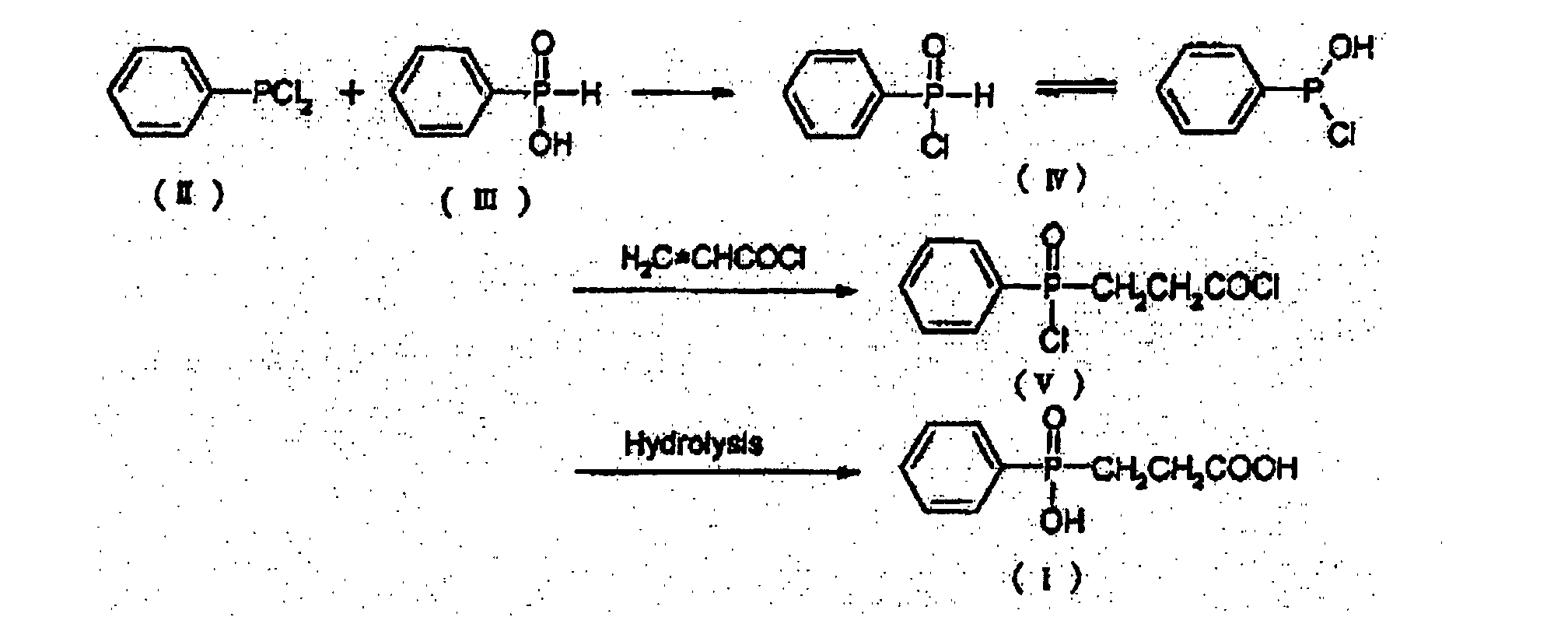
- The hydrophosphoryl compound IV resulting from the reaction of phenylphosphonous dichloride II and phenylphosphinic acid III is in a tautomeric state as seen in the Reaction Formula 2 and is of so high reactivity that it can readily react at low temperatures. In accordance with the present invention, the reaction of the hydrophosphoryl compound IV and acryloyl chloride is conducted at a temperature of 0-40 °C.
- In addition, since acryloyl chloride (H2C=CHCOCl) has a boiling point of 72-76 °C which is significantly lower than the boiling point (139 °C) of acrylic acid, the remainder of the acryloyl chloride after the addition reaction can be collected and recycled with ease. In the present invention, acryloyl chloride is used at an amount more by 5-30 mole % and more preferably 10-15 mole % than that of the hydrophosphoryl compound IV.
- The intermediate product 3-(chlorophenylphosphinyl)-propionyl chloride V is hydrolyzed in a well-known process to give 3-(hydroxyphenylphosphinyl)-propanoic acid I. Herein, it should be understood that this hydrolysis does not limit the present invention.
- A better understanding of the present invention may be obtained in light of the following examples which are set forth to illustrate, but are not to be construed to limit the present invention.
- In a reactor were placed 396.7 g (2.793 moles) of phenylphosphonous dichloride which was then dropwise added with 500 g (2.793 mole) of phenylphosphonous dichloride at 20 °C under a nitrogen atmosphere with stirring. After complete mixing, 556.15 g (6.145 moles) of acryloyl chloride was dropwise added at 20 °C for 90 min, and the reaction mixture was further reacted for 30 min.
- In 1,106 g of water, the resulting condensate was dropwise added at 80 °C with vigorous stirring, after which the temperature was cooled to near 10 °C to obtaine precipitates. After being allowed to stand at 10 °C for 1 hour, the slurry containing the precipitates was filtered, washed and dried in a vacuum dryer to produce 1,147.6 g of 3-(hydroxyphenylphosphinyl)-propanoic acid. Yield 96 %.
- In a reactor were placed 895g (5 moles) of phenylphosphonous dichloride, which was then heated at 80 °C with stirring. 346g (5.5 moles) of acrylic acid were dropwise added while the reactor was maintained at a temperature of 80∼100 °C under atmospheric pressure. Afer completion of the addition of acrylic acid, the reaction mixture was allowed to stand for 1 hour at 80 °C and then cooled to room temperature. In 1,000 ml of water, the resulting reaction mixture was dropwise added and subjected to hydrolysis at 80 °C, after which the temperature was cooled to near 10 °C to obtaine precipitates. After being allowed to stand at 10 °C for 1 hour, the slurry containing the precipitates was filtered, washed and dried in a vacuum dryer to produce 1,015 g of 3-(hydroxyphenylphosphinyl)-propanoic acid. Yield 94.9 %.
- A procedure was carried out following Example I except that 895 g (5 moles) of phenylphosphonous dichloride were placed in the reactor, heated to 80 °C with stirring, and dropwise added with 386 g (5.35 moles) of acrylic acid while maintaining a reaction temperature at 80-100 °C under 1 atm, after which the reaction mixture was heated up to 130 °C, allowed to stand for 1 hour, and cooled to room temperature, to produce 1,008 g of 3-(hydroxyphenylphosphinyl)-propanoic acid. Yield 94.2 %.
- The physical properties of 3-(hydroxyphenylphosphinyl)-propanoic acid obtained in the above examples are shown in Table 1, below.
Nos. of Examples Molar Ratio Yield (%) Color (L/b) Melting Point (°C) I 1.1 96.0 97.4/1.02 162 C. I 1.3 85.4 97.0/1.4 162 C. II 1.07 92.2 91.4/4.4 162 - As apparent in above Examples and Comparative Examples, 3-(hydroxyphenylphosphinyl)-propanoic acid can be prepared at high yields with good color through low temperature reactions, in accordance with the present invention. In addition, the present invention is economically favorable because the remainder of the acryloyl chloride after the addition reaction can be collected and recycled with ease.
- The present invention has been described in an illustrative manner, and it is to be understood that the terminology used is intended to be in the nature of description rather than of limitation. Many modifications and variations of the present invention are possible in light of the above teachings. Therefore, it is to be understood that the invention may be practiced otherwise than as specifically described.
Claims (1)
- A method for preparing 3-(hydroxyphenylphosphinyl)-propanoic acid essentially consisting of the steps:reacting phenylphosphonous dichloride with phenylphosphinic acid to give a hydrophosphoryl compound;reacting the hydrophosphoryl compound with acryloyl chloride at a temperature of 0∼40 °C to give 3-(chlorophenylphosphinyl)-propionyl chloride, the acyloyl chloride being present at an amount more by 10∼15 mole% than the amount of the hydrophosphoryl compound; andhydrolyzing the 3-(chlorophenylphosphinyl)-propionyl chloride in water to the 3-(hydroxyphenylphosphinyl)-propanoic acid and then cooling the aqueous mixture to 10°C and standing at 10°C for 1 hour to obtain the 3-(hydroxyphenylphosphinyl)-propanoic acid as precipitate.
Priority Applications (3)
| Application Number | Priority Date | Filing Date | Title |
|---|---|---|---|
| ES99122580T ES2212450T3 (en) | 1999-11-12 | 1999-11-12 | PROCEDURE FOR PREPARATION OF ACID 3- (HYDROXYPHENYLPHOSPHINYL) -PROPANOIC. |
| DE1999614764 DE69914764T2 (en) | 1999-11-12 | 1999-11-12 | Process for the preparation of 3- (hydroxyphenylphosphinyl) -propionic acid |
| EP19990122580 EP1099705B1 (en) | 1999-11-12 | 1999-11-12 | Method for preparing 3-(hydroxyphenylphosphinyl)-propanoic acid |
Applications Claiming Priority (1)
| Application Number | Priority Date | Filing Date | Title |
|---|---|---|---|
| EP19990122580 EP1099705B1 (en) | 1999-11-12 | 1999-11-12 | Method for preparing 3-(hydroxyphenylphosphinyl)-propanoic acid |
Publications (2)
| Publication Number | Publication Date |
|---|---|
| EP1099705A1 EP1099705A1 (en) | 2001-05-16 |
| EP1099705B1 true EP1099705B1 (en) | 2004-02-11 |
Family
ID=8239380
Family Applications (1)
| Application Number | Title | Priority Date | Filing Date |
|---|---|---|---|
| EP19990122580 Expired - Lifetime EP1099705B1 (en) | 1999-11-12 | 1999-11-12 | Method for preparing 3-(hydroxyphenylphosphinyl)-propanoic acid |
Country Status (3)
| Country | Link |
|---|---|
| EP (1) | EP1099705B1 (en) |
| DE (1) | DE69914764T2 (en) |
| ES (1) | ES2212450T3 (en) |
Families Citing this family (1)
| Publication number | Priority date | Publication date | Assignee | Title |
|---|---|---|---|---|
| CN105541908A (en) * | 2016-02-01 | 2016-05-04 | 东营美利达新型材料科技有限公司 | Method for producing 2-carboxethyl phenylphosphinic acid without wastewater |
Family Cites Families (2)
| Publication number | Priority date | Publication date | Assignee | Title |
|---|---|---|---|---|
| US4081463A (en) * | 1976-12-27 | 1978-03-28 | Monsanto Company | Production of 2-carboxyethyl(phenyl)phosphinic acid |
| US4769182A (en) * | 1985-06-05 | 1988-09-06 | Hoechst Celanese Corporation | Process for production of 3-(hydroxyphenylphosphinyl)-propanoic acid |
-
1999
- 1999-11-12 EP EP19990122580 patent/EP1099705B1/en not_active Expired - Lifetime
- 1999-11-12 DE DE1999614764 patent/DE69914764T2/en not_active Expired - Lifetime
- 1999-11-12 ES ES99122580T patent/ES2212450T3/en not_active Expired - Lifetime
Also Published As
| Publication number | Publication date |
|---|---|
| ES2212450T3 (en) | 2004-07-16 |
| DE69914764T2 (en) | 2004-12-30 |
| DE69914764D1 (en) | 2004-03-18 |
| EP1099705A1 (en) | 2001-05-16 |
Similar Documents
| Publication | Publication Date | Title |
|---|---|---|
| US4327039A (en) | Process for the production of 3-amino-1-hydroxypropane-1,1-diphosphonic acid | |
| US4053505A (en) | Preparation of n-phosphonomethyl glycine | |
| EP0971938B1 (en) | Process for the production of 4-amino-1-hydroxybutylidene-1,1-bisphosphonic acid or salts thereof | |
| CA2223287C (en) | Process for preparing n-phosphonomethyliminodiacetic acid | |
| US5847184A (en) | Process for preparing phosphorus-containing dicarboxylic acids | |
| US5821376A (en) | Process for the preparation of a dop-containing mixture | |
| EP1092722B1 (en) | Method for preparation of 3-(hydroxyphenyl phosphinyl)-propanoic acid | |
| US5739370A (en) | Process the production of octaphenylcyclotetrasiloxane | |
| US4769182A (en) | Process for production of 3-(hydroxyphenylphosphinyl)-propanoic acid | |
| KR100362553B1 (en) | Process for the manufacture of n-phosphonomethylglycine | |
| KR20000053014A (en) | Use of monosodium iminodiacetic acid solutions in the preparation of n-phosphonomethyliminodiacetic acid | |
| US5869722A (en) | Process for producing aluminum phosphinates | |
| EP1099705A1 (en) | Method for preparing 3-(hydroxyphenylphosphinyl)-propanoic acid | |
| KR930005009B1 (en) | Process for producing n-alkyamino methylphosphoric acid | |
| KR100242528B1 (en) | Process for the preparation of 2-(methylthio)-dinatriumbarbiturates | |
| JP5279156B2 (en) | Process for producing 4,6-dichloro-5-fluoropyrimidine | |
| HU206121B (en) | Process for producing acylamino methanephosphonic acids | |
| HU213457B (en) | Process for producing aminomethanephosphonic acid and aminomethyl-phosphinic acid | |
| CA1257267A (en) | Compound 1,4-diisopropyl-2,5-diketopiperazine | |
| KR20010029293A (en) | Method for the preparation of the 3-(hydroxyphenylphosphinyl)-propanoic acid | |
| KR880002435B1 (en) | Process for the preparation of aminoalkylphosphonate derivatives. | |
| KR100632988B1 (en) | Method for preparing 3- (hydroxyphenylphosphinyl) -propanoic acid | |
| EP0385014A1 (en) | Process for preparation of substituted aminomethylphosphonic acids | |
| US5053529A (en) | Process for the preparation of N-phosphonomethylglycine | |
| IE912921A1 (en) | Process for the preparation of aminomethylphosphonic acid¹and aminomethylphosphinic acids from N-hydroxymethylamides |
Legal Events
| Date | Code | Title | Description |
|---|---|---|---|
| PUAI | Public reference made under article 153(3) epc to a published international application that has entered the european phase |
Free format text: ORIGINAL CODE: 0009012 |
|
| 17P | Request for examination filed |
Effective date: 19991130 |
|
| AK | Designated contracting states |
Kind code of ref document: A1 Designated state(s): DE ES FR GB IT |
|
| AX | Request for extension of the european patent |
Free format text: AL;LT;LV;MK;RO;SI |
|
| AKX | Designation fees paid |
Free format text: DE ES FR GB IT |
|
| 17Q | First examination report despatched |
Effective date: 20020725 |
|
| GRAH | Despatch of communication of intention to grant a patent |
Free format text: ORIGINAL CODE: EPIDOS IGRA |
|
| GRAS | Grant fee paid |
Free format text: ORIGINAL CODE: EPIDOSNIGR3 |
|
| GRAA | (expected) grant |
Free format text: ORIGINAL CODE: 0009210 |
|
| AK | Designated contracting states |
Kind code of ref document: B1 Designated state(s): DE ES FR GB IT |
|
| REG | Reference to a national code |
Ref country code: GB Ref legal event code: FG4D |
|
| REF | Corresponds to: |
Ref document number: 69914764 Country of ref document: DE Date of ref document: 20040318 Kind code of ref document: P |
|
| REG | Reference to a national code |
Ref country code: ES Ref legal event code: FG2A Ref document number: 2212450 Country of ref document: ES Kind code of ref document: T3 |
|
| ET | Fr: translation filed | ||
| PLBE | No opposition filed within time limit |
Free format text: ORIGINAL CODE: 0009261 |
|
| STAA | Information on the status of an ep patent application or granted ep patent |
Free format text: STATUS: NO OPPOSITION FILED WITHIN TIME LIMIT |
|
| 26N | No opposition filed |
Effective date: 20041112 |
|
| REG | Reference to a national code |
Ref country code: FR Ref legal event code: PLFP Year of fee payment: 17 |
|
| REG | Reference to a national code |
Ref country code: FR Ref legal event code: PLFP Year of fee payment: 18 |
|
| REG | Reference to a national code |
Ref country code: FR Ref legal event code: PLFP Year of fee payment: 19 |
|
| PGFP | Annual fee paid to national office [announced via postgrant information from national office to epo] |
Ref country code: DE Payment date: 20181113 Year of fee payment: 20 |
|
| PGFP | Annual fee paid to national office [announced via postgrant information from national office to epo] |
Ref country code: ES Payment date: 20181203 Year of fee payment: 20 Ref country code: FR Payment date: 20181127 Year of fee payment: 20 Ref country code: IT Payment date: 20181122 Year of fee payment: 20 Ref country code: GB Payment date: 20181114 Year of fee payment: 20 |
|
| REG | Reference to a national code |
Ref country code: DE Ref legal event code: R071 Ref document number: 69914764 Country of ref document: DE |
|
| REG | Reference to a national code |
Ref country code: GB Ref legal event code: PE20 Expiry date: 20191111 |
|
| PG25 | Lapsed in a contracting state [announced via postgrant information from national office to epo] |
Ref country code: GB Free format text: LAPSE BECAUSE OF EXPIRATION OF PROTECTION Effective date: 20191111 |
|
| REG | Reference to a national code |
Ref country code: ES Ref legal event code: FD2A Effective date: 20200901 |
|
| PG25 | Lapsed in a contracting state [announced via postgrant information from national office to epo] |
Ref country code: ES Free format text: LAPSE BECAUSE OF EXPIRATION OF PROTECTION Effective date: 20191113 |