EP1099684A1 - Process for the preparation of nitro compounds and method for the removal of nitrogen dioxide - Google Patents
Process for the preparation of nitro compounds and method for the removal of nitrogen dioxide Download PDFInfo
- Publication number
- EP1099684A1 EP1099684A1 EP00927772A EP00927772A EP1099684A1 EP 1099684 A1 EP1099684 A1 EP 1099684A1 EP 00927772 A EP00927772 A EP 00927772A EP 00927772 A EP00927772 A EP 00927772A EP 1099684 A1 EP1099684 A1 EP 1099684A1
- Authority
- EP
- European Patent Office
- Prior art keywords
- nitrogen dioxide
- group
- organic substrate
- aromatic
- compounds
- Prior art date
- Legal status (The legal status is an assumption and is not a legal conclusion. Google has not performed a legal analysis and makes no representation as to the accuracy of the status listed.)
- Withdrawn
Links
- MGWGWNFMUOTEHG-UHFFFAOYSA-N 4-(3,5-dimethylphenyl)-1,3-thiazol-2-amine Chemical compound CC1=CC(C)=CC(C=2N=C(N)SC=2)=C1 MGWGWNFMUOTEHG-UHFFFAOYSA-N 0.000 title claims abstract description 137
- JCXJVPUVTGWSNB-UHFFFAOYSA-N nitrogen dioxide Inorganic materials O=[N]=O JCXJVPUVTGWSNB-UHFFFAOYSA-N 0.000 title claims abstract description 137
- 238000000034 method Methods 0.000 title claims abstract description 52
- 230000008569 process Effects 0.000 title claims abstract description 46
- 150000002828 nitro derivatives Chemical class 0.000 title claims abstract description 23
- 239000000758 substrate Substances 0.000 claims abstract description 66
- -1 imide compounds Chemical class 0.000 claims abstract description 59
- 125000003118 aryl group Chemical group 0.000 claims abstract description 47
- 238000006243 chemical reaction Methods 0.000 claims abstract description 41
- 125000004432 carbon atom Chemical group C* 0.000 claims abstract description 40
- 150000001875 compounds Chemical class 0.000 claims abstract description 38
- QVGXLLKOCUKJST-UHFFFAOYSA-N atomic oxygen Chemical compound [O] QVGXLLKOCUKJST-UHFFFAOYSA-N 0.000 claims abstract description 26
- 239000001301 oxygen Substances 0.000 claims abstract description 26
- 229910052760 oxygen Inorganic materials 0.000 claims abstract description 26
- 239000001257 hydrogen Substances 0.000 claims abstract description 21
- 229910052739 hydrogen Inorganic materials 0.000 claims abstract description 21
- 229910052799 carbon Inorganic materials 0.000 claims abstract description 16
- 229930195733 hydrocarbon Natural products 0.000 claims abstract description 16
- 150000001338 aliphatic hydrocarbons Chemical class 0.000 claims abstract description 12
- 125000004435 hydrogen atom Chemical group [H]* 0.000 claims abstract description 12
- 125000006615 aromatic heterocyclic group Chemical group 0.000 claims abstract description 7
- 125000002915 carbonyl group Chemical group [*:2]C([*:1])=O 0.000 claims abstract description 7
- 239000007789 gas Substances 0.000 claims description 56
- 125000000217 alkyl group Chemical group 0.000 claims description 19
- 125000003545 alkoxy group Chemical group 0.000 claims description 16
- 125000004453 alkoxycarbonyl group Chemical group 0.000 claims description 13
- 125000006574 non-aromatic ring group Chemical group 0.000 claims description 12
- 125000002252 acyl group Chemical group 0.000 claims description 10
- 125000002887 hydroxy group Chemical group [H]O* 0.000 claims description 10
- 125000004122 cyclic group Chemical class 0.000 claims description 9
- 125000005843 halogen group Chemical group 0.000 claims description 9
- 125000000753 cycloalkyl group Chemical group 0.000 claims description 8
- 125000003178 carboxy group Chemical group [H]OC(*)=O 0.000 claims description 7
- 125000004430 oxygen atom Chemical group O* 0.000 claims description 6
- CFMZSMGAMPBRBE-UHFFFAOYSA-N 2-hydroxyisoindole-1,3-dione Chemical compound C1=CC=C2C(=O)N(O)C(=O)C2=C1 CFMZSMGAMPBRBE-UHFFFAOYSA-N 0.000 abstract description 19
- 229910002651 NO3 Inorganic materials 0.000 abstract description 6
- NHNBFGGVMKEFGY-UHFFFAOYSA-N Nitrate Chemical compound [O-][N+]([O-])=O NHNBFGGVMKEFGY-UHFFFAOYSA-N 0.000 abstract description 5
- YXFVVABEGXRONW-UHFFFAOYSA-N Toluene Chemical compound CC1=CC=CC=C1 YXFVVABEGXRONW-UHFFFAOYSA-N 0.000 description 69
- 239000000203 mixture Substances 0.000 description 30
- 239000007795 chemical reaction product Substances 0.000 description 25
- 238000004587 chromatography analysis Methods 0.000 description 24
- 238000003756 stirring Methods 0.000 description 24
- 239000012298 atmosphere Substances 0.000 description 23
- ORILYTVJVMAKLC-UHFFFAOYSA-N adamantane Chemical compound C1C(C2)CC3CC1CC2C3 ORILYTVJVMAKLC-UHFFFAOYSA-N 0.000 description 16
- 125000001424 substituent group Chemical group 0.000 description 14
- 238000006396 nitration reaction Methods 0.000 description 13
- VLKZOEOYAKHREP-UHFFFAOYSA-N n-Hexane Chemical compound CCCCCC VLKZOEOYAKHREP-UHFFFAOYSA-N 0.000 description 12
- 150000001335 aliphatic alkanes Chemical class 0.000 description 10
- HUMNYLRZRPPJDN-UHFFFAOYSA-N benzaldehyde Chemical compound O=CC1=CC=CC=C1 HUMNYLRZRPPJDN-UHFFFAOYSA-N 0.000 description 10
- SQNZJJAZBFDUTD-UHFFFAOYSA-N durene Chemical compound CC1=CC(C)=C(C)C=C1C SQNZJJAZBFDUTD-UHFFFAOYSA-N 0.000 description 10
- 150000008064 anhydrides Chemical class 0.000 description 9
- 125000000449 nitro group Chemical group [O-][N+](*)=O 0.000 description 9
- GETTZEONDQJALK-UHFFFAOYSA-N (trifluoromethyl)benzene Chemical compound FC(F)(F)C1=CC=CC=C1 GETTZEONDQJALK-UHFFFAOYSA-N 0.000 description 8
- YNQLUTRBYVCPMQ-UHFFFAOYSA-N Ethylbenzene Chemical compound CCC1=CC=CC=C1 YNQLUTRBYVCPMQ-UHFFFAOYSA-N 0.000 description 8
- XDTMQSROBMDMFD-UHFFFAOYSA-N Cyclohexane Chemical compound C1CCCCC1 XDTMQSROBMDMFD-UHFFFAOYSA-N 0.000 description 7
- 150000001924 cycloalkanes Chemical class 0.000 description 7
- DMEGYFMYUHOHGS-UHFFFAOYSA-N heptamethylene Natural products C1CCCCCC1 DMEGYFMYUHOHGS-UHFFFAOYSA-N 0.000 description 7
- ZMXDDKWLCZADIW-UHFFFAOYSA-N N,N-Dimethylformamide Chemical compound CN(C)C=O ZMXDDKWLCZADIW-UHFFFAOYSA-N 0.000 description 6
- GRYLNZFGIOXLOG-UHFFFAOYSA-N Nitric acid Chemical compound O[N+]([O-])=O GRYLNZFGIOXLOG-UHFFFAOYSA-N 0.000 description 6
- UAEPNZWRGJTJPN-UHFFFAOYSA-N methylcyclohexane Chemical compound CC1CCCCC1 UAEPNZWRGJTJPN-UHFFFAOYSA-N 0.000 description 6
- 229910017604 nitric acid Inorganic materials 0.000 description 6
- LHMZQIXKHDRHQJ-UHFFFAOYSA-N nitromethylbenzene Chemical compound [O-][N+](=O)CC1=CC=CC=C1.[O-][N+](=O)CC1=CC=CC=C1 LHMZQIXKHDRHQJ-UHFFFAOYSA-N 0.000 description 6
- 239000002904 solvent Substances 0.000 description 6
- RSJKGSCJYJTIGS-UHFFFAOYSA-N undecane Chemical compound CCCCCCCCCCC RSJKGSCJYJTIGS-UHFFFAOYSA-N 0.000 description 6
- SNRUBQQJIBEYMU-UHFFFAOYSA-N dodecane Chemical compound CCCCCCCCCCCC SNRUBQQJIBEYMU-UHFFFAOYSA-N 0.000 description 5
- 230000000802 nitrating effect Effects 0.000 description 5
- 229910052757 nitrogen Inorganic materials 0.000 description 5
- QNGNSVIICDLXHT-UHFFFAOYSA-N para-ethylbenzaldehyde Natural products CCC1=CC=C(C=O)C=C1 QNGNSVIICDLXHT-UHFFFAOYSA-N 0.000 description 5
- CWNOIUTVJRWADX-UHFFFAOYSA-N 1,3-dimethyladamantane Chemical compound C1C(C2)CC3CC1(C)CC2(C)C3 CWNOIUTVJRWADX-UHFFFAOYSA-N 0.000 description 4
- WGECXQBGLLYSFP-UHFFFAOYSA-N 2,3-dimethylpentane Chemical compound CCC(C)C(C)C WGECXQBGLLYSFP-UHFFFAOYSA-N 0.000 description 4
- QENJZWZWAWWESF-UHFFFAOYSA-N 2,4,5-trimethylbenzoic acid Chemical compound CC1=CC(C)=C(C(O)=O)C=C1C QENJZWZWAWWESF-UHFFFAOYSA-N 0.000 description 4
- KNGSAYHEXMAZMM-UHFFFAOYSA-N 2-nitrohexane Chemical compound CCCCC(C)[N+]([O-])=O KNGSAYHEXMAZMM-UHFFFAOYSA-N 0.000 description 4
- PLAZTCDQAHEYBI-UHFFFAOYSA-N 2-nitrotoluene Chemical compound CC1=CC=CC=C1[N+]([O-])=O PLAZTCDQAHEYBI-UHFFFAOYSA-N 0.000 description 4
- IVZRMEMSOIPCGU-UHFFFAOYSA-N 3-nitrohexane Chemical compound CCCC(CC)[N+]([O-])=O IVZRMEMSOIPCGU-UHFFFAOYSA-N 0.000 description 4
- QZYHIOPPLUPUJF-UHFFFAOYSA-N 3-nitrotoluene Chemical compound CC1=CC=CC([N+]([O-])=O)=C1 QZYHIOPPLUPUJF-UHFFFAOYSA-N 0.000 description 4
- ZPTVNYMJQHSSEA-UHFFFAOYSA-N 4-nitrotoluene Chemical compound CC1=CC=C([N+]([O-])=O)C=C1 ZPTVNYMJQHSSEA-UHFFFAOYSA-N 0.000 description 4
- ATUOYWHBWRKTHZ-UHFFFAOYSA-N Propane Chemical compound CCC ATUOYWHBWRKTHZ-UHFFFAOYSA-N 0.000 description 4
- 125000002723 alicyclic group Chemical group 0.000 description 4
- 150000003997 cyclic ketones Chemical class 0.000 description 4
- 150000001925 cycloalkenes Chemical class 0.000 description 4
- DIOQZVSQGTUSAI-UHFFFAOYSA-N decane Chemical compound CCCCCCCCCC DIOQZVSQGTUSAI-UHFFFAOYSA-N 0.000 description 4
- 150000002148 esters Chemical class 0.000 description 4
- 125000001188 haloalkyl group Chemical group 0.000 description 4
- 125000000623 heterocyclic group Chemical group 0.000 description 4
- 150000002576 ketones Chemical class 0.000 description 4
- 125000002496 methyl group Chemical group [H]C([H])([H])* 0.000 description 4
- 125000001570 methylene group Chemical group [H]C([H])([*:1])[*:2] 0.000 description 4
- 125000001997 phenyl group Chemical group [H]C1=C([H])C([H])=C(*)C([H])=C1[H] 0.000 description 4
- 238000000926 separation method Methods 0.000 description 4
- 238000011282 treatment Methods 0.000 description 4
- GJOVHPKYFFGKCY-UHFFFAOYSA-N 1-nitroethylbenzene Chemical compound [O-][N+](=O)C(C)C1=CC=CC=C1 GJOVHPKYFFGKCY-UHFFFAOYSA-N 0.000 description 3
- QCWXDVFBZVHKLV-UHFFFAOYSA-N 1-tert-butyl-4-methylbenzene Chemical compound CC1=CC=C(C(C)(C)C)C=C1 QCWXDVFBZVHKLV-UHFFFAOYSA-N 0.000 description 3
- BZHMBWZPUJHVEE-UHFFFAOYSA-N 2,3-dimethylpentane Natural products CC(C)CC(C)C BZHMBWZPUJHVEE-UHFFFAOYSA-N 0.000 description 3
- ZWEHNKRNPOVVGH-UHFFFAOYSA-N 2-Butanone Chemical compound CCC(C)=O ZWEHNKRNPOVVGH-UHFFFAOYSA-N 0.000 description 3
- VLJXXKKOSFGPHI-UHFFFAOYSA-N 3-methylhexane Chemical compound CCCC(C)CC VLJXXKKOSFGPHI-UHFFFAOYSA-N 0.000 description 3
- SEEOMASXHIJCDV-UHFFFAOYSA-N 3-methyloctane Chemical compound CCCCCC(C)CC SEEOMASXHIJCDV-UHFFFAOYSA-N 0.000 description 3
- QTBSBXVTEAMEQO-UHFFFAOYSA-N Acetic acid Chemical compound CC(O)=O QTBSBXVTEAMEQO-UHFFFAOYSA-N 0.000 description 3
- CSCPPACGZOOCGX-UHFFFAOYSA-N Acetone Chemical compound CC(C)=O CSCPPACGZOOCGX-UHFFFAOYSA-N 0.000 description 3
- WEVYAHXRMPXWCK-UHFFFAOYSA-N Acetonitrile Chemical compound CC#N WEVYAHXRMPXWCK-UHFFFAOYSA-N 0.000 description 3
- UHOVQNZJYSORNB-UHFFFAOYSA-N Benzene Chemical compound C1=CC=CC=C1 UHOVQNZJYSORNB-UHFFFAOYSA-N 0.000 description 3
- RGSFGYAAUTVSQA-UHFFFAOYSA-N Cyclopentane Chemical compound C1CCCC1 RGSFGYAAUTVSQA-UHFFFAOYSA-N 0.000 description 3
- YMWUJEATGCHHMB-UHFFFAOYSA-N Dichloromethane Chemical compound ClCCl YMWUJEATGCHHMB-UHFFFAOYSA-N 0.000 description 3
- 229910002089 NOx Inorganic materials 0.000 description 3
- RWRDLPDLKQPQOW-UHFFFAOYSA-N Pyrrolidine Chemical compound C1CCNC1 RWRDLPDLKQPQOW-UHFFFAOYSA-N 0.000 description 3
- 150000001299 aldehydes Chemical class 0.000 description 3
- 150000001336 alkenes Chemical class 0.000 description 3
- 125000003277 amino group Chemical group 0.000 description 3
- 150000004945 aromatic hydrocarbons Chemical class 0.000 description 3
- JFDZBHWFFUWGJE-UHFFFAOYSA-N benzonitrile Chemical compound N#CC1=CC=CC=C1 JFDZBHWFFUWGJE-UHFFFAOYSA-N 0.000 description 3
- ZTQSAGDEMFDKMZ-UHFFFAOYSA-N butyric aldehyde Natural products CCCC=O ZTQSAGDEMFDKMZ-UHFFFAOYSA-N 0.000 description 3
- 125000004093 cyano group Chemical group *C#N 0.000 description 3
- DDTBPAQBQHZRDW-UHFFFAOYSA-N cyclododecane Chemical compound C1CCCCCCCCCCC1 DDTBPAQBQHZRDW-UHFFFAOYSA-N 0.000 description 3
- 239000003814 drug Substances 0.000 description 3
- SYEXGNJRYPOUSI-UHFFFAOYSA-N ethyl adamantane-1-carboxylate Chemical compound C1C(C2)CC3CC2CC1(C(=O)OCC)C3 SYEXGNJRYPOUSI-UHFFFAOYSA-N 0.000 description 3
- 150000002391 heterocyclic compounds Chemical class 0.000 description 3
- 150000002430 hydrocarbons Chemical class 0.000 description 3
- GYNNXHKOJHMOHS-UHFFFAOYSA-N methyl-cycloheptane Natural products CC1CCCCCC1 GYNNXHKOJHMOHS-UHFFFAOYSA-N 0.000 description 3
- OFBQJSOFQDEBGM-UHFFFAOYSA-N n-pentane Natural products CCCCC OFBQJSOFQDEBGM-UHFFFAOYSA-N 0.000 description 3
- 125000001624 naphthyl group Chemical group 0.000 description 3
- NJNQUTDUIPVROZ-UHFFFAOYSA-N nitrocyclohexane Chemical compound [O-][N+](=O)C1CCCCC1 NJNQUTDUIPVROZ-UHFFFAOYSA-N 0.000 description 3
- MWUXSHHQAYIFBG-UHFFFAOYSA-N nitrogen oxide Inorganic materials O=[N] MWUXSHHQAYIFBG-UHFFFAOYSA-N 0.000 description 3
- 239000000047 product Substances 0.000 description 3
- 239000002994 raw material Substances 0.000 description 3
- 229920006395 saturated elastomer Polymers 0.000 description 3
- CXWXQJXEFPUFDZ-UHFFFAOYSA-N tetralin Chemical compound C1=CC=C2CCCCC2=C1 CXWXQJXEFPUFDZ-UHFFFAOYSA-N 0.000 description 3
- HGBOYTHUEUWSSQ-UHFFFAOYSA-N valeric aldehyde Natural products CCCCC=O HGBOYTHUEUWSSQ-UHFFFAOYSA-N 0.000 description 3
- PSTVZBXGCKLSQA-UHFFFAOYSA-N (1-methylcyclohexyl) nitrate Chemical compound [O-][N+](=O)OC1(C)CCCCC1 PSTVZBXGCKLSQA-UHFFFAOYSA-N 0.000 description 2
- JHNRZXQVBKRYKN-VQHVLOKHSA-N (ne)-n-(1-phenylethylidene)hydroxylamine Chemical compound O\N=C(/C)C1=CC=CC=C1 JHNRZXQVBKRYKN-VQHVLOKHSA-N 0.000 description 2
- PHOUHVCAPAOEBH-UHFFFAOYSA-N 1,2,4-trimethyl-5-(nitromethyl)benzene Chemical compound CC1=CC(C)=C(C[N+]([O-])=O)C=C1C PHOUHVCAPAOEBH-UHFFFAOYSA-N 0.000 description 2
- KVZJLSYJROEPSQ-UHFFFAOYSA-N 1,2-dimethylcyclohexane Chemical compound CC1CCCCC1C KVZJLSYJROEPSQ-UHFFFAOYSA-N 0.000 description 2
- DSNHSQKRULAAEI-UHFFFAOYSA-N 1,4-Diethylbenzene Chemical compound CCC1=CC=C(CC)C=C1 DSNHSQKRULAAEI-UHFFFAOYSA-N 0.000 description 2
- XWJBRBSPAODJER-UHFFFAOYSA-N 1,7-octadiene Chemical compound C=CCCCCC=C XWJBRBSPAODJER-UHFFFAOYSA-N 0.000 description 2
- VXNZUUAINFGPBY-UHFFFAOYSA-N 1-Butene Chemical compound CCC=C VXNZUUAINFGPBY-UHFFFAOYSA-N 0.000 description 2
- ZGEGCLOFRBLKSE-UHFFFAOYSA-N 1-Heptene Chemical compound CCCCCC=C ZGEGCLOFRBLKSE-UHFFFAOYSA-N 0.000 description 2
- JRLPEMVDPFPYPJ-UHFFFAOYSA-N 1-ethyl-4-methylbenzene Chemical compound CCC1=CC=C(C)C=C1 JRLPEMVDPFPYPJ-UHFFFAOYSA-N 0.000 description 2
- LIKMAJRDDDTEIG-UHFFFAOYSA-N 1-hexene Chemical compound CCCCC=C LIKMAJRDDDTEIG-UHFFFAOYSA-N 0.000 description 2
- FPEIBPNUDALRCS-UHFFFAOYSA-N 1-methyl-1-nitrocyclohexane Chemical compound [O-][N+](=O)C1(C)CCCCC1 FPEIBPNUDALRCS-UHFFFAOYSA-N 0.000 description 2
- RZTDESRVPFKCBH-UHFFFAOYSA-N 1-methyl-4-(4-methylphenyl)benzene Chemical group C1=CC(C)=CC=C1C1=CC=C(C)C=C1 RZTDESRVPFKCBH-UHFFFAOYSA-N 0.000 description 2
- CTMHWPIWNRWQEG-UHFFFAOYSA-N 1-methylcyclohexene Chemical compound CC1=CCCCC1 CTMHWPIWNRWQEG-UHFFFAOYSA-N 0.000 description 2
- QPUYECUOLPXSFR-UHFFFAOYSA-N 1-methylnaphthalene Chemical compound C1=CC=C2C(C)=CC=CC2=C1 QPUYECUOLPXSFR-UHFFFAOYSA-N 0.000 description 2
- HONLSNLUVRQMEK-UHFFFAOYSA-N 1-nitroadamantane Chemical compound C1C(C2)CC3CC2CC1([N+](=O)[O-])C3 HONLSNLUVRQMEK-UHFFFAOYSA-N 0.000 description 2
- FEYJIFXFOHFGCC-UHFFFAOYSA-N 1-nitrohexane Chemical class CCCCCC[N+]([O-])=O FEYJIFXFOHFGCC-UHFFFAOYSA-N 0.000 description 2
- JRZJOMJEPLMPRA-UHFFFAOYSA-N 1-nonene Chemical compound CCCCCCCC=C JRZJOMJEPLMPRA-UHFFFAOYSA-N 0.000 description 2
- KWKAKUADMBZCLK-UHFFFAOYSA-N 1-octene Chemical compound CCCCCCC=C KWKAKUADMBZCLK-UHFFFAOYSA-N 0.000 description 2
- WAPNOHKVXSQRPX-UHFFFAOYSA-N 1-phenylethanol Chemical compound CC(O)C1=CC=CC=C1 WAPNOHKVXSQRPX-UHFFFAOYSA-N 0.000 description 2
- IWQTZGOENQHFNO-UHFFFAOYSA-N 1-tert-butyl-4-(nitromethyl)benzene Chemical compound CC(C)(C)C1=CC=C(C[N+]([O-])=O)C=C1 IWQTZGOENQHFNO-UHFFFAOYSA-N 0.000 description 2
- XHLHPRDBBAGVEG-UHFFFAOYSA-N 1-tetralone Chemical compound C1=CC=C2C(=O)CCCC2=C1 XHLHPRDBBAGVEG-UHFFFAOYSA-N 0.000 description 2
- DCTOHCCUXLBQMS-UHFFFAOYSA-N 1-undecene Chemical compound CCCCCCCCCC=C DCTOHCCUXLBQMS-UHFFFAOYSA-N 0.000 description 2
- YBYIRNPNPLQARY-UHFFFAOYSA-N 1H-indene Chemical compound C1=CC=C2CC=CC2=C1 YBYIRNPNPLQARY-UHFFFAOYSA-N 0.000 description 2
- WGLLSSPDPJPLOR-UHFFFAOYSA-N 2,3-dimethylbut-2-ene Chemical compound CC(C)=C(C)C WGLLSSPDPJPLOR-UHFFFAOYSA-N 0.000 description 2
- ZFFMLCVRJBZUDZ-UHFFFAOYSA-N 2,3-dimethylbutane Chemical compound CC(C)C(C)C ZFFMLCVRJBZUDZ-UHFFFAOYSA-N 0.000 description 2
- BWZVCCNYKMEVEX-UHFFFAOYSA-N 2,4,6-Trimethylpyridine Chemical compound CC1=CC(C)=NC(C)=C1 BWZVCCNYKMEVEX-UHFFFAOYSA-N 0.000 description 2
- JYYNAJVZFGKDEQ-UHFFFAOYSA-N 2,4-Dimethylpyridine Chemical compound CC1=CC=NC(C)=C1 JYYNAJVZFGKDEQ-UHFFFAOYSA-N 0.000 description 2
- UWNADWZGEHDQAB-UHFFFAOYSA-N 2,5-dimethylhexane Chemical compound CC(C)CCC(C)C UWNADWZGEHDQAB-UHFFFAOYSA-N 0.000 description 2
- KBPCCVWUMVGXGF-UHFFFAOYSA-N 2,6-dimethylheptane Chemical compound CC(C)CCCC(C)C KBPCCVWUMVGXGF-UHFFFAOYSA-N 0.000 description 2
- KEVMYFLMMDUPJE-UHFFFAOYSA-N 2,7-dimethyloctane Chemical compound CC(C)CCCCC(C)C KEVMYFLMMDUPJE-UHFFFAOYSA-N 0.000 description 2
- RYPKRALMXUUNKS-UHFFFAOYSA-N 2-Hexene Natural products CCCC=CC RYPKRALMXUUNKS-UHFFFAOYSA-N 0.000 description 2
- VQKFNUFAXTZWDK-UHFFFAOYSA-N 2-Methylfuran Chemical compound CC1=CC=CO1 VQKFNUFAXTZWDK-UHFFFAOYSA-N 0.000 description 2
- JVSWJIKNEAIKJW-UHFFFAOYSA-N 2-Methylheptane Chemical compound CCCCCC(C)C JVSWJIKNEAIKJW-UHFFFAOYSA-N 0.000 description 2
- AFABGHUZZDYHJO-UHFFFAOYSA-N 2-Methylpentane Chemical compound CCCC(C)C AFABGHUZZDYHJO-UHFFFAOYSA-N 0.000 description 2
- QQZOPKMRPOGIEB-UHFFFAOYSA-N 2-Oxohexane Chemical compound CCCCC(C)=O QQZOPKMRPOGIEB-UHFFFAOYSA-N 0.000 description 2
- HLPIHRDZBHXTFJ-UHFFFAOYSA-N 2-ethylfuran Chemical compound CCC1=CC=CO1 HLPIHRDZBHXTFJ-UHFFFAOYSA-N 0.000 description 2
- BKOOMYPCSUNDGP-UHFFFAOYSA-N 2-methylbut-2-ene Chemical compound CC=C(C)C BKOOMYPCSUNDGP-UHFFFAOYSA-N 0.000 description 2
- GXDHCNNESPLIKD-UHFFFAOYSA-N 2-methylhexane Chemical compound CCCCC(C)C GXDHCNNESPLIKD-UHFFFAOYSA-N 0.000 description 2
- SGVYKUFIHHTIFL-UHFFFAOYSA-N 2-methylnonane Chemical compound CCCCCCCC(C)C SGVYKUFIHHTIFL-UHFFFAOYSA-N 0.000 description 2
- BSKHPKMHTQYZBB-UHFFFAOYSA-N 2-methylpyridine Chemical compound CC1=CC=CC=N1 BSKHPKMHTQYZBB-UHFFFAOYSA-N 0.000 description 2
- ZPVFWPFBNIEHGJ-UHFFFAOYSA-N 2-octanone Chemical compound CCCCCCC(C)=O ZPVFWPFBNIEHGJ-UHFFFAOYSA-N 0.000 description 2
- KCKZIWSINLBROE-UHFFFAOYSA-N 3,4-dihydro-1h-naphthalen-2-one Chemical compound C1=CC=C2CC(=O)CCC2=C1 KCKZIWSINLBROE-UHFFFAOYSA-N 0.000 description 2
- SYBYTAAJFKOIEJ-UHFFFAOYSA-N 3-Methylbutan-2-one Chemical compound CC(C)C(C)=O SYBYTAAJFKOIEJ-UHFFFAOYSA-N 0.000 description 2
- LAIUFBWHERIJIH-UHFFFAOYSA-N 3-Methylheptane Chemical compound CCCCC(C)CC LAIUFBWHERIJIH-UHFFFAOYSA-N 0.000 description 2
- QENGPZGAWFQWCZ-UHFFFAOYSA-N 3-Methylthiophene Chemical compound CC=1C=CSC=1 QENGPZGAWFQWCZ-UHFFFAOYSA-N 0.000 description 2
- AORMDLNPRGXHHL-UHFFFAOYSA-N 3-ethylpentane Chemical compound CCC(CC)CC AORMDLNPRGXHHL-UHFFFAOYSA-N 0.000 description 2
- ZLCSFXXPPANWQY-UHFFFAOYSA-N 3-ethyltoluene Chemical compound CCC1=CC=CC(C)=C1 ZLCSFXXPPANWQY-UHFFFAOYSA-N 0.000 description 2
- KJRRQXYWFQKJIP-UHFFFAOYSA-N 3-methylfuran Chemical compound CC=1C=COC=1 KJRRQXYWFQKJIP-UHFFFAOYSA-N 0.000 description 2
- PFEOZHBOMNWTJB-UHFFFAOYSA-N 3-methylpentane Chemical compound CCC(C)CC PFEOZHBOMNWTJB-UHFFFAOYSA-N 0.000 description 2
- ITQTTZVARXURQS-UHFFFAOYSA-N 3-methylpyridine Chemical compound CC1=CC=CN=C1 ITQTTZVARXURQS-UHFFFAOYSA-N 0.000 description 2
- RHLVCLIPMVJYKS-UHFFFAOYSA-N 3-octanone Chemical compound CCCCCC(=O)CC RHLVCLIPMVJYKS-UHFFFAOYSA-N 0.000 description 2
- HCFAJYNVAYBARA-UHFFFAOYSA-N 4-heptanone Chemical compound CCCC(=O)CCC HCFAJYNVAYBARA-UHFFFAOYSA-N 0.000 description 2
- PZOUSPYUWWUPPK-UHFFFAOYSA-N 4-methyl-1h-indole Chemical compound CC1=CC=CC2=C1C=CN2 PZOUSPYUWWUPPK-UHFFFAOYSA-N 0.000 description 2
- CHBAWFGIXDBEBT-UHFFFAOYSA-N 4-methylheptane Chemical compound CCCC(C)CCC CHBAWFGIXDBEBT-UHFFFAOYSA-N 0.000 description 2
- FKNQCJSGGFJEIZ-UHFFFAOYSA-N 4-methylpyridine Chemical compound CC1=CC=NC=C1 FKNQCJSGGFJEIZ-UHFFFAOYSA-N 0.000 description 2
- OTXINXDGSUFPNU-UHFFFAOYSA-N 4-tert-butylbenzaldehyde Chemical compound CC(C)(C)C1=CC=C(C=O)C=C1 OTXINXDGSUFPNU-UHFFFAOYSA-N 0.000 description 2
- DLFVBJFMPXGRIB-UHFFFAOYSA-N Acetamide Chemical compound CC(N)=O DLFVBJFMPXGRIB-UHFFFAOYSA-N 0.000 description 2
- KWOLFJPFCHCOCG-UHFFFAOYSA-N Acetophenone Chemical compound CC(=O)C1=CC=CC=C1 KWOLFJPFCHCOCG-UHFFFAOYSA-N 0.000 description 2
- XKRFYHLGVUSROY-UHFFFAOYSA-N Argon Chemical compound [Ar] XKRFYHLGVUSROY-UHFFFAOYSA-N 0.000 description 2
- IJGRMHOSHXDMSA-UHFFFAOYSA-N Atomic nitrogen Chemical compound N#N IJGRMHOSHXDMSA-UHFFFAOYSA-N 0.000 description 2
- KAKZBPTYRLMSJV-UHFFFAOYSA-N Butadiene Chemical compound C=CC=C KAKZBPTYRLMSJV-UHFFFAOYSA-N 0.000 description 2
- OKTJSMMVPCPJKN-UHFFFAOYSA-N Carbon Chemical compound [C] OKTJSMMVPCPJKN-UHFFFAOYSA-N 0.000 description 2
- CURLTUGMZLYLDI-UHFFFAOYSA-N Carbon dioxide Chemical compound O=C=O CURLTUGMZLYLDI-UHFFFAOYSA-N 0.000 description 2
- ZAMOUSCENKQFHK-UHFFFAOYSA-N Chlorine atom Chemical compound [Cl] ZAMOUSCENKQFHK-UHFFFAOYSA-N 0.000 description 2
- HEDRZPFGACZZDS-UHFFFAOYSA-N Chloroform Chemical compound ClC(Cl)Cl HEDRZPFGACZZDS-UHFFFAOYSA-N 0.000 description 2
- SXVPOSFURRDKBO-UHFFFAOYSA-N Cyclododecanone Chemical compound O=C1CCCCCCCCCCC1 SXVPOSFURRDKBO-UHFFFAOYSA-N 0.000 description 2
- LROJZZICACKNJL-UHFFFAOYSA-N Duryl aldehyde Chemical compound CC1=CC(C)=C(C=O)C=C1C LROJZZICACKNJL-UHFFFAOYSA-N 0.000 description 2
- ZHNUHDYFZUAESO-UHFFFAOYSA-N Formamide Chemical compound NC=O ZHNUHDYFZUAESO-UHFFFAOYSA-N 0.000 description 2
- AVXURJPOCDRRFD-UHFFFAOYSA-N Hydroxylamine Chemical compound ON AVXURJPOCDRRFD-UHFFFAOYSA-N 0.000 description 2
- XEEYBQQBJWHFJM-UHFFFAOYSA-N Iron Chemical compound [Fe] XEEYBQQBJWHFJM-UHFFFAOYSA-N 0.000 description 2
- RRHGJUQNOFWUDK-UHFFFAOYSA-N Isoprene Chemical compound CC(=C)C=C RRHGJUQNOFWUDK-UHFFFAOYSA-N 0.000 description 2
- AMIMRNSIRUDHCM-UHFFFAOYSA-N Isopropylaldehyde Chemical compound CC(C)C=O AMIMRNSIRUDHCM-UHFFFAOYSA-N 0.000 description 2
- GWESVXSMPKAFAS-UHFFFAOYSA-N Isopropylcyclohexane Chemical compound CC(C)C1CCCCC1 GWESVXSMPKAFAS-UHFFFAOYSA-N 0.000 description 2
- OFOBLEOULBTSOW-UHFFFAOYSA-N Malonic acid Chemical compound OC(=O)CC(O)=O OFOBLEOULBTSOW-UHFFFAOYSA-N 0.000 description 2
- YNAVUWVOSKDBBP-UHFFFAOYSA-N Morpholine Chemical compound C1COCCN1 YNAVUWVOSKDBBP-UHFFFAOYSA-N 0.000 description 2
- IMNFDUFMRHMDMM-UHFFFAOYSA-N N-Heptane Chemical compound CCCCCCC IMNFDUFMRHMDMM-UHFFFAOYSA-N 0.000 description 2
- CBENFWSGALASAD-UHFFFAOYSA-N Ozone Chemical compound [O-][O+]=O CBENFWSGALASAD-UHFFFAOYSA-N 0.000 description 2
- GLUUGHFHXGJENI-UHFFFAOYSA-N Piperazine Chemical compound C1CNCCN1 GLUUGHFHXGJENI-UHFFFAOYSA-N 0.000 description 2
- NQRYJNQNLNOLGT-UHFFFAOYSA-N Piperidine Chemical compound C1CCNCC1 NQRYJNQNLNOLGT-UHFFFAOYSA-N 0.000 description 2
- NBBJYMSMWIIQGU-UHFFFAOYSA-N Propionic aldehyde Chemical compound CCC=O NBBJYMSMWIIQGU-UHFFFAOYSA-N 0.000 description 2
- VYPSYNLAJGMNEJ-UHFFFAOYSA-N Silicium dioxide Chemical compound O=[Si]=O VYPSYNLAJGMNEJ-UHFFFAOYSA-N 0.000 description 2
- QAOWNCQODCNURD-UHFFFAOYSA-N Sulfuric acid Chemical compound OS(O)(=O)=O QAOWNCQODCNURD-UHFFFAOYSA-N 0.000 description 2
- DKGAVHZHDRPRBM-UHFFFAOYSA-N Tert-Butanol Chemical compound CC(C)(C)O DKGAVHZHDRPRBM-UHFFFAOYSA-N 0.000 description 2
- WYURNTSHIVDZCO-UHFFFAOYSA-N Tetrahydrofuran Chemical compound C1CCOC1 WYURNTSHIVDZCO-UHFFFAOYSA-N 0.000 description 2
- 239000002253 acid Substances 0.000 description 2
- 150000008065 acid anhydrides Chemical class 0.000 description 2
- VLLNJDMHDJRNFK-UHFFFAOYSA-N adamantan-1-ol Chemical compound C1C(C2)CC3CC2CC1(O)C3 VLLNJDMHDJRNFK-UHFFFAOYSA-N 0.000 description 2
- IYKFYARMMIESOX-UHFFFAOYSA-N adamantanone Chemical compound C1C(C2)CC3CC1C(=O)C2C3 IYKFYARMMIESOX-UHFFFAOYSA-N 0.000 description 2
- 239000003905 agrochemical Substances 0.000 description 2
- 150000001298 alcohols Chemical class 0.000 description 2
- 150000001345 alkine derivatives Chemical class 0.000 description 2
- 150000008365 aromatic ketones Chemical class 0.000 description 2
- 230000008901 benefit Effects 0.000 description 2
- IAQRGUVFOMOMEM-UHFFFAOYSA-N but-2-ene Chemical compound CC=CC IAQRGUVFOMOMEM-UHFFFAOYSA-N 0.000 description 2
- CRPUJAZIXJMDBK-UHFFFAOYSA-N camphene Chemical compound C1CC2C(=C)C(C)(C)C1C2 CRPUJAZIXJMDBK-UHFFFAOYSA-N 0.000 description 2
- BWRHOYDPVJPXMF-UHFFFAOYSA-N carane Chemical compound C1C(C)CCC2C(C)(C)C12 BWRHOYDPVJPXMF-UHFFFAOYSA-N 0.000 description 2
- 150000001735 carboxylic acids Chemical class 0.000 description 2
- 239000000460 chlorine Substances 0.000 description 2
- 229910052801 chlorine Inorganic materials 0.000 description 2
- CGZZMOTZOONQIA-UHFFFAOYSA-N cycloheptanone Chemical compound O=C1CCCCCC1 CGZZMOTZOONQIA-UHFFFAOYSA-N 0.000 description 2
- CAMHIRXNJVJKPY-UHFFFAOYSA-N cycloheptyl nitrate Chemical compound [O-][N+](=O)OC1CCCCCC1 CAMHIRXNJVJKPY-UHFFFAOYSA-N 0.000 description 2
- MGNZXYYWBUKAII-UHFFFAOYSA-N cyclohexa-1,3-diene Chemical compound C1CC=CC=C1 MGNZXYYWBUKAII-UHFFFAOYSA-N 0.000 description 2
- JHIVVAPYMSGYDF-UHFFFAOYSA-N cyclohexanone Chemical compound O=C1CCCCC1 JHIVVAPYMSGYDF-UHFFFAOYSA-N 0.000 description 2
- HGCIXCUEYOPUTN-UHFFFAOYSA-N cyclohexene Chemical compound C1CCC=CC1 HGCIXCUEYOPUTN-UHFFFAOYSA-N 0.000 description 2
- 125000000113 cyclohexyl group Chemical group [H]C1([H])C([H])([H])C([H])([H])C([H])(*)C([H])([H])C1([H])[H] 0.000 description 2
- HLYOOCIMLHNMOG-UHFFFAOYSA-N cyclohexyl nitrate Chemical compound [O-][N+](=O)OC1CCCCC1 HLYOOCIMLHNMOG-UHFFFAOYSA-N 0.000 description 2
- BAUZLFKYYIVGPM-UHFFFAOYSA-N cyclononanone Chemical compound O=C1CCCCCCCC1 BAUZLFKYYIVGPM-UHFFFAOYSA-N 0.000 description 2
- ZSWFCLXCOIISFI-UHFFFAOYSA-N cyclopentadiene Chemical compound C1C=CC=C1 ZSWFCLXCOIISFI-UHFFFAOYSA-N 0.000 description 2
- BGTOWKSIORTVQH-UHFFFAOYSA-N cyclopentanone Chemical compound O=C1CCCC1 BGTOWKSIORTVQH-UHFFFAOYSA-N 0.000 description 2
- LPIQUOYDBNQMRZ-UHFFFAOYSA-N cyclopentene Chemical compound C1CC=CC1 LPIQUOYDBNQMRZ-UHFFFAOYSA-N 0.000 description 2
- NNBZCPXTIHJBJL-UHFFFAOYSA-N decalin Chemical compound C1CCCC2CCCCC21 NNBZCPXTIHJBJL-UHFFFAOYSA-N 0.000 description 2
- ZAJNGDIORYACQU-UHFFFAOYSA-N decan-2-one Chemical compound CCCCCCCCC(C)=O ZAJNGDIORYACQU-UHFFFAOYSA-N 0.000 description 2
- KSMVZQYAVGTKIV-UHFFFAOYSA-N decanal Chemical compound CCCCCCCCCC=O KSMVZQYAVGTKIV-UHFFFAOYSA-N 0.000 description 2
- XBDQKXXYIPTUBI-UHFFFAOYSA-N dimethylselenoniopropionate Natural products CCC(O)=O XBDQKXXYIPTUBI-UHFFFAOYSA-N 0.000 description 2
- 238000003912 environmental pollution Methods 0.000 description 2
- IIEWJVIFRVWJOD-UHFFFAOYSA-N ethylcyclohexane Chemical compound CCC1CCCCC1 IIEWJVIFRVWJOD-UHFFFAOYSA-N 0.000 description 2
- 239000002360 explosive Substances 0.000 description 2
- 125000002485 formyl group Chemical group [H]C(*)=O 0.000 description 2
- CATSNJVOTSVZJV-UHFFFAOYSA-N heptan-2-one Chemical compound CCCCCC(C)=O CATSNJVOTSVZJV-UHFFFAOYSA-N 0.000 description 2
- NGAZZOYFWWSOGK-UHFFFAOYSA-N heptan-3-one Chemical compound CCCCC(=O)CC NGAZZOYFWWSOGK-UHFFFAOYSA-N 0.000 description 2
- FXHGMKSSBGDXIY-UHFFFAOYSA-N heptanal Chemical compound CCCCCCC=O FXHGMKSSBGDXIY-UHFFFAOYSA-N 0.000 description 2
- FLBJFXNAEMSXGL-UHFFFAOYSA-N het anhydride Chemical compound O=C1OC(=O)C2C1C1(Cl)C(Cl)=C(Cl)C2(Cl)C1(Cl)Cl FLBJFXNAEMSXGL-UHFFFAOYSA-N 0.000 description 2
- 125000005842 heteroatom Chemical group 0.000 description 2
- DCAYPVUWAIABOU-UHFFFAOYSA-N hexadecane Chemical compound CCCCCCCCCCCCCCCC DCAYPVUWAIABOU-UHFFFAOYSA-N 0.000 description 2
- JARKCYVAAOWBJS-UHFFFAOYSA-N hexanal Chemical compound CCCCCC=O JARKCYVAAOWBJS-UHFFFAOYSA-N 0.000 description 2
- AGDYNDJUZRMYRG-UHFFFAOYSA-N hexyl nitrate Chemical compound CCCCCCO[N+]([O-])=O AGDYNDJUZRMYRG-UHFFFAOYSA-N 0.000 description 2
- CBFCDTFDPHXCNY-UHFFFAOYSA-N icosane Chemical compound CCCCCCCCCCCCCCCCCCCC CBFCDTFDPHXCNY-UHFFFAOYSA-N 0.000 description 2
- 238000006358 imidation reaction Methods 0.000 description 2
- 150000003949 imides Chemical class 0.000 description 2
- QNXSIUBBGPHDDE-UHFFFAOYSA-N indan-1-one Chemical compound C1=CC=C2C(=O)CCC2=C1 QNXSIUBBGPHDDE-UHFFFAOYSA-N 0.000 description 2
- PQNFLJBBNBOBRQ-UHFFFAOYSA-N indane Chemical compound C1=CC=C2CCCC2=C1 PQNFLJBBNBOBRQ-UHFFFAOYSA-N 0.000 description 2
- NNPPMTNAJDCUHE-UHFFFAOYSA-N isobutane Chemical compound CC(C)C NNPPMTNAJDCUHE-UHFFFAOYSA-N 0.000 description 2
- ZUBZATZOEPUUQF-UHFFFAOYSA-N isononane Chemical compound CCCCCCC(C)C ZUBZATZOEPUUQF-UHFFFAOYSA-N 0.000 description 2
- QWTDNUCVQCZILF-UHFFFAOYSA-N isopentane Chemical compound CCC(C)C QWTDNUCVQCZILF-UHFFFAOYSA-N 0.000 description 2
- HJOVHMDZYOCNQW-UHFFFAOYSA-N isophorone Chemical compound CC1=CC(=O)CC(C)(C)C1 HJOVHMDZYOCNQW-UHFFFAOYSA-N 0.000 description 2
- 239000000463 material Substances 0.000 description 2
- VNWKTOKETHGBQD-UHFFFAOYSA-N methane Chemical compound C VNWKTOKETHGBQD-UHFFFAOYSA-N 0.000 description 2
- GDOPTJXRTPNYNR-UHFFFAOYSA-N methylcyclopentane Chemical compound CC1CCCC1 GDOPTJXRTPNYNR-UHFFFAOYSA-N 0.000 description 2
- LACLQAUWSKAKQJ-UHFFFAOYSA-N nitrocycloheptane Chemical compound [O-][N+](=O)C1CCCCCC1 LACLQAUWSKAKQJ-UHFFFAOYSA-N 0.000 description 2
- 125000004433 nitrogen atom Chemical group N* 0.000 description 2
- VKCYHJWLYTUGCC-UHFFFAOYSA-N nonan-2-one Chemical compound CCCCCCCC(C)=O VKCYHJWLYTUGCC-UHFFFAOYSA-N 0.000 description 2
- GYHFUZHODSMOHU-UHFFFAOYSA-N nonanal Chemical compound CCCCCCCCC=O GYHFUZHODSMOHU-UHFFFAOYSA-N 0.000 description 2
- BKIMMITUMNQMOS-UHFFFAOYSA-N nonane Chemical compound CCCCCCCCC BKIMMITUMNQMOS-UHFFFAOYSA-N 0.000 description 2
- RZJRJXONCZWCBN-UHFFFAOYSA-N octadecane Chemical compound CCCCCCCCCCCCCCCCCC RZJRJXONCZWCBN-UHFFFAOYSA-N 0.000 description 2
- NUJGJRNETVAIRJ-UHFFFAOYSA-N octanal Chemical compound CCCCCCCC=O NUJGJRNETVAIRJ-UHFFFAOYSA-N 0.000 description 2
- TVMXDCGIABBOFY-UHFFFAOYSA-N octane Chemical compound CCCCCCCC TVMXDCGIABBOFY-UHFFFAOYSA-N 0.000 description 2
- FVEINXLJOJPHLH-UHFFFAOYSA-N p-tert-Butylbenzyl alcohol Chemical compound CC(C)(C)C1=CC=C(CO)C=C1 FVEINXLJOJPHLH-UHFFFAOYSA-N 0.000 description 2
- XNLICIUVMPYHGG-UHFFFAOYSA-N pentan-2-one Chemical compound CCCC(C)=O XNLICIUVMPYHGG-UHFFFAOYSA-N 0.000 description 2
- FDPIMTJIUBPUKL-UHFFFAOYSA-N pentan-3-one Chemical compound CCC(=O)CC FDPIMTJIUBPUKL-UHFFFAOYSA-N 0.000 description 2
- YWAKXRMUMFPDSH-UHFFFAOYSA-N pentene Chemical compound CCCC=C YWAKXRMUMFPDSH-UHFFFAOYSA-N 0.000 description 2
- QMMOXUPEWRXHJS-UHFFFAOYSA-N pentene-2 Natural products CCC=CC QMMOXUPEWRXHJS-UHFFFAOYSA-N 0.000 description 2
- XOKSLPVRUOBDEW-UHFFFAOYSA-N pinane Chemical compound CC1CCC2C(C)(C)C1C2 XOKSLPVRUOBDEW-UHFFFAOYSA-N 0.000 description 2
- 125000002924 primary amino group Chemical group [H]N([H])* 0.000 description 2
- 239000001294 propane Substances 0.000 description 2
- ODLMAHJVESYWTB-UHFFFAOYSA-N propylbenzene Chemical compound CCCC1=CC=CC=C1 ODLMAHJVESYWTB-UHFFFAOYSA-N 0.000 description 2
- 238000000746 purification Methods 0.000 description 2
- SMUQFGGVLNAIOZ-UHFFFAOYSA-N quinaldine Chemical compound C1=CC=CC2=NC(C)=CC=C21 SMUQFGGVLNAIOZ-UHFFFAOYSA-N 0.000 description 2
- 229930195734 saturated hydrocarbon Natural products 0.000 description 2
- KDYFGRWQOYBRFD-UHFFFAOYSA-N succinic acid Chemical compound OC(=O)CCC(O)=O KDYFGRWQOYBRFD-UHFFFAOYSA-N 0.000 description 2
- BGHCVCJVXZWKCC-UHFFFAOYSA-N tetradecane Chemical compound CCCCCCCCCCCCCC BGHCVCJVXZWKCC-UHFFFAOYSA-N 0.000 description 2
- JXTPJDDICSTXJX-UHFFFAOYSA-N triacontane Chemical compound CCCCCCCCCCCCCCCCCCCCCCCCCCCCCC JXTPJDDICSTXJX-UHFFFAOYSA-N 0.000 description 2
- JXPOLSKBTUYKJB-UHFFFAOYSA-N xi-2,3-Dimethylhexane Chemical compound CCCC(C)C(C)C JXPOLSKBTUYKJB-UHFFFAOYSA-N 0.000 description 2
- NFLGAXVYCFJBMK-RKDXNWHRSA-N (+)-isomenthone Natural products CC(C)[C@H]1CC[C@@H](C)CC1=O NFLGAXVYCFJBMK-RKDXNWHRSA-N 0.000 description 1
- MZJCFRKLOXHQIL-CCAGOZQPSA-N (1Z,3Z)-cyclodeca-1,3-diene Chemical compound C1CCC\C=C/C=C\CC1 MZJCFRKLOXHQIL-CCAGOZQPSA-N 0.000 description 1
- RZUNIXAGSKNOIB-HSFFGMMNSA-N (1z,3e)-cyclododeca-1,3-diene Chemical compound C1CCCC\C=C/C=C/CCC1 RZUNIXAGSKNOIB-HSFFGMMNSA-N 0.000 description 1
- RRKODOZNUZCUBN-CCAGOZQPSA-N (1z,3z)-cycloocta-1,3-diene Chemical compound C1CC\C=C/C=C\C1 RRKODOZNUZCUBN-CCAGOZQPSA-N 0.000 description 1
- LAGGTOBQMQHXON-GGWOSOGESA-N (2e,6e)-octa-2,6-diene Chemical compound C\C=C\CC\C=C\C LAGGTOBQMQHXON-GGWOSOGESA-N 0.000 description 1
- KNDQHSIWLOJIGP-UMRXKNAASA-N (3ar,4s,7r,7as)-rel-3a,4,7,7a-tetrahydro-4,7-methanoisobenzofuran-1,3-dione Chemical compound O=C1OC(=O)[C@@H]2[C@H]1[C@]1([H])C=C[C@@]2([H])C1 KNDQHSIWLOJIGP-UMRXKNAASA-N 0.000 description 1
- MUTGBJKUEZFXGO-OLQVQODUSA-N (3as,7ar)-3a,4,5,6,7,7a-hexahydro-2-benzofuran-1,3-dione Chemical compound C1CCC[C@@H]2C(=O)OC(=O)[C@@H]21 MUTGBJKUEZFXGO-OLQVQODUSA-N 0.000 description 1
- KMOUUZVZFBCRAM-OLQVQODUSA-N (3as,7ar)-3a,4,7,7a-tetrahydro-2-benzofuran-1,3-dione Chemical compound C1C=CC[C@@H]2C(=O)OC(=O)[C@@H]21 KMOUUZVZFBCRAM-OLQVQODUSA-N 0.000 description 1
- YHHHHJCAVQSFMJ-FNORWQNLSA-N (3e)-deca-1,3-diene Chemical compound CCCCCC\C=C\C=C YHHHHJCAVQSFMJ-FNORWQNLSA-N 0.000 description 1
- VUIFFVOKIWOJBA-FNORWQNLSA-N (3e)-dodeca-1,3-diene Chemical compound CCCCCCCC\C=C\C=C VUIFFVOKIWOJBA-FNORWQNLSA-N 0.000 description 1
- RSLLXTJELTWVHR-FNORWQNLSA-N (3e)-undeca-1,3-diene Chemical compound CCCCCCC\C=C\C=C RSLLXTJELTWVHR-FNORWQNLSA-N 0.000 description 1
- JQQDKNVOSLONRS-JEGFTUTRSA-N (3e,5e)-undeca-1,3,5-triene Chemical compound CCCCC\C=C\C=C\C=C JQQDKNVOSLONRS-JEGFTUTRSA-N 0.000 description 1
- YCTDZYMMFQCTEO-FNORWQNLSA-N (E)-3-octene Chemical compound CCCC\C=C\CC YCTDZYMMFQCTEO-FNORWQNLSA-N 0.000 description 1
- ULPMRIXXHGUZFA-UHFFFAOYSA-N (R)-4-Methyl-3-hexanone Natural products CCC(C)C(=O)CC ULPMRIXXHGUZFA-UHFFFAOYSA-N 0.000 description 1
- DSSYKIVIOFKYAU-XCBNKYQSSA-N (R)-camphor Chemical compound C1C[C@@]2(C)C(=O)C[C@@H]1C2(C)C DSSYKIVIOFKYAU-XCBNKYQSSA-N 0.000 description 1
- IICQZTQZQSBHBY-HWKANZROSA-N (e)-non-2-ene Chemical compound CCCCCC\C=C\C IICQZTQZQSBHBY-HWKANZROSA-N 0.000 description 1
- CRSBERNSMYQZNG-UHFFFAOYSA-N 1 -dodecene Natural products CCCCCCCCCCC=C CRSBERNSMYQZNG-UHFFFAOYSA-N 0.000 description 1
- FZDZWLDRELLWNN-UHFFFAOYSA-N 1,2,3,3a,4,5,5a,6,7,8,8a,8b-dodecahydroacenaphthylene Chemical compound C1CCC2CCC3C2C1CCC3 FZDZWLDRELLWNN-UHFFFAOYSA-N 0.000 description 1
- GNMCGMFNBARSIY-UHFFFAOYSA-N 1,2,3,4,4a,4b,5,6,7,8,8a,9,10,10a-tetradecahydrophenanthrene Chemical compound C1CCCC2C3CCCCC3CCC21 GNMCGMFNBARSIY-UHFFFAOYSA-N 0.000 description 1
- GVJFFQYXVOJXFI-UHFFFAOYSA-N 1,2,3,4,4a,5,6,7,8,8a,9,9a,10,10a-tetradecahydroanthracene Chemical compound C1C2CCCCC2CC2C1CCCC2 GVJFFQYXVOJXFI-UHFFFAOYSA-N 0.000 description 1
- WSLDOOZREJYCGB-UHFFFAOYSA-N 1,2-Dichloroethane Chemical compound ClCCCl WSLDOOZREJYCGB-UHFFFAOYSA-N 0.000 description 1
- KEIFWROAQVVDBN-UHFFFAOYSA-N 1,2-dihydronaphthalene Chemical compound C1=CC=C2C=CCCC2=C1 KEIFWROAQVVDBN-UHFFFAOYSA-N 0.000 description 1
- GWYPDXLJACEENP-UHFFFAOYSA-N 1,3-cycloheptadiene Chemical compound C1CC=CC=CC1 GWYPDXLJACEENP-UHFFFAOYSA-N 0.000 description 1
- FUZZFPVZJGQAKD-UHFFFAOYSA-N 1,3-dimethyl-5-nitroadamantane Chemical compound C1C(C2)CC3(C)CC1(C)CC2([N+]([O-])=O)C3 FUZZFPVZJGQAKD-UHFFFAOYSA-N 0.000 description 1
- USKZHFZEQOROEM-UHFFFAOYSA-N 1,3-dinitroadamantane Chemical compound C1C(C2)CC3CC1([N+](=O)[O-])CC2([N+]([O-])=O)C3 USKZHFZEQOROEM-UHFFFAOYSA-N 0.000 description 1
- OCJBOOLMMGQPQU-UHFFFAOYSA-N 1,4-dichlorobenzene Chemical compound ClC1=CC=C(Cl)C=C1 OCJBOOLMMGQPQU-UHFFFAOYSA-N 0.000 description 1
- PRBHEGAFLDMLAL-UHFFFAOYSA-N 1,5-Hexadiene Natural products CC=CCC=C PRBHEGAFLDMLAL-UHFFFAOYSA-N 0.000 description 1
- CHLICZRVGGXEOD-UHFFFAOYSA-N 1-Methoxy-4-methylbenzene Chemical compound COC1=CC=C(C)C=C1 CHLICZRVGGXEOD-UHFFFAOYSA-N 0.000 description 1
- OZNXTQSXSHODFR-UHFFFAOYSA-N 1-chloroadamantane Chemical compound C1C(C2)CC3CC2CC1(Cl)C3 OZNXTQSXSHODFR-UHFFFAOYSA-N 0.000 description 1
- BUXKULRFRATXSI-UHFFFAOYSA-N 1-hydroxypyrrole-2,5-dione Chemical compound ON1C(=O)C=CC1=O BUXKULRFRATXSI-UHFFFAOYSA-N 0.000 description 1
- VLBPHZFRABGLFH-UHFFFAOYSA-N 1-methoxyadamantane Chemical compound C1C(C2)CC3CC2CC1(OC)C3 VLBPHZFRABGLFH-UHFFFAOYSA-N 0.000 description 1
- AYFSZCKUEHBPKM-UHFFFAOYSA-N 1-methyladamantan-2-one Chemical compound C1C(C2)CC3CC2C(=O)C1(C)C3 AYFSZCKUEHBPKM-UHFFFAOYSA-N 0.000 description 1
- UZUCFTVAWGRMTQ-UHFFFAOYSA-N 1-methyladamantane Chemical compound C1C(C2)CC3CC2CC1(C)C3 UZUCFTVAWGRMTQ-UHFFFAOYSA-N 0.000 description 1
- KZNJSFHJUQDYHE-UHFFFAOYSA-N 1-methylanthracene Chemical compound C1=CC=C2C=C3C(C)=CC=CC3=CC2=C1 KZNJSFHJUQDYHE-UHFFFAOYSA-N 0.000 description 1
- RTBFRGCFXZNCOE-UHFFFAOYSA-N 1-methylsulfonylpiperidin-4-one Chemical compound CS(=O)(=O)N1CCC(=O)CC1 RTBFRGCFXZNCOE-UHFFFAOYSA-N 0.000 description 1
- KNSPBSQWRKKAPI-UHFFFAOYSA-N 2,2-dimethylcyclohexan-1-one Chemical compound CC1(C)CCCCC1=O KNSPBSQWRKKAPI-UHFFFAOYSA-N 0.000 description 1
- YQTCQNIPQMJNTI-UHFFFAOYSA-N 2,2-dimethylpropan-1-one Chemical group CC(C)(C)[C]=O YQTCQNIPQMJNTI-UHFFFAOYSA-N 0.000 description 1
- QGUYWRASKKWRQG-UHFFFAOYSA-N 2,3,3a,4,5,6,6a,7,8,9,9a,9b-dodecahydro-1h-phenalene Chemical compound C1CCC2CCCC3C2C1CCC3 QGUYWRASKKWRQG-UHFFFAOYSA-N 0.000 description 1
- RLPGDEORIPLBNF-UHFFFAOYSA-N 2,3,4-trimethylpentane Chemical compound CC(C)C(C)C(C)C RLPGDEORIPLBNF-UHFFFAOYSA-N 0.000 description 1
- JKTCBAGSMQIFNL-UHFFFAOYSA-N 2,3-dihydrofuran Chemical compound C1CC=CO1 JKTCBAGSMQIFNL-UHFFFAOYSA-N 0.000 description 1
- VBBUVIWLZBAEEF-UHFFFAOYSA-N 2,6-dihydroxypyrrolo[3,4-f]isoindole-1,3,5,7-tetrone Chemical compound C1=C2C(=O)N(O)C(=O)C2=CC2=C1C(=O)N(O)C2=O VBBUVIWLZBAEEF-UHFFFAOYSA-N 0.000 description 1
- FALRKNHUBBKYCC-UHFFFAOYSA-N 2-(chloromethyl)pyridine-3-carbonitrile Chemical compound ClCC1=NC=CC=C1C#N FALRKNHUBBKYCC-UHFFFAOYSA-N 0.000 description 1
- AJKVQEKCUACUMD-UHFFFAOYSA-N 2-Acetylpyridine Chemical compound CC(=O)C1=CC=CC=N1 AJKVQEKCUACUMD-UHFFFAOYSA-N 0.000 description 1
- OTTZHAVKAVGASB-HYXAFXHYSA-N 2-Heptene Chemical compound CCCC\C=C/C OTTZHAVKAVGASB-HYXAFXHYSA-N 0.000 description 1
- OTTZHAVKAVGASB-UHFFFAOYSA-N 2-heptene Natural products CCCCC=CC OTTZHAVKAVGASB-UHFFFAOYSA-N 0.000 description 1
- DBWVTDFTWIVIQA-UHFFFAOYSA-N 2-hydroxy-3a,4,5,6,7,7a-hexahydroisoindole-1,3-dione Chemical compound C1CCCC2C(=O)N(O)C(=O)C21 DBWVTDFTWIVIQA-UHFFFAOYSA-N 0.000 description 1
- MSXVEPNJUHWQHW-UHFFFAOYSA-N 2-methylbutan-2-ol Chemical compound CCC(C)(C)O MSXVEPNJUHWQHW-UHFFFAOYSA-N 0.000 description 1
- ILPBINAXDRFYPL-UHFFFAOYSA-N 2-octene Chemical compound CCCCCC=CC ILPBINAXDRFYPL-UHFFFAOYSA-N 0.000 description 1
- MGADZUXDNSDTHW-UHFFFAOYSA-N 2H-pyran Chemical compound C1OC=CC=C1 MGADZUXDNSDTHW-UHFFFAOYSA-N 0.000 description 1
- IICQZTQZQSBHBY-UHFFFAOYSA-N 2t-nonene Natural products CCCCCCC=CC IICQZTQZQSBHBY-UHFFFAOYSA-N 0.000 description 1
- PSVQKOKKLWHNRP-UHFFFAOYSA-N 3-ethylheptane Chemical compound CCCCC(CC)CC PSVQKOKKLWHNRP-UHFFFAOYSA-N 0.000 description 1
- PFCHFHIRKBAQGU-UHFFFAOYSA-N 3-hexanone Chemical compound CCCC(=O)CC PFCHFHIRKBAQGU-UHFFFAOYSA-N 0.000 description 1
- ZQDPJFUHLCOCRG-UHFFFAOYSA-N 3-hexene Chemical compound CCC=CCC ZQDPJFUHLCOCRG-UHFFFAOYSA-N 0.000 description 1
- QZNFRMXKQCIPQY-UHFFFAOYSA-N 3-propylthiophene Chemical compound CCCC=1C=CSC=1 QZNFRMXKQCIPQY-UHFFFAOYSA-N 0.000 description 1
- USMNOWBWPHYOEA-UHFFFAOYSA-N 3‐isothujone Chemical compound CC1C(=O)CC2(C(C)C)C1C2 USMNOWBWPHYOEA-UHFFFAOYSA-N 0.000 description 1
- DPKHPTVBFHJMBL-UHFFFAOYSA-N 4,5,6,7-tetrabromo-2-hydroxyisoindole-1,3-dione Chemical compound BrC1=C(Br)C(Br)=C(Br)C2=C1C(=O)N(O)C2=O DPKHPTVBFHJMBL-UHFFFAOYSA-N 0.000 description 1
- UTRBHXSKVVPTLY-UHFFFAOYSA-N 4,5,6,7-tetrachloro-2-hydroxyisoindole-1,3-dione Chemical compound ClC1=C(Cl)C(Cl)=C(Cl)C2=C1C(=O)N(O)C2=O UTRBHXSKVVPTLY-UHFFFAOYSA-N 0.000 description 1
- KUKRLSJNTMLPPK-UHFFFAOYSA-N 4,7,7-trimethylbicyclo[2.2.1]hept-2-ene Chemical group C1CC2(C)C=CC1C2(C)C KUKRLSJNTMLPPK-UHFFFAOYSA-N 0.000 description 1
- MTSCTQMKKVEJHD-UHFFFAOYSA-N 4-butylquinoline Chemical compound C1=CC=C2C(CCCC)=CC=NC2=C1 MTSCTQMKKVEJHD-UHFFFAOYSA-N 0.000 description 1
- VJXRKZJMGVSXPX-UHFFFAOYSA-N 4-ethylpyridine Chemical compound CCC1=CC=NC=C1 VJXRKZJMGVSXPX-UHFFFAOYSA-N 0.000 description 1
- VGVHNLRUAMRIEW-UHFFFAOYSA-N 4-methylcyclohexan-1-one Chemical compound CC1CCC(=O)CC1 VGVHNLRUAMRIEW-UHFFFAOYSA-N 0.000 description 1
- DOGIHOCMZJUJNR-UHFFFAOYSA-N 4-methyloctane Chemical compound CCCCC(C)CCC DOGIHOCMZJUJNR-UHFFFAOYSA-N 0.000 description 1
- BJYUIXYIIQJPIZ-UHFFFAOYSA-N 4-nitro-2-benzofuran-1,3-dione;4,5,6,7-tetrachloro-2-benzofuran-1,3-dione Chemical compound [O-][N+](=O)C1=CC=CC2=C1C(=O)OC2=O.ClC1=C(Cl)C(Cl)=C2C(=O)OC(=O)C2=C1Cl BJYUIXYIIQJPIZ-UHFFFAOYSA-N 0.000 description 1
- 125000002373 5 membered heterocyclic group Chemical group 0.000 description 1
- MGUXBQYXBAIDLD-UHFFFAOYSA-N 5,7-dimethyladamantan-2-one Chemical compound C1C(C2=O)CC3(C)CC2CC1(C)C3 MGUXBQYXBAIDLD-UHFFFAOYSA-N 0.000 description 1
- 150000000565 5-membered heterocyclic compounds Chemical class 0.000 description 1
- 125000004070 6 membered heterocyclic group Chemical group 0.000 description 1
- 150000000644 6-membered heterocyclic compounds Chemical class 0.000 description 1
- GJCOSYZMQJWQCA-UHFFFAOYSA-N 9H-xanthene Chemical compound C1=CC=C2CC3=CC=CC=C3OC2=C1 GJCOSYZMQJWQCA-UHFFFAOYSA-N 0.000 description 1
- UMHJEEQLYBKSAN-UHFFFAOYSA-N Adipaldehyde Chemical compound O=CCCCCC=O UMHJEEQLYBKSAN-UHFFFAOYSA-N 0.000 description 1
- 238000006237 Beckmann rearrangement reaction Methods 0.000 description 1
- GLVKGYRREXOCIB-UHFFFAOYSA-N Bornylene Natural products CC1CCC(C(C)(C)C)C=C1 GLVKGYRREXOCIB-UHFFFAOYSA-N 0.000 description 1
- WKBOTKDWSSQWDR-UHFFFAOYSA-N Bromine atom Chemical compound [Br] WKBOTKDWSSQWDR-UHFFFAOYSA-N 0.000 description 1
- LSPHULWDVZXLIL-UHFFFAOYSA-N Camphoric acid Natural products CC1(C)C(C(O)=O)CCC1(C)C(O)=O LSPHULWDVZXLIL-UHFFFAOYSA-N 0.000 description 1
- 239000004215 Carbon black (E152) Substances 0.000 description 1
- 241000723346 Cinnamomum camphora Species 0.000 description 1
- PMPVIKIVABFJJI-UHFFFAOYSA-N Cyclobutane Chemical compound C1CCC1 PMPVIKIVABFJJI-UHFFFAOYSA-N 0.000 description 1
- LVZWSLJZHVFIQJ-UHFFFAOYSA-N Cyclopropane Chemical compound C1CC1 LVZWSLJZHVFIQJ-UHFFFAOYSA-N 0.000 description 1
- BUDQDWGNQVEFAC-UHFFFAOYSA-N Dihydropyran Chemical compound C1COC=CC1 BUDQDWGNQVEFAC-UHFFFAOYSA-N 0.000 description 1
- MYMOFIZGZYHOMD-UHFFFAOYSA-N Dioxygen Chemical compound O=O MYMOFIZGZYHOMD-UHFFFAOYSA-N 0.000 description 1
- OTMSDBZUPAUEDD-UHFFFAOYSA-N Ethane Chemical compound CC OTMSDBZUPAUEDD-UHFFFAOYSA-N 0.000 description 1
- PXGOKWXKJXAPGV-UHFFFAOYSA-N Fluorine Chemical compound FF PXGOKWXKJXAPGV-UHFFFAOYSA-N 0.000 description 1
- SIKJAQJRHWYJAI-UHFFFAOYSA-N Indole Chemical compound C1=CC=C2NC=CC2=C1 SIKJAQJRHWYJAI-UHFFFAOYSA-N 0.000 description 1
- WSMYVTOQOOLQHP-UHFFFAOYSA-N Malondialdehyde Chemical compound O=CCC=O WSMYVTOQOOLQHP-UHFFFAOYSA-N 0.000 description 1
- NFLGAXVYCFJBMK-UHFFFAOYSA-N Menthone Chemical compound CC(C)C1CCC(C)CC1=O NFLGAXVYCFJBMK-UHFFFAOYSA-N 0.000 description 1
- NTIZESTWPVYFNL-UHFFFAOYSA-N Methyl isobutyl ketone Chemical compound CC(C)CC(C)=O NTIZESTWPVYFNL-UHFFFAOYSA-N 0.000 description 1
- UIHCLUNTQKBZGK-UHFFFAOYSA-N Methyl isobutyl ketone Natural products CCC(C)C(C)=O UIHCLUNTQKBZGK-UHFFFAOYSA-N 0.000 description 1
- FXHOOIRPVKKKFG-UHFFFAOYSA-N N,N-Dimethylacetamide Chemical compound CN(C)C(C)=O FXHOOIRPVKKKFG-UHFFFAOYSA-N 0.000 description 1
- NQTADLQHYWFPDB-UHFFFAOYSA-N N-Hydroxysuccinimide Chemical compound ON1C(=O)CCC1=O NQTADLQHYWFPDB-UHFFFAOYSA-N 0.000 description 1
- 229910017912 NH2OH Inorganic materials 0.000 description 1
- CTQNGGLPUBDAKN-UHFFFAOYSA-N O-Xylene Chemical compound CC1=CC=CC=C1C CTQNGGLPUBDAKN-UHFFFAOYSA-N 0.000 description 1
- LGRFSURHDFAFJT-UHFFFAOYSA-N Phthalic anhydride Natural products C1=CC=C2C(=O)OC(=O)C2=C1 LGRFSURHDFAFJT-UHFFFAOYSA-N 0.000 description 1
- PXRCIOIWVGAZEP-UHFFFAOYSA-N Primaeres Camphenhydrat Natural products C1CC2C(O)(C)C(C)(C)C1C2 PXRCIOIWVGAZEP-UHFFFAOYSA-N 0.000 description 1
- PCSMJKASWLYICJ-UHFFFAOYSA-N Succinic aldehyde Chemical compound O=CCCC=O PCSMJKASWLYICJ-UHFFFAOYSA-N 0.000 description 1
- QHWKHLYUUZGSCW-UHFFFAOYSA-N Tetrabromophthalic anhydride Chemical compound BrC1=C(Br)C(Br)=C2C(=O)OC(=O)C2=C1Br QHWKHLYUUZGSCW-UHFFFAOYSA-N 0.000 description 1
- DHXVGJBLRPWPCS-UHFFFAOYSA-N Tetrahydropyran Chemical compound C1CCOCC1 DHXVGJBLRPWPCS-UHFFFAOYSA-N 0.000 description 1
- 229910021536 Zeolite Inorganic materials 0.000 description 1
- CWRYPZZKDGJXCA-UHFFFAOYSA-N acenaphthene Chemical compound C1=CC(CC2)=C3C2=CC=CC3=C1 CWRYPZZKDGJXCA-UHFFFAOYSA-N 0.000 description 1
- IKHGUXGNUITLKF-XPULMUKRSA-N acetaldehyde Chemical compound [14CH]([14CH3])=O IKHGUXGNUITLKF-XPULMUKRSA-N 0.000 description 1
- 125000002777 acetyl group Chemical group [H]C([H])([H])C(*)=O 0.000 description 1
- 125000004018 acid anhydride group Chemical group 0.000 description 1
- 125000004423 acyloxy group Chemical group 0.000 description 1
- JIMXXGFJRDUSRO-UHFFFAOYSA-N adamantane-1-carboxylic acid Chemical compound C1C(C2)CC3CC2CC1(C(=O)O)C3 JIMXXGFJRDUSRO-UHFFFAOYSA-N 0.000 description 1
- 238000003915 air pollution Methods 0.000 description 1
- 150000001334 alicyclic compounds Chemical class 0.000 description 1
- 125000001931 aliphatic group Chemical group 0.000 description 1
- 125000003342 alkenyl group Chemical group 0.000 description 1
- 125000000304 alkynyl group Chemical group 0.000 description 1
- XCPQUQHBVVXMRQ-UHFFFAOYSA-N alpha-Fenchene Natural products C1CC2C(=C)CC1C2(C)C XCPQUQHBVVXMRQ-UHFFFAOYSA-N 0.000 description 1
- PNEYBMLMFCGWSK-UHFFFAOYSA-N aluminium oxide Inorganic materials [O-2].[O-2].[O-2].[Al+3].[Al+3] PNEYBMLMFCGWSK-UHFFFAOYSA-N 0.000 description 1
- 150000001408 amides Chemical class 0.000 description 1
- JFCQEDHGNNZCLN-UHFFFAOYSA-N anhydrous glutaric acid Natural products OC(=O)CCCC(O)=O JFCQEDHGNNZCLN-UHFFFAOYSA-N 0.000 description 1
- 229910052786 argon Inorganic materials 0.000 description 1
- 239000012300 argon atmosphere Substances 0.000 description 1
- 150000003934 aromatic aldehydes Chemical class 0.000 description 1
- 150000001491 aromatic compounds Chemical class 0.000 description 1
- 125000003710 aryl alkyl group Chemical group 0.000 description 1
- 125000004104 aryloxy group Chemical group 0.000 description 1
- 239000000440 bentonite Substances 0.000 description 1
- 229910000278 bentonite Inorganic materials 0.000 description 1
- SVPXDRXYRYOSEX-UHFFFAOYSA-N bentoquatam Chemical compound O.O=[Si]=O.O=[Al]O[Al]=O SVPXDRXYRYOSEX-UHFFFAOYSA-N 0.000 description 1
- 125000001797 benzyl group Chemical group [H]C1=C([H])C([H])=C(C([H])=C1[H])C([H])([H])* 0.000 description 1
- YZLCEXRVQZNGEK-UHFFFAOYSA-N bicyclo[2.2.0]hexane Chemical compound C1CC2CCC21 YZLCEXRVQZNGEK-UHFFFAOYSA-N 0.000 description 1
- GPRLTFBKWDERLU-UHFFFAOYSA-N bicyclo[2.2.2]octane Chemical compound C1CC2CCC1CC2 GPRLTFBKWDERLU-UHFFFAOYSA-N 0.000 description 1
- LPCWKMYWISGVSK-UHFFFAOYSA-N bicyclo[3.2.1]octane Chemical compound C1C2CCC1CCC2 LPCWKMYWISGVSK-UHFFFAOYSA-N 0.000 description 1
- OOSCHYDNHHSIKU-UHFFFAOYSA-N bicyclo[4.3.2]undecane Chemical compound C1CC2CCCC1CCCC2 OOSCHYDNHHSIKU-UHFFFAOYSA-N 0.000 description 1
- 230000015572 biosynthetic process Effects 0.000 description 1
- BEWYHVAWEKZDPP-UHFFFAOYSA-N bornane Chemical compound C1CC2(C)CCC1C2(C)C BEWYHVAWEKZDPP-UHFFFAOYSA-N 0.000 description 1
- 229930006742 bornane Natural products 0.000 description 1
- GDTBXPJZTBHREO-UHFFFAOYSA-N bromine Substances BrBr GDTBXPJZTBHREO-UHFFFAOYSA-N 0.000 description 1
- 229910052794 bromium Inorganic materials 0.000 description 1
- 125000001246 bromo group Chemical group Br* 0.000 description 1
- 239000001273 butane Substances 0.000 description 1
- JHIWVOJDXOSYLW-UHFFFAOYSA-N butyl 2,2-difluorocyclopropane-1-carboxylate Chemical compound CCCCOC(=O)C1CC1(F)F JHIWVOJDXOSYLW-UHFFFAOYSA-N 0.000 description 1
- 125000000484 butyl group Chemical group [H]C([*])([H])C([H])([H])C([H])([H])C([H])([H])[H] 0.000 description 1
- 125000004744 butyloxycarbonyl group Chemical group 0.000 description 1
- 125000004063 butyryl group Chemical group O=C([*])C([H])([H])C([H])([H])C([H])([H])[H] 0.000 description 1
- 239000006227 byproduct Substances 0.000 description 1
- 229930006739 camphene Natural products 0.000 description 1
- ZYPYEBYNXWUCEA-UHFFFAOYSA-N camphenilone Natural products C1CC2C(=O)C(C)(C)C1C2 ZYPYEBYNXWUCEA-UHFFFAOYSA-N 0.000 description 1
- 229930008380 camphor Natural products 0.000 description 1
- 229960000846 camphor Drugs 0.000 description 1
- LSPHULWDVZXLIL-QUBYGPBYSA-N camphoric acid Chemical compound CC1(C)[C@H](C(O)=O)CC[C@]1(C)C(O)=O LSPHULWDVZXLIL-QUBYGPBYSA-N 0.000 description 1
- 229930006741 carane Natural products 0.000 description 1
- 125000003917 carbamoyl group Chemical group [H]N([H])C(*)=O 0.000 description 1
- 239000001569 carbon dioxide Substances 0.000 description 1
- 229910002092 carbon dioxide Inorganic materials 0.000 description 1
- 239000000969 carrier Substances 0.000 description 1
- 239000003054 catalyst Substances 0.000 description 1
- VZWXIQHBIQLMPN-UHFFFAOYSA-N chromane Chemical compound C1=CC=C2CCCOC2=C1 VZWXIQHBIQLMPN-UHFFFAOYSA-N 0.000 description 1
- 238000004440 column chromatography Methods 0.000 description 1
- 230000000052 comparative effect Effects 0.000 description 1
- 238000002425 crystallisation Methods 0.000 description 1
- 230000008025 crystallization Effects 0.000 description 1
- 125000000392 cycloalkenyl group Chemical group 0.000 description 1
- CFBGXYDUODCMNS-UHFFFAOYSA-N cyclobutene Chemical compound C1CC=C1 CFBGXYDUODCMNS-UHFFFAOYSA-N 0.000 description 1
- LMGZGXSXHCMSAA-UHFFFAOYSA-N cyclodecane Chemical compound C1CCCCCCCCC1 LMGZGXSXHCMSAA-UHFFFAOYSA-N 0.000 description 1
- SXOZDDAFVJANJP-UHFFFAOYSA-N cyclodecanone Chemical compound O=C1CCCCCCCCC1 SXOZDDAFVJANJP-UHFFFAOYSA-N 0.000 description 1
- UCIYGNATMHQYCT-OWOJBTEDSA-N cyclodecene Chemical compound C1CCCC\C=C\CCC1 UCIYGNATMHQYCT-OWOJBTEDSA-N 0.000 description 1
- HYPABJGVBDSCIT-UPHRSURJSA-N cyclododecene Chemical compound C1CCCCC\C=C/CCCC1 HYPABJGVBDSCIT-UPHRSURJSA-N 0.000 description 1
- ZXIJMRYMVAMXQP-UHFFFAOYSA-N cycloheptene Chemical compound C1CCC=CCC1 ZXIJMRYMVAMXQP-UHFFFAOYSA-N 0.000 description 1
- JJWIOXUMXIOXQN-UHFFFAOYSA-N cyclohexadecane Chemical compound C1CCCCCCCCCCCCCCC1 JJWIOXUMXIOXQN-UHFFFAOYSA-N 0.000 description 1
- SMEJCQZFRMVYGC-UHFFFAOYSA-N cyclohexane-1,2,3,4-tetracarboxylic acid Chemical compound OC(=O)C1CCC(C(O)=O)C(C(O)=O)C1C(O)=O SMEJCQZFRMVYGC-UHFFFAOYSA-N 0.000 description 1
- KVFDZFBHBWTVID-UHFFFAOYSA-N cyclohexanecarbaldehyde Chemical compound O=CC1CCCCC1 KVFDZFBHBWTVID-UHFFFAOYSA-N 0.000 description 1
- HPXRVTGHNJAIIH-UHFFFAOYSA-N cyclohexanol Chemical compound OC1CCCCC1 HPXRVTGHNJAIIH-UHFFFAOYSA-N 0.000 description 1
- 125000000596 cyclohexenyl group Chemical group C1(=CCCCC1)* 0.000 description 1
- SMTWDFISDOTPCZ-UHFFFAOYSA-N cyclononadecane Chemical compound C1CCCCCCCCCCCCCCCCCC1 SMTWDFISDOTPCZ-UHFFFAOYSA-N 0.000 description 1
- GPTJTTCOVDDHER-UHFFFAOYSA-N cyclononane Chemical compound C1CCCCCCCC1 GPTJTTCOVDDHER-UHFFFAOYSA-N 0.000 description 1
- BESIOWGPXPAVOS-UPHRSURJSA-N cyclononene Chemical compound C1CCC\C=C/CCC1 BESIOWGPXPAVOS-UPHRSURJSA-N 0.000 description 1
- JNFIMRWCDIOUMT-UHFFFAOYSA-N cyclooctadecane Chemical compound C1CCCCCCCCCCCCCCCCC1 JNFIMRWCDIOUMT-UHFFFAOYSA-N 0.000 description 1
- WJTCGQSWYFHTAC-UHFFFAOYSA-N cyclooctane Chemical compound C1CCCCCCC1 WJTCGQSWYFHTAC-UHFFFAOYSA-N 0.000 description 1
- 239000004914 cyclooctane Substances 0.000 description 1
- IIRFCWANHMSDCG-UHFFFAOYSA-N cyclooctanone Chemical compound O=C1CCCCCCC1 IIRFCWANHMSDCG-UHFFFAOYSA-N 0.000 description 1
- URYYVOIYTNXXBN-UPHRSURJSA-N cyclooctene Chemical compound C1CCC\C=C/CC1 URYYVOIYTNXXBN-UPHRSURJSA-N 0.000 description 1
- 239000004913 cyclooctene Substances 0.000 description 1
- SRONXYPFSAKOGH-UHFFFAOYSA-N cyclopentadecane Chemical compound C1CCCCCCCCCCCCCC1 SRONXYPFSAKOGH-UHFFFAOYSA-N 0.000 description 1
- 125000001511 cyclopentyl group Chemical group [H]C1([H])C([H])([H])C([H])([H])C([H])(*)C1([H])[H] 0.000 description 1
- OOXWYYGXTJLWHA-UHFFFAOYSA-N cyclopropene Chemical compound C1C=C1 OOXWYYGXTJLWHA-UHFFFAOYSA-N 0.000 description 1
- KATXJJSCAPBIOB-UHFFFAOYSA-N cyclotetradecane Chemical compound C1CCCCCCCCCCCCC1 KATXJJSCAPBIOB-UHFFFAOYSA-N 0.000 description 1
- UEVXKGPJXXDGCX-UHFFFAOYSA-N cyclotridecane Chemical compound C1CCCCCCCCCCCC1 UEVXKGPJXXDGCX-UHFFFAOYSA-N 0.000 description 1
- ZNWNWEHQFXOPGK-UHFFFAOYSA-N decanedial Chemical compound O=CCCCCCCCCC=O ZNWNWEHQFXOPGK-UHFFFAOYSA-N 0.000 description 1
- 125000002704 decyl group Chemical group [H]C([H])([H])C([H])([H])C([H])([H])C([H])([H])C([H])([H])C([H])([H])C([H])([H])C([H])([H])C([H])([H])C([H])([H])* 0.000 description 1
- 229940117389 dichlorobenzene Drugs 0.000 description 1
- XNMQEEKYCVKGBD-UHFFFAOYSA-N dimethylacetylene Natural products CC#CC XNMQEEKYCVKGBD-UHFFFAOYSA-N 0.000 description 1
- HNPSIPDUKPIQMN-UHFFFAOYSA-N dioxosilane;oxo(oxoalumanyloxy)alumane Chemical compound O=[Si]=O.O=[Al]O[Al]=O HNPSIPDUKPIQMN-UHFFFAOYSA-N 0.000 description 1
- CZZYITDELCSZES-UHFFFAOYSA-N diphenylmethane Chemical compound C=1C=CC=CC=1CC1=CC=CC=C1 CZZYITDELCSZES-UHFFFAOYSA-N 0.000 description 1
- 238000007599 discharging Methods 0.000 description 1
- 238000004821 distillation Methods 0.000 description 1
- 229940069096 dodecene Drugs 0.000 description 1
- 230000008030 elimination Effects 0.000 description 1
- 238000003379 elimination reaction Methods 0.000 description 1
- 230000007613 environmental effect Effects 0.000 description 1
- 150000002170 ethers Chemical class 0.000 description 1
- 125000003754 ethoxycarbonyl group Chemical group C(=O)(OCC)* 0.000 description 1
- LTXTWKLNMULITK-UHFFFAOYSA-N ethyl 3-nitroadamantane-1-carboxylate Chemical compound C1C(C2)CC3CC1(C(=O)OCC)CC2([N+]([O-])=O)C3 LTXTWKLNMULITK-UHFFFAOYSA-N 0.000 description 1
- 125000001495 ethyl group Chemical group [H]C([H])([H])C([H])([H])* 0.000 description 1
- LPSXSORODABQKT-FIRGSJFUSA-N exo-trimethylenenorbornane Chemical compound C([C@@H]1C2)C[C@@H]2[C@@H]2[C@H]1CCC2 LPSXSORODABQKT-FIRGSJFUSA-N 0.000 description 1
- 238000000605 extraction Methods 0.000 description 1
- 238000001914 filtration Methods 0.000 description 1
- RMBPEFMHABBEKP-UHFFFAOYSA-N fluorene Chemical compound C1=CC=C2C3=C[CH]C=CC3=CC2=C1 RMBPEFMHABBEKP-UHFFFAOYSA-N 0.000 description 1
- 229910052731 fluorine Inorganic materials 0.000 description 1
- 239000011737 fluorine Substances 0.000 description 1
- 125000001153 fluoro group Chemical group F* 0.000 description 1
- ANSXAPJVJOKRDJ-UHFFFAOYSA-N furo[3,4-f][2]benzofuran-1,3,5,7-tetrone Chemical compound C1=C2C(=O)OC(=O)C2=CC2=C1C(=O)OC2=O ANSXAPJVJOKRDJ-UHFFFAOYSA-N 0.000 description 1
- 150000008282 halocarbons Chemical class 0.000 description 1
- 239000001307 helium Substances 0.000 description 1
- 229910052734 helium Inorganic materials 0.000 description 1
- SWQJXJOGLNCZEY-UHFFFAOYSA-N helium atom Chemical compound [He] SWQJXJOGLNCZEY-UHFFFAOYSA-N 0.000 description 1
- GEAWFZNTIFJMHR-UHFFFAOYSA-N hepta-1,6-diene Chemical compound C=CCCCC=C GEAWFZNTIFJMHR-UHFFFAOYSA-N 0.000 description 1
- 125000003187 heptyl group Chemical group [H]C([*])([H])C([H])([H])C([H])([H])C([H])([H])C([H])([H])C([H])([H])C([H])([H])[H] 0.000 description 1
- PYGSKMBEVAICCR-UHFFFAOYSA-N hexa-1,5-diene Chemical compound C=CCCC=C PYGSKMBEVAICCR-UHFFFAOYSA-N 0.000 description 1
- MUTGBJKUEZFXGO-UHFFFAOYSA-N hexahydrophthalic anhydride Chemical compound C1CCCC2C(=O)OC(=O)C21 MUTGBJKUEZFXGO-UHFFFAOYSA-N 0.000 description 1
- 125000004051 hexyl group Chemical group [H]C([H])([H])C([H])([H])C([H])([H])C([H])([H])C([H])([H])C([H])([H])* 0.000 description 1
- 125000005935 hexyloxycarbonyl group Chemical group 0.000 description 1
- BNRNAKTVFSZAFA-UHFFFAOYSA-N hydrindane Chemical compound C1CCCC2CCCC21 BNRNAKTVFSZAFA-UHFFFAOYSA-N 0.000 description 1
- PLZDDPSCZHRBOY-UHFFFAOYSA-N inaktives 3-Methyl-nonan Natural products CCCCCCC(C)CC PLZDDPSCZHRBOY-UHFFFAOYSA-N 0.000 description 1
- 239000011261 inert gas Substances 0.000 description 1
- 239000012442 inert solvent Substances 0.000 description 1
- 230000002401 inhibitory effect Effects 0.000 description 1
- 238000011835 investigation Methods 0.000 description 1
- PNDPGZBMCMUPRI-UHFFFAOYSA-N iodine Chemical compound II PNDPGZBMCMUPRI-UHFFFAOYSA-N 0.000 description 1
- 229910052742 iron Inorganic materials 0.000 description 1
- 235000013847 iso-butane Nutrition 0.000 description 1
- 125000000959 isobutyl group Chemical group [H]C([H])([H])C([H])(C([H])([H])[H])C([H])([H])* 0.000 description 1
- 125000005929 isobutyloxycarbonyl group Chemical group [H]C([H])([H])C([H])(C([H])([H])[H])C([H])([H])OC(*)=O 0.000 description 1
- HEBMCVBCEDMUOF-UHFFFAOYSA-N isochromane Chemical compound C1=CC=C2COCCC2=C1 HEBMCVBCEDMUOF-UHFFFAOYSA-N 0.000 description 1
- 125000001449 isopropyl group Chemical group [H]C([H])([H])C([H])(*)C([H])([H])[H] 0.000 description 1
- 125000005928 isopropyloxycarbonyl group Chemical group [H]C([H])([H])C([H])(OC(*)=O)C([H])([H])[H] 0.000 description 1
- QDLAGTHXVHQKRE-UHFFFAOYSA-N lichenxanthone Natural products COC1=CC(O)=C2C(=O)C3=C(C)C=C(OC)C=C3OC2=C1 QDLAGTHXVHQKRE-UHFFFAOYSA-N 0.000 description 1
- FPYJFEHAWHCUMM-UHFFFAOYSA-N maleic anhydride Chemical compound O=C1OC(=O)C=C1 FPYJFEHAWHCUMM-UHFFFAOYSA-N 0.000 description 1
- 238000004519 manufacturing process Methods 0.000 description 1
- NNYHMCFMPHPHOQ-UHFFFAOYSA-N mellitic anhydride Chemical compound O=C1OC(=O)C2=C1C(C(OC1=O)=O)=C1C1=C2C(=O)OC1=O NNYHMCFMPHPHOQ-UHFFFAOYSA-N 0.000 description 1
- 229930007503 menthone Natural products 0.000 description 1
- AUHZEENZYGFFBQ-UHFFFAOYSA-N mesitylene Substances CC1=CC(C)=CC(C)=C1 AUHZEENZYGFFBQ-UHFFFAOYSA-N 0.000 description 1
- 125000001827 mesitylenyl group Chemical group [H]C1=C(C(*)=C(C([H])=C1C([H])([H])[H])C([H])([H])[H])C([H])([H])[H] 0.000 description 1
- 125000001160 methoxycarbonyl group Chemical group [H]C([H])([H])OC(*)=O 0.000 description 1
- CLYOOVNORYNXMD-UHFFFAOYSA-N methyl adamantane-1-carboxylate Chemical compound C1C(C2)CC3CC2CC1(C(=O)OC)C3 CLYOOVNORYNXMD-UHFFFAOYSA-N 0.000 description 1
- POCNHGFJLGYFIK-UHFFFAOYSA-N methylcyclooctane Chemical compound CC1CCCCCCC1 POCNHGFJLGYFIK-UHFFFAOYSA-N 0.000 description 1
- SNVLJLYUUXKWOJ-UHFFFAOYSA-N methylidenecarbene Chemical group C=[C] SNVLJLYUUXKWOJ-UHFFFAOYSA-N 0.000 description 1
- YDLYQMBWCWFRAI-UHFFFAOYSA-N n-Hexatriacontane Natural products CCCCCCCCCCCCCCCCCCCCCCCCCCCCCCCCCCCC YDLYQMBWCWFRAI-UHFFFAOYSA-N 0.000 description 1
- IJDNQMDRQITEOD-UHFFFAOYSA-N n-butane Chemical compound CCCC IJDNQMDRQITEOD-UHFFFAOYSA-N 0.000 description 1
- AFFLGGQVNFXPEV-UHFFFAOYSA-N n-decene Natural products CCCCCCCCC=C AFFLGGQVNFXPEV-UHFFFAOYSA-N 0.000 description 1
- 150000002825 nitriles Chemical class 0.000 description 1
- WGQSPSMCVCWUDO-UHFFFAOYSA-N nitrocyclododecane Chemical compound [O-][N+](=O)C1CCCCCCCCCCC1 WGQSPSMCVCWUDO-UHFFFAOYSA-N 0.000 description 1
- UMRZSTCPUPJPOJ-KNVOCYPGSA-N norbornane Chemical compound C1C[C@H]2CC[C@@H]1C2 UMRZSTCPUPJPOJ-KNVOCYPGSA-N 0.000 description 1
- JFNLZVQOOSMTJK-UHFFFAOYSA-N norbornene Chemical group C1C2CCC1C=C2 JFNLZVQOOSMTJK-UHFFFAOYSA-N 0.000 description 1
- JFNLZVQOOSMTJK-KNVOCYPGSA-N norbornene Chemical compound C1[C@@H]2CC[C@H]1C=C2 JFNLZVQOOSMTJK-KNVOCYPGSA-N 0.000 description 1
- NIHNNTQXNPWCJQ-UHFFFAOYSA-N o-biphenylenemethane Natural products C1=CC=C2CC3=CC=CC=C3C2=C1 NIHNNTQXNPWCJQ-UHFFFAOYSA-N 0.000 description 1
- 229940038384 octadecane Drugs 0.000 description 1
- YWXLSHOWXZUMSR-UHFFFAOYSA-N octan-4-one Chemical compound CCCCC(=O)CCC YWXLSHOWXZUMSR-UHFFFAOYSA-N 0.000 description 1
- 125000002347 octyl group Chemical group [H]C([*])([H])C([H])([H])C([H])([H])C([H])([H])C([H])([H])C([H])([H])C([H])([H])C([H])([H])[H] 0.000 description 1
- 150000007524 organic acids Chemical class 0.000 description 1
- 235000005985 organic acids Nutrition 0.000 description 1
- 150000002923 oximes Chemical group 0.000 description 1
- 125000004043 oxo group Chemical group O=* 0.000 description 1
- 125000001820 oxy group Chemical group [*:1]O[*:2] 0.000 description 1
- 125000005740 oxycarbonyl group Chemical group [*:1]OC([*:2])=O 0.000 description 1
- QRMPKOFEUHIBNM-UHFFFAOYSA-N p-dimethylcyclohexane Natural products CC1CCC(C)CC1 QRMPKOFEUHIBNM-UHFFFAOYSA-N 0.000 description 1
- 125000001147 pentyl group Chemical group C(CCCC)* 0.000 description 1
- 125000001148 pentyloxycarbonyl group Chemical group 0.000 description 1
- XDJOIMJURHQYDW-UHFFFAOYSA-N phenalene Chemical compound C1=CC(CC=C2)=C3C2=CC=CC3=C1 XDJOIMJURHQYDW-UHFFFAOYSA-N 0.000 description 1
- PJGSXYOJTGTZAV-UHFFFAOYSA-N pinacolone Chemical compound CC(=O)C(C)(C)C PJGSXYOJTGTZAV-UHFFFAOYSA-N 0.000 description 1
- 229930006728 pinane Natural products 0.000 description 1
- 235000019260 propionic acid Nutrition 0.000 description 1
- 125000001501 propionyl group Chemical group O=C([*])C([H])([H])C([H])([H])[H] 0.000 description 1
- KRIOVPPHQSLHCZ-UHFFFAOYSA-N propiophenone Chemical compound CCC(=O)C1=CC=CC=C1 KRIOVPPHQSLHCZ-UHFFFAOYSA-N 0.000 description 1
- 125000001436 propyl group Chemical group [H]C([*])([H])C([H])([H])C([H])([H])[H] 0.000 description 1
- QQONPFPTGQHPMA-UHFFFAOYSA-N propylene Natural products CC=C QQONPFPTGQHPMA-UHFFFAOYSA-N 0.000 description 1
- 125000004805 propylene group Chemical group [H]C([H])([H])C([H])([*:1])C([H])([H])[*:2] 0.000 description 1
- 125000004742 propyloxycarbonyl group Chemical group 0.000 description 1
- IUVKMZGDUIUOCP-BTNSXGMBSA-N quinbolone Chemical compound O([C@H]1CC[C@H]2[C@H]3[C@@H]([C@]4(C=CC(=O)C=C4CC3)C)CC[C@@]21C)C1=CCCC1 IUVKMZGDUIUOCP-BTNSXGMBSA-N 0.000 description 1
- 239000000376 reactant Substances 0.000 description 1
- 230000009257 reactivity Effects 0.000 description 1
- 238000001953 recrystallisation Methods 0.000 description 1
- 230000009467 reduction Effects 0.000 description 1
- 238000007142 ring opening reaction Methods 0.000 description 1
- 125000002914 sec-butyl group Chemical group [H]C([H])([H])C([H])([H])C([H])(*)C([H])([H])[H] 0.000 description 1
- 239000000377 silicon dioxide Substances 0.000 description 1
- 239000010802 sludge Substances 0.000 description 1
- 238000001179 sorption measurement Methods 0.000 description 1
- 239000001384 succinic acid Substances 0.000 description 1
- 229940014800 succinic anhydride Drugs 0.000 description 1
- 229910052717 sulfur Inorganic materials 0.000 description 1
- 125000004434 sulfur atom Chemical group 0.000 description 1
- 125000000999 tert-butyl group Chemical group [H]C([H])([H])C(*)(C([H])([H])[H])C([H])([H])[H] 0.000 description 1
- YLQBMQCUIZJEEH-UHFFFAOYSA-N tetrahydrofuran Natural products C=1C=COC=1 YLQBMQCUIZJEEH-UHFFFAOYSA-N 0.000 description 1
- 125000004149 thio group Chemical group *S* 0.000 description 1
- 125000003396 thiol group Chemical group [H]S* 0.000 description 1
- 229930007110 thujone Natural products 0.000 description 1
- OLTHARGIAFTREU-UHFFFAOYSA-N triacontane Natural products CCCCCCCCCCCCCCCCCCCCC(C)CCCCCCCC OLTHARGIAFTREU-UHFFFAOYSA-N 0.000 description 1
- RRBYUSWBLVXTQN-UHFFFAOYSA-N tricyclene Chemical compound C12CC3CC2C1(C)C3(C)C RRBYUSWBLVXTQN-UHFFFAOYSA-N 0.000 description 1
- RRBYUSWBLVXTQN-VZCHMASFSA-N tricyclene Natural products C([C@@H]12)C3C[C@H]1C2(C)C3(C)C RRBYUSWBLVXTQN-VZCHMASFSA-N 0.000 description 1
- CVSHJVIVPYIEJK-UHFFFAOYSA-N tricyclo[5.2.1.03,8]decane Chemical compound C1CCC2CC3CC2C1C3 CVSHJVIVPYIEJK-UHFFFAOYSA-N 0.000 description 1
- 125000002023 trifluoromethyl group Chemical group FC(F)(F)* 0.000 description 1
- SRPWOOOHEPICQU-UHFFFAOYSA-N trimellitic anhydride Chemical compound OC(=O)C1=CC=C2C(=O)OC(=O)C2=C1 SRPWOOOHEPICQU-UHFFFAOYSA-N 0.000 description 1
- 125000003774 valeryl group Chemical group O=C([*])C([H])([H])C([H])([H])C([H])([H])C([H])([H])[H] 0.000 description 1
- PXXNTAGJWPJAGM-UHFFFAOYSA-N vertaline Natural products C1C2C=3C=C(OC)C(OC)=CC=3OC(C=C3)=CC=C3CCC(=O)OC1CC1N2CCCC1 PXXNTAGJWPJAGM-UHFFFAOYSA-N 0.000 description 1
- 239000002699 waste material Substances 0.000 description 1
- 239000008096 xylene Substances 0.000 description 1
- 239000010457 zeolite Substances 0.000 description 1
Classifications
-
- C—CHEMISTRY; METALLURGY
- C07—ORGANIC CHEMISTRY
- C07C—ACYCLIC OR CARBOCYCLIC COMPOUNDS
- C07C201/00—Preparation of esters of nitric or nitrous acid or of compounds containing nitro or nitroso groups bound to a carbon skeleton
- C07C201/06—Preparation of nitro compounds
- C07C201/08—Preparation of nitro compounds by substitution of hydrogen atoms by nitro groups
-
- C—CHEMISTRY; METALLURGY
- C07—ORGANIC CHEMISTRY
- C07C—ACYCLIC OR CARBOCYCLIC COMPOUNDS
- C07C201/00—Preparation of esters of nitric or nitrous acid or of compounds containing nitro or nitroso groups bound to a carbon skeleton
- C07C201/06—Preparation of nitro compounds
-
- B—PERFORMING OPERATIONS; TRANSPORTING
- B01—PHYSICAL OR CHEMICAL PROCESSES OR APPARATUS IN GENERAL
- B01D—SEPARATION
- B01D53/00—Separation of gases or vapours; Recovering vapours of volatile solvents from gases; Chemical or biological purification of waste gases, e.g. engine exhaust gases, smoke, fumes, flue gases, aerosols
- B01D53/34—Chemical or biological purification of waste gases
- B01D53/46—Removing components of defined structure
- B01D53/54—Nitrogen compounds
- B01D53/56—Nitrogen oxides
-
- C—CHEMISTRY; METALLURGY
- C07—ORGANIC CHEMISTRY
- C07B—GENERAL METHODS OF ORGANIC CHEMISTRY; APPARATUS THEREFOR
- C07B43/00—Formation or introduction of functional groups containing nitrogen
- C07B43/02—Formation or introduction of functional groups containing nitrogen of nitro or nitroso groups
-
- C—CHEMISTRY; METALLURGY
- C07—ORGANIC CHEMISTRY
- C07C—ACYCLIC OR CARBOCYCLIC COMPOUNDS
- C07C201/00—Preparation of esters of nitric or nitrous acid or of compounds containing nitro or nitroso groups bound to a carbon skeleton
- C07C201/02—Preparation of esters of nitric acid
-
- C—CHEMISTRY; METALLURGY
- C07—ORGANIC CHEMISTRY
- C07C—ACYCLIC OR CARBOCYCLIC COMPOUNDS
- C07C2601/00—Systems containing only non-condensed rings
- C07C2601/12—Systems containing only non-condensed rings with a six-membered ring
- C07C2601/14—The ring being saturated
-
- C—CHEMISTRY; METALLURGY
- C07—ORGANIC CHEMISTRY
- C07C—ACYCLIC OR CARBOCYCLIC COMPOUNDS
- C07C2601/00—Systems containing only non-condensed rings
- C07C2601/18—Systems containing only non-condensed rings with a ring being at least seven-membered
-
- C—CHEMISTRY; METALLURGY
- C07—ORGANIC CHEMISTRY
- C07C—ACYCLIC OR CARBOCYCLIC COMPOUNDS
- C07C2601/00—Systems containing only non-condensed rings
- C07C2601/18—Systems containing only non-condensed rings with a ring being at least seven-membered
- C07C2601/20—Systems containing only non-condensed rings with a ring being at least seven-membered the ring being twelve-membered
-
- C—CHEMISTRY; METALLURGY
- C07—ORGANIC CHEMISTRY
- C07C—ACYCLIC OR CARBOCYCLIC COMPOUNDS
- C07C2603/00—Systems containing at least three condensed rings
- C07C2603/56—Ring systems containing bridged rings
- C07C2603/58—Ring systems containing bridged rings containing three rings
- C07C2603/70—Ring systems containing bridged rings containing three rings containing only six-membered rings
- C07C2603/74—Adamantanes
-
- Y—GENERAL TAGGING OF NEW TECHNOLOGICAL DEVELOPMENTS; GENERAL TAGGING OF CROSS-SECTIONAL TECHNOLOGIES SPANNING OVER SEVERAL SECTIONS OF THE IPC; TECHNICAL SUBJECTS COVERED BY FORMER USPC CROSS-REFERENCE ART COLLECTIONS [XRACs] AND DIGESTS
- Y02—TECHNOLOGIES OR APPLICATIONS FOR MITIGATION OR ADAPTATION AGAINST CLIMATE CHANGE
- Y02A—TECHNOLOGIES FOR ADAPTATION TO CLIMATE CHANGE
- Y02A50/00—TECHNOLOGIES FOR ADAPTATION TO CLIMATE CHANGE in human health protection, e.g. against extreme weather
- Y02A50/20—Air quality improvement or preservation, e.g. vehicle emission control or emission reduction by using catalytic converters
Definitions
- This invention relates to a process for producing a nitro compound, which is capable of directly and efficiently nitrating an organic substrate by using nitrogen dioxide, and to a process and system for eliminating nitrogen dioxide, which are capable of efficiently eliminating nitrogen dioxide from a nitrogen dioxide-containing gas through reaction.
- Nitro compounds are in wide use as raw materials for pharmaceuticals, agricultural chemicals, dyestuffs, solvents, and explosives, and materials for amino compounds.
- a nitric acid method using mixed acid a mixture of nitric acid and sulfuric acid
- the nitric acid method requires large amounts of a strong acid in a high concentration and the nitration reaction is an exothermic reaction. The ease of operation of the reaction cannot be therefore significantly improved.
- the nitric acid method large amounts of nitrogen oxides are by-produced which might contaminate the environment and such by-products must be removed through complicated treatments.
- the nitric acid method cannot yield corresponding nitro compounds from saturated hydrocarbons in high yields.
- a process which includes the step of reacting propane or another alkane with nitric acid in a gas phase to yield a nitro compound.
- the reaction according to this process must be performed at such high temperatures of about 410°C and the selectivity of the reaction is low.
- an object of the invention is to provide a process for producing a nitro compound, which is capable of efficiently nitrating a substrate even under relatively mild conditions.
- Another object of the invention is to provide a process for producing a nitro compound, which is capable of nitrating saturated hydrocarbons under mild conditions.
- a further object of the invention is to provide a process and system for eliminating nitrogen dioxide, which are capable of efficiently eliminating nitrogen dioxide that will cause environmental pollution.
- the present inventors made intensive investigations to achieve the objects, and found that a nitration reaction can efficiently proceed when an organic substrate is reacted with nitrogen dioxide under specific conditions.
- the invention has been accomplished based on these findings.
- the invention provides, in an aspect, a process for producing a nitro compound.
- the process includes the step of reacting nitrogen dioxide with an organic substrate in the presence of oxygen to yield a corresponding nitro compound.
- the invention provides a process for producing a nitro compound.
- This process includes the step of reacting nitrogen dioxide with an organic substrate in a molar ratio of nitrogen dioxide to the organic substrate (nitrogen dioxide/organic substrate) of less than 1 to yield a corresponding nitro compound.
- nitrogen dioxide may be reacted with the organic substrate in the presence of an imide compound of the following formula (1): wherein each of R 1 and R 2 is, identical to or different from each other, a hydrogen atom, a halogen atom, an alkyl group, an aryl group, a cycloalkyl group, a hydroxyl group, an alkoxy group, a carboxyl group, an alkoxycarbonyl group, or an acyl group, where R 1 and R 2 may be combined to form a double bond, or an aromatic or non-aromatic ring; X is an oxygen atom or a hydroxyl group, where one or two N-substituted cyclic imido groups indicated in the formula (1) may be further formed on the substituent R 1 or R 2 , or on the double bond or aromatic or non-aromatic ring formed together by R 1 and R 2 .
- each of R 1 and R 2 is, identical to or different from each other, a hydrogen atom, a halogen atom
- the organic substrate may be selected from (a) aliphatic hydrocarbons, (b) alicyclic hydrocarbons, (c) non-aromatic heterocyclic compounds each having a carbon atom on a ring, which carbon atom is bonded to a hydrogen atom, (d) compounds each having a carbon-hydrogen bond at the adjacent position to an aromatic ring, and (e) compounds each having a carbon-hydrogen bond at the adjacent position to a carbonyl group.
- the invention provides a process for eliminating nitrogen dioxide.
- the process includes the step of bringing a gas containing nitrogen dioxide into contact with an organic substrate in the presence of oxygen to eliminate the nitrogen dioxide through reaction.
- the invention provides, in yet another aspect, a process for eliminating nitrogen dioxide.
- This process includes the step of bringing a gas containing nitrogen dioxide into contact with an organic substrate in a proportion exceeding 1 mole relative to 1 mole of the nitrogen dioxide to thereby eliminate the nitrogen dioxide through reaction.
- the gas containing nitrogen dioxide may be brought into contact with the organic substrate in the presence of the imide compound of the formula (1).
- At least one compound selected from the above compounds (a) to (e) may be used.
- the invention provides a system for eliminating nitrogen dioxide.
- the system includes an eliminating means which brings a gas containing nitrogen dioxide into contact with an organic substrate in the presence of oxygen to eliminate the nitrogen dioxide through reaction.
- the invention provides a system for eliminating nitrogen dioxide.
- the system includes an eliminating means which brings a gas containing nitrogen dioxide into contact with an organic substrate in a proportion exceeding 1 mole relative to 1 mole of the nitrogen dioxide to thereby eliminate the nitrogen dioxide through reaction.
- Organic substrates for use in the invention include, but are not limited to, a wide variety of saturated and unsaturated compounds such as hydrocarbons (aliphatic hydrocarbons, alicyclic hydrocarbons, and aromatic hydrocarbons), heterocyclic compounds, alcohols, ethers, esters, ketones, and aldehydes. Each of these organic substrates can be used alone or in combination.
- Preferred organic substrates include, for example, compounds each having a non-aromatic group with a carbon-hydrogen bond.
- Such compounds include, for example, (a) aliphatic hydrocarbons, (b) alicyclic hydrocarbons, (c) non-aromatic heterocyclic compounds each having a carbon atom on a ring, which carbon atom is bonded to a hydrogen atom, (d) compounds each having a carbon-hydrogen bond at the adjacent position to an aromatic ring, and (e) compounds each having a carbon-hydrogen bond at the adjacent position to a carbonyl group.
- the aliphatic hydrocarbons (a) include, for example, (a1) alkanes, and (a2) alkenes and alkynes each having a carbon-hydrogen bond at the adjacent position to an unsaturated bond.
- Illustrative alkanes (a1) are methane, ethane, propane, butane, 2-methylpropane, pentane, 2-methylbutane, hexane, 2,3-dimethylbutane, 2-methylpentane, 3-methylpentane, heptane, 2-methylhexane, 3-methylhexane, 2,3-dimethylpentane, 2,4-dimethylpentane, 2-ethylpentane, 3-ethylpentane, octane, 2-methylheptane, 4-methylheptane, 2-ethylhexane, 2,3-dimethylhexane, 2,5-dimethylhexane, 2-propylhexan
- Examples of (a2) alkenes and alkynes each having a carbon-hydrogen bond at the adjacent position to an unsaturated bond are propylene, 1-butene, 2-butene, butadiene, 1-pentene, 2-pentene, isoprene, 1-hexene, 2-hexene, 1,5-hexadiene, 2,3-dimethyl-2-butene, 3-hexene, 1-heptene, 2-heptene, 1,6-heptadiene, 1-octene, 2-octene, 3-octene, 1,7-octadiene, 2,6-octadiene, 2-methyl-2-butene, 1-nonene, 2-nonene, decene, decadiene, dodecene, dodecadiene, dodecatriene, undecene, undecadiene, undecatriene, and other straight- or branched-chain alkenes and alkanes each having about 3 to 30 carbon
- the alicyclic hydrocarbons (b) include, for example, (b1) cycloalkanes, (b2) cycloalkenes, and (b3) bridged cyclic hydrocarbons.
- Such cycloalkanes (b1) include, but are not limited to, cyclopropane, cyclobutane, cyclopentane, methylcyclopentane, cyclohexane, methylcyclohexane, 1,2-dimethylcyclohexane, ethylcyclohexane, isopropylcyclohexane, cycloheptane, cyclooctane, methylcyclooctane, cyclononane, cyclodecane, cyclododecane, cyclotridecane, cyclotetradecane, cyclopentadecane, cyclohexadecane, cyclooctadecane, cyclononadecane, and other cycloalkanes each having about 3 to 30 carbon atoms, and preferably about 3 to 20 carbon atoms.
- Illustrative cycloalkenes are cyclopropene, cyclobutene, cyclopentene, cyclohexene, 1-methyl-1-cyclohexene, cycloheptene, cyclooctene, cyclononene, cyclodecene, cyclododecene, and other C 3 -C 30 cycloalkenes; cyclopentadiene, cyclohexadiene, cycloheptadiene, cyclooctadiene, cyclodecadiene, cyclododecadiene, and other C 5 -C 30 cycloalkadienes; cycloalkatrienes; cycloalkatetraenes; dihydronaphthalene, indene, fluorene, indan, tetralin, acenaphthene, phenalene, indanone, xanthene, and other con
- the bridged cyclic hydrocarbons (b3) include, but are not limited to, decalin, bicyclo[2.2.0]hexane, bicyclo[2.2.2]octane, bicyclo[3.2.1]octane, bicyclo[4.3.2]undecane, thujone, carane, pinane, pinene, bornane, bornylene, norbornane, norbornene, camphor, camphoric acid, camphene, tricyclene, tricyclo[4.3.1.1 2,5 ]undecane, tricyclo[5.2.1.0 3,8 ]decane, exotricyclo[5.2.1.0 2,6 ]decane, endotricyclo[5.2.1.0 2,6 ]decane, endotricyclo[5.2.2.0 2,6 ]undecane, adamantane, 1-adamantanol, 1-chloroadamantane, 1-methyladamantane, 1,3-dimethyladamantane
- Illustrative non-aromatic heterocyclic compounds (c) each having a carbon atom on a ring, which carbon atom is bonded to a hydrogen atom include 5- or 6-membered heterocyclic compounds having a hetero atom selected from a nitrogen atom, an oxygen atom and a sulfur atom, and condensed heterocyclic compounds each having a 5- or 6-membered heterocyclic ring having a hetero atom bonded to an aromatic ring.
- heterocyclic rings include, but are not limited to, dihydrofuran, tetrahydrofuran, pyran, dihydropyran, tetrahydropyran, pyrrolidine, piperidine, piperazine, morpholine, indoline, chroman, and isochroman.
- the compounds (d) each having a carbon-hydrogen bond at the adjacent position to an aromatic ring include, for example, (d1) aromatic hydrocarbons each having an alkyl group on an aromatic carbocyclic ring, such as toluene, xylene, 1-ethyl-4-methylbenzene, 1-ethyl-3-methylbenzene, 1-t-butyl-4-methylbenzene, 1-methoxy-4-methylbenzene, mesitylene, durene, methylnaphthalene, methylanthracene, 4,4'-dimethylbiphenyl, ethylbenzene, propylbenzene, 1,4-diethylbenzene, and diphenylmethane; and (d2) heterocyclic compounds each having an alkyl group on an aromatic heterocyclic ring, such as 2-methylfuran, 3-methylfuran, 3-methylthiophene, 2-methylpyridine, 3-methylpyridine, 4-methylpyridine, 2,4-dimethylpyridine,
- Illustrative compounds (e) each having a carbon-hydrogen bond at the adjacent position to a carbonyl group are aldehydes, ketones, carboxylic acids and derivatives thereof.
- aldehydes include, for example, aliphatic aldehydes such as acetaldehyde, propionaldehyde, butyraldehyde, isobutyraldehyde, pentyl aldehyde, hexyl aldehyde, heptyl aldehyde, octyl aldehyde, nonyl aldehyde, decyl aldehyde, malonaldehyde, succinaldehyde, adipaldehyde, and sebacaldehyde; and alicyclic aldehydes such as formylcyclohexane and cycloneral.
- aliphatic aldehydes such as acetaldehyde, propionaldehyde, butyraldehyde, isobutyraldehyde, pentyl aldehyde, hexyl aldehyde, heptyl aldehyde,
- the ketones include aliphatic ketones, cyclic ketones, aromatic ketones, and heterocyclic ketones.
- Illustrative aliphatic ketones include acetone, methyl ethyl ketone, methyl isopropyl ketone, methyl isobutyl ketone, methyl t-butyl ketone, 2-pentanone, 3-pentanone, 2-hexanone, 3-hexanone, 2-heptanone, 3-heptanone, 4-heptanone, 2-octanone, 3-octanone, 4-octanone, 2-nonanone, and 2-decanone.
- Illustrative cyclic ketones are cyclopentanone, cyclohexanone, methylcyclohexanone, dimethylcyclohexanone, cycloheptanone, isophorone, cycloheptanone, cyclooctanone, cyclononanone, cyclodecanone, cyclohexadione, cyclooctadione, and other non-aromatic cyclic mono- or poly-ketones; ⁇ -tetralone, ⁇ -tetralone, indanone, and other cyclic ketones each having an aromatic ring; 2-adamantanone, 1-methyl-2-adamantanone, 1,3-dimethyl-6-adamantanone, menthone, and other bridged cyclic ketones.
- Illustrative aromatic ketones are acetophenone, and propiophenone; and illustrative heterocyclic ketones include acetylpyridine.
- carboxylic acids and derivatives thereof examples include aliphatic dicarboxylic acids and derivatives thereof, such as malonic acid and its esters, succinic acid and its esters, and glutaric acid and its esters.
- Each of these organic substrates may have a substituent.
- substituents include, but are not limited to, halogen atoms, oxo group, hydroxyl group, mercapto group, substituted oxy groups (e.g., alkoxy groups, aryloxy group, and acyloxy groups), substituted thio groups, carboxyl group, substituted oxycarbonyl group, substituted or unsubstituted carbamoyl groups, cyano group, nitro group, substituted or unsubstituted amino groups, alkyl groups, alkenyl group, alkynyl groups, cycloalkyl groups, cycloalkenyl groups, aryl groups (e.g., phenyl and naphthyl groups), aralkyl groups, and heterocyclic groups.
- the nitrogen dioxide (NO 2 ) may be a pure nitrogen dioxide or a mixture containing other components. Nitrogen dioxide formed in a reaction system can also be employed.
- the proportion of the nitrogen dioxide may be equivalent mole, or excess moles (e.g., 1 to 5 times by mole) relative to the organic substrate, or less than the equivalent mole relative to the organic substrate.
- the conversion rate of nitrogen dioxide is markedly increased.
- nitrogen dioxide is to be eliminated from a gas containing nitrogen dioxide, more than 1 mole of the organic substrate relative to 1 mole of nitrogen dioxide is preferably used.
- the molar ratio is set at less than 1 mole, a high conversion rate of nitrogen dioxide and a high reaction selectivity can be obtained even in the absence of oxygen.
- a reaction of the organic substrate with nitrogen dioxide in the presence of oxygen markedly increases the reaction rate. This advantage is outstanding when aliphatic hydrocarbons and/or alicyclic hydrocarbons are employed as the organic substrate.
- the oxygen for use in the invention may be a pure oxygen or a diluted oxygen diluted with an inert gas such as carbon dioxide, nitrogen, helium, or argon gas. Air can also be used as the oxygen source.
- the amount of oxygen is 0.5 mole or more (e.g., 1 mole or more), preferably about 1 to 100 moles, and more preferably about 2 to 50 moles relative to 1 mole of the nitrogen dioxide. Excess moles of oxygen is often used relative to the nitrogen dioxide.
- a reaction of the organic substrate with nitrogen dioxide in the presence of the imide compound of the formula (1) markedly increases the reaction rate of nitration.
- This advantage is outstanding when aliphatic hydrocarbons and/or alicyclic hydrocarbons are employed as the organic substrate.
- toluene or another compound having a carbon-hydrogen bond at the adjacent position ( ⁇ -position) to an aromatic ring is used as the substrate, nitration on the aromatic ring preferentially proceeds in the absence of the imide compound, but nitration on the ⁇ -position of the aromatic ring highly selectively proceeds in the presence of the imide compound.
- the halogen atom includes iodine, bromine, chlorine and fluorine atoms.
- the alkyl group includes, for example, methyl, ethyl, propyl, isopropyl, butyl, isobutyl, s-butyl, t-butyl, pentyl, hexyl, heptyl, octyl, decyl, and other straight- or branched-chain alkyl groups each having about 1 to 10 carbon atoms.
- Preferred alkyl groups are alkyl groups each having about 1 to 6 carbon atoms, and more preferably lower alkyl groups each having about 1 to 4 carbon atoms.
- the aryl group includes phenyl and naphthyl groups, for example; and illustrative cycloalkyl groups include cyclopentyl and cyclohexyl groups.
- Illustrative alkoxy groups are methoxy, ethoxy, propoxy, isopropoxy, butoxy, isobutoxy, t-butoxy, pentyloxy, hexyloxy, and other alkoxy groups each having about 1 to 10 carbon atoms, preferably about 1 to 6 carbon atoms, of which lower alkoxy groups each having about 1 to 4 carbon atoms are especially preferred.
- alkoxycarbonyl group examples include methoxycarbonyl, ethoxycarbonyl, propoxycarbonyl, isopropoxycarbonyl, butoxycarbonyl, isobutoxycarbonyl, t-butoxycarbonyl, pentyloxycarbonyl, hexyloxycarbonyl, and other alkoxycarbonyl groups each having about 1 to 10 carbon atoms in the alkoxy moiety.
- Preferred alkoxycarbonyl groups are alkoxycarbonyl groups each having about 1 to 6 carbon atoms in the alkoxy moiety, of which lower alkoxycarbonyl groups each having about 1 to 4 carbon atoms in the alkoxy moiety are typically preferred.
- acyl groups include, but are not limited to, formyl, acetyl, propionyl, butyryl, isobutyryl, valeryl, isovaleryl, pivaloyl, and other acyl groups each having about 1 to 6 carbon atoms.
- the substituents R 1 and R 2 may be identical to, or different from each other.
- the substituents R 1 and R 2 in the formula (1) may be combined to form a double bond, or an aromatic or non-aromatic ring.
- the preferred aromatic or non-aromatic ring is a 5- to 12-membered ring, and especially a 6- to 10-membered ring.
- the ring may be a heterocyclic ring or a condensed heterocyclic ring, but it is often a hydrocarbon ring.
- Such rings include, for example, non-aromatic alicyclic rings (e.g., cyclohexane ring and other cycloalkane rings which may have a substituent, cyclohexene ring and other cycloalkene rings which may have a substituent), non-aromatic bridged rings (e.g., 5-norbornene ring and other bridged hydrocarbon rings which may have a substituent), benzene ring, naphthalene ring and other aromatic rings (including condensed rings) which may have a substituent.
- the ring is composed of an aromatic ring in many cases.
- the ring may have a substituent such as an alkyl group, a haloalkyl group, a hydroxyl group, an alkoxy group, a carboxyl group, an alkoxycarbonyl group, an acyl group, a nitro group, a cyano group, an amino group, or a halogen atom.
- a substituent such as an alkyl group, a haloalkyl group, a hydroxyl group, an alkoxy group, a carboxyl group, an alkoxycarbonyl group, an acyl group, a nitro group, a cyano group, an amino group, or a halogen atom.
- X represents an oxygen atom or a hydroxyl group
- the bond between the nitrogen atom N and X is a single bond or a double bond.
- one or two N-substituted cyclic imido groups indicated in the formula (1) may be further formed.
- R 1 or R 2 is an alkyl group having two or more carbon atoms
- the N-substituted cyclic imido group may be formed together with adjacent two carbon atoms constituting the alkyl group.
- R 1 and R 2 are combined to form a double bond
- the N-substituted cyclic imido group may be formed together with the double bond.
- the N-substituted cyclic imido group may be formed with adjacent two carbon atoms constituting the aforementioned ring.
- Preferred imide compounds include compounds of the following formulae: wherein R 3 to R 6 are each, identical to or different from one another, a hydrogen atom, an alkyl group, a haloalkyl group, a hydroxyl group, an alkoxy group, a carboxyl group, an alkoxycarbonyl group, an acyl group, a nitro group, a cyano group, an amino group, or a halogen atom, where adjacent groups of R 3 to R 6 may be combined with each other to form an aromatic or non-aromatic ring; in the formula (1f), A represents a methylene group or an oxygen atom, and R 1 and R 2 have the same meanings as defined above; and one or two N-substituted cyclic imido groups indicated in the formula (1c) may be further formed on the benzene ring in the formula (1c).
- the alkyl group includes similar alkyl groups to those exemplified above, especially alkyl groups each having about 1 to 6 carbon atoms.
- the haloalkyl group includes trifluoromethyl group and other haloalkyl groups each having about 1 to 4 carbon atoms
- the alkoxy group includes similar alkoxy groups to those mentioned above, and especially lower alkoxy groups each having about 1 to 4 carbon atoms.
- the alkoxycarbonyl group includes similar alkoxycarbonyl groups to those described above, particularly lower alkoxycarbonyl groups each having about 1 to 4 carbon atoms in the alkoxy moiety.
- acyl group there may be mentioned similar acyl groups to those described above, especially acyl groups each having about 1 to 6 carbon atoms.
- Illustrative halogen atoms include fluorine, chlorine and bromine atoms.
- Each of the substituents R 3 to R 6 is often a hydrogen atom, a lower alkyl group having about 1 to 4 carbon atoms, a carboxyl group, a nitro group, or a halogen atom.
- the ring formed together by R 3 to R 6 includes similar rings to the aforementioned rings which are formed together by R 1 and R 2 . Among them, aromatic or non-aromatic 5- to 12-membered rings are particularly preferred.
- Illustrative preferred imide compounds include N-hydroxysuccinimide, N-hydroxymaleimide, N-hydroxyhexahydrophthalimide, N,N'-dihydroxycyclohexanetetracarboximide, N-hydroxyphthalimide, N-hydroxytetrabromophthalimide, N-hydroxytetrachlorophthalimide, N-hydroxychlorendimide, N-hydroxyhimimide, N-hydroxytrimellitimide, N,N'-dihydroxypyromellitimide, and N,N'-dihydroxynaphthalenetetracarboximide.
- the imide compounds of the formula (1) can be prepared by a conventional imidation process (a process for the formation of an imide).
- Such imidation processes includes a process which includes the steps of allowing a corresponding acid anhydride to react with hydroxylamine NH 2 OH for ring-opening of an acid anhydride group, and closing the ring to form an imide.
- Such acid anhydrides include succinic anhydride, maleic anhydride, and other saturated or unsaturated aliphatic dicarboxylic anhydrides, tetrahydrophthalic anhydride, hexahydrophthalic anhydride (1,2-cyclohexanedicarboxylic anhydride), 1,2,3,4-cyclohexanetetracarboxylic 1,2-dianhydride, and other saturated or unsaturated non-aromatic cyclic polycarboxylic anhydrides (alicyclic polycarboxylic anhydrides), HET anhydride (chlorendic anhydride), himic anhydride, and other bridged cyclic polycarboxylic anhydrides (alicyclic polycarboxylic anhydrides), phthalic anhydride, tetrabromophthalic anhydride, tetrachlorophthalic anhydride nitrophthalic anhydride, trimellitic anhydride, methylcyclohexenetricarboxylic anhydride, py
- imide compounds include N-hydroxyimide compounds derived from alicyclic polycarboxylic anhydrides or aromatic polycarboxylic anhydrides, of which N-hydroxyphthalimide and other N-hydroxyimide compounds derived from aromatic polycarboxylic anhydrides are especially preferred.
- Each of the imide compounds of the formula (1) can be used alone or in combination.
- the imide compound can be used as being supported by a carrier or support.
- a carrier or support As such carriers, activated carbon, zeolite, silica, silica-alumina, bentonite, and other porous carries are often employed.
- the proportion of the imide compound to the carrier is, for example, about 0.1 to 50 parts by weight, preferably about 0.5 to 30 parts by weight, and more preferably about 1 to 20 parts by weight, relative to 100 parts by weight of the carrier.
- the amount of the imide compound can be selected in a wide range and is generally about 0.0001 to 1 mole, preferably about 0.001 to 0.5 mole, more preferably about 0.01 to 0.4 mole, and frequently about 0.05 to 0.35 mole, relative to 1 mole of either the organic substrate or the nitrogen dioxide that is used in a less amount.
- a nitration reaction can be performed in the presence of or in the absence of a solvent.
- solvents include, but are not limited to, benzene and other aromatic hydrocarbons; dichloromethane, chloroform, 1,2-dichloroethane, dichlorobenzene, and other halogenated hydrocarbons; t-butanol, t-amyl alcohol, and other alcohols; acetonitrile, benzonitrile, and other nitriles; acetic acid, propionic acid, and other organic acids; formamide, acetamide, dimethylformamide (DMF), dimethylacetamide, and other amides; and mixtures of these solvents.
- Excess amounts of the organic substrate to nitrogen dioxide can be used as the solvent. Such use of the organic substrate in excess amounts to nitrogen dioxide can markedly improve the conversion rate of nitrogen dioxide and the selectivity of the reaction.
- the reaction temperature can be selected according to, for example, the type of the substrate, and is usually about 0°C to 150°C, preferably about 25°C to 125°C, and more preferably about 30°C to 100°C.
- the reaction can be performed either at atmospheric pressures or under pressure, in any of a batch system, a semi-batch system, a continuous system, or another conventional system.
- reaction products can be easily separated and purified by a conventional separation and purification means.
- separation and purification means include, for example, filtration, concentration, distillation, extraction, crystallization, recrystallization, adsorption, column chromatography, and other separation means, and combinations of these separation means.
- the nitration reaction smoothly proceeds under mild conditions.
- a compound having a non-aromatic group with a carbon-hydrogen bond is used as the organic substrate, a carbon atom constituting the carbon-hydrogen bond is nitrated.
- the invention can achieve smooth nitration of not only compounds with an active hydrogen, such as compounds having a carbon-hydrogen bond at the adjacent position to an aromatic ring or carbonyl group, but also hexane and other aliphatic hydrocarbons, and cyclohexane and other alicyclic hydrocarbons. This significantly distinguishes the invention from conventional equivalents.
- nitro group methine carbon atom > methylene carbon atom > methyl carbon atom.
- a compound e.g., toluene
- benzyl position a nitro group is introduced into a carbon atom of the methyl group.
- a corresponding aromatic aldehyde e.g., benzaldehyde
- the methyl group is converted into a formyl group, or a compound with a nitro group introduced into the aromatic ring is formed.
- a compound e.g., ethylbenzene
- a corresponding nitro compound e.g., ⁇ -nitroethylbenzene
- an oxime compound e.g., acetophenone oxime
- the invention has features in that (i) by existing oxygen, the reaction rate can be markedly increased, and (ii) by using excess amounts of the organic substrate to nitrogen dioxide, the nitrogen dioxide can be highly efficiently converted and the reaction selectivity can be markedly improved. Accordingly, the use of the above nitration reactions can efficiently eliminate nitrogen dioxide from a nitrogen dioxide-containing gas.
- Such nitrogen dioxide-containing gases for use in the invented process and system for eliminating nitrogen dioxide are not limited as far as gases contain nitrogen dioxide.
- gases contain nitrogen dioxide For example, exhaust gases of factories, and exhaust gases of cars can be employed.
- the organic substrate any of the above-exemplified compounds can be employed, but compounds which are low-cost, have a high reactivity, and are easy to be treated in an aftertreatment are preferred.
- Such compounds include alkanes and other aliphatic hydrocarbons, and cycloalkanes and other alicyclic hydrocarbons.
- Each of the organic substrates may be used alone or in combination.
- the means for eliminating nitrogen dioxide in the invented system can be composed of, for example, a vessel containing a mixture of the organic substrate and, where necessary, the imide compound of the formula (1), a nitrogen dioxide-containing gas inlet line for introducing the nitrogen dioxide-containing gas into the vessel, and where necessary, an oxygen supply line for supplying oxygen, and an exhaust gas line for discharging an exhaust gas from the vessel.
- the imide compound can be supported on a carrier, as mentioned above.
- the organic substrate may be gaseous.
- the elimination of nitrogen dioxide can be performed in any of a batch system, a semi-batch system and a continuous system.
- the concentration of the imide compound in the mixture can be selected within an appropriate range in consideration of the efficiency of eliminating nitrogen dioxide, and is for example about 0.001 to 2 mole/L, preferably about 0.01 to 1 mole/L, and more preferably about 0.05 to 0.3 mole/L.
- the mixture may contain an inert solvent.
- the proportion of oxygen to be supplied is, for example, equal to or more than 1 time by mole that of the nitrogen dioxide.
- the temperatures and pressures for the contact of the nitrogen dioxide-containing gas with the organic substrate are the same as mentioned above.
- nitrogen dioxide in the nitrogen dioxide-containing gas can be smoothly reacted with the organic substrate under mild conditions and the nitrogen dioxide can be efficiently eliminated from the gas.
- the product nitro compounds obtained by the invented production processes can be used as raw materials for pharmaceuticals, agricultural chemicals, dyestuffs, solvents, and explosives, and materials for amino compounds.
- a lactam compound can be obtained by nitrating an alicyclic hydrocarbon to yield a nitro compound, reducing the nitro compound in a conventional manner to yield a corresponding oxime compound, and subjecting the oxime compound to Beckmann rearrangement to yield a corresponding lactam compound.
- Product compounds formed through the reaction of the organic substrate with nitrogen dioxide in the invented process for eliminating nitrogen dioxide can be used as raw materials for the pharmaceuticals and the like.
- some product compounds may be subjected to, where necessary, reduction or another treatment, and to a conventional waste treatment such as activated sludge treatment.
- the invented processes for producing a nitro compound reacts an organic substrate with nitrogen dioxide under specific conditions and can directly and efficiently nitrate the substrate even under relatively mild conditions to yield a corresponding nitro compound in a high yield.
- the invented processes can easily nitrate even alkanes and other aliphatic hydrocarbons or cycloalkanes and other alicyclic hydrocarbons under mild conditions.
- the invented process and system for eliminating nitrogen dioxide allow nitrogen dioxide in a nitrogen dioxide-containing gas to smoothly react with an organic substrate under mild conditions and can efficiently eliminate the nitrogen dioxide from the gas.
- the process and system are markedly useful for inhibiting environmental pollution by nitrogen dioxide.
- a gas chromatographic analysis of reaction products revealed that 1-nitroadamantane in a yield of 66% (on the basis of adamantane), 1-adamantanol in a yield of 4% (on the basis of adamantane), 2-adamantanone in a yield of 4%, 1,3-dinitroadamantane in a yield of 2% (on the basis of adamantane), 3-adamant-1-yl nitrate in a yield of 4% (on the basis of adamantane) were formed.
- the conversion rate from adamantane was 94%.
- a gas chromatographic analysis of reaction products revealed that nitromethylbenzene ( ⁇ -nitrotoluene) in a yield of 19% (on the basis of toluene), o-nitrotoluene in a yield of 36% (on the basis of toluene), m-nitrotoluene in a yield of 2%, and p-nitrotoluene in a yield of 18% were respectively formed.
- the conversion rate from toluene was 99%.
Landscapes
- Chemical & Material Sciences (AREA)
- Organic Chemistry (AREA)
- Engineering & Computer Science (AREA)
- Health & Medical Sciences (AREA)
- Biomedical Technology (AREA)
- Environmental & Geological Engineering (AREA)
- Analytical Chemistry (AREA)
- General Chemical & Material Sciences (AREA)
- Oil, Petroleum & Natural Gas (AREA)
- Chemical Kinetics & Catalysis (AREA)
- Organic Low-Molecular-Weight Compounds And Preparation Thereof (AREA)
- Treating Waste Gases (AREA)
Abstract
In the invented process for producing a nitro compound,
an organic substrate and nitrogen dioxide are reacted in the
presence of oxygen or are reacted in a molar ratio of nitrogen
dioxide to the organic substrate of less than 1 to yield a
corresponding nitro compound. The reaction may be performed
in the presence of N-hydroxyphthalimide or other imide
compounds. Such organic substrates include (a) aliphatic
hydrocarbons, (b) alicyclic hydrocarbons, (c) non-aromatic
heterocyclic compounds each having a carbon atom on a ring,
which carbon atom is bonded to a hydrogen atom, (d) compounds
each having a carbon-hydrogen bond at the adjacent position
to an aromatic ring, and (e) compounds each having a
carbon-hydrogen bond at the adjacent position to a carbonyl
group. This process can efficiently nitrate an organic
substrate even under relatively mild conditions.
Description
- This invention relates to a process for producing a nitro compound, which is capable of directly and efficiently nitrating an organic substrate by using nitrogen dioxide, and to a process and system for eliminating nitrogen dioxide, which are capable of efficiently eliminating nitrogen dioxide from a nitrogen dioxide-containing gas through reaction.
- Nitro compounds are in wide use as raw materials for pharmaceuticals, agricultural chemicals, dyestuffs, solvents, and explosives, and materials for amino compounds. To nitrate hydrocarbons, a nitric acid method using mixed acid (a mixture of nitric acid and sulfuric acid) is widely employed. However, the nitric acid method requires large amounts of a strong acid in a high concentration and the nitration reaction is an exothermic reaction. The ease of operation of the reaction cannot be therefore significantly improved. In the nitric acid method, large amounts of nitrogen oxides are by-produced which might contaminate the environment and such by-products must be removed through complicated treatments. In addition, the nitric acid method cannot yield corresponding nitro compounds from saturated hydrocarbons in high yields.
- A process is known, which includes the step of reacting propane or another alkane with nitric acid in a gas phase to yield a nitro compound. The reaction according to this process, however, must be performed at such high temperatures of about 410°C and the selectivity of the reaction is low.
- As a nitration process of an organic substrate, a process of nitrating an aromatic compound such as toluene or an alicyclic compound such as adamantane with N2O5 and ozone in the presence of an iron catalyst has been proposed. This process utilizes NO3 as a reactant and can smoothly proceed nitration at low temperatures. However, the process requires extra utilities such as an ozonizer for generating ozone.
- Separately, nitrogen dioxide and other NOx gases contained in exhaust gases from cars and factories cause air pollution, and techniques for eliminating these NOx gases have been proposed and performed. However, demands have been made to provide processes and facilities which are capable of more easily and efficiently eliminating NOx gases, from the viewpoint of recent higher requirements in environmental issues.
- Accordingly, an object of the invention is to provide a process for producing a nitro compound, which is capable of efficiently nitrating a substrate even under relatively mild conditions.
- Another object of the invention is to provide a process for producing a nitro compound, which is capable of nitrating saturated hydrocarbons under mild conditions.
- A further object of the invention is to provide a process and system for eliminating nitrogen dioxide, which are capable of efficiently eliminating nitrogen dioxide that will cause environmental pollution.
- The present inventors made intensive investigations to achieve the objects, and found that a nitration reaction can efficiently proceed when an organic substrate is reacted with nitrogen dioxide under specific conditions. The invention has been accomplished based on these findings.
- Specifically, the invention provides, in an aspect, a process for producing a nitro compound. The process includes the step of reacting nitrogen dioxide with an organic substrate in the presence of oxygen to yield a corresponding nitro compound.
- In another aspect, the invention provides a process for producing a nitro compound. This process includes the step of reacting nitrogen dioxide with an organic substrate in a molar ratio of nitrogen dioxide to the organic substrate (nitrogen dioxide/organic substrate) of less than 1 to yield a corresponding nitro compound.
- In the above processes, nitrogen dioxide may be reacted with the organic substrate in the presence of an imide compound of the following formula (1):wherein each of R1 and R2 is, identical to or different from each other, a hydrogen atom, a halogen atom, an alkyl group, an aryl group, a cycloalkyl group, a hydroxyl group, an alkoxy group, a carboxyl group, an alkoxycarbonyl group, or an acyl group, where R1 and R2 may be combined to form a double bond, or an aromatic or non-aromatic ring; X is an oxygen atom or a hydroxyl group, where one or two N-substituted cyclic imido groups indicated in the formula (1) may be further formed on the substituent R1 or R2, or on the double bond or aromatic or non-aromatic ring formed together by R1 and R2.
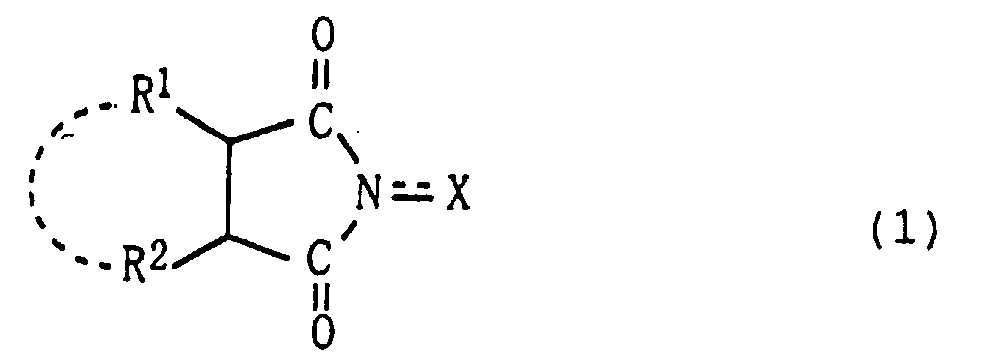
- The organic substrate may be selected from (a) aliphatic hydrocarbons, (b) alicyclic hydrocarbons, (c) non-aromatic heterocyclic compounds each having a carbon atom on a ring, which carbon atom is bonded to a hydrogen atom, (d) compounds each having a carbon-hydrogen bond at the adjacent position to an aromatic ring, and (e) compounds each having a carbon-hydrogen bond at the adjacent position to a carbonyl group.
- In a further aspect, the invention provides a process for eliminating nitrogen dioxide. The process includes the step of bringing a gas containing nitrogen dioxide into contact with an organic substrate in the presence of oxygen to eliminate the nitrogen dioxide through reaction.
- The invention provides, in yet another aspect, a process for eliminating nitrogen dioxide. This process includes the step of bringing a gas containing nitrogen dioxide into contact with an organic substrate in a proportion exceeding 1 mole relative to 1 mole of the nitrogen dioxide to thereby eliminate the nitrogen dioxide through reaction.
- In the processes for eliminating nitrogen dioxide, the gas containing nitrogen dioxide may be brought into contact with the organic substrate in the presence of the imide compound of the formula (1).
- As the organic substrate, at least one compound selected from the above compounds (a) to (e) may be used.
- In another aspect, the invention provides a system for eliminating nitrogen dioxide. The system includes an eliminating means which brings a gas containing nitrogen dioxide into contact with an organic substrate in the presence of oxygen to eliminate the nitrogen dioxide through reaction.
- In addition and advantageously, the invention provides a system for eliminating nitrogen dioxide. The system includes an eliminating means which brings a gas containing nitrogen dioxide into contact with an organic substrate in a proportion exceeding 1 mole relative to 1 mole of the nitrogen dioxide to thereby eliminate the nitrogen dioxide through reaction. Best Mode for Carrying Out the Invention
- Organic substrates for use in the invention include, but are not limited to, a wide variety of saturated and unsaturated compounds such as hydrocarbons (aliphatic hydrocarbons, alicyclic hydrocarbons, and aromatic hydrocarbons), heterocyclic compounds, alcohols, ethers, esters, ketones, and aldehydes. Each of these organic substrates can be used alone or in combination.
- Preferred organic substrates include, for example, compounds each having a non-aromatic group with a carbon-hydrogen bond. Such compounds include, for example, (a) aliphatic hydrocarbons, (b) alicyclic hydrocarbons, (c) non-aromatic heterocyclic compounds each having a carbon atom on a ring, which carbon atom is bonded to a hydrogen atom, (d) compounds each having a carbon-hydrogen bond at the adjacent position to an aromatic ring, and (e) compounds each having a carbon-hydrogen bond at the adjacent position to a carbonyl group.
- The aliphatic hydrocarbons (a) include, for example, (a1) alkanes, and (a2) alkenes and alkynes each having a carbon-hydrogen bond at the adjacent position to an unsaturated bond. Illustrative alkanes (a1) are methane, ethane, propane, butane, 2-methylpropane, pentane, 2-methylbutane, hexane, 2,3-dimethylbutane, 2-methylpentane, 3-methylpentane, heptane, 2-methylhexane, 3-methylhexane, 2,3-dimethylpentane, 2,4-dimethylpentane, 2-ethylpentane, 3-ethylpentane, octane, 2-methylheptane, 4-methylheptane, 2-ethylhexane, 2,3-dimethylhexane, 2,5-dimethylhexane, 2-propylhexane, 2,3,4-trimethylpentane, nonane, 2-methyloctane, 3-methyloctane, 2,6-dimethylheptane, 2-ethylheptane, 3-ethylheptane, decane, 2-methylnonane, 2,7-dimethyloctane, undecane, dodecane, tetradecane, hexadecane, octadecane, icosane, triacontane, and other straight- or branched-chain alkanes each having about 1 to 30 carbon atoms. Preferred alkanes include straight- or branched-chain alkanes each having about 1 to 20 carbon atoms, especially about 3 to 14 carbon atoms.
- Examples of (a2) alkenes and alkynes each having a carbon-hydrogen bond at the adjacent position to an unsaturated bond are propylene, 1-butene, 2-butene, butadiene, 1-pentene, 2-pentene, isoprene, 1-hexene, 2-hexene, 1,5-hexadiene, 2,3-dimethyl-2-butene, 3-hexene, 1-heptene, 2-heptene, 1,6-heptadiene, 1-octene, 2-octene, 3-octene, 1,7-octadiene, 2,6-octadiene, 2-methyl-2-butene, 1-nonene, 2-nonene, decene, decadiene, dodecene, dodecadiene, dodecatriene, undecene, undecadiene, undecatriene, and other straight- or branched-chain alkenes and alkanes each having about 3 to 30 carbon atoms, and preferably about 3 to 12 carbon atoms.
- The alicyclic hydrocarbons (b) include, for example, (b1) cycloalkanes, (b2) cycloalkenes, and (b3) bridged cyclic hydrocarbons.
- Such cycloalkanes (b1) include, but are not limited to, cyclopropane, cyclobutane, cyclopentane, methylcyclopentane, cyclohexane, methylcyclohexane, 1,2-dimethylcyclohexane, ethylcyclohexane, isopropylcyclohexane, cycloheptane, cyclooctane, methylcyclooctane, cyclononane, cyclodecane, cyclododecane, cyclotridecane, cyclotetradecane, cyclopentadecane, cyclohexadecane, cyclooctadecane, cyclononadecane, and other cycloalkanes each having about 3 to 30 carbon atoms, and preferably about 3 to 20 carbon atoms.
- Illustrative cycloalkenes (b2) are cyclopropene, cyclobutene, cyclopentene, cyclohexene, 1-methyl-1-cyclohexene, cycloheptene, cyclooctene, cyclononene, cyclodecene, cyclododecene, and other C3-C30 cycloalkenes; cyclopentadiene, cyclohexadiene, cycloheptadiene, cyclooctadiene, cyclodecadiene, cyclododecadiene, and other C5-C30 cycloalkadienes; cycloalkatrienes; cycloalkatetraenes; dihydronaphthalene, indene, fluorene, indan, tetralin, acenaphthene, phenalene, indanone, xanthene, and other condensed polycyclic hydrocarbons each having a 5- to 8-membered non-aromatic ring condensed to an aromatic ring.
- The bridged cyclic hydrocarbons (b3) include, but are not limited to, decalin, bicyclo[2.2.0]hexane, bicyclo[2.2.2]octane, bicyclo[3.2.1]octane, bicyclo[4.3.2]undecane, thujone, carane, pinane, pinene, bornane, bornylene, norbornane, norbornene, camphor, camphoric acid, camphene, tricyclene, tricyclo[4.3.1.12,5]undecane, tricyclo[5.2.1.03,8]decane, exotricyclo[5.2.1.02,6]decane, endotricyclo[5.2.1.02,6]decane, endotricyclo[5.2.2.02,6]undecane, adamantane, 1-adamantanol, 1-chloroadamantane, 1-methyladamantane, 1,3-dimethyladamantane, 1-methoxyadamantane, 1-carboxyadamantane, 1-methoxycarbonyladamantane, 1-nitroadamantane, tetracyclo[4.4.0.12,5.17,10]dodecane, perhydroanthracene, perhydroacenaphthene, perhydrophenanthrene, perhydrophenalene, perhydroindene, and derivatives of these compounds.
- Illustrative non-aromatic heterocyclic compounds (c) each having a carbon atom on a ring, which carbon atom is bonded to a hydrogen atom, include 5- or 6-membered heterocyclic compounds having a hetero atom selected from a nitrogen atom, an oxygen atom and a sulfur atom, and condensed heterocyclic compounds each having a 5- or 6-membered heterocyclic ring having a hetero atom bonded to an aromatic ring. Such heterocyclic rings include, but are not limited to, dihydrofuran, tetrahydrofuran, pyran, dihydropyran, tetrahydropyran, pyrrolidine, piperidine, piperazine, morpholine, indoline, chroman, and isochroman.
- The compounds (d) each having a carbon-hydrogen bond at the adjacent position to an aromatic ring include, for example, (d1) aromatic hydrocarbons each having an alkyl group on an aromatic carbocyclic ring, such as toluene, xylene, 1-ethyl-4-methylbenzene, 1-ethyl-3-methylbenzene, 1-t-butyl-4-methylbenzene, 1-methoxy-4-methylbenzene, mesitylene, durene, methylnaphthalene, methylanthracene, 4,4'-dimethylbiphenyl, ethylbenzene, propylbenzene, 1,4-diethylbenzene, and diphenylmethane; and (d2) heterocyclic compounds each having an alkyl group on an aromatic heterocyclic ring, such as 2-methylfuran, 3-methylfuran, 3-methylthiophene, 2-methylpyridine, 3-methylpyridine, 4-methylpyridine, 2,4-dimethylpyridine, 2,4,6-trimethylpyridine, 4-methylindole, 2-methylquinoline, 2-ethylfuran, 3-propylthiophene, 4-ethylpyridine, and 4-butylquinoline.
- Illustrative compounds (e) each having a carbon-hydrogen bond at the adjacent position to a carbonyl group are aldehydes, ketones, carboxylic acids and derivatives thereof.
- Such aldehydes include, for example, aliphatic aldehydes such as acetaldehyde, propionaldehyde, butyraldehyde, isobutyraldehyde, pentyl aldehyde, hexyl aldehyde, heptyl aldehyde, octyl aldehyde, nonyl aldehyde, decyl aldehyde, malonaldehyde, succinaldehyde, adipaldehyde, and sebacaldehyde; and alicyclic aldehydes such as formylcyclohexane and cycloneral.
- The ketones include aliphatic ketones, cyclic ketones, aromatic ketones, and heterocyclic ketones. Illustrative aliphatic ketones include acetone, methyl ethyl ketone, methyl isopropyl ketone, methyl isobutyl ketone, methyl t-butyl ketone, 2-pentanone, 3-pentanone, 2-hexanone, 3-hexanone, 2-heptanone, 3-heptanone, 4-heptanone, 2-octanone, 3-octanone, 4-octanone, 2-nonanone, and 2-decanone. Illustrative cyclic ketones are cyclopentanone, cyclohexanone, methylcyclohexanone, dimethylcyclohexanone, cycloheptanone, isophorone, cycloheptanone, cyclooctanone, cyclononanone, cyclodecanone, cyclohexadione, cyclooctadione, and other non-aromatic cyclic mono- or poly-ketones; α-tetralone, β-tetralone, indanone, and other cyclic ketones each having an aromatic ring; 2-adamantanone, 1-methyl-2-adamantanone, 1,3-dimethyl-6-adamantanone, menthone, and other bridged cyclic ketones. Illustrative aromatic ketones are acetophenone, and propiophenone; and illustrative heterocyclic ketones include acetylpyridine.
- Examples of the carboxylic acids and derivatives thereof include aliphatic dicarboxylic acids and derivatives thereof, such as malonic acid and its esters, succinic acid and its esters, and glutaric acid and its esters.
- Each of these organic substrates may have a substituent. Such substituents include, but are not limited to, halogen atoms, oxo group, hydroxyl group, mercapto group, substituted oxy groups (e.g., alkoxy groups, aryloxy group, and acyloxy groups), substituted thio groups, carboxyl group, substituted oxycarbonyl group, substituted or unsubstituted carbamoyl groups, cyano group, nitro group, substituted or unsubstituted amino groups, alkyl groups, alkenyl group, alkynyl groups, cycloalkyl groups, cycloalkenyl groups, aryl groups (e.g., phenyl and naphthyl groups), aralkyl groups, and heterocyclic groups.
- The nitrogen dioxide (NO2) may be a pure nitrogen dioxide or a mixture containing other components. Nitrogen dioxide formed in a reaction system can also be employed.
- The proportion of the nitrogen dioxide may be equivalent mole, or excess moles (e.g., 1 to 5 times by mole) relative to the organic substrate, or less than the equivalent mole relative to the organic substrate. The use of nitrogen dioxide in a proportion relative to 1 mole of the organic substrate of less than 4 moles, preferably less than 1 mole (e.g., 0.0001 mole or more and less than 1 mole), more preferably 0.8 mole or less (e.g., 0.001 to 0.8 mole), typically preferably 0.5 mole or less (e.g., 0.002 to 0.5 mole), and particularly 0.25 mole or less (e.g., 0.005 to 0.25 mole) markedly improves the conversion rate of nitrogen dioxide and the selectivity of the reaction. For example, when toluene or another compound having a carbon-hydrogen bond at the adjacent position (α-position) to an aromatic ring is used as the substrate and the molar ratio of nitrogen dioxide to the organic substrate (nitrogen dioxide/organic substrate) is large, large amounts of compounds having a nitro group introduced into the aromatic ring are by-produced, in addition to a compound having a nitro group introduced into the α-position of the aromatic ring. However, by setting the molar ratio at less than 4, particularly less than 1, nitration on the α-position of the aromatic ring selectively proceeds.
- When the molar ratio is set at less than 1, the conversion rate of nitrogen dioxide is markedly increased. Particularly, when nitrogen dioxide is to be eliminated from a gas containing nitrogen dioxide, more than 1 mole of the organic substrate relative to 1 mole of nitrogen dioxide is preferably used.
- If the molar ratio is set at less than 1 mole, a high conversion rate of nitrogen dioxide and a high reaction selectivity can be obtained even in the absence of oxygen.
- A reaction of the organic substrate with nitrogen dioxide in the presence of oxygen markedly increases the reaction rate. This advantage is outstanding when aliphatic hydrocarbons and/or alicyclic hydrocarbons are employed as the organic substrate.
- The oxygen for use in the invention may be a pure oxygen or a diluted oxygen diluted with an inert gas such as carbon dioxide, nitrogen, helium, or argon gas. Air can also be used as the oxygen source. The amount of oxygen is 0.5 mole or more (e.g., 1 mole or more), preferably about 1 to 100 moles, and more preferably about 2 to 50 moles relative to 1 mole of the nitrogen dioxide. Excess moles of oxygen is often used relative to the nitrogen dioxide.
- A reaction of the organic substrate with nitrogen dioxide in the presence of the imide compound of the formula (1) markedly increases the reaction rate of nitration. This advantage is outstanding when aliphatic hydrocarbons and/or alicyclic hydrocarbons are employed as the organic substrate. When toluene or another compound having a carbon-hydrogen bond at the adjacent position (α-position) to an aromatic ring is used as the substrate, nitration on the aromatic ring preferentially proceeds in the absence of the imide compound, but nitration on the α-position of the aromatic ring highly selectively proceeds in the presence of the imide compound.
- Of the substituents R1 and R2 in the imide compound of the formula (1), the halogen atom includes iodine, bromine, chlorine and fluorine atoms. The alkyl group includes, for example, methyl, ethyl, propyl, isopropyl, butyl, isobutyl, s-butyl, t-butyl, pentyl, hexyl, heptyl, octyl, decyl, and other straight- or branched-chain alkyl groups each having about 1 to 10 carbon atoms. Preferred alkyl groups are alkyl groups each having about 1 to 6 carbon atoms, and more preferably lower alkyl groups each having about 1 to 4 carbon atoms.
- The aryl group includes phenyl and naphthyl groups, for example; and illustrative cycloalkyl groups include cyclopentyl and cyclohexyl groups. Illustrative alkoxy groups are methoxy, ethoxy, propoxy, isopropoxy, butoxy, isobutoxy, t-butoxy, pentyloxy, hexyloxy, and other alkoxy groups each having about 1 to 10 carbon atoms, preferably about 1 to 6 carbon atoms, of which lower alkoxy groups each having about 1 to 4 carbon atoms are especially preferred.
- Examples of the alkoxycarbonyl group include methoxycarbonyl, ethoxycarbonyl, propoxycarbonyl, isopropoxycarbonyl, butoxycarbonyl, isobutoxycarbonyl, t-butoxycarbonyl, pentyloxycarbonyl, hexyloxycarbonyl, and other alkoxycarbonyl groups each having about 1 to 10 carbon atoms in the alkoxy moiety. Preferred alkoxycarbonyl groups are alkoxycarbonyl groups each having about 1 to 6 carbon atoms in the alkoxy moiety, of which lower alkoxycarbonyl groups each having about 1 to 4 carbon atoms in the alkoxy moiety are typically preferred.
- The illustrative acyl groups include, but are not limited to, formyl, acetyl, propionyl, butyryl, isobutyryl, valeryl, isovaleryl, pivaloyl, and other acyl groups each having about 1 to 6 carbon atoms.
- The substituents R1 and R2 may be identical to, or different from each other. The substituents R1 and R2 in the formula (1) may be combined to form a double bond, or an aromatic or non-aromatic ring. The preferred aromatic or non-aromatic ring is a 5- to 12-membered ring, and especially a 6- to 10-membered ring. The ring may be a heterocyclic ring or a condensed heterocyclic ring, but it is often a hydrocarbon ring. Such rings include, for example, non-aromatic alicyclic rings (e.g., cyclohexane ring and other cycloalkane rings which may have a substituent, cyclohexene ring and other cycloalkene rings which may have a substituent), non-aromatic bridged rings (e.g., 5-norbornene ring and other bridged hydrocarbon rings which may have a substituent), benzene ring, naphthalene ring and other aromatic rings (including condensed rings) which may have a substituent. The ring is composed of an aromatic ring in many cases. The ring may have a substituent such as an alkyl group, a haloalkyl group, a hydroxyl group, an alkoxy group, a carboxyl group, an alkoxycarbonyl group, an acyl group, a nitro group, a cyano group, an amino group, or a halogen atom.
- In the formula (1), X represents an oxygen atom or a hydroxyl group, and the bond between the nitrogen atom N and X is a single bond or a double bond.
- On the substituent R1 or R2, or on the double bond or aromatic or non-aromatic ring formed together by R1 and R2, one or two N-substituted cyclic imido groups indicated in the formula (1) may be further formed. For example, when R1 or R2 is an alkyl group having two or more carbon atoms, the N-substituted cyclic imido group may be formed together with adjacent two carbon atoms constituting the alkyl group. Likewise, when R1 and R2 are combined to form a double bond, the N-substituted cyclic imido group may be formed together with the double bond. In case that R1 and R2 are combined to form an aromatic or non-aromatic ring, the N-substituted cyclic imido group may be formed with adjacent two carbon atoms constituting the aforementioned ring.
- Preferred imide compounds include compounds of the following formulae:wherein R3 to R6 are each, identical to or different from one another, a hydrogen atom, an alkyl group, a haloalkyl group, a hydroxyl group, an alkoxy group, a carboxyl group, an alkoxycarbonyl group, an acyl group, a nitro group, a cyano group, an amino group, or a halogen atom, where adjacent groups of R3 to R6 may be combined with each other to form an aromatic or non-aromatic ring; in the formula (1f), A represents a methylene group or an oxygen atom, and R1 and R2 have the same meanings as defined above; and one or two N-substituted cyclic imido groups indicated in the formula (1c) may be further formed on the benzene ring in the formula (1c).
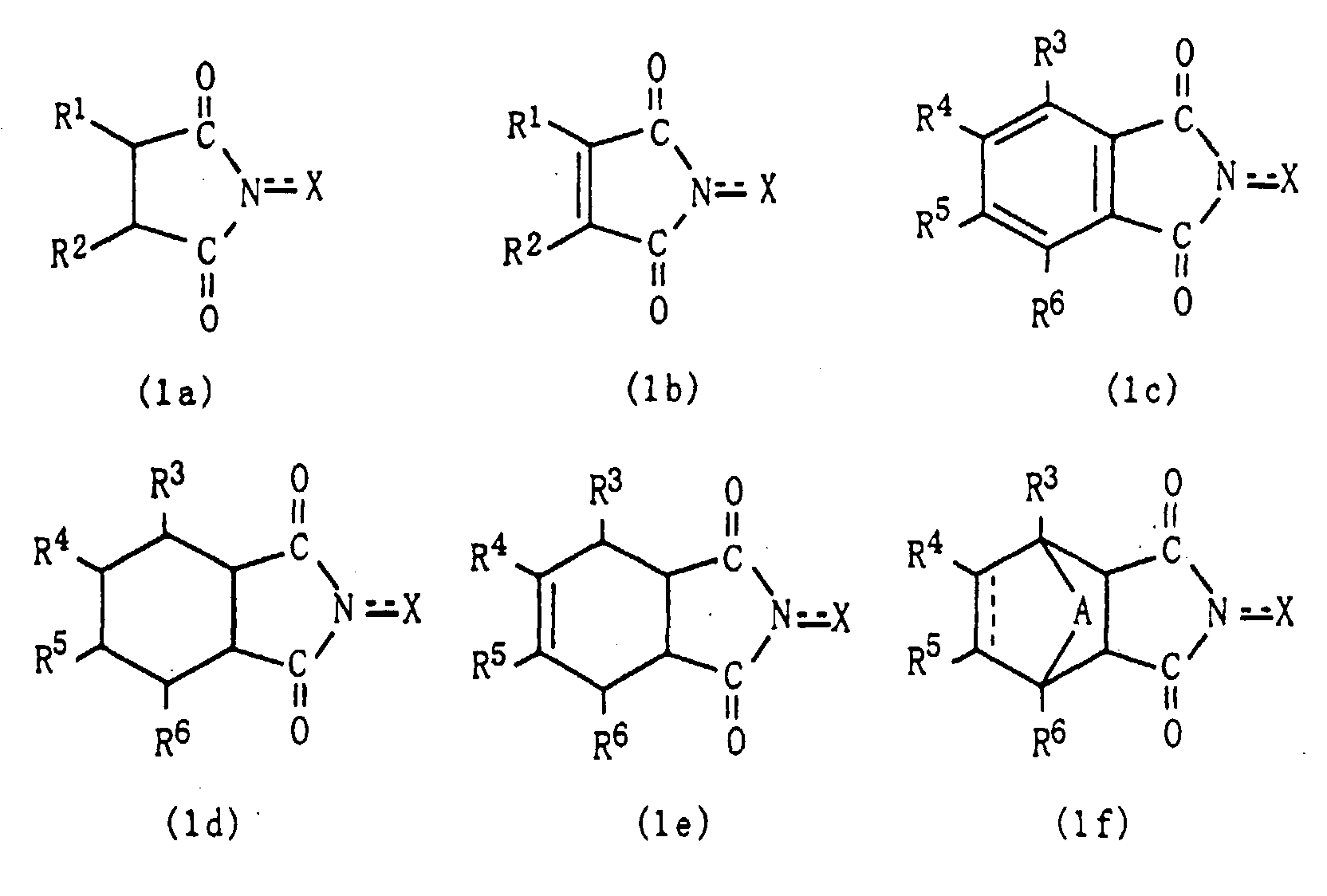
- In the substituents R3 to R6, the alkyl group includes similar alkyl groups to those exemplified above, especially alkyl groups each having about 1 to 6 carbon atoms. The haloalkyl group includes trifluoromethyl group and other haloalkyl groups each having about 1 to 4 carbon atoms, and the alkoxy group includes similar alkoxy groups to those mentioned above, and especially lower alkoxy groups each having about 1 to 4 carbon atoms. The alkoxycarbonyl group includes similar alkoxycarbonyl groups to those described above, particularly lower alkoxycarbonyl groups each having about 1 to 4 carbon atoms in the alkoxy moiety. As the acyl group, there may be mentioned similar acyl groups to those described above, especially acyl groups each having about 1 to 6 carbon atoms. Illustrative halogen atoms include fluorine, chlorine and bromine atoms. Each of the substituents R3 to R6 is often a hydrogen atom, a lower alkyl group having about 1 to 4 carbon atoms, a carboxyl group, a nitro group, or a halogen atom. The ring formed together by R3 to R6 includes similar rings to the aforementioned rings which are formed together by R1 and R2. Among them, aromatic or non-aromatic 5- to 12-membered rings are particularly preferred.
- Illustrative preferred imide compounds include N-hydroxysuccinimide, N-hydroxymaleimide, N-hydroxyhexahydrophthalimide, N,N'-dihydroxycyclohexanetetracarboximide, N-hydroxyphthalimide, N-hydroxytetrabromophthalimide, N-hydroxytetrachlorophthalimide, N-hydroxychlorendimide, N-hydroxyhimimide, N-hydroxytrimellitimide, N,N'-dihydroxypyromellitimide, and N,N'-dihydroxynaphthalenetetracarboximide.
- The imide compounds of the formula (1) can be prepared by a conventional imidation process (a process for the formation of an imide). Such imidation processes includes a process which includes the steps of allowing a corresponding acid anhydride to react with hydroxylamine NH2OH for ring-opening of an acid anhydride group, and closing the ring to form an imide.
- Such acid anhydrides include succinic anhydride, maleic anhydride, and other saturated or unsaturated aliphatic dicarboxylic anhydrides, tetrahydrophthalic anhydride, hexahydrophthalic anhydride (1,2-cyclohexanedicarboxylic anhydride), 1,2,3,4-cyclohexanetetracarboxylic 1,2-dianhydride, and other saturated or unsaturated non-aromatic cyclic polycarboxylic anhydrides (alicyclic polycarboxylic anhydrides), HET anhydride (chlorendic anhydride), himic anhydride, and other bridged cyclic polycarboxylic anhydrides (alicyclic polycarboxylic anhydrides), phthalic anhydride, tetrabromophthalic anhydride, tetrachlorophthalic anhydride nitrophthalic anhydride, trimellitic anhydride, methylcyclohexenetricarboxylic anhydride, pyromellitic anhydride, mellitic anhydride, 1,8;4,5-naphthalenetetracarboxylic dianhydride, and other aromatic polycarboxylic anhydrides.
- Typically preferred imide compounds include N-hydroxyimide compounds derived from alicyclic polycarboxylic anhydrides or aromatic polycarboxylic anhydrides, of which N-hydroxyphthalimide and other N-hydroxyimide compounds derived from aromatic polycarboxylic anhydrides are especially preferred.
- Each of the imide compounds of the formula (1) can be used alone or in combination. The imide compound can be used as being supported by a carrier or support. As such carriers, activated carbon, zeolite, silica, silica-alumina, bentonite, and other porous carries are often employed. The proportion of the imide compound to the carrier is, for example, about 0.1 to 50 parts by weight, preferably about 0.5 to 30 parts by weight, and more preferably about 1 to 20 parts by weight, relative to 100 parts by weight of the carrier.
- The amount of the imide compound can be selected in a wide range and is generally about 0.0001 to 1 mole, preferably about 0.001 to 0.5 mole, more preferably about 0.01 to 0.4 mole, and frequently about 0.05 to 0.35 mole, relative to 1 mole of either the organic substrate or the nitrogen dioxide that is used in a less amount.
- A nitration reaction can be performed in the presence of or in the absence of a solvent. Such solvents include, but are not limited to, benzene and other aromatic hydrocarbons; dichloromethane, chloroform, 1,2-dichloroethane, dichlorobenzene, and other halogenated hydrocarbons; t-butanol, t-amyl alcohol, and other alcohols; acetonitrile, benzonitrile, and other nitriles; acetic acid, propionic acid, and other organic acids; formamide, acetamide, dimethylformamide (DMF), dimethylacetamide, and other amides; and mixtures of these solvents. Excess amounts of the organic substrate to nitrogen dioxide can be used as the solvent. Such use of the organic substrate in excess amounts to nitrogen dioxide can markedly improve the conversion rate of nitrogen dioxide and the selectivity of the reaction.
- The reaction temperature can be selected according to, for example, the type of the substrate, and is usually about 0°C to 150°C, preferably about 25°C to 125°C, and more preferably about 30°C to 100°C. The reaction can be performed either at atmospheric pressures or under pressure, in any of a batch system, a semi-batch system, a continuous system, or another conventional system.
- After the completion of the reaction, reaction products can be easily separated and purified by a conventional separation and purification means. Such separation and purification means include, for example, filtration, concentration, distillation, extraction, crystallization, recrystallization, adsorption, column chromatography, and other separation means, and combinations of these separation means.
- According to the invention, the nitration reaction smoothly proceeds under mild conditions. For example, when a compound having a non-aromatic group with a carbon-hydrogen bond is used as the organic substrate, a carbon atom constituting the carbon-hydrogen bond is nitrated.
- Particularly, the invention can achieve smooth nitration of not only compounds with an active hydrogen, such as compounds having a carbon-hydrogen bond at the adjacent position to an aromatic ring or carbonyl group, but also hexane and other aliphatic hydrocarbons, and cyclohexane and other alicyclic hydrocarbons. This significantly distinguishes the invention from conventional equivalents.
- The degrees of ease of introducing nitro group are methine carbon atom > methylene carbon atom > methyl carbon atom. When a compound (e.g., toluene) having a methyl group at the adjacent position (so-called benzyl position) to an aromatic ring is used as the substrate, a nitro group is introduced into a carbon atom of the methyl group. Depending on conditions, however, a corresponding aromatic aldehyde (e.g., benzaldehyde) in which the methyl group is converted into a formyl group, or a compound with a nitro group introduced into the aromatic ring is formed. When a compound (e.g., ethylbenzene) having a methylene group at the adjacent position to an aromatic ring is employed as the substrate, a corresponding nitro compound (e.g., α-nitroethylbenzene), in which the methylene group is nitrated, is formed, and under some reaction conditions, an oxime compound (e.g., acetophenone oxime), in which the methylene group is converted into an oxime moiety, is formed.
- The invention has features in that (i) by existing oxygen, the reaction rate can be markedly increased, and (ii) by using excess amounts of the organic substrate to nitrogen dioxide, the nitrogen dioxide can be highly efficiently converted and the reaction selectivity can be markedly improved. Accordingly, the use of the above nitration reactions can efficiently eliminate nitrogen dioxide from a nitrogen dioxide-containing gas.
- Such nitrogen dioxide-containing gases for use in the invented process and system for eliminating nitrogen dioxide are not limited as far as gases contain nitrogen dioxide. For example, exhaust gases of factories, and exhaust gases of cars can be employed. As the organic substrate, any of the above-exemplified compounds can be employed, but compounds which are low-cost, have a high reactivity, and are easy to be treated in an aftertreatment are preferred. Such compounds include alkanes and other aliphatic hydrocarbons, and cycloalkanes and other alicyclic hydrocarbons. Each of the organic substrates may be used alone or in combination.
- The means for eliminating nitrogen dioxide in the invented system can be composed of, for example, a vessel containing a mixture of the organic substrate and, where necessary, the imide compound of the formula (1), a nitrogen dioxide-containing gas inlet line for introducing the nitrogen dioxide-containing gas into the vessel, and where necessary, an oxygen supply line for supplying oxygen, and an exhaust gas line for discharging an exhaust gas from the vessel. The imide compound can be supported on a carrier, as mentioned above. The organic substrate may be gaseous. The elimination of nitrogen dioxide can be performed in any of a batch system, a semi-batch system and a continuous system.
- The concentration of the imide compound in the mixture can be selected within an appropriate range in consideration of the efficiency of eliminating nitrogen dioxide, and is for example about 0.001 to 2 mole/L, preferably about 0.01 to 1 mole/L, and more preferably about 0.05 to 0.3 mole/L. The mixture may contain an inert solvent. The proportion of oxygen to be supplied is, for example, equal to or more than 1 time by mole that of the nitrogen dioxide. The temperatures and pressures for the contact of the nitrogen dioxide-containing gas with the organic substrate are the same as mentioned above.
- According to the invented process and system for eliminating nitrogen dioxide, nitrogen dioxide in the nitrogen dioxide-containing gas can be smoothly reacted with the organic substrate under mild conditions and the nitrogen dioxide can be efficiently eliminated from the gas.
- The product nitro compounds obtained by the invented production processes can be used as raw materials for pharmaceuticals, agricultural chemicals, dyestuffs, solvents, and explosives, and materials for amino compounds. For example, a lactam compound can be obtained by nitrating an alicyclic hydrocarbon to yield a nitro compound, reducing the nitro compound in a conventional manner to yield a corresponding oxime compound, and subjecting the oxime compound to Beckmann rearrangement to yield a corresponding lactam compound.
- Product compounds formed through the reaction of the organic substrate with nitrogen dioxide in the invented process for eliminating nitrogen dioxide can be used as raw materials for the pharmaceuticals and the like. Alternatively, some product compounds may be subjected to, where necessary, reduction or another treatment, and to a conventional waste treatment such as activated sludge treatment.
- The invented processes for producing a nitro compound reacts an organic substrate with nitrogen dioxide under specific conditions and can directly and efficiently nitrate the substrate even under relatively mild conditions to yield a corresponding nitro compound in a high yield. The invented processes can easily nitrate even alkanes and other aliphatic hydrocarbons or cycloalkanes and other alicyclic hydrocarbons under mild conditions.
- The invented process and system for eliminating nitrogen dioxide allow nitrogen dioxide in a nitrogen dioxide-containing gas to smoothly react with an organic substrate under mild conditions and can efficiently eliminate the nitrogen dioxide from the gas. The process and system are markedly useful for inhibiting environmental pollution by nitrogen dioxide.
- The present invention will now be illustrated in more detail with reference to several examples below, which are not intended limiting the scope of the invention.
- In a flask, 5 ml (46.3 mmol) of cyclohexane, 0.6 mmol of N-hydroxyphthalimide, and 0.1 ml (3.24 mmol) of nitrogen dioxide were placed and the resulting mixture was reacted at 70°C in an air atmosphere (1 atm) for 14 hours with stirring. A gas chromatographic analysis of reaction products revealed that nitrocyclohexane and cyclohexyl nitrate were formed in yields of 75% and 11%, respectively on the basis of nitrogen dioxide.
- In a flask, 3 mmol of cyclohexane, 0.3 mmol of N-hydroxyphthalimide, 15 mmol of nitrogen dioxide, and 5 ml of trifluoromethylbenzene were placed, and the resulting mixture was reacted at 60°C in an oxygen atmosphere (1 atm) for 5 hours with stirring. A gas chromatographic analysis of reaction products revealed that nitrocyclohexane and cyclohexanol were formed in yields of 4.6% and 0.42%, respectively on the basis of cyclohexane. The conversion rate from cyclohexane was 40%.
- In a flask, 3.2 mmol of cyclododecane, 0.6 mmol of N-hydroxyphthalimide, and 0.1 ml (3.24 mmol) of nitrogen dioxide were placed, and the resulting mixture was reacted at 70°C in an air atmosphere (1 atm) for 14 hours with stirring. A gas chromatographic analysis of reaction products revealed that nitrocyclododecane and cyclododecanone were formed in yields of 34% and 11%, respectively on the basis of cyclododecane.
- In a flask, 5 ml (41.3 mmol) of cycloheptane, 0.6 mmol of N-hydroxyphthalimide, and 0.1 ml (3.24 mmol) of nitrogen dioxide were placed, and the resulting mixture was reacted at 70°C in an air atmosphere (1 atm) for 14 hours with stirring. A gas chromatographic analysis of reaction products revealed that nitrocycloheptane and cycloheptyl nitrate were formed in yields of 88% and 4%, respectively on the basis of nitrogen dioxide.
- In a flask, 5 ml (41.3 mmol) of cycloheptane and 0.1 ml (3.24 mmol) of nitrogen dioxide were placed, and the resulting mixture was reacted at 70°C in an air atmosphere (1 atm) for 14 hours with stirring. A gas chromatographic analysis of reaction products revealed that nitrocycloheptane and cycloheptyl nitrate were formed in yields of 50% and 13%, respectively on the basis of nitrogen dioxide.
- In a flask, 5 ml (35.2 mmol) of methylcyclohexane, 0.6 mmol of N-hydroxyphthalimide, and 0.1 ml (3.24 mmol) of nitrogen dioxide were placed, and the resulting mixture was reacted at 70°C in an air atmosphere (1 atm) for 14 hours with stirring. A gas chromatographic analysis of reaction products revealed that 1-methyl-1-nitrocyclohexane and 1-methylcyclohexyl nitrate were formed in yields of 68% and 5%, respectively on the basis of nitrogen dioxide.
- In a flask, 5 ml (35.2 mmol) of methylcyclohexane and 0.1 ml (3.24 mmol) of nitrogen dioxide were placed, and the resulting mixture was reacted at 70°C in an air atmosphere (1 atm) for 14 hours with stirring. A gas chromatographic analysis of reaction products revealed that 1-methyl-1-nitrocyclohexane and 1-methylcyclohexyl nitrate were formed in yields of 17% and 5%, respectively on the basis of nitrogen dioxide.
- In a flask, 1 mmol of adamantane, 15 mmol of nitrogen dioxide, 0.1 mmol of N-hydroxyphthalimide, and 3 ml of trifluoromethylbenzene were placed, and the resulting mixture was reacted at 60°C in an oxygen atmosphere (1 atm) for 5 hours with stirring. A gas chromatographic analysis of reaction products revealed that 1-nitroadamantane in a yield of 66% (on the basis of adamantane), 1-adamantanol in a yield of 4% (on the basis of adamantane), 2-adamantanone in a yield of 4%, 1,3-dinitroadamantane in a yield of 2% (on the basis of adamantane), 3-adamant-1-yl nitrate in a yield of 4% (on the basis of adamantane) were formed. The conversion rate from adamantane was 94%.
- In a flask, 1 mmol of 1,3-dimethyladamantane, 15 mmol of nitrogen dioxide, 0.1 mmol of N-hydroxyphthalimide, and 3 ml of trifluoromethylbenzene were placed, and the resulting mixture was reacted at 60°C in an oxygen atmosphere (1 atm) for 5 hours with stirring. A gas chromatographic analysis of reaction products revealed that 1,3-dimethyl-5-nitroadamantane was formed in a yield of 60% on the basis of 1,3-dimethyladamantane. The conversion rate from 1,3-dimethyladamantane was 82%.
- In a flask, 1 mmol of ethyl 1-adamantanecarboxylate, 15 mmol of nitrogen dioxide, 0.1 mmol of N-hydroxyphthalimide, and 3 ml of trifluoromethylbenzene were placed, and the resulting mixture was reacted at 60°C in an oxygen atmosphere (1 atm) for 15 hours with stirring. A gas chromatographic analysis of reaction products revealed that ethyl 3-nitro-1-adamantanecarboxylate was formed in a yield of 70% on the basis of ethyl 1-adamantanecarboxylate. The conversion rate from ethyl 1-adamantanecarboxylate was 99% or more.
- In a flask, 5 ml (38.4 mmol) of hexane, 0.6 mmol of N-hydroxyphthalimide, and 0.1 ml (3.24 mmol) of nitrogen dioxide were placed, and the resulting mixture was reacted at 70°C in an air atmosphere (1 atm) for 14 hours with stirring. A gas chromatographic analysis of reaction products revealed that nitrohexanes and hexyl nitrate were formed in yields of 55% and 26%, respectively on the basis of nitrogen dioxide. The ratio of 2-nitrohexane to 3-nitrohexane [2-nitrohexane/3-nitrohexane] was 55/45.
- In a flask, 2.5 ml (23.2 mmol) of cyclohexane, 2.5 ml (19.2 mmol) of hexane, 0.6 mmol of N-hydroxyphthalimide, and 0.1 ml (3.24 mmol) of nitrogen dioxide were placed, and the resulting mixture was reacted at 70°C in an air atmosphere (1 atm) for 14 hours with stirring. A gas chromatographic analysis of reaction products revealed that nitrocyclohexane, nitrohexanes, cyclohexyl nitrate, and hexyl nitrate were formed in yields of 39%, 19%, 5.6%, and 4%, respectively on the basis of nitrogen dioxide. The ratio of 2-nitrohexane to 3-nitrohexane [2-nitrohexane/3-nitrohexane] was 55/45.
- In a flask, 1 mmol of toluene, 15 mmol of nitrogen dioxide, and 3 ml of trifluoromethylbenzene were placed, and the resulting mixture was reacted at 60°C in an oxygen atmosphere (1 atm) for 5 hours with stirring. A gas chromatographic analysis of reaction products revealed that nitromethylbenzene (α-nitrotoluene) in a yield of 2% (on the basis of toluene), o-nitrotoluene in a yield of 51% (on the basis of toluene), m-nitrotoluene in a yield of 3%, and p-nitrotoluene in a yield of 34% were respectively formed. The conversion rate from toluene was 100%.
- In a flask, 1 mmol of toluene, 15 mmol of nitrogen dioxide, and 3 ml of trifluoromethylbenzene were placed, and the resulting mixture was reacted at 60°C in an argon atmosphere (1 atm) for 5 hours with stirring. A gas chromatographic analysis of reaction products revealed that nitromethylbenzene (α-nitrotoluene) in a yield of 3% (on the basis of toluene), o-nitrotoluene in a yield of 5% (on the basis of toluene), m-nitrotoluene in a yield of 1%, and p-nitrotoluene in a yield of 4% were respectively formed. The conversion rate from toluene was 37%.
- In a flask, 1 mmol of toluene, 0.1 mmol of N-hydroxyphthalimide, 15 mmol of nitrogen dioxide, and 3 ml of trifluoromethylbenzene were placed, and the resulting mixture was reacted at 60°C in an oxygen atmosphere (1 atm) for 5 hours with stirring. A gas chromatographic analysis of reaction products revealed that nitromethylbenzene (α-nitrotoluene) in a yield of 19% (on the basis of toluene), o-nitrotoluene in a yield of 36% (on the basis of toluene), m-nitrotoluene in a yield of 2%, and p-nitrotoluene in a yield of 18% were respectively formed. The conversion rate from toluene was 99%.
- In a flask, 1 mmol of toluene, 0.1 mmol of N-hydroxyphthalimide, 3 mmol of nitrogen dioxide, and 3 ml of trifluoromethylbenzene were placed, and the resulting mixture was reacted at 60°C in an oxygen atmosphere (1 atm) for 5 hours with stirring. A gas chromatographic analysis of reaction products revealed that nitromethylbenzene (α-nitrotoluene) in a yield of 30% (on the basis of toluene), o-nitrotoluene in a yield of 18% (on the basis of toluene), m-nitrotoluene in a yield of 1%, and p-nitrotoluene in a yield of 3% were respectively formed. The conversion rate from toluene was 99% or more.
- In a flask, 5 ml (46.9 mmol) of toluene, 0.6 mmol of N-hydroxyphthalimide, and 0.1 ml (3.24 mmol) of nitrogen dioxide were placed, and the resulting mixture was reacted at 70°C in an air atmosphere (1 atm) for 14 hours with stirring. A gas chromatographic analysis of reaction products revealed that nitromethylbenzene (α-nitrotoluene) was formed in a yield of 52% on the basis of nitrogen dioxide and that 0.92 mmol of benzaldehyde was formed.
- In a flask, 5 ml (46.9 mmol) of toluene, and 0.1 ml (3.24 mmol) of nitrogen dioxide were placed, and the resulting mixture was reacted at 70°C in an air atmosphere (1 atm) for 14 hours with stirring. A gas chromatographic analysis of reaction products revealed that nitromethylbenzene (α-nitrotoluene) was formed in a yield of 50% on the basis of nitrogen dioxide and that 0.44 mmol of benzaldehyde was formed.
- In a flask, 5 ml (40.9 mmol) of ethylbenzene, 0.6 mmol of N-hydroxyphthalimide, and 0.1 ml (3.24 mmol) of nitrogen dioxide were placed, and the resulting mixture was reacted at 70°C in an air atmosphere (1 atm) for 14 hours with stirring. A gas chromatographic analysis of reaction products revealed that α-nitroethylbenzene and acetophenone oxime were formed in yields of 42% (on the basis of nitrogen dioxide) and 12%, respectively, and that 1.9 mmol of benzaldehyde and 1.2 mmol of α-hydroxyethylbenzene were formed.
- In a flask, 5 ml (40.9 mmol) of ethylbenzene and 0.1 ml (3.24 mmol) of nitrogen dioxide were placed, and the resulting mixture was reacted at 70°C in an air atmosphere (1 atm) for 14 hours with stirring. A gas chromatographic analysis of reaction products revealed that α-nitroethylbenzene was formed in a yield of 72% (on the basis of nitrogen dioxide) and that 1.4 mmol of benzaldehyde and 1.1 mmol of α-hydroxyethylbenzene were formed.
- In a flask, 5 ml (36.9 mmol) of p-t-butyltoluene, 0.6 mmol of N-hydroxyphthalimide, and 0.1 ml (3.24 mmol) of nitrogen dioxide were placed, and the resulting mixture was reacted at 70°C in an air atmosphere (1 atm) for 14 hours with stirring. A gas chromatographic analysis of reaction products revealed that 1-t-butyl-4-nitromethylbenzene was formed in a yield of 55% on the basis of nitrogen dioxide, and that 1.0 mmol of p-t-butylbenzaldehyde and 0.44 mmol of p-t-butylbenzyl alcohol were formed.
- In a flask, 5 ml (36.9 mmol) of p-t-butyltoluene and 0.1 ml (3.24 mmol) of nitrogen dioxide were placed, and the resulting mixture was reacted at 70°C in an air atmosphere (1 atm) for 14 hours with stirring. A gas chromatographic analysis of reaction products revealed that 1-t-butyl-4-nitromethylbenzene was formed in a yield of 63% on the basis of nitrogen dioxide. Separately, 0.5 mmol of p-t-butylbenzaldehyde and 0.53 mmol of p-t-butylbenzyl alcohol were formed.
- In a flask, 3.2 mmol of durene, 0.6 mmol of N-hydroxyphthalimide, and 0.1 ml (3.24 mmol) of nitrogen dioxide were placed, and the resulting mixture was reacted at 70°C in an air atmosphere (1 atm) for 14 hours with stirring. A gas chromatographic analysis of reaction products revealed that 2,4,5-trimethyl-1-nitromethylbenzene, 2,4,5-trimethylbenzaldehyde, and 2,4,5-trimethylbenzoic acid were formed in yields of 30%, 9%, and 26%, respectively on the basis of durene.
- In a flask, 3.2 mmol of durene and 0.1 ml (3.24 mmol) of nitrogen dioxide were placed, and the resulting mixture was reacted at 70°C in an air atmosphere (1 atm) for 14 hours with stirring. A gas chromatographic analysis of reaction products revealed that 2,4,5-trimethyl-1-nitromethylbenzene and 2,4,5-trimethylbenzaldehyde were formed in yields of 28% and 8%, respectively on the basis of durene. Separately, a trace amount of 2,4,5-trimethylbenzoic acid was formed.
Claims (10)
- A process for producing a nitro compound, said comprising the step of reacting nitrogen dioxide with an organic substrate in the presence of oxygen to yield a corresponding nitro compound.
- A process for producing a nitro compound, said comprising the step of reacting nitrogen dioxide with an organic substrate in a molar ratio of said nitrogen dioxide to said organic substrate of less than 1 to yield a corresponding nitro compound.
- A process according one of claims 1 and 2, wherein nitrogen dioxide is reacted with the organic substrate in the presence of an imide compound of the following formula (1):wherein each of R1 and R2 is, identical to or different from each other, a hydrogen atom, a halogen atom, an alkyl group, an aryl group, a cycloalkyl group, a hydroxyl group, an alkoxy group, a carboxyl group, an alkoxycarbonyl group, or an acyl group, where R1 and R2 may be combined to form a double bond, or an aromatic or non-aromatic ring; X is an oxygen atom or a hydroxyl group, where one or two N-substituted cyclic imido groups indicated in the formula (1) may be further formed on said R1 or R2, or on said double bond or aromatic or non-aromatic ring formed together by R1 and R2.

- A process according to one of claims 1, 2 and 3, wherein said organic substrate is a compound selected from the group consisting of (a) aliphatic hydrocarbons, (b) alicyclic hydrocarbons, (c) non-aromatic heterocyclic compounds each having a carbon atom on a ring, said carbon atom being bonded to a hydrogen atom, (d) compounds each having a carbon-hydrogen bond at the adjacent position to an aromatic ring, and (e) compounds each having a carbon-hydrogen bond at the adjacent position to a carbonyl group.
- A process for eliminating nitrogen dioxide, said process comprising the step of bringing a gas containing nitrogen dioxide into contact with an organic substrate in the presence of oxygen to eliminate the nitrogen dioxide through reaction.
- A process for eliminating nitrogen dioxide, said process comprising the step of bringing a gas containing nitrogen dioxide into contact with an organic substrate in a proportion exceeding 1 mole relative to 1 mole of the nitrogen dioxide to eliminate the nitrogen dioxide through reaction.
- A process according to one of claims 5 and 6, wherein the gas containing nitrogen dioxide is made into contact with the organic substrate in the presence of an imide compound of the following formula (1):wherein each of R1 and R2 is, identical to or different from each other, a hydrogen atom, a halogen atom, an alkyl group, an aryl group, a cycloalkyl group, a hydroxyl group, an alkoxy group, a carboxyl group, an alkoxycarbonyl group, or an acyl group, where R1 and R2 may be combined to form a double bond, or an aromatic or non-aromatic ring; X is an oxygen atom or a hydroxyl group, where one or two N-substituted cyclic imido groups indicated in the formula (1) may be further formed on said R1 or R2, or on said double bond or aromatic or non-aromatic ring formed together by R1 and R2.

- A process according to one of claims 5, 6 and 7, wherein said organic substrate is at least one compound selected from the group consisting of (a) aliphatic hydrocarbons, (b) alicyclic hydrocarbons, (c) non-aromatic heterocyclic compounds each having a carbon atom on a ring, said carbon atom being bonded to a hydrogen atom, (d) compounds each having a carbon-hydrogen bond at the adjacent position to an aromatic ring, and (e) compounds each having a carbon-hydrogen bond at the adjacent position to a carbonyl group.
- A system for eliminating nitrogen dioxide, said system comprising eliminating means which brings a gas containing nitrogen dioxide into contact with an organic substrate in the presence of oxygen to eliminate the nitrogen dioxide through reaction.
- A system for eliminating nitrogen dioxide, said system comprising eliminating means which brings a gas containing nitrogen dioxide into contact with an organic substrate in a proportion exceeding 1 mole relative to 1 mole of the nitrogen dioxide to eliminate the nitrogen dioxide through reaction.
Applications Claiming Priority (3)
| Application Number | Priority Date | Filing Date | Title |
|---|---|---|---|
| JP13633999 | 1999-05-17 | ||
| JP13633999A JP4685996B2 (en) | 1999-05-17 | 1999-05-17 | Method for producing nitro compound and method for removing nitrogen dioxide |
| PCT/JP2000/003112 WO2000069803A1 (en) | 1999-05-17 | 2000-05-16 | Process for the preparation of nitro compounds and method for the removal of nitrogen dioxide |
Publications (1)
| Publication Number | Publication Date |
|---|---|
| EP1099684A1 true EP1099684A1 (en) | 2001-05-16 |
Family
ID=15172906
Family Applications (1)
| Application Number | Title | Priority Date | Filing Date |
|---|---|---|---|
| EP00927772A Withdrawn EP1099684A1 (en) | 1999-05-17 | 2000-05-16 | Process for the preparation of nitro compounds and method for the removal of nitrogen dioxide |
Country Status (6)
| Country | Link |
|---|---|
| EP (1) | EP1099684A1 (en) |
| JP (1) | JP4685996B2 (en) |
| KR (1) | KR20010071919A (en) |
| CN (1) | CN1304398A (en) |
| ID (1) | ID28884A (en) |
| WO (1) | WO2000069803A1 (en) |
Cited By (1)
| Publication number | Priority date | Publication date | Assignee | Title |
|---|---|---|---|---|
| WO2014202031A1 (en) * | 2013-06-21 | 2014-12-24 | 湘潭大学 | Method for co-production of adipic acid and nitrocyclohexane |
Families Citing this family (7)
| Publication number | Priority date | Publication date | Assignee | Title |
|---|---|---|---|---|
| EP1238704B1 (en) * | 2001-03-09 | 2015-01-21 | Daicel Chemical Industries, Ltd. | Catalyst comprising a cyclic imide compound and process for producing organic compounds using the catalyst |
| RU2258062C1 (en) * | 2004-03-01 | 2005-08-10 | ЗАО "Нитрометан" | Method for preparing nitromethane |
| US7992781B2 (en) | 2009-12-16 | 2011-08-09 | Visa International Service Association | Merchant alerts incorporating receipt data |
| CN110772946B (en) * | 2019-10-25 | 2022-04-29 | 攀钢集团攀枝花钢铁研究院有限公司 | Low-temperature flue gas treatment method |
| CN110772944B (en) * | 2019-10-25 | 2022-04-22 | 攀钢集团攀枝花钢铁研究院有限公司 | A kind of treatment method of low temperature flue gas |
| CN111013358B (en) * | 2019-12-26 | 2021-11-23 | 佛山科学技术学院 | Efficient dry-process denitration initiator and preparation method thereof |
| CN114685279A (en) * | 2020-12-25 | 2022-07-01 | 南京理工大学 | Preparation method of short-chain nitroalkane |
Family Cites Families (9)
| Publication number | Priority date | Publication date | Assignee | Title |
|---|---|---|---|---|
| JPS51133182A (en) * | 1975-05-15 | 1976-11-18 | Kanegafuchi Chem Ind Co Ltd | A process for removal of nitrogen compounds in nitrogen-oxide absorbed solution |
| JPS52116427A (en) * | 1976-03-27 | 1977-09-29 | Kougai Boushi Chiyousa Kenkiyu | Preparation of nitrobenzole |
| EP0146203A3 (en) * | 1983-12-19 | 1986-03-12 | W.R. Grace & Co.-Conn. | Preparation of nitro compounds by vapor phase nitration of oxygenated hydrocarbons |
| EP0174600B1 (en) * | 1984-09-12 | 1988-03-09 | W.R. Grace & Co. | Preparation of nitro compounds by vapor phase nitration of olefins |
| JPH04272720A (en) * | 1991-02-28 | 1992-09-29 | Toshiba Home Techno Kk | Rice cooker |
| JPH06134257A (en) * | 1991-08-26 | 1994-05-17 | Takashi Yamamoto | Method and device for treating exhaust gas of large capacity combustion apparatus |
| JPH09155152A (en) * | 1995-12-04 | 1997-06-17 | Matsushita Electric Ind Co Ltd | Nitrogen oxide removing method and nitrogen oxide removing apparatus |
| DE69706952T2 (en) * | 1996-12-27 | 2002-03-28 | Daicel Chemical Industries, Ltd. | Process for the preparation of nitro compounds |
| EP0915077B1 (en) * | 1997-05-23 | 2004-11-17 | Daicel Chemical Industries, Ltd. | Polymerizable adamantane derivatives and process for producing the same |
-
1999
- 1999-05-17 JP JP13633999A patent/JP4685996B2/en not_active Expired - Fee Related
-
2000
- 2000-05-16 KR KR1020017000651A patent/KR20010071919A/en not_active Withdrawn
- 2000-05-16 ID IDW20010078A patent/ID28884A/en unknown
- 2000-05-16 CN CN00800851A patent/CN1304398A/en active Pending
- 2000-05-16 WO PCT/JP2000/003112 patent/WO2000069803A1/en not_active Ceased
- 2000-05-16 EP EP00927772A patent/EP1099684A1/en not_active Withdrawn
Non-Patent Citations (1)
| Title |
|---|
| See references of WO0069803A1 * |
Cited By (1)
| Publication number | Priority date | Publication date | Assignee | Title |
|---|---|---|---|---|
| WO2014202031A1 (en) * | 2013-06-21 | 2014-12-24 | 湘潭大学 | Method for co-production of adipic acid and nitrocyclohexane |
Also Published As
| Publication number | Publication date |
|---|---|
| JP4685996B2 (en) | 2011-05-18 |
| JP2000327635A (en) | 2000-11-28 |
| WO2000069803A1 (en) | 2000-11-23 |
| KR20010071919A (en) | 2001-07-31 |
| ID28884A (en) | 2001-07-12 |
| CN1304398A (en) | 2001-07-18 |
Similar Documents
| Publication | Publication Date | Title |
|---|---|---|
| US5981420A (en) | Oxidation catalytic system and oxidation process | |
| EP1459804B1 (en) | Catalysts comprising cyclic acylurea compounds and oxidation and nitration reactions of organic compounds in the presence of the same | |
| KR20020016816A (en) | Process for Separating Imide Compounds | |
| JP4685996B2 (en) | Method for producing nitro compound and method for removing nitrogen dioxide | |
| US6515171B1 (en) | Process for separating an oxidation reaction product and an oxidation catalyst | |
| EP0897747B1 (en) | Nitration or carboxylation catalysts | |
| US6232258B1 (en) | Oxygenation catalyst and process for producing a ketone using the same | |
| EP2116303A1 (en) | Immobilized cyclic imide catalyst and process for oxidation of organic compounds with the same | |
| US6939993B2 (en) | Method for separation of reaction products from catalysts | |
| JP4167310B2 (en) | Regeneration method of imide catalyst and production process using imide catalyst | |
| US6143924A (en) | Process for producing organic sulfur acids or salts thereof | |
| JP4039730B2 (en) | Oxidation catalyst system and oxidation method using the same | |
| EP3023407A1 (en) | Method for producing oxide | |
| EP0850915B1 (en) | Method for producing nitro compounds | |
| EP1164131B1 (en) | Process for producing organic compounds by catalysis of imide compounds | |
| JP4046402B2 (en) | Oxidation catalyst system and oxidation method using the same | |
| JP4700778B2 (en) | Lactam production method | |
| EP1188743B1 (en) | Process for preparing organic sulfur acids or salts thereof | |
| JP3989070B2 (en) | Process for producing nitro compounds | |
| JP2002226404A (en) | Method for producing organic compound using imide compound and nitrogen oxide as catalyst |
Legal Events
| Date | Code | Title | Description |
|---|---|---|---|
| PUAI | Public reference made under article 153(3) epc to a published international application that has entered the european phase |
Free format text: ORIGINAL CODE: 0009012 |
|
| AK | Designated contracting states |
Kind code of ref document: A1 Designated state(s): DE FR GB |
|
| 17P | Request for examination filed |
Effective date: 20010516 |
|
| STAA | Information on the status of an ep patent application or granted ep patent |
Free format text: STATUS: THE APPLICATION IS DEEMED TO BE WITHDRAWN |
|
| 18D | Application deemed to be withdrawn |
Effective date: 20021201 |