EP1098950B1 - Procede d'utilisation de boues de forage biodegradables - Google Patents
Procede d'utilisation de boues de forage biodegradables Download PDFInfo
- Publication number
- EP1098950B1 EP1098950B1 EP99932920A EP99932920A EP1098950B1 EP 1098950 B1 EP1098950 B1 EP 1098950B1 EP 99932920 A EP99932920 A EP 99932920A EP 99932920 A EP99932920 A EP 99932920A EP 1098950 B1 EP1098950 B1 EP 1098950B1
- Authority
- EP
- European Patent Office
- Prior art keywords
- oil
- process according
- oils
- triglycerides
- chosen
- Prior art date
- Legal status (The legal status is an assumption and is not a legal conclusion. Google has not performed a legal analysis and makes no representation as to the accuracy of the status listed.)
- Expired - Lifetime
Links
- 238000005553 drilling Methods 0.000 title claims description 31
- 238000000034 method Methods 0.000 title claims description 29
- 239000012530 fluid Substances 0.000 title description 2
- 239000003921 oil Substances 0.000 claims description 59
- 235000019198 oils Nutrition 0.000 claims description 59
- 239000010802 sludge Substances 0.000 claims description 36
- 230000008569 process Effects 0.000 claims description 22
- 150000003626 triacylglycerols Chemical class 0.000 claims description 22
- 150000002148 esters Chemical class 0.000 claims description 19
- ZQPPMHVWECSIRJ-KTKRTIGZSA-N oleic acid Chemical compound CCCCCCCC\C=C/CCCCCCCC(O)=O ZQPPMHVWECSIRJ-KTKRTIGZSA-N 0.000 claims description 18
- 239000003085 diluting agent Substances 0.000 claims description 16
- 238000005520 cutting process Methods 0.000 claims description 14
- 239000000839 emulsion Substances 0.000 claims description 14
- XLYOFNOQVPJJNP-UHFFFAOYSA-N water Substances O XLYOFNOQVPJJNP-UHFFFAOYSA-N 0.000 claims description 14
- 241001465754 Metazoa Species 0.000 claims description 12
- 125000004432 carbon atom Chemical group C* 0.000 claims description 12
- 229920006395 saturated elastomer Polymers 0.000 claims description 12
- KFZMGEQAYNKOFK-UHFFFAOYSA-N Isopropanol Chemical compound CC(C)O KFZMGEQAYNKOFK-UHFFFAOYSA-N 0.000 claims description 8
- 235000019486 Sunflower oil Nutrition 0.000 claims description 8
- 239000010775 animal oil Substances 0.000 claims description 8
- 239000002600 sunflower oil Substances 0.000 claims description 8
- 244000060011 Cocos nucifera Species 0.000 claims description 7
- 235000013162 Cocos nucifera Nutrition 0.000 claims description 7
- 239000004359 castor oil Substances 0.000 claims description 7
- 235000019438 castor oil Nutrition 0.000 claims description 7
- ZEMPKEQAKRGZGQ-XOQCFJPHSA-N glycerol triricinoleate Natural products CCCCCC[C@@H](O)CC=CCCCCCCCC(=O)OC[C@@H](COC(=O)CCCCCCCC=CC[C@@H](O)CCCCCC)OC(=O)CCCCCCCC=CC[C@H](O)CCCCCC ZEMPKEQAKRGZGQ-XOQCFJPHSA-N 0.000 claims description 7
- WRIDQFICGBMAFQ-UHFFFAOYSA-N (E)-8-Octadecenoic acid Natural products CCCCCCCCCC=CCCCCCCC(O)=O WRIDQFICGBMAFQ-UHFFFAOYSA-N 0.000 claims description 6
- LQJBNNIYVWPHFW-UHFFFAOYSA-N 20:1omega9c fatty acid Natural products CCCCCCCCCCC=CCCCCCCCC(O)=O LQJBNNIYVWPHFW-UHFFFAOYSA-N 0.000 claims description 6
- QSBYPNXLFMSGKH-UHFFFAOYSA-N 9-Heptadecensaeure Natural products CCCCCCCC=CCCCCCCCC(O)=O QSBYPNXLFMSGKH-UHFFFAOYSA-N 0.000 claims description 6
- OKKJLVBELUTLKV-UHFFFAOYSA-N Methanol Chemical compound OC OKKJLVBELUTLKV-UHFFFAOYSA-N 0.000 claims description 6
- 239000005642 Oleic acid Substances 0.000 claims description 6
- ZQPPMHVWECSIRJ-UHFFFAOYSA-N Oleic acid Natural products CCCCCCCCC=CCCCCCCCC(O)=O ZQPPMHVWECSIRJ-UHFFFAOYSA-N 0.000 claims description 6
- 230000007062 hydrolysis Effects 0.000 claims description 6
- 238000006460 hydrolysis reaction Methods 0.000 claims description 6
- QXJSBBXBKPUZAA-UHFFFAOYSA-N isooleic acid Natural products CCCCCCCC=CCCCCCCCCC(O)=O QXJSBBXBKPUZAA-UHFFFAOYSA-N 0.000 claims description 6
- 150000001735 carboxylic acids Chemical class 0.000 claims description 5
- 239000004215 Carbon black (E152) Substances 0.000 claims description 4
- 241000196324 Embryophyta Species 0.000 claims description 4
- LFQSCWFLJHTTHZ-UHFFFAOYSA-N Ethanol Chemical compound CCO LFQSCWFLJHTTHZ-UHFFFAOYSA-N 0.000 claims description 4
- PEDCQBHIVMGVHV-UHFFFAOYSA-N Glycerol Natural products OCC(O)CO PEDCQBHIVMGVHV-UHFFFAOYSA-N 0.000 claims description 4
- LRHPLDYGYMQRHN-UHFFFAOYSA-N N-Butanol Chemical compound CCCCO LRHPLDYGYMQRHN-UHFFFAOYSA-N 0.000 claims description 4
- 235000019483 Peanut oil Nutrition 0.000 claims description 4
- 235000019484 Rapeseed oil Nutrition 0.000 claims description 4
- 125000001931 aliphatic group Chemical group 0.000 claims description 4
- -1 glycerol triesters Chemical class 0.000 claims description 4
- 229930195733 hydrocarbon Natural products 0.000 claims description 4
- 150000002430 hydrocarbons Chemical class 0.000 claims description 4
- 239000000312 peanut oil Substances 0.000 claims description 4
- 239000003549 soybean oil Substances 0.000 claims description 4
- 235000012424 soybean oil Nutrition 0.000 claims description 4
- 235000019482 Palm oil Nutrition 0.000 claims description 3
- 239000010480 babassu oil Substances 0.000 claims description 3
- 239000003240 coconut oil Substances 0.000 claims description 3
- 235000005687 corn oil Nutrition 0.000 claims description 3
- 239000002285 corn oil Substances 0.000 claims description 3
- 230000032050 esterification Effects 0.000 claims description 3
- 238000005886 esterification reaction Methods 0.000 claims description 3
- 229910052500 inorganic mineral Inorganic materials 0.000 claims description 3
- 239000011707 mineral Substances 0.000 claims description 3
- 231100000252 nontoxic Toxicity 0.000 claims description 3
- 230000003000 nontoxic effect Effects 0.000 claims description 3
- 239000004006 olive oil Substances 0.000 claims description 3
- 235000008390 olive oil Nutrition 0.000 claims description 3
- 239000002540 palm oil Substances 0.000 claims description 3
- 239000003760 tallow Substances 0.000 claims description 3
- 238000005809 transesterification reaction Methods 0.000 claims description 3
- 230000015572 biosynthetic process Effects 0.000 claims description 2
- 235000019864 coconut oil Nutrition 0.000 claims description 2
- 239000000944 linseed oil Substances 0.000 claims description 2
- 235000021388 linseed oil Nutrition 0.000 claims description 2
- BDERNNFJNOPAEC-UHFFFAOYSA-N propan-1-ol Chemical compound CCCO BDERNNFJNOPAEC-UHFFFAOYSA-N 0.000 claims description 2
- 238000003786 synthesis reaction Methods 0.000 claims description 2
- 239000010773 plant oil Substances 0.000 claims 5
- 150000007933 aliphatic carboxylic acids Chemical class 0.000 claims 2
- 239000003346 palm kernel oil Substances 0.000 claims 2
- 235000019865 palm kernel oil Nutrition 0.000 claims 2
- 239000007858 starting material Substances 0.000 claims 1
- 239000008158 vegetable oil Substances 0.000 description 11
- 235000015112 vegetable and seed oil Nutrition 0.000 description 10
- 241000208818 Helianthus Species 0.000 description 9
- 235000003222 Helianthus annuus Nutrition 0.000 description 9
- 239000000706 filtrate Substances 0.000 description 6
- 235000008733 Citrus aurantifolia Nutrition 0.000 description 5
- 235000011941 Tilia x europaea Nutrition 0.000 description 5
- 239000004571 lime Substances 0.000 description 5
- 239000000203 mixture Substances 0.000 description 5
- 230000003647 oxidation Effects 0.000 description 5
- 238000007254 oxidation reaction Methods 0.000 description 5
- 230000001050 lubricating effect Effects 0.000 description 4
- 240000002791 Brassica napus Species 0.000 description 3
- 235000004977 Brassica sinapistrum Nutrition 0.000 description 3
- FBPFZTCFMRRESA-FSIIMWSLSA-N D-Glucitol Natural products OC[C@H](O)[C@H](O)[C@@H](O)[C@H](O)CO FBPFZTCFMRRESA-FSIIMWSLSA-N 0.000 description 3
- FBPFZTCFMRRESA-JGWLITMVSA-N D-glucitol Chemical compound OC[C@H](O)[C@@H](O)[C@H](O)[C@H](O)CO FBPFZTCFMRRESA-JGWLITMVSA-N 0.000 description 3
- 230000032683 aging Effects 0.000 description 3
- 239000003638 chemical reducing agent Substances 0.000 description 3
- 150000001875 compounds Chemical class 0.000 description 3
- 230000007423 decrease Effects 0.000 description 3
- 239000003995 emulsifying agent Substances 0.000 description 3
- 238000012423 maintenance Methods 0.000 description 3
- 229920013639 polyalphaolefin Polymers 0.000 description 3
- 239000000047 product Substances 0.000 description 3
- 239000000600 sorbitol Substances 0.000 description 3
- 238000006467 substitution reaction Methods 0.000 description 3
- 235000013311 vegetables Nutrition 0.000 description 3
- 239000000080 wetting agent Substances 0.000 description 3
- WOYWLLHHWAMFCB-UHFFFAOYSA-N 2-ethylhexyl acetate Chemical compound CCCCC(CC)COC(C)=O WOYWLLHHWAMFCB-UHFFFAOYSA-N 0.000 description 2
- 239000002253 acid Substances 0.000 description 2
- 230000002378 acidificating effect Effects 0.000 description 2
- 150000007513 acids Chemical class 0.000 description 2
- 239000000654 additive Substances 0.000 description 2
- 150000001336 alkenes Chemical class 0.000 description 2
- 239000003963 antioxidant agent Substances 0.000 description 2
- 230000000694 effects Effects 0.000 description 2
- 125000001449 isopropyl group Chemical group [H]C([H])([H])C([H])(*)C([H])([H])[H] 0.000 description 2
- NLYAJNPCOHFWQQ-UHFFFAOYSA-N kaolin Chemical compound O.O.O=[Al]O[Si](=O)O[Si](=O)O[Al]=O NLYAJNPCOHFWQQ-UHFFFAOYSA-N 0.000 description 2
- 231100001231 less toxic Toxicity 0.000 description 2
- 239000000314 lubricant Substances 0.000 description 2
- 150000004702 methyl esters Chemical class 0.000 description 2
- 235000010755 mineral Nutrition 0.000 description 2
- 229940049964 oleate Drugs 0.000 description 2
- 239000002689 soil Substances 0.000 description 2
- 239000000126 substance Substances 0.000 description 2
- UXVMQQNJUSDDNG-UHFFFAOYSA-L Calcium chloride Chemical compound [Cl-].[Cl-].[Ca+2] UXVMQQNJUSDDNG-UHFFFAOYSA-L 0.000 description 1
- RWSOTUBLDIXVET-UHFFFAOYSA-N Dihydrogen sulfide Chemical compound S RWSOTUBLDIXVET-UHFFFAOYSA-N 0.000 description 1
- 240000003133 Elaeis guineensis Species 0.000 description 1
- 235000001950 Elaeis guineensis Nutrition 0.000 description 1
- 240000006240 Linum usitatissimum Species 0.000 description 1
- 235000004431 Linum usitatissimum Nutrition 0.000 description 1
- 235000008331 Pinus X rigitaeda Nutrition 0.000 description 1
- 235000011613 Pinus brutia Nutrition 0.000 description 1
- 241000018646 Pinus brutia Species 0.000 description 1
- 235000004443 Ricinus communis Nutrition 0.000 description 1
- 238000009825 accumulation Methods 0.000 description 1
- 150000001241 acetals Chemical class 0.000 description 1
- 229910001854 alkali hydroxide Inorganic materials 0.000 description 1
- 150000008044 alkali metal hydroxides Chemical class 0.000 description 1
- 150000004996 alkyl benzenes Chemical class 0.000 description 1
- 150000004945 aromatic hydrocarbons Chemical class 0.000 description 1
- 125000003118 aryl group Chemical group 0.000 description 1
- 125000004429 atom Chemical group 0.000 description 1
- TZCXTZWJZNENPQ-UHFFFAOYSA-L barium sulfate Chemical compound [Ba+2].[O-]S([O-])(=O)=O TZCXTZWJZNENPQ-UHFFFAOYSA-L 0.000 description 1
- 229910052601 baryte Inorganic materials 0.000 description 1
- 239000010428 baryte Substances 0.000 description 1
- 239000002585 base Substances 0.000 description 1
- 239000002199 base oil Substances 0.000 description 1
- 230000008901 benefit Effects 0.000 description 1
- 238000006065 biodegradation reaction Methods 0.000 description 1
- 210000000988 bone and bone Anatomy 0.000 description 1
- 239000001110 calcium chloride Substances 0.000 description 1
- 229910001628 calcium chloride Inorganic materials 0.000 description 1
- 235000011148 calcium chloride Nutrition 0.000 description 1
- 230000015556 catabolic process Effects 0.000 description 1
- 230000008859 change Effects 0.000 description 1
- 239000004927 clay Substances 0.000 description 1
- 239000010779 crude oil Substances 0.000 description 1
- 238000000354 decomposition reaction Methods 0.000 description 1
- 238000006731 degradation reaction Methods 0.000 description 1
- 239000002283 diesel fuel Substances 0.000 description 1
- 235000014113 dietary fatty acids Nutrition 0.000 description 1
- 239000000194 fatty acid Substances 0.000 description 1
- 229930195729 fatty acid Natural products 0.000 description 1
- 125000005313 fatty acid group Chemical group 0.000 description 1
- 239000007789 gas Substances 0.000 description 1
- KWLMIXQRALPRBC-UHFFFAOYSA-L hectorite Chemical compound [Li+].[OH-].[OH-].[Na+].[Mg+2].O1[Si]2([O-])O[Si]1([O-])O[Si]([O-])(O1)O[Si]1([O-])O2 KWLMIXQRALPRBC-UHFFFAOYSA-L 0.000 description 1
- 229910000271 hectorite Inorganic materials 0.000 description 1
- 229910000037 hydrogen sulfide Inorganic materials 0.000 description 1
- 238000005461 lubrication Methods 0.000 description 1
- 238000005259 measurement Methods 0.000 description 1
- 238000002844 melting Methods 0.000 description 1
- 230000008018 melting Effects 0.000 description 1
- 239000002480 mineral oil Substances 0.000 description 1
- 238000006386 neutralization reaction Methods 0.000 description 1
- 238000005457 optimization Methods 0.000 description 1
- 229920000223 polyglycerol Polymers 0.000 description 1
- 229920000642 polymer Polymers 0.000 description 1
- 229920005862 polyol Polymers 0.000 description 1
- 150000003077 polyols Chemical class 0.000 description 1
- 239000002994 raw material Substances 0.000 description 1
- 238000011084 recovery Methods 0.000 description 1
- 238000004064 recycling Methods 0.000 description 1
- 230000001105 regulatory effect Effects 0.000 description 1
- 239000011347 resin Substances 0.000 description 1
- 229920005989 resin Polymers 0.000 description 1
- 238000007873 sieving Methods 0.000 description 1
- 241000894007 species Species 0.000 description 1
- 238000003860 storage Methods 0.000 description 1
- 239000003784 tall oil Substances 0.000 description 1
- 230000008719 thickening Effects 0.000 description 1
- 231100000331 toxic Toxicity 0.000 description 1
- 230000002588 toxic effect Effects 0.000 description 1
- 231100000419 toxicity Toxicity 0.000 description 1
- 230000001988 toxicity Effects 0.000 description 1
- 230000009466 transformation Effects 0.000 description 1
- 231100000925 very toxic Toxicity 0.000 description 1
- 239000004711 α-olefin Substances 0.000 description 1
Classifications
-
- C—CHEMISTRY; METALLURGY
- C09—DYES; PAINTS; POLISHES; NATURAL RESINS; ADHESIVES; COMPOSITIONS NOT OTHERWISE PROVIDED FOR; APPLICATIONS OF MATERIALS NOT OTHERWISE PROVIDED FOR
- C09K—MATERIALS FOR MISCELLANEOUS APPLICATIONS, NOT PROVIDED FOR ELSEWHERE
- C09K8/00—Compositions for drilling of boreholes or wells; Compositions for treating boreholes or wells, e.g. for completion or for remedial operations
- C09K8/02—Well-drilling compositions
- C09K8/32—Non-aqueous well-drilling compositions, e.g. oil-based
- C09K8/34—Organic liquids
-
- C—CHEMISTRY; METALLURGY
- C09—DYES; PAINTS; POLISHES; NATURAL RESINS; ADHESIVES; COMPOSITIONS NOT OTHERWISE PROVIDED FOR; APPLICATIONS OF MATERIALS NOT OTHERWISE PROVIDED FOR
- C09K—MATERIALS FOR MISCELLANEOUS APPLICATIONS, NOT PROVIDED FOR ELSEWHERE
- C09K8/00—Compositions for drilling of boreholes or wells; Compositions for treating boreholes or wells, e.g. for completion or for remedial operations
- C09K8/02—Well-drilling compositions
- C09K8/32—Non-aqueous well-drilling compositions, e.g. oil-based
- C09K8/36—Water-in-oil emulsions
Definitions
- the present invention relates to a method of use biodegradable sludge during drilling of a well. She relates more particularly to a method of using several types of sludge along the entire length of the well.
- sludge drilling rigs To reach lands in which at the bottom of well temperatures reach 200 ° C and more, sludge drilling rigs must keep their characteristics intact physical, i.e. their ability to lubricate, their resistance to oxidation, their lift to bring back surface cuttings, their density and their activity in as a filtrate reducer.
- This sludge must contain in addition to sufficient basic reserves to neutralize acidic species encountered during drilling and located usually in deep layers, such as gas carbonic or hydrogen sulfide.
- acidic species encountered during drilling and located usually in deep layers such as gas carbonic or hydrogen sulfide.
- the required characteristics can be less pointed than those required at the bottom of the well.
- the drilling temperatures being low (below 100 ° C)
- the drilling fluid undergoes little oxidation, hydrolysis or even transformation decomposition.
- Oil sludge includes an oil base formed by crude oil or a hydrocarbon cut, in which are added a number of additives to improve their rheological properties, their reducing powers of filtrate and their basicity.
- oils of the "Diesel” type or mineral oils to low aromatic content.
- US patent 4,481,121 proposes sludges to oil containing 75 to 95% by volume of diesel fuel or a vegetable oil especially extracted from pine resin or "tall oil", paraffins with a melting point between 76 and 120 ° C and from 5 to 25% by volume of a basic reserve consisting of diethanolamide and alkali hydroxides.
- Substitution sludge is used mainly in replacing oil sludge often strongly aromatics. They are formulated from products of non-toxic and non-aromatic hydrocarbon synthesis.
- a first type of substitution sludge is obtained from linear or branched olefins, or from poly- ⁇ -olefins whose performance is close to sludge at oil, i.e. maintenance of rheological properties and high temperature lubricants, good maintenance resistance to oxidation and maintenance of their character not toxic. They are slowly biodegradable in the environment aerobic and very little biodegradable in anaerobic environment. (J. Steber et al, offshore, September 1994). This problem is all the more critical when drilling is carried out in sea in which it is customary to dump spoil impregnated with mud. The cuttings accumulate in piles, under water, near the platform, in which we observes an accumulation of chemical compounds not biodegradable.
- sludge consists of easily biodegradable hydrocarbon products, among which the synthetic esters as described in US patents 4,374,737 and US 5,232,910. These sludges, very expensive, since they were designed to meet all drilling conditions, including drilling in extreme conditions such as withstanding temperature above 200 ° C, oxidation and media acids.
- US Patent 4,631,136 relates to emulsions reverse biodegradable oil / water based on oils natural and also containing, inter alia, emulsifiers and wetting agents, which are products generally similar to oils. More specifically these emulsifiers and wetting agents consist of esters oleic acid and sorbitol, polyoxyethylenated or not such as sorbitol monooleates, polyoxyethylenated or not, polyoxyethylenated sorbitol trioleates and hexaoleates of polyoxyethylenated sobitol.
- the aim of the present invention is to reduce simultaneously the risks of pollution while reducing significantly the cost of drilling with regard to the total cost of the sludge used. She also aims to decrease or even cancel the cost of treatment of impregnated cuttings, since containing a mud less toxic, rapidly biodegradable, these cuttings can be thrown as is into the sea or stored ashore.
- the subject of the present invention is a method use of biodegradable drilling mud characterized in that from the start of drilling, we introduce into the wells a biodegradable surface mud stable up to about 100 ° C, adjustable filtrate reducing power of 2 13 cm3 depending on the amount of filtrate reducing agent used, and electrical stability greater than or equal to 1000 Volts, and that when the ground temperature crossed reaches 100 ° C, we replace the said surface mud by a so-called bottom mud stable up to temperatures higher than 200 ° C, the volume of said surface mud representing 60 to 80% by volume of the total volume of sludge used.
- surface mud mud which can be used from the start of drilling, and by bottom mud, the or the sludge used in the part of the well where the specificity of the terrain requires characteristics of particular chemical and physical resistance such as temperature resistance or neutralization of species acids encountered.
- the first so-called sludge surface mud is chosen to be very easily biodegraded.
- the mud change temperature is fixed at 100 ° C in order to give an order of magnitude but this one can be chosen slightly higher or lower depending on the well casing progression plan. However, 100 ° C also corresponds to the temperature at which the first mud or surface mud becomes unstable and decomposes gradually over time.
- the surface mud is very quickly biodegradable, low pollution for the land crossed and for the marine environment. It can be chosen from sludge on the market and reverse emulsions biodegradable, the latter being preferred.
- the surface mud according to the invention consists of an inverse emulsion whose oil / water volume ratio varies from 95/5 to 70/30.
- the oil phase consists of a so-called eco-compatible oil, low viscosity and very biodegradable. aerobic and anaerobic environments.
- eco-compatible oil low viscosity and very biodegradable. aerobic and anaerobic environments.
- the major advantage of these eco-friendly oils lies in the simplification of the treatment of cuttings impregnated by this phase oil. If these cuttings, or even the eco-compatible oil or the drilling mud itself, is discharged at sea, it does not results in no pollution.
- the oil phase contains a major part of oils natural unrefined plants or animals and some minor of a diluent consisting of esters of these oils natural.
- oils of animal or vegetable origin not being not refined contain 90% by weight, and preferably more than 95% by weight of triglycerides. They are chosen preferably in the group consisting of sunflower, copra oil, soybean oil, rapeseed, castor oil, palm oil, oil palmitist, peanut oil, linseed oil, oil olive oil, corn oil, babassu oil, coconut and tallow oil.
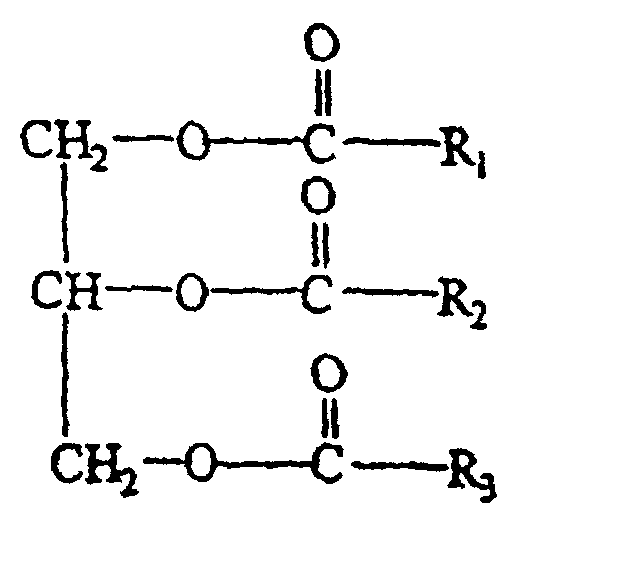
- oils according to the invention consist of triglycerides corresponding to glycerol triesters of general formula (I) below: in which R 1 , R 2 , and R 3 , identical or different, are residues chosen from the linear aliphatic groups R i , saturated or unsaturated, consisting of 5 to 23 carbon atoms. These groups originating from aliphatic fatty acids can contain from one to three olefinic bonds.
- the oil is of animal or vegetable origin, it is the fatty acid residues R i which give the triglycerides their properties.
- more than 60%, and preferably more than 80% of the residues R 1 , R 2 or R 3 are saturated groups R i or monounsaturated.
- castor oil is preferred.
- At least 60% of the groups R i come from oleic acid and preferably more than 77% of the R i come from oleic acid.
- Oils with a high oleic acid content such as, for example, oleic sunflower oil, have excellent resistance to oxidation at high temperatures, which makes it possible to reduce the amounts of antioxidants and consequently the cost price of the drilling mud.
- Preferred oleic vegetable oils are oil oleic rapeseed and oleic sunflower oil.
- the diluent not only has the function of lowering the viscosity of animal or vegetable oil but also to improve lubricating properties and stability of the emulsion resulting which composes the surface mud.
- these diluents can be chosen from synthetic esters of carboxylic acids saturated or unsaturated, linear or branched aliphatics comprising from 6 to 24 carbon atoms per chain and alkanols comprising from 1 to 4 carbon atoms per chain.
- esters are synthesized by esterification with using an alkanol comprising from 1 to 4 carbon atoms per chain, carboxylic acids obtained by hydrolysis of triglycerides from natural animal or vegetable oils. he it is also possible to synthesize these esters by transesterification direct natural triglycerides using of an alkanol.
- esters constituting the diluent it is possible to choose as raw material an animal or vegetable oil or else hydrocarbon cuts rich in triglycerides of formula (I) containing more than 60%, and preferably more than 80% of R 1 , R 2 or R 3 saturated or monounsaturated residues.
- esters synthetic constituting the diluent of the invention are formed from vegetable or animal oils from the group made up of sunflower oil, copra oil, soybean oil, rapeseed oil, castor oil, oil palm, palmitist oil, peanut oil, flax, olive oil, corn oil, babassu oil, coconut oil and tallow oil.
- an alkanol is preferably used chosen from the group consisting of isopropanol, ethanol, propanol, butanol and methanol.
- the diluent is synthesized from oils chosen from rapeseed, copra oil, sunflower oil, castor and isopropanol.
- bottom sludge chosen from the inverse emulsions obtained with mineral or organic oils stable up to 250 ° C and more, and non-toxic sludge including cuttings can be brought back and stored ashore due to their low volume.
- mineral and organic oils is meant linear alkylated olefins, mono- ⁇ -olefins (MAO), poly- ⁇ -olefins (PAO), paraffins, esters, acetals and linear alkylbenzenes (LAB).
- Another object of the invention is a mud of stable surface up to around 100 ° C consisting of 5 to 30% by volume of water and from 95 to 70% by volume of an oil phase containing a major part of natural, vegetable oils or unrefined animals, said bone being characterized in that the phase oil also contains a minor part of a diluent chosen from synthetic esters of carboxylic acids saturated or unsaturated, linear or branched aliphatics, comprising from 6 to 24 atoms per chain and alkanols containing 1 to 4 carbon atoms per chain.
- This example aims to show the properties lubricants of the sludges according to the invention when they are used between 20 and 100 ° C.
- samples X 1 and E 2 are of the same nature taking into account the reproducibility of the measurements. Indeed, under the conditions of extreme pressures in which one operates, it is difficult to differentiate the properties of the two diluents. There is mainly a decrease in viscosity compared to that of the vegetable oil itself, corresponding to the effect of the diluent.
- the emulsion EMU 1 shows much better lubricating properties than the emulsion EMU 2 since for a constraint of 13320 Newtons, limit of the possibilities of the extreme pressure machine there is still no evidence of seizing. This result is due to the very nature of the diluent according to the invention.
- the purpose of this example is to describe the properties rheological and reducing power of sludge filtrate according to the invention before and after aging showing that these muds are perfectly adaptable to surface drilling between ambient and 100 ° C.
- composition B 1 B 2 B 3 Base oil 624ml (sunflower) 415.9ml (sunflower) 512ml (oleic sunflower) diluent 69.2 ml (C8-C10 methyl ester) 277.2ml (methyl ester C8-C10) 170.7ml (isopropyl ester C16-C18) Report (vol) Oil / Thinner 90/10 60/40 75/25 Report (vol) Oil / water 90/10 80/20 80/20 emulsifier 8.6 ml 17.2 ml 25 ml (1) thickening 22.3g (bentone) 22.3g (bentone) 20g (organophilic hectorite) wetting agent 2.9 ml 2.9 ml 3 ml Filtrate reducer 15g 15g 0g water 73.4 ml 76.5 ml 173.7 ml CaCl2 28.6g
- the FANN 35 rheological characteristics of these sludges according to the invention are given in table II below before aging for B 1 and B 3 (without lime), and after aging of B 1 , B 2 and B 3 (with lime ) at 80 ° C for 16 hours.
Landscapes
- Chemical & Material Sciences (AREA)
- Oil, Petroleum & Natural Gas (AREA)
- Life Sciences & Earth Sciences (AREA)
- General Life Sciences & Earth Sciences (AREA)
- Engineering & Computer Science (AREA)
- Materials Engineering (AREA)
- Organic Chemistry (AREA)
- Lubricants (AREA)
- Internal Circuitry In Semiconductor Integrated Circuit Devices (AREA)
- Biological Depolymerization Polymers (AREA)
Description

| Echantillon | Composition | ||
| huile | diluant | eau | |
| E1 | tournesol oléique (100%) | 0% | 0% |
| E2 | tournesol oléique (75%) | 2-ethylhexyl-acétate (25%) | 0% |
| X1 | tournesol oléique (75%) | 2-oléate d'isopropyle (25%) | 0% |
| EMU1 | tournesol oléique (67,5%) | 2-oléate d'isopropyle (22,5%) | 10% |
| EMU2 | tournesol oléique (67,5%) | 2-ethylhexyl-acétate (22,5%) | 10% |
| Echantillon | Palier de grippage (Newtons) | Couple de frottement avant grippage (N.cm) |
| E1 | 7992 | 285 |
| E2 | 6216 | 230 |
| X1 | 6216 | 227 |
| EMU1 | 13320(vibration, usure) | 710 |
| EMU2 | 9768 | 475 |
| Composition | B1 | B2 | B3 |
| Huile de base | 624ml (tournesol) | 415,9ml (tournesol) | 512ml (tournesol oléique) |
| diluant | 69,2 ml (ester méthylique C8-C10) | 277,2ml (ester méthylique C8-C10) | 170,7ml (ester isopropylique C16-C18) |
| Rapport (vol) Huile/Diluant | 90/10 | 60/40 | 75/25 |
| Rapport (vol) Huile/eau | 90/10 | 80/20 | 80/20 |
| émulsifiant | 8,6 ml | 17,2 ml | 25 ml (1) |
| épaississant | 22,3g (bentone) | 22,3g (bentone) | 20g (hectorite organophile) |
| agent mouillant | 2,9 ml | 2,9 ml | 3 ml |
| Réducteur de filtrat | 15 g | 15g | 0g |
| eau | 73,4 ml | 76,5 ml | 173,7 ml |
| CaCl2 | 28,6 g | 29,8 g | 78,8 g |
| Chaux | 2,3 g | 2,3g | 3 |
| Baryte | 343,5g | 294g | 343,5g |
| FANN 35 Tour/minute | B1 | B2 | B3 | ||
| avant | après | avec chaux | sans chaux | ||
| 600 | 148 | 158 | 152 | 132 | 151 |
| 300 | 84 | 95 | 98 | 77 | 95 |
| 200 | 60 | 70 | 77 | 57 | 72 |
| 100 | 36 | 45 | 53 | 36 | 49 |
| 60 | 27 | 34 | 42 | 26 | 39 |
| 30 | 20 | 26 | 33 | 19 | 30 |
| 6 | 13 | 17 | 23 | 12 | 20 |
| 3 | 12 | 16 | 21 | 11 | 18 |
| VA(mPa.s) | 74 | 79 | 76 | 66 | 75,5 |
| VP(mPa.s) | 64 | 63 | 54 | 55 | 56 |
Claims (22)
- Procédé d'utilisation de boues biodégradables de forage, caractérisé en ce que dès le début du forage, on introduit dans le puits une boue de surface biodégradable stable jusqu'à 100°C, de pouvoir réducteur de filtrat réglable de 2 à 13 cm3 et de stabilité électrique supérieure ou égale à 1000 Volts, et que lorsque la température du terrain traversé atteint 100°C, on remplace ladite boue de surface par une boue de fond stable à des températures supérieures à 200°C, le volume de la boue de surface représentant de 60 à 80 % en volume du volume total de boue utilisée.
- Procédé selon la revendication 1, caractérisé en ce que la boue de surface biodégradable est choisie parmi les boues à l'eau et les émulsions inverses biodégradables.
- Procédé selon la revendication 1 ou 2, caractérisé en ce que la boue de surface est une émulsion inverse dont le rapport volumique Huile/eau varie de 95/5 à 70/30, la phase huile contenant une majeure partie d'huiles naturelles végétales ou animales non raffinées et une partie mineure d'un diluant constitué d'esters de ces huiles naturelles.
- Procédé selon la revendication 3, caractérisé en ce que lesdites huiles naturelles sont choisies dans le groupe constitué par l'huile de tournesol, l'huile de copra, l'huile de soja, l'huile de colza, l'huile de ricin, l'huile de palme, l'huile palmitiste, l'huile d'arachide, l'huile de lin, l'huile d'olive, l'huile de maïs, l'huile de babassu, l'huile de coco et l'huile de suif.
- Procédé selon la revendication 3 ou 4, caractérisé en ce que ces huiles naturelles sont constituées de triglycérides correspondant à des triesters de glycérol de formule générale (I) ci-après :dans laquelle R1, R2 et R3, identiques ou différents, sont des restes choisis parmi les groupements Ri aliphatiques linéaires, saturés ou comprenant jusqu'à trois liaisons oléfiniques et constitués de 5 à 23 atomes de carbone.
- Procédé selon la revendication 5, caractérisé en ce que dans les trigiycérides de formule (I), plus de 60 % des restes R1, R2 ou R3 sont des groupements Ri saturés ou monoinsaturés.
- Procédé selon les revendications 5 ou 6, caractérisé en ce que l'huile naturelle consiste en huile de ricin, laquelle huile est constituée de triglycérides de formule (I) dont les groupements Ri sont monoinsaturés.
- Procédé selon les revendications 5 ou 6, caractérisé en ce que dans les triglycérides de formule (I), au moins 60 % des groupements Ri sont issus d'acide oléique.
- Procédé selon les revendications 3 à 7, caractérisé en ce que les huiles végétales sont l'huile de colza oléique et l'huile de tournesol oléique.
- Procédé selon l'une des revendications 3 à 8, caractérisé en ce que le diluant est choisi parmi les esters synthétiques d'acides carboxyliques aliphatiques saturés ou insaturés, linéaires ou ramifiés comprenant de 6 à 24 atomes de carbone par chaíne et d'alcanols comprenant de 1 à 4 atomes de carbone par chaíne.
- Procédé selon la revendication 10, caractérisé en ce que les esters sont synthétisés par estérification au moyen d'un alcanol comprenant de 1 à 4 atomes de carbone par chaíne, des acides carboxyliques obtenus par hydrolyse de triglycérides d'huiles animales ou végétales naturelles ou par transestérification directe desdits triglycérides.
- Procédé selon la revendication 11, caractérisé en ce que les huiles choisies comme matière première pour la synthèse des esters sont des huiles animales ou végétales ou encore des coupes hydrocarbonées riches en triglycérides de formule correspondant à la formule (I) de la revendication 5 et contenant plus de 60 % de restes R1, R2 ou R3, saturés ou monoinsaturés.
- Procédé selon les revendications 11 ou 12, caractérisé en ce que les esters synthétiques sont formés à partir d'huiles végétales ou animales du groupe constitué par l'huile de tournesol, l'huile de copra, l'huile de soja, l'huile de colza, l'huile de ricin, l'huile de palme, l'huile palmitiste, l'huile d'arachide, l'huile de lin, l'huile d'olive, l'huile de maïs, l'huile de babassu, l'huile de coco et l'huile de suif.
- Procédé selon l'une des revendications de 10 à 13, caractérisé en ce que les alcanols sont choisis dans le groupe constitué par l'éthanol, le propanol, le butanol, le méthanol et l'isopropanol.
- Procédé selon la revendication 11, caractérisé en ce que le diluant est synthétisé à partir d'huiles choisies parmi l'huile de colza, l'huile de copra, l'huile de tournesol, l'huile de ricin et de l'alcanol consistant en isopropanol.
- Procédé selon l'une des revendications de 1 à 15 caractérisé en ce que la boue de fond est choisie parmi les émulsions inverses obtenues avec des huiles minérales et organiques stables jusqu'à 250°C et plus, et les boues non toxiques dont les déblais peuvent être ramenés et stockés à terre du fait de leur faible volume.
- Procédé selon la revendication 3, caractérisé en ce que lesdites huiles naturelles contiennent plus de 95 % en poids de triglycérides.
- Procédé selon la revendication 5, caractérisé en ce que dans les triglycérides de formule (I), plus de 80 % des restes R1, R2 ou R3 sont des groupements R; saturés ou monoinsaturés.
- Procédé selon la revendication 8, caractérisé en ce que dans les triglycérides de formule (I), plus de 77 % des groupements Ri sont issus d'acide oléique.
- Procédé selon la revendication 12, caractérisé en ce que les triglycérides de formule (I) présents dans les huiles choisies pour la synthèse des esters contiennent plus de 80 % de restes R1, R2 ou R3 saturés ou monoinsaturés.
- Boue de surface, utilisable dans la première étape du procédé selon les revendications 1 à 3, constituée de 5 à 30 % en volume d'eau et de 95 à 70 % en volume d'une phase huile contenant une majeure partie d'huiles naturelles, végétales ou animales non raffinées, et caractérisée en ce que la phase huile renferme également une partie mineure d'un diluant choisi parmi les esters synthétiques d'acides carboxyliques aliphatiques saturés ou insaturés, linéaires ou ramifiés, comprenant de 6 à 24 atomes de carbone par chaíne et d'alcanols renfermant de 1 à 4 atomes de carbone par chaíne.
- Boue de surface selon la revendication 21, caractérisée en ce que lesdits esters sont synthétisés par estérification, au moyen d'un alcanol comprenant de 1 à 4 atomes de carbone par chaíne, des acides carboxyliques résultant de l'hydrolyse de triglycérides d'huiles animales ou végétales naturelles ou par transestérification directe desdits triglycérides au moyen d'un tel alcanol.
Applications Claiming Priority (3)
| Application Number | Priority Date | Filing Date | Title |
|---|---|---|---|
| FR9809263 | 1998-07-21 | ||
| FR9809263A FR2781498B1 (fr) | 1998-07-21 | 1998-07-21 | Procede d'utilisation des boues de forage biodegradables |
| PCT/FR1999/001773 WO2000005324A1 (fr) | 1998-07-21 | 1999-07-20 | Procede d'utilisation des boues de forage biodegradables |
Publications (2)
| Publication Number | Publication Date |
|---|---|
| EP1098950A1 EP1098950A1 (fr) | 2001-05-16 |
| EP1098950B1 true EP1098950B1 (fr) | 2003-02-19 |
Family
ID=9528816
Family Applications (1)
| Application Number | Title | Priority Date | Filing Date |
|---|---|---|---|
| EP99932920A Expired - Lifetime EP1098950B1 (fr) | 1998-07-21 | 1999-07-20 | Procede d'utilisation de boues de forage biodegradables |
Country Status (6)
| Country | Link |
|---|---|
| US (1) | US6634442B1 (fr) |
| EP (1) | EP1098950B1 (fr) |
| FR (1) | FR2781498B1 (fr) |
| NO (1) | NO333117B1 (fr) |
| OA (1) | OA11709A (fr) |
| WO (1) | WO2000005324A1 (fr) |
Families Citing this family (4)
| Publication number | Priority date | Publication date | Assignee | Title |
|---|---|---|---|---|
| FR2897362B1 (fr) * | 2006-02-13 | 2008-04-18 | Inst Francais Du Petrole | Methode de traitement des puits par emulsions de petite taille contenant des additifs |
| US20100181110A1 (en) * | 2009-01-20 | 2010-07-22 | Harr Robert E | Green directional drilling fluid composition |
| US9834718B2 (en) * | 2014-05-06 | 2017-12-05 | Saudi Arabian Oil Company | Ecofriendly lubricating additives for water-based wellbore drilling fluids |
| US11352545B2 (en) | 2020-08-12 | 2022-06-07 | Saudi Arabian Oil Company | Lost circulation material for reservoir section |
Family Cites Families (12)
| Publication number | Priority date | Publication date | Assignee | Title |
|---|---|---|---|---|
| US4374737A (en) | 1980-01-14 | 1983-02-22 | Dana E. Larson | Nonpolluting drilling fluid composition |
| US4481121A (en) | 1982-05-17 | 1984-11-06 | Hughes Tool Company | Viscosifier for oil base drilling fluids |
| US4631136A (en) * | 1985-02-15 | 1986-12-23 | Jones Iii Reed W | Non-polluting non-toxic drilling fluid compositions and method of preparation |
| US5232910A (en) | 1988-12-19 | 1993-08-03 | Henkel Kommanditgesellschaft Auf Aktien | Use of selected ester oils in drilling fluids and muds |
| DE3842659A1 (de) * | 1988-12-19 | 1990-06-28 | Henkel Kgaa | Verwendung ausgewaehlter esteroele in bohrspuelungen insbesondere zur off-shore-erschliessung von erdoel- bzw. erdgasvorkommen (i) |
| DE3907392A1 (de) * | 1989-03-08 | 1990-09-13 | Henkel Kgaa | Ester von carbonsaeuren mittlerer kettenlaenge als bestnadteil der oelphase in invert-bohrspuelschlaemmen |
| AU1834695A (en) * | 1994-02-02 | 1995-08-21 | Chevron Chemical Company | Skeletally isomerized linear olefins |
| GB9406057D0 (en) * | 1994-03-26 | 1994-05-18 | Univ Heriot Watt | Drilling mud |
| US5707940A (en) * | 1995-06-07 | 1998-01-13 | The Lubrizol Corporation | Environmentally friendly water based drilling fluids |
| US5755295A (en) * | 1996-04-19 | 1998-05-26 | Spectral Inc. | Modular drilling fluid system and method |
| US5807811A (en) * | 1996-08-23 | 1998-09-15 | The Lubrizol Corporation | Water-based drilling fluids containing phosphites as lubricating aids |
| US5837654A (en) * | 1997-05-06 | 1998-11-17 | Southern Clay Products, Inc. | High temperature environmentally benign drilling fluid, and viscosifying additives for use therewith |
-
1998
- 1998-07-21 FR FR9809263A patent/FR2781498B1/fr not_active Expired - Fee Related
-
1999
- 1999-07-20 WO PCT/FR1999/001773 patent/WO2000005324A1/fr not_active Ceased
- 1999-07-20 OA OA1200100020A patent/OA11709A/en unknown
- 1999-07-20 US US09/744,284 patent/US6634442B1/en not_active Expired - Lifetime
- 1999-07-20 EP EP99932920A patent/EP1098950B1/fr not_active Expired - Lifetime
-
2001
- 2001-01-19 NO NO20010321A patent/NO333117B1/no not_active IP Right Cessation
Also Published As
| Publication number | Publication date |
|---|---|
| OA11709A (en) | 2005-01-25 |
| NO20010321D0 (no) | 2001-01-19 |
| EP1098950A1 (fr) | 2001-05-16 |
| US6634442B1 (en) | 2003-10-21 |
| FR2781498A1 (fr) | 2000-01-28 |
| FR2781498B1 (fr) | 2002-06-28 |
| NO333117B1 (no) | 2013-03-04 |
| WO2000005324A1 (fr) | 2000-02-03 |
| NO20010321L (no) | 2001-01-19 |
Similar Documents
| Publication | Publication Date | Title |
|---|---|---|
| CA2407842C (fr) | Composition lubrifiante biodegradable et ses utilisations, notamment dans un fluide de forage | |
| EP2513275B1 (fr) | Composition lubrifiante biodegradable et son utilisation dans un fluide de forage | |
| CA2281635C (fr) | Additif d'onctuosite pour carburant | |
| CA2411696C (fr) | Fluide de puits a base d'huile comprenant un systeme emulsifiant stable en temperature et non polluant | |
| EP2406356B1 (fr) | Fluide hydrocarbone hydrodeparaffine utilise dans la fabrication de fluides industriels, agricoles ou a usage domestique | |
| EP1910503B1 (fr) | Utilisation d'une composition lubrifiante pour melange hydrocarbone et produits obtenus | |
| RU2180910C2 (ru) | Гидравлическая жидкость, способ ее получения и гидравлическая жидкость для устройств высокого давления, предназначенных для передачи энергии и несущих нагрузку | |
| EP3429718B1 (fr) | Desemulsifiant pour petrole | |
| WO2014102237A1 (fr) | Concentre d'additifs biodegradable ameliorant la lubrifiance des boues a l'eau, son utilisation et boue a l'eau pour le forage | |
| NO319707B1 (no) | Boreslam | |
| EP1098950A1 (fr) | Procede d'utilisation des boues de forage biodegradables | |
| WO2018095975A1 (fr) | Utilisation d'un lipide de mannosylerythritol tri-acyle en tant qu'inhibiteur de corrosion | |
| WO2004011575A2 (fr) | Combustible emulsionne eau/hydrocarbures, sa preparation et ses utilisations | |
| EP0245157A1 (fr) | Composition émulsifiante et émulsion inverse la contenant | |
| WO2019129792A1 (fr) | Additif lubrifiant solide | |
| FR2689138A1 (fr) | Procédé de lavage de particules solides comportant une solution de sophorosides. | |
| EP4426800A1 (fr) | Utilisation d'une base biodégradable lubrifiante, son procédé de préparation et composition lubrifiante comprenant ladite base lubrifiante | |
| FR2521583A1 (fr) | Fluides de forage et procede pour leur utilisation | |
| FR2521584A1 (fr) | Fluides de forage et leurs procedes d'utilisation | |
| FR2521582A1 (fr) | Fluide de forage et procede pour son utilisation | |
| OA17546A (fr) | Concentré d'additifs biodégradable améliorant la lubrifiance des boues à l'eau, son utilisation et boue a l'eau pour le forage. |
Legal Events
| Date | Code | Title | Description |
|---|---|---|---|
| PUAI | Public reference made under article 153(3) epc to a published international application that has entered the european phase |
Free format text: ORIGINAL CODE: 0009012 |
|
| 17P | Request for examination filed |
Effective date: 20010221 |
|
| AK | Designated contracting states |
Kind code of ref document: A1 Designated state(s): AT BE CH CY DE DK ES FI FR GB GR IE IT LI LU MC NL PT SE |
|
| 17Q | First examination report despatched |
Effective date: 20010521 |
|
| RTI1 | Title (correction) |
Free format text: METHOD FOR USING BIODEGRADABLE DRILLING FLUIDS |
|
| GRAG | Despatch of communication of intention to grant |
Free format text: ORIGINAL CODE: EPIDOS AGRA |
|
| GRAG | Despatch of communication of intention to grant |
Free format text: ORIGINAL CODE: EPIDOS AGRA |
|
| GRAH | Despatch of communication of intention to grant a patent |
Free format text: ORIGINAL CODE: EPIDOS IGRA |
|
| GRAH | Despatch of communication of intention to grant a patent |
Free format text: ORIGINAL CODE: EPIDOS IGRA |
|
| GRAA | (expected) grant |
Free format text: ORIGINAL CODE: 0009210 |
|
| AK | Designated contracting states |
Designated state(s): FR GB NL |
|
| REG | Reference to a national code |
Ref country code: GB Ref legal event code: FG4D Free format text: NOT ENGLISH |
|
| REG | Reference to a national code |
Ref country code: IE Ref legal event code: FG4D Free format text: FRENCH |
|
| GBT | Gb: translation of ep patent filed (gb section 77(6)(a)/1977) |
Effective date: 20030424 |
|
| REG | Reference to a national code |
Ref country code: IE Ref legal event code: FD4D Ref document number: 1098950E Country of ref document: IE |
|
| PLBE | No opposition filed within time limit |
Free format text: ORIGINAL CODE: 0009261 |
|
| STAA | Information on the status of an ep patent application or granted ep patent |
Free format text: STATUS: NO OPPOSITION FILED WITHIN TIME LIMIT |
|
| 26N | No opposition filed |
Effective date: 20031120 |
|
| PGFP | Annual fee paid to national office [announced via postgrant information from national office to epo] |
Ref country code: GB Payment date: 20150626 Year of fee payment: 17 |
|
| PGFP | Annual fee paid to national office [announced via postgrant information from national office to epo] |
Ref country code: NL Payment date: 20150622 Year of fee payment: 17 |
|
| REG | Reference to a national code |
Ref country code: FR Ref legal event code: PLFP Year of fee payment: 18 |
|
| PGFP | Annual fee paid to national office [announced via postgrant information from national office to epo] |
Ref country code: FR Payment date: 20160622 Year of fee payment: 18 |
|
| REG | Reference to a national code |
Ref country code: NL Ref legal event code: MM Effective date: 20160801 |
|
| GBPC | Gb: european patent ceased through non-payment of renewal fee |
Effective date: 20160720 |
|
| PG25 | Lapsed in a contracting state [announced via postgrant information from national office to epo] |
Ref country code: NL Free format text: LAPSE BECAUSE OF NON-PAYMENT OF DUE FEES Effective date: 20160801 |
|
| PG25 | Lapsed in a contracting state [announced via postgrant information from national office to epo] |
Ref country code: GB Free format text: LAPSE BECAUSE OF NON-PAYMENT OF DUE FEES Effective date: 20160720 |
|
| REG | Reference to a national code |
Ref country code: FR Ref legal event code: ST Effective date: 20180330 |
|
| PG25 | Lapsed in a contracting state [announced via postgrant information from national office to epo] |
Ref country code: FR Free format text: LAPSE BECAUSE OF NON-PAYMENT OF DUE FEES Effective date: 20170731 |