EP1098075A2 - Vibration absorption assembly - Google Patents
Vibration absorption assembly Download PDFInfo
- Publication number
- EP1098075A2 EP1098075A2 EP00309736A EP00309736A EP1098075A2 EP 1098075 A2 EP1098075 A2 EP 1098075A2 EP 00309736 A EP00309736 A EP 00309736A EP 00309736 A EP00309736 A EP 00309736A EP 1098075 A2 EP1098075 A2 EP 1098075A2
- Authority
- EP
- European Patent Office
- Prior art keywords
- cavity
- assembly
- vibration absorption
- apertures
- housing
- Prior art date
- Legal status (The legal status is an assumption and is not a legal conclusion. Google has not performed a legal analysis and makes no representation as to the accuracy of the status listed.)
- Withdrawn
Links
- 238000010521 absorption reaction Methods 0.000 title claims abstract description 37
- 239000000446 fuel Substances 0.000 claims abstract description 29
- 238000002347 injection Methods 0.000 claims abstract description 20
- 239000007924 injection Substances 0.000 claims abstract description 20
- 238000000034 method Methods 0.000 claims abstract description 14
- 239000002283 diesel fuel Substances 0.000 claims abstract description 6
- 238000005096 rolling process Methods 0.000 claims 9
- 230000008878 coupling Effects 0.000 claims 3
- 238000010168 coupling process Methods 0.000 claims 3
- 238000005859 coupling reaction Methods 0.000 claims 3
- 239000000314 lubricant Substances 0.000 claims 3
- 238000006073 displacement reaction Methods 0.000 claims 1
- 239000003921 oil Substances 0.000 description 14
- 230000000712 assembly Effects 0.000 description 5
- 238000000429 assembly Methods 0.000 description 5
- 239000006096 absorbing agent Substances 0.000 description 2
- 238000002485 combustion reaction Methods 0.000 description 2
- 230000000994 depressogenic effect Effects 0.000 description 2
- 230000002411 adverse Effects 0.000 description 1
- 239000000470 constituent Substances 0.000 description 1
- 230000001788 irregular Effects 0.000 description 1
- 239000000463 material Substances 0.000 description 1
- 239000010705 motor oil Substances 0.000 description 1
- 239000002245 particle Substances 0.000 description 1
Images


Classifications
-
- F—MECHANICAL ENGINEERING; LIGHTING; HEATING; WEAPONS; BLASTING
- F16—ENGINEERING ELEMENTS AND UNITS; GENERAL MEASURES FOR PRODUCING AND MAINTAINING EFFECTIVE FUNCTIONING OF MACHINES OR INSTALLATIONS; THERMAL INSULATION IN GENERAL
- F16F—SPRINGS; SHOCK-ABSORBERS; MEANS FOR DAMPING VIBRATION
- F16F15/00—Suppression of vibrations in systems; Means or arrangements for avoiding or reducing out-of-balance forces, e.g. due to motion
- F16F15/10—Suppression of vibrations in rotating systems by making use of members moving with the system
- F16F15/14—Suppression of vibrations in rotating systems by making use of members moving with the system using masses freely rotating with the system, i.e. uninvolved in transmitting driveline torque, e.g. rotative dynamic dampers
- F16F15/1407—Suppression of vibrations in rotating systems by making use of members moving with the system using masses freely rotating with the system, i.e. uninvolved in transmitting driveline torque, e.g. rotative dynamic dampers the rotation being limited with respect to the driving means
- F16F15/145—Masses mounted with play with respect to driving means thus enabling free movement over a limited range
-
- F—MECHANICAL ENGINEERING; LIGHTING; HEATING; WEAPONS; BLASTING
- F02—COMBUSTION ENGINES; HOT-GAS OR COMBUSTION-PRODUCT ENGINE PLANTS
- F02B—INTERNAL-COMBUSTION PISTON ENGINES; COMBUSTION ENGINES IN GENERAL
- F02B67/00—Engines characterised by the arrangement of auxiliary apparatus not being otherwise provided for, e.g. the apparatus having different functions; Driving auxiliary apparatus from engines, not otherwise provided for
-
- F—MECHANICAL ENGINEERING; LIGHTING; HEATING; WEAPONS; BLASTING
- F02—COMBUSTION ENGINES; HOT-GAS OR COMBUSTION-PRODUCT ENGINE PLANTS
- F02B—INTERNAL-COMBUSTION PISTON ENGINES; COMBUSTION ENGINES IN GENERAL
- F02B77/00—Component parts, details or accessories, not otherwise provided for
- F02B77/11—Thermal or acoustic insulation
- F02B77/13—Acoustic insulation
-
- F—MECHANICAL ENGINEERING; LIGHTING; HEATING; WEAPONS; BLASTING
- F16—ENGINEERING ELEMENTS AND UNITS; GENERAL MEASURES FOR PRODUCING AND MAINTAINING EFFECTIVE FUNCTIONING OF MACHINES OR INSTALLATIONS; THERMAL INSULATION IN GENERAL
- F16F—SPRINGS; SHOCK-ABSORBERS; MEANS FOR DAMPING VIBRATION
- F16F15/00—Suppression of vibrations in systems; Means or arrangements for avoiding or reducing out-of-balance forces, e.g. due to motion
- F16F15/10—Suppression of vibrations in rotating systems by making use of members moving with the system
-
- Y—GENERAL TAGGING OF NEW TECHNOLOGICAL DEVELOPMENTS; GENERAL TAGGING OF CROSS-SECTIONAL TECHNOLOGIES SPANNING OVER SEVERAL SECTIONS OF THE IPC; TECHNICAL SUBJECTS COVERED BY FORMER USPC CROSS-REFERENCE ART COLLECTIONS [XRACs] AND DIGESTS
- Y10—TECHNICAL SUBJECTS COVERED BY FORMER USPC
- Y10T—TECHNICAL SUBJECTS COVERED BY FORMER US CLASSIFICATION
- Y10T74/00—Machine element or mechanism
- Y10T74/21—Elements
- Y10T74/2121—Flywheel, motion smoothing-type
- Y10T74/2131—Damping by absorbing vibration force [via rubber, elastomeric material, etc.]
Definitions
- the present invention relates to a vibration absorption assembly and more particularly, to a vibration absorption assembly for use with a fuel injection pump to absorb absorbs torsional vibrations emanating from the fuel injection pump.
- the torsional vibrational energy emanating from a diesel fuel pump increases the stress which is communicated to its drive chain, which typically couples the fuel injection pump to the crankshaft. This stress may cause the chain to fail, and may cause damage to the engine.
- a rotatably movable engine component such as a fuel pump
- a vibration absorption assembly for use in combination with a vibrating member.
- the vibration absorption assembly comprises a housing which is mounted upon the selectively vibrating member and which includes at least one cavity; a first aperture which communicates with the at least one cavity; a second aperture which communicates with the at least one cavity and which co-operates with the first aperture, to cause oil to enter the cavity, to traverse the cavity, and to exit the cavity through the second aperture; and a pair of members which are movably deployed within the cavity and which co-operatively dampen the vibration of the vibrating member, the pair of members being lubricated by the oil which traverses the cavity.
- a method for reducing the amount of vibrations emanating from a selectively rotatable member comprises the steps of forming at least one cavity within a portion of the selectively rotatable member, the cavity having opposed first and second end portions which access the cavity; movably disposing a pair of elements within the at least one tapered cavity; and tapering the first of the end portions, effective to substantially prevent the pair of elements from exiting the at least one cavity through the first of the end portions; and selectively covering the second of the end portions, thereby allowing the elements to be selectively and movably captured within the at least one cavity, effective to reduce the vibrations of the member.
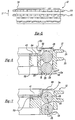
- FIG. 1 there is shown a conventional internal combustion diesel engine 10 having a vibration absorption assembly 12 of the invention incorporated into the drive sprocket 23 of the fuel injection pump 14.
- the vibration absorption assembly may alternatively be formed separately from, and coupled for rotation with, the fuel injection pump or any other component susceptible to torsional vibrations.
- the diesel engine 10 further includes a crankshaft 16, exhaust camshaft 19, and intake camshaft 18.
- Fuel injection pump 14, crankshaft 16, and camshafts 18, 19 are interconnected by a chain 20 which transmits torque from the crankshaft 16 to the camshafts 18, 19 and the fuel injection pump 14.
- the vibration reduction assembly 12 serves to attenuate vibrations emanating from the fuel pump assembly 14, which can damage the chain 20 and other engine components.
- the chain 20 and the various sprockets are lubricated by oil 27 which typically drips down from camshaft 18, in the direction of arrow 25.
- This oil 27 is drawn into the rotating vibration absorption assembly 12, and is effective to lubricate certain vibration absorption components of the vibration reduction assembly 12 to reduce wear within the assembly 12.
- the available oil 27 then exits from the assembly 12 and eventually drains, into a sump or reservoir 22.
- assembly 12 includes a round base portion 30 constituted in the preferred embodiment of the invention by the fuel pump drive sprocket.
- the base portion 30 has a central aperture 7 which allows the base portion 30 to be mounted upon the fuel injection pump 14.
- the base portion 30 further includes two sets of evenly spaced sprocket teeth 24 and 25 engaged by the duplex chain 20.
- the base portion 30 further includes substantially identical slotted apertures 55, 57, 59, 63; slotted aperture 61, slotted "blind" type aperture 53, and a pair of substantially identical and generally circular apertures 42.
- the apertures 55, 57, 59, 63, and 42 are used to secure portions of the assembly 12 upon the base member 30.
- Apertures 55, 57, 59, and 63 are further used to secure assembly 12 upon fuel pump assembly 14.
- Certain substantially identical, circular, axially extending cavities 26 that are tapered at their end are also arranged in an evenly spaced circumferential pattern, within base portion or member 30 and around the central aperture 7.
- Each of the cavities 26 contains two substantially identical spherical balls 28 which absorb the vibrational energy emanating from the fuel pump assembly 14.
- Each ball 28 acts as a rotary pendulum which rolls about the inner surface of its cavity 26 in synchronism with the rotation of the sprocket.
- the cavities 26 have an optimum diameter of 15.46328 mm, their centres are at a distance of 43.26836 mm from the axis of rotation of the base portion 30 and the balls have an optimum diameter of 15.08125 mm.
- the tapered portion 29, shown in Figure 6, at the bottom of each cavity 26 serves to retain the balls 28 from exiting the bottom portion or surface 31 of member 30.
- a slotted aperture 54 is formed within the base portion 30. Particularly, the slotted aperture 54 is proximate to and communicates with each of the cavities 26 and aperture 54 is formed slightly forward of surface 31.
- assembly 12 further includes an intermediate member 32, and a saucer-shaped front cover member 34 having a flat depressed centre portion 35, connected by a wall portion 11 to a raised flat upper portion 5.
- the depressed portion 35 includes substantially identical slotted apertures 43, 45, 49, and 51, relatively long slotted apertures 41 and 47, a pair of substantially identical and generally circular apertures or holes 38, and a central aperture 39.
- Central aperture 39 is substantially similar to aperture 7.
- Apertures 52 extend through the integrally formed wall 11 while apertures 46 extend through both the wall 11 and the upper portion 5.
- the intermediate member 32 also includes a generally circular and flat member 60 having a pair of substantially identical and generally circular apertures or holes 40, slotted apertures 62, 64, and 66, and a central aperture 15 which is substantially identical to apertures 7 and 39.
- Intermediate member 32 also includes several raised tabs or flanges 68, 70, and 72 which are each substantially identical in size and shape to apertures 46.
- a first fastener such as a shoulder type rivet 36
- a second fastener 36 is placed within and traverses a second of the apertures 38, within aperture 62, and within a second of the apertures 42.
- the fasteners 36 act to sandwich the member 32 between the member 34 and the base portion 30 while allowing member 34 to selectively move in the direction of arrow 71.
- Apertures 51 and 49 respectively communicate with apertures 57 and 63 through aperture 62.
- Aperture 43 communicates with aperture 55 through aperture 64 and aperture 45 communicates with aperture 59 through aperture 66.
- a fastener 37 is placed within and through each pair of communicating apertures 43, 55; 45, 59; 49, 63; and 51, 57, thereby securing the assembly 12 (e.g., sprocket 23) to the fuel pump assembly 14.
- Apertures 41, 40, and 53, as well as apertures 47, 40, and 61, also communicate.
- a screwdriver or another implement may be inserted within one or both of the communicative apertures 41, 40, and 53, or 47, 40, and 61, to rotate intermediate member 32 within assembly 12.
- Communicating apertures 47, 66, and 61 allow passage of a conventional alignment tool, through the assembly 12, to hold the rotary position of the fuel pump assembly 14 in the proper timing relationship to the crankshaft assembly 16 during engine assembly.
- Fasteners 37 also allow the intermediate member 32 to be rotatably secured between top member 34 and bottom member 30. Also, apertures 7, 15, and 39 cooperate to allow assembly 12 to receive the hub of a vibrating member, such as a diesel engine fuel injection pump. The vibration absorber assembly 12 dampens the torsional vibration of the member by movement of the balls 28 within the apertures 26, in a manner more fully described below.
- member 32 is movable, such as by placement of a screwdriver within communicating apertures 47, 40, 61 or 41, 40, 53, rotating member 32 from a first position, shown best in Figure 3, in which flanges 68, 70, and 72 respectively cover apertures 74, 76, 78 each of which forms a portion of the apertures 26, thereby respectively co-operating with the tapered portions 29 of apertures 74, 76, and 78 to retain the balls or spherical members 28, within the apertures 74-78, to a second position, shown best in Figure 2, in which flanges 68, 70, 72 do not overlay (e.g., are remote from) these respective apertures 74, 76, 78, thereby allowing the contained spherical members 28 to be removed from these apertures 74, 76, and 78, through apertures 46 of the front cover member 34, to allow access to servicing screws 80,
- the produced torsional vibration from fuel pump 14 is communicated to assembly 12.
- the balls 28 roll around the surfaces of the cavities 26 as illustrated by arrows 58, and act as pendulums that counteract the torsional vibrations.
- each cavity 26 allows the total effective mass of the pendulums to be increased so as to increase the amount of vibrational energy absorbed by the pendulums for a given size of cavity and a given distance of the centres of the cavities from the axis of rotation which dimensions are constrained by the configuration of the fuel injection pump 14.
Landscapes
- Engineering & Computer Science (AREA)
- General Engineering & Computer Science (AREA)
- Physics & Mathematics (AREA)
- Acoustics & Sound (AREA)
- Mechanical Engineering (AREA)
- Aviation & Aerospace Engineering (AREA)
- Chemical & Material Sciences (AREA)
- Combustion & Propulsion (AREA)
- Fuel-Injection Apparatus (AREA)
Abstract
Description
Claims (16)
- A vibration absorption assembly for use in combination with a member susceptible to torsional vibration, said vibration absorption assembly comprising:characterised in that two or more spherical elements are deployed within each cavity.a housing for coupling to the vibrating member to rotate therewith about an axis,at least one axially extending cylindrical cavity formed in said housing at a distance from the axis, anda rolling element of smaller diameter than the cavity deployed within the cavity to roll on the inner surface of the cavity in synchronism with the rotation of the housing so as to attenuate torsional vibrations of the member,
- An assembly as claimed in claim 1, wherein apertures communicate with the cavity at its opposite axial ends to permit a lubricant to flow axially through the cavity.
- An assembly as claimed in claim 2, wherein, in operation, the lubricant enters the cavity radially through a first aperture at one end, travels axially along the cavity and exits the cavity radially through a second aperture at the opposite end.
- An assembly as claimed in any preceding claim, wherein said housing comprises a base member having a first and a second row of protrusions and at least one tapered cavity;a pair of substantially spherical members which movably reside within said at least one cavity; anda second member which is movably coupled to said base portion and which is movable from a first position in which said second member overlays said at least one cavity to a second position in which said second member is remotely positioned from said at least one cavity.
- An assembly as claimed in claims 3 and 4, wherein said base member further includes said first and second apertures through which oil flows into and out of the cavity.
- A method of reducing torsional vibrations of a rotatable member, said method comprising the steps of:providing at least one cavity within a portion of said selectively rotatable member, said cavity having opposed first and second end portions which access said cavity, the first of the end portions of the cavity being tapered;movably disposing at least one rolling element within said at least one cavity in order to reduce vibrations of said member, the tapered end portion acting to prevent said rolling element(s) from exiting said at least one cavity through said first of said end portions; andselectively covering said second of said end portions, thereby allowing said rolling element(s) to be selectively and movably captured within said at least one cavity,
- A method as claimed in claim 6, wherein two spherical rolling elements of the same size are disposed within the or each cavity.
- A method as claimed in claim 7, wherein said member comprises a diesel fuel injection pump.
- A method as claimed in claim 8, wherein said portion comprises a chain sprocket portion of said diesel fuel injection pump.
- A method as claimed in any of claims 6 to 9, further comprising the steps of:providing oil; andcausing said oil to enter said at least one cavity.
- A method as claimed in claim 10, wherein said step of causing said oil to enter said cavity comprises the step of causing said oil to traverse said at least one cavity in an axial direction.
- A method as claimed in claim 11, further comprising the step of causing said oil to enter said at least one cavity radially.
- A method as claimed in claim 8 or any claim appended thereto, wherein said fuel pump has at least one fastener which fastens said fuel pump to an engine, said method further comprising the step of placing said fastener within said first end portion of said at least one cavity.
- A method as claimed in any of claims 6 to 13, wherein the step of selectively covering said second of said end portions comprises the step of providing a member; and movably coupling said member to said portion of said vibrating member.
- A vibration absorption assembly for use in combination with a member susceptible to torsional vibration, said vibration absorption assembly comprising:a housing for coupling to the vibrating member to rotate therewith about an axis,at least one axially extending cylindrical cavity formed in said housing at a distance from the axis,a rolling element of smaller diameter than the cavity deployed within the cavity to roll on the inner surface of the cavity in synchronism with the rotation of the housing so as to attenuate torsional vibrations of the member, andmeans for directing a flow of lubricant through the cavity.
- A vibration absorption assembly integrated into a drive sprocket of a fuel injection pump of a diesel engine, said vibration absorption assembly comprising:at least one axially extending cylindrical cavity formed in said sprocket at a distance from the axis,at least one rolling element of smaller diameter than the cavity deployed within the cavity to roll on the inner surface of the cavity in synchronism with the rotation of the housing so as to attenuate torsional vibrations of the member, anda displaceable cover serving to retain the rolling element(s) within the cavity,the rolling element(s) being removable from the cavity upon displacement of the cover to afford access to a fastener positioned in line with the cavity.
Applications Claiming Priority (2)
| Application Number | Priority Date | Filing Date | Title |
|---|---|---|---|
| US09/435,309 US6220970B1 (en) | 1999-11-05 | 1999-11-05 | Virbration absorption assembly |
| US435309 | 1999-11-05 |
Publications (2)
| Publication Number | Publication Date |
|---|---|
| EP1098075A2 true EP1098075A2 (en) | 2001-05-09 |
| EP1098075A3 EP1098075A3 (en) | 2002-05-02 |
Family
ID=23727871
Family Applications (1)
| Application Number | Title | Priority Date | Filing Date |
|---|---|---|---|
| EP00309736A Withdrawn EP1098075A3 (en) | 1999-11-05 | 2000-11-03 | Vibration absorption assembly |
Country Status (2)
| Country | Link |
|---|---|
| US (1) | US6220970B1 (en) |
| EP (1) | EP1098075A3 (en) |
Cited By (2)
| Publication number | Priority date | Publication date | Assignee | Title |
|---|---|---|---|---|
| US8714043B2 (en) | 2010-11-24 | 2014-05-06 | Schaeffler Technologies Gmbh & Co. Kg | Intermediate gear device |
| DE102011084104B4 (en) * | 2010-11-24 | 2017-05-24 | Schaeffler Technologies AG & Co. KG | Zwischenradvorrichtung |
Families Citing this family (16)
| Publication number | Priority date | Publication date | Assignee | Title |
|---|---|---|---|---|
| US6538852B1 (en) * | 1998-12-25 | 2003-03-25 | Nidec Corporation | Bearing device with damping mechanism |
| US6589121B1 (en) * | 1999-09-17 | 2003-07-08 | Halo Product Innovations | Fully adjustable torque controller, clutch and brake |
| TWD104266S1 (en) * | 2004-06-21 | 2005-04-21 | 東京威爾斯股份有限公司 | Electronic part conveyor table |
| US8091450B2 (en) * | 2007-09-26 | 2012-01-10 | Metavation, Llc | Decoupled vibration damper |
| DE102010005599C5 (en) * | 2009-02-09 | 2025-03-20 | Schaeffler Technologies AG & Co. KG | centrifugal pendulum |
| DE102014200901A1 (en) * | 2013-02-08 | 2014-08-14 | Schaeffler Technologies Gmbh & Co. Kg | Damper arrangement for chain or belt drive |
| DE102013103493A1 (en) * | 2013-04-08 | 2014-10-23 | Trw Automotive Gmbh | Pulley and gear nut with such a pulley |
| US9581229B2 (en) | 2014-02-10 | 2017-02-28 | Wolf Tooth Components, LLC | Sprocket |
| US9394986B2 (en) | 2014-02-10 | 2016-07-19 | Wolf Tooth Components, LLC | Sprocket |
| US9581230B2 (en) | 2014-02-10 | 2017-02-28 | Wolf Tooth Components, LLC | Sprocket |
| US9394987B2 (en) | 2014-02-10 | 2016-07-19 | Wolf Tooth Components, LLC | Sprocket |
| US9625027B2 (en) | 2014-04-08 | 2017-04-18 | Wolf Tooth Components, LLC | Sprocket |
| US9581231B2 (en) | 2014-04-08 | 2017-02-28 | Wolf Tooth Components, LLC | Sprocket |
| US9404565B2 (en) | 2014-04-08 | 2016-08-02 | Wolf Tooth Components, LLC | Sprocket |
| US9328814B2 (en) * | 2014-06-16 | 2016-05-03 | Sram, Llc | Clad chainring |
| KR101673741B1 (en) * | 2015-01-30 | 2016-11-07 | 현대자동차주식회사 | Device for noise vibration reduction of alternator's pulley |
Family Cites Families (21)
| Publication number | Priority date | Publication date | Assignee | Title |
|---|---|---|---|---|
| BE407592A (en) | 1932-04-07 | |||
| FR804697A (en) * | 1935-07-24 | 1936-10-29 | Device for reducing the oscillations of the cylinder groups of heat engines and of all components subjected to engine vibrations | |
| GB598646A (en) | 1939-08-07 | 1948-02-24 | Francois Marie Michel Bernard | Device for damping vibrations in rotating parts of machines |
| US2346972A (en) | 1941-06-12 | 1944-04-18 | Nash Kelvinator Corp | Vibration dampener |
| US2343421A (en) * | 1942-07-31 | 1944-03-07 | Fairbanks Morse & Co | Torsional vibration damper |
| US3109321A (en) * | 1961-09-19 | 1963-11-05 | Cecil B Rogers | Balancer for a rotating shaft |
| US3222953A (en) | 1963-05-27 | 1965-12-14 | Lysle I Benjamen | Torsion-keyed vibration damper |
| US3696688A (en) * | 1971-05-03 | 1972-10-10 | Eugene A Goodrich | Automatic balancer for rotating masses |
| US4075909A (en) * | 1976-01-29 | 1978-02-28 | Deakin James E | Automatic shaft balancer |
| US4739679A (en) * | 1986-01-23 | 1988-04-26 | Ford Motor Company | Bifilar pendulum vibration damper for automotive installation |
| DE3612942A1 (en) * | 1986-04-17 | 1987-10-22 | Bosch Gmbh Robert | FUEL INJECTION PUMP FOR INTERNAL COMBUSTION ENGINES |
| US4905776A (en) * | 1989-01-17 | 1990-03-06 | Amoco Corporation | Self-balancing drilling assembly and apparatus |
| US5219144A (en) * | 1990-07-20 | 1993-06-15 | General Motors Corporation | Mass impact damper for rotors |
| US5272937A (en) | 1992-05-26 | 1993-12-28 | Caterpillar Inc. | Active inertia torque absorbing system |
| JP3116639B2 (en) | 1992-06-08 | 2000-12-11 | 日産自動車株式会社 | Flywheel |
| JPH06346755A (en) | 1993-06-11 | 1994-12-20 | Komatsu Ltd | Engine accessory drive system torque fluctuation suppression device |
| US5295411A (en) | 1993-06-22 | 1994-03-22 | Speckhart Frank H | Torsional vibration absorber system |
| US5533422A (en) | 1994-11-28 | 1996-07-09 | Speckhart; Frank H. | System for absorbing torsional and/or bending vibrations |
| US5579665A (en) * | 1995-05-09 | 1996-12-03 | Borg-Warner Automotive, Inc. | Torsional absorber for camshaft sprockets |
| DE19604160C1 (en) * | 1996-02-06 | 1997-05-28 | Freudenberg Carl Fa | Damper which adapts to speed of rotation |
| US6109227A (en) * | 1998-09-17 | 2000-08-29 | Borgwarner Inc. | Torsionally compliant sprocket system for balance shaft drive |
-
1999
- 1999-11-05 US US09/435,309 patent/US6220970B1/en not_active Expired - Fee Related
-
2000
- 2000-11-03 EP EP00309736A patent/EP1098075A3/en not_active Withdrawn
Cited By (3)
| Publication number | Priority date | Publication date | Assignee | Title |
|---|---|---|---|---|
| US8714043B2 (en) | 2010-11-24 | 2014-05-06 | Schaeffler Technologies Gmbh & Co. Kg | Intermediate gear device |
| DE102010052200B4 (en) * | 2010-11-24 | 2015-05-13 | Schaeffler Technologies AG & Co. KG | Zwischenradvorrichtung |
| DE102011084104B4 (en) * | 2010-11-24 | 2017-05-24 | Schaeffler Technologies AG & Co. KG | Zwischenradvorrichtung |
Also Published As
| Publication number | Publication date |
|---|---|
| EP1098075A3 (en) | 2002-05-02 |
| US6220970B1 (en) | 2001-04-24 |
Similar Documents
| Publication | Publication Date | Title |
|---|---|---|
| EP1098075A2 (en) | Vibration absorption assembly | |
| DE10059101B4 (en) | drive system | |
| CA1306623C (en) | Camshaft damper | |
| US6557438B2 (en) | Breather structure of internal combustion engine for vehicles | |
| JP3709973B2 (en) | Belt-type transmission | |
| US7334553B2 (en) | Balancer driven gear of engine | |
| US5655416A (en) | Torsional absorber for camshaft sprockets | |
| DE19919449A1 (en) | Automotive pulley disc with overload protection device and damping mechanism | |
| EP1136721B1 (en) | Balancer shaft for an internal combustion engine | |
| EP0825363B1 (en) | Pulley | |
| US5272937A (en) | Active inertia torque absorbing system | |
| US20050229742A1 (en) | Sound-proof structure in power unit | |
| DE4328613A1 (en) | Device for damping vibrations on crankshafts | |
| MXPA04009253A (en) | Crank shaft bearing structure for internal combustion engine. | |
| KR102727146B1 (en) | Hub manufacturing device for damper pulley of vehicle | |
| DE4328596A1 (en) | Arrangement for damping vibrations on crankshafts | |
| US20050087421A1 (en) | Viscous damper | |
| US7360464B2 (en) | Variable rate impact and oscillation absorber in starter motors | |
| EP2514993B1 (en) | Coupling device | |
| US6896113B2 (en) | Manually operated tool | |
| KR100457295B1 (en) | Damper pulley | |
| DE19936825A1 (en) | Torque compensation mechanism gear for transmitting rotation drive power so that rotary direction reversal occurs and reversal shaft connected via gear with crankshaft | |
| JP3732342B2 (en) | Camshaft in crosshead type large two-stroke internal combustion engine | |
| JP3534126B2 (en) | Torque fluctuation absorption damper | |
| JP4333973B2 (en) | Crankshaft vibration prevention structure |
Legal Events
| Date | Code | Title | Description |
|---|---|---|---|
| PUAI | Public reference made under article 153(3) epc to a published international application that has entered the european phase |
Free format text: ORIGINAL CODE: 0009012 |
|
| AK | Designated contracting states |
Kind code of ref document: A2 Designated state(s): AT BE CH CY DE DK ES FI FR GB GR IE IT LI LU MC NL PT SE TR Kind code of ref document: A2 Designated state(s): DE GB SE |
|
| AX | Request for extension of the european patent |
Free format text: AL;LT;LV;MK;RO;SI |
|
| PUAL | Search report despatched |
Free format text: ORIGINAL CODE: 0009013 |
|
| AK | Designated contracting states |
Kind code of ref document: A3 Designated state(s): AT BE CH CY DE DK ES FI FR GB GR IE IT LI LU MC NL PT SE TR |
|
| AX | Request for extension of the european patent |
Free format text: AL;LT;LV;MK;RO;SI |
|
| RIC1 | Information provided on ipc code assigned before grant |
Free format text: 7F 02B 67/00 A, 7F 16F 15/14 B, 7F 02B 77/13 B |
|
| 17P | Request for examination filed |
Effective date: 20021004 |
|
| AKX | Designation fees paid |
Free format text: DE GB SE |
|
| STAA | Information on the status of an ep patent application or granted ep patent |
Free format text: STATUS: THE APPLICATION HAS BEEN WITHDRAWN |
|
| 18W | Application withdrawn |
Effective date: 20040906 |