EP1097936A1 - Process for the preparation of low chloride stabilisers - Google Patents
Process for the preparation of low chloride stabilisers Download PDFInfo
- Publication number
- EP1097936A1 EP1097936A1 EP00810981A EP00810981A EP1097936A1 EP 1097936 A1 EP1097936 A1 EP 1097936A1 EP 00810981 A EP00810981 A EP 00810981A EP 00810981 A EP00810981 A EP 00810981A EP 1097936 A1 EP1097936 A1 EP 1097936A1
- Authority
- EP
- European Patent Office
- Prior art keywords
- weight
- process according
- formula
- mixture
- solvent
- Prior art date
- Legal status (The legal status is an assumption and is not a legal conclusion. Google has not performed a legal analysis and makes no representation as to the accuracy of the status listed.)
- Granted
Links
- 239000003381 stabilizer Substances 0.000 title claims abstract description 49
- VEXZGXHMUGYJMC-UHFFFAOYSA-M Chloride anion Chemical compound [Cl-] VEXZGXHMUGYJMC-UHFFFAOYSA-M 0.000 title claims abstract description 30
- 238000000034 method Methods 0.000 title claims abstract description 24
- 238000002360 preparation method Methods 0.000 title claims abstract description 20
- 239000000203 mixture Substances 0.000 claims abstract description 74
- 229910001868 water Inorganic materials 0.000 claims abstract description 29
- 239000002904 solvent Substances 0.000 claims abstract description 26
- XLYOFNOQVPJJNP-UHFFFAOYSA-N water Substances O XLYOFNOQVPJJNP-UHFFFAOYSA-N 0.000 claims abstract description 22
- ICKWICRCANNIBI-UHFFFAOYSA-N 2,4-di-tert-butylphenol Chemical compound CC(C)(C)C1=CC=C(O)C(C(C)(C)C)=C1 ICKWICRCANNIBI-UHFFFAOYSA-N 0.000 claims abstract description 14
- ZUOUZKKEUPVFJK-UHFFFAOYSA-N diphenyl Chemical compound C1=CC=CC=C1C1=CC=CC=C1 ZUOUZKKEUPVFJK-UHFFFAOYSA-N 0.000 claims abstract description 12
- FAIAAWCVCHQXDN-UHFFFAOYSA-N phosphorus trichloride Chemical compound ClP(Cl)Cl FAIAAWCVCHQXDN-UHFFFAOYSA-N 0.000 claims abstract description 9
- 239000002274 desiccant Substances 0.000 claims abstract description 8
- VSCWAEJMTAWNJL-UHFFFAOYSA-K aluminium trichloride Chemical compound Cl[Al](Cl)Cl VSCWAEJMTAWNJL-UHFFFAOYSA-K 0.000 claims abstract description 7
- 150000004982 aromatic amines Chemical class 0.000 claims abstract description 7
- 150000003512 tertiary amines Chemical class 0.000 claims abstract description 7
- 235000010290 biphenyl Nutrition 0.000 claims abstract description 6
- 239000004305 biphenyl Substances 0.000 claims abstract description 6
- 239000002244 precipitate Substances 0.000 claims abstract description 5
- 238000005727 Friedel-Crafts reaction Methods 0.000 claims abstract description 4
- 239000000047 product Substances 0.000 claims abstract description 4
- 238000001704 evaporation Methods 0.000 claims abstract description 3
- PNEYBMLMFCGWSK-UHFFFAOYSA-N Alumina Chemical compound [O-2].[O-2].[O-2].[Al+3].[Al+3] PNEYBMLMFCGWSK-UHFFFAOYSA-N 0.000 claims description 30
- -1 alkaline earth metal sulfate Chemical class 0.000 claims description 28
- JUJWROOIHBZHMG-UHFFFAOYSA-N Pyridine Chemical group C1=CC=NC=C1 JUJWROOIHBZHMG-UHFFFAOYSA-N 0.000 claims description 11
- 125000004178 (C1-C4) alkyl group Chemical group 0.000 claims description 8
- UHOVQNZJYSORNB-UHFFFAOYSA-N monobenzene Natural products C1=CC=CC=C1 UHOVQNZJYSORNB-UHFFFAOYSA-N 0.000 claims description 7
- 150000001875 compounds Chemical class 0.000 claims description 5
- 239000002808 molecular sieve Substances 0.000 claims description 5
- 125000004430 oxygen atom Chemical group O* 0.000 claims description 5
- UMJSCPRVCHMLSP-UHFFFAOYSA-N pyridine Natural products COC1=CC=CN=C1 UMJSCPRVCHMLSP-UHFFFAOYSA-N 0.000 claims description 5
- URGAHOPLAPQHLN-UHFFFAOYSA-N sodium aluminosilicate Chemical compound [Na+].[Al+3].[O-][Si]([O-])=O.[O-][Si]([O-])=O URGAHOPLAPQHLN-UHFFFAOYSA-N 0.000 claims description 5
- IJGRMHOSHXDMSA-UHFFFAOYSA-N Atomic nitrogen Chemical compound N#N IJGRMHOSHXDMSA-UHFFFAOYSA-N 0.000 claims description 4
- VYPSYNLAJGMNEJ-UHFFFAOYSA-N Silicium dioxide Chemical compound O=[Si]=O VYPSYNLAJGMNEJ-UHFFFAOYSA-N 0.000 claims description 4
- 125000001997 phenyl group Chemical group [H]C1=C([H])C([H])=C(*)C([H])=C1[H] 0.000 claims description 4
- GDTSJMKGXGJFGQ-UHFFFAOYSA-N 3,7-dioxido-2,4,6,8,9-pentaoxa-1,3,5,7-tetraborabicyclo[3.3.1]nonane Chemical compound O1B([O-])OB2OB([O-])OB1O2 GDTSJMKGXGJFGQ-UHFFFAOYSA-N 0.000 claims description 3
- BVKZGUZCCUSVTD-UHFFFAOYSA-M Bicarbonate Chemical compound OC([O-])=O BVKZGUZCCUSVTD-UHFFFAOYSA-M 0.000 claims description 3
- ZAMOUSCENKQFHK-UHFFFAOYSA-N Chlorine atom Chemical compound [Cl] ZAMOUSCENKQFHK-UHFFFAOYSA-N 0.000 claims description 3
- NBIIXXVUZAFLBC-UHFFFAOYSA-L Phosphate ion(2-) Chemical compound OP([O-])([O-])=O NBIIXXVUZAFLBC-UHFFFAOYSA-L 0.000 claims description 3
- QAOWNCQODCNURD-UHFFFAOYSA-L Sulfate Chemical compound [O-]S([O-])(=O)=O QAOWNCQODCNURD-UHFFFAOYSA-L 0.000 claims description 3
- 229910052784 alkaline earth metal Inorganic materials 0.000 claims description 3
- 229910001860 alkaline earth metal hydroxide Inorganic materials 0.000 claims description 3
- 239000000460 chlorine Substances 0.000 claims description 3
- 229910052801 chlorine Inorganic materials 0.000 claims description 3
- NBIIXXVUZAFLBC-UHFFFAOYSA-M dihydrogenphosphate Chemical compound OP(O)([O-])=O NBIIXXVUZAFLBC-UHFFFAOYSA-M 0.000 claims description 3
- 229910052751 metal Inorganic materials 0.000 claims description 3
- 239000002184 metal Substances 0.000 claims description 3
- 125000002373 5 membered heterocyclic group Chemical group 0.000 claims description 2
- 125000004070 6 membered heterocyclic group Chemical group 0.000 claims description 2
- 125000003341 7 membered heterocyclic group Chemical group 0.000 claims description 2
- NINIDFKCEFEMDL-UHFFFAOYSA-N Sulfur Chemical group [S] NINIDFKCEFEMDL-UHFFFAOYSA-N 0.000 claims description 2
- QVGXLLKOCUKJST-UHFFFAOYSA-N atomic oxygen Chemical compound [O] QVGXLLKOCUKJST-UHFFFAOYSA-N 0.000 claims description 2
- 229910052757 nitrogen Inorganic materials 0.000 claims description 2
- 125000004433 nitrogen atom Chemical group N* 0.000 claims description 2
- 239000001301 oxygen Substances 0.000 claims description 2
- 229910052760 oxygen Inorganic materials 0.000 claims description 2
- OJMIONKXNSYLSR-UHFFFAOYSA-N phosphorous acid Chemical compound OP(O)O OJMIONKXNSYLSR-UHFFFAOYSA-N 0.000 claims description 2
- 239000000243 solution Substances 0.000 abstract description 28
- GWWYBYNZFWRRSG-UHFFFAOYSA-N hydroxyphosphanyloxyphosphinous acid;1,2,3,4-tetrakis(2,4-ditert-butylphenyl)biphenylene Chemical compound OPOPO.CC(C)(C)C1=CC(C(C)(C)C)=CC=C1C(C(=C1C=2C(=CC(=CC=2)C(C)(C)C)C(C)(C)C)C=2C(=CC(=CC=2)C(C)(C)C)C(C)(C)C)=C(C=2C3=CC=CC=2)C3=C1C1=CC=C(C(C)(C)C)C=C1C(C)(C)C GWWYBYNZFWRRSG-UHFFFAOYSA-N 0.000 abstract description 4
- SHOVJLQSYKEKMY-UHFFFAOYSA-N OPO.CC(C)(C)C1=CC(C(C)(C)C)=CC=C1C1=CC=C(C=2C3=CC=CC=2)C3=C1C1=CC=C(C(C)(C)C)C=C1C(C)(C)C Chemical compound OPO.CC(C)(C)C1=CC(C(C)(C)C)=CC=C1C1=CC=C(C=2C3=CC=CC=2)C3=C1C1=CC=C(C(C)(C)C)C=C1C(C)(C)C SHOVJLQSYKEKMY-UHFFFAOYSA-N 0.000 abstract description 2
- JKIJEFPNVSHHEI-UHFFFAOYSA-N Phenol, 2,4-bis(1,1-dimethylethyl)-, phosphite (3:1) Chemical compound CC(C)(C)C1=CC(C(C)(C)C)=CC=C1OP(OC=1C(=CC(=CC=1)C(C)(C)C)C(C)(C)C)OC1=CC=C(C(C)(C)C)C=C1C(C)(C)C JKIJEFPNVSHHEI-UHFFFAOYSA-N 0.000 abstract description 2
- MVPPADPHJFYWMZ-UHFFFAOYSA-N chlorobenzene Chemical compound ClC1=CC=CC=C1 MVPPADPHJFYWMZ-UHFFFAOYSA-N 0.000 description 34
- HEMHJVSKTPXQMS-UHFFFAOYSA-M Sodium hydroxide Chemical compound [OH-].[Na+] HEMHJVSKTPXQMS-UHFFFAOYSA-M 0.000 description 12
- BEIOEBMXPVYLRY-UHFFFAOYSA-N [4-[4-bis(2,4-ditert-butylphenoxy)phosphanylphenyl]phenyl]-bis(2,4-ditert-butylphenoxy)phosphane Chemical compound CC(C)(C)C1=CC(C(C)(C)C)=CC=C1OP(C=1C=CC(=CC=1)C=1C=CC(=CC=1)P(OC=1C(=CC(=CC=1)C(C)(C)C)C(C)(C)C)OC=1C(=CC(=CC=1)C(C)(C)C)C(C)(C)C)OC1=CC=C(C(C)(C)C)C=C1C(C)(C)C BEIOEBMXPVYLRY-UHFFFAOYSA-N 0.000 description 12
- CDMADVZSLOHIFP-UHFFFAOYSA-N disodium;3,7-dioxido-2,4,6,8,9-pentaoxa-1,3,5,7-tetraborabicyclo[3.3.1]nonane;decahydrate Chemical compound O.O.O.O.O.O.O.O.O.O.[Na+].[Na+].O1B([O-])OB2OB([O-])OB1O2 CDMADVZSLOHIFP-UHFFFAOYSA-N 0.000 description 12
- 235000010339 sodium tetraborate Nutrition 0.000 description 12
- 229910004835 Na2B4O7 Inorganic materials 0.000 description 11
- UQGFMSUEHSUPRD-UHFFFAOYSA-N disodium;3,7-dioxido-2,4,6,8,9-pentaoxa-1,3,5,7-tetraborabicyclo[3.3.1]nonane Chemical compound [Na+].[Na+].O1B([O-])OB2OB([O-])OB1O2 UQGFMSUEHSUPRD-UHFFFAOYSA-N 0.000 description 11
- 239000005909 Kieselgur Substances 0.000 description 10
- BRPQOXSCLDDYGP-UHFFFAOYSA-N calcium oxide Chemical compound [O-2].[Ca+2] BRPQOXSCLDDYGP-UHFFFAOYSA-N 0.000 description 10
- 239000000292 calcium oxide Substances 0.000 description 10
- ODINCKMPIJJUCX-UHFFFAOYSA-N calcium oxide Inorganic materials [Ca]=O ODINCKMPIJJUCX-UHFFFAOYSA-N 0.000 description 10
- 235000012255 calcium oxide Nutrition 0.000 description 10
- 238000003756 stirring Methods 0.000 description 10
- 239000000706 filtrate Substances 0.000 description 9
- 239000007787 solid Substances 0.000 description 9
- PMZURENOXWZQFD-UHFFFAOYSA-L Sodium Sulfate Chemical compound [Na+].[Na+].[O-]S([O-])(=O)=O PMZURENOXWZQFD-UHFFFAOYSA-L 0.000 description 8
- 238000001914 filtration Methods 0.000 description 8
- 229910052938 sodium sulfate Inorganic materials 0.000 description 8
- 235000011152 sodium sulphate Nutrition 0.000 description 8
- CDBYLPFSWZWCQE-UHFFFAOYSA-L Sodium Carbonate Chemical compound [Na+].[Na+].[O-]C([O-])=O CDBYLPFSWZWCQE-UHFFFAOYSA-L 0.000 description 7
- KWYUFKZDYYNOTN-UHFFFAOYSA-M Potassium hydroxide Chemical compound [OH-].[K+] KWYUFKZDYYNOTN-UHFFFAOYSA-M 0.000 description 6
- AXCZMVOFGPJBDE-UHFFFAOYSA-L calcium dihydroxide Chemical compound [OH-].[OH-].[Ca+2] AXCZMVOFGPJBDE-UHFFFAOYSA-L 0.000 description 6
- 239000000920 calcium hydroxide Substances 0.000 description 6
- 229910001861 calcium hydroxide Inorganic materials 0.000 description 6
- 238000006243 chemical reaction Methods 0.000 description 5
- QGZKDVFQNNGYKY-UHFFFAOYSA-N Ammonia Chemical compound N QGZKDVFQNNGYKY-UHFFFAOYSA-N 0.000 description 4
- VTYYLEPIZMXCLO-UHFFFAOYSA-L Calcium carbonate Chemical compound [Ca+2].[O-]C([O-])=O VTYYLEPIZMXCLO-UHFFFAOYSA-L 0.000 description 4
- 239000011541 reaction mixture Substances 0.000 description 4
- VEXZGXHMUGYJMC-UHFFFAOYSA-N Hydrochloric acid Chemical compound Cl VEXZGXHMUGYJMC-UHFFFAOYSA-N 0.000 description 3
- YXFVVABEGXRONW-UHFFFAOYSA-N Toluene Chemical compound CC1=CC=CC=C1 YXFVVABEGXRONW-UHFFFAOYSA-N 0.000 description 3
- 230000015572 biosynthetic process Effects 0.000 description 3
- 230000015556 catabolic process Effects 0.000 description 3
- 238000006731 degradation reaction Methods 0.000 description 3
- 239000011368 organic material Substances 0.000 description 3
- 230000001590 oxidative effect Effects 0.000 description 3
- 238000010992 reflux Methods 0.000 description 3
- 229910000029 sodium carbonate Inorganic materials 0.000 description 3
- 230000003019 stabilising effect Effects 0.000 description 3
- 238000003786 synthesis reaction Methods 0.000 description 3
- HPYNZHMRTTWQTB-UHFFFAOYSA-N 2,3-dimethylpyridine Chemical compound CC1=CC=CN=C1C HPYNZHMRTTWQTB-UHFFFAOYSA-N 0.000 description 2
- JYYNAJVZFGKDEQ-UHFFFAOYSA-N 2,4-Dimethylpyridine Chemical compound CC1=CC=NC(C)=C1 JYYNAJVZFGKDEQ-UHFFFAOYSA-N 0.000 description 2
- XWKFPIODWVPXLX-UHFFFAOYSA-N 2,5-dimethylpyridine Chemical compound CC1=CC=C(C)N=C1 XWKFPIODWVPXLX-UHFFFAOYSA-N 0.000 description 2
- NURQLCJSMXZBPC-UHFFFAOYSA-N 3,4-dimethylpyridine Chemical compound CC1=CC=NC=C1C NURQLCJSMXZBPC-UHFFFAOYSA-N 0.000 description 2
- NLXLAEXVIDQMFP-UHFFFAOYSA-N Ammonia chloride Chemical compound [NH4+].[Cl-] NLXLAEXVIDQMFP-UHFFFAOYSA-N 0.000 description 2
- CSNNHWWHGAXBCP-UHFFFAOYSA-L Magnesium sulfate Chemical compound [Mg+2].[O-][S+2]([O-])([O-])[O-] CSNNHWWHGAXBCP-UHFFFAOYSA-L 0.000 description 2
- UIIMBOGNXHQVGW-UHFFFAOYSA-M Sodium bicarbonate Chemical compound [Na+].OC([O-])=O UIIMBOGNXHQVGW-UHFFFAOYSA-M 0.000 description 2
- 229910021529 ammonia Inorganic materials 0.000 description 2
- TZCXTZWJZNENPQ-UHFFFAOYSA-L barium sulfate Chemical compound [Ba+2].[O-]S([O-])(=O)=O TZCXTZWJZNENPQ-UHFFFAOYSA-L 0.000 description 2
- 125000001797 benzyl group Chemical group [H]C1=C([H])C([H])=C(C([H])=C1[H])C([H])([H])* 0.000 description 2
- 229910000019 calcium carbonate Inorganic materials 0.000 description 2
- 230000000052 comparative effect Effects 0.000 description 2
- 239000012045 crude solution Substances 0.000 description 2
- BNIILDVGGAEEIG-UHFFFAOYSA-L disodium hydrogen phosphate Chemical compound [Na+].[Na+].OP([O-])([O-])=O BNIILDVGGAEEIG-UHFFFAOYSA-L 0.000 description 2
- 229910000397 disodium phosphate Inorganic materials 0.000 description 2
- 125000001495 ethyl group Chemical group [H]C([H])([H])C([H])([H])* 0.000 description 2
- 239000012467 final product Substances 0.000 description 2
- 239000011521 glass Substances 0.000 description 2
- 239000012071 phase Substances 0.000 description 2
- 229920000098 polyolefin Polymers 0.000 description 2
- 150000003839 salts Chemical class 0.000 description 2
- 229940001593 sodium carbonate Drugs 0.000 description 2
- 235000017550 sodium carbonate Nutrition 0.000 description 2
- 238000010626 work up procedure Methods 0.000 description 2
- GHYOCDFICYLMRF-UTIIJYGPSA-N (2S,3R)-N-[(2S)-3-(cyclopenten-1-yl)-1-[(2R)-2-methyloxiran-2-yl]-1-oxopropan-2-yl]-3-hydroxy-3-(4-methoxyphenyl)-2-[[(2S)-2-[(2-morpholin-4-ylacetyl)amino]propanoyl]amino]propanamide Chemical compound C1(=CCCC1)C[C@@H](C(=O)[C@@]1(OC1)C)NC([C@H]([C@@H](C1=CC=C(C=C1)OC)O)NC([C@H](C)NC(CN1CCOCC1)=O)=O)=O GHYOCDFICYLMRF-UTIIJYGPSA-N 0.000 description 1
- 125000006176 2-ethylbutyl group Chemical group [H]C([H])([H])C([H])([H])C([H])(C([H])([H])*)C([H])([H])C([H])([H])[H] 0.000 description 1
- 125000003229 2-methylhexyl group Chemical group [H]C([H])([H])C([H])([H])C([H])([H])C([H])([H])C([H])(C([H])([H])[H])C([H])([H])* 0.000 description 1
- 125000000094 2-phenylethyl group Chemical group [H]C1=C([H])C([H])=C(C([H])=C1[H])C([H])([H])C([H])([H])* 0.000 description 1
- CZTQZXZIADLWOZ-UHFFFAOYSA-O 8-oxo-3-(pyridin-1-ium-1-ylmethyl)-7-[(2-thiophen-2-ylacetyl)amino]-5-thia-1-azabicyclo[4.2.0]oct-2-ene-2-carboxylic acid Chemical compound C1SC2C(NC(=O)CC=3SC=CC=3)C(=O)N2C(C(=O)O)=C1C[N+]1=CC=CC=C1 CZTQZXZIADLWOZ-UHFFFAOYSA-O 0.000 description 1
- 239000005995 Aluminium silicate Substances 0.000 description 1
- 0 C*c1cc(*(C)C)c(C)cc1 Chemical compound C*c1cc(*(C)C)c(C)cc1 0.000 description 1
- SNRUBQQJIBEYMU-UHFFFAOYSA-N Dodecane Natural products CCCCCCCCCCCC SNRUBQQJIBEYMU-UHFFFAOYSA-N 0.000 description 1
- CTQNGGLPUBDAKN-UHFFFAOYSA-N O-Xylene Chemical compound CC1=CC=CC=C1C CTQNGGLPUBDAKN-UHFFFAOYSA-N 0.000 description 1
- XYQRXRFVKUPBQN-UHFFFAOYSA-L Sodium carbonate decahydrate Chemical compound O.O.O.O.O.O.O.O.O.O.[Na+].[Na+].[O-]C([O-])=O XYQRXRFVKUPBQN-UHFFFAOYSA-L 0.000 description 1
- 238000002479 acid--base titration Methods 0.000 description 1
- 125000000217 alkyl group Chemical group 0.000 description 1
- 235000012211 aluminium silicate Nutrition 0.000 description 1
- WMGSQTMJHBYJMQ-UHFFFAOYSA-N aluminum;magnesium;silicate Chemical compound [Mg+2].[Al+3].[O-][Si]([O-])([O-])[O-] WMGSQTMJHBYJMQ-UHFFFAOYSA-N 0.000 description 1
- 235000019270 ammonium chloride Nutrition 0.000 description 1
- 125000001204 arachidyl group Chemical group [H]C([*])([H])C([H])([H])C([H])([H])C([H])([H])C([H])([H])C([H])([H])C([H])([H])C([H])([H])C([H])([H])C([H])([H])C([H])([H])C([H])([H])C([H])([H])C([H])([H])C([H])([H])C([H])([H])C([H])([H])C([H])([H])C([H])([H])C([H])([H])[H] 0.000 description 1
- RQPZNWPYLFFXCP-UHFFFAOYSA-L barium dihydroxide Chemical compound [OH-].[OH-].[Ba+2] RQPZNWPYLFFXCP-UHFFFAOYSA-L 0.000 description 1
- 229910001863 barium hydroxide Inorganic materials 0.000 description 1
- 125000002511 behenyl group Chemical group [H]C([*])([H])C([H])([H])C([H])([H])C([H])([H])C([H])([H])C([H])([H])C([H])([H])C([H])([H])C([H])([H])C([H])([H])C([H])([H])C([H])([H])C([H])([H])C([H])([H])C([H])([H])C([H])([H])C([H])([H])C([H])([H])C([H])([H])C([H])([H])C([H])([H])C([H])([H])[H] 0.000 description 1
- 235000010216 calcium carbonate Nutrition 0.000 description 1
- 125000004432 carbon atom Chemical group C* 0.000 description 1
- 150000001768 cations Chemical class 0.000 description 1
- 239000003153 chemical reaction reagent Substances 0.000 description 1
- 229940125797 compound 12 Drugs 0.000 description 1
- 238000001816 cooling Methods 0.000 description 1
- 239000012043 crude product Substances 0.000 description 1
- 125000002704 decyl group Chemical group [H]C([H])([H])C([H])([H])C([H])([H])C([H])([H])C([H])([H])C([H])([H])C([H])([H])C([H])([H])C([H])([H])C([H])([H])* 0.000 description 1
- 235000019800 disodium phosphate Nutrition 0.000 description 1
- 125000003438 dodecyl group Chemical group [H]C([H])([H])C([H])([H])C([H])([H])C([H])([H])C([H])([H])C([H])([H])C([H])([H])C([H])([H])C([H])([H])C([H])([H])C([H])([H])C([H])([H])* 0.000 description 1
- 125000000623 heterocyclic group Chemical group 0.000 description 1
- 239000012535 impurity Substances 0.000 description 1
- 125000000959 isobutyl group Chemical group [H]C([H])([H])C([H])(C([H])([H])[H])C([H])([H])* 0.000 description 1
- 125000001972 isopentyl group Chemical group [H]C([H])([H])C([H])(C([H])([H])[H])C([H])([H])C([H])([H])* 0.000 description 1
- 125000001449 isopropyl group Chemical group [H]C([H])([H])C([H])(*)C([H])([H])[H] 0.000 description 1
- NLYAJNPCOHFWQQ-UHFFFAOYSA-N kaolin Chemical compound O.O.O=[Al]O[Si](=O)O[Si](=O)O[Al]=O NLYAJNPCOHFWQQ-UHFFFAOYSA-N 0.000 description 1
- 238000011031 large-scale manufacturing process Methods 0.000 description 1
- VTHJTEIRLNZDEV-UHFFFAOYSA-L magnesium dihydroxide Chemical compound [OH-].[OH-].[Mg+2] VTHJTEIRLNZDEV-UHFFFAOYSA-L 0.000 description 1
- 239000000347 magnesium hydroxide Substances 0.000 description 1
- 229910001862 magnesium hydroxide Inorganic materials 0.000 description 1
- 239000000395 magnesium oxide Substances 0.000 description 1
- CPLXHLVBOLITMK-UHFFFAOYSA-N magnesium oxide Inorganic materials [Mg]=O CPLXHLVBOLITMK-UHFFFAOYSA-N 0.000 description 1
- 235000012245 magnesium oxide Nutrition 0.000 description 1
- 229910052943 magnesium sulfate Inorganic materials 0.000 description 1
- 235000019341 magnesium sulphate Nutrition 0.000 description 1
- AXZKOIWUVFPNLO-UHFFFAOYSA-N magnesium;oxygen(2-) Chemical compound [O-2].[Mg+2] AXZKOIWUVFPNLO-UHFFFAOYSA-N 0.000 description 1
- 125000002960 margaryl group Chemical group [H]C([*])([H])C([H])([H])C([H])([H])C([H])([H])C([H])([H])C([H])([H])C([H])([H])C([H])([H])C([H])([H])C([H])([H])C([H])([H])C([H])([H])C([H])([H])C([H])([H])C([H])([H])C([H])([H])C([H])([H])[H] 0.000 description 1
- 229910000000 metal hydroxide Inorganic materials 0.000 description 1
- 125000002496 methyl group Chemical group [H]C([H])([H])* 0.000 description 1
- 229910000403 monosodium phosphate Inorganic materials 0.000 description 1
- 235000019799 monosodium phosphate Nutrition 0.000 description 1
- 125000001421 myristyl group Chemical group [H]C([*])([H])C([H])([H])C([H])([H])C([H])([H])C([H])([H])C([H])([H])C([H])([H])C([H])([H])C([H])([H])C([H])([H])C([H])([H])C([H])([H])C([H])([H])C([H])([H])[H] 0.000 description 1
- 125000004108 n-butyl group Chemical group [H]C([H])([H])C([H])([H])C([H])([H])C([H])([H])* 0.000 description 1
- 125000003136 n-heptyl group Chemical group [H]C([H])([H])C([H])([H])C([H])([H])C([H])([H])C([H])([H])C([H])([H])C([H])([H])* 0.000 description 1
- 125000001280 n-hexyl group Chemical group C(CCCCC)* 0.000 description 1
- 125000000740 n-pentyl group Chemical group [H]C([H])([H])C([H])([H])C([H])([H])C([H])([H])C([H])([H])* 0.000 description 1
- 238000006386 neutralization reaction Methods 0.000 description 1
- 239000012299 nitrogen atmosphere Substances 0.000 description 1
- 125000001400 nonyl group Chemical group [H]C([*])([H])C([H])([H])C([H])([H])C([H])([H])C([H])([H])C([H])([H])C([H])([H])C([H])([H])C([H])([H])[H] 0.000 description 1
- 239000012074 organic phase Substances 0.000 description 1
- 125000000913 palmityl group Chemical group [H]C([*])([H])C([H])([H])C([H])([H])C([H])([H])C([H])([H])C([H])([H])C([H])([H])C([H])([H])C([H])([H])C([H])([H])C([H])([H])C([H])([H])C([H])([H])C([H])([H])C([H])([H])C([H])([H])[H] 0.000 description 1
- 125000002958 pentadecyl group Chemical group [H]C([*])([H])C([H])([H])C([H])([H])C([H])([H])C([H])([H])C([H])([H])C([H])([H])C([H])([H])C([H])([H])C([H])([H])C([H])([H])C([H])([H])C([H])([H])C([H])([H])C([H])([H])[H] 0.000 description 1
- AQSJGOWTSHOLKH-UHFFFAOYSA-N phosphite(3-) Chemical class [O-]P([O-])[O-] AQSJGOWTSHOLKH-UHFFFAOYSA-N 0.000 description 1
- XRBCRPZXSCBRTK-UHFFFAOYSA-N phosphonous acid Chemical class OPO XRBCRPZXSCBRTK-UHFFFAOYSA-N 0.000 description 1
- 239000000843 powder Substances 0.000 description 1
- 125000001436 propyl group Chemical group [H]C([*])([H])C([H])([H])C([H])([H])[H] 0.000 description 1
- 125000002914 sec-butyl group Chemical group [H]C([H])([H])C([H])([H])C([H])(*)C([H])([H])[H] 0.000 description 1
- 235000017557 sodium bicarbonate Nutrition 0.000 description 1
- 229910000030 sodium bicarbonate Inorganic materials 0.000 description 1
- 229940018038 sodium carbonate decahydrate Drugs 0.000 description 1
- AJPJDKMHJJGVTQ-UHFFFAOYSA-M sodium dihydrogen phosphate Chemical compound [Na+].OP(O)([O-])=O AJPJDKMHJJGVTQ-UHFFFAOYSA-M 0.000 description 1
- 125000004079 stearyl group Chemical group [H]C([*])([H])C([H])([H])C([H])([H])C([H])([H])C([H])([H])C([H])([H])C([H])([H])C([H])([H])C([H])([H])C([H])([H])C([H])([H])C([H])([H])C([H])([H])C([H])([H])C([H])([H])C([H])([H])C([H])([H])C([H])([H])[H] 0.000 description 1
- 239000000725 suspension Substances 0.000 description 1
- 229920001059 synthetic polymer Polymers 0.000 description 1
- 125000000999 tert-butyl group Chemical group [H]C([H])([H])C(*)(C([H])([H])[H])C([H])([H])[H] 0.000 description 1
- 125000002889 tridecyl group Chemical group [H]C([*])([H])C([H])([H])C([H])([H])C([H])([H])C([H])([H])C([H])([H])C([H])([H])C([H])([H])C([H])([H])C([H])([H])C([H])([H])C([H])([H])C([H])([H])[H] 0.000 description 1
- 125000002948 undecyl group Chemical group [H]C([*])([H])C([H])([H])C([H])([H])C([H])([H])C([H])([H])C([H])([H])C([H])([H])C([H])([H])C([H])([H])C([H])([H])C([H])([H])[H] 0.000 description 1
- 239000003039 volatile agent Substances 0.000 description 1
- 239000008096 xylene Substances 0.000 description 1
Classifications
-
- C—CHEMISTRY; METALLURGY
- C08—ORGANIC MACROMOLECULAR COMPOUNDS; THEIR PREPARATION OR CHEMICAL WORKING-UP; COMPOSITIONS BASED THEREON
- C08K—Use of inorganic or non-macromolecular organic substances as compounding ingredients
- C08K5/00—Use of organic ingredients
- C08K5/49—Phosphorus-containing compounds
- C08K5/51—Phosphorus bound to oxygen
Definitions
- the present invention relates to a new work-up process for the preparation of a stabiliser mixture containing a low amount of chloride, which are suitable for stabilising organic materials against oxidative, thermal or light-induced degradation.
- U.S. 4,075,163 discloses the synthesis of tetrakis(2,4-di-tert-butylphenyl)biphenylene diphosphonite (column 7, Table 1, compound 12) which is suitable for stabilising organic materials against oxidative, thermal or light-induced degradation.
- This compound is commercially available for example as Sandostab P-EPQ (RTM) from Clariant, Switzerland.
- EP-A-0 633 287 discloses in Example 1 that this commercially available Sandostab P-EPQ (RTM) is a mixture of several components comprising a) 65 % by weight of tetrakis(2,4-di-tert-butylphenyl)biphenylene diphosphonite, b) 15 % by weight of bis(2,4-di-tert-butylphenyl)-biphenylene monophosphonite, c) 13 parts by weight of tris(2,4-di-tert-butylphenyl) phosphite, d) 1.5 parts by weight of 2,4-di-tert-butyl phenol, e) up to 1 % by weight of chloride [up to 10'000 mg/kg], f) up to 0.5 % by weight of volatiles, and g) 4 - 5 % by weight of the oxidised tetrakis(2,4-di-tert-butylphenyl)bi
- the goal of the instant invention was therefore to find an improved work-up process for the synthesis of Sandostab P-EPQ (RTM) containing a low amount of chloride and forming a product which is not turbid and does not induce any haze into synthetic polymers.
- RTM Sandostab P-EPQ
- the present invention therefore relates to a process for the preparation of a stabiliser mixture containing a low amount of chloride comprising
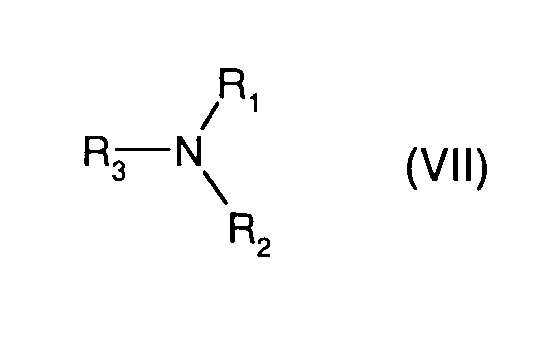
- a preferred tertiary amine is a compound of the formula VII wherein R 1 , R 2 and R 3 are the same or different, and are C 1 -C 24 alkyl; C 4 -C 24 alkyl interrupted by one or more O-atoms; phenyl, C 7 -C 9 phenylalkyl; C 7 -C 9 alkylphenyl; or two of R 1 , R 2 and R 3 together with the N-atom to which they are attached form a 5-, 6- or 7-membered heterocyclic residue, which optionally contains further oxygen, nitrogen or sulphur atom and which is optionally substituted by one or more C 1 -C 4 alkyl groups, and the other of R 1 , R 2 and R 3 is C 1 -C 24 alkyl or C 4 -C 24 alkyl interrupted by one or more O-atoms.
- Alkyl having up to 24 carbon atoms is a branched or unbranched radical, for example methyl, ethyl, propyl, isopropyl, n-butyl, sec-butyl, isobutyl, tert-butyl, 2-ethylbutyl, n-pentyl, isopentyl, 1-methylpentyl, 1,3-dimethylbutyl, n-hexyl, 1-methylhexyl, n-heptyl, isoheptyl, 1,1,3,3-tetramethylbutyl, 1-methylheptyl, 3-methylheptyl, n-octyl, 2-ethylhexyl, 1,1,3-trimethylhexyl, 1,1,3,3-tetramethylpentyl, nonyl, decyl, undecyl, 1-methylundecyl, dodecyl, 1,1,3,3,5,5-hexamethylhexy
- R 1 , R 2 and R 3 is, for example, C 2 -C 18 alkyl.
- An especially preferred definition for R 1 , R 2 and R 3 is C 2 -C 8 alkyl, for example ethyl.
- C 4 -C 24 alkyl interrupted by one or more O-atoms include, e.g. 2-ethoxypropyl, 1-methoxypropyl, 1-methoxybutyl, n-butoxyethyl, 1-methoxyoctyl, 1-methoxydecyl, 1-methoxydodecyl, 1-methoxyhexadecyl, 1-methoxyeicosyl, 1-methoxytetraeicosyl and 2-methoxyethoxymethyl.
- Phenylalkyl is, for example, benzyl, ⁇ -methylbenzyl, ⁇ , ⁇ -dimethylbenzyl or 2-phenylethyl. Preference is given to benzyl.
- Heterocyclic groups formed by two of R 1 , R 2 and R 3 are preferably 6-membered, examples of which are piperidino, morpholino, thiomorpholino and 4-C 1 -C 4 alkyl-piperazino.
- a preferred aromatic amine is pyridine which is optionally substituted by one or more C 1 -C 4 -alkyl groups.
- Pyridine which is optionally substituted by one or more C 1 -C 4 alkyl group is, for example, 2,3-lutidine, 2,4-lutidine, 2,5-lutidine or 3,4-lutidine.
- a preferred solvent is benzene which is optionally substituted by one or more chlorine or C 1 -C 4 alkyl groups.
- Benzene which is optionally substituted by one or more chlorine or C 1 -C 4 alkyl groups is, for example, chlorobenzene, toluene or xylene. Preferred is chlorobenzene.
- a preferred base is an alkaline metal- or an alkaline earth metal- hydroxide, oxide, hydrogen phosphate, dihydrogen phosphate, carbonate, hydrogen carbonate or tetraborate.
- An alkaline metal- or alkaline earth metal- hydroxide, oxide, hydrogen phosphate, dihydrogen phosphate, carbonate, hydrogen carbonate or tetraborate is, for example, sodium hydroxide, potassium hydroxide, magnesium hydroxide, calcium hydroxide, barium hydroxide, calcium oxide, sodium hydrogen phosphate, sodium dihydrogen phosphate, sodium carbonate, calcium carbonate, sodium hydrogen carbonate or sodium tetraborate decahydrate.
- the base is used in an amount of from 0.1 to 10 % by weight, especially from 0.1 to 5 % by weight, e.g. from 0.1 to 2 % by weight, based on the weight of the solvent layer.
- a preferred desiccant is an alkaline metal sulfate, an alkaline earth metal sulfate or oxide, a molecular sieve or aluminium oxide.
- An alkaline metal sulfate, an alkaline earth metal sulfate or oxide, a molecular sieve or aluminium oxide is, for example, magnesium oxide, calcium oxide, sodium sulfate, magnesium sulfate, barium sulfate, molecular sieve 3 ⁇ , molecular sieve 4 ⁇ , powdered aluminium oxide.
- the dessicant is used in an amount of from 0.1 to 10 % by weight, especially from 0.1 to 5 % by weight, e.g. from 0.1 to 2 % by weight, based on the weight of the solvent layer.
- Some dessicants like for example sodium sulfate can also act as a cation precipitant.
- a preferred filter-aid is, for example, fuller's earth [Merck Index 10 th Edition, 4162 (1983)] or infusorial earth [Merck Index 10 th Edition, 4857 (1983)] which includes floridin, a nonplastic variety of kaolin containing an aluminium magnesium silicate, kieselgur, celite, diatomaceous earth like for example Hyflo Super Cel [(RTM), Aldrich 39,254-5].
- the filter-aid is used in an amount of from 0.1 to 10 % by weight, especially from 0.1 to 5 % by weight, e.g. from 0.1 to 2 % by weight, based on the weight of the solvent layer.
- a preferred base with crystalline water is, for example, sodium tetraborate decahydrate (Na 2 B 4 O 7 10H 2 O), Na 2 HPO 4 12H 2 O or Na 2 CO 3 10H 2 O.
- a process for the preparation of a stabiliser mixture containing a low amount of chloride which comprises treating the solvent layer with water in an amount of from 0.1 to 10 % by weight, especially from 0.1 to 5 % by weight, e.g. 0.1 to 2 % by weight, based on the weight of the solvent layer.
- the phosphorus trichloride is preferably used as reagent and solvent.
- 3 to 10 mole, especially 3 to 8 mole, e.g. 3 to 5 mole, of phosphorus trichloride is used.
- the reaction is kept under reflux for 4 to 10 hours, especially 4 to 8 hours, e.g. 5 to 7 hours.
- the excess phosphorus trichloride is distilled off.
- the temperature range is advantageously of from 10 to 100°C, especially from 10 to 80°C, e.g. from 20 to 80°C.
- the concentration of the reaction mixture is advantageously of from 10 to 80 % by weight, especially from 10 to 60 % by weight.
- the tertiary amine or the aromatic amine is used advantageously in a molar excess of from 10 to 100 %, especially from 20 to 80 %, e.g. from 30 to 70 % based on the molar amount of 2,4-di-tert-butyl-phenol.
- This improved Sandostab P-EPQ (RTM) is named in the further paragraphs LCT ( L ow- C hloride- T ransparent) stabiliser mixture.
- LCT L ow- C hloride- T ransparent
- This LCT stabiliser mixture is suitable for stabilising organic materials against oxidative, thermal or light-induced degradation.
- Example 1 Preparation of crude chlorobenzene solution of stabiliser mixture (35 % w/w).
- This crude solution was added to a stirred solution of 482 g (2.334 mole) of 2,4-di-tert-butyl-phenol , 362 g (4.576 mole) of pyridine and 600 g of chlorobenzene in a 2.5 L jacketed glass reactor equipped with a mechanical stirrer and reflux condenser with external water cooling.
- the reaction is exothermic and the internal temperature was kept below 80°C.
- the mixture was kept 3 hours at an internal temperature of 63-65°C. On standing, the reaction mixture separated into two phases.
- the lower complex phase was separated and the upper organic phase was diluted with 430 g of chlorobenzene which lead to 1'650 g of crude chlorobenzene solution (35 % w/w) comprising the stabiliser mixture. Acid base titration of this crude solution gives an average consumption of 0.125 mole of KOH/kg of solution.
- Example 2 Comparative example.
- Example 3 Preparation of LCT stabiliser mixture containing a low amount of chloride.
- Example 4 Preparation of LCT stabiliser mixture containing a low amount of chloride.
- Example 5 Preparation of LCT stabiliser mixture containing a low amount of chloride.
- Example 6 Preparation of LCT stabiliser mixture containing a low amount of chloride.
- Example 7 Preparation of LCT stabiliser mixture containing a low amount of chloride.
- Example 8 Preparation of LCT stabiliser mixture containing a low amount of chloride.
- Example 9 Preparation of LCT stabiliser mixture containing a low amount of chloride.
- Example 10 Preparation of LCT stabiliser mixture containing a low amount of chloride.
Landscapes
- Chemical & Material Sciences (AREA)
- Health & Medical Sciences (AREA)
- Chemical Kinetics & Catalysis (AREA)
- Medicinal Chemistry (AREA)
- Polymers & Plastics (AREA)
- Organic Chemistry (AREA)
- Compounds Of Alkaline-Earth Elements, Aluminum Or Rare-Earth Metals (AREA)
Abstract
Description
- The present invention relates to a new work-up process for the preparation of a stabiliser mixture containing a low amount of chloride, which are suitable for stabilising organic materials against oxidative, thermal or light-induced degradation.
- U.S. 4,075,163 discloses the synthesis of tetrakis(2,4-di-tert-butylphenyl)biphenylene diphosphonite (column 7, Table 1, compound 12) which is suitable for stabilising organic materials against oxidative, thermal or light-induced degradation. This compound is commercially available for example as Sandostab P-EPQ (RTM) from Clariant, Switzerland.
- EP-A-0 633 287 discloses in Example 1 that this commercially available Sandostab P-EPQ (RTM) is a mixture of several components comprising a) 65 % by weight of tetrakis(2,4-di-tert-butylphenyl)biphenylene diphosphonite, b) 15 % by weight of bis(2,4-di-tert-butylphenyl)-biphenylene monophosphonite, c) 13 parts by weight of tris(2,4-di-tert-butylphenyl) phosphite, d) 1.5 parts by weight of 2,4-di-tert-butyl phenol, e) up to 1 % by weight of chloride [up to 10'000 mg/kg], f) up to 0.5 % by weight of volatiles, and g) 4 - 5 % by weight of the oxidised tetrakis(2,4-di-tert-butylphenyl)biphenylene diphosphonite.
- Phosphites and phosphonites are hydrolytically very labile (see Example 29 in U.S. Patent 4,075,163). Therefore, during the synthesis of Sandostab P-EPQ (RTM) the reaction mixture was never brought into contact with water. In the actual large scale production of Sandostab P-EPQ (RTM) the neutralisation of the remaining aluminium trichloride/pyridine/hydrochloric acid complex is done with gaseous ammonia (see comparative Example 2 in the instant application). However, some of the formed salts like for example ammonium chloride remain in the final product. These salt impurities may be the reason why the final stabiliser mixture is slightly turbid. A turbid stabiliser for polyolefins, however, induces some haze in polyolefins which is for some applications clearly undesired.
- The goal of the instant invention was therefore to find an improved work-up process for the synthesis of Sandostab P-EPQ (RTM) containing a low amount of chloride and forming a product which is not turbid and does not induce any haze into synthetic polymers.
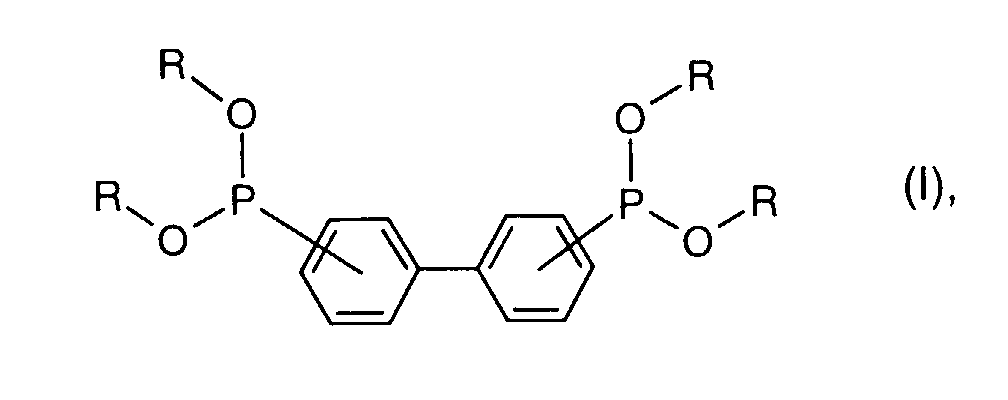
- The present invention therefore relates to a process for the preparation of a stabiliser mixture containing a low amount of chloride comprising
- a) 50 - 80 % by weight of a diphosphonite of the formula I
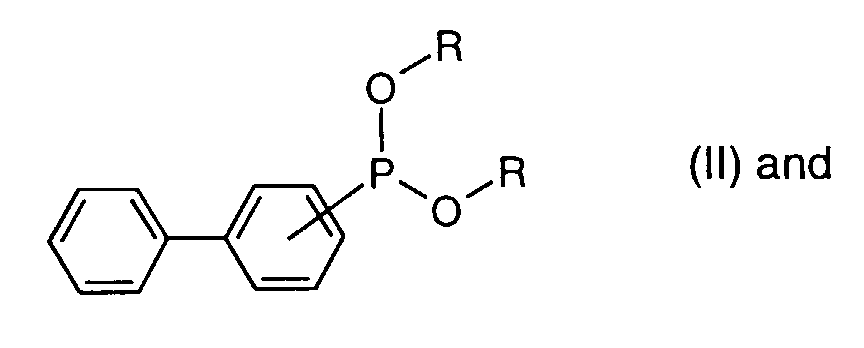
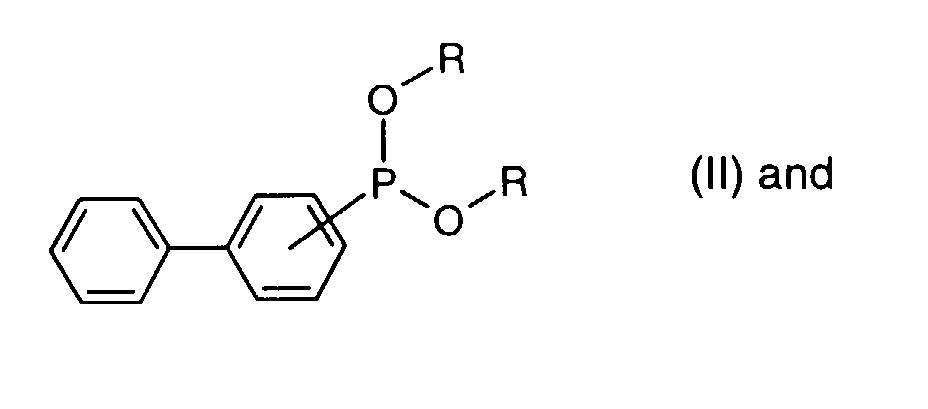
- b) 5 - 25 % by weight of a monophosphonite of the formula II
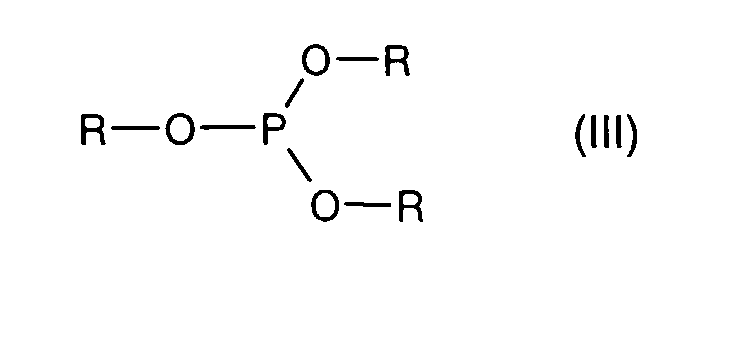
- c) 5 - 25 % by weight of a phosphite of the formula III
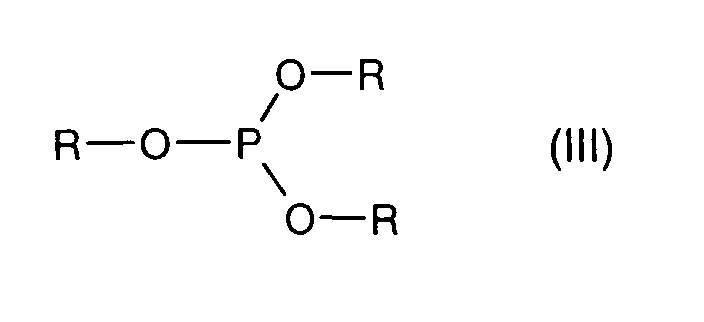 in which R is a radical of the formula IV
-
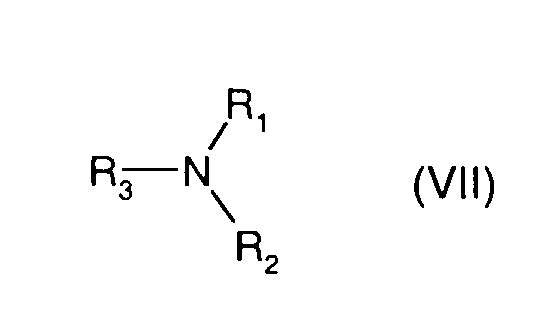
- A preferred tertiary amine is a compound of the formula VIIwherein R1, R2 and R3 are the same or different, and are C1-C24alkyl; C4-C24alkyl interrupted by one or more O-atoms; phenyl, C7-C9phenylalkyl; C7-C9alkylphenyl; or two of R1, R2 and R3 together with the N-atom to which they are attached form a 5-, 6- or 7-membered heterocyclic residue, which optionally contains further oxygen, nitrogen or sulphur atom and which is optionally substituted by one or more C1-C4alkyl groups, and the other of R1, R2 and R3 is C1-C24alkyl or C4-C24alkyl interrupted by one or more O-atoms.
- Alkyl having up to 24 carbon atoms is a branched or unbranched radical, for example methyl, ethyl, propyl, isopropyl, n-butyl, sec-butyl, isobutyl, tert-butyl, 2-ethylbutyl, n-pentyl, isopentyl, 1-methylpentyl, 1,3-dimethylbutyl, n-hexyl, 1-methylhexyl, n-heptyl, isoheptyl, 1,1,3,3-tetramethylbutyl, 1-methylheptyl, 3-methylheptyl, n-octyl, 2-ethylhexyl, 1,1,3-trimethylhexyl, 1,1,3,3-tetramethylpentyl, nonyl, decyl, undecyl, 1-methylundecyl, dodecyl, 1,1,3,3,5,5-hexamethylhexyl, tridecyl, tetradecyl, pentadecyl, hexadecyl, heptadecyl, octadecyl, icosyl or docosyl. One of the preferred definitions for R1, R2 and R3 is, for example, C2-C18alkyl. An especially preferred definition for R1, R2 and R3 is C2-C8alkyl, for example ethyl.
- C4-C24alkyl interrupted by one or more O-atoms include, e.g. 2-ethoxypropyl, 1-methoxypropyl, 1-methoxybutyl, n-butoxyethyl, 1-methoxyoctyl, 1-methoxydecyl, 1-methoxydodecyl, 1-methoxyhexadecyl, 1-methoxyeicosyl, 1-methoxytetraeicosyl and 2-methoxyethoxymethyl.
- C7-C9Phenylalkyl is, for example, benzyl, α-methylbenzyl, α,α-dimethylbenzyl or 2-phenylethyl. Preference is given to benzyl.
- Heterocyclic groups formed by two of R1, R2 and R3 are preferably 6-membered, examples of which are piperidino, morpholino, thiomorpholino and 4-C1-C4alkyl-piperazino.
- A preferred aromatic amine is pyridine which is optionally substituted by one or more C1-C4-alkyl groups.
- Pyridine which is optionally substituted by one or more C1-C4alkyl group is, for example, 2,3-lutidine, 2,4-lutidine, 2,5-lutidine or 3,4-lutidine.
- A preferred solvent is benzene which is optionally substituted by one or more chlorine or C1-C4alkyl groups.
- Benzene which is optionally substituted by one or more chlorine or C1-C4alkyl groups is, for example, chlorobenzene, toluene or xylene. Preferred is chlorobenzene.
- A preferred base is an alkaline metal- or an alkaline earth metal- hydroxide, oxide, hydrogen phosphate, dihydrogen phosphate, carbonate, hydrogen carbonate or tetraborate.
- An alkaline metal- or alkaline earth metal- hydroxide, oxide, hydrogen phosphate, dihydrogen phosphate, carbonate, hydrogen carbonate or tetraborate is, for example, sodium hydroxide, potassium hydroxide, magnesium hydroxide, calcium hydroxide, barium hydroxide, calcium oxide, sodium hydrogen phosphate, sodium dihydrogen phosphate, sodium carbonate, calcium carbonate, sodium hydrogen carbonate or sodium tetraborate decahydrate.
- Advantageously, the base is used in an amount of from 0.1 to 10 % by weight, especially from 0.1 to 5 % by weight, e.g. from 0.1 to 2 % by weight, based on the weight of the solvent layer.
- A preferred desiccant is an alkaline metal sulfate, an alkaline earth metal sulfate or oxide, a molecular sieve or aluminium oxide.
- An alkaline metal sulfate, an alkaline earth metal sulfate or oxide, a molecular sieve or aluminium oxide is, for example, magnesium oxide, calcium oxide, sodium sulfate, magnesium sulfate, barium sulfate, molecular sieve 3 Å, molecular sieve 4 Å, powdered aluminium oxide. basic aluminium oxide, calcined aluminium oxide, fused aluminium oxide, fused aluminium oxide, granulated aluminium oxide or sintered aluminium oxide.
- Advantageously, the dessicant is used in an amount of from 0.1 to 10 % by weight, especially from 0.1 to 5 % by weight, e.g. from 0.1 to 2 % by weight, based on the weight of the solvent layer.
- Some dessicants like for example sodium sulfate can also act as a cation precipitant.
- Of interest is a process for the preparation of a stabiliser mixture containing a low amount of chloride, which comprises treating the solvent layer additionally with a filter-aid before separating the precipitate from the solution containing the stabiliser mixture.
- A preferred filter-aid is, for example, fuller's earth [Merck Index 10th Edition, 4162 (1983)] or infusorial earth [Merck Index 10th Edition, 4857 (1983)] which includes floridin, a nonplastic variety of kaolin containing an aluminium magnesium silicate, kieselgur, celite, diatomaceous earth like for example Hyflo Super Cel [(RTM), Aldrich 39,254-5].
- Advantageously, the filter-aid is used in an amount of from 0.1 to 10 % by weight, especially from 0.1 to 5 % by weight, e.g. from 0.1 to 2 % by weight, based on the weight of the solvent layer.
- Of special interest is a process for the preparation of a stabiliser mixture containing a low amount of chloride, which comprises that the water is added in the form of crystalline water which is present in the base.
- A preferred base with crystalline water is, for example, sodium tetraborate decahydrate (Na2B4O7 10H2O), Na2HPO4 12H2O or Na2CO3 10H2O.
- Preferred is a process for the preparation of a stabiliser mixture containing a low amount of chloride, which comprises treating the solvent layer with water, a base and a desiccant at a temperature range of 0 - 25°C, for example 5 - 20°C.
- Preferred is also a process for the preparation of a stabiliser mixture containing a low amount of chloride, which comprises treating the solvent layer with water, a base and a desiccant so that the pH range is of from 7.0 to 13, especially of from 7.5 to 12, e.g. of from 8 to 12.
- Of special interest is a process for the preparation of a stabiliser mixture containing a low amount of chloride, which comprises treating the solvent layer with water in an amount of from 0.1 to 10 % by weight, especially from 0.1 to 5 % by weight, e.g. 0.1 to 2 % by weight, based on the weight of the solvent layer.
- Of special interest is also a process for the preparation of a stabiliser mixture in which the amount of chloride in the final product mixture is lower than 5'000 mg/kg, especially lower than 1500 mg/kg, e.g. lower than 500 mg/kg.
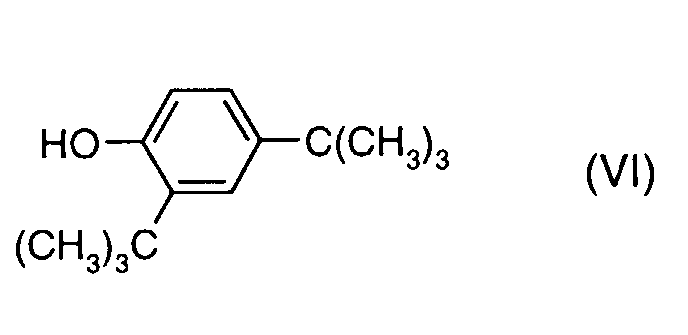
- In the reaction of biphenyl of the formula V under Friedel-Crafts condition with phosphorus trichloride and aluminium trichloride, the phosphorus trichloride is preferably used as reagent and solvent. Thus, for the reaction of one mole biphenyl, 3 to 10 mole, especially 3 to 8 mole, e.g. 3 to 5 mole, of phosphorus trichloride is used. Preferably the reaction is kept under reflux for 4 to 10 hours, especially 4 to 8 hours, e.g. 5 to 7 hours. Preferably, the excess phosphorus trichloride is distilled off. In the subsequent reaction of the crude product mixture with 2,4-di-tert-butyl-phenol in the presence of a tertiary amine or an aromatic amine and a solvent the temperature range is advantageously of from 10 to 100°C, especially from 10 to 80°C, e.g. from 20 to 80°C. The concentration of the reaction mixture is advantageously of from 10 to 80 % by weight, especially from 10 to 60 % by weight. The tertiary amine or the aromatic amine is used advantageously in a molar excess of from 10 to 100 %, especially from 20 to 80 %, e.g. from 30 to 70 % based on the molar amount of 2,4-di-tert-butyl-phenol.
- This improved Sandostab P-EPQ (RTM) is named in the further paragraphs LCT ( L ow- C hloride- T ransparent) stabiliser mixture. This LCT stabiliser mixture is suitable for stabilising organic materials against oxidative, thermal or light-induced degradation.
- The following Examples illustrate the invention further. Parts or percentages relate to weight.
- In a 1.5 L jacketed glass reactor equipped with a mechanical stirrer and reflux condenser, a mixture of 90 g (0.584 mole) of biphenyl, 204 g (1.53 mole) of anhydrous aluminium chloride and 305 g (2.218 mole) of phosphorus trichloride was refluxed under a nitrogen atmosphere with stirring at an internal temperature of 75°C for 6 hours, during which time hydrochloric acid gas was evolved and trapped with water in a scrubber tower. The reaction mixture was cooled and excess phosphorus trichloride was distilled off at an internal temperature of 63-65°C and reduced pressure of 400-180 mbar. The crude melt was cooled to 35°C and diluted with 220 g of chlorobenzene.
- This crude solution was added to a stirred solution of 482 g (2.334 mole) of 2,4-di-tert-butyl-phenol , 362 g (4.576 mole) of pyridine and 600 g of chlorobenzene in a 2.5 L jacketed glass reactor equipped with a mechanical stirrer and reflux condenser with external water cooling. The reaction is exothermic and the internal temperature was kept below 80°C. At end of the addition, the mixture was kept 3 hours at an internal temperature of 63-65°C. On standing, the reaction mixture separated into two phases. The lower complex phase was separated and the upper organic phase was diluted with 430 g of chlorobenzene which lead to 1'650 g of crude chlorobenzene solution (35 % w/w) comprising the stabiliser mixture. Acid base titration of this crude solution gives an average consumption of 0.125 mole of KOH/kg of solution.
- This solution was used in the further examples for producing LCT stabiliser mixture.
- 1000 g of crude chlorobenzene solution (35 % w/w) of stabiliser mixture obtained according to Example 1, was cooled to -10°C under stirring for 1 hour. The mixture was filtered from precipitated residual AlCl3-pyridine complex. Gaseous ammonia (4.0 g) was bubbled through the filtrate at 0-5°C and held at that temperature for 1 hour. An aliquot shaken with water showed a pH value of 8-9. The solvent was evaporated using a vacuum rotary evaporator at 100-110°C/ 350-310 mbar and finally at 170°C/< 10 mbar. The residue yields 350 g of stabiliser mixture as a pale, yellowish turbid glassy solid (Tg = 65°C). The remaining chloride content is > 5'000 mg/kg.
- 1000 g of crude chlorobenzene solution (35 % w/w) of stabiliser mixture obtained according to Example 1, was cooled to 5 - 10°C under stirring. To this mixture was added 5.0 g (0.01 mole) of sodium tetraborate decahydrate (Na2B4O7 10 H20), 2.5 g (0.14 mole) of water and 5.0 g (0.04 mole) of sodium sulfate and stirred for one hour during which time the solution brightens up. Afterwards 8.0 g (0.11 mole) of powdered calcium hydroxide, 5.0 g (0.09 mole) of calcium oxide and 5.0 g of Kieselgur Clarcel DIF B (RTM) was added and stirred for 3 hours at 25°C. After filtration, the filtrate was evaporated using a vacuum rotary evaporator at 100-110°C/350-310 mbar and finally at 170°C/< 10 mbar. The residue yields 350 g of LCT stabiliser mixture as a clear, light yellow solid (Tg = 65°C). The remaining chloride content is 1'000 mg/kg.
- 1000 g of crude chlorobenzene solution (35 % w/w) of stabiliser mixture obtained according to Example 1, was cooled to 20°C under stirring. To this mixture was added 5.0 g (0.04 mole) of sodium sulfate followed by a neutraliser solution comprising 11.1 g (0.029 mole) of sodium tetraborate decahydrate (Na2B4O7 10H2O), 11.0 g (0.61 mole) of water and 3.0 g (0.075 mole) of sodium hydroxide. The mixture was stirred for one hour during which time the solution brightens up. Afterwards 2.0 g (0.027 mole) of powdered calcium hydroxide, 5.0 g (0.09 mole) of calcium oxide and 5.0 g of Kieselgur Clarcel DIF B (RTM) was added and stirred for 3 hours at 25°C. After filtration, the filtrate was evaporated using a vacuum rotary evaporator at 100-110°C/350-310 mbar and finally at 170°C/< 10 mbar. The residue yields 350 g of LCT stabiliser mixture as a clear, light yellow solid (Tg = 65°C). The remaining chloride content is 400 mg/kg.
- 1000 g of crude chlorobenzene solution (35 % w/w) of stabiliser mixture obtained according to Example 1, was cooled to 20°C under stirring. To this mixture was added 5.0 g (0.04 mole) of sodium sulfate followed by 10.0 g (0.026 mole) of sodium tetraborate decahydrate (Na2B4O7 10H2O). The mixture was stirred for one hour during which time the solution brightens up. Afterwards a neutraliser solution comprising 6.6 g (0.017 mole) of sodium tetraborate decahydrate (Na2B4O7 10H2O), 1.8 g (0.045 mole) of sodium hydroxide and 6.6 g (0.37 mole) of water was added. The mixture was stirred for 30 minutes at room temperature. Afterwards 2.0 g (0.027 mole) calcium hydroxide, 6.0 g (0.107 mole) of calcium oxide and 5.0 g of Kieselgur Clarcel DIF B (RTM) was added and stirred for 3 hours at 25°C. After filtration, the filtrate was evaporated using a vacuum rotary evaporator at 100-110°C/350-310 mbar and finally at 170°C/< 10 mbar. The residue yields 350 g of LCT stabiliser mixture as a clear, light yellow solid (Tg = 65°C). The remaining chloride content is 300 mg/kg.
- 1000 g of crude chlorobenzene solution (35 % w/w) of stabiliser mixture obtained according to Example 1, was cooled to 20°C under stirring. To this mixture was added 5.0 g (0.04 mole) of sodium sulfate followed by 17.0 g (0.044 mole) of sodium tetraborate decahydrate (Na2B4O7 10 H2O). The mixture was stirred for one hour during which time the solution brightens up. Afterwards 5.0 g (0.068 mole) calcium hydroxide and 5.0 g (0.089 mole) of calcium oxide was added and stirred for one hour. Then 5.0 g of Kieselgur Clarcel DIF B (RTM) was added and stirred for 3 hours at 25°C. After filtration, the filtrate was evaporated using a vacuum rotary evaporator at 100-110°C/350-310 mbar and finally at 170°C/< 10 mbar. The residue yields 350 g of LCT stabiliser mixture as a clear, light yellow solid (Tg = 65°C). The remaining chloride content is 200 mg/kg.
- 1000 g of crude chlorobenzene solution (35 % w/w) of stabiliser mixture obtained according to Example 1, was cooled to 20°C under stirring. To this mixture was added 5.0 g (0.047 mole) of sodium carbonate followed by 10.0 g (0.026 mole) of sodium tetraborate decahydrate (Na2B4O7 10 H2O). The mixture was stirred for one hour during which time the solution brightens up. Afterwards a neutraliser solution comprising 9.9 g (0.026 mole) of sodium tetraborate decahydrate (Na2B4O7 10 H2O), 1.8 g (0.068 mole) of sodium hydroxide and 9.9 g (0.55 mole) of water was added. The mixture was stirred for 30 minutes at room temperature. Afterwards 2.0 g (0.027 mole) calcium hydroxide, 5.0 g (0.089 mole) of calcium oxide and 5.0 g of Kieselgur Clarcel DIF B (RTM) was added and stirred for 3 hours at 25°C. After filtration, the filtrate was evaporated using a vacuum rotary evaporator at 100-110°C/350-310 mbar and finally at 170°C/< 10 mbar. The residue yields 350 g of LCT stabiliser mixture as a clear, light yellow solid (Tg is 65°C). The remaining chloride content is 400 mg/kg.
- 1000 g of crude chlorobenzene solution (35 % w/w) of stabiliser mixture obtained according to Example 1, was cooled to 20°C under stirring. To this mixture was added 5.0 g (0.035 mole) of sodium sulfate followed by 5.0 g (0.013 mole) of sodium tetraborate decahydrate (Na2B4O7 10 H20) and 2.5 g (0.139 mole) of water. The mixture was stirred for one hour during which time the solution brightens up. Afterwards a suspension comprising 8.7 g (0.155 mole) of calcium oxide and 2.7 g (0.009 mole) of sodium carbonate decahydrate in 94 g of chlorobenzene was added. Finally, 5.0 g of Kieselgur Clarcel DIF B (RTM) was added and stirred for 2 hours at 25°C. After filtration, the filtrate was evaporated using a vacuum rotary evaporator at 100-110°C/350-310 mbar and finally at 170°C/< 10 mbar. The residue yields 350 g of LCT stabiliser mixture as a clear, light yellow solid (Tg is 65°C). The remaining chloride content is 1200 mg/kg.
- 1000 g of crude chlorobenzene solution (35 % w/w) of stabiliser mixture obtained according to Example 1, was cooled to 20°C under stirring. To this mixture was added 5.0 g (0.013 mole) of sodium tetraborate decahydrate (Na2B4O7 10 H20), 10.0 g (0.10 mole) of calcium carbonate powder, 5.0 g (0.035 mole) of sodium sulfate followed by 2.5 g (0.139 mole) of water. The mixture was stirred for one hour during which time the solution brightens up. Afterwards 5.0 g (0.089 mole) of calcium oxide was added and the mixture was stirred for one hour at room temperature. Finally, 5.0 g of Kieselgur Clarcel DIF B (RTM) was added and stirred for 2 hours at 25°C. After filtration, the filtrate was evaporated using a vacuum rotary evaporator at 100-110°C/350-310 mbar and finally at 170°C/< 10 mbar. The residue yields 350 g of LCT stabiliser mixture as a clear, light yellow solid (Tg is 65°C). The remaining chloride content is 2100 mg/kg.
- 1000 g of crude chlorobenzene solution (35 % w/w) of stabiliser mixture obtained according to Example 1, was cooled to 15°C under stirring. To this mixture was added 10.0 g (0.026 mole) of sodium tetraborate decahydrate (Na2B4O7 10 H20) and 4.0 g (0.222 mole) of water. The mixture was stirred for two hours during which time the solution brightens up. Afterwards 10.1 g ( 0.095 mole) of powdered anhydrous sodium carbonate was added and stirred for one hour. Then 5.0 g (0.089 mole) calcium oxide was added and stirred for one hour. Finally, 5.0 g of Kieselgur Clarcel DIF B (RTM) was added and stirred for 2 hours at 25°C. After filtration, the filtrate was evaporated using a vacuum rotary evaporator at 100-110°C/350-310 mbar and finally at 170°C/< 10 mbar. The residue yields 350 g of LCT stabiliser mixture as a clear, light yellow solid (Tg is 65°C). The remaining chloride content is 250 mg/kg.

by reacting a biphenyl of the formula V

Claims (10)
- A process for the preparation of a stabiliser mixture containing a low amount of chloride comprisingin which R is a radical of the formula IVa) 50 - 80 % by weight of a diphosphonite of the formula I
 b) 5 - 25 % by weight of a monophosphonite of the formula II
 c) 5 - 25 % by weight of a phosphite of the formula III
 and where the sum of the compounds of the formula I, II and III is not greater than 100 % by weight,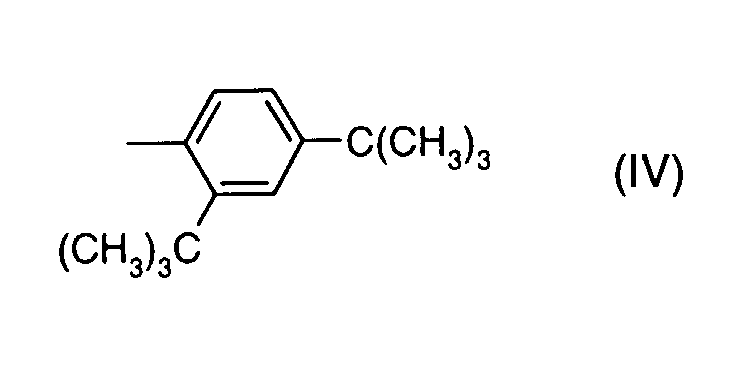
by reacting a biphenyl of the formula Vunder Friedel-Crafts condition with phosphorus trichloride and aluminium trichloride and by reacting the product mixture with 2,4-di-tert-butyl-phenol of the formula VI in the presence of a tertiary amine or an aromatic amine and a solvent, separating the formed two layers, which process comprises treating the solvent layer with water, a base and a desiccant, separating the precipitate from the solution containing the stabiliser mixture and evaporating the solvent.
- A process according to claim 1, wherein, the tertiary amine is a compound of the formula VIIwherein R1, R2 and R3 are the same or different, and are C1-C24alkyl; C4-C24alkyl interrupted by one or more O-atoms; phenyl, C7-C9phenylalkyl; C7-C9alkylphenyl; or two of R1, R2 and R3 together with the N-atom to which they are attached form a 5-, 6- or 7-membered heterocyclic residue, which optionally contains further oxygen, nitrogen or sulphur atom and which is optionally substituted by one or more C1-C4alkyl groups, and the other of R1, R2 and R3 is C1-C24alkyl or C4-C24alkyl interrupted by one or more O-atoms.
- A process according to claim 1, wherein the aromatic amine is pyridine which is optionally substituted by one or more C1-C4alkyl groups.
- A process according to claim 1, wherein, the solvent is benzene which is optionally substituted by one or more chlorine or C1-C4alkyl groups.
- A process according to claim 1, wherein the base is an alkaline metal- or an alkaline earth metal- hydroxide, oxide, hydrogen phosphate, dihydrogen phosphate, carbonate, hydrogen carbonate or tetraborate.
- A process according to claim 1, wherein the desiccant is an alkaline metal sulfate, an alkaline earth metal sulfate or oxide, a molecular sieve or aluminium oxide.
- A process according to claim 1, which comprises treating the solvent layer additionally with a filter-aid before separating the precipitate from the solution containing the stabiliser mixture.
- A process according to claim 7, wherein the filter-aid is fuller's earth or infusorial earth.
- A process according to claim 1, which comprises treating the solvent layer with water, a base and a desiccant at a temperature range of 0 - 25°C.
- A process according to claim 1, which comprises treating the solvent layer with water in an amount of from 0.1 to 10 % by weight based on the weight of the solvent layer.
Priority Applications (1)
| Application Number | Priority Date | Filing Date | Title |
|---|---|---|---|
| EP20000810981 EP1097936B1 (en) | 1999-11-02 | 2000-10-24 | Process for the preparation of low chloride stabilisers |
Applications Claiming Priority (3)
| Application Number | Priority Date | Filing Date | Title |
|---|---|---|---|
| EP99810997 | 1999-11-02 | ||
| EP99810997 | 1999-11-02 | ||
| EP20000810981 EP1097936B1 (en) | 1999-11-02 | 2000-10-24 | Process for the preparation of low chloride stabilisers |
Publications (2)
| Publication Number | Publication Date |
|---|---|
| EP1097936A1 true EP1097936A1 (en) | 2001-05-09 |
| EP1097936B1 EP1097936B1 (en) | 2003-03-05 |
Family
ID=26074056
Family Applications (1)
| Application Number | Title | Priority Date | Filing Date |
|---|---|---|---|
| EP20000810981 Expired - Lifetime EP1097936B1 (en) | 1999-11-02 | 2000-10-24 | Process for the preparation of low chloride stabilisers |
Country Status (1)
| Country | Link |
|---|---|
| EP (1) | EP1097936B1 (en) |
Cited By (1)
| Publication number | Priority date | Publication date | Assignee | Title |
|---|---|---|---|---|
| WO2015113840A1 (en) * | 2014-01-31 | 2015-08-06 | Evonik Degussa Gmbh | Purifying organophosphorous compounds contaminated with chlorine |
Citations (1)
| Publication number | Priority date | Publication date | Assignee | Title |
|---|---|---|---|---|
| EP0633287A1 (en) * | 1992-01-17 | 1995-01-11 | Sandoz Ltd. | Clarifying nucleating and/or large-improving compositions |
-
2000
- 2000-10-24 EP EP20000810981 patent/EP1097936B1/en not_active Expired - Lifetime
Patent Citations (1)
| Publication number | Priority date | Publication date | Assignee | Title |
|---|---|---|---|---|
| EP0633287A1 (en) * | 1992-01-17 | 1995-01-11 | Sandoz Ltd. | Clarifying nucleating and/or large-improving compositions |
Cited By (2)
| Publication number | Priority date | Publication date | Assignee | Title |
|---|---|---|---|---|
| WO2015113840A1 (en) * | 2014-01-31 | 2015-08-06 | Evonik Degussa Gmbh | Purifying organophosphorous compounds contaminated with chlorine |
| US9676805B2 (en) | 2014-01-31 | 2017-06-13 | Evonik Degussa Gmbh | Purifying organophosphorus compounds contaminated with chlorine |
Also Published As
| Publication number | Publication date |
|---|---|
| EP1097936B1 (en) | 2003-03-05 |
Similar Documents
| Publication | Publication Date | Title |
|---|---|---|
| US4705867A (en) | Process for the production of 1,2-dithiolan-3-pentanoic acid (thioctic acid) and intermediate compounds therefor | |
| US6472550B1 (en) | Process for the preparation of low chloride stabilizers | |
| CA1266272A (en) | A 2,2,6,6-tetramethylpiperidine derivative, its production and a stabilizer for synthetic resins containing the same | |
| US5208362A (en) | Process for stabilizing organophosphorus compounds | |
| EP1097936B1 (en) | Process for the preparation of low chloride stabilisers | |
| US6653494B2 (en) | Processes for producing triaryl phosphite | |
| NL192205C (en) | Process for preparing 7-amino-3- (Z-1-propenyl) -3-cephem-4-carboxylic acid and esters thereof. | |
| JP2001164246A5 (en) | ||
| US3810929A (en) | Polycarboxylic acid-bridged thio-methylenephenol antioxidants | |
| JPH02221290A (en) | Preparation of organic phosphorus derivative of 2,4-di-tert-butylphenol and organic phosphorus derivative of biphenyl 4,4-dihalomagnesium compound and use of said organic phosphorus derivative for stabilization of plastics, especially polyolefine molding composition | |
| SK31095A3 (en) | Method of production of hydroxyphenylcarboxyl acids | |
| IE49355B1 (en) | Process for the manufacture of(n-cyanoimido)-carbonates | |
| CN1314668C (en) | Method for the production of a thioacetic acid and salts thereof | |
| US4448915A (en) | Acetylene carbamide derivatives, processes for their production, and antioxidants for organic substances which comprise such derivatives as active ingredients | |
| US4093592A (en) | Novel phenolic antioxidants, their preparation and their use | |
| KR0169086B1 (en) | Arylesters of phosphorous acid, process for preparing them and their use to stabilize plastics, in particular polyolefin moulding materials | |
| US3136800A (en) | Method for producing hydroxythiobenzoic acids and esters thereof | |
| US5565600A (en) | Alkyl-aromatic diphosphites | |
| WO1992016537A1 (en) | Alkyl-aromatic diphosphites | |
| JPH05194566A (en) | New aryl ester of diarylphosphonous acid, its production and method of using same for stabilizing molding compositionof plastic especially polyolefin | |
| CN111943895A (en) | Method for preparing 2- (4, 6-diaryl-1, 3, 5-triazine-2-yl) -5-alkoxy-phenol | |
| US3635885A (en) | Polyolefins stabilized with alkenyl phenols | |
| US5786497A (en) | Process for the preparation of phosphites | |
| JP4623929B2 (en) | Method for producing hindered phosphite | |
| JPS59101437A (en) | Manufacture of fluorene-9-carboxylic acid |
Legal Events
| Date | Code | Title | Description |
|---|---|---|---|
| PUAI | Public reference made under article 153(3) epc to a published international application that has entered the european phase |
Free format text: ORIGINAL CODE: 0009012 |
|
| AK | Designated contracting states |
Kind code of ref document: A1 Designated state(s): AT BE CH CY DE DK ES FI FR GB GR IE IT LI LU MC NL PT SE |
|
| AX | Request for extension of the european patent |
Free format text: AL;LT;LV;MK;RO;SI |
|
| 17P | Request for examination filed |
Effective date: 20011004 |
|
| AKX | Designation fees paid |
Free format text: AT BE CH CY DE DK ES FI FR GB GR IE IT LI LU MC NL PT SE |
|
| GRAH | Despatch of communication of intention to grant a patent |
Free format text: ORIGINAL CODE: EPIDOS IGRA |
|
| GRAH | Despatch of communication of intention to grant a patent |
Free format text: ORIGINAL CODE: EPIDOS IGRA |
|
| GRAA | (expected) grant |
Free format text: ORIGINAL CODE: 0009210 |
|
| AK | Designated contracting states |
Designated state(s): AT BE CH CY DE DK ES FI FR GB GR IE IT LI LU MC NL PT SE |
|
| PG25 | Lapsed in a contracting state [announced via postgrant information from national office to epo] |
Ref country code: GR Free format text: LAPSE BECAUSE OF FAILURE TO SUBMIT A TRANSLATION OF THE DESCRIPTION OR TO PAY THE FEE WITHIN THE PRESCRIBED TIME-LIMIT Effective date: 20030305 Ref country code: FI Free format text: LAPSE BECAUSE OF FAILURE TO SUBMIT A TRANSLATION OF THE DESCRIPTION OR TO PAY THE FEE WITHIN THE PRESCRIBED TIME-LIMIT Effective date: 20030305 Ref country code: AT Free format text: LAPSE BECAUSE OF FAILURE TO SUBMIT A TRANSLATION OF THE DESCRIPTION OR TO PAY THE FEE WITHIN THE PRESCRIBED TIME-LIMIT Effective date: 20030305 |
|
| REG | Reference to a national code |
Ref country code: GB Ref legal event code: FG4D |
|
| REG | Reference to a national code |
Ref country code: CH Ref legal event code: EP |
|
| REG | Reference to a national code |
Ref country code: IE Ref legal event code: FG4D |
|
| REF | Corresponds to: |
Ref document number: 60001533 Country of ref document: DE Date of ref document: 20030410 Kind code of ref document: P |
|
| PG25 | Lapsed in a contracting state [announced via postgrant information from national office to epo] |
Ref country code: DK Free format text: LAPSE BECAUSE OF FAILURE TO SUBMIT A TRANSLATION OF THE DESCRIPTION OR TO PAY THE FEE WITHIN THE PRESCRIBED TIME-LIMIT Effective date: 20030605 Ref country code: PT Free format text: LAPSE BECAUSE OF FAILURE TO SUBMIT A TRANSLATION OF THE DESCRIPTION OR TO PAY THE FEE WITHIN THE PRESCRIBED TIME-LIMIT Effective date: 20030605 |
|
| REG | Reference to a national code |
Ref country code: SE Ref legal event code: TRGR |
|
| REG | Reference to a national code |
Ref country code: ES Ref legal event code: FG2A Ref document number: 2191603 Country of ref document: ES Kind code of ref document: T3 |
|
| PG25 | Lapsed in a contracting state [announced via postgrant information from national office to epo] |
Ref country code: LU Free format text: LAPSE BECAUSE OF NON-PAYMENT OF DUE FEES Effective date: 20031024 Ref country code: IE Free format text: LAPSE BECAUSE OF NON-PAYMENT OF DUE FEES Effective date: 20031024 Ref country code: CY Free format text: LAPSE BECAUSE OF FAILURE TO SUBMIT A TRANSLATION OF THE DESCRIPTION OR TO PAY THE FEE WITHIN THE PRESCRIBED TIME-LIMIT Effective date: 20031024 |
|
| PG25 | Lapsed in a contracting state [announced via postgrant information from national office to epo] |
Ref country code: MC Free format text: LAPSE BECAUSE OF NON-PAYMENT OF DUE FEES Effective date: 20031031 |
|
| ET | Fr: translation filed | ||
| PLBE | No opposition filed within time limit |
Free format text: ORIGINAL CODE: 0009261 |
|
| STAA | Information on the status of an ep patent application or granted ep patent |
Free format text: STATUS: NO OPPOSITION FILED WITHIN TIME LIMIT |
|
| 26N | No opposition filed |
Effective date: 20031208 |
|
| REG | Reference to a national code |
Ref country code: IE Ref legal event code: MM4A |
|
| REG | Reference to a national code |
Ref country code: CH Ref legal event code: PUE Owner name: CLARIANT FINANCE (BVI) LTD Free format text: CIBA SPECIALTY CHEMICALS HOLDING INC.#KLYBECKSTRASSE 141#4057 BASEL (CH) -TRANSFER TO- CLARIANT FINANCE (BVI) LTD#CITCO BUILDING, WICKHAMS CAY P.O. BOX 662, ROAD TOWN#TORTOLA (VG) |
|
| REG | Reference to a national code |
Ref country code: GB Ref legal event code: 732E |
|
| NLS | Nl: assignments of ep-patents |
Owner name: CLARIANT FINANCE (BVI) LIMITED Effective date: 20060620 |
|
| REG | Reference to a national code |
Ref country code: FR Ref legal event code: TP |
|
| REG | Reference to a national code |
Ref country code: ES Ref legal event code: PC2A |
|
| PGFP | Annual fee paid to national office [announced via postgrant information from national office to epo] |
Ref country code: NL Payment date: 20070831 Year of fee payment: 8 Ref country code: SE Payment date: 20070808 Year of fee payment: 8 |
|
| PGFP | Annual fee paid to national office [announced via postgrant information from national office to epo] |
Ref country code: BE Payment date: 20071213 Year of fee payment: 8 |
|
| BERE | Be: lapsed |
Owner name: CLARIANT FINANCE BVI LTD Effective date: 20081031 |
|
| EUG | Se: european patent has lapsed | ||
| NLV4 | Nl: lapsed or anulled due to non-payment of the annual fee |
Effective date: 20090501 |
|
| PG25 | Lapsed in a contracting state [announced via postgrant information from national office to epo] |
Ref country code: NL Free format text: LAPSE BECAUSE OF NON-PAYMENT OF DUE FEES Effective date: 20090501 |
|
| PG25 | Lapsed in a contracting state [announced via postgrant information from national office to epo] |
Ref country code: BE Free format text: LAPSE BECAUSE OF NON-PAYMENT OF DUE FEES Effective date: 20081031 |
|
| PG25 | Lapsed in a contracting state [announced via postgrant information from national office to epo] |
Ref country code: SE Free format text: LAPSE BECAUSE OF NON-PAYMENT OF DUE FEES Effective date: 20081025 |
|
| REG | Reference to a national code |
Ref country code: FR Ref legal event code: PLFP Year of fee payment: 16 |
|
| REG | Reference to a national code |
Ref country code: DE Ref legal event code: R082 Ref document number: 60001533 Country of ref document: DE Representative=s name: MIKULECKY, KLAUS, DIPL.-CHEM. DR.PHIL.NAT., DE Ref country code: DE Ref legal event code: R081 Ref document number: 60001533 Country of ref document: DE Owner name: CLARIANT INTERNATIONAL LTD, CH Free format text: FORMER OWNER: CLARIANT FINANCE (BVI) LTD., ROAD TOWN, TORTOLA, VG |
|
| REG | Reference to a national code |
Ref country code: CH Ref legal event code: PUE Owner name: CLARIANT INTERNATIONAL LTD., CH Free format text: FORMER OWNER: CLARIANT FINANCE (BVI) LTD, VG |
|
| PGFP | Annual fee paid to national office [announced via postgrant information from national office to epo] |
Ref country code: CH Payment date: 20150824 Year of fee payment: 16 Ref country code: GB Payment date: 20150824 Year of fee payment: 16 |
|
| PGFP | Annual fee paid to national office [announced via postgrant information from national office to epo] |
Ref country code: FR Payment date: 20150901 Year of fee payment: 16 |
|
| PGFP | Annual fee paid to national office [announced via postgrant information from national office to epo] |
Ref country code: IT Payment date: 20151006 Year of fee payment: 16 Ref country code: DE Payment date: 20150901 Year of fee payment: 16 |
|
| PGFP | Annual fee paid to national office [announced via postgrant information from national office to epo] |
Ref country code: ES Payment date: 20151022 Year of fee payment: 16 |
|
| REG | Reference to a national code |
Ref country code: DE Ref legal event code: R119 Ref document number: 60001533 Country of ref document: DE |
|
| REG | Reference to a national code |
Ref country code: CH Ref legal event code: PL |
|
| GBPC | Gb: european patent ceased through non-payment of renewal fee |
Effective date: 20161024 |
|
| REG | Reference to a national code |
Ref country code: FR Ref legal event code: ST Effective date: 20170630 |
|
| PG25 | Lapsed in a contracting state [announced via postgrant information from national office to epo] |
Ref country code: CH Free format text: LAPSE BECAUSE OF NON-PAYMENT OF DUE FEES Effective date: 20161031 Ref country code: FR Free format text: LAPSE BECAUSE OF NON-PAYMENT OF DUE FEES Effective date: 20161102 Ref country code: GB Free format text: LAPSE BECAUSE OF NON-PAYMENT OF DUE FEES Effective date: 20161024 Ref country code: LI Free format text: LAPSE BECAUSE OF NON-PAYMENT OF DUE FEES Effective date: 20161031 Ref country code: DE Free format text: LAPSE BECAUSE OF NON-PAYMENT OF DUE FEES Effective date: 20170503 |
|
| PG25 | Lapsed in a contracting state [announced via postgrant information from national office to epo] |
Ref country code: IT Free format text: LAPSE BECAUSE OF NON-PAYMENT OF DUE FEES Effective date: 20161024 |
|
| REG | Reference to a national code |
Ref country code: ES Ref legal event code: FD2A Effective date: 20180507 |
|
| PG25 | Lapsed in a contracting state [announced via postgrant information from national office to epo] |
Ref country code: ES Free format text: LAPSE BECAUSE OF FAILURE TO SUBMIT A TRANSLATION OF THE DESCRIPTION OR TO PAY THE FEE WITHIN THE PRESCRIBED TIME-LIMIT Effective date: 20030305 |
|
| PG25 | Lapsed in a contracting state [announced via postgrant information from national office to epo] |
Ref country code: ES Free format text: LAPSE BECAUSE OF FAILURE TO SUBMIT A TRANSLATION OF THE DESCRIPTION OR TO PAY THE FEE WITHIN THE PRESCRIBED TIME-LIMIT Effective date: 20161025 |
|
| RIC2 | Information provided on ipc code assigned after grant |
Ipc: C07F 9/145 20060101AFI20010222BHEP |