EP1097527B1 - Method and apparatus for performing an inter-frequency search - Google Patents
Method and apparatus for performing an inter-frequency search Download PDFInfo
- Publication number
- EP1097527B1 EP1097527B1 EP99933862A EP99933862A EP1097527B1 EP 1097527 B1 EP1097527 B1 EP 1097527B1 EP 99933862 A EP99933862 A EP 99933862A EP 99933862 A EP99933862 A EP 99933862A EP 1097527 B1 EP1097527 B1 EP 1097527B1
- Authority
- EP
- European Patent Office
- Prior art keywords
- search
- base station
- frequency
- mobile station
- station
- Prior art date
- Legal status (The legal status is an assumption and is not a legal conclusion. Google has not performed a legal analysis and makes no representation as to the accuracy of the status listed.)
- Expired - Lifetime
Links
- 238000000034 method Methods 0.000 title claims description 45
- 238000004891 communication Methods 0.000 claims description 17
- 230000000694 effects Effects 0.000 claims description 9
- 238000005562 fading Methods 0.000 claims 1
- 230000008569 process Effects 0.000 description 12
- 230000000153 supplemental effect Effects 0.000 description 12
- 230000005540 biological transmission Effects 0.000 description 10
- 230000001413 cellular effect Effects 0.000 description 4
- 230000008859 change Effects 0.000 description 4
- 238000010586 diagram Methods 0.000 description 3
- 230000002708 enhancing effect Effects 0.000 description 2
- 230000001965 increasing effect Effects 0.000 description 2
- 238000005259 measurement Methods 0.000 description 2
- 230000004044 response Effects 0.000 description 2
- 108010003272 Hyaluronate lyase Proteins 0.000 description 1
- 230000009471 action Effects 0.000 description 1
- 230000004075 alteration Effects 0.000 description 1
- 230000001427 coherent effect Effects 0.000 description 1
- 230000003247 decreasing effect Effects 0.000 description 1
- 238000002296 dynamic light scattering Methods 0.000 description 1
- 239000000203 mixture Substances 0.000 description 1
- 238000010295 mobile communication Methods 0.000 description 1
- 229920003258 poly(methylsilmethylene) Polymers 0.000 description 1
- 229920001690 polydopamine Polymers 0.000 description 1
- 238000013061 process characterization study Methods 0.000 description 1
- 238000001228 spectrum Methods 0.000 description 1
- 230000007480 spreading Effects 0.000 description 1
- 230000001360 synchronised effect Effects 0.000 description 1
Images




Classifications
-
- H—ELECTRICITY
- H04—ELECTRIC COMMUNICATION TECHNIQUE
- H04B—TRANSMISSION
- H04B7/00—Radio transmission systems, i.e. using radiation field
- H04B7/24—Radio transmission systems, i.e. using radiation field for communication between two or more posts
- H04B7/26—Radio transmission systems, i.e. using radiation field for communication between two or more posts at least one of which is mobile
-
- H—ELECTRICITY
- H04—ELECTRIC COMMUNICATION TECHNIQUE
- H04W—WIRELESS COMMUNICATION NETWORKS
- H04W36/00—Hand-off or reselection arrangements
- H04W36/0005—Control or signalling for completing the hand-off
- H04W36/0083—Determination of parameters used for hand-off, e.g. generation or modification of neighbour cell lists
- H04W36/0085—Hand-off measurements
- H04W36/0094—Definition of hand-off measurement parameters
-
- H—ELECTRICITY
- H04—ELECTRIC COMMUNICATION TECHNIQUE
- H04B—TRANSMISSION
- H04B7/00—Radio transmission systems, i.e. using radiation field
- H04B7/24—Radio transmission systems, i.e. using radiation field for communication between two or more posts
- H04B7/26—Radio transmission systems, i.e. using radiation field for communication between two or more posts at least one of which is mobile
- H04B7/2628—Radio transmission systems, i.e. using radiation field for communication between two or more posts at least one of which is mobile using code-division multiple access [CDMA] or spread spectrum multiple access [SSMA]
-
- H—ELECTRICITY
- H04—ELECTRIC COMMUNICATION TECHNIQUE
- H04W—WIRELESS COMMUNICATION NETWORKS
- H04W56/00—Synchronisation arrangements
Definitions
- This invention relates generally to spread spectrum communication systems that utilize an inter-frequency search. More particularly, a technique for performing an inter-frequency search with reduced or eliminated loss of link frames is described.
- Wireless communication systems have grown dramatically in popularity in recent years.
- mobile stations e.g., a cellular telephone
- base stations e.g., a cellular telephone
- CDMA code division multiple access
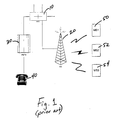
- FIG. 1 provides an overview of a CDMA system.
- mobile switching center 10 provides simultaneous communications among multiple base stations 20 while simultaneously routing calls from one or more base station 20 to public switched telephone network (PSTN) 30.
- PSTN 30 communicates with, for example, telephone 40.
- the mobile switching center's simultaneous routing makes handoffs between base station 20 and other base stations more reliable.
- CDMA base stations use one or more CDMA radio channels to provide both control and voice functionality.
- Base station 20 converts the radio channel to a signal that is transferred to and from mobile switching center 10.
- Base station 20 can also communicate simultaneously among different sections in a cell, enhancing handoffs.
- Base station 20 communicates with, for example, mobile stations 50, 52 and 54.
- Mobile stations 50, 52 and 54 can be, for example, mobile telephones and other types devices that provide wireless communication, such as PCSs, laptop computers or PDAs.
- a soft handoff the mobile station is allowed to communicate with two or more cell sites enhancing the signal quality. These cell sites must share the same frequency.
- the CDMA mobile station measures the pilot channel signal strength from adjacent cells and transmits the measurements to the serving base station.
- the pilot channel provides a reference for coherent channel demodulation and is used as a reference signal level for handoff decisions.
- the mobile station must be synchronized to the pilot channel pseudo noise (PN) phase before accessing any other control channel.
- PN pilot channel pseudo noise
- both base stations send an extended handoff direction message, which requests the addition of the new base station pilot to the mobile stations active set of pilots.
- the new base station also starts transmitting a signal to the mobile station, while the mobile station tunes to the arriving signal from the new base station. This tuning occurs when the mobile station assigns a demodulating element (e.g., a finger on a rake receiver) to the arriving signal.
- a demodulating element e.g., a finger on a rake receiver
- the mobile station is communicating with both base stations simultaneously.
- the mobile station utilizes time diversity to use signals from both base stations.
- the mobile station adds the new signal in a maximum ratio combiner before the decoding.
- the mobile station terminates the communication link with the current servicing base station before establishing the link with the new base station.
- This technique is similar to the technique used in time division multiple access (TDMA) and global system for mobile communication (GSM) systems.
- Hard handoffs occur when the mobile station's receiver is switching between a base station of one frequency and a base station of a different frequency.
- TDMA time division multiple access
- GSM global system for mobile communication
- Hard handoffs occur when the mobile station's receiver is switching between a base station of one frequency and a base station of a different frequency.
- there is only one receiver in a mobile station and that receiver can only receive data from one frequency at any given time. Therefore, a soft handoff is not possible when switching between base stations with different frequencies.
- Figure 2 illustrates base stations with different frequencies.
- cells 100, 104, 108, 114, 116 and 118 use a first frequency and cells 102, 106, 110, 112 and 120 use a second frequency.
- Microcells 106 and 110 are used, for example, in shopping malls, office buildings and other indoor facilities.
- SSC sequential sliding correlator
- the IS-95 standard combines new digital CDMA and advanced mobile phone service (AMPS) functionality.
- IS-95A CDMA systems do not allow for inter-frequency searches because of the continuous nature of the CDMA waveforms.
- the inter-frequency search also called mobile assisted hard handoff, was introduced in the IS-95B CDMA standard.
- the mobile assisted hard handoff can be performed without any timing restrictions (i.e., there is no restriction on the length of time used for this handoff).
- the mobile station is allowed to erase as many data frames (or portions of data frames) of the forward or reverse links as needed to perform the inter-frequency search.
- the forward link is the data link from the base station to the mobile station
- the reverse link is the data link from the mobile station to the base station.
- the IS-95B standard includes a gated-off transmission technique on the reverse link.
- a gated-off transmission is used when voice activity is low, and this allows voice data to be sent at different rates depending on the voice activity. For example, when voice activity drops to a low rate (e.g., 1/8 of the full rate), the transmission can be gated-off such that 1/8 of the normal amount of date is transmitted.
- This gated-off transmission on the reverse link allows the mobile station to perform the inter-frequency search during the period when the transmitter is gated-off. This technique minimizes the impact on the reverse link.
- a mobile station in a third generation CDMA system does not gate-off its transmitter during the transmission of lower rates.
- the erasure (i.e., loss) of both forward and reverse link frames is particularly true in this situation.
- Most of the third generation CDMA systems allow for a mixture of different classes of service, such as speech over data. In the cdma2000 system, this is achieved by allowing a simultaneous transmission on many physical channels. For example, fundamental channels and supplemental channels each carry a different payload.
- a supplemental channel since speech is carried on a fundamental channel and uses variable (i.e., speech activity driven) data rates, while a supplemental channel usually uses higher fixed (i.e., assigned) data rates, it is eminent that one or both of these channels will experience erasure during the inter-frequency search. Therefore, the likelihood of erasing links increases with, for example, the cdma2000 standard because the cdma2000 standard allows the mixing of different classes of services (e.g., data and voice services) on the fundamental and supplemental channels. It is desirable to have an inter-frequency search with minimal loss link frames in a CDMA system.
- WO-A-97/40593 discloses a method and system for the handover of connections between frequencies using non-continuous DS-CDMA transmissions.
- the handover is achieved by using a 'compressed' mode in which an idle part of a frame is created by selectively puncturing the output from an encoder to provide an increased coding rating in a part of the frame and an idle part of the frame.
- a deleting pattern is used by a puncturing circuit which comprises ones and zeros, each one representing a transmission bit and each zero representing a non-transmission bit. The ratio of ones to zeros is chosen ton achieve the desired punctured code rate.
- a method of performing inter-frequency searching in a wireless communication system comprising the steps of:- a) performing a search for pilot channels; b) erasing at least one portion of a frame during the search; c) reporting pilot channel signal strength; d) informing a first station of parameters related to the searching; and e) replacing the erased portions of the frame.
- the present invention provides a technique for performing an inter-frequency search with reduced or eliminated loss of link frames in a CDMA system.
- the CDMA system includes a base station and a mobile station.
- the mobile station has a searcher, which measures the signal strength of the base station pilot channels. The signal strengths of these pilot channels are then reported to the base station.
- there is only one RF receiver in the mobile station Thus, the mobile station cannot receive data on one frequency while searching for pilot channels on another frequency. As a result, this searching during a hard handoff produces erased portions of at least one data frame.
- the mobile station informs the base station of the parameters related to the search.
- these parameters include the frame of the search, the start position of the search, and the length of the search. This allows the mobile station and/or the base station to replace the erased portions of the frame(s) with corrective data such as soft zeros.
- FIG. 3 illustrates a device configuration for implementing the present invention.
- a band limited signal is filtered by low pass filter 130 and then received by analog to digital converter 132 (A/D converter).
- a pseudo random sequence from base station 1 is received by multiplier 140 along with the signal exiting A/D converter 132.
- the signal from multiplier 140 is sent to channel estimator 142 and multiplier 144.
- Multiplier 144 also receives a Walsh code from base station 1.
- the signals from channel estimator 142 and multiplier 144 are then sent to phase corrector 146.
- phase corrector 146 is also a multiplier.
- phase corrector 156 is not a multiplier.
- the sum of the signals from phase correctors 146 and 156 are then sent as soft data to viterbi decoder 158 in the preferred embodiment.
- the thin signal lines represent real data
- the thick signal lines represent complex data.
- the signal from A/D converter 132 is also sent to multiplier 160.
- Multiplier 160 also receives a pseudo random sequence from another base station.
- the signal from multiplier 160 is sent to searcher 164 and then to controller 166. Searcher 164 and controller 166 perform the inter-frequency search.
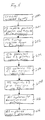
- FIG. 4 provides a process flowchart for the inter-frequency search of the present invention.
- the mobile station receives a candidate frequency search control message (CFSCM).
- CFSCM candidate frequency search control message
- the mobile station informs the base station of the position and the length of the search on frequency f2.
- the mobile station tunes its receiver from frequency f1 to frequency f2.
- the mobile station performs the search of f2 Pilots.
- the mobile station's receiver can only receive data on one frequency at one given time. Therefore, during the search time, no data is received from frequency f1 .
- the mobile station returns to frequency f1 and continues normal operation.
- the mobile station reports the frequency f2 Pilots' strength to the base station.
- the frequency f1 forward and reverse links are disrupted. This results in a negative impact on the quality of service of data transferred on frequency f1.
- the present invention allows the mobile station to perform the inter-frequency search while minimizing frame erasure on the forward and reverse links. This reduces or eliminates the negative impact on the quality of service.
- the mobile station replaces the erased portion of the frame with, for example, soft zeros.
- soft zeros are used to replace any data received in error from frequency f2 and to minimize the negative impact on the quality of service.
- Alternatives to soft zeros can also be utilized in the present invention.
- the inter-frequency search period is short relative to the length of the frame, then the probability of losing the forward channel frame is low because the transmitted symbols are interleaved over the entire frame period.
- the inter-frequency search disruption of the forward channel can be seen as a fade (i.e., loss of signal for a short period of time or lowering of the power) of the received signal.
- the inter-frequency search position and length are known to the base station, it can also perform the same operation (i.e., replacing the erased portion of the frame with soft zeros), thus minimizing the impact on the reverse link. This is shown in step 214 of Figure 4.
- a dedicated message is used to provide the inter-frequency search communication and synchronization between the base station and the mobile station.
- This message is referred to as a candidate frequency search position message (CFSPM) and may be placed, for example, on the reverse dedicated control channel (R-DCCH) or on the reverse common control channel (R-CCCH) to indicate the position and the length of the inter-frequency search.
- R-DCCH is dedicated to one mobile station, and the R-CCCH is for all mobile stations.
- the synchronization is provided by the base station.
- the base station pushes search parameters to the mobile station, such that the inter-frequency search is performed at the action time specified in a message from the base station.
- the search position can be defined in, for example, units of power control group (PCG) or in milliseconds.
- PCG power control group
- the length of the PCG is 1.25 ms (800 Hz).
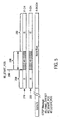
- Figure 5 provides a diagram illustrating one procedure used by the present invention.
- 220 identifies the forward channel and 222 identifies the reverse channel.
- Frame N+n contains data received by the rake receiver, which is located in the mobile station.
- Data sections 230 and 232 were received while the receiver was tuned to frequency f1 .
- the receiver was tuned from frequency f1 to frequency f2 at start time position 236.
- Data section 238 was received while the receiver was tuned to frequency f2 .
- time 236 provides the start time or position of the inter-frequency search
- section 238 provides the duration or length of the inter-frequency search.
- the following three parameters are used to characterize the inter-frequency search (IFS): (1) the frame in which the search is performed, (2) the start of the search within the frame, and (3) the length of the search.
- IFS inter-frequency search
- the message contains the following fields:
- FIG. 6 provides a process flowchart for one embodiment of the present invention.
- the mobile station MS is demodulating frequency f 1 (see also section 230 in Figure 5).
- the mobile station is directed by the base station (BS) to perform a search of frequency f 2 .
- the mobile station sends the candidate frequency search position message (CFSPM) on frequency f 1 with the above-described parameters (e.g., searched frame, search start position and search length).
- the base station waits until PCG is specified in parameter IFS_START_PCG.
- the mobile station performs the same operation for the forward traffic channel frame.
- the mobile station performs the inter-frequency search autonomously without network knowledge.
- Figure 7 provides a process flowchart for an autonomous inter-frequency search.
- the mobile station monitors speech activity when it is present on the reverse channel.
- the mobile station checks for a natural drop in speech activity. When the speech rate drops to a low rate (e.g., 1/8 of the normal rate), the process moves to step 264, and the mobile station performs the inter-frequency search for a fraction of the frame period (e.g., for several power control groups).
- a low rate e.g. 1/8 of the normal rate
- the mobile station receiver is tuned to frequency f2. Therefore, the mobile station does not receive any signal on the serving frequency f 1 . This will normally cause an erasure of a portion of the forward link frame. However, since the mobile station knows the timing of the inter-frequency search, it can replace the missing channel symbols with the soft zeros. If the inter-frequency search period is relatively short in comparison to the length of the frame, then the probability of losing the forward channel frame is low because the transmitted symbols are interleaved over the entire frame period. In this embodiment, the inter-frequency search disruption of the forward channel can be seen, for example, as a flat (i.e., shadow) fade of the received signal.
- Figure 8 provides a process flowchart for an inter-frequency search with full rate determination.
- the mobile station again monitors speech activities. When the speech rate drops below a predetermined threshold at step 272, the process moves to step 274.
- the mobile station drops the data rate for the reverse supplemental channel such that its data rate matches the data rate of the reverse fundamental channel.
- the supplemental channel usually carries data with a higher, fixed rate, and the fundamental channel usually uses a variable data rate that is speech activity driven. If the data rates on both channels are the same, then the position and length of the inter-frequency search will be the same on both channels. This simplifies the correction procedure when both channels are in use (e.g., in voice over IP applications).
- the base station In normal operation, the base station only checks the reverse fundamental channel for data rate variation because the data rate on the supplemental channel is normally fixed. Therefore, an alteration must be made so that the base station is aware of the rate change on the supplemental channel.
- the base station is notified of the change in data rate on the supplemental channel.
- the candidate frequency search response message can be used to notify the base station of the change in data rate at step 276. This notification can be placed, for example, in a new field that is added into the candidate frequency search response message or in the reserved bits of this message.
- the base station performs a rate determination on the reverse fundamental channel.
- the base station uses the rate from this rate determination for both the reverse fundamental channel and the reverse supplemental channel.
- the base station performs a rate determination on the reverse supplemental channel without any notification from the mobile station.
- the process moves forward only if the base station directs the mobile station to perform an inter-frequency search.
- the process moves forward only if the base station receives a low data rate frame on the reverse fundamental channel (e.g., 1/8 of the full data rate).
- the base station performs rate determinations on both the fundamental channel and the supplemental channel. Therefore, the base station detects the rate change on the supplemental channel.
- the present invention can be used with any CDMA system that includes a continuous channel or any other wideband CDMA system such as UMTS.
Landscapes
- Engineering & Computer Science (AREA)
- Computer Networks & Wireless Communication (AREA)
- Signal Processing (AREA)
- Mobile Radio Communication Systems (AREA)
Description
- The present application claims priority from Provisional Patent Application No. 60/092,957, filed on July 13, 1998, with Attorney Docket No. 98P7598US.
- This invention relates generally to spread spectrum communication systems that utilize an inter-frequency search. More particularly, a technique for performing an inter-frequency search with reduced or eliminated loss of link frames is described.
- Wireless communication systems have grown dramatically in popularity in recent years. In typical wireless communication systems, mobile stations (e.g., a cellular telephone) communicate with other mobile stations via base stations. To date, a variety of cellular networks have been implemented, and one of the increasingly popular types of networks is referred to as a code division multiple access (CDMA) system.
- Figure 1 provides an overview of a CDMA system. In this system,
mobile switching center 10 provides simultaneous communications amongmultiple base stations 20 while simultaneously routing calls from one ormore base station 20 to public switched telephone network (PSTN) 30. PSTN 30 communicates with, for example,telephone 40. The mobile switching center's simultaneous routing makes handoffs betweenbase station 20 and other base stations more reliable. CDMA base stations use one or more CDMA radio channels to provide both control and voice functionality.Base station 20 converts the radio channel to a signal that is transferred to and frommobile switching center 10.Base station 20 can also communicate simultaneously among different sections in a cell, enhancing handoffs.Base station 20 communicates with, for example,mobile stations Mobile stations - In a CDMA system, there are two types of handoffs, soft and hard. In a soft handoff, the mobile station is allowed to communicate with two or more cell sites enhancing the signal quality. These cell sites must share the same frequency. The CDMA mobile station measures the pilot channel signal strength from adjacent cells and transmits the measurements to the serving base station. The pilot channel provides a reference for coherent channel demodulation and is used as a reference signal level for handoff decisions. The mobile station must be synchronized to the pilot channel pseudo noise (PN) phase before accessing any other control channel. When an adjacent base station's pilot channel signal is strong enough, the mobile station moves the base station pilot into a candidate set and sends a pilot strength measurement message indicating the pilot signal energy. Now, both base stations (i.e., the current and the new one) send an extended handoff direction message, which requests the addition of the new base station pilot to the mobile stations active set of pilots. The new base station also starts transmitting a signal to the mobile station, while the mobile station tunes to the arriving signal from the new base station. This tuning occurs when the mobile station assigns a demodulating element (e.g., a finger on a rake receiver) to the arriving signal. Thus, during the soft handoff, the mobile station is communicating with both base stations simultaneously. During soft handoff, the mobile station utilizes time diversity to use signals from both base stations. The mobile station adds the new signal in a maximum ratio combiner before the decoding.
- In contrast, during a hard handoff, the mobile station terminates the communication link with the current servicing base station before establishing the link with the new base station. This technique is similar to the technique used in time division multiple access (TDMA) and global system for mobile communication (GSM) systems. Hard handoffs occur when the mobile station's receiver is switching between a base station of one frequency and a base station of a different frequency. Usually, there is only one receiver in a mobile station, and that receiver can only receive data from one frequency at any given time. Therefore, a soft handoff is not possible when switching between base stations with different frequencies. Figure 2 illustrates base stations with different frequencies. For example,
cells cells - Currently available hard handoff techniques can result in a dropped or lost telephone call. If the searcher in the cellular telephone mobile station uses, for example, a sequential sliding correlator (SSC) algorithm, and the search window size is 192 clips, then the total search time for a typical system with a 1x spreading note is as follows:
- The IS-95 standard combines new digital CDMA and advanced mobile phone service (AMPS) functionality. IS-95A CDMA systems do not allow for inter-frequency searches because of the continuous nature of the CDMA waveforms. The inter-frequency search, also called mobile assisted hard handoff, was introduced in the IS-95B CDMA standard. The mobile assisted hard handoff can be performed without any timing restrictions (i.e., there is no restriction on the length of time used for this handoff). As a result, the mobile station is allowed to erase as many data frames (or portions of data frames) of the forward or reverse links as needed to perform the inter-frequency search. The forward link is the data link from the base station to the mobile station, and the reverse link is the data link from the mobile station to the base station.
- Currently, the CDMA mobile station performing the inter-frequency search will erase one or more of forward link frames and reverse link frames. The IS-95B standard includes a gated-off transmission technique on the reverse link. A gated-off transmission is used when voice activity is low, and this allows voice data to be sent at different rates depending on the voice activity. For example, when voice activity drops to a low rate (e.g., 1/8 of the full rate), the transmission can be gated-off such that 1/8 of the normal amount of date is transmitted. This gated-off transmission on the reverse link allows the mobile station to perform the inter-frequency search during the period when the transmitter is gated-off. This technique minimizes the impact on the reverse link.
- A mobile station in a third generation CDMA system, such as cdma2000, does not gate-off its transmitter during the transmission of lower rates. Thus, the erasure (i.e., loss) of both forward and reverse link frames is particularly true in this situation. Most of the third generation CDMA systems allow for a mixture of different classes of service, such as speech over data. In the cdma2000 system, this is achieved by allowing a simultaneous transmission on many physical channels. For example, fundamental channels and supplemental channels each carry a different payload. Additionally, since speech is carried on a fundamental channel and uses variable (i.e., speech activity driven) data rates, while a supplemental channel usually uses higher fixed (i.e., assigned) data rates, it is eminent that one or both of these channels will experience erasure during the inter-frequency search. Therefore, the likelihood of erasing links increases with, for example, the cdma2000 standard because the cdma2000 standard allows the mixing of different classes of services (e.g., data and voice services) on the fundamental and supplemental channels. It is desirable to have an inter-frequency search with minimal loss link frames in a CDMA system.
- WO-A-97/40593 discloses a method and system for the handover of connections between frequencies using non-continuous DS-CDMA transmissions. The handover is achieved by using a 'compressed' mode in which an idle part of a frame is created by selectively puncturing the output from an encoder to provide an increased coding rating in a part of the frame and an idle part of the frame. A deleting pattern is used by a puncturing circuit which comprises ones and zeros, each one representing a transmission bit and each zero representing a non-transmission bit. The ratio of ones to zeros is chosen ton achieve the desired punctured code rate.
- An article by A. Baier et al. titled "Multi-rate DS-CDMA Radio Interface for Third-Generation Cellular Systems", IEE European Conference on Mobile and Personal Communications, 13 December 1993, pages 255 to 260, describes inter-frequency handover in which information is transmitted in half a frame by instantaneously doubling the symbol rate, decreasing the spreading factor and increasing the transmission power level, that is, in a 'compressed' mode. The second half of the frame is idle and is used to switch a mobile station to another RF channel. During inter-frequency handover, pilot channels of adj acent base stations are monitored by the mobile station whilst the link to the old base station is maintained. The uplink to the old base station is switched into 'compressed' mode and a new link to the new base station is established whilst maintaining the old link.
- In accordance with the present invention, there is provided a method of performing inter-frequency searching in a wireless communication system comprising the steps of:- a) performing a search for pilot channels; b) erasing at least one portion of a frame during the search; c) reporting pilot channel signal strength; d) informing a first station of parameters related to the searching; and e) replacing the erased portions of the frame.
- The present invention provides a technique for performing an inter-frequency search with reduced or eliminated loss of link frames in a CDMA system. In the preferred embodiment, the CDMA system includes a base station and a mobile station. The mobile station has a searcher, which measures the signal strength of the base station pilot channels. The signal strengths of these pilot channels are then reported to the base station. Usually, there is only one RF receiver in the mobile station. Thus, the mobile station cannot receive data on one frequency while searching for pilot channels on another frequency. As a result, this searching during a hard handoff produces erased portions of at least one data frame.
- Before the search on the candidate frequency is performed, the mobile station informs the base station of the parameters related to the search. In the preferred embodiment, these parameters include the frame of the search, the start position of the search, and the length of the search. This allows the mobile station and/or the base station to replace the erased portions of the frame(s) with corrective data such as soft zeros.
-
- Figure 1 provides an overview of a CDMA system;
- Figure 2 illustrates cells of base stations with different frequencies;
- Figure 3 illustrates a device configuration for implementing the present invention;
- Figure 4 provides a process flowchart for the inter-frequency search of the present invention;
- Figure 5 provides a diagram illustrating one procedure used by the present invention;
- Figure 6 provides a process flowchart for one embodiment of the present invention;
- Figure 7 provides a process flowchart for an autonomous inter-frequency search; and
- Figure 8 provides a process flowchart for an inter-frequency search with full rate determination.
-
- The present invention provides several embodiments for providing an inter-frequency search procedure that significantly reduces additional power requirements while achieving comparable or better performance. Figure 3 illustrates a device configuration for implementing the present invention. A band limited signal is filtered by
low pass filter 130 and then received by analog to digital converter 132 (A/D converter). A pseudo random sequence frombase station 1 is received bymultiplier 140 along with the signal exiting A/D converter 132. The signal frommultiplier 140 is sent tochannel estimator 142 andmultiplier 144.Multiplier 144 also receives a Walsh code frombase station 1. The signals fromchannel estimator 142 andmultiplier 144 are then sent to phasecorrector 146. In this example,phase corrector 146 is also a multiplier. A similar operation is performed forbase station 2 withmultiplier 150,channel estimator 152,multiplier 154 andphase corrector 156. In this example,phase corrector 156 is not a multiplier. The sum of the signals fromphase correctors viterbi decoder 158 in the preferred embodiment. In Figure 3, the thin signal lines represent real data, and the thick signal lines represent complex data. - The signal from A/
D converter 132 is also sent tomultiplier 160.Multiplier 160 also receives a pseudo random sequence from another base station. The signal frommultiplier 160 is sent to searcher 164 and then tocontroller 166.Searcher 164 andcontroller 166 perform the inter-frequency search. - Figure 4 provides a process flowchart for the inter-frequency search of the present invention. At
step 200, the mobile station receives a candidate frequency search control message (CFSCM). Atstep 201, the mobile station informs the base station of the position and the length of the search on frequency f2. Atstep 202, the mobile station tunes its receiver from frequency f1 to frequency f2. Atstep 204, the mobile station performs the search of f2 Pilots. In this embodiment, the mobile station's receiver can only receive data on one frequency at one given time. Therefore, during the search time, no data is received from frequency f1. Atstep 206, the mobile station returns to frequency f1 and continues normal operation. Atstep 208, the mobile station reports the frequency f2 Pilots' strength to the base station. During the time the mobile station is searching the frequency f2 (i.e., search time), the frequency f1 forward and reverse links are disrupted. This results in a negative impact on the quality of service of data transferred on frequency f1. The present invention allows the mobile station to perform the inter-frequency search while minimizing frame erasure on the forward and reverse links. This reduces or eliminates the negative impact on the quality of service. - At
step 212 in Figure 4, the mobile station replaces the erased portion of the frame with, for example, soft zeros. Thus these soft zeros are used to replace any data received in error from frequency f2 and to minimize the negative impact on the quality of service. Alternatives to soft zeros can also be utilized in the present invention. - If the inter-frequency search period is short relative to the length of the frame, then the probability of losing the forward channel frame is low because the transmitted symbols are interleaved over the entire frame period. When the inter-frequency search period is short, the inter-frequency search disruption of the forward channel can be seen as a fade (i.e., loss of signal for a short period of time or lowering of the power) of the received signal. If the inter-frequency search position and length are known to the base station, it can also perform the same operation (i.e., replacing the erased portion of the frame with soft zeros), thus minimizing the impact on the reverse link. This is shown in
step 214 of Figure 4. - In the preferred embodiment, a dedicated message is used to provide the inter-frequency search communication and synchronization between the base station and the mobile station. This message is referred to as a candidate frequency search position message (CFSPM) and may be placed, for example, on the reverse dedicated control channel (R-DCCH) or on the reverse common control channel (R-CCCH) to indicate the position and the length of the inter-frequency search. The R-DCCH is dedicated to one mobile station, and the R-CCCH is for all mobile stations.
- In another embodiment of the present invention, the synchronization is provided by the base station. In this embodiment, the base station pushes search parameters to the mobile station, such that the inter-frequency search is performed at the action time specified in a message from the base station. In either embodiment, the search position can be defined in, for example, units of power control group (PCG) or in milliseconds. In the IS-95B and cdma2000 standards, the length of the PCG is 1.25 ms (800 Hz).
- Figure 5 provides a diagram illustrating one procedure used by the present invention. In this diagram, 220 identifies the forward channel and 222 identifies the reverse channel. Frame N+n contains data received by the rake receiver, which is located in the mobile station.
Data sections start time position 236.Data section 238 was received while the receiver was tuned to frequency f2. Thus,time 236 provides the start time or position of the inter-frequency search, andsection 238 provides the duration or length of the inter-frequency search. - In the preferred-embodiment, the following three parameters are used to characterize the inter-frequency search (IFS): (1) the frame in which the search is performed, (2) the start of the search within the frame, and (3) the length of the search. In the preferred embodiment, the message contains the following fields:
- IFS_FRAME_OFFSET 6 bits (describes the frame position from CFSPM message)
- IFS_START_PCG 4 bits (defines the PCG in which IFS starts)
- IFS_LENGTH_PCG 4 bits (defines the # of PCG used for IFS search)
-
- Figure 6 provides a process flowchart for one embodiment of the present invention. At
step 240, the mobile station (MS) is demodulating frequency f 1 (see alsosection 230 in Figure 5). Atstep 242, the mobile station is directed by the base station (BS) to perform a search of frequency f 2 . At step 244, the mobile station sends the candidate frequency search position message (CFSPM) on frequency f 1 with the above-described parameters (e.g., searched frame, search start position and search length). Atstep 246, in the frame specified by the parameter IFS_FRAME_OFFSET, the base station waits until PCG is specified in parameter IFS_START_PCG. Then, atstep 248, to overcome the loss of the reverse link symbols, the base station replaces the indicated portion of the frame with soft zeros. For example, zeros are inserted by the following:
For IFS_LENGTH_PCG
Rx_SYMBOLS <= 'soft_zeros'
Atstep 250, the mobile station performs the same operation for the forward traffic channel frame. - In another embodiment, the mobile station performs the inter-frequency search autonomously without network knowledge. Figure 7 provides a process flowchart for an autonomous inter-frequency search. At
step 260, the mobile station monitors speech activity when it is present on the reverse channel. Atstep 262, the mobile station checks for a natural drop in speech activity. When the speech rate drops to a low rate (e.g., 1/8 of the normal rate), the process moves to step 264, and the mobile station performs the inter-frequency search for a fraction of the frame period (e.g., for several power control groups). - During the inter-frequency search, the mobile station receiver is tuned to frequency f2. Therefore, the mobile station does not receive any signal on the serving frequency f 1 . This will normally cause an erasure of a portion of the forward link frame. However, since the mobile station knows the timing of the inter-frequency search, it can replace the missing channel symbols with the soft zeros. If the inter-frequency search period is relatively short in comparison to the length of the frame, then the probability of losing the forward channel frame is low because the transmitted symbols are interleaved over the entire frame period. In this embodiment, the inter-frequency search disruption of the forward channel can be seen, for example, as a flat (i.e., shadow) fade of the received signal.
- In yet another embodiment of the present invention, data rates on multiple channels are determined. Figure 8 provides a process flowchart for an inter-frequency search with full rate determination. At
step 270, the mobile station again monitors speech activities. When the speech rate drops below a predetermined threshold atstep 272, the process moves to step 274. Atstep 274, the mobile station drops the data rate for the reverse supplemental channel such that its data rate matches the data rate of the reverse fundamental channel. As set forth above, the supplemental channel usually carries data with a higher, fixed rate, and the fundamental channel usually uses a variable data rate that is speech activity driven. If the data rates on both channels are the same, then the position and length of the inter-frequency search will be the same on both channels. This simplifies the correction procedure when both channels are in use (e.g., in voice over IP applications). - In normal operation, the base station only checks the reverse fundamental channel for data rate variation because the data rate on the supplemental channel is normally fixed. Therefore, an alteration must be made so that the base station is aware of the rate change on the supplemental channel. In one embodiment, the base station is notified of the change in data rate on the supplemental channel. In this embodiment, the candidate frequency search response message can be used to notify the base station of the change in data rate at
step 276. This notification can be placed, for example, in a new field that is added into the candidate frequency search response message or in the reserved bits of this message. Atstep 278, the base station performs a rate determination on the reverse fundamental channel. Atstep 280, the base station uses the rate from this rate determination for both the reverse fundamental channel and the reverse supplemental channel. - In a another embodiment, the base station performs a rate determination on the reverse supplemental channel without any notification from the mobile station. At
step 290, the process moves forward only if the base station directs the mobile station to perform an inter-frequency search. Atstep 292, the process moves forward only if the base station receives a low data rate frame on the reverse fundamental channel (e.g., 1/8 of the full data rate). Atstep 294, the base station performs rate determinations on both the fundamental channel and the supplemental channel. Therefore, the base station detects the rate change on the supplemental channel. - The present invention can be used with any CDMA system that includes a continuous channel or any other wideband CDMA system such as UMTS.
Claims (18)
- A method of performing inter-frequency searching for handoffs between different base stations in a wireless communication system that uses pilot channels as reference signal levels for handoff decisions, the method comprising the steps of:a) receiving a communication signal on a receiving link using a first frequency, the communication signal containing communication data;b) determining parameters related to a search for pilot channels, the parameters including timing parameters that set a time period during which the search will be performed;c) performing (204) the search for pilot channels during the time period defined by the timing parameters;d) erasing at least one portion (238) of a frame of the receiving link during the time period of the search, the erasure causing a loss of communication data from the communication signal in the frame;e) reporting (208) pilot channel signal strength;f) informing (201) a first station of the timing parameters related to the time period during which the search will be performed; andg) using the timing parameters to determine when to replace (212) the erased portions of the frame with predefined data.
- A method according to claim 1, wherein performing the search for pilot channels includes tuning to a second frequency other than the first frequency.
- A method according to claim 1, wherein the erased portions of the frame are replaced with corrective data that can be interpreted as a fading of the received communication signal.
- A method according to claim 3, wherein the corrective data comprises soft zeros.
- A method according to any one of the claims 1 to 4, wherein the timing parameters include at least one of the frame of the search, a start position of the search, and a length of the search.
- A method according to claim 5, wherein the start position of the search is defined in power control group units.
- A method according to claim 6, wherein the units are 1.25 ms.
- A method according to any one of the preceding claims, wherein the search occurs when speech activity drops to a low rate.
- A method according to any one of the preceding claims, wherein a second station performs steps a), b), c), d), e) and f).
- A method according to claim 9, wherein the first station is a base station and the second station is a mobile station.
- A method according to claim 10, wherein a candidate frequency search position message is used to inform the base station of the timing parameters of the search.
- A method according to claim 11, wherein the candidate frequency search position message is placed in at least one of a reverse dedicated control channel and a reverse common control channel.
- A method according to any one of claims 10 to 12, wherein the mobile station drops a first data rate on a first channel.
- A method according to claim 13, wherein the mobile station sends a rate message to the base station, the rate message notifying the base station of the first data rate on the first channel, and wherein the base station determines a second data rate on a second channel and uses the second data rate to determined the first data rate.
- A method according to claim 14, wherein the first data rate and the second data rate are equal.
- A method according to claim 13, wherein the base station determines the first data rate when the mobile station has been directed by the base station to perform the search.
- A method according to any one of claims 1 to 8, wherein the first station comprises a mobile station.
- A method according to any one of the preceding claims, wherein the wireless communication system comprises a CDMA system.
Applications Claiming Priority (5)
| Application Number | Priority Date | Filing Date | Title |
|---|---|---|---|
| US9295798P | 1998-07-13 | 1998-07-13 | |
| US92957P | 1998-07-13 | ||
| US346784 | 1999-07-06 | ||
| US09/346,784 US6865173B1 (en) | 1998-07-13 | 1999-07-06 | Method and apparatus for performing an interfrequency search |
| PCT/US1999/015621 WO2000003501A1 (en) | 1998-07-13 | 1999-07-07 | Method and aparatus for performing an inter-frequency search |
Publications (2)
| Publication Number | Publication Date |
|---|---|
| EP1097527A1 EP1097527A1 (en) | 2001-05-09 |
| EP1097527B1 true EP1097527B1 (en) | 2005-10-19 |
Family
ID=26786235
Family Applications (1)
| Application Number | Title | Priority Date | Filing Date |
|---|---|---|---|
| EP99933862A Expired - Lifetime EP1097527B1 (en) | 1998-07-13 | 1999-07-07 | Method and apparatus for performing an inter-frequency search |
Country Status (6)
| Country | Link |
|---|---|
| US (1) | US6865173B1 (en) |
| EP (1) | EP1097527B1 (en) |
| JP (1) | JP2003524910A (en) |
| KR (1) | KR100741586B1 (en) |
| CN (1) | CN1135743C (en) |
| WO (1) | WO2000003501A1 (en) |
Families Citing this family (16)
| Publication number | Priority date | Publication date | Assignee | Title |
|---|---|---|---|---|
| US6603751B1 (en) * | 1998-02-13 | 2003-08-05 | Qualcomm Incorporated | Method and system for performing a handoff in a wireless communication system, such as a hard handoff |
| US20030194033A1 (en) | 1998-05-21 | 2003-10-16 | Tiedemann Edward G. | Method and apparatus for coordinating transmission of short messages with hard handoff searches in a wireless communications system |
| US6587446B2 (en) | 1999-02-11 | 2003-07-01 | Qualcomm Incorporated | Handoff in a wireless communication system |
| GB2354671B (en) * | 1999-09-24 | 2003-10-01 | Nokia Mobile Phones Ltd | Inter-frequency measurement |
| US7768974B2 (en) * | 2003-02-03 | 2010-08-03 | Alcatel-Lucent | Method and arrangement for generating pilot beacons in wireless communication systems |
| US7292550B2 (en) * | 2003-03-27 | 2007-11-06 | Kyocera Wireless Corp. | System and method for minimizing voice packet loss during a wireless communications device candidate frequency search (CFS) |
| DE10329060B4 (en) * | 2003-06-27 | 2006-02-09 | Infineon Technologies Ag | Device and method for measuring the power of base stations in mobile radio receivers |
| US7297277B2 (en) * | 2003-06-27 | 2007-11-20 | The Procter & Gamble Company | Method for purifying a dry cleaning solvent |
| CN100356811C (en) * | 2004-04-30 | 2007-12-19 | 北京信威通信技术股份有限公司 | A method for searching adjacent base stations by terminals in synchronous CDMA system |
| US7830862B2 (en) * | 2005-01-07 | 2010-11-09 | At&T Intellectual Property Ii, L.P. | System and method for modifying speech playout to compensate for transmission delay jitter in a voice over internet protocol (VoIP) network |
| US7983680B2 (en) * | 2005-08-10 | 2011-07-19 | Nextel Communications Inc. | System and method for converged network services |
| KR100959336B1 (en) * | 2006-06-23 | 2010-05-20 | 삼성전자주식회사 | Apparatus and method for reducing neighbor cell interference in broadband wireless communication system |
| US7949649B2 (en) * | 2007-04-10 | 2011-05-24 | The Echo Nest Corporation | Automatically acquiring acoustic and cultural information about music |
| JP5137746B2 (en) * | 2008-08-28 | 2013-02-06 | キヤノン株式会社 | COMMUNICATION DEVICE, COMMUNICATION DEVICE CONTROL METHOD, PROGRAM |
| US8964692B2 (en) * | 2008-11-10 | 2015-02-24 | Qualcomm Incorporated | Spectrum sensing of bluetooth using a sequence of energy detection measurements |
| US9934785B1 (en) | 2016-11-30 | 2018-04-03 | Spotify Ab | Identification of taste attributes from an audio signal |
Family Cites Families (19)
| Publication number | Priority date | Publication date | Assignee | Title |
|---|---|---|---|---|
| US5267261A (en) | 1992-03-05 | 1993-11-30 | Qualcomm Incorporated | Mobile station assisted soft handoff in a CDMA cellular communications system |
| TW306102B (en) | 1993-06-14 | 1997-05-21 | Ericsson Telefon Ab L M | |
| JP3630460B2 (en) * | 1995-01-23 | 2005-03-16 | 富士通株式会社 | Data length correction system |
| US5699478A (en) * | 1995-03-10 | 1997-12-16 | Lucent Technologies Inc. | Frame erasure compensation technique |
| US5883899A (en) | 1995-05-01 | 1999-03-16 | Telefonaktiebolaget Lm Ericsson | Code-rate increased compressed mode DS-CDMA systems and methods |
| US5682416A (en) | 1995-05-09 | 1997-10-28 | Motorola, Inc. | Method and apparatus communication handover in a communication system |
| US5796757A (en) | 1995-09-15 | 1998-08-18 | Nokia Mobile Phones Ltd. | Methods and apparatus for performing rate determination with a variable rate viterbi decoder |
| US5940761A (en) * | 1997-01-15 | 1999-08-17 | Qaulcomm Incorporated | Method and apparatus for performing mobile assisted hard handoff between communication systems |
| US5999816A (en) * | 1997-02-18 | 1999-12-07 | Qualcomm Incorporated | Method and apparatus for performing mobile assisted hard handoff between communication systems |
| KR100252932B1 (en) * | 1997-11-06 | 2000-04-15 | 서평원 | Method and System for Providing a Inter-frequency Handoff in a CDMA Cellular Telephone System |
| US6134440A (en) * | 1998-01-26 | 2000-10-17 | Qualcomm Inc. | Method and apparatus for performing mobile station assisted hard handoff using off line searching |
| US6169752B1 (en) * | 1998-02-26 | 2001-01-02 | Lsi Logic Corporation | Method and system for preventing information losses during alternative frequency searches |
| US6169731B1 (en) * | 1998-03-10 | 2001-01-02 | Motorola, Inc. | Method and apparatus for signal acquisition and power control |
| US5978365A (en) * | 1998-07-07 | 1999-11-02 | Orbital Sciences Corporation | Communications system handoff operation combining turbo coding and soft handoff techniques |
| US6160804A (en) * | 1998-11-13 | 2000-12-12 | Lucent Technologies Inc. | Mobility management for a multimedia mobile network |
| US6304563B1 (en) * | 1999-04-23 | 2001-10-16 | Qualcomm Incorporated | Method and apparatus for processing a punctured pilot channel |
| US6351486B1 (en) * | 1999-05-25 | 2002-02-26 | Conexant Systems, Inc. | Accelerated selection of a base station in a wireless communication system |
| JP3305287B2 (en) * | 1999-09-06 | 2002-07-22 | 日本軽金属株式会社 | Friction stir welding material with high fatigue strength |
| KR200171155Y1 (en) * | 1999-09-17 | 2000-03-15 | 주식회사산업엔지니어링 | Device for injecting water at artificial leather |
-
1999
- 1999-07-06 US US09/346,784 patent/US6865173B1/en not_active Expired - Fee Related
- 1999-07-07 KR KR1020017000573A patent/KR100741586B1/en not_active Expired - Fee Related
- 1999-07-07 WO PCT/US1999/015621 patent/WO2000003501A1/en not_active Ceased
- 1999-07-07 EP EP99933862A patent/EP1097527B1/en not_active Expired - Lifetime
- 1999-07-07 CN CNB99809952XA patent/CN1135743C/en not_active Expired - Lifetime
- 1999-07-07 JP JP2000559658A patent/JP2003524910A/en not_active Withdrawn
Also Published As
| Publication number | Publication date |
|---|---|
| CN1135743C (en) | 2004-01-21 |
| WO2000003501A1 (en) | 2000-01-20 |
| US6865173B1 (en) | 2005-03-08 |
| KR100741586B1 (en) | 2007-07-20 |
| CN1323469A (en) | 2001-11-21 |
| JP2003524910A (en) | 2003-08-19 |
| EP1097527A1 (en) | 2001-05-09 |
| KR20010070959A (en) | 2001-07-28 |
Similar Documents
| Publication | Publication Date | Title |
|---|---|---|
| KR100897212B1 (en) | Method and system for performing a handoff in a wireless communication system, such as a hard handoff | |
| AU2004239630B2 (en) | Method for soft and softer handover in time division duplex code division multiple access (TDD-CDMA) networks | |
| US6768727B1 (en) | Fast forward link power control for CDMA system | |
| US6603751B1 (en) | Method and system for performing a handoff in a wireless communication system, such as a hard handoff | |
| US6865173B1 (en) | Method and apparatus for performing an interfrequency search | |
| KR20040069355A (en) | Method and apparatus for controlling communications of data from multiple base stations to a mobile station in a communication system | |
| KR20010043864A (en) | Measurement techniques for diversity and inter-frequency mobile assisted handoff(maho) | |
| JP4681180B2 (en) | CDMA signal component processing method | |
| EP0992172B1 (en) | Method and system for performing a handoff in a wireless communication system, such as a hard handoff | |
| Frantti et al. | Fuzzy Reasoning in WCDMA Radio Resource Functions | |
| HK1115494B (en) | Method and system for performing a handoff in a wireless communication system, such as a hard handoff | |
| HK1119007B (en) | Method and system for performing a handoff in a wireless communication system, such as a hard handoff | |
| AU2007240231A1 (en) | Method and system for performing a handoff in a wireless communication system, such as a hard handoff |
Legal Events
| Date | Code | Title | Description |
|---|---|---|---|
| PUAI | Public reference made under article 153(3) epc to a published international application that has entered the european phase |
Free format text: ORIGINAL CODE: 0009012 |
|
| 17P | Request for examination filed |
Effective date: 20010126 |
|
| AK | Designated contracting states |
Kind code of ref document: A1 Designated state(s): AT BE CH CY DE DK ES FI FR GB GR IE IT LI LU MC NL PT SE |
|
| 17Q | First examination report despatched |
Effective date: 20020226 |
|
| RAP1 | Party data changed (applicant data changed or rights of an application transferred) |
Owner name: INFINEON TECHNOLOGIES NORTH AMERICA CORP. |
|
| GRAP | Despatch of communication of intention to grant a patent |
Free format text: ORIGINAL CODE: EPIDOSNIGR1 |
|
| RBV | Designated contracting states (corrected) |
Designated state(s): DE FR GB |
|
| RAP1 | Party data changed (applicant data changed or rights of an application transferred) |
Owner name: LSI LOGIC CORPORATION Owner name: INFINEON TECHNOLOGIES NORTH AMERICA CORP. |
|
| GRAS | Grant fee paid |
Free format text: ORIGINAL CODE: EPIDOSNIGR3 |
|
| GRAA | (expected) grant |
Free format text: ORIGINAL CODE: 0009210 |
|
| AK | Designated contracting states |
Kind code of ref document: B1 Designated state(s): DE FR GB |
|
| REG | Reference to a national code |
Ref country code: GB Ref legal event code: FG4D |
|
| RAP2 | Party data changed (patent owner data changed or rights of a patent transferred) |
Owner name: LSI LOGIC CORPORATION Owner name: INFINEON TECHNOLOGIES NORTH AMERICA CORP. |
|
| REF | Corresponds to: |
Ref document number: 69927819 Country of ref document: DE Date of ref document: 20051124 Kind code of ref document: P |
|
| ET | Fr: translation filed | ||
| PLBE | No opposition filed within time limit |
Free format text: ORIGINAL CODE: 0009261 |
|
| STAA | Information on the status of an ep patent application or granted ep patent |
Free format text: STATUS: NO OPPOSITION FILED WITHIN TIME LIMIT |
|
| 26N | No opposition filed |
Effective date: 20060720 |
|
| REG | Reference to a national code |
Ref country code: FR Ref legal event code: ST Effective date: 20070330 |
|
| PG25 | Lapsed in a contracting state [announced via postgrant information from national office to epo] |
Ref country code: FR Free format text: LAPSE BECAUSE OF NON-PAYMENT OF DUE FEES Effective date: 20060731 |
|
| REG | Reference to a national code |
Ref country code: DE Ref legal event code: R082 Ref document number: 69927819 Country of ref document: DE Representative=s name: EPPING HERMANN FISCHER, PATENTANWALTSGESELLSCH, DE |
|
| REG | Reference to a national code |
Ref country code: DE Ref legal event code: R082 Ref document number: 69927819 Country of ref document: DE Representative=s name: EPPING HERMANN FISCHER PATENTANWALTSGESELLSCHA, DE Effective date: 20121128 Ref country code: DE Ref legal event code: R082 Ref document number: 69927819 Country of ref document: DE Representative=s name: EPPING HERMANN FISCHER, PATENTANWALTSGESELLSCH, DE Effective date: 20121128 Ref country code: DE Ref legal event code: R081 Ref document number: 69927819 Country of ref document: DE Owner name: INTEL MOBILE COMMUNICATIONS GMBH, DE Free format text: FORMER OWNERS: INFINEON TECHNOLOGIES NORTH AMERICA CORP., SAN JOSE, CALIF., US; LSI LOGIC CORP., MILPITAS, CALIF., US Effective date: 20121128 Ref country code: DE Ref legal event code: R081 Ref document number: 69927819 Country of ref document: DE Owner name: LSI LOGIC CORP., MILPITAS, US Free format text: FORMER OWNERS: INFINEON TECHNOLOGIES NORTH AMERICA CORP., SAN JOSE, CALIF., US; LSI LOGIC CORP., MILPITAS, CALIF., US Effective date: 20121128 Ref country code: DE Ref legal event code: R081 Ref document number: 69927819 Country of ref document: DE Owner name: INFINEON TECHNOLOGIES AG, DE Free format text: FORMER OWNERS: INFINEON TECHNOLOGIES NORTH AMERICA CORP., SAN JOSE, CALIF., US; LSI LOGIC CORP., MILPITAS, CALIF., US Effective date: 20121128 Ref country code: DE Ref legal event code: R081 Ref document number: 69927819 Country of ref document: DE Owner name: LSI LOGIC CORP., MILPITAS, US Free format text: FORMER OWNER: INFINEON TECHNOLOGIES NORTH AME, LSI LOGIC CORP., , US Effective date: 20121128 Ref country code: DE Ref legal event code: R081 Ref document number: 69927819 Country of ref document: DE Owner name: LSI LOGIC CORP., US Free format text: FORMER OWNER: INFINEON TECHNOLOGIES NORTH AME, LSI LOGIC CORP., , US Effective date: 20121128 Ref country code: DE Ref legal event code: R081 Ref document number: 69927819 Country of ref document: DE Owner name: INFINEON TECHNOLOGIES AG, DE Free format text: FORMER OWNER: INFINEON TECHNOLOGIES NORTH AME, LSI LOGIC CORP., , US Effective date: 20121128 |
|
| REG | Reference to a national code |
Ref country code: DE Ref legal event code: R082 Ref document number: 69927819 Country of ref document: DE Representative=s name: EPPING HERMANN FISCHER PATENTANWALTSGESELLSCHA, DE Ref country code: DE Ref legal event code: R082 Ref document number: 69927819 Country of ref document: DE Representative=s name: EPPING HERMANN FISCHER, PATENTANWALTSGESELLSCH, DE Ref country code: DE Ref legal event code: R081 Ref document number: 69927819 Country of ref document: DE Owner name: LSI LOGIC CORP., MILPITAS, US Free format text: FORMER OWNERS: INFINEON TECHNOLOGIES AG, 85579 NEUBIBERG, DE; LSI LOGIC CORP., MILPITAS, CALIF., US Ref country code: DE Ref legal event code: R081 Ref document number: 69927819 Country of ref document: DE Owner name: INTEL MOBILE COMMUNICATIONS GMBH, DE Free format text: FORMER OWNERS: INFINEON TECHNOLOGIES AG, 85579 NEUBIBERG, DE; LSI LOGIC CORP., MILPITAS, CALIF., US |
|
| REG | Reference to a national code |
Ref country code: GB Ref legal event code: 732E Free format text: REGISTERED BETWEEN 20161013 AND 20161019 |
|
| PGFP | Annual fee paid to national office [announced via postgrant information from national office to epo] |
Ref country code: DE Payment date: 20180626 Year of fee payment: 20 |
|
| PGFP | Annual fee paid to national office [announced via postgrant information from national office to epo] |
Ref country code: GB Payment date: 20180704 Year of fee payment: 20 |
|
| REG | Reference to a national code |
Ref country code: DE Ref legal event code: R071 Ref document number: 69927819 Country of ref document: DE |
|
| REG | Reference to a national code |
Ref country code: GB Ref legal event code: PE20 Expiry date: 20190706 |
|
| PG25 | Lapsed in a contracting state [announced via postgrant information from national office to epo] |
Ref country code: GB Free format text: LAPSE BECAUSE OF EXPIRATION OF PROTECTION Effective date: 20190706 |