EP1096770A2 - Method and apparatus for suppression of packets during silence periods in a packet telephony system - Google Patents
Method and apparatus for suppression of packets during silence periods in a packet telephony system Download PDFInfo
- Publication number
- EP1096770A2 EP1096770A2 EP00309500A EP00309500A EP1096770A2 EP 1096770 A2 EP1096770 A2 EP 1096770A2 EP 00309500 A EP00309500 A EP 00309500A EP 00309500 A EP00309500 A EP 00309500A EP 1096770 A2 EP1096770 A2 EP 1096770A2
- Authority
- EP
- European Patent Office
- Prior art keywords
- end device
- far
- communication stream
- music
- hold
- Prior art date
- Legal status (The legal status is an assumption and is not a legal conclusion. Google has not performed a legal analysis and makes no representation as to the accuracy of the status listed.)
- Withdrawn
Links
Images


Classifications
-
- H—ELECTRICITY
- H04—ELECTRIC COMMUNICATION TECHNIQUE
- H04M—TELEPHONIC COMMUNICATION
- H04M7/00—Arrangements for interconnection between switching centres
- H04M7/006—Networks other than PSTN/ISDN providing telephone service, e.g. Voice over Internet Protocol (VoIP), including next generation networks with a packet-switched transport layer
-
- H—ELECTRICITY
- H04—ELECTRIC COMMUNICATION TECHNIQUE
- H04M—TELEPHONIC COMMUNICATION
- H04M3/00—Automatic or semi-automatic exchanges
- H04M3/42—Systems providing special services or facilities to subscribers
- H04M3/428—Arrangements for placing incoming calls on hold
-
- H—ELECTRICITY
- H04—ELECTRIC COMMUNICATION TECHNIQUE
- H04M—TELEPHONIC COMMUNICATION
- H04M3/00—Automatic or semi-automatic exchanges
- H04M3/42—Systems providing special services or facilities to subscribers
- H04M3/428—Arrangements for placing incoming calls on hold
- H04M3/4285—Notifying, informing or entertaining a held party while on hold, e.g. Music On Hold
-
- H—ELECTRICITY
- H04—ELECTRIC COMMUNICATION TECHNIQUE
- H04M—TELEPHONIC COMMUNICATION
- H04M3/00—Automatic or semi-automatic exchanges
- H04M3/42—Systems providing special services or facilities to subscribers
- H04M3/487—Arrangements for providing information services, e.g. recorded voice services or time announcements
- H04M3/493—Interactive information services, e.g. directory enquiries ; Arrangements therefor, e.g. interactive voice response [IVR] systems or voice portals
-
- H—ELECTRICITY
- H04—ELECTRIC COMMUNICATION TECHNIQUE
- H04M—TELEPHONIC COMMUNICATION
- H04M3/00—Automatic or semi-automatic exchanges
- H04M3/42—Systems providing special services or facilities to subscribers
- H04M3/50—Centralised arrangements for answering calls; Centralised arrangements for recording messages for absent or busy subscribers ; Centralised arrangements for recording messages
- H04M3/53—Centralised arrangements for recording incoming messages, i.e. mailbox systems
- H04M3/533—Voice mail systems
Definitions
- the present invention relates generally to packet telephony systems, and more particularly, to methods and apparatus for minimizing the bandwidth utilization in such packet telephony systems.
- Communication networks are used to transfer information, such as data, voice, text or video information, among communication devices, such as packet telephones, computer terminals, multimedia workstations, and videophones, connected to the networks.
- a network typically comprises nodes connected to each other, and to communication devices, by various links. Each link is characterized by a bandwidth or link capacity.
- PBX private branch exchange
- PBX private branch exchange
- PSTN Public Switched Telephone Network
- the centralized PBX controls all aspects of a telephone connection. For example, if a given calling party is placed on hold, the PBX may respond by transmitting a music source to the calling party for a music-on-hold feature.
- the bandwidth that is allocated to a given call (typically 64-Kbps in each direction) is maintained for the entire length of the call, even during periods of extended silence, such as when a call is placed on hold, or when one caller utilizes a mute feature.
- Packet-switching network architectures are widely used, for example, in popular local-area network (LAN) protocols, such as Ethernet and asynchronous transfer mode (ATM) protocols.
- LAN local-area network
- ATM asynchronous transfer mode
- data transmissions are typically divided into blocks of data, called packets, for transmission through the network.
- packets For a packet to get to its proper destination, the packet must traverse through one or more network switches, routers or intermediate systems.
- a packet typically includes a header, containing source and destination address information, as well as a payload (the actual application data).
- payload the actual application data
- the packet data network used by the packet telephony system is typically shared with other network applications, such as web browsers, electronic mail, file and print servers. To avoid disrupting and degrading other applications that operate on the shared network, it is important to minimize network usage when possible.
- IVR automated interactive voice response unit
- a method and apparatus for notifying a far-end calling endpoint when a near-end calling party utilizes a hold or mute feature.
- the present invention reduces bandwidth utilization by suppressing the transmission of packets during periods of extended silence. Periods of silence are experienced, for example, when a call is placed on hold, or when packets will otherwise not be processed by the receiver, such as an automated interactive voice response unit (IVR) or a voice mail system before recording commences. If a near-end party activates the "hold" feature, then the near-end party is both ignoring anything sent by the far-end device and is not sending any meaningful media to the far-end device.
- IVR automated interactive voice response unit
- each device in a packet telephony system includes a packet suppression system that monitors local user or application activity (such as activating the "hold” feature) and notifies the far-end party that the near-end device is discarding the "listen” stream.
- the packet suppression system of the present invention monitors the incoming packets and processes such notifications from the far-end party that the far-end device is discarding the "listen” stream.
- the packet suppression system can suppress the transmission of further packets and optionally activate a music-on-hold feature for the held party. In this manner, the bandwidth consumption and resource utilization at both the near and far-end devices are minimized by suppressing the transmission of further packets until the far-end device indicates that it is again utilizing the "listen” stream.
- the near-end device can implement a music-on-hold feature, for example, by switching the input stream for the speaker/handset from the silent "listen” stream to an appropriate audio source.
- FIG. 1 illustrates a packet telephony system 100.
- the packet telephony system 100 shown in FIG. 1 includes a packet network 105 that connects a number of devices, such as Internet protocol (IP) telephones 110, 111, an automated interactive voice response unit (IVR) 112 and a voice mail system 113.
- IP Internet protocol
- IVR automated interactive voice response unit
- Each end-device 110-113 is a source of a media stream (a "talk" half-circuit) and a sink for a media stream (the "listen” half-circuit). Normally, the end-device is both playing the “listen” stream and sending a "talk” stream to the far-end device, and the far-end device is doing the same thing for the other far-end user. There are, however, several circumstances that lead an end-device to discard a "listen” stream or send silence on a "talk” stream or both.
- a "listen” stream will be discarded, for example, by an automated attendant, such as an automated interactive voice response unit (IVR) 112 that merely responds to dual-tone multi-frequency (DTMF) commands or a voice mail system 113 during playback of the outgoing voice message before recording commences.
- IVR automated interactive voice response unit
- DTMF dual-tone multi-frequency
- voice mail system 113 a voice mail system 113 during playback of the outgoing voice message before recording commences.
- the holding party will discard the "listen” stream and send silence on the "talk” stream.
- each device in the packet telephony system 100 includes a packet suppression system 200, discussed further below in conjunction with FIG. 2, that monitors local terminal activity and notifies the far-end party that the near-end device is discarding the "listen” stream.
- a packet suppression system 200 discussed further below in conjunction with FIG. 2, that monitors local terminal activity and notifies the far-end party that the near-end device is discarding the "listen” stream.
- bandwidth consumption and resource utilization are minimized at both the near and far-end devices by suppressing the transmission of further packets until the near-end device is notified that the far-end device is again utilizing the "listen" stream.
- the near-end device activates the "hold” feature, then the near-end device is both ignoring anything sent by the far-end device and is not sending any meaningful media to the far-end device.
- the present invention allows the far-end device to implement music-on-hold or some other advanced user experience for the "held" user at the far-end device.
- the far-end device can implement music-on-hold, for example, by switching the input stream for the speaker/handset from the silent "listen” stream to an appropriate audio source.
- FIG. 2 is a block diagram showing the architecture of an illustrative packet suppression system 200. It is noted that the packet suppression system 200 shown in FIG. 2 has been generalized for use by all the devices 110-113 in FIG. 1 to illustrate the principles of the present invention. The packet suppression system 200 may be tailored for a specific device 110-113 and incorporate only a subset of the features discussed herein, as would be apparent to a person of ordinary skill in the art.
- the packet suppression system 200 includes a processor 210 and related memory, such as a data storage device 220.
- the processor 210 may be embodied as a single processor, or a number of processors operating in parallel.
- the data storage device 220 and/or a read only memory (ROM) are operable to store one or more instructions, which the processor 210 is operable to retrieve, interpret and execute.
- the data storage device 220 includes a music source database 300, shown in FIG. 3, that identifies an appropriate audio source for a music-on-hold feature for each class of telephone call, time-of-day, and/or other selection criteria.
- the data storage device 220 includes a packet suppression initiation process 400, shown in FIG. 4, that monitors local terminal activity and notifies the far-end party that the near-end device is discarding the "listen” stream.
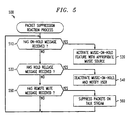
- the data storage device 220 includes a packet suppression reaction process 500, shown in FIG. 5, that receives notifications from the far-end party that the far-end device is discarding the "listen” stream and activates music-on-hold or another appropriate feature.
- the communications port 230 connects the packet suppression system 200 to the packet telephony environment 100, thereby linking the packet suppression system 200 to each connected node or party.
- FIG. 3 illustrates an exemplary music source database 300 that identifies an appropriate audio source for a music-on-hold feature for each class of user, to implement a set of rules for a corporate user.
- the exemplary music source database 300 maintains a plurality of records, such as records 305 and 310, each associated with a different user type. For each user type listed in field 320, the music source database 300 identifies an appropriate audio source for a music-on-hold feature in field 330.
- the far-end device can implement music-on-hold, for example, by switching the input stream for the speaker/handset from the silent "listen” stream to an appropriate audio source identified in the music source database 300.
- the audio source for the music-on-hold feature may be an Internet Radio (multicast) channel identified by a uniform resource locator (URL).
- the URL for the audio source could either be configured for the far-end device by the network management system, using, for example, some simple business rules.
- the business rules can specify that National Public Radio (NPR) should be utilized as the audio source for the music-on-hold feature of all internal users, while recorded company advertisements should be utilized as the audio source for the music-on-hold feature of all external users, such as potential customers.
- NPR National Public Radio
- the present invention permits the music-on-hold feature to be controlled by the device of the held party, rather than the holding party, advanced music-on-hold schemes can be implemented.
- each user can specify a set of music "presets," in a similar manner to an automobile radio, with each numeric key on the telephone device's keypad corresponding to a different preprogrammed music source.
- the packet suppression system 200 can automatically initiate the music-on-hold feature with the last music channel that was played until the held party presses a numeric key for a new desired music source.
- This mechanism can be extended to support background music so the system plays music from the speaker even when there is no active call.
- FIG. 4 is a flow chart describing the packet suppression initiation process 400 that monitors the local terminal activity and notifies the far-end party when the near-end device is discarding the "listen" stream.
- the packet suppression initiation process 400 continuously monitors the local activity on the telephone, such as telephone 110, and performs a test during step 410 to determine if the hold button has been pressed by the user. If it is determined during step 410 that the hold button has been pressed by the user then the packet suppression system 200 will transmit a message to the other party to the call during step 420 indicating the on-hold status. It is noted that the reaction of the held party to the on-hold message is discussed below in conjunction with FIG. 5.
- the packet suppression initiation process 400 also continuously performs a test during step 430 to determine if the automated attendant is discarding the listen stream, for example, when an automated interactive voice response unit (IVR) 112 merely responds to dual-tone multi-frequency (DTMF) commands or a voice mail system 113 during playback of the outgoing voice message before recording commences. If it is determined during step 430 that the automated attendant is discarding the listen stream, then the packet suppression system 200 will transmit a message to the other party to the call during step 420 initiating a remote mute. Thereafter, program control returns to step 410 to continue monitoring local activity.
- IVR automated interactive voice response unit
- DTMF dual-tone multi-frequency
- FIG. 5 is a flow chart describing the packet suppression reaction process 500 that receives notifications from the far-end party that the far-end device is discarding the "listen” stream and activates music-on-hold or another appropriate feature.
- the packet suppression reaction process 500 continuously monitors the incoming packets and performs a test during step 510 to determine if an on-hold message has been received from the other party. If it is determined during step 510 that an on-hold message has been received, then the packet suppression reaction process 500 will activate the music-on-hold feature during step 520 using an appropriate music source, for example, identified in the music source database 300.
- the packet suppression reaction process 500 continuously monitors the incoming packets and performs a test during step 530 to determine if a hold release message has been received. If it is determined during step 530 that a hold release message has been received, then the packet suppression reaction process 500 will deactivate the music-on-hold feature during step 540 (if activated) and optionally notify the user, for example, by issuing a predefined tone. While a hold-activation message is required to be sent from the holding-party to the held-party, the hold-release message can be signaled implicitly by non-silence packets being sent from the holding-party.
- the packet suppression reaction process 500 continuously monitors the incoming packets and performs a test during step 550 to determine if a remote mute message has been received. If it is determined during step 550 that a remote mute has been received, then the packet suppression reaction process 500 will suppress packets on talk stream during step 560.
- the information that the talk or listen streams are being discarded or consumed be synchronized with the media itself.
- this information can be passed along in the Real-Time Protocol (RTP) media stream as control packets.
- RTP Real-Time Protocol
- DTMF Dual-Tone Multi-frequency
- the music-on-hold feature can be controlled by the near-end device who puts the far-end device on hold.
- the hold-initiating party may want to specify which periodic messages to play during music-on-hold for the held party. This is accomplished by having the hold-initiating device server send a recommended music source to be played during hold to the held-party's device server.
- This recommended music source can contain, for example, advertisements, spoken information, or music.
- the URL for the recommended music source can be exchanged, for example, in the on-hold message packet that the hold-initiating device sends to the held-party, or it could be exchanged as part of the call-setup process.
Landscapes
- Engineering & Computer Science (AREA)
- Signal Processing (AREA)
- Multimedia (AREA)
- Computer Networks & Wireless Communication (AREA)
- Data Exchanges In Wide-Area Networks (AREA)
- Telephonic Communication Services (AREA)
- Mobile Radio Communication Systems (AREA)
Abstract
Description
Claims (25)
- A method for reducing resource utilization between a near-end device and a far-end device in a packet telephony system, comprising the steps of:monitoring said near-end device to detect if said near-end device is discarding at least one communication stream between said near-end device and said far-end device; andnotifying said far-end device that said near-end device is discarding at least one communication stream.
- The method of claim 1, wherein said near-end device is an automated interactive voice response unit (IVR) that responds to dual-tone multi-frequency (FTMF) commands.
- The method of claim 1, wherein said near-end device is a voice mail system and said at least one communication stream is discarded during playback of the outgoing voice message before recording commences.
- A system for reducing resource utilization between a near-end device and a far-end device in a packet telephony system, comprising:a memory for storing computer-readable code; anda processor operatively coupled to said memory, said processor configured to:monitor said near-end device to detect if said near-end device is discarding at least one communication stream between said near-end device and said far-end device; andnotify said far-end device that said near end device id discarding at least one communication stream.
- The system of claim 4 or the method of claim 1, wherein said far-end device suppresses transmission of information until notified by the near-end device.
- The system of claim 4 or the method of claim 1, wherein said far-end device discards said communication stream when said near-end device puts a call on hold.
- The system of claim 4 or the method of claim 1, wherein said near-end device is an automated interactive voice response unit (IVR) that responds to dual-tone multi-frequency (DTMF) commands.
- The system of claim 4, wherein said near-end device is an automated interactive voice response unit (IVR) that responds to dual-tone multi-frequency (DTMF) commands.
- The system of claim 8 or the method of claim 2, wherein said notification is a remote mute command.
- The system of claim 4, further comprising the step of notifying said far-end device that said near-end device is again utilizing said communication stream.
- A method for reducing resource utilization between a near-end device and a far-end device in a packet telephony system, comprising the steps of:monitoring incoming packets for a notification that said far-end device is discarding at least one communication stream; andsuppressing the transmission of further packets on said communication stream.
- The method of claim 11, further comprising the step of activating a music-on-hold feature for said near-end device.
- A method for reducing resource utilization between a near-end device and a far-end device in a packet telephony system, comprising the steps of:monitoring incoming packets for a notification that said far-end device is discarding at least one communication stream; andactivating a music-on-hold feature for said near-end device.
- A system for reducing resource utilization between a near-end device and a far-end device in a packet telephony system, comprising:a memory for storing computer-readable code; anda processor operatively coupled to said memory, said processor configured to:monitor incoming packets for a notification that said far-end device is discarding at least one communication stream; andsuppress the transmission of further packets on said communication stream.
- The method of claim 11 or the system of claim 14, further comprising the step of monitoring incoming packets for a notification that said far-end device is again utilizing said communication stream.
- The method or system of claim 15, further comprising the step of reactivating said communication stream following a notification that said far-end device is again utilizing said communication stream.
- The method of claim 11 or the system of claim 14, wherein said near-end device discards said communication stream when said far-end device puts a call on hold.
- The method of claim 11 or the system of claim 14, wherein said far-end device is an automated interactive voice response unit (IVR) that responds to dual-tone multi-frequency (DTMF) commands.
- The method of claim 11 or the system of claim 14, wherein said far-end device is a voice mail system and said at least one communication stream is discarded during playback of the outgoing voice message before recording commences.
- The method of claim 11 or the system of claim 14, wherein said notification is a remote mute command.
- A system for reducing resource utilization between a near-end device and a far-end device in a packet telephony system, comprising:a memory for storing computer-readable code; anda processor operatively coupled to said memory, said processor configured to:monitor incoming packets for a notification that said far-end device is discarding at least one communication stream; andactivate a music-on-hold feature for said near-end device.
- The system of claim 21 or the method of claim 13, wherein said music-on-hold feature utilizes a local music source.
- The system of claim 21 or the method of claim 12 or claim 13, wherein said music-on-hold feature utilizes a predefined music source for each user class.
- The system of claim 21 or the method of claim 12 or claim 13, wherein said music-on-hold feature utilizes a predefined music source for a certain time interval.
- The system of claim 21 or the method of claim 12 or claim 13, wherein said music-on-hold feature utilizes a predefined music source for a certain type of call.
Applications Claiming Priority (2)
| Application Number | Priority Date | Filing Date | Title |
|---|---|---|---|
| US09/429,389 US6735193B1 (en) | 1999-10-28 | 1999-10-28 | Method and apparatus for suppression of packets during silence periods in a packet telephony system |
| US429389 | 2003-05-05 |
Publications (2)
| Publication Number | Publication Date |
|---|---|
| EP1096770A2 true EP1096770A2 (en) | 2001-05-02 |
| EP1096770A3 EP1096770A3 (en) | 2004-11-17 |
Family
ID=23703033
Family Applications (1)
| Application Number | Title | Priority Date | Filing Date |
|---|---|---|---|
| EP00309500A Withdrawn EP1096770A3 (en) | 1999-10-28 | 2000-10-27 | Method and apparatus for suppression of packets during silence periods in a packet telephony system |
Country Status (4)
| Country | Link |
|---|---|
| US (1) | US6735193B1 (en) |
| EP (1) | EP1096770A3 (en) |
| JP (1) | JP2001189757A (en) |
| CA (1) | CA2324177C (en) |
Cited By (5)
| Publication number | Priority date | Publication date | Assignee | Title |
|---|---|---|---|---|
| GB2368749B (en) * | 2000-10-30 | 2004-06-16 | Siemens Plc | End-to-end voice over IP streams for telephone calls established via legacy switching systems |
| GB2397195A (en) * | 2000-10-30 | 2004-07-14 | Siemens Plc | End-to-end Voice over IP streams for telephone calls wherein oice data is transmitted directly between end gateways |
| EP1519548A1 (en) * | 2003-09-29 | 2005-03-30 | Lucent Technologies Inc. | Notification to the calling party when the called party becomes available |
| WO2005043813A3 (en) * | 2003-10-29 | 2005-08-25 | Siemens Ag | Method for reducing costs during the transfer of unidirectional information streams |
| EP1770972A1 (en) * | 2005-09-30 | 2007-04-04 | Alcatel Lucent | Method to determine the source of the music on hold by the held communication terminal |
Families Citing this family (19)
| Publication number | Priority date | Publication date | Assignee | Title |
|---|---|---|---|---|
| US9832244B2 (en) * | 1995-07-14 | 2017-11-28 | Arris Enterprises Llc | Dynamic quality adjustment based on changing streaming constraints |
| US7197120B2 (en) * | 2000-12-22 | 2007-03-27 | Openwave Systems Inc. | Method and system for facilitating mediated communication |
| JP3984929B2 (en) * | 2003-06-11 | 2007-10-03 | Necインフロンティア株式会社 | VoIP system, VoIP server, and multicast packet communication method |
| US8116442B2 (en) * | 2004-11-30 | 2012-02-14 | Cisco Technology, Inc. | Method and apparatus for audio conference bridge initiated remote device muting |
| US20060203975A1 (en) * | 2005-03-10 | 2006-09-14 | Avaya Technology Corp. | Dynamic content stream delivery to a telecommunications terminal based on the state of the terminal's transducers |
| US7847813B2 (en) * | 2005-03-10 | 2010-12-07 | Avaya Inc. | Dynamic multimedia content stream delivery based on quality of service |
| US7949106B2 (en) * | 2005-03-10 | 2011-05-24 | Avaya Inc. | Asynchronous event handling for video streams in interactive voice response systems |
| US7711095B2 (en) * | 2005-03-10 | 2010-05-04 | Avaya Inc. | Coordination of content streams in interactive voice response systems |
| US8130934B1 (en) * | 2005-09-26 | 2012-03-06 | At&T Intellectual Property Ii, L.P. | Method and apparatus for providing network based muting of call legs |
| US8213316B1 (en) * | 2006-09-14 | 2012-07-03 | Avaya Inc. | Method and apparatus for improving voice recording using an extended buffer |
| JP5760783B2 (en) * | 2010-07-29 | 2015-08-12 | 株式会社リコー | Communication terminal and program |
| JP5760782B2 (en) * | 2010-07-29 | 2015-08-12 | 株式会社リコー | Communication terminal, communication system and program |
| JP5870558B2 (en) * | 2011-02-17 | 2016-03-01 | 株式会社リコー | Transmission management system, transmission management method, and program |
| JP5870557B2 (en) * | 2010-12-06 | 2016-03-01 | 株式会社リコー | Transmission management system and transmission management program |
| US20120163370A1 (en) * | 2010-12-28 | 2012-06-28 | International Business Machines Corporation | Voip phone readiness alerting |
| US9467653B2 (en) * | 2012-06-29 | 2016-10-11 | Avaya Inc. | System and method for aggressive downstream bandwidth conservation based on user inactivity |
| US8743743B1 (en) | 2012-12-18 | 2014-06-03 | Cisco Technology, Inc. | Management of mute and unmute requests during an electronic-conference session |
| US11128752B2 (en) | 2018-03-28 | 2021-09-21 | Avaya Inc. | Personalized wait treatment during interaction |
| US10582050B2 (en) * | 2018-03-28 | 2020-03-03 | Avaya Inc. | Personalized wait treatment during interaction with contact centers |
Family Cites Families (12)
| Publication number | Priority date | Publication date | Assignee | Title |
|---|---|---|---|---|
| US4975828A (en) * | 1987-08-05 | 1990-12-04 | Cirrus Logic, Inc. | Multi-channel data communications controller |
| US5793843A (en) * | 1989-10-31 | 1998-08-11 | Intelligence Technology Corporation | Method and apparatus for transmission of data and voice |
| US5457687A (en) * | 1993-09-02 | 1995-10-10 | Network Equipment Technologies, Inc. | Method and apparatus for backward explicit congestion notification (BECN) in an ATM network |
| WO1996024215A1 (en) * | 1995-01-30 | 1996-08-08 | Radish Communications Systems, Inc. | Voice and visual data communications switching using a voice response unit |
| US5706279A (en) * | 1995-03-24 | 1998-01-06 | U S West Technologies, Inc. | Methods and systems for managing packet flow into a fast packet switching network |
| US5701295A (en) * | 1995-05-26 | 1997-12-23 | Lucent Technologies Inc. | Variable communication bandwidth for providing automatic call back and call hold |
| GB9618128D0 (en) * | 1996-08-30 | 1996-10-09 | Sgs Thomson Microelectronics | Improvements in or relating to an ATM switch |
| US5953338A (en) * | 1996-12-13 | 1999-09-14 | Northern Telecom Limited | Dynamic control processes and systems for asynchronous transfer mode networks |
| US6366651B1 (en) * | 1998-01-21 | 2002-04-02 | Avaya Technology Corp. | Communication device having capability to convert between voice and text message |
| US6405033B1 (en) * | 1998-07-29 | 2002-06-11 | Track Communications, Inc. | System and method for routing a call using a communications network |
| US6445682B1 (en) * | 1998-10-06 | 2002-09-03 | Vertical Networks, Inc. | Systems and methods for multiple mode voice and data communications using intelligently bridged TDM and packet buses and methods for performing telephony and data functions using the same |
| US6426944B1 (en) * | 1998-12-30 | 2002-07-30 | At&T Corp | Method and apparatus for controlling data messages across a fast packet network |
-
1999
- 1999-10-28 US US09/429,389 patent/US6735193B1/en not_active Expired - Lifetime
-
2000
- 2000-10-23 CA CA002324177A patent/CA2324177C/en not_active Expired - Lifetime
- 2000-10-27 EP EP00309500A patent/EP1096770A3/en not_active Withdrawn
- 2000-10-27 JP JP2000328792A patent/JP2001189757A/en active Pending
Cited By (10)
| Publication number | Priority date | Publication date | Assignee | Title |
|---|---|---|---|---|
| GB2368749B (en) * | 2000-10-30 | 2004-06-16 | Siemens Plc | End-to-end voice over IP streams for telephone calls established via legacy switching systems |
| GB2397195A (en) * | 2000-10-30 | 2004-07-14 | Siemens Plc | End-to-end Voice over IP streams for telephone calls wherein oice data is transmitted directly between end gateways |
| GB2397195B (en) * | 2000-10-30 | 2004-09-22 | Siemens Plc | End-to-end voice over ip streams for telephone calls established via legacy switching systems |
| US7848315B2 (en) | 2000-10-30 | 2010-12-07 | Siemens Enterprise Communications Limited | End-to-end voice over IP streams for telephone calls established via legacy switching systems |
| EP1519548A1 (en) * | 2003-09-29 | 2005-03-30 | Lucent Technologies Inc. | Notification to the calling party when the called party becomes available |
| WO2005043813A3 (en) * | 2003-10-29 | 2005-08-25 | Siemens Ag | Method for reducing costs during the transfer of unidirectional information streams |
| CN1875610B (en) * | 2003-10-29 | 2010-11-03 | 诺基亚西门子通信有限责任两合公司 | Method for reducing costs during the transfer of unidirectional information streams |
| US8306194B2 (en) | 2003-10-29 | 2012-11-06 | Nokia Siemens Networks Gmbh & Co. Kg | Method for reducing costs during the transfer of unidirectional information flows |
| EP1770972A1 (en) * | 2005-09-30 | 2007-04-04 | Alcatel Lucent | Method to determine the source of the music on hold by the held communication terminal |
| US8467501B2 (en) | 2005-09-30 | 2013-06-18 | Alcatel Lucent | Method for playing a personalized clip |
Also Published As
| Publication number | Publication date |
|---|---|
| CA2324177A1 (en) | 2001-04-28 |
| EP1096770A3 (en) | 2004-11-17 |
| US6735193B1 (en) | 2004-05-11 |
| CA2324177C (en) | 2005-07-19 |
| JP2001189757A (en) | 2001-07-10 |
Similar Documents
| Publication | Publication Date | Title |
|---|---|---|
| US6735193B1 (en) | Method and apparatus for suppression of packets during silence periods in a packet telephony system | |
| US6661886B1 (en) | Method and system for real-time monitoring of voice mail during active call | |
| EP1266516B1 (en) | Establishing real-time interactive audio calls by a computer on behalf of a packet-switched data network telephone | |
| KR100453757B1 (en) | Packet telephony power management | |
| US6909776B2 (en) | Systems and methods for monitoring network-based voice messaging systems | |
| EP2012516B1 (en) | Customised playback telephony services | |
| US7630486B2 (en) | Method and system for handling a queued automatic call distributor call | |
| EP1240777B1 (en) | A client-server network for managing internet protocol voice packets | |
| US8548144B2 (en) | Apparatus, system, and method for automated call initiation | |
| US20070153770A1 (en) | System and method for feature-based services control using SIP | |
| US20020078151A1 (en) | System for communicating messages of various formats between diverse communication devices | |
| JP2005526466A (en) | System and method for sifting calls | |
| AU7860498A (en) | A packet-switched network telephone system | |
| KR20010074556A (en) | Message monitor application concept and implementation | |
| US7023971B1 (en) | Method and system for call answer while connected to voice mail | |
| US7460656B2 (en) | Distributed processing in conference call systems | |
| CA2565550A1 (en) | System and method for voice scheduling and multimedia alerting | |
| US6956848B1 (en) | Computer network-based auto-attendant method and apparatus | |
| KR20050076414A (en) | The method for voip-ums system access | |
| US20040156493A1 (en) | Method and apparatus for providing a central telephony service for a calling party at the called party telephone | |
| US20060072469A1 (en) | Communication terminal, communication system, and communication method | |
| US7280531B2 (en) | Telephone communication system | |
| US8837459B2 (en) | Method and apparatus for providing asynchronous audio messaging | |
| US7724884B1 (en) | Method and apparatus for notifying called and/or calling parties of a call placement | |
| US20050111652A1 (en) | Call information recording |
Legal Events
| Date | Code | Title | Description |
|---|---|---|---|
| PUAI | Public reference made under article 153(3) epc to a published international application that has entered the european phase |
Free format text: ORIGINAL CODE: 0009012 |
|
| AK | Designated contracting states |
Kind code of ref document: A2 Designated state(s): AT BE CH CY DE DK ES FI FR GB GR IE IT LI LU MC NL PT SE |
|
| AX | Request for extension of the european patent |
Free format text: AL;LT;LV;MK;RO;SI |
|
| PUAL | Search report despatched |
Free format text: ORIGINAL CODE: 0009013 |
|
| AK | Designated contracting states |
Kind code of ref document: A3 Designated state(s): AT BE CH CY DE DK ES FI FR GB GR IE IT LI LU MC NL PT SE |
|
| AX | Request for extension of the european patent |
Extension state: AL LT LV MK RO SI |
|
| 17P | Request for examination filed |
Effective date: 20050428 |
|
| 17Q | First examination report despatched |
Effective date: 20050615 |
|
| AKX | Designation fees paid |
Designated state(s): DE FR GB |
|
| 17Q | First examination report despatched |
Effective date: 20050615 |
|
| 17Q | First examination report despatched |
Effective date: 20050615 |
|
| RAP1 | Party data changed (applicant data changed or rights of an application transferred) |
Owner name: AVAYA INC. |
|
| APBK | Appeal reference recorded |
Free format text: ORIGINAL CODE: EPIDOSNREFNE |
|
| APBN | Date of receipt of notice of appeal recorded |
Free format text: ORIGINAL CODE: EPIDOSNNOA2E |
|
| APAF | Appeal reference modified |
Free format text: ORIGINAL CODE: EPIDOSCREFNE |
|
| APBT | Appeal procedure closed |
Free format text: ORIGINAL CODE: EPIDOSNNOA9E |
|
| STAA | Information on the status of an ep patent application or granted ep patent |
Free format text: STATUS: THE APPLICATION IS DEEMED TO BE WITHDRAWN |
|
| 18D | Application deemed to be withdrawn |
Effective date: 20091014 |
|
| APAM | Information on closure of appeal procedure modified |
Free format text: ORIGINAL CODE: EPIDOSCNOA9E |