FIELD OF THE INVENTION
The invention relates to the use of malic acid diesters to reduce the surface
tension in water-based systems.
BACKGROUND OF THE INVENTION
The ability to reduce the surface tension of water is of great importance in
waterborne coatings, inks, adhesives, fountain solutions and agricultural formulations
because decreased surface tension translates to enhanced substrate wetting in actual
formulations. Surface tension reduction in water-based systems is generally achieved
through the addition of surfactants. Performance attributes resulting from the addition of
surfactants include enhanced surface coverage, fewer defects, and more uniform
distribution. Equilibrium surface tension performance is important when the system is at
rest. However, the ability to reduce surface tension under dynamic conditions is of great
importance in applications where high surface creation rates are utilized. Such
applications include spraying, rolling and brushing of coatings or spraying of agricultural
formulations, or high speed gravure or ink-jet printing. Dynamic surface tension is a
fundamental quantity which provides a measure of the ability of a surfactant to reduce
surface tension and provide wetting under such high speed application conditions.
Traditional nonionic surfactants such as alkylphenol or alcohol ethoxylates, and
ethylene oxide (EO)/propylene oxide (PO) copolymers have excellent equilibrium
surface tension performance but are generally characterized as having poor dynamic
surface tension reduction. In contrast, certain anionic surfactants such as sodium dialkyl
sulfosuccinates can provide good dynamic results, but these are very foamy and impart
water sensitivity to the finished coating.
In addition to the development of high-performance surfactants, there is
considerable interest in the industry in surfactants with improved environmental
characteristics. Environmental concerns have led to an increased use of
environmentally compatible surfactants as alternatives have become available. In
addition, the use of less favorable products, such as alkylphenol ethoxylate (APE)
surfactants, has declined. This is, in part, due to the poor environmental characteristics
of APE surfactants, such as incomplete biodegradation and a suspicion that they may
function as endocrine mimics. The demand for high-performance, eco-friendly
surfactants has stimulated efforts in new surfactant development. From this work a new
family of surfactants, referred to as alkyl polyglycoside (APG) surfactants, has emerged
as a readily biodegradable, environmentally-friendly alternative to conventional
surfactants. These materials, however, can be foamy and thus, are not suitable for a
variety of coating, ink, adhesive and agricultural applications where the generation of
foam is undesirable. Moreover, many APG surfactants possess poor color
characteristics and are solids or pastes. This latter property complicates handling and
necessitates the formation of blends which contain significantly less than 100% active
ingredient. Thus, not only is it desirable to obtain surfactants which exhibit excellent
surface tension reducing capabilities and low foam under dynamic application conditions,
but it is also highly desirable that such new surfactants are environmentally-friendly, are
liquids and possess little or no color.
There is a need for surfactants which exhibit good equilibrium and dynamic
surface tension properties, are low-foaming, are low viscosity liquids to facilitate
handling, have low color and low odor characteristics and would be widely accepted in
the waterborne coating, ink, adhesive, fountain solution and agricultural formulation
industries. Moreover, since there is substantial interest in the development of
environmentally-friendly surfactants, an essential attribute would be that these
surfactants not only possess the aforementioned desired performance attributes but also
are derived from naturally occurring compounds or their synthetic equivalents or possess
favorable biodegradation and toxicity properties.
The importance of reducing equilibrium and dynamic surface tension in
applications such as coatings, inks, adhesives, fountain solutions and agricultural
formulations is well-appreciated in the art.
Low dynamic surface tension is of great importance in the application of
waterborne coatings. In an article, Schwartz, J. "The Importance of Low Dynamic
Surface Tension in Waterborne Coatings", Journal of Coatings Technology, September
1992, there is a discussion of surface tension properties in waterborne coatings and a
discussion of dynamic surface tension in such coatings. Equilibrium and dynamic
surface tension were evaluated for several surface active agents. It is pointed out that
low dynamic surface tension is an important factor in achieving superior film formation in
waterborne coatings. Dynamic coating application methods require surfactants with low
dynamic surface tensions in order to prevent defects such as retraction, craters, and
foam.
Efficient application of agricultural products is also highly dependent on the
dynamic surface tension properties of the formulation. In an article, Wirth, W.; Storp, S.;
Jacobsen, W. "Mechanisms Controlling Leaf Retention of Agricultural Spray Solutions";
Pestic. Sci. 1991, 33, 411-420, the relationship between the dynamic surface tension of
agricultural formulations and the ability of these formulations to be retained on a leaf was
studied. These workers observed a good correlation between retention values and
dynamic surface tension, with more effective retention of formulations exhibiting low
dynamic surface tension.
Low dynamic surface tension is also important in high-speed printing as
discussed in the article "Using Surfactants to Formulate VOC Compliant Waterbased
Inks", Medina, S. W.; Sutovich, M. N. Am. Ink Maker 1994, 72 (2), 32-38. In this article,
it is stated that equilibrium surface tensions (ESTs) are pertinent only to ink systems at
rest. EST values, however, are not good indicators of performance in the dynamic, high
speed printing environment under which the ink is used. Dynamic surface tension is a
more appropriate property. This dynamic measurement is an indicator of the ability of
the surfactant to migrate to a newly created ink/substrate interface to provide wetting
during high speed printing.
US 5,098,478 discloses water-based ink compositions comprising water, a
pigment, a nonionic surfactant and a solubilizing agent for the nonionic surfactant.
Dynamic surface tension in ink compositions for publication gravure printing must be
reduced to a level of about 25 to 40 dynes/cm to assure that printability problems will not
be encountered.
US 5,562,762 discloses an aqueous jet ink of water, dissolved dyes and a tertiary
amine having two polyethoxylate substituents and that low dynamic surface tension is
important in ink jet printing.
A variety of esters of malic acid (2-hydroxy-butanedioic acid), also called
malates, are known. Malic acid itself is used primarily as an additive in beverages,
candy and food. The commercial form (DL-malic acid) is produced from maleic
anhydride and is classified as GRAS (Generally Recognized As Safe) by the U.S. Food
and Drug Administration. In addition, the naturally occurring form (L-malic acid) is found
in many fruits at low concentrations.
DE 3 011 645 A1 discloses the use of mixed esters of hydroxycarboxylic acids as
dispersion aids for the aqueous suspension polymerization of vinyl chloride.
US 3 927 073 discloses esters of dicarboxylic acids with polyhydroxy tertiary
amines as both a detergent and a fabric softening agent.
DE 19 621 681 A1 discloses aqueous pearl luster concentrates comprising
esters of polyvalent carboxylic acids and/or hydroxycarboxylic acids with fatty alcohols in
conjunction with emulsifiers and polyols. The mono- or di-esters of C6 to C22 alcohols
were used to impart a pearl luster to "surface active agents" for use in hair shampoo and
manual dishwashing detergents. Among the suggested acids is malic acid.
US 5 695 679 discloses dishwashing detergent formulations comprising esters of
mono- or polycarboxylic acids and mono- or polyhydric alcohols as "organic silver
coating agents". Malic acid is listed among the carboxylic acids.
US 2 925 352 discloses derivatives of malic acids as plasticisers for water-insoluble
thermoplastic organic film-forming polymers. Example 4 shows a film-forming
dope comprising 100 parts cellulose acetate, 12.5 parts of diisobutyl malate, 400 parts of
dioxalane and 27 parts water.
US 2 122 716 discloses hydroxycarboxylic acid esters of C10-C14 alcohols.
C. D. Vaughan and D. A. Rice, J. Dispersion Science and Technology, 1990, 11,
83, show the use of dioctylmalate in an oil-in-water emulsion used to test an equation for
the "Required HLB" value for the oil phase in order to obtain a stable emulsion.
Kyotani et al, Sekiyu Gakkaishi, 1988, 31, 382, studied the effect of OH groups
on the flow behavior of mono- and di-ester lubricants made from 2-ethylhexanol. The
increased viscosity of di(2-ethylhexyl)malate versus di(2-ethylhexyl)succinate illustrates
that the latter is a better lubricant. In this case, all liquids were studied neat and not in
aqueous media.
US 4 005 189 discloses as a deodorant an ester of an aliphatic mono- or
dihydroxycarboxylic acid or an aliphatic mono- or dihydroxy-dicarboxylic acid having 2 to
4 carbons with an aliphatic alcohol having 1 to 6 carbons. Diethyl malate, diisopropyl
malate and dihexyl malate are shown.
EP 0 850 935 A2 discloses concentrated solutions of 1,3,5-triazine derivatives
and certain esters of carboxylic acids as solvents. A preferred solvent is bis(2-ethyl-hexyl)
malate.
US 5 505 937 discloses a transfer resistant cosmetic composition containing as a
low viscosity oil dioctyl malate among the many listed esters.
US 5 702 693 discloses an aqueous liquid composition for removal of gypsum
from the skin of a patient comprising a water-miscible organic solvent, an acid and an
emollient. The examples show dioctyl malate as an emollient.
US 5 597 576 discloses oil-based transparent gels, i.e., "lipogels", containing
malic acid diesters of C12-13 single-branch fatty alcohols.
SUMMARY OF THE INVENTION
This invention provides water-based compositions containing an organic or
inorganic compound, particularly aqueous organic coating, ink, adhesive, fountain
solution and agricultural compositions, having reduced equilibrium and dynamic surface
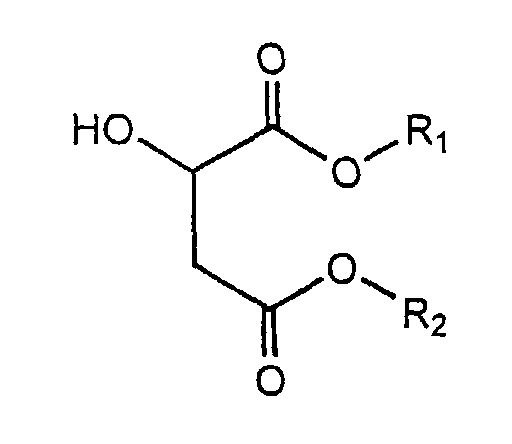
tension by incorporation of an effective amount of a diester of malic acid of the following
structure:
where R
1 and R
2 are C3 to C6 alkyl groups, but preferably R
1 and R
2 are the same. It
is desirable that an aqueous solution of the malate diester demonstrates a dynamic
surface tension of less than 45 dynes/cm at a concentration of ≤5 wt% in water at 25°C
and 6 bubble/second according to the maximum-bubble pressure method. The
maximum-bubble-pressure method of measuring surface tension is described in
Langmuir 1986,
2, 428-432, which is incorporated by reference.
By "water-based", "aqueous" or "aqueous medium", we mean, for purposes of
this invention, a solvent or liquid dispersing medium which comprises at least 90 wt%,
preferably at least 95 wt%, water. Obviously, an all water medium is also included.
Also provided is a method for lowering the equilibrium and dynamic surface
tension of such aqueous compositions by the incorporation of these malate diester
compounds.
Also provided is a method for applying a coating of a water-based inorganic or
organic compound-containing composition to a surface to partially or fully coat the
surface with the water-based composition, the composition containing an effective
amount of a malate diester compound of the above structure for reducing the dynamic
surface tension of the water-based composition.
There are significant advantages associated with the use of these malate
diesters in water-based organic coatings, inks, adhesives, fountain solutions and
agricultural compositions and these advantages include:
- water-borne coatings, inks, adhesives, fountain solutions and agricultural
compositions which may be applied to a variety of substrates with
excellent wetting of substrate surfaces including contaminated and low
energy surfaces;
- a reduction in coating or printing defects such as orange peel and
flow/leveling deficiencies;
- coating and ink compositions capable of high speed application;
- low-foam surfactants capable of reducing dynamic surface tension;
- low-foam surfactants which are low viscosity liquids at room temperature
for facile handling;
- low-foam surfactants which have low odor and color;
- water-borne coatings and inks which have low volatile organic content,
thus making these formulations environmentally favorable;
- water-borne compositions using a surfactant derived from natural acids or
synthetic equivalents, thus making such compositions environmentally
favorable; and
- low-foam surfactants which exhibit good biodegradation characteristics
and thus, are environmentally favorable.
Because of their excellent surfactant properties and the ability to control foam,
these materials are likely to find use in many applications in which reduction in dynamic
and equilibrium surface tension and low foam are important. Applications in which low
foam is important include various wet-processing textile operations, such as dyeing of
fibers, fiber souring, and kier boiling, where low-foaming properties would be particularly
advantageous; they may also have applicability in soaps, water-based perfumes,
shampoos, and various detergents where their marked ability to lower surface tension
while simultaneously producing substantially no foam would be highly desirable.
DETAILED DESCRIPTION OF THE INVENTION
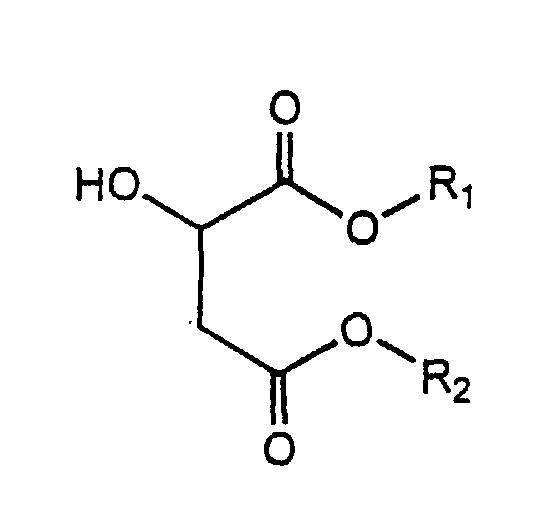
This invention relates to the use of compounds of the structure
where R
1 and R
2 are independently a C3-C6 alkyl group, preferably R
1 = R
2, for the
reduction of equilibrium and dynamic surface tension in water-based compositions
containing an organic compound, particularly coating, ink, fountain solution, adhesive
and agricultural compositions containing organic compounds such as polymeric resins,
herbicides, fungicides, insecticides or plant growth modifying agents. It is desirable that
an aqueous solution of the malate diester demonstrates a dynamic surface tension of
less than 45 dynes/cm at a concentration of ≤5 wt% in water at 25°C and
6 bubble/second according to the maximum-bubble-pressure method. The maximum-bubble-pressure
method of measuring surface tension is described in
Langmuir 1986,
2,
428-432, which is incorporated by reference.
In one aspect of the invention the malate diesters of the above formula display
excellent ability to reduce equilibrium and dynamic surface tension while producing
substantially no foam.
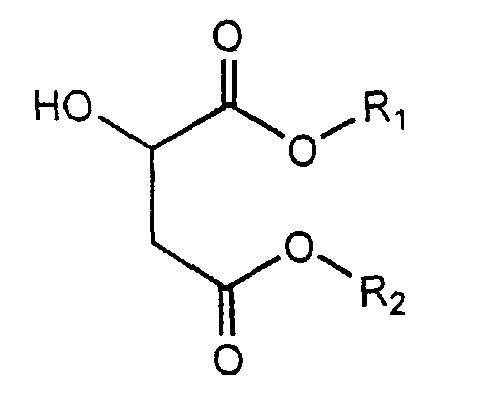
These materials may be prepared by esterification of malic acid with an alcohol.
The reaction is illustrated below:
For the purpose of this invention all stereoisomers of malic acid are suitable,
including L-malic acid, D-malic acid and DL- malic acid.
The esterification reaction may be performed using many catalysts and
processes as described in the Kirk-Othmer Encyclopedia of Chemical Technology, 4th
Ed., Vol. 9, p. 755-780, which is incorporated by reference. The reaction is preferentially
catalyzed by an acid. Examples of suitable acid catalysts are acidic ion exchange resins
(i.e. Amberlyst®15 resin), p-toluenesulfonic acid, boron trifluoride etherate and mineral
acid catalysts, such as hydrochloric acid and sulfuric acid. In addition, the esterification
reaction may be driven by removal of the water by-product. In this case, the water may
be removed as an azeotrope, typically with the alcohol used in the reaction. Other
suitable methods to remove water include the use of a drying agent. Also, solvents may
be added to the reaction to aid the dissolution of malic acid or to facilitate azeotropic
removal of water.
All alcohols or mixtures of alcohols containing the requisite C3 to C6 alkyl
substituents may be utilized for the preparation of the dialkylmalates of this invention
with alcohols containing a 3-5 carbons being preferred and those containing 4 carbons
being especially preferred. Alkyl groups which are suitable should have sufficient carbon
to confer surface activity (i.e. an ability to reduce the surface tension of water) to the
material but not enough carbon to decrease the solubility to the extent that the ability of
the material to reduce surface tension is insufficient for a particular application. In
general, an increase in the carbon number increases the efficiency of the resulting
dialkylmalate (i.e. less surfactant is required to obtain a given decrease in surface
tension), but decreases its ability to reduce surface tension at high surface creation
rates. The latter effect is a result of the fact that increased carbon number generally
decreases the water solubility of the material, and consequently, diminishes the diffusive
flux of surfactant to newly-created surface. Generally, in the practice of this invention, it
is desirable to choose alkyl groups such that the resulting dialkylmalates have a
solubility limit in water from 0.005 to 5 wt%, preferably from 0.01 to 3 wt%, and most
preferably from 0.1 to 1.0 wt%.
The alkyl groups in the malates of this invention may be the same or different.
However, symmetrical malates are preferred due to ease in synthesis. Alkyl groups may
be linear or branched, with alkyl groups containing terminal branching being preferred.
The point of attachment to the oxygen may be on either an internal or terminal carbon,
with a terminal carbon being preferred. The total number of carbons on R1 and R2
should be ≥6; fewer than this diminishes the surface activity of the dialkylmalate too
greatly. The total number of carbons should be ≤12; a greater number decreases the
solubility of the material to such a degree that its use in many formulations is impractical.
Examples of suitable alkyl groups are n-propyl, isopropyl, n-butyl, isobutyl, sec-butyl,
n-pentyl, 2-pentyl, 3-pentyl, isopentyl, neopentyl, cyclopentyl, 2-methylbutyl, 3-methyl-2-butyl,
n-hexyl 2-hexyl, 3-hexyl, cyclohexyl, 2-ethylbutyl, 4-methyl-2-pentyl and so on.
Preferred derivatives are those in which R1 = R2 and contain a total of 6 to 12 alkyl
carbons. Of these derivatives those which contain 6 to 10 alkyl carbons are preferred
and those containing 8 to 10 alkyl carbons especially preferred, with those containing 8
alkyl carbons being the most preferred, especially in the case where R1 = R2 = isobutyl.
Moreover, those alkyl groups which contain terminal branching or attachment at terminal
oxygen are preferred.
An amount of dialkylmalate compound that is effective to reduce the equilibrium
and/or dynamic surface tension of the water-based, organic compound-containing
composition is added. Such effective amount may range from 0.001 to 20 wt%,
preferably 0.01 to 10 wt%, and most preferably 0.05 to 5 wt%, of the aqueous
composition. Naturally, the most effective amount will depend on the particular
application and the solubility of the dialkylmalate.
The malate diesters are suitable for use in an aqueous composition comprising in
water an inorganic compound which is a mineral ore or a pigment or an organic
compound which is a pigment, a polymerizable monomer, such as addition,
condensation and vinyl monomers, an oligomeric resin, a polymeric resin, a detergent, a
caustic cleaning agent, a herbicide, a fungicide, an insecticide, or a plant growth
modifying agent.
In the following water-based organic coating, ink, adhesive, fountain solution and
agricultural compositions containing a dialkylmalate according to the invention, the other
listed components of such compositions are those materials well known to the workers in
the relevant art.
A typical water-based protective or decorative organic coating composition to
which the malate diester surfactants of the invention may be added would comprise in
an aqueous medium 30 to 80 wt% of a coating composition containing the following
components:
| Water-Based Organic Coating Composition |
| 0 to 50 wt% | Pigment Dispersant/Grind Resin |
| 0 to 80 wt% | Coloring Pigments/Extender Pigments/Anti-Corrosive Pigments/Other Pigment Types |
| 5 to 99.9 wt% | Water-Borne/Water-Dispersible/Water-Soluble Resins |
| 0 to 30 wt% | Slip Additives/Antimicrobials/Processing Aids/Defoamers |
| 0 to 50 wt% | Coalescing or Other Solvent |
| 0.01 to 10 wt% | Surfactant/Wetting Agent/Flow and Leveling Agents |
| 0.01 to 5 wt% | Dialkylmalate |
A typical water-based ink composition to which the malate diester surfactants of
the invention may be added would comprise in an aqueous medium 20 to 60 wt% of an
ink composition containing the following components:
| Water-Based Ink Composition |
| 1 to 50 wt% | Pigment |
| 0 to 50 wt% | Pigment Dispersant/Grind Resin |
| 0 to 50 wt% | Clay base in appropriate resin solution vehicle |
| 5 to 99.9 wt% | Water-Borne/Water-Dispersible/Water-Soluble Resins |
| 0 to 30 wt% | Coalescing or Other Solvent |
| 0.01 to 10 wt% | Surfactant/Wetting Agent |
| 0.01 to 10 wt% | Processing Aids/Defoamers/Solubilizing Agents |
| 0.01 to 5 wt% | Dialkylmalate |
A typical water-based agricultural composition to which the malate diester
surfactants of the invention may be added would comprise in an aqueous medium 0.1 to
80 wt% of an agricultural composition containing the following components:
| Water-Based Agricultural Composition |
| 0.1 to 50 wt% | Pesticide, Insecticide, Herbicide or Plant Growth Modifying Agent |
| 0.01 to 10 wt% | Surfactant |
| 0 to 5 wt% | Dyes |
| 0 to 20 wt% | Thickeners/Stabilizers/Co-surfactants/Gel Inhibitors/Defoamers |
| 0 to 25 wt% | Antifreeze |
| 0.01 to 50 wt% | Dialkylmalate |
A typical water-based fountain solution composition would the following
components:
| Water-Based Fountain Solution |
| 0.05 to 10 wt% | Film formable, water soluble macromolecule |
| 1 to 25 wt% | Alcohol, glycol, or polyol with 2-12 carbon atoms, water soluble or can be made to be water soluble |
| 0.01 to 20 wt% | Water soluble organic acid, inorganic acid, or a salt thereof |
| 30 t 70 wt% | Water |
| 0.01 to 5 wt% | Dialkylmalate |
A typical water-based adhesive composition to which the dialkylmalate
surfactants of the invention may be added would comprise in an aqueous medium 30 to
65 wt% of an adhesive composition containing the following components:
| Water-Based Adhesive |
| 50 to 99 wt% | Polymeric Resin (SBR, VAE, Acrylic) |
| 0 to 50 wt% | Tackifier |
| 0 to 0.5 wt% | Defoamer |
| 0.5 to 2 wt% | Dialkylmalate |
With the exception of diisopropyl-(S)-(-)-malate and dibutyl-DL-malate, which
were available commercially, all malates in the following examples were synthesized and
characterized via Gas Chromatography/Mass Spectrometry (GC/MS) and Nuclear
Magnetic Resonance (NMR) spectroscopy. All dialkylmalates prepared ranged from
>96% to >99% pure.
Example 1
Diisopropyl-(S)-(-)-malate was purchased from Aldrich Chemical Company (99%)
and used as received. The compound was a low viscosity, clear, colorless liquid with no
detectable odor.
Example 2
Dibutyl-DL-malate was purchased from TCI America (99%) and used as
received. The compound was a low viscosity, clear, colorless liquid with a slight,
pleasant odor.
Example 3
Diisobutyl-DL-malate was prepared by esterification of DL-malic acid with isobutyl
alcohol. To a three-neck 1L round-bottomed flask equipped with a reflux condenser,
Dean-Stark trap, septum, thermocouple and mechanical stirrer, were added DL-malic
acid (75.91 g), 2-methyl-1-propanol (210 mL) and Amberlyst®15 ion exchange resin
(10 g). The mixture was placed under nitrogen and heated to reflux. At 106°C, two
phases started to collect in the Dean-Stark trap. The reaction temperature was
maintained at 108°C for 2hr 15min and the water was continuously removed via the
Dean-Stark trap. As collection in the Dean-Stark trap slowed, the reaction temperature
was increased to 115°C and fresh alcohol (50 mL) was added to the reaction. The
reaction was heated to 120°C and more alcohol (50 mL) was added. At this point, no
more water collected in the Dean-Stark trap. The product was separated from the
catalyst via filtration. The crude yellow liquid was purified via vacuum distillation.
Diisobutyl-DL-malate was obtained as a low viscosity, clear, colorless liquid with a slight
pleasant odor (120.4 g, 86.3% yield).
Example 4
Di-sec-butyl-DL-malate was prepared using a procedure similar to Example 3.
This compound was isolated as a bottoms product. To the reaction flask, DL-malic acid
(80.23 g), 2-butanol (220 mL) and Amberlyst®15 ion exchange resin (11.2 g) were
added. The mixture was placed under nitrogen and heated to reflux. At 102°C, one
phase started to collect in the Dean-Stark trap. The reaction was maintained at 102°C
for 4 hr. During this time, the water/alcohol azeotrope was removed as fresh alcohol
was added. The product was dissolved in diethyl ether, separated from the catalyst via
filtration over a bed of silica, washed with saturated sodium bicarbonate a number of
times, washed once with water, and dried over magnesium sulfate. Diethyl ether was
removed via rotary evaporation. Di-sec-butyl-DL-malate was obtained as a low
viscosity, clear light yellow liquid with no detectable odor (46 g, 31 % yield) after pumping
on the sample in vacuo to remove residual 2-butanol.
Example 5
Dipentyl-DL-malate was prepared using a procedure similar to that in Example 4.
To the reaction flask, DL-malic acid (100.43 g), 1-pentanol (325 mL) and Amberlyst®15
ion exchange resin (14.2 g) were added. The mixture was placed under nitrogen and
heated to reflux. At 108°C, two phases started to collect in the Dean-Stark trap. The
reaction was maintained at 110-120°C for 4 hr 15 min and water was continuously
removed. The product was separated from the catalyst via filtration over silica using 300
mL diethyl ether. The organic layer was washed 4 times with saturated sodium
bicarbonate, washed once with water, and dried over magnesium sulfate. Diethyl ether
was removed via rotary evaporation. Dipentyl-DL-malate was obtained as a low
viscosity, slightly hazy, very light yellow liquid with a slight pleasant odor (116.5 g, 55.6%
yield) after pumping on the sample in vacuo to remove residual 1-pentanol.
Example 6
Diisoamyl-DL-malate was prepared using a procedure similar to that in Example
4. To the reaction flask, DL-malic acid (87.54 g), 3-methyl-1-butanol (285 mL) and
Amberlyst®15 ion exchange resin (11.9 g) were added. The mixture was placed under
nitrogen and heated to reflux. At 109°C, two phases started to collect in the Dean-Stark
trap. The reaction was maintained at 110°C for 8 hr, during this time water was
continuously removed. The product was dissolved in diethyl ether and separated from
the catalyst via filtration over a bed of silica. The organic layer was washed with
saturated sodium bicarbonate a number of times, washed once with water, and dried
over magnesium sulfate. Diethyl ether was removed via rotary evaporation. Diisoamyl-DL-malate
was obtained as a low viscosity, clear colorless liquid with a slight odor
(130 g, 72% yield) after pumping on the sample in vacua to remove residual 3-methyl-1-butanol.
Example 7
Di(2-methylbutyl)-DL-malate was prepared using a procedure similar to that in
Example 4. To the reaction flask, DL-malic acid (100.56 g), 2-methyl-1-butanol (325 mL)
and Amberlyst®15 ion exchange resin (15.1 g) were added. The mixture was placed
under nitrogen and heated to reflux. At 108°C, two phases started to collect in the
Dean-Stark trap. After 1.5 hr, the reaction temperature was increased to 115°C for 20
minutes and 120°C for 20 minutes. Once water ceased to collect in the Dean-Stark trap,
the product was diluted with diethyl ether, collected via filtration over a short bed of
silica, washed 4 times with saturated sodium bicarbonate, once with water and dried
over magnesium sulfate. The diethyl ether was removed via rotary evaporation. Di-(2-methylbutyl)-DL-malate
was obtained as a low viscosity, clear, very light yellow liquid
with no detectable odor (139.8 g, 68% yield) after removing residual 2-methyl-1-butanol
via vacuum distillation.
Example 8
Dihexyl-DL-malate was prepared using a procedure similar to that in Example 4
with p-toluenesulfonic acid as the catalyst. Unlike Examples 3-7, the reaction was not
performed in neat alcohol. In this case, 1,4-dioxane was added to dissolve the starting
acid. To the reaction flask, DL-malic acid (80.91 g), hexyl alcohol (307 mL), 1,4-dioxane
(200 mL) and p-toluenesulfonic acid (12.3 g) were added. The mixture was placed
under nitrogen and heated to reflux. At 103°C, one phase started to collect in the Dean-Stark
trap. The reaction temperature was increased to 110°C and after 2 hr 40 min very
little liquid had collected in the trap. The reaction temperature was increased to 115°C
and held until no more liquid collected in the trap. The product was neutralized with
saturated sodium bicarbonate, diluted with diethyl ether, washed three times with
saturated sodium bicarbonate, once with water and dried over magnesium sulfate. The
diethyl ether was removed via rotary evaporation. Dihexyl-DL-malate was obtained as a
low viscosity, clear, colorless liquid with a slight pleasant odor (127.7 g, 70% yield) after
removing residual hexyl alcohol via vacuum distillation.
Example 9
Di(4-methyl-2-pentyl)-DL-malate was prepared using a procedure similar to that
in Example 8. To the reaction flask, DL-malic acid (90.76 g), 4-methyl-2-pentanol (350
mL), 1,4-dioxane (200 mL) and p-toluenesulfonic acid (15.2 g) were added. The mixture
was placed under nitrogen and heated to reflux. At 105°C, one phase started to collect
in the Dean-Stark trap. After 2 hr, the temperature was increased to 110°C. After 1 hr
10 min, the temperature was increased to 112°C and held until no more liquid collected
in the trap. The reaction product was neutralized with saturated sodium bicarbonate,
diluted with diethyl ether, washed three times with saturated sodium bicarbonate, once
with water and dried over magnesium sulfate. The diethyl ether was removed via rotary
evaporation. Di(4-methyl-2-pentyl)-DL-malate was obtained as a low viscosity, light
yellow, slightly hazy liquid with no detectable odor (166.8 g, 81.5% yield) after removing
residual 4-methyl-2-pentanol via vacuum distillation.
Example 10
Dibenzyl-DL-malate was prepared using the method of Lee et al, J. Chem. Soc.
Perkin Trans. I, 1995, 2877. To a three-neck 1L round-bottomed flask equipped with a
reflux condenser, Dean-Stark trap, thermocouple and mechanical stirrer, were added
DL-malic acid (81.96 g), benzyl alcohol (132.0 g), toluene (620 mL) and p-toluene-sulfonic
acid (1.165 g). The mixture was placed under nitrogen and heated to reflux. At
100°C, two phases started to collect in the Dean-Stark trap. After 2 hr, the reaction
temperature was increased to 105°C for 1.5 hr. The crude product was neutralized with
saturated sodium bicarbonate and poured into a separatory funnel. The organic layer
was washed with saturated sodium bicarbonate twice, washed once with water, and
dried over magnesium sulfate. The toluene was removed via rotary evaporation. Two-thirds
of the crude product were purified via column chromatography (20% ethyl acetate
in hexane eluent). Residual benzyl alcohol was removed via vacuum distillation to give a
low viscosity, clear, colorless oil with no detectable odor (49.9 g, 28% yield).
In the following Examples dynamic surface tension data were obtained for
aqueous solutions of various compounds using the maximum bubble pressure method at
bubble rates from 0.1 bubbles/second (b/s) to 20 b/s. These data provide information
about the performance of a surfactant at conditions from near-equilibrium (0.1 b/s)
through extremely high surface creation rates (20 b/s). In practical terms, high bubble
rates correspond to high printing speeds in lithographic printing, high spray or roller
velocities in coating applications, and rapid application rates for agricultural products.
Examples 11-20
Solutions of the materials of Examples 1-10 in distilled water were prepared.
Their dynamic surface tension was evaluated at 25°C as described above, and these
data were used to determine the quantities provided in the Table 1. The
pC
20 value is
defined as the negative logarithm of the molar concentration of surfactant required to
decrease the surface tension of an aqueous solution to 52.1 dyne/cm, that is, 20
dyne/cm below that of pure water when the measurement is performed at 0.1 b/s. This
value is a measure of the efficiency of a surfactant. In general, an increase in
pC
20 value
of 1.0 indicates that 10 times less surfactant will be required to observe a given effect.
In addition, the relative efficiency of surfactants can be obtained by comparing surface
tension reduction of solutions containing the same amount of different surfactants. Such
data is given for 0.1 wt% solutions of the dialkylmalates at 1.0 and 6.0 bubbles/second
(b/s). The solubility limit was determined by intersection of the linear portion of a surface
tension / In concentration curve with the limiting surface tension as is described in many
textbooks. The limiting surface tensions at 0.1, 1, 6 and 20 b/s represent the lowest
surface tensions in water which can be achieved at the given surface creation rates for a
given surfactant regardless of the amount of surfactant used and is used to evaluate the
effectiveness of a surfactant. These values give information about the relative ability of
a surfactant to reduce surface defects under near-equilibrium conditions (0.1 b/s)
through very dynamic conditions (20 b/s). Lower surface tensions would allow the
elimination of defects upon application of a formulation onto lower energy surfaces.
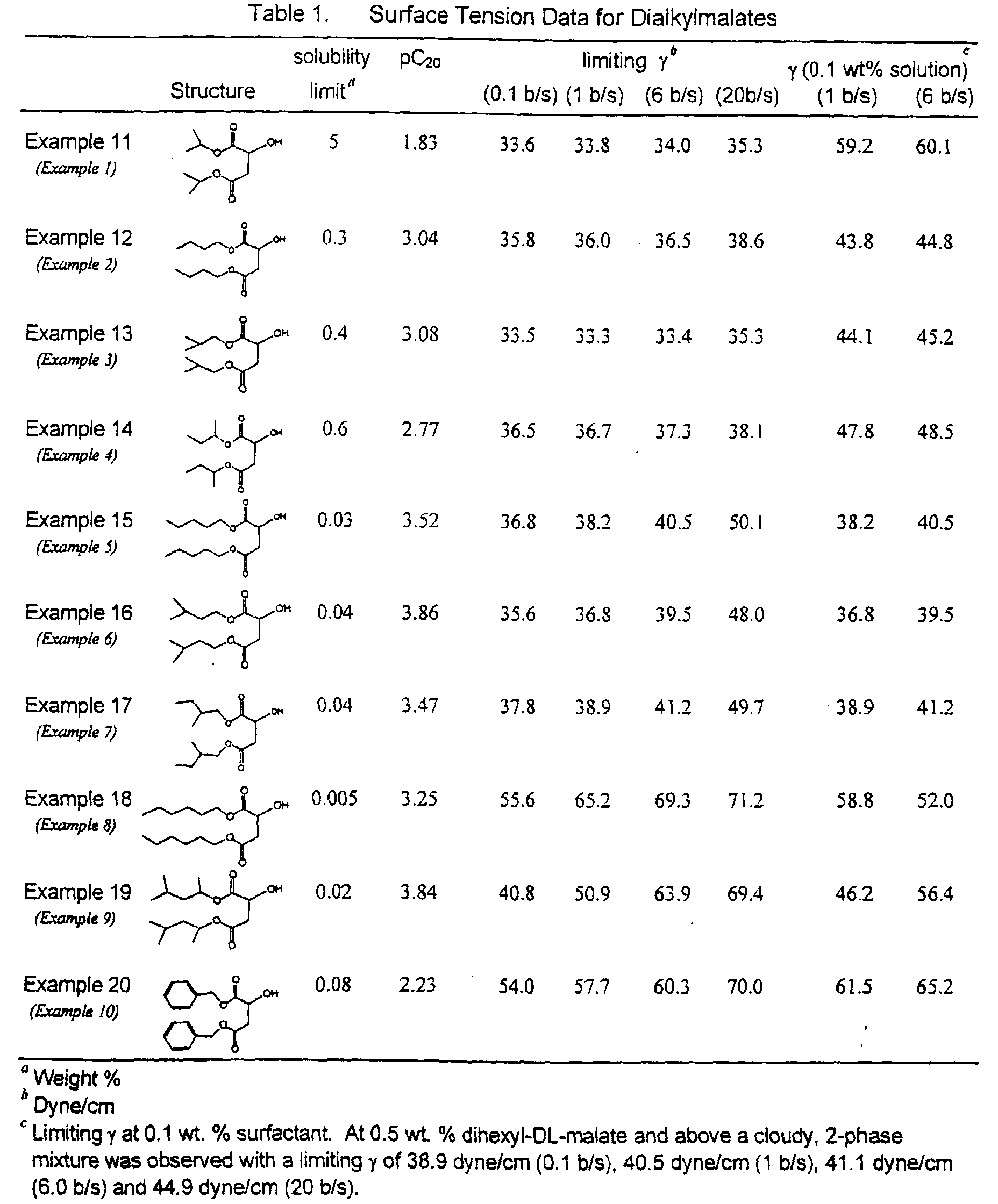
The data in Table 1 illustrate that various dialkylmalates have the ability to
reduce the surface tension of an aqueous composition and that in many cases low
surface tension can be maintained even under conditions in which surface is created at
a rapid rate. Examples 11-20 demonstrate that dialkylmalates containing alkyl groups of
three to six carbon atoms exhibit surface tension values of less than 45 dyne/cm at a
concentration of ≤ 5 wt% in water at 25°C and at 0.1 b/s. Furthermore, dialkylmalates
containing alkyl groups with three to five carbon atoms demonstrate a reduction in the
dynamic surface tension of aqueous solutions of less than 45 dyne/cm under more
dynamic conditions (6 b/s) and at a concentration of ≤ 5 wt% in water at 25°C. In
comparison, C6 and greater dialkylmalates performed poorly under these conditions.
Moreover, dialkylmalates containing alkyl groups with four to five carbon atoms can
achieve dynamic surface tension reduction of aqueous compositions of less than 42
dyne/cm at 6 b/s at a concentration of <1 wt% surfactant. Surprisingly, dialkylmalates
which contain C4 groups exhibit an optimum combination of effectiveness and efficiency
with surface tension reduction of less than 40 dyne/cm at very fast surface creation rates
(20 b/s) at a concentration of <1 wt% surfactant. Of the C4 dialkylmalates, those
prepared from primary alcohols are preferred, with those containing terminal branching
being the most preferred.
Overall, dialkylmalates containing C3 to C5 alkyl groups exhibit limiting dynamic
surface tension values <38 dyne/cm at low surface creation rates (0.1b/s) and values
<50 dyne/cm at high surface creation rates (20b/s). Specifically, dipentyl-DL-malate,
diisoamyl-DL-malate and di(2-methylbutyl)-DL-malate are very efficient at reducing
dynamic surface tension. This characteristic is evidenced by pC20 values for these
compounds of 3.52, 3.86 and 3.47, respectively. Moreover, the high efficiency of
dipentyl-DL-malate, diisoamyl-DL-malate and di(2-methylbutyl)-DL-malate is evidenced
by the surface tension data for 0.1 wt% compositions of these surfactants which are
capable of maintaining a surface tension <42 dyne/cm at relatively high surface creation
rates (6b/s). In contrast, diisopropyl-(S)-(-)-malate is a very effective, but not very
efficient surfactant. Although diisopropyl-(S)-(-)-malate is capable of maintaining a
surface tension <34 dyne/cm at very fast rates (20b/s), 5 wt% surfactant is required to
reduce the surface tension to a similar value obtained for 0.1 to 0.5 wt% compositions of
C4 dialkylmalates (Examples 12-14) and 0.05 to 0.1 wt% solutions of C5 dialkylmalates
(Examples 15-17). In contrast, C4 dialkylmalates provide sufficient effectiveness (i.e.
reduction in dynamic surface tension) with reasonable efficiencies (i.e. use levels). For
example, diisobutyl-DL-malate can maintain a limiting surface tension less than 36
dyne/cm even at the highest surface creation rates measured (20b/s). Moreover, this
value covers a narrow surface tension range for all bubble rates and is for a 0.5 wt%
solution. Thus, the C4 alkyl groups have optimum carbon to confer sufficient surface
activity (i.e. efficiency) to the material but not enough carbon to decrease the solubility to
the extent that the ability of the material to reduce surface tension is insufficient for a
particular application (i.e. effectiveness).
In addition to the number of carbon atoms in the alkyl chain, the structure of the
alkyl chain was observed to have an unanticipated effect on the properties of the malic
acid diester surfactants of this invention. Particularly, branching at the end of the alkyl
chain was found to improve both the efficiency and effectiveness of the dialkylmalate
surfactant whereas, the attachment of an oxygen atom at an internal position on the
alkyl group had a negative effect on surfactant performance. For example, the terminal
branching present in diisobutyl-DL-malate accounts for a decrease in the limiting surface
tension of 3.3 dyne/cm at 20b/s when compared to dibutyl-DL-malate. In addition, the
highest surface tensions exhibited for aqueous compositions containing 0.1 wt% of a C4
dialkylmalate were observed for di-sec-butyl-DL-malate, which was prepared from a
secondary alcohol. Such differences in the performance of dialkylmalates containing the
same number of carbon atoms would not be expected from what is known in the art.
Thus, for dialkylmalates consistent with this invention, those with alkyl groups containing
oxygen atoms attached at a terminal position are particularly applicable, with those
containing terminal branching being preferred and with isobutyl groups being the most
preferred for the reduction of surface tension of water in water-based, organic compound
containing compositions, including waterborne coatings, inks, adhesives, fountain
solutions and agricultural formulations. However, ultimately the choice of dialkylmalate
will depend upon the application.
Examples 21-30
The foaming properties of 0.1 wt% solutions of the dialkylmalate surfactants of
this invention were examined using a procedure based upon ASTM D 1173-53. In this
test, a 0.1 wt% solution of the surfactant is added from an elevated foam pipette to a
foam receiver containing the same solution. The foam height is measured at the
completion of the addition ("Initial Foam Height") and the time required for the foam to
dissipate at the air-liquid interface ("Time to 0 Foam") is recorded. This test provides a
comparison between the foaming characteristics of various surfactant solutions. In
general, in coatings, inks, adhesives, fountain solutions and agricultural compositions,
foam is undesirable because it complicates handling and can lead to coating and print
defects, and to inefficient application of agricultural materials. The data are presented in
Table 2.
As illustrated, the ability to control foam is advantageous in many applications,
including coatings, inks, adhesives, fountain solutions, agricultural formulations, soaps,
detergents, food processing and so on. The results for the malate diesters are reported
in Table 2. A drawback to the use of conventional surfactants in coatings, inks,
adhesives, fountain solutions and agricultural compositions is the formation of
considerable quantities of long-lasting foam in these systems. For such applications, it
is desired that a surfactant forms little foam and that the foam which forms dissipates
quickly. The data in Table 2 show that the compounds of this invention form very little
foam or no measurable foam, and that the foam which forms dissipates quickly.
Moreover, all of these materials form less initial foam and many form faster breaking
foam than the current art. Surprisingly, linear alkyl groups and those which were
prepared from secondary alcohols produced more initial foam and longer lasting foam
than their counterparts which contain the same number of carbon atoms and alkyl
groups with terminal branching. Therefore, malic acid diester surfactants which contain
terminal branching are preferred as low-foaming surfactants, especially diisobutyl-DL-malate
and diisoamyl-DL-malate. Overall, in addition to their ability to reduce the
surface tension of organic-containing aqueous compositions, these materials have
desirable foam properties with respect to their use in coatings, inks, adhesives, fountain
solutions and agricultural compositions.
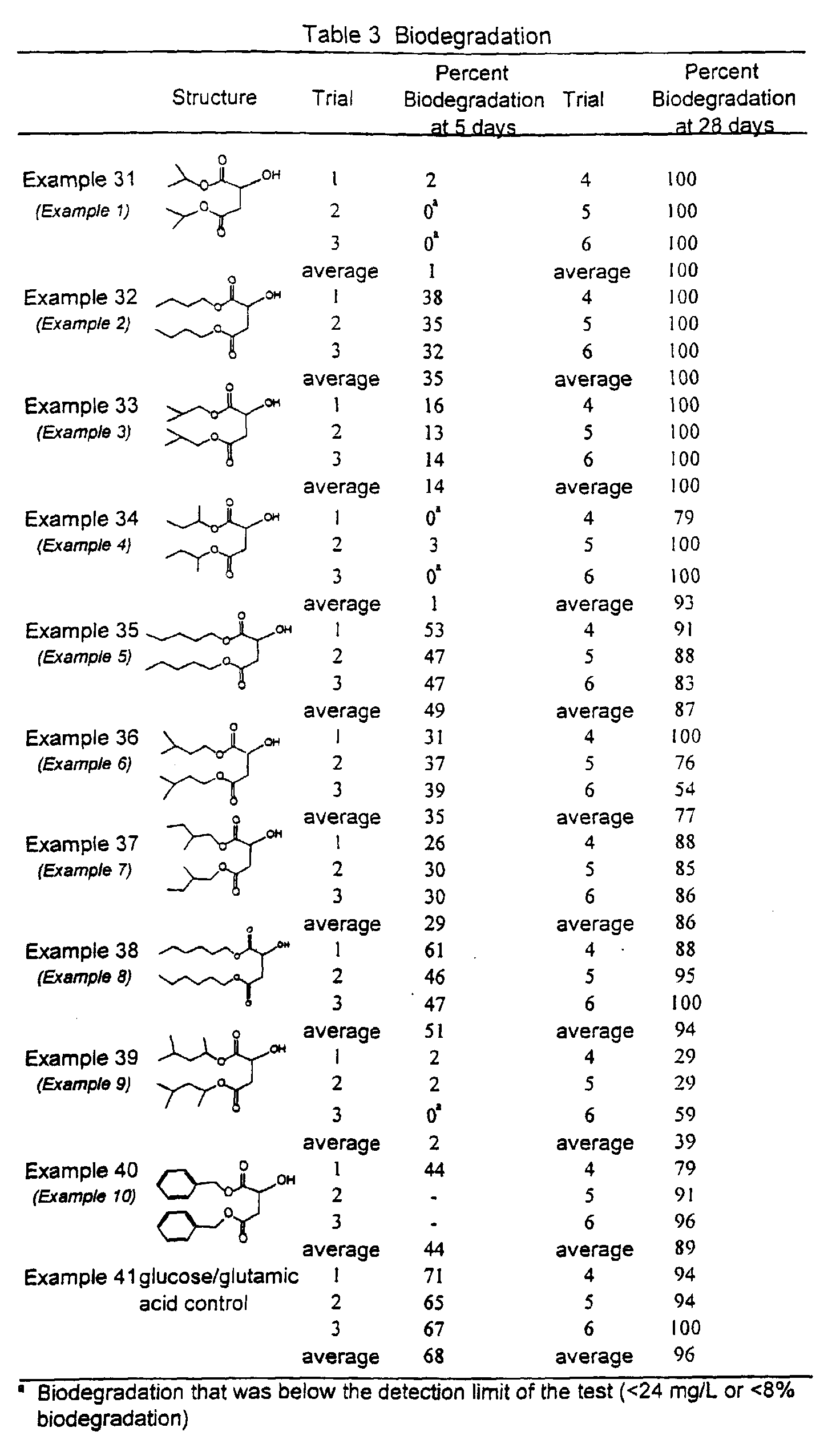
Examples 31-41
The ultimate biodegradability of various dialkylmalates (diisopropyl-(S)-(-)-malate,
dibutyl-DL-malate, diisobutyl-DL-malate, di-sec-butyl-DL-malate, dipentyl-DL-malate,
diisoamyl-DL-malate, di-(2-methylbutyl)-DL-malate, dihexyl-DL-malate, di-(4-methyl-2-pentyl)-DL-malate
and dibenzyl-DL-malate) is illustrated in Table 3. Assessment of
biodegradability of these compounds was made using the Carbonaceous Biological
Demand test at 5 days (CBOD5) and at 28 days (CBOD28). The test samples were
weighed out and solubilized in Milli-Q water with a target total organic carbon (TOC)
content of 100 mg/L. The chemical oxygen demand (COD) was measured on these
solutions as a measure of the complete oxidation or Ultimate Biological Oxygen Demand
(UBOD). These prepared samples were run in triplicate in 5 day and 28 day CBOD tests
using a biomass seed from a Easton, PA Wastewater Treatment Plant which was not
acclimatized to the compounds of this invention. Each measurement (5 day and 28 day
CBOD) was run three times for each compound to confirm reproducibility. The results
from the CBOD tests at 5 and 28 days were divided by the COD results for each
respective solution and multiplied by 100 to calculate a percent biodegradation. A
glucose/glutamic acid solution, which is readily biodegradable, was run as a positive
control to check biomass health. This is the preferred control for BOD tests as listed in
the Standard Methods. Examples which showed very low biodegradation which was
below the limit of detection for the test (<24 mg/L or <8% biodegradation) are reported
as 0% degraded in Table 3.
For compounds that are extremely biodegradable a high percent biodegradation
is usually seen in the CBOD5 measurement, even when using unacclimatized biomass.
Other compounds require a longer period of time during which the degrading organisms
develop enzyme systems to utilize the test material as a food source. For these
compounds, a higher oxygen demand is seen at 28 days. Compounds with high (i.e.
greater than 60%) biodegradation after 28 days may be considered easily biodegraded.
The results of these studies showed that dibutyl-DL-malate, diisobutyl-DL-malate,
dipentyl-DL-malate, diisoamyl-DL-malate, di-(2-methylbutyl)-DL-malate, dihexyl-DL-malate
and dibenzyl-DL-malate all exhibit significant biodegradation after only 5 days in
the CBOD5 test using unacclimatized biomass. Surprisingly, those dialkylmalates
containing oxygen atoms attached at a terminal position demonstrated significantly more
percent biodegradation than the corresponding malates containing an oxygen atom
which was attached at an internal position on the alkyl group. For example, diisopropyl-(S)-(-)-malate,
di-sec-butyl-DL-malate and di-(4-methyl-2-pentyl)-DL-malate were
degraded only 0-3% after 5 days, whereas diisobutyl-DL-malate, diisoamyl-DL-malate
and di-(2-methylbutyl)-DL-malate exhibited a significant amount of biodegradation after
only 5 days (i.e. 13-39%).
After 28 days, all malates except the highly branched di(4-methyl-2-pentyl)malate
degraded greater than 60%. Due to the low level of measured biodegradation for di(4-methyl-2-pentyl)malate,
this compound is not preferred relative to the more
biodegradable malates of this invention. Overall, after 28 days malates with shorter alkyl
chains degraded more than those with longer chains. This effect may be due to the
decreasing solubility as the alkyl chain length increases. Of the longer chain malates
(i.e. greater than C5), those with linear alkyl groups are more easily degraded. From
these data, it can be concluded that all malate surfactants are easily biodegraded, with
the exception of di(4-methyl-2-pentyl)malate. In addition, since all malates degraded to
a significant extent in 28 days, these compounds are not expected to persist or
bioaccumulate in the natural environment. Moreover, it should be emphasized that the
tests used for the materials of this invention are very stringent biodegradation screening
tests and higher degrees of biodegradation are likely for longer-term tests, tests using
acclimatized biomass and under the conditions of a well-maintained wastewater
treatment plant.
The ability of a surfactant in aqueous systems to reduce surface tension under
both equilibrium and dynamic conditions is of great importance in the performance of
waterbased coatings, inks, adhesives, fountain solutions and agricultural compositions.
Low equilibrium surface tension allows the development of excellent properties
subsequent to application. Low dynamic surface tension results in enhanced wetting
and spreading under the dynamic conditions of application, resulting in more efficient
use of the formulations and fewer defects. In waterborne coatings, inks, adhesives,
fountain solutions and agricultural compositions, the formation of foam is generally
undesirable because it complicates handling and can cause defects or result in
inefficient application. Furthermore, there is substantial interest in the industry in the
development of environmentally-friendly surfactants. As a result, it is essential to the
invention described herein is that this new family of surfactants not only possess the
aforementioned desired performance attributes but also is derived from naturally
occurring compounds or their synthetic equivalents and possess favorable
environmental characteristics, such as facile biodegradation. Moreover, it is desired that
this novel family of surfactants which exhibit good equilibrium and dynamic surface
tension properties, are low-foaming, are also low viscosity liquids to facilitate handling,
and have low color and low odor characteristics.
Although dialkylmalates have been studied in numerous applications, their role
appears to have not been to as surfactants themselves. In particular, surfactancy by
relatively short chain dialkylmalates is not apparent from the prior art. In fact, there are
not many examples of short-chain dialkylmalates in aqueous media. A property which is
particularly not apparent from the prior art is the outstanding dynamic properties shown
by dialkylmalates in reducing the surface tension of aqueous mixtures under conditions
of high surface creation rates and that this performance would be particularly good for
malic acid esters containing C3 to C5 alkyl groups and especially good for malic acid
esters containing C4 alkyl groups. Moreover, it is not expected from the prior art that
terminal branching in the alkyl groups would increase both the efficiency and
effectiveness of the surfactant and that dialkylmalates prepared from primary alcohols
would perform better than those prepared from secondary alcohols, with isobutyl alkyl
groups resulting the optimum combination of such properties.
In order to obtain satisfactory performance under high speed application
conditions, surfactants that exhibit both reduction in surface tension under dynamic
conditions and low foam are essential. Unexpectedly, these malic acid ester surfactants
are low foaming. In addition, many of these dialkylmalates biodegrade easily. This
property, in combination with unique dynamic surface tension reducing capabilities, low
foam and desirable physical characteristics, such as low color, low odor and low
viscosity, afford a novel class of surfactants which are particularly suited for a variety of
waterborne compositions including coatings, inks, adhesives, fountain solutions and
agricultural compositions.
STATEMENT OF INDUSTRIAL APPLICATION
The invention provides compositions suitable for reducing the equilibrium and
dynamic surface tension in water-based coating, ink, adhesive, fountain solution and
agricultural compositions.