EP1094389A2 - Method for monitoring fault of operating system and application program - Google Patents
Method for monitoring fault of operating system and application program Download PDFInfo
- Publication number
- EP1094389A2 EP1094389A2 EP00117950A EP00117950A EP1094389A2 EP 1094389 A2 EP1094389 A2 EP 1094389A2 EP 00117950 A EP00117950 A EP 00117950A EP 00117950 A EP00117950 A EP 00117950A EP 1094389 A2 EP1094389 A2 EP 1094389A2
- Authority
- EP
- European Patent Office
- Prior art keywords
- fault
- monitor
- fault monitor
- alive message
- memory
- Prior art date
- Legal status (The legal status is an assumption and is not a legal conclusion. Google has not performed a legal analysis and makes no representation as to the accuracy of the status listed.)
- Withdrawn
Links
Images



Classifications
-
- G—PHYSICS
- G06—COMPUTING OR CALCULATING; COUNTING
- G06F—ELECTRIC DIGITAL DATA PROCESSING
- G06F11/00—Error detection; Error correction; Monitoring
- G06F11/07—Responding to the occurrence of a fault, e.g. fault tolerance
- G06F11/0703—Error or fault processing not based on redundancy, i.e. by taking additional measures to deal with the error or fault not making use of redundancy in operation, in hardware, or in data representation
- G06F11/0751—Error or fault detection not based on redundancy
Definitions
- the present invention relates to a fault monitoring method for computer, and in particular to a fault monitoring method of an operating system (OS) and an application program (AP).
- OS operating system
- AP application program
- an AP encounters a fault for several reasons and stops. Main causes are defects included in the AP itself and faults of an OS on which the AP is mounted. As for such an AP that its operation needs to be continued, the following method has been adopted. A fault is monitored. If a fault has been detected, then the operation of the AP is resumed from a state in which it was before the occurrence of the fault, and thereby recovery of the AP from the fault is attempted.
- an AP fault monitor having a watchdog receives a periodical alive message from the AP. If the alive message stops for a predetermined time, the AP fault monitor judges an AP fault to have occurred and restarts the AP. In the case where a fault of an OS is monitored, an OS fault monitor having a watchdog receives a periodical alive message from the OS. If the alive message disappears for a predetermined time, the OS fault monitor judges an OS fault to have occurred and restarts the OS.
- check-point For recovery of an AP from a fault, a technique called check-point is used.
- execution information of the AP is acquired from the monitored AP periodically and reserved. When a fault has occurred, the reserved execution information is taken out, and processing of the AP is resumed from a check-point.
- the AP fault monitor operates on the same OS as the monitored AP. In some cases, therefore, the AP fault monitor using software cannot cope with such an AP fault caused by the OS. Furthermore, there is known such an OS fault monitoring method that a watchdog is formed of dedicated hardware and the watchdog monitors a periodical alive message supplied from an OS. However, there is a problem that dedicated hardware must be prepared.
- check-point if check-point information is preserved in a low speed memory, then it takes a considerable time to preserve the check-point information, and consequently the check-point repetition period becomes long. As a result, recovery from a fault must be conducted from a state of a considerably long time before the time of the fault occurrence. Furthermore, it is possible to provide a high speed non-volatile memory, such as a static RAM, apart from a volatile memory, such as a dynamic RAM, managed by the OS, and preserve check-point information in the high speed non-volatile memory. However, there is a problem that dedicated hardware must be prepared.
- An object of the present invention is to provide a method for monitoring a fault of the OS by using software, without adding dedicated hardware.
- Another object of the present invention is to provide a method for monitoring a fault of an AP and preserving check-point information of the AP at high speed without adding dedicated hardware.
- the present invention solves the above described problems.
- the operating system fault monitoring method includes the steps of transmitting an alive message from the first OS to the fault monitor via the inter-OS communication means, and determining whether the alive message has been received by the fault monitor within a predetermined time.
- the application program fault monitoring method includes the step of monitoring a fault of the AP fault monitor operating on the first OS by using the high rank fault monitor.
- An AP to be monitored by the AP fault monitor preserves check-point information in a shared memory region on a main memory. In the shared memory region, information is preserved by a fault and restart of the first OS as well.
- fault monitoring of an OS to be monitored is conducted by utilizing a multi-OS environment and using a high rank fault monitor operating on another OS, as heretofore described. Without adding dedicated hardware, therefore, a fault of the OS can be monitored. Furthermore, a fault of an AP fault monitor can also be monitored by using the high rank fault monitor. Furthermore, since the high rank fault monitor using software is used, a recovery method to be used when a fault of each of the OS and AP fault monitor has occurred can be set finely. In addition, a monitored AP can preserve check-point information at high speed without adding dedicated hardware.
- FIG. 1 is a diagram showing the configuration of a computer 100 in the present embodiment.
- the computer 100 can be divided broadly into a processor 10 and a memory (main storage) 9. An input/output device and a storage connected to the processor 10 are not illustrated.
- the memory 9 stores programs of a first OS 1, a second OS 2, a high rank fault monitor (hereafter referred to as "high rank monitor") 3, an AP fault monitor (hereafter referred to as "AP monitor”) 4, a monitored AP 5, and a multi-OS controller 6. These programs are executed by the processor 10.
- the memory 9 includes a shared memory region 11 which can be accessed by both the first OS 1 and the second OS 2.
- the monitored AP 5 is an application mounted on the first OS 1.
- the monitored AP 5 may be a program for conducting general business application.
- the AP monitor 4 is an application mounted on the first OS 1, and it is a program for conducting fault monitoring of the monitored AP 5.
- the second OS 2 is an OS which is different from the first OS 1.
- the second OS 2 is desired to be an OS regarded as an OS having a higher reliability than the first OS 1.
- the high rank monitor 3 is an application mounted on the second OS 2, and it is a program for conducting fault monitoring of the first OS 1 and the AP monitor 4.
- the multi-OS controller 6 has the following functions.
- the multi-OS controller 6 manages computer resources such as CPU time, the memory, external devices, and timers, and divides these resources and provides them to respective OSs. For example, as for timers, the multi-OS controller 6 has a function of virtually providing only one hardware timer to respective OSs. Furthermore, the multi-OS controller 6 has a function of reserving an I/O resource of an external device utilized by respective OSs.
- the multi-OS controller 6 secures a memory region which can be shared between OSs as a physical memory region independent of physical memory regions for respective OSs.
- the shared memory region is divided into several blocks and managed. Each block is provided with its identifier (ID).
- ID shared memory identifier
- each OS can access the shared memory. Supposing that information is not recorded in the memory region, each OS conducts memory initialization after it has been started. For example, when an OS is restarted at the time of a fault of the OS, a memory region in which the state and so on of an application has been preserved is initialized. However, the shared memory region is not initialized because it is located outside the OSs' regions, and its contents are preserved.
- each OS can utilize a pseudo-non-volatile memory or a software manner by specifying the shared memory identifier (ID) used the last time or a pointer to a physical memory.
- ID shared memory identifier
- the shared memory region is utilized as a check-point information storage region of the monitored AP.
- the OS fault notice is a function of giving notice that a fault has occurred in a certain OS to the other OS.
- noticed faults are only faults that the OS itself is conscious of.
- the monitored AP 5 transmits an alive message to the AP monitor 4 periodically.
- the AP monitor 4 determines whether it has received an alive message from the monitored AP 5 within a predetermined fault detection time. Unless an alive message has been received, the AP monitor 4 judges the stoppage to have been caused by a fault of the monitored AP 5. In accordance with a preset method for recovery from a fault, the AP monitor 4 conducts recovery processing of the monitored AP 5 in which a fault has occurred.
- the first OS 1 and the AP monitor 4 periodically transmit alive messages to the high rank monitor 3 by utilizing the inter-OS message passing function of the multi-OS controller 6 independently respectively.
- the high rank monitor 3 determines whether it has received an alive message from each of the first OS 1 and the AP monitor 4 within a predetermined fault detection time. Unless an alive message has been received, the high rank monitor 3 judges the stoppage to have been caused by a fault of pertinent one of the first OS 1 and the AP monitor 4. In accordance with a preset method for recovery from a fault, high rank monitor 3 conducts recovery processing of the first OS 1 or the AP monitor 4 in which a fault has occurred.
- the monitored AP 5 periodically stores check-point information in the shared memory region 11 of the memory 9.
- the monitored AP 5 is restarted due to a fault of the first OS 1, the AP monitor 4, or the monitored AP 5, the monitored AP 5 takes out check-point information from the shared memory region 11, and resumes processing of the monitored AP 5 from the check-point.
- the second OS 2 need only have a function for responding to a request from the high rank monitor 3.
- the second OS 2 can be regarded as an OS which is small in overhead of CPU time and highly reliable.
- the memory occupation quantity of the second OS 2 is smaller than the memory occupation quantity of the first OS 1.
- first OS 1, the second OS 2, the high rank monitor 3 and the multi-OS controller 6, or the first OS 1, the second OS 2, the high rank monitor 3, the AP monitor 4 and the multi-OS controller 6 into a storage medium, read them into the memory 9 via a drive device connected to the processor 10 or transmit them to the memory 9 of another computer via a drive device connected to the computer, the computer, and a network, and execute them by using the processor 10.
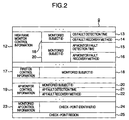
- FIG. 2 is a diagram showing the configuration of a storage region in the memory 9. However, a program region and the like are not illustrated. With regard to a region for storing control information and the like concerning the present invention, its data configuration is shown.
- High rank monitor control information 12 is information placed in a memory region of the second OS 2 and accessed by the high rank monitor 3.
- OS fault detection time 13 and an OS fault recovery method 14 are stored with regard to a monitored subject ID 18, and AP monitor fault detection time 15 and an AP monitor fault recovery method 16 are stored with regard to a monitored subject ID 20.
- the monitored subject ID 18 is an identifier provided to the first OS 1.
- the OS fault detection time 13 is time allowed until an alive message is received from the first OS 1 when the high rank monitor 3 monitors a fault of the first OS 1.
- the OS fault recovery method 14 is information which indicates a recovery method at the time of a fault of the first OS 1.
- the OS fault recovery method 14 is divided into OS restart without memory dump, OS restart after memory dump acquisition, restart of only a specific function of an OS, and so on.
- the monitored subject ID 20 is an identifier provided to the AP monitor 4.
- AP monitor fault detection time 15 is time allowed until an alive message is received from the AP monitor 4 when the high rank monitor 3 monitors a fault of the AP monitor 4.
- the AP monitor fault recovery method 16 is information which indicates a method to be used when the AP monitor 4 is recovered from a fault.
- the AP monitor fault recovery method 16 is divided into restart of the AP monitor 4 and the monitored AP 5, restart of the first OS 1, the AP monitor 4 and the monitored AP 5, and so on.
- a fault of the AP monitor 4 is caused in some cases by a fault of the first OS 1. In this case, a series of restart operations beginning with restart of the first OS 1 followed by restart of the AP monitor 4 are sometimes effective.
- First OS control information 17 is information placed in a memory region of the first OS 1 and accessed by the AP monitor 4. Monitored subject ID 18 is stored as the first OS control information 17. Control information required to restart the first OS 1 is stored.
- AP monitor control information 19 is information placed in the memory region of the first OS 1 and accessed by the AP monitor 4. Monitored subject ID 20, AP fault detection time 21, and an AP fault recovery method 22 are stored as the AP monitor control information 19.
- the AP fault detection time 21 is time allowed until an alive message is received from the monitored AP 5 when the AP monitor 4 monitors a fault of the monitored AP 5.
- the AP fault recovery method 22 is information which indicates a method to be used when the AP monitor 4 recovers the monitored AP 5 from a fault.
- the AP fault recovery method 22 is divided into restart of only the monitored AP 5, restart of the AP monitor 4 and the monitored AP 5, restart of the first OS 1, the AP monitor 4 and the monitored AP 5, and so on. For the same reason as the case of the recovery of the AP monitor 4, a series of restart operations beginning with restart of the first OS 1 followed by restart of the monitored AP 5 are sometimes effective.
- Monitored AP control information 23 is information placed in the shared memory region 11 and accessed by the monitored AP 5.
- a head block of a check-point region 25 is stored as check-point identifier ID 24.
- the check-point region 25 is a region for storing check-point information placed in the shared memory region 11 and accessed by the monitored AP 5.
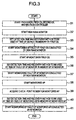
- FIG. 3 is a flow chart showing the procedure of start processing of respective programs conducted when the multi-OS computer 100 which is the embodiment of the present invention is started.
- the first OS 1, the second OS 2 and the multi-OS controller 6 are started by execution of an automatic procedure (step 31).
- the multi-OS controller 6 conducts resource division using assignment of computer resources, such as CPU time, memories, and external devices, utilized by the first OS 1 and the second OS 2, by referring to a configuration management file which is not illustrated.
- the second OS 2 starts the high rank monitor 3 (step 32).
- Its start procedure is the same as an ordinary start procedure for starting an AP on the second OS 2. Its start is conducted manually, or automatically by executing a command line on a file.
- the first OS 1 transmits OS fault detection time and an OS fault recovery method to the high rank monitor 3 via the multi-OS controller 6 and the second OS 2 by utilizing the inter-OS message passing function of the multi-OS controller 6.
- the high rank monitor 3 receives such information and sets the information in the memory 9 as the OS fault detection time 13 and the OS fault recovery method 14 (step 33).
- the high rank monitor 3 issues a monitored subject ID (for example, 01), adds it to the OS fault detection time 13 and the OS fault recovery method 14 on the memory.
- the high rank monitor 3 transmits the issued monitored subject ID to the first OS 1 via the second OS 2 and the multi-OS controller 6 by utilizing the inter-OS message passing function.
- the first OS 1 receives it and sets it in the memory 9 as the monitored subject ID 18 of the first OS control information 17. Thereafter, the high rank monitor 3 starts monitoring of the first OS 1 by referring to the OS fault detection time 13 (step 34). In other words, the first OS 1 transmits an alive message to the high rank monitor 3 via the multi-OS controller 6 and the second OS 2 by using the inter-OS message passing function. The high rank monitor 3 receives this alive message, and determines whether the alive message has been received within the OS fault detection time 13.
- the first OS 1 starts the AP monitor 4 (step 35). Its start procedure is the same as the ordinary start procedure for starting an AP on the first OS 1.
- the AP monitor 4 is automatically started manually or automatically by executing a command line on a file.
- the AP monitor 4 transmits AP monitor fault detection time and an AP monitor fault recovery method to the high rank monitor 3 via the first OS 1, the multi-OS controller 6 and the second OS 2 by utilizing the inter-OS message passing function.
- the high rank monitor 3 receives such information and sets the information in the memory 9 as the AP monitor fault detection time 15 and an AP monitor fault recovery method 16 of the monitor control information 12 (step 36).
- the high rank monitor 3 issues a monitored subject ID (for example, 02), and adds it to the AP monitor fault detection time 15 and an AP monitor fault recovery method 16 on the memory.
- the high rank monitor 3 transmits the issued monitored subject ID to the AP monitor 4 via the second OS 2, the multi-OS controller 6 and the first OS 1 by utilizing the inter-OS message passing function.
- the AP monitor 4 receives it and sets it in the memory 9 as the monitored subject ID 20 of the AP monitor control information 19. Thereafter, the high rank monitor 3 starts monitoring of the AP monitor 4 by referring to the monitor fault detection time 15 (step 37).
- the AP monitor 4 transmits an alive message to the high rank monitor 3 via the first OS 1, the multi-OS controller 6 and the second OS 2.
- the high rank monitor 3 receives this alive message, and determines whether the alive message has been received within the AP monitor fault detection time 15.
- the first OS 1 starts the monitored AP 5 (step 38).
- the monitored AP 5 issues a request for the region of the check-point identifier ID 24 and the check-point region 25 to the multi-OS controller 6 via the first OS 1, and acquires them (step 39). Furthermore, the monitored AP 5 sets the identifier ID of the check-point region 25 in the check-point identifier ID 24 of the monitored AP control information 23. Subsequently, the monitored AP 5 transmits AP monitor fault detection time and an AP monitor fault recovery method to the AP monitor 4 by utilizing the inter-process communication function of the first OS 1.
- the AP monitor 4 receives such information and sets the information in the memory 9 as the AP fault detection time 21 and an AP fault recovery method 22 of the monitor control information 19 (step 40). Thereafter, the AP monitor 4 starts monitoring of the monitored AP 5 by referring to the AP fault detection time 21 of the AP monitor control information 19 (step 41). In other words, the monitored AP 5 transmits an alive message to the AP monitor 4 by using the inter-process communication function. The AP monitor 4 receives this alive message, and determines whether the alive message has been received within the AP fault detection time 21.
- the monitored AP 5 advances processing of the AP, while periodically storing check-point information in the check-point region 25 indicated by the check-point identifier ID 24.
- FIG. 4 is a flow chart showing the procedure of OS monitoring processing conducted by the high rank monitor 3 and recovery processing of a relating program at the time of an OS fault.
- the first OS 1 periodically executes a program for transmitting an alive message to the high rank monitor 3 by utilizing the inter-OS message passing function, and thereby automatically transmits an alive message to the high rank monitor 3.
- the transmission period of the alive message is a time within the OS fault detection time 13.
- the alive message includes the monitored subject ID 18 and a one-bit signal (1 or 0) indicating an alive or dead state.
- the high rank monitor 3 determines whether an alive message has come from the first OS 1 (step 51).
- step 51 When the high rank monitor 3 has received an alive message indicating an alive state (YES of step 51), a timer is reset and the processing returns to the step 51. If an alive message indicating an alive state is not received (NO of step 51) and the OS fault detection time 13 has not elapsed (NO of step 52), then the processing returns to the step 51.
- the high rank monitor 3 judges the first OS 1 to have stopped due to a fault, and conducts processing for recovery from the OS fault in accordance with the OS fault recovery method 14 (step 53).
- the high rank monitor 3 requests the multi-OS controller 6 to conduct the recovery processing of the first OS 1 from a fault.
- the multi-OS controller 6 conducts the recovery processing of the first OS 1 from a fault. If fault information such as a memory dump of the first OS 1 is recorded in a disk or the like, it can be used to pursue the cause of a fault of the first OS 1 later. In this case, however, restart of the first OS 1 is delayed. There is trade-off between the requested restart time of the first OS 1 and the merit of recording.
- step 54 If the recovery processing is finished, then restart of the first OS 1 and resetting of control information are conducted (step 54). Even if a fault occurs in the first OS 1 and the first OS is restarted, the high rank monitor control information 12 located in the memory region of the second OS 2 is preserved. Since the high rank monitor 3 needs to detect the timing of restart termination of the first OS 1 and the OS fault recovery method 14 needs to be changeable, however, the high rank monitor 3 clears the OS fault detection time 13, the OS fault recovery method 14, and the monitored subject ID 18, and resets the OS fault detection time 13, the OS fault recovery method 14, and the monitored subject ID 18 in accordance with the above described procedure. The high rank monitor 3 transmits the monitored subject ID 18 to the first OS 1, and then restarts the fault monitoring of the first OS 1.
- the AP monitor 4 In the case where the first OS 1 is restarted due to the OS fault detection, the AP monitor 4 is also forcibly stopped. Therefore, restart of the AP monitor 4 and resetting of the control information are conducted (step 55).
- the high rank monitor 3 clears the AP monitor fault detection time 15, the AP monitor fault recovery method 16, and the monitored subject ID 20, and resets the AP monitor fault detection time 15, the AP monitor fault recovery method 16, and the monitored subject ID 20 in accordance with the above described procedure.
- the high rank monitor 3 transmits the monitored subject ID 20 to the AP monitor 4, and then restarts the fault monitoring of the AP monitor 4.
- the high rank monitor 3 conducts restarts of the monitored AP 5 and resetting of the control information (step 56).
- the monitored AP 5 recognizes its restart, and resets the AP fault detection time 21 and the AP fault recovery method 22 in accordance with the above described procedure.
- the monitored AP 5 acquires check-point information from the check-point region 25 indicated by the check-point identifier ID 24 (step 57).
- the AP monitor 4 resets the AP fault detection time 21 and the AP fault recovery method 22, and then restarts the fault monitoring of the monitored AP 5 (step 58).
- the monitored AP 5 periodically stores check-point information in the check-point region 25.
- FIG. 5 is a flow chart showing the procedure of AP monitor monitoring processing conducted by the high rank monitor 3 and recovery processing of a relating program at the time of an AP monitor fault.
- the AP monitor 4 calls a function for transmitting an alive message to the high rank monitor 3, and periodically transmits an alive message to the high rank monitor 3.
- the transmission period of the alive message is a time within the AP monitor fault detection time 15.
- the alive message includes the monitored subject ID 20 and a one-bit signal (1 or 0) indicating an alive or dead state.
- the high rank monitor 3 determines whether an alive message has come from the AP monitor 4 (step 61).
- step 61 When the high rank monitor 3 has received an alive message indicating an alive state (YES of step 61), a timer is reset and the processing returns to the step 61. If an alive message indicating an alive state is not received (NO of step 61) and the AP monitor fault detection time 15 has not elapsed (NO of step 62), then the processing returns to the step 61.
- the high rank monitor 3 judges the AP monitor 4 to have stopped due to a fault, and conducts processing for recovery of the AP monitor 4 from the fault in accordance with the AP monitor fault recovery method 16.
- the AP monitor fault recovery method 16 conducts restart beginning from the AP monitor 4 and resetting of control information (step 63).
- the high rank monitor 3 clears the AP monitor fault detection time 15, the AP monitor fault recovery method 16, and the monitored subject ID 20, and resets the AP monitor fault detection time 15, the AP monitor fault recovery method 16, and the monitored subject ID 20 in accordance with the above described procedure.
- the high rank monitor 3 transmits the monitored subject ID 20 to the AP monitor 4, and then restarts the fault monitoring of the AP monitor 4.
- step 64 restarting of the monitored AP 5 and resetting of control information are conducted (step 64).
- the monitored AP 5 recognizes its restart, and resets the AP fault detection time 21 and the AP fault recovery method 22 in accordance with the above described procedure.
- the monitored AP 5 acquires check-point information from the check-point region 25 indicated by the check-point identifier ID 24 (step 65).
- the AP monitor 4 resets the AP fault detection time 21 and the AP fault recovery method 22, and then restarts the fault monitoring of the monitored AP 5 (step 66).
- the monitored AP 5 periodically stores check-point information in the check-point region 25.
- the high rank monitor 3 conducts the processing of the step 53, and thereafter the processing of the steps 54 to 58 is conducted.
- FIG. 6 is a flow chart showing the procedure of monitored AP fault monitoring processing conducted by the AP monitor 4 and recovery processing of a relating program at the time of a monitored AP fault.
- the monitored AP 5 calls a function for transmitting an alive message to the AP monitor 4, and periodically transmits an alive message to the AP monitor 4.
- the transmission period of the alive message is a time within the AP fault detection time 21.
- the alive message includes a 1-bit signal indicating an alive or dead state.
- the AP monitor 4 determines whether an alive message has come from the monitored AP 5 (step 71). When the AP monitor 4 has received an alive message indicating an alive state (YES of step 71), a timer is reset and the processing returns to the step 71. If an alive message indicating the alive state is not received (NO of step 71) and the AP fault detection time 21 has not elapsed (NO of step 72), then the processing returns to the step 71.
- the AP monitor 4 judges the monitored AP 5 to have stopped due to a fault, and conducts processing for recovery of the monitored AP 5 from the fault in accordance with the AP fault recovery method 22.
- the AP fault recovery method 22 sets restart of only the monitored AP 5
- restart of the monitored AP 5 and resetting of control information are conducted (step 73).
- the monitored AP 5 recognizes its restart, and resets the AP fault detection time 21 and the AP fault recovery method 22 in accordance with the above described procedure.
- the monitored AP 5 acquires check-point information from the check-point region 25 indicated by the check-point identifier ID 24 (step 74).
- the AP monitor 4 resets the AP fault detection time 21 and the AP fault recovery method 22, and then restarts the fault monitoring of the monitored AP 5 (step 75).
- the monitored AP 5 periodically stores check-point information in the check-point region 25.
- restart beginning from the AP monitor 4 is set in the AP fault recovery method 22 and restart beginning from the AP monitor 4 is set in the AP monitor fault recovery method 16, then the AP monitor 4 transmits an alive message indicating death of the AP monitor 4 to the high rank monitor 3, and thereby processing of steps 63 to 66 is conducted. If a series of restart operations beginning from restart of the first OS 1 and followed by restart of the AP monitor 4 is set in the AP fault recovery method 22 and a series of restart operations beginning from restart of the first OS 1 and followed by restart of the AP monitor 4 is set in the AP monitor fault recovery method 16, then the high rank monitor 3 conducts processing of the step 53, and thereafter processing of steps 54 to 58 is conducted.
Landscapes
- Engineering & Computer Science (AREA)
- Theoretical Computer Science (AREA)
- Quality & Reliability (AREA)
- Physics & Mathematics (AREA)
- General Engineering & Computer Science (AREA)
- General Physics & Mathematics (AREA)
- Debugging And Monitoring (AREA)
Abstract
A fault of an operating system (hereafter referred to as "OS") is observed without adding dedicated hardware. Besides AP fault monitoring, check-point information is preserved at high speed without adding dedicated hardware. In a computer having a multi-OS environment, an AP fault monitor (4) and a monitored AP (5) operate on a first OS (1). A fault monitor (3) operates on a second OS (2). Each of the first OS and the AP fault monitor (4) transmits an alive message to the fault monitor (3) by utilizing an inter-OS communication function of a multi-OS controller (6). The fault monitor (3) monitors the alive message of each of the first OS and the AP fault monitor. The monitored AP (5) transmits an alive message to the AP fault monitor (4). The AP fault monitor (4) monitors it. The monitored AP (5) preserves check-point information in a region of a memory (9). In the region of the memory, information is preserved by a fault and restart of the first OS as well. <IMAGE>
Description
The present invention relates to a fault
monitoring method for computer, and in particular to a
fault monitoring method of an operating system (OS) and
an application program (AP).
In general, an AP encounters a fault for
several reasons and stops. Main causes are defects
included in the AP itself and faults of an OS on which
the AP is mounted. As for such an AP that its operation
needs to be continued, the following method has been
adopted. A fault is monitored. If a fault has been
detected, then the operation of the AP is resumed from a
state in which it was before the occurrence of the fault,
and thereby recovery of the AP from the fault is
attempted.
As one of fault monitoring methods for AP and
OS, there is a method called watchdog. "Fault Tolerant
Computer" written by Takashi NANYA, published by OHM-SHA
says "The watchdog timer is a different process which is
independent of a monitored process. The monitored
process is so designed that a timer is reset at intervals
of a fixed time (for example, in the range of several
microseconds to several minutes) during the execution of
the monitored process. If the timer is not reset until
the time is up, some fault is considered to have occurred
in the monitored process."
In the case where a fault of an AP is
monitored, an AP fault monitor having a watchdog receives
a periodical alive message from the AP. If the alive
message stops for a predetermined time, the AP fault
monitor judges an AP fault to have occurred and restarts
the AP. In the case where a fault of an OS is monitored,
an OS fault monitor having a watchdog receives a
periodical alive message from the OS. If the alive
message disappears for a predetermined time, the OS fault
monitor judges an OS fault to have occurred and restarts
the OS.
Furthermore, for recovery of an AP from a
fault, a technique called check-point is used. In the
check-point technique, execution information of the AP is
acquired from the monitored AP periodically and reserved.
When a fault has occurred, the reserved execution
information is taken out, and processing of the AP is
resumed from a check-point.
As for an AP fault monitor using software, the
AP fault monitor operates on the same OS as the monitored
AP. In some cases, therefore, the AP fault monitor using
software cannot cope with such an AP fault caused by the
OS. Furthermore, there is known such an OS fault
monitoring method that a watchdog is formed of dedicated
hardware and the watchdog monitors a periodical alive
message supplied from an OS. However, there is a problem
that dedicated hardware must be prepared.
On the other hand, as for the check-point, if
check-point information is preserved in a low speed
memory, then it takes a considerable time to preserve the
check-point information, and consequently the check-point
repetition period becomes long. As a result, recovery
from a fault must be conducted from a state of a
considerably long time before the time of the fault
occurrence. Furthermore, it is possible to provide a
high speed non-volatile memory, such as a static RAM,
apart from a volatile memory, such as a dynamic RAM,
managed by the OS, and preserve check-point information
in the high speed non-volatile memory. However, there is
a problem that dedicated hardware must be prepared.
An object of the present invention is to
provide a method for monitoring a fault of the OS by
using software, without adding dedicated hardware.
Another object of the present invention is to
provide a method for monitoring a fault of an AP and
preserving check-point information of the AP at high
speed without adding dedicated hardware.
The present invention solves the above
described problems. In accordance with the present
invention, in an operating system fault monitoring method
for a computer, the computer including a first OS, a
second OS different from the first OS, a multi-OS
controller for managing computer resources, the multi-OS
controller having inter-OS communication means between
the first OS and the second OS, and a fault monitor
operating on the second OS, the operating system fault
monitoring method includes the steps of transmitting an
alive message from the first OS to the fault monitor via
the inter-OS communication means, and determining whether
the alive message has been received by the fault monitor
within a predetermined time.
In accordance with the present invention, in an
application program fault monitoring method for a
computer, the computer including an AP fault monitor
operating on the first OS, and a high rank fault monitor
operating on a second OS to monitor not only a fault of
the first OS but also a fault of the AP fault monitor via
inter-OS communication means, the application program
fault monitoring method includes the step of monitoring a
fault of the AP fault monitor operating on the first OS
by using the high rank fault monitor. An AP to be
monitored by the AP fault monitor preserves check-point
information in a shared memory region on a main memory.
In the shared memory region, information is preserved by
a fault and restart of the first OS as well.
According to the present invention, fault
monitoring of an OS to be monitored is conducted by
utilizing a multi-OS environment and using a high rank
fault monitor operating on another OS, as heretofore
described. Without adding dedicated hardware, therefore,
a fault of the OS can be monitored. Furthermore, a fault
of an AP fault monitor can also be monitored by using the
high rank fault monitor. Furthermore, since the high
rank fault monitor using software is used, a recovery
method to be used when a fault of each of the OS and AP
fault monitor has occurred can be set finely. In
addition, a monitored AP can preserve check-point
information at high speed without adding dedicated
hardware.
Hereafter, an embodiment of the present
invention will be described.
FIG. 1 is a diagram showing the configuration
of a computer 100 in the present embodiment. The
computer 100 can be divided broadly into a processor 10
and a memory (main storage) 9. An input/output device
and a storage connected to the processor 10 are not
illustrated. The memory 9 stores programs of a first OS
1, a second OS 2, a high rank fault monitor (hereafter
referred to as "high rank monitor") 3, an AP fault
monitor (hereafter referred to as "AP monitor") 4, a
monitored AP 5, and a multi-OS controller 6. These
programs are executed by the processor 10. Furthermore,
the memory 9 includes a shared memory region 11 which can
be accessed by both the first OS 1 and the second OS 2.
The monitored AP 5 is an application mounted on
the first OS 1. The monitored AP 5 may be a program for
conducting general business application. The AP monitor
4 is an application mounted on the first OS 1, and it is
a program for conducting fault monitoring of the
monitored AP 5. The second OS 2 is an OS which is
different from the first OS 1. The second OS 2 is
desired to be an OS regarded as an OS having a higher
reliability than the first OS 1. The high rank monitor 3
is an application mounted on the second OS 2, and it is a
program for conducting fault monitoring of the first OS 1
and the AP monitor 4.
The multi-OS controller 6 has the following
functions.
The multi-OS controller 6 manages computer
resources such as CPU time, the memory, external devices,
and timers, and divides these resources and provides them
to respective OSs. For example, as for timers, the
multi-OS controller 6 has a function of virtually
providing only one hardware timer to respective OSs.
Furthermore, the multi-OS controller 6 has a function of
reserving an I/O resource of an external device utilized
by respective OSs.
This is a function for allowing processes on
respective OSs to conduct message passing. Unlike the
shared memory communication, the process of the other
party of communication can be called. In the embodiment
of the present invention, this message passing function
is utilized as an alive message.
The multi-OS controller 6 secures a memory
region which can be shared between OSs as a physical
memory region independent of physical memory regions for
respective OSs. The shared memory region is divided into
several blocks and managed. Each block is provided with
its identifier (ID). By utilizing this shared memory
identifier (ID) or a pointer to the physical memory, each
OS can access the shared memory. Supposing that
information is not recorded in the memory region, each OS
conducts memory initialization after it has been started.
For example, when an OS is restarted at the time of a
fault of the OS, a memory region in which the state and
so on of an application has been preserved is
initialized. However, the shared memory region is not
initialized because it is located outside the OSs'
regions, and its contents are preserved. After restart,
each OS can utilize a pseudo-non-volatile memory or a
software manner by specifying the shared memory
identifier (ID) used the last time or a pointer to a
physical memory. In the embodiment of the present
invention, the shared memory region is utilized as a
check-point information storage region of the monitored
AP.
The OS fault notice is a function of giving
notice that a fault has occurred in a certain OS to the
other OS. However, noticed faults are only faults that
the OS itself is conscious of. Furthermore, there is a
function of conducting recovery of a certain OS from a
fault by restarting only the OS.
The monitored AP 5 transmits an alive message
to the AP monitor 4 periodically. The AP monitor 4
determines whether it has received an alive message from
the monitored AP 5 within a predetermined fault detection
time. Unless an alive message has been received, the AP
monitor 4 judges the stoppage to have been caused by a
fault of the monitored AP 5. In accordance with a preset
method for recovery from a fault, the AP monitor 4
conducts recovery processing of the monitored AP 5 in
which a fault has occurred.
The first OS 1 and the AP monitor 4
periodically transmit alive messages to the high rank
monitor 3 by utilizing the inter-OS message passing
function of the multi-OS controller 6 independently
respectively. The high rank monitor 3 determines whether
it has received an alive message from each of the first
OS 1 and the AP monitor 4 within a predetermined fault
detection time. Unless an alive message has been
received, the high rank monitor 3 judges the stoppage to
have been caused by a fault of pertinent one of the first
OS 1 and the AP monitor 4. In accordance with a preset
method for recovery from a fault, high rank monitor 3
conducts recovery processing of the first OS 1 or the AP
monitor 4 in which a fault has occurred.
The monitored AP 5 periodically stores check-point
information in the shared memory region 11 of the
memory 9. When the monitored AP 5 is restarted due to a
fault of the first OS 1, the AP monitor 4, or the
monitored AP 5, the monitored AP 5 takes out check-point
information from the shared memory region 11, and resumes
processing of the monitored AP 5 from the check-point.
In the present embodiment, only the high rank
monitor 3 is mounted on the second OS 2. The second OS 2
need only have a function for responding to a request
from the high rank monitor 3. As compared with the first
OS 1, the second OS 2 can be regarded as an OS which is
small in overhead of CPU time and highly reliable.
Typically, the memory occupation quantity of the second
OS 2 is smaller than the memory occupation quantity of
the first OS 1.
It is possible to store the first OS 1, the
second OS 2, the high rank monitor 3 and the multi-OS
controller 6, or the first OS 1, the second OS 2, the
high rank monitor 3, the AP monitor 4 and the multi-OS
controller 6 into a storage medium, read them into the
memory 9 via a drive device connected to the processor 10
or transmit them to the memory 9 of another computer via
a drive device connected to the computer, the computer,
and a network, and execute them by using the processor
10.
FIG. 2 is a diagram showing the configuration
of a storage region in the memory 9. However, a program
region and the like are not illustrated. With regard to
a region for storing control information and the like
concerning the present invention, its data configuration
is shown.
High rank monitor control information 12 is
information placed in a memory region of the second OS 2
and accessed by the high rank monitor 3. As control
information 12, OS fault detection time 13 and an OS
fault recovery method 14 are stored with regard to a
monitored subject ID 18, and AP monitor fault detection
time 15 and an AP monitor fault recovery method 16 are
stored with regard to a monitored subject ID 20. The
monitored subject ID 18 is an identifier provided to the
first OS 1. The OS fault detection time 13 is time
allowed until an alive message is received from the first
OS 1 when the high rank monitor 3 monitors a fault of the
first OS 1. The OS fault recovery method 14 is
information which indicates a recovery method at the time
of a fault of the first OS 1. The OS fault recovery
method 14 is divided into OS restart without memory dump,
OS restart after memory dump acquisition, restart of only
a specific function of an OS, and so on. The monitored
subject ID 20 is an identifier provided to the AP monitor
4. AP monitor fault detection time 15 is time allowed
until an alive message is received from the AP monitor 4
when the high rank monitor 3 monitors a fault of the AP
monitor 4. The AP monitor fault recovery method 16 is
information which indicates a method to be used when the
AP monitor 4 is recovered from a fault. The AP monitor
fault recovery method 16 is divided into restart of the
AP monitor 4 and the monitored AP 5, restart of the first
OS 1, the AP monitor 4 and the monitored AP 5, and so on.
Since the AP monitor 4 is considered to be
higher in reliability than the first OS 1, a fault of the
AP monitor 4 is caused in some cases by a fault of the
first OS 1. In this case, a series of restart operations
beginning with restart of the first OS 1 followed by
restart of the AP monitor 4 are sometimes effective.
First OS control information 17 is information
placed in a memory region of the first OS 1 and accessed
by the AP monitor 4. Monitored subject ID 18 is stored
as the first OS control information 17. Control
information required to restart the first OS 1 is stored.
AP monitor control information 19 is
information placed in the memory region of the first OS 1
and accessed by the AP monitor 4. Monitored subject ID
20, AP fault detection time 21, and an AP fault recovery
method 22 are stored as the AP monitor control
information 19. The AP fault detection time 21 is time
allowed until an alive message is received from the
monitored AP 5 when the AP monitor 4 monitors a fault of
the monitored AP 5. The AP fault recovery method 22 is
information which indicates a method to be used when the
AP monitor 4 recovers the monitored AP 5 from a fault.
The AP fault recovery method 22 is divided into restart
of only the monitored AP 5, restart of the AP monitor 4
and the monitored AP 5, restart of the first OS 1, the AP
monitor 4 and the monitored AP 5, and so on. For the
same reason as the case of the recovery of the AP monitor
4, a series of restart operations beginning with restart
of the first OS 1 followed by restart of the monitored AP
5 are sometimes effective.
Monitored AP control information 23 is
information placed in the shared memory region 11 and
accessed by the monitored AP 5. A head block of a check-point
region 25 is stored as check-point identifier ID
24. The check-point region 25 is a region for storing
check-point information placed in the shared memory
region 11 and accessed by the monitored AP 5.
FIG. 3 is a flow chart showing the procedure of
start processing of respective programs conducted when
the multi-OS computer 100 which is the embodiment of the
present invention is started. After the processor 10 is
started, the first OS 1, the second OS 2 and the multi-OS
controller 6 are started by execution of an automatic
procedure (step 31). Upon being started, the multi-OS
controller 6 conducts resource division using assignment
of computer resources, such as CPU time, memories, and
external devices, utilized by the first OS 1 and the
second OS 2, by referring to a configuration management
file which is not illustrated. Subsequently, the second
OS 2 starts the high rank monitor 3 (step 32). Its start
procedure is the same as an ordinary start procedure for
starting an AP on the second OS 2. Its start is
conducted manually, or automatically by executing a
command line on a file.
Subsequently, the first OS 1 transmits OS fault
detection time and an OS fault recovery method to the
high rank monitor 3 via the multi-OS controller 6 and the
second OS 2 by utilizing the inter-OS message passing
function of the multi-OS controller 6. The high rank
monitor 3 receives such information and sets the
information in the memory 9 as the OS fault detection
time 13 and the OS fault recovery method 14 (step 33).
The high rank monitor 3 issues a monitored subject ID
(for example, 01), adds it to the OS fault detection time
13 and the OS fault recovery method 14 on the memory. In
addition, the high rank monitor 3 transmits the issued
monitored subject ID to the first OS 1 via the second OS
2 and the multi-OS controller 6 by utilizing the inter-OS
message passing function. The first OS 1 receives it and
sets it in the memory 9 as the monitored subject ID 18 of
the first OS control information 17. Thereafter, the
high rank monitor 3 starts monitoring of the first OS 1
by referring to the OS fault detection time 13 (step 34).
In other words, the first OS 1 transmits an alive message
to the high rank monitor 3 via the multi-OS controller 6
and the second OS 2 by using the inter-OS message passing
function. The high rank monitor 3 receives this alive
message, and determines whether the alive message has
been received within the OS fault detection time 13.
Subsequently, the first OS 1 starts the AP
monitor 4 (step 35). Its start procedure is the same as
the ordinary start procedure for starting an AP on the
first OS 1. The AP monitor 4 is automatically started
manually or automatically by executing a command line on
a file. Subsequently, the AP monitor 4 transmits AP
monitor fault detection time and an AP monitor fault
recovery method to the high rank monitor 3 via the first
OS 1, the multi-OS controller 6 and the second OS 2 by
utilizing the inter-OS message passing function. The
high rank monitor 3 receives such information and sets
the information in the memory 9 as the AP monitor fault
detection time 15 and an AP monitor fault recovery method
16 of the monitor control information 12 (step 36). The
high rank monitor 3 issues a monitored subject ID (for
example, 02), and adds it to the AP monitor fault
detection time 15 and an AP monitor fault recovery method
16 on the memory. In addition, the high rank monitor 3
transmits the issued monitored subject ID to the AP
monitor 4 via the second OS 2, the multi-OS controller 6
and the first OS 1 by utilizing the inter-OS message
passing function. The AP monitor 4 receives it and sets
it in the memory 9 as the monitored subject ID 20 of the
AP monitor control information 19. Thereafter, the high
rank monitor 3 starts monitoring of the AP monitor 4 by
referring to the monitor fault detection time 15 (step
37). In other words, the AP monitor 4 transmits an alive
message to the high rank monitor 3 via the first OS 1,
the multi-OS controller 6 and the second OS 2. The high
rank monitor 3 receives this alive message, and
determines whether the alive message has been received
within the AP monitor fault detection time 15.
Subsequently, the first OS 1 starts the
monitored AP 5 (step 38). The monitored AP 5 issues a
request for the region of the check-point identifier ID
24 and the check-point region 25 to the multi-OS
controller 6 via the first OS 1, and acquires them (step
39). Furthermore, the monitored AP 5 sets the identifier
ID of the check-point region 25 in the check-point
identifier ID 24 of the monitored AP control information
23. Subsequently, the monitored AP 5 transmits AP
monitor fault detection time and an AP monitor fault
recovery method to the AP monitor 4 by utilizing the
inter-process communication function of the first OS 1.
The AP monitor 4 receives such information and sets the
information in the memory 9 as the AP fault detection
time 21 and an AP fault recovery method 22 of the monitor
control information 19 (step 40). Thereafter, the AP
monitor 4 starts monitoring of the monitored AP 5 by
referring to the AP fault detection time 21 of the AP
monitor control information 19 (step 41). In other
words, the monitored AP 5 transmits an alive message to
the AP monitor 4 by using the inter-process communication
function. The AP monitor 4 receives this alive message,
and determines whether the alive message has been
received within the AP fault detection time 21.
The monitored AP 5 advances processing of the
AP, while periodically storing check-point information in
the check-point region 25 indicated by the check-point
identifier ID 24.
FIG. 4 is a flow chart showing the procedure of
OS monitoring processing conducted by the high rank
monitor 3 and recovery processing of a relating program
at the time of an OS fault. The first OS 1 periodically
executes a program for transmitting an alive message to
the high rank monitor 3 by utilizing the inter-OS message
passing function, and thereby automatically transmits an
alive message to the high rank monitor 3. The
transmission period of the alive message is a time within
the OS fault detection time 13. The alive message
includes the monitored subject ID 18 and a one-bit signal
(1 or 0) indicating an alive or dead state. By referring
to the monitored subject ID 18 of the high rank monitor
control information 12, the high rank monitor 3
determines whether an alive message has come from the
first OS 1 (step 51). When the high rank monitor 3 has
received an alive message indicating an alive state (YES
of step 51), a timer is reset and the processing returns
to the step 51. If an alive message indicating an alive
state is not received (NO of step 51) and the OS fault
detection time 13 has not elapsed (NO of step 52), then
the processing returns to the step 51.
If the OS fault detection time 13 has elapsed
(YES of step 52), then the high rank monitor 3 judges the
first OS 1 to have stopped due to a fault, and conducts
processing for recovery from the OS fault in accordance
with the OS fault recovery method 14 (step 53). The high
rank monitor 3 requests the multi-OS controller 6 to
conduct the recovery processing of the first OS 1 from a
fault. The multi-OS controller 6 conducts the recovery
processing of the first OS 1 from a fault. If fault
information such as a memory dump of the first OS 1 is
recorded in a disk or the like, it can be used to pursue
the cause of a fault of the first OS 1 later. In this
case, however, restart of the first OS 1 is delayed.
There is trade-off between the requested restart time of
the first OS 1 and the merit of recording. If the
recovery processing is finished, then restart of the
first OS 1 and resetting of control information are
conducted (step 54). Even if a fault occurs in the first
OS 1 and the first OS is restarted, the high rank monitor
control information 12 located in the memory region of
the second OS 2 is preserved. Since the high rank
monitor 3 needs to detect the timing of restart
termination of the first OS 1 and the OS fault recovery
method 14 needs to be changeable, however, the high rank
monitor 3 clears the OS fault detection time 13, the OS
fault recovery method 14, and the monitored subject ID
18, and resets the OS fault detection time 13, the OS
fault recovery method 14, and the monitored subject ID 18
in accordance with the above described procedure. The
high rank monitor 3 transmits the monitored subject ID 18
to the first OS 1, and then restarts the fault monitoring
of the first OS 1.
In the case where the first OS 1 is restarted
due to the OS fault detection, the AP monitor 4 is also
forcibly stopped. Therefore, restart of the AP monitor 4
and resetting of the control information are conducted
(step 55). In the same way, the high rank monitor 3
clears the AP monitor fault detection time 15, the AP
monitor fault recovery method 16, and the monitored
subject ID 20, and resets the AP monitor fault detection
time 15, the AP monitor fault recovery method 16, and the
monitored subject ID 20 in accordance with the above
described procedure. The high rank monitor 3 transmits
the monitored subject ID 20 to the AP monitor 4, and then
restarts the fault monitoring of the AP monitor 4.
Subsequently, the high rank monitor 3 conducts
restarts of the monitored AP 5 and resetting of the
control information (step 56). The monitored AP 5
recognizes its restart, and resets the AP fault detection
time 21 and the AP fault recovery method 22 in accordance
with the above described procedure. Subsequently, the
monitored AP 5 acquires check-point information from the
check-point region 25 indicated by the check-point
identifier ID 24 (step 57). The AP monitor 4 resets the
AP fault detection time 21 and the AP fault recovery
method 22, and then restarts the fault monitoring of the
monitored AP 5 (step 58). In the same way as the
foregoing description, the monitored AP 5 periodically
stores check-point information in the check-point region
25.
FIG. 5 is a flow chart showing the procedure of
AP monitor monitoring processing conducted by the high
rank monitor 3 and recovery processing of a relating
program at the time of an AP monitor fault. The AP
monitor 4 calls a function for transmitting an alive
message to the high rank monitor 3, and periodically
transmits an alive message to the high rank monitor 3.
The transmission period of the alive message is a time
within the AP monitor fault detection time 15. The alive
message includes the monitored subject ID 20 and a one-bit
signal (1 or 0) indicating an alive or dead state.
By referring to the monitored subject ID 20 of the high
rank monitor control information 12, the high rank
monitor 3 determines whether an alive message has come
from the AP monitor 4 (step 61). When the high rank
monitor 3 has received an alive message indicating an
alive state (YES of step 61), a timer is reset and the
processing returns to the step 61. If an alive message
indicating an alive state is not received (NO of step 61)
and the AP monitor fault detection time 15 has not
elapsed (NO of step 62), then the processing returns to
the step 61.
If the AP monitor fault detection time 15 has
elapsed (YES of step 62), then the high rank monitor 3
judges the AP monitor 4 to have stopped due to a fault,
and conducts processing for recovery of the AP monitor 4
from the fault in accordance with the AP monitor fault
recovery method 16. Here, the AP monitor fault recovery
method 16 conducts restart beginning from the AP monitor
4 and resetting of control information (step 63). The
high rank monitor 3 clears the AP monitor fault detection
time 15, the AP monitor fault recovery method 16, and the
monitored subject ID 20, and resets the AP monitor fault
detection time 15, the AP monitor fault recovery method
16, and the monitored subject ID 20 in accordance with
the above described procedure. The high rank monitor 3
transmits the monitored subject ID 20 to the AP monitor
4, and then restarts the fault monitoring of the AP
monitor 4.
It is necessary to do start setting of the
monitored AP 5 over again, with the restart of the AP
monitor 4. Therefore, restarting of the monitored AP 5
and resetting of control information are conducted (step
64). The monitored AP 5 recognizes its restart, and
resets the AP fault detection time 21 and the AP fault
recovery method 22 in accordance with the above described
procedure. Subsequently, the monitored AP 5 acquires
check-point information from the check-point region 25
indicated by the check-point identifier ID 24 (step 65).
The AP monitor 4 resets the AP fault detection time 21
and the AP fault recovery method 22, and then restarts
the fault monitoring of the monitored AP 5 (step 66). In
the same way as the foregoing description, the monitored
AP 5 periodically stores check-point information in the
check-point region 25.
If restart beginning from the first OS 1 is set
in the AP monitor fault recovery method 16, the high rank
monitor 3 conducts the processing of the step 53, and
thereafter the processing of the steps 54 to 58 is
conducted.
FIG. 6 is a flow chart showing the procedure of
monitored AP fault monitoring processing conducted by the
AP monitor 4 and recovery processing of a relating
program at the time of a monitored AP fault. The
monitored AP 5 calls a function for transmitting an alive
message to the AP monitor 4, and periodically transmits
an alive message to the AP monitor 4. The transmission
period of the alive message is a time within the AP fault
detection time 21. The alive message includes a 1-bit
signal indicating an alive or dead state. The AP monitor
4 determines whether an alive message has come from the
monitored AP 5 (step 71). When the AP monitor 4 has
received an alive message indicating an alive state (YES
of step 71), a timer is reset and the processing returns
to the step 71. If an alive message indicating the alive
state is not received (NO of step 71) and the AP fault
detection time 21 has not elapsed (NO of step 72), then
the processing returns to the step 71.
If the AP fault detection time 21 has elapsed
(YES of step 72), then the AP monitor 4 judges the
monitored AP 5 to have stopped due to a fault, and
conducts processing for recovery of the monitored AP 5
from the fault in accordance with the AP fault recovery
method 22. Here, assuming that the AP fault recovery
method 22 sets restart of only the monitored AP 5,
restart of the monitored AP 5 and resetting of control
information are conducted (step 73). The monitored AP 5
recognizes its restart, and resets the AP fault detection
time 21 and the AP fault recovery method 22 in accordance
with the above described procedure. Subsequently, the
monitored AP 5 acquires check-point information from the
check-point region 25 indicated by the check-point
identifier ID 24 (step 74). The AP monitor 4 resets the
AP fault detection time 21 and the AP fault recovery
method 22, and then restarts the fault monitoring of the
monitored AP 5 (step 75). In the same way as the
foregoing description, the monitored AP 5 periodically
stores check-point information in the check-point region
25.
If restart beginning from the AP monitor 4 is
set in the AP fault recovery method 22 and restart
beginning from the AP monitor 4 is set in the AP monitor
fault recovery method 16, then the AP monitor 4 transmits
an alive message indicating death of the AP monitor 4 to
the high rank monitor 3, and thereby processing of steps
63 to 66 is conducted. If a series of restart operations
beginning from restart of the first OS 1 and followed by
restart of the AP monitor 4 is set in the AP fault
recovery method 22 and a series of restart operations
beginning from restart of the first OS 1 and followed by
restart of the AP monitor 4 is set in the AP monitor
fault recovery method 16, then the high rank monitor 3
conducts processing of the step 53, and thereafter
processing of steps 54 to 58 is conducted.
Claims (15)
- A fault monitoring method in a computer (100) including a first operating system (hereafter referred to as "OS") (1), a second OS (2), and a multi-OS controller (6) having a communication function between said first OS (1) and said second OS (2), said fault monitoring method comprising the steps of:successively receiving, in a fault monitor (3) activated by execution of a program on said second OS (2), an alive message indicating an alive state of said first OS (1) transmitted from said first OS; andrestarting said first OS (1), when a reception interval of said alive message has exceeded a predetermined time in said fault monitor (3).
- A fault monitoring method in a computer (100) including a first OS (1), a second OS (2), and a multi-OS controller (6) having a communication function between said first OS (1) and said second OS (2), said fault monitoring method comprising the steps of:monitoring, in an AP fault monitor (4) activated by execution of a program on said first OS (1), a fault of an application (hereafter referred to as "AP") (5) activated by execution of a program on said first OS (1);successively receiving, in a high rank fault monitor (3) activated by execution of a program on said second OS (2), a monitor alive message indicating an alive state of said AP fault monitor (4) transmitted from said AP fault monitor (4), by using an inter-OS communication function of said multi-OS controller (6);successively receiving, in said high rank fault monitor (3), an OS alive message indicating an alive state of said first OS (1) transmitted from said first OS (1), by using an inter-OS communication function of said multi-OS controller (6); andin said high rank fault monitor (3), restarting said AP fault monitor (4) and recovering said AP (5) when a reception interval of said AP alive message has exceeded a first predetermined time, and restarting said first OS (1) and said AP fault monitor (4) and recovering said AP (5) when a reception interval of said OS alive message has exceeded a second predetermined time.
- The method of claim 2, wherein when restarting said first OS (1) said high rank fault monitor (3) restarts said first OS (1) in accordance with a restart method stored in said memory (9), when restarting said AP fault monitor (4) said high rank fault monitor (3) restarts said AP fault monitor (4) in accordance with a restart method stored in said memory (9), and when recovering said AP (5) said high rank fault monitor (3) recovers said AP (5) based on check-point information stored in a shared memory region (11) in said computer (100).
- The method of claim 2, wherein when said AP fault monitor (4) has sensed a fault of said AP (5), said AP is recovered based on check-point information stored in a shared memory region (11) in said computer (100).
- A multi-OS computer (100) having a fault monitoring function, comprising:a processor (10);a memory (9);a first OS (1) loaded on said memory (9) by said processor (10);a second OS (2) loaded on said memory (9) by said processor (10);a multi-OS controller (6) having a communication function between said first OS (1) and said second OS (2), loaded on said memory (9) by said processor (10); anda fault monitor (3) activated by execution of a program on said second OS (2), wherein by using the inter-OS communication function of said multi-OS controller (6), said fault monitor (3) successively receives an alive message indicating an alive state of said first OS (1) transmitted from said first OS (1), and when a reception interval of said alive message has exceeded a predetermined time, said fault monitor (3) restarts said first OS (1).
- The invention of claim 1 or 5, wherein said fault monitor (3) determines whether said alive message has exceeded said predetermined time by comparing the reception interval of said alive message with predetermined time information stored in a memory (9) included in said computer (100).
- The invention of claim 6, wherein said fault monitor (3) restarts said first OS (1) in accordance with a restart method stored in said memory (9).
- A multi-OS computer (100) having a fault monitor function, comprising:a processor (10);a memory (9);a first OS (1) loaded on said memory (9) by said processor (10);a second OS (2) loaded on said memory (9) by said processor (10);a multi-OS controller (6) having a communication function between said first OS (1) and said second OS (2), loaded on said memory (9) by said processor (10);an AP (5) activated by execution of a program on said first OS (1);an AP fault monitor (4) for monitoring a fault of said AP (5), said AP fault monitor (4) being activated by execution of a program on said first OS (1); anda high rank fault monitor (3) for monitoring a fault of said AP fault monitor (4), said high rank fault monitor (3) being activated by execution of a program on said second OS (2),
wherein by using the inter-OS communication function of said multi-OS controller (6), said high rank fault monitor (3) successively receives a monitor alive message indicating an alive state of said AP fault monitor (4) transmitted from said AP fault monitor (4),
wherein by using the inter-OS communication function of said multi-OS controller (6), said high rank fault monitor (3) successively receives an OS alive message indicating an alive state of said first OS (1) transmitted from said first OS (1), and
wherein said high rank fault monitor (3) restarts said AP fault monitor (4) and recovers said AP (5) when a reception interval of said AP alive message has exceeded a first predetermined time, and said high rank fault monitor (3) restarts said first OS (1) and said AP fault monitor (4) and recovers said AP (5) when a reception interval of said OS alive message has exceeded a second predetermined time. - The invention of claim 2 or 8, wherein said high rank fault monitor (3) determines whether said AP alive message and said OS alive message have exceeded said first and second predetermined time, respectively, by comparing the reception intervals of said AP alive message and said OS alive message with predetermined time information pieces respectively stored in a memory (9).
- The invention of claim 9, further comprising a shared memory region (11) in said memory (9), said shared memory region being capable of being accessed from said first OS (1) and second OS (2),
wherein when restarting said first OS (1) said high rank fault monitor (3) restarts said first OS (1) in accordance with a restart method stored in said memory (9), when restarting said AP fault monitor (4) said high rank fault monitor (3) restarts said AP fault monitor (4) in accordance with a restart method stored in said memory (9), and when recovering said AP (5) said high rank fault monitor (3) recovers said AP (5) based on check-point information stored in said shared memory region (11). - A storage medium for storing a computer readable program, said program comprising:a first OS (1);a second OS (2) different from said first OS (1);a multi-OS control program unit (6) for managing computer resources, said multi-OS control program unit having an inter-OS communication function between said first OS (1) and said second OS (2); anda fault monitoring program unit (3) for monitoring a fault of said first OS (1) via said inter-OS communication function, said fault monitoring program unit operating on said second OS (2).
- The storage medium of claim 11, said program further comprising:an AP fault monitoring program unit (4) for monitoring a fault of an AP (5) operating on said first OS (1), said AP fault monitoring program unit operating on said first OS (1); anda fault monitoring program unit (3) for monitoring a fault of said AP fault monitoring program unit besides a fault of said first OS (1) via said inter-OS communication function, said fault monitoring program unit operating on said second OS (2).
- The storage medium of claim 12, wherein said multi-OS control program unit (6) provides a storage region (11), check-point information of said AP (5) is stored in said storage region in response to a request from said AP (5), and information is preserved in said storage region by a fault and restart of said first OS (1) as well.
- An operating system fault monitoring method for a computer (100), said computer including a first OS (1), a second OS (2) different from said first OS (1), a multi-OS controller (6) for managing computer resources, said multi-OS control unit having an inter-OS communication unit between said first OS (1) and said second OS (2), and a fault monitor (3) operating on said second OS (2), said operating system fault monitoring method comprising the steps of:transmitting an alive message from said first OS (1) to said fault monitor (3) via said inter-OS communication unit; anddetermining whether said alive message has been received by said fault monitor (3) within a predetermined time.
- The method of claim 14, wherein when said alive message is not received by said fault monitor (3) though a predetermined time has elapsed, said first OS (1) is restarted in accordance with a preset OS recovery method.
Applications Claiming Priority (2)
| Application Number | Priority Date | Filing Date | Title |
|---|---|---|---|
| JP27327099 | 1999-09-27 | ||
| JP27327099A JP2001101033A (en) | 1999-09-27 | 1999-09-27 | Fault monitoring method for operating system and application program |
Publications (1)
| Publication Number | Publication Date |
|---|---|
| EP1094389A2 true EP1094389A2 (en) | 2001-04-25 |
Family
ID=17525509
Family Applications (1)
| Application Number | Title | Priority Date | Filing Date |
|---|---|---|---|
| EP00117950A Withdrawn EP1094389A2 (en) | 1999-09-27 | 2000-08-21 | Method for monitoring fault of operating system and application program |
Country Status (4)
| Country | Link |
|---|---|
| US (2) | US6697972B1 (en) |
| EP (1) | EP1094389A2 (en) |
| JP (1) | JP2001101033A (en) |
| TW (1) | TW476877B (en) |
Families Citing this family (54)
| Publication number | Priority date | Publication date | Assignee | Title |
|---|---|---|---|---|
| DE10036278A1 (en) * | 2000-07-26 | 2002-02-07 | Bosch Gmbh Robert | Monitoring the routine of an executed program, involves configuring debug logic to run exceptional condition routine if a program sequence is interrupted during the actual program run time |
| JP2002259155A (en) * | 2001-02-26 | 2002-09-13 | Hitachi Ltd | Multi-computer system |
| JP2002259201A (en) * | 2001-03-02 | 2002-09-13 | Hitachi Ltd | How to start the computer system |
| JP2002333990A (en) * | 2001-03-05 | 2002-11-22 | Omron Corp | Program updating device and program updating method |
| US6779132B2 (en) * | 2001-08-31 | 2004-08-17 | Bull Hn Information Systems Inc. | Preserving dump capability after a fault-on-fault or related type failure in a fault tolerant computer system |
| JP4755371B2 (en) * | 2001-09-25 | 2011-08-24 | 株式会社日立製作所 | Computer system |
| US6782424B2 (en) * | 2002-08-23 | 2004-08-24 | Finite State Machine Labs, Inc. | System, method and computer program product for monitoring and controlling network connections from a supervisory operating system |
| EP1460546A1 (en) * | 2003-03-18 | 2004-09-22 | SCHLUMBERGER Systèmes | Method for making secure execution of a programme in an electronic module against attacks by error introduction |
| JP4037810B2 (en) * | 2003-09-05 | 2008-01-23 | Necアクセステクニカ株式会社 | Small wireless device and mounting method thereof |
| KR100636268B1 (en) * | 2004-01-27 | 2006-10-19 | 삼성전자주식회사 | Apparatus and Method for Monitoring Software Module Status of Operating System in System Using Embedded Multitask Operating System |
| JP2005301639A (en) * | 2004-04-12 | 2005-10-27 | Hitachi Ltd | OS failure handling method and program thereof |
| US20060242406A1 (en) | 2005-04-22 | 2006-10-26 | Microsoft Corporation | Protected computing environment |
| US7216265B2 (en) * | 2004-06-15 | 2007-05-08 | International Business Machines Corporation | Software independent watchdogging scheme for monitoring operating system |
| JP4353005B2 (en) * | 2004-06-29 | 2009-10-28 | 株式会社日立製作所 | System switching method for clustered computer systems |
| US7383470B2 (en) * | 2004-09-30 | 2008-06-03 | Microsoft Corporation | Method, system, and apparatus for identifying unresponsive portions of a computer program |
| US8347078B2 (en) | 2004-10-18 | 2013-01-01 | Microsoft Corporation | Device certificate individualization |
| US8336085B2 (en) | 2004-11-15 | 2012-12-18 | Microsoft Corporation | Tuning product policy using observed evidence of customer behavior |
| US8464348B2 (en) | 2004-11-15 | 2013-06-11 | Microsoft Corporation | Isolated computing environment anchored into CPU and motherboard |
| US8176564B2 (en) | 2004-11-15 | 2012-05-08 | Microsoft Corporation | Special PC mode entered upon detection of undesired state |
| US7360253B2 (en) * | 2004-12-23 | 2008-04-15 | Microsoft Corporation | System and method to lock TPM always ‘on’ using a monitor |
| US7484127B2 (en) * | 2005-01-13 | 2009-01-27 | Nokia Siemens Networks Oy | Method and system for preserving crash dump in a diskless system |
| JP4528144B2 (en) * | 2005-01-26 | 2010-08-18 | 富士通株式会社 | Memory dump program boot method, mechanism and program |
| US8438645B2 (en) | 2005-04-27 | 2013-05-07 | Microsoft Corporation | Secure clock with grace periods |
| US9436804B2 (en) | 2005-04-22 | 2016-09-06 | Microsoft Technology Licensing, Llc | Establishing a unique session key using a hardware functionality scan |
| US9363481B2 (en) | 2005-04-22 | 2016-06-07 | Microsoft Technology Licensing, Llc | Protected media pipeline |
| US8353046B2 (en) | 2005-06-08 | 2013-01-08 | Microsoft Corporation | System and method for delivery of a modular operating system |
| US7719132B2 (en) | 2005-09-28 | 2010-05-18 | L3 Communications Corporation | Ruggedized mobile computing device |
| US20070104340A1 (en) * | 2005-09-28 | 2007-05-10 | Knowles Electronics, Llc | System and Method for Manufacturing a Transducer Module |
| JP4645837B2 (en) * | 2005-10-31 | 2011-03-09 | 日本電気株式会社 | Memory dump method, computer system, and program |
| RU2305313C1 (en) * | 2005-12-27 | 2007-08-27 | Яков Аркадьевич Горбадей | Method for ensuring reliable operation of program computing means |
| JP4585463B2 (en) * | 2006-02-15 | 2010-11-24 | 富士通株式会社 | Program for functioning virtual computer system |
| US7689820B2 (en) * | 2006-09-27 | 2010-03-30 | L3 Communications Corporation | Rapid-boot computing device with dual operating systems |
| US8819483B2 (en) | 2006-09-27 | 2014-08-26 | L-3 Communications Corporation | Computing device with redundant, dissimilar operating systems |
| US7685475B2 (en) * | 2007-01-09 | 2010-03-23 | Morgan Stanley Smith Barney Holdings Llc | System and method for providing performance statistics for application components |
| US7685474B2 (en) * | 2007-03-16 | 2010-03-23 | Symantec Corporation | Failsafe computer support assistant using a support virtual machine |
| US7966458B2 (en) * | 2007-03-31 | 2011-06-21 | Intel Corporation | Method and apparatus for controlling a primary operating system and an appliance operating system on the same machine |
| US8246341B2 (en) * | 2007-12-27 | 2012-08-21 | Nike, Inc. | Mold rotator |
| US8201029B2 (en) * | 2008-01-31 | 2012-06-12 | International Business Machines Corporation | Method and apparatus for operating system event notification mechanism using file system interface |
| JP2009282601A (en) * | 2008-05-20 | 2009-12-03 | Nec System Technologies Ltd | Operation monitoring program, monitoring system, and monitoring method |
| US7979751B2 (en) * | 2008-12-15 | 2011-07-12 | International Business Machines Corporation | Managing by one process state of another process to facilitate handling of error conditions |
| US8132057B2 (en) * | 2009-08-07 | 2012-03-06 | International Business Machines Corporation | Automated transition to a recovery kernel via firmware-assisted-dump flows providing automated operating system diagnosis and repair |
| WO2012070155A1 (en) * | 2010-11-26 | 2012-05-31 | 富士通株式会社 | Management system, management device, management method and management program |
| CN103518188B (en) | 2011-03-31 | 2017-05-24 | 惠普发展公司,有限责任合伙企业 | Supervisor system resuming control |
| JP5709713B2 (en) * | 2011-09-28 | 2015-04-30 | 三菱電機株式会社 | Application monitoring device |
| WO2013101083A1 (en) * | 2011-12-29 | 2013-07-04 | Intel Corporation | An apparatus for hardware accelerated runtime integrity measurement |
| GB2508344A (en) * | 2012-11-28 | 2014-06-04 | Ibm | Creating an operating system dump |
| JP6150048B2 (en) * | 2013-05-10 | 2017-06-21 | コニカミノルタ株式会社 | Image forming system and diagnostic method for image forming system |
| RU2600538C2 (en) * | 2014-04-08 | 2016-10-20 | Интел Корпорейшн | Launching applications on basis of message transmission interface (mpi) in heterogeneous medium |
| CN104794014B (en) | 2015-04-08 | 2020-08-25 | 华为技术有限公司 | System operation method and intelligent terminal |
| US9852028B2 (en) * | 2015-04-21 | 2017-12-26 | International Business Machines Corporation | Managing a computing system crash |
| JP6828558B2 (en) | 2017-03-30 | 2021-02-10 | 富士通株式会社 | Management device, management method and management program |
| US11023302B2 (en) * | 2018-03-07 | 2021-06-01 | Dell Products L.P. | Methods and systems for detecting and capturing host system hang events |
| US11366720B2 (en) * | 2019-08-01 | 2022-06-21 | Facebook Technologies, Llc. | Building a resilient operating system based on durable services with kernel support |
| US12061219B2 (en) * | 2022-06-08 | 2024-08-13 | Accuenergy (Canada) Inc. | Power meter and method thereof |
Family Cites Families (12)
| Publication number | Priority date | Publication date | Assignee | Title |
|---|---|---|---|---|
| JPS60263235A (en) * | 1984-06-12 | 1985-12-26 | Omron Tateisi Electronics Co | Microcomputer system |
| JPH01209565A (en) * | 1988-02-17 | 1989-08-23 | Fujitsu Ltd | Memory back-up system |
| JP3101825B2 (en) * | 1991-04-04 | 2000-10-23 | 日本信号株式会社 | Fault diagnosis device for multitasking system |
| US5761739A (en) * | 1993-06-08 | 1998-06-02 | International Business Machines Corporation | Methods and systems for creating a storage dump within a coupling facility of a multisystem enviroment |
| JPH10222388A (en) * | 1997-02-04 | 1998-08-21 | Hitachi Ltd | Hot standby method for parallel computers |
| JPH1153225A (en) * | 1997-07-31 | 1999-02-26 | Hitachi Ltd | Fault handling device |
| US6718482B2 (en) * | 1997-09-12 | 2004-04-06 | Hitachi, Ltd. | Fault monitoring system |
| US6772419B1 (en) * | 1997-09-12 | 2004-08-03 | Hitachi, Ltd. | Multi OS configuration system having an interrupt process program executes independently of operation of the multi OS |
| JP3806600B2 (en) * | 1997-11-14 | 2006-08-09 | 株式会社日立製作所 | System switching method for multi-system |
| US6446225B1 (en) * | 1998-04-23 | 2002-09-03 | Microsoft Corporation | Server system with scalable session timeout mechanism |
| US6314501B1 (en) * | 1998-07-23 | 2001-11-06 | Unisys Corporation | Computer system and method for operating multiple operating systems in different partitions of the computer system and for allowing the different partitions to communicate with one another through shared memory |
| JP2002251300A (en) * | 2001-02-22 | 2002-09-06 | Hitachi Ltd | Fault monitoring method and device |
-
1999
- 1999-09-27 JP JP27327099A patent/JP2001101033A/en active Pending
-
2000
- 2000-08-21 EP EP00117950A patent/EP1094389A2/en not_active Withdrawn
- 2000-08-22 US US09/642,769 patent/US6697972B1/en not_active Expired - Lifetime
- 2000-08-25 TW TW089117291A patent/TW476877B/en not_active IP Right Cessation
-
2004
- 2004-01-13 US US10/755,283 patent/US7134054B2/en not_active Expired - Fee Related
Also Published As
| Publication number | Publication date |
|---|---|
| US20040153834A1 (en) | 2004-08-05 |
| US6697972B1 (en) | 2004-02-24 |
| US7134054B2 (en) | 2006-11-07 |
| JP2001101033A (en) | 2001-04-13 |
| TW476877B (en) | 2002-02-21 |
Similar Documents
| Publication | Publication Date | Title |
|---|---|---|
| US6697972B1 (en) | Method for monitoring fault of operating system and application program | |
| US6484217B1 (en) | Managing shared devices in a data processing system | |
| US11397648B2 (en) | Virtual machine recovery method and virtual machine management device | |
| US7716520B2 (en) | Multi-CPU computer and method of restarting system | |
| US6425093B1 (en) | Methods and apparatuses for controlling the execution of software on a digital processing system | |
| JP5579650B2 (en) | Apparatus and method for executing monitored process | |
| CN114064132B (en) | Method, device, equipment and system for recovering system downtime | |
| US20120233509A1 (en) | Fault detecting method and information processing apparatus | |
| CN110413432B (en) | Information processing method, electronic equipment and storage medium | |
| CN111858077A (en) | Recording method, device and equipment for IO request log in storage system | |
| US7100162B2 (en) | System and method for process management | |
| CN110764962A (en) | Log processing method and device | |
| CN118484269A (en) | Virtual machine data migration method, device, system, and server | |
| CN114610567A (en) | Container monitoring method, network device and storage medium | |
| EP3499373B1 (en) | Method and apparatus for processing process | |
| CN107526672B (en) | Data recording method and device | |
| CN109062718B (en) | Server and data processing method | |
| CN115904773A (en) | Method, device and storage medium for collecting memory fault information | |
| JP2001101032A (en) | OS monitoring method by controlling between different types of OS | |
| JP7429792B2 (en) | Data transmission methods, terminals and computer-readable storage media | |
| CN107239377B (en) | Method and apparatus for obtaining running state of Java virtual machine | |
| CN115904793B (en) | Memory transfer method, system and chip based on multi-core heterogeneous system | |
| EP4443291A1 (en) | Cluster management method and device, and computing system | |
| JP4795388B2 (en) | Electronic computer apparatus and data storage method when detecting software processing delay | |
| CN115190052A (en) | Long connection management method, system and control unit |
Legal Events
| Date | Code | Title | Description |
|---|---|---|---|
| PUAI | Public reference made under article 153(3) epc to a published international application that has entered the european phase |
Free format text: ORIGINAL CODE: 0009012 |
|
| AK | Designated contracting states |
Kind code of ref document: A2 Designated state(s): AT BE CH CY DE DK ES FI FR GB GR IE IT LI LU MC NL PT SE |
|
| AX | Request for extension of the european patent |
Free format text: AL;LT;LV;MK;RO;SI |
|
| STAA | Information on the status of an ep patent application or granted ep patent |
Free format text: STATUS: THE APPLICATION HAS BEEN WITHDRAWN |
|
| 18W | Application withdrawn |
Effective date: 20030729 |