EP1094339A2 - A method for the supression of multiple reflections from marine seimsic data - Google Patents
A method for the supression of multiple reflections from marine seimsic data Download PDFInfo
- Publication number
- EP1094339A2 EP1094339A2 EP00308940A EP00308940A EP1094339A2 EP 1094339 A2 EP1094339 A2 EP 1094339A2 EP 00308940 A EP00308940 A EP 00308940A EP 00308940 A EP00308940 A EP 00308940A EP 1094339 A2 EP1094339 A2 EP 1094339A2
- Authority
- EP
- European Patent Office
- Prior art keywords
- section
- offset
- zero
- sections
- ensemble
- Prior art date
- Legal status (The legal status is an assumption and is not a legal conclusion. Google has not performed a legal analysis and makes no representation as to the accuracy of the status listed.)
- Granted
Links
- 238000000034 method Methods 0.000 title claims abstract description 112
- 238000004088 simulation Methods 0.000 claims abstract description 34
- 230000001629 suppression Effects 0.000 claims abstract description 25
- 238000001914 filtration Methods 0.000 claims description 22
- 230000009466 transformation Effects 0.000 claims description 18
- 230000005012 migration Effects 0.000 claims description 15
- 238000013508 migration Methods 0.000 claims description 15
- 230000008569 process Effects 0.000 claims description 14
- 238000012937 correction Methods 0.000 claims description 13
- 238000013459 approach Methods 0.000 claims description 6
- 230000001131 transforming effect Effects 0.000 claims description 5
- 230000003044 adaptive effect Effects 0.000 abstract description 9
- 238000012545 processing Methods 0.000 description 8
- XLYOFNOQVPJJNP-UHFFFAOYSA-N water Substances O XLYOFNOQVPJJNP-UHFFFAOYSA-N 0.000 description 7
- IERHLVCPSMICTF-XVFCMESISA-N CMP group Chemical group P(=O)(O)(O)OC[C@@H]1[C@H]([C@H]([C@@H](O1)N1C(=O)N=C(N)C=C1)O)O IERHLVCPSMICTF-XVFCMESISA-N 0.000 description 4
- 239000013317 conjugated microporous polymer Substances 0.000 description 4
- 238000003384 imaging method Methods 0.000 description 4
- 210000003643 myeloid progenitor cell Anatomy 0.000 description 4
- 230000000694 effects Effects 0.000 description 3
- 238000005070 sampling Methods 0.000 description 3
- 230000008030 elimination Effects 0.000 description 2
- 238000003379 elimination reaction Methods 0.000 description 2
- 230000006872 improvement Effects 0.000 description 2
- 230000002123 temporal effect Effects 0.000 description 2
- 241000272165 Charadriidae Species 0.000 description 1
- 241000364021 Tulsa Species 0.000 description 1
- 238000004458 analytical method Methods 0.000 description 1
- 238000010420 art technique Methods 0.000 description 1
- 230000002238 attenuated effect Effects 0.000 description 1
- 238000012512 characterization method Methods 0.000 description 1
- 238000010276 construction Methods 0.000 description 1
- 238000005516 engineering process Methods 0.000 description 1
- 238000000605 extraction Methods 0.000 description 1
- 238000013213 extrapolation Methods 0.000 description 1
- 230000001771 impaired effect Effects 0.000 description 1
- 238000011835 investigation Methods 0.000 description 1
- 238000001615 p wave Methods 0.000 description 1
- 238000003909 pattern recognition Methods 0.000 description 1
- 229910052704 radon Inorganic materials 0.000 description 1
- SYUHGPGVQRZVTB-UHFFFAOYSA-N radon atom Chemical compound [Rn] SYUHGPGVQRZVTB-UHFFFAOYSA-N 0.000 description 1
- 238000000790 scattering method Methods 0.000 description 1
- 230000003068 static effect Effects 0.000 description 1
Images




Classifications
-
- G—PHYSICS
- G01—MEASURING; TESTING
- G01V—GEOPHYSICS; GRAVITATIONAL MEASUREMENTS; DETECTING MASSES OR OBJECTS; TAGS
- G01V1/00—Seismology; Seismic or acoustic prospecting or detecting
- G01V1/28—Processing seismic data, e.g. for interpretation or for event detection
- G01V1/36—Effecting static or dynamic corrections on records, e.g. correcting spread; Correlating seismic signals; Eliminating effects of unwanted energy
-
- G—PHYSICS
- G01—MEASURING; TESTING
- G01V—GEOPHYSICS; GRAVITATIONAL MEASUREMENTS; DETECTING MASSES OR OBJECTS; TAGS
- G01V2210/00—Details of seismic processing or analysis
- G01V2210/50—Corrections or adjustments related to wave propagation
- G01V2210/56—De-ghosting; Reverberation compensation
Definitions
- the present invention relates to a method for the suppression of multiple reflections from marine seismic data, more specifically, to a method for the near offset range suppression of multiple reflections where the simulation of multiple reflections by means of a Kirchhoff-type algorithm is applied to a common near-offset section. As a result, significant improvement in the seismic image is achieved.
- Routine interpretation of processed seismic data is mainly focused on understanding primary reflections. Multiples, however, also occur in all seismic reflection data, acquired both in land and marine environments. Although multiples may bring useful data on the subsurface medium, present processing technology is still not able to make good use of this information. On the contrary, multiple arrivals are seen as undesirable events.
- methods of multiple attenuation or suppression can be divided into two categories, namely (a) filtering -- based on some characteristics of the multiple energy involved and (b) prediction -- simulation of multiples and subtraction from the original data.
- the well known Radon and f-k transform algorithms generally applied in the CMP domain, belong to the first group. An internal mute on near offsets has to be applied, as a discrimination between primaries and multiples is more difficult in this range.
- Algorithms of the second category are based on wave-propagation approaches such as forward modeling or inverse scattering. These are generally expensive and require, moreover, a good estimate of the source signature for useful results.
- US patent 4,665,510 teaches a method of attenuating multiple reflections in a conventional seismic processing flow. Predictive Deconvolution After Stack is used to reduce the multiple interference on stack velocity analysis. The Deconvolution After Stack emphasizes the primary reflections with their stack velocity ranges, and this information can aid in selecting a good multiple stack velocity for filtering in F-K domain.
- US patent 5,729,506 teaches a computationally economical method for applying multi-dimensional multiple-reflection attenuation to a marine seismic-signal data set comprised of a plurality of common shot sections that have surface-multiple wavefields embedded therein.
- a common shot section is chosen from among the plurality of common shot sections.
- the predicted surface-multiple wavefield nearest to the chosen common shot section is adaptively filtered to match the predicted surface-multiple wavefield to the surface-multiple wavefield embedded in the chosen common shot section.
- the matched predicted surface multiple wavefield is subtracted from the embedded surface multiple wavefield to provide a multiple-free common shot section.
- US patent 5,051,960 teaches a method of removing multiple reflection events from seismic records.
- a shallow primary reflection event is used as a model for a deeper primary, and is distorted responsive to the predicted static correction to yield a model for the multiple.
- the method is applied to a common depth point (CDP) record, in which the common-midpoint contribution of the multiple to each CDP record can be assumed to be equal.
- CDP common depth point
- Filpo Ferreira da Silva, E. and Tygel, M. in "Deep-water multiple suppression in the near-offset range"- The Leading Edge, January 1999, pages 81-84, present a method to suppress first-order and peg-leg multiples in deep-water marine data.
- the main steps are: i) simulation of multiples by means of a weighted Kirchhoff-type summation applied to a stacked section; ii) application of an adaptive filter to adjust the simulated multiple; and iii) subtraction of the adjusted multiple from the original data.
- the technique has no limitations on short offsets and no requirement to estimate source wavelets and reflection coefficients.
- Spitz S., in "Pattern recognition, spatial predictability, and subtraction of multiple events", The Leading Edge, January 1999, page 55 to 58, discusses the extraction of simulated or modeled multiples from the original data set, which corresponds to step iii) of the method described by Filpo Ferreira da Silva and Tygel M. in the previous paragraph.
- Spitz shows that the subtraction methodology is mainly concerned with the shapes of the events.
- the main steps of the application of the method are i) simulation of multiple reflections by means of a Kirchhoff-type summation applied to a pseudo zero-offset section. As explained hereinbefore, this is an input common near-offset of stacked section that is taken as an approximation of a zero-offset section; ii) application of an adaptive filter to adjust the simulated multiple reflections and iii) subtraction of the obtained adjusted simulated multiple reflection from the original data.
- steps ii) and iii) are carried out according to state-of-the-art principles.
- the present invention provides a method for the suppression of multiples with the aid of a Kirchhoff algorithm.
- the present invention provides further a method where the suppression of multiples may be applied to the near-offset range.
- the present invention provides stilt a method for the suppression of multiples which may be applied to multiples generated by sea bottoms of any dips.
- the present invention is based on theoretical principles which lead to a simulation of multiples in a 3-D environment even when using streamer data.
- the method of the present invention teaches an accurate and efficient scheme to simulate free-surface multiples out of a zero-offset (or input) section (including primaries and multiples).
- a reasonable approximation of the original zero-offset section can be a short-offset or a CMP-stacked section.
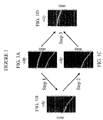
- the main steps of the inventive method are i) simulation of multiple reflections by means of a Kirchhoff-type summation applied to a pseudo zero-offset section; ii) application of an adaptive filter to adjust the simulated multiple and iii) subtraction of the obtained adjusted multiple reflection from the pseudo zero offset section.
- FIGURE 1A to 1D and FIGURE 2 illustrate said main steps.
- nudo zero off section means a section that contains all primaries and multiples and can serve as a good approximation of a zero offset section.
- a common offset section transformed into a zero offset section or a stack section.
- the application of the present method leads to a weighted Kirchhoff-type stack which, applied to the pseudo zero-offset section, performs the task of transforming an input zero-offset section, that comprises primaries and multiples, into an output simulated section in which all original primary reflections have been transformed into their corresponding, free-surface multiples.
- weight function that is to be applied in the present Kirchhoff-type method can be chosen so that the resulting amplitudes of the multiples well approximate their observed values.
- the use of this weight function should provide improved initial amplitudes prior to the application of the filtering procedures.
- the simulation method described in the present application is designed to effect a transformation of a given common near-offset or stacked input section (the input pseudo zero-offset section), into a corresponding output section that solely consists of the multiples to be suppressed.
- the input pseudo zero-offset section is taken as an approximation of a zero-offset section and containing all primaries and multiples.
- each sample of the output section (that is, the simulated multiple section) is the result of a sum of samples collected along a uniquely specified curve in the input section (the pseudo zero offset section).
- This curve is generically called the stacking line.
- the input samples along the stacking line are multiplied by certain weights, also determined by the sample in the output section, where the resulting sum is to be placed.
- weight function is employed to refer to the choice of multipliers that are used in the summation process, which in turn is called a weighted Kirchhoff stack.
- the above formula is an exact traveltime description of the first-order sea-bottom multiple in the zero-offset situation. It provides also a good approximation of the traveltimes of corresponding near sea-bottom peg-leg multiples.
- the simulation of a multiple reflection can be achieved by a cascaded application of Migration and Demigration processes. First, the pseudo zero-offset section is migrated to the depth domain. Next, the obtained depth section is demigrated back to time domain so as to obtain the simulated multiple section.
- the weight function W M ( ⁇ ; x , z ) in the migration algorithm is taken as unitary in this procedure.
- the weight function W D ( x , ⁇ 0 , t 0 ) in the demigration algorithm is also taken as unitary in this procedure.
- an ensemble of common offset sections is made up of several sections, each section being made up of several seismic traces registered with the same distance between source and receiver.
- offset As well known by the experts, the distance between source and receiver is designed by the expression "offset", such expression being used hereinbelow.
- the several sections are organized in increasing order of offset or distance, from the shortest to the largest offset.
- the method of the invention for the suppression of multiple reflections from a marine seismic data set having registered primary and multiple reflections comprises the following steps:
- steps c) and d) are modified in the following way:
- the process flow is applied in such a way that the adjusted multiple which is obtained for a certain common offset section is used as input for the nearest common offset section.
- the third embodiment of the present method involves choosing the common offset section having the shortest offset after the transformation of said common offset section to zero offset.
- the transformed common offset section having the shortest offset is thus considered as the first zero offset section.
- the reason for the choice of the shortest offset is that it has undergone the least transformation and therefore the highest possible accuracy may be obtained by applying the zero offset transformation.
- steps c) and d) are modified in the following way:
- a further, state-of-the-art step may be applied to the obtained multiple-free, that is, to apply the inverse zero-offset transformation.
- Such inverse transformation means the inverse NMO correction, the inverse NMO+ DMO correction or the inverse MZO process. This means that the source-receiver configuration is recovered, as it was at the stage of common offset sections.
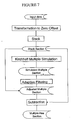
- Another, fourth possible embodiment is the application of the present method on stack data. Said embodiment comprises the following steps, as illustrated in FIGURE 7 attached:
- the transformation to Zero offset can be performed by applying
- the filtering process is carried out according to the usual way, that is by generating a matching filter using the simulated multiple reflection as input and the observed multiple as desired output.
- the simulated multiple is found at the simulated multiple section while the observed multiple is contained at the zero-offset section.
- the aim of the filtering is the matching of the simulated multiple reflections to the observed multiple reflections.
- the filtering step may be performed in several alternative ways, such as:
- the inventive method of multiple simulation using a Kirchhoff algorithm can be performed either:
- the Example corresponds to the application of the inventive method to a PETROBRAS offshore 2-D seismic line recorded at Brazilian continental margin.
- average sea-floor depths are 1,500 m, dips varying up to 5.2 degrees.
- the main parameters relative to the acquisition geometry and processing are displayed in Table 1 below. Interval between shots 26.67 m Interval between receivers 26.67 m Interval between CMPs 26.67 m Sampling interval 2 ms Processed record time 6.0 s Minimum offset 218 m Maximum offset 4191.83
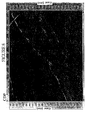
- Figure 8 shows a portion of a stacked section of the whole seismic line to which the method has been applied.
- the available data set consisted of an ensemble of common-offset sections, each of which having been subjected to a whole pre-stack processing sequence, which included conventional multiple attenuation using F-K methods.
- Figure 8 shows a stack of 22 common-offset sections with offsets up to 778 m. Examination of the common offset section shows that, in the considered small-offset range, the F-K method has not been able to correctly attenuate, free-surface multiples. Note, for example, that sea-bottom multiples can be clearly observed at times greater than 3.2 s and strongly interfere with primary reflections. As an example, Figure 9 readily shows a primary reflection being cut by the sea bottom multiple. This could be an important target event for which a clear image would be needed. Therefore, the successful withdrawal of said residual multiples from the ensemble of small-offset sections would demonstrate the excellence of the proposed algorithm as an adequate tool in the suppression of multiples.
- Example 2 corresponds to the application of the method of the invention on stack section extracted from a 3D seismic volume.
- the main acquisition and processing parameters of the selected line are presented in Table 2 below. Interval between shots 25.00 m Interval between receivers 12.50 m Interval between CMPs 6.25 m Sampling interval 2 ms Processed record time 4.0 s Minimum offset 148.00 m Maximum offset 235,50 m
- Figure 11 presents the results generated after each one of the three steps described above.
- Figures 12A and 12B show the zoom images of Figure 11.
- Figure 12A shows the stack section before the application of the method while Figure 12B shows the same stack section after the successful suppression of the multiples resulting from the application of the inventive method.
- the Kirchhoff simulation used in the present invention presents the following main advantages: i) it is target oriented, that is, it can be applied to a definite, constrained region, using rays that illuminate this region only; ii) it leads to very fast and robust algorithms, at least on simple models such as constant velocity; iii) it does not require spatially equal sampling and therefore may be used for 2-D as well as conventional 3-D streamer data; iv) there is no dip limitation for multiple simulation and v) it does not require an estimate of the source signature.
- the present invention treats the problem of multiple simulation as an imaging problem, based on the general principles stated in the article by Hubral et al, mentioned hereinbefore.
- the inventive method is expected to work well on any seismic section that can be a reasonably approximation of a zero-offset section. Very good results were obtained by applying the algorithm to deep-water, short-offset sections. As most available multiple suppression methods fail exactly on the near-offset range, the present scheme can be an alternative in this important range.
- the present method may be applied to a migrated section.
- the simulated multiple from pseudo zero-offset section needs to be subjected to the same migration procedure as the one applied to the data.
Landscapes
- Engineering & Computer Science (AREA)
- Remote Sensing (AREA)
- Physics & Mathematics (AREA)
- Life Sciences & Earth Sciences (AREA)
- Geology (AREA)
- Environmental & Geological Engineering (AREA)
- Acoustics & Sound (AREA)
- General Life Sciences & Earth Sciences (AREA)
- General Physics & Mathematics (AREA)
- Geophysics (AREA)
- Management, Administration, Business Operations System, And Electronic Commerce (AREA)
- Feedback Control In General (AREA)
- Control Of Position, Course, Altitude, Or Attitude Of Moving Bodies (AREA)
Abstract
Description

- (ξ0,t0)
- is the midpoint and traveltime coordinates of the output point in the simulated section of multiples;
- U0(ξ0,t0)
- is the amplitude resulting from the application of the algorithm to be placed at the point (ξ0,t0)in the output section;
- (ξ,t)
- is the midpoint and traveltime coordinates of the points in the input pseudo zero offset section;
- U(ξ,t)
- is the amplitude at the point (ξ,t) in the input section;
- W(ξ;ξ0,t0)
- is the weight function;
- τ(ξ;ξ0,t0)
- is the stacking line;
- Dt[U(ξ,t)]
- is the Hilbert transform of the temporal half derivative of U(ξ,t).

- AM
- is the migration aperture;
- (x, z)
- is the spatial coordinates of the output point in the depth migrated section;
- V(x, z)
- is the amplitude resulting from the application of the depth migration algorithm to be placed at the point (x, z) in the output migrated section;
- (ξ,t)
- is the midpoint and traveltime coordinates of the points in the input pseudo zero offset section;
- U(ξ,t)
- is the amplitude at the point (ξ,t) in the input section;
- WM (ξ; x, z)
- is the weight function of the migration algorithm;
- τM (ξ; x, z)
- is the stacking line of the migration algorithm;
- Dt[U(ξ,t)]
- is the Hilbert transform of the temporal half derivative of U(ξ,t).

- AD
- is the demigration aperture;
- (ξ0,t0)
- is the midpoint and traveltime coordinates of the output point in the demigrated section, which corresponds to the simulated multiple section;
- U(ξ0,t0)
- is the amplitude resulting from the application of the demigration algorithm to be placed at the point (ξ0,t 0) in the output demigrated section;
- (x,z)
- are the spatial coordinates of the points in the input depth migrated section;
- V(x,z)
- is the amplitude at the point (x,z)in the input depth migrated section;
- WD(x,ξ0,t0)
- is the weight function of the demigration algorithm;
- ζD(x,ξ0,t0)
- is the stacking line of the demigration algorithm;
- Dz[V(x,z)]
- is the Hilbert transform of the depth half derivative of V(x,z).
wherein NMO means Normal Moveout, DMO means Dip Moveout and MZO is Migration to Zero Offset.
| Interval between shots | 26.67 m |
| Interval between receivers | 26.67 m |
| Interval between CMPs | 26.67 m |
| Sampling interval | 2 ms |
| Processed record time | 6.0 s |
| Minimum offset | 218 m |
| Maximum offset | 4191.83 |
| Interval between shots | 25.00 m |
| Interval between receivers | 12.50 m |
| Interval between CMPs | 6.25 m |
| Sampling interval | 2 ms |
| Processed record time | 4.0 s |
| Minimum offset | 148.00 m |
| Maximum offset | 235,50 m |
Claims (19)
- A method for the suppression of multiple reflections from a marine seismic data set having registered primary and multiple reflections, which process comprises the following steps:a) sorting said input data set so as to obtain an ensemble of common offset sections;b) transforming each of said common-offset sections into a zero offset section, so as to obtain an ensemble of zero-offset sections;c) by means of a Kirchhoff algorithm for simulation of multiple reflections, using each of said obtained zero-offset sections to generate a new zero-offset section which only contains simulated, multiple reflections, that is, an ensemble of simulated multiple sections;d) by filtering, adjusting amplitude, frequency and phase of each of the so-obtained simulated multiple sections to each corresponding zero offset section of step b), so as to generate an ensemble of adjusted multiple sections having amplitude, frequency and phase compatible with the registered multiple reflection;e) from each section of the ensemble of the zero-offset sections of b), subtracting the corresponding adjusted multiple section of d), obtaining an ensemble of multiple-free sections.
- A method for the suppression of multiple reflections from a marine seismic data set having registered primary and multiple reflections, which process comprises the following steps:a)sorting said input data set so as to obtain an ensemble of common offset sections;b)transforming each of said common-offset sections into a zero offset section, obtaining an ensemble of zero-offset sections;c)stacking a sorted subset of the ensemble of zero offset sections of step b) so as to generate a single stack section that is, a single pseudo zero offset section;d)using said single pseudo zero offset section as input to the Kirchhoff algorithm for simulation of multiple reflections, so as to generate a single simulated multiple section;e)by filtering, adjusting the amplitude, frequency and phase of the so-generated single simulated multiple section of d) to each section of the zero offset sections ensemble of step b) so as to generate an ensemble of adjusted multiple sections;f) from each section of the ensemble of the zero-offset sections of b), subtracting the corresponding adjusted multiple section of e), so as to obtain an ensemble of multiple-free sections.
- A method for the suppression of multiple reflections from a marine seismic data set having registered primary and multiple reflections, which process comprises the following steps:a)sorting said input data set so as to obtain an ensemble of common offset sections;b) transforming each of said common-offset section into a zero offset section, so as to obtain an ensemble of zero-offset sections;c)from said ensemble of zero offset sections, sorting the first zero-offset section;d)using said first zero offset section as input to the Kirchhoff algorithm for simulation of multiple reflections, so as to generate a simulated multiple section;e)by filtering, adjusting the amplitude, frequency and phase of the so-generated simulated multiple section to the first zero offset section so as to generate the adjusted multiple section corresponding to the first common offset section, said adjusted multiple section playing the role of simulated multiple section for the following, second common offset section, and successively to all sorted common offset sections;f)from each of the zero offset sections of b), subtracting the corresponding adjusted multiple section of d) so as to obtain the corresponding multiple-free section.
- A method for the suppression of multiple reflections from a marine seismic data set having registered primary and multiple reflections, which process comprises the following steps:a)applying a proper zero offset transformation and stacking the obtained data in order to generate a stack section, that is, a single pseudo zero offset section;b)using the so-generated single pseudo zero offset section as an input to the Kirchhoff method for multiple simulation, obtaining a zero offset simulated multiple section;c)by filtering, adjusting amplitude, frequency and phase of the so-obtained zero offset simulated multiple section, so as to generate a multiple section of amplitude, frequency and phase compatible with the registered multiple reflections, that is, an adjusted multiple section;d)from the single pseudo zero-offset section of a), subtracting the corresponding adjusted multiple section of c), so as to obtain a multiple-free zero offset section.
- A method according to claims 1, 2, 3 or 4, wherein the transformation to zero offset is performed by applying NMO correction.
- A method according to claims 1, 2, 3 or 4, wherein the transformation to zero offset is performed by applying NMO correction followed by a DMO correction.
- A method according to claims 1, 2, 3 or 4, wherein the transformation to zero offset is performed by applying MZO (Migration to Zero Offset) processes.
- A method according to claims 1, 2 or 3, wherein further an inverse zero-offset transformation is applied to the obtained multiple-free section.
- A method according to claim 8, wherein the inverse zero-offset transformation is performed by applying an inverse NMO correction.
- A method according to claim 8, wherein the inverse zero-offset transformation is performed by applying an inverse NMO correction followed by a DMO correction.
- A method according to claim 8, wherein the inverse zero-offset transformation is performed by applying inverse MZO (Migration to Zero-Offset) processes.
- A method according to claims 1, 2 ,3 or 4, wherein the Kirchhoff multiple simulation is performed in one step.
- A method according to claim 12, wherein the Kirchhoff multiple simulation in one step comprises a summation of figures collected on input data along a stacking line.
- A method according to claims 1, 2 ,3 or 4, wherein the Kirchhoff multiple simulation is performed in two steps.
- A method according to claim 14, wherein the Kirchhoff multiple simulation performed in two steps comprises: i) migrating input data to depth domain so as to obtain a migrated section and ii) demigrating the so-obtained migrated section using the multiple demigrating approach.
- A method according to claims 1, 2, 3 or 4, wherein filtering is performed by using a single matching filter for the whole section.
- A method according to claims 1, 2, 3 or 4, wherein filtering is performed by using a set of matching filters, each filter being applied to a portion of the adjusted multiple section.
- A method according to claims 1, 2, 3 or 4, wherein filtering and subtraction are performed at the same step using a single matching filter for the whole section.
- A method according to claims 1, 2, 3 or 4, wherein filtering and subtraction are performed at the same step using a set of matching filters, each filter being applied to a portion of the adjusted multiple section.
Applications Claiming Priority (2)
| Application Number | Priority Date | Filing Date | Title |
|---|---|---|---|
| US419769 | 1999-10-18 | ||
| US09/419,769 US6507787B1 (en) | 1999-10-18 | 1999-10-18 | Method for the suppression of multiple reflections from marine seismic data |
Publications (3)
| Publication Number | Publication Date |
|---|---|
| EP1094339A2 true EP1094339A2 (en) | 2001-04-25 |
| EP1094339A3 EP1094339A3 (en) | 2004-05-12 |
| EP1094339B1 EP1094339B1 (en) | 2010-04-28 |
Family
ID=23663687
Family Applications (1)
| Application Number | Title | Priority Date | Filing Date |
|---|---|---|---|
| EP00308940A Expired - Lifetime EP1094339B1 (en) | 1999-10-18 | 2000-10-11 | A method for the supression of multiple reflections from marine seimsic data |
Country Status (5)
| Country | Link |
|---|---|
| US (1) | US6507787B1 (en) |
| EP (1) | EP1094339B1 (en) |
| BR (1) | BR0002250B1 (en) |
| DE (1) | DE60044280D1 (en) |
| NO (1) | NO333571B1 (en) |
Cited By (10)
| Publication number | Priority date | Publication date | Assignee | Title |
|---|---|---|---|---|
| US6507787B1 (en) * | 1999-10-18 | 2003-01-14 | Petroleo Brasileiro S.A.-Petrobras | Method for the suppression of multiple reflections from marine seismic data |
| GB2378506A (en) * | 2001-06-08 | 2003-02-12 | Pgs Americas Inc | Pseudo offset migration of C wave seismic data |
| WO2004077099A3 (en) * | 2003-02-26 | 2004-12-23 | Landmark Graphics Corp | 3-d prestack/poststack multiple prediction |
| WO2006037815A1 (en) * | 2004-10-08 | 2006-04-13 | Compagnie Generale De Geophysique | Improvement to seismic processing for the elimination of multiple reflections |
| WO2006096349A3 (en) * | 2005-03-04 | 2007-01-04 | John M Robinson | Radon transformations for removal of noise from seismic data |
| US7239578B2 (en) | 2005-03-03 | 2007-07-03 | John M. Robinson | Removal of noise from seismic data using radon transformations |
| US7366054B1 (en) | 2002-08-30 | 2008-04-29 | John M. Robinson | Tau-P filters for removal of noise from seismic data |
| GB2451615A (en) * | 2007-01-11 | 2009-02-11 | Real Time Data Company Ltd | Radar reflection simulator for generating synthetic radar reflections |
| US7564740B2 (en) | 2002-08-30 | 2009-07-21 | Wood Lawrence C | Methods of enhancing separation of primary reflection signals and noise in seismic data using radon transformations |
| CN109283579A (en) * | 2018-11-08 | 2019-01-29 | 中海油田服务股份有限公司 | An Interlayer Multiples Prediction Method Based on Kirchhoff Integral Demigration |
Families Citing this family (19)
| Publication number | Priority date | Publication date | Assignee | Title |
|---|---|---|---|---|
| US7437330B1 (en) | 2002-09-20 | 2008-10-14 | Yt Acquisition Corp. | System and method for categorizing transactions |
| US7464059B1 (en) | 2001-09-21 | 2008-12-09 | Yt Acquisition Corporation | System and method for purchase benefits at a point of sale |
| US7624073B1 (en) * | 2001-09-21 | 2009-11-24 | Yt Acquisition Corporation | System and method for categorizing transactions |
| US7925392B2 (en) * | 2002-04-23 | 2011-04-12 | Lord Corporation | Aircraft vehicular propulsion system monitoring device and method |
| AU2003275061A1 (en) * | 2002-09-20 | 2004-04-08 | Core Laboratories L.P. | A method of reconstructing seismic records to obtain high resolution signals |
| GB2397907B (en) * | 2003-01-30 | 2006-05-24 | Westerngeco Seismic Holdings | Directional de-signature for seismic signals |
| BR0318256A (en) * | 2003-05-02 | 2006-05-23 | Westerngeco Seismic Holdings | methods for computing one or more timing errors to optimize a marine research project and apparatus for computing one or more timing errors |
| US6832161B1 (en) | 2003-08-15 | 2004-12-14 | Westerngeco, L.L.C. | Method for attenuating water layer multiples |
| AU2003285057A1 (en) * | 2003-10-28 | 2005-06-17 | Western Geco, Llc | A method for estimating porosity and saturation in a subsurface reservoir |
| EP2386880B1 (en) | 2004-04-07 | 2018-10-10 | WesternGeco Seismic Holdings Limited | Fast 3-d surface multiple prediction |
| US7388808B2 (en) * | 2004-09-23 | 2008-06-17 | Pgs Americas, Inc. | Method for depth migrating seismic data using pre-stack time migration, demigration, and post-stack depth migration |
| US7447114B2 (en) | 2005-08-31 | 2008-11-04 | Geotrace Technologies, Inc. | Non-linear seismic trace matching to well logs |
| US7453765B2 (en) * | 2006-05-16 | 2008-11-18 | Ikelle Luc T | Scattering diagrams in seismic imaging |
| US7715986B2 (en) | 2007-05-22 | 2010-05-11 | Chevron U.S.A. Inc. | Method for identifying and removing multiples for imaging with beams |
| WO2009051900A2 (en) * | 2007-10-17 | 2009-04-23 | Exxonmobil Upstream Research Company | Method to adapt a template dataset to a target dataset by using curvelet representations |
| US8077544B2 (en) * | 2008-03-28 | 2011-12-13 | Westerngeco L.L.C. | Dual-wavefield multiple attenuation |
| US8326543B2 (en) * | 2009-11-20 | 2012-12-04 | Chevron U.S.A. Inc. | System and method for attenuating multiples in seismic data that accounts for beam azimuth |
| US11409012B2 (en) * | 2019-10-21 | 2022-08-09 | Saudi Arabian Oil Company | Frequency based method for reducing the effect of multiples in seismic data |
| CN113671573B (en) * | 2020-05-14 | 2024-07-23 | 中国石油化工股份有限公司 | Seismic data pre-stack diffraction wave separation method, device, electronic equipment and medium |
Family Cites Families (8)
| Publication number | Priority date | Publication date | Assignee | Title |
|---|---|---|---|---|
| US4380059A (en) * | 1980-08-20 | 1983-04-12 | Mobil Oil Corporation | F-K Filtering of multiple reflections from a seismic section |
| US4682307A (en) * | 1984-08-21 | 1987-07-21 | Horizon Exploration Limited | Underwater seismic testing |
| US4665510A (en) | 1985-05-06 | 1987-05-12 | Mobil Oil Corporation | Method for attenuating multiples in CDP data gathers |
| US5051960A (en) | 1990-07-16 | 1991-09-24 | Mobil Oil Corporation | Method of removing records of multiple reflection events from seismic data |
| US5729506A (en) | 1996-11-18 | 1998-03-17 | Western Atlas International, Inc. | 3-D multiple attenuation |
| GB9800741D0 (en) * | 1998-01-15 | 1998-03-11 | Geco As | Multiple attenuation of multi-component sea-bottom data |
| US6094620A (en) * | 1999-01-08 | 2000-07-25 | Exxonmobil Upstream Research Company | Method for identifying and removing multiples from seismic reflection data |
| US6507787B1 (en) * | 1999-10-18 | 2003-01-14 | Petroleo Brasileiro S.A.-Petrobras | Method for the suppression of multiple reflections from marine seismic data |
-
1999
- 1999-10-18 US US09/419,769 patent/US6507787B1/en not_active Expired - Lifetime
-
2000
- 2000-04-25 BR BRPI0002250-0A patent/BR0002250B1/en not_active IP Right Cessation
- 2000-10-11 DE DE60044280T patent/DE60044280D1/en not_active Expired - Lifetime
- 2000-10-11 EP EP00308940A patent/EP1094339B1/en not_active Expired - Lifetime
- 2000-10-17 NO NO20005212A patent/NO333571B1/en not_active IP Right Cessation
Cited By (24)
| Publication number | Priority date | Publication date | Assignee | Title |
|---|---|---|---|---|
| US6507787B1 (en) * | 1999-10-18 | 2003-01-14 | Petroleo Brasileiro S.A.-Petrobras | Method for the suppression of multiple reflections from marine seismic data |
| GB2378506A (en) * | 2001-06-08 | 2003-02-12 | Pgs Americas Inc | Pseudo offset migration of C wave seismic data |
| US6856911B2 (en) | 2001-06-08 | 2005-02-15 | Pgs Americas, Inc. | Pseudo-offset migration |
| GB2378506B (en) * | 2001-06-08 | 2005-06-01 | Pgs Americas Inc | Pseudo-offset migration |
| US7366054B1 (en) | 2002-08-30 | 2008-04-29 | John M. Robinson | Tau-P filters for removal of noise from seismic data |
| US7948826B2 (en) | 2002-08-30 | 2011-05-24 | Wood Lawrence C | Limited radon transformations for removal of noise from seismic data |
| US7821869B2 (en) | 2002-08-30 | 2010-10-26 | John M. Robinson | Methods of enhancing separation of primary reflection signals and noise in seismic data using radon transformations |
| US7564740B2 (en) | 2002-08-30 | 2009-07-21 | Wood Lawrence C | Methods of enhancing separation of primary reflection signals and noise in seismic data using radon transformations |
| WO2004077099A3 (en) * | 2003-02-26 | 2004-12-23 | Landmark Graphics Corp | 3-d prestack/poststack multiple prediction |
| FR2876458A1 (en) * | 2004-10-08 | 2006-04-14 | Geophysique Cie Gle | IMPROVEMENT TO SEISMIC TREATMENTS FOR THE SUPPRESSION OF MULTIPLE REFLECTIONS |
| WO2006037815A1 (en) * | 2004-10-08 | 2006-04-13 | Compagnie Generale De Geophysique | Improvement to seismic processing for the elimination of multiple reflections |
| NO339057B1 (en) * | 2004-10-08 | 2016-11-07 | Cggveritas Services Sa | Seismic processing for the elimination of multiple reflections |
| GB2426588B (en) * | 2004-10-08 | 2008-03-19 | Geophysique Cie Gle | Improvement to seismic processing for the elimination of multiple reflections |
| US8559266B2 (en) | 2004-10-08 | 2013-10-15 | Cggveritas Services Sa | Seismic processing for the elimination of multiple reflections |
| GB2426588A (en) * | 2004-10-08 | 2006-11-29 | Geophysique Cie Gle | Improvement to seismic processing for the elimination of multiple reflections |
| US7881154B2 (en) | 2004-10-08 | 2011-02-01 | Cggveritas Services Sa | Seismic processing for the elimination of multiple reflections |
| US7239578B2 (en) | 2005-03-03 | 2007-07-03 | John M. Robinson | Removal of noise from seismic data using radon transformations |
| US7561491B2 (en) | 2005-03-04 | 2009-07-14 | Robinson John M | Radon transformations for removal of noise from seismic data |
| US7936640B2 (en) | 2005-03-04 | 2011-05-03 | Robinson John M | Radon transformation for removal of noise from seismic data |
| WO2006096349A3 (en) * | 2005-03-04 | 2007-01-04 | John M Robinson | Radon transformations for removal of noise from seismic data |
| GB2451615B (en) * | 2007-01-11 | 2011-06-01 | Real Time Data Company Ltd | Radar reflection simulator |
| GB2451615A (en) * | 2007-01-11 | 2009-02-11 | Real Time Data Company Ltd | Radar reflection simulator for generating synthetic radar reflections |
| CN109283579A (en) * | 2018-11-08 | 2019-01-29 | 中海油田服务股份有限公司 | An Interlayer Multiples Prediction Method Based on Kirchhoff Integral Demigration |
| CN109283579B (en) * | 2018-11-08 | 2019-07-19 | 中海油田服务股份有限公司 | An Interlayer Multiples Prediction Method Based on Kirchhoff Integral Demigration |
Also Published As
| Publication number | Publication date |
|---|---|
| EP1094339A3 (en) | 2004-05-12 |
| US6507787B1 (en) | 2003-01-14 |
| BR0002250A (en) | 2002-05-28 |
| NO333571B1 (en) | 2013-07-08 |
| EP1094339B1 (en) | 2010-04-28 |
| NO20005212D0 (en) | 2000-10-17 |
| NO20005212L (en) | 2001-04-19 |
| BR0002250B1 (en) | 2012-06-26 |
| DE60044280D1 (en) | 2010-06-10 |
Similar Documents
| Publication | Publication Date | Title |
|---|---|---|
| EP1094339B1 (en) | A method for the supression of multiple reflections from marine seimsic data | |
| EP2356492B1 (en) | Method for separating independent simultaneous sources | |
| Muijs et al. | Prestack depth migration of primary and surface-related multiple reflections: Part I—Imaging | |
| CA2453280C (en) | Method for attenuating noise in seismic data | |
| US8559270B2 (en) | Method for separating independent simultaneous sources | |
| EP0799429B1 (en) | Source signature determination and multiple reflection reduction | |
| US5970023A (en) | Reducing aliasing artifacts in seismic data processing using sharpened (TAU-P-Q) transforms | |
| US7433265B2 (en) | Converted wave energy removal from seismic data | |
| AU2002324926A1 (en) | Method for attenuating noise in seismic data | |
| WO2004077099A2 (en) | 3-d prestack/poststack multiple prediction | |
| Zhou et al. | Multiple suppression by 2D filtering in the parabolic τ–p domain: a wave‐equation‐based method1 | |
| WO2005078478A1 (en) | Method for processing borehole seismic data | |
| Tatham et al. | Application of the tau-p transform (slant-stack) in processing seismic reflection data | |
| Craft et al. | Geophone Noise Attenuation And Wave-field Separation Using a Multidimensional Decomposition Technique | |
| Liu et al. | Dip selective 2-D multiple attenuation in the plane-wave domain | |
| Kent et al. | Suppression of sea-floor-scattered energy using a dip-moveout approach—Application to the mid-ocean ridge environment | |
| CA2806241C (en) | Method for separating independent simultaneous sources | |
| Moore | Practical implementation of interbed multiple attenuation | |
| Ogagarue et al. | Free surface multiple removal using 3D surface related multiple elimination technique on 3D seismic data from offshore Niger Delta | |
| Stoffa | Tau-p: An alternative domain for filtering, velocity analysis, and imaging | |
| Iverson | Refining the amplitude of inverse scattering series internal multiple predictions | |
| Putra et al. | Multichannel Seismic Reflection Data Processing: Multiple Attenuation of Line 250 at the Coast of Southern California Using Hyperbolic Radon Transform | |
| Pearse | Inversion and modelling of seismic data to assess the evolution of the Rockall Trough | |
| Abbasi | Attenuation of multiples in 2D short streamer length multi-channel seismic data, Gulf of Callifornia | |
| Oppert | Radon methods for improved imaging of high-velocity layers using mode-converted energy |
Legal Events
| Date | Code | Title | Description |
|---|---|---|---|
| PUAI | Public reference made under article 153(3) epc to a published international application that has entered the european phase |
Free format text: ORIGINAL CODE: 0009012 |
|
| AK | Designated contracting states |
Kind code of ref document: A2 Designated state(s): AT BE CH CY DE DK ES FI FR GB GR IE IT LI LU MC NL PT SE |
|
| AX | Request for extension of the european patent |
Free format text: AL;LT;LV;MK;RO;SI |
|
| PUAL | Search report despatched |
Free format text: ORIGINAL CODE: 0009013 |
|
| AK | Designated contracting states |
Kind code of ref document: A3 Designated state(s): AT BE CH CY DE DK ES FI FR GB GR IE IT LI LU MC NL PT SE |
|
| AX | Request for extension of the european patent |
Extension state: AL LT LV MK RO SI |
|
| 17P | Request for examination filed |
Effective date: 20041013 |
|
| AKX | Designation fees paid |
Designated state(s): DE FR GB NL |
|
| 17Q | First examination report despatched |
Effective date: 20050609 |
|
| 17Q | First examination report despatched |
Effective date: 20050609 |
|
| GRAP | Despatch of communication of intention to grant a patent |
Free format text: ORIGINAL CODE: EPIDOSNIGR1 |
|
| GRAS | Grant fee paid |
Free format text: ORIGINAL CODE: EPIDOSNIGR3 |
|
| GRAA | (expected) grant |
Free format text: ORIGINAL CODE: 0009210 |
|
| AK | Designated contracting states |
Kind code of ref document: B1 Designated state(s): DE FR GB NL |
|
| REG | Reference to a national code |
Ref country code: GB Ref legal event code: FG4D |
|
| REF | Corresponds to: |
Ref document number: 60044280 Country of ref document: DE Date of ref document: 20100610 Kind code of ref document: P |
|
| REG | Reference to a national code |
Ref country code: NL Ref legal event code: T3 |
|
| PLBE | No opposition filed within time limit |
Free format text: ORIGINAL CODE: 0009261 |
|
| STAA | Information on the status of an ep patent application or granted ep patent |
Free format text: STATUS: NO OPPOSITION FILED WITHIN TIME LIMIT |
|
| 26N | No opposition filed |
Effective date: 20110131 |
|
| REG | Reference to a national code |
Ref country code: FR Ref legal event code: PLFP Year of fee payment: 16 |
|
| REG | Reference to a national code |
Ref country code: FR Ref legal event code: PLFP Year of fee payment: 17 |
|
| REG | Reference to a national code |
Ref country code: FR Ref legal event code: PLFP Year of fee payment: 18 |
|
| REG | Reference to a national code |
Ref country code: FR Ref legal event code: PLFP Year of fee payment: 19 |
|
| PGFP | Annual fee paid to national office [announced via postgrant information from national office to epo] |
Ref country code: DE Payment date: 20191001 Year of fee payment: 20 Ref country code: NL Payment date: 20191023 Year of fee payment: 20 |
|
| PGFP | Annual fee paid to national office [announced via postgrant information from national office to epo] |
Ref country code: FR Payment date: 20191029 Year of fee payment: 20 |
|
| PGFP | Annual fee paid to national office [announced via postgrant information from national office to epo] |
Ref country code: GB Payment date: 20200421 Year of fee payment: 20 |
|
| REG | Reference to a national code |
Ref country code: DE Ref legal event code: R071 Ref document number: 60044280 Country of ref document: DE |
|
| REG | Reference to a national code |
Ref country code: NL Ref legal event code: MK Effective date: 20201010 |
|
| REG | Reference to a national code |
Ref country code: GB Ref legal event code: PE20 Expiry date: 20201010 |
|
| PG25 | Lapsed in a contracting state [announced via postgrant information from national office to epo] |
Ref country code: GB Free format text: LAPSE BECAUSE OF EXPIRATION OF PROTECTION Effective date: 20201010 |