EP1094127A2 - Large forging manufacturing process - Google Patents
Large forging manufacturing process Download PDFInfo
- Publication number
- EP1094127A2 EP1094127A2 EP00305672A EP00305672A EP1094127A2 EP 1094127 A2 EP1094127 A2 EP 1094127A2 EP 00305672 A EP00305672 A EP 00305672A EP 00305672 A EP00305672 A EP 00305672A EP 1094127 A2 EP1094127 A2 EP 1094127A2
- Authority
- EP
- European Patent Office
- Prior art keywords
- component part
- component
- temperature
- billet
- areas
- Prior art date
- Legal status (The legal status is an assumption and is not a legal conclusion. Google has not performed a legal analysis and makes no representation as to the accuracy of the status listed.)
- Granted
Links
Images
Classifications
-
- C—CHEMISTRY; METALLURGY
- C21—METALLURGY OF IRON
- C21D—MODIFYING THE PHYSICAL STRUCTURE OF FERROUS METALS; GENERAL DEVICES FOR HEAT TREATMENT OF FERROUS OR NON-FERROUS METALS OR ALLOYS; MAKING METAL MALLEABLE, e.g. BY DECARBURISATION OR TEMPERING
- C21D7/00—Modifying the physical properties of iron or steel by deformation
- C21D7/13—Modifying the physical properties of iron or steel by deformation by hot working
-
- B—PERFORMING OPERATIONS; TRANSPORTING
- B21—MECHANICAL METAL-WORKING WITHOUT ESSENTIALLY REMOVING MATERIAL; PUNCHING METAL
- B21J—FORGING; HAMMERING; PRESSING METAL; RIVETING; FORGE FURNACES
- B21J5/00—Methods for forging, hammering, or pressing; Special equipment or accessories therefor
-
- B—PERFORMING OPERATIONS; TRANSPORTING
- B21—MECHANICAL METAL-WORKING WITHOUT ESSENTIALLY REMOVING MATERIAL; PUNCHING METAL
- B21J—FORGING; HAMMERING; PRESSING METAL; RIVETING; FORGE FURNACES
- B21J1/00—Preparing metal stock or similar ancillary operations prior, during or post forging, e.g. heating or cooling
- B21J1/06—Heating or cooling methods or arrangements specially adapted for performing forging or pressing operations
-
- C—CHEMISTRY; METALLURGY
- C22—METALLURGY; FERROUS OR NON-FERROUS ALLOYS; TREATMENT OF ALLOYS OR NON-FERROUS METALS
- C22F—CHANGING THE PHYSICAL STRUCTURE OF NON-FERROUS METALS AND NON-FERROUS ALLOYS
- C22F1/00—Changing the physical structure of non-ferrous metals or alloys by heat treatment or by hot or cold working
- C22F1/10—Changing the physical structure of non-ferrous metals or alloys by heat treatment or by hot or cold working of nickel or cobalt or alloys based thereon
Definitions
- This invention relates to forgings used for large land-based gas turbines, and particularly to large Alloy 718 forgings that are prone to a problem known as abnormal grain growth.
- Alloy 718 involves heating a billet and forging it in one or many steps (also referred to as upsets) to the final required shape.
- the billet must be reheated before each upset.
- the shaped parts are solution treated at a high temperature (1700-1825F), and then aged at a lower temperature (1325-1150F)to develop strength.
- Alloy 718 forgings develop abnormal grain growth when heated to the solution temperature. This has not been a serious problem for small forgings (as discussed below), but it has been a serious problem for large forgings which, for purposes of this invention, are those over 10,000 pounds in weight.
- Abnormal grain growth also referred to as secondary grain growth or critical grain growth, occurs when a few grains in the material grow to a very large size compared to neighboring grains. This occurrence alters the mechanical properties of the material. Specifically, not only does abnormal grain growth reduce fatigue resistance and yield strength of the material, it also impairs the ability to detect small defects by ultrasonic testing. Abnormal grain growth does however, improve creep resistance at high temperatures, and may therefore be desirable in certain instances.
- This invention involves the identification of a unique processing window for large Alloy 718 forgings which causes abnormal grain growth. By then avoiding this window, abnormal grain growth can be eliminated, thereby permitting large forgings that have a uniform grain structure. Alternatively, the process permits the formation of abnormal grain growth in selected areas when considered desirable.
- abnormal grain growth can be avoided by a forging process which takes into account the above factors, within the parameters disclosed herein.
- the present invention relates generally to a process for forging large components of Alloy 718 material comprising:
- steps e) and f) are changed only as follows.
- the process in accordance with the invention has advantages over the prior art. Specifically, one can develop a control process which can eliminate abnormal grain growth and have a uniform grain structure specifically for large 718 alloy forgings. Alternatively, one can develop a control process which does produce abnormal grain growth intentionally in specific areas to meet specific property needs. This aspect can be used in both large and small forgings.
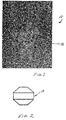
- abnormal grain growth is shown in a photomicrograph with a magnification of 200X. Specifically, evidence of abnormal grain growth is shown in the gray areas, one of which is designated by numeral 12.
- abnormal grain growth occurs when a few grains in the material grow to a very large scale compared to neighboring grains. Abnormal grain growth reduces fatigue resistance and yield strength of the material. It also impairs the ability to detect small defects by ultrasonic testing. On the other hand, since abnormal grain growth does improve creep resistance at high temperatures, it may be desirable to foster such growth under certain circumstances.
- specimens were used for purposes of developing the process in accordance with this invention.
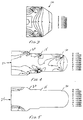
- the specimens initially as supplied for testing had a cross sectional shape as indicated in Figure 2.
- a side elevation of the specimen is shown generally in Figure 3.
- the specimen in Figure 3 is also shown to include typical strain contours, with strains in each labeled area indicated adjacent the figure.
- the small scale specimen or billet 14 is an Alloy 718 forge material with grain size of ASTM 4-5 and ASTM 8-10.
- the specific geometry of the specimen as shown in Figures 2 and 3 allowed strains of different levels to be generated in the same specimen, thus minimizing the number of specimens.
- test methodology included small scale upsets done in a servo-hydraulic testing machine.
- the specimen 14 and forging dies were both heated and maintained at the temperature of testing, i.e., it was an isothermal process.
- Finite element modeling of the forging process was done using a commercial code DEFORM.
- Specimens were cut up after the upset experiments for microstructure analysis. It was observed that the abnormal grain growth was located in the low strain region, but when strain reached a certain level, the abnormal grain growth disappears. The locations of abnormal grain growth were recorded and strain level at the certain location was then calculated by commercial forge modeling software DEFORM 2D. The highest strain value (Hstrain) of each specimen represents the amount of abnormal grain growth in the particular specimen. By running statistic software Minitab 12, it was determined that lowering forging temperature and lowering the solution heat treatment temperature could reduce Hstrain and thus the possibility of abnormal grain growth, but strain rate has little effect on Hstrain and thus the amount of abnormal grain growth generated.
- samples 22 and 24 each include a double cone-shaped geometry, with a notch at 16 and annular steps or shoulders formed at 18 and 20.
- the samples 22 and 24 are components made by a conventional process, and by a process in accordance with this invention, respectively.
- Sample 22 in Figure 4 exhibit a relatively large area in the low strain range, which has a tendency for abnormal grain growth.
- sample 24 in Figure 5 shows a very limited low strain region. This low strain region will be removed by subsequent machining and the possibility of abnormal grain growth is thus eliminated.
- steps g) and h) are changed only as follows.
- the component part can be selectively forged to create areas with no abnormal grain growth as well as areas where abnormal grain growth occurs but where creep resistance at high temperatures is improved.
- step a) if the start-up grain size of the billet in step a) above is ASTM8-10, then steps b) and c) can be eliminated, and the process can continue with step d).
Landscapes
- Chemical & Material Sciences (AREA)
- Engineering & Computer Science (AREA)
- Mechanical Engineering (AREA)
- Crystallography & Structural Chemistry (AREA)
- Materials Engineering (AREA)
- Metallurgy (AREA)
- Organic Chemistry (AREA)
- Physics & Mathematics (AREA)
- Thermal Sciences (AREA)
- Forging (AREA)
Abstract
Description
| Forging Temperature (F) | Strain Rate | Solution Temperature (F) | |
| 1 | 1775 | 0.01 | 1725 |
| 2 | 1775 | 0.01 | 1760 |
| 3 | 1775 | 0.03 | 1725 |
| 4 | 1775 | 0.03 | 1760 |
| 5 | 1800 | 0.01 | 1725 |
| 6 | 1800 | 0.01 | 1760 |
| 7 | 1800 | 0.03 | 1725 |
| 8 | 1800 | 0.03 | 1760 |
Claims (14)
- A process for forging large component parts of Alloy 718 material comprising:a) providing a billet (14) with an average grain size between ASTM 0 and ASTM 3;b) heating the billet (14) to a temperature of between 1750°F and 1800°F;c) upsetting the billet (14) to obtain a component part (24) with a minimum strain of 0.125 in at least selected areas of the part;d) reheating the component part (24) to a temperature between 1750°F and 1800°F;e) upsetting the component part (24) to a final configuration such that said selected areas receive no strains between .01 and 0.125;f) solution treating the component part (24) at a temperature of between 1725°F and 1750°F; andg) aging the component part (24) over predetermined times at different temperatures.
- The process of claim 1 wherein said selected areas include the entire compartment part (24).
- The process of claim 1 wherein for certain areas other than said selected areas of the compartment part (24), step e) is carried out such that said certain areas receive strains between 0.01 and 0.125 and step f) is carried out by solution heating to between 1825°F-1850°F.
- The process of claim 1 wherein, in step g), the component part (24) is aged for 8 hours at 1325°F and 8 hours at 1150°F.
- The process of claim 1 wherein large component parts comprise component parts weighing at least 10,000 lbs.
- The process of claim 1 wherein steps c) and d) are repeated as necessary to obtain a minimum strain in said selected areas of 0.125.
- The process of claim 1 wherein, following step e), the component part (24) has a fine grain size of ASTM 6-8 in said selected areas.
- The process of claim 1 wherein said large component part (24) comprises a land based gas turbine component.
- A process for forging a gas turbine component having a weight of at least 10,000 lbs. from Alloy 718 material so that the component does not exhibit any abnormal grain growth, comprising the steps of:a) providing a billet (14) with an average grain size between ASTM 0 and ASTM 3;b) heating the billet to a temperature of between 1750°F and 1800°F;c) upsetting the billet to obtain a component part (24) with a minimum strain of 0.125 in all areas of the part for each upset;d) reheating the component part (24) to a temperature between 1750°F and 1800°F;e) upsetting the component part (24) to a final configuration such that no areas of the component part (24) receive strains between .01 and 0.125;f) solution treating the selected areas of the component part at a temperature of between 1725°F and 1750°F; andg) aging the selected areas of the component part (24) over predetermined times at different temperatures.
- The process of claim 9 wherein, in step g), the component part (24) is aged for 8 hours at 1325°F and 8 hours at 1150°F.
- The process of claim 9 wherein steps c) and d) are repeated as necessary to obtain a minimum strain in said selected areas of 0.125.
- The process of claim 9 wherein, following step e), the component part (24) has a fine grain size of ASTM 6-8 in said selected areas.
- A process for forging a gas turbine component having a weight of at least 10,000 lbs. from Alloy 718 material so that the component does not exhibit abnormal grain growth in selected areas of the part but does exhibit abnormal grain growth in other areas of the part, comprising the steps of:a) providing a billet (14) with an average grain size between ASTM 0 and ASTM 3;b) heating the billet (14) to a temperature of between 1750°F and 1800°F;c) upsetting the billet (14) to obtain a component part (24) with a minimum strain of 0.125 in all areas of the part;d) reheating the component part (24) to a temperature between 1750°F and 1800°F;e) upsetting the component part (24) to a final configuration such that said selected areas receive no strains between .01 and 0.125 and said other areas receive strains between 0.01 to 0.125;f) solution treating the component part (24) at a temperature of between 1825°F and 1850°F;g) aging the component part (24) over predetermined times at different temperatures.
- The process of claim 13 wherein, in step g), the component part (24) is aged for 8 hours at 1325°F and 8 hours at 1150°F.
Applications Claiming Priority (2)
| Application Number | Priority Date | Filing Date | Title |
|---|---|---|---|
| US09/426,306 US6409853B1 (en) | 1999-10-25 | 1999-10-25 | Large forging manufacturing process |
| US426306 | 1999-10-25 |
Publications (3)
| Publication Number | Publication Date |
|---|---|
| EP1094127A2 true EP1094127A2 (en) | 2001-04-25 |
| EP1094127A3 EP1094127A3 (en) | 2005-03-02 |
| EP1094127B1 EP1094127B1 (en) | 2009-10-07 |
Family
ID=23690250
Family Applications (1)
| Application Number | Title | Priority Date | Filing Date |
|---|---|---|---|
| EP00305672A Expired - Lifetime EP1094127B1 (en) | 1999-10-25 | 2000-07-05 | Large forging manufacturing process |
Country Status (6)
| Country | Link |
|---|---|
| US (1) | US6409853B1 (en) |
| EP (1) | EP1094127B1 (en) |
| JP (1) | JP5284555B2 (en) |
| KR (1) | KR100550702B1 (en) |
| AT (1) | ATE445027T1 (en) |
| DE (1) | DE60043090D1 (en) |
Cited By (3)
| Publication number | Priority date | Publication date | Assignee | Title |
|---|---|---|---|---|
| US6512982B2 (en) * | 2000-12-20 | 2003-01-28 | General Electric Company | Methods and systems for evaluating defects in metals |
| US7754028B2 (en) | 2002-07-29 | 2010-07-13 | Koninklijke Philips Electronics N.V. | Plasma-nitriding of maraging steel, shaver cap for an electric shaver, cutting device made out of such steel and an electric shaver |
| EP3854902A4 (en) * | 2018-09-19 | 2022-06-22 | Hitachi Metals, Ltd. | METHOD FOR PRODUCING A CIRCULAR ROLLING FORGED MATERIAL CONSISTING OF A HIGHLY HEAT-RESISTANT FE-NI-BASED ALLOY |
Families Citing this family (10)
| Publication number | Priority date | Publication date | Assignee | Title |
|---|---|---|---|---|
| US7763129B2 (en) * | 2006-04-18 | 2010-07-27 | General Electric Company | Method of controlling final grain size in supersolvus heat treated nickel-base superalloys and articles formed thereby |
| US20080230584A1 (en) * | 2007-03-19 | 2008-09-25 | The Boeing Company | Method for Manufacturing a Workpiece by Friction Welding to Reduce the Occurrence of Abnormal Grain Growth |
| US8038178B2 (en) | 2009-03-31 | 2011-10-18 | Hitachi, Ltd | High pressure fuel pipe construction for an internal combustion engine |
| US20110076419A1 (en) * | 2009-09-28 | 2011-03-31 | Hitachi America, Ltd. | Method for developing fine grained, thermally stable metallic material |
| US8790473B2 (en) | 2011-08-10 | 2014-07-29 | United Technologies Corporation | Method for forging metal alloy components for improved and uniform grain refinement and strength |
| US8956700B2 (en) | 2011-10-19 | 2015-02-17 | General Electric Company | Method for adhering a coating to a substrate structure |
| US20130167979A1 (en) * | 2011-12-29 | 2013-07-04 | General Electric Company | Method of predicting quench cracking in components formed by high deformation processes |
| WO2015151318A1 (en) * | 2014-03-31 | 2015-10-08 | 日立金属株式会社 | METHOD FOR PRODUCING Fe-Ni-BASED SUPER HEAT-RESISTANT ALLOY |
| CN108504833A (en) * | 2018-03-28 | 2018-09-07 | 贵州航天精工制造有限公司 | A kind of GH4169 superhigh intensitys antifatigue bolt processing method |
| CN114406169B (en) * | 2022-03-23 | 2024-05-31 | 西安圣泰金属材料有限公司 | Processing method of two-phase titanium alloy large-size plate |
Family Cites Families (6)
| Publication number | Priority date | Publication date | Assignee | Title |
|---|---|---|---|---|
| US4793868A (en) * | 1986-09-15 | 1988-12-27 | General Electric Company | Thermomechanical method of forming fatigue crack resistant nickel base superalloys and product formed |
| US4957567A (en) * | 1988-12-13 | 1990-09-18 | General Electric Company | Fatigue crack growth resistant nickel-base article and alloy and method for making |
| US5120373A (en) * | 1991-04-15 | 1992-06-09 | United Technologies Corporation | Superalloy forging process |
| US5360496A (en) * | 1991-08-26 | 1994-11-01 | Aluminum Company Of America | Nickel base alloy forged parts |
| US5374323A (en) * | 1991-08-26 | 1994-12-20 | Aluminum Company Of America | Nickel base alloy forged parts |
| US6193823B1 (en) * | 1999-03-17 | 2001-02-27 | Wyman Gordon Company | Delta-phase grain refinement of nickel-iron-base alloy ingots |
-
1999
- 1999-10-25 US US09/426,306 patent/US6409853B1/en not_active Expired - Lifetime
-
2000
- 2000-07-05 DE DE60043090T patent/DE60043090D1/en not_active Expired - Lifetime
- 2000-07-05 AT AT00305672T patent/ATE445027T1/en not_active IP Right Cessation
- 2000-07-05 EP EP00305672A patent/EP1094127B1/en not_active Expired - Lifetime
- 2000-07-13 JP JP2000212584A patent/JP5284555B2/en not_active Expired - Lifetime
- 2000-07-14 KR KR1020000040427A patent/KR100550702B1/en not_active Expired - Lifetime
Cited By (4)
| Publication number | Priority date | Publication date | Assignee | Title |
|---|---|---|---|---|
| US6512982B2 (en) * | 2000-12-20 | 2003-01-28 | General Electric Company | Methods and systems for evaluating defects in metals |
| US7754028B2 (en) | 2002-07-29 | 2010-07-13 | Koninklijke Philips Electronics N.V. | Plasma-nitriding of maraging steel, shaver cap for an electric shaver, cutting device made out of such steel and an electric shaver |
| EP3854902A4 (en) * | 2018-09-19 | 2022-06-22 | Hitachi Metals, Ltd. | METHOD FOR PRODUCING A CIRCULAR ROLLING FORGED MATERIAL CONSISTING OF A HIGHLY HEAT-RESISTANT FE-NI-BASED ALLOY |
| US12594593B2 (en) | 2018-09-19 | 2026-04-07 | Proterial, Ltd. | Production method for ring-rolled material of Fe—Ni-based superalloy |
Also Published As
| Publication number | Publication date |
|---|---|
| EP1094127B1 (en) | 2009-10-07 |
| US6409853B1 (en) | 2002-06-25 |
| ATE445027T1 (en) | 2009-10-15 |
| JP5284555B2 (en) | 2013-09-11 |
| KR20010039718A (en) | 2001-05-15 |
| DE60043090D1 (en) | 2009-11-19 |
| KR100550702B1 (en) | 2006-02-08 |
| EP1094127A3 (en) | 2005-03-02 |
| JP2001123257A (en) | 2001-05-08 |
Similar Documents
| Publication | Publication Date | Title |
|---|---|---|
| US5649280A (en) | Method for controlling grain size in Ni-base superalloys | |
| US6409853B1 (en) | Large forging manufacturing process | |
| RU2644089C2 (en) | Thermomechanical processing of high-strength non-magnetic corrosion-resistant material | |
| EP1813690B1 (en) | Local heat treatment for improved fatigue resistance in turbine components | |
| US20090000706A1 (en) | Method of controlling and refining final grain size in supersolvus heat treated nickel-base superalloys | |
| Groh et al. | Development of a new cast and wrought alloy (René 65) for high temperature disk applications | |
| EP1847627A2 (en) | Method of controlling final grain size in supersolvus heat treated nickel-base superalloys and articles formed thereby | |
| US20120006452A1 (en) | Method of improving the mechanical properties of a component | |
| EP0533918A1 (en) | Superalloy forging process and related composition. | |
| EP0280467A1 (en) | Method for providing valve members having varied microstructure | |
| EP0533914B1 (en) | Superalloy forging process and related composition | |
| Mahmoudi et al. | An Investigation on unstable flow during hot deformation of Inconel X750 superalloy using 3D processing map and shear band formation criterion | |
| US7138020B2 (en) | Method for reducing heat treatment residual stresses in super-solvus solutioned nickel-base superalloy articles | |
| US6565683B1 (en) | Method for processing billets from multiphase alloys and the article | |
| US5415712A (en) | Method of forging in 706 components | |
| US20040255635A1 (en) | Billet for cold forging, method of manufacturing billet for cold forging, method of continuously cold-forging billet, method of cold-forging | |
| Forcellese et al. | Warm forging of aluminium alloys: a new approach for time compression of the forging sequence | |
| Gupta et al. | Effect of variants of thermomechanical working and annealing treatment on titanium alloy Ti6Al4V closed die forgings | |
| CN115354130B (en) | A method for composite grain refinement of hot work die steel | |
| WO2019094400A1 (en) | Highly alloyed stainless steel forgings made without solution anneal | |
| CN114226618A (en) | Reverse control process of final forging forming of large shaft forgings based on mixed crystal control | |
| Semiatin et al. | The effect of shear bands on service properties of ti-6ai-2sn-4zr-2mo-0.1 si forgings | |
| CZ20002505A3 (en) | Method for Forging Large Parts of Alloy 718 | |
| RU2801383C1 (en) | METHOD FOR MANUFACTURING GAS TURBINE ENGINE BLADES FROM ALLOY BASED ON Ti2AlNb ALUMINIDE | |
| RU2196189C2 (en) | Method of working, mainly, large-sized blanks from (alpha+betta)-titanium alloys |
Legal Events
| Date | Code | Title | Description |
|---|---|---|---|
| PUAI | Public reference made under article 153(3) epc to a published international application that has entered the european phase |
Free format text: ORIGINAL CODE: 0009012 |
|
| AK | Designated contracting states |
Kind code of ref document: A2 Designated state(s): AT BE CH CY DE DK ES FI FR GB GR IE IT LI LU MC NL PT SE |
|
| AX | Request for extension of the european patent |
Free format text: AL;LT;LV;MK;RO;SI |
|
| PUAL | Search report despatched |
Free format text: ORIGINAL CODE: 0009013 |
|
| AK | Designated contracting states |
Kind code of ref document: A3 Designated state(s): AT BE CH CY DE DK ES FI FR GB GR IE IT LI LU MC NL PT SE |
|
| AX | Request for extension of the european patent |
Extension state: AL LT LV MK RO SI |
|
| 17P | Request for examination filed |
Effective date: 20050902 |
|
| AKX | Designation fees paid |
Designated state(s): AT BE CH CY DE DK ES FI FR GB GR IE IT LI LU MC NL PT SE |
|
| 17Q | First examination report despatched |
Effective date: 20080327 |
|
| GRAP | Despatch of communication of intention to grant a patent |
Free format text: ORIGINAL CODE: EPIDOSNIGR1 |
|
| GRAS | Grant fee paid |
Free format text: ORIGINAL CODE: EPIDOSNIGR3 |
|
| GRAA | (expected) grant |
Free format text: ORIGINAL CODE: 0009210 |
|
| AK | Designated contracting states |
Kind code of ref document: B1 Designated state(s): AT BE CH CY DE DK ES FI FR GB GR IE IT LI LU MC NL PT SE |
|
| REG | Reference to a national code |
Ref country code: GB Ref legal event code: FG4D |
|
| REG | Reference to a national code |
Ref country code: CH Ref legal event code: EP Ref country code: CH Ref legal event code: NV Representative=s name: SERVOPATENT GMBH |
|
| REG | Reference to a national code |
Ref country code: IE Ref legal event code: FG4D |
|
| REF | Corresponds to: |
Ref document number: 60043090 Country of ref document: DE Date of ref document: 20091119 Kind code of ref document: P |
|
| NLV1 | Nl: lapsed or annulled due to failure to fulfill the requirements of art. 29p and 29m of the patents act | ||
| PG25 | Lapsed in a contracting state [announced via postgrant information from national office to epo] |
Ref country code: PT Free format text: LAPSE BECAUSE OF FAILURE TO SUBMIT A TRANSLATION OF THE DESCRIPTION OR TO PAY THE FEE WITHIN THE PRESCRIBED TIME-LIMIT Effective date: 20100208 Ref country code: FI Free format text: LAPSE BECAUSE OF FAILURE TO SUBMIT A TRANSLATION OF THE DESCRIPTION OR TO PAY THE FEE WITHIN THE PRESCRIBED TIME-LIMIT Effective date: 20091007 Ref country code: ES Free format text: LAPSE BECAUSE OF FAILURE TO SUBMIT A TRANSLATION OF THE DESCRIPTION OR TO PAY THE FEE WITHIN THE PRESCRIBED TIME-LIMIT Effective date: 20100118 Ref country code: SE Free format text: LAPSE BECAUSE OF FAILURE TO SUBMIT A TRANSLATION OF THE DESCRIPTION OR TO PAY THE FEE WITHIN THE PRESCRIBED TIME-LIMIT Effective date: 20091007 |
|
| PG25 | Lapsed in a contracting state [announced via postgrant information from national office to epo] |
Ref country code: BE Free format text: LAPSE BECAUSE OF FAILURE TO SUBMIT A TRANSLATION OF THE DESCRIPTION OR TO PAY THE FEE WITHIN THE PRESCRIBED TIME-LIMIT Effective date: 20091007 Ref country code: AT Free format text: LAPSE BECAUSE OF FAILURE TO SUBMIT A TRANSLATION OF THE DESCRIPTION OR TO PAY THE FEE WITHIN THE PRESCRIBED TIME-LIMIT Effective date: 20091007 |
|
| PG25 | Lapsed in a contracting state [announced via postgrant information from national office to epo] |
Ref country code: NL Free format text: LAPSE BECAUSE OF FAILURE TO SUBMIT A TRANSLATION OF THE DESCRIPTION OR TO PAY THE FEE WITHIN THE PRESCRIBED TIME-LIMIT Effective date: 20091007 Ref country code: DK Free format text: LAPSE BECAUSE OF FAILURE TO SUBMIT A TRANSLATION OF THE DESCRIPTION OR TO PAY THE FEE WITHIN THE PRESCRIBED TIME-LIMIT Effective date: 20091007 |
|
| PLBE | No opposition filed within time limit |
Free format text: ORIGINAL CODE: 0009261 |
|
| STAA | Information on the status of an ep patent application or granted ep patent |
Free format text: STATUS: NO OPPOSITION FILED WITHIN TIME LIMIT |
|
| 26N | No opposition filed |
Effective date: 20100708 |
|
| PG25 | Lapsed in a contracting state [announced via postgrant information from national office to epo] |
Ref country code: GR Free format text: LAPSE BECAUSE OF FAILURE TO SUBMIT A TRANSLATION OF THE DESCRIPTION OR TO PAY THE FEE WITHIN THE PRESCRIBED TIME-LIMIT Effective date: 20100108 |
|
| REG | Reference to a national code |
Ref country code: DE Ref legal event code: R409 Ref document number: 60043090 Country of ref document: DE |
|
| PG25 | Lapsed in a contracting state [announced via postgrant information from national office to epo] |
Ref country code: MC Free format text: LAPSE BECAUSE OF NON-PAYMENT OF DUE FEES Effective date: 20100731 |
|
| PG25 | Lapsed in a contracting state [announced via postgrant information from national office to epo] |
Ref country code: DE Free format text: LAPSE BECAUSE OF NON-PAYMENT OF DUE FEES Effective date: 20110201 |
|
| REG | Reference to a national code |
Ref country code: DE Ref legal event code: R119 Ref document number: 60043090 Country of ref document: DE Effective date: 20110201 |
|
| PG25 | Lapsed in a contracting state [announced via postgrant information from national office to epo] |
Ref country code: IE Free format text: LAPSE BECAUSE OF NON-PAYMENT OF DUE FEES Effective date: 20100705 |
|
| REG | Reference to a national code |
Ref country code: DE Ref legal event code: R409 Ref document number: 60043090 Country of ref document: DE |
|
| REG | Reference to a national code |
Ref country code: DE Ref legal event code: R074 Ref document number: 60043090 Country of ref document: DE Ref country code: DE Ref legal event code: R409 Ref document number: 60043090 Country of ref document: DE |
|
| REG | Reference to a national code |
Ref country code: DE Ref legal event code: R409 Ref document number: 60043090 Country of ref document: DE |
|
| REG | Reference to a national code |
Ref country code: DE Ref legal event code: R074 Ref document number: 60043090 Country of ref document: DE Effective date: 20111017 Ref country code: DE Ref legal event code: R074 Ref document number: 60043090 Country of ref document: DE Effective date: 20110916 |
|
| REG | Reference to a national code |
Ref country code: DE Ref legal event code: R409 Ref document number: 60043090 Country of ref document: DE |
|
| PG25 | Lapsed in a contracting state [announced via postgrant information from national office to epo] |
Ref country code: CY Free format text: LAPSE BECAUSE OF FAILURE TO SUBMIT A TRANSLATION OF THE DESCRIPTION OR TO PAY THE FEE WITHIN THE PRESCRIBED TIME-LIMIT Effective date: 20091007 |
|
| PG25 | Lapsed in a contracting state [announced via postgrant information from national office to epo] |
Ref country code: LU Free format text: LAPSE BECAUSE OF NON-PAYMENT OF DUE FEES Effective date: 20100705 |
|
| PGRI | Patent reinstated in contracting state [announced from national office to epo] |
Ref country code: DE Effective date: 20111128 |
|
| REG | Reference to a national code |
Ref country code: FR Ref legal event code: PLFP Year of fee payment: 17 |
|
| REG | Reference to a national code |
Ref country code: FR Ref legal event code: PLFP Year of fee payment: 18 |
|
| REG | Reference to a national code |
Ref country code: FR Ref legal event code: PLFP Year of fee payment: 19 |
|
| PGFP | Annual fee paid to national office [announced via postgrant information from national office to epo] |
Ref country code: IT Payment date: 20190624 Year of fee payment: 20 |
|
| PGFP | Annual fee paid to national office [announced via postgrant information from national office to epo] |
Ref country code: FR Payment date: 20190621 Year of fee payment: 20 |
|
| PGFP | Annual fee paid to national office [announced via postgrant information from national office to epo] |
Ref country code: CH Payment date: 20190624 Year of fee payment: 20 |
|
| PGFP | Annual fee paid to national office [announced via postgrant information from national office to epo] |
Ref country code: GB Payment date: 20190624 Year of fee payment: 20 Ref country code: DE Payment date: 20190620 Year of fee payment: 20 |
|
| REG | Reference to a national code |
Ref country code: CH Ref legal event code: PCAR Free format text: NEW ADDRESS: WANNERSTRASSE 9/1, 8045 ZUERICH (CH) |
|
| REG | Reference to a national code |
Ref country code: DE Ref legal event code: R071 Ref document number: 60043090 Country of ref document: DE |
|
| REG | Reference to a national code |
Ref country code: CH Ref legal event code: PL |
|
| REG | Reference to a national code |
Ref country code: GB Ref legal event code: PE20 Expiry date: 20200704 |
|
| PG25 | Lapsed in a contracting state [announced via postgrant information from national office to epo] |
Ref country code: GB Free format text: LAPSE BECAUSE OF EXPIRATION OF PROTECTION Effective date: 20200704 |