EP1094053B1 - Method of preparing fluoroaromatic compounds - Google Patents
Method of preparing fluoroaromatic compounds Download PDFInfo
- Publication number
- EP1094053B1 EP1094053B1 EP99121167A EP99121167A EP1094053B1 EP 1094053 B1 EP1094053 B1 EP 1094053B1 EP 99121167 A EP99121167 A EP 99121167A EP 99121167 A EP99121167 A EP 99121167A EP 1094053 B1 EP1094053 B1 EP 1094053B1
- Authority
- EP
- European Patent Office
- Prior art keywords
- chloro
- reacting
- chlorotrifluoroethylene
- ctfe
- temperature range
- Prior art date
- Legal status (The legal status is an assumption and is not a legal conclusion. Google has not performed a legal analysis and makes no representation as to the accuracy of the status listed.)
- Expired - Lifetime
Links
- 238000000034 method Methods 0.000 title claims description 43
- 150000001875 compounds Chemical class 0.000 title description 4
- UUAGAQFQZIEFAH-UHFFFAOYSA-N chlorotrifluoroethylene Chemical group FC(F)=C(F)Cl UUAGAQFQZIEFAH-UHFFFAOYSA-N 0.000 claims description 73
- 239000000203 mixture Substances 0.000 claims description 39
- RRHGJUQNOFWUDK-UHFFFAOYSA-N Isoprene Chemical compound CC(=C)C=C RRHGJUQNOFWUDK-UHFFFAOYSA-N 0.000 claims description 32
- CGFMLBSNHNWJAW-UHFFFAOYSA-N 2-chloro-4,5-difluorobenzoic acid Chemical compound OC(=O)C1=CC(F)=C(F)C=C1Cl CGFMLBSNHNWJAW-UHFFFAOYSA-N 0.000 claims description 20
- WVGSPMZLNNRZRH-UHFFFAOYSA-N 2-chloro-4,5-difluorobenzoyl chloride Chemical compound FC1=CC(Cl)=C(C(Cl)=O)C=C1F WVGSPMZLNNRZRH-UHFFFAOYSA-N 0.000 claims description 19
- 239000003960 organic solvent Substances 0.000 claims description 19
- HHFUBJHILNJHHI-UHFFFAOYSA-N 1-chloro-4,5-difluoro-2-(trichloromethyl)benzene Chemical compound FC1=CC(Cl)=C(C(Cl)(Cl)Cl)C=C1F HHFUBJHILNJHHI-UHFFFAOYSA-N 0.000 claims description 18
- FZMPLKVGINKUJZ-UHFFFAOYSA-N 1,2-difluoro-4-methylbenzene Chemical compound CC1=CC=C(F)C(F)=C1 FZMPLKVGINKUJZ-UHFFFAOYSA-N 0.000 claims description 17
- LLVWLCAZSOLOTF-UHFFFAOYSA-N 1-methyl-4-[1,4,4-tris(4-methylphenyl)buta-1,3-dienyl]benzene Chemical compound C1=CC(C)=CC=C1C(C=1C=CC(C)=CC=1)=CC=C(C=1C=CC(C)=CC=1)C1=CC=C(C)C=C1 LLVWLCAZSOLOTF-UHFFFAOYSA-N 0.000 claims description 17
- 238000006243 chemical reaction Methods 0.000 claims description 17
- 239000003054 catalyst Substances 0.000 claims description 15
- GOYDNIKZWGIXJT-UHFFFAOYSA-N 1,2-difluorobenzene Chemical class FC1=CC=CC=C1F GOYDNIKZWGIXJT-UHFFFAOYSA-N 0.000 claims description 14
- 238000009833 condensation Methods 0.000 claims description 14
- 230000005494 condensation Effects 0.000 claims description 14
- 239000012808 vapor phase Substances 0.000 claims description 14
- QOVKZMZPXOFFKK-UHFFFAOYSA-N 5-chloro-4,4,5-trifluoro-1-methylcyclohexene Chemical compound CC1=CCC(F)(F)C(F)(Cl)C1 QOVKZMZPXOFFKK-UHFFFAOYSA-N 0.000 claims description 13
- KZBUYRJDOAKODT-UHFFFAOYSA-N Chlorine Chemical compound ClCl KZBUYRJDOAKODT-UHFFFAOYSA-N 0.000 claims description 13
- PKZMDIAFGCOUAX-UHFFFAOYSA-N 1-chloro-4,5-difluoro-2-methylbenzene Chemical compound CC1=CC(F)=C(F)C=C1Cl PKZMDIAFGCOUAX-UHFFFAOYSA-N 0.000 claims description 12
- UOKWVMBVEMREAD-UHFFFAOYSA-N 4-chloro-4,5,5-trifluoro-1-methylcyclohexene Chemical compound CC1=CCC(F)(Cl)C(F)(F)C1 UOKWVMBVEMREAD-UHFFFAOYSA-N 0.000 claims description 12
- 150000008044 alkali metal hydroxides Chemical class 0.000 claims description 12
- 150000001935 cyclohexenes Chemical class 0.000 claims description 11
- 238000004821 distillation Methods 0.000 claims description 9
- 239000012071 phase Substances 0.000 claims description 9
- 230000007704 transition Effects 0.000 claims description 9
- XLOMVQKBTHCTTD-UHFFFAOYSA-N Zinc monoxide Chemical compound [Zn]=O XLOMVQKBTHCTTD-UHFFFAOYSA-N 0.000 claims description 8
- 238000009835 boiling Methods 0.000 claims description 7
- 229910021578 Iron(III) chloride Inorganic materials 0.000 claims description 6
- RBTARNINKXHZNM-UHFFFAOYSA-K iron trichloride Chemical compound Cl[Fe](Cl)Cl RBTARNINKXHZNM-UHFFFAOYSA-K 0.000 claims description 6
- QSHDDOUJBYECFT-UHFFFAOYSA-N mercury Chemical compound [Hg] QSHDDOUJBYECFT-UHFFFAOYSA-N 0.000 claims description 6
- 229910052753 mercury Inorganic materials 0.000 claims description 6
- 238000004064 recycling Methods 0.000 claims description 6
- 230000035484 reaction time Effects 0.000 claims description 5
- 239000011260 aqueous acid Substances 0.000 claims description 4
- 125000002496 methyl group Chemical group [H]C([H])([H])* 0.000 claims description 4
- 239000011787 zinc oxide Substances 0.000 claims description 4
- 125000004435 hydrogen atom Chemical group [H]* 0.000 claims description 3
- 125000000217 alkyl group Chemical group 0.000 claims description 2
- HEDRZPFGACZZDS-MICDWDOJSA-N Trichloro(2H)methane Chemical compound [2H]C(Cl)(Cl)Cl HEDRZPFGACZZDS-MICDWDOJSA-N 0.000 description 48
- 238000002360 preparation method Methods 0.000 description 22
- KWYUFKZDYYNOTN-UHFFFAOYSA-M Potassium hydroxide Chemical compound [OH-].[K+] KWYUFKZDYYNOTN-UHFFFAOYSA-M 0.000 description 18
- 238000001256 steam distillation Methods 0.000 description 17
- HEMHJVSKTPXQMS-UHFFFAOYSA-M Sodium hydroxide Chemical compound [OH-].[Na+] HEMHJVSKTPXQMS-UHFFFAOYSA-M 0.000 description 15
- 238000004293 19F NMR spectroscopy Methods 0.000 description 13
- HGCIXCUEYOPUTN-UHFFFAOYSA-N cyclohexene Chemical compound C1CCC=CC1 HGCIXCUEYOPUTN-UHFFFAOYSA-N 0.000 description 12
- 239000011541 reaction mixture Substances 0.000 description 12
- CYRMSUTZVYGINF-UHFFFAOYSA-N trichlorofluoromethane Chemical compound FC(Cl)(Cl)Cl CYRMSUTZVYGINF-UHFFFAOYSA-N 0.000 description 12
- 238000005160 1H NMR spectroscopy Methods 0.000 description 11
- 239000000047 product Substances 0.000 description 11
- HTZCNXWZYVXIMZ-UHFFFAOYSA-M benzyl(triethyl)azanium;chloride Chemical compound [Cl-].CC[N+](CC)(CC)CC1=CC=CC=C1 HTZCNXWZYVXIMZ-UHFFFAOYSA-M 0.000 description 10
- 239000010410 layer Substances 0.000 description 10
- 239000000243 solution Substances 0.000 description 10
- 239000007788 liquid Substances 0.000 description 9
- 230000000052 comparative effect Effects 0.000 description 7
- 238000004508 fractional distillation Methods 0.000 description 7
- 238000002347 injection Methods 0.000 description 7
- 239000007924 injection Substances 0.000 description 7
- XLYOFNOQVPJJNP-UHFFFAOYSA-N water Substances O XLYOFNOQVPJJNP-UHFFFAOYSA-N 0.000 description 7
- IJGRMHOSHXDMSA-UHFFFAOYSA-N Atomic nitrogen Chemical compound N#N IJGRMHOSHXDMSA-UHFFFAOYSA-N 0.000 description 6
- KAKZBPTYRLMSJV-UHFFFAOYSA-N Butadiene Chemical compound C=CC=C KAKZBPTYRLMSJV-UHFFFAOYSA-N 0.000 description 6
- 230000015572 biosynthetic process Effects 0.000 description 6
- NVDAQMGSFFBHFS-UHFFFAOYSA-N 1-ethenyl-1-fluorocyclobutane Chemical class C=CC1(F)CCC1 NVDAQMGSFFBHFS-UHFFFAOYSA-N 0.000 description 5
- HBEROXBDOXJBLM-UHFFFAOYSA-N 4-chloro-4,5,5-trifluoro-1,2-dimethylcyclohexene Chemical compound CC1=C(C)CC(F)(Cl)C(F)(F)C1 HBEROXBDOXJBLM-UHFFFAOYSA-N 0.000 description 5
- CKRXOEATBQGTTP-UHFFFAOYSA-N 4-chloro-4,5,5-trifluorocyclohexene Chemical compound FC1(F)CC=CCC1(F)Cl CKRXOEATBQGTTP-UHFFFAOYSA-N 0.000 description 5
- UXVMQQNJUSDDNG-UHFFFAOYSA-L Calcium chloride Chemical compound [Cl-].[Cl-].[Ca+2] UXVMQQNJUSDDNG-UHFFFAOYSA-L 0.000 description 5
- 239000001110 calcium chloride Substances 0.000 description 5
- 229910001628 calcium chloride Inorganic materials 0.000 description 5
- AZUYLZMQTIKGSC-UHFFFAOYSA-N 1-[6-[4-(5-chloro-6-methyl-1H-indazol-4-yl)-5-methyl-3-(1-methylindazol-5-yl)pyrazol-1-yl]-2-azaspiro[3.3]heptan-2-yl]prop-2-en-1-one Chemical compound ClC=1C(=C2C=NNC2=CC=1C)C=1C(=NN(C=1C)C1CC2(CN(C2)C(C=C)=O)C1)C=1C=C2C=NN(C2=CC=1)C AZUYLZMQTIKGSC-UHFFFAOYSA-N 0.000 description 4
- 229910001873 dinitrogen Inorganic materials 0.000 description 4
- 239000012044 organic layer Substances 0.000 description 4
- KJTMUKCWKKBFLW-UHFFFAOYSA-N 4-chloro-4,5,5-trifluoro-3-methylcyclohexene Chemical compound CC1C=CCC(F)(F)C1(F)Cl KJTMUKCWKKBFLW-UHFFFAOYSA-N 0.000 description 3
- 230000009977 dual effect Effects 0.000 description 3
- 239000003444 phase transfer catalyst Substances 0.000 description 3
- QAOWNCQODCNURD-UHFFFAOYSA-N sulfuric acid group Chemical class S(O)(O)(=O)=O QAOWNCQODCNURD-UHFFFAOYSA-N 0.000 description 3
- FPENCTDAQQQKNY-UHFFFAOYSA-N 3,4-difluorobenzoic acid Chemical compound OC(=O)C1=CC=C(F)C(F)=C1 FPENCTDAQQQKNY-UHFFFAOYSA-N 0.000 description 2
- JZTPKAROPNTQQV-UHFFFAOYSA-N 3-fluorobenzonitrile Chemical compound FC1=CC=CC(C#N)=C1 JZTPKAROPNTQQV-UHFFFAOYSA-N 0.000 description 2
- HGGRAOYTQNFGGN-UHFFFAOYSA-N 4,5-difluoro-2-nitrobenzoic acid Chemical compound OC(=O)C1=CC(F)=C(F)C=C1[N+]([O-])=O HGGRAOYTQNFGGN-UHFFFAOYSA-N 0.000 description 2
- OKTJSMMVPCPJKN-UHFFFAOYSA-N Carbon Chemical compound [C] OKTJSMMVPCPJKN-UHFFFAOYSA-N 0.000 description 2
- ZAMOUSCENKQFHK-UHFFFAOYSA-N Chlorine atom Chemical compound [Cl] ZAMOUSCENKQFHK-UHFFFAOYSA-N 0.000 description 2
- SECXISVLQFMRJM-UHFFFAOYSA-N N-Methylpyrrolidone Chemical compound CN1CCCC1=O SECXISVLQFMRJM-UHFFFAOYSA-N 0.000 description 2
- SMWDFEZZVXVKRB-UHFFFAOYSA-N Quinoline Chemical compound N1=CC=CC2=CC=CC=C21 SMWDFEZZVXVKRB-UHFFFAOYSA-N 0.000 description 2
- 239000006227 byproduct Substances 0.000 description 2
- 229910052799 carbon Inorganic materials 0.000 description 2
- 239000000460 chlorine Substances 0.000 description 2
- 229910052801 chlorine Inorganic materials 0.000 description 2
- 238000007796 conventional method Methods 0.000 description 2
- 239000012025 fluorinating agent Substances 0.000 description 2
- 150000008423 fluorobenzenes Chemical class 0.000 description 2
- 229910044991 metal oxide Inorganic materials 0.000 description 2
- 150000004706 metal oxides Chemical class 0.000 description 2
- 229920000642 polymer Polymers 0.000 description 2
- GEHJYWRUCIMESM-UHFFFAOYSA-L sodium sulfite Chemical compound [Na+].[Na+].[O-]S([O-])=O GEHJYWRUCIMESM-UHFFFAOYSA-L 0.000 description 2
- 238000003786 synthesis reaction Methods 0.000 description 2
- JRMUNVKIHCOMHV-UHFFFAOYSA-M tetrabutylammonium bromide Chemical compound [Br-].CCCC[N+](CCCC)(CCCC)CCCC JRMUNVKIHCOMHV-UHFFFAOYSA-M 0.000 description 2
- BFKJFAAPBSQJPD-UHFFFAOYSA-N tetrafluoroethene Chemical group FC(F)=C(F)F BFKJFAAPBSQJPD-UHFFFAOYSA-N 0.000 description 2
- FYSNRJHAOHDILO-UHFFFAOYSA-N thionyl chloride Chemical compound ClS(Cl)=O FYSNRJHAOHDILO-UHFFFAOYSA-N 0.000 description 2
- PMJHHCWVYXUKFD-SNAWJCMRSA-N (E)-1,3-pentadiene Chemical compound C\C=C\C=C PMJHHCWVYXUKFD-SNAWJCMRSA-N 0.000 description 1
- ZNEHIDGAPGVZSA-UHFFFAOYSA-N 1,2-difluoro-3-methylbenzene Chemical compound CC1=CC=CC(F)=C1F ZNEHIDGAPGVZSA-UHFFFAOYSA-N 0.000 description 1
- DDEXEXKNWFMJMX-UHFFFAOYSA-N 1,2-difluoro-4,5-dimethylbenzene Chemical group CC1=CC(F)=C(F)C=C1C DDEXEXKNWFMJMX-UHFFFAOYSA-N 0.000 description 1
- JRTYPYSADXRJBQ-UHFFFAOYSA-N 1-fluoro-3-(trichloromethyl)benzene Chemical compound FC1=CC=CC(C(Cl)(Cl)Cl)=C1 JRTYPYSADXRJBQ-UHFFFAOYSA-N 0.000 description 1
- XEZNGIUYQVAUSS-UHFFFAOYSA-N 18-crown-6 Chemical compound C1COCCOCCOCCOCCOCCO1 XEZNGIUYQVAUSS-UHFFFAOYSA-N 0.000 description 1
- 150000003990 18-crown-6 derivatives Chemical group 0.000 description 1
- MXNBDFWNYRNIBH-UHFFFAOYSA-N 3-fluorobenzoic acid Chemical class OC(=O)C1=CC=CC(F)=C1 MXNBDFWNYRNIBH-UHFFFAOYSA-N 0.000 description 1
- FFSBOABNRUJQFW-UHFFFAOYSA-N 4,5-difluorophthalic acid Chemical compound OC(=O)C1=CC(F)=C(F)C=C1C(O)=O FFSBOABNRUJQFW-UHFFFAOYSA-N 0.000 description 1
- UATBWQQFLABWKR-UHFFFAOYSA-N 5,6-difluoro-2-benzofuran-1,3-dione Chemical compound C1=C(F)C(F)=CC2=C1C(=O)OC2=O UATBWQQFLABWKR-UHFFFAOYSA-N 0.000 description 1
- VHUUQVKOLVNVRT-UHFFFAOYSA-N Ammonium hydroxide Chemical compound [NH4+].[OH-] VHUUQVKOLVNVRT-UHFFFAOYSA-N 0.000 description 1
- PXGOKWXKJXAPGV-UHFFFAOYSA-N Fluorine Chemical compound FF PXGOKWXKJXAPGV-UHFFFAOYSA-N 0.000 description 1
- FXHOOIRPVKKKFG-UHFFFAOYSA-N N,N-Dimethylacetamide Chemical compound CN(C)C(C)=O FXHOOIRPVKKKFG-UHFFFAOYSA-N 0.000 description 1
- 229910000831 Steel Inorganic materials 0.000 description 1
- 239000002253 acid Substances 0.000 description 1
- 150000007513 acids Chemical class 0.000 description 1
- QGZKDVFQNNGYKY-UHFFFAOYSA-N ammonia Natural products N QGZKDVFQNNGYKY-UHFFFAOYSA-N 0.000 description 1
- 150000003863 ammonium salts Chemical class 0.000 description 1
- 150000001491 aromatic compounds Chemical class 0.000 description 1
- 125000003118 aryl group Chemical group 0.000 description 1
- 125000004429 atom Chemical group 0.000 description 1
- QVGXLLKOCUKJST-UHFFFAOYSA-N atomic oxygen Chemical compound [O] QVGXLLKOCUKJST-UHFFFAOYSA-N 0.000 description 1
- 230000003115 biocidal effect Effects 0.000 description 1
- 239000003153 chemical reaction reagent Substances 0.000 description 1
- 230000002860 competitive effect Effects 0.000 description 1
- 230000000911 decarboxylating effect Effects 0.000 description 1
- 230000003247 decreasing effect Effects 0.000 description 1
- 229940113088 dimethylacetamide Drugs 0.000 description 1
- 238000001035 drying Methods 0.000 description 1
- 230000008030 elimination Effects 0.000 description 1
- 238000003379 elimination reaction Methods 0.000 description 1
- 229910052731 fluorine Inorganic materials 0.000 description 1
- 239000011737 fluorine Substances 0.000 description 1
- 125000000524 functional group Chemical group 0.000 description 1
- 230000003301 hydrolyzing effect Effects 0.000 description 1
- 239000005457 ice water Substances 0.000 description 1
- 238000002955 isolation Methods 0.000 description 1
- 238000004519 manufacturing process Methods 0.000 description 1
- 238000012986 modification Methods 0.000 description 1
- 230000004048 modification Effects 0.000 description 1
- PYLWMHQQBFSUBP-UHFFFAOYSA-N monofluorobenzene Chemical compound FC1=CC=CC=C1 PYLWMHQQBFSUBP-UHFFFAOYSA-N 0.000 description 1
- 229910052757 nitrogen Inorganic materials 0.000 description 1
- 239000001301 oxygen Substances 0.000 description 1
- 229910052760 oxygen Inorganic materials 0.000 description 1
- PMJHHCWVYXUKFD-UHFFFAOYSA-N piperylene Natural products CC=CC=C PMJHHCWVYXUKFD-UHFFFAOYSA-N 0.000 description 1
- 238000010926 purge Methods 0.000 description 1
- 238000000197 pyrolysis Methods 0.000 description 1
- -1 quinolone carboxylic acids Chemical class 0.000 description 1
- 235000010265 sodium sulphite Nutrition 0.000 description 1
- 239000007787 solid Substances 0.000 description 1
- 239000010959 steel Substances 0.000 description 1
- 239000012258 stirred mixture Substances 0.000 description 1
- 238000006467 substitution reaction Methods 0.000 description 1
- 239000011269 tar Substances 0.000 description 1
Classifications
-
- C—CHEMISTRY; METALLURGY
- C07—ORGANIC CHEMISTRY
- C07C—ACYCLIC OR CARBOCYCLIC COMPOUNDS
- C07C17/00—Preparation of halogenated hydrocarbons
- C07C17/26—Preparation of halogenated hydrocarbons by reactions involving an increase in the number of carbon atoms in the skeleton
- C07C17/30—Preparation of halogenated hydrocarbons by reactions involving an increase in the number of carbon atoms in the skeleton by a Diels-Alder synthesis
-
- C—CHEMISTRY; METALLURGY
- C07—ORGANIC CHEMISTRY
- C07C—ACYCLIC OR CARBOCYCLIC COMPOUNDS
- C07C17/00—Preparation of halogenated hydrocarbons
- C07C17/25—Preparation of halogenated hydrocarbons by splitting-off hydrogen halides from halogenated hydrocarbons
-
- C—CHEMISTRY; METALLURGY
- C07—ORGANIC CHEMISTRY
- C07C—ACYCLIC OR CARBOCYCLIC COMPOUNDS
- C07C25/00—Compounds containing at least one halogen atom bound to a six-membered aromatic ring
- C07C25/02—Monocyclic aromatic halogenated hydrocarbons
- C07C25/13—Monocyclic aromatic halogenated hydrocarbons containing fluorine
-
- C—CHEMISTRY; METALLURGY
- C07—ORGANIC CHEMISTRY
- C07C—ACYCLIC OR CARBOCYCLIC COMPOUNDS
- C07C51/00—Preparation of carboxylic acids or their salts, halides or anhydrides
- C07C51/093—Preparation of carboxylic acids or their salts, halides or anhydrides by hydrolysis of —CX3 groups, X being halogen
-
- C—CHEMISTRY; METALLURGY
- C07—ORGANIC CHEMISTRY
- C07C—ACYCLIC OR CARBOCYCLIC COMPOUNDS
- C07C51/00—Preparation of carboxylic acids or their salts, halides or anhydrides
- C07C51/58—Preparation of carboxylic acid halides
Definitions
- the present invention relates to a method of preparing fluoroaromatic compounds, which shows high productivity, simple process and low cost of preparation. More particularly, the present invention relates to a method of preparing 2-chloro-4,5-difluorobenzoic acid and 2-chloro-4,5-difluorobenzoyl chloride via formation of ortho-difluorobenzene derivatives prepared by reacting chlorotrifluoroethylene with 1,3-diene.
- 2-chloro-4,5-difluorobenzoyl chloride which is normally prepared from 2-chloro-4,5-difluorobenzoic acid is used as a particularly valuable intermediate for synthesis of quinolone carboxylic acids which have a strong antibiotic activity.
- US Patent No. 4,374,266 discloses fluorophthalamic acids and ammonium salts thereof, and a method for the preparation of these compounds.
- US Patent No. 5,003,103 discloses a preparation of 2-chloro-4,5-difluorobenzoic acid which is prepared by decarboxylating 4,5-difluorophthalic anhydride or 4,5-difluorophthalic acid to form 3,4-difluorobenzoic acid in N-methyl-2-pyrrolidone, quinoline, or dimethyl acetamide, treating the 3,4-difluorobenzoic acid with a mixture of nitric and sulfuric acids to produce 2-nitro-4,5-difluorobenzoic acid, and treating the 2-nitro-4,5-difluorobenzoic acid with elemental chlorine.
- European Patent Publication No. 431 373 A2 discloses a process for producing 5-fluorbenzoic acids which comprises trichloromethylating a fluorobenzene to obtain a 5-fluorobenzotrichloride, reacting with aqueous ammonia to obtain a 5-fluorobenzonitrile, reacting with a fluorinating agent to obtain a 5-fluorobenzonitrile, and hydrolyzing it.
- all of these methods have shortcomings of either longer reaction steps or using expensive reagents.
- the 2-chloro-4,5-difluorobenzoyl chloride has been prepared by reacting 2-chloro-4,5-difluorobenzoic acid with thionyl chloride.
- US Patent No. 4,754,084 discloses a preparation of substituted fluorobenzenes which is produced by pyrolyzing vinylfluorocyclobutanes in the presence of activated carbon or certain metal oxides or mixtures of metal oxides.
- a tetrafluoroethylene was used to prepare the substituted fluorobenzenes, which tends to polymerize spontaneously in the presence of traces of oxygen. Therefore, the tetrafluoroethylene should be stored at low temperature without contacting air.
- vinylfluorocyclobutane derivatives it forms easily polymeric by-products which affects badly a yield of products and cause difficulties in mass production, thus it is always required to react in a nitrogen gas atmosphere.
- the present inventors have developed methods of preparing 2-chloro-4,5-difluorobenzoic acid and 2-chloro-4,5-difluorobenzoyl chloride without passing via vinylfluorocyclobutane derivatives.
- An object of the present invention is to provide a method of preparing ortho-difluorobenzene derivatives having a high yield.
- Another object of the invention is to provide methods of preparing 2-chloro-4,5-difluorobenzoic acid and 2-chloro-4,5-difluorobenzoyl chloride having a high productivity.
- a further object of the invention is to provide methods of preparing 2-chloro-4,5-difluorobenzoic acid and 2-chloro-4,5-difluorobenzoyl chloride from ortho-difluorobenzene derivatives, which obviates a step of forming vinylfluorocyclobutane as an intermediate.
- a further object of the invention is to provide methods of preparing 2-chloro-4,5-difluorobenzoic acid and 2-chloro-4,5-difluorobenzoyl chloride having a simple process and low cost of preparation thereof.
- a further object of the invention is to provide methods of preparing 2-chloro-4,5-difluorobenzoic acid and 2-chloro-4,5-difluorobenzoyl chloride without using an organic solvent.
- a further object of the invention is to provide methods of preparing 2-chloro-4,5-difluorobenzoyl chloride which obviates a step of forming 2-chloro-4,5-difluorobenzoic acid as an intermediate.
- the present invention provides a method of preparing ortho-difluorobenzene derivatives, which comprises (a) providing a mixture of cyclohexenes by reacting chlorotrifluoroethylene (CTFE) and 1,3-diene in a flow reactor at temperature range of 390 to 480 °C under atmospheric pressure through continuous vapor phase condensation and distilling the resultant, and (b) dehydrohalogenating the mixture of cyclohexenes with a phase transition catalyst in the presence of alkali metal hydroxide at temperature range of 40 to 150 °C without using any organic solvent.
- CTFE chlorotrifluoroethylene
- step (a) the molar ratio of chlorotrifluoroethylene (CTFE) to 1,3-diene is in the range of 1.5:1 to 0.8:1, and the reaction time is in the range of 0.2 to 30 sec.
- the present invention also provides a method of preparing 2-chloro-4,5-difluorobenzoic acid, which comprises (a) providing a mixture of 4-chloro-1-methyl-4,5,5-trifluorocyclohexene and 5-chloro-1-methyl-4,4,5-trifluorocyclohexene by reacting chlorotrifluoroethylene (CTFE) and isoprene at temperature range of 390 to 480°C through continuous vapor phase condensation in a flow reactor and distilling the resultant, (b) dehydrohalogenating said mixture in the presence of alkali metal hydroxide and a phase transition catalyst to form 3,4-difluorotoluene, (c) reacting said 3,4-difluorotoluene with chlorine gas in the presence of catalysts consisting of ferro-shaving and ferric chloride at temperature range of -10 to 40°C without using any organic solvent to form 2-chloro-4,5-difluorotoluene, (d)
- the present invention relates to methods of preparing 2-chloro-4,5-difluorobenzoic acid and 2-chloro-4,5-difluorobenzoyl chloride via formation of ortho-difluorobenzene derivatives that are prepared by reacting chlorotrifluoroethylene with 1,3-diene, which shows high productivity, simple process and low cost of preparation.
- the method of preparing ortho-difluorobenzene derivatives is represented by the following reaction: wherein R 1 , R 2 and R 3 are independently a hydrogen atom or a lower alkyl group, preferably a methyl group.
- the method of preparing ortho-difluorobenzene derivatives comprises (a) providing a mixture of cyclohexenes by reacting chlorotrifluoroethylene (CTFE) and 1,3-diene in a flow reactor at temperature range of 390 to 480 °C under atmospheric pressure through continuous vapor phase condensation and distilling the resultant, and (b) dehydrohalogenating the mixture of cyclohexenes with a phase transition catalyst in the presence of alkali metal hydroxide at temperature range of 40 to 150 °C without using any organic solvent.
- CTFE chlorotrifluoroethylene
- chlorotrifluoroethylene (CTFE) (I) and 1,3-diene (II) are continuously reacted at the vapor phase in a flow reactor to produce a mixture of cyclohexenes (IIIa) and (IIIb) through condensation and the mixture is distilled.
- the molar ratio of chlorotrifluoroethylene (CTFE) to 1,3-diene is in the range of 1.5:1 to 0.8:1, and the reaction time is in the range of 0.2 to 30 sec, preferably 5 to 15 sec.
- the reaction temperature is in the range of 390 to 480°C, preferably 420 to 470°C.
- reaction temperature is higher than 480°C, the yield of the mixture of cyclohexenes (IIIa and IIIb) is remarkably decreased because of formation of undesired tars and polymers which give a potential hazard that a flow reactor may be clogged by the polymers. Also, by lowering the reaction temperature, a cost of energy can be reduced as well.
- the distillate having low boiling point is obtained during distillation of the resultant, and the distillate is recycled into the flow reactor.
- the second step (b) of the method is elimination of halogenated atoms from the mixture of cyclohexenes (IIIa and IIIb).
- the mixture of cyclohexenes is dehydrohalogenated with a phase transition catalyst in the presence of alkali metal hydroxide at temperature range of 40 to 150 °C without using any organic solvent to prepare ortho-difluorobenzene derivatives (IV).
- the alkali metal hydroxide is preferably potassium hydroxide or sodium hydroxide
- the phase transfer catalyst is preferably 18-crown-6, tetrabutylammonium bromide or benzyltriethylammonium chloride.
- the method of preparing ortho-difluorobenzene derivatives according to the present invention has advantages of providing an energy-saving process by lowering the reaction temperature and of providing a high efficiency process by recycling the distillate having low boiling point which is produced during distillation of the mixture of cyclohexenes, which are superior to the conventional methods for preparation thereof.
- the method of the present invention is a simple process, therefore it is a very competitive method of preparing 2-chloro-4,5-difluorobenzoic acid and 2-chloro-4,5-difluorobenzoyl chloride from ortho-difluorobenzene derivatives, which obviates a step of forming vinylfluorocyclobutane as an intermediate.
- the ortho-difluorobenzene derivatives prepared in the above reaction is employed to prepare 2-chloro-4,5-difluorobenzoic acid and 2-chloro-4,5-difluorobenzoyl chloride.
- the present invention also provides a method of preparing 2-chloro-4,5-difluorobenzoic acid, which comprises (a) providing a mixture of 4-chloro-1-methyl-4,5,5-trifluorocyclohexene and 5-chloro-1-methyl-4,4,5-trifluorocyclohexene by reacting chlorotrifluoroethylene (CTFE) and isoprene at temperature range of 390 to 480°C through continuous vapor phase condensation in a flow reactor and distilling the resultant, (b) dehydrohalogenating said mixture in the presence of alkali metal hydroxide and a phase transition catalyst to form 3,4-difluorotoluene, (c) reacting said 3,4-difluorotoluene with chlorine gas in the presence of catalysts consisting of ferro-shaving and ferric chloride at temperature range of -10 to 40°C without using any organic solvent to form 2-chloro-4,5-difluorotoluene, (d)
- a mixture of 4-chloro-1-methyl-4,5,5-trifluorocyclohexene (IIIa) and 5-chloro-1-methyl-4,4,5-trifluorocyclohexene (IIIb) is prepared by reacting chlorotrifluoroethylene (CTFE) (I) and isoprene (II) at temperature range of 390 to 480°C through continuous vapor phase condensation in a flow reactor and distilling the resultant.
- CTFE chlorotrifluoroethylene
- II isoprene
- the mixture is dehydrohalogenated in the presence of alkali metal hydroxide and a phase transition catalyst to form 3,4-difluorotoluene (IV).
- the 3,4-difluorotoluene is reacted with chlorine gas in the presence of catalysts consisting of ferro-shaving and ferric chloride at temperature range of -10 to 40°C without using any organic solvent to form 2-chloro-4,5-difluorotoluene (V).
- the 2-chloro-4,5-difluorotoluene is photo-reacted with chlorine gas under a lighting mercury lamp at temperature range of 80 to 140°C without using any organic solvent to form 2-chloro-4,5-difluorobenzotrichloride (VI).
- the 2-chloro-4,5-difluorobenzotrichloride is reacted with aqueous acid solution at temperature range of 35 to 80°C without using any organic solvent to give 2-chloro-4,5-difluorobenzoic acid (VII).
- the 2-chloro-4,5-difluorobenzoyl chloride (VIII) according to the present invention is prepared by reacting 2-chloro-4,5-difluorobenzotrichloride (VI) with zinc oxide.
- the distillate having low boiling point which is obtained during distillation of the mixture of 4-chloro-1-methyl-4,5,5-trifluorocyclohexene (IIIa) and 5-chloro-1-methyl-4,4,5-trifluorocyclohexene (IIIb), may be recycled into the flow reactor.
- Example 1 Preparations of 4-chloro-1-methyl-4,5,5-trifluorocyclohexene and 5-chloro-1-methyl-4,4,5-trifluorocyclohexene
- Example 1a A flow reactor equipped with dual tubes having 30 mm of inner diameter of the outer tube, 16 mm of outer diameter of the inner tube, and 1 m of length of the tubes was employed. The temperature in the reactor was kept at 440 °C. Chlorotrifluoroethylene (CTFE) and isoprene were continuously injected into the flow reactor at the rate of 62.7 g/hr and 38.9 g/hr, respectively, and the vapor phase condensation was carried out for 44 hours. Then, unreacted chlorotrifluoroethylene (CTFE) of 0.42 kg was recovered. The resultant was purified by steam distillation and obtained as 3.10 kg.
- CTFE chlorotrifluoroethylene
- the distillate of 0.84 kg collected at temperature range of 46 to 83 °C was recycled for use in the vapor phase condensation in Example 1b.
- Example 1b Cyclohexene mixture was prepared in the same manner as in Example 1a except that the distillate collected at temperature range of 46 to 83 °C in Example 1a was recycled. The distillate was continuously injected to the flow reactor at the rate of 22.0 g/hr. The vapor phase condensation was carried out for 38 hours with chlorotrifluoroethylene (CTFE) and isoprene at the same rates as in Example la. Then, unreacted chlorotrifluoroethylene (CTFE) of 0.33 kg was recovered. The resultant was purified by steam distillation and the water layer was removed.
- CTFE chlorotrifluoroethylene
- Cyclohexene mixtures were prepared in the same manner as in Example 1b except reaction temperature, injection rates of chlorotrifluoroethylene (CTFE) and isoprene, and recycling distillate, which are shown in Table 2. The contents of the cyclohexene mixture are shown in Table 2.
- a flow reactor equipped with dual tubes having 30 mm of inner diameter of the outer tube, 16 mm of outer diameter of the inner tube, and 1 m of length of the tubes was employed.
- the temperature in the reactor was kept at 450 °C.
- Chlorotrifluoroethylene (CTFE) and isoprene were continuously injected into the flow reactor at the rate of 71.0 g/hr and 41.2 g/hr, respectively, and the vapor phase condensation was carried out for 1 hour. Then, unreacted chlorotrifluoroethylene (CTFE) of 9.6 g was recovered.
- a flow reactor equipped with dual tubes having 20 mm of inner diameter of the outer tube, 16 mm of outer diameter of the inner tube, and 60 cm of length of the tubes was employed.
- the temperature in the reactor was kept at 520 °C.
- Chlorotrifluoroethylene (CTFE), 1,3-pentadiene and nitrogen gas were continuously injected into the flow reactor at the rates of 36.1 g/hr, 20.4 g/hr, and 0.4 mol/hr, respectively, and the vapor phase condensation was carried out for 1 hour. Then, 4.7 g of unreacted chlorotrifluoroethylene (CTFE) was recovered.
- CTFE chlorotrifluoroethylene
- GC% 61%
- Example 2 To a stirred mixture of 4-chloro-1-methyl-4,5,5-trifluorocyclohexene and 5-chloro-1-methyl-4,4,5-triflurocyclohexene (1.20 kg) prepared in Example 1 was added 42 g of benzyltriethylammonium chloride, and then the reaction mixture was heated to 85 °C followed by slowly adding 2.15 kg of 50% aqueous sodium hydroxide solution over 4.5 hours. The reaction mixture was stirred for an additional 1.5 hours at 90 °C, and then the resultant was purified by steam distillation followed by separating the aqueous layer.
- 3,4-difluorotoluene was prepared in the same manner as in Example 15 except alkali metal hydroxide, phase transfer catalyst, and reaction temperature, which are shown in Table 3. The contents of 3,4-difluorotoluene are shown in Table 3.
- Example 15 To 925 g of 3,4-difluorotoluene prepared in Example 15 were added 17 g of shaving steel and 2.5 g of ferric chloride, and then chlorine gas was injected at the rate of 10.0 l/hr for 19 hours, maintaining the temperature between 15 °C. The reaction mixture was washed with 10% aqueous sodium sulfite and water. After drying with 32 g of calcium chloride, the resultant was purified by fractional distillation to give 980 g of the desired product as a colorless liquid, collecting at temperature of 156 °C.
Landscapes
- Chemical & Material Sciences (AREA)
- Organic Chemistry (AREA)
- Engineering & Computer Science (AREA)
- Oil, Petroleum & Natural Gas (AREA)
- Chemical Kinetics & Catalysis (AREA)
- Organic Low-Molecular-Weight Compounds And Preparation Thereof (AREA)
Description
- The present invention relates to a method of preparing fluoroaromatic compounds, which shows high productivity, simple process and low cost of preparation. More particularly, the present invention relates to a method of preparing 2-chloro-4,5-difluorobenzoic acid and 2-chloro-4,5-difluorobenzoyl chloride via formation of ortho-difluorobenzene derivatives prepared by reacting chlorotrifluoroethylene with 1,3-diene.
- Conventional methods for synthesis of fluoroaromatic compounds are based on direct substitution of the hydrogen atoms or suitable functional groups of the aromatic ring with fluorine of a fluorinating agent. US Patent No. 3,499,942 discloses an alternative method of preparing aromatic compounds using a fluorosynthon.
- 2-chloro-4,5-difluorobenzoyl chloride which is normally prepared from 2-chloro-4,5-difluorobenzoic acid is used as a particularly valuable intermediate for synthesis of quinolone carboxylic acids which have a strong antibiotic activity.
- US Patent No. 4,374,266 discloses fluorophthalamic acids and ammonium salts thereof, and a method for the preparation of these compounds. US Patent No. 5,003,103 discloses a preparation of 2-chloro-4,5-difluorobenzoic acid which is prepared by decarboxylating 4,5-difluorophthalic anhydride or 4,5-difluorophthalic acid to form 3,4-difluorobenzoic acid in N-methyl-2-pyrrolidone, quinoline, or dimethyl acetamide, treating the 3,4-difluorobenzoic acid with a mixture of nitric and sulfuric acids to produce 2-nitro-4,5-difluorobenzoic acid, and treating the 2-nitro-4,5-difluorobenzoic acid with elemental chlorine. European Patent Publication No. 431 373 A2 discloses a process for producing 5-fluorbenzoic acids which comprises trichloromethylating a fluorobenzene to obtain a 5-fluorobenzotrichloride, reacting with aqueous ammonia to obtain a 5-fluorobenzonitrile, reacting with a fluorinating agent to obtain a 5-fluorobenzonitrile, and hydrolyzing it. However, all of these methods have shortcomings of either longer reaction steps or using expensive reagents.
- Generally, the 2-chloro-4,5-difluorobenzoyl chloride has been prepared by reacting 2-chloro-4,5-difluorobenzoic acid with thionyl chloride.
- US Patent No. 4,754,084 discloses a preparation of substituted fluorobenzenes which is produced by pyrolyzing vinylfluorocyclobutanes in the presence of activated carbon or certain metal oxides or mixtures of metal oxides. In this invention, a tetrafluoroethylene was used to prepare the substituted fluorobenzenes, which tends to polymerize spontaneously in the presence of traces of oxygen. Therefore, the tetrafluoroethylene should be stored at low temperature without contacting air. In the pyrolysis of vinylfluorocyclobutane derivatives, it forms easily polymeric by-products which affects badly a yield of products and cause difficulties in mass production, thus it is always required to react in a nitrogen gas atmosphere.
- In addition, the methods described above have a difficulty for isolation of the desired product because of formation of structurally similar by-products.
- Accordingly, to overcome the shortcomings as described above, the present inventors have developed methods of preparing 2-chloro-4,5-difluorobenzoic acid and 2-chloro-4,5-difluorobenzoyl chloride without passing via vinylfluorocyclobutane derivatives.
- An object of the present invention is to provide a method of preparing ortho-difluorobenzene derivatives having a high yield.
- Another object of the invention is to provide methods of preparing 2-chloro-4,5-difluorobenzoic acid and 2-chloro-4,5-difluorobenzoyl chloride having a high productivity.
- A further object of the invention is to provide methods of preparing 2-chloro-4,5-difluorobenzoic acid and 2-chloro-4,5-difluorobenzoyl chloride from ortho-difluorobenzene derivatives, which obviates a step of forming vinylfluorocyclobutane as an intermediate.
- A further object of the invention is to provide methods of preparing 2-chloro-4,5-difluorobenzoic acid and 2-chloro-4,5-difluorobenzoyl chloride having a simple process and low cost of preparation thereof.
- A further object of the invention is to provide methods of preparing 2-chloro-4,5-difluorobenzoic acid and 2-chloro-4,5-difluorobenzoyl chloride without using an organic solvent.
- A further object of the invention is to provide methods of preparing 2-chloro-4,5-difluorobenzoyl chloride which obviates a step of forming 2-chloro-4,5-difluorobenzoic acid as an intermediate.
- These and other objects and advantages may found in various embodiments of the present invention. It is not necessary that each and every object or advantage be found in all embodiments of the present invention. Other objects and advantages of this invention will be apparent from the ensuing disclosure and appended claims.
- The present invention provides a method of preparing ortho-difluorobenzene derivatives, which comprises (a) providing a mixture of cyclohexenes by reacting chlorotrifluoroethylene (CTFE) and 1,3-diene in a flow reactor at temperature range of 390 to 480 °C under atmospheric pressure through continuous vapor phase condensation and distilling the resultant, and (b) dehydrohalogenating the mixture of cyclohexenes with a phase transition catalyst in the presence of alkali metal hydroxide at temperature range of 40 to 150 °C without using any organic solvent. In step (a), the molar ratio of chlorotrifluoroethylene (CTFE) to 1,3-diene is in the range of 1.5:1 to 0.8:1, and the reaction time is in the range of 0.2 to 30 sec. The distillate having low boiling point, which is obtained during distillation of the resultant, is recycled into the flow reactor.
- The present invention also provides a method of preparing 2-chloro-4,5-difluorobenzoic acid, which comprises (a) providing a mixture of 4-chloro-1-methyl-4,5,5-trifluorocyclohexene and 5-chloro-1-methyl-4,4,5-trifluorocyclohexene by reacting chlorotrifluoroethylene (CTFE) and isoprene at temperature range of 390 to 480°C through continuous vapor phase condensation in a flow reactor and distilling the resultant, (b) dehydrohalogenating said mixture in the presence of alkali metal hydroxide and a phase transition catalyst to form 3,4-difluorotoluene, (c) reacting said 3,4-difluorotoluene with chlorine gas in the presence of catalysts consisting of ferro-shaving and ferric chloride at temperature range of -10 to 40°C without using any organic solvent to form 2-chloro-4,5-difluorotoluene, (d) photo-reacting said 2-chloro-4,5-difluorotoluene with chlorine gas under a lighting mercury lamp at temperature range of 80 to 140°C without using any organic solvent to form 2-chloro-4,5-difluorobenzotrichloride, and (e) reacting said 2-chloro-4,5-difluorobenzotrichloride with aqueous acid solution at temperature range of 35 to 80°C without using any organic solvent. The present invention also provides a method of preparing 2-chloro-4,5-difluorobenzoyl chloride by reacting the 2-chloro-4,5-difluorobenzotrichloride of step (e) above with zinc oxide.
- The present invention relates to methods of preparing 2-chloro-4,5-difluorobenzoic acid and 2-chloro-4,5-difluorobenzoyl chloride via formation of ortho-difluorobenzene derivatives that are prepared by reacting chlorotrifluoroethylene with 1,3-diene, which shows high productivity, simple process and low cost of preparation. The method of preparing ortho-difluorobenzene derivatives is represented by the following reaction:wherein R1, R2 and R3 are independently a hydrogen atom or a lower alkyl group, preferably a methyl group.
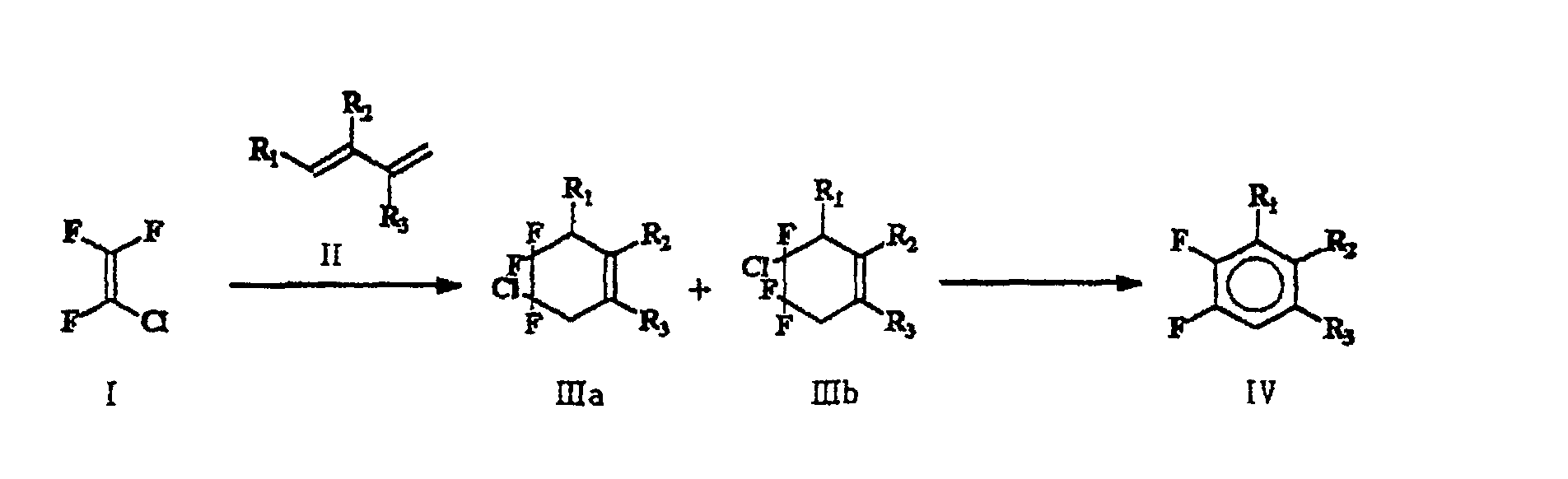
- The method of preparing ortho-difluorobenzene derivatives comprises (a) providing a mixture of cyclohexenes by reacting chlorotrifluoroethylene (CTFE) and 1,3-diene in a flow reactor at temperature range of 390 to 480 °C under atmospheric pressure through continuous vapor phase condensation and distilling the resultant, and (b) dehydrohalogenating the mixture of cyclohexenes with a phase transition catalyst in the presence of alkali metal hydroxide at temperature range of 40 to 150 °C without using any organic solvent.
- In the first step (a) of the method, chlorotrifluoroethylene (CTFE) (I) and 1,3-diene (II) are continuously reacted at the vapor phase in a flow reactor to produce a mixture of cyclohexenes (IIIa) and (IIIb) through condensation and the mixture is distilled. In step (a), the molar ratio of chlorotrifluoroethylene (CTFE) to 1,3-diene is in the range of 1.5:1 to 0.8:1, and the reaction time is in the range of 0.2 to 30 sec, preferably 5 to 15 sec. The reaction temperature is in the range of 390 to 480°C, preferably 420 to 470°C. If the reaction temperature is higher than 480°C, the yield of the mixture of cyclohexenes (IIIa and IIIb) is remarkably decreased because of formation of undesired tars and polymers which give a potential hazard that a flow reactor may be clogged by the polymers. Also, by lowering the reaction temperature, a cost of energy can be reduced as well. The distillate having low boiling point is obtained during distillation of the resultant, and the distillate is recycled into the flow reactor.
- The second step (b) of the method is elimination of halogenated atoms from the mixture of cyclohexenes (IIIa and IIIb). The mixture of cyclohexenes is dehydrohalogenated with a phase transition catalyst in the presence of alkali metal hydroxide at temperature range of 40 to 150 °C without using any organic solvent to prepare ortho-difluorobenzene derivatives (IV). In this invention, the alkali metal hydroxide is preferably potassium hydroxide or sodium hydroxide, and the phase transfer catalyst is preferably 18-crown-6, tetrabutylammonium bromide or benzyltriethylammonium chloride.
- The method of preparing ortho-difluorobenzene derivatives according to the present invention has advantages of providing an energy-saving process by lowering the reaction temperature and of providing a high efficiency process by recycling the distillate having low boiling point which is produced during distillation of the mixture of cyclohexenes, which are superior to the conventional methods for preparation thereof. In addition, the method of the present invention is a simple process, therefore it is a very competitive method of preparing 2-chloro-4,5-difluorobenzoic acid and 2-chloro-4,5-difluorobenzoyl chloride from ortho-difluorobenzene derivatives, which obviates a step of forming vinylfluorocyclobutane as an intermediate.
- The ortho-difluorobenzene derivatives prepared in the above reaction is employed to prepare 2-chloro-4,5-difluorobenzoic acid and 2-chloro-4,5-difluorobenzoyl chloride.
- The method of preparing 2-chloro-4,5-difluorobenzoic acid and 2-chloro-4,5-difluorobenzoyl chloride in accordance with the present invention is represented as follow:wherein Me represents a methyl group.
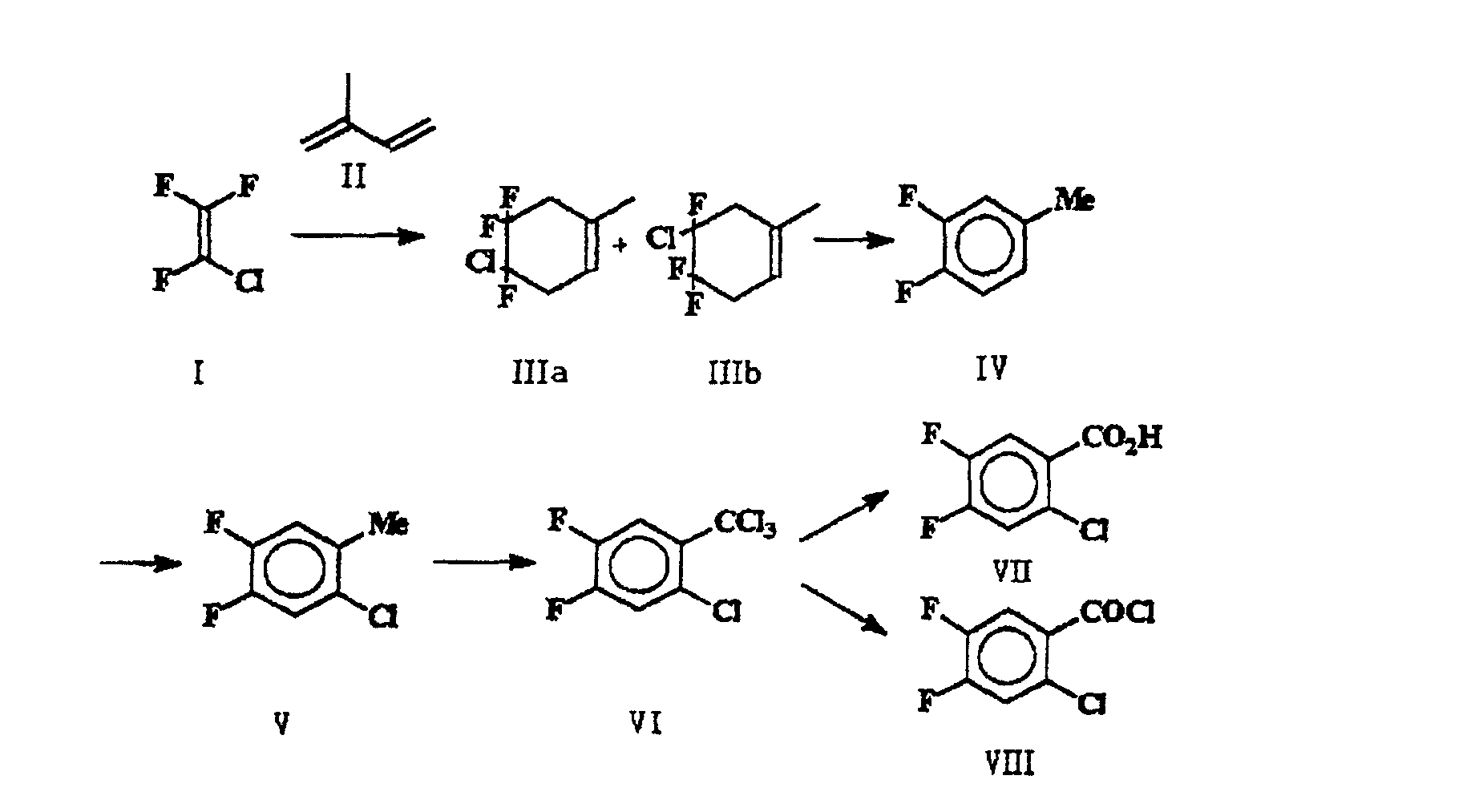
- The present invention also provides a method of preparing 2-chloro-4,5-difluorobenzoic acid, which comprises (a) providing a mixture of 4-chloro-1-methyl-4,5,5-trifluorocyclohexene and 5-chloro-1-methyl-4,4,5-trifluorocyclohexene by reacting chlorotrifluoroethylene (CTFE) and isoprene at temperature range of 390 to 480°C through continuous vapor phase condensation in a flow reactor and distilling the resultant, (b) dehydrohalogenating said mixture in the presence of alkali metal hydroxide and a phase transition catalyst to form 3,4-difluorotoluene, (c) reacting said 3,4-difluorotoluene with chlorine gas in the presence of catalysts consisting of ferro-shaving and ferric chloride at temperature range of -10 to 40°C without using any organic solvent to form 2-chloro-4,5-difluorotoluene, (d) photo-reacting said 2-chloro-4,5-difluorotoluene with chlorine gas under a lighting mercury lamp at temperature range of 80 to 140°C without using any organic solvent to form 2-chloro-4,5-difluorobenzotrichloride, and (e) reacting said 2-chloro-4,5-difluorobenzotrichloride with aqueous acid solution at temperature range of 35 to 80°C without using any organic solvent.
- As shown in the above reaction, a mixture of 4-chloro-1-methyl-4,5,5-trifluorocyclohexene (IIIa) and 5-chloro-1-methyl-4,4,5-trifluorocyclohexene (IIIb) is prepared by reacting chlorotrifluoroethylene (CTFE) (I) and isoprene (II) at temperature range of 390 to 480°C through continuous vapor phase condensation in a flow reactor and distilling the resultant. The mixture is dehydrohalogenated in the presence of alkali metal hydroxide and a phase transition catalyst to form 3,4-difluorotoluene (IV). The 3,4-difluorotoluene is reacted with chlorine gas in the presence of catalysts consisting of ferro-shaving and ferric chloride at temperature range of -10 to 40°C without using any organic solvent to form 2-chloro-4,5-difluorotoluene (V). The 2-chloro-4,5-difluorotoluene is photo-reacted with chlorine gas under a lighting mercury lamp at temperature range of 80 to 140°C without using any organic solvent to form 2-chloro-4,5-difluorobenzotrichloride (VI). The 2-chloro-4,5-difluorobenzotrichloride is reacted with aqueous acid solution at temperature range of 35 to 80°C without using any organic solvent to give 2-chloro-4,5-difluorobenzoic acid (VII). The 2-chloro-4,5-difluorobenzoyl chloride (VIII) according to the present invention is prepared by reacting 2-chloro-4,5-difluorobenzotrichloride (VI) with zinc oxide.
- The distillate having low boiling point, which is obtained during distillation of the mixture of 4-chloro-1-methyl-4,5,5-trifluorocyclohexene (IIIa) and 5-chloro-1-methyl-4,4,5-trifluorocyclohexene (IIIb), may be recycled into the flow reactor.
- The present invention may be better understood by reference to the following examples which are intended for purposes of illustration and are not to be confined in any way limiting the scope of the present invention, which is defined in the claims appended hereto.
- Example 1a: A flow reactor equipped with dual tubes having 30 mm of inner diameter of the outer tube, 16 mm of outer diameter of the inner tube, and 1 m of length of the tubes was employed. The temperature in the reactor was kept at 440 °C. Chlorotrifluoroethylene (CTFE) and isoprene were continuously injected into the flow reactor at the rate of 62.7 g/hr and 38.9 g/hr, respectively, and the vapor phase condensation was carried out for 44 hours. Then, unreacted chlorotrifluoroethylene (CTFE) of 0.42 kg was recovered. The resultant was purified by steam distillation and obtained as 3.10 kg. The resultant was purified by fractional distillation under reduced pressure (70 mmHg) to give 1.77 kg of the desired cyclohexene mixture (IIIa/IIb = 62/34) collected at temperature range of 84 to 88°C, as a colorless liquid. The distillate of 0.84 kg collected at temperature range of 46 to 83 °C was recycled for use in the vapor phase condensation in Example 1b.
- Example 1b: Cyclohexene mixture was prepared in the same manner as in Example 1a except that the distillate collected at temperature range of 46 to 83 °C in Example 1a was recycled. The distillate was continuously injected to the flow reactor at the rate of 22.0 g/hr. The vapor phase condensation was carried out for 38 hours with chlorotrifluoroethylene (CTFE) and isoprene at the same rates as in Example la. Then, unreacted chlorotrifluoroethylene (CTFE) of 0.33 kg was recovered. The resultant was purified by steam distillation and the water layer was removed. The resultant of 3.58 kg was further purified by fractional distillation under reduced pressure (70 mmHg) to give 1.72 kg of the desired cyclohexene mixture (IIIa/IIb = 62/34) collected at temperature range of 84 to 88 °C, as a colorless liquid. And the distillate of 1.04 kg collected at temperature range of 46 to 83 °C was collected.
- 4-chloro-1-methyl-4,5,5-trifluorocyclohexene (IIIa):
- 1H-NMR (CDCl3) δ (ppm) : 1.75(3H), 2.72(2H), 2.97(2H), 5.28(1H)
- 19F-NMR (CDCl3) δ (ppm, CFCl3) : 110.5 & 112.7(2F, 246 Hz), 124.0(1F)
- 5-chloro-1-methyl-4,4,5-trifluorocyclohexene (IIIb):
- 1H-NMR (CDCl3) δ (ppm) : 1.75 (3H), 2.76 (2H), 2.95 (2H), 5.31 (1H)
- 19F-NMR (CDCl3) δ (ppm, CFCl3) : 111.8 & 114.4 (2F, 246 Hz), 122.4(1F)
-
- 4-chloro-1-methyl-4,5,5-trifluorocyclohexene and 5-chloro-1-methyl-4,4,5-trifluorocyclohexene were prepared in the same - manner as in Example 1a except the reaction temperature and the injection rates of chlorotrifluoroethylene (CTFE) and isoprene, which are shown in Table 1. The contents of the cyclohexene mixture are shown in Table 1.
reaction temperature (°C) injection rate of CTFE (g/hr) injection rate of isoprene (g/hr) Amount of the mixture after steam distillation (g/hr) GC purity of (IIIa)+(IIIb) after steam distillation(%) Examples 2 435 63.8 35.8 67.7 62 3 442 65.8 38.9 79.3 57 4 445 65.8 45.3 70.2 63 5 450 65.8 50.6 70.8 65 6 450 65.2 38.1 70.4 60 7 450 67.3 41.0 72.3 62 Comparatives Examples 1 500 65.2 38.1 54.1 54 2 520 51.2 30.0 34.8 44 3 520 65.2 38.1 45.2 52 - Cyclohexene mixtures were prepared in the same manner as in Example 1b except reaction temperature, injection rates of chlorotrifluoroethylene (CTFE) and isoprene, and recycling distillate, which are shown in Table 2. The contents of the cyclohexene mixture are shown in Table 2.
Examples Reaction temperature (°C) Injection rate of CTFE (g/hr) Injection rate of isoprene (g/hr) Injection rate of the recycling fraction(g/hr) Amount of the mixture after steam distillation (g/hr) GC purity of (IIIa)+(IIIb) after steam distillation (%) 8 435 62.7 40.5 30.1 92.2 59 9 440 62.7 41.4 28.3 89.7 60 10 450 62.7 41.6 29.3 90.5 61 11 450 62.7 39.5 19.9 84.2 62 - A flow reactor equipped with dual tubes having 30 mm of inner diameter of the outer tube, 16 mm of outer diameter of the inner tube, and 1 m of length of the tubes was employed. The temperature in the reactor was kept at 450 °C. Chlorotrifluoroethylene (CTFE) and isoprene were continuously injected into the flow reactor at the rate of 71.0 g/hr and 41.2 g/hr, respectively, and the vapor phase condensation was carried out for 1 hour. Then, unreacted chlorotrifluoroethylene (CTFE) of 9.6 g was recovered. The resultant was purified by steam distillation and obtained as 71.2 g of the mixture (GC% = 58%).
Cis + Trans isomers
1H-NMR (CDCl3) δ (ppm) 1.31+1.34(3H), 2.83(2H), 3.15(1H), 5.44(1H), 5.57(1H)
19F-NMR (CDCl3) δ (ppm, CFCl3) :(110.4&116.6)+(108.0&111.2) (2F,244Hz), 132.4+134.2(1F) - A flow reactor equipped with dual tubes having 20 mm of inner diameter of the outer tube, 16 mm of outer diameter of the inner tube, and 60 cm of length of the tubes was employed. The temperature in the reactor was kept at 520 °C. Chlorotrifluoroethylene (CTFE), 1,3-pentadiene and nitrogen gas were continuously injected into the flow reactor at the rates of 36.1 g/hr, 20.4 g/hr, and 0.4 mol/hr, respectively, and the vapor phase condensation was carried out for 1 hour. Then, 4.7 g of unreacted chlorotrifluoroethylene (CTFE) was recovered. The resultant was purified by steam distillation, and then the water layer was removed to give 32.1 g of the mixture (GC% = 52%).
- 4-chloro-4,5,5-trifluorocyclohexene was prepared in the same manner as in Example 12 except that chlorotrifluoroethylene (CTFE) and 1,3-butadiene were continuously injected into the flow reactor at the rates of 65.2 g/hr and 30.3 g/hr, respectively. Then, 8.6 g of unreacted chlorotrifluoroethylene (CTFE) was recovered. The resultant was purified by steam distillation, and then the water layer was removed to give 64.9 g of the mixture (GC% = 61%).
1H-NMR (CDCl3) δ (ppm) 2.82 (2H), 3.18 (2H), 5.65 (2H)
19F-NMR (CDCl3) δ (ppm, CFCl3) : 113.4 (2F), 122.2 (1F) - 4-chloro-4,5,5-trifluorocyclohexene was prepared in the same manner as in Comparative Example 4 except that chlorotrifluoroethylene (CTFE), 1,3-butadiene and nitrogen gas were continuously injected into the flow reactor in the rates of 33.8 g/hr, 15.7 g/hr, and 0.4 mol/hr, respectively. Then, 4.7 g of unreacted chlorotrifluoroethylene (CTFE) was recovered. The resultant was purified by steam distillation, and then the water layer was removed to give 29.4 g of the mixture (GC% = 53%).
- 5-chloro-1,2-dimethyl-4,4,5-trifluorocyclohexene was prepared in the same manner as in Example 12 except that chlorotrifluoroethylene (CTFE) and 1,3-butadiene were continuously injected into the flow reactor at the rates of 65.2 g/hr and 46.0 g/hr, respectively. Then, 8.1 g of unreacted chlorotrifluoroethylene (CTFE) was recovered. The resultant was purified by steam distillation, and then the water layer was removed to give 68.4 g of the mixture (GC% = 57%).
19F-NMR (CDCl3) δ (ppm, CFl3): 111.4&114.5 (2F, 245 Hz), 123.4 (1F) - 5-chloro-1,2-dimethyl-4,4,5-trifluorocyclohexene was prepared in the same manner as in Comparative Example 4 except that chlorotrifluoroethylene (CTFE), 2,3-dimethyl-2,3-butadiene, and nitrogen gas were continuously injected into the flow reactor at the rates of 33.8 g/hr, 23.8 g/hr and 0.4 mol/hr, respectively. Then, 5.8 g of unreacted chlorotrifluoroethylene (CTFE) was recovered. The resultant was purified by steam distillation, and then the water layer was removed to give 29.8 g of the mixture (GC% = 51%).
- To a stirred mixture of 4-chloro-1-methyl-4,5,5-trifluorocyclohexene and 5-chloro-1-methyl-4,4,5-triflurocyclohexene (1.20 kg) prepared in Example 1 was added 42 g of benzyltriethylammonium chloride, and then the reaction mixture was heated to 85 °C followed by slowly adding 2.15 kg of 50% aqueous sodium hydroxide solution over 4.5 hours. The reaction mixture was stirred for an additional 1.5 hours at 90 °C, and then the resultant was purified by steam distillation followed by separating the aqueous layer. The organic layer was dried with 32 g of calcium chloride, and then 0.64 kg of the desired product was collected by fractional distillation at temperature range of 112 °C as a colorless liquid.
1H-NMR (CDCl3) δ (ppm) : 2.30 (3H, s), 6.8-7.1 (3H, m)
19F-NMR (CDCl3) δ (ppm, CFCl3) : 138.7 (1F), 143.0 (1F) - 3,4-difluorotoluene was prepared in the same manner as in Example 15 except alkali metal hydroxide, phase transfer catalyst, and reaction temperature, which are shown in Table 3. The contents of 3,4-difluorotoluene are shown in Table 3.
Examples Alkali metal hydroxide Phase transfer catalyst catalyst Reaction temperature (°C) GC purity after steam distillation (%) 16 50% aq. KOH 18-crown-6 85 80 17 50% aq. KOH Bu4NBr 85 85 18 KOH Et3BnNCl 85 78 19 30% aq. KOH Et3BnNCl 85 50 20 50% aq. KOH Et3BnNCl 60 59 21 50% aq. KOH Et3BnNCl 85 85 - To a stirred solution of 4-chloro-3-methyl-4,5,5-trifluorocyclohexene of 58.6 g prepared in Example 12 was added 2.5 g of benzyltriethylammonium chloride, and then the reaction mixture was heated to 80 °C followed by slowly adding 240 g of 50% aqueous sodium hydroxide solution for 1 hour. The reaction mixture was stirred for additional 3 hours at 80 °C, and then the resultant was purified by steam distillation followed by separating the aqueous layer. The organic layer was dried with calcium chloride, and then 32.3 g of the desired product was collected by fractional distillation as a colorless liquid.
1H-NMR (CDCl3) δ (ppm) 2.32 (3H, s), 6.98 (3H, m)
19F-NMR (CDCl3) δ (ppm, CFCl3) : 139.1 (1F), 142.6 (1F) - To a stirred solution of 4-chloro-4,5,5-trifluorocyclohexene of 24 g prepared in Example 13 was added 1.2 g of benzyltriethylammonium chloride, and then the reaction mixture was heated to 80 °C followed by slowly adding 100 g of 50% aqueous sodium hydroxide solution for 30 min. The reaction mixture was stirred for additional 2 hours at 80 °C, and then the resultant was purified by steam distillation followed by separating the aqueous layer. The organic layer was dried with calcium chloride, and then 12.8 g of the desired product was collected by fractional distillation at temperature of 93 °C as a colorless liquid.
1H-NMR (CDCl3) δ (ppm) : 7.0∼7.2 (4H, m)
19F-NMR (CDCl3) δ (ppm, CFCl3) : 137.5 (2F) - To a stirred solution of 5-chloro-1,2-dimethyl-4,4,5-trifluorocyclohexene of 12.6 g prepared in Example 14 was added 1.0 g of benzyltriethylammonium chloride, and then the reaction mixture was heated to 80 °C followed by slowly adding 40 g of 50% aqueous sodium hydroxide solution for 30 min. The reaction mixture was stirred for additional 2 hours at 80 °C, and then the resultant was purified by steam distillation followed by separating the aqueous layer. The organic layer was dried with calcium chloride, and then 7.3 g of the desired product was collected by fractional distillation at temperature 150 °C as a colorless liquid.
19F-NMR (CDCl3) δ (ppm, CFCl3) : 143.8 (2F) - To 925 g of 3,4-difluorotoluene prepared in Example 15 were added 17 g of shaving steel and 2.5 g of ferric chloride, and then chlorine gas was injected at the rate of 10.0 ℓ/hr for 19 hours, maintaining the temperature between 15 °C. The reaction mixture was washed with 10% aqueous sodium sulfite and water. After drying with 32 g of calcium chloride, the resultant was purified by fractional distillation to give 980 g of the desired product as a colorless liquid, collecting at temperature of 156 °C.
1H-NMR (CDCl3) δ (ppm) : 2.31(3H, s), 7.02(1H, dd), 7.16(1H, dd)
19F-NMR (CDCl3) δ (ppm, CFCl3) : 139.1(1F), 139.9(1F) - To 300 g of 2-chloro-4,5-difluorotoluene prepared in Example 25 was added a flow of chlorine gas at the rate of 4.5 ℓ/hr for 8 hours at 100 °C under a lighting mercury lamp. The rate of chlorine gas was increased to 7.0 ℓ/hr for 10 hours at the inside temperature of 110 °C, and then 5.0 ℓ/hr for another 12 hours followed by purging the excess chlorine with nitrogen to give 472 g of the desired product as a colorless liquid. If necessary, the ultra pure product was obtained by distillation under reduced pressure (10 mmHg), collecting at temperature of 100 °C.
1H-NMR (CDCl3) δ (ppm) 7.40 (1H, dd), 8.09 (1H, dd)
19F-NMR (CDCl3) δ (ppm, CFCl3) : 131.6 (1F), 136.5 (1F) - To 610 g of 85% sulfuric acid was slowly added 150g of the distilled 2-chloro-4,5-difluorobenzotrichloride prepared in Example 26 at room temperature for 2 hours, and then the reaction mixture was stirred for 4 hours. The reaction mixture was stirred at 75 °C for 1 hour, and then poured into an ice water. The resultant was filtered and then air-dried to give 107 g of the desired product as white solid (mp = 103-105 °C).
1H-NMR (CDCl3) δ (ppm) 7.35 (1H, dd), 7.95 (1H, dd), 11.50 (1H)
19F-NMR (CDCl3) δ (ppm, CFCl3) : 126.4 (1F), 137.0 (1F) - To 152 g of 2-chloro-4,5-difluorobenzotrichloride prepared in Example 26 was added 58 g of zinc oxide, and then the reaction mixture was stirred for 3 hours at 100 °C. The desired product of 95 g was obtained by distillation under reduced pressure (5 mmHg), collecting at temperature range of 67 to 69 °C as a colorless liquid.
1H-NMR (CDCl3) δ (ppm) : 7.50 (1H, dd), 8.14 (1H, dd)
19F-NMR (CDCl3) δ (ppm, CFCl3) : 126.5 (1F), 137.0 (1F) - The present invention can be easily carried out by an ordinary skilled person in the art. Many modifications and changes may be deemed to be within the scope of the present invention as defined in the following claims.
Claims (9)
- A method of preparing ortho-difluorobenzene derivatives (IV) according to the following reaction, which comprises:wherein R1, R2 and R3 are independently a hydrogen atom or a lower alkyl group.(a) providing a mixture of cyclohexenes (IIIa and IIIb) by reacting chlorotrifluoroethylene (CTFE) (I) and 1,3-diene (II) in a flow reactor at temperature range of 390 to 480 °C under atmospheric pressure through continuous vapor phase condensation and distilling the resultant; and(b) dehydrohalogenating the mixture of cyclohexenes (IIIa and IIIb) with a phase transition catalyst in the presence of alkali metal hydroxide at temperature range of 40 to 150 °C without using any organic solvent:

- The method as defined in claim 1 wherein the molar ratio of said chlorotrifluoroethylene (CTFE) (I) to 1,3-diene (II) is in the range of 1.5:1 to 0.8:1, and the reaction time is in the range of 0.2 to 30 sec.
- The method as defined in claim 1, wherein said reacting step of chlorotrifluoroethylene (I) and 1,3-diene (II) includes recycling the distillate having low boiling point, which is obtained during distillation of the resultant, into the flow reactor.
- A method of preparing 2-chloro-4,5-difluorobenzoic acid (VII) according to the following reaction, which comprises:wherein Me represents a methyl group.(a) providing a mixture of 4-chloro-1-methyl-4,5,5-trifluorocyclohexene (IIIa) and 5-chloro-1-methyl-4,4,5-trifluorocyclohexene (IIIb) by reacting chlorotrifluoroethylene (CTFE) (I) and isoprene (II) at temperature range of 390 to 480°C through continuous vapor phase condensation in a flow reactor and distilling the resultant;(b) dehydrohalogenating said mixture in the presence of alkali metal hydroxide and a phase transition catalyst to form 3,4-difluorotoluene (IV);(c) reacting said 3,4-difluorotoluene with chlorine gas in the presence of catalysts consisting of ferro-shaving and ferric chloride at temperature range of -10 to 40°C without using any organic solvent to form 2-chloro-4,5-difluorotoluene (V);(d) photo-reacting said 2-chloro-4,5-difluorotoluene with chlorine gas under a lighting mercury lamp at temperature range of 80 to 140°C without using any organic solvent to form 2-chloro-4,5-difluorobenzotrichloride (VI); and(e) reacting said 2-chloro-4,5-difluorobenzotrichloride with aqueous acid solution at temperature range of 35 to 80°C without using any organic solvent:

- The method as defined in claim 4 wherein the molar ratio of said chlorotrifluoroethylene (CTFE) (I) to isoprene (II) is in the range of 1.5:1 to 0.8:1, and the reaction time is in the range of 0.2 to 30 sec.
- The method as defined in claim 4, wherein said reacting step of chlorotrifluoroethylene (CTFE) (I) and isoprene (II) includes recycling the distillate having low boiling point, which is obtained during distillation of the resultant, into the flow reactor.
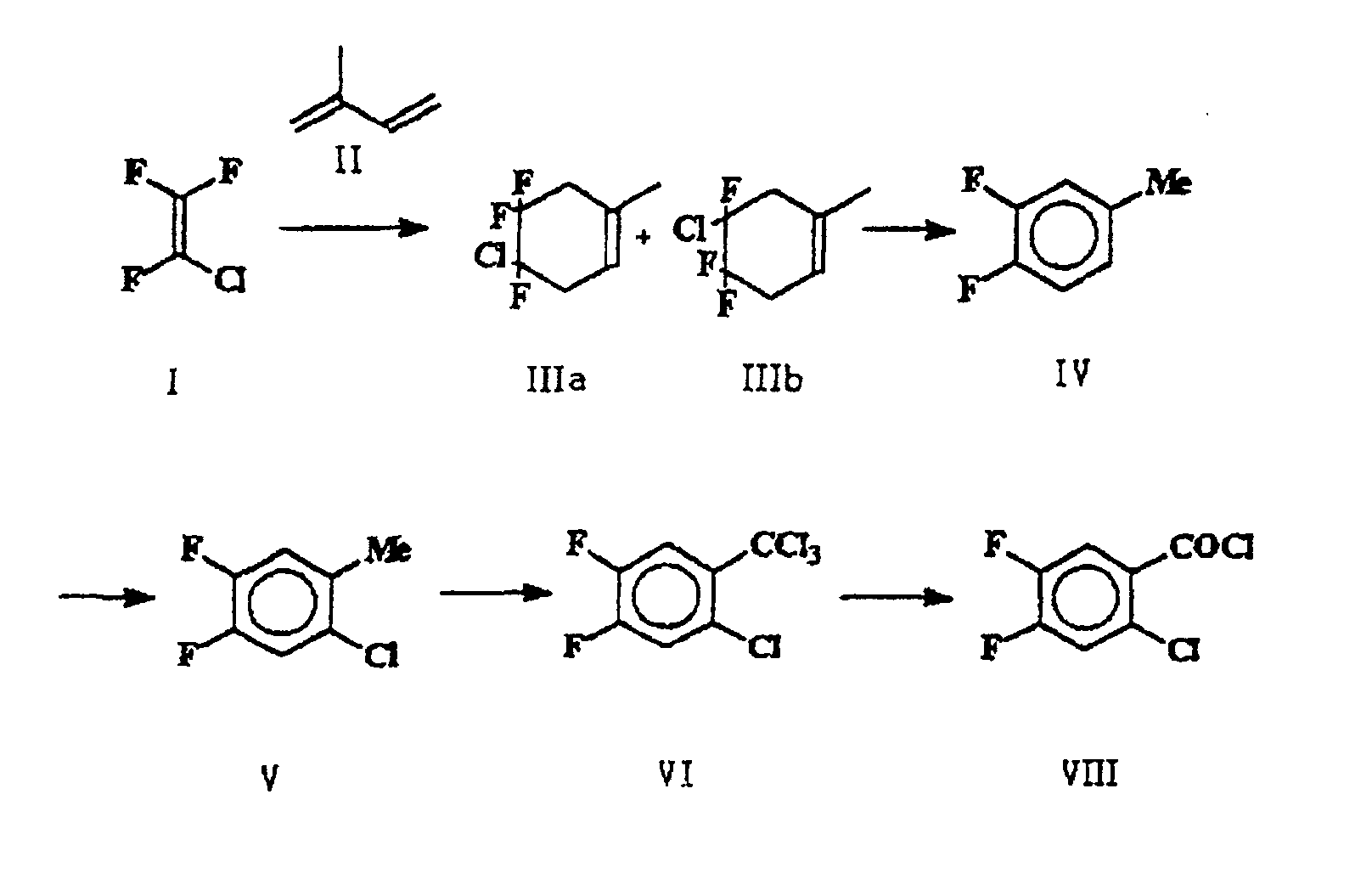
- A method of preparing 2-chloro-4,5-difluorobenzoyl chloride (VIII) according to the following reaction, which comprises:wherein Me represents a methyl group.(a) providing a mixture of 4-chloro-1-methyl-4,5,5-trifluorocyclohexene (IIIa) and 5-chloro-1-methyl-4,4,5-trifluorocyclohexene (IIIb) by reacting chlorotrifluoroethylene (CTFE) (I) and isoprene (II) at temperature range of 390 to 480°C through continuous vapor phase condensation in a flow reactor and distilling the resultant;(b) dehydrohalogenating said mixture in the presence of alkali metal hydroxide and a phase transition catalyst to form 3,4-difluorotoluene (IV);(c) reacting said 3,4-difluorotoluene with chlorine gas in the presence of catalysts consisting of ferro-shaving and ferric chloride at temperature range of -10 to 40°C without using any organic solvent to form 2-chloro-4,5-difluorotoluene (V);(d) photo-reacting said 2-chloro-4,5-difluorotoluene with chlorine gas under a lighting mercury lamp at temperature range of 80 to 140°C without using any organic solvent to form 2-chloro-4,5-difluorobenzotrichloride (VI); and(e) reacting said 2-chloro-4,5-difluorobenzotrichloride with zinc oxide:
- The method as defined in claim 7 wherein the molar ratio of said chlorotrifluoroethylene (CTFE) (I) to isoprene (II) is in the range of 1.5:1 to 0.8:1, and the reaction time is in the range of 0.2 to 30 sec.
- The method as defined in claim 7, wherein said reacting step of chlorotrifluoroethylene (CTFE) (I) and isoprene (II) includes recycling the distillate having low boiling point, which is obtained during distillation of the resultant, into the flow reactor.
Priority Applications (3)
| Application Number | Priority Date | Filing Date | Title |
|---|---|---|---|
| US09/185,171 US6008407A (en) | 1998-11-03 | 1998-11-03 | Method of preparing fluoroaromatic compounds |
| EP99121167A EP1094053B1 (en) | 1998-11-03 | 1999-10-22 | Method of preparing fluoroaromatic compounds |
| DE1999608131 DE69908131T2 (en) | 1999-10-22 | 1999-10-22 | Process for the preparation of fluoroaromatic compounds |
Applications Claiming Priority (2)
| Application Number | Priority Date | Filing Date | Title |
|---|---|---|---|
| US09/185,171 US6008407A (en) | 1998-11-03 | 1998-11-03 | Method of preparing fluoroaromatic compounds |
| EP99121167A EP1094053B1 (en) | 1998-11-03 | 1999-10-22 | Method of preparing fluoroaromatic compounds |
Publications (2)
| Publication Number | Publication Date |
|---|---|
| EP1094053A1 EP1094053A1 (en) | 2001-04-25 |
| EP1094053B1 true EP1094053B1 (en) | 2003-05-21 |
Family
ID=26153154
Family Applications (1)
| Application Number | Title | Priority Date | Filing Date |
|---|---|---|---|
| EP99121167A Expired - Lifetime EP1094053B1 (en) | 1998-11-03 | 1999-10-22 | Method of preparing fluoroaromatic compounds |
Country Status (2)
| Country | Link |
|---|---|
| US (1) | US6008407A (en) |
| EP (1) | EP1094053B1 (en) |
Families Citing this family (3)
| Publication number | Priority date | Publication date | Assignee | Title |
|---|---|---|---|---|
| US6455744B1 (en) | 2001-01-23 | 2002-09-24 | Air Products And Chemicals, Inc. | Synthesis of vicinal difluoro aromatics and intermediates thereof |
| CN115073282A (en) * | 2022-06-08 | 2022-09-20 | 都创(重庆)医药科技有限公司 | Method for rapidly preparing 3-bromo-2, 4-difluorobenzoic acid based on microchannel continuous flow technology |
| CN115322102A (en) * | 2022-08-30 | 2022-11-11 | 老河口华辰化学有限公司 | Synthetic method for producing 2-fluoro-3-nitrobenzoic acid from 2-chloro-3-nitrotoluene |
Family Cites Families (8)
| Publication number | Priority date | Publication date | Assignee | Title |
|---|---|---|---|---|
| US3499942A (en) * | 1966-06-11 | 1970-03-10 | Oleg Matveevich Nefedov | Method of preparing fluoroaromatic compounds |
| US4374266A (en) * | 1980-12-29 | 1983-02-15 | Occidental Chemical Corporation | Ammonium salts of fluorophthalamic acids and method of preparation |
| US4754084A (en) * | 1987-04-01 | 1988-06-28 | E. I. Du Pont De Nemours And Company | Preparation of substituted fluorobenzenes |
| JP2690326B2 (en) * | 1988-07-07 | 1997-12-10 | 帝人株式会社 | Weaving method for fragment loom and special fragment loom |
| US4968830A (en) * | 1989-09-11 | 1990-11-06 | Occidental Chemical Corporation | Aromatization process |
| IE72169B1 (en) * | 1989-11-17 | 1997-03-26 | Asahi Glass Co Ltd | Processes for producing 5-fluorobenzoic acids and their intermediates |
| US5003103A (en) * | 1989-11-20 | 1991-03-26 | Occidental Chemical Corporation | Preparation of 2-choloro-4,5-difluorobenzoic acid from 4,5-difluorophthalic anhydride of 4,5-difluorophthalic acid |
| JP3896482B2 (en) * | 2002-10-07 | 2007-03-22 | 独立行政法人産業技術総合研究所 | Method for producing differentiated cells |
-
1998
- 1998-11-03 US US09/185,171 patent/US6008407A/en not_active Expired - Lifetime
-
1999
- 1999-10-22 EP EP99121167A patent/EP1094053B1/en not_active Expired - Lifetime
Also Published As
| Publication number | Publication date |
|---|---|
| US6008407A (en) | 1999-12-28 |
| EP1094053A1 (en) | 2001-04-25 |
Similar Documents
| Publication | Publication Date | Title |
|---|---|---|
| KR101392030B1 (en) | Method for preparing a halogenocetyl fluoride and the derivatives thereof | |
| JP2001514636A (en) | An improved method for producing cyclopropylacetylene | |
| EP0008532B1 (en) | Synthesis of amines | |
| JP2026062955A (en) | Method for producing chlorosubstituted phenyltrifluoromethyl ketones | |
| JPS6212212B2 (en) | ||
| EP0004636B1 (en) | Process for preparing benzotrifluoride and its derivatives | |
| US6008407A (en) | Method of preparing fluoroaromatic compounds | |
| EP0199646B1 (en) | Process for preparing 6-alkoxy-5-trifluoromethyl-1-naphtoic acids and novel 1-cyano-naphtalene intermediates | |
| GB2219292A (en) | Process of preparing 1,2,2,2-tetrafluoroethyl-difluoromethyl ether | |
| US5654473A (en) | Intermediates for the synthesis of trifluoromethylated organic compounds | |
| JPS6133829B2 (en) | ||
| JP3477532B2 (en) | Method for producing methacrylic acid chloride | |
| JP5000031B2 (en) | Method for producing aromatic-o-dialdehyde compound | |
| US7205440B2 (en) | Method of producing amines | |
| US7268260B2 (en) | Fluorine-containing bisphenols, their preparation, their precursors and intermediates, and use of the fluorine-containing bisphenols | |
| US3467697A (en) | Production of polychlorobenzoic acids | |
| DE69908131T2 (en) | Process for the preparation of fluoroaromatic compounds | |
| KR100288273B1 (en) | Method for producing aromatic fluorine compound | |
| US4647700A (en) | Process for the preparation of meta-chloroanilines | |
| JPH0733340B2 (en) | Method for converting carbonyl group to difluoromethylene group | |
| JP3001626B2 (en) | 2-Chloropropionaldehyde trimer and method for producing the same | |
| JPH0660130B2 (en) | Method for producing 1-bromoethylhydrocarbonyl carbonate | |
| JPH0474340B2 (en) | ||
| JP4357645B2 (en) | Process for producing 1,3-cycloalkadiene | |
| KR810001279B1 (en) | Preparation of meta-aryloxy-benzaldehydes |
Legal Events
| Date | Code | Title | Description |
|---|---|---|---|
| PUAI | Public reference made under article 153(3) epc to a published international application that has entered the european phase |
Free format text: ORIGINAL CODE: 0009012 |
|
| 17P | Request for examination filed |
Effective date: 20000412 |
|
| AK | Designated contracting states |
Kind code of ref document: A1 Designated state(s): DE ES FR GB IT |
|
| AX | Request for extension of the european patent |
Free format text: AL;LT;LV;MK;RO;SI |
|
| AKX | Designation fees paid |
Free format text: DE ES FR GB IT |
|
| GRAH | Despatch of communication of intention to grant a patent |
Free format text: ORIGINAL CODE: EPIDOS IGRA |
|
| GRAH | Despatch of communication of intention to grant a patent |
Free format text: ORIGINAL CODE: EPIDOS IGRA |
|
| RAP1 | Party data changed (applicant data changed or rights of an application transferred) |
Owner name: SAMSUNG GENERAL CHEMICALS CO., LTD. Owner name: ZELINSKY INSTITUTE OF ORGANIC CHEMISTRY |
|
| GRAH | Despatch of communication of intention to grant a patent |
Free format text: ORIGINAL CODE: EPIDOS IGRA |
|
| GRAA | (expected) grant |
Free format text: ORIGINAL CODE: 0009210 |
|
| AK | Designated contracting states |
Designated state(s): DE ES FR GB IT |
|
| REG | Reference to a national code |
Ref country code: GB Ref legal event code: FG4D |
|
| REF | Corresponds to: |
Ref document number: 69908131 Country of ref document: DE Date of ref document: 20030626 Kind code of ref document: P |
|
| PGFP | Annual fee paid to national office [announced via postgrant information from national office to epo] |
Ref country code: ES Payment date: 20031128 Year of fee payment: 5 |
|
| RAP2 | Party data changed (patent owner data changed or rights of a patent transferred) |
Owner name: SAMSUNG ATOFINA CO., LTD. Owner name: ZELINSKY INSTITUTE OF ORGANIC CHEMISTRY |
|
| ET | Fr: translation filed | ||
| REG | Reference to a national code |
Ref country code: GB Ref legal event code: 732E |
|
| PLBE | No opposition filed within time limit |
Free format text: ORIGINAL CODE: 0009261 |
|
| STAA | Information on the status of an ep patent application or granted ep patent |
Free format text: STATUS: NO OPPOSITION FILED WITHIN TIME LIMIT |
|
| 26N | No opposition filed |
Effective date: 20040224 |
|
| REG | Reference to a national code |
Ref country code: FR Ref legal event code: TQ |
|
| PG25 | Lapsed in a contracting state [announced via postgrant information from national office to epo] |
Ref country code: ES Free format text: LAPSE BECAUSE OF NON-PAYMENT OF DUE FEES Effective date: 20041031 |
|
| REG | Reference to a national code |
Ref country code: DE Ref legal event code: R082 Ref document number: 69908131 Country of ref document: DE Representative=s name: GRUENECKER PATENT- UND RECHTSANWAELTE PARTG MB, DE Effective date: 20140522 Ref country code: DE Ref legal event code: R082 Ref document number: 69908131 Country of ref document: DE Representative=s name: GRUENECKER, KINKELDEY, STOCKMAIR & SCHWANHAEUS, DE Effective date: 20140522 Ref country code: DE Ref legal event code: R081 Ref document number: 69908131 Country of ref document: DE Owner name: HANWHA TOTAL PETROCHEMICAL CO., LTD., SEOSAN-S, KR Free format text: FORMER OWNERS: ZELINSKY INSTITUTE OF ORGANIC CHEMISTRY, MOSKAU/MOSKVA, RU; SAMSUNG ATOFINA CO.,LTD., SEOSAN, CHUNGNAM, KR Effective date: 20140522 Ref country code: DE Ref legal event code: R081 Ref document number: 69908131 Country of ref document: DE Owner name: SAMSUNG TOTAL PETROCHEMICALS CO., LTD., SEOSAN, KR Free format text: FORMER OWNERS: ZELINSKY INSTITUTE OF ORGANIC CHEMISTRY, MOSKAU/MOSKVA, RU; SAMSUNG ATOFINA CO.,LTD., SEOSAN, CHUNGNAM, KR Effective date: 20140522 Ref country code: DE Ref legal event code: R081 Ref document number: 69908131 Country of ref document: DE Owner name: ZELINSKY INSTITUTE OF ORGANIC CHEMISTRY, RU Free format text: FORMER OWNERS: ZELINSKY INSTITUTE OF ORGANIC CHEMISTRY, MOSKAU/MOSKVA, RU; SAMSUNG ATOFINA CO.,LTD., SEOSAN, CHUNGNAM, KR Effective date: 20140522 Ref country code: DE Ref legal event code: R081 Ref document number: 69908131 Country of ref document: DE Owner name: SAMSUNG TOTAL PETROCHEMICALS CO., LTD., SEOSAN, KR Free format text: FORMER OWNER: ZELINSKY INSTITUTE OF ORGANIC C, SAMSUNG ATOFINA CO.,LTD., , KR Effective date: 20140522 Ref country code: DE Ref legal event code: R081 Ref document number: 69908131 Country of ref document: DE Owner name: ZELINSKY INSTITUTE OF ORGANIC CHEMISTRY, RU Free format text: FORMER OWNER: ZELINSKY INSTITUTE OF ORGANIC C, SAMSUNG ATOFINA CO.,LTD., , KR Effective date: 20140522 Ref country code: DE Ref legal event code: R081 Ref document number: 69908131 Country of ref document: DE Owner name: SAMSUNG TOTAL PETROCHEMICALS CO., LTD., KR Free format text: FORMER OWNER: ZELINSKY INSTITUTE OF ORGANIC C, SAMSUNG ATOFINA CO.,LTD., , KR Effective date: 20140522 |
|
| REG | Reference to a national code |
Ref country code: FR Ref legal event code: CD Owner name: SAMSUNG TOTAL PETROCHEMICALS CO., LTD., KR Effective date: 20140602 Ref country code: FR Ref legal event code: CD Owner name: ZELINSKY INSTITUTE OF ORGANIC CHEMISTRY, RU Effective date: 20140602 Ref country code: FR Ref legal event code: CA Effective date: 20140602 |
|
| REG | Reference to a national code |
Ref country code: FR Ref legal event code: PLFP Year of fee payment: 17 |
|
| REG | Reference to a national code |
Ref country code: DE Ref legal event code: R082 Ref document number: 69908131 Country of ref document: DE Representative=s name: GRUENECKER PATENT- UND RECHTSANWAELTE PARTG MB, DE Ref country code: DE Ref legal event code: R081 Ref document number: 69908131 Country of ref document: DE Owner name: ZELINSKY INSTITUTE OF ORGANIC CHEMISTRY, RU Free format text: FORMER OWNERS: SAMSUNG TOTAL PETROCHEMICALS CO., LTD., SEOSAN-SI, CHUNGNAM, KR; ZELINSKY INSTITUTE OF ORGANIC CHEMISTRY, MOSKAU/MOSKVA, RU Ref country code: DE Ref legal event code: R081 Ref document number: 69908131 Country of ref document: DE Owner name: HANWHA TOTAL PETROCHEMICAL CO., LTD., SEOSAN-S, KR Free format text: FORMER OWNERS: SAMSUNG TOTAL PETROCHEMICALS CO., LTD., SEOSAN-SI, CHUNGNAM, KR; ZELINSKY INSTITUTE OF ORGANIC CHEMISTRY, MOSKAU/MOSKVA, RU |
|
| REG | Reference to a national code |
Ref country code: FR Ref legal event code: CD Owner name: ZELINSKY INSTITUTE OF ORGANIC CHEMISTRY, RU Effective date: 20151217 Ref country code: FR Ref legal event code: CD Owner name: HANWHA TOTAL PETROCHEMICAL CO., LTD., KR Effective date: 20151217 |
|
| REG | Reference to a national code |
Ref country code: FR Ref legal event code: PLFP Year of fee payment: 18 |
|
| REG | Reference to a national code |
Ref country code: FR Ref legal event code: PLFP Year of fee payment: 19 |
|
| REG | Reference to a national code |
Ref country code: FR Ref legal event code: PLFP Year of fee payment: 20 |
|
| PGFP | Annual fee paid to national office [announced via postgrant information from national office to epo] |
Ref country code: FR Payment date: 20180910 Year of fee payment: 20 |
|
| PGFP | Annual fee paid to national office [announced via postgrant information from national office to epo] |
Ref country code: GB Payment date: 20180906 Year of fee payment: 20 |
|
| PGFP | Annual fee paid to national office [announced via postgrant information from national office to epo] |
Ref country code: DE Payment date: 20180905 Year of fee payment: 20 |
|
| PGFP | Annual fee paid to national office [announced via postgrant information from national office to epo] |
Ref country code: IT Payment date: 20181011 Year of fee payment: 20 |
|
| REG | Reference to a national code |
Ref country code: DE Ref legal event code: R071 Ref document number: 69908131 Country of ref document: DE |
|
| REG | Reference to a national code |
Ref country code: GB Ref legal event code: PE20 Expiry date: 20191021 |
|
| PG25 | Lapsed in a contracting state [announced via postgrant information from national office to epo] |
Ref country code: GB Free format text: LAPSE BECAUSE OF EXPIRATION OF PROTECTION Effective date: 20191021 |