EP1093906A2 - Stretched film having independent voids and method for producing the same - Google Patents
Stretched film having independent voids and method for producing the same Download PDFInfo
- Publication number
- EP1093906A2 EP1093906A2 EP00121058A EP00121058A EP1093906A2 EP 1093906 A2 EP1093906 A2 EP 1093906A2 EP 00121058 A EP00121058 A EP 00121058A EP 00121058 A EP00121058 A EP 00121058A EP 1093906 A2 EP1093906 A2 EP 1093906A2
- Authority
- EP
- European Patent Office
- Prior art keywords
- stretched film
- film
- stretched
- thickness
- independent voids
- Prior art date
- Legal status (The legal status is an assumption and is not a legal conclusion. Google has not performed a legal analysis and makes no representation as to the accuracy of the status listed.)
- Withdrawn
Links
Images
Classifications
-
- B—PERFORMING OPERATIONS; TRANSPORTING
- B29—WORKING OF PLASTICS; WORKING OF SUBSTANCES IN A PLASTIC STATE IN GENERAL
- B29C—SHAPING OR JOINING OF PLASTICS; SHAPING OF MATERIAL IN A PLASTIC STATE, NOT OTHERWISE PROVIDED FOR; AFTER-TREATMENT OF THE SHAPED PRODUCTS, e.g. REPAIRING
- B29C44/00—Shaping by internal pressure generated in the material, e.g. swelling or foaming ; Producing porous or cellular expanded plastics articles
- B29C44/34—Auxiliary operations
- B29C44/3469—Cell or pore nucleation
-
- B—PERFORMING OPERATIONS; TRANSPORTING
- B29—WORKING OF PLASTICS; WORKING OF SUBSTANCES IN A PLASTIC STATE IN GENERAL
- B29C—SHAPING OR JOINING OF PLASTICS; SHAPING OF MATERIAL IN A PLASTIC STATE, NOT OTHERWISE PROVIDED FOR; AFTER-TREATMENT OF THE SHAPED PRODUCTS, e.g. REPAIRING
- B29C55/00—Shaping by stretching, e.g. drawing through a die; Apparatus therefor
- B29C55/005—Shaping by stretching, e.g. drawing through a die; Apparatus therefor characterised by the choice of materials
-
- B—PERFORMING OPERATIONS; TRANSPORTING
- B29—WORKING OF PLASTICS; WORKING OF SUBSTANCES IN A PLASTIC STATE IN GENERAL
- B29K—INDEXING SCHEME ASSOCIATED WITH SUBCLASSES B29B, B29C OR B29D, RELATING TO MOULDING MATERIALS OR TO MATERIALS FOR MOULDS, REINFORCEMENTS, FILLERS OR PREFORMED PARTS, e.g. INSERTS
- B29K2105/00—Condition, form or state of moulded material or of the material to be shaped
- B29K2105/04—Condition, form or state of moulded material or of the material to be shaped cellular or porous
-
- Y—GENERAL TAGGING OF NEW TECHNOLOGICAL DEVELOPMENTS; GENERAL TAGGING OF CROSS-SECTIONAL TECHNOLOGIES SPANNING OVER SEVERAL SECTIONS OF THE IPC; TECHNICAL SUBJECTS COVERED BY FORMER USPC CROSS-REFERENCE ART COLLECTIONS [XRACs] AND DIGESTS
- Y10—TECHNICAL SUBJECTS COVERED BY FORMER USPC
- Y10T—TECHNICAL SUBJECTS COVERED BY FORMER US CLASSIFICATION
- Y10T428/00—Stock material or miscellaneous articles
- Y10T428/24—Structurally defined web or sheet [e.g., overall dimension, etc.]
- Y10T428/24273—Structurally defined web or sheet [e.g., overall dimension, etc.] including aperture
Definitions
- This invention relates to a novel, stretched film having independent voids, and a method for producing the same, more particularly a stretched film having independent voids, useful for various areas which need light and strong films, e.g., exterior sheets for covering wall materials, various wrapping materials, cushion sheets, trays and electronic device parts, and method for producing the same.
- a stretched film having independent voids useful for various areas which need light and strong films, e.g., exterior sheets for covering wall materials, various wrapping materials, cushion sheets, trays and electronic device parts, and method for producing the same.
- Stretched films have been generally used in a variety of areas, e.g., wrapping films for foods, photographic base films, films for drawings, magnetic disks, magnetic tapes, flexible liquid-crystal panel boards, flexible printed circuit boards, labels, electrically insulating films for various purposes, films for condensers, surface sheets for various switches and other industrial purposes, and base films for various types of printed matter.
- Biaxially stretched films in particular, have been used for various industrial purposes, e.g., photographic films, magnetic recording media, wrapping materials, agricultural purposes, construction materials, photographic purposes and sheets for drawings, because of their excellent mechanical properties, resistance to heat, electric properties and resistance to chemicals.
- stretched films undergo post-treatment. They are coated with a varying functional material, extrusion-laminated or printed, to have a film of varying functional material thereon.
- a wrapping film is laminated with a heat-sealing layer or printed film
- photographic base film is coated with two or more photosensitive layers of different color
- magnetic disks and tapes are coated with a magnetic recording material
- flexible liquid-crystal panel board is coated with a transparent, electroconductive layer by evaporation
- flexible printed circuit board is laminated with copper foil or coated with a metal by evaporation.
- a label is printed by screen or jet printing, condenser film is generally coated with aluminum by evaporation, surface sheets for various switches are screen-printed with various printing inks, and base film for printed matter is offset-printed with a varying ink.
- the film for the above purposes is required to be light while having an adequate strength, in any case.
- the stretched films having voids inside are proposed to have opaque, pearly luster or substitutes for paper.
- Japanese Patent Application Laid-Open No.60-37793 discloses a film-stretching method for producing voids therein and thereby making the film opaque.
- Japanese Patent Application Laid-Open No.5-339408 discloses a method for producing a polyester-based film having a number of fine voids by at least monoaxially orienting the film of polyester incorporated with a thermoplastic resin incompatible with the polyester.
- these techniques fall to improve mechanical properties of the films, merely making them opaque or improving their outer appearances by providing voids therein.
- Japanese Patent Application Laid-Open No.8-72058 discloses a method for recycling plastic materials using supercritical water.
- National Publication of Translation No.6-511278 discloses a method for removing residual additives from elastomer products using a supercritical fluid.
- Japanese Patent Application Laid-Open No.8-181050 discloses a method which uses supercritical carbon dioxide gas to remove a resist used for lithography.
- Japanese Patent Application Laid-Open No.8-197021 discloses an apparatus which uses a supercritical fluid to wash fine devices, e.g., semiconductor devices and liquid-crystal displays.
- a stretched film has greatly improved mechanical properties (in particular, bending-related properties) and, at the same time, is made lighter, when it is so structured as to have independent voids of adequate size therein, formed by the flaky layers which keep characteristics of the as-stretched film, i.e., molecular orientation, reaching the present invention.
- the present invention provides the stretched film characterized in that it is treated, after being stretched, to contain independent voids formed by the flaky layers which keep characteristics of the as-stretched film.
- the independent voids are 10 to 500 ⁇ m thick on the two-dimensional plane, i.e., in the stretching direction and direction perpendicular thereto, and 1 to 250 ⁇ m thick in the thickness direction, the flaky layers which form the independent voids are 1 to 250 ⁇ m thick, and the film as a whole is 5 to 2000 ⁇ m thick.
- thickness of the independent voids is 5 to 50% of total film thickness on the two-dimensional plane, i.e., in the stretching direction and direction perpendicular thereto, and 1 to 20% in the thickness direction, thickness of the flaky layers which form the independent voids is 0.5 to 10%, and the film as a whole is 5 to 2000 ⁇ m thick.
- the stretched film has particularly improved mechanical strength, when coated with surface layers on both sides, thickness of each surface layer being 5 to 20% of the total thickness.
- the stretched film of the present invention has a bending load strength at least 1.5 times higher than that of the film before it is treated to have the independent voids.
- the present invention also provides a method for forming the stretched film described above, where the as-stretched film is impregnated with supercritical carbon dioxide gas and then expanded to form the independent voids.
- the excellent independent voids can be formed by keeping treatment temperature at glass transition point of the film or higher but at its melting point or lower, while the as-stretched film is impregnated with supercritical carbon dioxide gas and/or expanded.
- the film is amorphous; on the other hand, especially excellent independent voids can be formed by restricting the perimeters of the film while it is impregnated with supercritical carbon dioxide gas and expanded.
- the stretched film of the present invention containing independent voids, is characterized in that it is treated, after being stretched, to form therein these voids by the flaky layers which keep characteristics of the as-stretched film.
- Such a stretched film has much more favorable mechanical characteristics, in particular bending-related characteristics, than the as-stretched one, and is made lighter and provided with insulating and cushion characteristics. This conceivably results from a honeycomb core type structure formed by the flaky layers which keep the mechanical strength characteristic of the as-stretched film.
- Widely varying polymeric resins can be used for the stretched film of the present invention. These include polyolefin-based resins, polyester-based resins, polystyrene-based resins, ABS resins (alloyed resins of acrylonitrile, butadiene and styrene), polycarbonate-based resins, polyamide-based resins, acrylic resins, vinyl ester-based resins, polysulfone-based resins, cellulosic resins, polylactone-based resins, silicone-based resins, and alloys of two or more types of the above resins. Of these, those having a strongly polar group can suitably have independent voids therein, because of the synergistic effects with polarity of carbon dioxide gas.
- polyester-based resins e.g., polyethylene terephthalate and polyethylene naphthalate
- polystyrene-based resins homopolymer or copolymer
- polyamide-based resins e.g., nylon 6, 66, 612, 11 and 12
- the film for the present invention may be stretched monoaxially or biaxially, the latter being more preferable, because the independent voids can be formed more easily with the flaky layers which keep characteristics of the as-stretched film serving as the void walls, to provide notable improvements of the film characteristics.
- the monoaxially stretched film is fairly fibrous, and more easily broken while the independent voids are being formed. It may not have sufficiently high mechanical strength, because of difficulty in forming the independent voids.
- the biaxially stretched film having an adequate degree of crystallinity will have the independent voids excellent in mechanical, chemical and electrical characteristics, coming from its crystallinity.
- Degree of crystallinity of the as-stretched film is an important factor in formation of the adequate independent voids. Insufficient crystallinity will retard formation of the independent voids, helping delamination to occur. Excessive crystallinity will also retard formation of the independent voids under moderate conditions.
- polyester in particular, makes a film of favorable characteristics (e.g., resistance to chemicals and heat) and good independent voids, when biaxially stretched. It is preferable to fully consider the effects of degree of crystallinity also for the biaxially stretched polyester film.
- the literature values of ⁇ a and ⁇ c , 1.455 and 1.335 g/cc, are used in this specification.
- a biaxially stretched amorphous film can easily make the film of the present invention having the independent voids. Whether the good independent voids are formed or not depends on biaxial stretching ratio and stretching orientation.
- the stretched film is preferably well balanced in orientation in both directions.
- the polystyrene film in particular can easily have good independent voids, making it a useful inexpensive material for various purposes, e.g., wrapping materials, containers and fillers.
- polyesters e.g., polyethylene terephthalate and polyethylene naphthalate
- polystyrenes make particularly preferable films, when biaxially stretched.
- Total thickness of the stretched film of the present invention containing the independent voids is normally in a range from 1 to 2000 ⁇ m, although varying depending on purposes for which it is used, preferably from 5 to 2000 ⁇ m, more preferably from 20 to 1000 ⁇ m or so.
- the independent void size and thickness of the flaky layers serving as the walls therefor at adequate levels, in addition to preventing delamination and securing independent voids.
- the independent voids are preferably 10 to 500 ⁇ m thick on the two-dimensional plane, i.e., in the stretching direction and direction perpendicular thereto, more preferably 30 to 300 ⁇ m and most preferably 50 to 200 ⁇ m thick, and 1 to 250 ⁇ m thick in the thickness direction, more preferably 10 to 150 ⁇ m and most preferably 20 to 100 ⁇ m thick.
- the film may not have sufficiently improved mechanical properties (e.g., bending load strength) as compared with the as-stretched film.
- mechanical properties (e.g., bending load strength) of the film may be inferior to those of the as-stretched film.
- the flaky layers which form the independent voids are preferably 1 to 250 ⁇ m thick, more preferably 10 to 150 ⁇ m and most preferably 20 to 100 ⁇ m thick.
- flaky layers are thinner than the above, improvement of mechanical properties of the film having the independent voids tends to be insufficient.
- the independent voids of adequate size may not be formed.
- Relative thickness of the independent voids and flaky layers which form the independent voids to the total film thickness may be more important than their absolute levels.
- thickness of the independent voids is 5 to 50% (more preferably 10 to 30% or so) of total film thickness on the two-dimensional plane, i.e., in the stretching direction and direction perpendicular thereto, and 1 to 20% (more preferably 5 to 15%) in the thickness direction, and thickness of the flaky layers is 0.5 to 10% (more preferably 1 to 7% or so), and the film as a whole is 5 to 2000 ⁇ m thick (more preferably 20 to 1000 ⁇ m thick).
- the stretched film of the present invention has particularly improved mechanical strength, when coated with surface layers (free of the independent voids) on both sides, thickness of each surface layer being 5 to 20% of the total thickness. When coated with these layers, the film will have still improved mechanical properties and shows film-like appearances.
- the stretched film of the present invention containing the independent voids, preferably has at least a 1.5 times (e.g., 1.5 to 10 times or so) higher bending load strength than the as-stretched film, more preferably at least 1.8 times (e.g., 1.8 to 10 times or so) higher.
- the stretched film of the present invention containing the independent voids, may be obtained by impregnating the as-stretched film and expanding the film to form the independent voids therein.
- the as-stretched film as the stock for the film of the present invention is normally 1 to 500 ⁇ m thick or so. It is 10 to 100 ⁇ m thick or so for a wrapping film, around 100 ⁇ m thick for a photographic base film, 50 to 100 ⁇ m thick or so for a magnetic disk, 1 to 10 ⁇ m thick or so for a magnetic tape, around 100 ⁇ m thick for a flexible liquid-crystal panel board, 1 to 300 ⁇ m thick or so for a label, 10 to 100 ⁇ m thick or so for a flexible printed circuit board, 1 to 10 ⁇ m thick or so for a condenser film, 10 to 200 ⁇ m thick or so for a surface sheet for various switches, and 10 to 100 ⁇ m thick or so for a base film for various types of printed matter.
- the as-stretched film is at least doubled in thickness, when treated to contain the independent voids by the method of the present invention. Therefore, it is recommended to use the as-stretched film having a thickness 50% or less of a desired thickness of the final film.
- Carbon dioxide (CO 2 ) has a critical temperature of 31°C and critical pressure of 72.8 atms (7.38 MPa), and supercritical carbon dioxide gas is at or above the critical temperature and pressure.
- the as-stretched film may be impregnated with supercritical carbon dioxide gas by various methods.
- the as-stretched film sheets may be put batchwise in a supercritical container filled with supercritical carbon dioxide gas, or the as-stretched film may be continuously charged in a supercritical carbon, dioxide zone to be treated there.
- Japanese Patent Application Laid-Open No.4-268344 discloses the latter approach, where the roll-shaped film is continuously supplied to a supercritical or subsupercritical carbon dioxide gas zone, formed by oil seal.
- the film is amorphous, to immerse the as-stretched film in supercritical carbon dioxide gas at glass transition point of the film or higher or at its melting point or lower, while restricting the perimeters of the film to prevent its shrinkage.
- the independent bubbles are produced more efficiently as pressure at which the as-stretched film is immersed increases.
- the preferable pressure level will be 100 to 400 atms or so, in consideration of operability and investment cost.
- the as-stretched film is expanded by evaporating carbon dioxide gas, e.g., by releasing pressure.
- Temperature at which the film is expanded is glass transition point of the film or higher or its melting point or lower. However, it is preferably glass transition point of the film or higher but its melting point or lower, in order to efficiently produce the good independent voids in the film. It is also preferable to expand the film, when it is amorphous, at glass transition point of the film or higher but at its melting point or lower, while restricting (or fixing) the perimeters of the film to prevent its shrinkage.
- Pressure at which the film is expanded is not limited, but preferably normal pressure in consideration of, e.g., operability and workability.
- containing the independent voids, size of the independent voids, thickness of the flaky layers forming the independent voids and thickness of the surface layer can be adjusted by adequately selecting temperature and pressure at which the film is impregnated with supercritical carbon dioxide gas, time for which it is impregnated with the supercritical fluid, and temperature and pressure at which it is expanded.
- Carbon dioxide gas released from the film surface during the film expansion step is preferably recovered to prevent global warming. It can be recovered by a supercritical fluid recovering apparatus disclosed by Japanese Patent Application Laid-Open No.8-197021. This apparatus can securely prevent release of carbon dioxide gas into the atmosphere. Recovered carbon dioxide gas can be easily recycled into the supercritical or subsupercritical fluid.
- the method of the present invention efficiently produces the independent voids in the stretched film, where the walls of these voids are formed by the flaky layers which keep characteristics of the as-stretched film. Therefore, the stretched film containing these voids has much improved mechanical properties (e.g., bending strength) and a much lower apparent density (and hence is much lighter) than the as-stretched film. At the same time, it has improved insulating characteristics, because of the voids being filled with carbon dioxide.
- the so-called expansion ratio is roughly 3, although varying depending on stock type and expansion conditions, reducing the original thermal conductivity to one-thirds or less.
- the independent voids greatly improve cushion characteristics of the film, even when it is 2 mm thick or thinner, with the result that the film, when used for wrapping materials or containers, should have greatly improved function of protecting the content, and also improve electrical properties (e.g., electrical insulation characteristics) of the film.
- PET polyethylene terephthalate
- the stretched film thus prepared was bending-tested to have the load-displacement curve, by which its bending load strength was determined. The results are given in Table 1.
- the bending load strength (N) is defined as the stress at a displacement rate of 10 mm/min and displacement of 8 mm.
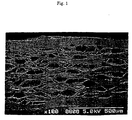
- the section, i.e., plane perpendicular to the surface, of the stretched film was observed by a scanning electron microscope (SEM).
- Figure 1 presents the SEM photograph, showing its sectional structure.
- the stretched film showed no delamination, contained the independent voids approximately 100 ⁇ m thick on the two-dimensional plane and 50 ⁇ m thick in the thickness direction, and was coated with approximately 80 ⁇ m thick surface layers on both sides. Its total thickness was confirmed to increase from 250 ⁇ m to approximately 650 ⁇ m by the CO 2 treatment. It was also confirmed that the stretched film had a drastically increased bending load strength, 5 times higher than that of the sample prepared by COMPARATIVE EXAMPLE described later.
- a biaxially stretched polystyrene (OPS) film (thickness: 210 ⁇ m, Daicel Kagaku Kogyo) was immersed in supercritical carbon dioxide gas under the conditions shown in Table 1, and, then withdrawn to release carbon dioxide into the atmosphere (EXAMPLES 4-A and 4-B). The perimeters of each of these films were fixed, while it was immersed in supercritical carbon dioxide and carbon dioxide was released into the atmosphere.
- the polystyrene had a glass transition point of approximately 100°C.
- a biaxially stretched polyethylene terephthalate film (thickness: 250 ⁇ m, Toray, degree of crystallization: 54%) was immersed in supercritical carbon dioxide gas under the conditions shown in Table 1, and then withdrawn to release carbon dioxide into the atmosphere (EXAMPLES 5-A and 5-B).
- Biaxially stretched polyethylene terephthalate film [thickness: 125 ⁇ m for EXAMPLE 6-A and 75 ⁇ m for EXAMPLE 6-B, Toray, degree of crystallization: approximately 48% for both] were immersed in supercritical carbon dioxide gas under the conditions shown in Table 1, and then withdrawn to release carbon dioxide into the atmosphere (EXAMPLES 6-A and 6-B).
- Each of the stretched films prepared by EXAMPLES 6-A and 6-B showed no delamination, and contained the independent voids having a thickness approximately 15% of total film thickness on the two-dimensional plane and 8% in the thickness direction. Each was coated with surface layers on both sides, where thickness of each surface layer was approximately 12% of the total thickness.
- the stretched film of the present invention containing the independent voids formed by the flaky layers which keep characteristics of the as-stretched film, can be made lighter without deteriorating the mechanical strength characteristic of the as-stretched film. It has a much higher bending strength, and improved insulation and cushion characteristics than the as-stretched one, and hence can going into various industrial areas as the novel, light and strong material. In addition to the improved characteristics, its thickness is also increased, which makes the stretched film still lighter depending on purposes for which it is used.
Landscapes
- Engineering & Computer Science (AREA)
- Mechanical Engineering (AREA)
- Manufacture Of Porous Articles, And Recovery And Treatment Of Waste Products (AREA)
Abstract
Description
| Films | Immersion conditions | CO2 releasing conditions | Bending load strength | ||
| EXAMPLE 1 | PET | 140°C, 20.2MPa, for 4min. | Allowed to stand at room temperature | 5.89N | |
| COMPARATIVE EXAMPLE 1 | PET | - | - | 1.18N | |
| EXAMPLE 2-A | PET | 120°C, 20.2MPa, for 30min. | Allowed to stand at room temperature | 27.5N | |
| EXAMPLE 2- | PET | 100°C, 20.2MPa, for 120min. | Allowed to stand at room temperature | 24.7N | |
| EXAMPLE 3-A | PET | 120°C, 20.2MPa, for 30min. | 120°C for 5 min. | 37.3N | |
| EXAMPLE 3- | PET | 100°C, 20.2MPa, for 120min. | 100°C for 5 min. | 28.4N | |
| COMPARATIVE EXAMPLE 2-A | PET | 60°C, 20.2MPa, for 30min. | 60°C for 5 min. | 11.8N | |
| COMPARATIVE EXAMPLE 2-B | PET | 40°C, 30.3MPa, for 120min. | Allowed to stand at room temperature | 11.7N | |
| EXAMPLE 4-A | OPS | 105°C, 20.2MPa, for 2min. | Allowed to stand at room temperature | 34.3N | |
| EXAMPLE 4-B | OPS | 110°C, 20.2MPa, for 1min. | Allowed to stand at room temperature | 37.3N | |
| COMPARATIVE EXAMPLE 3 | OPS | - | - | 15.7N | |
| EXAMPLE 5-A | PET | 120°C, 20.2MPa, for 30min. | Allowed to stand at room temperature | 20.6N | |
| EXAMPLE 5-B | PET | 140°C, 20.2MPa, for 4min. | Allowed to stand at room temperature | 23.7N | |
| COMPARATIVE EXAMPLE 4 | PET | - | - | 10.8N | |
| EXAMPLE 6-A | PET | 140°C, 20.2MPa, for 4min. | Allowed to stand at room temperature | 4.12N | |
| COMPARATIVE EXAMPLE 5-A | PET | - | - | 1.37N | |
| EXAMPLE 6-B | PET | 140°C, 20.2MPa, for 4min. | Allowed to stand at room temperature | 0.98N | |
| COMPARATIVE EXAMPLE 5-B | PET | - | - | 0.29N |
Claims (12)
- A stretched film obtained by treating the as-stretched film to have independent voids therein, wherein said independent voids are formed by flaky layers which keep characteristics of the as-stretched film.
- The stretched film according to Claim 1, wherein said independent voids are 10 to 500 µm thick on the two-dimensional plane, ( in the stretching direction and direction perpendicular thereto), and 1 to 250 µm thick in the thickness direction, the flaky layers which form the independent voids are 1 to 250 µm thick, and the film as a whole is 5 to 2000 µm thick.
- The stretched film according to Claim 1 or 2, wherein thickness of said independent voids is 5 to 50% of total film thickness on the two-dimensional plane, (in the stretching direction and direction perpendicular thereto), and 1 to 20% in the thickness direction, thickness of the flaky layers which form the independent voids is 0.5 to 10%, and the film as a whole is 5 to 2000 µm thick.
- The stretched film according to one or more of Claims 1 to 3, which is coated with surface layers on both sides, thickness of each surface layer being 5 to 20% of the total thickness.
- The stretched film according to one or more of Claims 1 to 4, whose bending load strength is at least 1.5 times higher than that of the as-stretched film.
- The stretched film according to one or more of Claims 1 to 5, which is a biaxially stretched one containing the independent voids.
- The stretched film according to one or more of Claims 1 to 6, which is a biaxially stretched polyester film.
- The stretched film according to one or more of Claims 1 to 6, which is a biaxially stretched polystyrene film.
- A method for producing the stretched film according to one or more of Claims 1 to 8, wherein said as-stretched film is impregnated with supercritical carbon dioxide gas and then expanded to form the independent voids.
- The method for producing the stretched film according to Claim 9, wherein said as-stretched film is crystalline, and impregnated with supercritical carbon dioxide gas at glass transition point of said as-stretched film or higher but at its melting point or lower.
- The method for producing the stretched film according to Claim 9 or 10, wherein said as-stretched film is crystalline, and expanded at glass transition point of said as-stretched film or higher but at its melting point or lower.
- The method for producing the stretched film according to one ore more of Claims 9 to 11 wherein said as-stretched film is amorphous, and impregnated with supercritical carbon dioxide gas and then expanded while its perimeters are restricted.
Applications Claiming Priority (2)
| Application Number | Priority Date | Filing Date | Title |
|---|---|---|---|
| JP29655699A JP2001114923A (en) | 1999-10-19 | 1999-10-19 | Stretched film having independent voids and method for producing the same |
| JP29655699 | 1999-10-19 |
Publications (2)
| Publication Number | Publication Date |
|---|---|
| EP1093906A2 true EP1093906A2 (en) | 2001-04-25 |
| EP1093906A3 EP1093906A3 (en) | 2002-04-10 |
Family
ID=17835078
Family Applications (1)
| Application Number | Title | Priority Date | Filing Date |
|---|---|---|---|
| EP00121058A Withdrawn EP1093906A3 (en) | 1999-10-19 | 2000-09-27 | Stretched film having independent voids and method for producing the same |
Country Status (3)
| Country | Link |
|---|---|
| US (1) | US20030203156A1 (en) |
| EP (1) | EP1093906A3 (en) |
| JP (1) | JP2001114923A (en) |
Cited By (1)
| Publication number | Priority date | Publication date | Assignee | Title |
|---|---|---|---|---|
| WO2008145826A3 (en) * | 2007-06-01 | 2009-01-22 | Upm Raflatac Oy | A filmic label and a use of a plastic film for a filmic label |
Families Citing this family (7)
| Publication number | Priority date | Publication date | Assignee | Title |
|---|---|---|---|---|
| JP2005043490A (en) * | 2003-07-24 | 2005-02-17 | Voc Direct:Kk | Interactive screen sheet for projector |
| JP2006008942A (en) * | 2004-06-29 | 2006-01-12 | Mitsubishi Chemicals Corp | Porous stretched resin film and method for producing the same |
| JP2009149050A (en) * | 2007-09-03 | 2009-07-09 | Mitsubishi Plastics Inc | Polystyrene resin foamed biaxially stretched sheet manufacturing method and sheet, and molded article made of the sheet |
| US8908129B2 (en) * | 2007-12-28 | 2014-12-09 | Sabic Global Technologies B.V. | Reflective polymeric article and manufacture |
| JP5379980B2 (en) * | 2008-02-12 | 2013-12-25 | 富士フイルム株式会社 | Cavity-containing resin molded body, method for producing the same, and image-receiving film or sheet for sublimation transfer recording material or thermal transfer recording material |
| US8440732B2 (en) * | 2008-03-25 | 2013-05-14 | Sabic Innovative Plastics Ip B.V. | Polymeric foams with nanocellular morphology and methods for making them |
| EP4041525A4 (en) * | 2019-10-07 | 2023-11-01 | MuCell Extrusion LLC | LIGHTWEIGHT MULTILAYER FOAM FILM WITH IMPROVED PERCEIVED SURFACE WHITENESS |
Family Cites Families (16)
| Publication number | Priority date | Publication date | Assignee | Title |
|---|---|---|---|---|
| JPS50111174A (en) * | 1973-12-28 | 1975-09-01 | ||
| GB1548865A (en) * | 1975-06-16 | 1979-07-18 | Smith & Nephew Res | Integral fibrillated net material |
| US4247498A (en) * | 1976-08-30 | 1981-01-27 | Akzona Incorporated | Methods for making microporous products |
| US4473665A (en) * | 1982-07-30 | 1984-09-25 | Massachusetts Institute Of Technology | Microcellular closed cell foams and their method of manufacture |
| JPH0633107B2 (en) * | 1983-12-28 | 1994-05-02 | 富士写真フイルム株式会社 | Packaging material |
| US5160674A (en) * | 1987-07-29 | 1992-11-03 | Massachusetts Institute Of Technology | Microcellular foams of semi-crystaline polymeric materials |
| US4867881A (en) * | 1987-09-14 | 1989-09-19 | Minnesota Minning And Manufacturing Company | Orientied microporous film |
| US5032433A (en) * | 1989-08-10 | 1991-07-16 | The University Of Akron | Thermoplastic web and process for manufacture same |
| JPH04268344A (en) * | 1991-02-25 | 1992-09-24 | Furukawa Electric Co Ltd:The | Production of saturated polyester resin foam |
| US5158986A (en) * | 1991-04-05 | 1992-10-27 | Massachusetts Institute Of Technology | Microcellular thermoplastic foamed with supercritical fluid |
| TW273531B (en) * | 1991-08-14 | 1996-04-01 | Chicopee | Textile-like apertured plastic films |
| FI98714C (en) * | 1994-08-29 | 1997-08-11 | Valtion Teknillinen | A method of making a foamed plastic product |
| US5770144A (en) * | 1995-09-01 | 1998-06-23 | Mcneil-Ppc, Inc. | Method of forming improved apertured films by using fluid perforation |
| US5830923A (en) * | 1996-05-22 | 1998-11-03 | E. I. Du Pont De Nemours And Company | Foamed fluoropolymer |
| US5800758A (en) * | 1997-09-16 | 1998-09-01 | Kimberly-Clark Worldwide, Inc. | Process for making microporous films with improved properties |
| EP1040902B1 (en) * | 1999-03-30 | 2006-10-04 | Sumitomo Chemical Company, Limited | Foamed resin article |
-
1999
- 1999-10-19 JP JP29655699A patent/JP2001114923A/en active Pending
-
2000
- 2000-09-27 EP EP00121058A patent/EP1093906A3/en not_active Withdrawn
-
2003
- 2003-05-12 US US10/435,396 patent/US20030203156A1/en not_active Abandoned
Cited By (2)
| Publication number | Priority date | Publication date | Assignee | Title |
|---|---|---|---|---|
| WO2008145826A3 (en) * | 2007-06-01 | 2009-01-22 | Upm Raflatac Oy | A filmic label and a use of a plastic film for a filmic label |
| US8628848B2 (en) | 2007-06-01 | 2014-01-14 | Upm Raflatac Oy | Plastic filmic label and a use of a plastic film for a filmic label |
Also Published As
| Publication number | Publication date |
|---|---|
| EP1093906A3 (en) | 2002-04-10 |
| US20030203156A1 (en) | 2003-10-30 |
| JP2001114923A (en) | 2001-04-24 |
Similar Documents
| Publication | Publication Date | Title |
|---|---|---|
| KR100491763B1 (en) | Heat-shrinkable film and container having the same attached through heat shrinkage | |
| US9150004B2 (en) | Biaxially oriented polylactic acid film with improved heat seal properties | |
| EP1752285B1 (en) | Heat shrink laminate film, molding utilizing the film, heat shrink label and container | |
| EP1824911B1 (en) | Biaxially oriented copolyester film and laminates thereof with copper | |
| US8980160B2 (en) | Label film for deep drawing methods | |
| EP1517939B1 (en) | Biaxially oriented polyester film and laminates thereof with copper | |
| WO2009152460A1 (en) | Matte biaxially oriented polylactic acid film | |
| EP1093906A2 (en) | Stretched film having independent voids and method for producing the same | |
| CN109070399B (en) | Release film suitable for manufacturing multilayer printed wiring board | |
| US7112365B2 (en) | Multilayer, oriented film capable of structuring by means of electromagnetic radiation and composed of thermoplastic polyester, for the production of selectively metallized films | |
| EP0524572B1 (en) | Stretched, laminated film | |
| JP7004071B2 (en) | Film-laminated metal plate, flexible device substrate, and organic EL device substrate | |
| JPH11262981A (en) | Film for heat shrinkable label and pet bottle attached with label made of it | |
| EP1115564A1 (en) | Medium density polyethylene film having unidirectional tear | |
| JP5033326B2 (en) | Heat-shrinkable pore-containing film, molded article using the film, heat-shrinkable label, and container | |
| Catalá et al. | Alternative high barrier polymers for food packaging Revisión: Polimeros de alta barrera para el envase de alimentos | |
| JPH08244177A (en) | Manufacturing method of vapor deposition film | |
| JPH1171473A (en) | Thermally shrinkable polyester-based film | |
| JP2002060518A (en) | Polyester film and printing ink stripping method | |
| JPH11254626A (en) | Polyester laminated film, and film laminated metal plate and metal container using the same | |
| JP3219065B2 (en) | Polyester laminated film and film-laminated metal plate and metal container using the same | |
| JP2005126559A (en) | Laser via processing film | |
| JP4334782B2 (en) | Powder storage member and toner storage container using the same | |
| JPS62148264A (en) | Transparent laminated plastic film | |
| JPH04307239A (en) | Composite polyester type film |
Legal Events
| Date | Code | Title | Description |
|---|---|---|---|
| PUAI | Public reference made under article 153(3) epc to a published international application that has entered the european phase |
Free format text: ORIGINAL CODE: 0009012 |
|
| AK | Designated contracting states |
Kind code of ref document: A2 Designated state(s): DE FR GB Kind code of ref document: A2 Designated state(s): AT BE CH CY DE DK ES FI FR GB GR IE IT LI LU MC NL PT SE |
|
| AX | Request for extension of the european patent |
Free format text: AL;LT;LV;MK;RO;SI |
|
| PUAL | Search report despatched |
Free format text: ORIGINAL CODE: 0009013 |
|
| AK | Designated contracting states |
Kind code of ref document: A3 Designated state(s): AT BE CH CY DE DK ES FI FR GB GR IE IT LI LU MC NL PT SE |
|
| AX | Request for extension of the european patent |
Free format text: AL;LT;LV;MK;RO;SI |
|
| RIC1 | Information provided on ipc code assigned before grant |
Free format text: 7B 29D 7/01 A, 7B 29C 44/34 B, 7C 08J 9/12 B |
|
| RAP1 | Party data changed (applicant data changed or rights of an application transferred) |
Owner name: DAICEL CHEMICAL INDUSTRIES, LTD. |
|
| 17P | Request for examination filed |
Effective date: 20020613 |
|
| AKX | Designation fees paid |
Free format text: DE FR GB |
|
| 17Q | First examination report despatched |
Effective date: 20030318 |
|
| STAA | Information on the status of an ep patent application or granted ep patent |
Free format text: STATUS: THE APPLICATION IS DEEMED TO BE WITHDRAWN |
|
| 18D | Application deemed to be withdrawn |
Effective date: 20030930 |